
Co-Extrusion Carbon Fiber FDM Filament Investigated

After previously putting carbon fiber-reinforced PLA filament under the (electron) microscope, the [I built a thing] bloke is back with a new video involving PLA-CF, this time involving co-extrusion rather than regular dispersed chopped CF. This features a continuous CF core that is enveloped by PLA, with a sample filament spool sent over by BIQU in the form of their CarbonCore25 filament.
In the previous video chopped CF in PLA turned out to be essentially a contaminant, creating voids and with no integration of the CF into the polymer matrix. Having the CF covered by PLA makes the filament less abrasive to print, which is a definitely advantage, but does it help with the final print’s properties? Of note is that this is still chopped CF, just with a longer fiber length (0.3-0.5 mm).
Samples of the BIQU filament were printed on a Bambu Lab H2D printer with AMS. In order to create a clean fracture surface, a sample was frozen in liquid nitrogen to make it easy to snap. After this it was coated with gold using a gold sputtering system to prepare it for the SEM.
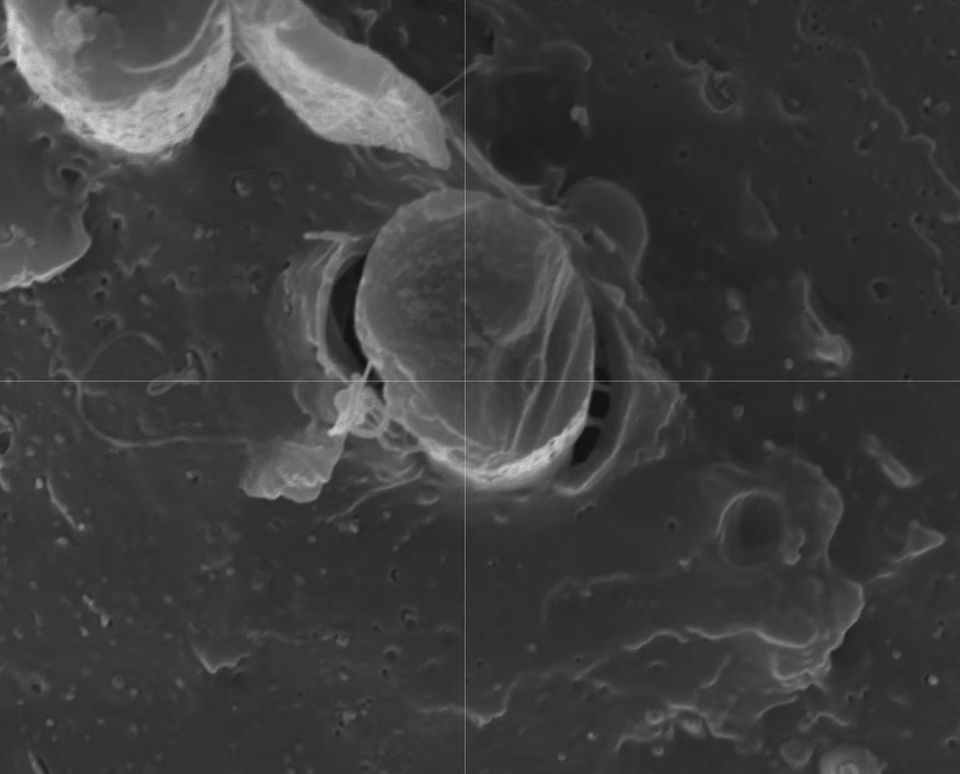
Compared to the finer chopped CF PLA-CF, what is notable here is that CF is not present between the layers, which is a good thing as this degrades layer adhesion significantly. Less good is that the same lack of polymer matrix integration is visible here, with the PLA clearly detaching from the CF and leaving behind voids.
This shows that BIQU’s PLA-CF filament fails to address the fundamental problem with PLA-CF of extremely poor matrix integration. To verify this, an undisturbed sample was put into the Micro CT scanner.
Fascinating about the Micro CT findings was that there is carbon black in the filament, which is ironically highly abrasive.
Also in the images were again what looked like air bubbles, much like in the previous video’s results. These bubbles turned out to be always linked to a CF strand, which could be due to how the PLA-CF mixture cools with the mismatch between the solid CF inside the still liquid PLA.
After a series of mechanical tests on the printed samples, the conclusion is that the part is stiffer by about 15% and due to the CF contaminant not intruding between layers it’s also better than typical PLA-CF. Of course, regular PLA outperforms both types of PLA-CF in most tests by a considerable margin, so most people are probably still better off with regular PLA.
youtube.com/embed/m7JAOi4JnBs?…