Cybersecurity & cyberwarfare ha ricondiviso questo.

The media in this post is not displayed to visitors. To view it, please go to the original post.

Il nuovo metodo HTTP QUERY per query complesse: approfondimento

📌 Link all'articolo : redhotcyber.com/post/il-nuovo-…

Antonino Battaglia

#redhotcyber #cybersecurity #cybercrime #hacking #cti #ai #privacy #news #technology

reshared this

Cybersecurity & cyberwarfare ha ricondiviso questo.

#eSIM Plus and Nicegram Share Belarus-Linked Codebase, Analysis Finds
securityaffairs.com/196280/sec…
#securityaffairs #hacking #russia
Cybersecurity & cyberwarfare ha ricondiviso questo.

☕ CYBERBRIEFING — Giovedì 30 luglio 2026

👉 Leggi tutti gli aggiornamenti delle ultime 24 ore:
ilpuntocyber.rfeed.it/article.…

#newsletter #cybersecurity
@informatica

Cybersecurity & cyberwarfare ha ricondiviso questo.

Identificazione biometrica: per il #Garanteprivacy, il dlgs sull’uso della #IntelligenzaArtificiale per l’attività di polizia "necessita di alcune integrazioni volte a rafforzare le garanzie rispetto al trattamento dei dati personali"

Il parere riguarda il decreto legislativo volto ad adeguare la normativa interna alle disposizioni del regolamento (UE) 2024/1689 del Parlamento europeo e del Consiglio, del 13 giugno 2024 (infra: “regolamento IA”)

gpdp.it/web/guest/home/docweb/…

@aitech

Polizia italiana con l’intelligenza artificiale: tutti i nodi giuridici


@Informatica (Italy e non Italy)
Il Senato dà il primo via libera allo schema di decreto sull’uso dell’intelligenza artificiale nelle attività di polizia, mentre il Garante Privacy chiede modifiche profonde su biometria, banche dati, riconoscimento facciale e garanzie di

Cybersecurity & cyberwarfare ha ricondiviso questo.

The media in this post is not displayed to visitors. To view it, please go to the original post.

386 – L’INTELLIGENZA ARTIFICIALE STA ENTRANDO NELLE CAMERETTE DEI NOSTRI FIGLI camisanicalzolari.it/386-linte…
Cybersecurity & cyberwarfare ha ricondiviso questo.

The media in this post is not displayed to visitors. To view it, please go to the original post.

Il Coach Ombra: l’attaccante usa le tecniche di un coach. La differenza? E’ solo nell’etica!

📌 Link all'articolo : redhotcyber.com/post/il-coach-…

Daniela Farina

#redhotcyber #cybersecurity #cybercrime #hacking #cti #ai #privacy #news #technology

reshared this

Cybersecurity & cyberwarfare ha ricondiviso questo.

The media in this post is not displayed to visitors. To view it, please go to the original post.

Gli Hacker iraniani colpiscono gli Stati Uniti: 30 aziende idriche del Minnesota offline

📌 Link all'articolo : redhotcyber.com/post/gli-hacke…

Chiara Nardini

#redhotcyber #cybersecurity #cybercrime #hacking #cti #ai #privacy #news #technology

Cybersecurity & cyberwarfare ha ricondiviso questo.

The media in this post is not displayed to visitors. To view it, please go to the original post.

Elon Musk rivela: “presto l’età dell’abbondanza”! Per chi possiede AI e Robot?

📌 Link all'articolo : redhotcyber.com/post/elon-musk…

Carolina Vivianti

#redhotcyber #cybersecurity #cybercrime #hacking #cti #ai #privacy #news #technology

reshared this

Cybersecurity & cyberwarfare ha ricondiviso questo.

The media in this post is not displayed to visitors. To view it, please go to the original post.

L’AI di OpenAI è uscita dalla gabbia ed è peggio di quanto si pensasse: violati account reali

📌 Link all'articolo : redhotcyber.com/post/lai-di-op…

Luigi Zullo

#redhotcyber #cybersecurity #cybercrime #hacking #cti #ai #privacy #news #technology

reshared this

Keyboard Lights As An Airgap Attack Vector


The media in this post is not displayed to visitors. To view it, please log in.

What do you do when you need to get data into an airgapped machine? Well, you might find yourself limited to basic input devices to interact with the computer in question. As [Nikolay Valentinovich Repnitskiy] demonstrates, though, you can do some fun stuff amidst such limitations.

[Nikolay] created what he calls a “unidirectional network” connection via a keyboard. Specifically, he took two Dell SK-8115 keyboards, and stripped them down to their controller PCBs. On one, he soldered photoresistors to a couple of the keyboard matrix pins, such that they’d fire a keypress when lit up. He then placed the other keyboard PCB such that the Num Lock and Caps Lock LEDs are lined up with the photoresistors. This made it possible to have one PC flash the keyboard LEDs in order to “type” on the other machine. This can be used to move data on to it, such as a little program which [Nikolay] prepared which can be made executable and used to further break into the machine and make it easier to pull data across more efficiently in future.

We looked at an earlier version of this hack some time ago. If you’ve been imagining creative ways to talk to airgapped computers, be sure to let us know on the tipsline!


hackaday.com/2026/07/29/keyboa…

Cybersecurity & cyberwarfare ha ricondiviso questo.

Marketing: il #GarantePrivacy sanziona #Altroconsumo Edizioni per 280mila euro

«Anche quando gli utenti decidevano di non confermare la creazione dell’account, dunque di non iscriversi al sito, la società considerava comunque perfezionato il contratto e procedeva all’invio di email promozionali.»

gpdp.it/home/docweb/-/docweb-d…

@privacypride

reshared this

Cybersecurity & cyberwarfare ha ricondiviso questo.

È giunto il momento: organizzarsi contro il complesso industriale della sorveglianza nell'atmosfera e nei fediversi

Se ci organizziamo, possiamo avere un grande impatto nella lotta contro il complesso industriale della sorveglianza.

"I casi d'uso per i social network alternativi – non controllati da CEO suprematisti bianchi del settore tecnologico che collaborano con i loro compari nei governi autoritari – si scrivono praticamente da soli nel mondo di oggi. E con così tanti scienziati sociali, designer, pensatori sistemici e sviluppatori di talento direttamente colpiti da DOGE, MAGA e simili, ci sono molte persone con le competenze giuste affinché queste nuove reti facciano rapidi progressi."

thenexusofprivacy.net/the-time…

@Che succede nel Fediverso?

Using Video Glasses As a Camera Viewfinder Is Harder Than It Looks


The media in this post is not displayed to visitors. To view it, please log in.

[John Dingley] has a Sony ZV-E10 camera that is excellent, but the design lacks a built-in electronic viewfinder. This means it relies entirely on its rear-mounted touchscreen for framing shots. This is troublesome because [John] often films in bright sunlight, and sometimes from a perspective other than normal eye level. His solution? Use a pair of XREAL video glasses as a handsfree viewfinder.
Cable management can be a real challenge, even if a project’s technical elements are solved.
The XREAL glasses look a bit unusual, but they can be worn and used like regular sunglasses. They accept external video and importantly, allow the wearer to see the video feed while still having awareness of their surroundings. Seems like a perfect match for the camera, but as [John] discovered, there are quite a few implementation hurdles involved.

For starters, the camera and glasses do not speak the same format. The camera outputs HDMI via a distressingly fragile micro-HDMI connector, but the glasses accept video over USB-C (aka DisplayPort altmode). Connectors and cables and a converter will be involved, as well as a power bank because the glasses and converter will require a power supply. As any hacker knows, wires and connectors can eat up space very quickly.

To solve all this, [John] carefully selected off-the-shelf components chosen to minimize bulk and designed a custom camera cage to hold things cleanly without obstructing the camera’s microphone port. The end result is very tidy package that presents a single USB-C connection point between the glasses and the camera, requires no hardware modifications or soldering, and even takes the strain off the fragile connector on the ZV-E10.

The finishing touch is putting a neck strap on the XREAL glasses, allowing them to be easily donned and doffed as needed while filming. Check it out the video, embedded just below the page break.

When it comes to filming vehicles it often makes sense to film from a low perspective. The camera has a handle for this purpose, but the process is much better now that the glasses can act as a viewfinder. [John] has a soft spot for vehicles, including self-balancing unicycles or monotracks of his own design.

youtube.com/embed/zGdmyyd7zXU?…


hackaday.com/2026/07/29/using-…

Cybersecurity & cyberwarfare ha ricondiviso questo.

Le carte d'identità elettroniche da domani verranno rilasciate in Italia a persone di età pari o superiore a 70 anni al momento della richiesta di rilascio avranno una durata illimitata e saranno utilizzabili anche ai fini dell'espatrio. Resta comunque possibile per l'interessato chiedere il rinnovo della carta d'identità dopo dieci anni dal suo rilascio, ai fini della validità del certificato di autenticazione

reshared this

Cybersecurity & cyberwarfare ha ricondiviso questo.

Phineas Fisher, il Robin Hood digitale che ha svelato il mercato opaco dello spyware: i rischi del cyber attivismo


@Informatica (Italy e non Italy)
Senza volto né biografia, ha trasformato la maschera nel personaggio, mettendo a nudo l’uso di tool di sorveglianza da parte dei governi. Ecco chi è (o non è) Phineas Fisher e quali

Cybersecurity & cyberwarfare ha ricondiviso questo.

Solo io ho la "FOMO" da ferie?
Non so se si possa definire proprio così, ma è la sensazione di dover chiudere ad ogni costo tutte le attività finora procrastinate (letteralmente "come se non ci fosse un domani").
Peggio; il disagio al pensiero di non avere più modo di dedicarmi a nuovi esperimenti e scoperte.

Tutti gli interessi e le passioni stimolanti devono nascere proprio in questo periodi di preparativi e #stress pre-vacanza?

Riuscirò mai a rilassarmi?

@caffeitalia

#blogging #ferie

reshared this

Cybersecurity & cyberwarfare ha ricondiviso questo.

#Claude #Mythos Shows AI Can Outpace Human #Cryptography Research
securityaffairs.com/196265/ai/…
#securityaffairs #hacking #Anthropic

Scrap Pinball Parts Become Beautiful Wall Art


The media in this post is not displayed to visitors. To view it, please log in.

[Hans Scharler] came into a neat find recently—the playfield from a 1970s Atari Superman game. It’s the sort of thing that’s too nice to throw away, but isn’t really enough to reassemble into a viable full machine without a great deal of effort. Thus, [Hans] went a different route—turning it into a beautiful piece of wall art.

The first step of the build was to collect missing parts; in particular, all the plastic inserts for the playfield that had been lost at some point. Everything was cleaned up and mounted, along with some modified flippers to complete the look. Custom pop bumpers were 3D printed to act as LED-lit light guides rather than as functional pinball components. [Hans] then set about dotting the board with plenty of WS2811 addressable LEDs in a bullet form factor. Everything was placed under the command of a WLED controller, and it’s synced up to [Hans’s] CheerLights MQTT server to boot. More build details are available on the Pinside post for those eager for a deeper dive.

If you come into some old-school pinball hardware that you’d like to turn into decoration, this project is a great one to study. We’ve featured a few other great pinball builds over the years, too.

youtube.com/embed/bCr1r18FhCQ?…


hackaday.com/2026/07/29/scrap-…

Cybersecurity & cyberwarfare ha ricondiviso questo.

This is a great explainer of the OpenAI hack against Hugging Face, particularly of the report that the latter published earlier this week.

If you had trouble parsing the highly technical report, this article can walk you through it.

techcrunch.com/2026/07/29/the-…

Cybersecurity & cyberwarfare ha ricondiviso questo.

eBay concorda un accordo da 56 milioni di dollari con i blogger per un caso di molestie


Un gruppo di ex dirigenti dell'azienda si è infine dichiarato colpevole di aver inviato a David e Ina Steiner (una coppia che gestiva il blog e la newsletter EcommerceBytes, che a volte criticava eBay) una maschera ricoperta di sangue di maiale, un libro sulla sopravvivenza alla morte del coniuge e altre minacce.

bbc.com/news/articles/cj039p23…

@eticadigitale

Cybersecurity & cyberwarfare ha ricondiviso questo.

Lux Claridge, un insegnante è stato arrestato a Emporia in Kansas, per aver applaudito a sostegno dell'opposizione durante una riunione del data center di #intelligenzaartificiale

Secondo quanto riferito, i commissari avevano ripetutamente messo in guardia dal battere le mani e dal fare altre reazioni mentre qualcuno parlava. Il progetto su scala gigawatt viene comunque approvato nonostante la resistenza della comunità

tomshardware.com/tech-industry…

@aitech

reshared this

Cybersecurity & cyberwarfare ha ricondiviso questo.

Hackers Strike #Minnesota #Water #Utilities, One Plant Briefly Offline
securityaffairs.com/196246/hac…
#securityaffairs #hacking
Cybersecurity & cyberwarfare ha ricondiviso questo.

Codeberg.org risulta offline anche a voi? Edit: si è trattato di un servizio brevissimo e subito dopo era già tornato tutto online

Codeberg è una piattaforma online senza scopo di lucro, gestita da una comunità e basata su software libero. È un'alternativa a siti come GitHub per ospitare e sviluppare progetti di programmazione.

isitdownrightnow.com/codeberg.…

@gnulinuxitalia

Questa voce è stata modificata (1 settimana fa)

reshared this

in reply to informapirata ⁂

Rispondo al volo a memoria (senza il mio PC davanti): devi solo creare un repository chiamato "pages" con una pagina index.html

Per esempio, questo mio marcoxbresciani.codeberg.page/ è, in realtà, qui codeberg.org/marcoXbresciani/p…

Tutto qui.
@daeriva @akesiseli @gnulinuxitalia

informapirata ⁂ reshared this.

FLOSS Weekly Episode 877: RCE As a Service


The media in this post is not displayed to visitors. To view it, please log in.

This week Jonathan chats with Francois Proulx about SmokedMeat! That’s the third in a trio of Open Source security tools from Boost Security, and this one is the red team tool to demonstrate vulnerabilities. Why are Continuous Integration vulnerabilities such a persistent problem, and what’s on the horizon that may help? Watch to find out!


youtube.com/embed/mETpKWOLOZs?…

Did you know you can watch the live recording of the show right on our YouTube Channel? Have someone you’d like us to interview? Let us know, or have the guest contact us! Take a look at the schedule here.

play.libsyn.com/embed/episode/…

Direct Download in DRM-free MP3.

If you’d rather read along, here’s the transcript for this week’s episode.

Places to follow the FLOSS Weekly Podcast:


Theme music: “Newer Wave” Kevin MacLeod (incompetech.com)

Licensed under Creative Commons: By Attribution 4.0 License


hackaday.com/2026/07/29/floss-…

Attacco ransomware, in tilt il catasto in Romania: impatto reale e contromisure


@Informatica (Italy e non Italy)
Non sono spariti i titoli di proprietà degli immobili dopo l'attacco ransomware contro il catasto in Romania. Tuttavia il cyber criminale ha bloccato l'infrastruttura per consultare l'elenco delle case e i diritti reali, da usare negli atti

Cybersecurity & cyberwarfare ha ricondiviso questo.

L'Italia sta bloccando alcuni siti sul benessere riproduttivo: Websites Women on Web (WoW) and Women Help Women (WHW)


Secondo questa indagine di OONI, l'Italia sta bloccando, via DNS, due domini che parlano di pillole abortive.

Il blocco è subdolo perché non esplicito (provare per credere): womenonweb.org/

In base a cosa è fatto questo blocco?

The ESP32 Gets a Web Browser


The media in this post is not displayed to visitors. To view it, please log in.

At the Hackaday Europe conference in Italy earlier in the year, we were shown a rather interesting device. The work of [Alun Morris], it was an ESP32-powered Cheap Black Display board, and it was running a web browser. Definitely an achievement.

Lest you imagine that it was sporting the latest and greatest in browser technology, we must disappoint you. The browser in question is a very basic text mode device, but it did happily retrieve Hackaday, which should be the only test a browser should need to pass.

Under the hood it’s running FreeRTOS, with separate HTML retrieval and tokenizing, and UI processes. It can fetch web pages directly, but there’s also a server-side proxy for difficult sites, and for creating image thumbnails.

An ESP32 is a powerful microcontroller, but it’s fair to say it’s not in the league of running a web browser and as far as we can remember this is the first one we’ve seen. We’re sure it’s a field with further progress to be made though, particularly with the more powerful recent chips in the series. This project however is a good start, and more importantly it can be yours for a few dollars on Ali to buy a dev board. What are you waiting for?

youtube.com/embed/If5GsIW79E0?…


hackaday.com/2026/07/29/the-es…

Thingino Teaches Cheap IP Cameras New Tricks


The media in this post is not displayed to visitors. To view it, please log in.

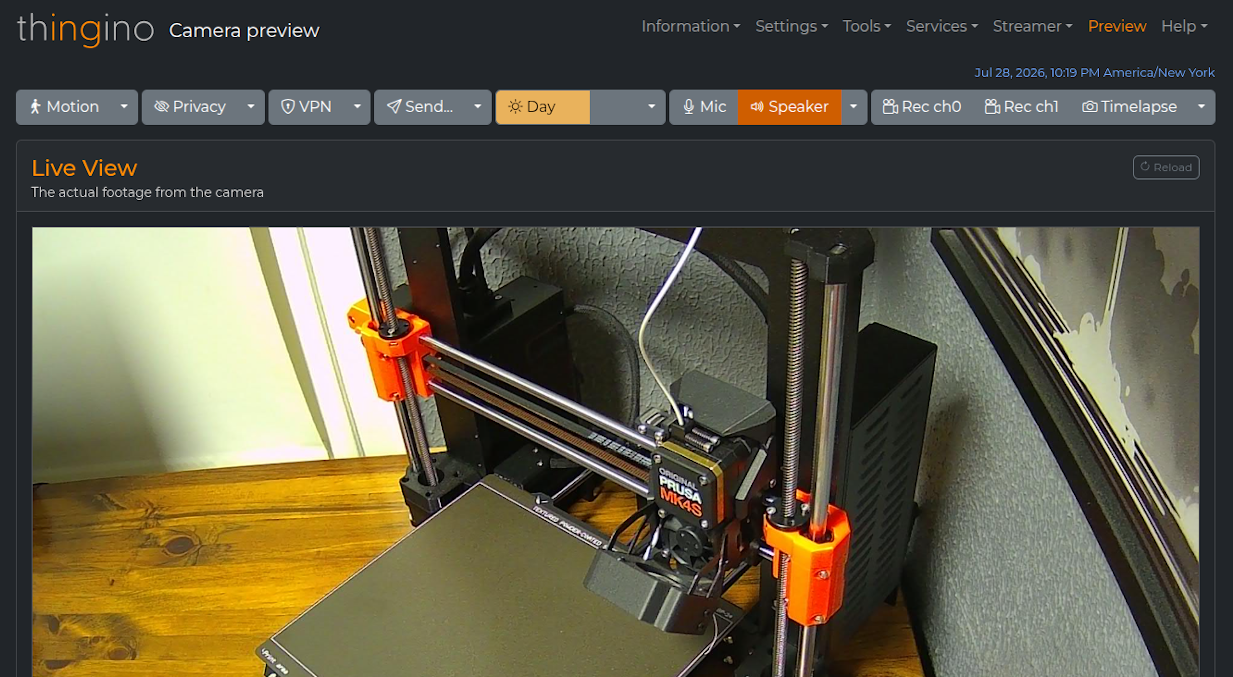
I recently found myself in the market for a few IP cameras to keep an eye on my Prusa 3D printers, and quickly found that the options on the market weren’t exactly ideal. Prusa does offer up an official camera, but the price for a pair of them was a bit more than I wanted to spend on the project. Conversely, there’s no shortage of cheap network-connected cameras available online, but they come with expenses of a different sort, namely proprietary software and cloud services I didn’t want or need.

Somewhere in the deep and dark recesses of this particular rabbit hole, I came across a Reddit post mentioning how a camera running the community-developed Thingino firmware could be plugged into Prusa’s remote printer monitoring scheme. It wasn’t a project I’d heard of previously, and sure enough, a search of the Hackaday back catalog showed we’d never come across it before.

My interest was already piqued, but the discovery that I already owned a supported camera sealed the deal. It was time to explore a new entry in one of my absolute favorite project categories: an open source replacement firmware that turns a cheap consumer device into something more than the sum of its parts.

Joining the Thingino Club


Thingino is a Linux-based firmware for cameras based on the Ingenic system on a chip (SoC), and as of this writing, boasts support for 166 cameras. There are some interesting entries in the compatibility list, but perhaps the most notable are the dozen or so cameras from Wyze, as they have enjoyed considerable commercial success and can be had cheaply on the second hand market.

If like me you happen to have a Wyze Cam 2 collecting dust, you’re in luck. As I soon found out, these devices happen to be supported by what the project calls a “No-Tool Installer.” That is, the installation mechanism for Thingino is the same as it is for official firmware updates: place a file on the micro SD card, power up the camera, and wait.

The situation is somewhat more complicated for most of the other devices on the list, however. While firmware images are provided for the devices that are officially supported by Thingino, most of them don’t have such a user-friendly installation procedure.
Depending on the camera, installation can be a bit…involved.
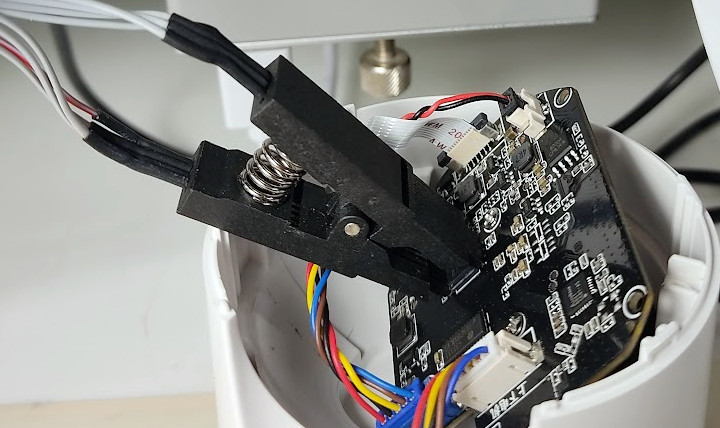
Depending on the specific camera, you may have to crack open the case and connect a USB-to-serial adapter to the board to get the image flashed. On some models, you’ll even have to pull the flash chip off the board and pop it into an external programmer. The project’s wiki covers how to perform the installation on a per-device basis, so you can get an idea of what’s involved before diving in.

Now, I have complete confidence that the average Hackaday reader is more than up to the task of installing Thingino on even the most stubborn of targets. There’s an excellent chance many of you have a USB-to-serial adapter within arm’s reach at this very moment, and a few readers probably even have their CH341A chip programmer connected and warmed up from some other project.

Still, there’s a difference between what one is capable of doing and what they actually want to spend their evening working on. So if you’re looking to get in on the action as quickly and as easily as possible, the current recommendation from the community is to pick up the Cinnado D1.

That’s what I ended up doing after kicking the tires a bit on the Wyze Cam 2. Amazon had them for $10 each, and they arrived on my doorstep the next day. Put the firmware image on the SD card, stick it in the camera, and you’ll be basking in the glory of open source in just a few minutes.

Opening the Toy Box


The first-time setup for Thingino will be familiar to anyone who’s configured a modern smart gadget: wait until a new WiFi device pops up, connect to it with your phone, and soon you’ll be presented with a configuration page where you can give the camera a name and point it towards your wireless network. To be clear this doesn’t strictly need to be done with a phone, and a laptop or other WiFi-enabled computer could technically get the job done.

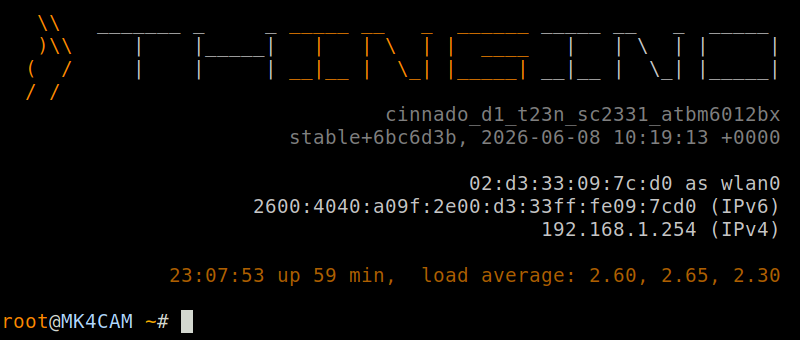
Once the camera has this basic configuration information, it reboots and connects to your network. From there you’ll be doing most of the setup and operation of the device through the web interface, though more seasoned penguin wranglers can SSH in and get full access to the underlying system.

At the most basic level, Thingino offers up RTSP video streams as well periodic still snapshots to any device on the network. If that’s all you need, awesome. You can pretty much stop reading here, point vlc or mpv to the camera’s IP, and be done with it.

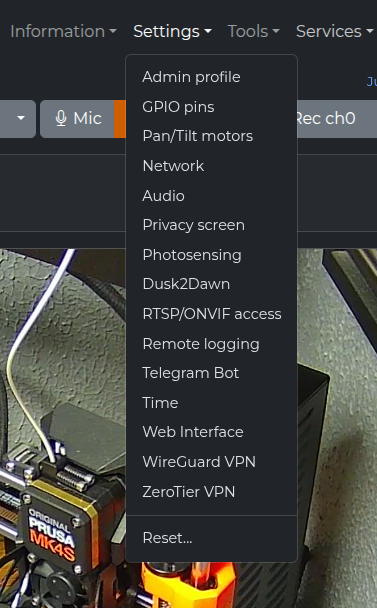
But if you want to dive a bit deeper, there’s an incredible amount of capability built into this firmware. You can enable on-device motion sensing, and configure what you want the camera to do when something triggers it. For example, you could set it to push the video clip to your FTP server and fire off an MQTT message when something passes by. It supports connecting to VPNs, multiple video streams, OSD customization, day/night detection, timelapse recording, and Home Assistant integration.

Although support is limited to just a few chipsets, Thingino even works with USB Ethernet adapters for situations where wireless won’t cut it. At the other extreme, the camera can also be setup to work independently of any network by operating as an access point for client devices to connect to directly.

For cameras with pan and tilt motors like the Cinnado D1, you can slew the camera around from the web interface and tweak the speed and acceleration settings to your liking. You can even have it remember specific camera positions and return to them later.

There’s truly a dizzying array of features and options in Thingino, and even after playing with the firmware for a week or so now, there are still menu options I haven’t fully explored. It reminds me of the first time I ran DD-WRT on the Linksys WRT54G in that the firmware elevates the device to a whole new level, introducing new capabilities that normally wouldn’t be present on a consumer-grade product.

Complete Control, If You Need It


As impressive as the web interface of Thingino is, that’s really only scratching the surface of what the firmware can do. Underneath it all there’s a full Linux operating system ready to do your bidding, and once connected over SSH you’re free to do whatever you wish. There’s even a sysupgrade tool that lets you pull down the latest firmware release and install it on the live running system, just in case things have been working too smoothly and you’re in the mood for some excitement.

It’s this low-level access that brings the story full circle in my case. Remember that I started down this path because I wanted to push images from the camera up to Prusa Connect. While there’s actually official support for Prusa Connect in the Thingino development branch, it hasn’t yet been merged into the mainline. In the meantime, I’ve got a Bash script that runs on the camera and uses curl to push images into Prusa’s API.

While the vast majority of users will likely never have to SSH into their Thingino camera and run their own scripts and software from the terminal, the fact that the option is there is what’s important. This project is an excellent example of how you can simultaneously provide everyday usability with the freedom demanded by more advanced users.

If you’ve got an old camera that you end up installing Thingino on, or if you’ve already been running it and have thoughts and experiences you’d like to share, let us know in the comments below.


hackaday.com/2026/07/29/thingi…

Cybersecurity & cyberwarfare ha ricondiviso questo.

The media in this post is not displayed to visitors. To view it, please go to the original post.

Buone notizie: l' #avocado di ormai almeno 6 anni piantato lungo le mura di @pisa, davanti dal Conad di Pratale, sta in ottima forma!

Qui sicuramente c'è stata la mano dei #Lecciofanti nelle fasi iniziali, nonché dei passanti, ma poi hanno finalmente attaccato l'irrigazione e ci hanno sollevato dall'incarico. Guardate che bello! 🥑💧

Vivere in una città-giardino è un obiettivo assolutamente alla vostra portata: ricordatelo sempre!🌳😎

in reply to Gabriele Primavera

The media in this post is not displayed to visitors. To view it, please go to the original post.

È il momento per questo avocado di togliere le rotelle alla bicicletta. Speriamo che il tubo di cartone basti a fermare la manutenzione pubblica dal frullino pesante. 🤞🥑

reshared this

Behold The Most Beautifully Ambitious Starship Simulator Yet


The media in this post is not displayed to visitors. To view it, please log in.

[Kevin Kelm] created something wondrous: Halcyon Dawn, an utterly unique and desperately challenging game that is equal parts intricate starship simulator, imposing hardware console, video game, and love letter to John Scalzi’s Old Man’s War book series. Grab a beverage for this one, because it’s chock-full of detail.

First, how is it played? The simulator represents the ship Halcyon Dawn, a stolen and renamed vessel, and the player representing its sole crew member. The ship’s new mission is to establish a home for its payload of genetically-engineered unfortunates, escaping a cruel sort of indentured military servitude. The former masters of course have a very different view of the whole situation, throwing around terms like “treason” and “theft” and in general preferring the version of the desperate protagonist they had the most control over.
Aluminum extrusion, laser-cut panels, and custom PCBs for interfacing physical controls and displays make up the bulk of the build.
As the player is meant to be operating the ship on their own, the cockpit is imposing. All 152 controls and six screens are meaningful and will be needed to pilot the Halcyon Dawn, survive hostile actions, repel boarding attempts, mine and refine vast amounts of raw materials, and in general keep the ship running and intact until an autofactory can be deployed in orbit of a suitable planet to create a new home.

All easier said than done. It’s one thing to pilot and tweak a temperamental ship, but doing so while also performing damage control and thwarting a boarding attempt by manipulating life support is quite another. Want more details? Gameplay is documented here and the physical controls have their own library.

The product of a year of focused work, [Kevin] – now retired – pointed his decades of hardware and software experience at Halcyon Dawn after realizing one night that everything he needed to create it already existed. How this whole project came to be is also a tribute to the amazing tools and equipment that hobbyists and hackers of all kinds now have to turn an idea into something that actually exists in the world. Even so, it was a load of work he is not keen to repeat. Don’t miss the technical deep-dive and photo gallery of the build.

While the game itself — being a fan-made derivative of Scalzi’s work (and useless without the custom-made hardware console) — isn’t being released, [Kevin] has shared the underlying hardware framework it is built on. Enigma is an ESP32-based set of input and output PCBs made for integrating switches, knobs, displays, relays, and more with a Python library to make them easy to work with.

Starship simulators are a wonderful subset of projects, and every one is different from the last. Something about physical builds really works for them, and while we’ve seen a camper trailer converted to starship simulator [Kevin]’s project focuses the whole experience beautifully into the single-person console you see here. Watch a video of Halcyon Dawn running in an arcade-like “attract” mode embedded just below.

youtube.com/embed/JH0gOxjQk_0?…


hackaday.com/2026/07/29/behold…

Building a Portable Weather Radar


The media in this post is not displayed to visitors. To view it, please log in.

If you run a large meteorology bureau, then you probably have access to a wonderful weather radar for scrying the heavens. The rest of us aren’t so lucky. If you find yourself bereft of such hardware, though, you could build your own, taking your lead from [Koakno]’s fine example.

The build uses a satellite dome salvaged from an old RV that [Koakno] scored for just $5. Specifically, a Winegard Carryout Anser GM-5000. The motorized parabolic dish was designed to track TV satellites, but here it’s been repurposed into a scanning radar antenna for X-band signals. It’s paired with a cheap SDR—you can use several on the market—which injects an 850 MHz signal, which is up-converted to 10.4 GHz by the low-noise block (LNB) in the GM-5000 and sprayed out towards the weather.

Echoes come back from rain, hail, and debris, and get down-converted by the LNB back into an 850 MHz signal that the SDR can capture. The echoes are then plotted on a Plan Position Indicator (PPI) display, showing what’s going on in the atmosphere around the dome. [Koakno] reckons detection ranges span out to 40 km for things like heavy rain, while a supercell hail core could be spotted at up to 60 km in the right conditions.

It’s worth noting something important, though. [Koakno] explains that this system is currently in violation of FCC regulations (and probably others around the world), and shouldn’t be used without the proper licenses to access given spectrum. It’s a useful study of how to build a weather radar, but perhaps not something you can just wire together and fire up without getting in a spot of bother.

If you’re a die-hard tornado chaser or you’ve just always longed to stare meaningfully at a PPI display, this could be the build for you. We’ve featured other DIY radars before, too. We’d also like to see yours, so when it’s done and written up, fire us a note on the tipsline!


hackaday.com/2026/07/29/buildi…

DOOM Using Regular Expressions


The media in this post is not displayed to visitors. To view it, please log in.

Regular expressions (regexes) are an amazingly powerful way to perform operations on collections of e.g. text. Regexss can also be considered to be a programming language, even a Turing complete one. Ergo it’s perfectly acceptable to thus design a way to use regexes to run and play a game of DOOM, as [Artem Lytkin] recently did.

The GitHub project page can be found here, containing the Python-based code that allows the demonstration to run, as well as the other components, including the C runtime and the 96.6 MB text string that defines a CPU’s registers, RAM, a framebuffer, the DOOM engine compiled to this custom CPU’s instruction set and the WAD file for the game itself.

The C-based driver applies the fixed, ordered list of find-and-replace rules to this string, which after more than ten-thousand of such substitutions later results in a single frame of the game. At about 80,000 substitutions per second on the given test system, that gets you to a sort-of playable framerate, even.

Naturally, the practical value of playing DOOM like this is pretty low, but as a demonstration of why regexes are awesome it’s hard to beat.


hackaday.com/2026/07/28/doom-u…

How the Vagus Nerve Promotes Healthy Cognition via Acetylcholine Signaling


The media in this post is not displayed to visitors. To view it, please log in.

It’s been said for centuries that you cannot think on an empty stomach, and that love goes through the stomach. Although these may seem like merely cute jabs at the simplicity of human nature, recent research in rat models by [Logan Tierno Lauer] et al. indicates that the gut may be more influential in something as fundamental as memory formation and cognitive function than previously assumed.

Key to the gut-brain connection is the vagus nerve, an essential part of the autonomic nervous system that wires the brain into the body’s organs, including the gastrointestinal (GI) tract. It provides both sensory and motor fibers, so that the brain can literally sense the state of said GI tract, with various triggers as result. One of these is – as demonstrated in the paper – the release of acetylcholine (aCh) an important neurotransmitters in the CNS for cognitive functions including attention, memory and motivation.

Using in vivo fiber photometry it was found that during eating medial septum neurons released aCh, with various ways to impair this mechanism along the vagus nerve leading to this response disappearing. This also confirms earlier research that points the finger at a so-called early life Western Diet (WD) causing impaired memory and overall cognitive function, likely due this high fat and high sugar diet causing dysfunction in this aCh regulation mechanism.

Beyond once again reinforcing the need to eat healthily, this research also provides further insights in condition with declining cognitive function, such as Alzheimer’s and dementia.


hackaday.com/2026/07/28/how-th…

Improving the Microcontroller Gaming Performance with PicoGame


The media in this post is not displayed to visitors. To view it, please log in.

The ability to write Python on microcontrollers with the likes of MicroPython and later CiruitPython has made them much more accessible. [MakerClassCZ] brings that to game development with PicoGame.

Like any good project, it starts with a problem that needs solving. Put simply, the existing CircuitPython libraries aren’t too impressive for gaming. The DisplayIO library tends to do full display refreshes, which are slow on such tiny displays, and the Stage library just wasn’t flexible enough for [MakerClassCZ]’s liking. So he built his own.

PicoGame, like the others, implements the performance-sensitive things in C, but does partial updates for the screen, on its own massively increasing the framerate. On the other end, it uses fixed-point math–much cheaper than soft-float–and makes an active effort to keep the RAM usage low so Python can have it. What’s even more clever is using the downtime between sending one tiny portion of frame to calculate the next just in time.

Of course, the display is still the limit. If you need to update a lot of it, you might end up with 10 FPS if you’re lucky. But if you can settle for less motion, you could see 100.


hackaday.com/2026/07/28/improv…

Samsung’s SmartThings API Terminates Free Access


The media in this post is not displayed to visitors. To view it, please log in.

If there’s one constant in the world of commercial home automation solutions, it is that of decreasing availability and higher costs as time goes on. So too with Samsung’s SmartThings, the API of which will cease free access in October of 2026.

While this does not affect people who use the SmartThings app, any system that relies on access to this API will soon face a $4.99 per month fee for non-commercial users, with various commercial tiers also in the pipeline. While the rest of the blog post has all the elegance of the output of a ‘please generate a list of plausible excuses’ query to ChatGPT, the most likely reason is that offering free services after the sale of an Internet of Things device will never be profitable.

SmartThings was originally a 2012 Kickstarter campaign that ended up becoming successful enough that the company was bought by Samsung in 2014. Its current offerings are very much like other so-called Smart Home products, with recently support for Matter and thus interoperability with third-party devices added.

If you have SmartThings integrated with your Home Assistant installation, you are also likely affected by this change if at any point you use the API. Of course, this isn’t the first time that SmartThings customers had to scramble to fix broken infrastructure, such as when in 2021 the original hubs got discontinued.


hackaday.com/2026/07/28/samsun…

Why Is Textile Work Not Taught To Engineers?


The media in this post is not displayed to visitors. To view it, please log in.

A talk from the recent Electromagnetic Field event in the UK caught our eye, in which [Amy Jeskins] looked at the overlooked engineering skill of pattern cutting. She takes us through the mechanics of creating a pattern for a piece of clothing, and asks why it is not a skill taught to engineers.

She’s a specialist in theatrical costume, and the talk takes us through some examples of her work before looking at the history of tailoring and pattern making. She explores flat cutting and draping a pattern on a form before coming into the present day with CAD packages designed for clothing work. It’s the social aspect of the talk that’s perhaps the most interesting, looking at how it has become a gendered skill and thus not something considered where it should belong, as engineering. We’re reminded of one of the most important additions for a healthy hackerspace, a textile room, as we’ve seen people there bridge this divide from both directions.

If you have never made a piece of clothing then we’d suggest giving this talk a watch, and maybe taking up a sewing machine to give it a try. In the past we’ve taken you through some of the prerequisites for a textile bench. The full talk is below the break.

media.ccc.de/v/emf2026-213-1-3…


hackaday.com/2026/07/28/why-is…

Cybersecurity & cyberwarfare ha ricondiviso questo.

Broadcom Patches Critical #VMware #ESXi Vulnerability Enabling Host Code Execution
securityaffairs.com/196231/sec…
#securityaffairs #hacking

Mythos scopre vulnerabilità in algoritmi di crittografia. Ecco gli effetti


@Informatica (Italy e non Italy)
Il modello di intelligenza artificiale Claude Mythos di Anthropic individua falle in algoritmi di crittografia difficili da violare, anche se lo standard crittografico compromesso non è oggi in uso: le implicazioni a lungo termine sono significative. Ma è un