What the FDA’s 2026 Wellness Device Update Means for Wearables


The media in this post is not displayed to visitors. To view it, please log in.

With more and more sensors being crammed into the consumer devices that many of us wear every day, the question of where medical devices begin and end, and how they should be regulated become ever more pertinent. When a ‘watch’ no longer just shows the time, but can keep track of a dozen vital measurements, and the line between ‘earbud’ and ‘hearing aid’ is a rather fuzzy one, this necessitates that institutions like the US FDA update their medical device rules, as was done recently in its 2026 update.

This determines how exactly these devices are regulated, and in how far their data can be used for medical purposes. An important clarification made in the 2026 update is the distinction between ‘medical information’ and ‘signals/patterns’. Meaning that while a non-calibrated fitness tracker or smart watch does not provide medically valid information, it can be used to detect patterns and events that warrant a closer look, such as indications of arrhythmia or low blood oxygen saturation.

As detailed in the IEEE Spectrum article, these consumer devices are thus ‘general wellness’ devices, and should be marketed as such, without embellished claims. Least of all should they be sold as devices that can provide medical information.

Another major aspect with these general wellness devices is what happens to the data that they generate. While not medical information, it does provide health information about a person that e.g. a marketing company would kill for to obtain. This privacy issue is unresolved in the US market, while other countries prescribe strict requirements about such data handling.

Effectively, this leaves the designers of wearables relatively free to do whatever they want, as long as they do not claim that the medical data being produced from any sensors is medical information. How this data is being handled is strictly regulated in most markets, except for the US, which is quite worrying and something you should definitely be aware of.

As for other medical device purposes like hearing aids, the earbuds capable of this fortunately do not generally collect information. They do need to have local regulatory approval to enable the feature, however, even if you can bypass any geofencing with some creative hacking.


hackaday.com/2026/02/16/what-t…

A Basic Guide To Shielding


The media in this post is not displayed to visitors. To view it, please log in.

[GreatScott] has recently been tinkering in the world of radio frequency emissions, going so far as to put their own designs in a proper test chamber to determine whether they meet contemporary standards for noise output. This led them to explore the concept of shielding, and how a bit of well-placed metal can make all the difference in this regard.

The video focuses on three common types of shielding—absorber sheets, shielding tapes, and shielding cabinets. A wide variety of electronic devices use one or more of these types of shielding. [GreatScott] shows off their basic effectiveness by putting various types of shielding in between a noise source and a near-field probe hooked up to a receiver. Just placing a bit of conductive material in between the two can cut down on noise significantly. Then, a software defined radio (SDR) was busted out for some more serious analysis. [GreatScott] shows how Faraday cages (or simple shielding cabinets] can be used to crush down spurious RF outputs to almost nothing, and how his noisy buck-boost designs can be quieted down with the use of the right absorber sheets that deal well with the problematic frequencies in question. The ultimate upshot of the tests is that higher frequencies respond best to conductive shielding that is well enclosed, while lower frequency noise benefits from more absorptive shielding materials with the right permeability for the job.

Shielding design can be a complex topic that you probably won’t master in a ten minute YouTube video, but this content is a great primer if you’re new to the topic. We’ve covered the topic before, too, particularly on how a bit of DIY shielding can really aid a cheap SDR’s performance. Video after the break.

youtube.com/embed/n5KC1TlKKwQ?…


hackaday.com/2026/02/16/a-basi…

A Computer That Fits Inside A Camera Lens


The media in this post is not displayed to visitors. To view it, please log in.

For a long while, digital single-lens reflex (DSLR) cameras were the king of the castle for professional and amateur photography. They brought large sensors, interchangeable lenses, and professional-level viewfinders to the digital world at approachable prices, and then cemented their lead when they started being used to create video as well. They’re experiencing a bit of a decline now, though, as mirrorless cameras start to dominate, and with that comes some unique opportunities. To attach a lens meant for a DSLR to a mirrorless camera, an adapter housing must be used, and [Ancient] found a way to squeeze a computer and a programmable aperture into this tiny space.

The programmable aperture is based on an LCD screen from an old cell phone. LCD screens are generally transparent until their pixels are switched, and in most uses as displays a backer is put in place so someone can make out what is on the screen. [Ancient] is removing this backer, though, allowing the LCD to be completely transparent when switched off. The screen is placed inside this lens adapter housing in the middle of a PCB where a small computer is also placed. The computer controls the LCD via a set of buttons on the outside of the housing, allowing the photographer to use this screen as a programmable aperture.

The LCD-as-aperture has a number of interesting uses that would be impossible with a standard iris aperture. Not only can it function as a standard iris aperture, but it can do things like cycle through different areas of the image in sequence, open up arbitrary parts or close off others, and a number of other unique options. It’s worth checking out the video below, as [Ancient] demonstrates many of these effects towards the end. We’ve seen some of these effects before, although those were in lenses that were mechanically controlled instead.

youtube.com/embed/Kg_2MAgS_pE?…

Thanks to [kemfic] for the tip!


hackaday.com/2026/02/16/a-comp…

Retrotechtacular: Mr. Wizard Jams with IBM


The media in this post is not displayed to visitors. To view it, please log in.

You may not remember [Mr. Wizard], but he was a staple of nerd kids over a few decades, teaching science to kids via the magic of television. The Computer History Archives Project has a partially restored film of [Mr. Wizard] showing off sounds and noise on a state-of-the-art (for 1963) Tektronix 504 oscilloscope. He talks about noise and also shows the famous IBM mainframe rendition of the song “Daisy Bell.” You can see the video along with some extras below.

You might recall that the movie “2001: A Space Odyssey” paid homage to the IBM computer’s singing debut by having HAL 9000 sing the same song as it is being deactivated. The idea that HAL was IBM “minus one” has been repeatedly denied, but we still remain convinced.

Can you imagine a TV show these days that would teach kids about signal-to-noise ratio or even show them an actual oscilloscope? We suppose that’s what YouTube is for.

At about the 17-minute mark, you can see some enormous walkie-talkies. A far cry from today’s cell phones. At the 27-minute mark, another film shows how engineers at Bell created the song using a mainframe.

We wish there were a modern version of [Mr. Wizard]. Then again, there’s no reason you can’t fill in. You might not be on TV, but you can always drop in on a few classrooms.

youtube.com/embed/l381_ho8KR8?…


hackaday.com/2026/02/16/retrot…

Il recruiting si trasforma in arma di compromissione: così funziona la truffa e come difendersi


@Informatica (Italy e non Italy)
È stata ribattezzata Graphalgo la campagna di social engineering mirata contro sviluppatori software attivi nell’ecosistema crypto e blockchain, basata su un sofisticato schema di falso reclutamento. L’obiettivo, oltre

Keebin’ with Kristina: the One With the NEO With the Typewriter Shell


The media in this post is not displayed to visitors. To view it, please log in.

Illustrated Kristina with an IBM Model M keyboard floating between her hands.

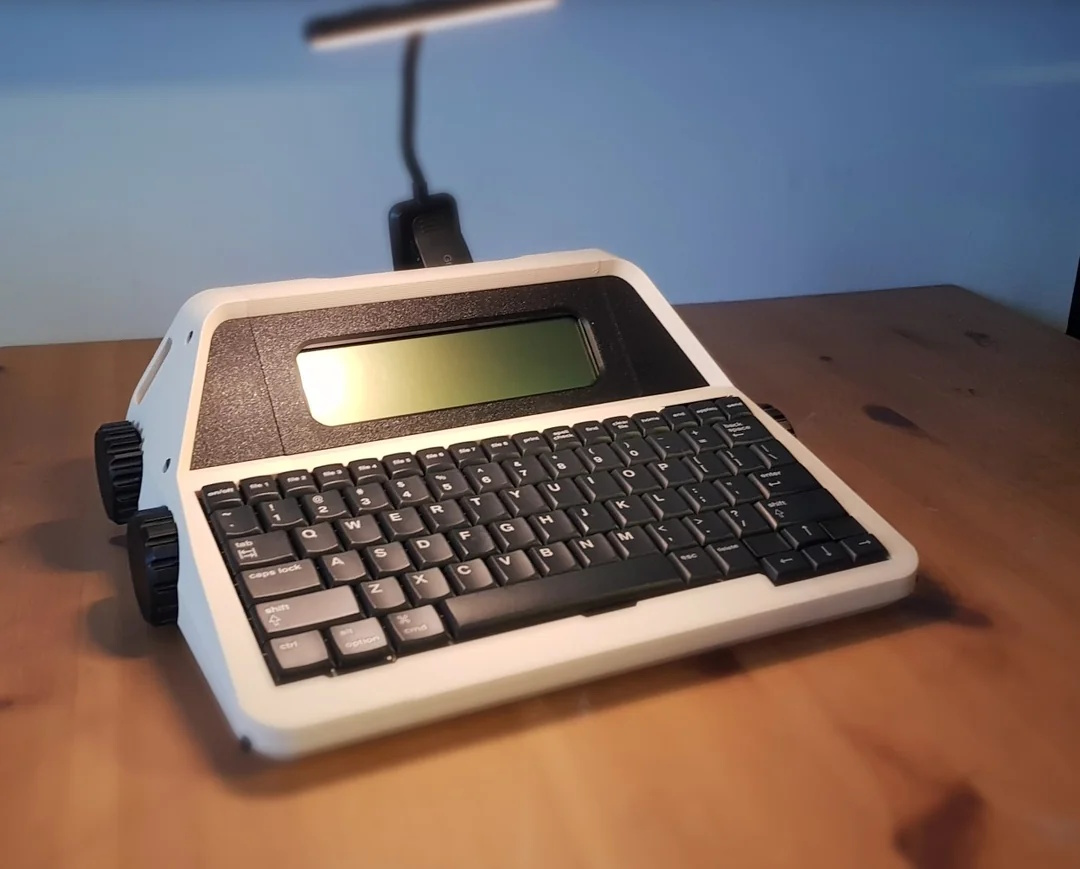
Isn’t this glorious? If you don’t recognize what this is right away (or from the post title), it’s an AlphaSmart NEO word processor, repackaged in a 3D-printed typewriter-esque shell, meticulously designed by the renowned [Un Kyu Lee] of Micro Journal fame.

An AlphaSmart NEO in a 3D-printed, typewriter-esque enclosure, complete with big knobs.Image by [Un Kyu Lee] via GitHubIf you don’t want to spend roughly 40 hours printing ~1 kg of filament in order to make your own, you can join the wait-list on Tindie like I did. Go here to figure out which color you want, and email [Un Kyu Lee] when you order. In the meantime, you can watch the assembly video and then check out this playlist that shows the available colors.

Assembly looks easy enough; there’s no soldering, but you do have to disconnect and reconnect the fiddly ribbon cables. After that, it’s just screws.

This design happened by accident. A friend named [Hook] who happens to manage the AlphaSmart Flickr community had given [Un Kyu Lee] a NEO2 to try out, but before he could, it fell from a shelf and the enclosure suffered a nasty hole near the screen. But the internals seemed fine, so he got the idea to design a new enclosure.

I don’t believe the knobs do anything, but they sure do look nice. There’s an area along the top where you can clip a light, since the NEO has no backlight. There are also two smaller slots on the sides if your light won’t clip to the top.

I’d really like to do this to one of my NEOs. I have two NEO regulars, but reviewers on Tindie report that it works just as well with those as the NEO2.

IBM 701c Butterfly Keyboard Flaps Its Wings Again


I feel like this wonderful laptop and its butterfly keyboard come up often enough, but for today’s lucky 10,000, the IBM 701C laptop has a sweet keyboard that automatically extends when the lid is opened, kind of like one of those special birthday cards.

A pair of hands play GTA on a butterfly keyboard-having laptop as a robot looks on.Image by [LCLDIY] via Hackaday.IO[LCLDIY] found such a laptop at a junkyard with no screen, a damaged motherboard, and a shell that’s old and broken. He decided to try to save it with 3D printing, and well, it worked.

First, he obtained a replacement screen and motherboard, and set about modeling a new case. Be sure to watch the video below so you can catch the machine [LCLDIY] does his modeling on. Now, here’s a surprise: the filament is all hand-spun from plastic bottles he collected from the streets.

Once the case was done, he ran into a slight problem. Namely, the keyboard has a ribbon cable and not a USB interface, so he had to make a PCB to handle that and get it over to the motherboard. Really, [LCLDIY] did so much more than save a keyboard; he built an entire laptop around it. To that, I say kudos. Kudos from Kristina.

youtube.com/embed/DQmLzOEAn7E?…

The Centerfold: the Smurve80 Is a Thing You Could Buy

The Smurve80 in greige with a silly Amazon-esque logo that almost ruins it.Image via reddit
What is this? A baby Model M? A Unicomp? Neither — it is the Smurve80 from Play Keyboard x Swagkeys. This 87-key TKL is heavily inspired by the Model M, however, down to the curved keyboard. And the name? It’s an amalgamation of ‘smile’ and ‘curve’, and this is reflected in the unfortunately Amazon-like logo in the upper left. I might get one anyway. I haven’t decided. If I do, you can bet I will probably be reviewing it.

Here’s the full info post, and here’s the post about the group buy, which is live now (NA link) through February 16th at 10PM ET. Not in North America? Check the group buy post for a list of vendors. For a mere $100, this baby can be yours in either Sandstone (pictured) or Graphite (semi-pictured), and that’s the fully assembled price. There’s also a bare-bones kit version. The best part, aside from the price, has to be the built-in solenoid. So you can get it with reds if you want, but it’s gonna be loud regardless. Just kidding; you can switch off the solenoid.

Do you rock a sweet set of peripherals on a screamin’ desk pad? Send me a picture along with your handle and all the gory details, and you could be featured here!

Historical Clackers: the Wellington


Are you familiar with Wellington Parker Kidder? His name is nearly as one with typewriter history as Christopher Latham Sholes (the guy responsible for QWERTY). I myself had not heard of Kidder, but his name is directly and indirectly associated with dozens of machines, including the Franklin, the Rochester, and the Noiseless, which was later bought by Remington. Then there’s all the clones of his work.
A Wellington typewriter with a really cool cover over the typebars. How is this possible? The typebars punch the platen rather than swing to strike it.Image via The Antikey Chop
Kidder’s patents for the Wellington first appeared in 1892. The appeal of this machine is in the thrust-action type bars, which punch the platen rather than swinging to strike it. The design was well-received, and the Wellington was produced virtually unchanged from 1892 to 1924.

There were two models, No. 1 and No. 2. The former had square key tops, while the latter featured rounded key tops. Both models had a three-row keyboard with a double-shift mechanism, and used an extra-wide ribbon. They also both had that attractive cover on the type bars that reminds me of the fender skirts on, say, a 1950 Mercury.

And much like that 1950 Mercury, Wellingtons were well-built, but unfortunately the passage of time has proven them to be rust buckets. That’s really sad to me and I wish I could forget the fact.

The Wellington sold well enough in the States, but it really shone in Europe. Many typewriters are based on the either the overall design, or at least the type bar mechanism. Antikey Chop calls Kidder’s Wellington one of the most influential typewriters of all time, and I believe it.

Finally, the Zerowriter Is Shipping For Early Backers


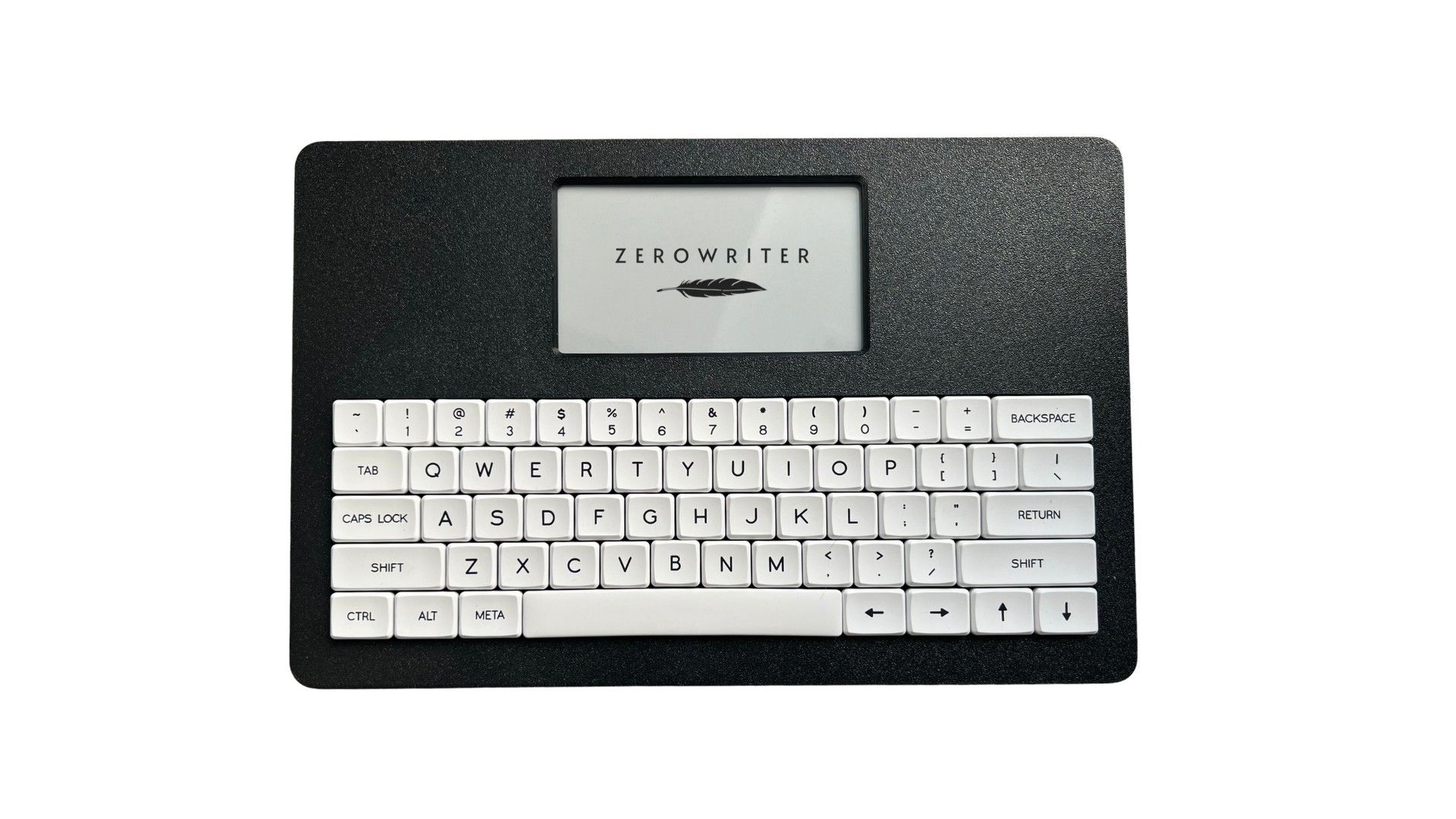
In case you don’t have an AlphaSmart NEO and/or dislike the Freewrite for whatever reason, there’s also the Zerowriter, created by a one-man team out of Canada. You can pre-order it today for $279 and it’ll ship March 30th for free, worldwide.
A distraction-free word processor with an e-ink screen.Image via Good E-Reader
So, what is this thing? It’s a distraction-free writing tool with an e-ink screen and a low-profile mechanical keyboard. The battery is supposed to last a long time, and it’s cheaper than a Freewrite.

This thing has Kailh Choc Pro red switches, which are thankfully hot-swappable. Much like the NEO, it comes on and is instantly ready for typing. There’s no account to register, no login to memorize. Files are saved as .txt to a microSD card and can be transferred to a computer, though unlike the NEO, there’s a companion app standing between you and file transfer.

That said, this baby uses an ESP32 and was coded in Arduino, so do what you will. The battery is supposed to last for weeks of daily use on a single charge. It’s a user-replaceable LiPo pouch with USB-C charging. They actually encourage you to open her up, and I think that’s great.


Got a hot tip that has like, anything to do with keyboards? Help me out by sending in a link or two. Don’t want all the Hackaday scribes to see it? Feel free to email me directly.


hackaday.com/2026/02/16/keebin…

Cybersecurity & cyberwarfare ha ricondiviso questo.

A security flaw at #DavaIndia #Pharmacy allowed attackers to access customers' data and moreù
securityaffairs.com/188056/hac…
#securityaffairs #hacking

How Volunteers Saved a Victorian-Era Pumping Station From Demolition


The media in this post is not displayed to visitors. To view it, please log in.


D-engine of the Claymills Pumping Station. (Credit: John M)D-engine of the Claymills Pumping Station. (Credit: John M)
Although infrastructure like a 19th-century pumping station generally tends to be quietly decommissioned and demolished, sometimes you get enough people looking at such an object and wondering whether maybe it’d be worth preserving. Such was the case with the Claymills Pumping Station in Staffordshire, England. After starting operations in the late 19th century, the pumping station was in active use until 1971. In a recent documentary by the Claymills Pumping Station Trust, as the start of their YouTube channel, the derelict state of the station at the time is covered, as well as its long and arduous recovery since they acquired the site in 1993.

After its decommissioning, the station was eventually scheduled for demolition. Many parts had by that time been removed for display elsewhere, discarded, or outright stolen for the copper and brass. Of the four Woolf compounding rotative beam engines, units A and B had been shut down first and used for spare parts to keep the remaining units going. Along with groundwater intrusion and a decaying roof, it was in a sorry state after decades of neglect. Restoring it was a monumental task.

The inventor of the compounding beam engine, Arthur Woolf, was a Cornish engineer who had figured out how to make this more efficient steam engine work. While his engineering made pumping stations like these possible, the many workers and their families ensured that they kept working smoothly. Although firmly obsolete in the 21st century, pumping stations like these are excellent examples of all the engineering and ingenuity that got us to where we are today, and preserving them is the best way to retain all this knowledge and the memories associated with them.

For that reason, one can really congratulate the volunteers who turned this piece of history into a museum. It features a static display of the restored machinery. If you want to see it running, there are seven demonstrations of the station operating under steam every year, during which the six-story tall machinery can be observed in all its glory.

Top image: Claymills Pumping Station in 2010. (Credit: Ashley Dace)

youtube.com/embed/tYvqV27G4c8?…


hackaday.com/2026/02/16/how-vo…

Real LED TVs Are Finally Becoming A Thing


The media in this post is not displayed to visitors. To view it, please log in.

Once upon a time, the cathode ray tube was pretty much the only type of display you’d find in a consumer television. As the analog broadcast world shifted to digital, we saw the rise of plasma displays and LCDs, which offered greater resolution and much slimmer packaging. Then there was the so-called LED TV, confusingly named—for it was merely an LCD display with an LED backlight. The LEDs were merely lamps, with the liquid crystal doing all the work of displaying an image.

Today, however, we are seeing the rise of true LED displays. Sadly, decades of confusing marketing messages have polluted the terminology, making it a confusing space for the modern television enthusiast. Today, we’ll explore how these displays work and disambiguate what they’re being called in the marketplace.

The Rise Of Emissive Displays


When it comes to our computer monitors and televisions, most of us have got used to the concept of backlit LCD displays. These use a bright white backlight to actually emit light, which is then filtered by the liquid crystal array into all the different colored pixels that make up the image. It’s an effective way to build a display, with a serious limitation on contrast ratio because the LCD is only so good at blocking out light coming from behind. Over time, these displays have become more sophisticated, with manufacturers ditching cold-cathode tube backlights for LEDs, before then innovating with technologies that would vary the brightness of parts of the LED backlight to improve contrast somewhat. Some companies even started using arrays of colored LEDs in their backlights for further control, with the technology often referred to as “RGB mini LED” or “micro RGB.” This still involves an LCD panel in front of the backlight, limiting contrast ratios and response times.

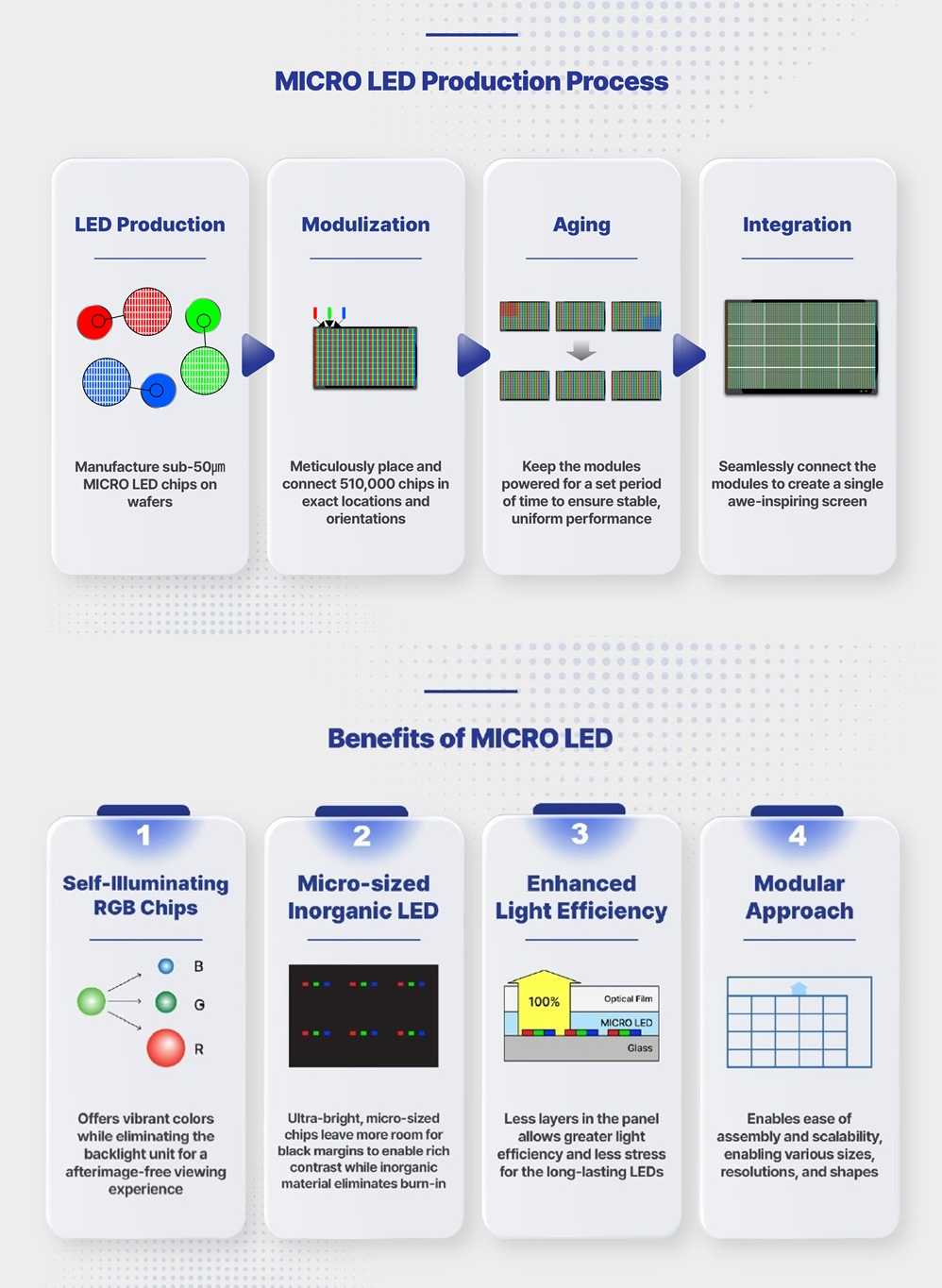
The holy grail, though, would be to ditch the liquid crystal entirely, and just have a display fully made of individually addressable LEDs making up the red, green, and blue subpixels. That is finally coming to pass, with manufacturers launching new television lines under the “Micro LED” name. These are true “emissive” displays, where the individual red, blue, and green subpixels are themselves emitting light, not just filtering it from a backlight source behind them.
The challenge behind making pure LED TVs was figuring out how to get the LEDs small enough and to put them in scalable arrays. Credit: Samsung
These displays promise greater contrast than backlit LCDs, because individual pixels can be turned completely off to create blacker blacks. Response times are also fast because LEDs switch on and off much more quickly than liquid crystals can react. They’re also relatively power efficient, as there’s no need to supply electrons to pixels that are off. Contrast this to LCDs, which are always spending power on turning some pixels black in front of a glowing backlight which is also drawing power. Viewing angles of emissive displays are also top-notch. Inorganic LEDs also have long lifetimes, which makes them far more desirable than OLED displays (discussed further below). Their high brightness also makes them ideal for us in bright conditions, particularly where sunlight is concerned.

Given the many boons of this technology, you might question why it’s taken true LED displays this long to hit the market. The ultimate answer comes down to cost and manufacturability. If you’ve ever built your own LED array, you’ve probably noted the engineering challenges in reducing pixel size and increasing resolution. When it comes to producing a 4K display, you’re talking about laying down 8,294,400 individual RGB LEDs, all of which need to work flawlessly and be small enough to not show up as individually visible pixels from typical viewing ranges. Other technologies like LCDs and OLEDs have the benefit that they can be easily produced with lithographic techniques in great sizes, but the technology to produce pure LED displays on this scale is only just coming into fruition.
There are very few Micro LED TVs on the market right now. The price is why. Credit: Best Buy via screenshot
You can purchase an all-LED TV today, if you so desire. Just note that you’ll pay through the nose for it. Few models are on the market, but Best Buy will sell you a 114″ Micro LED set from Samsung for the charming price of $149,999.99. If that’s a bit big for your house, condo, or apartment, you might consider the 89″ model for a more acceptable $109,999.99. Meanwhile, LG has demonstrated a 136″ model of a micro LED TV, but there have been no concrete plans to bring it to market. Expect it to land somewhere firmly in the six-figure range, too.

If you’re not feeling so flush, you can get a lesser “Micro RGB” TV if you like, which combines a fancy RGB matrix backlight with LCD technology as discussed above. Even then, a Samsung R95 television with Micro RGB technology will set you back $29,999.99 at Best Buy, or you can purchase it on a payment plan for $1,250 a month. In fact, with the launch of these comparatively affordable TVs, Samsung has gone somewhat quiet on its Micro LED line since initially crowing about it in 2024. Still, whichever way you go, these fancy TVs don’t come cheap.

But What About OLED?

OLEDs have many benefits as an emissive display technology, however the organic materials used come with limits to brightness and lifespan. Fabrication cost is, however, far cheaper than pure inorganic LED displays. Credit: author
It’s true that emissive LED displays have existed in the market for some time, but not using traditional light-emitting diodes. These are the popular “OLED” displays, with the acronym standing for “organic light emitting diode.” Unlike standard LEDs, which use inorganic semiconductor crystals to emit light, OLEDs instead use special organic compounds in a substrate between electrodes, which emit light when electricity is applied. They can readily be fabricated in large arrays to create displays, which are used in everything from tiny smartwatches to full-sized televisions.

You might question why the advent of “proper” LED displays is noteworthy given that OLED technology has been around for some time. The problem is that OLEDs are somewhat limited in their performance versus traditional inorganic LEDs. The main area in which they suffer is longevity, as the organic compounds are susceptible to degradation over time. The brightness of individual pixels in an OLED display tends to drop off very quickly compared to inorganic LEDs. A display can diminish to half of its original brightness in just a few years of moderate to heavy use. In particular, blue OLED subpixels tend to degrade faster than red or green subpixels, forcing manufacturers to take measures to account for this over the lifetime of a display. Peak brightness is also somewhat limited, which can make OLED displays less attractive for use in bright rooms with lots of natural light. Dark spots and burn in are also possible, at rates greater than those seen in contemporary LCD displays.

The limitations of OLED displays have not stopped them gaining a strong position in the TV marketplace. However, the technology will be unlikely to beat true LED displays in terms of outright image quality, brightness, and performance. Cost will still be a factor, and OLEDs (and LCDs) will still be relevant for a long time to come. However, for now at least, the pure LED display promises to become the prime choice for those looking for a premium viewing experience at any cost.

Featured image: “Micro LED” displays. Credit: Samsung


hackaday.com/2026/02/16/real-l…

Cybersecurity & cyberwarfare ha ricondiviso questo.

Buone notizie per gli utenti Discord del Regno Unito: stiamo partecipando a un "esperimento" di raccolta dati collegato a Peter Thiel

Ma tranquilli: "Le informazioni inviate verranno temporaneamente conservate per un massimo di 7 giorni..."

rockpapershotgun.com/good-news…

@aitech

Cybersecurity & cyberwarfare ha ricondiviso questo.

The media in this post is not displayed to visitors. To view it, please go to the original post.

La Telco Odido violata senza hacker. Nessun exploit, solo ingegneria sociale

📌 Link all'articolo : redhotcyber.com/post/la-telco-…

#redhotcyber #news #cybersecurity #hacking #phishing #sicurezzainformatica #protezionedatidipersonali

Cybersecurity & cyberwarfare ha ricondiviso questo.

The media in this post is not displayed to visitors. To view it, please go to the original post.

Siamo a cinque, in un giorno.
Ah, che bella la sicurezza!

🚨 nuova rivendicazione #ransomware Italia 🚨

🏴‍☠️ gruppo #Qilin
🧬 Casartigiani - Confederazione Autonoma Sindacati Artigiani | Roma
🎯 settore: attività dei sindacati di lavoratori
🔗 casartigiani.org
🗓️ 16 febbraio 2026

📄 sample: sì
▪️ dati esfiltrati dichiarati: -
▪️ dati esfiltrati pubblicati: -
⏲️ scadenza: -

#ransomNews #cybersecurity #cyberthreats

reshared this

The global AI governance bonanza


The media in this post is not displayed to visitors. To view it, please log in.

The global AI governance bonanza
IT'S MONDAY, AND THIS IS DIGITAL POLITICS. I'm Mark Scott, and I won't be in New Delhi for India's AI Impact Summit this week. For those of you who are, here's the official agenda. God speed navigating the endless side events.

— This week's AI conference in India pits different visions of the emerging technology against each other. You should be wary of all of them.

— The global rush to ban kids from using social media is a prime example of the lack of quantifiable evidence used to make digital rules.

— The Global Majority is missing from the worldwide data center boom.

Let's get started.


digitalpolitics.co/newsletter0…

A Novelty Clock Makes The Best Tiny Mac Yet


The media in this post is not displayed to visitors. To view it, please log in.

We’re lucky enough in 2026 to have cheap single-board computers fast enough to emulate machines from the 1990s, touching on the 32-bit era. We’ve seen a few projects as a result, emulating the Apple Macs of the 68000 era, but even with the best 3D printing, they can disappoint when it comes to the case. So when [This Does Not Compute] saw a novelty alarm clock using a very well-modelled mini replica of an early Mac, putting a Mac emulator in it was the obvious way to go.

The project uses a Raspberry Pi with a small colour LCD. The video below the break takes us through the process of gutting it and mounting the Pi and display on a custom 3D-printed bracket. In an unexpected touch, parts of the original LCD are used to give the curved corners, which owners of an original Mac will remember. It may have a little further to go in that its fake floppy drive is begging to be converted to an SD card slot, and it has a now-unused brightness dial. But we’d say it’s one of the best little Mac emulators we’ve seen so far, if perhaps not the smallest.

youtube.com/embed/dRr5iVjMfqs?…


hackaday.com/2026/02/16/a-nove…

Cybersecurity & cyberwarfare ha ricondiviso questo.

The media in this post is not displayed to visitors. To view it, please go to the original post.

🚨 nuova rivendicazione #ransomware Italia - e la terna è servita!

🏴‍☠️ gruppo #akira
🧬 iSMA Controlli SPA | Sant'Olcese (GE)
🎯 settore: manifattura elettrica
🔗 ismacontrolli.com
🗓️ 16 febbraio 2026

📄 sample: -
▪️ dati esfiltrati dichiarati: -
▪️ dati esfiltrati pubblicati: -
⏲️ scadenza: -

#ransomNews #cybersecurity #cyberthreats

Cybersecurity & cyberwarfare ha ricondiviso questo.

#ShinyHunters leaked 600K+ #Canada #Goose customer records, but the firm denies it was breached
securityaffairs.com/188046/cyb…
#securityaffairs #hacking
Cybersecurity & cyberwarfare ha ricondiviso questo.

The media in this post is not displayed to visitors. To view it, please go to the original post.

🚨 nuova rivendicazione #ransomware Italia - take two

🏴‍☠️ gruppo #Dragonforce
🧬 Wipro Ferretto SRL | San Polo D'Enza (RE)
🎯 settore: IT magazzini
🔗 wiproferretto.com
🗓️ 16 febbraio 2026

📄 sample: sì
▪️ dati esfiltrati dichiarati: 301.82GB
▪️ dati esfiltrati pubblicati: -
⏲️ scadenza: 24 febbraio 2025

#ransomNews #cybersecurity #cyberthreats

Cybersecurity & cyberwarfare ha ricondiviso questo.

The media in this post is not displayed to visitors. To view it, please go to the original post.

Privacy addio? OpenAI sta raccogliendo i numeri di chiunque: tu sei nella lista?

📌 Link all'articolo : redhotcyber.com/post/privacy-a…

#redhotcyber #news #chatgpt #openai #ecosistemaopenai #importazionecontatti #hashing

Cybersecurity & cyberwarfare ha ricondiviso questo.

Anthropic cerca di nascondere le azioni dell'IA di Claude e gli sviluppatori insorgono

Anthropic ha aggiornato Claude Code, il suo strumento di programmazione basato sull'intelligenza artificiale, modificando l'output di avanzamento per nascondere i nomi dei file che lo strumento stava leggendo, scrivendo o modificando. Tuttavia, gli sviluppatori hanno reagito, affermando di aver bisogno di vedere a quali file si accede

theregister.com/2026/02/16/ant…

@aitech

Cybersecurity & cyberwarfare ha ricondiviso questo.

The media in this post is not displayed to visitors. To view it, please go to the original post.

L'azienda israeliana Paragon ha esposto la propria dashboard di spyware su LinkedIn, svelando l'architettura nascosta di un impero di sorveglianza da miliardi di dollari!

Ciò che mostrano le immagini è agghiacciante: un numero di telefono ceco etichettato "Valentina", registri di intercettazione contrassegnati come "Completati" e categorie di dati a livello di applicazione che prendono di mira servizi crittografati.

ahmedeldin.substack.com/p/the-…

@informatica

Cybersecurity & cyberwarfare ha ricondiviso questo.

I wish that those surveys so often cited by InfoSec pundits that ask

Do you fully trust AI output?
Do you always verify AI output?

also asked

Do you fully trust your colleagues' output?
Do you always verify your colleagues' output?

Just to have comparative numbers, you know.

in reply to Filippo Valsorda

apples and oranges.

human output follows human patterns, making it easier to intuit where bugs will be. LLM output exhibits stochastic randomness in a way that breaks that intuition (I have to mode-switch for this reason when I'm reviewing vibe coded stuff that clients send me)

LLM output comes with no ability to explain why a change was made, and almost always results in a difficult PR review process, because nobody involved actually walked the path to produce the result.

in reply to Graham Sutherland / Polynomial

@gsuberland I am pretty sure a mental model can be developed for where LLMs tend to make mistakes, if nothing else because smarter people than me describe it.

The rest of your points seem not really related to what I was commenting, which was a pundit posting about how the gap between "% of respondents that fully trust AI" and "% of respondents. who always review AI" is going to be where security dies, when you'd observe the same gap for e.g. third-party deps.

in reply to Graham Sutherland / Polynomial

the remainder of my points are still relevant.

if a person wrote it, I can trust that they went through the process of doing so, and therefore at least notionally understand both the problem space and the solution space. that means that I can implicitly apply some modicum of trust in that process, and that the person will be able to engage in a productive conversation with me if I have queries. I can't do that with LLM output. that means some gap between the trust models is acceptable.

in reply to Graham Sutherland / Polynomial

like, a system is what it does, and ultimately it's an intellectual laziness machine for people who have either confused short-sighted KPIs for productivity or are dishonestly promoting the thing for money. if you want to know where security dies, it's in a future where people have atrophied their cognitive skills and intellectual curiosity in exchange for perpetually rented sycophantic blathering.
Questa voce è stata modificata (3 mesi fa)
in reply to ✧✦Catherine✦✧

@whitequark @gsuberland oh ffs, not everything has to collapse down to "are you a booster or an anti."

I just posted that I am annoyed at surveys that capture the gap between those cherry-picked % for AI without any context or comparison, and at commenters that make the world of that gap.

If you want an actually nuanced take on these tools, go read Russ as linked from the thread.

Also, @whitequark, can you take a hint that it's time to disengage or do I have to block you. I wouldn't like to!

Cybersecurity & cyberwarfare ha ricondiviso questo.

The media in this post is not displayed to visitors. To view it, please go to the original post.

🚨 nuova rivendicazione #ransomware Italia 🚨

🏴‍☠️ gruppo #akira
🧬 Icat Food SPA | Genova
🎯 settore: alimentare
🔗 icatfood.it
🗓️ 16 febbraio 2026

📄 sample: -
▪️ dati esfiltrati dichiarati: -
▪️ dati esfiltrati pubblicati: -
⏲️ scadenza: -

#ransomNews #cybersecurity #cyberthreats

reshared this

Cybersecurity & cyberwarfare ha ricondiviso questo.

The media in this post is not displayed to visitors. To view it, please go to the original post.

Vulnerabilità zero-day in Google Chrome. Exploit rilasciato: aggiornare subito

📌 Link all'articolo : redhotcyber.com/post/vulnerabi…

#redhotcyber #news #cybersecurity #hacking #malware #googlechrome #vulnerabilita #zeroday #useafterfree

Cybersecurity & cyberwarfare ha ricondiviso questo.

#Microsoft alerts on DNS-based #ClickFix variant delivering malware via nslookup
securityaffairs.com/188039/hac…
#securityaffairs #hacking
Cybersecurity & cyberwarfare ha ricondiviso questo.

The media in this post is not displayed to visitors. To view it, please go to the original post.

🔥 SONO UFFICIALMENTE APERTE LE ISCRIZIONI! 🔥

Per info e iscrizioni: 📱 💬 379 163 8765 ✉️ formazione@redhotcyber.com

#redhotcyber #formazione #cybersecurity #darkweb #cyberthreatintelligence #ethicalhacking #infosec #intelligence

Cybersecurity & cyberwarfare ha ricondiviso questo.

The media in this post is not displayed to visitors. To view it, please go to the original post.

2149 BREAK THE SPHERE! La CTF di RHC & Hack The Box all’interno della RHC Conference

📌 Link all'articolo : redhotcyber.com/post/2149-brea…

#redhotcyber #news #cittastato #velos7 #intelligenzaartificiale #aegissphere #consiglio #speculari #controllodelle

Cybersecurity & cyberwarfare ha ricondiviso questo.

The media in this post is not displayed to visitors. To view it, please go to the original post.

0APT e l’illusione operativa: quando il ransomware è solo narrativa

📌 Link all'articolo : redhotcyber.com/post/0apt-e-li…

#redhotcyber #news #cybersecurity #hacking #malware #ransomware #cybercrime #sicurezzainformatica

Cybersecurity & cyberwarfare ha ricondiviso questo.

#Google fixes first actively exploited #Chrome zero-day of 2026
securityaffairs.com/188029/sec…
#securityaffairs #hacking

Inside a Fake Mean Well DIN-rail PSU


The media in this post is not displayed to visitors. To view it, please log in.


Looks just like the real deal in a dark cabinet. (Credit: Big Clive, YouTube)Looks just like the real deal in a dark cabinet. (Credit: Big Clive, YouTube)
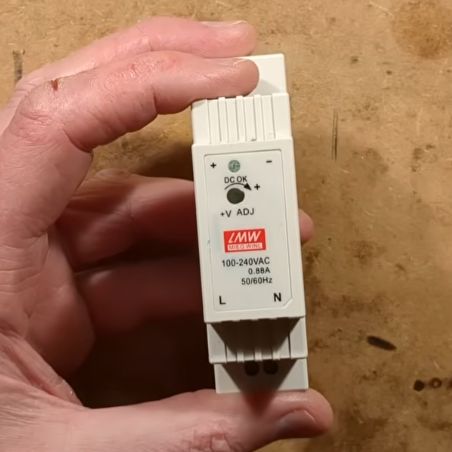
These days, you can get fakes, bootlegs, and similar for just about anything. While a fake handbag isn’t such a big deal, in the case of a DIN-rail power supply, you’d better make sure that you got the real deal. Case in point, the fake ‘Mean Well’ DIN-rail PSU that [Big Clive] got his mitts on for a detailed analysis and teardown.

Even without taking a PSU apart there are often clear clues that you might be dealing with a fake, starting with the logo and the rest of the markings. Here it’s clear that the logo is designed to only appear to be the MW one at a quick glance, with the rest of the label being poorly copied English gibberish containing copious “unnecessary” double “quotes”.

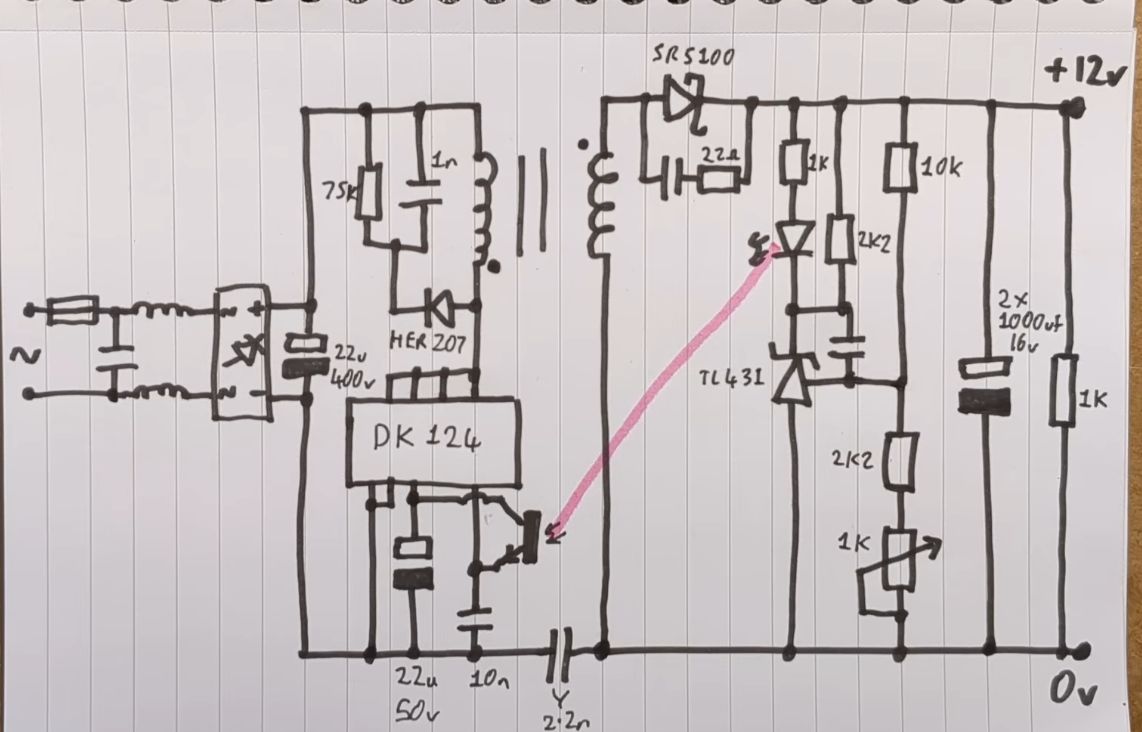
So what do you get for £3-5 in this +12VDC, 1.25A rated PSU? Shockingly, the insides are actually quite decent and probably close to the genuine MW, with basic noise filtering, proper isolation, and apparently a real class-Y safety capacitor. Similarly, the chosen DK124 control IC is more than capable of the task, with a good circuit for the adjustable voltage control.

This is possibly one of those cases where an off-the-shelf industrial design was stuffed into a case that tries to hitch a ride on the brand recognition of Mean Well rather than some national brand name. It’ll be interesting to see how close this circuitry is to the genuine MW PSU. We’ll find out once [Clive] gets the real deal in for a teardown. Perhaps it’s actually a solid clone of an older MW unit?
Schematic of the fake Mean Well PSU. (Credit: Big Clive, YouTube)Schematic of the fake Mean Well PSU. (Credit: Big Clive, YouTube)
youtube.com/embed/pOb51Q718F8?…


hackaday.com/2026/02/16/inside…

Microfluidic Display Teaches The Basics


The media in this post is not displayed to visitors. To view it, please log in.

We’ve always been interested in fluidic logic and, based on [soiboi’s] videos, he is too. His latest shows how to use silicone and a vacuum to build a multiplexed dot matrix display. This is a fascinating look at how you design with air instead of electrons.

Just like a regular display, it isn’t efficient to control each element separately. Usually, it’s better to multiplex such that 16 “pixels” need only row and column air valves. Just as you might use transistors, the project uses “air transistors” to build logic gates.

Each pixel is a bit of silicone that can be sucked down only when a row and column are drawing a vacuum simultaneously. The air transistor is a similar membrane that a control input can suck down. In its relaxed position, two air channels are blocked by the membrane. When the membrane moves away, the two channels connect. This is analogous to a Field Effect Transistor (FET), where the channel conducts electricity when the gate is active and does not conduct when the gate is inactive.

We appreciated the step-by-step development. The video moves from a pixel step-by-step to small arrays and then to a 4×4 array. If this is your first encounter with fluidic logic, you can learn more about it. The last time we checked in with [soiboi], he was creating fluidic robots.

youtube.com/embed/VZ2ZcOzLnGg?…


hackaday.com/2026/02/15/microf…

Cybersecurity & cyberwarfare ha ricondiviso questo.

The media in this post is not displayed to visitors. To view it, please go to the original post.

📣 ISCRIVITI AL WEBINAR GRATUITO DI PRESENTAZIONE DEL CORSO "CYBER OFFENSIVE FUNDAMENTALS" – LIVELLO BASE 🚀

📅 Data Webinar: Martedì 17 Febbraio
🕕 Orario: 18:00
🖥️ Google Meet

🔗 Programma: redhotcyber.com/linksSk2L/cybe…
🎥 Intro del prof: youtube.com/watch?v=0y4GYsJMoX…

Per ricevere il link al webinar e per iscrizioni: 📞 379 163 8765 ✉️ formazione@redhotcyber.com

#redhotcyber #formazione #pentesting #pentest #formazioneonline #ethicalhacking #cybersecurity #penetrationtesting #cti #cybercrime #infosec #corsi #liveclass #hackerhood #pentesting

Cybersecurity & cyberwarfare ha ricondiviso questo.

The media in this post is not displayed to visitors. To view it, please go to the original post.

Azienda italiana all’asta per 200$: ecco come il cyber-crimine colpisce il nostro tessuto produttivo (e come difendersi)

📌 Link all'articolo : redhotcyber.com/post/azienda-i…

Gli accessi di un’azienda #italiana sono stati messi in vendita nelle vetrine digitali del #crimine #informatico. Con un fatturato dichiarato di 1,7 milioni di euro nel #report finanziario 2024, l’azienda è stata messa all’asta su un noto #forum #underground da un attore malevolo identificato come “privisnanet”.

A cura di Bajram Zeqiri

#redhotcyber #news #cybersecurity #hacking #aziendaitaliana #venditaaccessi #forumunderground #fatturatoconsorprendenza #acquistosistemi #sicurezzainformatica #datipersonali #protezioneaziendale #riservatezza #informaticaitaliana

Cybersecurity & cyberwarfare ha ricondiviso questo.

Japanese sex toys maker #Tenga discloses data breach
securityaffairs.com/188022/dat…
#securityaffairs #hacking

reshared this

Cybersecurity & cyberwarfare ha ricondiviso questo.

The media in this post is not displayed to visitors. To view it, please go to the original post.

Gli spioni si sono fatti spiare! Paragon Graphite si “auto-leaka” la dashboard

📌 Link all'articolo : redhotcyber.com/post/quando-gl…

#redhotcyber #news #spyware #graphite #sorveglianza #sicurezzainformatica #malware #hacking

reshared this

Cybersecurity & cyberwarfare ha ricondiviso questo.

The media in this post is not displayed to visitors. To view it, please go to the original post.

🚀 RHC CONFERENCE 2026 (V EDIZIONE) - Termine massimo 28 febbraio

Se siete ancora indecisi, avete tempo fino al 28 febbraio per partecipare come sponsor alla quinta edizione della RHC Conference.
Per informazioni e sponsorizzazioni, scrivete a sponsor@redhotcyber.com.

La RHC Conference, è l’appuntamento annuale gratuito, creato dalla community di RHC, per far accrescere l’interesse verso le tecnologie digitali, l’innovazione digitale e la consapevolezza del rischio informatico.

📍 Pagina dell'evento: redhotcyber.com/red-hot-cyber-…
📍 Video Riassuntivo della precedente IV edizione: youtube.com/watch?v=J1i9S4LOWS…

#redhotcyber #rhcconference #conferenza #informationsecurity #ethicalhacking #dataprotection #hacking #cybersecurity #cybercrime #cybersecurityawareness #cybersecuritytraining #cybersecuritynews #privacy #infosecurity

Cybersecurity & cyberwarfare ha ricondiviso questo.

The media in this post is not displayed to visitors. To view it, please go to the original post.

Italia sotto attacco: 2.400 cyber attacchi a settimana, il 15% in più della media globale

📌 Link all'articolo : redhotcyber.com/post/italia-so…

#redhotcyber #news #cyberattacchi #sicurezzainformatica #hacking #malware #ransomware #attacchinformatici

Cybersecurity & cyberwarfare ha ricondiviso questo.

The media in this post is not displayed to visitors. To view it, please go to the original post.

RHC Intervista Anubis Ransomware: il punto di vista su RAMP, LockBit e il “mercato” RaaS

📌 Link all'articolo : redhotcyber.com/post/rhc-inter…

#redhotcyber #news #cybersecurity #hacking #malware #ransomware #attacchinformatici #sicurezzadigital

Cybersecurity & cyberwarfare ha ricondiviso questo.

The media in this post is not displayed to visitors. To view it, please go to the original post.

Un agente IA attacca un manutentore open source: il caso spaventa la community

📌 Link all'articolo : redhotcyber.com/post/un-agente…

#redhotcyber #news #intelligenzaartificiale #opensource #sicurezzainformatica #conflittisonline #interazioniumane

reshared this

Removing the BIOS Administrator Password on a ThinkPad Takes Timing


The media in this post is not displayed to visitors. To view it, please log in.


This would be a bad time to slip. (Credit: onionboots, YouTube)This would be a bad time to slip. (Credit: onionboots, YouTube)
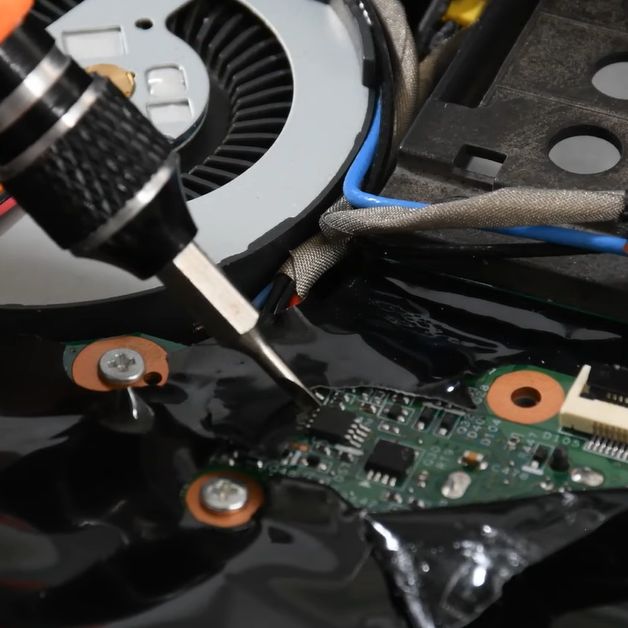
In the olden days, an administrator password on a BIOS was a mere annoyance, one quickly remedied by powering off the system and pulling its CMOS battery or moving a jumper around. These days, you’re more likely to find a separate EEPROM on the mainboard that preserves the password. This, too, is mostly just another annoyance, as [onionboots] knew. All it takes is shorting out this EEPROM at the right time to knock it offline, with the ‘right time’ turning out to be rather crucial.

While refurbishing this laptop for a customer, he thought it’d be easy: the guide he found said he just had to disassemble the laptop to gain access to this chip, then short out its reset pin at the right time to make it drop offline and keep it shorted. Important here is that you do not short it when you are still booting the system, or it won’t boot. This makes for some interesting prodding of tiny pins with a metal tool.

What baffled him was that although this method worked, and he could now disable the password, on the next boot, it would be enabled again. As it turns out, to actually save the new supervisor password status to the EEPROM, you should stop shorting its pin, else you cannot write to it. Although the guide said to keep shorting it, this was, in hindsight, a clear case of relying too much on instructions and less on an obvious deduction. Not like any of us are ever guilty of such an embarrassing glitch, natch.

At any rate, it was still infinitely faster than trying to crack such a password with a brute-force method, even if helped by an LLM.

youtube.com/embed/AOAA6aWwplM?…


hackaday.com/2026/02/15/removi…