Cybersecurity & cyberwarfare ha ricondiviso questo.

U.S. #CISA adds a flaw in multiple Fortinet products to its Known Exploited Vulnerabilities catalog
securityaffairs.com/187435/sec…
#securityaffairs #hacking

The Fancy Payment Cards of Taiwan


The media in this post is not displayed to visitors. To view it, please log in.

If you’re an old-schooler, you might still go to the local bar and pay for a beer with cash. You could even try and pay with a cheque, though the pen-and-paper method has mostly fallen out of favor these days. But if you’re a little more modern, you might use a tap-to-pay feature on a credit or debit card.

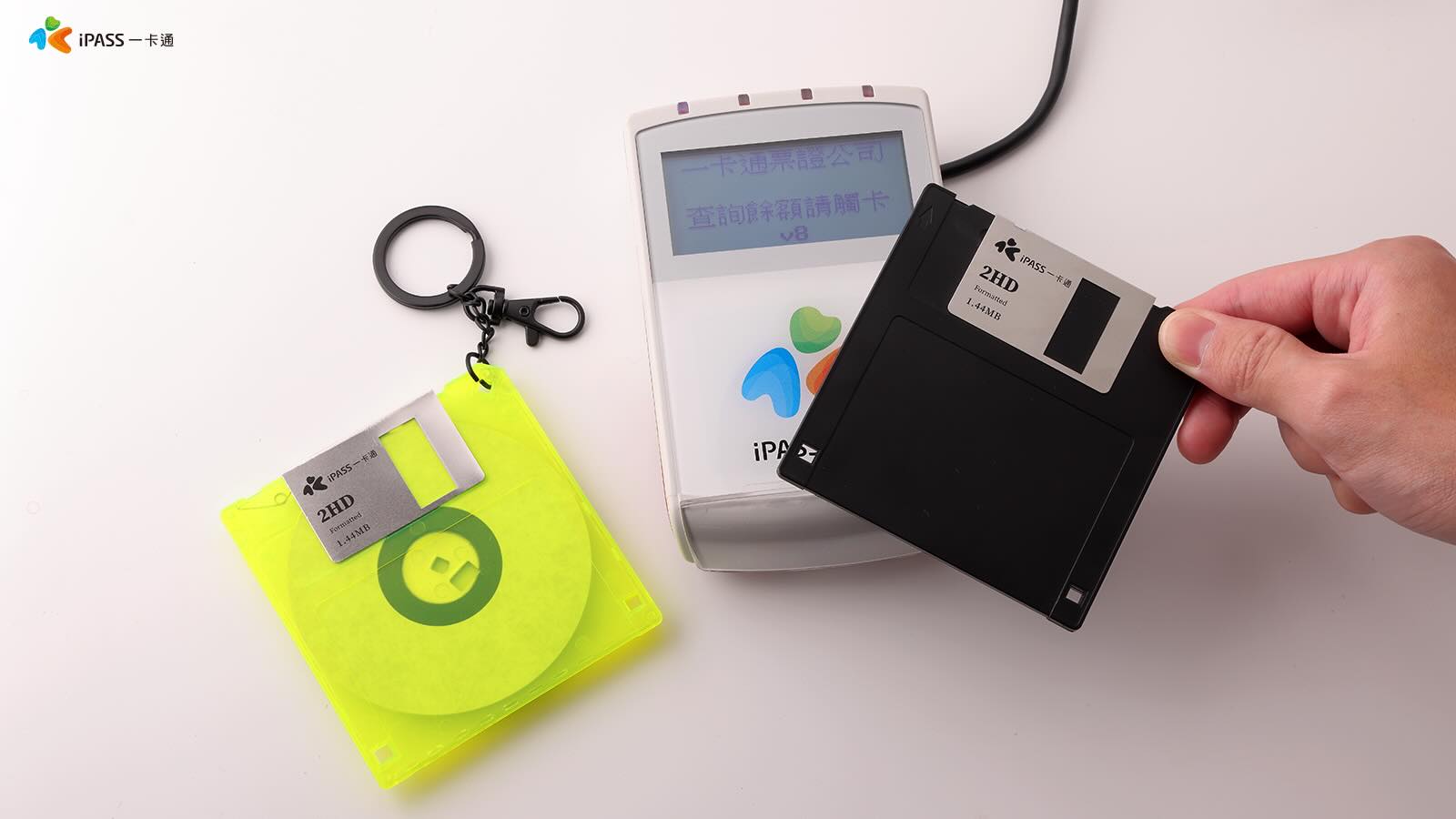
In Taiwan, though, there’s another unique way to pay. The island nation has a whole ecosystem of bespoke payment cards, and you can even get one that looks like a floppy disk!

It’s Not About The Money, Money, Money

A regular adult iPASS card. Like many mass transit smartcards, it’s based on MIFARE contactless technology. Credit: iPASS
Like so many other countries with highly-developed public transport systems, Taiwan implemented a smartcard ticketing system many years ago. Back in December 2007, it launched iPASS (一卡通), initially for use by riders on the Kaohsiung Metro system which opened in March 2008. The cards were launched using MIFARE technology, as seen in a wide range of contactless smart card systems in other public transport networks around the world.

The system was only ever supposed to be used to pay fares on public transport using the pre-paid balance on the card. Come 2014, however, management of the cards was passed to the iPASS Corporation. The new organization quickly established the card’s use as a widespread form of payment at a huge variety of stores across Taiwan. The earliest adopters were OK MART, SUNFAR 3C, and a handful of malls and department stores. Soon enough, partnerships with FamilyMart and Hi-Life convenience stores followed, and the use of the card quickly spread from there.
iPASS can be used across much of the public transport in Taiwan, and the cards are also compatible with smartphone wallets. Credit: iPASS
As iPASS cards continued to gain in popularity, companies started lining up to produce co-branded cards. Many came with special deals at select retailers. For example, NPC issued an iPASS card that offered cheaper prices on gasoline at affiliated gas stations. Furthermore, no longer did your iPASS have to be a rigid, rectangular plastic card. You can buy a normal one if you like, but you can also get an iPASS built into prayer beads, laced into a leather bracelet, or even baked into a faux floppy disk. The latter specifically notes that it’s not a real disk, of course; it only has iPASS functionality and will not work if you put it in a floppy drive. It is, however, a startlingly good recreation, with the proper holes cut out for write protect and density and a real metal sheath. On the translucent yellow version, you can even see what appears to be the fabric inside that would be used to protect the spinning magnetic platter.
Novelty iPass cards are common. Some are merely fun prints or designs, while others go far outside the usual smartcard format—like this novelty floppy disk. Credit: iPASS
Other novelty iPASS “cards” include a keychain-sized Taiwan Railways train and a Japanese shinkansen. Where a regular iPASS card costs NT$100 or so, a novelty version like the floppy disk or train costs more like NT$500-$600. That might sound like a lot, but in the latter case, you’re only talking about $15 USD or so. If so desired, though, you don’t need to carry a card or keychain, or floppy disk at all. It’s possible to use an iPASS with contactless smartphone and smartwatch wallets like Google Wallet and Garmin Pay.

iPASS Cards are typically sold empty with no value, and must have money transferred to the card prior to use. Notably, the money stored on the cards is backed by the Union Bank of Taiwan. This provides a certain level of peace of mind. Even if it wasn’t there, though, there isn’t so much to lose if things do go wrong—as any individual card is limited to storing a maximum of NT$10,000 (~$320 USD).
You can use a little train as your iPASS card if you’re willing to spend just a little more money. Credit: PCHOME.TW
Similar Taiwanese pre-paid payment cards exist, too. EasyCard has been around since 2002, initially established by the Taipei Smart Card Corporation for use on the Taipei Metro. It similarly offers novelty versions of its cards, and these days, it can be used on most public transport in Taiwan and at a range of convenience stores. Like the iPASS, it’s limited to storing up to NT$10,000, with balances backed by the Cathay United Bank. 7-Eleven has also joined the fray with its iCash cards, which are available in some very cute novelty styles. However, where there are tens of millions of users across EasyCard and iPASS, iCash has not had the same level of market penetration.
As Easycard demonstrates, you can put a contactless payment chip in just about anything. Credit: PCHOME.TW
Generally, most of us get by using payment cards linked directly to our main banking accounts. However, if you happen to find yourself in Taiwan, you might find the iPASS to be a very useful tool indeed. You can load it once with a bunch of money, and then run around on buses and trains while buying yourself snacks and beverages all over town. Plus, if you buy the floppy disk one, you’ll have an awesome souvenir to bring back with you, and you can entertain all your payment-card-obsessed friends with tales of your adventures. All in all, the banking heavyweights of the world would do well to learn from the whimsical example of the iPASS Corporation.


hackaday.com/2026/01/28/the-fa…

Wikipedia as a Storage Medium


The media in this post is not displayed to visitors. To view it, please log in.

We know that while the cost per byte of persistent storage has dropped hugely over the years, it’s still a pain to fork out for a new disk drive. This must be why [MadAvidCoder] has taken a different approach to storage, placing files as multiple encoded pieces of metadata in Wikipedia edits.

The project takes a file, compresses it, and spits out small innocuous strings. These are placed in the comments for Wikipedia edits — which they are at pains to stress — were all legitimate edits in the test cases. The strings can then be retrieved at will and reconstituted, for later use. The test files are a small bitmap of a banana, and a short audio file.

It’s an interesting technique, though fortunately one that’s unlikely to be practical beyond a little amusement at the encyclopedia’s expense. We probably all have our favorite examples of low quality Wikipedia content, so perhaps it’s fortunate that these are hidden in the edit history rather than the pages themselves. Meanwhile we’re reminded of the equally impractical PingFS, using network pings as a file system medium.


hackaday.com/2026/01/28/wikipe…

The Amazing Maser


The media in this post is not displayed to visitors. To view it, please log in.

While it has become a word, laser used to be an acronym: “light amplification by stimulated emission of radiation”. But there is an even older technology called a maser, which is the same acronym but with light switched out for microwaves. If you’ve never heard of masers, you might be tempted to dismiss them as early proto-lasers that are obsolete. But you’d be wrong! Masers keep showing up in places you’d never expect: radio telescopes, atomic clocks, deep-space tracking, and even some bleeding-edge quantum experiments. And depending on how a few materials and microwave engineering problems shake out, masers might be headed for a second golden age.

Simplistically, the maser is — in one sense — a “lower frequency laser.” Just like a laser, stimulated emission is what makes it work. You prepare a bunch of atoms or molecules in an excited energy state (a population inversion), and then a passing photon of the right frequency triggers them to drop to a lower state while emitting a second photon that matches the first with the same frequency, phase, and direction. Do that in a resonant cavity and you’ve got gain, coherence, and a remarkably clean signal.

The Same but Different

Townes with his original maser (public domain).
However, there are many engineering challenges to building a maser. For one thing, cavities are bigger than required for lasers. Sources of noise and the mitigations are different, too.

The maser grew out of radar research in the early 1950s. Charles Townes and others at Columbia University used ammonia in a cavity to produce a 24 GHz maser, completing it in 1953. For his work, he would share the 1964 Nobel Prize for physics with two Soviet physicists, Nikolay Basov and Alexander Prokhorov, who had also built a maser.

Eclipsed but Useful


By 1960, the laser appeared, and the maser was nearly forgotten. After all, a visible-light laser is something anyone can immediately appreciate, and it has many spectacular applications.

At the time, the naming of maser vs laser was somewhat controversial. Townes wanted to recast the “M” in maser to mean “molecular,” and pushed to call lasers “optical masers.” But competitors wanted unique names for each type of emission, so lasers for light, grasers for gamma rays, xasers for X-rays, and so on. In the end, only maser and laser stuck.

Masers have uses beyond fancy physics experiments. Trying to detect signals that are just above the noise floor? Try a cryogenic maser amplifier. That’s one way the NASA Deep Space Network pulls in signals. (PDF) You cool a ruby, or other material, to just a bit of 4 °K and use the output of the resulting maser to pull out signals without adding much noise. This works well for radio astronomy, too.

Need an accurate time base? Over the long term, a cesium clock is the way to go. But over a short period, a hydrogen maser clock will offer less noise and drift. This is also important to radio astronomy for building systems to use very long baseline interferometry. The NASA network also uses masers as a frequency standard.

All Natural


While we didn’t have our own masers until 1953, nature forms them in space. Water, hydroxyl, and silicon monoxide molecules in space can form natural masers. Scientists can use these astrophysical masers to map regions of space and measure velocities using Doppler shifts.

Harold Weaver found these in 1965 and, as you might expect, they operate without cavities, but still emit microwaves and are an important source of data for scientists studying space.

Future


While traditional masers are difficult to build, modern material science may be setting the stage for a maser comeback. For example, using nitrogen-vacancy centers in diamonds rather than rubies can lead to masers that don’t require cryogenic cooling. A room-temperature maser could open up applications in much the same way that laser diodes made things possible that would not have been practical with high-voltage tubes and special gases.

Masers can produce signals that may be useful in quantum computing, too. So while you might think of the maser as a historical oddity, it is still around and still has an important job to do.

In a world where lasers are so cheap that they are a dollar-store cat toy, we’d love to see a cheap “maser on a chip” that works at room temperature might even put the maser in reach of us hackers. We hope we get there.


hackaday.com/2026/01/28/the-am…

Cybersecurity & cyberwarfare ha ricondiviso questo.

The media in this post is not displayed to visitors. To view it, please go to the original post.

🎂 Buon Privacy Day!

#redhotcyber #online #it #privacy #ai #artificialintelligence #llm #allucinazioni #ia #privacy #intelligence

Grok sotto indagine UE: dall’algoritmo al danno sistemico


@Informatica (Italy e non Italy 😁)
Con l’apertura di un’indagine formale contro X, la Commissione UE intende verificare se l’integrazione di Grok, il sistema di AI generativa sviluppato dal gruppo di Elon Musk, abbia rispettato gli obblighi europei di valutazione e mitigazione dei rischi sistemici previsti dal DSA. Ecco i

Data protection day: nell’era dell’AI agentica serve una disciplina di resilienza


@Informatica (Italy e non Italy 😁)
Le identità compromesse sono spesso la strada principale per accedere ai dati sensibili. Resilienza significa rilevare precocemente gli accessi anomali, limitare il raggio d’azione dell’attacco e ripristinare con sicurezza quando i controlli di identità vengono aggirati. Ma

Perché le aziende faticano a integrare l’intelligenza artificiale


@Informatica (Italy e non Italy 😁)
L’adozione dell’AI nel mondo business è inferiore alle aspettative, tra scetticismo sui risultati e incertezze sui costi. Più il tempo passa, più aumenta il rischio che questo stallo faccia esplodere la bolla.
L'articolo Perché le aziende faticano a integrare l’intelligenza artificiale

Cybersecurity & cyberwarfare ha ricondiviso questo.

#Fortinet patches actively exploited FortiOS SSO auth bypass (CVE-2026-24858)
securityaffairs.com/187426/sec…
#securityaffairs #hacking
Cybersecurity & cyberwarfare ha ricondiviso questo.

The media in this post is not displayed to visitors. To view it, please go to the original post.

La privacy è morta? No, ma è in coma! Cosa celebriamo davvero oggi 28 gennaio

📌 Link all'articolo : redhotcyber.com/post/la-privac…

A cura di Silvia Felici

#redhotcyber #news #giornataeuropeadellaprotezionedatidati #protezionedatidati #sicurezzadigital

LA GUERRA: ALCUNE SUE DEFINIZIONI E CARATTERISTICHE (SESTA PARTE)

@Informatica (Italy e non Italy 😁)

Ogni guerra tra clan, tribù, gruppi etnici, comunità religiose e nazioni affonda le sue radici nelle identità storiche, culturali e religiose dei popoli.
L'articolo LA GUERRA: ALCUNE SUE DEFINIZIONI E CARATTERISTICHE (SESTA PARTE) proviene da GIANO NEWS.
#DIFESA

Make Your Own ESP32-Based Person Sensor, No Special Hardware Needed


The media in this post is not displayed to visitors. To view it, please log in.

Home automation with high usefulness and low annoyance tends to rely on reliable person sensing, and [francescopace]’s ESPectre shows one way to do that cheaply and easily by leveraging hardware that’s already present on a common dev board.

ESPectre is an ESP32-based open source motion detector that detects movement without any cameras or microphones. It works similarly to millimeter-wave (mmWave) radar motion detectors in the sense that when a person moves, wireless signals are altered slightly as a result. ESPectre can detect this disturbance by watching and analyzing the Wi-Fi channel state information (CSI) and doing some very smart math and filtering. It’s cheap, easy to deploy and use, and even integrates with Home Assistant.

Combining a sensor like this with something else like a passive infrared (PIR) motion sensor is one way to get really robust results. But keep in mind that PIR only senses what it can see, whereas ESPectre works on WiFi, which can penetrate walls.

Since ESPectre supports low-cost ESP32 variants and is so simple to get up and running, it might be worth your time to give it a trial run. There’s even a browser-based ghost-dodging game [francescopace] put online that uses an ESPectre board plugged in over USB, which seems like a fun way to get a feel for what it can do.


hackaday.com/2026/01/28/make-y…

Cybersecurity & cyberwarfare ha ricondiviso questo.

The media in this post is not displayed to visitors. To view it, please go to the original post.

Allerta n8n: Scoperte due falle RCE critiche (CVE-2026-1470). Aggiorna ora!

📌 Link all'articolo : redhotcyber.com/post/allerta-n…

#redhotcyber #news #cybersecurity #hacking #vulnerabilita #sicurezzainformatica #n8n #codicearbitrario

Computer History Museum Opens Virtually


The media in this post is not displayed to visitors. To view it, please log in.

If your travels take you near Mountain View, California, you can have the pleasure of visiting the Computer History Museum. You can see everything from a PDP-1 to an Altair 8800 to a modern PC there. If you aren’t travelling, the museum has launched a digital portal that expands your ability to enjoy its collection remotely.

CEO Marc Etkind said, “OpenCHM is designed to inspire discovery, spark curiosity, and make the stories of the digital age more accessible to everyone, everywhere. We’re unlocking the collection for new audiences to explore.”

The portal features advanced search tools along with browsable curated collections and stories. There’s also an album feature so you can create and share your own custom collections. If you are a developer, the portal also allows access via an API.

As an example, we checked out the vintage marketing collection. Inside were a 1955 brochure for a Bendix computer you could lease for under $1,000 a month, and a 1969 brochure for the high-performance Hitachi HITEC 10. It had 4K words of 16-bit memory and a clock just a bit more than 700 kHz, among others.

If you are on the other side of the Atlantic, you might want to check out a very large museum there. There’s also a fine museum in the UK.


hackaday.com/2026/01/28/comput…

Cybersecurity & cyberwarfare ha ricondiviso questo.

The media in this post is not displayed to visitors. To view it, please go to the original post.

Telnet, il ritorno di un fantasma. Un bug del 2015 sfruttato nel 2026: 800.000 dispositivi a rischio

📌 Link all'articolo : redhotcyber.com/post/telnet-il…

A cura di Pietro Melillo

#redhotcyber #news #cybersecurity #hacking #vulnerabilita #gnu #inetutils #telnetd #accesso

Cybersecurity & cyberwarfare ha ricondiviso questo.

Negli ultimi mesi, il motore di ricerca Bing ha bloccato completamente il dominio neocities.org , incluso il sito principale e tutti i sottodomini degli utenti

Bing stava anche posizionando quello che sembrava essere un attacco di phishing contro Neocities nella prima pagina dei risultati di ricerca

blog.neocities.org/blog/2026/0…

@informatica

Cybersecurity & cyberwarfare ha ricondiviso questo.

The media in this post is not displayed to visitors. To view it, please go to the original post.

OpenSSL: 12 bug di sicurezza rilevati tra i quali una vulnerabilità critica

📌 Link all'articolo : redhotcyber.com/post/openssl-1…

A cura di Bajram Zeqiri

#redhotcyber #news #cybersecurity #hacking #vulnerabilita #opessl #sicurezzainformatica #cve202515467

Cybersecurity & cyberwarfare ha ricondiviso questo.

Much ink has been spilled on spam security reports, but in 2026 I expect security teams will be overloaded by VALID security reports, as AI tools clear the backlog of findable issues.

You can already see an uptick in Go cryptography security fixes.

aisle.com/blog/aisle-discovere…

Cybersecurity & cyberwarfare ha ricondiviso questo.

#PackageGate bugs let attackers bypass protections in NPM, PNPM, VLT, and Bun
securityaffairs.com/187416/hac…
#securityaffairs #hacking
Cybersecurity & cyberwarfare ha ricondiviso questo.

The media in this post is not displayed to visitors. To view it, please go to the original post.

Autonomia Digitale: La Francia dice addio a Teams e Zoom dal 2027

📌 Link all'articolo : redhotcyber.com/post/autonomia…

A cura di Silvia Felici

#redhotcyber #news #governoFrancese #sovranitaDigitale #platformeNazionali #Visio #Teams #Zoom

reshared this

Electric Lawnmower Gets RC Controls


The media in this post is not displayed to visitors. To view it, please log in.

Decades ago, shows like Star Trek, The Jetsons, and Lost in Space promised us a future full of helpful computers and robot assistants. Unfortunately, we haven’t quite gotten our general-purpose helper to do all of our tasks with a simple voice command yet. But if some sweat equity is applied, we can get machines to do specific tasks for us under some situations. [Max Maker] built this remote-controlled lawnmower which at least minimizes the physical labor he needs to do to cut his grass.

The first step in the project was to remove the human interface parts of the push mower and start working on a frame for the various control mechanisms. This includes adding an actuator to raise and lower the mower deck on the fly. Driving the new rear wheels are two wheelchair motors, which allow it to use differential steering, with a set of casters up front for maximum maneuverability. An Arduino Mega sits in a custom enclosure to control everything and receive the RC signals, alongside the mower’s batteries and the motor controllers for the drive wheels.

After some issues with programming, [Max] has an effective remote controlled mower that he can use to mulch leaves or cut grass without getting out of his chair. It would also make an excellent platform if he decides to fully automate it in the future, which is a project that has been done fairly effectively in the past even at much larger scales.

youtube.com/embed/Qn5ZmVfUYho?…


hackaday.com/2026/01/27/electr…

Cybersecurity & cyberwarfare ha ricondiviso questo.

The media in this post is not displayed to visitors. To view it, please go to the original post.

211 – Caso Khaby Lame. Ci pagano per clonarci camisanicalzolari.it/211-caso-…
in reply to Marco Camisani Calzolari

🤖 Tracking strings detected and removed!

🔗 Clean URL(s):
camisanicalzolari.it/211-caso-…

❌ Removed parts:
?utm_source=dlvr.it&utm_medium=mastodon

Cybersecurity & cyberwarfare ha ricondiviso questo.

The media in this post is not displayed to visitors. To view it, please go to the original post.

Vulnerabilità Fortinet CVE-2026-24858: Hacker Dentro le Reti con Credenziali Legittime

📌 Link all'articolo : redhotcyber.com/post/vulnerabi…

A cura di Bajram Zeqiri

#redhotcyber #news #cybersecurity #hacking #forticloud #sso #vulnerabilita #sicurezzainformatica

Cybersecurity & cyberwarfare ha ricondiviso questo.

The media in this post is not displayed to visitors. To view it, please go to the original post.

NSA pubblica le prime linee guida operative sullo Zero Trust

📌 Link all'articolo : redhotcyber.com/post/nsa-pubbl…

#redhotcyber #news #cybersecurity #zerotrust #nsa #sicurezzainformatica #lineeguida #implementazione

Cybersecurity & cyberwarfare ha ricondiviso questo.

The media in this post is not displayed to visitors. To view it, please go to the original post.

VApache Hadoop a rischio: una falla di memoria può mandare in crash i Big Data

📌 Link all'articolo : redhotcyber.com/post/vapache-h…

Un #aggiornamento di #sicurezza è stato rilasciato dalla Apache Software Foundation per Apache Hadoop, elemento fondamentale nell’elaborazione dei #bigdata per le aziende a livello globale. La #vulnerabilità, identificata con il #codice CVE-2025-27821, è stata rilevata nel client nativo HDFS e potrebbe causare crash di #sistema o danneggiamento dei #dati a causa di una #gestione non #appropriata della #memoria, mettendo così i #sistemi a #rischio.

A cura di Agostino Pellegrino

#redhotcyber #news #apache #hadoop #sicurezza #cybersecurity #vulnerabilita #aggiornamentodisicurezza #hdfs #protezionedatidanni #prevenzione #sisteminformatici #criticità #informatica

How HP Calculators Communicate Over Infrared


The media in this post is not displayed to visitors. To view it, please log in.

For most people, calculators are cheap and simple devices used for little more than addition and the odd multiplication job. However, when you get into scientific and graphical calculators, the feature sets get a lot more interesting. For example, [Ready? Z80] has this excellent explainer on how HP’s older calculators handle infrared communications.

The video focuses on the HP 27S Scientific Calculator, which [Ready? Z80] found in an op-shop for just $5. Introduced in 1988, the HP-27S had the ability to dump screen data over an infrared link to a thermal printer to produce paper records of mundane high-school calculations or important engineering math. In the video, [Ready? Z80] explains the communication method with the aid of Hewlett-Packard’s own journal publication from October 1987, which lays out of the details of “the REDEYE Protocol.” Edgy stuff. It’s pretty straightforward to understand, with the calculator sending out bursts of data in six to eight pulses at a time, modulated onto a 32.768KHz square wave as is the norm. [Ready? Z80] then goes a step further, whipping up custom hardware to receive the signal and display the resulting data on a serial terminal. This is achieved with a TEC-1G single-board computer, based on the Z80 CPU, because that’s how [Ready? Z80] does things.

We’ve seen other great stuff from this channel before, too. For example, if you’ve ever wanted to multitask on the Z80, it’s entirely possible with the right techniques. Video after the break.

youtube.com/embed/FYOFi1Atyg0?…


hackaday.com/2026/01/27/how-hp…

Smoothie Bikes Turned Into Game Controllers


The media in this post is not displayed to visitors. To view it, please log in.

Smoothie bikes are a great way to make a nutritious beverage while getting a workout at the same time. [Tony Goacher] was approached by a local college, though, which had a problem with this technology. Namely, that students were using them and leaving them filthy. They posed a simple question—could these bikes become something else?

[Tony’s] solution was simple—the bikes would be turned into game controllers. This was easily achieved by fitting a bi-color disc into the blender assembly. As the wheel on the bike turns, it spins up the blender, with the disc inside. An ESP32 microcontroller paired with a light sensor is then able to count pulses as the disc spins, getting a readout of the blender’s current RPM. Working backwards, this can then be calculated out into the bike’s simulated road speed and used to play a basic game on an attached Raspberry Pi. Notably, the rig is setup such that the Raspberry Pi and one bike connect to an access point hosted by the other bike. This is helpful, because it means neither bike has too many dangling cables that could get caught up in a wheel or chain.

We’ve seen many amusing game peripherals over the years, from salad spinners to turntables. Video after the break.

youtube.com/embed/tXwGMks4NyE?…


hackaday.com/2026/01/27/smooth…

Servicing the ‘Not Serviceable’ Bearings on a Vacuum Power Head


The media in this post is not displayed to visitors. To view it, please log in.

Everyone knows that bearings are a consumable wear item, and that the power head of a vacuum likely contains bearings that will eventually need to be replaced. Yet when the manufacturer wants you to toss out the entire roller and pay $80 for the privilege, that feels rather steep and unnecessary. In the case of [Mark Furneaux], the roller in the power head of his Filter Queen brand vacuum felt particularly over the top to toss, since it’s all fancy wood with very durable brushes.

One of the bearings had stopped being a bearing, resulting in the plastic that held it in place beginning to melt. Fortunately the damage hadn’t progressed to the point where printing a replacement was necessary, so instead it was time to figure out how to remove the bearings without permanent damage. The trick that the manufacturer used was to peen the ends of the metal shafts that the bearings fit onto, requiring some Dremel action to convince them to come off.

After some careful modifications like this, the remnants of the old bearings came off and their replacements could go on. Due to the metal shaft modifications, it is now mostly the plastic caps on either end which grip the bearings, but it seems to work well enough. For $2 in bearings and some labor on [Mark]’s end, he managed to keep a perfectly good roller brush out of the landfill, and future bearing replacements should be much easier.

youtube.com/embed/oEJ6OIHEAjc?…


hackaday.com/2026/01/27/servic…

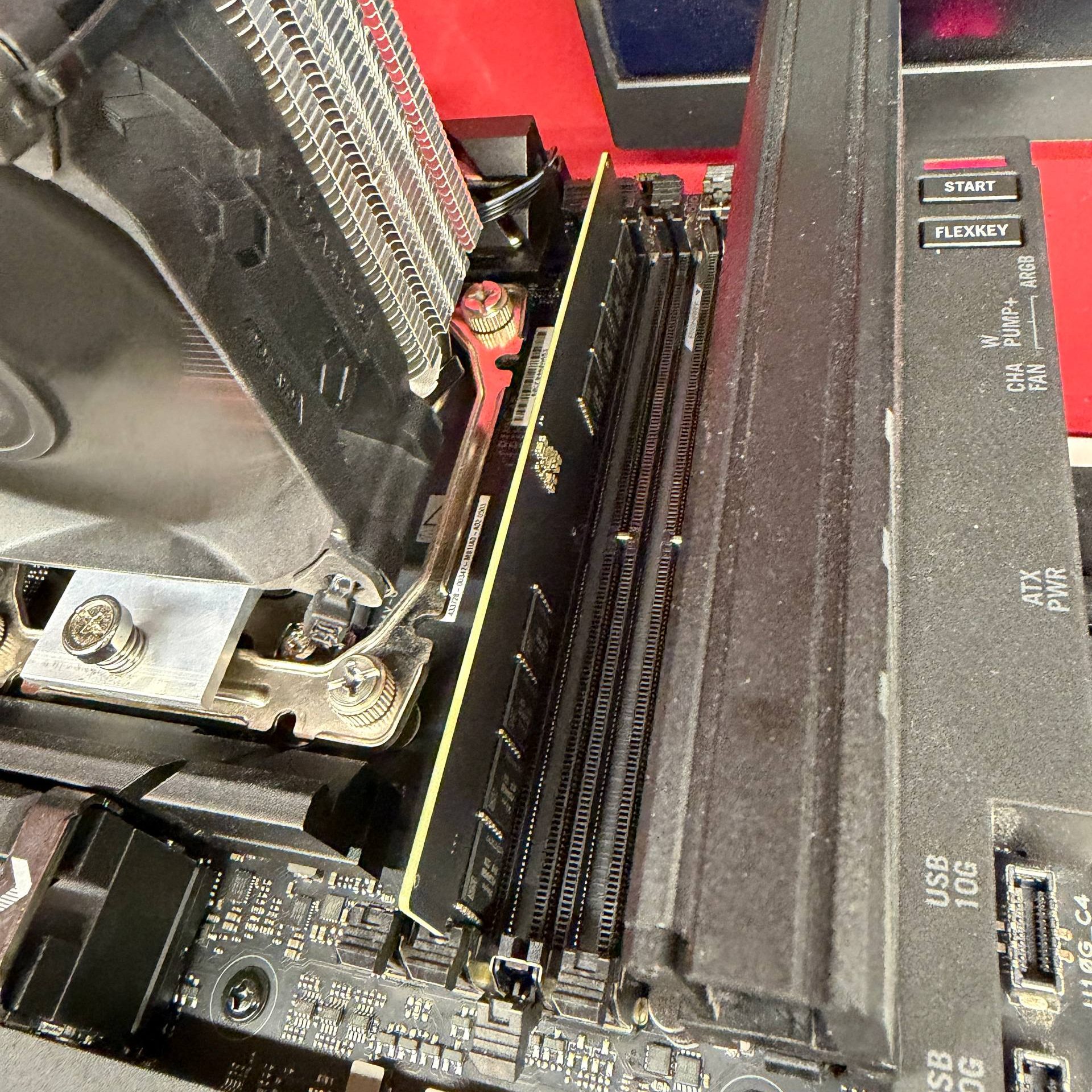
Post-rampocalyptic Chip-Swap Provides Desktop Memory at Laptop Prices


The media in this post is not displayed to visitors. To view it, please log in.

When you can buy something at a low price in one location, and sell it at a higher price somewhere else, you’re engaged in what economists call “arbitrage”. We’re not sure if desoldering DDR5 chips from laptop SO-DIMMs to populate a custom PCB to create much-more-expensive desktop memory counts as arbitrage, but it certainly counts as a hack. [VIK-on], who built the cards, claims he’s getting DDR5 performance at almost DDR3 prices. Nice!

Installed, the RAM apparently works well, though [VIK-on] has not shared benchmarks.Specifically, he’s put together a 32 GB UDIMM from donor chips from two 16 GB SO-DIMMs. The memory chips themselves aren’t enough to make a stick of RAM, however: the part where we wish we had more details was in the firmware. The firmware identifies this DIY DIMM as an ADATA AX5U6500C3232G-DCLARWH, specifically. [VIK-on] is still performing stability tests, if those go well, we’re told to expect a how-to guide.

[VIK-on] is in Russia, so SO-DIMM rates may differ in your local market, but he claims walkaway costs of 17,015 ₽ — about $218 or €188, an astounding price for DDR5 in these dark days.

Some say soldering SIMMs seems severe, but hardly strange to Hackaday, and desperate times call for desperate measures. It’s ether that or optimize software, and who wants go to that effort?


hackaday.com/2026/01/27/post-r…

Cybersecurity & cyberwarfare ha ricondiviso questo.

NEW: After Apple launched Lockdown Mode years ago, and Google released its own special security feature for Android last year, WhatsApp now offers a new mode for users at high risk of being targeted with spyware.

It's called Strict Account Settings and enables certain restrictions to protect users.

techcrunch.com/2026/01/27/what…

Cybersecurity & cyberwarfare ha ricondiviso questo.

#WhatsApp rolls out Strict Account settings to strengthen protection for high-risk users
securityaffairs.com/187405/sec…
#securityaffairs #hacking

Regrowing Teeth Might Not Be Science Fiction Anymore


The media in this post is not displayed to visitors. To view it, please log in.

The human body is remarkably good at handling repairs. Cut the skin, and the blood will clot over the wound and the healing process begins. Break a bone, and the body will knit it back together as long as you keep it still enough. But teeth? Our adult teeth get damaged all the time, and yet the body has almost no way to repair them at all. Get a bad enough cavity or knock one out, and it’s game over. There’s nothing to be done but replace it.

Finding a way to repair teeth without invasive procedures has long been a holy grail for dental science. A new treatment being developed in Japan could help replace missing teeth in the near future.

The Tooth

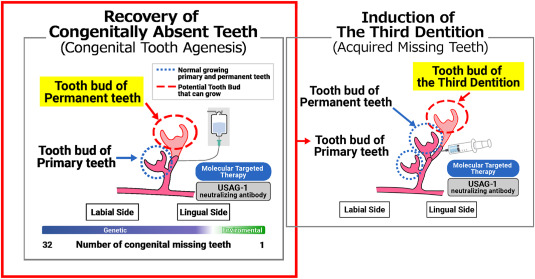
Using an antibody treatment to suppress USAG-1 in ferrets led to the development of supernumerary teeth. In regular speak, that means “more teeth than you would typically expect a ferret to have.” Credit: Research paper
In the course of normal development, humans grow a set of baby teeth, followed by a set of adult or “permanent” teeth. Conventional wisdom tells us that this second set is all we get, and that we should properly care for them if we hope to hang on to them for life. Physical injury can knock them out, and a lack of dental hygiene can see them badly damaged to the point where they have to be removed. Thus, there are plenty of incentives to take care of one’s teeth, given that there is little to be done beyond replacing them with clumsy dentures if they fail us.

Researchers in Japan may have figured out a workaround, however. A gene called uterine sensitization–associated gene-1 (USAG-1) was identified to play a role in stopping the growth of teeth in small mammals like mice and ferrets. In turn, it was determined that by inhibiting the interaction between proteins generated by USAG-1 and bone morphgenetic protein (BMP) molecules, it was possible to make dental growth resume. The perceived link is relatively simple—suppress USAG-1, and kickstart the tooth generation process. The hope is that using an antibody to do this would then lead to the spontaneous development of healthy adult teeth.

Research suggests that humans may have an extra set of teeth “buds” lurking in the jaw that normally lay dormant; it could be as simple as activating them to produce new teeth as needed. Thus, the concept is sometimes referred to as growing “the third tooth”—in that a regenerated tooth would be the third tooth after the original baby and adult teeth. Particularly as human lifespans grow longer, the ability to produce a third set of teeth becomes more valuable. However, the technique won’t just be useful for people that break a tooth or lose one to excessive acid wear or associated damage. Indeed, an early focus of the work is to help individuals with conditions like congenital anodontia, wherein a patient never grew a full set of mature permanent teeth. The aim is that the treatment could stimulate the growth of strong, adult-grade teeth to improve the quality of life for those with the condition.
It’s believed humans may have buds for a third set of teeth already lurking, just waiting to be activated. Credit: research paper
With early stage trials in mice completed some time ago, the treatment remains in early stage clinical trials for humans. An initial trial tested the treatment on adult males from 30 to 64 years old who were missing at least one tooth. This was with the hope that if growth did occur, it would ideally be limited to the missing slot, rather than causing new growth in areas that would push out existing healthy teeth. The next stage of trials will involve young children from ages 2 to 7 who are missing at least four teeth, to test the treatment on those with a congenital tooth deficiency. It’s likely that testing will also aim to determine just how USAG-1 suppression influences tooth regrowth. Ideally, it would only occur in specific areas where teeth were missing. It would be a great disaster if the treatment led to widespread tooth regrowth, which could cause crowding issues or loss of healthy teeth.

Right now, taking a pill or injection to regrow entire teeth seems like science fiction. However, if it does turn out that merely supressing some proteins is enough to get the body’s own tooth factory rolling again, it could be a game changer. There’s hope yet for all, except perhaps those that make their business in selling dentures.


hackaday.com/2026/01/27/regrow…

Running DOOM on Earbuds


The media in this post is not displayed to visitors. To view it, please log in.

In 1993, DOOM was a great game to play if you had a 486 with a VGA monitor and nothing to do all weekend. In 2026, you can play it on a set of earbuds instead, if for some reason that’s something you’ve always dreamed of doing.

The project comes to us from [Arin Sarkisian], who figured out that the Pinebuds Pro had enough processing power to run one of the seminal FPS games from the 1990s. Inside these earbuds is a Cortex-M4F, which is set to run at 100 MHz. [Arin] figured out it could easily be cranked up to 300 MHz with low power mode switched off, which would come in handy for one main reason. See, the earbuds might be able to run the DOOM engine, but they don’t have a display.

Thus, [Arin] figured the easiest way to get the video data out would be via the Cortex-M4F’s serial UART running at 2.4 mbps. Running the game at a resolution of 320 x 200 at 3 frames per second would consume this entire bandwidth. However, all those extra clock cycles allow running an MJPEG compression algorithm that allow spitting out up to 18 frames per second. Much better!

All that was left to do was to figure out a control scheme. To that end, a web server is set up off-board that passes key presses to the buds and accepts and displays the MJPEG stream to the player. If you’re so inclined you can even play the game yourself on the project website, though you might just have to get in a queue. In the meantime, you can watch the Twitch stream of whoever else is playing at the time.

Files are on GitHub—both the earbud firmware and the web interface used to play the game. It was perhaps only a matter of time until we saw DOOM on earbuds; no surprise given that we’ve already seen it played on everything from receipt printers to cookware. No matter how cliche, we’re going to keep publishing interesting DOOM ports—so keep them coming to the tipsline.

Thanks to [alialiali] for the tip!


hackaday.com/2026/01/27/runnin…

Cybersecurity & cyberwarfare ha ricondiviso questo.

The media in this post is not displayed to visitors. To view it, please go to the original post.

Caro @pixelfed@pixelfed.social @pixelfed@mastodon.social @pixelfed@mastodon.uno che smandruppato di senso ha offrire un servizio e togliere l'unica funzione che farà impazzire di gioia gli utenti che vogliono levarsi #Instagram dalle scatole?

La funzione Import non è disponibile.
Il supporto assente.
La richiesta di risposta dagli admin assente.

Zombie Netscape Won’t Die


The media in this post is not displayed to visitors. To view it, please log in.

The very concept of the web browser began with a humble piece of software called NCSA Mosaic, all the way back in 1993. It was soon eclipsed by Netscape Navigator, and later Internet Explorer, which became the titans of the 1990s browser market. In turn, they too would falter. Navigator’s dying corpse ended up feeding what would become Mozilla Firefox, and Internet Explorer later morphed into the unexceptional browser known as Edge.

Few of us have had any reason to think about Netscape Navigator since its demise in 2008. And yet, the name lingers on. A zombie from a forgotten age, risen again to haunt us today.

The Bigger They Are, The Harder They Fall


Netscape Navigator was once the browser to use, dominating its rivals with a 90% market share. Unfortunately, that reign of glory only lasted until the last few years of the 1990s, when Internet Explorer began to embrace, extend, and extinguish. Explorer was included with every copy of Windows sold, it was distributed by AOL and minor ISPs alike, and it was better at keeping up with, or outright creating, new standards at a time when Netscape’s developers became stuck in the quagmire of an an increasingly aging codebase.

Netscape was great right through the 4.0s, but Netscape 5 was cancelled, and Netscape 6 was a mess. The company was bought out by AOL, and the product limped on into the early 2000s, but it was eventually declared dead on March 1, 2008. With almost no user base to speak of at that point, it simply did not make sense to continue.

You might think, then, that the Netscape name died with the browser and that it would never be seen or heard again. Unfortunately, that’s almost never the case when it comes to recognizable names in the tech world. Somebody always seems to hang on to the rights to do something with them, even if it’s usually unsuccessful. Sometimes it goes well, but more often than not, it amounts to little more than a hackneyed old logo slapped on a product that nobody really cares about.
Connect to the Internet by dialing up the Netscape ISP! Ironically founded several years after the browser ceased to be relevant at all. Credit: Netscape ISP via Web Archive
In the case of Netscape, the branding rights became AOL’s when it first purchased the business in 1998. It would go on to use the name to start a dial-up ISP in 2004, called Netscape Internet Service. It’s unclear precisely why this was done, given that AOL already was an ISP in its own right, which ran dial-up service all the way up until September 2025.

But for whatever reason, Netscape ISP kicked off operations on January 8, 2004, initially offering unlimited use for just $9.95 a month. Notably, it seems the name was the point—with the barebones site noting that you were getting a “reliable Internet connection from a name you trust.” It was also somewhat different from the contemporary AOL offering, in that you didn’t need a CD full of bloatware to access the service. The signup site went so far as to explain that you didn’t need to use a Netscape Navigator browser to access the service; any would do. As a cool bonus, you got a sweet “@netscape.com” email address when you signed up.
Even in 2016, the Netscape ISP was still offering dial-up connections only. However, you could get additional netscape.com email addresses for an extra $2.00 a month, along with various other add-ons of questionable value. Credit: Netscape ISP via Web Archive
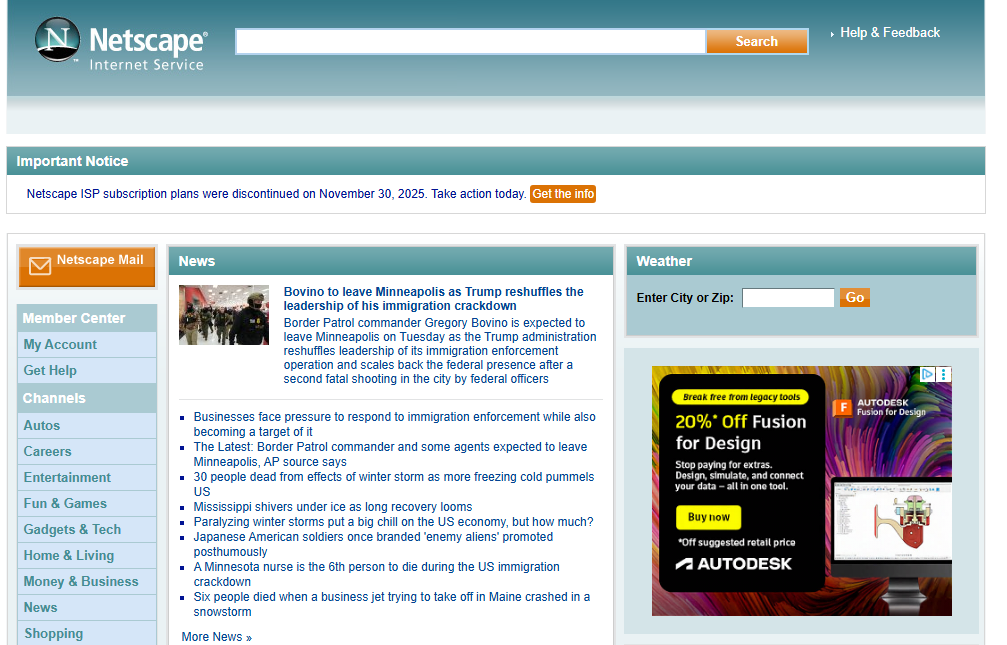
The Netscape ISP maintained its cheap offering for many years. It also later added “Web Accelerator,” which was a simple compression tool that promised to let you surf the web “up to 5x faster.” In reality, it was marketing fluff that did not make a lot of difference to dial-up users chugging along on slow connections. Weirdly, the Netscape ISP never transitioned over to selling DSL or fiber or any sort of modern broadband connection. As recently as 2018, you could still sign up for a service that was entirely dial-up only. Eventually, at some point in the late 2010s or early 2020s, Netscape ISP appeared to stop accepting new signups, with the main webpage (isp.netscape.com) eventually turning into a generic news aggregator. It remains in that state today at the time of writing.

Perhaps the most hilarious part of the Netscape ISP story, though, is that it eventually spawned its own browser. Somewhere deep in the bowels of an AOL office, some poor developer had to hack together a Chromium fork to slap the Netscape ISP branding on it. You can still download it today, thanks to a link lurking on the bottom of the Netscape ISP site. We gave it a look.
The Netscape ISP page as it stands in 2026. This format has been used on the site since at least 2022; it appears the ISP stopped accepting new customers some years prior. Credit: isp.netscape.com
Hilariously, it’s an amalgamation of so many dying names from the early Internet—the privacy policy is hosted on Yahoo, because the now-defunct search engine merged with AOL in 2015. The browser is very obviously a reskinned version of Chromium from mid-2024, with a bit of AOL search bloatware thrown in for good measure.

While you can still download the silly 2024 “Netscape” browser, you can’t use the ISP anymore. That’s because AOL killed it dead in November 2025. Affected users will be able to maintain their super-cool netscape.com email addresses, but no more will you be able to dial up to access the Internet with your Netscape ISP account. To ease the change, AOL offered to transition affected users over to the “Complete by AOL” service, while also recommending alternatives like Starlink, HughesNet, Dialup4Less.com, and T-Mobile and Verizon 5G home internet plans. Yes, even in late 2025, your dying dial-up ISP was willing to recommend another that still operates on the old-fashioned phone lines, just as our ancestors intended.

One thing we’d love to see are the user statistics for the Netscape ISP over the past two decades. It’s hard to imagine there were a whole lot of people that were inconvenienced when AOL’s random off-shoot dial-up ISP went down in November 2025. It has to be some tiny figure, even less than the number of dial-up users that were still on the company’s main service, which shut down a month earlier. Still, they felt the need to issue a notice to users, so somebody must still have been calling in now and then, using their glacial 56K connection to check the weather and catch up on the latest updates in the Ivy League squash standings.

In any case, save for a tired old website and a rapidly-aging port of Chrome, Netscape is finally dead. For good this time. Until the logo turns up on a bunch of smart TVs and a badly-rebadged smartphone, or something. Until then, the big N shall hopefully be laid to rest.

Pi Compute Module Powers Fully Open Smartphone


The media in this post is not displayed to visitors. To view it, please log in.

With the powerful off-the-shelf hardware available to us common hardware hobbyist folk, how hard can it be to make a smartphone from scratch? Hence [V Electronics]’s Spirit smartphone project, with the video from a few months ago introducing the project.

As noted on the hardware overview page, everything about the project uses off the shelf parts and modules, except for the Raspberry Pi Compute Module 5 (CM5) carrier board. The LCD is a 5.5″, 1280×720 capacitive one currently, but this can be replaced with a compatible one later on, same as the camera and the CM5 board, with the latter swappable with any other CM5 or drop-in compatible solution.

The star of the show and the thing that puts the ‘phone’ in ‘smartphone’ is the Quectel EG25-GL LTE (4G) and GPS module which is also used in the still-not-very-open PinePhone. Although the design of the carrier board and the 3D printable enclosure are still somewhat in flux, the recent meeting notes show constant progress, raising the possibility that with perhaps some community effort this truly open hardware smartphone will become a reality.

youtube.com/embed/OgMdO0ckICg?…

Thanks to [tiel] for the tip.


hackaday.com/2026/01/27/pi-com…

Cybersecurity & cyberwarfare ha ricondiviso questo.

Idiocracy is coming - Governo tramite intelligenza artificiale? L'amministrazione Trump prevede di redigere regolamenti utilizzando l'intelligenza artificiale

Il Dipartimento dei Trasporti, che sovrintende alla sicurezza di aerei, automobili e oleodotti, prevede di utilizzare Google Gemini per redigere nuove normative. "Non abbiamo bisogno della norma perfetta", dice il procuratore del Dipartimento dei Trasporti. "Vogliamo che sia sufficientemente buona".

propublica.org/article/trump-a…

@aitech

Cybersecurity & cyberwarfare ha ricondiviso questo.

La Francia abbandonerà le piattaforme statunitensi Microsoft Teams e Zoom per una "piattaforma sovrana" a causa di problemi di sicurezza

La Francia sostituirà le piattaforme americane Microsoft Teams e Zoom con una propria piattaforma di videoconferenza sviluppata a livello nazionale, che sarà utilizzata in tutti i dipartimenti governativi entro il 2027, ha annunciato lunedì il Paese.

euronews.com/next/2026/01/27/f…

@informatica

Allarme truffe, nuove campagne di phishing SPID: analisi delle tecniche e dei rischi


@Informatica (Italy e non Italy 😁)
Il CERT-AgID ha individuato una nuova campagna di phishing ai danni dell’Agenzia delle Entrate finalizzata non solo ad acquisire le credenziali di accesso delle identità digitali SPID degli utenti, ma anche a impersonare la vittima in