The Cutest Weather Forecast on E-Ink and ESP32


The media in this post is not displayed to visitors. To view it, please log in.

A photo of the cats and the generated image

There’s a famous book that starts: “It is a truth universally acknowledged that a man in possession of a good e-ink display, must be in want of a weather station.” — or something like that, anyway. We’re not English majors. We are, however, major fans of this feline-based e-ink weather display by [Jesse Ward-Bond]. It’s got everything: e-ink, cats, and AI.
The generated image needs a little massaging to look nice on the Spectra6 e-ink display.
AI? Well, it might seem a bit gratuitous for a simple weather display, but [Jesse] wanted something a little more personalized and dynamic than just icons. With that in the design brief, he turned to Google’s Nano Banana API, feeding it the forecast and a description of his cats to automatically generate a cute scene to match the day’s weather.

That turned out to not be enough variety for the old monkey brain, so the superiority of silicon — specifically Gemini–was called upon to write unique daily prompts for Nano Banana using a random style from a list presumably generated by TinyLlama running on a C64. Okay, no, [Jesse] wrote the prompt for Gemini himself. It can’t be LLM’s all the way down, after all. Gemini is also picking the foreground, background, and activity the cats will be doing for maximum neophilia.

Aside from the parts that are obviously on Google servers, this is all integrated in [Jesse]’s Home Assistant server. That server stores the generated image until the ESP32 fetches it. He’s using a reTerminal board from SeedStudio that includes an ESP32-S3 and a Spectrum6 coloor e-ink display. That display leaves something to be desired in coloration, so on top of dithering the image to match the palette of the display, he’s also got a bit of color-correction in place to make it really pop.

If you’re interested in replicating this feline forecast, [Jesse] has shared the code on GitHub, but it comes with a warning: cuteness isn’t free. That is to say, the tokens for the API calls to generate these images aren’t free; [Jesse] estimates that when the sign-up bonus is used up, it should cost about fourteen cents a pop at current rates. Worth it? That’s a personal choice. Some might prefer saving their pennies and checking the forecast on something more physical, while others might prefer the retro touch only a CRT can provide.


hackaday.com/2026/01/17/the-cu…

The Journey of Finding the Right Press Brake


The media in this post is not displayed to visitors. To view it, please log in.

Press brakes are invaluable tools when working with sheet metal, but along with their almost infinite versatility comes a dizzying number of press brake types. After starting with an old-school, purely mechanical press brake, [Wes] of Watch Wes Work fame had been thinking of upgrading said press brake to a hydraulic configuration, but soured on this after facing all the disadvantages of the chosen approach. Thus, one does what any rational person does and purchases a used and very much untested 45-ton computer-controlled hydraulic press brake.

The video first explores the pros and cons of the various types of press brakes, with the issue of providing a balanced force across the entirety of the press brake’s dies being the largest problem. Although various mechanical and hydraulic solutions were attempted over the decades, a computer-controlled press brake like this Gasparini PBS 045 that [Wes] got is probably one of the more effective solutions, even if it provides the headache of more electrical and electronic things that can go wrong. The above screenshot of its basic workings should make that quite obvious, along with [Wes]’s detailed explanation.

As it turned out, this about 25-year-old Italian press brake wasn’t in such a terrible nick, but needed some badly needed TLC and obligatory breaker testing to bring it back to life. While it doesn’t like you not centering the part, this can be worked around by specifying that the part is actually larger than it is. Although [Wes] got it working well enough to do some work with it, it still has some gremlins left in it that will hopefully be hunted down over the coming time and video(s).

youtube.com/embed/X4z7UmUZyig?…


hackaday.com/2026/01/17/the-jo…

Cybersecurity & cyberwarfare ha ricondiviso questo.

«Ho deciso di fare un passo indietro» - Il comunicato di Guido Scorza sulle dimissioni irrevocabili dal #GarantePrivacy

«Credo si tratti di una decisione giusta e necessaria nell’interesse dell’istituzione anche se, permettetemi di pensarlo, non posso che ritenerla ingiusta nella sostanza e nelle modalità che mi hanno portato ad assumerla.»

guidoscorza.it/cosedaexgarante…

@privacypride

Cybersecurity & cyberwarfare ha ricondiviso questo.

🌑Garante Privacy: Dimissioni di Guido Scorza componente del Collegio🌑

Guido Scorza, componente del Collegio del Garante per la protezione dei dati personali, ha rassegnato in data odierna le proprie dimissioni dall’incarico

garanteprivacy.it/home/docweb/…

@privacypride

reshared this

Cybersecurity & cyberwarfare ha ricondiviso questo.

HaveIBeenFlocked.com ha pubblicato informazioni rilasciate dai dipartimenti di polizia che, utilizzando Flock, hanno involontariamente divulgato i dettagli di milioni di obiettivi di sorveglianza

Obiettivi di sorveglianza e indagini a rischio per un errore della polizia.
Flock ha risposto a questa rivelazione minacciando un sito che le aveva divulgate e limitando le informazioni che il pubblico può ottenere tramite richieste di accesso ai documenti pubblici.

404media.co/police-unmask-mill…

@pirati

reshared this

Cybersecurity & cyberwarfare ha ricondiviso questo.

Mi dispiace Dave, temo di non poterlo fare! I PC si rifiutano di spegnersi dopo la patch di Microsoft

Quando progettare aggiornamenti con il culo è più pericoloso di quanto non sia creare HAL9000. Microsoft si giustifica: «è un bug di Secure Launch»

theregister.com/2026/01/16/pat…

@aitech

Cybersecurity & cyberwarfare ha ricondiviso questo.

Ukraine–Germany operation targets #Black #Basta, Russian leader wanted
securityaffairs.com/187008/cyb…
#securityaffairs #hacking #ransomware
Cybersecurity & cyberwarfare ha ricondiviso questo.

The media in this post is not displayed to visitors. To view it, please go to the original post.

Ucraina e Germania smantellano Black Basta? 2 arresti per ransomware, coinvolto un russo

📌 Link all'articolo : redhotcyber.com/post/ucraina-e…

#redhotcyber #news #cybersecurity #hacking #malware #ransomware #blackbasta #gruppocriminale #infiltrorete

reshared this

The Best Robot Mop System: Flat, Spinning, or Roller?


The media in this post is not displayed to visitors. To view it, please log in.

When it comes to designing a mopping robot, there are a number of approaches you can pick from, including just having the movement of the robot push the soggy mop over the floor, having spinning pads, or even a big spinning roller. But what difference does it make? Recently the [Vacuum Wars] channel ran a comparison to find out the answer.

The two spinning pad design is interesting, because it allows for the bot to move closer to objects or walls, and the base station doesn’t need the active scrubber that the simple static pad requires. The weakness of both types of flat mop design is that they are quickly saturated with dirt and moisture, after which they’ll happily smear it over the floor.

The spinning roller is the most complex, with the robot having its own onboard water tank, and a way to extract the dirty water from the mop and store it for disposal in the base station. Theoretically this would be the clear winner, with basically all of them having features like avoiding carpet.

Taking the test data from 150 different mopping robots that were made to clean up dried-up coffee stains, the results weren’t as clear-cut as one might perhaps expect due to the very limited scope of the test. But the comments to the video are perhaps more revealing. After all, most people don’t briefly run their robot mop over a few dried-up stains, but are faced with more severe real-life scenarios.

One commentator mentions their dogs dragging in a lot of mud on rainy days, in which case the spinning pads robot would end up spreading a thin film of mud across the floor. After upgrading to a spinning roller version this issue was resolved, though it’s readily admitted to be the more expensive system, with a much larger base station.

When in the video you see the details of what each approach involves on the side of the robot, the base station and the human caretaker, trade-offs are clear. Having the fixed flat pad is simple, but moves all complexity to the base station, with the spinning pads removing at least the need to motorize the base station. If you have small children or pets with muddy paws around, neither option works well, so you either have to whip out the human-powered mop or shell out for the high-end robotic solution.

Of course, you can also build your own super-charged robot mop, or a very thorough one, but definitely avoid mopping robots that are too cheap to actually work.

youtube.com/embed/Tz6U9QkXn5I?…


hackaday.com/2026/01/17/the-be…

Cybersecurity & cyberwarfare ha ricondiviso questo.

The media in this post is not displayed to visitors. To view it, please go to the original post.

Un nuovo gruppo cyber legato alla Cina colpisce gli USA: cosa sappiamo su UAT-8837

📌 Link all'articolo : redhotcyber.com/post/un-nuovo-…

#redhotcyber #news #cybersecurity #hacking #malware #ransomware #sicurezzainformatica #attacchinformatici

reshared this

Cybersecurity & cyberwarfare ha ricondiviso questo.

We are sunsetting the Tuscolo2025h2 CT log shard, and unfortunately its archive is larger than the (reasonable!) @internetarchive item limit of 1100 GB.

Instead, we made a .torrent file, and are seeding it with a custom memory-safe client. github.com/geomys/ct-archive#g…

Suggestions for a long-term home (or long-term seeding of the torrent) welcome!

groups.google.com/a/chromium.o…

Get Bored!


The media in this post is not displayed to visitors. To view it, please log in.

My son went over to a friends house this afternoon, when my wife had been planning on helping him with his French homework. This meant she had an hour or so of unexpected free time. Momentarily at a loss, she asked me what she should do, and my reply was “slack off”, meaning do something fun and creative instead of doing housework or whatever. Take a break! She jokingly replied that slacking off wasn’t on her to-do list, so she wouldn’t even know how to start.

But as with every joke, there’s more than a kernel of truth to it. We often get so busy with stuff that we’ve got to do, that we don’t leave enough time to slack, to get bored, or to simply do nothing. And that’s a pity, because do-nothing time is often among the most creative times. It’s when your mind wanders aimlessly that you find inspiration for that upgrade to the z-stage on your laser cutter, or whatever the current back-burner project of the moment is.

You don’t get bored when you’re watching TV, playing video games, or scrolling around the interwebs on your phone, and it’s all too easy to fall into these traps. To get well and truly bored requires discipline these days, so maybe putting “slack” into your to-do list isn’t a bad idea after all. My wife was right! And that’s why I volunteered to take my son to parkour on Sundays – it’s and hour of guaranteed, 100% uninterruptible boredom. How do you make sure you get your weekly dose of slack?

This article is part of the Hackaday.com newsletter, delivered every seven days for each of the last 200+ weeks. It also includes our favorite articles from the last seven days that you can see on the web version of the newsletter. Want this type of article to hit your inbox every Friday morning? You should sign up!


hackaday.com/2026/01/17/get-bo…

Cybersecurity & cyberwarfare ha ricondiviso questo.

#China-linked #APT #UAT-8837 targets North American critical infrastructure
securityaffairs.com/186999/bre…
#securityaffairs #hacking
Cybersecurity & cyberwarfare ha ricondiviso questo.

The media in this post is not displayed to visitors. To view it, please go to the original post.

Ritorna Gootloader più pericoloso che mai: il malware incastonato nello ZIP torna alla ribalta

📌 Link all'articolo : redhotcyber.com/post/ritorna-g…

#redhotcyber #news #malware #cybersecurity #hacking #gootloader

Arnis Brings the World to Minecraft: Bedrock Edition


The media in this post is not displayed to visitors. To view it, please log in.

A couple of years ago, we covered a project called Arnis, created by [Louis Erbkamm], which allowed you to generate any portion of Earth into Minecraft blocks and maps. It was already impressive, but since we last checked in the open source project has made some incredible progress.

When we first covered Arnis, it was stuck on the Java edition of Minecraft. But now the project has been updated to support the more modern Bedrock Edition, meaning you can put your home into any device’s version of Minecraft!

Beyond Bedrock version support, the actual tool has improved with proper elevation generation using data provided from NASA. This allows you to view the Alps or the Himalayas in all their voxel glory, or explore an entire map of the Moon. Perhaps what’s even more impressive is that the generation is accurate enough to be used in an actual research study involving flood mitigation education.

All of this has been made possible with help from a passionate community who have volunteered their time to assist [Louis] with the project — a testament to the power of open source.


hackaday.com/2026/01/17/arnis-…

The eMac: Using Apple’s Forgotten Educational Mac in 2025


The media in this post is not displayed to visitors. To view it, please log in.


Beauty truly is in the eye of the beholder. (Credit: MattKC, YouTube)Beauty truly is in the eye of the beholder. (Credit: MattKC, YouTube)
What’s it like to use a 2002-era Apple eMac all-in-one in 2025? That’s what [MattKC] asked himself after obtaining one of these systems from a seller who ominously mentioned that it had been ‘left outside for years’.

The Apple iMac is a bit of a cult symbol, whether you’re talking about the iconic fruity iMac G3 or the desk lamp-like iMac G4, but few reminisce or actively collect the Apple eMac. Manufactured from 2002 to 2006, it featured the PowerPC 7450 (G4e) CPU with clock speeds ranging from 700 MHz to 1.42 GHz, as well as a 17″ CRT. In terms of design it was basically a bland iMac G3 that was firmly targeting the education markets to try and regain market share after Windows PCs had begun to eat its lunch there.

As for the model that [MattKC] purchased, it was this earliest model, featuring a 700 MHz PowerPC G4 CPU in addition to 640 MB SDRAM. Despite the seller’s description it seems to be in good nick with it firing right up, and even a glance inside after beating the challenge of 2.5 mm hex screws showed it to be in relatively good condition.

Unlike the iMac G3, you can play the Mac port of Halo on it, but the Minecraft port is very much not performant. With generally multimedia and gaming working well, it does show why the eMac was released, as it’s quite capable relative to an iMac G3 which would have struggled with the educational software of the era. We definitely hope that [MattKC] restores it to its full glory instead of ripping out its innards, as the neglected status of the eMac makes it much more likely to go extinct than PowerPC-based iMacs.

youtube.com/embed/6dYLtxdwYlw?…


hackaday.com/2026/01/17/the-em…

Cybersecurity & cyberwarfare ha ricondiviso questo.

The media in this post is not displayed to visitors. To view it, please go to the original post.

VLAN: quando la segmentazione diventa un’illusione di sicurezza

📌 Link all'articolo : redhotcyber.com/post/vlan-quan…

#redhotcyber #news #vlan #sicurezzainformatica #reteinformatica

Cybersecurity & cyberwarfare ha ricondiviso questo.

The media in this post is not displayed to visitors. To view it, please go to the original post.

Stati Uniti: la difesa nel cyberspace non basta più. Occorre più Attacco

📌 Link all'articolo : redhotcyber.com/post/stati-uni…

#redhotcyber #news #cybersecurity #hacking #malware #ransomware #sicurezzainformatica #attacchihacker

Cybersecurity & cyberwarfare ha ricondiviso questo.

The media in this post is not displayed to visitors. To view it, please go to the original post.

Google paga gli hacker per la tranquillità di un prodotto sicuro: Chrome 144

📌 Link all'articolo : redhotcyber.com/post/google-pa…

#redhotcyber #news #googlechrome #aggiornamentogoogle #sicurezzainformatica #vulnerabilitadisicurezza #patchdisicurezza

Cybersecurity & cyberwarfare ha ricondiviso questo.

Meishi - Connections Reflect Your Privacy

L'app contatti 📞📱 Privacy-First che aggiorna automaticamente 🔄 i dati dei contatti rispettando privacy e conformità GDPR ✅ grazie a P2P 🔗 e E2EE Signal Protocol 🔓. Alternativa Apple/Google 🚫. Open source 🌐 e Freemium. Versione Premium per backup/ripristino, condivisione dei dati granulare e gruppi illimitati.

meishiapp.com/

@privacypride

Cybersecurity & cyberwarfare ha ricondiviso questo.

The media in this post is not displayed to visitors. To view it, please go to the original post.

BREACHFORUMS DATABASE LEAK: 323.986 utenti con 70k IP e PGP privata

📌 Link all'articolo : zurl.co/VqGEN

Nel gennaio 2026 un archivio contenente il #database #utenti di #BreachForums, noto #forum di cybercriminalità, è stato pubblicato su un sito esterno, esponendo i #dati di circa 324.000 account registrati tra il 2022 e l’agosto 2025. Fonti indipendenti come BleepingComputer e Resecurity hanno analizzato il dump, confermandone l’autenticità e sottolineando le possibili conseguenze per l’operatività degli attori che frequentavano la piattaforma.

A cura di Inva Malaj del gruppo DarkLab

#redhotcyber #news #cybersecurity #hacking #malware #ransomware #database #breachforums #cybercriminalita #sicurezzainformatica #protezionedatidipersonali #furtofotoconsenso #databreach

Cybersecurity & cyberwarfare ha ricondiviso questo.

The media in this post is not displayed to visitors. To view it, please go to the original post.

🚨 💥OFFERTA LAMPO IMPERDIBILE 🚨💥

FINO A LUNEDI' 19 GENNAIO -15% PER LA SETTIMA LIVE CLASS "𝗗𝗔𝗥𝗞 𝗪𝗘𝗕 𝗘 𝗖𝗬𝗕𝗘𝗥 𝗧𝗛𝗥𝗘𝗔𝗧 𝗜𝗡𝗧𝗘𝗟𝗟𝗜𝗚𝗘𝗡𝗖𝗘" IN PARTENZA A MARZO

Per info e iscrizioni: 📱 💬 379 163 8765 ✉️ formazione@redhotcyber.com

✅ Pagina del corso: redhotcyber.com/linksSk2L/acad…
✅ Presentazione del corso del prof. Pietro Melillo : youtube.com/watch?v=9VaQUnTz4J…
✅ Webinar introduttivo di presentazione al corso : youtube.com/watch?v=ExZhKqjuwf…

#redhotcyber #formazione #formazioneonline #ethicalhacking #cti #cyberthreatintelligence #cybersecurity #cybercrime #cybersecuritytraining #cybersecuritynews #privacy #cti #cyberthreat #intelligence #infosec #corsi #corsiprartici #liveclass

Cybersecurity & cyberwarfare ha ricondiviso questo.

The media in this post is not displayed to visitors. To view it, please go to the original post.

Attacco al Ministero dell’interno francese: Credenziali condivise via email e dati sottratti

📌 Link all'articolo : redhotcyber.com/post/attacco-a…

#redhotcyber #news #cyberattacco #hacking #sicurezzainformatica #ministrodegliinterni #polizianazionale

reshared this

Cybersecurity & cyberwarfare ha ricondiviso questo.

The media in this post is not displayed to visitors. To view it, please go to the original post.

La Memoria a caldo: una storia di innovazione che passa dall’Italiana Olivetti

📌 Link all'articolo : redhotcyber.com/post/la-memori…

#redhotcyber #news #memoriaafil #magnetostrizione #tecnologia #informatica #memorie #tempidaccess

reshared this

Cybersecurity & cyberwarfare ha ricondiviso questo.

The media in this post is not displayed to visitors. To view it, please go to the original post.

200 – Se internet si spegne, si blocca la vita di tutti i giorni camisanicalzolari.it/200-se-in…

reshared this

Cybersecurity & cyberwarfare ha ricondiviso questo.

The media in this post is not displayed to visitors. To view it, please go to the original post.

B.E.L.L.A.: il protocollo che trasforma lo smartphone in alleato, non in padrone

📌 Link all'articolo : redhotcyber.com/post/b-e-l-l-a…

#redhotcyber #news #tecnologiaelibertà #benessere digitale #sfidadellatecnologia #uominie tecnologia

Crittografia post quantum nel settore finanziario: centrale la sicurezza della supply chain


@Informatica (Italy e non Italy 😁)
La rotta del G7 Cyber non prevede nuovi obblighi regolatori, ma offre un quadro di riferimento condiviso: una roadmap per autorità, istituzioni finanziarie e fornitori tecnologici, declinata in sei fasi principali della

reshared this

DIY, Full-Stack Farm Automation


The media in this post is not displayed to visitors. To view it, please log in.

Recently, [Vinnie] aka [vinthewrench] moved from Oregon to Arkansas to start a farmstead. This is a style of farming that focuses not just on a profitable farm where produce is sold at market, but also on a homestead where much of one’s own food is grown on the farm as well. Like any farm, though, it’s extremely hard work that takes a tremendous amount of time. Automation and other technology can make a huge impact in these situations, and [Vinnie] is rolling out his own software stack to help with this on his farm.

He calls his project the Pi Internet of Things, or PioT, and as its name suggests is based around the Raspberry Pi. Since this will all be outdoors and exposed to the extremes of Arkansas weather, everything built under the auspices of this project prioritizes ruggedness, stability, and long-term support, all while avoiding any cloud service. The system also focuses on being able to ride through power outages. The server side, called piotserver, uses a REST API to give the user access to the automation systems through a web interface

[Vinnie] also goes into detail about why existing systems like Home Assistant and Open Sprinkler wouldn’t work in his situation, and why a ground-up solution like this is more appropriate for his farm. This post is largely an overview of his system, but some of his other posts go into more detail about things like integrating temperature sensors, rainfall monitoring, controlling irrigation systems, and plenty of other farm automation tasks that are useful for any farmer or gardener.

We’ve also seen some other projects of his here like this project which converts a common AC sprinkler system to an easier-to-use DC system, and a DIY weather station that operates in the 915 MHz band. He’s been a great resource for anyone looking to have technology help them out with their farm or garden, but if you’re just getting started on your green thumb be sure to take a look at this starter guide as well.


hackaday.com/2026/01/16/diy-fu…

How Accurate is a 125 Year Old Resistance Standard?


The media in this post is not displayed to visitors. To view it, please log in.


Internals of the 1900 Evershed & Vignoles Ltd 1 ohm resistance standard. (Credit: Three-phase, YouTube)Internals of the 1900 Evershed & Vignoles Ltd 1 ohm resistance standard. (Credit: Three-phase, YouTube)
Resistance standards are incredibly useful, but like so many precision references they require regular calibration, maintenance and certification to ensure that they stay within their datasheet tolerances. This raises the question of how well a resistance standard from the year 1900 performs after 125 years, without the benefits of modern modern engineering and standards. Cue the [Three-phase] YouTube channel testing a genuine Evershed & Vignoles Ltd one ohm resistance standard from 1900.

With mahogany construction and brass contacts it sure looks stylish, though the unit was missing the shorting pin that goes in between the two sides. This was a common feature of e.g. resistance decade boxes of the era, where you inserted pins to connect resistors until you hit the desired total. Inside the one ohm standard is a platinoid resistor, which is an alloy of copper, nickel, tungsten, and zinc. Based on the broad arrow mark on the bottom this unit was apparently owned by the UK’s Ordnance Board, which was part of what was then called the War Office.

After a quick gander at the internals, the standard was hooked up to a Keithley DMM7510 digital bench meter. The resistance standard’s ‘datasheet’ is listed on top of the unit on the brass plaques, including the effect of temperature on its accuracy. Adjusting for this, the measured ~1.016 Ω was within 1.6% tolerance, with as sidenote that this was with the unit not having been cleaned or otherwise having had maintenance performed on it since it was last used in service. Definitely not a bad feat.

youtube.com/embed/gRksE0-k8U8?…


hackaday.com/2026/01/16/how-ac…

Testing a Continuous Printing Mod for the Bambu Lab A1 Mini


The media in this post is not displayed to visitors. To view it, please log in.

There are a few types of continuous 3D printing with FDM printers, with a conveyer belt and automatic build plate swapping the most common types. The advantage of build plate swapping is that it automates the bit where normally a human would have to come in to remove finished parts from the build plate. A recent entry here is the Chitu PlateCycler C1M which the [Aurora Tech] YouTube channel had over for a review. This kit bolts onto the Bambu Lab A1 Mini FDM printer and comes with four extra PEI build plates for a not unreasonable $79 (€69).

As also noted in the review video, this is effectively a clone of the original swapmod A1m kit, but a big difference is that the Chitu kit comes with all of the parts and doesn’t require you to print anything yourself.

The different plates are prepared using a special tool that inserts G-code between the plate changes. Moving the bed in a specific way triggers the switch that lifts the finished plate off the magnetic bed by the plastic grip on the plate and loads a fresh plate from the stack. Here it was found that a small tolerance issue prevented the last plate from being used, but some sandpaper fixed this. Other than that it was a fairly painless experience, and for e.g. multi-color prints with separated colors – as demonstrated – it would seem to be a great way to churn out the entire model without manual intervention or a lot of wasted filament.

Perhaps the main issue that is central to all of these build plate swap mods is where the plates go after they’re pulled off the magnetic bed: the padded box is a great idea for the first one or two plates, but after that you get your PEI build plates with parts on them crashing on top of each other.

This is where perhaps something like a passive roller conveyer system could provide a nice gentle off-ramp, though this too would increase the footprint of the system. Regardless, the overall system seems to work well enough, allowing one to stack fresh plates in the chute and if you turn on build plate detection in the A1 you can even prevent the printer from trying to print on the magnetic bed.

youtube.com/embed/5Ev57r4ikBg?…


hackaday.com/2026/01/16/testin…

Jam like It’s the 1980s With A Mini-IBM PC


The media in this post is not displayed to visitors. To view it, please log in.

The Mini PC. Without a banana for scale, you might be fooled.

A lot of retrocomputer enthusiasts have a favourite system, to the point of keeping up 40 year old flame wars over which system was “best”. In spite of the serious, boring nature of the PC/AT and its descendants, those early IBMs have a certain style that Compaq and the Clones never quite matched. Somehow, we live in a world where there are people nostalgic for Big Blue. That’s why [AnneBarela] built a miniature IBM PC using an Adafruit Fruit Jam board.

If you haven’t seen it before, the Fruit Jam board is an RP2350 dev board created specifically to make minicomputers, with its two USB host sockets, DVI-out and 3.5mm jack. [Anne] loaded a PC emulator by [Daft-Freak] called PACE-32 than can emulate an IBM compatible PC with an 80386 and up-to 8 MB of RAM on this particular board. The video is VGA, 640×480 — as god intended– piped to a 5″ LCD [Anne] picked up from AliExpress.

That display is mounted inside a replica monitor designed by [giobbino], and is sitting on top of a replica case. Both are available on Thingiverse, though some modification was required to provide proper mounting for the Fruit Jam board. [giobbino] designed it to house a FabGL ESP32 module– which has us wondering, if an RP2350 can be a 386, what level of PC might the ESP32-P4 be capable of? We’ve seen it pretend to be a Quadra, so a 486 should be possible. It wasn’t that long ago that mini builds of this nature required a Raspberry Pi, after all.

Speculation aside, this diminutive IBM build leaves us but with but one question: if you played Links386 on it, would it count as miniature golf?


hackaday.com/2026/01/16/jam-li…

Battle Born LFP Battery Melts With New Problem


The media in this post is not displayed to visitors. To view it, please log in.

Following up on user-reported cases of Battle Born LiFePO4 batteries displaying very hot positive terminals, [Will Prowse] decided to buy a brand new one of these LFP batteries for some controlled cycle testing.

Starting with 30 cycles with a charging current of 49 A and a discharge current of 99 A, this put it well within the 100 A continuous rating for the battery. There is also a surge current rating of 200 A for thirty seconds, but that was not tested here.

What’s interesting about the results here is that instead of the positive terminal getting visibly discolored as with the previous cases that we reported on, [Will] saw severe thermal effects on the side of the negative terminal to the point where the plastic enclosure was deforming due to severe internal heating.

During testing, the first two charge-discharge cycles showed full capacity, but after that the measured capacity became extremely erratic until the battery kept disconnecting randomly. After letting the battery cool down and trying again with 80 A discharge current the negative terminal side of the enclosure began to melt, which was a good hint to stop testing. After this the battery also couldn’t be charged any more by [Will]’s equipment, probably due to the sketchy contact inside the battery.

It’s clear that the plastic spacer inside the terminal bus bar was once again the primary cause, starting a cascade which resulted in not only the enclosure beginning to char and melt, but with heat damage visible throughout the battery. Considering that the battery was used as specified, without pushing its limits, it seems clear that nobody should be using these batteries for anything until Battle Born fixes what appears to be the sketchiest terminal and bus bar design ever seen in a high-current battery.

youtube.com/embed/2m7DSCKO-Bo?…


hackaday.com/2026/01/16/battle…

Cybersecurity & cyberwarfare ha ricondiviso questo.

NEW: Nicholas Moore, a hacker who broke into the systems of the U.S. Supreme Court and the Department of Veteran Affairs, stole the personal data of victims and then posted it online on his @ihackthegovernment Instagram account.

Moore faces a maximum of a year in prison and a fine of up to $100,000.

techcrunch.com/2026/01/16/supr…

Questa voce è stata modificata (3 mesi fa)

Magecart e web skimming, così evolvono le truffe sugli e-commerce: come difendersi


@Informatica (Italy e non Italy 😁)
È stata identificata una nuova campagna di web skimming basata su Magecart che non colpisce il server in modo tradizionale ma punta direttamente al browser dell’utente durante la fase di pagamento, intercettando i dati nel momento esatto in cui

Hackaday Podcast Episode 353: Fantastic Peripherals, Fake or Not Fake Picos, and Everything on the Steam Deck


The media in this post is not displayed to visitors. To view it, please log in.

Join Hackaday Editors Elliot Williams and Tom Nardi as they swap their favorite hacks and stories from the week. In this episode, they’ll start off by marveling over the evolution of the “smart knob” and other open hardware input devices, then discuss a futuristic propulsion technology you can demo in your own kitchen sink, and a cheap handheld game system that get’s a new lease on life thanks to the latest version of the ESP32 microcontroller.

From there they’ll cover spinning CRTs, creating custom GUIs on Android, and yet another thing you can build of out that old Ender 3 collecting dust in the basement. The episode wraps up with a discussion about putting Valve’s Steam Deck to work and a look at the history-making medical evacuation of the International Space Station.

Check out the links below if you want to follow along, and as always, tell us what you think about this episode in the comments!

html5-player.libsyn.com/embed/…

As always, this episode is available in DRM-free MP3.

Where to Follow Hackaday Podcast

Places to follow Hackaday podcasts:


Episode 353 Show Notes:

What’s that Sound?


Interesting Hacks of the Week:


Quick Hacks:


Can’t-Miss Articles:


hackaday.com/2026/01/16/hackad…

Trying Out the Allwinner-Based Walnut Pi SBC


The media in this post is not displayed to visitors. To view it, please log in.

When it comes to the term ‘Raspberry Pi clones’, the most that they really clone is the form factor, as nobody is creating clones of Broadcom VideoCore-based SoCs. At least not if they want to stay safe from Broadcom’s vicious legal team. That said, the Walnut Pi 1B single-board computer (SBC) that [Silly Workshop] recently took a gander at seems to be taking a fairly typical approach to a Raspberry Pi 4 form factor compatible board.

Part of Walnut Pi’s line-up, the Allwinner H616/H168-equipped 1B feels like it takes hints from both the RPi 4B and the Asus Tinkerboard, especially with its nicely colored GPIO pins. There’s also a beefier Walnut Pi 2B with an Allwinner T527 SoC that’s not being reviewed here. Translating the Chinese-language documentation for the board suggests that either the H616 or H618 may be installed, with both featuring a quad-core Cortex-A53, so in the ballpark of the Raspberry Pi 3.

There are also multiple RAM configurations, ranging from 1 GB of DDR3 to 4 GB of LPDDR4, with the 1 GB version being fun to try and run benchmarks like GeekBench on. Ultimately the impression was that it’s just another Allwinner SoC-based board, with a half-hearted ‘custom’ Linux image, no hardware acceleration due to missing (proprietary) Allwinner IP block drivers, etc.

While cheaper than a Raspberry Pi SBC, if you need anything more than the basic Allwinner H61* support and Ethernet/WiFi, there clearly are better options, some of which may even involve repurposing an e-waste Android TV box.

youtube.com/embed/XbNntV_yU50?…


hackaday.com/2026/01/16/trying…

Optimizing Software with Zero-Copy and Other Techniques


The media in this post is not displayed to visitors. To view it, please log in.

An important aspect in software engineering is the ability to distinguish between premature, unnecessary, and necessary optimizations. A strong case can be made that the initial design benefits massively from optimizations that prevent well-known issues later on, while unnecessary optimizations are those simply do not make any significant difference either way. Meanwhile ‘premature’ optimizations are harder to define, with Knuth’s often quoted-out-of-context statement about these being ‘the root of all evil’ causing significant confusion.

We can find Donald Knuth’s full quote deep in the 1974 article Structured Programming with go to Statements, which at the time was a contentious optimization topic. On page 268, along with the cited quote, we see that it’s a reference to making presumed optimizations without understanding their effect, and without a clear picture of which parts of the program really take up most processing time. Definitely sound advice.

And unlike back in the 1970s we have today many easy ways to analyze application performance and to quantize bottlenecks. This makes it rather inexcusable to spend more time today vilifying the goto statement than to optimize one’s code with simple techniques like zero-copy and binary message formats.

Got To Go Fast

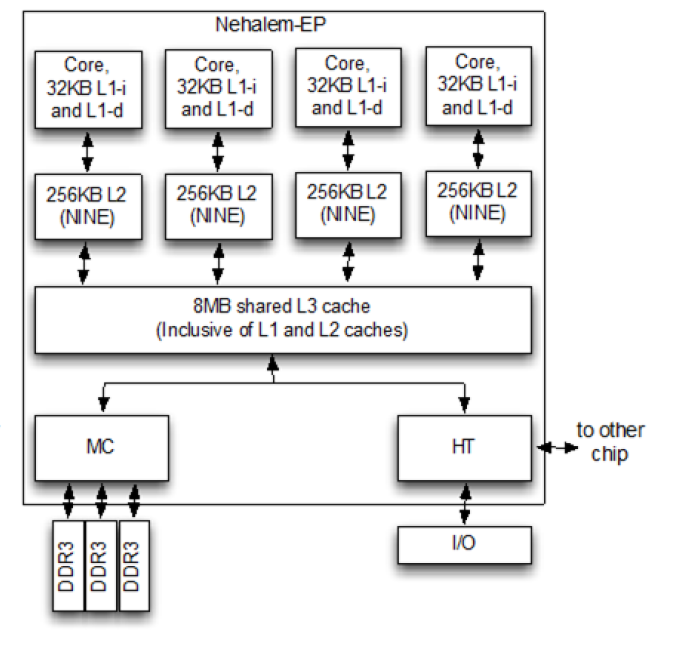
The cache hierarchy of the 2008 Intel Nehalem x86 microarchitecture. (Source: Intel)The cache hierarchy of the 2008 Intel Nehalem x86 microarchitecture. (Source: Intel)
There’s a big difference between having a conceptual picture of how one’s code interacts with the hardware and having an in-depth understanding. While the basic concept of more lines of code (LoC) translating into more RAM, CPU, and disk resources used is technically true much of the time, the real challenge lies in understanding how individual CPU cores are scheduled by the OS, how core cache synchronization works, and the impact that the L2 and L3 cache have.

Another major challenge is that of simply moving data around between system RAM, caches and registers, which seems obvious at face value, but the impact of certain decisions can have big implications. For example, passing a pointer to a memory address instead of the entire string, and performing aligned memory accesses instead of unaligned can take more or less time. This latter topic is especially relevant on x86, as this ISA allows unaligned memory access with a major performance penalty, while ARM will hard fault the application at the merest misaligned twitch.

I came across a range of these issues while implementing my remote procedure call library NymphRPC. Initially I used a simple and easy to parse binary message format, but saddled it with a naïve parser implementation that involved massive copying of strings, as this was the zero-planning-needed, smooth-brained, ‘safe’ choice. In hindsight this was a design failure with a major necessary optimization omitted that would require major refactoring later.

In this article I’d like to highlight both the benefits of simple binary formats as well as how simple it is to implement a zero-copy parser that omits copying of message data during parsing, while also avoiding memory alignment issues when message data is requested and copied to a return value.

KISS


Perhaps the biggest advantage of binary message formats is that they’re very simple, very small, and extremely low in calories. In the case of NymphRPC its message format features a standard header, a message-specific body, and a terminator. For a simple NymphRPC message call for example we would see something like:
uint32 Signature: DRGN (0x4452474e)
uint32 Total message bytes following this field.
uint8 Protocol version (0x00).
uint32 Method ID: identifier of the remote function.
uint32 Flags (see _Flags_ section).
uint64 Message ID. Simple incrementing global counter.
<..> Serialised values.
uint8 Message end. None type (0x01).
The very first value is a 32-bit unsigned integer that when interpreted as characters identifies this as a valid NymphRPC message. (‘DRGN’, because dragonfly nymph.) This is followed by another uint32 that contains the number of bytes that follow in the message. We’re now eight bytes in and we already have done basic validation and know what size buffer to allocate.

Serializing the values is done similarly, with an 8-bit type code followed by the byte(s) that contain the value. This is both easy to parse without complex validation like XML or JSON, and about as light-weight as one can make a format without adding something like compression.

Only If Needed


When we receive the message bytes on the network socket, we read it into a buffer. Because the second 32-bit value which we read earlier contained the message size, we can make sure to allocate a buffer that’s large enough to fit the rest of the message’s bytes. The big change with zero-copy parsing commences after this, where the naïve approach is to copy the entire byte buffer into e.g. a std::string for subsequent substring parsing.

Instead of such a blunt method, the byte buffer is parsed in-place with the use of a moving index pointer into the buffer. The two key methods involved with the parsing can be found in [url=https://github.com/MayaPosch/NymphRPC/blob/master/src/nymph_message.cpp]nymph_message.cpp[/url] and [url=https://github.com/MayaPosch/NymphRPC/blob/master/src/nymph_types.cpp]nymph_types.cpp[/url], with the former providing the NymphMessage constructor and the basic message parser. After parsing the header, the NymphType class provides a parseValue() function that takes a value type code, a reference to the byte buffer and the current index. This function is called until the terminating NYMPH_TYPE_NONE is found, or some error occurs.

Looking at parseValue() in more detail, we can see two things of note: the first is that we are absolutely copying certain data despite the ‘zero-copy’ claim, and the liberal use of memcpy() instead of basic assignment statements. The first item is easy to explain: the difference between either copying the memory address or the value of a simple integer/floating point type is so minimal that we trip head-first into the same ‘premature optimization’ thing that Mr. Knuth complained about back in 1974.

Ergo we just copy the value and don’t break our pretty little heads about whether doing the same thing in a more convoluted way would net us a few percent performance improvement or loss. This is different with non-trivial types, such as strings. These are simply a char* pointer into the byte buffer, leaving the string’s bytes in peace and quiet until the application demands either that same character pointer via the API or calls the convenience function that assembles a readily-packaged std::string.

Memcpy Is Love


Although demonizing ‘doing things the C way’ appears to be a popular pastime, if you want to write code that works with the hardware instead of against it, you really want to be able to write some highly performative C code and fully understand it. When I had written the first zero-copy implementation of NymphRPC and had also written up what I thought was a solid article on how well optimized the project now was, I had no idea that I had a “fun” surprise waiting for me.

As I happily tried running the new code on a Raspberry Pi SBC after doing the benchmarking for the article on an x86 system, the first thing it did was give me a hard fault message in the shell along with a strongly disapproving glare from the ARM CPU. As it turns out, doing a direct assignment like this is bound to get you into trouble:
methodId = *((uint32_t*) (binmsg + index));
This line casts the current index into the byte buffer as a uint32_t type before dereferencing it and assigning the value to the variable. When you’re using e.g. std::string the alignment issues sort themselves out somewhere within the depths of the STL, but with direct memory access like this you’re at the mercy of the underlying platform. Which is a shame, because platforms like ARM do not know the word ‘mercy’.

Fortunately this is easy to fix:
memcpy(&methodId, (binmsg + index), 4);
Instead of juggling pointers ourselves, we simply tell memcpy what the target address is, where it should copy from and how many bytes are to be copied. Among all the other complex scenarios that this function has to cope with, doing aligned memory address access for reading and writing is probably among its least complex requirements.

Hindsight


Looking back on the NymphRPC project so far, it’s clear that some necessary optimizations that ought to have been there from the very beginning weren’t there. At least as far as unnecessary and premature optimizations go, I do feel that I have successfully dodged these, but since these days we’re still having annual flamewars about the merits of using goto I very much doubt that we will reach consensus here.

What is clear from the benchmarking that I have done on NymphRPC before and after this major refactoring is that zero-copy makes a massive difference, with especially operations involving larger data (string) chunks becoming multiple times faster, with many milliseconds shaved off and the Callgrind tool of Valgrind no longer listing __memcpy_avx_unaligned_erms as the biggest headache due to std::string abuse.

Perhaps the most important lesson from optimizing a library like NymphRPC is that aside from it being both frustrating and fun, it’s also a humbling experience that makes it clear that even as a purported senior developer there’s always more to learn. Even if putting yourself out there with a new experience like porting a lock-free ring buffer to a language like Ada and getting corrected by others stings a little.

After all, we are here to write performant software that’s easy to maintain and have fun while doing it, with sharing optimization tips and other tricks just being part of the experience.


hackaday.com/2026/01/16/optimi…

Cybersecurity & cyberwarfare ha ricondiviso questo.

The media in this post is not displayed to visitors. To view it, please go to the original post.

Allarme Cisco: falla CVSS 10 consente RCE come root, attacchi in corso

📌 Link all'articolo : redhotcyber.com/post/allarme-c…

#redhotcyber #news #cybersecurity #hacking #vulnerabilita #zeroday #ciscosecurity #secureemail #patch

Cybersecurity & cyberwarfare ha ricondiviso questo.

Data breach at #Canada’s Investment Watchdog Canadian Investment Regulatory Organization impacts 750,000 people
securityaffairs.com/186993/dat…
#securityaffairs #hacking