Cybersecurity & cyberwarfare ha ricondiviso questo.

The media in this post is not displayed to visitors. To view it, please go to the original post.

Ha coinvolto dati personali? Fine del dibattito: è Data Breach

📌 Link all'articolo : redhotcyber.com/post/ha-coinvo…

#redhotcyber #news #gdpr #databreach #sicurezzadigital #protezionedatidigitali #violazionididati #accesso

Cybersecurity & cyberwarfare ha ricondiviso questo.

The media in this post is not displayed to visitors. To view it, please go to the original post.

Orion Leaks: Erede Legittimo o “Scavenger” nell’Ombra di LockBit?

📌 Link all'articolo : redhotcyber.com/post/orion-lea…

#redhotcyber #news #orionleaks #lockbit #ransomware #cybersecurity #hacking #malware #operazionecronos #leak

Cybersecurity & cyberwarfare ha ricondiviso questo.

AZ Monica #hospital in Belgium shuts down servers after cyberattack
securityaffairs.com/186882/cyb…
#securityaffairs #hacking
Cybersecurity & cyberwarfare ha ricondiviso questo.

Threat actor claims the theft of full customer data from Spanish energy firm #Endesa
securityaffairs.com/186861/cyb…
#securityaffairs #hacking
Cybersecurity & cyberwarfare ha ricondiviso questo.

NEW: 24-year-old Nicholas Moore will plead guilty to hacking the U.S. Supreme Court electronic filing system in 2023.

There aren't a lot of public details about this case for now. It will be interesting to find out what he accessed or stole.

techcrunch.com/2026/01/13/man-…

Cybersecurity & cyberwarfare ha ricondiviso questo.

The media in this post is not displayed to visitors. To view it, please go to the original post.

#Fedinews: il "giornale" con le migliori notizie provenienti dal fediverso italiano

Vuoi leggere un flusso di notizie selezionato dagli utenti italiani del @fediverso ?

Allora puoi provare ad aprire la pagina
di fedinews.it, realizzata da @skariko

E se vuoi pubblicare anche tu una notzia che secondo dovrebbe essere presente su FediNews, allora puoi pubblicarla dal tuo attuale account social menzionando i gruppi Activitypub su feddit.it e su citiverse.it

fedinews.it

Questa voce è stata modificata (3 mesi fa)
in reply to saxeee

The media in this post is not displayed to visitors. To view it, please log in.

@saxeee esattamente. Con NodeBB basta andare sulla categoria e il feed è uno solo (vedi img)

Il feed RSS di una categoria NodeBBIl feed RSS di una categoria NodeBB

Con Lemmy poi è ancora più configurabile (vedi img) perché puoi vere un feed personalizzato

Il feed RSS di una comunità LemmyIl feed RSS di una comunità Lemmy

@DajeLinux @informapirata ⁂

saxeee reshared this.

Cybersecurity & cyberwarfare ha ricondiviso questo.

Meta nomina l'ex consigliera di Trump Dina Powell McCormick presidente e vicepresidente

La notizia ha ottenuto il plauso del presidente degli Stati Uniti Donald Trump . In un post sulla sua piattaforma social Truth Social, il presidente repubblicano ha affermato che la mossa è stata una "grande scelta" da parte del CEO di Meta Mark Zuckerberg, e ha sottolineato che Powell McCormick ha "servito l'amministrazione Trump con forza e distinzione".

apnews.com/article/meta-dina-p…

@eticadigitale

Cybersecurity & cyberwarfare ha ricondiviso questo.

The media in this post is not displayed to visitors. To view it, please go to the original post.

I robot imparano guardando YouTube: NEO potrebbe cambiare per sempre la robotica

📌 Link all'articolo : redhotcyber.com/post/i-robot-i…

#redhotcyber #news #intelligenzaartificiale #robotica #neo #1xworldmodel #comandidigitali #azionireali

Cybersecurity & cyberwarfare ha ricondiviso questo.

The media in this post is not displayed to visitors. To view it, please go to the original post.

Morte on demand: le reti digitali che trasformano i ragazzi e i disabili in killer

📌 Link all'articolo : redhotcyber.com/post/morte-on-…

#redhotcyber #news #cybercrime #violenzaonline #criminalitàinformatica #sicurezzainformatica

Privilegi di accesso e identità alimentate dall’AI: rischi e mitigazioni


@Informatica (Italy e non Italy 😁)
Molte aziende fanno affidamento sull'accesso sempre attivo, na gli ambienti operativi attuali sono più dinamici di quelli di ieri. Invece oggi l’AI amplia velocemente la superficie di attacco focalizzata sulle identità. Ecco quali rischi cyber sono legati agli

Cybersecurity & cyberwarfare ha ricondiviso questo.

Piccioni che cagano in soffitta

Sensitive content

reshared this

The ARCTURUS Computer Developed at Sydney University in the 1960s


The media in this post is not displayed to visitors. To view it, please log in.

ARCTURUS control panel

[State of Electronics] have released their latest video about ARCTURUS, the 14th video in their series The Computer History of Australia.

ARCTURUS was a research computer system developed on a shoestring budget at Sydney University in the 1960s, and was in service until 1975. Particularly the system was developed by [David Wong] as a part of his PhD thesis: The design and construction of the digital computers snocom, nimbus and arcturus (PDF). [David] worked in collaboration with [Kevin R. Rosolen] who is interviewed in the video.

The machine is described as a fixed-point, binary, parallel, single address, general-purpose digital computer using packaged diode-transistor circuits. Ferrite-core memory was used instead of drum memory because drum memory was too slow and performance was a high priority feature. For the same reason parallel features were implemented where serial might have been done more simply, if it hadn’t been so slow. In addition to the ferrite-core there were paper-tape peripherals and control panels.

The machine supported 32 distinct instructions and had a 13-bit address space allowing it to directly address 8,192 words, each word comprising 20-bits. Those word bits were one sign bit and nineteen magnitude bits for fixed-point two’s complement binary numbers.

We covered The Computer History of Australia by [State of Electronics] back when they released their 5th video in the series, Australia’s Silliac Computer, if you’re interested in more history of computing in Australia.

youtube.com/embed/h7cw7BNOZ-Y?…


hackaday.com/2026/01/12/the-ar…

Electronic Nose Sniffs out Mold


The media in this post is not displayed to visitors. To view it, please log in.

It turns out, that mold is everywhere. The problem is when it becomes too much, as mold infestations can have serious health effects on both humans and animals. Remediation is extremely expensive, too. So there are plenty of benefits to finding mold early. Now, German researchers are proposing an electronic “nose” that uses UV-activated tin oxide nanowires that change resistance in the presence of certain chemicals, and they say it can detect two common indoor mold species.

The nanowire sensors can detect Staachybotrys chartarum and Chaetominum globosum. The real work, though, is in the math used to determine positive versus negative results.

Traditional methods take some sort of physical sample that is sent to a lab and require days to process. However, trained dogs can also smell mold, but as you might expect, there aren’t many dogs trained to find mold. Besides, the training is expensive, you have to maintain the dog all the time, and if the dog knows what kind of mold it is, it can’t say. So an electronic nose that can give fast, specific results is quite attractive.

Even if you don’t care about mold, the data crunching to classify the sensor data has application to many types of sensors. They used training to build multiple models, then they combine the outputs using a regression algorithm to predict the true output. Finally, they use a majority voting technique to combine the results of the model and the regression output.

Could you make a sensor like this? Reading section 4.2 of the paper, it looks like you need a pretty stout set of lab gear to play. But the math ideas are certainly something you could replicate or use as a starting point for your own sensor fusion projects.

Want a deep dive into sensor fusion? You should have been at the Hackaday Superconference a few years ago. Luckily, you can still watch [Christal’s] talk about fusing multiple streams of sensor data.


hackaday.com/2026/01/12/electr…

Optimizing a Desktop, 3D Printed Wind Tunnel


The media in this post is not displayed to visitors. To view it, please log in.

The best-practice wind tunnel (above) vs a compact version (below)

You’ve heard of wind tunnels– get some airflow going over a thingy, put some some smoke on, and voila! Flow visualization. How hard could it be? Well, as always, the devil is in the details and [toast] is down in there with him with this Hot-Wheels sized wind tunnel video.

To get good, laminar flow inside of a wind tunnel, there are important ratios to be followed– the inlet and outlet diameters must relate to the interior size to get the correct slope on the contraction and exhaust cones. You need a flow straightener on both ends. All of it can be easily 3D printed, as [toast] shows, but you have to know those design rules and pay attention to, which [toast] does… this time. One of his “don’t do this” examples in this video is previous build of his where he did not follow all the rules, and the difference is clear.

Now, unless you’re hooked on flow visualizations —guilty— or are a Hot-Wheels aficionado, since that’s what this wind tunnel is sized for, you probably won’t rush to gumroad to buy [toast]’s STLs. On the other hand, if you pay attention to the lessons [toast] has learned in this video you can apply them to wind tunnels of whatever size and construction technique you need, be it cardboard or junk box plastic and get a more stable result.

youtube.com/embed/D60PdZJggyk?…


hackaday.com/2026/01/12/optimi…

The Distroless Linux Future May Be Coming


The media in this post is not displayed to visitors. To view it, please log in.

Over the decades the number of Linux distributions has effectively exploded, from a handful in the late ’90s to quite literally hundreds today, not counting minor variations. There lately seems to be a counter-movement brewing in response to this fragmentation, with Project Bluefin’s Distroless project being the latest addition here. Also notable are KDE’s efforts, with KDE Linux as its own top-down KDE-based distro, but now with a switch to BuildStream from Arch likely as a distroless move.

It should be clear that there is no obvious course here yet, and that opinions are very much divided. The idea of ‘Linux’ becoming a more singular OS appeals to some, while to others it’s the antithesis of what ‘Linux’ is about. This much becomes clear in [Brodie Robertson]’s exploration of this topic as well.

The way to think about ‘distroless’ is that there is a common base using the Freedesktop SDK on which the customization layer is applied, such as Bluefin, KDE or Gnome’s environments. You could think of this base as the common runtime, using the Freedesktop standards for interoperability for a user-selected layer that’s installed on top. This way the idea of basing a distro on a specific distro is tossed out in favor of something that’s vaguely reminiscent of the Linux Standard Base attempt at standardization.

It’ll be fascinating to see how things will move from here, as there are definite arguments to be made in favor of less fragmentation and resultingly less duplicated effort. In many ways this would bring Linux closer to for example FreeBSD, which avoids the Linux Chaos Vortex problem by having a singular codebase. FreeBSD ‘distros’ like GhostBSD and NomadBSD are therefore essentially just specialized customizations that target a sub-group of FreeBSD users.

Of course, when we start talking about package managers and other base-distro specific features, we may very well risk igniting the same problems that tore apart the LSB so many years ago. Will we also standardize on RPM over DEB package files and kin, or something else?

youtube.com/embed/k6qCtIHFu_c?…


hackaday.com/2026/01/12/the-di…

Michelson Interferometer Comes Home Cheap


The media in this post is not displayed to visitors. To view it, please log in.

We suspect there are three kinds of people in the world. People who have access to a Michelson Interferometer and are glad, those who don’t have one and don’t know what one is, and a very small number of people who want one but don’t have one. But since [Longest Path Search] built one using 3D printing, maybe the third group will dwindle down to nothing.

If you are in the second camp, a Michelson interferometer is a device for measuring very small changes in the length of optical paths (oversimplifying, a distance). It does this by splitting a laser into two parts. One part reflects off a mirror at a fixed distance from the splitter. The other reflects off another, often movable, mirror. The beam splitter also recombines the two beams when they reflect back, producing an interference pattern that varies with differences in the path length between the splitter and the mirror. For example, if the air between the splitter and one mirror changes temperature, the change in the refraction index will cause a minute difference in the beam, which will show up using this instrument.

The device has been used to detect gravitational waves, study the sun and the upper atmosphere, and also helped disprove the theory that light is transmitted through a medium known as luminiferous aether.

The tolerances for such a device are tight, but within the capability of modern 3D printers. The CAD files are online. The key was the mirror mounts, which use springs and thumbscrews. So you do need some hardware and, oh yeah, a laser, although that’s not as hard to obtain as it once was. You obviously can’t 3D print the mirrors or the beam splitter either.

The post claims the device is cheap because the bill of materials was roughly $3, although that didn’t include the beamsplitter, which would bring the cost up to maybe $20. The device, in theory, could detect distance changes as small as one wavelength of the laser, which is around 650nm. Not bad for a few bucks.

Not all Michelsons use lasers. The man behind the Michelson instrument also worked out how to do Fourier analysis with a mechanical computer.


hackaday.com/2026/01/12/michel…

Keebin’ with Kristina: the One with the Cheap-O Keyboard


The media in this post is not displayed to visitors. To view it, please log in.

Illustrated Kristina with an IBM Model M keyboard floating between her hands.

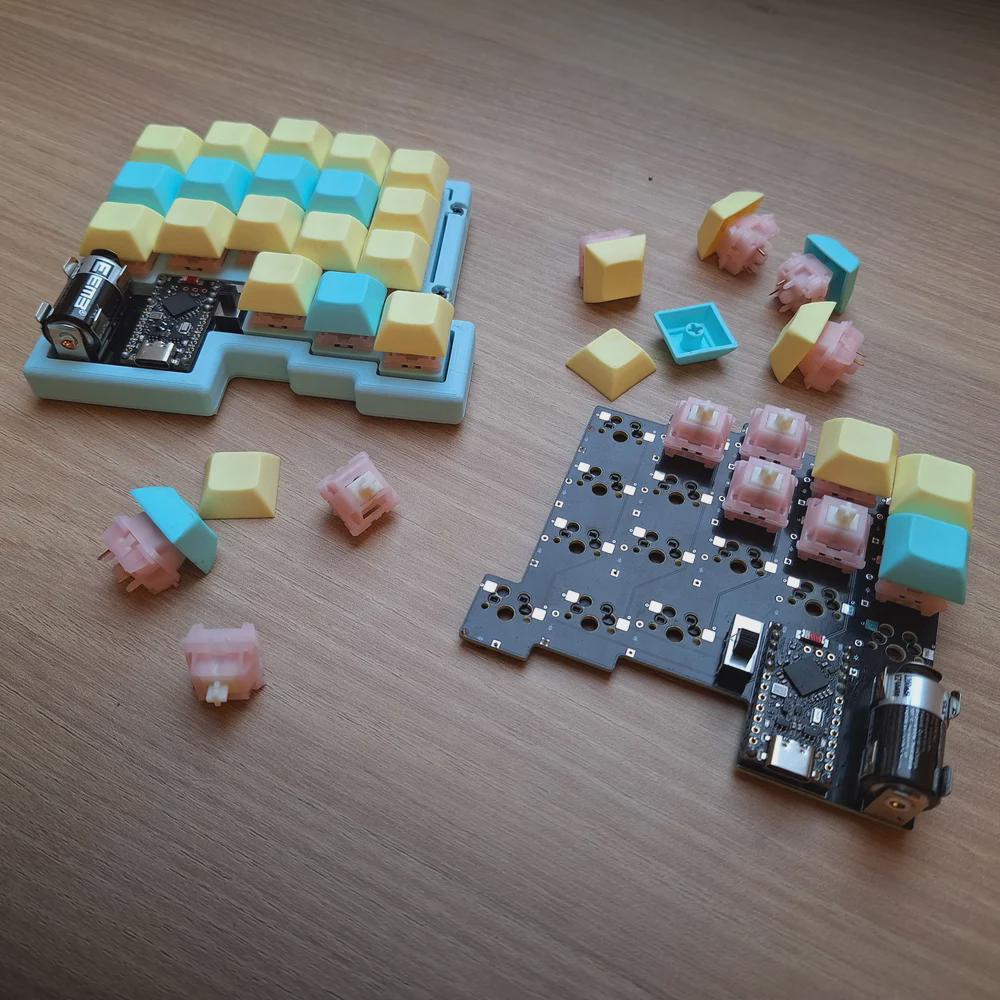
All right, I’ll cut to the chase: Cheap03xD is mainly so cheap because the PCB falls within a 10 x 10 cm footprint. The point was to make a very affordable keyboard — all the parts come to ~40 Euro (~$47). So it would seem that [Lander03xD_] succeeded.

A 36-key, no-frills split keyboard whose PCBs fit in a 10 x 10 cm footprint.Image by [Lander03xD_] via redditCheap03xD is all the things — 36-key, split, column-staggered, wireless, hot-swappable, and uses ZMK. The batteries are easily replaceable, and no they don’t get in the way.

Those are MMD Princess silent switches, which I wouldn’t choose, but [Lander03xD_] is taking this board to the office, so I get it. They sure are a nice shade of pink, anyway, and they go really well with the pastels of the DSA keycaps and the bezel.

One cool thing to note is that the PCBs are reversible, like the ErgoDox. This isn’t [Lander03xD_]’s first board, and it won’t be the last.

Now, let’s talk batteries. [Saixos] pointed out that the design doesn’t appear to include a protection circuit. In case you can’t tell from where you’re sitting, those are nice!nano clones that [Lander03xD_] is using, and they expect a protection circuit.

[Lander03xD_] is going to look through the docs and see what’s what. The goal is not to have any daughter boards, so this may take some rethinking.

Via reddit

Arc Raiders Keyboard Looks the Part


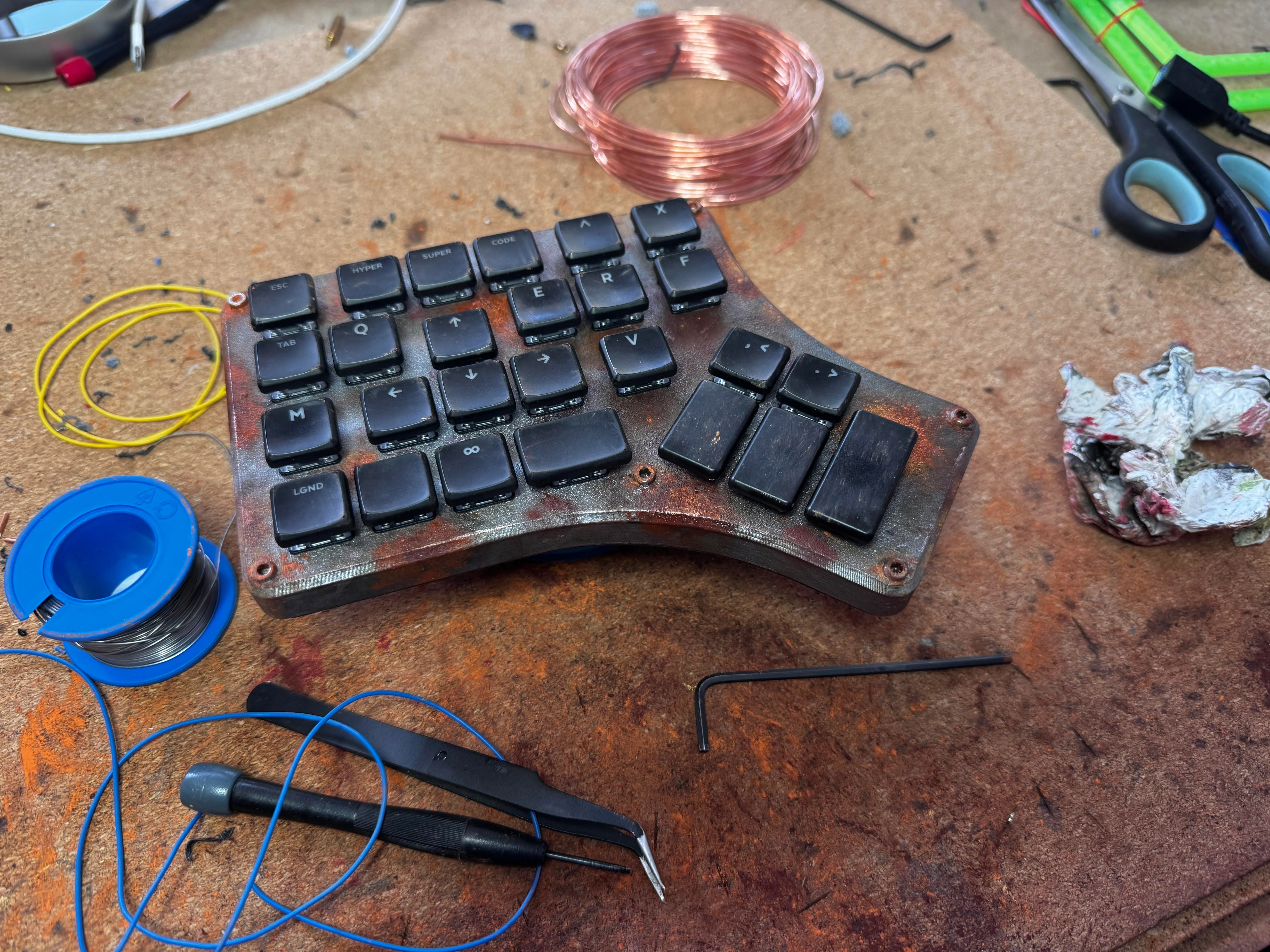
So Arc Raiders is this cool-looking, stripe-logoed, multiplayer extraction shooter that just came out a couple of months ago for all the platforms. It’s not something I could personally play as it’s way too immersive (read: time-consuming), but it definitely looks good, much like this keyboard that [RunRunAndyRun] designed to play it.

A rusty, industrial-looking one-handed keyboard for the left hand.Image by [RunRunAndyRun] via redditHaving enjoyed the game with a game pad for a couple of weeks, [RunRunAndyRun] longed for the precision of a keyboard and mouse. The only problem was that his stock of split keyboards all lack a number row.

No matter; just make a new one. Why not? This rustic beauty runs on the Waveshare RP2040 Zero. The case was 3D printed on a Prusa Mk4, which you’d never know unless you blew up the picture. And then [RunRunAndyRun] gave it that nice patina using Panduro hobby acrylics and a bit of weathering powder.

For now, it’s working pretty well, though [RunRunAndyRun] is still perfecting the keymap. If you’d like to build one yourself, the STLs are available here, and the firmware is on GitHub.

Thanks for the tip, [John]!

The Centerfold: Witch’s Brew


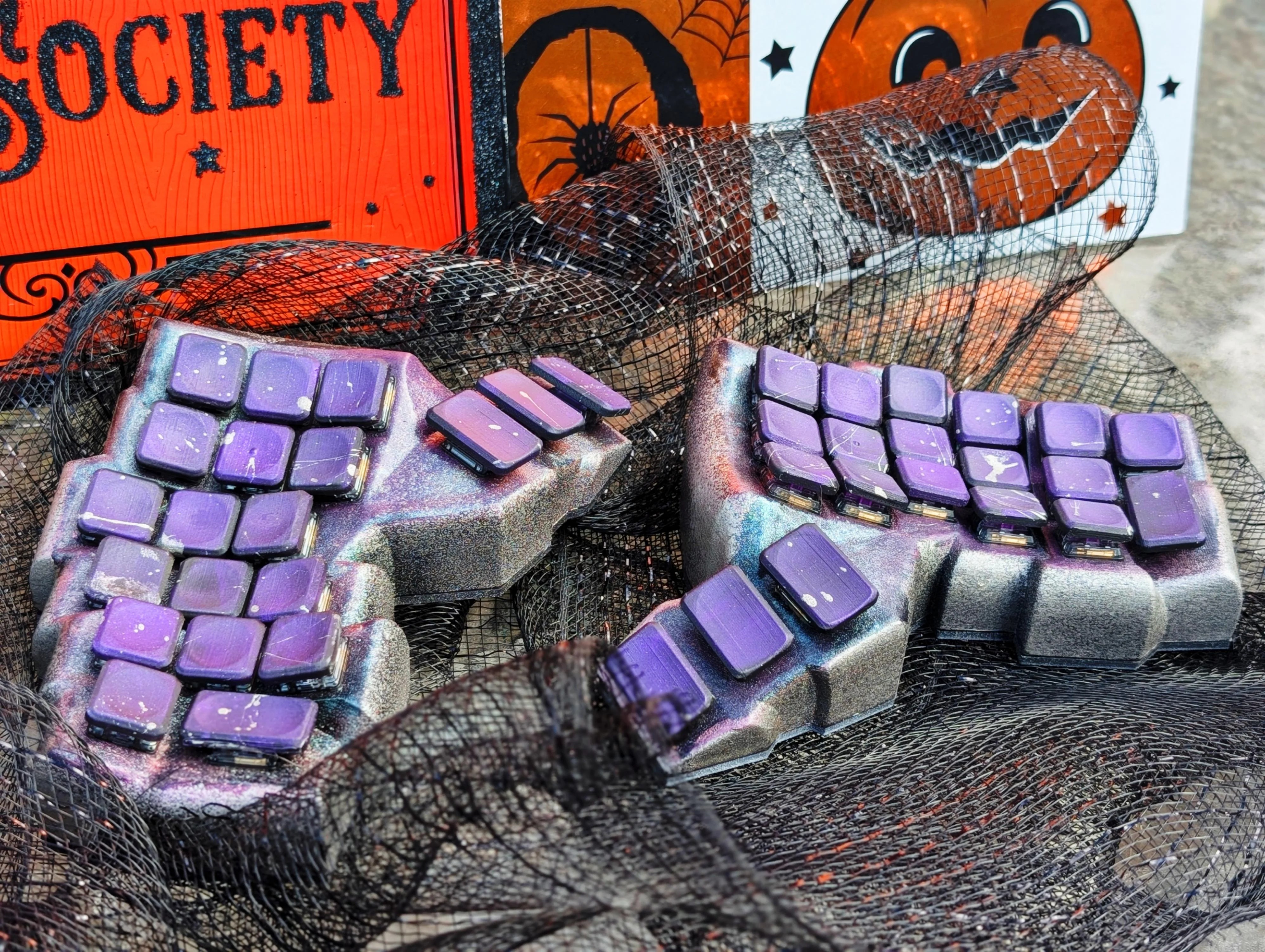
A beautiful concave split with a rad paint job.Image by [CaptLynx] via redditThis stunning beauty, Witch’s Brew, was created by [CaptLynx] with the Cosmos keyboard configurator. Doesn’t sound familiar? It’s the one that uses a scan of your hand to create your ultimate comfort. This keyboard is a custom build for a commission. I must say, as much as I dislike the work of Jackson Pollock, I do absolutely love the spatter on those keycaps.

Do you rock a sweet set of peripherals on a screamin’ desk pad? Send me a picture along with your handle and all the gory details, and you could be featured here!

Historical Clackers: the Keystone

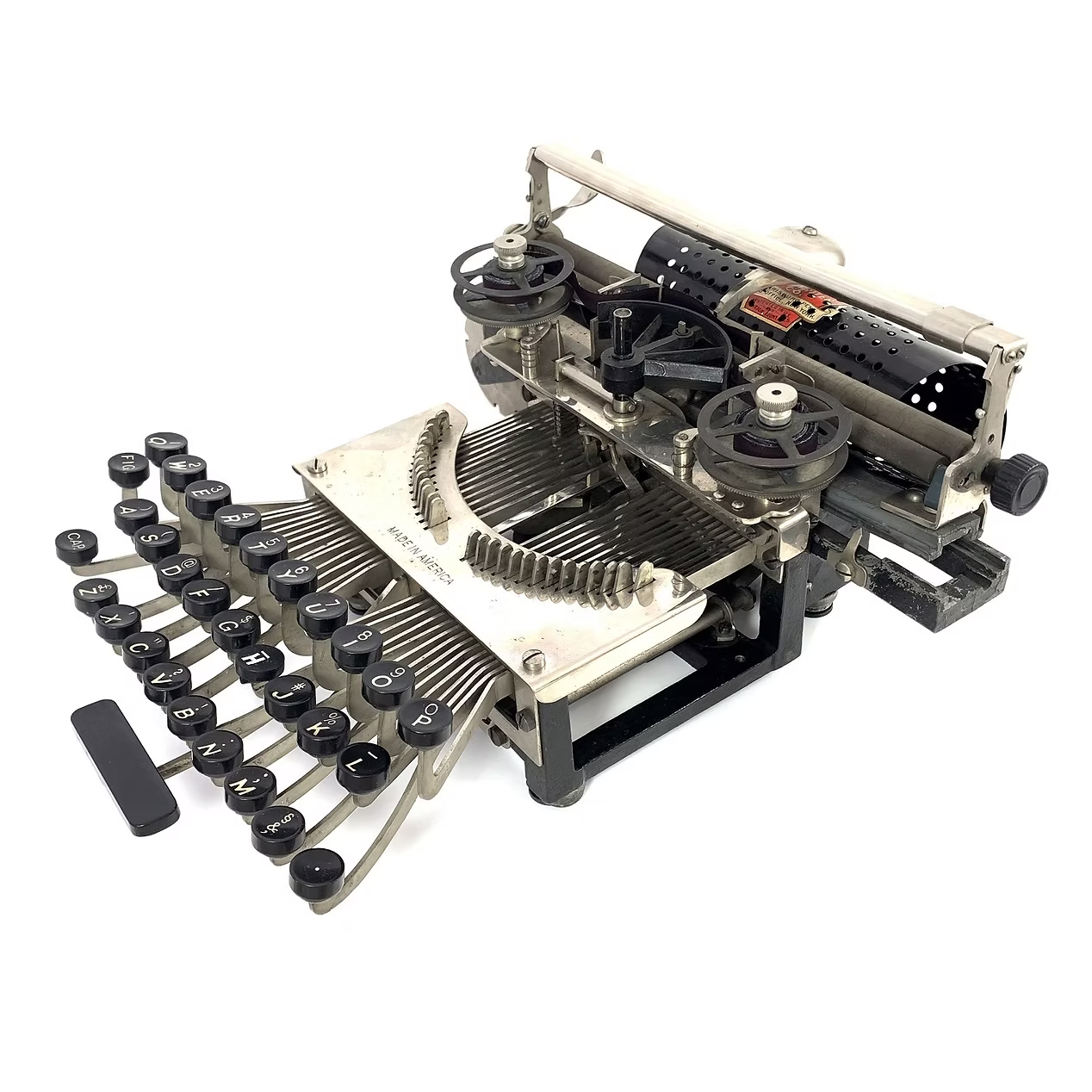
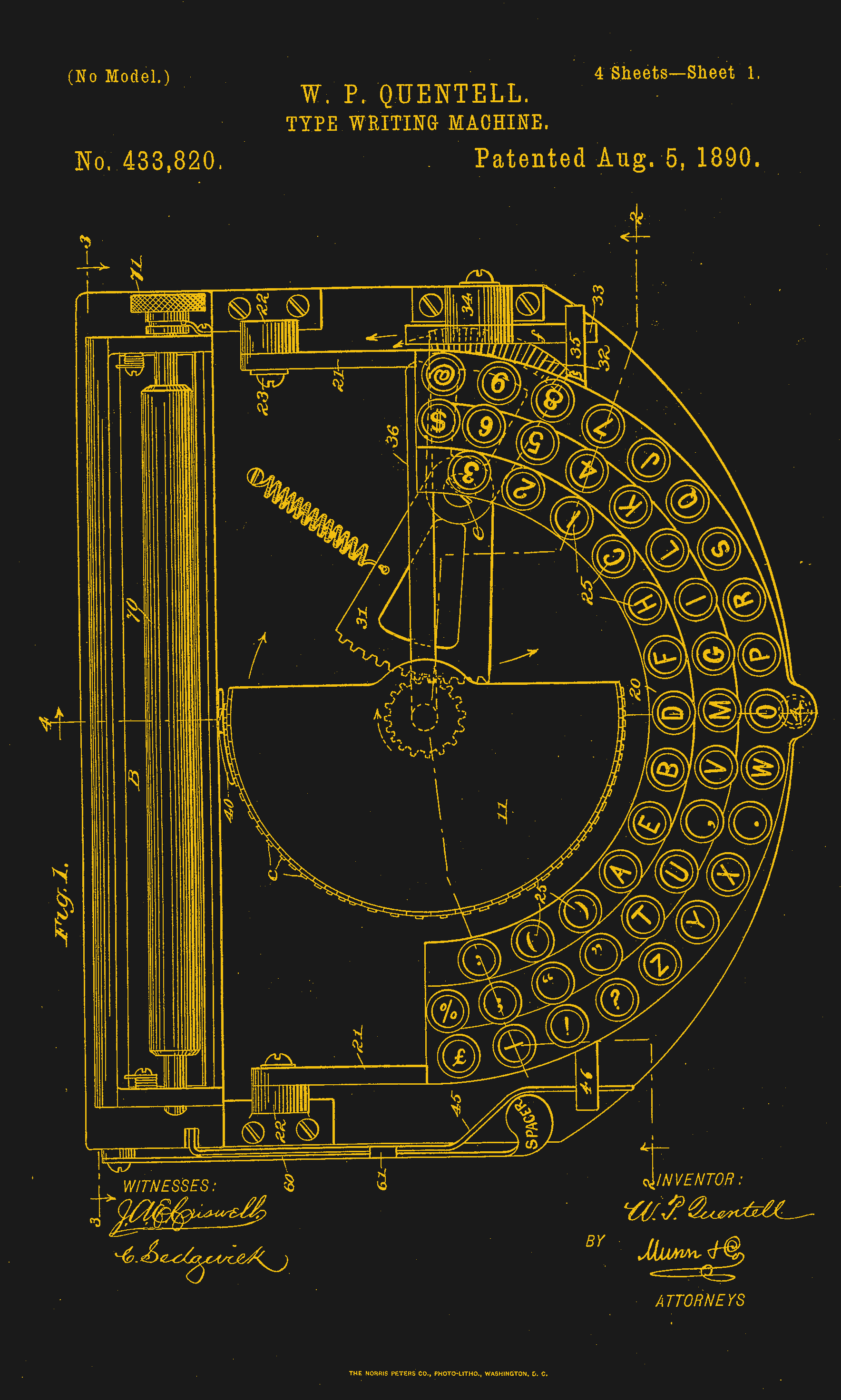
The Keystone typewriter, a minimal design with no enclosure to speak of.Image via The Antikey Chop
This spartan beauty was named after the state in which it was made, Pennsylvania. Manufactured between 1898 and 1903, the Keystone was invented by William Prehn Quentell.

Quentell was living in Kansas City, MO when he first applied for a patent, and later moved to the east coast. At the time, the machine was nameless. The patent looks nothing like the finished product pictured here, but the genesis of the key feature of this “poor man’s Hammond” is there — the swinging type sector.

What this means is that the Keystone has its type on a half wagon wheel, which is evident in the patent drawing. The glyphs are molded around the outside edge of the wheel, which gets rotated into the correct position with each keystroke. This type wheel could be easily changed out for different fonts.
Patent image of the Keystone, which looks like a replica of the Hammond here.Image via Google Patents
To imprint the paper, a spring-driven hammer strikes from behind, pushing the paper and ribbon against the type wheel. The paper is loaded into a cylindrical holder in the rear, and unfurls as one types.

So, why was it a poor man’s Hammond? Well, for one, the patent image looks like a Hammond. But the poor part is felt the hardest in the makeup of the typewriter.

In the early Keystone examples, the carriage rails were made of pig iron. Why? It’s a simple case of lateral integration. The factory that was retrofitted to manufacture the machine had previously been the Lochiel iron mill, a producer of pig iron. They were just using up old stock, I imagine.

The Keystone featured two Shift keys on the left, one for Caps and one for Figures. It was a comparatively inexpensive at $40, and then later, $35 (around $1,200 today).

Production was supposed to begin in May of 1898. But by June of ’99, “the company has been unable to fill the orders which are piling up at the works.” Sounds like your average Kickstarter. Quentell was already working on his next project by 1902, the Postal typewriter.

Finally, a Keyboard That Charges Your Phone


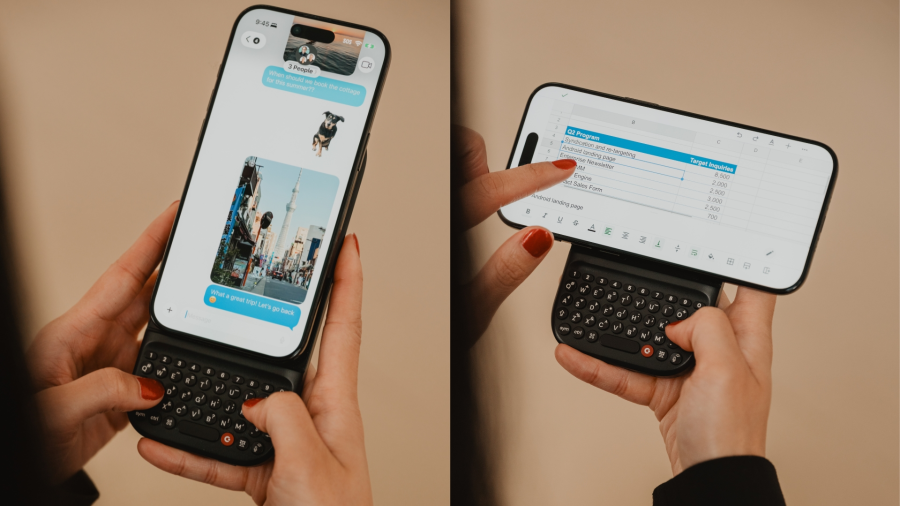
So this article mainly centers on the new little Blackberry-esque number from Clicks which might just be my next phone, except that it doesn’t actually telephone. Clicks is meant to be your second phone, the one you use for emailing and such. You can pre-order it for $399 if you put a $199 deposit down before February 27th. If you decide to drop the full four hundo as an early bird, you’ll get two additional back covers, which slightly change the look of the phone.
A phone in portrait and landscape mode with the Clicks keyboard attached.Image by Clicks via TechCrunch
But I’d like to talk about the add-on Power Keyboard for smart phones that Clicks is also dropping at CES this year. Do you miss your Sidekick? Well, here’s a sliding keyboard with multiple positions for differently-sized smart phones, tablets, and even smart TVs. (Because forget typing with the remote control.)

It uses a 2,150 mAh battery and attaches via MagSafe or Qi2, but it also can be used with the case on. When paired with a smart TV, you just use it by itself. Honestly, it looks kind of hard to type on without the phone for support. But I don’t use the smart features of my TV, so whatever.

Honestly, I will probably start by getting the keyboard, which is $79 for early birds through their site, and $109 later on. Pre-orders started a week ago, so I guess I should get on that.


Got a hot tip that has like, anything to do with keyboards? Help me out by sending in a link or two. Don’t want all the Hackaday scribes to see it? Feel free to email me directly.


hackaday.com/2026/01/12/keebin…

Chasing The Coca-Cola Recipe


The media in this post is not displayed to visitors. To view it, please log in.

One of the most widely recognised product brands in the world is probably Coca-Cola, and its formula is famously kept a secret through precautions that probably rival those of many nation states. There are other colas, and there are many amateurs who have tried to copy Coke’s flavour, but in well over a century, nobody has managed it. Why does [LabCoatz] think his attempt will be successful where others failed? He has friends with their own mass spectrometers.

‘The video below the break is a nearly half-hour exploration into food chemistry and the flavour profile of the well-known soft drink. It’s easy to name many of the ingredients, but some, such as acetic acid, are unexpected. Replicating the contribution from Coke’s de-cocainised coca leaf extract requires the purchase of some of the constituent chemicals in pure form. Its value lies in showing us how flavour profiles are built up, and the analytical methods used in their decoding.

He makes the point that Coke has never patented the formula because to do so would reveal it, but perhaps in that lies the real point. The value in a secret formula for brands such as Coke lies not in the secret itself, as it’s not difficult to make a refreshing cola drink. Instead, it’s the mystique of their product having a secret recipe that matters. Since this isn’t the recipe itself but something that’s supposed to taste a lot like it, that mystique stays intact. He’s not positioning his Lab-Cola as the real thing, so while we might have used a different label colour and font just to make sure, we’re guessing he’s safe from the lawyers. If you’re interested in the legal grey areas surrounding perceived infringement, though, it’s a topic we’ve looked at before.

youtube.com/embed/TDkH3EbWTYc?…

Thanks [Hans] for the tip!


hackaday.com/2026/01/12/chasin…

La civiltà dei dati. Rivista


The media in this post is not displayed to visitors. To view it, please log in.

Civiltà dei dati è una bella rivista. Prosecuzione ideale della Civiltà delle macchine che dal 1953 al 1979 ha contribuito a modellare la cultura dell’innovazione nel nostro paese, aspira oggi come allora a intrecciare il dialogo tra scienza, tecnologica e sperimentazione letteraria e artistica con un focus specifico sull’ontologia del dato. Proprio quel dato che consente scelte e previsioni, il dato che ci anticipa e rappresenta nel mondo digitale e che è il carburante delle nuove macchine IA è il centro e al centro della rivista. Diretta da Jaime D’Alessandro, storica penna tecnologica dell’Espresso e di Repubblica, è un contenitore di alcune delle migliori firme del pensiero contemporaneo in lingua italiana, Floridi, Taddeo, Benanti, Aresu, e del giornalismo tech come Iacona, Aluffi, Sterling e altri. I primi quattro numeri della rivista, frutto di un progetto della Fondazione Leonardo, direttrice generale la giornalista Helga Cossu, sono stati dedicati a quattro grandi temi d’attualità: lo spazio, la mente, gli archivi, l’IA e i digital twins.

La rivista è molto curata, sia dal punto di vista grafico, con una chiara impronta visiva, sia per i contenuti.

Il primo numero è una parata delle stelle femminili protagoniste della ricerca spaziale; il secondo, è incentrato sugli effetti psicologici della tecnologia e dei social network; il terzo si fonda sul rapporto tra analogico e digitale per parlare di archivi. Particolarmente interessanti sono le riflessioni di Paolo Benanti in questo numero tre quando parla dell’importanza della memoria selettiva, cioè di quel processo che è umano ma non macchinico, di ritenere solo quello che serve, come accadeva con le biblioteche. Benanti fa anche un riferimento importante all’etica dell’IA quando ricorda che gli strumenti, tutti gli strumenti, non sono neutri, ma forme d’ordine e disposizioni di potere. Nella rivista numero 4 va letta l’intervista a Lucilla Sioli, direttrice dell’ufficio europeo per l’IA. Detto per inciso è quella graficamente più bella (recupera le copertine di Urania). Ma è sempre nel numero 3 che troviamo la chicca: una storia a fumetti dell’impareggiabile Milo Manara basato sulla storia della biblioteca meccanica di Jorge Luis Borges. Chissà se quell’utopia bella e terribile della macchina da scrivere universale, oggi rappresentata dall’IA generativa, potrà mai predirci il futuro dentro a un libro. Accetteremmo anche qualche errore di sintassi.

«Civiltà dei dati. 2025. Fondazione Leonardo. Direttore Jaime D’Alessandro». Nella foto i primi quattro numeri.


dicorinto.it/articoli/la-civil…

Cybersecurity & cyberwarfare ha ricondiviso questo.

Dutch court convicts hacker who exploited port networks for drug trafficking
securityaffairs.com/186851/cyb…
#securityaffairs #hacking
Cybersecurity & cyberwarfare ha ricondiviso questo.

The media in this post is not displayed to visitors. To view it, please go to the original post.

Basta un riavvio: il trucco che spegne Windows Defender prima ancora che parta

📌 Link all'articolo : redhotcyber.com/post/basta-un-…

#redhotcyber #news #cybersecurity #hacking #malware #ransomware #sicurezzainformatica #edr #antivirus #windows

Cybersecurity & cyberwarfare ha ricondiviso questo.

The media in this post is not displayed to visitors. To view it, please go to the original post.

La controversa battaglia legislativa dell'UE su chatcontrol sta entrando in una fase decisiva. L'intervista a @echo_pbreyer

Il 2026 è l’anno in cui impareremo fino a che punto l’UE è disposta ad arrivare. Il regolamento sugli abusi sessuali sui minori, comunemente noto come #chatcontrol richiederà alle piattaforme online di rilevare, segnalare e rimuovere materiale illegale, ha una storia lunga e controversa.

euperspectives.eu/2025/12/brey…

@privacypride

Cybersecurity & cyberwarfare ha ricondiviso questo.

The media in this post is not displayed to visitors. To view it, please go to the original post.

La mente dietro le password: Errore umano? No, un legame che non c’è. Puntata 4

📌 Link all'articolo : redhotcyber.com/post/la-mente-…

#redhotcyber #news #sicurezzainformatica #cybersecurity #fattoreumano #sicurezzadeldipendente #violazionididati

Cybersecurity & cyberwarfare ha ricondiviso questo.

The media in this post is not displayed to visitors. To view it, please go to the original post.

🔴 Benvenuta in Red Hot Cyber Cyber Angels 🔴

📩 Chi fosse interessata a partecipare alle RHC Cyber Angels può inviare la propria candidatura a
👉 redazione@redhotcyber.com

#redhotcyber #rhccyberangels #hacking #benesseredigitale #cti #ai #online #it #cybercrime #cybersecurity

Report annuale Polizia Postale 2025: la normalità dell’attacco, il dovere della resilienza


@Informatica (Italy e non Italy 😁)
La fotografia scattata dal report annuale della Polizia Postale è netta: frodi industrializzate, incidenti continui, AI che aumenta la credibilità delle truffe. Un’analisi dei punti salienti e delle scelte operative che imprese e

Cybersecurity & cyberwarfare ha ricondiviso questo.

The media in this post is not displayed to visitors. To view it, please go to the original post.

CORSO NIS2 SENZA SEGRETI: LA FORMAZIONE PER AZIENDE E PROFESSIONISTI FIRMATA RED HOT CYBER!

📌 𝗔𝗰𝗰𝗲𝘀𝘀𝗼 𝗳𝗹𝗲𝘀𝘀𝗶𝗯𝗶𝗹𝗲: contenuti sempre disponibili
📌 𝗗𝘂𝗿𝗮𝘁𝗮 𝗱𝗲𝗹 𝗰𝗼𝗿𝘀𝗼: 10 ore suddivise in 5 moduli e 26 lezioni
📌 𝗟𝗶𝘃𝗲𝗹𝗹𝗼: Base
📌 𝗣𝗿𝗲𝗿𝗲𝗾𝘂𝗶𝘀𝗶𝘁𝗶 𝗽𝗲𝗿 𝗶𝗹 𝗰𝗼𝗿𝘀𝗼: conoscenza base della valutazione del rischio
📌 𝗦𝘂𝗽𝗽𝗼𝗿𝘁𝗼 𝗮𝗹 𝗰𝗼𝗿𝘀𝗼: docente disponibile via mail

👉Iscriviti all'Academy per vedere l'anteprima gratuita del corso academy.redhotcyber.com/course…
👉Scrivici ad academy@redhotcyber.com o Whatsapp al 3791638765

#redhotcyber #hacking #cti #ai #online #it #cybercrime #cybersecurity #threat #OnlineCourses #Elearning #DigitalLearning #RemoteCourses #VirtualClasses #CourseOfTheDay #LearnOnline #OnlineTraining #Webinars #academy #corso #formazioneonline #direttivanis

Drive 1024×600 Pixels via I2C with an ATtiny85


The media in this post is not displayed to visitors. To view it, please log in.

The clock demo on display

If you need to drive a big screen for a project, it’s fair to say your first thought isn’t going to be to use the ATtiny85. With just 512 bytes of RAM and 8 kilobytes of flash memory, the 8-bit micro seems a little cramped to drive, say, a 10″ screen. Yet that’s exactly what [ToSStudio] is doing with TinyTFT_LT7683: 1024 x 600 pixels of TFT goodness, over I2C no less.
With the right TFT controller, this little micro-controller can do magic.
The name kind of gives away the secret: it won’t work on just any TFT display. It’s using properties of the LT7683 display driver, though if you don’t have one of those, the RA8875 is also compatible. Those drivers can take more than just a pixel stream– a good thing, since you’d be hard pressed to get that many pixels streaming from an ATtiny. These are character/graphic display drivers, which means you can get them to draw both characters and graphics on the screen if you speak the lingo.

It’s still not blazing fast; the documentation suggests “static or moderately dynamic UIs” as the suggested use case, and a clock is of the pre-programmed examples. From that, we can surmise that you can get 1 FPS or better with this code. You’re limited both by the simple micro-controller and the bandwidth of the I2C bus, but within those limits this seems like a very powerful technique.

This isn’t the first ATtiny graphics library to blow our minds, but if you really want an impressive graphics demo from the little micro that could, you really need to race the beam.

Thanks to [Thomas Scherer] for the tip!


hackaday.com/2026/01/08/drive-…

LA GUERRA: ALCUNE DEFINIZIONI E CARATTERISTICHE (PRIMA PARTE)

@Informatica (Italy e non Italy 😁)

In questi ultimi anni la comunicazione, scritta e verbale, ci ha subissato di informazioni inerenti alle guerre, seppur concentrandosi sulle due principali.
L'articolo LA GUERRA: ALCUNE DEFINIZIONI E CARATTERISTICHE (PRIMA PARTE) proviene da GIANO NEWS.
#DIFESA

Cybersecurity & cyberwarfare ha ricondiviso questo.

The media in this post is not displayed to visitors. To view it, please go to the original post.

Burnout: un allarme di sistema nell’IT e nella Cyber Security aziendale

📌 Link all'articolo : redhotcyber.com/post/burnout-u…

#redhotcyber #news #cybersecurity #burnout #stresslavorativo #salutelavorativa #sicurezzainformatica

Cybersecurity & cyberwarfare ha ricondiviso questo.

The media in this post is not displayed to visitors. To view it, please go to the original post.

196 – L’AI è ovunque, ma il lavoro no. Cosa fare, adesso camisanicalzolari.it/196-lai-e…
in reply to Marco Camisani Calzolari

🤖 Tracking strings detected and removed!

🔗 Clean URL(s):
camisanicalzolari.it/196-lai-e…

❌ Removed parts:
?utm_source=dlvr.it&utm_medium=mastodon

The Intel 8087 and Conditional Microcode Tests


The media in this post is not displayed to visitors. To view it, please log in.

Continuing his reverse-engineering of the Intel 8087, [Ken Shirriff] covers the conditional tests that are implemented in the microcode of this floating point processing unit (FPU). This microcode contains the details on how to perform the many types of specialized instructions, like cos and arctan, all of which decode into many microcode ops. These micro ops are executed by the microcode engine, which [Ken] will cover in more detail in an upcoming article, but which is effectively its own CPU.

Conditional instructions are implemented in hardware, integrating the states of various functional blocks across the die, ranging from the instruction decoder to a register. Here, the evaluation is performed as close as possible to the source of said parameter to save on wiring.

Implementing this circuitry are multiplexers, with an example shown in the top die shot image. Depending on the local conditions, any of four pass transistors is energized, passing through that input. Not shown in the die shot image are the inverters or buffers that are required with the use of pass transistors to amplify the signal, since pass transistors do not provide that feature.

Despite how firmly obsolete the 8087 is today, it still provides an amazing learning opportunity for anyone interested in ASIC design, which is why it’s so great that [Ken] and his fellow reverse-engineering enthusiasts keep plugging away at recovering all this knowledge.


hackaday.com/2026/01/11/the-in…

The SCSI Film Scanner Resurrection


The media in this post is not displayed to visitors. To view it, please log in.

[Ronan] likes 35mm film photography, but the world, of course, has gone digital. He picked up an Epson FilmScan 200 for about €10. This wonder device from 1997 promised to convert 35mm film to digital at 1200 DPI resolution. But there was a catch: it connects via SCSI. Worse, the drivers were forever locked to Windows 95/98 and Mac System 7/8.

In a surprise twist, though, [Ronan] recently resurrected a Mac SE/30 with the requisite SCSI port and the System 7 OS. Problem solved? Not quite. The official software is a plugin for Photoshop. So the obvious answer is to write new software to interact with the device.

First, of course, you have to figure out how the device works. A service manual provided clues that, as far as the SCSI bus knew, the device wasn’t a scanner at all, but a processor. The processor, though, used SCSI as a simple pipe to handle Epson’s standard “ESC/I” protocol.

Armed with that information and a knowledge of the Mac’s SCSI Manager API, the rest is just coding. Well, that is until [Ronan] tried to scan the other five negatives in the six-negative film carrier. He was frustrated until he found an old patched SANE driver for the scanner from 2002. By looking at how it worked, he was able to figure out how to switch to the other negatives.

Color scanning also took a little coaxing. The scanner returns three monochrome images, one for each color channel. Some assembly, then, is required. In the end, though, the project was a complete success. Can’t find a FilmScan 200? Don’t have a SCSI port? There’s always the roll-your-own approach.


hackaday.com/2026/01/11/the-sc…

A Much Faster Mac On A Microcontroller


The media in this post is not displayed to visitors. To view it, please log in.

Emulating older computers on microcontrollers has been a staple of retrocomputing for many years now, with most 8-bit and some 16-bit machines available on Atmel, ARM, or ESP32 platforms. But there’s always been a horsepower limit, a point beyond which a microcontroller is no longer enough, and a “proper” computer is needed. One of those barriers now appears to have been broken, as microcontroller-based emulation moves into the 32-bit era. [Amcchord] has the Basilisk II emulator ported to the ESP32-P4 platform, providing a 68040 Mac able to run OS8.1. This early-1990s-spec machine might not seem like much in 2026, but it represents a major step forward.

The hardware it uses is the M5Stack Tab5, and it provides an emulated Mac with up to 16 MB of memory. Remember, in 1992 this would have been a high-spec machine. It manages a 15 frames per second refresh rate, which is adequate for productivity applications. The emulator uses the Tab5’s touchscreen to emulate the Mac mouse alongside support for USB input devices. To 1990 hackers, it’s almost the Mac tablet you didn’t know you would want in the future.

We like this project, both because it’s advancing the art of emulation on microcontrollers, and also because it delivers a computer that’s useful for some of the things you might have done with a Mac in 1992 and could even do today. Pulling this out on the train back then would have blown people’s minds. There’s even a chance that MacOS on something like this would turn a few heads in 2026. It’s certainly not the first emulated Mac we’ve seen though.


hackaday.com/2026/01/11/a-much…

Reverse-Engineering the Tamagotchi IR Connection


The media in this post is not displayed to visitors. To view it, please log in.

The Tamagotchi Connection is a series of Tamagotchi toys that took the original portable pet concept and mixed things up with a wireless connection, which allowed you to interact with the pets of other proud Tamagotchi owners. This wireless connection is implemented using an infrared transceiver, somewhat like IrDA, but as [Zach Resmer] discovered while reverse-engineering this connection, it’s actually what is called ‘Nearly NEC’ by [Natalie Silvanovich], who has a GitHub repository full of related Tamagotchi hacking tools and ROM dumps.

With the protocol figured out, creating a transceiver for low-bitrate infrared communication isn’t particularly hard. In this case, it was implemented using an RP2040 MCU and an appropriate IR LED and receiver pair. This Tamagometer project was also implemented as an app for the Flipper Zero, and a custom PCB called the Pico TamaBadge by [Daniel Weidman].

There’s a web application associated with [Zach]’s project using a Web Serial-enabled browser (i.e. Chrome). The serial protocol is somewhat documented in the patent for the device’s connection feature, which makes it relatively easy to implement yourself.


hackaday.com/2026/01/10/revers…

ESP with EEG — No, Not That ESP!


The media in this post is not displayed to visitors. To view it, please log in.

While EEG research might help you figure out extrasensory perception, we won’t be betting on it. However, if you want to read EEG data and use an ESP32, [Cerelog-ESP-EEG] might be the right project for you. The commercial project is an 8-channel biosensing board suitable for EEG, EMG, ECG, and brain-computer interface studies. However, the company says, “We love the hacker community! We explicitly grant permission for Personal & Educational Use.” We love you too.

They do require you to agree not to sell boards you are building, and they give you schematics, but no PC board layout. That’s understandable, although we’d guess that achieving good results will require understanding how to lay out highly sensitive circuits.

What you do get is the schematic and the firmware source. They note that you may have to modify the firmware if you want to switch modes, change gain, or enable haptic feedback, among other things. At the application layer, the device is compatible with Lab Streaming Layer, and there is a fork of OpenBCI (brain control interface) that understands how to talk to the board.

Even if you don’t want to directly clone the device, there’s a ton of information here if you are interested in EEG or any other small signal acquisition. We’ve seen a number of interfaces like this, but we are still waiting to see a killer application.


hackaday.com/2026/01/10/esp-wi…

A 1990s VNA Gets An LCD


The media in this post is not displayed to visitors. To view it, please log in.

A Vector Network Analyser, or VNA, is the ultimate multi-tool of RF test equipment. They can now be had in not very capable form for almost pocket money prices, but the professional-grade ones cost eye-watering sums. Enough to make an older VNA for a few hundred on eBay a steal, and [W3AXL] has just such a device in an HP 8714C. It’s the height of 1990s tech with a floppy drive and a green-screen CRT, but he’s homing right in on the VGA monitor port on the back. Time for a colour LCD upgrade!

There are two videos below the break, posted a year apart, because as we’re sure many of you will know, events have a habit of getting in the way of projects. In the first, we see the removal of the CRT module and safe extraction of its electronics, followed by the crafting of a display bezel for the LCD. Meanwhile, the second video deals with the VNA itself, extracting the VGA signal and routing it forward to the new module.

We’re struck not for the first time by the high quality of the construction in this piece of test equipment; it’s not only substantial but well designed for maintenance and disassembly. [W3AXL] sensibly leaves the RF part alone, but both CRT and mainboard modules slide out with minimal screw removals and few problems in reassembly.

He goes the extra mile with a second iteration of the display mount and a curved print to fit the CRT shape in the front panel. The result is a colour display on the instrument, and we’re guessing, a much lighter device, too.

If VNAs are new to you, then you might wish to learn a little about them,

youtube.com/embed/AuNkZtfcmqU?…

youtube.com/embed/vi5H66_kYRc?…


hackaday.com/2026/01/10/a-1990…

Simplifying the SmartKnob


The media in this post is not displayed to visitors. To view it, please log in.

A man's hands are shown holding a black device. A white knob is in the center of the device, and above the knob in a central protrusion from the rest of the device is a small, circular LCD device.

A knob can make a surprisingly versatile interface, particularly if it’s the SmartKnob, which builds a knob around a BLDC motor for programmable haptic response. It can rotate freely or with a set resistance, spring back to a fixed point when released, stick at detent points, and completely change its behavior as the interface demands. For people inexperienced in electronic assembly, though, smartknobs can be difficult to assemble. That’s why [Kokensha Tech] designed a simpler version, while at the same time letting it use a wider range of BLDC motors.

In addition to a motor, the original design used a magnetic encoder to detect position and a strain gauge to detect pressure on the knob. A circular LCD on the knob itself provided visual feedback, but it also required the motor to have a hollow center shaft. The LCD control wires running through the shaft proved tricky to assemble. [Kokensha Tech] moved the display out of the knob and onto a separate breakout board, which plugs into the controller board. This greatly broadens the range of compatible motors, since they no longer need a hollow shaft.

The motor now fits on a separate carrier board, which makes it easier to swap out different motors. The carrier board has mounting holes sized for a wide variety of motors, and four different types of motor connectors. [Kokensha Tech] also redesigned the rest of the PCB for easier soldering, while avoiding components with narrow pin spacing whenever possible. The original design used a LILYGO T-micro32 Plus MCU. The ESP32 is both cheaper and easier to solder, so it was a no-brainer to swap it in.

We’ve covered the original SmartKnob before, including a more in-depth look at its design. We’ve also seen another project use BLDCs and field-oriented control to make haptic knobs.

youtube.com/embed/7kSSMUdl7_k?…


hackaday.com/2026/01/10/simpli…

Cybersecurity & cyberwarfare ha ricondiviso questo.

The media in this post is not displayed to visitors. To view it, please go to the original post.

APT28, noto come Fancy Bear, lancia attacco di credential harvesting in Europa e Asia

📌 Link all'articolo : redhotcyber.com/post/apt28-not…

#redhotcyber #news #cybersecurity #hacking #malware #ransomware #apt28 #fancybear #credentialharvesting

Cybersecurity & cyberwarfare ha ricondiviso questo.

The media in this post is not displayed to visitors. To view it, please go to the original post.

Quando il segnale muore, il potere vince: il blackout digitale dell’Iran

📌 Link all'articolo : redhotcyber.com/post/quando-il…

A volte le cose importanti non arrivano in conferenza stampa. Arrivano come un grafico che smette di respirare: la linea della connettività che crolla, l’OSINT che si inaridisce, il rumore che cresce perché il segnale sparisce.

In Iran, la crisi interna e la dimensione cyber stanno entrando nella stessa stanza. E quando succede, la domanda non è più solo «che cosa sta accadendo?», ma «chi sta controllando la prova di ciò che accade?».

A cura di Roberto Villani

#redhotcyber #news #iran #crisipolitica #crisidigitale #censurainternet #connessionelimitate #governocontrollo #percezionecontrollo #protesteonline #repressionedigitale #libertadiparola #dirittiumani #cibernetica

reshared this

Cybersecurity & cyberwarfare ha ricondiviso questo.

The media in this post is not displayed to visitors. To view it, please go to the original post.

Microsoft investe nei cavi sottomarini: nuova rete globale tra America, Europa e Asia

📌 Link all'articolo : redhotcyber.com/post/microsoft…

#redhotcyber #news #caviSottomarini #infrastrutturaGlobale #reteInformatica #microsoft #dataCenter