Cybersecurity & cyberwarfare ha ricondiviso questo.

The media in this post is not displayed to visitors. To view it, please go to the original post.

BitLocker sotto accusa: Microsoft ammette di consegnare le chiavi di cifratura all’FBI

📌 Link all'articolo : redhotcyber.com/post/bitlocker…

#redhotcyber #news #sicurezzadigitale #microsoftbitlocker #protezionedatidigitali #insidiadisicurezza

An E-Ink Macropad For Improved Productivity


The media in this post is not displayed to visitors. To view it, please log in.

Why press many button when few button do trick? That was the thinking of [Bike Cook Robots] when it came time to revamp his desk. To that end, he whipped up a tidy macropad to make daily computing tasks easier.

The build is based around an Adafruit RP2040 Feather ThinkInk devboard, chosen because it plugs straight into a readily-available 4.2 inch e-ink. The display is tasked with showing icons that correspond to the macro assignments for the 3 x 4 array of mechanical keyboard switches. Everything is wrapped up in a 3D printed frame, with an bracket to mount it to the monitor arms on the desk. The macropad is set up to talk to a custom Python app that runs on the host machine, which handles triggering actions and can also talk back to the pad itself.

The combination of e-ink display and button pad is a great way to display the function of each key without excess complexity. We’ve seen some other great builds in this space before, too.

youtube.com/embed/PbdwmN28-So?…


hackaday.com/2026/01/29/an-e-i…

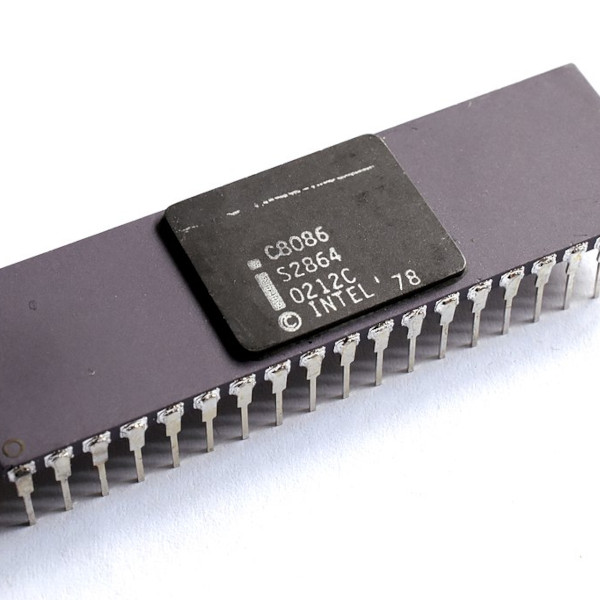
The Inner Workings of the Intel 8086’s Arithmetic Logic Unit


The media in this post is not displayed to visitors. To view it, please log in.

In the 1970s CPUs still had wildly different approaches to basic features, with the Intel 8086 being one of them. Whereas the 6502 used separate circuits for operations, and the Intel 8085 a clump of reconfigurable clump of gates, the 8086 uses microcode that configures the ALU along with two lookup tables. This complexity is one of the reasons why the Intel 8086 is so unique, with [Ken Shirriff] taking an in-depth look at its workings on a functional and die-level.

These lookup tables are used for the ALU configuration – as in the above schematic – making for a very flexible but also complex system, where the same microcode can be used by multiple instructions. This is effectively the very definition of a CISC-style processor, a legacy that the x86 ISA would carry with it even if the x86 CPUs today are internally more RISC-like. Decoding a single instruction and having it cascade into any of a variety of microcodes and control signals is very powerful, but comes with many trade-offs.

Of course, as semiconductor technology improved, along with design technologies, many of these trade-offs and disadvantages became less relevant. [Ken] also raises the interesting point that much of this ALU control technology is similar to that used in modern-day FPGAs, with their own reconfigurable logic using LUTs that allow for on-the-fly reconfiguration.


hackaday.com/2026/01/29/the-in…

Cybersecurity & cyberwarfare ha ricondiviso questo.

#SolarWinds addressed four critical Web Help Desk flaws
securityaffairs.com/187470/sec…
#securityaffairs #hacking
in reply to Filippo Valsorda

Direct ML-DSA signature/verification or also X.509 support? Deterministic or randomized signing? External Mu signing? External Mu verification? Hardware interfaces to sign with/without external Mu? Seed encoding only ok? Need the LAMPS hybrids?

If you want to make ML-DSA adoption in Go faster, then email me specific answers on what you need, so I can collect enough information to make a decision.

If you don't know what you need, then it might be too soon for the standard library!

L’estasi dell’ignoranza. La tradizione occidentale della non conoscenza


The media in this post is not displayed to visitors. To view it, please log in.

Perché un lettore crede a racconti palesemente falsi? Vuole evitare notizie scomode? Come fanno i fedeli religiosi a credere nella scienza e contemporaneamente affidarsi al mito? Si tratta di scelte razionali, strategie collettive oppure difesa privata e personale di un nucleo emotivo che altrimenti finirebbe in pezzi? Sono queste le domande che affiorano, con risposta annessa, nel libro del politologo Mark Lilla che per Luiss University Press ha pubblicato «L’estasi dell’ignoranza. La tradizione occidentale della non conoscenza».

A dispetto della moderna logica mediatica che obbliga tutti alla trasparenza, alla conoscenza, alla condivisione di informazioni e intimità sui social, Mark Lilla elabora una ricostruzione storica e filosofica del volto contrario di questa modernità, cioè dell’ignoranza intesa come volontà di non sapere. Strategia adattativa piuttosto che euristica vitale, l’ignoranza descritta da Lilla viene dissezionata nei miti antichi, come quello di Edipo, che non voleva sapere di essere giaciuto con la madre; passa per le Confessioni di Sant’Agostino che dubita della sua fede; arriva da Nietzsche il pazzo fino a Freud e alla sua teoria della rimozione, per ricostruire i tabù della verità, la delusione della curiosità quando si osa strappare il velo di Iside, fino alle cedevoli illusioni di innocenza personale, colte nelle loro forme quotidiane e talvolta penose.

La fuga dalla realtà è la chiave di questo viaggio intellettuale nella volontà di ignoranza. Certo, sull’ignoranza e sull’errore molto è stato detto, da Gianrico Carofiglio in Elogio dell’ignoranza e dell’errore, a Umberto Galimberti con Le contraddizioni della Verità e l’attitudine tutta binaria a pensare semplice senza troppo complicarsi la vita, come pure in L’età dell’ignoranza di Fabrizio Tonello, ma questo testo si misura sulla volontà di non conoscere quale strategia di sopravvivenza intima, nascosta e personale, per rendere la vita odierna più accettabile. Una scelta che è alla base di questioni tremendamente attuali, dagli effetti della disinformazione al cospirazionismo politico, dal pensiero magico alle semplificazioni scientifiche. In fondo, in fondo, il trionfo dell’ignorante è l’estasi del potere.


dicorinto.it/articoli/recensio…

Supply chain attack on eScan antivirus: detecting and remediating malicious updates


The media in this post is not displayed to visitors. To view it, please log in.

On January 20, a supply chain attack has occurred, with the infected software being the eScan antivirus developed by an Indian company MicroWorld Technologies. The previously unknown malware was distributed through the eScan update server. The same day, our security solutions detected and prevented cyberattacks involving this malware. On January 21, having been informed by Morphisec, the developers of eScan contained the security incident related to the attack.

Malicious software used in the attack


Users of the eScan security product received a malicious Reload.exe file, which initiated a multi-stage infection chain. According to colleagues at Morphisec who were the first to investigate the attack, Reload.exe prevented further antivirus product updates by modifying the HOSTS file, thereby blocking the ability of security solution developers to automatically fix the problem, which, among other things, led to the update service error.

The malware also ensured its persistence in the system, communicated with control servers, and downloaded additional malicious payloads. Persistence was achieved by creating scheduled tasks; one example of such a malicious task is named CorelDefrag. Additionally, the consctlx.exe malicious file was written to the disk during the infection.

How the attackers managed to pull off this attack


At the request of the BleepingComputer information portal, eScan developers explained that the attackers managed to gain access to one of the regional update servers and deploy a malicious file, which was automatically delivered to customers. They emphasize that this is not a vulnerability — the incident is classified as unauthorized access to infrastructure. The malicious file was distributed with a fake invalid digital signature.

According to the developers, the infrastructure affected by the incident was quickly isolated, and all access credentials were reset.

How to stay safe?


To detect infection, it is recommended to review scheduled tasks for traces of malware, check the %WinDir%\System32\drivers\etc\hosts file for blocked eScan domains, and review the eScan update logs for January 20.

The developers of eScan have created a utility for their users that removes the malware, rolls back the modifications it has made, and restores the normal functionality of the antivirus. The utility is sent to customers upon request to technical support.

Users of the solution are also advised to block known malware control server addresses.

Kaspersky’s security solutions, such as Kaspersky Next, successfully detect all malware used by attackers with its Behavior Detection component.

Indicators of compromise


Several malicious domain names and links were listed in the Morphisec blog:

Our experts have discovered additional network IoCs related to this attack:

Right now we are analyzing the malware used in this incident, and will post more details as soon as possible.


securelist.com/escan-supply-ch…

Did We Overestimate the Potential Harm from Microplastics?


The media in this post is not displayed to visitors. To view it, please log in.

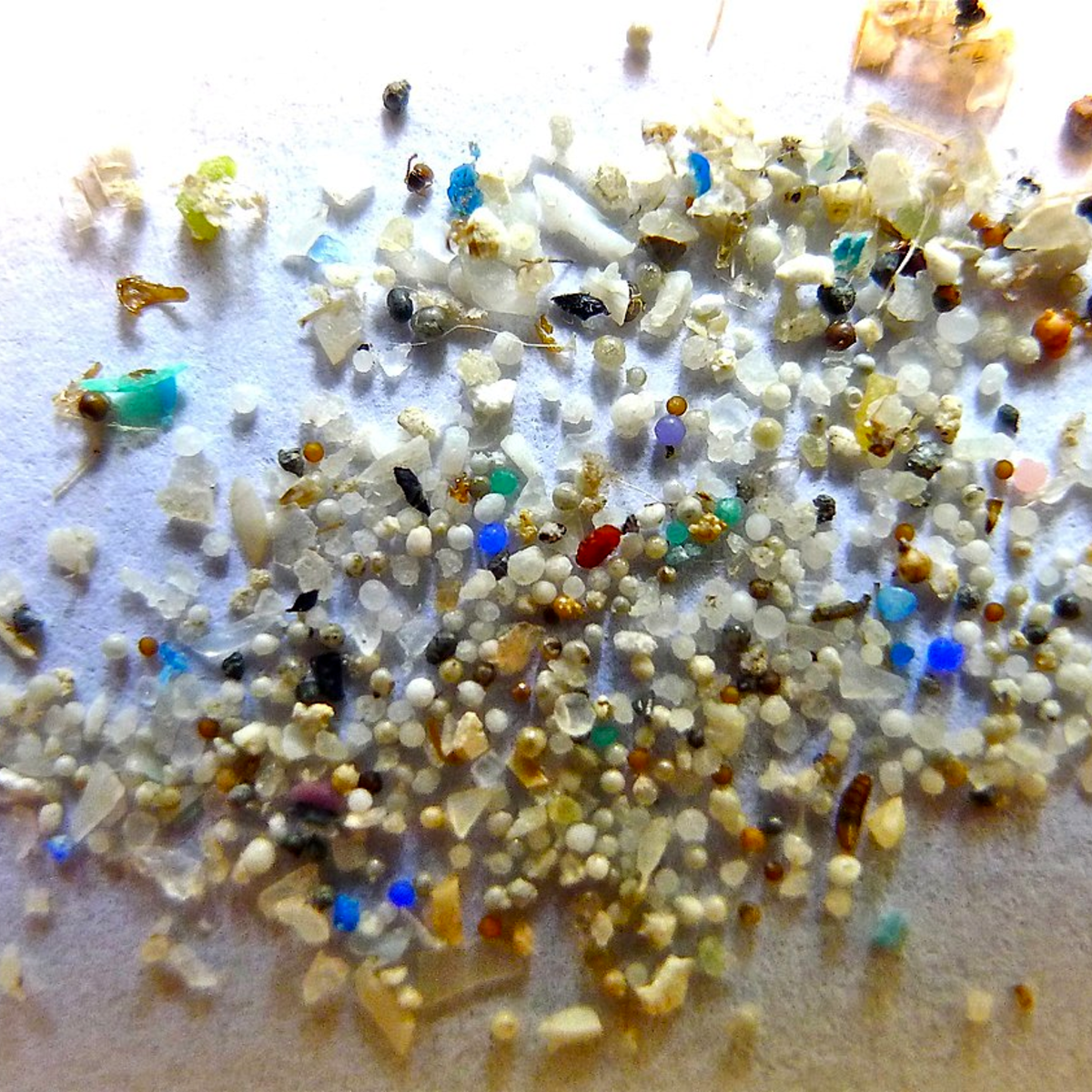
Over the past years there have appeared in the media increasingly more alarming reports about micro- and nanoplastics (MNPs) and the harm that they are causing not only in the environment, but also inside our bodies. If some of the published studies were to be believed, then MNPs are everywhere inside our bodies, from our blood and reproductive organs to having deeply embedded themselves inside our brains with potentially catastrophic health implications.

Early last year we covered what we thought we knew about the harm from MNPs in our bodies, but since then more and more scientists have pushed back against these studies, calling them ‘flawed’ and questioning the used methodology and conclusions. Despite claims of health damage in mice, institutions like the German federal risk assessment institute also do not acknowledge evidence of harm to human health from MNPs.

All of which raises the question whether flawed studies have pushed us into our own Chicken Little moment, and whether it’s now time to breathe a sigh of relief that the sky isn’t falling after all.

Measuring Many Tiny Things


One of the problems with making statements about the amount of MNPs in the body pertains to the way that this is measured. Rather than sliding samples under a microscope and doing manual counting, the typical method involves a method like pyrolysis-gas chromatography-mass spectrometry (Py-GC-MS). For biological samples you first want to remove the organic components before pyrolysis, lest the subsequent mass spectrometry step produces false positives rather than an objective polymer analysis.
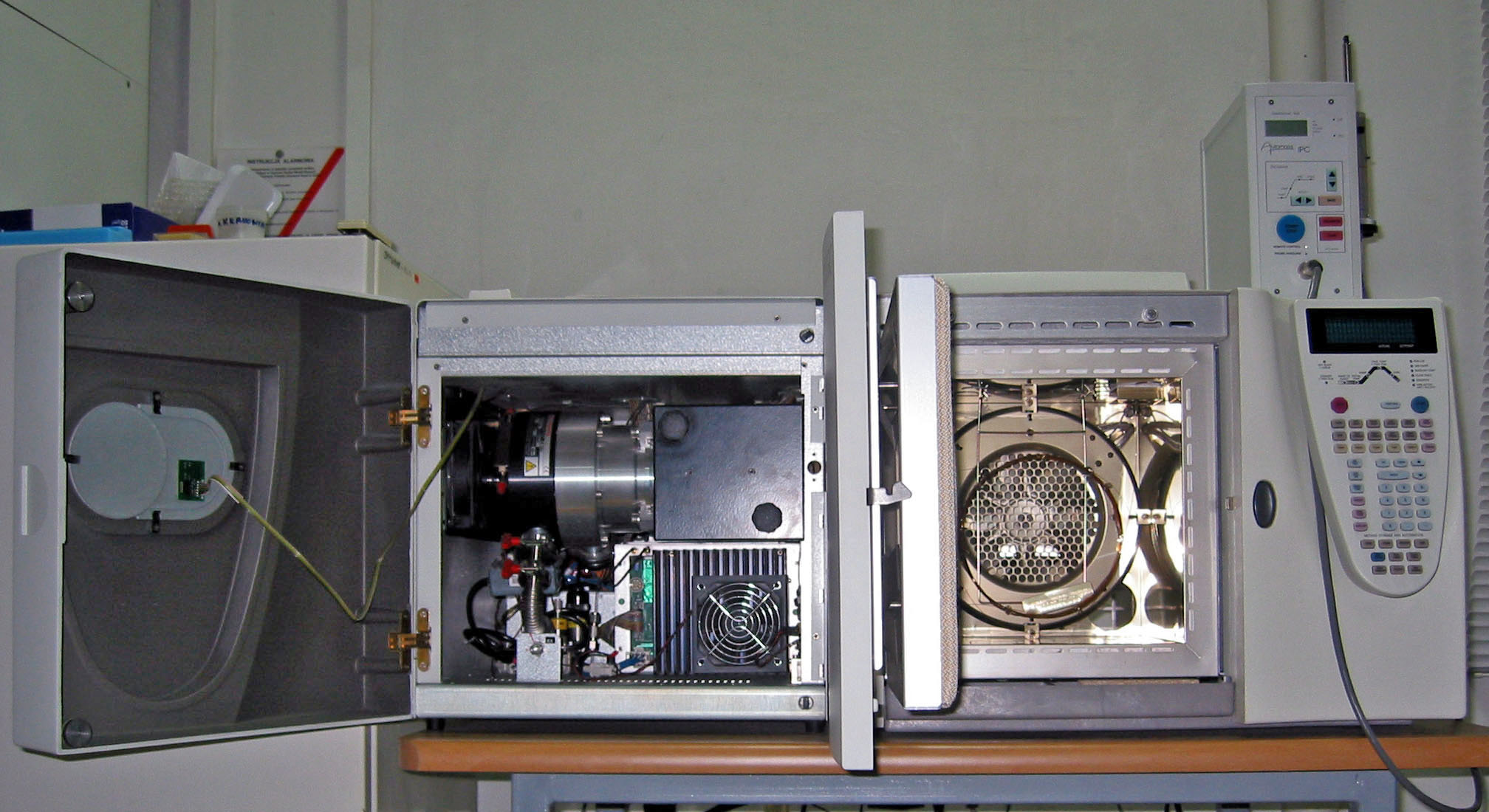
A ThermoQuest Trace 200 gas chromatograph–mass spectrometer (GCMS) with open door. (credit: Polimerek, Wikimedia)A ThermoQuest Trace 200 gas chromatograph–mass spectrometer (GCMS) with open door. (credit: Polimerek, Wikimedia)
Py-GC-MS involves rapidly heating the sample in an inert atmosphere or vacuum. This cleaves large molecules into smaller fragments which can then be separated using a gas chromatography column and classified in combination with a mass spectrometer. With both results combined, the likely original materials in the sample can thus be deduced. This means that you are not literally counting MNP particles in the sample or measuring them, but quite literally vaporizing said sample and analyzing the debris cloud. Obviously this comes with some major asterisks.

A 2024 paper by Marthinus Brits et al. as published in Microplastics and Nanoplastics explored the use of Py-GC-MS for determining the amount of MNPs in human blood. Using whole blood samples they found mostly polyethylene (PE) polymer, with a mean of 268 ng/mL of MNPs across all 68 samples, with a call to investigate the health impact of this finding.

In response to this paper a correspondence by Bianca Wilhelmus et al. was submitted to the journal, in which one of the complaints was a lack of detail on the Py-GC-MS fingerprints using which the polymers were purportedly detected. It was also noted that with sub-micrometer MNP particles you’d need millions of them in a sample to really register, which is far above what had typically been found in human body fluids.

To this Brits et al. replied with among other things the admission that the quantitative analysis of MNPs using Py-GC-MS is still in early stages of development. To the issue of quantity it was noted that most of the MNPs are significantly larger than a micrometer, so they were still fairly confident of their findings.

It’s important to note more recent studies here, such as the 2025 study by Cassandra Rauert et al. in Environmental Science & Technology, in which also a study on using Py-GC-MS for detecting MNPs in blood was performed. Its conclusion was that this detection method has trouble detecting PE and PVC polymers, and the estimated exposure concentrations are testing the detection limits of this technique.

Contamination


One of the problems with trying to measure MNPs in a sample is that of environmental MNP contamination, as MNPs are being shed and distributed all around us, whether it’s from e.g. polyester clothing, plastic surfaces and tools, or carried in from outside. This makes it a real chore to make sure that in a laboratory setting such contamination does not ruin the findings, as with a recent study on MNPs in bottled water by Qian et al. in PNAS.

Rather than Py-GC-MS, this used stimulated Raman scattering, but also led to accusations of contamination due to improper procedures, with the finding that the ultra-pure filtered Milli-Q water that was used for a blank (i.e. control) contained as many MNPs as the bottled water. This and other issues were suggested as invalidating the findings. While Qian et al. acknowledged that using the Milli-Q water as a blank was resultingly improper, they disagreed with the premise that this invalidated the study’s findings.

Another type of contamination can come from the aforementioned biological tissue, such as in the early 2025 study on MNPs in the human brain and other organs by Nihart et al. as published in Nature Medicine. This analyzed tissue samples from human cadavers using, among other methods, Py-GC-MS, leading them to conclude that especially our brains are full of PE polymers, with major implications for Alzheimer’s and dementia research, for instance.

This assessment subsequently got challenged (full article) by Monikh et al. in a November 2025 published commentary, with the authors noting that Nihart et al.’s samples from the human liver, kidney and brain all have in common that they contain significant amounts of fatty tissue (lipids), which when subjected to pyrolysis produce fragments that are easily mistaken for PE polymer fragments.

When it comes to detecting polymers in such biological samples, it is absolutely essential to strip away the biological material, without affecting the sample that will ultimately be analyzed. In this case the processing method appears to have been flawed, leading to subsequent contamination. This was acknowledged by the team, in a reply by some of the study authors.

Empirical Correlation


Although it seems like we can at least conclude that our brains aren’t overflowing with PE polymer fragments, but that they are just filled with phospholipids in particular, this doesn’t necessarily take away all our concerns. After all, didn’t some studies find real, empirical evidence for MNPs causing actual damage? Especially since it seems harmful in mice, according to a 2025 study using starch-based plastics.

As highlighted by Baroni et al. in a September 2025 review paper on MNPs in the brain as published in Nanomaterials, the enduring problem that we are dealing with right now is one of a lack of information, a scarcity of standard detection methods and a total lack of longitudinal studies in humans.

Although we have health databases that span decades in countries with strong public healthcare systems, trying to figure out whether certain health trends are due to MNPs using their data is borderline lunacy, as you cannot realistically account for all confounding factors. Thus we are mostly stuck at this point trying to figure out how to actually effectively measure the presence of MNPs.

Methodology


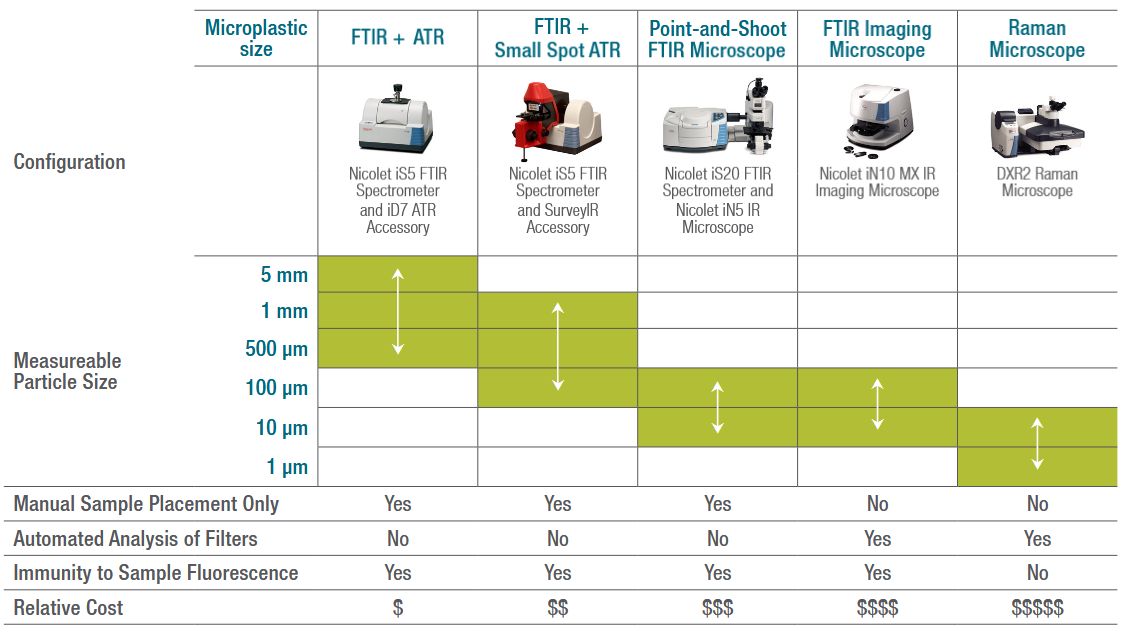
The aforementioned Py-GC-MS and SRS methods are two tools available to us here, but clearly moving from measuring MNPs in water to measuring them in biological tissues is still a challenging topic. When we look at the established science of MNPs in water, we got a range of options, as illustrated by this application note by ThermoFisher Scientific:

In order to measure not just the relatively large microplastic particles, but also the much smaller nanoplastics which are more likely to interact with biological systems, you are pretty limited here already. With only Raman spectroscopes applicable for such fine analysis, it’s little wonder that Py-GC-MS is being applied to biological samples.

Maybe once we have figured out the right methodology for Py-GC-MS and potentially other approaches will we be able to tell with some certainty how many of these polymer fragments are in our bodies right now, and how much of it will simply pass through rather than take up permanent residence. On the bright side, there’s no clear epidemiological evidence of MNPs being actively harmful to us, yet.

Although the sky hasn’t been confirmed to be falling, it is still looking somewhat unsteady. For that reason alone it is probably in our own best interest to use the precautionary principle here, as it’s better to have begun today to find ways to reduce and prevent the spread of MNPs, rather than to regret not having done so tomorrow.


hackaday.com/2026/01/29/did-we…

Ask Hackaday: How Do You Digitize Your Documents?


The media in this post is not displayed to visitors. To view it, please log in.

Like many of you, I have a hard time getting rid of stuff. I’ve got boxes and boxes of weirdo bits and bobs, and piles of devices that I’ll eventually get around to stripping down into even more bits and bobs. Despite regular purges — I try to bring a car-load of crap treasure to local hackerspaces and meetups at least a couple times a year — the pile only continues to grow.

But the problem isn’t limited to hardware components. There’s all sorts of things that the logical part of me understands I’ll almost certainly never need, and yet I can’t bring myself to dispose of. One of those things just so happens to be documents. Anything printed is fair game. Could be the notes from my last appointment with the doctor, or fliers for events I attended years ago. Doesn’t matter, the stacks keep building up until I end up cramming it all into a box and start the whole process starts over again.

I’ve largely convinced myself that the perennial accumulation of electronic bric-à-brac is an occupational hazard, and have come to terms with it. But I think there’s a good chance of moving the needle on the document situation, and if that involves a bit of high-tech overengineering, even better. As such, I’ve spent the last couple of weeks investigating digitizing the documents that have information worth retaining so that the originals can be sent along to Valhalla in my fire pit.

The following represents some of my observations thus far, in the hopes that others going down a similar path may find them useful. But what I’m really interested in is hearing from the Hackaday community. Surely I’m not the only one trying to save some storage space by turn piles of papers into ones and zeros.

Take a Picture, It’ll Last Longer


Obviously, the first step in digitizing physical documents is image capture. The most obvious way to accomplish this is to simply use a flatbed scanner, and in some cases, there’s a solid argument to be made that it’s the best approach. Indeed, many of the documents that I’ve already filed away digitally were created this way. But it’s a tedious enough process that you may want to consider alternative methods.

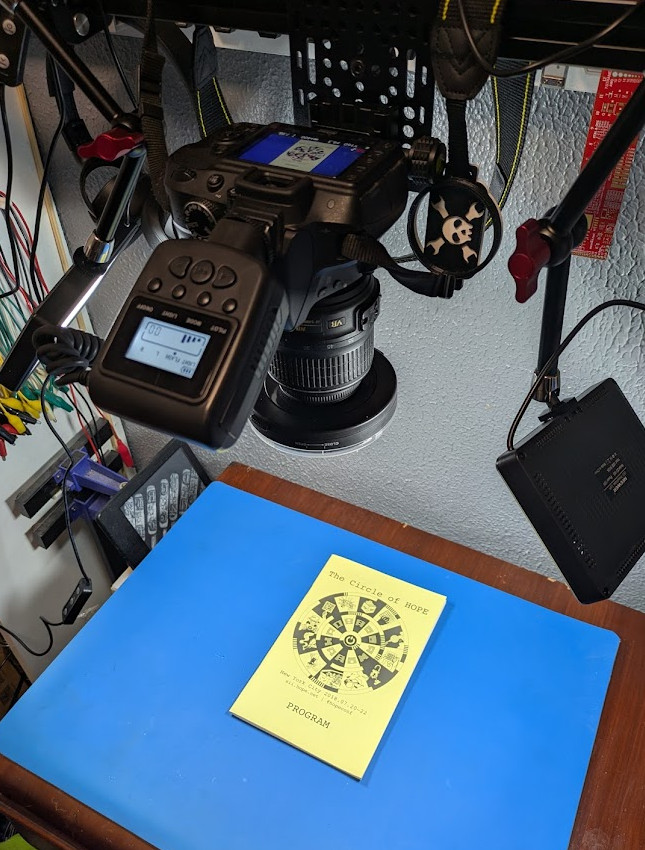
If you’ve got a decent camera, you can get a couple of lights and put together a nice overhead photography rig without spending too much money. Put your document down under the camera, snap a picture, and keep it moving.

Imaging doesn’t get any faster than taking a picture, and so long as you’re not using some point and shoot from the early 2000s, the resolution should be more than sufficient. This method is particularly appealing if you’re planning on digitizing books or anything else that can’t be laid perfectly flat on a scanner.

The major downside with this approach is the setup itself. It’s one thing if you’re digitizing documents and books on a daily basis, but for occasional use, putting something like this together is a big ask. A flatbed scanner certainly takes up a lot less room, and you don’t have to worry about getting the lighting right, mounting the camera, and so on.

Casting Some Magick


Whether you used a scanner or a camera, once you have the image of your document, you’ve technically digitized it. Congratulations, you’re now an amateur archivist.

If you’re looking to keep things simple, you could stop here. Stash the files someplace and be done with it. But depending on the type of content you’re working with and what your goals are, there’s a good chance you’ll want to touch up the images a bit. Luckily for us, the incredible ImageMagick project has many of the functions we need built-in, from cropping and resizing, all the way to image enhancement.

Consider the image below. It’s clear enough to read, but the text is rotated and the lighting isn’t consistent across the entire page.

We can fix both issues with a simple ImageMagick command via the convert tool:
convert input.png -deskew 30% -threshold 25% output.png
We won’t get too bogged down in the details, the ImageMagick documentation can break it all down better than I can. The short version is that we’re telling it to straighten out the image and convert it into pure black and white. The result looks like this:

The values can be tweaked a bit to refine the result, and as you might imagine there are many other ImageMagick functions that could potentially be brought in to clean up the result. Things do get more complicated if you’re working with something more complex than plain text, but you get the general idea.

This sort of post-processing is especially important if you plan on running the images through any sort of optical character recognition (OCR) to capture the actual text of the document. That first image might be perfectly legible to our human eyeballs. You might even prefer it over the stark look of the processed image, but tools like tesseract have a hell of a time picking the text out when the background isn’t uniform.

There’s an App For That


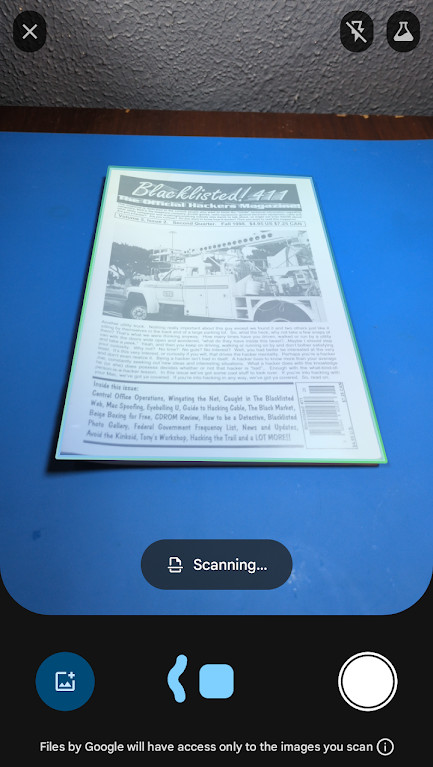
The process described here certainly isn’t for everyone, and that’s fine. If you’re not looking to invest the sort of time and effort it would take to make this work, there’s fortunately a far more approachable solution available. In fact, it might already be in your pocket.

The Google Drive mobile application offers a very impressive document scanning mode that essentially automates everything above. If you give it access to your device’s camera, it will automagically detect documents in the field of view, find their edges, compensate for angle and rotation to straighten out the image, and even run it through filters to make the text pop. It’s fast, works reasonably well, and is exceptionally handy for cranking out multi-page PDFs.

The downside is that you’ve got relatively little control over the process, and being a product of Google, there’s the usual concerns over what they may be doing with the information that’s passing through the system. For these reasons it’s not something I would personally recommend for any private information, and its automatic nature the lack of fine-grained control means it may not be a great choice if your needs venture too far from the beaten path.

Still, the speed and ease of use it offers is admittedly very attractive.

Open to Suggestions


I’d love to hear the community’s thoughts on digitization, whether it’s hardware or software related. There’s surely some slick projects out there that aid in creating bespoke digital libraries, and there’s plenty of areas where real-world experience can help streamline and improve the overall process. For example, what’s your file naming convention look like?

Hackaday readers are rarely shy about sharing their opinions, so let’s hear them.


hackaday.com/2026/01/29/ask-ha…

These Ultra-Cute, Handsfree Walkie-Talkies Are Built For Cycling


The media in this post is not displayed to visitors. To view it, please log in.

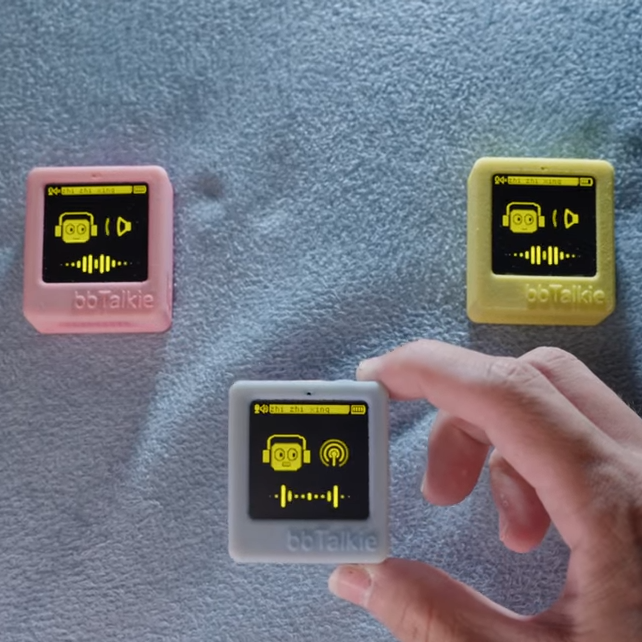
Walkie-talkies are great fun, and [RealCorebb]’s bbTalkie project takes the concept a step further by adding some extremely cool features to make a highly refined, self-contained ESP32-based communicator. bbTalkie completely does away with a push-to-talk button by implementing robust voice detection that works reliably even in noisy environments. It was all designed with cycling in mind, so hands-free operation that stands up to noise is a big plus.
Hands-free, wireless, self-contained digital walkie-talkies that can connect in a group. What’s not to like?
The core of communication is done over ESP-NOW, which is Espressif’s own protocol for direct device-to-device broadcasting. This removes the need to involve any sort of external service like SIM cards or internet access to transmit voice. Performance is best with an external antenna, naturally, but ESP-NOW doesn’t actually require anything other than the existing on-board hardware.

We’ve seen ESP-NOW used to make digital walkie-talkies before, but bbTalkie is a really evolved take on the concept, not least of which due to its hands-free operation.

Because volume-based automatic triggers are highly susceptible to noise, voice detection is done with the help of VADNet, a neural network-based model implemented locally on the device. This system can reliably detect human speech, even in noisy environments. This lets bbTalkie switch between transmit and listen modes automatically and hands-free, without false triggers.

Even when doing all that, there’s still spare capability to play with. Further to the goal of making bbTalkie useful for cyclists in a group, [RealCorebb] added a system that can recognize specific voice commands (like “turn left” for example, or “wait for me!”) which trigger synchronized animations to play on the displays of all connected units. There’s even some experimental support for controlling a camera over Bluetooth, though currently it only supports hardware from Sony.

Watch a tour of it in the video below (Chinese language, English captions available). The OLED screens and animations are adorable, and are great visual feedback of what the unit is doing at any given moment.

youtube.com/embed/v0QcsWsoYbw?…


hackaday.com/2026/01/29/these-…

Cybersecurity & cyberwarfare ha ricondiviso questo.

The media in this post is not displayed to visitors. To view it, please go to the original post.

FRANCE TRAVAIL, multa da 5 milioni per violazione dati personali

📌 Link all'articolo : redhotcyber.com/post/france-tr…

#redhotcyber #news #violazionedeidatipersonali #sicurezzainformatica #hacking #cybersecurity #protezionedeidati

Cybersecurity & cyberwarfare ha ricondiviso questo.

AI, motori di ricerca e qualche vibe nostalgico.

Oggi è giovedì ed esce il mio #SocialDebug 🦄

open.substack.com/pub/signorin…

reshared this

Cybersecurity & cyberwarfare ha ricondiviso questo.

Installed the Fedora Remix from fedoravforce.org on my new Milk-V Jupiter (yes, I have a thing for weird computers), saw a message about skipped PGP checks, and...

[fedora-spacemit-k1]
name=Fedora SpacemiT K1
baseurl=openkoji.iscas.ac.cn/pub/dist-…
enabled=1
priority=1
gpgcheck=0

No HTTPS either 💀😬 any network attacker can install whatever they want.

in reply to Filippo Valsorda

yep .. because that's not the official fedora either ... I found other images pointing to different http only URLs, and .repo still having gpgcheck=0 too ... at this point I'd wait for official release from @fedora or (if you're willing to be "early bird" wrt testing) switch at least to riscv-koji.fedoraproject.org/k… ?

Clawdbot diventa Moltbot: come mitigare il rischio dell’infostealer camuffato da Agentic AI


@Informatica (Italy e non Italy 😁)
Le preoccupazioni relative alla sicurezza del nuovo strumento di Agentic AI, precedentemente noto come Clawdbot, permangono, nonostante il rebranding richiesto da Anthropic per motivi legati al marchio registrato. Ecco i

Cybersecurity & cyberwarfare ha ricondiviso questo.

The media in this post is not displayed to visitors. To view it, please go to the original post.

WhatsApp cambia pelle: Arriva la modalità “Paranoia” (e no, non è per tutti)

📌 Link all'articolo : redhotcyber.com/post/whatsapp-…

#redhotcyber #hacking #cti #ai #online #it #cybercrime #cybersecurity #technology #news #cyberthreatintelligence

Cybersecurity & cyberwarfare ha ricondiviso questo.

The media in this post is not displayed to visitors. To view it, please go to the original post.

Il CISA ci insegna come farsi un Data Leak da soli, senza nemmeno assoldare un hacker

📌 Link all'articolo : redhotcyber.com/post/il-cisa-c…

#redhotcyber #news #sicurezzainformatica #cybersecurity #chatgpt #intelligenzartificiale #sicurezzadatidigitali

Cybersecurity & cyberwarfare ha ricondiviso questo.

#Google targets #IPIDEA in crackdown on global residential proxy networks
securityaffairs.com/187463/sec…
#securityaffairs #hacking

Buildling A Light That Reacts To Radio Waves


The media in this post is not displayed to visitors. To view it, please log in.

When it comes to electromagnetic waves, humans can really only directly perceive a very small part of the overall spectrum, which we call “visible light.” [rootkid] recently built an art piece that has perception far outside this range, turning invisible waves into a visible light sculpture.

The core of the device is the HackRF One. It’s a software defined radio (SDR) which can tune signals over a wide range, from 10 MHz all the way up to 6 GHz. [rootkid] decided to use the HackRF to listen in on transmissions on the 2.4 GHz and 5 GHz bands. This frequency range was chosen as this is where a lot of devices in the home tend to communicate—whether over WiFi, Bluetooth, or various other short-range radio standards.

The SDR is hooked up to a Raspberry Pi Zero, which is responsible for parsing the radio data and using it to drive the light show. As for the lights themselves, they consist of 64 filament LEDs bent into U-shapes over a custom machined metal backing plate. They’re controlled over I2C with custom driver PCBs designed by [rootkid]. The result is something that looks like a prop from some high-budget Hollywood sci-fi. It looks even better when the radio waves are popping and the lights are in action.

It’s easy to forget about the rich soup of radio waves that we swim through every day.

youtube.com/embed/moBCOEiqiPs?…


hackaday.com/2026/01/29/buildl…

Ultimate Picture Frame Combines Walnut and 3D Printing


The media in this post is not displayed to visitors. To view it, please log in.

A man cutting wood with a circular bench saw

[Make Something] boasts he has made probably the fanciest picture frame you’ll ever see. He started with an original sign purchased on eBay and then made it to be bigger, brighter, and better. The frame is of solid walnut with back-lighting for the imagery all chasing that classic mid-century modern style. The backlit photo was taken the “hard way”, with an actual film camera and a road-trip to the picturesque site at Yellowstone. [Make Something] then developed the film himself in his home studio.

For the chimney [Make Something] used a new trick he learned in Autodesk Fusion: you take a photo of an object, convert to black and white, and then use the light/dark values to emboss or deboss a surface. To do this he took photos of the brick wall outside his shop and used that as the basis of the textured chimney he made with his 3D printer.

If you’re interested in other projects made from solid walnut, check out 3D Printed Spirograph Makes Art Out Of Walnut and Walnut Case Sets This Custom Arduino-Powered RPN Calculator Apart From The Crowd.

youtube.com/embed/80qMQnYRgBA?…


hackaday.com/2026/01/28/ultima…

DK 10x19_ - Post-americani (La versione di Carney)


The media in this post is not displayed to visitors. To view it, please log in.

Quando un uomo dell'establishment come Mark Carne, PM del Canada, va a Davos a dire cose che sentivi al massimo in qualche facoltà di Scienze Politiche, vuol dire che l'era post-americana è cominciata. Sarà un viaggio.


spreaker.com/episode/dk-10x19-…

Cybersecurity & cyberwarfare ha ricondiviso questo.

The media in this post is not displayed to visitors. To view it, please go to the original post.

🔥 SONO UFFICIALMENTE APERTE LE ISCRIZIONI! 🔥

Per info e iscrizioni: 📱 💬 379 163 8765 ✉️ formazione@redhotcyber.com

#redhotcyber #formazione #cybersecurity #darkweb #cyberthreatintelligence #ethicalhacking #infosec

Cybersecurity & cyberwarfare ha ricondiviso questo.

The media in this post is not displayed to visitors. To view it, please go to the original post.

Smartphone in affitto a tua insaputa: Google smantella una rete proxy globale

📌 Link all'articolo : redhotcyber.com/post/smartphon…

Android non è mai stato così sfruttato, almeno secondo gli ultimi sviluppi riportati da una recente #indagine. #Google ha annunciato di aver smantellato ciò che potrebbe essere la più grande #rete di proxy “domestici” mai vista, una #infrastruttura che per anni ha usato #dispositivi Android come punti di uscita per #traffico internet di terzi, senza che gli #utenti lo sapessero.

A cura di Bajram Zeqiri

#redhotcyber #news #google #android #malware #cybersecurity #hacking #sicurezzainformatica #proxy #sdk #ipidea #trafficointernet #appgratuite #giochipermobili

Cybersecurity & cyberwarfare ha ricondiviso questo.

Nation-state and criminal actors leverage #WinRAR flaw in Attacks
securityaffairs.com/187451/hac…
#securityaffairs #hacking

Guerre di Rete - Scarica il manualetto di sicurezza digitale


@Informatica (Italy e non Italy 😁)
Da oggi rendiamo disponibile per tutti il Manualetto di sicurezza digitale per giornalisti e attivisti.

#GuerreDiRete è la newsletter curata da @Carola Frediani
guerredirete.substack.com/p/gu…

reshared this

in reply to Cybersecurity & cyberwarfare

ben fatto. Aggiungo che con LUKS è possibile configurare una "nuke key", ovvero una password che, se inserita al posto di quella normale, rende il disco non più decifrabile packages.debian.org/sid/admin/… può essere utile in certi contesti

Le professioni cyber più richieste nel 2026: le 5 sfide che devono affrontare


@Informatica (Italy e non Italy 😁)
Al Richmond Cyber resilience forum, a cui hanno partecipato CISO, manager e professionisti della sicurezza, il report Cybersecurity Statistics 2025 ha delineato le principali tendenze cyber del 2026, a partire dalle figure professionali più richieste.

Cybersecurity & cyberwarfare ha ricondiviso questo.

The media in this post is not displayed to visitors. To view it, please go to the original post.

L’IA non chiede il permesso: sta riscrivendo le regole in fretta e probabilmente male

📌 Link all'articolo : redhotcyber.com/post/lia-non-c…

#redhotcyber #news #intelligenzaartificiale #lavoro #futurodelavoro #automatizzazione #innovazione #tecnologia

Cybersecurity & cyberwarfare ha ricondiviso questo.

#OpenSSL issued security updates to fix 12 flaws, including Remote Code Execution
securityaffairs.com/187445/sec…
#securityaffairs #hacking
Cybersecurity & cyberwarfare ha ricondiviso questo.

The media in this post is not displayed to visitors. To view it, please go to the original post.

Attenzione al “I am not a robot”: la trappola malware che usa Google Calendar

📌 Link all'articolo : redhotcyber.com/post/attenzion…

Una nuova #minaccia si aggira, usando la nostra più grande debolezza: l’abitudine. Quante volte, infatti, capita di ritrovarsi a cliccare su caselle di #verifica senza pensarci due volte? Ora, pare che i malintenzionati abbiano creato una nuova campagna malware, che utilizza finti CAPTCHA per indurre l’utente a eseguire comandi sul proprio pc.

A cura di Bajram Zeqiri

#redhotcyber #news #cybersecurity #hacking #malware #phishing #sicurezzainformatica #minacceinformatiche #captcha #ingannoinformatico #protezionedatidigitali #sicurezzadelleinformazioni #vulnerabilita #datipersonali

reshared this

Cybersecurity & cyberwarfare ha ricondiviso questo.

The media in this post is not displayed to visitors. To view it, please go to the original post.

WinRAR come arma: Google scopre una falla sfruttata da APT e cybercriminali

📌 Link all'articolo : redhotcyber.com/post/winrar-co…

#redhotcyber #news #cybersecurity #hacking #malware #winrar #vulnerabilita #sicurezzainformatica

ACN: nel secondo semestre del 2025 qualcosa ha finalmente iniziato a funzionare


@Informatica (Italy e non Italy 😁)
Non siamo affatto più sicuri, ma un po’ meno disordinati nella capacità di rilevazione e triage. Ecco i dati di Acn del secondo semestre del 2025 da cui si evince che gli eventi aumentano, mentre diminuiscono gli incidenti con impatto confermato

Cybersecurity & cyberwarfare ha ricondiviso questo.

The media in this post is not displayed to visitors. To view it, please go to the original post.

212 – Meshtastic & MeshCore. La rivoluzione per mandare messaggi senza Internet camisanicalzolari.it/212-mesht…
Cybersecurity & cyberwarfare ha ricondiviso questo.

The media in this post is not displayed to visitors. To view it, please go to the original post.

Nike indaga su un presunto attacco hacker: “Sottratti 1,4 TB di dati”

📌 Link all'articolo : redhotcyber.com/post/nike-inda…

A cura di Pietro Melillo del gruppo DarkLab

#redhotcyber #news #cybersecurity #hacking #malware #nike #sicurezzainformatica #databreach #worldleaks #incidentesicurezza #protezionedatidatabas #sicurezzadigital #leaksinformatici #hackingaziendale

Cybersecurity & cyberwarfare ha ricondiviso questo.

The media in this post is not displayed to visitors. To view it, please go to the original post.

America Latina sotto assedio digitale: i numeri che preoccupano gli esperti

📌 Link all'articolo : redhotcyber.com/post/america-l…

#redhotcyber #news #cyberattacchi #sicurezzainformatica #americalatina #caraibi #hacking #malware #ransomware

X-Cube Prism Becomes Dichoric Disco Ball


The media in this post is not displayed to visitors. To view it, please log in.

You’ve likely seen an X-cube, a dichoric prism used to split light into its constituent colours–you know, those fun little cubes you get when tearing apart a broken projector. Have you considered that the X-cube need not be a cube for its entire existence? [Matt] at “Matt’s Corner of Gem Cutting” on YouTube absolutely did, which is why he ground one into a 216-facet disco ball.

That’s the hack, really. He took something many of us have played with at our desks thinking “I should do something cool with this” and… did something cool with it that most of us lack the tools and especially skills to even consider. It’s not especially practical, but it is especially pretty. Art, in other words.

The shape he’s using is known specifically to gemologists as “Santa’s Little Helper II” though we’d probably describe it as a kind of isosphere. Faceting the cube is just a matter of grinding down the facets to create the isosphere, then polishing them to brilliance with increasingly finer grit. This is done one hemisphere at a time, so the other hemisphere can be safely held in place with the now-classic cyanoacrylate and baking soda composite. Yes, jewelers use that trick, too.

We were slightly worried when [Matt] dumped his finished disco ball in acetone to clean off the cyanoacrylate– we haven’t the foggiest idea what optical-quality glue is used to hold the four prisms of an X-cube together and were a little worried acetone might soften the joints. That turned out not to be an issue, and [Matt] now has the most eye-catching sun-catcher we think we’ve ever seen.

We actually have seen suncatchers before, though admittedly it’s not a very popular tag around here. The closest build to this one was a so-called “hypercrystal” that combined an infinitiy mirror with a crystaline shape and dicloric tape for an effect as trippy as it sounds.

We also featured a deep-dive a while back if you want to know how these colourful, hard-to-pronounce coatings work.

youtube.com/embed/5I7LdqpNolY?…


hackaday.com/2026/01/28/x-cube…

Light Following Robot Does It The Analog Way


The media in this post is not displayed to visitors. To view it, please log in.

If you wanted to build a robot that chased light, you might start thinking about Raspberry Pis, cameras, and off-the-shelf computer vision systems. However, it needn’t be so complex. [Ed] of [Death and the Penguin] demonstrates this ably with a simple robot that finds the light the old-fashioned way.

The build is not dissimilar from many line-following and line chasing robots that graced the pages of electronics magazines 50 years ago or more. The basic circuit relies on a pair of light-dependent resistors (LDR), which are wrapped in cardboard tubes to effectively make their response highly directional. An op-amp is used to compare the resistance of each LDR. It then crudely steers the robot towards the brighter light between turning one motor hard on or the other, operating in a skid-steer style arrangement.

[Ed] then proceeded to improve the design further with the addition of a 555 timer IC. It’s set up to enable PWM-like control, allowing one motor to run at a lower speed than the other depending on the ratio between the light sensors. This provides much smoother steering than the hard-on, hard-off control of the simpler circuit. [Ed] notes that this is about the point where he would typically reach for a microcontroller if he hoped to add any additional sophistication.

In an era where microcontrollers seem to be the solution to everything, it’s nice to remember that sometimes you can complete a project without using a processor or any code at all. Video after the break.

youtube.com/embed/ikTkOXu1th4?…

youtube.com/embed/tPZAZ0fSK8M?…


hackaday.com/2026/01/28/light-…

Using 3D Printing and Copper Tape to Make PCBs


The media in this post is not displayed to visitors. To view it, please log in.

In a recent video [QWZ Labs] demonstrates an interesting technique to use 3D printing to make creating custom PCBs rather straightforward even if all you have is a 3D printer and a roll of copper tape.

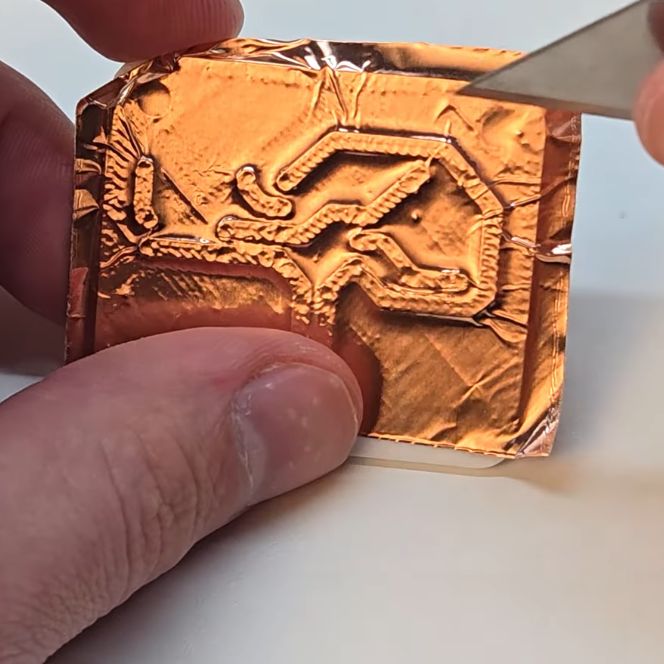
The PCB itself is designed as usual in KiCad or equivalent EDA program, after which it is exported as a 3D model. This model is then loaded into a CAD program – here Autodesk Fusion – which is used to extrude the traces by 0.6 mm before passing the resulting model to the 3D printer’s slicer.

By extruding the traces, you can subsequently put copper tape onto the printed PCB and use a cutting tool of your choice to trace these raised lines. After removing the rest of the copper foil, you are left with copper traces that you can poke holes in for the components and subsequently solder onto.

As far as compromises go, these are obviously single-sided boards, but you could probably extend this technique to make double-sided ones if you’re feeling adventurous. In the EDA you want to use fairly thick, 2 mm trace width with plenty of clearance to make your copper cutting easy, while in the slicer you have to check that the traces get printed properly. Using the Arachne wall generator option for example helps to fill in unpleasant voids, and the through-holes ought to be about 1 mm at least lest the slicer decides that you really want to drill them out later by hand instead.

While soldering is pretty easy on copper tape like this, desoldering would be more challenging, especially with hot air. In the video PLA was used for the PCB, which of course is rather flexible and both softens and melts easily when exposed to heat, neither of which make it look very good compared to FR4 or even FR1 PCB materials. Of course, you are free to experiment with whatever FDM, SLA or even SLS materials you fancy that would work better for the board in question.

Although obviously not a one-size-fits-all solution for custom PCBs, it definitely looks a lot easier than suffering through the much-maligned prototype perfboards that do not fit half the components and make routing traces hell. Now all we need is the ability to use e.g. targeted vapor-deposition of copper to make fully 3D printed PCBs and this method becomes even easier.

youtube.com/embed/PLliKgzKKUI?…


hackaday.com/2026/01/28/using-…

FLOSS Weekly Episode 862: Have Your CAKE and Eat It Too


The media in this post is not displayed to visitors. To view it, please log in.

This week Jonathan chats with Toke Hoiland-Jorgensen about CAKE_MQ, the newest Kernel innovation to combat Bufferbloat! What was the realization that made CAKE parallelization? When can we expect it in the wild? And what’s new in the rest of the kernel world? Watch to find out!


youtube.com/embed/EWFWhstN1Ko?…

Did you know you can watch the live recording of the show right on our YouTube Channel? Have someone you’d like us to interview? Let us know, or have the guest contact us! Take a look at the schedule here.

play.libsyn.com/embed/episode/…

Direct Download in DRM-free MP3.

If you’d rather read along, here’s the transcript for this week’s episode.

Places to follow the FLOSS Weekly Podcast:


Theme music: “Newer Wave” Kevin MacLeod (incompetech.com)

Licensed under Creative Commons: By Attribution 4.0 License


hackaday.com/2026/01/28/floss-…

Cybersecurity & cyberwarfare ha ricondiviso questo.

OLTRE GLI ALGORITMI: LA GUIDA DEFINITIVA A BOOKWYRM E ALLA RIVOLUZIONE DEL FEDIVERSO.

Se senti che il tuo spazio di lettura digitale è diventato troppo stretto, affollato di pubblicità o limitato da logiche commerciali, è il momento di guardare altrove. La risposta non è un nuovo sito web, ma un intero ecosistema: il Fediverso. E per noi lettori, la porta d’ingresso principale si chiama Bookwyrm.

librotilovvo.com/2026/01/27/ol…

@fediverso

reshared this

Cybersecurity & cyberwarfare ha ricondiviso questo.

The media in this post is not displayed to visitors. To view it, please go to the original post.

Colpo al cuore del cybercrime: RAMP messo offline. Il “tempio” del ransomware cade!

📌 Link all'articolo : redhotcyber.com/post/colpo-al-…

Il #forum RAMP (Russian Anonymous Marketplace), uno dei principali punti di riferimento del cybercrime #underground #internazionale, è stato ufficialmente chiuso e sequestrato dalle forze dell’ordine statunitensi. La notizia è emersa dopo che il dominio associato alla piattaforma ha iniziato a mostrare un banner di sequestro congiunto del Federal Bureau of Investigation (FBI) e del Department of Justice (DoJ).

A cura di Bajram Zeqiri

#redhotcyber #news #cybercrime #ransomware #forumramp #fbi #doj #cybersecurity #hacking #malware #sicurezzainformatica #chiusurafórum #ecosistemamarketplace #attacchiinformatici

Cybersecurity & cyberwarfare ha ricondiviso questo.

U.S. #CISA adds a flaw in multiple Fortinet products to its Known Exploited Vulnerabilities catalog
securityaffairs.com/187435/sec…
#securityaffairs #hacking