Cybersecurity & cyberwarfare ha ricondiviso questo.

The media in this post is not displayed to visitors. To view it, please go to the original post.

Spionaggio globale su rete mobile: nuovi fornitori sfruttano vecchie falle di sicurezza

📌 Link all'articolo : redhotcyber.com/post/spionaggi…

A cura di Carolina Vivianti

#redhotcyber #news #cybersecurity #hacking #malware #sorveglianza #rete #telecom #vulnerabilita #ss7 #diameter

2026 Green Powered Challenge: Solar-Powered Pollution Monitor


The media in this post is not displayed to visitors. To view it, please log in.

As we learn more about all the nasty stuff floating in the air, it becomes more compelling to monitor the air for pollution levels. [Aleksei Tertychnyi] does just that with pollutagNode2, a solar-powered pollution sensor.

The device uses a Seeed Studio Wia-E5 module for its built-in LoRa low power long-range communication capabilities. Pair that with a cheap 2 watt solar panel and a Li-ion battery, and you have a monitoring device that can stay up indefinitely — or until harsh weather gets the better of it. Even if the solar panel were to be omitted, a full charge would last you about two weeks!

It comes on an open-hardware PCB; no need for giant wire messes, just solder the solar panel, battery, sensor, and anything else you want onto the convenient pads on the side. It also integrates into the existing sensor community nicely via existing LoRa infrastructure. All this combined makes it easy for anyone to deploy one.

2026 Hackaday Greep Powered Challenge


hackaday.com/2026/04/24/2026-g…

The media in this post is not displayed to visitors. To view it, please log in.

GopherWhisper: il nuovo APT cinese che spia il governo mongolo nascondendo il C2 in Slack, Discord e Outlook


@Informatica (Italy e non Italy)
ESET Research ha scoperto GopherWhisper, un APT cinese attivo dal 2023 che ha compromesso 12 sistemi governativi mongoli usando Discord, Slack e le bozze di Microsoft Outlook come canali C2. Il


GopherWhisper: il nuovo APT cinese che spia il governo mongolo nascondendo il C2 in Slack, Discord e Outlook


ESET Research ha scoperto GopherWhisper, un nuovo gruppo APT allineato alla Cina attivo dal novembre 2023, specializzato nello spionaggio di istituzioni governative in Mongolia. La particolarità operativa che distingue questo attore: utilizza Discord, Slack e le bozze di Microsoft Outlook come canali di command-and-control, rendendo il traffico malevolo praticamente indistinguibile dalle normali comunicazioni aziendali.

Scoperta e attribuzione: 12 sistemi governativi mongoli compromessi


La ricerca pubblicata da ESET il 23 aprile 2026 rivela che GopherWhisper ha compromesso almeno 12 sistemi appartenenti a un’istituzione governativa mongola, con attività iniziata nel novembre 2023. La telemetria raccolta ha permesso ai ricercatori di recuperare migliaia di messaggi degli operatori direttamente dai server Discord e Slack compromessi, grazie al recupero di token API inclusi nel codice dei backdoor.

L’attribuzione alla Cina si basa su più elementi convergenti: l’analisi dei timestamp dei messaggi Slack e Discord mostra che il grosso delle comunicazioni avviene tra le 8:00 e le 17:00, perfettamente allineato con il China Standard Time (UTC+8). I metadati di configurazione dell’utente Slack configurato dagli operatori riportano inoltre il fuso orario cinese. ESET stima che le vittime complessive siano potenzialmente decine, ma non ha informazioni sulla loro geolocalizzazione o settore.

L’arsenale: sette tool, quattro backdoor, un’infrastruttura C2 distribuita


GopherWhisper si distingue per la proliferazione di strumenti personalizzati — sette in totale, quattro dei quali sono backdoor distinte. Questa ridondanza suggerisce un’organizzazione con risorse sufficienti per sviluppare e mantenere un ecosistema malware parallelo, probabilmente con team distinti per componente.

LaxGopher — Backdoor Go via Slack


Backdoor scritta in Go che usa Slack come canale C2. Esegue comandi tramite cmd.exe, pubblica i risultati su un canale Slack configurato e può scaricare payload aggiuntivi. La comunicazione avviene attraverso le API ufficiali di Slack, rendendola quasi impossibile da rilevare a livello di firewall senza ispezione applicativa.

RatGopher — Backdoor Go via Discord


Backdoor analoga a LaxGopher ma che usa Discord come infrastruttura C2. Riceve messaggi da un server Discord privato, esegue comandi, pubblica i risultati sui canali configurati e gestisce upload/download da file[.]io. L’uso di due piattaforme separate (Slack e Discord) per backdoor distinte è probabilmente una strategia di ridondanza operativa.

BoxOfFriends — Backdoor via bozze Outlook


La backdoor più sofisticata dal punto di vista della tradecraft: gestisce il C2 attraverso bozze email di Microsoft 365 Outlook. Le istruzioni vengono scritte come bozze sul server di posta — mai inviate — e recuperate dal backdoor. Questa tecnica sfrutta il fatto che il traffico HTTPS verso i server Microsoft è quasi universalmente consentito e ignorato dagli strumenti di monitoraggio. È una variante della tecnica nota come “draft-based C2”, già osservata in alcuni APT mediorientali.

SSLORDoor — Backdoor C++ con raw socket


Backdoor scritta in C++ che comunica su porta 443 attraverso connessioni raw socket con OpenSSL BIO. A differenza dei backdoor Go che usano servizi cloud legittimi, SSLORDoor comunica direttamente con infrastruttura C2 controllata dall’attaccante. Supporta enumerazione di drive, operazioni su file e esecuzione di comandi via cmd.exe.

CompactGopher — Strumento di esfiltrazione


Tool Go-based di raccolta e esfiltrazione file, deployato da LaxGopher. Filtra i file di interesse per estensione, li comprime in ZIP, li cifra con AES-CFB-128 e li esfiltra su file[.]io. Le estensioni target sono documentali: .doc, .docx, .jpg, .xls, .xlsx, .txt, .pdf, .ppt, .pptx.

FriendDelivery e JabGopher


FriendDelivery è una DLL malevola che funge da loader e injector per BoxOfFriends. JabGopher è un injector generico del toolkit. Entrambi i componenti svolgono funzioni di supporto nell’ecosistema GopherWhisper, gestendo il deployment e l’iniezione dei backdoor principali.

Living off Trusted Services: la nuova frontiera dell’evasione APT


La scelta di Discord, Slack e Outlook come canali C2 non è casuale: rappresenta l’evoluzione della tecnica “Living off the Land” applicata ai servizi cloud. Invece di abusare di tool di sistema Windows legittimi, GopherWhisper abusa di servizi cloud enterprise affidabili il cui traffico è quasi impossibile da bloccare senza interrompere le operazioni aziendali normali.

L’approccio crea un problema fondamentale per i difensori: bloccare Discord o Slack a livello di firewall è tecnicamente fattibile, ma spesso politicamente impraticabile in organizzazioni che li usano quotidianamente. Rilevare il C2 richiede quindi un’analisi comportamentale del traffico verso questi servizi — pattern anomali di accesso, frequenza, orari e dimensioni dei payload.

Indicatori di compromissione

## GopherWhisper IoC (fonte: ESET Research, aprile 2026)
## IoC completi disponibili su: github.com/eset/malware-ioc

## Strumenti identificati
LaxGopher     - Go backdoor, C2: Slack API
RatGopher     - Go backdoor, C2: Discord API  
BoxOfFriends  - Go backdoor, C2: Microsoft Outlook drafts (M365)
SSLORDoor     - C++ backdoor, C2: raw socket port 443
CompactGopher - Go exfil tool, upload: file[.]io (AES-CFB-128)
FriendDelivery - DLL loader/injector per BoxOfFriends
JabGopher      - Injector generico

## Estensioni file target (CompactGopher)
.doc .docx .jpg .xls .xlsx .txt .pdf .ppt .pptx

## Caratteristiche di attribuzione
- Orari operativi: 08:00-17:00 CST (UTC+8)
- Locale configurato: China Standard Time
- Vittime confermate: istituzione governativa Mongolia (gen 2025)
- Attività iniziale: novembre 2023

Consigli per i difensori


GopherWhisper solleva sfide difensive specifiche legate all’abuso di servizi cloud legittimi:

  • Monitoraggio del traffico verso servizi di messaggistica: Implementare analisi comportamentale del traffico verso Discord, Slack e Microsoft 365. Pattern anomali — accessi notturni, frequenza insolita, grandi upload su file.io — possono indicare attività C2.
  • Controllo degli accessi alle API di servizi cloud: Gestire e monitorare i token API delle piattaforme aziendali. Un’applicazione non autorizzata che accede alle API Slack o Discord dall’interno della rete è un segnale di allarme.
  • Ispezione delle bozze email: La tecnica “draft-based C2” via Outlook è particolarmente insidiosa poiché non genera traffico SMTP. Considerare soluzioni DLP (Data Loss Prevention) in grado di ispezionare le bozze nei sistemi di posta enterprise.
  • EDR con visibilità sulle chiamate Go runtime: I backdoor Go presentano pattern di comportamento riconoscibili a livello di runtime. Assicurarsi che le soluzioni EDR abbiano firma e behavioral detection per payload Go-based.
  • Blocco dei servizi di file-sharing anonimi: Limitare o monitorare il traffico verso file[.]io e servizi analoghi nelle reti governative e critiche. Questi servizi sono raramente necessari per operazioni aziendali legittime.

Il report completo di ESET Research è disponibile su WeLiveSecurity, con indicatori di compromissione pubblicati nel repository GitHub ufficiale di ESET.


Morpheus: un nuovo spyware collegato a IPS Intelligence. L'analisi di Osservatorio Nessuno

Abbiamo analizzato un campione di uno spyware per Android precedentemente sconosciuto, probabilmente sviluppato in Italia. Si chiama " Morpheus ", versione 2025.3.0 , e ne descriviamo le funzionalità, tra cui l'abuso delle funzioni di accessibilità, l'attivazione automatica di ADB e l'emissione di comandi, la disattivazione degli indicatori di microfono e fotocamera, l'associazione di dispositivi WhatsApp aggiuntivi, l'acquisizione di screenshot, la registrazione di audio e video e altro ancora. Colleghiamo parte dell'infrastruttura a IPS Intelligence e scopriamo alcune aziende potenzialmente correlate, Rever Servicenet e Iris Telecomunicazioni.


osservatorionessuno.org/blog/2…

@Informatica (Italy e non Italy)

Hackaday Podcast Episode 367: Radioactive Weather, Continuous Pickles, and Moon Junk


The media in this post is not displayed to visitors. To view it, please log in.

When Elliot Williams and Al Williams compare their notes on the week in Hackaday, you know you’ll get at least one or two bad puns. How bad? Tune in and find out.

This week, Tom Nardi visits several in-person events, and Elliot and Al talk about smart buttons, Itanium, ejecting things from a rocket, and the infinite pickle. Will Elliot build the coin flipper? Will Al use plasma at his next cookout? Hard to say.

For the can’t miss articles, this week, Al swept the category with a post on splices and another on what human junk is still sitting on the moon.

What do you think? Leave us a comment or record something and send it to our mailbag.

html5-player.libsyn.com/embed/…

Download a copy of the podcast with an MP3 from our continuous audio pipeline.

Where to Follow Hackaday Podcast

Places to follow Hackaday podcasts:


News:


Mailbag


  • Got something to share for the Mailbag? Drop us a line. Already sent something in? Maybe send it again as we were… ahem… experiencing technical difficulties.


What’s that Sound?


Interesting Hacks of the Week:


Quick Hacks:


Can’t-Miss Articles:


hackaday.com/2026/04/24/hackad…

Spool Roller Gets Touch Screen


The media in this post is not displayed to visitors. To view it, please log in.

If you have a desktop 3D printer, you probably want something to hang filament spools on. [LVTRC] has a spool roller that fits the bill. It also incorporates a scale and a round touch screen. (Google Translate)

We’ve seen those round screens before, and now we wonder why we didn’t think of this. The GC9A01 display shows a progress ring and lets you save settings or calibrations to EEPROM. An Arduino Nano provides the brain, and the load cell connects to an HX711. The project is made to fit a specific printer, but it should be little trouble to adapt it to a different printer or to mount it in an external mount.

One of the calibration steps, of course, is to program the weight of an empty spool to subtract from the total weight. The device can store up to five specific profiles.

Not the biggest spool holder we’ve seen. We keep thinking that we don’t know why we want a circular screen, and then someone always drops in to show us another thing we didn’t think about.


hackaday.com/2026/04/24/spool-…

GopherWhisper: lo spionaggio via Discord e l’uso malevolo di piattaforme legittime


@Informatica (Italy e non Italy)
Secondo ESET Research, il nuovo gruppo cinese GopherWhisper compie attività di cyber spionaggio sfruttando Discord, Slack e Outlook. Ecco come l'uso di servizi di messaggistica e collaborazioone pone sfide ai sistemi di rilevamento
L'articolo

Cybersecurity & cyberwarfare ha ricondiviso questo.

NEW: Researchers have have exposed yet another spyware maker that makes fake Android apps for its government customers. The apps were pushed with help of telecom providers.

And it's yet another Italian company: IPS. Until now, IPS was only known to make traditional wiretapping surveillance systems.

The researchers tied the spyware to IPS thanks to an IP address used in its infrastructure that was registered to “IPS Intelligence Public Security.”

techcrunch.com/2026/04/24/anot…

Questa voce è stata modificata (2 mesi fa)

This Week in Security: Annoyed Researchers, Dangling DNS, and Hacks that Could Have Been Worse


The media in this post is not displayed to visitors. To view it, please log in.

The author of the BlueHammer exploit, which was released earlier this month and addressed in the last Patch Tuesday, continues to be annoyed with the responses from the Microsoft security research and vulnerability response team, and has released another Windows zero-day attack against Windows Defender.

The RedSun exploit targets a logic and timing error in Windows Defender, convincing it to install the target file in the system, instead of quarantining the file and protecting the system. Not, generally, what you would hope would happen.

Since the RedSun attack requires local access in the first place, it seems unlikely Microsoft will release an out-of-sequence patch for it, however with public code available, we can probably expect to see malware leveraging it to establish higher permissions on an infected system.

Releasing exploits out of spite feels like a return to the late 1990s, and I almost don’t hate it.

University Domains Hijacked


Reported in Bleeping Computer, a group tracked as “Hazy Hawk” has been hijacking unmaintained DNS records of universities and government institutions to serve ad click spam.

The attack seems simple and doesn’t even require compromising the actual institution, using dangling DNS “CNAME” records. A “CNAME” entry in DNS acts essentially as an alias, pointing one domain name at another, which can be used to provide content from an official domain that is hosted on a cloud service where the IP address of the service might change.

A DNS “A” (or “AAAA” if you speak IPv6) record points a hostname – like “foo.example.com” – to an IP address – like “1.1.1.1”. A “CNAME” record points a hostname to another hostname, like “foo.some_cloud_host.com”. Scanning “high value” domains (like Ivy League universities) for “CNAME” records which point to expired domains (or domains on cloud hosted providers which no longer exist) lets anyone able to register that domain (or create an account with the proper naming scheme on the cloud host) to post any content they wish, and still appear to be the original name.

At least 30 educational institutions have been impacted, along with several government agencies including the CDC.

Linux Drops Old Network Drivers


A recent patch set to the Linux kernel schedules 18 legacy network drivers for removal, citing an increased maintenance burden due to bugs found by AI and fuzzing tools. This seems to be in line with other recent Linux kernel efforts to deprecate particularly old devices, migrating single-core systems to the multi-core scheduler and flagging i486 support for removal.

All of the devices slated to go are from 2002 or earlier, and are all ISA or PCMCIA Ethernet devices. Ultimately, it probably makes sense to remove problematic drivers for devices which have been out of production for 25 years or more, but it’s personally a bit painful to see the 3COM 3c59x driver going away, which was the first Ethernet card I had in a Linux system.

Bitwarden CLI Client Compromised


Following the theme the past month of supply chain hacks, the latest high-profile casualty is the Bitwarden command line client. There are indications this is the same group responsible for several of the previous weeks of supply chain attacks on NPM, GitHub, and VS Code extensions.

Bitwarden is a password manager, with the option of self-hosting, similar to LastPass or OnePassword. The trojan version of the Bitwarden CLI contains malicious code to spread the supply-chain botnet, by stealing authentication tokens , SSH keys, and AI service tokens. Whenever GitHub tokens are found, the script will also attempt to modify the GitHub Actions –automatic scripts run for code validation or package building — to embed itself in any packaged repository it has write access to.

In many ways, what could have been an astoundingly serious incident – the compromise of the password manager vault – turned into a case of the dog catching the car. (If a dog chasing cars caught one, would he even know what to do with it?) A surprising turn of events from code designed to steal credentials.

Mythos “Hacked”


Anthropic has admitted that there has been “unauthorized access” to the new Mythos model. The company has made copious announcements about the danger their new model brings for security and exploit development, humble-bragging that it is too dangerous for public use. Meanwhile it appears that enthusiasts on an AI-focused Discord were able to social engineer access from a third-party Anthropic contractor.

It is difficult to ascertain what risk Mythos will actually represent once it becomes generally available. Like any new bug discovery tool, the challenge is not only in finding a possible bug, but in validating that it can be triggered. When the concept of fuzzing — spamming programs with invalid or nearly-valid input — was popularized, thousands of bugs were found rapidly. OSS-Fuzz found almost 30,000 bugs in 360 projects, per this paper. That’s truly an intimidating quantity of issues to fix, but hardly heralded as apocalyptic.

The impact of new AI on bug finding will have to be assessed in retrospect, but it’s not exactly comforting that the same company making claims of world-changing danger in their models were still themselves victims to a social engineering campaign that exposed the model for weeks.

Nextcloud Ends Bug Bounty


Another week, another project ending their bug bounty program. This week it’s Nextcloud, a self-hostable file hosting platform – basically an open source Dropbox analogue.

Like other projects, Dropbox puts the blame on a flood of low-quality but time consuming AI generated bug reports. As of April 22, 2026, Nextcloud will no longer offer rewards for bug reports, regardless of the severity of the bug.

iOS Patches Notifications


Apple has released iOS 26.4.2 which fixes a notification issue used recently to expose Signal messages.

A recent court case demonstrated that it was possible to extract the content of Signal messages on an iPhone, even if the app and notifications had been deleted. This is not a flaw in Signal itself, or even limited to iOS devices: when Signal is configured to show the content of a message in a notification, it’s no longer under the control of the Signal app itself. For devices which have the option to show notifications on the lock screen, the content of messages is also no longer protected by user authentication!

Investigators were able to extract the notifications database from the phone, and from there, extract previous Signal notifications containing message content thought to have been deleted.

$2.5 M Stolen from Sri Lanka


Wrapping up, Newswire reports that Sri Lankan officials have confirmed that $2.5 million in funds were stolen from their Ministry of Finance by redirecting a foreign debt repayment. Few details are available, but such attacks typically take advantage of a compromised email account, using existing email threads to continue a conversation and change payment details.

Similar attacks happen on a smaller scale, often targeting real estate agencies and small banks – institutions likely to have little to no information security processes but who handle large lump sums of money. Having it occur on a national level is certainly a little unusual.


hackaday.com/2026/04/24/this-w…


FBI Extracts Suspect’s Deleted Signal Messages Saved in iPhone Notification Database


The FBI was able to forensically extract copies of incoming Signal messages from a defendant’s iPhone, even after the app was deleted, because copies of the content were saved in the device’s push notification database, multiple people present for FBI testimony in a recent trial told 404 Media. The case involved a group of people setting off fireworks and vandalizing property at the ICE Prairieland Detention Facility in Alvarado, Texas in July, and one shooting a police officer in the neck.

The news shows how forensic extraction—when someone has physical access to a device and is able to run specialized software on it—can yield sensitive data derived from secure messaging apps in unexpected places. Signal already has a setting that blocks message content from displaying in push notifications; the case highlights why such a feature might be important for some users to turn on.

This post is for subscribers only


Become a member to get access to all content
Subscribe now


Cybersecurity & cyberwarfare ha ricondiviso questo.

#Signal phishing campaign targets Germany’s Bundestag President Julia Klöckner
securityaffairs.com/191224/int…
#securityaffairs #hacking
Cybersecurity & cyberwarfare ha ricondiviso questo.

The media in this post is not displayed to visitors. To view it, please go to the original post.

Privacy a rischio: vulnerabilità in Firefox e Tor Browser permette il tracciamento

📌 Link all'articolo : redhotcyber.com/post/privacy-a…

A cura di Bajram Zeqiri

#redhotcyber #news #cybersecurity #hacking #firefox #vulnerabilita #privacysicura #tracciamento #sitiweb #browser #mozilla

NIS2, la guida pratica alla categorizzazione di attività e servizi


@Informatica (Italy e non Italy)
ACN ha pubblicato la nuova determinazione sulla categorizzazione delle attività e dei servizi dei soggetti NIS, regolando modalità di compilazione e aggiornamento delle informazioni sul portale dedicato, criteri per la categorizzazione e indicazioni operative per la

Cybersecurity & cyberwarfare ha ricondiviso questo.

'As alleged, on or about Dec. 26, 2025, Van Dyke created a Polymarket account ... approximately 13 bets from Dec. 27, 2025, through the evening of Jan. 26 ... Van Dyke bet a total of approximately $33,034 on those outcomes while in possession of classified nonpublic information about Operation Absolute Resolve.

'In total, Van Dyke allegedly profited approximately $409,881.

'... allegedly sent most of his proceeds to a foreign cryptocurrency vault before depositing them into a newly created online brokerage account. The same day of the operation, Van Dyke withdrew the majority of his allegedly unlawful proceeds from his Polymarket account ... On or about January 6, 2026, for example, Van Dyke asked Polymarket to delete his Polymarket account, falsely claiming that he had lost access to the email address to which the account had been associated. That same day, Van Dyke changed the email registered to his cryptocurrency exchange account to an email address that was not subscribed to in his name, and which he had created on or about Dec. 14, 2025'.
justice.gov/opa/pr/us-soldier-…

reshared this

How Anthropic’s Model Context Protocol Allows for Easy Remote Execution


The media in this post is not displayed to visitors. To view it, please log in.

As part of the effort to push Large Language Model (LLM) ‘AI’ into more and more places, Anthropic’s Model Context Protocol (MCP) has been adopted as the standard to connect LLMs with various external tools and systems in a client-server model. A light oversight with the architecture of this protocol is that remote command execution (RCE) of arbitrary commands is effectively an essential part of its design, as covered in a recent article by [OX Security].

The details of this flaw are found in a detailed breakdown article, which applies to all implementations regardless of the programming language. Essentially the StdioServerParameters that are passed to the remote server to create a new local instance on said server can contain any command and arguments, which are executed in a server-side shell.

Essentially the issue is a lack of input sanitization, which is only the most common source of exploited CVEs. Across multiple real-world exploitation attempts on the software of LettaAI, LangFlow, Flowise and Windsurf it was possible to perform RCEs or perform local RCE in the case of the Windsurf IDE. Although Flowise had implemented some input sanitization by limiting allowed commands and the stripping of special characters, this was bypassed by using standard flags of the npx command.

After contacting Anthropic to inform them of these issues with MCP, the researchers were told that there was no design flaw and essentially had a ‘no-fix, works as designed’ hurled at them. According to Anthropic it’s the responsibility of the developer to perform input sanitization, which is interesting since they provide a range of implementations.


hackaday.com/2026/04/24/how-an…

OpenAI presenta GPT-5.4-Cyber a governi e alleati Five Eyes


@Informatica (Italy e non Italy)
OpenAI ha avviato negli ultimi giorni una serie di briefing con agenzie federali statunitensi, governi locali e Paesi dell’alleanza Five Eyes per presentare le capacità del suo nuovo prodotto di cybersecurity: GPT-5.4-Cyber. La notizia, riportata da Axios segnala l’interesse crescente delle

Cybersecurity & cyberwarfare ha ricondiviso questo.

The media in this post is not displayed to visitors. To view it, please go to the original post.

North Korean IT Worker Scheme: How DPRK Operatives Infiltrate Companies to Fund Weapons Programs
#CyberSecurity
securebulletin.com/north-korea…
Cybersecurity & cyberwarfare ha ricondiviso questo.

The media in this post is not displayed to visitors. To view it, please go to the original post.

Malicious npm Package js-logger-pack Turns Hugging Face Into Malware CDN and Data Exfiltration Backend
#CyberSecurity
securebulletin.com/malicious-n…
Cybersecurity & cyberwarfare ha ricondiviso questo.

The media in this post is not displayed to visitors. To view it, please go to the original post.

Azure Developer CLI: scrivere gli hook in Python, TypeScript e .NET
#tech
spcnet.it/azure-developer-cli-…
@informatica


Azure Developer CLI: scrivere gli hook in Python, TypeScript e .NET


L’Azure Developer CLI (azd) è lo strumento open-source di Microsoft pensato per accompagnare lo sviluppatore dall’ambiente locale fino al deployment su Azure. Tra le sue funzionalità più apprezzate, il sistema degli hook permette di iniettare logica personalizzata nei punti chiave del ciclo di vita: prima del provisioning, dopo il deployment, e così via. Fino a poco tempo fa, però, questa logica doveva essere scritta esclusivamente in Bash o PowerShell, costringendo chi lavora in Python o TypeScript a un cambio di contesto non sempre gradito.

Con il rilascio più recente di azd, questo limite è stato rimosso: gli hook possono ora essere scritti in Python, JavaScript, TypeScript e .NET, oltre ai già supportati Bash e PowerShell. La selezione del linguaggio avviene automaticamente in base all’estensione del file, senza configurazione aggiuntiva.

Cosa sono gli hook in azd


Gli hook sono script eseguiti automaticamente da azd in corrispondenza di eventi specifici nel workflow:

  • preprovision: prima che venga eseguito il provisioning dell’infrastruttura
  • postprovision: dopo il provisioning
  • predeploy / postdeploy: prima e dopo il deployment dell’applicazione

Si definiscono nel file azure.yaml con il blocco hooks:, specificando il percorso allo script da eseguire. azd si occupa autonomamente di rilevare il runtime appropriato, installare le dipendenze e lanciare lo script.

Come usare gli hook in Python


Per un hook Python, è sufficiente creare il file .py e, nella stessa directory o in una directory padre, un file requirements.txt o pyproject.toml. azd individuerà automaticamente il file di dipendenze, creerà un virtual environment e installerà i pacchetti necessari prima di eseguire lo script.

Struttura tipica:

hooks/
├── setup.py
└── requirements.txt

Configurazione in azure.yaml:
hooks:
  preprovision:
    run: ./hooks/setup.py

È possibile personalizzare il nome del virtual environment tramite il blocco config:
hooks:
  preprovision:
    run: ./hooks/setup.py
    config:
      virtualEnvName: .venv

Hook in JavaScript e TypeScript


Per gli hook JavaScript e TypeScript, azd cerca un file package.json nella stessa directory o in una directory padre. Esegue automaticamente npm install (o il package manager specificato nella configurazione) e lancia lo script.

Per TypeScript, la novità più interessante è che non serve un tsconfig.json né una fase di compilazione separata: azd utilizza npx tsx per eseguire il file TypeScript direttamente.

hooks/
├── seed.ts
└── package.json
hooks:
  postdeploy:
    run: ./hooks/seed.ts
    config:
      packageManager: pnpm   # npm | pnpm | yarn

Hook in .NET e C#


Per i progetti .NET sono supportate due modalità distinte:

  • Project mode: se nella directory dello script (o in una padre) è presente un file .csproj, .fsproj o .vbproj, azd esegue automaticamente dotnet restore e dotnet build.
  • Single-file mode: a partire da .NET 10, i file .cs standalone vengono eseguiti direttamente con dotnet run script.cs, senza necessità di un progetto.


hooks/
├── migrate.cs
└── migrate.csproj   # opzionale su .NET 10+
hooks:
  postprovision:
    run: ./hooks/migrate.cs
    config:
      configuration: Release   # Debug | Release
      framework: net10.0

Funzionalità avanzate

Override della directory di lavoro


Se la root del progetto e la posizione dello script differiscono, si può usare il campo dir per specificare la working directory:

hooks:
  preprovision:
    run: main.py
    dir: hooks/preprovision

Override esplicito del linguaggio


Se l’estensione è assente o ambigua, è possibile forzare il runtime con il campo kind:

hooks:
  preprovision:
    run: ./hooks/setup
    kind: python

Formato misto e override per piattaforma


Si possono combinare hook in linguaggi diversi e specificare script differenti per Windows e sistemi POSIX:

hooks:
  preprovision:
    run: ./hooks/setup.py
  predeploy:
    windows:
      run: ./hooks/build.ps1
    posix:
      run: ./hooks/build.sh
  postdeploy:
    run: ./hooks/seed.ts
  postprovision:
    run: ./hooks/migrate.cs

Come aggiornare azd


Per assicurarsi di avere questa funzionalità disponibile, è sufficiente aggiornare azd all’ultima versione:

azd update

Per una nuova installazione, è possibile seguire la guida ufficiale di installazione.

Conclusioni


Il supporto multi-linguaggio per gli hook di azd rappresenta un miglioramento concreto per i team che lavorano con stack tecnologici eterogenei. Non dover più mantenere script shell separati per la logica di deployment è un risparmio reale di complessità, soprattutto nei progetti .NET o Python dove gran parte della base di codice esistente può essere riutilizzata direttamente negli hook.

La gestione automatica delle dipendenze (virtual env per Python, npm install per JS/TS, dotnet restore per .NET) elimina ulteriore boilerplate, rendendo l’integrazione trasparente. Chi già usa azd nel proprio workflow troverà questa novità immediatamente utile; chi non lo ha ancora esplorato può partire dalla documentazione ufficiale e dalla galleria di template.

Fonte: Write azd hooks in Python, JavaScript, TypeScript, or .NET – Azure SDK Blog


Cybersecurity & cyberwarfare ha ricondiviso questo.

The media in this post is not displayed to visitors. To view it, please go to the original post.

The media in this post is not displayed to visitors. To view it, please go to the original post.

fast16: il framework di cybersabotaggio pre-Stuxnet riemerso dai tool segreti NSA dei ShadowBrokers
#CyberSecurity
insicurezzadigitale.com/fast16…


fast16: il framework di cybersabotaggio pre-Stuxnet riemerso dai tool segreti NSA dei ShadowBrokers


Si parla di:
Toggle

SentinelLABS ha riportato alla luce un framework di cybersabotaggio completamente sconosciuto, denominato fast16, i cui componenti core risalgono al 2005: almeno cinque anni prima di Stuxnet. La scoperta rimette in discussione la cronologia del cyberwarfare a livello statale e solleva interrogativi inquietanti sull’affidabilità dei sistemi di calcolo ad alta precisione nelle infrastrutture critiche.

Un fantasma nei tool NSA: la connessione ShadowBrokers


La storia di fast16 inizia nel 2017, quando il gruppo ShadowBrokers pubblicò una serie di tool offensivi attribuiti alla NSA, tra cui un documento denominato “Territorial Dispute”. Quello schema elencava framework malware di cui la NSA era a conoscenza — o che aveva prodotto — e che i suoi operatori non avrebbero dovuto interferire. Tra le voci appariva un riferimento criptico a “fast16”, rimasto inspiegato per quasi un decennio.

È stato il ricercatore di SentinelLABS Juan Andrés Guerrero-Saade, insieme al collega Vitaly Kamluk, a riconnettere i puntini: dopo anni di oscurità, Guerrero-Saade ha identificato un campione reale del framework, scoprendo che non si trattava di un semplice rootkit, ma di un sistema sofisticato di cybersabotaggio con capacità di auto-propagazione all’interno di reti chiuse.

Architettura tecnica: Lua VM, kernel driver e alterazione floating-point


fast16 è composto da due componenti principali che collaborano in modo sinergico:

  • fast16.sys — Un kernel driver con avvio a livello boot (boot-start), in grado di operare a basso livello nel sistema operativo prima che qualsiasi software di sicurezza si inizializzi. Il driver è responsabile del patching in-memory degli eseguibili target e dell’introduzione di sottili errori nei calcoli in virgola mobile (floating-point).
  • svcmgmt.exe — Un “service carrier” riutilizzabile che incorpora una virtual machine Lua. Questa scelta architetturale è notevole: si tratta del primo utilizzo documentato di una Lua VM embedded in malware offensivo, datato 2005, anticipando tecniche poi riutilizzate in framework come Sandman APT decenni dopo. Il design rende il payload modulare e facilmente aggiornabile senza modificare il componente carrier.

Il meccanismo di sabotaggio è di raffinata sottigliezza: invece di bloccare o distruggere i sistemi target, fast16 introduce errori minimi ma sistematici nei calcoli ad alta precisione. L’obiettivo non è il crash, ma risultati scientifici falsati che possono essere impossibili da distinguere da errori di progettazione o calibrazione. Fast16 include inoltre meccanismi di propagazione worm-style per diffondersi trasversalmente all’interno di una facility, garantendo che lo stesso driver corrotto raggiunga tutte le workstation rilevanti.

I target: LS-DYNA, PKPM e il programma nucleare iraniano


Il framework è stato progettato per colpire specifiche categorie di software di simulazione ad alta precisione:

  • LS-DYNA — Software di analisi agli elementi finiti (FEA) ampiamente usato per modellare dinamiche fisiche complesse, inclusi problemi legati alla ricerca nucleare e ai sistemi d’arma. Scienziati iraniani risultano averlo impiegato in contesti ricollegabili al programma nucleare nazionale.
  • PKPM — Suite di ingegneria strutturale molto diffusa in Cina e nel mondo accademico, utilizzata per simulazioni nell’industria delle costruzioni e dell’ingegneria avanzata.
  • MOHID (Modelo Hidrodinâmico) — Framework di modellazione idrodinamica per sistemi acquatici, rilevante in ambiti di ricerca scientifica applicata.

La presenza di LS-DYNA nella lista dei target è particolarmente significativa: il software è stato usato da ricercatori iraniani in attività compatibili con lo sviluppo di armamenti convenzionali e non convenzionali. Questo ha portato i ricercatori a ipotizzare che fast16 potrebbe essere stato impiegato come operazione offensiva contro il programma nucleare iraniano — non distruggendo centrifughe come Stuxnet, ma falsando i risultati delle simulazioni a monte della progettazione.

Stuxnet aveva un precursore: implicazioni geopolitiche e strategiche


Stuxnet, scoperto nel 2010 e datato operativamente intorno al 2007-2008, è stato a lungo considerato il capostipite del cyberwarfare industriale: il primo malware a causare danni fisici reali in impianti industriali attraverso il sabotaggio di sistemi SCADA Siemens. La scoperta di fast16 sposta l’asticella indietro di almeno cinque anni.

Questa linea temporale suggerisce che le capacità di cybersabotaggio offensivo a livello statale — in particolare quelle attribuite agli USA o ai loro alleati contro il programma nucleare iraniano — erano molto più mature e avanzate di quanto si ritenesse pubblicamente. fast16 non sostituisce Stuxnet nella narrativa, ma ne diventa il precursore logico: un primo tentativo di alterare i calcoli scientifici a monte, prima che si optasse per il sabotaggio diretto delle centrifughe.

Kamluk ha espresso preoccupazioni esplicite sulle implicazioni più ampie: se un framework capace di introdurre errori floating-point non rilevabili esisteva già nel 2005, quante altre operazioni analoghe potrebbero essere rimaste silenti in sistemi critici globali per anni o decenni?

Componenti principali e indicatori tecnici

## Componenti fast16 (SentinelLABS, aprile 2026)

Componente         | Tipo                      | Funzione
-------------------|---------------------------|----------------------------------
fast16.sys         | Kernel driver (boot-start)| Patching in-memory + errori FP
svcmgmt.exe        | Service carrier + Lua VM  | Loader modulare riutilizzabile
[payload Lua]      | Script Lua embedded       | Logica di sabotaggio e targeting

## Software target identificati
- LS-DYNA (FEA, fisica nucleare/balistica)
- PKPM (ingegneria strutturale)
- MOHID (idrodinamica)

## Connessione ShadowBrokers
- Documento: "Territorial Dispute" (2017 leak)
- Indicazione: tool marcato come "da non toccare" per operatori NSA
- Implicazione: fast16 era già monitorato dalla NSA prima del 2017

Consigli per i difensori


La scoperta di fast16 ha implicazioni pratiche per chi opera in ambienti ad alta criticità scientifica o industriale:

  • Integrità dei risultati di calcolo: Implementare meccanismi di verifica crociata (cross-validation) per simulazioni ad alta precisione, specialmente in ambiti nucleari, aerospaziali e infrastrutturali. Un attaccante sofisticato non distruggerà i vostri sistemi — li renderà inaffidabili in modo silenzioso.
  • Monitoraggio dei driver kernel: Rivedere le policy di controllo dei driver con avvio boot-start. Strumenti come Windows Driver Signature Enforcement e Secure Boot sono parzialmente efficaci, ma un attaccante con accesso fisico o supply chain può aggirarli.
  • Audit di supply chain del software scientifico: Il software di simulazione specialistico è spesso distribuito attraverso canali meno controllati rispetto al software commerciale mainstream. Verificare l’integrità degli installer e monitorare comportamenti anomali a runtime.
  • Threat hunting retrospettivo: Considerare l’eventualità che tecniche analoghe a fast16 siano già presenti in ambienti critici. La firma “Territorial Dispute” è pubblica dal 2017 — è il momento di verificare.

La ricerca di SentinelLABS su fast16 è disponibile nel blog ufficiale di SentinelOne Labs e rappresenta un contributo fondamentale alla comprensione storica e tecnica del cyberwarfare offensivo a livello statale.


Cybersecurity & cyberwarfare ha ricondiviso questo.

The media in this post is not displayed to visitors. To view it, please go to the original post.

The Gentlemen: il nuovo ransomware che sta crescendo più veloce di LockBit

📌 Link all'articolo : redhotcyber.com/post/the-gentl…

A cura di Chiara Nardini

#redhotcyber #news #ransomware #cybersecurity #malware #sicurezzainformatica #hacking #gentlemen #lockbit

Cybersecurity & cyberwarfare ha ricondiviso questo.

#Checkmarx supply chain attack impacts #Bitwarden npm distribution path
securityaffairs.com/191215/unc…
#securityaffairs #hacking
Cybersecurity & cyberwarfare ha ricondiviso questo.

#Checkmarx supply chain attack impacts #Bitwarden npm distribution path
securityaffairs.com/191215/unc…
#securityaffairs #hacking

The media in this post is not displayed to visitors. To view it, please log in.

fast16: il framework di cybersabotaggio pre-Stuxnet riemerso dai tool segreti NSA dei ShadowBrokers


@Informatica (Italy e non Italy)
SentinelLABS ha scoperto fast16, un framework di cybersabotaggio datato 2005 che precede Stuxnet di cinque anni. Il tool altera sottilmente i calcoli floating-point nei software di simulazione come LS-DYNA, target


fast16: il framework di cybersabotaggio pre-Stuxnet riemerso dai tool segreti NSA dei ShadowBrokers


Si parla di:
Toggle

SentinelLABS ha riportato alla luce un framework di cybersabotaggio completamente sconosciuto, denominato fast16, i cui componenti core risalgono al 2005: almeno cinque anni prima di Stuxnet. La scoperta rimette in discussione la cronologia del cyberwarfare a livello statale e solleva interrogativi inquietanti sull’affidabilità dei sistemi di calcolo ad alta precisione nelle infrastrutture critiche.

Un fantasma nei tool NSA: la connessione ShadowBrokers


La storia di fast16 inizia nel 2017, quando il gruppo ShadowBrokers pubblicò una serie di tool offensivi attribuiti alla NSA, tra cui un documento denominato “Territorial Dispute”. Quello schema elencava framework malware di cui la NSA era a conoscenza — o che aveva prodotto — e che i suoi operatori non avrebbero dovuto interferire. Tra le voci appariva un riferimento criptico a “fast16”, rimasto inspiegato per quasi un decennio.

È stato il ricercatore di SentinelLABS Juan Andrés Guerrero-Saade, insieme al collega Vitaly Kamluk, a riconnettere i puntini: dopo anni di oscurità, Guerrero-Saade ha identificato un campione reale del framework, scoprendo che non si trattava di un semplice rootkit, ma di un sistema sofisticato di cybersabotaggio con capacità di auto-propagazione all’interno di reti chiuse.

Architettura tecnica: Lua VM, kernel driver e alterazione floating-point


fast16 è composto da due componenti principali che collaborano in modo sinergico:

  • fast16.sys — Un kernel driver con avvio a livello boot (boot-start), in grado di operare a basso livello nel sistema operativo prima che qualsiasi software di sicurezza si inizializzi. Il driver è responsabile del patching in-memory degli eseguibili target e dell’introduzione di sottili errori nei calcoli in virgola mobile (floating-point).
  • svcmgmt.exe — Un “service carrier” riutilizzabile che incorpora una virtual machine Lua. Questa scelta architetturale è notevole: si tratta del primo utilizzo documentato di una Lua VM embedded in malware offensivo, datato 2005, anticipando tecniche poi riutilizzate in framework come Sandman APT decenni dopo. Il design rende il payload modulare e facilmente aggiornabile senza modificare il componente carrier.

Il meccanismo di sabotaggio è di raffinata sottigliezza: invece di bloccare o distruggere i sistemi target, fast16 introduce errori minimi ma sistematici nei calcoli ad alta precisione. L’obiettivo non è il crash, ma risultati scientifici falsati che possono essere impossibili da distinguere da errori di progettazione o calibrazione. Fast16 include inoltre meccanismi di propagazione worm-style per diffondersi trasversalmente all’interno di una facility, garantendo che lo stesso driver corrotto raggiunga tutte le workstation rilevanti.

I target: LS-DYNA, PKPM e il programma nucleare iraniano


Il framework è stato progettato per colpire specifiche categorie di software di simulazione ad alta precisione:

  • LS-DYNA — Software di analisi agli elementi finiti (FEA) ampiamente usato per modellare dinamiche fisiche complesse, inclusi problemi legati alla ricerca nucleare e ai sistemi d’arma. Scienziati iraniani risultano averlo impiegato in contesti ricollegabili al programma nucleare nazionale.
  • PKPM — Suite di ingegneria strutturale molto diffusa in Cina e nel mondo accademico, utilizzata per simulazioni nell’industria delle costruzioni e dell’ingegneria avanzata.
  • MOHID (Modelo Hidrodinâmico) — Framework di modellazione idrodinamica per sistemi acquatici, rilevante in ambiti di ricerca scientifica applicata.

La presenza di LS-DYNA nella lista dei target è particolarmente significativa: il software è stato usato da ricercatori iraniani in attività compatibili con lo sviluppo di armamenti convenzionali e non convenzionali. Questo ha portato i ricercatori a ipotizzare che fast16 potrebbe essere stato impiegato come operazione offensiva contro il programma nucleare iraniano — non distruggendo centrifughe come Stuxnet, ma falsando i risultati delle simulazioni a monte della progettazione.

Stuxnet aveva un precursore: implicazioni geopolitiche e strategiche


Stuxnet, scoperto nel 2010 e datato operativamente intorno al 2007-2008, è stato a lungo considerato il capostipite del cyberwarfare industriale: il primo malware a causare danni fisici reali in impianti industriali attraverso il sabotaggio di sistemi SCADA Siemens. La scoperta di fast16 sposta l’asticella indietro di almeno cinque anni.

Questa linea temporale suggerisce che le capacità di cybersabotaggio offensivo a livello statale — in particolare quelle attribuite agli USA o ai loro alleati contro il programma nucleare iraniano — erano molto più mature e avanzate di quanto si ritenesse pubblicamente. fast16 non sostituisce Stuxnet nella narrativa, ma ne diventa il precursore logico: un primo tentativo di alterare i calcoli scientifici a monte, prima che si optasse per il sabotaggio diretto delle centrifughe.

Kamluk ha espresso preoccupazioni esplicite sulle implicazioni più ampie: se un framework capace di introdurre errori floating-point non rilevabili esisteva già nel 2005, quante altre operazioni analoghe potrebbero essere rimaste silenti in sistemi critici globali per anni o decenni?

Componenti principali e indicatori tecnici

## Componenti fast16 (SentinelLABS, aprile 2026)

Componente         | Tipo                      | Funzione
-------------------|---------------------------|----------------------------------
fast16.sys         | Kernel driver (boot-start)| Patching in-memory + errori FP
svcmgmt.exe        | Service carrier + Lua VM  | Loader modulare riutilizzabile
[payload Lua]      | Script Lua embedded       | Logica di sabotaggio e targeting

## Software target identificati
- LS-DYNA (FEA, fisica nucleare/balistica)
- PKPM (ingegneria strutturale)
- MOHID (idrodinamica)

## Connessione ShadowBrokers
- Documento: "Territorial Dispute" (2017 leak)
- Indicazione: tool marcato come "da non toccare" per operatori NSA
- Implicazione: fast16 era già monitorato dalla NSA prima del 2017

Consigli per i difensori


La scoperta di fast16 ha implicazioni pratiche per chi opera in ambienti ad alta criticità scientifica o industriale:

  • Integrità dei risultati di calcolo: Implementare meccanismi di verifica crociata (cross-validation) per simulazioni ad alta precisione, specialmente in ambiti nucleari, aerospaziali e infrastrutturali. Un attaccante sofisticato non distruggerà i vostri sistemi — li renderà inaffidabili in modo silenzioso.
  • Monitoraggio dei driver kernel: Rivedere le policy di controllo dei driver con avvio boot-start. Strumenti come Windows Driver Signature Enforcement e Secure Boot sono parzialmente efficaci, ma un attaccante con accesso fisico o supply chain può aggirarli.
  • Audit di supply chain del software scientifico: Il software di simulazione specialistico è spesso distribuito attraverso canali meno controllati rispetto al software commerciale mainstream. Verificare l’integrità degli installer e monitorare comportamenti anomali a runtime.
  • Threat hunting retrospettivo: Considerare l’eventualità che tecniche analoghe a fast16 siano già presenti in ambienti critici. La firma “Territorial Dispute” è pubblica dal 2017 — è il momento di verificare.

La ricerca di SentinelLABS su fast16 è disponibile nel blog ufficiale di SentinelOne Labs e rappresenta un contributo fondamentale alla comprensione storica e tecnica del cyberwarfare offensivo a livello statale.


IA Mythos di Anthropic, tutti gli affari nella cybersecurity. Report Wsj


@Informatica (Italy e non Italy)
Mythos di Anthropic ha già ripagato il suo costo individuando migliaia di vulnerabilità prima che venissero sfruttate, aprendo un nuovo mercato miliardario nella correzione delle falle e migliorando la qualità delle decisioni umane. L'articolo del Wall Street

Cybersecurity & cyberwarfare ha ricondiviso questo.

The media in this post is not displayed to visitors. To view it, please go to the original post.

The media in this post is not displayed to visitors. To view it, please go to the original post.

Contagious Interview diventa un worm: Void Dokkaebi trasforma 750 repository in vettori auto-propaganti contro gli sviluppatori
#CyberSecurity
insicurezzadigitale.com/contag…


Contagious Interview diventa un worm: Void Dokkaebi trasforma 750 repository in vettori auto-propaganti contro gli sviluppatori


Si parla di:
Toggle

Le campagne di cyberspionaggio nordcoreane basate su finti colloqui di lavoro hanno una storia lunga: da almeno il 2023 il cluster noto come Contagious Interview, attribuito al gruppo Famous Chollima (tracciato da Trend Micro come Void Dokkaebi, da altri come DeceptiveDevelopment, Gwisin Gang o Wagemole), ha ripetutamente adescato sviluppatori occidentali promettendo posizioni in startup cripto e AI. L’ultima iterazione documentata da Trend Micro nell’aprile 2026 fa un passo qualitativo in avanti che cambia la natura della minaccia: la campagna ha smesso di essere un attacco mirato sviluppatore-per-sviluppatore ed è diventata una vera infezione worm-like della supply chain del software, con propagazione automatica attraverso l’ecosistema Git/VS Code.

Nel solo mese di marzo 2026, i ricercatori hanno identificato più di 750 repository infetti, oltre 500 configurazioni VS Code task weaponized e 101 istanze del tool di commit-tampering usato dal gruppo. Quando una vittima clona un repository compromesso e lo apre in VS Code, il malware si avvia automaticamente e — soprattutto — riesce a infettare a sua volta i repository che lo sviluppatore toccherà in seguito, innescando una cascata di contaminazione attraverso fork, contributi downstream e template condivisi.

Da Famous Chollima a Void Dokkaebi: la continuità operativa DPRK


Void Dokkaebi è una delle diverse sotto-unità che negli ultimi anni hanno reso la Corea del Nord uno degli avversari più attivi sul fronte del furto di criptovalute e del cyberspionaggio economico. Il nome «dokkaebi» richiama una figura del folklore coreano: uno spirito burlone capace di trasformarsi, metafora apt per un attore che continua a riciclare lo stesso modus operandi cambiando i nomi di fantasia, i finti marchi aziendali e le tecniche di consegna del payload. Il filone «Contagious Interview» è stato negli anni associato anche a famiglie di malware come BeaverTail (JavaScript infostealer), InvisibleFerret (Python backdoor), OtterCookie e, più recentemente, a varianti compilate in Go per espandere la compatibilità cross-platform.

Parallelamente, una seconda campagna DPRK — tracciata come HexagonalRodent — ha sottratto oltre 12 milioni di dollari a sviluppatori web attirati con finte offerte LinkedIn, usando la stessa infrastruttura di consegna basata su BeaverTail e InvisibleFerret. L’ipotesi operativa degli analisti è che i cluster condividano infrastruttura e codice base, con team distinti focalizzati rispettivamente su spionaggio tecnologico e monetizzazione diretta via cripto.

Il lure: da colloquio tecnico a code-review test


Il vettore iniziale resta coerente con la narrazione storica: un finto recruiter si rivolge alla vittima su LinkedIn, Upwork, Freelancer o piattaforme di recruiting specializzate in Web3/cripto. L’offerta è attraente — compensi alti, lavoro da remoto, meeting su Google Meet o Discord — e culmina in un «test tecnico» che chiede allo sviluppatore di clonare un repository e «risolvere un bug» o estendere una feature. È in questa fase che Void Dokkaebi ha inserito la novità sostanziale: il repository non si limita a contenere un payload JavaScript eseguito al npm install, ma distribuisce due vettori complementari progettati per coprire gli scenari operativi di qualsiasi sviluppatore moderno.

I due vettori: .vscode/tasks.json e JavaScript iniettato


Il primo vettore sfrutta un file .vscode/tasks.json ben costruito, con una task configurata per l’esecuzione automatica all’apertura della cartella (tramite proprietà runOptions folderOpen). Questo meccanismo è nativo di Visual Studio Code ed è controllato dal sistema di Workspace Trust: quando un utente apre un repository e lo segna come «trusted» — comportamento comune tra sviluppatori pressati — le task si eseguono senza ulteriori avvisi. Gli attaccanti hanno inoltre imparato a nascondere la cartella .vscode nelle viste più comuni, anche tramite commit-tampering che la omette dai diff presentati a UI-level.

Il secondo vettore è JavaScript direttamente iniettato nel codice del progetto. Si tratta di payload offuscato che si attiva alla build o all’esecuzione del progetto, indipendentemente dall’IDE in uso. La ridondanza è deliberata: se lo sviluppatore usa JetBrains, Neovim o Sublime invece di VS Code, il JavaScript di progetto scavalca il primo vettore. Se l’utente evita di eseguire il codice ma apre solo la cartella in VS Code, la task interviene. In entrambi i casi, l’esecuzione del malware è garantita.

Commit tampering: il tool che rende invisibili i file malevoli


Uno degli aspetti più ingegnosi dell’evoluzione 2026 è l’uso sistematico di un tool custom che Trend Micro ha ritrovato in 101 istanze operative. Il tool manipola i commit per nascondere i file malevoli (tipicamente la cartella .vscode) dalle viste di GitHub, GitLab e dai client grafici più usati, mentre i file restano fisicamente presenti nel tree al momento del clone. La tecnica sfrutta la differenza tra come i sistemi Git mostrano la history rispetto a come checkoutano lo stato: un reviewer umano che scorre i diff su GitHub può non vedere nulla di sospetto, ma uno sviluppatore che fa git clone si trova il payload sul disco.

La propagazione worm-like tra repository


Quando il payload viene eseguito, oltre alla fase di furto credenziali tipica di BeaverTail e InvisibleFerret (dump di browser-stored passwords, wallet cripto, file SSH, token cloud), il malware scansiona la workspace locale dello sviluppatore alla ricerca di repository Git aperti. Ove possibile, iniezione e commit-tampering vengono replicati nei repository upstream dello sviluppatore, trasformando la vittima in un untwitting maintainer di nuovi vettori. Ogni sviluppatore che contribuisce al repository infetto diventa il potenziale paziente zero della prossima ondata. È il tratto che giustifica la parola «contagious» nel nome del cluster: il contagio non è più una metafora narrativa, è l’architettura tecnica dell’operazione.

Staging C2 su blockchain pubbliche


Per ostacolare le operazioni di takedown, Void Dokkaebi ospita parte della logica C2 e della distribuzione dei payload su Tron, Aptos e Binance Smart Chain. Smart contract e transazioni pubbliche diventano canali di delivery praticamente incancellabili: le autorità possono sanzionare indirizzi o bloccare domini, ma non possono cancellare dati già scritti su una blockchain permanente. La stessa tecnica era stata osservata in campagne precedenti (tra cui EtherHiding del cluster UNC5342), e qui viene integrata nell’infrastruttura di staging per la fase di second-stage download.

Indicatori di Compromissione

== IP C2 Void Dokkaebi (aprile 2026) ==
136.0.9.8
198.105.127.210
23.27.202.27
154.91.0.196
23.27.20.143
85.239.62.36
83.168.68.219
166.88.4.2
23.27.120.142

== Famiglie malware associate ==
BeaverTail        (JavaScript infostealer)
InvisibleFerret   (Python backdoor)
OtterCookie       (loader recente, varianti Go)

== Artefatti sospetti nei repository ==
.vscode/tasks.json con runOptions = "folderOpen" e comandi curl/wget
Commit che modificano tree ma non diff visibili (commit tampering)
Cartelle hidden (.vscode, .run, .idea) con script non giustificati dal contenuto

== Infrastruttura di staging ==
Smart contract su Tron, Aptos, Binance Smart Chain usati come C2 resilienti

Implicazioni e consigli pratici per i difensori


La nuova postura di Void Dokkaebi mette in discussione alcune assunzioni base della difesa dello sviluppatore. Non basta più non eseguire codice sconosciuto: anche la sola apertura di un repository in VS Code può essere sufficiente a compromettere la workstation. In più, la scala raggiunta (750 repository infetti in un mese) rende plausibile che un team stia inconsapevolmente clonando contenuti malevoli durante normali attività di ricerca, valutazione tecnica o contributo open source.

  • Workspace Trust disabilitato per default: impostare VS Code a chiedere esplicitamente il trust ad ogni apertura, con preferenza per l’apertura in modalità restricted.
  • Ambienti effimeri per il codice non fidato: ogni repository proveniente da recruiter, colloqui o contatti esterni andrebbe clonato ed eseguito dentro VM isolate, devcontainer o dev sandbox (GitHub Codespaces, Gitpod) usa-e-getta senza credenziali cloud montate.
  • Segregazione dei token: mai tenere gh auth token, credenziali AWS/Azure/GCP o wallet cripto sulla stessa workstation usata per esperimenti su codice esterno.
  • Monitoraggio commit: verificare periodicamente i commit dei repository personali per la comparsa di cartelle .vscode, .run, .idea non previste; strumenti come git fsck e hook pre-commit possono intercettare task injection.
  • Code-signing enforcement per script di build critici e pipeline di rilascio.
  • Awareness sul pattern «colloquio tecnico»: ogni richiesta di clonare un repository durante una fase di colloquio è oggi un segnale di rischio elevato, a prescindere dalla credibilità apparente del recruiter.

Lo snodo strategico è che il lure di Void Dokkaebi punta esattamente alle vittime più fragili dell’ecosistema tech: freelance in cerca di nuove opportunità, sviluppatori Web3 con wallet personali carichi di token, ingegneri AI con accesso a modelli e infrastruttura cloud. Per la Corea del Nord, ogni workstation compromessa è tre obiettivi in uno: liquidità in cripto, accesso a supply chain software, e un trampolino per campagne di spionaggio più ampie. La svolta contagious di aprile trasforma ogni nuova vittima in un potenziale super-spreader — e rende l’operazione una delle minacce più silenziosamente pervasive del 2026 contro la community open source.


PhantomRPC: A new privilege escalation technique in Windows RPC


The media in this post is not displayed to visitors. To view it, please log in.


Intro


Windows Interprocess Communication (IPC) is one of the most complex technologies within the Windows operating system. At the core of this ecosystem is the Remote Procedure Call (RPC) mechanism, which can function as a standalone communication channel or as the underlying transport layer for more advanced interprocess communication technologies. Because of its complexity and widespread use, RPC has historically been a rich source of security issues. Over the years, researchers have identified numerous vulnerabilities in services that rely on RPC, ranging from local privilege escalation to full remote code execution.

In this research, I present a new vulnerability in the RPC architecture that enables a novel local privilege escalation technique in all Windows versions. This technique enables processes with impersonation privileges to elevate their permissions to SYSTEM level. Although this vulnerability differs fundamentally from the “Potato” exploit family, Microsoft has not issued a patch despite proper disclosure.

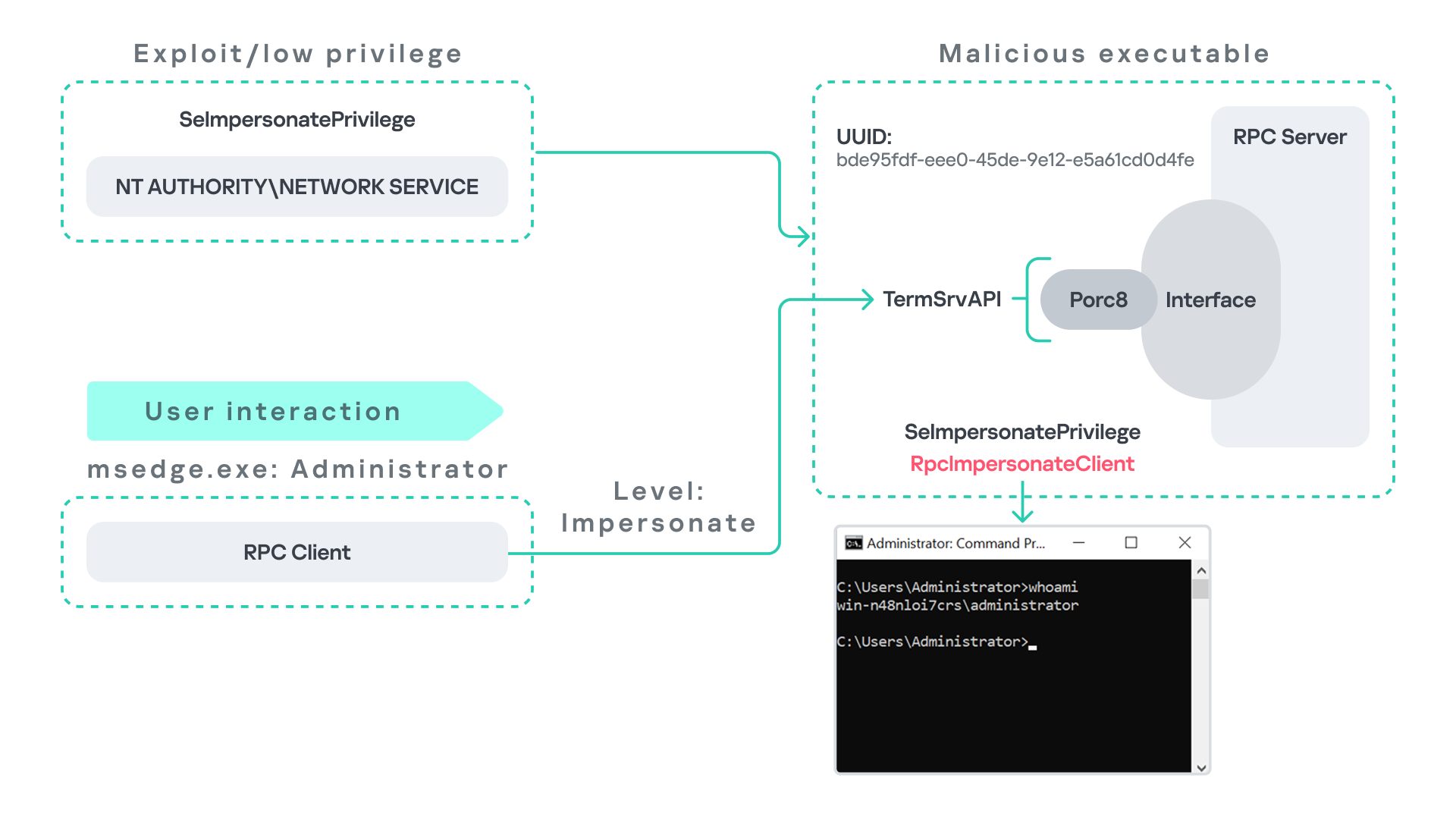
I will demonstrate five different exploitation paths that show how privileges can be escalated from various local or network service contexts to SYSTEM or high-privileged users. Some techniques rely on coercion, some require user interaction and some take advantage of background services. As this issue stems from an architectural weakness, the number of potential attack vectors is effectively unlimited; any new process or service that depends on RPC could introduce another possible escalation path. For this reason, I also outline a methodology for identifying such opportunities.

Finally, I examine possible detection strategies, as well as defensive approaches that can help mitigate such attacks.

MSRPC


Microsoft RPC (Remote Procedure Call) is a Windows technology that enables communication between two processes. It enables one process to invoke functions that are implemented in another process, even though they are running in different execution contexts.

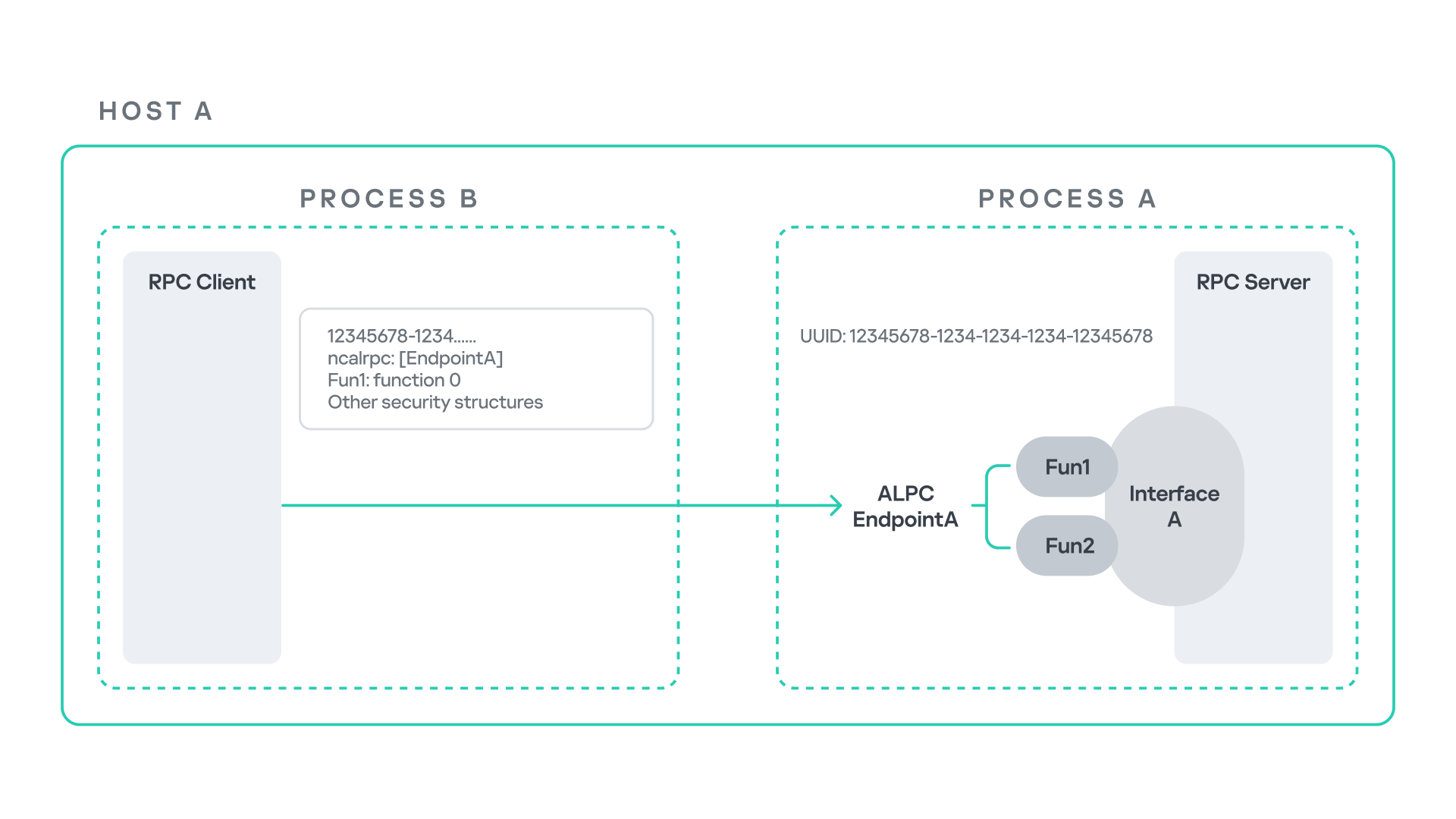
The figure below illustrates this mechanism.

Let us assume that Host A is running two processes: Process A and Process B. Process B needs to execute a function that resides inside Process A. To enable this type of interaction, Windows provides the Remote Procedure Call (RPC) architecture, which follows a client–server model. In this model, Process A acts as the RPC server, exposing its functionality through an interface, in our example, Interface A. Each RPC interface is uniquely identified by a Universally Unique Identifier (UUID), which is represented as a 128-bit value. This identifier enables the operating system to distinguish one interface from another.

The interface defines a set of functions that can be invoked remotely by the RPC client implemented in Process B. In our example, the interface exposes two functions: Fun1 and Fun2.

To communicate with the server, the RPC client must establish a connection through a communication endpoint. An endpoint represents the access point that enables transport between the client and the server. Because RPC supports multiple transport mechanisms, different endpoint types may exist, depending on the underlying transport.

For example:

  • When TCP is used as the transport layer, the endpoint is a TCP port.
  • When SMB is used, communication occurs through a named pipe.
  • When ALPC is used, the endpoint is an ALPC port.

Each transport mechanism is associated with a specific RPC protocol sequence. For instance:

  • ncacn_ip_tcp is used for RPC over TCP.
  • ncacn_np is used for RPC over named pipes.
  • ncalrpc is used for RPC over ALPC.

In this research, I focus specifically on Advanced Local Procedure Call (ALPC) as the RPC transport mechanism. ALPC is a Windows interprocess communication mechanism that predates MSRPC. Today, RPC can leverage ALPC as an efficient transport layer for communication between processes located on the same machine.

For simplicity, an ALPC port can be thought of as a communication channel similar to a file, where processes can send messages by writing to it, and receive messages by reading from it.

When the client wants to invoke a remote function, for example, Fun1, it must construct an RPC request. This request includes several important pieces of information, such as the interface UUID, the protocol sequence, the endpoint, and the function identifier. In RPC, functions are not referenced by name, but by a numerical identifier called the operation number (OPNUM). Depending on the requirements of the call, the request may also contain additional structures, such as security-related information.

Impersonation in Windows


In Windows, impersonation enables a service to temporarily operate using another user’s security context. For example, a service may need to open a file that belongs to a user while performing a specific operation. By impersonating the calling user, the system allows the service to access that file, even if the service itself would not normally have permission to do so. You can read more about impersonation in James Forshaw’s book Windows Security Internals.

This research focuses specifically on RPC impersonation. Instead of describing the interaction as a service and a user, I refer to the participants as a client and a server. In this model, the RPC server may temporarily adopt the identity of the client that initiated the request.

To perform this operation, the RPC server can call the RpcImpersonateClient API, which causes the server thread to execute under the client’s security context.

However, in some situations, a client may not want the server to be able to impersonate its identity. To control this behavior, Windows introduces the concept of an impersonation level. This defines how much authority the client grants the server to act on its behalf.

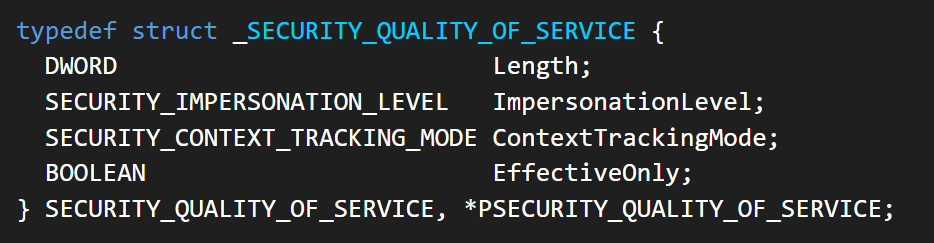
These settings are defined as part of the Security Quality of Service (SQOS) parameters, specified using the SECURITY_QUALITY_OF_SERVICE structure.

As you can see, this structure contains the impersonation level field, which determines the extent to which the server can assume the client’s identity.

Impersonation levels range from Anonymous, where the server cannot impersonate the client at all, to Impersonate and Delegate, which allow the server to act fully on behalf of the client.

At the same time, not every server process is allowed to impersonate a client. If any process could perform impersonation freely, it would pose a serious security risk. To prevent this, Windows requires the server process to possess a specific privilege called SeImpersonatePrivilege. Only processes with this privilege can successfully impersonate a client.

This privilege is granted by default to certain service accounts, such as Local Service and Network Service.

Interaction between Group Policy service and TermService


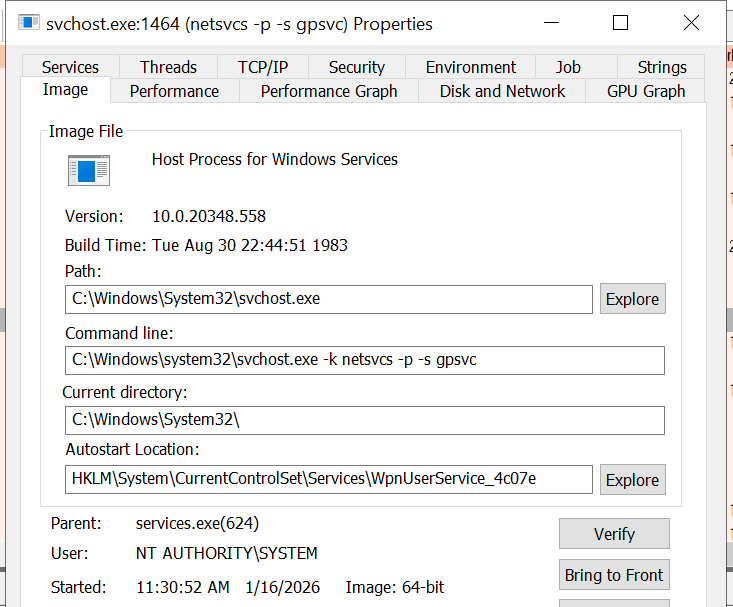
The Group Policy Client service (gpsvc) is a core Windows service responsible for applying and enforcing group policy settings on a system. It runs under the SYSTEM account inside svchost.exe.

When a group policy update is triggered, Windows uses an executable called gpupdate.exe. This tool can be executed with the /force flag to force an immediate refresh of all group policy settings. Internally, this executable communicates with the Group Policy service, which coordinates the update process.

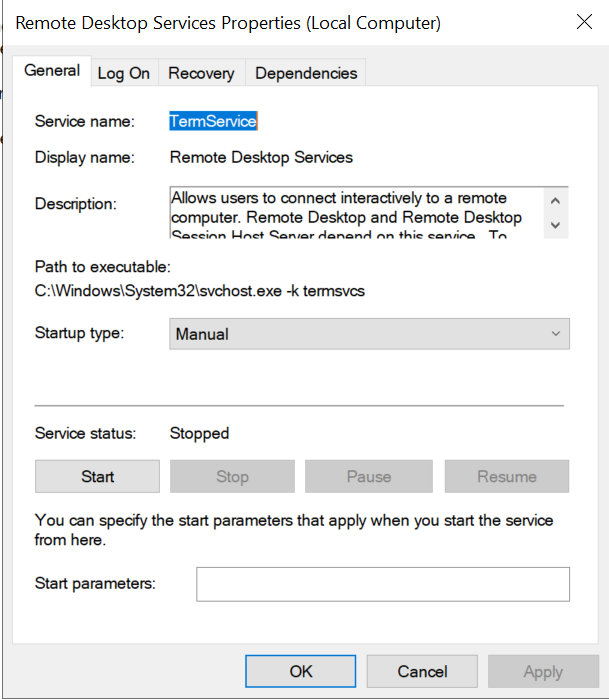
At a certain stage during this operation, the Group Policy service attempts to communicate with TermService (Terminal Service, the Remote Desktop Services service) using RPC.

TermService is responsible for providing remote desktop functionality. This service is not running by default and can be enabled manually by the administrator via activation of Remote Desktop access. When this happens, the service exposes an RPC server with multiple interfaces and endpoints. TermService runs under the NT AUTHORITY\Network Service account.

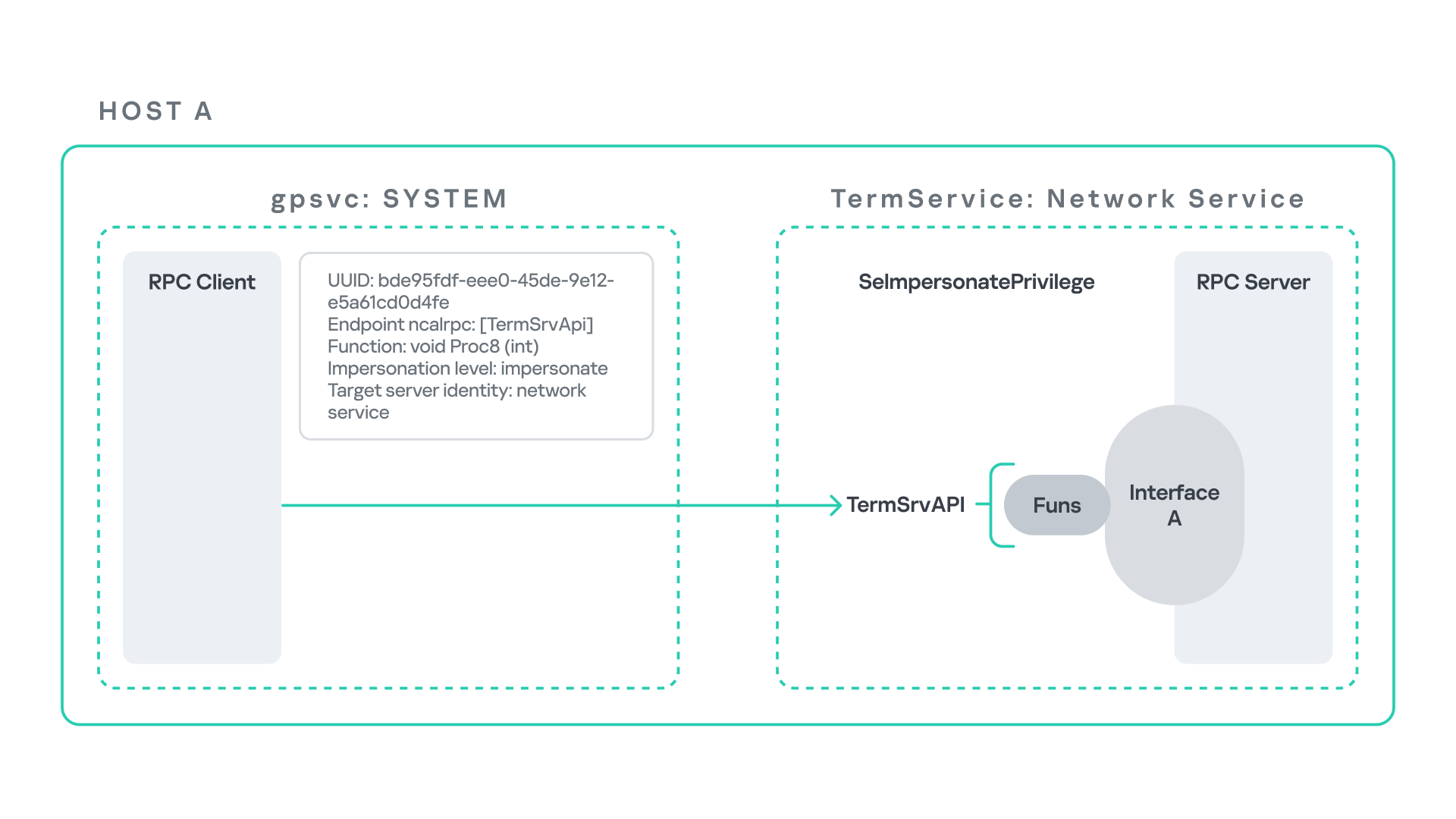
When the command gpupdate /force is executed, the Group Policy service performs an RPC call to the TermService using the following parameters:

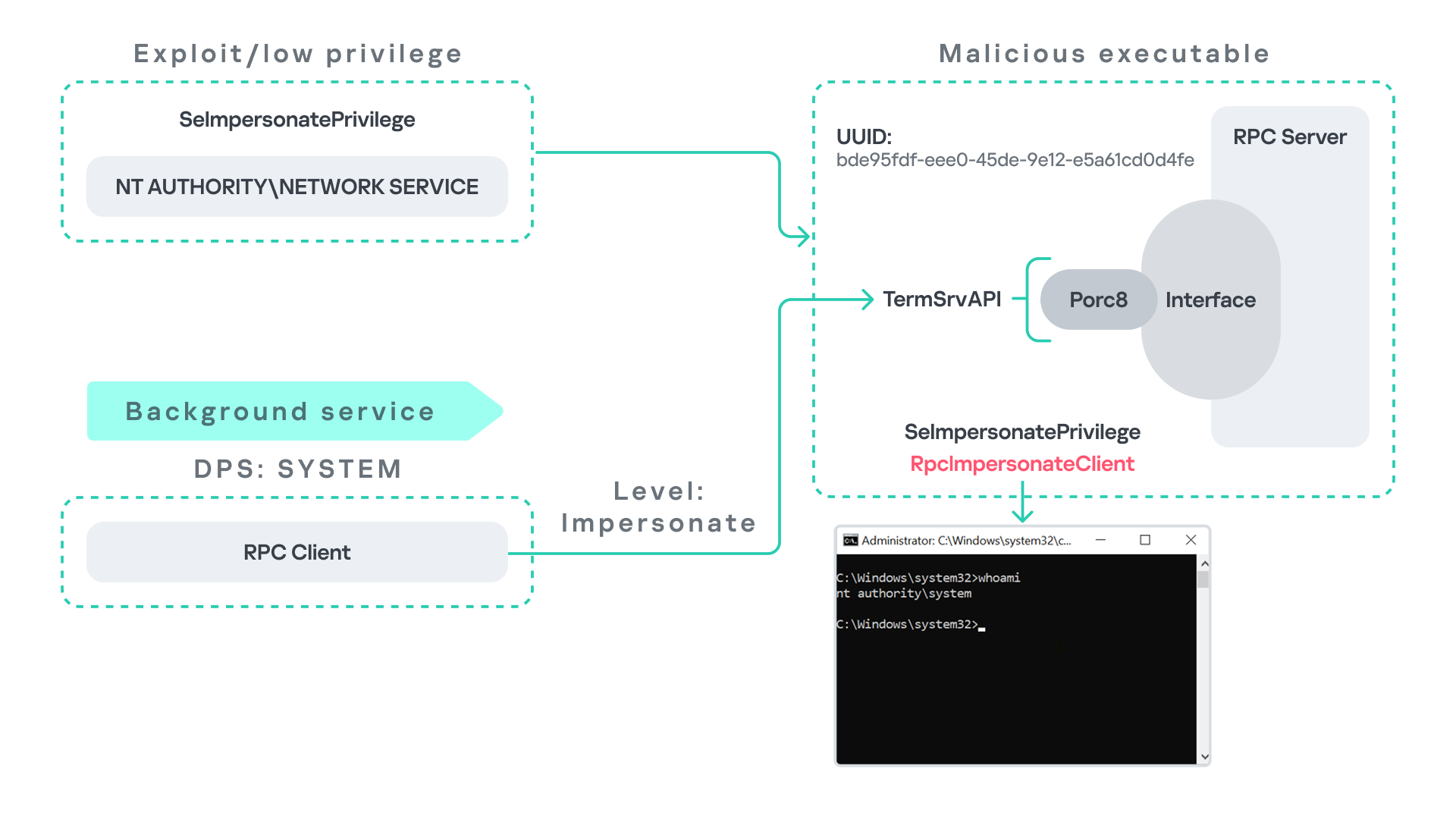
  • UUID: bde95fdf-eee0-45de-9e12-e5a61cd0d4fe.
  • Endpoint: ncalrpc:[TermSrvApi].
  • Function: void Proc8(int).

However, because TermService is disabled by default, the RPC call fails and an exception occurs in rpcrt4.dll (the RPC runtime). The returned error is:

  • 0x800706BA (RPC_S_SERVER_UNAVAILABLE, 1722).

This error indicates that the RPC client could not reach the target server.

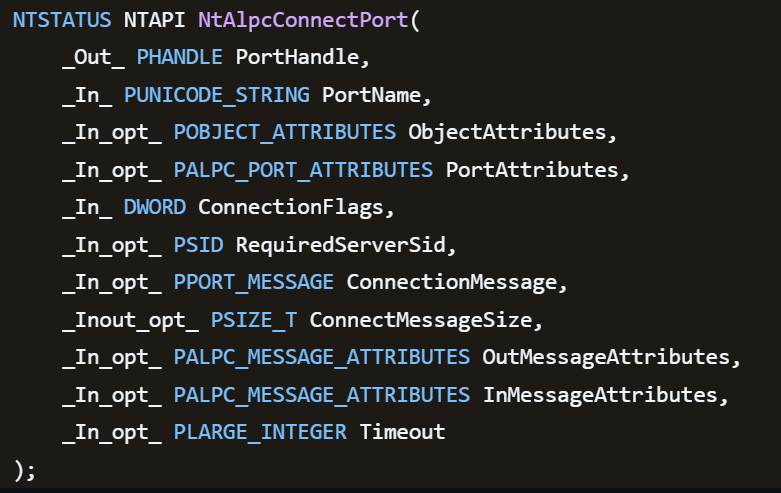
Tracing the failure path further reveals that the root cause originates from a call to NtAlpcConnectPort, which is used by RPC to establish an ALPC connection between processes.

The NtAlpcConnectPort function is responsible for connecting to a specific ALPC port and returning a handle that the client can use for further communication. This function accepts multiple parameters.

The first two parameters include:

  • A pointer to the returned port handle.
  • The ALPC port name, represented as an ASCII string.

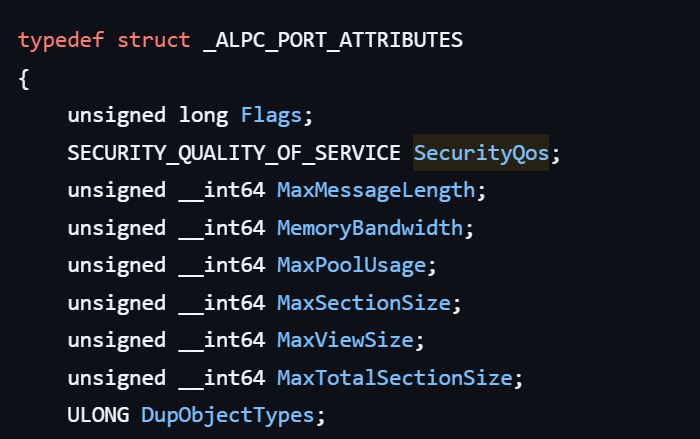
Another important argument is PortAttributes, which is an ALPC_PORT_ATTRIBUTES structure. Inside this structure is the SECURITY_QUALITY_OF_SERVICE structure, which, as mentioned above, defines the impersonation level used for the connection.

The final parameter of interest is RequiredServerSid, which specifies the expected identity of the target server process. This identity is represented using a Security Identifier (SID) structure.

Inspecting this call reveals that the Group Policy service attempts to connect to the RPC server using an impersonation level of Impersonate, expecting the remote server to run under the Network Service account. This behavior makes sense because TermService normally runs under Network Service.

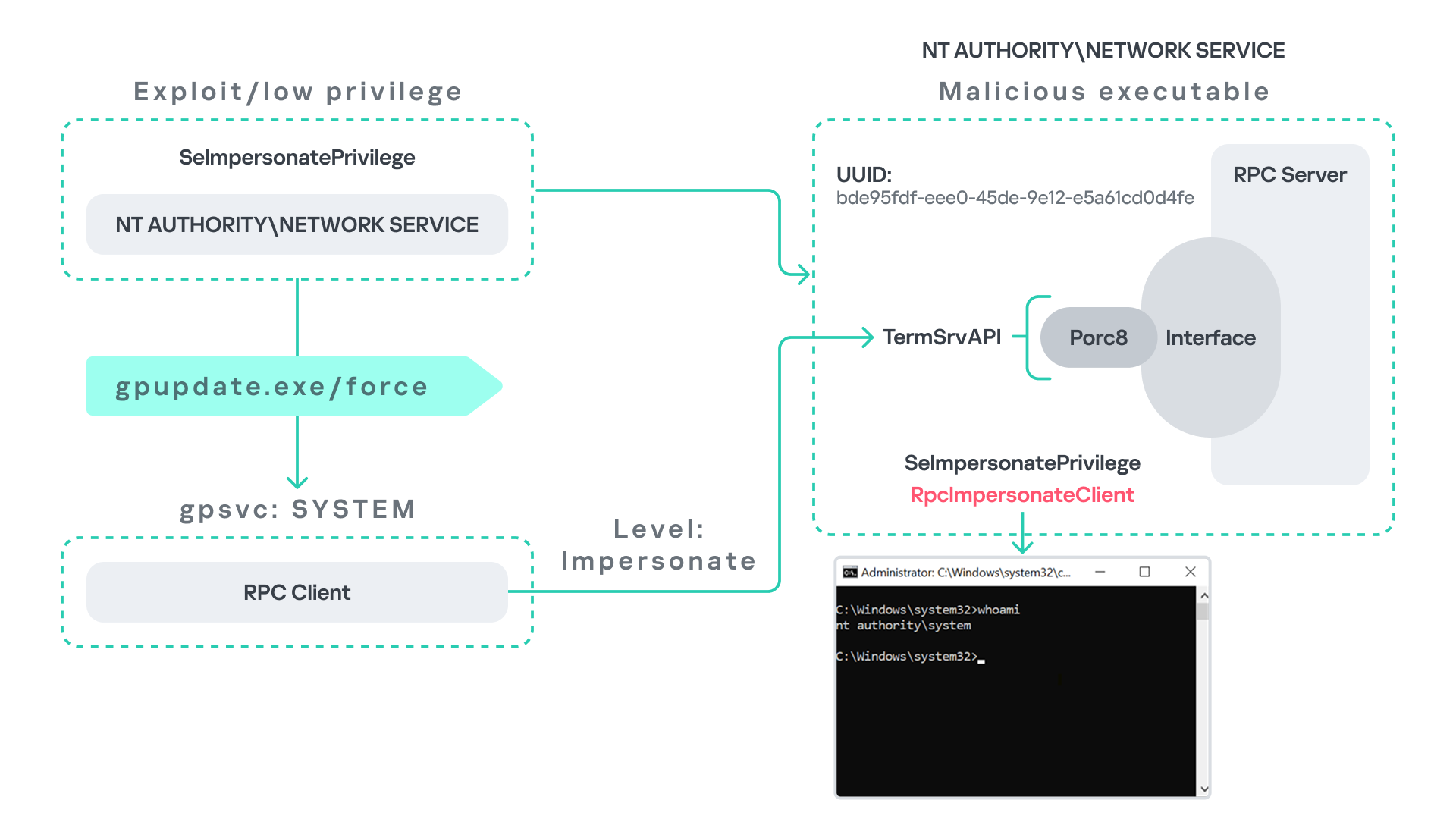
Based on all the information above, the following scheme can be created to illustrate the interaction between TermService and gpsvc.

Up to this point, nothing unusual has occurred. An RPC client attempts to connect to an RPC server that is unavailable, resulting in an exception handled by the RPC runtime.

However, an interesting question arises: What if an attacker compromises a service that runs under the Network Service identity and mimics the exact RPC server exposed by TermService?

Could the attacker deploy a fake RPC server with the same endpoint?

If so, would the RPC runtime allow the client to connect to this illegitimate server?

And if the connection is successful, how could an attacker leverage this behavior?

Coercing the Group Policy service


To better understand the implications of the previously described behavior, let us consider the following attack scenario.

Imagine an attacker has compromised a service running on the system under the Network Service account, for example, an IIS server operating under the Network Service account. With this level of access, the attacker can deploy a malicious RPC server.

The attacker’s RPC server is designed to mimic the RPC interface exposed by the Remote Desktop service (TermService). Specifically, it implements the same RPC interface UUID and exposes the same endpoint name: TermSrvApi. Once deployed, the malicious server listens for RPC requests that would normally be directed to the legitimate RDP service.

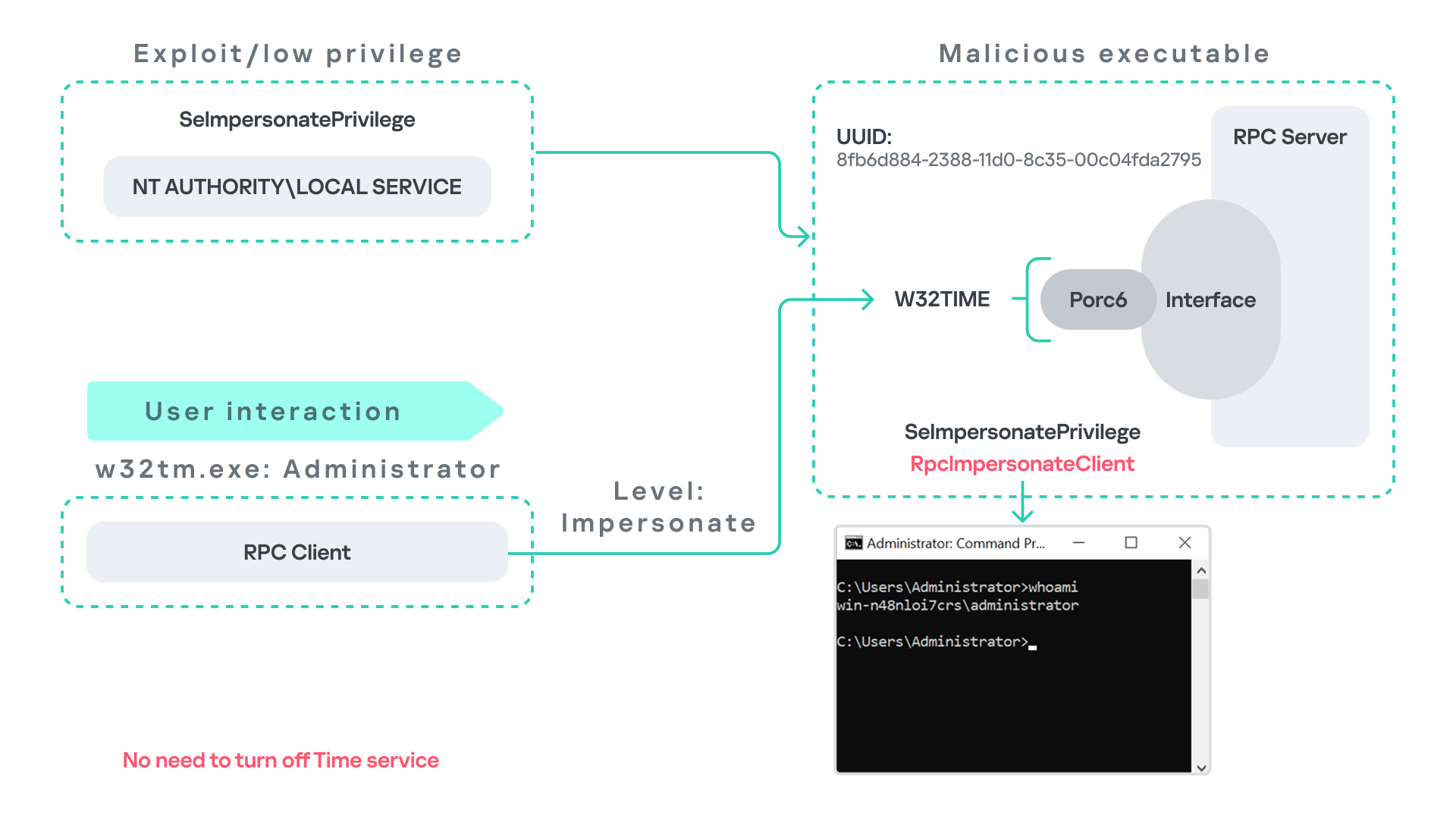
Next, the attacker coerces the Group Policy service by triggering a policy update using gpupdate.exe /force. This causes the Group Policy Client service, which runs under the SYSTEM account, to perform the previously described RPC call. As observed earlier, this RPC call uses a high impersonation level (Impersonate).

When the attacker’s fake RPC server receives the request, it calls RpcImpersonateClient. This enables the server thread to impersonate the security context of the calling client, which, in this case, is SYSTEM.

As a result, the attacker can elevate privileges from Network Service to SYSTEM. In our proof-of-concept implementation, the exploit demonstrates privilege escalation by spawning a SYSTEM-level command prompt.

When this attack scenario was first discussed, it was purely theoretical. However, after implementing the malicious RPC server, the experiment confirmed that Windows allowed the server to be deployed and started successfully, and that the RPC runtime permitted the client to connect to the malicious endpoint. This made it possible to reliably escalate privileges from Network Service to SYSTEM using this technique. For this attack to succeed, though, at least one group policy must be applied on the system.

RPC architecture flow


Further investigation revealed that many Windows services attempt to communicate with TermService using RPC. These RPC calls often originate from winsta.dll, which acts as the RPC client component.

Windows processes invoke APIs exposed by winsta.dll; these APIs rely internally on RPC communication with TermService. This pattern is common in Windows; many system DLLs use RPC behind the scenes when their exported APIs are called.

However, it appears that the RPC runtime (rpcrt4.dll) does not provide a mechanism to verify the legitimacy of RPC servers. Moreover, Windows allows another process to deploy an RPC server that exposes the same endpoint as a legitimate service.

As a result, this architectural design introduces a large attack surface because RPC is heavily used across numerous system DLLs. Applications that invoke seemingly benign APIs may unintentionally trigger privileged RPC interactions. Under certain conditions, these interactions could be abused to achieve local privilege escalation without the user’s knowledge.

Identifying RPC calls to unavailable servers


As the issue appears to stem from an architectural weakness, a systematic approach is needed to identify RPC clients attempting to communicate with servers that are unavailable. First, I need a platform capable of monitoring RPC activity and extracting relevant information from each RPC request.

Specifically, I need to capture key RPC metadata, including:

  • Interface UUID, endpoint, and OPNUM.
  • Impersonation level and RPC status code.
  • Client process privilege level, process name, and module path.

This information is critical because it enables me to reconstruct the RPC interaction, mimic the expected RPC server, and determine how the call is triggered.

The platform that provides this capability is Event Tracing for Windows (ETW). ETW is a built-in Windows logging framework that captures both kernel-mode and user-mode events in real time.

Windows provides a tool called logman to collect ETW data. It enables us to create trace sessions, select event providers, and configure the verbosity level of the tracing process. The collected tracing data is stored in an .etl file, which can later be analyzed using tools such as Event Viewer or other ETW analysis utilities.

ETW provides deep visibility into RPC activity without requiring modifications to applications. Through ETW, it is possible to capture detailed RPC information, such as:

  • RPC bindings
  • Endpoints
  • Interface UUIDs
  • Authentication details
  • Call flow and timing
  • RPC status codes

However, I’m not interested in every RPC event. My focus is on RPC call failures, specifically those that return the status RPC_S_SERVER_UNAVAILABLE.

For an event to be relevant to this research, the exception must meet two conditions:

  • It must originate from a high-privileged process because impersonating such a process may allow an attacker to escalate privileges to a more powerful security context.
  • The RPC call must use a high impersonation level, enabling the server to fully impersonate the client once the connection is established.

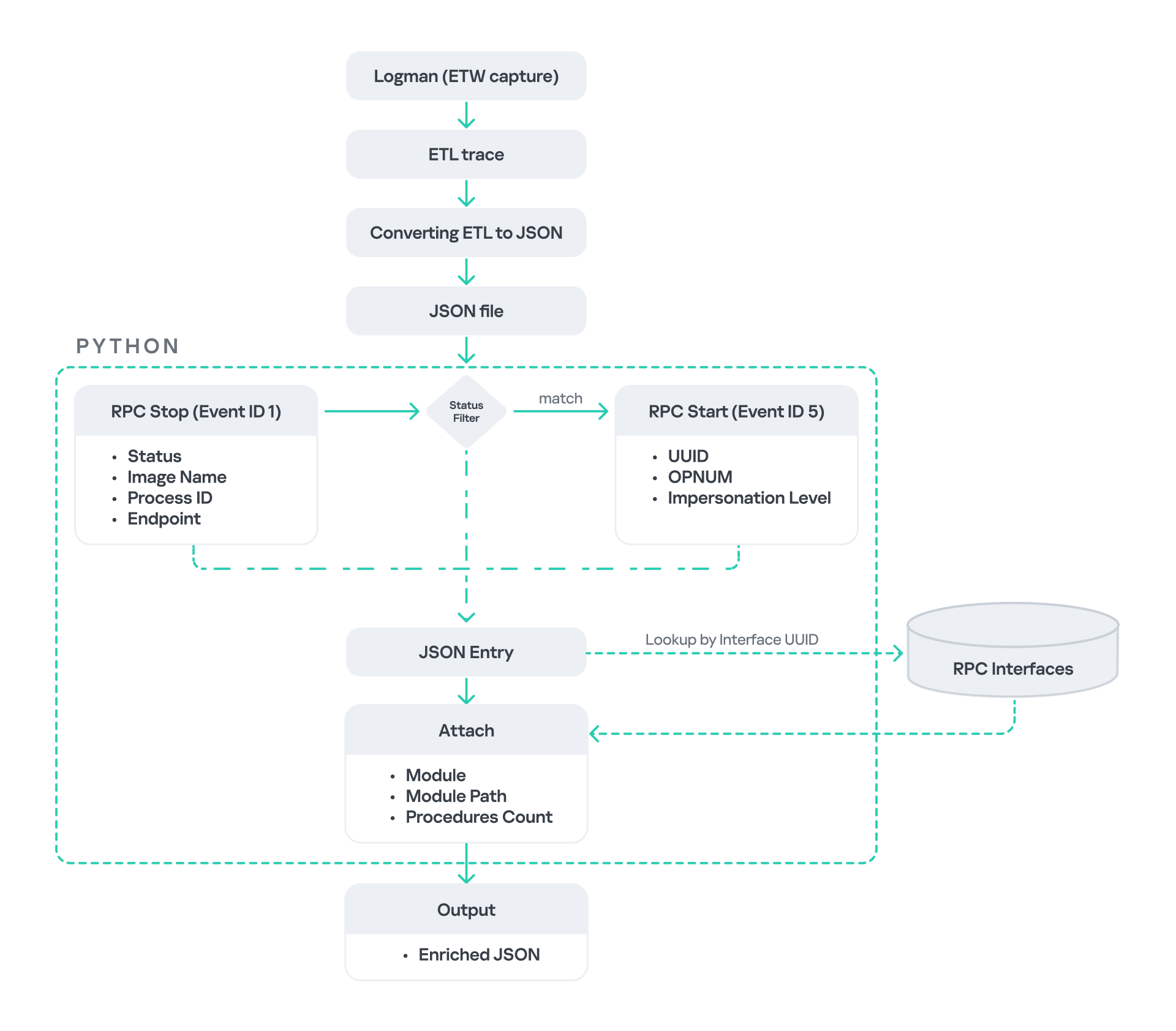
I cannot rely solely on the raw ETW output to implement this framework because it contains thousands of events, making manual filtering with standard tools inefficient. Therefore, I need to automate this process. The workflow shown below enables me to efficiently filter and extract only those events that are relevant to this analysis.

After generating the logs as an .etl file, I convert them to JSON format using tools such as etw2json. JSON is a much easier format to process programmatically. In this case, I use a Python script to filter and extract the relevant information.

The filtering process begins with a search for Event ID 1, which corresponds to an RPC stop event. This event indicates that the RPC client has completed the call and the result is available. From this event, I can extract useful information, such as:

  • Status code
  • Client process name
  • Client process ID
  • Endpoint

After extracting the status code, I filter for the specific value RPC_S_SERVER_UNAVAILABLE, which indicates that the target server was unreachable during an RPC call. These events represent the scenarios that are of interest.

However, Event ID 1 does not contain all of the required RPC metadata. To obtain the missing information, it is correlated with Event ID 5, which represents the RPC start event. This event is generated when the client initiates the RPC call.

By matching the metadata between Event ID 1 and Event ID 5, I can recover the missing details, including:

  • Interface UUID
  • OPNUM
  • Impersonation level

After correlating and filtering these events, a JSON entry is obtained that is almost ready for analysis. At this stage, the data can be enriched further by adding context that will be helpful when reversing or analyzing the RPC server implementation. For example, the following can be identified:

  • The DLL where the RPC interface is implemented
  • The location of that DLL
  • The number of procedures exposed by the interface

To retrieve this information, I match the UUID with an external RPC interface database. In this case, I used the RPC database, which contains a comprehensive list of RPC interfaces and their corresponding DLL implementations.

At the end of this process, a complete JSON dataset is obtained that can be used for further analysis.

One important observation is that the RPC calls I am looking for may only occur when specific system actions are triggered. Additionally, the resulting exceptions may vary from one system to another depending on which services are enabled or disabled. Therefore, I need a reliable way to generate these RPC exceptions.

In this research, I used several approaches to trigger such events:

  1. Monitoring RPC activity during system startup
    I observed RPC activity while the system booted. During startup, many services initialize and perform various RPC calls, which increases the chances of capturing calls to unavailable servers.
  2. Triggering administrative operations
    I developed PowerShell scripts that perform common administrative tasks, such as updating Group Policy, changing network settings, or creating new users. These operations often trigger RPC communication and may generate exceptions.
  3. Disabling services intentionally
    After observing that Remote Desktop was disabled by default, I extended this idea by disabling additional services one by one and repeating the previous steps. This approach can reveal RPC clients that attempt to connect to services that are no longer available.


Additional privilege escalation paths


After running the logging and monitoring framework described earlier, I identified four additional scenarios that can lead to privilege escalation. The following sections introduce each case and explain how escalation can be achieved.

User interaction: From Edge to RDP


Microsoft Edge (msedge.exe) comes preinstalled on Windows systems. During startup, Edge triggers an RPC call to TermService. This RPC call is performed with a high impersonation level.

As previously discussed, Terminal Service is disabled by default. Because of this, the expected RPC server is unavailable, creating an opportunity for the attack scenario illustrated below.

The attack follows the same initial assumption as before: the attacker has already compromised a process running under the Network Service account. From there, they deploy the same malicious RPC server that mimics the legitimate TermService RPC interface.

However, unlike the previous scenario where the attacker coerced the Group Policy service, no coercion is required this time. Instead, the attacker simply waits for a high-privileged user, such as an administrator, to launch msedge.exe.

When Edge starts, it triggers the RPC client to attempt communication with the expected TermService RPC interface. Because the legitimate server is not running, the request is received by the attacker’s fake RPC server. Since the RPC call is made with a high impersonation level, the malicious server can call RpcImpersonateClient to impersonate the client process.

As a result, the attacker is able to impersonate the administrator-level client and escalate privileges from Network Service to Administrator.

Background services: From WDI to RDP


Some background Windows services periodically attempt to make RPC calls to the RDP service without user interaction. One such service is the WdiSystemHost service. The Diagnostic System Host Service (WDI) is a built-in Windows service that runs system diagnostics and performs troubleshooting tasks. This service runs under the SYSTEM account.

During normal operation, WDI periodically performs background RPC calls to the Remote Desktop service (TermService) using a high impersonation level. These RPC interactions occur automatically every 5–15 minutes and do not require any user input.

This behavior can be abused in a similar manner to the previous attack scenarios, as illustrated in the figure below.

In this case, however, no user interaction or coercion is required. After deploying a malicious RPC server that mimics the expected TermService RPC interface, the attacker only needs to wait for the WDI service to perform its periodic RPC call. Because the request is made with a high impersonation level, the malicious server can invoke RpcImpersonateClient and impersonate the calling process. This enables the attacker to escalate privileges to SYSTEM.

Abusing the Local Service account: From ipconfig to DHCP


Another scenario involves the DHCP Client service, which manages DHCP client operations on Windows systems. This service runs under the Local Service account and is enabled by default.

The DHCP Client service exposes an RPC server with multiple interfaces and endpoints. These interfaces are frequently invoked by various system DLLs, often using a high impersonation level.

In this scenario, instead of compromising a process running under Network Service, it is assumed the attacker has compromised a process running under the Local Service account. I also assume that the DHCP Client service is disabled, meaning the legitimate RPC server is unavailable.

As the figure below illustrates, the attacker can leverage this situation to escalate privileges.

After gaining control of a Local Service process, the attacker deploys a malicious RPC server that mimics the legitimate RPC server normally exposed by the DHCP Client service. Once the malicious server is running, the attacker waits for a high-privileged user, such as an administrator, to execute ipconfig.exe.

When ipconfig is run, it internally triggers an RPC request to the DHCP Client service. Since the legitimate RPC server is not running, the request is received by the attacker’s fake RPC server. Because the RPC call is performed with a high impersonation level, the malicious server can call RpcImpersonateClient to impersonate the client.

As a result, the attacker can escalate privileges from the Local Service account to the Administrator account.

Abusing Time


The Windows Time service (W32Time) is responsible for maintaining date and time synchronization across systems in a Windows environment. This service is enabled by default and runs under the Local Service account.

The service exposes an RPC server with two endpoints:

  • \PIPE\W32TIME_ALT
  • \RPC Control\W32TIME_ALT

The executable C:\Windows\System32\w32tm.exe interacts with the Windows Time service through RPC. However, before connecting to the valid RPC endpoints exposed by the service, the executable first attempts to access the nonexistent named pipe: \PIPE\W32TIME. This named pipe is not exposed by the legitimate W32Time service. However, if this endpoint were available, w32tm.exe would attempt to connect to it.

An attacker can abuse this behavior by deploying a malicious RPC server that mimics the legitimate RPC interface of the Windows Time service. Rather than exposing the legitimate endpoints, the attacker’s server exposes the nonexistent endpoint \PIPE\W32TIME, as shown in the figure below.

As in the previous scenarios, it is assumed the attacker has already compromised a process running under the Local Service account. The attacker then deploys a fake RPC server that implements the same RPC interface as the Windows Time service, but which exposes the alternative endpoint used by w32tm.exe.

Once the malicious server is running, the attacker simply waits for a high-privileged user, such as an administrator, to execute w32tm.exe. When the executable runs, it attempts to connect to the endpoint \PIPE\W32TIME. Because the attacker’s fake server exposes this endpoint, the RPC request is directed to the malicious server.

Since the RPC call is performed with a high impersonation level, the malicious server can impersonate the calling client. As a result, the attacker can escalate privileges from the Local Service account to the Administrator account.

In this scenario, it is important to note that the legitimate Windows Time service does not need to be disabled. Because the executable attempts to connect to a nonexistent endpoint, it is sufficient for the attacker to expose that endpoint through the malicious RPC server.

Vulnerability disclosure


After discovering the vulnerability, Kaspersky Security Services prepared a 10-page technical report describing the issue and the various aforementioned exploitation scenarios. The report was submitted to the Microsoft Security Response Center (MSRC) to report the vulnerability and request a fix.

Twenty days later, Microsoft responded, indicating that they did not classify the vulnerability as high severity. According to their assessment, the issue was classified as moderate severity and would therefore not be patched immediately. No CVE would be assigned, and the case would be closed without further tracking.

Microsoft explained that the moderate severity classification was due to the requirement that the originating process had to already possess the SeImpersonatePrivilege privilege. Since this privilege was typically required for the attack to succeed, Microsoft determined that the issue did not require immediate remediation.

Kaspersky Security Services respect Microsoft’s assessment and only published the research after the embargo period ends. In line with the coordinated vulnerability disclosure policy, Kaspersky Security Services will refrain from publishing detailed instructions that could enable or accelerate mass exploitation.

The disclosure timeline is shown below:

  • 2025-09-19: Vulnerability reported to Microsoft Security Response Center (Case 101749).
  • 2025-10-10: MSRC response – the case was assessed as moderate severity, not eligible for a bounty, no CVE was issued, and the case was closed without further tracking.
  • 2026-04-24: expected whitepaper publication date.


Detection and defense


As discussed above, this vulnerability is related to an architectural design behavior. Fully preventing it would require Microsoft to release a patch that addresses the underlying issue.

Nevertheless, organizations can still take steps to detect and mitigate potential abuse. ETW-based monitoring within the framework described above enables defenders to identify RPC exceptions in their environment, especially when RPC clients attempt to connect to unavailable servers.

I have provide the tools used in the previously described framework so that organizations can check their environment for such behavior. You can find all of them in the research repository.

By monitoring these events, administrators can identify situations where legitimate RPC servers are expected but not running. In some cases, the attack surface may be reduced by enabling the corresponding services, ensuring that the legitimate RPC server is available. This can hinder attackers from deploying malicious RPC servers that imitate legitimate endpoints.

It is also good practice to reduce the use of the SeImpersonatePrivilege privilege in processes where it is not required. Some system processes need this privilege for normal operations. However, granting it to custom processes is generally not considered good security practice.

Conclusion


All the exploits described in this research were tested on Windows Server 2022 and Windows Server 2025 with the latest available updates prior to the submission date. The proof-of-concept implementations can be found in the research repository. However, it is highly likely that this issue may also be exploitable on other Windows versions.

Because the vulnerability stems from an architectural design issue, there may be additional attack scenarios beyond those presented in this research. The exact exploitation paths may vary from one system to another depending on factors such as installed software, the DLLs involved in RPC communication, and the availability of corresponding RPC servers.


securelist.com/phantomrpc-rpc-…

Reviving Nintendo’s Early Arcade Game, Wild Gunman


The media in this post is not displayed to visitors. To view it, please log in.

There’s retrogaming, and then there’s retro gaming. This next project falls into the second category, as [Callan] of 74XX Arcade Repair digs into the original Wild Gunman, first released by Nintendo way, way back in 1974 — on 16 mm film. Yes, it was a film-based arcade machine, but how else were you going to get realistic graphics just two years after PONG?

The game had two 16 mm projectors, with four different sets of film reels available, each depicting five gunmen. Unfortunately for [Callan], the film is all he has, so he’s not so much repairing as re-creating the historic game. Luckily, he had the manuals, so at least he knew how it was supposed to come together.

One projector did most of the work, showing the gunmen and a hidden timing signal for the game to know when the user could shoot; the other only activated if the user pulled the trigger at the correct time. Interestingly the ‘gun’ has an IR illuminator that bounced infrared light off the screen to a detector in the cabinet — much like later TV remotes. That makes for a rather large circular hitbox around the enemy gunslinger, which is perhaps not a bad thing for a game likely to be found in a bar.

His recreation is all-digital as he didn’t want to risk completely wearing out the vintage film. Instead there’s a PC, a digital projector, and a pico-based light-gun running the OpenFire firmware. [Callan] did go to some lengths to match the original appearance, with a combination of 3D printing, woodworking and fabric arts. Plus his recreation is authentic to the behavior of the original, so what more could you ask for?

As far as we know, this is the only playable version of the 1970s game in existence. [Callan] will have it available to play at the Ontario Pinfest 2026, in Stayner, Ontario on May 30-31, 2026. Happily enough, that’s 50 years since the game first arrived in North America in 1976. Worth a trip? Well, that depends on your location.

This reminds us of the time someone 3D printed a Computer Space cabinet, which only predates Wild Gunman by a few years. Speaking of 3D printing, you can also print your own 16 mm film camera, if you want to make an indie version this now-vanished style of arcade game.

youtube.com/embed/TOfqnomGPkM?…


hackaday.com/2026/04/24/revivi…

The media in this post is not displayed to visitors. To view it, please log in.

Contagious Interview diventa un worm: Void Dokkaebi trasforma 750 repository in vettori auto-propaganti contro gli sviluppatori


@Informatica (Italy e non Italy)
Il gruppo APT nordcoreano Void Dokkaebi (Famous Chollima) ha trasformato le sue finte offerte di lavoro in un attacco supply chain capace di propagarsi


Contagious Interview diventa un worm: Void Dokkaebi trasforma 750 repository in vettori auto-propaganti contro gli sviluppatori


Si parla di:
Toggle

Le campagne di cyberspionaggio nordcoreane basate su finti colloqui di lavoro hanno una storia lunga: da almeno il 2023 il cluster noto come Contagious Interview, attribuito al gruppo Famous Chollima (tracciato da Trend Micro come Void Dokkaebi, da altri come DeceptiveDevelopment, Gwisin Gang o Wagemole), ha ripetutamente adescato sviluppatori occidentali promettendo posizioni in startup cripto e AI. L’ultima iterazione documentata da Trend Micro nell’aprile 2026 fa un passo qualitativo in avanti che cambia la natura della minaccia: la campagna ha smesso di essere un attacco mirato sviluppatore-per-sviluppatore ed è diventata una vera infezione worm-like della supply chain del software, con propagazione automatica attraverso l’ecosistema Git/VS Code.

Nel solo mese di marzo 2026, i ricercatori hanno identificato più di 750 repository infetti, oltre 500 configurazioni VS Code task weaponized e 101 istanze del tool di commit-tampering usato dal gruppo. Quando una vittima clona un repository compromesso e lo apre in VS Code, il malware si avvia automaticamente e — soprattutto — riesce a infettare a sua volta i repository che lo sviluppatore toccherà in seguito, innescando una cascata di contaminazione attraverso fork, contributi downstream e template condivisi.

Da Famous Chollima a Void Dokkaebi: la continuità operativa DPRK


Void Dokkaebi è una delle diverse sotto-unità che negli ultimi anni hanno reso la Corea del Nord uno degli avversari più attivi sul fronte del furto di criptovalute e del cyberspionaggio economico. Il nome «dokkaebi» richiama una figura del folklore coreano: uno spirito burlone capace di trasformarsi, metafora apt per un attore che continua a riciclare lo stesso modus operandi cambiando i nomi di fantasia, i finti marchi aziendali e le tecniche di consegna del payload. Il filone «Contagious Interview» è stato negli anni associato anche a famiglie di malware come BeaverTail (JavaScript infostealer), InvisibleFerret (Python backdoor), OtterCookie e, più recentemente, a varianti compilate in Go per espandere la compatibilità cross-platform.

Parallelamente, una seconda campagna DPRK — tracciata come HexagonalRodent — ha sottratto oltre 12 milioni di dollari a sviluppatori web attirati con finte offerte LinkedIn, usando la stessa infrastruttura di consegna basata su BeaverTail e InvisibleFerret. L’ipotesi operativa degli analisti è che i cluster condividano infrastruttura e codice base, con team distinti focalizzati rispettivamente su spionaggio tecnologico e monetizzazione diretta via cripto.

Il lure: da colloquio tecnico a code-review test


Il vettore iniziale resta coerente con la narrazione storica: un finto recruiter si rivolge alla vittima su LinkedIn, Upwork, Freelancer o piattaforme di recruiting specializzate in Web3/cripto. L’offerta è attraente — compensi alti, lavoro da remoto, meeting su Google Meet o Discord — e culmina in un «test tecnico» che chiede allo sviluppatore di clonare un repository e «risolvere un bug» o estendere una feature. È in questa fase che Void Dokkaebi ha inserito la novità sostanziale: il repository non si limita a contenere un payload JavaScript eseguito al npm install, ma distribuisce due vettori complementari progettati per coprire gli scenari operativi di qualsiasi sviluppatore moderno.

I due vettori: .vscode/tasks.json e JavaScript iniettato


Il primo vettore sfrutta un file .vscode/tasks.json ben costruito, con una task configurata per l’esecuzione automatica all’apertura della cartella (tramite proprietà runOptions folderOpen). Questo meccanismo è nativo di Visual Studio Code ed è controllato dal sistema di Workspace Trust: quando un utente apre un repository e lo segna come «trusted» — comportamento comune tra sviluppatori pressati — le task si eseguono senza ulteriori avvisi. Gli attaccanti hanno inoltre imparato a nascondere la cartella .vscode nelle viste più comuni, anche tramite commit-tampering che la omette dai diff presentati a UI-level.

Il secondo vettore è JavaScript direttamente iniettato nel codice del progetto. Si tratta di payload offuscato che si attiva alla build o all’esecuzione del progetto, indipendentemente dall’IDE in uso. La ridondanza è deliberata: se lo sviluppatore usa JetBrains, Neovim o Sublime invece di VS Code, il JavaScript di progetto scavalca il primo vettore. Se l’utente evita di eseguire il codice ma apre solo la cartella in VS Code, la task interviene. In entrambi i casi, l’esecuzione del malware è garantita.

Commit tampering: il tool che rende invisibili i file malevoli


Uno degli aspetti più ingegnosi dell’evoluzione 2026 è l’uso sistematico di un tool custom che Trend Micro ha ritrovato in 101 istanze operative. Il tool manipola i commit per nascondere i file malevoli (tipicamente la cartella .vscode) dalle viste di GitHub, GitLab e dai client grafici più usati, mentre i file restano fisicamente presenti nel tree al momento del clone. La tecnica sfrutta la differenza tra come i sistemi Git mostrano la history rispetto a come checkoutano lo stato: un reviewer umano che scorre i diff su GitHub può non vedere nulla di sospetto, ma uno sviluppatore che fa git clone si trova il payload sul disco.

La propagazione worm-like tra repository


Quando il payload viene eseguito, oltre alla fase di furto credenziali tipica di BeaverTail e InvisibleFerret (dump di browser-stored passwords, wallet cripto, file SSH, token cloud), il malware scansiona la workspace locale dello sviluppatore alla ricerca di repository Git aperti. Ove possibile, iniezione e commit-tampering vengono replicati nei repository upstream dello sviluppatore, trasformando la vittima in un untwitting maintainer di nuovi vettori. Ogni sviluppatore che contribuisce al repository infetto diventa il potenziale paziente zero della prossima ondata. È il tratto che giustifica la parola «contagious» nel nome del cluster: il contagio non è più una metafora narrativa, è l’architettura tecnica dell’operazione.

Staging C2 su blockchain pubbliche


Per ostacolare le operazioni di takedown, Void Dokkaebi ospita parte della logica C2 e della distribuzione dei payload su Tron, Aptos e Binance Smart Chain. Smart contract e transazioni pubbliche diventano canali di delivery praticamente incancellabili: le autorità possono sanzionare indirizzi o bloccare domini, ma non possono cancellare dati già scritti su una blockchain permanente. La stessa tecnica era stata osservata in campagne precedenti (tra cui EtherHiding del cluster UNC5342), e qui viene integrata nell’infrastruttura di staging per la fase di second-stage download.

Indicatori di Compromissione

== IP C2 Void Dokkaebi (aprile 2026) ==
136.0.9.8
198.105.127.210
23.27.202.27
154.91.0.196
23.27.20.143
85.239.62.36
83.168.68.219
166.88.4.2
23.27.120.142

== Famiglie malware associate ==
BeaverTail        (JavaScript infostealer)
InvisibleFerret   (Python backdoor)
OtterCookie       (loader recente, varianti Go)

== Artefatti sospetti nei repository ==
.vscode/tasks.json con runOptions = "folderOpen" e comandi curl/wget
Commit che modificano tree ma non diff visibili (commit tampering)
Cartelle hidden (.vscode, .run, .idea) con script non giustificati dal contenuto

== Infrastruttura di staging ==
Smart contract su Tron, Aptos, Binance Smart Chain usati come C2 resilienti

Implicazioni e consigli pratici per i difensori


La nuova postura di Void Dokkaebi mette in discussione alcune assunzioni base della difesa dello sviluppatore. Non basta più non eseguire codice sconosciuto: anche la sola apertura di un repository in VS Code può essere sufficiente a compromettere la workstation. In più, la scala raggiunta (750 repository infetti in un mese) rende plausibile che un team stia inconsapevolmente clonando contenuti malevoli durante normali attività di ricerca, valutazione tecnica o contributo open source.

  • Workspace Trust disabilitato per default: impostare VS Code a chiedere esplicitamente il trust ad ogni apertura, con preferenza per l’apertura in modalità restricted.
  • Ambienti effimeri per il codice non fidato: ogni repository proveniente da recruiter, colloqui o contatti esterni andrebbe clonato ed eseguito dentro VM isolate, devcontainer o dev sandbox (GitHub Codespaces, Gitpod) usa-e-getta senza credenziali cloud montate.
  • Segregazione dei token: mai tenere gh auth token, credenziali AWS/Azure/GCP o wallet cripto sulla stessa workstation usata per esperimenti su codice esterno.
  • Monitoraggio commit: verificare periodicamente i commit dei repository personali per la comparsa di cartelle .vscode, .run, .idea non previste; strumenti come git fsck e hook pre-commit possono intercettare task injection.
  • Code-signing enforcement per script di build critici e pipeline di rilascio.
  • Awareness sul pattern «colloquio tecnico»: ogni richiesta di clonare un repository durante una fase di colloquio è oggi un segnale di rischio elevato, a prescindere dalla credibilità apparente del recruiter.

Lo snodo strategico è che il lure di Void Dokkaebi punta esattamente alle vittime più fragili dell’ecosistema tech: freelance in cerca di nuove opportunità, sviluppatori Web3 con wallet personali carichi di token, ingegneri AI con accesso a modelli e infrastruttura cloud. Per la Corea del Nord, ogni workstation compromessa è tre obiettivi in uno: liquidità in cripto, accesso a supply chain software, e un trampolino per campagne di spionaggio più ampie. La svolta contagious di aprile trasforma ogni nuova vittima in un potenziale super-spreader — e rende l’operazione una delle minacce più silenziosamente pervasive del 2026 contro la community open source.


Cybersecurity & cyberwarfare ha ricondiviso questo.

The media in this post is not displayed to visitors. To view it, please go to the original post.

292 – Ci vietano lo smartphone ma il cruscotto è un videogioco camisanicalzolari.it/292-ci-vi…
Cybersecurity & cyberwarfare ha ricondiviso questo.

#China-linked threat actors use consumer device botnets to evade detection, warn UK and partners
securityaffairs.com/191202/sec…
#securityaffairs #hacking
Cybersecurity & cyberwarfare ha ricondiviso questo.

The media in this post is not displayed to visitors. To view it, please go to the original post.

Una fregata olandese tracciata con un portachiavi da 5 euro!

📌 Link all'articolo : redhotcyber.com/post/una-frega…

A cura di Silvia Felici

#redhotcyber #news #sicurezzainformatica #hacking #tracciamento #bluetooth #portachiavi #cybersecurity

Cybersecurity & cyberwarfare ha ricondiviso questo.

The media in this post is not displayed to visitors. To view it, please go to the original post.

🚀 Gli speaker della RHC Conference 2026

📍𝗤𝘂𝗮𝗻𝗱𝗼: Martedì 19 Maggio con ingresso dalle ore 8:45
📍𝗗𝗼𝘃𝗲: Teatro Italia, Via Bari 18, Roma (Metro Piazza Bologna)
📍𝗣𝗿𝗼𝗴𝗿𝗮𝗺𝗺𝗮: redhotcyber.com/linksSk2L/prog…
📍𝗜𝘀𝗰𝗿𝗶𝘇𝗶𝗼𝗻𝗲 conferenza di Martedì 19 Maggio: rhc-conference-2026.eventbrite…

𝗦𝗧𝗔𝗬 𝗧𝗨𝗡𝗘𝗗!

#redhotcyber #rhcconference #conferenza #informationsecurity #ethicalhacking #dataprotection #hacking #cybersecurity #cybercrime #cybersecurityawareness #cybersecuritytraining #cybersecuritynews #privacy #infosecurity

WSL9x: Add an Entire Windows 9x Subsystem to Your Linux


The media in this post is not displayed to visitors. To view it, please log in.

Considering that Windows has the concept of so-called ‘subsystems’ whereby you can run different systems side-by-side, starting with the POSIX subsystem and later the Windows Subsystem for Linux (WSL), it was probably only a matter of time before someone figured that the inverse was also completely reasonable. Rather than mucking about with Wine or such, we now got [Hailey Somerville]’s Linux Subsystem for Windows which is disappointingly called WSL9x rather than LSW.

To make running Windows 9x inside Linux work, it was necessary to heavily patch a Linux kernel, as normally there are no provisions for such a subsystems unlike the NT kernel. Correspondingly, the Linux kernel is based on user-mode Linux and hacked to call Windows 9x kernel APIs instead of the POSIX ones.

In order to use WSL9x you thus need to build said modified Linux kernel – currently at version 6.19 – along with a disk image containing an installed copy of Windows 9x. From there WSL9x can be loaded with the wsl command and you’re then free to cooperatively run the Win9x and Linux kernel side-by-side. This is reminiscent of Cooperative Linux (coLinux), which did pretty much the same except with Windows NT and Linux kernels running side-by-side. Maybe one day coLinux will be revived so that we can run 64-bit Windows alongside modern Linux?

Thanks to [adistuder] for the tip.


hackaday.com/2026/04/23/wsl9x-…

Cybersecurity & cyberwarfare ha ricondiviso questo.

The media in this post is not displayed to visitors. To view it, please go to the original post.

Hai firmato una petizione online? Ecco cosa può succedere ai tuoi dati

📌 Link all'articolo : redhotcyber.com/post/hai-firma…

A cura di Stefano Gazzella

#redhotcyber #news #petizionionline #sicurezzadigital #phishing #socialengineering #protezionedatidigitali #rischionline

Cybersecurity & cyberwarfare ha ricondiviso questo.

The media in this post is not displayed to visitors. To view it, please go to the original post.

USA: e se un attacco ransomware ad un ospedale fosse considerato un omicidio?

📌 Link all'articolo : redhotcyber.com/post/usa-e-se-…

A cura di Carolina Vivianti

#redhotcyber #news #cybersecurity #hacking #malware #ransomware #attacchihacker #omicidioinformatico #sanzionipenali

Encrypting Encrypted Traffic To Get Around VPN Bans


The media in this post is not displayed to visitors. To view it, please log in.

VPNs, Virtual Private Networks, aren’t just a good idea to keep your data secure: for millions of people living under restrictive regimes they’re the only way to ensure full access to the internet. What do you do when your government orders ISPs to ban VPNs, like Russia has done recently? [LaserHelix] shows us one way Gopniks cope, which is to use a ShadowSocks proxy.

If you’re not deep into network traffic, you might be wondering: how can an ISP block VPN traffic? Isn’t that stuff encrypted? Yes, but while the traffic going over the VPN is encrypted, you still need to connect to your VPN’s servers– and those handshake packets are easy enough to detect. You can do it at home with Wireshark, a tool that shows up fairly often on these pages. Of course if they can ID those packets, they can block them.

So, you just need a way to obfuscate what exactly the encrypted traffic you’re sending is. Luckily that’s a solved problem: Chinese hackers came up with something called Shadowsocks back in 2012 to help get around the Great Firewall, and have been in an arms-race with their authorities ever since.

Shadowsocks is not, in fact, a sibling of Gandalf’s horse as the name might suggest, but a tool to obfuscate the traffic going to your VPN. To invert a meme, you’re telling the authorities: we heard you don’t like encrypted traffic, so we put encryption in your encrypted traffic so you have to decrypt the packets before you recognize the encrypted packets.

What about the VPN? Well, some run their own shadowsocks service, while others will need to be accessed via a shadowsocks bridge: in effect, a proxy that then connects to the VPN for you. That means of course you’re bouncing through two servers you need to trust not to glow in the dark, but if you have to trust someone– otherwise it’s off to a shack in the woods, which never ends well.

Don’t forget that while VPNs can get you around government censorship, they do not provide anonymity on their own. If, like tipster [Keith Olson] –thanks for the tip, [Keith]!– you’re looking side-eyed at your government’s “think of the children!” rhetoric but don’t know where to start, we had a discussion about which VPNs to use last year.


hackaday.com/2026/04/23/encryp…

This KiCAD Plugin Enables Breadboarding


The media in this post is not displayed to visitors. To view it, please log in.

Some people learning the noble art of electronics find the jump from simpler tools like Fritzing to more complex ones, such as KiCAD, a little daunting, especially since they need to learn at least two tools. Fritzing is great for visualising your breadboard layout, but what if you want to start from a proper schematic, make a prototype on a breadboard and then design a custom PCB? Well, with the Kicad-breadboard plugin for (you guessed it!) KiCAD, you can now do all of this in the same tool.
A simple dual-rail oscillator schematic corresponding to the featured image above
Originally designed to support EE students at the University of Antwerp, the tool presents you with a virtual breadboard with configurable size and style, along with a list of components and tools that can be placed. A few clicks and parts can be placed on the virtual breadboard with ease. Adding wires is the next logical step to make those connections that operate in the horizontal dimension. Finally, assigning power supplies and probe connections completes the process. It’s a simple enough tool to draw stuff, but drawing a layout is no use if you can’t verify it’s correctness. This is where this plugin shines: it can perform an ERC (check) between the schematic and the breadboard and flag up what you missed. Add to this that you can also perform an ERC at the schematic level, before even thinking about layout, and it’s pretty hard to make an error. Now, you can transfer this directly to a real breadboard, or even a veroboard, for more permanence once you have confidence in correctness. This will definitely save time correcting errors and help keep the magic smoke safely contained within those mysterious black rectangles.

As it stands, the tools are limited to a few select ICs, which, much to this scribe’s disappointment, did not include the venerable 555 timer; however, it would be possible to work around that with some imagination at the schematic level. The ability to drop in and document power supply, function generator, and oscilloscope probing points is nice, enabling one to close the loop on documenting a layout to make it truly transferable to physical reality.

We cover electronics prototyping with breadboards a lot because they’re accessible. Here’s a super simple computer on a breadboard. We also like seeing them integrated as tools, like here. Finally, why stick with the tired old common breadboard shapes when you could make your own?


hackaday.com/2026/04/23/this-k…

ESP32Synth : an Audio Synthesis Library for the ESP32


The media in this post is not displayed to visitors. To view it, please log in.

With MCUs becoming increasingly more powerful it was only a matter of time before they would enable some more serious audio-processing tasks. [Danilo Gabriel]’s ESP32Synth library is a good example here, which provides an ESP-IDF based 80+ voice mixing and synthesis engine. If you ever wanted to create a pretty impressive audio synthesizer, then all you really need to get started is an ESP32, ESP32-S3 or similar dual-core Espressif MCU that has the requisite processing power.

Audio output goes via I2S, requiring only a cheap I2S DAC like the UDA1334A or PCM5102 to be connected, unless you really want to use the internal DAC. With this wired up you get 80 voices by default, with up to 350 voices demonstrated before the hardware cannot keep up any more. You can stream multiple WAV files from an SD card for samples along with the typical oscillators like sinewave, triangle, sawtooth and pulse, as well as noise, wavetables and more.

In order to make this work in real-time a number of optimizations had to be performed, such as the removal of slow floating-point and division operations in the audio path. The audio rendering task is naturally pinned to a single core, leaving a single core for application code to use for remaining tasks. While the code is provided as an Arduino project, it uses ESP-IDF so it can likely be used for a regular ESP-IDF project as well without too much fuss.


hackaday.com/2026/04/23/esp32s…

2026 Green Powered Challenge: Cook With The Sun!


The media in this post is not displayed to visitors. To view it, please log in.

One of the problems facing any solar power installation comes in storing enough power for high-intensity operations such as cooking. The high-tech and expensive way involves battery banks and inverters, but [Solar Genius] is taking a more direct route by skipping the energy storage entirely.

A pair of parabolic antennas are pressed into service as mirrors, catching and focusing the sun’s energy onto a cooking pot. Of course, solar cookers like this are nothing new, so what makes this one different is the in-depth analysis of its performance. This thing can cook!

One antenna is covered in square mirrors while the other is covered in sticky chrome-effect mirror sheeting. They’re described as sun tracking, but since we don’t see any mechanism we’re guessing the tracking is done by hand. The experiment takes place in Pakistan, so there’s a plentiful supply of sunlight that those of us in more northern climes can only dream of.

This hack is part of our 2026 Green Powered Challenge. You’ve just got time to get your own entry in, so get a move on!

2026 Hackaday Greep Powered Challenge


hackaday.com/2026/04/23/2026-g…

Cybersecurity & cyberwarfare ha ricondiviso questo.

Luxury cosmetics giant #Rituals discloses data breach impacting member personal details
securityaffairs.com/191192/cyb…
#securityaffairs #hacking