The Privacy Post ha ricondiviso questo.

The media in this post is not displayed to visitors. To view it, please go to the original post.

Flying Lotus is a Framework-Powered Portable All-in-One Computer
poliverso.org/display/0477a01e…
Flying Lotus is a Framework-Powered Portable All-in-One Computer One of the things that we love about the modern era of computing is the increasing ease by which you can roll your own custom computer, as seen with the cyberdeck phenomenon. The Flying Lotus youtube.com/watch?app=desktop&… is another awesome build in this vein.Built around the


Flying Lotus is a Framework-Powered Portable All-in-One Computer

A man in glasses and a black sweatshirt sits in front of an orange and black computer screen just below eye level at the table in front of him. His keyboard sits on the table below. He appears to be in a park as there are trees and grass in the background.

One of the things that we love about the modern era of computing is the increasing ease by which you can roll your own custom computer, as seen with the cyberdeck phenomenon. The Flying Lotus is another awesome build in this vein.

Built around the Framework ecosystem, this device was built to suit the very specific use case of its designer, [Carlos Aldana]. He found himself traveling a lot and that the ergonomics of a laptop left a lot to be desired, especially when in the air. Add to it the fact that he has trouble typing on typical laptop keyboards for any length of time, and you can see how an ergonomic keyboard plus a laptop just doesn’t really work on a tray table.

The Flying Lotus takes the screen, modular ports, and mainboard of a Framework laptop and puts them into a single computing block that can be hung from the clever tabs at the top or mounted on a stand that puts the screen at a more ergonomically ideal height from the work surface. [Aldana] describes it as an “iMac that’s portable.” Since it doesn’t have an integrated keyboard, you can run it with whatever keyboard you like from super duper ergo to a teeny game controller sized unit.

We’ve talked about why we like Framework so much before, and if you’d like another take on a modern portable computer, how about this portable Mac mini?

youtube.com/embed/JomsnMH4k28?…


The Privacy Post reshared this.

The Privacy Post ha ricondiviso questo.

La Backdoor Msupedge rilevata sui Sistemi Windows dell’università di Taiwan
poliverso.org/display/0477a01e…
La Backdoor Msupedge rilevata sui Sistemi Windows dell’università di Taiwan Gli specialisti della sicurezza informatica hanno scoperto symantec-enterprise-blogs.secu… che aggressori sconosciuti hanno implementato una backdoor precedentemente sconosciuta chiamata Msupedge sui sistemi Windows di una


La Backdoor Msupedge rilevata sui Sistemi Windows dell’università di Taiwan

Gli specialisti della sicurezza informatica hanno scoperto che aggressori sconosciuti hanno implementato una backdoor precedentemente sconosciuta chiamata Msupedge sui sistemi Windows di una delle università di Taiwan. Sembra che l’attacco all’istituto scolastico abbia sfruttato una vulnerabilità RCE recentemente corretta in PHP (CVE-2024-4577).

Ricordiamo che la vulnerabilità RCE CVE-2024-4577 (9,8 punti sulla scala CVSS) in PHP-CGI è stata scoperta all’inizio di giugno 2024. Consente a un utente malintenzionato di eseguire in remoto comandi dannosi sui sistemi Windows. Il problema viene aggravato quando si utilizzano determinate localizzazioni più suscettibili a questo bug, tra cui il cinese tradizionale, il cinese semplificato e il giapponese.

Come riportato dal team Symantec Threat Hunter, Msupedge è stato distribuito utilizzando due librerie (weblog.dll e wmiclnt.dll), la prima delle quali è stata caricata dal processo Apache httpd.exe e il processo principale per la seconda DLL è rimasto non identificato .

Gli esperti affermano che una caratteristica distintiva di Msupedge è l’uso del traffico DNS per comunicare con il server di controllo. Il tunneling DNS (una funzionalità implementata utilizzando lo strumento open source dnscat2 ) consente agli hacker di incapsulare i dati nelle richieste e risposte DNS per ricevere comandi dal server di comando e controllo. Pertanto, gli aggressori possono utilizzare Msupedge per eseguire vari comandi che vengono lanciati in base al terzo ottetto dell’indirizzo IP risolto del server di gestione.

Sebbene alcuni gruppi di hacker abbiano utilizzato tali metodi in passato, va notato che sono ancora rari negli attacchi reali. Per quanto riguarda la backdoor stessa, gli esperti hanno avvertito che Msupedge potrebbe essere utilizzata dagli hacker per eseguire vari comandi, tra cui la creazione di processi, il download di file e la gestione di file temporanei.

Vale la pena notare che il problema CVE-2024-4577 viene già utilizzato in attacchi da parte di altri hacker. Ad esempio, nel luglio 2024, gli esperti Akamai hanno riferito che molti aggressori utilizzano questa vulnerabilità per distribuire trojan di accesso remoto, minatori di criptovaluta e organizzare attacchi DDoS.

Nello stesso mese, gli analisti di Imperva hanno scritto che i membri del gruppo di estorsione TellYouThePass hanno iniziato a sfruttare il bug per distribuire la versione .NET del loro ransomware.

L'articolo La Backdoor Msupedge rilevata sui Sistemi Windows dell’università di Taiwan proviene da il blog della sicurezza informatica.


The Privacy Post ha ricondiviso questo.

The media in this post is not displayed to visitors. To view it, please go to the original post.

A Journey Into Unexpected Serial Ports
poliverso.org/display/0477a01e…
A Journey Into Unexpected Serial Ports Through all the generations of computing devices from the era of the teleprinter to the present day, there’s one interface that’s remained universal. Even though its usefulness as an everyday port has decreased in the face of much faster competition, it’s fair to say that everything has a serial port on board somewhere. Even with that ubiquity though,


A Journey Into Unexpected Serial Ports

Through all the generations of computing devices from the era of the teleprinter to the present day, there’s one interface that’s remained universal. Even though its usefulness as an everyday port has decreased in the face of much faster competition, it’s fair to say that everything has a serial port on board somewhere. Even with that ubiquity though, there’s still some scope for variation.

Older ports and those that are still exposed via a D socket are in most case the so-called RS-232, a higher voltage port, while your microcontroller debug port will be so-called TTL (transistor-transistor logic), operating at logic level. That’s not quite always the case though, as [Terin Stock] found out with an older Garmin GPS unit.

Pleasingly for a three decade old device, given a fresh set of batteries it worked. The time was wrong, but after some fiddling and a Windows 98 machine spun up it applied a Garmin update from 1999 that fixed it. When hooked up to a Flipper Zero though, and after a mild panic about voltage levels, the serial port appeared to deliver garbage. There followed some investigation, with an interesting conclusion that TTL serial is usually the inverse of RS-232 serial, The Garmin had the RS-232 polarity with TTL levels, allowing it to work with many PC serial ports. A quick application of an inverter fixed the problem, and now Garmin and Flipper talk happily.


The Privacy Post reshared this.

The Privacy Post ha ricondiviso questo.

Un Supercomputer proteggerà gli Stati Uniti d’America dalla minaccia biologica
poliverso.org/display/0477a01e…
Un Supercomputer proteggerà gli Stati Uniti d’America dalla minaccia biologica In California è stato rilasciato un nuovo sistema che potrebbe cambiare radicalmente l’approccio alla difesa biologica negli Stati Uniti. Il Pentagono, in collaborazione con la National Nuclear Security Administration, ha creato un complesso unico che combina un potente


Un Supercomputer proteggerà gli Stati Uniti d’America dalla minaccia biologica

In California è stato rilasciato un nuovo sistema che potrebbe cambiare radicalmente l’approccio alla difesa biologica negli Stati Uniti. Il Pentagono, in collaborazione con la National Nuclear Security Administration, ha creato un complesso unico che combina un potente supercomputer e un moderno laboratorio di risposta rapida (RRL).

Il cuore del sistema sarà un supercomputer costruito sull’architettura El Capitan , il futuro supercomputer del Livermore National Laboratory (LLNL). Si basa sugli acceleratori APU AMD MI300A avanzati, che combinano CPU e GPU ad alte prestazioni.

Il nuovo complesso è progettato per rafforzare la protezione sia militare che civile contro le minacce biologiche. Condurrà simulazioni su larga scala, svilupperà farmaci e utilizzerà strumenti di intelligenza artificiale per modellare e classificare i rischi.

È importante notare che non solo le forze armate, ma anche altre agenzie governative statunitensi, alleati internazionali, mondo accademico e industria avranno accesso alla piattaforma. Ciò è dovuto all’ampia gamma di rischi potenziali che colpiscono i civili, le risorse idriche, il cibo e altri settori.

Il laboratorio di risposta rapida, situato in prossimità del centro informatico, integrerà le capacità del programma GUIDE ( Generative Unconstrained Intelligent Drug Engineering ), che mira a creare nuove difese mediche. Utilizza l’apprendimento automatico per progettare anticorpi, analizzare dati sperimentali, studiare biologia strutturale e condurre simulazioni molecolari.

Grazie al nuovo sistema, il Dipartimento della Difesa e tre laboratori nazionali (LLNL, Sandia e Los Alamos) potranno accelerare il processo di creazione di vaccini e anticorpi. Ora gli scienziati testeranno rapidamente una varietà di opzioni farmacologiche progettate al computer.

Il laboratorio RRL era dotato delle più moderne attrezzature. Qui lavorano robot automatizzati, capaci di modificare contemporaneamente la struttura delle proteine ​​e creare prototipi di nuovi farmaci. I ricercatori sono ora molto più rapidi nell’identificare le vulnerabilità nella struttura degli agenti patogeni che possono essere presi di mira.

Non stiamo parlando di un progetto o di una minaccia biologica o chimica specifica. Stiamo costruendo forti capacità nazionali per valutare e rispondere rapidamente a qualsiasi minaccia emergente, indipendentemente da ciò che dovremo affrontare in futuro”, commenta Jim Brace, Direttore associato per l’informatica di LLNL.

L'articolo Un Supercomputer proteggerà gli Stati Uniti d’America dalla minaccia biologica proviene da il blog della sicurezza informatica.


The Privacy Post reshared this.

The Privacy Post ha ricondiviso questo.

The media in this post is not displayed to visitors. To view it, please go to the original post.

Attacchi Temporali: La Nuova Frontiera per Scoprire Vulnerabilità Nascoste sui Server
poliverso.org/display/0477a01e…
Attacchi Temporali: La Nuova Frontiera per Scoprire Vulnerabilità Nascoste sui Server Una nuova ricerca portswigger.net/research/liste… presentata al DEF CON rivela le migliori pratiche per attaccare i server Web utilizzando dipendenze temporali. Gli attacchi consentono di scoprire


Attacchi Temporali: La Nuova Frontiera per Scoprire Vulnerabilità Nascoste sui Server

Una nuova ricerca presentata al DEF CON rivela le migliori pratiche per attaccare i server Web utilizzando dipendenze temporali. Gli attacchi consentono di scoprire vulnerabilità nascoste, aggirare le protezioni e accedere ad aree riservate dei server senza la necessità di configurazioni complesse.

Tecniche base di attacco temporale


La ricerca si concentra su tre tecniche chiave:

Rilevamento delle superfici di attacco nascoste : la ricerca ha sviluppato una tecnica per trovare parametri nascosti, intestazioni HTTP e altri elementi che potrebbero essere utilizzati per ulteriori attacchi. Ciò si ottiene misurando il tempo di risposta del server alle varie richieste, dove piccoli cambiamenti nella latenza possono indicare la presenza di parametri nascosti o addirittura vulnerabilità.

In particolare, l’autore ha utilizzato lo strumento Param Miner, che esegue la scansione in massa dei parametri in base al tempo di risposta. Ad esempio, un server che elabora l’intestazione commonconfig potrebbe rispondere con un ritardo di 5 ms se il valore dell’intestazione non è un JSON valido. Ciò indica la possibilità di un ulteriore sfruttamento di questa funzionalità.

Iniezioni lato server : l’analisi temporale si è dimostrata efficace nel rilevare vari tipi di iniezioni come iniezioni SQL, iniezioni JSON e contaminazione dei parametri lato server. Ad esempio, è stato presentato un esempio di blind SQL injection, in cui l’utilizzo di payload classici ha permesso di identificare una vulnerabilità in base alle variazioni dei tempi di risposta.

È stato anche dimostrato un attacco di tipo JSON injection. Quando una richiesta con una struttura JSON errata ha restituito una risposta con un leggero ritardo, ciò ha permesso al ricercatore di concludere che esisteva una possibile vulnerabilità nel sistema di gestione degli errori sul server.

Rilevamento di reverse proxy mal configurati : una delle scoperte più significative dello studio è stato l’uso dell’analisi temporale per rilevare SSRF (Server-Side Request Forgery) attraverso proxy inversi mal configurati. Ad esempio, è stato scoperto che i server che instradano le richieste in base all’intestazione Host potrebbero essere vulnerabili a SSRF. Il ricercatore ha dimostrato come l’intestazione Host possa essere utilizzata per aggirare le restrizioni e ottenere l’accesso ai sistemi interni di un’azienda.

È stato proposto un nuovo approccio chiamato Scoped SSRF, in cui i server proxy consentono solo il reindirizzamento a determinati sottodomini, rendendo la vulnerabilità meno evidente e difficile da rilevare. Tuttavia, l’uso dell’analisi temporale ha permesso di identificare tali vulnerabilità determinando se il server stava inviando query DNS a domini specifici.

Dettagli tecnici di implementazione

Per ottenere tali risultati sono state utilizzate le seguenti tecniche tecniche:

Sincronizzazione di due pacchetti : una delle innovazioni chiave è stata l’uso di un metodo di sincronizzazione di due pacchetti per eliminare il rumore di rete. In HTTP/2, puoi inviare due richieste in un pacchetto TCP, assicurandoti che arrivino al server contemporaneamente. I tempi di risposta vengono confrontati in base all’ordine in cui vengono restituite le risposte, consentendo di determinare quale richiesta ha richiesto più tempo per essere elaborata.

Tuttavia, questa tecnica presenta una sua trappola: il cosiddetto problema dello “sticky query order”. A causa della natura del TLS, una richiesta verrà comunque prima decrittografata, il che può distorcere i risultati dell’analisi. Per combattere questo effetto è stato utilizzato un frame ping aggiuntivo per equalizzare il tempo di elaborazione delle richieste sul server.

Superare il rumore del server : nonostante l’eliminazione del rumore della rete, rimane il problema del rumore lato server, che può verificarsi a causa del carico, dell’interazione con altri sistemi e di altri fattori. Per ridurre al minimo il rumore, il ricercatore ha consigliato di utilizzare i percorsi di codice più brevi possibili ed evitare la memorizzazione nella cache. Inoltre, in alcuni casi, gli attacchi DoS (come CPDoS) possono aiutare a ridurre il rumore proveniente da altri utenti.

Scansione e automazione su larga scala : per eseguire la scansione di 30.000 siti sono stati utilizzati vari approcci di automazione. Ad esempio, è stato creato un elenco di sottodomini sulla base di dati noti e verificata la possibilità di aggirare la protezione attraverso percorsi alternativi. Il processo prevedeva di contattare due volte ciascun host per identificare le differenze nelle risposte.

Lo studio dimostra che gli attacchi temporali possono essere applicati a un’ampia gamma di sistemi del mondo reale e il loro potenziale è lungi dall’essere esaurito. Il ricercatore prevede di migliorare ulteriormente gli strumenti Param Miner e Turbo Intruder per rendere gli attacchi ancora più rapidi ed efficaci. Si stanno esplorando anche nuove direzioni di ricerca, tra cui il miglioramento del segnale di latenza e la riduzione del rumore, che potrebbero aprire nuove opportunità per lo sfruttamento delle vulnerabilità.

L'articolo Attacchi Temporali: La Nuova Frontiera per Scoprire Vulnerabilità Nascoste sui Server proviene da il blog della sicurezza informatica.


The Privacy Post reshared this.

The Privacy Post ha ricondiviso questo.

The media in this post is not displayed to visitors. To view it, please go to the original post.

Intuitive Explanation of Arithmetic, Geometric & Harmonic Mean
poliverso.org/display/0477a01e…
Intuitive Explanation of Arithmetic, Geometric & Harmonic Mean The simple definition of a mean is that of a numeric quantity which represents the center of a collection of numbers. Here the trick lies in defining the exact type of numeric collection, as beyond the arithmetic mean (AM for short, the sum of all values divided by their number) there are many more, with


Intuitive Explanation of Arithmetic, Geometric & Harmonic Mean

The simple definition of a mean is that of a numeric quantity which represents the center of a collection of numbers. Here the trick lies in defining the exact type of numeric collection, as beyond the arithmetic mean (AM for short, the sum of all values divided by their number) there are many more, with the other two classical Pythagorean means being the geometric mean (GM) and harmonic mean (HM).

The question that many start off with, is what the GM and AM are and why you’d want to use them, which is why [W.D.] wrote a blog post on that topic that they figure should be somewhat intuitive relative to digging through search results, or consulting the Wikipedia entries.

Compared to the AM, the GM uses the product of the values rather than the sum, which makes it a good fit for e.g. changes in a percentage data set. One thing that [W.D] argues for is to use logarithms to grasp the GM, as this makes it more obvious and closer to taking the AM. Finally, the HM is useful for something like the average speed across multiple trips, and is perhaps the easiest to grasp.

Ultimately, the Pythagorean means and their non-Pythagorean brethren are useful for things like data analysis and statistics, where using the right mean can reveal interesting data, much like how other types using something like the median can make a lot more sense. The latter obviously mostly in the hazy field of statistics.

No matter what approach works for you to make these concepts ‘click’, they’re all very useful things to comprehend, as much of every day life revolves around them, including concepts like ‘mean time to failure’ for parts.


Top image: Cycles of sunspots for the last 400 years as an example data set to apply statistical interpretations to. (Credit: Robert A. Rohde, CC BY-SA 3.0)


The Privacy Post reshared this.

The Privacy Post ha ricondiviso questo.

The media in this post is not displayed to visitors. To view it, please go to the original post.

I Dati di Yummy finiscono in vendita nelle Underground
poliverso.org/display/0477a01e…
I Dati di Yummy finiscono in vendita nelle Underground Recentemente, sul celebre forum “Breached” è comparso un post dove vengono venduti 2 database con diverse informazioni estratte dal sito “YUMMY”, i dati devono ancora essere verificati.Al momento, non è possibile confermare la veridicità della notizia, poiché l’organizzazione non ha ancora rilasciato alcun comunicato


I Dati di Yummy finiscono in vendita nelle Underground

Recentemente, sul celebre forum “Breached” è comparso un post dove vengono venduti 2 database con diverse informazioni estratte dal sito “YUMMY”, i dati devono ancora essere verificati.

Al momento, non è possibile confermare la veridicità della notizia, poiché l’organizzazione non ha ancora rilasciato alcun comunicato stampa ufficiale sul proprio sito web riguardo l’incidente. Pertanto, questo articolo deve essere considerato come ‘fonte di intelligence’.

Attacco Yummyapp


YUMMY , leggendo dal loro sito ufficiale, è un app di delivery che promette la consegna in luoghi lontani anche dove i competitor non riescono.

Il Thread actor che ha compiuto l’ esfiltrazione dei dati utilizza il nickname “grep”, ha all’attivo 24 Post ed una reputazione con punteggio pari a 50.

Al momento non sappiamo di quanti record stiamo parlando, lo abbiamo chiesto direttamente all’autore del post. Aggiorneremo le informazioni appena possibile.

Verificando altri thread dell’autore si possono visionare altri attacchi molto simili.

Nel post sono presenti porzioni dei record estratti, tali informazioni trattano di account utenti, mail, password in formato hash (crittografate), indirizzi, telefoni, metodi di pagamento, token degli apparati etc. Informazioni davvero delicate.

Queste informazioni vengono messe in vendita, in questo caso a 2 Credits, per essere poi sfruttate da altri criminali informatici per compiere attacchi di Phishing o altri generi di frodi telematiche.

Come nostra consuetudine, lasciamo sempre spazio ad una dichiarazione da parte dell’azienda qualora voglia darci degli aggiornamenti sulla vicenda. Saremo lieti di pubblicare tali informazioni con uno specifico articolo dando risalto alla questione.

RHC monitorerà l’evoluzione della vicenda in modo da pubblicare ulteriori news sul blog, qualora ci fossero novità sostanziali. Qualora ci siano persone informate sui fatti che volessero fornire informazioni sulla vicenda od effettuare una dichiarazione, possono accedere alla sezione contatti, oppure in forma anonima utilizzando la mail crittografata del whistleblower.

L'articolo I Dati di Yummy finiscono in vendita nelle Underground proviene da il blog della sicurezza informatica.


The Privacy Post reshared this.

The Privacy Post ha ricondiviso questo.

Security Weekly: nuove linee guida e minacce cyber 19-23 agosto
poliverso.org/display/0477a01e…
Security Weekly: nuove linee guida e minacce cyber 19-23 agostoBuon sabato e ben ritrovato caro cyber User.Eccoci al nostro appuntamento settimanale con gli aggiornamenti più rilevanti dal mondo della sicurezza informatica! Questa settimana ci sono stati importanti sviluppi, dalle nuove linee guida per il monitoraggio e la rilevazione delle minacce alla comparsa di


Security Weekly: nuove linee guida e minacce cyber 19-23 agosto


Buon sabato e ben ritrovato caro cyber User.

Eccoci al nostro appuntamento settimanale con gli aggiornamenti più rilevanti dal mondo della sicurezza informatica! Questa settimana ci sono stati importanti sviluppi, dalle nuove linee guida per il monitoraggio e la rilevazione delle minacce alla comparsa di sofisticate campagne di attacco. Esaminiamo insieme i principali eventi.

Linee guida globali per la rilevazione delle minacce


Più di una dozzina di autorità cyber a livello globale hanno approvato nuove linee guida per stabilire standard di base per il logging e la rilevazione delle minacce. Queste linee guida sono state sviluppate per contrastare l'aumento delle tecniche di attacco che sfruttano strumenti già presenti sui sistemi bersaglio, note come "living off the land". Tra le organizzazioni coinvolte ci sono l'ACSC e la CISA, che sottolineano l'importanza di monitorare attentamente le modifiche critiche al software per prevenire incidenti come l'attacco a SolarWinds e l'hack al Colonial Pipeline.

Cyber Resilience Audit del NCSC


Il National Cyber Security Centre (NCSC) del Regno Unito ha lanciato un nuovo Cyber Resilience Audit per aiutare le organizzazioni a valutare la propria resilienza contro le minacce informatiche. Questo audit fornisce un approccio strutturato per valutare le pratiche di cybersecurity e identificare aree di miglioramento. L'iniziativa fa parte degli sforzi continui del NCSC per rafforzare la resilienza informatica del Regno Unito e sostenere le aziende nel proteggere le loro operazioni contro i crescenti rischi cyber.

Nuovo progetto pilota per la cybersecurity nel settore dell'assistenza sociale


Nella regione del North East e dello Yorkshire, è stato annunciato un finanziamento per un nuovo progetto pilota di cybersecurity rivolto ai fornitori di assistenza sociale. Il progetto, una collaborazione tra il North East Business Resilience Centre e l'NHS England, fornirà servizi e formazione cyber gratuiti per aiutare a contrastare le minacce informatiche nel settore dell'assistenza sociale, un settore particolarmente vulnerabile agli attacchi informatici.

Proposte di aggiornamento degli standard di cybersecurity per l'aviazione


La Federal Aviation Administration (FAA) degli Stati Uniti ha proposto aggiornamenti agli standard di cybersecurity per i futuri aeromobili e attrezzature critiche. In risposta alla crescente connettività delle apparecchiature di volo alle reti dati, le nuove normative richiederebbero ai richiedenti l'approvazione del design di condurre analisi del rischio di sicurezza e mitigare eventuali vulnerabilità individuate. L'obiettivo della FAA è standardizzare i criteri per affrontare le minacce di cybersecurity, riducendo al contempo i costi e i tempi di certificazione.

Campagne di attacco sofisticate: Malware, phishing e RAT


Un'ondata di campagne di attacco sofisticate ha fatto emergere nuove minacce. I ricercatori di ESET hanno scoperto un malware Android chiamato NGate, utilizzato per clonare carte di pagamento e facilitare prelievi non autorizzati dai conti di clienti bancari cechi. Nel frattempo, un gruppo pro-russo sta diffondendo malware sotto forma di false informazioni sull'Ucraina, mentre il gruppo nordcoreano Lazarus ha evoluto il suo malware BeaverTail per colpire chi cerca lavoro, ampliando la sua portata sia su macOS che su Windows.

Vulnerabilità emergenti e nuovi attacchi su larga scala


La sicurezza del web e dei dispositivi rimane al centro delle preoccupazioni. Recentemente, Cisco Talos ha identificato un nuovo RAT sviluppato dalla Corea del Nord, chiamato MoonPeak, mentre Google ha patchato una vulnerabilità zero-day critica in Chrome, che era già stata sfruttata dagli attaccanti. Inoltre, Symantec ha rivelato un nuovo backdoor furtivo, Msupedge, utilizzato in un attacco contro un'università taiwanese, che sfrutta una grave vulnerabilità in PHP.

😋 FunFact


CSS ha finalmente inserito il supporto completo all’allineamento centrato sui div. Il supporto è arrivato da poco e i browser non sono ancora tutti completamente supportati, quindi gli effetti potrebbero ancora non vedersi. Qui una lista completa degli attuali supporti.

Infine


Le minacce informatiche continuano a evolversi, con attacchi sempre più sofisticati e mirati a infrastrutture critiche e utenti finali. Le nuove linee guida e iniziative globali mirano a rafforzare la resilienza e a migliorare la capacità di rilevamento delle minacce, mentre le scoperte di nuove vulnerabilità ci ricordano l'importanza di mantenere una vigilanza costante e di adottare le migliori pratiche di cybersecurity.


Anche quest'oggi abbiamo concluso, ti ringrazio per il tempo e l'attenzione che mi hai dedicato, augurandoti buon fine settimana, ti rimando al mio blog e alla prossima settimana per un nuovo appuntamento con NINAsec.


buttondown.com/ninasec/archive…


The Privacy Post reshared this.

The Privacy Post ha ricondiviso questo.

The media in this post is not displayed to visitors. To view it, please go to the original post.

A Game of Snake on a LEGO Mechanical Computer
poliverso.org/display/0477a01e…
A Game of Snake on a LEGO Mechanical Computer Really, [OzzieGerff] had us at “LEGO.” But then he took it to another place entirely and built a completely mechanical, nearly 100% LEGO version of Snake youtube.com/watch?v=Ux_brSrV9-…. And it’s just as cool as it sounds.Mind you, it’s a little hard to grok how this whole contraption works, which has been in the works for a


A Game of Snake on a LEGO Mechanical Computer

Really, [OzzieGerff] had us at “LEGO.” But then he took it to another place entirely and built a completely mechanical, nearly 100% LEGO version of Snake. And it’s just as cool as it sounds.

Mind you, it’s a little hard to grok how this whole contraption works, which has been in the works for a while, but we’ll try to summarize as best we can. The most important aspect of this build is that there are no electronics at all — everything is done with mechanical linkages, with some Technics pneumatic components and a couple of electric motors to provide the oomph. The three main components are the input section, which consists of a two-axis joystick, a tail buffer, which keeps track of the length of the snake’s tail as gameplay progresses, and the largest component, the 16×16 display.

The joystick translates user inputs into pneumatic signals which pass through a mechanical filtering unit that prevents the head of the snake from doubling back on itself. The filtered inputs then pass into the screen reader, a complex device that probes the status of a given pixel on the display and determines the status of the snake’s head. If it touches a snake pixel, the game’s over. Hitting a blank pixel moves the head of the snake by one and takes one pixel off the end, while a food pixel extends the snake’s length.

Keeping track of the length of the snake is the job of the buffer, which uses Technics tank tracks and levers. Setting a one is done by flipping the lever to one side as it passes under the write head; a read head further down the track senses which way the lever is flipped and translates it into a pneumatic signal. The buffer has four channels, one for each possible direction the snake’s head could be moving. The signals drive a screen writer, which moves a pyramidal follower across a series of push-rods that flip the corresponding pixel on the display to show the proper icon. Simplicity itself? No, but the video below will make things a lot clearer.

It doesn’t look like [Ozzie] is quite done with this game, as he doesn’t show any actual gameplay yet. We’d love to see and hear that — we suspect it’ll make quite a racket. We’ll be keeping an eye out for this one, but while we wait, check out this rope braiding machine or watch Lego break steel.

youtube.com/embed/Ux_brSrV9-g?…

Thanks to [Hari Wiguna] for spotting this one for us.


The Privacy Post reshared this.

The Privacy Post ha ricondiviso questo.

The media in this post is not displayed to visitors. To view it, please go to the original post.

Creating Customized Diffraction Lenses For Lasers
poliverso.org/display/0477a01e…
Creating Customized Diffraction Lenses For Lasers [The Thought Emporium] has been fascinated by holograms for a long time, and in all sorts of different ways. His ultimate goal right now is to work up to creating holograms using chocolate, but along the way he’s found another interesting way to manipulate light. Using specialized diffraction gratings, a laser, and a few lines of


Creating Customized Diffraction Lenses For Lasers

[The Thought Emporium] has been fascinated by holograms for a long time, and in all sorts of different ways. His ultimate goal right now is to work up to creating holograms using chocolate, but along the way he’s found another interesting way to manipulate light. Using specialized diffraction gratings, a laser, and a few lines of code, he explores a unique way of projecting hologram-like images on his path to the chocolate hologram.

There’s a lot of background that [The Thought Emporium] has to go through before explaining how this project actually works. Briefly, this is a type of “transmission hologram” that doesn’t use a physical object as a model. Instead, it uses diffraction gratings, which are materials which are shaped to light apart in specific ways. After some discussion he demonstrates creating diffraction gratings using film. Certain diffraction patterns, including blocking all of the light source, can actually be used as a lens as the light bends around the blockage into the center of the shadow where there can be focal points. From there, a special diffraction lens can be built.

The diffraction lens can be shaped into any pattern with a small amount of computer code to compute the diffraction pattern for a given image. Then it’s transferred to film and when a laser is pointed at it, the image appears on the projected surface. Diffraction gratings like these have a number of other uses as well; the video also shows a specific pattern being used to focus a telescope for astrophotography, and a few others in the past have used them to create the illusive holographic chocolate that [The Thought Emporium] is working towards.

youtube.com/embed/atg1PN1sZfg?…


The Privacy Post reshared this.

The Privacy Post ha ricondiviso questo.

The media in this post is not displayed to visitors. To view it, please go to the original post.

You Can Get A Precision Instrument-Guided Landing Even In Antarctica
poliverso.org/display/0477a01e…
You Can Get A Precision Instrument-Guided Landing Even In Antarctica Traditional airports spend big money to install instrument landing systems (ILS) to guide planes in safely. In places like Antarctica, though, it’s simply not possible to permanently install a massive antenna array for localization, particularly with all the ice shifting about on the regular.


You Can Get A Precision Instrument-Guided Landing Even In Antarctica

Traditional airports spend big money to install instrument landing systems (ILS) to guide planes in safely. In places like Antarctica, though, it’s simply not possible to permanently install a massive antenna array for localization, particularly with all the ice shifting about on the regular. As covered by Flightradar24, the solution to this is to use a transponder landing system (TLS) instead.
Comparatively compact! Credit: ANPC
A TLS tracks planes by using multilateration—basically, transponder signals are picked up by multiple antennas and the time delays are used to figure out the position of the aircraft. It then sends the guidance signals a plane would normally expect to receive from an ILS transmitter array, for horizontal and vertical guidance. These signals appear to the plane to be coming from antennas located as per a typical ILS array, with the TLS able to generate signals from ‘virtual emanation points” as needed. This allows the TLS to generate different landing approaches to suit different planes and conditions. From the pilot and aircraft side, it’s all perfectly transparent.

In Antarctica’s McMurdo station, landings are handled by a TLS system that barely takes up more space than a single shipping crate. The system can be set up in just a few hours, unlike a traditional ILS which takes significant installation work spanning weeks or months at best. At the moment, though, the landing strip at McMurdo is stable enough that the system only needs periodic realignment every three years or so.

You might assume that if you’re approaching Antarctica by plane, everything would be on manual. However, the creature comforts of modern airports are available even at one of the the most southerly airports on Earth!


The Privacy Post reshared this.

The Privacy Post ha ricondiviso questo.

New note by cybersecurity
poliverso.org/display/0477a01e…
Tendenze globali: i democratici USA danno poca importanza al cyber nella piattaforma del partito cyberscoop.com/democrats-give-… questo senso la tendenza è simile a quella della piattaforma repubblicana, ma si discosta dal documento politico democratico del 2020Nel programma democratico del 2024 ci sono stati solo due accenni espliciti al tema informat
[share author='Cybersecurity & cyberwarfare' profile='https://poliverso.org/profile/cybersecurity' avatar='' link='https://poliverso.org/display/0477a01e-1366-c91a-c813-f3e488032275' posted='2024-08-23 23:27:04' guid='0477a01e-1366-c91a-c813-f3e488032275' message_id='https://poliverso.org/objects/0477a01e-1366-c91a-c813-f3e488032275']

Tendenze globali: i democratici USA danno poca importanza al cyber nella piattaforma del partito

In questo senso la tendenza è simile a quella della piattaforma repubblicana, ma si discosta dal documento politico democratico del 2020

Nel programma democratico del 2024 ci sono stati solo due accenni espliciti al tema informatico, entrambi vaghi

@Politica interna, europea e internazionale

cyberscoop.com/democrats-give-…

The Privacy Post reshared this.

The Privacy Post ha ricondiviso questo.

The media in this post is not displayed to visitors. To view it, please go to the original post.

Tiny Custom Keyboard Gets RGB
poliverso.org/display/0477a01e…
Tiny Custom Keyboard Gets RGB Full-size keyboards are great for actually typing on and using for day-to-day interfacing duties. They’re less good for impressing the Internet. If you really want to show off, you gotta go really big — or really small. [juskim] went the latter route, and added RGB to boot! youtube.com/watch?v=N5kgYcf-wf… was [juskim]’s attempt to produce the world’s s


Tiny Custom Keyboard Gets RGB

A very tiny keyboard with RGB backlighting.

Full-size keyboards are great for actually typing on and using for day-to-day interfacing duties. They’re less good for impressing the Internet. If you really want to show off, you gotta go really big — or really small. [juskim] went the latter route, and added RGB to boot!

This was [juskim]’s attempt to produce the world’s smallest keyboard. We can’t guarantee that, but it’s certainly very small. You could readily clasp it within a closed fist. It uses a cut down 60% key layout, but it’s still well-featured, including numbers, letters, function keys, and even +,-, and =. The build uses tiny tactile switches that are SMD mounted on a custom PCB. An ATmega32U4 is used as the microcontroller running the show, which speaks USB to act as a standard human interface device (HID). The keycaps and case are tiny 3D printed items, with six RGB LEDs installed inside for the proper gamer aesthetic. The total keyboard measures 66 mm x 21 mm.

Don’t expect to type fast on this thing. [juskim] only managed 14 words per minute. If you want to be productive, consider a more traditional design.

youtube.com/embed/N5kgYcf-wfI?…


The Privacy Post reshared this.

The Privacy Post ha ricondiviso questo.

Gli hacker cinesi di Velvet Ant utilizzano gli exploit sugli apparati Cisco per infiltrarsi nelle reti aziendali
poliverso.org/display/0477a01e…
Gli hacker cinesi di Velvet Ant utilizzano gli exploit sugli apparati Cisco per infiltrarsi nelle reti aziendali All’inizio delhttps://www.redhotcyber.com/post/vulnerabilita-cve-2024-21893-ivanti-colpito-da-hacker-cinesi-unc5325-e-unc3886/


Gli hacker cinesi di Velvet Ant utilizzano gli exploit sugli apparati Cisco per infiltrarsi nelle reti aziendali

All’inizio del 2024, il gruppo cinese Velvet Ant ha approfittato di una vulnerabilità ZeroDay recentemente corretta negli switch Cisco per ottenere il controllo dei dispositivi e aggirare i sistemi di rilevamento delle minacce.

La vulnerabilità CVE-2024-20399 (punteggio CVSS 6,7) ha consentito agli aggressori di implementare malware unici e ottenere un ampio controllo sul sistema infetto, rendendo più semplice sia il furto dei dati che il mantenimento dell’accesso.

Secondo Sygnia, Velvet Ant ha utilizzato un exploit per eseguire comandi arbitrari su Linux in esecuzione sotto la shell NX-OS. Per portare a termine con successo l’attacco, i criminali informatici avevano bisogno di credenziali di amministratore valide per accedere alla console di gestione dello switch.

Gli specialisti di Sygnia hanno attirato per la prima volta l’attenzione sul gruppo Velvet Ant come parte di una campagna pluriennale diretta contro una certa organizzazione nell’Asia orientale. Durante la campagna, Velvet Ant ha utilizzato dispositivi F5 BIG-IP legacy per creare un accesso persistente a un ambiente compromesso.

La scoperta dello sfruttamento latente della vulnerabilità CVE-2024-20399 è avvenuta all’inizio di luglio, spingendo Cisco a rilasciare aggiornamenti di sicurezza per risolvere il problema. Il gruppo Velvet Ant ha dimostrato un elevato livello di competenza tecnica e la capacità di adattare i propri metodi, passando dall’infezione di nuovi sistemi Windows a server e dispositivi di rete legacy, eludendo così il rilevamento.

Secondo gli esperti di Sygnia, il passaggio all’utilizzo di dispositivi di rete interni è una nuova tattica per aggirare i sistemi di sicurezza. L’ultima catena di attacchi ha coinvolto l’hacking di uno switch Cisco sfruttando la vulnerabilità CVE-2024-20399, l’esecuzione di operazioni di ricognizione e l’esecuzione di uno script dannoso, che alla fine ha portato al lancio di una backdoor.

Il malware, soprannominato VELVETSHELL, è una combinazione di due strumenti open source: la backdoor Unix Tiny SHell e l’utilità proxy 3proxy. Il malware si nasconde a livello del sistema operativo e consente di eseguire comandi arbitrari, scaricare e caricare file e stabilire tunnel del traffico di rete.

Le azioni di Velvet Ant evidenziano l’alto grado di rischio associato all’uso di apparecchiature e applicazioni di terze parti su una rete aziendale. Questi dispositivi sono spesso una “scatola nera” perché sono in gran parte nascosti all’utente, rendendoli un potenziale bersaglio per gli aggressori.

L'articolo Gli hacker cinesi di Velvet Ant utilizzano gli exploit sugli apparati Cisco per infiltrarsi nelle reti aziendali proviene da il blog della sicurezza informatica.


The Privacy Post reshared this.

The Privacy Post ha ricondiviso questo.

The media in this post is not displayed to visitors. To view it, please go to the original post.

Hackaday Podcast Episode 285: Learning Laser Tricks, Rocket Science, and a Laptop That’s Not a Laptop
poliverso.org/display/0477a01e…
Hackaday Podcast Episode 285: Learning Laser Tricks, Rocket Science, and a Laptop That’s Not a Laptop This week on the Podcast, we have something a little different for you. Elliot is on vacation, so Tom was in charge of running hackaday.com/wp-content/upload…


Hackaday Podcast Episode 285: Learning Laser Tricks, Rocket Science, and a Laptop That’s Not a Laptop

This week on the Podcast, we have something a little different for you. Elliot is on vacation, so Tom was in charge of running the show and he had Kristina in the hot seat.

First up in the news: the 2024 Tiny Games Challenge is still underway and has drawn an impressive 44 entries as of this writing. You have until 9AM PDT on September 10th to show us your best tiny game, whether that means tiny hardware, tiny code, or a tiny BOM.

Then it’s on to What’s That Sound, which Tom and Kristina came up with together, so there will be no pageantry about guessing. But can you get it? Can you figure it out? Can you guess what’s making that sound? If you can, and your number comes up, you get a special Hackaday Podcast t-shirt.

Now it’s on to the hacks, beginning with an open-source liquid-fueled rocket and a really cool retro trackball laptop. Then we’ll discuss screwdriver mange, the Wow! signal, and whether you’re using you’re calipers incorrectly. Finally, we look at a laptop that that isn’t really a laptop, and one simple trick to keep things aligned on your laser engraver.

Check out the links below if you want to follow along, and as always, tell us what you think about this episode in the comments!

html5-player.libsyn.com/embed/…

Download in DRM-free MP3 and savor at your leisure.

Where to Follow Hackaday Podcast

Places to follow Hackaday podcasts:


Episode 285 Show Notes:

News:


What’s that Sound?


Interesting Hacks of the Week:


Quick Hacks:


Can’t-Miss Articles:


The Privacy Post reshared this.

The Privacy Post ha ricondiviso questo.

The media in this post is not displayed to visitors. To view it, please go to the original post.

Ethernet History: Why Do We Have Different Frame Types?
poliverso.org/display/0477a01e…
Ethernet History: Why Do We Have Different Frame Types? Although Ethernet is generally considered to be a settled matter, its history was anything but peaceful, with its standardization process (under Project 802) leaving its traces to this very day. This is very clear when looking at the different Ethernet frame types in use today, and with many more historical types. While


Ethernet History: Why Do We Have Different Frame Types?

Although Ethernet is generally considered to be a settled matter, its history was anything but peaceful, with its standardization process (under Project 802) leaving its traces to this very day. This is very clear when looking at the different Ethernet frame types in use today, and with many more historical types. While Ethernet II is the most common frame type, 802.2 LLC (Logical Link Control) and 802 SNAP (Subnetwork Access Protocol) are the two major remnants of this struggle that raged throughout the 1980s, even before IEEE Project 802 was created. An in-depth look at this history with all the gory details is covered in this article by [Daniel].
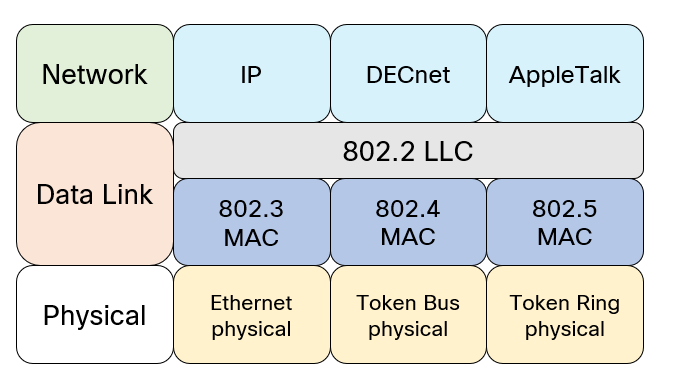
The originally proposed IEEE 802 layout, with the logical link control (LLC) providing an abstraction layer.The originally proposed IEEE 802 layout, with the logical link control (LLC) providing an abstraction layer.
We covered the history of Ethernet’s original development by [Robert Metcalfe] and [David Boggs] while they worked at Xerox, leading to its commercial introduction in 1980, and eventual IEEE standardization as 802.3. As [Daniel]’s article makes clear, much of the problem was that it wasn’t just about Ethernet, but also about competing networking technologies, including Token Ring and a host of other technologies, each with its own gaggle of supporting companies backing them.

Over time this condensed into three subcommittees:

  • 802.3: CSMA/CD (Ethernet).
  • 802.4: Token bus.
  • 802.5: Toking ring.

An abstraction layer (the LLC, or 802.2) would smooth over the differences for the protocols trying to use the active MAC. Obviously, the group behind the Ethernet and Ethernet II framing push (DIX) wasn’t enamored with this and pushed through Ethernet II framing via alternate means, but with LLC surviving as well, yet its technical limitations caused LLC to mutate into SNAP. These days network engineers and administrators can still enjoy the fallout of this process, but it was far from the only threat to Ethernet.

Ethernet’s transition from a bus to a star topology was enabled by the LANBridge 100 as an early Ethernet switch, allowing it to scale beyond the limits of a shared medium. Advances in copper wiring (and fiber) have further enabled Ethernet to scale from thin- and thicknet coax to today’s range of network cable categories, taking Ethernet truly beyond the limits of token passing, CSMA/CD and kin, even if their legacy will probably always remain with us.


The Privacy Post reshared this.

The Privacy Post ha ricondiviso questo.

Google Chrome Abbandona Ubuntu 18.04. E Scoppia la Polemica
poliverso.org/display/0477a01e…
Google Chrome Abbandona Ubuntu 18.04. E Scoppia la Polemica Google ha inaspettatamente smesso chromium-review.googlesource.c… di supportare il browser Chrome sull’attuale sistema operativo con supporto a lungo termine Ubuntu 18.04 LTS “Bionic Beaver” ubuntu.com/18-04 con il rilascio della nuova versione di Chrome 128. Ciò ha


Google Chrome Abbandona Ubuntu 18.04. E Scoppia la Polemica

Google ha inaspettatamente smesso di supportare il browser Chrome sull’attuale sistema operativo con supporto a lungo termine Ubuntu 18.04 LTS “Bionic Beaver” con il rilascio della nuova versione di Chrome 128. Ciò ha causato un’ondata di malcontento tra gli utenti, poiché il browser ha smesso di funzionare.

Inizialmente, la società non aveva intenzione di risolvere il problema. Tuttavia, dopo numerose lamentele da parte della comunità Linux, l’azienda ha deciso di modificare i propri piani. Un portavoce di Google ha affermato che la società riconosce che l’improvvisa fine del supporto ha colto di sorpresa molti utenti. Pertanto, è stata presa la decisione di restituire il supporto a Ubuntu 18.04… Per un po’.

Google ha promesso di rilasciare un aggiornamento che ripristinerà la compatibilità di Chrome con questa versione del sistema operativo già la prossima settimana. Tuttavia, in futuro la società prevede di smettere di supportare Ubuntu 18.04. Questa volta, però, Google ha promesso di non “premere l’interruttore” silenziosamente, ma di avvisare in anticipo gli utenti della fine del supporto.

È importante installare la nuova versione di Chrome 128 perché contiene aggiornamenti di sicurezza critici anche se l’aggiornamento non si installa a causa dell’incompatibilità con la libreria di sistema libgcc-s1, che ha causato ulteriori difficoltà agli utenti.

Questa situazione dimostra l’importanza di mantenere un equilibrio tra gli aggiornamenti di sicurezza e le esigenze degli utenti. Le aziende di software devono pianificare attentamente i cambiamenti nel supporto dei loro prodotti, tenendo conto della diversità della loro base di utenti e del potenziale impatto delle

L'articolo Google Chrome Abbandona Ubuntu 18.04. E Scoppia la Polemica proviene da il blog della sicurezza informatica.


The Privacy Post reshared this.

The Privacy Post ha ricondiviso questo.

Noyb files complaints against EU Parliament, civil society criticises Breton’s DSA approach
poliverso.org/display/0477a01e…
Noyb files complaints against EU Parliament, civil society criticises Breton’s DSA approach Welcome to Euractiv’s Tech Brief, your weekly update on all things digital in the EU. We’re back from the summer break.euractiv.com/section/digital/n…


Noyb files complaints against EU Parliament, civil society criticises Breton’s DSA approach 


Welcome to Euractiv’s Tech Brief, your weekly update on all things digital in the EU. We’re back from the summer break.


euractiv.com/section/digital/n…


The Privacy Post reshared this.

The Privacy Post ha ricondiviso questo.

The media in this post is not displayed to visitors. To view it, please go to the original post.

The Famous Computer Cafe Has Now Been Archived Online
poliverso.org/display/0477a01e…
The Famous Computer Cafe Has Now Been Archived Online You might think that TV stations or production houses would be great at archiving, but it’s not always the case. Particularly from the public access perspective. However, if you’re a fan of The Famous Computer Cafe, you’re in luck! The beloved series has now been preserved on archive.org/details/famous-com…


The Famous Computer Cafe Has Now Been Archived Online

You might think that TV stations or production houses would be great at archiving, but it’s not always the case. Particularly from the public access perspective. However, if you’re a fan of The Famous Computer Cafe, you’re in luck! The beloved series has now been preserved on The Internet Archive!

If you’re not familiar with the show, it was a radio program broadcast from 1983 to 1986. It was pumped out of a variety of radio stations in southern and central California in the period. The creators making sure to keep a copy of each episode in reel-to-reel tape format. For years, these tapes were tragically lost, until archivist [Kay Savetz] was able to recover some of them from a recent property sale. From there, a GoFundMe paid for digitization, and the show has been placed on The Internet Archive with the blessings of the original creators.

This is quite the cultural victory, particularly when you observe the list of guests on the show. Timothy Leary, Bill Gates, Jack Tramiel, and even Douglas Adams made appearances in the recovered recordings. Sadly, though, not all the tapes have been recovered. Episodes with Gene Roddenberry, Robert Moog, and Ray Bradbury are still lost to time.

If you fancy a listen, 53 episodes presently exist on the archive. Take a trip back in time and hear from some technological visionaries—and futurists—speaking their minds at the very beginning of the microcomputer era! If you find any particularly salient gems, don’t hesitate to drop them on the tip line.


The Privacy Post reshared this.

The Privacy Post ha ricondiviso questo.

The media in this post is not displayed to visitors. To view it, please go to the original post.

This Week in Security: Crash your iPhone, Hack Your Site, and Bluetooth Woes
poliverso.org/display/0477a01e…
This Week in Security: Crash your iPhone, Hack Your Site, and Bluetooth Woes There have been some hilarious issues on mobile devices over the years. The HTC Dream had a hidden shell that was discovered when a phone rebooted after sending a text containing just the word “reboot”. iOS has gotten in on the fun from time to time, and this time it’s ""::.


This Week in Security: Crash your iPhone, Hack Your Site, and Bluetooth Woes

There have been some hilarious issues on mobile devices over the years. The HTC Dream had a hidden shell that was discovered when a phone rebooted after sending a text containing just the word “reboot”. iOS has gotten in on the fun from time to time, and this time it’s ""::. Type the double quotes, a colon, and any other character, and Apple’s Springboard service crashes.

Another hacker dug in a bit, and realized that Springboard is trying to jump execution to a null pointer, leading to a crash. It’s very odd that user input breaks the query parser badly enough to jump to null like that. There are a couple interesting questions that we have to ask. Given that the crash trigger is quite flexible, "anything goes":x, is it possible to manipulate that function pointer to be something other than null? And perhaps more importantly, why is the code crashing, instead of an invalid address error as one would expect from a Pointer Authentication Code (PAC) violation? Regardless, the bug seems to be fixed in the latest iOS 18 builds.

Typing “”:: in various search bars (e.g. in Settings .app) on iOS, will cause a crash! ☠t.co/P4Ax0z9W9F (by: @)

….let's dig into why 🧵

— Patrick Wardle (@patrickwardle) August 21, 2024

OpenBMC


OpenBMC is something of a reference Baseboard Management Controller, and as such it’s the upstream for other implementations. And it has a fairly serious issue, in the slpd-lite service, which just happens to be installed and enabled by default. SLP is the Service Location Protocol, a service discovery protocol, which is something of a predecessor to Zeroconf. Slpd-lite has a pair of issues that result in trivial heap reads and writes, beyond the intended buffer.

The slpd-lite project patched the issues about a week after disclosure, back in May. In June, the patch and an advisory was applied to OpenBMC itself. Nice and speedy action. Now to get all the downstream vendors to apply it, too.

WordPress LightSpeed Falls to Weak Hash


The LightSpeed Cache plugin for WordPress does something really clever, but in a way that managed to allow admin authentication bypasses. To cache pages that a logged-in user would see, the plugin’s crawler simulates each user loading the site, and caches that. To protect that cache, a random string is generated. The problem is that this random generation is seeded using the current time, only the microsecond portion of the time. So one of only a million possible values. And while a million is a lot when talking about physical objects, it’s not nearly enough when talking about cryptography.

To log in as a user using this weak hash, an attacker only has to guess te proper user ID (usually 1 is an admin) and then hit the right hash value. Lightspeed hash released a fix, but this is a severe issue, and we should expect to see exploitation attempts — And that didn’t take long. This one could be nasty, as something like 3.5 million sites are still running the vulnerable version of the plugin. Wordfence has already blocked 48,500 in the first 24 hours of this attack being publicly known.

Insulin, Privacy, and Firewalls


[Remy] fron Greynoise Labs is on a bit of a crusade against insecure Bluetooth. And make no mistake, Bluetooth can be a problem. Case in point, the FDA has issued a recall on a particular insulin pump, because the iOS app could enter a crash loop, and the continual Bluetooth re-connections drained the device’s batteries. Battery drain may seem like a mild inconvenience, but apparently over 200 people have reported injuries as a result.

So in this push for more secure use of Bluetooth, [Remy] mined a collection of Android applications for Bluetooth UUIDs. Those are unique identifiers of what kind of device is advertising Bluetooth. With this new treasure trove of identifiers, it was only natural to write a Bluetooth UUID scanner. And this is where a bit of a bizarre coincidence took place. At the some moment [Remy] fired up this scanner, his local Internet access dropped. As a result, his Firewalla firewall started advertising a Bluetooth Low Energy interface. The database returned a hit, and [Remy] had the Android APK to look at.

The Firewalla scheme for authenticating that BLE interface was lacking, with a handful of possible issues, like only checking the first 8 characters of a UUID key. And once past that initial hurdle, further administration tasks are secured using a JSON Web Token. That token’s signing key was global for all Firewally devices, and trivially derived from either firmware or the Android APK. And that’s not even all, since there were also command injection issues over the same Bluetooth link. Firewalla has released version 1.979 to address these issues.

Moar Bluetooth


If that wasn’t enough Bluetooth, the Zero Day Initiative has us covered, with coverage of a pair of flaws in the Autel Maxicharger vehicle charging station. The first was a simple buffer overflow in the Bluetooth data handling, leading to possible Remote Code Execution (RCE). The second issue was the presence of “Backup credentials” in the firmware’s WiFi handling.

Bits and Bytes


“Insufficient sanitization” is not a feature you want in your microservices. Spring’s Cloud Dataflow is a tool to plug data flows in to various other applications. Before a recent patch fixed it, Dataflow was doing some basic checks on file uploads, like looking for nulls or empty files. The problem was some very simple path traversal attacks. Name a package name with ../../../poc, and while the service may throw an error, it still creates the files as requested. 2.11.3 has shipped with the fix, so time to update!

And speaking of bypasses, ingress-nginx has a validation bypass, allowing unauthorized access to Kubernetes clusters using that controller. Kubernetes supports annotations as a sort of metadata system, and ingress-nginx was failing to properly validate those annotations, which could then be used for command injection.

And finally, I think I’ve played this video game. Except this time, someone actually tried to hack himself out of existence. The FBI discovered that a criminal had not only used stolen social security numbers to commit fraud, he had gone so far as to register his own death in a Government system, using stolen credentials. It didn’t turn out so well, as he was discovered alive, and sentenced to jail time for the effort.


The Privacy Post reshared this.

The Privacy Post ha ricondiviso questo.

Did you know that at @fsfe@peertube.social you can find various videos related to #freesoftware and our public talks?

media.fsfe.org/

#softwarefreedom

The Privacy Post reshared this.

The Privacy Post ha ricondiviso questo.

New note by cybersecurity
poliverso.org/display/0477a01e…
Normativa e Gestione di un Data Breach edoardolimone.com/2024/08/23/n… (Italy e non Italy 😁)Il 26 luglio 2024 l’Agenzia per la Cybersicurezza Nazionale (ACN) ha pubblicato la “Guida alla notifica degli incidenti al CSIRT Italia”. Si tratta di un documento di 56 pagine che […]L'articolo Normativa e Gestione di un Data Breach proviene da E


Normativa e Gestione di un Data Breach


@Informatica (Italy e non Italy 😁)
Il 26 luglio 2024 l’Agenzia per la Cybersicurezza Nazionale (ACN) ha pubblicato la “Guida alla notifica degli incidenti al CSIRT Italia”. Si tratta di un documento di 56 pagine che […]
L'articolo Normativa e Gestione di un Data Breach proviene da Edoardo Limone.

L'articolo proviene dal blog dell'esperto di #Cybersecurity


The Privacy Post reshared this.

The Privacy Post ha ricondiviso questo.

The media in this post is not displayed to visitors. To view it, please go to the original post.

Xiaomi pronta a lanciare la funzione di rilevamento delle telecamere nascoste
poliverso.org/display/0477a01e…
Xiaomi pronta a lanciare la funzione di rilevamento delle telecamere nascoste Secondo i media, Xiaomi potrebbe presto introdurre nei suoi telefoni una funzione di rilevamento delle telecamere nascoste. L’azienda si sta ora preparando a lanciare HyperOS 2.0 e la xiaomitime.com/xiaomi-hyperos-…,


Xiaomi pronta a lanciare la funzione di rilevamento delle telecamere nascoste

Secondo i media, Xiaomi potrebbe presto introdurre nei suoi telefoni una funzione di rilevamento delle telecamere nascoste. L’azienda si sta ora preparando a lanciare HyperOS 2.0 e la funzionalità potrebbe diventarne parte.

Secondo XiaomiTime, HyperOS 2.0 conterrà probabilmente una funzionalità che consentirà ai dispositivi supportati di rilevare telecamere nascoste utilizzando segnali di rete locale wireless (WLAN). Questa funzionalità, ad esempio, può essere utile per i viaggiatori che spesso si fermano in luoghi sconosciuti.

Sembra che con questa funzione gli utenti dei telefoni Xiaomi saranno in grado di identificare i dispositivi sospetti connessi alla rete Wi-Fi locale. A giudicare dagli screenshot presentati, puoi cercare dispositivi nascosti con un solo tocco.

Si ritiene che la nuova funzionalità sia ispirata da Ingram, un programma Python che sembra rilevare le telecamere vulnerabili.

L'articolo Xiaomi pronta a lanciare la funzione di rilevamento delle telecamere nascoste proviene da il blog della sicurezza informatica.


The Privacy Post reshared this.

The Privacy Post ha ricondiviso questo.

The media in this post is not displayed to visitors. To view it, please go to the original post.

A Simple Guide to RF PCB Design
poliverso.org/display/0477a01e…
A Simple Guide to RF PCB Design [Hans Rosenberg] knows a thing or two about RF PCB design and has provided a three-part video demonstration of some solid rules of thumb. We will cover the first part here youtube.com/watch?v=EEb_0dja8t…, and leave the other two for the more interested readers!The design process begins with a schematic diagram, assuming ideal conductors. Advanced softwar


A Simple Guide to RF PCB Design

[Hans Rosenberg] knows a thing or two about RF PCB design and has provided a three-part video demonstration of some solid rules of thumb. We will cover the first part here, and leave the other two for the more interested readers!

The design process begins with a schematic diagram, assuming ideal conductors. Advanced software tools can extract the resistive, inductive, and capacitive elements of the physical wiring to create a parasitic model that can be compared to the desired schematic. The RF designer’s task is to optimize the layout to minimize differences and achieve the best performance to meet the design goals. However, what do you do when you don’t have access to such software?

[Hans] explains that at low frequencies, return current flows through all paths, with the lowest resistance path taking most of the current. At higher frequencies, the lowest inductance path carries all the current. In real designs, a ground plane is used instead of an explicit return trace for the lowest possible impedance.
You really wouldn’t design an RF circuit like this.
[Hans] shows the effect of interrupting the signal return path on a physical test PCB. The result is pretty bad, with the current forced to detour around the hole in the ground plane. A nanoVNA shows a -20 dB drop at 4 GHz, where the ground plane has effectively become an antenna. Energy will be radiated out, causing signal loss, but worse, it will create an EMC hazard with an unintended transmission.

Additionally, this creates an EMC susceptibility, making the situation worse. Placing a solder blob to bridge the gap directly under the signal trace is all that’s required to make it a continuous straight path again, and the performance is restored.

Floating planes are also an issue in RF designs, causing signal resonance and losses. One solution is to pull back the planes near the signal or stitch them to the ground plane with vias placed closely on either side of the signal trace. However, such stitching may slightly affect transmission line impedance and require tweaking the design a little. The next two parts of the series expand on this, hammering home the importance of good ground plane design. These are definitely worth a watch!

PCB design is as much art as science, and we’ve discussed this subject a lot. Here’s our simple guide to rocking RF PCB designs. There’s also a lot of devil in that detail, for example when understanding edge-launch SMA connectors.

youtube.com/embed/EEb_0dja8tE?…

youtube.com/embed/xhuHAhIKWoM?…

youtube.com/embed/nsDzvE8TeQo?…


The Privacy Post reshared this.

The Privacy Post ha ricondiviso questo.

5 milioni di siti WordPress a rischio a causa del Plugin LiteSpeed ​​Cache
poliverso.org/display/0477a01e…
5 milioni di siti WordPress a rischio a causa del Plugin LiteSpeed ​​Cache Gli specialisti di PatchStack securitylab.ru/glossary/patchs… scoperto una vulnerabilità redhotcyber.com/post/vulnerabi… critica nel plugin LiteSpeed ​​Cache per WordPress, che


5 milioni di siti WordPress a rischio a causa del Plugin LiteSpeed ​​Cache

Gli specialisti di PatchStack hanno scoperto una vulnerabilità critica nel plugin LiteSpeed ​​Cache per WordPress, che consente di ottenere i diritti di amministratore sul sito.

Il bug colpisce potenzialmente più di 5 milioni di siti che utilizzano questo plugin. Anche Wordfence si è unito al rapporto di PatchStack e ha emesso il proprio avviso sulla vulnerabilità.

LiteSpeed ​​​​Cache è un popolare plug-in di memorizzazione nella cache per WordPress con oltre 5 milioni di installazioni attive.

L’errore riguarda tutte le versioni del plugin fino alla versione 6.4 inclusa, il cui aggiornamento è stato rilasciato il 13 agosto. Si consiglia vivamente agli utenti di aggiornare il plug-in all’ultima versione (6.4.1) il prima possibile per evitare potenziali attacchi.

La vulnerabilità relativa all’elevazione dei privilegi CVE-2024-28000 (punteggio CVSS: 9,8) consente a un utente malintenzionato non autenticato di ottenere l’accesso a livello di amministratore, il che rende possibile scaricare e installare plug-in dannosi. Un criminale informatico può falsificare un ID utente e accedere come amministratore utilizzando l’API REST /wp-json/wp/v2/users. Tali azioni portano al pieno controllo del sito vulnerabile.

Il problema è che la funzione di simulazione utente nel plugin utilizza un hash debole. Questo hash viene generato in base a un numero casuale, facile da prevedere poiché dipende dal tempo con una precisione di un microsecondo. Di conseguenza, ci sono solo un milione di possibili valori hash. Inoltre, il generatore di numeri casuali non è crittograficamente sicuro e l’hash non è protetto da misure aggiuntive come il salting o il collegamento a una richiesta o a un utente specifico.

Vale la pena notare che la vulnerabilità non può essere sfruttata sui siti WordPress che funzionano sulla piattaforma Windows, poiché la funzione di generazione dell’hash dipende dal metodo PHP sys_getloadavg(), che non è implementato su Windows.

L'articolo 5 milioni di siti WordPress a rischio a causa del Plugin LiteSpeed ​​Cache proviene da il blog della sicurezza informatica.


The Privacy Post reshared this.

The Privacy Post ha ricondiviso questo.

The media in this post is not displayed to visitors. To view it, please go to the original post.

IntelBroker assume la guida di BreachForums: Un nuovo capitolo per la gestione del cybercrime
poliverso.org/display/0477a01e…
IntelBroker assume la guida di BreachForums: Un nuovo capitolo per la gestione del cybercrime La recente acquisizione di BreachForums dahttps://www.redhotcyber.com/post/chi-e-intelbroker-il-threat-actors-dietro-gli-attacchi-a-zscalar-ed-europol/


IntelBroker assume la guida di BreachForums: Un nuovo capitolo per la gestione del cybercrime

La recente acquisizione di BreachForums da parte di IntelBroker segna un cambiamento significativo nell’ambito del cybercrime. Questa transizione di potere avviene in un momento cruciale per il forum, che ha recentemente attraversato un periodo di stagnazione e inefficienza sotto la precedente amministrazione. L’arrivo di IntelBroker come nuovo proprietario promette di rinnovare e rafforzare la piattaforma, portando con sé una gestione più attiva e coinvolta.

Intelbroker è un individuo (o un gruppo di hacker criminali) operante nel dark web, tra le risorse underground quali xss, Breachforums, Exposed. Si tratta di un attore di minacce operante nel gruppo di hackerCyberniggers“, ed è attivo sia nelle categorie di hacktivismo che nella criminalità informatica, soprattutto come Inital Access Broker (IaB).

Come accennato in precedenza, in prima linea tra CyberNiggers è un membro di lunga esperienza nell’orchestrazione di attacchi informatici di alto profilo. Operando come Initial Access Broker (IaB), IntelBroker è specializzato nell’identificazione e nella vendita dell’accesso ai sistemi compromessi, aprendo la strada a varie attività dannose.

Nonostante l’identità collettiva dei CyberNiggers, IntelBroker si distingue come attore di minacce individuali. Questa distinzione solleva interrogativi sulla portata delle loro capacità e sulle motivazioni che guidano i loro sforzi individuali.

Stato di BreachForums sotto la precedente amministrazione


BreachForums, storicamente riconosciuto come uno dei principali punti di riferimento per la comunità del cybercrime, ha subito un progressivo declino a causa della gestione inefficace del precedente proprietario. Le principali criticità riscontrate includevano:

  • Assenza di leadership: Il precedente amministratore era spesso assente, provocando ritardi significativi nella risoluzione di controversie tra utenti e nella gestione delle richieste tecniche e operative del sito.
  • Mancanza di intervento tempestivo: La scarsa presenza amministrativa ha portato a un accumulo di problemi non risolti, che hanno minato la fiducia degli utenti e compromesso l’efficacia operativa del forum.
  • Stagnazione della comunità: A causa della gestione inefficace, il forum ha registrato un calo nell’attività e nell’afflusso di nuovi membri, portando a una perdita di slancio all’interno della comunità.


L’avvento di IntelBroker: Una leadership rinnovata


L’ingresso di IntelBroker come nuovo proprietario e amministratore rappresenta un punto di svolta per BreachForums. Le caratteristiche distintive della sua leadership includono:

  • Coinvolgimento attivo: IntelBroker è noto per il suo approccio diretto e partecipativo nella gestione della comunità. La sua presenza costante e il suo impegno attivo sono stati accolti positivamente dagli utenti, che vedono in lui una figura capace di riportare ordine e disciplina al forum.
  • Reputazione consolidata: IntelBroker gode di un alto livello di rispetto e fiducia all’interno della comunità. Questo elemento è cruciale per garantire un ambiente sicuro e stabile, soprattutto in un contesto come quello del cybercrime, dove la credibilità del leader è fondamentale.
  • Focus sulla sicurezza e sull’integrità: La gestione di IntelBroker si preannuncia orientata a mantenere elevati standard di sicurezza e integrità del forum, elementi essenziali per il successo e la longevità della piattaforma.

Prospettive future per BreachForums


Con IntelBroker al timone, BreachForums si prepara a entrare in una nuova fase di sviluppo. Le aspettative per il futuro includono:

  • Rinnovata crescita della comunità: Si prevede un aumento delle attività e dell’afflusso di nuovi membri, grazie alla ritrovata fiducia nella gestione del forum.
  • Miglioramento della governance: Con una leadership più attiva e responsabile, il forum dovrebbe vedere un miglioramento nella gestione delle controversie e delle operazioni quotidiane, portando a una maggiore soddisfazione degli utenti.
  • Rafforzamento della posizione nel cyber underground: La nuova amministrazione potrebbe consolidare la posizione di BreachForums come piattaforma leader per il cybercrime, attirando un numero crescente di utenti e risorse.


Conclusione


L’acquisizione di BreachForums da parte di IntelBroker rappresenta un’opportunità di rinascita per la piattaforma. Con una gestione più dinamica e attenta, il forum è destinato a recuperare la vitalità perduta e a consolidare il suo ruolo nel panorama del cybercrime.

La comunità osserva con interesse i primi passi di IntelBroker nella sua nuova veste di leader, consapevole che da questa transizione dipenderà il futuro del forum.

L'articolo IntelBroker assume la guida di BreachForums: Un nuovo capitolo per la gestione del cybercrime proviene da il blog della sicurezza informatica.


The Privacy Post reshared this.

The Privacy Post ha ricondiviso questo.

Elon Musk’s Brat Summer
poliverso.org/display/0477a01e…
Elon Musk’s Brat SummerCharli XCX’s new album has made waves worldwide with its ravey beats and bold lyrics. And who better than Elon Musk to embody the fearless “brat” attitude?euractiv.com/section/digital/p…


Elon Musk’s Brat Summer


Charli XCX’s new album has made waves worldwide with its ravey beats and bold lyrics. And who better than Elon Musk to embody the fearless “brat” attitude?


euractiv.com/section/digital/p…


The Privacy Post reshared this.

The Privacy Post ha ricondiviso questo.

The media in this post is not displayed to visitors. To view it, please go to the original post.

Portable PS4 Is Easier To Move Than A Regular One
poliverso.org/display/0477a01e…
Portable PS4 Is Easier To Move Than A Regular One The PlayStation 4 was a popular enough console, but it was a home console. If you wanted to play at a friend’s house, you had to unplug all your cables and haul the whole lot over there. Unless, that is, you built something along the lines of [Rudd van Falier]’s https://hackaday.io/project/185482-portable-gamestation-pgs4It’s


Portable PS4 Is Easier To Move Than A Regular One

The PlayStation 4 was a popular enough console, but it was a home console. If you wanted to play at a friend’s house, you had to unplug all your cables and haul the whole lot over there. Unless, that is, you built something along the lines of [Rudd van Falier]’s Portable GameStation.

It’s not a super-complicated build, but it is a well-executed one. It combines laser cut acrylic with 3D-printed brackets to produce a housing that looks clean, sharp, and of almost commercial quality. That’s the benefit of laser-cutting—it avoids all the ugly problems of layer lines. From there, [Rudd] simply set about stuffing the PS4 motherboard inside, along with placing the relevant ports and vents in the housing where needed. A screen with inbuilt speakers was then attached to complete the build. The one thing it’s missing is a set of batteries for playing it on the bus. This thing needs mains power to run.

We’d love to see [Rudd] take another stab at the concept, making it fully independent from cables. It’s definitely possible. Who wouldn’t want to play some Persona 5 Royal on the train, anyway? Video after the break.

youtube.com/embed/5GN1kxtK0ps?…


The Privacy Post reshared this.

The Privacy Post ha ricondiviso questo.

The media in this post is not displayed to visitors. To view it, please go to the original post.

Wardriving Tools In The Modern Era
poliverso.org/display/0477a01e…
Wardriving Tools In The Modern Era When WiFi first came out, it was a super exciting time. The technology was new, and quite a bit less secure back then—particularly if not configured properly. That gave rise to the practice of wardriving—driving around with a computer, looking for unsecured networks, often just for the fun of it. [Simon] has been examining this classic practice from a modern


Wardriving Tools In The Modern Era

When WiFi first came out, it was a super exciting time. The technology was new, and quite a bit less secure back then—particularly if not configured properly. That gave rise to the practice of wardriving—driving around with a computer, looking for unsecured networks, often just for the fun of it. [Simon] has been examining this classic practice from a modern perspective.

He’s been at the game for a long time—from back in the days when you might head out with a thick old laptop, a bunch of PCMCIA cards, and dangly antennas. It’s much more advanced these days, given we’ve got WiFi on all different bands and Bluetooth devices to consider to boot. Heck, even Zigbee, if you’re hunting down a rogue house full of Internet of Things gadgets.

Today, when he’s out researching the wireless landscape, he uses devices like the Flipper Zero, the Raspberry Pi, and a Google Pixel 5 running the WiGLE WiFi Wardriving app. [Simon] notes that the latter is the easiest way to get started if you’ve got an Android phone. Beyond that, there’s software and hardware out there these days that can do amazing things compared to the simple rigs of yesteryear.

If you’re out looking for free internet these days, wardriving might be a bit pointless given it’s available in practically every public building you visit. But if you’re a wireless security researcher, or just curious about what your own home setup is putting out, it might be worth looking at these tools! Happy hunting.


The Privacy Post reshared this.

The Privacy Post ha ricondiviso questo.

The media in this post is not displayed to visitors. To view it, please go to the original post.

Second Human Neuralink Brain Implant Recipient Uses It For CAD and Videogaming
poliverso.org/display/0477a01e…
Second Human Neuralink Brain Implant Recipient Uses It For CAD and Videogaming As Neuralink works towards getting its brain-computer interface technology approved for general use, it now has two human patients who have received the experimental implant. The second patient, [Alex], received the implanthttps://www.pcmag.com/news/second-human-to-receive-n


Second Human Neuralink Brain Implant Recipient Uses It For CAD and Videogaming

As Neuralink works towards getting its brain-computer interface technology approved for general use, it now has two human patients who have received the experimental implant. The second patient, [Alex], received the implant in July of 2024 and is said to be doing well, being able to play games like Counter Strike 2 without using his old mouth-operated controller. He’s also creating designs in Fusion 360 to have them 3D printed.

This positive news comes after the first patient ([Noland Arbaugh]) suffered major issues with his implant, with only 10-15% of the electrodes still working after receiving the implant in January. The issue of electrode threads retracting was apparently a known issue years prior already.

We analyzed Neuralink’s claims back in 2019, when its founder – [Elon Musk] – was painting lofty goals for the implant, including reading and writing of brains, integration with AIs and much more. Since that time Neuralink has been mostly in the news for the many test animals which it euthanized during its test campaign prior to embarking on its first human test subjects.

There also appears a continuing issue with transmitting the noisy data from the electrodes, as it is far more data than can be transmitted wirelessly. To solve this seemingly impossible problem, Neuralink has now turned to the public with its Neuralink Compression Challenge to have someone make a miraculous lossless compression algorithm for it.

With still many challenges ahead, it ought to be clear that it will take many more years before Neuralink’s implant is ready for prime-time, but so far at least it seems to at least make life easier for two human patients.

youtube.com/embed/X7OpjB_8sHQ?…


The Privacy Post reshared this.

The Privacy Post ha ricondiviso questo.

The media in this post is not displayed to visitors. To view it, please go to the original post.

You Can 3D Print Yourself Some Simple Magnetic Switches
poliverso.org/display/0477a01e…
You Can 3D Print Yourself Some Simple Magnetic Switches Permanent magnets aren’t typically switchable. They’re always doing their magnet thing. However, if you align them with a bunch of other magnets in just the right way, you can create a permanent magnet that you can effectively switch on and off. [Andrew Klein] has done just that with his 3D-printed magnetic switch


You Can 3D Print Yourself Some Simple Magnetic Switches

Permanent magnets aren’t typically switchable. They’re always doing their magnet thing. However, if you align them with a bunch of other magnets in just the right way, you can create a permanent magnet that you can effectively switch on and off. [Andrew Klein] has done just that with his 3D-printed magnetic switch design.

The concept is simple enough. The design consists of a 3D-printed housing in two parts, top and bottom. When set into one orientation, the housing holds two arrays of magnets in opposite orientations. This effectively cancels out their magnetic fields and allows you to move the assembly around as if it’s pretty much not magnetic at all. However, rotate the device to its alternative orientation, and the magnets poles are aligned. This effectively combines their magnetic fields and makes the assembly act as one big large magnet.

These devices are useful if you want to create magnetic clamps or fixtures that can be attached and detached at will from ferrous surfaces. Being able to effectively “switch the magnet off” is much easier than trying to wrench a powerful magnet from a metal plate, after all.

You can do something similar with electromagnetic techniques, too! Video after the break.

youtube.com/embed/n9tZIFfM14o?…


The Privacy Post reshared this.

The Privacy Post ha ricondiviso questo.

The media in this post is not displayed to visitors. To view it, please go to the original post.

A Field Guide to the North American Substation
poliverso.org/display/0477a01e…
A Field Guide to the North American Substation Drive along nearly any major road in the United States and it won’t be long before you see evidence of the electrical grid. Whether it’s wooden poles strung along the right of way or a line of transmission towers marching across the countryside in the distance, signs of the grid are never far from view but often go ignored, blending into


A Field Guide to the North American Substation

Drive along nearly any major road in the United States and it won’t be long before you see evidence of the electrical grid. Whether it’s wooden poles strung along the right of way or a line of transmission towers marching across the countryside in the distance, signs of the grid are never far from view but often go ignored, blending into the infrastructure background and becoming one with the noise of our built environment.

But there’s one part of the electrical grid that, despite being more widely distributed and often relegated to locations off the beaten path, is hard to ignore. It’s the electrical substation, more than 55,000 of which dot the landscape of the US alone. They’re part of a continent-spanning machine that operates as one to move electricity from where it’s produced to where it’s consumed, all within the same instant of time. These monuments of galvanized steel are filled with strange, humming equipment of inscrutable purpose, seemingly operating without direct human intervention. But if you look carefully, there’s a lot of fascinating engineering going on behind those chain-link fences with the forbidding signage, and the arrangement of equipment within them tells an interesting story about how the electrical grid works, and what the consequences are when it doesn’t.

From The Ground Up


The most basic function of a substation is to transform voltages, either stepping up the voltage from the point of production for efficient transmission over long distances, or stepping voltages down from transmission systems to feed regional or local distribution systems. That makes substations conceptually simple, but as is always the case in engineering, the details are where things get interesting.

While the equipment mounted above the ground is the easiest part of a substation to observe, what you don’t see is arguably far more important, at least in terms of safety. A note to frame the discussion: we’ll be concentrating on open-air substations, rather than substations that are inside a structure, which are an important and interesting part of the grid, but harder to observe casually.

Substations must have an extensive grounding system, both for worker safety and to provide the needed neutral reference. Most substations use a grid of thick copper conductors buried just below the surface, tied together at regular intervals to ground rods extending 25 feet (7 meters) or more into the soil below. Horizontal and vertical conductors are tied together with exothermically welded connections or cold-forged fittings to form low-impedance electrical connections between every element of the grid. The grounding grid spreads out under the entire area of the substation, and everything is bonded into the ground system by heavy, low-impedance braided straps.

youtube.com/embed/3Lmu31TUp0U?…

Over the grounding grid is a layer of crushed rock about 6 inches (15 cm) thick. The gravel serves several functions, including aiding water drainage and inhibiting weed growth. But the main function is worker safety in the event of a ground fault, which could cause a lethal voltage difference between the above-ground equipment and the earth. The high resistivity of the gravel (3,000 to 5,000 ohm-meters) compared to the soil makes it less likely that a worker will conduct these voltages through their body. Also, gravel reduces the possibility of lethal voltages between one foot and the other while walking, or step voltages.

Every substation also has a fence or physical barrier of some sort. Most are imposing structures of heavy-duty chain-link topped with razor wire, but in some residential areas, a more decorative option might be used to appease the neighbors. Some substations also have sound barriers, to reduce the incessant 60 Hz hum of the equipment within that could annoy nearby residents. The characteristic hum has also been known to attract bears, who apparently think they’ve found the world’s largest beehive. A sturdy barrier is critical to avoiding unpleasant consequences for the bear, or for those with a greedy eye on the multiple tons of copper most substations contain.

Rule of Threes


Of the above-ground equipment in the substation, the most visually striking structures are those that support and terminate the wires coming into and leaving the yard. These are loosely referred to as “high side” and “low side” lines based on the voltages they carry. A substation might have a 345 kV high side to receive power from a transmission line and several 25 kV lines on the low side feeding different local distribution lines. Some substations will also have multiple high-side feeds from different transmission lines, or may have multiple low-side inputs from wind or solar plants that the substation will combine into one or more high-side transmission lines.

Overview of the high side of a wind farm substation. From the right: transformer with corona caps on output bushings; 3-phase circuit breakers; PTs and VTs for monitoring; high-side lines on tower with surge arrestors on each phase. Source: Adbobestock, by [JJ Gouin]One way to tell the high-side and low-side lines apart is by the size of their insulating bushings. Bushings are used to electrically and physically separate conductors from enclosures and supports, and the longer the bushing, the higher the voltage. Bushings are made from ceramic, glass, or polymers, and generally have stacks of circular fins that reduce the possibility of electrical discharge from the line to something with a lower potential. The highest voltage bushings are often fitted with special corona caps, which are circular cages that reduce the possibility of corona discharges from the relatively sharp tip of the bushing.

Something that stands out about most substations is that there seem to be three copies of each piece of equipment. Each set of high-side lines comes into the substation in a set of three, there are often three transformers (or one transformer with three input bushings and three output bushings), and all of the gear between the input and the output seems to be in triplicate. This is thanks to the three-phase electrical system in North America. Electrical transmission and distribution systems are all three-phase power, and while residential customers rarely enjoy such service to the home, commercial and industrial installations almost universally have it.

While the high-side and low-side lines entering and leaving the substation are generally — but not always — overhead wires, inside the substation, most of the components are connected by a series of overhead busbars. Busbars are simply pieces of metal pipe, often galvanized steel or aluminum and usually in groups of three, which are attached to equipment bushings either directly or via jumper wires. Busbars have the advantage of not sagging or swaying in the wind, but do have a few disadvantages, too. When busbars get hot they expand, and since they’re rigid and supported firmly on each end they’ll either buckle or break their supports. That means busbars have to be provided with expansion joints.

Another potential failure mode for busbars is ice damage, which I witnessed back in the 1980s. During a late winter thaw, meltwater had accumulated in a busbar at a substation near my home. When the temperature dropped precipitously that night, the freezing water exerted enough pressure to burst the busbar, which caused a fault on one of the phases bad enough to trip the entire substation. This knocked out power to the entire town and resulted in the local utility asking for help from my volunteer fire company.

The substation techs used the enormous generator on our truck to power a welder so they could make an impromptu repair to the busbar and restore power. It was a long, bitterly cold night, but I got to walk around inside a substation and check things out. It was pretty cool.

Plenty of Protection


That brings up the topic of control and protection. The vast majority of the equipment inside a substation is devoted to circuit protection, in the form of circuit breakers, fuses, reactors, and capacitors, followed by the equipment needed to control and monitor the circuits. Lightning protection is also vital, since a nearby strike can induce currents that can permanently damage equipment. Protection starts at the top with static lines on the highest part of transmission towers that are designed to catch discharges and run them directly to ground. Static lines are now often hybrid cables called OPGW, or optical ground wire, which has one or more optical fiber pairs at its core. These fibers are used for control and communications between substations; some utilities even lease the extra pairs out to communications providers.

Circuit breakers play a last-ditch role in substation protection, and are capable of disconnecting the entire substation in a catastrophic fault. They’re pretty easy to spot thanks to their angled bushings, usually two per breaker with one breaker per phase, although some breakers have three bushings each. The breakers are just super-sized versions of those in your home panel and work in a similar way, albeit tripping at a much higher current — often 5,000 amps or more. They also have to switch very rapidly, a tough job when there’s enough voltage to keep an arc going between the contacts even when they’re fully separated. So circuit breakers are often filled with a dielectric gas such as sulfur hexafluoride (SF6), a liquid dielectric like mineral oil, or even evacuated completely. Air blast breakers which literally blow the arc out are also used.

Another interesting bit of control equipment in the yard is the voltage regulators, which are essentially autotransformers that can adjust the voltage on a phase within a small percentage range. These are easily recognizable as a set of three tall cylinders, each bearing a large dial on the top. The dial shows how much voltage is being boosted or bucked, and is usually angled downward for easier reading from the ground. Substation switchyards also often contain banks of high-voltage capacitors, which adjust the power factor and compensate for noise on the line. Capacitor banks are usually located on the distribution side of a substation along with neutral grounding reactors, which are large, cylindrical inductors that are connected in series between the neutral of a transformer and ground and limit current if there’s a phase-to-ground fault.

Sprinkled liberally around the substation are instrumentation transformers whose entire job is to monitor the flow of current into and out of almost every piece of equipment. Current transformers, or CTs, are just permanently installed, beefed-up versions of the clamp meter you might use for measuring current in an electrical panel and work pretty much the same way, with current in the conductor under measurement inducing a proportional current in a toroidal coil. Voltages are measured with voltage transformers (VTs), the most common of which is the capacitive voltage transformer, or CVT. These use high-voltage capacitors as a voltage divider and a transformer to isolate and further step down the voltage to a reasonable instrumentation range. The outputs of instrumentation transformers are generally piped into a supervisory control and data acquisition (SCADA) system that remotely monitors and controls everything in the substation, right down to alarm contacts on the fence gates.

The Diva Treatment


Since the primary job of the substation is changing one voltage to another, the main power transformers are the centerpiece of the switchyard. In a lot of ways, transformers are the divas of the substation — they’re expensive to procure, require a lot of maintenance, and the show won’t go on until they’re happy. The transformers are easy to spot, since they’re generally the largest pieces of equipment in the yard. In keeping with the rule of threes, there are usually three identical units, one for each phase, although some transformers have windings for all three phases in a single massive enclosure.
138 kV transformer in a wind farm substation. High-side to the left, low-side to the right, with all three phases in a single enclosure. Note the cooling radiators on each side; the tank just visible at the back is an oil conservator, which is basically a pressurized reservoir for the oil to expand and contract. Source: SpeedFreakLS1.
Almost all substation transformers are filled with mineral oil, which acts as a liquid dielectric and helps cool the transformer thanks to giant radiators and fans for forced-air cooling. A large transformer can hold thousands of gallons of oil, an environmental disaster waiting to happen if there should be a leak, which given some recent rural substation attacks is not unthinkable. That makes secondary containment a necessity, with deep pits dug around the transformer foundation pads. The pits are lined with thick plastic sheets and backfilled with gravel. They’re designed to contain the entire volume of oil if necessary, and sump pumps with oil separators keep rainwater from accumulating in the pit.

In keeping with the diva treatment, transformers require constant monitoring to ensure they operate at their peak. Aside from the instrumentation used to measure their electrical status, transformers need to have their oil checked regularly for chemical changes that could indicate internal problems like arcing and overheating. This can either be performed by a technician visiting the substation and taking samples of the oil, or through online dissolved gas analysis (DGA), which uses a compact gas chromatograph to automatically sample the oil and measure the amount of acetylene, ethylene, and methane dissolved within it. Continuous measurements are collected via SCADA and provide a much more accurate picture of transformer health than monthly or quarterly sampling.

And finally, to push the diva metaphor even further, transformers are often provided with pressure-relief devices to protect the system in the event of an explosion within the transformer enclosure. PRDs can be as simple as a burst disc that shatters under increased pressure, but are more commonly sensors that detect and characterize the pressure wave from an internal explosion as it propagates through the oil. If the pressure wave looks like a catastrophic internal failure has occurred, the SCADA system will disconnect the transformer, in an attempt to save it from irreparable damage.


The Privacy Post reshared this.

The Privacy Post ha ricondiviso questo.

The media in this post is not displayed to visitors. To view it, please go to the original post.

A Cheap DIY PLC Based on the Atmega328P
poliverso.org/display/0477a01e…
A Cheap DIY PLC Based on the Atmega328P If you’re running a big factory, you’ve probably got a massively expensive contract with a major programmable logic controller (PLC) manufacturer. One shudders to think about the cost of the service subscription on that one. If you’re working on a smaller scale, though, you might consider a DIY PLC like this one from [Mr youtube.com/


A Cheap DIY PLC Based on the Atmega328P

If you’re running a big factory, you’ve probably got a massively expensive contract with a major programmable logic controller (PLC) manufacturer. One shudders to think about the cost of the service subscription on that one. If you’re working on a smaller scale, though, you might consider a DIY PLC like this one from [Mr Innovative.]

PLCs are rarely cutting-edge; instead, they’re about reliability and compliance with common industry standards. To that end, this design features the ATmega328P. Few other microcontrollers are as well understood or trusted as that one. The device is compatible with RS232 and RS485 and will run off 24 VDC, both of which you would find in a typical industrial environment. It offers 24 V digital inputs and outputs, as well as analog inputs and outputs from 0 to 10 V. [Mr Innovative] demonstrates it by hooking up a DWIN human-machine interface (HMI) for, well… human interaction, and a variable frequency drive to run a motor.

If you want to run a basic industrial-lite system but can’t afford the real industrial price tag, you might enjoy tinkering around at this level first. It could be a great way to get a simple project up and running without breaking the bank. Video after the break.

youtube.com/embed/gCmLq-S2bcE?…


The Privacy Post reshared this.

The Privacy Post ha ricondiviso questo.

noyb files two complaints against EU Parliament over massive data breach

In early May 2024, the European Parliament informed its staff of a massive data breach in the institution’s recruiting platform (called “PEOPLE”). The breach affected the personal data of more than 8,000 staff.

@privacy

noyb.eu/en/noyb-complaints-aga…

The Privacy Post reshared this.

The Privacy Post ha ricondiviso questo.

The media in this post is not displayed to visitors. To view it, please go to the original post.

Tempeste, naufragi e cyberspionaggio: gli ingredienti del complotto
poliverso.org/display/0477a01e…
Tempeste, naufragi e cyberspionaggio: gli ingredienti del complottoUno yacht di lusso, il Bayesian, che si inabissa il 19 agosto a poche centinaia di metri dal porto di Palermo. Fin qui non ci sarebbe nulla di eccezionale. Le cose cambiano non appena si conosce l’identità delle persone a bordo e, purtroppo, delle vittime. Tra queste, la più illustre è senz’altro


Tempeste, naufragi e cyberspionaggio: gli ingredienti del complotto


Uno yacht di lusso, il Bayesian, che si inabissa il 19 agosto a poche centinaia di metri dal porto di Palermo. Fin qui non ci sarebbe nulla di eccezionale. Le cose cambiano non appena si conosce l’identità delle persone a bordo e, purtroppo, delle vittime. Tra queste, la più illustre è senz’altro il magnate britannico […]
Continua a leggere

The post Tempeste, naufragi e cyberspionaggio: gli ingredienti del complotto appeared first on InsideOver.


The Privacy Post reshared this.

The Privacy Post ha ricondiviso questo.

The media in this post is not displayed to visitors. To view it, please go to the original post.

Citizen Scientists Spot Super Fast Moving Object in NASA Data
poliverso.org/display/0477a01e…
Citizen Scientists Spot Super Fast Moving Object in NASA Data When you were five, you probably spotted your best friend running at “a million miles an hour” when they beat everybody at the local athletics meet. You probably haven’t seen anything that fast snice. According to NASA, though, a group of citizen scientists spotted a science.nasa.gov/get-involve


Citizen Scientists Spot Super Fast Moving Object in NASA Data

When you were five, you probably spotted your best friend running at “a million miles an hour” when they beat everybody at the local athletics meet. You probably haven’t seen anything that fast snice. According to NASA, though, a group of citizen scientists spotted a celestial object doing just that!

The group of citizen scientists were involved in a NASA program called Backyard Worlds: Planet 9. They were working on images from NASA’s Wide-field Infrared Explorer mission. Scanning through stored images, Martin Kabatnik, Thomas P. Bickle, and Dan Caselden identified a curiously speedy object termed CWISE J124909.08+362116.0. There are lots of fast-moving objects out in space, but few quite as fast as this one. It’s quite literally zooming through the Milky Way at about 1 million miles per hour.

It’s unclear exactly what the object is. It appears light enough to be a low-mass star, or potentially a brown dwarf—somewhere in between the classification of gas giant and star. It also has suspiciously low iron and metallic content. The leading hypothesis is that CWISE J1249 might have been ejected from a supernova, or that it got flung around a pair of black holes.

For now, it remains a mystery. It’s a grand discovery that really highlights the value of citizen science. If you’ve been doing your own rigorous scientific work—on NASA’s data or your own—do let us know!


The Privacy Post reshared this.

The Privacy Post ha ricondiviso questo.

The media in this post is not displayed to visitors. To view it, please go to the original post.

McDonald’s vittima di un attacco hacker su Instagram: sottratti 700.000 $ attraverso una truffa in cripto
poliverso.org/display/0477a01e…
McDonald’s vittima di un attacco hacker su Instagram: sottratti 700.000 $ attraverso una truffa in cripto L’account Instagram ufficiale di McDonald’s è stato compromesso da redhotcyber.com/post/i-padri-f… che hanno utilizzato la piattaforma per promuovere una criptovaluta, riuscendo


McDonald’s vittima di un attacco hacker su Instagram: sottratti 700.000 $ attraverso una truffa in cripto

L’account Instagram ufficiale di McDonald’s è stato compromesso da hacker che hanno utilizzato la piattaforma per promuovere una criptovaluta, riuscendo a sottrarre oltre 700.000 dollari. Questo evento mette nuovamente in luce i pericoli delle truffe digitali nel settore delle criptovalute e la vulnerabilità anche dei marchi più noti quando si tratta di sicurezza sui social media.

Dettagli dell’attacco


Gli hacker, che si sono identificati come “India_X_Kr3w”, hanno modificato la biografia del profilo Instagram di McDonald’s, visibile ai suoi oltre 5 milioni di follower. La nuova biografia promuoveva un token fasullo chiamato “GRIMACE”, presentato come un esperimento legato alla rete blockchain Solana, nota per l’alta velocità delle sue transazioni. In meno di mezz’ora, il valore del token è balzato a 25 milioni di dollari, per poi crollare bruscamente quando gli hacker hanno liquidato i fondi accumulati.

Il messaggio inserito dai truffatori recitava: “Sorry mah n**ga, you have just been rug pulled by India_X_Kr3w, thank you for the $700,000 in Solana.”

Immagine che mostra la biografia modificata dagli attaccanti

L’attacco non si è fermato al solo account ufficiale di McDonald’s, ma ha colpito anche il profilo di Guillaume Huin, Senior Marketing Director dell’azienda.

Gli hacker hanno sfruttato i suoi account social per conferire maggiore credibilità alla truffa, pubblicando messaggi che facevano credere che McDonald’s fosse coinvolto in un presunto esperimento sulla blockchain di Solana. Questa mossa astuta ha tratto in inganno numerosi investitori, che hanno visto svanire i loro fondi nel giro di pochi minuti, convinti di partecipare a un’iniziativa legittima del colosso del fast food.

Trend Token GRIMAGRACE

Rug pull


Questo tipo di truffa, noto nel mondo delle criptovalute come “rug pull”, si basa sulla creazione e promozione di una valuta digitale fittizia. Gli autori accumulano investimenti significativi grazie a una campagna promozionale aggressiva, per poi ritirare rapidamente i fondi raccolti, lasciando gli investitori con token privi di valore. In questo caso, gli hacker sono riusciti a sottrarre 700.000 dollari, suddividendo i fondi in circa 100 portafogli diversi per complicare il tracciamento del denaro.

Le conseguenze per McDonald’s


McDonald’s ha rapidamente ripreso il controllo del suo account Instagram e ha rimosso tutti i contenuti compromessi. In una dichiarazione ufficiale, la società ha definito l’accaduto un “episodio isolato“, scusandosi con i suoi fan per eventuali offese derivanti dai messaggi pubblicati durante l’attacco. L’azienda ha inoltre ribadito il suo impegno a rafforzare le misure di sicurezza per prevenire futuri incidenti simili.

Questo attacco evidenzia i rischi crescenti associati alle criptovalute e sottolinea l’importanza della sicurezza informatica, anche per le aziende più grandi e consolidate. Con il numero di truffe in aumento nel settore delle criptovalute, è essenziale che utenti e aziende rimangano vigili e adottino misure preventive per proteggere i propri investimenti e la propria reputazione online.

L'articolo McDonald’s vittima di un attacco hacker su Instagram: sottratti 700.000 $ attraverso una truffa in cripto proviene da il blog della sicurezza informatica.


The Privacy Post reshared this.

The Privacy Post ha ricondiviso questo.

The media in this post is not displayed to visitors. To view it, please go to the original post.

Tech in Plain Sight: Speedometers
poliverso.org/display/0477a01e…
Tech in Plain Sight: Speedometers In a modern car, your speedometer might look analog, but it is almost certainly digital and driven by the computer that has to monitor all sorts of things anyway. But how did they work before your car was a rolling computer complex? The electronic speedometer has been around for well over a century and, when you think about it, qualifies as a technlogical


Tech in Plain Sight: Speedometers

In a modern car, your speedometer might look analog, but it is almost certainly digital and driven by the computer that has to monitor all sorts of things anyway. But how did they work before your car was a rolling computer complex? The electronic speedometer has been around for well over a century and, when you think about it, qualifies as a technlogical marvel.

If you already know how they work, this isn’t a fair question. But if you don’t, think about this. Your dashboard has a cable running into it. The inner part of the cable spins at some rate, which is related to either the car’s transmission or a wheel sensor. How do you make a needle deflect based on the speed?

Mechanical Solutions


Early versions of the speedometer used a governor pulling against a spring. The faster it rotates, the more the two weights of the governor pull out against the spring, and the needle moves with the weights.

As an aside, this sort of centrifugal governor is also known as a fly-ball governor, and similar devices were commonly used to regulate the maximum throttle on steam engines. The arms of the governor would be fully extended once the engine reached its top speed, which lead to the term “balls-out” becoming used to describe a machine operating at its upper limits.

Another type of mechanical speedometer had an escapement like a watch. The time mechanism would move the needle back, and the rotation of the wheels would move it forward. The net result was a needle position that would increase with speed.

The Magnetic Approach


However, most cars use a magnetic type speedometer — although it doesn’t work in the way you might imagine. There’s no reed relay or Hall effect sensing the magnetic field. Instead, there is an aluminum cup attached to the speedometer needle and, nearby, a magnet that spins on a shaft moving at some ratio of the car’s speed. There’s no direct connection between the two.

Being a non-ferrous metal, aluminum is not generally something we think of being affected by magnets. Under normal circumstances that might be true, but a moving magnetic field will induce eddy currents in aluminum. This forms a field in the aluminum, too, and the spinning magnet tends to drag the cup, thereby deflecting the pointer.

A spring similar to one you might find in a mechanical clock or watch pulls back the pointer so the needle hovers at the point where the force of the magnet pulls against the spring. The pull on the spring has to account for the gear ratios and the size of the tires to accurately reflect the vehicle’s speed.

If you want to see an entertaining teardown of an old speedometer, [Tubalcain/Mr Pete] has you covered in the video below. He also shows how the odometer part worked, too.

youtube.com/embed/DssASTqXqK8?…

Modern Times


Of course, these days you are more likely to pick up a pulse using a Hall effect or some other part of the vehicle and just count the pulses in the car’s computer. In fact, the pulses might be encoded at the source and travel over something like a CAN bus to get to the computer.

It is also possible to pick up speed from other tracking information like GPS, although that might not be as accurate. But if you have, for example, a mobile phone app that shows your speed, that’s probably what it is doing. The obvious way to do that is to take position measurements periodically and then do the math. However, more sophisticated systems can actually measure Doppler shift to get a more accurate reading.

We see a lot of bicycle speedometers for some reason. Eddy currents make induction cooktops work, too. Even tiny ones.


The Privacy Post reshared this.

The Privacy Post ha ricondiviso questo.

Civil society criticises Commissioner Breton’s approach to EU digital rulebook
poliverso.org/display/0477a01e…
Civil society criticises Commissioner Breton’s approach to EU digital rulebookCivil society groups and academics have criticised European Commissioner Thierry Breton's recent letter to Elon Musk, the owner of the social media platform X, arguing that it misinterprets the Digital Services Act and threatens free expression.euractiv.com/section/platforms…


Civil society criticises Commissioner Breton’s approach to EU digital rulebook


Civil society groups and academics have criticised European Commissioner Thierry Breton's recent letter to Elon Musk, the owner of the social media platform X, arguing that it misinterprets the Digital Services Act and threatens free expression.


euractiv.com/section/platforms…


The Privacy Post reshared this.

The Privacy Post ha ricondiviso questo.

Un bug 0day colpisce Google Chrome e mette a rischio milioni di utenti
poliverso.org/display/0477a01e…
Un bug 0day colpisce Google Chrome e mette a rischio milioni di utenti Google ha rilasciato aggiornamenti di sicurezza chromereleases.googleblog.com/… per il suo browser securitylab.ru/glossary/Chrome… redhotcyber.com/post/vulnerabi…


Un bug 0day colpisce Google Chrome e mette a rischio milioni di utenti

Google ha rilasciato aggiornamenti di sicurezza per il suo browser Chrome per risolvere una grave vulnerabilità zeroday che viene attualmente utilizzata attivamente dai criminali informatici in attacchi reali.

Il problema, identificato come CVE-2024-7971, è un bug di type confusion nel motore JavaScript V8 e WebAssembly.

Secondo il National Vulnerability Database del NIST, il problema consente a un utente malintenzionato remoto di provocare il danneggiamento della memoria tramite una pagina HTML appositamente predisposta. L’identificazione del problema e delle sue caratteristiche è stata segnalata dalla divisione Microsoft specializzata in rilevamento delle minacce informatiche il 19 agosto 2024.

Google non ha ancora rivelato dettagli sulla natura degli attacchi o sulle identità di coloro che potrebbero sfruttare questa vulnerabilità.

Questo viene fatto per garantire che la maggior parte degli utenti abbia il tempo di aggiornare il proprio browser prima che le informazioni diventino disponibili pubblicamente. Tuttavia, la dichiarazione dell’azienda conferma che la vulnerabilità viene già sfruttata attivamente.

Il CVE-2024-7971 è stata la terza vulnerabilità di Type Confusion nella versione V8 corretta da Google nel 2024, dopo il CVE-2024-4947 e il CVE-2024-5274. In totale, dall’inizio dell’anno, l’azienda ha risolto nove vulnerabilità zero-day in Chrome, alcune delle quali sono state rilevate durante la competizione di hacking Pwn2Own 2024.

Gli utenti di Chrome su Windows, Linux e macOS sono fortemente incoraggiati ad aggiornare i propri browser alla versione 128.0.6613.84 per proteggersi da potenziali minacce. Anche i proprietari di browser basati su Chromium come Microsoft Edge, Brave, Opera e Vivaldi dovrebbero installare gli aggiornamenti disponibili non appena diventano disponibili.

Di norma, gli aggiornamenti del browser vengono installati automaticamente, ma è una buona idea controllare manualmente la versione corrente del software che stai utilizzando.

Queste misure aiuteranno a ridurre al minimo i rischi associati alla vulnerabilità e a proteggersi da possibili attacchi.

L'articolo Un bug 0day colpisce Google Chrome e mette a rischio milioni di utenti proviene da il blog della sicurezza informatica.


The Privacy Post reshared this.