Cybersecurity & cyberwarfare ha ricondiviso questo.

NEW: Nicholas Moore, a hacker who broke into the systems of the U.S. Supreme Court and the Department of Veteran Affairs, stole the personal data of victims and then posted it online on his @ihackthegovernment Instagram account.

Moore faces a maximum of a year in prison and a fine of up to $100,000.

techcrunch.com/2026/01/16/supr…

Questa voce è stata modificata (5 mesi fa)

Magecart e web skimming, così evolvono le truffe sugli e-commerce: come difendersi


@Informatica (Italy e non Italy 😁)
È stata identificata una nuova campagna di web skimming basata su Magecart che non colpisce il server in modo tradizionale ma punta direttamente al browser dell’utente durante la fase di pagamento, intercettando i dati nel momento esatto in cui

Hackaday Podcast Episode 353: Fantastic Peripherals, Fake or Not Fake Picos, and Everything on the Steam Deck


The media in this post is not displayed to visitors. To view it, please log in.

Join Hackaday Editors Elliot Williams and Tom Nardi as they swap their favorite hacks and stories from the week. In this episode, they’ll start off by marveling over the evolution of the “smart knob” and other open hardware input devices, then discuss a futuristic propulsion technology you can demo in your own kitchen sink, and a cheap handheld game system that get’s a new lease on life thanks to the latest version of the ESP32 microcontroller.

From there they’ll cover spinning CRTs, creating custom GUIs on Android, and yet another thing you can build of out that old Ender 3 collecting dust in the basement. The episode wraps up with a discussion about putting Valve’s Steam Deck to work and a look at the history-making medical evacuation of the International Space Station.

Check out the links below if you want to follow along, and as always, tell us what you think about this episode in the comments!

html5-player.libsyn.com/embed/…

As always, this episode is available in DRM-free MP3.

Where to Follow Hackaday Podcast

Places to follow Hackaday podcasts:


Episode 353 Show Notes:

What’s that Sound?


Interesting Hacks of the Week:


Quick Hacks:


Can’t-Miss Articles:


hackaday.com/2026/01/16/hackad…

Trying Out the Allwinner-Based Walnut Pi SBC


The media in this post is not displayed to visitors. To view it, please log in.

When it comes to the term ‘Raspberry Pi clones’, the most that they really clone is the form factor, as nobody is creating clones of Broadcom VideoCore-based SoCs. At least not if they want to stay safe from Broadcom’s vicious legal team. That said, the Walnut Pi 1B single-board computer (SBC) that [Silly Workshop] recently took a gander at seems to be taking a fairly typical approach to a Raspberry Pi 4 form factor compatible board.

Part of Walnut Pi’s line-up, the Allwinner H616/H168-equipped 1B feels like it takes hints from both the RPi 4B and the Asus Tinkerboard, especially with its nicely colored GPIO pins. There’s also a beefier Walnut Pi 2B with an Allwinner T527 SoC that’s not being reviewed here. Translating the Chinese-language documentation for the board suggests that either the H616 or H618 may be installed, with both featuring a quad-core Cortex-A53, so in the ballpark of the Raspberry Pi 3.

There are also multiple RAM configurations, ranging from 1 GB of DDR3 to 4 GB of LPDDR4, with the 1 GB version being fun to try and run benchmarks like GeekBench on. Ultimately the impression was that it’s just another Allwinner SoC-based board, with a half-hearted ‘custom’ Linux image, no hardware acceleration due to missing (proprietary) Allwinner IP block drivers, etc.

While cheaper than a Raspberry Pi SBC, if you need anything more than the basic Allwinner H61* support and Ethernet/WiFi, there clearly are better options, some of which may even involve repurposing an e-waste Android TV box.

youtube.com/embed/XbNntV_yU50?…


hackaday.com/2026/01/16/trying…

Optimizing Software with Zero-Copy and Other Techniques


The media in this post is not displayed to visitors. To view it, please log in.

An important aspect in software engineering is the ability to distinguish between premature, unnecessary, and necessary optimizations. A strong case can be made that the initial design benefits massively from optimizations that prevent well-known issues later on, while unnecessary optimizations are those simply do not make any significant difference either way. Meanwhile ‘premature’ optimizations are harder to define, with Knuth’s often quoted-out-of-context statement about these being ‘the root of all evil’ causing significant confusion.

We can find Donald Knuth’s full quote deep in the 1974 article Structured Programming with go to Statements, which at the time was a contentious optimization topic. On page 268, along with the cited quote, we see that it’s a reference to making presumed optimizations without understanding their effect, and without a clear picture of which parts of the program really take up most processing time. Definitely sound advice.

And unlike back in the 1970s we have today many easy ways to analyze application performance and to quantize bottlenecks. This makes it rather inexcusable to spend more time today vilifying the goto statement than to optimize one’s code with simple techniques like zero-copy and binary message formats.

Got To Go Fast

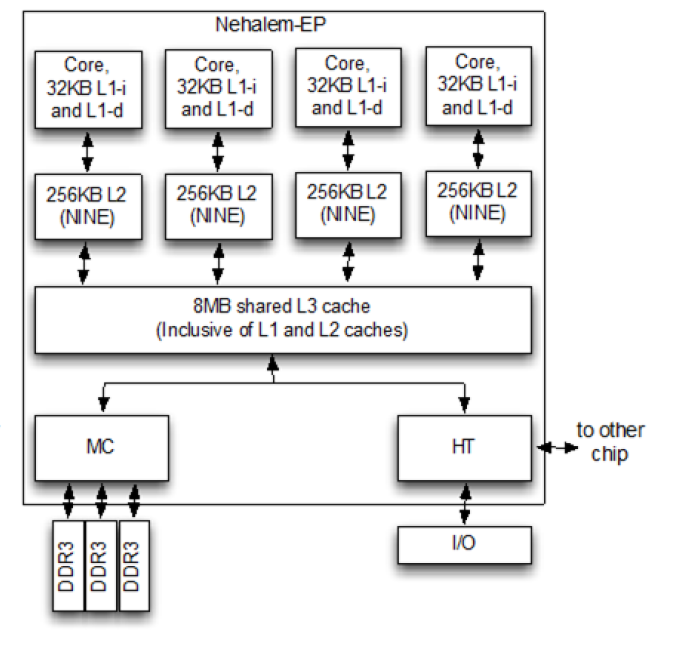
The cache hierarchy of the 2008 Intel Nehalem x86 microarchitecture. (Source: Intel)The cache hierarchy of the 2008 Intel Nehalem x86 microarchitecture. (Source: Intel)
There’s a big difference between having a conceptual picture of how one’s code interacts with the hardware and having an in-depth understanding. While the basic concept of more lines of code (LoC) translating into more RAM, CPU, and disk resources used is technically true much of the time, the real challenge lies in understanding how individual CPU cores are scheduled by the OS, how core cache synchronization works, and the impact that the L2 and L3 cache have.

Another major challenge is that of simply moving data around between system RAM, caches and registers, which seems obvious at face value, but the impact of certain decisions can have big implications. For example, passing a pointer to a memory address instead of the entire string, and performing aligned memory accesses instead of unaligned can take more or less time. This latter topic is especially relevant on x86, as this ISA allows unaligned memory access with a major performance penalty, while ARM will hard fault the application at the merest misaligned twitch.

I came across a range of these issues while implementing my remote procedure call library NymphRPC. Initially I used a simple and easy to parse binary message format, but saddled it with a naïve parser implementation that involved massive copying of strings, as this was the zero-planning-needed, smooth-brained, ‘safe’ choice. In hindsight this was a design failure with a major necessary optimization omitted that would require major refactoring later.

In this article I’d like to highlight both the benefits of simple binary formats as well as how simple it is to implement a zero-copy parser that omits copying of message data during parsing, while also avoiding memory alignment issues when message data is requested and copied to a return value.

KISS


Perhaps the biggest advantage of binary message formats is that they’re very simple, very small, and extremely low in calories. In the case of NymphRPC its message format features a standard header, a message-specific body, and a terminator. For a simple NymphRPC message call for example we would see something like:
uint32 Signature: DRGN (0x4452474e)
uint32 Total message bytes following this field.
uint8 Protocol version (0x00).
uint32 Method ID: identifier of the remote function.
uint32 Flags (see _Flags_ section).
uint64 Message ID. Simple incrementing global counter.
<..> Serialised values.
uint8 Message end. None type (0x01).
The very first value is a 32-bit unsigned integer that when interpreted as characters identifies this as a valid NymphRPC message. (‘DRGN’, because dragonfly nymph.) This is followed by another uint32 that contains the number of bytes that follow in the message. We’re now eight bytes in and we already have done basic validation and know what size buffer to allocate.

Serializing the values is done similarly, with an 8-bit type code followed by the byte(s) that contain the value. This is both easy to parse without complex validation like XML or JSON, and about as light-weight as one can make a format without adding something like compression.

Only If Needed


When we receive the message bytes on the network socket, we read it into a buffer. Because the second 32-bit value which we read earlier contained the message size, we can make sure to allocate a buffer that’s large enough to fit the rest of the message’s bytes. The big change with zero-copy parsing commences after this, where the naïve approach is to copy the entire byte buffer into e.g. a std::string for subsequent substring parsing.

Instead of such a blunt method, the byte buffer is parsed in-place with the use of a moving index pointer into the buffer. The two key methods involved with the parsing can be found in [url=https://github.com/MayaPosch/NymphRPC/blob/master/src/nymph_message.cpp]nymph_message.cpp[/url] and [url=https://github.com/MayaPosch/NymphRPC/blob/master/src/nymph_types.cpp]nymph_types.cpp[/url], with the former providing the NymphMessage constructor and the basic message parser. After parsing the header, the NymphType class provides a parseValue() function that takes a value type code, a reference to the byte buffer and the current index. This function is called until the terminating NYMPH_TYPE_NONE is found, or some error occurs.

Looking at parseValue() in more detail, we can see two things of note: the first is that we are absolutely copying certain data despite the ‘zero-copy’ claim, and the liberal use of memcpy() instead of basic assignment statements. The first item is easy to explain: the difference between either copying the memory address or the value of a simple integer/floating point type is so minimal that we trip head-first into the same ‘premature optimization’ thing that Mr. Knuth complained about back in 1974.

Ergo we just copy the value and don’t break our pretty little heads about whether doing the same thing in a more convoluted way would net us a few percent performance improvement or loss. This is different with non-trivial types, such as strings. These are simply a char* pointer into the byte buffer, leaving the string’s bytes in peace and quiet until the application demands either that same character pointer via the API or calls the convenience function that assembles a readily-packaged std::string.

Memcpy Is Love


Although demonizing ‘doing things the C way’ appears to be a popular pastime, if you want to write code that works with the hardware instead of against it, you really want to be able to write some highly performative C code and fully understand it. When I had written the first zero-copy implementation of NymphRPC and had also written up what I thought was a solid article on how well optimized the project now was, I had no idea that I had a “fun” surprise waiting for me.

As I happily tried running the new code on a Raspberry Pi SBC after doing the benchmarking for the article on an x86 system, the first thing it did was give me a hard fault message in the shell along with a strongly disapproving glare from the ARM CPU. As it turns out, doing a direct assignment like this is bound to get you into trouble:
methodId = *((uint32_t*) (binmsg + index));
This line casts the current index into the byte buffer as a uint32_t type before dereferencing it and assigning the value to the variable. When you’re using e.g. std::string the alignment issues sort themselves out somewhere within the depths of the STL, but with direct memory access like this you’re at the mercy of the underlying platform. Which is a shame, because platforms like ARM do not know the word ‘mercy’.

Fortunately this is easy to fix:
memcpy(&methodId, (binmsg + index), 4);
Instead of juggling pointers ourselves, we simply tell memcpy what the target address is, where it should copy from and how many bytes are to be copied. Among all the other complex scenarios that this function has to cope with, doing aligned memory address access for reading and writing is probably among its least complex requirements.

Hindsight


Looking back on the NymphRPC project so far, it’s clear that some necessary optimizations that ought to have been there from the very beginning weren’t there. At least as far as unnecessary and premature optimizations go, I do feel that I have successfully dodged these, but since these days we’re still having annual flamewars about the merits of using goto I very much doubt that we will reach consensus here.

What is clear from the benchmarking that I have done on NymphRPC before and after this major refactoring is that zero-copy makes a massive difference, with especially operations involving larger data (string) chunks becoming multiple times faster, with many milliseconds shaved off and the Callgrind tool of Valgrind no longer listing __memcpy_avx_unaligned_erms as the biggest headache due to std::string abuse.

Perhaps the most important lesson from optimizing a library like NymphRPC is that aside from it being both frustrating and fun, it’s also a humbling experience that makes it clear that even as a purported senior developer there’s always more to learn. Even if putting yourself out there with a new experience like porting a lock-free ring buffer to a language like Ada and getting corrected by others stings a little.

After all, we are here to write performant software that’s easy to maintain and have fun while doing it, with sharing optimization tips and other tricks just being part of the experience.


hackaday.com/2026/01/16/optimi…

Cybersecurity & cyberwarfare ha ricondiviso questo.

The media in this post is not displayed to visitors. To view it, please go to the original post.

Allarme Cisco: falla CVSS 10 consente RCE come root, attacchi in corso

📌 Link all'articolo : redhotcyber.com/post/allarme-c…

#redhotcyber #news #cybersecurity #hacking #vulnerabilita #zeroday #ciscosecurity #secureemail #patch

Cybersecurity & cyberwarfare ha ricondiviso questo.

Data breach at #Canada’s Investment Watchdog Canadian Investment Regulatory Organization impacts 750,000 people
securityaffairs.com/186993/dat…
#securityaffairs #hacking
Cybersecurity & cyberwarfare ha ricondiviso questo.

The media in this post is not displayed to visitors. To view it, please go to the original post.

Cyber guerra fredda: la Cina smantella in silenzio le difese digitali occidentali

📌 Link all'articolo : redhotcyber.com/post/cyber-gue…

#redhotcyber #news #sicurezzanazionale #ciber sicurezza #datipersonali #protezione dati #soluzionicinesi

reshared this

Cybersecurity & cyberwarfare ha ricondiviso questo.

Possiamo prendere ad esempio Asimov e scrivere le Tre Leggi della Parola, per avere una vita più sana in rete?

#SocialDebug, una volta a settimana 🦄

open.substack.com/pub/signorin…

reshared this

Cybersecurity & cyberwarfare ha ricondiviso questo.

The media in this post is not displayed to visitors. To view it, please go to the original post.

Sventato un nuovo SolarWinds! Il bug su AWS CodeBuild non ha permesso un attacco globale

📌 Link all'articolo : redhotcyber.com/post/sventato-…

#redhotcyber #news #cybersecurity #hacking #aws #cloudsecurity #github #vulnerabilita #sicurezzainformatica

WCH CH32M030: Another Microcontroller To Watch Out For


The media in this post is not displayed to visitors. To view it, please log in.

One of the joys of writing for Hackaday comes in following the world of new semiconductor devices, spotting interesting ones while they are still just entries on manufacturer websites, and then waiting for commonly-available dev boards. With Chinese parts there’s always a period in which Chinese manufacturers and nobody else has them, and then they quietly appear on AliExpress.

All of which brings us to the WCH CH32M030, a chip that’s been on the radar for a while and has finally broken cover. It’s the CH32 RISC-V microcontroller you may be familiar with, but with a set of four half-bridge drivers on board for running motors. A handy, cheap, and very smart motor controller, if you will.

There’s been at least one Chinese CH32M030 dev board (Chinese language) online for a while now, but the one listed on AliExpress appears to be a different design. At the time of writing the most popular one is still showing fewer than 20 sales, so we’re getting in at the ground floor here.

We think this chip is of interest because it has the potential to be used in low price robotic projects, replacing as it does a couple of parts or modules in one go. If you use it, we’d like to hear from you!


hackaday.com/2026/01/16/wch-ch…

A PSOne In the Palm of Your Hand


The media in this post is not displayed to visitors. To view it, please log in.

Sony’s original Playstation wasn’t huge, and they did shrink it for re-release later as the PSOne, but even that wasn’t small enough for [Secret Hobbyist]. You may have seen the teaser video a while back where his palm-size Playstation went viral, but now he’s begun a series of videos on how he redesigned the vintage console.

Luckily for [Secret Hobbyist], the late-revision PSOne he started with is only a two-layer PCB, which made reverse engineering the traces a lot easier. Between probing everything under the microscope and cleaning the board off to follow all the traces in copper, [Hobbyist] was able to reproduce the circuit in KiCAD. (Reverse engineering starts at about 1:18 in the vid.)

With a schematic in hand, drafting a smaller PCB than Sony built is made easier by the availability of multi-layer PCBs. In this case [Hobbyist] was able to get away with a four-layer board. He was also able to ditch one of the ICs from the donor mainboard, which he called a “sub-CPU” as its functionality was recreated on the “PSIO” board that’s replacing the original optical drive. The PSIO is a commercial product that has been around for years now, allowing Playstations to run from SD cards– but it’s not meant for the PSOne so just getting it working here is something of a hack. He’s also added on a new DAC for VGA output, but otherwise the silicon is all original SONY.

This is the first of a series about this build, so if you’re into retro consoles you might want to keep an eye on [Secret Hobbyist] on YouTube to learn all the details as they are released.

youtube.com/embed/q0sUCJE2s6A?…


hackaday.com/2026/01/16/a-pson…

The media in this post is not displayed to visitors. To view it, please log in.

Origin-mo: il trucco pigro che ha aperto 40.000 siti WordPress agli hacker


@Informatica (Italy e non Italy 😁)
I ricercatori hanno scoperto una vulnerabilità critica nel plugin Modular DS per WordPress che ha permesso a hacker di compromettere oltre 40.000 siti con un metodo sorprendentemente semplice. La vulnerabilità CVE-2026-23550 Il plugin Modular DS, installato su


Origin-mo: il trucco pigro che ha aperto 40.000 siti WordPress agli hacker


Si parla di:
Toggle


I ricercatori hanno scoperto una vulnerabilità critica nel plugin Modular DS per WordPress che ha permesso a hacker di compromettere oltre 40.000 siti con un metodo sorprendentemente semplice.

La vulnerabilità CVE-2026-23550


Il plugin Modular DS, installato su decine di migliaia di siti WordPress, presentava una falla di privilege escalation classificata con un punteggio CVSS di 10.0, il massimo livello di severità. Questa debolezza, identificata come CVE-2026-23550 e catalogata nel database di Positive Technologies, riguardava le versioni 2.5.1 e 2.5.2 e derivava da una mancanza di autenticazione adeguata nell’endpoint API /apimodular-connector/login. Gli attaccanti potevano inviare una richiesta GET a questo endpoint senza credenziali, sfruttando parametri come login, server-information e manager per elevare i privilegi e ottenere accesso amministrativo completo, inclusi moduli per il login, la gestione del server e i backup.

Patchstack ha rilevato le prime exploitation il 13 gennaio 2026 alle 02:00 UTC, con richieste anomale provenienti da IP come 45.11.89.19 e 185.196.0.11, che puntavano proprio a quell’endpoint vulnerabile. La tecnica non richiedeva payload complessi né exploit zero-day elaborati: bastava una semplice chiamata HTTP per bypassare i controlli e iniettare un account amministratore, permettendo l’esecuzione di comandi arbitrari sul server sottostante.

Il trucco con l’header Origin


Gli hacker hanno affinato l’attacco aggiungendo un header HTTP "Origin: mo.", una stringa apparentemente innocua che il plugin Modular DS interpretava come indicatore di una richiesta legittima proveniente dal dominio “originmo”. Questo header, combinato con la mancanza di validazione sull’API apimodular-connector, convinceva il sistema a trattare la chiamata come interna, eludendo ulteriori verifiche di sicurezza. In pratica, l’attaccante simulava una richiesta dal pannello di controllo del plugin stesso, ottenendo accesso istantaneo a funzionalità sensibili come la gestione dei backup e le informazioni sul server.

Tale approccio, definito il “metodo più pigro” dagli analisti, ha colpito siti vulnerabili in modo massivo perché non necessitava di scansioni personalizzate o tool avanzati: una semplice modifica all’header in una richiesta GET standard era sufficiente per compromettere l’intero ambiente WordPress. Positive Technologies ha dettagliato come questo meccanismo permettesse non solo l’elevazione di privilegi ma anche l’inserimento di backdoor persistenti, con potenziali ramificazioni su database e file system.

Impatto e risposta


L’exploit ha interessato circa 40.000 installazioni attive del plugin, esponendo siti a rischi di defacement, furto dati e ulteriore propagazione di malware tramite i manager di backup integrati. Patchstack ha rilasciato una patch urgente nella versione 2.5.2, che introduce validazioni rigorose sugli header Origin e sull’autenticazione API, bloccando richieste non autorizzate attraverso controlli nonce e verifica IP whitelisting.

Gli amministratori di WordPress devono verificare immediatamente la presenza del plugin Modular DS, aggiornarlo alla versione corretta e monitorare i log di accesso per endpoint sospetti come /apimodular-connector/.

Questa discussione è aperta anche su Feddit in @informatica


Cybersecurity & cyberwarfare ha ricondiviso questo.

#China-linked #APT UAT-9686 abused now patched maximum severity #AsyncOS bug
securityaffairs.com/186985/apt…
#securityaffairs #hacking
Cybersecurity & cyberwarfare ha ricondiviso questo.

The media in this post is not displayed to visitors. To view it, please go to the original post.

The media in this post is not displayed to visitors. To view it, please go to the original post.

Origin-mo: il trucco pigro che ha aperto 40.000 siti WordPress agli hacker
#CyberSecurity
insicurezzadigitale.com/origin…


Origin-mo: il trucco pigro che ha aperto 40.000 siti WordPress agli hacker


Si parla di:
Toggle


I ricercatori hanno scoperto una vulnerabilità critica nel plugin Modular DS per WordPress che ha permesso a hacker di compromettere oltre 40.000 siti con un metodo sorprendentemente semplice.

La vulnerabilità CVE-2026-23550


Il plugin Modular DS, installato su decine di migliaia di siti WordPress, presentava una falla di privilege escalation classificata con un punteggio CVSS di 10.0, il massimo livello di severità. Questa debolezza, identificata come CVE-2026-23550 e catalogata nel database di Positive Technologies, riguardava le versioni 2.5.1 e 2.5.2 e derivava da una mancanza di autenticazione adeguata nell’endpoint API /apimodular-connector/login. Gli attaccanti potevano inviare una richiesta GET a questo endpoint senza credenziali, sfruttando parametri come login, server-information e manager per elevare i privilegi e ottenere accesso amministrativo completo, inclusi moduli per il login, la gestione del server e i backup.

Patchstack ha rilevato le prime exploitation il 13 gennaio 2026 alle 02:00 UTC, con richieste anomale provenienti da IP come 45.11.89.19 e 185.196.0.11, che puntavano proprio a quell’endpoint vulnerabile. La tecnica non richiedeva payload complessi né exploit zero-day elaborati: bastava una semplice chiamata HTTP per bypassare i controlli e iniettare un account amministratore, permettendo l’esecuzione di comandi arbitrari sul server sottostante.

Il trucco con l’header Origin


Gli hacker hanno affinato l’attacco aggiungendo un header HTTP "Origin: mo.", una stringa apparentemente innocua che il plugin Modular DS interpretava come indicatore di una richiesta legittima proveniente dal dominio “originmo”. Questo header, combinato con la mancanza di validazione sull’API apimodular-connector, convinceva il sistema a trattare la chiamata come interna, eludendo ulteriori verifiche di sicurezza. In pratica, l’attaccante simulava una richiesta dal pannello di controllo del plugin stesso, ottenendo accesso istantaneo a funzionalità sensibili come la gestione dei backup e le informazioni sul server.

Tale approccio, definito il “metodo più pigro” dagli analisti, ha colpito siti vulnerabili in modo massivo perché non necessitava di scansioni personalizzate o tool avanzati: una semplice modifica all’header in una richiesta GET standard era sufficiente per compromettere l’intero ambiente WordPress. Positive Technologies ha dettagliato come questo meccanismo permettesse non solo l’elevazione di privilegi ma anche l’inserimento di backdoor persistenti, con potenziali ramificazioni su database e file system.

Impatto e risposta


L’exploit ha interessato circa 40.000 installazioni attive del plugin, esponendo siti a rischi di defacement, furto dati e ulteriore propagazione di malware tramite i manager di backup integrati. Patchstack ha rilasciato una patch urgente nella versione 2.5.2, che introduce validazioni rigorose sugli header Origin e sull’autenticazione API, bloccando richieste non autorizzate attraverso controlli nonce e verifica IP whitelisting.

Gli amministratori di WordPress devono verificare immediatamente la presenza del plugin Modular DS, aggiornarlo alla versione corretta e monitorare i log di accesso per endpoint sospetti come /apimodular-connector/.

Questa discussione è aperta anche su Feddit in @informatica


Cybersecurity & cyberwarfare ha ricondiviso questo.

Diamo il benvenuto nel #fediverso anche al mio blog InsicurezzaDigitale. Ora è un blog federato quindi potete seguirlo anche da qui: @blog

PS: piano piano sto portando tutti i progetti 😂

Cybersecurity & cyberwarfare ha ricondiviso questo.

The media in this post is not displayed to visitors. To view it, please go to the original post.

CORSO NIS2 SENZA SEGRETI: LA FORMAZIONE PER AZIENDE E PROFESSIONISTI FIRMATA RED HOT CYBER!

📌 𝗔𝗰𝗰𝗲𝘀𝘀𝗼 𝗳𝗹𝗲𝘀𝘀𝗶𝗯𝗶𝗹𝗲: corso in e-learning con contenuti sempre disponibili
📌 𝗟𝗶𝘃𝗲𝗹𝗹𝗼: Base
📌 𝗣𝗿𝗲𝗿𝗲𝗾𝘂𝗶𝘀𝗶𝘁𝗶 𝗽𝗲𝗿 𝗶𝗹 𝗰𝗼𝗿𝘀𝗼: conoscenza base della valutazione del rischio
📌 𝗦𝘂𝗽𝗽𝗼𝗿𝘁𝗼 𝗮𝗹 𝗰𝗼𝗿𝘀𝗼: docente disponibile via mail

👉Iscriviti all'Academy per vedere l'anteprima gratuita del corso academy.redhotcyber.com/course…
👉Scrivici ad academy@redhotcyber.com o Whatsapp al 3791638765

#redhotcyber #hacking #cti #ai #online #it #cybercrime #cybersecurity #threat #OnlineCourses #Elearning #DigitalLearning #RemoteCourses #VirtualClasses #CourseOfTheDay #LearnOnline #OnlineTraining #Webinars #academy #corso #formazioneonline #direttivanis #nis2

Cybersecurity & cyberwarfare ha ricondiviso questo.

Google Gemini to power entire Apple ecosystem - My Interview with TRT youtube.com/watch?v=fyJE6542d9… - Apple has announced a multi-year partnership with Google to use the company's AI models. It's all aimed at revamping Siri and projects like Apple Intelligence. Pierluigi Paganini, CEO Cybhorus and Cybersecurity has more
Cybersecurity & cyberwarfare ha ricondiviso questo.

The media in this post is not displayed to visitors. To view it, please go to the original post.

🔴 Benvenuta in Red Hot Cyber Cyber Angels 🔴

🔗 Seguite Daniela:
📌Sul suo profilo LinkedIn : linkedin.com/in/talktodani/
📌Leggendo gli ultimi articoli : redhotcyber.com/rhc/redazione/…

#redhotcyber #rhccyberangels #hacking #benesseredigitale #cti #ai #online #it #cybercrime #cybersecurity

Cybersecurity & cyberwarfare ha ricondiviso questo.

Actively exploited critical flaw in Modular DS #WordPress plugin enables admin takeover
securityaffairs.com/186976/sec…
#securityaffairs #hacking
Cybersecurity & cyberwarfare ha ricondiviso questo.

The media in this post is not displayed to visitors. To view it, please go to the original post.

Allarme Windows: due gravi zero-day nel file system NTFS mettono a rischio milioni di PC

📌 Link all'articolo : redhotcyber.com/post/allarme-w…

#redhotcyber #news #microsoft #windows #sicurezza #cybersecurity #aggiornamentodisicurezza #vulnerabilita

reshared this

LA GUERRA: ALCUNE SUE DEFINIZIONI E CARATTERISTICHE (SECONDA PARTE)

@Informatica (Italy e non Italy 😁)

Scopo primario della guerra è “l’abbattimento dell’avversario, e quindi, l’annientamento delle sue forze armate” che “deve costituire lo scopo principale di tutta l’azione bellica”.
L'articolo LA GUERRA: ALCUNE SUE DEFINIZIONI E CARATTERISTICHE (SECONDA PARTE) proviene da

What Happens When a Bug Rears its Head at Mach Two?


The media in this post is not displayed to visitors. To view it, please log in.

While some may see amateur rocketry as little more than attaching fins to a motor and letting it fly, it is, in fact, rocket science. This fact became very clear to [BPS.space] when a parachute deployed on a rocket traveling at approximately Mach 1.8.

The rocket design is rather simple — essentially just 3D printed fins glued onto a motor with a nose-cone for avionics. A single servo and trim tab provide a modicum of roll control, and a parachute is mounted in the nose along with a homing beacon for faster recovery. Seemingly, the only thing different about this flight is properly validated telemetry and GPS antennae.

After a final ground check of the telemetry and GPS signal quality, everything is ready for what seems like a routine launch. However, somewhere around Mach 1.8, the parachute prematurely deploys, ripping apart the Kevlar rope holding together the three rocket sections. Fortunately, the booster and avionics sections could be recovered from the desert.

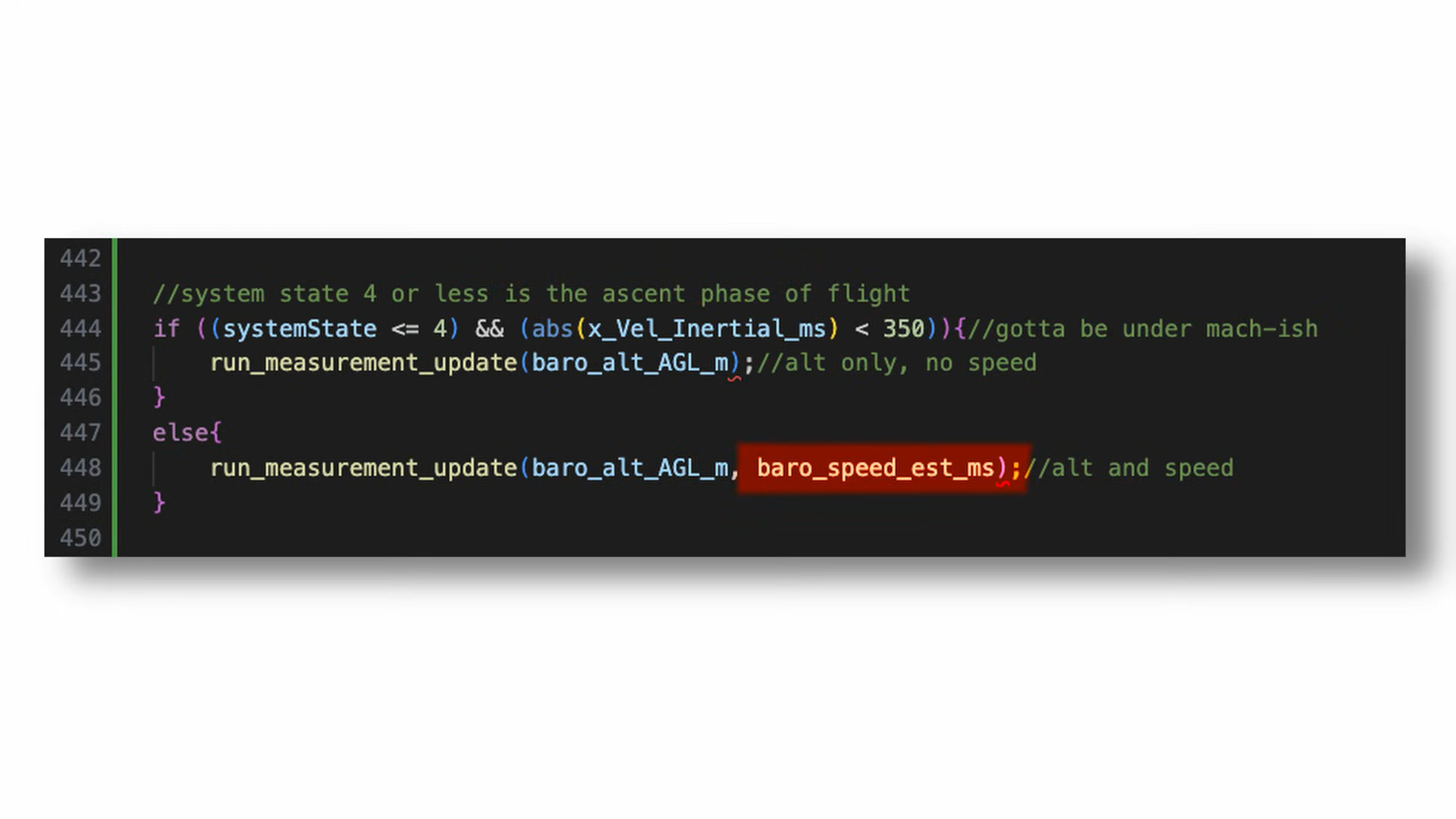
But this begs the question, what could possibly have caused a parachute deployment at nearly twice the speed of sound?[BPS.space] had made a quick untested change to the flight control software, in an attempt to get more accurate speed data. By feeding into the flight controller barometric altitude changes during the decent stage, it should be able to more accurately estimate its position. However, direct static pressure readings at supersonic speeds are not an accurate way of measuring altitude. So, during the boost phase, the speed estimation function should only rely on accelerometer data.
The line in question.
However, a simple mistake in boolean logic resulted in the accelerometer velocity being passed into the velocity estimate function during the boost phase. This gave an erroneous velocity value below zero triggering the parachute deployment. Nevertheless, the test was successful in proving antenna choice resulted in poor telemetry and GPS readings on earlier launches.

If you want to see a far more successful [BPS.space] rocket launch, make sure to check out this self landing rocket next!

youtube.com/embed/JXr4-GoCWsw?…


hackaday.com/2026/01/15/what-h…

Cybersecurity & cyberwarfare ha ricondiviso questo.

The media in this post is not displayed to visitors. To view it, please go to the original post.

🔐 LA CYBERSECURITY NON È UNA LISTA DI TOOL. È UN MINDSET.

“Cyber Offensive Fundamentals” nasce per chi vuole capire prima di fare.

📌 40 ore di formazione LIVE
📌 Percorso strutturato da zero
📌 Laboratori pratici su ambienti reali

Guidati dal Prof. Alessio Lauro, entrerai nella logica offensiva:

perché difendere senza comprendere l’attacco è un’illusione.

🔗 Programma completo: redhotcyber.com/linksSk2L/cybe…
🎥 Introduzione al corso: youtube.com/watch?v=0y4GYsJMoX…

Per info e iscrizioni: 📞 379 163 8765 ✉️ formazione@redhotcyber.com

#redhotcyber #formazione #pentesting #pentest #formazionelive #ethicalhacking #hacking #cybersecurity #penetrationtesting #cti #cybercrime #infosec #corsi #liveclass #hackerhood #pentesting

Cybersecurity & cyberwarfare ha ricondiviso questo.

The media in this post is not displayed to visitors. To view it, please go to the original post.

Trimestre nero per JLR dopo l’incidente informatico: crollo del 43% delle vendite

📌 Link all'articolo : redhotcyber.com/post/trimestre…

#redhotcyber #news #jlr #incidenteinformatico #cybersecurity #hacking #malware #ransomware

Cybersecurity & cyberwarfare ha ricondiviso questo.

The media in this post is not displayed to visitors. To view it, please go to the original post.

199 – Cerchiamo l’anima camisanicalzolari.it/199-cerch…
in reply to Marco Camisani Calzolari

🤖 Tracking strings detected and removed!

🔗 Clean URL(s):
camisanicalzolari.it/199-cerch…

❌ Removed parts:
?utm_source=dlvr.it&utm_medium=mastodon

Cybersecurity & cyberwarfare ha ricondiviso questo.

The media in this post is not displayed to visitors. To view it, please go to the original post.

Gestiva un servizio per “bucare” gli antivirus: arrestato l’Admin di AVCheck

📌 Link all'articolo : redhotcyber.com/post/gestiva-u…

#redhotcyber #news #cybersecurity #hacking #malware #arrestohacker #servizitest #antimalware #fugacriminal

Cybersecurity & cyberwarfare ha ricondiviso questo.

X ha introdotto nuove restrizioni che, in alcune località, impediscono di generare, con il chatbot di intelligenza artificiale Grok, immagini sessualizzate di persone reali a loro insaputa.
wired.com/story/elon-musks-gro…

L'app autonoma di Grok continua, tuttavia, a permettere la rimozione digitale degli indumenti.
washingtonpost.com/technology/…

Cybersecurity & cyberwarfare ha ricondiviso questo.

The media in this post is not displayed to visitors. To view it, please go to the original post.

Scoperto VoidLink: il “super malware” per Linux che prende di mira cloud e container

📌 Link all'articolo : redhotcyber.com/post/scoperto-…

#redhotcyber #news #cybersecurity #hacking #malware #linux #sicurezzainformatica #voidlink

reshared this

Cybersecurity & cyberwarfare ha ricondiviso questo.

The media in this post is not displayed to visitors. To view it, please go to the original post.

Addio a Windows Server 2008! Microsoft termina definitivamente il supporto

📌 Link all'articolo : redhotcyber.com/post/addio-a-w…

#redhotcyber #news #windowsserver2008 #supportoterminato #microsoft #windowsvista

Is the Theory of Special Relativity Wrong?


The media in this post is not displayed to visitors. To view it, please log in.

A red-and-blue image of a nebula is shown, shaped somewhat like an eye, with a plume of gas emitting from the center.

There’s an adage coined by [Ian Betteridge] that any headline ending in a question mark can be answered by the word “No”. However, Lorentz invariance – the theory that the same rules of physics apply in the same way in all frames of reference, and an essential component of special relativity – has been questioned for some time by researchers trying to unify general relativity and quantum field theory into a theory of quantum gravity. Many theories of quantum gravity break Lorentz invariance by giving photons with different energy levels very slightly different speeds of light – a prediction which now looks less likely since researchers recently analyzed gamma ray data from pulsed astronomical sources, and found no evidence of speed variation (open-access paper).

The researchers specifically looked for the invariance violations predicted by the Standard-Model Extension (SME), an effective field theory that unifies special relativity with the Standard Model. The variations in light speed which it predicts are too small to measure directly, so instead, the researchers analyzed gamma ray flare data collected from pulsars, active galactic nuclei, and gamma-ray bursts (only sources that emitted gamma rays in simultaneous pulses could be used). Over such great distances as these photons had traveled, even slight differences in speed between photons with different energy levels should have added up to a detectable delay between photons, but none was found.

This work doesn’t disprove the SME, but it does place stricter bounds on the Lorentz invariance violations it allows, about one and a half orders of magnitude stricter than those previously found. This study also provides a method for new experimental data to be more easily integrated into the SME. Fair warning to anyone reading the paper: the authors call their work “straightforward,” from which we can only conclude that the word takes on a new meaning after a few years studying mathematics.

If you want to catch up on relativity and Lorentz invariance, check out this quick refresher, or this somewhat mind-bending explanation. For an amateur, it’s easier to prove general relativity than special relativity.


Top image: Crab Pulsar, one of the gamma ray sources analysed. (Credit: J. Hester et al., NASA/HST/ASU/J)


hackaday.com/2026/01/15/is-the…

Project Fail: Cracking a Laptop BIOS Password Using AI


The media in this post is not displayed to visitors. To view it, please log in.

Whenever you buy used computers there is a risk that they come with unpleasant surprises that are not of the insect variant. From Apple hardware that is iCloud-locked with the original owner MIA to PCs that have BIOS passwords, some of these are more severe than others. In the case of BIOS passwords, these tend to be more of an annoyance that’s easily fixed by clearing the CMOS memory, but this isn’t always the case as [Casey Bralla] found with a former student-issued HP ProBook laptop purchased off Facebook Marketplace.

Maybe it’s because HP figured that locking down access to the BIOS is essential on systems that find their way into the hands of bored and enterprising students, but these laptops write the encrypted password and associated settings to a separate Flash memory. Although a master key purportedly exists, HP’s policy here is to replace the system board. Further, while there are some recovery options that do not involve reflashing this Flash memory, they require answers to recovery questions.

This led [Casey] to try brute-force cracking, starting with a Rust-based project on GitHub that promised much but failed to even build. Undeterred, he tasked the Claude AI to write a Python script to do the brute-forcing via the Windows-based HP BIOS utility. The chatbot was also asked to generate multiple lists of unique passwords to try that might be candidates based on some human guesses.

Six months later of near-continuous attempts at nine seconds per try, this method failed to produce a hit, but at least the laptop can still be used, just without BIOS access. This may require [Casey] to work up the courage to do some hardware hacking and erase that pesky UEFI BIOS administrator password, proving at least that apparently it’s fairly good BIOS security.


hackaday.com/2026/01/15/projec…

Cybersecurity & cyberwarfare ha ricondiviso questo.

Qualche idea per sopravvivere al divorzio transatlantico. Conversazione con Giuliano Da Empoli

“quelli che chiamo predatori digitali e predatori politici, i proprietari delle grandi aziende digitali, sostengono esplicitamente i movimenti nazionalisti, perché si sono resi conto di poterli sfruttare per smantellare le democrazie liberali: su quello che viene dopo, sul futuro, non c’è convergenza, ma intanto si distrugge insieme, e con più efficacia”

foglioeuropeo.ilfoglio.it/qual…

@politica

Building an Escape Room Lockbox with the ESP32 Cheap Yellow Display (CYD)


The media in this post is not displayed to visitors. To view it, please log in.

A hand operating a numeric touch pad

Here’s something fun from [Chad Kapper] over on HackMakeMod: Escape Room Lockbox with the Cheap Yellow Display.

You may have heard of the “cheap yellow display” (CYD), so-called due to the board’s typical color. It’s a dodgy cheapo board with, among other things, TFT display, touchscreen, and ESP32 built-in. You can learn more about the CYD over here: Getting Started with ESP32 Cheap Yellow Display Board – CYD (ESP32-2432S028R).

In this build eight AA batteries are used to deliver 12 volts to operate a solenoid controlling a latch and 5 volts for the microcontroller. The encasing is clear in order to entice players in an escape-room style sitting. The custom software is included down the bottom of the project page and it is also available from arduino.cc, if that’s your bag.

Of course we’ve done plenty of other ESP32 TFT projects before, such as Piko – Your ESP32 Powered Fitness Buddy and ESP32 Brings New Features To Classic Geiger Circuit.


hackaday.com/2026/01/15/buildi…

Cybersecurity & cyberwarfare ha ricondiviso questo.

A #ransomware attack disrupted operations at South Korean conglomerate #Kyowon
securityaffairs.com/186964/dat…
#securityaffairs #hacking

Building a Carousel Autosampler


The media in this post is not displayed to visitors. To view it, please log in.

A common task in a laboratory setting is that of sampling, where a bit of e.g. liquid has to be sampled from a series of containers. Doing this by hand is possible, but tedious, ergo an autosampler can save a lot of time and tedium. Being not incredibly complex devices that have a lot in common with e.g. FDM 3D printers and CNC machines, it makes perfect sense to build one yourself, as [Markus Bindhammer] of Marb’s Lab on YouTube has done.

The specific design that [Markus] went for uses a sample carousel that can hold up to 30 bottles of 20 mL each. An ATmega-based board forms the brain of the machine, which can operate either independently or be controlled via I2C or serial. The axes and carousel are controlled by three stepper motors, each of which is driven by a TB6600 microstep driver.

Why this design is a time saver should be apparent, as you can load the carousel with bottles and have the autosampler handle the work over the course of however long the entire process takes instead of tying up a human. Initially the autosampler will be used for the synthesis of cadmium-selenium quantum dots, before it will be put to work for an HPLC/spectrometer project.

Although [Markus] intends this to be an open hardware and software project, it will take a bit longer to get all the files and documentation organized. Until then we will have to keep manually sampling, or use the video as the construction tutorial.

youtube.com/embed/9yzY5WbTRmg?…


hackaday.com/2026/01/15/buildi…

The Random Laser


The media in this post is not displayed to visitors. To view it, please log in.

When we first heard the term “random laser,” we did a double-take. After all, most ordinary sources of light are random. One defining characteristic of a traditional laser is that it emits coherent light. By coherent, in this context, that usually includes temporal coherence and spatial coherence. It is anything but random. It turns out, though, that random laser is a bit of a misnomer. The random part of the name refers to how the device generates the laser emission. It is true that random lasers may produce output that is not coherent over long time scales or between different emission points, but individually, the outputs are coherent. In other words, locally coherent, but not always globally so.

That is to say that a random laser might emit light from four different areas for a few brief moments. A particular emission will be coherent. But not all the areas may be coherent with respect to each other. The same thing happens over time. The output now may not be coherent with the output in a few seconds.

Baseline


A conventional laser works by forming a mirrored cavity, including a mirror that is only partially reflective. Pumping energy into the gain medium — the gas, semiconductor, or whatever — produces more photons that further stimulate emission. Only cavity modes that satisfy the design resonance conditions and experience gain persist, allowing them to escape through the partially reflecting mirror.

The laser generates many photons, but the cavity and gain medium favor only a narrow set of modes. This results in a beam that is of a very narrow band of frequencies, and the photons are highly collimated. Sure, they can spread over a long distance, but they don’t spread out in all directions like an ordinary light source.

So, How does a Random Laser Work?


Random lasers also depend on gain, but they have no mirrors. Instead, the gain medium is within or contains some material that highly scatters photons. For example, rough crystals or nanoparticles may act as scattering media to form random lasers.

The scattering has photons bounce around at random. Some of the photons will follow long paths, and if the gain exceeds the losses along those paths, laser emission occurs. Incoherent random lasers that use powder (to scatter) or a dye (as gain medium) tend to have broadband output. However, coherent random lasers produce sharp spectral lines much like a conventional laser. They are, though, more difficult to design and control.

Random lasers are relatively new, but they are very simple to construct. Since the whole thing depends on randomness, defects are rarely fatal. The downside is that it is difficult to predict exactly what they will emit.

There are some practical use cases, including speckle-free illumination or creating light sources with specific fingerprints for identification.

It’s Alive!


Biological tissue often can provide scattering for random lasers. Researchers have used peacock feathers, for example. Attempts to make cells emit laser light are often motivated by their use as cellular tags or to monitor changes in the laser light to infer changes in the cell itself.

The video below isn’t clearly using a random laser, but it gives a good overview of why researchers want your cells to emit laser light.

youtube.com/embed/SHbXDlnLIYA?…

You may be thinking: “Isn’t this just amplified spontaneous emission?” While random lasers can resemble amplified spontaneous emission (ASE), true random lasing exhibits a distinct turn-on threshold and, in some cases, well-defined spectral modes. ASE will exhibit a smooth increase in output as the pump energy increases. A random laser will look like ASE until you reach a threshold pump energy. Then a sharp rise will occur as the laser modes suddenly dominate.

We glossed over a lot about conventional lasers, population inversion, and related topics. If you want to know more, we can help.


hackaday.com/2026/01/15/the-ra…

AC Motor Converted into DC eBike Powerplant


The media in this post is not displayed to visitors. To view it, please log in.

AC induction motors are everywhere, from ceiling fans to vehicles. They’re reliable, simple, and rugged — but there are some disadvantages. It’s difficult to control the speed without complex electronics, and precisely placing the shaft at a given angle is next to impossible. But the core of these common induction machines can be modified and rewired into brushless DC (BLDC) motors, provided you have a few tools on hand as [Austin] demonstrates.

To convert an AC induction motor to a brushless DC electric motor (BLDC), the stator needs to be completely rewired. It also needs a number of poles proportional to the number of phases of the BLDC controller, and in this case the 24-pole motor could accommodate the three phases. [Austin] removed the original stator windings and hand-wound his own in a 16-pole configuration. The rotor needs modification as well, so he turned the rotor on a lathe and then added a set of permanent magnets secured to the rotor with JB Weld. From there it just needs some hall effect sensors, a motor controller and power to get spinning.

At this point the motor could be used for anything a BLDC motor would be used. For this project, [Austin] is putting it on a bicycle. A 3D printed pulley mounts to the fixed gear on the rear wheel, and a motor controller, battery, and some tensioners are all that is left to get this bike under power. His tests show it comfortably drawing around 1.3 kW so you may want to limit this if you’re in Europe but other than that it works extremely well and reminds us of one of our favorite ebike conversions based on a washing machine motor instead of a drill press.

youtube.com/embed/Sxq1ncduPvw?…


hackaday.com/2026/01/15/ac-mot…

ISS Medical Emergency: An Orbital Ambulance Ride


The media in this post is not displayed to visitors. To view it, please log in.

Over the course of its nearly 30 years in orbit, the International Space Station has played host to more “firsts” than can possibly be counted. When you’re zipping around Earth at five miles per second, even the most mundane of events takes on a novel element. Arguably, that’s the point of a crewed orbital research complex in the first place — to study how humans can live and work in an environment that’s so unimaginably hostile that something as simple as eating lunch requires special equipment and training.

Today marks another unique milestone for the ISS program, albeit a bittersweet one. Just a few hours ago, NASA successfully completed the first medical evacuation from the Station, cutting the Crew-11 mission short by at least a month. By the time this article is released, the patient will be back on terra firma and having their condition assessed in California. This leaves just three crew members on the ISS until NASA’s Crew-12 mission can launch in early February, though it’s possible that mission’s timeline will be moved up.

What We Know (And Don’t)


To respect the privacy of the individual involved, NASA has been very careful not to identify which member of the multi-nation Crew-11 mission is ill. All of the communications from the space agency have used vague language when discussing the specifics of the situation, and unless something gets leaked to the press, there’s an excellent chance that we’ll never really know what happened on the Station. But we can at least piece some of the facts together.
Crew-11: Oleg Platonov, Mike Fincke, Kimiya Yui, and Zena Cardman
On January 7th, Kimiya Yui of Japan was heard over the Station’s live audio feed requesting a private medical conference (PMC) with flight surgeons before the conversation switched over to a secure channel. At the time this was not considered particularly interesting, as PMCs are not uncommon and in the past have never involved anything serious. Life aboard the Station means documenting everything, so a PMC could be called to report a routine ailment that we wouldn’t give a second thought to here on Earth.

But when NASA later announced that the extravehicular activity (EVA) scheduled for the next day was being postponed due to a “medical concern”, the press started taking notice. Unlike what we see in the movies, conducting an EVA is a bit more complex than just opening a hatch. There are many hours of preparation, tests, and strenuous work before astronauts actually leave the confines of the Station, so the idea that a previously undetected medical issue could come to light during this process makes sense. That said, Kimiya Yui was not scheduled to take part in the EVA, which was part of a long-term project of upgrading the Station’s aging solar arrays. Adding to the mystery, a representative for Japan’s Aerospace Exploration Agency (JAXA) told Kyodo News that Yui “has no health issues.”

This has lead to speculation from armchair mission controllers that Yui could have requested to speak to the flight surgeons on behalf of one of the crew members that was preparing for the EVA — namely station commander Mike Fincke and flight engineer Zena Cardman — who may have been unable or unwilling to do so themselves.

Within 24 hours of postponing the EVA, NASA held a press conference and announced Crew-11 would be coming home ahead of schedule as teams “monitor a medical concern with a crew member”. The timing here is particularly noteworthy; the fact that such a monumental decision was made so quickly would seem to indicate the issue was serious, and yet the crew ultimately didn’t return to Earth for another week.

Work Left Unfinished


While the reusable rockets and spacecraft of SpaceX have made crew changes on the ISS faster and cheaper than they were during the Shuttle era, we’re still not at the point where NASA can simply hail a Dragon like they’re calling for an orbital taxi. Sending up a new vehicle to pickup the ailing astronaut, while not impossible, would have been expensive and disruptive as one of the Dragon capsules in rotation would have had to be pulled from whatever mission it was assigned to.

So unfortunately, bringing one crew member home means everyone who rode up to the Station with them needs to leave as well. Given that each astronaut has a full schedule of experiments and maintenance tasks they are to work on while in orbit, one of them being out of commission represents a considerable hit to the Station’s operations. Losing all four of them at once is a big deal.

Granted, not everything the astronauts were scheduled to do is that critical. Tasks range form literal grade-school science projects performed as public outreach to long-term medical evaluations — some of the unfinished work will be important enough to get reassigned to another astronaut, while some tasks will likely be dropped altogether.
Work to install the Roll Out Solar Arrays (ROSAs) atop the Stations original solar panels started in 2021.
But the EVA that Crew-11 didn’t complete represents a fairly serious issue. The astronauts were set to do preparatory work on the outside of the Station to support the installation of upgraded roll-out solar panels during an EVA scheduled for the incoming Crew-12 to complete later on this year. It’s currently unclear if Crew-12 received the necessary training to complete this work, but even if they have, mission planners will now have to fit an unforeseen extra EVA into what’s already a packed schedule.

What Could Have Been


Having to bring the entirety of Crew-11 back because of what would appear to be a non-life-threatening medical situation with one individual not only represents a considerable logistical and monetary loss to the overall ISS program in the immediate sense, but will trigger a domino effect that delays future work. It was a difficult decision to make, but what if it didn’t have to be that way?
The X-38 CRV prototype during a test flight in 1999.
In other timeline, the ISS would have featured a dedicated “lifeboat” known as the Crew Return Vehicle (CRV). A sick or injured crew member could use the CRV to return to Earth, leaving the spacecraft they arrived in available for the remaining crew members. Such a capability was always intended to be part of the ISS design, with initial conceptual work for the CRV dating back to the early 1990s, back when the project was still called Space Station Freedom. Indeed, the idea that the ISS has been in continuous service since 2000 without such a failsafe in place is remarkable.

Unfortunately, despite a number of proposals for a CRV, none ever made it past the prototype stage. In practice, it’s a considerable engineering challenge. A space lifeboat needs to be cheap, since if everything goes according to plan, you’ll never actually use the thing. But at the same time, it must be reliable enough that it could remain attached to the Station for years and still be ready to go at a moment’s notice.

In practice, it was much easier to simply make sure there are never more crew members on the Station than there are seats in returning spacecraft. It does mean that there’s no backup ride to Earth in the event that one of the visiting vehicles suffers some sort of failure, but as we saw during the troubled test flight of Boeing’s CST-100 in 2024, even this issue can be resolved by modifications to the crew rotation schedule.

No Such Thing as Bad Data


Everything that happens aboard the International Space Station represents an opportunity to learn something new, and this is no different. When the dust settles, you can be sure NASA will commission a report to dives into every aspect of this event and tries to determine what the agency could have done better. While the ISS itself may not be around for much longer, the information can be applied to future commercial space stations or other long-duration missions.

Was ending the Crew-11 mission the right call? Will the loses and disruptions triggered by its early termination end up being substantial enough that NASA rethinks the CRV concept for future missions? There are many questions that will need answers before it’s all said and done, and we’re eager to see what lessons NASA takes away from today.


hackaday.com/2026/01/15/iss-me…

Sfiduciati


The media in this post is not displayed to visitors. To view it, please log in.

I social sono un pericolo per la democrazia. Sono numerosi i saggi che argomentano questo aspetto distruttivo della comunicazione paritaria online che si afferma nelle logiche algoritmiche di Facebook, Tik Tok, Truth, eccetera. I social media sono spesso fonte e canale di propaganda e disinformazione.

Purtroppo la maggior parte delle persone non sa distinguere tra notizie vere e notizie false e le notizie false sono più virali di quelle vere. E questo è il danno principale che fanno alla democrazia.

Giovanni Boccia Artieri lo sintetizza bene nel suo ultimo libro, “Sfiduciati. Democrazia e disordine comunicativo nella società aperta” appena pubblicato da Feltrinelli, provando a dare qualche rimedio.
“I social media favoriscono ciò che funziona: e ciò che funziona polarizza, semplifica, infiamma. La democrazia ha bisogno di ascolto, mediazione, argomentazione. E se il conflitto algoritmico si consuma in millisecondi, il dissenso democratico richiede tempo”, ma è necessario.

La riflessione del professore di sociologia, prorettore dell’Università degli Studi di Urbino, già autore di diversi saggi sul tema è ovviamente molto più ampia.
Nel libro sostiene infatti che l’agorà pubblica negli ultimi anni è stata inquinata soprattutto da tre fenomeni. Il primo è l’ingresso nell’era della post-verità. In questa fase della comunicazione infatti non è tanto importante la verità e neanche la validità la coerenza e l’utilità con cui si comunicano concetti semplici e complessi ma il modo in cui le persone vi reagiscono. Chi sa gestire quelle reazioni può farci credere a ciò che vero non è. Il secondo fenomeno è la piattaformizzazione di Internet. Secondo questa famosa teorizzazione di Van Dijck e Poell, le piattaforme che connettono gli individui tra di loro permettendogli di fruire e consumare servizi non offerti dagli Stati, creano strutture sociali disomogenee producendo valori
con un potenziale rischio etico. Il terzo fenomeno è la fringe democracy, cioè l’annullamento del confine tra cio che è legittimo e cio che non lo è, insieme al livellamento delle opinioni sempre più autoreferenziali.

Queste tre dinamiche creano la società esposta, un ambiente in cui la comunicazione e la sfera pubblica, attraversate dalla sfiducia, sono diventate vulnerabili.


dicorinto.it/articoli/recensio…