The Privacy Post ha ricondiviso questo.

The media in this post is not displayed to visitors. To view it, please go to the original post.

Il Cybercriminale IntelBroker vende accessi compromessi di colossi aziendali: dati sensibili a rischio
poliverso.org/display/0477a01e…
Il Cybercriminale IntelBroker vende accessi compromessi di colossi aziendali: dati sensibili a rischio redhotcyber.com/post/chi-e-int… colpisce ancora, ha annunciato la vendita di accesso non autorizzato di due importanti aziende americane, ciascuna


Il Cybercriminale IntelBroker vende accessi compromessi di colossi aziendali: dati sensibili a rischio

IntelBroker colpisce ancora, ha annunciato la vendita di accesso non autorizzato di due importanti aziende americane, ciascuna con entrate arrivano a centinaia di miliardi. Questo annuncio è stato reso pubblico attraverso un post su un forum del dark web, BreachForums, noto per la vendita di dati illeciti e servizi di hacking.

Il threat actor è in grado di ottenere e offrire accessi a sistemi di alto profilo, rendendolo una minaccia per le aziende, utilizza inoltre tattiche di doppia estorsione, minacciando di divulgare pubblicamente i dati rubati.

Dettagli Vendita


Secondo IntelBroker, l’accesso offerto include una vasta gamma di sistemi e risorse sensibili, tra cui:

  • Bitbucket
  • AWS S3 (Amazon Simple Storage Service)
  • AWS Cognito
  • SSH (Secure Shell)
  • Chiavi di Firma Software
  • Certificati
  • API AWS


Immagine del post rinvenuta nel Dark Web

Inoltre, il venditore afferma di aver già estratto una quantità significativa di informazioni preziose da queste aziende e nel caso dovesse perdere l’accesso ai sistemi compromessi o non riuscire a vendere le credenziali, ha minacciato di rendere pubbliche informazioni riservate delle due aziende coinvolte.
Questa strategia di “doppia estorsione” comporta la divulgazione di dati sensibili e dettagli sui sistemi aziendali compromessi su forum pubblici o del dark web. Una tale azione potrebbe causare gravi danni reputazionali e finanziari alle aziende coinvolte, mettendo a rischio la fiducia dei clienti e degli investitori. Inoltre, la pubblicazione dei dati potrebbe facilitare ulteriori attacchi da parte di altri threat actor, aumentando così il rischio e i danni potenziali per le aziende stesse. Questa minaccia è utilizzata come leva per esercitare pressione sulle aziende compromesse e sui potenziali acquirenti, al fine di massimizzare il profitto per il cybercriminale.

IntelBroker ha specificato che le transazioni saranno effettuate esclusivamente tramite Monero (XMR), una criptovaluta nota per le sue caratteristiche di privacy. Inoltre, solo gli utenti con reputazioni e ranghi consolidati all’interno della comunità BreachForums saranno considerati per l’acquisto dell’accesso.

Portata Finanziaria


Le aziende coinvolte sono leader nei rispettivi settori, con entrate significative che ne fanno obiettivi di alto profilo:

  • Azienda 1: Con un’entrata di 120 miliardi di dollari.
  • Azienda 2: Ancora più grande, con entrate che raggiungono i 140 miliardi di dollari.

Queste cifre sottolineano la gravità della violazione, poiché le aziende di tali dimensioni possiedono dati e risorse critiche che sono essenziali per le loro operazioni quotidiane. Una compromissione di questa portata non solo minaccia la loro sicurezza interna, ma ha anche il potenziale di destabilizzare le relazioni con clienti, fornitori e investitori.

Le implicazioni economiche della violazione sono significative. La divulgazione di dati sensibili potrebbe compromettere la fiducia degli investitori e dei partner commerciali, con effetti negativi sul valore azionario e sulla reputazione dell’azienda. Inoltre, le aziende coinvolte potrebbero affrontare elevati costi per il recupero dei dati, la protezione dei sistemi e la gestione delle crisi. Le sanzioni legali e regolamentari rappresentano un ulteriore rischio, con multe potenzialmente onerose per la mancata protezione delle informazioni. Infine, una violazione di tale portata potrebbe influenzare l’intero settore, spingendo concorrenti e partner a rivedere le loro politiche di sicurezza e le relazioni contrattuali.

L’ampiezza dell’accesso offerto solleva preoccupazioni critiche, tra cui:

  1. Integrità dei Dati: L’accesso a Bitbucket e a AWS S3 potrebbe compromettere i dati e i codici sorgente, influenzando i processi di sviluppo software e l’infrastruttura cloud.
  2. Autenticazione e Sicurezza: L’accesso a software e certificati potrebbe compromettere la validità delle applicazioni e delle comunicazioni aziendali.
  3. Interruzione Operativa: L’accesso a AWS Cognito e API AWS potrebbe consentire significative interruzioni delle attività operative e della continuità dei servizi.


Conclusione


Questo annuncio ha evidenziato l’urgenza di rafforzare le misure di cybersicurezza all’interno delle grandi aziende e ha sottolineato la necessità di monitorare proattivamente i forum del dark web per prevenire “sfruttamenti”. È fondamentale che le aziende coinvolte valutino l’impatto potenziale e adottino azioni immediate per mitigare i rischi associati all’accesso compromesso.

La vendita degli accessi da parte di IntelBroker rappresenta una minaccia significativa, le organizzazioni devono rimanere vigili e proattive nel rispondere rapidamente per proteggere i loro beni critici e mantenere l’integrità operativa.

L'articolo Il Cybercriminale IntelBroker vende accessi compromessi di colossi aziendali: dati sensibili a rischio proviene da il blog della sicurezza informatica.


The Privacy Post reshared this.

The Privacy Post ha ricondiviso questo.

2 giorni senza riscaldamento per colpa del malware FrostyGoop. E’ successo a Leopoli in Ucraina a Gennaio
poliverso.org/display/0477a01e…
2 giorni senza riscaldamento per colpa del malware FrostyGoop. E’ successo a Leopoli in Ucraina a Gennaio Tutto questo per chi conosce la storia della cybersecurity fa venire in mente redhotcyber.com/post/industroy…, già ampiamente trattato, che lasciò la capitale


2 giorni senza riscaldamento per colpa del malware FrostyGoop. E’ successo a Leopoli in Ucraina a Gennaio

Tutto questo per chi conosce la storia della cybersecurity fa venire in mente Industroyer, già ampiamente trattato, che lasciò la capitale dell’Ucraina KIEV per due ore senza elettricità, ma sembra che in questo caso sia andato molto peggio.

A gennaio, l’Ucraina ha dovuto affrontare un attacco informatico che ha lasciato i residenti di Leopoli senza riscaldamento per 2 giorni. Gli aggressori hanno utilizzato il malware FrostyGoop, precedentemente sconosciuto, mirato ai sistemi ICS. In un nuovo rapporto gli esperti di Dragos hanno descritto il funzionamento del malware.

FrostyGoop è stato il primo virus a utilizzare direttamente il protocollo Modbus TCP per sabotare le reti OT (Operational Technology). Il virus è stato identificato per la prima volta dall’azienda nell’aprile 2024. FrostyGoop è scritto in Golang e può interagire direttamente con i sistemi ICS tramite Modbus TCP sulla porta 502. Il virus prende di mira principalmente i sistemi Windows e utilizza controller ENCO con accesso aperto alla porta 502 su Internet.

Il software dannoso è in grado di leggere e scrivere dati su dispositivi ICS, gestire registri contenenti dati di input e output, nonché informazioni di configurazione. FrostyGoop utilizza file di configurazione JSON per impostare indirizzi IP di destinazione e comandi Modbus e scrive i risultati sulla console e/o su un file JSON.

L’attacco informatico era mirato a un’azienda municipale che fornisce il riscaldamento centralizzato in più di 600 condomini a Leopoli. Il malware FrostyGoop ha modificato i valori sui termoregolatori, provocando l’erogazione di acqua fredda anziché calda. I residenti della città sono rimasti senza riscaldamento e acqua calda per quasi 48 ore.

Gli aggressori hanno inviato comandi Modbus ai controllori ENCO, che hanno causato misurazioni errate e guasti al sistema. Ci sono voluti quasi 2 giorni per eliminare le conseguenze dell’attacco. L’accesso iniziale ai sistemi è stato probabilmente ottenuto attraverso una vulnerabilità nei router Mikrotik nell’aprile 2023.

Nonostante l’uso diffuso del protocollo Modbus per le comunicazioni client-server, FrostyGoop non è l’unico esempio di tale software. Nel 2022, Dragos e Mandiant hanno introdotto un altro malware ICS chiamato PIPEDREAM (INCONTROLLER), che utilizzava vari protocolli di rete industriale per interagire con i sistemi.

I ricercatori hanno evidenziato che l’uso mirato di Modbus TCP sulla porta 502 e la capacità di comunicare direttamente con vari dispositivi ICS rappresentano una seria minaccia per le infrastrutture critiche in vari settori. Le organizzazioni dovrebbero dare priorità all’implementazione di sistemi completi di sicurezza informatica per proteggere le infrastrutture critiche da minacce simili in futuro.

L'articolo 2 giorni senza riscaldamento per colpa del malware FrostyGoop. E’ successo a Leopoli in Ucraina a Gennaio proviene da il blog della sicurezza informatica.


The Privacy Post reshared this.

The Privacy Post ha ricondiviso questo.

The media in this post is not displayed to visitors. To view it, please go to the original post.

FLOSS Weekly Episode 793: Keeping an Eye on Things with Hilight.io
poliverso.org/display/0477a01e…
FLOSS Weekly Episode 793: Keeping an Eye on Things with Hilight.io This week Jonathan Bennett and Aaron Newcomb x.com/retrohackshack chat with Jay Khatri x.com/theJayKhatri, the co-founder of highlight.io/. That’s a web application monitoring tool that can help you troubleshoot performance problems, find bugs, and improve experiences


FLOSS Weekly Episode 793: Keeping an Eye on Things with Hilight.io

This week Jonathan Bennett and Aaron Newcomb chat with Jay Khatri, the co-founder of Highlight.io. That’s a web application monitoring tool that can help you troubleshoot performance problems, find bugs, and improve experiences for anything that runs in a browser or browser-like environment. Why did they opt to make this tool Open Source? What’s the funding model? And what’s the surprising challenge we tried to help Jay solve, live on the show? Listen to find out!

youtube.com/embed/Grw4rKe3jkA?…

Did you know you can watch the live recording of the show Right on our YouTube Channel? Have someone you’d like us to interview? Let us know, or contact the guest and have them contact us! Take a look at the schedule here.

play.libsyn.com/embed/episode/…

Direct Download in DRM-free MP3.

If you’d rather read along, here’s the transcript for this week’s episode.

Places to follow the FLOSS Weekly Podcast:


The Privacy Post reshared this.

The Privacy Post ha ricondiviso questo.

The media in this post is not displayed to visitors. To view it, please go to the original post.

Questo è il tizio che chiama antisemita l'ONU e le sue agenzie umanitarie. Se proprio non lo volete mandare in galera come meriterebbero tutti i criminali di guerra, almeno mettetelo in condizione di non nuocere e toglietegli l'esercito dalle mani.

reshared this

The Privacy Post ha ricondiviso questo.

New note by cybersecurity
poliverso.org/display/0477a01e…
Croazia, attacco cyber all’aeroporto di Spalato: passeggeri a terra key4biz.it/croazia-attacco-cyb… cyber all’aeroporto di Spalato: il sistema informatico dell’aeroscalo della seconda città croata è andato in tilt, come ha ammesso il vicedirettore della struttura, Pero Bilas. Aggiungendo: “I servizi specializzati stanno lavoran


Croazia, attacco cyber all’aeroporto di Spalato: passeggeri a terra

Attacco cyber all’aeroporto di Spalato: il sistema informatico dell’aeroscalo della seconda città croata è andato in tilt, come ha ammesso il vicedirettore della struttura, Pero Bilas. Aggiungendo: “I servizi specializzati stanno lavorando con intensità per risolvere le conseguenze di quanto è avvenuto”.


The Privacy Post reshared this.

The Privacy Post ha ricondiviso questo.

#FreeSoftware refers to freedom, not price.

It guarantees its users the essential four freedoms: use, understand, share and improve

media.fsfe.org/w/p/9gYSyoEYggs…

reshared this

The Privacy Post ha ricondiviso questo.

The media in this post is not displayed to visitors. To view it, please go to the original post.

Is It Time for Synthetic Diamonds to Shine?
poliverso.org/display/0477a01e…
Is It Time for Synthetic Diamonds to Shine? The process of creating a diamond naturally takes between 1 and 3.3 billion years. Conversely, a lab-grown diamond can now be created in 150 minutes. But despite being an ethical and environmentally-friendly alternative to the real thing, the value of lab-grown diamonds has plummeted in recent years. Manufacturers are doing various things to


Is It Time for Synthetic Diamonds to Shine?

Lab-grown diamonds in 'cake' form -- before they are processed and polished.

The process of creating a diamond naturally takes between 1 and 3.3 billion years. Conversely, a lab-grown diamond can now be created in 150 minutes. But despite being an ethical and environmentally-friendly alternative to the real thing, the value of lab-grown diamonds has plummeted in recent years. Manufacturers are doing various things to battle the stigma and increase their value by being carbon neutral and using recycled metals.

About halfway through is where this article gets really interesting. Swiss jeweler LOEV has partnered with lab growers Ammil to produce a line of Swiss-made jewelry by relying on renewable energy sources. 90% comes from hydroelectric power, and the rest comes from solar and biomass generation. Now, on to the process itself.
A lab-grown diamond 'cake' before the excess carbon is lasered away.You can have your cake and heat it, too.
Growing a diamond starts with a seed — a thin wafer of diamond laser-shaved off of an existing stone, and this is placed in a vacuum chamber and subjected to hydrocarbon gas, high heat (900 to 1200 °C), and pressure.

Then, a microwave beam induces carbon to condense and form a plasma cloud, which crystallizes and forms diamonds. The result is called a ‘cake’ — a couple of diamond blocks. The excess carbon is lasered away, then the cake is processed and polished. This is known as the chemical vapor deposition method (CVD).

There is another method of growing diamonds in a lab, and that’s known as the high-pressure, high-temperature (HPHT) method. Here, a small bit of natural diamond is used to seed a chamber filled with carbon, which is then subjected to high pressure and temperatures. The carbon crystallizes around the seed and grows around a millimeter each day.

As the industry evolves, lab-grown diamonds present a sustainable alternative to natural diamonds. But the consumer is always in charge.

Once you’ve got a stone, what then? Just use 3D printing to help create the ring and setting.


The Privacy Post reshared this.

The Privacy Post ha ricondiviso questo.

The media in this post is not displayed to visitors. To view it, please go to the original post.

Esposti i Dati di 3.379 Medici Spagnoli! Quando la frode mira sull’Obiettivo
poliverso.org/display/0477a01e…
Esposti i Dati di 3.379 Medici Spagnoli! Quando la frode mira sull’Obiettivo Recentemente, un attore di minacce in un forum clandestino Breach Forums ha pubblicato una presunta violazione dei dati. Il post afferma di aver esposto i nomi, i dipartimenti e le email di 3.379 medici spagnoli.Questa informazione è stata condivisa da un utente che si fa


Esposti i Dati di 3.379 Medici Spagnoli! Quando la frode mira sull’Obiettivo

Recentemente, un attore di minacce in un forum clandestino Breach Forums ha pubblicato una presunta violazione dei dati. Il post afferma di aver esposto i nomi, i dipartimenti e le email di 3.379 medici spagnoli.

Questa informazione è stata condivisa da un utente che si fa chiamare “jewwu”. Al momento, non possiamo confermare la veridicità della notizia, poiché non abbiamo avuto accesso all’interno set di dati. Pertanto, questo articolo deve essere considerato come ‘fonte di intelligence’.

Dettagli della presunta violazione


Secondo quanto riportato nel forum, i dati violati includono nomi, reparti, e-mail e altri dettagli personali dei medici. Il post include un esempio di questi dati, mostrando una lista con varie informazioni personali e professionali. Tuttavia, non riporteremo dati sensibili nel testo dell’articolo per proteggere la privacy delle persone coinvolte.

Gli attori di minacce sembrano aver preso di mira un database contenente informazioni sui medici in Spagna. Il post non specifica quale organizzazione sia stata violata, ma le informazioni potrebbero appartenere a un’istituzione sanitaria o a un’organizzazione medica spagnola. Queste organizzazioni operano su scala nazionale e contano migliaia di dipendenti, tra medici, infermieri e personale amministrativo.

Quando la frode diventa On-Target


La recente pubblicazione dei dati di 3.379 medici spagnoli in un forum clandestino evidenzia come la frode informatica stia diventando sempre più mirata e sofisticata. Gli attori di minacce non si limitano più a raccogliere informazioni generiche, ma puntano direttamente a obiettivi specifici con l’intento di massimizzare i loro guadagni illeciti e provocare il massimo danno possibile.

Il furto di dati sensibili di professionisti medici non è casuale. Gli hacker sanno che queste informazioni possono essere estremamente preziose nel mercato nero, sia per finalità di furto d’identità che per la rivendita a terze parti interessate. Le email professionali dei medici, ad esempio, possono essere utilizzate per condurre attacchi di phishing altamente mirati, sfruttando la fiducia dei pazienti e dei colleghi per ottenere ulteriori dati sensibili o per diffondere malware.

Inoltre, i dettagli personali e professionali dei medici possono essere sfruttati per creare profili falsi e credibili, con l’obiettivo di ottenere accesso a risorse finanziarie o a informazioni sanitarie riservate. Questi attacchi non solo mettono a rischio la sicurezza personale dei medici, ma possono anche compromettere la sicurezza dell’intera infrastruttura sanitaria.

L'articolo Esposti i Dati di 3.379 Medici Spagnoli! Quando la frode mira sull’Obiettivo proviene da il blog della sicurezza informatica.


The Privacy Post reshared this.

The Privacy Post ha ricondiviso questo.

The Parliament is looking to increase its role in implementing digital policy, MEPs say
poliverso.org/display/0477a01e…
The Parliament is looking to increase its role in implementing digital policy, MEPs sayThe European Parliament has had a traditionally limited role in implementing the regulations it ratifies, but in the next mandate, some lawmakers are keen to change that when it comes to digital policy.euractiv.com/section/digital/n…


The Parliament is looking to increase its role in implementing digital policy, MEPs say


The European Parliament has had a traditionally limited role in implementing the regulations it ratifies, but in the next mandate, some lawmakers are keen to change that when it comes to digital policy.


euractiv.com/section/digital/n…


The Privacy Post reshared this.

The Privacy Post ha ricondiviso questo.

The media in this post is not displayed to visitors. To view it, please go to the original post.

AAA Cercasi Penetration Test! Anche il crimine informatico è in cerca personale
poliverso.org/display/0477a01e…
AAA Cercasi Penetration Test! Anche il crimine informatico è in cerca personale Anche nel crimine informatico si è sempre alla ricerca di talenti!L’abilità tecnica è una merce preziosa, e gli annunci di lavoro non sono esclusiva delle aziende legittime. Recentemente, sul forum underground XSS, uno dei più noti ritrovi underground per cyber-criminali


AAA Cercasi Penetration Test! Anche il crimine informatico è in cerca personale

Anche nel crimine informatico si è sempre alla ricerca di talenti!

L’abilità tecnica è una merce preziosa, e gli annunci di lavoro non sono esclusiva delle aziende legittime. Recentemente, sul forum underground XSS, uno dei più noti ritrovi underground per cyber-criminali in lingua russa, è apparso un annuncio che ha attirato l’attenzione degli esperti di sicurezza: “Cerchiamo esperti e team di penetrazione dei siti web.”

L’annuncio, dal tono quasi professionale, cerca hacker esperti in penetration testing, invitandoli a crackare database di siti web specificati. Gli obiettivi sono chiari e diretti: ottenere informazioni sensibili dai database compromessi. Le ricompense sono altrettanto chiare, con una forbice di pagamento che varia dai 5.000 ai 100.000 dollari, a seconda della difficoltà e del valore dell’informazione ottenuta.

Una Proposta di Lavoro Molto Particolare


Il testo dell’annuncio è esplicito: “Cerchiamo esperti e team di penetrazione dei siti web. Crackare il database del sito web specificato. Ottenere informazioni dal database. Prezzo: 5k-100k. Il forum garantisce le transazioni e auspica di stabilire rapporti di cooperazione a lungo termine. Abbiamo molti siti web target. Fornisci un nuovo elenco di siti di destinazione per i nuovi membri del team. Registrerò le informazioni dell’account sul sito Web di destinazione e dovrai fornire le mie informazioni per confermare se hai violato il database. Se la verifica non è possibile, non contattarmi. Più le parole chiave sono complete, meglio è. Requisiti di base: nome, sesso, età, numero di telefono.”

Una delle peculiarità di questo annuncio è la garanzia delle transazioni fornita dal forum stesso. In un mondo dove la fiducia è rara, il forum XSS cerca di offrire una sorta di “sicurezza” agli hacker coinvolti, promettendo rapporti di cooperazione a lungo termine e la gestione delle transazioni.

Un Mercato in Crescita


Questa chiamata alle armi evidenzia una realtà sempre più diffusa nelle underground come nelle aziende legittime: la carenza di talenti. Il crimine informatico è ormai un settore organizzato e in espansione, con una domanda crescente di specialisti in grado di violare sistemi di sicurezza. Gli attacchi informatici non sono più soltanto l’opera di singoli individui isolati, ma di team ben coordinati che operano come vere e proprie aziende.

Per le aziende e le organizzazioni di tutto il mondo, questo significa una minaccia in costante evoluzione. La professionalizzazione del crimine informatico richiede difese altrettanto sofisticate. Le strategie di cybersecurity devono adattarsi rapidamente, adottando tecniche avanzate di difesa e continuando a formare personale qualificato.

L'articolo AAA Cercasi Penetration Test! Anche il crimine informatico è in cerca personale proviene da il blog della sicurezza informatica.


The Privacy Post reshared this.

The Privacy Post ha ricondiviso questo.

The media in this post is not displayed to visitors. To view it, please go to the original post.

Tiny Games Challenge: A Retro Racing Game on a 16×2 LCD
poliverso.org/display/0477a01e…
Tiny Games Challenge: A Retro Racing Game on a 16×2 LCD Sometimes, all it takes is a change in perspective to take something boring and make it fun. That’s true about 16×2 LCD; in its usual landscape format, it’s a quick and easy way to provide a character-based display for a project. But flip it 90 degrees and use a little imagination, and it can become a cool retro racing


Tiny Games Challenge: A Retro Racing Game on a 16×2 LCD

Sometimes, all it takes is a change in perspective to take something boring and make it fun. That’s true about 16×2 LCD; in its usual landscape format, it’s a quick and easy way to provide a character-based display for a project. But flip it 90 degrees and use a little imagination, and it can become a cool retro racing game that fits in the palm of your hand.

[arduinocelantano] has made it a habit to press the humble 16×2 character LCD into service in ways it clearly wasn’t intended to support, such as playing Space Invaders and streaming video on it. Both of these projects seem to inform the current work, which was one of the first entries in our current Tiny Games Challenge contest. The racing game requires multiple sprites to animate the roadway and the cars, using six “layers” of eight custom characters and rapidly switching between them to create the appearance of movement. The video below has a brief sample of gameplay.

Flipping the display on its side makes for a somewhat limited game — it’s all straightaway, all the time — but that could probably be fixed. [arduinocelentano] suggests scaling it up to a 16×4 to include curves, but we’d bet you could still simulate curves on the upper part of the game field while leaving the player’s car fixed on a straight section. Higher difficulties could be achieved by moving the curved section closer to the player’s position.

Sure, it’s limited, but that’s half the charm of games like these. If you’ve got an idea for our Tiny Games Challenge, head over to our contest page and let us know about it. We’re keen to see what you come up with.

player.vimeo.com/video/9827378…

2024 Tiny Games Challenge


The Privacy Post reshared this.

The Privacy Post ha ricondiviso questo.

Scopri le Novità di WSL – Interfaccia Grafica, Comandi e Miglioramenti
poliverso.org/display/0477a01e…
Scopri le Novità di WSL – Interfaccia Grafica, Comandi e Miglioramenti Il sottosistema Windows per Linux (WSL) è stato aggiornato github.com/microsoft/WSL2-Linu… alla versione 2.3.11. La novità principale è il passaggio alla versione kernel 6.6.36.3, che completa l’aggiornamento alla versione LTS 6.6. Gli


Scopri le Novità di WSL – Interfaccia Grafica, Comandi e Miglioramenti

Il sottosistema Windows per Linux (WSL) è stato aggiornato alla versione 2.3.11. La novità principale è il passaggio alla versione kernel 6.6.36.3, che completa l’aggiornamento alla versione LTS 6.6. Gli sviluppatori hanno inoltre aggiunto centinaia di nuovi moduli che espandono significativamente la funzionalità del sistema.

Abbiamo prestato attenzione anche all’interfaccia grafica WSL (WSLg), che ora funziona con la versione 1.0.63. Nell’arsenale degli utenti è apparso un nuovo comando wsl –manage –move, nonché una funzione di impostazione WSL.

Tuttavia, vale la pena considerare che la modalità di rete a ponte non è ancora disponibile tramite l’interfaccia grafica e richiede la configurazione tramite riga di comando.

Altre modifiche importanti includono:

  • Microsoft.DXCore.Linux è stato aggiornato alla versione 10.0.26100.1-240331-1435.ge-release.
  • La gamma di port Linux temporanei è stata ampliata.
  • Modalità di routing mirror migliorata per una comunicazione più efficiente tra host Windows e contenitori Linux Docker/Podman.
  • Il sistema di output degli errori quando si utilizza il comando wsl.exe –exec è stato migliorato.
  • Caricamento ottimizzato dei moduli (spostato alle fasi precedenti dell’avvio del sistema).
  • Risolti i problemi con la localizzazione dei file msrdc.exe.
  • Virtio9p è stato temporaneamente disabilitato per risolvere i problemi.
  • Protocollo socket migliorato per il rilevamento tempestivo degli errori.
  • Aggiunto sistema di tracciamento degli errori all’apertura di wslconfig.
  • L’algoritmo di installazione della distribuzione è stato modificato: ora il sistema tenta prima di installarla nella RAM, e solo in caso di insuccesso ricorre al caricamento diretto.

È importante notare che la versione 2.3.11 è attualmente in fase di pre-rilascio.

Si consiglia agli utenti che preferiscono la stabilità di continuare a utilizzare la versione comprovata 2.2.4.

L'articolo Scopri le Novità di WSL – Interfaccia Grafica, Comandi e Miglioramenti proviene da il blog della sicurezza informatica.


The Privacy Post reshared this.

The Privacy Post ha ricondiviso questo.

The media in this post is not displayed to visitors. To view it, please go to the original post.

DK8x35 - Castelli di sabbia
poliverso.org/display/0477a01e…
DK8x35 - Castelli di sabbiaCrowdstrike è solo l'avvisaglia.spreaker.com/episode/dk8x35-ca…api.spreaker.com/download/epis…


DK8x35 - Castelli di sabbia


Crowdstrike è solo l'avvisaglia.


spreaker.com/episode/dk8x35-ca…


The Privacy Post reshared this.

The Privacy Post ha ricondiviso questo.

The media in this post is not displayed to visitors. To view it, please go to the original post.

Hacktivisti a Sostegno delle Rivolte in Bangladesh: Escalation di Violenza e Cyber Attacchi
poliverso.org/display/0477a01e…
Hacktivisti a Sostegno delle Rivolte in Bangladesh: Escalation di Violenza e Cyber Attacchi Autori: Roland Kapidani linkedin.com/in/roland-kapidan… ed Edoardo Faccioli linkedin.com/in/edoardo-faccio… gli eventi di rivolta che hanno caratterizzato i giorni precedenti, molti gruppi


Hacktivisti a Sostegno delle Rivolte in Bangladesh: Escalation di Violenza e Cyber Attacchi

Autori: Roland Kapidani ed Edoardo Faccioli

Dopo gli eventi di rivolta che hanno caratterizzato i giorni precedenti, molti gruppi hacktivisti hanno iniziato a lavorare per difendere e supportare tutte le attività che possano aiutare a ottenere ciò per cui gli studenti lavorano e lottano da tempo.

Le rivolte, come spiegato in precedenza in un articolo già pubblicato sul nostro blog, Bangladesh e Rivolte , hanno preso una direzione sempre più violenta , portando a un’escalation crescente e causando la morte di diverse persone durante gli scontri (ad oggi si parla di più di 147 morti).

Come si stanno muovendo gli Hacktivisti


L’hacktivismo ha spesso (ma non sempre) come bersaglio diretto obiettivi governativi o aziendali considerati oppressivi. I metodi degli hacktivisti possono includere il furto di dati, attacchi DDoS (Distributed Denial of Service), defacement di siti web o l’uso dei social media per diffondere consapevolezza su una causa a loro cara.

I principali gruppi di hacktivisti hanno iniziato fin da subito a collaborare tra loro e a portare a termine numerosi attacchi. Ormai, molti gruppi utilizzano vari canali Telegram per comunicare tra di loro, con i membri del gruppo e con i semplici sostenitori.

La presenza di diversi messaggi come questo, che annunciano alleanze o rivendicazioni di attacchi eseguiti in collaborazione tra più forze criminali, sta diventando sempre più frequente.

Oggi, gli hacktivisti stanno evolvendo sempre più, arrivando a compiere attacchi di vario tipo, come attacchi DDoS per mettere in ginocchio la disponibilità e raggiungibilità dei servizi più critici, e attacchi di tipo intrusivo per estorcere e rubare il maggior numero possibile di dati sensibili dai governi e dai paesi presi di mira.

In aggiunta, hacktivisti come “Alixsec” svolgono attività di intelligence e ricerca anche sulle persone chiave coinvolte in conflitti statali e non statali. Questa attività, sempre più pressante, porta alla condivisione di tutte le informazioni personali e sensibili del bersaglio scelto dai criminali, arrivando perfino a fare allusioni alla sua cattura.

Le persone chiave prese come bersaglio da parte degli hacktivisti


Sui principali canali Telegram, l’attività di hacktivismo a favore degli studenti del Bangladesh sta proseguendo con la ricerca delle persone chiave responsabili dell’oppressione e delle escalation contro le proteste.

Come vediamo dalle immagini elencate sopra, notiamo che il gruppo di hacker pubblica informazioni sempre più dettagliate delle persone da loro scelte e identificate come importanti nel conflitto tra stato e studenti. Inoltre, nei messaggi vengono fatti riferimenti alla possibile cattura ed eliminazione di tali individui e, talvolta, anche dei loro familiari. Come si può notare dalle foto, gli hacktivisti pubblicano tutte le informazioni private in loro possesso, come immagini, indirizzi di abitazione e di lavoro, email, numeri di telefono, nomi e cognomi dei familiari e, talvolta, anche le credenziali di accesso agli account personali delle vittime.

Le ricerche di queste informazioni sono effettuate con molteplici tecniche, dalle ricerche OSINT (Open Source Intelligence) a veri e propri attacchi per infiltrarsi nelle reti governative o delle organizzazioni prese di mira ed estorcere quante più informazioni possibili. Un esempio è il furto di database appartenenti alla polizia del Bangladesh e all’associazione Chhatra League (BSL).

Questo tipo di attività genera molto interesse e numerose interazioni tra i vari seguaci dei gruppi di hacktivisti, come si può vedere dai numerosi commenti. Queste interazioni potrebbero portare a comportamenti e ripercussioni di vario tipo, anche al di fuori della rete e dei social network.

Composizione e comportamento dei gruppi


I gruppi sono composti da persone miste e non solo da hacker, questo lo si può notare dalla preparazione tecnica e dai messaggi riportati. Quello che gli accomuna invece è proprio la volontà di opporsi e farsi giustizia da soli.

Dall’analisi dei commenti possiamo vedere come i toni crescano ancora di più. Il loro obiettivo principale è quello di formare gruppi, riempire le piazze (anche straniere ed europee) ed agire in maniera forte e decisa contro coloro che chiamano i “fascisti”.

Come riportato delle immagini di cui sopra i commenti richiamano alla mobilitazione su tutti i livelli con l’obiettivo principale di fare cadere il governo attuale.

Per dare forza alla loro posizione ed ottenere ancora più consenso spesso pubblicano articoli come questi di “The Mirror Asia” dove

Come potete vedere si tende a riportare articoli forti e molto sensibili (anche se non verificati e con assenza di dettagli) come quello del bambino di 10/11 anni di cui sopra.

Conclusioni


Come RHC ci teniamo a rimarcare come oggi più che mai, non possiamo pensare all’Hacker come una persona singola chiusa in una stanza buia con il suo PC, tanto meno che i danni che possono effettuare riguardano solo ai dispositivi informatici. Dobbiamo realizzare il fatto che gli Hacker e soprattutto gli Hacktivisti lavorano principalmente in gruppi e i loro obiettivi finali non sono i dispositivi IT, bensì le persone nel mondo fisiche in carne ed ossa.

Quanto riportato per il Bangladesh non è un caso isolato, ma anzi segue il trend degli ultimi 2 anni, dove abbiamo osservato un aumento significativo dell’attività di Hacktivismo a causa delle guerre in corso e dei conflitti geopolitici in varie regioni. Dall’inizio della guerra contro l’Ucraina, abbiamo assistito a una notevole mobilitazione di attori non statali e sostenuti dallo stato, che hanno formato nuovi gruppi o si sono uniti a collettivi di hacker esistenti.

Infatti come si può notare dal report di Orange Cyberdefense, nel periodo 2023/2024 noi europei rappresentiamo la regione più colpita dagli Hacktivisti con l’Ucraina come principale target di queste attività:
twitter.com/orangecyberdef/sta…
A tal proposito per conoscere un pò più da vicino questi gruppi, vi invitiamo per chi non lo avesse fatto di leggere il nostro articolo/ intervista “Parla AzzaSec! RHC intervista gli Hacktivisti Italiani pro Palestina e Russia, affiliati a NoName057(16)

L'articolo Hacktivisti a Sostegno delle Rivolte in Bangladesh: Escalation di Violenza e Cyber Attacchi proviene da il blog della sicurezza informatica.


The Privacy Post reshared this.

The Privacy Post ha ricondiviso questo.

The media in this post is not displayed to visitors. To view it, please go to the original post.

Need a Tube? Reach for Plywood!
poliverso.org/display/0477a01e…
Need a Tube? Reach for Plywood! To be clear, when we are talking about tubes, we mean ordinary cylinders, not vacuum-amplifying elements. With that out of the way, when we need a tube like that, we usually think of PVC or some other kind of pipe product. Or maybe we’ll 3D print what we need. But not [GregO29]. He made his tubes from plywood instructables.com/Build-Your-O…


Need a Tube? Reach for Plywood!

To be clear, when we are talking about tubes, we mean ordinary cylinders, not vacuum-amplifying elements. With that out of the way, when we need a tube like that, we usually think of PVC or some other kind of pipe product. Or maybe we’ll 3D print what we need. But not [GregO29]. He made his tubes from plywood.

You can make tubes as small as 12 inches in diameter, and [GregO29] made some that were 16 inches. The first step was to make a mold or form. In this case, he elected to make a form that the tube-to-be wraps around. The plywood is thin 2-ply white birch. This makes it easy to shape.

The basic idea is to wrap the wood around the form and glue it. You hold it together with a strap until it dries. Then, you can add more layers until it is the thickness you need.

The real problem turned out to be removing the form once it was done. Why make a tube like this? In [Greg]’s case, he’s building a telescope, which is as good a reason as any to have a tube, we suppose.

We build a lot of things, but we always forget about plywood. It even mixes well with electricity.


The Privacy Post reshared this.

The Privacy Post ha ricondiviso questo.

The media in this post is not displayed to visitors. To view it, please go to the original post.

Colour Film Processing For The 2020s Hacker
poliverso.org/display/0477a01e…
Colour Film Processing For The 2020s Hacker We’re now somewhere over two decades since the mass adoption of digital photography made chemical film obsolete in a very short time, but the older technology remains in use by artists and enthusiasts. There’s no longer a speedy developing service at you local mall though, so unless you don’t mind waiting for one of the few remaining


Colour Film Processing For The 2020s Hacker

We’re now somewhere over two decades since the mass adoption of digital photography made chemical film obsolete in a very short time, but the older technology remains in use by artists and enthusiasts. There’s no longer a speedy developing service at you local mall though, so unless you don’t mind waiting for one of the few remaining professional labs you’ll be doing it yourself. Black-and-white is relatively straightforward, but colour is another matter. [Jason Koebler] has set up his own colour processing lab, and takes us through the difficult and sometimes frustrating process.

From an exhaustive list of everything required, to a description of the ups and downs of loading a Patterson tank and the vagiuaries of developer chemicals, we certainly recognise quite a bit of his efforts from the Hackaday black-and-white lab. But this is 2024 so there’s a step from days past that’s missing. We no longer print our photos, instead we scan the negatives and process then digitally, and it’s here that some of the good advice lies.

What this piece shows us is that colour developing is certainly achievable even if the results in a home lab can be variable. If you’re up for trying it, you can always automate some of the process.


The Privacy Post reshared this.

The Privacy Post ha ricondiviso questo.

The media in this post is not displayed to visitors. To view it, please go to the original post.

Workholding Options for the Beginner CNC Operator
poliverso.org/display/0477a01e…
Workholding Options for the Beginner CNC Operator Designing a file to cut on a CNC is only part of the process. You also have to keep it in place while the machine does its work. [Garrett Fromme] walks us through five different work holding techniques youtube.com/watch?v=rRkjuLSV6B… every project is different and stock material can vary from thin veneer to much


Workholding Options for the Beginner CNC Operator

A person putting a screw into a CNC spoil board on the left of the image. Their drill is chartreuse and black. Clamps hold a rectangular board down at all four corners. The spindle of the CNC is just visible on the right hand side of the image.

Designing a file to cut on a CNC is only part of the process. You also have to keep it in place while the machine does its work. [Garrett Fromme] walks us through five different work holding techniques.

Since every project is different and stock material can vary from thin veneer to much larger pieces, there’s no one right work holding method for every project, and not all methods are applicable to all materials. A vise is great for small projects that need to be held very securely and won’t be damaged, vacuum tables can make switching pieces quick in a production environment, fasteners will hold a piece securely at the expense of your spoil board, clamps are fairly versatile but fiddly to setup, and tape and CA glue are quick but require more consumables.

[Fromme] does a quick demonstration of setups with these different methods and their limitations, which is a great place to start for the beginner CNC operator. Just like 3D printers, CNCs are a far cry from the replicators in Star Trek that can automagically create what you ask it to, but proper workholding lets you waste less material and operate the machine more safely.

Our own [Elliot Williams] had a look at how CNCs aren’t as automated as you think. If you do need some CNC clamps, you might try these printable parametric clamps, or if you want something more beautiful, give these metal toe clamps a go.

youtube.com/embed/rRkjuLSV6Bc?…


The Privacy Post reshared this.

The Privacy Post ha ricondiviso questo.

The media in this post is not displayed to visitors. To view it, please go to the original post.

Automatic Garbage Can Keeps Cooking Cleaner
poliverso.org/display/0477a01e…
Automatic Garbage Can Keeps Cooking Cleaner Over the last decade or so, we’ve been inundated with appliances with wireless or “smart” technology that is often of dubious utility. No one really needs a tablet in their refrigerator or Wi-Fi on their coffee maker. A less glamorous kitchen appliance that actually might benefit from some automation and connectivity is the garbage can, or


Automatic Garbage Can Keeps Cooking Cleaner

Over the last decade or so, we’ve been inundated with appliances with wireless or “smart” technology that is often of dubious utility. No one really needs a tablet in their refrigerator or Wi-Fi on their coffee maker. A less glamorous kitchen appliance that actually might benefit from some automation and connectivity is the garbage can, or “bin” for those speaking the Queen’s English, and [Mellow_Labs] is here to show off just how to get that done with this automatic garbage can lid.

As he explains, the real impetus behind this build is to not have to touch a dirty lid while cooking to avoid having to take time to wash one’s hands again afterwards. There are a few other design criteria as well; it has to be roommate-approved so nothing permanently attached to the lid, overly complicated, or with an unnecessary amount of wires or other fixtures. A servo with an extension sits on the lid itself, and when activated forces the lid open. A distance sensor provides basic gesture recognition and a microcontroller with wireless connectivity controls both and provides home automation integration as well. With a 3D printed case that includes a quick disconnect function for easy cleaning of the lid, the build was ready to be put into service.

The first iteration used an infrared distance sensor, but placing it by an open window caused it to continuously open and close since sunlight has the same wavelengths of light the sensor is tuned for. A quick swap with an ultrasonic sensor solved the problem, and the garbage can is working flawlessly in the kitchen now. Another appliance that is generally not targeted by off-the-shelf automation solutions is the range fume hood, but another build tackled that problem a while back.

youtube.com/embed/mCNBK_UZYTE?…


The Privacy Post reshared this.

The Privacy Post ha ricondiviso questo.

The media in this post is not displayed to visitors. To view it, please go to the original post.

2024 Tiny Games Challenge: Improving Reaction Time
poliverso.org/display/0477a01e…
2024 Tiny Games Challenge: Improving Reaction Time What lies at the heart of many games? In a sense, it’s your response time, which is a function of hand-eye coordination. Although the 2024 Business Card Challenge has come to a close, [gokux] tends to go small anyway, and has taken their miniature approach to the Tiny Games Challenge with this awesome little hackaday.io/


2024 Tiny Games Challenge: Improving Reaction Time

A fast-looking hand plays a reaction time game.

What lies at the heart of many games? In a sense, it’s your response time, which is a function of hand-eye coordination. Although the 2024 Business Card Challenge has come to a close, [gokux] tends to go small anyway, and has taken their miniature approach to the Tiny Games Challenge with this awesome little reaction time game.

It’s basically whack-a-mole, but instead of striking down fuzzy puppets, you get fast and furious on big buttons that light up. Press any button to start, and there is a 3-2-1 countdown to get you geared up for action. Once the screen says ‘GO’, you’re off to the races. Each of the four buttons will light up in random order, and your overall response time is taken as the average of these four.

While there are many microcontrollers that would work here, [gokux] chose the Seeed Studio Xiao ESP32-C3. If you want to make one of these for yourself, there are excellent build instructions waiting for you. Be sure to check it out in action after the break. Oh, and be sure to let [gokux] know if you can beat 220 ms.

The gloved hands of [gokux] play their reaction time game in this GIF.

2024 Tiny Games Challenge


The Privacy Post reshared this.

The Privacy Post ha ricondiviso questo.

Report Europol IOCTA 2024 sul Cybercrime: Più Adolescenti, Più Frammentazione e più uso delle AI
poliverso.org/display/0477a01e…
Report Europol IOCTA 2024 sul Cybercrime: Più Adolescenti, Più Frammentazione e più uso delle AI Secondo l’ultimo europol.europa.eu/cms/sites/de… rapporto sulla criminalità organizzata di redhotcyber.com/post/il-ransom…


Report Europol IOCTA 2024 sul Cybercrime: Più Adolescenti, Più Frammentazione e più uso delle AI

Secondo l’ultimo rapporto sulla criminalità organizzata di Internet (IOCTA) di Europol, i gruppi di ransomware stanno diventando sempre più frammentati a causa delle recenti azioni delle forze dell’ordine.

L’ultimo rapporto IOCTA di Europol evidenzia la frammentazione dei gruppi di ransomware e le nuove minacce della criminalità informatica, con un focus su attacchi cyber, frodi online e sfruttamento minorile. Scopri le sfide future legate a tecnologie emergenti e criptovalute.

La decima edizione del rapporto esamina i principali sviluppi, cambiamenti e minacce nella criminalità informatica nell’ultimo anno. L’edizione 2024 affronta questioni importanti come gli attacchi informatici, le frodi online e lo sfruttamento minorile e prevede le sfide future legate alle nuove tecnologie, alle criptovalute e ai contenuti illegali online.

Lo studio sottolinea che l’intervento delle forze dell’ordine nell’attività delle associazioni di criminali informatici ha portato a un massiccio rebranding e alla frammentazione in sottogruppi più piccoli. Anche le frequenti chiusure di forum e mercati nel dark web hanno aumentato la frammentazione delle minacce informatiche.

Di conseguenza, milioni di persone in tutta l’UE affrontano ogni giorno rischi, tra cui attacchi alle piccole e medie imprese, scansioni digitali rivolte a rivenditori e banche online e varie forme di phishing e frode. Inoltre, si è registrato un aumento significativo delle estorsioni sessuali online contro i minori vulnerabili.

L’IOCTA 2024 evidenzia anche l’aumento di tattiche di estorsione a più livelli, in cui i dati rubati rischiano di essere pubblicati o messi all’asta. Il rapporto rileva che l’età media dei criminali informatici sta gradualmente diminuendo, raggiungendo sempre più giovani, e che gli strumenti di intelligenza artificiale vengono utilizzati sempre più spesso per attività dannose.

Il rapporto esamina inoltre l’aumento dell’uso delle criptovalute in vari crimini informatici, nonché le sfide associate alle principali piattaforme di comunicazione crittografate end-to-end ( E2EE ).

“Per affrontare in modo rapido ed efficace le principali minacce evidenziate nell’IOCTA 2024, le forze dell’ordine hanno bisogno di conoscenze, strumenti e legislazione adeguati. Man mano che i criminali si adattano, anche le forze dell’ordine e i legislatori devono innovarsi per stare al passo con loro e sfruttare le nuove tecnologie in evoluzione”, ha scritto Europol.

L'articolo Report Europol IOCTA 2024 sul Cybercrime: Più Adolescenti, Più Frammentazione e più uso delle AI proviene da il blog della sicurezza informatica.


The Privacy Post reshared this.

The Privacy Post ha ricondiviso questo.

US, UK, and EU share views on competition in AI development
poliverso.org/display/0477a01e…
US, UK, and EU share views on competition in AI developmentThe UK, US, and EU competition authorities specified common fair competition principles on foundation artificial intelligence (AI) models like ChatGPT but did not commit to joint action, according to a joint statement on Tuesday (23 July).euractiv.com/section/artificia…

The Privacy Post reshared this.

The Privacy Post ha ricondiviso questo.

Gli Hacker Cinesi di Daggerfly Attaccano Taiwan e gli USA!
poliverso.org/display/0477a01e…
Gli Hacker Cinesi di Daggerfly Attaccano Taiwan e gli USA! Un gruppo di redhotcyber.com/post/i-padri-f… legati al governo cinese noto come Daggerfly ha attaccato diverse organizzazioni a Taiwan e un’organizzazione non governativa americana in Cina utilizzando redhotcyber.com/post/la-storia…


Gli Hacker Cinesi di Daggerfly Attaccano Taiwan e gli USA!

Un gruppo di hacker legati al governo cinese noto come Daggerfly ha attaccato diverse organizzazioni a Taiwan e un’organizzazione non governativa americana in Cina utilizzando suite malware avanzate.

Secondo il gruppo di ricerca Symantec, Daggerfly è impegnato nello spionaggio informatico. In uno degli ultimi attacchi, il gruppo ha sfruttato una vulnerabilità nel server HTTP Apache per diffondere il malware MgBot.

Il gruppo Daggerfly, noto anche come Bronze Highland ed Evasive Panda, è attivo dal 2012. In precedenza utilizzava la piattaforma modulare MgBot per raccogliere informazioni dai fornitori di telecomunicazioni in Africa.

Un nuovo rapporto di Symantec rileva che Daggerfly è in grado di aggiornare rapidamente i suoi strumenti per continuare le attività di spionaggio. Gli attacchi recenti sono caratterizzati dall’utilizzo di una nuova famiglia di malware basata su MgBot e di una versione migliorata del noto malware macOS chiamata MACMA.

Il MACMA, che è in grado di raccogliere informazioni sensibili ed eseguire comandi arbitrari, è stato collegato per la prima volta nella sua storia a uno specifico gruppo di hacker. Un’analisi SentinelOne del 2021 ha rilevato che MACMA utilizza codice di sviluppatori ELF/Android, indicando la possibilità di attacchi a dispositivi.

La connessione tra MACMA e Daggerfly è confermata anche dallo stesso codice sorgente e dall’utilizzo di server C2 condivisi. Un altro nuovo malware nell’arsenale del gruppo è Nightdoor, che utilizza l’API di Google Drive per C2 ed è stato utilizzato negli attacchi contro gli utenti tibetani dal settembre 2023.

Symantec riferisce che gli hacker di Daggerfly sono in grado di creare varianti dei loro strumenti per la maggior parte dei principali sistemi operativi, inclusi Android e persino Solaris, utilizzando software dannoso per intercettare SMS e richieste DNS.

Il costante miglioramento degli strumenti di hacking degli aggressori sottolinea la necessità di una collaborazione globale sulla sicurezza digitale e di una maggiore consapevolezza delle minacce informatiche a tutti i livelli della società.

L'articolo Gli Hacker Cinesi di Daggerfly Attaccano Taiwan e gli USA! proviene da il blog della sicurezza informatica.


The Privacy Post ha ricondiviso questo.

The media in this post is not displayed to visitors. To view it, please go to the original post.

You Can Use LEDs As Sensors, Too
poliverso.org/display/0477a01e…
You Can Use LEDs As Sensors, Too LEDs are a wonderful technology. You put in a little bit of power, and you get out a wonderful amount of light. They’re efficient, cheap, and plentiful. We use them for so much!What you might not have known is that these humble components have a secret feature, one largely undocumented in the datasheets. You can use an LED as a light source, sure, but did you know


You Can Use LEDs As Sensors, Too

LEDs are a wonderful technology. You put in a little bit of power, and you get out a wonderful amount of light. They’re efficient, cheap, and plentiful. We use them for so much!

What you might not have known is that these humble components have a secret feature, one largely undocumented in the datasheets. You can use an LED as a light source, sure, but did you know you can use one as a sensor?

Dual-Use Devices


The concept of using an LED as a sensor is much like using a speaker as a microphone. Flip things around, and instead of emitting light, the LED senses it instead. You can see the effect quite simply by using a multimeter. Hook up the leads of a multimeter to your LED, and set it to measure current. Point the LED towards the sun, and you’ll likely pick up a reading. While the LED is sensitive to light, it’s usually on quite a small range of wavelength, unlike traditional photodiodes.
Forrest Mims liked to use op-amps to boost the output from LEDs used as sensors. Credit:Forrest Mims via Make article
But how to use this effect? Well, you can go multiple routes. If you’re of the analog tilt, you can hook the LED up to the inputs of an op-amp, using the device to amplify the output if you so desire. Just about any garden-variety op-amp can be used in such a way that it produces a higher output voltage the more light falls on the LED.
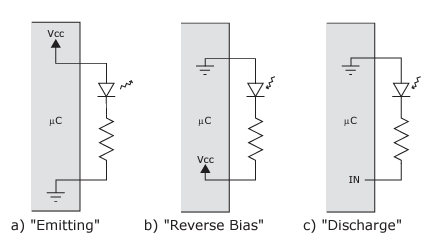
Two tristate pins let you use an LED for emitting light and sensing it. Credit: MERL research paper
However, you can go so much further, as the bright minds at Mitsubishi Electric Research Laboratories (MERL) determined back in 2003. Following their example, you might like to hook the LED up to a microcontroller. Setting it up in a “reverse biased” mode allows it to act as a sensor when attached to an IO pin, instead of acting as a light emitter. To do this, simply attach the LED’s anode to ground, while connecting the cathode to an I/O pin in a high state. This achieves the “reverse bias,” and charges the inherent capacitance of the LED. The capacitance is small, so this only takes a fraction of a second. Then, the IO pin can be switched to an input, and the capacitance of the LED will discharge into the microcontroller pin. The more light, the more current induced in the LED, and the faster the LED’s capacitance will discharge. Measure how long it takes for the voltage to drop below the IO pin’s digital logic level, and you can sense light levels with a simple IO pin.

Researchers were able to communicate between microcontrollers over a distance of a few centimeters using nothing but regular LEDs. Data rates reached 250 bits/sec. Credit: MERL, research paper
In fact, the team at MERL realized that you could go even further. The humble LED could become a “last centimeter” communications device, used as both light transmitter and receiver. To achieve this, one simply had to insert the LED between two tristate IO pins on a microcontroller. With the anode driven high and the cathode driven low, the LED would light. Flipped the other way, and the LED would be reverse biased. Then, one of the tristate pins could be set to input mode to read the LED as a sensor.

As suggested by the team at MERS, LEDs can be used as sensors in all kinds of innovative applications. You could use a TV’s power LED to detect light levels, and thus adjust screen brightness appropriately. You can even do simple proximity sensing, using an array of LEDs to act as emitters and sensors in turn. You could even use status LEDs on small devices to do bidirectional communication if you were so inclined.

And yet! We almost never use LEDs for any of these things. Realistically, while LEDs are sensors, they’re not excellent sensors. We have far better phototransistors, photodiodes, and other sensors available these days. This technique could be useful to you, if you’re trying to design a device with the bare minimum part count or as cheaply as possible. Or, if you want to put surprise functionality into a device that has just an LED on board. But in the real world, this technique doesn’t get a whole lot of use. Futzing around with nifty LED tricks takes more engineering time than just speccing a proper sensor, after all.

Still, the technique has found some real applications. LEDs used in this way do have the benefit of being quite selective as to wavelength, and can be quite stable over time. The legendary Forrest Mims took advantage of this, putting LED sensors to use in a variety of scientific apparatus. Indeed, his ozone measurement device relied on this technique, and was so reliable it proved there was a drift error in NASA’s own Nimbus-7 satellite.
Some researchers believe PerLEDs could enable the creation of touchscreen displays that don’t need additional sensor elements beyond the LEDs themselves. Credit: Bao, et al, research paper
There’s also hope in the rapidly-advancing field of perovskite technology. Perovskite LEDs, or PerLEDs, could use advanced semiconductor materials to create devices that act as both good light sources and capable photodetectors. The hope is that they might be good enough to create touchable displays that need no additional sensor for touch. Instead, the PerLED array would act as both display and sensor. However, for now, the research is at an early stage, and the instability of perovskites means any practical applications are a long way off.

It’s also worth noting that this technique doesn’t work on a lot of modern LEDs. Namely, addressable LEDs, self-flashing LEDs, and anything of that ilk. That’s because this technique relies on hooking up a microcontroller directly to the LED die itself. Many modern “smart” LEDs don’t break out the pins themselves, only providing pins for the controller chip inside. Thus, don’t expect to use this technique with your NeoPixels, WS2812Bs, or anything like that.

Ultimately, using LEDs as a sensor is a fun technique. It’s also highly useful if you’re doing specific things with certain wavelengths of light. Barring that, though, it’s a great party trick to keep in your toolbox, because you never know when it’ll come in handy.


The Privacy Post reshared this.

The Privacy Post ha ricondiviso questo.

The media in this post is not displayed to visitors. To view it, please go to the original post.

Could Carbon Fiber be the New Asbestos?
poliverso.org/display/0477a01e…
Could Carbon Fiber be the New Asbestos? Could carbon fiber inflict the same kind of damage on the human body as asbestos? That’s the question which [Nathan] found himself struggling with after taking a look youtube.com/watch?v=RLt9l6YxvH… at carbon fiber-reinforced filament under a microscope, revealing a sight that brings to mind fibrous asbestos samples. Considering the


Could Carbon Fiber be the New Asbestos?

Could carbon fiber inflict the same kind of damage on the human body as asbestos? That’s the question which [Nathan] found himself struggling with after taking a look at carbon fiber-reinforced filament under a microscope, revealing a sight that brings to mind fibrous asbestos samples. Considering the absolutely horrifying impact that asbestos exposure can have, this is a totally pertinent question to ask. Fortunately, scientific studies have already been performed on this topic.
Example SEM and TEM images of the released particles following the rupture of CFRP cables in the tensile strength test. (Credit: Jing Wang et al, Journal of Nanobiotechnology, 2017)Example SEM and TEM images of the released particles following the rupture of CFRP cables in the tensile strength test. (Credit: Jing Wang et al, Journal of Nanobiotechnology, 2017)
While [Nathan] demonstrated that the small lengths of carbon fiber (CF) contained in some FDM filaments love to get stuck in your skin and remain there even after washing one’s hands repeatedly, the aspect that makes asbestos such a hazard is that the mineral fibers are easily respirable due to their size. It is this property which allows asbestos fibers to nestle deep inside the lungs, where they pierce cell membranes and cause sustained inflammation, DNA damage and all too often lung cancer or worse.

Clearly, the 0.5 to 1 mm sized CF strands in FDM filaments aren’t easily inhaled, but as described by [Jing Wang] and colleagues in a 2017 Journal of Nanobiotechnology paper, CF can easily shatter into smaller, sharper fragments through mechanical operations (cutting, sanding, etc.) which can be respirable. It is thus damaged carbon fiber, whether from CF reinforced thermal polymers or other CF-containing materials, that poses a potential health risk. This is not unlike asbestos — which when stable in-situ poses no risk, but can create respirable clouds of fibers when disturbed. When handling CF-containing materials, especially for processing, wearing an effective respirator (at least N95/P2) that is rated for filtering out asbestos fibers would thus seem to be a wise precaution.

The treacherous aspect of asbestos and kin is that diseases like lung cancer and mesothelioma are not immediately noticeable after exposure, but can take decades to develop. In the case of mesothelioma, this can be between 15 and 30 years after exposure, so protecting yourself today with a good respirator is the only way you can be relatively certain that you will not be cursing your overconfident young self by that time.

youtube.com/embed/RLt9l6YxvHk?…


The Privacy Post reshared this.

The Privacy Post ha ricondiviso questo.

The media in this post is not displayed to visitors. To view it, please go to the original post.

Keebin’ with Kristina: the One with the Key Cap Map
poliverso.org/display/0477a01e…
Keebin’ with Kristina: the One with the Key Cap Map So, [zyumbik]’s trademark seems to be sexing things up, and the Artsey layout did not escape their gaze. This is the Sexy Artsey gleb.sexy/sexy-artsey. Let’s back up a hackaday.com/wp-content/upload…


Keebin’ with Kristina: the One with the Key Cap Map

Illustrated Kristina with an IBM Model M keyboard floating between her hands.

So, [zyumbik]’s trademark seems to be sexing things up, and the Artsey layout did not escape their gaze. This is the Sexy Artsey. Let’s back up a bit.

A pink and purple 10-key keyboard with a rotary encoder, spikes, and a custom area with LEGO attached.Image by [zyumbik] via redditArtsey is a keyboard layout for chording, and this keyboard is built for it. It’s a one-handed keyboard meant for pressing multiple keys at a time to produce each character. With some use, [zyumbik] discovered that the Taipo layout might be a better fit, so there are currently some elements of both.

If you’d like to make this adorable keyboard, everything is waiting for you to download, including files for various thingamabobs you can stick on the side there where the rainbow is now. There’s also a groovy flower version of the knob.

Controller-wise, you can use a Seeed Studio Xiao in either BLE or RP2040 format, or the Waveshare RP2040 Zero. The firmware is written in ZMK.

Remember the death metal macropad? (Who could forget that tentacled nightmare?) This is the same creator. Kind of hard to believe, innit? Well, except for the spikes. Apparently they’re for thumb discipline.

Via reddit

Oooh, Dream Keyboard: I Believe You Can Get Me Through My Life


Perhaps the YouTube algorithm fed you this one the other day, too. As an iOS developer, [Christian Selig] spends all day typing, and has owned a lot of keyboards as a result. Like, a lot of keyboards. But, as you may have guessed, none of them fully satisfy.

[Christian Selig]'s dream keyboard, a made-from-scratch, column-staggered, ortholinear split with a matching smart watch between the halves.Image via YouTubeAnd so began the familiar hero’s journey of building something new, something perfect for them. A dream keyboard. Maybe it’ll be your dream keyboard, too.

[Christian] hid the nice!nano underneath the keyboard to make it as sleek as possible, almost as though Apple themselves designed an ortho split.

Of particular note here is that [Christian] used a nifty program called Ergogen to generate the both the PCB layout and the 3D-printable case with just a few lines of very readable “code”. Even so, [Christian] still got to play connect-the-dots in KiCad.

This is a great video all around. It’s low-level enough to be interesting to those who have already built a keyboard, but high-level enough to draw in new people who might just catch the bug.

youtube.com/embed/7UXsD7nSfDY?…

Thanks to [Joey] and [foamyguy] for the tip!

The Centerfold: Keycap World Map


A world map on a wall made entirely from black, white, and grey keycaps.Image by [mathinpenn] via redditGuess the number of keycaps correctly, and you win absolutely nothing but my excitedly raised eyebrows. At any rate, it would be nice to know approximately how many keycaps adorn the conference room wall of a certain hotel in Denver, CO. Be sure to check out [mathinpenn]’s reddit post for the close-up shot.

Do you rock a sweet set of peripherals on a screamin’ desk pad? Send me a picture along with your handle and all the gory details, and you could be featured here!

Historical Clackers: the Zerograph


This is a machine that was quite far ahead of its time. The Zerograph could instantly transmit and print text, arguably making it the first Telex machine. The patent language declares it a printing telegraph.
The Zerograph, a typewriting machine that could instantly transmit and print text.Image via Antikey Chop
But unlike most telegraphs, which transmitted dots and dashes, the Zerograph sent actual words, at the rate of 25 per minute. Not bad for 1895.

Its inventor, Leonard “Leo” Ulrich Kamm, was quite renowned for his work in the field of cinema, having created a film-less movie projector, the Kammatograph. Instead of film, it used a circular glass plate with images arranged in a spiral.

The Zerograph worked using a pendulum system. Actuate the pendulum of one machine, and a second, synced machine would match the distance of each swing. The second Zerograph would then map that distance to one of the 36 characters and type it.

Each swing was different for each character, but none took more than half a second. The pendulum returned to a zero position after each swing, hence the name Zerograph. So, why haven’t you heard of this machine before? History shows that Kamm invested zero effort in marketing and improving the thing, due to focusing his efforts on the Kammatograph instead.

ICYMI: Vacuum-forming Keycaps Sucks, But the Result is Slick


A keyboard with vacuum-former-wrapped key caps.Image by [Drygol] via RetrohaxWhile there are all kinds of keycap options out there, there’s nothing quite like a custom set. What’s interesting is the method that [Drygol] chose — vacuum-forming several at once using a 3D-printed scaffold.

The really neat part here is that the keycap is left intact underneath. So not only do the legends show through (provided you use the right type of vinyl), no keycaps are harmed during this process.

In fact, you could almost say they are being preserved under there. Good news for, say, an Amiga keyboard like the one pictured.

The process looks simple, but seems tedious: each one is carefully trimmed from the vinyl, and the edges are made triangular and folded neatly underneath. The end result is quite unique and stunning, though, so it seems worth it to me. If only I had a vacuum-forming table.


Got a hot tip that has like, anything to do with keyboards? Help me out by sending in a link or two. Don’t want all the Hackaday scribes to see it? Feel free to email me directly.


The Privacy Post reshared this.

The Privacy Post ha ricondiviso questo.

Copybara, il malware che prende di mira il banking italiano
poliverso.org/display/0477a01e…
Copybara, il malware che prende di mira il banking italiano Il team di Tinexta Cyber ha identificato una nuova variante di Copybara, che a partire dalla fine del 2023 ha iniziato a colpire utenti italiani utilizzando TTPs (Tactics, Techniques and Procedures) innovative per diffondere la minaccia. I ricercatori hanno tracciato l’evoluzione di questa minaccia, evidenziando


Copybara, il malware che prende di mira il banking italiano

Il team di Tinexta Cyber ha identificato una nuova variante di Copybara, che a partire dalla fine del 2023 ha iniziato a colpire utenti italiani utilizzando TTPs (Tactics, Techniques and Procedures) innovative per diffondere la minaccia. I ricercatori hanno tracciato l’evoluzione di questa minaccia, evidenziando come sia diventata particolarmente rilevante nel mondo Android in pochi anni.

Copybara è una variante di Brata, una famiglia di malware scoperta nel 2019 da Kaspersky. Brata si diffondeva tramite siti compromessi e sfruttava la vulnerabilità CVE-2019-3568 su WhatsApp per colpire utenti in Sud America. Una caratteristica distintiva di Brata è l’utilizzo del framework B4X/B4A, una versione moderna di Visual Basic che supporta molte piattaforme e può compilare applicazioni in modo nativo. Questa caratteristica è stata mantenuta in tutte le varianti.

Nella seconda metà del 2021 sono state scoperte due nuove varianti, chiamate AmexTroll e Copybara, che presentavano caratteristiche comuni con Brata, ma anche differenze in termini di codice, attori e TTPs. Nel 2022 è stata scoperta un’altra variante, denominata IRATA, che infettava utenti iraniani. La ricerca condotta dal team di Tinexta Cyber sulla nuova variante di Copybara scoperta nel 2024 ha evidenziato l’uso del protocollo MQTT per la comunicazione con il C2.

“Il protocollo MQTT (Message Queueing Telemetry Transport), utilizzato prevalentemente per gli oggetti IoT (Internet of Things), si basa su un modello publish-subscribe, con una netta distinzione tra chi invia e chi riceve”, spiega Luigi Martire, Technical Leader – CERT di Tinexta Cyber. “Inoltre – continua l’esperto – i criminali utilizzano il phishing kit Mr.Robot per raccogliere credenziali e numeri di telefono tramite social engineering, nello specifico smishing/vishing. Si presentano come personale della banca per manipolare la vittima e convincerla a scaricare ed eseguire Copybara”.

Una volta eseguito, il malware richiede di essere abilitato come “servizio di accessibilità”. Le applicazioni abilitate a questo servizio possono essere eseguite in background e accedere a determinati eventi, come transizioni nell’interfaccia o clic su pulsanti. Sebbene legittimamente utilizzate per aiutare persone con disabilità, queste funzionalità vengono abusate per sviluppare malware per Android e raccogliere informazioni sulle vittime.

In questa campagna, sono stati osservati due differenti metodi di operare. Il primo è tramite phishing, con cui gli attori raccolgono informazioni sulla vittima, chiamano fingendosi personale della banca e manipolano la vittima a installare l’applicazione.

Il secondo metodo è meno diretto: la vittima riceve un messaggio che sembra legittimo, riguardo a un possibile problema di sicurezza, e viene invitata a contattare il numero riportato nel messaggio in caso di incongruenze.

Acquisendo informazioni su questo numero tramite vari siti che consentono di segnalarli, le statistiche riportano 60 ricerche nel mese di giugno e una chiamata confermata da una vittima.
“Il nostro recente studio sul malware Copybara ha rivelato un’evoluzione sofisticata nell’utilizzo di protocolli di comunicazione avanzati come il MQTT, segnalando una significativa mutazione nelle TTP (tattiche, tecniche e procedure) dei cyber criminali”, commenta Fabrizio Vacca, MSS Operations Director – Tinexta Cyber.

“Questo progresso mette in evidenza l’importanza di adattare continuamente le nostre strategie di difesa per fronteggiare minacce sempre più complesse e mirate. La scoperta è stata resa possibile grazie alla tecnologia avanzata e all’expertise di Tinexta Cyber. In particolare, l’applicativo SOC NDR “Defensyo”, progettato specificamente per le PMI, è stato fondamentale nell’intercettare queste minacce. Il SOC di Tinexta Cyber, supportato dall’appliance proprietaria, ha dimostrato una notevole efficacia nel rilevamento precoce del malware. Questo approccio, conforme agli standard NIS2, garantisce una protezione robusta e all’avanguardia per le imprese”, conclude Vacca.

L'articolo Copybara, il malware che prende di mira il banking italiano proviene da il blog della sicurezza informatica.


The Privacy Post ha ricondiviso questo.

The media in this post is not displayed to visitors. To view it, please go to the original post.

EvilVideo: The Zero-Day Exploit That Threatens Telegram on Android
poliverso.org/display/0477a01e…
EvilVideo: The Zero-Day Exploit That Threatens Telegram on Android welivesecurity.com/en/eset-res…


EvilVideo: The Zero-Day Exploit That Threatens Telegram on Android

ESET researchers have discovered a zero-day exploit targeting Telegram for Android. An exploit called EvilVideo appeared for sale on an underground forum on June 6, 2024. Attackers exploited this vulnerability to distribute malicious files through Telegram channels, groups, and chats, disguising them as media files.

Specialists managed to obtain an example of the exploit, which allowed them to analyze it and report the problem on Telegram on June 26. An update fixing the vulnerability was released on July 11, 2024 in Telegram versions 10.14.5 and later.

The vulnerability allowed attackers to send malicious files that looked like videos in unprotected versions of Telegram for Android (10.14.4 and earlier). The exploit was found on an underground forum, where the vendor demonstrated its work in a public Telegram channel.

This allowed researchers to obtain the malicious file and test it.

The analysis showed that the exploit exploited the ability to create malicious files that were displayed as media previews. While attempting to play such a “video,” Telegram reported that the file could not be played and suggested using an external player.

By clicking the “Open” button, the user was asked to install a malicious application disguised as a player.

Telegram has fixed the vulnerability in version 10.14.5. Media file previews now correctly indicate that the file is an application and not a video.

The exploit was tested on the web and desktop versions of Telegram for Windows, but it did not work. In both cases, the file was recognized as multimedia and posed no threat.

It was also discovered that the exploit vendor offered an encryption service for Android, making malicious files invisible to antiviruses. This service has been advertised on the same underground forum since January 2024.

After discovering the vulnerability and reporting it to Telegram, the problem was fixed. Users are advised to update the application to the latest version to protect themselves from potential threats.

L'articolo EvilVideo: The Zero-Day Exploit That Threatens Telegram on Android proviene da il blog della sicurezza informatica.


The Privacy Post ha ricondiviso questo.

The media in this post is not displayed to visitors. To view it, please go to the original post.

Photoresistor-based Single Pixel Camera
poliverso.org/display/0477a01e…
Photoresistor-based Single Pixel Camera [Hugh] has been going back through episodes of the Hackaday podcast, and Elliot mentioned in episode 67 that it can often be inspiring to go back through the archives of Hackaday to find ideas for new projects. Well, he did just that and came across a single-pixel camera made using an infrared photodiode. He decided to try and hack together his own


Photoresistor-based Single Pixel Camera

[Hugh] has been going back through episodes of the Hackaday podcast, and Elliot mentioned in episode 67 that it can often be inspiring to go back through the archives of Hackaday to find ideas for new projects. Well, he did just that and came across a single-pixel camera made using an infrared photodiode. He decided to try and hack together his own single-pixel camera, but this time on the cheap and using an ever simpler component – a photoresistor!

His description of the project tickled me – “I’ve used an ESP32, MicroPython, two servos, a peanut butter jar lid, a toilet paper roll, a paper towel roll, magnets and scrap wood for this version.” That’s certainly a much simpler bill of materials than the original (which was written up by Hackaday way back in 2015), which used a nice metal frame to hold everything together. However, there’s absolutely nothing wrong with improvising with things you happen to have to hand.

The alt-az mechanism
In this case, the sensor is mounted at the back of a paper towel tube, with black tape covering the front and a tiny pinhole poked in the tape to act as the aperture. Similarly to the original, the sensor is scanned over the scene in an XY altitude/azimuth pattern to capture the samples one at a time. It takes just under eight minutes to capture 8100 “pixels” in a 90×90 grid. The servos are driven using a PCA9685 PWM/Servo driver, which makes motor control a lot easier. An important lesson [Hugh] learned during construction was that weak power supplies can cause all sorts of issues when motors or servos are involved. He had been encountering uneven rotation and random halting, but as soon as a beefier power supply was attached everything worked smoothly.

[Hugh] used a much more powerful ESP32 to do the actual gathering of the analog data, which is then sent over a serial port to a Python processing engine which uses Pandas, numpy and matplotlib to do the bulk of the image processing. The resulting processed photo is very recognizable, considering the differences in linearity and sensitivity between a photoresistor and the infrared photodiode used in the original project! It really is incredible what you can do with a few spare parts, some random construction materials, and a little bit of creativity.


The Privacy Post reshared this.

The Privacy Post ha ricondiviso questo.

European Commission opens formal antitrust investigation into Delivery Hero and Glovo
poliverso.org/display/0477a01e…
European Commission opens formal antitrust investigation into Delivery Hero and GlovoThe European Commission opened a formal antitrust investigation into food delivery apps Delivery Hero and Glovo, examining whether the two are participating in a cartel, according to a Tuesday (23 July) press release.euractiv.com/section/competiti…


European Commission opens formal antitrust investigation into Delivery Hero and Glovo


The European Commission opened a formal antitrust investigation into food delivery apps Delivery Hero and Glovo, examining whether the two are participating in a cartel, according to a Tuesday (23 July) press release.


euractiv.com/section/competiti…


The Privacy Post ha ricondiviso questo.

Sorpresa da Google: I Cookie di Terze Parti Rimarranno in Chrome
poliverso.org/display/0477a01e…
Sorpresa da Google: I Cookie di Terze Parti Rimarranno in Chrome Dopo molte discussioni e riflessioni, Google securitylab.ru/glossary/Google… deciso di mantenere il supporto per i cookie di terze parti nel browser Chrome. Si è scoperto che tutto il clamore degli ultimi anni non è stato vano: le lamentele del settore pubblicitario sono state finalmente


Sorpresa da Google: I Cookie di Terze Parti Rimarranno in Chrome

Dopo molte discussioni e riflessioni, Google ha deciso di mantenere il supporto per i cookie di terze parti nel browser Chrome. Si è scoperto che tutto il clamore degli ultimi anni non è stato vano: le lamentele del settore pubblicitario sono state finalmente ascoltate.

Google ha annunciato “l’approccio aggiornato” in un post sul blog. La società ha dichiarato che non eliminerà gradualmente i cookie di terze parti. Sta invece introducendo una “nuova esperienza utente in Chrome” che consente agli utenti di fare scelte informate durante la navigazione sul Web, che possono essere modificate in qualsiasi momento.

I rappresentanti di Google stanno già discutendo questa svolta inaspettata con le autorità di regolamentazione, tra cui la British Competition and Markets Authority (CMA) e l’Information Commissioner’s Office (ICO). Nel prossimo futuro sono previste anche trattative con i rappresentanti del settore pubblicitario.

Google non ha fretta di annunciare scadenze specifiche per l’implementazione del nuovo approccio. Sembra che l’azienda abbia imparato la lezione dalle numerose scadenze per la disattivazione dei cookie in passato.

L’azienda non intende tuttavia abbandonare la propria iniziativa Privacy Sandbox. La società ha dichiarato la propria intenzione di continuare a sviluppare l’API come parte di questo progetto per migliorare la privacy e l’utilità per gli utenti. Ci sono piani per aggiungere ulteriori controlli sulla privacy, come la protezione dell’indirizzo IP recentemente annunciata nella modalità di navigazione in incognito di Chrome.

Per gli inserzionisti e gli editori che hanno già investito risorse significative nello sviluppo di alternative ai cookie di terze parti, Google promette che i loro sforzi non saranno vani. L’azienda intende mantenere e sviluppare l’API Privacy Sandbox, che potrebbe essere un vantaggio soprattutto se un numero significativo di utenti Chrome decidesse di disattivare i cookie di terze parti.

Alcuni esperti tracciano paralleli con Apple, che tre anni fa ha introdotto la funzionalità App Tracking Transparency sui dispositivi mobili. Questa iniziativa ha consentito agli utenti di decidere autonomamente se fornire i propri dati o IDFA ad app e siti web.

Google sta promuovendo attivamente le sue soluzioni alternative. L’azienda ha pubblicato i risultati dei test condotti da gennaio a marzo che mostrano risultati promettenti nel mantenere l’efficacia della pubblicità senza l’uso di cookie di terze parti. Ad esempio, Google Display Ads ha registrato un recupero dell’89% nella spesa pubblicitaria, mentre Display & Video 360 ha registrato un recupero dell’86%. Il ritorno sull’investimento è stato rispettivamente del 97% e del 95%.

Tuttavia, la risposta del settore pubblicitario a Privacy Sandbox rimane contrastante. Molti editori hanno avuto difficoltà a testare nuovi strumenti, lamentandosi del fatto che il campione di utenti di Chrome (solo l’1%) è troppo piccolo per condurre esperimenti significativi. A seguito di un ulteriore ritardo nell’eliminazione dei cookie di terze parti, alcuni editori hanno smesso del tutto di dedicare risorse ai test di Privacy Sandbox.

L'articolo Sorpresa da Google: I Cookie di Terze Parti Rimarranno in Chrome proviene da il blog della sicurezza informatica.


The Privacy Post reshared this.

The Privacy Post ha ricondiviso questo.

Every day in our work, @edri challenges private and state actors who abuse their power to control or manipulate the public ✊🏾

We have also put forward a manifesto that establishes a positive vision for our digital futures 🌱

Read more by @CFerKic in The Parliament Magazine ⤵️

theparliamentmagazine.eu/partn…

reshared this

The Privacy Post ha ricondiviso questo.

“It is important to recognise the special nature of #FreeSoftware development and the #FreeSoftware ecosystem and its role in the software supply chain. Implementation needs to be proportionate and effective”

fsfe.org/news/2024/news-202407…

The Privacy Post reshared this.

The Privacy Post ha ricondiviso questo.

Microsoft rilascia un tool USB per risolvere il problema del BSOD di CrowdStrike su Windows 10 e 11
poliverso.org/display/0477a01e…
Microsoft rilascia un tool USB per risolvere il problema del BSOD di CrowdStrike su Windows 10 e 11 Microsoft securitylab.ru/glossary/Micros… rilasciato uno strumento per gli amministratori di sistema per semplificare il processo di correzione della schermata blu della morte (BSOD) sui computer Windows 10 e 11. La


Microsoft rilascia un tool USB per risolvere il problema del BSOD di CrowdStrike su Windows 10 e 11

Microsoft ha rilasciato uno strumento per gli amministratori di sistema per semplificare il processo di correzione della schermata blu della morte (BSOD) sui computer Windows 10 e 11. La soluzione prevede l’utilizzo di un’unità USB avviabile e uno script speciale MsftRecoveryToolForCS.ps1.

CrowdStrike aveva precedentemente rilasciato una patch per correggere un errore logico che portava a più casi BSOD. Tuttavia, la maggior parte dei computer non riceve automaticamente questa correzione a causa del loro stato non funzionante.

Il ripristino dei sistemi IT dei clienti dopo un’interruzione globale del software CrowdStrike su Windows può richiedere settimane. Ciò è dovuto al fatto che gli amministratori di sistema sono costretti a ripristinare manualmente PC, server e laptop perché la connessione remota non funziona. Richiede l’avvio del sistema in modalità provvisoria e l’esecuzione di determinati comandi o l’utilizzo del registro.

Microsoft Recovery Tool evita la necessità di avviare manualmente il PC in modalità provvisoria e rimuovere manualmente il file di aggiornamento problematico CrowdStrike. Semplifica notevolmente il processo di ripristino utilizzando Windows PE tramite un’unità USB. Lo strumento accede all’unità del computer interessato e rimuove automaticamente il file CrowdStrike problematico, garantendo che il dispositivo si avvii correttamente.

Il vantaggio di questo metodo è che non richiede l’avvio in modalità provvisoria o il possesso dei diritti di amministratore sul computer. Lo strumento accede direttamente al disco, senza scaricare una copia locale di Windows. Nel caso in cui l’unità sia protetta dalla crittografia BitLocker, lo strumento Microsoft richiederà la chiave di ripristino BitLocker prima di continuare il processo di riparazione.

Vale la pena notare che in alcuni casi lo script MsftRecoveryToolForCS.ps1 potrebbe non funzionare correttamente.

L'articolo Microsoft rilascia un tool USB per risolvere il problema del BSOD di CrowdStrike su Windows 10 e 11 proviene da il blog della sicurezza informatica.


The Privacy Post reshared this.

The Privacy Post ha ricondiviso questo.

New note by cybersecurity
poliverso.org/display/0477a01e…
Cyber caos, per Microsoft la colpa è delle regole dell’Europa. Ma è solo attività di marketing https://www.key4biz.it/cyber-caos-per-microsoft-la-colpa-e-delle-regole-delleuropa-ma-e-solo-attivita-di-marketing/499061/L’Unione europea è responsabile del più grande blackout informatico del mondo, avvenuto venerdì scorso a causa di un aggiornamento di sicurezza non andato a buon fine. Lo ha detto un


Cyber caos, per Microsoft la colpa è delle regole dell’Europa. Ma è solo attività di marketing

L’Unione europea è responsabile del più grande blackout informatico del mondo, avvenuto venerdì scorso a causa di un aggiornamento di sicurezza non andato a buon fine. Lo ha detto un portavoce dell’azienda di Redmont, Pavan Davuluri, al Wall Street


The Privacy Post reshared this.

The Privacy Post ha ricondiviso questo.

The media in this post is not displayed to visitors. To view it, please go to the original post.

Brain Implant Uses Graphene Instead of Metal Probes
poliverso.org/display/0477a01e…
Brain Implant Uses Graphene Instead of Metal Probes Implantable electrodes for the (human) brain have been around for a many decades in the form of Utah arrays and kin, but these tend to be made out of metal, which can cause issues when stimulating the surrounding neurons with an induced current. This is due to faradaic processes between the metal probe and an electrolyte (i.e.


Brain Implant Uses Graphene Instead of Metal Probes

Implantable electrodes for the (human) brain have been around for a many decades in the form of Utah arrays and kin, but these tend to be made out of metal, which can cause issues when stimulating the surrounding neurons with an induced current. This is due to faradaic processes between the metal probe and an electrolyte (i.e. the cerebrospinal fluid). Over time this can result in insulating deposits forming on the probe’s surface, reducing their effectiveness.
Graphene-based, high-resolution cortical brain interface (Credit: Inbrain Neuroelectronics)Graphene-based, high-resolution cortical brain interface (Credit: Inbrain Neuroelectronics)
Now a company called InBrain claims to have cracked making electrodes out of graphene, following a series of tests on non-human test subjects. Unlike metal probes, these carbon-based probes should be significantly more biocompatible even when used for brain stimulation as with the target goal of treating the symptoms associated with Alzheimer’s.

During the upcoming first phase human subjects would have these implants installed where they would monitor brain activity in Alzheimer’s patients, to gauge how well their medication is helping with the symptoms like tremors. Later these devices would provide deep-brain stimulation, purportedly more efficiently than similar therapies in use today. The FDA was impressed enough at least to give it the ‘breakthrough device’ designation, though it is hard to wade through the marketing hype to get a clear picture of the technology in question.

In their most recently published paper (preprint) in Nature Nanotechnology, [Calia] and colleagues describe flexible graphene depth neural probes (gDNP) which appear to be what is being talked about. These gDNP are used in the experiment to simultaneously record infraslow (<0.1 Hz) and higher frequencies, a feat which metal microelectrodes are claimed to struggle with.

Although few details are available right now, we welcome any brain microelectrode array improvements, as they are incredibly important for many types of medical therapies and research.


The Privacy Post reshared this.

The Privacy Post ha ricondiviso questo.

Il Supercomputer di Musk a Memphis è pronto! 100.000 Nvidia H1 raffreddate a liquido
poliverso.org/display/0477a01e…
Il Supercomputer di Musk a Memphis è pronto! 100.000 Nvidia H1 raffreddate a liquido Elon Musk, che dirige contemporaneamente sei aziende innovative: Tesla, SpaceX, Starlink, X (precedentemente noto come Twitter), Neuralink e xAI, non si ferma qui.Recentemente ha annunciato x.com/elonmusk/status/18153254… che xAI ha iniziato ad


Il Supercomputer di Musk a Memphis è pronto! 100.000 Nvidia H1 raffreddate a liquido

Elon Musk, che dirige contemporaneamente sei aziende innovative: Tesla, SpaceX, Starlink, X (precedentemente noto come Twitter), Neuralink e xAI, non si ferma qui.

Recentemente ha annunciato che xAI ha iniziato ad addestrare i suoi modelli sul cluster di intelligenza artificiale più potente al mondo: il Memphis Supercluster, situato a Memphis, nel Tennessee.

Nice work by @xAI team, @X team, @Nvidia & supporting companies getting Memphis Supercluster training started at ~4:20am local time.

With 100k liquid-cooled H100s on a single RDMA fabric, it’s the most powerful AI training cluster in the world!
— Elon Musk (@elonmusk) July 22, 2024

Secondo la pubblicazione WREG , questo supercomputer rappresenterà il più grande investimento di capitale da parte di una nuova società di mercato nella storia della città. Tuttavia, nonostante i suoi piani ambiziosi, xAI non ha ancora un accordo con la società energetica locale Tennessee Valley Authority, necessario per fornire al progetto elettricità con una capacità di oltre 100 megawatt.

Secondo Musk, il cluster è dotato di 100.000 GPU Nvidia H100 raffreddate a liquido. Ha osservato che il sistema funziona su un’unica struttura RDMA (Remote Direct Memory Access), che consente il trasferimento dei dati in modo efficiente e con bassa latenza tra i nodi di elaborazione senza caricare il processore centrale.

L’uomo d’affari ha affermato che xAI prevede di creare “l’intelligenza artificiale più potente sotto tutti i punti di vista” entro dicembre 2024.

Musk ha aggiunto che il Supercluster di Memphis fornirà un vantaggio significativo nel raggiungimento di questo obiettivo. Tuttavia, la sua reputazione di rispettare le scadenze non è buona. In precedenza, ha più volte rinviato il lancio di progetti come automobili completamente autonome, robotaxi e missioni su Marte. Tuttavia, se xAI riuscirà a presentare il suo nuovo modello entro i tempi previsti, sarà un enorme passo avanti per l’azienda.

Con giganti come OpenAI, Anthropic, Google, Microsoft e Meta che lavorano anche per creare modelli più potenti e accessibili, xAI deve offrire qualcosa di veramente nuovo e utile per rimanere competitivo in questa corsa per i clienti e l’attenzione.

È interessante notare che si dice che anche Microsoft, che sostiene OpenAI, stia lavorando su un supercomputer da 100 miliardi di dollari per l’addestramento all’intelligenza artificiale, nome in codice Stargate. A seconda di come si svilupperanno questi progetti, lo status del Supercluster di Memphis come il più potente del mondo potrebbe essere di breve durata.

L'articolo Il Supercomputer di Musk a Memphis è pronto! 100.000 Nvidia H1 raffreddate a liquido proviene da il blog della sicurezza informatica.


The Privacy Post reshared this.

The Privacy Post ha ricondiviso questo.

Green’s Cavazzini re-elected as IMCO chair
poliverso.org/display/0477a01e…
Green’s Cavazzini re-elected as IMCO chairGreens MEP Anna Cavazzini (Germany) will be chairing the European Parliament's Committee on Internal Market and Consumer Protection (IMCO) for another term, according to a press release by the Parliament on Tuesday (23 July).euractiv.com/section/digital/n…


Green’s Cavazzini re-elected as IMCO chair


Greens MEP Anna Cavazzini (Germany) will be chairing the European Parliament's Committee on Internal Market and Consumer Protection (IMCO) for another term, according to a press release by the Parliament on Tuesday (23 July).


euractiv.com/section/digital/n…


The Privacy Post reshared this.

The Privacy Post ha ricondiviso questo.

The media in this post is not displayed to visitors. To view it, please go to the original post.

1/2 Amidst skyrocketing industry lobbying & the far-right surge in Europe, civil society's agenda is key.🚨

On 1 October, we'll open a dialogue with recently elected EU decision-makers at the #EUTechSociety Summit.

The draft programme is out now: edri.org/take-action/events/co…

The Privacy Post ha ricondiviso questo.

New note by cybersecurity
poliverso.org/display/0477a01e…
Crittografia post quantum, ACN pubblica il documento di preparazione alla minaccia key4biz.it/crittografia-post-q… le linee guida sulla conservazione delle password, le funzioni di hash e i codici di autenticazione messaggi, l’Agenzia per la cybersicurezza nazionale pubblica altri approfondimenti sulla crittografi


Crittografia post quantum, ACN pubblica il documento di preparazione alla minaccia

Dopo le linee guida sulla conservazione delle password, le funzioni di hash e i codici di autenticazione messaggi, l’Agenzia per la cybersicurezza nazionale pubblica altri approfondimenti sulla crittografia dedicati alla confidenzialità dei dati e alle tecniche di


The Privacy Post reshared this.

The Privacy Post ha ricondiviso questo.

Google potrebbe non indicizzare più il tuo sito in futuro. Ecco le nuove strategie di indicizzazione
poliverso.org/display/0477a01e…
Google potrebbe non indicizzare più il tuo sito in futuro. Ecco le nuove strategie di indicizzazione 10 anni fa, il lancio di un nuovo blog su WordPress era accompagnato dall’indicizzazione quasi istantanea dei contenuti su Google. Il motore di ricerca ha cercato di mettere tutte le informazioni a disposizione degli utenti il


Google potrebbe non indicizzare più il tuo sito in futuro. Ecco le nuove strategie di indicizzazione

10 anni fa, il lancio di un nuovo blog su WordPress era accompagnato dall’indicizzazione quasi istantanea dei contenuti su Google. Il motore di ricerca ha cercato di mettere tutte le informazioni a disposizione degli utenti il ​​più rapidamente possibile, il che è stato vantaggioso anche per i creatori di contenuti. Tuttavia, nel tempo, la situazione è cambiata e ora Google è diventato estremamente selettivo in termini di indicizzazione.

Con l’aumento dei contenuti di bassa qualità e delle pratiche SEO manipolative come l’acquisto di link, Google ha iniziato a introdurre aggiornamenti di algoritmi come Panda e Penguin. Queste misure miravano a liberare i risultati della ricerca dalla manipolazione. A poco a poco, sia l’azienda stessa che gli specialisti SEO si sono adattati alle nuove condizioni, trovando un equilibrio tra la promozione di contenuti di qualità e il rispetto delle regole.

Nel processo di miglioramento della qualità nel SEO, è emerso un nuovo principio: il contenuto è fondamentale. Ciò significava che i buoni contenuti avrebbero sempre attirato clic e avrebbero avuto un impatto positivo sul posizionamento. Tuttavia, in pratica si è scoperto che i contenuti di alta qualità di per sé non sempre garantiscono posizioni elevate nei risultati di ricerca. Gli algoritmi di Google non sono sempre stati in grado di identificare i buoni contenuti, il che significa che i contenuti di qualità a volte passavano inosservati.

Nel 2018, con il rilascio di GPT-1 da OpenAI, il futuro della creazione di contenuti nei prossimi anni è diventato chiaro: contenuti generati dall’intelligenza artificiale che erano quasi indistinguibili da quelli umani sono diventati realtà. Ora, con l’intelligenza artificiale in grado di creare infinite quantità di testo, Google ha cambiato nuovamente la sua strategia.

Ora Google ha smesso di provare a indicizzare l’intero spazio web. Invece, è diventato estremamente selettivo, includendo solo i contenuti che ritiene veramente necessari. Ciò è influenzato da diversi fattori:

  • Unicità dei contenuti. Google richiede che i contenuti siano veramente nuovi e colmino lacune significative nell’indice.
  • Autorità della fonte. I siti che Google ritiene autorevoli nella loro nicchia hanno maggiori probabilità di essere indicizzati.
  • Il riconoscimento del marchio. I marchi affermati vedono la maggior parte dei loro contenuti indicizzati, mentre i blog più piccoli devono affrontare requisiti più rigorosi.

In generale, Google indicizza i nuovi contenuti abbastanza rapidamente per garantire che non perdano notizie o aggiornamenti importanti. Tuttavia, dopo qualche tempo, questi contenuti potrebbero essere deindicizzati e rimanere tali in futuro. Ricevere l’indicizzazione iniziale non garantisce la presenza a lungo termine nei risultati di ricerca.

Attualmente, gli utenti di un popolare motore di ricerca potrebbero non trovare le informazioni di cui hanno bisogno tramite Google, anche se esistono. Per i creatori di contenuti, ciò significa che ottenere visibilità richiede qualcosa di più della semplice creazione di contenuti di qualità. È necessario convincere Google della necessità dell’indice.

Pertanto, Google si sta gradualmente trasformando da motore di ricerca completo in una directory esclusiva. A loro volta, i creatori di contenuti devono affrontare una nuova sfida: come diventare visibili se Google si rifiuta di indicizzare la maggior parte dei loro materiali. Di conseguenza, stiamo assistendo a un cambiamento di paradigma nell’editoria online, dove la quantità sta cedendo il passo alla qualità, e la reputazione e la credibilità della fonte stanno diventando fattori chiave per la visibilità nello spazio digitale.

L'articolo Google potrebbe non indicizzare più il tuo sito in futuro. Ecco le nuove strategie di indicizzazione proviene da il blog della sicurezza informatica.


The Privacy Post reshared this.