The Privacy Post ha ricondiviso questo.

The media in this post is not displayed to visitors. To view it, please go to the original post.

Creating a Twisted Grid Image Illusion With a Diffusion Model
poliverso.org/display/0477a01e…
Creating a Twisted Grid Image Illusion With a Diffusion ModelImages that can be interpreted in a variety of ways have existed for many decades, with the classical example being Rubin’s vase — which some viewers see as a vase, and others a pair of human faces. hackaday.com/wp-content/upload…When the duck becomes a bunny, if you ignore the graphical glitches that used to


Creating a Twisted Grid Image Illusion With a Diffusion Model


Images that can be interpreted in a variety of ways have existed for many decades, with the classical example being Rubin’s vase — which some viewers see as a vase, and others a pair of human faces.
When the duck becomes a bunny, if you ignore the graphical glitches that used to be part of the duck. (Credit: Steve Mould, YouTube)When the duck becomes a bunny, if you ignore the graphical glitches that used to be part of the duck. (Credit: Steve Mould, YouTube)
Where things get trickier is if you want to create an image that changes into something else that looks realistic when you rotate each section of it within a 3×3 grid. In a video by [Steve Mould], he explains how this can be accomplished, by using a diffusion model to identify similar characteristics of two images and to create an output image that effectively contains essential features of both images.

Naturally, this process can be done by hand too, with the goal always being to create a plausible image in either orientation that has enough detail to trick the brain into filling in the details. To head down the path of interpreting what the eye sees as a duck, a bunny, a vase or the outline of faces.

Using a diffusion model to create such illusions is quite a natural fit, as it works with filling in noise until a plausible enough image begins to appear. Of course, whether it is a viable image is ultimately not determined by the model, but by the viewer, as humans are susceptible to such illusions while machine vision still struggles to distinguish a cat from a loaf and a raisin bun from a spotted dog. The imperfections of diffusion models would seem to be a benefit here, as it will happily churn through abstractions and iterations with no understanding or interpretive bias, while the human can steer it towards a viable interpretation.

youtube.com/embed/FMRi6pNAoag?…


hackaday.com/2024/09/18/creati…


The Privacy Post reshared this.

The Privacy Post ha ricondiviso questo.

The media in this post is not displayed to visitors. To view it, please go to the original post.

Blowing Up Shell Scripts
poliverso.org/display/0477a01e…
Blowing Up Shell ScriptsOne of the most universal experiences of any Linux or Unix user is working through a guide or handbook and coming across an almost unbelievably complex line of code meant to be executed with a shell. At the time of encountering a snippet like this it’s difficult to imagine any human ever having written it in the first place, but with some dedication it is possible to tease


Blowing Up Shell Scripts


One of the most universal experiences of any Linux or Unix user is working through a guide or handbook and coming across an almost unbelievably complex line of code meant to be executed with a shell. At the time of encountering a snippet like this it’s difficult to imagine any human ever having written it in the first place, but with some dedication it is possible to tease out what these small bits of code do when they’re typed into the terminal and run (unless it’s something like 🙁){ :|:& };: but that’s another story entirely). [noperator] recently built a tool which helps users in this predicament understand these shell scripts by expanding them into a more human-intelligible form.

The tool is named sol and does much more than expanding shell one-liners into a readable format. It also provides an interactive shell environment where the user can explore the exploded code in detail, modify it in any way they see fit, and collapse it back down to a single line so it can easily be sent to other users. It can be used with most of the major text editors as well as piped directly to standard input, and has a number of other options as well such as custom configurations and the ability to see non-standard bits of code that might not be compatible from one shell environment to another, as well as helping to translate those bits of code.

[noperator] has made the code available in the linked GitHub page for anyone curious about its use, and has a to-do list for future versions of the tool as well including adding support beyond bash. We’d definitely recommend a tool like this especially if you’re still relatively new to bash scripting (or shell scripting in general) and, as always, we’d just to remind everyone not to blindly copy and paste commands into their terminal windows. If you’re the type of person to go out on a limb and run crazy commands to see what they actually do, though, make sure you’re at least logged into the right computer first.


hackaday.com/2024/09/18/blowin…


The Privacy Post reshared this.

The Privacy Post ha ricondiviso questo.

The media in this post is not displayed to visitors. To view it, please go to the original post.

Upgraded Raster Laser Projector Goes RGB
poliverso.org/display/0477a01e…
Upgraded Raster Laser Projector Goes RGBWe’ve covered a scanning laser project by Ben Make’s Everything last year, and now he’s back with a significant update. [Ben]’s latest project now offers a higher resolution and RGB lasers youtube.com/watch?v=fEPicBSYeN…. A couple of previous versions of the device used the same concept of a rotating segmented mirror synchronised to a pulsed laser


Upgraded Raster Laser Projector Goes RGB


We’ve covered a scanning laser project by Ben Make’s Everything last year, and now he’s back with a significant update. [Ben]’s latest project now offers a higher resolution and RGB lasers. A couple of previous versions of the device used the same concept of a rotating segmented mirror synchronised to a pulsed laser diode to create scanlines. When projected onto a suitable surface, the distorted, pixelated characters looked quite funky, but there was clearly room for improvement.
More scanlines and a faster horizontal pixel rate
The previous device used slightly inclined mirrors to deflect the beam into scanlines, with one mirror per scanline limiting the vertical resolution. To improve resolution, the mirrors were replaced with identically aligned mirrors of the type used in laser printers for horizontal scanning. An off-the-shelf laser galvo was used for vertical scanning, allowing faster scanning due to its small deflection angle. This setup is quicker than then usual vector galvo application, as the smaller movements require less time to complete. Once the resolution improvement was in hand, the controller upgrade to a Teensy 4 gave more processing bandwidth than the previous Arduino and a consequent massive improvement in image clarity.

Finally, monochrome displays don’t look anywhere near as good as an RGB setup. [Ben] utilised a dedicated RGB laser setup since he had trouble sourcing the appropriate dichroic mirrors to match available lasers. This used four lasers (with two red ones) and the correct dichroic mirrors to combine each laser source into a single beam path, which was then sent to the galvo. [Ben] tried to find a DAC solution fast enough to drive the lasers for a proper colour-mixing input but ended up shelving that idea for now and sticking with direct on-off control. This resulted in a palette of just seven colours, but that’s still a lot better than monochrome.

The project’s execution is excellent, and care was taken to make it operate outdoors with a battery. Even with appropriate safety measures, you don’t really want to play with high-intensity lasers around the house!

Here’s the previous version we covered, a neat DIY laser galvo using steppers, and a much older but very cool RGB vector projector.

youtube.com/embed/fEPicBSYeNQ?…

Thanks to [Chan] for the tip!


hackaday.com/2024/09/18/upgrad…


The Privacy Post reshared this.

The Privacy Post ha ricondiviso questo.

The media in this post is not displayed to visitors. To view it, please go to the original post.

FLOSS Weekly Episode 801: JBang — Not Your Parents Java Anymore
poliverso.org/display/0477a01e…
FLOSS Weekly Episode 801: JBang — Not Your Parents Java AnymoreThis week Jonathan Bennett x.com/jp_bennett and Jeff Massie chat with Max Rydahl Andersen about JBang, the cross-platform tool to run Java as a system scripting language. That’s a bit harder than it sounds, particularly to take advantage of Java’s rich debugging capabilities and the ecosystem of libraries


FLOSS Weekly Episode 801: JBang — Not Your Parents Java Anymore


This week Jonathan Bennett and Jeff Massie chat with Max Rydahl Andersen about JBang, the cross-platform tool to run Java as a system scripting language. That’s a bit harder than it sounds, particularly to take advantage of Java’s rich debugging capabilities and the ecosystem of libraries that are available. Tune in to get the details, as well as how polyglot files are instrumental to making JBang work!


youtube.com/embed/5qTyyMyU2hQ?…

Did you know you can watch the live recording of the show Right on our YouTube Channel? Have someone you’d like us to interview? Let us know, or contact the guest and have them contact us! Take a look at the schedule here.

play.libsyn.com/embed/episode/…

Direct Download in DRM-free MP3.

If you’d rather read along, here’s the transcript for this week’s episode.

Places to follow the FLOSS Weekly Podcast:


hackaday.com/2024/09/18/floss-…


The Privacy Post reshared this.

The Privacy Post ha ricondiviso questo.

The media in this post is not displayed to visitors. To view it, please go to the original post.

Meet the Winners of the 2024 Tiny Games Contest
poliverso.org/display/0477a01e…
Meet the Winners of the 2024 Tiny Games ContestOver the years, we’ve figured out some pretty sure-fire ways to get hackers and makers motivated for contests. One of the best ways is to put arbitrary limits on different aspects of the project, such as how large it can be or how many power it can consume. Don’t believe us? Then just take a look at the entries of this year’s Tiny Games


Meet the Winners of the 2024 Tiny Games Contest


Over the years, we’ve figured out some pretty sure-fire ways to get hackers and makers motivated for contests. One of the best ways is to put arbitrary limits on different aspects of the project, such as how large it can be or how many power it can consume. Don’t believe us? Then just take a look at the entries of this year’s Tiny Games Contest.

Nearly 80 projects made it across the finish line this time, and our panel of judges have spent the last week or so going over each one to try and narrow it down to a handful of winners. We’ll start things off with the top three projects, each of which will be awarded a $150 gift certificate from our friends at DigiKey.

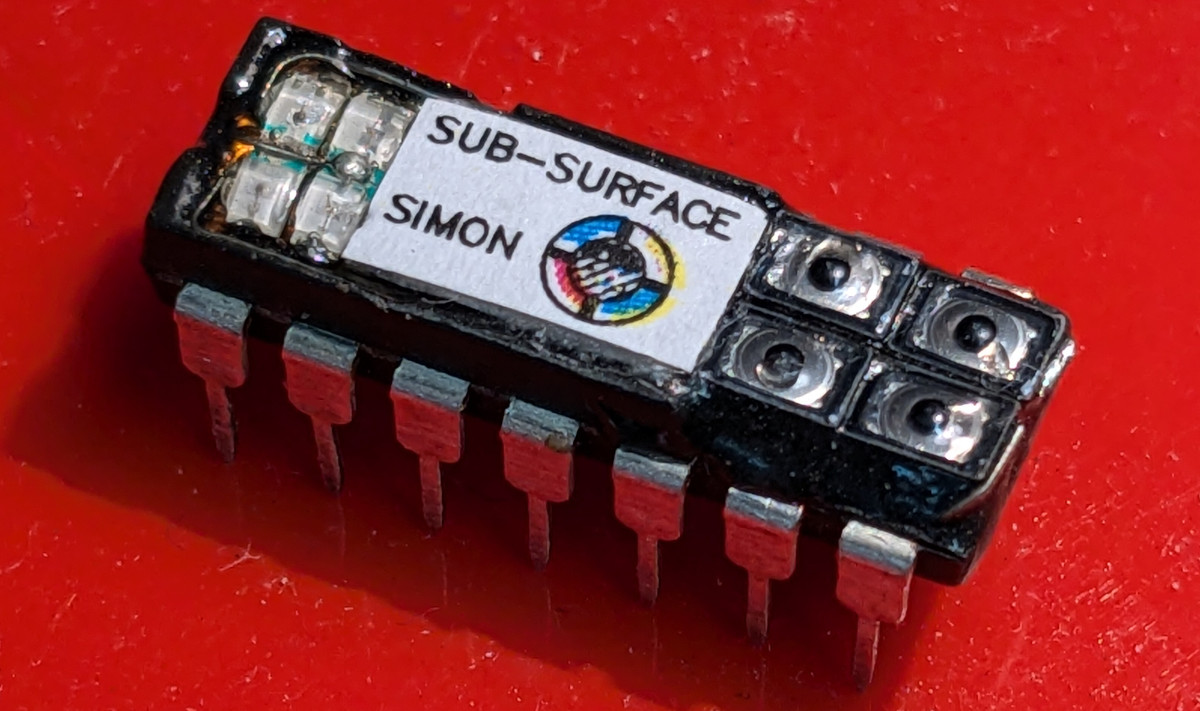
First: Sub-Surface Simon


While this contest saw a lot of excellent entries, we don’t think anyone is going to be surprised to see this one take the top spot. Earning an exceptionally rare perfect ten score from each of our judges, Sub-Surface Simon from [alnwlsn] grabbed onto the theme of this contest and ran like hell with it.

Exploiting the fact that many integrated circuits are actually far smaller than their external packages, [alnwlsn] milled away the inert plastic surrounding the DIP-14 version of the ATtiny84A, which left just enough room to install some LEDs and buttons. This means the complete game is housed within the boundaries of the chip itself — just plug it into a powered breadboard and get playing.

Second: Morse Quest


Coming in at second place is Morse Quest, from [felix]. Basically, [felix] took the classic text-based adventure game formula, and replaced the keyboard and monitor with a microswitch and an LED. Players not only need to correctly decode the flashing LED to figure out what the game is saying about their immediate environment, but they have to compose their response and key it in manually.

Always wanted to learn Morse code, but didn’t know how to get started? Well, this game probably isn’t it. While you can select the rate at which the same blinks out the game to make things a little easier on yourself, you’ll still need a pretty solid knowledge of Morse to explore very far.

Third: WS2812B Othello


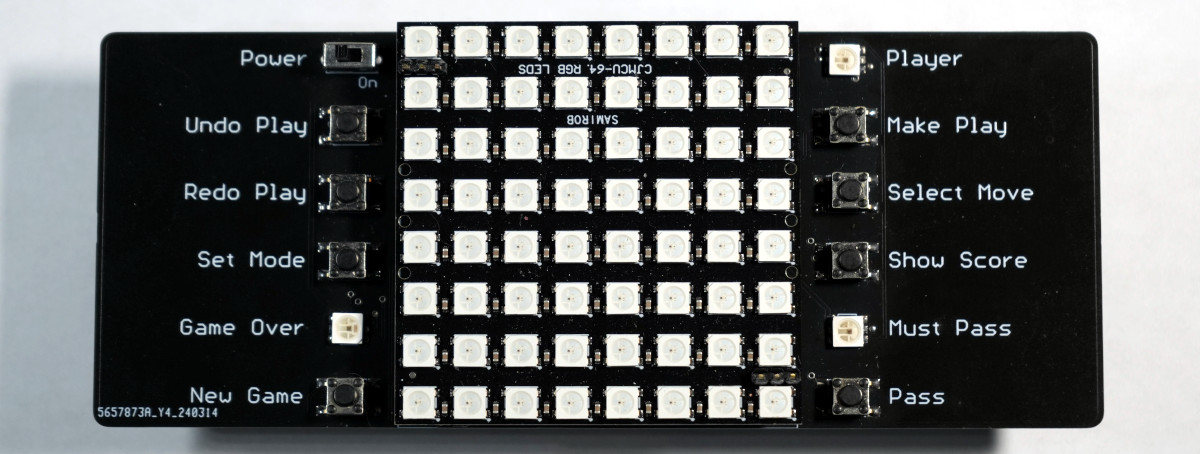
Easily the most traditional game of the of the top three, this handheld Othello allows the player to challenge a computerized opponent on an 8×8 matrix of WS2812B LEDs. As the LED board is an off-the-shelf module, [Dave] was able to hide most of the main PCB’s electronics underneath it, giving the overall device a particularly clean look.

As nice as the hardware is, the software is equally impressive. Running on an 80 MHz STM32L412KBT6, [Dave] wrote the entire firmware without using any external libraries. Most of us would have been reaching for a common library just to get the hardware working, but he wrote everything from the button debounce routines to the actual logic by which the game is played.

Honorable Mentions


There’s no way we can pick just three of these incredible projects to showcase, so as usual, we have a few additional categories for entries that really stood out to the judges.

One Dimensional: For this category we wanted to get people thinking about what they could do with a common addressable LED strip, and T1Duino from [Andrea Trentini] didn’t disappoint. This large-format game re-imagines Tetris in a single dimension by focusing on the colors of the falling blocks instead of their shapes. But we’ve also got to give credit to [senily64dx], who really thumbed their nose at this one. Zero Dimensional PONG recreates the classic game with just a single LED. The players are meant to interpret the changing brightness of the LED as it moving closer or farther away from them, and time their button presses accordingly.

The Classics: This category was devoted to entries that brought back the iconic games of yesteryear, so it’s little surprise that the judges singled out this miniature Space Invaders arcade cabinet from [Nick Cranch] as a prime example. Just one classic game not enough? Then take a look at the μRetro from [bobricius]. This gorgeous handheld uses ATtiny85 cartridges that let’s you swap between a collection of arcade standards.

The Controls: Nintendo has spent the last couple of decades proving that how players interact with the hardware can be just as important as the games themselves, and these entries are no different. Salsa ONE by [Alex] is a minimalistic handheld that you play with just a single button, while Blind Maze from [penumbriel] tasks the player with navigating an invisible maze using an interface consisting of a trio of buttons and LEDs.

Pocket Arcade: Each judge agreed that, as far as being pocket-friendly, the Wibraboy was the project to beat. By repurposing the enclosure from a cheapo handheld game, [x3e] was able to give their DIY recreation a remarkably professional look. For those with even smaller pockets, the Tiny OLED by [deʃhipu] offers up classic gameplay in an exceptionally small footprint.

Fancy!: Finally, this category was devoted to the most polished and professional looking builds. Among all the projects, the LED Matrix Arcade from [Ryan Shill] may be the most attractive of the bunch. With its vibrant 32×32 LED array and walnut enclosure, it’s a build we’d be proud to have on display at home. The all-digital Mini Virtual Pinball Cabinet created by [mircemk] was also a favorite for this category, as it does an excellent job of recreating the authentic pinball look with a sideways-mounted 17 inch monitor.

Shall We Play a Game?


There’s only so many projects we can call out individually, so we strongly recommend you head over to Hackaday.io and browse all of the incredible entries into this contest. There’s some truly impressive work in there, and we’re willing to bet you’ll find something in there that will help inspire your own projects.

We’d like to thank DigiKey for helping to make this contest possible, and of course the Hackaday community for consistently rising to our latest challenge. Speaking of which, you’ve still got some time before the deadline to submit your best Simple Supercon Add-On for our latest contest.

2024 Tiny Games Challenge


The Privacy Post reshared this.

The Privacy Post ha ricondiviso questo.

Commission ends probe of Microsoft-Inflection AI merger
poliverso.org/display/0477a01e…
Commission ends probe of Microsoft-Inflection AI mergerThe European Commission will stop looking into whether Microsoft's hiring of Inflection AI staff breached EU merger rules after seven EU countries dropped their requests for an investigation, the EU executive said in a press release on Wednesday (18 September).euractiv.com/section/competiti…


Commission ends probe of Microsoft-Inflection AI merger


The European Commission will stop looking into whether Microsoft's hiring of Inflection AI staff breached EU merger rules after seven EU countries dropped their requests for an investigation, the EU executive said in a press release on Wednesday (18 September).


euractiv.com/section/competiti…


The Privacy Post reshared this.

The Privacy Post ha ricondiviso questo.

The media in this post is not displayed to visitors. To view it, please go to the original post.

Airline Seats Are for Dummies
poliverso.org/display/0477a01e…
Airline Seats Are for DummiesYou normally don’t think a lot would go into the construction of a chair. However, when that chair is attached to a commercial jet plane, there’s a lot of technology that goes into making sure they are safe. According to a recent BBC article, testing involves crash dummies and robot arms bbc.com/news/articles/c74l9p2x….Admittedly, these are first-class and business-cla


Airline Seats Are for Dummies


You normally don’t think a lot would go into the construction of a chair. However, when that chair is attached to a commercial jet plane, there’s a lot of technology that goes into making sure they are safe. According to a recent BBC article, testing involves crash dummies and robot arms.

Admittedly, these are first-class and business-class seats. Robots do repetitive mundane tasks like opening and closing the tray table many, many times. They also shoot the seats with crash dummies aboard at up to 16 Gs of acceleration. Just to put that into perspective, a jet pilot ejecting gets about the same amount of force. A MiG-35 pilot might experience 10 G.

We didn’t realize how big the airline seat industry is in Northern Ireland. Thompson, the company that has the lab in question, is only one of the companies in the country that builds seats. Apparently, the industry suffered from the global travel slowdown during the pandemic but is now bouncing back.

While people worry about robots taking jobs, we can’t imagine anyone wanting to spend all day returning their tray table to the upright and locked position repeatedly. We certainly don’t want to be 16 G crash dummies, either.

Crash dummies have a long history, of course. Be glad airliners don’t feature ejector seats.


hackaday.com/2024/09/18/airlin…


The Privacy Post reshared this.

The Privacy Post ha ricondiviso questo.

The media in this post is not displayed to visitors. To view it, please go to the original post.

Catching The BOAT: Gamma-Ray Bursts and The Brightest of All Time
poliverso.org/display/0477a01e…
Catching The BOAT: Gamma-Ray Bursts and The Brightest of All TimeDown here at the bottom of our ocean of air, it’s easy to get complacent about the hazards our universe presents. We feel safe from the dangers of the vacuum of space, where radiation sizzles and rocks whizz around. In the same way that a catfish doesn’t much care what’s going on above the surface of


Catching The BOAT: Gamma-Ray Bursts and The Brightest of All Time


Down here at the bottom of our ocean of air, it’s easy to get complacent about the hazards our universe presents. We feel safe from the dangers of the vacuum of space, where radiation sizzles and rocks whizz around. In the same way that a catfish doesn’t much care what’s going on above the surface of his pond, so too are we content that our atmosphere will deflect, absorb, or incinerate just about anything that space throws our way.

Or will it? We all know that there are things out there in the solar system that are more than capable of wiping us out, and every day holds a non-zero chance that we’ll take the same ride the dinosaurs took 65 million years ago. But if that’s not enough to get you going, now we have to worry about gamma-ray bursts, searing blasts of energy crossing half the universe to arrive here and dump unimaginable amounts of energy on us, enough to not only be measurable by sensitive instruments in space but also to effect systems here on the ground, and in some cases, to physically alter our atmosphere.

Gamma-ray bursts are equal parts fascinating physics and terrifying science fiction. Here’s a look at the science behind them and the engineering that goes into detecting and studying them.

Collapsars and Neutron Stars


Although we now know that gamma-ray bursts are relatively common, it wasn’t all that long ago that we were ignorant of their existence, thanks in part to our thick, protective atmosphere. The discovery of GRBs had to wait for the Space Race to couple with Cold War paranoia, which resulted in Project Vela, a series of early US Air Force satellites designed in part to watch for Soviet compliance with the Partial Test Ban Treaty, which forbade everything except underground nuclear tests. In 1967, gamma ray detectors on satellites Vela 3 and Vela 4 saw a flash of gamma radiation that didn’t match the signature of any known nuclear weapon. Analysis of the data from these and subsequent flashes revealed that they came from space, and the race to understand these energetic cosmic outbursts was on.
Trust, but verify. Vela 4, designed to monitor Soviet nuclear testing, was among the first satellites to detect cosmic gamma-ray bursts. Source: ENERGY.GOV, Public domain, via Wikimedia Commons
Gamma-ray bursts are the most energetic phenomena known, with energies that are almost unfathomable. Their extreme brightness, primarily as gamma rays but across the spectrum and including visible light, makes them some of the most distant objects ever observed. To put their energetic nature into perspective, a GRB in 2008, dubbed GRB 080319B, was bright enough in the visible part of the spectrum to just be visible to the naked eye even though it was 7.5 billion light years away. That’s more than halfway across the observable universe, 3,000 times farther away than the Andromeda galaxy, normally the farthest naked-eye visible object.

For all their energy, GRBs tend to be very short-lived. GRBs break down into two rough groups. Short GRBs last for less than about two seconds, with everything else falling into the long GRB category. About 70% of GRBs we see fall into the long category, but that might be due to the fact that the short bursts are harder to see. It could also be that the events that precipitate the long variety, hypernovae, or the collapse of extremely massive stars and the subsequent formation of rapidly spinning black holes, greatly outnumber the progenitor event for the short category of GRBs, which is the merging of binary neutron stars locked in a terminal death spiral.

The trouble is, the math doesn’t work out; neither of these mind-bogglingly energetic events could create a burst of gamma rays bright enough to be observed across half the universe. The light from such a collapse would spread out evenly in all directions, and the tyranny of the inverse square law would attenuate the signal into the background long before it reached us. Unless, of course, the gamma rays were somehow collimated. The current thinking is that a disk of rapidly spinning material called an accretion disk develops outside the hypernova or the neutron star merger. The magnetic field of this matter is tortured and twisted by its rapid rotation, with magnetic lines of flux getting tangled and torn until they break. This releases all the energy of the hypernova or neutron star merger in the form of gamma rays in two tightly focused jets aligned with the pole of rotation of the accretion disk. And if one of those two jets happens to be pointed our way, we’ll see the resulting GRB.

youtube.com/embed/rofLQgMxM78?…

Crystals and Shadows


But how exactly do we detect gamma-ray bursts? The first trick is to get to space, or at least above the bulk of the atmosphere. Our atmosphere does a fantastic job shielding us from all forms of cosmic radiation, which is why the field of gamma-ray astronomy in general and the discovery of GRBs in particular had to wait until the 1960s. A substantial number of GRBs have been detected by gamma-ray detectors carried aloft on high-altitude balloons, especially in the early days, but most dedicated GRB observatories are now satellite-borne

Gamma-ray detection technology has advanced considerably since the days of Vela, but a lot of the tried and true technology is still used today. Scintillation detectors, for example, use crystals that release photons of visible light when gamma rays of a specific energy pass through them. The photons can then be amplified by photomultiplier tubes, resulting in a pulse of current proportional to the energy of the incident gamma ray. This is the technology used by the Gamma-ray Burst Monitor (GBM) aboard the Fermi Gamma-Ray Space Telescope, a satellite that was launched in 2008. Sensors with the GBT are mounted around the main chassis of Fermi, giving it a complete very of the sky. It consists of twelve sodium iodide detectors, each of which is directly coupled to a 12.7-cm diameter photomultiplier tube. Two additional sensors are made from cylindrical bismuth germanate scintillators, each of which is sandwiched between two photomultipliers. Together, the fourteen sensors cover from 8 keV to 30 MeV, and used in concert they can tell where in the sky a gamma-ray burst has occurred.
The coded aperture for Swift’s BAT. Each tiny lead square casts a unique shadow pattern on the array of cadmiun-zinc-telluride (CZT) ionization sensors, allowing an algorithm to work out the characteristics of the gamma rays falling on it. Source: NASA.
Ionization methods are also used as gamma-ray detectors. The Niel Gehrels Swift Observatory, a dedicated GRB hunting satellite that was launched in 2004, has an instrument known as the Burst Alert Telescope, or BAT. This instrument has a very large field of view and is intended to monitor a huge swath of sky. It uses 32,768 cadmium-zinc-telluride (CZT) detector elements, each 4 x 4 x 2 mm, to directly detect the passage of gamma rays. CZT is a direct-bandgap semiconductor in which electron-hole pairs are formed across an electric field when hit by ionizing radiation, producing a current pulse. The CZT array sits behind a fan-shaped coded aperture, which has thousands of thin lead tiles arranged in an array that looks a little like a QR code. Gamma rays hit the coded aperture first, casting a pattern on the CZT array below. The pattern is used to reconstruct the original properties of the radiation beam mathematically, since conventional mirrors and lenses don’t work with gamma radiation. The BAT is used to rapidly detect the location of a GRB and to determine if it’s something worth looking at. If it is, it rapidly slews the spacecraft to look at the burst with its other instruments and instantly informs other gamma observatories about the source so they can take a look too.

The B.O.A.T.


On October 9, 2022, both Swift and Fermi, along with dozens of other spacecraft and even some ground observatories, would get to witness a cataclysmically powerful gamma-ray burst. Bloodlessly named GRB 221009A but later dubbed “The BOAT,” for “brightest of all time,” the initial GRB lasted for an incredible ten minutes with a signal that remained detectable for hours. Coming from the direction of the constellation Sagittarius from a distance of 2.4 billion light years, the burst was powerful enough to saturate Fermi’s sensors and was ten times more powerful than any signal yet received by Swift.
The BOAT. A ten-hour time-lapse of data from the Fermi Large Area Telescope during GRB 221009A on October 8, 2022. Source: NASA/DOE/Fermi LAT Collaboration, Public domain
Almost everything about the BOAT is fascinating, and the superlatives are too many to list. The gamma-ray burst was so powerful that it showed up in the scientific data of spacecraft that aren’t even equipped with gamma-ray detectors, including orbiters at Mars and Voyager 1. Ground-based observatories noted the burst, too, with observatories in Russia and China noting very high-energy photons in the range of tens to hundreds of TeV arriving at their detectors.

The total energy released by GRB 221009A is hard to gauge with precision, mainly because it swamped the very instruments designed to measure it. Estimates range from 1048 to 1050 joules, either of which dwarfs the total output of the Sun over its entire 10 billion-year lifespan. So much energy was thrown in our direction in such a short timespan that even our own atmosphere was impacted. Lightning detectors in India and Germany were triggered by the burst, and the ionosphere suddenly started behaving as if a small solar flare had just occurred. Most surprising was that the ionospheric effects showed up on the daylight side of the Earth, swamping the usual dampening effect of the Sun.

When the dust had settled from the initial detection of GRB 221009A, the question remained: What happened to cause such an outburst? To answer that, the James Webb Space Telescope was tasked with peering into space, off in the direction of Sagittarius, where it found pretty much what was expected — the remains of a massive supernova. In fact, the supernova that spawned this GRB doesn’t appear to have been particularly special when compared to other supernovae from similarly massive stars, which leaves the question of how the BOAT got to be so powerful.

Does any of this mean that a gamma-ray burst is going to ablate our atmosphere and wipe us out next week? Probably not, and given that this recent outburst was estimated to be a one-in-10,000-year event, we’re probably good for a while. It seems likely that there’s plenty that we don’t yet understand about GRBs, and that the data from GRB 221009A will be pored over for decades to come. It could be that we just got lucky this time, both in that we were in the right place at the right time to see the BOAT, and that it didn’t incinerate us in the process. But given that on average we see one GRB per day somewhere in the sky, chances are good that we’ll have plenty of opportunities to study these remarkable events.


hackaday.com/2024/09/18/catchi…


The Privacy Post reshared this.

The Privacy Post ha ricondiviso questo.

Supply Chain del Terrore! I Cercapersone Manomessi in fase di Produzione e Spedizione
poliverso.org/display/0477a01e…
Supply Chain del Terrore! I Cercapersone Manomessi in fase di Produzione e SpedizioneDa ieri, la percezione degli attacchi alla supply chain redhotcyber.com/post/cosa-sono… è cambiata radicalmente.Non si tratta più solo di proteggere i dati, ma di garantire la sicurezza fisica delle persone. Gli eventi di ieri hanno evidenziato come la


Supply Chain del Terrore! I Cercapersone Manomessi in fase di Produzione e Spedizione


Da ieri, la percezione degli attacchi alla supply chain è cambiata radicalmente.

Non si tratta più solo di proteggere i dati, ma di garantire la sicurezza fisica delle persone. Gli eventi di ieri hanno evidenziato come la manipolazione dei dispositivi possa mettere a rischio la vita umana, trasformando la tecnologia in un’arma silenziosa e invisibile. Questo ci fa comprendere come la sicurezza informatica e quella fisica siano ora profondamente interconnesse, e il prezzo dell’inazione non è più solo la perdita di informazioni, ma la perdita di vite umane

Da quanto è stato riportato da alcuni media, all’interno dei dispositivi esplosi agli Hezbollah, sono state impiantate delle schede con dell’esplosivo in fase di produzione.

La vicenda rappresenta uno degli attacchi più significativi in termini di penetrazione delle reti di comunicazione di Hezbollah, e ha sollevato numerosi interrogativi sulla vulnerabilità delle forniture elettroniche destinate a gruppi militanti.

Manomissioni in fase di produzione


Secondo fonti di intelligence citate da Reuters, il Mossad avrebbe orchestrato un sabotaggio su larga scala inserendo esplosivi all’interno di migliaia di cercapersone ordinati da Hezbollah e fabbricati in Taiwan. Gli esplosivi sono stati inseriti durante la fase di produzione o di spedizione, rendendo i dispositivi quasi impossibili da distinguere dai normali cercapersone. Questi ordigni sarebbero stati progettati per detonare in risposta alla ricezione di specifici messaggi codificati inviati ai dispositivi.

Hezbollah aveva optato per l’utilizzo di cercapersone, in quanto considerati un’alternativa più sicura rispetto agli smartphone, ritenuti facilmente tracciabili dai servizi segreti israeliani. Tuttavia, questo incidente dimostra come anche tecnologie più semplici possano essere compromesse in maniera sofisticata. Il sabotaggio ha provocato un’esplosione simultanea dei dispositivi, causando un numero significativo di vittime, inclusi combattenti e affiliati del gruppo.

Una pianificazione da Stato


Le fonti vicine alla vicenda hanno riferito che il piano è stato attentamente orchestrato nei mesi precedenti, sfruttando l’ordinazione in blocco dei cercapersone da parte di Hezbollah. Questi dispositivi, prodotti dalla compagnia taiwanese Gold Apollo, erano destinati a migliorare la comunicazione tra i membri del gruppo, soprattutto in aree come Libano e Siria. Tuttavia, la loro alterazione a livello di produzione o spedizione ha trasformato questi strumenti di comunicazione in vere e proprie bombe a orologeria.

Gold Apollo ha negato qualsiasi coinvolgimento diretto nella manipolazione dei dispositivi, sottolineando che i cercapersone fabbricati erano stati venduti attraverso canali regolari e che non avevano il controllo su ciò che accadeva dopo la spedizione. L’azienda ha dichiarato di non essere responsabile per l’uso improprio dei suoi prodotti e ha puntato il dito verso la possibilità che i dispositivi siano stati sabotati durante il trasporto o in altre fasi della supply chain.

L’utilizzo del PETN


Questa operazione rappresenta un esempio clamoroso di attacco alla supply chain, in cui l’infiltrazione dei sistemi avviene prima che i dispositivi raggiungano i loro destinatari finali. L’uso di esplosivi miniaturizzati, come il PETN, inseriti all’interno dei vani batteria dei cercapersone, è stato identificato come la modalità principale con cui è stato attuato il sabotaggio. La possibilità che tali esplosivi possano essere detonati a distanza tramite un segnale radio codificato evidenzia l’elevato livello tecnologico raggiunto dall’intelligence israeliana.

La reazione di Hezbollah non si è fatta attendere: il gruppo ha subito accusato Israele di essere responsabile dell’attacco, e ha promesso vendetta. L’episodio ha inasprito ulteriormente le tensioni tra Israele e Hezbollah, rafforzando la percezione che il Mossad sia capace di colpire in profondità le infrastrutture e le comunicazioni del gruppo militante.

Questo scenario di sabotaggio tecnologico apre nuovi interrogativi sul futuro della sicurezza nelle comunicazioni per gruppi come Hezbollah, e pone l’accento sui rischi associati agli attacchi alla supply chain, una tecnica che sta diventando sempre più sofisticata e devastante. La vicenda potrebbe avere importanti implicazioni geopolitiche, non solo in Medio Oriente ma anche a livello internazionale, considerando l’utilizzo di tecnologie civili per fini militari.

L'articolo Supply Chain del Terrore! I Cercapersone Manomessi in fase di Produzione e Spedizione proviene da il blog della sicurezza informatica.


The Privacy Post reshared this.

The Privacy Post ha ricondiviso questo.

The 30 new Commission initiatives to get Europe back in the tech game
poliverso.org/display/0477a01e…
The 30 new Commission initiatives to get Europe back in the tech gameUrsula von der Leyen’s commissioners-designate are to present 30 new strategies, acts, and initiatives to make Europe competitive and secure in tech.euractiv.com/section/industria…


The 30 new Commission initiatives to get Europe back in the tech game


Ursula von der Leyen’s commissioners-designate are to present 30 new strategies, acts, and initiatives to make Europe competitive and secure in tech.


euractiv.com/section/industria…


The Privacy Post reshared this.

The Privacy Post ha ricondiviso questo.

The media in this post is not displayed to visitors. To view it, please go to the original post.

Bringing the Horror of Seaman into the Real World
poliverso.org/display/0477a01e…
Bringing the Horror of Seaman into the Real WorldA little under 25 years ago, a particularly bizarre game was released for Sega’s Dreamcast. In actually, calling it a “game” might be something of a stretch. It was more of a pet simulator, where you need to feed and care for a virtual animal as it grows. Except rather than something like a dog or a rabbit, your pet is a talking


Bringing the Horror of Seaman into the Real World


A little under 25 years ago, a particularly bizarre game was released for Sega’s Dreamcast. In actually, calling it a “game” might be something of a stretch. It was more of a pet simulator, where you need to feed and care for a virtual animal as it grows. Except rather than something like a dog or a rabbit, your pet is a talking fish with a human face that doesn’t seem to like you very much. Oh, and Leonard Nimoy is there too for some reason.

Most people in the world don’t even know this game ever existed, and frankly, their lives are all the better for it. But for those who lovingly cared for (or intentionally killed) one of these rude creatures back in the early 2000s, it’s an experience that sticks with you. Which we assume is why [Robert Prest] decided to build this incredibly faithful physical recreation of Seaman.

The creature itself is a wireless animatronic that’s been fitted with several servos to operate not just its creepy human mouth, but its flippers, legs, and tail. [Robert] pulled the original speech clips from the game, and recreated most of the voice recognition prompts so he can converse with his pet monster. A Dreamcast controller is used to interact with the robo-seaman, but even that’s a bit of a hack. It’s actually just the shell of the controller which has been filled with new hardware, namely an ESP8266 and Nokia LCD that take the place of the original Visual Memory Unit (VMU).

[Robert] went the extra mile and also recreated the tank the creature lives in. The front glass is actually a transparent display that can show game information or “water”, and there’s sonar sensors that can detect when somebody has reached into it. The original game’s interactive elements involved adjusting the temperature of the tank and feeding your growing abomination, which are represented in this physical incarnation. There’s even little 3D printed versions of the bugs (which incidentally also have human faces) raise as food for the creature.

While this might not be our ideal office decoration, but we’ve got to hand it to [Robert], he did a hell of job bringing Seaman to life. Now let’s just hope it doesn’t escape its tank and get into the wild.

youtube.com/embed/-HH8HnN_mB4?…


hackaday.com/2024/09/18/bringi…


The Privacy Post reshared this.

The Privacy Post ha ricondiviso questo.

The media in this post is not displayed to visitors. To view it, please go to the original post.

Bringing the Horror of Seaman into the Real World
poliverso.org/display/0477a01e…
Bringing the Horror of Seaman into the Real WorldA little under 25 years ago, a particularly bizarre game was released for Sega’s Dreamcast. In actually, calling it a “game” might be something of a stretch. It was more of a pet simulator, where you need to feed and care for a virtual animal as it grows. Except rather than something like a dog or a rabbit, your pet is a talking


Bringing the Horror of Seaman into the Real World


A little under 25 years ago, a particularly bizarre game was released for Sega’s Dreamcast. In actually, calling it a “game” might be something of a stretch. It was more of a pet simulator, where you need to feed and care for a virtual animal as it grows. Except rather than something like a dog or a rabbit, your pet is a talking fish with a human face that doesn’t seem to like you very much. Oh, and Leonard Nimoy is there too for some reason.

Most people in the world don’t even know this game ever existed, and frankly, their lives are all the better for it. But for those who lovingly cared for (or intentionally killed) one of these rude creatures back in the early 2000s, it’s an experience that sticks with you. Which we assume is why [Robert Prest] decided to build this incredibly faithful physical recreation of Seaman.

The creature itself is a wireless animatronic that’s been fitted with several servos to operate not just its creepy human mouth, but its flippers, legs, and tail. [Robert] pulled the original speech clips from the game, and recreated most of the voice recognition prompts so he can converse with his pet monster. A Dreamcast controller is used to interact with the robo-seaman, but even that’s a bit of a hack. It’s actually just the shell of the controller which has been filled with new hardware, namely an ESP8266 and Nokia LCD that take the place of the original Visual Memory Unit (VMU).

[Robert] went the extra mile and also recreated the tank the creature lives in. The front glass is actually a transparent display that can show game information or “water”, and there’s sonar sensors that can detect when somebody has reached into it. The original game’s interactive elements involved adjusting the temperature of the tank and feeding your growing abomination, which are represented in this physical incarnation. There’s even little 3D printed versions of the bugs (which incidentally also have human faces) raise as food for the creature.

While this might not be our ideal office decoration, but we’ve got to hand it to [Robert], he did a hell of job bringing Seaman to life. Now let’s just hope it doesn’t escape its tank and get into the wild.

youtube.com/embed/-HH8HnN_mB4?…


hackaday.com/2024/09/18/bringi…


The Privacy Post reshared this.

The Privacy Post ha ricondiviso questo.

The media in this post is not displayed to visitors. To view it, please go to the original post.

Exotic SambaSpy is now dancing with Italian users
poliverso.org/display/0477a01e…
Exotic SambaSpy is now dancing with Italian usersIntroductionIn May 2024, we detected a campaign exclusively targeting victims in Italy. We were rather surprised by this, as cybercriminals typically select a broader target to maximize their profits. For example, a certain type of malware might target users in France and Spain, with the phishing emails written in both of the


Exotic SambaSpy is now dancing with Italian users


Introduction


In May 2024, we detected a campaign exclusively targeting victims in Italy. We were rather surprised by this, as cybercriminals typically select a broader target to maximize their profits. For example, a certain type of malware might target users in France and Spain, with the phishing emails written in both of the respective languages. However, for such a campaign, the malware’s code includes no particular checks to ensure it only runs in France and Spain. What sets this campaign apart is that, at various stages of the infection chain, checks are made to ensure that only Italian users are infected. This prompted us to investigate further and discover that the attackers were delivering a new RAT as the final payload that we dubbed SambaSpy.

Infection chain


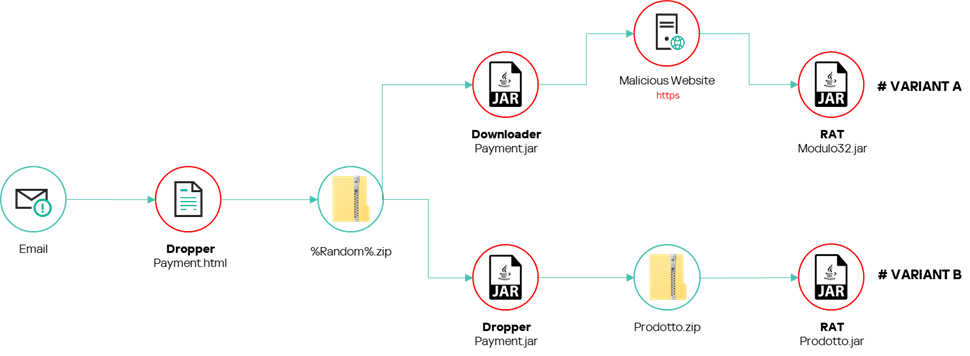
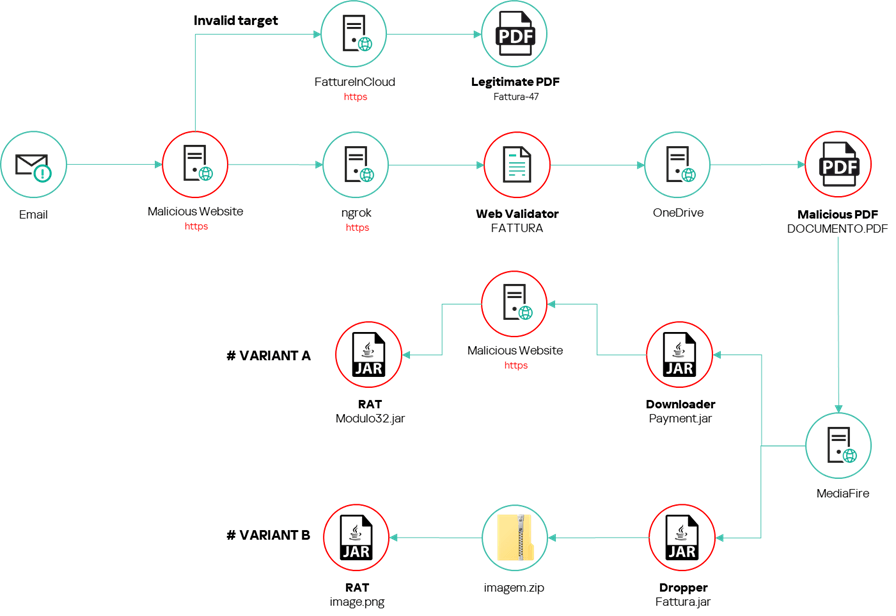
When we started our investigation, we discovered two (slightly) different infection chains, as can be seen in the two figures below.

SambaSpy infection chain 1

SambaSpy infection chain 2

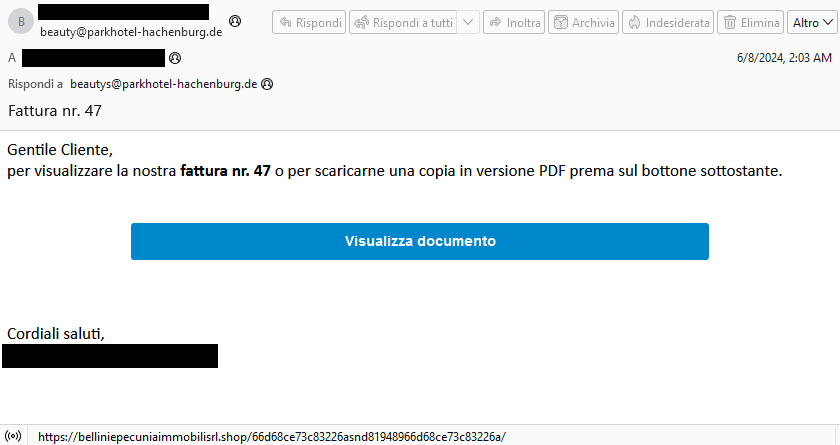
Let’s discuss the second case in more detail as that infection chain is more elaborate. First, the victim receives an email from a German email address. The email was, however, written in Italian and looked like it came from a legitimate Italian real estate company.

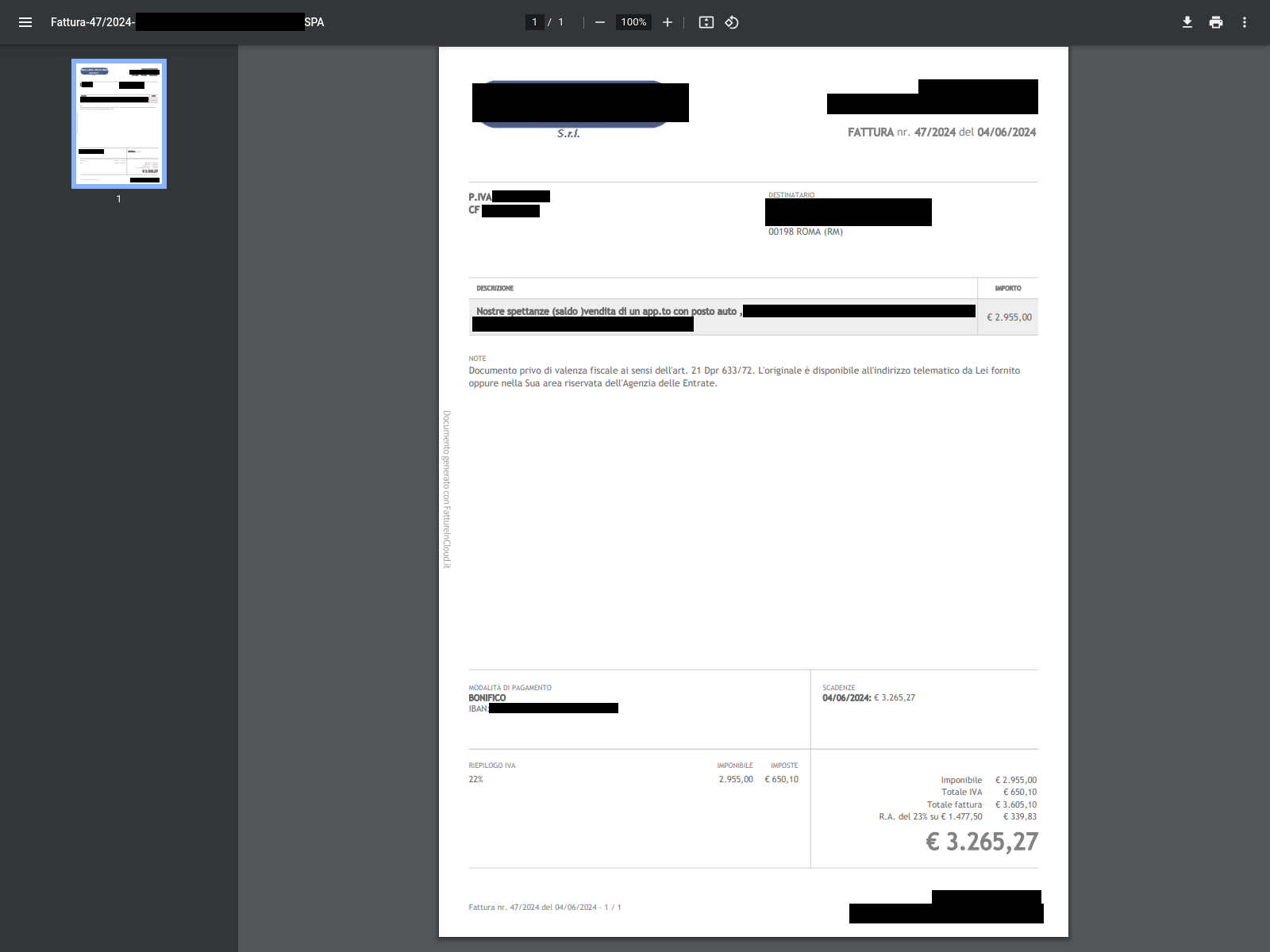
The email urges the receiver to view an invoice by clicking on an embedded link. Then the user is redirected to a malicious website which, during our analysis and according to other open sources, redirects to FattureInCloud, a legitimate Italian cloud solution used to store and manage digital invoices and quotes, where a legitimate invoice is displayed. Unfortunately, we were unable to view this file directly. Luckily, we found such an invoice on the urlscan.io website as can be seen in the figure below.

Note that all the distribution campaigns seem to be designed around this legitimate invoice. We observed a variety of the malicious emails and in all of them, the sender, subjects, and content took advantage of the brand of the company that generated the invoice. Moreover, the attacker registered more than a dozen of malicious domains under the company’s name:

belliniepecuniaimmobili[.]com
immobilibelliniepecunia[.]xyz
immobilibelliniepecunia[.]online
immobilibelliniepecunia[.]site
bpecuniaimmobili[.]online
bpecuniaimmobili[.]info
belliniepecuniaimmobilisrl[.]shop
belliniepecuniaimmobilisrl[.]online
belliniepecuniaimmobilisrl[.]xyz
belliniepecuniaimmobili.com[.]br
bpecuniaimmobili[.]xyz
immobilibelliniepecunia[.]shop
immobilibelliniepecunia[.]me
immobiliarebelliniepecunia[.]info
immobiliarebelliniepecunia[.]online

Getting redirected to a legitimate resource seemed like a dead end but our telemetry provided information that some users were redirected by the same URL to a malicious web server running behind ngrok. This server provided an HTML page containing JS code with comments in Brazilian Portuguese. It redirects users to a malicious OneDrive URL but only if they are running Edge, Firefox, or Chrome with their language set to Italian. If the users don’t pass these checks, they stay on the page.
<title> FATTURA </title>
<script>
window.onload = function() {
var language = navigator.language || navigator.userLanguage;

if (language.startsWith("it")) {
var userAgent = navigator.userAgent.toLowerCase();
var browser;

if (userAgent.includes("edg")) {
browser = "Edge";
} else if (userAgent.includes("firefox")) {
browser = "Firefox";
} else if (userAgent.includes("chrome")) {
browser = "Chrome";
} else {
// Navegador desconhecido, pode lidar com isso de acordo com sua lógica
return;
}

switch (browser) {
case "Edge":
window.location.href = "hxxps://1drv.ms/b/s!AnMKZoF8QfODa92x201yr0GDysk?e=ZnX3Rm";
Users that match the target end up at a PDF document hosted on Microsoft OneDrive, luring the user to click on a hyperlink with the text “VISUALIZZA DOCUMENTO”, meaning “view document.” Finally, the URL redirects to a malicious JAR file hosted on MediaFire, which is either a dropper or a downloader.

The downloader


The downloader runs some checks to see whether or not it is running in a VM.It then checks that the environment is set to Italian again and if not, exits. If all the checks are passed, the downloader downloads the final stage and executes it.


The dropper


The dropper does exactly the same thing as a downloader besides downloading the malware, as it is embedded inside the resources of the JAR file.

SambaSpy


SambaSpy is a full-featured RAT developed in Java and obfuscated using the Zelix KlassMaster protector. The strings are encrypted and class names and methods are obfuscated to prevent analysis and detection. The malware exhibits a wide range of functionalities. Below, we provided a partial description. For the full report, please contact us.

The many malware’s features include:

  • File system management;
  • Process management;
  • Uploading/downloading files;
  • Webcam control;
  • Logging keystrokes and controlling the clipboard;
  • Grabbing screenshots;
  • Remote desktop management;
  • Password stealing;
  • Loading additional plugins at runtime;
  • Starting a remote shell;
  • Interacting with the victim;

Let’s look at some of these in more detail:

Loading plugins


The plugin loading mechanism is fairly simple. A class is supplied to the RAT and loaded using URLClassLoader to open a file on the disk previously downloaded by the RAT. It then invokes the addURL() method in the loaded class. See the figure below for the complete code.


Logging keystrokes and clipboard


SambaSpy uses the JNativeHook library to log every keystroke from the victim. Then, upon key release, each keystroke event is sent to the C2. It also uses Java Abstract Window native libraries to steal or modify the victim’s clipboard content.

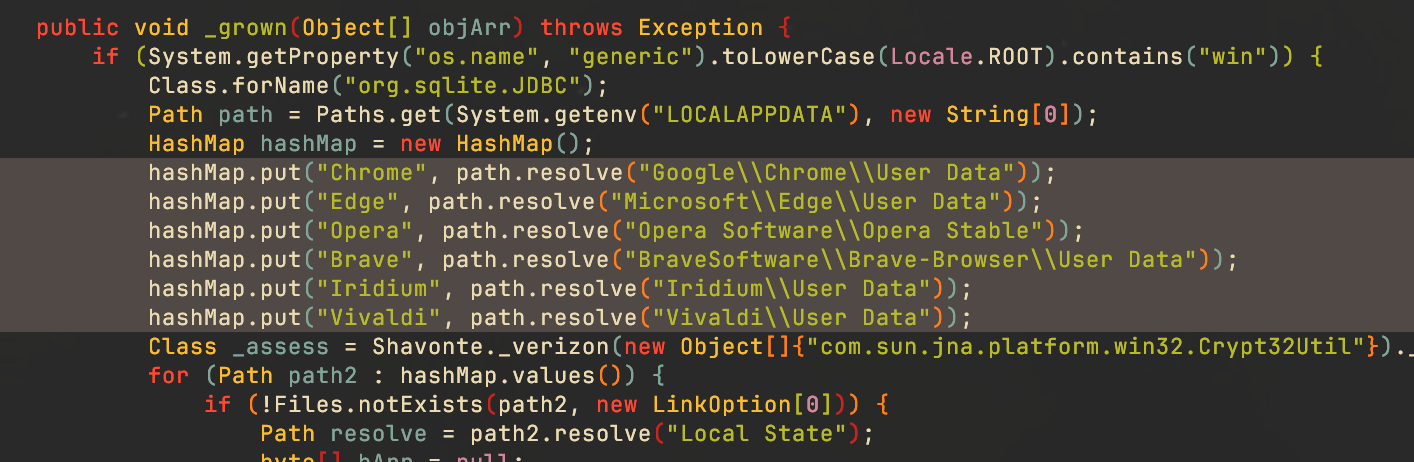
Stealing browser credentials


The RAT can steal credentials from major browsers including Chrome, Edge, Opera, Brave, Iridium and Vivaldi.


Remote desktop control


SambaSpy implements a custom remote control system. It uses the Java Abstract Window library’s Robot class to control the mouse and keyboard from the system, along with the GraphicsDevice class to provide a screen display under the attacker’s control.

Who is behind the campaign?


We have yet to correlate the attackers behind this campaign to known actors. Nevertheless, there are indications that the threat actor speaks Brazilian Portuguese.

The language found in the malicious artifacts (i.e., code comments and error messages), and in the various sites utilized by the threat actor, was identified as Brazilian Portuguese as it features words not used in other dialects of the language.

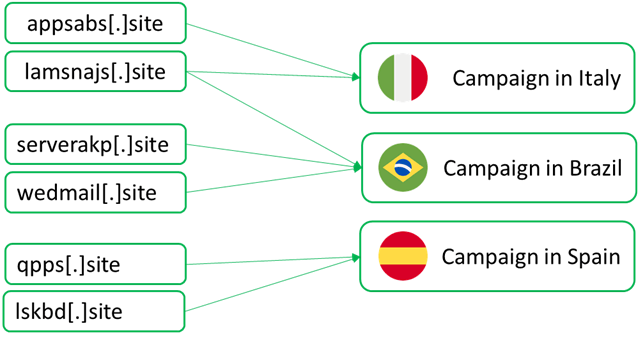
We also know that the attacker is not exclusively interested in Italian targets, but has extended their activities to Spain and Brazil. During our investigation, we discovered other malicious domains attributed to the same attacker used in other campaigns. However, the infection chain involving these domains doesn’t include any language checks similar to those we observed in the Italian campaign.

The domains were attributed to the same attacker because they were used to manage or distribute other variants of the downloader observed in Italy.

Conclusion


There are several interesting aspects to this campaign. First, this campaign specifically targeted Italians by ensuring at multiple stages of the infection process that Italian was set as the language of the victim’s system. Second, there are various connections with Brazil, such as language artifacts in the code and domains targeting Brazilian users. This aligns with the fact that attackers from Latin America often target European countries with closely related languages, namely Italy, Spain, and Portugal.

Third, it is interesting to observe how the attackers based their distribution campaign on a legitimate document shared online, taking advantage of the brand of the company that generated the document. It is important to highlight that the company is completely unrelated to the campaign, as they are not directly involved in sending the messages or distributing the malware. They do not even appear to have published the invoice. Rather a customer presumably did so.

The attacker behind this campaign continuously changes its obfuscation methods, phishing emails, and C2 endpoints. Nevertheless, they reuse infrastructure-related second-level domains by creating new subdomains, which gives us a better overview of the attacker. This information can be used in future attribution efforts, while enhancing malware detection.

If you would like to stay up to date on the latest TTPs that criminals are using, or if you have questions about our private reports, contact us at crimewareintel@kaspersky.com.

Indicators of compromise


e6be6bc2f8e27631a7bfd2e3f06494aa Malicious PDF
1ec21bd711b491ad47d5c2ef71ff1a10 Downloader
d153006e00884edf7d48b9fe05d83cb4 Dropper
0f3b46d496bbf47e8a2485f794132b48 SambaSpy

Domain names embedded in email messages
officediraccoltaanabelacosta[.]net
belliniepecuniaimmobili[.]com
immobilibelliniepecunia[.]xyz
immobilibelliniepecunia[.]online
immobilibelliniepecunia[.]site
bpecuniaimmobili[.]online
bpecuniaimmobili[.]info
belliniepecuniaimmobilisrl[.]shop
belliniepecuniaimmobilisrl[.]online
belliniepecuniaimmobilisrl[.]xyz
belliniepecuniaimmobili.com[.]br
bpecuniaimmobili[.]xyz
immobilibelliniepecunia[.]shop
immobilibelliniepecunia[.]me
immobiliarebelliniepecunia[.]info
immobiliarebelliniepecunia[.]online

Domain names used to distribute malware
lamsnajs[.]site
appsabs[.]site
qpps[.]site
lskbd[.]site
serverakp[.]site
wedmail[.]site

66d68ce73c83226a.ngrok[.]app
hxxps://1drv[.]ms/b/s!AnMKZoF8QfODa92x201yr0GDysk?e=ZnX3Rm PDF hosted on OneDrive
hxxps://moduloj.lamsnajs[.]site/Modulo32.jpg URL embedded in downloader


securelist.com/sambaspy-rat-ta…


The Privacy Post reshared this.

The Privacy Post ha ricondiviso questo.

The media in this post is not displayed to visitors. To view it, please go to the original post.

Cercapersone come bombe, il blitz di Israele contro Hezbollah che può allargare la guerra
poliverso.org/display/0477a01e…
Cercapersone come bombe, il blitz di Israele contro Hezbollah che può allargare la guerraL’esplosione di oltre un migliaio di cercapersone di membri di Hezbollah e di altri esponenti di istituzioni e apparati legati all’Iran nella giornata odierna a seguito di un’azione con ogni probabilità di stampo israeliana ha suscitato clamore e


Cercapersone come bombe, il blitz di Israele contro Hezbollah che può allargare la guerra


L’esplosione di oltre un migliaio di cercapersone di membri di Hezbollah e di altri esponenti di istituzioni e apparati legati all’Iran nella giornata odierna a seguito di un’azione con ogni probabilità di stampo israeliana ha suscitato clamore e scalpore. Un’esplosione simultanea di un numero così ampio di dispositivi, che ha causato 1.200 feriti in Libano, […]
Continua a leggere

The post Cercapersone come bombe, il blitz di Israele contro Hezbollah che può allargare la guerra appeared first on InsideOver.


The Privacy Post reshared this.

The Privacy Post ha ricondiviso questo.

Una Full Chain Zero-Click RCE in macOS Calendar espone i dati di iCloud
poliverso.org/display/0477a01e…
Una Full Chain Zero-Click RCE in macOS Calendar espone i dati di iCloudUna catena di tre vulnerabilità redhotcyber.com/post/vulnerabi… (rischio critico, medio e basso) in macOS ha permesso di aggirare i livelli di protezione del sistema operativo e ottenere l’accesso ai dati utente di iCloud. Il problema risiede nell’elaborazione insufficiente dei file


Una Full Chain Zero-Click RCE in macOS Calendar espone i dati di iCloud


Una catena di tre vulnerabilità (rischio critico, medio e basso) in macOS ha permesso di aggirare i livelli di protezione del sistema operativo e ottenere l’accesso ai dati utente di iCloud. Il problema risiede nell’elaborazione insufficiente dei file allegati agli eventi nel calendario, l’applicazione “nativa” di macOS.

Come ha scoperto il ricercatore di sicurezza informatica Mikko Kenttälä, questa falla consente l’esecuzione remota di codice arbitrario, nonché l’accesso a dati sensibili. Durante i test, Kenttälä, ad esempio, ha raggiunto le foto archiviate su iCloud.

Il funzionamento della full-chain


Nessuno dei passaggi di questo vettore di attacco richiede l’interazione dell’utente ma, cosa ancora più importante, non può essere fermato dai sistemi di difesa Gatekeeper e TCC. La vulnerabilità più pericolosa in questo gruppo è il CVE-2022-46723, a cui è stato assegnato un punteggio CVSS di 9,8 e, di conseguenza, uno stato critico.

La cosa peggiore è che il CVE-2022-46723 è abbastanza facile da usare in un attacco. Un criminale informatico opportunista potrebbe inviare all’utente preso di mira un invito di calendario contenente un file dannoso.

Poiché macOS non controlla il nome del file, un utente malintenzionato potrebbe nominarlo arbitrariamente. Inoltre, il CVE-2022-46723 ha creato anche un problema di path traversal, consentendo all’app Calendario di uscire dalla propria sandbox.

Un altro difetto, il CVE-2023-40344, che ha ricevuto un punteggio CVSS di 5,6 (rischio medio) ha funzionato bene insieme al CVE-2022-46723. La terza vulnerabilità – CVE-2023-40434 (rischio basso, punteggio CVSS 3,3) – ha aperto la possibilità di rubare foto dell’utente preso di mira.

Che cos’è una Full Chain RCE Zero-Click?


Una Full Chain Zero-Click RCE è un tipo di attacco informatico estremamente pericoloso che combina diverse vulnerabilità in una catena per ottenere il controllo completo di un dispositivo o sistema, senza richiedere alcuna interazione da parte della vittima.

Ecco una spiegazione dettagliata dei termini:

  1. Full Chain: Indica che l’attacco utilizza una catena di vulnerabilità, ovvero una serie di exploit collegati tra loro. Ogni vulnerabilità sfruttata in questa catena permette all’attaccante di ottenere un controllo progressivo sul sistema target, fino a raggiungere l’obiettivo finale, come l’esecuzione di codice arbitrario.
  2. Zero-Click: Significa che l’attacco non richiede alcuna interazione da parte della vittima (come cliccare su un link o aprire un allegato). La vittima può essere compromessa semplicemente ricevendo un messaggio o un file, sfruttando vulnerabilità nei software o nei servizi esposti, come le applicazioni di messaggistica o i protocolli di comunicazione.
  3. RCE (Remote Code Execution): L’obiettivo finale di questo tipo di attacco è eseguire codice arbitrario da remoto. In pratica, l’attaccante può eseguire qualsiasi comando o programma sul dispositivo della vittima, ottenendo così il pieno controllo del sistema.

In un attacco Full Chain Zero-Click RCE, l’attaccante sfrutta una serie di vulnerabilità senza che la vittima faccia nulla, ottenendo il controllo completo del dispositivo, che può portare all’accesso a dati sensibili, installazione di malware o spyware, o l’esecuzione di altre operazioni malevole.

L'articolo Una Full Chain Zero-Click RCE in macOS Calendar espone i dati di iCloud proviene da il blog della sicurezza informatica.


The Privacy Post reshared this.

The Privacy Post ha ricondiviso questo.

The media in this post is not displayed to visitors. To view it, please go to the original post.

From High Level Language to Assembly
poliverso.org/display/0477a01e…
From High Level Language to AssemblyIf you cut your teeth on Z-80 assembly and have dabbled in other assembly languages, you might not find much mystery in creating programs using the next best thing to machine code. However, if you have only used high level languages, assembly can be somewhat daunting. [Shikaan] has an introductory article aimed to get you started at the “hello world” level


From High Level Language to Assembly


If you cut your teeth on Z-80 assembly and have dabbled in other assembly languages, you might not find much mystery in creating programs using the next best thing to machine code. However, if you have only used high level languages, assembly can be somewhat daunting. [Shikaan] has an introductory article aimed to get you started at the “hello world” level of x86-64 assembly language. The second part is already up, too, and covers control structures.

You can argue that you may not need to know assembly language these days, and we’ll admit it’s certainly not as important as it used to be. However, there are unusual cases where you really need either the performance or the small footprint, which is only possible in assembly language. What’s more, it is super useful to be able to read assembly from your high-level tools when something goes wrong.

Of course, one of the problems is that each assembly language is different. For example, knowing that the x86 assembly doesn’t completely transfer to ARM instructions. However, in most cases, the general concepts apply, and it is usually fairly easy to learn your second, third, or fourth instruction set.

We’ve had our own tutorials on this topic. You can also debate if you should learn assembly first or wait, although in this case, the audience is people who waited.


hackaday.com/2024/09/18/from-h…


The Privacy Post reshared this.

The Privacy Post ha ricondiviso questo.

Top EU Court annuls a €1.49 billion fine on Google
poliverso.org/display/0477a01e…
Top EU Court annuls a €1.49 billion fine on GoogleThe European Union's General Court annulled the Commission's €1.49 billion fine on Google for anticompetitive behaviour with its AdSense product on Wednesday (18 September), leaving the Commission just over two months to appeal.euractiv.com/section/competiti…


Top EU Court annuls a €1.49 billion fine on Google


The European Union's General Court annulled the Commission's €1.49 billion fine on Google for anticompetitive behaviour with its AdSense product on Wednesday (18 September), leaving the Commission just over two months to appeal.


euractiv.com/section/competiti…


The Privacy Post reshared this.

The Privacy Post ha ricondiviso questo.

Milioni di dispositivi a rischio. La Vulnerabilità Critica di Chrome Minaccia Android e macOS
poliverso.org/display/0477a01e…
Milioni di dispositivi a rischio. La Vulnerabilità Critica di Chrome Minaccia Android e macOSGli specialisti BI.ZONE hanno condotto un’analisi tecnica bi.zone/expertise/blog/analiz-… di una vulnerabilità redhotcyber.com/post/vulnerabi… critica nel motore JavaScript V8 utilizzato nel browser Google Chrome. È stato stabilito che la


Milioni di dispositivi a rischio. La Vulnerabilità Critica di Chrome Minaccia Android e macOS


Gli specialisti BI.ZONE hanno condotto un’analisi tecnica di una vulnerabilità critica nel motore JavaScript V8 utilizzato nel browser Google Chrome. È stato stabilito che la vulnerabilità rappresenta una minaccia per gli utenti di smartphone Android e alcuni modelli di laptop con macOS.

Google ha annunciato lo sfruttamento della vulnerabilità CVE-2024-7965 il 26 agosto, pochi giorni dopo il rilascio della versione 128.0.6613.84, che ha corretto l’errore. La vulnerabilità consente agli aggressori di assumere il controllo del renderer del browser quando un utente accede a un sito contenente codice JavaScript appositamente predisposto. Sulla scala CVSS questa vulnerabilità ha ottenuto un punteggio di 8,8 su 10, indicando la sua elevata pericolosità.

Secondo diversi ricercatori, CVE-2024-7965 è stato utilizzato dagli aggressori insieme a CVE-2024-7964, una vulnerabilità nella piattaforma Privacy Sandbox in Chrome. Se combinate, queste vulnerabilità consentono agli aggressori non solo di assumere il controllo del browser di una vittima, ma anche di accedere a dati sensibili come password, cronologia di navigazione e cookie memorizzati. Uno sfruttamento riuscito consente inoltre di installare spyware sul dispositivo per tenere traccia delle azioni dell’utente nel browser.

Anche tutti i browser basati su Chromium sono a rischio. In alcuni di essi, l’errore potrebbe ancora non essere corretto. Dall’analisi è emerso che la vulnerabilità CVE-2024-7965 si applica ai dispositivi con architettura del processore ARM, come i laptop Apple rilasciati dopo novembre 2020 e gli smartphone Android di qualsiasi versione.

Gli esperti hanno stabilito che CVE-2024-7965 è associato a una gestione errata dei valori durante l’ottimizzazione del tempo di esecuzione del codice JavaScript. Un errore porta alla possibilità di scrivere e leggere al di fuori dell’area di memoria legittima, il che, a sua volta, consente di prendere il controllo dell’esecuzione del codice.

Ciò consente a un criminale informatico, se esiste una vulnerabilità XSS comune su un sottodominio di un sito popolare (ad esempio, mio.esempio.com), di rubare una sessione utente sul sito principale e su tutti gli altri sottodomini (ad esempio, esempio.com e mail.esempio.com). Le conseguenze vanno dalla fuga di dati riservati all’infezione del dispositivo con malware.

Si consiglia agli utenti di aggiornare il proprio browser alla versione più recente se gli aggiornamenti automatici non sono configurati per proteggere i propri dispositivi.

L'articolo Milioni di dispositivi a rischio. La Vulnerabilità Critica di Chrome Minaccia Android e macOS proviene da il blog della sicurezza informatica.


The Privacy Post reshared this.

The Privacy Post ha ricondiviso questo.

The media in this post is not displayed to visitors. To view it, please go to the original post.

L’Exploit per il Bug di Ivanti è Online: Che la Caccia abbia Inizio! Quindi, Patchare subito
poliverso.org/display/0477a01e…
L’Exploit per il Bug di Ivanti è Online: Che la Caccia abbia Inizio! Quindi, Patchare subitoÈ apparso online un redhotcyber.com/post/cosa-sono… redhotcyber.com/post/cosa-sono… per una vulnerabilità redhotcyber.com/post/vulnerabi… critica legata all’esecuzione di codice in modalità remota (CVE-2024-29847) in Ivanti Endpoint Manager.


L’Exploit per il Bug di Ivanti è Online: Che la Caccia abbia Inizio! Quindi, Patchare subito


È apparso online un exploit PoC per una vulnerabilità critica legata all’esecuzione di codice in modalità remota (CVE-2024-29847) in Ivanti Endpoint Manager. L’azienda ha inoltre avvertito che un’altra vulnerabilità nell’Ivanti Cloud Services Appliance (CSA) è già sotto attacco.

CVE-2024-29847 è un problema di deserializzazione dei dati non attendibili che interessava Ivanti Endpoint Manager prima delle versioni 2022 SU6 ed EPM 2024. Questo problema è stato risolto recentemente, il 10 settembre 2024.

Il problema è stato scoperto dalla ricercatrice sulla sicurezza informatica Sina Kheirkhah, che ne ha informato gli sviluppatori tramite la Zero Day Initiative il 1 maggio 2024. Ora che la patch è stata finalmente rilasciata, un ricercatore ha pubblicato informazioni complete sul bug e su come può essere sfruttato, cosa che probabilmente incoraggerà gli hacker a sfruttare CVE-2024-29847.

L’esperto ha affermato che la radice del problema risiede nella deserializzazione non sicura del file eseguibile AgentPortal.exe, ovvero nel metodo OnStart del servizio e nell’utilizzo del framework obsoleto Microsoft .NET Remoting per garantire la comunicazione tra oggetti remoti.

Pertanto, il servizio registra un canale TCP con porte assegnate dinamicamente e non fornisce una protezione adeguata, consentendo a un utente malintenzionato remoto di iniettare oggetti dannosi. Alla fine, l’aggressore acquisisce la capacità di eseguire operazioni sui file sul server (lettura e scrittura di file), anche con shell web in grado di eseguire codice arbitrario.

Kheirkhah nota che un filtro può limitare la capacità di deserializzare gli oggetti, ma utilizzando una tecnica descritta da James Forshaw, questo meccanismo di protezione può essere aggirato.

Vale anche la pena notare che la scorsa settimana gli sviluppatori Ivanti hanno avvertito che un’altra recente vulnerabilità (CVE-2024-8190) nel prodotto Cloud Services Appliance è già utilizzata attivamente negli attacchi.

Secondo il fornitore, questo problema consente agli aggressori autenticati in remoto con privilegi amministrativi di eseguire l’esecuzione di codice in modalità remota tramite l’iniezione di comandi su dispositivi vulnerabili che eseguono Ivanti CSA 4.6 e versioni precedenti.

In seguito alla divulgazione di questo problema il 10 settembre 2024, diversi clienti Ivanti hanno riferito che la falla era già stata utilizzata in attacchi, i cui dettagli non erano ancora disponibili.

Sebbene sia stata rilasciata la CSA 4.6 Patch 519, Ivanti ha consigliato ai clienti di migrare da CSA 4.6.x (che non è più supportato) a CSA 5.0 (che è ancora supportato). Si noti inoltre che l’utilizzo di configurazioni CSA dual-homed con ETH-0 come rete interna riduce significativamente il rischio di sfruttamento di questo problema.

L'articolo L’Exploit per il Bug di Ivanti è Online: Che la Caccia abbia Inizio! Quindi, Patchare subito proviene da il blog della sicurezza informatica.


The Privacy Post reshared this.

The Privacy Post ha ricondiviso questo.

Fake Kamala hit-and-run story is the work of Russian propaganda group, Microsoft says
poliverso.org/display/0477a01e…
Fake Kamala hit-and-run story is the work of Russian propaganda group, Microsoft saysA false claim circulating on social media that Democratic presidential candidate Kamala Harris left a 13-year-old girl paralysed after an alleged hit-and-run is the work of a covert Russian disinformation operation, according to


Fake Kamala hit-and-run story is the work of Russian propaganda group, Microsoft says


A false claim circulating on social media that Democratic presidential candidate Kamala Harris left a 13-year-old girl paralysed after an alleged hit-and-run is the work of a covert Russian disinformation operation, according to Microsoft.


euractiv.com/section/global-eu…


The Privacy Post reshared this.

The Privacy Post ha ricondiviso questo.

The media in this post is not displayed to visitors. To view it, please go to the original post.

La Sicurezza Fisica: Il Primo Scudo contro gli Attacchi Informatici (3 di 12)
poliverso.org/display/0477a01e…
La Sicurezza Fisica: Il Primo Scudo contro gli Attacchi Informatici (3 di 12)Spoiler: Anche una finestra aperta può costarti caro!Quando pensiamo alla cybersecurity, spesso immaginiamo firewall, antivirus redhotcyber.com/post/dagli-sch… e software sofisticati. Ma la sicurezza informatica redhotcyber.com/rubriche/alla-… inizia da qualcosa di molto più


La Sicurezza Fisica: Il Primo Scudo contro gli Attacchi Informatici (3 di 12)


Spoiler: Anche una finestra aperta può costarti caro!

Quando pensiamo alla cybersecurity, spesso immaginiamo firewall, antivirus e software sofisticati. Ma la sicurezza informatica inizia da qualcosa di molto più semplice: la sicurezza fisica. Che senso ha avere la miglior crittografia al mondo, se poi lasciamo la porta aperta? Una piccola svista, come dimenticare una chiavetta USB al bar, potrebbe aprire la strada a disastri che nemmeno gli hacker più esperti riuscirebbero a scatenare da remoto.

Qualche Esempio di “Epic Fail” nella Sicurezza Fisica


  • Un impiegato lascia una chiavetta USB sul tavolo di un bar. Torna dopo qualche ora e… sorpresa! La chiavetta, con centinaia di numeri di sicurezza sociale, è sparita.


  • Un altro impiegato decide di buttare vecchi registri bancari aziendali nel bidone della spazzatura. Purtroppo, non solo i rifiuti vengono riciclati… anche i dati!


  • Un ladro si introduce in un ufficio attraverso una finestra lasciata aperta e porta via file e computer. Un furto, due danni: quello economico e quello dei dati sensibili rubati.


Come Proteggere i Tuoi Dispositivi e Documenti Cartacei


Vediamo ora alcune pratiche di base per evitare che informazioni sensibili finiscano nelle mani sbagliate:

1. Conservare in Sicurezza


Non si tratta di nascondere i documenti sotto il letto, ma di metterli in un armadio chiuso a chiave o in una stanza sicura. Sia i file cartacei che i dispositivi elettronici che contengono dati sensibili vanno protetti con cura.

2. Limitare l’Accesso


Solo chi ne ha davvero bisogno dovrebbe poter accedere a dati sensibili. Basta un occhio indiscreto per trasformare una semplice curiosità in un disastro.

3. Nascondi le notifiche a telefono sbloccato

Guida per Android

Le notifiche sul telefono non devono essere visibili quando lo schermo è bloccato. Se qualcuno ti ruba il telefono, rendigli la vita difficile. Se la memoria del dispositivo è crittografata e le notifiche sono nascoste sul blocco schermo, eventuali codici MFA (Multi-Factor Authentication) non saranno visibili a un malintenzionato che potrebbe conoscere la tua password (che magari è già finita nel darkweb… o è scritta su un post-it attaccato al monitor del computer!).

4. Non appiccicare mai post-it con le password!

Non lasciare mai post-it con le password attaccati al computer, specialmente se incustodito. Un malintenzionato potrebbe fingersi il tecnico della stampante o della macchinetta del caffè e aggirarsi furtivamente nel tuo ufficio, e conoscere le tua password da sfruttare da remoto.

5. Invio di Promemoria ai Dipendenti


Le persone dimenticano. Ricorda ai tuoi dipendenti di chiudere a chiave i file cartacei, scollegarsi dalle reti quando non lavorano, e mai, mai, mai lasciare incustoditi dispositivi che contengono dati sensibili.

6. Mantenere un Inventario


Tieni traccia di tutti i dispositivi che raccolgono informazioni dei clienti. Mantieni solo i dati necessari e sii sicuro di sapere chi ha accesso a cosa.

Come Proteggere i Dati nei Dispositivi


Se ti rubano un laptop o perdi uno smartphone, il danno è grande, ma non deve essere irreparabile. Ecco come ridurre i rischi:

1. Password Complesse: Niente “1234” o “password”


Richiedi password lunghe, complesse e uniche per ogni dispositivo. Hai una memoria pessima? Considera l’uso di un password manager.

2. Autenticazione Multi-fattore: Più è Meglio


Aggiungi un livello extra di sicurezza richiedendo una seconda forma di verifica, come un codice temporaneo inviato allo smartphone. Un po’ di sforzo in più per te, ma tanto mal di testa in meno per gli hacker.

3. Limita i Tentativi di Accesso


Imposta un numero limitato di tentativi di login falliti. Così, anche se qualcuno tenta di indovinare la tua password, non potrà farlo all’infinito.

4. Crittografia: La Magia dei Dati


Cripta i dispositivi portatili e i supporti rimovibili, come le chiavette USB. Crittografa anche i dati sensibili che invii a terzi, come il tuo commercialista o il servizio di spedizione. Questo farà sembrare i tuoi file come una lingua aliena agli occhi dei malintenzionati.

Formazione e Pratiche di Sicurezza


Non è sufficiente mettere in atto queste misure: i tuoi dipendenti devono essere formati e ricordati costantemente dell’importanza della sicurezza fisica.

1. Distruggi i Documenti Sensibili


Non basta buttarli via. Distruggi qualsiasi documento con informazioni sensibili prima di liberartene. Lo stesso vale per i dispositivi: usa software dedicati per cancellare i dati prima di donarli o buttarli.

2. Mantieni la Sicurezza Ovunque


Sia in ufficio, a casa o in viaggio per lavoro, le pratiche di sicurezza non vanno in vacanza. Un dispositivo rubato è ugualmente pericoloso, ovunque tu sia.

3. Pianifica le Risposte


Ogni dipendente deve sapere cosa fare se un dispositivo o un documento viene perso o rubato. Pianifica chi informare e quali passi seguire per ridurre i danni. Trovi risorse utili in tal senso, come la guida “Data Breach Response” dell’FTC, su FTC.gov/DataBreach.

L'articolo La Sicurezza Fisica: Il Primo Scudo contro gli Attacchi Informatici (3 di 12) proviene da il blog della sicurezza informatica.


The Privacy Post reshared this.

The Privacy Post ha ricondiviso questo.

The media in this post is not displayed to visitors. To view it, please go to the original post.

A Brand New USB Modem In The 2020s
poliverso.org/display/0477a01e…
A Brand New USB Modem In The 2020sThe dulcet tones of a modem handshake may be a thing of the distant past for most of us, but that hasn’t stopped there being a lively hacking scene in the world of analogue telephones. Often that’s achieved using old devices resurrected from a parts bin, but sometimes, as with [Brian]’s USB modem github.com/ME-IRL/SkyFax, the devices are entirely new.A surprise


A Brand New USB Modem In The 2020s


The dulcet tones of a modem handshake may be a thing of the distant past for most of us, but that hasn’t stopped there being a lively hacking scene in the world of analogue telephones. Often that’s achieved using old devices resurrected from a parts bin, but sometimes, as with [Brian]’s USB modem, the devices are entirely new.

A surprise is that modem chips are still available, in this case the SkyWorks IsoModem chips. It uses an M.2 module format to allow the modem and support circuitry to be separated enough to place it in another project if necessary, along with a clear warning on the PCB not to put it in the identical-looking PC slot. It also comes with tips for experimenting if you don’t have access to a landline too, given that POTS is fast becoming a thing of the past itself in so many places.

If you’ve got nowhere to show off your modem, we’d like to suggest you try a hacker camp. There you’ll often find a copper network you’re positively expected to hack.


hackaday.com/2024/09/17/a-bran…


The Privacy Post reshared this.

The Privacy Post ha ricondiviso questo.

The media in this post is not displayed to visitors. To view it, please go to the original post.

Aumenta la conta dei morti nella strage dei cercapersone. 3000 feriti e 9 morti e spunta l’esplosivo PETN!
poliverso.org/display/0477a01e…
Aumenta la conta dei morti nella strage dei cercapersone. 3000 feriti e 9 morti e spunta l’esplosivo PETN!Mentre le informazioni ancora risultano confuse, sembrerebbe che i cercapersone esplosi in tutto il Libano siano 3: Motorola LX2, Teletrim, Gold Apollo. Intanto sale il conteggio dei feriti, che sono ad ora 2800, tra i


Aumenta la conta dei morti nella strage dei cercapersone. 3000 feriti e 9 morti e spunta l’esplosivo PETN!


Mentre le informazioni ancora risultano confuse, sembrerebbe che i cercapersone esplosi in tutto il Libano siano 3: Motorola LX2, Teletrim, Gold Apollo. Intanto sale il conteggio dei feriti, che sono ad ora 2800, tra i quali 200 in condizioni gravi e 9 morti (tra i quali una bambina).

Le prime indagini suggeriscono che è improbabile che la configurazione standard della batteria del cercapersone sia la causa delle esplosioni. Le autorità propendono invece per la possibilità che i dispositivi siano stati intenzionalmente manipolati con materiali esplosivi. Se all’interno del dispositivo fossero stati piazzati degli esplosivi prima che raggiungesse i membri di Hezbollah, i danni potrebbero essere altrettanto ingenti se fatti detonare da uno specifico segnale.

Il Giallo attorno alla società taiwanese Apollo


Il produttore taiwanese associato ai cercapersone esplosi durante un attacco mortale e senza precedenti in Libano contro Hezbollah ha dichiarato che i dispositivi erano stati fabbricati da un’azienda europea (riporta the guardian) mentre il gruppo militante ha incolpato Israele e ha giurato vendetta.

Il cercapersone Apollo Gold Rugged Pager AR-924 e Apollo Gol AP-900 prodotto dalla Gold Apollo Co., Ltd. è stato identificato come uno degli ordigni esplosi, il quale detonando ha ferito centinaia di persone nel Libano. Sono emerse speculazioni su come i dispositivi abbiano potuto esplodere e causare così tante vittime, in particolare un cercapersone Apollo che funziona con batterie alcaline AAA.

Mercoledì, il fondatore dell’azienda, Hsu Ching-Kuang, ha negato di aver prodotto i cercapersone, affermando che erano stati fabbricati da un’azienda in Europa che aveva il diritto di usare il suo marchio. “Il prodotto non era nostro. Era solo che aveva il nostro marchio”, ha detto. “Siamo un’azienda responsabile. Questo è molto imbarazzante”, ha detto.

trtworld.com/middle-east/sever…

Che cos’è l’Apollo AR-924 e AP-900?


Sono dispositivi popolari negli anni ’90 e nei primi anni 2000, che sono stati progettati per ricevere e visualizzare messaggi di testo, il che li rende uno strumento di comunicazione essenziale in vari contesti professionali e di emergenza. Nonostante la loro semplicità, funzionano grazie a un sistema sofisticato che garantisce la trasmissione tempestiva e accurata dei messaggi.

La trasmissione di un messaggio inizia da un terminale di paging centrale, che codifica il messaggio in un formato di segnale come FLEX o POCSAG. Questo segnale viene inviato su una banda di frequenza specifica e il cercapersone, ricercando i segnali che corrispondono al suo identificatore univoco, lo riceve tramite la sua antenna.

Il cercapersone decodifica quindi il messaggio e lo visualizza sullo schermo, avvisando l’utente tramite vibrazione, suono o entrambi. Inoltre, l’AP-900 può memorizzare più messaggi per una successiva consultazione.

I Dispositivi Apollo Gold possono essere hackerati?


In teoria sì, ma, come dimostrano le informazioni provenienti da fonti aperte, sarebbero necessarie conoscenze e attrezzature specializzate. Il metodo di compromissione più diretto comporterebbe l’intercettazione e la decodifica dei segnali radio. Poiché i cercapersone ricevono messaggi tramite frequenze radio, questi segnali possono essere intercettati da chiunque disponga dell’attrezzatura giusta.

Sebbene i messaggi siano codificati, in genere non sono criptati, il che significa che un messaggio intercettato può essere facilmente decodificato. Attacchi più sofisticati potrebbero comportare la compromissione dell’infrastruttura di messaggistica o la manomissione fisica dei dispositivi durante la distribuzione. Sebbene il cercapersone alfanumerico sia uno strumento di comunicazione affidabile ed efficiente, non è esente da potenziali vulnerabilità.

Gli utenti, in particolare quelli che ricoprono ruoli sensibili, devono essere consapevoli dei rischi e adottare le dovute precauzioni, come l’utilizzo di canali di comunicazione sicuri e il monitoraggio di attività insolite. Con l’evolversi della situazione, gli esperti stanno concentrando i loro sforzi per scoprire la reale portata della manipolazione preventiva e le sue implicazioni per l’attuale situazione di sicurezza nella regione.

Quale pista risulta la più coerente?


Al momento, la pista più probabile è un attacco alla supply-chain. Tale attacco differisce dal classico attacco alla catena di approvvigionamento dal punto di vista informatico. Secondo quanto riferito a Reuters da un’importante fonte della sicurezza libanese e da un’altra fonte, il Mossad, l’agenzia di spionaggio israeliana, ha piazzato una piccola quantità di esplosivo all’interno di 5.000 cercapersone fabbricati a Taiwan e ordinati dal gruppo libanese Hezbollah mesi prima delle detonazioni di martedì.

Da diverse fonti sembrerebbe che in fase di spedizione dei dispositivi l, sia stato inserito all’interno del vano batterie un potente esplosivo il PETN.

Tale esplosivo è stato controllato a distanza e fatto detonare attraverso un messaggio radio inviato al dispositivo.

According to Sky News Arabia; Mossad was able to Inject a Compound of Pentaerythritol Tetranitrate (PETN) into the Batteries of the New Encrypted Pagers that Hezbollah began using around February, before they even arrived in the Hands of Hezbollah Members, allowing them to… pic.twitter.com/evFJXgbdFA
— Shehzad Younis شہزاد یونس (@shehzadyounis) September 17, 2024

Il tutto potrebbe essere stato architettato in diversi fasi da un attore statale, presumibilmente Israele, che sono:

  1. Ordinazione: Hezbollah ordina migliaia di nuovi cercapersone per i propri membri distribuiti in Libano e Siria.
  2. Intercettazione: La spedizione viene intercettata da agenti durante un attacco alla supply chain.
  3. Sabotaggio: Ogni cercapersone viene caricato con 10-20 grammi di esplosivo di qualità militare all’interno.
  4. Distribuzione: I cercapersone sabotati vengono consegnati ai membri di Hezbollah e distribuiti tra di loro.
  5. Attivazione: I dispositivi sono programmati per esplodere solo quando ricevono un messaggio alfanumerico specifico.
  6. Esplosione: I cercapersone vibrano e esplodono nelle tasche, sulle cinture o davanti ai volti degli utenti mentre cercano di leggere il messaggio.

Occorre anche dire che gli Hezbollah avevano deciso tempo fa di non utilizzare gli smartphone in quanto facilmente hackerabili dalle intelligence israeliane e decisero per l’utilizzo dei cerca persona.

Questa sequenza di eventi descrive una possibile manipolazione dei dispositivi che porta alla detonazione controllata da remoto. Va da se che se l’esplosivo è stato inserito nella fase di spedizione, siamo di fronte a uno scenario di attacco totalmente nuovo, complesso e critico anche dal punto di vista politico. Ma se invece l’esplosivo è stato inserito in fase di progettazione, si tratterebbe di un attacco che ha delle pesanti ricadute a livello geopolitico internazionale.

L'articolo Aumenta la conta dei morti nella strage dei cercapersone. 3000 feriti e 9 morti e spunta l’esplosivo PETN! proviene da il blog della sicurezza informatica.


The Privacy Post reshared this.

The Privacy Post ha ricondiviso questo.

The media in this post is not displayed to visitors. To view it, please go to the original post.

Thermal Runaway: Solving the Bane of Electric Vehicles
poliverso.org/display/0477a01e…
Thermal Runaway: Solving the Bane of Electric VehiclesAlthough battery fires in electric cars and two-wheeled vehicles are not a common phenomenon, they are notoriously hard to put out, requiring special training and equipment by firefighters. Although the full scope of the issue is part of a contentious debate, [Aarian Marshall] over at Wired recently wrote an article


Thermal Runaway: Solving the Bane of Electric Vehicles


Although battery fires in electric cars and two-wheeled vehicles are not a common phenomenon, they are notoriously hard to put out, requiring special training and equipment by firefighters. Although the full scope of the issue is part of a contentious debate, [Aarian Marshall] over at Wired recently wrote an article about how the electric car industry has a plan to make a purportedly minor issue even less of an issue. Here the questions seem to be mostly about what the true statistics are for battery fires and what can be done about the primary issue with batteries: thermal runaway.

Although the Wired article references a study by a car insurance company about the incidence of car fires by fuel type (gas, hybrid, electric), its cited sources are dubious as the NTSB nor NHTSA collect statistics on these fires. The NFPA does, but this only gets you up to 2018, and they note that the data gathering here is spotty. Better data is found from European sources, which makes clear that battery electric vehicles (BEVs) catch fire less often than gasoline cars at 25 per 100,000 cars sold vs 1529/100k for ICE cars, but when BEVs do burn it’s most often (60%) from thermal runaway, which can be due to factors like a short circuit in a cell, overcharging and high ambient temperatures (including from arson or after-effects of a car crash).

As for the claimed ways to make battery-powered vehicles safer, the Wired article mentions the shift to more stable lithium-ion chemistries like lithium-ion phosphate (LiFePO4, or LFP for short), experimenting with solid-state batteries and easier ways to extinguish a fire and disconnect the BEV’s battery, along with firefighter training. Meanwhile the European Union will require a ‘battery passport’ starting in 2027 which tracks the origin, manufacturing and testing of batteries.

Of the risks with batteries, thermal runaway is probably the least predictable, with a review article by [Mahn-Kien Tran] and colleagues in Processes from 2022 covering our current understanding here, including ways to model and predict the occurrence of thermal runaway to increase safety while e.g. charging a battery. As internal shorts due to wear and/or manufacturing defects can be hard to predict, it is essential to detect thermal runaway before it has a chance to get out of hand.

Beyond electric cars, electric bikes are far more notorious for catching on fire, with these devices in New York City having gained the reputation of burning down apartment buildings, generally while charging. As MIT Technology Review reports, a solution here may have been found in battery swapping stations that are equipped with sensors and fire extinguishing systems, so that delivery drivers and other e-bike users do not have to charge batteries at their apartments while praying that they don’t wake up to thick smoke and a screaming fire alarm.

As battery-powered vehicles and devices become more and more common, it’s clear that even if the risk of fire from these vehicles is small compared to their gasoline-powered brethren, those generally do not catch on fire while parked in one’s garage or hallway. Finding ways to mitigate this risk is therefore more than welcome.


hackaday.com/2024/09/17/therma…


The Privacy Post reshared this.

The Privacy Post ha ricondiviso questo.

The media in this post is not displayed to visitors. To view it, please go to the original post.

Ferrites Versus Ethernet in the Ham Shack
poliverso.org/display/0477a01e…
Ferrites Versus Ethernet in the Ham ShackFor as useful as computers are in the modern ham shack, they also tend to be a strong source of unwanted radio frequency interference. Common wisdom says applying a few ferrite beads to things like Ethernet cables will help, but does that really work?It surely appears to, for the most part at least, according to experiments done by [Ham Radio DX]


Ferrites Versus Ethernet in the Ham Shack


For as useful as computers are in the modern ham shack, they also tend to be a strong source of unwanted radio frequency interference. Common wisdom says applying a few ferrite beads to things like Ethernet cables will help, but does that really work?

It surely appears to, for the most part at least, according to experiments done by [Ham Radio DX]. With a particular interest in lowering the noise floor for operations in the 2-meter band, his test setup consisted of a NanoVNA and a simple chunk of wire standing in for the twisted-pair conductors inside an Ethernet cable. The NanoVNA was set to sweep across the entire HF band and up into the VHF; various styles of ferrite were then added to the conductor and the frequency response observed. Simply clamping a single ferrite on the wire helped a little, with marginal improvement seen by adding one or two more ferrites. A much more dramatic improvement was seen by looping the conductor back through the ferrite for an additional turn, with diminishing returns at higher frequencies as more turns were added. The best performance seemed to come from two ferrites with two turns each, which gave 17 dB of suppression across the tested bandwidth.

The question then becomes: How do the ferrites affect Ethernet performance? [Ham Radio DX] tested that too, and it looks like good news there. Using a 30-meter-long Cat 5 cable and testing file transfer speed with iPerf, he found no measurable effect on throughput no matter what ferrites he added to the cable. In fact, some ferrites actually seemed to boost the file transfer speed slightly.

Ferrite beads for RFI suppression are nothing new, of course, but it’s nice to see a real-world test that tells you both how and where to apply them. The fact that you won’t be borking your connection is nice to know, too. Then again, maybe it’s not your Ethernet that’s causing the problem, in which case maybe you’ll need a little help from a thunderstorm to track down the issue.

youtube.com/embed/LGwgn_0ADUI?…

youtube.com/embed/314pwWcLhGg?…


hackaday.com/2024/09/17/ferrit…


The Privacy Post reshared this.

The Privacy Post ha ricondiviso questo.

New note by cybersecurity
poliverso.org/display/0477a01e…
CSC 8.1: cosa è cambiato edoardolimone.com/2024/09/18/c…@Informatica (Italy e non Italy 😁)Ad agosto 2024 il CIS (Center for Internet Security) ha pubblicato l’aggiornamento dei Critical Security Controls di cui abbiamo parlato in questo sito. Le modifiche non sono solo formali, di […]L'articolo CSC 8.1: cosa è cambiato proviene da Edoardo Limone.L'articolo proviene dal edoardolimone.com/2024/09/18


CSC 8.1: cosa è cambiato


@Informatica (Italy e non Italy 😁)
Ad agosto 2024 il CIS (Center for Internet Security) ha pubblicato l’aggiornamento dei Critical Security Controls di cui abbiamo parlato in questo sito. Le modifiche non sono solo formali, di […]
L'articolo CSC 8.1: cosa è cambiato proviene da Edoardo Limone.

L'articolo proviene dal edoardolimone.com/2024/09/18/c…


The Privacy Post reshared this.

The Privacy Post ha ricondiviso questo.

The media in this post is not displayed to visitors. To view it, please go to the original post.

Latest PiEEG Shield Now Offers 16 Channels
poliverso.org/display/0477a01e…
Latest PiEEG Shield Now Offers 16 ChannelsWe’ve previously covered the PiEEG, an affordable brain-computer interface (BCI) shield designed to connect to the Raspberry Pi. The open source project developed by [Ildar Rakhmatulin] is intended to allow students and hobbyists to experiment with detecting electroencephalography (EEG), electromyography (EMG), and electrocardiography (ECG)


Latest PiEEG Shield Now Offers 16 Channels


We’ve previously covered the PiEEG, an affordable brain-computer interface (BCI) shield designed to connect to the Raspberry Pi. The open source project developed by [Ildar Rakhmatulin] is intended to allow students and hobbyists to experiment with detecting electroencephalography (EEG), electromyography (EMG), and electrocardiography (ECG) biosignals — unlocking a wide array of applications ranging from assistive tech to gaming.

Now, the PiEEG hardware has been upgraded to detect sixteen channels via either wet or dry electrodes. The new board, referred to as the PiEEG-16, offers up the same ease of use and features as its predecessor, including the ability to read out signals from the device using Python scripts. Compared to the eight channels supported by the previous generation of hardware, the PiEEG-16 promises to provide the fine-grain data required for more complex operations.

Since we last checked in with the PiEEG back in 2023, [Ildar] says the project has attracted plenty of attention. To help document how the community is using the capability offered by these BCIs, he’s added a page on the project’s site to show off what folks are building with the technology.

Inevitably, some express concern when talking about non-professionals working with brain interfacing hardware. But the project’s documentation is quick to point out that efforts have been taken to make the endeavour as risk-free as possible. The most important thing to remember is that the Raspberry Pi and PiEEG are intended to be powered by batteries so as to remain completely isolated. Similarly, there’s no need to connect the devices to a mains-powered computer, as everything happens on the Pi itself.

Even still, it’s made clear that the PiEEG-16 is not a medical device, and has received no formal certifications. If you want to experiment with this technology, you do so at your own risk. Just something to keep in mind…no pun intended.

youtube.com/embed/tjCazk2Efqs?…


hackaday.com/2024/09/17/latest…


The Privacy Post reshared this.

The Privacy Post ha ricondiviso questo.

The media in this post is not displayed to visitors. To view it, please go to the original post.

New duckyPad Pro is Bigger and Smarter than Original
poliverso.org/display/0477a01e…
New duckyPad Pro is Bigger and Smarter than OriginalIn a world that has no shortage of macropads, the duckyPad still managed to set itself apart. The open source mechanical pad offered an incredible array of customization options, and thanks to its onboard OLED display, you never had to wonder which key did what. But there’s always room for improvement.Announced earlier today,


New duckyPad Pro is Bigger and Smarter than Original


In a world that has no shortage of macropads, the duckyPad still managed to set itself apart. The open source mechanical pad offered an incredible array of customization options, and thanks to its onboard OLED display, you never had to wonder which key did what. But there’s always room for improvement.

Announced earlier today, the duckyPad Pro is the culmination of everything creator [dekuNukem] learned from developing, marketing, and supporting the original duckyPad. Much hasn’t changed — it looks largely the same, offers the same RGB-backlit mechanical switches, and the trademark OLED is still there, although it’s gotten a little larger. The obvious changes are the addition of five more keys, and a pair of rotary encoders.

The most exciting changes are the things you can’t see. For one, the duckyPad Pro is now powered by the ESP32-S3. This not only provides considerably more processing power and storage, but also allows the new pad to connect over Bluetooth. Naturally that also means WiFi is along for the ride, which could offer some interesting hacking potential down the line.

Upgrading the brains of the operation has also allowed for considerable expansion of the duckyPad’s already impressive scripting capabilities; [dekuNukem] boasts the new Pro model can type out the entire script for the Bee Movie at the touch of a button. That’s gotta be worth the cost of admission alone.

We’re also very interested in the expansion capabilities offered by the duckyPad Pro. While there’s not much technical information available this early in the game, the video below shows how you can create custom hardware interfaces that range from button boxes for flight simulators to assistive devices. This feature reminds us a bit of the Xbox Adaptive Controller, and we can’t wait to see what the community does with it.

You’re probably wondering how much this marvel will set you back. Unfortunately we don’t yet have an answer for that, as [dekuNukem] says the final price of the duckyPad Pro is still undecided. But we suspect it won’t be long before we know more — the Kickstarter for the new pad is set to go live next month.

youtube.com/embed/uzL-kk1gB_Y?…


hackaday.com/2024/09/17/new-du…


The Privacy Post reshared this.

The Privacy Post ha ricondiviso questo.

Open Webinar – Dal DPO al DRO – Inaugurazione dell’Annata 2024-25 del Corso Maestro IIP
istitutoitalianoprivacy.it/202…
@informatica
Per la rassegna de “I Martedì della Privacy”, nell’ambito delle iniziative dell’Istituto Italiano per la Privacy e la Valorizzazione dei Dati, martedì 24 settembre 2024 dalle ore 17:00 alle 18:30 si terrà l’Open Webinar d’inaugurazione dell’Annata

The Privacy Post reshared this.

The Privacy Post ha ricondiviso questo.

The media in this post is not displayed to visitors. To view it, please go to the original post.

2024 Hackaday Superconference Speakers, Round One
poliverso.org/display/0477a01e…
2024 Hackaday Superconference Speakers, Round OneSupercon is the Ultimate Hardware Conference and you need to be there! We’ve got a stellar slate of 36 speakers this year — way too many to feature in one post. So here’s your first taste, and a reminder that Supercon will sell out so get your tickets now eventbrite.com/e/2024-hackaday… before it’s too late.In addition to the


2024 Hackaday Superconference Speakers, Round One


Supercon is the Ultimate Hardware Conference and you need to be there! We’ve got a stellar slate of 36 speakers this year — way too many to feature in one post. So here’s your first taste, and a reminder that Supercon will sell out so get your tickets now before it’s too late.

In addition to the full-length talks, we’ve got a series of Lightning Talks, so if you want to share seven minutes’ of insight with everyone there, please register your Lightning Talk idea now.

But Supercon has a lot more than just talks! The badge heavily features Supercon Add-Ons, and we want to see the awesome SAOs you are working on. There will be prizes, and we’ll manufacture four of our favorite designs in small batches for the winners, and make a full run for Hackaday Europe in 2025. Want to know more about SAOs? They’re the ideal starter PCB project.

If you are a fan of interesting display technology, you definitely won’t want to miss Supplyframe’s DesignLab mini-museum of odd and interesting displays.

Of course, there will be workshops. We haven’t announced them yet, but swing by Hackaday on Tuesday the 24th at 8 AM PST for our Gigantic Workshop Reveal and Ticket Sale!

So stay tuned for that announcement, the full details on the badge, and of course the remaining two dozen speakers.

See you in November at Supercon!

Christina Cyr
3D-Printing Packaging for Small Scale Product Deliveries

You’ve successfully brought your product to life and received a hundred orders – congratulations! To ensure your product’s box can withstand rough handling during delivery, you need robust packaging. However, the minimum order for molded packaging inserts is in the thousands of units, and your product’s design is still evolving with each revision, making it difficult for a vendor to create suitable packaging.

With extra filament on hand, why not design and 3D print the packaging yourself? Here is the story of one such journey, along with the lessons learned and the eco-friendly advantages detailed.

Ayesha Iftiqhar-Wilson
Environmentally-Friendly Electronics: Design Principles for Sustainability

In this talk, I will address the pressing issue of electronic waste (e-waste) by introducing Sustainable Design Engineering (SDE) and Design for Environment (DFE) principles. As an electronics designer in climate tech, I’m acutely aware of the exponential growth of e-waste and its environmental impact.

By exploring SDE and DFE, attendees will gain practical insights into integrating environmental considerations into electronics design, fostering a more sustainable approach. Learn how to make a positive impact through eco-conscious design practices in the electronics industry.

Cedric Honnet
FiberCircuits: Integrating Miniature FPCs with MCUs & Sensors INSIDE Fibers!

FiberCircuits explore the miniaturization of electronics to be woven into textiles like fibers. With both scalability and DIY approach in mind, the presentation details design and fabrication techniques for high density PCB challenges, miniature component selection, encapsulation for embedding in fabrics, and (embedded) software tips.

Some applications will also be demonstrated to speculate about a future where electronics devices are seamlessly integrated into our clothing. As a conclusion, some tips about Shenzhen manufacturing and its exploding art scene can be discussed at the end.

Sarah Vollmer
Turning (a lot) of talk into action – friends, foes, and forging ahead.

This talk is a journey of experiences, hacks, product developments, companies started, connections and collaborations, and international exhibitions that can all be traced back to my first ever Supercon (2019) and the talk I gave then – on haptics.

I will focus on how Hackaday and the people and the connections I’ve made there that started with that haptics talk and has led to so many interesting projects, new builds, papers, exhibitions, courses. How I also pressed on with haptics and became an external company vendor to an academic institution – contracted for custom builds to research labs. In addition, I will also present on the various large scale digital media exhibitions and international museum and gallery exhibitions we have put on in the past few years, including ones incorporating past Hackaday badges and participants live interactions while at past Supercons piped into the exhibitions themselves.

Charles Lohr
Every machine can be a radio if you operate it wrong enough

Every wire is an antenna, and software can perform all the operations that would normally be done with dedicated radio hardware. We’ll explore how to leverage every cycle of under-powered microcontrollers to get them to do the work of parts 10x their price.

We’ll go into tricks and tips the methodology of broadcasting 900 MHz LoRa over a mile from a pin operating at under 60 MHz and receiving broadcast radio stations by looking at the noise on an ADC pin of a 25-cent-microcontroller, all without any dedicated radio hardware.

Wenting Zhang
Making E-Ink Go Fast

The talk will go through the design of the Caster project and the background information on the e-ink technology. Caster enables high refresh rate and low latency display on off-the-shelf e-ink panels.

Caster is an open-source low-latency electrophoretics display controller design, offering support for wide range of screens, flexible screen update control, and multiple dithering options. Zhang also recently turned it into a fully-fledged portable e-ink monitor with Type-C and HDMI input which will be discussed as well.

Jorvon Moss (Odd-Jayy) and Shawn Hymel
Giving Robotic Friends a Voice: Integrating Local LLMs and Speech Systems Into a Companion Bot

Companion bots in media (e.g. Baymax, R2-D2, K9) often include both high-functioning AI and interactivity with humans. A common form of interaction is voice: the bots can understand human speech and can respond with either synthetic speech or lovable beeps.

Jayy will demonstrate full voice interaction on his Digit companion bot and discuss how this was made possible through the use of a large language model (LLM). He will show how physical movement can be triggered by this voice system to breathe life into the bot’s actions and how such a powerful AI was made portable. Shawn will discuss running Meta’s Llama 3 (8B) model on NVIDIA Jetson Orin hardware to achieve response times in a few seconds. He will also show the hopper-chat system, which wraps the LLM with speech-to-text and text-to-speech modules to construct a full, AI-powered voice assistant.

Baird Bankovic
DIY Atomic Imaging with STM and Active Vibration Cancellation

I will talk about a DIY desktop scanning tunneling microscope (Peregrine) I built, along with a fully analog controller for Peregrine, and finally a feed-forward active cancellation system which allows for atomic resolution even in non-ideal vibration conditions. All parts in the build are made to be accessible for others to replicate and afford.

Peregrine’s head uses a commercial tube scanner, CNC milled aluminum, and plastic 3D printed parts, which total ~$300. A key feature of the head is a very low-noise, high bandwidth transimpedance amplifier, which provides exceptional signal integrity, allowing Peregrine to resolve individual atoms.

Vibrations are often a problem for STMs, Peregrine features a real-time active vibration cancellation system which is implemented using a cheap FPGA and seismometer. This is a good introductory project for those looking to learn more about FPGAs, especially for real-time signal processing.

Angelica Tavella
Designing Intelligent Interfaces for the Future of Renewable Energy

The global shift towards renewable energy sources requires not only new infrastructure for a more flexible and distributed network, but also a collective paradigm shift in understanding who consumes and generates electricity, and how and when they do so.

This talk will show how open source Energy Metering Systems (EMS) can be used to better utilize solar power, and ideas around how interfaces for visualizing and metering electricity can be more user-friendly.

Mohit Bhoite
Building space themed circuit sculptures

Hardware engineer and circuit sculptor Mohit Bhoite will explore the art of building space-themed free-formed electronic circuit sculptures. Join this talk to learn how anyone with the right tools can get involved in this art form.

Andy Kong
Human Plants: Open-Source Implants You Don’t Need To Recharge

Hobbyist implants such as magnets or RFID chips are cool, but have not progressed much in the past decade. And the main reason is power systems: batteries are big and recharging is a drag. But what if implants and other devices didn’t need to bring their own power, but rather took it from the environment?

I’d like to talk about the modern state of energy harvesting (piezoelectric, solar, capacitive, RF) as it relates to implantable devices, and how I’m working to make open-source platforms which support health tracking and embodied computation in tiny, implantable form factors.

Jim Scarletta
Repurposing ESP32 Based Commercial Products

You want to build out your home automation setup? This talk will teach you how to turn any ESP32 into an Apply HomeKit device and flash custom software onto existing commercial ESP32-based products.

Along the way, I’ll cover classic reverse engineering methods like finding JTAG pins, and development and debugging using open source Tigard JTAG hardware with VisualGDB in Visual Studio.

Finally, I’ll implement more secure cryptographic functions (e.g. post quantum TLS 1.3) with commercial-grade wolfSSL examples, and warn of the dangers with modifications to and use of high voltage devices.

[If you read this far, you probably want tickets. Just sayin’.]


hackaday.com/2024/09/17/2024-h…


The Privacy Post reshared this.

The Privacy Post ha ricondiviso questo.

The media in this post is not displayed to visitors. To view it, please go to the original post.

PC Floppy Copy Protection: Electronic Arts Interlock
poliverso.org/display/0477a01e…
PC Floppy Copy Protection: Electronic Arts InterlockContinuing the series on floppy copy protection, [GloriousCow] examines Electronic Arts’ Interlock system martypc.blogspot.com/2024/09/p…. This was used from 1984 to 1987 for at least fourteen titles released on both 5.25″ and 3.5″ floppies. Although not officially advertised, in the duplication mark sector the string


PC Floppy Copy Protection: Electronic Arts Interlock


Continuing the series on floppy copy protection, [GloriousCow] examines Electronic Arts’ Interlock system. This was used from 1984 to 1987 for at least fourteen titles released on both 5.25″ and 3.5″ floppies. Although not officially advertised, in the duplication mark sector the string ELECTRONIC ARTS IBM INTERLOCK. appears, hence the name. Compared to other copy protection systems like Softguard Superlok this Interlock protection poses a number of somewhat extreme measures to enforce the copy protection.
The disk surface of Side #0 of the 1984 mystery-adventure title, Murder on the Zinderneuf (Credit: GloriousCow)The disk surface of Side #0 of the 1984 mystery-adventure title, Murder on the Zinderneuf (Credit: GloriousCow)
Other than the typical issues that come with copying so-called ‘booter’ floppies that do not use DOS but boot directly into the game, the protection track with Interlock is rather easy to spot, as seen on the right. It’s the track that lights up like a Christmas tree with meta data, consisting out of non-consecutive sector IDs. Of note is the use of ‘deleted’ sector data marks (DDAM), which is a rarity in normal usage. Along with the other peculiarities of this track it requires an exact query-response from the disk to be accepted as genuine, including timings. This meant that trying to boot a straight dump of the magnetic surface and trying to run it in an emulated system failed to work.

Reverse-engineering Interlock starts with the stage 0 bootloader from the first sector, which actually patches the End-of-Track (EOT) table parameter to make the ridiculous number of sectors on the special track work. The bootloader then loads a logo, which is the last thing you’ll see if your copy is imperfect.

Decrypting the second stage bootloader required a bit of disassembly and reverse-engineering, which uncovered some measures against crackers. While the actual process of reverse-engineering and the uncovered details of Interlock are far too complex to summarize here, after many hours and the final victory over the handling of an intentional bad CRC the target game (Murder on the Zinderneuf from 1984) finally loaded in the emulator.

After confirming the process with a few other titles, it seems that Interlock is mostly broken, with the DOS-based title ArcticFox (1987) the last hurdle to clear. We just hope that [GloriousCow] is safe at this point from EA’s tame lawyers.

Interested in more copy protection deep dives? Check out the work [GloriousCow] has already done on investigating Softguard’s Superlok and Formaster’s Copy-Lock.


hackaday.com/2024/09/17/pc-flo…


The Privacy Post reshared this.

The Privacy Post ha ricondiviso questo.

The media in this post is not displayed to visitors. To view it, please go to the original post.

Il modello esploso in Libano è il Gold Apollo AP-900. Si tratta di un attacco informatico?
poliverso.org/display/0477a01e…
Il modello esploso in Libano è il Gold Apollo AP-900. Si tratta di un attacco informatico?L’onda di esplosioni di cercapersone che ha sconvolto il Libano e ferito oltre 1.000 persone potrebbe essere legata al modello AP-900 gapollo.com.tw/product/ap-900/ di cercapersone wireless, prodotto dalla taiwanese Gapollo. Secondo le prime indagini,


Il modello esploso in Libano è il Gold Apollo AP-900. Si tratta di un attacco informatico?


L’onda di esplosioni di cercapersone che ha sconvolto il Libano e ferito oltre 1.000 persone potrebbe essere legata al modello AP-900 di cercapersone wireless, prodotto dalla taiwanese Gapollo. Secondo le prime indagini, tutti i dispositivi esplosi sembrerebbero essere modelli dello stesso tipo, distribuiti in tutto il paese e utilizzati in contesti militari e civili.

Le detonazioni, che si sono verificate quasi contemporaneamente intorno alle 15:30, hanno sollevato l’ipotesi di un attacco alla supply chain dei dispositivi elettronici. Il cercapersone AP-900, noto per le sue caratteristiche avanzate di comunicazione, potrebbe essere stato compromesso a livello software.

As information comes in about the exploding beepers in Lebanon, it seems now more likely than not to be implanted explosives, not a hack. Why? Too many consistent, very serious injuries. If it were overheated batteries exploding, you'd expect many more small fires & misfires.
— Edward Snowden (@Snowden) September 17, 2024


Possibile Attacco Informatico?


Le autorità stanno valutando la possibilità che l’esplosione sia stata causata da un aggiornamento software malevolo che ha infettato i dispositivi. Secondo esperti di sicurezza, un attacco di questo tipo potrebbe avere sfruttato una vulnerabilità nella supply chain della distribuzione del software, iniettando codice malevolo nel sistema di aggiornamento automatico del cercapersone. Il codice avrebbe quindi causato un sovraccarico dei componenti interni, portando all’esplosione.

L’ipotesi che un aggiornamento coordinato sia stato inviato poco prima delle 15:30, ora locale, ha fatto pensare a un attacco pianificato, che ha preso di mira la gestione centralizzata degli aggiornamenti dei dispositivi. Un tale scenario rientrerebbe nel quadro di un attacco sofisticato alla supply chain, simile a quelli visti in precedenti cyberattacchi globali.

The Hezbollah pager model was was a Gold Apollo AP-900 based on the info from one that detonated. The pager uses a AAA Alkaline battery so surging the battery through a hack is unlike. Most likely a small EFP was put in the device based on penetration t.co/FWDG9NOUGU pic.twitter.com/i5tdVVnXSs
— Strikerglows (@strikerglows) September 17, 2024


Implicazioni per Hezbollah e la Sicurezza Regionale


Hezbollah, che ha subito la “peggiore violazione di sicurezza” della sua storia, secondo un anonimo funzionario, al momento è convinto che si tratti di un malware, come confermato dal telegraph. I cercapersone sono strumenti chiave per la comunicazione interna del gruppo e la loro compromissione rappresenta una minaccia diretta alla sicurezza operativa.

L’assenza di commenti ufficiali da parte di Israele, che è in guerra con Hezbollah da ottobre, e il ferimento di figure chiave, tra cui l’ambasciatore iraniano Mojtaba Amani, suggeriscono che questa esplosione potrebbe essere parte di una più ampia operazione cybernetica.

La Supply Chain: Il Perno degli Attacchi Moderni


Gli attacchi alla supply chain rappresentano una delle principali minacce nella sicurezza informatica moderna. Infettare il software di un produttore di dispositivi può avere conseguenze devastanti, poiché permette agli aggressori di distribuire malware a migliaia di dispositivi attraverso un singolo punto di accesso.
Specifiche tecniche del Gold Apollo
Nel caso del cercapersone AP-900, la Gapollo non ha ancora rilasciato dichiarazioni ufficiali sul possibile coinvolgimento dei propri dispositivi, ma la coincidenza temporale e l’ampia diffusione del modello tra i militanti di Hezbollah e altre organizzazioni nel Libano ne fa un sospetto chiave.

Conclusioni


Mentre le indagini proseguono, cresce l’attenzione sul ruolo potenziale di un malware che abbia quindi sovraccaricato i cercapersone fino a farli esplodere. Se confermato, questo evento rappresenterebbe uno dei più grandi attacchi alla supply chain della regione e un esempio di come le cyber-minacce possano tradursi in conseguenze fisiche devastanti.

Le autorità libanesi e i ricercatori di sicurezza stanno lavorando per confermare se il dispositivo AP-900 di Gapollo sia effettivamente il responsabile delle esplosioni, e se dietro l’evento vi sia un attacco coordinato alla catena di distribuzione del software.

L'articolo Il modello esploso in Libano è il Gold Apollo AP-900. Si tratta di un attacco informatico? proviene da il blog della sicurezza informatica.


The Privacy Post reshared this.

The Privacy Post ha ricondiviso questo.

Esplosioni dei Cercapersone in Libano! La Sicurezza di Hezbollah Sotto Attacco. Oltre 1000 feriti
poliverso.org/display/0477a01e…
Esplosioni dei Cercapersone in Libano! La Sicurezza di Hezbollah Sotto Attacco. Oltre 1000 feritiOltre 1.000 persone, tra cui combattenti e operatori sanitari di Hezbollah, sono rimaste ferite martedì a seguito di una serie di esplosioni di cercapersone in tutto il Libano, hanno riferito fonti della sicurezza a Reuters.Un funzionario


Esplosioni dei Cercapersone in Libano! La Sicurezza di Hezbollah Sotto Attacco. Oltre 1000 feriti


Oltre 1.000 persone, tra cui combattenti e operatori sanitari di Hezbollah, sono rimaste ferite martedì a seguito di una serie di esplosioni di cercapersone in tutto il Libano, hanno riferito fonti della sicurezza a Reuters.

Un funzionario di Hezbollah, mantenendo l’anonimato, ha dichiarato che queste esplosioni rappresentano “la più grande violazione della sicurezza” mai sperimentata dal gruppo in quasi un anno di conflitto con Israele.

Il conflitto tra Israele e Hezbollah, supportato dall’Iran, è in corso da ottobre, quando la guerra di Gaza ha scatenato una delle peggiori escalation transfrontaliere degli ultimi anni. L’esercito israeliano non ha rilasciato dichiarazioni in risposta alle domande della Reuters riguardo le detonazioni.

The pagers attack in Lebanon; where huge numbers of Hezbollah fighters have been injured when their pagers exploded after receiving a message is among the craziest things I have seen in this new generation of warfare.

Reportedly, the Israeli intelligence send a message to the… pic.twitter.com/Hgt0eYauY5
— ScharoMaroof (@ScharoMaroof) September 17, 2024

Secondo l’agenzia iraniana Mehr, l’ambasciatore iraniano in Libano, Mojtaba Amani, è rimasto ferito in una delle esplosioni, sebbene Reuters non sia riuscita a confermare immediatamente la notizia.

Un giornalista della Reuters ha assistito all’arrivo di ambulanze nei sobborghi meridionali di Beirut, roccaforte di Hezbollah, mentre il panico si diffondeva nella capitale. Anche nel sud del Libano, altri dispositivi hanno continuato a esplodere, secondo una fonte della sicurezza.

All’ospedale di Mt. Lebanon, testimoni hanno visto motociclette portare d’urgenza feriti al pronto soccorso, tra grida di dolore per le mani insanguinate. Il direttore dell’ospedale di Nabatieh, Hassan Wazni, ha riferito che circa 40 persone sono state curate per ferite al volto, agli occhi e agli arti.

Le esplosioni, che sono iniziate alle 15:45 ora locale (13:45 GMT), sono durate per circa un’ora. Le modalità di detonazione dei dispositivi rimangono poco chiare. Le forze di sicurezza libanesi hanno confermato che dispositivi di comunicazione wireless sono esplosi in tutto il paese, in particolare nella periferia meridionale di Beirut, provocando diversi feriti.

A pager uses very little energy and can run on a single aaa battery. If it has a lithium battery it will be very small and much smaller than a smartphone battery. If they explode there will be a flash of fire. I don't think what we are seeing here are exploding batteries. pic.twitter.com/gwRmyJxKY1
— ItsyTwitsy (@TwitsyItsy) September 17, 2024

Filmati di videosorveglianza trasmessi dalle emittenti regionali mostrano un dispositivo esplodere accanto a una cassiera di un supermercato e un altro colpire una persona vicino a una bancarella di frutta in un mercato. Il centro operativo di crisi del Libano ha chiesto a tutti gli operatori sanitari di recarsi negli ospedali e ha vietato l’uso dei cercapersone. La Croce Rossa libanese ha mobilitato oltre 50 ambulanze e 300 operatori per gestire l’emergenza.

Hezbollah ha intensificato gli attacchi missilistici contro Israele dopo l’offensiva di Hamas del 7 ottobre, e da allora i due fronti hanno continuato a scambiarsi colpi. Le ostilità hanno causato lo sfollamento di decine di migliaia di persone lungo il confine.

L'articolo Esplosioni dei Cercapersone in Libano! La Sicurezza di Hezbollah Sotto Attacco. Oltre 1000 feriti proviene da il blog della sicurezza informatica.


The Privacy Post reshared this.

The Privacy Post ha ricondiviso questo.

D-Link risolve 6 vulnerabilità critiche in modelli di router Wi-Fi. Accesso Telnet con credenziali hardcoded
poliverso.org/display/0477a01e…
D-Link risolve 6 vulnerabilità critiche in modelli di router Wi-Fi. Accesso Telnet con credenziali hardcodedD-Link ha risolto supportannouncement.us.dlink.c… diverse vulnerabilità redhotcyber.com/post/vulnerabi… critiche in tre popolari modelli di router wireless. I bug consentivano agli aggressori remoti di eseguire


D-Link risolve 6 vulnerabilità critiche in modelli di router Wi-Fi. Accesso Telnet con credenziali hardcoded


D-Link ha risolto diverse vulnerabilità critiche in tre popolari modelli di router wireless. I bug consentivano agli aggressori remoti di eseguire codice arbitrario o di accedere ai dispositivi utilizzando credenziali codificate.

Le vulnerabilità interessano i modelli di router Wi-Fi 6 della serie DIR-X e i dispositivi mesh COVR:

  • COVR-X1870 (versione non statunitense) con firmware v1.02 e precedente;
  • DIR-X4860 con firmware v1.04B04_Hot-Fix e precedenti;
  • DIR-X5460 con firmware v1.11B01_Hot-Fix e versioni precedenti.

Il bollettino sulla sicurezza dell’azienda elenca cinque bug, tre dei quali hanno uno stato critico:

  • CVE-2024-45694 (CVSS Score 9.8) è un buffer overflow basato su stack che consente agli aggressori remoti non autenticati di eseguire codice arbitrario su un dispositivo.
  • CVE-2024-45695 (CVSS Score 9.8) è un altro buffer overflow dello stack che consente agli aggressori remoti non autenticati di eseguire codice arbitrario.
  • CVE-2024-45696 (punteggio CVSS 8.8): gli aggressori possono forzare l’abilitazione del servizio telnet utilizzando credenziali hardcoded su una rete locale.
  • CVE-2024-45697 (CVSS Punteggio 9.8) – Telnet è abilitato quando si collega una porta WAN, consentendo l’accesso remoto utilizzando credenziali hardcoded;
  • CVE-2024-45698 (punteggio CVSS 8.8) La convalida errata dell’input in telnet consente agli aggressori remoti di accedere ed eseguire comandi a livello di sistema operativo con credenziali codificate.

D-Link consiglia ai propri clienti di aggiornare il prima possibile alle versioni firmware 1.03B01 per COVR-X1870, 1.04B05 per DIR-X4860 e DIR-X5460A1_V1.11B04 per DIR-X5460.

Secondo i rappresentanti dell’azienda, alcuni di questi problemi sono stati resi pubblici prima del rilascio delle patch, il che “ha esposto gli utenti finali a rischi”. D-Link non ha specificato di quale tipo di divulgazione stiamo parlando.

Si sottolinea che l’azienda non è ancora a conoscenza di casi in cui queste vulnerabilità siano state sfruttate da aggressori.

L'articolo D-Link risolve 6 vulnerabilità critiche in modelli di router Wi-Fi. Accesso Telnet con credenziali hardcoded proviene da il blog della sicurezza informatica.


The Privacy Post reshared this.

The Privacy Post ha ricondiviso questo.

Von der Leyen’s maze-like organogram for tech policy
poliverso.org/display/0477a01e…
Von der Leyen’s maze-like organogram for tech policyEuropean Commission President Ursula von der Leyen's proposal for the next College of Commissioners is to split the tech portfolio into a maze-like organogram.euractiv.com/section/digital-s…


Von der Leyen’s maze-like organogram for tech policy


European Commission President Ursula von der Leyen's proposal for the next College of Commissioners is to split the tech portfolio into a maze-like organogram.


euractiv.com/section/digital-s…


The Privacy Post reshared this.

The Privacy Post ha ricondiviso questo.

Help to advocate for a digital future that puts users in control of technology!

Participate in the EU consultation before 20 September:

fsfe.org/news/2024/news-202409…

💥 Your input makes a difference

#FreeSoftware #SoftwareFreedom

The Privacy Post ha ricondiviso questo.

Probabilità di Accadimento: Il Fattore Chiave per Proteggere la Tua Azienda dai Cyberattacchi
poliverso.org/display/0477a01e…
Probabilità di Accadimento: Il Fattore Chiave per Proteggere la Tua Azienda dai CyberattacchiNel contesto dell’informatica e della cybersicurezza, la probabilità di accadimento rappresenta uno dei concetti fondamentali per valutare e gestire i rischi. Si tratta della stima della probabilità con cui un determinato evento, spesso associato


Probabilità di Accadimento: Il Fattore Chiave per Proteggere la Tua Azienda dai Cyberattacchi


Nel contesto dell’informatica e della cybersicurezza, la probabilità di accadimento rappresenta uno dei concetti fondamentali per valutare e gestire i rischi. Si tratta della stima della probabilità con cui un determinato evento, spesso associato a una minaccia o a una vulnerabilità, potrebbe verificarsi. Questa valutazione è cruciale per determinare le priorità e allocare risorse adeguate per mitigare i rischi.

Importanza della Probabilità di Accadimento nella Cybersicurezza


In ambito informatico e di cybersicurezza, la probabilità di accadimento assume un ruolo essenziale nella gestione delle minacce. Ogni sistema informatico è esposto a una vasta gamma di minacce, che vanno dai malware, agli attacchi DDoS, fino alle violazioni dei dati. Non tutte le minacce hanno però la stessa probabilità di concretizzarsi, ed è qui che entra in gioco la probabilità di accadimento.

Calcolo della Probabilità di Accadimento


La probabilità di accadimento è solitamente espressa come una percentuale o come un valore numerico su una scala predefinita (ad esempio, da 1 a 5). Questo valore può essere determinato attraverso diverse metodologie, tra cui:

  1. Analisi statistica storica: Esamina la frequenza con cui una determinata minaccia si è concretizzata in passato. Questa analisi è particolarmente utile quando si hanno dati storici affidabili e sufficienti.
  2. Valutazione degli esperti: Gli esperti di sicurezza possono fornire valutazioni qualitative basate sulla loro esperienza e conoscenza del settore.
  3. Simulazioni e modelli di previsione: Tecniche avanzate come l’analisi dei dati e l’apprendimento automatico possono essere utilizzate per creare modelli che prevedano la probabilità di accadimento di specifiche minacce.
  4. Valutazioni basate su scenari: Questa tecnica consiste nel valutare la probabilità di accadimento in base a scenari ipotetici, considerando fattori come l’esposizione del sistema e la capacità di attacco.


Fattori che Influenzano la Probabilità di Accadimento


La probabilità di accadimento non è un valore fisso, ma può variare nel tempo e dipendere da diversi fattori, tra cui:

  • Vulnerabilità del sistema: Maggiore è il numero di vulnerabilità note presenti in un sistema, maggiore sarà la probabilità che una minaccia possa sfruttarle.
  • Motivazione e capacità degli attaccanti: La probabilità di accadimento aumenta se gli attaccanti hanno una forte motivazione (ad esempio, guadagno economico) e capacità tecniche adeguate.
  • Esposizione al rischio: Un sistema che è esposto a Internet o che ha molte interfacce aperte sarà più vulnerabile agli attacchi rispetto a un sistema isolato.
  • Controlli di sicurezza esistenti: La presenza di solide misure di sicurezza può ridurre significativamente la probabilità di accadimento di eventi indesiderati.


Applicazione della Probabilità di Accadimento nella Gestione del Rischio


In informatica e cybersicurezza, la gestione del rischio è un processo continuo che include la valutazione della probabilità di accadimento di vari eventi. Questo processo può essere suddiviso in diverse fasi:

  1. Identificazione delle minacce: In questa fase, vengono individuate le potenziali minacce che potrebbero compromettere la sicurezza di un sistema.
  2. Valutazione della probabilità di accadimento: Una volta identificate le minacce, si procede con la valutazione della probabilità di accadimento per ciascuna di esse.
  3. Valutazione dell’impatto: Si analizza l’impatto potenziale che una minaccia potrebbe avere sul sistema se dovesse verificarsi.
  4. Prioritizzazione dei rischi: Sulla base della probabilità di accadimento e dell’impatto, i rischi vengono classificati in ordine di priorità per l’adozione di contromisure.
  5. Implementazione delle contromisure: Vengono adottate misure per mitigare i rischi con la maggiore probabilità di accadimento e impatto.
  6. Monitoraggio e revisione: Il contesto della sicurezza è dinamico, pertanto è necessario monitorare costantemente la probabilità di accadimento e l’efficacia delle misure adottate, rivedendo periodicamente il piano di gestione del rischio.


Esempio Pratico: Cyberattacco su una Rete Aziendale


Consideriamo un esempio pratico: una grande azienda con una rete complessa esposta a Internet. Le minacce possibili includono attacchi DDoS, phishing, ransomware e vulnerabilità zero-day. Per ciascuna minaccia, l’azienda valuterà la probabilità di accadimento:

  • Attacco DDoS: Se l’azienda ha una storia di attacchi DDoS e non ha implementato misure adeguate, la probabilità di un nuovo attacco potrebbe essere alta.
  • Phishing: Se i dipendenti non sono adeguatamente formati, la probabilità di accadimento di un attacco di phishing riuscito potrebbe essere elevata.
  • Ransomware: La probabilità di un attacco ransomware dipenderà dalla robustezza delle misure di sicurezza, come backup regolari e aggiornamenti di sicurezza.
  • Vulnerabilità Zero-Day: La probabilità di accadimento sarà difficile da stimare, ma può essere mitigata con un programma di patching efficace e un sistema di rilevamento delle intrusioni.


Conclusioni


La probabilità di accadimento è un concetto essenziale nella gestione della sicurezza informatica. Comprenderla e valutarla correttamente consente alle organizzazioni di adottare misure preventive e reattive adeguate, minimizzando l’esposizione ai rischi e garantendo una maggiore sicurezza dei loro sistemi e dati. In un ambiente sempre più digitale e interconnesso, la capacità di stimare e gestire correttamente la probabilità di accadimento è fondamentale per proteggere le risorse critiche dalle crescenti minacce cyber.

L'articolo Probabilità di Accadimento: Il Fattore Chiave per Proteggere la Tua Azienda dai Cyberattacchi proviene da il blog della sicurezza informatica.


The Privacy Post reshared this.

The Privacy Post ha ricondiviso questo.

Tech sovereignty gets its own executive vice-president in the new Commission
poliverso.org/display/0477a01e…
Tech sovereignty gets its own executive vice-president in the new Commission Finland’s Henna Virkkunen has been appointed as the European Commission's next executive vice-president for Tech Sovereignty, Security, and Democracy, signalling a shift in EU digital policy, European Commission President Ursula von der Leyen announced on Tuesday (17


Tech sovereignty gets its own executive vice-president in the new Commission 


Finland’s Henna Virkkunen has been appointed as the European Commission's next executive vice-president for Tech Sovereignty, Security, and Democracy, signalling a shift in EU digital policy, European Commission President Ursula von der Leyen announced on Tuesday (17 September).


euractiv.com/section/digital/n…


The Privacy Post reshared this.

The Privacy Post ha ricondiviso questo.

The media in this post is not displayed to visitors. To view it, please go to the original post.

Apple May Break Into the Hearing Aid Industry
poliverso.org/display/0477a01e…
Apple May Break Into the Hearing Aid IndustryWhen the entry of a tech giant such as Apple into a market represents its liberation from exploitation, that market must be really broken, yet the reported FDA approval of the hearing aid feature in the latest AirPod earbuds 9to5mac.com/2024/09/12/apple-j… seems to represent just that. The digital hearing aid business is notorious for its


Apple May Break Into the Hearing Aid Industry


When the entry of a tech giant such as Apple into a market represents its liberation from exploitation, that market must be really broken, yet the reported FDA approval of the hearing aid feature in the latest AirPod earbuds seems to represent just that. The digital hearing aid business is notorious for its sharp sales practices and eye-watering prices, so for all Apple’s own notoriety the news might actually represent a leap forward for consumers in that sector. We have to ask though, if Apple of all people are now the Good Guys, where has the world of electronics gone so badly wrong?

Your grandparents decades ago would have had a simple analogue hearing aid if they had one, usually a small transistor circuit and perhaps with some kind of analogue filtering. Digital aids with DSP algorithms to pick out speech arrived some time in the 1990s, and from there evolved a market in which their high prices increasingly didn’t match the cost of the technology or software involved. At least in the UK, they were sold aggressively to older people as less cumbersome or better than the National Health Service aids, and if you had an older person in the family it was routine to see pages and pages of targeted junk mail offering dubious financial schemes to pay for them.

The question then, given that a modern hearing aid has a relatively cheap microcontroller and DSP at its heart, why has the open source community not risen to the challenge? The answer is that they have, though the Tympan seems an over-expensive trinket for what it is and the LoCHAid and Open Speech Platform seem to have sunk without trace. Can we do better?

Header: Gregory Varnum, CC BY-SA 4.0 .


hackaday.com/2024/09/17/apple-…


The Privacy Post reshared this.