

L’Italia è in semifinale agli Europei femminili di calcio
Ha battuto 2-1 la Norvegia, dopo una partita molto combattuta e decisa all'ultimo minuto: non ci riusciva dal 1997Il Post
reshared this
Slugterra Mazzo sfida Fiamma Brillante. Nuovo integro. - Questo è un post automatico da FediMercatino.it

Prezzo: 0 Euro
Slugterra Mazzo sfida Fiamma Brillante. Nuovo integro.
Non solo libri, fumetti, riviste, manifesti cinema.
Il Blog si rinnova quotidianamente e con articoli sempre più vari e disponibili per i più attenti.
Dovete sapere che anche un regalo bisogna meritarselo ed in questo caso vale il detto:
Chi primo arriva meglio alloggia.
Alla prossima.
videodavederecondividere.alter…
Il Blog delle occasioni a costo zero.
Il Mercatino del Fediverso 💵♻️ reshared this.
Mini Car Racing Game Really Shows Off Multicolor Printing

Quality 3D printing is a common hobbyist tool nowadays, and [wontonnn]’s mini arcade car racing game really shows off how 3D printing can bring parts from functional to fantastic. There are quite a few details we like in [wontonn]’s design, so let’s take a closer look.

Treadmill belt segments print as large pre-assembled pieces, with ends that snap together without connectors. Belts like this are sometimes tricky, so this is worth keeping in mind should one ever need a similar part. Since there are no external fasteners or hardware to depend on, one could resize it easily to suit their own project purposes.
The finishing touches on the whole assembly look great. It used to be that the sort of colors and lettering seen here would come from a sticker or label, but [wontonn] gets clean lines and colors by raising (or sinking) different parts of the design. The checkerboard pattern, for example, has the light squares raised for printing in a different color.
Electromechanical arcade games have an appeal all their own, being a fusion of both mechanical and electric design that comes together in a special way. Want to make your own? Get inspired by the classic Lunar Lander reimagined, or check out this LEGO treadmill racer that takes an entirely different approach to the concept.
youtube.com/embed/O_E6rC1JlwA?…
AOC AGON AG241QX 23,8 Zoll Monitor 2560 x 1440 144Hz - Questo è un post automatico da FediMercatino.it
Prezzo: 50 €
Verkaufe einen gut erhaltenen und 1A funktionierenden Monitor (AOC AGON AG241QX 60,5cm (23,8 Zoll) Monitor (Displayport, DVI, HDMI, 4 x USB 3.0, 2560 x 1440, 144 Hz, 1ms) wegen Neuanschaffung.
Il Mercatino del Fediverso 💵♻️ reshared this.
FLOSS Weekly Episode 841: Drupal and AI: The Right Tool for Everything

This week Jonathan and Katherine talk with Jamie Abrahams about Drupal, and how AI just makes sense. No, really. Jamie makes a compelling case that Drupal is a really good tool for building AI workflows. We cover security, personal AI, and more!
youtube.com/embed/dnKFN6eIJ5I?…
Did you know you can watch the live recording of the show right on our YouTube Channel? Have someone you’d like us to interview? Let us know, or contact the guest and have them contact us! Take a look at the schedule here.
play.libsyn.com/embed/episode/…
Direct Download in DRM-free MP3.
If you’d rather read along, here’s the transcript for this week’s episode.
Places to follow the FLOSS Weekly Podcast:
Theme music: “Newer Wave” Kevin MacLeod (incompetech.com)
Licensed under Creative Commons: By Attribution 4.0 License
hackaday.com/2025/07/16/floss-…
#Francia, armi e austerity o La guerra di classe di #Macron

Francia, armi e austerity
La presentazione del bilancio pubblico per l’anno 2026 del primo ministro, François Bayrou, ha dato un’anticipazione piuttosto chiara delle misure drastiche di riduzione della spesa sociale che attendono non solo la Francia, ma anche molti degli altr…www.altrenotizie.org
presentazione di oggettistica @ libreria panisperna, qualche tempo fa: youtube.com/watch?v=YKnfAp8Ksa…
Poliversity - Università ricerca e giornalismo reshared this.
Per l’IA agentica il Pentagono guarda ad Anthropic, Google e xAI. Ecco i dettagli
@Notizie dall'Italia e dal mondo
Il Pentagono ha deciso di scommettere in grande sull’intelligenza artificiale commerciale di frontiera. La mattina del 14 luglio il chief digital and artificial intelligence office (Cdao) del Dipartimento della Difesa ha annunciato l’assegnazione di 600
Notizie dall'Italia e dal mondo reshared this.
Israele bombarda Damasco. Interessi geopolitici dietro la difesa dei drusi
@Notizie dall'Italia e dal mondo
Almeno tre i morti e 34 i feriti degli attacchi israeliani. Tel Aviv continua a sostenere di voler "proteggere" la minoranza drusa, ma il suo fine è quello di fare della Siria meridionale una enorme zona cuscinetto
L'articolo Israele bombarda Damasco.
Notizie dall'Italia e dal mondo reshared this.
Sistemi ibridi Active Directory ed Entra ID: come mitigare i rischi legati all’identità
@Informatica (Italy e non Italy 😁)
Secondo la nuova indagine Purple Knight 2025, esistono rischi di sicurezza delle identità, oltre a punteggi medi bassi negli assessment iniziali. Occorre intervenire su Active Directory, Entra ID e Okta. Ecco come
L'articolo Sistemi
Informatica (Italy e non Italy 😁) reshared this.
Mach Cutoff: Bending The Sonic Boom

Supersonic air travel is great if you want to get somewhere quickly. Indeed, the Concorde could rush you from New York to London in less than three and a half hours, over twice as fast as a conventional modern airliner. Despite the speed, though, supersonic passenger service has never really been sustainable thanks to the noise involved. Disruption from sonic booms has meant that supersonic travel over land is near-universally banned. This strictly limits the available routes for supersonic passenger jets, and thus their economic viability.
Solving this problem has been a hot research topic for some time. Now, it appears there might be a way forward for supersonic air travel over land, using a neat quirk of Earth’s atmosphere.
The Problem With Sonic Booms

When supersonic airliners were first envisaged, the issue of sonic booms was recognized, but thought to be a minor one. Unfortunately, public opinion soon made it clear that wasn’t the case. As research and military aircraft began to punch through the sound barrier, the resulting sonic booms over populated areas lead to widespread complaints and even property damage in some cases.
As the Concorde developed, hopes remained high that the issue wouldn’t be insurmountable. In 1969, British Aircraft Corporation noted that they “do not expect that its sonic boom will be unacceptable to the great majority of the public.” However, in the face of widespread protest and opposition, the writing was on the wall. The world’s first supersonic airliner would be hamstrung by regulations, almost solely able to use its Mach 2 party trick on stretches of open water.
By the time of the Concorde’s initial revenue flights in the 1970s, the sonic boom was well understood. A plane pushing through the air is much like a boat pushing out bow and stern waves as it moves through the water. As a plane approaches the sound barrier, the pressure waves emanating from the aircraft get closer and closer together. At Mach 1, they effectively collide, and form into a single large shockwave. As speed increases, a characteristic shock cone is formed, with its apex at the nose of the aircraft.
To a stationary observer on the ground, the passing shockwave appears as a fast, large rise in pressure, followed by a significant negative pressure, before returning to normal. This is referred to as an “N-wave,” due to the characteristic shape the sonic boom leaves when graphed out.
The positive pressure spike followed by the negative pressure spike are what creates the auditory “double boom” heard by observers. The overpressure from a sonic boom is great enough to cause minor damage such as shattering glass windows on buildings under the flight path.
The loud noise also typically creates great annoyance to those in the affected area. When an aircraft is flying at altitude, it can create an uncomfortable sonic boom that covers a wide stretch of land under the flight path, dependent on altitude, and it continues to do this for as long as it flies faster than the sound barrier. The affected area is typically referred to as the “boom carpet” for this reason.
Bending The Booms
If engineers were able to reduce the volume of a sonic boom or otherwise redirect it, supersonic travel over land would no longer face public or regulatory opposition. For this reason, a great deal of research has been undertaken into ways to mitigate or eliminate sonic booms created by fast-flying aircraft.
A particularly promising area of research has involved the theory of the “Mach cutoff.” The idea is that the pressure waves of a sonic boom could be redirected away from the ground by using the properties of the Earth’s atmosphere.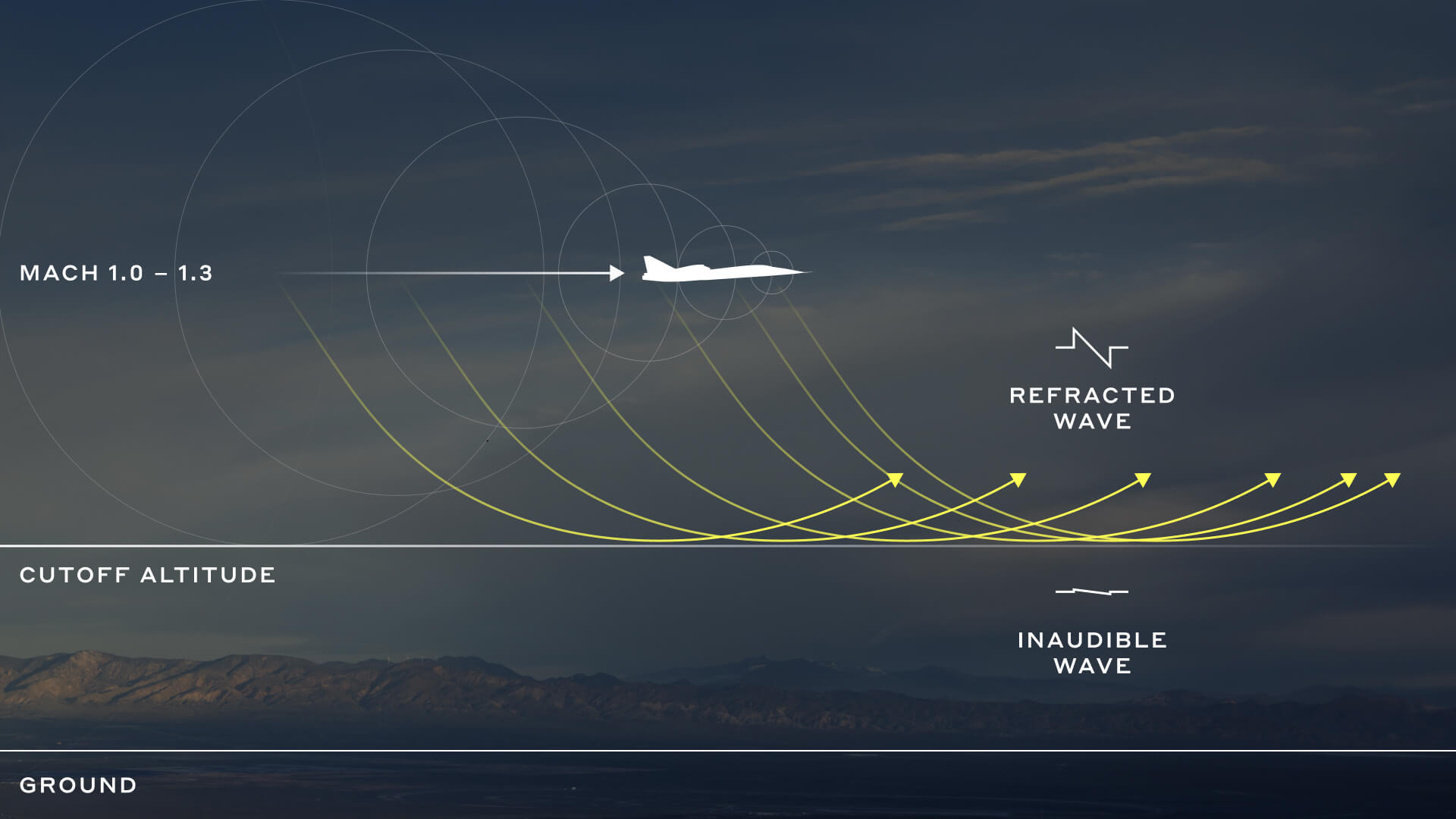
A sonic boom is effectively just a powerful pressure wave, and thus, like any wave, it’s subject to refraction. This is where a wave’s path bends when it travels through different media at different speeds. For example, light waves bend when they travel through air and water, because the speed of propagation of light is different in each. The same is true of sound travelling through air at different temperatures. At lower altitudes, the air is typically warmer and sound travels faster. At higher altitudes, the air is cooler, and sound travels slower. Thus, as the pressure waves travel downwards from an aircraft at high altitude, they reach the warmer air and are refracted, tending to bend away from the ground. The idea behind the Mach cutoff effect is to find a combination of conditions where the sonic boom is refracted such that it never hits the ground. The Mach cutoff itself refers to the critical altitude below which the sonic boom is effectively not heard.
This technique has been the focus of research by Boom Technology, a company aiming to bring back supersonic air travel. Working with NASA, the company has been running tests with its Boom XB-1 test aircraft. Earlier this year, the company successfully attained supersonic flight without the sonic boom reaching the ground. This was confirmed by microphone arrays under the flight path, which verified there was no characteristic N-wave or pressure spike hitting the surface as the XB-1 flew multiple passes overhead. Test flights in February saw the company’s test aircraft hit top speeds of Mach 1.12 without a sonic boom hitting the ground. The company hopes to use the learnings from these tests to guide the development of the Boom Overture, a full-sized supersonic passenger airliner.
However, using the Mach cutoff technique is not a perfect solution to supersonic travel over land. The problem is that it’s highly dependent on ambient conditions. The local temperature, atmospheric pressure, and prevailing winds can all affect the local Mach cutoff altitude. Thus, to fly supersonic in this manner requires a flight system capable of monitoring local conditions and keeping the aircraft’s flight parameters in the region where Mach cutoff is possible. Research by NASA has also indicated that it is not possible to exploit this phenomenon at very high speeds. Above Mach 1.3, it’s not realistically possible to refract the sonic boom enough to have it miss the ground.
These factors mean that even when exploiting the Mach cutoff, there would be some limitations on supersonic flight over land. Most commercial airliners fly at Mach 0.75 to Mach 0.85. Boom’s hypothetical future airliner could maybe top out at Mach 1.3 over land to avoid sonic booms hitting the ground. This would still net some serious speed gains—but perhaps only slashing travel times by 40-50% on overland routes. Boom expects that it could achieve a flight from San Francisco to New York in 3 hours and 30 minutes, versus over 5 hours for standard airliners today.
Fuel use is also expected to be very high in the supersonic flight regime, thanks to the extra drag experienced at higher speeds. There is also reason to believe that different routes might face very different conditions.
A study by the University of Pennsylvania used atmospheric data to determine that the maximum speed for Mach cutoff was much higher for westbound flights across the continental US versus eastbound flights, thanks to typical prevailing weather conditions over the country and their effect on the local speed of sound. In any case, Boom still plans to ensure its airliner is capable of achieving up to Mach 1.7 when sound is not an issue, which would make it at least comparable to the Concorde’s top speed of Mach 2.04 when travelling over open ocean.
As far as supersonic passenger travel goes, things are currently looking brighter than ever. There is now a potentially viable technique for airliners to fly faster than the sound barrier over populated areas. However, the economics and practicalities will still have to work out if we are ever to see a supersonic transport in revenue service ever again.

Uno studio mostra una verità shock: il 98,5% delle password è debole!
In una nuova analisi basata su 10 milioni di password compromesse, Specops ha dimostrato quanto le reti aziendali rimangano vulnerabili all’errore umano. Tutte le password sono state estratte da un elenco di oltre un miliardo di perdite. I risultati sono stati allarmanti: solo l’1,5% di tutte le password analizzate poteva essere classificato come “forte”.
I criteri per questa definizione erano rigorosi: una password era considerata sicura se era lunga 15 caratteri e conteneva almeno due tipi di caratteri diversi, come lettere e numeri. Questa lunghezza è stata scelta per un motivo: ogni carattere aggiuntivo aumenta di molte volte il numero di combinazioni possibili.
Ad esempio, una password di 15 lettere minuscole ha 1,7 quintilioni di combinazioni. L’aggiunta di un carattere aumenta il numero di combinazioni di quasi 26 volte e, utilizzando tutti i caratteri validi (lettere, numeri e caratteri speciali), il numero totale di combinazioni raggiunge i 2,25 ottilioni. Persino i computer con GPU più potenti non saranno in grado di gestire un compito del genere nel prossimo futuro.
Mappa di calore: lunghezza della password vs. complessità della password (Specops)

Tuttavia, nonostante queste prospettive, gli utenti continuano a scegliere combinazioni brevi e semplici. Il tipo di password più comune è composto da 8 caratteri con due tipi di caratteri (ad esempio, lettere e numeri), che rappresenta il 7,9% di tutte le password. Seguono password della stessa lunghezza, ma ancora meno affidabili: un solo tipo di carattere, il loro 7,6%. E le password lunghe fino a 8 caratteri in generale costituiscono la stragrande maggioranza e possono essere violate in poche ore.
L’analisi ha mostrato che solo il 3,3% di tutte le password superava il limite di 15 caratteri. Ciò suggerisce che le policy sulle password nelle organizzazioni non sono regolamentate o sono ignorate. Allo stesso tempo, aumentare la lunghezza anche di pochi caratteri aumenta drasticamente la resistenza agli attacchi: un’estensione di quattro caratteri di una password di 12 caratteri aumenta lo sforzo richiesto per un attacco brute-force di 78 milioni di volte.
Lo studio presta particolare attenzione alla tendenza verso una complessità insufficiente. Più della metà di tutte le password analizzate includeva un massimo di due tipi di caratteri. E sebbene le raccomandazioni moderne (in particolare quelle del NIST) si concentrino maggiormente sulla lunghezza, l’aggiunta di un terzo o quarto tipo di carattere ne aumenta significativamente la sicurezza. Tuttavia, la lunghezza rimane il fattore principale: 16-20 caratteri offrono una protezione migliore rispetto a password brevi, seppur complesse.
Per aumentare la sicurezza, si consiglia di passare dalle password tradizionali a frasi significative. Frasi lunghe ma facili da ricordare come “SunsetCoffeeMaroonReview” sono molto più affidabili e pratiche di set di caratteri come “!x9#A7b!”. Questo approccio riduce il numero di errori di digitazione, le richieste di supporto tecnico e la fatica derivante dal continuo cambio di password.
Le principali minacce legate all’utilizzo di password deboli rimangono le stesse.
- Facilità di hacking : le combinazioni brevi sono facilmente soggette ad attacchi automatizzati, soprattutto se si utilizzano acceleratori grafici e botnet.
- Riutilizzo : una password compromessa spesso consente l’accesso a più sistemi.
- Non conformità : le password deboli violano normative come GDPR, HIPAA e PCI DSS. Tutto ciò comporta multe, controlli e danni alla reputazione.
Allo stesso tempo, anche una buona implementazione dell’hashing non salva dalla debolezza della password stessa: se il database viene rubato e la password viene facilmente forzata tramite attacco brute force, né il salt né gli algoritmi saranno d’aiuto.
I risultati dello studio portano a una semplice verità: le password deboli sono ancora onnipresenti. Solo una politica completa che includa il controllo su lunghezza, complessità, unicità e aggiornamenti tempestivi può proteggere l’infrastruttura aziendale dagli attacchi più comuni. E, come dimostrano le statistiche, la maggior parte delle aziende ha ancora molto lavoro da fare in questo ambito.
L'articolo Uno studio mostra una verità shock: il 98,5% delle password è debole! proviene da il blog della sicurezza informatica.
There is a massive exodus happening in the AI world; the 'Save Our Signs' campaign, and why AI won't save the media industry.
There is a massive exodus happening in the AI world; the x27;Save Our Signsx27; campaign, and why AI wonx27;t save the media industry.#Podcast

Podcast: The AI Exodus Begins
There is a massive exodus happening in the AI world; the 'Save Our Signs' campaign, and why AI won't save the media industry.Joseph Cox (404 Media)
Presentazione del libro “Governare (con) le macchine”
@Politica interna, europea e internazionale
23 luglio 2025, ore 18:00 Al webinar interverranno Gianluca Sgueo, Curatore del volume e coordinatore del Dipartimento digitale della Fondazione Mario Nobile, Direttore generale, AGID Francesca Rossi, IBM fellow, IBM T.J. Watson Research Center Flavio Arzarello, Public Policy Manager, Economic and
Politica interna, europea e internazionale reshared this.
#telegram va bene, almeno per ora. (e per canali come t.me/slowforward e t.me/asemic).
ma, in generale, se vogliamo #comunicare in #sicurezza , consiglio di disinstallare #whatsapp o usarlo il meno possibile, e installare semmai #signal :
signal.org/install
#nientedinuovo , lo so, ma l'impressione è che la situazione stia precipitando di giorno in giorno
Poliversity - Università ricerca e giornalismo reshared this.
fa rima (per papà)

fa rima (11.6.2025)
Fa rima con cuore oppure rispetto fa riva con tavolo oppure con tetto fa rima con casa al mare ma la parola non la voglio trovare. Mil...ordinariafollia
Patriot all’Ucraina, come funzionerà la nuova fornitura (e perché l’Italia si sfila)
@Notizie dall'Italia e dal mondo
L’Ucraina riceverà nuove batterie di missili Patriot, ma non saranno gli Stati Uniti a fornirle direttamente. Le batterie arriveranno da arsenali europei e saranno i governi europei a pagarle, mentre Washington si limiterà a dare il via libera politico e a
Notizie dall'Italia e dal mondo reshared this.


Ben(e)detto – Immuni dal populismo
@Politica interna, europea e internazionale
Mercoledì 16 luglio 2025, ore 21:00 Con Davide Giacalone e Andrea Davola
L'articolo Ben(e)detto – Immuni dal populismo proviene da Fondazione Luigi Einaudi.
Politica interna, europea e internazionale reshared this.
Morbidone
@Politica interna, europea e internazionale
La cosa più sciocca da farsi è disputare sull’approccio morbido e avvolgente o duro e vociante alla dissennatezza dei dazi trumpiani. Quello è un bidone il cui sgradevole contenuto creerà più danni agli Stati Uniti, nuocendo allo sviluppo e alla libertà dei consumi prima da noi e poi da loro, ma intaccando l’affidabilità più di […]
L'articolo Morbidone proviene da Fondazione Luigi
Politica interna, europea e internazionale reshared this.
Sinjil. L’ennesimo crimine impunito nella Cisgiordania occupata
@Notizie dall'Italia e dal mondo
Due giovani palestinesi, tra cui un cittadino statunitense, sono stati uccisi da milizie di coloni israeliani durante un attacco armato contro una protesta pacifica nel villaggio
L'articolo Sinjil. L’ennesimo crimine impunito nella Cisgiordania occupata proviene da Pagine Esteri.
Notizie dall'Italia e dal mondo reshared this.
“Salta la fila con la scorta”, il ministro Urso risponde alle polemiche dopo il video di Zingaretti: “È la scorta che decide”
@Politica interna, europea e internazionale
A scatenare il caso è stato inizialmente un video pubblicato sui social dal noto attore Luca Zingaretti, con il quale aveva denunciato il fatto che “la moglie
Politica interna, europea e internazionale reshared this.
BRASILE. La Procura chiede la condanna di Bolsonaro per tentato golpe
@Notizie dall'Italia e dal mondo
Il processo alla cospirazione golpista entra nella fase finale. Il giudizio è atteso per settembre
L'articolo BRASILE. La Procura chiede la pagineesteri.it/2025/07/16/ame…
Notizie dall'Italia e dal mondo reshared this.
freezonemagazine.com/news/gene…
The Lamb Lies Down On Broadway fu pubblicato il 22 novembre 1974. Fu l’ultimo album in cui Peter Gabriel fu il cantante principale, prima che il batterista Phil Collins assumesse il ruolo di frontman. Collins è indicato come “backing vocals” in questo disco. The Lamb Lies Down On Broadway è un’opera rock. Racconta
differx
Unknown parent • •purtroppo il cellulare serve, sì, è vero
differx
Unknown parent • •Ska
Unknown parent • • •differx likes this.
Sabrina Web 📎
in reply to differx • • •differx likes this.
differx
in reply to differx • •