
Cyber attacco filo-ucraino contro Aeroflot: un punto di svolta nella guerra cibernetica
@Informatica (Italy e non Italy 😁)
Non è solo un sabotaggio informatico riuscito, ma un atto di guerra ibrida perfettamente orchestrata da parte dei gruppi filo-ucraini Silent Crow e Cyberpartisans BY, condotta con metodi di social engineering che per un anno hanno
Informatica (Italy e non Italy 😁) reshared this.
Router e dispositivi di rete non aggiornati: il cimitero digitale dove fioriscono gli attacchi
@Informatica (Italy e non Italy 😁)
Dai firmware marci ai Comuni in balia del primo script kiddie: il rischio derivante dai router e dai dispositivi di rete non aggiornati e “abbandonati” negli uffici delle aziende viene spesso sottovalutato. Un
Informatica (Italy e non Italy 😁) reshared this.
#Freddure #Dadsjoke @❄️🧊 Freddure 🧊❄️
reshared this
freezonemagazine.com/articoli/…
Ci sono libri che si leggono d’un fiato, e altri che, pur nella loro brevità, si fanno strada lentamente, lasciando tracce profonde. La salita di Ludwig Hohl appartiene alla seconda categoria. È un’opera straordinaria, breve ma densissima, che merita un posto d’onore nella letteratura filosofica e letteraria del Novecento. Pubblicato per la prima volta nel […]
L'articolo Ludwig Hohl – La salita pr
Ci sono
I Paesi Bassi adottano alcune misure contro Israele
@Notizie dall'Italia e dal mondo
Il governo dei Paesi Bassi ha deciso di vietare l’ingresso nel paese ai ministri israeliani Bezalel Smotrich e Itamar Ben Gvir, accusati di incitamento alla violenza e sostegno alla pulizia etnica nella Striscia di Gaza
L'articolo I Paesi Bassi adottano alcune misure contro Israele proviene da Pagine Esteri.
Notizie dall'Italia e dal mondo reshared this.
Cyberattacco ad Aeroflot: la guerra ibrida si sposta nei cieli digitali
@Informatica (Italy e non Italy 😁)
Il 28 luglio 2025, il mondo ha assistito a uno degli attacchi informatici più audaci degli ultimi anni: oltre 100 voli cancellati, sistemi IT paralizzati e il sito di Aeroflot, la compagnia aerea di bandiera russa, reso inaccessibile. Dietro questa operazione, firmata dal
reshared this
Compliance e cyber security: come il legislatore ha cambiato le regole del gioco
@Informatica (Italy e non Italy 😁)
La cyber security aziendale passa necessariamente attraverso una gestione integrata della compliance, dove competenze tecniche e conoscenze normative si fondono per creare strategie di sicurezza efficaci e sostenibili. Ecco come
Informatica (Italy e non Italy 😁) reshared this.
Acea ancora sotto attacco ransomware. Rivendica di World Leaks, danni ancora incerti
@Informatica (Italy e non Italy 😁)
Acea, la multiutility romana che gestisce servizi idrici, energetici e ambientali, è finita nel mirino di un nuovo attacco ransomware, rivendicato dal collettivo World Leaks. La notizia è stata riportata da RansomNews. 🚨 nuova rivendicazione
Informatica (Italy e non Italy 😁) reshared this.
MESAFER YATTA. Un colono israeliano ha ucciso l’attivista palestinese Awdah Hathaleen
@Notizie dall'Italia e dal mondo
Dopo aver ferito un abitante di Umm Al Kheir, il colono, già noto per gravi violenze, ha sparato uccidendo Hathaleen
L'articolo MESAFER YATTA. Un colono israeliano ha ucciso l’attivista palestinese Awdah Hathaleen proviene da Pagine
Notizie dall'Italia e dal mondo reshared this.
Microimprese come soggetti NIS 2: come risolvere il paradosso della direttiva
@Informatica (Italy e non Italy 😁)
La normativa NIS 2 è stata concepita con l'obiettivo di tutelare la sicurezza collettiva, rafforzando la resilienza digitale dei soggetti che, per dimensione, settore e funzione, rivestono un ruolo sistemico. Tuttavia, con le microimprese la forma
Informatica (Italy e non Italy 😁) reshared this.
freezonemagazine.com/articoli/…
Modulazioni d’anima e respiro collettivo, questa è la suggestione che instilla questo live album. C’è qualcosa di profondamente ancestrale, eppure modernissimo, nell’arte di Dominique Fils-Aimé. Nel suo nuovo album Live at the Montreal Jazz Festival 2024 la cantautrice canadese di origini haitiane – già vincitrice
Sulla genuflessione europea a Trump
Non c'è mai stata una reale cessione di sovranità all'UE da parte degli stati membri in materia di politica estera o di politica economica. In questo caso particolare, inoltre, l'unica cosa su cui gli stati membri erano d'accordo era ridurre i dazi del 30% minacciati da Trump.
Trovo abbastanza ridicolo che i governi che non hanno mai voluto un'Europa forte e che hanno dato un mandato così minimalista a Von Der Layen adesso l'accusino di essersi genuflessa a Trump.
like this
reshared this
freezonemagazine.com/articoli/…
Modulazioni d’anima e respiro collettivo, questa è la suggestione che instilla questo live album. C’è qualcosa di profondamente ancestrale, eppure modernissimo, nell’arte di Dominique Fils-Aimé. Nel suo nuovo album Live at the Montreal Jazz Festival 2024 la cantautrice canadese di origini haitiane – già vincitrice
Models of Wave Propagation

[Stoppi] always has interesting blog posts and videos, even when we don’t understand all the German in them. The latest? Computer simulation of wave propagation (Google Translate link), which, if nothing else, makes pretty pictures that work in any language. Check out the video below.
Luckily, most browsers will translate for you these days, or you can use a website. We’ve seen waves modeled with springs before, but between the explanations and the accompanying Turbo Pascal source code, this is worth checking out.
We can’t explain it better than [Stoppi] who writes:
The model consists of individual atoms with the mass m, which are connected to each other by springs with the spring constant k. To start, I deflect the first atom sinusoidally. According to this, the individual atoms obey Newton’s equation of motion F = m·a, whereby Hook’s spring law F = k·Δl is used for the force F. I solved these differential equations iteratively using the Euler method. The movement of the atoms is restricted in the y-direction. At the beginning, the number of atoms, their mass m and the spring constant k must be entered. In addition, you can choose between transverse or longitudinal deflection and whether you want the reflection at the free or fixed end.
Can you get better simulations? Of course. But will this help you develop more intuitive understanding? Maybe. If you are interested in simulating the physical world, don’t forget TinkerCad has added that capability.
youtube.com/embed/eAZvdjsBR8c?…
Skateboard Wheels Add Capabilities to Plasma Cutter

Although firmly entrenched in the cultural zeitgeist now, the skateboard wasn’t always a staple of popular culture. It had a pretty rocky start as surfers jankily attached roller skating hardware to wooden planks searching for wave-riding experiences on land. From those rough beginnings it still took decades of innovation until Rodney Mullen adapted the ollie for flatground skating before the sport really took off. Skateboard hardware is quite elegant now too; the way leaning turns the board due to the shape of the trucks is immediately intuitive for even the most beginner riders, and bearing technology is so high-quality and inexpensive now that skateboard hardware is a go-to parts bin grab for plenty of other projects like this plasma cutter modification.
[The Fabrication Series]’s plasma cutter is mounted to a CNC machine, allowing for many complex cuts in much less time than it would take to do by hand. But cutting tubes is a more complicated endeavor for a machine like this. This is where the skateboard hardware comes in: by fabricating two custom pivoting arms each with two skateboard wheels that push down on a tube to hold it in place, the CNC machine can roll the tube along the table in a precise way as the plasma cutter works through it.
Of course, cutting a moving part is a little more complicated for the CNC machine than cutting a fixed piece of sheet metal, so [The Fabrication Series] walks us through a few ways of cutting pipe for various purposes, including miters and notches. The first step is to build a model of the pipes, in this case using Onshape, and then converting the 3D model of the pipes into a sheet metal model that the CNC machine can use. It does take a few cuts on the machine to fine-tune the cuts, but in no time the machine is effortlessly cutting complex shapes into the pipe. Don’t have a plasma cutter at all? You can always build your own from scratch.
Thanks to [JohnU] and [paulvdh] for the tip!
youtube.com/embed/F9LiEK-DjPk?…
Office365 ci faceva schifo, ma adesso ci piace tanto. Questo pensa la Commissione Europea
@Privacy Pride
Il post completo di Christian Bernieri è sul suo blog: garantepiracy.it/blog/office/
Long story short: l'8 marzo 2024 la Commissione Europea, con il supporto dell'EDPB, il Garante Europeo, ha riscontrato una serie di criticità e violazioni, 180 pagine per descrivere minuziosamente le ragioni per le quali
Privacy Pride reshared this.
Destructive Testing of ABS and Carbon Fiber Nylon Parts

The good part about FDM 3D printing is that there are so many different filament types and parameters to choose from. This is also the bad part, as it can often be hard to tell what impact a change has. Fortunately we got destructive testing to provide us with some information here. Case in point [Functional Print Friday] on YouTube recently testing out a few iterations of a replacement part for a car.

The original part was in ABS, printed horizontally in a Bambu Lab FDM printer, which had a protruding element snapped off while in use. In addition to printing a replacement in carbon fiber-reinforced nylon (PAHT-CF, i.e. PA12 instead of the typical PA6), the part was now also printed at a 45° angle. To compare it with the original ABS filament in a more favorable way, the same part was reprinted at the same angle in ABS.
Another change was to add a machine screw to the stop element of the part, which turned out to make a massive difference. Whereas the original horizontal ABS print failed early and cleanly on layer lines, the angled versions put up much more of a fight, with the machine screw-reinforced stop combined with the PA12 CF filament maxing out the first meter.
The take-away here appears to be that not only angles are good, but that adding a few strategic metal screws can do wonders, even if you’re not using a more exotic filament type.
youtube.com/embed/5k6YLlyV9ds?…
2025 One-Hertz Challenge: Clock Calibrator

Wall clocks! Are they very accurate? Well, sometimes they are, and sometimes they lose minutes a day. If you’ve got one that needs calibrating, you might like this device from [Lauri Pirttiaho].
Most cheap wall clocks use very similar mechanisms based around the Lavet-type stepper motor. These are usually driven by a chip-on-board oscillator that may or may not be particularly accurate.
[Lauri] desired a way to tune up these cheap clocks by using GPS-level timing accuracy. Thus began a project based around a CY8KIT evaluation board from Cypress. The microcontroller is paired with a small character LCD as a user interface, and hooked up to a cheap GPS module with an accurate 1-pulse-per-second (1PPS) timing output. The concept is simple enough. Clock drift is measured by using counters in the microcontroller to compare the timing of the GPS 1PPS output and the pulses driving the Lavet-type stepper motor. The difference between the two can be read off the device, and used to determine if the wall clock is fast or slow. Then one need only use a trimmer capacitor to tweak the wall clock’s pulse rate in order to make it more accurate.
Few of us spend much time calibrating low-cost wall clocks to high levels of accuracy. If that sounds like a fun hobby to you, or your name is Garrus, you would probably find [Lauri]’s device remarkably useful. Believe it or not, this isn’t the first clock calibrator we’ve seen, either. Meanwhile, if you’ve brewed up your own high-accuracy timing hardware, feel free to let us know on the tipsline.

Fediquette
Forse sarebbe il caso di arricchire la Netiquette, in modo da estendere la sua ala protettrice anche sopra il Fediverso.
Serve, secondo me, un capitolo "Fediquette".
Per cominciare aggiungerei alla Fediquette questa regola:
- non si possono pubblicare link ad articoli, post o contenuti che per essere fruiti richiedono il pagamento di un abbonamento o l'obbligo ad accettare cookies che non siano tecnicamente necessari al funzionamento del sito.
like this
reshared this

Be More Axolotl: How Humans May One Day Regrow Limbs and Organs

Although often glossed over, the human liver is a pretty amazing organ. Not just because it’s pretty much the sole thing that prevents our food from killing us, but also because it’s the only organ in our body that is capable of significant regeneration. This is a major boon in medicine, as you can remove most of a person’s liver and it’ll happily regrow back to its original volume. Obviously this is very convenient in the case of disease or when performing a liver transplant.
Despite tissue regeneration being very common among animals, most mammalian species have only limited regenerative ability. This means that while some species can easily regrow entire limbs and organs including eyes as well as parts of their brain, us humans and our primate cousins are lucky if we can even count on our liver to do that thing, while limbs and eyes are lost forever.
This raises many questions, including whether the deactivation of regenerative capabilities is just an evolutionary glitch, and how easily we might be able to turn it back on.
Regenerating Vs Repair
Even in the absence of a regenerative ability, animals can heal injuries, which generally means the growth of fibrous tissue called scar tissue. This can be observed very clearly on our skin, where certain old injuries tend to remain clearly visible as the scar tissue replaces skin tissue. While made of the same collagen protein as skin tissue, the fiber organization is different and serves no real purpose beyond sealing up a lesion. Scar tissue can form elsewhere in the body too, where it can impede function, as in the heart and lungs.
Both regeneration and repair are a form of healing in an organism, but only the former restores the original functionality, whereas the latter is the biological equivalent of slapping on a duct tape patch and calling it good. This ‘repair’ outcome is effectively an incomplete regeneration process, where instead of the affected site creating the conditions for normal growth – leading to a good-as-new result – you only get the basic scaffolding while certain biochemical pathways are never or insufficiently activated.
Although it’s often said that the human liver is the sole organ capable of regeneration in our species, it could be argued that our blood vessels are a much better example of regeneration. Within minutes after receiving a cut or bad scrape, any damaged blood vessels are plugged and macrophages along with other specialized cells begin to move into the area as the inflammatory phase begins.
At the end of this phase, angiogenesis commences, which involves existing blood vessels growing new blood vessels into the affected area. In a developing embryo, this is the stage that follows the earliest development of the initial blood vessels through vasculogenesis. In this regard, blood vessels can be said to regenerate themselves in the case of injury. They can also expand into tissues where e.g. hypoxia conditions are present, which triggers the hypoxia-inducible factor (HIF) signaling path.
In the case of wound healing this signal path is stimulated due to the hypoxia condition that exists at the injury site. Although the HIF-related HIF-1α subunit is constantly expressed, oxygen-dependent prolyl hydroxylases (PHDs) normally degrade it and thus downregulating the further responses down this chain.
Another aspect here is the re-epithelization, whereby surrounding skin cells move towards the wound, multiplying until the signals that induce this growth are downregulated below a critical threshold. Based on research the same HIF pathway is implicated here. For example, in a 2015 study in Science Translational Medicine Yong Zhang et al. reported that forced upregulation of HIF-1α was able to induce full regeneration of a hole punched in the ears of mice who normally just show scarring.
This indicates that boosting the HIF signaling pathway might be a viable way to prevent scarring and induce full regeneration of certain types of wounds to the skin.
Blastema Limbo

The HIF signaling pathway is an example of a basic regeneration pathway involving a single organ (i.e. the skin). Things get more complicated when there’s the removal of something to the extent of a limb. Among mammals regenerating ability is limited, with some species like rabbits still possessing the ability to regenerate holes in their ears while other species, including humans, are not creating the requisite blastema of undifferentiated cells after an amputation.
The axolotl is one of the most studied species when it comes to tissue regeneration. Similar to other salamanders they possess a remarkable ability to regenerate many parts of their body, with the axolotl capable of regenerating their limbs, gills, eyes and parts of their brain. Although annelids (segmented worms) and echinoderms like starfish are capable of even more extreme forms of regeneration, axolotls are significantly more akin to us mammals than either of those.
Incidentally, similar research in fruit flies (Drosophila melanogaster) has led us to the highly conserved Hippo signaling pathway. This particular signaling path is essential in determining how big an organ is supposed to be, such as when a human liver is chopped up in vivo and has to regrow back to its original size.
New Limb Cap
When an axolotl suffers severe injury like the loss of a limb or a gill, the surface where the amputation occurred gets covered up by epidermal cells, forming the wound epithelium (WE). This is the point where for human and other mammals the process pretty much ends with a stump covered up by skin. In the case of the axolotl, however, this WE keeps gathering epidermal cells, forming the apical epithelial cap (AEC).
Inside this AEC the tissues then undergo dedifferentiation into a blastema – led by signals from macrophages – effectively resetting the tissues here to a much earlier, embryonic state of development. Under the influence of Hox genes which regulate the body’s layout, the AEC subsequently grows as it would have done previously with the very young axolotl until the entire limb, gill, eye, etc. has been regrown.
The trick is thus to take these identified signaling pathways, establish in how far they have been preserved in other animals – like us primates – and whether we can easily re-enable them in some way, whether permanently or temporarily. After all, it worked once when we were still embryos, ergo by resetting the cellular clock on part of our bodies it would simply run through the same biochemical steps again.
Still A Lumpy Road Ahead
Of course, this involves developmental biology, biochemistry and genetic research, meaning that clear answers are rarely found and require immense amounts of research and study to unravel how all of these signaling pathways work, while maybe finding a few more ones along the way. The upshot of course is that the field of regenerative medicine can have massive implications for human health, ranging from the ability to treat many (genetic) disorders related to faulty signaling pathways to the ability regrow limbs, eyes and more.
It’s likely that regenerating skin and directly related tissues in human patients will be one of the first widescale applications of these findings, with recently Weifeng Lin et al. publishing a study in Science involving regrowing a damaged outer ear (pinna) of mice and rats through the addition of retinoic acid (RA), a key element in embryonic development. Specifically they identified that in non-regenerative species of rats and mice the Aldh1a2 gene was not expressed as much as it was in species who do regenerate, which reduces the amount of available RA from the retinaldehyde precursor.
Although there’s a lot that can be said about the pros and cons of turning back on genes that haven’t been active since we were either an embryo or a still-growing-child, understanding these biochemical pathways offers us the prospect of bypassing them in order to restore that which once was thought to be lost forever. Even if we won’t be regrowing limbs yet next year, we might be giving people back their pinna, digits, faces and erase old scars before we know it.
“Closeup of Axolotl in Hand” by [Yaiol AI]
“Purple Tropical Axolotl” by[ Raphael Brasileiro]
#Dazi USA, suicidio europeo

Dazi USA, suicidio europeo
Nel darne l’annuncio domenica, Ursula von der Leyen ha affermato che l’accordo commerciale tra Europa e Stati Uniti “crea certezza in tempi incerti”.www.altrenotizie.org
Fire Ant all’attacco: come un bug in vCenter apre le porte all’inferno IT
Sygnia segnala che il vettore di attacco iniziale di Fire Ant CVE-2023-34048, sfrutta la vulnerabilità di scrittura fuori dai limiti nell’implementazione del protocollo DCERPC di vCenter Server che consente l’esecuzione di codice remoto non autenticato. I ricercatori di sicurezza hanno identificato arresti anomali sospetti del processo ‘vmdird‘ sui server vCenter, indicando lo sfruttamento di questa vulnerabilità critica.
Dopo aver ottenuto la compromissione, gli autori della minaccia implementano strumenti sofisticati, tra cui lo script open source vCenter_GenerateLoginCookie.py, per falsificare i cookie di autenticazione e aggirare i meccanismi di accesso. Gli aggressori raccolgono sistematicamente le credenziali vpxuser, ovvero account di sistema creati automaticamente da vCenter con privilegi amministrativi completi sugli host ESXi.
Questo furto di credenziali consente lo spostamento laterale nell’intera infrastruttura di virtualizzazione, poiché gli account vpxuser restano esenti dalle restrizioni della modalità di blocco. Gli autori della minaccia sfruttano anche il CVE-2023-20867, una vulnerabilità di VMware Tools che consente l’esecuzione di comandi host-to-guest non autenticati tramite il cmdlet Invoke-VMScript di PowerCLI.
Capacità di persistenza e metodi di evasione
Fire Ant dimostra notevoli capacità di persistenza attraverso molteplici tecniche di distribuzione di backdoor. Il gruppo installa vSphere Installation Bundle (VIB) dannosi con livelli di accettazione impostati su “partner” e distribuiti utilizzando il flag -force per ignorare la convalida della firma. Questi VIB non autorizzati contengono file di configurazione che fanno riferimento a file binari nella cartella ‘/bin‘ e script personalizzati incorporati in ‘/etc/rc.local.d/’ per l’esecuzione all’avvio.
Inoltre, gli aggressori implementano una backdoor HTTP basata su Python denominata autobackup.bin che si collega alla porta 8888 e fornisce funzionalità di esecuzione di comandi remoti. Questo malware modifica ‘/etc/rc.local.d/local.sh’ sugli host ESXi per un’esecuzione persistente. Per eludere ulteriormente il rilevamento, Fire Ant termina il processo vmsyslogd, il demone syslog nativo di VMware, disabilitando di fatto sia la scrittura dei log locali che l’inoltro dei log remoti.
Gli autori della minaccia dimostrano sofisticate capacità di manipolazione della rete compromettendo i bilanciatori di carico F5 tramite lo sfruttamento CVE-2022-1388 e distribuendo webshell su ‘ /usr/local/www/xui/common/css/css.php ‘ per il bridging di rete. Utilizzano webshell di tunneling Neo-reGeorg su server web interni basati su Java e distribuiscono il rootkit Medusa su punti pivot Linux per la raccolta delle credenziali e l’accesso persistente.

Fire Ant utilizza i comandi netsh portproxy per l’inoltro delle porte attraverso endpoint attendibili, aggirando di fatto gli elenchi di controllo degli accessi e le restrizioni del firewall. Il gruppo sfrutta inoltre il traffico IPv6 per aggirare le regole di filtraggio incentrate su IPv4, dimostrando una conoscenza approfondita degli ambienti di rete dual-stack e delle comuni lacune di sicurezza nelle infrastrutture organizzative.
Le organizzazioni devono dare urgentemente priorità alla protezione dei propri ambienti VMware tramite l’applicazione completa di patch, un monitoraggio avanzato delle attività dell’hypervisor e l’implementazione di funzionalità di rilevamento avanzate che vadano oltre le tradizionali soluzioni di sicurezza degli endpoint.
L'articolo Fire Ant all’attacco: come un bug in vCenter apre le porte all’inferno IT proviene da il blog della sicurezza informatica.
Learn Computing? Head for MonTana!

We’ve often thought that it must be harder than ever to learn about computers. Every year, there’s more to learn, so instead of making the gentle slope from college mainframe, to Commodore 64, to IBM PC, to NVidia supercomputer, you have to start at the end. But, really, you don’t. You can always emulate computers from simpler times, and even if you don’t need to, it can be a lot of fun.
That’s the idea behind the MonTana mini-computer. It combines “…ideas from the PDP-11, MIPS, Scott CPU, Game Boy, and JVM to make a relatively simple 16-bit computer…”
The computer runs on Java, so you can try it nearly anywhere. The console is accessed through a web browser and displays views of memory, registers, and even something that resembles a Game Boy screen. You’ll need to use assembly language until you write your own high-level language (we’d suggest Forth). There is, however, a simple operating system, MTOS.
This is clearly made for use in a classroom, and we’d love to teach a class around a computer like this. The whole thing reminds us of a 16-bit computer like the PDP-11 where everything is a two-byte word. There are only 4K bytes of memory (so 2K words). However, you can accomplish a great deal in that limited space. Thanks to the MTOS API, you don’t have to worry about writing text to the screen and other trivia.
It looks like fun. Let us know what you’ll use it for. If you want to go down a level, try CARDIAC. Or skip ahead a little, and teach kids QBasic.
fabrizio likes this.
Una tabella fatta bene: come un file Excel ha (quasi) compromesso un colosso dell’aviazione russa
@Informatica (Italy e non Italy 😁)
È bastato un file Excel per mettere a rischio un’azienda strategica del comparto aerospaziale russo. Dietro la banalità di una…
L'articolo Una tabella fatta bene: come un file Excel ha (quasi) compromesso un colosso
Informatica (Italy e non Italy 😁) reshared this.
Lumo, l’IA secondo Proton: privacy come architettura, non come opzione
@Informatica (Italy e non Italy 😁)
Nel panorama sempre più affollato dell’intelligenza artificiale generativa, un nuovo attore fa il suo ingresso con una promessa chiara: nessun…
L'articolo Lumo, l’IA secondo Proton: privacy come architettura, non come opzione proviene da (in)sicurezza digitale.
L'articolo
Informatica (Italy e non Italy 😁) reshared this.
SHUYAL: il malware che ruba tutto e svanisce nel nulla
@Informatica (Italy e non Italy 😁)
Di recente tracciamento, un nuovo infostealer, potrebbe aggiungersi alle minacce già note. Si chiama SHUYAL, una specie di tornado digitale:…
L'articolo SHUYAL: il malware che ruba tutto e svanisce nel nulla proviene da (in)sicurezza digitale.
L'articolo proviene dal blog #InsicurezzaDigitale di
Informatica (Italy e non Italy 😁) reshared this.
Router abbandonati: un arsenale di 0-day pronto all’uso
@Informatica (Italy e non Italy 😁)
I dispositivi obsoleti rappresentano una minaccia spesso sottovalutata. Un recente studio condotto da Trail of Bits durante la competizione DistrictCon…
L'articolo Router abbandonati: un arsenale di 0-day pronto all’uso proviene da (in)sicurezza digitale.
L'articolo proviene dal blog
Informatica (Italy e non Italy 😁) reshared this.
Scavenger: il trojan che saccheggia i gamer per rubare crypto e password
@Informatica (Italy e non Italy 😁)
Nel mondo del gaming, dove cheat e mod sembrano offrire vantaggi irresistibili, si cela oggi una delle minacce informatiche più…
L'articolo Scavenger: il trojan che saccheggia i gamer per rubare crypto e password proviene da (in)sicurezza digitale.
L'articolo
Informatica (Italy e non Italy 😁) reshared this.
La casella e-mail Outlook è scaduta, ma è phishing: così rubano i nostri dati
@Informatica (Italy e non Italy 😁)
Una nuova campagna di phishing sta sfruttando una falsa notifica di scadenza della casella di posta elettronica su Outlook per ingannare le potenziali vittime e sottrarre loro dati riservati e credenziali di accesso. Ecco come funziona l’attacco e i
Informatica (Italy e non Italy 😁) reshared this.
Hamilton sotto attacco: il riscatto da 18,5 milioni di dollari e le conseguenze del cyberattacco
@Informatica (Italy e non Italy 😁)
Nel febbraio del 2024, la città di Hamilton è stata colpita da un grave attacco ransomware che ha paralizzato l’80%…
L'articolo Hamilton sotto attacco: il riscatto da 18,5 milioni di dollari e le conseguenze del
Informatica (Italy e non Italy 😁) reshared this.
A History of Pong

Today, creating a ground-breaking video game is akin to making a movie. You need a story, graphic artists, music, and more. But until the middle of the 20th century, there were no video games. While several games can claim to be the “first” electronic or video game, one is cemented in our collective memory as the first one we’d heard of: Pong.
The truth is, Pong wasn’t the first video game. We suspect that many people might have had the idea, but Ralph Baer is most associated with inventing a practical video game. As a young engineer in 1951, he tried to convince his company to invest in games that you could play games on your TV set. They didn’t like the idea, but Ralph would remember the concept and act on it over a decade later.
But was it really the first time anyone had thought of it? Perhaps not. Thomas Goldsmith Jr. and Estle Ray Mann filed a patent in 1947 for a game that simulated launching missiles at targets with an oscilloscope display. The box took eight tubes and, being an oscilloscope, was a vector graphic device. The targets were physical dots on a screen overlay. These “amusement devices” were very expensive, and they only produced handmade prototypes.
Between 1952 and 1961, computers were coming into their own. In the UK, a man named Douglas used the CRT display of EDSAC to play naughts and crosses — also known as tic-tac-toe to Americans. Interestingly, the display was sort of “bit mapped” as it showed the bits in one of the machine’s mercury delay lines. The program featured an algorithm-driven computer player that was capable of beating humans.
Meanwhile, in 1958 at Brookhaven National Laboratory, Willy Higginbotham used an analog computer and an oscilloscope to allow two people to play “tennis” against each other. There was no computer player, but still. You can see a video below. The machine didn’t survive, but the Lab built a replica in 1997.
youtube.com/embed/6PG2mdU_i8k?…
By 1961, MIT had Spacewar running on a DEC PDP-1, which became fairly famous. However, it would take Ralph Baer — remember him? — to bring the game into your home.
In 1966, he revisited his old idea and had built seven prototype games by 1968, aided by $2,500 from his employer and a couple of engineers. The resulting “brown box” game (so called because the final prototype had a simulated wood case created using brown tape) was shopped around until Magnavox decided to produce it. By the way, Baer would go on to also invent Simon and a few other games, but that’s another story.
1972: A Game Odyssey
Magnavox liked the brown box and signed a deal to produce a game based on it. In May 1972, Odyssey hit store shelves. By today’s standards, it wasn’t much. Just one or two paddles and a moving dot. Graphics and color were plastic overlays on your screen. Check out those controllers in the promotional video below.
youtube.com/embed/jLGBtkKPj2U?…
In a year, the box sold 69,000 units. By 1975, there were 350,000 out in the world. The $99.95 price was high for those days. They did some test marketing with the system, then called Skill-O-Vision, and decided to add some generic board games that seemed pretty pointless. If you wanted the shooting game that was part of the prototypes, that was extra.

Oh, and if you are under a certain age, you might have to stretch your imagination of what an 18-inch TV looks like. It was a different world and arcades in those days had electromechanical devices like pinball machines, bowling machines, and very rare games that had real electronics in them.
Pong?
You might notice that the video doesn’t mention Pong. The reason? While what we call Pong was one of the 12 games on the Odyssey, it wasn’t called that. That name was from Atari and Nolan Bushnell (who later started Chuck E. Cheese).
Bushnell wanted to create electronic games after working while in college for an amusement park where he’d seen electromechanical arcade games. He set out with a partner, Ted Dabney, to form a company to create a game similar to Spacewar. Called Computer Space, it arrived in amusement parks and similar venues in 1970 with the help of partner company Nutting Associates.
youtube.com/embed/o019DYaSxUQ?…
The game was a commercial flop. However, Bushnell wanted to try again. He hired Allan Alcorn. Here’s where the story gets strange.
The goal was to build a driving game for Bally, but Alcorn had no experience with games. Bushnell claims that he had played tennis on a PDP-1 in college and decided to get Alcorn to create a tennis game as a warm-up project. However, there is considerable evidence that Bushnell had, in fact, seen the Magnavox Odyssey and was looking to copy it.
Whatever the truth is, a prototype Pong game wound up in a local bar late in 1972, about three months after the Odyssey was on store shelves. It was such a hit that the coin acceptor filled up in only a few days.
Bushnell originally shopped the game to Bally, where he wanted to use it to fulfill his existing contract, and to Midway. However, once he realized it was a hit, he decided Atari should produce it themselves. He told Bally that Midway didn’t want it. Then he told Midway that Bally didn’t want it. As a result, both declined to buy the machine. A few months later, Atari started producing Pong arcade games for sale.
Back Home
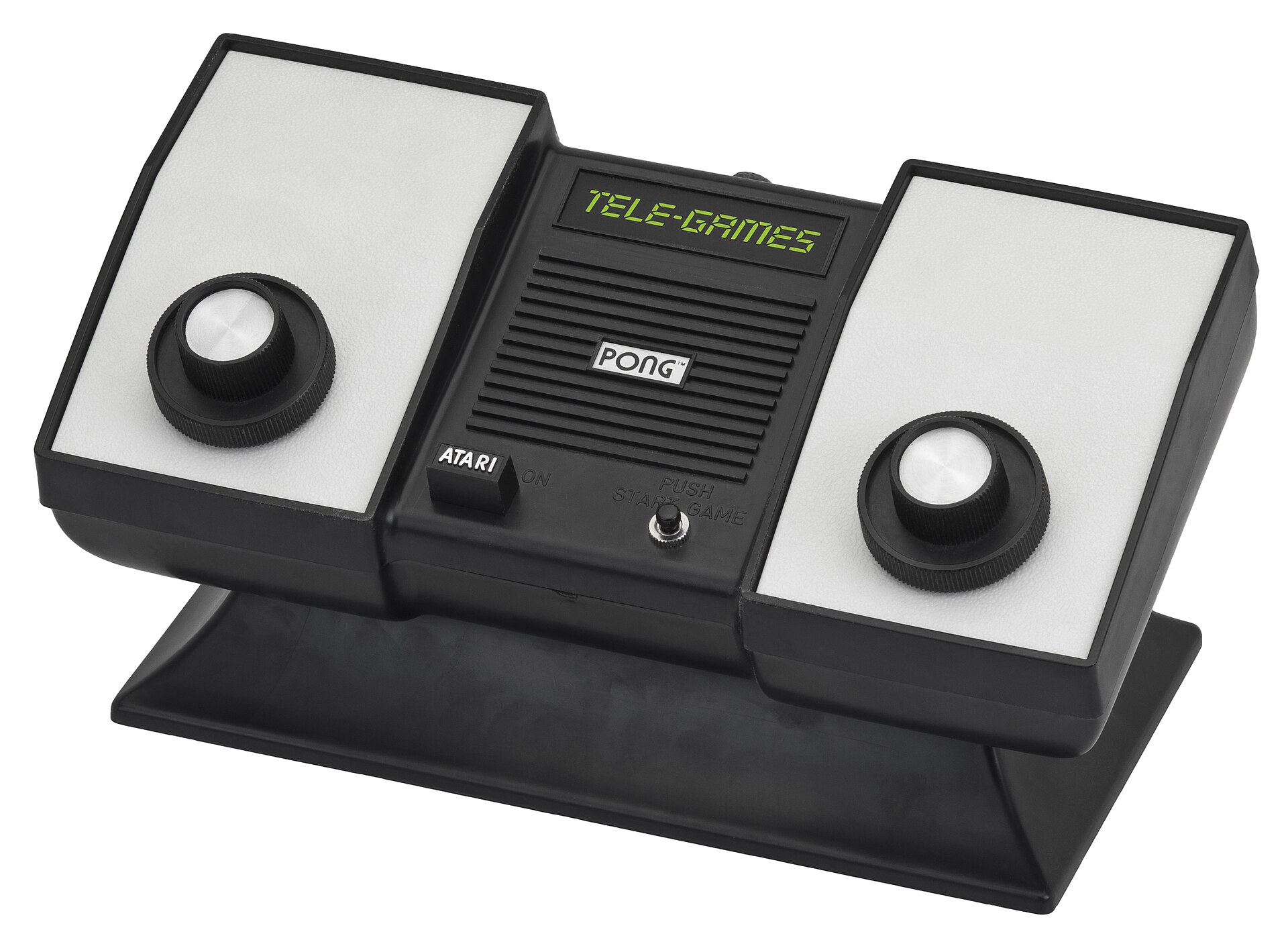
This led to Magnavox suing Atari. Atari capitulated and struck a deal to be considered a licensee for $1.5 million and other concessions.
During the same time, Magnavox was also feeling the pinch of production costs. The box, which had cost $37 to produce, was up to $47, and there was no appetite for raising the $100 price tag. To make it more affordable, they also turned to integrated circuits (the original was full of discrete devices and was entirely analog).
Chips for the Win
Magnavox used Texas Instruments to develop a chip set for its new 1975 games. TI developed more advanced chips, and by combining chips, you could make new kinds of games. By 1976, TI began selling these parts to the general public. However, they would ultimately not succeed because another company had arguably done a better job: General Instruments.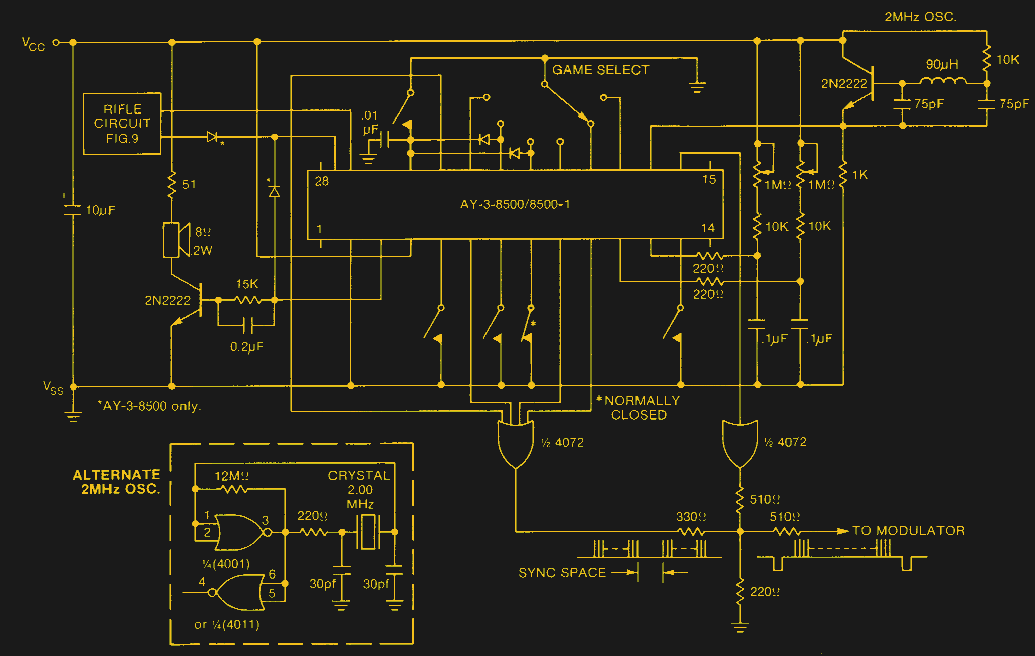
General Instruments created the single-chip Pong game. The AY-3-8500 was nearly everything you needed to create a Pong game. In fact, it could also play soccer, squash (one or two players), and two rifle games, with the right equipment. You could add a few components to get color and a few more to get four players instead of two.
These chips were cheap and made it extremely simple to create a workable video game. If you had a way to sell them, this was the answer. Coleco was the first, but not the last, to be a customer. We’ve heard there were over 200 products from the era that utilized the IC, including the Odyssey 2000 and 3000, Radio Shack’s TV Scoreboard, and Sears’ Hockey Pong. The chips were also popular among hobby builders. Prior to that, it was a big project to make even a simple game (like the one on page 61 of the November 1972 Popular Electronics magazine).
The AY-3-8500 wasn’t, however, the only game in town — no pun intended. National Semiconductor had its own entry into the market. MOSTek was another entrant. They all played the same basic games with a bouncing ball and some controllers. None of these could stand against General Instruments’ momentum. We saw one of these recently in one of the many little-known attempts to cash in on the video game craze.
A company called Universal Research produced the F4301 in 1976. It featured two tennis-like games, as well as two unique car racing games. This helped it a bit, but it was still no match for the simple designs possible with the General Instruments devices. Even TI finally threw in the towel and produced a clone of the General Instrument chip.
There were so many of these made that they are still easy to find and use. Even on a breadboard. Can’t imagine how you’d do this without a chip? Simulate it.
The Future
Who could have imagined where games on video screens would go? In 1978, Space Invaders hit the arcade scene. But that’s an entirely different subject.
Caterina sta arrivando? Lava, stira e piega e comunica con gli altri elettrodomestici in casa
Il sogno di tutti è avere un assistente in casa che faccia lavori fisici come il celebre film “io e Caterina” non è vero? Sappiate che non ci siamo molto lontani.
27 luglio 2025 – Il futuro delle faccende domestiche avrà sicuramente un volto – anzi, un corpo – umanoide, ma per ora serve ancora un operatore umano dietro le quinte. È quanto emerge dalla presentazione ufficiale di HIVA Haiwa, il nuovo prototipo di robot sviluppato da Haier Group, gigante cinese noto per i suoi elettrodomestici smart.
Come riportato dal portale IT Home, HIVA Haiwa è progettato per svolgere attività domestiche come lavare i pavimenti, avviare la lavatrice, stirare e piegare i vestiti. Tuttavia, c’è un dettaglio importante: il robot non esegue queste operazioni in completa autonomia, ma è controllato a distanza da specialisti di Haier. Questa scelta rientra nella fase di apprendimento del robot, che attraverso l’esperienza operativa accumula dati per migliorare le proprie capacità e, in futuro, diventare (si spera) più indipendente.
Un robot umanoide “domestico”, ma con limiti
HIVA Haiwa misura 165 cm di altezza e pesa circa 70 kg. È dotato di due braccia meccaniche e si sposta grazie a una piattaforma mobile a ruote. Grazie ai suoi 44 gradi di libertà, può afferrare e maneggiare oggetti posizionati fino a 2 metri dal pavimento, rendendolo potenzialmente molto versatile in un ambiente domestico.
Il design del robot ricorda un altro prototipo sviluppato da Haier Brothers Robotics Technology, una sussidiaria del gruppo Haier Smart Home, in collaborazione con Beijing Xingdong Jiyuan Technology. Le due aziende hanno stretto un accordo di cooperazione nel marzo 2025 con l’obiettivo di creare robot specializzati per scenari smart home.

Verso una casa sempre più intelligente
Secondo quanto dichiarato da Haier, l’intento finale non è solo avere un robot che pulisce, ma integrare HIVA Haiwa nell’ecosistema della smart home, dove potrà coordinarsi con altri dispositivi intelligenti: elettrodomestici, sensori, impianti domotici e sistemi di monitoraggio. L’idea è che, grazie all’intelligenza artificiale e all’interconnessione, questi robot possano diventare veri assistenti domestici, capaci di gestire in autonomia gran parte delle incombenze quotidiane.
Per il momento, però, HIVA Haiwa resta un progetto sperimentale, ancora lontano da un utilizzo commerciale diffuso. Nonostante ciò, la strada tracciata da Haier e dai suoi partner mostra chiaramente come i robot potrebbero trasformare il concetto stesso di “casa intelligente” nei prossimi anni.
L'articolo Caterina sta arrivando? Lava, stira e piega e comunica con gli altri elettrodomestici in casa proviene da il blog della sicurezza informatica.
“Without these safeguards, Mr. Barber eventually developed full-blown PTSD, which he is currently still being treated for,” the former mod's lawyer said.
“Without these safeguards, Mr. Barber eventually developed full-blown PTSD, which he is currently still being treated for,” the former modx27;s lawyer said.#ContentModeration

Former Moderator Sues Chaturbate for 'Psychological Trauma'
“Without these safeguards, Mr. Barber eventually developed full-blown PTSD, which he is currently still being treated for,” the former mod's lawyer said.Samantha Cole (404 Media)