Cybersecurity & cyberwarfare ha ricondiviso questo.

The media in this post is not displayed to visitors. To view it, please go to the original post.

194 – Peter Thiel e Alex Karp camisanicalzolari.it/194-peter…
Cybersecurity & cyberwarfare ha ricondiviso questo.

The media in this post is not displayed to visitors. To view it, please go to the original post.

193 – Polymarket: quando scommettere su tutto diventa una dipendenza camisanicalzolari.it/193-polym…
Cybersecurity & cyberwarfare ha ricondiviso questo.

The media in this post is not displayed to visitors. To view it, please go to the original post.

Black Axe: gruppo criminale nigeriano che conduce attacchi BEC in Spagna
#CyberSecurity
insicurezzadigitale.com/black-…
Cybersecurity & cyberwarfare ha ricondiviso questo.

The media in this post is not displayed to visitors. To view it, please go to the original post.

Truffe delle false offerte – Marco Camisani Calzolari testimonial della Polizia di Stato camisanicalzolari.it/truffe-de…

Black Axe: gruppo criminale nigeriano che conduce attacchi BEC in Spagna


@Informatica (Italy e non Italy 😁)
È interessante il caso dell’operazione condotta dalla Polizia Nazionale spagnola, con la collaborazione della polizia bavarese e il supporto operativo di EUROPOL, che ha portato alla disarticolazione di una sofisticata cellula dedita al ciberfraude, direttamente

Cybersecurity & cyberwarfare ha ricondiviso questo.

The media in this post is not displayed to visitors. To view it, please go to the original post.

Truffe dei Mi Piace – Marco Camisani Calzolari testimonial della Polizia di Stato camisanicalzolari.it/truffe-de…

What will happen in tech policy during 2026?


The media in this post is not displayed to visitors. To view it, please log in.

What will happen in tech policy during 2026?
WELCOME BACK TO THE MONTHLY free editionof Digital Politics.I'm Mark Scott, and Happy New Year!

As I plan for the year ahead, I'm looking to arrange more in-person events — mostly because it's great to connect with people in real life. If that sounds something you'd be interested in, please fill out this survey to help my planning.

Just as the last newsletterlooked back over what happened in 2025, this first edition of the new year focuses on how global tech policy will evolve over the next 12 months. I've skipped the clichés — 'AI will consume everything,' 'Washington and Brussels won't get along' — to highlight macro trends that, imo, will underpin what will likely be a bumpy road ahead.

Some of my predictions will be wrong. That's OK — no one's perfect.

What follows is my best guess at the topics which will dominate 2026 at a time when geopolitics, technology and economic competitiveness have become intertwined like never before.

Let's get started:


The end of US digital leadership?


AS THE LAST WEEK HAS SHOWN, we're living through a very different reality for the United States' standing in the world compared to any time since the 19th century. Donald Trump's administration has blown hot and cold on digital policy, often preferring the analogue geopolitics of traditional Great Powers over the wonkery associated with artificial intelligence governance and digital public infrastructure.

Yet Washington will assert itself in global digital policymaking circles in three ways during 2026. How the rest of the (democratic) world responds will determine if the US can still hold onto the claim of leading the free world. Or, in a once-in-a–generation shift, will other countries will start to form different, non-US alliances that will increasingly sideline the Trump administration and other US lawmakers/officials?

I'm still not sure how this will play out. But I'm increasingly coming to terms that as much as non-US officials/politicians want to maintain close ties with the world's largest economy, the last 12 months has cemented many people's view that the US no longer holds a leadership position on tech policy (if, frankly, it ever did.)

But I'm skipping steps.

Thanks for reading the free monthly version of Digital Politics. Paid subscribers receive at least one newsletter a week. If that sounds like your jam, please sign up here.

Here's what paid subscribers read in December:
— How the child online safety battle is a proxy for a wider battle around digital platforms; The European Union is not shifting its stance on tech because of the United States; Here's the price of what your personal data is worth. More here.
— Exclusive polling from YouGov on what Europeans think about tech policy; What the White House's National Security Strategy means for US tech policy; How Washington linked digital to a spate of new trade/tariff deals. More here.
— How Australia's social media ban is a response to policymakers' lack of understanding about how social media works; The international implications of the White House's proposed moratorium on AI oversight; The latest rankings of AI models, based on transparency indicators. More here.
— The five lessons about global digital policymaking that I learned in 2025. More here.

First, Washington will likely take a vocal position in promoting the US "AI Stack" to the rest of the world. That includes connecting future tariff/trade deals with pledges from third-party countries to not pass comprehensive (or any?) AI regulation or legislation. It will also see US industry work hand-in-glove with the Trump administration, via the US Commerce Department, to offer financing support so that other governments can buy the latest wares from Nvidia, Microsoft and OpenAI. Those companies don't exactly need state-backed financing to make such deals.

This combination will stand in stark contrast to what Europe and China are similarly doing to promote their own AI stacks, at home and abroad. It will also likely force countries to pick a side — either accept the current US approach of no regulation and US infrastructure, or be perceived as a potential enemy to American "AI dominance."

Second, expect a more vocal pushback against non-US competition rules (aka: the European Union's Digital Markets Act) and any form of online safety legislation (aka: the United Kingdom's Online Safety Act.)

As I explained in the last newsletter, non-US digital antitrust enforcement is a bigger issue than the "Culture Wars" dog whistling associated with unproven claims that online safety rules are akin to free speech censorship. But as other countries like Brazil and Australia push aggressively ahead with checks on social media's power, as well as the ongoing enforcement of the EU's DMA and the UK's Digital Markets, Competition and Consumers Act, Washington will likely call out these countries in ways that force local officials to choose a side.

Many will not want to be put in that position. But just as we saw with US officials' sabre-rattling when the EU fined X $130 million under its Digital Services Act, upcoming enforcement actions (via online safety and digital competition legislation) will lead to similarly vocal rebuttals from Washington. At that point, non-US policymakers need to make a choice: either implement local laws or kow-tow to Washington's demands.

Third, the US will almost certainly connect the EU's digital rulebook, including the soon to be pared-back AI Act, with the simmering transatlanic trade war. It's hard to see how that makes much sense, given the US' trade surplus, in services, with the 27-country bloc. But Washington has already voiced concerns that the EU's digital legislation equates to so-called non-tariff trade measures. This year will see such talk turn into action, potentially via increased tariffs on Europe's non-digital goods (where the bloc runs a trade surplus with the US).

If/when that happens, EU officials will again be put in a tough spot. They will have to choose to shift gears on digital rulemaking — all in the name of saving French cheese makers or German auto parts manufacturers from hefty tariff hikes — or live with the consequences of bringing the so-called "Brussels Effect" into reality.


The rise of China as the internet governor


I WILL ADMIT I'M NO CHINA EXPERT. But even with my non-China focus, it's hard not to see Beijing taking an ever increasing leadership position on internet governance in 2026.

Even for me, this may sound geeky. Bear with me.

Internet governance (and all the global standards that come with it) is the backbone of how the current digital world works. For decades, it was the US that led, globally, to shape those conversations around an open, interoperable internet which has become the game-changing technology that we all know and love.

Yet over the last decade, China has positioned itself as an increasingly important player. It has reshaped the conversation so that governments — and not other stakeholders like industry and civil society — are the key decisionmakers in how the next stage of internet governance protocols are negotiated.

This year will be when Beijing's steady rise as the go-to internet standards provider comes into its own.

In part, that's down to the significant pullback from Washington and a failure by other democratic countries to fill the breach left by the Trump administration's decision to turn its back on such multistakeholder negotiations. It also has a lot to do with China's clever diplomacy which has seen the world's second largest economy align itself with many Global Majority countries to create a coalition of the willing behind Beijing's authoritarian approach to internet governance.

Much of this year will be about framing China's state-first approach ahead of the upcoming World Radiocommunication Conference next year in Shanghai. This four-year event is about finalizing an international treaty for how global radio airwaves (central to mobile telecommunication) are divvied up between countries. For a much more in-depth understanding of why this matters, read this.

That set-piece event will be preceded, in 2026, with a full-court press from Beijing — especially within United Nations agencies where tech policy has taken on increased importance — to cement a state-first approach to internet governance. Without Washington to hold the line (and other democratic countries stepping into that position), Beijing will have much of the chessboard to itself.

This closed-doors diplomacy will define how much of the internet over the next decade will be created. Mostly in China's image.


The AI slop cometh for elections


TWO YEARS AGO, I WROTE A SERIES OF STORIESthat asked everyone to calm down about the impact of artificial intelligence on the election-palazoo that was 2024.

Now I come with a different rallying cry: it's time to freak out.

I still find it hard to suggest AI will unfairly skew the outcome of any election this year. That doesn't give people enough credit for the complex decisions that we all go through in deciding who to vote for. Just because you see some form of election-related AI slop on social media doesn't mean, in general, that you'll change the way that you'll vote for a candidate.

Where I am concerned, however, is the level of sophistication that such AI-generated now represents. It's not just the fact people can upload their images to OpenAI's Sora 2 and go crazy. It's also that digital tricksters (or opposing candidates) can bombard social media with such convincing fakery that some voters will start to question everything that they read/see/listen to online.

Here's a stat for you. In 2025, more than 150 YouTube channels accumulated 5.3 million followers and created roughly 56,000 videos, with combined total views of almost 1.2 billion, that attacked British prime minister Keir Starmer with AI-generated fakery, according to a report from Reset Tech, an advocacy group. That, unfortunately, is not a unique event after politicians from Ireland to the Netherlands to the US and Pakistan also were targeted via AI slop to undermine their campaigns.

Fast-forward to later this year, and the 2026 US mid-terms look set to be defined as the AI slop election cycle, mostly due to the lack of legal checks on how such AI fakery can spread across social media within the US (despite a series of voluntary corporate pledges to combat this threat.)

Many of these posts will be so outlandish as to be called out, almost immediately. But it's the slow drip of AI slop into our collective election mindset that worries me. As with all types of disinformation, it's not a singular piece of content that you need to debunk. It's the cavalcade of ongoing and repeated attempts to undermine people's trust in electoral processes — this time, via AI slop — that has me freaking out.

One AI-generated falsehood about a candidate is one thing. But if you do that at scale (and now, almost at zero cost), as well as use AI tools to generate legitimate electoral material, then the dividing line between real and fake becomes so blurry as to not matter anymore.

Unfortunately, this year will be the turning point into such mass election-related AI slop.


The protection of kids online get real


WE'RE LESS THAN A MONTH INTO Australia's effort to keep anyone under 16 years of age off (most) social media. It's still too early to gauge the impact. But from such bans popping up from Virginia to Malaysia to countries enacting separate legislation to determine the age of people accessing some online services, 2026 marks when policymakers' attempts to keep kids safe online become real.

Personally, I would prefer to embed 'safety by design' principles across all of these services so that everyone, and not just children, are protected online.

But officials and lawmakers have decided that kids should receive enhanced protection, and that will have both positive and negative consequences over the next 12 months. Either way, those who have promoted such checks will have to grapple with such policymaking efforts that will inevitably lead to unexpected outcomes.

One thing is clear: the age of anonymity online is over.

Sign up for Digital Politics


Thanks for getting this far. Enjoyed what you've read? Why not receive weekly updates on how the worlds of technology and politics are colliding like never before. The first two weeks of any paid subscription are free.

Subscribe
Email sent! Check your inbox to complete your signup.


No spam. Unsubscribe anytime.

Expect to be asked, repeatedly, to prove your age when attempting to sign into popular digital services (if you haven't already done so.) Many of these requests will come via privacy-conscious mechanisms that will involve you providing some form of ID — or allowing your device to take a photo of your image — that will be quickly deleted once it has been verified by a third-party provider.

That, in theory, is how it is supposed to work. But technology has a sneaky way of not working how it is supposed to. And when it comes to people's personal data, such sensitive information is likely to be misused/mishandled in ways that endangers people's privacy online. I don't know exactly how that will play out. But if history has taught us anything, it's that sensitive data has a tendency of leaking out in ways that people don't expect. The quick rush to prove people's age online is unlikely to be any different.

That's the downside. Now the upside.

By narrowing the scope of online safety protections, lawmakers worldwide are about to provide us a live testbed to determine which privacy-by-design principles work — and which ones don't.

Does the banning of teenagers' data from serving up targeted ads make a difference? We're going to find out. Does it make sense to keep teenagers off TikTok until they can drive (in the US, at least)? Countries will give us that answer. Do facial recognition technologies provide accuracy when determining someone's age? We'll know pretty soon.

I still remain massively skeptical that such kid-focused online safety efforts will make the overall internet a better place to be. Nor do I think children will overly benefit from such well-meaning policymaking. But by throwing the kitchen sink at the problem in 2026, at least policymakers will provide some level of quantifiable evidence to hopefully tweak existing, and future, rules aimed at protecting children from the worst abuse online.


What I'm reading


— Several US tech giants altered their terms of service over the holiday period in ways that potentially cemented their power over the digital world, argues Dion Wiggins.

— So-called 'data poisoning', or where large language model's training data is manipulated to affect its behavior, is becoming an increasing risk, based on a report from The Alan Turing Institute.

— After the US administration imposes visa restrictions on 5 European researchers and ex-officials, one of those individuals, Imran Ahmed, sued to stay in the country. This is his legal appeal.

— AI systems ability to accurately fact-check live events remains poor and can lead to harmful outcomes, according to this first-person account from a US official.

— Europe must pursue a dual strategy of promoting local technology providers while also maintaining close ties to non-EU tech companies are part of its digital sovereignty agenda, claim two German national security officials in Atlantik-Brücke


digitalpolitics.co/newsletter0…

Testing Laughing Gas for Rocket Propellant


The media in this post is not displayed to visitors. To view it, please log in.

A man's gloved hand is need adjusting the valve on a cylinder, from which a clear plastic tube extends. The man's other hand is seen holding the the other end of the tube in front of a dish of burning wax, which is flaring brightly.

Nitrous oxide’s high-speed abilities don’t end with racing cars, as it’s a powerful enough oxidizer to be a practical component of rocket propellant. Since [Markus Bindhammer] is building a hybrid rocket engine, in his most recent video he built and tested a convenient nitrous oxide dispenser.

The most commercially available form of nitrous oxide is as a propellant for whipped cream, for which it is sold as “cream chargers,” basically small cartridges of nitrous oxide which fit into cream dispensers. Each cartridge holds about eight grams of gas, or four liters at standard temperature and pressure. To use these, [Markus] bought a cream dispenser and disassembled it for the cartridge fittings, made an aluminium adapter from those fittings to a quarter-inch pipe, and installed a valve. As a quick test, he fitted a canister in, attached it to a hose, lit some paraffin firelighter, and directed a stream of nitrous oxide at it, upon which it burned much more brightly and aggressively.

It’s not its most well-known attribute in popular culture, but nitrous oxide’s oxidizing potential is behind most of its use by hackers, whether in racing or in rocketry. [Markus] is no stranger to working with nitrogen oxides, including the much more aggressively oxidizing nitrogen dioxide.

youtube.com/embed/x2kbrF5kHxI?…


hackaday.com/2026/01/07/testin…

How Do PAL and NTSC Really Work?


The media in this post is not displayed to visitors. To view it, please log in.

Many projects on these pages do clever things with video. Whether it’s digital or analogue, it’s certain our community can push a humble microcontroller to the limit of its capability. But sometimes the terminology is a little casually applied, and in particular with video there’s an obvious example. We say “PAL”, or “NTSC” to refer to any composite video signal, and perhaps it’s time to delve beyond that into the colour systems those letters convey.

Know Your Sub-carriers From Your Sync Pulses


A close-up on a single line of composite video from a Raspberry Pi.A close-up on a single line of composite video from a Raspberry Pi.

A video system of the type we’re used to is dot-sequential. It splits an image into pixels and transmits them sequentially, pixel by pixel and line by line. This is the same for an analogue video system as it is for many digital bitmap formats. In the case of a fully analogue TV system there is no individual pixel counting, instead the camera scans across each line in a continuous movement to generate an analogue waveform representing the intensity of light. If you add in a synchronisation pulse at the end of each line and another at the end of each frame you have a video signal.

But crucially it’s not a composite video signal, because it contains only luminance information. It’s a black-and-white image. The first broadcast TV systems as for example the British 405 line and American 525 line systems worked in exactly this way, with the addition of a separate carrier for their accompanying sound.

The story of the NTSC colour TV standard’s gestation in the late 1940s is well known, and the scale of their achievement remains impressive today. NTSC, and PAL after it, are both compatible standards, which means they transmit the colour information alongside that black-and-white video, such that it doesn’t interfere with the experience of a viewer watching on a black-and-white receiver. They do this by adding a sub-carrier modulated with the colour information, at a frequency high enough to minimise its visibility on-screen. for NTSC this is 3.578MHz, while for PAL it’s 4.433MHz. These frequencies are chosen to fall between harmonics of the line frequency. It’s this combined signal which can justifiably be called composite video, and in the past we’ve descended into some of the complexities of its waveform.

It’s Your SDR’s I and Q, But Sixty Years Earlier


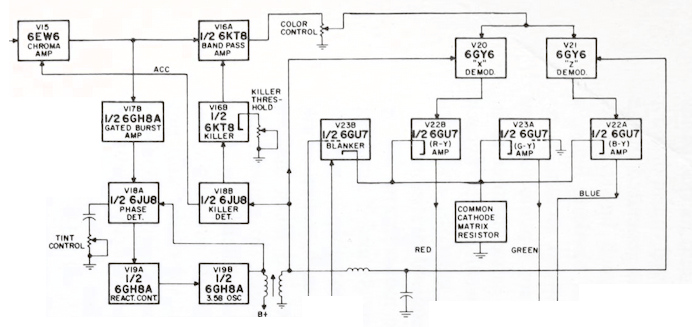
Block diagram of an NTSC colour decoder as found in a typical 1960s American TV set.Block diagram of an NTSC colour decoder as found in a typical 1960s American TV set. Color TV Servicing, Buchsbaum, Walter H, 1968.

An analogue colour TV camera produces three video signals, one for each of the red, green, and blue components of the picture. Should you combine all three you arrive at that black-and-white video waveform, referred to as the luminance, or as Y. The colour information is then reduced to two further signals by computing the difference between the red and the luminance, or R-Y, and the blue and the luminance, or B-Y. These are then phase modulated as I-Q vectors onto the colour sub-carrier in the same way as happens in a software-defined radio.

At the receiver end, the decoder isolates the sub-carrier, I-Q demodulates it, and then rebuilds the R, G, and B, with a summing matrix. To successfully I-Q demodulate the sub-carrier it’s necessary to have a phase synchronised crystal oscillator, this synchronisation is achieved by sending out a short burst of the colour sub-carrier on its own at the start of the line. The decoder has a phase-locked-loop in order to perform the synchronisation.

So, Why The PAL Delay Line?


A PAL decoder module from a 1970s ITT TV. The blue component in the middle is the delay line. Mister rf, CC BY-SA 4.0.

There in a few paragraphs, is the essence of NTSC colour television. How is PAL different? In essence, PAL is NTSC, with some improvements to correct phase errors in the resulting picture. PAL stands for Phase Alternate Line, and means that the phase of those I and Q modulated signals swaps every line. The decoder is similar to an NTSC one and indeed an NTSC decoder set to that 4.433MHz sub-carrier could do a job of decoding it, but a fully-kitted out PAL decoder includes a one-line delay line to cancel out phase differences between adjacent lines. Nowadays the whole thing is done in the digital domain in an integrated circuit that probably also decodes other standards such as the French SECAM, but back in the day a PAL decoder was a foot-square analogue board covered in juicy parts highly prized by the teenage me. Since it was under a Telefunken patent there were manufacturers, in particular those from Japan, who would try to make decoders that didn’t infringe on that IP. Their usual approach was to create two NTSC decoders, one for each phase-swapped line.

So if you use “NTSC” to mean “525-line” and “PAL” to mean “625-line”, then everyone will understand what you mean. But make sure you’re including that colour sub-carrier, or you might be misleading someone.


hackaday.com/2026/01/07/how-do…

The Rise and Fall of The In-Car Fax Machines


The media in this post is not displayed to visitors. To view it, please log in.

Once upon a time, a car phone was a great way to signal to the world that you were better than everybody else. It was a clear sign that you had money to burn, and implied that other people might actually consider it valuable to talk to you from time to time.

There was, however, a way to look even more important than the boastful car phone user. You just had to rock up to the parking lot with your very own in-car fax machine.

Dial It Up


Today, the fax machine is an arcane thing only popular in backwards doctor’s offices and much of Japan. We rely on email for sending documents from person A to person B, or fill out forms via dedicated online submission systems that put our details directly in to the necessary databases automatically. The idea of printing out a document, feeding it into a fax machine, and then having it replicated as a paper version at some remote location? It’s positively anachronistic, and far more work than simply using modern digital methods instead.

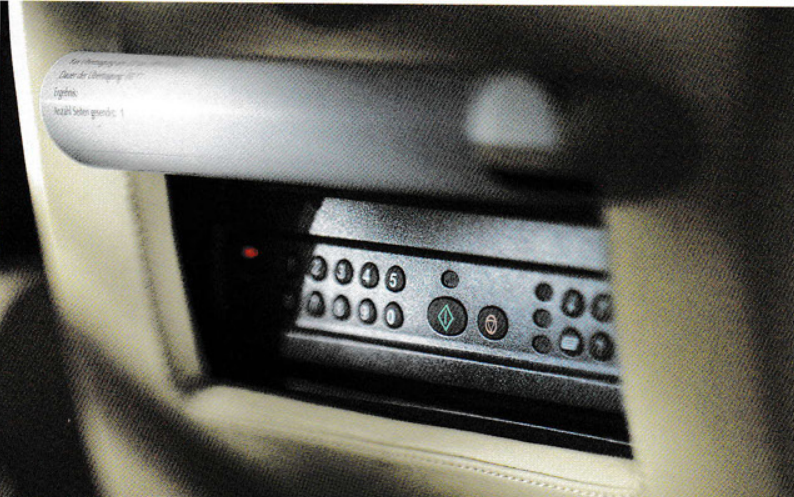
In 1990, Mercedes-Benz offered a fully-stocked mobile office in the S-Class. You got a phone, fax, and computer, all ready to be deployed from the back seat. Credit: Mercedes-Benz

Back in the early 90s though, the communications landscape looked very different. If you had a company executive out on the road, the one way you might reach them would be via their cell or car phone. That was all well and good if you wanted to talk, but if you needed some documents looked over or signed, you were out of luck.

Even if your company had jumped on the e-mail bandwagon, they weren’t going to be able to get online from a random truck stop carpark for another 20 years or so. Unless… they had a fax in the car! Then, you could simply send them a document via the regular old cellular phone network, their in-car fax would spit it out, and they could go over it and get it back to you as needed.

Of course, such a communications setup was considered pretty high end, with a price tag to match. You could get car phones on a wide range of models from the 1980s onwards, but faxes came along a little later, and were reserved for the very top-of-the-line machines.

Mercedes-Benz was one of the first automakers to offer a remote fax option in 1990, but you needed to be able to afford an S-Class to get it. With that said, you got quite the setup if you invested in the Büro-Kommunikationssystem package. It worked via Germany’s C-Netz analog cellular system, and combined both a car phone and an AEG Roadfax fax machine. The phone was installed in the backrest of one of the front seats, while the fax sat in the fold-down armrest in the rear. The assumption was that if you were important enough to have a fax in the car, you were also important enough to have someone else driving for you. You also got an AEG Olyport 40/20 laptop integrated into the back of the front seats, and it could even print to the fax machine or send data via the C-Netz connection.

BMW would go on to offer faxes in high-end 7 Series and limousine models. Credit: BMW

Not to be left out, BMW would also offer fax machines on certain premium 7 Series and L7 limousine models, though availability was very market-dependent. Some would stash a fax machine in the glove box, others would integrate it into the back rest of one of the front seats. Toyota was also keen to offer such facilities in its high-end models for the Japanese market. In the mid-90s, you could purchase a Toyota Celsior or Century with a fax machine secreted in the glove box. It even came with Toyota branding!

Ultimately, the in-car fax would be a relatively short-lived option in the luxury vehicle space, for several reasons. For one thing, it only became practical to offer an in-car fax in the mid-80s, when cellular networks started rolling out across major cities around the world.

By the mid-2000s, digital cell networks were taking over, and by the end of that decade, mobile internet access was trivial. It would thus become far more practical to use e-mail rather than a paper-based fax machine jammed into a car. Beyond the march of technology, the in-car fax was never going to be a particularly common selection on the options list. Only a handful of people ever really had a real need to fax documents on the go. Compared to the car phone, which was widely useful to almost anyone, it had a much smaller install base. Fax options were never widely taken up by the market, and had all but disappeared by 2010.

youtube.com/embed/0vbvu7EiWNA?…

The Toyota Celsior offered a nice healthy-sized fax machine in the 1990s, but it did take up the entire glove box.

These days, you could easily recreate a car-based fax-type experience. All you’d need would be a small printer and scanner, ideally combined into a single device, and a single-board computer with a cellular data connection. This would allow you to send and receive paper documents to just about anyone with an Internet connection. However, we’ve never seen such a build in the wild, because the world simply doesn’t run on paper anymore. The in-car fax was thus a technological curio, destined only to survive for maybe a decade or so in which it had any real utility whatsoever. Such is life!

Build a 2K Resolution MSLA 3D Resin Printer for Cheap


The media in this post is not displayed to visitors. To view it, please log in.

A photo of the various parts for this MSLA 3D printer

Have an old Android device collecting dust somewhere that you’d like to put to better use? [Electronoobs] shows us how to make a Masked Stereolithography Apparatus (MSLA) printer for cheap using screens salvaged from old Android phones or tablets.

[Electronoobs] wanted to revisit his earlier printer with all the benefits of hindsight, and this is the result. The tricky bit, which is covered in depth in the video below the break, is slicing up the model into graphics for each layer, so that these layers can be rendered by the LCD for each layer during the print.

The next tricky bit, once your layer graphics are in hand, is getting them to the device. This build does that by installing a custom Android app which connects to a web app hosted on the ESP32 microcontroller controlling the print, and the app has a backchannel via a USB OTG adapter installed in the device. [Electronoobs] notes that there are different and potentially better ways by which this full-duplex communication can be achieved, but he is happy to have something that works.

If you’re interested in resin printer tech, be sure to check out Continuous Printing On LCD Resin Printer: No More Wasted Time On Peeling? Is It Possible? and Resin Printer Temperature Mods And Continuous IPA Filtration.

youtube.com/embed/fu2NBy5zDxI?…


hackaday.com/2026/01/07/build-…

Joe Vinegar reshared this.

This 8-Bit Commodore PET Was Hard to Fix


The media in this post is not displayed to visitors. To view it, please log in.

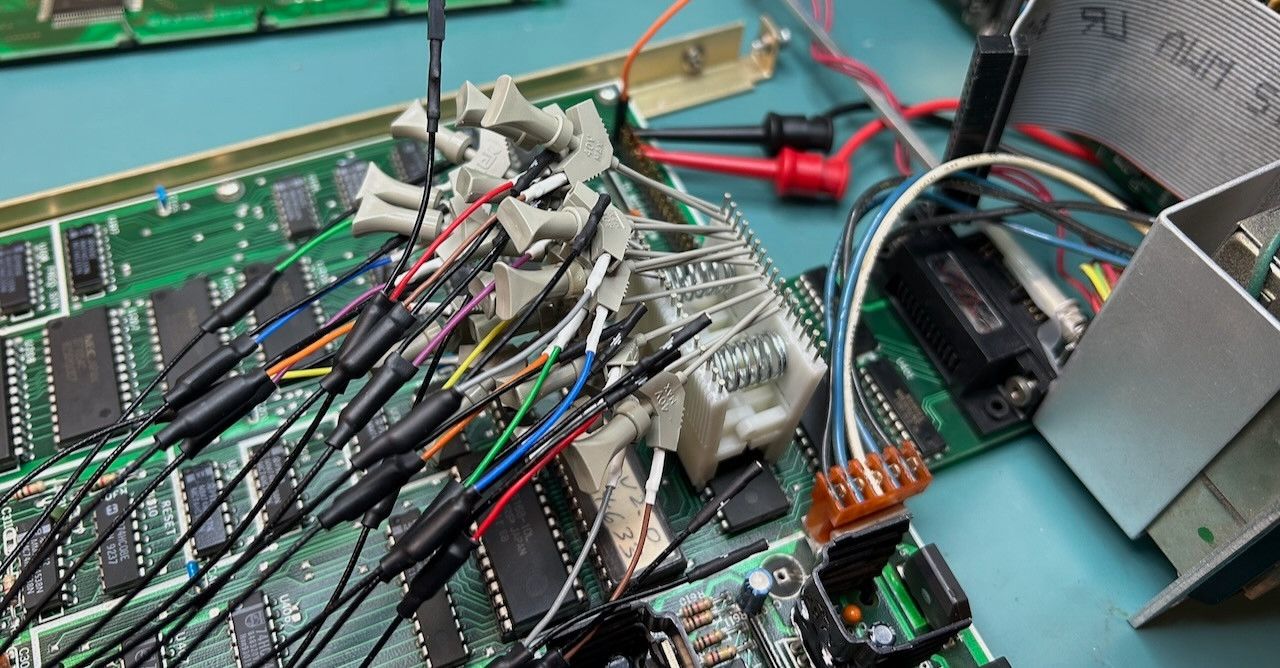
Ken Shirriff working on the Commodore PET

Over on [Ken Shirriff]’s blog is a tricky Commodore PET repair: tracking down 6 1/2 bad chips. WARNING: contains 8-bit assembly code.

The Trinity of 1977 which started the personal computer revolution were the Apple II, the Commodore PET, and the TRS-80. In this project it’s a failing Commodore PET which is being restored.

In the video below the break you can see [Ken Shirriff] and [CuriousMarc] team up to crack this tough nut. Resolving the various issues required a whole heap of software and equipment. Most notably a Keysight DSOX3104T oscilloscope, a Retro Chip Tester Pro, an old Agilent 1670G logic analyzer (this thing is rocking a 3.5″ floppy disk drive!), an old Agilent 54622A oscilloscope (also rocking a floppy drive!), a Data I/O 29B Universal Programmer With UniPak 2 insert, and the disassembly software Ghidra.

In the end there were 6 (and a half) bad chips which needed to be discovered and then replaced. This project is a reminder that it’s nice to have the right tools for the job!

If you’re interested in the Commodore PET you might like to read A Tricky Commodore PET Repair And A Lesson About Assumptions or Tracking Satellites With A Commodore PET.

youtube.com/embed/nxilekpLp6g?…


hackaday.com/2026/01/06/this-8…

An RP2040 Powered ADS-B Receiver


The media in this post is not displayed to visitors. To view it, please log in.

If you’ve ever heard the sound of an aircraft passing overhead and looked at an online plane tracker to try and figure out what it was, then you’ve interacted with ADS-B. It’s a protocol designed to enable easier aircraft monitoring, and it just so happens you can decode it yourself with the right hardware and software — which is how [John McNelly] came to develop ADSBee, an open source ADS-B receiver based around an RP2040.

ADS-B uses on–off keying (OOK) at 1 Mbps, and operates at 1090 MHz. This might seem like a rather difficult protocol to decode on a microcontroller, but the RP2040’s PIO is up to the task. All it takes is a bit of optimization, and a some basic RF components to amplify and digitize the signals.

However, not all aircraft utilize the 1090 MHz ADS-B implementation, and instead use a related protocol called UAT. Operating at 978 MHz, a second receiver is needed for decoding UAT traffic data, which is where the CC1312 comes into play. ADSBee may even be the first open source implementation of a UAT decoder!

What’s quite impressive is the various form factors the module is available in. Ranging from small solder-down modules to weatherproof outdoor base stations, nearly every potential need for an ADS-B receiver is covered. With POE or ESP32 S3 options available, there is no shortage of networking options either!

ADSBees have been placed in numerous locations, ranging from base stations to drones. One user even built out a tiny flight display cluster complete with traffic indicators into an FPV drone.

This isn’t the first time we have seen ADS-B receivers used by drone enthusiasts, but this is certainly the most feature rich and complete receiver we have come across.


hackaday.com/2026/01/07/an-rp2…

Repairing a Self-Destructing SRS DG535 Digital Delay Generator


The media in this post is not displayed to visitors. To view it, please log in.

There’s a lot of laboratory equipment out there that the casual hobbyist will never need to use, but that doesn’t mean you wouldn’t snap it up if the price is right. That’s what happened when [Tom Verbeure] saw a 1980s digital delay generator at a flea market for $40. Not only is it an excellent way to learn something about these devices, but it also provides a fascinating opportunity to troubleshoot and hopefully fix it. Such was also the case with this Stanford Research Systems (SRS) DG535 that turned out to be not only broken, but even features an apparently previously triggered self-destruct feature.

These devices are pretty basic, with this specimen incorporating a Z80 MPU in addition to digital and analog components to provide a programmable delay with 12.5 nanosecond resolution on its output channels after the input trigger is sensed. For that reason it was little surprise that the problem with the device was with its supply rails, of which a few were dead or out of spec, along with a burned-out trace.

Where the self-destruct feature comes into play is with the use of current boosting resistors around its linear regulators. Although these provide a current boost over what the regulator can provide, their disadvantages include a tendency towards destruction whenever the load on the supply rail decreases. This could for example occur when you’re debugging an issue and leave some of the PCBs disconnected.

Unsurprisingly, this issue caused the same charred trace to reignite during [Tom]’s first repair attempt, but after working up the courage over the subsequent 18 months the second repair attempt went much better, also helped by the presence of the mostly correct original board schematics.

Ultimately the fixes were relatively modest, involving replacing a discrete diode bridge with an integrated one, fixing the -9 V rail with a bodge wire, and replacing the LCD with its busted AC-powered backlight with a modern one with a LED backlight. Fortunately running the 5 V rail at 7 V for a while seemed to have caused no readily observable damage, nor did flipping connectors because of SRS’ inconsistent ‘standards’ for its connector orientations.

Sadly, when [Tom] emailed SRS to inquire about obtaining an updated schematic for this unit — which is currently still being sold new for $4,495 — he merely got told to send his unit in for repair.


hackaday.com/2026/01/07/repair…

Cybersecurity & cyberwarfare ha ricondiviso questo.

A massive breach exposed data of 17.5M #Instagram users
securityaffairs.com/186765/dat…
#securityaffairs #hacking
Cybersecurity & cyberwarfare ha ricondiviso questo.

The media in this post is not displayed to visitors. To view it, please go to the original post.

Doom sbarca in pentola: il leggendario sparatutto ora gira su una pentola a pressione

📌 Link all'articolo : redhotcyber.com/post/doom-sbar…

#redhotcyber #news #krups #cook4me #doom #gaming #pentolaintelligente #reverseengineering

reshared this

Cybersecurity & cyberwarfare ha ricondiviso questo.

Open source in Europa: la Commissione lancia la consultazione per la sovranità digitale

La Commissione Europea ha lanciato una consultazione pubblica con l’obiettivo di ridurre la dipendenza da software extraeuropeo e rafforzare sicurezza e interoperabilità. Il focus è sul sostegno ai manutentori di progetti open source considerati infrastrutture critiche.

ilsoftware.it/open-source-in-e…

@informatica

Grazie a @filippodb per la segnalazione

Cybersecurity & cyberwarfare ha ricondiviso questo.

BREAKING NEWS: 17.5 Milioni di account #Instagram leakati attraverso, sembra, uno scraping avvenuto via API.

Tra i dati sembrano esserci indirizzi mail, numeri di telefono etc etc...

infosecbulletin.com/instagram-…

@informatica

Grazie a @grep_harder per la segnalazione

Cybersecurity & cyberwarfare ha ricondiviso questo.

#North #Korea–linked #APT #Kimsuky behind quishing attacks, #FBI warns
securityaffairs.com/186755/int…
#securityaffairs #hacking
Cybersecurity & cyberwarfare ha ricondiviso questo.

Un traffico anomalo su pagine sensibili del ministero della Difesa italiano porta a indirizzi cinesi

L’aumento degli accessi, concentrato tra fine dicembre e inizio gennaio, mostra pattern compatibili con un’attività di ricognizione informativa. Le visite si concentrano su sezioni tecniche e amministrative: tutti dati utili all'intelligence. I dati per ora non consentono attribuzioni definitive, ma l’anomalia c'è, e il messaggio pure

ilfoglio.it/esteri/2026/01/09/…

@informatica

Cybersecurity & cyberwarfare ha ricondiviso questo.

#Iran: la chiusura di Internet nasconde le violazioni nell'escalation della repressione mortale dei manifestanti

In seguito al blackout di Internet e delle telecomunicazioni imposto dalle autorità iraniane l'8 gennaio 2026, mentre le proteste in tutto il paese si intensificavano dallo scoppio del 28 dicembre 2025, Rebecca White, ricercatrice presso il Security Lab di Amnesty International, ha dichiarato:

amnesty.org/en/latest/news/202…

@politica

Cybersecurity & cyberwarfare ha ricondiviso questo.

It’s bewildering how bad offline Apple Music is.

When I have spotty reception the app just stops working until I enable airplane mode.

Now I went to listen to music on an actual plane and all my downloads are just gone.

I guess I need to 🏴‍☠️ for a better UX. What’s a good iOS app to play mp3s?

Cybersecurity & cyberwarfare ha ricondiviso questo.

The media in this post is not displayed to visitors. To view it, please go to the original post.

LockBit torna a colpire: la nuova versione 5.0 rilancia il ransomware più temuto

📌 Link all'articolo : redhotcyber.com/post/lockbit-t…

#redhotcyber #news #cybersecurity #hacking #malware #ransomware #lockbit #raas #criminalitàinformatica

Cybersecurity & cyberwarfare ha ricondiviso questo.

The media in this post is not displayed to visitors. To view it, please go to the original post.

Ritrovato dopo 50 anni: il raro nastro UNIX V4 rivive al Computer History Museum

📌 Link all'articolo : redhotcyber.com/post/ritrovato…

#redhotcyber #news #storiadiunix #unixoriginal #versioniniziale #nascondiglipolverosi

reshared this

Cybersecurity & cyberwarfare ha ricondiviso questo.

The media in this post is not displayed to visitors. To view it, please go to the original post.

Data Breach ad Instagram: 17,5 milioni di utenti circolano nel DarkWeb

📌 Link all'articolo : redhotcyber.com/post/data-brea…

Un massiccio archivio digitale contenente le #informazioni private di circa 17,5 milioni di #utenti Instagram sembrerebbe essere finito nelle mani dei cybercriminali. Qualche ora fa è stato segnalato l’allarme dopo che diversi #utenti su Reddit hanno affermato di aver ricevuto un’email da Meta, che consigliava di reimpostare la password a causa di una presunta #violazione dei #dati.

Ma purtroppo tali email non erano reali, ma solo tentativi di truffa.

A cura di Redazione RHC

#redhotcyber #news #cybersecurity #hacking #instagram #datirubati #darkweb #sicurezzainformatica #furatodidati #protezionedatidigitali #informaticacriminosa #sicurezzaonline #datipersonali #privacy

Cybersecurity & cyberwarfare ha ricondiviso questo.

The media in this post is not displayed to visitors. To view it, please go to the original post.

“La tua password sta per scadere”: quando il phishing sembra arrivare dall’ufficio della porta accanto

📌 Link all'articolo : redhotcyber.com/post/la-tua-pa…

#redhotcyber #news #cybersecurity #phishing #microsoft365 #sicurezzainformatica #attacchiphishing

Cybersecurity & cyberwarfare ha ricondiviso questo.

The media in this post is not displayed to visitors. To view it, please go to the original post.

Cybercrime in Italia: il report della Polizia Postale racconta un 2025 sotto attacco

📌 Link all'articolo : redhotcyber.com/post/cybercrim…

#redhotcyber #news #sicurezzadigitale #cybersecurity #poliziapostale #attacchiinformatici #prevenzione

Cybersecurity & cyberwarfare ha ricondiviso questo.

The media in this post is not displayed to visitors. To view it, please go to the original post.

Era il 2014 e gli agenti di frontiera USA si sono intenzionalmente piazzati davanti a veicoli in movimento per giustificare la sparatoria contro di loro

Un'analisi interna della US Border Patrol sollevava seri interrogativi sulla politica dell'agenzia in materia di uso della forza.

thenation.com/article/archive/…

@politica

Il post di @dogzilla
masto.deluma.biz/@dogzilla/115…
#ReneeNicoleGood #Minneapolis


This is from 2014. Seems like the shooter was, in fact, following his training to the letter.

——

US Border Agents Intentionally Stepped in Front of Moving Vehicles to Justify Shooting at Them | The Nation thenation.com/article/archive/…


Cybersecurity & cyberwarfare ha ricondiviso questo.

The media in this post is not displayed to visitors. To view it, please go to the original post.

Ho parlato al Parlamento Inglese di rischi democratici dell’IA camisanicalzolari.it/ho-parlat…

reshared this

Cybersecurity & cyberwarfare ha ricondiviso questo.

The media in this post is not displayed to visitors. To view it, please go to the original post.

Sono intervenuto alle Nazioni Unite su AI e FGM camisanicalzolari.it/sono-inte…

reshared this

Cybersecurity & cyberwarfare ha ricondiviso questo.

Illinois Department of Human Services (#IDHS) suffered a data breach that impacted 700K individuals
securityaffairs.com/186745/dat…
#securityaffairs #hacking

The Many Questions and Challenges with DIY Hydroelectric Generators


The media in this post is not displayed to visitors. To view it, please log in.

The concept of building your own hydroelectric generator seems simple at face value: use gravity to impart as much force as possible onto a turbine, which spins a generator, thus generating electricity. If you’re like the bloke over at [FarmCraft101] trying to DIY this with your farm pond and a lot of PVC pipes, you may have some significantly more in-depth questions, especially pertaining to what kind of generator to use. This and other questions, some of which were raised after the previous video in which the first prototype generator was assembled, are answered in this follow-up video.

When you DIY such a hydroelectric system, you have a number of options when it comes to just the turbine design alone, with the Kaplan-style turbine being one of the most straightforward ones – especially if you use a fixed pitch instead of adjustable – but you can go pretty far in the weeds with alternatives. As for the sharp drop-off after the turbine in the used design, the technical term is a draft tube, which is actually more efficient in this kind of low head, high flow hydroelectric dam situation.

After getting his money back for the unusable ‘3 kW’ generator, there were three options left: try an EBay special, get a purpose-built one from a US company, or rewind an alternator stator for higher voltage output than the standard 12/24V. Ultimately option four was chosen, as in ‘all of the above’, so that comparison is coming up in a future video.

There were also questions from viewers about why he opted to rectify the AC power from the generator and use DC transmission to the nearest farm building. The main reason is efficiency, as DC transmission lines lack the skin effect losses. The other is that the grid-tie inverter that he plans to use needs DC input anyway. Not having to deal with AC transmission issues like losses and reactive power shenanigans is a major plus here.

Once the three new generator versions are being tested it will be interesting to see how they perform. One thing with the Kaplan-style turbine is that too fast RPM induces cavitation, which will erode the propeller pretty quickly. Generally car alternators require a pretty fast RPM, so that may not work out too well. There is also the question of the DC voltage generated, as for DC transmission you want to have as high a voltage as possible to reduce the current.

The purpose-built generator he purchased tops out at 48V, which is quite low. The goal is to have at least 230 VAC before rectification, so a step-up transformer may be needed. Unfortunately three-phase transformers are pretty pricy again, making the rewound alternator seem less crazy. The wild card here is perhaps whether the EBay-purchased generator is a diamond in the rough and works out of the box as hoped.

youtube.com/embed/45DNG8eUhwY?…


hackaday.com/2026/01/06/the-ma…

Tired of Burnt Fingers? Try PID Tuning the Hot Glue Gun


The media in this post is not displayed to visitors. To view it, please log in.

The modified hot glue gun, reassembled

Hot glue guns are pretty simple beasts: there’s an on/off switch, a heating element, and a source of current, be it battery or wired. You turn it on, and the heater starts warming up; eventually you can start extruding the thermoplastic sticks we call “hot glue”. Since there’s no temperature control, the longer you run the gun, the warmer it gets until it is inevitably hotter than you actually want– either burning you or oozing thermoplastic out the tip. [Mellow_Labs] was sick of that after a marathon hot-glue session, and decided to improve on his hot glue gun with PID tuning in the video embedded below.

PID tuning is probably a familiar concept to most of you, particularly those who have 3D printers, where it’s used in exactly the same way [Mellow_Labs] puts it to work in the hot glue gun. By varying the input (in this case the power to the heater) proportional both to the Parameter (in this case, temperature) as well as the Integral and Derivative of that value, you can have a much steadier control than more naive algorithms, like the simple “on/off” thermostat that leads to large temperature swings.

In this case [Mellow_Labs] is implementing the PID control using a thermistor that looks like it came from a 3D printer, and a MOSFET driven by an RP2040. Microcontroller gets its power via the hot glue gun’s battery fed through a buck converter. Since he has them, a small OLED screen displays temperature, which is set with a pair of push-buttons. Thus, one can set a temperature hot enough to melt the glue, but low enough to avoid oozing or third degree burns.

He does not share the code he’s running on the RP2040, but if you are inspired to replicate this project and don’t want to roll your own, there are plenty of example PID scripts out there, like the one in this lovely robot. No, PID isn’t reserved for thermostats– but if you are controlling heat, it’s not reserved for electric, either. Some intrepid soul put built a PID controller for a charcoal BBQ once.

youtube.com/embed/DKgOyBBh7eE?…


hackaday.com/2026/01/06/tired-…

PiStorm68K Offers Supercharged Retro Amiga Experience


The media in this post is not displayed to visitors. To view it, please log in.

A photo of the PiStorm68K circuit board

[AmiCube] has announced their new PiStorm68K special edition MiniMig accelerator board. This board was developed to replace the 68000 CPU in a MiniMig — a recreation of the original Amiga chipset in an FPGA allowing a real genuine 68000 CPU to operate.

The PiStorm68K itself can host a real genuine 68000 CPU but it can also host various Raspberry Pi models which can do emulation of a 68000. So if you combine a PiStorm68K with a MiniMig you can, at your option, boot into an emulated environment with massively increased performance, or you can boot into an original environment, with its reliable and charming sluggishness.

In the introduction video below, [AmiCube] uses the SYSINFO utility software to compare the CPU speed when using emulation (1531 MIPS) versus the original (4.47 MIPS), where MIPS means Millions of Instructions Per Second. As you can see the 68000 emulated by the Raspberry Pi is way faster than the original. The Raspberry Pi also emulates a floating-point unit (FPU) which the original doesn’t include and a memory management unit (MMU) which isn’t used.

If you’re interested in old Amiga tech you might also like to read about Chip Swap Fixes A Dead Amiga 600 or The Many-Sprites Interpretation Of Amiga Mechanics.

youtube.com/embed/6b-HfLYA1E8?…


hackaday.com/2026/01/06/pistor…

Linux Fu: Yet Another Shell Script Trick


The media in this post is not displayed to visitors. To view it, please log in.

I’m going to go ahead and admit it: I really have too many tray icons. You know the ones. They sit on your taskbar, perhaps doing something in the background or, at least, giving you fingertip access to some service. You’d think that creating a custom tray icon would be hard, but on Linux, it can be surprisingly simple. Part of the reason is that the Freedesktop people created standards, so you don’t typically have to worry about how it works on KDE vs. GNOME or any of the other desktop environments. That’s a big win.

In fact, it is simple enough that you can even make your own tray icons with a lowly shell script. Well, of course, like most interesting shell scripts, you need some helper programs and, in this case, we’ll use YAD — which is “yet another dialog,” a derivative of Zenity. It’s a GTK program that may cause minor issues if you primarily use KDE, but they are nothing insurmountable.

The program is somewhat of a Swiss army knife. You can use it to make dialogs, file pickers, color selectors, printer dialogs, and even — in some versions — simple web browsers. We’ve seen plenty of tools to make pretty scripts, of course. However, the ability to quickly make good-looking taskbar icons is a big win compared to many other tools.

Docs


Depending on what you want to do, YAD will read things from a command line, a file, or standard input. There are dozens of options, and it is, honestly, fairly confusing. Luckily, [Ingemar Karlsson] wrote the Yad Guide, which is very digestible and full of examples.

Exactly what you need will depend on what you want to do. In my case, I want a tray icon that picks up the latest posts from my favorite website. You know. Hackaday?

The Web Connection


YAD can render HTML using WebKit. However, I ran into immediate problems. The version in the repos for the Linux I use was too old to include the HTML option. I found a supposedly statically linked version, but it was missing dependencies. Even after I fixed that, the program still reported errors related to the NVIDIA OpenGL stack.

I quickly abandoned the idea of using a web browser. I turned to two other YAD features. First, the basic dialog can hold text and, in most cases, renders quasi-HTML because it uses the Pango library. However, there is also a text-info dialog built in. Unlike most other YAD features, the text-info dialog reads its input from standard input. However, it doesn’t render markup.

In the end, I decided to try them both. Why not? It is simple enough. But first, I needed a tray icon.

The Tray


YAD can provide a “notification,” which is what it calls a tray icon. You can specify an icon, some text, and a right-click context menu. In addition, it can react when someone clicks on the icon.
Can you find the tray icon we’re talking about?
I decided to write a script with multiple personalities. If you run it with no arguments, it sets up the tray icon. If you pass anything to it, it will show a dialog with the latest Hackaday articles from the RSS feed. I wanted to make those links clickable, and that turned out to be a bit of a wrinkle. Both versions will do the job, but they each need a different approach, as you will see.

Here’s the tray code:

yad --notification --image="$0.icon.png" --text="Hackaday Now" \
--menu="Quit!quit!gtk-quit" --command="$0 show" --no-middle

You can probably guess at most of this without the manual. The image is stored in a file with the same name as the script, but with .icon.png at the end. That’s the icon in the tray. The simple menu provides an option to exit the program. If you click the icon, it calls the same script again, but with the “show” argument. The script doesn’t care what the argument is, but maybe one day it will.

So that part of the project was extremely simple. The next job is making the dialog appear.

Text Info


Grabbing the RSS feed with wget is trivial. You could use grep, sed, and bash pattern replacement to extract the titles and URLs, but I opted for awk and a brute-force parsing approach.
This works, but the URLs are long and not terribly attractive. The list is scrollable, and there are more links below the visible ones.
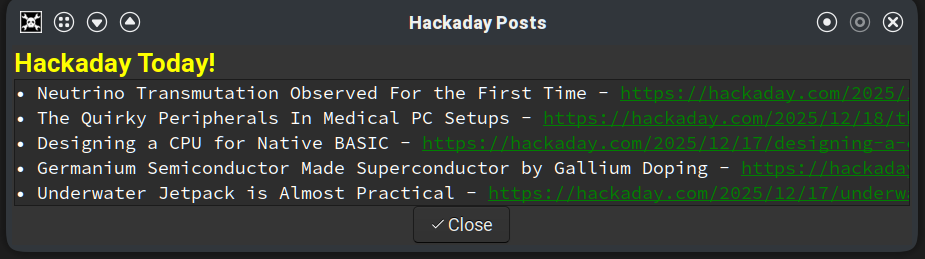
The standard output of awk pipes into YAD, but you can’t readily apply formatting or hyperlinks. You can use formatting in regular dialog text, which will appear before the other output. That’s where the yellow “Hackaday Today!” title in the adjacent screenshot gets set. In addition, you can automatically detect URLs and make them clickable using the --show-uri option.

Here’s the relevant command:

yad --text-info \
--text "<span foreground='$TITLECOLOR'><b><big><big>Hackaday Today!</big></big></b></span>" \
--show-uri --window-icon="$0.icon.png" \
--uri-color=$LINKCOLOR --width=$WIDTH --height=$HEIGHT \
--Title "Hackaday Posts" --button="Close!gtk-ok" \
--buttons-layout=center --escape-ok 2>/dev/null

You’ll notice that the –text option does take Pango formatting and the --show-uri option makes the links clickable. By default, dialogs have an Open and Cancel button, but I forced this one to have a single close button, accept escape, and I wanted the button centered.

As you can see in the screenshot, the result isn’t bad, but it does require having the title followed by a long URL that you can click on and that’s a little ugly.

Stock Dialog

Using a standard dialog instead of text-info allows better formatting.
Since the –text option works with any dialog and handles formatting, I decided to try that. The awk code was nearly the same, except for the output formatting. In addition, the output now needs to go on the command line instead of through a pipe.

This does make the script a bit more unwieldy. The awk script sets a variable, since jamming the command into the already busy YAD command line would make the script more complicated to read and work with.

The YAD command is still simple, though:

yad \
--text="$DATA" \
--window-icon="$0.icon.png" \
--width=$WIDTH --height=$HEIGHT \
--Title "Hackaday Posts" --button="Close!gtk-ok" \
--buttons-layout=center --escape-ok

The DATA variable has the formatted output text. The result looks better, as you can see in the screenshot. In either version, if you click an underlined link, your default browser should open the relevant post.

Other Choices


If you want to install either script, you can get it from GitHub. Of course, you could do this in Python or any other conventional language. There are also programs for “minimizing” another program to the tray, like AllTray or KDocker, although some of these may only work with X11 and not Wayland.

It would have been nice to have an integrated browser, although, thanks again to FreeDesktop, it is simple enough to open a URL and launch the system’s default browser.

Prefer your Hackaday feed on the command line? Check out the comments for this post. Meanwhile, send us a tip (you know, a link to your project, not a gratuity) and maybe you’ll see your own project show up on the feed.


hackaday.com/2026/01/06/linux-…

The use of Ultrasound to take on Cancerous Tumors


The media in this post is not displayed to visitors. To view it, please log in.

As areas of uncontrolled cell growth, cancerous growth form a major problem for a multi-celled organism like us humans. Thus before they can begin to affect our long-term prospects of a continued existence, eradicating these cells-gone-wrong is essential. Unfortunately, doing so without affecting healthy cells significantly is tough. Treatments such as chemotherapy are correspondingly rough on the body, while radiation therapy is a lot more directed. Perhaps one of the more fascinating treatments involves ultrasound, with the IEEE Spectrum magazine recently covering one company providing histotripsy equipment.
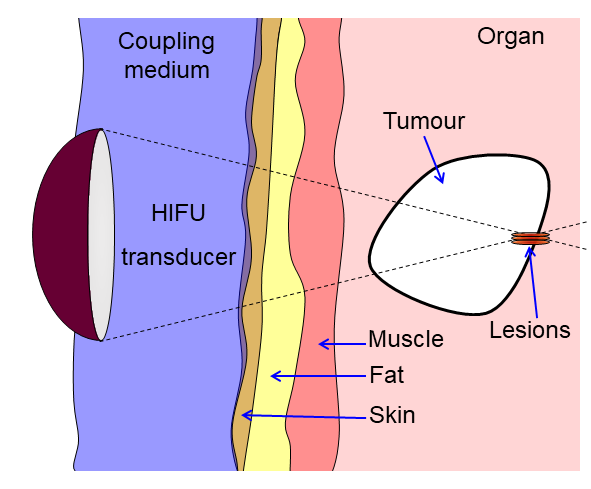
Diagram showing how HIFU can be used to destroy tissue in the body. An acoustic lens is used to focus sound to a small point in the body. (Credit: James Ross McLaughlan, Wikimedia)Diagram showing how HIFU can be used to destroy tissue in the body. An acoustic lens is used to focus sound to a small point in the body. (Credit: James Ross McLaughlan, Wikimedia)
Ultrasound has found many applications in the medical field far beyond imaging, with therapeutic ultrasound by itself covering a variety of methods to perform actions within the body without breaking the skin. By using high-energy ultrasound, everything from kidney stones to fat cells and cancerous cells can be accurately targeted and destroyed. For liver tumors the application of so-called histotropsy has become quite common, allowing certain types of tumors to be ablated non-invasively after which the body can handle the clean-up.

Histotropsy is a form of high-intensify focused ultrasound (HIFU) that uses either continuous or pulsed waves to achieve the desired effect, with the HIFU transducer equipped with an acoustic lens to establish a focal point. In the case of histotripsy cavitation is induced at this focal point that ends up destroying the local tissue. Beyond liver tumors the expectation is that other tumors will soon be treated in a similar manner, which could be good news for especially solid tumors.

Along with new approaches like CAR T cell immunotherapy, the prospects for cancer becoming a very treatable set of diseases would seem to be brighter than ever.


hackaday.com/2026/01/06/the-us…

How Advanced Autopilots Make Airplanes Safer When Humans go AWOL


The media in this post is not displayed to visitors. To view it, please log in.

It’s a cliché in movies that whenever an airplane’s pilots are incapacitated, some distraught crew member queries the self-loading freight if any of them know how to fly a plane. For small airplanes we picture a hapless passenger taking over the controls so that a heroic traffic controller can talk them through the landing procedure and save the day.

Back in reality, there have been zero cases of large airliners being controlled by passengers in this fashion, while it has happened a few times in small craft, but with variable results. And in each of these cases, another person in the two- to six-seater aircraft was present to take over from the pilot, which may not always be the case.

To provide a more reliable backup, a range of automated systems have been proposed and implemented. Recently, the Garmin Emergency Autoland system got its first real use: the Beechcraft B200 Super King Air landed safely with two conscious pilots on board, but they let the Autoland do it’s thing due to the “complexity” of the situation.

Human In The Loop


Throughout the history of aviation, a human pilot has been a crucial component for the longest time for fairly obvious reasons, such as not flying past the destination airport or casually into terrain or rough weather. This changed a few decades ago with the advent of more advanced sensors, fast computing systems and landing assistance systems such as the ILS radio navigation system. It’s now become easier than ever to automate things like take-off and landing, which are generally considered to be the hardest part of any flight.

Meanwhile, the use of an autopilot of some description has become indispensable since the first long-distance flights became a thing by around the 1930s. This was followed by a surge in long-distance aviation and precise bombing runs during World War II, which in turn resulted in a massive boost in R&D on airplane automation.
A USAF C-54 Skymaster. (Credit: US Air Force)A USAF C-54 Skymaster. (Credit: US Air Force)
While the the early gyroscopic autopilots provided basic controls that kept the airplane level and roughly on course, the push remained to increase the level of automation. This resulted in the first fully automatic take-off, flight and landing being performed on September 22, 1947 involving a USAF C-54 Skymaster. As the military version of the venerable DC-4 commercial airplane its main adaptations included extended fuel capacity, which allowed it to safely perform this autonomous flight from Newfoundland to the UK.

In the absence of GNSS satellites, two ships were located along the flight path to relay bearings to the airplane’s board computer via radio communication. As the C-54 approached the airfield at Brise Norton, a radio beacon provided the glide slope and other information necessary for a safe landing. The fact that this feat was performed just over twenty-eight years after the non-stop Atlantic crossing of Alcock and Brown in their Vickers Vimy airplane shows just how fast technology progressed at the time.

Nearly eighty years later, it bears asking the question why we still need human pilots, especially in this age of GNSS navigation, machine vision, and ILS beacons at any decently sized airfield. The other question that comes to mind is why we accept that airplanes effectively fall out of the sky the moment that they run out of functioning human pilots to push buttons, twist dials, and fiddle with sticks.

State of the Art


In the world of aviation, increased automation has become the norm, with Airbus in particular taking the lead. This means that Airbus has also taken the lead in spectacular automation-related mishaps: Flight 296Q in 1988 and Air France Flight 447 in 2009. While some have blamed the 296Q accident on the automation interfering with the pilot’s attempt to increase thrust for a go-around, the official explanation is that the pilots simply failed to notice that they were flying too low and thus tried to blame the automation.
The Helios Airways 737-300, three days before it would become a ghost flight. (Credit: Mila Daniel)The Helios Airways 737-300, three days before it would become a ghost flight. (Credit: Mila Daniel)
For the AF447 crash the cause was less ambiguous, even if took a few years to recover the flight recorders from the seafloor. Based on the available evidence it was clear by then that the automation had functioned as designed, with the autopilot disengaging at some point due to the unheated pitot tubes freezing up, resulting in inconsistent airspeed readings. Suddenly handed the reins, the pilots took over and reacted incorrectly to the airspeed information, stalled the plane, and crashed into the ocean.

One could perhaps say that AF447 shows that there ought to be either more automation, or better pilot training so that the human element can fly an airplane unassisted by an autopilot. When we then consider the tragic case of Helios Airways Flight 522, the ‘ghost flight’ that flew on autopilot with no conscious souls on board due to hypoxia, we can imagine a dead-man switch that auto-lands the airplane instead of leaving onlookers powerless to do anything but watch the airplane run out of fuel and crash.

Be Reasonable


Although there are still a significant number of people who would not dare to step a foot on an airliner that doesn’t have at least two full-blooded, breathing human pilots on board, there is definitely a solid case to be made for emergency landing systems to become a feature on airplanes, starting small. Much like the Cirrus Airframe Parachute System (CAPS) – a whole-airplane parachute system that has saved many lives as well as airframes – the Garmin Autoland feature targets smaller airplanes.
The Garmin Autoland system communicates with ATC and nearby traffic and lands unassisted. (Credit: Garmin)The Garmin Autoland system communicates with ATC and nearby traffic and lands unassisted. (Credit: Garmin)
After a recent successful test with a HondaJet, this recent unscheduled event with the Beechcraft B200 Super King Air twin-prop airplane turned out to be effectively another test. As the two pilots in this airplane were flying between airports for a repositioning flight, the cabin suddenly lost pressurization. Although both pilots were able to don their oxygen masks, the Autoland system engaged due to the dangerous cabin conditions. They then did not disengage the system as they didn’t know the full extent of the situation.

This effectively kept both pilots ready to take full control of the airplane should the need have arisen to interfere, but with the automated system making a textbook descent, approach and landing, it’s clear that even if their airplane had turned into another ghost flight, they would have woken up groggy but whole on the airstrip, surrounded by emergency personnel.

Considering how many small airplanes fly each year in the US alone, systems like CAPS and Autoland stand to save many lives both in the air and on the ground the coming years. Combine this with increased ATC automation at towers and elsewhere such as the FAA’s STARS and Saab’s I-ATS, and a picture begins to form of increased automation that takes the human element out of the loop as much as possible.

Although we’re still a long way off from the world imagined in 1947 where ‘electronic brains’ would unerringly fly all airplanes and more for us, it’s clear that we are moving in that direction, with such technology even within the reach of the average owner of an airplane of some description.


hackaday.com/2026/01/06/how-ad…

Super Mario 64, Now With Microtransactions


The media in this post is not displayed to visitors. To view it, please log in.

Besides being a fun way to pass time, video gaming is a surprisingly affordable hobby per unit time. A console or budget PC might only cost a few hundred dollars, and modern games like Hollowknight: Silksong can provide 40-60 hours of experience for only around $20 USD. This value proposition wasn’t really there in the 80s, where arcade cabinets like Gauntlet might have cost an inflation-adjusted $8 per hour in quarters. This paradigm shift is great for gamers, but hasn’t been great for arcade owners. [PrintAndPanic] wanted to bring some of that old coin munching vibe into console gaming, and so added a credit system to Super Mario 64.

The project is a fork of a decompilation of Super Mario 64, which converts the original machine code into a human-friendly format so bugs can be fixed and other modern features added. With the code available, essentially anyone can add features into the game that weren’t there already. In this case, [PrintAndPanic] is using a Raspberry Pi connected to a coin slot, so when coins are put into the game like an old arcade machine, the Raspberry Pi can tell the modified version of Super Mario 64 to add credits. These credits allow the player to run and jump, and when the credits run out Mario becomes extremely limited and barely able to outrun even the slowest Bombombs and Goombas.

With some debugging out of the way and the custom game working, [PrintAndPanic] built a custom enclosure for the game and the coin slot to turn it into a more self-contained arcade-style machine. The modified code for this project is available on the project’s GitHub page for those who want to play a tedious version of a favorite video game that costs more money than it should.

There are plenty of other modifications for this classic as well, most of which involve improving the game instead of adding a modern microtransaction-based system.

youtube.com/embed/Z_uFcPic5kE?…


hackaday.com/2026/01/06/super-…

Raccolta dati e AI: le sfide legali del web scraping secondo la CNIL


@Informatica (Italy e non Italy 😁)
La CNIL chiarisce che la raccolta di dati accessibili online tramite web scraping è legittima se accompagnata da misure a salvaguardia dei diritti degli interessati. Con un interessante focus sheet sul punto, la base giuridica del legittimo interesse prende forza. Vediamo