The Privacy Post ha ricondiviso questo.

Scoperte Due Privilege Escalation in Citrix Workspace per Windows: Aggiorna Subito!
poliverso.org/display/0477a01e…
Scoperte Due Privilege Escalation in Citrix Workspace per Windows: Aggiorna Subito!Due vulnerabilità redhotcyber.com/post/vulnerabi… ad alta gravità, CVE-2024-7889 e CVE-2024-7890, sono state scoperte nel Citrix Workspace app per Windows. Queste vulnerabilità redhotcyber.com/post/vulnerabi… interessano le versioni precedenti alla 2405 per la


Scoperte Due Privilege Escalation in Citrix Workspace per Windows: Aggiorna Subito!


Due vulnerabilità ad alta gravità, CVE-2024-7889 e CVE-2024-7890, sono state scoperte nel Citrix Workspace app per Windows. Queste vulnerabilità interessano le versioni precedenti alla 2405 per la release corrente e le versioni precedenti alla 2402 CU1 per la LTSR.

Citrix raccomanda ai clienti di aggiornare immediatamente le loro installazioni per mitigare i rischi di sicurezza.ia significativa per gli utenti e le organizzazioni che utilizzano l’ambiente Citrix Workspace.

Versioni Interessate


Le vulnerabilità interessano le seguenti versioni supportate dell’app Citrix Workspace per Windows.

  • Current Release (CR): Citrix Workspace app for Windows versions BEFORE 2405
  • Long Term Service Release (LTSR): Citrix Workspace app for Windows versions BEFORE 2402 LTSR CU1

CVE-2024-7889: Descrive una vulnerabilità di escalation di privilegi locali che permette a un utente con pochi privilegi di ottenere diritti di SYSTEM. È necessaria l’accesso locale al sistema target. Questa vulnerabilità è categorizzata come CWE-664 (Gestione impropria delle risorse). Il punteggio CVSS v4.0 è 7.0, suggerendo una gravità elevata.

CVE-2024-7890: Un’altra vulnerabilità di escalation di privilegi locali, che però richiede condizioni più complesse. Classificata come CWE-269 (Gestione impropria dei privilegi). Il CVSS v4.0 è 5.4, indicando un rischio moderato rispetto a CVE-2024-7889.

Cosa occorre fare


Citrix consiglia vivamente ai clienti di aggiornare la propria app Citrix Workspace per Windows il prima possibile a versioni che contengano le correzioni. Le versioni dell’app Citrix Workspace per Windows che contengono le correzioni sono:

  • Current Release (CR): Citrix Workspace app for Windows 2405 and later versions
  • Long Term Service Release (LTSR): Citrix Workspace app for Windows 2402 CU1 LTSR and later versions

Citrix sta notificando i propri clienti e partner di canale riguardo questa vulnerabilità attraverso la pubblicazione di questo bollettino di sicurezza nel Citrix Knowledge Center al seguente link: support.citrix.com/securitybul…

L'articolo Scoperte Due Privilege Escalation in Citrix Workspace per Windows: Aggiorna Subito! proviene da il blog della sicurezza informatica.


The Privacy Post reshared this.

The Privacy Post ha ricondiviso questo.

The media in this post is not displayed to visitors. To view it, please go to the original post.

Mobile Coffee Table Uses Legs to Get Around
poliverso.org/display/0477a01e…
Mobile Coffee Table Uses Legs to Get AroundFor getting around on most surfaces, it’s hard to beat the utility of the wheel. Versatile, inexpensive, and able to be made from a wide array of materials has led to this being a cornerstone technology for the past ten thousand years or so. But with that much history it can seem a little bit played out. To change up the locomotion game, you


Mobile Coffee Table Uses Legs to Get Around


For getting around on most surfaces, it’s hard to beat the utility of the wheel. Versatile, inexpensive, and able to be made from a wide array of materials has led to this being a cornerstone technology for the past ten thousand years or so. But with that much history it can seem a little bit played out. To change up the locomotion game, you might want to consider using robotic legs instead. That’s what [Giliam] designed into this mobile coffee table which uses custom linkages to move its legs and get itself from place to place around the living room.

The process to build this mobile coffee table started years ago, when [Giliam] was designing walking mechanisms in software. A genetic algorithm was used to develop improved versions of various mechanisms, with the best ones going on to develop successive generations of the designs. Originally this just started out as a software project, but [Giliam] also developed some woodworking skills in the meantime which led to the actual construction of this coffee table.

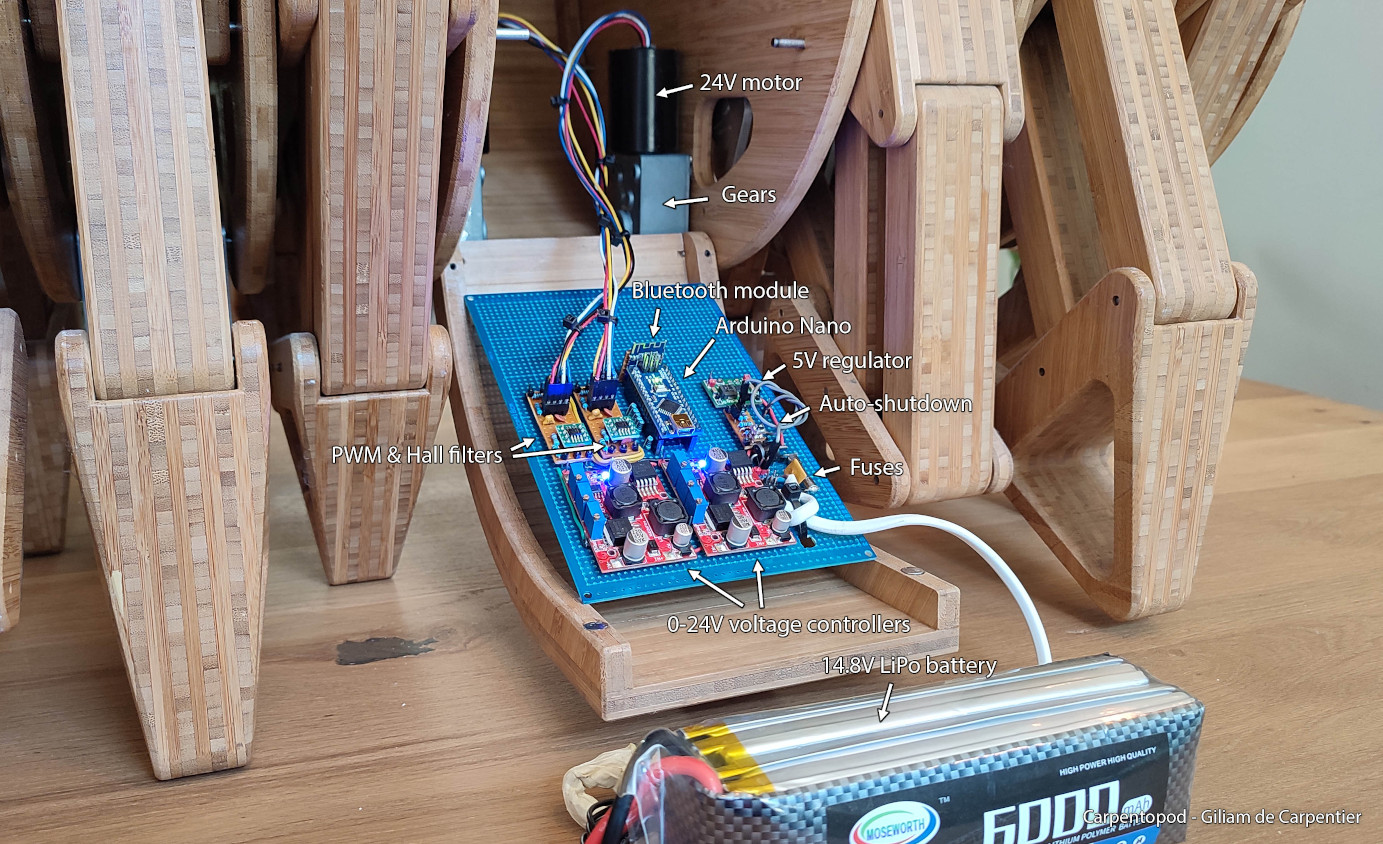
From there the design was moved to Fusion 360, where it could then be sent to a CNC machine to create all of the parts for the 12-legged table. An Arduino Nano controls the leg movements, with power to the legs’ crankshafts provided by 24 V brushless motors. Finally, a Bluetooth module is included to allow the table to receive commands from a modified Nintendo Wii “Nunchuk” — itself an impressive project that we covered back in 2020.

This project took an incredible amount of work not just to design the leg mechanisms but CNC machine them out of bamboo, glue everything together, and finish it into what would be an excellent example of woodworking even without the capability of moving the table from the wall to the middle of the room and back as needed. We can’t really say we’ve seen a mobile coffee table before either, wheeled or otherwise, but if you need the tabletop instead to rotate and position itself at arbitrary angles we have seen one which was designed to be used for metalworking.

youtube.com/embed/xKDY4yWxfJM?…


hackaday.com/2024/09/10/mobile…


The Privacy Post reshared this.

The Privacy Post ha ricondiviso questo.

The media in this post is not displayed to visitors. To view it, please go to the original post.

Assessing the Energy Efficiency of Programming Languages
poliverso.org/display/0477a01e…
Assessing the Energy Efficiency of Programming LanguagesProgramming languages are generally defined as a more human-friendly way to program computers than using raw machine code. Within the realm of these languages there is a wide range of how close the programmer is allowed to get to the bare metal, which ultimately can affect the performance and efficiency of the


Assessing the Energy Efficiency of Programming Languages


Programming languages are generally defined as a more human-friendly way to program computers than using raw machine code. Within the realm of these languages there is a wide range of how close the programmer is allowed to get to the bare metal, which ultimately can affect the performance and efficiency of the application. One metric that has become more important over the years is that of energy efficiency, as datacenters keep growing along with their power demand. If picking one programming language over another saves even 1% of a datacenter’s electricity consumption, this could prove to be highly beneficial, assuming it weighs up against all other factors one would consider.

There have been some attempts over the years to put a number on the energy efficiency of specific programming languages, with a paper by Rui Pereira et al. from 2021 (preprint PDF) as published in Science of Computer Programming covering the running a couple of small benchmarks, measuring system power consumption and drawing conclusions based on this. When Hackaday covered the 2017 paper at the time, it was with the expected claim that C is the most efficient programming language, while of course scripting languages like JavaScript, Python and Lua trailed far behind.

With C being effectively high-level assembly code this is probably no surprise, but languages such as C++ and Ada should see no severe performance penalty over C due to their design, which is the part where this particular study begins to fall apart. So what is the truth and can we even capture ‘efficiency’ in a simple ranking?

Defining Energy Efficiency


At its core, ‘energy efficiency’ is pretty simple to define: it’s the total amount of energy required to accomplish a specific task. In the case of a software application, this means the whole-system power usage, including memory, disk and processor(s). Measuring the whole-system power usage is also highly relevant, as not every programming and scripting language taxes these subsystems in the same way. In the case of Java, for example, its CPU usage isn’t that dissimilar from the same code written in C, but it will use significantly more memory in the process of doing so.

Two major confounding factors when it comes to individual languages are:

  • Idiomatic styles versus a focus on raw efficiency.
  • Native language features versus standard library features.

The idiomatic style factor is effectively some kind of agreed-upon language usage, which potentially eschews more efficient ways of accomplishing the exact same thing. Consider here for example C++, and the use of smart pointers versus raw pointers, with the former being part of the Standard Template Library (STL) instead of a native language feature. Some would argue that using an STL ‘smart pointer’ like a unique_ptr or auto_ptr is the idiomatic way to use C++, rather than the native language support for raw pointers, despite the overhead that these add.

A similar example is also due to C++ being literally just an extension to C, namely that of printf() and similar functions found in the <cstdio> standard library header. The idiomatic way to use C++ is to use the stream-based functions found in the <iostream> header, so that instead of employing low-level functions like putc() and straightforward formatted output functions like printf() to write this:
printf("Printing %d numbers and this string: %s.\n", number, string);
The idiomatic stream equivalent is:
std::cout << "Printing " << number << " numbers and this string: " << string << "." << std::endl;
Not only is the idiomatic version longer, harder to read, more convoluted and easier to get formatting wrong with, it is internally also significantly more complicated than a simple parse-and-replace and thus causes more overhead. This is why C++20 decided to double-down on stream formatting and fudging in printf-like support with std::format and other functions in the new <format> header. Because things can always get worse.

Know What You’re Measuring


At this point we have defined what energy efficiency with programming languages is, and touched upon a few confounding factors. All of this leads to the golden rule in science: know what you’re measuring. Or in less fanciful phrasing: ‘garbage in, garbage out’, as conclusions drawn from data using flawed assumptions truly are a complete waste of anyone’s time. Whether it was deliberate, due to wishful thinking or a flawed experimental setup, the end result is the same: a meticulously crafted document that can go straight into the shredder.

In this particular comparative analysis, the pertinent question is whether the used code is truly equivalent, as looking across the papers by Rui et al. (2017, 2021), Gordillo et al. (2024) or even a 2000 paper by Lutz Prechelt all reveal stark differences between the results, with seemingly the only constant being that ‘C is pretty good’, while a language such as C++ ends up being either very close to C (Gordillo et al., Prechelt) or wildly varying in tests (Rui et al.), all pointing towards an issue with the code being used, as power usage measurement and time measurement is significantly more straightforward to verify.

In the case of the 2021 paper by Rui et al., the code examples used come from Rosetta Code, with the code-as-used also provided on GitHub. Taking as example the Hailstone Sequence, we can see a number of fascinating differences between the C, C++ and Ada versions, particularly as it pertains to the use of console output and standard library versus native language features.

The C version of the Hailstone Sequence has two printf() statements, while the C++ version has no fewer than five instances of std::cout. The Ada version comes in at two put(), two new_line (which should be merged with put_line) and one put_line. This difference in console output is already a red flag, even considering that when benchmarking you should never have console output enabled as this draws in significant parts of the operating system, with resulting high levels of variability due to task scheduling, etc.

The next red flag is that while the Ada and C versions uses the native array type, the C++ version uses std::vector, which is absolutely not equivalent to an array and should not be used if efficiency is at all a concern due to the internal copying and house-keeping performed by the std::vector data structure.

If we consider that Rosetta Code is a communal wiki that does not guarantee that the code snippets provided are ‘absolutely equivalent’, that means that the resulting paper by Rui et al. is barely worth the trip to the shredder and consequently a total waste of a tree.

Not All Bad

None of this should come as a surprise, of course, as it is well-known (or should be) that C++ produces the exact same code as C unless you use specific constructs like RTTI or the horror show that is C++ exceptions. Similarly, Ada code with similar semantics as C code should not show significant performance differences. The problem with many of the ‘programming language efficiency’ studies is simply that they take a purported authoritative source of code without being fluent in the chosen languages, run them in a controlled environment and then draw conclusions based on the mangled garbage that comes out at the end.

That said, there are some conclusions that can be drawn from the fancy-but-horrifically-flawed tables, such as how comically inefficient scripting languages like Python are. This was also the take-away by Bryan Lunduke in a recent video when he noted that Python is 71 times slower and uses 75 times more energy based on the Rui et al. paper. Even if it’s not exactly 71 times slower, Python is without question a total snail even among scripting languages, where it trades blows with Perl, PHP and Ruby at the bottom of every ranking.

The take-away here is thus perhaps that rather than believing anything you see on the internet (or read in scientific papers), it pays to keep an open mind and run your own benchmarks. As eating your own dogfood is crucial in engineering, I can point to my own remote-procedure call (NymphRPC) library in C++ on which I performed a range of optimizations to reduce overhead. This mostly involved getting rid of std::string and moving to a zero-copy system involving C-isms like memcpy and every bit of raw pointer arithmetic and bit-wise operators goodness that is available.

The result for NymphRPC was a four-fold increase in performance, which is probably a good indication of how much performance you can gain if you stick close to C-style semantics. It also makes it obvious how limited these small code snippets are, as with a real application you also deal with cache access, memory alignment and cache eviction issues, all of which can turn a seemingly efficient approach into a sluggish affair.


hackaday.com/2024/09/10/assess…


The Privacy Post reshared this.

The Privacy Post ha ricondiviso questo.

Compromise on child sexual abuse law focuses on known material, simplifies authority roles
poliverso.org/display/0477a01e…
Compromise on child sexual abuse law focuses on known material, simplifies authority rolesA new compromise text sent by the Hungarian Presidency of the EU Council to delegations about the draft law to detect child sexual abuse material (CSAM), focuses on known material, possibly lessening concerns around the regulations' privacy


Compromise on child sexual abuse law focuses on known material, simplifies authority roles


A new compromise text sent by the Hungarian Presidency of the EU Council to delegations about the draft law to detect child sexual abuse material (CSAM), focuses on known material, possibly lessening concerns around the regulations' privacy implications.


euractiv.com/section/law-enfor…


The Privacy Post reshared this.

The Privacy Post ha ricondiviso questo.

The media in this post is not displayed to visitors. To view it, please go to the original post.

Arriva RAMBO! l’emissione Elettromagnetica della RAM consente di Rubare i Dati dai computer isolati
poliverso.org/display/0477a01e…
Arriva RAMBO! l’emissione Elettromagnetica della RAM consente di Rubare i Dati dai computer isolatiSiamo di fronte ad un nuovo e sofisticato side channel attack redhotcyber.com/post/cosa-sono…. L’attacco RAMBO (Radiation of Air-gapped Memory Bus for Offense), presentato da ricercatori israeliani, sfrutta l’emissione


Arriva RAMBO! l’emissione Elettromagnetica della RAM consente di Rubare i Dati dai computer isolati


Siamo di fronte ad un nuovo e sofisticato side channel attack. L’attacco RAMBO (Radiation of Air-gapped Memory Bus for Offense), presentato da ricercatori israeliani, sfrutta l’emissione elettromagnetica prodotta dalla memoria RAM per rubare dati da computer isolati fisicamente (air-gapped).

Attraverso un malware, i ricercatori hanno manipolano l’accesso alla memoria per generare segnali elettromagnetici rilevabili con dispositivi di ricezione SDR (Software Defined Radio). Anche se la velocità di trasmissione è relativamente bassa (fino a 1000 bit al secondo), è sufficiente per sottrarre informazioni sensibili come password o chiavi crittografiche. Questo attacco rappresenta una minaccia crescente soprattutto per sistemi ad alta sicurezza.

La RAM è stata a lungo considerata una parte non attaccabile direttamente nei sistemi informatici, ma la scoperta del team israeliano dimostra che la memoria volatile può essere utilizzata come vettore di attacco attraverso radiazioni elettromagnetiche. La particolarità di RAMBO è che riesce a superare le misure di sicurezza di isolamento fisico, sfruttando una vulnerabilità fisica nei sistemi di memoria che in precedenza non era stata considerata.

L’attacco non necessita di connessione diretta al computer preso di mira, ma solo della presenza di un ricevitore nelle vicinanze. Questi segnali elettromagnetici possono essere generati appositamente con modelli di accesso alla memoria RAM ben studiati, manipolati dal malware installato sul computer vittima.

La trasmissione dei dati è unidirezionale, quindi i criminali riescono a leggere i dati sensibili senza inviare alcun segnale che potrebbe compromettere il loro attacco.

Una delle sfide principali per i difensori di sistemi sensibili come quelli militari o finanziari è che i tradizionali metodi di sicurezza come firewall e software anti-malware non sono efficaci contro attacchi basati su radiazioni elettromagnetiche, in quanto non c’è interazione diretta con la rete o i sistemi di protezione. Anche se la velocità di trasmissione dei dati di RAMBO è bassa, questo attacco può essere eseguito nel tempo, permettendo ai criminali di raccogliere informazioni critiche.

Per prevenire attacchi come RAMBO, gli esperti di sicurezza consigliano l’adozione di misure fisiche come schermature elettromagnetiche, in particolare per le macchine ad alta criticità. L’implementazione di gabbie di Faraday intorno ai dispositivi potrebbe essere una soluzione efficace, poiché queste barriere bloccano i segnali elettromagnetici in uscita, impedendo la trasmissione non autorizzata dei dati.

RAMBO si inserisce in una crescente serie di attacchi volti a compromettere la sicurezza di sistemi air-gap, tradizionalmente considerati tra i più sicuri. A differenza di altri attacchi, RAMBO non richiede la compromissione di connessioni cablate o wireless convenzionali, rendendolo un vettore d’attacco estremamente subdolo e potenzialmente devastante per ambienti altamente protetti.

In sintesi, l’attacco RAMBO rappresenta una nuova e insidiosa minaccia che sfrutta le radiazioni elettromagnetiche della RAM per estrarre dati critici da sistemi isolati. La difesa contro tali attacchi richiede l’adozione di misure innovative e fisiche, oltre alla consueta protezione software, per garantire la sicurezza dei dati in ambienti sensibili.

Per maggiori dettagli sull’attacco RAMBO, puoi consultare l’articolo completo qui.

L'articolo Arriva RAMBO! l’emissione Elettromagnetica della RAM consente di Rubare i Dati dai computer isolati proviene da il blog della sicurezza informatica.


The Privacy Post ha ricondiviso questo.

Il compromesso su #Chatcontrol (scansione solo sul materiale noto) è una presa in giro rivenduta come soluzione rispettosa per la privacy

Il testo aggiornato, datato 9 settembre e visionato da Euractiv, sostiene di rispettare maggiormente la #privacy limitando la rilevazione ai contenuti che sono già in circolazione e che sono già stati rilevati.

TUTTAVIA il materiale multimediale verrà comunque scansionato prima di essere inviato

@privacypride

euractiv.com/section/law-enfor…

cc @echo_pbreyer

Questa voce è stata modificata (1 anno fa)
in reply to El Salvador

@salvadorbs beh non ci sarebbero veri falsi positivi, perché Al momento la scansione avviene solo su contenuti noti. Quello che può succedere però è che se un minore riceve un file di quel tipo su un telefono e un abbonamento di proprietà del genitore, attraverso un canale non presidiato e lo invia al genitore per avvertirlo del problema, passeranno i guai sia il ragazzo che il genitore

@Herco

Privacy Pride reshared this.

in reply to El Salvador

@salvadorbs il falso positivo avviene quando c'è un "riconoscimento ottico", mentre in questo caso ci sarebbe più che altro un confronto tra l'immagine rilevata e il dataset della polizia. Ecco perché i falsi positivi sono improbabili.
Ma il problema è che viene introdotto il rilevamento a monte. Questo è il Rubicone. Poi che davanti al rilevamento ci sarà solo il match o che ci sarà un riconoscimento ottico o chissà cos'altro, sarà irrilevante

@Herco

Privacy Pride reshared this.

The Privacy Post ha ricondiviso questo.

The media in this post is not displayed to visitors. To view it, please go to the original post.

Rescuing High-Res Displays from Older Macs
poliverso.org/display/0477a01e…
Rescuing High-Res Displays from Older MacsWhen Apple started rolling out its Retina displays, it multiplied the amount of pixels compared to their standard, non-Retina displays by four. This increased pixel density while keeping the standard screen size — idea for those needing a lot of detail for their work. But, as is common with Apple, using these displays outside of the Apple


Rescuing High-Res Displays from Older Macs


When Apple started rolling out its Retina displays, it multiplied the amount of pixels compared to their standard, non-Retina displays by four. This increased pixel density while keeping the standard screen size — idea for those needing a lot of detail for their work. But, as is common with Apple, using these displays outside of the Apple ecosystem can be quite a challenge. Retina displays have been around for about a decade now, though, with some third-party hardware able to break them free of their cage. This post details how [Kevin] liberated the 5K display from a 2017 iMac for more general use with support for USB-C.

The first step was to find a used iMac for the right price, and then sell off most of its parts to recoup most of the initial cost. That brought the cost of the panel itself to about $250. The key to getting the display working without all of the Apple hardware is the R1811 driver board, which can be had for around $300. A new 156 watt power supply was added to the mix, and [Kevin] also put in a few extras like a USB cable extension and a latching push-button which kills the display’s power. Additionally, he attempted to get the original iMac speakers working with this setup too, but none of his attempts resulted in anything close to quality sound so he’s mostly abandoned that extra feature for now.

With that all buttoned up, he has a 27″ 5K display with USB-C input for around $650 which is quite a deal. The MacRumors thread that [Kevin] added his project to currently has around 1,700 posts about similar builds too, so it can be a wealth of information for all kinds of models. As Apple drops support for their older machines, these displays will become more and more common and projects like these can keep a lot of e-waste out of the landfill while also providing decent hardware at a bargain price. Don’t just look for iMacs and MacBooks though; there’s a similar process to use various iPad displays for other things as well.


hackaday.com/2024/09/10/rescui…


The Privacy Post reshared this.

The Privacy Post ha ricondiviso questo.

The media in this post is not displayed to visitors. To view it, please go to the original post.

Se la Russia ci taglia Internet… la guerra ibrida intorno ai cavi sottomarini
poliverso.org/display/0477a01e…
Se la Russia ci taglia Internet… la guerra ibrida intorno ai cavi sottomariniSecondo i servizi occidentali, c'è un aumento dell'attività militare russa intorno ai cavi sottomarini delle comunicazioni.The post Se la Russia ci taglia Internet… la guerra ibrida intorno ai cavi sottomarini it.insideover.com/guerra/se-la… appeared first on


Se la Russia ci taglia Internet… la guerra ibrida intorno ai cavi sottomarini


Secondo i servizi occidentali, c'è un aumento dell'attività militare russa intorno ai cavi sottomarini delle comunicazioni.

The post Se la Russia ci taglia Internet… la guerra ibrida intorno ai cavi sottomarini appeared first on InsideOver.


The Privacy Post reshared this.

The Privacy Post ha ricondiviso questo.

The media in this post is not displayed to visitors. To view it, please go to the original post.

A Look At The Small Web, Part 1
poliverso.org/display/0477a01e…
A Look At The Small Web, Part 1In the early 1990s I was privileged enough to be immersed in the world of technology during the exciting period that gave birth to the World Wide Web, and I can honestly say I managed to completely miss those first stirrings of the information revolution in favour of CD-ROMs, a piece of technology which definitely didn’t have a future. I’ve written in the past about


A Look At The Small Web, Part 1


In the early 1990s I was privileged enough to be immersed in the world of technology during the exciting period that gave birth to the World Wide Web, and I can honestly say I managed to completely miss those first stirrings of the information revolution in favour of CD-ROMs, a piece of technology which definitely didn’t have a future. I’ve written in the past about that experience and what it taught me about confusing the medium with the message, but today I’m returning to that period in search of something else. How can we regain some of the things that made that early Web good?

We All Know What’s Wrong With The Web…


It’s likely most Hackaday readers could recite a list of problems with the web as it exists here in 2024. Cory Doctrow coined a word for it, enshitification, referring to the shift of web users from being the consumers of online services to the product of those services, squeezed by a few Internet monopolies. A few massive corporations control so much of our online experience from the server to the browser, to the extent that for so many people there is very little the touch outside those confines.
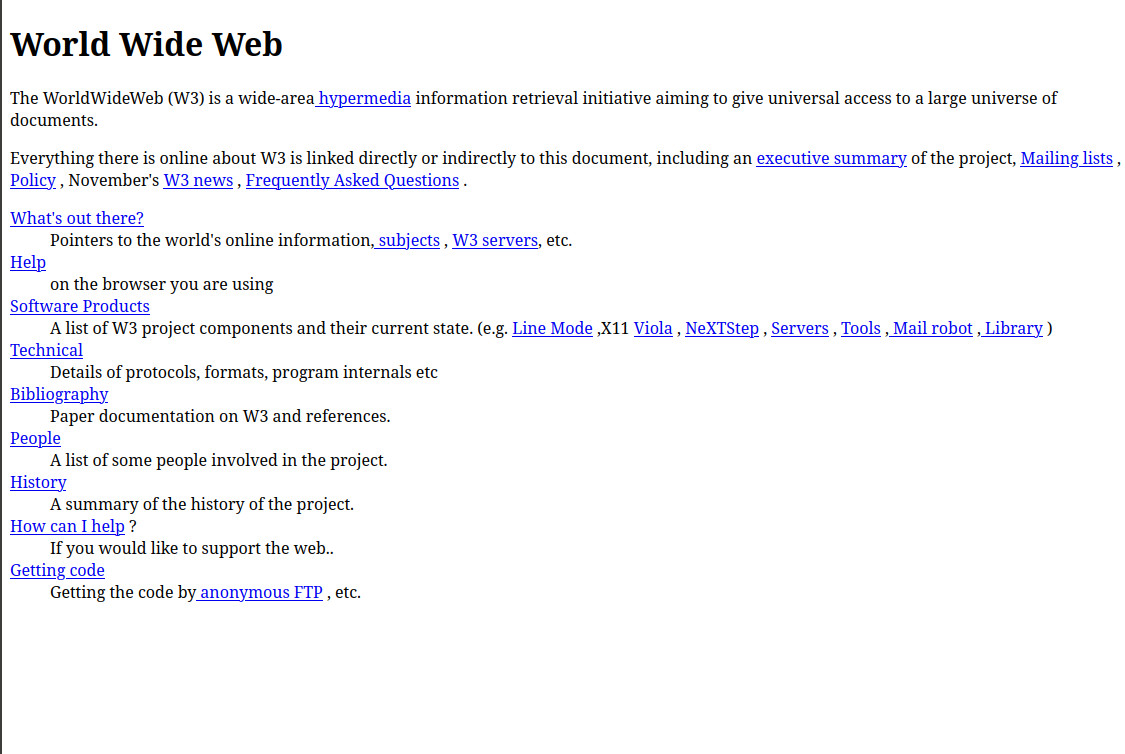
A screenshot of the first ever web pageThe first ever web page is maintained as a historical exhibit by CERN.
Contrasting the enshitified web of 2024 with the early web, it’s not difficult to see how some of the promise was lost. Perhaps not the web of Tim Berners-Lee and his NeXT cube, but the one of a few years later, when Netscape was the new kid on the block to pair with your Trumpet Winsock. CD-ROMs were about to crash and burn, and I was learning how to create simple HTML pages.

The promise then was of a decentralised information network in which we would all have our own websites, or homepages as the language of the time put it, on our own servers. Microsoft even gave their users the tools to do this with Windows, in that the least technical of users could put a Frontpage Express web site on their Personal Web Server instance. This promise seems fanciful to modern ears, as fanciful perhaps as keeping the overall size of each individual page under 50k, but at the time it seemed possible.

With such promise then, just how did we end up here? I’m sure many of you will chip in in the comments with your own takes, but of course, setting up and maintaining a web server is either hard, or costly. Anyone foolish enough to point their Windows Personal Web Server directly at the Internet would find their machine compromised by script kiddies, and having your own “proper” hosting took money and expertise. Free stuff always wins online, so in those early days it was the likes of Geocities or Angelfire which drew the non-technical crowds. It’s hardly surprising that this trend continued into the early days of social media, starting the inevitable slide into today’s scene described above.

…So Here’s How To Fix It


If there’s a ray of hope in this wilderness then, it comes in the shape of the Small Web. This is a movement in reaction to a Facebook or Google internet, an attempt to return to that mid-1990s dream of a web of lightweight self-hosted sites. It’s a term which encompases both lightweight use of traditional web tehnologies and some new ones designed more specifically to deliver lightweight services, and it’s fair to say that while it’s not going to displace those corporations any time soon it does hold the interesting prospect of providing an alternative. From a Hackaday perspective we see Small Web technologies as ideal for serving and consuming through microcontroller-based devices, for instance, such as event badges. Why shouldn’t a hacker camp badge have a Gemini client which picks up the camp schedule, for example? Because the Small Web is something of a broad term, this is the first part of a short series providing an introduction to the topic. We’ve set out here what it is and where it comes from, so it’s now time to take a look at some of those 1990s beginnings in the form of Gopher, before looking at what some might call its spiritual successors today.
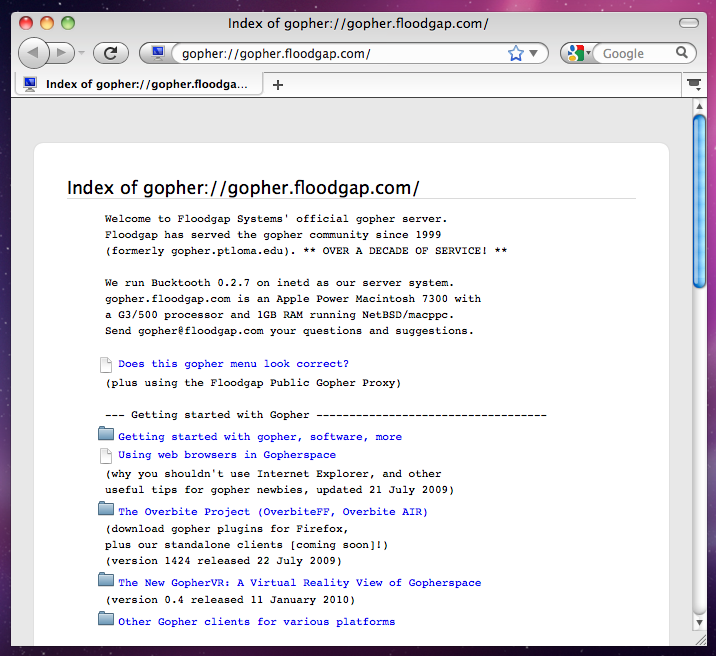
A screenshot of a browser with a very plain text page.An ancient Firefox version shows us a Gopher site. Ph0t0phobic, MPL 1.1.
It’s odd to return to Gopher after three decades, as it’s one of those protocols which was for most of us immediately lost as the Web gained traction. Particulrly as at the time I associated Gopher with CLI base clients and the Web with the then-new NCSA Mosaic, I’d retained that view somehow. It’s interesting then to come back and look at how the first generation of web browsers rendered Gopher sites, and see that they did a reasonable job of making them look a lot like the more texty web sites of the day. In another universe perhaps Gopher would have evolved further to something more like the web, but instead it remains an ossifed glimpse of 1992 even if there are still a surprising number of active Gopher servers still to be found. There’s a re-imagined version of the Veronica search engine, and some fun can be had browsing this backwater.

With the benefit of a few decades of the Web it’s immediately clear that while Gopher is very fast indeed in the days of 64-bit desktops and gigabit fibre, the limitations of what it can do are rather obvious. We’re used to consuming information as pages instead of as files, and it just doesn’t meet those expectations. Happily though Gopher never made those modifications, there’s something like what it might have become in Gemini. This is a lightweight protocol like Gopher, but with a page format that allows hyperlinking. Intentionally it’s not simply trying to re-implement the web and HTML, instead it’s trying to preserve the simplicity while giving users the hyperlinking that makes the web so useful.
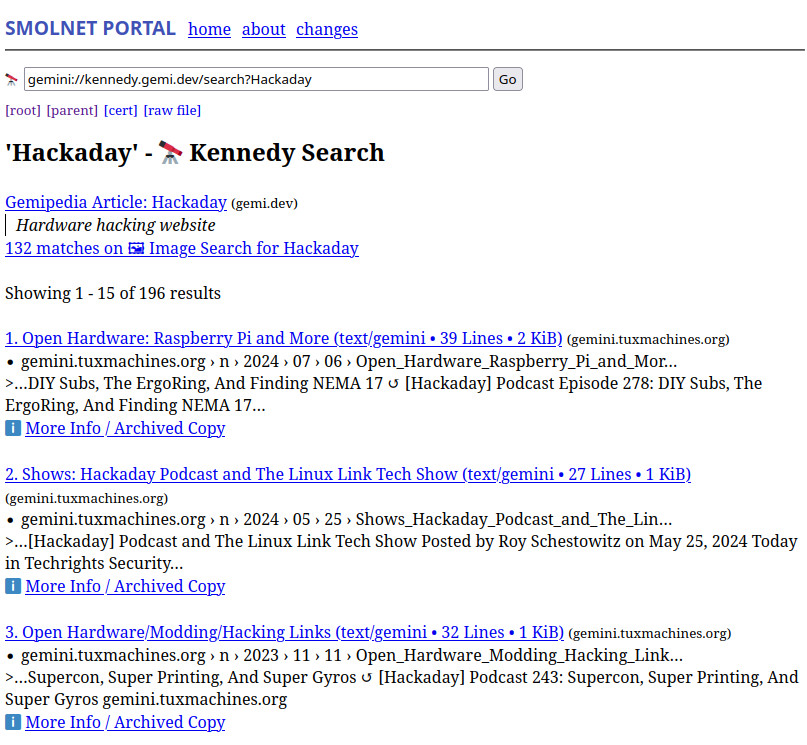
A Kennedy search engine Gemini search page for "Hackaday".It feels a lot like the early 1990s Web, doesn’t it.
The great thing about Gemini is that it’s easy to try. The Gemini protocol website has a list of known clients, but if even that’s too much, find a Gemini to HTTP proxy (I’m not linking to one, to avoid swamping someone’s low traffic web server). I was soon up and running, and exploring the world of Gemini sites. Hackaday don’t have a presence there… yet.

We’ve become so used to web pages taking a visible time to load, that the lightning-fast response of Gemini is a bit of a shock at first. It’s normal for a web page to contain many megabytes of images, Javascript, CSS, and other resources, so what is in effect the Web stripped down to only the information is unexpected. The pages are only a few K in size and load in effect, instantaneously. This may not be how the Web should be, but it’s certainly how fast and efficient hypertext information should be.

This has been part 1 of a series on the Small Web, in looking at the history and the Gemini protocol from a user perspective we know we’ve only scratched the surface of the topic. Next time we’ll be looking at how to create a Gemini site of your own, through learning it ourselves.


hackaday.com/2024/09/10/a-look…


The Privacy Post reshared this.

The Privacy Post ha ricondiviso questo.

The media in this post is not displayed to visitors. To view it, please go to the original post.

NoiseAttack: il nuovo attacco backdoor multi-target che sfida le difese AI
poliverso.org/display/0477a01e…
NoiseAttack: il nuovo attacco backdoor multi-target che sfida le difese AII ricercatori hanno sviluppato arxiv.org/pdf/2409.02251 un nuovo metodo di attacco backdoor chiamato NoiseAttack, capace di compromettere più classi contemporaneamente con un minimo di configurazione. A differenza dei precedenti approcci che si concentrano su una singola classe,


NoiseAttack: il nuovo attacco backdoor multi-target che sfida le difese AI


I ricercatori hanno sviluppato un nuovo metodo di attacco backdoor chiamato NoiseAttack, capace di compromettere più classi contemporaneamente con un minimo di configurazione. A differenza dei precedenti approcci che si concentrano su una singola classe, NoiseAttack utilizza la densità spettrale di potenza del rumore gaussiano bianco (WGN) come trigger invisibile durante la fase di addestramento.

I test sperimentali mostrano che NoiseAttack ottiene alti tassi di successo su diversi modelli e set di dati, eludendo i sistemi di rilevamento delle backdoor più avanzati.

Quando si parla di “più classi” in riferimento a NoiseAttack, si intende che l’attacco non si limita a colpire una sola categoria o classe di dati in un modello di classificazione. Invece, può prendere di mira contemporaneamente più classi, inducendo errori in varie categorie di output. Ciò significa che il modello può essere manipolato per commettere errori in diverse classificazioni contemporaneamente, rendendo l’attacco più versatile e potente.
Una panoramica del NoiseAttack proposto
Il rumore gaussiano bianco (WGN) utilizzato in NoiseAttack è impercettibile e applicato universalmente, ma attivato solo su campioni selezionati per indurre classificazioni errate su più etichette target.

Questo metodo consente un attacco backdoor multi-target su modelli di deep learning senza compromettere le prestazioni sugli input non compromessi.

Addestrando il modello su un dataset contaminato con WGN accuratamente applicato, gli avversari possono causare classificazioni errate intenzionali, superando le difese avanzate e offrendo grande flessibilità nel controllo delle etichette di destinazione.
Una panoramica della preparazione del set di dati avvelenato
Il framework elude efficacemente le difese all’avanguardia e raggiunge alti tassi di successo degli attacchi su vari set di dati e modelli. Introducendo rumore gaussiano bianco nelle immagini di input, NoiseAttack può classificarle erroneamente in etichette mirate senza influire in modo significativo sulle prestazioni del modello su dati puliti.

Attraverso analisi teoriche ed esperimenti approfonditi, gli autori dimostrano la fattibilità e l’ubiquità di questo attacco. NoiseAttack raggiunge alti tassi di successo medi degli attacchi su vari set di dati e modelli senza influire in modo significativo sulla precisione per le classi di non vittime.

L'articolo NoiseAttack: il nuovo attacco backdoor multi-target che sfida le difese AI proviene da il blog della sicurezza informatica.


The Privacy Post reshared this.

The Privacy Post ha ricondiviso questo.

Microsoft manda in discarica gli ActiveX in Office 2024 per impostazione predefinita
poliverso.org/display/0477a01e…
Microsoft manda in discarica gli ActiveX in Office 2024 per impostazione predefinitaMicrosoft securitylab.ru/glossary/Micros…ha annunciato un importante cambiamento nel funzionamento delle app di Office a partire da ottobre 2024. Nella nuova versione di Office 2024, i controlli ActiveX saranno disabilitati per impostazione predefinita in Word,


Microsoft manda in discarica gli ActiveX in Office 2024 per impostazione predefinita


Microsoft ha annunciato un importante cambiamento nel funzionamento delle app di Office a partire da ottobre 2024. Nella nuova versione di Office 2024, i controlli ActiveX saranno disabilitati per impostazione predefinita in Word, Excel, PowerPoint e Visio. La decisione riguarderà innanzitutto le applicazioni desktop Office Win32 e, da aprile 2025, gli utenti di Microsoft 365.

ActiveX è una tecnologia legacy introdotta per la prima volta nel 1996. Ha consentito agli sviluppatori di incorporare oggetti interattivi nei documenti di Office. Tuttavia, a partire dalla nuova versione di Office, le impostazioni di sicurezza cambieranno e i controlli ActiveX saranno disabilitati per impostazione predefinita.

Gli utenti non saranno più in grado di creare o interagire con oggetti ActiveX nei documenti. Invece, questi elementi appariranno come immagini statiche, il che potrebbe causare inconvenienti a coloro il cui lavoro in precedenza dipendeva da questi oggetti.

La tecnologia ActiveX è da tempo fonte di preoccupazione a causa delle vulnerabilità della sicurezza. Gli hacker hanno utilizzato ripetutamente ActiveX per distribuire malware, inclusi i famosi attacchi TrickBot e Cobalt Strike. Gli attacchi hanno consentito agli aggressori di penetrare nelle reti aziendali installando malware tramite documenti Word con controlli ActiveX incorporati.

Dopo l’implementazione delle modifiche, gli utenti che necessitano di abilitare i controlli ActiveX nei documenti di Office possono ripristinare le impostazioni predefinite precedenti utilizzando uno dei metodi seguenti:

  • Nella finestra di dialogo Impostazioni Centro protezione, sotto Opzioni ActiveX, seleziona l’opzione “Richiedi conferma prima di abilitare tutti i controlli meno restrittivi”;
  • Nel Registro di sistema impostare il valore HKEY_CURRENT_USER\Software\Microsoft\Office\Common\Security\DisableAllActiveX su 0 (REG_DWORD);
  • Imposta quindi DisableAllActiveX su 0.

La disabilitazione di ActiveX fa parte degli sforzi più ampi di Microsoft per migliorare la sicurezza dei suoi prodotti. Negli ultimi anni l’azienda ha costantemente implementato misure volte a bloccare funzioni potenzialmente pericolose in Office e Windows. Le misure includono il blocco delle macro VBA e XLM, l’introduzione della sicurezza per XLM e il blocco dei componenti aggiuntivi XLL non attendibili.

Inoltre, nel 2024, Microsoft prevede di abbandonare definitivamente VBScript, un’altra tecnologia associata a vulnerabilità. Si prevede che VBScript diventi un’opzione on-demand e quindi venga completamente rimosso dai prodotti dell’azienda.

Le aziende che utilizzano ActiveX per automatizzare i processi devono essere preparate a possibili ritardi e maggiori costi per il supporto tecnico e la configurazione. Gli amministratori IT si troveranno ad affrontare la necessità di formare i dipendenti e fornire risorse aggiuntive per ripristinare la funzionalità ActiveX o trovare soluzioni alternative.

Le modifiche a Office potrebbero causare insoddisfazione tra gli utenti abituati alle vecchie funzionalità. Un improvviso arresto di strumenti familiari può avere un impatto negativo sulla produttività e sulla soddisfazione dei dipendenti. Inoltre, i documenti creati utilizzando ActiveX potrebbero diventare inutilizzabili o richiedere modifiche significative.

L'articolo Microsoft manda in discarica gli ActiveX in Office 2024 per impostazione predefinita proviene da il blog della sicurezza informatica.


The Privacy Post reshared this.

The Privacy Post ha ricondiviso questo.

The media in this post is not displayed to visitors. To view it, please go to the original post.

Shedding New Light on the Voynich Manuscript With Multispectral Imaging
poliverso.org/display/0477a01e…
Shedding New Light on the Voynich Manuscript With Multispectral ImagingThe Voynich Manuscript is a medieval codex written in an unknown alphabet and is replete with fantastic illustrations as unusual and bizarre as they are esoteric. It has captured interest for hundreds of years, and expert [Lisa Fagin Davis] shared interesting results from using


Shedding New Light on the Voynich Manuscript With Multispectral Imaging


The Voynich Manuscript is a medieval codex written in an unknown alphabet and is replete with fantastic illustrations as unusual and bizarre as they are esoteric. It has captured interest for hundreds of years, and expert [Lisa Fagin Davis] shared interesting results from using multispectral imaging on some pages of this highly unusual document.

We should make it clear up front that the imaging results have not yielded a decryption key (nor a secret map or anything of the sort) but the detailed write-up and freely-downloadable imaging results are fascinating reading for anyone interested in either the manuscript itself, or just how exactly multispectral imaging is applied to rare documents. Modern imaging techniques might get leveraged into things like authenticating sealed packs of Pokémon cards, but that’s not all it can do.

Because multispectral imaging involves things outside our normal perception, the results require careful analysis rather than intuitive interpretation. Here is one example: multispectral imaging may yield faded text visible “between the lines” of other text and invite leaping to conclusions about hidden or erased content. But the faded text could be the result of show-through (content from the opposite side of the page is being picked up) or an offset (when a page picks up ink and pigment from its opposing page after being closed for centuries.)

[Lisa] provides a highly detailed analysis of specific pages, and explains the kind of historical context and evidence this approach yields. Make some time to give it a read if you’re at all interested, we promise it’s worth your while.


hackaday.com/2024/09/10/sheddi…


The Privacy Post reshared this.

The Privacy Post ha ricondiviso questo.

The EU AI Office needs top scientific talent, not familiar faces
poliverso.org/display/0477a01e…
The EU AI Office needs top scientific talent, not familiar facesThe European Commission shouldn’t hire internally for its lead scientific advisor on artificial intelligence (AI), writes Alex Petropolos and Max Reddel.euractiv.com/section/digital/o…


The EU AI Office needs top scientific talent, not familiar faces


The European Commission shouldn’t hire internally for its lead scientific advisor on artificial intelligence (AI), writes Alex Petropolos and Max Reddel.


euractiv.com/section/digital/o…


The Privacy Post reshared this.

The Privacy Post ha ricondiviso questo.

Top EU Court rejects Google’s appeal of €2.42 billion fine in Shopping case
poliverso.org/display/0477a01e…
Top EU Court rejects Google’s appeal of €2.42 billion fine in Shopping case The Court of Justice of the European Union (CJEU) upheld the European Commission's €2.42 billion fine against Google over allegations it abused its dominant position in the search engine market.euractiv.com/section/platforms…

The Privacy Post reshared this.

The Privacy Post ha ricondiviso questo.

Top EU court orders Apple to pay €13 billion tax bill
poliverso.org/display/0477a01e…
Top EU court orders Apple to pay €13 billion tax billApple must pay a €13 billion tax bill as per a ruling from the European Court of Justice (ECJ), which experts deem gives weight to Ireland being dubbed, by some, a 'tax-safe haven'.euractiv.com/section/competiti…


Top EU court orders Apple to pay €13 billion tax bill


Apple must pay a €13 billion tax bill as per a ruling from the European Court of Justice (ECJ), which experts deem gives weight to Ireland being dubbed, by some, a 'tax-safe haven'.


euractiv.com/section/competiti…


The Privacy Post reshared this.

The Privacy Post ha ricondiviso questo.

The media in this post is not displayed to visitors. To view it, please go to the original post.

Slim Tactile Switches Save Classic TI Calculator with a Bad Keypad
poliverso.org/display/0477a01e…
Slim Tactile Switches Save Classic TI Calculator with a Bad KeypadFor vintage calculator fans, nothing strikes more fear than knowing that someday their precious and irreplaceable daily driver will become a museum piece to be looked at and admired — but never touched again. More often than not, the failure mode will be the keypad.In an effort to recover from the


Slim Tactile Switches Save Classic TI Calculator with a Bad Keypad


For vintage calculator fans, nothing strikes more fear than knowing that someday their precious and irreplaceable daily driver will become a museum piece to be looked at and admired — but never touched again. More often than not, the failure mode will be the keypad.

In an effort to recover from the inevitable, at least for 70s vintage TI calculators, [George] has come up with these nice replacement keypad PCBs. The original membrane switches on these calculators have a limited life, but luckily there are ultra-slim SMD tactile switches these days make a dandy substitute. [George] specifies a 0.8 mm thick switch that when mounted on a 1.6 mm thick PCB comes in just a hair over the original keypad’s 2.2 mm thickness. He has layouts for a TI-45, which should also fit a TI-30, and one for the larger keypads on TI-58s and TI-59s.

While these particular calculators might not in your collection, [George]’s goal is to create an open source collection of replacement keypads for all the vintage calculators sitting in desk drawers out there. And not just keypads, but battery packs, too.


hackaday.com/2024/09/10/slim-t…


The Privacy Post reshared this.

The Privacy Post ha ricondiviso questo.

The media in this post is not displayed to visitors. To view it, please go to the original post.

L’intelligenza artificiale nello spazio, la nuova frontiera della Difesa Usa e Ue
poliverso.org/display/0477a01e…
L’intelligenza artificiale nello spazio, la nuova frontiera della Difesa Usa e UeNel contesto della crescente competizione spaziale tra Stati Uniti e Cina, Washington sta sfruttando le competenze europee.The post L’intelligenza artificiale nello spazio, la nuova frontiera della Difesa Usa e Ue it.insideover.com/difesa/linte… appeared first on


L’intelligenza artificiale nello spazio, la nuova frontiera della Difesa Usa e Ue


Nel contesto della crescente competizione spaziale tra Stati Uniti e Cina, Washington sta sfruttando le competenze europee.

The post L’intelligenza artificiale nello spazio, la nuova frontiera della Difesa Usa e Ue appeared first on InsideOver.


The Privacy Post reshared this.

The Privacy Post ha ricondiviso questo.

Draghi’s report is the third to sound alarm on telecom competition policy
poliverso.org/display/0477a01e…
Draghi’s report is the third to sound alarm on telecom competition policyLarge EU telcos said Draghi's report sounded the alarm over the state of EU's telecom competition policy, consumer associations and smaller telecom companies are repeating their stance against these findings.euractiv.com/section/digital/n…


Draghi’s report is the third to sound alarm on telecom competition policy


Large EU telcos said Draghi's report sounded the alarm over the state of EU's telecom competition policy, consumer associations and smaller telecom companies are repeating their stance against these findings.


euractiv.com/section/digital/n…


The Privacy Post reshared this.

The Privacy Post ha ricondiviso questo.

The media in this post is not displayed to visitors. To view it, please go to the original post.

888 rivendica un attacco informatico ai danni di BMW Hong Kong. Database scaricabile nelle underground
poliverso.org/display/0477a01e…
888 rivendica un attacco informatico ai danni di BMW Hong Kong. Database scaricabile nelle undergroundIn data 3/9/24 sul celebre forum “Breached” è comparso un post dove il Threat Actors 888 mette in vendita un database con diverse informazioni sui proprietari dei veicoli estratti da BMW Hong Kong,.Secondo 888, sarebbe la


888 rivendica un attacco informatico ai danni di BMW Hong Kong. Database scaricabile nelle underground


In data 3/9/24 sul celebre forum “Breached” è comparso un post dove il Threat Actors 888 mette in vendita un database con diverse informazioni sui proprietari dei veicoli estratti da BMW Hong Kong,.

Secondo 888, sarebbe la seconda esfiltrazione, ora più completa con dati riguardanti account del proprietario, nomi, dettagli di contatto etc….

Secondo cybersecuritynews BMW ha sottolineato il suo impegno per la privacy dei clienti e gli sforzi continui per rafforzare la sicurezza dei suoi sistemi. Tuttavia, le violazioni che sembrerebbero avvenute nella prima metà del 2024 hanno sollevato diverse preoccupazioni.

Al momento, non è possibile confermare la veridicità della notizia, poiché l’organizzazione non ha ancora rilasciato alcun comunicato stampa ufficiale sul proprio sito web riguardo l’incidente. Pertanto, questo articolo deve essere considerato come ‘fonte di intelligence’.

Come nostra consuetudine, lasciamo sempre spazio ad una dichiarazione da parte dell’azienda qualora voglia darci degli aggiornamenti sulla vicenda. Saremo lieti di pubblicare tali informazioni con uno specifico articolo dando risalto alla questione.

RHC monitorerà l’evoluzione della vicenda in modo da pubblicare ulteriori news sul blog, qualora ci fossero novità sostanziali. Qualora ci siano persone informate sui fatti che volessero fornire informazioni sulla vicenda od effettuare una dichiarazione, possono accedere alla sezione contatti, oppure in forma anonima utilizzando la mail crittografata del whistleblower.

Chi è 888 ?


Il cyber threat actor noto come “888” ha fatto la sua comparsa nei forum underground nell’agosto 2023.

Le sue operazioni si concentrano principalmente sul furto di dati sensibili di importanti aziende, al fine di poterli rivendere. Tra le aziende che potrebbero avere subito violazioni da parte di “888” rientrano: Shopify, BMW (Hong Kong), L’Oreal, Shell, Heineken, Accenture (India) e Credit Suisse (India).

Le attività di “888” rappresentano una minaccia significativa per le organizzazioni con potenziali impatti che includono la perdita di dati confidenziali, danni alla reputazione, costi finanziari per la risposta agli incidenti e possibilità di estorsioni.

Per mitigare i rischi associati a questo attore della minaccia, le organizzazioni devono monitorare attivamente l’esposizione dei propri dati, oltre a implementare misure di sicurezza robuste, tra cui controlli di accesso, crittografia dei dati, gestione delle patch e formazione del personale sulla sicurezza informatica.

In sintesi, “888” rappresenta una minaccia emergente nel panorama della cybersecurity, e le organizzazioni devono rimanere vigili e informate per proteggere i loro dati e la loro reputazione.

In poco meno di un anno di attività ha dimostrato determinazione nel perseguire le sue attività dannose, accumulando una reputazione totale di 1750, con 66 valutazioni dai membri (di cui 65 positive e 1 negativa).

Cerchiamo di fornire un’analisi delle attività note di “888” e delle organizzazioni bersaglio, nonché alcune raccomandazioni per le organizzazioni che desiderano proteggere i loro dati sensibili.

Per la redazione del report si è fatto riferimento a fonti di informazione disponibili su internet e al monitoraggio di forum underground.

Threat Landscape


Le attività di “888” si concentrano sulla compromissione di dati sensibili, che vengono successivamente diffusi nei canali underground. Fino ad oggi, “888” ha postato 51 thread su Breachforums, offrendo sample di dati e proponendo la condivisione di informazioni sensibili dietro pagamento. Le aziende bersaglio includono nomi di rilievo come: Riyadh Airport, Shopify, BMW (Hong Kong), L’Oreal, Shell, Heineken, Accenture e Credit Suisse (India).

Purtroppo ad oggi non ci sono informazioni certe circa le TTPs utilizzate da “888”; presumibilmente potrebbe sfruttare misconfiguration nei controlli di accesso o credenziali provenienti da altre violazioni, per poter avere accesso ai dati delle organizzazioni.

Inoltre, si potrebbe ipotizzare che i dati provengano da attacchi alla supply chain. Infatti, dopo la pubblicazione dei dati da parte di “888”, Shopify ha smentito di aver subito un data breach, affermando che le informazioni potessero provenire da violazioni di app di terze parti.

Ulteriori ricerche sono necessarie per comprendere le strategie e le tattiche utilizzate da questo threat actor.

Allo stesso modo, Accenture India ha contestato la validità della violazione rivendicata da “888”, indicando che solo 3 dei 32.000 record diffusi appartenevano a dipendenti dell’azienda.

Minacce Specifiche


Dalla sua comparsa il threat actor “888” si è reso responsabile di attacchi mirati contro organizzazioni di rilievo, come da tabella seguente:

Mitigazione e Raccomandazioni


Al fine di mitigare le possibili conseguenze derivanti da diffusioni di dati sensibili dei dipendenti delle organizzazioni, è necessario che le aziende si dotino di strutture capaci di svolgere i compiti di Cyber Threat Intelligence, al fine di monitorare l’esposizione aziendale e quindi:

  • Implementare controlli di accesso robusti e autenticazione a più fattori
  • Provvedere con regolarità all’aggiornamento e al patching dei software
  • Formare il personale sulla sicurezza informatica e, in particolare, svolgere regolari aggiornamenti sulle minacce emergenti
  • Implementare soluzioni di sicurezza avanzate, come sistemi di rilevamento delle intrusioni e di analisi delle minacce
  • In occasione del rilevamento di dati esposti, aumentare il livello di attenzione di tutte le parti coinvolte nel business aziendale (dipendenti, clienti, fornitori), al fine di proteggersi dall’impiego delle informazioni stesse in attacchi di social engineering


Conclusioni


Pur in assenza di informazioni dettagliate che permettano di comprendere a fondo le capacità tecniche del cyber threat actor “888”, questo rappresenta una minaccia significativa dal momento che ha dimostrato determinazione nel perseguire le sue attività dannose, finalizzate all’esfiltrazione di dati sensibili per finalità economiche, oltre alla capacità di colpire organizzazioni rilevanti nei rispettivi settori di attività.

Fonti e Riferimenti:


L'articolo 888 rivendica un attacco informatico ai danni di BMW Hong Kong. Database scaricabile nelle underground proviene da il blog della sicurezza informatica.


The Privacy Post reshared this.

The Privacy Post ha ricondiviso questo.

La MFA non è più sufficiente! Gli hacker hanno superato le sue difese
poliverso.org/display/0477a01e…
La MFA non è più sufficiente! Gli hacker hanno superato le sue difeseNel 2023, un sondaggio condotto su 2.600 professionisti IT da KnowBe4 knowbe4.com/press/knowbe4-stud…, rinomata azienda di sicurezza informatica redhotcyber.com/rubriche/alla-…, ha rivelato ancora ampie disparità nelle pratiche di sicurezza tra le grandi organizzazioni e le piccole e medie


La MFA non è più sufficiente! Gli hacker hanno superato le sue difese


Nel 2023, un sondaggio condotto su 2.600 professionisti IT da KnowBe4, rinomata azienda di sicurezza informatica, ha rivelato ancora ampie disparità nelle pratiche di sicurezza tra le grandi organizzazioni e le piccole e medie imprese. Mentre solo il 38% delle grandi organizzazioni non ha ancora implementato l’autenticazione a più fattori (MFA) per proteggere i propri account utente, una percentuale significativamente più alta, il 62%, delle PMI non ha adottato alcuna forma di MFA.

La tendenza è però positiva: con l’aumento della popolarità dei metodi senza password e la crescente complessità delle applicazioni, l’uso della MFA si sta diffondendo. Nel 2021, ad esempio, l’amministrazione Biden negli Stati Uniti ha emesso un ordine esecutivo per migliorare la sicurezza informatica nazionale, seguito dall’introduzione da parte di Google di requisiti MFA obbligatori per tutti i dipendenti.

Successivamente, Microsoft ha rafforzato le pratiche di autenticazione su Azure, promuovendo un’autenticazione continua e completa. Oggi secondo un sondaggio, due terzi degli utenti comuni utilizzano regolarmente la MFA, e il 90% degli amministratori aziendali la adotta per proteggere l’accesso.

La Sicurezza della MFA: Opportunità e Sfide

La maggior parte delle persone riconosce ormai i benefici della MFA nel migliorare la sicurezza. Tuttavia, l’implementazione di questa tecnologia è ancora disomogenea, generando confusione tra i responsabili della sicurezza e gli utenti. L’aggiunta di fattori di autenticazione può aumentare il carico di lavoro per gli utenti, rappresentando un ulteriore ostacolo alla diffusione dell’MFA.

Nonostante ciò, i tentativi di aggirare la MFA sono sempre più frequenti. Ad esempio, recenti attacchi di spear-phishing hanno preso di mira piccole imprese che utilizzavano Microsoft 365, e nel 2022 Okta è stata vittima di attacchi che hanno compromesso il codice sorgente e rubato credenziali utente. Questi eventi hanno sollevato dubbi sulla corretta implementazione della MFA.

Principali Minacce alla MFA

Tra gli errori comuni nell’implementazione della MFA, tre modalità di attacco emergono:

1. MFA Fatigue o Push Bombing: Questo metodo consiste nell’inviare un gran numero di richieste di autorizzazione, spesso sotto forma di notifiche push, fino a quando l’utente, sopraffatto, concede l’accesso all’attaccante. Un esempio emblematico è l’incidente di sicurezza avvenuto presso Uber nel 2022.

2. Ingegneria Sociale e Phishing: Gli aggressori combinano tecniche di ingegneria sociale con attacchi di phishing per manipolare gli utenti e sottrarre i loro token MFA, sfruttando cambiamenti nel comportamento degli utenti, come l’uso del telelavoro.

3. Targeting di Utenti e Sistemi senza MFA: Nonostante l’aumento dell’adozione della MFA, non è ancora universale. Gli aggressori sfruttano questo gap per colpire utenti e sistemi con password deboli, come dimostrato dall’attacco al Colonial Pipeline nel 2021.

Strategie per Proteggersi dagli Attacchi MFA

Per migliorare la sicurezza MFA senza compromettere l’esperienza utente, si possono adottare alcune strategie:

1. Valutazione delle Risorse Critiche: È fondamentale comprendere quali risorse proteggere. La CISA consiglia di utilizzare sistemi compatibili con il protocollo FIDO per i componenti più critici, come le chiavi hardware.

2. Autenticazione Basata sul Rischio: Le protezioni di sicurezza dovrebbero essere adattate dinamicamente in base al comportamento dell’utente. È inoltre importante una valutazione continua dei diritti di accesso, limitando l’accesso ai dati necessari per il lavoro.

3. Miglioramento dei Processi di Reimpostazione delle Password: Spesso, la reimpostazione della password rappresenta un punto di vulnerabilità. È cruciale che i processi di reimpostazione integrino l’autenticazione a due fattori.

4. Identificazione degli Utenti a Rischio: È necessario individuare e proteggere gli utenti con diritti di accesso elevati, che sono spesso bersagli di attacchi mirati.

In sintesi, una pianificazione e implementazione precisa della MFA sono cruciali per garantire la sicurezza aziendale, affrontare le minacce attuali e future e rispettare le normative governative e industriali.

L'articolo La MFA non è più sufficiente! Gli hacker hanno superato le sue difese proviene da il blog della sicurezza informatica.


The Privacy Post reshared this.

The Privacy Post ha ricondiviso questo.

The media in this post is not displayed to visitors. To view it, please go to the original post.

Hard Lessons Learned While Building a Solar RC Plane
poliverso.org/display/0477a01e…
Hard Lessons Learned While Building a Solar RC PlaneAlthough not the first to try and build a DIY solar-powered remote control airplane, [ProjectAir]’s recent attempt is the most significant one youtube.com/watch?v=tEpn-6dBn-… in recent memory. It follows [rctestflight]’s multi-year saga hackaday.com/2019/10/09/soarin… with its v4 revision in 2019, as well as 2022’s rather big


Hard Lessons Learned While Building a Solar RC Plane


Although not the first to try and build a DIY solar-powered remote control airplane, [ProjectAir]’s recent attempt is the most significant one in recent memory. It follows [rctestflight]’s multi-year saga with its v4 revision in 2019, as well as 2022’s rather big one by [Bearospace]. With so many examples to look at, building a solar-powered RC airplane in 2024 should be a snap, surely?

The first handicap was that [ProjectAir] is based in the UK, which means dealing with the famously sunny weather in those regions. The next issue was that the expensive, 20% efficient solar panels are exceedingly fragile, so the hope was that hot-gluing them to the foam of the airplane would keep them safe, even in the case of a crash. During the first test flights they quickly found that although the airplane few fairly well, the moment the sun vanished behind another cloud, the airplane would quite literally fall out of the sky, damaging some cells in the process.

For the final revision, a storage battery was picked, which got charged with an MPPT charger. The airplane itself was changed to be as low-drag as possible, with 60 photovoltaic (PV) cells stuck to its wings. This resulted in the somewhat spindly, swept wing, tail-less pusher design. After debugging a fun issue with EMI from the motor and the navigation module a test flight could be performed, which had the airplane autonomously keep a fixed course. That’s when everything went horribly wrong.

During the subsequent crash investigation, it was found that a total power loss occurred, due to the MPPT charger overcharging the battery, possibly due to a shared ground with the PV cells. Simultaneously, likely due to rushing the testing as bad weather was incoming, the backup battery on the controller was not installed, resulting in the airplane plummeting once primary power ran out. Fortunately, all of these are fixable issues, while providing a learning experience at the cost of an RC airplane and the PV cells that got destroyed in the crash.

Perhaps most importantly, this shows that even if much of building one’s own PV RC airplane in 2024 is just sticking off-the-shelf modules together, there’s no substitute for good engineering, not to mention assembly & pre-flight checklists.

youtube.com/embed/tEpn-6dBn-M?…


hackaday.com/2024/09/09/hard-l…


The Privacy Post reshared this.

The Privacy Post ha ricondiviso questo.

The media in this post is not displayed to visitors. To view it, please go to the original post.

Un Threat Actors rivendica la violazione di Capgemini. 20 GB di Dati Trapelati nel Dark Web
poliverso.org/display/0477a01e…
Un Threat Actors rivendica la violazione di Capgemini. 20 GB di Dati Trapelati nel Dark WebUn recente post apparso su un noto forum del dark web redhotcyber.com/post/deep-web-… ha sollevato preoccupazioni riguardo a una possibile violazione dei dati di Capgemini, una delle principali società di consulenza e servizi IT a livello


Un Threat Actors rivendica la violazione di Capgemini. 20 GB di Dati Trapelati nel Dark Web


Un recente post apparso su un noto forum del dark web ha sollevato preoccupazioni riguardo a una possibile violazione dei dati di Capgemini, una delle principali società di consulenza e servizi IT a livello globale.

Secondo il post, il gruppo di hacker “CyberNiggers” avrebbe sottratto 20 gigabyte di dati sensibili, inclusi database, codice sorgente, chiavi private, credenziali, API keys, dati dei dipendenti, log delle macchine virtuali e molto altro. Tuttavia, è importante sottolineare che Capgemini non ha ancora confermato pubblicamente la presunta violazione.

Al momento, non possiamo confermare la veridicità della notizia, poiché l’organizzazione non ha ancora rilasciato alcun comunicato stampa ufficiale sul proprio sito web riguardo l’incidente. Pertanto, questo articolo deve essere considerato come ‘fonte di intelligence’.

Dettagli dell’attacco


Immagine del post rinvenuta nel Dark Web

Tra i dati esposti vi sarebbero database contenenti informazioni sugli utenti, permessi, e log delle macchine virtuali utilizzate da T-Mobile, uno dei principali clienti di Capgemini.

Questi log contengono dettagli sulle configurazioni delle VM, i loro stati operativi, e altre informazioni tecniche che potrebbero essere utilizzate per ulteriori attacchi informatici.

Immagine dei dettagli del post rinvenuto nel dark web

L’hacker che ha rivendicato l’attacco, noto con lo pseudonimo di “@grep”, ha dichiarato di aver esfiltrato solamente i file più grandi e di maggior valore, lasciando intendere che potrebbe esserci molto più materiale non ancora divulgato.

Conclusione


Sebbene le informazioni fornite nel post sul dark web siano allarmanti, è importante trattarle con cautela fino a quando Capgemini non confermerà ufficialmente l’accaduto. Se confermata, questa violazione rappresenterebbe uno degli attacchi più significativi del 2024, considerando la vastità e la sensibilità dei dati potenzialmente compromessi. In attesa di ulteriori sviluppi, le aziende e i professionisti IT dovrebbero prendere in considerazione misure preventive per proteggere i propri sistemi e dati, specialmente quando si tratta di collaborazioni con grandi società come Capgemini.

Come nostra consuetudine, lasciamo sempre spazio ad una dichiarazione da parte dell’azienda qualora voglia darci degli aggiornamenti sulla vicenda. Saremo lieti di pubblicare tali informazioni con uno specifico articolo dando risalto alla questione.

RHC monitorerà l’evoluzione della vicenda in modo da pubblicare ulteriori news sul blog, qualora ci fossero novità sostanziali. Qualora ci siano persone informate sui fatti che volessero fornire informazioni in modo anonimo possono utilizzare la mail crittografata del whistleblower.

L'articolo Un Threat Actors rivendica la violazione di Capgemini. 20 GB di Dati Trapelati nel Dark Web proviene da il blog della sicurezza informatica.


The Privacy Post reshared this.

The Privacy Post ha ricondiviso questo.

The media in this post is not displayed to visitors. To view it, please go to the original post.

DOOM on a Volumetric Display
poliverso.org/display/0477a01e…
DOOM on a Volumetric DisplayThere’s something magical about volumetric displays. They really need to be perceived in person, and no amount of static or video photography will ever do them justice. [AncientJames] has built a few, and we’re reporting on his progress, mostly because he got it to run a playable port of DOOM youtube.com/watch?v=na7pvihXhY….Base view of an earlier version showing the mo


DOOM on a Volumetric Display


There’s something magical about volumetric displays. They really need to be perceived in person, and no amount of static or video photography will ever do them justice. [AncientJames] has built a few, and we’re reporting on his progress, mostly because he got it to run a playable port of DOOM.
Base view of an earlier version showing the motor drive and PSU
As we’ve seen before, DOOM is very much a 3D game viewed on a 2D display using all manner of clever tricks and optimizations. The background visual gives a 3D effect, but the game’s sprites are definitely very solidly in 2D land. As we’ll see, that wasn’t good enough for [James].

The basic concept relies on a pair of 128 x 64 LED display matrix modules sitting atop a rotating platform. The 3D printed platform holds the displays vertically, with the LEDs lined up with the diameter, meaning the electronics hang off the back, creating some imbalance.

Lead, in the form of the type used for traditional window leading, was used as a counterbalance. A Raspberry Pi 4 with a modified version of this LED driver HAT is rotating with the displays. The Pi and both displays are fed power from individual Mini560 buck modules, taking their input from a 12 V 100 W Mean-Well power supply via a car alternator slip ring setup. (Part numbers ABH6004S and ASL9009 for those interested.) Finally, to synchronise the setup, a simple IR photo interrupter signals the Pi via an interrupt.

The second version running Doom
The base contains a DC motor driving the platform with a 224:20 reduction ratio using a GT2 timing belt to help reduce noise. [James] reports that running at 700 RPM was the limit for the current version, giving an acceptable update frame rate. Too high, and the vibration and chassis flex was excessive. The base does little else other than house that power supply and support a 400 mm acrylic garden light dome. We wouldn’t want to run this without such protection, which might not even be enough.

There are quite a few details to consider in such a build. One is the need to reduce the angle of perception of the LED display using a 3D printed slat-type collimator in front of each unit. You only want to perceive the LEDs head-on, or the POV effect is ruined. However, most of the details are in the software.

To that end, [James] took the entire game logic of the ‘Doom Generic’ port, removing the code that renders the 3D parts of the scene. The 2D menus and in-game panels are rendered by projecting the image onto a cylinder. That was easy. [James] took a minimalist path for the room scenes, as fully solid walls looked too busy. The viewport automatically zooms into any ongoing battles, so monsters zoom into focus if nearby, but objects behind closed doors and too far around corners are discarded. No spoiler alerts! The models were lifted from Chello’s Voxel Doom mod, giving a fitting 3D upgrade to gameplay. This is an ongoing project, so we’ll keep track and report back!

We’ve reported on a few volumetric displays over the years, like this tiny one based on an OLED display. Even a volumetric CCTV system. But they can’t run DOOM. Speaking of which, here’s what it looks like ray-traced.

youtube.com/embed/na7pvihXhYs?…

Thanks to [Keith] for the tip!


hackaday.com/2024/09/09/doom-o…


The Privacy Post reshared this.

The Privacy Post ha ricondiviso questo.

The media in this post is not displayed to visitors. To view it, please go to the original post.

PC Floppy Copy Protection: Softguard Superlok
poliverso.org/display/0477a01e…
PC Floppy Copy Protection: Softguard Superlok hackaday.com/wp-content/upload…Sierra’s King Quest v1.0 for DOS.Many have sought the holy grail of making commercial media both readable and copy-proof, especially once everyone began to copy those floppies. One of these attempts to make floppies copy-proof was Softguard’s Superlok martypc.blogspot.com/2024/08/p…. This in-depth look at


PC Floppy Copy Protection: Softguard Superlok


Sierra’s King Quest v1.0 for DOS.
Many have sought the holy grail of making commercial media both readable and copy-proof, especially once everyone began to copy those floppies. One of these attempts to make floppies copy-proof was Softguard’s Superlok. This in-depth look at this copy protection system by [GloriousCow] comes on the heels of a part 1 that covers Formaster’s Copy-Lock. Interestingly, Sierra switched from Copy-Lock to Superlok for their DOS version of games like King’s Quest, following the industry’s quest in search of this holy grail.

The way that Superlok works is that it loads a (hidden) executable called CPC.COM which proceeds to read the 128 byte key that is stored on a special track 6. With this key the game’s executable is decoded and fun can commence. Without a valid ‘Play’ disk containing the special track and CPC.COM executable all one is instead left with is a request by the game to ‘insert your ORIGINAL disk 1’.

As one can see in the Norton Commander screenshot of a Sierra game disk, the hidden file is easily uncovered in any application that supports showing hidden files. However, CPC.COM couldn’t be executed directly; it needs to be executed from a memory buffer and passed the correct stack parameters. Sierra likely put in very little effort when implementing Softguard’s solution in their products, as Superlok supports changing the encryption key offset and other ways to make life hard for crackers.

Sierra was using version 2.3 of Superlok, but Softguard would also make a version 3.0. This is quite similar to 2.x, but has a gotcha in that it reads across the track index for the outer sector. This requires track wrapping to be implemented. Far from this kind of copy protection cracking being a recent thing, there was a thriving market for products that would circumvent these protections, all the way up to Central Point’s Copy II PC Option Board that would man-in-the-middle between the floppy disk drive and the CPU, intercepting data and render those copy protections pointless.

As for the fate of Softguard, by the end of the 1980s many of its customers were tiring of the cat-and-mouse game between crackers and Softguard, along with issues reported by legitimate users. Customers like Infographics Inc. dropped the Superlok protection by 1987 and by 1992 Softguard was out of business.


hackaday.com/2024/09/09/pc-flo…


The Privacy Post reshared this.

The Privacy Post ha ricondiviso questo.

New note by cybersecurity
poliverso.org/display/0477a01e…
L’ascesa delle intrusioni interattive: cosa rivelano i dati del Report Threat Hunting 2024 di CrowdStrike insicurezzadigitale.com/lasces…@Informatica (Italy e non Italy 😁)Negli ultimi anni, il panorama delle minacce informatiche ha subito un’evoluzione drammatica, e il recente Threat Hunting Report 2024 di CrowdStrike offre uno sguardo approfondito su queste tendenze


L’ascesa delle intrusioni interattive: cosa rivelano i dati del Report Threat Hunting 2024 di CrowdStrike


@Informatica (Italy e non Italy 😁)
Negli ultimi anni, il panorama delle minacce informatiche ha subito un’evoluzione drammatica, e il recente Threat Hunting Report 2024 di CrowdStrike offre uno sguardo approfondito su queste tendenze


The Privacy Post reshared this.

The Privacy Post ha ricondiviso questo.

The media in this post is not displayed to visitors. To view it, please go to the original post.

This Tiny Steam Engine Takes a Watchmaker’s Skill to Build
poliverso.org/display/0477a01e…
This Tiny Steam Engine Takes a Watchmaker’s Skill to BuildWhen your steam engine build requires multiple microscopes, including those of the scanning electron variety, you know you’re building something really, really tiny youtube.com/watch?v=O8txvk5m6V….All of the usual tiny superlatives and comparisons apply to [Chronova Engineering]’s latest effort — fits on a pencil


This Tiny Steam Engine Takes a Watchmaker’s Skill to Build


When your steam engine build requires multiple microscopes, including those of the scanning electron variety, you know you’re building something really, really tiny.

All of the usual tiny superlatives and comparisons apply to [Chronova Engineering]’s latest effort — fits on a pencil eraser, don’t sneeze while you’re working on it or you’ll never find it. If we were to put the footprint of this engine into SMD context, we’d say it’s around a 2010 or so. As one would expect, the design is minimalistic, with no room for traditional bearings or valves. The piston and connecting rod are one piece, meaning the cylinder must pivot, which provides a clever way of switching between intake and exhaust. Tiny crankshaft, tiny flywheel. Everything you’d associate with a steam engine is there, but just barely.

The tooling needed to accomplish this feat is pretty impressive too. [Chronova] are no strangers to precision work, but this is a step beyond. Almost everything was done on a watchmaker’s lathe with a milling attachment and a microscope assist. For the main body of the engine, a pantograph engraving machine was enlisted to scale a 3D printed template down tenfold. Drill bits in the 0.3 mm range didn’t fare too well against annealed tool steel, which is where the scanning electron microscope came into play. It revealed brittle fractures in the carbide tool, which prompted a dive down the rabbit hole of micro-machining and a switch to high-speed steel tooling.

It all worked in the end, enough so that the engine managed 42,000 RPM on a test with compressed air. We eagerly await the equally tiny boiler for a live steam test.

youtube.com/embed/O8txvk5m6VM?…


hackaday.com/2024/09/09/this-t…


The Privacy Post reshared this.

The Privacy Post ha ricondiviso questo.

The media in this post is not displayed to visitors. To view it, please go to the original post.

One Giant Steppe for Space Flight
poliverso.org/display/0477a01e…
One Giant Steppe for Space FlightIn a recent photo essay for the New Yorker magazine newyorker.com/culture/photo-bo…, author Keith Gessen and photographer Andrew McConnell share what life is like for the residents around the launch facility and where Soyuz capsules land in Kazakhstan.Read the article for a brief history of the Baikonur spaceport and observations from the photographer’s15 visits


One Giant Steppe for Space Flight


A photo of a farmer in Kazakhstan wearing a balaclava mask standing in front of a farm house with a rusting piece of Soyuz space capsule used as part of the farm's animal feed trough

In a recent photo essay for the New Yorker magazine, author Keith Gessen and photographer Andrew McConnell share what life is like for the residents around the launch facility and where Soyuz capsules land in Kazakhstan.

Read the article for a brief history of the Baikonur spaceport and observations from the photographer’s15 visits to observe Syuz landings and the extreme separation between the local farmers and the facilities built up around Baikonur. A local ecologist even compares the family farmers toiling around the busy spaceport to a scene our readers may be familiar with on Tatooine.

A wide angle photo of a Kazakhstan grassy steppe littered with rusty abandoned pieces of Soyuz space capsules

We assumed Soyuz capsules splashdown somewhere near Russia just like the iconic images of Apollo capsules. While they can land in water, their 13 target landing sites are all on land in the sparsely inhabited Kazakhstan steppe (flat grasslands). According to russianspaceweb.com, the descent is slowed with a single large parachute. When the capsule is about one meter from the ground, solid rocket thrusters fire, “reducing the descent speed of the capsule to between 0 and 3 meters per second.” We learned that the rockets’ force, not the crumple zone on the capsule, causes so much stress that each is only suitable for a single use.

Map of Kazakhstan showing the landing trajectory of Soyuz space capsulesA typical final descent trajectory for the Soyuz spacecraft in Kazakhstan (courtesy russianspaceweb.com)

While there is fascinating engineering in the Soyuz landing, from the landing rockets mentioned above to parachute wires acting as antennae for transponders to the multiple automated and backup systems, there is some hacking by the local farmers as well. The cast-off parts of the single-use capsules become scrap metal for use around the farms, leading to haunting images that seem to come from a dystopian future where space flights are as common as commercial air travel but still out of reach for many.


hackaday.com/2024/09/09/one-gi…


The Privacy Post reshared this.

The Privacy Post ha ricondiviso questo.

The media in this post is not displayed to visitors. To view it, please go to the original post.

Supercon 2023: Ben Combee And The Hacker’s Guide To Audio/Video Formats
poliverso.org/display/0477a01e…
Supercon 2023: Ben Combee And The Hacker’s Guide To Audio/Video FormatsMedia formats have come a long way since the early days of computing. Once upon a time, the very idea of even playing live audio was considered a lofty goal, with home computers instead making do with simple synthesizer chips instead. Eventually, though, real audio became possible, and in


Supercon 2023: Ben Combee And The Hacker’s Guide To Audio/Video Formats


Media formats have come a long way since the early days of computing. Once upon a time, the very idea of even playing live audio was considered a lofty goal, with home computers instead making do with simple synthesizer chips instead. Eventually, though, real audio became possible, and in turn, video as well.

But what of the formats in which we store this media? Today, there are so many—from MP3s to MP4s, old-school AVIs to modern *.h264s. Senior software engineer Ben Combee came down to the 2023 Hackaday Supercon to give us all a run down of modern audio and video formats, and how they’re best employed these days.

Vaguely Ironic

Thanks to vectrexer, who raised the alarm that the stream’s sound needed to be kicked into gear.
Before we dive into the meat of the talk, it’s important we acknowledge the elephant in the room. Yes, the audio on Ben’s talk was completely absent until seven minutes and ten seconds in. The fact that this happened on a talk about audio/visual matters has not escaped us. In any case, Ben’s talk is still very much worth watching—most of it has perfectly fine audio and you can quite easily follow what he’s saying from his slides. Ben, you have our apologies in this regard.

youtube.com/embed/iz2lkeCUK3c?…

Choose Carefully

You know the great thing about MP3? The patents expired in 2018!
Ben’s talk starts with fundamentals. He notes you need to understand your situation in exquisite detail to ensure you’re picking the correct format for the job. You need to think about what platform you’re using, how much processing you can do on the CPU, and how much RAM you have to spare for playback. There’s also the question of storage, too. Questions of latency are also important if your application is particularly time-sensitive, and you should also consider whether you’ll need to encode streams in addition to simply decoding them. Or, in simpler terms, are you just playing media, or are you recording it too? Finally, he points out that you should consider licensing or patent costs. This isn’t such a concern on small hobby projects, but it’s a big deal if you’re doing something commercially.

When it comes to picking an audio format, you’ll need to specify your desired bit rate, sample size, and number of channels. Metadata might be important to your application, too. He provides a go-to list of popular choices, from the common uncompressed PCM to the ubiquitous MP3. Beyond that, there are more modern codecs like AAC and Vorbis, as well as those for specialist applications like aLaw and uLaw.
Brightness is what humans notice most! That lets you do some neat things where you spend more data on brightness levels and less on specific colors.
Ben notes that MP3 is particularly useful these days, as its patents ran out in 2018. However, it does require a lot of software to decode, and can take quite a bit of hardware resources too (on the embedded scale, at least). Meanwhile, Opus is a great open-source format that was specifically designed for speech applications, and has low bitrate options handy if you need them.

When it comes to video, Ben explains that it makes sense to first contemplate images. After all, what is video but a sequence of images? So many formats exist, from raw bitmaps to tiled formats and those relying on all kinds of compression. There’s also color formats to consider, along with relevant compression techniques like run-length encoding and the use of indexed color palettes. You’re probably familiar with RGB, but Ben goes through a useful explanation of YUV too, and why it’s useful. In short, it’s a color format that prioritizes brightness over color information because that’s what’s most important to a human viewer’s perception.
Decoding video usually means storing multiple frames in memory.
As for video formats themselves, there are a great many to pick from. Motion JPEG is one of the simplest, which is mostly just a series of JPEGs played one after another. Then there are the MPEG-1 and MPEG-2 standards from the 1990s, which were once widespread but have dropped off a lot since. H.264 has become a leading modern video standard, albeit with some patent encumbrances that can make it hard or expensive to use in some cases. H.265 is even more costly again. Standards like VP8, VP9, and AV1 were created to side step some of these patent issues, but with mixed levels of success. If you’re building a commercial product, you’ll have to consider these things.

Ben explains that video decoding can be very hardware intensive, far more so than working with simple images. Much of the time, it comes down to reference frames. Many codecs periodically store an “I-frame,” which is a fully-detailed image. They then only store the parts of the image that change in following frames to save space, before eventually storing another full I-frame some time later. This means that you need lots of RAM to store multiple frames of video at once, since decoding a later frame requires the earlier one as a reference.

Interestingly, Ben states that MPEG-1 is one of his favorite codecs at the moment. He explains its history as a format for delivering video on CD, noting that while it never took off in the US, it was huge in Asia. It has the benefit of being patent free since 2008. It’s also easy to decode with in C with a simple header called pl_mpeg. It later evolved into MPEG-2 which remains an important broadcast standard to this day.
Ben explains the nitty-gritty syncronization work he did in CircuitPython to sync audio with his custom Daft Punk word clock.
The talk also crucially covers synchronization. In many cases, if you’ve got video, you’ve got audio that goes along with it. Even a small offset between the two streams can be incredibly off-putting; all the worse if they’re drifting relative to each other over time. Sync is also important for things like closed captions, too.

Ultimately, if you’re pursuing an audio or video project and you’ve never done one before, this talk is great for you. Rather than teaching you any specific lesson, it’s a great primer to get you thinking about the benefits and drawbacks of various media formats, and how you might pick the best one for your application. Ben’s guide might just save you some serious development time in future—and some horrible patent lawsuits to boot!


hackaday.com/2024/09/09/superc…


The Privacy Post reshared this.

The Privacy Post ha ricondiviso questo.

The media in this post is not displayed to visitors. To view it, please go to the original post.

The Science of Coating Steel
poliverso.org/display/0477a01e…
The Science of Coating Steel[Breaking Taps] has a look at “parkerization youtube.com/watch?v=O0-6g6NJMm…” — a process to coat steel to prevent rust. While you commonly see this finish in firearms, it is usable anywhere you need some protection for steel parts. The process is relatively easy. It does require heat and a special manganese solution made for the purpose. You scuff up the surface of the


The Science of Coating Steel


[Breaking Taps] has a look at “parkerization” — a process to coat steel to prevent rust. While you commonly see this finish in firearms, it is usable anywhere you need some protection for steel parts. The process is relatively easy. It does require heat and a special manganese solution made for the purpose. You scuff up the surface of the steel and degrease and wash it.

Once the part is ready, you insert the part in hot solution which is manganese and phosphoric acid. Rinse and displace the water and you are ready to oil the part.

But what we really liked was the electron micrographs of the steel before and after the process. The phosphates formed in the solution cover the iron and hold oil to prevent oxidization. However, the first attempt wasn’t uniform so it wouldn’t work as well. [Breaking Taps] thinks it was a failure to rough up the piece sufficiently before starting. He also raised the temperature of the bath and got a better, but not perfect, result.

We miss having an electron microscope at work and we really want one at home! The last fun coating project we remember used copper in a strange and wonderful way.

youtube.com/embed/O0-6g6NJMmE?…


hackaday.com/2024/09/09/the-sc…


The Privacy Post reshared this.

The Privacy Post ha ricondiviso questo.

Cyber Resilience Act: è iniziata l’era della Sicurezza del software
poliverso.org/display/0477a01e…
Cyber Resilience Act: è iniziata l’era della Sicurezza del softwareIl Cyber Resilience Act (CRA) rappresenta un passo fondamentale nell’evoluzione della normativa europea sulla sicurezza informatica redhotcyber.com/rubriche/alla-…, nato dall’esigenza di garantire che i prodotti con elementi digitali, come software e hardware, siano progettati e sviluppati con


Cyber Resilience Act: è iniziata l’era della Sicurezza del software


Il Cyber Resilience Act (CRA) rappresenta un passo fondamentale nell’evoluzione della normativa europea sulla sicurezza informatica, nato dall’esigenza di garantire che i prodotti con elementi digitali, come software e hardware, siano progettati e sviluppati con elevati standard di sicurezza. Approvato dalla Commissione Europea ed entrato in vigore in Aprile 2024, il Cyber Resilience Act si propone di prevenire e mitigare i rischi legati agli attacchi informatici, proteggendo non solo le aziende, ma anche i consumatori finali.

Cos’è il Cyber Resilience Act?


Il Cyber Resilience Act è un regolamento che mira a rafforzare la sicurezza informatica nell’Unione Europea, imponendo requisiti chiari per i produttori di software e hardware digitali. L’obiettivo è creare un ecosistema digitale sicuro, in cui i prodotti siano progettati con la sicurezza come priorità fin dalle prime fasi di sviluppo. Il CRA impone alle aziende di considerare la sicurezza non solo al momento della produzione e vendita del prodotto, ma per tutto il suo ciclo di vita. Questo significa che i produttori sono obbligati a garantire aggiornamenti di sicurezza continui, oltre che a rispondere tempestivamente a eventuali vulnerabilità.

Tempistiche di Entrata in Vigore e Adeguamento


Il Cyber Resilience Act è entrato in vigore ufficialmente in aprile 2024. Le aziende avranno un periodo di transizione per conformarsi alle nuove normative, con la piena applicabilità del regolamento prevista entro il 2026. Alcuni obblighi specifici, come la gestione delle vulnerabilità e la segnalazione di incidenti informatici, diventeranno effettivi già nel corso del 2025​.

Requisiti Principali per le Aziende Produttrici di Software


Le aziende produttrici di software devono adottare una serie di misure preventive e correttive per essere conformi al Cyber Resilience Act. Queste misure includono:

  1. Progettazione sicura e prevenzione delle vulnerabilità:
    • Le aziende devono garantire che i loro prodotti siano progettati e sviluppati con un approccio “sicurezza by design” e “sicurezza per default”, riducendo le superfici di attacco e minimizzando i rischi di vulnerabilità sfruttabili.
    • È obbligatorio adottare tecniche di mitigazione delle vulnerabilità e fornire aggiornamenti di sicurezza tempestivi ai prodotti


  2. Gestione delle vulnerabilità:
    • Le aziende devono creare un processo per l’identificazione, documentazione e risoluzione delle vulnerabilità. Devono inoltre mantenere un elenco completo dei componenti software utilizzati nei loro prodotti, inclusi quelli di terze parti, in un formato leggibile​.
    • Le aziende sono obbligate a implementare una politica di divulgazione coordinata delle vulnerabilità e a fornire un contatto per la segnalazione di falle di sicurezza da parte di utenti e terze parti.


  3. Aggiornamenti di sicurezza:
    • I produttori devono garantire che i prodotti ricevano aggiornamenti di sicurezza gratuiti e tempestivi per almeno cinque anni o per tutta la durata prevista di utilizzo del prodotto. Le patch devono essere fornite con la massima celerità una volta scoperte le vulnerabilità.


  4. Segnalazione degli incidenti:
    • Le aziende sono tenute a segnalare incidenti di sicurezza rilevanti o vulnerabilità sfruttate entro 24 ore alle autorità competenti e fornire un rapporto dettagliato entro 72 ore​.


  5. Conformità e marcatura CE:
    • Prima di immettere un prodotto sul mercato, le aziende devono completare una valutazione della conformità che certifichi il rispetto dei requisiti di sicurezza del Cyber Resilience Act. Una volta completata la valutazione, devono redigere una dichiarazione di conformità e applicare il marchio CE sul prodotto.


L’impatto sulle aziende produttrici di software


Per le aziende produttrici di software, l’introduzione del Cyber Resilience Act comporta l’adozione di un approccio di Security by Design. Ciò significa che la sicurezza informatica deve essere integrata sin dalle prime fasi del ciclo di vita del software, dalla progettazione allo sviluppo, fino alla distribuzione e al mantenimento. Uno degli obblighi più rilevanti è quello di condurre test continui sui prodotti, come SAST (Static Application Security Testing) e DAST (Dynamic Application Security Testing). I test SAST permettono di identificare vulnerabilità nel codice sorgente durante lo sviluppo, mentre i test DAST simulano attacchi durante l’esecuzione del software per rilevare debolezze che potrebbero essere sfruttate da attori malevoli.

Inoltre, il Cyber Resilience Act richiede che i produttori di software implementino processi per la gestione delle vulnerabilità, inclusa la redazione di un elenco dei componenti software utilizzati (Software Bill of Materials – SBOM), garantendo la trasparenza sulla sicurezza del prodotto. L’obbligo di mantenere aggiornamenti di sicurezza costanti per almeno cinque anni rappresenta un’altra sfida significativa per le aziende.

Obblighi di segnalazione e gestione delle vulnerabilità


Un aspetto cruciale della nuova normativa è la gestione delle vulnerabilità. Le aziende devono essere in grado di segnalare entro 24 ore eventuali incidenti o vulnerabilità sfruttate da attori malevoli. Le segnalazioni devono essere inviate all’ENISA (Agenzia dell’Unione Europea per la Sicurezza Informatica) e ai Computer Security Incident Response Teams (CSIRT) nazionali, e le aziende devono fornire aggiornamenti dettagliati entro 72 ore. Questo obbligo di trasparenza e reattività è centrale per prevenire danni su larga scala e mantenere la fiducia dei consumatori.

Sanzioni per il mancato adeguamento


Le aziende che non rispetteranno il Cyber Resilience Act saranno soggette a sanzioni molto severe. Le multe possono arrivare fino a 15 milioni di euro o il 2,5% del fatturato globale annuale, a seconda di quale cifra sia maggiore. Le violazioni meno gravi, come il mancato rispetto della documentazione tecnica o delle regole di conformità, possono comunque comportare sanzioni fino a 10 milioni di euro o il 2% del fatturato globale.

Oltre alle multe, le aziende rischiano il ritiro del marchio CE, essenziale per la vendita dei prodotti nell’Unione Europea. Senza il marchio CE, i prodotti digitali non potranno essere commercializzati sul mercato europeo, mettendo in seria difficoltà le aziende che non riescono a conformarsi​.

Opportunità e sfide


Sebbene il Cyber Resilience Act rappresenti una sfida significativa per le aziende, soprattutto in termini di adeguamento tecnologico e organizzativo, esso offre anche delle opportunità. Le aziende che adotteranno un approccio proattivo alla sicurezza informatica non solo eviteranno le sanzioni, ma potranno guadagnare la fiducia dei consumatori, aumentando la loro competitività. In un’epoca in cui le minacce informatiche sono in costante crescita, la conformità al Cyber Resilience Act può diventare un vantaggio competitivo per le aziende che sapranno sfruttare questa normativa a loro favore.

Conclusione


Il Cyber Resilience Act è destinato a trasformare il panorama della sicurezza informatica in Europa. Le aziende produttrici di software, e in particolare quelle che operano nel settore dell’automazione industriale, devono prepararsi ad affrontare sfide complesse ma necessarie per garantire la sicurezza dei loro prodotti. Con l’introduzione di nuove misure di sicurezza, obblighi di segnalazione e sanzioni per il mancato rispetto, il CRA diventa un regolamento imprescindibile per tutte le aziende che operano nel mercato europeo. Tuttavia, chi saprà adeguarsi potrà trarre beneficio da una maggiore fiducia dei consumatori e da nuove opportunità di crescita in un mercato sempre più digitalizzato e sicuro.

L'articolo Cyber Resilience Act: è iniziata l’era della Sicurezza del software proviene da il blog della sicurezza informatica.


The Privacy Post reshared this.

The Privacy Post ha ricondiviso questo.

Call for Nominations: 15th Annual Privacy Papers for Policymakers Award
fpf.org/blog/call-for-nominati…
@privacy
Future of Privacy Forum Award Elevates Privacy Research to Inform Policy Discussion September 9, 2024 —The Future of Privacy Forum (FPF) invites scholars and authors with an interest in privacy issues to submit finished papers to be considered for its 15th annual Privacy Papers for Policymakers (PPPM) Awards.

The Privacy Post reshared this.

The Privacy Post ha ricondiviso questo.

The media in this post is not displayed to visitors. To view it, please go to the original post.

While @europarl_en was on break, tech enforcers & Big Tech lobbyists have been making moves.

What have #Google, #Meta & #X been up to while you were away? How did the summer feel like with the #DigitalServicesAct & #DigitalMarketsAct in place?

Read more: edri.org/our-work/enforcing-th…

reshared this

The Privacy Post ha ricondiviso questo.

New note by cybersecurity
poliverso.org/display/0477a01e…
Usa, un ‘I want you’ per la cyber war: reclutano 500mila esperti. “Eliminiamo requisiti di laurea non necessari” key4biz.it/usa-un-i-want-you-p…@Informatica (Italy e non Italy 😁)Gli Stati Uniti lanciano “Service for America: Service is Serving your Country“, un programma di reclutamento per colmare il divario di circa 500mila posti di lavoro disponibili nel settore della


Usa, un ‘I want you’ per la cyber war: reclutano 500mila esperti. “Eliminiamo requisiti di laurea non necessari”


@Informatica (Italy e non Italy 😁)
Gli Stati Uniti lanciano “Service for America: Service is Serving your Country“, un programma di reclutamento per colmare il divario di circa 500mila posti di lavoro disponibili nel settore della


The Privacy Post reshared this.

The Privacy Post ha ricondiviso questo.

The media in this post is not displayed to visitors. To view it, please go to the original post.

Reinforcing Plastic Polymers With Cellulose and Other Natural Fibers
poliverso.org/display/0477a01e…
Reinforcing Plastic Polymers With Cellulose and Other Natural FibersWhile plastics are very useful on their own, they can be much stronger when reinforced and mixed with a range of fibers. Not surprisingly, this includes the thermoplastic polymers which are commonly used with FDM 3D printing, such as polylactic acid (PLA) and polyamide (PA, also known as nylon).


Reinforcing Plastic Polymers With Cellulose and Other Natural Fibers


While plastics are very useful on their own, they can be much stronger when reinforced and mixed with a range of fibers. Not surprisingly, this includes the thermoplastic polymers which are commonly used with FDM 3D printing, such as polylactic acid (PLA) and polyamide (PA, also known as nylon). Although the most well-known fibers used for this purpose are probably glass fiber (GF) and carbon fiber (CF), these come with a range of issues, including their high abrasiveness when printing and potential carcinogenic properties in the case of carbon fiber.

So what other reinforcing fiber options are there? As it turns out, cellulose is one of these, along with basalt. The former has received a lot of attention currently, as the addition of cellulose and similar elements to thermopolymers such as PLA can create so-called biocomposites that create plastics without the brittleness of PLA, while also being made fully out of plant-based materials.

Regardless of the chosen composite, the goal is to enhance the properties of the base polymer matrix with the reinforcement material. Is cellulose the best material here?

Cellulose Nanofibers


Plastic objects created by fused deposition modeling (FDM) 3D printing are quite different from their injection-molding counterparts. In the case of FDM objects, the relatively poor layer adhesion and presence of voids means that 3D-printed PLA parts only have a fraction of the strength of the molded part, while also affecting the way that any fiber reinforcement can be integrated into the plastic. This latter aspect can also be observed with the commonly sold CF-containing FDM filaments, where small fragments of CF are used rather than long strands.

According to a study by Tushar Ambone et al. (2020) as published (PDF) in Polymer Engineering and Science, FDM-printed PLA has a 49% lower tensile strength and 41% lower modulus compared to compression molded PLA samples. The addition of a small amount of sisal-based cellulose nanofiber (CNF) at 1% by weight to the PLA subsequently improved these parameters by 84% and 63% respectively, with X-ray microtomography showing a reduction in voids compared to the plain PLA. Here the addition of CNF appears to significantly improve the crystallization of the PLA with corresponding improvement in its properties.

Fibers Everywhere


Incidentally a related study by Chuanchom Aumnate et al. (2021) as published in Cellulose used locally (India) sourced kenaf cellulose fibers to reinforce PLA, coming to similar results. This meshes well with the findings by Usha Kiran Sanivada et al. (2020) as published in Polymers, who mixed flax and jute fibers into PLA. Although since they used fairly long fibers in compression and injection molded samples a direct comparison with the FDM results in the Aumnate et al. study is somewhat complicated.

Meanwhile the use of basalt fibers (BF) is already quite well-established alongside glass fibers (GF) in insulation, where it replaced asbestos due to the latter’s rather unpleasant reputation. BF has some advantages over GF in composite materials, as per e.g. Li Yan et al. (2020) including better chemical stability and lower moisture absorption rates. As basalt is primarily composed of silicate, this does raise the specter of it being another potential cause of silicosis and related health risks.

With the primary health risk of mineral fibers like asbestos coming from the jagged, respirable fragments that these can create when damaged in some way, this is probably a very pertinent issue to consider before putting certain fibers quite literally everywhere.

A 2018 review by Seung-Hyun Park in Saf Health Work titled “Types and Health Hazards of Fibrous Materials Used as Asbestos Substitutes” provides a good overview of the relative risks of a range of asbestos-replacements, including BF (mineral wool) and cellulose. Here mineral wool fibers got rated as IARC Group 3 (insufficient evidence of carcinogenicity) except for the more biopersistent types (Group 2B, possibly carcinogenic), while cellulose is considered to be completely safe.

Finally, related to cellulose, there is also ongoing research on using lignin (present in plants next to cellulose as cell reinforcement) to improve the properties of PLA in combination with cellulose. An example is found in a 2021 study by Diana Gregor-Svetec et al. as published in Polymers. PLA composites created with lignin and surface-modified nanofibrillated (nanofiber) cellulose (NFC). A 2023 study by Sofia P. Makri et al. (also in Polymers) examined methods to improve the dispersion of the lignin nanoparticles. The benefit of lignin in a PLA/NFC composite appears to be in UV stabilization most of all, which should make objects FDM printed using this material last significantly longer when placed outside.

End Of Life


Another major question with plastic polymers is what happens with them once they inevitably end up discarded in the environment. There should be little doubt about what happens with cellulose and lignin in this case, as every day many tons of cellulose and lignin are happily devoured by countless microorganisms around the globe. This means that the only consideration for cellulose-reinforced plastics in an end-of-life scenario is that of the biodegradability of PLA and other base polymers one might use for the polymer composite.

Today, many PLA products end up discarded in landfills or polluting the environment, where PLA’s biodegradability is consistently shown to be poor, similar to other plastics, as it requires an industrial composting process involving microbial and hydrolytic treatments. Although incinerating PLA is not a terrible option due to its chemical composition, it is perhaps an ironic thought that the PLA in cellulose-reinforced PLA might actually be the most durable component in such a composite.

That said, if PLA is properly recycled or composted, it seems to pose few issues compared to other plastics, and any cellulose components would likely not interfere with the process, unlike CF-reinforced PLA, where incinerating it is probably the easiest option.

Do you print with hybrid or fiber-mixed plastics yet?


hackaday.com/2024/09/09/reinfo…


The Privacy Post reshared this.

The Privacy Post ha ricondiviso questo.

Call for Nominations: 15th Annual Privacy Papers for Policymakers Award
fpf.org/press-releases/call-fo…
@privacy
Future of Privacy Forum Award Elevates Privacy Research to Inform Policy Discussion September 9, 2024 —The Future of Privacy Forum (FPF) invites scholars and authors with an interest in privacy issues to submit finished papers to be considered for its 15th annual Privacy Papers for Policymakers (PPPM)

The Privacy Post reshared this.

The Privacy Post ha ricondiviso questo.

Elon Musk controlla il futuro dell’accesso a Internet globale: Potere più grande dei governi?
poliverso.org/display/0477a01e…
Elon Musk controlla il futuro dell’accesso a Internet globale: Potere più grande dei governi?Negli ultimi due anni, la rete Internet satellitare Starlink , nata da un’idea di SpaceX di Elon Musk x.com/elonmusk/status/18313501… , ha rivoluzionato la vita di centinaia di comunità remote dell’Amazzonia. Le regioni precedentemente isolate


Elon Musk controlla il futuro dell’accesso a Internet globale: Potere più grande dei governi?


Negli ultimi due anni, la rete Internet satellitare Starlink , nata da un’idea di SpaceX di Elon Musk , ha rivoluzionato la vita di centinaia di comunità remote dell’Amazzonia. Le regioni precedentemente isolate dalla civiltà hanno finalmente ottenuto l’accesso a Internet e alla comunicazione con il resto del mondo. Sembrerebbe che il sogno di una rete globale anche negli angoli più inaccessibili del pianeta si sia avverato. Il successo di Starlink in Brasile è stato così impressionante che il governo del paese ha assegnato a Musk una medaglia per il suo contributo alla regione.

Tuttavia, oggi questo idillio tecnologico è oscurato da un grave conflitto politico. Starlink si è trovata nel mezzo di uno scontro tra il suo proprietario e le autorità brasiliane. La causa della discordia è stata l’altra società del miliardario, il social network X (ex Twitter).

Il conflitto è scoppiato dopo che il giudice della Corte Suprema brasiliana Alexandre de Moraes ha ordinato a X di bloccare dozzine di account, per lo più appartenenti a politici e commentatori di destra. Il giudice ha spiegato questo come una lotta contro la disinformazione, ma Musk ha considerato l’iniziativa di de Moraes come una censura delle voci conservatrici.

Il miliardario ha ignorato le richieste del tribunale, che hanno portato a multe e al congelamento dei beni brasiliani di Starlink. La situazione è arrivata al limite quando de Moraes ha ordinato di interrompere l’accesso a X in tutto il paese. In risposta, Musk ha dichiarato che non avrebbe bloccato il sito tramite Starlink finché le società non avessero restituito i fondi congelati.

Questo incidente ha dimostrato ancora una volta la disponibilità di Elon a confrontarsi con chiunque possa violare gli interessi della sua attività. La situazione è andata ben oltre il conflitto personale e riflette un dibattito globale sulla libertà di parola.

Questa controversia ha messo in luce un’altra tendenza allarmante: Elon Musk sta diventando un vero “dio di Internet”. La combinazione di Internet spaziale e social network nelle mani di una persona è un caso senza precedenti, che causa non meno preoccupazione dei tentativi dei governi di censurare Internet. Ora Musk non solo può determinare quali voci verranno ascoltate, ma anche decidere chi avrà accesso alla rete in alcune regioni del mondo. Nei suoi cinque anni di esistenza, Starlink è diventato davvero onnipresente, fornendo connettività in tutti e sette i continenti. Il miliardario ha inviato terminali in aree colpite da disastri naturali e persino in prima linea.

Nel 2023, Elon ha visitato Israele, dove ha incontrato il primo ministro Benjamin Netanyahu. Il miliardario ha ispezionato un kibbutz attaccato da Hamas e ha offerto al governo i servizi Starlink. Dopo lunghe trattative, le autorità israeliane hanno consentito a SpaceX di attivare Starlink in uno degli ospedali di Gaza, con la prospettiva di espandere il servizio.

Tutti questi eventi mostrano quanto sia diventata significativa l’influenza di Elon Musk sulla politica mondiale. Le sue azioni possono avere conseguenze di vasta portata, paragonabili alle decisioni dei capi di stato.

Attualmente ci sono più di 6.000 satelliti Starlink operativi nell’orbita terrestre, più della metà di tutti i satelliti operativi. SpaceX lancia nuovi lotti quasi ogni settimana, ben prima di concorrenti come Amazon, che stanno anch’essi lavorando per costruire le proprie costellazioni Internet.

L'articolo Elon Musk controlla il futuro dell’accesso a Internet globale: Potere più grande dei governi? proviene da il blog della sicurezza informatica.


The Privacy Post ha ricondiviso questo.

Lack of productivity growth ‘existential challenge’ for Europe, Draghi report says
poliverso.org/display/0477a01e…
Lack of productivity growth ‘existential challenge’ for Europe, Draghi report saysEurope is facing an "existential challenge" to increase its productivity, Mario Draghi’s long-awaited report on European competitiveness states, with the main priorities focused on advancing the tech sector and ensuring a successful transition towards climate


Lack of productivity growth ‘existential challenge’ for Europe, Draghi report says


Europe is facing an "existential challenge" to increase its productivity, Mario Draghi’s long-awaited report on European competitiveness states, with the main priorities focused on advancing the tech sector and ensuring a successful transition towards climate neutrality.


euractiv.com/section/economy-j…


The Privacy Post reshared this.

The Privacy Post ha ricondiviso questo.

The media in this post is not displayed to visitors. To view it, please go to the original post.

Orion Ceases Operations, Future of Meade Unclear
poliverso.org/display/0477a01e…
Orion Ceases Operations, Future of Meade UnclearThere was a time when building a telescope was a rite of passage for budding astronomers, much as building a radio was the coming age for electronics folks. These days, many things are cheaper to buy than build, even though we do enjoy building anything we can. Orion was a big name in telescopes for many years. Their parent company


Orion Ceases Operations, Future of Meade Unclear


There was a time when building a telescope was a rite of passage for budding astronomers, much as building a radio was the coming age for electronics folks. These days, many things are cheaper to buy than build, even though we do enjoy building anything we can. Orion was a big name in telescopes for many years. Their parent company also owned Meade and Coronado, both well-known optical brands. A recent video from [Reflactor] brought it to our attention that Orion abruptly ceased operations on July 9th.

We always hate to hear when well-known brands that serve a big part of our community vanish. According to [Reflactor], people who have telescopes with the company for repair are likely to never see them again. [Dylan O’Donnell] also had a video about it (see below), and, as he notes, at that time, the website was still operating, but it’s gone now. To add further fuel to the fire Sky & Telescope ran an article on July 12th saying that Meade was also on the chopping block, although at the time of this writing, their site is still online.

You have to wonder what problems you might have selling telescopes today. Many people live where there is light pollution. We’d like to think there are still people who want to ponder the universe from their backyard, though.

There are still people selling telescopes, so presumably, one of them — maybe Celestron — will take up the slack. Or maybe we’ll see a resurgence in telescope homebrewing.

After all, if you have a 3D printer, you could make a 900 mm telescope on a tight budget. Or, try IKEA.

youtube.com/embed/O9VFVsz_sb8?…


hackaday.com/2024/09/09/orion-…


The Privacy Post reshared this.

The Privacy Post ha ricondiviso questo.

The media in this post is not displayed to visitors. To view it, please go to the original post.

280 App Android distribuiscono SpyAgent! Il Malware Android che Ruba i dati dalle immagini
poliverso.org/display/0477a01e…
280 App Android distribuiscono SpyAgent! Il Malware Android che Ruba i dati dalle immaginiGli analisti McAfee hanno scoperto mcafee.com/blogs/other-blogs/m… che almeno 280 applicazioni Android sono infette dal redhotcyber.com/post/la-storia… SpyAgent. Gli redhotcyber.com/post/i-padri-f… utilizzano la tecnologia di riconoscimento ottico dei


280 App Android distribuiscono SpyAgent! Il Malware Android che Ruba i dati dalle immagini


Gli analisti McAfee hanno scoperto che almeno 280 applicazioni Android sono infette dal malware SpyAgent. Gli hacker utilizzano la tecnologia di riconoscimento ottico dei caratteri (OCR) per rubare le frasi di recupero dai portafogli di criptovaluta dagli screenshot delle vittime.

In genere, la frase di recupero è una serie di 12-24 parole che funge da chiave di backup per un portafoglio di criptovaluta. Tali frasi vengono utilizzate per ripristinare l’accesso a un portafoglio crittografico e a tutti i suoi fondi, ad esempio in caso di perdita del dispositivo, danneggiamento dei dati o trasferimento del portafoglio su un nuovo dispositivo.

Poiché le frasi seed sono costituite da molte parole, possono essere difficili da ricordare e spesso si consiglia di salvarle, stamparle e generalmente conservarle in un luogo sicuro. Di conseguenza, è normale che gli utenti acquisiscano screenshot delle frasi seed e le salvino come immagini normali sul proprio dispositivo.

Questa caratteristica del comportamento degli utenti è stata notata dagli autori del malware SpyAgent, che utilizza l’OCR per recuperare frasi seed dalle immagini salvate sui dispositivi Android. I ricercatori di McAfee scrivono di aver scoperto almeno 280 APK dannosi con SpyAgent distribuiti al di fuori di Google Play (tramite SMS e post sui social media).

Alcune di queste app impersonano vere e proprie agenzie governative della Corea del Sud e del Regno Unito, app bancarie ufficiali e si mascherano anche da app di incontri e siti porno. Sebbene l’attività di SpyAgent si rivolga principalmente agli utenti della Corea del Sud, gli esperti notano che la minaccia si è recentemente diffusa anche nel Regno Unito.

Dopo aver infettato un nuovo dispositivo, SpyAgent trasmette le seguenti informazioni al suo server di controllo:

  • un elenco dei contatti della vittima (probabilmente per la successiva distribuzione del malware via SMS);
  • messaggi SMS in entrata, compresi quelli contenenti password monouso;
  • immagini archiviate sul dispositivo per la scansione OCR;
  • informazioni generali sul dispositivo.

SpyAgent può anche ricevere comandi dai suoi operatori per modificare le impostazioni audio del dispositivo o inviare messaggi SMS. Questo viene probabilmente utilizzato per inviare messaggi di phishing e diffondere malware.

Gli esperti affermano che gli operatori di SpyAgent non hanno seguito le regole di sicurezza durante la configurazione dei propri server e, di conseguenza, i ricercatori sono riusciti ad accedervi. Gli specialisti avevano a disposizione anche il pannello di amministrazione, nonché i file e i dati rubati alle vittime.

Si è scoperto che sul lato server, le immagini rubate agli utenti vengono elaborate e scansionate tramite OCR, quindi organizzate nel pannello di amministrazione, che consente agli hacker di gestirle facilmente e di utilizzarle immediatamente per hackerare i portafogli di altre persone.

Il rapporto degli specialisti rileva inoltre che gli sviluppatori di malware stanno gradualmente migliorando la loro creazione per mascherare meglio le sue funzionalità dannose. Pertanto, le tecniche di offuscamento includono la codifica di stringhe in modo che non possano essere facilmente lette, l’aggiunta di codice irrilevante e la ridenominazione di funzioni e variabili. Inoltre i ricercatori hanno trovato segni dello sviluppo di una versione di SpyAgent per iOS.

Vale la pena notare che questo non è il primo malware che utilizza l’OCR per rubare informazioni dalle immagini. L’anno scorso, i ricercatori di Trend Micro hanno scoperto i malware Android CherryBlos e FakeTrade, che utilizzavano anch’essi l’OCR e riuscivano a penetrare anche nel Google Play Store ufficiale.

L'articolo 280 App Android distribuiscono SpyAgent! Il Malware Android che Ruba i dati dalle immagini proviene da il blog della sicurezza informatica.