The Privacy Post ha ricondiviso questo.

The media in this post is not displayed to visitors. To view it, please go to the original post.

Dot-Matrix Printer Brings Old School Feel to Today’s Headlines
poliverso.org/display/0477a01e…
Dot-Matrix Printer Brings Old School Feel to Today’s HeadlinesIf you remember a time when TV news sets universally incorporated a room full of clattering wire service teleprinters to emphasize the seriousness of the news business, congratulations — you’re old. Now, most of us get our news piped directly into our phones, selected by algorithms perfectly tuned to rile


Dot-Matrix Printer Brings Old School Feel to Today’s Headlines


If you remember a time when TV news sets universally incorporated a room full of clattering wire service teleprinters to emphasize the seriousness of the news business, congratulations — you’re old. Now, most of us get our news piped directly into our phones, selected by algorithms perfectly tuned to rile us up on whatever the hot-button issue du jour happens to be. Welcome to the future.

If like us you long for a simpler way to get your news, [Andrew Schmelyun] has a partial solution with this dot-matrix news feeder. It’s part of his effort to detox a bit from the whole algorithm thing and make the news a little more concrete. He managed to chase down a very old Star Micronics printer with a serial interface, which he got on the cheap thanks to the previous owner not being sure if it worked. It did, at least after some cleaning, and thanks to a USB-to-serial and the efforts of Linux kernel hackers through the ages, was able to echo output to the printer from a Raspberry Pi Zero W.

From there, getting a daily news feed was as simple as writing some PHP code to mine the APIs of a few selected services. We’re perplexed and alarmed to report that Hackaday is not among the selected sources, but we’re sure this was just a small oversight that will be corrected in version 2. The program runs as a cron job so that a dead-tree version of the day’s top stories is ready for [Andrew]’s morning coffee.

We’ve seen similar news printers before; we particularly like this roll-feed paper version. But for a seriously retro feel, we’d love to see this done on a real teletype.


hackaday.com/2024/10/09/dot-ma…


The Privacy Post reshared this.

The Privacy Post ha ricondiviso questo.

The media in this post is not displayed to visitors. To view it, please go to the original post.

QUIC: Il Futuro Della Trasmissione Dei Dati su Internet Sta Arrivando!
poliverso.org/display/0477a01e…
QUIC: Il Futuro Della Trasmissione Dei Dati su Internet Sta Arrivando!Internet si è evoluto in modo significativo negli ultimi decenni e la tecnologia che ne è alla base si è evoluta insieme ad essa. Una di queste innovazioni è redhotcyber.com/post/quic-prot…, un nuovo protocollo di trasporto sviluppato da Google che promette di rendere Internet più veloce,


QUIC: Il Futuro Della Trasmissione Dei Dati su Internet Sta Arrivando!


Internet si è evoluto in modo significativo negli ultimi decenni e la tecnologia che ne è alla base si è evoluta insieme ad essa. Una di queste innovazioni è QUIC, un nuovo protocollo di trasporto sviluppato da Google che promette di rendere Internet più veloce, più sicura e più affidabile. In questo articolo vedremo perché QUIC è stato un tale passo avanti, i suoi vantaggi e perché questo protocollo potrebbe rappresentare il fondamento del futuro delle comunicazioni Internet.

Cos’è QUIC?


Originariamente sviluppato e implementato da Google nel 2012, QUIC è un protocollo di rete universale a livello di trasporto. Lo scopo principale della sua creazione è migliorare le prestazioni delle applicazioni web che utilizzano il tradizionale TCP (Transmission Control Protocol). QUIC si basa sul protocollo Internet (IP) e in genere viene eseguito sullo User Datagram Protocol (UDP). Sebbene originariamente il nome QUIC fosse l’abbreviazione di “Quick UDP Internet Connections“, nella versione IETF è semplicemente il nome del protocollo, senza acronimo.

UDP è famoso per la sua velocità dovuta alla mancanza di costi aggiuntivi per stabilire una connessione, ma la sua affidabilità lascia molto a desiderare. TCP, d’altro canto, garantisce affidabilità, ma a scapito di una velocità inferiore a causa dei complessi meccanismi di handshake e di ritrasmissione dei pacchetti. QUIC, come nuovo protocollo, combina la velocità di UDP con l’affidabilità e la sicurezza di TCP e include anche le funzionalità di crittografia di TLS (Transport Layer Security).

Caratteristiche principali di QUIC

Creazione rapida della connessione


Uno dei principali vantaggi di QUIC è la riduzione della latenza di installazione della connessione. Il TCP tradizionale richiede un handshake in più passaggi per stabilire una connessione e diversi altri passaggi per impostare la crittografia tramite TLS. QUIC combina questi processi in un’unica “stretta di mano”, che può ridurre significativamente il tempo necessario per stabilire una connessione sicura.

Multiplexing senza blocco a causa della perdita di pacchetti


Uno dei problemi noti del TCP è il blocco head-of-line, quando la perdita di un pacchetto fa sì che tutti i pacchetti successivi attendano fino alla ritrasmissione. QUIC risolve questo problema utilizzando thread indipendenti all’interno di una singola connessione. Ciò significa che la perdita di un pacchetto in un flusso non blocca gli altri, rendendo il trasferimento dei dati più efficiente.

Crittografia integrata


QUIC è stato progettato pensando alla sicurezza fin dall’inizio. A differenza del TCP, dove la crittografia è un’opzione (implementata tramite TLS), in QUIC è richiesta per tutte le connessioni. Ciò garantisce che tutti i dati trasmessi utilizzando QUIC siano crittografati, fornendo un’esperienza Internet più sicura.

Gestione fluida delle modifiche alla rete


I dispositivi mobili spesso passano da una rete all’altra (ad esempio, dal Wi-Fi a una rete mobile), il che può causare connessioni intermittenti. Nel TCP tradizionale, qualsiasi modifica alla rete richiede il ristabilimento della connessione. QUIC, d’altra parte, dispone di meccanismi integrati per funzionare senza problemi quando la rete cambia, consentendo di mantenere le connessioni e mantenere prestazioni elevate senza dover ristabilire la connessione.

Latenza ridotta sulle riconnessioni


QUIC utilizza un ID univoco per ciascuna connessione anziché un indirizzo IP. Ciò consente ai server di riconoscere più rapidamente i dispositivi a cui si sono connessi in precedenza e di saltare alcuni passaggi di handshake quando si riconnettono, il che è particolarmente utile nelle reti ad alta latenza.

Perché QUIC è importante


QUIC è stato originariamente progettato per migliorare l’esperienza dei servizi Google, in particolare per gli utenti mobili. Tuttavia, i suoi vantaggi si estendono all’intera Internet. Grazie a connessioni più veloci e a una migliore elaborazione dei dati, le applicazioni web si caricano più velocemente, il che è particolarmente importante nelle aree con connessioni Internet lente o inaffidabili.

Streaming video e esperienza di gioco migliorati


Un’area in cui QUIC dà il meglio di sé è nelle applicazioni in tempo reale come lo streaming video, i giochi online e le videoconferenze. La bassa latenza e l’elevata velocità dei dati di QUIC garantiscono una riproduzione video più fluida e meno interruzioni. La capacità del protocollo di passare facilmente da una rete all’altra senza la necessità di riconnessione lo rende la scelta ideale per le applicazioni mobili.

Sicurezza avanzata per impostazione predefinita


La crittografia integrata del protocollo aiuta a migliorare la sicurezza complessiva del traffico Internet. Più servizi e applicazioni web passeranno all’utilizzo di QUIC, più sicura diventerà Internet nel suo insieme, proteggendo gli utenti dall’intercettazione dei dati e da altre minacce informatiche.

QUIC gioca un ruolo chiave nello sviluppo di HTTP/3, l’ultima versione dell’Hypertext Transfer Protocol. HTTP/3 viene eseguito su QUIC anziché su TCP, rendendo la navigazione web più veloce, più sicura e più affidabile. Con l’avvento di HTTP/3, QUIC svolgerà un ruolo importante nel plasmare il futuro di Internet.

Distribuzione globale di QUIC


Sebbene i vantaggi di QUIC siano evidenti, la sua adozione è limitata dall’impossibilità di ispezionare il traffico a livello di rete, come può essere fatto con TCP. Tuttavia, l’uso di QUIC sta crescendo rapidamente nei paesi in cui la maggioranza della popolazione accede a Internet tramite reti mobili. Oggi, QUIC è utilizzato dall’8,2% di tutti i siti web in tutto il mondo e HTTP/3 dal 31,1%.

Uno degli sviluppi promettenti basati su QUIC è MASQUE (Multiplexed Application Substrate over QUIC Encryption), un meccanismo che consente di proxare le connessioni e creare tunnel tra i server, garantendo l’anonimizzazione del traffico. Questo può essere utilizzato nelle VPN e in altri sistemi simili alla rete Tor, ma sfruttando QUIC.

Conclusione


QUIC non è solo un modo più veloce per navigare in Internet, ma rappresenta un cambiamento fondamentale nell’approccio alla trasmissione dei dati in Internet. Combinando le migliori qualità di TCP e UDP, fornendo crittografia e migliore gestione delle condizioni di rete odierne, QUIC è destinato a diventare la base per un’esperienza Internet più veloce, sicura e affidabile. Man mano che HTTP/3 continua a guadagnare popolarità e sempre più aziende adottano QUIC, vedremo miglioramenti significativi in ​​aree come il cloud gaming, lo streaming e la comunicazione dei dispositivi IoT. Il futuro di Internet sembra luminoso e QUIC sta illuminando la strada.

L'articolo QUIC: Il Futuro Della Trasmissione Dei Dati su Internet Sta Arrivando! proviene da il blog della sicurezza informatica.


The Privacy Post reshared this.

The Privacy Post ha ricondiviso questo.

New note by cybersecurity
poliverso.org/display/0477a01e…
Sicurezza dei pagamenti, la capacità di protezione cresce meno degli investimenti: i dati cybersecurity360.it/news/payme…@Informatica (Italy e non Italy 😁)Dal Payment Security Report di Verizon emerge il ruolo crescente della normativa in materia di sicurezza dei pagamenti. Ma non tutte le spese in sicurezza e conformità si traducono in un aumento proporzionale delle capacità di protezione, ecco p


Sicurezza dei pagamenti, la capacità di protezione cresce meno degli investimenti: i dati


@Informatica (Italy e non Italy 😁)
Dal Payment Security Report di Verizon emerge il ruolo crescente della normativa in materia di sicurezza dei pagamenti. Ma non tutte le spese in sicurezza e conformità si traducono in un aumento proporzionale delle capacità di protezione, ecco perché
L'articolo Sicurezza dei


The Privacy Post reshared this.

The Privacy Post ha ricondiviso questo.

New note by cybersecurity
poliverso.org/display/0477a01e…
Phishing via WhatsApp, così rubano i dati di accesso a Facebook: come difendersi cybersecurity360.it/news/phish…@Informatica (Italy e non Italy 😁)È in corso una campagna di phishing con cui i criminali informatici, sfruttando messaggi di WhatsApp, mirano a rubare dati di accesso a Facebook spacciandosi per addetti dell’assistenza ufficiale del social network. Ecco come riconoscere la truffa e


Phishing via WhatsApp, così rubano i dati di accesso a Facebook: come difendersi


@Informatica (Italy e non Italy 😁)
È in corso una campagna di phishing con cui i criminali informatici, sfruttando messaggi di WhatsApp, mirano a rubare dati di accesso a Facebook spacciandosi per addetti dell’assistenza ufficiale del social network. Ecco come riconoscere la truffa e


The Privacy Post reshared this.

The Privacy Post ha ricondiviso questo.

FSFE Newsletter is out!!📤
🔸Watch the story of #AdaZangemann
🔹 Our community made it clear that long-term, funding for #FreeSoftware is essential to ensuring Europe’s independence
🔸We’ve submitted our arguments in the ongoing #Applelitigation

📰 fsfe.org/news/nl/nl-202410.en.…

reshared this

The Privacy Post ha ricondiviso questo.

The media in this post is not displayed to visitors. To view it, please go to the original post.

Happy #AdaLovelaceDay! 🎉

We celebrated this day with the #FreeSoftware community with the world premiere of the animated movie 'Ada & Zangemann'!

💻🌟 Watch it here: media.fsfe.org/w/j1c6LQVZ8qnCL…

#WomenInTech #STEM #AdaMovie


Ada & Zangemann - A Tale of Software, Skateboards, and Raspberry Ice Cream


The famous inventor Zangemann lives in a huge villa high above the city. Adults and children alike love his inventions and are desperate to have them. But then something happens: when Zangemann wants to take another close-up look at his inventions during a walk through the city, a child hits him in the shin with the skateboard. That hurts! Enraged, the inventor makes a momentous decision... The clever girl Ada sees through what is going on. Together with her friends, she forges a plan.

This animated movie tells the story of the famous inventor Zangemann and the girl Ada, a curious tinkerer. Ada begins to experiment with hardware and software, and in the process realises how crucial it is for her and others to control technology.

An Open Educational Resource that inspires children to tinker and create technology.

Find out more about this film and book at ada.fsfe.org

Copyright (c) 2024 Free Software Foundation Europe e.V.
This work is licensed under the Creative Commons Attribution-ShareAlike 4.0 (CC‑BY‑SA‑4.0) International License.
To view a copy of this license, visit: creativecommons.org/licenses/b…


Questa voce è stata modificata (1 anno fa)

reshared this

The Privacy Post ha ricondiviso questo.

The media in this post is not displayed to visitors. To view it, please go to the original post.

Happy #AdaLovelaceDay! 🎉 A huge thank you to everyone who joined us for the world premiere of 'Ada & Zangemann: A Tale of Software, Skateboards, and Raspberry Ice Cream'! 🍦

Find all the info about the movie under : ada.fsfe.org/movie 🎬

#WomenInTech #STEM #Adamovie

Questa voce è stata modificata (1 anno fa)

reshared this

in reply to Free Software Foundation Europe

That was cute. I hope something like this will come to pass in the real world someday!

Btw the link in the post isn't a link, this one should work: ada.fsfe.org/movie

The Privacy Post ha ricondiviso questo.

The media in this post is not displayed to visitors. To view it, please go to the original post.

3D Printering: Listen to Klipper
poliverso.org/display/0477a01e…
3D Printering: Listen to KlipperI recently wrote about using Klipper to drive my 3D printers hackaday.com/2024/09/04/3d-pri…, and one natural question is: Why use Klipper instead of Marlin? To some degree that’s like asking why write in one programming language instead of another. However, Klipper does offer some opportunities to extend the environment more easily. Klipper runs on a Linux host, so


3D Printering: Listen to Klipper


Art of 3D printer in the middle of printing a Hackaday Jolly Wrencher logo

I recently wrote about using Klipper to drive my 3D printers, and one natural question is: Why use Klipper instead of Marlin? To some degree that’s like asking why write in one programming language instead of another. However, Klipper does offer some opportunities to extend the environment more easily. Klipper runs on a Linux host, so you can do all of the normal Linux things.

What if you wanted to create a custom G-code that would play a wave file on a speaker? That would let you have custom sounds for starting a print, aborting a print, or even finishing a print.

If you recall, I mentioned that the Klipper system is really two parts. Well, actually more than two parts, but two important parts at the core. Klipper is, technically, just the small software stub that runs on your 3D printer. It does almost nothing. The real work is in Klippy, which is mostly Python software that runs on a host computer like a Raspberry Pi or, in my case, an old laptop.

Because it is Python and quite modular, it is very simple to write your own extensions without having to major surgery or even fork Klipper. At least in theory. Most of the time, you wind up just writing G-code macros. That’s fine, but there are some limitations. This time, I’m going to show you how easy it can be using the sound player as an example.

Macros All the Way Down


Normally, you think of gcode as something like: G1 X50 Y50. Some of the newer codes don’t start with G, but they look similar. But with Klipper, G1, M205, and MeltdownExtruder are all legitimate tokens that could be “G-code.”

For example, suppose you wanted to implement a new command called G_PURGE to create a purge line (case doesn’t matter, by the way). That’s easy. You just need to put in your configuration file:
[gcode_macro g_purge]
gcode:
# do your purge code here
The only restriction is that numbers have to occur at the end of the name, if at all. You can create a macro called “Hackaday2024,” but you can’t create one called “Hackaday2024_Test.” At least, the documentation says so. We haven’t tried it.

There’s more to macros. You can add descriptions, for example. You can also override an existing macro and even call it from within your new macro. Suppose you want to do something special before and after a G28 homing command:
[gcode_macro g28]
description: Macro to do homing (no arguments)
rename_existing: g28_original
gcode:
M117 Homing...
g28_original
M117 Home done....

Not Enough!


By default, your G-code macros can’t call shell commands. There are some ways to add that feature, but letting a file just run any old command seems like an unnecessary invitation for mayhem. Instead, we’ll write a Klippy “extra.” This is a Python class that resides in your klipper/klippy/extra directory.

Your code will run with a config object that lets you learn about the system in different ways. Suppose you are writing code to set up one single item, and it doesn’t make sense that you might have more than one. For example, consider an extra that raises the print speed for all printing. Then, you’d provide an entry point, load_config, and it would receive the config object.

However, it is more common to write code to handle things that could — at least in theory — have multiple instances. For example, if you wanted to control a fan, you might imagine that a printer could have more than one of these fans. In that case, you use load_config_prefix. That allows someone who writes a configuration file to specify multiple copies of the thing you define:
[hackaday_fan fan1]
pin: 8

[hackaday_fan_fan2]pin: 9

The Sounds


In this case, we do want to allow for different sounds to play, so we’ll use load_config_prefix. Here’s the short bit of code that does the trick:

<h1>Play a sound from gcode</h1>

#

<h1>Copyright (C) 2023 Al Williams</h1>

<h1> </h1>

#

<h1>This file may be distributed under the terms of the GNU GPLv3 license.</h1>

import os
import shlex
import subprocess
import logging
class AplayCommand:
def <strong>init</strong>(self, config):
self.name = config.get_name().split()[-1] # get our name
self.printer = config.get_printer()
self.gcode = self.printer.lookup_object(039;gcode039;) # get wave and path
wav = config.get(039;wave039;)
path = config.get(039;path039;,None)
if path!=None:
wav = "aplay "+path+039;/039;+wav
else:
wav = "aplay " + wav
self.wav = shlex.split(wav) # build command line
self.gcode.register_mux_command( # register new command for gcode_macro
"APLAY", "SOUND", self.name,
self.cmd_APLAY_COMMAND, # worker for new command
desc=self.cmd_APLAY_COMMAND_help) # help text

cmd_APLAY_COMMAND_help = "Play a sound"

def cmd_APLAY_COMMAND(self, params):
try:
proc = subprocess.run(self.wav) # run aplay
except Exception:
logging.exception(
"aplay: Wave {%s} failed" % (self.name))
raise self.gcode.error("Error playing {%s}" % (self.name))

<h1>main entry point</h1>

def load_config_prefix(config):
return AplayCommand(config)

Note that the AplayCommand object does all the actual configuration when you initialize it with a config object. So, to create an “aplay object” in your config files:
[aplay startup]
wave: powerup.wav
path: /home/klipper/sounds

[aplay magic]
wave: /home/klipper/sounds/wand.wav
Then, to use that sound in a macro, you only need to use:
[gcode_macro get_ready]
gcode:
aplay sound=startup
You can make as many different sounds as you like, and if you provide an entire path for the wave parameter, you can omit the path. Optional parameters like this require a default in your code:
path = config.get('path',None)
Obviously, this assumes your Klipper computer has aplay installed and the wave files you want to play. Or, switch players and use whatever format you want.

You can read more about options and other things you can do in the “Adding a host module” section of the code overview documentation. Another good resource is the source code for the stock extras, many of which aren’t really things you’d probably consider as extra.

So next time you want to add some features to your printer, you can do it in Python with less work than you probably thought. Haven’t tried Klipper? You can learn more and get set up fairly quickly.


hackaday.com/2024/10/08/3d-pri…


The Privacy Post reshared this.

The Privacy Post ha ricondiviso questo.

Casio Vittima di Un Attacco Informatico. Compromessa la Sicurezza dei Dati e dei Servizi
poliverso.org/display/0477a01e…
Casio Vittima di Un Attacco Informatico. Compromessa la Sicurezza dei Dati e dei ServiziLa società giapponese Casio ha confermato casio.co.jp/release/2024/1008-… il 5 ottobre un accesso non autorizzato alla sua rete, che ha causato gravi interruzioni del suo funzionamento. Un’indagine interna ha stabilito che l’incidente ha causato un guasto


Casio Vittima di Un Attacco Informatico. Compromessa la Sicurezza dei Dati e dei Servizi


La società giapponese Casio ha confermato il 5 ottobre un accesso non autorizzato alla sua rete, che ha causato gravi interruzioni del suo funzionamento. Un’indagine interna ha stabilito che l’incidente ha causato un guasto del sistema, compromettendo la disponibilità di una serie di servizi.

L’azienda, insieme ad esperti esterni, sta attualmente conducendo un’indagine approfondita per determinare la portata e le conseguenze dell’hacking. L’obiettivo principale è verificare la possibile compromissione dei dati personali e di altre informazioni riservate.

Un portavoce di Casio ha dichiarato: “Stiamo esaminando attivamente i dettagli dell’incidente e la nostra prima priorità è determinare l’entità della perdita e ridurre al minimo i potenziali rischi”.

Dopo aver scoperto l’hacking, Casio ha prontamente segnalato l’accaduto alle autorità competenti e ha introdotto ulteriori misure di sicurezza. In particolare, sono state limitate le connessioni esterne alla rete e rafforzati i sistemi di monitoraggio per individuare tempestivamente attività sospette.

L’azienda ha assicurato ai propri clienti e partner che si stanno adottando tutte le misure necessarie per proteggere l’infrastruttura di rete e prevenire incidenti simili in futuro. “Abbiamo reagito rapidamente alla situazione e stiamo lavorando con esperti per migliorare il nostro sistema di sicurezza”, si legge nel comunicato ufficiale.

Inoltre, Casio ha rilasciato pubbliche scuse per il disagio causato. In un comunicato ufficiale, l’azienda ha sottolineato il proprio impegno a risolvere rapidamente il problema e a rafforzare la protezione. I clienti sono incoraggiati a prestare attenzione e a segnalare qualsiasi attività sospetta relativa alle loro interazioni con i prodotti dell’azienda.

L'articolo Casio Vittima di Un Attacco Informatico. Compromessa la Sicurezza dei Dati e dei Servizi proviene da il blog della sicurezza informatica.


The Privacy Post reshared this.

The Privacy Post ha ricondiviso questo.

The media in this post is not displayed to visitors. To view it, please go to the original post.

Il Paradosso del CISO! Stipendio e Burnout sono Direttamente Proporzionali
poliverso.org/display/0477a01e…
Il Paradosso del CISO! Stipendio e Burnout sono Direttamente ProporzionaliGli stipendi dei Chief Information Security Officer (CISO) continuano ad aumentare, ma aumentano anche il loro carico di lavoro e le loro responsabilità. Secondo un rapporto sf-cdn.iansresearch.com/sitefi… IANS Research del 2024 , il compenso medio per un


Il Paradosso del CISO! Stipendio e Burnout sono Direttamente Proporzionali


Gli stipendi dei Chief Information Security Officer (CISO) continuano ad aumentare, ma aumentano anche il loro carico di lavoro e le loro responsabilità. Secondo un rapporto IANS Research del 2024 , il compenso medio per un CISO è di 403.000 dollari all’anno, compreso stipendio, vari bonus e offerte aziendali. Nonostante una crescita dei ricavi del 6,4% nell’ultimo anno, le minacce alla sicurezza cambiano costantemente, aumentando la responsabilità del CISO nel proteggere l’azienda.

Inoltre, nuovi requisiti, come quelli della Securities and Exchange Commission (SEC) statunitense, obbligano i CISO a determinare l’importanza di un incidente entro quattro giorni dalla sua scoperta, il che spesso comporta rischi legali. Tuttavia, molti professionisti non dispongono di risorse sufficienti per svolgere questi compiti, il che aumenta lo stress.

Come sottolinea Fred Kwong, vicepresidente e CISO della DeVry University, una prevenzione efficace delle minacce porta a tagli di budget poiché il management si chiede se siano necessarie risorse aggiuntive se le misure attuali sembrano essere sufficientemente efficaci.

Tra il 2021 e il 2022, la domanda di CISO è aumentata a causa del lavoro a distanza e della maggiore distribuzione di ransomware da parte dei criminali informatici. Tuttavia, questa domanda è ora in calo. Secondo Nick Kakolovsky di IANS Research , solo l’11% dei CISO nel 2024 ha cambiato lavoro o ha ricevuto un bonus fedeltà, rispetto al 44% nel 2022.

I professionisti della cybersecurity nelle agenzie governative tendono ad avere meno probabilità di cambiare lavoro, anche se quasi la metà degli Stati Uniti ha assunto nuovi CISO nell’ultimo anno. La permanenza media di un CISO nella stessa posizione è scesa da 30 mesi nel 2022 a 23 mesi nel 2024. Gli analisti prevedono che la pressione su questi professionisti continuerà a crescere, poiché gli attacchi diventano più complessi, i budget si riducono e la carenza di personale aumenta.

Gli stipendi dei CISO presso le istituzioni scolastiche sono attualmente tra i più bassi, con una media di 243.000 dollari all’anno. Per esempio, l’ex specialista di cybersecurity dell’Università di Washington, Daniel Schwalbe, osserva che il carico di lavoro per la sicurezza nelle istituzioni scolastiche era enorme: c’erano circa mezzo milione di dispositivi sulla rete protetta e ogni giorno circa mille di essi potevano essere compromessi. Tuttavia, Schwalbe ha cambiato lavoro non per lo stipendio, ma per la mancanza di prospettive di carriera.

Anche il ruolo crescente dell’intelligenza artificiale aumenta la tensione. Come sottolinea Kakolowski, i CISO si trovano spesso a essere responsabili dei rischi legati all’intelligenza artificiale, anche se non sempre hanno conoscenze sufficienti in questo campo. Ciò può rappresentare un’ulteriore sfida per le aziende in cui i rischi legati all’IA non sono ancora completamente sotto controllo.

Il futuro dei CISO come professione appare quindi molto incerto. Da un lato, la domanda di professionisti della cybersecurity altamente qualificati continua ad aumentare. Dall’altro, la crescente complessità delle minacce, la carenza di personale e i budget limitati stanno creando serie sfide per la professione.

L'articolo Il Paradosso del CISO! Stipendio e Burnout sono Direttamente Proporzionali proviene da il blog della sicurezza informatica.


The Privacy Post reshared this.

The Privacy Post ha ricondiviso questo.

The media in this post is not displayed to visitors. To view it, please go to the original post.

Running Game Boy Games On STM32 MCUs is Peanuts
poliverso.org/display/0477a01e…
Running Game Boy Games On STM32 MCUs is PeanutsUsing a STM32F429 Discovery board [Jan Zwiener] put together a Game Boy-compatible system called github.com/jnz/stm32boy. It is based around the github.com/deltabeard/Peanut-G… Game Boy emulator core, which is a pretty nifty and fast single-header GB emulator library in C99. Considering that the average 32-bit MCU these days is


Running Game Boy Games On STM32 MCUs is Peanuts


Using a STM32F429 Discovery board [Jan Zwiener] put together a Game Boy-compatible system called STM32Boy. It is based around the Peanut-GB Game Boy emulator core, which is a pretty nifty and fast single-header GB emulator library in C99. Considering that the average 32-bit MCU these days is significantly faster than the ~4 MHz 8-bit Sharp SM83 (Intel 8080/Zilog Z80 hybrid) in the original Game Boy it’s probably no surprise that the STM32F429 (up to 180 MHz) can emulate this 8-bit SoC just fine.

Since Peanut-GB is a library, the developer using it is expected to provide their own routines to read and write RAM and ROM and to handle errors. Optional are the line drawing, audio read/write and serial Tx/Rx functions, with the library providing reset and a host of other utility functions. Audio functionality is provided externally, such as using the provided MiniGB APU. Although fast, it comes with a range of caveats that limit compatibility and accuracy.

For STM32Boy, [Jan] uses the LCD screen that’s on the STM32 development board to render the screen on, along with a Game Boy skin. The LCD’s touch feature is then used for the controls, as can be elucidated from the main source file. Of note is that the target GB ROM is directly compiled into the firmware image rather than provided via an external SD card. This involves using the xxd tool to create a hex version of the ROM image that can be included. Not a bad way to get a PoC up and running, but we imagine that if you want to create a more usable GB-like system it should at least be able to play more than one game without having to reflash the MCU.


hackaday.com/2024/10/08/runnin…


The Privacy Post reshared this.

The Privacy Post ha ricondiviso questo.

Tech and the new mandate, Europe’s AI opportunities and challenges [Advocacy Lab Content]
poliverso.org/display/0477a01e…
Tech and the new mandate, Europe’s AI opportunities and challenges [Advocacy Lab Content]The previous European Parliament mandate introduced a raft of tech regulations to reign in Big Tech, including the much anticipated AI Act. Is Europe now in a position to lead globally?euractiv.com/section/artificia…

The Privacy Post reshared this.

The Privacy Post ha ricondiviso questo.

The media in this post is not displayed to visitors. To view it, please go to the original post.

Recycling Tough Plastics Into Precursors With Some Smart Catalyst Chemistry
poliverso.org/display/0477a01e…
Recycling Tough Plastics Into Precursors With Some Smart Catalyst ChemistryPlastics are unfortunately so cheap useful that they’ve ended up everywhere. They’re filling our landfills, polluting our rivers, and even infiltrating our food chain as microplastics. As much as we think of plastic as recyclable, too, that’s often not the case—while some plastics


Recycling Tough Plastics Into Precursors With Some Smart Catalyst Chemistry


Plastics are unfortunately so cheap useful that they’ve ended up everywhere. They’re filling our landfills, polluting our rivers, and even infiltrating our food chain as microplastics. As much as we think of plastic as recyclable, too, that’s often not the case—while some plastics like PET (polyethylene terephthalate) are easily reused, others just aren’t.

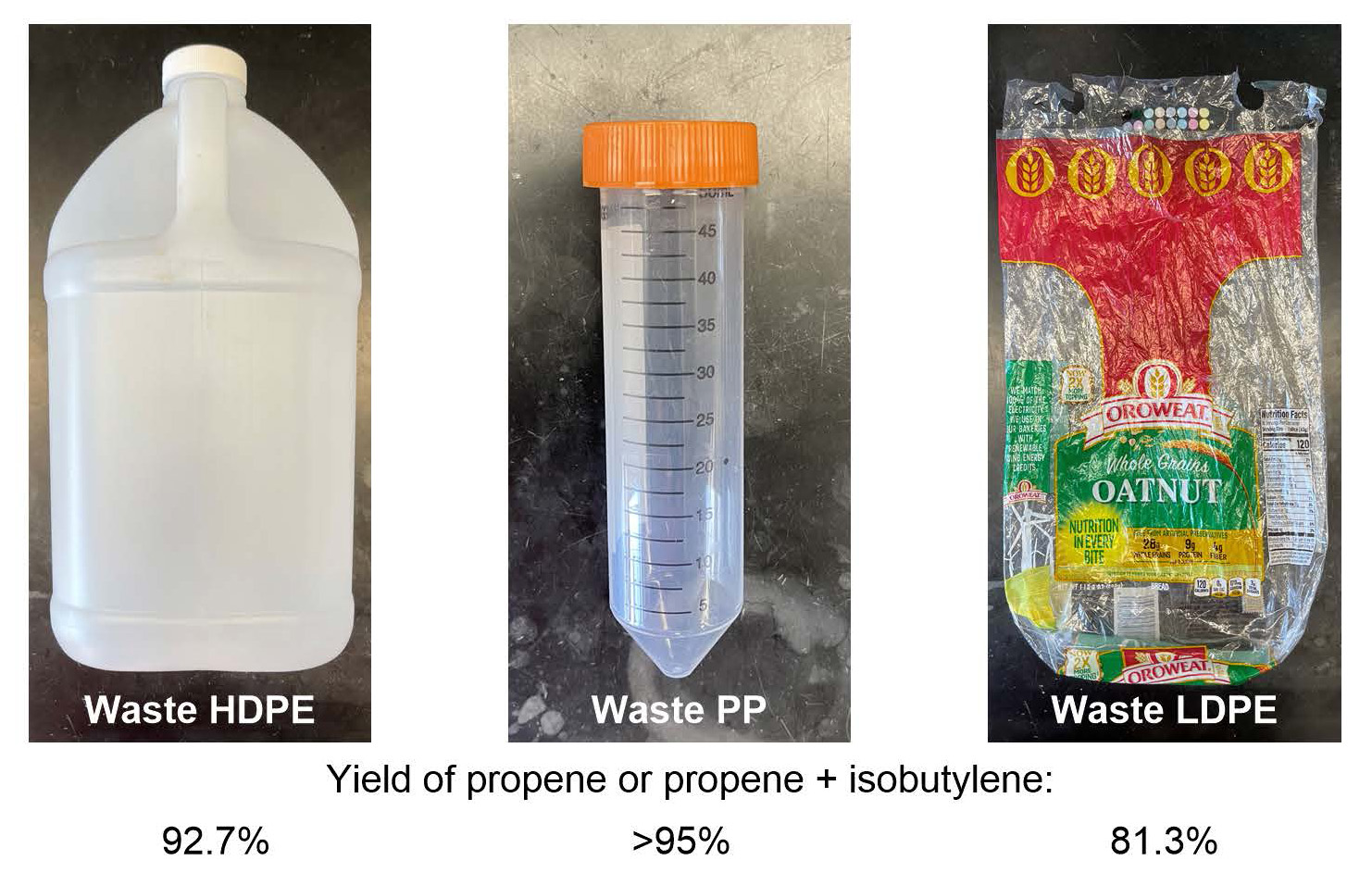
Indeed, the world currently produces an immense amount of polyethylene and polypropylene waste. These materials are used for everything from plastic bags to milk jugs and for microwavable containers—and it’s all really hard to recycle. However, a team at UC Berkeley might have just figured out how to deal with this problem.

Catalytic


Here’s the thing—polyethylene and polypropylene are not readily biodegradable at present. That means that waste tends to pile up. They’re actually quite tough to deal with in a chemical sense, too. It’s because these polymers have strong carbon-carbon bonds that are simply quite difficult to break. That means it’s very hard to turn them back into their component molecules for reforming. In an ideal world, you can sometimes capture a very clean waste stream of a single type of these plastics and melt and reform them, but generally, the quality of material you get out of this practice is poor. It’s why so many waste plastics get munched up and turned into unglamorous things like benches and rubbish bins.

youtube.com/embed/z39v6l6neGo?…

At Berkley, researchers were hoping to achieve a better result, turning these plastics back into precursor chemicals that could then be used to make fresh new material. The subject of a new paper in Science is a new catalytic process that essentially vaporizes these common plastics, breaking them down into their hydrocarbon building blocks. Basically, they’re turning old plastic back into the raw materials needed to make new plastic. This has the potential to be more than a nifty lab trick—the hope is that it could make it easy to deal with a whole host of difficult-to-recycle waste products.
Combining the plastics in a high-pressure reactor with ethylene gas and the catalyst materials breaks the polymer chains up into component molecules that can be used to make new plastics. Credit: UC Berkeley
The team employed a pair of solid catalysts, which help push along the desired chemical reactions without being consumed in the process. The first catalyst, which consists of sodium on alumina, tackles the tough job of breaking the strong carbon-carbon bonds in the plastic polymers. These materials consists of long chains of molecules, and this catalyst effectively chops them up. This typically leaves a broken link on one of the polymer chain fragments in the form of a reactive carbon-carbon double bond. The second catalyst, tungsten oxide on silica helps that reactive carbon atom pair up with ethylene gas which is streamed through the reaction chamber, producing propylene molecules as a result. As that carbon atom is stripped away, the process routinely leaves behind another double bond on the broken chain ready to react again, until the whole polymer chain has been converted. Depending on the feed plastic, whether it’s polyethylene, polypropylene, or a mixture, the same reaction process will generate propylene and isobutylene as a result. These gases can then be separated out and used as the starting points for making new plastics.
Before and after—the plastic has been converted to gas, leaving the catalytic material behind. Credit: UC Berkeley
What’s particularly impressive is that this method works on both polyethylene and polypropylene—the two heavy hitters in plastic waste—and even on mixtures of the two. Traditional recycling processes struggle with mixed plastics, often requiring tedious and costly sorting. By efficiently handling blends, this new approach sidesteps one of the major hurdles in plastic recycling.

To achieve this conversion in practice is relatively simple. Chunks of waste plastic are sealed in a high-pressure reaction vessel with the catalyst materials and a feed of ethylene gas, with the combination then heated and stirred. The materials react, and the gas left behind is the useful precursor gases for making fresh plastic.

In lab tests, the catalysts converted a near-equal mix of polyethylene and polypropylene into useful gases with an efficiency of almost 90%. That’s a significant leap forward compared to current methods, which often result in lower-value products or require pure streams of a single type of plastic. The process also showed resilience against common impurities and should be able to work with post-consumer materials—i.e. stuff people have thrown away. Additives and small amounts of other plastics didn’t significantly hamper the efficiency, though larger amounts of PET and PVC did pose a problem. However, since recycling facilities already separate out different types of plastics, this isn’t a deal-breaker.
The process can even run efficiently with a mixture of polypropylene and polyethylene. Note that propene is just another word for propylene. Credit: UC Berkeley
One of the most promising aspects of this development is the practicality of scaling it up. The catalysts used are cheaper and more robust than those in previous methods, which relied on expensive, sensitive metals dissolved in liquids. Solid catalysts are more amenable to industrial processes, particularly continuous flow systems that can handle large volumes of material.

Of course, moving from the lab bench to a full-scale industrial process will require further research and investment. The team needs to demonstrate that the process is economically viable and environmentally friendly on a large scale. But the potential benefits are enormous. It could actually make it worthwhile to recycle a whole lot more single-use plastic items, and reduce our need to replace or eliminate them entirely. Anything that cuts plastic waste streams into the environment is a boon, too. Ultimately, there’s still a ways to go, but it’s promising that solutions for these difficult-to-recycle plastics are finally coming on stream.


hackaday.com/2024/10/08/recycl…


The Privacy Post reshared this.

The Privacy Post ha ricondiviso questo.

Phishing via WhatsApp, così rubano i dati di accesso a Facebook: come difendersi
poliverso.org/display/0477a01e…
Phishing via WhatsApp, così rubano i dati di accesso a Facebook: come difendersiÈ in corso una campagna di phishing con cui i criminali informatici, sfruttando messaggi di WhatsApp, mirano a rubare dati di accesso a Facebook spacciandosi per addetti dell’assistenza ufficiale del social network. Ecco come riconoscere la truffa e come


Phishing via WhatsApp, così rubano i dati di accesso a Facebook: come difendersi


È in corso una campagna di phishing con cui i criminali informatici, sfruttando messaggi di WhatsApp, mirano a rubare dati di accesso a Facebook spacciandosi per addetti dell’assistenza ufficiale del social network. Ecco come riconoscere la truffa e come difendersi

L'articolo Phishing via WhatsApp, così rubano i dati di accesso a Facebook: come difendersi proviene da Cyber Security 360.


The Privacy Post reshared this.

The Privacy Post ha ricondiviso questo.

New note by cybersecurity
poliverso.org/display/0477a01e…
Phishing via WhatsApp, così rubano i dati di accesso a Facebook: come difendersi cybersecurity360.it/news/phish…@Informatica (Italy e non Italy 😁)È in corso una campagna di phishing con cui i criminali informatici, sfruttando messaggi di WhatsApp, mirano a rubare dati di accesso a Facebook spacciandosi per addetti dell’assistenza ufficiale del social network. Ecco come riconoscere la truffa e


Phishing via WhatsApp, così rubano i dati di accesso a Facebook: come difendersi


@Informatica (Italy e non Italy 😁)
È in corso una campagna di phishing con cui i criminali informatici, sfruttando messaggi di WhatsApp, mirano a rubare dati di accesso a Facebook spacciandosi per addetti dell’assistenza ufficiale del social network. Ecco come riconoscere la truffa e


The Privacy Post reshared this.

The Privacy Post ha ricondiviso questo.

New note by cybersecurity
poliverso.org/display/0477a01e…
Hacker cinesi all’attacco dei provider internet USA: il nuovo fronte dello spionaggio cyber cybersecurity360.it/nuove-mina…@Informatica (Italy e non Italy 😁)Provider internet statunitensi sono stati vittime di hacker cinesi, che vi si sono infiltrati in una campagna di cyber spionaggio allo scopo di prelevare dati sensibili. È solo l’ultimo tentativo da parte dello Stato


Hacker cinesi all’attacco dei provider internet USA: il nuovo fronte dello spionaggio cyber


@Informatica (Italy e non Italy 😁)
Provider internet statunitensi sono stati vittime di hacker cinesi, che vi si sono infiltrati in una campagna di cyber spionaggio allo scopo di prelevare dati sensibili. È solo l’ultimo tentativo da parte dello Stato


The Privacy Post ha ricondiviso questo.

New note by cybersecurity
poliverso.org/display/0477a01e…
Sicurezza dei pagamenti, la capacità di protezione cresce meno degli investimenti: i dati cybersecurity360.it/news/payme…@Informatica (Italy e non Italy 😁)Dal Payment Security Report di Verizon emerge il ruolo crescente della normativa in materia di sicurezza dei pagamenti. Ma non tutte le spese in sicurezza e conformità si traducono in un aumento proporzionale delle capacità di protezione, ecco p


Sicurezza dei pagamenti, la capacità di protezione cresce meno degli investimenti: i dati


@Informatica (Italy e non Italy 😁)
Dal Payment Security Report di Verizon emerge il ruolo crescente della normativa in materia di sicurezza dei pagamenti. Ma non tutte le spese in sicurezza e conformità si traducono in un aumento proporzionale delle capacità di protezione, ecco perché
L'articolo Sicurezza dei


The Privacy Post reshared this.

The Privacy Post ha ricondiviso questo.

New note by cybersecurity
poliverso.org/display/0477a01e…
AI e Deepfake, nuove frontiere del phishing: come difendersi cybersecurity360.it/nuove-mina…@Informatica (Italy e non Italy 😁)L'aumento esponenziale degli attacchi di phishing sfrutta l'intelligenza artificiale, mettendo a dura prova le difese aziendali e richiedendo un approccio proattivo alla sicurezza informaticaL'articolo AI e Deepfake, nuove frontiere del phishing: come difendersi proviene da


AI e Deepfake, nuove frontiere del phishing: come difendersi


@Informatica (Italy e non Italy 😁)
L'aumento esponenziale degli attacchi di phishing sfrutta l'intelligenza artificiale, mettendo a dura prova le difese aziendali e richiedendo un approccio proattivo alla sicurezza informatica
L'articolo AI e Deepfake, nuove frontiere del phishing: come difendersi proviene da Cyber


The Privacy Post reshared this.

The Privacy Post ha ricondiviso questo.

AI e Deepfake, nuove frontiere del phishing: come difendersi
poliverso.org/display/0477a01e…
AI e Deepfake, nuove frontiere del phishing: come difendersiL'aumento esponenziale degli attacchi di phishing sfrutta l'intelligenza artificiale, mettendo a dura prova le difese aziendali e richiedendo un approccio proattivo alla sicurezza informaticaL'articolo AI e Deepfake, nuove frontiere del phishing: come difendersi cybersecurity360.it/nuove-mina… proviene da Cyber


AI e Deepfake, nuove frontiere del phishing: come difendersi


L'aumento esponenziale degli attacchi di phishing sfrutta l'intelligenza artificiale, mettendo a dura prova le difese aziendali e richiedendo un approccio proattivo alla sicurezza informatica

L'articolo AI e Deepfake, nuove frontiere del phishing: come difendersi proviene da Cyber Security 360.


The Privacy Post reshared this.

The Privacy Post ha ricondiviso questo.

Dalla CGUE: commercio online sì, ma nel rispetto del GDPR altrimenti è concorrenza sleale
poliverso.org/display/0477a01e…
Dalla CGUE: commercio online sì, ma nel rispetto del GDPR altrimenti è concorrenza slealeLa Corte di Giustizia UE ha stabilito che nel commercio online, in quel caso di farmaci non da banco, occorre il consenso esplicito del cliente al trattamento dei suoi dati personali. In assenza, è pratica commerciale sleale. Quindi, chi viola il GDPR


Dalla CGUE: commercio online sì, ma nel rispetto del GDPR altrimenti è concorrenza sleale


La Corte di Giustizia UE ha stabilito che nel commercio online, in quel caso di farmaci non da banco, occorre il consenso esplicito del cliente al trattamento dei suoi dati personali. In assenza, è pratica commerciale sleale. Quindi, chi viola il GDPR sarà fuori dal mercato

L'articolo Dalla CGUE: commercio online sì, ma nel rispetto del GDPR altrimenti è concorrenza sleale proviene da Cyber Security 360.


The Privacy Post reshared this.

The Privacy Post ha ricondiviso questo.

Cavi sottomarini: così Europa e USA garantiranno una maggiore sicurezza del traffico dati
poliverso.org/display/0477a01e…
Cavi sottomarini: così Europa e USA garantiranno una maggiore sicurezza del traffico datiApprovata dall’Unione Europa una dichiarazione congiunta proposta dagli Stati Uniti a tutela dei cavi internet sottomarini. L’obiettivo è lavorare insieme per garantire una sempre maggiore sicurezza e affidabilità dell’infrastruttura e del traffico dati


Cavi sottomarini: così Europa e USA garantiranno una maggiore sicurezza del traffico dati


Approvata dall’Unione Europa una dichiarazione congiunta proposta dagli Stati Uniti a tutela dei cavi internet sottomarini. L’obiettivo è lavorare insieme per garantire una sempre maggiore sicurezza e affidabilità dell’infrastruttura e del traffico dati che trasporta

L'articolo Cavi sottomarini: così Europa e USA garantiranno una maggiore sicurezza del traffico dati proviene da Cyber Security 360.


The Privacy Post reshared this.

The Privacy Post ha ricondiviso questo.

Tra NIS 2 e decreto di recepimento: il ruolo centrale della governance
poliverso.org/display/0477a01e…
Tra NIS 2 e decreto di recepimento: il ruolo centrale della governanceC’è una differenza significativa tra i testi della NIS 2 e del decreto di recepimento che riguarda la governance: la direttiva introduce il concetto di “organi di gestione”, mentre il decreto distingue tra “organi di amministrazione” e “organi direttivi”. Ecco le implicazioni organizzative e


Tra NIS 2 e decreto di recepimento: il ruolo centrale della governance


C’è una differenza significativa tra i testi della NIS 2 e del decreto di recepimento che riguarda la governance: la direttiva introduce il concetto di “organi di gestione”, mentre il decreto distingue tra “organi di amministrazione” e “organi direttivi”. Ecco le implicazioni organizzative e operative di questi due diversi modelli

L'articolo Tra NIS 2 e decreto di recepimento: il ruolo centrale della governance proviene da Cyber Security 360.


The Privacy Post reshared this.

The Privacy Post ha ricondiviso questo.

The media in this post is not displayed to visitors. To view it, please go to the original post.

Printed Rack Holds Pair of LattePandas In Style
poliverso.org/display/0477a01e…
Printed Rack Holds Pair of LattePandas In StyleARM single-board computers like the Raspberry Pi are great for some applications — if you need something that’s energy efficient or can fit into a tight space, they’re tough to beat. But sometimes you’re stuck in the middle: you need more computational muscle than the average SBC can bring to the table, but at the same time, a full-size


Printed Rack Holds Pair of LattePandas In Style


ARM single-board computers like the Raspberry Pi are great for some applications — if you need something that’s energy efficient or can fit into a tight space, they’re tough to beat. But sometimes you’re stuck in the middle: you need more computational muscle than the average SBC can bring to the table, but at the same time, a full-size computer isn’t going to work for you.

Luckily, we now have options such as the LattePanda Mu powered by Intel’s quad-core N100 processor. Put a pair of these modules (with their associated carrier boards) on your desktop, and you’ve got considerable number-crunching capabilities in a relatively small package. Thanks to [Jay Doscher] we’ve got a slick 3D printed rack that can keep them secure and cool, complete with the visual flair that we’ve come to expect from his creations.

While you might be able to get away with leaving a Raspberry Pi naked on your workbench while it hosts your MQTT server, Mini-ITX boards like the LattePanda Mu carriers used in this project need a bit more protection. Even if you didn’t want to print out the whole rack, you could run off just one of the individual “Compute Unit” cases that [Jay] has designed and made freely available. Complete with stylish handle, the brutalist box will do nicely to keep gerfingerpoken und mittengraben at a minimum.

But if you do have a pair of these x86 beauties at your disposal, going all the way and printing the skeletonized rack the cases lock into looks like it would be well worth the investment of time and filament. The open design and 140 mm Noctua fan mounted in the bottom keeps airflow at a maximum, to the point that [Jay] says he doesn’t even need to run individual fans on the LattePanda boards.

This design is something of an evolution of the N100 Obelisk that [Jay] created back in May, which was able to hold more mini computers and used a more chimney-like approach to heat management. Though you can start to see the origins of his unique visual style, which combines sci-fi and militaristic elements, much earlier than that.


hackaday.com/2024/10/08/printe…


The Privacy Post reshared this.

The Privacy Post ha ricondiviso questo.

The media in this post is not displayed to visitors. To view it, please go to the original post.

Barbie’s Video Has Never Looked So Good
poliverso.org/display/0477a01e…
Barbie’s Video Has Never Looked So GoodFor those who missed it, there’s been something of a quiet revolution in the world of analogue video over the last year, due to the arrival of inexpensive “MiniDVR” devices. These little modules are a complete video recorder including battery, recording PAL or NTSC composite video and audio to SD card. They’ve become the box of choice for camcorder


Barbie’s Video Has Never Looked So Good


For those who missed it, there’s been something of a quiet revolution in the world of analogue video over the last year, due to the arrival of inexpensive “MiniDVR” devices. These little modules are a complete video recorder including battery, recording PAL or NTSC composite video and audio to SD card. They’ve become the box of choice for camcorder enthusiasts, but that’s not where the fun ends. [Max Vega] has taken a Barbie video camera toy from 2001 and added a MiniDVR to make it into a fully self-contained novelty camcorder. But this isn’t a simple case of duct-taping the DVR to the toy, instead it’s a comprehensive upgrade resulting in a device which could almost have been a real product.

The original toy had a small transmitter which could send over a short distance to a receiver that connected to a domestic VCR, so all that circuitry had to go. The camera itself is a small enough module in the fake lens assembly, with an easily identifiable output cable with the required composite signal. The video below the break steps through the proces of making the space for the MiniDVR module, and putting in extensions for all its buttons, and the SD card. Finally it has a new power supply module with an associated USB-C input, providing juice to both DVR and camera.

The result has what we can only describe as a pleasingly retro feel, in that it’s not of high quality and the colour is, well, Never The Same. But when a smartphone can record HD video that’s not the point, instead it’s there to be a retro toy, and in that it succeeds completely.

youtube.com/embed/0dgdPiL6mJ0?…


hackaday.com/2024/10/08/barbie…


The Privacy Post reshared this.

The Privacy Post ha ricondiviso questo.

IA: Minaccia o Opportunità? Come Adattarsi ai Grandi Cambiamenti Tecnologici
poliverso.org/display/0477a01e…
IA: Minaccia o Opportunità? Come Adattarsi ai Grandi Cambiamenti TecnologiciL’intelligenza artificiale redhotcyber.com/post/che-cose-… (AI) sta ridefinendo le nostre realtà professionali a un ritmo vertiginoso.Nel settore immobiliare, ad esempio, l’intelligenza artificiale redhotcyber.com/post/che-cose-… offre possibilità rivoluzionarie e allo stesso


IA: Minaccia o Opportunità? Come Adattarsi ai Grandi Cambiamenti Tecnologici


L’intelligenza artificiale (AI) sta ridefinendo le nostre realtà professionali a un ritmo vertiginoso.

Nel settore immobiliare, ad esempio, l’intelligenza artificiale offre possibilità rivoluzionarie e allo stesso tempo suscita preoccupazioni. Algoritmi avanzati sono ora in grado di valutare, al posto dei professionisti, il valore degli immobili con maggiore precisione, prevedere l’andamento del mercato e persino automatizzare i processi di gestione degli affitti.

Nell’industria cinematografica invece, i progressi tecnologici hanno già consentito alle macchine di duplicare le voci umane in tutte le lingue e generare sceneggiature, compiti precedentemente riservati ai doppiatori umani e agli sceneggiatori. Questo sconvolgimento sta generando crescente preoccupazione: l’intelligenza artificiale è una minaccia per l’occupazione o un catalizzatore per la trasformazione?

I timori legati all’intelligenza artificiale non sono nuovi


Dall’avvento di questa tecnologia, il dibattito sul suo impatto sull’occupazione e sulle competenze umane è stato onnipresente. La capacità degli algoritmi di svolgere compiti complessi, a volte meglio e più velocemente degli esseri umani, è vista da alcuni come l’inizio della fine per molte professioni creative e tecniche.

Questo sentimento di minaccia è esacerbato dalla velocità con cui queste tecnologie si evolvono e dalla mancanza di una regolamentazione chiara riguardo al loro utilizzo. In risposta, stanno cominciando ad emergere iniziative legislative per regolamentare l’uso dell’intelligenza artificiale e proteggere le professioni minacciate. Tuttavia, la regolamentazione da sola non basterà a dissipare le preoccupazioni. È imperativo comprendere e accettare che l’intelligenza artificiale, lungi dall’essere una semplice minaccia, è anche un’opportunità per rinnovarci.

Tuttavia, queste innovazioni consentono agli agenti immobiliari di concentrarsi sugli aspetti più strategici e umani della professione, come la consulenza personalizzata e la gestione della relazione con il cliente.

È quindi essenziale utilizzare l’intelligenza artificiale come complemento delle competenze umane, piuttosto che come sostituto. I professionisti devono adottare queste tecnologie per migliorare la propria efficienza preservando la dimensione umana del proprio lavoro, che rimane essenziale per comprendere le esigenze specifiche dei clienti e offrire un servizio personalizzato.

Il cambiamento è ora!


Per affrontare queste nuove tecnologie in modo costruttivo, è essenziale riconoscere che l’intelligenza artificiale è uno strumento potente che, utilizzato con giudizio, può arricchire e integrare le competenze umane anziché sostituirle. Piuttosto che temere l’intelligenza artificiale, dovremmo concentrarci su come integrarla perfettamente nelle nostre attività.

La chiave per sfruttare l’intelligenza artificiale risiede nell’educazione e nell’adattamento. I professionisti devono prepararsi ad evolversi e ad acquisire nuove competenze che consentiranno loro di collaborare in modo efficace con queste tecnologie. Inoltre, una stretta collaborazione tra gli sviluppatori di tecnologia e gli utenti finali è essenziale per garantire che le innovazioni dell’intelligenza artificiale soddisfino le reali esigenze delle professioni nel rispetto dei valori umani fondamentali.

In breve, i timori sull’intelligenza artificiale non dovrebbero essere ignorati ma compresi e affrontati in modo proattivo. Piuttosto che temere il futuro, dobbiamo abbracciare le trasformazioni che ci offre e adattarci per renderlo una risorsa nella nostra vita professionale quotidiana. Integrando attentamente l’intelligenza artificiale, possiamo non solo preservare ma anche arricchire le nostre professioni, creando nuove opportunità e affermando il nostro ruolo in questa nuova era tecnologica.

L'articolo IA: Minaccia o Opportunità? Come Adattarsi ai Grandi Cambiamenti Tecnologici proviene da il blog della sicurezza informatica.


The Privacy Post reshared this.

The Privacy Post ha ricondiviso questo.

Red Hot Cyber avvia una nuova serie di vignette satiriche per sensibilizzare sulla cybersecurity
poliverso.org/display/0477a01e…
Red Hot Cyber avvia una nuova serie di vignette satiriche per sensibilizzare sulla cybersecurityRed Hot Cyber è pronta a stupire il suo pubblico con una nuova serie di vignette satiriche che usciranno ogni martedì mattina, create dal gruppo Arte della Community, che realizza la Graphic Novel BETTI-RHC redhotcyber.com/post/formare-i…,


Red Hot Cyber avvia una nuova serie di vignette satiriche per sensibilizzare sulla cybersecurity


Red Hot Cyber è pronta a stupire il suo pubblico con una nuova serie di vignette satiriche che usciranno ogni martedì mattina, create dal gruppo Arte della Community, che realizza la Graphic Novel BETTI-RHC, la prima incentrata sul tema del Cybersecurity Awareness.

Vogliamo incentrare queste vignette sul mondo dell’IT e sulla consapevolezza del rischio cibernetico, e lo faremo con il personaggio “Bryce Thorde”, da noi inventato per rappresentare in modo ironico le sfide quotidiane legate alla sicurezza informatica.

Bryce Thorde (anagramma di Red Hot Cyber) è un uomo di circa 45 anni, sguardo nel nulla, divorziato, pochi capelli sulla testa, vestito anni 70, impiegato nel reparto IT di un ufficio della pubblica amministrazione. Si auto-definisce un “genio dell’informatica”. Ma dietro questa facciata pseudo professionale, Bryce è in realtà un disastro ambulante, che fatica a gestire anche le operazioni più banali con i computer.

Avere a che fare con un mouse, una tastiera, un Virus, un bug e una password sono il suo pane quotidiano, ma spesso trasforma questi problemi informatici alle volte anche semplici in catastrofi epocali.

Con un tono esilarante e un forte tocco di autoironia, Bryce racconta: “Salve, mi presento, mi chiamo BRYCE, BRYCE THORDE. Sono un genio dell’informatica… almeno, così dicono le mie credenziali LinkedIn. In realtà sono un DISASTRO AMBULANTE. Ho iniziato a smanettare con i computer da piccolo e da allora ne ho combinate DI TUTTI I COLORI. Virus, bug, password… sono il mio pane quotidiano. Dicono che ho un talento per trasformare anche l’operazione più semplice in un DISASTRO EPOCALE. Nonostante tutto, cerco di imparare, ma PIÙ LEGGO MANUALI E PIÙ MI INCASINO. Forse gli hacker mi hanno impiantato un CHIP NEL CERVELLO? Se cercate un esperto di IT e di CyberSecurity, sono l’uomo giusto… per dimostrare che anche i computer… PIANGONO DAVVERO.”

Queste vignette satiriche non si limiteranno solo a far ridere, ma avranno l’obiettivo di veicolare messaggi importanti sulla cybersecurity, puntando a sensibilizzare il pubblico sui rischi informatici. Ogni storia umoristica di Bryce Thorde avrà un tema legato alla sicurezza online, dalla gestione delle password alla difesa contro il phishing, dalle vulnerabilità dei sistemi alle falle di sicurezza più comuni.

Attraverso il personaggio di Bryce, Red Hot Cyber intende educare i suoi lettori con una dose di umorismo, ma allo stesso tempo fornire utili spunti di riflessione per migliorare la loro consapevolezza in ambito digitale.

Con questa nuova iniziativa, Red Hot Cyber dimostra ancora una volta di essere all’avanguardia nella promozione della cultura della sicurezza informatica, utilizzando un linguaggio creativo accessibile, a far avvicinare il pubblico a tematiche tecniche che troppo spesso vengono trascurate.

Se vi piacciono i racconti o inviare un messaggio attraverso una storia, o siete appassionati di vignette o disegno, proponeteci qualcosa alla casella di posta graphicnovel@redhotcyber.com, leggeremo e risponderemo a tutte le vostre email.

L'articolo Red Hot Cyber avvia una nuova serie di vignette satiriche per sensibilizzare sulla cybersecurity proviene da il blog della sicurezza informatica.


The Privacy Post reshared this.

The Privacy Post ha ricondiviso questo.

The media in this post is not displayed to visitors. To view it, please go to the original post.

GPS Tracking in the Trackless Land
poliverso.org/display/0477a01e…
GPS Tracking in the Trackless LandNeed a weekend project? [Cepa] wanted a GPS tracker that would send data out via LTE or the Iridium network. Ok, maybe that’s one for a very long weekend. However, the project was a success github.com/cepa/aegir-gps-trac… and saw service crossing the Barents Sea in the Arctic. Not bad.Apparently, [Cepa] is very involved in sharing tracks to odd and remote


GPS Tracking in the Trackless Land


Need a weekend project? [Cepa] wanted a GPS tracker that would send data out via LTE or the Iridium network. Ok, maybe that’s one for a very long weekend. However, the project was a success and saw service crossing the Barents Sea in the Arctic. Not bad.

Apparently, [Cepa] is very involved in sharing tracks to odd and remote places. While you may not have cell service in the middle of the Barents Sea, you can always see Iridium. The device does make some sacrifices to the expense of satellite communications. On LTE, the system pings your location every ten seconds. Without it, it dials up the sat connection once an hour. However, it does store data on a SD card, so — presumably — you get caught up when you have a connection.

Hardware-wise, the setup uses an STM32 BlackPill, an OLED, and some off-the-shelf GPS, LTE, and Iridium modules. The system uses an RTOS, which might be overkill, but it makes it easy to program complex behaviors.

In practice, the tracker lost LTE about 20 nautical miles from the Norwegian coast and used the satellite until it was closer to the coast of Svalbard. The problem is that satellite communications come at a high cost. According to the post, the monthly fee was £13, with another £14 for 100 credits, which translates to about 5kB of data. That adds up quickly.

Iridium, however, is sometimes the only choice if you are in the middle of the ocean or an otherwise inaccessible part of the world.


hackaday.com/2024/10/07/gps-tr…


The Privacy Post reshared this.

The Privacy Post ha ricondiviso questo.

The media in this post is not displayed to visitors. To view it, please go to the original post.

Minacce emergenti: L’uso improprio di strumenti di sicurezza pubblici per furti di dati
poliverso.org/display/0477a01e…
Minacce emergenti: L’uso improprio di strumenti di sicurezza pubblici per furti di datiNel panorama attuale della sicurezza informatica redhotcyber.com/rubriche/alla-…, un nuovo tipo di minaccia si sta facendo strada, sfruttando strumenti pubblici di sicurezza per raccogliere dati sensibili. Durante le mie ultime ricerche, ho scoperto come


Minacce emergenti: L’uso improprio di strumenti di sicurezza pubblici per furti di dati


Nel panorama attuale della sicurezza informatica, un nuovo tipo di minaccia si sta facendo strada, sfruttando strumenti pubblici di sicurezza per raccogliere dati sensibili. Durante le mie ultime ricerche, ho scoperto come piattaforme come AlienVault OTX possano essere utilizzate da hacker per ottenere gratuitamente email e password in chiaro trapelate da recenti data breach, senza necessità di accedere al dark web. Questa vulnerabilità rappresenta una seria minaccia per gli utenti di queste piattaforme.

Scenario di attacco


Immaginiamo uno scenario in cui un hacker decide di sfruttare strumenti di sicurezza pubblici per effettuare un attacco contro Netflix e altre piattaforme di streaming e servizi online. Il processo si articola in diverse fasi:

  • Raccolta di informazioni: L’hacker usa servizi come AlienVault OTX, cercando dati relativi a violazioni passate che coinvolgono Netflix. Utilizzando query mirate, il malintenzionato trova un elenco di email e password compromesse. Con i dati ottenuti, l’hacker analizza quali account sono ancora attivi e se le password sono state cambiate. Questo passaggio è cruciale, per determinare quali credenziali possono essere utilizzate per accedere a diversi servizi.
  • Sfruttamento delle credenziali: L’attaccante utilizza le credenziali ottenute per accedere agli account Netflix, approfittando del fatto che molti utenti riutilizzano la stessa password su più piattaforme. In alternativa, possono attuare attacchi di credential stuffing, utilizzando le credenziali per tentare di accedere a servizi simili, come altre piattaforme di streaming o social.
  • Furto di dati: Una volta ottenuto l’accesso agli account, l’hacker può raccogliere informazioni personali degli utenti, come dati di pagamento, preferenze e cronologie di visione. Questi dati possono essere venduti nel dark web o utilizzati per ulteriori attacchi di phishing.


Tipologie di sistemi e settori coinvolti


Questa tipologia di attacco non riguarda solo Netflix, ma si estende a diversi settori e piattaforme, tra cui:

  • Piattaforme di streaming: Servizi come Amazon Prime Video, Disney+ e Hulu sono a rischio poiché gli utenti possono condividere credenziali o utilizzare la stessa password per più servizi.
  • E-commerce: Piattaforme come Netflix, T-Mobile, Amazon e eBay, dove gli utenti memorizzano dati di pagamento, rappresentano obiettivi privilegiati per gli hacker che cercano di monetizzare le informazioni rubate.
  • Settore bancario: L’accesso a servizi di streaming può rivelare informazioni sensibili, portando a potenziali attacchi su conti bancari o carte di credito.


Prevenzione e protezione


Esistono diverse mitigazioni per questo genere di attacco e sono:

  • Autenticazione a due fattori: Implementare questa misura di sicurezza su tutti gli account per aggiungere un ulteriore livello di protezione.
  • Monitoraggio delle violazioni: Utilizzare strumenti di monitoraggio per informare gli utenti in caso di compromissione dei dati.
  • Educazione degli utenti: Sensibilizzare gli utenti sull’importanza di utilizzare password uniche e complesse, oltre a evitare il riutilizzo delle credenziali su più servizi.
  • Rafforzamento delle politiche di sicurezza: Le aziende devono investire in sistemi di sicurezza informatica e formazione per il personale, per migliorare la gestione dei dati sensibili e prevenire accessi non autorizzati.


Conclusione


In un’era in cui i dati sono il nuovo petrolio, la nostra sicurezza è a rischio.

Gli strumenti pubblici di sicurezza, se usati in modo improprio, possono trasformarsi in una vera minaccia. È fondamentale che aziende e utenti alzino il livello di guardia, adottando misure di protezione robuste e consapevoli. Non possiamo permettere che la nostra privacy venga messa a repentaglio da attacchi prevedibili. La chiave? Investire nella sicurezza e fare scelte intelligenti oggi, per un domani più sicuro.

L'articolo Minacce emergenti: L’uso improprio di strumenti di sicurezza pubblici per furti di dati proviene da il blog della sicurezza informatica.


The Privacy Post reshared this.

The Privacy Post ha ricondiviso questo.

The media in this post is not displayed to visitors. To view it, please go to the original post.

Fondamenti di Cybersecurity per le PMI (5/12): PHISHING, L’Arte di Non Cadere Nella Rete…
poliverso.org/display/0477a01e…
Fondamenti di Cybersecurity per le PMI (5/12): PHISHING, L’Arte di Non Cadere Nella Rete…Il grande bluff: l’email del “tizio importante”La prossima volta che ricevi un’email del tipo “URGENTE: Aggiorna il tuo account ora o il mondo finirà”, respira profondamente e, per favore, non cliccare subito. Lo so, sembra proprio il messaggio che


Fondamenti di Cybersecurity per le PMI (5/12): PHISHING, L’Arte di Non Cadere Nella Rete…


Il grande bluff: l’email del “tizio importante”

La prossima volta che ricevi un’email del tipo “URGENTE: Aggiorna il tuo account ora o il mondo finirà”, respira profondamente e, per favore, non cliccare subito. Lo so, sembra proprio il messaggio che potrebbe mandare il tuo capo alle 22:00 perché ha “dimenticato” la password. Eppure, fidati, Bill Gates non ti chiederà mai il codice di accesso al server della tua azienda via Gmail.

Ecco come funziona il magico mondo del phishing:

  1. Arriva l’email magica: A prima vista sembra legittima, magari usa pure il logo della tua banca o della tua azienda. Che gentile! Ma aspetta, è facile falsificare un logo o un indirizzo email. Sai quanti “Elon Musk” ci sono là fuori pronti a regalarti qualche Bitcoin? Nessuno. Ma loro proveranno comunque a convincerti del contrario.
  2. Sembra tutto vero… quasi troppo: Oh sì, anche il tono è familiare, e ti dicono che devi fare qualcosa “immediatamente”. La pressione è palpabile. Il tempo scorre, il mondo brucia, devi agire ora! O… forse no?


  1. Tu clicchi, e… boom!: Magia nera! Hai appena scaricato ransomware o, ancora meglio, hai consegnato la chiave del regno aziendale. Complimenti, sei parte di uno scherzo non proprio divertente.


Come salvarsi prima che sia troppo tardi?


Senti, non c’è bisogno di essere un detective informatico per difendersi dai truffatori online. Basta seguire alcune semplici regole, tipo non dare il codice della tua cassaforte a qualcuno che si presenta alla tua porta con una pizza gratuita. Ma ecco alcune dritte più utili:

Non scaricare immagini automaticamente!


Hai mai notato che la tua email a volte scarica automaticamente le immagini? Non è sempre una funzione migliorativa, a volte ti espone a diversi rischi. Non farlo! Sai perché? Scaricare immagini permette ai truffatori di sapere che la tua casella di posta è attiva e che tu hai appena letto la mail che ti hanno inviato. È come un segnale di fumo che dice: “Ehi, esisto, attaccami con qualcosa di più elaborato!”. Non scaricare nulla automaticamente e, se possibile, disattiva questa funzione nelle impostazioni del tuo client email. Fai loro capire che con te non si scherza!

Ecco le guide tecniche per i due client web di riferimento:


Come verificare l’autenticità del mittente (no, non basta guardare il nome)


Ti arriva una mail da un certo “Manager@aziendaimportante.com”. Sembra legittimo, ma è davvero così? Attenzione: il campo del mittente può essere falsificato in modo semplice, quindi non fidarti solo del nome. Prima di agire, verifica l’indirizzo e assicurati che non ci siano avvertimenti dal tuo provider di posta. Se ti avvisa che l’autenticità del mittente non può essere verificata, allerta rossa! Ignora l’email o segnalala.

Per fare un controllo più approfondito, una volta che il tuo client non ti ha allertato, puoi utilizzare strumenti affidabili che ti permettono di verificare se quell’indirizzo email è autentico e a chi potrebbe appartenere:


Controlla i link, non cliccarli a caso


Ti tentano con un link? Fermati un attimo e pensa. Cliccare senza controllare è come infilare la mano in un buco senza sapere cosa c’è dentro. Controlla i link prima di seguirli. Fai clic con il tasto destro, copia l’URL e incollalo su siti come VirusTotal per verificare se il dominio è pulito o potenzialmente dannoso. Se hai meno tempo, almeno incolla il link in un blocco note per vedere l’URL completo e capire se effettivamente appartiene al presunto mittente. Se il mittente dice di essere “LaBancaDellaPace” e il dominio è qualcosa tipo “truffabank.ru”, beh, sai già che stai per cascare male.

Sandbox e macchine virtuali: il campo di battaglia perfetto


Ricevi un allegato? Attenzione, è un potenziale campo minato! Non aprirlo direttamente! Se proprio devi scaricarlo, fallo in un ambiente sicuro, come una sandbox o una macchina virtuale. Crea uno snapshot prima, testa il file senza connessione alla rete e poi elimina tutto ripristinando lo snapshot. Anche se apparentemente non succede nulla di strano, non fidarti. Carica comunque l’allegato su VirusTotal per un controllo extra. Meglio passare qualche minuto a fare verifiche che vedere tutto il sistema infettato da malware.

Immagine generata con Dall-E

Quindi? Occhi Sempre Aperti!


Il phishing è un gioco di manipolazione. Truffatori brillanti, capaci di usare trucchi psicologici e tecnici per convincerti che l’email ricevuta è del tutto autentica. Ma con queste tecniche, puoi fargli capire che hai qualche asso nella manica. Non scaricare immagini, controlla ogni link e mittente, e testa sempre gli allegati in un ambiente protetto. Insomma, l’obiettivo è rendere il loro “lavoro” più complicato e farti una bella risata mentre ti guardi indietro, sapendo di aver evitato l’ennesima trappola.

Vuoi saperne di più?


Dai un’occhiata ai precedenti articoli della nostra rubrica, Fondamenti di Cybersecurity per le PMI:

L'articolo Fondamenti di Cybersecurity per le PMI (5/12): PHISHING, L’Arte di Non Cadere Nella Rete… proviene da il blog della sicurezza informatica.


The Privacy Post reshared this.

The Privacy Post ha ricondiviso questo.

The media in this post is not displayed to visitors. To view it, please go to the original post.

Using Donor Immune Cells to Mass-Produce CAR-T Autoimmune Therapies
poliverso.org/display/0477a01e…
Using Donor Immune Cells to Mass-Produce CAR-T Autoimmune TherapiesAs exciting as immunotherapies are in terms of fighting cancer, correcting autoimmune disorders and so on, they come with a major disadvantage. Due to the current procedure involving the use of a patient’s own immune (T) cells, this making such therapies rather expensive and involved for the


Using Donor Immune Cells to Mass-Produce CAR-T Autoimmune Therapies


As exciting as immunotherapies are in terms of fighting cancer, correcting autoimmune disorders and so on, they come with a major disadvantage. Due to the current procedure involving the use of a patient’s own immune (T) cells, this making such therapies rather expensive and involved for the patient. Recent research has therefore focused on answering the question whether T cells from healthy donors could be somehow used instead, with promising results from a recent study on three human patients, as reported in Nature.

The full study results (paywalled) by [Xiaobing Wang] et al. are published in Cell, with the clinical trial details available on the ClinicalTrials.gov website. For this particular trial the goal was to attempt to cure the autoimmune conditions of the three study participants (being necrotizing myopathy (IMNM) and diffuse cutaneous systemic sclerosis (dcSSc)). The T cells used in the study were obtained from a healthy 21-year old woman, and modified with chimeric antigen receptors targeting B (memory) cells. Using CRISPR-Cas9 the T cells were then further modified to prevent the donor cells from attacking the patient’s cells and vice versa.

After injection, the CAR-T cells got to work, multiplying and seeking out the target B cells, including the pathogenic ones underlying the autoimmune conditions. This persisted for a few weeks until the CAR-T cells effectively vanished and new B cells began to emerge, with a clear decrease in autoantibodies. Two months after beginning treatment, all three participants noted marked improvements in their conditions, which persisted at 6 months. For the woman with IMNM, muscle strength had increased dramatically with undetectable autoantibody levels, and the two men with dcSSc saw scar tissue formation reversed and their skin condition improve massively.

It remains to be seen whether this period of remission in these patients is permanent, and whether there any side effects of CAR-T cell therapy. We previously reported on CAR-T cell therapies and the many promises which they hold. Depending on the outcome of these early trials, it could mean that autoimmune conditions, allergies and cancer will soon be worries of the past, marking another massive medical milestone not unlike the invention of vaccines and the discovery of antibiotics.


hackaday.com/2024/10/07/using-…


The Privacy Post reshared this.

The Privacy Post ha ricondiviso questo.

The media in this post is not displayed to visitors. To view it, please go to the original post.

The Piezoelectric Glitching Attack
poliverso.org/display/0477a01e…
The Piezoelectric Glitching AttackMany readers will be familiar with the idea of a glitching attack, introducing electrical noise into a computer circuit in the hope of disrupting program flow and causing unexpected behaviour which might lead to hitherto unavailable access to memory or other system resources. [David Buchanan] has written a piece investigating glitching attacks on PC memory, and


The Piezoelectric Glitching Attack


Many readers will be familiar with the idea of a glitching attack, introducing electrical noise into a computer circuit in the hope of disrupting program flow and causing unexpected behaviour which might lead to hitherto unavailable access to memory or other system resources. [David Buchanan] has written a piece investigating glitching attacks on PC memory, and the tool he’s used is the ubiquitous piezoelectric lighter.

Attaching a short piece of wire to one of the lines on a SODIMM memory module, he can glitch a laptop at will with the lighter through the electromagnetic noise its discharge creates. It’s a cool trick, but the real meat of the write-up lies in his comprehensive description of how virtual memory works, and how a glitch can be used to break out of the “sandbox” of memory allocated to a particular process. He demonstrates it in a video which we’ve placed below the break, in which he gains root access and runs an arbitrary piece of code on a Linux laptop. It’s probable that not many of us have the inclination to do this for ourselves, but even so it’s fascinating to know how such an attack works.

youtube.com/embed/X_D8BwEhuno?…


hackaday.com/2024/10/07/the-pi…


The Privacy Post reshared this.

The Privacy Post ha ricondiviso questo.

The media in this post is not displayed to visitors. To view it, please go to the original post.

Se vi dicessi che Google vi spia mentre usate Mastodon?

Tutte le notifiche che ricevete sul vostro android passano prima attraverso i server google, comprese quelle di mastodon!

Oltre a disattivare le notifiche c'è una soluzione alternativa, libera e rispettosa della privacy: #UnifiedPush

Ho creato questa semplice guida italiana per configurare UnifiedPush: noblogo.org/filippodb/mai-piu-…

Grazie a tutti quanti mi hanno aiutato in questi giorni a migliorare la guida! ❤️

#Guida #M1Tutorial #Mastodon


Mai più notifiche da Google! Guida a UnifiedPush su Mastodon, Matrix e Telegram


Un recente problema con le notifiche #mastodon ci ha insegnato 2 cose:

1) usare tutti il sistema di notifiche di google va contro il concetto di decentralizzazione.

2) anche nel #fediverso siamo spiati da google che controlla e legge tutte le notifiche android.

Per risolvere (e togliere google dalle notifiche) è sufficiente cambiare le impostazioni usando la soluzione libera UnifiedPush attraverso l'app Nextpush presente su Nextcloud!

Su android installate questa app :gitea.it/Mastodon/nextpush-and…

Usate i dati di accesso del nextcloud di #MastodonUno. (per avere un account: cloud.mastodon.uno/apps/forms/…)

e impostate la vostra app per usare #UnifiedPush!

Di seguito le guide per Mastodon, Matrix e Telegram (Pixelfed supporterà Unified Push a breve).

Mastodon


Il nostro consiglio è di usare solo app che usano il sistema UnifiedPush:

. Moshidon gitea.it/Mastodon/moshidon. Fedilab gitea.it/Mastodon/fedilab-Andr…. Tusky gitea.it/Mastodon/Tusky-App-An…. Pachli gitea.it/Mastodon/pachli-andro…

Installare l'app nextpush: gitea.it/Mastodon/nextpush-and… con credenziali del nextcloud di M1 (per un account: cloud.mastodon.uno/apps/forms/…)

Matrix


Matrix è la messaggistica decentralizzata che usiamo dal 2020, sono 300 le persone iscritte alla nostra stanza per discutere su mastodon e sul fediverso (chiedimi un invito su @filippodb@mastodon.uno).

Proprio dalla stanza #matrix è nata l'esigenza di usare notifiche alternative a google come #unifiedpush dato che tutte le app matrix le possono usare:

. FluffyChat fluffychat.im/. SchildiChat schildi.chat/. Element element.io/download. SmallTalk gitea.it/devol/smalltalk-matri…

Basta attivare l'app #NextPush con le credenziali nextcloud (potete chiedere un account qui: cloud.mastodon.uno/apps/forms/…)

Telegram


Per chi preferisce ancora usare #telegram esistono dei client che ti permettono di usare le notifiche #UnifiedPush invece che le notifiche di Google:

. MercuryGram github.com/drizzt/Telegram-FOS…. Nagram github.com/NextAlone/Nagram

Serve installare #NextPush: gitea.it/Mastodon/nextpush-and…

e utilizzare le credenziali del vostro account #nextcloud (per averne uno basta chiedere: cloud.mastodon.uno/apps/forms/…)

Su telegram abbiamo il nostro canale con quasi 3000 iscritti, potete iscrivervi da qui: t.me/devolitalia

Potete seguirmi: Attraverso questo blog su @filippodb@noblogo.org (attivate la campanella per essere notificati) su mastodon: @filippodb@mastodon.uno

Oppure iscrivetevi la newsletter: buttondown.com/devol


Questa voce è stata modificata (1 anno fa)
in reply to razeft

The media in this post is not displayed to visitors. To view it, please go to the original post.

@alexgioff qua una descrizione di matrix da parte di @lealternative qua:

lealternative.net/2021/04/28/c…


Cos’è Matrix?

Indice dei contenuti


Da qualche tempo sul nostro sito sito sono apparse delle scritte per alcuni misteriose. Parliamo infatti di Matrix, di seguirci in stanze di Matrix e abbiamo aggiunto tra i social network in cui siamo presenti anche il logo di Matrix. Ma che cos’è Matrix? Non ci riferiamo ovviamente all’omonimo film, ma a un protocollo aperto molto interessante. Vediamolo insieme.

Matrix è una sorta di ritorno alle origini di internet ed è per questo che ci piace molto. Punta infatti a risolvere i problemi di protocolli simili già esistenti 1, ma molto datati, come ad esempio IRC e XMPP. Il problema delle app di messaggistica, al di là dei singoli pregi/difetti di ognuna, è che puoi parlare solo con chi si è iscritto a quella stessa app di messaggistica.

Ma quanto sarebbe bello poter utilizzare le chat come le email? Ecco, prendiamo come esempio proprio le email, per capirci meglio.

Tralasciamo un attimo da questo discorso il geniale Delta Chat che meriterebbe un articolo a parte. Delta Chat utilizza infatti la rete di server email per poter chattare con chiunque sfruttando proprio quel protocollo. Ne abbiamo parlato brevemente nell’articolo dedicato alle alternative a Whatsapp.

Torniamo alle email: oggi potete mandare un’email a chiunque da qualunque indirizzo email. Non vi interessa se il vostro amico è passato da Gmail a ProtonMail o ad Outlook perché al massimo dovrete modificare l’indirizzo e siete sicuri di potergli scrivere.

Non è la stessa cosa per le chat di messaggistica: se un vostro amico usa Whatsapp potrete scrivergli solo se anche voi vi iscrivete su Whatsapp. Questo è un limite enorme e mette nelle mani di una singola azienda un potere a dir poco gigantesco.
Background vector created by starline – www.freepik.com

Cos’è Matrix?


Matrix cerca di porre rimedio a tutto questo.

Matrix è infatti un protocollo aperto per comunicare tramite chat, VoIP e videochiamate. Cosa significa? Che potenzialmente possono esistere infinite applicazioni, tutte diverse tra loro, che utilizzano lo stesso protocollo. Non essere più vincolati dunque ad un’azienda ma poter scegliere una qualunque applicazione per chattare con chiunque, senza limiti. Come dicevamo prima punta a sostituire i protocolli IRC e XMPP. Qui una tabella riassuntiva:
Element su Twitter.
Il protocollo Matrix inoltre permette l’utilizzo di bot (come Telegram) e soprattutto di ponti (bridge) che permettono di fare cose davvero meravigliose. Ad esempio noi grazie a uno di questi bridge abbiamo creato una chat su Telegram collegata con una stanza di Matrix. Significa che chiunque entri in questa chat su Telegramautomaticamente può parlare con gli utenti della relativa stanza su Matrix. È tutto sincronizzato.

Ci sono già aziende che stanno tentando di sfruttare questa peculiarità di Matrix. Come ad esempio Beeper che permette di scrivere a tutte le applicazioni possibili (tra cui anche Whatsapp, Telegram, WeChat, Twitter) sfruttando per l’appunto proprio il protocollo Matrix e i suoi bridge. Di recente anche Element ha creato il suo Element Onedi cui ne abbiamo fatto anche una recensione qui.
Screenshot del sito ufficiale di Element

Cos’è Matrix? I bot


Abbiamo deciso di aprire una stanza in Matrix proprio perché crediamo che il progetto LeAlternative sia abbastanza maturo per farlo. Inoltre. come sempre abbiamo detto, saremo sempre presenti sui social network tradizionali ma ne sconsigliamo l’utilizzo e vi invitiamo sempre a seguirci e a preferire mezzi alternativi.

Matrix è uno di questi anche se purtroppo lo usano ancora in pochi. Non aspettatevi dunque di trovarci dentro la gente che trovate su Facebook o su Telegram. Ma ha delle potenzialità secondo noi: è facile da usare ed è molto user-friendly ed è per questo che ne supportiamo l’uso.

Matrix insomma non è l’ennesima app di messaggistica su cui portare i propri amici e basta. Matrix è probabilmente il mostro finale a cui si dovrebbe arrivare. Come sappiamo infatti è deleterio e faticoso portare amici su nuove piattaforme convincendoli ogni volta che quella nuova è meglio di quella vecchia perché il suo proprietario è più simpatico e meno attaccato ai soldi del precedente. L’obiettivo finale è il protocollo aperto e libero e Matrix può aiutarci in questa impresa.
Screenshot del sito ufficiale di Element

Non è tutt’oro quel che luccica


Nonostante ne siamo generalmente abbastanza entusiasti Matrix non risolve tutti i problemi del mondo delle app di messaggistica. Ad esempio sembra che un server Matrix collezioni diversi metadati 2, purtroppo non siamo riusciti a trovare informazioni più precise e soprattutto più recenti riguardo questo aspetto. Anche se fino ad oggi non esistono aziende pronte a rivenderli a terzi o ad usarli per profilazione nessuno potrebbe impedire loro di farlo in un futuro. La peculiarità del protocollo aperto però è anche questa: se il server Matrix a cui siete iscritti inizia a diventare poco etico secondo i vostri canoni basterà spostarsi su un altro server e potrete comunque continuare a parlare con i nostri amici.

Esattamente come per le email: non è che quando avete scoperto che Google leggeva le vostre email per farne della pubblicità targhetizzata 3 avete smesso di usare le email. Siete solo passati ad un’altra società che vi offre un servizio più adatto a voi.

Matrix, Telegram, Whatsapp e Signal


Se qualcuno di voi si sta chiedendo: “ma perché allora consigliate principalmente Signal e Telegram al posto di Whatsapp?”. Perché LeAlternative vuole essere un punto di passaggio: è pressoché impossibile convincere qualcuno a passare da Whatsapp a Matrix anche per colpa della non totale maturità del progetto. Può essere invece più semplice parlargli di privacy, portarlo prima su Signal o Telegram (che è già un buon compromesso) e poi fargli conoscere anche Matrix. Tutto qui.

Essendo decentralizzato chiunque può aprire un server Matrix e permettere alle persone di registrarsi, proprio come si fa con Mastodon (cos’è e come funziona Mastodon?). Cerchiamo però di rendervi la vita facile e se avete deciso di provare questa nuova chat di messaggistica potete provare l’app di riferimento chiamata Element e che vi permetterà di registrarvi sul server principale su Matrix.org: clicca qui per registrarti. La registrazione è molto semplice e pressoché identica a qualunque altro sistema di messaggistica, con la differenza che non vi verrà chiesto nessun numero di telefono.

In alternativa potete provare uno dei tantissimi server Matrix. Vi ricordiamo sempre che anche registrandovi su un server differente potrete comunque parlare con tutte le persone degli altri server ed entrare anche nella nostra stanza. Per la lista dei server potete dare un occhio qui:

Una volta iscritti e registrati potete venire a trovarci nella nostra stanza.
Screenshot del sito ufficiale di SchildiChat

Altre applicazioni oltre Element


Come dicevamo esistono però diverse applicazioni per Matrix. Ve ne suggeriamo due che secondo noi sono le più carine: SchildiChat (un fork di Element) e FluffyChat.

Per i più smanettoni qui trovate una lista di applicazioni e di server disponibili.

Speriamo di essere riusciti a spiegarvi cos’è Matrix e a incuriosirvi abbastanza per provarlo. Uno dei nostri sogni è quello di riuscire a invitare in questi luoghi personaggi con un discreto seguito online.

Crediamo infatti sia fondamentale che chi ha molti follower si unisca a questa battaglia per la privacy. È un invito soprattutto a chi lotta in prima linea per difendere la privacy: fate da megafono a queste straordinarie alternative, non adagiatevi sui tanti follower di Twitter, Facebook e Instagram.

  1. Su Wikipedia[]
  2. Serpent Security[]
  3. Google will stop looking at your emails to create targeted adverts[]

#chat #decentralizzazione #mastodon #matrix #telegram #whatsapp

lealternative.net/?p=16466


The Privacy Post ha ricondiviso questo.

The media in this post is not displayed to visitors. To view it, please go to the original post.

The Turing Machine Made Real, In Lego
poliverso.org/display/0477a01e…
The Turing Machine Made Real, In LegoThe British mathematician and pioneer of computing Alan Turing published a paper in 1936 which described a Universal Machine, a theoretical model of a computer processor that would later become known as a Turing Machine. Practical computers don’t quite follow the design of a Turing Machine, but if we are prepared to sacrifice its need for an infinitely


The Turing Machine Made Real, In Lego


The British mathematician and pioneer of computing Alan Turing published a paper in 1936 which described a Universal Machine, a theoretical model of a computer processor that would later become known as a Turing Machine. Practical computers don’t quite follow the design of a Turing Machine, but if we are prepared to sacrifice its need for an infinitely long paper tape it’s quite possible to build one. This is what [The Bananaman] has done using Lego as a medium, and if you’d like one for yourself you can even vote for it on the Lego ideas website.

There’s a video for the project which we’ve placed below the break, and it goes into quite some detail on the various mechanisms required. Indeed for someone used to physical machinery it’s a better explanation through seeing the various parts than many paper explanations. Not for the first time we’re bowled over by what is possible through the use of the Lego precision mouldings, this is a machine which would have been difficult and expensive to build in the 1930s by individually machining all its parts.

With just shy of six thousand supporters and a hefty 763 days left at time of writing, there’s plenty of time for it to garner support. But if you want one don’t delay, boost the project by voting for it early.

youtube.com/embed/KGliD4KjxAo?…

Thanks [Furby73] for the tip!


hackaday.com/2024/10/07/the-tu…


The Privacy Post reshared this.

The Privacy Post ha ricondiviso questo.

The media in this post is not displayed to visitors. To view it, please go to the original post.

JawnCon 0x1 Kicks off Friday, Tickets Almost Gone
poliverso.org/display/0477a01e…
JawnCon 0x1 Kicks off Friday, Tickets Almost GoneOf all nature’s miraculous gifts, few can compare to the experience of witnessing a new hacker con grow. If you’re in the Philadelphia area this weekend, you can get a front-row seat to this rare spectacle as JawnCon moves into its second year jawncon.org/.Running Friday into Saturday at Arcadia University, JawnCon 0x1 promises to


JawnCon 0x1 Kicks off Friday, Tickets Almost Gone


Of all nature’s miraculous gifts, few can compare to the experience of witnessing a new hacker con grow. If you’re in the Philadelphia area this weekend, you can get a front-row seat to this rare spectacle as JawnCon moves into its second year.

Running Friday into Saturday at Arcadia University, JawnCon 0x1 promises to be a celebration of technology, with a unique bend towards the gory days of the 80s and 90s — back when screeching noises coming out of the back of your computer was nothing to worry about. With talks that cover resurrecting payphones and spinning up your own AIM (AOL Instant Messenger), to a badge that will let attendees literally dial into an array of early Internet services, hackers of a certain vintage should feel right at home.
JawnCon Modem Badge
No gray beard? No problem. The early Internet theme certainly isn’t meant to exclude the younger players. In fact, quite the opposite. There’s an undeniable benefit to studying the fundamentals of any topic, and just as the 4-bit badge from Supercon 2022 gave many attendees their first taste of programming bare metal, JawnCon 0x1 ticket holders will get the opportunity to study protocols and techniques which you don’t often get a chance to work with these days. How you gonna keep ’em down on the farm after they’ve seen pppd?

As of this writing there are still tickets available, but it’s getting down to the wire so we wouldn’t recommending sitting on that fence for too much longer. Judging by what this team managed to pull off in their first year, we’re confident that JawnCon 0x1 (and beyond) are going to be well worth the trip.


hackaday.com/2024/10/07/jawnco…


The Privacy Post reshared this.

The Privacy Post ha ricondiviso questo.

The media in this post is not displayed to visitors. To view it, please go to the original post.

Hack On Self: The Alt-Tab Annihilator
poliverso.org/display/0477a01e…
Hack On Self: The Alt-Tab AnnihilatorLast time, hackaday.com/2024/09/16/hack-o… I told you about a simple script I made to collect data about my laptop activity, talked about why collecting data about yourself is a moral imperative, and shared the upgraded script with you alongside my plans for it. Today, I will show you a problem I’ve been tackling, with help of this script and the data it


Hack On Self: The Alt-Tab Annihilator


Last time, I told you about a simple script I made to collect data about my laptop activity, talked about why collecting data about yourself is a moral imperative, and shared the upgraded script with you alongside my plans for it. Today, I will show you a problem I’ve been tackling, with help of this script and the data it gives, and I also would love to hear your advice on a particular high-level problem I’m facing.

Today’s problem is as old as time – I often can’t focus on tasks I badly need done, even ones I want done for myself. This has been a consistent problem in my life, closing off opportunities, getting me to inadvertently betray my friends and family, hurting my health and well-being, reinforcing a certain sort of learned helplessness, and likely reinforcing itself as it goes, too.

It’s deeply disturbing to sit down fully intending to work on a project, then notice no progress on it hours later, and come to a gut-wrenching realization you’ve had hundreds of such days before – I think this screws with you, on a fundamental level. Over the years, I’ve been squeezing out lessons from this failure mode, making observations, trying out all sorts of advice, in search of a solution.

Join me today in non-invasive brain augmentation and reprogramming, as I continue trying to turn my life around – this time, with help of my laptop, a computer that I already spend a ton of time interfacing with. Ever notice that starting work on a task is often the hardest part of it? It’s the same for me, and I decided to hack away at it.

Staying On Track

As you might recall from the last article, I wrote a program that produces a stream of “currently open window” data – which is a good proxy for “what I’m doing right now”. That looks like a good start for figuring out when I’m planning to do a specific task and end up doing something else entirely!

Starting small, what kind of specific problem could I solve here? Let’s see. There’s a difficulty jump when I’m starting certain kinds of tasks (like writing articles!), but the difficulty lowers a fair bit once I’ve been typing for a few minutes. In that crucial time, it’s way too easy for me to Alt-Tab and get distracted, and not just then – I also become more distractable when I stumble upon a hard-to-write block of text. As you might imagine, Alt-Tabbing when things are hard is the undesirable kind of habit to develop, and I’m concerned that this habit is priming me to give up early when I’m struggling. It’s definitely not the kind of brain wiring I ever wanted to have!

I don’t even notice when I Alt-Tab away from a task I’m not yet focused on. It’s not a conscious reaction – instead, it’s more like a split-second reflex. This concerns me – Alt-Tabbing from a hard task is not something I genuinely think I should do, it’s more of a coping mechanism, and an effective one at that.
how to quickly build helpful tools that are easy to use? consider this.
The idea to fix this problem was simple – making noises into my headphones when I Alt-Tab into something I’m not supposed to Alt-Tab into, and stopping the noises once I’m back on track, very rudimentary negative feedback. I already rely on headphones to listen to music and videos as I write, so that’s the actuator sorted out.

As for classification, I could classify the windows as I went about it, using hotkeys – unknown windows resulting in a noise by default, requiring me to whitelist windows manually. Whitelisting makes the most sense – there’s an infinite amount of possible distractions, and a limited amount of windows I want to be focused into. An important project was upcoming, and I couldn’t afford to fail it, so I switched into “I must have this ready today” mode and finished it in an evening’s time.

A lot of required building blocks, were things I already had developed by then – for instance, it’s best for me to monitor hotkeys using direct evdev input, instead of DE-provided mechanisms, which are limited, and I had enough code for it written already. As for audio, the usual import pygame trick everyone uses to play short audio clips from Python, was nowhere near quick enough, and didn’t even really let me control audio playback. Instead, I wrote a small proof-of-concept library using gstreamer to play audio files on a whim. I pilfered an online sound effect library a little, arming myself with files like Siren.wav, Martian Scanner.wav and Alarm Alert Effect.wav, then glued the building blocks together, added a simple task tracking system on top, and got a working prototype.

The algorithm currently is simple and effective. Press a hotkey to start a new task or resume a previous one – a task contains a list of “good” windows, and optionally a list of “bad” windows. There’s a global whitelist of known-good windows, containing mostly window titles like New Window - Firefox and Save As. When I open a new window, the system starts beeping at me within half a second – giving me immediate feedback that my Alt-Tab was perhaps uncalled for. As it’s beeping, I have the option to either whitelist a window for this specific task, or blacklist it – the whitelisting stops the beeping immediately, and the latter raises the beeping noise intensity next time I switch to the window again. As I’m working Alt-Tabbing between windows I need, the workplace is, and whenever I switch to a blacklisted window, I instantly get a notification that this particular window switch is not something I want myself to be doing.
Hotkeys are focused on the right side of the keyboard, using right Ctrl and AltGr – an underutilized hotkey space.
Hotkey input, audio output – the system ties into the “flow” state pretty damn well, as long as I am wearing headphones – they are required for this specific augment program. And thankfully, I wear my headphones 24/7 already. Of course, I had to make the algorithm less obtrusive – make the relationship between “current window” and “what I’m doing right now” into a more direct one.

There’s a few heuristics I’ve added, that “normalize” the window name – for instance, Notepad++ adds an * in front of the title if you haven’t yet saved the document, which makes the window title change every time you save your text file, Discord, Gmail and YouTube append unread notification numbers in front of the tab (each in their own way), and GIMP puts the currently open image resolution in the title, which results in plenty of beeps as I’m resizing article images for Hackaday articles. Also, I ended up adding a few of my closest friends’ nicknames into the global whitelist – people I want to make sure I always pay attention to.

Does it Work?


Exceptionally well – I just used this system to write the very words you’re reading, this entire article, and many articles you might’ve read before. The audio files seem to lose their effectiveness over time, but I’ll soon be trying out swapping the files to a different sound – it’s not like there’s a shortage of siren sounds online. As you might noticed, in the end, I’ve built something like Windows Recall, except my program is a thousand times simpler, to its benefit. It is also consensual, open-source, and it actually does something directly useful for me, not to mention that it does not capture any passwords or private messages by accident.

I’ve been using this script for the past few months’ time, and my life is notably better nowadays because of it. Sometimes it’s finishing an article where the conclusion can’t quite seem to come into words, sometimes it’s pushing myself through writing a tricky email I must send out, and sometimes it’s staying in a chatroom with a friend helping them as they’re dealing with some emotional turmoil. Alt-Tabbing away from these situations never helps me or anyone else, somehow, it’s a reflex I ended up with, and I’m hell bent on rooting it out. Slowly, over time, it helps me re-align my life in the way I always wished it to be.

One thing I’ve noticed over time – this project focuses mainly on negative reinforcement. I don’t want to lean into negative reinforcement – it has notable negative consequences. For me, I often don’t want to switch into “task” mode when I’m supposed to work on something. This means that I have to look for various ways to add positive reinforcement sources to my life, and, I’m coming up short. I’ve also noticed that I rarely ever blacklist windows – instead, leaving the even distracting ones in the “beeping” state; associating a distraction window with a more-intense beep is not something I can quite teach myself to do automatically, somehow, even though I adore everything else about the system. There absolutely are methods of positive reinforcement that can work, so not tapping into that feels like a major waste.

I want to ask you all about positive reinforcement – it’s something I am a little baffled about. I strongly suspect that a cultural layer is missing here, because it feels so much easier to think of methods for negative reinforcement than positive reinforcement. Is it that my culture doesn’t treat positive reinforcement with the respect it deserves, or did I get trapped in a self-reinforcing loop because I only knew to put points in a specific skill tree? Maybe a mix of these two, maybe something else, the outcome here is the same – I struggle to come up with positive reinforcement methods, and today’s augment reflects it.

Positive Reinforcement: Gamification?


We have quite a few shining examples of positive reinforcement done right, like videogames – they rely a ton on it, at their core, tapping into fundamental human drives I didn’t even know I had. Some do it a little too well, usually, when money gets involved.

youtube.com/embed/0hYx-N56HKo?…

There’s a wealth of material on just how much focus you can extract from someone – the video above is a good introduction. Modern-day mobile games are a well-known offender, to the point where smartphone gaming companies hire behavioural psychology researchers, who then get paid to figure out ways of capturing our attention and converting it into money, hijacking the brains of people most susceptible. The consequences of the mobile game microtransaction-backed reinforcement loops are pretty daunting, and have a close parallel with gambling – from people pushed to recklessly spend their money, to increased suicidality and depression, and most often, significantly reduced ability to achieve tasks in day-to-day life. Remember the perils of external data collection? Once again, large entities wield significant power over us, in ways we barely discuss, and we get none of the benefits – even though we could benefit tremendously if we started to use the same methods.
honestly, I just want this kind of menu, but for tasks that actually benefit me
Videogame-tailored methods sure work well on me, in particular – I’ve spent dozens upon dozens of hours in videogames, feeling pretty fulfilled in life as I go through a list of in-game tasks, or perfect a level time after time. It’s not an unpopular topic, either – you’ll find quite a few open-source solutions trying to tap into it. Where’s my own quest menu, and why can’t I have a quest progression system for my real-life tasks? Why is this system of positive reinforcement reserved to virtual stories that I will forget in a year’s time?

I’ve only started learning about all the yet-unexplored ways of positive reinforcement harnessing, and there’s a ton of them that could work pretty well, and I keep discovering new options – just that they’re harder to think of. Audio feedback works for me well when it comes to noticing unwanted Alt-Tab presses – what about figuring out when I’m doing well, and giving me audio feedback on it too? Tracking time spent in whitelisted windows, together with monitoring typing speed, the system could put pleasant sounds in my headphones as long as I’m focused, reminding me that I’m on the right track, or maybe provide a summary right after. Could this help, or would it be distracting? Can’t know until I finally try them out, one by one.

What about keeping a running-tally summary of what I hack on, and perhaps creating some sort of “streak” or “levelling” system? Maybe, each morning, giving me an overview on how my days went? I’ve written a “productivity calendar” program before, a generator of printable PDFs for each month. Every day, I’d try and write in my day-to-day tasks with a ballpoint pen.
“Productivity” is not a word I use anymore – I find it tainted, typically aimed at you from the outside world. Today, I’d call this a “hacking calendar”.
It largely failed to uphold itself – the A4 sheet of paper and a pen were easy to lose track of, given how I move from place to place all the time. It would be pretty simple to repurpose this script, however, putting task summaries into the empty boxes and regenerate it every hour. Say, I have this summary generate & open automatically each morning, right after I wake up – could it help? What about adding messages from the past into the mix? I’m probably jumping ahead a bit too much here – this one’s a whole self-hacking topic of its own.

Once again, sadly, I have committed the sin of not collecting enough data over time – this program, too, needs to grow an API. The bringup of my software stack has been pretty recursive, in a bad way, aimed at solving exactly the problems preventing me from working on it – an uphill climb with no peak in sight. Seems like I really ought to forgive myself for this journey taking years. Exploring new ground, with what feels like barely enough language to describe it, is not a pleasant process, but today’s Alt-Tab Annihilator program has helped me gain a strong foothold that felt long overdue, and it helped me spot a fundamental weakness in the way I learn, too.

Thankfully, I know that I can ask advice from your all. What’s your experiences, ideas, and opinions on positive reinforcement methods? What kind of positive reinforcement methods do you use for yourself, or wish that someone explored?


hackaday.com/2024/10/07/hack-o…


The Privacy Post reshared this.

The Privacy Post ha ricondiviso questo.

The media in this post is not displayed to visitors. To view it, please go to the original post.

Vehicle-To-Everything: the Looming Smart Traffic Experience
poliverso.org/display/0477a01e…
Vehicle-To-Everything: the Looming Smart Traffic ExperienceMuch of a car’s interaction with the world around it is still a very stand-alone, analog experience, regardless of whether said car has a human driver or a self-driving computer system. Mark I eyeballs or equivalent computer-connected sensors perceive the world, including road markings, traffic signs and the


Vehicle-To-Everything: the Looming Smart Traffic Experience


Much of a car’s interaction with the world around it is still a very stand-alone, analog experience, regardless of whether said car has a human driver or a self-driving computer system. Mark I eyeballs or equivalent computer-connected sensors perceive the world, including road markings, traffic signs and the locations of other road traffic. This information is processed and the car’s speed and trajectory are adjusted to ideally follow the traffic rules and avoid unpleasant conversations with police officers, insurance companies, and/or worse.

An idea that has been kicked around for a few years now has been to use wireless communication between cars and their environment to present this information more directly, including road and traffic conditions, independent from signs placed near or on the road. It would also enable vehicle-to-vehicle communication (V2V), which somewhat like the transponders in airplanes would give cars and other vehicles awareness of where other traffic is hanging out. Other than V2V, Vehicle-to-Everything (V2X) would also include communication regarding infrastructure (V2I), pedestrians (V2P) and an expansive vehicle-to-network (V2N) that gives off strong Ghost in the Shell vibes.

Is this is the future of road traffic? The US Department of Transport (DOT) seems to think that its deployment will be a good thing, but V2X has been stuck in regulatory hurdles. This may now change, with the DOT releasing a roadmap for its deployment.

CB Radio On Steroids

Cobra 18 WX ST II mobile Citizens' band radio, with a toggle to receive NOAA Weather Radio All Hazards, scanning the CB band, and a toggle for Channels 9 and 19. (Credit: Zuzu, Wikimedia Commons)Cobra 18 WX ST II mobile Citizens’ band radio, with a toggle to receive NOAA Weather Radio All Hazards, scanning the CB band, and a toggle for Channels 9 and 19. (Credit: Zuzu, Wikimedia Commons)
No doubt many of us have used or are aware of the existence of Citizens Band radio (CB for short), which is a radio system operating around the 27 MHz band, first popularized in the US during the 1950s and gaining world-wide popularity during the 1970. It is an early example of an ubiquitous communication system that was, and is, used both by citizens at home and installed in just about any type of vehicle and boat. For truckers in particular it provides a means to obtain constant updates on road conditions, as well as for truck-to-truck communications should the need arise.

Over the years CB has become less relevant to the average citizen, who these days is equipped with a smartphone and drives a vehicle that has more computing power and communication options than the Space Shuttle. While connected to the internet, they can get route updates, warnings about road condition and construction, etc. delivered to various apps on the smartphone, to the infotainment system, a dedicated satnav device and so on. Yet the concept remains of being tied into some form of communication network that provides information that would otherwise be hard to come by.

Meanwhile features such as cruise control and collision avoidance systems (CAS) keep tabs on what is going on around the vehicle and any potential traffic rule violations to some extent. The number and types of CAS and other forms of advanced driver-assistance systems (ADAS) in modern cars keep increasing, using everything from LIDAR and cameras to millimeter-wave radar systems to prevent collisions, keep the car in the current lane, detect braking cars ahead and integrate data obtained via a data link on upcoming traffic lights and other notable features long before they become visible.

With such a long list of safety features and data links a part of an increasing number of vehicles on the road, it raises the question of whether this V2X deployment would do more than to standardize and expand upon much of the technology that is already out and about on the roads today.

Defining V2X


As with many marketing-buzzword-bingo-laden terms, it is probably a good idea to take a look at the overview of the National V2X Deployment Plan (PDF) which the US DOT recently released. The title for the document makes it clear that the primary consideration is that of safety, specifically increasing road safety by preventing collisions and with it the deaths and injuries that occur on US roads every year. Motor vehicle fatalities on US roads hit 42,512 deaths in 2022, or 12.76 per 100,000 inhabitants. More worryingly is an increase in pedestrian and bicycle fatalities, with 81% more pedestrians dying in 2022 compared to 2013.

So how would V2X prevent these fatalities? If we scroll down to page 11 of the DOT document to the actual roadmap, we can see that for the period of 2024 – 2028 the short-term goals are to deploy V2X on 20% of national highways and have the top 75 US metro areas equip 25% of their intersections with the technology. For vehicles, two manufacturers would commit to producing vehicles capable of using the selected 5.895 – 5.925 GHz band by the 2028 model year. From that period the V2X system would be expanded to cover more of the highways and intersections.

If we consult the referenced ITS America National V2X Deployment Plan which was published in Aril of 2023, we can get a bit more background information. ITS America is a collaboration of infrastructure owners and operators (IOO) and the aforementioned OEMs. The V2X-enabled cars would have 5.9 GHz-enabled radios, which communicate with road-side units (RSU) to exchange relevant information, building upon the knowledge gained so far from Cellular-V2X (C-V2X) trials.

The RSUs would be placed at intersections, where it could eliminate many crashes while also providing the driver with information on when a traffic light will turn green and prevent the running of red lights. In addition, V2X-enabled cars would also be able to communicate with V2X-enabled bicyclists, pedestrians and similar, who would also have a V2X-enabled device on their person or bike. This would then communicate with the vehicles ADAS, ideally preventing collisions between the vehicle and these much squishier traffic participants. These personal V2X devices could be integrated into smartphones at some point, for example.

Casualties Versus Security


On one hand it sounds wonderful if cars and trucks can effectively no longer hit pedestrians, cyclists, scooters, etc. because of V2X-ADAS integration, but there are some concerns regarding privacy and security. There is the obvious worry about spoofed V2X messages that might mess with traffic, or even cause the very casualties that it sought to avoid. To this end the DOT hosts the ITS Cybersecurity Research Program, which among other things is working on ensuring trusted communications between vehicles, infrastructure and other parties in a V2X-enabled system.

This would seem to involve some secure way to signing messages, while guaranteeing some level of anonymity. The former would seem to be standard secure communication practice, while the latter makes sense when the goal of V2X vis-à-vis other traffic participants is to merely avoid becoming kinetically intimate. In order to avoid said collision, you only need need to know where the vehicle, bike or pedestrian in question is roughly located before any onboard sensors can detect it.

Presumably this might include common scenarios such as a person running out from behind a row of parked cars into traffic, or another car popping out from a narrow side street in one of those harrowingly picturesque ancient city centers. The scenarios referenced in the documents are left turns and intersection crossings, but presumably one could come up with many more scenarios.

Implementation-Dependent

Waymo’s self-driving Chrysler Pacifica, Mountain View.
To circle back to the question asked at the beginning, of whether V2X is the future of road traffic, it’s hard to give a definitive answer here. Although the benefits are stark, and the technologies required neither new nor bleeding edge, one only has to look at the sometimes outright hostility that for example battery-electric vehicles (BEVs) as well as self-driving cars receive. Even though BEVs are over a century old by now, and self-driving cars like those from Alphabet’s Waymo are demonstrating clearly superior incidents-per-kilometer statistics than human drivers, bias persists.

If V2X wants to succeed, it should be implemented and handled in a way that works with these biases, rather than against them. If lives are saved due V2X-enabled cars with a human driver pulling off a superhuman collision avoidance maneuver, or a child not run over after running into traffic because the V2X-enabled truck already stopped before the child came into view, then those are convincing arguments.

Perhaps V2X will have an easier time here than self-driving cars and BEVs, as it does not seek to change or replace anything, no more than that ADAS features in today’s cars do. It might even be quite realistic to retrofit V2X into existing vehicles, significantly promoting kinetic hesitancy in close traffic situations, but these are all things that we will have to wait and see what happens.


hackaday.com/2024/10/07/vehicl…


The Privacy Post reshared this.

The Privacy Post ha ricondiviso questo.

New note by cybersecurity
poliverso.org/display/0477a01e…
Attacco informatico senza precedenti alla tv di Stato russa rivendicato dal gruppo filo-ucraino Sudo rm-RF key4biz.it/attacco-informatico…@Informatica (Italy e non Italy 😁)“Il nostro patrimonio informativo statale, uno dei più grandi, ha dovuto affrontare un attacco informatico senza precedenti alla sua infrastruttura digitale”. Lo ha dichiarato il portavoce del Cremlino,


Attacco informatico senza precedenti alla tv di Stato russa rivendicato dal gruppo filo-ucraino Sudo rm-RF


@Informatica (Italy e non Italy 😁)
“Il nostro patrimonio informativo statale, uno dei più grandi, ha dovuto affrontare un attacco informatico senza precedenti alla sua infrastruttura digitale”. Lo ha dichiarato il portavoce del Cremlino,


reshared this

The Privacy Post ha ricondiviso questo.

FPF Analysis of New Requirements for Generative AI Use by Healthcare Entities in Patient Communications
fpf.org/blog/fpf-analysis-of-n…
@privacy
Co-Authored by Judy Wang, FPF Communications Intern On September 28, Governor Gavin Newsom signed California AB 3030, among a host of AI bills. CA AB 3030 amended the California Health & Safety Code and requires specified healthcare entities to

The Privacy Post reshared this.

The Privacy Post ha ricondiviso questo.

The media in this post is not displayed to visitors. To view it, please go to the original post.

La Macchina di Turing realizzata con i mattoncini Lego! Il Progetto pubblicato su Lego ideas
poliverso.org/display/0477a01e…
La Macchina di Turing realizzata con i mattoncini Lego! Il Progetto pubblicato su Lego ideasUn designer conosciuto con lo pseudonimo di The Bananaman 2018 ha presentato sulla piattaforma Lego Ideas un modello funzionante di una macchina di Turing ideas.lego.com/projects/10a323… assemblata con parti Lego. Questo progetto unico, composto da


La Macchina di Turing realizzata con i mattoncini Lego! Il Progetto pubblicato su Lego ideas


Un designer conosciuto con lo pseudonimo di The Bananaman 2018 ha presentato sulla piattaforma Lego Ideas un modello funzionante di una macchina di Turing assemblata con parti Lego. Questo progetto unico, composto da circa 2.900 elementi, dimostra l’incredibile ingegnosità e abilità tecnica dell’autore.

Una macchina di Turing, originariamente proposta dal matematico Alan Turing nel 1936, è un ipotetico dispositivo in grado di simulare qualsiasi algoritmo informatico. Il concetto include un nastro di simboli infinitamente lungo, una “testa” per leggere e scrivere simboli, un insieme finito di stati e una tabella di istruzioni per determinare l’azione successiva.

Creare incarnazioni fisiche di un modello è un compito interessante sia dal punto di vista ingegneristico che computazionale. Nonostante tali macchine abbiano prestazioni significativamente inferiori ai computer moderni, rimangono uno strumento utile per apprendere le basi dell’informatica.

The Bananaman ha detto di essersi imbattuto per la prima volta nel concetto di macchina di Turing diversi anni fa. Anche se il concetto era astratto, ne rimase colpito e decise di ricrearlo utilizzando i pezzi Lego Technic. I primi tentativi non hanno avuto successo: il progetto si è rivelato ingombrante e inefficace. Quindi l’uomo sviluppò un nuovo metodo e utilizzò un sistema di registri, che semplificò notevolmente l’intero meccanismo.

Il progetto di Bananaman è al limite, utilizza 2900 elementi dei 3000 previsti da Lego ideas. È interessante notare che i piccoli elementi di costruzione, nella loro struttura di grandi dimensioni, sono stati stampati su una stampante 3D.

Prima di creare la versione digitale, The Bananaman ha progettato e costruito un modello reale per assicurarsi che funzionasse. Ha quindi utilizzato il software Stud.io per creare rendering 3D.

Rispondendo a una domanda sull’affidabilità del meccanismo, il progettista ha ammesso che il dispositivo richiede una calibrazione molto precisa. Per far sì che tutto funzioni in modo più stabile. Ha utilizzato molte connessioni ridondanti e ha cercato di creare un supporto affidabile per ciascun meccanismo. Tuttavia, alcune parti rimangono ancora vulnerabili, quindi l’autore prevede di apportare ulteriori miglioramenti.

La Turing Machine di Lego era originariamente alimentata da un motore elettrico, ma The Bananaman l’ha sostituita con un meccanismo manuale. Questa decisione ha reso il progetto più economico e sicuro (nel caso in cui il meccanismo si inceppi).

Il progetto Bananaman conta attualmente quasi 4.000 voti di sostegno su Lego Ideas. Per passare alla fase successiva, deve ricevere 5.000 voti e per arrivare alla valutazione degli esperti Lego – 10.000 voti. Se il progetto raggiunge questo traguardo, l’azienda valuterà la possibilità di metterlo in produzione.

Questa è la quarta volta che The Bananaman mostra le sue creazioni su Lego Ideas. Sul suo canale YouTube puoi vedere come le sue competenze sono migliorate nel corso degli anni. C’è molto altro da scoprire sulla piattaforma: altri progetti per gli appassionati di Lego Technic includono una calcolatrice meccanica e un tamburo automatico.

L'articolo La Macchina di Turing realizzata con i mattoncini Lego! Il Progetto pubblicato su Lego ideas proviene da il blog della sicurezza informatica.


The Privacy Post reshared this.

The Privacy Post ha ricondiviso questo.

New note by cybersecurity
poliverso.org/display/0477a01e…
Per chi lavorava l’hacker Miano? startmag.it/cybersecurity/per-…@Informatica (Italy e non Italy 😁)È riuscito a infiltrarsi nei sistemi informatici di Ministero della Giustizia, Guardia di Finanza, Tim e Telespazio: per l'hacker Carmelo Miano si profila anche l'ipotesi di cessioni di questi dati nel dark web. All'analisi degli inquirenti la pista collegata all’accesso al portale Russian Market, uno


Per chi lavorava l’hacker Miano?


@Informatica (Italy e non Italy 😁)
È riuscito a infiltrarsi nei sistemi informatici di Ministero della Giustizia, Guardia di Finanza, Tim e Telespazio: per l'hacker Carmelo Miano si profila anche l'ipotesi di cessioni di questi dati nel dark web. All'analisi degli inquirenti la pista collegata all’accesso al portale Russian Market, uno dei principali siti di "e-commerce del


The Privacy Post reshared this.