The Privacy Post ha ricondiviso questo.

Dal CISA tre bug di sicurezza che devono essere risolti entro il 30 Settembre
poliverso.org/display/0477a01e…
Dal CISA tre bug di sicurezza che devono essere risolti entro il 30 SettembreLa Cybersecurity and Infrastructure Security Agency ( CISA ) degli Stati Uniti D’America ha emesso un avvertimento cisa.gov/news-events/alerts/20… su tre pericolose vulnerabilità redhotcyber.com/post/vulnerabi… che vengono attivamente sfruttate dagli aggressori. Questi errori


Dal CISA tre bug di sicurezza che devono essere risolti entro il 30 Settembre


La Cybersecurity and Infrastructure Security Agency ( CISA ) degli Stati Uniti D’America ha emesso un avvertimento su tre pericolose vulnerabilità che vengono attivamente sfruttate dagli aggressori. Questi errori minacciano molti programmi e sistemi popolari, creando seri rischi per organizzazioni e utenti.

La prima vulnerabilità, CVE-2016-3714 (punteggio CVSS: 8,4), colpisce ImageMagick, un popolare pacchetto software di elaborazione delle immagini. Il problema è legato a un’insufficiente convalida dei dati di input, che porta alla possibilità di esecuzione di codice arbitrario nel sistema durante l’elaborazione di un’immagine appositamente predisposta.

Una seconda vulnerabilità, CVE-2017-1000253 (punteggio CVSS: 7,8), è stata scoperta nel kernel Linux. È correlato alla corruzione del buffer dello stack nella funzione load_elf_binary(). Lo sfruttamento di questa falla consente a un utente malintenzionato locale di aumentare i privilegi e ottenere l’accesso non autorizzato ai dati critici del sistema.

La terza vulnerabilità, CVE-2024-40766 (punteggio CVSS: 9,8), colpisce il sistema operativo SonicWall SonicOS, utilizzato nei firewall. Una falla nel controllo degli accessi consente agli aggressori di accedere alle risorse di sistema e causare il crash del firewall. Nonostante la mancanza di informazioni sui possibili casi di utilizzo della vulnerabilità negli attacchi, il suo impatto sulla sicurezza della rete rimane critico.

La CISA consiglia di installare urgentemente gli aggiornamenti forniti dagli sviluppatori o di rifiutarsi di utilizzare software vulnerabile se non sono disponibili soluzioni. Il termine ultimo per l’attuazione delle misure è il 30 settembre 2024.

L’agenzia sottolinea la necessità di attuare rapidamente misure di protezione e aggiornamenti. Si consiglia alle organizzazioni di non ritardare l’aggiornamento dei propri sistemi per prevenire possibili attacchi informatici e violazioni dei dati.

L'articolo Dal CISA tre bug di sicurezza che devono essere risolti entro il 30 Settembre proviene da il blog della sicurezza informatica.


The Privacy Post reshared this.

The Privacy Post ha ricondiviso questo.

The media in this post is not displayed to visitors. To view it, please go to the original post.

Using a Potato as Photographic Recording Surface
poliverso.org/display/0477a01e…
Using a Potato as Photographic Recording SurfaceFollowing in the tracks of unconventional science projects, [The Thought Emporium] seeks to answer the question of whether you can use a potato as a photograph recording medium youtube.com/watch?v=BlWyKKJF0r…. This is less crazy than it sounds, as ultimately analog photographs (and photograms en.wikipedia.org/wiki/Photogra…) is about


Using a Potato as Photographic Recording Surface


Following in the tracks of unconventional science projects, [The Thought Emporium] seeks to answer the question of whether you can use a potato as a photograph recording medium. This is less crazy than it sounds, as ultimately analog photographs (and photograms) is about inducing a light-based change in some kind of medium, which raises the question of whether there is anything about potatoes that is light-sensitive enough to be used for capturing an image, or what we can add to make it suitable.

Unfortunately, a potato by itself cannot record light as it is just starch and salty water, so it needs a bit of help. Here [The Thought Emporium] takes us through the history of black and white photography, starting with a UV-sensitive mixture consisting out of turmeric and rubbing alcohol. After filtration and staining a sheet of paper with it, exposing only part of the paper to strong UV light creates a clear image, which can be intensified using a borax solution. Unfortunately this method fails to work on a potato slice.

The next attempt was to create a cyanotype, which involves covering a surface in a solution of 25 g ferric ammonium oxalate, 10 g of potassium ferricyanide and 100 mL water and exposing it to UV light. This creates the brilliant blue that gave us the term ‘blueprint’. As it turns out, this method works really well on potato slices too, with lots of detail, but the exposure process is very slow.

Speeding up cyanotype production is done by spraying the surface with an ammonium oxalate and oxalic acid solution to modify the pH, exposing the surface to UV, and then spraying it with a 10 g / 100 mL potassium ferricyanide solution, leading to fast exposure and good details.

This is still not as good on paper as an all-time favorite using silver-nitrate, however. These silver prints are the staple of black and white photography, with the silver halide reacting very quickly to light exposure, after which a fixer, like sodium thiosulfate, can make the changes permanent. When using cyanotype or silver-nitrate film like this in a 35 mm camera, it does work quite well too, but of course creates a negative image, that requires inverting, done digitally in the video, to tease out the recorded image.

Here the disappointment for potatoes hit, as using the developer with potatoes was a soggy no-go. Ideally a solution like that used with direct positive paper that uses a silver solution suspended in a gel, but creates a positive image unlike plain silver-nitrate. As for the idea of using the potato itself as the camera, this was also briefly attempted to by using a pinhole in a potato and a light-sensitive recording surface on the other side, but the result did indeed look like a potato was used to create the photograph.

youtube.com/embed/BlWyKKJF0r4?…


hackaday.com/2024/09/11/using-…


The Privacy Post reshared this.

The Privacy Post ha ricondiviso questo.

The media in this post is not displayed to visitors. To view it, please go to the original post.

Lithium-Ion Battery Hotswapping, Polarity, Holders
poliverso.org/display/0477a01e…
Lithium-Ion Battery Hotswapping, Polarity, HoldersEveryone loves, and should respect, lithium-ion batteries. They pack a ton of power and can make our projects work better. I’ve gathered a number of tips and tricks about using them over the years hackaday.com/series_of_posts/l…, based on my own hacking and also lessons I’ve learned from others.This installment includes a grab-bag


Lithium-Ion Battery Hotswapping, Polarity, Holders


Everyone loves, and should respect, lithium-ion batteries. They pack a ton of power and can make our projects work better. I’ve gathered a number of tips and tricks about using them over the years, based on my own hacking and also lessons I’ve learned from others.

This installment includes a grab-bag of LiIon tricks that will help you supercharge your battery use, avoid some mistakes, and make your circuits even safer. Plus, I have a wonderful project that I just have to share.

Hot-swapping Cells


When your device runs out of juice, you might not always want to chain yourself to a wall charger. Wouldn’t it be cool if you could just hot-swap cells? Indeed it is, I’ve been doing it for years, it’s dead simple to support, but you can also do it wrong. Let me show you how to do it right!

Recently, a new handheld has hit the hacker markets – the Hackberry Pi. With a Blackberry keyboard and a colour screen, it’s a pretty standard entry into the trend of handheld Pi Zero-backed computers with Blackberry keyboards. It’s not open-source and the author does not plan to open-source its hardware, so I want to make it absolutely clear I don’t consider it hacker-friendly or worth promoting. It did publish schematics, though, and these helped me find a dangerous mistake that the first revision made when trying to implement LiIon battery hot-swap.
This is not how you connect batteries in parallel,
It uses BL-5C cells, which are widely available as aftermarket batteries for Nokia phones. It’s a smart choice, though it’s worth remembering that vendors constantly inflate the capacity on the label, and my gut feel is that the more inflated the number is, the more shady the cell you’re getting. Remember, there’s a physical limit to the capacity you can shove into a certain cell volume, with 18650s limited to about 3500 mAh, as the market offerings show. (And if you try to put more capacity into a cell of certain volume, you get the Galaxy Note 7. Ahem.)

The batteries in the Hackberry Pi should be hot-swappable – no supercaps, they’re just in parallel with nothing in between the cells. Nothing in between? Question – what happens when you connect two batteries, one charged and one discharged, in parallel? Remember, LiIon batteries can give out a ton of current, and phone batteries doubly so due to the GSM modem peak current requirements. Decent voltage difference, very low resistance – you get a lot of current flowing, discharging the full cell needlessly or causing a brownout at best, and charring PCB tracks at worst.
but just two more components make it a fair bit better.
The easy solution is to use PTC resettable fuses in series with the positive or negative terminal, either between each cell, or just one between two cells. If current surges sharply, the fuse will heat up and increase its resistance, limiting the current.

But remember, a fuse’s current rating is deceiving, and a 2 A fuse won’t actually trip at exactly 2.1 A. This is beneficial for you, though – while doing hotswap, one cell will have to produce twice the current than normally, even if for a short moment. Also, remember to size the cell protection fuse not just for device consumption, but also the charging current it will receive!

It’s certain that the new Hackberry Pi revision will fix this, and if you have the first revision, just swap batteries carefully and you will be 100% fine. Hotswap doesn’t have to be complicated – now you all know how to do a very simple form of it. Oh, and, having adding the fuse, you can easily get a good few extra features with only a few components, like, say, polarity protection!

The Polarity Hacks


With 18650 holders, it’s easy to insert a cell the wrong way by accident – I’ve burned out a good few boards like that, spending precious hours and dollars replacing burned out components. A 18650 cell holds a ton of energy and can burn out a lot of silicon very easily. Or if you’re using pouch cells using JST-PH connectors, you have to watch out for two polarity conventions. In short, polarity reversal is a real risk. How do you protect from it?

The reverse polarity crowbar circuit is a dead simple way to add polarity protection – all you need is a diode across the battery, placed after the fuse, flipped in a way that it will conduct when the polarity is wrong, tripping the fuse before any circuitry is damaged. The diode’s rating has to be higher than the fuse’s trip point – otherwise, the diode will burn out before the fuse trips, negating the circuit. I’ve tested this, it works, it’s now being manufactured in hundreds.

You might also want the user, whether you or someone else (especially someone else!) to quickly notice that the polarity is flipped. The solution is simple – add a LED and a resistor flipped in a way it lights up when the cell is reversed, before the fuse. Use a red or orange LED to make it crystal clear that something is wrong; don’t use green or blue, or any colours that often mean “the device is working normally”; add silkscreen markings to indicate that this is a “wrong polarity” LED.

Back to cells with JST-PH connectors. Are you developing a project that will get into hackers’ hands, and you don’t want to have them rewire their entire LiIon cell arsenal just for your device? Thankfully, 0 R resistors save the day; it’s dead simple to add two pairs of 0603 0R’s next to a JST-PH 2-pin connector. Make one polarity the default, and leave the option of switching the polarity in there. Again, this goes before the fuse, and before the reverse polarity LED, too. Of course, your users will have to make sure the red wire goes to positive, but at least you’re helping them get there.

This quickly, we have dealt with a number of polarity problems, using barely any components, all of them cheap, no fancy ICs. Your boards deserve to be fail-proof, serving you no matter the mistakes you make.

A New 18650 Holder Enters The Scene


Leaf contact holders are great. Unlike spring holders, they’re low-inductance, high-current, resillient to shocks, reliable, and cheap to find. Unfortunately, the leaf often catches on the cell’s heatshrink ends when you unplug the battery, slowly tearing it off piece by piece, and at some point even causing the positive terminal protective ring to detach – which risks a massive short-circuit as you unplug the battery or just drop the holder hard enough. Not great!

I’ve developed a pretty unique holder for 18650s, that I currently use for a pretty substantial portable device project of mine. It’s got all the advantages of spring holders, but it wraps around the battery fully, protecting it from shocks and the elements, and closes with a twist-on locking cap. Plus, it’s belt-mountable, thanks to a 3D-printed holder. It lends itself wonderfully to hotswap, too! Most of all, it’s fully 3D printable. All you need is some threaded inserts and some leaf contacts from Keystone that I found on Mouser – a baggie with 25 of them is quite cheap, and worth the money. (Remember to scroll through categories for things like battery contacts, you will find cool stuff!) There are definitely drawbacks to this type of holder, but it’s seriously great.
Just a few threaded inserts and screws, and off you go!
It’s parametric, designed in FreeCAD, so you can change a fair few parameters without breaking a sweat. The holder is designed for quick swap – just twist the cap and the battery falls out. Swapping 18650 cells is a cakewalk. High current consumption: tested; portability: tested; not damaging the cell wrappers: tested. I’ve been actively using these holders for about nine months now – they fulfilled their purpose and far more.

There’s something that makes it feel like military equipment, but I can assure you that it’s not designed by the lowest bidder. Put these on a belt, screw these into a project, or slap two of them together back to back – maybe even lengthen it and use three cells in series! Thanks to someone’s advice from Twitter, there are also vent holes at the positive terminal’s place. (Of course, if your cell starts venting, you have a big problem on your hands no matter what you’re using.) Still, it’s got these holes, in addition to ten other features. And it’s printable vertically with no supports.

Are there possible failure modes? Absolutely. The main one is the cylinder breaking across the layer lines under pressure, especially if you drop it. I’ve tried printing the holder laying down, so that layer lines are aligned differently, but cleaning the tube from internal supports is damn brutal and the tolerances for the 18650 inside are pretty tight. I’m going to pick up a roll of PLA-Plus, since it supposedly is more strong, and print a new set of holders. If you print it, let us know!

Another failure mode is the spring’s compressing over time. I might be overcompressing the metal, so I just ought to check the datasheets and adjust the width. Of course, strong compression is a plus, but it’s of no use if the holder starts being super bump-sensitive after a few months of use. Last but not least, the positive wire is a failure point, though the channel i’ve recently introduced mostly fixes that.

More To Come


There are a few additions in the queue for the v3 holder. One is unifying the threaded inserts so that you don’t have to buy too many different ones, and improving mounting for the belt holster to limit the molten plastic backflow. Another is adding strips on the side that’d be a base for a long metal plate, which would acts as extra backing for the 18650 holder. The only problem is finding a suitable metal plate – flat, 70 mm long, about 4 mm wide, with screw holes alongside, or, at least, on both ends. Anyone have any ideas, especially if it’s something commonly found that can be repurposed?

I’m currently working on a custom PCB for this holder – involving protection, fuse holding, reverse polarity protection and warning LED, and maybe even an opamp circuit for roughly measuring the battery voltage. In short, including all of the tips shared here.

What are your favorite tricks for using lithium batteries?


The Privacy Post reshared this.

The Privacy Post ha ricondiviso questo.

The media in this post is not displayed to visitors. To view it, please go to the original post.

Flipper Zero rilascia il Firmware 1.0! Tutto un altro Mondo per fare Hacking
poliverso.org/display/0477a01e…
Flipper Zero rilascia il Firmware 1.0! Tutto un altro Mondo per fare HackingDopo tre anni di sviluppo, il team Flipper Zero ha annunciato blog.flipper.net/released-firm… il rilascio di una nuova versione firmware (1.0). L’aggiornamento include un nuovo sottosistema NFC, supporto JavaScript, caricamento dinamico di applicazioni di terze parti e molto


Flipper Zero rilascia il Firmware 1.0! Tutto un altro Mondo per fare Hacking


Dopo tre anni di sviluppo, il team Flipper Zero ha annunciato il rilascio di una nuova versione firmware (1.0). L’aggiornamento include un nuovo sottosistema NFC, supporto JavaScript, caricamento dinamico di applicazioni di terze parti e molto altro.

Come scrive Pavel Zhovner nel suo canale Telegram : “Questa è la versione principale in 3 anni di sviluppo. In esso speriamo di sistemare le principali API per gli sviluppatori e di non interrompere le cose fondamentali per qualche tempo.”

Molte le differenze e i miglioramenti


Gli sviluppatori affermano che il nuovo firmware implementa 89 protocolli radio, 20 protocolli RFID e aggiunge 4 tipi di telecomandi IR universali. Anche Bluetooth e NFC sono stati accelerati, è apparso il supporto JavaScript, è apparso il caricamento dinamico di applicazioni di terze parti e la durata della batteria del dispositivo in modalità standby è ora di un mese.

Sebbene alcune delle funzionalità elencate dagli sviluppatori fossero già presenti nelle versioni precedenti del firmware Flipper Zero, potrebbero non funzionare in modo molto stabile e gli utenti potrebbero riscontrare problemi. La versione attuale dovrebbe fornire maggiore stabilità e prestazioni migliori.

In un post dedicato al rilascio del firmware 1.0, il team di Flipper Zero evidenzia le seguenti caratteristiche chiave.

Uno sguardo alle nuove funzionalità


  • Caricamento dinamico delle app : gli utenti potranno installare app sviluppate dalla community da un catalogo, risparmiando memoria di sistema eseguendo app dai file FAP (Flipper Application Package) sulla scheda microSD.


  • Aggiornamento del sottosistema NFC : NFC è stato riscritto poiché gli sviluppatori hanno completamente riprogettato la libreria RFAL, migliorando la velocità di lettura delle carte, aggiungendo il supporto per nuovi tipi di carte (ad esempio, ICODE® SLIX, FeliCa™ Lite-S) e anche attivando il plug-in nel sistema. E i dump delle carte MIFARE Classic® possono ora essere visualizzati e modificati direttamente nell’applicazione mobile Flipper.


  • Supporto JavaScript : Flipper Zero ora supporta JavaScript, il che dovrebbe rendere lo sviluppo di app più accessibile. Come scrive Pavel Zhovner: “Per ora le funzioni API non raggiungono ciò che può essere fatto tramite C/C++, ma gradualmente diventerà più interessante.”


  • Miglioramenti sub-GHz : aggiunto il supporto per 89 protocolli radio, la possibilità di ascoltare radio analogiche e un nuovo formato file BinRAW per un’archiviazione e uno scambio di segnali più efficienti.


  • Miglioramenti IR : sono presenti nuovi telecomandi IR universali per vari dispositivi (TV, condizionatori, sistemi audio e proiettori) e supporto per apparecchiature IR esterne con LED più potenti.
  • Miglioramenti generali del sistema: la durata della batteria ora raggiunge un mese in modalità standby. Le velocità di trasferimento Bluetooth con i dispositivi Android sono aumentate fino a due volte e gli aggiornamenti del firmware vengono ora scaricati il ​​40% più velocemente tramite Bluetooth (il programma di aggiornamento Flipper Zero supporta l’ algoritmo di compressione heatshrink ).
  • Miglioramenti IR : sono presenti nuovi telecomandi IR universali per vari dispositivi (TV, condizionatori, sistemi audio e proiettori) e supporto per apparecchiature IR esterne con LED più potenti.
  • Miglioramenti generali del sistema: la durata della batteria ora raggiunge un mese in modalità standby. Le velocità di trasferimento Bluetooth con i dispositivi Android sono aumentate fino a due volte e gli aggiornamenti del firmware vengono ora scaricati il ​​40% più velocemente tramite Bluetooth (il programma di aggiornamento Flipper Zero supporta l’ algoritmo di compressione heatshrink ).

Sul sito Flipper Zero è già disponibile la versione firmware 1.0 , e la sua installazione è possibile sia via Bluetooth da dispositivo mobile che da computer utilizzando l’applicazione qFlipper.

L'articolo Flipper Zero rilascia il Firmware 1.0! Tutto un altro Mondo per fare Hacking proviene da il blog della sicurezza informatica.


The Privacy Post reshared this.

The Privacy Post ha ricondiviso questo.

Quando l’Antivirus diventa un’Arma! RansomHub utilizza TDSSKiller per infiltrarsi nelle reti
poliverso.org/display/0477a01e…
Quando l’Antivirus diventa un’Arma! RansomHub utilizza TDSSKiller per infiltrarsi nelle retiIl team di redhotcyber.com/post/la-storia…bytes ha scoperto threatdown.com/blog/new-ransom… che il gruppo redhotcyber.com/post/il-ransom… RansomHub utilizza lo strumento legittimo TDSSKiller per disabilitare gli strumenti


Quando l’Antivirus diventa un’Arma! RansomHub utilizza TDSSKiller per infiltrarsi nelle reti


Il team di Malwarebytes ha scoperto che il gruppo ransomware RansomHub utilizza lo strumento legittimo TDSSKiller per disabilitare gli strumenti EDR su un dispositivo. Oltre a TDSSKiller, i criminali informatici utilizzano anche LaZagne per raccogliere dati. Questi programmi sono conosciuti da tempo tra i criminali informatici, ma questa è la prima volta che vengono utilizzati da RansomHub. LaZagne è un’utilità per estrarre password da varie applicazioni e sistemi, che può aiutare nei test di penetrazione.

TDSSKiller, originariamente sviluppato da Kaspersky Lab per rimuovere i rootkit, è stato utilizzato per disabilitare i sistemi EDR. Dopo aver condotto una ricognizione e identificato gli account con privilegi elevati, RansomHub ha tentato di disabilitare il servizio di sicurezza MBAMService.

Lo strumento è stato eseguito da una directory temporanea utilizzando un nome file generato dinamicamente per rendere difficile il rilevamento. Poiché TDSSKiller è un programma legittimo con un certificato valido, molti sistemi di sicurezza non riconoscono che gli hacker criminali stanno effettuando azioni malevole.

Dopo aver disabilitato i sistemi di sicurezza, RansomHub ha lanciato lo strumento LaZagne per raccogliere credenziali dai sistemi infetti. Il programma estrae le password da varie applicazioni come browser, client di posta elettronica e database, consentendo agli aggressori di aumentare i propri privilegi e spostarsi lateralmente attraverso la rete. In questo caso l’obiettivo dei criminali informatici era quello di ottenere l’accesso alla banca dati che permettesse di controllare i sistemi critici.

Durante l’attacco, LaZagne ha creato più di 60 file, la maggior parte dei quali conteneva login e password. Per nascondere le tracce del programma, gli hacker hanno anche cancellato alcuni file una volta completata l’operazione.

Rilevare LaZagne è abbastanza semplice, poiché la maggior parte dei programmi antivirus lo contrassegna come malware. Tuttavia, se TDSSKiller veniva utilizzato per disabilitare i sistemi di protezione, l’attività del programma diventa invisibile alla maggior parte degli strumenti.

ThreatDown incoraggia le organizzazioni a prendere ulteriori precauzioni per proteggersi da tali attacchi. In particolare, si consiglia di limitare l’uso di driver vulnerabili come TDSSKiller e monitorare i comandi sospetti utilizzati sui sistemi. È inoltre importante segmentare la rete e isolare i sistemi critici per ridurre al minimo il rischio che le credenziali vengano compromesse.

L'articolo Quando l’Antivirus diventa un’Arma! RansomHub utilizza TDSSKiller per infiltrarsi nelle reti proviene da il blog della sicurezza informatica.


The Privacy Post reshared this.

The Privacy Post ha ricondiviso questo.

LIVE NOW! Quantum technologies – How can we lead in the industries of the future? [Advocacy Lab Content]
poliverso.org/display/0477a01e…
LIVE NOW! Quantum technologies – How can we lead in the industries of the future? [Advocacy Lab Content]Quantum technologies are one of the emerging technologies deemed by experts to have the potential to radically transform the world. Quantum opens possibilities to process data that are too complex for today’s fastest


LIVE NOW! Quantum technologies – How can we lead in the industries of the future? [Advocacy Lab Content]


Quantum technologies are one of the emerging technologies deemed by experts to have the potential to radically transform the world. Quantum opens possibilities to process data that are too complex for today’s fastest computers.


euractiv.com/section/digital/v…


The Privacy Post reshared this.

The Privacy Post ha ricondiviso questo.

The media in this post is not displayed to visitors. To view it, please go to the original post.

Voyager 1 Completes Tricky Thruster Reconfiguration
poliverso.org/display/0477a01e…
Voyager 1 Completes Tricky Thruster ReconfigurationAfter 47 years it’s little wonder that the hydrazine-powered thrusters of the Voyager 1, used to orient the spacecraft in such a way that its 3.7 meter (12 foot) diameter antenna always points back towards Earth, are getting somewhat clogged up. As a result, the team has now switched back to the thrusters


Voyager 1 Completes Tricky Thruster Reconfiguration


After 47 years it’s little wonder that the hydrazine-powered thrusters of the Voyager 1, used to orient the spacecraft in such a way that its 3.7 meter (12 foot) diameter antenna always points back towards Earth, are getting somewhat clogged up. As a result, the team has now switched back to the thrusters which they originally retired back in 2018. The Voyager spacecraft each have three sets (branches) of thrusters. Two sets were originally intended for attitude propulsion, and one for trajectory correction maneuvers, but since leaving the Solar System many years ago, Voyager 1’s navigational needs have become more basic, allowing all three sets to be used effectively interchangeably.

The first set was used until 2002, when clogging of the fuel tubes was detected with silicon dioxide from an aging rubber diaphragm in the fuel tank. The second set of attitude propulsion thrusters was subsequently used until 2018, until clogging caused the team to switch to the third and final set. It is this last set that is now more clogged then the second set, with the fuel tube opening reduced from about 0.25 mm to 0.035 mm. Unlike a few decades ago, the spacecraft is much colder due energy-conserving methods, complicating the switching of thruster sets. Switching on a cold thruster set could damage it, so it had to be warmed up first with its thruster heaters.

The conundrum was where to temporarily borrow power from, as turning off one of the science instruments might be enough to not have it come back online. Ultimately a main heater was turned off for an hour, allowing the thruster swap to take place and allowing Voyager 1 to breathe a bit more freely for now.

Compared to the recent scare involving Voyager 1 where we thought that its computer systems might have died, this matter probably feels more routine to the team in charge, but with a spacecraft that’s the furthest removed man-made spacecraft in outer space, nothing is ever truly routine.


hackaday.com/2024/09/11/voyage…


The Privacy Post ha ricondiviso questo.

Unresolved questions over X’s deal with Ireland to halt AI data processing
euractiv.com/section/data-priv…
@privacy
Despite the conclusion of the Irish Data Protection Commission's (DPC) court proceedings against social media platform X, questions about its Artificial Intelligence (AI) data practices and compliance with EU data protection laws remain.

The Privacy Post reshared this.

The Privacy Post ha ricondiviso questo.

Unresolved questions over X’s deal with Ireland to halt AI data processing
poliverso.org/display/0477a01e…
Unresolved questions over X’s deal with Ireland to halt AI data processingDespite the conclusion of the Irish Data Protection Commission's (DPC) court proceedings against social media platform X, questions about its Artificial Intelligence (AI) data practices and compliance with EU data protection laws remain.euractiv.com/section/data-priv…


Unresolved questions over X’s deal with Ireland to halt AI data processing


Despite the conclusion of the Irish Data Protection Commission's (DPC) court proceedings against social media platform X, questions about its Artificial Intelligence (AI) data practices and compliance with EU data protection laws remain.


euractiv.com/section/data-priv…


The Privacy Post ha ricondiviso questo.

The @EUCommission has cut important funds for #FreeSoftware in a non-transparent decision.

💥 Raise your voice and take part in an ongoing consultation to ask for sustainable long-term funds for software freedom!

We explain why and how: fsfe.org/news/2024/news-202409…

in reply to Free Software Foundation Europe

The article has gifs that play without any user prompting, one of them kind of flashing, even if "reduced motion" is active in the browser. That's a serious accessibility issue (making it extremely hard for me to read, and flashing can trigger some forms of epilepsy), can you get that fixed please?

(see CSS prefers-reduced-motion)

The Privacy Post ha ricondiviso questo.

The media in this post is not displayed to visitors. To view it, please go to the original post.

NoName: come creare un’alleanza tra hacker Criminali lavorando all’ombra di LockBit
poliverso.org/display/0477a01e…
NoName: come creare un’alleanza tra hacker Criminali lavorando all’ombra di LockBitDa oltre tre anni il gruppo redhotcyber.com/post/il-ransom… NoName cerca di costruirsi una reputazione prendendo di mira le piccole e medie imprese di tutto il mondo con il suo ransomware. Gli specialisti di ESET hanno suggerito welivesecurity.com/en/eset-res… che


NoName: come creare un’alleanza tra hacker Criminali lavorando all’ombra di LockBit


Da oltre tre anni il gruppo ransomware NoName cerca di costruirsi una reputazione prendendo di mira le piccole e medie imprese di tutto il mondo con il suo ransomware. Gli specialisti di ESET hanno suggerito che NoName sta ora lavorando con RansomHub come partner.

Gli hacker utilizzano strumenti personalizzati che fanno parte della famiglia di malware Spacecolon. Per penetrare nella rete, i criminali informatici utilizzano attacchi di forza bruta e sfruttano anche vecchie vulnerabilità. Recentemente, NoName ha aggiunto un nuovo ransomware al suo arsenale: ScRansom, che ha sostituito Scarab.

I ricercatori seguono le attività del gruppo dal 2023, dandogli il nome in codice CosmicBeetle. ESET sottolinea che, nonostante la minore complessità di ScRansom rispetto ad altre minacce conosciute, questo ransomware continua ad evolversi e rappresenta una minaccia.

ScRansom supporta la crittografia parziale con diverse modalità di velocità, offrendo flessibilità agli aggressori. Il programma sostituisce inoltre il contenuto dei file con un valore permanente, rendendone impossibile il recupero. Il crittografo è in grado di funzionare con tutti i tipi di media: locali, remoti e rimovibili. Prima dell’avvio della crittografia, ScRansom disabilita i processi e i servizi chiave di Windows, tra cui Windows Defender, le copie shadow e i processi relativi alla virtualizzazione.

La crittografia ScRansom utilizza uno schema complesso, che combina gli algoritmi AES-CTR-128 e RSA-1024. Tuttavia, il processo di crittografia in più fasi a volte porta a errori che possono impedire la decrittografia anche se sono disponibili le chiavi corrette. In un caso, la vittima ha ricevuto 31 chiavi di decrittazione, ma non è stata in grado di recuperare tutti i file.
Data leak Site di LockBit
ScRansom continua ad evolversi. Il virus stesso è scritto in Delphi, come altri strumenti CosmicBeetle. È interessante notare che la crittografia richiede l’intervento umano per essere attivata, rendendo difficile il rilevamento nei sandbox automatizzati. Le ultime versioni del virus sono automatizzate e richiedono un intervento minimo. ScRansom attacca i file su tutte le unità e utilizza diverse modalità di crittografia, una delle quali distrugge completamente i dati, rendendone impossibile il ripristino.

Oltre agli attacchi di forza bruta, NoName sfrutta attivamente le vulnerabilità che si trovano più spesso nell’infrastruttura delle piccole e medie imprese. Tra questi ci sono le vulnerabilità CVE-2017-0144 (EternalBlue), CVE-2020-1472 (ZeroLogon), FortiOS SSL-VPN (CVE-2022-42475), nonché vulnerabilità in Veeam e Active Directory. Gli attacchi NoName sfruttano anche la vulnerabilità CVE-2017-0290 attraverso uno script speciale che disabilita le funzionalità di sicurezza di Windows.

I tentativi del gruppo di farsi conoscere non si limitano all’introduzione di nuovi ransomware. I ricercatori hanno notato che CosmicBeetle ha iniziato a utilizzare il codice sorgente del virus LockBittrapelato online per imitare un noto gruppo criminale sia nelle richieste di riscatto che del Data leak Site (DLS). Ciò aiuta a convincere le vittime a pagare il riscatto, pensando di avere a che fare con aggressori più esperti.

Nel settembre 2023, CosmicBeetle ha creato un sito che era una copia del sito LockBit, dove pubblicava i dati delle vittime colpite non solo da NoName, ma anche da LockBit stesso. A novembre gli aggressori sono andati oltre registrando il dominio lockbitblog[.]info e utilizzando il marchio LockBit per ulteriori attacchi.

Data leak Site di NoName

L’utilizzo di strumenti di crittografia trapelati, come LockBit, è una pratica comune per i gruppi di ransomware inesperti. Ciò li aiuta non solo a trarre vantaggio da un marchio riconoscibile, ma anche a ottenere un campione di ransomware funzionante in modo affidabile. In un incidente iniziato con un tentativo fallito di implementare ScRansom, gli hacker hanno utilizzato gli strumenti RansomHub pochi giorni dopo, consentendo ai ricercatori di suggerire una possibile partnership tra NoName e questo gruppo.

Sebbene non vi siano prove definitive di collaborazione, lo sviluppo attivo di ScRansom e il passaggio all’utilizzo degli strumenti LockBit indicano che NoName non ha intenzione di interrompere le proprie attività.

L'articolo NoName: come creare un’alleanza tra hacker Criminali lavorando all’ombra di LockBit proviene da il blog della sicurezza informatica.


The Privacy Post reshared this.

The Privacy Post ha ricondiviso questo.

Draghi’s research and innovation proposals lack spark, experts say
poliverso.org/display/0477a01e…
Draghi’s research and innovation proposals lack spark, experts sayDraghi gave an accurate diagnosis of EU’s competitiveness problems in his long-waited report, but his treatment is “too incremental” and lacking “spark,” according to experts.euractiv.com/section/research-…


Draghi’s research and innovation proposals lack spark, experts say


Draghi gave an accurate diagnosis of EU’s competitiveness problems in his long-waited report, but his treatment is “too incremental” and lacking “spark,” according to experts.


euractiv.com/section/research-…


The Privacy Post reshared this.

The Privacy Post ha ricondiviso questo.

Ireland wonders how to spend Apple’ back tax bonanza
poliverso.org/display/0477a01e…
Ireland wonders how to spend Apple’ back tax bonanzaAn EU court order that Apple pay Ireland 13 billion euros in back taxes triggered mixed feelings in Dublin as the government assessed possible reputational damage and rebuffed opposition calls for the cash to be spent quickly.euractiv.com/section/competiti…


Ireland wonders how to spend Apple’ back tax bonanza


An EU court order that Apple pay Ireland 13 billion euros in back taxes triggered mixed feelings in Dublin as the government assessed possible reputational damage and rebuffed opposition calls for the cash to be spent quickly.


euractiv.com/section/competiti…


The Privacy Post reshared this.

The Privacy Post ha ricondiviso questo.

The media in this post is not displayed to visitors. To view it, please go to the original post.

A Look Inside a DIY Rocket Motor
poliverso.org/display/0477a01e…
A Look Inside a DIY Rocket Motor[Joe Barnard] made a solid propellant rocket motor, and as one does in such situations, he put it through its paces on the test stand. The video below youtube.com/watch?v=OY9qi0cdaz… is not about the test, nor is it about the motor’s construction. Rather, it’s a deconstruction of the remains of the motor in order to better understand its design, and it’s pretty inte


A Look Inside a DIY Rocket Motor


[Joe Barnard] made a solid propellant rocket motor, and as one does in such situations, he put it through its paces on the test stand. The video below is not about the test, nor is it about the motor’s construction. Rather, it’s a deconstruction of the remains of the motor in order to better understand its design, and it’s pretty interesting stuff.

Somewhere along the way, [Joe], aka “BPS.Space” on YouTube, transitioned from enthusiastic model rocketeer to full-fledged missile-man, and in the process stepped up his motor game considerably. The motor that goes under the knife — or rather, the bandsaw — in this video is his “Simplex V2,” a completely DIY build of [Joe]’s design. For scale, the casing is made from a 6″ (15 cm) diameter piece of aluminum tubing over a meter in length, with a machined aluminum forward closure and a composite nozzle assembly. This is a pretty serious piece of engineering.

The closure and the nozzle are the focus of the video, which makes sense since that’s where most of the action takes place. To understand what happened during the test, [Joe] lopped them off and cut them roughly in half longitudinally. The nozzle throat, which was machined from a slug of graphite, fared remarkably well during the test, accumulating only a little slag from the propellant, a combination of powdered aluminum, ammonium perchlorate, and HTBP resin. The lower part of the nozzle, made from phenolic-impregnated linen, did pretty well too, building up a pyrolyzed layer that acted much like a space capsule’s ablative heat shield would. The forward closure, whose sole job is to contain the inferno and direct the exhaust anywhere but up, took more of a beating but stood up to the challenge. Especially interesting was the state of the O-rings and the way that the igniter interfaced with the closure.

Post mortems like these are valuable teaching tools, and while it must be heartbreaking to destroy something you put so much work into, you can’t improve what you can’t measure. Hats off to [Joe] for the peek inside his world.

youtube.com/embed/OY9qi0cdazM?…


hackaday.com/2024/09/11/a-look…


The Privacy Post reshared this.

The Privacy Post ha ricondiviso questo.

Com’è andato l’ultimo Patch Tuesday? Corrette 79 vulnerabilità, di cui 4 zero-day.
poliverso.org/display/0477a01e…
Com’è andato l’ultimo Patch Tuesday? Corrette 79 vulnerabilità, di cui 4 zero-day.Microsoft ha rilasciato gli aggiornamenti di sicurezza come parte del Patch Tuesday 2024 di settembre che risolvono 79 vulnerabilità redhotcyber.com/post/vulnerabi…. Tra queste ci sono 4 vulnerabilità redhotcyber.com/post/vulnerabi… zeroday


Com’è andato l’ultimo Patch Tuesday? Corrette 79 vulnerabilità, di cui 4 zero-day.


Microsoft ha rilasciato gli aggiornamenti di sicurezza come parte del Patch Tuesday 2024 di settembre che risolvono 79 vulnerabilità. Tra queste ci sono 4 vulnerabilità zeroday sfruttati attivamente (uno tra questi divulgato pubblicamente) .

L’aggiornamento include le seguenti correzioni:

  • 30 vulnerabilità legate all’escalation dei privilegi;
  • 4 funzionalità di sicurezza aggirano le vulnerabilità;
  • 23 vulnerabilità legate all’esecuzione di codice in modalità remota;
  • 11 vulnerabilità nella divulgazione di informazioni;
  • 8 vulnerabilità di tipo Denial of Service;
  • 3 vulnerabilità legate allo spoofing.

Una parte importante dell’aggiornamento riguardava la correzione di 4 vulnerabilità zero-day utilizzate attivamente dagli aggressori, inclusa una divulgata pubblicamente.

Elenco delle vulnerabilità zero-day :


CVE-2024-38014 – Vulnerabilità legata all’acquisizione di privilegi più elevati in Windows Installer

Ti consente di ottenere privilegi di sistema sui dispositivi Windows. Microsoft non ha ancora diffuso dettagli circa le modalità di utilizzo.

CVE-2024-38217 – La funzionalità di sicurezza Mark of the Web ( MotW) ignora la vulnerabilità

La vulnerabilità è stata scoperta nell’agosto 2024. Gli esperti ritengono che l’errore sia stato sfruttato dal 2018. La vulnerabilità utilizza la tecnica LNK Stomping, che consente a file LNK appositamente predisposti di aggirare i sistemi di sicurezza Smart App Control e gli avvisi Mark of the Web ( MotW ).

Gli aggressori possono creare file che aggirano la protezione MotW, con conseguente perdita di integrità e disponibilità di funzionalità di sicurezza come la reputazione delle applicazioni SmartScreen e i servizi allegati di Windows.

CVE-2024-38226 – Vulnerabilità relativa all’elusione della funzionalità di sicurezza di Microsoft Publisher

Il bug ha permesso di aggirare la protezione contro le macro incorporate nei documenti caricati. Se sfruttati con successo, gli aggressori potrebbero aggirare i criteri di Office che bloccano i file sospetti. I dettagli su come è stata sfruttata la vulnerabilità non sono stati divulgati.

CVE-2024-43491 : vulnerabilità legata all’esecuzione di codice in modalità remota nel Centro aggiornamenti

Una vulnerabilità nello stack di manutenzione potrebbe consentire l’esecuzione di codice in modalità remota. Il problema ha interessato Windows 10 versione 1507, che ha raggiunto la fine del suo ciclo di vita nel 2017, ma interessa anche Windows 10 Enterprise 2015 LTSB e Windows 10 IoT Enterprise 2015 LTSB, che sono ancora supportati.

L’errore è dovuto al fatto che durante l’installazione di alcuni aggiornamenti di sicurezza sui dispositivi con Windows 10 1507 si sono riattivate vulnerabilità precedentemente fixate. Per risolvere il problema, gli utenti devono installare l’aggiornamento dello stack di manutenzione di settembre 2024 e il corrispondente aggiornamento della sicurezza.

I dettagli sui componenti interessati e su come risolvere le vulnerabilità possono essere trovati nella documentazione ufficiale di Microsoft. L’azienda ha inoltre rilasciato l’aggiornamento cumulativo obbligatorio KB5043076 di Windows 11 23H2, che contiene le correzioni del Patch Tuesday di settembre.

L'articolo Com’è andato l’ultimo Patch Tuesday? Corrette 79 vulnerabilità, di cui 4 zero-day. proviene da il blog della sicurezza informatica.


The Privacy Post reshared this.

The Privacy Post ha ricondiviso questo.

Vuoi fare il rifornimento Gratis della tua Auto Elettrica? Al Pwn2Own sembra che ci siano riusciti
poliverso.org/display/0477a01e…
Vuoi fare il rifornimento Gratis della tua Auto Elettrica? Al Pwn2Own sembra che ci siano riuscitiAl concorso Pwn2Own Automotive 2024 , che si è svolto nel gennaio di quest’anno a Tokyo, un team di ricercatori ha dimostrato le vulnerabilità redhotcyber.com/post/vulnerabi… in tre diversi caricabatterie per veicoli elettrici: Autel


Vuoi fare il rifornimento Gratis della tua Auto Elettrica? Al Pwn2Own sembra che ci siano riusciti


Al concorso Pwn2Own Automotive 2024 , che si è svolto nel gennaio di quest’anno a Tokyo, un team di ricercatori ha dimostrato le vulnerabilità in tre diversi caricabatterie per veicoli elettrici: Autel MaxiCharger, ChargePoint Home Flex e JuiceBox 40. Uno dei risultati più interessanti è stata l’esecuzione riuscita del codice sul caricabatterie Autel MaxiCharger (modello MAXI US AC W12-L-4G) tramite Bluetooth senza ulteriori condizioni se non quella di trovarsi all’interno della sua area di copertura.

Autel MaxiCharger ha molte funzionalità hardware come Wi-Fi, Ethernet, Bluetooth, 4G LTE, lettore RFID e touch screen. Durante la ricerca, il team ha scoperto diverse vulnerabilità gravi, tra cui la capacità di bypassare l’autenticazione Bluetooth ( CVE-2024-23958 ) e due vulnerabilità di buffer overflow ( CVE-2024-23959 e CVE-2024-23967 ). Questi bug hanno consentito agli aggressori di ottenere il pieno controllo del dispositivo.

La difficoltà principale per i ricercatori è stata estrarre il firmware del dispositivo. Il team ha effettuato diversi tentativi per comprendere come funzionano gli aggiornamenti software tramite l’app mobile e il Bluetooth. Dopo aver scoperto che i collegamenti per il download degli aggiornamenti erano offuscati, gli hacker sono riusciti a decrittografarli utilizzando la sostituzione dei caratteri, consentendo loro di scaricare il firmware e iniziare l’analisi.

Durante l’analisi, i ricercatori hanno identificato un bug nel processo di autenticazione Bluetooth che consentiva l’utilizzo di codice precostruito nel firmware per aggirare l’autenticazione. Ciò significava che qualsiasi dispositivo nel raggio d’azione del Bluetooth poteva connettersi al caricabatterie senza inserire un codice di autenticazione.

Inoltre è stata scoperta una vulnerabilità nell’elaborazione dei dati tramite Bluetooth, che potrebbe causare un buffer overflow ed eseguire codice arbitrario sull’apparecchio. Un utente malintenzionato potrebbe, ad esempio, riprogrammare il dispositivo affinché funzioni al di fuori delle sue impostazioni di sicurezza standard, causando potenzialmente danni al veicolo o al caricabatterie.

È interessante notare che Autel MaxiCharger ha una funzionalità che consente al proprietario di offrire il proprio caricabatterie per uso pubblico, con la possibilità di ricevere un rimborso per l’energia consumata. I ricercatori hanno notato che l’hacking di un dispositivo del genere potrebbe consentire agli aggressori di manipolare i rapporti sui consumi energetici, aprendo opportunità di frode.

Il team ha concluso la ricerca rilevando che molti caricabatterie per veicoli elettrici hanno molteplici funzionalità di plug-in, che li rendono vulnerabili a vari tipi di attacchi. Sebbene Autel abbia rilasciato rapidamente le patch, i ricercatori hanno sottolineato l’importanza di aggiornare regolarmente il firmware e di controllare attentamente le vulnerabilità dei dispositivi.

In futuro, ricerche come questa contribuiranno a rafforzare la sicurezza delle infrastrutture di ricarica dei veicoli elettrici e a prevenire possibili attacchi che potrebbero colpire sia i proprietari di veicoli elettrici che interi sistemi elettrici cittadini.

L'articolo Vuoi fare il rifornimento Gratis della tua Auto Elettrica? Al Pwn2Own sembra che ci siano riusciti proviene da il blog della sicurezza informatica.


The Privacy Post reshared this.

The Privacy Post ha ricondiviso questo.

The media in this post is not displayed to visitors. To view it, please go to the original post.

RansomHub rivendica un attacco informatico all’università di Genova. Allarme per la Sicurezza dei Dati
poliverso.org/display/0477a01e…
RansomHub rivendica un attacco informatico all’università di Genova. Allarme per la Sicurezza dei DatiIl gruppo di redhotcyber.com/post/i-padri-f… noto come RansomHub ha pubblicato recentemente all’interno del proprio data Leak Site redhotcyber.com/post/cosa-sono… (DLS) la rivendicazione di un nuovo attacco informatico ad una PA


RansomHub rivendica un attacco informatico all’università di Genova. Allarme per la Sicurezza dei Dati


Il gruppo di hacker noto come RansomHub ha pubblicato recentemente all’interno del proprio data Leak Site (DLS) la rivendicazione di un nuovo attacco informatico ad una PA italiana: l’Università di Genova.

Secondo quanto descritto nella sezione ‘Chi siamo’ del loro sito, RansomHub è formato da cybercriminali operanti in diverse parti del mondo, accomunati dall’intento di ottenere profitti economici attraverso le loro azioni illecite.

L’attacco è stato annunciato da RansomHub il 9 Settembre 2024, dove hanno pubblicato alcuni dettagli relativi alla violazione. La violazione riguarda circa 18 GB di dati e, se non verrà pagato il riscatto, i dati presumibilmente esfiltrati verranno pubblicati tra 13 giorni.

RansomHub ha fornito delle immagini di esempio di dati esfiltrati. Le immagini sembrano raffigurare estratti di verbale, attestati di presenza, etc. suggerendo una vasta gamma di dati potenzialmente compromessi.

Al momento, non possiamo confermare la veridicità della notizia, poiché l’organizzazione non ha ancora rilasciato alcun comunicato stampa ufficiale sul proprio sito web riguardo l’incidente. Pertanto, questo articolo deve essere considerato come ‘fonte di intelligence’.

Chi è RansomHub?


RansomHub, una nuova piattaforma di ransomware-as-a-service (RaaS), è emersa nel febbraio 2024, prendendo di mira i sistemi operativi Windows, Linux ed ESXi attraverso malware sviluppato in Go e C++. Il modello di affiliazione, con un’alta percentuale di guadagno del 90%, ha attirato numerosi affiliati esperti, contribuendo a un significativo aumento delle infezioni globali. Le vittime, sparse in diciotto paesi, provengono principalmente dal settore IT. Il ransomware sfrutta vulnerabilità nei backup di cloud storage e configurazioni errate delle istanze Amazon S3 per aumentare l’estorsione. Secondo il gruppo di ricerca Insikt, sono state riscontrate similitudini nel codice con ALPHV e Knight Ransomware, suggerendo possibili connessioni tra queste entità.

Sul sito web di RansomHub, il gruppo dichiara di non attaccare obiettivi nei paesi della Comunità degli Stati Indipendenti (CIS), né in Cuba, Corea del Nord e Cina. Sebbene la composizione sembri di natura internazionale, il modus operandi del gruppo ricorda da vicino le tradizionali strutture di ransomware russe. È significativo notare anche il loro atteggiamento verso le nazioni legate alla Russia, così come la sovrapposizione di obiettivi comuni con altri gruppi ransomware russi.

Il gruppo recluta i propri affiliati principalmente attraverso il forum RAMP (Russian Anonymous Market Place), una piattaforma frequentata prevalentemente da utenti russi. Gli affiliati ricevono il 90% dei guadagni derivanti dalle attività illecite, mentre il restante 10% viene trattenuto dal gruppo principale. Contrariamente alle pratiche usuali, i fondi vengono inviati prima all’affiliato, un aspetto particolarmente apprezzato all’interno della comunità ransomware. Questo metodo è stato introdotto per mitigare la sfiducia generata da una frode di 22 milioni di dollari associata a ALPHV, in cui diversi affiliati non erano stati pagati, contribuendo a un clima di insicurezza nel contesto del Ransomware-as-a-Service (RaaS)

La Situazione Attuale


Ad oggi, l’Università di Genova non ha rilasciato dichiarazioni ufficiali riguardo all’attacco. Questa assenza di risposta lascia molte questioni in sospeso riguardo alla portata della violazione e alle misure adottate per mitigare i danni. Senza un comunicato stampa o una conferma ufficiale, le informazioni disponibili devono essere considerate come “fonti di intelligence” piuttosto che come conferme definitive della fuga di dati.

È probabile che l’Università rilasci ulteriori comunicazioni in futuro per chiarire la situazione. La trasparenza e la chiarezza nella gestione della crisi saranno fondamentali per comprendere appieno le implicazioni dell’attacco e le strategie di risposta adottate.

Come nostra consuetudine, lasciamo sempre spazio ad una dichiarazione da parte dell’azienda qualora voglia darci degli aggiornamenti sulla vicenda. Saremo lieti di pubblicare tali informazioni con uno specifico articolo dando risalto alla questione.

RHC monitorerà l’evoluzione della vicenda in modo da pubblicare ulteriori news sul blog, qualora ci fossero novità sostanziali. Qualora ci siano persone informate sui fatti che volessero fornire informazioni in modo anonimo possono utilizzare la mail crittografata del whistleblower.

L'articolo RansomHub rivendica un attacco informatico all’università di Genova. Allarme per la Sicurezza dei Dati proviene da il blog della sicurezza informatica.


The Privacy Post reshared this.

The Privacy Post ha ricondiviso questo.

The media in this post is not displayed to visitors. To view it, please go to the original post.

The Apple Watch As An Ammeter
poliverso.org/display/0477a01e…
The Apple Watch As An AmmeterYour shiny new personal electronic device is likely to be designed solely as an app platform to run the products of faceless corporations, so the story goes, and therefore has an ever smaller hacking potential. Perhaps that view is needlessly pessimistic, because here’s [JP3141] with an example that goes against the grain. It’s an Apple Watch, being used as an ammeter


The Apple Watch As An Ammeter


Your shiny new personal electronic device is likely to be designed solely as an app platform to run the products of faceless corporations, so the story goes, and therefore has an ever smaller hacking potential. Perhaps that view is needlessly pessimistic, because here’s [JP3141] with an example that goes against the grain. It’s an Apple Watch, being used as an ammeter. How it does that comes as the result of a delicious piece of lateral thinking.

Like many mobile devices, the device comes with a magnetometer. This serves as an electronic compass, but it’s also as its name might suggest, an instrument for sensing magnetic fields in three axes. With a 3D printed bobbin that slides over the watch, and a few turns of wire, it can sense the magnetic field created by the current, and a measurement can be derived from it. The software on the watch is only a simple proof of concept as yet, but it applies some fairly understandable high-school physics to provide a useful if unexpected measure of current.

We’re surprised to see just how many times the Apple Watch has appeared on these pages, but scanning past projects it was a cosmetic one which caught our eye. Who wouldn’t want a tiny Mac Classic!


hackaday.com/2024/09/10/the-ap…


The Privacy Post reshared this.

The Privacy Post ha ricondiviso questo.

The media in this post is not displayed to visitors. To view it, please go to the original post.

Fondamenti di Cybersecurity per le PMI: il NIST Cybersecurity Framework (2/12)
poliverso.org/display/0477a01e…
Fondamenti di Cybersecurity per le PMI: il NIST Cybersecurity Framework (2/12)Bentornati alla nostra serie di articoli dedicati alla cybersecurity per le Piccole e Medie Imprese (PMI)! In un mondo sempre più digitale, la sicurezza informatica redhotcyber.com/rubriche/alla-… è diventata una priorità fondamentale per le aziende di tutte le dimensioni.


Fondamenti di Cybersecurity per le PMI: il NIST Cybersecurity Framework (2/12)


Bentornati alla nostra serie di articoli dedicati alla cybersecurity per le Piccole e Medie Imprese (PMI)! In un mondo sempre più digitale, la sicurezza informatica è diventata una priorità fondamentale per le aziende di tutte le dimensioni. Tuttavia, le PMI spesso non dispongono delle risorse o delle competenze necessarie per affrontare adeguatamente le minacce informatiche.

Quando si tratta di proteggere la tua azienda dalle minacce informatiche, avere una strategia ben definita è fondamentale. Il NIST Cybersecurity Framework è uno strumento potente, progettato per aiutare le aziende di tutte le dimensioni a gestire e ridurre i rischi di cybersecurity.

Sebbene sia stato creato principalmente per le organizzazioni negli Stati Uniti, il suo approccio è riconosciuto a livello internazionale e può essere applicato ovunque. Ma cos’è esattamente questo framework e come può essere utile alla tua PMI? Scopriamolo insieme.

Cos’è il NIST Cybersecurity Framework?


Immagina di avere un super manuale della sicurezza, scritto da un gruppo di geniacci del National Institute of Standards and Technology (NIST) negli Stati Uniti. Questo “manualone”, noto come NIST Cybersecurity Framework, non è un obbligo, ma è un po’ come quelle raccomandazioni della nonna: “Fidati, se lo segui ti risparmi un sacco di grane”.

E indovina? È progettato per aiutare le aziende di tutte le taglie, anche quelle piccole come un chiosco di limonate, a proteggere i propri dati come se fossero il tesoro nazionale.

Perché il NIST Cybersecurity Framework è Importante per le PMI?


Ora, potresti pensare: “Ma dai, questo è roba per le multinazionali con budget che noi comuni mortali possiamo solo sognare!”. E invece no! Il NIST Cybersecurity Framework è fatto apposta per essere flessibile e adattabile, un po’ come quei jeans che stanno bene a tutti (o quasi). Quindi sì, anche la tua piccola azienda può usarlo per tenere al sicuro dati, clienti e un bel po’ di notti di sonno.

Le Cinque Funzioni Principali del NIST Framework

1. Identificare (Identify)


  • Qui si tratta di fare un po’ di sano inventario, tipo contare tutte le matite che hai nel cassetto, ma molto più serio. Devi capire esattamente cosa hai e cosa potrebbe finire nel mirino dei cattivi. Fai un inventario delle risorse, dai server ai computer del tuo ufficio, e cerca di prevedere dove potresti essere vulnerabile.
  • Effettua una scansione della vulnerabilità utilizzando software aggiornati ed affidabili oppure ingaggia un esperto di cybersecurity per effettuare un vulnerability assestment per produrre un report dettagliato sulle vulnerabilità presenti e le contromisure da prendere per correre ai ripari


Immagine tratta da brightsec.com

2. Proteggere (Protect)


  • Questo è il momento di armarsi fino ai denti… di firewall, software di sicurezza e criptografia! Blocca gli accessi non autorizzati come se fosse l’ultimo tavolo libero in un ristorante stellato. E non dimenticare di fare backup regolari, perché il giorno in cui non lo farai sarà esattamente il giorno in cui succederà il peggio. Ah, e una nota: insegna al tuo team che “password123” non è una password sicura!
  • Installa dispositivi di sicurezza come firewall all’avanguardia che ti proteggano con regole fatte su misura per la tua azienda.


Crediti Fortinet

3. Rilevare (Detect)


  • Qui entra in gioco la tua versione personale di Sherlock Holmes. Devi tenere d’occhio la tua rete come se stessi aspettando il postino con una lettera importante. Hai bisogno di strumenti che ti avvisino se qualcuno sta cercando di fare il furbo. Qualcosa di strano? Nessun problema, indaga subito ogni anomalia come se fosse un caso da risolvere, perché potrebbe essere la punta di un iceberg.
  • Utilizza dispositivi e software per la rilevazione di intrusioni e software dannosi in tempo reale come gli EDR o meglio ancora XDR


Crediti Sophos

4. Rispondere (Respond)


  • Questo è il tuo piano B (e anche C, D, e così via). Se un incidente si verifica – e prima o poi succederà, perché la legge di Murphy è sempre in agguato – devi essere pronto a rispondere come un pompiere. Informa tutti, mantieni la calma e assicurati che l’azienda non si fermi. E quando tutto è finito, fai un bel debriefing: “Cosa abbiamo imparato da questo casino?”


5. Ripristinare (Recover)


  • Infine, arriva il momento di rimettere insieme i pezzi. Dopo un attacco, devi essere in grado di ripristinare tutto rapidamente. Comunica con i tuoi clienti e dipendenti per tenerli aggiornati e assicurati che la tua infrastruttura sia di nuovo in piedi prima che qualcuno possa dire “downtime”. E magari cogli l’occasione per potenziare le tue difese, perché non si sa mai.
  • Implementa politiche di ripristino rapido per garantire che il tuo sito produttivo o i tuoi servizi tornino operativi in tempi ragionevoli. Se il ripristino del backup richiede giorni, stai di fatto accettando un’interruzione della produzione proporzionale a questo tempo. Questo potrebbe non essere compatibile con le esigenze della tua attività.


Crediti Veeam

Per riassumere il framework NIST per la cybersecurity aiuterà la tua azienda a:

  • Migliorare la gestione del rischio.
  • Avere una visione chiara di dove allocare risorse per la cybersecurity.
  • Migliorare la resilienza contro gli attacchi informatici.
  • Proteggere i dati sensibili di clienti e dipendenti.

Nel prossimo articolo esploreremo come rilevare e rispondere agli incidenti di sicurezza in modo efficace, utilizzando il NIST Framework come guida. Non perdere l’occasione di rafforzare la sicurezza della tua PMI!

L'articolo Fondamenti di Cybersecurity per le PMI: il NIST Cybersecurity Framework (2/12) proviene da il blog della sicurezza informatica.


The Privacy Post reshared this.

The Privacy Post ha ricondiviso questo.

The media in this post is not displayed to visitors. To view it, please go to the original post.

Cruise Ship-Lengthening Surgery: All the Cool Companies Are Doing It
poliverso.org/display/0477a01e…
Cruise Ship-Lengthening Surgery: All the Cool Companies Are Doing It hackaday.com/wp-content/upload…Sliding in an extra slice of cruise ship to lengthen it. (Credit: Silversea cruises)The number of people going on cruises keeps rising year over year, with the number passengers carried increasing from just over 3.7 million in 1990 to well over 28 million in 2023.


Cruise Ship-Lengthening Surgery: All the Cool Companies Are Doing It


Credit: Silversea cruises
Sliding in an extra slice of cruise ship to lengthen it. (Credit: Silversea cruises)Sliding in an extra slice of cruise ship to lengthen it. (Credit: Silversea cruises)
The number of people going on cruises keeps rising year over year, with the number passengers carried increasing from just over 3.7 million in 1990 to well over 28 million in 2023. This has meant an increasing demand for more and also much larger cruise ships, which has led to an interesting phenomenon where it has become more economical to chop up an existing cruise ship and put in an extra slice to add many meters to each deck. This makes intuitively sense, as the segment added is fairly ‘dumb’, with no engine room, control systems, but mostly more rooms and cabins.

The current top-of-the-line cruise ship experience is exemplified by the Icon class that’s being constructed for the Royal Caribbean Group. The first in this line is the Icon of the Seas, which is the largest cruise ship in the world with a length of 364.75 meters and a gross tonnage of 248,663. All of this cost €1.86 billion and over two years of construction time, compared to around $80 million and a few months in the drydock. When combined with a scheduled maintenance period in the drydock, this ‘Jumboization’ process can be considered to be a great deal that gives existing cruise ships a new lease on life.

Extending a ship in this manner is fairly routine as well, with many ships beyond cruise ships seeing the torch before being split. A newly built segment is then slid in place, the metal segments are welded together, wires, tubing and more are spliced together, before the in and outside are ready for a new coat of paint that makes it seem like nothing ever happened to the ship.

youtube.com/embed/bhZHhDrVQ2Q?…


hackaday.com/2024/09/10/cruise…


The Privacy Post reshared this.

The Privacy Post ha ricondiviso questo.

The media in this post is not displayed to visitors. To view it, please go to the original post.

Misleading GPS, Philosophy of Maps, And You
poliverso.org/display/0477a01e…
Misleading GPS, Philosophy of Maps, And YouThe oft-quoted saying “all models are wrong, but some are useful” is a tounge-in-cheek way of saying that at some level, tools we use to predict how the world behaves will differ from reality in some measurable way. This goes well beyond the statistics classroom it is most often quoted in, too, and is especially apparent to anyone who has used


Misleading GPS, Philosophy of Maps, And You


The oft-quoted saying “all models are wrong, but some are useful” is a tounge-in-cheek way of saying that at some level, tools we use to predict how the world behaves will differ from reality in some measurable way. This goes well beyond the statistics classroom it is most often quoted in, too, and is especially apparent to anyone who has used a GPS mapping device of any sort. While we might think that our technological age can save us from the approximations of maps and models, there are a number of limitations with this technology that appear in sometimes surprising ways. [Kyle] has an interesting writeup about how maps can be wrong yet still be incredibly useful especially in the modern GPS-enabled world.

[Kyle] is coming to us with a background in outdoor travel, involving all kinds of activities like hiking and backcountry skiing. When dealing with GPS tracking under these conditions, often the user’s actual position will deviate from their recorded position by a significant margin. Obvious causes like a loss of GPS signal are one thing, but there are some other reasons for this behavior. GPS can be off by tens of meters, so the question then becomes whether or not mapping software should record these errors or attempt to guess where it thinks the most likely location is, based on available data like barometric pressure, existing trails, elevation profiles, and other data. Especially in areas where the elevation changes rapidly, these errors can compound quickly and provide some truly mystifying data. Where mapping software draws these distinctions is a matter of active debate in these communities, with some taking more approximate routes that make more sense while sacrificing the raw data, and others letting the GPS pins fall where they may.

For anyone who’s been confused by Strava or Garmin data at the end of a run, hike, or bike ride, this is a fairly informative explanation of why the GPS data might differ from the actual distance of any of these activities. [Kyle] also notes that unless you’re out with a measuring wheel (and perhaps even then) any method to determine a true distance like this will have some amount of approximation or error. The closest technological solution to a problem like this we’ve seen is this GPS receiver which claims centimeter-level precision using some unique tricks.


hackaday.com/2024/09/10/mislea…


The Privacy Post reshared this.

The Privacy Post ha ricondiviso questo.

The media in this post is not displayed to visitors. To view it, please go to the original post.

Why have Seven Segments When You Can Have 21?
poliverso.org/display/0477a01e…
Why have Seven Segments When You Can Have 21?IO user [monte] was pointed towards an 1898 display patent issued to a [George Mason] and liked the look of the ‘creepy’ font it defined. The layout used no less than 21 discrete segments to display the complete roman alphabet and numerals, which is definitely not possible with the mere seven segments we are all familiar with. [monte] then


Why have Seven Segments When You Can Have 21?


IO user [monte] was pointed towards an 1898 display patent issued to a [George Mason] and liked the look of the ‘creepy’ font it defined. The layout used no less than 21 discrete segments to display the complete roman alphabet and numerals, which is definitely not possible with the mere seven segments we are all familiar with. [monte] then did the decent thing and created a demonstration digit using modern parts.

For the implementation, [monte] created a simple PCB by hand (with an obvious mistake) and 3D-printed an enclosure and diffuser to match. After a little debugging, a better PCB was ordered from one of the usual overseas factories. There isn’t a schematic yet, but they mention using a CH32V003 Risc-V micro, which can be seen sitting on the rear of the PCB.

Maximum flexibility is ensured by storing every glyph as a 32-bit integer, with each LED corresponding to a single bit. It’s interesting to note the display incorporates serifs, which are definitely optional, although you could display sans-serif style glyphs if you wanted to. There is now a bit of a job to work out how to map character codes to glyph codes, but you can have a go at that yourself here. It’s still early doors on this project, but it has some real potential for a unique-looking display.

We love displays—every kind. Here’s a layout reminiscent of a VFD digit but done purely mechanically. And if you must limit yourself to seven digits, what about this unique thing?

youtube.com/embed/V7O3_IHwjD0?…


hackaday.com/2024/09/10/why-ha…


The Privacy Post reshared this.

The Privacy Post ha ricondiviso questo.

Scoperte Due Privilege Escalation in Citrix Workspace per Windows: Aggiorna Subito!
poliverso.org/display/0477a01e…
Scoperte Due Privilege Escalation in Citrix Workspace per Windows: Aggiorna Subito!Due vulnerabilità redhotcyber.com/post/vulnerabi… ad alta gravità, CVE-2024-7889 e CVE-2024-7890, sono state scoperte nel Citrix Workspace app per Windows. Queste vulnerabilità redhotcyber.com/post/vulnerabi… interessano le versioni precedenti alla 2405 per la


Scoperte Due Privilege Escalation in Citrix Workspace per Windows: Aggiorna Subito!


Due vulnerabilità ad alta gravità, CVE-2024-7889 e CVE-2024-7890, sono state scoperte nel Citrix Workspace app per Windows. Queste vulnerabilità interessano le versioni precedenti alla 2405 per la release corrente e le versioni precedenti alla 2402 CU1 per la LTSR.

Citrix raccomanda ai clienti di aggiornare immediatamente le loro installazioni per mitigare i rischi di sicurezza.ia significativa per gli utenti e le organizzazioni che utilizzano l’ambiente Citrix Workspace.

Versioni Interessate


Le vulnerabilità interessano le seguenti versioni supportate dell’app Citrix Workspace per Windows.

  • Current Release (CR): Citrix Workspace app for Windows versions BEFORE 2405
  • Long Term Service Release (LTSR): Citrix Workspace app for Windows versions BEFORE 2402 LTSR CU1

CVE-2024-7889: Descrive una vulnerabilità di escalation di privilegi locali che permette a un utente con pochi privilegi di ottenere diritti di SYSTEM. È necessaria l’accesso locale al sistema target. Questa vulnerabilità è categorizzata come CWE-664 (Gestione impropria delle risorse). Il punteggio CVSS v4.0 è 7.0, suggerendo una gravità elevata.

CVE-2024-7890: Un’altra vulnerabilità di escalation di privilegi locali, che però richiede condizioni più complesse. Classificata come CWE-269 (Gestione impropria dei privilegi). Il CVSS v4.0 è 5.4, indicando un rischio moderato rispetto a CVE-2024-7889.

Cosa occorre fare


Citrix consiglia vivamente ai clienti di aggiornare la propria app Citrix Workspace per Windows il prima possibile a versioni che contengano le correzioni. Le versioni dell’app Citrix Workspace per Windows che contengono le correzioni sono:

  • Current Release (CR): Citrix Workspace app for Windows 2405 and later versions
  • Long Term Service Release (LTSR): Citrix Workspace app for Windows 2402 CU1 LTSR and later versions

Citrix sta notificando i propri clienti e partner di canale riguardo questa vulnerabilità attraverso la pubblicazione di questo bollettino di sicurezza nel Citrix Knowledge Center al seguente link: support.citrix.com/securitybul…

L'articolo Scoperte Due Privilege Escalation in Citrix Workspace per Windows: Aggiorna Subito! proviene da il blog della sicurezza informatica.


The Privacy Post reshared this.

The Privacy Post ha ricondiviso questo.

The media in this post is not displayed to visitors. To view it, please go to the original post.

Mobile Coffee Table Uses Legs to Get Around
poliverso.org/display/0477a01e…
Mobile Coffee Table Uses Legs to Get AroundFor getting around on most surfaces, it’s hard to beat the utility of the wheel. Versatile, inexpensive, and able to be made from a wide array of materials has led to this being a cornerstone technology for the past ten thousand years or so. But with that much history it can seem a little bit played out. To change up the locomotion game, you


Mobile Coffee Table Uses Legs to Get Around


For getting around on most surfaces, it’s hard to beat the utility of the wheel. Versatile, inexpensive, and able to be made from a wide array of materials has led to this being a cornerstone technology for the past ten thousand years or so. But with that much history it can seem a little bit played out. To change up the locomotion game, you might want to consider using robotic legs instead. That’s what [Giliam] designed into this mobile coffee table which uses custom linkages to move its legs and get itself from place to place around the living room.

The process to build this mobile coffee table started years ago, when [Giliam] was designing walking mechanisms in software. A genetic algorithm was used to develop improved versions of various mechanisms, with the best ones going on to develop successive generations of the designs. Originally this just started out as a software project, but [Giliam] also developed some woodworking skills in the meantime which led to the actual construction of this coffee table.

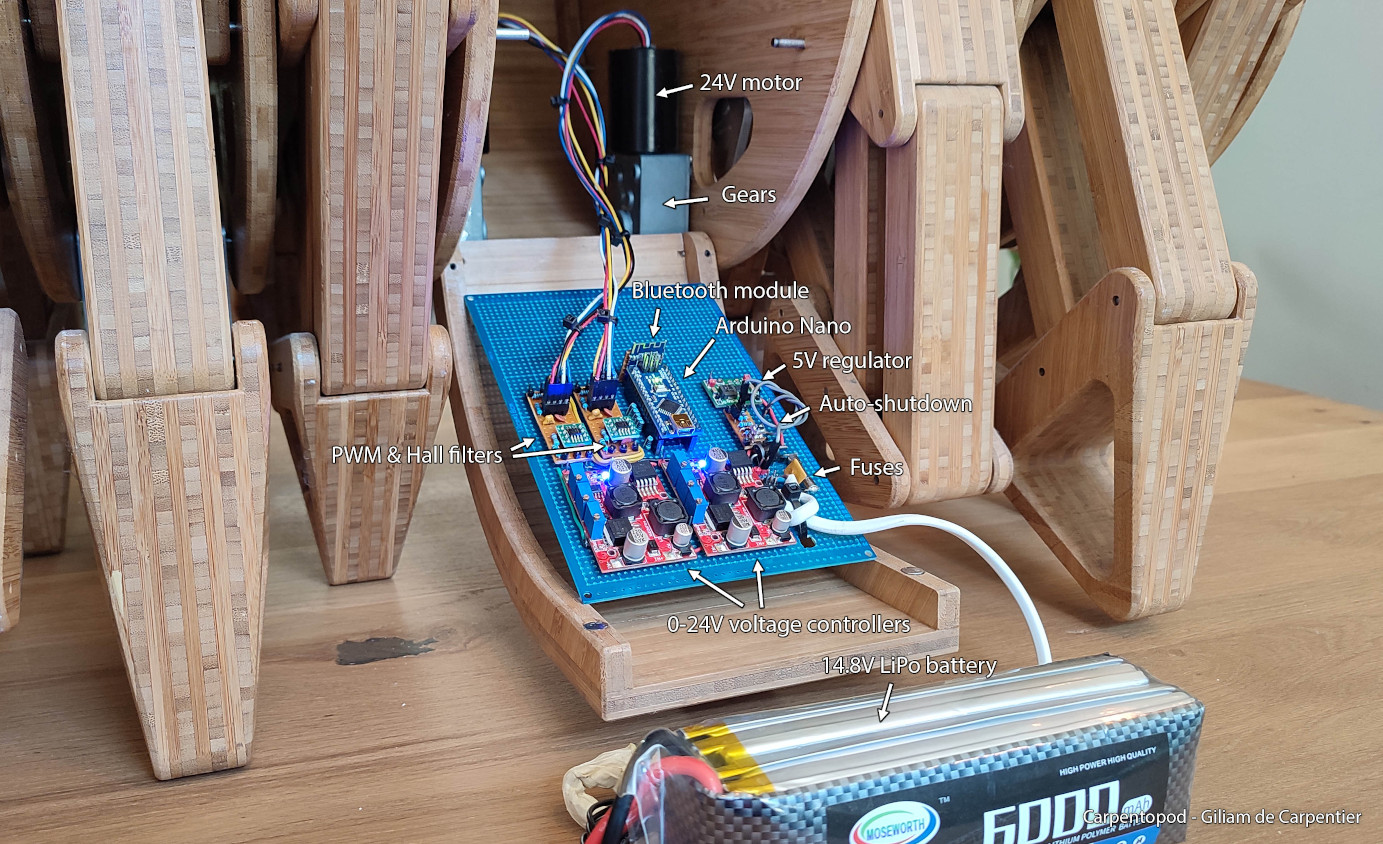
From there the design was moved to Fusion 360, where it could then be sent to a CNC machine to create all of the parts for the 12-legged table. An Arduino Nano controls the leg movements, with power to the legs’ crankshafts provided by 24 V brushless motors. Finally, a Bluetooth module is included to allow the table to receive commands from a modified Nintendo Wii “Nunchuk” — itself an impressive project that we covered back in 2020.

This project took an incredible amount of work not just to design the leg mechanisms but CNC machine them out of bamboo, glue everything together, and finish it into what would be an excellent example of woodworking even without the capability of moving the table from the wall to the middle of the room and back as needed. We can’t really say we’ve seen a mobile coffee table before either, wheeled or otherwise, but if you need the tabletop instead to rotate and position itself at arbitrary angles we have seen one which was designed to be used for metalworking.

youtube.com/embed/xKDY4yWxfJM?…


hackaday.com/2024/09/10/mobile…


The Privacy Post reshared this.

The Privacy Post ha ricondiviso questo.

The media in this post is not displayed to visitors. To view it, please go to the original post.

Assessing the Energy Efficiency of Programming Languages
poliverso.org/display/0477a01e…
Assessing the Energy Efficiency of Programming LanguagesProgramming languages are generally defined as a more human-friendly way to program computers than using raw machine code. Within the realm of these languages there is a wide range of how close the programmer is allowed to get to the bare metal, which ultimately can affect the performance and efficiency of the


Assessing the Energy Efficiency of Programming Languages


Programming languages are generally defined as a more human-friendly way to program computers than using raw machine code. Within the realm of these languages there is a wide range of how close the programmer is allowed to get to the bare metal, which ultimately can affect the performance and efficiency of the application. One metric that has become more important over the years is that of energy efficiency, as datacenters keep growing along with their power demand. If picking one programming language over another saves even 1% of a datacenter’s electricity consumption, this could prove to be highly beneficial, assuming it weighs up against all other factors one would consider.

There have been some attempts over the years to put a number on the energy efficiency of specific programming languages, with a paper by Rui Pereira et al. from 2021 (preprint PDF) as published in Science of Computer Programming covering the running a couple of small benchmarks, measuring system power consumption and drawing conclusions based on this. When Hackaday covered the 2017 paper at the time, it was with the expected claim that C is the most efficient programming language, while of course scripting languages like JavaScript, Python and Lua trailed far behind.

With C being effectively high-level assembly code this is probably no surprise, but languages such as C++ and Ada should see no severe performance penalty over C due to their design, which is the part where this particular study begins to fall apart. So what is the truth and can we even capture ‘efficiency’ in a simple ranking?

Defining Energy Efficiency


At its core, ‘energy efficiency’ is pretty simple to define: it’s the total amount of energy required to accomplish a specific task. In the case of a software application, this means the whole-system power usage, including memory, disk and processor(s). Measuring the whole-system power usage is also highly relevant, as not every programming and scripting language taxes these subsystems in the same way. In the case of Java, for example, its CPU usage isn’t that dissimilar from the same code written in C, but it will use significantly more memory in the process of doing so.

Two major confounding factors when it comes to individual languages are:

  • Idiomatic styles versus a focus on raw efficiency.
  • Native language features versus standard library features.

The idiomatic style factor is effectively some kind of agreed-upon language usage, which potentially eschews more efficient ways of accomplishing the exact same thing. Consider here for example C++, and the use of smart pointers versus raw pointers, with the former being part of the Standard Template Library (STL) instead of a native language feature. Some would argue that using an STL ‘smart pointer’ like a unique_ptr or auto_ptr is the idiomatic way to use C++, rather than the native language support for raw pointers, despite the overhead that these add.

A similar example is also due to C++ being literally just an extension to C, namely that of printf() and similar functions found in the <cstdio> standard library header. The idiomatic way to use C++ is to use the stream-based functions found in the <iostream> header, so that instead of employing low-level functions like putc() and straightforward formatted output functions like printf() to write this:
printf("Printing %d numbers and this string: %s.\n", number, string);
The idiomatic stream equivalent is:
std::cout << "Printing " << number << " numbers and this string: " << string << "." << std::endl;
Not only is the idiomatic version longer, harder to read, more convoluted and easier to get formatting wrong with, it is internally also significantly more complicated than a simple parse-and-replace and thus causes more overhead. This is why C++20 decided to double-down on stream formatting and fudging in printf-like support with std::format and other functions in the new <format> header. Because things can always get worse.

Know What You’re Measuring


At this point we have defined what energy efficiency with programming languages is, and touched upon a few confounding factors. All of this leads to the golden rule in science: know what you’re measuring. Or in less fanciful phrasing: ‘garbage in, garbage out’, as conclusions drawn from data using flawed assumptions truly are a complete waste of anyone’s time. Whether it was deliberate, due to wishful thinking or a flawed experimental setup, the end result is the same: a meticulously crafted document that can go straight into the shredder.

In this particular comparative analysis, the pertinent question is whether the used code is truly equivalent, as looking across the papers by Rui et al. (2017, 2021), Gordillo et al. (2024) or even a 2000 paper by Lutz Prechelt all reveal stark differences between the results, with seemingly the only constant being that ‘C is pretty good’, while a language such as C++ ends up being either very close to C (Gordillo et al., Prechelt) or wildly varying in tests (Rui et al.), all pointing towards an issue with the code being used, as power usage measurement and time measurement is significantly more straightforward to verify.

In the case of the 2021 paper by Rui et al., the code examples used come from Rosetta Code, with the code-as-used also provided on GitHub. Taking as example the Hailstone Sequence, we can see a number of fascinating differences between the C, C++ and Ada versions, particularly as it pertains to the use of console output and standard library versus native language features.

The C version of the Hailstone Sequence has two printf() statements, while the C++ version has no fewer than five instances of std::cout. The Ada version comes in at two put(), two new_line (which should be merged with put_line) and one put_line. This difference in console output is already a red flag, even considering that when benchmarking you should never have console output enabled as this draws in significant parts of the operating system, with resulting high levels of variability due to task scheduling, etc.

The next red flag is that while the Ada and C versions uses the native array type, the C++ version uses std::vector, which is absolutely not equivalent to an array and should not be used if efficiency is at all a concern due to the internal copying and house-keeping performed by the std::vector data structure.

If we consider that Rosetta Code is a communal wiki that does not guarantee that the code snippets provided are ‘absolutely equivalent’, that means that the resulting paper by Rui et al. is barely worth the trip to the shredder and consequently a total waste of a tree.

Not All Bad

None of this should come as a surprise, of course, as it is well-known (or should be) that C++ produces the exact same code as C unless you use specific constructs like RTTI or the horror show that is C++ exceptions. Similarly, Ada code with similar semantics as C code should not show significant performance differences. The problem with many of the ‘programming language efficiency’ studies is simply that they take a purported authoritative source of code without being fluent in the chosen languages, run them in a controlled environment and then draw conclusions based on the mangled garbage that comes out at the end.

That said, there are some conclusions that can be drawn from the fancy-but-horrifically-flawed tables, such as how comically inefficient scripting languages like Python are. This was also the take-away by Bryan Lunduke in a recent video when he noted that Python is 71 times slower and uses 75 times more energy based on the Rui et al. paper. Even if it’s not exactly 71 times slower, Python is without question a total snail even among scripting languages, where it trades blows with Perl, PHP and Ruby at the bottom of every ranking.

The take-away here is thus perhaps that rather than believing anything you see on the internet (or read in scientific papers), it pays to keep an open mind and run your own benchmarks. As eating your own dogfood is crucial in engineering, I can point to my own remote-procedure call (NymphRPC) library in C++ on which I performed a range of optimizations to reduce overhead. This mostly involved getting rid of std::string and moving to a zero-copy system involving C-isms like memcpy and every bit of raw pointer arithmetic and bit-wise operators goodness that is available.

The result for NymphRPC was a four-fold increase in performance, which is probably a good indication of how much performance you can gain if you stick close to C-style semantics. It also makes it obvious how limited these small code snippets are, as with a real application you also deal with cache access, memory alignment and cache eviction issues, all of which can turn a seemingly efficient approach into a sluggish affair.


hackaday.com/2024/09/10/assess…


The Privacy Post reshared this.

The Privacy Post ha ricondiviso questo.

Compromise on child sexual abuse law focuses on known material, simplifies authority roles
poliverso.org/display/0477a01e…
Compromise on child sexual abuse law focuses on known material, simplifies authority rolesA new compromise text sent by the Hungarian Presidency of the EU Council to delegations about the draft law to detect child sexual abuse material (CSAM), focuses on known material, possibly lessening concerns around the regulations' privacy


Compromise on child sexual abuse law focuses on known material, simplifies authority roles


A new compromise text sent by the Hungarian Presidency of the EU Council to delegations about the draft law to detect child sexual abuse material (CSAM), focuses on known material, possibly lessening concerns around the regulations' privacy implications.


euractiv.com/section/law-enfor…


The Privacy Post reshared this.

The Privacy Post ha ricondiviso questo.

The media in this post is not displayed to visitors. To view it, please go to the original post.

Arriva RAMBO! l’emissione Elettromagnetica della RAM consente di Rubare i Dati dai computer isolati
poliverso.org/display/0477a01e…
Arriva RAMBO! l’emissione Elettromagnetica della RAM consente di Rubare i Dati dai computer isolatiSiamo di fronte ad un nuovo e sofisticato side channel attack redhotcyber.com/post/cosa-sono…. L’attacco RAMBO (Radiation of Air-gapped Memory Bus for Offense), presentato da ricercatori israeliani, sfrutta l’emissione


Arriva RAMBO! l’emissione Elettromagnetica della RAM consente di Rubare i Dati dai computer isolati


Siamo di fronte ad un nuovo e sofisticato side channel attack. L’attacco RAMBO (Radiation of Air-gapped Memory Bus for Offense), presentato da ricercatori israeliani, sfrutta l’emissione elettromagnetica prodotta dalla memoria RAM per rubare dati da computer isolati fisicamente (air-gapped).

Attraverso un malware, i ricercatori hanno manipolano l’accesso alla memoria per generare segnali elettromagnetici rilevabili con dispositivi di ricezione SDR (Software Defined Radio). Anche se la velocità di trasmissione è relativamente bassa (fino a 1000 bit al secondo), è sufficiente per sottrarre informazioni sensibili come password o chiavi crittografiche. Questo attacco rappresenta una minaccia crescente soprattutto per sistemi ad alta sicurezza.

La RAM è stata a lungo considerata una parte non attaccabile direttamente nei sistemi informatici, ma la scoperta del team israeliano dimostra che la memoria volatile può essere utilizzata come vettore di attacco attraverso radiazioni elettromagnetiche. La particolarità di RAMBO è che riesce a superare le misure di sicurezza di isolamento fisico, sfruttando una vulnerabilità fisica nei sistemi di memoria che in precedenza non era stata considerata.

L’attacco non necessita di connessione diretta al computer preso di mira, ma solo della presenza di un ricevitore nelle vicinanze. Questi segnali elettromagnetici possono essere generati appositamente con modelli di accesso alla memoria RAM ben studiati, manipolati dal malware installato sul computer vittima.

La trasmissione dei dati è unidirezionale, quindi i criminali riescono a leggere i dati sensibili senza inviare alcun segnale che potrebbe compromettere il loro attacco.

Una delle sfide principali per i difensori di sistemi sensibili come quelli militari o finanziari è che i tradizionali metodi di sicurezza come firewall e software anti-malware non sono efficaci contro attacchi basati su radiazioni elettromagnetiche, in quanto non c’è interazione diretta con la rete o i sistemi di protezione. Anche se la velocità di trasmissione dei dati di RAMBO è bassa, questo attacco può essere eseguito nel tempo, permettendo ai criminali di raccogliere informazioni critiche.

Per prevenire attacchi come RAMBO, gli esperti di sicurezza consigliano l’adozione di misure fisiche come schermature elettromagnetiche, in particolare per le macchine ad alta criticità. L’implementazione di gabbie di Faraday intorno ai dispositivi potrebbe essere una soluzione efficace, poiché queste barriere bloccano i segnali elettromagnetici in uscita, impedendo la trasmissione non autorizzata dei dati.

RAMBO si inserisce in una crescente serie di attacchi volti a compromettere la sicurezza di sistemi air-gap, tradizionalmente considerati tra i più sicuri. A differenza di altri attacchi, RAMBO non richiede la compromissione di connessioni cablate o wireless convenzionali, rendendolo un vettore d’attacco estremamente subdolo e potenzialmente devastante per ambienti altamente protetti.

In sintesi, l’attacco RAMBO rappresenta una nuova e insidiosa minaccia che sfrutta le radiazioni elettromagnetiche della RAM per estrarre dati critici da sistemi isolati. La difesa contro tali attacchi richiede l’adozione di misure innovative e fisiche, oltre alla consueta protezione software, per garantire la sicurezza dei dati in ambienti sensibili.

Per maggiori dettagli sull’attacco RAMBO, puoi consultare l’articolo completo qui.

L'articolo Arriva RAMBO! l’emissione Elettromagnetica della RAM consente di Rubare i Dati dai computer isolati proviene da il blog della sicurezza informatica.


The Privacy Post ha ricondiviso questo.

Il compromesso su #Chatcontrol (scansione solo sul materiale noto) è una presa in giro rivenduta come soluzione rispettosa per la privacy

Il testo aggiornato, datato 9 settembre e visionato da Euractiv, sostiene di rispettare maggiormente la #privacy limitando la rilevazione ai contenuti che sono già in circolazione e che sono già stati rilevati.

TUTTAVIA il materiale multimediale verrà comunque scansionato prima di essere inviato

@privacypride

euractiv.com/section/law-enfor…

cc @echo_pbreyer

Questa voce è stata modificata (1 anno fa)
in reply to El Salvador

@salvadorbs beh non ci sarebbero veri falsi positivi, perché Al momento la scansione avviene solo su contenuti noti. Quello che può succedere però è che se un minore riceve un file di quel tipo su un telefono e un abbonamento di proprietà del genitore, attraverso un canale non presidiato e lo invia al genitore per avvertirlo del problema, passeranno i guai sia il ragazzo che il genitore

@Herco

Privacy Pride reshared this.

in reply to El Salvador

@salvadorbs il falso positivo avviene quando c'è un "riconoscimento ottico", mentre in questo caso ci sarebbe più che altro un confronto tra l'immagine rilevata e il dataset della polizia. Ecco perché i falsi positivi sono improbabili.
Ma il problema è che viene introdotto il rilevamento a monte. Questo è il Rubicone. Poi che davanti al rilevamento ci sarà solo il match o che ci sarà un riconoscimento ottico o chissà cos'altro, sarà irrilevante

@Herco

Privacy Pride reshared this.

The Privacy Post ha ricondiviso questo.

The media in this post is not displayed to visitors. To view it, please go to the original post.

Rescuing High-Res Displays from Older Macs
poliverso.org/display/0477a01e…
Rescuing High-Res Displays from Older MacsWhen Apple started rolling out its Retina displays, it multiplied the amount of pixels compared to their standard, non-Retina displays by four. This increased pixel density while keeping the standard screen size — idea for those needing a lot of detail for their work. But, as is common with Apple, using these displays outside of the Apple


Rescuing High-Res Displays from Older Macs


When Apple started rolling out its Retina displays, it multiplied the amount of pixels compared to their standard, non-Retina displays by four. This increased pixel density while keeping the standard screen size — idea for those needing a lot of detail for their work. But, as is common with Apple, using these displays outside of the Apple ecosystem can be quite a challenge. Retina displays have been around for about a decade now, though, with some third-party hardware able to break them free of their cage. This post details how [Kevin] liberated the 5K display from a 2017 iMac for more general use with support for USB-C.

The first step was to find a used iMac for the right price, and then sell off most of its parts to recoup most of the initial cost. That brought the cost of the panel itself to about $250. The key to getting the display working without all of the Apple hardware is the R1811 driver board, which can be had for around $300. A new 156 watt power supply was added to the mix, and [Kevin] also put in a few extras like a USB cable extension and a latching push-button which kills the display’s power. Additionally, he attempted to get the original iMac speakers working with this setup too, but none of his attempts resulted in anything close to quality sound so he’s mostly abandoned that extra feature for now.

With that all buttoned up, he has a 27″ 5K display with USB-C input for around $650 which is quite a deal. The MacRumors thread that [Kevin] added his project to currently has around 1,700 posts about similar builds too, so it can be a wealth of information for all kinds of models. As Apple drops support for their older machines, these displays will become more and more common and projects like these can keep a lot of e-waste out of the landfill while also providing decent hardware at a bargain price. Don’t just look for iMacs and MacBooks though; there’s a similar process to use various iPad displays for other things as well.


hackaday.com/2024/09/10/rescui…


The Privacy Post reshared this.

The Privacy Post ha ricondiviso questo.

The media in this post is not displayed to visitors. To view it, please go to the original post.

Se la Russia ci taglia Internet… la guerra ibrida intorno ai cavi sottomarini
poliverso.org/display/0477a01e…
Se la Russia ci taglia Internet… la guerra ibrida intorno ai cavi sottomariniSecondo i servizi occidentali, c'è un aumento dell'attività militare russa intorno ai cavi sottomarini delle comunicazioni.The post Se la Russia ci taglia Internet… la guerra ibrida intorno ai cavi sottomarini it.insideover.com/guerra/se-la… appeared first on


Se la Russia ci taglia Internet… la guerra ibrida intorno ai cavi sottomarini


Secondo i servizi occidentali, c'è un aumento dell'attività militare russa intorno ai cavi sottomarini delle comunicazioni.

The post Se la Russia ci taglia Internet… la guerra ibrida intorno ai cavi sottomarini appeared first on InsideOver.


The Privacy Post reshared this.

The Privacy Post ha ricondiviso questo.

The media in this post is not displayed to visitors. To view it, please go to the original post.

A Look At The Small Web, Part 1
poliverso.org/display/0477a01e…
A Look At The Small Web, Part 1In the early 1990s I was privileged enough to be immersed in the world of technology during the exciting period that gave birth to the World Wide Web, and I can honestly say I managed to completely miss those first stirrings of the information revolution in favour of CD-ROMs, a piece of technology which definitely didn’t have a future. I’ve written in the past about


A Look At The Small Web, Part 1


In the early 1990s I was privileged enough to be immersed in the world of technology during the exciting period that gave birth to the World Wide Web, and I can honestly say I managed to completely miss those first stirrings of the information revolution in favour of CD-ROMs, a piece of technology which definitely didn’t have a future. I’ve written in the past about that experience and what it taught me about confusing the medium with the message, but today I’m returning to that period in search of something else. How can we regain some of the things that made that early Web good?

We All Know What’s Wrong With The Web…


It’s likely most Hackaday readers could recite a list of problems with the web as it exists here in 2024. Cory Doctrow coined a word for it, enshitification, referring to the shift of web users from being the consumers of online services to the product of those services, squeezed by a few Internet monopolies. A few massive corporations control so much of our online experience from the server to the browser, to the extent that for so many people there is very little the touch outside those confines.
A screenshot of the first ever web pageThe first ever web page is maintained as a historical exhibit by CERN.
Contrasting the enshitified web of 2024 with the early web, it’s not difficult to see how some of the promise was lost. Perhaps not the web of Tim Berners-Lee and his NeXT cube, but the one of a few years later, when Netscape was the new kid on the block to pair with your Trumpet Winsock. CD-ROMs were about to crash and burn, and I was learning how to create simple HTML pages.

The promise then was of a decentralised information network in which we would all have our own websites, or homepages as the language of the time put it, on our own servers. Microsoft even gave their users the tools to do this with Windows, in that the least technical of users could put a Frontpage Express web site on their Personal Web Server instance. This promise seems fanciful to modern ears, as fanciful perhaps as keeping the overall size of each individual page under 50k, but at the time it seemed possible.

With such promise then, just how did we end up here? I’m sure many of you will chip in in the comments with your own takes, but of course, setting up and maintaining a web server is either hard, or costly. Anyone foolish enough to point their Windows Personal Web Server directly at the Internet would find their machine compromised by script kiddies, and having your own “proper” hosting took money and expertise. Free stuff always wins online, so in those early days it was the likes of Geocities or Angelfire which drew the non-technical crowds. It’s hardly surprising that this trend continued into the early days of social media, starting the inevitable slide into today’s scene described above.

…So Here’s How To Fix It


If there’s a ray of hope in this wilderness then, it comes in the shape of the Small Web. This is a movement in reaction to a Facebook or Google internet, an attempt to return to that mid-1990s dream of a web of lightweight self-hosted sites. It’s a term which encompases both lightweight use of traditional web tehnologies and some new ones designed more specifically to deliver lightweight services, and it’s fair to say that while it’s not going to displace those corporations any time soon it does hold the interesting prospect of providing an alternative. From a Hackaday perspective we see Small Web technologies as ideal for serving and consuming through microcontroller-based devices, for instance, such as event badges. Why shouldn’t a hacker camp badge have a Gemini client which picks up the camp schedule, for example? Because the Small Web is something of a broad term, this is the first part of a short series providing an introduction to the topic. We’ve set out here what it is and where it comes from, so it’s now time to take a look at some of those 1990s beginnings in the form of Gopher, before looking at what some might call its spiritual successors today.
A screenshot of a browser with a very plain text page.An ancient Firefox version shows us a Gopher site. Ph0t0phobic, MPL 1.1.
It’s odd to return to Gopher after three decades, as it’s one of those protocols which was for most of us immediately lost as the Web gained traction. Particulrly as at the time I associated Gopher with CLI base clients and the Web with the then-new NCSA Mosaic, I’d retained that view somehow. It’s interesting then to come back and look at how the first generation of web browsers rendered Gopher sites, and see that they did a reasonable job of making them look a lot like the more texty web sites of the day. In another universe perhaps Gopher would have evolved further to something more like the web, but instead it remains an ossifed glimpse of 1992 even if there are still a surprising number of active Gopher servers still to be found. There’s a re-imagined version of the Veronica search engine, and some fun can be had browsing this backwater.

With the benefit of a few decades of the Web it’s immediately clear that while Gopher is very fast indeed in the days of 64-bit desktops and gigabit fibre, the limitations of what it can do are rather obvious. We’re used to consuming information as pages instead of as files, and it just doesn’t meet those expectations. Happily though Gopher never made those modifications, there’s something like what it might have become in Gemini. This is a lightweight protocol like Gopher, but with a page format that allows hyperlinking. Intentionally it’s not simply trying to re-implement the web and HTML, instead it’s trying to preserve the simplicity while giving users the hyperlinking that makes the web so useful.
A Kennedy search engine Gemini search page for "Hackaday".It feels a lot like the early 1990s Web, doesn’t it.
The great thing about Gemini is that it’s easy to try. The Gemini protocol website has a list of known clients, but if even that’s too much, find a Gemini to HTTP proxy (I’m not linking to one, to avoid swamping someone’s low traffic web server). I was soon up and running, and exploring the world of Gemini sites. Hackaday don’t have a presence there… yet.

We’ve become so used to web pages taking a visible time to load, that the lightning-fast response of Gemini is a bit of a shock at first. It’s normal for a web page to contain many megabytes of images, Javascript, CSS, and other resources, so what is in effect the Web stripped down to only the information is unexpected. The pages are only a few K in size and load in effect, instantaneously. This may not be how the Web should be, but it’s certainly how fast and efficient hypertext information should be.

This has been part 1 of a series on the Small Web, in looking at the history and the Gemini protocol from a user perspective we know we’ve only scratched the surface of the topic. Next time we’ll be looking at how to create a Gemini site of your own, through learning it ourselves.


hackaday.com/2024/09/10/a-look…


The Privacy Post reshared this.

The Privacy Post ha ricondiviso questo.

The media in this post is not displayed to visitors. To view it, please go to the original post.

NoiseAttack: il nuovo attacco backdoor multi-target che sfida le difese AI
poliverso.org/display/0477a01e…
NoiseAttack: il nuovo attacco backdoor multi-target che sfida le difese AII ricercatori hanno sviluppato arxiv.org/pdf/2409.02251 un nuovo metodo di attacco backdoor chiamato NoiseAttack, capace di compromettere più classi contemporaneamente con un minimo di configurazione. A differenza dei precedenti approcci che si concentrano su una singola classe,


NoiseAttack: il nuovo attacco backdoor multi-target che sfida le difese AI


I ricercatori hanno sviluppato un nuovo metodo di attacco backdoor chiamato NoiseAttack, capace di compromettere più classi contemporaneamente con un minimo di configurazione. A differenza dei precedenti approcci che si concentrano su una singola classe, NoiseAttack utilizza la densità spettrale di potenza del rumore gaussiano bianco (WGN) come trigger invisibile durante la fase di addestramento.

I test sperimentali mostrano che NoiseAttack ottiene alti tassi di successo su diversi modelli e set di dati, eludendo i sistemi di rilevamento delle backdoor più avanzati.

Quando si parla di “più classi” in riferimento a NoiseAttack, si intende che l’attacco non si limita a colpire una sola categoria o classe di dati in un modello di classificazione. Invece, può prendere di mira contemporaneamente più classi, inducendo errori in varie categorie di output. Ciò significa che il modello può essere manipolato per commettere errori in diverse classificazioni contemporaneamente, rendendo l’attacco più versatile e potente.
Una panoramica del NoiseAttack proposto
Il rumore gaussiano bianco (WGN) utilizzato in NoiseAttack è impercettibile e applicato universalmente, ma attivato solo su campioni selezionati per indurre classificazioni errate su più etichette target.

Questo metodo consente un attacco backdoor multi-target su modelli di deep learning senza compromettere le prestazioni sugli input non compromessi.

Addestrando il modello su un dataset contaminato con WGN accuratamente applicato, gli avversari possono causare classificazioni errate intenzionali, superando le difese avanzate e offrendo grande flessibilità nel controllo delle etichette di destinazione.
Una panoramica della preparazione del set di dati avvelenato
Il framework elude efficacemente le difese all’avanguardia e raggiunge alti tassi di successo degli attacchi su vari set di dati e modelli. Introducendo rumore gaussiano bianco nelle immagini di input, NoiseAttack può classificarle erroneamente in etichette mirate senza influire in modo significativo sulle prestazioni del modello su dati puliti.

Attraverso analisi teoriche ed esperimenti approfonditi, gli autori dimostrano la fattibilità e l’ubiquità di questo attacco. NoiseAttack raggiunge alti tassi di successo medi degli attacchi su vari set di dati e modelli senza influire in modo significativo sulla precisione per le classi di non vittime.

L'articolo NoiseAttack: il nuovo attacco backdoor multi-target che sfida le difese AI proviene da il blog della sicurezza informatica.


The Privacy Post reshared this.

The Privacy Post ha ricondiviso questo.

Microsoft manda in discarica gli ActiveX in Office 2024 per impostazione predefinita
poliverso.org/display/0477a01e…
Microsoft manda in discarica gli ActiveX in Office 2024 per impostazione predefinitaMicrosoft securitylab.ru/glossary/Micros…ha annunciato un importante cambiamento nel funzionamento delle app di Office a partire da ottobre 2024. Nella nuova versione di Office 2024, i controlli ActiveX saranno disabilitati per impostazione predefinita in Word,


Microsoft manda in discarica gli ActiveX in Office 2024 per impostazione predefinita


Microsoft ha annunciato un importante cambiamento nel funzionamento delle app di Office a partire da ottobre 2024. Nella nuova versione di Office 2024, i controlli ActiveX saranno disabilitati per impostazione predefinita in Word, Excel, PowerPoint e Visio. La decisione riguarderà innanzitutto le applicazioni desktop Office Win32 e, da aprile 2025, gli utenti di Microsoft 365.

ActiveX è una tecnologia legacy introdotta per la prima volta nel 1996. Ha consentito agli sviluppatori di incorporare oggetti interattivi nei documenti di Office. Tuttavia, a partire dalla nuova versione di Office, le impostazioni di sicurezza cambieranno e i controlli ActiveX saranno disabilitati per impostazione predefinita.

Gli utenti non saranno più in grado di creare o interagire con oggetti ActiveX nei documenti. Invece, questi elementi appariranno come immagini statiche, il che potrebbe causare inconvenienti a coloro il cui lavoro in precedenza dipendeva da questi oggetti.

La tecnologia ActiveX è da tempo fonte di preoccupazione a causa delle vulnerabilità della sicurezza. Gli hacker hanno utilizzato ripetutamente ActiveX per distribuire malware, inclusi i famosi attacchi TrickBot e Cobalt Strike. Gli attacchi hanno consentito agli aggressori di penetrare nelle reti aziendali installando malware tramite documenti Word con controlli ActiveX incorporati.

Dopo l’implementazione delle modifiche, gli utenti che necessitano di abilitare i controlli ActiveX nei documenti di Office possono ripristinare le impostazioni predefinite precedenti utilizzando uno dei metodi seguenti:

  • Nella finestra di dialogo Impostazioni Centro protezione, sotto Opzioni ActiveX, seleziona l’opzione “Richiedi conferma prima di abilitare tutti i controlli meno restrittivi”;
  • Nel Registro di sistema impostare il valore HKEY_CURRENT_USER\Software\Microsoft\Office\Common\Security\DisableAllActiveX su 0 (REG_DWORD);
  • Imposta quindi DisableAllActiveX su 0.

La disabilitazione di ActiveX fa parte degli sforzi più ampi di Microsoft per migliorare la sicurezza dei suoi prodotti. Negli ultimi anni l’azienda ha costantemente implementato misure volte a bloccare funzioni potenzialmente pericolose in Office e Windows. Le misure includono il blocco delle macro VBA e XLM, l’introduzione della sicurezza per XLM e il blocco dei componenti aggiuntivi XLL non attendibili.

Inoltre, nel 2024, Microsoft prevede di abbandonare definitivamente VBScript, un’altra tecnologia associata a vulnerabilità. Si prevede che VBScript diventi un’opzione on-demand e quindi venga completamente rimosso dai prodotti dell’azienda.

Le aziende che utilizzano ActiveX per automatizzare i processi devono essere preparate a possibili ritardi e maggiori costi per il supporto tecnico e la configurazione. Gli amministratori IT si troveranno ad affrontare la necessità di formare i dipendenti e fornire risorse aggiuntive per ripristinare la funzionalità ActiveX o trovare soluzioni alternative.

Le modifiche a Office potrebbero causare insoddisfazione tra gli utenti abituati alle vecchie funzionalità. Un improvviso arresto di strumenti familiari può avere un impatto negativo sulla produttività e sulla soddisfazione dei dipendenti. Inoltre, i documenti creati utilizzando ActiveX potrebbero diventare inutilizzabili o richiedere modifiche significative.

L'articolo Microsoft manda in discarica gli ActiveX in Office 2024 per impostazione predefinita proviene da il blog della sicurezza informatica.


The Privacy Post reshared this.

The Privacy Post ha ricondiviso questo.

The media in this post is not displayed to visitors. To view it, please go to the original post.

Shedding New Light on the Voynich Manuscript With Multispectral Imaging
poliverso.org/display/0477a01e…
Shedding New Light on the Voynich Manuscript With Multispectral ImagingThe Voynich Manuscript is a medieval codex written in an unknown alphabet and is replete with fantastic illustrations as unusual and bizarre as they are esoteric. It has captured interest for hundreds of years, and expert [Lisa Fagin Davis] shared interesting results from using


Shedding New Light on the Voynich Manuscript With Multispectral Imaging


The Voynich Manuscript is a medieval codex written in an unknown alphabet and is replete with fantastic illustrations as unusual and bizarre as they are esoteric. It has captured interest for hundreds of years, and expert [Lisa Fagin Davis] shared interesting results from using multispectral imaging on some pages of this highly unusual document.

We should make it clear up front that the imaging results have not yielded a decryption key (nor a secret map or anything of the sort) but the detailed write-up and freely-downloadable imaging results are fascinating reading for anyone interested in either the manuscript itself, or just how exactly multispectral imaging is applied to rare documents. Modern imaging techniques might get leveraged into things like authenticating sealed packs of Pokémon cards, but that’s not all it can do.

Because multispectral imaging involves things outside our normal perception, the results require careful analysis rather than intuitive interpretation. Here is one example: multispectral imaging may yield faded text visible “between the lines” of other text and invite leaping to conclusions about hidden or erased content. But the faded text could be the result of show-through (content from the opposite side of the page is being picked up) or an offset (when a page picks up ink and pigment from its opposing page after being closed for centuries.)

[Lisa] provides a highly detailed analysis of specific pages, and explains the kind of historical context and evidence this approach yields. Make some time to give it a read if you’re at all interested, we promise it’s worth your while.


hackaday.com/2024/09/10/sheddi…


The Privacy Post reshared this.

The Privacy Post ha ricondiviso questo.

The EU AI Office needs top scientific talent, not familiar faces
poliverso.org/display/0477a01e…
The EU AI Office needs top scientific talent, not familiar facesThe European Commission shouldn’t hire internally for its lead scientific advisor on artificial intelligence (AI), writes Alex Petropolos and Max Reddel.euractiv.com/section/digital/o…


The EU AI Office needs top scientific talent, not familiar faces


The European Commission shouldn’t hire internally for its lead scientific advisor on artificial intelligence (AI), writes Alex Petropolos and Max Reddel.


euractiv.com/section/digital/o…


The Privacy Post reshared this.

The Privacy Post ha ricondiviso questo.

Top EU Court rejects Google’s appeal of €2.42 billion fine in Shopping case
poliverso.org/display/0477a01e…
Top EU Court rejects Google’s appeal of €2.42 billion fine in Shopping case The Court of Justice of the European Union (CJEU) upheld the European Commission's €2.42 billion fine against Google over allegations it abused its dominant position in the search engine market.euractiv.com/section/platforms…

The Privacy Post reshared this.

The Privacy Post ha ricondiviso questo.

Top EU court orders Apple to pay €13 billion tax bill
poliverso.org/display/0477a01e…
Top EU court orders Apple to pay €13 billion tax billApple must pay a €13 billion tax bill as per a ruling from the European Court of Justice (ECJ), which experts deem gives weight to Ireland being dubbed, by some, a 'tax-safe haven'.euractiv.com/section/competiti…


Top EU court orders Apple to pay €13 billion tax bill


Apple must pay a €13 billion tax bill as per a ruling from the European Court of Justice (ECJ), which experts deem gives weight to Ireland being dubbed, by some, a 'tax-safe haven'.


euractiv.com/section/competiti…


The Privacy Post reshared this.

The Privacy Post ha ricondiviso questo.

The media in this post is not displayed to visitors. To view it, please go to the original post.

Slim Tactile Switches Save Classic TI Calculator with a Bad Keypad
poliverso.org/display/0477a01e…
Slim Tactile Switches Save Classic TI Calculator with a Bad KeypadFor vintage calculator fans, nothing strikes more fear than knowing that someday their precious and irreplaceable daily driver will become a museum piece to be looked at and admired — but never touched again. More often than not, the failure mode will be the keypad.In an effort to recover from the


Slim Tactile Switches Save Classic TI Calculator with a Bad Keypad


For vintage calculator fans, nothing strikes more fear than knowing that someday their precious and irreplaceable daily driver will become a museum piece to be looked at and admired — but never touched again. More often than not, the failure mode will be the keypad.

In an effort to recover from the inevitable, at least for 70s vintage TI calculators, [George] has come up with these nice replacement keypad PCBs. The original membrane switches on these calculators have a limited life, but luckily there are ultra-slim SMD tactile switches these days make a dandy substitute. [George] specifies a 0.8 mm thick switch that when mounted on a 1.6 mm thick PCB comes in just a hair over the original keypad’s 2.2 mm thickness. He has layouts for a TI-45, which should also fit a TI-30, and one for the larger keypads on TI-58s and TI-59s.

While these particular calculators might not in your collection, [George]’s goal is to create an open source collection of replacement keypads for all the vintage calculators sitting in desk drawers out there. And not just keypads, but battery packs, too.


hackaday.com/2024/09/10/slim-t…


The Privacy Post reshared this.

The Privacy Post ha ricondiviso questo.

The media in this post is not displayed to visitors. To view it, please go to the original post.

L’intelligenza artificiale nello spazio, la nuova frontiera della Difesa Usa e Ue
poliverso.org/display/0477a01e…
L’intelligenza artificiale nello spazio, la nuova frontiera della Difesa Usa e UeNel contesto della crescente competizione spaziale tra Stati Uniti e Cina, Washington sta sfruttando le competenze europee.The post L’intelligenza artificiale nello spazio, la nuova frontiera della Difesa Usa e Ue it.insideover.com/difesa/linte… appeared first on


L’intelligenza artificiale nello spazio, la nuova frontiera della Difesa Usa e Ue


Nel contesto della crescente competizione spaziale tra Stati Uniti e Cina, Washington sta sfruttando le competenze europee.

The post L’intelligenza artificiale nello spazio, la nuova frontiera della Difesa Usa e Ue appeared first on InsideOver.


The Privacy Post reshared this.

The Privacy Post ha ricondiviso questo.

Draghi’s report is the third to sound alarm on telecom competition policy
poliverso.org/display/0477a01e…
Draghi’s report is the third to sound alarm on telecom competition policyLarge EU telcos said Draghi's report sounded the alarm over the state of EU's telecom competition policy, consumer associations and smaller telecom companies are repeating their stance against these findings.euractiv.com/section/digital/n…


Draghi’s report is the third to sound alarm on telecom competition policy


Large EU telcos said Draghi's report sounded the alarm over the state of EU's telecom competition policy, consumer associations and smaller telecom companies are repeating their stance against these findings.


euractiv.com/section/digital/n…


The Privacy Post reshared this.