Cybersecurity & cyberwarfare ha ricondiviso questo.

The media in this post is not displayed to visitors. To view it, please go to the original post.

Quando il segnale muore, il potere vince: il blackout digitale dell’Iran

📌 Link all'articolo : redhotcyber.com/post/quando-il…

A volte le cose importanti non arrivano in conferenza stampa. Arrivano come un grafico che smette di respirare: la linea della connettività che crolla, l’OSINT che si inaridisce, il rumore che cresce perché il segnale sparisce.

In Iran, la crisi interna e la dimensione cyber stanno entrando nella stessa stanza. E quando succede, la domanda non è più solo «che cosa sta accadendo?», ma «chi sta controllando la prova di ciò che accade?».

A cura di Roberto Villani

#redhotcyber #news #iran #crisipolitica #crisidigitale #censurainternet #connessionelimitate #governocontrollo #percezionecontrollo #protesteonline #repressionedigitale #libertadiparola #dirittiumani #cibernetica

reshared this

Cybersecurity & cyberwarfare ha ricondiviso questo.

The media in this post is not displayed to visitors. To view it, please go to the original post.

Microsoft investe nei cavi sottomarini: nuova rete globale tra America, Europa e Asia

📌 Link all'articolo : redhotcyber.com/post/microsoft…

#redhotcyber #news #caviSottomarini #infrastrutturaGlobale #reteInformatica #microsoft #dataCenter

Cybersecurity & cyberwarfare ha ricondiviso questo.

The media in this post is not displayed to visitors. To view it, please go to the original post.

Vulnerabilità critica in ServiceNow: i rischi sono lo spoofing dell’identità

📌 Link all'articolo : redhotcyber.com/post/vulnerabi…

#redhotcyber #news #cybersecurity #hacking #servicenow #vulnerabilita #sicurezzainformatica #bug

Cybersecurity & cyberwarfare ha ricondiviso questo.

The media in this post is not displayed to visitors. To view it, please go to the original post.

Il vero rischio dell’AI non è che sbagli, ma che funzioni troppo bene

📌 Link all'articolo : redhotcyber.com/post/il-vero-r…

#redhotcyber #news #intelligenzaartificiale #sicurezzacibernetica #risichias #cybersecurity #malware #hacking

Avventure domotiche con Zigbee


@Informatica (Italy e non Italy 😁)
TL;DR Una serie di chiacchierate tra colleghi sulla domotica domestica mi ha stimolato a scrivere un articolo per aiutare chi sta affacciandosi al mondo dell'automazione domestica.
Source

L'articolo proviene dal blog #ZeroZone di zerozone.it/arduino-esp-e-iot/…

Cybersecurity & cyberwarfare ha ricondiviso questo.

U.S. #CISA adds a flaw in #Gogs to its Known Exploited Vulnerabilities catalog
securityaffairs.com/186837/hac…
#securityaffairs #hacking
Cybersecurity & cyberwarfare ha ricondiviso questo.

#Meta fixes #Instagram #password #reset flaw, denies data breach
securityaffairs.com/186829/sec…
#securityaffairs #hacking
Cybersecurity & cyberwarfare ha ricondiviso questo.

The media in this post is not displayed to visitors. To view it, please go to the original post.

Avvelenare l’Intelligenza Artificiale dall’interno: nasce il progetto Poison Fountain

📌 Link all'articolo : redhotcyber.com/post/avvelenar…

#redhotcyber #news #intelligenzaartificiale #vulnerabilitainformatica #cybersecurity #hacking #malware

Cybersecurity & cyberwarfare ha ricondiviso questo.

NEW: Betterment said hackers gained access to some customers' "names, email addresses and postal addresses, phone numbers, and dates of birth," and then used that info to send a crypto-related phishing attack.

The hackers reportedly made a few thousand dollars.

techcrunch.com/2026/01/12/fint…

Cybersecurity & cyberwarfare ha ricondiviso questo.

La funzionalità porno deepfake di X violano i TOS degli store: ma Tim Cook e Sundar Pichai sono dei codardi

!Da quando Grok spoglia donne e bambini, ho atteso quello che davo per scontato fosse inevitabile: la rimozione di X dagli app store di Apple e Google. Il fatto che ciò non sia ancora accaduto mi dice qualcosa di serio sulla leadership della Silicon Valley: Tim Cook e Sundar Pichai sono codardi senza spina dorsale terrorizzati da Elon Musk.!

theverge.com/policy/859902/app…

@eticadigitale

in reply to informapirata ⁂

so esattamente cos'è, ma i TOS degli Store non sono specifici, quantomeno quello di App Store che parla genericamente di contenuti offensivi (almeno dando per buono quello che dice l'articolo).
A ogni modo quanto ho affermato resta valido: se quelle regole fossero effettivamente applicate dovrebbero saltare dagli store sia i social che i Browser, quindi dire che Apple e Google temono musk è un po' una forzatura

Etica Digitale (Feddit) reshared this.

Raccolta dati e AI, come informare correttamente gli interessati: le raccomandazioni


@Informatica (Italy e non Italy 😁)
La CNIL chiarisce come informare gli utenti/interessati quando si utilizzano sistemi di intelligenza artificiale, rendendo note delle linee guida molto operative e altrettanto dettagliate circa gli obblighi di trasparenza quando si raccolgono

Cos’è la guerra cognitiva e qual è la posizione della NATO


@Informatica (Italy e non Italy 😁)
Il paradigma della sicurezza globale è al centro di un cambiamento sostanziale. La NATO ha formalizzato la guerra cognitiva come nuova frontiera per la superiorità strategica. Cosa è la guerra cognitiva e quali sono i rischi che la caratterizzano
L'articolo Cos’è la guerra cognitiva e qual è la posizione della NATO

Il caso OVH, quando il Canada sfida la sovranità digitale UE: i rischi per i nostri dati


@Informatica (Italy e non Italy 😁)
Un tribunale canadese ha ordinato a OVHcloud di consegnare dati di clienti archiviati in Europa, creando un conflitto con il diritto francese e mettendo alla prova la sovranità digitale europea. Un caso in cui non è la geografia dei

reshared this

Cybersecurity & cyberwarfare ha ricondiviso questo.

The media in this post is not displayed to visitors. To view it, please go to the original post.

Quando parliamo di infrastrutture critiche, sovranità digitale e resilienza del Paese, ricordiamoci sempre di lui:

#redhotcyber #meme4cyber #meme #comico #cyber #hacking #hacker #infosec #infosecurity #quotes #meme

Cybersecurity & cyberwarfare ha ricondiviso questo.

The media in this post is not displayed to visitors. To view it, please go to the original post.

154 miliardi di dollari sporchi in crypto: gli Stati ora usano l’infrastruttura criminale

📌 Link all'articolo : redhotcyber.com/post/154-milia…

#redhotcyber #news #criptovalute #mercatocrypto #attivitailegali #sanzionicrypto #restrizioniblockchain

Cybersecurity & cyberwarfare ha ricondiviso questo.

The media in this post is not displayed to visitors. To view it, please go to the original post.

195 – Se utilizzi l’AI in azienda, devi fare queste cose subito camisanicalzolari.it/195-se-ut…
Cybersecurity & cyberwarfare ha ricondiviso questo.

The media in this post is not displayed to visitors. To view it, please go to the original post.

Truffe su abbonamento: il nuovo volto industriale del “pig butchering”

📌 Link all'articolo : redhotcyber.com/post/truffe-su…

#redhotcyber #news #truffeonline #pigbutchering #cybersecurity #hacking #malware #phishing

Cybersecurity & cyberwarfare ha ricondiviso questo.

Europol and Spanish Police arrest 34 in crackdown on #Black #Axe criminal network
securityaffairs.com/186819/sec…
#securityaffairs #hacking
Cybersecurity & cyberwarfare ha ricondiviso questo.

Scorza: “Il 2026 sulle barricate per difendere regole e democrazia”

La rivolta anti-regolazione del 2025 punta a far dettare le “regole” dalla tecnologia. Le norme restano lo scudo dei diritti: innovazione vera è distribuire i benefici a tutti

agendadigitale.eu/cultura-digi…

@eticadigitale

Cybersecurity & cyberwarfare ha ricondiviso questo.

The media in this post is not displayed to visitors. To view it, please go to the original post.

🔴 Benvenuta in Red Hot Cyber Cyber Angels 🔴

📩 Chi fosse interessata a partecipare alle RHC Cyber Angels può inviare la sua candidatura a
👉 redazione@redhotcyber.com

#redhotcyber #rhccyberangels #hacking #benesseredigitale #cti #ai #online #it #cybercrime #cybersecurity

Cybersecurity & cyberwarfare ha ricondiviso questo.

The media in this post is not displayed to visitors. To view it, please go to the original post.

Il rientro in ufficio: quando la vera sbornia è quella cyber

📌 Link all'articolo : redhotcyber.com/post/il-rientr…

#redhotcyber #news #cybersecurity #hacking #malware #ransomware #dataleak #sicurezzainformatica #minaccecyber

Cybersecurity & cyberwarfare ha ricondiviso questo.

The media in this post is not displayed to visitors. To view it, please go to the original post.

Apache Struts 2: un nuovo bug di sicurezza mette a rischio le applicazioni aziendali

📌 Link all'articolo : redhotcyber.com/post/apache-st…

#redhotcyber #news #cybersecurity #hacking #vulnerabilita #apache #struts2 #frameworkjava #sicurezzainformatica

Cybersecurity & cyberwarfare ha ricondiviso questo.

Credential-harvesting attacks by #APT28 hit Turkish, European, and Central Asian organizations
securityaffairs.com/186801/apt…
#securityaffairs #hacking
Cybersecurity & cyberwarfare ha ricondiviso questo.

La battaglia per la libertà cognitiva nell'era dell'intelligenza artificiale aziendale

La libertà di pensiero non è solo uno scudo contro le intrusioni, è il terreno su cui costruiamo tutto il resto: il diritto di esprimersi, dissentire, credere, imparare, amare. Richiede sia libertà negative (da manipolazione, sorveglianza, coercizione) sia positive (di immaginare alternative, di cercare la verità, di plasmare le nostre opinioni e preferenze).

techpolicy.press/the-battle-fo…

@aitech

Cybersecurity & cyberwarfare ha ricondiviso questo.

The media in this post is not displayed to visitors. To view it, please go to the original post.

🚀 APERTE LE ISCRIZIONI ALLA PRIMA LIVE CLASS DEL CORSO "CYBER OFFENSIVE FUNDAMENTALS" – LIVELLO BASE 🚀

Per info e iscrizioni: 📞 379 163 8765 ✉️ formazione@redhotcyber.com

✅ Scopri il programma completo : redhotcyber.com/linksSk2L/cybe…

#redhotcyber #formazione #pentesting #pentest #formazioneonline #ethicalhacking #hacking #cybersecurity #penetrationtesting #cti #cybercrime #infosec #corsi #liveclass #hackerhood #pentesting

Cybersecurity & cyberwarfare ha ricondiviso questo.

The media in this post is not displayed to visitors. To view it, please go to the original post.

Al via CyberAngels: il volto umano e tutto al femminile di Red Hot Cyber

📌 Link all'articolo : redhotcyber.com/post/al-via-cy…

#redhotcyber #news #cyberangels #rhccyberangels #sicurezzainformatica #minacceinformatiche

Cybersecurity & cyberwarfare ha ricondiviso questo.

The media in this post is not displayed to visitors. To view it, please go to the original post.

Domini italiani esposti su forum underground. C’è anche un ospedale

📌 Link all'articolo : redhotcyber.com/post/domini-it…

#redhotcyber #news #cybersecurity #hacking #malware #ransomware #sicurezzainformatica #violazioneconti #ftp

reshared this

Cybersecurity & cyberwarfare ha ricondiviso questo.

The media in this post is not displayed to visitors. To view it, please go to the original post.

🚀 RHC CONFERENCE 2026 (V EDIZIONE) - LOADING …

📍 Pagina dell'evento: redhotcyber.com/red-hot-cyber-…

Le sponsorizzazioni termineranno il 28 Febbraio. Per info sponsor@redhotcyber.com.

#redhotcyber #rhcconference #conferenza #informationsecurity #ethicalhacking #dataprotection

Cybersecurity & cyberwarfare ha ricondiviso questo.

The media in this post is not displayed to visitors. To view it, please go to the original post.

Mai più Influenza? La tecnologia CRISPR si evolve grazie all’Intelligenza Artificiale

📌 Link all'articolo : redhotcyber.com/post/mai-piu-i…

#redhotcyber #news #tecnologiaCRISPR #virusdellinfluenza #RNA #prevenzionedeldiffusione #codicegenetico

Cybersecurity & cyberwarfare ha ricondiviso questo.

The media in this post is not displayed to visitors. To view it, please go to the original post.

Jailbreak nel Dark Web: così un ricercatore italiano ha hackerato i segreti dell’AI criminale

📌 Link all'articolo : redhotcyber.com/post/jailbreak…

#redhotcyber #news #cybersecurity #hacking #malware #darkweb #telegram #chatbot #intelligenzaartificiale

It’s Not a Leica, It’s a Lumix


The media in this post is not displayed to visitors. To view it, please log in.

There’s an old adage in photography that the best camera in the world is the one in your hand when the shot presents itself, but there’s no doubt that a better camera makes a difference to the quality of the final image. Among decent quality cameras the Leica rangefinder models have near cult-like status, but the problem is for would-be Leica owners that they carry eye-watering prices. [Cristian Băluță] approached this problem in s special way, by crafting a Leica-style body for a Panasonic Lumix camera. Given the technology relationship between the Japanese and German companies, we can see the appeal.

While the aesthetics of a Leica are an important consideration, the ergonomics such as the position of the lens on the body dictated the design choices. He was fortunate that the internal design of the Lumix gave plenty of scope for re-arrangement of parts, given that cameras are often extremely packed internally. Some rather bold surgery to the Lumix mainboard and a set of redesigned flex PCBs result in all the parts fitting in the CNC machined case, and the resulting camera certainly looks the part.

The write-up is in part a journey through discovering the process of getting parts manufactured, but it contains a lot of impressive work. Does the performance of the final result match up to its looks? We’ll leave you to be the judge of that. Meanwhile, take a look at another Leica clone.


hackaday.com/2026/01/08/its-no…

The Time Clock Has Stood the Test of Time


The media in this post is not displayed to visitors. To view it, please log in.

No matter the item on my list of childhood occupational dreams, one constant ran throughout: I saw myself using an old-fashioned punch clock with the longish time cards and everything. I now realize that I have some trouble with the daily transitions of life. In my childish wisdom, I somehow knew that doing this one thing would be enough to signify the beginning and end of work for the day, effectively putting me in the mood, and then pulling me back out of it.

But that day never came. Well, it sort of did this year. I realized a slightly newer dream of working at a thrift store, and they use something that I feel like I see everywhere now that I’ve left the place — a system called UKG that uses mag-stripe cards to handle punches. No it was not the same as a real punch clock, not that I have experience with a one. And now I just want to use one even more, to track my Hackaday work and other projects. At the moment, I’m torn between wanting to make one that uses mag-stripe cards or something, and just buying an old punch clock from eBay.

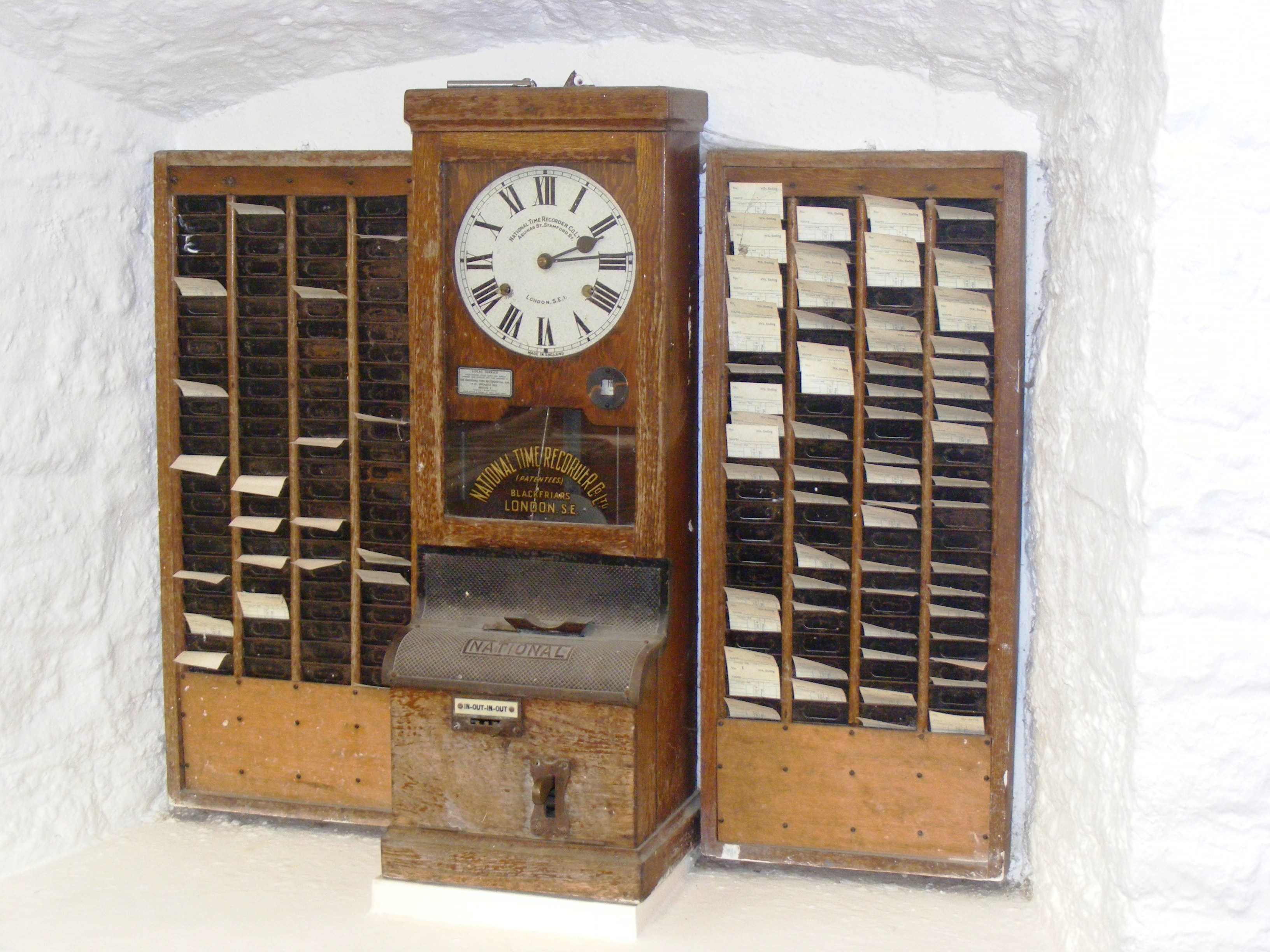
I keep calling it a ‘punch clock’, but it has a proper name, and that is the Bundy clock. I soon began to wonder how these things could both keep exact time mechanically, but also create a literal inked stamp of said time and date. I pictured a giant date stamper, not giant in all proportions, but generally larger than your average handheld one because of all the mechanisms that surely must be inside the Bundy clock. So, how do these things work? Let’s find out.

Bundy’s Wonder


Since the dawn of train transportation and the resulting surge of organized work during the industrial revolution, employers have had a need to track employees’ time. But it wasn’t until the late 1880s that timekeeping would become so automatic.
An early example of a Bundy clock that used cards, made by National Time Recorder Co. Ltd. Public domain via Wikipedia
Willard Le Grand Bundy was a jeweler in Auburn, New York who invented a timekeeping clock in 1888. A few years later, Willard and his brother Harlow formed a company to mass-produce the clocks.

By the early 20th century, Bundy clocks were in use all over the world to monitor attendance. The Bundy Manufacturing Company grew and grew, and through a series of mergers, became part of what would become IBM. They sold the time-keeping business to Simplex in 1958.

Looking at Willard Le Grand Bundy’s original clock, which appears to be a few feet tall and demonstrates the inner workings quite beautifully through a series of glass panels, it’s no wonder that it is capable of time-stamping magic.

Part of that magic is evident in the video below. Workers file by the (more modern) time clock and operate as if on autopilot, grabbing their card from one set of pockets, inserting it willy-nilly into the machine, and then tucking it in safely on the other side until lunch. This is the part that fascinates me the most — the willy-nilly insertion part. How on Earth does the clock handle this? Let’s take a look.

youtube.com/embed/kCpWF5UXfQ4?…

Okay, first of all, you probably noticed that the video doesn’t mention Willard Le Grand Bundy at all, just some guy named Daniel M. Cooper. So what gives? Well, they both invented time-recording machines, and just a few years apart.

The main difference is that Bundy’s clock wasn’t designed around cards, but around keys. Employees carried around a metal key with a number stamped on it. When it was time clock in or out, they inserted the key, and the machine stamped the time and the key number on a paper roll. Cooper’s machine was designed around cards, which I’ll discuss next. Although the operation of Bundy’s machine fell out of fashion, the name had stuck, and Bundy clocks evolved slightly to use cards.

Plotting Time


You would maybe think of time cards as important to the scheme, but a bit of an afterthought compared with the clock itself. That’s not at all the case with Cooper’s “Bundy”. It was designed around the card, which is a fixed size and has rows and columns corresponding to days of the week, with room for four punches per day.
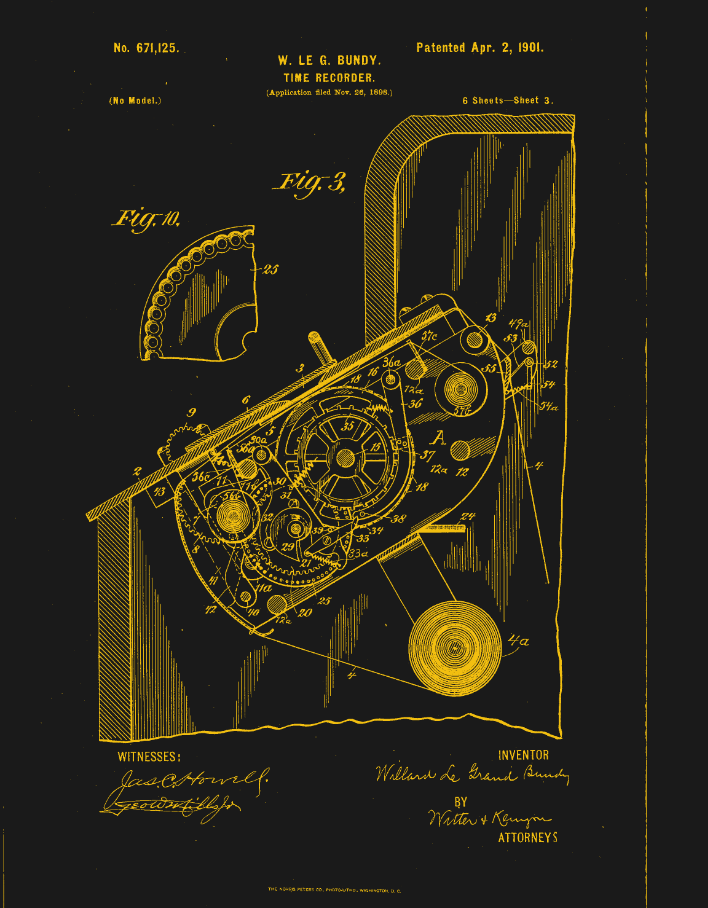
One image from William Le Grand Bundy's patented time clock.An image from Bundy’s patent via Google Patents
Essentially, the card is mechanically indexed inside the machine. When the card is inserted in the top slot, it gets pulled straight down by gravity, and goes until it hits a fixed metal stop that defines vertical zero. No matter how haphazardly you insert the card, the Bundy clock takes card of things. Inside the slot are narrow guides that align the card and eliminate drift. Now the card is essentially locked inside a coordinate system.

So, how does it find the correct row on the card? You might think that the card moves vertically, but it’s actually the punching mechanism itself that moves up and down on a rack-and-pinion system. This movement is driven by the timekeeping gears of the clock itself, which plot the times in the correct places as though the card were a piece of graph paper.

In essence, the time of day determined the punch location on the card, which wasn’t a punch in the hole punch sense, but a two-tone ink stamp from a type of bi-color ribbon you can still get online.

There’s a date wheel that selects the row for the given day, and a time cam to select the column. The early time clocks didn’t punch automatically — the worker had to pull a lever. When they did so, the mechanism would lock onto the current time, and the clock would fire a single punch at the card at the given coordinates.

Modern Time

Image via Comp-U-Charge
By the mid-century, time clocks had become somewhat simpler. No longer did the machine do the plotting for you. Now you put them in sideways, in the front, and use the indicator to get the punch in the right spot. It’s not hard to imagine why these gave way to more modern methods like fingerprint readers, or in my case, mag-stripe cards.

This is the type of time clock I intend to buy for myself, though I’m having trouble deciding between the manual model where you get to push a large button like this one, and the automatic version. I’d still like to build a time clock, too, for all the finesse and detail it could have by comparison. So honestly, I’ll probably end up doing both. Perhaps you’ll read about it on these pages one day.


hackaday.com/2026/01/08/the-ti…

The Issue With Wii U Gamepads and How to Clone Them


The media in this post is not displayed to visitors. To view it, please log in.


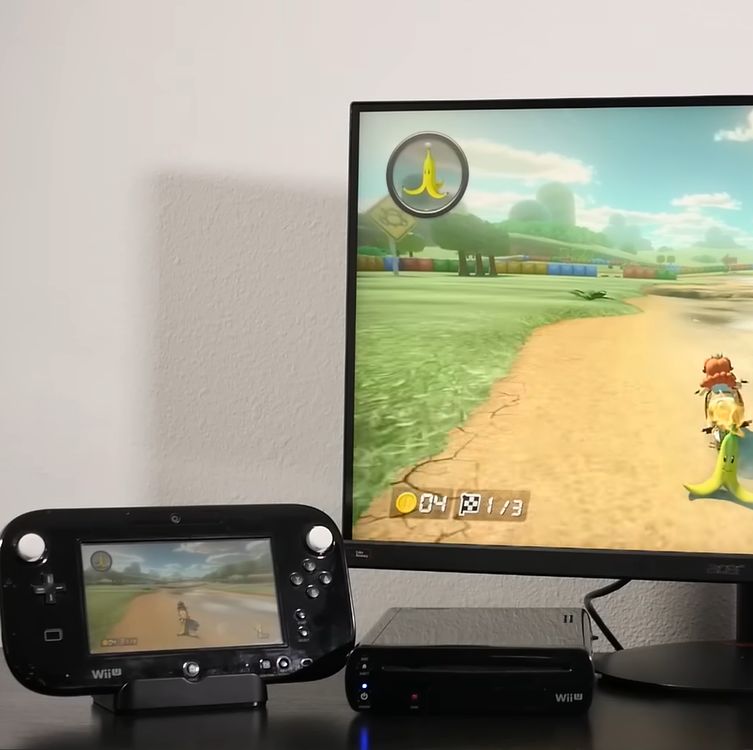
The Wii U running Mario Kart with the Gamepad duplicating the main screen. (Credit: MattKC, YouTube)The Wii U running Mario Kart with the Gamepad duplicating the main screen. (Credit: MattKC, YouTube)
How hard would it be to clone the Wii U gamepad, the quirky controller with its unique embedded screen? This is the question that [MattKC] faced as he noticed the complete lack of Wii U gamepad replacements from either Nintendo or third-parties, leading him down the rabbit hole of answering said question.

Although unloved and even despised in compared to the Nintendo Wii, the Wii U was a solid system in its own right. One of its interesting additions was the gamepad controller, whose screen games used for features like a private screen during multiplayer and 3DS-like map screens. Its main weakness is however that the Wii U gamepad was considered an irreplaceable part of the console, which is obviously not fun if your gamepad breaks and your console along with it.

The Wii U console and gamepad communicate via 5 GHz 802.11n WiFi, but in order to deter other parties from simply hopping onto the access point, Nintendo slightly obfuscated this WiFi standard. Specifically the WPA authentication was modified by a byte swap in the PTK, rendering every existing WiFi stack incompatible with the Wii U.

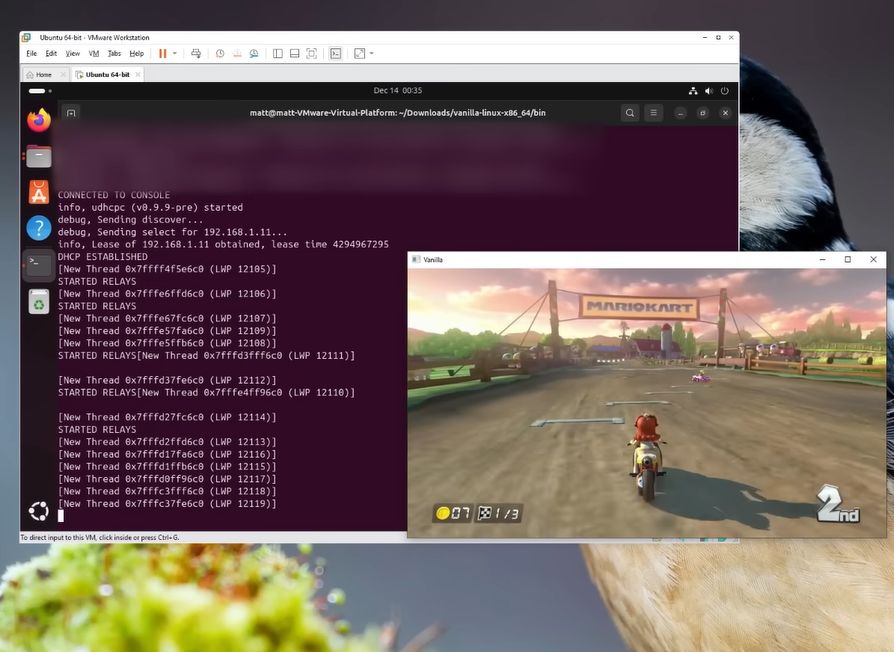
Vanilla Wii U running on Windows 10 with the network pipe in a Linux VM. (Credit: MattKC, YouTube)Vanilla Wii U running on Windows 10 with the network pipe in a Linux VM. (Credit: MattKC, YouTube)
Knowing this, the key is to use a platform that allows one to pre-break WPA in a similar fashion, such as is possible on e.g. Linux and BSD. Along with the use of the hilariously insecure WPS that is triggered when the gamepad’s sync button is pressed, this enables one to connect a modified Linux system to a Wii U console. After this the console starts sending h.264 (AVC) encoded video to the ‘gamepad’, and a binary packet can be sent back with the controller inputs.

Suffice it to say that this finding was immediately turned into a GitHub project called Vanilla Wii U, that enables a Steam Deck to be used as a gamepad, as well as any Linux – and presumably BSD – system with a compatible WiFi adapter. This latter point is key, as the non-standard authentication method has to be bypassed in software. This means for example that an un-modded Nintendo Switch cannot be used either.

The technical challenges combined with the systems relatively low popularity explain why third-party gamepads never appeared. However, now that the Wii U is a retro console, these efforts are essential for keeping these consoles working. We’d love to see the PlayStation Portal get modded into being a Wii U gamepad, since it’s basically a more limited clone of the same concept.

youtube.com/embed/jlbcKuDEBw8?…


hackaday.com/2026/01/08/the-is…

Elischeva reshared this.

The Unreasonable Effectiveness of the Fourier Transform


The media in this post is not displayed to visitors. To view it, please log in.

The Fourier transform

A talk, The Unreasonable Effectiveness of the Fourier Transform, was presented by [Joshua Wise] at Teardown 2025 in June last year. Click-through for the notes or check out the video below the break for the one hour talk itself.

The talk is about Orthogonal Frequency Division Multiplexing (OFDM) which is the backbone for radio telecommunications these days. [Joshua] tries to take an intuitive view (rather than a mathematical view) of working in the frequency domain, and trying to figure out how to “get” what OFDM is (and why it’s so important). [Joshua] sent his talk in to us in the hope that it would be useful for all skill levels, both folks who are new to radio and signal processing, and folks who are well experienced in working in the frequency domain.

If you think you’ve seen “The Unreasonable Effectiveness of $TOPIC” before, that’s because hacker’s can’t help but riff on the original The Unreasonable Effectiveness of Mathematics in the Natural Sciences, wherein a scientist wonders why it is that mathematical methods work at all. They seem to, but how? Or why? Will they always continue to work? It’s a mystery.

Hidden away in the notes and at the end of his presentation, [Joshua] notes that every year he watches The Fast Fourier Transform (FFT): Most Ingenious Algorithm Ever? and every year he understands a little more.

If you’re interested in OFDM be sure to check out AI Listens To Radio.

youtube.com/embed/9k1Wu69Gw4w?…


hackaday.com/2026/01/07/the-un…

Co-Extrusion Carbon Fiber FDM Filament Investigated


The media in this post is not displayed to visitors. To view it, please log in.

After previously putting carbon fiber-reinforced PLA filament under the (electron) microscope, the [I built a thing] bloke is back with a new video involving PLA-CF, this time involving co-extrusion rather than regular dispersed chopped CF. This features a continuous CF core that is enveloped by PLA, with a sample filament spool sent over by BIQU in the form of their CarbonCore25 filament.

In the previous video chopped CF in PLA turned out to be essentially a contaminant, creating voids and with no integration of the CF into the polymer matrix. Having the CF covered by PLA makes the filament less abrasive to print, which is a definitely advantage, but does it help with the final print’s properties? Of note is that this is still chopped CF, just with a longer fiber length (0.3-0.5 mm).

Samples of the BIQU filament were printed on a Bambu Lab H2D printer with AMS. In order to create a clean fracture surface, a sample was frozen in liquid nitrogen to make it easy to snap. After this it was coated with gold using a gold sputtering system to prepare it for the SEM.

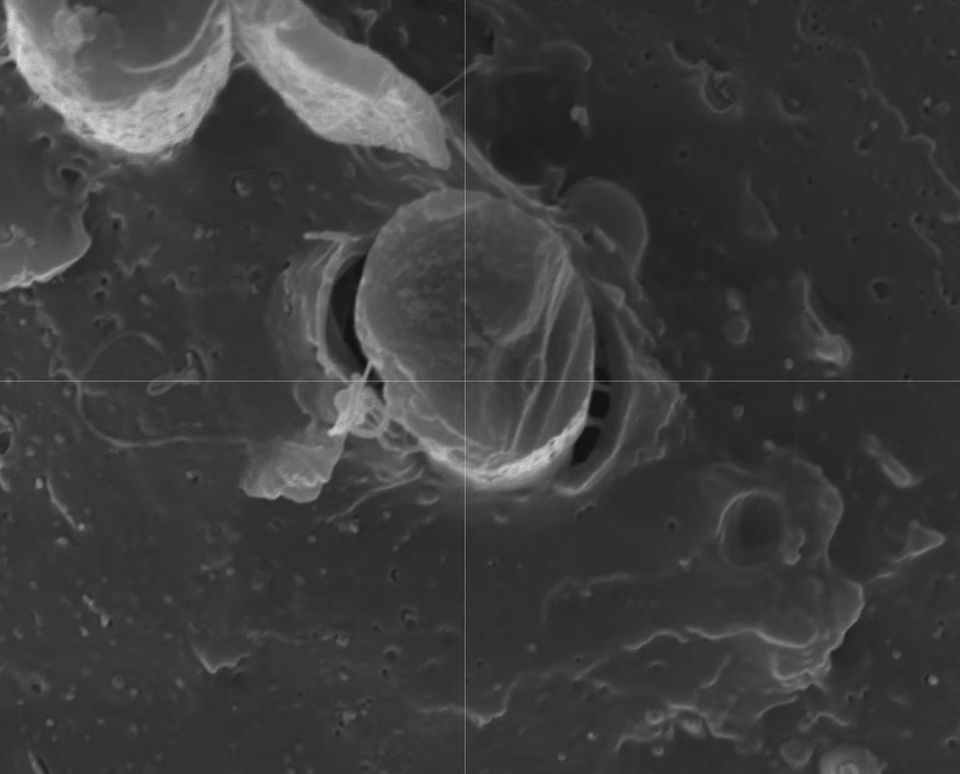
Carbon fiber in PLA after FDM printing, showing clear voids. (Credit: I built a thing, YouTube)Carbon fiber in PLA after FDM printing, showing clear voids. (Credit: I built a thing, YouTube)
Compared to the finer chopped CF PLA-CF, what is notable here is that CF is not present between the layers, which is a good thing as this degrades layer adhesion significantly. Less good is that the same lack of polymer matrix integration is visible here, with the PLA clearly detaching from the CF and leaving behind voids.

This shows that BIQU’s PLA-CF filament fails to address the fundamental problem with PLA-CF of extremely poor matrix integration. To verify this, an undisturbed sample was put into the Micro CT scanner.

Fascinating about the Micro CT findings was that there is carbon black in the filament, which is ironically highly abrasive.

Also in the images were again what looked like air bubbles, much like in the previous video’s results. These bubbles turned out to be always linked to a CF strand, which could be due to how the PLA-CF mixture cools with the mismatch between the solid CF inside the still liquid PLA.

After a series of mechanical tests on the printed samples, the conclusion is that the part is stiffer by about 15% and due to the CF contaminant not intruding between layers it’s also better than typical PLA-CF. Of course, regular PLA outperforms both types of PLA-CF in most tests by a considerable margin, so most people are probably still better off with regular PLA.

youtube.com/embed/m7JAOi4JnBs?…


hackaday.com/2026/01/07/co-ext…

DIY Grid Dip Meter Teardown


The media in this post is not displayed to visitors. To view it, please log in.

You don’t see them much anymore, but there was a time when any hobbyist who dealt with RF probably had a grid dip meter. The idea was to have an oscillator and measure the grid current as it coupled to external circuits. At resonance, the grid current would go down or dip, hence the name. In the hands of someone who knew how to use it, the meter could measure inductance, capacitance, tuned circuits, antennas, and more. [Thomas] takes a peek inside a homebrew unit from the 1950s in a recent video you can see below.

These meters often have a few things in common. They usually have a plug-in coil near the top and a big tuning capacitor. Of course, there’s also a meter. You have to pick the right coil for the frequency of interest, which both sets the oscillator frequency range and couples to the circuit under test.

The device has an odd case for a homebrew instrument. Whoever made it was an excellent metalworker. Inside was a neatly built circuit with an EC-81 triode and a unique selenium rectifier.

It would be nice to know who the unknown builder was, but with a bit of coaxing, the device still worked just fine. Of course, these days, you have many better options, but it is amazing what all this relatively simple device could do.

We’ve covered how these meters work before, including some pictures from our own benches.

youtube.com/embed/IXj_BxmdY2E?…


hackaday.com/2026/01/07/diy-gr…

Cybersecurity & cyberwarfare ha ricondiviso questo.

The media in this post is not displayed to visitors. To view it, please go to the original post.

Questi i numeri del #Fediverso Italiano di inizio anno 2026

In cima spicca il server pixelfed.uno (6.996), seguito da mastodon.uno (5.283).

Mantiene gli utenti livellosegreto.it (1.074) mentre guadagnano qualcosa mastodon.bida.im (692) e sociale.network (294)

Tengono bene le nostre 3 istanze storiche poliverso.org (186) feddit.it (163) e poliversity.it (100)

Poco dietro puntarella.party (90) e vivere.uno (78)

fediverse.observer/list

@fediverso

#pixelfed #mastodon #lemmy

Questa voce è stata modificata (3 mesi fa)
in reply to lgsp@feddit.it

@lgsp la crescita È sicuramente diminuita rispetto a qualche mese fa, Ma si mantiene comunque su ottimi livelli. Secondo me potrebbe mantenersi su ottimi livelli ma a condizione che il resto del fediverso mantenga un livello adeguato di interazioni che rendano più gratificante l'esperienza dell'utente che pubblica contenuti fotografici
Unknown parent

mastodon - Collegamento all'originale

informapirata ⁂

@ed non sono un amante di di Pixelfed, anzi... 😅 però riconosco che l'esperienza d'uso è migliorata tantissimo, il sistema si è evoluto abbastanza e la creazione dell'app è stata determinante per il suo successo.

Il tool di moderazione poi, anche se non è pratico come quello di mastodon, è stato progettato bene ed è Addirittura è stato pensato per essere virtualmente portabile anche su altre piattaforme del Fediverso.

@fediverso @filippodb

Cybersecurity & cyberwarfare ha ricondiviso questo.

The ideals of #Aaron #Swartz in an age of control
securityaffairs.com/186792/sec…
#securityaffairs #hacking

reshared this

Cybersecurity & cyberwarfare ha ricondiviso questo.

The media in this post is not displayed to visitors. To view it, please go to the original post.

Torvalds chiude l’era dell’hype: nel kernel Linux conta solo la qualità, non l’IA

📌 Link all'articolo : redhotcyber.com/post/torvalds-…

#redhotcyber #news #linux #intelligenzaartificiale #codice #ia #linustorvalds #critica #sciocchezze #etichettatura