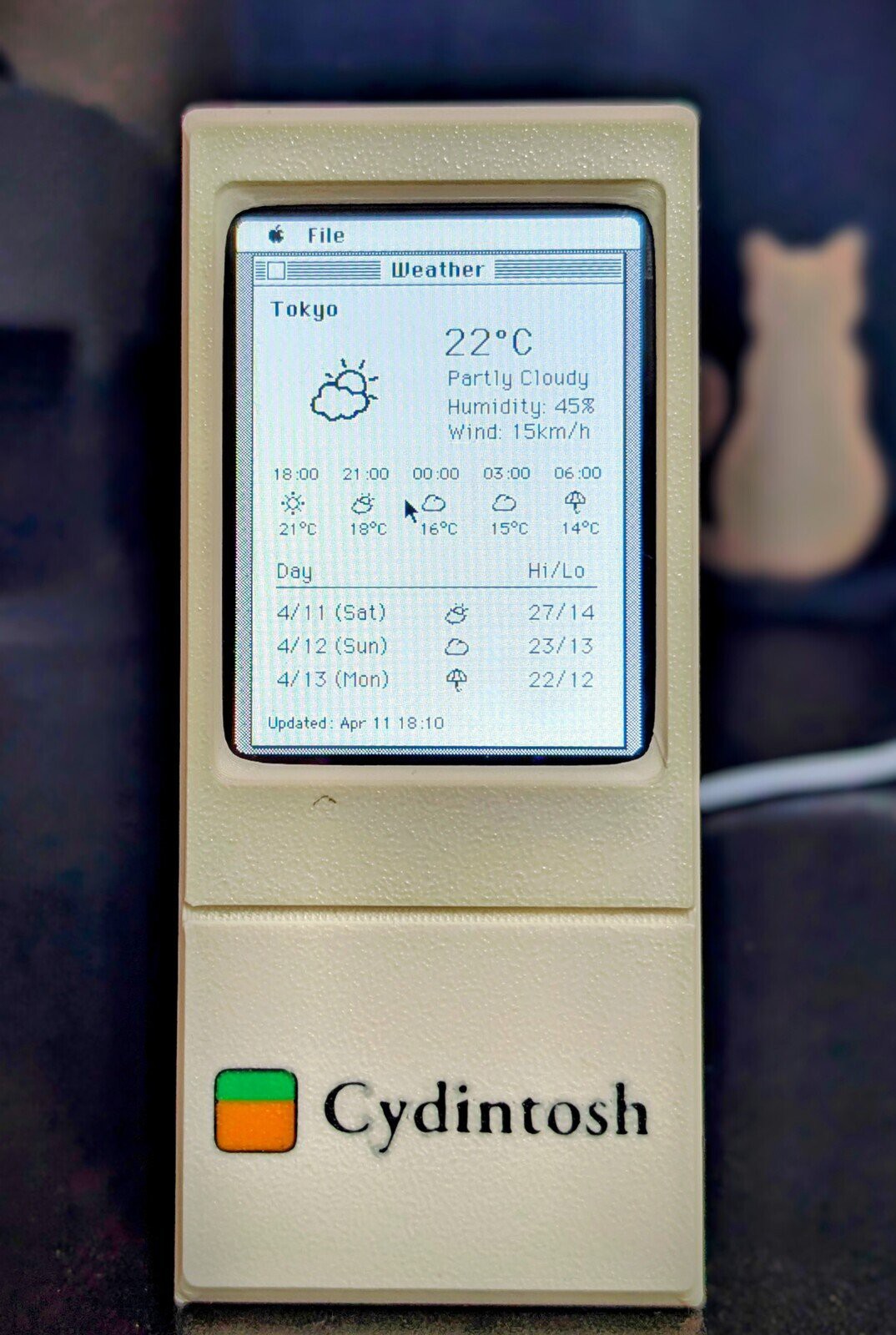
ESP32 Weather Display Runs Macintosh System 3


The media in this post is not displayed to visitors. To view it, please log in.

It seems like everybody takes their turn doing an ESP32-based weather display, and why not? They’re cheap, they’re easy, and you need to start somewhere. With the Cheap Yellow Display (CYD) and modules like it, you don’t even need to touch hardware! [likeablob] had the CYD, and he’s showing weather on it, but the Cydintosh is a full Macintosh Plus Emulator running on the ESP32.
Honey, I stretched the Macintosh!
The weather app is his own creation, written with the Retro68k cross-compiler, but it looks like something out of the 80s even if it’s getting its data over WiFi. The WiFi connection is, of course, thanks to the whole thing running on an ESP32-S3. Mac Plus emulation comes from [evansm7]’s Micro Mac emulator, the same one that lives inside the RP2040-based PicoMac that we covered some time ago. Obviously [likeablob] has added his own code to get the Macintosh emulator talking to the ESP32’s wireless hardware, with a native application to control the wifi connection in System 3.3. As far as the Macintosh is concerned, commands are passed to the ESP32 via memory address 0xF00000, and data can be read back from it as well. It’s a straightforward approach to allow intercommunication between the emulator and the real world.

The touchpad on the CYD serves as a mouse for the Macintosh, which might not be the most ergonomic given the Macintosh System interface was never meant for touchscreens, but evidently it’s good enough for [likeablob]. He’s built it into a lovely 3D printed case, whose STLs are available on the GitHub repository along with all the code, including the Home Assistant integration.


hackaday.com/2026/04/13/esp32-…

Cybersecurity & cyberwarfare ha ricondiviso questo.

Hackers access #Booking.com user data, company secures systems
securityaffairs.com/190757/dat…
#securityaffairs #hacking

reshared this

Cybersecurity & cyberwarfare ha ricondiviso questo.

The FBI announced it took down the "full-service cybercrime platform" W3LL, which allowed cybercriminals to purchase a phishing kit to create fake login pages.

W3LL “facilitated the sale of more than 25,000 compromised accounts,” over the years according to the FBI.

techcrunch.com/2026/04/13/fbi-…

Cybersecurity & cyberwarfare ha ricondiviso questo.

Israele convoca l'ambasciatore italiano per i commenti sugli "attacchi inaccettabili" contro il Libano

Tajani, membro di spicco del governo del Primo Ministro Giorgia Meloni, si è recato lunedì a Beirut per colloqui con il Presidente libanese Joseph Aoun e il Ministro degli Esteri Youssef Raggi.

Tajani ha scritto su X che era lì per "esprimere la solidarietà dell'Italia in seguito agli inaccettabili attacchi di Israele contro la popolazione civile".

euronews.com/2026/04/13/israel…

@politica

reshared this

Reverse-Engineering Human Cognition and Decision Making in a Modern Age


The media in this post is not displayed to visitors. To view it, please log in.

Cognitive processes are not something that we generally pay much attention to until something goes wrong, but they cover the entire scope of us ingesting sensory information, the processing and recalling thereof, as well as any resulting decisions made based on such internal deliberation.

Within that context there has also long been a struggle between those who feel that it’s fine for humans to rely on available technologies to make tasks like information recall and calculations easier, and those who insist that a human should be perfectly capable of doing such tasks without any assistance. Plato argued that reading and writing hurt our ability to memorize, and for the longest time it was deemed inappropriate for students to even consider taking one of those newfangled digital calculators into an exam, while now we have many arguing that using an ‘AI’ is the equivalent of using a calculator.

At the root of this conundrum lies the distinction between that which enhances and that which hampers human cognition. When does one merely offload tasks to a device or object, and when does one harm one’s own cognition?

Surrender Versus Offloading


Cognitive offloading is the practice of shifting cognitive tasks to external aids, and it is thought to make learning complex tasks easier. In contrast to rote memorization of facts like dates of events and formulas, if we consider books to be an external memory storage device, then we can offload such precise memorization to their pages and only require from students that they are capable of efficiently finding information, as well as the judging of these on their merits.

An often misquoted anecdote here pertains to Albert Einstein, who was was once asked why he couldn’t cite the speed of sound from memory. To this he responded with a curt:

[I do not] carry such information in my mind since it is readily available in books. …The value of a college education is not the learning of many facts but the training of the mind to think.


With this statement Einstein makes a clear case for the benefits of cognitive offloading in the sense that rote memorization does not enhance one’s cognition. Similarly, the ability to solve complicated equations and sums without so much as the use of pen and paper is fairly irrelevant when a slide rule and a digital calculator can offload all that work. As a benefit these devices tend to be more precise, faster and very accessible.

It is still important to have an intuitive feeling for whether a calculation is in the expected range, and one should never assume that what is written in a book is the absolute truth. That in a nutshell is the key difference between cognitive offloading and cognitive surrender. If you have entered a series of values into your calculator, the result seems off and you re-type them to be sure, that’s cognitive offloading.

If, however, you accept the outcome of such a calculation, or a text as written without a second thought, that constitutes surrendering an essential part of your cognitive processes to an external source. If we thus replace ‘calculator’ in this context with ‘LLM chatbot’ or an ‘AI summary’, the same caveat applies. Perhaps more so as at least a calculator is fully deterministic and can be proven to be mathematically correct.

So if that’s the case, and modern-day ‘AI’ isn’t really what it’s often cracked up to be, why would a presumably intelligent human being end up accepting their outputs like the literal gospel?

External Cognition


A recent study (DOI link) by Steven D. Shaw and Gideon Nave of the University of Pennsylvania investigated the prevalence of cognitive surrender in the context of LLM chatbots, looking for instances where users are seen to blindly accept the generated answers.

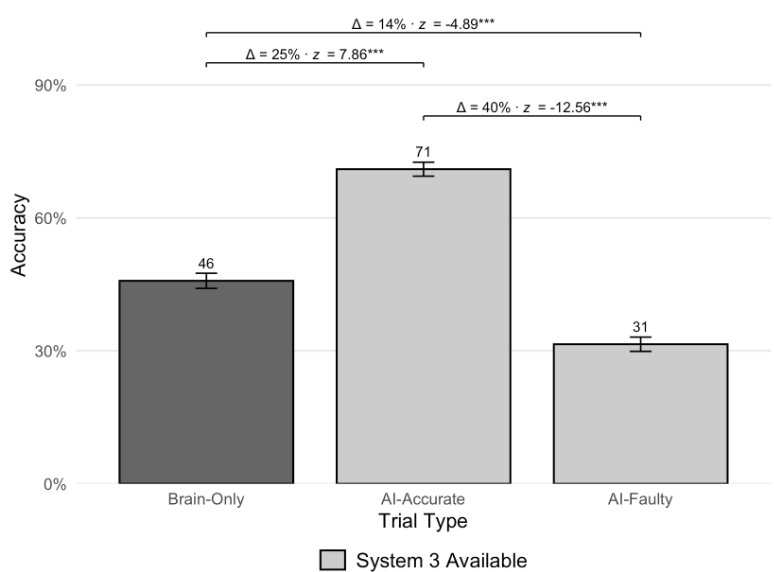
In this study, Shaw et al. had three groups of volunteers take a standardized test, during which one group had to rely purely on their own wits, the second group could use an LLM chatbot which gave correct answers, while a third group also had access to this chatbot, but for them it gave wrong answers.
System 3 facilitates cognitive surrender. (Credit: Shaw et al., 2026)System 3 facilitates cognitive surrender. (Credit: Shaw et al., 2026)
Perhaps unsurprisingly, the test subjects used the chatbot quite a lot when available, with predictable results. In the ‘tri-system theory of cognition’ that Shaw et al. propose in the paper, the external cognitive system (‘System 3’) is that of the chatbot, whose output is clearly being accepted verbatim by a significant part of the test subjects. If said chatbot output is correct, this is great, but when it’s not, the test results massively suffer.

Where this is worrisome outside of such a self-contained tests is that people are exposed to endless amounts of faulty LLM-generated text, such as for example in the form of ‘AI summaries’ that search engines love to put front and center these days. Back in 2024, for example, Avram Piltch over at Tom’s Hardware compiled a amusing collection of such faulty outputs, some of which are easier to spot than others.

Ranging from the health effects of eating nose pickings to the speed difference between USB 3.2 Gen 1 and USB 3.0, to classics like adding Elmer’s glue to pizza sauce, it’s generally possible to find where on the internet a ridiculous claim was scraped from for the LLM’s dataset, while other types of faulty output are simply due to an LLM not possessing any intelligence or essentials like grasping what a context is.

Meanwhile other types of output are clearly confabulations, a fact which ought to be obvious to any intelligent human being, and yet it seems that so much of it passes whatever sniff test occurs within the cognitive capabilities of the average person.

Making Decisions

Anterior cingulate gyrus. (Credit: BodyParts3D, Wikimedia)Anterior cingulate gyrus. (Credit: BodyParts3D, Wikimedia)
In the generally accepted model of cognitive decision making we see two internal systems: the first is the fast, intuitive and emotion-driven system. The second is the deliberate and analytical system, which tends to take a backseat to the first system in general, but could be said to be checking the homework of the first.

Although psychology is hardly an exact science, in the scientific fields of systems neuroscience and cognitive neuroscience we can find evidence for how decisions are made in the primate brain – including those of humans – with various cortices involved in the decision-making process. Fascinating here is the activity observed in the parietal cortex where a decision is not only formed, but also apparently assigned a degree of confidence.

Lesions in the anterior cingulate cortex (ACC) have been linked to impaired decision making and the arisal of impulse control issues, as the ACC appears to be instrumental in error detection. Issues in the ACC are thus more likely to result in faulty or flawed decisions and judgements passing by uncorrected. Incidentally, the ACC was found to be heavily affected by environmental tetraethyl lead contamination, underlying the theory that leaded gasoline was responsible for a surge in crime until this additive was discontinued.

Knowing this, we can thus say with a fairly high degree of confidence that the concept of human cognition is very much determined by the physical wiring in the pinkish-white goo that constitutes our brains. A good demonstration of this is the effect of ethanol on the brain, as well as the intense cravings that accompany addictions.
Implanted electrodes in the rostrodorsal anterior cingulate cortex (rdACC) for alcoholism treatment. (Credit: Sook Ling Leong et al., 2020, Neurotherapeutics)Implanted electrodes in the rostrodorsal anterior cingulate cortex (rdACC) for alcoholism treatment. (Credit: Sook Ling Leong et al., 2020, Neurotherapeutics)
Abnormal activity in the ACC has for example been associated with alcohol addiction, with an implant suggested to adjust said neural activity as detailed in a 2020 Neurotherapeutics study by Sook Ling Leong et al. In this study the eight treatment-resistant alcoholics had electrodes inserted into part of their ACC to provide direct stimulation, leading to a self-reported 60% drop in cravings.

As ethanol can freely pass through the blood-brain barrier, it is free to start binding with GABA receptors and induce the release of dopamine along with a range of other neurological effects that initially induce a feeling of relaxation and well-being, but also suppresses activity in various cortices, including the ACC. Effectively ethanol thus reduces one’s cognitive prowess and with it the ability to recognize flawed decisions.

From this we can thus deduce that activity in the ACC is not only essential for decision-making, but it also illustrates how the pinkish goop in our skulls is a fascinating biochemistry and neurochemistry experiment in which the addition or subtraction of certain substances and poking it with electrodes can induce a wide variety of cognitive outcomes.

Experiments aside, we started our lives off with the baseline that we were born with (‘nature’) and the various neuroplastic alterations made as we grew up (‘nurture’), which along the way led to various cognitive outcomes that we may or may not regret as adults. This leaves us free to learn from our mistakes and do better in as far as neuroplasticity allows.

Asking Why


It’s often said that the most valuable skill in life that adults tend to lose as we mature out of innocent childhood is the incessant ability to ask ‘Why?’. By questioning everything and wanting to know everything, we not only display curiosity, but also nurture the cognitive skills of our brain. If instead our environment pushes back against this, it can harm the development of such cognitive skills, even if the pushback doesn’t rise to the level of childhood trauma.

As a certified ‘nerdy kid’ back in the day who went through all the motions of being bullied, shoved into proverbial lockers and other types of physical abuse at school for having the nerve to like books, science and other ‘nerdy’ things that involved being curious, it’s hard not to feel the social pressure to simply comply and not question things. As an adult such social pressure only gets worse, with skills like critical thinking generally discouraged.

Of course, said critical thinking is exactly what we need when confronted with new technologies and the temptation to simply surrender that cognitive burden instead of asking questions. Yet when cognitive surrendering can have real consequences that may affect not just your own life but also those of others, it’s pretty much a basic survival skill to weapon yourself against it.

In a world where things like politics, idols, religion, and advertising exist, the rise of this purported ‘AI’ in the form of LLM-based chatbots with their often very convincingly human-like and authoritative outputs seem to have hit the same weaknesses that unscrupulous religious leaders and scammers exploit, with sometimes tragic consequences.

Although it’s clear that believing some factual misinformation generated by a chatbot is a far cry from deciding to take fatal actions based on a dialog with said chatbot, it also highlights the importance of retaining your critical thinking skills. Although we often like to think otherwise, people aren’t fully rational beings whose cognitive processes belong completely to themselves.

Answering the question of when we harm our own cognition, it would see that while we can generally trust a calculator, an LLM-based chatbot is not nearly as reliable or benign. Caution and awareness of the risk of cognitive surrendering are thus well-warranted.


hackaday.com/2026/04/13/the-us…

Cristiano G. doesn't like this.

Cybersecurity & cyberwarfare ha ricondiviso questo.

NEW: Booking says hackers accessed customers’ personal data, including names, emails, physical addresses, phone numbers, and booking details.

The company refused to say how many customers' were affected by this incident.

techcrunch.com/2026/04/13/book…

in reply to Lorenzo Franceschi-Bicchierai

"We use [AI] for user behavior detection, risk-based authentication, risk-based access to information, detection of risky transactions from a fraud perspective and fake property detection." Sauce: infosecurity-magazine.com/inte…
Questa voce è stata modificata (2 mesi fa)

Claude Code come strumento d’attacco: il rischio emergente nell’agente AI


@Informatica (Italy e non Italy)
Una ricerca dimostra che Claude Code può essere trasformato da strumento di programmazione a tool di hacking offensivo a livello di Stato, utilizzabile per violare siti web, sferrare attacchi informatici e individuare nuove vulnerabilità. Ecco tutti i dettagli

From Lunar Dust to Breathable Air


The media in this post is not displayed to visitors. To view it, please log in.

Moon missions are hot again for the first bit since the space race. While the previous period had us land on the big lunar rock, the missions of tomorrow have us living on it. The initial problem of landing in one piece has been solved, but there are many more puzzles to solve. One major issue of living in the vacuum of space is the lack of breathable air, because, ya know, it’s space.

This brings us to today, where [Blue Origin] has announced a prototype method of turning Moon dust into the valuable gas we call oxygen. [Blue Origin] hasn’t posted much about the actual process behind this feat, terming the system “Air Pioneer”. What we do know is that it requires melting the regolith and then passing current through to release the O2 molecules from their rocky prison.

While some publications on this matter have been calling this a first in its entirety, this isn’t entirely true. NASA has worked on this technology for the past couple of years, called “Gaseous Lunar Oxygen from Regolith Electrolysis”, or (GaLORE). What [Blue Origin] has done, however, is complete the task under a for-profit motive. Perhaps this can introduce the drive needed to accelerate the development of the tech? (If anyone knows any more detail about the Blue Origins system, please let us know.)

Private space is certainly an exciting and quickly moving space in nearly all regards. It’s important to see how far we have come from the initial moon missions. If you want to check out some of the wackier lessons from that era, be sure to read up on the fight for moon cockroaches!

View this post on Instagram


hackaday.com/2026/04/13/from-l…

Cybersecurity & cyberwarfare ha ricondiviso questo.

The media in this post is not displayed to visitors. To view it, please go to the original post.

The media in this post is not displayed to visitors. To view it, please go to the original post.

La catena di fornitura software colpita: come CPUID è stata compromessa per distribuire il RAT stealer STX
#CyberSecurity
insicurezzadigitale.com/la-cat…


La catena di fornitura software colpita: come CPUID è stata compromessa per distribuire il RAT stealer STX


Nel mese di aprile 2026, i ricercatori di sicurezza hanno identificato un attacco di supply chain sofisticato ai danni di CPUID, l’azienda dietro i popolarissimi tool di monitoraggio hardware CPU-Z e HWMonitor. Gli attaccanti hanno compromesso i server dell’azienda e reindirizzato i download ufficiali verso versioni malware. Per il corso di sei ore, gli utenti che scaricavano CPU-Z e HWMonitor dai siti ufficiali ricevevano un Remote Access Trojan precedentemente non documentato denominato STX RAT.

Questo incidente exemplifica una tendenza crescente nel panorama delle minacce informatiche: gli attaccanti hanno capito che il modo più efficace per ottenere una penetrazione di massa non è attaccare i singoli utenti, ma compromettere i software publisher e i loro canali di distribuzione. Se il software che stai scaricando oggi da un sito ufficiale contiene malware, la fiducia nella sicurezza della catena di distribuzione software crolla completamente.

Anatomia dell’attacco: come gli attaccanti hanno compromesso CPUID


A differenza di molti attacchi di supply chain che richiedono il compromesso dei sistemi di build e signing di un’azienda, gli attaccanti dietro questo incidente hanno adottato un approccio più mirato. Invece di cercare di infettare i binari finali di CPU-Z o HWMonitor (che sono firmati digitalmente), gli attaccanti hanno compromesso un’API secondaria utilizzata da CPUID per servire i link di download sul proprio sito web.

Modificando questa API, gli attaccanti hanno reindirizzato le richieste degli utenti verso file malevoli ospitati su Cloudflare R2. Le vittime pensavano di scaricare il software legittimo direttamente dal sito CPUID, ma ricevevano invece il malware. Non è stata trovata alcuna evidenza che gli attaccanti abbiano compromesso il processo di compilazione, il sistema di signing dei binari, o i server di controllo della versione di CPUID.

Il malware: STX RAT e le sue capacità


STX RAT è stato nominato da eSentire per la sua caratteristica firma tecnica: l’utilizzo consistente del byte STX come magic byte per prefisso nei messaggi diretti al command-and-control (C2).

Capacità di infostealer


Browser e credenziali web:

  • Estrazione di password, cookie, e dati di autofill da Firefox, SeaMonkey, e browser basati su Chromium (Chrome, Edge, Brave, ecc.)
  • Bypass potenziale di Application-Bound Encryption (ABE) sulle credenziali crittografate di Windows

Portafogli di criptovalute:

  • Furto di chiavi private da Litecoin-Qt, Electrum, e altri wallet desktop
  • Accesso a file di configurazione che contengono seed phrase o wallet backup

Credenziali client FTP:

  • Estrazione di dati di accesso da FileZilla, WinSCP, e altri client FTP


Remote Desktop nascosto (HVNC)


Una capacità particolarmente insidiosa di STX RAT è il supporto per hidden VNC (Virtual Network Computing). Questo permette all’attaccante di:

  • Avviare una sessione desktop virtuale nascosta che non è visibile agli utenti locali
  • Controllare il mouse e la tastiera tramite l’API SendInput di Windows
  • Eseguire applicazioni e navigare nel filesystem senza alcun indicatore visibile all’utente locale
  • Accedere ai dati sensibili mentre l’utente legittimo è offline

I comandi supportati includono “starthvnc”, “keypress”, “mouseinput”, “mousewheel”, e “switchdesktop”, fornendo una suite completa di controllo remoto.

Tattica di delivery: DLL Sideloading


Il vettore di consegna del malware utilizza una tecnica classica pero ancora efficace: DLL sideloading (also known as DLL hijacking). Quando un utente scaricava il file trojanizzato da HWMonitor, conteneva:

  • HWMonitor_x64.exe – Un file con nome legittimo (il binario vero di HWMonitor)
  • CRYPTBASE.dll – Una DLL malevola che l’eseguibile legittimo carica automaticamente

Poiché Windows segue un ordine di ricerca delle DLL specifico, quando HWMonitor_x64.exe cerca di caricare CRYPTBASE.dll, trova prima la versione malevola nella stessa directory. Questo causa l’esecuzione del codice dell’attaccante con gli stessi privilegi dell’applicazione legittima.

Indicatori tecnici e infrastruttura C2

C2 Server: 95.216.51.236
Malware: STX RAT
Compromesso: 9-10 aprile 2026
Download malevoli: CPU-Z, HWMonitor versioni x64 e x86
DLL sideload: CRYPTBASE.dll

Il malware STX RAT è configurato per contattare il C2 all’indirizzo IP 95.216.51.236. Al primo contatto, il malware invia un messaggio di “introduzione” contenente: nome dell’host, nome utente, versione OS, status amministrativo, RAM disponibile, e elenco antivirus installati.

Inoltre, eSentire ha documentato che STX RAT supporta il routing del traffico C2 attraverso Tor per garantire anonimato, rendendo la tracciatura della comunicazione estremamente difficile.

Impatto e distribuzione


Kaspersky ha identificato oltre 150 vittime dirette dell’incidente CPUID. La distribuzione geografica mostra una concentrazione in Brasile, Russia, e Cina, con settori colpiti che includono: retail e e-commerce, manufacturing, consulting, telecomunicazioni, e agricoltura.

Il fatto che utenti in settori critici siano stati infetti suggerisce che STX RAT potrebbe essere utilizzato sia per cyber-spionaggio che per estorsione, poiché il malware combina capacità di reconnaissance (infostealing) con accesso remoto completo (HVNC).

Timeline dell’incidente


  • 9 aprile 2026, ~15:00 UTC: Gli attaccanti modificano l’API di CPUID, reindirizzando i download
  • 10 aprile 2026, ~10:00 UTC: CPUID scopre l’anomalia e ripristina l’API
  • 10 aprile 2026: eSentire pubblica analisi tecnica del malware
  • 13 aprile 2026: Kaspersky fornisce dati sulla distribuzione geografica


Raccomandazioni per le organizzazioni


  • Verifica dell’integrità: Implementare processi di verifica dell’hash per tutti i software scaricati, anche da fonti ufficiali.
  • Sandboxing: Eseguire software appena scaricati in ambienti virtuali isolati prima dell’installazione.
  • Monitoraggio DLL loading: Implementare EDR in grado di rilevare il caricamento inusuale di DLL.
  • Blocco C2: Aggiungere 95.216.51.236 alle blocklists firewall immediate.
  • Credential rotation: Ruotare credenziali per chi ha scaricato HWMonitor/CPU-Z tra 9-10 aprile.
  • Threat intelligence: Adottare YARA rules da eSentire per rilevare STX RAT in memoria.


Conclusione


L’incidente CPUID dimostra che la sicurezza della catena di distribuzione software non è negoziabile. Anche i siti ufficiali di società legittime possono essere compromessi. I defender devono adottare un mindset di “zero trust” verso qualsiasi software e implementare verifiche multi-strato di integrità e autenticità prima dell’esecuzione.


Cybersecurity & cyberwarfare ha ricondiviso questo.

The media in this post is not displayed to visitors. To view it, please go to the original post.

Linux 7.0 cambia tutto: sicurezza post-quantistica e Rust entrano nel kernel

📌 Link all'articolo : redhotcyber.com/post/linux-7-0…

A cura di Carolina Vivianti

#redhotcyber #news #linux #rust #sicurezzainformatica #file system #virtualizzazione

reshared this

Il GDPR pilastro del diritto digitale europeo: le implicazioni strategiche secondo EDPB


@Informatica (Italy e non Italy)
Il GDPR è diventato la pietra d'angolo del mercato digitale europeo, il livello su cui poggiano DMA, DSA e AI Act e il parametro che condiziona i rapporti di forza tra grandi operatori tecnologici e il resto del sistema economico. Un

The media in this post is not displayed to visitors. To view it, please log in.

La catena di fornitura software colpita: come CPUID è stata compromessa per distribuire il RAT stealer STX


@Informatica (Italy e non Italy)
Nel mese di aprile 2026, gli attaccanti hanno compromesso i server CPUID e reindirizzato i download di CPU-Z e HWMonitor verso versioni trojanizzate contenenti STX RAT. Per sei ore, oltre 150 utenti


La catena di fornitura software colpita: come CPUID è stata compromessa per distribuire il RAT stealer STX


Nel mese di aprile 2026, i ricercatori di sicurezza hanno identificato un attacco di supply chain sofisticato ai danni di CPUID, l’azienda dietro i popolarissimi tool di monitoraggio hardware CPU-Z e HWMonitor. Gli attaccanti hanno compromesso i server dell’azienda e reindirizzato i download ufficiali verso versioni malware. Per il corso di sei ore, gli utenti che scaricavano CPU-Z e HWMonitor dai siti ufficiali ricevevano un Remote Access Trojan precedentemente non documentato denominato STX RAT.

Questo incidente exemplifica una tendenza crescente nel panorama delle minacce informatiche: gli attaccanti hanno capito che il modo più efficace per ottenere una penetrazione di massa non è attaccare i singoli utenti, ma compromettere i software publisher e i loro canali di distribuzione. Se il software che stai scaricando oggi da un sito ufficiale contiene malware, la fiducia nella sicurezza della catena di distribuzione software crolla completamente.

Anatomia dell’attacco: come gli attaccanti hanno compromesso CPUID


A differenza di molti attacchi di supply chain che richiedono il compromesso dei sistemi di build e signing di un’azienda, gli attaccanti dietro questo incidente hanno adottato un approccio più mirato. Invece di cercare di infettare i binari finali di CPU-Z o HWMonitor (che sono firmati digitalmente), gli attaccanti hanno compromesso un’API secondaria utilizzata da CPUID per servire i link di download sul proprio sito web.

Modificando questa API, gli attaccanti hanno reindirizzato le richieste degli utenti verso file malevoli ospitati su Cloudflare R2. Le vittime pensavano di scaricare il software legittimo direttamente dal sito CPUID, ma ricevevano invece il malware. Non è stata trovata alcuna evidenza che gli attaccanti abbiano compromesso il processo di compilazione, il sistema di signing dei binari, o i server di controllo della versione di CPUID.

Il malware: STX RAT e le sue capacità


STX RAT è stato nominato da eSentire per la sua caratteristica firma tecnica: l’utilizzo consistente del byte STX come magic byte per prefisso nei messaggi diretti al command-and-control (C2).

Capacità di infostealer


Browser e credenziali web:

  • Estrazione di password, cookie, e dati di autofill da Firefox, SeaMonkey, e browser basati su Chromium (Chrome, Edge, Brave, ecc.)
  • Bypass potenziale di Application-Bound Encryption (ABE) sulle credenziali crittografate di Windows

Portafogli di criptovalute:

  • Furto di chiavi private da Litecoin-Qt, Electrum, e altri wallet desktop
  • Accesso a file di configurazione che contengono seed phrase o wallet backup

Credenziali client FTP:

  • Estrazione di dati di accesso da FileZilla, WinSCP, e altri client FTP


Remote Desktop nascosto (HVNC)


Una capacità particolarmente insidiosa di STX RAT è il supporto per hidden VNC (Virtual Network Computing). Questo permette all’attaccante di:

  • Avviare una sessione desktop virtuale nascosta che non è visibile agli utenti locali
  • Controllare il mouse e la tastiera tramite l’API SendInput di Windows
  • Eseguire applicazioni e navigare nel filesystem senza alcun indicatore visibile all’utente locale
  • Accedere ai dati sensibili mentre l’utente legittimo è offline

I comandi supportati includono “starthvnc”, “keypress”, “mouseinput”, “mousewheel”, e “switchdesktop”, fornendo una suite completa di controllo remoto.

Tattica di delivery: DLL Sideloading


Il vettore di consegna del malware utilizza una tecnica classica pero ancora efficace: DLL sideloading (also known as DLL hijacking). Quando un utente scaricava il file trojanizzato da HWMonitor, conteneva:

  • HWMonitor_x64.exe – Un file con nome legittimo (il binario vero di HWMonitor)
  • CRYPTBASE.dll – Una DLL malevola che l’eseguibile legittimo carica automaticamente

Poiché Windows segue un ordine di ricerca delle DLL specifico, quando HWMonitor_x64.exe cerca di caricare CRYPTBASE.dll, trova prima la versione malevola nella stessa directory. Questo causa l’esecuzione del codice dell’attaccante con gli stessi privilegi dell’applicazione legittima.

Indicatori tecnici e infrastruttura C2

C2 Server: 95.216.51.236
Malware: STX RAT
Compromesso: 9-10 aprile 2026
Download malevoli: CPU-Z, HWMonitor versioni x64 e x86
DLL sideload: CRYPTBASE.dll

Il malware STX RAT è configurato per contattare il C2 all’indirizzo IP 95.216.51.236. Al primo contatto, il malware invia un messaggio di “introduzione” contenente: nome dell’host, nome utente, versione OS, status amministrativo, RAM disponibile, e elenco antivirus installati.

Inoltre, eSentire ha documentato che STX RAT supporta il routing del traffico C2 attraverso Tor per garantire anonimato, rendendo la tracciatura della comunicazione estremamente difficile.

Impatto e distribuzione


Kaspersky ha identificato oltre 150 vittime dirette dell’incidente CPUID. La distribuzione geografica mostra una concentrazione in Brasile, Russia, e Cina, con settori colpiti che includono: retail e e-commerce, manufacturing, consulting, telecomunicazioni, e agricoltura.

Il fatto che utenti in settori critici siano stati infetti suggerisce che STX RAT potrebbe essere utilizzato sia per cyber-spionaggio che per estorsione, poiché il malware combina capacità di reconnaissance (infostealing) con accesso remoto completo (HVNC).

Timeline dell’incidente


  • 9 aprile 2026, ~15:00 UTC: Gli attaccanti modificano l’API di CPUID, reindirizzando i download
  • 10 aprile 2026, ~10:00 UTC: CPUID scopre l’anomalia e ripristina l’API
  • 10 aprile 2026: eSentire pubblica analisi tecnica del malware
  • 13 aprile 2026: Kaspersky fornisce dati sulla distribuzione geografica


Raccomandazioni per le organizzazioni


  • Verifica dell’integrità: Implementare processi di verifica dell’hash per tutti i software scaricati, anche da fonti ufficiali.
  • Sandboxing: Eseguire software appena scaricati in ambienti virtuali isolati prima dell’installazione.
  • Monitoraggio DLL loading: Implementare EDR in grado di rilevare il caricamento inusuale di DLL.
  • Blocco C2: Aggiungere 95.216.51.236 alle blocklists firewall immediate.
  • Credential rotation: Ruotare credenziali per chi ha scaricato HWMonitor/CPU-Z tra 9-10 aprile.
  • Threat intelligence: Adottare YARA rules da eSentire per rilevare STX RAT in memoria.


Conclusione


L’incidente CPUID dimostra che la sicurezza della catena di distribuzione software non è negoziabile. Anche i siti ufficiali di società legittime possono essere compromessi. I defender devono adottare un mindset di “zero trust” verso qualsiasi software e implementare verifiche multi-strato di integrità e autenticità prima dell’esecuzione.


Skylab Under the Ocean


The media in this post is not displayed to visitors. To view it, please log in.

A crew lives on a station in a hostile environment. Leaving that environment requires oxygen tanks and specialized gear to deal with pressure differentials. A space station? Nah. A base built on the ocean floor. The US Navy was interested in such a base in the 1960s, and bases like this are a staple of science fiction. But today, we see more space stations than underwater bases. Have you ever wondered why?

Diving deep underwater is a tricky business. At a certain depth, the pressure forces gas like nitrogen to dissolve into your body. By itself, this isn’t a problem, but when you ascend, it is a big problem. If the gas all comes out at the same time, you get bubbles, which can cause decompression sickness, commonly called the bends. The exact problems vary, but the bends often cause extreme joint pain, fatigue, or a rash. Sometimes people die.

While you think of the bends as a deep-sea diver’s problem, it can also happen in airplanes and outer space. Any time you go from high pressure to low pressure quickly, you are subject to decompression sickness. Depending on what you are doing, there are different ways to mitigate the problem. For diving, traditionally, you simply don’t surface too quickly.

You dive, do your work, and then head towards the surface, stopping at preset stops to let the pressure equalize gradually. Physics is a bear, though. The longer you stay at a given depth, the longer you have to decompress.

That means you rapidly reach a point of diminishing returns. Suppose you dive to the ocean floor. You spend an hour working. Then you have to spend, say, eight hours gradually rising to the surface. That makes extended operations at significant depth impractical.

George Bond was thinking about all this and had an interesting idea. It is true that, in general, the longer you stay down, the more gas your body absorbs. But it is also true that, eventually, your tissues saturate, and then you don’t absorb any more.

Saturation Diving


So the counterintuitive insight was not to send a diver down and then back up repetitively. Instead, you keep the diver under pressure for the entire job. Then, once, at the end, you decompress. This is known today as saturation diving.

This leads to a new problem: If you plan to send a diver down to the ocean floor for a week, they can’t just hang out in a wetsuit the whole time. They need somewhere to eat, rest, and all the other things you need to do when you aren’t working. They need a base.

It still isn’t as simple as it might seem. There are problems with oxygen toxicity, the effort to breathe under pressure, and other issues. But these are largely solvable.

George Bond did experiments under the project name “Genesis,” where animals and, eventually, people were subjected to high pressures for extended durations. At roughly the same time, Edwin Link (a familiar name if you know about flight simulators) and famed diver Jacques Cousteau were experimenting with long-term saturation diving as well.

As part of a larger plan, Link experimented with placing one person at a modest depth for a day, and Cousteau had a two-person team at greater depths.

The Navy decided to run some experiments to see if Bond’s ideas would work in reality. They started the “man in the sea” experiments that deployed three prototype “sealabs” that were far more ambitious than previous commercial projects.

Sealab I

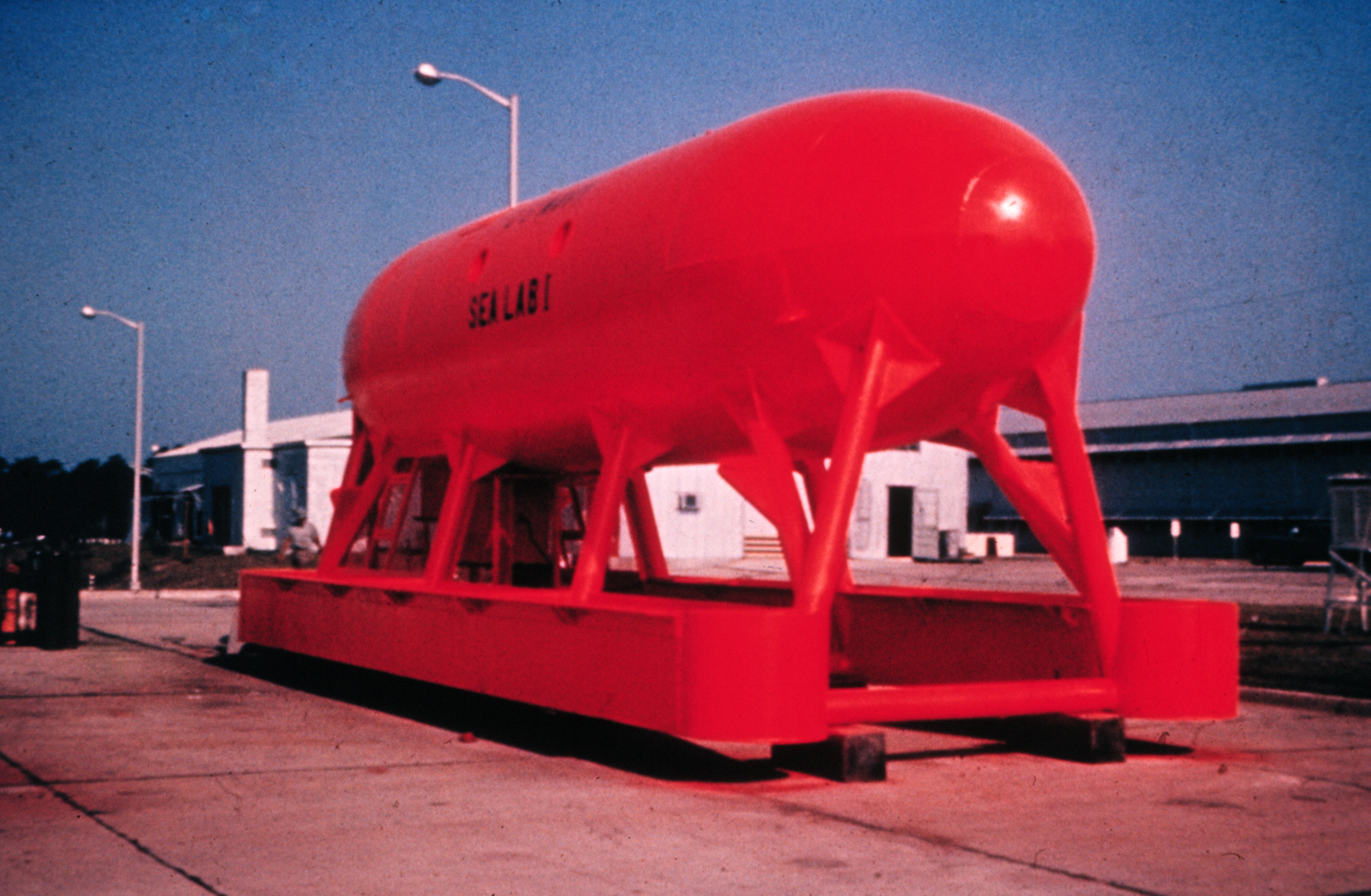
Sealab 1 (Public Domain)
In 1964, off the coast of Bermuda, the Navy placed an ambient-pressure cylinder 192 feet down. An umbilical connected the habitat to the surface. You’d think the station would be full of air, but high pressures of nitrogen can cause other health problems, so, instead, the divers had a helium and oxygen mix.

The crew of four was supposed to stay submerged for several weeks. However, an approaching storm cut their stay to only 11 days. Still, the experiment was a success.

It also brought up several problems. If you’ve taken a hit of helium, you know it makes your voice squeaky, which can make it difficult to communicate with other people. More importantly, though, is that helium is a good conductor of heat. Divers get cold fast hanging out in a helium-rich atmosphere.

You can see a video from the Navy in 1965 describing the program below.

youtube.com/embed/a-cJMQRG96s?…

As a side note, former astronaut Scott Carpenter was set to be the fifth person in Sealab I, but a scooter accident in Bermuda bumped him from the roster.

Sealab II


In 1965, the Navy tried again with Sealab II off the coast of La Jolla in California at a depth of around 200 feet. This time, Scott Carpenter made the trip.
Sealab II (Public Domain)
Sealab II was more complex with demonstration tasks and a planned mission length of up to 30 days. For a long trip like this, the same problems arise as you’d have in a space station. Carbon dioxide needs scrubbing, and oxygen levels need control. Humidity and corrosion are constant problems. Equipment noise affects people over the long term.

The new habitat was twice as large as Sealab I. There were heaters, hot showers, and refrigeration. The idea was to have a crew that rotated every 15 days, but Carpenter spent 30 days inside.

The Navy also tried to train a bottlenose dolphin — Tuffy — to act as a helper to the crew with mixed results. While the mission, overall, was a success, there were issues with the crew feeling isolated and confined, along with sleep problems due to noise and lights.

Famously, President Lyndon Johnson was to speak to Carpenter after his 30-day stay and called while Carpenter was in a decompression chamber full of helium. The resulting confusion among telephone operators is pretty funny, as you can see in the video below.

youtube.com/embed/Gg0pMbc7Opk?…

Sealab III


The next and final attempt to submerge a crew was Sealab III in 1969. At a depth of about 600 feet — 200 feet beyond the normal planned operation depth — the Sealab III mission reused the Sealab II module, refurbished and upgraded. Five teams of nine divers were scheduled to spend 12 days each in the habitat.

At such a depth, problems magnify and margins for error all but disappear. The Navy was already stretched thin in Vietnam, and Sealab III had a difficult time getting not just off the ground, but under the sea. The project was late and overbudget. Work got sloppy, and corners got cut. When the habitat developed a helium leak, four divers volunteered to repair it in place, but failed on their first attempt.

A second attempt had the divers taking amphetamines to stay awake, which went predictably wrong. A diver, Berry Cannon, died. At the time, it was chalked up to improper setup of his rebreather, although a more modern investigation speculates that he may have been electrocuted. Either way, it was enough to end the program. The Navy gave up on the program and focused on other undersea programs, such as submarines. If there are any undersea bases, they are too secret for us to know about them.

You can see a Navy video showing the progress of Sealab III before the accident below. Unfortunately, the audio track isn’t present, so it isn’t always clear what the message is.

youtube.com/embed/XMj9ByrPuS8?…

The End?


You might wonder why someone didn’t continue this work. We don’t have underwater bases, farms, mines, or hotels. Why not? It is true, of course, that the Navy continued to use limited saturation diving for certain, sometimes clandestine, purposes.

Well, the answer is complicated. The Navy’s work on Sealab directly created the tech and techniques used every day by saturation divers around the world, many of whom maintain underwater petroleum production equipment. However, that’s very specialized, and even then, a modern remote vehicle is a better choice for many tasks. Just like space is a harsh place to live, so is the ocean floor. Everything corrodes and leaks.

Now, we build space stations, and the day of the station on the ocean floor will either never come or will be in the future. But regardless, the technology developed by these pioneers will inform human undersea operations for the foreseeable future. Meanwhile, robots are cheaper and more effective for nearly any task. Still, there are times when only a human will do.


hackaday.com/2026/04/13/skylab…

Cybersecurity & cyberwarfare ha ricondiviso questo.

The media in this post is not displayed to visitors. To view it, please go to the original post.

.NET Aspire 13.2: la modalità isolata risolve i conflitti di porta nello sviluppo parallelo
#tech
spcnet.it/net-aspire-13-2-la-m…
@informatica


.NET Aspire 13.2: la modalità isolata risolve i conflitti di porta nello sviluppo parallelo


Chiunque abbia lavorato con .NET Aspire su progetti reali si è prima o poi scontrato con il classico errore: “Port 17370 is already in use”. Capita quando si prova ad avviare una seconda istanza dell’AppHost — magari su un altro branch, o in un altro terminale — e le porte predefinite sono già occupate dalla prima istanza in esecuzione. Con Aspire 13.2, questo problema ha finalmente una soluzione elegante: la modalità isolata (--isolated).

In questo articolo vediamo nel dettaglio come funziona questa nuova funzionalità, i casi d’uso pratici, e le altre novità rilevanti di questa release.

Il problema: conflitti di porta nello sviluppo parallelo


In un tipico progetto .NET Aspire, l’AppHost configura i binding delle porte per tutti i servizi nell’orchestrazione: la dashboard su una porta, l’API su un’altra, il database su un’altra ancora. Questi binding sono statici per default, e questo crea problemi immediati quando si vuole eseguire due istanze dello stesso AppHost contemporaneamente:

  • Sviluppo su due branch in parallelo con git worktrees
  • Test di integrazione che richiedono un AppHost “live” mentre si continua a sviluppare
  • Agenti AI che creano automaticamente worktree separati per task paralleli
  • Pipeline CI/CD locali che eseguono più istanze dello stesso progetto

La soluzione tradizionale era modificare manualmente i port binding nella configurazione — un approccio fragile, soggetto a errori e difficile da gestire in team.

La soluzione: la flag --isolated


Aspire 13.2 introduce la flag --isolated che risolve il problema alla radice. L’utilizzo è semplicissimo:

aspire run --isolated
# oppure
aspire start --isolated

Quando si passa --isolated, la CLI genera un identificativo univoco per l’istanza corrente, e questo ID guida due comportamenti fondamentali:

1. Randomizzazione automatica delle porte


Invece di usare le porte definite staticamente nell’AppHost, ogni istanza isolata riceve un range di porte casuali disponibili. Dove un run normale potrebbe bindare i servizi su 8080, 8081, 8082, due istanze isolate potrebbero usare rispettivamente:

  • Istanza 1: 15234, 15235, 15236
  • Istanza 2: 22891, 22892, 22893

La cosa notevole è che il codice dell’applicazione non necessita alcuna modifica: il service discovery di Aspire risolve gli endpoint dinamicamente a runtime, quindi i servizi si “trovano” a prescindere dalle porte assegnate.

2. Isolamento dei user secrets


La configurazione rimane completamente separata per ogni istanza. Connection string, chiavi API e altre variabili d’ambiente non si “contaminano” tra run diversi, anche quando puntano a risorse Azure o database con nomi diversi. Questo è particolarmente importante in scenari di test dove ogni istanza deve operare in modo completamente autonomo.

Casi d’uso pratici

Git worktrees multipli


Il caso d’uso più comune: sviluppo su due branch in parallelo.

# Terminale 1 - branch principale
cd ~/projects/myapp-main
aspire run --isolated

# Terminale 2 - feature branch
cd ~/projects/myapp-feature-xyz
aspire run --isolated

Entrambe le istanze partono senza conflitti, con porte diverse assegnate automaticamente. La dashboard di Aspire di ciascuna istanza è accessibile su porte diverse, e i servizi di ciascuna istanza sono completamente separati.

Test di integrazione con AppHost live


Un pattern molto utile: eseguire test di integrazione contro un AppHost “live” mentre si continua a sviluppare sull’AppHost principale.

# AppHost per sviluppo interattivo
aspire run --isolated

# In un altro terminale: avvia i test che usano il loro AppHost dedicato
dotnet test --isolated-apphost

Con la modalità isolata, i test non interferiscono con l’ambiente di sviluppo e viceversa.

Sviluppo agentico


Questo è il caso d’uso che ha spinto direttamente lo sviluppo di questa feature. Gli agenti AI in VS Code Copilot possono creare automaticamente git worktree separati per task paralleli. Con --isolated, ogni agente può avviare il proprio AppHost nella sua directory di lavoro senza conflitti con la sessione principale dello sviluppatore.

Aspire 13.2 include anche il comando aspire agent init (rinominato da aspire mcp init) che configura automaticamente gli agenti per usare --isolated con i worktree git.

Nuovi comandi CLI in Aspire 13.2


La modalità isolata non è l’unica novità della CLI. Aspire 13.2 introduce una serie di nuovi comandi operativi che rendono la gestione delle istanze molto più potente:

aspire ps — lista delle istanze attive


Elenca tutti gli AppHost Aspire in esecuzione sulla macchina, con le relative informazioni (porte, stato, ID istanza). Utile specialmente quando si hanno più istanze isolate attive contemporaneamente e si vuole sapere cosa sta girando.

aspire ps
# Output:
# ID           PROJECT          STATUS    DASHBOARD
# abc123       myapp-main       Running   http://localhost:15234
# def456       myapp-feature    Running   http://localhost:22891

aspire describe — dettagli sulle risorse


Accede ai dettagli di una risorsa specifica direttamente dal terminale, senza dover aprire la dashboard:

aspire describe api
# Mostra endpoint, variabili d'ambiente, stato health, ecc.

aspire doctor — diagnostica dell’ambiente


Esegue un controllo completo dell’ambiente di sviluppo: verifica che tutte le dipendenze siano installate correttamente (Docker, .NET SDK, ecc.) e segnala eventuali problemi di configurazione.

aspire wait — attesa su uno stato specifico


Blocca l’esecuzione in script di automazione finché una risorsa non raggiunge uno stato specifico. Utile in pipeline CI/CD o in script di startup:

aspire run --isolated &
aspire wait --resource api --state Running
# Ora l'API è sicuramente up, posso eseguire i test

aspire export — export di telemetria e dati


Cattura telemetria e dati delle risorse in formato JSON per analisi offline o per integrazione con altri strumenti.

TypeScript AppHost in preview


Una delle novità più interessanti di Aspire 13.2 è il supporto preview per scrivere l’AppHost in TypeScript. Fino ad ora, l’AppHost era necessariamente un progetto C#. Con questa release, è possibile usare TypeScript con una sintassi idiomatica:

import { createBuilder } from '@aspire/hosting';

const builder = await createBuilder();

// Aggiunge Redis come risorsa
const cache = await builder.addRedis("cache");

// Aggiunge un servizio Node.js con dipendenza da Redis
const api = await builder.addNpmApp("api", "../api")
    .withReference(cache);

await builder.build().run();

Il TypeScript AppHost funziona come un processo guest che comunica tramite JSON-RPC con l’orchestrator .NET sottostante. La CLI gestisce automaticamente la generazione degli SDK TypeScript quando si esegue aspire add, e aspire restore li rigenera se necessario.

Questa funzionalità è ancora in preview e non è raccomandata per produzione, ma è un segnale chiaro della direzione che sta prendendo Aspire: abbracciare anche gli sviluppatori TypeScript/Node.js, non solo quelli .NET.

Miglioramenti alla dashboard


La nuova dashboard di Aspire 13.2 con il dialog di gestione telemetria

Export e import di telemetria


La dashboard introduce un dialog centralizzato “Manage logs and telemetry” che permette di:

  • Esportare risorse e telemetria come JSON
  • Esportare variabili d’ambiente come file .env
  • Importare dati da sessioni precedenti


API HTTP per telemetria


Nuovo endpoint /api/telemetry sulla dashboard che permette query programmatiche dei dati di telemetria con supporto streaming NDJSON. Utile per integrare la telemetria di Aspire con strumenti di monitoring esterni o script di analisi.

Impostazione parametri dalla UI


È ora possibile impostare i parametri delle risorse direttamente dalla dashboard, con opzione di salvataggio nei user secrets. Questo elimina la necessità di modificare manualmente i file di configurazione per cambiare un parametro durante il debug.

Miglioramenti al visualizzatore GenAI


Chi usa Aspire con workload AI troverà utili i miglioramenti al GenAI visualizer: migliore gestione di schemi complessi, payload troncati, testo non-ASCII e navigazione tra definizioni di tool.

Altre novità rilevanti


Resource graph in Aspire 13.2

Endpoint MCP per i servizi


È possibile dichiarare server Model Context Protocol (MCP) direttamente nell’AppHost con il nuovo metodo WithMcpServer():

var api = builder.AddProject<Projects.MyApi>("api")
    .WithMcpServer("/mcp");

Aspire gestirà automaticamente la discovery dell’endpoint MCP, rendendolo disponibile agli agenti AI che operano nell’ambiente.

Docker Compose publishing stabile


L’integrazione con Docker Compose passa da prerelease a stabile. È ora possibile generare un docker-compose.yaml completo direttamente dal modello di app Aspire con aspire publish --format docker-compose.

Azure Virtual Network


Nuovo pacchetto Aspire.Hosting.Azure.Network per la gestione di reti virtuali Azure:

var vnet = builder.AddAzureVirtualNetwork("vnet");
var subnet = vnet.AddSubnet("web", "10.0.1.0/24");
var natGateway = vnet.AddNatGateway("nat");


Breaking changes da tenere a mente


Se stai aggiornando un progetto Aspire esistente a 13.2, ci sono alcune breaking changes da considerare:

  1. Variabili Service Discovery: usano ora lo schema endpoint invece del nome endpoint
  2. File di configurazione: preferenza per aspire.config.json unificato (migrazione automatica al primo run)
  3. Comandi risorse: resource-startstart, resource-stopstop
  4. Dashboard API: ora opt-in per dashboard standalone
  5. Pacchetto AIFoundry: Aspire.Hosting.Azure.AIFoundryAspire.Hosting.Foundry
  6. WithSecretBuildArg: rinominato in WithBuildSecret

Per aggiornare, usa:

aspire update --self   # aggiorna la CLI
aspire update          # aggiorna i pacchetti del progetto

Conclusione


Aspire 13.2 è una release sostanziosa che affronta problemi concreti del workflow di sviluppo. La modalità --isolated è probabilmente la novità più impattante per il day-to-day: risolve un pain point reale in modo elegante, senza richiedere modifiche al codice dell’applicazione.

L’aggiunta del TypeScript AppHost in preview è un segnale importante della direzione di Aspire verso un ecosistema più inclusivo, mentre i nuovi comandi CLI (ps, describe, doctor, wait) rendono Aspire molto più adatto a workflow di automazione e sviluppo agentico.

Chi lavora già con Aspire troverà questo aggiornamento decisamente consigliato. Chi non lo ha ancora provato, potrebbe essere il momento giusto per iniziare — soprattutto se lavora con architetture microservizi in .NET.

Fonti: Running Multiple Instances of an Aspire AppHost Without Port Conflicts · What’s new in Aspire 13.2


Cybersecurity & cyberwarfare ha ricondiviso questo.

garantepiracy.it/blog/weward/ e pensate a quante app abbiamo sul cell
Cybersecurity & cyberwarfare ha ricondiviso questo.

The media in this post is not displayed to visitors. To view it, please go to the original post.

The media in this post is not displayed to visitors. To view it, please go to the original post.

𝗜𝗹 𝗙𝗨𝗧𝗨𝗥𝗢 𝗔𝗟𝗟𝗘 𝗦𝗣𝗔𝗟𝗟𝗘. 𝗖𝗼𝗻𝘁𝗿𝗼𝗰𝘂𝗹𝘁𝘂𝗿𝗲, 𝗿𝗲𝘀𝗶𝘀𝘁𝗲𝗻𝘇𝗲 𝗲 𝗳𝗮𝘀𝗰𝗶𝘀𝗺𝗶 𝗹𝘂𝗻𝗴𝗼 𝗶 𝗯𝗼𝗿𝗱𝗶 𝗱𝗲𝗹𝗹’𝗮𝗽𝗼𝗰𝗮𝗹𝗶𝘀𝘀𝗲 - Venerdì 17 aprile ore 18, Casale Garibaldi, Roma

roma.convoca.la/event/2092

#novanta #25aprile


𝗜𝗹 𝗙𝗨𝗧𝗨𝗥𝗢 𝗔𝗟𝗟𝗘 𝗦𝗣𝗔𝗟𝗟𝗘. 𝗖𝗼𝗻𝘁𝗿𝗼𝗰𝘂𝗹𝘁𝘂𝗿𝗲, 𝗿𝗲𝘀𝗶𝘀𝘁𝗲𝗻𝘇𝗲 𝗲 𝗳𝗮𝘀𝗰𝗶𝘀𝗺𝗶 𝗹𝘂𝗻𝗴𝗼 𝗶 𝗯𝗼𝗿𝗱𝗶 𝗱𝗲𝗹𝗹’𝗮𝗽𝗼𝗰𝗮𝗹𝗶𝘀𝘀𝗲
Inizia: Venerdì Aprile 17, 2026 @ 6:00 PM GMT+02:00 (Europe/Rome)
Finisce: Sabato Aprile 18, 2026 @ 12:00 AM GMT+02:00 (Europe/Rome)

Venerdì 17 aprile 2026

::::::::::::::::::::::::::::::::::::::::::::::::::::::::::::::::::::::::::::::::::::

𝗜𝗹 𝗙𝗨𝗧𝗨𝗥𝗢 𝗔𝗟𝗟𝗘 𝗦𝗣𝗔𝗟𝗟𝗘. 𝗖𝗼𝗻𝘁𝗿𝗼𝗰𝘂𝗹𝘁𝘂𝗿𝗲, 𝗿𝗲𝘀𝗶𝘀𝘁𝗲𝗻𝘇𝗲 𝗲 𝗳𝗮𝘀𝗰𝗶𝘀𝗺𝗶 𝗹𝘂𝗻𝗴𝗼 𝗶 𝗯𝗼𝗿𝗱𝗶 𝗱𝗲𝗹𝗹’𝗮𝗽𝗼𝗰𝗮𝗹𝗶𝘀𝘀𝗲

::::::::::::::::::::::::::::::::::::::::::::::::::::::::::::::::::::::::::::::::::::

Ore 18,00

Inaugurazione della mostra "𝗡𝗲𝗿𝗼𝗡𝗼𝘃𝗲𝗖𝗲𝗻𝘁𝗼", 𝗱𝗶 𝗖𝗿𝗶𝘀𝘁𝗶𝗮𝗻𝗼 𝗥𝗲𝗮

A seguire

Presentazione di "𝗡𝗢𝗩𝗔𝗡𝗧𝗔 - 𝗨𝗻𝗮 𝗰𝗼𝗻𝘁𝗿𝗼𝘀𝘁𝗼𝗿𝗶𝗮 𝗰𝘂𝗹𝘁𝘂𝗿𝗮𝗹𝗲", 𝗱𝗶 𝗩𝗮𝗹𝗲𝗿𝗶𝗼 𝗠𝗮𝘁𝘁𝗶𝗼𝗹𝗶

Oltre all'autore, partecipano:

𝗔𝗴𝗻𝗲𝘀𝗲 𝗧𝗿𝗼𝗰𝗰𝗵𝗶 –tecnologa, artista multimediale, scrittrice e formatrice. Collabora con circex.org

𝗚𝗶𝘂𝗹𝗶𝗮𝗻𝗼 𝗦𝗮𝗻𝘁𝗼𝗿𝗼 – giornalista Il manifesto

𝗚𝗶𝘂𝗹𝗶𝗮𝗻𝗮 𝗩𝗶𝘀𝗰𝗼 – Insegnante, ex “Tute Bianche” e R.A.G.E. Genova 2001

𝗔𝗻𝗱𝗿𝗲𝗮 𝗡𝗮𝘁𝗲𝗹𝗹𝗮 – sociologo, pubblicitario, ufologo, artivista, ex Luther Blissett Project e guerrigliamarketing.it

𝗖𝗿𝗶𝘀𝘁𝗶𝗻𝗮 – regista, femminista, ex Fucking Barbies

𝗔𝗹𝗯𝗲𝗿𝘁𝗼 𝗗𝗲 𝗡𝗶𝗰𝗼𝗹𝗮 - sociologo, attivista di Esc Atelier autogestito

In collegamento: 𝗠𝗶𝗹𝗶𝘁𝗮𝗻𝘁 𝗔 – rapper e scrittore (Assalti frontali, ex Onda Rossa Posse)

// Una mostra imperdibile sull’anima oscura del Novecento e un libro seminale su un decennio decisivo per la grammatica dei movimenti: questa la combo speciale che presentiamo venerdì 17 aprile, alle 18:00, a Casale Garibaldi. Un’occasione importante per approfondire temi e suggestioni che hanno attraversato una parte decisiva del secolo scorso.

// L'evento si inserisce nel percorso verso il corteo del 25 Aprile promosso dalla Rete antifascista Roma Est


Cybersecurity & cyberwarfare ha ricondiviso questo.

The media in this post is not displayed to visitors. To view it, please go to the original post.

Anthropic limita Glasswing: l’AI che trova zero-day è un vantaggio strategico e fa paura

📌 Link all'articolo : redhotcyber.com/post/zeroday-l…

A cura di Massimiliano Brolli

#redhotcyber #news #intelligenzaartificiale #cyberwar #cybersicurezza #zeroday #glasswing

Cybersecurity & cyberwarfare ha ricondiviso questo.

#iPhone forensics expose #Signal messages after app removal in U.S. case

securityaffairs.com/190740/sec…

#securityaffairs #hacking

illuminante un post di Andrea Fortuna

Cybersecurity & cyberwarfare ha ricondiviso questo.

🎙️ What happens after North Korea infiltrates?

risky.biz/RBFEATURES12/

reshared this

Cybersecurity & cyberwarfare ha ricondiviso questo.

The media in this post is not displayed to visitors. To view it, please go to the original post.

The EU-US tech relationship is still on life support


The media in this post is not displayed to visitors. To view it, please log in.

The EU-US tech relationship is still on life support
IT'S MONDAY, AND THIS IS DIGITAL POLITICS. I'm Mark Scott, and Hungary's opposition leader, Péter Magyar, secured a landmark two-thirds majority victory in the country's parliamentary elections on April 12. More on that here and here.

— Brussels and Washington are still at loggerheads over digital regulation, even as both sides seek a path forward.

— Ireland is giving the world what it doesn't need: another global AI summit.

— The European Union issued, collectively, $1.3 billion in data protection fines during 2025.

Let's get started:


digitalpolitics.co/newsletter0…

Reverse-Engineering an Amazon Blink Gen 3 Camera


The media in this post is not displayed to visitors. To view it, please log in.

After some water intrusion apparently killed one of [electronupdate]’s Amazon Blink Gen 3 cameras he took this opportunity to do a full teardown and analysis of all the major components. Spread across its three PCBs there are no fewer than two wireless ICs and a custom ASIC for all the major processing. There’s also a blog post with easy-to-ogle pictures.

The most basic PCB is effectively just a PCB antenna for the Silicon Labs EZR32 IC on the main PCB, using which the ~915 MHz connection with the central hub is maintained. The other smaller PCB is a bit surprising in that it contains a Cypress CYW43438 W-Fi b/g/n and BT 5.1 chip. This would seem to be used for the setup process, but considering that it also uses a central hub it is a bit of a mystery as to what it is used for exactly.

Finally, the main PCB contains all the major parts, with the custom Amazon Immedia ASIC that’s an integral part of this very low-power camera. Given that two AA cells being enough to run the camera for about two years, using off-the-shelf parts probably wasn’t good enough without some serious customization.

As for why this outdoors-rated camera failed after a few years in the outdoors, the reason appears to be water intrusion via the speaker opening. As for why a camera needs a speaker and not just the microphone is left as an exercise to the reader, but maybe it could be useful for yelling at the local kids to get off your darn lawn?

youtube.com/embed/BPvyd_3hW0g?…


hackaday.com/2026/04/13/revers…

Cybersecurity & cyberwarfare ha ricondiviso questo.

Con Christian @garantepiracy.it abbiamo scritto questo pezzo.

Se camminate (fa benissimo) fate un favore a certe aziende (fa malissimo).

garantepiracy.it/blog/weward/

Cybersecurity & cyberwarfare ha ricondiviso questo.

#Citizen #Lab: #Webloc tracked 500M devices for global law enforcement
securityaffairs.com/190715/int…
#securityaffairs #hacking

Sanzione privacy da 190 mila euro a ITA: siamo ancora all’abc del GDPR


@Informatica (Italy e non Italy)
Il Garante privacy ha sanzionato la compagnia aerea per aver trattato i dati dell’allora Presidente del CdA in maniera illegittima commettendo plurime violazioni, tra cui accessi abusivi all’e-mail con acquisizione di documenti nel corso di un’attività di digital

Cybersecurity & cyberwarfare ha ricondiviso questo.

The media in this post is not displayed to visitors. To view it, please go to the original post.

PoC Exploit Leaked for Unpatched Windows Privilege Escalation Zero-Day ‘BlueHammer’
#CyberSecurity
securebulletin.com/poc-exploit…
Cybersecurity & cyberwarfare ha ricondiviso questo.

The media in this post is not displayed to visitors. To view it, please go to the original post.

Fortinet Issues Emergency Patch for Actively Exploited FortiClient EMS Zero-Day CVE-2026-35616
#CyberSecurity
securebulletin.com/fortinet-is…
Cybersecurity & cyberwarfare ha ricondiviso questo.

The media in this post is not displayed to visitors. To view it, please go to the original post.

Supply Chain Attack Backdoors Smart Slider 3 Pro: 800,000+ WordPress Sites at Risk
#CyberSecurity
securebulletin.com/supply-chai…
Cybersecurity & cyberwarfare ha ricondiviso questo.

The media in this post is not displayed to visitors. To view it, please go to the original post.

Visual Studio Code 1.116: tutte le novità di aprile 2026
#tech
spcnet.it/visual-studio-code-1…
@informatica


Visual Studio Code 1.116: tutte le novità di aprile 2026


Microsoft ha rilasciato Visual Studio Code 1.116, l’aggiornamento di aprile 2026, che porta con sé una serie di miglioramenti significativi focalizzati sull’Agent Mode, sull’integrazione con Copilot e sulla produttività dello sviluppatore. In questo articolo analizziamo nel dettaglio le novità più rilevanti per chi usa VS Code come ambiente di sviluppo quotidiano.

Agent Mode e Copilot: le novità principali


Il grosso degli investimenti di questa release riguarda ancora una volta l’ecosistema degli agenti AI integrati nell’editor. Microsoft continua a spingere forte su questo fronte, e i risultati iniziano a farsi sentire in termini di produttività concreta.

Storico sessioni agenti nel Debug Panel


Una delle funzionalità più attese arriva finalmente: è ora possibile sfogliare lo storico delle sessioni degli agenti direttamente dall’Agent Debug Panel. Questo significa che non si perde traccia delle conversazioni precedenti con gli agenti, e si può tornare a consultare cosa un agente ha fatto in sessioni passate — utile soprattutto in workflow complessi dove si delega a Copilot l’esecuzione di task multi-step.

Generazione automatica dei nomi di branch


Il Copilot CLI agent può ora generare automaticamente i nomi dei branch Git a partire dal prompt dell’utente. Invece di dover pensare a un nome descrittivo, è sufficiente descrivere cosa si sta facendo e l’agente proporrà un nome di branch appropriato e consistente con le convenzioni del progetto. Una piccola cosa, ma che in team grandi fa davvero la differenza.

Controllo del reasoning effort


VS Code 1.116 introduce il controllo della profondità di ragionamento (reasoning effort) per le sessioni Copilot CLI. Questo permette di bilanciare velocità e qualità delle risposte: per task semplici si può usare un effort minore (risposte più rapide), mentre per problemi complessi si può alzare il livello per ottenere analisi più approfondite. Funzionalità particolarmente utile per chi lavora con modelli che supportano ragionamento esteso come o3 o Claude 3.7.

Strumenti terminale migliorati per gli agenti


Gli strumenti terminale degli agenti ricevono un aggiornamento importante: ora funzionano con i terminali in foreground. Questo vuol dire che send_to_terminal e get_terminal_output possono interagire con qualsiasi terminale visibile nell’interfaccia, non solo con quelli creati dall’agente stesso.

È stato aggiunto anche un pulsante Focus Terminal nel carosello delle domande dell’agente: quando un agente ha bisogno di input diretto (ad esempio una password o una conferma interattiva), l’utente può focalizzare il terminale con un click senza dover navigare manualmente nell’interfaccia.

Viene introdotto anche lo stato NeedsInput nel protocollo Agent Host: un nuovo status che segnala quando una sessione agente è in attesa di input utente. Questo permette alle estensioni e agli strumenti di terze parti di rilevare questa condizione e reagire di conseguenza — ad esempio mostrando notifiche o sbloccando blocchi di automazione.

Miglioramenti all’editor

Breakpoint widget tramite Alt+click


Una piccola ma benvenuta aggiunta: è ora possibile aprire il widget breakpoint con Alt+click direttamente nella gutter (la barra laterale con i numeri di riga) dell’editor. In precedenza era necessario usare click destro e navigare nel menu contestuale. Questo accelera il workflow di debugging, specialmente quando si devono impostare breakpoint condizionali o con log point.

CSS @[url=https://mastodon.social/users/import]Asia Link Import & Export[/url] con risoluzione node_modules


Per chi lavora con CSS e preprocessori, arriva il supporto per la risoluzione dei path node_modules negli import CSS. Ora è possibile fare Ctrl+Click su un import del tipo @import '~bootstrap/scss/bootstrap' e VS Code risolverà correttamente il percorso al modulo installato in node_modules. Funzionalità attesa da tempo, specialmente da chi usa SCSS in progetti con molte dipendenze npm.

Diff editor nei contesti agentic


I diff editor usati dagli agenti ora mostrano un pulsante “Open File” che permette di aprire direttamente il file originale dal diff. Una piccola friction in meno nel workflow di review delle modifiche proposte da Copilot.

TextMate grammars: nuovo token type “regex”


Per chi sviluppa estensioni con grammar TextMate, è stato aggiunto “regex” come token type supportato. Utile per definire regole di colorazione sintattica per espressioni regolari in linguaggi che le supportano natively.

Accessibilità


VS Code 1.116 porta diversi miglioramenti per l’accessibilità, in particolare per gli utenti che usano screen reader:

  • Dialog di aiuto per l’input chat degli agenti: accessibile con ⌥F1 (macOS) o Alt+F1 (Windows/Linux), mostra comandi e scorciatoie disponibili nell’input chat degli agenti con istruzioni specifiche per gli screen reader.
  • Navigazione risultati di ricerca: nuove istruzioni per navigare i risultati di ricerca con Ctrl+Down Arrow usando screen reader.
  • Scorciatoie dedicate nell’app Agents: nuovi shortcut da tastiera per navigare tra la visualizzazione Changes, l’albero dei file nella Changes view e la Chat Customizations view — permettendo la navigazione full-keyboard senza toccare il mouse.


API per sviluppatori di estensioni


Chi sviluppa estensioni per VS Code trova in questa release alcune API nuove interessanti:

Diff cumulativi per sessione


Le API del protocollo Agent Host espongono ora i diff cumulativi per sessione: dopo ogni turno dell’agente sono disponibili statistiche aggregate sulle modifiche ai file effettuate durante l’intera sessione. Utile per costruire strumenti di monitoring o reporting sull’attività degli agenti.

Completamenti contestuali nell’app Agents


I completamenti attivati con il carattere # nell’app Agents ora supportano il context file scoping al workspace selezionato. Questo significa che i suggerimenti di completamento per i file sono limitati al workspace corrente, evitando confusione in setup multi-root.

Scorciatoia per il browser integrato


È stata aggiunta una scorciatoia globale per attivare/disattivare il browser integrato — particolarmente utile per chi fa sviluppo web e alterna frequentemente tra codice e preview.

Come aggiornare


VS Code si aggiorna automaticamente, ma se vuoi forzare l’aggiornamento puoi usare il menu Help → Check for Updates (Windows/Linux) o Code → Check for Updates (macOS). In alternativa, puoi scaricare l’installer direttamente da code.visualstudio.com.

Per consultare le release notes complete direttamente in VS Code, usa il comando Show Release Notes dalla Command Palette (Ctrl+Shift+P / Cmd+Shift+P).

Conclusione


VS Code 1.116 consolida ulteriormente l’ecosistema agentic dell’editor, con miglioramenti che rendono gli agenti AI più controllabili, più trasparenti e più integrati nel workflow quotidiano dello sviluppatore. Le novità sull’accessibilità sono benvenute, e le piccole migliorie all’editor (breakpoint widget, CSS imports) dimostrano che Microsoft non trascura nemmeno le funzionalità “classiche” in favore dell’hype sull’AI.

Il trend è chiaro: VS Code sta diventando sempre più un ambiente agentic-first, dove gli strumenti AI non sono plugin aggiuntivi ma cittadini di prima classe dell’editor. Per chi lavora già con Copilot in modalità agente, questo aggiornamento è decisamente consigliato.

Fonte: Visual Studio Code 1.116 Release Notes


Cybersecurity & cyberwarfare ha ricondiviso questo.

The media in this post is not displayed to visitors. To view it, please go to the original post.

The media in this post is not displayed to visitors. To view it, please go to the original post.

Attacco SCADA nel mirino: le APT iraniane prendono di mira i controllori Unitronics negli Stati Uniti
#CyberSecurity
insicurezzadigitale.com/attacc…


Attacco SCADA nel mirino: le APT iraniane prendono di mira i controllori Unitronics negli Stati Uniti


Si parla di:
Toggle


A partire da marzo 2026, attori APT affiliati all’Iran hanno intensificato le operazioni di cyberattacco contro l’infrastruttura critica statunitense, sfruttando direttamente le esposizioni di controllori programmabili (PLC) di Unitronics e Rockwell Automation online. Secondo un avviso congiunto pubblicato dal CISA, dall’FBI e dalla NSA l’aprile 2026, questi attacchi rappresentano una minaccia diretta ai sistemi di controllo industriale (SCADA/HMI) che gestiscono funzioni critiche nelle utilities idriche, nei sistemi energetici e nelle strutture governative.

La novità inquietante è che gli attaccanti non stanno sfruttando vulnerabilità zero-day o malware sofisticato: invece, stanno utilizzando il software legittimo Rockwell Automation Studio 5000 Logix Designer per accedere direttamente ai PLC esposti, modificare i file di progetto contenenti la logica ladder, e falsificare i dati visualizzati sulle interfacce HMI (Human-Machine Interface). Una tecnica che trasforma il software di ingegneria industriale in un vettore di attacco praticamente invisibile alle difese tradizionali.

Contesto dell’operazione e portata dell’attacco


Le operazioni di ricognizione hanno identificato almeno 75 dispositivi compromessi distribuiti tra settori critici statunitensi. Tuttavia, il dato più allarmante emerge dall’analisi della superficie d’attacco: Censys ha riportato che oltre 5.219 PLC Rockwell/Allen-Bradley sono attualmente esposti a Internet, creando un bersaglio potenziale massivo per le operazioni offensive iraniane.

Gli attori APT affiliati all’Iran stanno accedendo ai dispositivi utilizzando indirizzi IP forniti da provider di hosting di terze parti, presumibilmente per mascherare la loro origine geografica. Una volta all’interno, stabiliscono connessioni autenticate sfruttando le credenziali ottenute da precedenti ricognizioni o mediante attacchi di brute force contro interfacce web esposte.

L’FBI ha formalmente valutato che questa campagna è motivata da ritorsioni geopolitiche legate alle ostilità tra Stati Uniti, Israele e Iran. Le operazioni si sono intensificate in parallelo ai crescenti attriti regionali, suggerendo che le infrastrutture critiche americane sono state designate come obiettivi di rappresaglia informatica.

Metodologie di attacco e indicatori tecnici


Gli attaccanti mantengono persistenza attraverso la modifica diretta dei file di progetto .ACD (AutoCAD) che contengono la logica ladder, gli script di automazione e le configurazioni dei PLC. Modificando questi file prima di sincronizzarli con i controller, gli attori APT possono inserire comportamenti malevoli che verranno riprodotti ogni volta che il PLC viene alimentato o riavviato.

Le porte di accesso monitorate includono:

  • Porta 44818 (Rockwell Automation native)
  • Porta 2222 (SSH alternativo)
  • Porta 102 (Siemens S7 protocol)
  • Porta 22 (SSH standard)
  • Porta 502 (Modbus TCP)

La molteplicità di protocolli suggerisce che gli attaccanti stanno sfruttando un’unica campagna per accedere a dispositivi di produttori diversi: non solo Rockwell Automation e Unitronics, ma potenzialmente anche controllori Siemens S7 e altri standard OT.

Una volta dentro, gli attori hanno estratto file di configurazione contenenti la logica intera dell’infrastruttura, fornendogli una roadmap completa dell’architettura di controllo. Inoltre, hanno modificato i valori visualizzati sulle interfacce HMI per mostrare false letture agli operatori umani, disaccoppiando quello che gli ingegneri vedono sugli schermi da quello che i PLC stanno effettivamente eseguendo.

Indicatori di compromissione (IoCs)


Sebbene il CISA non abbia pubblicato una lista completa di IoCs nella versione iniziale dell’avviso, gli indirizzi IP utilizzati dagli attaccanti includono range associati a provider di hosting europei. Le organizzazioni dovrebbero monitorare:

  • Connessioni non autorizzate alle porte 44818, 2222, 102, 22, 502
  • Modifiche inaspettate ai file .ACD e .L5K (Rockwell Automation project files)
  • Accessi a Studio 5000 Logix Designer durante ore non-lavorative
  • Alterazioni dei timestamp di accesso ai sistemi HMI/SCADA
  • Estrazione massiva di file di progetto verso destinazioni esterne


Impatto operativo e rischi


Le organizzazioni vittime hanno segnalato varie forme di disruption:

  • Interruzioni nei sistemi di trattamento delle acque
  • Alterazioni nei parametri di controllo energetico
  • Falsificazione dei dati storici di telemetria
  • Potenziale esposizione di procedimenti critici a spilorcare/manipolazione

Una delle implicazioni più insidiose è che i PLC modificati continuano a funzionare apparentemente normalmente secondo le metriche di superficie, mentre la logica sottostante è stata completamente compromessa. Uno scenario di “perfect impersonation” che rende estremamente difficile rilevare l’attacco senza audit tecnici approfonditi della logica ladder.

Raccomandazioni di difesa


Le organizzazioni OT dovrebbero implementare immediatamente:

  • Air-gapping e segmentazione: disconnettere fisicamente i PLC critici da qualsiasi rete esterna. Se la connettività remota è essenziale, implementare DMZ dedicate e controlli di accesso granulari.
  • Protezione dell’accesso remoto: disabilitare gli accessi da Studio 5000 Logix Designer su connessioni remote non crittografate. Implementare VPN con autenticazione multi-fattore.
  • Monitoraggio della logica ladder: implementare sistemi di versioning e change management per i file .ACD. Qualsiasi modifica deve essere confrontata con baseline storiche approvate.
  • Honeypots e deception: distribuire controller PLC decoy connessi a Internet per rilevare e tracciare i tentativi di accesso malevoli.
  • Incident response capability: istituire playbook di risposta per scenari di compromissione PLC.

L’adozione di queste contromisure è critica per le organizzazioni nei settori water, energy, government, e manufacturing. La sofisticazione dell’attacco non risiede nel malware o negli exploit, ma nella comprensione profonda degli ambienti OT e nella capacità di manipolare la realtà percepita dagli operatori umani.


JanelaRAT: a financial threat targeting users in Latin America


The media in this post is not displayed to visitors. To view it, please log in.


Background


JanelaRAT is a malware family that takes its name from the Portuguese word “janela” which means “window”. JanelaRAT looks for financial and cryptocurrency data from specific banks and financial institutions in the Latin America region.

JanelaRAT is a modified variant of BX RAT that has targeted users since June 2023. One of the key differences between these Trojans is that JanelaRAT uses a custom title bar detection mechanism to identify desired websites in victims’ browsers and perform malicious actions.

The threat actors behind JanelaRAT campaigns continuously update the infection chain and malware versions by adding new features.

Kaspersky solutions detect this threat as Trojan.Script.Generic and Backdoor.MSIL.Agent.gen.

Initial infection


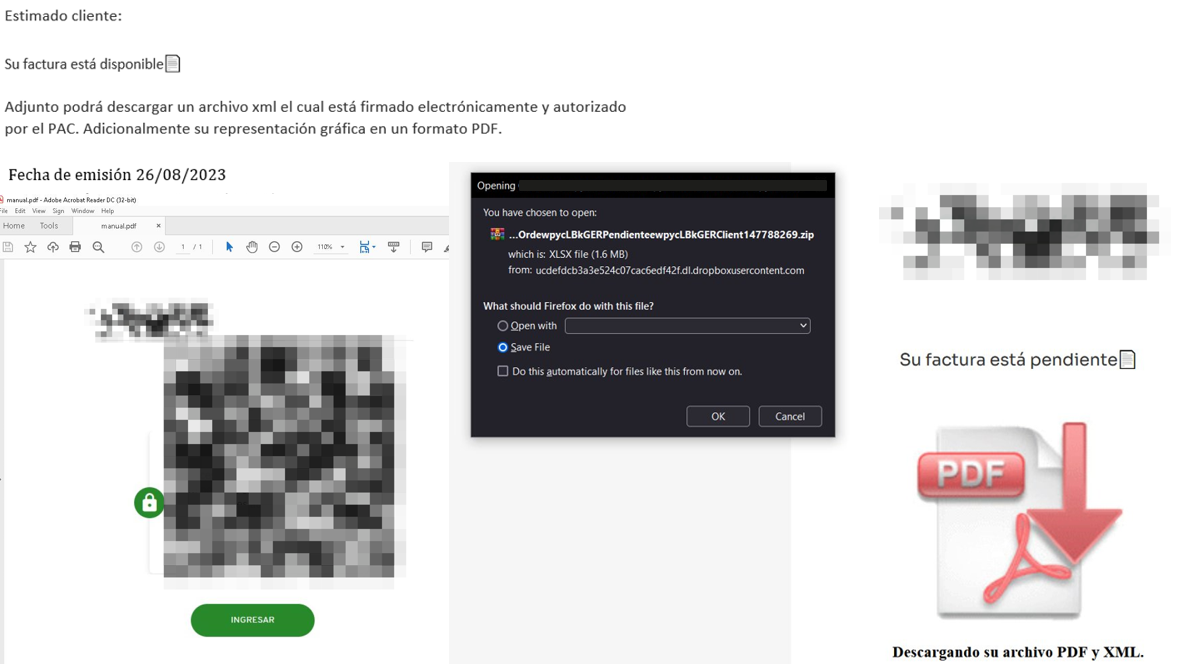
JanelaRAT campaigns involve a multi-stage infection chain. It starts with emails mimicking the delivery of pending invoices to trick victims into downloading a PDF file by clicking a malicious link. Then the victims are redirected to a malicious website from which a compressed file is downloaded.

Malicious email used in JanelaRAT campaigns

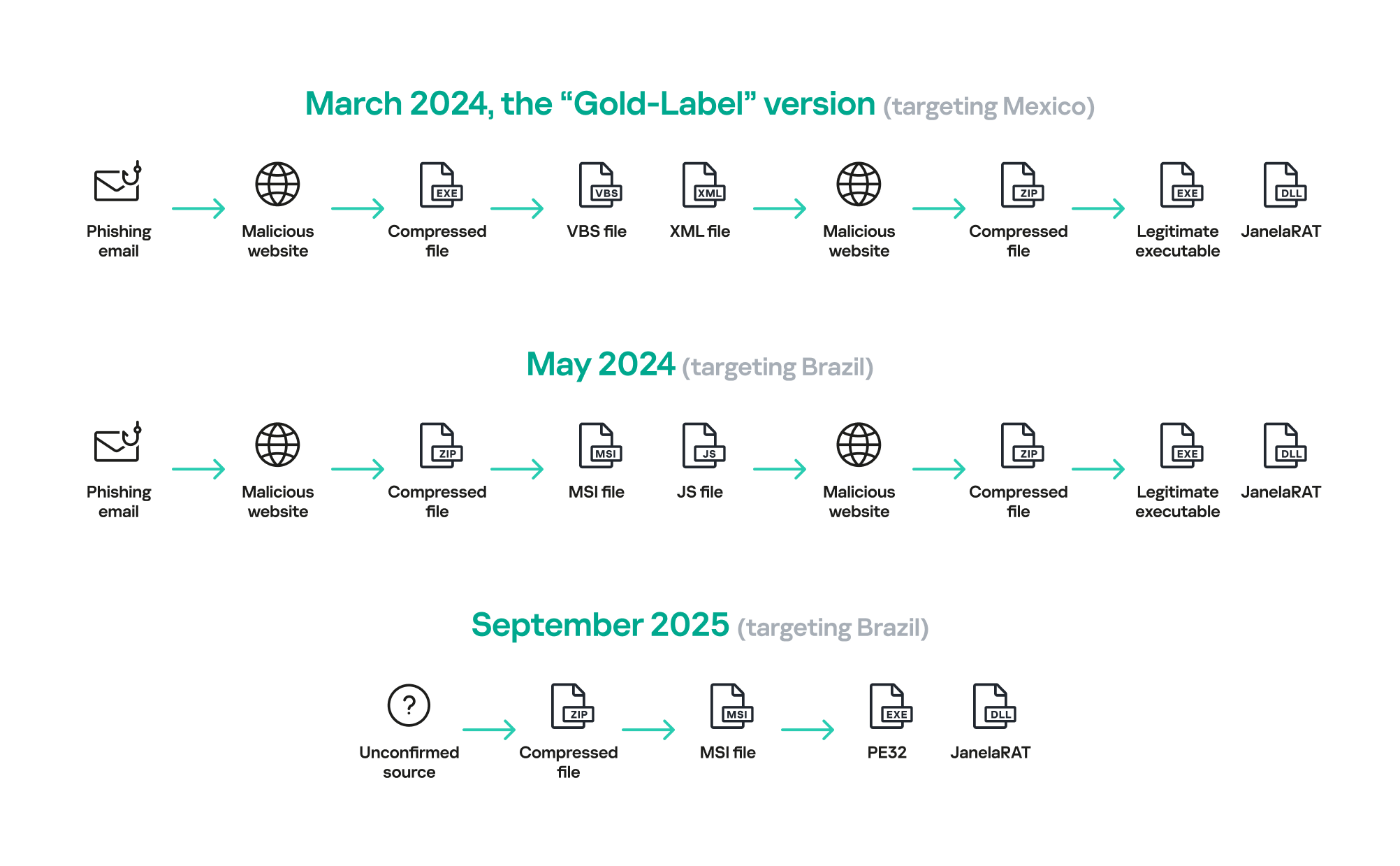
Throughout our monitoring of these malware campaigns, the compressed files have typically contained VBScripts, XML files, other ZIP archives, and BAT files. They ultimately lead to downloading a ZIP archive that contains components for DLL sideloading and executing JanelaRAT as the final payload.

However, we have observed variations in the infection chains depending on the delivered version of the malware. The latest observed campaign evolved by integrating MSI files to deliver a legitimate PE32 executable and a DLL, which is then sideloaded by the executable. This DLL is actually JanelaRAT, delivered as the final payload.

Based on our analysis of previous JanelaRAT intrusions, the updates in the infection chain represent threat actors’ attempts to streamline the process, with a reduced number of malware installation steps. We’ve observed a logical sequence in how components, such as MSI files, have been incorporated and adapted over time. Moreover, we have observed the use of auxiliary files — additional components that aid in the infection — such as configuration files that have been changing over time, showing how the threat actors have adapted these infections in an effort to avoid detection.

JanelaRAT infection flow evolution

Initial dropper


The MSI file acts as an initial dropper designed to install the final implant and establish persistence on the system. It obfuscates file paths and names with the objective to hinder analysis. This code is designed to create several ActiveX objects to manipulate the file system and execute malicious commands.

Among the actions taken, the MSI defines paths based on environment variables for hosting binaries, creating a startup shortcut, and storing a first-run indicator file. The dropper file checks for the existence of the latter and for a specific path, and if either is missing, it creates them. If the file exists, the MSI file redirects the user to an external website as a decoy, showing that everything is “normal”.

The MSI dropper places two files at a specified path: the legitimate executable nevasca.exe and the PixelPaint.dll library, renaming them with obfuscated combinations of random strings before relocating. An LNK shortcut is created in the user’s Startup folder, pointing to the renamed nevasca.exe executable, ensuring persistence. Finally, the nevasca.exe file is executed, which in turn loads the PixelPaint.dll file that is JanelaRAT.

Malicious implant


In this case, we analyzed JanelaRAT version 33, which was masqueraded as a legitimate pixel art app. Similar to other malware versions, it was protected with Eazfuscator, a common .NET obfuscation tool. We have also seen previous JanelaRAT samples that used the ConfuserEx obfuscator or its custom builds. The malware uses Control Flow Flattening method and renames classes and variables to make the code unreadable without deobfuscation.

JanelaRAT monitors the victim’s activity, intercepts sensitive banking interactions, and establishes an interactive C2 channel to report changes to the threat actor. While screen monitoring is also present, the core functionality focuses on financial fraud and real-time manipulation of the victim’s machine. The malware collects system information, including OS version, processor architecture (32-bit, 64-bit, or unknown), username, and machine name. The Trojan evaluates the current user’s privilege level and assigns different nicknames for administrators, users, guests, and an additional one for any other role.

The malware then retrieves the current date and constructs a beacon to register the victim on the C2 server, along with the malware version. To prevent multiple instances, the malware creates the mutex and exits if it already exists.

String encryption


All JanelaRAT samples utilize encrypted strings for sending information to the C2 and obfuscating embedded data. The encryption algorithm remains consistent across campaigns, combining base64 encoding with Rijndael (AES). The encryption key is derived from the MD5 hash of a 4-digit number and the IV is composed of the first 16 bytes of the decoded base64 data.

C2 communication and command handling


After initialization, JanelaRAT establishes a TCP socket, configuring callbacks for connection events and message handling. It registers all known message types, executing specific system tasks based on the received message.

Following socket initialization, the malware launches two background routines:

  1. User inactivity and session tracking
    This routine activates timers and launches secondary threads, including an internal timer and a user inactivity monitor. The malware determines if the victim’s machine has been inactive for more than 10 minutes by calculating the elapsed time since the last user input. If the inactivity period exceeds 10 minutes, the malware notifies the C2 by sending the corresponding message. Upon user activity, it notifies the threat actor again. This makes it possible to track the user’s presence and routine to time possible remote operations.

    Timer that looks for 10 minutes of inactivity
    Timer that looks for 10 minutes of inactivity

  2. Victim registration and further malicious activity
    This routine is launched immediately after the socket setup. It triggers two subroutines responsible for periodic HTTP beaconing and downloading additional payloads.
    1. The first subroutine executes a PowerShell downloaded from a staging server during post-exploitation. Its main objective is to establish persistence by downloading the PixelPaint.dll file once again. The routine then builds and executes periodic HTTP requests to the C2, reporting the malware’s version and the victim machine’s security environment. It loops continuously as long as a specific local file does not exist, ensuring repeated telemetry transmission. The file was not observed being extracted or created by the malware itself; rather, it appears to be placed on the system by the threat actor during other post-exploitation activities. Based on previous incidents, this file likely contains instructions for establishing persistence.
      This JanelaRAT version constructs a second C2 URL for beaconing, using several decrypted strings and following a pattern that uses different parameters to report information about new victims:
      <C2Domain>?VS=<malwareversion>&PL=<profilelevel>&AN=<presenceofbankingsoftware>
      We have observed constant changes in the parameters across campaigns. A new parameter “AN” was introduced in this version. It is used to detect the presence of a specific process associated with banking security software. If such software is found on the victim’s device, the malware notifies the threat actor.
      Parameter Description
      VSJanelaRAT version
      PLOFF by default
      ANYes or No depending on whether banking security software process exists
    2. The second subroutine is responsible for monitoring the user’s visits to banking websites and reporting any activity of interest to the threat actor. JanelaRAT 33v is specifically engineered to target Brazilian financial institutions. However, we have also observed other versions of the malware targeting other specific countries in the region, such as the “Gold-Label” version targeting banking users in Mexico that we described earlier.
      This subroutine creates a timer to enable an active system monitoring cycle. During this cycle, the malware obtains the title of the active window and checks if it matches entries of interest using a hardcoded but obfuscated list of financial institutions. Although the threat actors behind JanelaRAT primarily focus on one country as a target, the list of financial institutions is constantly updated.

      If a title bar matches one of the listed targets, the malware waits 12 seconds before establishing a dedicated communication channel to the C2. This channel is used to execute malicious tasks, including taking screenshots, monitoring keyboard and mouse input, displaying messages to the user, injecting keystrokes or simulating mouse input, and forcing system shutdown.

      To perform these actions, the malware uses a dedicated C2 handler that interprets incoming commands from the C2. Notably, 33v supports live banking session hijacking, not just credential theft.

      Action PerformedDescription
      Capture desktop imageSend compressed screenshots to the C2
      Specific screenshotsCrop specific screen regions and exfiltrate images
      Overlay windowsDisplay images in full-screen mode, limit user interactions, and mimic bank dialogs to harvest credentials
      KeyloggingKeystroke capture
      Simulate keyboardInject keys such as DOWN, UP, and TAB to navigate or trigger new elements
      Track mouse inputMove the cursor, simulate clicks, and report the cursor position
      Display messageShow message boxes (custom title, text, buttons, or icons)
      System shutdownExecute a forced shutdown sequence
      Command executionRun CMD or PowerShell scripts/commands
      Task Manager
      manipulation
      Launch Task Manager, find its window, and hide it to prevent discovery by the user
      Check for banking security software processDetect the presence of anti-fraud systems
      BeaconingSend host information (malware version, profile, presence of banking software)
      Toggle internal modesEnable and disable modes such as screenshot flow, key injection, or overlay visibility
      Anti-analysisDetect sandbox or automation tools


C2 infrastructure


Unlike other versions, this variant rotates its C2 server daily. Once a title bar matches the one in the list, the software dynamically constructs the C2 channel domain by concatenating an obfuscated string, the current date, and a suffix domain related to a legitimate dynamic DNS (DDNS) service. This communication is established using port 443, but not TLS.

Decoy overlay system


This version of JanelaRAT implements a decoy overlay system designed to capture banking credentials and bypass multi-factor authentication. When a target banking window is detected, the malware requests further instructions from the C2 server. The C2 responds with a command identifier and a Base64-encoded image, which is then displayed as a full-screen overlay window mimicking legitimate banking or system interfaces. The malware ensures the fake window completely covers the screen and limits the victim’s interaction with the system.

The malware blocks the victim’s interaction by displaying modal dialogs. Each modal dialog corresponds to a specific operation, such as password capture, token/MFA capture, fake loading screen, fake Windows update full-screen modal and more. The malware resizes the overlay, scans multiple screens, and loads deceptive elements to distract the user or temporarily hide legitimate application windows.

Among other fake elements, the malware displays fake Windows update notifications, often accompanied by messages in Brazilian Portuguese, such as:

  • “Configuring Windows updates, please wait.”
  • “Do not turn off your computer; this could take some time.”

When a message command is received from the operator, the malware constructs a custom message box based on parameters sent from the server. These parameters include the message title, text content, button type (e.g., OK, Yes/No), and icon type (e.g., Warning, Error). The malware then creates a maximized message box positioned at the top of the screen, ensuring it captures user focus and blocks the visibility of other windows, mimicking a system or security alert.

An obfuscated acknowledgement string is sent back to the C2 to confirm successful execution of this task.

Anti-analysis techniques


In addition to the conditional behavior based on whether the process of banking security software is detected, the malware includes anti-analysis routines and computer environment checks, such as sandbox detection through the Magnifier and MagnifierWindow components. These components are used to determine if accessibility tools are active on the infected computer indicating a possible malware analysis environment.

Persistence


The malware establishes persistence by writing a command script into the Windows Startup directory. This script forces the execution chain to run at each user logon enabling malicious activity without triggering privilege escalation prompts. The script is executed silently to evade user awareness.

This method is either an alternative or a supplement to the persistence method previously described in the subroutines responsible for periodic HTTP beaconing section.

Victimology


Consistent with previous intrusions and campaigns, the primary targets of the threat actors distributing JanelaRAT are banking users in Latin America, with specific focus on users of financial institutions in Brazil and Mexico.

According to our telemetry, in 2025 we detected 14,739 attacks in Brazil and 11,695 in Mexico related to JanelaRAT.

Conclusions


JanelaRAT remains an active and evolving threat, with intrusions exhibiting consistent characteristics despite ongoing modifications. We have tracked the evolution of JanelaRAT infections for some time, observing variations in both the malware itself and its infection chain, including targeted variants for specific countries.

This variant represents a significant advancement in the actor’s capabilities, combining multiple communication channels, comprehensive victim monitoring, interactive overlays, input injection, and robust remote control features. The malware is specifically designed to minimize user visibility and adapt its behavior upon detection of anti-fraud software.

To mitigate the risk of communication with the C2 infrastructure utilizing similar evasive techniques, we recommend that defenders block dynamic DNS services at the corporate perimeter or internal DNS resolvers. This will disrupt the communication channels used by JanelaRAT and similar threats.

Indicators of compromise


808c87015194c51d74356854dfb10d9e MSI Dropper
d7a68749635604d6d7297e4fa2530eb6 JanelaRAT
ciderurginsx[.]com Primary C2


securelist.com/janelarat-finan…

Cybersecurity & cyberwarfare ha ricondiviso questo.

#Iran-linked group #Handala claims to have breached three major UAE organizations
securityaffairs.com/190716/hac…
#securityaffairs #hacking

The media in this post is not displayed to visitors. To view it, please log in.

Attacco SCADA nel mirino: le APT iraniane prendono di mira i controllori Unitronics negli Stati Uniti


@Informatica (Italy e non Italy)
A partire da marzo 2026, attori APT affiliati all'Iran hanno compromesso almeno 75 controllori programmabili Unitronics negli USA, utilizzando il software legittimo Studio 5000 Logix Designer per modificare la


Attacco SCADA nel mirino: le APT iraniane prendono di mira i controllori Unitronics negli Stati Uniti


Si parla di:
Toggle


A partire da marzo 2026, attori APT affiliati all’Iran hanno intensificato le operazioni di cyberattacco contro l’infrastruttura critica statunitense, sfruttando direttamente le esposizioni di controllori programmabili (PLC) di Unitronics e Rockwell Automation online. Secondo un avviso congiunto pubblicato dal CISA, dall’FBI e dalla NSA l’aprile 2026, questi attacchi rappresentano una minaccia diretta ai sistemi di controllo industriale (SCADA/HMI) che gestiscono funzioni critiche nelle utilities idriche, nei sistemi energetici e nelle strutture governative.

La novità inquietante è che gli attaccanti non stanno sfruttando vulnerabilità zero-day o malware sofisticato: invece, stanno utilizzando il software legittimo Rockwell Automation Studio 5000 Logix Designer per accedere direttamente ai PLC esposti, modificare i file di progetto contenenti la logica ladder, e falsificare i dati visualizzati sulle interfacce HMI (Human-Machine Interface). Una tecnica che trasforma il software di ingegneria industriale in un vettore di attacco praticamente invisibile alle difese tradizionali.

Contesto dell’operazione e portata dell’attacco


Le operazioni di ricognizione hanno identificato almeno 75 dispositivi compromessi distribuiti tra settori critici statunitensi. Tuttavia, il dato più allarmante emerge dall’analisi della superficie d’attacco: Censys ha riportato che oltre 5.219 PLC Rockwell/Allen-Bradley sono attualmente esposti a Internet, creando un bersaglio potenziale massivo per le operazioni offensive iraniane.

Gli attori APT affiliati all’Iran stanno accedendo ai dispositivi utilizzando indirizzi IP forniti da provider di hosting di terze parti, presumibilmente per mascherare la loro origine geografica. Una volta all’interno, stabiliscono connessioni autenticate sfruttando le credenziali ottenute da precedenti ricognizioni o mediante attacchi di brute force contro interfacce web esposte.

L’FBI ha formalmente valutato che questa campagna è motivata da ritorsioni geopolitiche legate alle ostilità tra Stati Uniti, Israele e Iran. Le operazioni si sono intensificate in parallelo ai crescenti attriti regionali, suggerendo che le infrastrutture critiche americane sono state designate come obiettivi di rappresaglia informatica.

Metodologie di attacco e indicatori tecnici


Gli attaccanti mantengono persistenza attraverso la modifica diretta dei file di progetto .ACD (AutoCAD) che contengono la logica ladder, gli script di automazione e le configurazioni dei PLC. Modificando questi file prima di sincronizzarli con i controller, gli attori APT possono inserire comportamenti malevoli che verranno riprodotti ogni volta che il PLC viene alimentato o riavviato.

Le porte di accesso monitorate includono:

  • Porta 44818 (Rockwell Automation native)
  • Porta 2222 (SSH alternativo)
  • Porta 102 (Siemens S7 protocol)
  • Porta 22 (SSH standard)
  • Porta 502 (Modbus TCP)

La molteplicità di protocolli suggerisce che gli attaccanti stanno sfruttando un’unica campagna per accedere a dispositivi di produttori diversi: non solo Rockwell Automation e Unitronics, ma potenzialmente anche controllori Siemens S7 e altri standard OT.

Una volta dentro, gli attori hanno estratto file di configurazione contenenti la logica intera dell’infrastruttura, fornendogli una roadmap completa dell’architettura di controllo. Inoltre, hanno modificato i valori visualizzati sulle interfacce HMI per mostrare false letture agli operatori umani, disaccoppiando quello che gli ingegneri vedono sugli schermi da quello che i PLC stanno effettivamente eseguendo.

Indicatori di compromissione (IoCs)


Sebbene il CISA non abbia pubblicato una lista completa di IoCs nella versione iniziale dell’avviso, gli indirizzi IP utilizzati dagli attaccanti includono range associati a provider di hosting europei. Le organizzazioni dovrebbero monitorare:

  • Connessioni non autorizzate alle porte 44818, 2222, 102, 22, 502
  • Modifiche inaspettate ai file .ACD e .L5K (Rockwell Automation project files)
  • Accessi a Studio 5000 Logix Designer durante ore non-lavorative
  • Alterazioni dei timestamp di accesso ai sistemi HMI/SCADA
  • Estrazione massiva di file di progetto verso destinazioni esterne


Impatto operativo e rischi


Le organizzazioni vittime hanno segnalato varie forme di disruption:

  • Interruzioni nei sistemi di trattamento delle acque
  • Alterazioni nei parametri di controllo energetico
  • Falsificazione dei dati storici di telemetria
  • Potenziale esposizione di procedimenti critici a spilorcare/manipolazione

Una delle implicazioni più insidiose è che i PLC modificati continuano a funzionare apparentemente normalmente secondo le metriche di superficie, mentre la logica sottostante è stata completamente compromessa. Uno scenario di “perfect impersonation” che rende estremamente difficile rilevare l’attacco senza audit tecnici approfonditi della logica ladder.

Raccomandazioni di difesa


Le organizzazioni OT dovrebbero implementare immediatamente:

  • Air-gapping e segmentazione: disconnettere fisicamente i PLC critici da qualsiasi rete esterna. Se la connettività remota è essenziale, implementare DMZ dedicate e controlli di accesso granulari.
  • Protezione dell’accesso remoto: disabilitare gli accessi da Studio 5000 Logix Designer su connessioni remote non crittografate. Implementare VPN con autenticazione multi-fattore.
  • Monitoraggio della logica ladder: implementare sistemi di versioning e change management per i file .ACD. Qualsiasi modifica deve essere confrontata con baseline storiche approvate.
  • Honeypots e deception: distribuire controller PLC decoy connessi a Internet per rilevare e tracciare i tentativi di accesso malevoli.
  • Incident response capability: istituire playbook di risposta per scenari di compromissione PLC.

L’adozione di queste contromisure è critica per le organizzazioni nei settori water, energy, government, e manufacturing. La sofisticazione dell’attacco non risiede nel malware o negli exploit, ma nella comprensione profonda degli ambienti OT e nella capacità di manipolare la realtà percepita dagli operatori umani.


3D-Printed Parts Nearly Sink RC Submarine


The media in this post is not displayed to visitors. To view it, please log in.

A model submarine is shown on a dock. The body of the submarine is made out of a series of acrylic tubes, with other parts made out of grey plastic.

Of all the remote-control vehicles one can build, a submarine is possibly the hardest: if something goes wrong with almost any other vehicle, it’s easy to recover and repair, but a submarine is a very different affair. This nearly lost [James] of [ProjectAir] his latest project, a 2.7-meter long RC submarine, but it survived to make a few test sails.

Before building the full version, [James] made a test prototype. These submarines use large syringes as ballast tanks, pulling water in and out of the submarine body. The plungers are driven by a lead screw, and have a linear potentiometer for feedback. This can be wired in the same way as a servo motor, making it compatible with the RC controller. The controller receives its signal from an antenna in a buoy tethered to the submarine. Since initial tests worked well, [James] moved on to the full-scale model.

This was made out of radially-arranged acrylic tubes, with all but the top tube left open to the water. At the back of the submarine there were servo-actuated fins and a propeller, which would allow it to steer, ascend, and descend underwater. To waterproof the servo motors, [James] sealed them as much as possible, then filled them with oil. The other water-exposed electronics were either potted in epoxy or coated with a waterproofing compound. During testing, the submarine descended without issue, but was reluctant to resurface. Most of the external components had been 3D printed, and water infiltrated the infill below a certain depth. [James], however, managed to recover it before it was permanently lost, and managed to make a few other dives at a very limited depth.

On the other end of the spectrum from an RC submarine, we’ve also seen a rubber band-powered submarine. We’ve also seen a smaller, but more dive-ready RC submarine.

youtube.com/embed/jU4MszQURLI?…

Thanks to [H Hack] for the tip!


hackaday.com/2026/04/13/3d-pri…

Cybersecurity & cyberwarfare ha ricondiviso questo.

The media in this post is not displayed to visitors. To view it, please go to the original post.

Adobe Patches Actively Exploited Acrobat Reader Zero-Day CVE-2026-34621 — Exploited Since December 2025
#CyberSecurity
securebulletin.com/adobe-patch…

DK 10x27 - LinkedIn, la spia


The media in this post is not displayed to visitors. To view it, please log in.

LinkedIn raccoglie segretamente dati sensibili ogni volta che ci colleghiamo. Perché? Cosa ci fa? A chi li rivende? È ora dif ar capire a Big Tech che non può fare quel che vuole.

Link alle fonti:


  1. LinkedIn che profila gli utenti in modo illecito
  2. Microsoft e Anthropic che, in una pausa dallo hype incessante sulle meraviglie future dell'AI, scrivono nei termini d'uso che i loro modelli linguistici sono "solo per intrattenimento"
  3. il sistema della cosiddetta "pubblicità profilata" riciclato come strumento di sorveglianza che erode ogni garanzia costituzionale
  4. chatGPT, che come tutti i modelli linguistici non sa fare di conto, usato dal Dipartimento della Difesa statunitense nell'analisi dei dati di test nucleari
  5. openAI che supporta una proposta di legge per limitare la responsabilità in caso di disastri finanziari o morti di massa resi possibili dall'IA.

spreaker.com/episode/dk-10x27-…

Cybersecurity & cyberwarfare ha ricondiviso questo.

The media in this post is not displayed to visitors. To view it, please go to the original post.

282 – Il CEO di Palantir dice che si salveranno solo quelli che non ragionano come gli altri camisanicalzolari.it/282-il-ce…