The Privacy Post ha ricondiviso questo.

The media in this post is not displayed to visitors. To view it, please go to the original post.

Fuga di Dati FBI: Pubblicato il Database degli Agenti su Breached Forum
poliverso.org/display/0477a01e…
Fuga di Dati FBI: Pubblicato il Database degli Agenti su Breached Forum Una presunta fuga di dati senza precedenti ha travolto l’FBI: un massiccio data breach che ha esposto online i dati personali di oltre 22.000 agenti, mettendo a rischio la sicurezza nazionale.Un utente di Breached Forum ha pubblicato un database contenente nomi, ruoli e altre informazioni


Fuga di Dati FBI: Pubblicato il Database degli Agenti su Breached Forum

Una presunta fuga di dati senza precedenti ha travolto l’FBI: un massiccio data breach che ha esposto online i dati personali di oltre 22.000 agenti, mettendo a rischio la sicurezza nazionale.

Un utente di Breached Forum ha pubblicato un database contenente nomi, ruoli e altre informazioni sensibili degli agenti, scatenando l’allarme nella comunità dell’intelligence.

Al momento, non possiamo confermare la veridicità della notizia, poiché l’organizzazione non ha ancora rilasciato alcun comunicato stampa ufficiale sul proprio sito web riguardo l’incidente. Pertanto, questo articolo deve essere considerato come ‘fonte di intelligence’.

Dettagli del Data Breach


Il post, pubblicato dall’utente “rpk” il 3 agosto 2024 alle 03:23 AM, presenta un file contenente i dettagli di numerosi agenti dell’FBI. Il file, di 1.9MB, include presumibilmente nomi, ruoli e altre informazioni personali degli agenti.

Secondo il post, il database è descritto come un file di testo (.txt) con un totale di 22.175 righe. Il post include anche alcune informazioni generali sull’FBI, enfatizzando il ruolo dell’agenzia come principale braccio investigativo del Dipartimento di Giustizia degli Stati Uniti e membro a pieno titolo della comunità dell’intelligence statunitense.

Un aspetto rilevante di questa pubblicazione è la totale assenza di esempi di dati (sample) che dimostrino la veridicità delle informazioni contenute nel database. Inoltre, non è stato previsto alcun meccanismo di escrow, un intermediario fidato che possa garantire l’autenticità e la sicurezza della transazione dei dati. Queste assenze sollevano dubbi sulla credibilità del database e sull’intenzione dell’utente “rpk”.

Conclusione


La divulgazione di informazioni personali degli agenti dell’FBI rappresenta un rischio significativo. Gli agenti potrebbero diventare bersagli di attacchi fisici o digitali, e le loro famiglie potrebbero essere minacciate. Inoltre, la fuga di dati potrebbe compromettere operazioni investigative in corso.

Non è chiaro come l’FBI abbia risposto al data breach, è probabile che l’agenzia stia conducendo un’indagine interna per determinare come si sia verificata la fuga di dati e per prevenire ulteriori incidenti.

Questa fuga di dati sottolinea l’importanza critica della cyber security e della protezione delle informazioni sensibili. Mentre l’FBI lavora per mitigare i danni e prevenire future violazioni, questo incidente serve come promemoria della necessità di rafforzare continuamente le misure di sicurezza a tutti i livelli delle agenzie governative.

L'articolo Fuga di Dati FBI: Pubblicato il Database degli Agenti su Breached Forum proviene da il blog della sicurezza informatica.


The Privacy Post reshared this.

The Privacy Post ha ricondiviso questo.

The media in this post is not displayed to visitors. To view it, please go to the original post.

Radio Apocalypse: HFGCS, The Backup Plan for Doomsday
poliverso.org/display/0477a01e…
Radio Apocalypse: HFGCS, The Backup Plan for Doomsday To the extent that you have an opinion on something like high-frequency (HF) radio, you probably associate it with amateur radio operators, hunched over their gear late at night as they try to make contact with a random stranger across the globe to talk about the fact that they’re both doing the same thing at the same time.


Radio Apocalypse: HFGCS, The Backup Plan for Doomsday

To the extent that you have an opinion on something like high-frequency (HF) radio, you probably associate it with amateur radio operators, hunched over their gear late at night as they try to make contact with a random stranger across the globe to talk about the fact that they’re both doing the same thing at the same time. In a world where you can reach out to almost anyone else in an instant using flashy apps on the Internet, HF radio’s reputation as somewhat old and fuddy is well-earned.

Like the general population, modern militaries have largely switched to digital networks and satellite links, using them to coordinate and command their strategic forces on a global level. But while military nets are designed to be resilient to attack, there’s only so much damage they can absorb before becoming degraded to the point of uselessness. A backup plan makes good military sense, and the properties of radio waves between 3 MHz and 30 MHz, especially the ability to bounce off the ionosphere, make HF radio a perfect fit.

The United States Strategic Forces Command, essentially the people who “push the button” that starts a Very Bad Day™, built their backup plan around the unique properties of HF radio. Its current incarnation is called the High-Frequency Global Communications System, or HFGCS. As the hams like to say, “When all else fails, there’s radio,” and HFGCS takes advantage of that to make sure the end of the world can be conducted in an orderly fashion.

Bombs Away LeMay


The US Air Force has a long history radio, dating back to when airplanes were little more than wood and canvas contraptions. Radio, especially HF radio, played a huge role in prosecuting World War II, changing the face of warfare forever. As the Cold War years set in and strategic forces became increasingly important, HF radio systems continued to play a role. One of the biggest boosters of HF radio for coordinating strategic air forces was none other than General Curtis LeMay, who as an enthusiastic amateur radio operator well knew the power of HF radio to communicate long distances, particularly using single-sideband (SSB) modulation.

Despite this history, HFGCS itself is relatively new. It only came onto the scene in 1992, when post-Cold War military restructuring combined two earlier Air Force HF networks into the Global High-Frequency System. GHFS would undergo equipment upgrades in 2002 and get an extra letter in its rearranged acronym, becoming HFGCS. While HFGCS may have started out as the Air Force’s baby, its design is open and flexible enough that it can be used by Air Force, Army, and Navy assets anywhere in the world around the clock.

The primary fixed infrastructure of HFGCS is a network of thirteen ground stations scattered across the United States and its territories as well as allied countries around the world. The HFGCS ground stations are linked together through a combination of landlines and satellite stations to act as a unified network. Almost all of the stations on the network are “lights out” stations that are controlled remotely. The primary control point for the entire system is located at Andrews Air Force Base outside of Washington, DC, with a backup location deep in the interior of the continent at Offutt AFB in Omaha, Nebraska. Each of these two stations is manned around the clock and can control the entire network.

It’s obviously difficult to get a lot of technical detail on what sort of gear is being used at each HFGCS station, but there’s one aspect of the system that’s hard to keep from public scrutiny: the antennas. The Offutt AFB transmitter station provides a pretty good look at things, sitting as it does in the middle of a cornfield off a public road in Elkhorn, Nebraska. There sprouts a sprawling farm of directional and omnidirectional antennas, including a collection of massive AS-3482/GRC log periodic arrays. These giants have twin towers that support a rotating platform with three support booms for the radiation array. A balun at the base matches the antenna to the feedline, which is a 50-ohm hardline coax measuring a whopping 3-1/8″ (80 mm) diameter. HFGCS stations also have receive capability, of course, but given the 25,000-watt power rating on these antennas, the receivers are generally not located with the transmitters. In the case of the Offutt AFB station, the receivers are located 28 miles (45 km) away outside of Scribner, Nebraska.
Interesting crop. One of the many AS-3482/GRC log-periodic antennas at the HFGCS transmit antenna farm outside Offut AFB in Nebraska. Source: Google

Fine Business, Old Minuteman


The ability of HF radio to make contacts across the globe with no fixed infrastructure between contact points is what makes it perfect for backup communications with strategic forces. That’s not to say that it’s foolproof, of course; there certainly are ways to interfere with the ionospheric skip that it depends on, which probably plays a large part in why HFGCS is only a backup, but things have to have gone badly wrong for that to be the case.
Built to last. Blast cover for HFGCS transmit antenna silo at a Minuteman LCC. The white cone in the background is a hardened radome for the UHF satellite link. Source: Library of Congress.
Ironically, one of the ways for things to go wrong enough to bump HFGCS up from backup status is an all-out nuclear exchange, which would no doubt involve the 450-odd Minuteman III ICBMs that comprise one of the legs of the United States’ nuclear triad. The Minuteman missiles are kept at the ready in 45 missile alert facilities (MAFs) scattered across the American prairie. Each MAF is comprised of ten launch facilities, each storing one LGM-30 missile in an underground silo, and a separate launch control center, or LCC. The LCC is the underground bunker crewed by two Air Force officers who bear the responsibility of turning the keys that launch their flight of missiles, should it be so ordered.

But to perform that final official act of their careers, those officers have to get the coded order from US Strategic Command, typically over one of the primary secure networks. Should those links fail, though, each LCC is equipped with an HFGCS link. The fact that each LCC is no doubt slated to receive a nasty package on the appointed day means that standard HF antennas, which tend to be quite large, are far too exposed to survive and perform their backup duties. So the LCCs sport hidden HFGCS antennas that can be deployed on command.

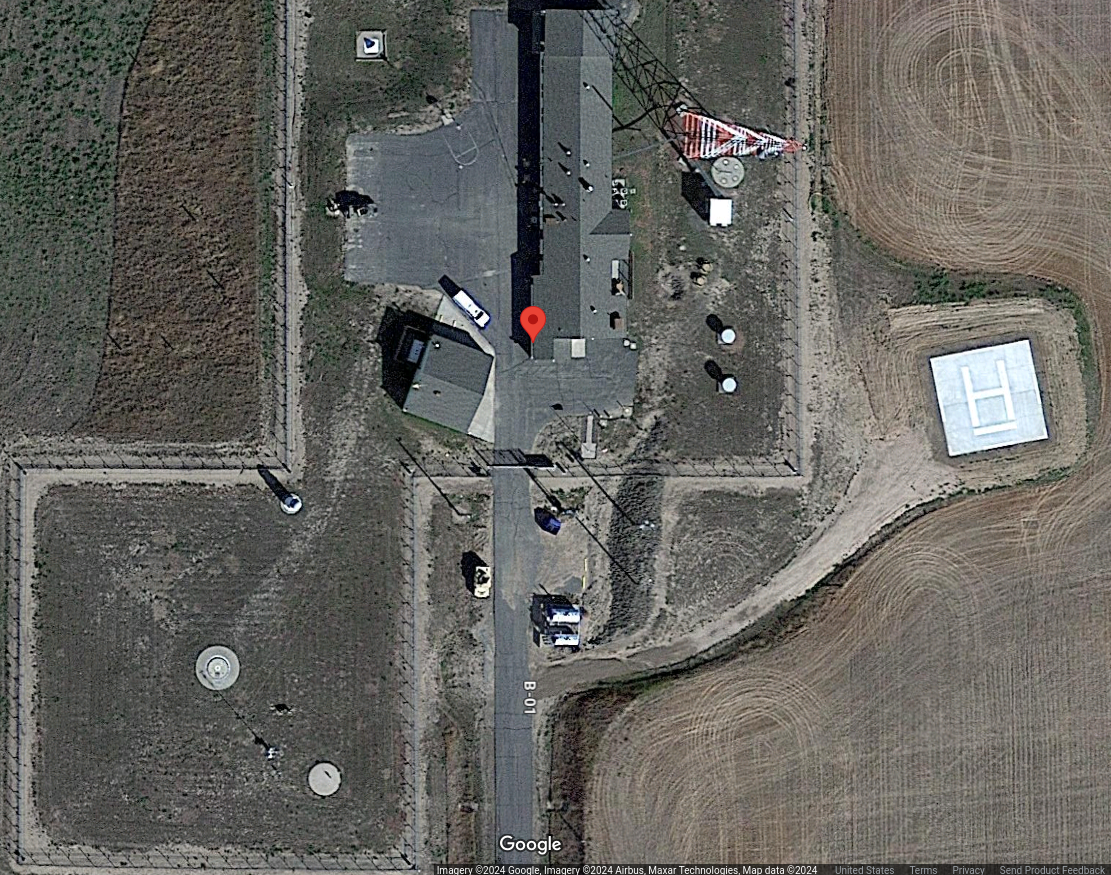
On the transmit side, each squadron LCC has a 50′ (15 meter) deep reinforced concrete silo topped by an extremely sturdy blast door that’s flush to the ground, for maximum resistance to nearby blast waves. Upon command, the door opens to allow a telescopic HF antenna to extend up to 120′ (36 meters) above the ground. The reality, though, is that the need to transmit on HFGCS is far less important than being able to receive. That’s why the receiving antenna arrangement is a bit more complicated.
The Bravo-01 LCC for the 319th Missile Squadron. It’s not entirely clear if Minuteman LCCs still have the deployable antennas activated, but the silo for the receive antenna is clearly visible in the northeast corner below the freestanding red-on-white tower. The telescoping transmit antenna silo is the ominous bullseye in the southwest section of the facility. Source: Google Maps
To make sure the LCC is always ready to receive and act on an Emergency Alert Message (EAM), each facility has a hardened HFGCS receive antenna array. Like the transmitting antenna, these are housed in underground silos. Each silo has six monopole steel antennas, one of which is always deployed. The five others are kept in reserve; should the main antenna get knocked down, an explosive charge at the bottom of the antenna’s tube detonates, extending a fresh antenna above the ground.

Mainsail, Mainsail


Given the highly sensitive nature of the traffic on a radio network charged in part with ending the world, you’d think that messages would be digitally encrypted and completely useless to try snooping in on. And while it’s true that there are encrypted digital modes that use HFGCS, a surprising amount of traffic is just plain old voice messages transmitted in the open. While it remains true that nothing punches through like good old Morse code on continuous wave (CW), SSB voice is far more efficient. The video below shows British ham M0SZT monitoring HFGCS from an adorable shepherd’s camp somewhere in the Peak’s District, not far from the RAF Croughton HFGCS site:

youtube.com/embed/ytqLbWRBQy4?…

That’s not to say that you’d be able to understand the messages, the bulk of which is a block of 30 numbers and letters, with the former stated as the standard NATO phonetic alphabet. Unless you have the decryption code, the message will read as gibberish. In fact, you can’t even derive any useful information from the length of the message, since it’s always 30 characters long. About the only metadata you could potentially glean would be the station code names embedded in the message, but since those are randomly changed every day, there’s not much point.

Still, there’s plenty to be gained from monitoring HFGCS, especially in times of geopolitical tumult. If the balloon goes up, so to speak, then traffic on HFGCS will undoubtedly increase markedly, as it will on its Russian counterpart, colloquially known as Bear Net to the US military. It’ll make for interesting listening — at least for a few minutes.


The Privacy Post reshared this.

The Privacy Post ha ricondiviso questo.

X slammed with data privacy complaint over AI training
euractiv.com/section/data-priv…
@privacy
Consumer organisations allege X's artificial intelligence (AI) tool is in violation of the General Data Protection Regulation (GDPR) in a complaint filed with the Irish Data Protection Commission (DPC) on Monday (5 August).

The Privacy Post reshared this.

The Privacy Post ha ricondiviso questo.

TikTok Lite to permanently suspend Rewards Program in EU, closing Commission investigation over addictive effects
poliverso.org/display/0477a01e…
TikTok Lite to permanently suspend Rewards Program in EU, closing Commission investigation over addictive effectsTikTok can no longer launch rewards programmes for its EU users, following binding measures that the European Commission announced on Monday (5 August).euractiv.com/section/platforms…


TikTok Lite to permanently suspend Rewards Program in EU, closing Commission investigation over addictive effects


TikTok can no longer launch rewards programmes for its EU users, following binding measures that the European Commission announced on Monday (5 August).


euractiv.com/section/platforms…


The Privacy Post reshared this.

The Privacy Post ha ricondiviso questo.

New note by cybersecurity
poliverso.org/display/0477a01e…
Come prosegue il braccio di ferro tra Delta Air e CrowdStrike startmag.it/cybersecurity/come… (Italy e non Italy 😁)La società di cybersicurezza il cui software ha causato un’interruzione globale dei computer il 19 luglio che ha paralizzato settori tra cui le compagnie aeree sostiene che Delta ha rifiutato l'assistenza


Come prosegue il braccio di ferro tra Delta Air e CrowdStrike


@Informatica (Italy e non Italy 😁)
La società di cybersicurezza il cui software ha causato un’interruzione globale dei computer il 19 luglio che ha paralizzato settori tra cui le compagnie aeree sostiene che Delta ha rifiutato l'assistenza in loco e che la causa legale proposta dal vettore contribuisce a una


The Privacy Post reshared this.

The Privacy Post ha ricondiviso questo.

The media in this post is not displayed to visitors. To view it, please go to the original post.

"An elegant if not joyful solution to helping children and their parents understand the fundamental concepts of the freedom of expression, creation, collaboration and individual contribution FOSS represents."
-Deborah Bryant, Board Director Emeritus @OpenSourceOrg

#AdaZangemann

The Privacy Post reshared this.

The Privacy Post ha ricondiviso questo.

The media in this post is not displayed to visitors. To view it, please go to the original post.

Proof that find + mkdir are Turing-Complete
poliverso.org/display/0477a01e…
Proof that find + mkdir are Turing-Complete Data manipulation is at the heart of computation, and a system is said to be Turing-complete if it can be configured to manipulate data in a way that makes implementing arbitrary computation possible. [Keigo Oka] shared a proof ogiekako.vercel.app/blog/find_… that find and mkdir together are Turing-complete, which is to say, a


Proof that find + mkdir are Turing-Complete

Data manipulation is at the heart of computation, and a system is said to be Turing-complete if it can be configured to manipulate data in a way that makes implementing arbitrary computation possible. [Keigo Oka] shared a proof that find and mkdir together are Turing-complete, which is to say, a system with only GNU’s find and mkdir has access to enough functionality to satisfy the requirements of Turing completeness, which ignores questions of efficiency or speed.

[Keigo Oka]’s first attempt at a proof worked to implement Rule 110, an elementary cellular automata configuration that has been shown to be Turing-complete, or ‘universal’, but has been updated to implement a tag system as it’s proof, and you can see it in action for yourself.

Seeing basic utilities leveraged in such a way illustrates how computation is all around us, and not always in expected places. We’ve also seen Turing-complete origami and computation in cellular automata.


The Privacy Post reshared this.

The Privacy Post ha ricondiviso questo.

The media in this post is not displayed to visitors. To view it, please go to the original post.

New note by cybersecurity
poliverso.org/display/0477a01e…
Cyber caos, CrowdStrike contro le accuse di Delta Airlines: “L’azienda ha rifiutato il nostro aiuto” key4biz.it/cyber-caos-crowdstr… (Italy e non Italy 😁)Continuano le polemiche dopo il cyber caos informatico dello scorso 19 luglio che ha provato un blackout informatico in tutto il mondo. Ier


Cyber caos, CrowdStrike contro le accuse di Delta Airlines: “L’azienda ha rifiutato il nostro aiuto”


@Informatica (Italy e non Italy 😁)
Continuano le polemiche dopo il cyber caos informatico dello scorso 19 luglio che ha provato un blackout informatico in tutto il mondo. Ieri, in una risposta a Delta Airlines, CrowdStrike ha affermato che la società di


The Privacy Post reshared this.

The Privacy Post ha ricondiviso questo.

The media in this post is not displayed to visitors. To view it, please go to the original post.

LianSpy: new Android spyware targeting Russian users
poliverso.org/display/0477a01e…
LianSpy: new Android spyware targeting Russian users In March 2024, we discovered a campaign targeting individuals in Russia with previously unseen Android spyware we dubbed LianSpy. Our analysis indicates that the malware has been active since July 2021. This threat is equipped to capture screencasts, exfiltrate user files, and harvest call logs and app lists. The malicious


LianSpy: new Android spyware targeting Russian users

In March 2024, we discovered a campaign targeting individuals in Russia with previously unseen Android spyware we dubbed LianSpy. Our analysis indicates that the malware has been active since July 2021. This threat is equipped to capture screencasts, exfiltrate user files, and harvest call logs and app lists. The malicious actor behind LianSpy employs multiple evasive tactics, such as leveraging a Russian cloud service, Yandex Disk, for C2 communications. They also avoid having dedicated infrastructure, and employ a lot of other features to keep the spyware undiscovered. Some of these features suggest that LianSpy is most likely deployed through either an unknown vulnerability or direct physical access to the target phone.

Technical details


Initially, LianSpy determines if it is running as a system app, which automatically receives the permissions it needs. Otherwise, it requests permissions for screen overlay, notifications, background activity, contacts, call logs, etc. Once authorized, the spyware verifies it’s not running in a debugging environment. If the environment is free from debugger artifacts, LianSpy sets up its configuration with predefined values and stores this data as a collection of key-value pairs locally using SharedPreferences, an app data storage mechanism generally used for storing application settings. This configuration persists across device reboots and uses integer keys linked to specific spyware settings in SharedPreferences. A detailed list of configuration parameters, including descriptions and default values, is provided below.

ID (key)DescriptionDefault value
100Is first launchfalse
110Allow to run if connected to Wi-Fitrue
111Allow to run if connected to mobile networktrue
113Threat actor’s Yandex IDREDACTED
115Threat actor’s Yandex Disk OAuth tokenREDACTED
121Collect list of installed applications on target devicetrue
123Collect call logstrue
124Collect contact listtrue
128Take screenshots as root with screencap binaryfalse
136Capture screen via media projection APItrue
302Time interval between screenshots in milliseconds5000 (5s)
308Time interval between data exfiltration tasks in milliseconds1200000 (20min)
400Comma-separated list of apps (package name substrings) for screen capture via media projection API or taking screenshots with screencap binarywhatsapp, viber, skype, chrome, vkontakte, telegram, android.gm, gallery, thoughtcrime.securesms, facebook, tencent.mm, snapchat, icq, tencent.mobileqq, imoim, mailapp, instagram, kakao.talk, discord, chrome, internet, browser, dolphin, firefox, opera, safari, uc browser, maxthon, baidu, yandex
420Unused
450User ID

Once activated, the spyware hides its icon and registers a built-in broadcast receiver to receive intents from the system. This receiver triggers various malicious activities, such as screen capturing via the media projection API, taking screenshots as root, exfiltrating data, and updating its configuration.

LianSpy registers a malicious broadcast receiver

To update the spyware configuration, LianSpy searches for a file matching the regular expression
"^frame_.+\\.png$" on a threat actor’s Yandex Disk every 30 seconds. If found, the file is downloaded to the application’s internal data directory. The spyware then decrypts the overlay (data written after the end of the payload) in the downloaded file with a hardcoded AES key. Finally, the configuration updater searches the decrypted payload for a set of substrings, each substring modifying LianSpy’s configuration. A comprehensive list of available options can be found below.

Substring (command name)Description
*con+Enable contact list collection
*con-Disable contact list collection
*clg+Enable call log collection
*clg-Disable call log collection
*app+Enable collection of installed app list
*app-Disable collection of installed app list
*rsr+Schedule taking screenshots
*rsr-Stop taking screenshots
*nrs+Enable screen recording
*nrs-Disable screen recording
*swlSet new app list, stored right after command string, for screen recording
*wif+Allow to run if device is connected to Wi-Fi
*wif-Prohibit from running if device is connected to Wi-Fi only
*mob+Allow to run if device is connected to mobile network
*mob-Prohibit from running if device is connected to mobile network only
*sciSet screen capture interval in milliseconds
*sbiSet interval between data exfiltration tasks in milliseconds

The collected victim’s data is stored encrypted in the SQL table
Con001, which also contains the type of record (device information, contact list, call logs, etc.) and its SHA-256 hash. The data is encrypted using the following scheme:

  • An AES key for data encryption is generated using secure pseudorandom number generator (PRNG). This approach thwarts timing-based attacks that could potentially be exploited by unauthorized parties.
  • A hardcoded public RSA key embedded within the spyware encrypts the AES key.

This robust encryption scheme ensures that only a threat actor owning the corresponding private RSA key can decrypt stolen data.

Stealth features


LianSpy employs unconventional sophisticated evasion techniques to remain undetected.

  • To blend in with legitimate applications, its variants masquerade as the Alipay app or a system service.
  • Android 12 introduced the privacy indicators feature, which displays a status bar icon if sensitive data is being accessed, for example when the screen is being recorded. However, LianSpy developers have managed to bypass this protection by appending a cast value to the Android secure setting parameter icon_blacklist, which prevents notification icons from appearing in the status bar.
  • To further conceal its activities, LianSpy hides notifications from background services it calls by leveraging the NotificationListenerService that processes status bar notifications and is able to suppress them. A list of key phrases used for removing a notification from the status bar can be found below.running in the background
    using battery
    в фоновом режиме
    использует батарею
    используют батарею
  • LianSpy can take screenshots using the screencap system command, typically employed for debugging, but accessible with root permissions. This command leaves no trace of screenshot capture, which allows attackers to stealthily capture screen content.
  • It leverages legitimate cloud and pastebin services extensively, making malicious web activity from a compromised device virtually undetectable.
  • It encrypts exfiltrated data using a robust encryption scheme. Victim identification remains impossible even if Yandex Disk credentials are compromised during APK analysis.
  • LianSpy uses su binary with a modified name to gain root access. The malware samples we analyzed attempt to locate a mu binary in the default su directories. This indicates an effort to evade root detection on the victim’s device. Acquiring superuser rights with such a strong reliance on a modified binary suggests that the spyware was likely delivered through a previously unknown exploit or physical device access.


Infrastructure


LianSpy has no private infrastructure whatsoever. Instead, the threat actor leverages Yandex Disk for both exfiltrating stolen data and storing configuration commands. Victim data is uploaded into a separate Yandex Disk folder.

Other than configuration update job, LianSpy’s communication with its command-and-control (C2) server is unidirectional, with no incoming commands. The malware autonomously conducts update checks and data exfiltration based on its current configuration.

Yandex Disk credentials can be updated from a hardcoded pastebin URL, which may vary across different malware variants. A comprehensive list of these pastebin pages is provided in the IoC section.

Victims


Given that key phrases used to filter notifications are partially in Russian, and some of the default configurations of LianSpy variants include package names for messaging apps popular in Russia, we assume that this spyware targets users in that country. Our KSN telemetry corroborates this, indicating that Russian users have been victims of LianSpy attacks.

Conclusion


The newly discovered Android spyware we dubbed LianSpy exhibits several noteworthy capabilities. Beyond standard espionage tactics like harvesting call logs and app lists, it leverages root privileges for covert screen recording and evasion. Its reliance on a renamed
su binary strongly suggests secondary infection following an initial compromise. Unlike financially motivated spyware, LianSpy’s focus on capturing instant message content indicates a targeted data-gathering operation.
By exclusively leveraging legitimate platforms like Yandex Disk and pastebin services for data exfiltration and C2 communication, the threat actor has complicated attribution. This novel Android threat exhibits no overlap with ongoing malware campaigns targeting Russian users, and we will maintain vigilant monitoring for related activities.

Indicators of Compromise


APK file hashes
084206ec8e6e5684a5acdcbd264d1a41
09088db5640381951e1b4449e930ff11
15222c61978f9133aa34b5972ce84e7e
1ccf5b723c38e30107d55040f10ce32a
22b013cfb95df6b4ba0d2d40dc4bddf4
23b9e5d4ab90506c6e9a42fa47164b84
36bc97ce040ada7142e4add4eb8cd3dd
38149658e5aba1942a6147b387f79d3f
3a4f780820043a8f855979d2c59f36f2
4c3e81bb8e972eef3c9511782f47bdea
5b16eb23a2f5a41063f3f09bc4ca47dd
69581e8113eaed791c2b90f13be0981a
707a593863d5ba9b2d87f0c8a6083f70
7de18a7dac0725d74c215330b8febd4e
842d600d5e5adb6ca425387f1616d6c4
86ea1be200219aca0dc985113747d5ea
86f7c39313500abfb12771e0a4f6d47a
8f47283f19514178ceb39e592324695a
966824d8c24f6f9d0f63b8db41f723b6
99d980a71a58c8ad631d0b229602bbe2
9f22d6bffda3e6def82bf08d0a03b880
a7142ad1b70581c8b232dc6cf934bda4
c449003de06ba5f092ee9a74a3c67e26
d46c5d134a4f9d3cd77b076eb8af28b3
d9e9655013d79c692269aeadcef35e68
da97092289b2a692789f7e322d7d5112
ec74283d40fd69c8efea8570aadd56dc
f13419565896c00f5e632346e5782be4
f37213a7ef3dc51683eec6c9a89e45af
f78eaca29e7e5b035dbcbabac29eb18d
fa3fecca077f0797e9223676d8a48391
fbc2c4226744c363e62fcfeaec1a47f1

Yandex Disk encrypted credential sources
hxxps://pastebin[.]com:443/raw/X4CuaV5L
hxxps://pastebin[.]com:443/raw/0t2c1Djz
hxxps://pastebin[.]com:443/raw/8YXyQtp9
hxxps://pastebin[.]com:443/raw/hm78BGe9
hxxps://pastebin[.]com:443/raw/R509SydV
hxxps://pastebin[.]com:443/raw/dXXcZDF7
hxxps://pastebin[.]com:443/raw/81GhQUjK
hxxps://pastebin[.]com:443/raw/2PmX7Bgd
hxxps://pastebin[.]com:443/raw/zsY6tZLb
hxxps://pastebin[.]com:443/raw/rzMhGiFp
hxxps://pastebin[.]com:443/raw/85DMiWdE
hxxps://pastebin[.]com:443/raw/nSZaB3hw
hxxps://pastebin[.]com:443/raw/Wppem8U5
hxxps://pastebin[.]com:443/raw/KRqNqNrT
hxxps://pastebin[.]com:443/raw/47uLyg6q
hxxps://pastebin[.]com:443/raw/tUQFWtVY
hxxps://pastebin[.]com:443/raw/AgBMX16r
hxxps://pastebin[.]com:443/raw/wSzsbXpg
hxxps://pastebin[.]com:443/raw/e0SqYu41
hxxps://pastebin[.]com:443/raw/ZBFe2b4z
hxxps://pastebin[.]com:443/raw/cbLWwCbR
hxxps://pastebin[.]com:443/raw/fxqART5r
hxxps://pastebin[.]com:443/raw/hiAYisG8
hxxps://pastebin[.]com:443/raw/459bbu4H
hxxps://pastebin[.]com:443/raw/7kxADNLm
hxxps://pastebin[.]com:443/raw/417svXuD
hxxps://pastebin[.]com:443/raw/w4j6jNBV
hxxps://pastebin[.]com:443/raw/9eQJ8uUd
hxxps://pastebin[.]com:443/raw/zy8BKYyg
hxxps://pastebin[.]com:443/raw/uc5Ft4z6


securelist.com/lianspy-android…


The Privacy Post reshared this.

The Privacy Post ha ricondiviso questo.

The media in this post is not displayed to visitors. To view it, please go to the original post.

At Last, Chumby is Ready
poliverso.org/display/0477a01e…
At Last, Chumby is Ready It has been two years, but the slow and steady progress that [Doug Brown] has been making towards bringing a modern Linux kernel to the Chumby has approached the point that it could be called done. In his final blog post of the series, downtowndougbrown.com/2024/08/… [Doug] walks through the highs and lows of the whol


At Last, Chumby is Ready

It has been two years, but the slow and steady progress that [Doug Brown] has been making towards bringing a modern Linux kernel to the Chumby has approached the point that it could be called done. In his final blog post of the series, [Doug] walks through the highs and lows of the whole process.

Many of the changes [Doug] and others have made are already upstream in the Linux mainline. However, some will likely remain in private branches for a few reasons that [Doug] gets into. The blog post covers every commit needed to turn a Chumby or other Marvell ARMADA-powered widget into a working device. At the end of the day, what does [Doug] have to show? He can turn it on, see a boot logo, and then see an indefinite white screen. While underwhelming to most of the world, an X server is coming up, Wi-fi is online, the time syncs from an NTP server, and the touchscreen is ready to be tapped. A white screen, yes, but a white screen of potential. [Doug] has to decide what to launch after boot.

However, the future of the Chumby and other older devices is still on the chopping block of progress. Compiler writers want to drop support for platforms that nobody uses anymore, and the Chumby is ARMv5. With many changes destined to languish, [Doug] still considers it a huge success, and we do too. The whole series represents a journey with beautiful lessons about the power of the Linux device tree, making the dark and scary world of Linux kernel drivers seem a little more approachable.

We’ve covered the first post and when graphics started coming along. We salute the mighty Chumby and the idea it stood for. Of course, the idea of a handy screen displaying information is still alive and well. This handy e-paper HomeAssistant display is just one of many examples.


The Privacy Post reshared this.

The Privacy Post ha ricondiviso questo.

The media in this post is not displayed to visitors. To view it, please go to the original post.

DeerStealer: la MFA non è stata mai così pericolosa fingendosi Google Authenticator
poliverso.org/display/0477a01e…
DeerStealer: la MFA non è stata mai così pericolosa fingendosi Google Authenticator Google è vittima della propria piattaforma pubblicitaria, scrivono i ricercatori di Malwarebytes malwarebytes.com/blog/news/202…. Il fatto è che gli aggressori stanno creando degli


DeerStealer: la MFA non è stata mai così pericolosa fingendosi Google Authenticator

Google è vittima della propria piattaforma pubblicitaria, scrivono i ricercatori di Malwarebytes. Il fatto è che gli aggressori stanno creando degli annunci che promuovono una falsa applicazione Google Authenticator, con il pretesto di distribuire il malware DeerStealer.

Gli esperti affermano che gli aggressori sono ancora in grado di inserire annunci nei risultati delle ricerche di Google, mentre sembrano essere associati a domini legittimi, il che crea un falso senso di fiducia tra gli utenti.

Lo schema funziona così: durante la ricerca di Google Authenticator, l’utente vede un annuncio pubblicitario, presumibilmente proveniente da una fonte ufficiale.

In effetti, dietro l’annuncio si nasconde un account falso. Quando si fa clic sul collegamento, si verificano numerosi reindirizzamenti verso domini controllati dai truffatori.

Di conseguenza, l’utente finisce su un sito Web falso che imita la pagina di Google Authenticator. Lì verrà scaricato il file eseguibile.

Questo è seguito da un reindirizzamento a GitHub, dove è ospitato il payload dannoso. L’utilizzo di hosting legittimo per sviluppatori infonde fiducia negli utenti e consente di aggirare di evadere molti sistemi di sicurezza.

Il file scaricato contiene il malware DeerStealer che è progettato per rubare i dati personali dell’utente. Tutte le informazioni rubate vengono immediatamente inviate al server degli aggressori.

È interessante notare che il file dannoso ha una firma digitale valida, che inganna ulteriormente gli utenti.

Gli esperti di Malwarebytes hanno notato la particolare ironia della situazione: mentre cercano di aumentare la sicurezza utilizzando l’autenticazione a due fattori, gli utenti rischiano di diventare vittime di truffatori incappando accidentalmente in un sito di phishing simile, mascherato da ufficiale tramite reindirizzamenti multipli.

Gli esperti consigliano di non fare clic sui collegamenti pubblicitari per scaricare software. Dovresti invece visitare direttamente i siti Web ufficiali degli sviluppatori. E per evitare che la pubblicità dannosa ti confonda, sarebbe una buona idea installare un comprovato blocco degli annunci.

L'articolo DeerStealer: la MFA non è stata mai così pericolosa fingendosi Google Authenticator proviene da il blog della sicurezza informatica.


The Privacy Post reshared this.

The Privacy Post ha ricondiviso questo.

The media in this post is not displayed to visitors. To view it, please go to the original post.

The Ultimate Seed Vault Backup? How About the Moon
poliverso.org/display/0477a01e…
The Ultimate Seed Vault Backup? How About the Moon A safe haven to preserve samples of biodiversity from climate change, habitat loss, natural disaster, and other threats is recognized as a worthwhile endeavor. Everyone knows good backup practice involves a copy of critical elements at a remote location, leading some to ask:theguardian.com/environment/ar…


The Ultimate Seed Vault Backup? How About the Moon

A safe haven to preserve samples of biodiversity from climate change, habitat loss, natural disaster, and other threats is recognized as a worthwhile endeavor. Everyone knows good backup practice involves a copy of critical elements at a remote location, leading some to ask: why not the moon?
Not even the Svalbard global seed vault is out of the reach of climate change’s effects.
A biological sample repository already exists in the form of the Svalbard global seed vault, located in a mountain on a remote island in the Arctic circle. Even so, not even Svalbard is out of the reach of our changing Earth. In 2017, soaring temperatures in the Arctic melted permafrost in a way no one imagined would be possible, and water infiltrated the facility. Fortunately the flooding was handled by personnel and no damage was done to the vault’s contents, but it was a wake-up call.

An off-site backup that requires no staffing could provide some much-needed redundancy. Deep craters near the moon’s polar regions offer stable and ultra-cold locations that are never exposed to sunlight, and could offer staffing-free repositories if done right. The lunar biorepository proposal has the details, and is thought-provoking, at least.

The moon’s lack of an atmosphere is inconvenient for life, but otherwise pretty attractive for some applications. A backup seed vault is one, and putting a giant telescope in a lunar crater is another.


The Privacy Post reshared this.

The Privacy Post ha ricondiviso questo.

US to propose barring Chinese software in autonomous vehicles
poliverso.org/display/0477a01e…
US to propose barring Chinese software in autonomous vehiclesThe US Commerce Department is expected to propose barring Chinese software in autonomous and connected vehicles in the coming weeks, according to sources briefed on the matter.euractiv.com/section/cybersecu…


US to propose barring Chinese software in autonomous vehicles


The US Commerce Department is expected to propose barring Chinese software in autonomous and connected vehicles in the coming weeks, according to sources briefed on the matter.


euractiv.com/section/cybersecu…


The Privacy Post reshared this.

The Privacy Post ha ricondiviso questo.

Sam Altman e il reddito universale. Iniziano ad uscire i primi dati dello studio
poliverso.org/display/0477a01e…
Sam Altman e il reddito universale. Iniziano ad uscire i primi dati dello studio L’esperimento di Altman si ispira alla sua convinzione dell’importanza di un reddito di base nell’era dell’intelligenza artificiale redhotcyber.com/post/che-cose-…, che secondo alcuni esperti


Sam Altman e il reddito universale. Iniziano ad uscire i primi dati dello studio

L’esperimento di Altman si ispira alla sua convinzione dell’importanza di un reddito di base nell’era dell’intelligenza artificiale, che secondo alcuni esperti potrebbe rendere obsoleti milioni di posti di lavoro. Ritiene inoltre che sia impossibile raggiungere le pari opportunità senza una qualche forma di sicurezza del reddito.

L’idea di un reddito di base universale non è nuova, ma ha guadagnato particolare popolarità grazie alla campagna presidenziale del 2016 di Andrew Yang. Da allora, molte figure di spicco del settore tecnologico, tra cui il cofondatore di Twitter Jack Dorsey e il CEO di Tesla Elon Musk, hanno espresso sostegno al concetto.

Sono emersi i risultati tanto attesi di un esperimento su larga scala sul reddito di base avviato dal CEO di OpenAI Sam Altman del quale avevamo parlato a suo tempo.

Lo studio, uno dei più grandi nel suo genere, ha fornito ai partecipanti a basso reddito pagamenti mensili di 1.000 dollari per tre anni senza vincoli. Lo scopo dell’esperimento era studiare l’impatto del reddito di base sulla vita delle persone, e i risultati sono stati davvero notevoli.

Lo studio ha rilevato che la maggior parte dei fondi aggiuntivi sono stati spesi per bisogni primari, come l’affitto, i trasporti e il cibo. È interessante notare che i partecipanti hanno iniziato a lavorare meno, ma allo stesso tempo sono rimasti partecipanti attivi nel mercato del lavoro ed erano più consapevoli della ricerca di lavoro rispetto al gruppo di controllo.

Gli autori del rapporto sottolineano che ai partecipanti allo studio è stata data maggiore libertà di prendere decisioni che meglio si adattassero alle loro vite e si preparassero per il futuro. Alcuni hanno potuto trasferirsi in altre aree o prendere in considerazione nuove opportunità di business.

Lo studio è stato condotto da OpenResearch e guidato dalla ricercatrice Elizabeth Rhodes. Tutto è iniziato nel 2019, quando sono stati arruolati nell’esperimento 3.000 residenti del Texas e dell’Illinois che vivevano in aree urbane, suburbane e rurali con redditi inferiori a 28.000 dollari. Un terzo dei partecipanti ha ricevuto 1.000 dollari al mese per tre anni, mentre il resto, il gruppo di controllo, ha ricevuto 50 dollari al mese. Tutti i partecipanti hanno mantenuto i vantaggi esistenti.

Secondo lo studio, coloro che hanno ricevuto 1.000 dollari hanno aumentato la loro spesa totale in media di 310 dollari al mese, di cui la maggior parte è destinata al cibo, all’affitto e ai trasporti. Hanno anche fornito maggiore assistenza finanziaria ai bisognosi rispetto al gruppo di controllo.

Tuttavia, i ricercatori non hanno trovato prove dirette di un migliore accesso all’assistenza sanitaria o di cambiamenti significativi nella salute fisica e mentale dei partecipanti. Il rapporto rileva che, sebbene nel primo anno si siano registrate riduzioni significative dello stress, del disagio psicologico e dell’insicurezza alimentare, questi effetti sono scomparsi nel secondo e nel terzo anno del programma. Pagamenti di 1.000 dollari al mese non possono risolvere problemi come malattie croniche, mancanza di assistenza all’infanzia o alti costi abitativi.

Il reddito di base universale fornisce pagamenti diretti in contanti a tutte le persone senza vincoli. Tuttavia, politicamente questo è un compito molto difficile. Molte città e stati stanno sperimentando la garanzia di un reddito di base per alcune popolazioni a basso reddito o vulnerabili. Le prove provenienti da dozzine di programmi simili dimostrano che i trasferimenti di denaro possono aiutare a combattere i senzatetto, la disoccupazione e l’insicurezza alimentare.

All’inizio di quest’anno, Altman ha anche proposto un diverso tipo di reddito di base, che ha chiamato “informatica di base universale”. In questo scenario, le persone riceverebbero una “quota” delle risorse informatiche del grande modello linguistico GPT-7, che potrebbero utilizzare come ritengono opportuno.

Anche questi piccoli esperimenti devono affrontare ostacoli politici. I conservatori di diversi stati hanno contestato i programmi, bloccandone l’avanzamento.

I risultati della ricerca di Altman includevano sia dati quantitativi (indagini e transazioni bancarie) che dati qualitativi (interviste con i partecipanti). Si è scoperto che i destinatari del pagamento mensile di 1.000 dollari hanno aumentato i loro risparmi del 25% rispetto al gruppo di controllo. Hanno anche speso 22 dollari in più al mese per aiutare gli altri, ovvero il 26% in più rispetto al gruppo di controllo.

Non ci sono stati cambiamenti significativi nella proprietà dell’auto o della casa, ma i destinatari di 1.000 dollari avevano maggiori probabilità di cambiare residenza o pagare l’affitto rispetto al gruppo di controllo.

Nel settore sanitario, i destinatari hanno riportato lievi aumenti nella spesa per cure odontoiatriche, visite al pronto soccorso e altre spese mediche, ma non vi è stata alcuna prova diretta di un miglioramento della salute.

I destinatari erano più propensi a mettere in conto un budget e a continuare gli studi, soprattutto nel terzo anno del programma, anche se non ci sono stati cambiamenti significativi nel livello di istruzione complessivo.

Lo studio, avviato durante la pandemia di COVID-19, ha rilevato un calo dei tassi di occupazione tra i destinatari negli anni due e tre rispetto al gruppo di controllo. In media, i redditi sono aumentati in modo significativo per tutti i gruppi, ma leggermente più alti per il gruppo di controllo. I redditi dei destinatari di 1.000 dollari sono aumentati da poco meno di 30.000 a 45.710 dollari, mentre i redditi del gruppo di controllo sono aumentati da un livello simile a 50.970 dollari.

L'articolo Sam Altman e il reddito universale. Iniziano ad uscire i primi dati dello studio proviene da il blog della sicurezza informatica.


The Privacy Post reshared this.

The Privacy Post ha ricondiviso questo.

FIN7: quando dai POS al ransomware, il passo è breve
poliverso.org/display/0477a01e…
FIN7: quando dai POS al ransomware, il passo è breve Gli esperti hanno scoperto sentinelone.com/labs/fin7-rebo… nuove prove che il famigerato gruppo di hacker FIN7 continua a migliorare i suoi metodi di attacco e ad espandere la sua influenza nell’underground criminale. Secondo una recente


FIN7: quando dai POS al ransomware, il passo è breve

Gli esperti hanno scoperto nuove prove che il famigerato gruppo di hacker FIN7 continua a migliorare i suoi metodi di attacco e ad espandere la sua influenza nell’underground criminale. Secondo una recente ricerca, gli hacker utilizzano una varietà di alias per mascherare la loro vera identità e supportare operazioni criminali nei forum clandestini.

FIN7 è operativo dal 2012. Durante questo periodo è riuscito a causare danni significativi a diversi settori dell’economia, tra cui il settore alberghiero, l’energia, la finanza, l’alta tecnologia e il commercio al dettaglio.

Inizialmente la FIN7 utilizzava malware per terminali POS a scopo di frode finanziaria. Tuttavia, dal 2020, il gruppo ha spostato la sua attenzione sulle operazioni di ransomware, unendosi a noti gruppi RaaS (ransomware as a service) come REvil e Conti, oltre a lanciare i propri programmi RaaS chiamati Darkside e BlackMatter.

Uno dei tratti distintivi di FIN7 è la creazione di false società di sicurezza informatica. Il gruppo ha così fondato le società fittizie Combi Security e Bastion Secure per frodare. Nonostante l’arresto di alcuni membri del gruppo, le attività della FIN7 continuano, segnalando cambiamenti di tattica, pause temporanee o l’emergere di sottogruppi scissionisti.

Nuovi dati mostrano che FIN7 sta vendendo attivamente i suoi strumenti nei forum criminali. Nello specifico, i ricercatori hanno trovato annunci pubblicitari che offrivano uno strumento di bypass specializzato chiamato AvNeutralizer (noto anche come AuKill).

Un’analisi dell’attività su vari forum clandestini ha rivelato diversi alias presumibilmente associati a FIN7:

  • “buonosoft”
  • “lefroggy”
  • “killerAV”
  • “Stupore”

Questi utenti hanno pubblicato annunci simili per la vendita di strumenti per aggirare i sistemi antivirus e i framework post-exploitation. L’arsenale di FIN7 comprende una serie di strumenti sofisticati, ciascuno progettato per una fase specifica dell’attacco:

  1. Powertrash è uno script PowerShell fortemente offuscato per caricare in modo riflessivo i file PE in memoria.
  2. Diceloader (noto anche come Lizar e IceBot) è una backdoor minima per stabilire un canale di comando e controllo (C2).
  3. Backdoor basato su SSH: un insieme di strumenti basati su OpenSSH e 7zip per fornire accesso permanente ai sistemi compromessi.
  4. Core Impact è uno strumento commerciale di test di penetrazione utilizzato da FIN7 per sfruttare le vulnerabilità.
  5. AvNeutralizer è uno strumento specializzato per aggirare le soluzioni di sicurezza.

Di particolare interesse è l’evoluzione dello strumento AvNeutralizer. L’ultima versione di questo malware utilizza una tecnica precedentemente sconosciuta per aggirare alcune implementazioni di processi protetti utilizzando il driver Windows integrato ProcLaunchMon.sys (TTD Monitor Driver).

FIN7 ha anche sviluppato un sistema di attacco automatizzato chiamato Checkmarks. Questa piattaforma mira principalmente a sfruttare i server pubblici Microsoft Exchange utilizzando le vulnerabilità ProxyShell (CVE-2021-34473, CVE-2021-34523 e CVE-2021-31207).

Inoltre, la piattaforma Checkmarks include un modulo Auto-SQLi per attacchi SQL injection. Se i tentativi iniziali non hanno successo, lo strumento SQLMap esegue la scansione delle destinazioni per potenziali vulnerabilità di SQL injection.

I ricercatori hanno scoperto numerose intrusioni utilizzando vulnerabilità di SQL injection che prendono di mira server pubblici attraverso lo sfruttamento automatizzato. Questi attacchi sono attribuiti a FIN7 con moderata sicurezza. La maggior parte di queste intrusioni si è verificata nel 2022, in particolare nel terzo trimestre, colpendo aziende statunitensi nei settori manifatturiero, legale e governativo.

L'articolo FIN7: quando dai POS al ransomware, il passo è breve proviene da il blog della sicurezza informatica.


The Privacy Post reshared this.

The Privacy Post ha ricondiviso questo.

The media in this post is not displayed to visitors. To view it, please go to the original post.

Apollo Computer: The Forgotten Workstations
poliverso.org/display/0477a01e…
Apollo Computer: The Forgotten Workstations Ever heard of Apollo Computer, Inc.? They were one of the first graphical workstation vendors in the 1980s, and at the time were competitors to Sun Microsystems. hackaday.com/wp-content/upload… that’s enough dry historical context. Feast your eyes on this full-color, 26-page product brochure straight


Apollo Computer: The Forgotten Workstations

Ever heard of Apollo Computer, Inc.? They were one of the first graphical workstation vendors in the 1980s, and at the time were competitors to Sun Microsystems.

But that’s enough dry historical context. Feast your eyes on this full-color, 26-page product brochure straight from 1988 for the Series 10000 “Personal Supercomputer” featuring multiple processors and more! It’s loaded with information about their hardware and design architecture, giving a unique glimpse into just how Apollo was positioning their offerings, and the markets they were targeting with their products.

Apollo produced their own hardware and software, which meant much of it was proprietary. Whatever happened to Apollo? They were acquired by Hewlett-Packard in 1989 and eventually shuttered over the following decade or so. Find yourself intrigued? [Jim Rees] of The Apollo Archive should be your next stop for everything Apollo-oriented.

Vintage computing has a real charm of its own, but no hardware lasts forever. Who knows? Perhaps we might someday see an Apollo workstation brought to life in VR, like we have with the Commodore 64 or the BBC Micro (which even went so far as to sample the sound of authentic keystrokes. Now that’s dedication.)


The Privacy Post reshared this.

The Privacy Post ha ricondiviso questo.

The media in this post is not displayed to visitors. To view it, please go to the original post.

Hackaday Links: August 4, 2024
poliverso.org/display/0477a01e…
Hackaday Links: August 4, 2024 Good news, bad news for Sun watchers this week, as our star launched a solar flare even bigger than the one back in May space.com/sun-solar-flare-far-… that gave us an amazing display of aurora that dipped down into pretty low latitudes. This was a big one; where the earlier outburst was only an X8.9 class, the one on July 23 was X14. That


Hackaday Links: August 4, 2024

Hackaday Links Column Banner

Good news, bad news for Sun watchers this week, as our star launched a solar flare even bigger than the one back in May that gave us an amazing display of aurora that dipped down into pretty low latitudes. This was a big one; where the earlier outburst was only an X8.9 class, the one on July 23 was X14. That sure sounds powerful, but to put some numbers to it, the lower end of the X-class exceeds 10-4 W/m2 of soft X-rays. Numbers within the class designate a linear increase in power, so X2 is twice as powerful as X1. That means the recent X14 flare was about five times as powerful as the May flare that put on such a nice show for us. Of course, this all pales in comparison to the strongest flare of all time, a 2003 whopper that pegged the needle on satellite sensors at X17 but was later estimated at X45.

So while the X14 last week was puny by comparison, it still might have done some damage if it had been Earth-directed. As it was, the flare and its associated coronal mass ejection occurred on the far side of the Sun, sending all that plasma off into the void, since pretty much all the planets were on this side of the Sun at the time. That’s the bad news part of this story, at least for those of us who enjoy watching aurora, not to mention the potential for a little doomsday. But fear not; the sunspot region that spawned this monster flare is transiting the far side of the Sun as we speak, and might just emerge with all its destructive potential intact.

Then again, why wait for the Sun to snuff communications when you can just start your own fiber optic apocalypse? Perhaps that was the motivation when saboteurs in France broke into cabinets in several locations on the night of July 28 and 29 to cut fiber cables. These must have been proper cables, since telecomms insiders say it would have taken an axe or angle grinder to cut through them. While the saboteurs were obviously motivated and organized, they appear not to have been familiar enough with the network topology to cause a widespread outage, nor did they succeed in disrupting the Paris Olympics, the most obvious nearby target. Then again, maybe they weren’t looking for that much attention. Probing attack much?

A couple of weeks back we featured a story (third item) about a GMRS system that had a questionable interaction with Federal Communications Commission investigators, resulting in their system of linked repeaters being taken offline. It seemed pretty clear to us at the time that the FCC regulations regarding the General Mobile Radio Service allowed for repeaters, but prohibited linking them together with pretty much any kind of network. Our friend Josh (KI6NAZ) over at Ham Radio Crash Course is weighing in on the issue now, and seems to have come to the same conclusion. However, the FCC didn’t really do themselves or the GMRS community any favors with the wording of 47 CFR §95.1733, which prohibits “Messages which are both conveyed by a wireline control link and transmitted by a GMRS station.” That “wireline” bit seems to be the part GMRS operators latched onto, thinking somehow that this only meant landline telephones and that linking repeaters through the Internet was all good.

youtube.com/embed/dyikR1lZXnQ?…

A friend of ours once related his plans for the weekend, which included, “Going home, flipping on cable, and turning on CSPAN.” He knew this was pretty sad, and even had a name for it: “Loser Entertainment Television”, or LET. We’re not sure what other channels were on his LET list, but if NASA TV had been available at the time, we’re pretty sure he would have included it. Sadly, or luckily depending on your viewpoint, NASA is shutting down their cable channel in a couple of weeks. You say you had no idea that NASA had a cable channel? We didn’t either — we haven’t had cable or satellite service in at least a decade now — so don’t feel too bad. Our condolences if NASA TV was a part of your life, but you can at least take comfort that much of the same content will still be available on the NASA+ streaming service, which we also didn’t know was a thing. Are we so out of touch?

And finally, if you need something to play with during these dog days of (northern hemisphere) summer, you could do worse than React Flight Tracker, and open-source 3D visualizer for everything that flies. And we mean everything; not only does it track civil and military aviation globally, it also shows the obit of everything from satellites in LEO to dead comms birds in parking geosynchronous parking orbits. You can even zoom way out and see bits of space flotsam like boosters and fairing out about halfway to the Moon. The nice thing about it is the Google Earth-like interface, which gives you a unique perspective on flight. We always knew that the best path from Istanbul to Seattle was (almost) over the North Pole, but seeing it on a 3D globe really brings the point home. It’s also interesting to watch planes from Tokyo to Frankfurt skirting around Russian airspace. Have fun.


The Privacy Post reshared this.

The Privacy Post ha ricondiviso questo.

The media in this post is not displayed to visitors. To view it, please go to the original post.

Your ESP32 As A USB Bluetooth Dongle
poliverso.org/display/0477a01e…
Your ESP32 As A USB Bluetooth Dongle Using Bluetooth on a desktop computer is now such a seamless process; it’s something built-in and just works. Behind that ubiquity is a protocol layer called HCI, or Host Controller Interface, a set of commands allowing a host computer to talk to a Bluetooth interface. That interface doesn’t have to be special, and [Dakhnod] is here to show us that it can


Your ESP32 As A USB Bluetooth Dongle

Using Bluetooth on a desktop computer is now such a seamless process; it’s something built-in and just works. Behind that ubiquity is a protocol layer called HCI, or Host Controller Interface, a set of commands allowing a host computer to talk to a Bluetooth interface. That interface doesn’t have to be special, and [Dakhnod] is here to show us that it can be done with an ESP32 microcontroller through its USB interface.

The linked repository doesn’t tell us which of the ESP32 variants it works with, but since not all of them have a USB peripheral we’re guessing one of the newer variety. It works with Linux computers, and we’re told it should work with Windows too if a HCI driver is present. We might ask ourselves why such a project is necessary given the ubiquity of Bluetooth interfaces, but for us it’s provided the impetus to read up on how it all works.

We can’t find anyone else in our archive who’s made a Bluetooth dongle in this way, but we’ve certainly seen sniffing of HCI commands to reverse engineer a speaker’s communications.


The Privacy Post reshared this.

The Privacy Post ha ricondiviso questo.

The media in this post is not displayed to visitors. To view it, please go to the original post.

All The Air Ducting Parts You Could Ever Need
poliverso.org/display/0477a01e…
All The Air Ducting Parts You Could Ever Need If you have ever planned an air duct or dust extraction system for your shop, you’ll know just how difficult it can be to accommodate all but the simplest of arrangements. Off the shelf systems are intended for use in home heating or other domestic systems, and offer little flexibility of choice. Of course you could 3D print an adapter or


All The Air Ducting Parts You Could Ever Need

If you have ever planned an air duct or dust extraction system for your shop, you’ll know just how difficult it can be to accommodate all but the simplest of arrangements. Off the shelf systems are intended for use in home heating or other domestic systems, and offer little flexibility of choice. Of course you could 3D print an adapter or two, but [Fabian] has taken it to the next level with a comprehensive library of 3D-printable pipe system adapters and accessories. We’re not sure we’ve seen such a complete collection.

The pipes are mostly at 125 mm diameter, with the full array of elbows and joints, alongside adapters for fans and smaller pipes, and different splitter options. It becomes particularly interesting in the accessories department though, because he’s also made a set of smart addons, packing ESP32s for sensors, and even valves.

It sometimes shocks us to go into hackerspaces and see nothing in the way of extraction around tools that really need it. Airborne smoke and particulates are a proven hazard, and thus we like this project a lot. If you don’t have adequate ventilation or extraction on your bench, consider printing yourself a solution. Take a look at how one hackerspace did it.


The Privacy Post reshared this.

The Privacy Post ha ricondiviso questo.

The media in this post is not displayed to visitors. To view it, please go to the original post.

PC-9800 Boot Sounds for Modern Computers!
poliverso.org/display/0477a01e…
PC-9800 Boot Sounds for Modern Computers! There have been many computers that played a little jingle to greet you upon booting. The NEC PC-9800 is a famous example, though almost all the Macintosh computers played either the soothing “booting” chord or sometimes the Sad Mac “error” chord. And of course, consoles have long played music on startup, with the original PlayStation boot music


PC-9800 Boot Sounds for Modern Computers!

There have been many computers that played a little jingle to greet you upon booting. The NEC PC-9800 is a famous example, though almost all the Macintosh computers played either the soothing “booting” chord or sometimes the Sad Mac “error” chord. And of course, consoles have long played music on startup, with the original PlayStation boot music heralding a whole new era of video games. But modern machines don’t do anything, except maybe a single beep if you’re lucky. So why not pop in this M.2 card (JP) and bring some quirky flair to your PC?

While this particular card is aimed at the Japanese market and specifically evokes the PC-9800, we hope to see some hackers creating projects bringing other custom boot sounds to laptops and PCs around the rest of the world! A simple microcontroller, DAC, speaker and flash storage for the waveform would be all that’s required. It could even be capacitively coupled into the system’s sound output for some extra nerd points. You could pull the ultimate prank and have your friend’s laptop play the opening notes to “Never Gonna Give You Up” upon boot. Or you could have your favourite hacker movie quote play – “I can trace her physical location by looking at the binary!”. Brilliant!

In the meantime, if you want one of these cards, you’ll likely have to use a Japanese mail forwarding service as the cards are only available from Japanese retailer Kadenken — though for only ¥2880, or just under $20 USD, which is a great deal.

[via Techspot]


The Privacy Post reshared this.

The Privacy Post ha ricondiviso questo.

The media in this post is not displayed to visitors. To view it, please go to the original post.

Detecting Faster Than Light Travel by Extraterrestrials
poliverso.org/display/0477a01e…
Detecting Faster Than Light Travel by Extraterrestrials The idea of traveling faster than the speed of light (FTL) has been a popular idea long before [Alcubierre] came up with the first plausible theoretical underpinnings for such a technology. Yet even if such an FTL drive is possible, it may be hundreds of years before humanity manages to develop its first prototype. This


Detecting Faster Than Light Travel by Extraterrestrials

The idea of traveling faster than the speed of light (FTL) has been a popular idea long before [Alcubierre] came up with the first plausible theoretical underpinnings for such a technology. Yet even if such an FTL drive is possible, it may be hundreds of years before humanity manages to develop its first prototype. This does however not prevent us from for looking for possible FTL drive signatures in the spacetime around us. Such a concept was recently proposed by [Katy Clough] and colleagues in a recent article (Arxiv preprint).

For a friendly but detailed explanation the PBS Space Time video (embedded below) on the paper comes highly recommended. The gotcha with detecting an FTL warp drive is that it is undetectable until it collapses in some fashion. By simulating what this collapse might look like, the researchers were able to speculate about the properties to look for. These include gravitational waves, which would not be detectable by an existing gravitational wave detector like LIGO, but we might be able to build one that can.

Ultimately we’d be acting on conjecture on what a warp bubble would look like and how it would behave when it collapses so we might just as well mistake something far less intelligent for Vulcans passing through our solar system. It might also be our first sign of extraterrestrial life, possibly ogling some primitive civilization on a Class M planet until it’s ready for First Contact.

youtube.com/embed/8hvzF5oQe1g?…


The Privacy Post reshared this.

The Privacy Post ha ricondiviso questo.

Conversione automatica da C a Rust. Il DARPA scommette su TRACTOR
poliverso.org/display/0477a01e…
Conversione automatica da C a Rust. Il DARPA scommette su TRACTOR DARPA sta accelerando la transizione verso linguaggi di programmazione memory-safe con il progetto TRACTOR, che mira a convertire automaticamente il codice C in Rust. Questo progetto sviluppa strumenti di apprendimento automatico per automatizzare la traduzione del codice C legacy in Rust.Il problema


Conversione automatica da C a Rust. Il DARPA scommette su TRACTOR

DARPA sta accelerando la transizione verso linguaggi di programmazione memory-safe con il progetto TRACTOR, che mira a convertire automaticamente il codice C in Rust. Questo progetto sviluppa strumenti di apprendimento automatico per automatizzare la traduzione del codice C legacy in Rust.

Il problema della sicurezza della memoria è una delle principali cause di vulnerabilità nelle codebase di grandi dimensioni. La DARPA spera che i modelli di intelligenza artificiale aiutino a tradurre i linguaggi di programmazione per rendere il software più sicuro.

I giganti della tecnologia come Google e Microsoft mettono in guardia ormai da anni sui problemi legati ai bug di sicurezza della memoria e chiedono l’uso di linguaggi di programmazione che non richiedano la gestione manuale della memoria, come Rust.

Ciò ha attirato l’attenzione di agenzie governative come la Casa Bianca e la US Cybersecurity and Infrastructure Agency (CISA), che ora raccomandano l’uso di linguaggi di programmazione sicuri per la memoria, tra cui Rust, C#, Go, Java, Python e Swift.

I sostenitori di C e C++ sostengono che la corretta aderenza agli standard ISO e l’uso di strumenti di test possono produrre risultati comparabili. Tuttavia, la DARPA ritiene che i problemi di sicurezza della memoria in questi linguaggi rimangano rilevanti.

Rust, rilasciato nel 2015, è sicuro per la memoria e adatto alla programmazione di sistemi ad alta prestazione. Il linguaggio è diventato popolare grazie a iniziative che mirano a riscrivere il codice critico, incluso il demone Network Time Protocol (NTP), in Rust per ridurre i rischi per la sicurezza.

Il progetto TRACTOR sta attirando l’attenzione anche nel settore privato. Ad esempio, Code Metal, una società di conversione di codici hardware, ritiene che il progetto DARPA sia promettente e tempestivo. Tuttavia, la traduzione automatizzata del codice rimane una sfida, soprattutto a causa delle funzionalità di gestione dei puntatori di C, che sono vietate in Rust.

DARPA ospiterà un evento per coloro che intendono presentare proposte per il progetto TRACTOR il 26 agosto 2024. I partecipanti dovranno registrarsi entro il 19 agosto .

L'articolo Conversione automatica da C a Rust. Il DARPA scommette su TRACTOR proviene da il blog della sicurezza informatica.


The Privacy Post reshared this.

The Privacy Post ha ricondiviso questo.

Il Pakistan Introduce un nuovo Firewall Internet: Sicurezza o Censura?
poliverso.org/display/0477a01e…
Il Pakistan Introduce un nuovo Firewall Internet: Sicurezza o Censura? Il Pakistan si sta preparando voanews.com/a/pakistani-minist… a introdurre un firewall Internet, ma le autorità negano che limiterà la libertà di parola. Venerdì, il ministro pakistano dell’Informazione e delle


Il Pakistan Introduce un nuovo Firewall Internet: Sicurezza o Censura?

Il Pakistan si sta preparando a introdurre un firewall Internet, ma le autorità negano che limiterà la libertà di parola. Venerdì, il ministro pakistano dell’Informazione e delle Telecomunicazioni, Shaza Fatima Khawaja, ha confermato che il governo sta introducendo un nuovo sistema di regolamentazione di Internet, definendolo “una migliore sicurezza informatica”.

È un sistema, non un muro fisico. Non limiterà nulla”, ha detto Khawaja. Ha sottolineato che questa decisione è stata presa a causa degli attacchi informatici quotidiani contro il Paese.

L’ultimo budget del Pakistan ha stanziato più di 70 milioni di dollari per la sua iniziativa sulle infrastrutture critiche. Tuttavia, i critici e gli attivisti per i diritti digitali temono che il firewall venga utilizzato per reprimere il dissenso. Da diversi mesi le autorità pakistane hanno accennato alla possibilità di introdurre uno strumento di censura, ma hanno tardato a rilasciare dichiarazioni ufficiali.

A gennaio, il primo ministro ad interim del Pakistan, Anwar-ul-Haq Kakar, ha annunciato in un’intervista ad un canale di notizie che presto sarebbe stato implementato un firewall nazionale. A giugno, un alto funzionario ha confermato che il governo di Shehbaz Sharif stava lavorando alla creazione di uno strumento per monitorare il traffico Internet e filtrare i contenuti.

Allo stesso tempo, il governo di Sharif ha evitato spiegazioni dettagliate e sta cercando di minimizzare le preoccupazioni sulla censura. Il ministro dell’Informazione e della radiodiffusione Attaullah Tarrar ha dichiarato in un briefing che il firewall riguarderà solo la sicurezza informatica e dei dati e non influirà sulla libertà di parola.

Giovedì, il media pakistano The News ha riferito che i problemi riscontrati dagli utenti durante l’invio di messaggi tramite il messenger WhatsApp di proprietà di Meta erano il risultato di test del firewall. Un portavoce dell’Autorità indipendente per le telecomunicazioni del Pakistan ha rifiutato di commentare, affermando che i suoi sistemi funzionavano normalmente e che i problemi potrebbero essere stati causati da un problema tecnico.

L'articolo Il Pakistan Introduce un nuovo Firewall Internet: Sicurezza o Censura? proviene da il blog della sicurezza informatica.


The Privacy Post ha ricondiviso questo.

Minority Report è qui! L’Argentina adotta sistemi basati su AI di Polizia Predittiva
poliverso.org/display/0477a01e…
Minority Report è qui! L’Argentina adotta sistemi basati su AI di Polizia Predittiva La settimana scorsa, il governo del presidente Javier Miley in Argentina ha annunciato la creazione di un gruppo di intelligenza artificiale redhotcyber.com/post/che-cose-… all’interno


Minority Report è qui! L’Argentina adotta sistemi basati su AI di Polizia Predittiva

La settimana scorsa, il governo del presidente Javier Miley in Argentina ha annunciato la creazione di un gruppo di intelligenza artificiale all’interno della direzione per la criminalità informatica e gli affari informatici del paese che utilizzerà software statistici per prevedere la criminalità.

La missione dell’Unità di Intelligenza Artificiale Applicata alla Sicurezza (UIAAS) è prevenire, individuare, indagare e perseguire i crimini e le loro connessioni utilizzando l’intelligenza artificiale“, ha affermato il Dipartimento di Sicurezza nella risoluzione .

L’UIASS monitorerà Internet e il dark web per indagare sui crimini e identificare i criminali, analizzare immagini e video dalle telecamere a circuito chiuso in tempo reale e utilizzare algoritmi di apprendimento automatico per analizzare i dati storici sulla criminalità e prevedere crimini futuri.

Come ha notato El País , il governo argentino, nonostante i tagli alle agenzie governative, sta creando una nuova agenzia per prevedere i crimini, che ricorda la trama del Minority Report di Philip K. Dick, dove le persone vengono perseguitate per crimini che non hanno ancora commesso.

Tuttavia, il Ministero della Sicurezza argentino cita un’altra fonte di ispirazione: “Paesi come Stati Uniti, Cina, Regno Unito, Israele, Francia, Singapore, India e altri sono pionieri nell’uso dell’intelligenza artificiale nel governo e nelle forze di sicurezza”.

I rapporti mostrano che le previsioni effettuate attraverso la polizia predittiva si sono rivelate piuttosto imprecise. Secondo un rapporto di The Markup dello scorso anno, le previsioni sui crimini effettuate nel 2018 dalla polizia di Plainfield hanno avuto un tasso di successo inferiore allo 0,5%.

New York ha recentemente iniziato a testare un sistema di rilevamento delle armi basato sull’intelligenza artificiale nella metropolitana.

Sui social media, il Centro per lo Studio della Libertà di Espressione e l’Accesso all’Informazione dell’Università di Palermo a Buenos Aires ha espresso preoccupazione per la mancanza di trasparenza nell’acquisizione e nell’impiego di tecnologia da parte del governo argentino, rilevando che tecnologie simili sono state utilizzato in passato per profilare accademici, giornalisti, politici e attivisti.

Non tutti i programmi predittivi sono imprecisi o contraffatti. I ricercatori dell’Università di Chicago nel 2022 hanno affermato di aver sviluppato un algoritmo che prevede le scene del crimine una settimana prima che si verifichino con una precisione del 90%. Lo studio ha anche scoperto che i crimini commessi nelle aree più ricche portano a più arresti rispetto ai crimini commessi nelle aree svantaggiate: un difetto istituzionale, non tecnico.

Gli accademici argentini ed europei considerano un successo il sistema di intelligenza artificiale predittiva Prometea, sviluppato dalla Procura della città di Buenos Aires. In un rapporto del 2020, Juan G. Corvalan ed Enzo Maria Le Fevre Servini hanno affermato che Prometea “prevede la risoluzione di un caso giudiziario in meno di 20 secondi con una precisione del 96%”.

L'articolo Minority Report è qui! L’Argentina adotta sistemi basati su AI di Polizia Predittiva proviene da il blog della sicurezza informatica.


The Privacy Post ha ricondiviso questo.

The media in this post is not displayed to visitors. To view it, please go to the original post.

NSO Group nel mirino! BlackMeta attacca il dominio centrale del produttore di Spyware
poliverso.org/display/0477a01e…
NSO Group nel mirino! BlackMeta attacca il dominio centrale del produttore di Spyware Il gruppo Pro-Palestina BlackMeta (o DarkMeta) ha annunciato, nella giornata del 1 Agosto 2024, sul loro canale telegram ufficiale t.me/SN_Darkmeta di aver condotto un attacco distruttivo sull’infrastruttura del gruppo NSO, incluso il dominio centrale.


NSO Group nel mirino! BlackMeta attacca il dominio centrale del produttore di Spyware

Il gruppo Pro-Palestina BlackMeta (o DarkMeta) ha annunciato, nella giornata del 1 Agosto 2024, sul loro canale telegram ufficiale di aver condotto un attacco distruttivo sull’infrastruttura del gruppo NSO, incluso il dominio centrale. Assieme al sito del gruppo intelligence Israeliano anche il sito Europol ha subito lo stesso trattamento subendo un forte attacco DDoS.


Il 3 Agosto, BlackMeta ha voluto aggiornare la situazione dell’attacco dichiarando che entrambi i siti sono rimasti unreachable per almeno 24 ore. Il gruppo ha voluto precisare anche i metodi di mitigazione d’ermegenza avviato da Europol vantandosi dei loro fallimenti di fronte ai loro attacchi.

Attacchi passati di BlackMeta


DarkMeta non è nuovo ad attacchi ad assrt digitali israeliani, il tutto è iniziato nel mese di Aprile 2024 con l’attacco alla telecom Orange Israel portando a forti lag e disservizi. Nella rivendicazione hanno promesso di continuare i loro attacchi ad Israele a causa “del genocidio corrente e dei crimini di guerra commessi nella striscia di Gaza”. Più di 150 domini subirono disservizi e le API dell’azienda non furono utilizzabili in 6 stati diversi per tutta la durata dell’attacco

Le loro promesse sono state mantenute ben prima del recente attacco all’infrastruttura NSO, come a Israeli Bank ed il giornale Jerusalem Post. Il gruppo è molto influenzato dalla guerra Israelo-Palestinese e dichiarano di aver una lista di almeno 7 target come future vittime, incluso il Reattore Nucleare di Dimona.

NSO ed il suo destriero


NSO (acronimo dei 3 fondatori Niv, Shalev e Omri) è una azienda privata israeliana specializzata in soluzioni di cyber-intelligence, il gruppo accetta come clienti solo ed unicamente governi con la premessa di creare strumenti per il contrasto al crimine e terroristico. Il prodotto più famoso dell’azienda è lo spyware Pegasus, un sofisticato malware che sfrutta una vulnerabilità 0-click presenti in specifiche versioni di iOS e Android. Una volta lanciato l’exploit, Pegasus viene installato nel dispositivo della vittima permettendo di estrarre dati dalle app di messagistica più comuni, chiamate, SMS, locazione in tempo reale e molto altro con un’alta affidabilità. Per chi volesse approfondire può visionare il report di CitizenLab che furono tra i primi watchdog a scoprire ed analizzare il malware. Israele definisce Pegasus come arma necessitando di una approvazione diretta dal governo per l’uso e lo sviluppo di varianti, tra le controversie riguardanti NSO molte riguardano l’utilizzo di questo malware.

Pegasus è stato usato contro giornalisti, politici e difensori dei diritti umani creando problemi agli equilibri geopolitici portando gli USA a blacklistare non solo lo spyware ma il gruppo NSO nella sua interezza proibendo alle aziende americane a vendere le proprie tecnologie all’azienda [1].

Conclusioni


Nel Dicembre 2023, NSO ha rilasciato un rapporto sulla trasparenza dichiarando (sull’introduzione, scritta direttamente dal CEO) come l’attacco terroristico Palestinese del 7 Ottobre 2023 evidenzi la necessita di uno strumento come Pegasus e specificando cosa non fa e non è Pegasus.

Tali dichiarazioni sembrano presagire un possibile ritorno (silenzioso) dell’utlizzo dello spyware sia fuori che dentro i confini dei paesi in conflitto. Questa potrebbe essere la motivazione del gruppo DarkMeta ad aggiungere NSO alla lista dei loro target.

Il landscape GeoPolitico sta influenzando sempre di più le motivazioni di diversi gruppi (apparentemente) indipendenti portandoli a non temere obbiettivi grossi ed ambiti. Questo tipo di attacchi si posizionano nella linea grigia tra giusto e sbagliato lasciando spazio a quesiti su come giudicare i diversi soggetti coinvolti. Uno dei dilemmi da affrontare, quando la situazione di guerra in Europa e Medio Oriente si stabilizzerà, sarà giudicare se la definizione Ethical Hacking e White Hat debbano essere aggiornate o persino considerate inutili ed estremamente limitanti.

L'articolo NSO Group nel mirino! BlackMeta attacca il dominio centrale del produttore di Spyware proviene da il blog della sicurezza informatica.


The Privacy Post reshared this.

The Privacy Post ha ricondiviso questo.

The media in this post is not displayed to visitors. To view it, please go to the original post.

Bringing The UMPCs Back With A Pi Zero
poliverso.org/display/0477a01e…
Bringing The UMPCs Back With A Pi Zero Miss PDAs and UMPCs? You wouldn’t be the only one, and it’s a joy to see someone take the future into their own hands. [Icepat]’s dream is reviving UMPCs as a concept, and he’s bringing forth a pretty convincing hardware-backed argument in form of the Pocket Z project. hackaday.io/project/196625-poc… For the


Bringing The UMPCs Back With A Pi Zero

The UMPC powered up, case-less showing the black PCB, with the display standing upwards and showing a blue colour scheme desktop with a CLI terminal open. To the right of it is one of the UMPCs that served as an inspiration for this project.

Miss PDAs and UMPCs? You wouldn’t be the only one, and it’s a joy to see someone take the future into their own hands. [Icepat]’s dream is reviving UMPCs as a concept, and he’s bringing forth a pretty convincing hardware-backed argument in form of the Pocket Z project. For the hardware design, he’s hired two engineers, [Adam Nowak] and [Marcin Turek], and the 7-inch Pocket Z7 version is coming up quite nicely!

The Hackaday.io project shows an impressive gallery of inspiration devices front and center, and with these in mind, the first version of the 7-inch UMPC sets the bar high. With a 1024×600 parallel RGB (DPI) touchscreen display, an ATMega32U4-controlled keyboard, battery-ready power circuitry, and a socketed Pi Zero for brains, this device shows a promising future for the project, and we can’t wait to see how it progresses.

While it’s not a finished project just yet, this effort brings enough inspiration all around, from past device highlights to technical choices, and it’s worth visiting it just for the sentiment alone. Looking at our own posts, UMPCs are indeed resurfacing, after a decade-long hiatus – here’s a Sidekick-like UMPC with a Raspberry Pi, that even got an impressive upgrade a year later! As for PDAs, the Sharp memory LCD and Blackberry keyboard combination has birthed a good few projects recently, and, who can forget about the last decade’s introductions to the scene.


The Privacy Post reshared this.

The Privacy Post ha ricondiviso questo.

The media in this post is not displayed to visitors. To view it, please go to the original post.

Steam Deck, Or Single Board Computer?
poliverso.org/display/0477a01e…
Steam Deck, Or Single Board Computer? With a number of repair-friendly companies entering the scene, we have gained motivation to dig deeper into devices they build, repurpose them in ways yet unseen, and uncover their secrets. One such secret was recently discovered by [Ayeitsyaboii] on Reddit reddit.com/r/SteamDeck/comment… – turns out, you


Steam Deck, Or Single Board Computer?

Steamdeck motherboard standing upright propped onto a USB-C dock it's wired up to, showing just how little you need to make the steamdeck board work.

With a number of repair-friendly companies entering the scene, we have gained motivation to dig deeper into devices they build, repurpose them in ways yet unseen, and uncover their secrets. One such secret was recently discovered by [Ayeitsyaboii] on Reddit – turns out, you can use the Steam Deck mainboard as a standalone CPU board for your device, no other parts required aside from cooling.

All you need is a USB-C dock with charging input and USB/video outputs, and you’re set – it doesn’t even need a battery plugged in. In essence, a Steam Deck motherboard is a small computer module with a Ryzen CPU and a hefty GPU! Add a battery if you want it to work in UPS mode, put an SSD or even an external GPU into the M.2 port, attach WiFi antennas for wireless connectivity – there’s a wide range of projects you can build.

Each such finding brings us closer to the future of purple neon lights, where hackers spend their evenings rearranging off-the-shelf devices into gadgets yet unseen. Of course, there’s companies that explicitly want us to hack their devices in such a manner – it’s a bet that Framework made to gain a strong foothold in the hacker community, for instance. This degree of openness is becoming a welcome trend, and it feels like we’re only starting to explore everything we can build – for now, if your Framework’s or SteamDeck’s screen breaks, you always have the option to build something cool with it.

[Via Dexerto]


The Privacy Post reshared this.

The Privacy Post ha ricondiviso questo.

The media in this post is not displayed to visitors. To view it, please go to the original post.

Pixel Art and the Myth of The CRT Effect
poliverso.org/display/0477a01e…
Pixel Art and the Myth of The CRT Effect The ‘CRT Effect’ myth says that the reason why pixel art of old games looked so much better is due to the smoothing and blending effects of cathode-ray tube (CRT) displays, which were everywhere until the early 2000s. In fits of mistaken nostalgia this has led both to modern-day extreme cubism pixel art and video game ‘CRT’ filters that respectively


Pixel Art and the Myth of The CRT Effect

The ‘CRT Effect’ myth says that the reason why pixel art of old games looked so much better is due to the smoothing and blending effects of cathode-ray tube (CRT) displays, which were everywhere until the early 2000s. In fits of mistaken nostalgia this has led both to modern-day extreme cubism pixel art and video game ‘CRT’ filters that respectively fail to approach what pixel art was about, or why old games looked the way they did back with our NES and SNES game consoles. This is a point which [Carl Svensson] vehemently argues from a position of experience, and one which is likely shared by quite a few of our readers.

Although there is some possible color bleed and other artefacts with CRTs due to the shadow mask (or Sony’s Trinitron aperture grille), there was no extreme separation between pixels or massive bleed-over into nearby pixels to create some built-in anti-aliasing as is often claimed unless you were using a very old/cheap or dying CRT TV. Where such effects did happen was mostly in the signal being fed into the CRT, which ranged from the horrid (RF, composite) to the not-so-terrible (S-Video, component) to the sublime (SCART RGB), with RGB video (SCART or VGA) especially busting the CRT effect myth.

Where the pixel art of yester-year shines is in its careful use of dithering and anti-aliasing to work around limited color palettes and other hardware limitations. Although back in the Atari 2600 days this led to the extreme cubism which we’re seeing again in modern ‘retro pixel art’ games, yesterday’s artists worked with the hardware limitations to create stunning works of arts, which looked great on high-end CRTs connected via RGB and decent via composite on the kids’ second-hand 14″ color set with misaligned electron guns.


The Privacy Post reshared this.

The Privacy Post ha ricondiviso questo.

The media in this post is not displayed to visitors. To view it, please go to the original post.

Need A USB Sniffer? Use Your Pico!
poliverso.org/display/0477a01e…
Need A USB Sniffer? Use Your Pico! Ever wanted to sniff USB device communications? The usual path was buying an expensive metal box with USB connectors, using logic analyzers, or wiring devboards together and hacking some software to make them forward USB data.Now, thanks to [ataradov]’s work, github.com/ataradov/usb-sniffe… you can simply use a Pi Pico – you only need to tap the D+


Need A USB Sniffer? Use Your Pico!

D+ and D- wires from a USB cable connected to GPIO pins on the Pi Pico, using a female header plugged onto the jumper wires

Ever wanted to sniff USB device communications? The usual path was buying an expensive metal box with USB connectors, using logic analyzers, or wiring devboards together and hacking some software to make them forward USB data.

Now, thanks to [ataradov]’s work, you can simply use a Pi Pico – you only need to tap the D+ and D- pins, wire them to RP2040’s GPIOs, and you can sniff communication between your computer and any low-speed (1.1 Mbps) or full-speed (12 Mbps) devices. On the RP2040 side, plug the Pico into your computer, open the virtual serial port created, and witness the USB packets streaming in – for the price of a Pico, you get an elegant USB sniffer, only a little soldering required.

[ataradov] also offers us a complete board design with a RP2040 and a USB hub on it, equipped with USB sockets that completely free us from the soldering requirement; it’s an open-source KiCad design, so you can simply order some sniffers made from your favourite fab! This project is a great learning tool, it’s as cheap and easy to make as humanly possible, and it has big potential for things like reverse-engineering old and new systems alike. Just couple this hack with another Pico doing USB device or host duty, maybe get up to date with USB reverse-engineering fundamentals, and you could make a Facedancer-like tool with ease.

Need to reach 480 Mbit/s? [ataradov] has a wonderful board for you as well, that we have covered last year – it’s well worth it if a device of yours can only do the highest speed USB2 can offer, and, it offers WireShark support. Want WireShark support and to use a Pico? Here’s a GitHub project by another hacker, [tana]. By now, merely having a Pi Pico gives you so many tools, it’s not even funny.

We thank [Julianna] for sharing this with us!


The Privacy Post reshared this.

The Privacy Post ha ricondiviso questo.

The media in this post is not displayed to visitors. To view it, please go to the original post.

Homebrew Relay Computer Features Motorized Clock
poliverso.org/display/0477a01e…
Homebrew Relay Computer Features Motorized Clock Before today, we probably would have said that scratch-built relay computers were the sole domain of only the most wizardly of graybeards. But this impressive build sent in by [Will Dana] youtube.com/watch?v=KP4FK6AMIo… shows that not only are there young hardware hackers out there that are still bold enough to leave the


Homebrew Relay Computer Features Motorized Clock

Before today, we probably would have said that scratch-built relay computers were the sole domain of only the most wizardly of graybeards. But this impressive build sent in by [Will Dana] shows that not only are there young hardware hackers out there that are still bold enough to leave the transistor behind, but that they can help communicate how core computing concepts can be implemented with a bungle of wires and switches.

Created for his YouTube channel WillsBuilds, every component of this computer was built by [Will] himself. Each of the nine relay-packed protoboards inside the machine took hours to solder, and when that was done, he went out to the garage to start cutting the wood that would become the cabinet they all get mounted in.

The entire build process is documented in the video, and is interwoven with short segments that go deeper into the various concepts at play. If you’ve never been able to figure out how a box full of relays can add numbers together, this might be the video that finally makes it click for you (no pun intended).

We were particularly impressed with [Will]’s determination to not let any modern technology sneak into his build. When researching other relay builds, he found that some of them relied on anachronistic components like the 555 timer or quartz crystals to generate the clock signal. That simply wouldn’t do, so he initially tried to put together a variation of the clock circuit that [Paul Law] used in his gorgeous relay computer. In the end he couldn’t quite get it working the way he wanted, so he went really old school and came up with a clock module that uses a motorized cam and microswitch to generate the necessary pulses.

In the era of the 10 cent microcontroller, when it’s often easier to write a few lines of code to get something working than figuring out how to do it with discrete components, this project is certainly refreshing. Especially when it’s coming from a younger maker. [Will] definitely came away from this build with several new skills under his belt and a new appreciation for concepts that many of us take for granted these days, and we’re looking forward to seeing what he comes up with next.

youtube.com/embed/KP4FK6AMIoc?…


The Privacy Post reshared this.

The Privacy Post ha ricondiviso questo.

The media in this post is not displayed to visitors. To view it, please go to the original post.

ALPHA TEAM ha in mano 5 milioni di dati di italiani! Rivendica un attacco a 77 Aziende italiane
poliverso.org/display/0477a01e…
ALPHA TEAM ha in mano 5 milioni di dati di italiani! Rivendica un attacco a 77 Aziende italiane Alpha Team è un gruppo di redhotcyber.com/post/i-padri-f… criminali che abbiano incontrato in passato. Spesso li abbiamo visti colpire con efficacia le aziende italiane. Abbiano anche conosciuto più


ALPHA TEAM ha in mano 5 milioni di dati di italiani! Rivendica un attacco a 77 Aziende italiane

Alpha Team è un gruppo di hacker criminali che abbiano incontrato in passato. Spesso li abbiamo visti colpire con efficacia le aziende italiane. Abbiano anche conosciuto più da vicino il gruppo attraverso l’intervista al loro leader Z0rg.

Questa volta il gruppo ha rilevato un altro bug di sicurezza non documentato (0day) che affligge diverse piattaforme di Content Management System (CMS). Attraverso questo bug hanno iniziato ad utilizzarlo per rendere pubblica la falla di sicurezza individuata.

Su alcuni social sono iniziate a circolare delle print screen che riportano la violazione di alcune APP/backend con specifiche notifiche push.

La rivendicazione di Alpha Team


All’interno del noto forum underground Breach forum, Alpha Team ha pubblicato un post dove riporta una serie di aziende che utilizzano questa tecnologia CMS che è risultata essere affetta da tale bug di sicurezza.

Si parla di moltissime testate giornalistiche che utilizzano un preciso CMS su Cloud.

Alpha team ha riportato che ha a disposizione il database di 77 aziende e tra i dati disponibili sono presenti email, password, date di nascita e altro ancora.

Per attestare che i dati sottratti sono effettivamente reali, la cyber gang riporta all’interno del post dei samples che possono essere scaricati per verificarne la violazione.

Il gruppo Alpha Team


Il gruppo Alpha Team ha violato in precedenza diversi obiettivi italiani. Ricordiamo che Alpha Team ha violato in passato 10 organizzazioni italiane sempre con un bug di sicurezza non documentato. Successivamente ha rivendicato un attacco informatico alla Avantgate e a Federprivacy.

L'articolo ALPHA TEAM ha in mano 5 milioni di dati di italiani! Rivendica un attacco a 77 Aziende italiane proviene da il blog della sicurezza informatica.


The Privacy Post reshared this.

The Privacy Post ha ricondiviso questo.

The media in this post is not displayed to visitors. To view it, please go to the original post.

How About Privacy and Hackability?
poliverso.org/display/0477a01e…
How About Privacy and Hackability? Many smart electric meters in the US use the 900 MHz band to broadcast their usage out to meter readers as they walk the neighborhood. [Jeff Sandberg] used an RTL-SDR dongle and some software to integrate this data into his own home automation system pdx.su/blog/2024-03-17-reading…, which lets him keep track of his home’s


How About Privacy and Hackability?

Many smart electric meters in the US use the 900 MHz band to broadcast their usage out to meter readers as they walk the neighborhood. [Jeff Sandberg] used an RTL-SDR dongle and some software to integrate this data into his own home automation system, which lets him keep track of his home’s power usage.

Half of the comment section was appalled that the meters broadcast this data in the clear, and these readers thought this data should be encrypted even if the reach is limited to the home-owner’s front yard. But that would have stopped [Jeff] from accessing his own data as well, and that would be a shame. So there’s clearly a tradeoff in play here.

We see this tradeoff in a lot of hardware devices as well – we want to be able to run our firmware on them, but we don’t want criminals to do the same. We want the smart device to work with the cloud service, but to also work with our own home automation system if we have one. And we want to be able to listen in to our smart meters, but don’t necessarily want others to do so.

The solution here is as easy as it is implausible that it will get implemented. If the smart meters transmitted encrypted, each with their own individual password, then everyone would win. The meter reader would have a database of passwords linked to meter serial numbers or addresses, and the home owner could just read it off of a sticker, optimally placed on each unit. Privacy and usability would be preserved.

This issue isn’t just limited to electric meters. Indeed, think of all of the data that is being sent out from or about you, and what percentage of it is not encrypted and should be, but also about what data is sent out encrypted that you could use access to. The solution is to put you in control of the encryption, by selecting a password or having access to one that’s set for you. Because after all, if it’s your data, it should be your data: private and usable.

This article is part of the Hackaday.com newsletter, delivered every seven days for each of the last 200+ weeks. It also includes our favorite articles from the last seven days that you can see on the web version of the newsletter. Want this type of article to hit your inbox every Friday morning? You should sign up!


The Privacy Post reshared this.

The Privacy Post ha ricondiviso questo.

The media in this post is not displayed to visitors. To view it, please go to the original post.

Get Your Glitch on With a PicoEMP and a 3D Printer
poliverso.org/display/0477a01e…
Get Your Glitch on With a PicoEMP and a 3D Printer We’re not sure what [Aaron Christophel] calls his automated chip glitching setup built from a 3D printer youtu.be/tcqLgjmzUzM, but we’re going to go ahead and dub it the “Glitch-o-Matic 9000.” Has a nice ring to it.Of course, this isn’t a commercial product, or even a rig that’s necessarily intended for repeated use. It’s


Get Your Glitch on With a PicoEMP and a 3D Printer

We’re not sure what [Aaron Christophel] calls his automated chip glitching setup built from a 3D printer, but we’re going to go ahead and dub it the “Glitch-o-Matic 9000.” Has a nice ring to it.

Of course, this isn’t a commercial product, or even a rig that’s necessarily intended for repeated use. It’s more of a tactical build, which is still pretty cool if you ask us. It started with a proof-of-concept exploration, summarized in the first video below. That’s where [Aaron] assembled and tested the major pieces, which included a PicoEMP, the bit that actually generates the high-voltage pulses intended to scramble a running microcontroller temporarily, along with a ChipWhisperer and an oscilloscope.

The trouble with the POC setup was that glitching the target chip, an LPC2388 microcontroller, involved manually scanning the business end of the PicoEMP over the package. That’s a tedious and error-prone process, which is perfect for automation. In the second video below, [Aaron] has affixed the PicoEMP to his 3D printer, giving him three-axis control of the tip position. That let him build up a heat map of potential spots to glitch, which eventually led to a successful fault injection attack and a clean firmware dump.

It’s worth noting that the whole reason [Aaron] had to resort to such extreme measures in the first place was the resilience of the target chip against power supply-induced glitching attacks. You might not need to build something like the Glitch-o-Matic, but it’s good to keep in mind in case you run up against such a hard target.

youtube.com/embed/q9o9sKY2hk8?…

youtube.com/embed/tcqLgjmzUzM?…


The Privacy Post reshared this.

The Privacy Post ha ricondiviso questo.

Gli Hacktivisti Israeliani Rivendicano le Interruzioni di Internet in Iran
poliverso.org/display/0477a01e…
Gli Hacktivisti Israeliani Rivendicano le Interruzioni di Internet in Iran Gli hacktivisti redhotcyber.com/post/che-cose-… israeliani hanno rivendicato la responsabilità delle attuali interruzioni di Internet in Iran. Il gruppo, noto come WeRedEvils, esiste


Gli Hacktivisti Israeliani Rivendicano le Interruzioni di Internet in Iran

Gli hacktivisti israeliani hanno rivendicato la responsabilità delle attuali interruzioni di Internet in Iran. Il gruppo, noto come WeRedEvils, esiste dall’ottobre 2023 ed è apparso probabilmente in risposta all’attacco di Hamas contro Israele che ha portato all’attuale guerra a Gaza.

Sulla loro pagina Telegram, WeRedEvils ha annunciato: “ Nei prossimi minuti attaccheremo sistemi e provider Internet in Iran. Si prevede un colpo potente .” Secondo loro, l’attacco ha avuto successo: sono riusciti a penetrare nei sistemi informatici iraniani, a rubare dati e a causare un’interruzione di Internet. Gli hacktivisti affermano di aver fornito informazioni rubate al governo israeliano.

Come prova, WeRedEvils ha sottolineato che il sito web del Ministero iraniano delle tecnologie dell’informazione e delle comunicazioni (ict.gov.ir) era inattivo, così come la maggior parte degli altri siti web del ministero iraniano che mostrano un errore “tempo di risposta troppo lungo“. Alcuni siti hanno mostrato anche un errore 403, che potrebbe indicare l’accesso negato.

WeRedEvils ha inoltre dichiarato su Telegram: “ Sappiamo che tra voi ci sono sostenitori del Corpo delle Guardie della Rivoluzione Islamica e desideriamo contattarvi personalmente. Smettila di alzare bandiere rosse e inizia ad alzare quelle bianche. Questa follia vi porterà tutti nella pattumiera della storia. L’Iran brucerà, Israele vincerà ”.

Tuttavia, non è noto quanti danni abbiano effettivamente causato WeRedEvils e se siano interamente responsabili delle attuali interruzioni di Internet, data la natura chiusa dell’Iran in tali questioni.

Il gruppo ha anche affermato di aver attaccato la rete elettrica iraniana lo scorso ottobre e di averla messa fuori uso per due ore. I WeRedEvils sono diventati così famosi anche in Israele che a giugno l’agenzia di sicurezza israeliana Shin Bet ha arrestato “diversi membri” del gruppo con l’accusa di spionaggio.

L'articolo Gli Hacktivisti Israeliani Rivendicano le Interruzioni di Internet in Iran proviene da il blog della sicurezza informatica.


The Privacy Post reshared this.

The Privacy Post ha ricondiviso questo.

The media in this post is not displayed to visitors. To view it, please go to the original post.

Linux Handheld Packs Dual Batteries So It’s Never out of Juice
poliverso.org/display/0477a01e…
Linux Handheld Packs Dual Batteries So It’s Never out of Juice There was a time — not so long ago — when a handheld terminal would have been an expensive and exotic piece of kit. Now, all it takes is a Raspberry Pi and an off-the-shelf TFT display, as [ZitaoTech]github.com/ZitaoTech/Hackberry….


Linux Handheld Packs Dual Batteries So It’s Never out of Juice

There was a time — not so long ago — when a handheld terminal would have been an expensive and exotic piece of kit. Now, all it takes is a Raspberry Pi and an off-the-shelf TFT display, as [ZitaoTech] shows us.
The resemblance to a Blackberry isn’t a coincidence
Admittedly, we are now seeing these all over the place, but this build looks well thought out. It looks suspiciously like a Blackberry, which isn’t a bad thing. It also has an interesting dual-battery system that lets you swap between two identical Nokia BL-5C batteries without missing a beat.

The device looks like a Blackberry because it uses the Q10 or Q20 Blackberry keyboard. There is a pass-through switch that lets you use the keyboard and pointer as a USB device on a different host computer.

Rounding out the design are three USB ports, an I2C port, and a TF card slot. Size-wise, the device is about 140 mm tall and 82 mm wide. The thickness is less than 16 mm. Even with the batteries, it weighs a lot less than 200 grams.

In the “Something-you-can-try” directory, there are images for Windows 3.1, mini VMAC, and — of course — DOOM. As you might expect, most of the project is 3D printing the intricate case.

We’ve seen similar projects, including one that has a case inspired by the ZX Spectrum. Then there is Beepy.


The Privacy Post reshared this.

The Privacy Post ha ricondiviso questo.

The media in this post is not displayed to visitors. To view it, please go to the original post.

Sai davvero cosa vuol dire Hacktivismo? E’ un “messaggio speciale di speranza!”
poliverso.org/display/0477a01e…
Sai davvero cosa vuol dire Hacktivismo? E’ un “messaggio speciale di speranza!” “Hacktivism, un messaggio speciale di speranza.” Così inizia la “Dichiarazione di Hacktivismo” web.archive.org/web/2009050205…, redhotcyber.com/post/i-padri-f…


Sai davvero cosa vuol dire Hacktivismo? E’ un “messaggio speciale di speranza!”

“Hacktivism, un messaggio speciale di speranza.” Così inizia la Dichiarazione di Hacktivismo”, pubblicata il 4 luglio del 2001 dal celebre gruppo hacker Cult of the dead Cow (chiamati anche cDc o Omega).

“La libertà di parola è sotto assedio ai margini di internet. Parecchi paesi stanno censurando l’accesso al web…”

Inizialmente c’era l’attivismo


Si trattava di quell’attività che tenta di promuovere, impedire, dirigere o intervenire nelle riforme sociali, in quelle politiche ed economiche, con il desiderio principale di avviare dei forti cambiamenti all’interno di una società attraverso manifestazioni, sit-in, scioperi della fame e tanto altro ancora.

A seguito dell’avvento dei microcomputer e l’incremento della “cultura hacker”, si pensò che l’utilizzo dei computer per fini di attivismo, fosse un potente mezzo di protesta, che permettesse una maggiore efficacia. Pertanto dall’unione dei due termini appunto Hacking e Actvivism nacque Hacktivism.

L’idea generale dell’hacktivismoè stata articolata per la prima volta da John Perry Barlow, co-fondatore della Electronic Frontier Foundation, nella sua “Dichiarazione di indipendenza nel cyberspazio” del 1996, della quale abbiamo parlato su RHC.

Ma nessuno utilizzò questa parola prima del 1998, quando Omega (pseudonimo di Misha Kubecka), un membro di lunga data dei cDc, la cominciò ad utilizzare come fosse una sorta di battuta. Oxblood Ruffin, un membro dei cDc riporta in un documento: “in origine questa parola era più una battuta o uno scherzo. Ma dal primo momento in cui l’ho sentita dire da Omega, sapevo che avrebbe avuto un significato profondo, non solo per il cDc, ma per milioni di persone su Internet”.


Oxblood Ruffin

La parola Hacktivism inizia a diffondersi nel web


Quasi immediatamente “hacktivism” si diffuse a macchia d’olio. La parola suonava così bella che tutti volevano usarla come un parola di tendenza, anche se i giornalisti e gli attivisti avevano da poco scoperto la posta elettronica. All’improvviso, tutti sono diventati “hacktivist“. Nessuno aveva la più pallida idea di cosa significasse, ma suonava bene dirlo.

Le persone dei cDc principalmente interessate all’hacktivism erano Omega, Reid Fleming, Count Zero, Nightstalker, Tweety Fish e Oxblood Ruffin e ne discutevano sul loro listserv, attraverso e-mail private e alle convention di hacker, uno dei pochi posti in cui si sono incontrati fisicamente.

Fu Reid Fleming che portò sul tavolo la parola hacktivism, qualcosa di unico e nuovo, con quel tocco tecnologico che in quel periodo non guastava affatto. Reid creò hacktivism.org che conteneva una citazione dalla Dichiarazione universale dei diritti umani delle Nazioni Unite (UNDHR). Era l’articolo 19 e diceva: “Ogni individuo ha diritto alla libertà di opinione e di espressione; questo diritto include la libertà di avere opinioni senza interferenze e di cercare, ricevere e diffondere informazioni e idee attraverso qualsiasi media indipendentemente dalle frontiere”.

L’Hacktivista non è motivato da un guadagno economico


E l‘”indipendentemente senza frontiere” era l’elemento focale, il cyberspace è immateriale, come la radio e la televisione. Subito dopo i membri di cDc hanno iniziato a registrare i domini di primo livello. Count Zero ha preso hacktivism.net mentre Fleming prenotò, senza mai finire hacktivism.com.

L’Hacktivista non è motivato da un guadagno economico, ma da tutto ciò che viene considerato come “sbagliato” o “ingiusto”. Le motivazioni includono anche la vendetta, incentivi politici o sociali, ideologia, protesta, il desiderio di mettere in imbarazzo governi e le organizzazioni. Più precisamente, L’hacktivismo è un atto di attivismo sociale o politico che viene realizzato irrompendo e scatenando il caos all’interno di un sistema informatico ritenuto sicuro.

L’hacktivismo di solito è diretto verso obiettivi aziendali o governativi e le persone o i gruppi che svolgono attività di hacktivismo vengono definiti hacktivisti. Si tratta dell’utilizzo della tecnologia come mezzo dell’attivismo. Gli atti di hacktivismo generalmente ostacolano in qualche modo la normale attività dei sistemi causano quelli che chiamiamo “deface” (defacciamento in italiano), o significative perdite di dati.


Deface all’FBI del 22 dicembre 2016

cDc ha da sempre descritto come siamo finiti nel caos in cui ci troviamo oggi, dove i governi e società detengono un potere immenso sugli individui e come stiamo finalmente combattendo. Siamo disgustati da queste gravi violazioni delle informazioni e dei diritti umani. Ma gli hacker non sono disposti a guardare.

Gli attivisti sono criminali informatici? Molte persone la pensano in modo diverso.

Se sei l’unico a beneficiarne, non stai facendo hacking e tanto meno hacktivism.

Tu come la pensi a riguardo?

Di seguito la traduzione in italiano di “A Special Message of Hope” dei Cult Of The Dead Cow (cDc) realizzata da Olivia Terragni.
Hacktivismo: uno speciale messaggio di speranza
“Rogo internazionale di libri in corso”

4 luglio, 2001, Lubbock, Texas. La libertà di parola è sotto assedio, ai margini di Internet. Un bel po' di paesi stanno censurando l'accesso al Web tramite il filtraggio DNS [Domain Name Service]. Questo è un processo in cui le informazioni politicamente scorrette sono bloccate dall’indirizzo di dominio – il nome che appare prima del suffisso dot com.
Altri impiegano il filtraggio che nega politicamente o socialmente temi difficili da affrontare
In base al loro contenuto.

Hacktivismo e CULT OF THE DEAD COW hanno deciso che questo è troppo. Siamo hacker e sostenitori della libertà di parola, e stiamo sviluppando tecnologie per sfidare la censura di Internet sponsorizzata dallo stato.

La maggior parte dei paesi utilizza intimidazioni e filtri di un tipo o dell’altro che includono la Repubblica popolare cinese, Cuba e molti paesi islamici. La maggior parte afferma di bloccare i contenuti pornografici. Ma il vero motivo è impedire la diffusione di contenuti impegnativi attraverso regimi repressivi. Ciò include informazioni che vanno dalle opinioni politiche alle notizie "straniere", dalle questioni femminili ai lavori accademici, dalle informazioni religiose a quelle che riguardano i gruppi etnici sfavoriti e le notizie sugli abusi dei diritti umani, documenti che presentano le droghe in una luce positiva, nonché contenuti sui gay e lesbiche, tra gli altri.

La capricciosità della censura statale è di ampia portata.

[1]*Nello Zambia il governo ha tentato di censurare le informazioni rivelando i loro piani per referendum costituzionali.

* In Mauritania – come nella maggior parte dei paesi – i proprietari dei cybercafè sono tenuti a fornire agli agenti dell'intelligence governativa copie della posta elettronica inviati o ricevuti presso i loro stabilimenti.

*Anche governi meno draconiani, come quello della Malesia, hanno minacciato gli editori del web per aver violato le loro licenze di pubblicazione pubblicando aggiornamenti frequenti: le informazioni – tempestive e pertinenti – sono viste come una minaccia.

* La legge sulla sicurezza nazionale della Corea del Sud vieta ai sudcoreani di avere contatti, incluso il contatto su Internet, con i loro vicini nordcoreani.

* Lo Sri Lanka ha minacciato i siti di informazione di possibile revoca delle loro licenze in caso che la copertura di un'elezione presidenziale non sia a favore del partito del presidente uscente.

I rischi connessi all’accesso o alla diffusione delle informazioni sono spesso elevati.

* In Ucraina si ritiene che un corpo decapitato rinventuo vicino al villaggio di Tarachtcha sia quello di Georgiy Gongadze, fondatore ed editore di un quotidiano on-line critico nei confronti delle autorità.

* Nell'agosto del 1998 il diciottenne turco Emre Ersoz fu ritenuto colpevole di "insulto alla polizia nazionale" in un forum Internet dopo aver partecipato ad una manifestazione repressa violentemente dalla polizia. Il suo ISP ha fornito alle autorità il suo indirizzo.

* Il giornalista Miroslav Filipovic ha il triste primato di essere stato il primo giornalista accusato di spionaggio a causa di articoli pubblicati su Internet – in questo caso descrivendo dettagliatamente gli abusi di alcune unità dell'esercito jugoslavo in Kosovo.

Siamo disgustati da queste vergognose violazioni dell'informazione e dei diritti umani. Le democrazie liberali sono di gran lunga migliori a parole che nei fatti sull'accesso alle informazioni. Ma gli hacker non sono disposti a guardare i custodi della
Convenzione Internazionale sui diritti civili e politici e della Dichiarazione Universale dei Diritti Umani trasformarsi in una farsa. Noi vogliamo far seguire le parole ai fatti.

Hacktivismo e CULT OF THE DEAD COW pubblicano la HACKTIVISMO DECLARATION come dichiarazione di sdegno e dichiarazione di intenti. È la nostra Magna Carta per il diritto all’informazione. Le persone hanno un diritto ad un accesso ragionevole alle informazioni altrimenti pubblicate legittimamente. Se i nostri leader non sono preparati a difendere Internet, lo siamo noi.

-----------------------------------------------------------------------------------------------------------------------

[1] alcune informazioni citate nel presente comunicato stampa erano entrambe parafrasate, o citate direttamente, dal rapporto "Nemici di Internet" pubblicato da Reporters Without Frontiers e può essere trovato su rsf.fr

/>/>/>/>/>/>/>/>/>/>/>/>/>/>/>/>/>/>/>/>/>/>/>/>/>/>/>/>/>/>/>/>/>/>/>/>/>/>/>/>/>/>/>/>/>/>

HACKTIVISMO DECLARATION
affermazioni di libertà a sostegno di un internet senza censura

PROFONDAMENTE ALLARMATI che la censura di Internet sponsorizzata dallo stato si stia rapidamente diffondendo tramite l'assistenza delle società transnazionali,

PRENDENDO COME BASE i principi e gli scopi sanciti nell'Articolo 19 della Dichiarazione universale dei diritti umani (UDHR) che afferma,
_Ogni individuo ha diritto alla libertà di opinione e di espressione; questo diritto include la libertà di avere opinioni senza interferenze e di cercare, ricevere e impartire informazioni e idee attraverso ogni mezzo e senza riguardo alle frontiere_, e l'Articolo 19 del Patto internazionale sui diritti civili e politici (ICCPR) che afferma,

1. Ogni individuo ha il diritto di avere opinioni senza interferenze.

2. Ogni individuo ha diritto alla libertà di espressione; questo diritto include la libertà di cercare, ricevere e impartire informazioni e idee di ogni genere, senza riguardo alle frontiere, sia oralmente, per iscritto o a mezzo stampa, in forma artistica, o attraverso ogni altro mezzo di sua scelta.

3. L'esercizio dei diritti previsti nel paragrafo 2 di questo articolo comporta doveri e responsabilità speciali. Può quindi essere soggetto a determinate restrizioni, ma queste saranno solo quelle previste dalla legge e necessarie:

(a) Per il rispetto dei diritti o della reputazione altrui;

(b) Per la protezione della sicurezza nazionale o dell'ordine pubblico, o della salute o della morale pubblica.

RICORDANDO che alcuni stati membri delle Nazioni Unite hanno firmato l'ICCPR o l'hanno ratificato in modo tale da impedire ai loro cittadini di utilizzarlo nei tribunali,

CONSIDERANDO che tali stati membri continuano a sopprimere volontariamente l'accesso su vasta scala alle informazioni pubblicate legalmente su Internet, nonostante il chiaro linguaggio dell'ICCPR secondo cui la libertà di espressione esiste in tutti i media,

PRENDENDO NOTA che le multinazionali continuano a vendere tecnologie dell'informazione ai regimi più repressivi del mondo sapendo benissimo che saranno utilizzate per tracciare e controllare una cittadinanza già tormentata,

TENENDO CONTO che Internet sta rapidamente diventando un metodo di
repressione piuttosto che uno strumento di liberazione,

TENENDO PRESENTE che in alcuni paesi è un crimine richiedere il
diritto di accesso alle informazioni pubblicate legalmente e di altri diritti umani fondamentali,

RICORDANDO che gli stati membri delle Nazioni Unite hanno fallito nel fare pressione sui più eclatanti violatori dei diritti di informazione del mondo a standard più elevati,

CONSAPEVOLI che negare l'accesso alle informazioni potrebbe portare a un declino spirituale, intellettuale ed economico, promozione della xenofobia e alla
destabilizzazione dell’ordine internazionale,

PREOCCUPATI che governi e multinazionali siano complici nel mantenere lo status quo,

PROFONDAMENTE ALLARMATI dal fatto che i leader mondiali non siano riusciti a gestire l’informazione su questioni relative ai diritti direttamente e senza equivoci,

RICONOSCENDO l'importanza di lottare contro le violazioni dei diritti umani con
rispetto all’accesso ragionevole alle informazioni su Internet,

SIAMO QUINDI CONVINTI che la comunità internazionale degli hacker abbia un imperativo morale ad agire, e noi

DICHIARIAMO:

*QUEL PIENO RISPETTO DEI DIRITTI UMANI E DELLE LIBERTÀ FONDAMENTALI
CHE INCLUDE LA LIBERTÀ DI UN ACCESSO EQUO E RAGIONEVOLE ALLE INFORMAZIONI, SIA TRAMITE LA RADIO A ONDE CORTE, LA POSTA AEREA, LA TELEFONIA SEMPLICE, L’INTERNET GLOBALE O ALTRI SUPPORTI.

* CHE RICONOSCIAMO IL DIRITTO DEI GOVERNI DI VIETARE LA PUBBLICAZIONE DI SEGRETI DI STATO ADEGUATAMENTE CATEGORIZZATI, PORNOGRAFIA INFANTILE,
E QUESTIONI LEGATE ALLA PRIVACY E AI PRIVILEGI PERSONALI, TRA LE ALTRE
RESTRIZIONI ACCETTATE. MA NOI CI OPPONIAMO ALL'USO DEL POTERE STATO PER IL CONTROLLO DELL’ACCESSO ALLE OPERE DI CRITICI, INTELLETTUALI, ARTISTI O RELIGIOSI.

*CHE LA CENSURA DI INTERNET SPONSORIZZATA DALLO STATO ERODE LA PACIFICO E CIVILIZZATA CONVIVENZA, INFLUISCE SULL’ESERCIZIO DELLA DEMOCRAZIA E METTE IN PERICOLO LO SVILUPPO SOCIOECONOMICO DELLE NAZIONI.

*CHE LA CENSURA DI INTERNET SPONSORIZZATA DALLO STATO È UNA FORMA SERIA DELLA VIOLENZA ORGANIZZATA E SISTEMATICA CONTRO I CITTADINI, MIRA A GENERARE CONFUSIONE E XENOFOBIA, ED È UNA VIOLAZIONE RIPROVEVOLE DELLA FIDUCIA.

* CHE STUDIEREMO MODI E MEZZI PER AGGIRARE LA CENSURA DI INTERNET SPONSORIZZATA DALLO STATO E IMPLEMENTERA' TECNOLOGIE PER SFIDARE LE
VIOLAZIONI DEI DIRITTI D'INFORMAZIONE.

Pubblicato il 4 luglio 2001 da Hacktivismo e CULT OF THE DEAD COW.

Collegamenti Web rilevanti:

Dichiarazione Universale dei Diritti Umani
un.org/Overview/rights.html

Patto internazionale sui diritti civili e politici
unhchr.ch/html/menu3/b/a_ccpr.…

Reporter Without Frontiers
rsf.fr

CULT OF THE DEAD COW
cultdeadcow.com

Fonti
cs.stanford.edu/people/erobert…
web.archive.org/web/2009050205…

L'articolo Sai davvero cosa vuol dire Hacktivismo? E’ un “messaggio speciale di speranza!” proviene da il blog della sicurezza informatica.


The Privacy Post reshared this.

The Privacy Post ha ricondiviso questo.

The media in this post is not displayed to visitors. To view it, please go to the original post.

Stressed Forums: Espansione e Collaborazioni nel Mondo Underground
poliverso.org/display/0477a01e…
Stressed Forums: Espansione e Collaborazioni nel Mondo Underground Nel panorama dei forum underground disponibile nelle profondità del deep e dark web redhotcyber.com/post/deep-web-… da pochi giorni sta nascendo un nuovo forum chiamato “Stressed Forums” che mira ad affermarsi nell’ambiente in maniera veloce e molto professionale


Stressed Forums: Espansione e Collaborazioni nel Mondo Underground

Nel panorama dei forum underground disponibile nelle profondità del deep e dark web da pochi giorni sta nascendo un nuovo forum chiamato “Stressed Forums” che mira ad affermarsi nell’ambiente in maniera veloce e molto professionale promettendo di diventare un punto di riferimento per chi cerca discussioni e materiale e qualità e fuori dall’ordinario.

Come nasce e quale tecnica di espansione utilizza


Stressed Forum nasce dal progetto Telegram “Stressed Projects Official”. Secondo un’analisi effettuata sul gruppo, l’attività effettiva di scambio di informazioni è iniziata intorno al febbraio 2024. Il canale è diviso in due parti: la prima è dedicata alla condivisione di materiale e aggiornamenti di notizie, mentre la seconda è una chat di gruppo dove gli utenti registrati possono interagire tra loro.

Ad oggi, risultano 602 iscritti alla chat e 468 iscritti al gruppo di condivisione di materiale.

Un messaggio di benvenuto e l’utilizzo del bot disponibile spiegano le regole e gli obiettivi del canale Telegram, invitando inoltre gli utenti a registrarsi sul forum ufficiale Stressed Forums. Le regole sono simili a quelle di molti altri canali, ma una regola aggiuntiva, evidenziata in modo particolare, è l’utilizzo della lingua inglese per comunicare. Questo sottolinea l’internazionalità del canale e suggerisce un obiettivo di espansione globale.

I primi messaggi di modifiche al vecchio forum, chiamato Forum Stressed City, risalgono al 16 aprile 2024. Da allora, i messaggi sono stati poco strutturati, fino a pochi giorni fa, quando su altri canali, come quello di “Hunt3r Kill3rs Group”, sono comparsi messaggi di invito a registrarsi sul sito Stressed Forums. Inoltre, è stato chiesto a chi fosse interessato di contribuire economicamente al sostegno del progetto, promettendo miglioramenti significativi.

Gli inviti si sono diffusi anche in altri gruppi Telegram conosciuti, come CyberVolk e The African Network, dove si parla molto di questo sito underground. L’obiettivo di questi messaggi inoltrati da gruppo a gruppo è sicuramente quello di attirare il maggior numero possibile di persone sul forum, creando un passaparola che aumenti anche la percezione di affidabilità del progetto e del forum stesso.

La struttura del Forum


Il forum si presenta in modo innovativo rispetto ai soliti forum, come ad esempio BreachForums. Si nota subito la presenza di banner pubblicitari che riportano il nome del gruppo hacker Africa Networks, lo stesso nome del canale Telegram che sponsorizza il sito. Questo tipo di attività suggerisce una possibile collaborazione tra African Network e Stressed Projects.

Le categorie proposte variano e aumentano in base ai servizi offerti dagli utenti. Il primo post è stato scritto da un utente chiamato Zulu il 31 luglio 2024.

Ad oggi le categorie presenti sono:

  • Community Hub
  • DDoS
  • SEO
  • Professional Private Investigation Services
  • Server Hosting
  • Botnet
  • Database Leaks
  • Exploit
  • Fraud
  • White Hat Category
  • Gaming

Oltre ai post e alle categorie, il forum mette a disposizione un calendario dove vengono inseriti gli eventi principali. Ad esempio, il 5 agosto è programmato un evento Giveaway che consiste nel mettere a disposizione un “Free African C2/Api”.

Secondo le statistiche fornite direttamente sul sito web, gli utenti registrati sono 55. Tuttavia, considerando la giovane età del forum, l’attività effettuata su Telegram e i servizi proposti, il numero è destinato a crescere notevolmente.


Conclusioni


La presenza di Stressed Forums sul web e i suoi collegamenti a gruppi e community vere e proprie indicano la tendenza sempre più dominante dei cyber criminali a organizzarsi in veri e propri team, con una suddivisione interna e collaborazioni esterne ben strutturate e gestite come progetti complessi.

Oggi, Stressed Forums si aggiunge ai numerosi forum underground già esistenti. Le categorie che espone non sono una novità assoluta, ma è sempre utile effettuare analisi e ricerche approfondite per rimanere al passo con i cambiamenti e studiare nel migliore dei modi le nuove tecniche di comunicazione e organizzazione utilizzate dai criminali per scambiarsi dati e servizi di vario tipo.

RHC monitorerà l’evoluzione della vicenda in modo da pubblicare ulteriori news sul blog, qualora ci fossero novità sostanziali. Qualora ci siano persone informate sui fatti che volessero fornire informazioni in modo anonimo possono utilizzare la mail crittografata del whistleblower.

L'articolo Stressed Forums: Espansione e Collaborazioni nel Mondo Underground proviene da il blog della sicurezza informatica.


The Privacy Post reshared this.

The Privacy Post ha ricondiviso questo.

Security Weekly: le ultime novità dal mondo cyber
poliverso.org/display/0477a01e…
Security Weekly: le ultime novità dal mondo cyberBuon sabato e ben ritrovato caro cyber User.Questa settimana ci concentreremo su importanti sviluppi nel campo della sicurezza informatica che hanno visto interventi significativi delle autorità, nuove minacce emergenti e iniziative per rafforzare le difese. Scopriamo insieme cosa è successo.Smantellamento della piattaforma di


Security Weekly: le ultime novità dal mondo cyber


Buon sabato e ben ritrovato caro cyber User.

Questa settimana ci concentreremo su importanti sviluppi nel campo della sicurezza informatica che hanno visto interventi significativi delle autorità, nuove minacce emergenti e iniziative per rafforzare le difese. Scopriamo insieme cosa è successo.

Smantellamento della piattaforma di spoofing Russian Coms


Il National Crime Agency (NCA) del Regno Unito ha raggiunto un importante traguardo nella lotta contro le frodi telefoniche smantellando Russian Coms, una piattaforma di spoofing utilizzata per effettuare oltre 1,8 milioni di chiamate fraudolente. Questa operazione, parte di "Operation Henhouse," ha portato all'arresto di 290 individui coinvolti in attività criminali, dimostrando l'impegno delle autorità nel contrastare le frodi e proteggere i cittadini.

NSA introduce la Penetration Testing autonoma con AI


La National Security Agency (NSA) degli Stati Uniti ha svelato una piattaforma di Penetration Testing autonoma alimentata da intelligenza artificiale. Questo strumento è progettato per migliorare la difesa cibernetica dei fornitori dell'industria dell'intelligence, permettendo di identificare e mitigare le vulnerabilità nei sistemi del Defense Industrial Base. L'uso dell'AI consente una valutazione più precisa e continua delle vulnerabilità di rete, proteggendo dati sensibili e classificati dalle minacce cibernetiche.

Nuova iniziativa per rafforzare la cybersecurity federale negli USA


Il Center for Federal Civilian Executive Branch Resilience ha lanciato un'iniziativa per migliorare le difese informatiche delle agenzie federali statunitensi. In risposta a incidenti come l'attacco SolarWinds, questa iniziativa mira a proteggere i lavoratori governativi dai cybercriminali e dagli attacchi di stati-nazione attraverso educazione, soluzioni tecnologiche e raccomandazioni politiche. Un obiettivo chiave è l'adozione di un'architettura di zero trust da parte delle agenzie federali.

Campagne di cyber spionaggio e phishing sofisticato


La scena globale delle minacce informatiche continua a evolversi. Il gruppo APT41, ritenuto composto da cittadini cinesi, ha lanciato una campagna di cyber-spionaggio contro un istituto di ricerca taiwanese, utilizzando malware avanzati come ShadowPad e Cobalt Strike. Allo stesso tempo, falsi siti Google Authenticator promossi tramite Google ads stanno installando malware sui dispositivi degli utenti, mentre una nuova campagna di phishing con il kit Tycoon 2FA utilizza Amazon SES per ingannare le vittime.

Malware e attacchi alle piccole e medie imprese


I cybercriminali stanno prendendo di mira le piccole e medie imprese in Europa con campagne di phishing che utilizzano malware come Agent Tesla e Remcos RAT. Utilizzando account email compromessi, queste campagne diffondono malware attraverso nove ondate di attacchi, cercando di compromettere i sistemi delle aziende e rubare dati sensibili.

Nuove minacce DNS e malware Android


Un nuovo vettore di attacco DNS, chiamato Sitting Ducks, è stato sfruttato da attori di minaccia russi per dirottare oltre un milione di domini. Questo sfruttamento deriva da verifiche inadeguate della proprietà dei domini da parte dei provider DNS. Nel campo della sicurezza mobile, un nuovo malware Android chiamato BingoMod non solo ruba denaro dai conti bancari delle vittime ma cancella anche i dispositivi compromessi.

Aggiornamenti di sicurezza Apple e nuovi ransomware


Apple ha rilasciato aggiornamenti di sicurezza per iOS, macOS, tvOS, visionOS, watchOS e Safari, correggendo numerose vulnerabilità. Nel frattempo, Microsoft ha avvertito che diversi attori ransomware stanno sfruttando una vulnerabilità negli hypervisor ESXi per ottenere permessi amministrativi completi, portando a distribuzioni di ransomware come Akira e Black Basta.

Attacco ransomware a OneBlood e impatto sulla fornitura di sangue


OneBlood, una grande organizzazione di donazione di sangue negli Stati Uniti sudorientali, ha subito un attacco ransomware che ha compromesso la sua capacità di fornire sangue agli ospedali. In risposta, l'organizzazione ha implementato processi manuali e ha chiesto l'attivazione di protocolli di carenza critica di sangue nelle oltre 250 strutture ospedaliere servite. La comunità nazionale della donazione di sangue sta assistendo OneBlood per garantire la fornitura di sangue ai pazienti.

😋 FunFact


Hackerare e sbloccare nel 2024 il primo tablet Amazon basato su MediaTek: Amazon Fire HD6/HD7 del 2014.

In chiusura


Questi eventi recenti sottolineano la natura dinamica e in continua evoluzione delle minacce cibernetiche. La cooperazione internazionale, l'adozione di tecnologie avanzate e l'implementazione di strategie di difesa robuste sono essenziali per affrontare le sfide del panorama della sicurezza informatica.


Anche quest'oggi abbiamo concluso, ti ringrazio per il tempo e l'attenzione che mi hai dedicato, augurandoti buon fine settimana, ti rimando al mio blog e alla prossima settimana per un nuovo appuntamento con NINAsec.


buttondown.email/ninasec/archi…


The Privacy Post reshared this.

The Privacy Post ha ricondiviso questo.

Luce Verde per il Caos: una Vulnerabilità nei Semafori è stata scoperta da Ricercatore!
poliverso.org/display/0477a01e…
Luce Verde per il Caos: una Vulnerabilità nei Semafori è stata scoperta da Ricercatore! Un ricercatore di sicurezza ha scoperto una vulnerabilità redhotcyber.com/post/vulnerabi… nel controllore di un semaforo che potrebbe consentire agli aggressori di modificare i


Luce Verde per il Caos: una Vulnerabilità nei Semafori è stata scoperta da Ricercatore!

Un ricercatore di sicurezza ha scoperto una vulnerabilità nel controllore di un semaforo che potrebbe consentire agli aggressori di modificare i segnali e causare ingorghi. Andrew Lemon di Red Threat ha detto di aver trovato un bug nel dispositivo Intelight X-1, che consente a chiunque di ottenere il pieno controllo dei semafori. Il motivo è la mancanza di autenticazione sull’interfaccia web dell’apparecchio, accessibile tramite Internet.

Lemon ha provato a replicare uno scenario in cui tutti i semafori a un incrocio diventano verdi, come visto nei film. Tuttavia, un dispositivo chiamato Unità di gestione dei malfunzionamenti previene tali situazioni. Tuttavia, gli aggressori possono modificare gli orari dei semafori, causando problemi fisici come gli ingorghi.

Lemon e il suo team hanno trovato circa 30 dispositivi Intellight vulnerabili accessibili tramite Internet. Ha segnalato il problema a Q-Free, proprietaria di Intellight. Tuttavia, invece di collaborare, Q-Free gli ha inviato una lettera legale, sostenendo che il dispositivo che Lemon aveva analizzato non era più in vendita e che la sua ricerca avrebbe potuto violare la legge sulle frodi informatiche.

La società ha inoltre espresso preoccupazione per il fatto che la pubblicazione della vulnerabilità potrebbe danneggiare la sicurezza nazionale e portare ad attacchi alle infrastrutture. Lemon crede che la compagnia stia cercando di tenerlo tranquillo attraverso minacce legali.

La rappresentante di Q-Free Tricia Tunilla ha osservato che il controller non viene prodotto da quasi dieci anni e ha raccomandato agli utenti di sostituire i vecchi dispositivi con nuovi modelli. Lemon ha anche scoperto che alcuni dispositivi Econolite connessi a Internet utilizzano un protocollo NTCIP potenzialmente vulnerabile. Un portavoce di Econolite ha confermato che questi dispositivi sono ormai obsoleti e tutti gli utenti dovrebbero sostituirli con modelli più recenti.

Gli esperti consigliano di seguire le migliori pratiche per la sicurezza della rete e di limitare l’accesso alle apparecchiature critiche su Internet aperta.

L'articolo Luce Verde per il Caos: una Vulnerabilità nei Semafori è stata scoperta da Ricercatore! proviene da il blog della sicurezza informatica.


The Privacy Post reshared this.

The Privacy Post ha ricondiviso questo.

The media in this post is not displayed to visitors. To view it, please go to the original post.

Better Battery Design Through Science
poliverso.org/display/0477a01e…
Better Battery Design Through Science Before the age of lithium batteries, any project needing to carry its own power had to rely on batteries that were much less energy-dense and affordable. In many ways, we take modern lithium technology for granted, and can easily put massive batteries in our projects by the standards of just a few decades ago. While the affordability of lithium batteries


Better Battery Design Through Science

Before the age of lithium batteries, any project needing to carry its own power had to rely on batteries that were much less energy-dense and affordable. In many ways, we take modern lithium technology for granted, and can easily put massive batteries in our projects by the standards of just a few decades ago. While the affordability of lithium batteries has certainly decreased the amount of energy we need to put in to our projects to properly size batteries, there’s still a lot of work to be done if you’re working on a bigger project or just want to get the maximize the efficiency and effectiveness of your DIY battery pack.

The main problem with choosing a battery, as [ionworks] explains, is that batteries can’t be built for both high energy and high power, at least not without making major concessions for weight or cost. After diving in to all of the possible ways of customizing a battery, the battery guide jumps in to using PyBaMM to perform computational modeling of potential battery designs to hopefully avoid the cumbersome task of testing all of the possible ways of building a battery. With this tool virtually all of a battery’s characteristics can be simulated and potential problems with your setup can be uncovered before you chose (or start production of) a specific battery system.

While customizing a battery pack to this extent might not be a consideration for most of us unless the project is going to be big enough to run something like an electric car or a whole-house generator, it’s a worthwhile tool to know about as even smaller projects like ebikes can benefit from choosing the right cell for the application. Some of the nuances of battery pack design can be found in this guide to building packs from the standard 18650 cells.

Header: Lead holder, CC BY-SA 3.0 .


The Privacy Post reshared this.