
Dolce Gusto
FunkSec, il ransomware potenziato dall’AI generativa: come proteggersi
@Informatica (Italy e non Italy 😁)
Integrando crittografia su larga scala, esfiltrazione locale dei dati e autopulizia in un singolo file binario compilato in Rust, senza l’utilizzo di side-loader o script di supporto, FunkSec permette agli affiliati di avvalersi di uno tool plug-and-play. Ecco come
like this
Informatica (Italy e non Italy 😁) reshared this.
Invalsi, Cangini ‘più scrittura a mano e lettura su carta’ – ANSA
@Politica interna, europea e internazionale
Di male in peggio. Dal rapporto Invalsi 2025 emerge che solo il 51,7% degli studenti giunti al termine dell’ultimo ciclo scolastico raggiunge il livello 3, considerato in linea con le indicazioni nazionali. Un calo di 4,8 punti percentuali rispetto allo scorso anno”. Lo dice
Politica interna, europea e internazionale reshared this.
Dithering With Quantization to Smooth Things Over

It should probably come as no surprise to anyone that the images which we look at every day – whether printed or on a display – are simply illusions. That cat picture isn’t actually a cat, but rather a collection of dots that when looked at from far enough away tricks our brain into thinking that we are indeed looking at a two-dimensional cat and happily fills in the blanks. These dots can use the full CMYK color model for prints, RGB(A) for digital images or a limited color space including greyscale.
Perhaps more interesting is the use of dithering to further trick the mind into seeing things that aren’t truly there by adding noise. Simply put, dithering is the process of adding noise to reduce quantization error, which in images shows up as artefacts like color banding. Within the field of digital audio dithering is also used, for similar reasons. Part of the process of going from an analog signal to a digital one involves throwing away data that falls outside the sampling rate and quantization depth.
By adding dithering noise these quantization errors are smoothed out, with the final effect depending on the dithering algorithm used.
The Digital Era

For most of history, humanity’s methods of visual-auditory recording and reproduction were analog, starting with methods like drawing and painting. Until fairly recently reproducing music required you to assemble skilled artists, until the arrival of analog recording and playback technologies. Then suddenly, with the rise of computer technology in the second half of the 20th century we gained the ability to not only perform analog-to-digital conversion, but also store the resulting digital format in a way that promised near-perfect reproduction.
Digital optical discs and tapes found themselves competing with analog formats like the compact cassette and vinyl records. While video and photos remained analog for a long time in the form of VHS tapes and film, eventually these all gave way to the fully digital world of digital cameras, JPEGs, PNGs, DVDs and MPEG. Despite the theoretical pixel- and note-perfect reproduction of digital formats, considerations like sampling speed (Nyquist frequency) and the aforementioned quantization errors mean a range of new headaches to address.
That said, the first use of dithering was actually in the 19th century, when newspapers and other printed media were looking to print phots without the hassle of having a woodcut or engraving made. This led to the invention of halftone printing.
Polka Dots

With early printing methods, illustrations were limited to an all-or-nothing approach with their ink coverage. This obviously meant serious limitations when it came to more detailed illustrations and photographs, until the arrival of the halftone printing method. First patented in 1852 by William Fox Talbot, his approach used a special screen to break down an image into discrete points on a photographic plate. After developing this into a printing plate, these plates would then print this pattern of differently sized points.
Although the exact halftone printing methods were refined over the following decades, the basic principle remains the same to this day: by varying the size of the dot and the surrounding empty (white) space, the perceived brightness changes. When this method got extended to color prints with the CMYK color model, the resulting printing of these three colors as adjoining dots allowed for full-color photographs to be printed in newspapers and magazines despite having only so few ink colors available.
While it’s also possible to do CMYK printing with blending of the inks, as in e.g. inkjet printers, this comes with some disadvantages especially when printing on thin, low-quality paper, such as that used for newspapers, as the ink saturation can cause the paper to rip and distort. This makes CMYK and monochrome dithering still a popular technique for newspapers and similar low-fidelity applications.
Color Palettes
In an ideal world, every image would have an unlimited color depth. Unfortunately we sometimes have to adapt to a narrower color space, such as when converting to the Graphics Interchange Format (GIF), which is limited to 8 bits per pixel. This 1987-era and still very popular format thus provides an astounding 256 possible colors -albeit from a full 24-bit color space – which poses a bit of a challenge when using a 24-bit PNG or similar format as the source. Simply reducing the bit depth causes horrible color banding, which means that we should use dithering to ease these sharp transitions, like the very common Floyd-Steinberg dithering algorithm:
The Floyd-Steinberg dithering algorithm was created in 1976 by Robert W. Floyd and Louis Steinberg. Its approach to dithering is based on error diffusion, meaning that it takes the quantization error that causes the sharp banding and distributes it across neighboring pixels. This way transitions are less abrupt, even if it means that there is noticeable image degradation (i.e. noise) compared to the original.
This algorithm is quite straightforward, working its way down the image one pixel at a time without affecting previously processed pixels. After obtaining the current pixel’s quantization error, this is distributed across the subsequent pixels following and below the current one, as in the below pseudo code:
for each y from top to bottom do
for each x from left to right do
oldpixel := pixels[x]
[y] newpixel := find_closest_palette_color(oldpixel)
pixels[x][y] := newpixel
quant_error := oldpixel - newpixel
pixels[x + 1][y ] := pixels[x + 1][y ] + quant_error × 7 / 16
pixels[x - 1][y + 1] := pixels[x - 1][y + 1] + quant_error × 3 / 16
pixels[x ][y + 1] := pixels[x ][y + 1] + quant_error × 5 / 16
pixels[x + 1][y + 1] := pixels[x + 1][y + 1] + quant_error × 1 / 16
The implementation of the find_closest_palette_color() function is key here, with for a greyscale image a simple round(oldpixel / 255) sufficing, or trunc(oldpixel + 0.5) as suggested in this CS 559 course material from 2000 by the Universe of Wisconsin-Madison.
As basic as Floyd-Steinberg is, it’s still commonly used today due to the good results that it gives with fairly minimal effort. Which is not to say that there aren’t other dithering algorithms out there, with the Wikipedia entry on dithering helpfully pointing out a number of alternatives, both within the same error diffusion category as well as other categories like ordered dithering. In the case of ordered dithering there is a distinct crosshatch pattern that is both very recognizable and potentially off-putting.
Dithering is of course performed here to compensate for a lack of bit-depth, meaning that it will never look as good as the original image, but the less obnoxious the resulting artefacts are, the better.
Dithering With Audio
Although at first glance dithering with digital audio seems far removed from dithering the quantization error with images, the same principles apply here. When for example the original recording has to be downsampled to CD-quality (i.e. 16-bit) audio, we can either round or truncate the original samples to get the desired sample size, but we’d get distortion in either case. This distortion is highly noticeable by the human ear as the quantization errors create new frequencies and harmonics, this is quite noticeable in the 16- to 6-bit downsampling examples provided in the Wikipedia entry.
In the sample with dithering, there is clearly noise audible, but the original signal (a sine wave) now sounds pretty close to the original signal. This is done through the adding of random noise to each sample by randomly rounding up or down and counting on the average. Although random noise is clearly audible in the final result, it’s significantly better than the undithered version.
Random noise distribution is also possible with images, but more refined methods tend to give better results. For audio processing there are alternative noise distributions and noise shaping approaches.
Regardless of which dither method is being applied, it remains fascinating how the humble printing press and quantization errors have led to so many different ways to trick the human eye and ear into accepting lower fidelity content. As many of the technical limitations that existed during the time of their conception – such as expensive storage and low bandwidth – have now mostly vanished, it will be interesting to see how dithering usage evolves over the coming years and decades.
Featured image: “JJN Dithering” from [Tanner Helland]’s great dithering writeup.

Il potente gas serra di cui dovremmo parlare di più
Il metano ha un impatto sul clima molto maggiore dell'anidride carbonica nel breve termine, e ridurne le emissioni sarebbe più facileIl Post
Kids vs Computers: Chisanbop Remembered

If you are a certain age, you probably remember the ads and publicity around Chisanbop — the supposed ancient art of Korean finger math. Was it Korean? Sort of. Was it faster than a calculator? Sort of. [Chris Staecker] offers a great look at Chisanbop, not just how to do it, but also how it became such a significant cultural phenomenon. Take a look at the video below. Long, but worth it.
Technically, the idea is fairly simple. Your right-hand thumb is worth 5, and each finger is worth 1. So to identify 8, you hold down your thumb and the first three digits. The left hand has the same arrangement, but everything is worth ten times the right hand, so the thumb is 50, and each digit is worth 10.
With a little work, it is easy to count and add using this method. Subtraction is just the reverse. As you might expect, multiplication is just repeated addition. But the real story here isn’t how to do Chisanbop. It is more the story of how a Korean immigrant’s system went viral decades before the advent of social media.
You can argue that this is a shortcut that hurts math understanding. Or, you could argue the reverse. However, the truth is that this was around the time the calculator became widely available. Math education would shift from focusing on getting the right answer to understanding the underlying concepts. In a world where adding ten 6-digit numbers is easy with a $5 device, being able to do it with your fingers isn’t necessarily a valuable skill.
If you enjoy unconventional math methods, you may appreciate peasant multiplication.
youtube.com/embed/Rsaf4ncxlyA?…
Gli Exploit per Citrix Bleed2 sono online! Aggiornare immediatamente, la caccia è iniziata
Il CERT-AgID recentemente aveva avvertito che molte istanze pubbliche non sono ancora state aggiornate e tra queste 70 sono relative a banche, assicurazioni e pubbliche amministrazioni italiane.
Ora la situazione si fa più seria in quanto gli exploit PoC per la vulnerabilità critica Citrix Bleed 2 (CVE-2025-5777) stanno comparendo diffusamente su internet e la caccia ha davvero inizio. I ricercatori avvertono che la vulnerabilità può essere facilmente sfruttata e che i token di sessione utente possono essere rubati.
Il bug di sicurezza Citrix NetScaler ADC e NetScaler Gateway è stata denominata Citrix Bleed 2 perché è simile a un problema del 2023 che consentiva ad aggressori non autenticati di dirottare i cookie della sessione di autenticazione sui dispositivi vulnerabili.
Come ha spiegato Kevin Beaumont, noto esperto di sicurezza informatica che ha dato il nome al nuovo problema, si tratta di una vulnerabilità simile a quella di Citrix Bleed (CVE-2023-4966),support.citrix.com/article/CTX…sfruttata attivamente dagli hacker, tra cui gruppi ransomware e “governativi”, diversi anni fa .
Una vulnerabilità di lettura fuori limite interessa i dispositivi NetScaler configurati come gateway: server virtuale VPN, proxy ICA, VPN clientless (CVPN), proxy RDP o server virtuale AAA. La vulnerabilità consente agli aggressori di ottenere il contenuto della memoria semplicemente creando richieste POST malformate durante i tentativi di accesso.
Gli sviluppatori di Citrix hanno rilasciato patch e hanno vivamente raccomandato agli amministratori di terminare tutte le sessioni ICA e PCoIP attive dopo l’aggiornamento per impedire a potenziali aggressori di accedere a sessioni dirottate. Citrix ha fornito consigli simili per il Citrix Bleed originale.
Come spiegano ora gli esperti di watchTowr e Horizon3, che hanno pubblicato analisi tecniche della vulnerabilità, il problema può essere sfruttato inviando richieste di accesso malformate in cui il parametro login= viene modificato in modo da essere passato senza segno di uguale o valore. Di conseguenza, il dispositivo NetScaler visualizza il contenuto della memoria fino al primo byte zero nella sezione del corpo della risposta.
Secondo i ricercatori, il bug è causato dall’utilizzo della funzione snprintf insieme a una stringa di formato contenente %.*s, che causa una perdita di memoria. Ogni richiesta perde circa 127 byte. Tuttavia, gli aggressori possono effettuare richieste ripetute per estrarre dati aggiuntivi. I ricercatori di Horizon3 hanno dimostrato in un video che la vulnerabilità può essere sfruttata per rubare i token delle sessioni utente, sebbene i ricercatori di watchTowr non abbiano avuto successo nei loro tentativi.
Le dichiarazioni dell’azienda sono contestate anche dal già citato Kevin Beaumont. Il ricercatore scrive che la vulnerabilità è stata sfruttata attivamente da metà giugno e che gli aggressori la utilizzano per estrarre dati dalla memoria e intercettare le sessioni. “Il supporto di Citrix non rivela alcun indicatore di compromissione e afferma erroneamente (di nuovo, come nel caso del Citrix Bleed originale) che non ci sono exploit. Citrix deve intervenire, sta danneggiando i suoi clienti”, ha scritto Beaumont.
L'articolo Gli Exploit per Citrix Bleed2 sono online! Aggiornare immediatamente, la caccia è iniziata proviene da il blog della sicurezza informatica.
Italia e Nucleare: un nuovo capitolo per la sicurezza energetica
@Politica interna, europea e internazionale
9 luglio 2025 – Aula Malagodi, Fondazione Luigi Einaudi Ore 17.00 – Saluti di benvenuto Alessandro De Nicola – Presidente, The Adam Smith Society ETS Ore 17.05– Introduzione Stefano Besseghini – Presidente, ARERA Ore 17.15 – Dibattito Moderatore: Roberto Borghini – Vice
Politica interna, europea e internazionale reshared this.

I Brics rispondono alle minacce di Trump con la rivolta anti-dollaro
Il tycoon promette tariffe aggiuntive del 10 per cento a chi «si allinea» a politiche contrarie agli interessi americani. Di tutta risposta al ... Scopri di più!Michelangelo Cocco (Domani)
La logistica aeroportuale migliora con la Carta dei servizi
@Notizie dall'Italia e dal mondo
In uno scenario in cui la logistica globale si fa ogni giorno più complessa e interconnessa, la gestione del traffico merci negli aeroporti non può più essere affrontata soltanto come una questione operativa. La velocità, l’affidabilità e la qualità dei servizi diventano criteri strategici per
Notizie dall'Italia e dal mondo reshared this.
Crunching The News For Fun And Little Profit

Do you ever look at the news, and wonder about the process behind the news cycle? I did, and for the last couple of decades it’s been the subject of one of my projects. The Raspberry Pi on my shelf runs my word trend analysis tool for news content, and since my journey from curious geek to having my own large corpus analysis system has taken twenty years it’s worth a second look.
How Career Turmoil Led To A Two Decade Project

In the middle of the 2000s I had come out of the dotcom crash mostly intact, and was working for a small web shop. When they went bust I was casting around as one does, and spent a while as a Google quality rater while I looked for a new permie job. These teams are employed by the search giant through temporary employment agencies, and in loose terms their job is to be the trained monkeys against whom the algorithm is tested. The algorithm chose X, and if the humans also chose X, the algorithm is probably getting it right. Being a quality rater is not in any way a high-profile job, but with the big shiny G on my CV I soon found myself in demand from web companies seeking some white-hat search engine marketing expertise. What I learned mirrored my lesson from a decade earlier in the CD-ROM business, that on the web as in any other electronic publishing medium, good content well presented has priority over any black-hat tricks.
But what makes good content? Forget an obsession with stuffing bogus keywords in the text, and instead talk about the right things, and do it authoritatively. What are the right things in this context? If you are covering a subject, you need to do so using the right language; that which the majority uses rather than language only you use. I can think of a bunch of examples which I probably shouldn’t talk about, but an example close to home for me comes in cider. In the UK, cider is a fermented alcoholic drink made from apples, and as a craft cidermaker of many years standing I have a good grasp of its vocabulary. The accepted spelling is “Cider”, but there’s an alternate spelling of “Cyder” used by some commercial producers of the drink. It doesn’t take long to realise that online, hardly anyone uses cyder with a Y, and thus pages concentrating on that word will do less well than those talking about cider.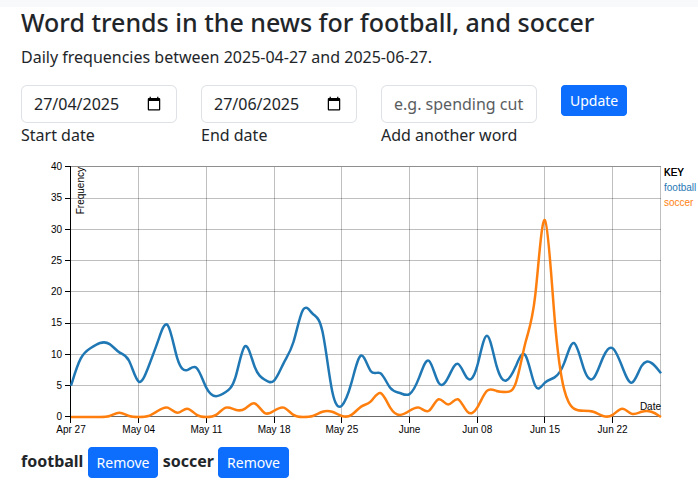
I started to build software to analyse language around a given topic, with the aim of discerning the metaphorical cider from the cyder. It was a great surprise a few years later to discover that I had invented for myself the already-existing field of computational linguistics, something that would have saved me a lot of time had I known about it when I began. I was taking a corpus of text and computing the frequencies and collocates (words that appear alongside each other) of the words within it, and from that I could quickly see which wording mattered around a subject, and which didn’t. This led seamlessly to an interest in what the same process would look like for news data with a time axis added, so I created a version which harvested its corpus from RSS feeds. Thus began my decades-long project.
From Project Idea, To Corpus Appliance
In 2005 I knew how to create websites in the manner of the day, so I used the tools I had. PHP5, and MySQL. I know PHP is unfashionable these days, but at the time this wasn’t too controversial, and aside from all the questionable quality PHP code out there it remains a useful scripting language. Using MySQL however would cause me immense problems. I had done what seemed the right thing and created a structured database with linked tables, but I hadn’t fully appreciated just how huge was the task I had taken on. Harvesting the RSS firehose across multiple media outlets brings in thousands of stories every week, so queries which were near-instantaneous during my first development stages grew to take many minutes as my corpus expanded. It was time to come up with an alternative, and I found it in the most basic of OS features, the filesystem.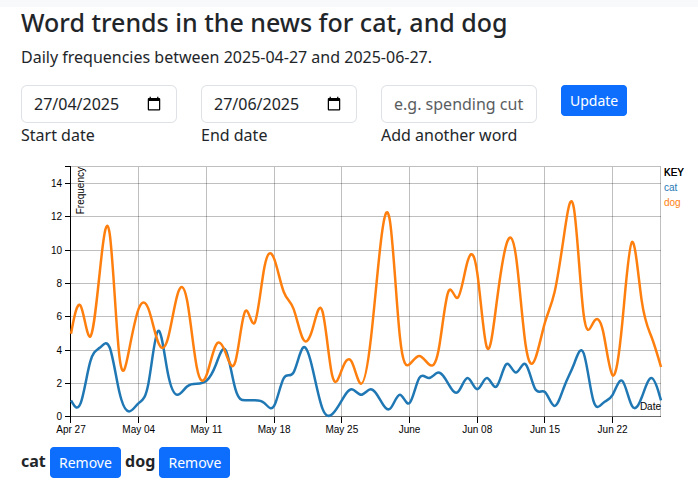
Casting back to the 1990s, when you paid for web hosting it was given in terms of the storage space it came with. The processing power required to run your CGI scripts or later server-side interpreters such as ASP or PHP, wasn’t considered. It thus became normal practice to try to reduce storage use and not think about processing, and I had without thinking followed this path.
But by the 2000s the price of storage had dropped hugely while that of processing hadn’t. This was the decade in which cloud services such as AWS made an appearance, and as well as buying many-gigabyte hard disks for not a lot, you could also for the first time rent a cloud bucket for pennies. My corpus analysis system didn’t need to spend all its time computing if I could use a terabyte hard drive to make up for less processor usage, so I turned my system on its head. When collecting the RSS stories my retrieval script would pre-compute the final data and store it in a vast tree of tiny JSON files accessible at high speed through the filesystem, and then my analysis software could simply retrieve them and make its report. The system moved from a hard-working x86 laptop to a whisper-quiet and low powered Raspberry Pi with a USB hard disk, and there it has stayed in some form ever since.
Just What Can This Thing Do?
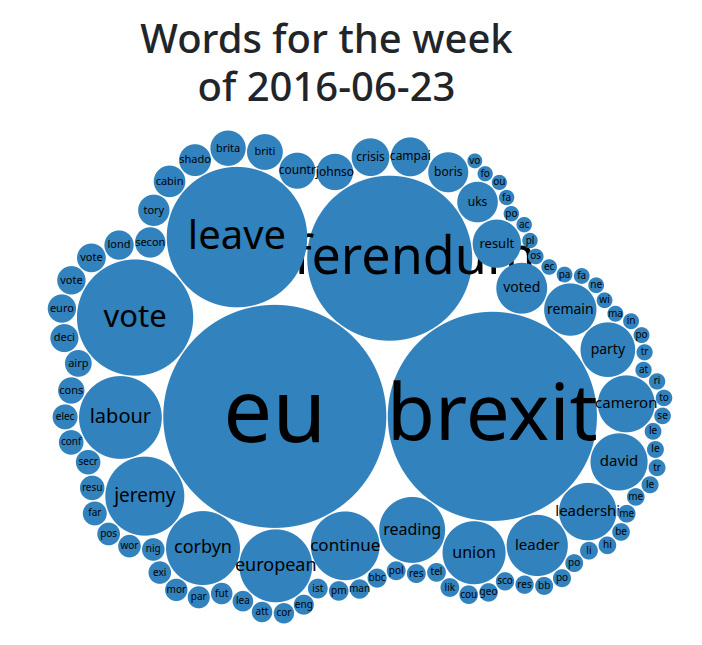
So I have a news corpus that has taken me a long time to build. I can take one or more words, and I can compare their occurrence over time. I can watch the news cycle, I can see stories build up over time. I can even see trends which sometimes go against received opinion, such as spotting that the eventual winner of the 2016 UK Labour leadership race was likely to be Jeremy Corbyn early on while the herd were looking elsewhere. Sometimes as with the performance of the word “Brexit” over the middle of the last decade I can see the great events of our times in stark relief, but perhaps it’s in the non-obvious that there’s most value. If you follow a topic and it suddenly dries up for a couple of days, expect a really big story on day three, for example. I can also see which outlets cover one story more than another, something helpful when trying to ascertain if a topic is being pushed on behalf of a particular lobby.
My experiment in text analysis then turned into something much more, even dare I say it, something I find of help in figuring out what’s really going on in turbulent times. But from a tech point of view it’s taught me a huge amount, about statistics, about language, about text parsing, and even about watching the number of available inodes on a hard drive. Believe me, many millions of tiny files in a tree can become unwieldy. But perhaps most of all, after a lifetime of mucking about with all manner of projects but generating little of lasting significance, I can look at this one and say I created something useful. And that is something to be happy about.
Bug della mente: perché la disinformazione è la vulnerabilità più pericolosa
@Informatica (Italy e non Italy 😁)
La human vulnerability è una nuova frontiera della cyber. Ecco perché la disinformazione rappresenta una minaccia diversa, silenziosa e subdola, che non agisce direttamente sul codice o sui dispositivi, ma riesce a minare la sicurezza in modo altrettanto dirompente,
Informatica (Italy e non Italy 😁) reshared this.
Il bonus per andare in vacanza
@Politica interna, europea e internazionale
L’Italia è forse l’unico Paese al mondo disposto a indebitarsi per mandare i propri cittadini in vacanza. Un gesto certamente generoso, ma che suona stonato in un Paese in cui mancano fondi per questioni più importanti.Milioni di italiani considerano irrinunciabile soggiornare tra mari e monti, anche quando le condizioni economiche personali
Politica interna, europea e internazionale reshared this.

The rise of Anubis; ICE's new facial recognition app; and a bunch of articles about LLMs.
The rise of Anubis; ICEx27;s new facial recognition app; and a bunch of articles about LLMs.#Podcast

Podcast: How to Fight Back Against AI Bot Scrapers
The rise of Anubis; ICE's new facial recognition app; and a bunch of articles about LLMs.Joseph Cox (404 Media)
Alla conferenza interverrà il Ministro Giuseppe Valditara.

Ministero dell'Istruzione
Oggi, dalle ore 15.30, presso l'Aula dei Gruppi parlamentari della Camera dei Deputati, si svolgerà la Presentazione del Rapporto nazionale "Le prove #Invalsi 2025". Alla conferenza interverrà il Ministro Giuseppe Valditara.Telegram
L’intelligenza artificiale usata per impersonare il Segretario di Stato Americano Marco Rubio
Secondo due alti funzionari e un cablogramma inviato la scorsa settimana a tutte le ambasciate e i consolati, il Dipartimento di Stato degli Stati Uniti D’America sta mettendo in guardia i diplomatici statunitensi dai tentativi di impersonare il Segretario di Stato Marco Rubio e forse altri funzionari utilizzando tecnologie basate sull’intelligenza artificiale.
Non è la prima volta che Rubio viene impersonato in un deepfake. Questa primavera, è stato creato dai malintenzionati un video falso in cui affermava di voler interrompere l’accesso dell’Ucraina al servizio internet Starlink di Elon Musk. Il governo ucraino ha successivamente smentito la falsa affermazione.
L’avvertimento è arrivato dopo che il dipartimento ha scoperto che un impostore che si spacciava per Rubio aveva tentato di contattare almeno tre ministri degli esteri, un senatore degli Stati Uniti e un governatore, secondo il cablogramma del 3 luglio, riportato per primo dal Washington Post.
I destinatari dei messaggi truffa, inviati tramite SMS, Signal e posta vocale, non sono stati identificati nel cablogramma, una copia del quale è stata condivisa con l’Associated Press. “Il Dipartimento di Stato è a conoscenza di questo incidente e sta attualmente monitorando e affrontando la questione”, ha dichiarato ai giornalisti la portavoce del dipartimento, Tammy Bruce. “Il dipartimento prende sul serio la propria responsabilità di salvaguardare le proprie informazioni e adotta costantemente misure per migliorare la propria strategia di sicurezza informatica e prevenire futuri incidenti”.
Si tratta dell’ultimo caso in cui un personaggio di alto livello dell’amministrazione Trump è stato preso di mira da un sosia, dopo un episodio simile rivelato a maggio che ha coinvolto il capo dello staff del presidente Donald Trump, Susie Wiles. L’uso improprio dell’intelligenza artificiale per ingannare le persone è destinato a crescere con il miglioramento e la diffusione della tecnologia, e l’FBI ha lanciato l’allarme la scorsa primavera riguardo a “attori malintenzionati” che si spacciavano per alti funzionari del governo statunitense in una campagna di messaggi di testo e vocali.
Le bufale che coinvolgono Rubio si sono rivelate infruttuose e “poco sofisticate”, ha affermato uno dei funzionari. Ciononostante, il secondo funzionario ha affermato che il dipartimento ha ritenuto “prudente” avvisare tutti i dipendenti e i governi stranieri, soprattutto in considerazione dell’aumento dei tentativi da parte di attori stranieri di compromettere la sicurezza informatica.
I funzionari non erano autorizzati a discutere pubblicamente la questione e hanno parlato a condizione di mantenere l’anonimato. “Questa campagna non rappresenta una minaccia informatica diretta per il dipartimento, ma le informazioni condivise con terze parti potrebbero essere divulgate se gli individui presi di mira venissero compromessi”, si legge nel cablogramma.
L’FBI ha lanciato l’allarme in un annuncio di pubblica utilità riguardo a una campagna “dannosa” basata su messaggi di testo e messaggi vocali generati dall’intelligenza artificiale che sembrano provenire da un alto funzionario degli Stati Uniti e che mirano a ingannare altri funzionari governativi, nonché i soci e i contatti della vittima.
L'articolo L’intelligenza artificiale usata per impersonare il Segretario di Stato Americano Marco Rubio proviene da il blog della sicurezza informatica.
Vulnerabilità critica nel boot Linux: quando il male entra dalla porta principale
@Informatica (Italy e non Italy 😁)
È stata scoperta una vulnerabilità critica nel componente Shim, uno dei pilastri su cui poggia il meccanismo di avvio sicuro (Secure Boot) di moltissime distribuzioni Linux: se sfruttata, permette di aggirare completamente le difese del sistema
Informatica (Italy e non Italy 😁) reshared this.
Pier Silvio Berlusconi: “Il governo Meloni il migliore d’Europa. La politica? Non la escludo”
@Politica interna, europea e internazionale
“Non penso alla politica. Guardando al futuro, non lo escludo: una sfida completamente nuova, perché no? Ma oggi non ha nessuna concretezza”. Così Pier Silvio Berlusconi ha risposto a chi, durante la presentazione dei palinsesti Mediaset, gli chiedeva di
Politica interna, europea e internazionale reshared this.
Giornalisti e attivisti attaccati per aver denunciato i legami tra Tekapp e Israele
@Notizie dall'Italia e dal mondo
Dopo le critiche all’azienda Tekapp per i suoi legami con l’unità militare israeliana 8200, giornalisti e attivisti modenesi sono finiti nel mirino di una violenta campagna diffamatoria lanciata da canali social pro-Israele.
L'articolo
Notizie dall'Italia e dal mondo reshared this.
PIC Burnout: Dumping Protected OTP Memory in Microchip PIC MCUs

Normally you can’t read out the One Time Programming (OTP) memory in Microchip’s PIC MCUs that have code protection enabled, but an exploit has been found that gets around the copy protection in a range of PIC12, PIC14 and PIC16 MCUs.
This exploit is called PIC Burnout, and was developed by [Prehistoricman], with the cautious note that although this process is non-invasive, it does damage the memory contents. This means that you likely will only get one shot at dumping the OTP data before the memory is ‘burned out’.
The copy protection normally returns scrambled OTP data, with an example of PIC Burnout provided for the PIC16LC63A. After entering programming mode by setting the ICSP CLK pin high, excessively high programming voltage and duration is used repeatedly while checking that an area that normally reads as zero now reads back proper data. After this the OTP should be read out repeatedly to ensure that the scrambling has been circumvented.
The trick appears to be that while there’s over-voltage and similar protections on much of the Flash, this approach can still be used to affect the entire flash bit column. Suffice it to say that this method isn’t very kind to the fzslash memory cells and can take hours to get a good dump. Even after this you need to know the exact scrambling method used, which is fortunately often documented by Microchip datasheets.
Thanks to [DjBiohazard] for the tip.
Cosa faranno Eni e Polizia di Stato e Eni contro il cybercrime
@Informatica (Italy e non Italy 😁)
Polizia di Stato e Eni hanno avviato una campagna informativa per contrastare le truffe online, un fenomeno in costante aumento che sfrutta strumenti digitali per ottenere informazioni o denaro in modo illegale.
L'articolo proviene dalla sezione #Cybersecurity di #StartMag la testata diretta da Michele
Informatica (Italy e non Italy 😁) reshared this.
Cybersecurity e AI: le aziende sostengono l’innovazione e si preparano a nuove minacce
L’ultima ricerca Trend Micro rivela un’adozione diffusa dell’intelligenza artificiale nelle strategie di sicurezza informatica, ma crescono le preoccupazioni sull’esposizione al rischio informatico. Lo studio include un campione italiano.
Milano, 8 luglio 2025 – In tutto il mondo, le organizzazioni adottano l’intelligenza artificiale per potenziare le proprie difese informatiche, ma molte sottolineano la crescente preoccupazione che questa tecnologia possa ampliare la superficie di attacco ed esporle a nuove minacce. Il dato emerge da AI is Changing the Cyber Risk Game. Are You Keeping Up?, l’ultima ricerca Trend Micro, leader globale di cybersecurity, che include anche un campione italiano
“L’intelligenza artificiale consente all’organizzazione di rafforzare le proprie difese informatiche, permettendo di individuare più rapidamente le anomalie e di automatizzare le attività più dispendiose in termini di tempo. Ma anche i cybercriminali sfruttano l’AI per raggiungere i propri obiettivi e questo porta grandi trasformazioni nel panorama delle minacce cyber. La nostra ricerca e i test che abbiamo effettuato nel mondo reale certificano come sia necessario integrare la security nei sistemi AI sin dall’inizio. La posta in gioco è troppo alta per rimandare la gestione di questo aspetto a un secondo momento”. Afferma Salvatore Marcis, Country Manager Trend Micro Italia.
Secondo lo studio, l’81% delle aziende a livello globale utilizza già strumenti basati sull’AI come parte della strategia di cybersecurity e un ulteriore 16% è attivo nell’esplorare altre implementazioni. Il 97% del campione è favorevole all’utilizzo dell’AI e più della metà si affida a questa tecnologia per processi essenziali come il rilevamento automatizzato delle risorse, la prioritizzazione dei rischi e la scoperta delle anomalie. Per quanto riguarda i prossimi 12 mesi, il 42% degli intervistati considera l’AI e l’automazione un’assoluta priorità nelle strategie di miglioramento della cybersecurity.
Questo ottimismo non è esente da perplessità. Un sorprendente 94% del campione ritiene che l’AI peggiorerà la propria esposizione al rischio nei prossimi 3-5 anni e oltre la metà si aspetta un incremento nella portata e complessità degli attacchi basati sull’AI, che costringerà le organizzazioni a ripensare e rimodellare le strategie di cybersecurity in atto. Molti sottolineano il rischio di esposizione dei dati sensibili, l’incertezza sul modo in cui i dati vengono elaborati e archiviati dai sistemi di intelligenza artificiale, la possibilità che i dati proprietari vengano sfruttati da modelli non affidabili. Parte degli intervistati ha anche manifestato timore circa le crescenti pressioni sulla conformità e le sfide legate al monitoraggio di nuovi endpoint, API e shadow IT.
Il dualismo tra opportunità e rischi nell’ambito dell’intelligenza artificiale è emerso chiaramente all’ultimo evento Pwn2Own di Trend Micro a Berlino, che ha introdotto per la prima volta la categoria AI. I risultati hanno offerto un’istantanea convincente dello stato della sicurezza dell’intelligenza artificiale. Dodici sfide miravano a quattro principali framework di intelligenza artificiale, tra cui NVIDIA Triton Inference Server, che ha ricevuto le maggiori attenzioni. Anche Chroma, Redis e NVIDIA Container Toolkit sono stati colpiti con successo, in alcuni casi utilizzando un solo bug per raggiungere il massimo risultato. In totale, nei framework AI coinvolti nell’evento, sono state scoperte sette vulnerabilità zero-day uniche. I vendor hanno a disposizione 90 giorni per sviluppare le patch, prima che i dettagli tecnici vengano resi pubblici.
L’intelligenza artificiale è sempre più profondamente integrata negli ambienti IT enterprise. Trend raccomanda ai leader aziendali di valutare proattivamente il panorama in costante evoluzione delle minacce e integrare pratiche rigorose di cybersecurity a ogni livello di adozione dell’AI.
Metodologia e campione della ricerca: La ricerca, commissionata da Trend Micro e condotta da Sapio Research, ha coinvolto 2.250 professionisti con responsabilità in ambito IT e/o cybersecurity, impegnati in aziende di diverse dimensioni e settori verticali, distribuite in 21 Paesi tra Europa, Nord America e area APAC. Il campione italiano include 100 intervistati. Ulteriori informazioni sono disponibili a questo link
L'articolo Cybersecurity e AI: le aziende sostengono l’innovazione e si preparano a nuove minacce proviene da il blog della sicurezza informatica.
Più Patriot per Washington. Cosa dice la Proposta di bilancio per il 2026
@Notizie dall'Italia e dal mondo
L’Us Army è mira a quadriplicare le scorte di Patriot nei suoi arsenali. In base alle informazioni presente nella proposta di budget 2026 l’obiettivo è quadruplicare le acquisizioni di segmenti Pac-3 Mse, passando da 3.376 a 13.773 unità. Una mossa che fotografa l’urgenza, sempre più pressante, di rafforzare le scorte di
Notizie dall'Italia e dal mondo reshared this.
#tic spedisce in tutta italia e in tutto il mondo. a roma, è in piazza san cosimato 39, a trastevere.
differx.tumblr.com/post/788497…
#scritturadiricerca #scritturediricerca #chapbooks #cambiodiparadigma #prosa #prosainprosa #ticedizioni #edizionitic
Poliversity - Università ricerca e giornalismo reshared this.
simona
Unknown parent • — (Livorno) •simona
in reply to simona • — (Livorno) •