
Spatial Audio in a Hat

Students from the ECE4760 program at Cornell have been working on a spatial audio system built into a hat. The project from [Anishka Raina], [Arnav Shah], and [Yoon Kang], enables the wearer to get a sense of the direction and proximity of objects in the immediate vicinity with the aid of audio feedback.
The heart of the build is a Raspberry Pi Pico. It’s paired with a TF-Luna LiDAR sensor which is used to identify the range to objects around the wearer. The sensor is mounted on a hat, so the wearer can pan the sensor from side to side to scan the immediate area for obstacles. Head tracking wasn’t implemented in the project, so instead, the wearer uses a potentiometer to indicate to the microcontroller the direction they are facing as they scan. The Pi Pico then takes the LIDAR scan data, determines the range and location of any objects nearby, and creates a stereo audio signal which indicates to the wearer how close those objects are and their relative direction using a spatial audio technique called interaural time difference (ITD).
It’s a neat build that provides some physical sensory augmentation via the human auditory system. We’ve featured similar projects before, too.
youtube.com/embed/l2lWxGuDcH4?…
Più tempo libero per tutti con l’AI? Meta cambia strategia e rinuncia alla sfida con ChatGPT
Secondo quanto riportato dai media di Fast Technology il 3 agosto, il CEO di Meta, Mark Zuckerberg, ha recentemente apportato importanti modifiche alla direzione strategica dell’azienda nel campo dell’intelligenza artificiale, attirando grande attenzione da parte del settore. Secondo il suo amico e vicedirettore di The Verge Alex Heath, Meta ha chiaramente rinunciato a competere direttamente con ChatGPT nel campo della produttività.
Un anno prima, Zuckerberg aveva tentato di contrastare la crescita di ChatGPT promuovendo il suo assistente Meta AI, ma con scarso successo. ChatGPT, sfruttando i suoi potenti strumenti di produttività e il vantaggio di essere il primo a muoversi, aveva rapidamente conquistato utenti e consolidato la sua leadership di mercato. Di fronte a questa realtà, Zuckerberg iniziò a riconsiderare il posizionamento di Meta nel settore dell’intelligenza artificiale.
Nel suo “Manifesto della Superintelligenza Personale” pubblicato di recente, Zuckerberg ha delineato una nuova intuizione: con il progresso tecnologico, gli esseri umani dedicheranno meno tempo alle app di produttività e più ad attività creative e sociali. Pertanto, lo strumento più prezioso del futuro sarà una “superintelligenza personale” in grado di comprendere a fondo gli utenti, comprenderne gli obiettivi e fornire assistenza personalizzata.
Sulla base di ciò, l’attenzione strategica di Meta è cambiata in modo significativo: non più ossessionata dal tentativo di recuperare terreno rispetto a ChatGPT in ambito produttività, ma ora focalizzata sul “tempo libero” liberato dagli utenti grazie a una maggiore efficienza. Il Chief Product Officer di Meta, Chris Cox, ha sottolineato internamente che l’azienda si concentrerà sui suoi punti di forza tradizionali: intrattenimento, relazioni sociali e servizi per lo stile di vita degli utenti.
Questo cambiamento strategico è accompagnato da investimenti senza precedenti. Meta ha creato un “Superintelligence Lab” e reclutato i migliori talenti dell’intelligenza artificiale da giganti come Apple, OpenAI e Google. Mark Zuckerberg ha persino partecipato personalmente a questa acquisizione, offrendo ai talenti chiave un pacchetto salariale quadriennale fino a 300 milioni di dollari. L’azienda prevede inoltre di investire centinaia di miliardi di dollari nella costruzione di infrastrutture di superintelligenza.
L'articolo Più tempo libero per tutti con l’AI? Meta cambia strategia e rinuncia alla sfida con ChatGPT proviene da il blog della sicurezza informatica.
reshared this
Tutti parlano di GPT-5. Nessuno l’ha visto. Ma i meme sono già ovunque
GPT-5 non è ancora apparso e gli internauti hanno iniziato a creare ogni genere di meme per lamentarsi. In effetti, le voci su GPT-5 non si sono fermate negli ultimi giorni. Innanzitutto, alcuni internauti hanno trovato tracce dei modelli GPT-5-Auto e GPT-5-Reasoning nell’applicazione ChatGPT di macOS.
Poi hanno rivelato che anche Microsoft Copilot e Cursor sono stati segretamente collegati per testare GPT-5. Il 1° agosto, The Information ha pubblicato un lungo articolo intitolato “Inside OpenAI’s Rocky Path to GPT-5”, rivelando ulteriori informazioni riservate su GPT-5.
GPT-5 è migliorato, ma il salto di prestazioni non è così grande come prima. Lo scorso dicembre, OpenAI ha presentato i risultati della sua tecnologia Test-Time Scaling, una svolta fondamentale nelle capacità dei modelli di grandi dimensioni nell’era post-pre-addestramento.

Il test ha dimostrato che le prestazioni dell’IA continuano a migliorare quando ha più tempo e potenza di calcolo per elaborare le attività. Questo approccio tecnico ha già dimostrato la sua efficacia nell’applicazione pratica di OpenAI-o1 e DeepSeek-R1. Sembra che gli utenti di ChatGPT rimarranno colpiti dalle potenti capacità di questa nuova IA. Tuttavia, l’entusiasmo non è durato a lungo.
Secondo due persone coinvolte nel suo sviluppo, quando i ricercatori di OpenAI hanno adattato la nuova IA in una versione basata sulla chat, o3, in grado di rispondere ai comandi degli utenti di ChatGPT, i miglioramenti in termini di prestazioni rispetto ai benchmark precedenti sono in gran parte scomparsi.
Questo è solo un esempio delle numerose sfide tecniche che OpenAI ha dovuto affrontare quest’anno. Le crescenti difficoltà stanno rallentando il ritmo dello sviluppo dell’intelligenza artificiale e potrebbero persino influire sul business di ChatGPT, un’applicazione di intelligenza artificiale di successo.
Con l’imminente rilascio di GPT-5, si dice che i ricercatori di OpenAI abbiano trovato una soluzione. Secondo fonti e ingegneri interni di OpenAI, il prossimo modello di intelligenza artificiale di punta di OpenAI, GPT-5, avrà capacità notevolmente migliorate in programmazione, matematica e altri ambiti.
Una fonte ha affermato che il nuovo modello è più efficace nell’aggiungere funzionalità durante la scrittura del codice applicativo (“vibe coding”), rendendolo più facile da usare e più gradevole esteticamente. Ha inoltre affermato che GPT-5 è migliore del suo predecessore anche nel guidare gli agenti di intelligenza artificiale a gestire attività complesse con una supervisione umana minima. Ad esempio, può seguire istruzioni complesse e un elenco di regole per determinare quando il servizio clienti automatizzato debba emettere un rimborso, mentre i modelli precedenti dovevano prima testare diversi casi complessi (ad esempio, casi limite) prima di poter elaborare tale rimborso.
Un’altra persona a conoscenza della questione ha affermato che i miglioramenti non possono eguagliare i balzi in termini di prestazioni osservati nei precedenti modelli GPT, come i miglioramenti tra GPT-3 nel 2020 e GPT-4 nel 2023. Il rallentamento nei guadagni di prestazioni che OpenAI ha sperimentato negli ultimi 12 mesi suggerisce che potrebbe avere difficoltà a superare il suo principale rivale, almeno in termini di capacità di intelligenza artificiale.
Gli attuali modelli di OpenAI hanno già creato un valore commerciale significativo tramite ChatGPT e varie applicazioni, e anche i miglioramenti incrementali aumenteranno la domanda dei clienti. Questi miglioramenti daranno anche fiducia agli investitori per finanziare il piano di OpenAI di investire 45 miliardi di dollari nei prossimi tre anni e mezzo per l’acquisto di GPU per lo sviluppo e l’esecuzione dei prodotti.
Migliorare le capacità di codifica automatizzata è diventata la massima priorità di OpenAI. I recenti progressi contribuiscono anche a spiegare perché i dirigenti di OpenAI abbiano dichiarato nelle ultime settimane ad alcuni investitori di credere che l’azienda possa raggiungere l’obiettivo “GPT-8”. Questa affermazione è in linea con le dichiarazioni pubbliche del CEO Sam Altman, secondo cui OpenAI, con le sue attuali conoscenze tecniche, è sulla buona strada per creare un’intelligenza artificiale generale (AGI), che rivaleggia con le capacità degli esseri umani più intelligenti.
Sebbene siamo ancora lontani dal raggiungimento dell’AGI, il modello GPT-5, che verrà rilasciato a breve, potrebbe avere un certo fascino, che va oltre una migliore codifica e un ragionamento migliore. Microsoft ha i diritti esclusivi per utilizzare la proprietà intellettuale di OpenAI e alcuni dirigenti dell’azienda hanno detto ai dipendenti che i test del modello hanno dimostrato che GPT-5 è in grado di generare codici di qualità superiore e altre risposte basate su testo senza consumare più risorse di elaborazione, secondo un dipendente Microsoft a conoscenza della questione.
Ciò è dovuto in parte al fatto che, rispetto ai modelli precedenti, è più efficace nel valutare quali attività richiedono relativamente più o meno risorse di elaborazione, ha affermato la persona. La valutazione interna di OpenAI dimostra che il miglioramento della capacità dell’intelligenza artificiale di eseguire automaticamente attività di codifica è diventata la priorità principale di OpenAI dopo che il concorrente Anthropic ha preso l’iniziativa lo scorso anno nello sviluppo e nella vendita di tali modelli a sviluppatori di software e assistenti di codifica come Cursor.
I progressi di OpenAI non sono stati facili, poiché quest’anno i suoi ricercatori e la sua dirigenza hanno dovuto affrontare nuove pressioni. Innanzitutto c’è il delicato rapporto con Microsoft. Sebbene Microsoft sia il maggiore azionista esterno di OpenAI e abbia il diritto di utilizzare alcune delle tecnologie di OpenAI fino al 2030 in base a un accordo contrattuale tra le due parti, alcuni ricercatori senior di OpenAI non sono d’accordo a cedere le loro innovazioni e invenzioni a Microsoft.
Anche in termini finanziari, Microsoft e OpenAI hanno un rapporto di collaborazione molto stretto, ma ci sono controversie sui termini specifici della cooperazione ed entrambe le parti chiedono all’altra parte di fare alcune concessioni. OpenAI spera di prepararsi a una futura IPO ristrutturando la sua divisione a scopo di lucro. Sebbene alcuni dettagli rimangano incerti, entrambe le parti hanno raggiunto un consenso preliminare su alcuni aspetti importanti, come la potenziale acquisizione di circa il 33% del capitale di OpenAI da parte di Microsoft dopo la ristrutturazione.
La seconda è che continua il bracconaggio degli ingegneri. Di recente, Meta ha speso molti soldi per sottrarre più di una dozzina di ricercatori a OpenAI, alcuni dei quali avevano partecipato al recente lavoro di OpenAI sul miglioramento della tecnologia. Queste perdite di talenti e i conseguenti adeguamenti del personale mettono sotto pressione la dirigenza di OpenAI.
La scorsa settimana, Jerry Tworek, vicepresidente della ricerca di OpenAI, si è lamentato con il suo capo, Mark Chen, dei cambiamenti nel team in un messaggio interno su Slack, visto da molti colleghi. Tworek ha dichiarato di aver dovuto prendersi una settimana di ferie per rivalutare la situazione, ma in seguito non ha usufruito delle ferie.
Sebbene OpenAI abbia compiuto alcuni progressi commerciali, all’interno dell’azienda persistono ancora alcune preoccupazioni sulla sua capacità di continuare a migliorare l’intelligenza artificiale e mantenere la sua posizione di leadership, soprattutto di fronte a concorrenti ben finanziati.
Nella seconda metà del 2024, OpenAI ha sviluppato un modello chiamato Orion, che inizialmente aveva pianificato di rilasciare come GPT-5, prevedendo che le sue prestazioni sarebbero state superiori a quelle del modello GPT-40 esistente. Tuttavia, Orion non è riuscito a ottenere il miglioramento previsto, quindi OpenAI lo ha rilasciato come GPT-4.5, che alla fine non ha avuto un impatto significativo.
Il fallimento di Orion è dovuto in parte alle limitazioni nella fase di pre-addestramento. Il pre-addestramento è il primo passo nello sviluppo del modello, che richiede l’elaborazione di grandi quantità di dati per comprendere le connessioni tra i concetti. Di fronte alla carenza di dati di alta qualità, OpenAI ha anche scoperto che le ottimizzazioni apportate al modello di Orion, pur essendo efficaci quando il modello era di piccole dimensioni, diventavano inefficaci con l’aumentare delle dimensioni.
L'articolo Tutti parlano di GPT-5. Nessuno l’ha visto. Ma i meme sono già ovunque proviene da il blog della sicurezza informatica.
Apple Sviluppa il proprio Motore di Intelligenza Artificiale per alimentare Siri
Apple sta sviluppando un proprio motore di intelligenza artificiale per rispondere alle domande, simile a ChatGPT, secondo quanto riportato da Bloomberg. Il progetto è gestito da un nuovo team interno chiamato Answers, Knowledge and Information (AKI), guidato da Robbie Walker, che riporta direttamente al responsabile dell’intelligenza artificiale, John Gianandrea.
Gli annunci di lavoro di Apple indicano AKI come sviluppatore di tecnologie per prodotti come Siri, Spotlight, Safari, Messaggi e Lookup. L’azienda è alla ricerca di persone specializzate nello sviluppo di algoritmi e motori di ricerca, e il lavoro del team è descritto come la creazione di “servizi informativi intuitivi” per i prodotti iconici di Apple.
AKI sta lavorando a un “motore di risposte”, una versione semplificata di ChatGPT che sarà in grado di cercare e fornire risposte alle domande provenienti da Internet. Allo stesso tempo, Apple sta sviluppando un’applicazione separata per questo motore e aggiornando l’infrastruttura server, che verrà successivamente integrata in Siri e altri sistemi.
Come sottolinea TechCrunch, nonostante Apple Intelligence venga lanciato nel 2024, l’azienda non ha ancora introdotto un proprio modello linguistico paragonabile a GPT-4 o Claude di Anthropic. Siri attualmente utilizza una connessione a ChatGPT e potrebbe iniziare a interagire con Perplexity in futuro.
Apple è chiaramente in ritardo rispetto ai concorrenti, tra cui Microsoft, Google e Meta, che hanno tutti lanciato potenti prodotti di intelligenza artificiale. Tuttavia, l’azienda continua a intensificare i suoi sforzi. In una recente conference call sui risultati finanziari, il CEO Tim Cook ha annunciato maggiori investimenti nell’intelligenza artificiale: “Consideriamo l’intelligenza artificiale una delle tecnologie più importanti del nostro tempo”.
Secondo lui, Apple punta a integrare l’intelligenza artificiale in tutti i dispositivi e le piattaforme, rendendo le tecnologie “semplici e accessibili a tutti”. Allo stesso tempo, il ritardo nel rilascio delle proprie soluzioni potrebbe essere spiegato non da un ritardo, ma dalla strategia: l’azienda tradizionalmente cerca di offrire un prodotto unico e non si affretta a lanciarlo per il bene della concorrenza.
Una nuova Siri con risposte integrate e logica migliorata potrebbe essere lanciata già nel 2026. Fino ad allora, Apple probabilmente si affiderà a motori di intelligenza artificiale esterni, sviluppando al contempo la propria infrastruttura all’interno di AKI.
L'articolo Apple Sviluppa il proprio Motore di Intelligenza Artificiale per alimentare Siri proviene da il blog della sicurezza informatica.

Proxy Trickster: il gruppo di hacker dilettanti che vuole i server di tutto il mondo
Gli specialisti di Solar 4RAYS di Solar Group hanno scoperto un nuovo gruppo di hacker, Proxy Trickster, dedito al mining di criptovalute e al proxyjacking (intercettazione del controllo dei server per la loro conversione e vendita). Nel corso di un anno, gli aggressori hanno attaccato quasi 900 server in 58 paesi. Nel marzo 2025, gli specialisti hanno indagato su un incidente di sicurezza informatica presso un’azienda informatica e hanno scoperto l’attività di un gruppo precedentemente sconosciuto, denominato Proxy Trickster.
Gli hacker ricavano il loro reddito principale dal mining di criptovalute e dal proxyjacking, attività che consiste nell’assumere il controllo di server legittimi sfruttando vulnerabilità note, convertendoli in server proxy e poi vendendoli sul darknet ad altri criminali in modo che possano nascondere le loro attività e i loro indirizzi IP. Le prime tracce di attacchi Proxy Trickster risalgono a maggio 2024 e da allora gli hacker non hanno più interrotto le loro attività.
Nell’attacco studiato dagli esperti, il punto di ingresso non è stato ripristinato, ma gli analisti di Cado Security hanno scritto che il gruppo utilizza vulnerabilità precedentemente scoperte in Selenium Grid. Nel caso studiato da Solar 4RAYS, questo software non è stato utilizzato, quindi è emersa l’ipotesi che il gruppo abbia attaccato diversi servizi pubblici che presentano già vulnerabilità note.
Nel corso di oltre un anno di attività sono stati infettati almeno 874 dispositivi in 58 paesi. Il maggior numero di server attaccati è stato rilevato negli Stati Uniti (16% del numero totale di server infetti), in Germania (6%), in Russia (4%), in Ucraina (4%), in Francia (4%) e in altri paesi. Da ciò, i ricercatori concludono che la geografia degli obiettivi non ha importanza per gli hacker: attaccano qualsiasi server disponibile per guadagnare denaro.
I ricercatori ritengono che il gruppo sia più un gruppo di dilettanti, ma che utilizzi strumenti e tecniche di hacker professionisti che attaccano a fini di spionaggio e azioni distruttive. Proxy Trickster sostituisce le utilità di sistema (ps, pstree, pkill) con script personalizzati che mascherano i processi dannosi (ad esempio, [kworker/u8:1-events_unbound]) agli amministratori di sistema e utilizza anche l’automazione multilivello degli attacchi.ù
Schema generale del funzionamento dello script

Inoltre, il gruppo mantiene l’accesso ai server attaccati, il che, in teoria, consente attacchi più complessi. In altre parole, il gruppo può rappresentare una minaccia per centinaia, se non migliaia, di aziende.
L'articolo Proxy Trickster: il gruppo di hacker dilettanti che vuole i server di tutto il mondo proviene da il blog della sicurezza informatica.
2025 One Hertz Challenge: Analog Clock for Microsoft Windows

Our hacker [glgorman] sent in their submission for the One Hertz Challenge: an analog software clock for Microsoft Windows.
I guess we’d have to say that this particular project is a work-in-progress. There is no final clock, yet. But a number of yak’s have been shaved. For instance, we have code for computing geometric objects without using branch instructions, including points and lines and circles and such.
The notes dive deep into various rabbit holes. At one point we find ourselves computing the angle to the sun in the sky, that we may be able to cast the shadow of the clock hands on our clock face. The notes include miscellaneous source code snippets and various screenshots of geometric renderings which have been achieved so far.
We thought it was fun that the geometric software references Euclid’s Elements, which, as you probably know, is the famous geometry book from Ancient Greece, the second most published book of all time, second only to the Bible.
If you’re interested in analog clocks you might like this one which displays the date, not the time or this one which uses colors instead of hands.

Brilliant Labs Has New Smart Glasses, With a New Display

Brilliant Labs have been making near-eye display platforms for some time now, and they are one of the few manufacturers making a point of focusing on an open and hacker-friendly approach to their devices. Halo is their newest smart glasses platform, currently in pre-order (299 USD) and boasting some nifty features, including a completely new approach to the display.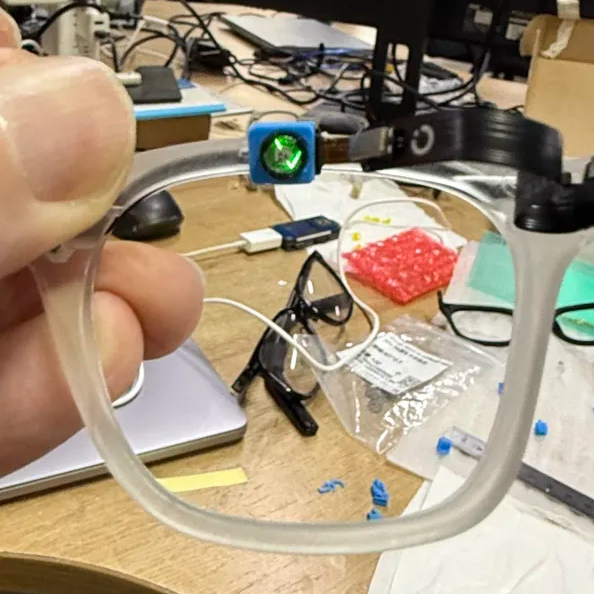
Halo is an evolution of the concept of a developer-friendly smart glasses platform intended to make experimentation (or modification) as accessible as possible. Compared to previous hardware, it has some additional sensors and an entirely new approach to the display element.
Whereas previous devices used a microdisplay and beam splitter embedded into a thick lens, Halo has a tiny display module that one looks up and into in the eyeglasses frame. The idea appears to be to provide the user with audio (bone-conduction speakers in the arms of the glasses) as well as a color “glanceable” display for visual data.
Some of you may remember Brilliant Labs’ Monocle, a transparent, self-contained, and wireless clip-on display designed with experimentation in mind. The next device was Frame, which put things into a “smart glasses” form factor, with added features and abilities.
Halo, being in pre-release, doesn’t have full SDK or hardware details shared yet. But given Brilliant Labs’ history of fantastic documentation for their hardware and software, we’re pretty confident Halo will get the same treatment. Want to know more but don’t wish to wait? Checking out the tutorials and documentation for the earlier devices should give you a pretty good idea of what to expect.
ma è vero che h_mas accoglie un piano di disarmo?
ma è vera questa cosa?
facebook.com/share/p/16vx9ZEpK…
il passaggio sarebbe dunque dal colonialismo militare israeliano a quello economico della "World Bank"? i soldati del genocidio si ritirerebbero da Gaza? siamo sicuri?? e i coloni dalla Cisgiordania??? e poi, se capisco bene... quello palestinese dovrebbe essere l'unico stato al mondo a non avere nemmeno una cerbottana. no? e dovrebbe stare allegro e sereno e fidarsi di un confinante genocida che gli ha mutilato 100mila persone e uccise tra le 60mila e le oltre 300mila? e poi dovrebbe affidare il governo ai collaborazionisti di israele?
scusate lo scetticismo. forse sbaglio io. mi sforzo di capire. la notizia è fondata?
in generale, che ne pensate?
___
#Gaza #genocide #genocidio #Palestine #Palestina #warcrimes #sionismo #zionism #starvingpeople #starvingcivilians #iof #idf #colonialism #sionisti #izrahell #israelterroriststate #invasion #israelcriminalstate #israelestatocriminale #children #bambini #massacri #deportazione #concentramento #famearmadiguerra
Poliversity - Università ricerca e giornalismo reshared this.
Il Consiglio dei Ministri ha approvato il decreto che autorizza le #assunzioni a tempo indeterminato per l’anno scolastico 2025/2026.
Il provvedimento consentirà l’immissione in ruolo di 347 dirigenti scolastici, 48.504 docenti, di cui 13.

Ministero dell'Istruzione
Il Consiglio dei Ministri ha approvato il decreto che autorizza le #assunzioni a tempo indeterminato per l’anno scolastico 2025/2026. Il provvedimento consentirà l’immissione in ruolo di 347 dirigenti scolastici, 48.504 docenti, di cui 13.Telegram
How to Design 3D-Printed Parts With Tolerance in Mind

One of the continuing struggles with FDM printing is making sure that parts that should fit together actually do. While adding significant tolerance between parts is an option, often you want to have a friction fit or at least a gap that you cannot drive a truck through. In a video by [Slant 3D] a number of tips and tricks to improve parts design with tolerance in mind are provided.
Starting with the fairly obvious, such as avoiding sharp corners, rounding off edges and using chamfered edges and filets for e.g. lids to make getting started easy, the video then moves into more advanced topics. Material shrinkage is a concern, which is where using thin walls instead of solid blocks of material helps, as does using an appropriate infill type. Another interesting idea is to use a compliant mechanism in the lid to get a friction fit without getting all print parameters just right.
On the opposing side to the lid – or equivalent part – you’d follow many of the same tips, with the addition of e.g. slots that allow for the part to flex somewhat. All of this helps to deal with any variability between prints, with the suggested grip fins at the end of the video being probably the most extreme.
youtube.com/embed/XKrDUnZCmQQ?…
The Tape Speed Keyboard

For those who experienced any part of the 1960s, even if it’s just experiencing the music from that era here in the future, the sound of the Mellotron is immediately recognizable. The Moody Blues were famous for using the tape-based instrument, and the Beatles and David Bowie produced hits with it as well. It’s haunting sounds are still highly prized today, but the complexity, cost, and maintenance requirement for the tape loops and other moving parts can put many musicians off from owning one. But [Japhy Riddle] has built an instrument without these downsides called the Tape Speed Keyboard.
Unlike the Mellotron which used a tape loop for each of its keys, the Tape Speed Keyboard uses only a single cassette tape. As the name implies, it changes the pitch of the sound by modulating the speed of the single tape housed in its own tape deck. The keyboard itself started off life as a Casio MT-35 but since this is a completely analog instrument, it was rewired so each key is connected to a potentiometer whose output voltage is tuned to a specific tape speed. [Japhy] reports that this is similar to tuning an analog piano and the process can be equally temperamental.
With everything electronic working, [Japhy] turned to making this a more acceptable musical instrument. Predictably, turning the motor on and off for each key press came with a bit of delay, causing the sound to come out goofy and muddy. To solve this problem he changed the design to make the tape play continuously rather than start and stop for a key press, and then modified other keys to be on-off switches for sound output. Since cassette tapes have two sides, he can also play either of two sounds in this way.
With the final polish on, the Tape Speed Keyboard is able to produce completely unique compositions that separate it from even the venerable Mellotron. Be sure to check out the video linked below to hear its sound. There have been plenty of other musical projects based around tape decks as well, including this one inspired by the original Mellotron and this tape deck-based guitar effects pedal.
Thanks to [splashbun] for the tip!
youtube.com/embed/adxlFwIGTfc?…
A Simple Simulator For Model Rocket Performance

When building a model rocket, it can be fun to get into the maths of it all—calculating the expected performance of your build, and then seeing how it measures up in the real world. To aid in that task, [Rotislav Persion] has created a simple web-based simulator for charting the potential performance of your own rockets.
The calculator lets you key in the fundamentals of your hobby rocket. Punch in the diameter of your rocket, its mass, the standard rocket engine you’re using, and the diameter and delay time of your parachute, and it will chart the altitude profile expected during flight.
Punch in the details for a small 1-inch diameter rocket with an A8-5 engine, and you’ll find it won’t go very high or very far, and the calculator bears that out. However, upgrade to a C6 engine and you’ll go higher and faster, and drift a lot longer once the parachute is deployed.
Perhaps the only thing missing from the simulator is a wider variety of rocket engines to choose from, and more parameters to tweak for finer simulation. However, for small and basic rockets, it’s an interesting starting point you can use to learn about the basic mathematics and physics behind your rocket’s flight.
We’ve seen some great feats in model rocketry, not least of which was a valiant effort to master vertical landing. If you’ve got your own unique model rocket hacks cooking up in the lab, don’t hesitate to notify the tipsline!
Il malware si camuffa in una foto innocente su Dropbox. La strategia steganografica di APT37
Gli specialisti del Genians Security Center hanno scoperto una versione migliorata del malware RoKRAT, associato al gruppo nordcoreano APT37. La nuova versione si distingue per un insolito modo di nascondere il codice dannoso: nel corpo delle normali immagini JPEG. Questo approccio consente di bypassare i sistemi antivirus tradizionali, poiché la funzionalità dannosa non viene scritta direttamente sul disco, ma viene estratta nella RAM.
L’infezione iniziale inizia con l’avvio di un collegamento .LNK dannoso contenuto in un archivio ZIP. Un esempio è un archivio chiamato “National Intelligence and Counterintelligence Manuscript.zip”. La sua struttura include un file .LNK di grandi dimensioni (oltre 50 MB) che contiene documenti esca e componenti codificati: shellcode (ttf01.dat), script PowerShell (ttf02.dat) e file batch (ttf03.bat).
Quando il file viene eseguito, PowerShell viene attivato, utilizzando un XOR a un byte con la chiave 0x33, decrittografando lo shellcode a 32 bit. Il passaggio successivo prevede l’iniezione di un secondo livello di codice crittografato, che viene decrittografato all’offset 0x590 utilizzando la chiave 0xAE. Questo crea un file eseguibile contenente riferimenti a informazioni di debug, come il percorso “D:WorkUtilInjectShellcodeReleaseInjectShellcode.pdb”.
Il frammento decrittografato viene quindi iniettato in processi Windows legittimi come “mspaint.exe” o “notepad.exe” situati nella directory SysWOW64. Questa procedura crea una memoria virtuale in cui vengono scritti blocchi di dati di circa 892.928 byte. Questi vengono nuovamente decrittografati utilizzando XOR, questa volta con la chiave 0xD6. A questo punto, la parte principale di RoKRAT viene attivata.
Il file non viene salvato su disco, rendendo molto più difficile l’analisi post-infezione. I segnali di affiliazione ad APT37 includono timestamp del file, come 21 aprile 2025 alle 00:39:59 UTC, e costrutti univoci come “-wwjaughalvncjwiajs-“.
L’innovazione significativa è l’uso della steganografia. Il loader dannoso RoKRAT è incorporato in un’immagine JPEG, come “Father.jpg”, ospitata su Dropbox. Questo file conserva un’intestazione Exif valida, ma a partire dall’offset 0x4201 contiene uno shellcode codificato. Per estrarlo, viene utilizzata una doppia trasformazione XOR: prima con la chiave 0xAA, poi con 0x29. RoKRAT viene quindi caricato direttamente in memoria ed eseguito senza lasciare traccia sul file system.

Per avviare il file DLL dannoso, vengono utilizzate tecniche di sideload tramite utility legittime, come ShellRunas.exe o AccessEnum.exe, incorporate nei documenti HWP. I download vengono effettuati da piattaforme cloud, tra cui Dropbox, pCloud e Yandex.Disk, utilizzando API e token di accesso scaduti, come ad esempio: “hFkFeKn8jJIAAAAAAAAAAZr14zutJmQzoOx-g5k9SV9vy7phb9QiNCIEO7SAp1Ch”.
Oltre a raccogliere informazioni e documenti di sistema, RoKRAT acquisisce screenshot e li invia a server esterni. Gli ultimi campioni, datati luglio 2025, sono distribuiti tramite scorciatoie come “Academy Operation for Successful Resettlement of North Korean Defectors in South Korea.lnk”. Queste versioni utilizzano già “notepad.exe” come processo di destinazione per l’iniezione e nuovi percorsi come “D:WorkWeapon” sono specificati all’interno del codice, a indicare il continuo perfezionamento del toolkit.

I sistemi di rilevamento e risposta agli endpoint (EDR) svolgono un ruolo importante nella protezione da tali attacchi. Queste soluzioni monitorano le attività insolite, tra cui iniezioni di codice e connessioni di rete alle API cloud. La visualizzazione tramite EDR consente di ricostruire l’intera catena di attacco, dall’avvio di LNK alla trasmissione dei dati al server di comando, nonché di isolare rapidamente la minaccia utilizzando la metodologia MITRE ATT&CK.
Con i metodi sempre più sofisticati dei gruppi APT basati sul diniego di accesso ai file e sul trasferimento occulto di dati, è chiaro che le tradizionali difese basate sulle firme non sono più sufficienti. Soprattutto quando vengono presi di mira i sistemi Windows in Corea del Sud e in altri paesi della regione.
L'articolo Il malware si camuffa in una foto innocente su Dropbox. La strategia steganografica di APT37 proviene da il blog della sicurezza informatica.
Google ha annunciato che il suo cacciatore di bug basato sull'intelligenza artificiale Big Sleep ha trovato le sue prime 20 vulnerabilità, per lo più in progetti open source.
Un dirigente dell'azienda ha definito lo sviluppo "una nuova frontiera nella scoperta automatizzata delle vulnerabilità". Ma è importante sottolineare che è stato comunque coinvolto un essere umano, come ci ha detto Google.
"Prima di segnalare la situazione, abbiamo un esperto umano nel nostro team, ma ogni vulnerabilità è stata individuata e riprodotta dall'agente AI senza l'intervento umano", ha affermato un portavoce.
@Informatica (Italy e non Italy 😁)
L'articolo di @Lorenzo Franceschi-Bicchierai su @TechCrunch
techcrunch.com/2025/08/04/goog…


NEW: Google announced that its AI-powered bug hunter Big Sleep found its first 20 vulnerabilities, mostly in open source projects.A company executive called the development "a new frontier in automated vulnerability discovery." But it's important to note that there was still a human involved, as Google told us.
"We have a human expert in the loop before reporting, but each vulnerability was found and reproduced by the AI agent without human intervention,” a spokesperson said.
techcrunch.com/2025/08/04/goog…
Google says its AI-based bug hunter found 20 security vulnerabilities | TechCrunch
The discoveries by an AI-based bug hunter are significant, as it shows these tools are starting to get real results, even if they still need a human.Lorenzo Franceschi-Bicchierai (TechCrunch)


Ho scoperto delle vulnerabilità in un'app, ne ho discusso qui su reddit (senza fare nomi) e ho segnalato a ACN, GPDP e azienda. Oggi ricevo una PEC di richiesta risarcimento danni da un avvocato. Cosa fare?
Buongiorno. L'altro ieri ho chiesto dei chiarimenti su r/ItalyInformatica (link: qui ) su delle potenziali vulnerabilità che avevo scoperto in un'app di mobility sharing. Come suggerito nei commenti, visto che una delle vulnerabilità lì presenti pare grave, ho fatto segnalazione ad Agenzia per la Cybersicurezza Nazionale, Garante per la Protezione dei Dati Personali e all'azienda che sviluppa la piattaforma su cui si basa quell'app.
Sabrina Web 📎 reshared this.
Lo studioso più temuto della Svizzera SMASCHERA le bugie di guerra della Nato | Dr. Daniele Ganseri
Dr. Daniele Ganser Storico e ricercatore per la pace
Switzerland’s Most Feared Academic EXPOSES Nato War Lies | Dr. Daniele G...
youtube.com/watch?v=BySxF6eDu0…
Questo account è gestito da @informapirata ⁂ e propone e ricondivide articoli di cybersecurity e cyberwarfare, in italiano e in inglese
I post possono essere di diversi tipi:
1) post pubblicati manualmente
2) post pubblicati da feed di alcune testate selezionate
3) ricondivisioni manuali di altri account
4) ricondivisioni automatiche di altri account gestiti da esperti di cybersecurity
NB: purtroppo i post pubblicati da feed di alcune testate includono i cosiddetti "redazionali"; i redazionali sono di fatto delle pubblicità che gli inserzionisti pubblicano per elogiare i propri servizi: di solito li eliminiamo manualmente, ma a volte può capitare che non ce ne accorgiamo (e no: non siamo sempre on line!) e quindi possono rimanere on line alcuni giorni. Fermo restando che le testate che ricondividiamo sono gratuite e che i redazionali sono uno dei metodi più etici per sostenersi economicamente, deve essere chiaro che questo account non riceve alcun contributo da queste pubblicazioni.
like this
reshared this
CloudFlare afferma di aver rilevato che Perplexity esegue lo scraping e la scansione di siti web che gli impediscono esplicitamente di effettuare lo scraping.
Sulla base dei reclami dei clienti e dei propri esperimenti, l'azienda afferma che Perplexity sta utilizzando bot "stealth" e sta modificando il loro "user agent" per aggirare le restrizioni.
Articolo di @Lorenzo Franceschi-Bicchierai su @TechCrunch
techcrunch.com/2025/08/04/perp…

Perplexity accused of scraping websites that explicitly blocked AI scraping | TechCrunch
Internet giant Cloudflare says it detected Perplexity crawling and scraping websites, even after customers had added technical blocks telling Perplexity not to scrape their pages.Lorenzo Franceschi-Bicchierai (TechCrunch)

][/url]
A Gentle Introduction to Fortran

Originally known as FORTRAN, but written in lower case since the 1990s with Fortran 90, this language was developed initially by John Backus as a way to make writing programs for the IBM 704 mainframe easier. The 704 was a 1954 mainframe with the honor of being the first mass-produced computer that supported hardware-based floating point calculations. This functionality opened it up to a whole new dimension of scientific computing, with use by Bell Labs, US national laboratories, NACA (later NASA), and many universities.
Much of this work involved turning equations for fluid dynamics and similar into programs that could be run on mainframes like the 704. This translating of formulas used to be done tediously in assembly languages before Backus’ Formula Translator (FORTRAN) was introduced to remove most of this tedium. With it, engineers and physicists could focus on doing their work and generating results rather than deal with the minutiae of assembly code. Decades later, this is still what Fortran is used for today, as a domain-specific language (DSL) for scientific computing and related fields.
In this introduction to Fortran 90 and its later updates we will be looking at what exactly it is that makes Fortran still such a good choice today, as well as how to get started with it.
Modern Fortran
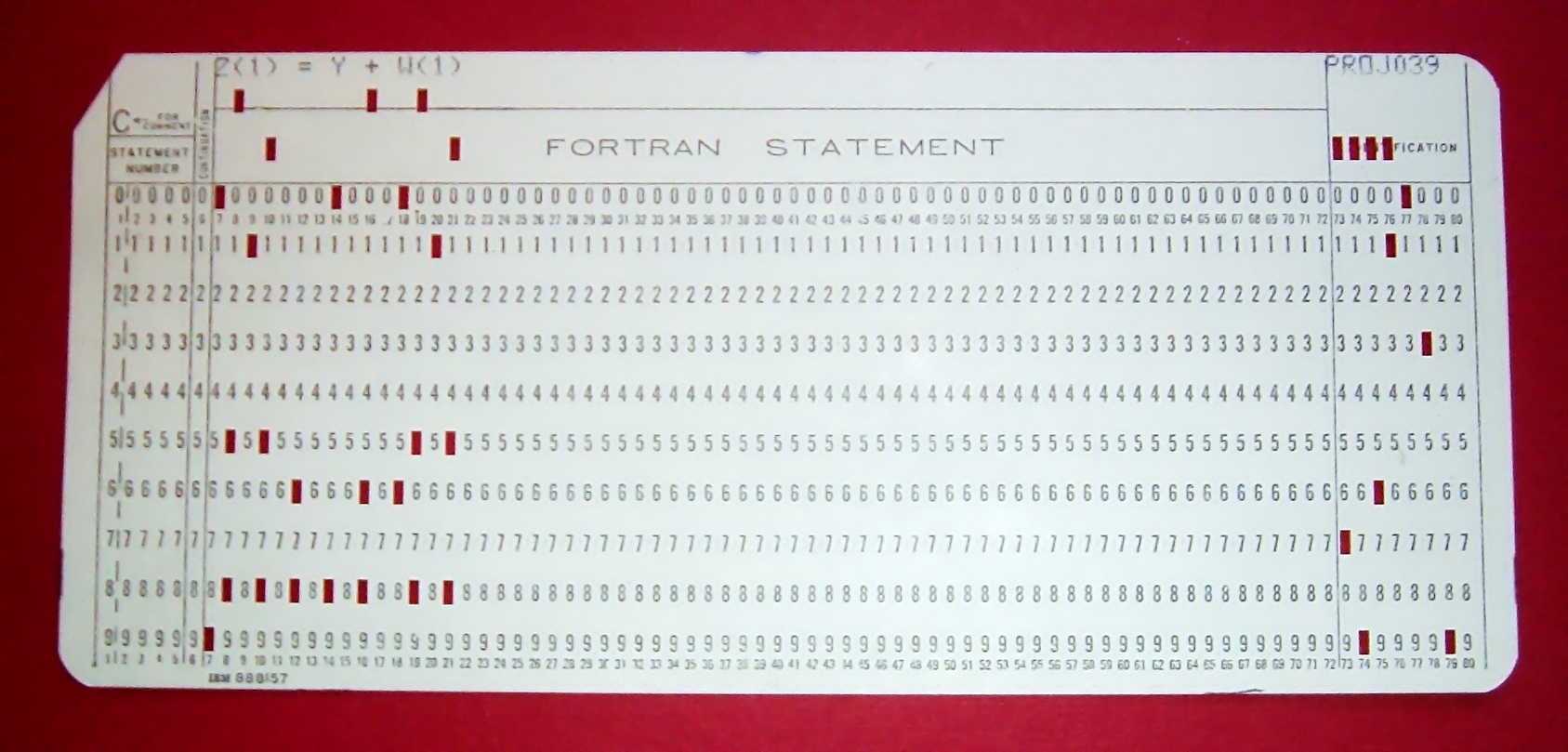
The release of the Fortran 90 (F90) specification in 1991 was the first major update to the language since Fortran 77, and introduced many usability improvements, as well as the dropping of punch card era legacy requirements and limitations to variable lengths and more. This is the reason for our focus on F90 here, as there is no real reason to use F77 or earlier, unless you’re maintaining a legacy codebase, or you have a stack of new cards that need punching. In case you are dying to know what changed, the Wikibooks Fortran Examples article has examples of early FORTRAN all the way to modern Fortran.
Of note here is that a modern Fortran compiler like GCC’s GFortran(forked from g95) still supports F77, but users are highly encouraged to move on to Fortran 95, a minor update to F90, with GFortran supporting up to F2008, with coarray support, as covered later. F2018 support is still a work in progress as of writing, but many features are already available.
Support for the latest standard (F2023) is not widely available yet outside of commercial compilers, but as a minor extension of F2018 it should eventually get rolled into those features as the implementation progresses. This means that for now F2008 is the latest standard we can reliably target across toolchains with new Fortran code.
Beyond GFortran there are a few more options, including Flang in LLVM and LFortran in addition to a gaggle of commercial offerings. Unless you intend to run high-performance computing code on massive parallel clusters like supercomputers, the GNU and LLVM offerings will probably suffice. Simply fetch either GFortran or Flang from your local package manager or equivalent and you should be ready to start with programming in Fortran.
Hello World
As with most DSLs, there is very little preamble to start writing the business logic. The ‘Hello World’ example is most succinct:
program helloworld
print *, "Hello, World!"
end program helloworld
The program name is specified right after the opening program keyword, which is repeated after the closing end program. This is similar to languages like Ada and Pascal. The program name does not have to match the name of the file. Although there’s no explicit specification for what the file extension has to be for a Fortran source file, convention dictates that for F77 and older you use .f or .for, while F90 and newer uses generally .f90 as extension. Although some opt to use extensions like .f95 and .f03, this is rather confusing, isn’t recognized by all compilers and all of those are similar free-form Fortran source files anyway.
Tl;dr: Use .f90 for modern Fortran source files. Our Hello World example goes into a file called hello_world.f90.
The other point of note in this basic example is the print command, which looks somewhat cryptic but is quite easy. The first argument is the format, reminiscent of C’s printf. The asterisk here simply means that we use the default format for the provided value, but we could for example print the first string as an 11 character wide field and a variable string as 8 wide:
character(len=8) :: name = 'Karl'
print '(a11,a8)', 'My name is ', name
This also shows how to declare and define a variable in Fortran. Note that if you do not start the code with implicit none, variable names that start with I through N are considered to be integer type and real otherwise. With gfortran you can also globally do this by compiling with the -fimplicit-none flag.
A total of five basic types are supported:
- real
- integer
- logical (boolean)
- complex
- character
Finally, comments in Fortran are preceded by an exclamation mark !. It’s also relevant to note that Fortran – like all good programming languages – is case insensitive, so you can still write your Fortran code like it’s F77 or Fortran II, yelling in all caps without anyone but the people reading your code batting an eye.
Hello Science
Now that we have got a handle on the basics of Fortran, we can look at some fun stuff that Fortran makes really easy. Perhaps unsurprisingly, as a DSL that targets scientific computing, much of this fun stuff focuses around making such types of computing as easy as possible. Much of this can be found in the intrinsic procedures of Fortran, which make working with real, integer and complex values quite straightforward.
For example, conjugating a complex number with conjg: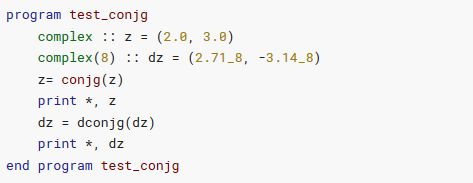
Basically, whatever mathematical operation you wish to perform, Fortran should have you covered, allowing you to translate your formulas into a functional program without having to bother with any dependencies or the like. This includes working with matrices and getting into the weeds with numerical precision.
Even better is that you’re not stuck running your code on a single CPU core either. Since Fortran 2008, Coarray Fortran (CAF) is now part of the specification. This feature enables parallel processing, which is generally implementing on top of the Message Passing Interface (MPI) protocol, with gfortran implementing CAF support. Depending on the selected option with the -fcoarray= flag, gfortran can use the ‘single’ image (thread) option, or with a library like OpenCoarrays it can use MPI, GASNet, and others.
When using CAF with MPI, the program (‘image’) is distributed across all nodes in the MPI cluster per its configuration, with synchronization occurring as defined by the program. With OpenCoarrays available from many local OS repositories, this means that any budding molecular scientist and astrophysicists can set up their own MPI cluster and start running simulations with relatively very little effort.
The DSL Life
Much like when we looked at COBOL, a DSL like Fortran is often misunderstood as ‘yet another programming language’, much like how in the 1980s some thought that the scientific and engineering communities were going to switch over to Pascal or Modula-2. One simple reason that didn’t happen lies in the very nature of DSLs, with them being developed explicitly to deal with that specific domain. It will always be possible to do everything a DSL does in any generic programming language, it’s just that a DSL can be optimized more exactly, and is often easier to maintain, since it is not generic.
There are many things that Fortran does not have to concern itself with, yet which haunt languages like C and its kin. Meanwhile, reimplementing Fortran in C would come at considerable cost, run into certain limitations of the language and potentially require compromises in order to get close to the original functionality of the DSL.
Running a cluster with Coarray-based Fortran source, churning through complex simulations that require utmost control over precision and where one small flaw can waste days of very expensive calculations, those are the kind of scenarios where you’re not looking for some generic language to poorly reinvent the wheel, but where you keep using the same – yet much more refined – wheel that has gotten us this far.
Pirate News: No Secret Police!
Steve and James discuss ICE (et. al.) actions, how they are becoming a secret police force and why we need to get rid of them.
youtube.com/embed/SM6kGmzkUFA?…
Sign up to our newsletter to get notified of new events or volunteer. Join us on:
Some links we mentioned:
- MassPirates 2025 Administrative Coup Memory Bank;
- The IRS Is Building a Vast System to Share Millions of Taxpayers’ Data With ICE;
- 26 USC 6103: Confidentiality and disclosure of returns and return information;
- Immigration agents demand tenant information from landlords, stirring questions and confusion;
- Flight Manifests Reveal Dozens of Previously Unknown People on Three Deportation Flights to El Salvador;
Image Credit: Public Domain via Wikipedia Commons
Neptune Strike, Italia e Nato insieme per la sicurezza euro-mediterranea
@Notizie dall'Italia e dal mondo
La seconda fase di Neptune Strike 25-2, l’esercitazione più complessa e articolata dell’Enhanced Vigilance Activity (Eva) Nato per il 2025, ha esteso la sua proiezione operativa dal Mediterraneo centrale fino al Mar Baltico e al fianco orientale dell’Alleanza. Undici giorni
Open Source 5-Axis Printer Has Its Own Slicer

Three-axis 3D printing has been with us long enough that everybody knows the limitations, but so far, adding extra axes has been very much a niche endeavor. [Daniel] at Fractal Robotics wants to change that, with the Fractal 5 Pro 5-axis printer, and its corresponding Fractal Cortex slicer.
The printer looks like an extra-beefy Voron from a distance, which is no surprise as [Daniel] admits to taking heavy inspiration from the Voron Trident. The Fractal 5 shares a core-XY geometry with the Voron, using beefy 30 mm x 30 mm extrusions. Also like the Voron, it runs Klipper on a Raspberry Pi hiding in the base. Under a standard-looking printhead using a BondTech extruder and E3D volcano hotend, we find the extra two axes hiding under the circular build plate. The B axis is a gantry that can pivot the build plate assembly a full 90 degrees; the A axis spins the plate without limit thanks to the slip rings built into the design.
The extruder may look fairly normal, but it has actually been designed very carefully to allow the nozzle to get as close as possible to the build plate when the B-axis is at 90 degrees. It looks like the E3D hotend is actually the limiting factor there, which gives plenty of design freedom when planning prints in the accompanying Fractal Cortex slicer.
Fractal Cortex is an all-new slicer written entirely in Python. It does have a 3-axis legacy mode, but it’s primarily designed for 5-axis slicing with the Fractal 5 Pro. The multi-axis operation looks very straightforward: you place “slicing planes” and orient them along the part, as many as you require. Printing pauses while the A and B axes rotate, then resumes with straight, parallel layers. Sure, non-planar slicing would be the bees’ knees on this sort of 5-axis printer, but we’ve got to say for a young engineer’s first crack at this kind of software, Fractal Cortex looks pretty good.
It sounds like [Daniel] is looking for contributors to the project, so if this project tickles your fancy, head over to the GitHub links at the top of the page and dive in.
We’ve seen other 5D printers before, but this one probably takes the cake for build volume, and having a slicer to match is a big advantage for anyone who wants to try this at home.
Thanks to [Hari] for the tip. Use all your axes to extrude your projects into our tips line here.
youtube.com/embed/2_BY-7XOgWg?…
roma.mid.ru/it/press-centre/in…


Happy Birthday 6502

The MOS Technology 6502 is a microprocessor which casts a long shadow over the world of computing. Many of you will know it as the beating heart of so many famous 8-bit machines from the likes of Commodore, Apple, Acorn, and more, and it has retained enough success for a version to remain in production today. It’s still a surprise though, to note that this part is now fifty years old. Though there are several contenders for its birthday, the first adverts for it were in print by July 1975, and the first customers bought their chips in September of that year. It’s thus only fitting that in August 2025, we give this processor a retrospective.
The Moment Motorola Never Really Recovered From

The story of the 6502’s conception is a fascinating tale of how the giants of the early mocroprocessor industry set about grappling with these new machines. In the earlier half of the 1970s, Chuck Peddle worked for Motorola, whose 6800 microprocessor reached the market in 1974. The 6800 was for its time complex, expensive, and difficult to manufacture, and Peddle’s response to this was a far simpler device with a slimmed-down instruction set that his contact with customers had convinced him the market was looking for: the 6502.
There’s a tale of Motorola officially ordering him to stop working on this idea, something he would later assert as such an abandonment of the technology that he could claim the IP for himself. Accompanied by a group of his Motorola 6800 colleagues, in the summer of 1974 he jumped ship for MOS Technology to pursue the design. What first emerged was the 6501, a chip pin-compatible with the 6800, followed soon after by the 6502, with the same core, but with an on-board clock oscillator.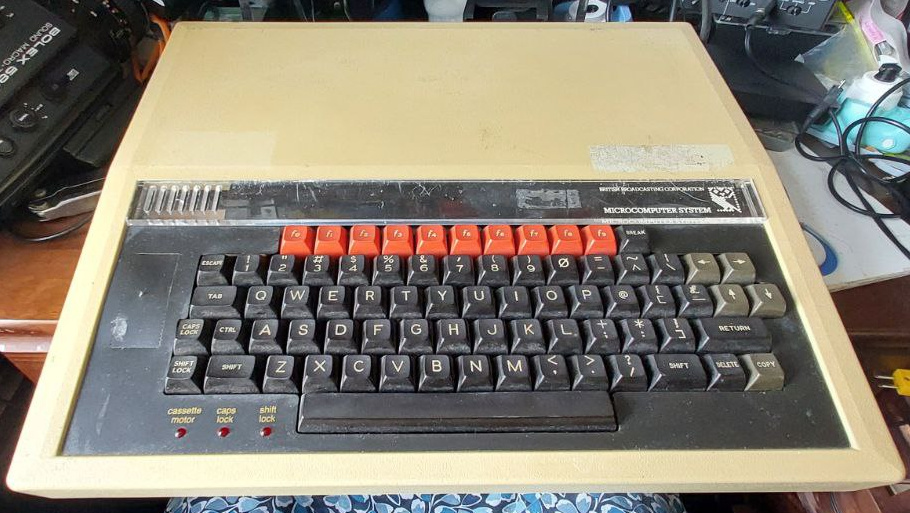
If you were one of the small group of very geeky kids in the early 1980s who really used their home computers instead of merely gaming it’s likely you are part of the only generation ever to have a playground one-upmanship over processor architectures. Those of us with a Z80 in our Sinclair machines would cite the higher clock speed, while the Commodore owners would talk about the 6502’s pipelined architecture and smaller instruction set.
With the benefit of many decades’ hindsight it’s fair to say they had a point, and one that the Z80’s ability to flip between two sets of registers on a dime couldn’t make up for. The 6502 was quick, it had a reliable manufacturing process, and since MOS Technology sold it to anyone for a surprisingly reasonable price rather than restricting it to big-bucks industrial customers, it or one of its many derivatives was a natural choice for much of the first generation of home computers and consoles. If you had an Acorn, an Atari, a Commodore, an Oric, or an Apple 8-bit machine you would have had one, and if you had a Nintendo console you also joined the 6502 club.
Just Who Is Still Buying A 6502?
It’s still not too difficult to find dedicated defenders of the 6502 among those now in their 50s geeks who owned an 8-bit computer when they were new. Just as with their Z80-fan friends, they come from an era when it was possible to fully comprehend the architecture of your computer at nearly gate level. It’s thus understandable that both architectures lingered on in the world of embedded computing long after their heyday on the desktop had passed, but it’s still a surprise to find the WDC version of the chip still in production. Unlike other surviving 8-bit architectures such as the 8051, this is the real thing in a 40-pin DIP rather than a core found embedded in other chips, so we’d be curious to know: aside from a small number of retrocomputing enthusiasts, who is still buying these things? The Z80 finally shuffled off this mortal coil last year, so how long has the WDC W65C02 got left? We’d be curious for your views.
Speaking personally, I had a foot in both camps. Like many British kids of the early 1980s I could save enough pocket money for a Z80-based Sinclair ZX81 of my own, but I had access to a room full of 6502-powered Acorn BBC Micros at school. I thus painstakingly hand-assembled Z80 code for the Sinclair, and was blown away by the built-in assembler in the Beeb. But did I have a favourite? Perhaps not, after all the most important lesson is one I only fully understood years later; that far more important than what architecture a computer uses is what you can do with it. And in that, to my profound sadness as a Sinclair fan, the 6502-powered BBC Micro won hands-down.
Header image: Dirk Oppelt, CC BY-SA 3.0.
Ieri sera per questioni logistiche ho dormito a #Pontedera in provincia di #Pisa 😋
Il nome di questa cittadina mi è sempre stato familiare perché durante l'estate alcune ragazze di questa cittadina si aggregavano sempre alla nostra "comitiva del muretto" a Fiumicino Beach, dove venivano a trovare le cuginette o roba del genere.
Però non sapevo null'altro di questo posto.
Invece ho scoperto che la storia di Pontedera è legata a doppio filo a quella dell'industria (anche militare) e dello stile Italiano, essendo stata la sede del principale impianto della #Piaggio, che tra le altre cose, dopo carrozze di treni e aerei (anche da guerra) nel primo dopoguerra ha prodotto la mitica Vespa, così cara anche a tanta parte di una certa sottocultura degli anni '60, tipo quella dei mod, ma non solo.
🤖👉A Pontedera nacque il presidente della Repubblica Giovanni Gronchi. La città è nota per essere la sede storica della Piaggio, dove fu creata la #Vespa nel 1946. Inoltre, ospitò un aeroscalo per dirigibili e uno dei primi gruppi scout italiani all'inizio del Novecento.
Le origini di Piaggio risalgono alla fine dell'Ottocento e sono strettamente legate alla figura del suo fondatore, Rinaldo Piaggio.
* 1884: La fondazione a Sestri Ponente. La storia ha inizio il 24 gennaio 1884 a Sestri Ponente, Genova, quando Rinaldo Piaggio, all'età di 20 anni, fondò la "Piaggio & C.". L'azienda si specializzò inizialmente nella produzione di arredamenti navali per la crescente industria marittima genovese.
* Espansione e diversificazione. Il successo nel settore nautico portò l'azienda a espandersi rapidamente. All'inizio del Novecento, Piaggio iniziò a diversificare la produzione, entrando nel settore ferroviario con la costruzione e la riparazione di carrozze e vagoni.
* La svolta aeronautica. Il vero punto di svolta arrivò con la Prima Guerra Mondiale. Rinaldo Piaggio, intuendo l'importanza strategica dell'aviazione, iniziò a produrre motori e componenti per aerei. Nel 1915, aprì un'officina a Finale Ligure, specializzata in questo nuovo settore. L'azienda si dedicò poi alla produzione di velivoli completi, diventando un attore di spicco nell'industria aeronautica italiana.
* L'eredità e la nascita della Vespa. Dopo la morte di Rinaldo Piaggio nel 1938, l'azienda fu divisa tra i suoi figli, Armando ed Enrico. Quest'ultimo, dopo la devastazione della Seconda Guerra Mondiale, decise di riconvertire la produzione. L'obiettivo era quello di offrire agli italiani un mezzo di trasporto economico e accessibile per la ricostruzione del Paese. Dando l'incarico all'ingegnere aeronautico Corradino D'Ascanio, Enrico Piaggio diede vita nel 1946 a uno dei simboli del "Made in Italy" nel mondo: la Vespa.
In sintesi, la storia di Piaggio è un percorso che va dagli arredamenti navali ai treni, dagli aerei militari agli scooter che hanno rivoluzionato la mobilità individuale, dimostrando una notevole capacità di adattamento e innovazione nel corso di oltre un secolo di attività 🤖
Riguardo le attività nel campo dell'industria militare invece:
🤖 La conversione di Piaggio alla produzione militare ha radici storiche profonde, ma è anche un tema di attualità, soprattutto per quanto riguarda la sua divisione aeronautica.
Contesto storico:
* Dalle origini al dopoguerra: Piaggio ha avuto una lunga storia nel settore aeronautico. Già durante la Prima Guerra Mondiale, l'azienda si dedicò alla produzione di aeroplani e idrovolanti. Nel periodo tra le due guerre e durante la Seconda Guerra Mondiale, Piaggio divenne un importante produttore italiano di aerei, inclusi bombardieri come il P.108. Gli stabilimenti dell'azienda, proprio a causa del loro ruolo strategico nella produzione bellica, furono gravemente danneggiati dai bombardamenti.
* La riconversione post-bellica: Nel dopoguerra, Piaggio, in particolare sotto la guida di Enrico Piaggio, scelse una riconversione industriale radicale. L'azienda si concentrò sulla mobilità individuale per un Paese in fase di ricostruzione, dando vita a veicoli iconici come la Vespa. Questa decisione segnò un allontanamento dalla produzione di grandi velivoli militari.
Situazione attuale: Piaggio Aerospace e la produzione militare
Mentre il Gruppo Piaggio è noto per scooter e motocicli, la sua divisione aeronautica, ora nota come Piaggio Aerospace, ha mantenuto e sviluppato un ruolo significativo nel settore della difesa e della sicurezza. Piaggio Aerospace produce e commercializza velivoli, motori aeronautici e servizi di manutenzione.
* Il P.180 Avanti EVO: Piaggio Aerospace continua a produrre il P.180 Avanti, un aereo bimotore turboelica a nove posti. Questo modello viene utilizzato anche da forze armate, come l'Aeronautica Militare italiana, per missioni di trasporto, addestramento e utility. Recentemente, sono stati formalizzati contratti per la fornitura di nuovi velivoli P.180 Avanti EVO+ e per l'ammodernamento di quelli già in servizio.
* I droni e la recente acquisizione: Un'evoluzione importante è il progetto P.1HH HammerHead, un drone a pilotaggio remoto di tipo MALE (Medium Altitude Long Endurance). Questo velivolo, concepito per missioni di sorveglianza, è un chiaro esempio dell'orientamento verso il settore militare e della sicurezza. Recentemente, un cambiamento significativo per Piaggio Aerospace è stata l'acquisizione da parte del gruppo turco Baykar, noto gigante nella produzione di droni. Questa operazione, autorizzata dal governo italiano, ha l'obiettivo di creare un polo di eccellenza europeo nella produzione di droni, integrando il portfolio di Baykar con quello di Piaggio Aerospace e rafforzando il ruolo strategico dell'azienda nel panorama industriale.
In sintesi, la storia di Piaggio è un esempio di come un'azienda, dopo aver giocato un ruolo chiave nella produzione bellica, abbia saputo reinventarsi e concentrarsi su altri settori. Tuttavia, la sua divisione aeronautica ha mantenuto una forte connessione con il settore della difesa, che si è ulteriormente consolidata e modernizzata con l'introduzione dei droni e la recente acquisizione da parte di un'azienda leader nel settore 🤖


L'immagine mostra un muro di cemento con graffiti scritti in blu e nero. Il testo principale, in blu, recita "FIRENZE MERDA" e "ANCHE PISA MERDA", con la parola "FIRENZE" in caratteri più grandi. In alto a destra, in nero, si legge "A-LIMITO". Il muro presenta segni di usura e macchie, e sotto il muro c'è una recinzione metallica grigia. Il contesto suggerisce un'opinione negativa nei confronti di Firenze e Pisa, espressa in modo diretto e provocatorio.
―
L'immagine mostra una strada pavimentata con mattoni a vista, tipica di un paese italiano. Sullo sfondo si vedono edifici con facciate colorate e balconi, alcuni dei quali sono decorati con tende rosse. Un uomo in primo piano indossa una camicia hawaiana colorata con motivi floreali e pantaloni corti neri, con le mani nelle tasche e un cappello da sole. Le sue scarpe sono sandali. Sullo sfondo, si intravedono altre persone che camminano lungo la strada. Alcune corde rosse sono tese tra i palazzi, creando un effetto decorativo. L'atmosfera è vivace e colorata, con un'atmosfera tipica di una giornata estiva in un piccolo paese italiano.
―
L'immagine mostra un uomo in piedi davanti a una scultura di una Vespa ricoperta di graffiti colorati. La Vespa è decorata con una varietà di motivi vivaci, tra cui stelle, cuori, creature fantasiose e scritte graffiti, con una combinazione di colori come il blu, il rosso, il verde, il giallo e il viola. Le ruote della Vespa hanno un design unico con cerchi colorati. L'uomo indossa una camicia hawaiana colorata con disegni variopinti e pantaloni corti neri. La scultura è posizionata su un podio nero, e dietro di essa si vede un edificio con finestre e una cornice gialla. L'atmosfera è vivace e colorata, con un forte contrasto tra la scultura e l'ambiente circostante.
―
L'immagine mostra una chiesa con un imponente campanile a destra. La facciata della chiesa è caratterizzata da colonne corinzie e un portico con un frontone triangolare. Sopra l'ingresso principale, si trova un arco a tutto sesto. La chiesa è situata in una piazza con un marciapiede e una strada asfaltata. In primo piano, si vede un marciapiede pedonale con una striscia bianca. Due ambulanze con strisce colorate sono parcheggiate sul lato sinistro della strada, vicino alla chiesa. Il cielo è coperto di nuvole, e la luce del sole filtra attraverso le nuvole, creando un'atmosfera luminosa ma diffusa. Sul lato destro della chiesa, si notano edifici adiacenti e alberi.
Fornito da @altbot, generato localmente e privatamente utilizzando Ovis2-8B
🌱 Energia utilizzata: 3.362 Wh
BitLocker sotto Attacco! Una nuova tecnica consente movimenti laterali eludendo i controlli
Attraverso la funzionalità Component Object Model (COM) di BitLocker, gli aggressori possono mettere in atto una tecnica innovativa di pivoting, finalizzata all’esecuzione di codice malevolo sui sistemi presi di mira. Questo approccio, presentato tramite uno strumento di prova chiamato BitLockMove, segna un progresso significativo nelle strategie di movimento laterale, riuscendo a eludere i metodi di individuazione standard grazie all’utilizzo di elementi Windows autentici.
Solitamente abilitato su workstation e laptop per impedire l’accesso non autorizzato in caso di furto o smarrimento del dispositivo, la protezione completa di BitLocker lo ha reso un bersaglio allettante per gli aggressori che cercano di abusare della sua infrastruttura sottostante.

Durante la sua presentazione, il ricercatore Fabian Mosch ha illustrato che l’aggiunta di ogni applicazione o funzionalità a Windows comporta un aumento sostanziale degli oggetti, comprendenti processi, file e chiavi di registro, i quali, nel loro insieme, ampliano la superficie esposta a potenziali attacchi. Nonostante l’efficacia di BitLocker nella protezione dei dati non attivi, gli esperti hanno rilevato che la sua implementazione include aspetti che possono essere sfruttati dai malintenzionati più esperti per creare strumenti offensivi.
La tecnica appena divulgata mira alla manipolazione remota delle chiavi del registro di sistema di BitLocker tramite Windows Management Instrumentation (WMI) per dirottare specifici oggetti COM. Questo approccio consente agli aggressori di eseguire codice nel contesto dell’utente interattivo sugli host di destinazione, portando potenzialmente all’escalation del dominio se l’utente compromesso possiede privilegi elevati, come i diritti di amministratore di dominio.
Una falla critica nella struttura gerarchica degli oggetti COM di BitLocker è sfruttata dall’attacco, che punta direttamente alla classe BDEUILauncher attraverso l’interfaccia IBDEUILauncher. Gli aggressori possono utilizzare tre metodi principali offerti da questa interfaccia per il loro sfruttamento:
- BdeUIProcessStart : avvia il processo BitLocker (BdeUISrv.exe)
- BdeUIContextTrigger : fornisce funzionalità di manipolazione del contesto
- GetUserLogonTime : recupera le informazioni sui tempi di accesso dell’utente
Il processo di exploit si concentra sul CLSID ab93b6f1-be76-4185-a488-a9001b105b94, che genera quattro processi diversi come utente interattivo. Tra questi, il processo BaaUpdate.exe si dimostra particolarmente vulnerabile al COM hijacking quando eseguito con parametri di input. L’attacco prende di mira specificamente il CLSID mancante A7A63E5C-3877-4840-8727-C1EA9D7A4D50, che il processo BaaUpdate.exe tenta di caricare.
Creando una voce di registro per questo CLSID e stabilendo le sottochiavi appropriate, gli aggressori possono reindirizzare il processo per caricare codice dannoso invece del componente legittimo, ha affermato Fabin . Lo strumento BitLockMove dimostra l’implementazione pratica di questa tecnica attraverso due modalità operative:
- Modalità di enumerazione: La funzionalità di ricognizione dello strumento utilizza API Microsoft non documentate della libreria winsta.dll per enumerare da remoto le sessioni attive sui sistemi di destinazione. Queste API, tra cui WinStationEnumerateW, WinStationOpenServerW e WinStationQueryInformationW, forniscono informazioni complete sulle sessioni senza richiedere l’abilitazione dei Servizi Desktop remoto.
- Modalità di attacco: Durante la fase di exploit attivo, BitLockMove stabilisce una connessione remota all’host di destinazione tramite WMI ed esegue query per abilitare il servizio Registro di sistema remoto. Lo strumento crea quindi il percorso di registro necessario per preparare l’ambiente al dirottamento COM, creando in particolare voci nella struttura di chiavi CLSID.

Il processo BdeUISrv.exe rimane attivo sul sistema, a differenza del processo vulnerabile al COM hijacking BaaUpdate.exe che viene terminato.
È importante notare che il processo BdeUISrv.exe è stato eseguito nel contesto dell’utente Amministratore, ovvero l’utente che aveva la sessione interattiva sull’host ed è stato preso di mira.
Sebbene la tecnica tenti di integrarsi nell’ambiente, poiché il comando arbitrario viene eseguito nel contesto di un processo BitLocker attendibile (BdeUISrv.exe ), esistono molteplici opportunità di rilevamento in varie fasi. L’analisi del comportamento dello strumento può rivelare le caratteristiche della tecnica e le aree su cui gli ingegneri del rilevamento dovrebbero concentrarsi.

La tecnica di spostamento laterale tramite dirottamento del modello a oggetti dei componenti BitLocker prevede diverse fasi, ma offre anche numerose opportunità di rilevamento. Le organizzazioni dovrebbero valutare quali log sia possibile abilitare nei propri ambienti e concentrare di conseguenza i propri sforzi di ingegneria del rilevamento.
L’arricchimento del SIEM con tutti i log associati e l’esecuzione di query di threat hunting a breve frequenza consentono il rilevamento con un elevato livello di affidabilità.
L'articolo BitLocker sotto Attacco! Una nuova tecnica consente movimenti laterali eludendo i controlli proviene da il blog della sicurezza informatica.
In defense of digital political ads
IT'S MONDAY, AND THIS IS DIGITAL POLITICS. I'm Mark Scott, and here's a little plug for my day job.

As part of work I'm doing linked to the United Kingdom's efforts around social media transparency and accountability, we'll be holding a webinar with regulators and policymakers on Aug. 6 (at 11am UK time / 6am ET — sorry!) about the country's new data access efforts. You can sign up here.
— Google and Meta's collective pullback on political ad transparency in the European Union harms free speech and the public's engagement with political campaigns.
— What Big Tech's recent earnings season demonstrates about their high-wire geopolitical balance between the United States and everyone else.
— Almost half of the United Kingdom has never used artificial intelligence tools in their daily lives.
Let's get started:
THE END OF DIGITAL POLITICAL ADS
LATE LAST YEAR, GOOGLE PUT OUT A POST that few outside of digital policy circles paid much attention to. In the 2-minute read, the search giant's head of EU government affairs said that, as of October, 2025, the tech giant would not allow advertisers to buy political ads targeted within the 27-country bloc. The reason? An obscure new rule, known as the EU Regulation on Transparency and Targeting of Political Advertising, or TTPA.
The rule "introduces significant new operational challenges and legal uncertainties for political advertisers and platforms," read the announcement. "Google will stop serving political advertising in the EU before the TTPA enters into force in October 2025."
Then, on July 25, Meta followed suit. In an equally short and obscure message, the social media company said it too would be ending its political ad offering inside the EU because of the upcoming TTPA. "We continue to believe online political advertising is a vital part of modern politics," Meta said in its post. "The TTPA introduces significant, additional obligations to our processes and systems that create an untenable level of complexity and legal uncertainty for advertisers and platforms operating in the EU."
And with that, the two largest platforms for political ads within the second largest democratic bloc (behind India) hobbled politicians' ability to talk to would-be supporters. On top of that, Google and Meta made it almost impossible to track what was being spent on political campaigns, by who, and who was the audience for these paid-for messages.
Thanks for reading the free monthly version of Digital Politics. Paid subscribers receive at least one newsletter a week. If that sounds like your jam, please sign up here.
Here's what paid subscribers read in July:
— We are entering a new era of social media where everyone lives in digital siloes and the cost of spreading falsehoods is next to nothing. More here.
— The EU-US trade dispute will not include digital; Where the EU and US diverge on AI governance; Tech-related risks now top people's concerns across multiple different regions worldwide. More here.
— The rise of 'age verification' across the West is ending the era of online anonymity; All you need to know about the White House's upcoming AI Action Plan; The billions to be spent on digital in the next EU Budget. More here.
— The US-EU trade/tariff agreement was a skirmish in a wider tech-focused war; Contrasting American and Chinese AI strategies; Energy consumption linked to AI, data centers and crypto will double between 2022-26. More here.
It was a one-two punch that both hit people's legitimate free speech rights and hamstrung wider society's obligations to understand how national elections were influenced, by domestic and foreign groups.
First, a quick synopsis of the (flawed) TTPA. Introduced in 2024 with the other alphabet soup of EU digital regulation, the rules were aimed at giving citizens greater awareness about the types of political ads they saw online.
That included 1) ensuring political ads were labeled as such; 2) accessible information, stored in an online repository, about who paid for each digital ad; 3) a ban on foreign entities paying for these paid-for messages in the build-up to national elections; and — most importantly — 4) new restrictions that limited platforms and advertisers in targeting people via data the firms/political groups had already collected on individuals unless they explicitly consented to receiving political ads.
The new limits on how political ads could be targeted was a major stumbling block. It made it next to impossible for Meta and Google to help political groups to target would-be supporters. To do that, the companies and/or politicians would have to explicitly ask people if they were OK about receiving digital political ads — something that even the most ardent political supporter would likely be beige about, at best.
There are legitimate weaknesses in the TTPA that everyone knew about from the beginning.
The definition of "political ads" varied widely between platforms, and EU policymakers' efforts to harmonize that — alongside so-called "issues-based" ads like those around climate change, public health and other societal issues — spread the net too wide. In practice, that meant a large bucket of ads beyond traditional party political messaging would likely be caught within the TTPA. That, in turn, would hit platforms' underlying advertising business models with the potential of 6 percent fines (linked to a company's yearly revenue) for failing to comply.
Faced with that regulatory uncertainty — and at a time when Google and Meta are trying (badly) to pull back from politics — it made sense both firms would give up a part of their business that was marginal to their collective bottom lines. Why take the risk if you could just pull the plug in a way that, in theory, would anger some politicians already falling out of love with Europe's penchant for digital regulation?
And yet, I just don't buy in.
Negotiations were still underway about how the TTPA would be implemented, as of October, so pulling the plug now was an active choice from both Google (in November, 2024) and Meta (in July.) The companies would argue that, at some point, they had to call it a day. And that was their choice. But after companies doubled down on their free speech bonafides, the decision to then limit people's free speech rights via buying political ads felt out of step. The separate decisions would be particularly hard for smaller political movements that could level the playing field with larger rivals via targeted digital political ads.
I also don't believe either company doesn't have the internal resources (both technical and financial) to find a solution. Yes, the definition of what constitutes a "political ad" in the TTPA is bad. But both firms have been tracking various types of ads for years. To suggest that engineers — or even artificial intelligence tooling — could not figure out the line between what was allowed, and what was not, also felt too binary.
When you then look at how much these firms are making (more on that in the section below) on a quarterly basis, this looks more like a political decision than an economic one. Alphabet (Google's parent company), for instance, plans to spend $86 billion this year, primarily on AI-related infrastructure. That's on top of the $28 billion net profit the company made in the second quarter of 2025.
When spending/making that amount of money, the idea that figuring out how to implement (flawed) political ad regulations was too costly doesn't add up.
There is still time, before the October deadline, for the tech companies and the European Commission to find a solution. But that's not really how this should work. It is Meta and Google's right to pull back on services within the bloc — even if sometimes that feels more like point-scoring than actual policymaking.
But without a coherent approach to overseeing political ads in one of the world's largest democratic blocs, these companies are leaving a massive hole in which nefarious actors will likely continue peppering voters with political ads — but in a way that lacks transparency, accountability and oversight. That will harm legitimate political actors who will no longer have a legal way, within the bloc, to amplify their messaging to would-be supporters.
Faced with that trade-off, both companies have made the wrong choice. Google and Meta will still play a central role in domestic European politics, even if they follow through with their respective decisions to pull out of the political ad business in Europe.
By abdicating this responsibility, the firms are not, collectively, living up to their stated objectives (to wider society) of uplifting people's free speech rights in a way that promotes transparency and accountability for all.
Chart of the Week
ROUGHLY 40 PERCENT OF BRITS never use artificial intelligence tools as part of their daily lives, and only 10 percent of those polled by YouGov say they use it at least once or twice a day.
For those who do rely on the emerging technology, they most regularly seek information about "a simple topic." The least used reason is to find out what is going on in the news.


Source: YouGov
BIG TECH EARNINGS, AI AND GEOPOLITICS
AS A LAPSED FINANCE JOURNALIST, I can't help but scan tech companies' earnings reports when they are published each quarter. Policymakers and politicians may not always tell the truth. But numbers don't lie, so these regular updates from Silicon Valley's biggest names offer a way to cut through the noise to understand how these firms are making and spending their money.
The figures are wild. Meta's net income in the second quarter, or the profit that the social media giant made after taxes, was a whopping $13.5 billion, or a 36 percent yearly jump. Microsoft's figure rose 22 percent, to $27.2 billion, over the same period. Amazon — not a company known for making much profit, despite its size — recorded net income for the three months through June 30 or $18.2 billion, or a 34% increase.
These profits are crazy. But that's not where the politics lie in the companies' separate announcements.
Instead, the combination of Google, Amazon, Meta and Microsoft said that, during the 2025-26 fiscal year, they had earmarked roughly $370 billion for spending, primarily to drive big bets on artificial intelligence. That includes massive spending on data centers, AI engineers and other AI-related costs required in what is increasingly turning into a Silicon Valley-led race toward AI dominance.
Let's put that into perspective.
The $370 billion back-of-the-napkin figure doesn't include spending from the second tier of AI (Western) giants, so it's an inherently conservative number. It also doesn't include other digital infrastructure spending, tax cuts and research and design expenditure already announced by the likes of the United States and EU. At best, it's a significant under-count on what has already been allocated by these firms — and that comes despite many of the companies recording significant increases in their net profits (see above.)
Sign up for Digital Politics
Thanks for getting this far. Enjoyed what you've read? Why not receive weekly updates on how the worlds of technology and politics are colliding like never before. The first two weeks of any paid subscription are free.
Subscribe
Email sent! Check your inbox to complete your signup.
No spam. Unsubscribe anytime.
Here's another stat: The $370 billion figure — solely linked to Big Tech capital expenditure — is the equivalent to the expected 2025 gross domestic product of the Czech Republic, or the world's 41st largest GDP. In anyone's mind, that is a lot of money.
Here's where the geopolitics comes in.
These firms are American — and some have lent heavily into the Red, White and Blue to win favor with the current White House administration. But much of what has been earmarked in AI-related spending is destined for outside of the US. That includes significant expansion in companies' global networks of data centers to meet non-US needs. In those conversations, the companies have often played down their American roots, highlighting how they can meet the domestic objectives of national politicians eager to develop indigenous AI tooling to compete on the global stage.
In this bizarro world, two opposite, but complementary, messages are playing out, in real time.
For US policymakers, these firms are signed up to the American "dominance" agenda, as articulated in the White House's recent AI Action Plan. For non-US policymakers, the companies are pushing a "we're here to help" ethos that positions them as apolitical globalist allies that can neutrally support these countries' often contradictory policy aims to those of the US.
Central to those conversations are the megabucks announced in the latest earnings cycle. The expected capital expenditure is the realization of these political discussions, both at home and abroad, at a time when all of Silicon Valley is desperately seeking an edge to keep competitors at bay. That means walking a tight rope between American domestic interests and the business opportunities overseas.
What many in Washington have yet to understand is how these conversations are playing out in national capitals from Brasilia to Berlin. Once American policymakers figure that out, it's an open question if they will view the companies' international outreach as either part of American "dominance" or as a potential direct conflict with the White House's MAGA agenda.
What I'm reading
— UK Research and Innovation, a public research body, announced a $74 million program to attract world-class researchers to the UK. More here.
— An Australian court ruled that X would have to respond to a local regulator's requests on how the social network tackled child sexual abuse material. More here.
— Michael Kratsios, the director of The White House's Office for Science and Technology Policy, spoke at the Center for Strategic & International Studies about the AI Action Plan. More here.
— Donald Trump's administration announced tariffs against Brazil, in part related to how the South American country approached questions around content moderation and the role of platforms in the failed 2022 coup. More here.
— Italy's competition regulator announced an investigation into Meta's potential abuse of its market position by installing an AI agent within its WhatsApp service. More here.
Amiche! Siete continuamente in #viaggio perché vi state sparando le #vacanze d'agosto e state sperimentando la classica devastante #stitichezza estiva?! 🥵🤣
Ebbene ve la do io la soluzione: mangiate più #frutta mortacci vostri! 🍇🍅🍉🙌🙌😅
E sì perché si dà il caso che in realtà il "cambio d'aria" non c'entra niente. Il problema vero è che siccome siete povere in canma state mangiando solo schifezze, tipo una rustichella cenciosa all'autogrill, o un paninetto ammuffito al baretto del Lido, la sera una pizza marinara (quella che costa di meno!) alla costosissima pizzeria nel pittoresco centro storico in cui siete capitate e via così. E poi state bevendo troppi cocktail, perché la sera bisogna fare un po' le matte giustamente, e pochissima acqua si giorno. E quindi insomma, son tre giorni che non cacate e ogni volta che vi sedete sulla tavoletta a forza di spingere vi scoppiano le tempie e sentite che le #emorroidi vi stanno uscendo anche dagli occhi?! 😬
Ebbene, lasciate stare lo spot delle fave di fuca che tiene banco su tutti i muri e tutte le tv, ho io la soluzione che fa per voi: mangiate più frutta mortacci vostri! 🍇🍅🍉🙌😋
Ma non buttatevi sulle prugne secche, che vi disidratano abbestia e vi fanno venire le carie e il cagotto, buttatevi piuttosto sull'uva fresca, che adesso è stagione, la trovate ovunque a buon prezzo, la potete mangiare anche on the road, anche senza lavarla volendo, e ha un effetto blandamente lassativo perfetto per mettervi a posto il pancino. Mezzo kilo al giorno, un kilo al giorno, quello che è, e passa la paura 😋
Un po' tutta la frutta aiuta in questi casi eh, ma la #uva in particolar modo, e sapete perché?! Chiediamolo alla pseudoscienza artificiale, che è sempre da prendere con le pinze ma fondamentalmente abbastanza informata sui fatti. Parola alla macchina quindi 🤖👉: L'effetto blandamente lassativo dell'uva fresca è dovuto a una combinazione di diversi fattori:
* Fibre: L'uva contiene fibre, in particolare nella buccia e nei semi. Le fibre, soprattutto quelle insolubili (come la cellulosa), non vengono digerite e assorbono acqua nell'intestino, aumentando il volume delle feci e stimolando i movimenti intestinali (peristalsi).
* Acqua: L'uva è un frutto molto ricco di acqua, il che contribuisce a idratare le feci e a renderle più morbide, facilitandone il transito e l'evacuazione.
* Zuccheri: L'uva contiene zuccheri semplici, come fruttosio e glucosio. Se consumati in quantità elevate, possono avere un leggero effetto osmotico, richiamando acqua nell'intestino e contribuendo a un'azione lassativa.
* Acidi organici: La presenza di acidi organici nell'uva può contribuire a tonificare la muscolatura intestinale e a stimolare la digestione.
In sintesi, la sinergia tra acqua, fibre e zuccheri rende l'uva un rimedio naturale efficace per combattere la stitichezza occasionale, ma il suo effetto è solitamente blando e non irrita la mucosa intestinale.
Tutto chiaro quindi?! Dajje forte e mi raccomando: mangiate più frutta! 🍇🍅🍉🙌😅
Ps: attenzione, questo non è un post di mensplaining, ho solo usato il plurale femminile esteso, ma il discorso vale tale e quale anche per i maschietti 🦄🌈

differx
Unknown parent • •