
IL PARLAMENTO METTA UN FRENO ALLA CONCENTRAZIONE DI POTERI NELLE MANI DI GUALTIERI
Oggi pomeriggio abbiamo depositato alla Camera dei deputati 24 mila firme che chiedono la fine dei poteri speciali di Gualtieri che beneficia di una concentrazione di potere senza precedenti cumulando ruolo e funzioni di Sindaco di Roma, di Sindaco della Città metropolitana e di Commissario straordinario di governo al Giubileo con poteri illimitati in materia di rifiuti. Come è arcinoto, i poteri straordinari relativi ai rifiuti sono attributi per affrontare l’afflusso dei pellegrini del Giubileo 2025 che però è sta per finire. Poteri concentrati nelle mani di Gualtieri che, da subito, li ha utilizzati in spregio alle normative di settore anche di derivazione europea per impianti che con il Giubileo non c’entrano quindi nulla e rispetto ai quali, come nel caso dell’inceneritore, in campagna elettorale si era pubblicamente dichiarato contrario in un confronto con lo sfidante Calenda.
Oggi pomeriggio davanti al Palazzo di Montecitorio abbiamo innalzato lo striscione che riafferma davanti alla Camera dei deputati che, con il Senato, approva le leggi il principio costituzionale per il quale tutti sono eguali davanti alla legge. Non a Roma dove da tre anni esatti non è così perché Roberto Gualtieri in quanto Commissario con poteri speciali può impunemente violare le leggi. Questo accade perché finora non abbiamo trovato un giudice coraggioso capace di portare la norma attributiva dei poteri davanti alla Corte costituzionale.
Allora siamo quindi tornati alla Camera, presto torneremo al Senato perché quella norma il Parlamento l’ha scritta e il Parlamento dovrà cambiarla perché una concentrazione di potere nelle mani di uno solo viola il principio democratico e non può quindi più essere tollerata laddove ci si riconosca nei principi della Costituzione della Repubblica italiana.
Con noi oggi c’erano e hanno preso lo striscione i deputati Francesco Emilio Borrelli, Filiberto Zaratti e Andrea Volpi, Sindaco di Lanuvio, unitamente ai Sindaci di Albano, Massimiliano Borelli, di Ardea, Maurizio Cremonini, di Ariccia Gianluca Staccoli e di Genzano Carlo Zoccolotti. I consiglieri regionali Alessandra Zeppieri e Adriano Zuccala, i consiglieri comunali di Albano Salvatore Tedone, di Pomezia Giacomo Castro e Luisa Navisse e Marco Cerisola consigliere del Municipio IX.
L’Unione dei Comitati contro l’inceneritore

Il messaggio di Nave Alpino alla Global Sumud Flotilla
@Giornalismo e disordine informativo
articolo21.org/2025/09/il-mess…
Questo pomeriggio la nave Alpino della Marina Militare italiana, che segue la flotta, ha diramato un avviso ufficiale a tutte le imbarcazioni, dichiarandosi disponibile ad accogliere ogni persona che manifesti
#Gaza, una trappola chiamata pace

Gaza, una trappola chiamata pace
Il “piano di pace” lanciato lunedì a Washington dai due partner nel genocidio palestinese, Trump e Netanyahu, non rappresenta in nessun modo una proposta di accordo serio per mettere fine alle atrocità nella striscia e costruire una prospettiva di fu…www.altrenotizie.org
Il campo profughi di Jenin. Il reportage sulla Cisgiordania
@Giornalismo e disordine informativo
articolo21.org/2025/09/il-camp…
Si conclude con il campo profughi di Jenin il reportage esclusivo per Articolo 21 di Sandra Cecchi, giornalista Rai (ex TG2) di ritorno dai Territori occupati. Quel che resta del campo profughi di
LA LEGGE SIA UGUALE PER TUTTI GUALTIERI COMPRESO
Abbiamo consegnato 24 Mila firme chiedendo alla Camera dei Deputati che la legge sia uguale per tutti, Gualtieri compreso.
Più tardi diamo comunicazione dettagliata.

#Ambiente #StopInceneritore #NoInceneritore #NoInceneritori #ZeroWaste #Rifiuti #Riciclo #EconomiaCircolare #NoAlCarbone #EnergiaPulita
Cgil: “Sciopero generale se toccano la Flotilla”. L’Odg dell’assemblea nazionale
L’Assemblea Generale della CGIL ieri ha approvato un Odg in cui si ritiene necessario intensificare ed estendere la mobilitazione per: - Fermare il genocidio del popolo palestinese in corso da parte dTommaso Galgani (CGIL Regionale Toscana)
Poliversity - Università ricerca e giornalismo reshared this.
Trump chiarisce che trasformerà TikTok in una macchina di propaganda di destra
Dopo anni di iperventilazione sull'impatto di TikTok su privacy, propaganda e sicurezza nazionale, è probabile che TikTok venga venduto a un gruppo di miliardari tecnofascisti amici di Trump che non credono nella privacy e vogliono usare TikTok per diffondere propaganda di destra. Un lavoro scellerato per tutti, soprattutto per tutti i Democratici confusi la cui isteria sull'app ha aiutato Trump a concludere l'affare.
Tra i nuovi proprietari di TikTok ci saranno Rupert Murdoch (responsabile della creazione di Fox News, la piattaforma di propaganda di destra più efficace di sempre ) e il migliore amico di Trump, Larry Ellison, che sta trasformando CBS News praticamente nella stessa cosa.
@Politica interna, europea e internazionale
techdirt.com/2025/09/30/trump-…

Trump Makes It Very Clear They’re Going To Turn TikTok Into A Right Wing Propaganda Machine
After years of hyperventilation about TikTok’s impact on privacy, propaganda, and national security, TikTok is likely being sold to a bunch of Trump’s billionaire technofascist buddies …Techdirt
reshared this
Mario Paciolla, il prossimo 8 ottobre al via la Peace School intitolata al cooperante Onu
@Giornalismo e disordine informativo
articolo21.org/2025/09/mario-p…
Il nostro XVI Festival (2024), col suo titolo “Costruiamo una cultura di Pace” ci ha lasciato un’eredità
Rai, senza ascolti né legge
@Giornalismo e disordine informativo
articolo21.org/2025/09/rai-sen…
Altro che contro-narrazione, in grado di scalfire la presunta egemonia della sinistra nelle vicende culturali e in quelle del servizio pubblico radiotelevisivo. La destra sta contribuendo -purtroppo con qualche successo- a sfasciare la Rai. Se è vero che la televisione generalista sta
Ahead of the European Union's Regulation on Transparency and Targeting of Political Advertising, Google's Ad Transparency Center no longer shows political ads from any countries in the EU.
Ahead of the European Unionx27;s Regulation on Transparency and Targeting of Political Advertising, Googlex27;s Ad Transparency Center no longer shows political ads from any countries in the EU.#advertising #Google
Lawyers blame IT, family emergencies, their own poor judgment, their assistants, illness, and more.#AI #Lawyers #law


18 Lawyers Caught Using AI Explain Why They Did It
Earlier this month, an appeals court in California issued a blistering decision and record $10,000 fine against a lawyer who submitted a brief in which “nearly all of the legal quotations in plaintiff’s opening brief, and many of the quotations in plaintiff’s reply brief, are fabricated” through the use of ChatGPT, Claude, Gemini, and Grok. The court said it was publishing its opinion “as a warning” to California lawyers that they will be held responsible if they do not catch AI hallucinations in their briefs.In that case, the lawyer in question “asserted that he had not been aware that generative AI frequently fabricates or hallucinates legal sources and, thus, he did not ‘manually verify [the quotations] against more reliable sources.’ He accepted responsibility for the fabrications and said he had since taken measures to educate himself so that he does not repeat such errors in the future.”
As the judges remark in their opinion, the use of generative AI by lawyers is now everywhere, and when it is used in ways that introduce fake citations or fake evidence, it is bogging down courts all over America (and the world). For the last few months, 404 Media has been analyzing dozens of court cases around the country in which lawyers have been caught using generative AI to craft their arguments, generate fictitious citations, generate false evidence, cite real cases but misinterpret them, or otherwise take shortcuts that has introduced inaccuracies into their cases. Our main goal was to learn more about why lawyers were using AI to write their briefs, especially when so many lawyers have been caught making errors that lead to sanctions and that ultimately threaten their careers and their standings in the profession.
To do this, we used a crowdsourced database of AI hallucination cases maintained by the researcher Damien Charlotin, which so far contains more than 410 cases worldwide, including 269 in the United States. Charlotin’s database is an incredible resource, but it largely focuses on what happened in any individual case and the sanctions against lawyers, rather than the often elaborate excuses that lawyers told the court when they were caught. Using Charlotin’s database as a starting point, we then pulled court records from around the country for dozens of cases where a lawyer offered a formal explanation or apology. Pulling this information required navigating clunky federal and state court record systems and finding and purchasing the specific record where the lawyer in question tried to explain themselves (these were often called “responses to order to show cause.”) We also reached out to lawyers who were sanctioned for using AI to ask them why they did it. Very few of them responded, but we have included explanations from the few who did.
What we found was incredibly fascinating, and reveals a mix of lawyers blaming IT issues, personal and family emergencies, their own poor judgment and carelessness, and demands from their firms and the industry to be more productive and take on more casework. But most often, they simply blame their assistants.
Few dispute that the legal industry is under great pressure to use AI. Legal giants like Westlaw and LexisNexis have pitched bespoke tools to law firms that are now regularly being used, but Charlotin’s database makes clear that lawyers are regularly using off-the-shelf generalized tools like ChatGPT and Gemini as well. There’s a seemingly endless number of startups selling AI legal tools that do research, write briefs, and perform other legal tasks. While working on this article, it became nearly impossible to keep up with new cases of lawyers being sanctioned for using AI. Charlotin has documented 11 new cases within the last week alone.
This article is the first of several 404 Media will write exploring the use of AI in the legal profession. If you’re a lawyer and have thoughts or firsthand experiences, please get in touch. Some of the following anecdotes have been lightly edited for clarity.
💡
Are you a lawyer or do you work in the legal industry? We want to know how AI is impacting the industry, your firm, and your job. Using a non-work device, you can message me securely on Signal at jason.404. Otherwise, send me an email at jason@404media.co.A lawyer in Indiana blames the court (Fake case cited)
A judge stated that the lawyer “took the position that the main reason for the errors in his brief was the short deadline (three days) he was given to file it. He explained that, due to the short timeframe and his busy schedule, he asked his paralegal (who once was, but is not currently, a licensed attorney) to draft the brief, and did not have time to carefully review the paralegal's draft before filing it.”
A lawyer in New York blamed vertigo, head colds, and malware
"He acknowledges that he used Westlaw supported by Google Co-Pilot which is an artificial intelligence-based tool as preliminary research aid." The lawyer “goes on to state that he had no idea that such tools could fabricate cases but acknowledges that he later came to find out the limitation of such tools. He apologized for his failure to identify the errors in his affirmation, but partly blames ‘a serious health challenge since the beginning of this year which has proven very persistent which most of the time leaves me internally cold, and unable to maintain a steady body temperature which causes me to be dizzy and experience bouts of vertigo and confusion.’ The lawyer then indicates that after finding about the ‘citation errors’ in his affirmation, he conducted a review of his office computer system and found out that his system was ‘affected by malware and unauthorized remote access.’ He says that he compared the affirmation he prepared on April 9, 2025, to the affirmation he filed to [the court] on April 21, 2025, and ‘was shocked that the cases I cited were substantially different.’”
A lawyer in Florida blames a paralegal and the fact they were doing the case pro bono (Fake cases and hallucinated quotes)
The lawyer “explained that he was handling this appeal pro bono and that as he began preparing the brief, he recognized that he lacked experience in appellate law. He stated that at his own expense, he hired ‘an independent contractor paralegal to assist in drafting the answer brief.’ He further explained that upon receipt of a draft brief from the paralegal, he read it, finalized it, and filed it with this court. He admitted that he ‘did not review the authority cited within the draft answer brief prior to filing’ and did not realize it contained AI generated content.
A lawyer in South Carolina said he was rushing (Fake cases generated by Microsoft CoPilot)
“Out of haste and a naïve understanding of the technology, he did not independently verify the sources were real before including the citations in the motion filed with the Court seeking a preliminary injunction”
A lawyer in Hawaii blames a New Yorker they hired
This lawyer was sanctioned $100 by a court for one AI-generated case, as well as quoting multiple real cases and misattributing them to that fake case. They said they had hired a per-diem attorney—“someone I had previously worked with and trusted,” they told the court—to draft the case, and though they “did not personally use AI in this case, I failed to ensure every citation was accurate before filing the brief.” The Honolulu Civil Beat reported that the per-diem attorney they hired was from New York, and that they weren’t sure if that attorney had used AI or not.
The lawyer told us over the phone that the news of their $100 sanction had blown up in their district thanks to that article. “ I was in court yesterday, and of course the [opposing] attorney somehow brought this up,” they said in a call. According to them, that attorney has also used AI in at least seven cases. Nearly every lawyer is using AI to some degree, they said; it’s just a problem if they get caught. “The judges here have seen it extensively. I know for a fact other attorneys have been sanctioned. It’s public, but unless you know what to search for, you’re not going to find it anywhere. It’s just that for some stupid reason, my matter caught the attention of a news outlet. It doesn’t help with business.”
A lawyer in Arizona blames someone they hired
A judge wrote “this is a case where the majority of authorities cited were either fabricated, misleading, or unsupported. That is egregious … this entire litigation has been derailed by Counsel’s actions. The Opening Brief was replete with citation-related deficiencies, including those consistent with artificial intelligence generated hallucinations.”
The attorney claimed “Neither I nor the supervising staff attorney knowingly submitted false or non-existent citations to the Court. The brief writer in question was experienced and credentialed, and we relied on her professionalism and prior performance. At no point did we intend to mislead the Court or submit citations not grounded in valid legal authority.”
A lawyer in Louisiana blames Westlaw (a legal research tool)
The lawyer “acknowledge[d] the cited authorities were inaccurate and mistakenly verified using Westlaw Precision, an AI-assisted research tool, rather than Westlaw’s standalone legal database.” The lawyer further wrote that she “now understands that Westlaw Precision incorporates AI-assisted research, which can generate fictitious legal authority if not independently verified. She testified she was unable to provide the Court with this research history because the lawyer who produced the AI-generated citations is currently suspended from the practice of law in Louisiana:
“In the interest of transparency and candor, counsel apologizes to the Court and opposing counsel and accepts full responsibility for the oversight. Undersigned counsel now understands that Westlaw Precision incorporates AI-assisted research, which can generate fictitious legal authority if not independently verified. Since discovering the error, all citations in this memorandum have been independently confirmed, and a Motion for Leave to amend the Motion to Transfer has been filed to withdraw the erroneous citations. Counsel has also implemented new safeguards, including manual cross-checking in non AI-assisted databases, to prevent future mistakes.”
“At the time, undersigned counsel understood these authorities to be accurate and reliable. Undersigned counsel made edits and finalized the pleading but failed to independently verify every citation before filing it. Undersigned counsel takes responsibility for this oversight.
Undersigned counsel wants the Court to know that she takes this matter extremely seriously. Undersigned counsel holds the ethical obligations of our profession in the highest regard and apologizes to opposing counsel and the Court for this mistake. Undersigned counsel remains fully committed to the ethical obligations as an officer of the court and the standards expected by this Court going forward, which is evidenced by requesting leave to strike the inaccurate citations. Most importantly, undersigned counsel has taken steps to ensure this oversight does not happen again.”
A lawyer in New York says the death of their spouse distracted them
“We understand the grave implications of misreporting case law to the Court. It is not our intention to do so, and the issue is being investigated internally in our office,” the lawyer in the case wrote.
“The Opposition was drafted by a clerk. The clerk reports that she used Google for research on the issue,” they wrote. “The Opposition was then sent to me for review and filing. I reviewed the draft Opposition but did not check the citations. I take full responsibility for failing to check the citations in the Opposition. I believe the main reason for my failure is due to the recent death of my spouse … My husband’s recent death has affected my ability to attend to the practice of law with the same focus and attention as before.”
A lawyer in California says it was ‘a legal experiment’
This is a weird one, and has to do with an AI-generated petition filed three times in an antitrust lawsuit brought against Apple by the Coronavirus Reporter Corporation. The lawyer in the case explained that he created the document as a “legal experiment.” He wrote:
“I also ‘approved for distribution’ a Petition which Apple now seeks to strike. Apple calls the Petition a ‘manifesto,’ consistent with their five year efforts to deride us. But the Court should be aware that no human ever authored the Petition for Tim Cook’s resignation, nor did any human spend more than about fifteen minutes on it. I am quite weary of Artificial Intelligence, as I am weary of Big Tech, as the Court knows. We have never done such a test before, but we thought there was an interesting computational legal experiment here.
Apple has recently published controversial research that AI LLM's are, in short, not true intelligence. We asked the most powerful commercially available AI, ChatGPT o3 Pro ‘Deep Research’ mode, a simple question: ‘Did Judge Gonzales Rogers’ rebuke of Tim Cook’s Epic conduct create a legally grounded impetus for his termination as CEO, and if so, write a petition explaining such basis, providing contextual background on critics’ views of Apple’s demise since Steve Jobs’ death.’ Ten minutes later, the Petition was created by AI. I don't have the knowledge to know whether it is indeed 'intelligent,' but I was surprised at the quality of the work—so much so that (after making several minor corrections) I approved it for distribution and public input, to promote conversation on the complex implications herein. This is a matter ripe for discussion, and I request the motion be granted.”
Lawyers in Michigan blame an internet outage
“Unfortunately, difficulties were encountered on the evening of April 4 in assembling, sorting and preparation of PDFs for the approximately 1,500 pages of exhibits due to be electronically filed by Midnight. We do use artificial intelligence to supplement their research, along with strict verification and compliance checks before filing.
AI is incorporated into all of the major research tools available, including West and Lexis, and platforms such as ChatGPT, Claude, Gemini, Grok and Perplexity. [We] do not rely on AI to write our briefs. We do include AI in their basic research and memorandums, and for checking spelling, syntax, and grammar. As Midnight approached on April 4, our computer system experienced a sudden and unexplainable loss of internet connection and loss of connection with the ECF [e-court filing] system … In the midst of experiencing these technical issues, we erred in our standard verification process and missed identifying incorrect text AI put in parentheticals in four cases in footnote 3, and one case on page 12, of the Opposition.”
Lawyers in Washington DC blame Grammarly, ProWritingAid, and an IT error
“After twenty years of using Westlaw, last summer I started using Lexis and its protege AI product as a natural language search engine for general legal propositions or to help formulate arguments in areas of the law where the courts have not spoken directly on an issue. I have never had a problem or issue using this tool and prior to recent events I would have highly recommended it. I failed to heed the warning provided by Lexis and did not double check the citations provided. Instead, I inserted the quotes, caselaw and uploaded the document to ProWritingAid. I used that tool to edit the brief and at one point used it to replace all the square brackets ( [ ) with parentheses.
In preparing and finalizing the brief, I used the following software tools: Pages with Grammarly and ProWritingAid ... through inadvertence or oversight, I was unaware quotes had been added or that I had included a case that did not actually exist … I immediately started trying to figure out what had happened. I spent all day with IT trying to figure out what went wrong.”
A lawyer in Texas blames their email, their temper, and their legal assistant
“Throughout May 2025, Counsel's office experienced substantial technology related problems with its computer and e-mail systems. As a result, a number of emails were either delayed or not received by Counsel at all. Counsel also possesses limited technological capabilities and relies on his legal assistant for filing documents and transcription - Counsel still uses a dictation phone. However, Counsel's legal assistant was out of the office on the date Plaintiffs Response was filed, so Counsel's law clerk had to take over her duties on that day (her first time filing). Counsel's law clerk had been regularly assisting Counsel with the present case and expressed that this was the first case she truly felt passionate about … While completing these items, Counsel's law clerk had various issues, including with sending opposing counsel the Joint Case Management Plan which required a phone conference to rectify. Additionally, Counsel's law clerk believed that Plaintiff’s Response to Defendant's Motion to Dismiss was also due that day when it was not.
In midst of these issues, Counsel - already missing his legal assistant - became frustrated. However, Counsel's law clerk said she had already completed Plaintiff's Response and Counsel immediately read the draft but did not thoroughly examine the cases cited therein … unbeknownst to Counsel and to his dismay, Counsel's law clerk did use artificial intelligence in drafting Plaintiff's Response. Counsel immediately instituted a strict policy prohibiting his staff from using artificial intelligence without exception - Counsel doesn't use artificial intelligence, so neither shall his staff.
Second, Counsel now requires any staff assisting in drafting documents to provide Counsel with a printout of each case cited therein with the passage(s) being relied on highlighted or marked.”
The lawyer also submitted an invoice from a company called Mainframe Computers for $480 which include line items for “Install office,” “printer not working and computer restarting,” “fixes with email and monitors and default fonts,” and “computer errors, change theme, resolution, background, and brightness.”
This post is for subscribers only
Become a member to get access to all content
Subscribe now

Shadowleak: ecco come i cyber criminali possono colpire l’AI con attacchi zero clic
@Informatica (Italy e non Italy 😁)
La tecnica di attacco messo a punto dai ricercatori di Radware permette di eseguire un prompt injection in ChatGPT Deep Research. Ecco come funziona
L'articolo Shadowleak: ecco come i cyber criminali possono colpire l’AI con attacchi zero clic
‘Negazionista’ Lucia Goracci? Gasparri dovrebbe rispondere di fake news
@Giornalismo e disordine informativo
articolo21.org/2025/09/negazio…
Il senatore Maurizio Gasparri ha accusato di essere “negazionisti” l’inviata del Tg3 Lucia Goracci, esempio di giornalismo rigoroso e professionale, e il presidente

Ask Hackaday: What’s the Top Programming Language of 2025

We did an informal poll around the Hackaday bunker and decided that, for most of us, our favorite programming language is solder. However, [Stephen Cass] over at IEEE Spectrum released their annual post on The Top Programming Languages. We thought it would be interesting to ask you what you think is the “top” language these days and why.
The IEEE has done this since 2013, but even they admit there are some issues with how you measure such an abstract idea. For one thing, what does “top” mean anyway? They provide three rankings. The first is the “Spectrum” ranking, which draws data from various public sources, including Google search, Stack Exchange, and GitHub.
The post argues that as AI coding “help” becomes more ubiquitous, you will care less and less about what language you use. This is analogous to how most programmers today don’t really care about the machine language instruction set. They write high-level language code, and the rest is a detail beneath their notice. They also argue that this will make it harder to get new languages in the pipeline. In the old days, a single book on a language could set it on fire. Now, there will need to be a substantial amount of training data for the AI to ingest. Even now, there have been observations that AI writes worse code for lesser-used languages.
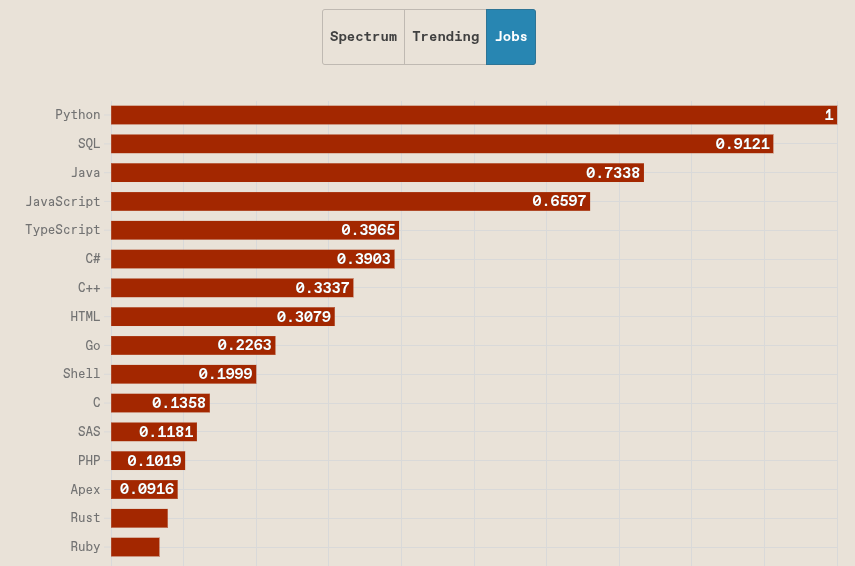
A few surprises: Visual Basic is still holding its own in the job market. Verilog outweighs VHDL, but VHDL still has more jobs than LabVIEW. Who would guess? There are still pockets of Ada. Meanwhile, Fortran and Arduino are about equally ranked, as far as jobs go (though we would argue that Arduino is really C++).
So you tell us. Do you agree with the rankings? Do you think hackers would rank languages differently? Will AI reduce us to describing algorithms instead of writing them? We aren’t holding our breath, but who knows what tomorrow brings? Discuss in the comments.
Da user a root in un secondo! il CISA avverte: milioni di OS a rischio. Patchate!
La Cybersecurity and Infrastructure Security Agency (CISA) degli Stati Uniti ha aggiunto una vulnerabilità critica nella popolare utility Sudo, utilizzata su sistemi Linux e Unix-like, al suo catalogo di vulnerabilità attualmente sfruttabili (KEV).
Il bug è registrato come CVE-2025-32463 e ha un punteggio CVSS di 9,3. Riguarda le versioni di Sudo precedenti alla 1.9.17p1 e consente a un utente locale, tramite l’opzione -R (–chroot), di eseguire comandi arbitrari come root, anche se la loro esecuzione non è specificata nella configurazione di sudoers. Il problema è stato segnalato per la prima volta dal ricercatore di Stratascale Rich Mirch a fine giugno 2025.
Sebbene l’esatto sfruttamento della vulnerabilità e l’identità degli aggressori rimangano poco chiari , la CISA ha documentato casi di sfruttamento in natura. Pertanto, l’agenzia ha ordinato alle agenzie civili federali di affrontare la minaccia entro il 20 ottobre 2025, per ridurre il rischio di compromissione della rete.
Oltre al bug Sudo, altre quattro vulnerabilità sono state aggiunte all’elenco KEV. La prima è CVE-2021-21311 nello strumento Adminer, relativa a SSRF lato server.
Consente ad aggressori remoti di ottenere dati sensibili ed è stata precedentemente sfruttata dal gruppo UNC2903 contro l’infrastruttura AWS, come segnalato da Google Mandiant nel 2022.
La seconda è CVE-2025-20352 in Cisco IOS e IOS XE. Questa vulnerabilità nel sottosistema SNMP può portare sia al denial of service che all’esecuzione di codice arbitrario; Cisco ne ha confermato lo sfruttamento la scorsa settimana .
La terza vulnerabilità è CVE-2025-10035 in Fortra GoAnywhere MFT. Comporta una deserializzazione non sicura e può consentire la sostituzione di oggetti e la successiva iniezione di comandi se un aggressore utilizza una risposta di licenza contraffatta.
Questa attività è stata scoperta da watchTowr Labs. L’ultima vulnerabilità è CVE-2025-59689 in Libraesva Email Security Gateway. Questa falla consente l’iniezione di comandi tramite allegati email compressi; lo sfruttamento è stato confermato dal fornitore.
CISA sottolinea che la presenza di tali voci in KEV indica un’elevata probabilità di attacchi contro le organizzazioni che non hanno installato gli aggiornamenti. Si consiglia a fornitori e amministratori di correggere immediatamente queste vulnerabilità, poiché rappresentano già una minaccia concreta.
L'articolo Da user a root in un secondo! il CISA avverte: milioni di OS a rischio. Patchate! proviene da il blog della sicurezza informatica.
freezonemagazine.com/news/dry-…
Secret Love è la migliore espressione delle profonde amicizie che hanno dato vita ai Dry Cleaning, tra la frontwoman Florence Shaw, il chitarrista Tom Dowse, il batterista Nick Buxton e il bassista Lewis Maynard. Qui, il quartetto del sud di Londra si colloca nell’avanguardia del rock, catalizzando la paranoia reaganiana del punk e
Gesichtserkennung gegen Grundrechte: Ungarn verbietet auch Pride in Pécs
netzpolitik.org/2025/gesichtse…


Libsophia #24 – Conservazione con Ermanno Ferretti
@Politica interna, europea e internazionale
L'articolo Libsophia #24 – Conservazione con Ermanno Ferretti proviene da Fondazione Luigi Einaudi.
Il ransomware HybridPetya bypassa il Secure Boot Uefi: come proteggersi
@Informatica (Italy e non Italy 😁)
Pur imitando il famigerato Petya/NotPetya, il modello del ransomware HybridPetya trasforma l’attacco da distruttivo a ricattatorio. Ecco le tendenze negli attacchi ransomware, sempre più verso firmware e boot, più difficili da monitorare e da bonificare, e come
Venezuela, gli Usa valutano attacchi aerei sul Paese e Caracas schiera la difesa aerea
@Notizie dall'Italia e dal mondo
La tensione non accenna a diminuire nel mar dei Caraibi. Il Venezuela ha dichiarato lo stato d’emergenza nazionale e il comando della difesa aerea ha schierato i suoi sistemi missilistici BUK-M2E attorno a Caracas. La decisione è stata presa a seguito delle voci, sempre più insistenti, che
Data breach e filiera dei fornitori
@Informatica (Italy e non Italy 😁)
Il rapporto tra data breach e filiera di fornitori è spesso sottovalutato nonostante, da oltre un decennio, le buone prassi stabiliscano metodi e approcci utili a regolarlo. Di recente c’è […]
L'articolo Data breach e filiera dei fornitori proviene da Edoardo Limone.
L'articolo proviene dal blog dell'esperto di #Cybersecurity
Dal nuovo missile Teseo Mk2E alla torretta Lionfish 30, cosa c’è in mostra a Seafuture 2025
@Notizie dall'Italia e dal mondo
A La Spezia ha preso il via Seafuture 2025, evento che, fino al 2 ottobre, mette in campo le ambizioni tecnologiche e strategiche della difesa navale italiana e non solo. Alla cerimonia inaugurale il ministro Guido Crosetto ha lanciato un messaggio chiaro: “non c’è progresso senza sapere, senza
“The Voice of Hind Rajab” a Orvieto il primo ottobre
@Giornalismo e disordine informativo
articolo21.org/2025/09/the-voi…
Domani sera (primo ottobre), alle 20, presso il cinema Corso, promosso da Articolo 21 e dal coordinamento della Palestina, “The Voice of Hind Rajab”. Diretto da Kaouther Ben Hania (nominata agli Oscar per Four
Kruku reshared this.
[AF]2050
in reply to The Pirate Post • • •informapirata ⁂ reshared this.
informapirata ⁂
in reply to [AF]2050 • • •@piratepost @politica