DIY Smart Button Gets Surprisingly Complicated


The media in this post is not displayed to visitors. To view it, please log in.

There’s a reason that the standards specifications for various wireless communications protocols are extremely long and detailed. [Made by Dennis] found this out first hand when he decided to build a wireless button from scratch.

The major issues with wireless devices is one of power consumption. If reliable power is available from a wall plug or solar panel, this isn’t as serious of a concern. But [Dennis] is using batteries for his buttons, so minimizing power consumption is a priority. He’s going with the nRF52, a microcontroller designed for low power and which has a built in wireless radio, and configuring it in a way that uses the least amount of energy possible.

From there, [Dennis] turns to the wireless communication. He goes into detail about how the microcontroller is woken up, how it sends its data packets to another wireless-enabled microcontroller, and how they handle handshakes and acknowledgements of data. For something as simple as a button press, it gets quickly more complicated especially when adding some basic encryption and security to the communications protocol.

With all the design decisions out of the way, the system can be built. [Dennis] has created custom PCBs for his devices, and also included some expansion I/O for other sensors and peripherals beyond just a pushbutton. All of the schematics and code are available on the project’s GitHub page and the STL files can be found at Printables.

For those new to offline home automation or who are turning away from cloud-based services lately, there are some easy entry points that don’t require much extra hardware or expenditure.

youtube.com/embed/ljrKFFjFT04?…


hackaday.com/2026/04/22/diy-sm…

Cybersecurity & cyberwarfare ha ricondiviso questo.

#Venezuela #energy #sector targeted by highly destructive #Lotus #wiper
securityaffairs.com/191106/mal…
#securityaffairs #hacking #malware
Cybersecurity & cyberwarfare ha ricondiviso questo.

The media in this post is not displayed to visitors. To view it, please go to the original post.

290 – Se vi chiudono i social, dove vi trovano? camisanicalzolari.it/290-se-vi…
Cybersecurity & cyberwarfare ha ricondiviso questo.

The media in this post is not displayed to visitors. To view it, please go to the original post.

Mythos, il modello AI più potente, è stato violato in pochi giorni

📌 Link all'articolo : redhotcyber.com/post/mythos-il…

A cura di Redazione RHC

#redhotcyber #news #intelligenzaartificiale #sicurezzainformatica #vulnerabilita #hacking

reshared this

Cybersecurity & cyberwarfare ha ricondiviso questo.

The media in this post is not displayed to visitors. To view it, please go to the original post.

🚀 Gli speaker della RHC Conference 2026

📍𝗤𝘂𝗮𝗻𝗱𝗼: Martedì 19 Maggio con ingresso dalle ore 8:45
📍𝗗𝗼𝘃𝗲: Teatro Italia, Via Bari 18, Roma (Metro Piazza Bologna)
📍𝗣𝗿𝗼𝗴𝗿𝗮𝗺𝗺𝗮: redhotcyber.com/linksSk2L/prog…
📍𝗜𝘀𝗰𝗿𝗶𝘇𝗶𝗼𝗻𝗲 conferenza di Martedì 19 Maggio: rhc-conference-2026.eventbrite…

#redhotcyber #rhcconference #conferenza #informationsecurity #ethicalhacking #dataprotection

Cybersecurity & cyberwarfare ha ricondiviso questo.

The media in this post is not displayed to visitors. To view it, please go to the original post.

LunaSpy: quando i criminali ti regalano uno smartphone con Trojan integrato

📌 Link all'articolo : redhotcyber.com/post/lunaspy-q…

A cura di Carolina Vivianti

#redhotcyber #news #lunaspytrojan #androidmalware #trojanandroid #malwarebancario

reshared this

Cybersecurity & cyberwarfare ha ricondiviso questo.

The media in this post is not displayed to visitors. To view it, please go to the original post.

Firewall? Antivirus? No, il problema sei tu dopo 8 ore di lavoro

📌 Link all'articolo : redhotcyber.com/post/firewall-…

A cura di Paloma Donadi

#redhotcyber #news #psicologiadellacybersecurity #cybersecurity #sicurezzainformatica

Wearable MIDI Controller Built With Raspberry Pi


The media in this post is not displayed to visitors. To view it, please log in.

Most synths happily get by with keyboard or pad inputs and make lovely sounds in response. [Becky Clarke] and her fellow collaborators are building a synth that works rather differently. DigitSynth is a wearable controller that’s rather fun to interact with.

The heart of the build is a Raspberry Pi 5. It’s set up to talk to a TI ADS1115 ADC chip that lets it read a bunch of analog flex sensors embedded in a right-hand glove, while the Pi can also read a bunch of tactile buttons activated by the left hand. The flex sensors are used to control synth parameters like LFO rate and filter cutoffs, while the buttons control chord changes. The Raspberry Pi runs custom code to read these devices and generate the requisite MIDI commands to send to a Roland JD-Xi synth which is responsible for actually making the sound. Both sets of fingers are also dotted with LEDs for visual feedback, controlled via a TLC59711 PWM driver.

It’s a fun build that creates some ethereal sounds in an intuitive way, thanks to the nature of the interface. We’ve featured some similar builds before, using the flexure of the hand to create musical soundscapes. Video after the break.

View this post on Instagram

View this post on Instagram


hackaday.com/2026/04/21/wearab…

Itanium: the Great X86 Replacement that Never Was


The media in this post is not displayed to visitors. To view it, please log in.

Itanium was once meant to be the next step in computing, to compete with the likes of IBM, Sun and DEC, but also for Intel to have an architecture that couldn’t be taken from it, as the PC was from IBM by its clones. Today, however, Itanium is a relic of the past. [Asianometry] tells us the story of Itanium.

By the ’90s, servers were an established market dominated by RISC architectures and Unix-like operating systems. Intel wanted to compete in this market, due in part to worries of losing control over x86. So, when Hewlett Packard came to Intel in late ’93, Intel eventually agreed to collaborate on a new project in EPIC (Explicitly Parallel Instruction Computing).

The project initially called PA-WW (later IA-64 and Itanium), was also a radical approach to ILP (Instruction-Level Parallelism). As HP engineers saw RISC architectures potentially hitting performance limits in the future, the idea was a compromise between fully compiler-driven VLIW and the fully hardware-driven superscalar and out-of-order computers.

The collaboration between Intel and HP did not go without problems, however. Internal politics, both between HP and Intel disagreeing about design choices and Intel’s Itanium and x86 teams internally competing who was making the new big product, were early signs of trouble. The x86 team’s work eventually came to be the Pentium Pro, which was now catching up with the fastest RISC architectures.

In the mean time, Itanium had been delayed once and twice, due to Intel underestimating the true scale of the project and the fabrication technology required. The mounting delays eventually caused a release in 2003, 4 years late. And the competition wasn’t waiting in the mean time. New RISC chips were still being released year after year, eating in to what would have been Itanium’s performance advantage.

In an ironic twist, Itanium’s attempt to dislodge x86 actually solidified it. AMD realized that Intel had made a mistake; software developers would not want to recompile for a completely different architecture. And so, yet more competition began in the form of AMD’s 64-bit extension to x86, the specification written by the legendary Jim Keller. And, while sales numbers were lower than projected, AMD had still won; more AMD64 chips were being sold than Itanium ones.

In the end, Itanium died a slow death due to delays and increasing competition. With it, AMD made a major change to x86, the first time Intel was on the back foot in the x86 race, eventually leading to their adoption of AMD64 (now called x86-64) with some minor changes. By the time Itanium 2 launched, the writing was on the wall: Itanium had failed to capture the market.

History often rhymes, and so does the story of Itanium to that of VLIW; an architecture perhaps too ambitious for its own good.

youtube.com/embed/-K-IfiDmp_w?…

Die shots of an Intel Itanium processor courtesy of [der8auer].


hackaday.com/2026/04/21/itaniu…

The Electromechanical Computer of the B-52’s Star Tracker


The media in this post is not displayed to visitors. To view it, please log in.


The Angle Computer of the B-52, opened. (Credit: Ken Shirriff)The Angle Computer of the B-52, opened. (Credit: Ken Shirriff)
In the ages before convenient global positioning satellites to query for one’s current location military aircraft required dedicated navigators in order to not get lost. This changed with increasing automation, including the arrival of increasingly more sophisticated electromechanical computers, such as the angle computer in the B-52 bomber’s star tracker that [Ken Shirriff] recently had a poke at.

We covered star trackers before, with this devices enabling the automation of celestial navigation. In effect, as long as you have a map of the visible stars and an accurate time source you will never get lost on Earth, or a few kilometers above its surface as the case may be.

The B-52’s Angle Computer is part of the Astro Compass, which is the star tracker device that locks onto a star and outputs a heading that’s accurate to a tenth of a degree, while also allowing for position to be calculated from it. Inside the device a lot of calculations are being performed as explained in the article, though the full equations are quite complex.

Not burdening the navigator of a B-52 with having to ogle stars themselves with an instrument and scribbling down calculations on paper is a good idea, of course. Instead the Angle Computer solves the navigational triangle mechanically, essentially by modelling the celestial sphere with a metal half-sphere. The solving is thus done using this physical representation, involving numerous gears and other parts that are detailed in the article.

In addition to the mechanical components there are of course the motors driving it, feedback mechanisms and ways to interface with the instruments. For the 1950s this was definitely the way to design a computer like this, but of course as semiconductor transistors swept the computing landscape, this marvel of engineering would before long find itself too replaced with a fully digital version.


hackaday.com/2026/04/21/the-el…

Cybersecurity & cyberwarfare ha ricondiviso questo.

Durante la guerra, tutte le apparecchiature di comunicazione iraniane di fabbricazione statunitense hanno smesso di funzionare. E i media cinesi gongolano...

@Informatica (Italy e non Italy)

Tutti i dispositivi difettosi erano di marchi americani come Cisco, Fortinet e Juniper comprati durante la tregua di Obama, per apparecchiature nazionali di telecomunicazione, difesa, governo, infrastrutture di base e industriali, corrispondenti direttamente alle comunicazioni militari, ai centri di comando per le emergenze e agli hub di comunicazione regionali.
A seguito di un'ispezione, è emerso che tutti questi problemi agli hub di comunicazione erano causati da guasti hardware di base, e non da vulnerabilità software di livello superiore o attacchi virus. Il problema derivava da un meccanismo di attivazione di basso livello integrato nei dispositivi hardware. Quando questo meccanismo veniva attivato da remoto, bloccava immediatamente l'hardware sottostante, paralizzando di fatto l'intero dispositivo.
Stranamente, quando si è verificato il malfunzionamento, l'Iran aveva già preventivamente interrotto la sua connessione internet internazionale, rendendo irraggiungibile il gateway globale. Ciò suggerisce che questi strumenti e apparecchiature non avessero affatto bisogno di essere connessi a internet e che gli Stati Uniti avessero i mezzi per manipolarli.

163.com/dy/article/KR0E9NT5055…

Cybersecurity & cyberwarfare ha ricondiviso questo.

#Ransomware negotiator caught secretly assisting #BlackCat extortion scheme
securityaffairs.com/191100/sec…
#securityaffairs #hacking #malware
Cybersecurity & cyberwarfare ha ricondiviso questo.

[RISOLTO] donazione Toner per stampanti samsung


Scusatemi se vi scrivo da qui. Avevo una vecchia stampante funzionante samsung scx3200, che aveva bisogno di un toner nuovo. Allora ne ho comperati 3 su amazon perchè nei negozi di vicinato non c'erano. Purtroppo nell'inserirlo non avevo tolto il coperchio e l'ho spinto con forza rovinando i contatti a molla della stampante, quelli che si collegano al toner. Ho provato ad aggiustarli inutilmente. Volentieri gli spedisco a mie spese a voi o a qualcuno che ha stampanti compatibili. [...]
Scusatemi se vi scrivo da qui. Avevo una vecchia stampante funzionante samsung scx3200, che aveva bisogno di un toner nuovo. Allora ne ho comperati 3 su amazon perchè nei negozi di vicinato non c'erano. Purtroppo nell'inserirlo non avevo tolto il coperchio e l'ho spinto con forza rovinando i contatti a molla della stampante, quelli che si collegano al toner. Ho provato ad aggiustarli inutilmente. Volentieri gli spedisco a mie spese a voi o a qualcuno che ha stampanti compatibili. Sono:alphaink 3 Toner compatibili MLT-D1042S SU737A Nero per Samsung ML-1661, ML-1665, ML-1666, ML1670, ML -1675, ML-1860, ML-1865, 1865W, SCX-3200, SCX-3201, SCX-3205, SCX-3206, SCX-3217, SCX-3218. Io questo materiale non lo butto se a voi interessa fatemi sapere.
Grazie
Questa voce è stata modificata (2 mesi fa)

Analog Circuitry Lets You Blow This LED Out


The media in this post is not displayed to visitors. To view it, please log in.

LED candles are neat, but they’re very suboptimal for wish-making: you can’t blow them out. Unless you take the circuit from [Andrea Console]’s latest project that lets you do just that, using only analog electronics— no microcontroller in sight.

He’s using the known temperature-voltage behaviour of the LED for control here– sort of like the project we saw in last year’s Component Abuse Challenge that let you illuminate the LED with a butane lighter. Here it’s a bit less dramatic, relying only on the small cooling effect your breath has on the LED.

There are two parts to the circuit, really– a latching section to turn the thing on from a single button press, and breath-detecting section. The breath-detecting section relies on an op-amp acting as a comparator, comparing the voltage across the LED’s current-limiting resistor, and a reference stored in a 100 µF capacitor. Blowing on the candle spikes the voltage on the LED, and thus the current-limiting resistor too fast for the capacitor’s voltage to change, so the comparator flips, triggering a reset of the latching circuit. Could you do it with an Arduino? No doubt, but the fact is you don’t have to and this is a more elegant solution than just another microcontroller.Check it out in action with the video embedded below.

It reminds us of the sort of circuit we’d have found in a project book, back in the day. [Andrea] seems to have a knack for that sort of thing, as seen with the half crystal/half regenerative radio we saw previously.

youtube.com/embed/OWNeqiZT3Yw?…


hackaday.com/2026/04/21/analog…

Cybersecurity & cyberwarfare ha ricondiviso questo.

#North #Korea’s #Lazarus #APT stole $290M from #Kelp #DAO
securityaffairs.com/191092/dig…
#securityaffairs #hacking

2026 Green Powered Challenge: A Low Power Distraction Free Writing Tool


The media in this post is not displayed to visitors. To view it, please log in.

Distraction free writing tools are a reaction to the bells and whistles of the modern desktop computer, allowing the user to simply pick up the device and write. The etyper from [Quackieduckie] is one such example, packing an e-paper screen into a minimalist case.

These devices are most often made using a microcontroller such as an ESP32, so it’s interesting to note that this one uses a full-fat computer — if an Orange Pi Zero 2W can be described as “Full-fat”, anyway. There’s an Armbian image for it with the software pre-configured, and also mention of a Raspberry Pi port. It works with wired USB-C keyboards, and files can be retrieved via Bluetooth. It doesn’t look as though there’s a framebuffer or other more general driver for the display so it’s likely you won’t be using this as a general purpose machine, but maybe that’s not the point. We like it, though maybe it’s not a daily driver.

This hack is part of our 2026 Green Powered Challenge. You’ve just got time to get your own entry in, so get a move on!

2026 Hackaday Greep Powered Challenge


hackaday.com/2026/04/21/2026-g…

Cybersecurity & cyberwarfare ha ricondiviso questo.

14x2026 Linux trionfa a Parigi
- La guerra dei robot in Ucraina
- Gli influencer contro Putin
- Iran - 50 giorni di blocco Internet
- IT-Wallet - 200 documenti in arrivo
- Ray-Ban - allarme Stalker
- App della settimana - Joplin
- Russia - i limiti per Telegram e WhatsApp
- Commissione Infanzia - l’impatto dei chatbot sui minori
- La Campagna MAGA dei finti americani
- Linux trionfa a Parigi
- Il Deepfake Intelligence Report

reshared this

Cybersecurity & cyberwarfare ha ricondiviso questo.

The media in this post is not displayed to visitors. To view it, please go to the original post.

The media in this post is not displayed to visitors. To view it, please go to the original post.

CyberAv3ngers e l’IRGC all’assalto delle infrastrutture critiche USA: sei agenzie federali confermano gli attacchi ai PLC Rockwell Automation
#CyberSecurity
insicurezzadigitale.com/cybera…


CyberAv3ngers e l’IRGC all’assalto delle infrastrutture critiche USA: sei agenzie federali confermano gli attacchi ai PLC Rockwell Automation


Il 7 aprile 2026, sei agenzie federali statunitensi — tra cui CISA, FBI e NSA — hanno pubblicato l’advisory congiunto AA26-097A, confermando che CyberAv3ngers, gruppo di cyberoffensiva direttamente controllato dall’IRGC-CEC (Islamic Revolutionary Guard Corps Cyber-Electronic Command) iraniano, ha condotto attacchi contro infrastrutture critiche americane sfruttando una vulnerabilità critica nei Programmable Logic Controller di Rockwell Automation. L’aspetto più preoccupante: per questa vulnerabilità non esiste alcuna patch del vendor.

Il gruppo: CyberAv3ngers e la struttura del comando IRGC


CyberAv3ngers è un threat group state-directed attivo almeno dal 2020, tracciato dalla comunità di threat intelligence con molteplici denominazioni: Storm-0784 (Microsoft), Bauxite (Dragos), Hydro Kitten, UNC5691 (Mandiant) e classificato da MITRE ATT&CK come G1027. Il gruppo opera come persona ufficiale dell’IRGC-CEC, distinguendosi per la focalizzazione sulle Operational Technology (OT) e i sistemi di controllo industriale (ICS), un dominio in cui pochi gruppi APT hanno sviluppato capacità analoghe.

La traiettoria evolutiva del gruppo è significativa: da attacchi opportunistici con credenziali di default su PLC Unitronics di fabbricazione israeliana nel 2023, alla distribuzione della piattaforma malware ICS custom IOCONTROL nel 2024, fino alla campagna 2026 contro i controller Rockwell Automation, che rappresenta un salto qualitativo nell’ambito delle capacità offensive ICS.

Il contesto geopolitico: rappresaglia cyber dopo gli attacchi del febbraio 2026


La campagna si inserisce in un contesto geopolitico estremamente teso. Il 28 febbraio 2026, USA e Israele hanno condotto un’operazione militare congiunta contro obiettivi iraniani, innescando una campagna di rappresaglia cyber multi-vettore che Unit 42 di Palo Alto Networks ha tracciato come cluster CL-STA-1128. In questo contesto, CyberAv3ngers ha intensificato le operazioni contro infrastrutture critiche americane, spostando il focus dai precedenti target israeliani verso obiettivi statunitensi.

CVE-2021-22681: la vulnerabilità senza patch al centro degli attacchi


Il vettore tecnico primario della campagna è CVE-2021-22681, una vulnerabilità di authentication bypass con CVSS score 9.8 che affligge i controller Logix di Rockwell Automation. La vulnerabilità permette a un attaccante di bypassare l’autenticazione e ottenere accesso ai PLC senza credenziali valide. Il problema strutturale: Rockwell Automation non ha rilasciato una patch, indicando invece misure di difesa in profondità come unica mitigazione disponibile.

I prodotti vulnerabili includono un ampio portfolio:

  • RSLogix 5000 (versioni 16-20)
  • Studio 5000 Logix Designer (versione 21 e successive)
  • Famiglie di controller: CompactLogix, ControlLogix, GuardLogix, DriveLogix, SoftLogix

Secondo la scansione Cortex Xpanse di Palo Alto, risultano esposti su internet globalmente 5.600 indirizzi IP con servizi Rockwell Automation o Allen-Bradley SCADA, inclusi FactoryTalk e vari PLC — una superficie di attacco di proporzioni allarmanti.

Le TTPs operative: preparazione con FactoryTalk su VPS


L’analisi di Unit 42 rivela che gli attaccanti hanno adottato un approccio metodico nella preparazione. Con moderata confidenza, i ricercatori ritengono che CL-STA-1128 abbia installato il software FactoryTalk di Rockwell Automation su infrastruttura VPS per abilitare le proprie attività di exploitation, sviluppando internamente la capacità di interagire con il protocollo CIP (Common Industrial Protocol) prima di colpire i target reali. La mappatura delle porte utilizzate dai dispositivi esposti ha permesso al gruppo di identificare i target mediante pattern statici caratteristici dei prodotti Rockwell.

I settori colpiti confermati dall’advisory federale comprendono Water and Wastewater Systems (WWS), Energy e Government Services and Facilities. L’advisory CISA AA26-097A, primo caso in cui sei agenzie federali attribuiscono congiuntamente un’operazione all’IRGC, conferma interruzioni operative e perdite economiche in organizzazioni multiple.

Escalation della minaccia: dall’hacktivism all’OT warfare


La progressione di CyberAv3ngers illustra una tendenza preoccupante nel panorama delle minacce state-sponsored: la convergenza tra capacità IT e OT in un unico gruppo APT. Nelle prime operazioni del 2023, il gruppo si limitò a modificare i display HMI dei Unitronics PLC presso impianti idrici israeliani e americani, un’azione prevalentemente dimostrativa. Con IOCONTROL nel 2024, il gruppo ha sviluppato malware custom per dispositivi IoT e OT. La campagna del 2026, che sfrutta una vulnerabilità critica senza patch in uno dei vendor di automazione industriale più diffusi al mondo, rappresenta una capacità offensiva significativamente più matura.

Mitigazioni: nessuna patch disponibile, solo difesa in profondità


In assenza di una patch per CVE-2021-22681, le organizzazioni che utilizzano controller Rockwell Automation devono implementare le seguenti misure di difesa in profondità raccomandate dall’advisory federale:

  • Segmentazione di rete: isolare i PLC e i sistemi OT in zone di rete separate, con firewall tra IT e OT, eliminando qualsiasi esposizione diretta a internet
  • Isolamento delle engineering workstation: le workstation che comunicano con i PLC devono essere dedicate e segregate dalla rete corporate generale
  • Abilitazione di CIP Security: configurare il protocollo CIP Security per autenticazione e cifratura delle comunicazioni tra EWS e PLC dove supportato
  • Physical mode switch: impostare i PLC in modalità fisica protetta dove applicabile, impedendo modifiche al firmware via software
  • Monitoraggio anomalie CIP-IP: deployare soluzioni di monitoraggio OT (es. Dragos, Claroty, Nozomi) in grado di rilevare download anomali e cambi di modalità sui PLC tramite protocollo CIP
  • Rimozione dell’esposizione internet: verificare con Shodan o Censys la presenza di dispositivi Rockwell/Allen-Bradley esposti e rimuoverli immediatamente


Implicazioni strategiche


La campagna di CyberAv3ngers evidenzia la crescente militarizzazione del cyberspazio nelle operazioni di rappresaglia tra stati. La scelta di colpire infrastrutture idriche, energetiche e governative — settori con potenziale impatto diretto sulla popolazione civile — segnala una volontà di massimizzare l’effetto psicologico e operativo degli attacchi. Il fatto che Rockwell Automation non abbia rilasciato una patch per CVE-2021-22681 pone interrogativi seri sul modello di sicurezza dei vendor OT: in un settore dove i device lifecycle si misurano in decenni, l’assenza di aggiornamenti di sicurezza per vulnerabilità critiche è un rischio sistemico che va affrontato con urgenza a livello regolatorio.

Con 5.600 dispositivi Rockwell Automation esposti su internet a livello globale e nessuna patch in vista, la superficie di attacco rimane aperta. Le organizzazioni che operano infrastrutture critiche devono trattare l’advisory AA26-097A come una priorità assoluta e avviare immediatamente una revisione dell’esposizione OT.


Cybersecurity & cyberwarfare ha ricondiviso questo.

With growing focus on the threat quantum computing poses to crucial and widely used forms of encryption, @filippo wants to make one thing perfectly clear: Contrary to popular mythology that refuses to die, AES 128 is perfectly fine in a post-quantum world

arstechnica.com/security/2026/…

reshared this

The Splice Must Flow


The media in this post is not displayed to visitors. To view it, please log in.

There are plenty of electronic components out there, but the one we tend to forget is the most basic: wire. Sure, PC boards have largely replaced wire with copper traces, but most projects still need some kind of wire somewhere. Once you need any wire, there’s a good bet you will need longer wire, and that means splicing one wire to another. Simple, right? Not really. There are a variety of ways to splice wires, and which one you use depends on what you want to do and the type of wire you are using.

If the wires touch, good enough, right? Not necessarily. You need enough contact area for the current you are drawing through the wire to flow. It is also nice if the splice can survive some amount of mechanical strain, vibration, and survive getting hot and cold repeatedly.

Usually, after splicing, you’d like to solder the connection, although depending on the application, you don’t always see that. At the very least, you’d want to wrap it in electrical tape, use heat-shrink tubing, or otherwise insulate the bare wires and maybe provide a little mechanical support or strain relief.

Keep in mind that there are connector options, either mechanical, crimped, or soldered, that allow you to avoid splices. Soldering to a terminal strip, for example, or scewing wires into a barrier strip will get the job done. So will a butt connector, a wire nut, or a WAGO connector. But sometimes, for whatever reason, you just need to attach two wires to each other. It’s been done before.

The Gold Standard


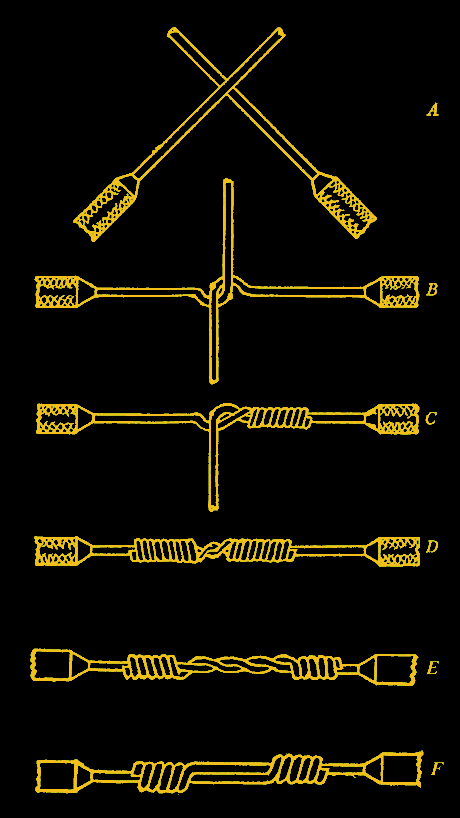
Arguably, the best way to join two similar-sized solid wires is the Western Union splice, or the lineman’s splice, which goes back to at least 1915 when the book Practical Electric Wiring (PDF) described it. It will work with stranded wire, too, if you twist it tightly and, even better, tin the wires first.

You essentially bend each wire around the other and then tightly wrap each wire around the other wire. There are a few options about how to handle the middle part, as you can see in the adjacent figure.

These aren’t hard to make, but it does depend a bit on the skill and patience of the person making the splice. On the other hand, they are mechanically very robust.

NASA’s workmanship document (NASA-STD-8739.3, PDF) urges you to avoid splices and prefer controlled processes like crimps, where a tool produces repeatable connections. However, in testing, soldered Western Union splices were found to be quite strong, usually stronger than the wire around them.

youtube.com/embed/SKr3h1cHIiM?…

Other Common Splices


Perhaps the most common splice is the rat or pig tail splice. That’s where you just twist two wires together. If you don’t have to survive mechanical tension and you have solid wire, this works ok and is what you often see inside electrical boxes in North America, either made by or topped with a wire nut.

These are fast and simple, but without something like a wire nut, a bit suspect. They tend to loosen over time, especially under vibration.

Another problem is when you have very large solid wires that are not practical to twist. That calls for a Britannia splice. Here, you put two presumably thick wires end-to-end and bind them with a smaller wire. You don’t see these very often, although you may see them in some utility contexts. More often, you’d crimp a butt connector to join two large wires. Note the binding wire wraps around both wires and the common part where the wires touch.

youtube.com/embed/bfpagotoIak?…

A similar splice is the so-called fixture splice, in which a smaller wire wraps around a larger one. This is another case where you would almost always finish this off with some kind of mechanical connector, like a wire nut.

Sometimes you need a splice that isn’t much larger than the original wire. You can do that with a scarfed splice. This is usually only practical for large, solid wires. You essentially taper each wire to a point (using, for example, a file) and then bond them together much like a scarf joint in carpentry. Of course, you must solder or somehow fix the wires together, as there is no mechanical connection. This takes a lot of work and also takes skill to get right.

Specialty Splices


Sometimes, you want a splice into an existing wire to form like a “T” or a tap. It is possible to create a tap joint by removing insulation from the main conductor and then wrapping wire around the bare metal. Often, you’ll tie a knot it the tap wire before wrapping to try to improve the mechanical hold a bit.

However, these are not especially strong, and you have to be careful removing the insulation so as not to nick the main conductor and weaken it or reduce its current capacity.

If the main wire is stranded, another variation is to carefully split the main conductor into two segments and then pass the tap wire through the center before wrapping it as before. While this might be slightly more mechanically advantageous, it is still not a good replacement for a crimp-on tap or a connector to hold three wires.

Splicing multiconductor wire can also pose a challenge. Sure, for a lamp cord, it is just as simple as making two splices. But in cables where the pair is balanced, it is often impractical to maintain the spacing and twisting of the wire. Better to get a cable of the proper length.

Probably Others


There are probably as many ways to make a splice as there are people making splices. Some are clever, others are terrible, and a few — like the Western Union splice — have stood the test of time.

Most of the time, you want to avoid splices where you can. Try a terminal block, a solder sleeve, or a crimp connector. Even a wire nut, while technically a splice, will give you some mechanical advantage over just twisting wire together.

We favor the Western Union splice with a good coat of solder. In the end, the “right” splice is the one that matches the electrical load, mechanical demands, and environment you expect it to live in. A quick twist might work today, but a properly executed splice will still be working years down the line.

What’s your go-to method? Let us know in the comments.


hackaday.com/2026/04/21/the-sp…

The media in this post is not displayed to visitors. To view it, please log in.

CyberAv3ngers e l’IRGC all’assalto delle infrastrutture critiche USA: sei agenzie federali confermano gli attacchi ai PLC Rockwell Automation


@Informatica (Italy e non Italy)
Un advisory congiunto di sei agenzie federali statunitensi, pubblicato il 7 aprile 2026, conferma che CyberAv3ngers — gruppo


CyberAv3ngers e l’IRGC all’assalto delle infrastrutture critiche USA: sei agenzie federali confermano gli attacchi ai PLC Rockwell Automation


Il 7 aprile 2026, sei agenzie federali statunitensi — tra cui CISA, FBI e NSA — hanno pubblicato l’advisory congiunto AA26-097A, confermando che CyberAv3ngers, gruppo di cyberoffensiva direttamente controllato dall’IRGC-CEC (Islamic Revolutionary Guard Corps Cyber-Electronic Command) iraniano, ha condotto attacchi contro infrastrutture critiche americane sfruttando una vulnerabilità critica nei Programmable Logic Controller di Rockwell Automation. L’aspetto più preoccupante: per questa vulnerabilità non esiste alcuna patch del vendor.

Il gruppo: CyberAv3ngers e la struttura del comando IRGC


CyberAv3ngers è un threat group state-directed attivo almeno dal 2020, tracciato dalla comunità di threat intelligence con molteplici denominazioni: Storm-0784 (Microsoft), Bauxite (Dragos), Hydro Kitten, UNC5691 (Mandiant) e classificato da MITRE ATT&CK come G1027. Il gruppo opera come persona ufficiale dell’IRGC-CEC, distinguendosi per la focalizzazione sulle Operational Technology (OT) e i sistemi di controllo industriale (ICS), un dominio in cui pochi gruppi APT hanno sviluppato capacità analoghe.

La traiettoria evolutiva del gruppo è significativa: da attacchi opportunistici con credenziali di default su PLC Unitronics di fabbricazione israeliana nel 2023, alla distribuzione della piattaforma malware ICS custom IOCONTROL nel 2024, fino alla campagna 2026 contro i controller Rockwell Automation, che rappresenta un salto qualitativo nell’ambito delle capacità offensive ICS.

Il contesto geopolitico: rappresaglia cyber dopo gli attacchi del febbraio 2026


La campagna si inserisce in un contesto geopolitico estremamente teso. Il 28 febbraio 2026, USA e Israele hanno condotto un’operazione militare congiunta contro obiettivi iraniani, innescando una campagna di rappresaglia cyber multi-vettore che Unit 42 di Palo Alto Networks ha tracciato come cluster CL-STA-1128. In questo contesto, CyberAv3ngers ha intensificato le operazioni contro infrastrutture critiche americane, spostando il focus dai precedenti target israeliani verso obiettivi statunitensi.

CVE-2021-22681: la vulnerabilità senza patch al centro degli attacchi


Il vettore tecnico primario della campagna è CVE-2021-22681, una vulnerabilità di authentication bypass con CVSS score 9.8 che affligge i controller Logix di Rockwell Automation. La vulnerabilità permette a un attaccante di bypassare l’autenticazione e ottenere accesso ai PLC senza credenziali valide. Il problema strutturale: Rockwell Automation non ha rilasciato una patch, indicando invece misure di difesa in profondità come unica mitigazione disponibile.

I prodotti vulnerabili includono un ampio portfolio:

  • RSLogix 5000 (versioni 16-20)
  • Studio 5000 Logix Designer (versione 21 e successive)
  • Famiglie di controller: CompactLogix, ControlLogix, GuardLogix, DriveLogix, SoftLogix

Secondo la scansione Cortex Xpanse di Palo Alto, risultano esposti su internet globalmente 5.600 indirizzi IP con servizi Rockwell Automation o Allen-Bradley SCADA, inclusi FactoryTalk e vari PLC — una superficie di attacco di proporzioni allarmanti.

Le TTPs operative: preparazione con FactoryTalk su VPS


L’analisi di Unit 42 rivela che gli attaccanti hanno adottato un approccio metodico nella preparazione. Con moderata confidenza, i ricercatori ritengono che CL-STA-1128 abbia installato il software FactoryTalk di Rockwell Automation su infrastruttura VPS per abilitare le proprie attività di exploitation, sviluppando internamente la capacità di interagire con il protocollo CIP (Common Industrial Protocol) prima di colpire i target reali. La mappatura delle porte utilizzate dai dispositivi esposti ha permesso al gruppo di identificare i target mediante pattern statici caratteristici dei prodotti Rockwell.

I settori colpiti confermati dall’advisory federale comprendono Water and Wastewater Systems (WWS), Energy e Government Services and Facilities. L’advisory CISA AA26-097A, primo caso in cui sei agenzie federali attribuiscono congiuntamente un’operazione all’IRGC, conferma interruzioni operative e perdite economiche in organizzazioni multiple.

Escalation della minaccia: dall’hacktivism all’OT warfare


La progressione di CyberAv3ngers illustra una tendenza preoccupante nel panorama delle minacce state-sponsored: la convergenza tra capacità IT e OT in un unico gruppo APT. Nelle prime operazioni del 2023, il gruppo si limitò a modificare i display HMI dei Unitronics PLC presso impianti idrici israeliani e americani, un’azione prevalentemente dimostrativa. Con IOCONTROL nel 2024, il gruppo ha sviluppato malware custom per dispositivi IoT e OT. La campagna del 2026, che sfrutta una vulnerabilità critica senza patch in uno dei vendor di automazione industriale più diffusi al mondo, rappresenta una capacità offensiva significativamente più matura.

Mitigazioni: nessuna patch disponibile, solo difesa in profondità


In assenza di una patch per CVE-2021-22681, le organizzazioni che utilizzano controller Rockwell Automation devono implementare le seguenti misure di difesa in profondità raccomandate dall’advisory federale:

  • Segmentazione di rete: isolare i PLC e i sistemi OT in zone di rete separate, con firewall tra IT e OT, eliminando qualsiasi esposizione diretta a internet
  • Isolamento delle engineering workstation: le workstation che comunicano con i PLC devono essere dedicate e segregate dalla rete corporate generale
  • Abilitazione di CIP Security: configurare il protocollo CIP Security per autenticazione e cifratura delle comunicazioni tra EWS e PLC dove supportato
  • Physical mode switch: impostare i PLC in modalità fisica protetta dove applicabile, impedendo modifiche al firmware via software
  • Monitoraggio anomalie CIP-IP: deployare soluzioni di monitoraggio OT (es. Dragos, Claroty, Nozomi) in grado di rilevare download anomali e cambi di modalità sui PLC tramite protocollo CIP
  • Rimozione dell’esposizione internet: verificare con Shodan o Censys la presenza di dispositivi Rockwell/Allen-Bradley esposti e rimuoverli immediatamente


Implicazioni strategiche


La campagna di CyberAv3ngers evidenzia la crescente militarizzazione del cyberspazio nelle operazioni di rappresaglia tra stati. La scelta di colpire infrastrutture idriche, energetiche e governative — settori con potenziale impatto diretto sulla popolazione civile — segnala una volontà di massimizzare l’effetto psicologico e operativo degli attacchi. Il fatto che Rockwell Automation non abbia rilasciato una patch per CVE-2021-22681 pone interrogativi seri sul modello di sicurezza dei vendor OT: in un settore dove i device lifecycle si misurano in decenni, l’assenza di aggiornamenti di sicurezza per vulnerabilità critiche è un rischio sistemico che va affrontato con urgenza a livello regolatorio.

Con 5.600 dispositivi Rockwell Automation esposti su internet a livello globale e nessuna patch in vista, la superficie di attacco rimane aperta. Le organizzazioni che operano infrastrutture critiche devono trattare l’advisory AA26-097A come una priorità assoluta e avviare immediatamente una revisione dell’esposizione OT.


Inchiesta sui servizi segreti italiani: a rischio le fondamenta stesse dello Stato


@Informatica (Italy e non Italy)
Il caso dei dossier e di un ramo dei servizi segreti italiani coinvolto mette in risalto un rischio strutturale legato all'uso "non istituzionale" delle informazioni riservate colpisce. Ecco cosa accade quando dati sensibili, acquisiti tramite

RecruitRAT, la nuova generazione di Android banker: come difendersi


@Informatica (Italy e non Italy)
Sono stati identificati come RecruitRAT, SaferRat, Astrinox e Massiv i quattro malware usati in altrettante campagne di trojan bancari per Android che segnano il passaggio da operazioni isolate a modelli organizzati e scalabili. Ecco tutti i dettagli e i consigli per

Cybersecurity & cyberwarfare ha ricondiviso questo.

The media in this post is not displayed to visitors. To view it, please go to the original post.

Zero-day su Microsoft Defender senza patch: exploit pubblici usati in attacchi reali

📌 Link all'articolo : redhotcyber.com/post/zero-day-…

A cura di Chiara Nardini

#redhotcyber #news #cybersecurity #hacking #malware #zeroDay #microsoftDefender #vulnerabilita

Cybersecurity & cyberwarfare ha ricondiviso questo.

NEW: Angelo Martino, a former ransomware negotiator, pleaded guilty to helping a ransomware gang get more money — of which he took a cut — from their victims.

He was secretly playing both sides in several ransomware negotiations, and he also deployed ransomware himself with co-conspirators.

techcrunch.com/2026/04/21/rans…

Cybersecurity & cyberwarfare ha ricondiviso questo.

Can confirm this for Arc, Brave, Edge, Chromium, and Vivaldi on my machine:

#Anthropic secretly installs spyware when you install Claude Desktop
thatprivacyguy.com/blog/anthro…

CAN Bus Analyzer Runs In Your Browser


The media in this post is not displayed to visitors. To view it, please log in.

If you’ve got a modern car, truck, or tractor, it’s probably got a CAN bus or three that is bouncing data all around the vehicle. Listening in on these transmissions can enlighten you to what’s going on with sensors and modules which can aid in troubleshooting. You might find [Chanchal]’s latest work to be helpful in this regard — a CAN bus visualizer that runs right in your browser.

CANviz, as the project is known, is designed to work with any one of a number of cheap USB CAN reader modules. To use it, you simply run the Python “pip” tool to install it, and then you have a live CAN bus frame analyzer running on your local machine. Point your browser to localhost:8080 and you can see the data pouring in from whatever you happen to be hooked up to. The tool supports decoding CAN DBC files to make better sense of the raw data coming off the bus, and you can also record sessions for later analysis and even send CAN frames yourself if you need to. You can also run the tool on a remote single-board PC if so desired and access it over a network connection from another machine.

We’ve explored CAN hacking tools before and tools for visualization as well. Often, the latter is important when trying to debug and investigate dynamic issues. Meanwhile, if you’re working on your own automotive interface hacks, don’t hesitate to notify the tipsline!


hackaday.com/2026/04/21/can-bu…

SuperDisk: The Better Floppy That Never Caught On


The media in this post is not displayed to visitors. To view it, please log in.

Once the microcomputer era got going in earnest, the floppy disk quickly supplanted the tape as the portable storage method of choice. They were never particularly large, but they were fine for the average user to get by.

At the same time, it wasn’t long before heavier-duty removable storage solutions hit the market for power users who needed to move many megabytes at a time. In the 1980s, these were primarily the preserve of big print shops, corporate users, and governments. By the 1990s, even the mildly savvy computerist was starting to chafe against the tyrannical 1.44 MB limit of the regular 3.5″ diskette. Against this backdrop launched the SuperDisk—the product which hoped to take the floppy format to the next level, yet faltered all the same.

More Is Better

SuperDisk drives could also write regular floppy disks, which was a chief difference between them and the then-dominant Zip drives from Iomega. Credit: Kirbylover4000, CC BY-SA 4.0
The SuperDisk was yet another innovation spawned by 3M, or more specifically, by the company’s storage group, Imation. Landing on the market in 1996, it was intended to be a higher-capacity successor to the regular floppy disk. In this era, the default removable storage was was the 3.5″ floppy, capable of storing 1.44 MB on a high-density double-sided disk in the dominant IBM format. The SuperDisk would easily eclipse that with its 120 MB capacity, nearly ten times what users were used to getting from a compact floppy disk. Back in the mid-1990s, when hard drives were just starting to flirt with gigabyte capacities in the single digits, this was a huge chunk of storage to be carrying around in your pocket.

The format relied on so-called “floptical” technology. The idea was to use optical guidance to more precisely position the magnetic heads that read and write the floppy magnetic platter. This would allow a disk to pack more tracks in per given area of disk, massively increasing the storage density. Where a regular 3.5″ floppy disk had 135 tracks per inch, an LS-120 disk would expand that to 2,490 tracks per inch. The LS-120 disks were physically unique, due to the need to have optical alignment tracks on the magnetic surface that could be read via a laser and sensor. Hence the LS designation, for “laser servo.”
LS120 SuperDisks had very similar dimensions to regular 3.5″ floppy disks, but the unique shutter design was an easy tell you were holding something different. Credit: Amada44, CC BY-SA 4.0Inside, the construction was not so different to a regular floppy disk. Credit: Amada44, CC BY-SA 4.0Optical tracking marks on the surface of the LS120 disk were used to enable more accurate head tracking for denser storage. Credit: Shelby Jueden, CC BY-SA 4.0
A variety of drives were made available in the marketplace, both in internal and external versions. The latter typically used parallel, USB, or SCSI interfaces, while internal drives were accessed via SCSI or ATAPI. Despite the special technology inside SuperDisks, they were otherwise very close in size to regular floppies, albeit with a rather unique shutter design. This allowed the SuperDisk drive to also read regular 1.44 MB and 720 KB diskettes. Notably, though, this was really only a thing in the PC world—the drives could not read 800 KB or 400 KB Macintosh format disks.

Unfortunately for Imation, the SuperDisk had a major hurdle to overcome from the outset. Iomega had already launched the Zip drive in 1995 to rapturous applause, racking up huge orders from the drop. The drives were not compatible with regular floppies in any way, and initial versions stored just 100 MB per disk. However, the first mover advantage had launched Iomega’s market share and stock into the stratosphere. There was little market interest in the upstart competitor when purple drives were already sitting on desks in business and universities around the world. Nevertheless, the SuperDisk drive still found some traction with big OEMs, showing up as an option in Dell, Compaq, and Gateway computers way back when. Panasonic even launched a line of digital cameras that used the supersized disks, not unlike Sony’s floppy disk cameras but with far more storage that made them more practical. Sadly, though, uptake was never high enough to make the SuperDisk a normalized replacement for a regular floppy drive, nor even a viable or well-known competitor to the all-domineering Zip.

Nevertheless, Matsushita persevered with the SuperDisk concept for some time. In 2001, the company launched LS-240 drives, which doubled capacity to 240 MB per disk. They also came with a fun party trick that allowed regular 3.5″ floppies to be formatted to hold 32MB. This feat was achieved in part due to the use of shingled magnetic recording (SMR), a technique wherein magnetic tracks on the platter are allowed to overlap to increase storage density. “FD32MB” formatted disks could only be read in LS-240 drives.

By this point, however, the CD burner had already taken over the world. With a CD-R or CD-RW retailing for less than a dollar in quantity, and capable of storing 700MB-plus, the value proposition of the SuperDisk faltered, along with most other magnetic storage solutions of the era. The drives would eventually go out of production in 2003, by which point the venerable USB drive was rising to prominence as the go-to standard for removable media.

Other than being a little late to market, there wasn’t a lot the SuperDisk got wrong. There were no major scandals with the reliability of the drives or media, and they had the nice feature that they were backwards compatible with existing floppy disks to boot. Sometimes, though, it’s impossible to overcome showing up late to the party. Between Iomega’s dominance in the 90s, and the widespread abandonment of magnetic removable media in the early 2000s, there was never really a good time for the SuperDisk to shine. Like so many other technologies out there, it was perfectly capable at what it was supposed to do, it just didn’t find the right audience. A solution without a problem, perhaps, given that others had already solved the issue before the SuperDisk saw the light of day.

Featured image: “SuperDisk” by [Miguel Durán]


hackaday.com/2026/04/21/superd…

Cybersecurity & cyberwarfare ha ricondiviso questo.

Diamo il benvenuto alle ultime newsletter e blog federati basati su Ghost, seguiti e rilanciati dal nostro account

Questo post viene ripubblicato sulla comunità @Che succede nel Fediverso? che puoi seguire per avere tutti i recenti aggiornamenti sul Fediverso

Diamo il benvenuto nel Fediverso a:

@RAEE - Storie Digitali
@L'Analista
@Alessio Pomaro
@Zuppa di Particelle
@Giuseppe Castagna
@Cambia le tue Abitudini
@Spherenode
@L'Unica
@Ricardo Antonio Piana
@Stranger Than Cinema
@La Terna Sinistrorsa
@Ivan Agliardi | PRO
@SmartPulse.it
@Agensocial
@SpazioLIFE
@VistaGare
@Luca Schenato

Questo account è gestito dagli amministratori di poliverso.org.

Se vuoi dare un contributo ai nostri servizi, puoi farlo con una donazione.

Cybersecurity & cyberwarfare ha ricondiviso questo.

The media in this post is not displayed to visitors. To view it, please go to the original post.

Cisco Patches Four Critical Flaws in Identity Services Engine and Webex: Unauthenticated RCE and Full User Impersonation at Risk
#CyberSecurity
securebulletin.com/cisco-patch…
Cybersecurity & cyberwarfare ha ricondiviso questo.

The media in this post is not displayed to visitors. To view it, please go to the original post.

Inditex (Zara) Confirms Third-Party Data Breach: Transaction Records Exposed via Analytics Platform with April 21 Leak Deadline
#CyberSecurity
securebulletin.com/inditex-zar…
Cybersecurity & cyberwarfare ha ricondiviso questo.

The media in this post is not displayed to visitors. To view it, please go to the original post.

Primary Constructor e Dependency Injection in C# 12: vantaggi, insidie e quando usarli
#tech
spcnet.it/primary-constructor-…
@informatica


Primary Constructor e Dependency Injection in C# 12: vantaggi, insidie e quando usarli


Con C# 12, Microsoft ha introdotto i primary constructors per tutte le classi e le struct — non solo per i record come in precedenza. Per chi lavora quotidianamente con ASP.NET Core e il pattern di dependency injection, questa feature merita attenzione: riduce il boilerplate in modo significativo, ma nasconde un'insidia che è bene conoscere prima di adottarla sistematicamente.

Il problema: il boilerplate del costruttore classico


Chi ha scritto servizi ASP.NET Core sa bene come appare il costruttore tradizionale con dependency injection:

public class OrderService
{
    private readonly IOrderRepository _orderRepository;
    private readonly ILogger<OrderService> _logger;
    private readonly IEventBus _eventBus;
    private readonly IValidator<Order> _validator;

    public OrderService(
        IOrderRepository orderRepository,
        ILogger<OrderService> logger,
        IEventBus eventBus,
        IValidator<Order> validator)
    {
        _orderRepository = orderRepository;
        _logger = logger;
        _eventBus = eventBus;
        _validator = validator;
    }
}

Per ogni dipendenza: una dichiarazione di campo, un parametro nel costruttore, un'assegnazione nel corpo. Con quattro dipendenze, sono già dodici righe di puro scaffolding. In un servizio con sei o sette dipendenze, il costruttore diventa il blocco di codice più lungo della classe — senza contenere logica.

La soluzione con primary constructors


Con i primary constructors di C# 12, lo stesso servizio si scrive così:

public class OrderService(
    IOrderRepository orderRepository,
    ILogger<OrderService> logger,
    IEventBus eventBus,
    IValidator<Order> validator)
{
    public async Task<Order?> GetOrderAsync(Guid id)
    {
        logger.LogInformation("Fetching order {OrderId}", id);
        return await orderRepository.GetByIdAsync(id);
    }

    public async Task PlaceOrderAsync(Order order)
    {
        await validator.ValidateAndThrowAsync(order);
        await orderRepository.SaveAsync(order);
        await eventBus.PublishAsync(new OrderPlacedEvent(order.Id));
    }
}

I parametri del primary constructor diventano direttamente disponibili in tutta la classe senza dichiarazioni esplicite di campo. Il risultato è codice più snello, con meno rumore visivo e il focus immediato sulla logica di business.

L'insidia della mutabilità: perché Milan Jovanović era inizialmente scettico


Il motivo di resistenza di molti sviluppatori esperti è legittimo: i parametri del primary constructor non sono campi readonly. Il compilatore non impedisce la riassegnazione accidentale:

public class OrderService(IOrderRepository orderRepository)
{
    public void SomeMethod()
    {
        orderRepository = null!;  // Compila senza warning
    }
}

Con i campi privati readonly tradizionali, questo codice causa un errore di compilazione. Con i primary constructors, il compilatore lo accetta silenziosamente. In un servizio DI dove le dipendenze non dovrebbero mai essere rimpiazzate a runtime, questo è un rischio concreto in team di grandi dimensioni.

Mitigazione: assegnazione esplicita a readonly field


Quando la garanzia di immutabilità è critica, si può assegnare esplicitamente il parametro a un campo readonly:

public class CriticalService(IRepository repository)
{
    private readonly IRepository _repository = repository;

    // Da qui in poi si usa _repository, mai repository direttamente
}

Questo reintroduce parte del boilerplate, ma mantiene la sintassi più compatta per la firma del costruttore e garantisce l'immutabilità a livello compilatore.

Quando usare i primary constructors


La valutazione pragmatica è che i primary constructors offrono il massimo vantaggio nelle classi di servizio DI tipiche di ASP.NET Core, dove i parametri vengono usati ma raramente riassegnati. In questi scenari, il rischio di mutabilità accidentale è basso e i benefici di leggibilità sono immediati.

Vale la pena usarli anche per entity e value object dove i parametri di costruzione diventano proprietà read-only:

public class Order(Guid customerId, Money total)
{
    public Guid Id { get; } = Guid.NewGuid();
    public Guid CustomerId { get; } = customerId;
    public Money Total { get; } = total;
    public DateTime CreatedAt { get; } = DateTime.UtcNow;
}

Quando evitarli


Tre scenari in cui i primary constructors non sono la scelta giusta:

  • Logica di validazione nel costruttore: se il costruttore deve eseguire guard clause o validazioni prima dell'assegnazione, il corpo esplicito del costruttore tradizionale è necessario.
  • Multiple signature di costruttore: i primary constructors supportano una sola firma. Con overload multipli (es. per serializzazione), la sintassi tradizionale è l'unica opzione.
  • Cinque o più dipendenze: se una classe richiede molte dipendenze, il problema non è la sintassi del costruttore ma il design della classe. Il segnale che suggerisce un refactoring verso interfacce più coese o il pattern Facade.


Conclusione: adottarli con consapevolezza


I primary constructors di C# 12 non sono una rivoluzione, ma un'evoluzione pragmatica del linguaggio. Per la maggior parte delle classi di servizio in ASP.NET Core, il tradeoff è favorevole: meno boilerplate, codice più leggibile, rischio di mutabilità basso nel contesto DI. L'importante è conoscere il comportamento del compilatore e scegliere consapevolmente quando la garanzia di readonly è effettivamente necessaria.

Come sempre con le feature di C#, il consiglio è adottarle dove migliorano la leggibilità del codice reale, non per seguire una moda sintattica.

Fonte originale: Why I Switched to Primary Constructors for DI in C# di Milan Jovanović.


Cybersecurity & cyberwarfare ha ricondiviso questo.

The media in this post is not displayed to visitors. To view it, please go to the original post.

Lo Zero Trust? Era già tutto scritto 2000 anni fa

📌 Link all'articolo : redhotcyber.com/post/lo-zero-t…

A cura di Daniela Farina

#redhotcyber #news #cybersecurity #sicurezzainformatica #filosofia #zerotrust #disasterrecovery

Cybersecurity & cyberwarfare ha ricondiviso questo.

The media in this post is not displayed to visitors. To view it, please go to the original post.

⚠️ ANTS leak spared documents but raised phishing risk ANTS said the April 15 incident did not expose submitted attachments or enable account access, but leaked personal data from individual and business accounts still creates phishing and identity-abuse risk. #ransomNews #DataBreach #France

reshared this

Flipper Zero Transmits APRS With No Extra Parts


The media in this post is not displayed to visitors. To view it, please log in.

APRs is an amateur radio protocol allowing the exchange of short packets of data. It’s commonly used to transmit a GPS position, though it can find other applications. The Flipper Zero RF hacker’s multi tool normally needs to be hooked up to an external transmitter to do APRS, but [Richard YO3GND] has made his Flipper do the job without any external parts at all.

One of the the Flipper’s radios sits in the 435 MHz ISM band, meaning that the rest of the 70 cm amateur band is well within its reach. There only remains the subject of modulation, in which the Flipper’s FSK and APRS’s FM are similar on paper if not on a waterfall display. Some software hackery ensues, and the Flipper is an APRS station. Because of the FSK-as-FM modulation it won’t be decoded by everything, but you can’t argue with the bill of materials if you happen to own a Flipper. Check out the demo video below.

Meanwhile, should any readers with an amateur radio licence be interested, this certainly isn’t the first time we’ve brought you a minimalist APRS transceiver. Assuming that possession of a Flipper hasn’t got you into hot water, that is.

youtube.com/embed/OhWlq-4IK9E?…


hackaday.com/2026/04/21/flippe…

The media in this post is not displayed to visitors. To view it, please log in.

The Gentlemen e SystemBC: anatomia di un’operazione ransomware con botnet da 1.570 vittime aziendali


@Informatica (Italy e non Italy)
Check Point Research ha documentato come il gruppo ransomware-as-a-service The Gentlemen impieghi la botnet SystemBC per orchestrare attacchi devastanti: 320 vittime rivendicate, 1.570 host aziendali compromessi e


The Gentlemen e SystemBC: anatomia di un’operazione ransomware con botnet da 1.570 vittime aziendali


Si parla di:
Toggle


Un’indagine di Check Point Research ha portato alla luce l’infrastruttura operativa di The Gentlemen, uno dei gruppi ransomware-as-a-service (RaaS) a crescita più rapida del 2026. L’analisi forense di un singolo incidente ha disvelato una botnet SystemBC con oltre 1.570 host aziendali compromessi, un arsenale di post-exploitation maturo e un modello operativo che spiega la rapidità con cui il gruppo ha raggiunto 320 vittime rivendicate, 240 delle quali concentrate nei primi mesi di quest’anno.

Il profilo del gruppo: RaaS ad alta velocità


Emerso intorno alla metà del 2025, The Gentlemen si è rapidamente affermato come uno dei programmi RaaS più aggressivi nel panorama del cybercrime organizzato. Il modello economico è generoso per gli affiliati: 90% dei proventi ai partner, 10% agli operatori. Questo split ha attratto affiliati con elevate competenze tecnico-operative, capaci di orchestrare intrusioni complesse nelle reti enterprise. Il gruppo opera una piattaforma di doppia estorsione con leak site Tor e countdown di 7 giorni prima della pubblicazione dei dati esfiltrati. Le comunicazioni avvengono tramite Tox, Session e l’account X @TheGentlemen25. Tra le vittime documentate: Oltenia Energy Complex (Romania) e Adaptavist Group.

La scoperta della botnet SystemBC


L’elemento più allarmante emerso dall’analisi è la presenza di una botnet SystemBC con 1.570 host compromessi, prevalentemente in ambienti aziendali distribuiti tra Stati Uniti, Regno Unito, Germania, Australia e Romania. SystemBC è un malware proxy che stabilisce tunnel SOCKS5 all’interno della rete vittima, comunicando con il C2 tramite un protocollo custom cifrato RC4. La botnet non è di proprietà esclusiva di The Gentlemen: indica che gli affiliati si integrano in un ecosistema più ampio di tooling condiviso, amplificando l’impatto operativo ben oltre le vittime rivendicate pubblicamente. I settori più colpiti sono manifatturiero e tecnologico, con healthcare in crescita come terzo target.

La kill chain: da accesso iniziale a cifratura domain-wide in poche ore


Il processo di attacco documentato rivela una kill chain estremamente efficiente. Dopo l’accesso iniziale — vettore non ancora determinato nell’incidente analizzato — gli attaccanti procedono con la compromissione del Domain Controller tramite Mimikatz per credential harvesting, seguita dal deploy di Cobalt Strike via RPC per il controllo remoto. Una volta ottenuti i privilegi di Domain Admin, viene attivata la propagazione via Group Policy Objects (GPO) per una detonazione sincronizzata sull’intera rete.

Per il lateral movement, il gruppo implementa sei vettori simultanei: PsExec con credenziali esplicite, WMI tramite wmic /node: process call create, Scheduled Tasks remoti, Windows Services, PowerShell Remoting via WinRM e accesso alle SMB Admin Shares (ADMIN$ e C$\Temp). L’uso parallelo di tutti i vettori massimizza la velocità di propagazione e rende difficile il contenimento.

Evasione difensiva: preparazione metodica alla cifratura


Prima dell’avvio della cifratura, il ransomware esegue una sequenza di operazioni per neutralizzare le difese:

# Disabilita Windows Defender real-time
powershell -Command Set-MpPreference -DisableRealtimeMonitoring $true -Force

# Disabilita Windows Firewall
netsh advfirewall set allprofiles state off

# Elimina le Shadow Copy
vssadmin delete shadows /all /quiet

# Cancella i log di sistema
wevtutil cl System
wevtutil cl Application
wevtutil cl Security

Vengono inoltre rimossi file di prefetch, log RDP e file di supporto di Windows Defender. LSA viene configurato per l’accesso anonimo e SMB1 viene riabilitato per compatibilità. Un comportamento rivelatore: il ransomware ignora esplicitamente la directory “! Cynet Ransom Protection(DON’T DELETE)”, dimostrando una conoscenza specifica dei meccanismi di rilevamento dei vendor di sicurezza.

Schema crittografico ibrido: X25519 + XChaCha20


Il payload Windows è scritto in Go, quello ESXi/Linux in C. Lo schema crittografico è progettato per massimizzare la velocità. Per ogni file viene generata una chiave privata effimera random a 32 byte; l’algoritmo X25519 (Curve25519) effettua lo scambio ECDH e i primi 24 byte del segreto condiviso diventano il nonce per XChaCha20. File inferiori a 1 MB vengono completamente cifrati; file più grandi subiscono cifratura parziale (1%, 3% o 9% del contenuto) per ottimizzare la velocità. Il footer apposto ai file è del tipo: --eph--[base64_key]--marker--GENTLEMEN.

La variante ESXi gestisce le VM tramite vim-cmd vmsvc/power.off e esxcli vm process kill --type=force, con persistenza tramite /etc/rc.local.d/local.sh e crontab @reboot, mascherandosi come /bin/.vmware-authd.

Indicatori di compromissione (IoC)

# Cobalt Strike C2
91.107.247[.]163

# SystemBC C2
45.86.230[.]112

# SystemBC SHA-256
992c951f4af57ca7cd8396f5ed69c2199fd6fd4ae5e93726da3e198e78bec0a5

# Leak site Tor
tezwsse5czllksjb7cwp65rvnk4oobmzti2znn42i43bjdfd2prqqkad.onion

# Contatto operatori
@TheGentlemen25 (X/Twitter)

Raccomandazioni per i difensori


Le priorità difensive si concentrano su tre fronti. Credential protection: implementare Windows Credential Guard, monitorare l’esecuzione di Mimikatz e lsass dumps, imporre MFA su tutti gli account privilegiati e in particolare su quelli con accesso al Domain Controller. GPO e lateral movement: allertare su modifiche non autorizzate ai Group Policy Objects, monitorare la creazione di scheduled task con contesto SYSTEM su host remoti, disabilitare SMB1 dove non strettamente necessario e bloccare PsExec non autorizzato. Detection comportamentale: correlare l’esecuzione parallela di PsExec, WMI e PowerShell Remoting su più host in breve tempo; monitorare la disabilitazione di Windows Defender e la cancellazione massiva di log come precursori di un evento ransomware. Check Point ha rilasciato una YARA rule specifica che rileva campioni compilati in Go tramite le stringhe caratteristiche del gruppo.

The Gentlemen rappresenta l’evoluzione moderna del RaaS: affiliati specializzati, infrastruttura condivisa con altri threat actor, velocità operativa che comprime la finestra di rilevamento a poche ore. La scoperta di 1.570 host aziendali compromessi nella botnet correlata suggerisce che l’impatto reale del gruppo superi significativamente le 320 vittime rivendicate pubblicamente — e che l’ecosistema criminale che supporta le sue operazioni sia molto più vasto di quanto finora documentato.


Cybersecurity & cyberwarfare ha ricondiviso questo.

The US #NSA is using Anthropic's #Claude #Mythos despite supply chain risk
securityaffairs.com/191087/ai/…
#securityaffairs #hacking #AI

reshared this

Cybersecurity & cyberwarfare ha ricondiviso questo.

The media in this post is not displayed to visitors. To view it, please go to the original post.

The media in this post is not displayed to visitors. To view it, please go to the original post.

The Gentlemen e SystemBC: anatomia di un’operazione ransomware con botnet da 1.570 vittime aziendali
#CyberSecurity
insicurezzadigitale.com/the-ge…


The Gentlemen e SystemBC: anatomia di un’operazione ransomware con botnet da 1.570 vittime aziendali


Si parla di:
Toggle


Un’indagine di Check Point Research ha portato alla luce l’infrastruttura operativa di The Gentlemen, uno dei gruppi ransomware-as-a-service (RaaS) a crescita più rapida del 2026. L’analisi forense di un singolo incidente ha disvelato una botnet SystemBC con oltre 1.570 host aziendali compromessi, un arsenale di post-exploitation maturo e un modello operativo che spiega la rapidità con cui il gruppo ha raggiunto 320 vittime rivendicate, 240 delle quali concentrate nei primi mesi di quest’anno.

Il profilo del gruppo: RaaS ad alta velocità


Emerso intorno alla metà del 2025, The Gentlemen si è rapidamente affermato come uno dei programmi RaaS più aggressivi nel panorama del cybercrime organizzato. Il modello economico è generoso per gli affiliati: 90% dei proventi ai partner, 10% agli operatori. Questo split ha attratto affiliati con elevate competenze tecnico-operative, capaci di orchestrare intrusioni complesse nelle reti enterprise. Il gruppo opera una piattaforma di doppia estorsione con leak site Tor e countdown di 7 giorni prima della pubblicazione dei dati esfiltrati. Le comunicazioni avvengono tramite Tox, Session e l’account X @TheGentlemen25. Tra le vittime documentate: Oltenia Energy Complex (Romania) e Adaptavist Group.

La scoperta della botnet SystemBC


L’elemento più allarmante emerso dall’analisi è la presenza di una botnet SystemBC con 1.570 host compromessi, prevalentemente in ambienti aziendali distribuiti tra Stati Uniti, Regno Unito, Germania, Australia e Romania. SystemBC è un malware proxy che stabilisce tunnel SOCKS5 all’interno della rete vittima, comunicando con il C2 tramite un protocollo custom cifrato RC4. La botnet non è di proprietà esclusiva di The Gentlemen: indica che gli affiliati si integrano in un ecosistema più ampio di tooling condiviso, amplificando l’impatto operativo ben oltre le vittime rivendicate pubblicamente. I settori più colpiti sono manifatturiero e tecnologico, con healthcare in crescita come terzo target.

La kill chain: da accesso iniziale a cifratura domain-wide in poche ore


Il processo di attacco documentato rivela una kill chain estremamente efficiente. Dopo l’accesso iniziale — vettore non ancora determinato nell’incidente analizzato — gli attaccanti procedono con la compromissione del Domain Controller tramite Mimikatz per credential harvesting, seguita dal deploy di Cobalt Strike via RPC per il controllo remoto. Una volta ottenuti i privilegi di Domain Admin, viene attivata la propagazione via Group Policy Objects (GPO) per una detonazione sincronizzata sull’intera rete.

Per il lateral movement, il gruppo implementa sei vettori simultanei: PsExec con credenziali esplicite, WMI tramite wmic /node: process call create, Scheduled Tasks remoti, Windows Services, PowerShell Remoting via WinRM e accesso alle SMB Admin Shares (ADMIN$ e C$\Temp). L’uso parallelo di tutti i vettori massimizza la velocità di propagazione e rende difficile il contenimento.

Evasione difensiva: preparazione metodica alla cifratura


Prima dell’avvio della cifratura, il ransomware esegue una sequenza di operazioni per neutralizzare le difese:

# Disabilita Windows Defender real-time
powershell -Command Set-MpPreference -DisableRealtimeMonitoring $true -Force

# Disabilita Windows Firewall
netsh advfirewall set allprofiles state off

# Elimina le Shadow Copy
vssadmin delete shadows /all /quiet

# Cancella i log di sistema
wevtutil cl System
wevtutil cl Application
wevtutil cl Security

Vengono inoltre rimossi file di prefetch, log RDP e file di supporto di Windows Defender. LSA viene configurato per l’accesso anonimo e SMB1 viene riabilitato per compatibilità. Un comportamento rivelatore: il ransomware ignora esplicitamente la directory “! Cynet Ransom Protection(DON’T DELETE)”, dimostrando una conoscenza specifica dei meccanismi di rilevamento dei vendor di sicurezza.

Schema crittografico ibrido: X25519 + XChaCha20


Il payload Windows è scritto in Go, quello ESXi/Linux in C. Lo schema crittografico è progettato per massimizzare la velocità. Per ogni file viene generata una chiave privata effimera random a 32 byte; l’algoritmo X25519 (Curve25519) effettua lo scambio ECDH e i primi 24 byte del segreto condiviso diventano il nonce per XChaCha20. File inferiori a 1 MB vengono completamente cifrati; file più grandi subiscono cifratura parziale (1%, 3% o 9% del contenuto) per ottimizzare la velocità. Il footer apposto ai file è del tipo: --eph--[base64_key]--marker--GENTLEMEN.

La variante ESXi gestisce le VM tramite vim-cmd vmsvc/power.off e esxcli vm process kill --type=force, con persistenza tramite /etc/rc.local.d/local.sh e crontab @reboot, mascherandosi come /bin/.vmware-authd.

Indicatori di compromissione (IoC)

# Cobalt Strike C2
91.107.247[.]163

# SystemBC C2
45.86.230[.]112

# SystemBC SHA-256
992c951f4af57ca7cd8396f5ed69c2199fd6fd4ae5e93726da3e198e78bec0a5

# Leak site Tor
tezwsse5czllksjb7cwp65rvnk4oobmzti2znn42i43bjdfd2prqqkad.onion

# Contatto operatori
@TheGentlemen25 (X/Twitter)

Raccomandazioni per i difensori


Le priorità difensive si concentrano su tre fronti. Credential protection: implementare Windows Credential Guard, monitorare l’esecuzione di Mimikatz e lsass dumps, imporre MFA su tutti gli account privilegiati e in particolare su quelli con accesso al Domain Controller. GPO e lateral movement: allertare su modifiche non autorizzate ai Group Policy Objects, monitorare la creazione di scheduled task con contesto SYSTEM su host remoti, disabilitare SMB1 dove non strettamente necessario e bloccare PsExec non autorizzato. Detection comportamentale: correlare l’esecuzione parallela di PsExec, WMI e PowerShell Remoting su più host in breve tempo; monitorare la disabilitazione di Windows Defender e la cancellazione massiva di log come precursori di un evento ransomware. Check Point ha rilasciato una YARA rule specifica che rileva campioni compilati in Go tramite le stringhe caratteristiche del gruppo.

The Gentlemen rappresenta l’evoluzione moderna del RaaS: affiliati specializzati, infrastruttura condivisa con altri threat actor, velocità operativa che comprime la finestra di rilevamento a poche ore. La scoperta di 1.570 host aziendali compromessi nella botnet correlata suggerisce che l’impatto reale del gruppo superi significativamente le 320 vittime rivendicate pubblicamente — e che l’ecosistema criminale che supporta le sue operazioni sia molto più vasto di quanto finora documentato.


Monitoraggio antifrode non conforme al GDPR: la sanzione record a Poste e PostePay


@Informatica (Italy e non Italy)
L’Autorità garante per la protezione dei dati personali ha irrogato due sanzioni per un totale di 12,5 milioni di euro a Poste Italiane e PostePay per aver trattato illecitamente i dati personali di milioni di utenti con le app BancoPosta e

reshared this