Critical Fortinet FortiClient EMS Zero-Day CVE-2026-35616 Exploited Before Official Patch Was Released
#CyberSecurity
securebulletin.com/critical-fo…
reshared this
reshared this
Creare addon nativi per Node.js con .NET Native AOT: addio a Python e node-gyp
#tech
spcnet.it/creare-addon-nativi-…
@informatica
reshared this
@Informatica (Italy e non Italy)
L'EDPB fa chiarezza sul trattamento dei dati personali per la ricerca scientifica, a vantaggio dei tanti ricercatori e in ottica di semplificazione in conformità al GDPR. Perciò istituisce anche un “team sprint” proprio per accelerare la finalizzazione delle
Violazione ANTS: un banale difetto IDOR espone 19 milioni di identità francesi in vendita sul dark web
#CyberSecurity
insicurezzadigitale.com/violaz…
reshared this
@Informatica (Italy e non Italy)
Opacità, rischi sistemici e vulnerabilità diffusa: quanto e come sono protetti i nostri porti, aeroporti, ferrovie e non solo?
L'articolo Le troppe falle nella cybersicurezza dei trasporti italiani proviene da Guerre di Rete.
L'articolo proviene da #GuerreDiRete di
Gazzetta del Cadavere reshared this.
@Informatica (Italy e non Italy)
L'Agence Nationale des Titres Sécurisés (ANTS), il portale governativo francese per passaporti, carte d'identità e patenti, è stata violata il 15 aprile 2026. Un attore di minaccia noto come 'breach3d' afferma
reshared this
@Informatica (Italy e non Italy)
Il Garante privacy ha adottato le linee guida sull'uso dei pixel di tracciamento nelle comunicazioni di posta elettronica, chiarendo il quadro normativo e definendo obblighi precisi in materia di informativa, consenso,
Gazzetta del Cadavere reshared this.
Vuoi passare lo Stretto di Hormuz? Nessun problema, paga in Bitcoin!
📌 Link all'articolo : redhotcyber.com/post/vuoi-pass…
A cura di Carolina Vivianti
#redhotcyber #news #cybersecurity #hacking #malware #ransomware #truffeinformatica
Scopri di più sulle truffe online che stanno colpendo le compagnie di navigazione nel Golfo Persico. I criminali informatici chiedono criptovalute in cambio di un passaggio sicuroCarolina Vivianti (Red Hot Cyber)
Cybersecurity & cyberwarfare reshared this.
There’s a reason that the standards specifications for various wireless communications protocols are extremely long and detailed. [Made by Dennis] found this out first hand when he decided to build a wireless button from scratch.
The major issues with wireless devices is one of power consumption. If reliable power is available from a wall plug or solar panel, this isn’t as serious of a concern. But [Dennis] is using batteries for his buttons, so minimizing power consumption is a priority. He’s going with the nRF52, a microcontroller designed for low power and which has a built in wireless radio, and configuring it in a way that uses the least amount of energy possible.
From there, [Dennis] turns to the wireless communication. He goes into detail about how the microcontroller is woken up, how it sends its data packets to another wireless-enabled microcontroller, and how they handle handshakes and acknowledgements of data. For something as simple as a button press, it gets quickly more complicated especially when adding some basic encryption and security to the communications protocol.
With all the design decisions out of the way, the system can be built. [Dennis] has created custom PCBs for his devices, and also included some expansion I/O for other sensors and peripherals beyond just a pushbutton. All of the schematics and code are available on the project’s GitHub page and the STL files can be found at Printables.
For those new to offline home automation or who are turning away from cloud-based services lately, there are some easy entry points that don’t require much extra hardware or expenditure.
youtube.com/embed/ljrKFFjFT04?…
Lotus Wiper hit Venezuelan energy systems, used scripts to disable defenses, then erased all data beyond recovery.Pierluigi Paganini (Security Affairs)
Cybersecurity & cyberwarfare reshared this.
Se vi chiudono i social, dove vi trovano? Domanda semplice. Se domani vi chiudono Instagram, vi mettono in shadow ban su TikTok e Facebook smette di farvi vedere, dove vanno le persone che vi seguono? Da nessuna parte.Marco Camisani Calzolari
Cybersecurity & cyberwarfare reshared this.
Mythos, il modello AI più potente, è stato violato in pochi giorni
📌 Link all'articolo : redhotcyber.com/post/mythos-il…
A cura di Redazione RHC
#redhotcyber #news #intelligenzaartificiale #sicurezzainformatica #vulnerabilita #hacking
Scopri di più su come un gruppo di utenti non autorizzati ha accesso a Mythos, il modello di intelligenza artificiale più potente di Anthropic, e cosa significa per la sicurezza informaticaRedazione RHC (Red Hot Cyber)
reshared this
🚀 Gli speaker della RHC Conference 2026
📍𝗤𝘂𝗮𝗻𝗱𝗼: Martedì 19 Maggio con ingresso dalle ore 8:45
📍𝗗𝗼𝘃𝗲: Teatro Italia, Via Bari 18, Roma (Metro Piazza Bologna)
📍𝗣𝗿𝗼𝗴𝗿𝗮𝗺𝗺𝗮: redhotcyber.com/linksSk2L/prog…
📍𝗜𝘀𝗰𝗿𝗶𝘇𝗶𝗼𝗻𝗲 conferenza di Martedì 19 Maggio: rhc-conference-2026.eventbrite…
#redhotcyber #rhcconference #conferenza #informationsecurity #ethicalhacking #dataprotection
Registrazione per l'evento Red Hot Cyber Conference 2026 del 19 Maggio 2026 presso il Teatro Italia di Roma, in Via Bari 18.Eventbrite
Cybersecurity & cyberwarfare reshared this.
LunaSpy: quando i criminali ti regalano uno smartphone con Trojan integrato
📌 Link all'articolo : redhotcyber.com/post/lunaspy-q…
A cura di Carolina Vivianti
#redhotcyber #news #lunaspytrojan #androidmalware #trojanandroid #malwarebancario
Scopri LunaSpy, il pericoloso Trojan Android che gli aggressori preinstallano sugli smartphone. Ruba dati bancari, SMS e intercetta password. Attenzione!Carolina Vivianti (Red Hot Cyber)
reshared this
Firewall? Antivirus? No, il problema sei tu dopo 8 ore di lavoro
📌 Link all'articolo : redhotcyber.com/post/firewall-…
A cura di Paloma Donadi
#redhotcyber #news #psicologiadellacybersecurity #cybersecurity #sicurezzainformatica
La cybersecurity non è solo tecnologia: stress, bias cognitivi e fattore umano sono il vero punto debole sfruttato dagli hacker. Ecco perché la psicologia è decisiva nella sicurezza informatica.Paloma Donadi (Red Hot Cyber)
Cybersecurity & cyberwarfare reshared this.
Most synths happily get by with keyboard or pad inputs and make lovely sounds in response. [Becky Clarke] and her fellow collaborators are building a synth that works rather differently. DigitSynth is a wearable controller that’s rather fun to interact with.
The heart of the build is a Raspberry Pi 5. It’s set up to talk to a TI ADS1115 ADC chip that lets it read a bunch of analog flex sensors embedded in a right-hand glove, while the Pi can also read a bunch of tactile buttons activated by the left hand. The flex sensors are used to control synth parameters like LFO rate and filter cutoffs, while the buttons control chord changes. The Raspberry Pi runs custom code to read these devices and generate the requisite MIDI commands to send to a Roland JD-Xi synth which is responsible for actually making the sound. Both sets of fingers are also dotted with LEDs for visual feedback, controlled via a TLC59711 PWM driver.
It’s a fun build that creates some ethereal sounds in an intuitive way, thanks to the nature of the interface. We’ve featured some similar builds before, using the flexure of the hand to create musical soundscapes. Video after the break.
View this post on Instagram
Itanium was once meant to be the next step in computing, to compete with the likes of IBM, Sun and DEC, but also for Intel to have an architecture that couldn’t be taken from it, as the PC was from IBM by its clones. Today, however, Itanium is a relic of the past. [Asianometry] tells us the story of Itanium.
By the ’90s, servers were an established market dominated by RISC architectures and Unix-like operating systems. Intel wanted to compete in this market, due in part to worries of losing control over x86. So, when Hewlett Packard came to Intel in late ’93, Intel eventually agreed to collaborate on a new project in EPIC (Explicitly Parallel Instruction Computing).
The project initially called PA-WW (later IA-64 and Itanium), was also a radical approach to ILP (Instruction-Level Parallelism). As HP engineers saw RISC architectures potentially hitting performance limits in the future, the idea was a compromise between fully compiler-driven VLIW and the fully hardware-driven superscalar and out-of-order computers.
The collaboration between Intel and HP did not go without problems, however. Internal politics, both between HP and Intel disagreeing about design choices and Intel’s Itanium and x86 teams internally competing who was making the new big product, were early signs of trouble. The x86 team’s work eventually came to be the Pentium Pro, which was now catching up with the fastest RISC architectures.
In the mean time, Itanium had been delayed once and twice, due to Intel underestimating the true scale of the project and the fabrication technology required. The mounting delays eventually caused a release in 2003, 4 years late. And the competition wasn’t waiting in the mean time. New RISC chips were still being released year after year, eating in to what would have been Itanium’s performance advantage.
In an ironic twist, Itanium’s attempt to dislodge x86 actually solidified it. AMD realized that Intel had made a mistake; software developers would not want to recompile for a completely different architecture. And so, yet more competition began in the form of AMD’s 64-bit extension to x86, the specification written by the legendary Jim Keller. And, while sales numbers were lower than projected, AMD had still won; more AMD64 chips were being sold than Itanium ones.
In the end, Itanium died a slow death due to delays and increasing competition. With it, AMD made a major change to x86, the first time Intel was on the back foot in the x86 race, eventually leading to their adoption of AMD64 (now called x86-64) with some minor changes. By the time Itanium 2 launched, the writing was on the wall: Itanium had failed to capture the market.
History often rhymes, and so does the story of Itanium to that of VLIW; an architecture perhaps too ambitious for its own good.
youtube.com/embed/-K-IfiDmp_w?…
Die shots of an Intel Itanium processor courtesy of [der8auer].
The Angle Computer of the B-52, opened. (Credit: Ken Shirriff)
In the ages before convenient global positioning satellites to query for one’s current location military aircraft required dedicated navigators in order to not get lost. This changed with increasing automation, including the arrival of increasingly more sophisticated electromechanical computers, such as the angle computer in the B-52 bomber’s star tracker that [Ken Shirriff] recently had a poke at.
We covered star trackers before, with this devices enabling the automation of celestial navigation. In effect, as long as you have a map of the visible stars and an accurate time source you will never get lost on Earth, or a few kilometers above its surface as the case may be.
The B-52’s Angle Computer is part of the Astro Compass, which is the star tracker device that locks onto a star and outputs a heading that’s accurate to a tenth of a degree, while also allowing for position to be calculated from it. Inside the device a lot of calculations are being performed as explained in the article, though the full equations are quite complex.
Not burdening the navigator of a B-52 with having to ogle stars themselves with an instrument and scribbling down calculations on paper is a good idea, of course. Instead the Angle Computer solves the navigational triangle mechanically, essentially by modelling the celestial sphere with a metal half-sphere. The solving is thus done using this physical representation, involving numerous gears and other parts that are detailed in the article.
In addition to the mechanical components there are of course the motors driving it, feedback mechanisms and ways to interface with the instruments. For the 1950s this was definitely the way to design a computer like this, but of course as semiconductor transistors swept the computing landscape, this marvel of engineering would before long find itself too replaced with a fully digital version.
@Informatica (Italy e non Italy)
Tutti i dispositivi difettosi erano di marchi americani come Cisco, Fortinet e Juniper comprati durante la tregua di Obama, per apparecchiature nazionali di telecomunicazione, difesa, governo, infrastrutture di base e industriali, corrispondenti direttamente alle comunicazioni militari, ai centri di comando per le emergenze e agli hub di comunicazione regionali.
A seguito di un'ispezione, è emerso che tutti questi problemi agli hub di comunicazione erano causati da guasti hardware di base, e non da vulnerabilità software di livello superiore o attacchi virus. Il problema derivava da un meccanismo di attivazione di basso livello integrato nei dispositivi hardware. Quando questo meccanismo veniva attivato da remoto, bloccava immediatamente l'hardware sottostante, paralizzando di fatto l'intero dispositivo.
Stranamente, quando si è verificato il malfunzionamento, l'Iran aveva già preventivamente interrotto la sua connessione internet internazionale, rendendo irraggiungibile il gateway globale. Ciò suggerisce che questi strumenti e apparecchiature non avessero affatto bisogno di essere connessi a internet e che gli Stati Uniti avessero i mezzi per manipolarli.
like this
reshared this
Angelo Martino pleaded guilty to helping BlackCat ransomware group while acting as a ransomware negotiator.Pierluigi Paganini (Security Affairs)
Cybersecurity & cyberwarfare reshared this.
reshared this
LED candles are neat, but they’re very suboptimal for wish-making: you can’t blow them out. Unless you take the circuit from [Andrea Console]’s latest project that lets you do just that, using only analog electronics— no microcontroller in sight.
He’s using the known temperature-voltage behaviour of the LED for control here– sort of like the project we saw in last year’s Component Abuse Challenge that let you illuminate the LED with a butane lighter. Here it’s a bit less dramatic, relying only on the small cooling effect your breath has on the LED.
There are two parts to the circuit, really– a latching section to turn the thing on from a single button press, and breath-detecting section. The breath-detecting section relies on an op-amp acting as a comparator, comparing the voltage across the LED’s current-limiting resistor, and a reference stored in a 100 µF capacitor. Blowing on the candle spikes the voltage on the LED, and thus the current-limiting resistor too fast for the capacitor’s voltage to change, so the comparator flips, triggering a reset of the latching circuit. Could you do it with an Arduino? No doubt, but the fact is you don’t have to and this is a more elegant solution than just another microcontroller.Check it out in action with the video embedded below.
It reminds us of the sort of circuit we’d have found in a project book, back in the day. [Andrea] seems to have a knack for that sort of thing, as seen with the half crystal/half regenerative radio we saw previously.
youtube.com/embed/OWNeqiZT3Yw?…
North Korea-linked Lazarus Group stole $290M from Kelp DAO by abusing LayerZero. A second $95M attempt was stopped.Pierluigi Paganini (Security Affairs)
Cybersecurity & cyberwarfare reshared this.
Distraction free writing tools are a reaction to the bells and whistles of the modern desktop computer, allowing the user to simply pick up the device and write. The etyper from [Quackieduckie] is one such example, packing an e-paper screen into a minimalist case.
These devices are most often made using a microcontroller such as an ESP32, so it’s interesting to note that this one uses a full-fat computer — if an Orange Pi Zero 2W can be described as “Full-fat”, anyway. There’s an Armbian image for it with the software pre-configured, and also mention of a Raspberry Pi port. It works with wired USB-C keyboards, and files can be retrieved via Bluetooth. It doesn’t look as though there’s a framebuffer or other more general driver for the display so it’s likely you won’t be using this as a general purpose machine, but maybe that’s not the point. We like it, though maybe it’s not a daily driver.
This hack is part of our 2026 Green Powered Challenge. You’ve just got time to get your own entry in, so get a move on!
reshared this
CyberAv3ngers e l’IRGC all’assalto delle infrastrutture critiche USA: sei agenzie federali confermano gli attacchi ai PLC Rockwell Automation
#CyberSecurity
insicurezzadigitale.com/cybera…
reshared this
With growing focus on the threat quantum computing poses to crucial and widely used forms of encryption, @filippo wants to make one thing perfectly clear: Contrary to popular mythology that refuses to die, AES 128 is perfectly fine in a post-quantum world
arstechnica.com/security/2026/…
A stubborn misconception is hampering the already hard work of quantum readiness.Dan Goodin (Ars Technica)
reshared this
There are plenty of electronic components out there, but the one we tend to forget is the most basic: wire. Sure, PC boards have largely replaced wire with copper traces, but most projects still need some kind of wire somewhere. Once you need any wire, there’s a good bet you will need longer wire, and that means splicing one wire to another. Simple, right? Not really. There are a variety of ways to splice wires, and which one you use depends on what you want to do and the type of wire you are using.
If the wires touch, good enough, right? Not necessarily. You need enough contact area for the current you are drawing through the wire to flow. It is also nice if the splice can survive some amount of mechanical strain, vibration, and survive getting hot and cold repeatedly.
Usually, after splicing, you’d like to solder the connection, although depending on the application, you don’t always see that. At the very least, you’d want to wrap it in electrical tape, use heat-shrink tubing, or otherwise insulate the bare wires and maybe provide a little mechanical support or strain relief.
Keep in mind that there are connector options, either mechanical, crimped, or soldered, that allow you to avoid splices. Soldering to a terminal strip, for example, or scewing wires into a barrier strip will get the job done. So will a butt connector, a wire nut, or a WAGO connector. But sometimes, for whatever reason, you just need to attach two wires to each other. It’s been done before.
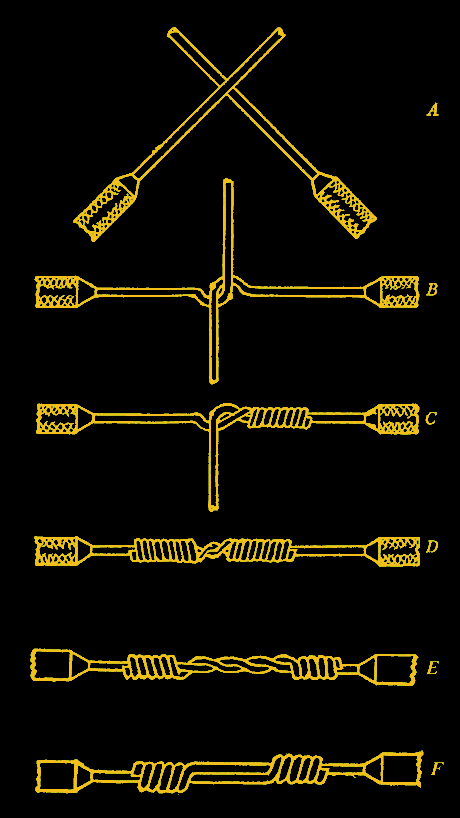
Arguably, the best way to join two similar-sized solid wires is the Western Union splice, or the lineman’s splice, which goes back to at least 1915 when the book Practical Electric Wiring (PDF) described it. It will work with stranded wire, too, if you twist it tightly and, even better, tin the wires first.
You essentially bend each wire around the other and then tightly wrap each wire around the other wire. There are a few options about how to handle the middle part, as you can see in the adjacent figure.
These aren’t hard to make, but it does depend a bit on the skill and patience of the person making the splice. On the other hand, they are mechanically very robust.
NASA’s workmanship document (NASA-STD-8739.3, PDF) urges you to avoid splices and prefer controlled processes like crimps, where a tool produces repeatable connections. However, in testing, soldered Western Union splices were found to be quite strong, usually stronger than the wire around them.
youtube.com/embed/SKr3h1cHIiM?…
Perhaps the most common splice is the rat or pig tail splice. That’s where you just twist two wires together. If you don’t have to survive mechanical tension and you have solid wire, this works ok and is what you often see inside electrical boxes in North America, either made by or topped with a wire nut.
These are fast and simple, but without something like a wire nut, a bit suspect. They tend to loosen over time, especially under vibration.
Another problem is when you have very large solid wires that are not practical to twist. That calls for a Britannia splice. Here, you put two presumably thick wires end-to-end and bind them with a smaller wire. You don’t see these very often, although you may see them in some utility contexts. More often, you’d crimp a butt connector to join two large wires. Note the binding wire wraps around both wires and the common part where the wires touch.
youtube.com/embed/bfpagotoIak?…
A similar splice is the so-called fixture splice, in which a smaller wire wraps around a larger one. This is another case where you would almost always finish this off with some kind of mechanical connector, like a wire nut.
Sometimes you need a splice that isn’t much larger than the original wire. You can do that with a scarfed splice. This is usually only practical for large, solid wires. You essentially taper each wire to a point (using, for example, a file) and then bond them together much like a scarf joint in carpentry. Of course, you must solder or somehow fix the wires together, as there is no mechanical connection. This takes a lot of work and also takes skill to get right.
Sometimes, you want a splice into an existing wire to form like a “T” or a tap. It is possible to create a tap joint by removing insulation from the main conductor and then wrapping wire around the bare metal. Often, you’ll tie a knot it the tap wire before wrapping to try to improve the mechanical hold a bit.
However, these are not especially strong, and you have to be careful removing the insulation so as not to nick the main conductor and weaken it or reduce its current capacity.
If the main wire is stranded, another variation is to carefully split the main conductor into two segments and then pass the tap wire through the center before wrapping it as before. While this might be slightly more mechanically advantageous, it is still not a good replacement for a crimp-on tap or a connector to hold three wires.
Splicing multiconductor wire can also pose a challenge. Sure, for a lamp cord, it is just as simple as making two splices. But in cables where the pair is balanced, it is often impractical to maintain the spacing and twisting of the wire. Better to get a cable of the proper length.
There are probably as many ways to make a splice as there are people making splices. Some are clever, others are terrible, and a few — like the Western Union splice — have stood the test of time.
Most of the time, you want to avoid splices where you can. Try a terminal block, a solder sleeve, or a crimp connector. Even a wire nut, while technically a splice, will give you some mechanical advantage over just twisting wire together.
We favor the Western Union splice with a good coat of solder. In the end, the “right” splice is the one that matches the electrical load, mechanical demands, and environment you expect it to live in. A quick twist might work today, but a properly executed splice will still be working years down the line.
What’s your go-to method? Let us know in the comments.
@Informatica (Italy e non Italy)
Un advisory congiunto di sei agenzie federali statunitensi, pubblicato il 7 aprile 2026, conferma che CyberAv3ngers — gruppo
@Informatica (Italy e non Italy)
Il caso dei dossier e di un ramo dei servizi segreti italiani coinvolto mette in risalto un rischio strutturale legato all'uso "non istituzionale" delle informazioni riservate colpisce. Ecco cosa accade quando dati sensibili, acquisiti tramite
@Informatica (Italy e non Italy)
Sono stati identificati come RecruitRAT, SaferRat, Astrinox e Massiv i quattro malware usati in altrettante campagne di trojan bancari per Android che segnano il passaggio da operazioni isolate a modelli organizzati e scalabili. Ecco tutti i dettagli e i consigli per
Zero-day su Microsoft Defender senza patch: exploit pubblici usati in attacchi reali
📌 Link all'articolo : redhotcyber.com/post/zero-day-…
A cura di Chiara Nardini
#redhotcyber #news #cybersecurity #hacking #malware #zeroDay #microsoftDefender #vulnerabilita
Scopri di più sulle vulnerabilità di Microsoft Defender e come proteggere il tuo sistema. Ultime notizie e aggiornamenti sulla sicurezza informaticaChiara Nardini (Red Hot Cyber)
Cybersecurity & cyberwarfare reshared this.
NEW: Angelo Martino, a former ransomware negotiator, pleaded guilty to helping a ransomware gang get more money — of which he took a cut — from their victims.
He was secretly playing both sides in several ransomware negotiations, and he also deployed ransomware himself with co-conspirators.
techcrunch.com/2026/04/21/rans…
A former employee of a cybersecurity firm pleaded guilty to aiding ransomware criminals to maximize their profits, with the goal of taking a cut of the ransom.Lorenzo Franceschi-Bicchierai (TechCrunch)
Cybersecurity & cyberwarfare reshared this.
Can confirm this for Arc, Brave, Edge, Chromium, and Vivaldi on my machine:
#Anthropic secretly installs spyware when you install Claude Desktop
thatprivacyguy.com/blog/anthro…
Anthropic's Claude Desktop silently installs a Native Messaging bridge into seven Chromium browsers, including browsers Anthropic's own documentation says it does not support, and browsers the user has not even installed.Alexander Hanff (That Privacy Guy!)
reshared this
If you’ve got a modern car, truck, or tractor, it’s probably got a CAN bus or three that is bouncing data all around the vehicle. Listening in on these transmissions can enlighten you to what’s going on with sensors and modules which can aid in troubleshooting. You might find [Chanchal]’s latest work to be helpful in this regard — a CAN bus visualizer that runs right in your browser.
CANviz, as the project is known, is designed to work with any one of a number of cheap USB CAN reader modules. To use it, you simply run the Python “pip” tool to install it, and then you have a live CAN bus frame analyzer running on your local machine. Point your browser to localhost:8080 and you can see the data pouring in from whatever you happen to be hooked up to. The tool supports decoding CAN DBC files to make better sense of the raw data coming off the bus, and you can also record sessions for later analysis and even send CAN frames yourself if you need to. You can also run the tool on a remote single-board PC if so desired and access it over a network connection from another machine.
We’ve explored CAN hacking tools before and tools for visualization as well. Often, the latter is important when trying to debug and investigate dynamic issues. Meanwhile, if you’re working on your own automotive interface hacks, don’t hesitate to notify the tipsline!
Once the microcomputer era got going in earnest, the floppy disk quickly supplanted the tape as the portable storage method of choice. They were never particularly large, but they were fine for the average user to get by.
At the same time, it wasn’t long before heavier-duty removable storage solutions hit the market for power users who needed to move many megabytes at a time. In the 1980s, these were primarily the preserve of big print shops, corporate users, and governments. By the 1990s, even the mildly savvy computerist was starting to chafe against the tyrannical 1.44 MB limit of the regular 3.5″ diskette. Against this backdrop launched the SuperDisk—the product which hoped to take the floppy format to the next level, yet faltered all the same.
SuperDisk drives could also write regular floppy disks, which was a chief difference between them and the then-dominant Zip drives from Iomega. Credit: Kirbylover4000, CC BY-SA 4.0
The SuperDisk was yet another innovation spawned by 3M, or more specifically, by the company’s storage group, Imation. Landing on the market in 1996, it was intended to be a higher-capacity successor to the regular floppy disk. In this era, the default removable storage was was the 3.5″ floppy, capable of storing 1.44 MB on a high-density double-sided disk in the dominant IBM format. The SuperDisk would easily eclipse that with its 120 MB capacity, nearly ten times what users were used to getting from a compact floppy disk. Back in the mid-1990s, when hard drives were just starting to flirt with gigabyte capacities in the single digits, this was a huge chunk of storage to be carrying around in your pocket.
The format relied on so-called “floptical” technology. The idea was to use optical guidance to more precisely position the magnetic heads that read and write the floppy magnetic platter. This would allow a disk to pack more tracks in per given area of disk, massively increasing the storage density. Where a regular 3.5″ floppy disk had 135 tracks per inch, an LS-120 disk would expand that to 2,490 tracks per inch. The LS-120 disks were physically unique, due to the need to have optical alignment tracks on the magnetic surface that could be read via a laser and sensor. Hence the LS designation, for “laser servo.”LS120 SuperDisks had very similar dimensions to regular 3.5″ floppy disks, but the unique shutter design was an easy tell you were holding something different. Credit: Amada44, CC BY-SA 4.0
Inside, the construction was not so different to a regular floppy disk. Credit: Amada44, CC BY-SA 4.0
Optical tracking marks on the surface of the LS120 disk were used to enable more accurate head tracking for denser storage. Credit: Shelby Jueden, CC BY-SA 4.0
A variety of drives were made available in the marketplace, both in internal and external versions. The latter typically used parallel, USB, or SCSI interfaces, while internal drives were accessed via SCSI or ATAPI. Despite the special technology inside SuperDisks, they were otherwise very close in size to regular floppies, albeit with a rather unique shutter design. This allowed the SuperDisk drive to also read regular 1.44 MB and 720 KB diskettes. Notably, though, this was really only a thing in the PC world—the drives could not read 800 KB or 400 KB Macintosh format disks.
Unfortunately for Imation, the SuperDisk had a major hurdle to overcome from the outset. Iomega had already launched the Zip drive in 1995 to rapturous applause, racking up huge orders from the drop. The drives were not compatible with regular floppies in any way, and initial versions stored just 100 MB per disk. However, the first mover advantage had launched Iomega’s market share and stock into the stratosphere. There was little market interest in the upstart competitor when purple drives were already sitting on desks in business and universities around the world. Nevertheless, the SuperDisk drive still found some traction with big OEMs, showing up as an option in Dell, Compaq, and Gateway computers way back when. Panasonic even launched a line of digital cameras that used the supersized disks, not unlike Sony’s floppy disk cameras but with far more storage that made them more practical. Sadly, though, uptake was never high enough to make the SuperDisk a normalized replacement for a regular floppy drive, nor even a viable or well-known competitor to the all-domineering Zip.
Nevertheless, Matsushita persevered with the SuperDisk concept for some time. In 2001, the company launched LS-240 drives, which doubled capacity to 240 MB per disk. They also came with a fun party trick that allowed regular 3.5″ floppies to be formatted to hold 32MB. This feat was achieved in part due to the use of shingled magnetic recording (SMR), a technique wherein magnetic tracks on the platter are allowed to overlap to increase storage density. “FD32MB” formatted disks could only be read in LS-240 drives.
By this point, however, the CD burner had already taken over the world. With a CD-R or CD-RW retailing for less than a dollar in quantity, and capable of storing 700MB-plus, the value proposition of the SuperDisk faltered, along with most other magnetic storage solutions of the era. The drives would eventually go out of production in 2003, by which point the venerable USB drive was rising to prominence as the go-to standard for removable media.
Other than being a little late to market, there wasn’t a lot the SuperDisk got wrong. There were no major scandals with the reliability of the drives or media, and they had the nice feature that they were backwards compatible with existing floppy disks to boot. Sometimes, though, it’s impossible to overcome showing up late to the party. Between Iomega’s dominance in the 90s, and the widespread abandonment of magnetic removable media in the early 2000s, there was never really a good time for the SuperDisk to shine. Like so many other technologies out there, it was perfectly capable at what it was supposed to do, it just didn’t find the right audience. A solution without a problem, perhaps, given that others had already solved the issue before the SuperDisk saw the light of day.
Featured image: “SuperDisk” by [Miguel Durán]
Dee Liteyears - V I D E O G I R L likes this.
Questo post viene ripubblicato sulla comunità @Che succede nel Fediverso? che puoi seguire per avere tutti i recenti aggiornamenti sul Fediverso
Diamo il benvenuto nel Fediverso a:
@RAEE - Storie Digitali
@L'Analista
@Alessio Pomaro
@Zuppa di Particelle
@Giuseppe Castagna
@Cambia le tue Abitudini
@Spherenode
@L'Unica
@Ricardo Antonio Piana
@Stranger Than Cinema
@La Terna Sinistrorsa
@Ivan Agliardi | PRO
@SmartPulse.it
@Agensocial
@SpazioLIFE
@VistaGare
@Luca Schenato
Questo account è gestito dagli amministratori di poliverso.org.
like this
reshared this
Cisco has patched four critical vulnerabilities in Identity Services Engine (ISE) and Webex, including an unauthenticated remote code execution flaw in ISE and an authentication bypass in Webex that allows full user impersonation.dark6 (Secure Bulletin)
reshared this
Inditex, owner of Zara and Bershka, has confirmed a data breach affecting transaction records accessed via a third-party analytics platform, Anodot. Hackers set an April 21 deadline, threatening to leak the data.dark6 (Secure Bulletin)
reshared this
Primary Constructor e Dependency Injection in C# 12: vantaggi, insidie e quando usarli
#tech
spcnet.it/primary-constructor-…
@informatica
reshared this
macfranc
in reply to Derom • • •Toner per stampanti samsung
Per massimizzare la visibilità del tuo messaggio, puoi provare a pubblicare anche un annuncio sul gruppo "Il Mercatino del Fediverso" a questo link: citiverse.it/category/mercatin…