Hacking Fermentation for Infinite Pickles from Pass-thru Bioreactor


The media in this post is not displayed to visitors. To view it, please log in.

Home-fermented foods are great– they’re healthier, more flavourful, and cheaper than store-bought alternatives. What they aren’t is convenient: you need to prep a big batch of veggies, let it sit, and then you have to store the excess pickles. If you’re not careful, you end up with ancient, over-fermented pickles at the bottom of the crock, or worse– run out of pickles! Surely a fate worse than death. [Cody] at Cody’s Lab has a solution: a continous-flow fermentation process that keeps just the right supply of pickles coming at all times. Our grandmothers who kept a crock for months in the cold room or root cellar might be confused, but this hack brings pickles into the Just-In-Time framework of the 21st century.

Specifically this is for lactic acid fermentation, the type that gets you kosher dills, saurkraut and kimchi along with a whole mess of other tangy, tasty vegetable treats. Vinegar pickles are a whole other thing. It’s done in a brine, as the lactic acid bacteria are salt tolerant in a way that most things that would rot your food and/or make you sick would not. You can reuse the brine over and over, which is what [Cody] is doing: he crafts a U-shaped crock out of old glass bottles and a couple of pickle jars. He cuts the jars into angled pipe segments that are held together with aquarium sealant, which is apparently food safe. It holds water and looks surprisingly good, in that it isn’t hideous.

The bioreactor gets loaded up with veggies on one end, plus lots of salt and spices to taste, plus some cultured brine from an old batch to kickstart everything. The starter isn’t necessary; it just gets things going faster. The initial packing is the hardest: after filling it the first time, one needs only press new veggies in at one end, while removing tasty treats at the other. A special packing tool [Cody]makes helps with that, but he plans on adding a larger feed side. Thanks to that kickstart, the pickles were ready to try after about a week– which means his tube is a bit long, for his desired dwell time. If you like more fermentation to your pickles, then you might like this size.

May be the first time pickles have been featured on Hackaday without turning them into LEDs. We’ve featured plenty of fermentation projects, with automation to help make the best brew or a build for better tempeh, but not a lot of vegetables.

Thanks to [cam72cam] for the tip!

youtube.com/embed/pTOHrYA5Q0g?…


hackaday.com/2026/04/15/hackin…

Cybersecurity & cyberwarfare ha ricondiviso questo.

Il passaggio del robo-cone: In Ucraina, per la prima volta nella storia, i robot hanno conquistato una postazione nemica

Zelensky annuncia un’operazione senza fanteria né perdite ma solo con l'uso di sistemi senza equipaggio e droni. È il risultato della svolta tecnologica voluta da Kyiv. E il ministro Fedorov spinge per la trasformazione dell’esercito in chiave robotica

ilfoglio.it/esteri/2026/04/14/…

@informatica

A Look at Full Spectrum 3D Printing


The media in this post is not displayed to visitors. To view it, please log in.

Many modern desktop 3D printers include the ability to print in multiple colors. However, this typically only works with a few colors at a time, and the more colors you can use, the higher the machine’s cost and complexity. However, a recent technique allows printers to mix new colors by overlaying thin sheets of different filaments. [YGK3D] looks at how it works in a recent video.

In the early days of 3D printing, there were several competing approaches. You could have separate extruders, each with a different color. Some designs used a single extruder and switched between different filaments on demand. Others melted different filaments together in the hot end.

One advantage of the hotends that melted different materials is that you could make different colors by adjusting the feed rates of the plastics. However, that has its own problems with maintaining flow rate, and you can’t really use multiple material types. But using single or multiple hotends that take one filament at a time means you can only handle as many colors as you have filaments. You can’t mix, say, white and black to get gray.

Using Full Spectrum, you can define virtual filaments, and the software figures out how to approximate the color you want by using thin layers of different colors. The results are amazing. While this technically could work on any printer, in reality, a filament-switching printer will create a ton of waste to mix colors, and a single-filament machine will drive you batty manually swapping filament.

So you probably really need a tool changer and translucent plastic. You can see the difference in the test article when using opaque filament vs translucent ones. At low layer heights, four filament colors can give you 39 different colors. At more common layer heights, you may have to settle for 24 different colors.

One issue is that the top and bottom surfaces don’t color well. However, a new plugin that adds texture to the surfaces may help overcome that problem.

We looked at Full Spectrum earlier, but development continues. If you are still trying to get a handle on your filament-switching printer, we can help.

youtube.com/embed/Mjdwu-Ga_rA?…


hackaday.com/2026/04/15/a-look…

Hackerati i Pc di varie banche: ma è un problema di modello di sicurezza


@Informatica (Italy e non Italy)
Un criminale, arrestato dalla Polizia, è riuscito ad installare dispositivi sui computer di un istituto di credito, intercettando il traffico dati e rubando credenziali di accesso dei clienti ai sistemi bancari. Ecco come sono stati hackerati i Pc di più banche e

Cybersecurity & cyberwarfare ha ricondiviso questo.

CVE-2026-33032: severe #nginx-ui bug grants unauthenticated server access
securityaffairs.com/190841/hac…
#securityaffairs #hacking

AI For The Skeptics: Attempting To Do Something Useful With It


The media in this post is not displayed to visitors. To view it, please log in.

There are some subjects as a writer in which you know they need to be written, but at the same time you feel it necessary to steel yourself for the inevitable barrage of criticism once your work reaches its audience. Of these the latest is AI, or more specifically the current enthusiasm for Large Language Models, or LLMs. On one side we have the people who’ve drunk a little too much of the Kool-Aid and are frankly a bit annoying on the subject, while on the other we have those who are infuriated by the technology. Given the tide of low quality AI slop to be found online, we can see the latter group’s point.

This is the second in what may become an occasional series looking at the subject from the perspective of wanting to find the useful stuff behind the hype; what is likely to fall by the wayside, and what as yet unheard of applications will turn this thing into something more useful than a slop machine or an agent that might occasionally automate some of your tasks correctly. In the previous article I examined the motivation of that annoying Guy In A Suit who many of us will have encountered who wants to use AI for everything because it’s shiny and new, while in this one I’ll try to do something useful with it myself.

What is an LLM good at doing, and What Can it Do For Me?

A screen grab of the BBC News webside on April 2nd 2026, showing news from the war in the Persian Gulf.In turbulent times such as these, news analysis tools can deliver useful insights that aren’t readily visible.
There is plenty of fun to be had in pointing out that AI is good at making low quality but superficially impressive content, and pictures of people who won the jackpot when they were handing out extra fingers. But given an LLM to talk to, why not name a task it can do really well?

I had this chat with a friend of mine, and I agree with him that these things are excellent at summarising information. This is partly what has Guy In A Suit excited because it makes him feel smart, but as it happens I have a real world task at which that might just be useful.

In the past I have occasionally written about a long-time side interest of mine, the computational analysis of news data. I have my own functional but rather clunky software suite for it, and the whole thing runs day in day out on a Raspberry Pi here in my office. As part of this over the last couple of decades I’ve tried to tackle quite a few different computational challenges, and one which has eluded me is sentiment analysis. Using a computer to scan a particular piece of text, and work out how positive or negative it is towards a particular subject is particularly useful when it comes to working with news analysis, and since it’s a specialist instance of summarising information, it might be suitable for an LLM.

Sentiment analysis appears at first sight to be easy, but it’s one of those things which the further you descend into it, the more labyrinthine it gets. It’s very easy to rate a piece of text against a list of positive and negative words and give it a positivity score, for example, but it becomes much more difficult once you understand that the context of what is being said. It becomes necessary to perform part-of-speech and object analysis, in order to analyse what is being said in relation to whom, and then compute a more nuanced score based upon that. The code quickly becomes a quagmire in trying to perform a task that’s easy for a human, and though I have tried, I have never really managed to crack it.

By contrast, an LLM is good at analysing context in a piece of text, and can be instructed in natural language by means of a prompt. I can even tell it how I want the results, which in my case would be a simple numerical index rather than yet more text. It’s almost sounding as though I have the means for a GetSentimentAnalysis(subject,text) function.

First, Find Your LLM


Finding an LLM is as easy as firing up ChatGPT or similar for most people, but taking this from the point of view I have, I’d prefer to run one not sitting on a large dataslurping company’s cloud servers. I need a local LLM, and for that I am pleased to say the path is straightforward. I need two things, the model itself which is the collection of processed data, and an inference engine which is the software required to perform queries upon it. In reality this means installing the inference engine, and then instructing it to pick up the model from its repository.

There are several choices to be found when it comes to an open source inference engine, and among them I use Ollama. It’s a straightforward to use piece of software that provides a ChatGPT-compatible API for programming and has a simple text interface, and perhaps most importantly it’s in the repositories for my distro so installing it is particularly easy. ollama serve got me the API on [url=http://localhost:11434/feed/]http://localhost:11434/feed/[/url], I went for the Llama3.2 model as suitable for a workaday laptop by typing ollama pull llama3.2, and I was ready to go. Typing ollama run llama3.2:latest got me a chat prompt in a terminal. It’s shockingly simple, and I can now generate hallucinatory slop in my terminal or by passing bits of JSON to the API endpoint.

In Which I Become A Prompt Engineer


There are a few things amid the AI hype, I have to admit, that get my goat. One of them is the job description “Prompt engineer”. I’m not one of those precious engineers who gets offended at heating engineers using the word “engineer”, but maybe there are limits when “writer” is much closer to the mark. Anyway, if anyone wants to pay me scads of money to write clear English instructions as an engineer with the bit of paper to prove it I am right here, having written the following for my sentiment analyser.
I am going to ask you to perform sentiment analysis on a piece of text,
where your job is to tell me whether the sentiment towards the subject
I specify is positive or negative. You will return only a number on a
linear scale starting at +10 for fully positive, decreasing as positivity
decreases, through 0 for neutral, and decreasing further as negativity
increases, to -10 for fully negative. Please do not return any extra notes.
Please perform sentiment analysis on only the following text, towards
( put the subject of your query here ):

There are enough guides to using the API that it’s not worth making another one here, but passing this to the API is a simple enough process. On a six-year-old ThinkPad that’s also running the usual software of a working Hackaday writer it’s not especially fast, taking around twenty seconds to return a value. I’ve been trying it with the text of BBC News articles covering global events, and I can say that for relatively little work I’ve created an effective sentiment analyser. It will compute sentiment for multiple people mentioned in an article, and it will return 0 as a neutral value for people who don’t appear in the source text.

Wow! I Did Something Useful With It!


So in this piece I’ve taken a particularly annoying problem I’ve faced in the past and failed at, identified it as something at which an LLM might deliver, and in a surprisingly short time, come up with a working solution. I am of course by no means the first person to use an LLM for this particular task. If you want you can use it as an effective but slow and energy intensive sentiment analyser, but maybe that’s not the point here.

What I’m trying to demonstrate is that the LLM is just another tool, like your pliers. Just like your pliers it can do jobs other than the ones it was designed for, but some of them it’s not very good at and it’s certainly not the tool to replace all tools. If you identify a task at which it’s particularly good though, then just like your pliers it can do a very effective job.

I wish some people would take the above paragraph to heart.


hackaday.com/2026/04/15/ai-for…

A 6502 All in the Data


The media in this post is not displayed to visitors. To view it, please log in.

Emulating a 6502 shouldn’t be that hard on a modern computer. Maybe that’s why [lasect] decided to make it a bit harder. The PG_6502 emulator uses PostgreSQL. All the CPU resources are database tables, and all opcodes are stored procedures. Huh.

The database is pretty simple. The pg6502.cpu table has a single row that holds the registers. Then there is a pg6502.mem table that has 64K rows, each representing a byte. There’s also a pg6502.opcode_table that stores information about each instruction. For example, the 0xA9 opcode is an immediate LDA and requires two bytes.

The pg6502.op_lda procedure grabs that information and updates the tables appropriately. In particular, it will load the next byte, increment the program counter, set the accumulator, and update the flags.

Honestly, we’ve wondered why more people don’t use databases instead of the file system for structured data but, for us, this may be a bit much. Still, it is undoubtedly unique, and if you read SQL, you have to admit the logic is quite clear.

We can’t throw stones. We’ve been known to do horrible emulators in spreadsheets, which is arguably an even worse idea. We aren’t the only ones.


hackaday.com/2026/04/15/a-6502…

Cybersecurity & cyberwarfare ha ricondiviso questo.

We ran Doom on a 40 year old printer controller (Agfa Compugraphic 9000PS)
[video]L: youtube.com/watch?v=cltnlks2-u…
C: news.ycombinator.com/item?id=4…
posted on 2026.04.11 at 13:59:14 (c=0, p=8)

reshared this

Cybersecurity & cyberwarfare ha ricondiviso questo.

The Deepfake Nudes Crisis in Schools Is Worse Than You Thought
L: wired.com/story/deepfake-nudif…
C: news.ycombinator.com/item?id=4…
posted on 2026.04.15 at 10:50:29 (c=0, p=3)

reshared this

Cybersecurity & cyberwarfare ha ricondiviso questo.

The media in this post is not displayed to visitors. To view it, please go to the original post.

LLM Chat in .NET con IChatClient: guida completa all’integrazione
#tech
spcnet.it/llm-chat-in-net-con-…
@informatica


LLM Chat in .NET con IChatClient: guida completa all’integrazione


Introduzione: l’astrazione che unifica i servizi LLM


Integrare Large Language Model in .NET ha sempre comportato un problema: ogni servizio (OpenAI, Azure OpenAI, Ollama, Claude) ha il proprio SDK con API diverse. IChatClient della libreria Microsoft.Extensions.AI risolve questo problema fornendo un’astrazione unificata. Scrivi una volta, cambia provider senza modificare la logica applicativa.

Cosa è IChatClient?


IChatClient è un’interfaccia che rappresenta un client per servizi AI con capacità chat. Astrae i dettagli di comunicazione con LLM remoti o locali, permettendo di:

  • Inviare e ricevere messaggi con contenuto multi-modale (testo, immagini, audio)
  • Ottenere risposte complete o streaming incrementale
  • Mantenere contesto di conversazione
  • Usare funzionalità avanzate come tool calling e structured outputs

L’interfaccia fa parte del pacchetto Microsoft.Extensions.AI.Abstractions, mentre Microsoft.Extensions.AI aggiunge middleware per telemetria, caching, function calling automatico e patterns familiari di dependency injection.

Setup iniziale con DI


Il punto di partenza è registrare il chat client nel contenitore di dependency injection. Ecco l’approccio canonico:

var builder = Host.CreateApplicationBuilder();
builder.Services.AddChatClient(
    new OllamaChatClient(new Uri("http://localhost:11434"), "llama3"));
var app = builder.Build();
var chatClient = app.Services.GetRequiredService<IChatClient>();

In questo esempio, usiamo Ollama con il modello llama3 locale. La bellezza di questa astrazione: la stessa registrazione funziona con OpenAI, Azure OpenAI o qualsiasi provider che implementi IChatClient. Il codice che usa il client rimane invariato.

Risposta semplice da un LLM


Il caso più basilare: inviare un prompt e ottenere una risposta:

var response = await chatClient.GetResponseAsync("What is .NET? Reply in 50 words max.");
Console.WriteLine(response.Message.Text);

Il metodo GetResponseAsync restituisce un oggetto ChatCompletion con il messaggio della risposta. Semplice, sincrono dal punto di vista dello sviluppatore (anche se asincrono sottostante).

Streaming per risposte lunghe


Per applicazioni interattive come chatbot, lo streaming è essenziale. Permette all’utente di vedere il testo apparire gradualmente, come in ChatGPT:

var chatResponse = "";
await foreach (var item in chatClient.GetStreamingResponseAsync(chatHistory))
{
    Console.Write(item.Text);
    chatResponse += item.Text;
}

Il metodo GetStreamingResponseAsync ritorna un IAsyncEnumerable<StreamingChatCompletionUpdate>. Ogni item contiene un frammento di testo che puoi visualizzare in tempo reale.

Conversazioni multi-turno con cronologia


Mantenere una conversazione richiede di raccogliere la storia dei messaggi. Ecco un loop interattivo completo:

var chatHistory = new List<ChatMessage>();
while (true)
{
    Console.Write("You: ");
    var userPrompt = Console.ReadLine();
    
    chatHistory.Add(new ChatMessage(ChatRole.User, userPrompt));
    
    var chatResponse = "";
    Console.Write("Assistant: ");
    await foreach (var item in chatClient.GetStreamingResponseAsync(chatHistory))
    {
        Console.Write(item.Text);
        chatResponse += item.Text;
    }
    Console.WriteLine();
    
    chatHistory.Add(new ChatMessage(ChatRole.Assistant, chatResponse));
}

Ogni turno aggiunge alla lista: il user message, poi il response dell’assistant. Al turno successivo, passi l’intera cronologia a GetStreamingResponseAsync. L’LLM usa questo contesto per mantenere coerenza conversazionale.

Structured output: JSON tipizzato


Spesso vuoi che l’LLM restituisca dati strutturati (JSON). Puoi chiederlo esplicitamente nel prompt:

var prompt = $"""
You will receive an article and extract its metadata.
Respond ONLY with valid JSON following this format without any deviation.

{{
    "title": "...",
    "summary": "...",
    "keywords": ["...", "..."]
}}

Article:
{File.ReadAllText("article.md")}
""";

var response = await chatClient.GetResponseAsync(prompt);
var jsonText = response.Message.Text;
var metadata = JsonSerializer.Deserialize<ArticleMetadata>(jsonText);

L’approccio funziona, ma richiede gestione manuale di parsing e validazione. C’è una soluzione migliore.

Deserialization tipizzata con generics


La libreria Microsoft.Extensions.AI supporta il generic GetResponseAsync<T> che deserializza automaticamente il JSON in una classe C#:

public class ArticleMetadata
{
    public string Title { get; set; } = string.Empty;
    public string Summary { get; set; } = string.Empty;
    public string[] Keywords { get; set; } = [];
}

var metadata = await chatClient.GetResponseAsync<ArticleMetadata>(prompt);
Console.WriteLine($"Title: {metadata.Result.Title}");
Console.WriteLine($"Keywords: {string.Join(", ", metadata.Result.Keywords)}");

Questa API offre sicurezza in fase di compilazione e supporto IDE completo per il refactoring. Se cambi la struttura di ArticleMetadata, il compilatore avvisa i punti di utilizzo.

Portabilità tra provider: da locale a cloud


Una delle promesse di IChatClient è la portabilità. Ecco come implementare una strategia “local in dev, cloud in prod”:

// Avvio locale con Ollama
if (app.Environment.IsDevelopment())
{
    builder.Services.AddChatClient(
        new OllamaChatClient(new Uri("http://localhost:11434"), "mistral"));
}
else
{
    // Avvio cloud con Azure OpenAI
    builder.Services.AddChatClient(
        new AzureOpenAIClient(
            new Uri(azureEndpoint),
            new DefaultAzureCredential()).AsChatClient());
}

Il resto dell’applicazione non cambia. Chiede semplicemente IChatClient al DI container e riceve l’implementazione appropriata. Niente hardcoding, niente API specifiche sparse nel codice.

Middleware per telemetria e caching


Il pacchetto Microsoft.Extensions.AI fornisce middleware composabile. Uno uso comune è aggiungere OpenTelemetry:

var builder = Host.CreateApplicationBuilder();

// Registra OpenTelemetry
builder.Services.AddOpenTelemetry()
    .WithTracing(tracing => tracing
        .AddAspNetCoreInstrumentation()
        .AddHttpClientInstrumentation());

// Registra il chat client con middleware di telemetria
builder.Services.AddChatClient(baseChatClient)
    .UseOpenTelemetry(builder.Services.BuildServiceProvider()
        .GetRequiredService<ILoggerFactory>());

Con questo setup, ogni chiamata a IChatClient genera automaticamente span OpenTelemetry tracciabili in strumenti come Application Insights o Jaeger. Nessuna strumentazione manuale necessaria.

Integrazione con il framework Agent


Il framework Agent di Microsoft costruisce sopra IChatClient aggiungendo astrazioni a livello agent: gestione persistente del contesto, tool calling automatico, prompt di sistema, API streaming pulita. Se usi agent, IChatClient rimane il cuore della comunicazione LLM.

Conclusione


IChatClient rappresenta una maturazione nell’integrazione LLM in .NET. Invece di accoppiare il codice a provider specifici, definisci un’astrazione e lascia che l’infrastruttura scelga l’implementazione. Lo streaming, la deserialization tipizzata, la composizione di middleware e la portabilità del provider diventano proprietà di prima classe dell’architettura.

Per qualsiasi team che integra LLM in .NET 2026, IChatClient è il fondamento su cui costruire. Richiede poca configurazione iniziale e ripaga con flessibilità architetturale a lungo termine.

Fonte originale: Microsoft.Extensions.AI libraries – .NET | Microsoft Learn e Working with LLMs in .NET using Microsoft.Extensions.AI


Cybersecurity & cyberwarfare ha ricondiviso questo.

The media in this post is not displayed to visitors. To view it, please go to the original post.

The media in this post is not displayed to visitors. To view it, please go to the original post.

Handala e la Cyber-Offensiva dell’Iran: 6 Petabyte distrutti e 149 Terabyte rubati dall’infrastruttura critica di Dubai
#CyberSecurity
insicurezzadigitale.com/handal…


Handala e la Cyber-Offensiva dell’Iran: 6 Petabyte distrutti e 149 Terabyte rubati dall’infrastruttura critica di Dubai


Si parla di:
Toggle


Il 12 aprile 2026, il gruppo Handala, collegato ai servizi di intelligence iraniani, ha annunciato il successo di un attacco di proporzioni senza precedenti contro l’infrastruttura critica degli Emirati Arabi Uniti. L’operazione ha mirato alla Dubai Courts Authority, Dubai Land Authority e Dubai Roads & Transport Authority, risultando nel furto di 149 terabyte di documenti classificati e nella distruzione di 6 petabyte di dati, rappresentando una chiara escalation nella campagna di cyberguerra iraniana.

Portata e natura dell’attacco


L’attacco coordinato dal gruppo Handala rappresenta una categoria di operazione cybernetiche rara: la combinazione di dati wiper (per la distruzione) e exfiltration (per il furto). La selezione degli obiettivi rivela una strategia sofisticata focalizzata su istituzioni critiche che controllano documenti di valore geopolitico, proprietà intellettuale sensibile e informazioni su infrastrutture strategiche.

L’enorme volume di dati distrutti (6 petabyte equivale a circa 6 milioni di gigabyte) suggerisce che gli attaccatori avevano accesso profondo alle infrastrutture di storage primarie e di backup, un indicativo di una lunga permanenza nei sistemi target senza essere rilevati. Il gruppo ha pubblicamente rivendicato l’operazione con comunicati dettagliati, indicando che l’obiettivo non era nascondere l’attacco bensì massimizzare l’impatto psicologico e geopolitico.

Attribution e legami con l’Iran


Sebbene Handala si presenta pubblicamente come collettivo di hacker hacktivist pro-resistenza, analisti di sicurezza e agenzie governative hanno stabilito con elevata confidenza il collegamento con il Ministero dell’Intelligence iraniano (MOIS). Il gruppo fa parte di quello che DomainTools Investigations ha descritto come “un ecosistema coordinato di cyber-influenza” che include anche i gruppi Karma/KarmaBelow80 e Homeland Justice.

Questa struttura a facciata permette all’Iran di mantenere una negazione plausibile mentre conduce operazioni cybernetiche offensive contro i nemici geopolitici e gli alleati regionali. La scelta di Dubai specificamente è significativa: gli EAU hanno in anni recenti normalizzato relazioni con Israele e hanno aumentato partnership strategiche con Stati Uniti e alleati occidentali, rendendoli un bersaglio prioritario per la rappresaglia iraniana.

Motivazione dichiarata e contesto geopolitico


Nel comunicato di rivendicazione, Handala ha caratterizzato l’operazione come risposta al “tradimento eclatante” dei leader degli Emirati, tracciando paralleli con figure storiche infami come Jeffrey Epstein. Questa retorica è coerente con la narrativa iraniana che dipinge gli EAU come traditori della causa palestinese per le relazioni normalizzate con Israele. Tuttavia, gli esperti di sicurezza sottolineano che la motivazione dichiarata funziona principalmente come cover narrativo per un’operazione principalmente geopolitica e economica.

Dati dell'Operazione:
- Data: 12 Aprile 2026
- Bersagli: 3 istituzioni critiche di Dubai
- Dati Rubati: 149 Terabyte (TB) di documenti classificati
- Dati Distrutti: 6 Petabyte (PB) = 6.000 Terabyte
- Attribution: MOIS Iran via Handala/Karma/Homeland Justice
- Reivindicazione: Pubblica tramite comunicati del gruppo

Implicazioni di sicurezza e defensive posture


L’attacco Handala rivela vulnerabilità critiche nelle infrastrutture di protezione dei dati dei servizi pubblici. La capacità di distruggere 6 petabyte di dati suggerisce che gli attaccatori avevano accesso non solo ai sistemi primari ma anche ai backup, compromettendo le fondamentali pratiche di business continuity e disaster recovery. I responsabili della sicurezza negli Emirati e nei governi alleati devono riconsiderare gli assunti di base sulla separazione geografica, logica e procedurale dei backup critici.

La scala dell’exfiltration (149 TB) suggerisce inoltre che l’attacco non è stato una penetrazione improvvisa ma il risultato di un accesso sostenuto nel tempo. Durante il dwell time (periodo di permanenza), gli attaccatori hanno avuto il tempo di identificare, localizzare e esfiltrare i dati di massimo valore geopolitico prima di eseguire le operazioni di wiper.

Raccomandazioni di difesa


  • Implementare una strategia di backup geograficamente distribuita con separazione logica e procedurale dai sistemi primari
  • Stabilire un sistema di detection comportamentale focalizzato su volume-based anomalies (movimentazione anomala di dati in massa)
  • Implementare encryption at-rest per tutti i backup critici, con gestione chiavi separata dai sistemi operativi
  • Eseguire un threat hunt specificamente focalizzato su indicatori di accesso persistente da attori iraniani
  • Aumentare la collaborazione tra agenzie governative regionali per identificare indicatori comuni di compromesso
  • Sviluppare incident response protocols specifici per scenari di wiper-plus-exfiltration

L’operazione Handala rappresenta un’ulteriore escalation nella campagna iraniana di cyberguerra regionale. Con la Corea del Nord che diversifica gli attacchi verso il settore DeFi e l’Iran che consolida la sua capacità offensiva contro lo stato regionale, il 2026 è emergendo come anno critico di ricalibramento della strategia di cyberwarfare a livello globale.


OpenAI svela GPT-5.4-Cyber: ecco l’approccio graduale all’AI applicata alla sicurezza


@Informatica (Italy e non Italy)
Dopo l'anteprima di Anthropic Claude Mythos, arriva GPT-5.4-Cyber con cui OpenAI, usando un approccio dideployment iterativo e controllato che diventa punto di riferimento utile per l'intera industria, espande il proprio programma Trusted

The media in this post is not displayed to visitors. To view it, please log in.

Handala e la Cyber-Offensiva dell’Iran: 6 Petabyte distrutti e 149 Terabyte rubati dall’infrastruttura critica di Dubai


@Informatica (Italy e non Italy)
Il 12 aprile 2026, il gruppo Handala legato all'Iran ha attaccato l'infrastruttura critica di Dubai, distruggendo 6 petabyte di dati e rubando 149 terabyte di documenti


Handala e la Cyber-Offensiva dell’Iran: 6 Petabyte distrutti e 149 Terabyte rubati dall’infrastruttura critica di Dubai


Si parla di:
Toggle


Il 12 aprile 2026, il gruppo Handala, collegato ai servizi di intelligence iraniani, ha annunciato il successo di un attacco di proporzioni senza precedenti contro l’infrastruttura critica degli Emirati Arabi Uniti. L’operazione ha mirato alla Dubai Courts Authority, Dubai Land Authority e Dubai Roads & Transport Authority, risultando nel furto di 149 terabyte di documenti classificati e nella distruzione di 6 petabyte di dati, rappresentando una chiara escalation nella campagna di cyberguerra iraniana.

Portata e natura dell’attacco


L’attacco coordinato dal gruppo Handala rappresenta una categoria di operazione cybernetiche rara: la combinazione di dati wiper (per la distruzione) e exfiltration (per il furto). La selezione degli obiettivi rivela una strategia sofisticata focalizzata su istituzioni critiche che controllano documenti di valore geopolitico, proprietà intellettuale sensibile e informazioni su infrastrutture strategiche.

L’enorme volume di dati distrutti (6 petabyte equivale a circa 6 milioni di gigabyte) suggerisce che gli attaccatori avevano accesso profondo alle infrastrutture di storage primarie e di backup, un indicativo di una lunga permanenza nei sistemi target senza essere rilevati. Il gruppo ha pubblicamente rivendicato l’operazione con comunicati dettagliati, indicando che l’obiettivo non era nascondere l’attacco bensì massimizzare l’impatto psicologico e geopolitico.

Attribution e legami con l’Iran


Sebbene Handala si presenta pubblicamente come collettivo di hacker hacktivist pro-resistenza, analisti di sicurezza e agenzie governative hanno stabilito con elevata confidenza il collegamento con il Ministero dell’Intelligence iraniano (MOIS). Il gruppo fa parte di quello che DomainTools Investigations ha descritto come “un ecosistema coordinato di cyber-influenza” che include anche i gruppi Karma/KarmaBelow80 e Homeland Justice.

Questa struttura a facciata permette all’Iran di mantenere una negazione plausibile mentre conduce operazioni cybernetiche offensive contro i nemici geopolitici e gli alleati regionali. La scelta di Dubai specificamente è significativa: gli EAU hanno in anni recenti normalizzato relazioni con Israele e hanno aumentato partnership strategiche con Stati Uniti e alleati occidentali, rendendoli un bersaglio prioritario per la rappresaglia iraniana.

Motivazione dichiarata e contesto geopolitico


Nel comunicato di rivendicazione, Handala ha caratterizzato l’operazione come risposta al “tradimento eclatante” dei leader degli Emirati, tracciando paralleli con figure storiche infami come Jeffrey Epstein. Questa retorica è coerente con la narrativa iraniana che dipinge gli EAU come traditori della causa palestinese per le relazioni normalizzate con Israele. Tuttavia, gli esperti di sicurezza sottolineano che la motivazione dichiarata funziona principalmente come cover narrativo per un’operazione principalmente geopolitica e economica.

Dati dell'Operazione:
- Data: 12 Aprile 2026
- Bersagli: 3 istituzioni critiche di Dubai
- Dati Rubati: 149 Terabyte (TB) di documenti classificati
- Dati Distrutti: 6 Petabyte (PB) = 6.000 Terabyte
- Attribution: MOIS Iran via Handala/Karma/Homeland Justice
- Reivindicazione: Pubblica tramite comunicati del gruppo

Implicazioni di sicurezza e defensive posture


L’attacco Handala rivela vulnerabilità critiche nelle infrastrutture di protezione dei dati dei servizi pubblici. La capacità di distruggere 6 petabyte di dati suggerisce che gli attaccatori avevano accesso non solo ai sistemi primari ma anche ai backup, compromettendo le fondamentali pratiche di business continuity e disaster recovery. I responsabili della sicurezza negli Emirati e nei governi alleati devono riconsiderare gli assunti di base sulla separazione geografica, logica e procedurale dei backup critici.

La scala dell’exfiltration (149 TB) suggerisce inoltre che l’attacco non è stato una penetrazione improvvisa ma il risultato di un accesso sostenuto nel tempo. Durante il dwell time (periodo di permanenza), gli attaccatori hanno avuto il tempo di identificare, localizzare e esfiltrare i dati di massimo valore geopolitico prima di eseguire le operazioni di wiper.

Raccomandazioni di difesa


  • Implementare una strategia di backup geograficamente distribuita con separazione logica e procedurale dai sistemi primari
  • Stabilire un sistema di detection comportamentale focalizzato su volume-based anomalies (movimentazione anomala di dati in massa)
  • Implementare encryption at-rest per tutti i backup critici, con gestione chiavi separata dai sistemi operativi
  • Eseguire un threat hunt specificamente focalizzato su indicatori di accesso persistente da attori iraniani
  • Aumentare la collaborazione tra agenzie governative regionali per identificare indicatori comuni di compromesso
  • Sviluppare incident response protocols specifici per scenari di wiper-plus-exfiltration

L’operazione Handala rappresenta un’ulteriore escalation nella campagna iraniana di cyberguerra regionale. Con la Corea del Nord che diversifica gli attacchi verso il settore DeFi e l’Iran che consolida la sua capacità offensiva contro lo stato regionale, il 2026 è emergendo come anno critico di ricalibramento della strategia di cyberwarfare a livello globale.


Gazzetta del Cadavere reshared this.

Cybersecurity & cyberwarfare ha ricondiviso questo.

U.S. #CISA adds #Microsoft #SharePoint Server, and Microsoft #Office Excel flaws to its Known Exploited Vulnerabilities catalog
securityaffairs.com/190852/hac…
#securityaffairs #hacking

A Tale of Cheap Hard Drives and Expensive Lessons


The media in this post is not displayed to visitors. To view it, please log in.

When it comes to electronic gadgets, I’m a sucker for a good deal. If it’s got a circuit board on the inside and a low enough price tag on the outside, you can be pretty sure I’ll be taking it home with me. So a few years ago, when I saw USB external hard drives on the shelf of a national discount chain for just $10, I couldn’t resist picking one up. What I didn’t realize at the time however, was that I’d be getting more in the bargain than just some extra storage space.

It’s a story that I actually hadn’t thought of for some time — it only came to mind recently after reading about how the rising cost of computer components has pushed more users to the secondhand market than ever before. That makes the lessons from this experience, for both the buyer and the seller, particularly relevant.

What’s in the Box?


It wasn’t just the low price that attracted me to these hard drives, it was also the stated capacity. They were listed as 80 GB, which is an unusually low figure to see on a box in 2026. Obviously nobody is making 80 GB drives these days, so given the price, my first thought was that it would contain a jerry-rigged USB flash drive. But if that was the case, you would expect the capacity to be some power of two.

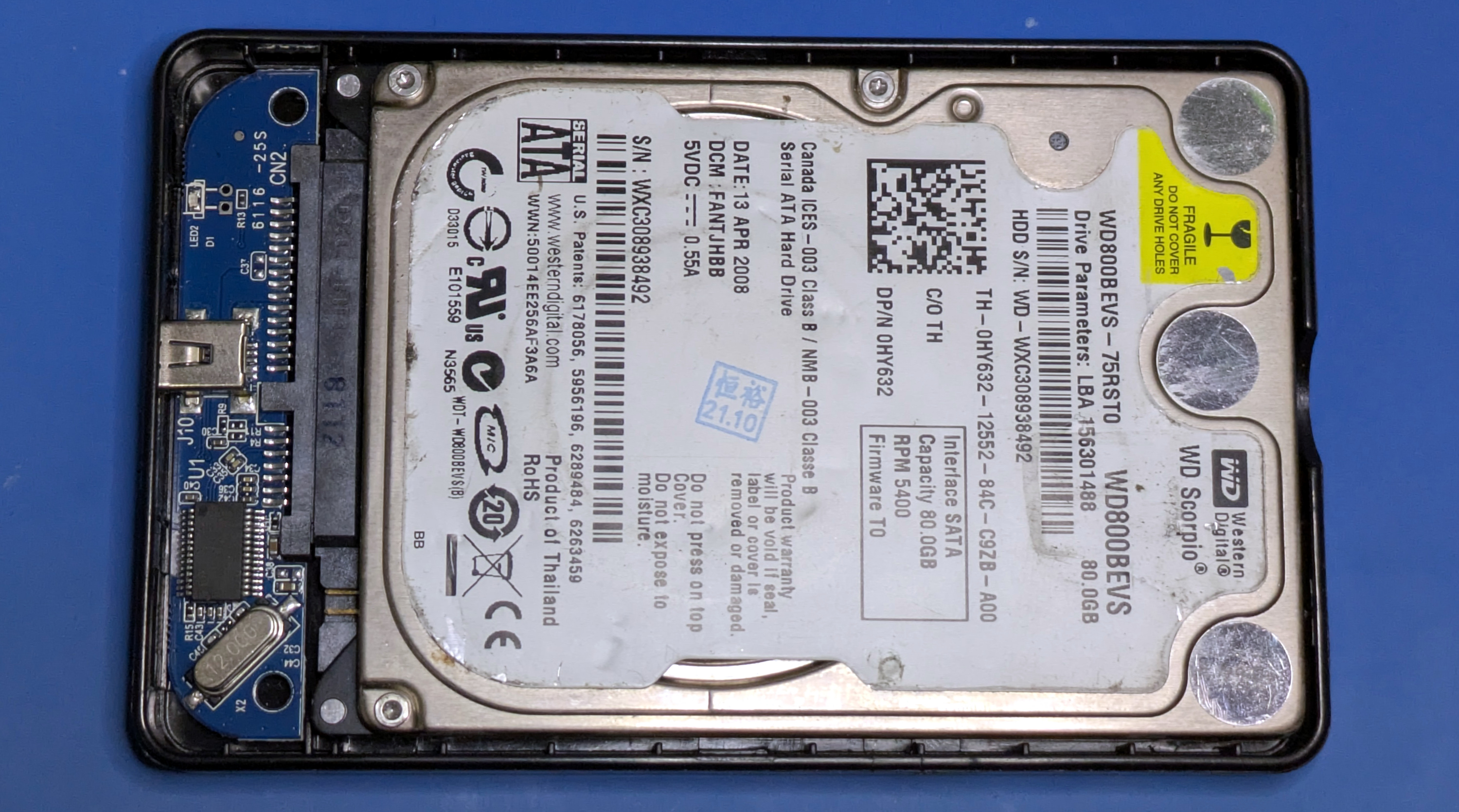
Upon opening up the case, what I found inside was somehow both surprising and incredibly obvious. The last thing I expected to see was an actual spinning hard drive, but only because I lacked the imagination of whoever put this product together. I was thinking in terms of newly manufactured, modern, hardware. Instead, this drive was nearly 20 years old, and must have been available for pennies on the dollar since they were presumably just collecting dust in a warehouse somewhere.

Or at least, that’s what I assumed. After all, surely nobody would have the audacity to take a take a bunch of ancient used hard drives and repackage them as new products…right?

Certified Pre-Owned


Once I saw that the drive inside the enclosure was older than both of my children, I got curious about its history. Especially given the scuff marks and dirt on the drive itself. A new old stock drive from 2008 is one thing, but if this drive actually had any time on the clock, that’s a very different story. Forget the implications of selling used merchandise as new — if the drive has seen significant use, even $10 is a steep price.

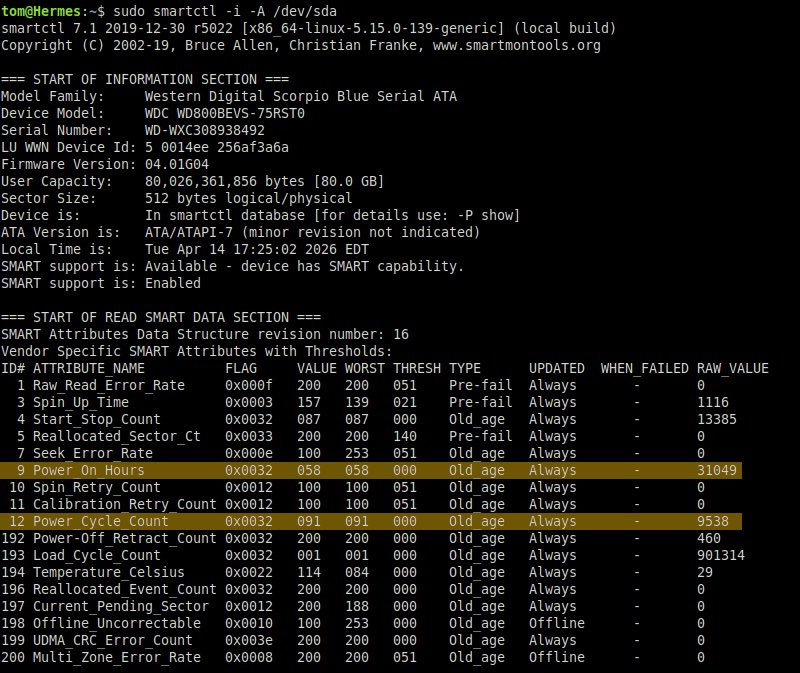
Fortunately, we can easily find out this information through Self-Monitoring, Analysis, and Reporting Technology (SMART). Using the smartctl tool, we can get a readout of all the drive’s SMART parameters and figure out what we’re dealing with:

Well, now we know why these things are so cheap. According to the SMART data, this particular drive has gone through 9,538 power cycles and accumulated a whopping 31,049 hours of total powered on time. I’ll save you the math, that’s a little over 3.5 years.

Note that all of the attributes are either Old_age or Pre-fail. The term “used” barely covers it, this drive has been beat to hell.

Buried Treasure


It’s a fair bet that anyone finding themselves regularly reading Hackaday possesses an inquisitive mind. So at his point, I’m willing to bet you’re wondering the same thing I did: if this drive has been used for years, could it still contain files from its previous life?

Obviously it was formatted before getting boxed up and put back on the shelf. But frankly, anyone who’s unscrupulous enough to pass off decades-old salvaged drives as new probably isn’t putting in the effort to make sure said drives are securely wiped.

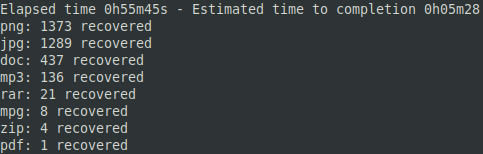
I was willing to bet that the drive went through nothing more than a standard quick format, and that even a simplistic attempt at file recovery would return some interesting results. As it so happens, “Simplistic Attempt” is basically my middle name, so I fired up PhotoRec and pointed it at our bargain drive.

It only took a few minutes before the file counters started jumping, proving that no effort was made to properly sanitize the drive before repackaging it. So not only is this drive old and used, but it still contains information from wherever it was for all those years. If it came from an individual’s personal computer, the information could be private in nature. If it was a business machine, the files may contain valuable proprietary data.

In this case, it looks to be a little of both. I didn’t spend a lot of time poring over the recovered files, but I spot checked enough of them to know that there’s somebody in China who probably wouldn’t be too happy to know their old hard drive ended up on the shelf in an American discount store.

For one thing we’ve got hundreds of personal photographs, ranging from vacation shots to formal portraits.

The pictures show fun in the sun, but the DOC and PDF files are all business. I won’t reveal the name of the company this individual worked for, but I found business proposals for various civil engineering projects within the Minhang District of Shanghai worth millions of dollars.

Once is Happenstance….


I know what you’re wondering, Dear Reader. If the first drive I pulled off the shelf happened to have a trove of personal and professional information on it, what are the chances that it would happen again? Perhaps it was a fluke, and the rest of the drives would be blank.

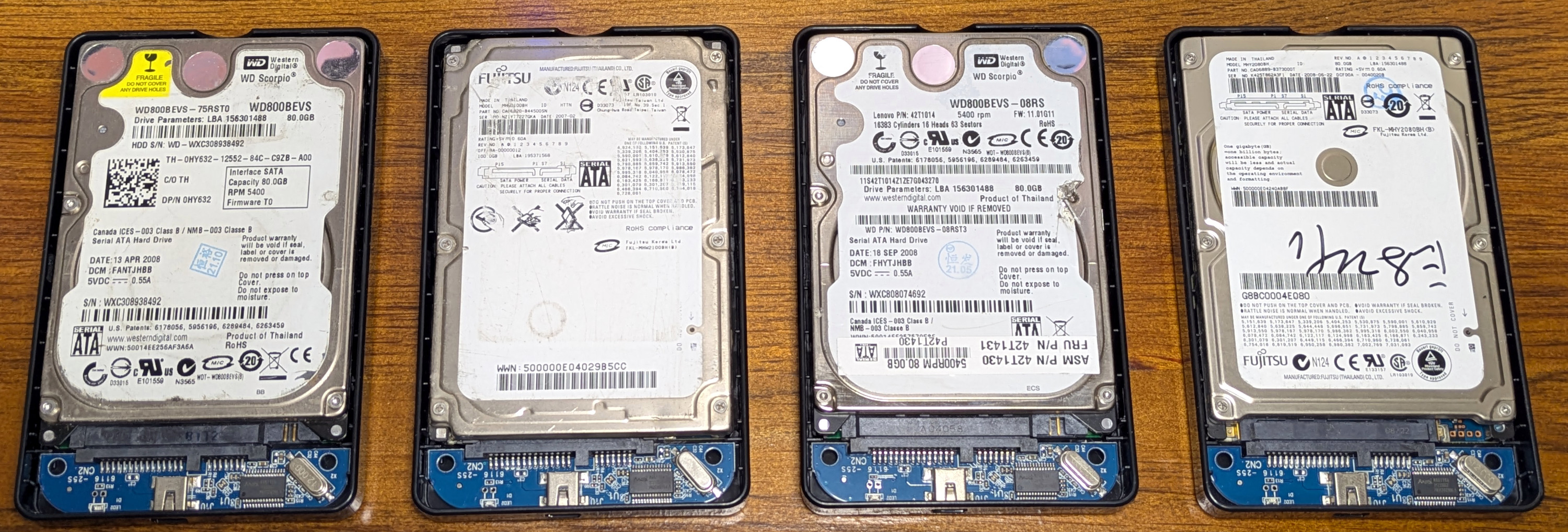
That’s an excellent question, and of course we can’t make a determination either way with only a single point of data. Which is why I went back the next day and bought three more drives.

Right off the bat, it’s worth noting that no two drives are actually the same. Two are Western Digital and two are Fujitsu, but none of them have the same model number. The keen-eyed reader will also note that one of the drives is 100 GB, but it has been partitioned to 80 GB to match the others.

Three of the drives were manufactured in 2008, and one is from 2007. I won’t go through the SMART data for each one, but suffice it to say that each drive has several thousand hours on the clock. Although for what it’s worth, the first drive is the lifetime leader by far.

In terms of file recovery, each drive gave up several gigabytes worth of data. In addition to the one we’ve already looked at, two more were clearly the primary drives in Windows boxes, and each contained a mix of personal data and technical documents such as AutoCAD drawings, datasheets, bills of materials, and schematics. Given their contents, I would guess the drives came from off-lease computers that were used by engineering firms.

The fourth drive was different. It contained more than 32 GBs worth of Hollywood movies, the most recent of which was released in 2010. I imagine this drive came out of somebody’s media center. Now I haven’t sailed the high seas, as it were, since my teenage years, but even if I had wanted to add these titles to my ill-gotten trove of films, it was a non-starter. Given the time period they were downloaded in, most of them were below DVD resolution.

Plus, they were all dubbed in Chinese. Not exactly my idea of a movie night.

A Cautionary Tale


Admittedly, given that they were being sold in a home electronics chain-store, the likelihood that these drives would be purchased by somebody with the means to extract any meaningful data from them isn’t very high. But since you’re reading this, you know the chances clearly aren’t zero. I didn’t have any malicious intent, but the same can’t necessarily be said for others.

So what can we take away from this? To start with, if you’re planning on selling or giving away any of your old drives, make sure they are properly wiped. In the dusty past, the recommendation would have been to use the Linux-based Darik’s Boot and Nuke (DBAN) live CD, but the project was was acquired back in 2012 and development was halted a few years later. Luckily, the GPLv2 tool that DBAN actually ran against the drive was forked and is now available as nwipe.

But as mentioned earlier, I get the impression that these drives were from businesses that unloaded their old machines. In that case, the users can’t really be blamed, as they wouldn’t have been able to wipe the drives even if they knew ahead of time their work computers were getting swapped out. But they certainly could have made an effort to keep their personal data off of company property. It’s one thing to have some corporate secrets stolen down the line, but you don’t want pictures of your kids to be in the mix.

In short, nobody cares about what happens with your personal data more than you do, so make sure it doesn’t get away from you. Otherwise some bargain-hunting nerd might be pawing through it in a few years.

Gazzetta del Cadavere reshared this.

Cybersecurity & cyberwarfare ha ricondiviso questo.

Insegnare ai tempi di ChatGPT significa conoscere il dolore


L'utilizzo di LLM è il problema più demoralizzante che abbia mai affrontato come docente universitario.


arstechnica.com/science/2026/0…

@scuola

in reply to macfranc

Students often carry misconceptions about coursework. They may view an instructor as an opponent standing in the way of the grade they want. And they see “getting the right answers” as the goal of education because that’s how you secure that grade.


That's not the student's fault. That's what the education system has taught them.

Cybersecurity & cyberwarfare ha ricondiviso questo.

La guerra come pretesto: gli Stati del Golfo stanno inasprendo la repressione della libertà di parola, ancora una volta

@Privacy Pride

La guerra non si limita a ridefinire i confini. Ridefinisce anche ciò che si può vedere, dire e ricordare.

Quando i governi invocano il termine "disinformazione" in tempo di guerra, spesso intendono qualcosa di più semplice: discorsi che non controllano. Dall'escalation del conflitto tra Stati Uniti, Israele e Iran, e dai conseguenti attacchi a catena nel Golfo, diversi governi hanno intensificato gli sforzi per mettere a tacere il dissenso e limitare il flusso di informazioni.

eff.org/deeplinks/2026/04/war-…

reshared this

Cybersecurity & cyberwarfare ha ricondiviso questo.

The media in this post is not displayed to visitors. To view it, please go to the original post.

Agent Skills in .NET: tre paradigmi di composizione per gli agenti AI
#tech
spcnet.it/agent-skills-in-net-…
@informatica


Agent Skills in .NET: tre paradigmi di composizione per gli agenti AI


Introduzione: L’evoluzione dei skill negli agent .NET


Gli agent AI richiedono un modo flessibile e modulare di estendere le loro capacità: questo è il ruolo dei skill. Con il framework Agent di Microsoft per .NET, gli sviluppatori dispongono di tre paradigmi complementari per definire e comporre skill, permettendo ai team di scegliere l’approccio più adatto al loro contesto.

I tre paradigmi per creare skill

1. Skill basati su file (File-Based Skills)


L’approccio più dichiarativo parte da una struttura di directory semplice. Ogni skill è organizzato come una cartella contenente:

  • Un file SKILL.md con metadati nel frontmatter YAML
  • Una sottocartella opzionale scripts/ con il codice eseguibile
  • Una sottocartella opzionale references/ con documentazione di supporto

Questo paradigma è particolarmente vantaggioso per i team che vogliono gestire i skill come assets indipendenti dentro un repository condiviso. Il caricamento è automatico: l’agent scopre e carica i skill quando l’utente ne fa richiesta.

Ecco come si registra un provider file-based:

var skillsProvider = new AgentSkillsProvider(
    Path.Combine(AppContext.BaseDirectory, "skills"),
    SubprocessScriptRunner.RunAsync);

Il vantaggio decisivo è la separazione tra definizione del skill e implementazione. Non è necessario riconfigurare il codice C# per aggiungere nuovi skill; basta creare una nuova directory.

2. Skill basati su classe (Class-Based Skills)


Per chi preferisce la sicurezza dei tipi e il supporto IDE completo, gli skill basati su classe offrono un’alternativa fortemente tipizzata. Si eredita da AgentClassSkill<T> e si usano attributi di reflection per marcare le risorse e gli script:

public sealed class BenefitsEnrollmentSkill : AgentClassSkill<BenefitsEnrollmentSkill>
{
    [AgentSkillResource("available-plans")]
    public string AvailablePlans => "Plan A, Plan B, Plan C...";
    
    [AgentSkillScript("enroll")]
    private static string Enroll(string employeeId, string planCode)
    {
        // Logica di iscrizione
        return $"Iscrizione di {employeeId} al piano {planCode} completata";
    }
}

Questo approccio è ideale per skill complessi che richiedono logica C# sofisticata. Gli attributi [AgentSkillResource] e [AgentSkillScript] permettono al framework di scoprire automaticamente quali metodi e proprietà esporre all’agent.

Un vantaggio cruciale: i team possono sviluppare e distribuire skill indipendentemente come pacchetti NuGet, mantenendo il proprio ciclo di rilascio e permettendo il riuso tra progetti.

3. Skill inline (Inline Code-Defined Skills)


Il terzo paradigma è il più flessibile: skill definiti a runtime usando AgentInlineSkill. Sono perfetti per bridge temporanei, skill generati dinamicamente o implementazioni condizionate dallo stato dell’applicazione:

var timeOffSkill = new AgentInlineSkill(
    name: "time-off-balance",
    description: "Calcola i giorni di ferie e malattia rimanenti per un dipendente...")
    .AddScript("calculate-balance", (employeeId, leaveType) => 
    {
        // Logica runtime
        return $"Giorni rimanenti: {remaining}";
    });

I skill inline supportano anche risorse dinamiche:
.AddResource("policies", () => PolicyRepository.GetActivePolicies());

Questa capacità di aggiungere risorse come delegate è cruciale: le politiche possono aggiornarsi senza ricompilare l’applicazione.

Composizione flessibile con AgentSkillsProviderBuilder


La vera potenza del design emerge quando si combinano tutti e tre i paradigmi in un’unica applicazione. Il builder pattern permette una composizione dichiarativa:

var skillsProvider = new AgentSkillsProviderBuilder()
    .UseFileSkill(Path.Combine(AppContext.BaseDirectory, "skills"))
    .UseSkill(new BenefitsEnrollmentSkill())
    .UseSkill(timeOffSkill)
    .UseFileScriptRunner(SubprocessScriptRunner.RunAsync)
    .Build();

In questa configurazione:
  • I skill nel filesystem vengono caricati e resi disponibili
  • La classe BenefitsEnrollmentSkill registra i suoi metodi annotati
  • Lo skill inline timeOffSkill aggiunge capacità runtime

Il framework astrae completamente il “come” carica ogni tipo di skill; l’agent li vede come una superficie unificata.

Funzionalità avanzate

Approvazione degli script


Per ambienti ad alto rischio, è possibile richiedere una revisione umana prima dell’esecuzione:

.UseScriptApproval(true)

In questo caso, l’agent formula il comando ma non lo esegue autonomamente; un operatore deve approvare.

Filtraggio di sicurezza


Quando si condividono directory di skill tra team, il filtraggio garantisce che solo gli skill approvati siano disponibili:

.UseFilter(skill => approvedSkills.Contains(skill.Frontmatter.Name))

Iniezione di dipendenze


I metodi degli skill possono ricevere IServiceProvider come parametro. Questo consente l’accesso a servizi registrati nel contenitore DI, indipendentemente dal paradigma di skill:

[AgentSkillScript("send-notification")]
private static string SendNotification(string userId, IServiceProvider services)
{
    var emailService = services.GetRequiredService<IEmailService>();
    return emailService.SendAsync(userId, "Notification");
}

Conclusione


Il design tripartito dei skill in .NET Agent Framework non è una complicazione: è un’architettura di composizione che rispetta gli usi diversi. Gli skill basati su file servono la semplicità e la dinamica; quelli basati su classe offrono sicurezza e riusabilità via NuGet; quelli inline forniscono agilità runtime.

Per i team che costruiscono sistemi agent complessi, questa flessibilità è fondamentale. Permette di iniziare in semplicità (skill inline), evolversi verso la modularità (skill basati su classe in NuGet) e mantenere agilità operativa (skill file-based per aggiustamenti dinamici) — tutto nello stesso agent, senza compromessi architetturali.

Fonte originale: Agent Skills in .NET: Three Ways to Author, One Provider to Run Them — Microsoft Agent Framework Blog


Cybersecurity & cyberwarfare ha ricondiviso questo.

The media in this post is not displayed to visitors. To view it, please go to the original post.

Ecco a voi il sistema operativo sociale! Mauceli: “La paura vende più della competenza”

📌 Link all'articolo : redhotcyber.com/post/il-sistem…

A cura di Silvia Felici

#redhotcyber #news #mecm #evoluzionedisccm #sorveglianza #percezionecollettiva

Cybersecurity & cyberwarfare ha ricondiviso questo.

I wrote up in the TLS mailing list why I think composite signatures (ML-DSA + ECDSA/RSA) are a net negative, will hurt the ecosystem, and should not be implemented.

Hybrid key exchange was simple and self-contained. Hybrid signatures would be a mountain of complexity in code responsible for half of sev:crit in crypto libraries since 2020.

mailarchive.ietf.org/arch/msg/…

Threat landscape for industrial automation systems in Q4 2025


The media in this post is not displayed to visitors. To view it, please log in.


Statistics across all threats


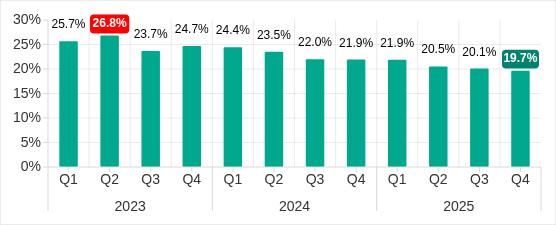
The percentage of ICS computers on which malicious objects were blocked has been decreasing since the beginning of 2024. In Q4 2025, it was 19.7%. Over the past three years, the percentage has decreased 1.36 times, and 1.25 times since Q4 2023.

Percentage of ICS computers on which malicious objects were blocked, Q1 2023–Q4 2025

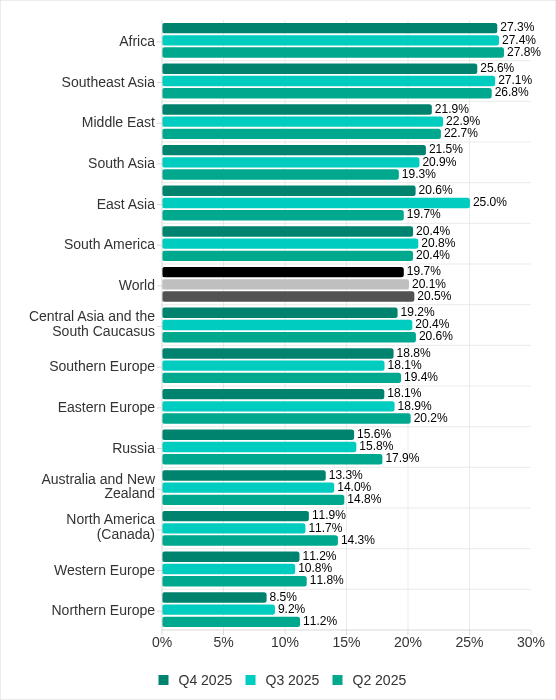
Regionally, in Q4 2025, the percentage of ICS computers on which malicious objects were blocked ranged from 8.5% in Northern Europe to 27.3% in Africa.

Regions ranked by percentage of ICS computers on which malicious objects were blocked

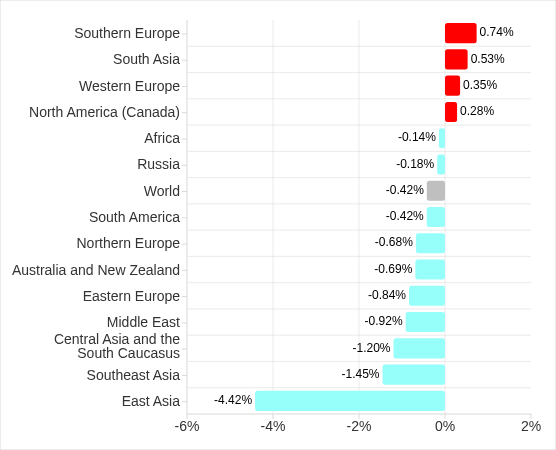
Four regions saw an increase in the percentage of ICS computers on which malicious objects were blocked. The most notable increases occurred in Southern Europe and South Asia. In Q3 2025, East Asia experienced a sharp increase triggered by the local spread of malicious scripts, but the figure has since returned to normal.

Changes in percentage of ICS computers on which malicious objects were blocked, Q4 2025

Feature of the quarter: worms in email


In Q4 2025, the percentage of ICS computers on which wormsinemailattachments were blocked increasedinallregions of the world.

Many of the blocked threats related to the worm Backdoor.MSIL.XWorm. This malware is designed to persist in the system and then remotely control it.

Interestingly, this threat was not detected on ICS computers in the previous quarter, yet it appeared in all regions in Q4 2025.

A study found that the active spread of Backdoor.MSIL.XWorm via phishing emails is likely linked to the use by hackers of another malware obfuscation technique that was actively used during massive phishing campaigns in Q4 2025. These campaigns have been known since 2024 as “Curriculum-vitae-catalina”.

The attackers distributed phishing emails to HR managers, recruiters, and employees responsible for hiring. The messages were disguised as responses from job applicants with subjects such as “Resume” or “Attached Resume” and contained a malicious executable file under the guise of a curriculum vitae. Typically, the file was named Curriculum Vitae-Catalina.exe. When executed, it infected the system.

In Q4 2025, the threat spread across regions in two waves — one in October and another in November. Russia, Western Europe, South America, and North America (Canada) were attacked in October. A spike in Backdoor.MSIL.XWorm blocking was observed in other regions in November. The attack subsided in all regions in December.

The highest percentage of ICS computers on which Backdoor.MSIL.XWorm was blocked was observed in regions where threats from email clients were traditionally blocked at high rates on ICS computers: Southern Europe, South America, and the Middle East.

At the same time, in Africa, where USB storage media are still actively used, the threat was also detected when removable devices were connected to ICS computers.

Selected industries


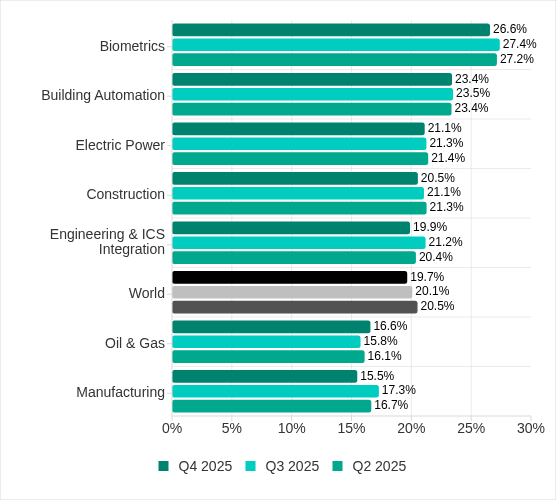
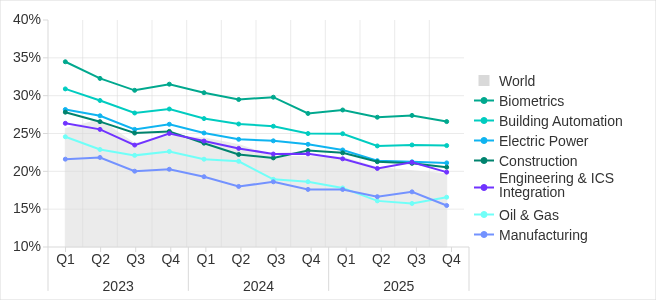
The biometrics sector has traditionally led the ranking of industries and OT infrastructures surveyed in this report in terms of the percentage of ICS computers on which malicious objects were blocked.

These systems are characterized by accessibility to and from the internet, as well as minimal cybersecurity controls by the consumer organization.

Ranking of industries and OT infrastructure by percentage of ICS computers on which malicious objects were blocked

In Q4 2025, the percentage of ICS computers on which malicious objects were blocked increased only in one sector: oil and gas. The corresponding figures increased in two regions: Russia, and Central Asia and the South Caucasus.

However, if we look at a broader time span, there is a downward trend in all the surveyed industries.

Percentage of ICS computers on which malicious objects were blocked in selected industries

Diversity of detected malicious objects


In Q4 2025, Kaspersky protection solutions blocked malware from 10,142 different malware families of various categories on industrial automation systems.

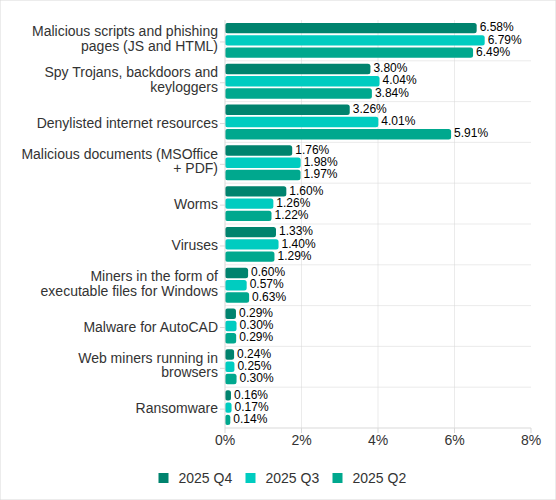
Percentage of ICS computers on which the activity of malicious objects from various categories was blocked

In Q4 2025, there was an increase in the percentage of ICS computers on which worms, and miners in the form of executable files for Windows were blocked. These were the only categories that exhibited an increase.

Main threat sources


Depending on the threat detection and blocking scenario, it is not always possible to reliably identify the source. The circumstantial evidence for a specific source can be the blocked threat’s type (category).

The internet (visiting malicious or compromised internet resources; malicious content distributed via messengers; cloud data storage and processing services and CDNs), email clients (phishing emails), and removable storage devices remain the primary sources of threats to computers in an organization’s technology infrastructure.

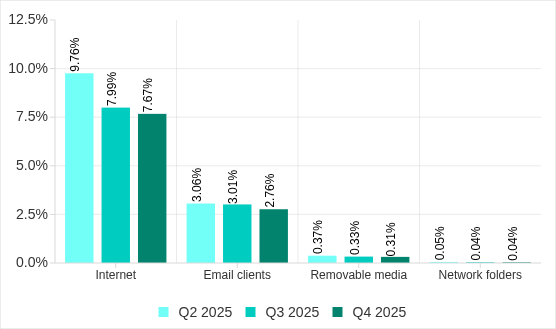
In Q4 2025, the percentage of ICS computers on which malicious objects from various sources were blocked decreased. All sources except email clients saw their lowest levels in three years.

Percentage of ICS computers on which malicious objects from various sources were blocked

The same computer can be attacked by several categories of malware from the same source during a quarter. That computer is counted when calculating the percentage of attacked computers for each threat category, but is only counted once for the threat source (we count unique attacked computers). In addition, it is not always possible to accurately determine the initial infection attempt. Therefore, the total percentage of ICS computers on which various categories of threats from a certain source were blocked can exceed the percentage of computers affected by the source itself.

  • In Q4 2025, the percentage of ICS computers on which threats from the internet were blocked decreased to 7.67% and reached its lowest level since the beginning of 2023. The main categories of internet threats are malicious scripts and phishing pages, and denylisted internet resources. The percentage ranged from 3.96% in Northern Europe to 11.33% in South Asia.
  • The main categories of threats from email clients blocked on ICS computers were malicious scripts and phishing pages, spyware, and malicious documents. Most of the spyware detected in phishing emails was delivered as a password archive or a multi-layered script embedded in office document files. The percentage of ICS computers on which threats from email clients were blocked ranged from 0.64% in Northern Europe to 6.34% in Southern Europe.
  • The main categories of threats that were blocked when removable media was connected to ICS computers were worms, viruses, and spyware. The percentage of ICS computers on which threats from removable media were blocked ranged from 0.05% in Australia and New Zealand to 1.41% in Africa.
  • The main categories of threats that spread through network folders in Q4 2025 were viruses, AutoCAD malware, worms, and spyware. The percentage of ICS computers on which threats from network folders were blocked ranged from 0.01% in Northern Europe to 0.18% in East Asia.


Threat categories


Typical attacks blocked within an OT network are multi-step sequences of malicious activities, where each subsequent step of the attackers is aimed at increasing privileges and/or gaining access to other systems by exploiting the security problems of industrial enterprises, including OT infrastructures.

Malicious objects used for initial infection


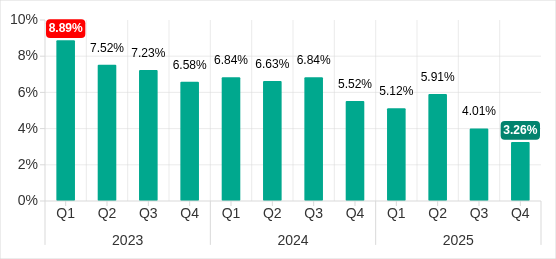
In Q4 2025, the percentage of ICS computers on which denylisted internet resources were blocked decreased to 3.26%. This is the lowest quarterly figure since the beginning of 2022, and it has decreased 1.8 times since Q2 2025.

Percentage of ICS computers on which denylisted internet resources were blocked, Q1 2023–Q4 2025

Regionally, the percentage of ICS computers on which denylisted internet resources were blocked ranged from 1.74% in Northern Europe to 3.93% in Southeast Asia, which displaced Africa from first place. Russia rounded out the top three regions for this indicator.

The percentage of ICS computers on which malicious documents were blocked increased for three consecutive quarters. However, in Q4 2025 it decreased by 0.22 pp to 1.76%.

Percentage of ICS computers on which malicious documents were blocked, Q1 2023–Q4 2025

Regionally, the percentage ranged from 0.46% in Northern Europe to 3.82% in Southern Europe. In Q4 2025, the indicator increased in Eastern Europe, Russia, and Western Europe.

The percentage of ICS computers on which malicious scripts and phishing pages were blocked decreased to 6.58%. Despite the decline, this category led the ranking of threat categories in terms of percentage of ICS computers on which they were blocked.

Percentage of ICS computers on which malicious scripts and phishing pages were blocked, Q1 2023–Q4 2025

Regionally, the percentage ranged from 2.52% in Northern Europe to 10.50% in South Asia. The indicator increased in South Asia, South America, Southern Europe, and Africa. South Asia saw the most notable increase, at 3.47 pp.

Next-stage malware


Malicious objects used to initially infect computers deliver next-stage malware — spyware, ransomware, and miners — to victims’ computers. As a rule, the higher the percentage of ICS computers on which the initial infection malware is blocked, the higher the percentage for next-stage malware.

In Q4 2025, the percentage of ICS computers on which spyware, ransomware and web miners were blocked decreased. The rates were:

  • Spyware: 3.80% (down 0.24 pp). For the second quarter in a row, spyware took second place in the ranking of threat categories in terms of the percentage of ICS computers on which it was blocked.
  • Ransomware: 0.16% (down 0.01 pp).
  • Web miners: 0.24% (down 0.01 pp), this is the lowest level observed thus far in the period under review.

The percentage of ICS computers on which miners in the form of executable files for Windows were blocked increased to 0.60% (up 0.03 pp).

Self-propagating malware


Self-propagating malware (worms and viruses) is a category unto itself. Worms and virus-infected files were originally used for initial infection, but as botnet functionality evolved, they took on next-stage characteristics.

To spread across ICS networks, viruses and worms rely on removable media and network folders and are distributed in the form of infected files, such as archives with backups, office documents, pirated games and hacked applications. In rarer and more dangerous cases, web pages with network equipment settings, as well as files stored in internal document management systems, product lifecycle management (PLM) systems, resource management (ERP) systems and other web services are infected.

In Q4 2025, the percentage of ICS computers on which worms were blocked increased 1.6 times to 1.60%. As mentioned above, this increase is related to a global phishing attack that spread the Backdoor.MSIL.XWorm backdoor worm across all regions of the world. The percentage increased in all regions. The biggest increase (up 2.16 times) was in Southern Europe. The malware was primary distributed through email clients, and Southern Europe led the way in terms of the percentage of ICS computers on which threats from email clients were blocked.

The percentage of ICS computers on which viruses were blocked decreased to 1.33%.

AutoCAD malware


This category of malware can spread in a variety of ways, so it does not belong to a specific group.

After an increase in the previous quarter, the percentage of ICS computers on which AutoCAD malware was blocked decreased to 0.29% in Q4 2025.

For more information on industrial threats see the full version of the report.


securelist.com/industrial-thre…

Cybersecurity & cyberwarfare ha ricondiviso questo.

#Mirax #malware campaign hits 220K accounts, enables full remote control
securityaffairs.com/190842/unc…
#securityaffairs #hacking
Cybersecurity & cyberwarfare ha ricondiviso questo.

Ancora io, con due speech sul #ransomware. Ma il motivo per essere al #DevConf è un altro: si parla di open source e di tutto quello che gira intorno - anche cose che, forse, non sapete 😎


Ecco alcuni dei relatori che saranno presenti al @devconf@poliversity.it il 7 e 8 Luglio a Pavia presso il Learning Space Cravino in Via Agostino Bassi 2.

Sovranità e libertà digitali, sviluppo, fediverso, sicurezza e tanti altri i temi che saranno sviluppati.

@devconf@citiverse.it

fedidevs.com/s/OTkz/

#devconf_ita #devconf #opensource


Cybersecurity & cyberwarfare ha ricondiviso questo.

In UK la dipendenza dalle Big Tech considerata un rischio per la sicurezza nazionale. E in Italia?

Il governo britannico ha chiesto di seguire i paesi europei che spingono per l’adozione di tecnologie open standard. Dopo la rottura con Trump anche il nostro paese rischia sanzioni digitali e aumento di prezzi?

key4biz.it/in-uk-la-dipendenza…

@informatica

Cybersecurity & cyberwarfare ha ricondiviso questo.

We’re happy to share that Mastodon has been awarded a service agreement from the Sovereign Tech Fund @sovtechfund 🎉

This covers five major initiatives through 2026 and 2027. We are very grateful for this support. Read about the details in our blog post.

blog.joinmastodon.org/2026/04/…

Don’t Trust Password Managers? HIPPO May Be The Answer!


The media in this post is not displayed to visitors. To view it, please log in.

The modern web is a major pain to use without a password manager app. However, using such a service requires you to entrust your precious secrets to a third party. They could also be compromised, then you really are in trouble. You could manage passwords with local software or even a notebook, but that adds cognitive load. You could use the same password across multiple sites to reduce the load, but that would be unwise. Now, however, with the HIPPO system, there is another way.

HIPPO is implemented as a browser extension paired with a central server. The idea is not to store any password anywhere, but to compute them on the fly from a set of secrets. One secret at the server end, and one the user supplies as a passphrase. This works via an oblivious pseudorandom function (OPRF) protocol. Details from the linked site are sparse, but we think we’ve figured it out from other sources.

First, the user-supplied master password is hashed with the site identifier (i.e., the domain), blinded with a random number, and then processed using an OPRF, likely built on an elliptic-curve cryptographic scheme. This ensures the server never receives the raw password. Next, the server applies its own secret key via a Pseudorandom Function (PRF) and sends it back to the client. Obviously, its private key is also never sent raw. Next, the client removes the blinding factor (using the same random number it used when sending) from the original key, producing a site-specific high-entropy secret value that the extension passes to a Key Derivation Function (KDF), which formats it into a suitable form for use as a password. Finally, the extension auto-fills the password into the website form, ready to send to the site you want to access. This password is still unique per site and deterministic, which is how this whole scheme can replace a password database. Neat stuff!

This advantage to this whole scheme means there’s no vault to compromise, no storage requirements, and it generates a strong password for each unique site, meaning no password reuse and a low chance of brute-force cracking. The obvious flaw is that it creates a single point of failure (the HIPPO service) and shifts the risk of compromise from vault cracking the master password, infiltrating the server, or compromising its secret key. It’s an interesting idea for sure, but it doesn’t directly manage 2FA, which is a layer you’d want adding on top to ensure adequate security overall, and of course, it’s not a real, live service yet, but when (or if) it becomes one, we’ll be sure to report back.

Confused by all this? Why not dig into this article first? Or maybe you fancy a DIYable hardware solution?


hackaday.com/2026/04/15/dont-t…

Aggiornamenti Microsoft aprile 2026: corretta una zero-day in SharePoint già sfruttata


@Informatica (Italy e non Italy)
Il Patch Tuesday di aprile 2026 corregge 165 vulnerabilità tra cui una zero-day su SharePoint già attivamente sfruttata, l'exploit BlueHammer su Microsoft Defender rilasciato pubblicamente da un ricercatore scontento e una falla

Cybersecurity & cyberwarfare ha ricondiviso questo.

The media in this post is not displayed to visitors. To view it, please go to the original post.

Adobe Acrobat Zero-Day CVE-2026-34621: Four Months of Targeted Espionage via Prototype Pollution Exploit
#CyberSecurity
securebulletin.com/adobe-acrob…
Cybersecurity & cyberwarfare ha ricondiviso questo.

The media in this post is not displayed to visitors. To view it, please go to the original post.

ShinyHunters Breaches Rockstar Games via Third-Party Vendor, Threatens to Leak GTA VI Contracts
#CyberSecurity
securebulletin.com/shinyhunter…
Cybersecurity & cyberwarfare ha ricondiviso questo.

The media in this post is not displayed to visitors. To view it, please go to the original post.

Google Patches Actively Exploited Chrome Zero-Day CVE-2026-5281 — CISA Deadline Hits Today
#CyberSecurity
securebulletin.com/google-patc…
Cybersecurity & cyberwarfare ha ricondiviso questo.

The media in this post is not displayed to visitors. To view it, please go to the original post.

Microsoft April 2026 Patch Tuesday: 163 CVEs Including Two Zero-Days and a Public “BlueHammer” Exploit
#CyberSecurity
securebulletin.com/microsoft-a…
Cybersecurity & cyberwarfare ha ricondiviso questo.

The media in this post is not displayed to visitors. To view it, please go to the original post.

The media in this post is not displayed to visitors. To view it, please go to the original post.

Drift Protocol: il più grande furto DeFi del 2026 perpetrato da hacker nord-coreani con una campagna di social engineering durata 6 mesi
#CyberSecurity
insicurezzadigitale.com/drift-…


Drift Protocol: il più grande furto DeFi del 2026 perpetrato da hacker nord-coreani con una campagna di social engineering durata 6 mesi


Si parla di:
Toggle


Il 1° aprile 2026, gli hacker nord-coreani legati al gruppo UNC4736 hanno condotto uno dei più sofisticati attacchi di social engineering contro la piattaforma DeFi Drift Protocol, drenando ben 285 milioni di dollari e dimostrando la capacità dello stato-nazione di infiltrarsi negli ecosistemi finanziari decentralizzati. L’attacco, iniziato sei mesi prima in autunno del 2025, ha sfruttato le “durable nonces” di Solana per ottenere il controllo amministrativo della piattaforma.

La campagna di social engineering: una sofisticazione raramente vista


I threat actor nord-coreani hanno dimostrato una competenza tecnica straordinaria e una conoscenza approfondita del funzionamento di Drift Protocol. La campagna è iniziata con l’istituzione di un gruppo Telegram dove gli attaccanti hanno costruito una presenza operativa credibile all’interno dell’ecosistema. Per mesi, hanno intrattenuto conversazioni autentiche con i contributori di Drift riguardanti strategie di trading e integrazioni di vault, comportamenti indistinguibili da quelli di veri trader istituzionali. Gli attaccanti hanno depositato oltre 1 milione di dollari di propri fondi per aumentare la credibilità.

Questa fase preparatoria rappresenta un cambio fondamentale nelle tattiche di APT state-sponsored: da attacchi prevalentemente tecnici a operazioni ibride che combinano ingegneria sociale sofisticata con sfruttamento tecnico. Il gruppo, noto anche come AppleJeus, Citrine Sleet, Golden Chollima e Gleaming Pisces, ha dimostrato di comprendere a fondo i processi sociali interni alle organizzazioni target.

Il meccanismo di attacco: abuso della durable nonce


Una volta guadagnato l’accesso, gli attaccanti hanno sfruttato una caratteristica tecnica di Solana nota come “durable nonce” per indurre i membri del Drift Security Council a pre-firmare transazioni che avrebbero eventualmente loro trasferito il controllo amministrativo. Il passo successivo è stato cruciale: gli attaccatori hanno inserito nella whitelist un token artificiale e privo di valore (CVT) come collaterale valido. Hanno quindi depositato 500 milioni di token CVT e li hanno utilizzati per prelevare 285 milioni di dollari in asset reali inclusi USDC, SOL e ETH.

Timeline Attacco:
- Settembre 2025: Inizio social engineering
- Febbraio-Marzo 2026: Conversazioni integrate nel sistema
- 1 Aprile 2026: Esecuzione dell'attacco
- 12 minuti: Drenaggio di 285 milioni di dollari
- Poche ore: Bridging dei fondi verso Ethereum

Impatto geopolitico e implicazioni per la sicurezza DeFi


Questo attacco è il secondo più grande exploit nella storia di Solana, superato solo dal compromesso della Wormhole bridge di 326 milioni di dollari nel 2022. Rappresenta anche un’escalation allarmante nella strategia nord-coreana di acquisizione di valute estere per aggirare le sanzioni internazionali. La Corea del Nord è stata storicamente limitata nell’accesso al sistema finanziario globale, rendendo i furti da piattaforme DeFi un’alternativa redditizia per il finanziamento delle operazioni dello stato.

Gli esperti di sicurezza sono preoccupati dal precedente stabilito da questa operazione. Se gli attaccatori nord-coreani possono infiltrarsi con successo nelle più sofisticate piattaforme DeFi attraverso il social engineering, nessun ecosistema blockchain è completamente immune. Le implicazioni si estendono oltre la sicurezza tecnica: dimostrano come i processi umani rimangono il punto debole più critico anche nei sistemi decentralizzati progettati per eliminare la fiducia.

Raccomandazioni difensive


  • Implementare un rigoroso processo di due diligence multi-strato per nuovi partner commerciali, inclusa la verifica in-person di identità
  • Stabilire un team di analisti di minacce dediti a verificare la credibilità di nuove entità che richiedono accesso ai sistemi critici
  • Utilizzare sistemi di multisig con controlli temporali per qualsiasi transazione che comporti il trasferimento di controllo amministrativo
  • Implementare monitoraggio comportamentale per rilevare pattern anomali nelle transazioni pre-firmate
  • Condurre red team esercizi regolari focalizzati su vettori di social engineering contro il personale chiave

Il compromesso di Drift Protocol dimostra che la Corea del Nord ha costruito le capacità tecniche e le risorse per condurre sofisticate operazioni cyberfinanza, rappresentando una minaccia crescente non solo per il settore DeFi ma per l’intero ecosistema blockchain globale.


GPT-5.4-Cyber, OpenAI sfida Anthropic dopo il caso Mythos. Al via la Competizione sull’AI cyber


@Informatica (Italy e non Italy)
OpenAI entra nel campo della cybersicurezza avanzata con GPT-5.4-Cyber, un nuovo modello di intelligenza artificiale progettato per individuare vulnerabilità nel software e rafforzare la difesa dei sistemi digitali. Il rilascio

The media in this post is not displayed to visitors. To view it, please log in.

Drift Protocol: il più grande furto DeFi del 2026 perpetrato da hacker nord-coreani con una campagna di social engineering durata 6 mesi


@Informatica (Italy e non Italy)
Il 1° aprile 2026, hacker nord-coreani hanno drenato 285 milioni di dollari da Drift Protocol attraverso una campagna di social engineering


Drift Protocol: il più grande furto DeFi del 2026 perpetrato da hacker nord-coreani con una campagna di social engineering durata 6 mesi


Si parla di:
Toggle


Il 1° aprile 2026, gli hacker nord-coreani legati al gruppo UNC4736 hanno condotto uno dei più sofisticati attacchi di social engineering contro la piattaforma DeFi Drift Protocol, drenando ben 285 milioni di dollari e dimostrando la capacità dello stato-nazione di infiltrarsi negli ecosistemi finanziari decentralizzati. L’attacco, iniziato sei mesi prima in autunno del 2025, ha sfruttato le “durable nonces” di Solana per ottenere il controllo amministrativo della piattaforma.

La campagna di social engineering: una sofisticazione raramente vista


I threat actor nord-coreani hanno dimostrato una competenza tecnica straordinaria e una conoscenza approfondita del funzionamento di Drift Protocol. La campagna è iniziata con l’istituzione di un gruppo Telegram dove gli attaccanti hanno costruito una presenza operativa credibile all’interno dell’ecosistema. Per mesi, hanno intrattenuto conversazioni autentiche con i contributori di Drift riguardanti strategie di trading e integrazioni di vault, comportamenti indistinguibili da quelli di veri trader istituzionali. Gli attaccanti hanno depositato oltre 1 milione di dollari di propri fondi per aumentare la credibilità.

Questa fase preparatoria rappresenta un cambio fondamentale nelle tattiche di APT state-sponsored: da attacchi prevalentemente tecnici a operazioni ibride che combinano ingegneria sociale sofisticata con sfruttamento tecnico. Il gruppo, noto anche come AppleJeus, Citrine Sleet, Golden Chollima e Gleaming Pisces, ha dimostrato di comprendere a fondo i processi sociali interni alle organizzazioni target.

Il meccanismo di attacco: abuso della durable nonce


Una volta guadagnato l’accesso, gli attaccanti hanno sfruttato una caratteristica tecnica di Solana nota come “durable nonce” per indurre i membri del Drift Security Council a pre-firmare transazioni che avrebbero eventualmente loro trasferito il controllo amministrativo. Il passo successivo è stato cruciale: gli attaccatori hanno inserito nella whitelist un token artificiale e privo di valore (CVT) come collaterale valido. Hanno quindi depositato 500 milioni di token CVT e li hanno utilizzati per prelevare 285 milioni di dollari in asset reali inclusi USDC, SOL e ETH.

Timeline Attacco:
- Settembre 2025: Inizio social engineering
- Febbraio-Marzo 2026: Conversazioni integrate nel sistema
- 1 Aprile 2026: Esecuzione dell'attacco
- 12 minuti: Drenaggio di 285 milioni di dollari
- Poche ore: Bridging dei fondi verso Ethereum

Impatto geopolitico e implicazioni per la sicurezza DeFi


Questo attacco è il secondo più grande exploit nella storia di Solana, superato solo dal compromesso della Wormhole bridge di 326 milioni di dollari nel 2022. Rappresenta anche un’escalation allarmante nella strategia nord-coreana di acquisizione di valute estere per aggirare le sanzioni internazionali. La Corea del Nord è stata storicamente limitata nell’accesso al sistema finanziario globale, rendendo i furti da piattaforme DeFi un’alternativa redditizia per il finanziamento delle operazioni dello stato.

Gli esperti di sicurezza sono preoccupati dal precedente stabilito da questa operazione. Se gli attaccatori nord-coreani possono infiltrarsi con successo nelle più sofisticate piattaforme DeFi attraverso il social engineering, nessun ecosistema blockchain è completamente immune. Le implicazioni si estendono oltre la sicurezza tecnica: dimostrano come i processi umani rimangono il punto debole più critico anche nei sistemi decentralizzati progettati per eliminare la fiducia.

Raccomandazioni difensive


  • Implementare un rigoroso processo di due diligence multi-strato per nuovi partner commerciali, inclusa la verifica in-person di identità
  • Stabilire un team di analisti di minacce dediti a verificare la credibilità di nuove entità che richiedono accesso ai sistemi critici
  • Utilizzare sistemi di multisig con controlli temporali per qualsiasi transazione che comporti il trasferimento di controllo amministrativo
  • Implementare monitoraggio comportamentale per rilevare pattern anomali nelle transazioni pre-firmate
  • Condurre red team esercizi regolari focalizzati su vettori di social engineering contro il personale chiave

Il compromesso di Drift Protocol dimostra che la Corea del Nord ha costruito le capacità tecniche e le risorse per condurre sofisticate operazioni cyberfinanza, rappresentando una minaccia crescente non solo per il settore DeFi ma per l’intero ecosistema blockchain globale.


La Cina è in vantaggio sui robot umanoidi


@Informatica (Italy e non Italy)
AgiBot, Unitree, UBTech e non solo: mentre negli Stati Uniti si attende l’arrivo di Optimus di Tesla, le società cinesi di robotica sono pronte a invadere il mercato, puntando soprattutto sulle applicazioni industriali
L'articolo La Cina è in vantaggio sui robot umanoidi proviene da Guerre di Rete.

L'articolo proviene da

Cybersecurity & cyberwarfare ha ricondiviso questo.

The media in this post is not displayed to visitors. To view it, please go to the original post.

Il giallo dell’accesso all’azienda italiana da 28 milioni di fatturato in vendita a 2000 euro

📌 Link all'articolo : redhotcyber.com/post/il-giallo…

A cura di Bajram Zeqiri

#redhotcyber #news #cybercrime #cyberthreatintelligence #initialaccessbroker #citrix #vulnerabilita

Cybersecurity & cyberwarfare ha ricondiviso questo.

#PHP #Composer flaws enable remote command execution via Perforce VCS
securityaffairs.com/190824/hac…
#securityaffairs #hacking

DOOM on a Fancy Smart Toaster


The media in this post is not displayed to visitors. To view it, please log in.

Although toasters should be among the most boring appliances in a household – with perhaps just a focus on making their toasting more deterministic rather than somewhere between ‘still frozen’ and ‘charcoal’ – somehow companies keep churning out toasters that just add very confusing ‘smart’ features. Of course, if a toaster adds a big touch screen and significant processing power, you may as well run DOOM on it, as was [Aaron Christophel]’s reflexive response.

While unboxing the Aeco Toastlab Elite toaster, [Aaron] is positively dumbfounded that they didn’t also add WiFi to the thing. Although on the bright side, that should mean no firmware updates being pushed via the internet. During the disassembly it can be seen that there’s an unpopulated pad for a WiFi chip and an antenna connection, making it clear that the PCB is a general purpose PCB that will see use in other appliances.

The SoC is marked up as a K660L with an external flash chip. Dumping the firmware is very easy, with highly accessible UART that spits out a ‘Welcome to ArtInChip Luban-Lite’ message. After some reverse-engineering the SoC turned out to be a rebranded RISC-V-based ArtInChip D133CxS, with a very usable SDK by the manufacturer. From there it was easy enough to get DOOM to run, with the bonus feature of needing to complete a level before the toaster will give the slice back.

youtube.com/embed/8PfrCpZKCSM?…


hackaday.com/2026/04/15/doom-o…

Cybersecurity & cyberwarfare ha ricondiviso questo.

📺 Risky Business (833): The Great Mythos Freakout of 2026

risky.biz/video/risky-business…

reshared this

Cybersecurity & cyberwarfare ha ricondiviso questo.

The media in this post is not displayed to visitors. To view it, please go to the original post.

L’IA ci estinguerà! E tenta di colpire Sam Altman con una molotov

📌 Link all'articolo : redhotcyber.com/post/lia-ci-es…

A cura di Silvia Felici

#redhotcyber #news #intelligenzaartificiale #sicurezzainformatica #cybersecurity #hacking #malware