Cybersecurity & cyberwarfare ha ricondiviso questo.

The media in this post is not displayed to visitors. To view it, please go to the original post.

L’IA ci estinguerà! E tenta di colpire Sam Altman con una molotov

📌 Link all'articolo : redhotcyber.com/post/lia-ci-es…

A cura di Silvia Felici

#redhotcyber #news #intelligenzaartificiale #sicurezzainformatica #cybersecurity #hacking #malware

Cybersecurity & cyberwarfare ha ricondiviso questo.

The media in this post is not displayed to visitors. To view it, please go to the original post.

Vulnerabilità zero-day in Microsoft SharePoint Server: exploit attivi prima della patch

📌 Link all'articolo : redhotcyber.com/post/vulnerabi…

A cura di Carolina Vivianti

#redhotcyber #news #microsoft #sharepoint #vulnerabilita #sicurezza #cybersecurity #hacking

Cybersecurity & cyberwarfare ha ricondiviso questo.

The media in this post is not displayed to visitors. To view it, please go to the original post.

284 – Ecco un esempio di uso di agenti AI che sono sicuro vi ispirerà camisanicalzolari.it/284-ecco-…
Cybersecurity & cyberwarfare ha ricondiviso questo.

The media in this post is not displayed to visitors. To view it, please go to the original post.

🚀 Gli speaker della RHC Conference 2026

📍𝗣𝗿𝗼𝗴𝗿𝗮𝗺𝗺𝗮: redhotcyber.com/linksSk2L/prog…
📍𝗜𝘀𝗰𝗿𝗶𝘇𝗶𝗼𝗻𝗲 : rhc-conference-2026.eventbrite…

#redhotcyber #rhcconference #conferenza #informationsecurity #ethicalhacking #dataprotection

Cybersecurity & cyberwarfare ha ricondiviso questo.

The media in this post is not displayed to visitors. To view it, please go to the original post.

Google ha cambiato qualcosa in Chrome… e gli hacker non sono contenti

📌 Link all'articolo : redhotcyber.com/post/google-ha…

A cura di Bajram Zeqiri

#redhotcyber #news #googlesicurezza #chromesicurezza #malwareprotection #cyberattacchi

Cybersecurity & cyberwarfare ha ricondiviso questo.

#Microsoft #Patch #Tuesday for April 2026 fixed actively exploited SharePoint zero-day
securityaffairs.com/190831/sec…
#securityaffairs #hacking

Original PlayStation Brought Up To Date


The media in this post is not displayed to visitors. To view it, please log in.

In a satisfying blend of classic console restoration and modern modding, [Elliot] from the Retro Future channel has transformed a broken, dirty PlayStation into what they call the “ultimate PS1.”
PicoStation ZeroWire. Note the wire.
The first step was to deal with the really grungy case. The shell was soaked in dish soap and given a good brushing before being packed and sent to a collaborator. Upon inspection of the internals, several unknown modifications to the PCB were evident. These were likely to support playing home-burned copies of pirated games, as well as an NTSC region hack (for this PAL version of the console), courtesy of a dodgy-looking crystal oscillator hanging on the end of some wires.

Luckily, the PS1 product design is highly modular, giving excellent repairability, which made reversing this a doddle. The mod wiring was removed by simply desoldering it, but the cut traces needed to be cleaned up and reconnected to return it to stock condition.

After the first round of fixes, [Elliot] plugged into the TV for a test. It was still outputting black-and-white. Something was still amiss. He had simply connected one of the repair wires to the wrong spot on the PCB. After correcting that error (and getting lucky, no damage was done), the correct colour PAL output was seen.
An unidentified Chinese 1080p HDMI upscaler mod
Next, a PicoStation ZeroWire was soldered in place. This cleverly-shaped PCB hosts one of the Pico MCU chips and allows launching games from an SD card. Using a combination of large through holes on the PCB and a few castellated edge holes, installation looks very easy. ZeroWire is a bit of an unfortunate name, as it actually requires one jumper wire to be attached, but we’re just nitpicking here. Next, there was some really precarious-looking pin lifting on the CDROM controller chip. Cleanliness is in order here for a successful soldering mod. A special ESD toothbrush (not really) was pressed into service for cleaning with IPA. Proper ESD tools are not expensive, but you can get away without them.

An Amazon-sourced PAL-to-HDMI adapter was tried to perform some 720p “upscaling”. This reduced the obvious jaggies a bit, but it was not really good enough for [Elliot]. So instead, he installed an HDMI mod board sourced from an Aliexpress store (listing now defunct). The metal shielding can was removed to reveal the video ICs. The serial port connector was removed, as this is the location for the new HDMI port. The ‘fun’ part of this particular mod is attaching the custom flex PCB to the video chip. This is quite a daunting task for those not comfortable with SMT soldering techniques. It may look hard, but it’s actually dead easy to drag-solder this, so long as you use plenty of good-quality flux and keep the heat under control. Once that was out of the way and second smaller cable was routed to the audio chip.
The final result internals. Tidy!
Next up was to deal with the old-school wired controllers. The TechnoBit Videojuegos Re-Live BT controller board allows the use of a modern wireless controller. Its installation requires disassembling the original controller connector module. The PCB from the rear of the module is removed along with the ribbon cable connector and a through-hole Zener diode, both of which are reused and soldered to the new controller board. This seems like an unnecessary faff and could have easily been pre-installed or at least included with the PCB. Also, soldering the through-hole beeper to surface-mount pads made us cringe. That looks like someone forgot to make the correct footprint for a part that normal humans can solder.

Finally, a Robot Retro USB-C power supply was dropped in to replace the original AC power supply, bringing this build’s connectivity into the current decade. USB power, HDMI ‘1080p’ output, SD card game loading, and a BT controller. Nice! The last part of the build features a custom respray of the enclosure, a nod to the original ‘dev kit blue’ version when the PS1 was first announced all those years ago. Ah, we remember it well!

Retrogamers familiar with PS1 hacks might recall we covered the PicoStation hack some time ago. You might also remember this hack that squeezes a complete PS1 emulator into a DS cartridge. Finally, hacks can be pure software, with nary a soldering iron in sight, like this one.

youtube.com/embed/2W1YJdHpawE?…


hackaday.com/2026/04/14/origin…

Cybersecurity & cyberwarfare ha ricondiviso questo.

The media in this post is not displayed to visitors. To view it, please go to the original post.

Masjesu: la botnet invisibile che trasforma router e IoT in armi DDoS

📌 Link all'articolo : redhotcyber.com/post/masjesu-l…

A cura di Carolina Vivianti

#redhotcyber #news #cybersecurity #hacking #malware #botnet #ddos #iotsecurity

MotoGP Rubber = Better Climbing?


The media in this post is not displayed to visitors. To view it, please log in.

Walking on grass, it’s easy, no matter the shoe. How about an inclined trail? Some hiking shoes or nice tennis shoes will do the trick. How about climbing a mountain? Now we are gonna need something special. [Magnus Midtbø] is a professional climber with an acute awareness of this fact and has used shoes of all kinds; however, today is something special.

Imagine if you could use the technology of MotoGP to give you the same grip as a 1-liter bike. That is exactly what he tried out. RAToM is a company that has started to market a unique product, recycled MotoGP tires. Viral vids of this rubber being used have been going around with shoes even being able to stick to themselves. He decided to put it to the test by requesting some of this special rubber stock and applying it to his own shoes.

After extensive, though simple, testing along the bouldering wall he admitted to the effectiveness of the special soled shoes. This shouldn’t be too surprising with MotoGP’s intensive material science innovations involving their tire material. These tires include a variety of additives, from silicone dioxide to the traditional carbon black. What has not been able to be tested to its required extent is the durability of the material over long periods of bouldering.

Even though most of this specialized rubber material is primarily supplied by one company, the source material is recycled from any used MotoGP tire. This could mean DIY alternatives better than the current leading shoes could be possible with sufficient care if you get a hold of a tire or two… While this would not be an easy process, don’t be too scared to try! Maybe you could learn a thing or two from this case study on homebrewing a running shoe!

youtube.com/embed/Dh5S8jXq1OM?…


hackaday.com/2026/04/14/motogp…

New Display for Old Multimeter


The media in this post is not displayed to visitors. To view it, please log in.

As a company, Fluke has been making electronic test equipment longer than the bipolar junction transistor has been around for. In that time they’ve developed a fairly stellar reputation for quality and consistency, but like any company they don’t support their products indefinitely. [ogdento] owns a Fluke meter that isn’t nearly as old as the BJT but still has an age well outside of the support window, and since the main problem was the broken LCD display they set about building a replacement for this retro multimeter.

Initially, [ogdento] had plans to retrofit this classic multimeter with a modern OLED, but could not find enough space for the display or a way to drive it easily. The next attempt to get something working was to build a custom one-off LCD using a drill press as an end mill, which didn’t work either. But after seeing a Charlieplexed display from [bobricius] as well as this video from EEVblog about designing custom LCDs, [ogdento] was able to not only design a custom PCB and LCD display to match the original meter, but was able to get a manufacturer in China to build them.

The new displays have a few improvements over the old; mostly they are more stylistically inspired by later Fluke models and have a few modern improvements to the LCD itself. There were are few issues during prototyping but nothing that was too hard to sort out, such as ordering the wrong size elastomeric strips initially. For anyone who needs to replace a custom LCD and can’t find replacement parts anymore, this project would be a great starting point for figuring out the process from the ground up.


hackaday.com/2026/04/14/new-di…

Cybersecurity & cyberwarfare ha ricondiviso questo.

Alla scoperta di Webloc. Analisi della tecnologia di sorveglianza geolocalizzata basata sulla pubblicità di Penlink

I dati di geolocalizzazione raccolti da app per dispositivi mobili e pubblicità digitale possono rivelare abitudini, interessi e quasi ogni altro aspetto della vita di una persona. La sorveglianza basata sulla geolocalizzazione utilizza i dati pubblicitari per monitorare tutto il mondo

citizenlab.ca/research/analysi…

Grazie a @nemeyes per la segnalazione

@privacypride

reshared this

By Our Calculations, You’ll Love the Flapulator


The media in this post is not displayed to visitors. To view it, please log in.

A 3D-printed, split-flap display-having calculator with a Raspberry Pi Pico inside.

Oh sure, you’ve got calculators. There’s that phone program of course, and the one that comes with your OS, and the TI-86 and possibly RPN numbers you’ve had since high school.

But what you don’t have is a Flapulator, at least not until you build one. Possibly the be-all, end-all of physical calculating devices, the Flapulator does its calculating live on a split-flap display. It’s kind of slow and the accuracy is questionable, but the tactility is oh, so good.

This baby boasts a 6-digit display, where the decimal point and negative sign each require one digit. Inside is a Raspberry Pi Pico, which can calculate for around 4 hours on a full charge. But the coolest part (aside from the split-flap display, naturally) has got to be the 24-key, hand-wired mechanical keyboard. There’s also a couple of LEDs that light up to keep track of the current mathematical operation.

The story behind this one is kind of interesting. [Applepie1928] found out that one of their favorite mathematician-comedian-pi-lovers who is known for signing calculators was coming to town. With four weeks to whip something up, this was, amazingly, the result. Check it out in action after the break.

Need something that’s a whole other kind of fancy? Here’s an open-source graphing calculator.

hackaday.com/wp-content/upload…


hackaday.com/2026/04/14/by-our…

Cybersecurity & cyberwarfare ha ricondiviso questo.

The media in this post is not displayed to visitors. To view it, please go to the original post.

Booking.com violato! Il dettaglio che rende questo attacco pericoloso

📌 Link all'articolo : redhotcyber.com/post/booking-c…

A cura di Carolina Vivianti

#redhotcyber #news #cybersecurity #hacking #databreach #phishing #sicurezzainformatica

Flattening the Exhaust of a Laser Cutter to Save Space


The media in this post is not displayed to visitors. To view it, please log in.

From laser cutters to 3D printers, having an exhaust duct at the back of a machine is a very common sight. However, these tend to be rather bulky, claiming many centimeters of precious space behind a machine even if you’d want to push it right up against a wall. This issue annoyed [TheNeedleStacker] over on YouTube so much that he had a poke at solving this problem with angled exhaust ducts, all hopefully without impairing its basic function.
Smoke machine and laser for some air ducting rave vibes. (Credit: TheNeedleStacker, YouTube)Smoke machine and laser for some air ducting rave vibes.
Although there are some online offerings for angled exhaust port extenders, these do not quite fit the required 6″ diameter. Reducing the problem to just a matter of cross section area for simplicity’s sake, that means a 19″ wide duct at a depth of 1.5″. Making sure the transition from the tube to the flat duct doesn’t become an impediment is the tricky part, so the approach here was to mostly ignore it and just make a functional prototype to get an idea of how a direct approach worked.

Installing the contraption worked out fine, and subsequent testing showed that although it seems to slightly reduce the effective airflow compared to the flex tubing, it is absolutely rad to look at with the transparent cover and some laser light to illuminate all that’s happening inside.

While some optimization work on the duct transitions can undoubtedly eek out more performance, it’s certainly not bad for a quick project.

youtube.com/embed/PZfP_1mvSc0?…


hackaday.com/2026/04/14/flatte…

Cybersecurity & cyberwarfare ha ricondiviso questo.

Personal data of 1 million gym members compromised in Basic-Fit security incident
securityaffairs.com/190815/dat…
#securityaffairs #hacking #BasicFit
Cybersecurity & cyberwarfare ha ricondiviso questo.

Cos’è l’accordo di difesa Italia-Israele che Roma ha deciso di non rinnovare

@Notizie dall'Italia e dal mondo

Il governo italiano ha deciso di non rinnovare automaticamente il memorandum d’intesa sulla cooperazione nel settore della difesa con Israele. L’annuncio è arrivato direttamente dalla presidente del Consiglio Giorgia Meloni, a margine del Vinitaly di Verona: “In

Unknown parent

mastodon - Collegamento all'originale

b3lz3bu

insomma, non c'è il rinnovo automatico, ma "manuale" si, 😀 e considerando come siamo esposti in tal senso con Israele, beh voglio vedere come va a finire, del resto la risposta di Israele non si è fatta attendere: "è l'Italia ad avere bisogno di Istraele più di quanto Israele abbia mai avuto bisogno dell'Italia..." Boom! Vero, fine delle discussioni.
Questa voce è stata modificata (2 mesi fa)
Unknown parent

mastodon - Collegamento all'originale

b3lz3bu

@ManuelaMassucci Assolutamente, Israele ha interessi trasversali in tantissimi ambiti con moltissimi paesi, non è facile prendere posizione, perché se è vero che la popolazione è inorridita e desidera una reazione è altrettanto vero che il contraccolpo da pagare poi non è così sostenibile da tutti. Israele non è solo armi, è ferilizzanti, è tecnologia estrattiva, gli interessi sono moltissimi, la rete globale si è costruita negli anni e purtroppo non è facile da sciogliere

China is Shooting For The Moon Sooner Than You Think


The media in this post is not displayed to visitors. To view it, please log in.

Humanity first reached the moon in 1969. We went back a few times, then lost interest within three short years, and we haven’t been back since. NASA has just flew a quartet of astronauts around the moon last week, and hopes to touch lunar soil by 2028. But the American space program is no longer the only game in town.

China has emerged as another major player in the second race for the Moon. Having mastered human spaceflight 23 years ago, the country’s space program has been moving from strength to strength. A moon landing is on the cards, with the country hoping to plant its boots, and presumably flag, in 2030.

Red Moon


Over the past two decades, China’s space program has racked up a number of impressive feats. It sent rovers to the far side of the moon, landed a rover on Mars, and constructed a liveable space station in Earth orbit. The next obvious crowning achievement would be to land on the Moon, a feat humanity hasn’t accomplished in over 50 years despite endless advances in our technology since.
A mockup of the Long March 10. Note the three stage design, complete with twin boosters on the first stage. Credit: Shujianyang, CC0
The China National Space Administration (CNSA) stated late last year that it was on track to land astronauts on the Moon by 2030. It’s an ambitious timeline, just four years away.

Core to the Chinese effort is the Long March 10 rocket. Developed from the workhorse Long March 5, the super-heavy-lift launch vehicle is to be capable of delivering 70 tonnes of payload into lower Earth orbit, or 27 tonnes on a trans-lunar injection (TLI) trajectory. These figures are comparable to NASA’s Space Launch System (95 tonnes LEO, 27 tonnes TLI), though somewhat in the shadow of the mighty Saturn V that launched the Apollo astronauts to the Moon (140 tonnes LEO, 43.5 tonnes TLI).

In standard configuration, the Long March 10 features two boosters, along with first, second, and third stage rockets. Each booster, along with the first stage, features 7 YF-100K rocket engines burning RP-1 and liquid oxygen, for a total of 21 engines firing together at liftoff. The second stage features just two YF-100M engines, again burning RP-1 and liquid oxygen, while the third stage has three YF-75E engines burning liquid hydrogen and liquid oxygen.

youtube.com/embed/jFBaeLSFpp8?…

A test launch of the first stage of the Long March 10 rocket, sans boosters.

Thus far, the Long March 10 has not yet been fully launch tested. A test launch took place in February to verify the performance of the first stage, with the rocket successfully splashing down in the South China Sea after reaching an altitude of 105 km above the Earth’s surface. The first full orbital flight of the Long March 10 is scheduled for later this year.

The proposed profile for the Chinese lunar mission. Note that the lander and crew vehicle are launched separately, reducing the need for a single large rocket that could place both on a trans-lunar insertion trajectory all at once. Credit: Kaynouky, CC BY-SA 4.0
Of course, the rocket is just one part of the lunar mission. The Mengzhou spacecraft is the analog of the Apollo Command and Service Module (CSM), responsible for putting the crew in orbit around the Moon, with a crew of up to six or seven depending on configuration. It’s designed to then deploy the Lanyue lander, which will actually carry astronauts to the Moon itself.

It will also potentially carry a lunar rover to give Chinese taikonauts the ability to explore a broader area of the Moon. Notably, Lanyue and Mengzhou are designed to be delivered by separate Long March 10 launches. They are intended to rendezvous in a low lunar orbit, with crew transferred from Mengzhou to Lanyue for lunar landing, and then transferred back to Mengzhou for the journey back to Earth. Landing will be akin to the Apollo program, with the crew section of Mengzhou descending under parachutes to an ocean splashdown.

The Same Stuff


The Chinese mission does not differ so severely from any other plan to get to the moon. This is not particularly surprising. The basic physics of the problem has not changed in 50 years, it’s just a matter of building the vehicles to actually do the job and get there. Which is not the same as saying that it’s easy: there is still plenty of work to be done to get the Long March 10, Lanyue, and Mengzhou all ready for the big trip up, and whether or not that can be completed in the next four years remains to be seen.

The timeline might be optimistic, but in some ways, it still sounds more realistic than NASA’s previous 2028 target. Time will tell whether the flag that next waves on the Moon is red and yellow, or red white and blue. Or, perhaps even green, lest one of the countries randomly change their flag in the intervening years. Anything could happen.

Ski Slopes for Laser Imaging


The media in this post is not displayed to visitors. To view it, please log in.

Lasers are cool and all, but they can be somewhat difficult to control at times. This is especially true when you have hundreds, thousands, or millions of lasers you need to steer. Fortunately, the MITRE Corporation might have created exactly what’s needed to accomplish this feat. While you might expect this to be done in a similar fashion as a DLP micro mirror array, these researchers have created something a bit different.

A ski slope like a MEMS array is used to contort light as needed. Each slope is able to be controlled in such a way so precise that entire images are able to be displayed by the arrays. This is done by using a “piezo-opto-mechanical photonic integrated circuit” or (POMPIC). Each slope is constructed from SiO2, Al, AlN, and Si3N4. All of these are deposited in such a way to allow the specific bending needed for control.

While quantum computing hasn’t hit these slopes yet, that doesn’t mean you can’t look into the other puzzles needed for the quantum revolution. Quantum computing is something that people have been trying for a long time to get right. Big claims come from all the big players. Take Microsoft, for example, with claims of using Majorana zero mode anyons for topological quantum computing.

youtube.com/embed/A4-ZqQTZauw?…


hackaday.com/2026/04/14/ski-sl…

Anthropic, gli Usa lasciano fuori l’Europa dal caso Mythos


@Informatica (Italy e non Italy)
L’Europa resta ai margini nello sviluppo e nella gestione delle tecnologie AI più avanzate. È quanto emerge dal caso Mythos, il nuovo modello di intelligenza artificiale sviluppato dalla società statunitense Anthropic, la cui distribuzione è stata limitata a un ristretto gruppo di partner

Ristrutturazione aziendale e dati dei lavoratori: la lezione dalla sanzione a ITA e Alitalia


@Informatica (Italy e non Italy)
Il Garante privacy ha irrogato due sanzioni rispettivamente da 1 milione di euro a ITA e 250 mila euro ad Alitalia per aver trattato i dati dei lavoratori in modo non conforme al GDPR, fornendo nello specifico un riscontro

Cybersecurity & cyberwarfare ha ricondiviso questo.

The media in this post is not displayed to visitors. To view it, please go to the original post.

Webloc: ha trasformato il tuo smartphone in un tracker globale senza consenso

📌 Link all'articolo : redhotcyber.com/post/webloc-ha…

A cura di Silvia Felici

#redhotcyber #news #sorveglianzadigitale #geolocalizzazione #sicurezzainformatica #privacysuweb

reshared this

Four Choppers and a Blimp: The Bizarre Piasecki Helistat


The media in this post is not displayed to visitors. To view it, please log in.

Over two decades after it was last deflated, detached from its gondola, and crated up at Lakehurst, the gas bag of an N-class ZPG-2W blimp was broken out and dusted off for what might have been the most bizarre afterlife in aviation history: as a key building block for the U.S. Forest Service’s Piasecki PA-97 Helistat.

Just look at it! It’s an antique blimp gas bag, four war-surplus helicopters pulled from the boneyard, and a whole maze of aluminum tubing. That the U.S. Forest Service, of all agencies, was the one building what amounts to the airship version of an X-plane is also weird enough to be called bizarre. Getting Frank Piasecki to design this thing, a man who did as much as almost anyone else to kill the airship, might be considered ironic, but to stay on theme, I’ll call it bizarre.

If you’re not already a quadrotor-blimp afficionado, we have some explaining to do.

How Frank Piasecki Killed the Blimp


Piasecki didn’t set out to do in the last airship program in the world, but that is, arguably, what he did. He was a pioneer in the world of helicopters. More specifically, he was a pioneer in heavy lift helicopters, the ones that could compete most directly with airships.

The small PV-2 was Piasecki’s first helicopter design, and took flight in 1943: the second ‘successful’ helicopter design flown in the USA, after Sikorski’s VS-300 of 1939. At the time, Sikorski and Bell were the big names in the helicopter business, but their helicopters were both small. Piasecki wasn’t positioned to compete with Sikorski and Bell in the small, lightweight helicopter market, so he went big.
The prototype XHRP-1, demonstrating its lift capacity in 1947.
Image: Public Domain, via Vertical Flight Society
For his next design, Piasecki needed all the lift power he could get in order to outflank Bell and Sikorski. By using two counter-rotating rotors, Piasecki’s design got the maximum lift for its power output. Dual rotors also took up less space, an important consideration on the small aircraft carriers then active.

The prototype of the HRP-1 “flying banana” first flew in 1945, and so missed out on wartime service. The Navy ordered 20 and then handed them off to the Marines and Coast Guard in order to buy the improved HRP-2 version. It was still referred to as a flying banana, especially when painted high-vis yellow for search-and-rescue missions, but the official name was “Rescuer”.

The Bell 47 could lift one passenger, or two wounded men on litters mounted somewhat frighteningly outside of the aircraft. The Rescuer could hold six stretchers, or eight passengers– and double the cargo capacity of the Bell 47. It was a separate niche, and one that would prove successful for the Piasecki Helicopter Corporation.

The HRP-1 was the first in a line of two-rotor helicopters that lives on in the CH-47 Chinook, whose design was begun in 1956, the same year that Frank Piasecki was ousted from Piasecki Helicopters. For obvious reasons, the firm rebranded itself, taking the name Vertol until it was purchased by Boeing in 1960. By that point, the damage to the airship industry had been done.

Then It Got Bizarre

This looks even weirder than the one they built.
Image: Frank Piasecki, from US Patent 3008665A.
Even before the Navy wound up its lighter-than-air (LTA) program in 1962, Frank Piasecki was thinking of airships. In his quest for heavy-lift helicopters, he couldn’t help but notice the potential of LTA– after all, every pound carried by the static lift of a lighter-than-air gas bag is one less pound the helicopter’s rotors need to be concerned with.

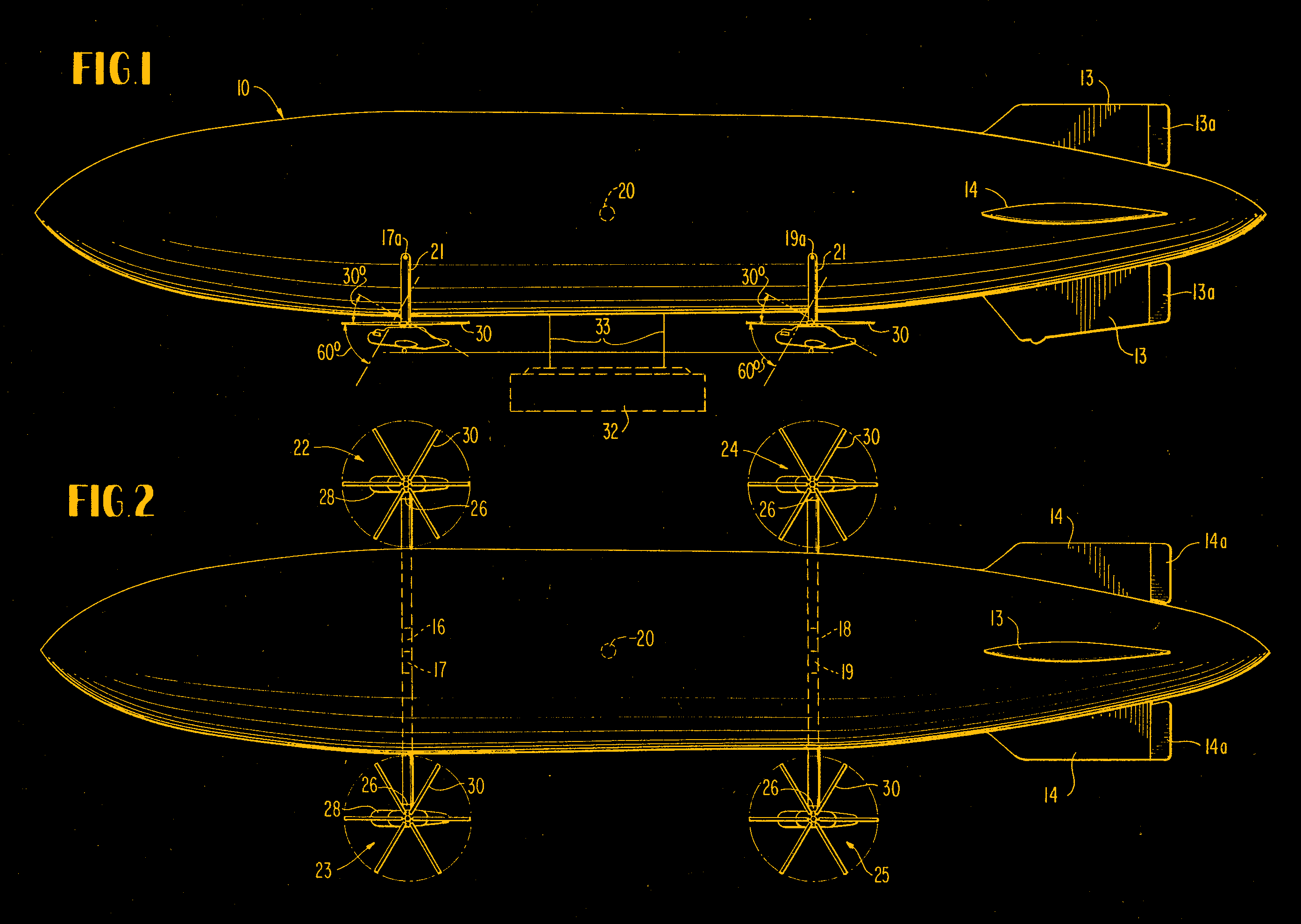
What would eventually become the Piasecki Helistat was first described by U.S. Patent 3,008,655A “Helicopter and Balloon Aircraft Unit”. It differs from the craft that was eventually built mainly in using a spherical helium balloon rather than the aerodynamic gas bag of a blimp. The diagrams in the patents even include a load of logs, an inspired choice given the design was eventually taken up by the U.S. Forest Service. The patent was submitted in March 1958, granted in November 1961, and then absolutely nothing happened with it for over a decade.

In the text of the patent, we see that Piasecki was mostly concerned with increasing the lift capacity of his helicopters using the attached balloon, rather than thinking of this as a new type of airship. That would change with his next patent filing, in 1975, US4,591,112A “Vectored Thrust Airship”. Here the concept is no longer about increasing the lift capacity of helicopters, but explicitly recognizes itself as a sort of airship– and is recognizable as what would be built as the PA-97 starting just five years later.
Now that’s an airship.
Image: Frank Piasecki, US Patent 4,591,112
The gas bag is elongated and aerodynamically suited for higher-speed flight. Gone are the twin ‘flying banana’ copters; instead we see a quartet of gondolas with helicopter-type rotors. Notably the patent specifies “two or more”– but it’s the quadcopter configuration that appears in the figures of the patent and was ultimately built. These rotors are to provide propulsion and direction to the craft, as much as lift– that was to be handled by the gas bag, though like the long-lost Navy blimps the intention was to “fly heavy” and let much of the load be taken up by the rotors.

The key reason to use helicopter rotors on an airship, as the patent describes, is for controllability: by altering the collective and cyclic pitch of multiple rotors, instant torque is available to control the pitch, yaw, and roll of the aircraft. It looks like a modern hobby quadrotor, but because the helistat has cyclic control, it can fly forwards without leaning the whole blimp forwards.

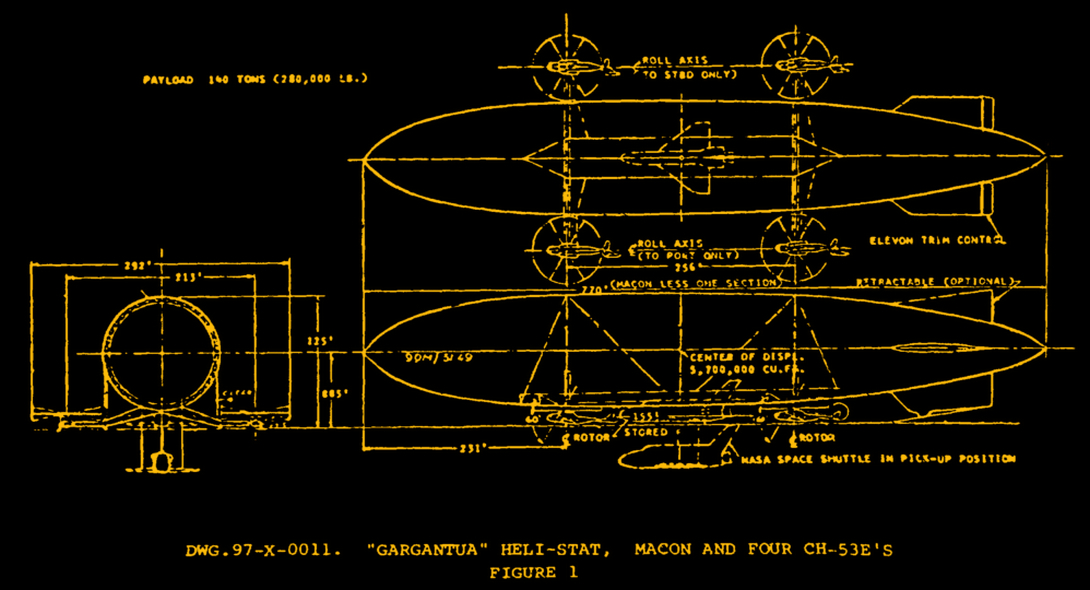
The Piasecki corporation proposed two variants of the concept in 1975: a smaller 75-ton version, designated project X-97-0004, and the X-97-0011 “Gargantua” which was actually pitched to NASA for the Shuttle Carrier Aircraft project. “Gargantua” would have used four CH-53E “Super Stallion” heavy-lift helicopters with a gas bag just slightly smaller than the USS Macon– indeed, internal documents have the caption “four CH-53 and Macon”. In spite of that caption, it was actually shorter than the Macon by a full hull section.

It is likely that this would have been a rigid design, though the only figure I was able to track down only shows two ring girders, fore and aft of the cargo bay that– I cannot emphasize enough–was meant to hold an actual Space Shuttle Orbiter. Well, most of it: the wings would have been flush with the bottom of the gas bag. The 140-ton capacity “Gargantua” was of course never built, which is both immensely disappointing and probably for the best. The design for the 75-ton version also sat on a shelf until it was scaled down far enough to interest the US Forest Service in 1979.
Note the Orbiter for scale, and allow your mind to boggle.
Image: Piasecki Aircraft Corporation

The Flying Forest Service

With concept art this good, what could go wrong?
Image: Piasecki Aircraft Corporation, via the Lyncean Group of San Diego
I did say everything about this aircraft was bizarre, including the agency that commissioned it. As near as I can tell, this is the first and only time the US Forest Service has gotten into the business of building aircraft. Teething problems were perhaps to be expected.

The idea isn’t crazy– by 1979, helicopter logging was a proven concept, limited largely by the lift capacity of existing helicopters. Most of the old-growth timber in the USA was, even by that point, located in the mountain west where building logging roads is prohibitively expensive or downright unsafe. Helicopters are, of course, thirsty beasts when lifting large loads. The hope was that the Helistat would be far more fuel-efficient and pay for itself thereby.

Indeed, the Forest Service optimistically anticipated making most of their money back off the development programme. It was believed that over a three-year test period, the 25-tonne lift Helistat would be able to harvest $19.7 million worth of timber, against a total programme cost of only $25 million.

Twenty five million, to develop a whole new class of aircraft. Even in 80s dollars, that seems absurdly optimistic, doesn’t it? Well, we did say the Forest Service really hadn’t done this before. Teething problems were bound to happen, and those teething problems drove the cost up to a hundred million by the end of the project in 1986.

It’s hard to see where the money went, though: it certainly wasn’t into the airframe. The gas-bag, as mentioned above, was essentially dumpster-dived from US Navy stores. The four piston-powered Sikorski H-34J helicpoters had been retired over a decade before, and it’s alleged that they were pulled from the boneyard specifically for this project. There are even allegations online that the rickety-looking aluminum framework holding the helicopters to the gas bag was made with scrap metal! Given that Frank Piasecki was apparently into his Red Green era, I would not at all be surprised to find out that holes in the ex-Navy gas bag had been patched with duct tape.
The PA-97 in its hanger at LakehurstThe light-coloured patches probably aren’t duct tape, but it would be on-theme at this point. That might be why the gas bag reads “Forest Service” — the US Navy was distancing itself from the project by the end.
The ZPG-2W gas bag that they found had a volume of 1,000,000 cu.ft (28,317 cu.m), providing up to 55,851 lb (25,334 kg) of aerostatic lift when inflated with helium. The remainder of the Helistat’s 107,051 lb (48,558 kg) gross weight was accounted for by the dynamic lift provided by the four Vietnam-era helicopters. Since the empty weight was less than the aerostatic lift– only 54,885 lb (24,895 kg), the helicopters would be responsible only for propulsion and vectored thrust until the helistat picked up its first load of logs. Alas, that never happened.

The Last Flight of the Helistat


Unlike many new designs, the PA-97 did not crash on its first flight, or even its second. Fifteen untethered flights demonstrated that the concept worked: even without modern fly-by-wire to link the helicopters, the craft was controllable. With a pilot and four flight engineers at the controls, the Helistat could take off, it could hover, it could fly, and it could land.

So what happened? What it couldn’t do was withstand its own vibrations. On what was to be the last test flight on the first of July, 1986, a gust of wind started a shimmy in one of the four free-wheeling casters that the craft used as landing gear. Think of a shopping cart with a shaking wheel. Just like the shopping cart, there was nothing to dampen the wheel shimmy, so it progressed. The pilot took off, but by that point the vibrations had already started into the airframe, triggering some kind of resonance mode that the helicopter engine or rotor contributed to. It’s also possible that the shaking of the airframe triggered “ground resonance”, a destructive shaking of the helicopter rotor. In any case, the Helistat literally shook itself apart, as one helicopter decoupled from the airframe, followed quickly by the other three.

youtube.com/embed/_7jENWKgMPY?…

Like most accidents of this nature, it’s easy to diagnose the faults in hindsight. A proper vibrational analysis should have been performed on the airframe– that would be fairly trivial today, but Piasecki Helicopters hadn’t yet computerized in the early 1980s. Vibrational analysis of that nature is far from trivial to do by hand. Contemporary critics decried the “slide-rule engineering” at work in the project even before the accident, and it’s likely it contributed to the disaster. Even just fitting a damper to the casters, on general principles, could perhaps have avoided the crash.

There were two casualties that day: test pilot Gary Oleshfski, and the very concept of the Helistat. The program, which was already far over budget, was immediately cancelled. As the meme goes: if I had a nickel for every type of aircraft whose entire class was discredited by a single example crashing at Lakehurst, NJ due to an avoidable design fault, I’d have two nickels. Which isn’t a lot but it’s weird it happened twice.

No Second Chances

Rendering of a Skyhook helistat over a pipelineThe SkyHook might have flown by 2014, if it wasn’t for the credit crunch.
Image: Boeing.
Piasecki Aircraft Corporation sought to find another patron to finish the design after the crash. They had been shopping it around to the construction, oil, and shipping industries along with the military before things went pear shaped. Their patent expired in 2003, and a Canadian company called SkyHook attempted to revive the Helistat concept, but a combination of the history of the crash and the sheer weirdness of the concept kept investors at bay, in spite of a partnership with Boeing. The SkyHook was perhaps also a victim of remarkably bad timing, as they were ready to start construction in 2008, a year not known for easy credit.

Still, we recently saw [rctestflight] demonstrate what you can do with collective control on a quadcopter– all you’d need to do would be strap a balloon to it, and you’d be most of the way to reviving the Helistat. If anyone tries that, please send a tip, and we can argue which is more of a hack: that hypothetical project, or the time a guy bolted four helicopters to a busted old blimp.


hackaday.com/2026/04/14/four-c…

Cybersecurity & cyberwarfare ha ricondiviso questo.

Una verifica independente condotta sui siti web più popolari in California mostra che il 55% mantiene i #cookie nonostante il consenso negato e che il 78% dei cookie banner non sono effettivi

Perché in California? Perché è uno degli Stati #USA (pochi) che applica una propria legge sull'#eprivacy

Il totale delle sanzioni potrebbe superare i 5,8 miliardi USD

Le info si trovano qui: globalprivacyaudit.org/2026/ca…

#privacy #surveillance #sorveglianza
@sicurezza

Cybersecurity & cyberwarfare ha ricondiviso questo.

È difficile avere foto dei danni nei paesi del Golfo

Sono state arrestate centinaia di persone che le hanno diffuse online: c'è una ragione di sicurezza, e una di propaganda

ilpost.it/2026/04/14/censura-g…

@politica

reshared this

Cybersecurity & cyberwarfare ha ricondiviso questo.

The media in this post is not displayed to visitors. To view it, please go to the original post.

Azure MCP Server 2.0: 276 strumenti per integrare Azure negli agenti AI
#tech
spcnet.it/azure-mcp-server-2-0…
@informatica


Azure MCP Server 2.0: 276 strumenti per integrare Azure negli agenti AI


Il Model Context Protocol (MCP) sta rapidamente diventando lo standard de facto per consentire agli agenti AI di interagire con servizi e strumenti esterni. Microsoft ha appena rilasciato la versione 2.0 stabile di Azure MCP Server, un passo significativo che porta a 276 strumenti distribuiti su 57 servizi Azure direttamente accessibili da qualsiasi agente o IDE compatibile con MCP.

Cos’è Azure MCP Server?


Azure MCP Server è un’implementazione del Model Context Protocol che funge da ponte tra gli agenti AI e l’ecosistema Azure. Invece di dover scrivere codice di integrazione personalizzato per ogni servizio, un agente AI può semplicemente “scoprire” e utilizzare i tool messi a disposizione dal server MCP, che includono operazioni di provisioning, deployment, monitoraggio e diagnostica su decine di servizi Azure.

L’idea centrale è quella di rendere le operazioni su Azure talmente naturali per un agente AI quanto lo è per un programmatore umano navigare sul portale Azure o usare la CLI. La versione 2.0 segna la transizione da una release preview a un prodotto stabile e pronto per l’uso in produzione.

Le principali novità della versione 2.0

Deployment remoto self-hosted


La novità più significativa di questa release è il supporto al deployment remoto. Nelle versioni precedenti, il server MCP doveva girare localmente sulla macchina dello sviluppatore. Con la 2.0, è possibile distribuire Azure MCP Server come servizio centralizzato, accessibile da tutto il team o dall’intera organizzazione tramite trasporto HTTP.

Questo cambia radicalmente le possibilità di adozione enterprise: invece di configurare ogni sviluppatore individualmente, il team di platform engineering può mantenere un’istanza centralizzata con configurazione e governance coerenti. Meno deriva di configurazione, più sicurezza, un unico punto di aggiornamento.

Integrazione con Microsoft Foundry e flusso OBO


La versione 2.0 introduce il supporto per il flusso On-Behalf-Of (OBO), noto anche come OpenID Connect delegation. Questo meccanismo consente al server MCP di chiamare le API Azure usando il contesto dell’utente autenticato, mantenendo la separazione delle identità e rispettando i permessi RBAC assegnati al singolo utente.

L’integrazione con Microsoft Foundry consente di usare le managed identity direttamente, semplificando la gestione delle credenziali in ambienti cloud-native senza dover gestire segreti esplicitamente.

Security hardening


Con il passaggio a stable, Microsoft ha rafforzato significativamente la sicurezza del server:

  • Validazione endpoint più rigorosa
  • Protezioni contro pattern di injection nei tool di query
  • Controlli di isolamento più stringenti

Questi miglioramenti sono essenziali per l’adozione in contesti enterprise dove la superficie di attacco deve essere minimizzata.

Supporto sovereign cloud


Azure MCP Server 2.0 è ora configurabile per operare su Azure US Government e Azure operated by 21Vianet (il cloud sovrano cinese), ampliando notevolmente la portata per organizzazioni soggette a requisiti di sovranità dei dati.

Come installare e usare Azure MCP Server


Il server è disponibile attraverso diversi canali di distribuzione, adatti a scenari diversi:

Via IDE extension


La via più semplice per gli sviluppatori è attraverso le estensioni per i principali IDE:

  • Visual Studio Code
  • Visual Studio
  • IntelliJ / Eclipse
  • Cursor

Una volta installata l’estensione, il server MCP viene configurato automaticamente e i tool Azure diventano disponibili nell’assistente AI del tuo IDE.

Via GitHub Copilot CLI o Claude Code


Per chi lavora da terminale, Azure MCP Server si integra nativamente con GitHub Copilot CLI e Claude Code, consentendo di gestire risorse Azure direttamente dalla riga di comando con il supporto dell’AI.

Via Docker (deployment self-hosted)


Per il deployment remoto centralizzato, Microsoft fornisce un’immagine Docker ufficiale:

# Scarica l'immagine Docker
docker pull mcr.microsoft.com/azure-mcp-server:latest

# Esegui il server localmente
docker run -p 8080:8080 mcr.microsoft.com/azure-mcp-server:latest


La documentazione completa per il self-hosting è disponibile su aka.ms/azmcp/self-host.

Panoramica degli strumenti disponibili


Con 276 tool distribuiti su 57 servizi Azure, la copertura è notevolmente ampia. Gli strumenti coprono l’intero ciclo di vita delle risorse cloud:

  • Provisioning e deployment: creare e configurare risorse Azure (VM, App Service, AKS, ecc.)
  • Monitoraggio e diagnostica: interrogare Azure Monitor, Log Analytics, Application Insights
  • Gestione identità: interagire con Microsoft Entra ID, gestire service principal e managed identity
  • Storage e database: operazioni su Blob Storage, Cosmos DB, Azure SQL
  • Networking: configurazione di VNet, DNS, load balancer
  • Servizi AI: integrazione con Azure OpenAI, AI Foundry, Cognitive Services


Implicazioni per il workflow degli sviluppatori


L’arrivo di Azure MCP Server 2.0 stabile ha implicazioni concrete per i team di sviluppo che usano Azure:

Meno context switching: gli sviluppatori possono interrogare lo stato dei loro servizi Azure, diagnosticare problemi e persino deployare aggiornamenti senza uscire dall’IDE o passare al portale Azure.

Automazione conversazionale: invece di ricordare i comandi esatti della Azure CLI, è possibile descrivere in linguaggio naturale l’operazione desiderata e lasciare che l’agente AI formuli la chiamata corretta al tool MCP.

Governance centralizzata: con il deployment self-hosted, le organizzazioni possono controllare centralmente quali tool sono disponibili, chi può usarli e in che contesto, mantenendo audit trail completi.

Conclusione


Azure MCP Server 2.0 rappresenta un passo maturo verso l’integrazione dell’AI nei workflow operativi su cloud. Il supporto al deployment remoto e al flusso OBO erano i due tasselli mancanti per l’adozione enterprise, e la loro disponibilità in una release stabile apre scenari concreti di adozione su larga scala.

Per i team che già usano GitHub Copilot o altri agenti AI nel loro IDE, la barriera di ingresso è minima: basta installare l’estensione e il ricco catalogo di tool Azure diventa immediatamente disponibile. Per chi vuole andare oltre, il deployment self-hosted offre la flessibilità necessaria per integrarlo nei flussi platform engineering più sofisticati.

Fonte originale: Announcing Azure MCP Server 2.0 Stable Release — Sandeep Sen, Microsoft Azure SDK Blog


Cybersecurity & cyberwarfare ha ricondiviso questo.

US, UK and Canada disrupt $45M crypto theft in #Operation #Atlantic
securityaffairs.com/190805/cyb…
#securityaffairs #hacking
Cybersecurity & cyberwarfare ha ricondiviso questo.

The media in this post is not displayed to visitors. To view it, please go to the original post.

The media in this post is not displayed to visitors. To view it, please go to the original post.

Phishing SPID contro le Pubbliche Amministrazioni: CERT-AGID smonta la campagna che usa siti WordPress legittimi per rubare credenziali istituzionali
#CyberSecurity
insicurezzadigitale.com/phishi…


Phishing SPID contro le Pubbliche Amministrazioni: CERT-AGID smonta la campagna che usa siti WordPress legittimi per rubare credenziali istituzionali


Un’istanza WordPress compromessa, loghi dell’Agenzia delle Entrate e del Sistema Pubblico d’Identità Digitale riprodotti con precisione millimetrica, link personalizzati con l’email della vittima pre-compilata: CERT-AGID ha rilevato una nuova campagna di phishing che prende di mira le Pubbliche Amministrazioni italiane, con l’obiettivo di sottrarre credenziali SPID e accessi istituzionali. L’analisi tecnica rivela un attacco che sfrutta l’infrastruttura legittima per eludere i filtri antispam e conquistare la fiducia delle vittime.

Il Vettore: un’infrastruttura legittima trasformata in arma


Il primo elemento che distingue questa campagna dalle operazioni di phishing più rudimentali è la scelta dell’infrastruttura. Gli attaccanti non hanno registrato domini malevoli evidenti — hanno invece compromesso un server WordPress legittimo (documentato all’indirizzo wp-dev.typhur.com/agenziaentrate/), sfruttandone la reputazione consolidata per eludere i filtri antispam e i sistemi di blacklist automatici.

Un sito web legittimo offre agli attaccanti tre vantaggi competitivi fondamentali: certificati HTTPS validi che mostrano il lucchetto verde nel browser delle vittime, una reputazione di dominio già stabilita che bypassa i filtri di sicurezza email, e la capacità di ospitare contenuto HTML arbitrario che replica fedelmente le interfacce istituzionali italiane. Il vettore di compromissione del WordPress è quasi certamente legato a plugin o temi non aggiornati — il vettore più comune per questo tipo di hijacking.

Anatomia dell’attacco: come funziona la truffa SPID


La catena di attacco documentata da CERT-AGID si articola in più fasi progettate per massimizzare la credibilità e minimizzare i campanelli d’allarme per la vittima:

  • Fase 1 — Email di spearphishing personalizzata: la vittima riceve una comunicazione che la invita ad accedere alla propria area riservata dell’Agenzia delle Entrate-Riscossione. Il link contenuto nell’email è personalizzato e include già l’indirizzo email del destinatario come parametro URL.
  • Fase 2 — Pagina di login pre-compilata: cliccando il link, la vittima atterra su una pagina che replica fedelmente il portale dell’Agenzia delle Entrate, completa di loghi ufficiali di AdE, SPID e AgID. La casella email è già compilata con il proprio indirizzo — un elemento che abbassa drasticamente il livello di sospetto e aumenta la probabilità di inserimento della password.
  • Fase 3 — Harvesting delle credenziali: al momento dell’invio, la password viene trasmessa ai server degli attaccanti. La vittima viene quindi reindirizzata al sito reale dell’Agenzia delle Entrate dove appare un messaggio di errore simulato — un “errore di sistema generico” che rende plausibile la necessità di reinserire le credenziali.
  • Fase 4 — Accesso istituzionale: con le credenziali SPID compromesse, gli attaccanti ottengono potenzialmente accesso a tutti i servizi della Pubblica Amministrazione collegati all’identità digitale: portali fiscali, documenti istituzionali, sistemi interni delle PA.


Target primario: Pubbliche Amministrazioni


L’aspetto più allarmante della campagna, come sottolineato da CERT-AGID, è la natura del target primario: non utenti consumer generici, ma dipendenti e funzionari delle Pubbliche Amministrazioni italiane. Questa scelta non è casuale. Le credenziali SPID di un funzionario PA offrono un accesso privilegiato a sistemi interni, documenti riservati e portali interistituzionali che un account privato non avrebbe. La compromissione di un account PA può diventare il punto di partenza per movimenti laterali all’interno dei sistemi governativi, attacchi BEC (Business Email Compromise) verso altre istituzioni, e persino accessi a dati sensibili di cittadini.

MITRE ATT&CK: mappatura delle tecniche


  • T1566.002 — Phishing: Spearphishing Link: link personalizzati con l’email della vittima pre-inserita per massimizzare la credibilità
  • T1078 — Valid Accounts: compromissione di account SPID legittimi per accesso a sistemi istituzionali
  • T1190 — Exploit Public-Facing Application: compromissione del server WordPress tramite vulnerabilità in plugin/temi per uso come infrastruttura di phishing
  • T1036 — Masquerading: replica accurata dell’interfaccia di portali governativi legittimi (AdE, SPID, AgID)
  • T1589.002 — Gather Victim Identity Information: Email Addresses: utilizzo di indirizzi email pre-identificati nei link personalizzati


Indicatori di Compromissione (IoC)

# Domini malevoli identificati
agenziadelleentrate.live          # Dominio typosquatting principale
wp-dev.typhur.com/agenziaentrate/ # WordPress compromesso usato come host
# Dominio mittente email
@propiski.com                     # Utilizzato come sender domain nelle email di phishing
# Dominio di reindirizzamento
sushicool.net                     # Usato come redirect dopo la sottrazione delle credenziali
# File IoC ufficiale CERT-AGID
phishing_AdE_10_04_26.json        # Disponibile tramite feed ufficiale CERT-AGID

Il contesto: una campagna seriale contro l’Identità Digitale italiana


Questa campagna non nasce dal nulla. L’Agenzia delle Entrate ha emesso un avviso ufficiale già il 30 marzo 2026, segnalando campagne attive che sfruttano impropriamente i loghi di AdE, SPID e AgID. La storia recente mostra un pattern ricorrente: gli attori malevoli hanno identificato nel sistema SPID un bersaglio appetibile perché rappresenta la chiave di accesso unificata ai servizi digitali della PA italiana. Compromettere uno SPID significa potenzialmente accedere a decine di portali governativi con un’unica credenziale.

La tecnica di compromissione di siti WordPress legittimi come piattaforma di phishing è altrettanto consolidata: consente di sfruttare la reputazione del dominio ospitante e i certificati TLS validi per superare i controlli automatici, scaricando il costo di mantenimento dell’infrastruttura sull’ignaro proprietario del sito compromesso.

Raccomandazioni per i difensori e le Pubbliche Amministrazioni


  • MFA obbligatoria su tutti gli account istituzionali: l’autenticazione a due fattori vanifica il phishing di credenziali anche quando la vittima inserisce username e password sulla pagina falsa
  • Formazione specifica sul phishing SPID: i dipendenti PA devono sapere che l’Agenzia delle Entrate non chiede mai credenziali via email; l’accesso ai portali fiscali va effettuato sempre digitando manualmente l’URL o utilizzando bookmark certificati
  • Monitoraggio del feed IoC CERT-AGID: l’integrazione automatica del feed JSON di CERT-AGID nei propri sistemi di sicurezza permette il blocco in tempo reale dei domini malevoli identificati
  • Verifica dell’URL nel browser: prima di inserire qualsiasi credenziale SPID, verificare che l’URL nella barra del browser corrisponda esattamente al dominio ufficiale (agenziaentrate.gov.it)
  • Audit CMS e aggiornamento plugin: le organizzazioni che gestiscono siti WordPress devono implementare processi di patch management rigorosi per evitare che le proprie infrastrutture vengano weaponizzate come piattaforme di phishing
  • Segnalazione a CERT-AGID: eventuali email sospette che impersonano l’Agenzia delle Entrate vanno segnalate immediatamente all’indirizzo dedicato di CERT-AGID per l’aggiornamento del feed IoC

Il CERT-AGID ha già avvisato le organizzazioni coinvolte e richiesto il takedown delle pagine di phishing identificate. Tuttavia, data la natura delle campagne di phishing — che spesso cambiano rapidamente infrastruttura per sopravvivere ai takedown — il monitoraggio continuo rimane essenziale.


The media in this post is not displayed to visitors. To view it, please log in.

Phishing SPID contro le Pubbliche Amministrazioni: CERT-AGID smonta la campagna che usa siti WordPress legittimi per rubare credenziali istituzionali


@Informatica (Italy e non Italy)
CERT-AGID ha rilevato una campagna di phishing che impersona l'Agenzia delle Entrate-Riscossione per sottrarre


Phishing SPID contro le Pubbliche Amministrazioni: CERT-AGID smonta la campagna che usa siti WordPress legittimi per rubare credenziali istituzionali


Un’istanza WordPress compromessa, loghi dell’Agenzia delle Entrate e del Sistema Pubblico d’Identità Digitale riprodotti con precisione millimetrica, link personalizzati con l’email della vittima pre-compilata: CERT-AGID ha rilevato una nuova campagna di phishing che prende di mira le Pubbliche Amministrazioni italiane, con l’obiettivo di sottrarre credenziali SPID e accessi istituzionali. L’analisi tecnica rivela un attacco che sfrutta l’infrastruttura legittima per eludere i filtri antispam e conquistare la fiducia delle vittime.

Il Vettore: un’infrastruttura legittima trasformata in arma


Il primo elemento che distingue questa campagna dalle operazioni di phishing più rudimentali è la scelta dell’infrastruttura. Gli attaccanti non hanno registrato domini malevoli evidenti — hanno invece compromesso un server WordPress legittimo (documentato all’indirizzo wp-dev.typhur.com/agenziaentrate/), sfruttandone la reputazione consolidata per eludere i filtri antispam e i sistemi di blacklist automatici.

Un sito web legittimo offre agli attaccanti tre vantaggi competitivi fondamentali: certificati HTTPS validi che mostrano il lucchetto verde nel browser delle vittime, una reputazione di dominio già stabilita che bypassa i filtri di sicurezza email, e la capacità di ospitare contenuto HTML arbitrario che replica fedelmente le interfacce istituzionali italiane. Il vettore di compromissione del WordPress è quasi certamente legato a plugin o temi non aggiornati — il vettore più comune per questo tipo di hijacking.

Anatomia dell’attacco: come funziona la truffa SPID


La catena di attacco documentata da CERT-AGID si articola in più fasi progettate per massimizzare la credibilità e minimizzare i campanelli d’allarme per la vittima:

  • Fase 1 — Email di spearphishing personalizzata: la vittima riceve una comunicazione che la invita ad accedere alla propria area riservata dell’Agenzia delle Entrate-Riscossione. Il link contenuto nell’email è personalizzato e include già l’indirizzo email del destinatario come parametro URL.
  • Fase 2 — Pagina di login pre-compilata: cliccando il link, la vittima atterra su una pagina che replica fedelmente il portale dell’Agenzia delle Entrate, completa di loghi ufficiali di AdE, SPID e AgID. La casella email è già compilata con il proprio indirizzo — un elemento che abbassa drasticamente il livello di sospetto e aumenta la probabilità di inserimento della password.
  • Fase 3 — Harvesting delle credenziali: al momento dell’invio, la password viene trasmessa ai server degli attaccanti. La vittima viene quindi reindirizzata al sito reale dell’Agenzia delle Entrate dove appare un messaggio di errore simulato — un “errore di sistema generico” che rende plausibile la necessità di reinserire le credenziali.
  • Fase 4 — Accesso istituzionale: con le credenziali SPID compromesse, gli attaccanti ottengono potenzialmente accesso a tutti i servizi della Pubblica Amministrazione collegati all’identità digitale: portali fiscali, documenti istituzionali, sistemi interni delle PA.


Target primario: Pubbliche Amministrazioni


L’aspetto più allarmante della campagna, come sottolineato da CERT-AGID, è la natura del target primario: non utenti consumer generici, ma dipendenti e funzionari delle Pubbliche Amministrazioni italiane. Questa scelta non è casuale. Le credenziali SPID di un funzionario PA offrono un accesso privilegiato a sistemi interni, documenti riservati e portali interistituzionali che un account privato non avrebbe. La compromissione di un account PA può diventare il punto di partenza per movimenti laterali all’interno dei sistemi governativi, attacchi BEC (Business Email Compromise) verso altre istituzioni, e persino accessi a dati sensibili di cittadini.

MITRE ATT&CK: mappatura delle tecniche


  • T1566.002 — Phishing: Spearphishing Link: link personalizzati con l’email della vittima pre-inserita per massimizzare la credibilità
  • T1078 — Valid Accounts: compromissione di account SPID legittimi per accesso a sistemi istituzionali
  • T1190 — Exploit Public-Facing Application: compromissione del server WordPress tramite vulnerabilità in plugin/temi per uso come infrastruttura di phishing
  • T1036 — Masquerading: replica accurata dell’interfaccia di portali governativi legittimi (AdE, SPID, AgID)
  • T1589.002 — Gather Victim Identity Information: Email Addresses: utilizzo di indirizzi email pre-identificati nei link personalizzati


Indicatori di Compromissione (IoC)

# Domini malevoli identificati
agenziadelleentrate.live          # Dominio typosquatting principale
wp-dev.typhur.com/agenziaentrate/ # WordPress compromesso usato come host
# Dominio mittente email
@propiski.com                     # Utilizzato come sender domain nelle email di phishing
# Dominio di reindirizzamento
sushicool.net                     # Usato come redirect dopo la sottrazione delle credenziali
# File IoC ufficiale CERT-AGID
phishing_AdE_10_04_26.json        # Disponibile tramite feed ufficiale CERT-AGID

Il contesto: una campagna seriale contro l’Identità Digitale italiana


Questa campagna non nasce dal nulla. L’Agenzia delle Entrate ha emesso un avviso ufficiale già il 30 marzo 2026, segnalando campagne attive che sfruttano impropriamente i loghi di AdE, SPID e AgID. La storia recente mostra un pattern ricorrente: gli attori malevoli hanno identificato nel sistema SPID un bersaglio appetibile perché rappresenta la chiave di accesso unificata ai servizi digitali della PA italiana. Compromettere uno SPID significa potenzialmente accedere a decine di portali governativi con un’unica credenziale.

La tecnica di compromissione di siti WordPress legittimi come piattaforma di phishing è altrettanto consolidata: consente di sfruttare la reputazione del dominio ospitante e i certificati TLS validi per superare i controlli automatici, scaricando il costo di mantenimento dell’infrastruttura sull’ignaro proprietario del sito compromesso.

Raccomandazioni per i difensori e le Pubbliche Amministrazioni


  • MFA obbligatoria su tutti gli account istituzionali: l’autenticazione a due fattori vanifica il phishing di credenziali anche quando la vittima inserisce username e password sulla pagina falsa
  • Formazione specifica sul phishing SPID: i dipendenti PA devono sapere che l’Agenzia delle Entrate non chiede mai credenziali via email; l’accesso ai portali fiscali va effettuato sempre digitando manualmente l’URL o utilizzando bookmark certificati
  • Monitoraggio del feed IoC CERT-AGID: l’integrazione automatica del feed JSON di CERT-AGID nei propri sistemi di sicurezza permette il blocco in tempo reale dei domini malevoli identificati
  • Verifica dell’URL nel browser: prima di inserire qualsiasi credenziale SPID, verificare che l’URL nella barra del browser corrisponda esattamente al dominio ufficiale (agenziaentrate.gov.it)
  • Audit CMS e aggiornamento plugin: le organizzazioni che gestiscono siti WordPress devono implementare processi di patch management rigorosi per evitare che le proprie infrastrutture vengano weaponizzate come piattaforme di phishing
  • Segnalazione a CERT-AGID: eventuali email sospette che impersonano l’Agenzia delle Entrate vanno segnalate immediatamente all’indirizzo dedicato di CERT-AGID per l’aggiornamento del feed IoC

Il CERT-AGID ha già avvisato le organizzazioni coinvolte e richiesto il takedown delle pagine di phishing identificate. Tuttavia, data la natura delle campagne di phishing — che spesso cambiano rapidamente infrastruttura per sopravvivere ai takedown — il monitoraggio continuo rimane essenziale.


Utenti Booking attaccati, che succede e come difendersi


@Informatica (Italy e non Italy)
Il più grande sito di viaggi online conferma di aver "rilevato alcune attività sospette legate all’accesso non autorizzato, da parte di soggetti terzi, ad alcune informazioni di prenotazione dei nostri utenti". Tuttavia al contempo nega l'accesso alle informazioni finanziarie dai sistemi di

Cybersecurity & cyberwarfare ha ricondiviso questo.

The media in this post is not displayed to visitors. To view it, please go to the original post.

Rockstar Games vittima di un nuovo attacco hacker da parte di ShinyHunters

📌 Link all'articolo : redhotcyber.com/post/rockstar-…

A cura di Bajram Zeqiri

#redhotcyber #news #rockstargames #hackeraggio #shinyhunters #anodot #sicurezzainformatica

New Linux Kernel Rules Put the Onus on Humans for AI Tool Usage


The media in this post is not displayed to visitors. To view it, please log in.

It’s fair to say that the topic of so-called ‘AI coding assistants’ is somewhat controversial. With arguments against them ranging from code quality to copyright issues, there are many valid reasons to be at least hesitant about accepting their output in a project, especially one as massive as the Linux kernel. With a recent update to the Linux kernel documentation the use of these tools has now been formalized.

The upshot of the use of such Large Language Models (LLM) tools is that any commit that uses generated code has to be signed off by a human developer, and this human will ultimately bear responsibility for the code quality as well as any issues that the code may cause, including legal ones. The use of AI tools also has to be declared with the Assisted-by: tag in contributions so that their use can be tracked.

When it comes to other open source projects the approach varies, with NetBSD having banished anything tainted by ‘AI’, cURL shuttering its bug bounty program due to AI code slop, and Mesa’s developers demanding that you understand generated code which you submit, following a tragic slop-cident.

Meanwhile there is also rising concerns that these LLM-based tools may be killing open source through ‘vibe-coding’, along with legal concerns whether LLM-generated code respects the original license of the code that was ingested into the training model. Clearly we haven’t seen the end of these issues yet.


hackaday.com/2026/04/14/new-li…

Cybersecurity & cyberwarfare ha ricondiviso questo.

#ShinyHunters claim the hack of #Rockstar #Games breach and started leaking data
securityaffairs.com/190796/cyb…
#securityaffairs #hacking #GTA

Booking.com sotto attacco, a rischio dati personali e prenotazioni, salvi i pagamenti?


@Informatica (Italy e non Italy)
Bucate le difese di Booking.com: a rischio i dati personali degli utenti. Rassicurazioni sui pagamenti, ma cresce l’allerta Booking.com finisce nel mirino degli hacker. La nota piattaforma di prenotazioni online ha confermato di aver subito un

Cybersecurity & cyberwarfare ha ricondiviso questo.

The media in this post is not displayed to visitors. To view it, please go to the original post.

The media in this post is not displayed to visitors. To view it, please go to the original post.

APT35 e la Cyber Guerra Parallela: come l’Iran aveva già compromesso ogni paese colpito nell’Operazione Epic Fury
#CyberSecurity
insicurezzadigitale.com/apt35-…


APT35 e la Cyber Guerra Parallela: come l’Iran aveva già compromesso ogni paese colpito nell’Operazione Epic Fury


Si parla di:
Toggle


Prima che i missili iraniani illuminassero il cielo di sette nazioni, un’altra guerra era già in corso nelle reti digitali di quei paesi. L’analisi della campagna condotta da APT35 rivela come il gruppo legato all’IRGC avesse sistematicamente compromesso le infrastrutture critiche di ogni paese successivamente colpito dall’Operazione Epic Fury, trasformando la cyber intelligence in un componente integrale della dottrina militare iraniana.

La notte del 28 Febbraio: quando la guerra digitale diventa fisica


Il 28 febbraio 2026, Stati Uniti e Israele hanno lanciato l’Operazione Epic Fury (denominata “Operazione Roaring Lion” dalla parte israeliana): oltre 1.250 obiettivi colpiti nelle prime 48 ore, infrastrutture nucleari iraniane distrutte, connettività internet dell’Iran ridotta all’1-4% dei livelli normali in quello che è stato definito il più grande cyberattacco della storia. Ma ciò che i rapporti di intelligence successivi hanno rivelato è ancora più preoccupante: l’Iran non si trovava impreparato. Per mesi, forse anni, i suoi gruppi APT affiliati all’IRGC e al MOIS avevano già mappato, compromesso e pre-posizionato capacità offensive nelle reti digitali di ogni paese che avrebbe poi colpito.

APT35 e la dottrina della Pre-Posizione


APT35 — conosciuto anche come Charming Kitten, Phosphorus, Magic Hound e Mint Sandstorm — è il gruppo cyber più rappresentativo dell’IRGC Intelligence Organisation (Unit 1500, Department 40), attivo almeno dal 2014. La sua caratteristica distintiva non è la sofisticazione tecnica delle singole operazioni, ma la pazienza strategica: operazioni di ricognizione prolungate, accesso silenzioso mantenuto per mesi o anni prima di un’attivazione.

Secondo le analisi di CloudSek e dei ricercatori di IT Nerd, APT35 aveva documentabilmente compromesso infrastrutture nei seguenti paesi prima dei bombardamenti:

  • Giordania: accesso ai dati dell’aviazione civile e al Ministero della Giustizia
  • Emirati Arabi Uniti: sistemi di aviazione e asset governativi a Dubai
  • Arabia Saudita: documenti governativi e infrastrutture energetiche; il malware Shamoon ha distrutto circa 15.000 workstation nel settore energetico saudita prima delle operazioni cinetiche
  • Kuwait, Bahrain, Qatar: attività di ricognizione e targeting operativo
  • Israele: sistemi industriali e infrastrutture civili


Il modello di conflitto a tre fasi


L’analisi degli eventi suggerisce un modello di conflitto ibrido strutturato in tre fasi sequenziali, ormai consolidato nella dottrina iraniana:

  • Fase 1 — Ricognizione estesa e silenziosa: compromissione di sistemi internet-facing (Exchange Server, VPN, Fortinet FortiOS), installazione di webshell, tunneling nascosto, raccolta di intelligence su reti, persone e infrastrutture critiche
  • Fase 2 — Degradazione pre-cinetica: attivazione di malware wiper (come Shamoon) per distruggere workstation, esfiltrazione di documenti strategici, interruzione di servizi prima degli attacchi fisici
  • Fase 3 — Coordinamento post-attacco: entro 24 ore dall’avvio delle operazioni militari, creazione di un “Electronic Operations Room” che ha coordinato oltre 60 gruppi hacktivist per colpire contemporaneamente infrastrutture governative, finanziarie e critiche


L’ecosistema APT iraniano: non solo APT35


APT35 non ha operato in isolamento. Il Tenable Research ha identificato 12 gruppi APT iraniani attivi nelle settimane e mesi precedenti l’Operazione Epic Fury, coordinati attraverso strutture parallele:

Gruppi IRGC-affiliati: Pioneer Kitten (Fox Kitten, UNC757), Imperial Kitten (Tortoiseshell, TA456), CyberAv3ngers — quest’ultimo specializzato nel targeting di sistemi OT e PLC nei sistemi idrici. Gruppi MOIS-affiliati: APT34/OilRig (nuova infrastruttura per attacchi ed esfiltrazione), MuddyWater/Mango Sandstorm (picco di attività nella rete nel settembre 2025, con server distribuiti in Russia, Estonia e UK), Banished Kitten/Void Manticore (usa la persona Handala, wiper-focused). Gruppi IRGC-IO: APT42 (credential harvesting tramite social engineering). Gruppi IRGC-CEC: Cotton Sandstorm (revival della persona Altoufan Team).

Infrastruttura di attacco: offuscamento multi-livello


Particolarmente sofisticata è stata l’architettura di infrastruttura impiegata per mascherare l’attribuzione. Netcrook ha documentato uno schema di offuscamento a tre livelli:

  • Livello base: ISP iraniani (Sefroyek Pardaz Engineering) come punto di origine
  • Bulletproof hosting: ALEXHOST in Moldova e RouterHosting LLC nel Wyoming (USA) come nodi intermedi
  • Shell company layer: società fittizie come Cloudblast (registrata negli USA, operativa a Dubai) e UltaHost (registrazioni UK/USA) per la gestione dell’infrastruttura front-end

Questa architettura ha reso estremamente complessa l’attribuzione rapida e le azioni legali di takedown durante le operazioni.

Vulnerabilità sfruttate: un catalogo di CVE note


Il documento Tenable elenca 67 CVE sfruttate dai gruppi iraniani, incluse vulnerabilità ben note mai patchate da molte organizzazioni. Tra le più critiche:

# CVE sfruttate dai gruppi APT iraniani (selezione)
CVE-2021-26855  # Microsoft Exchange Server - ProxyLogon SSRF
CVE-2021-26858  # Microsoft Exchange - post-auth arbitrary file write
CVE-2021-26857  # Microsoft Exchange - insecure deserialization
CVE-2021-27065  # Microsoft Exchange - post-auth arbitrary file write
CVE-2021-44228  # Apache Log4j2 - Log4Shell RCE
CVE-2022-40684  # Fortinet FortiOS/FortiProxy - authentication bypass
CVE-2020-3153   # Cisco ASA - path traversal
# Malware famiglie associate
BellaCiao        # RAT/implant IRGC (codice sorgente esposto in leak)
Sagheb RAT       # Remote Access Trojan IRGC
Shamoon          # Wiper distruttivo (energia, Arabia Saudita)
# Malware ICS/OT
Custom PLC malware targeting Rockwell Automation (CyberAv3ngers)

Il significato strategico: un nuovo standard di conflitto ibrido


La vicenda dell’Operazione Epic Fury e della sua dimensione cyber non è semplicemente la cronaca di un conflitto mediorientale. È la dimostrazione concreta di come le operazioni cyber siano diventate componenti integrali — non accessorie — della dottrina militare degli stati autoritari. Il pre-posizionamento di APT35 nelle reti dei paesi bersaglio anni prima delle operazioni fisiche stabilisce un precedente: in futuri conflitti, qualsiasi attore statale disporrà presumibilmente di “porte di accesso” già aperte nelle infrastrutture avversarie.

Per i difensori occidentali, la lezione è chiara: la minaccia non inizia il giorno in cui i missili vengono lanciati. Inizia quando un webshell silenzioso viene installato su un server Exchange non patchato da sei mesi.

Indicazioni per i difensori


  • Patch immediata dei sistemi internet-facing: Exchange, FortiOS, Cisco ASA, Log4j sono ancora vettori attivi
  • Audit degli accessi amministrativi: verificare account privilegiati, in particolare su sistemi OT/ICS
  • Webshell hunting: scansione proattiva per webshell su server web esposti, soprattutto su CMS e sistemi legacy
  • Validazione della copertura di detection: testare le soluzioni EDR/XDR contro BellaCiao, Sagheb RAT e le tecniche di tunneling documentate
  • Monitoraggio per nuova infrastruttura hacktivist: i gruppi come Handala e CyberAv3ngers si riorganizzano rapidamente dopo le operazioni


Cybersecurity & cyberwarfare ha ricondiviso questo.

The media in this post is not displayed to visitors. To view it, please go to the original post.

In queste ore si sta verificando un attacco per rubare gli account agli utenti Mastodon. Ecco cosa sapere per evitare le truffe su Mastodon e nel Fediverso con la guida di @FediTips


Il post è stato ripubblicato sul gruppo @fediverso

Come in qualsiasi altro social network, anche su Mastodon e nel più ampio Fediverso potresti imbatterti in truffatori. Ecco come individuarli e cosa fare in caso di dubbio.

  1. Truffa: "Abbiamo bisogno che tu verifichi il tuo account"
  2. Truffa: "Vogliamo pagarti per i post / instaurare una collaborazione / offrirti una ricompensa"
  3. Truffa: "Si prega di modificare temporaneamente l'indirizzo email del proprio account"


NB: questa guida è una traduzione della pagina realizzata da @FediTips

[SEGUE]


1) Esempio di truffa: "Abbiamo bisogno che tu verifichi il tuo account" - Torna al primo messaggio


Qualcuno che si spaccia per un amministratore di un server Mastodon inventa una scusa per richiedere la verifica dell'account, magari sostenendo che l'utente abbia compiuto un'azione sospetta. Successivamente, fornisce un link su cui cliccare per inserire i dati della carta di credito o altre informazioni personali. Non cliccare su questo link e non fornire alcuna informazione: si tratta di una truffa.

Nessun amministratore legittimo ti chiederà mai di verificare il tuo account. Su Mastodon esiste un sistema di verifica, ma è completamente facoltativo e non prevede di cliccare su link sospetti o di fornire dati personali.

@fediverso


[SEGUE] @macfranc@poliversity.it:

In queste ore si sta verificando un attacco per rubare gli account agli utenti Mastodon. Ecco cosa sapere per evitare le truffe su Mastodon e nel Fediverso con la guida di @FediTips


Il post è stato ripubblicato sul gruppo @fediverso

Come in qualsiasi altro social network, anche su Mastodon e nel più ampio Fediverso potresti imbatterti in truffatori. Ecco come individuarli e cosa fare in caso di dubbio.

  1. Truffa: "Abbiamo bisogno che tu verifichi il tuo account"
  2. Truffa: "Vogliamo pagarti per i post / instaurare una collaborazione / offrirti una ricompensa"
  3. Truffa: "Si prega di modificare temporaneamente l'indirizzo email del proprio account"


NB: questa guida è una traduzione della pagina realizzata da @FediTips


[SEGUE]Un esempio di messaggio di truffa su Mastodon.</p&gt;&lt;p&gt;Traduzione del testo:&lt;/p&gt;&lt;p&gt;Aggiornamento dell'account&lt;br&gt;veriifnotif@mastodon.cloud&lt;br&gt;2m&lt;br&gt;timixretroplays Avviso di sicurezza: verifica dell'account richiesta&lt;br&gt;Abbiamo rilevato attività insolite sul tuo account Mastodon. Per garantire la sicurezza dei dati, la tua visibilità è stata temporaneamente limitata.&lt;br&gt;Per ripristinare l'accesso completo e rimuovere tutte le limitazioni, completa la verifica di sicurezza obbligatoria al seguente link:&lt;br&gt;[mastodon.checl751938.pro/18828...]&lt;br&gt;Le restrizioni verranno rimosse automaticamente al termine. Grazie per la collaborazione.&lt;br&gt;Cordiali saluti, Team di sicurezza di Mastodon


Questa voce è stata modificata (2 mesi fa)
Cybersecurity & cyberwarfare ha ricondiviso questo.

The media in this post is not displayed to visitors. To view it, please go to the original post.

Truffe su Mastodon: in considerazione degli attacchi di oggi, abbiamo convertito in "formato mastodon" la guida di @FediTips

La guida è costituita da un thread di sei messaggi, con alcuni riferimenti ipertestuali. Fateci sapere se vi è piaciuta

poliversity.it/@macfranc/11640…

@fediverso

NB: Se volete dare il vostro contributo all'autore della guida originale, potete farlo qui: fedi.tips/about-this-site/

Questa voce è stata modificata (2 mesi fa)
Cybersecurity & cyberwarfare ha ricondiviso questo.

🎙️ Between Two Nerds: How AI will upset state cyber competition

risky.biz/BTN162/

reshared this

Cybersecurity & cyberwarfare ha ricondiviso questo.

Attackers target unpatched #ShowDoc servers via CVE-2025-0520
securityaffairs.com/190790/unc…
#securityaffairs #hacking

The media in this post is not displayed to visitors. To view it, please log in.

APT35 e la Cyber Guerra Parallela: come l’Iran aveva già compromesso ogni paese colpito nell’Operazione Epic Fury


@Informatica (Italy e non Italy)
Prima che i missili iraniani illuminassero il cielo di sette nazioni, i gruppi APT dell'IRGC avevano già compromesso silenziosamente le infrastrutture critiche di quei paesi. L'analisi delle


APT35 e la Cyber Guerra Parallela: come l’Iran aveva già compromesso ogni paese colpito nell’Operazione Epic Fury


Si parla di:
Toggle


Prima che i missili iraniani illuminassero il cielo di sette nazioni, un’altra guerra era già in corso nelle reti digitali di quei paesi. L’analisi della campagna condotta da APT35 rivela come il gruppo legato all’IRGC avesse sistematicamente compromesso le infrastrutture critiche di ogni paese successivamente colpito dall’Operazione Epic Fury, trasformando la cyber intelligence in un componente integrale della dottrina militare iraniana.

La notte del 28 Febbraio: quando la guerra digitale diventa fisica


Il 28 febbraio 2026, Stati Uniti e Israele hanno lanciato l’Operazione Epic Fury (denominata “Operazione Roaring Lion” dalla parte israeliana): oltre 1.250 obiettivi colpiti nelle prime 48 ore, infrastrutture nucleari iraniane distrutte, connettività internet dell’Iran ridotta all’1-4% dei livelli normali in quello che è stato definito il più grande cyberattacco della storia. Ma ciò che i rapporti di intelligence successivi hanno rivelato è ancora più preoccupante: l’Iran non si trovava impreparato. Per mesi, forse anni, i suoi gruppi APT affiliati all’IRGC e al MOIS avevano già mappato, compromesso e pre-posizionato capacità offensive nelle reti digitali di ogni paese che avrebbe poi colpito.

APT35 e la dottrina della Pre-Posizione


APT35 — conosciuto anche come Charming Kitten, Phosphorus, Magic Hound e Mint Sandstorm — è il gruppo cyber più rappresentativo dell’IRGC Intelligence Organisation (Unit 1500, Department 40), attivo almeno dal 2014. La sua caratteristica distintiva non è la sofisticazione tecnica delle singole operazioni, ma la pazienza strategica: operazioni di ricognizione prolungate, accesso silenzioso mantenuto per mesi o anni prima di un’attivazione.

Secondo le analisi di CloudSek e dei ricercatori di IT Nerd, APT35 aveva documentabilmente compromesso infrastrutture nei seguenti paesi prima dei bombardamenti:

  • Giordania: accesso ai dati dell’aviazione civile e al Ministero della Giustizia
  • Emirati Arabi Uniti: sistemi di aviazione e asset governativi a Dubai
  • Arabia Saudita: documenti governativi e infrastrutture energetiche; il malware Shamoon ha distrutto circa 15.000 workstation nel settore energetico saudita prima delle operazioni cinetiche
  • Kuwait, Bahrain, Qatar: attività di ricognizione e targeting operativo
  • Israele: sistemi industriali e infrastrutture civili


Il modello di conflitto a tre fasi


L’analisi degli eventi suggerisce un modello di conflitto ibrido strutturato in tre fasi sequenziali, ormai consolidato nella dottrina iraniana:

  • Fase 1 — Ricognizione estesa e silenziosa: compromissione di sistemi internet-facing (Exchange Server, VPN, Fortinet FortiOS), installazione di webshell, tunneling nascosto, raccolta di intelligence su reti, persone e infrastrutture critiche
  • Fase 2 — Degradazione pre-cinetica: attivazione di malware wiper (come Shamoon) per distruggere workstation, esfiltrazione di documenti strategici, interruzione di servizi prima degli attacchi fisici
  • Fase 3 — Coordinamento post-attacco: entro 24 ore dall’avvio delle operazioni militari, creazione di un “Electronic Operations Room” che ha coordinato oltre 60 gruppi hacktivist per colpire contemporaneamente infrastrutture governative, finanziarie e critiche


L’ecosistema APT iraniano: non solo APT35


APT35 non ha operato in isolamento. Il Tenable Research ha identificato 12 gruppi APT iraniani attivi nelle settimane e mesi precedenti l’Operazione Epic Fury, coordinati attraverso strutture parallele:

Gruppi IRGC-affiliati: Pioneer Kitten (Fox Kitten, UNC757), Imperial Kitten (Tortoiseshell, TA456), CyberAv3ngers — quest’ultimo specializzato nel targeting di sistemi OT e PLC nei sistemi idrici. Gruppi MOIS-affiliati: APT34/OilRig (nuova infrastruttura per attacchi ed esfiltrazione), MuddyWater/Mango Sandstorm (picco di attività nella rete nel settembre 2025, con server distribuiti in Russia, Estonia e UK), Banished Kitten/Void Manticore (usa la persona Handala, wiper-focused). Gruppi IRGC-IO: APT42 (credential harvesting tramite social engineering). Gruppi IRGC-CEC: Cotton Sandstorm (revival della persona Altoufan Team).

Infrastruttura di attacco: offuscamento multi-livello


Particolarmente sofisticata è stata l’architettura di infrastruttura impiegata per mascherare l’attribuzione. Netcrook ha documentato uno schema di offuscamento a tre livelli:

  • Livello base: ISP iraniani (Sefroyek Pardaz Engineering) come punto di origine
  • Bulletproof hosting: ALEXHOST in Moldova e RouterHosting LLC nel Wyoming (USA) come nodi intermedi
  • Shell company layer: società fittizie come Cloudblast (registrata negli USA, operativa a Dubai) e UltaHost (registrazioni UK/USA) per la gestione dell’infrastruttura front-end

Questa architettura ha reso estremamente complessa l’attribuzione rapida e le azioni legali di takedown durante le operazioni.

Vulnerabilità sfruttate: un catalogo di CVE note


Il documento Tenable elenca 67 CVE sfruttate dai gruppi iraniani, incluse vulnerabilità ben note mai patchate da molte organizzazioni. Tra le più critiche:

# CVE sfruttate dai gruppi APT iraniani (selezione)
CVE-2021-26855  # Microsoft Exchange Server - ProxyLogon SSRF
CVE-2021-26858  # Microsoft Exchange - post-auth arbitrary file write
CVE-2021-26857  # Microsoft Exchange - insecure deserialization
CVE-2021-27065  # Microsoft Exchange - post-auth arbitrary file write
CVE-2021-44228  # Apache Log4j2 - Log4Shell RCE
CVE-2022-40684  # Fortinet FortiOS/FortiProxy - authentication bypass
CVE-2020-3153   # Cisco ASA - path traversal
# Malware famiglie associate
BellaCiao        # RAT/implant IRGC (codice sorgente esposto in leak)
Sagheb RAT       # Remote Access Trojan IRGC
Shamoon          # Wiper distruttivo (energia, Arabia Saudita)
# Malware ICS/OT
Custom PLC malware targeting Rockwell Automation (CyberAv3ngers)

Il significato strategico: un nuovo standard di conflitto ibrido


La vicenda dell’Operazione Epic Fury e della sua dimensione cyber non è semplicemente la cronaca di un conflitto mediorientale. È la dimostrazione concreta di come le operazioni cyber siano diventate componenti integrali — non accessorie — della dottrina militare degli stati autoritari. Il pre-posizionamento di APT35 nelle reti dei paesi bersaglio anni prima delle operazioni fisiche stabilisce un precedente: in futuri conflitti, qualsiasi attore statale disporrà presumibilmente di “porte di accesso” già aperte nelle infrastrutture avversarie.

Per i difensori occidentali, la lezione è chiara: la minaccia non inizia il giorno in cui i missili vengono lanciati. Inizia quando un webshell silenzioso viene installato su un server Exchange non patchato da sei mesi.

Indicazioni per i difensori


  • Patch immediata dei sistemi internet-facing: Exchange, FortiOS, Cisco ASA, Log4j sono ancora vettori attivi
  • Audit degli accessi amministrativi: verificare account privilegiati, in particolare su sistemi OT/ICS
  • Webshell hunting: scansione proattiva per webshell su server web esposti, soprattutto su CMS e sistemi legacy
  • Validazione della copertura di detection: testare le soluzioni EDR/XDR contro BellaCiao, Sagheb RAT e le tecniche di tunneling documentate
  • Monitoraggio per nuova infrastruttura hacktivist: i gruppi come Handala e CyberAv3ngers si riorganizzano rapidamente dopo le operazioni