Long before modern supply chains, ancient hominins were moving stone across long distances, potentially reshaping what we know about our evolutionary roots.#TheAbstract
A New Discovery Might Have Just Rewritten Human History
🌘 Subscribe to 404 Media to get The Abstract, our newsletter about the most exciting and mind-boggling science news and studies of the week.
For more than a million years, early humans crafted stone tools as part of the Oldowan tradition, which is the oldest sustained tool-making industry in the archaeological record. Now, scientists have discovered that Oldowan tool-makers who lived in Kenya at least 2.6 million years ago transported high-quality raw materials for tools across more than seven miles to processing sites.
The find pushes the recorded timeline of this unique behavior back half-a-million years, at minimum, and reveals that hominins possessed complex cognitive capacities, like forward planning and delayed rewards, earlier than previously known, according to a study published on Friday in Science.
Hominins at this site, called Nyayanga, used their tools to pound and cut foraged plants and scavenged animals, including hippos, to prepare them for consumption. Intriguingly, the identity of the tool-makers remains unknown, and while they may have been early humans, it’s also possible that they could have been close cousins of our own Homo lineage.
“I've always thought that early tool-makers must have had more capabilities than we sometimes give them credit for,” said Emma Finestone, associate curator and the Robert J. and Linnet E. Fritz Endowed Chair of Human Origins at the Cleveland Museum of Natural History, who led the study, in a call with 404 Media.
“I was excited to see that at 2.6 million years ago, hominins were making use of many different resources and moving stones over large distances,” she added.
While many animals craft and transport tools, hominins are unique in their ability to identify and move special materials across long distances, which the team defines as more than three kilometers (or 1.86 miles). This innovation reveals a capacity for forward planning, complex mental maps, and delayed payoff of food consumption.
“What's unique is the amount of effort put into moving resources around a landscape,” said Finestone. “There's several steps involved, and there's also time in between these efforts and the reward. Although you see that to some extent in other animals, humans really separate themselves, especially as we get further and further in evolutionary time, in terms of the complexities of our foraging system." Nyayanga amphitheater in July 2025. Image: T.W. Plummer, Homa Peninsula Paleoanthropology Project Previously, the earliest record of this behavior in hominins came from a site called Kanjera South, which is about two million years old. Both sites are on the Homa peninsula, a region dominated by soft rocks that are not durable as tools; this may have prompted early hominins to search elsewhere for high-quality resources, such as quartz, chert, and granite.
Given that long-distance material transport was present at Kanjera South, the discovery of similar behavior at Nyayanga was not completely unexpected—though Finestone and her colleagues were still surprised by the scope and variety of materials these hominins gathered.
“Often, when you're dealing with these really old archeological assemblages, it's dominated by one type of raw material that's coming from a single source, or a few sources that are really nearby,” said Finestone. “Nyayanga has a lot of different raw materials, and they're using a variety of different sources, so that was surprising and exciting to us.”
Finestone and her colleagues have made many discoveries during their decade-long excavation at Nyayanga. The team previously reported that the tool-makers butchered hippopotamus carcasses which were probably scavenged rather than hunted, providing the earliest evidence of hominin consumption of large animals, according to a 2023 study led by Thomas Plummer, a professor of anthropology at Queens College, City University of New York.
That study also reported fossils from Paranthropus, a close hominin cousin of our own Homo genus, which went extinct more than a million years ago. So far, these are the only hominin remains recovered from Nyayanga, raising the possibility that the Oldowan tool-making industry was not limited to our own human lineage.
“It is interesting because Paranthropus is not traditionally thought to be a tool-user,” Finestone said. “There's debate over whether Paranthropus made tools or whether it was only genus Homo that was making Oldowan tools. I don't think that evidence at Nyayanga is definitive that Paranthropus was the tool maker. It's still an open question. But because we found Paranthropus remains at Nyayanga, and we haven't found anything from genus Homo—at least yet—there's definitely reason to consider that Paranthropus might have been manufacturing these tools.”
With luck, the team may uncover more fossils from these ancient hominins that could shed light on their place in the family. Finestone and her colleagues are also working on constraining the age of the Nyayanga artifacts, which could be anywhere from 2.6 million to three million years old.
But for now, the study marks a new milestone in the evolution of Oldowan tools and their makers, which eventually dispersed across Africa and into Europe and Asia before they were succeeded by new traditions (like the one from our story last week about yet another group of ancient tool-makers with an unknown identity).
The stones once used to butcher hippos and pound tubers offer a window into the minds of bygone hominins that pioneered technologies that ultimately made humans who we are today.
“What's really interesting about humans and their ancestors is we're a technologically dependent species,” Finestone said. “We rely on tools. We're obligate tool users. We don't do it opportunistically or occasionally the way that a lot of other animals use tools. It's really become ingrained in our way of life, in our survival, and our foraging strategies across all people and all cultures.”
“What was exciting about this study is that you see this investment in tool technology, and you see tools becoming ingrained in the landscape-scale behaviors of hominins 2.6 million years ago,” she concluded. “We might be seeing the roots of this importance that technology plays in our foraging behaviors and also just the daily rhythms of our life.”
🌘 Subscribe to 404 Media to get The Abstract, our newsletter about the most exciting and mind-boggling science news and studies of the week.
Behind the Blog: Exercises in OSINT and Storage Pains
This is Behind the Blog, where we share our behind-the-scenes thoughts about how a few of our top stories of the week came together. This week, we discuss OSINT for chat groups, Russell Crowe films, and storage problems.
JOSEPH: On Wednesday we recorded a subscribers podcast about the second anniversary of 404 Media. That should hit your feeds next week or so. Towards the end of recording, I went silent for a bit. I said on air sorry about that, a source just sent me an insane tip, or something like that.
That tip led to ICE Adds Random Person to Group Chat, Exposes Details of Manhunt in Real-Time. Definitely read the piece if you haven’t already. It presented an interesting verification challenge. Essentially I was given these screenshots which included phone numbers but I didn’t know exactly who was behind each one. I didn’t know their names, nor their agencies. It sure looked like a conversation involving ICE though, because it included a “Field Operations Worksheet” covered in ICE branding. But I needed to know who was involved. I didn’t think DHS or ICE would help because they are taking multiple days to reply to media requests if they do at all at the moment. So I had to do something else.
Upgrade to continue reading
Become a paid member to get access to all premium content Upgrade
Rubber! It starts out as a goopy material harvested from special trees, and is then processed into a resilient, flexible material used for innumerable important purposes. In the vast majority of applications, rubber is prized for its elasticity, which eventually goes away with repeated stress cycles, exposure to heat, and time. When a rubber part starts to show cracks, it’s generally time to replace it.
Researchers at Harvard have now found a way to potentially increase rubber’s ability to withstand cracking. The paper, published in Nature Sustainability, outlines how the material can be treated to provide far greater durability and toughness.
Big Flex
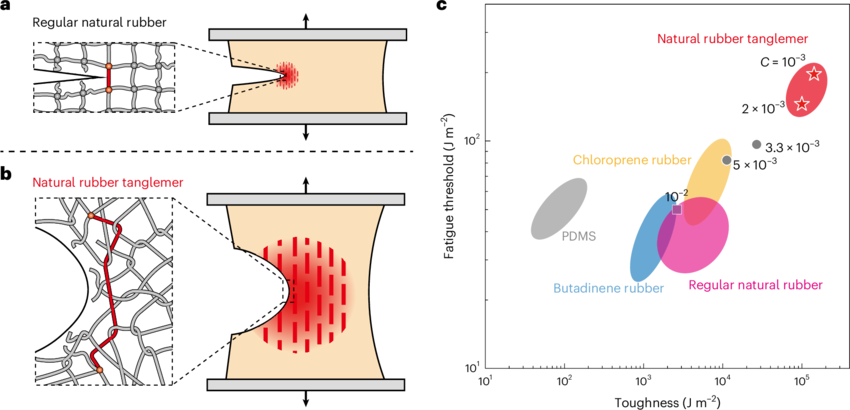
Note the differences between a short-chain crosslinked structure, and the longer-chain tanglemer structure with far less crosslinks. The latter is far better at resisting crack formation, since the longer chain can deconcentrate stress over a longer distance, allowing far greater stretch before failure. Credit: research paper The traditional method of producing rubber products starts with harvesting the natural rubber latex from various types of rubber tree. The trees are tapped to release their milky sap, which is then dried, processed with additives, and shaped into the desired form before heating with sulfur compounds to vulcanize the material. It’s this last step that is key to producing the finished product we know as rubber, as used in products like tires, erasers, and o-rings. The vulcanization process causes the creation of short crosslinked polymer chains in the rubber, which determine the final properties and behavior of the material.
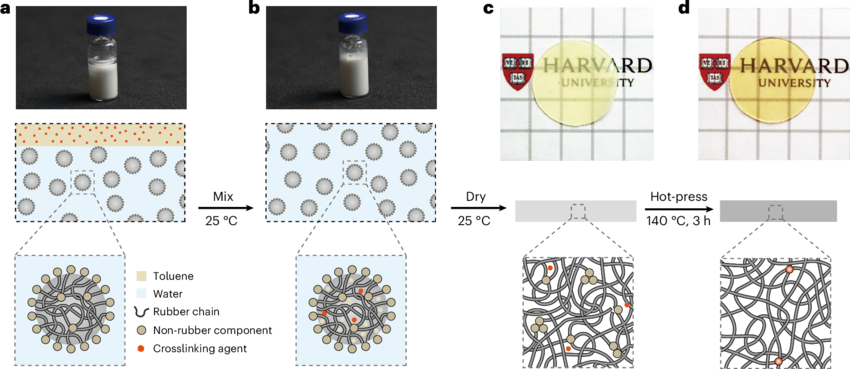
Harvard researchers modified the traditional rubber production process to be gentler. Typical rubber production includes heavy-handed mixing and extruding steps which tend to “masticate” the polymers in the material, turning them into shorter chains. The new, gentler process better preserves the long polymer chains initially present in the raw rubber. When put through the final stages of processing, these longer chains form into a structure referred to as a “tanglemer”, where the tangles of long polymer chains actually outnumber the sparse number of crosslinks between the chains in the structure. The gentler production method involves drying the latex and additive mixture at room temperature to form a film, before hot-pressing it to form the final tanglemer structure. This process isn’t practical for producing large, thick parts. Credit: research paper This tanglemer structure is much better at resisting crack formation. “At a crack tip in the tanglemer, stress deconcentrates over a long polymer strand between neighbouring crosslinks,” notes the research paper. “The entanglements function as slip links and do not impede stress deconcentration, thus decoupling modulus and fatigue threshold.” Plus, these long, tangled polymer chains are just generally better at spreading out stress in the material than the shorter crosslinked chains found in traditional vulcanized rubber. With the stress more evenly distributed, the rubber is less likely to crack or fail in any given location. The material is thus far tougher, more durable, and more flexible. These properties hold up even over repeated loading cycles.
Overall, the researchers found the material to be four times better at resisting crack growth during repeated stretch cycles. It also proved to be ten times tougher than traditional rubber. However, the new gentler processing method is fussy, and cannot outperform traditional rubber processing in all regards. After all, there’s a reason things are done the way they are in industry. Most notably, it relies on a lot of water evaporation, and it’s not currently viable for thick-wall parts like tires, for example. For thinner rubber parts, though, the mechanical advantages are all there—and this method could prove useful.
Ultimately, don’t expect to see new this ultra-rubber revolutionizing the tire market or glove manufacturing overnight. However, the research highlights an important fact—rubber can be made with significantly improved properties if the longer polymer chains can be preserved during processing, and tangled instead of excessively cross-linked. There may be more fruitful ground to explore to find other ways in which we can improve rubber by giving it a better, more resilient structure.
Sembra che gli Stati Uniti abbiano già seriamente preso in considerazione il concetto di guerra autonoma. Il jet da combattimento autonomo della DARPA , risulta in grado di combattere senza pilota, non è più considerato una svolta: l’agenzia è passata alla fase successiva di sviluppo, con l’obiettivo di creare sistemi in grado di controllare un gruppo di jet da combattimento in missioni congiunte oltre il raggio visivo.
Il nuovo programma della DARPA, Artificial Intelligence Reinforcements (AIR), si basa sul progetto Air Combat Evolution (ACE) , che ha messo a confronto F-16 dotati di intelligenza artificiale con velivoli con equipaggio in un addestramento “dogfight”. L’obiettivo è aumentare l’autonomia fino al punto in cui tali velivoli possano operare in formazione, coordinandosi su lunghe distanze e in ambienti di combattimento complessi. Il programma fa parte di una più ampia militarizzazione dell’intelligenza artificiale che sta sollevando preoccupazioni sulla sua sicurezza.
Sebbene AIR sia stato avviato più tardi di ACE, il concetto in sé non è nuovo: la prima domanda per il programma è stata pubblicata nel 2022. Questa settimana, la DARPA ha assegnato silenziosamente a Systems & Technology Research(STR) un contratto da 11,3 milioni di dollari nell’ambito della cosiddetta “Opzione Uno“. Come ha spiegato l’agenzia, questa è già la seconda delle due fasi previste del programma, il che indica che il progetto sta procedendo.
All’inizio di AIR, il programma coinvolgeva sei appaltatori, ma nella seconda fase il numero è stato ridotto a quattro. STR è responsabile di una delle due aree tecniche chiave: lo sviluppo di algoritmi che consentiranno l’esecuzione distribuita e autonoma di missioni tattiche in tempo reale in ambienti incerti, in rapida evoluzione e complessi. La seconda area prevede la creazione di modelli rapidi e accurati in grado di tenere conto dell’incertezza e di migliorare automaticamente con l’accumulo di dati.
Secondo la documentazione iniziale, l’AIR dovrebbe utilizzare sistemi di sensori, sistemi di guerra elettronica e armi esistenti. Le fasi di test includeranno simulazioni, quindi test con un essere umano nel circuito di controllo e infine test su un vero velivolo da combattimento senza pilota. Sviluppi simili sono già stati dimostrati: l’esercito statunitense ha creato un sistema robotico in grado di abbattere autonomamente i droni.
Oltre a STR, al progetto hanno partecipato anche Lockheed Martin e BAE Systems , ma la DARPA non ha ancora reso noto chi sarà incluso esattamente nella seconda fase: la selezione dei partecipanti è ancora in corso. I dettagli del lavoro nella prima e nella seconda fase rimangono riservati, ma è noto che la prossima fase durerà circa 30 mesi e coprirà la parte restante del programma.
La questione di quando i piloti saranno effettivamente costretti a cedere il passo all’intelligenza artificiale rimane aperta. E mentre gli sviluppatori stanno testando l’autonomia tattica, i critici non escludono scenari più inaspettati, fino al punto che un giorno un jet da combattimento autonomo decida di abbandonare una missione di combattimento. Gli esperti avvertono che la diffusione dell’IA militare potrebbe rendere il mondo meno sicuro , poiché l’IA commette errori e le conseguenze possono essere fatali . La comunità internazionale sta cercando di sviluppare un patto globale contro l’IA militare .
This week, Hackaday’s Elliot Williams and Kristina Panos met up over the tubes to bring you the latest news, mystery sound, and of course, a big bunch of hacks from the previous week.
In Hackaday news, get your Supercon 2025 tickets while they’re hot! Also, the One Hertz Challenge ticks on, but time is running out. You have until Tuesday, August 19th to show us what you’ve got, so head over to Hackaday.IO and get started now. Finally, its the end of eternal September as AOL discontinues dial-up service after all these years.
On What’s That Sound, Kristina got sort of close, but this is neither horseshoes nor hand grenades. Can you get it? If so, you could win a limited edition Hackaday Podcast t-shirt!
After that, it’s on to the hacks and such, beginning with a talking robot that uses typewriter tech to move its mouth. We take a look at hacking printed circuit boards to create casing and instrument panels for a PDP-1 replica. Then we explore a fluid simulation business card, witness a caliper shootout, and marvel at one file in six formats. Finally, it’s a telephone twofer as we discuss the non-hack-ability of the average smart phone, and learn about what was arguably the first podcast.
Check out the links below if you want to follow along, and as always, tell us what you think about this episode in the comments!
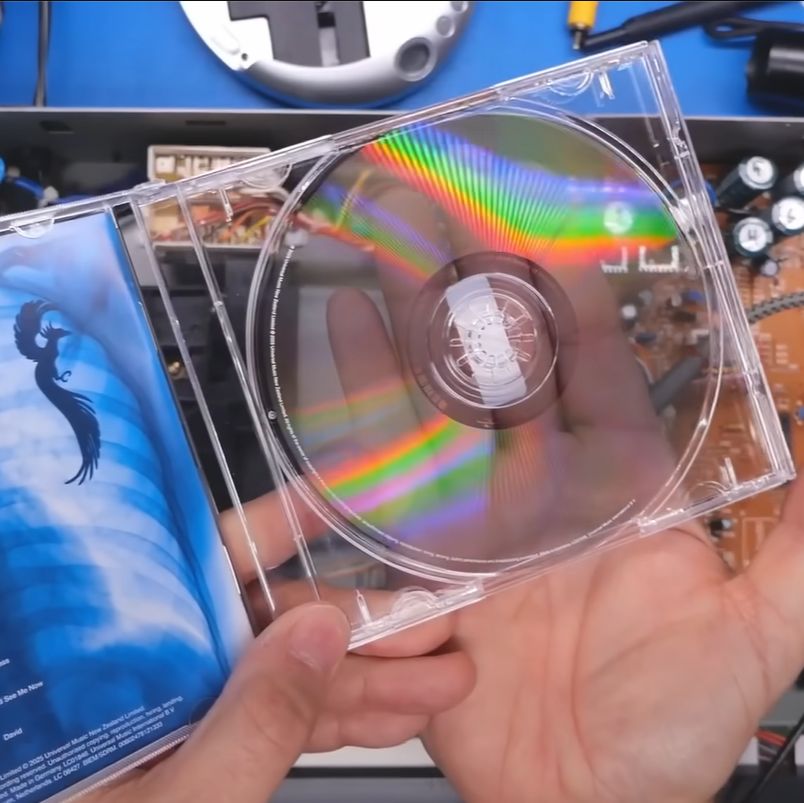
Despite the regularly proclaimed death of physical media, new audio albums are still being published on CD and vinyl. There’s something particularly interesting about Lorde’s new album Virgin however — the CD is a completely clear disc. Unfortunately there have been many reports of folks struggling to get the unique disc to actually play, and some sharp-eyed commentators have noted that the CD doesn’t claim to be Red Book compliant by the absence of the Compact CD logo. The clear Lorde audio CD in all its clear glory. (Credit: Adrian’s Digital Basement, YouTube) To see what CD players see, [Adrian] of Adrian’s Digital Basement got out some tools and multiple CD players to dig into the issue. These players range from a 2003 Samsung, a 1987 NEC, and a cheap portable Coby player. But as all audio CDs are supposed to adhere to the Red Book standard, a 2025 CD should play just as happily on a 1980s CD player as vice versa.
The first step in testing was to identify the laser pickup (RF) signal test point on the PCB of each respective player. With this hooked up to a capable oscilloscope, you can begin to see the eye pattern forming. In addition to being useful with tuning the CD player, it’s also an indication of the signal quality that the rest of the CD player has to work with. Incidentally, this is also a factor when it comes to CD-R compatibility.
While the NEC player was happy with regular and CD-R discs, its laser pickup failed to get any solid signal off the clear Lorde disc. With the much newer Samsung player (see top image), the clear CD does play, but as the oscilloscope shot shows, it only barely gets a usable signal from the pickup. Likewise, the very generic Coby player also plays the audio CD, which indicates that any somewhat modern CD player with its generally much stronger laser and automatic gain control ought to be able to play it.
That said, it seems that very little of the laser’s light actually makes it back to the pickup’s sensor, which means that the gain gets probably cranked up to 11, and with that its remaining lifespan will be significantly shortened. Ergo it’s probably best to just burn that CD-R copy of the album and listen to that instead.
CrowdStrike ha pubblicato il suo Global Threat Report 2025, che documenta un balzo in avanti nel comportamento dei criminali informatici e dei gruppi statali. Gli esperti definiscono il 2024 “l’anno dell’avversario intraprendente“: gli aggressori si comportano come aziende mature, introducendo innovazioni, costruendo catene di approvvigionamento resilienti e utilizzando attivamente l’intelligenza artificiale .
L’indicatore principale – il tempo di breakout, ovvero il periodo che intercorre tra la penetrazione iniziale e l’inizio del movimento laterale attraverso la rete – è stato ridotto al minimo storico: una media di 48 minuti contro i 62 minuti dell’anno precedente. Il record assoluto è di 51 secondi, il che di fatto priva i difensori del tempo necessario per reagire.
Nel 79% dei casi rilevati, gli aggressori non hanno utilizzato file dannosi, ma hanno agito tramite strumenti di amministrazione legittimi e operazioni manuali (hands-on-keyboard). Questo approccio consente loro di camuffarsi come una normale attività utente e di aggirare l’EDR . Gli strumenti di gestione remota (RMM) sono particolarmente utilizzati, tra cui Microsoft Quick Assist e TeamViewer.
Gli attacchi di vishing sono esplosi nell’ultimo anno, con un aumento del 442% nella seconda metà del 2024 rispetto alla prima. I gruppi CURLY SPIDER, CHATTY SPIDER e PLUMP SPIDER hanno utilizzato attivamente le telefonate come vettore principale, spesso in combinazione con lo “spam bombing“, ovvero l’invio massivo di reclami che fungono da pretesto per una chiamata “dall’assistenza”. In alcuni casi, questi schemi si sono conclusi con l’installazione di backdoor e il lancio del ransomwareBlack Basta .
Si sta diffondendo anche l’ingegneria sociale nell’help desk, in cui gli aggressori si spacciano per dipendenti aziendali e convincono gli operatori a reimpostare le password o a disattivare l’autenticazione a più fattori. Questa tattica è utilizzata, tra gli altri, da SCATTERED SPIDER ed è diventata uno dei metodi chiave per compromettere account cloud e applicazioni SaaS.
Il 2024 ha segnato una svolta nell’uso dell’IA Gen da parte di criminali informatici e attori statali. I modelli LLM sono stati utilizzati per:
creazione di profili e immagini falsi (ad esempio, il famoso CHOLLIMA nordcoreano);
generare e-mail e siti Web di phishing che hanno mostrato un CTR superiore del 54% rispetto ai messaggi scritti da esseri umani;
deepfake negli schemi BEC: in un caso, sono stati rubati 25,6 milioni di dollari tramite questi metodi;
scrivere script e strumenti dannosi;
creazione di siti “deco” nelle campagne NITRO SPIDER.
È emerso anche un nuovo fenomeno: LLMJacking : il furto dell’accesso ai servizi di intelligenza artificiale aziendali nel cloud per rivenderli o utilizzarli in altri attacchi.
Il numero di attacchi con tracce cinesi è aumentato in media del 150% e del 200-300% nei settori finanziario, mediatico, manifatturiero e ingegneristico. Sono stati identificati nuovi gruppi specializzati: LIMINAL PANDA, LOCKSMITH PANDA, OPERATOR PANDA, VAULT PANDA ed ENVOY PANDA, ognuno con la propria specializzazione di nicchia, dalle telecomunicazioni e dalla finanza alle agenzie diplomatiche. Gli operatori cinesi utilizzano attivamente reti ORB composte da centinaia e migliaia di dispositivi hackerati per nascondere il traffico e utilizzano congiuntamente strumenti precedentemente unici, come il malware KEYPLUG.
Il famoso gruppo CHOLLIMA ha implementato campagne su larga scala utilizzando falsi dipendenti IT che ottengono lavoro presso aziende straniere, ricevono dispositivi aziendali e li consegnano a “laboratori di laptop” per installare backdoor. CrowdStrike ha registrato 304 incidenti che li hanno coinvolti, il 40% dei quali riguardava minacce interne.
Gli attacchi al cloud sono aumentati del 26%. Il 35% di questi è iniziato con la compromissione di account attivi, mentre gli aggressori preferiscono non modificare le password per non destare allarme. Vengono utilizzati sia il furto di credenziali tramite infostealer (Stealc, Vidar) sia l’abuso di connessioni attendibili tra aziende.
Una parte significativa degli attacchi si basa sull’utilizzo concatenato di exploit e sull’abuso di funzioni software legittime. Ad esempio, OPERATOR PANDA ha utilizzato una serie di vulnerabilità in Cisco IOS per attaccare società di telecomunicazioni e di consulenza negli Stati Uniti.
CrowdStrike prevede che la velocità degli attacchi e l’uso diffuso dell’intelligenza artificiale continueranno ad aumentare, soprattutto negli ambienti di social engineering e cloud. Per proteggersi da queste minacce, gli esperti raccomandano di dare priorità alla protezione dell’identità, implementare una pianificazione proattiva delle patch, rafforzare i controlli degli account cloud e utilizzare strumenti di threat hunting basati sull’intelligenza artificiale.
A metà di Giugno ho informato tutti i miei amici di Facebook che avrei chiuso l'account. Gli ho anche detto che mi avrebbero trovato qui su Friendica, ma fino ad oggi purtroppo non vedo nessuno, a parte @Fabrizio Venerandi che è molto più avanti di me (e di tanti altri) in queste cose. Io non desisto, anche rinfrancato dal fatto che l'affidabilità di Meta è sempre più in declino. Mia moglie aveva disattivato il suo account Facebook anni fa e da qualche settimana aveva notato riapparire notifiche via mail. Chiaramente il suo account era stato hackerato. Per settimane abbiamo provato a riprenderne il controllo e solo oggi ci siamo riusciti. Ore e ore perse dietro questi incompetenti. In pratica mia moglie ogni 5 giorni, oltre alle usuali notifiche, riceveva un messaggio con un codice numerico per recuperare la password. Questo probabilmente era l'hacker che le impediva in questo modo di attivare la funzione di recupero della password. Infatti quando andava per attivarla, le diceva "Sembra che tu stia usando in modo errato questa funzione andando troppo velocemente. Ti è stato temporaneamente impedito di usarla.". Ma la cosa assurda è che esiste anche un link di Facebook per segnalare che il proprio account è stato hackerato ed utilizzandolo si riceveva la stessa risposta "Sembra che tu stia usando in modo errato questa funzione...", il che è completamente assurdo perché è proprio quello che gli hacker desiderano per impedire che qualcuno possa recuperare il proprio account! Il tentativo che finalmente è andato in porto è stato quello di cercare di creare un account con la stessa e-mail e nome e a quel punto la funzione di recupero della password con l'invio di un codice si è attivata. Ora il problema sarà riuscire ad entrare (per capire cosa ha fatto l'hacker) senza inchinarsi a 1) pagare dei soldi per non avere la pubblicità o 2) accettare che i propri dati personali vengano usati per pubblicità personalizzata. Ci siamo quasi e poi anche questo account verrà eliminato!
la questione balneari può essere vista e descritta in molti modi diversi e pure contrapposti. ma quando è l'evidenza dei fatti ci dice che è gestita come una "rendita", dalla quale si cerca ogni anno di spremere sempre di più, e non un'attività economica, legata al territorio e all'economia locale, che non tiene conto del potere di acquisto degli italiani costantemente in decrescita, quando più, quanto meno, diventa comprensibile come diventi un non senso economico. tanto varrebbe annullare tutte le concessioni e trasformare tutto in spiagge libere con servizi extra a pagamento, cosa che peraltro, almeno in teoria, già sarebbero. un governo coraggioso potrebbe sollo fare questo come atto sensato. come minimo andrebbe dichiarato illegale far pagare l'ingresso i controllare gli accessi. è proprio l'attuale modello di business è che è fuori dal tempo, come quasi tutto in italia.
la cosa assurda è che vedendo trump pare un soggetto talmente assurdo, pare talmente assurdo che possa esistere ed essere apprezzato, che vivo in una specie di limbo di insicurezza totale, in cui a loop mi chiedo se sono impazzita io, se ho una visione distorta del mondo, se mi sfugge una qualche qualità a cui sono ostinatamente cieca. trump è talmente un non senso che non riesco ad accettare che possa esistere senza che io stia dimenticando di considerare qualche ragione logica importante. un qualche problema reale che incredibilmente io non so come riesco a ignorare e che lui sta dimostrando di risolvere efficacemente che possa giustificare tutta questa follia sicuramente solo "apparente". vivo nell'idea che "qualcosa mi sfugga". non può essere così stupida la realtà.
ci sono semplicemente alcuni momenti della storia che servono a farci capire che il progresso non è il destino necessario dell'umanità, che l'umanità è composta da culture e individui molto diversi tra loro, che la Cultura è un elemento fondamentale per ogni specie sociale e che fottere il prossimo o credere di poterlo fottere è una delle attività preferite da una considerevole componente dell'umanità
@thatgiga beh ne abbiamo avuto anche un altro che a mio parere forse è peggio dei due citati,ma erano altri tempi,tutto più "rilassato, cc'era il boom economico,poi gli anni delle stragi terroristiche,non esisteva internet e le notizie erano addomesticate alle fonti e gli italiani avevano meno possibilità alternative di informarsi,ma Lui cera sempre al comando,indovinate un po chi era questo democristiano così potente...😑😁
non sono così ingenua dal pensare che pure in democrazia gli eletti siano scelti dal "popolo". la democrazia "ammorbidisce" solo le posizioni se mi passate in termine. gli elettori mediamente sono incapaci di pensiero razionale e questo vanifica la democraticità di scelta del voto. diciamo che possono comunque essere facilmente condizionati. non è solo questione di propaganda in senso classico. la democrazia però rende più facile giudicare un politico e cacciarlo. alla fine la democrazia serve solo per il ricambio politico nel tempo. ma attenzione che non è poco. il problema non è "come hanno potuto gli americani..." sappiamo che non sono stati gli americani. anche perché tra difficoltà di votare negli usa e come sono suddivise le circoscrizioni elettorali, e metti nel conto un sistema maggioritario che non ha niente di democratico, e pure un forzato bi-partitismo, è evidente che contano gli interessi. ma la domanda è: i soliti cosa pensavano quando hanno scelto trump? erano in preda a droga? qualcuno ci guadagna ma nessun settore economico guadagna da trump a conti fatti... neppure i petrolieri.
@simona gli americani hanno fatto quello che abbiamo fatto noi con Berlusconi, la differenza è che gli Usa sono la più importante potenza del mondo quindi gli effetti catastrofici li subiamo tutti. Dall'Italia non hanno imparato niente, ma neppure noi, conosco parecchia gente che tifa Trump, anche persone che per preparazione politica avrebbero gli strumenti per capire quale disastro sia. C'è stata un'involuzione culturale, spesso alimentata dai social,oppure gente che legge solo Epoch Times considerandolo una bibbia quando invece pubblica per lo più stronzate.
mah... trump mi pare pure ben peggiore di berlusconi a dire la verità. e non lo dico per discolpare gli italiani visto quanto odio berusconi. ma comunque visto che nessuno vota razionalmente ma per tifoseria ripeto che elezioni sono comunque fortemente guidate. e in italia non è come in russia... ci sarebbe anche l'informazione corretta, assieme a quella di parte. ma si sa l'italiano è pigro e non cerca la verità. si preferisce vedere putin come la vittima, assieme a israele. no n che né berlusconi ne trump possano davvero essere definiti di destra o liberisti in economia, non mi fraintendere.
@informapirata @talksina in realtà sta facendo gli interessi delle big tech. Minaccia tariffe alte a qualsiasi stato voglia tassarle. L'unico a cui sta pestando i piedi è Melon, ma tanto ormai è diventato lo zimbello di tutti.
@giga 🔻 guarda... se ti riferisci ad andreotti a questo punto per quanto siamo caduti in basso c'è da rimpiangere pure lui sinceramente. tra berlusconi, trump, meloni, io voterei andreotti. è difficile scendere così in basso.
@informapirata @talksina Ok, cerchiamo di essere seri. Se si vuole capire di chi si sta facendo gli interessi e come basta leggere “Dall’economia dell’ occupazione all’economia del genocidio” della relatrice speciale sulla situazione dei diritti umani nei territori palestinesi occupati dal 1967. È un esempio estremo? È un esempio circoscritto? No. Svela interessi, meccanismi e intrecci che ci riguardano e non solo umanamente
@thatgiga prova a leggere chi è stato veramente,se poi intendi politicamente e intellettualmente decisamente era meglio di quelli attuali,ovvio che si,ma resterà sempre un colluso condannato per associazione mafiosa,condanna non scontata per...prescrizione dei termini,umanità,etica,empatia zero,il vero problema sono gli eredi di chi mi dovrebbe rappresentare sono diventati politicamente amorfi tendenti al nero,che politicamente mi fa schifo #senzanullaapretendere
Nuovo articolo su giardino-punk.it: Anarchismo e modernità politica giardino-punk.it/anarchismo-e-… L'anarchismo come politica posmoderna, partendo da un testo di Nathan Jun
in realtà [!?ma davvero esiste una realtà oggettiva!?] trump-hio,(eggasi tronfio),e put-in,(leggasi in inglese)sono le due faccie della stessa medaglia,unica differenza la bandiera😑😁
culturalmente rimangono abbastanza diversi. non ti lasciar perdere nel qualunquismo. putin è un uomo del kgb che ragiona in modo ottocentesco che pensa a conquista militari stile prima guerra mondiale. avanzate poderose. artiglieria. mezzi e uomini al macello. e pensa che questo serva a qualcosa. un "idoelogo" puro. di quelle ideologie che hanno a lungo avvelenato la storia. trump è il figlio di un uomo d'affari. che non sa fare affari. che non sa che un affare parte da un'idea innovativa. trump non ha idee. ma pensa che sia tutta una questione di soldi. sono molto diversi. a modo loro ugualmente dannosi ma certamente diversi. poi possiamo vedere trump come l'gente russo e putin con l'agente americano, ma sono tutte idee surreali più fantasie. l'unica cosa che hanno in comune è che entrambi stanno minando alla radice quello che amministrano. io vedo felicemernte distrutti entrambi gli imperi. ma peccato ci sia l'ucraina nel mezzo. ed in realtà non solo perché putin al confine russo schiavizza numerosi popoli e nazioni.
The United States Pirate Party is excited to announce our first of many candidates for the 2026 election cycle: AZPP Captain Blase Henry shall be running for Arizona’s 17th Legislative District!
Blase has been a rising star within the ranks of the United States Pirate Party, and with this announcement, he is officially the first Pirate we will be backing during the 2026 elections.
If elected, future State Rep. Henry has laid out to us some of the bills he plans on introducing, including but not limited to:
– A digital Bill of Rights for Arizona
– A bill banning ID requirement/age verification laws on the internet, AI or otherwise
– A bill similar to the “Stop Killing Games” initiative of Europe, aiming to protect video game consumers and players
– A bill that prevents internet service providers from sharing your data without your consent and make it so police need a warrant for your data
We are excited to share what will be the first of many Pirate candidates. Some candidates will appear on the ballot as independents, some as members of major parties and some, if they are so fortunate, will have “Pirate” next to their name on the ballot. No matter what it says next to their name on the ballot, we will throw our support behind our Pirate candidates.
NOTE: the US Pirate Party recently endorsed the gubernatorial campaign of Timothy Grady for Ohio. Timothy Grady is an independent candidate but is not officially a Pirate Party candidate. Blase Henry is the first official candidate announced from the US Pirate Party.
To quote Blase Henry himself: “Let’s Hoist the Colours and Join the Pirate Revolution! For if Buying isn’t Ownership, then Piracy isn’t Theft!”
You can visit his campaign website here, or if you’re an AZ resident, you can help get Blase on the ballot here.
The image displays a computer desktop screen with a stunning wallpaper of the Northern Lights over a snowy landscape. The aurora borealis, with its vibrant green and hints of purple, dominates the sky, creating a mesmerizing display against a backdrop of stars. Below, a mountainous terrain with patches of snow and a body of water reflects the aurora's glow. The desktop interface includes a taskbar at the top with various icons, including a Raspberry Pi logo, a trash bin labeled "Cestino," and a clock showing 22:10. The window title reads "Server Raspberry Pi 4," indicating the device's operating system. The overall scene combines the natural beauty of the aurora with the functional elements of a computer desktop.
Provided by @altbot, generated privately and locally using Ovis2-8B
L'immagine mostra uno schermo di un computer con un desktop che ha uno sfondo blu con forme ondulate. In alto a sinistra, c'è una finestra intitolata "VNC config" con opzioni di configurazione come "Accept clipboard from viewers", "Also set primary selection", "Send clipboard to viewers" e "Send primary selection to viewers", tutte disattivate. In basso, c'è una barra di stato con l'ora "mercoledì 10 settembre 2025 - 19:05" e un pulsante di spegnimento. Sullo schermo, c'è anche un simbolo di un giroscopio bianco.
Fornito da @altbot, generato localmente e privatamente utilizzando Ovis2-8B
Ecco i post su Mastodon con le tappe del mio viaggio di quest'estate in Mecklenburg-Vorpommern e Schleswig-Holstein (aprire sempre le didascalie/testi alternativi delle immagini per qualche particolare in più)
The texts were sent to a group called “Mass Text” and show ICE using DMV and license plate reader data in an attempt to find their target, copies of the messages obtained by 404 Media show.#News
ICE Adds Random Person to Group Chat, Exposes Details of Manhunt in Real-Time
Members of a law enforcement group chat including Immigration and Customs Enforcement (ICE) and other agencies inadvertently added a random person to the group called “Mass Text” where they exposed highly sensitive information about an active search for a convicted attempted murderer seemingly marked for deportation, 404 Media has learned.
The texts included an unredacted ICE “Field Operations Worksheet” that includes detailed information about the target they were looking for, and the texts showed ICE pulling data from a DMV and license plate readers (LPRs), according to screenshots of the chat obtained and verified by 404 Media. The person accidentally added to the group chat is not a law enforcement official or associated with the investigation in any way, and said they were added to it weeks ago and initially thought it was a series of spam messages.
The incident is a significant data breach and operational security failure for ICE, which has ramped up arrest efforts across the U.S. as part of the Trump administration’s mass deportation efforts. The breach also has startling similarities to so-called Signal Gate, in which a senior administration official added the editor-in-chief of The Atlantic to a group chat that contained likely classified information. These new ICE messages were MMS, or Multimedia Messaging Service messages, meaning they weren’t end-to-end encrypted, like texts sent over Signal or WhatsApp are.
This post is for subscribers only
Become a member to get access to all content Subscribe now
We’re building something big — a European umbrella organisation working to support our pirate parties across Europe and amplify our shared political voice. Our movement is rooted in collaboration, grassroots empowerment, and making real impact at the EU level. To make this happen, we’re looking for motivated, reliable, and passionate people to take on Team Lead roles in our volunteer-run European secretariat.
As a Team Lead, you will:
Coordinate the work of your team and help shape its priorities
Collaborate closely with other team leads in the Management Team
Support volunteers, delegate tasks, and ensure smooth internal communication
Help develop the strategy and direction of our European-level work
We are currently seeking Team Leads for the following teams:
Communications Team
Community & Outreach Team
IT Team
Policy Team
Operations Team
You don’t need to be an expert or have years of experience — we value commitment, collaboration, and curiosity. We’re especially excited to hear from people with lived experience in grassroots activism, digital tools, or cross-border collaboration.
Time commitment: Flexible and part-time (volunteer-based). We expect most leads to dedicate around 4–6 hours per week, depending on availability.
John Lennon & Yoko Ono annunciata l’uscita del box Power To The People freezonemagazine.com/news/john… Esce il 10 ottobre il Box deluxe composto di nove CD + tre Blue-Ray più un libro di oltre duecento pagine dedicato a John Lennon e Yoko Ono. 31 brani live tratti dai due storici concerti di John e Yoko al One To One Concert, accompagnati dalla Plastic Ono Band, dagli Elephant’s Memory e da […] L'articolo John Lennon &
Per la prima volta dall’inizio della guerra in Ucraina, l’Europa ha superato gli Stati Uniti nella produzione e nella fornitura di materiale militare a Kyiv. Lo dicono i numeri diffusi dal Kiel Institute for the World Economy: tra febbraio 2022 e giugno 2025, la produzione militare europea
Il Dipartimento della Difesa degli Stati Uniti ha deciso di alzare il velo sull’architettura operativa del Golden Dome, il futuro sistema di difesa missilistica destinato a proteggere l’intero territorio statunitense – Alaska e Hawaii inclusi – contro le minacce balistiche,
Il concerto di Gastone Pietrucci e La Macina insieme a Elisa Ridolfi, vincitrice del Premio Tenco 2024 per la migliore opera prima, si è rivelato un'esperienza suggestiva e toccante. Il luogo prescelto, una radura a pochi metri dal borgo medievale di Cerreto di Montegiorgio, ha donato all'evento un'atmosfera intima e quasi magica. Seduti su semplici assi di legno grezzo, ci siamo ritrovati a stretto contatto con i musicisti, annullando ogni barriera e favorendo una vera e propria comunione tra artisti e ascoltatori. Nonostante la qualità del suono non fosse sempre eccelsa, quasi a voler dimostrare che quello che conta è la sincerità e non la perfezione artificiale, l'espressività dei musicisti ha superato ogni limite tecnico. Le emozioni scaturite da ogni nota e da ogni parola sono state così coinvolgenti da rendere l'esperienza unica e indimenticabile. L'esibizione ha offerto un viaggio musicale che ha saputo unire brani originali ad omaggi ad alcuni dei più grandi cantautori italiani: le canzoni di De André, Ciampi, Tenco e Piero Cesanelli (padre della rassegna musicale Musicultura) sono state reinterpretate con passione e rispetto. Momenti di rara intensità si sono raggiunti con le esecuzioni appassionate di "Vedrai, vedrai" di Luigi Tenco e del canto popolare "Sotto la croce Maria", così come con la sorprendente interpretazione della “Ballata degli impiccati” di De André, che è stata introdotta dalla voce nuda e dirompente di Elisa Ridolfi. Questi passaggi hanno trasformato la serata da un semplice concerto in un'esperienza quasi spirituale di condivisione di sentimenti e storie, confermando ancora una volta il valore di una musica che affonda le radici nella tradizione, ma che sa parlare con forza e attualità al cuore di chi ascolta. (13agosto2025 - #worldland festival)
Dal 7 al 12 agosto, le autorità russe hanno chiuso lo spazio aereo per 500 chilometri lungo la costa occidentale di Novaya Zemlya. Almeno quattro navi di supporto hanno raggiunto posizioni di osservazione nel Mare di Barents, mentre due velivoli della Rosatom
Passo qualche giorno da una mia zia 85enne a cui sono molto affezionato, lo faccio un paio di volte l'anno, per ferragosto e per l'ultimo dell'anno.
Da 5 anni io la televisione l'accendo solo per guardare Netflix, la TV vera e propria la guardo solo qui da mia zia, dove è accesa dalla mattina alla sera.
Ecco... io credo che per capire meglio questo paese, e come sia finito così in basso, non si possa prescindere dal riflettere su quello che passa in TV.
Con Live Spirit I, il Wojtek Mazolewski Quintet firma il suo primo album dal vivo: un viaggio sonoro tra jazz spirituale e momenti di estasi collettiva, che celebra la libertà compositiva del suo leader.


Nyayanga amphitheater in July 2025. Image: T.W. Plummer, Homa Peninsula Paleoanthropology Project






simona
Unknown parent • — (Livorno) •