
Il collasso del liberalismo globale
m.youtube.com/watch?v=0pPzS5Qg…
Una riflessione di Michele Serra sui fatti di Torino in cui mi riconosco molto.


Il giorno che picchiano la marmotta
https://www.ilpost.it/ok-boomer/il-giorno-che-picchiano-la-marmotta/?utm_source=flipboard&utm_medium=activitypubPubblicato su News @news-ilPost
Il giorno che picchiano la marmotta
«Ogni tanto (e per fortuna) il già visto e il già noto, per quanto tu ci sia abituato, ti mordono la pancia come quando avevi vent’anni»Il Post

Poliversity - Università ricerca e giornalismo reshared this.
ISIS. Gli USA frenano i trasferimenti dei detenuti in Iraq
@Notizie dall'Italia e dal mondo
Il rallentamento è legato alle riserve dei governi occidentali nel riportare a casa i propri cittadini che si erano uniti allo Stato islamico
L'articolo ISIS. Gli USA frenano i pagineesteri.it/2026/02/03/med…
Decreto sicurezza: da Torino alla deriva autoritaria.
noblogo.org/transit/decreto-si…


Decreto sicurezza: da Torino alla deriva autoritaria.
(203)
Dopo gli scontri di #Torino di sabato scorso, il governo #Meloni ha colto l’occasione per accelerare su un nuovo decreto sicurezza, trasformando un episodio di violenza circoscritto in pretesto per una stretta repressiva sul dissenso.
Non si tratta di una reazione improvvisata, ma dell’evoluzione di un’idea di “sicurezza” che parte da lontano nella strategia della destra al potere, radicata nei pacchetti sicurezza del passato e in una narrazione binaria tra “buoni cittadini” e “teppisti” da contenere a ogni costo.
Il contenuto del decreto (perquisizioni immediate sul posto, fermi preventivi fino a 12 ore senza vaglio giudiziario, cauzioni obbligatorie per gli organizzatori di cortei e uno “scudo penale” ampliato per le forze dell’ordine) mira a rendere costoso e rischioso l’esercizio del diritto di manifestare, spostando l’equilibrio verso un potere discrezionale della polizia quasi illimitato.
Questa logica trasforma l’ordine pubblico in stato d’eccezione permanente: un corteo violento a Torino diventa grimaldello per limitare proteste pacifiche, centri sociali e sindacati conflittuali, colpendo il cuore dell’uguaglianza democratica e rendendo la piazza un privilegio per chi ha risorse economiche.
Le origini di questa repressione affondano nelle precedenti norme del governo, come il primo decreto sicurezza con oltre sessanta misure su immigrazione, blocchi navali e tutele alle forze dell’ordine, che già riprendevano la retorica securitaria inaugurata anni fa da altre destre.
Culturalmente, è il trionfo di una visione che legge l’insicurezza sociale solo come minaccia da reprimere, ignorando le sue radici in disuguaglianze e mancata redistribuzione, per normalizzare un clima di sospetto verso chiunque dissenta.
Ma i profili costituzionali sono il vero nodo: l’uso del decreto-legge viola l’articolo 77, che richiede reale urgenza e non un pretesto politico per aggirare il Parlamento, come già contestato da costituzionalisti sui provvedimenti passati.
Le restrizioni su riunioni e manifestazioni (artt. 17 e 21 della #Costituzione) appaiono sproporzionate, con fermi e divieti basati su semplici denunce che erodono garanzie fondamentali, mentre lo scudo penale rischia di ledere l’uguaglianza davanti alla legge (art. 3) e i pesi e contrappesi dello Stato di diritto. Organismi internazionali hanno già ammonito l’Italia su queste derive, che comprimono il dissenso pacifico in modo inaccettabile.
In fondo, non è solo un pacchetto norme: è una scelta politica netta, che governa conflitti sociali con polizia e codice penale anziché con dialogo e politiche inclusive. Torino è solo la scintilla; il fuoco è un modello di democrazia sempre più autoritario, dove il garantismo cede il passo a un esecutivo onnipotente. Resta da vedere se il Parlamento e la Consulta porranno rimedio a questa deriva, ma non si può essere troppo ottimisti. Pure la speranza potrebbe essere scambiata per pericolosa provocazione.
#Blog #DecretoSicurezza #GovernoMeloni #Politica #Società #DirittiCivili
Mastodon: @alda7069@mastodon.unoTelegram: t.me/transitblogFriendica: @danmatt@poliverso.orgBlue Sky: bsky.app/profile/mattiolidanie…Bio Site (tutto in un posto solo, diamine): bio.site/danielemattioli
Gli scritti sono tutelati da “Creative Commons” (qui)
Tutte le opinioni qui riportate sono da considerarsi personali. Per eventuali problemi riscontrati con i testi, si prega di scrivere a: corubomatt@gmail.com


Luca🇮🇹🚜🏎️✈️ reshared this.
Contro la “Nato islamica” si rafforza l’asse tra Emirati e India (e Israele)
@Notizie dall'Italia e dal mondo
Gli Emirati rafforzano l'intesa con l'India per tentare di contrastare il patto di “mutua difesa” firmato da Riad e Islamabad al quale potrebbe sommarsi la Turchia
L'articolo Contro la “Nato islamica” si rafforza l’asse tra Emirati e India (e Israele) proviene da
KDE Binds Itself Tightly to Systemd, Drops Support for Non-Systemd Systems

The KDE desktop’s new login manager (PLM) in the upcoming Plasma 6.6 will mark the first time that KDE requires that the underlying OS uses systemd, if one wishes for the full KDE experience. This has especially the FreeBSD community upset, but will also affect Linux distros that do not use systemd. The focus of the KDE team is clear, as stated in the referenced Reddit thread, where a KDE developer replies that the goal is to rely on systemd for more tasks in the future. This means that PLM is just the first step.
In the eyes of KDE it seems that OSes that do not use systemd are ‘niche’ and not worth supporting, with said niche Linux distros that would be cut out including everything from Gentoo to Alpine Linux and Slackware. Regardless of your stance on systemd’s merits or lack thereof, it would seem to be quite drastic for one of the major desktop environments across Linux and BSD to suddenly make this decision.
It also raises the question of in how far this is related to the push towards a distroless and similarly more integrated, singular version of Linux as an operating system. Although there are still many other DEs that will happily run for the foreseeable future on your flavor of GNU/Linux or BSD – regardless of whether you’re more about about a System V or OpenRC init-style environment – this might be one of the most controversial divides since systemd was first introduced.
Top image: KDE Plasma 6.4.5. (Credit: Michio.kawaii, Wikimedia)
Print-in-Place Gripper Does It With a Single Motor

[XYZAiden]’s concept for a flexible robotic gripper might be a few years old, but if anything it’s even more accessible now than when he first prototyped it. It uses only a single motor and requires no complex mechanical assembly, and nowadays 3D printing with flexible filament has only gotten easier and more reliable.
The four-armed gripper you see here prints as a single piece, and is cable-driven with a single metal-geared servo powering the assembly. Each arm has a nylon string threaded through it so when the servo turns, it pulls each string which in turn makes each arm curl inward, closing the grip. Because of the way the gripper is made, releasing only requires relaxing the cables; an arm’s natural state is to fall open.
The main downside is that the servo and cables are working at a mechanical disadvantage, so the grip won’t be particularly strong. But for lightweight, irregular objects, this could be a feature rather than a bug.
The biggest advantage is that it’s extremely low-cost, and simple to both build and use. If one has access to a 3D printer and can make a servo rotate, raiding a junk bin could probably yield everything else.
DIY robotic gripper designs come in all sorts of variations. For example, this “jamming” bean-bag style gripper does an amazing, high-strength job of latching onto irregular objects without squashing them in the process. And here’s one built around grippy measuring tape, capable of surprising dexterity.
youtube.com/embed/8F8gctNCGyE?…
[2026-02-09] Odiamo Ogni Maledettissimo Lunedì @ Cascina Torchiera
Odiamo Ogni Maledettissimo Lunedì
Cascina Torchiera - Piazzale Cimitero Maggio 18, Milano
(lunedì, 9 febbraio 19:00)
Vi aspettiamo dalle 19, come ogni stramaledettissimo lunedì dell'anno con

- il "Mercatork" di frutta, verdura e autoproduzioni
- la libreria/biblioteca "Bibliotork"
- il corso di Yoga
- le prove della "Banda degli Ottoni a Scoppio"
- Cena Popolare Vegana
- Musica/Proiezioni/Presentazioni/Dibattiti (restate aggiornatx)
- Convivialità & Autogestione
In questo spazio si pratica l’autogestione come espressione di responsabilità verso se stess* e tutto ciò che ci circonda. Come uno strumento di libertà e liberazione dai canoni del consumismo, come presa in carico del benessere collettivo e del pianeta
Quindi ricordati di lavare piatto e posate nell’area lavastoviglie
Riutilizza il bicchiere e quando hai finito di usarlo mettilo nei contenitori predisposti
Non buttare rifiuti per terra, utilizza i posacenere e bidoni della raccolta differenziata
Se hai dubbi CHIEDI: il tuo interessamento sarà apprezzato e ti sentirai parte di ciò che stai vivendo. Collabora alla buona riuscita dell’esperienza per tutt*, sii rispettos* e condividi la presa bene ❤
Lasciare pulito ciò che trovi pulito è Autogestione.
Lasciare pulito ciò che trovi sporco è Cura.
Lo spazio della Cascina è accessibile alle persone con difficoltà o disabilità motorie
[2026-02-09] VINYASA YOGA @ Cascina Torchiera
VINYASA YOGA
Cascina Torchiera - Piazzale Cimitero Maggio 18, Milano
(lunedì, 9 febbraio 19:30)
Corso all'attivo da anni e aperto a tuttə!

Un'occasione per ricontattare il corpo, spingendolo al di là del proprio limite personale per restare con la mente ben salda al presente!
A offerta libera e consapevole
Per info: Maria 3396787195
A Higher-End Pico-Based Oscilloscope

Hackers have been building their own basic oscilloscopes out of inexpensive MCUs and cheap LCD screens for some years now, but microcontrollers have recently become fast enough to actually make such ‘scopes useful. [NJJ], for example, used a pair of Raspberry Pi Picos to build Picotronix, an extensible combined oscilloscope and logic analyzer.
This isn’t an open-source project, but it is quite well-documented, and the general design logic and workings of the device are freely available. The main board holds two Picos, one for data sampling and one to handle control, display, and external communication. The control unit is made out of stacked PCBs surrounded by a 3D-printed housing; the pinout diagrams printed on the back panel are a helpful touch. One interesting technique was to use a trimmed length of clear 3D printer filament as a light pipe for an indicator LED.
Even the protocol used to communicate between the Picos is documented; the datagrams are rather reminiscent of Ethernet frames, and can originate either from one of the Picos or from a host computer. This lets the control board operate as an automatic testing station reporting data over a wireless or USB-connected network. The display module is therefore optional hardware, and a variety of other boards (called picoPods) can be connected to the Picotronix control board. These include a faster ADC, adapters for various analog input spans, a differential analog input probe, a 12-bit logic state analyzer, and a DAC for signal generation.
If this project inspired you to make your own, we’ve also seen other Pico-based oscilloscopes before, including one that used a phone for the display.
Potere e privilegi
linuxtrent.it/potere-e-privile…
Segnalato dal LinuxTrent di #Trento e pubblicato sulla comunità Lemmy @GNU/Linux Italia
Segnaliamo questa interessante serata che si terrà domani martedì 3 febbraio 2026 presso la sala Bookique di Trento alle ore 20.00 Si parlerà di potere…
Rendere la nevrosi un capolavoro. Perché ‘Tutto Woody Allen’ è un’opera imprescindibile
@Giornalismo e disordine informativo
articolo21.org/2026/02/rendere…
C’è qualcosa di profondamente alleniano nel tentare di racchiudere l’infinito in un volume: un’impresa che oscilla tra
[2026-02-23] Incontro aperto mensile @ Piano Terra
Incontro aperto mensile
Piano Terra - via Federico Confalonieri 3, Milano
(lunedì, 23 febbraio 19:00)
Ogni quarto lunedì del mese la sezione di Milano si convoca a Piano Terra per un momento laboratoriale aperto a tutte e tutti. E’ l’occasione giusta per venire a conoscerci, tesserarsi, portare avanti insieme campagne e progetti, o immaginare le prossime uscite sociali dell’Associazione.

Nel mese di febbraio parleremo di:
- Programmazione gite
- Archivio APEino
- Progetto CASA
Per info scrivici una mail o vienici a trovare lun. 23 febbraio, dalle 19 alle 21, a Piano Terra (via F. Confalonieri 3, Milano)
[2026-02-05] Presentazione Magazine e proiezione 'Souvenirs of war' @ Cinemino Ad Astra
Presentazione Magazine e proiezione 'Souvenirs of war'
Cinemino Ad Astra - Vico della Cittadella, Principe, Prè, Centro Est, Genova, Liguria, 16126, Italia
(giovedì, 5 febbraio 21:00)
In una serata speciale dedicata ai Balcani parleremo della complessità del raccontare quest’area geografica ricca di contraddizioni. Con Matteo Pioppi della redazione di R/EST e grazie alle suggestioni offerte dal documentario di Zeller ci soffermeremo sulla narrazione di territori segnati dal conflitto e sul nostro sguardo segnato da stereotipi. Tra spettacolarizzazione del dolore e rielaborazione della memoria, cercheremo di immaginare un nuovo modo di guardare ai Balcani.

Usagi’s New Computer is a Gas!

[Dave] over at Usagi Electric has a mystery on his hands in the form of a computer. He picked up a Motorola 68000 based machine at a local swap meet. A few boards, a backplane, and a power supply. The only information provided is the machines original purpose: gas station pump control.
The computer in question is an embedded system. It uses a VME backplane, and all the cards are of the 3u variaety. The 68k and associated support chips are on one card. Memory is on another. A third card contains four serial ports. The software lives across three different EPROM chips. Time for a bit of reverse engineering!
[Dave] quickly dumped the ROMs and looked for strings. Since the 68k is a big endian machine, some byte swapping was required to get things human readable. Once byte swapped, huge tables of human readable strings revealed themselves, including an OS version. The computer runs pSOS, an older 68k based real time operating system – exactly what one would expect a machine from the 80’s to run.
The next step was to give it some power and see if the gas station computer would pump once again. The LEDs lit up, and a repeating signal showed up from one of the serial ports. The serial connections on this machine are RS-485. Not common for home computers, but used quite a bit in industrial embedded systems. Unfortunately, the machine wouldn’t respond to commands sent from a terminal. The communication protocol remained a mystery.
Since this video has gone up though, several people have provided a wealth of information at the vintage-micros channel over on [Dave’s] Usagi Electric Discord.
Gas pumps are a bit of a departure from [Dave’s] usual minicomputer work. We’re no strangers to embedded systems here though.
youtube.com/embed/i0Qw8GrOcp0?…
Referendum: la critica blasfema
@Giornalismo e disordine informativo
articolo21.org/2026/02/referen…
Con la sua sentenza del 28 gennaio il TAR, che respinto la richiesta di annullare il decreto di indizione del referendum. Nella motivazione del rigetto il TAR sposa l’interpretazione del Governo in ordine ai tempi e alle modalità per l’indizione del referendum. Questa
Ddl stupri, le donne dicono no
@Giornalismo e disordine informativo
articolo21.org/2026/02/ddl-stu…
In commissione Giustizia al Senato è passato un testo base del ddl Bongiorno che peggiora la normativa attuale. L’intento dell’accordo Meloni-Schlein era quello di far fare un passo avanti alla normativa sulla violenza sessuale. Quello scritto dall’avvocata, nonché senatrice
Dialogo di Articolo 21 col regista Andrea Segre
@Giornalismo e disordine informativo
articolo21.org/2026/02/dialogo…
Andrea Segre regista de La grande ambizione racconta ad Articolo 21 l’attualità della testimonianza di impegno politico di Enrico Berlinguer, sottolineando come l’attuale crisi della politica riveli non soltanto la debolezza delle
Da ottant’anni la Costituzione ha difeso i cittadini. Ora i cittadini devono difendere la Costituzione
@Giornalismo e disordine informativo
articolo21.org/2026/02/da-otta…
Quanto sono giuste le parole del Cardinal Matteo Zuppi: “Invitiamo
like this
[2026-02-08] ʍʊֆɨƈɦɛ ֆȶʀǟռɛ: Manoir Molle, Front Page Leslie @ Radio Blackout 105.250
ʍʊֆɨƈɦɛ ֆȶʀǟռɛ: Manoir Molle, Front Page Leslie
Radio Blackout 105.250 - Via Cecchi 21/a, Torino
(domenica, 8 febbraio 09:00)
🗓️ domenica 8 febbraio, radio blackout presenta:

una serata dedicata all'esplorazione del magico mondo delle ʍʊֆɨƈɦɛ ֆȶʀǟռɛ
⏰ Orari
Dalle 21 selexioni di riscaldamento a cura di Les Geants.
Dalle 22 Live:
l'orchestrina al pc di @manoirmolle
e, a seguire, da Bruxelles, le atmosfere sballate e introspettive di @frontpageleslie_
INIZIA PRESTO, FINISCE PRESTO! 🐇🎩
è una serata per stare bene, no molesti!
Nuovo anno nuovi appuntamenti allo sportello di Rovereto
linuxtrent.it/nuovo-anni-nuovi…
Segnalato dal LinuxTrent di #Trento e pubblicato sulla comunità Lemmy @GNU/Linux Italia
Con febbraio riprendono gli appuntamenti presso lo sportello linux di Rovereto Trovate tutte le
A note from investigators in the files said some images Epstein had were "POSSIBLE CSAM."#JeffreyEpstein


DOJ Released Unredacted Nude Images in Epstein Files
The Department of Justice left multiple unredacted photos of fully nude women or girls exposed as part of Friday’s dump of more than 3.5 million pages of files related to the investigations and prosecutions of Jeffrey Epstein and Ghislane Maxwell. Unlike the majority of the images in the released files, both the nudity and the faces of the people were not redacted, making them easy to identify. In some of the photos, the women or girls were either fully nude or partially undressed, posed for cameras, and exposed their genitals.The files include more than 2,000 videos and 180,000 images, Deputy Attorney General Todd Blanche said Friday in a press conference, including “large quantities of commercial pornography and images that were seized from Epstein’s devices,” some of which were taken by Epstein, according to Blanche.
404 Media emailed the DOJ on Friday evening for comment after a reader found the exposed photos.
“Our team is working around the clock to address any victim concerns, additional redactions of personally identifiable information, as well as any files that require further redactions under the Act, to include images of a sexual nature,” a Department of Justice spokesperson told 404 Media in an email. “Once proper redactions have been made, any responsive documents will repopulate online. As stated on the website, and in public materials.
404 Media then sent the DOJ specific links to the images on the DOJ’s website. The files stayed online for at least another full day, until Sunday evening, when they disappeared.
Another file in the dump is a typed message from investigators, commenting on the content of three CDs found in Epstein’s possession. Each CD is marked as “POSSIBLE CSAM,” referring to child sexual abuse material.
💡
Do you have a tip to share? We would love to hear from you. Using a non-work device, you can message us securely on Signal at sam.404. Otherwise, send an email at sam@404media.co.Another file containing comments from investigators on the three CDs says “Mostly fine, a few Suspected CSAM photo items in photos, needs to be SPLIT.” The photos on the DOJ’s website were of people in sexually explicit poses and situations, but it was unclear whether they were underage.
The DOJ released the files because it was required to by the Epstein Files Transparency Act, but missed the December deadline set out by the act. President Donald Trump signed the act into law on November 19, at which point Attorney General Pam Bondi had 30 days to release all of the files. On December 19, the DOJ released about 10,000 files, and on December 23 it released another 30,000.
The amount of information released and the unorganized way the government released has made it difficult to cover.
Musk to Epstein: ‘What Day/Night Will Be the Wildest Party on Your Island?’
New emails show Musk has been lying about his relationship with Epstein.404 MediaJason Koebler
“In view of the Congressional deadline, all reasonable efforts have been made to review and redact personal information pertaining to victims, other private individuals, and protect sensitive materials from disclosure,” a notice from the DOJ says at the top of every page of files. “That said, because of the volume of information involved, this website may nevertheless contain information that inadvertently includes non-public personally identifiable information or other sensitive content, to include matters of a sexual nature.” The Epstein Library also asks if visitors are over the age of 18 before entering the site.If a member of the public “identifies any information that should not have been posted,” the notice says, the DOJ asks them to notify them at EFTA@usdoj.gov “so we can take steps to correct the problem as soon as possible.”
On Sunday, the Wall Street Journal reported that the DOJ left 43 of 47 full names of Epstein and Maxwell’s victims exposed in Friday’s data.
Podcast: The Epstein Email Dump Is a Mess
We talk the terrible format of the latest Epstein dump; how a contractor is hiring randos on LinkedIn to physically track immigrants for $300; and a new code of conduct in the adult industry.404 MediaJoseph Cox
“We are getting constant calls for victims because their names, despite them never coming forward, being completely unknown to the public, have all just been released for public consumption,” victims’ attorney Brad Edwards told ABC News. “It's literally thousands of mistakes.”According to the New York Times, a group of 18 survivors of Epstein’s abuse said in a joint statement reacting to the release of data exposing their identities: “Once again, survivors are having their names and identifying information exposed, while the men who abused us remain hidden and protected. That is outrageous. This is not over. We will not stop until the truth is fully revealed and every perpetrator is finally held accountable.”
DOJ releasing 3 million pages of Epstein files, 'didn't protect' Trump, deputy AG says
Deputy AG Todd Blanche said nearly 3 million other pages were being withheld.James Hill (ABC News)


Download a PDF of our first ever zine here.#zine
Our Zine About ICE Surveillance Is Here
We are very proud to present 404 Media’s zine on the surveillance technology used by Immigrations and Customs Enforcement. While we have always covered surveillance and privacy, for the last year, you may have noticed that we have spent an outsized amount of our attention and time reporting on the ways technology companies are powering Donald Trump’s deportation raids.When we announced this zine in early December, we hoped that people would want it. Trump’s dehumanizing mass deportation campaign is perhaps the bleakest, most horrifying aspect of an administration that has reveled in its attacks on civil liberties, science, and government expertise. We did not know just how many of you would want a copy. We originally intended to print 1,000 copies, and to hand most of them out at a benefit concert in Los Angeles for CHIRLA, a human rights organization that helps immigrants. When those sold out in a few hours, we asked Punch Kiss Press, our printer, if they could make 2,500. When those sold out just as fast, we increased our order to 3,500. If you preordered a print zine, I put it in the mail last week and it should be arriving soon. Thank you everyone for your patience in waiting for the zine and we’d love to know what you think of it. We have a handful more copies that we’ve put up for sale on our Shopify. They will almost certainly sell out today and we will probably not reprint them.
We never intended to make this zine a scarce resource. We wanted to make a print product as an experiment for the reasons we explained when we announced it: Print is cool, it’s human, it’s enduring, and it’s shareable.
404ICEZINE
Full-sized zine in English404ICEZINE.pdf
62 MBdownload-circle
ICEZineEspanol
Zine en españolICEZineEspanol.pdf
5 MBdownload-circle
zinesmallfile
Zine in English, small file sizezinesmallfile.pdf
5 MBdownload-circle
Each of these zines was printed, assembled, and cut down to size by hand, and each of them was stuck in the mail by me or a friend of mine over the course of the last few weeks. We printed this on a riso printer, a Japanese duplicator from the early 1990s that anyone who is into will talk your ear off about endlessly, to the point that it has become a meme. I also printed all the envelopes on a riso printer from 1995 that I have painstakingly spent the last few months repairing. Basically, making and shipping these was labor intensive and DIY by design; we never thought we would need to print so many. They were made with a considerable amount of love. And for this first one, we don’t really have the capability to make and ship more than we’ve already made.
0:00
/0:18
1×So for that reason, we’re releasing a PDF of the zine for free to everyone, because we think the information contained within it is important and should be shared as widely as possible. We have also paid to have the zine translated into Spanish by human translators, thanks in part to a donation from one of our subscribers. You can find the Spanish version of the zine here. If you have a riso printer or are a riso print shop and are interested in printing additional copies at scale to distribute to your community, please email me and I may be able to share the print files with you.
We could not have made this zine without the support of our subscribers, our friends, and our local community. The zine was laid out by our friend Ernie Smith, who is one of the best to ever do it. The cover art was done by Veri Alvarez, whose work you can find here and whose anti-ICE art is frankly very fucking good and who deserves your support. The printing and assembly of the zine was done by Karina Richardson at Punch Kiss Press in Los Angeles and a few of her friends. I met Karina at a print festival in Los Angeles a few months ago and then asked her if she could take on this very complicated project on a short timeline. I then asked her to more than triple the number of copies, all over the holidays. It cannot be overstated how much Karina and Punch Kiss knocked it out of the park on this, and how thankful we are to her. And we made the zine to support LA Fights Back, a concert series dedicated to raising money for communities affected by ICE. We are thankful that we were invited to participate.
This being a print product, our work has been frozen in time. We wrote these pieces before DHS agents killed Renee Good and Alex Pretti in Minneapolis, and before several other people died in ICE custody in the last few weeks. The horrors we are facing are evolving and changing every day and we are committed to continuing to cover the ways that big tech and the surveillance state empowers ICE. You can find most of our most recent work on ICE here:
- Here is the User Guide for ELITE, the Tool Palantir Made for ICE
- DHS Says Critical ICE Surveillance Footage From Abuse Case Was ...
- Feds Create Drone No Fly Zone That Would Stop People Filming ICE
- ICE's Facial Recognition App Misidentified a Woman. Twice
- 'ELITE': The Palantir App ICE Uses to Find Neighborhoods to Raid
- Inside ICE's Tool to Monitor Phones in Entire Neighborhoods
- DHS Is Lying To You About ICE Shooting a Woman
- Here is the Agreement Giving ICE Medicaid Patients' Data
- How a US Citizen Was Scanned With ICE's Facial Recognition Tech
- ICE Contracts Company Making Bounty Hunter AI Agents
- ICE Taps into Nationwide AI-Enabled Camera Network, Data Shows
We’ve been overwhelmed and heartened by the support and interest in our reporting and in this zine. This project was a lot of work, and we’ve learned a lot about making and distributing a physical product at scale. We don’t have anything concrete to announce yet but I think we’d love to do more print products and issues in the future. So if you liked this please let us know. If you want to support our work specifically, the best thing you can do is subscribe to 404 Media. We also have a tip jar and, if you are interested in making a larger tax-deductible donation, please email us at donate@404media.co.

Privacy Telecom ‘Cape’ Introduces ‘Disappearing Call Logs’ That Delete Every 24 Hours#Privacy
Privacy Telecom ‘Cape’ Introduces ‘Disappearing Call Logs’ That Delete Every 24 Hours
Cape, a privacy-focused telecommunications company, says it has introduced a feature that automatically deletes a user’s call data records, such as who they call and when, every 24 hours. These “disappearing call logs” as Cape describes them break with the telecom industry standard of keeping hold of call logs for months if not years.“One of our first design principles was to minimize the amount of data that we collect and the amount of data that we store,” John Doyle, CEO of Cape, told 404 Media in an interview. “There’s no other business purpose to keep most of these logs more than like a day.”
Call data records, or CDRs, are metadata about a user’s phone call and text records. This includes the phone number the user contacted. This information can be especially revealing, showing that a particular person called an abortion clinic, for instance. In 2024, hackers stole “nearly all” of AT&T customers’ call records spanning several months. That in turn started a rush from the FBI to protect the identities of confidential informants, Bloomberg reported. That hack was so damaging in part because AT&T kept its customers’ call records for an extended period of time.
💡
Do you know about any other similar tools? I would love to hear from you. Using a non-work device, you can message me securely on Signal at joseph.404 or send me an email at joseph@404media.co.Cape is a mobile virtual network operator (MVNO), meaning it runs its service on top of other companies’ existing telecommunications infrastructure. Cape isn’t building cellphone towers; it’s making software to add security benefits. Cape is able to make changes to how long it retains data and other technical aspects because it runs its own mobile core—all of the software necessary to route messages and essentially be a telecom.
404 Media asked Cape to demonstrate that CDRs were being deleted. In response, Cape made a video describing the process. It appeared to show that the databases Cape uses to store CDRs did only contain data from a 24 hour period. Previously, Cape stored CDRs for 60 days, “which was already well short of industry standards,” Doyle said. Cape says it does hold “billing CDRs” for longer, for 30 days. These records are used to determine how much Cape has used carriers’ infrastructure.
playlist.megaphone.fm?p=TBIEA2…
Cape’s CDRs are made when a customer uses the Cape phone number assigned to their account. The change wouldn’t impact data generated by an app such as Signal; those are separate, and Signal already has various metadata protections.Doyle said Cape did not warn law enforcement about the change to CDR retention beforehand. “I guess they’ll find out in the same way everyone else does,” he said. He added that the company still is in keeping with CALEA, or the Communications Assistance for Law Enforcement Act, which requires telecommunications companies to respond to legal demands for data.
Because Cape is piggybacking off other carriers’ infrastructure, that does mean that somewhere along the line those other companies could store their own copy of Cape users’ data.
“It’s definitely true that some of our carrier partners may collect some information,” Doyle said, including the IMEI, a unique identifier assigned to a device.
Since I first covered Cape in 2024, I occasionally get emails asking me if Cape is a honeypot, in the sense that maybe it is a ruse to then provide data to the authorities. Doyle is also formerly of Palantir.
“All I can do is say we definitively are not a honeypot,” Doyle said. “It’s so hard to prove a negative, but I say it out loud every chance I get.”
Hackers Steal Text and Call Records of ‘Nearly All’ AT&T Customers
In one of the most significant data breaches in recent history, hackers stole AT&T customers’ call and text metadata spanning several months.Joseph Cox (404 Media)

Privacy and Surveillance reshared this.
Joseph speaks to Samuel Bagg about all the ways identities dictate what people see, and how what they choose to believe is based much more on those identities than the evidence in front of them.#Podcast
How Identity Literally Changes What You See (with Samuel Bagg)
This week Joseph talks to Samuel Bagg, assistant professor of political science at the University of South Carolina. Bagg recently wrote a fascinating essay, linked below, about how the problem with lots of things might be knowledge-based (people believing stuff that’s wrong or dangerous) but the solution is not more knowledge. It’s all about social identity. This is an incredibly interesting discussion, and definitely check out more of Bagg’s writing.
playlist.megaphone.fm?e=TBIEA5…
Listen to the weekly podcast on Apple Podcasts,Spotify, or YouTube. Become a paid subscriber for access to this episode's bonus content and to power our journalism. If you become a paid subscriber, check your inbox for an email from our podcast host Transistor for a link to the subscribers-only version! You can also add that subscribers feed to your podcast app of choice and never miss an episode that way. The email should also contain the subscribers-only unlisted YouTube link for the extended video version too. It will also be in the show notes in your podcast player.
youtube.com/embed/lNKOqp-rZL8?…
- The Problem is Epistemic. The Solution is Not
- The Dispersion of Power: A Critical Realist Theory of Democracy
The Problem is Epistemic. The Solution is Not. | Blog of the APA
Doubts about the wisdom of the masses are as old as philosophy itself. Yet interest in democracy’s “epistemic” merits has surged in the last decade—and it is no mystery why.Samuel Bagg (Blog of the APA)
How Vibe Coding is Killing Open Source

Does vibe coding risk destroying the Open Source ecosystem? According to a pre-print paper by a number of high-profile researchers, this might indeed be the case based on observed patterns and some modelling. Their warnings mostly center around the way that user interaction is pulled away from OSS projects, while also making starting a new OSS project significantly harder.
“Vibe coding” here is defined as software development that is assisted by an LLM-backed chatbot, where the developer asks the chatbot to effectively write the code for them. Arguably this turns the developer into more of a customer/client of the chatbot, with no requirement for the former to understand what the latter’s code does, just that what is generated does the thing that the chatbot was asked to create.
This also removes the typical more organic selection process of libraries and tooling, replacing it with whatever was most prevalent in the LLM’s training data. Even for popular projects visits to their website decrease as downloads and documentation are replaced by LLM chatbot interactions, reducing the possibility of promoting commercial plans, sponsorships, and community forums. Much of this is also reflected in the plummet in usage of community forums like Stack Overflow.
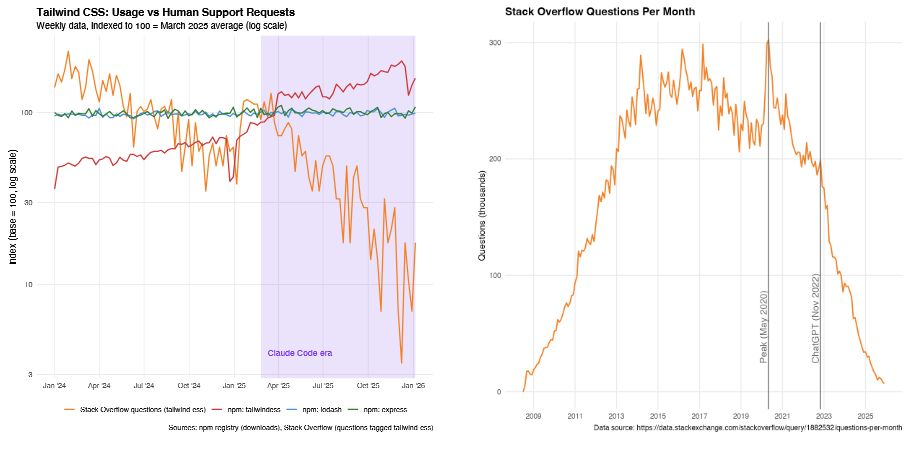
If we consider this effect of ‘AI-assisted’ software development to be effectively the delegating of the actual engineering and development to the statistical model of an LLM, then it’s easy to see the problems here. The LLM will not interact with the developers of a library or tool, nor submit usable bug reports, or be aware of any potential issues no matter how well-documented.
Although the authors of this paper are still proponents of ‘AI technology’, their worries seem well-warranted, even if it’s unclear at this point how big the impact is going to be. Software ecosystems like those involving JavaScript, Python, and web technologies are likely to suffer the impact from vibe coding first, as their audiences appear to be more into such vibes, and the training sets were largest.
It’s also a topic that is highly controversial, ever since Microsoft launched GitHub Copilot in 2021. Since then we saw reports in 2024 that ‘vibe coding’ using Copilot and similar chatbots offered no real benefits unless adding 41% more bugs is a measure of success.
By the time we hit 2025, we can observe an even more negative mood, with LLM chatbots in general being accused of degrading the cognitive skills of those using them, vibe coding chatbots reducing productivity by 19%, and experienced developers who gave them a whirl subsequently burning them to the ground in scathing reviews.
All of which reinforces the notion that perhaps this ‘AI revolution’ is more of a stress test for human intelligence than an actual boost to productivity or code quality. Despite the authors pitching the idea that OpenAI or Google could toss a few cents the way of OSS projects when their code is being used, the comparison with Spotify is painfully apt, since about 80% of artists on Spotify rarely have their tracks played and thus receive basically no money for their efforts.
With an LLM statistical model we know with extremely high likelihood that only the dependencies that are most prevalent in the training data set will realistically be used for the output, and we expect that we’ll see something similar happen with this vibe coding compensation scheme.
Even today we can already observe many negative effects from ‘AI slop’ in software development. Whether it’ll be something that’ll choke the life out of the entire OSS ecosystem remains to be seen, but it is hard to envision a bright vibe coding future.


Santa Sede: card. Petrocchi nominato Presidente della Commissione cardinalizia dell’Istituto delle Opere di Religione (Ior). Gli auguri dei vescovi di Abruzzo e Molise - AgenSIR
"A nome dei Vescovi della Conferenza episcopale abruzzese-molisana esprimo i più sentiti e affettuosi auguri di buon lavoro al card.Daniele Rocchi (AgenSIR)

ICYMI: Updates from the 2/1 Meeting
ICYMI
Arizona – Arizona recently passed new state bylaws. We are also actively seeking volunteers to assist with collecting signatures to get Blase Henry onto the ballot. If you are in the Tucson area and are interested in helping out, please reach out!
Candidate News – Hunter Rand has officially made the ballot for his race for Sparks City Council. Hunter, who recently received the endorsement of the U.S. Transhumanist Party, joins Tim Grady as having received endorsements from both members of the All Hands for a Free Future coalition. Love live the Handies!
International – While the rule has previously been implied but not codified, the board officially moved to have any international relations coordinated directly through the Pirate National Committee and not via state parties. The PNC also voted to confirm that we are no longer members of Pirate Party International, voting to leave via unanimous vote. As stated in the Part II of the Through the Spyglass article: We are not members of PPI. This vote was to tie up any loose ends and confirm our departure for the record.
Pirate National Committee – there is a vacancy at the Public Relations Director position following a resignation. The role is expected to be filled by the Feb. 22nd meeting. There will be no meeting next week due to the holiday (Super Bowl Sunday). The Feb. 15th has been moved to livestream, meaning the Feb. 15th and 22nd meetings will both be livestreamed to YouTube.
Volunteers – We are actively seeking volunteers from Arizona, Idaho, Illinois, North Carolina and West Virginia! We are actively seeking volunteers from every state, but we are especially seeking volunteers from those five states.
Special thanks to Ty Clifford, Vice Captain of the United States Pirate Party, for chairing yesterday’s meeting in the absence of the Captain.

Un nuovo inizio
Tra Roma e Londra, Crosetto svela il nodo che blocca il Gcap
@Notizie dall'Italia e dal mondo
Ancora una volta il Gcap si conferma un osservato speciale nel panorama della difesa europea e internazionale, non solo per la sua ambizione tecnologica ma per le implicazioni politiche che ne accompagnano lo sviluppo. Le recenti parole del ministro della Difesa Guido Crosetto rappresentano
La voglia di Ue (e di difesa) di Londra passa dall’alleanza Starmer-Xi
@Notizie dall'Italia e dal mondo
Londra “chiama Bruxelles” per il programma Safe sulla difesa, ma per ora il Regno Unito può accedere al programma come Paese terzo e non ha diritto a una partecipazione più completa, come previsto in origine. Che cosa rischiano in questo modo Uk e Ue? Il formalismo dato dalla Brexit
È disponibile il nuovo numero della newsletter del #MIM.
🔶 #Maturità2026, pubblicate le discipline della seconda prova scritta e le quattro materie del colloquio
🔶 Polizza sanitaria per oltre 1.200.

Ministero dell'Istruzione
#NotiziePerLaScuola È disponibile il nuovo numero della newsletter del #MIM. 🔶 #Maturità2026, pubblicate le discipline della seconda prova scritta e le quattro materie del colloquio 🔶 Polizza sanitaria per oltre 1.200.Telegram
Ue-India, non solo commercio. Cosa dice la partnership Bruxelles-Delhi sulla difesa
@Notizie dall'Italia e dal mondo
A margine del vertice che ha visto la firma dell’accordo commerciale Ue-India, l’Alto rappresentante dell’Unione per gli affari esteri, Kaja Kallas, e il ministro degli Esteri indiano, Subrahmanyam Jaishankar, hanno firmato la Security and Defence
#Trump, le mani sulla #Fed

Trump, le mani sulla Fed -
La decisione di Donald Trump di nominare nei giorni scorsi Kevin Warsh come nuovo presidente della Federal Reserve va letta come l’esito di un complesso eMichele Paris (altrenotizie.org)
Assuefazione al crollo
@Politica interna, europea e internazionale
L'articolo Assuefazione al crollo proviene da Fondazione Luigi Einaudi.
Sorgerà in Bulgaria la prima base militare italiana in Est Europa
@Notizie dall'Italia e dal mondo
A Yambole sarà insediata un’intera brigata multinazionale con la possibilità di ospitare fino a una intera divisione di 3.000 unità
L'articolo Sorgerà in Bulgariahttps://pagineesteri.it/2026/02/02/medioriente/sorgera-in-bulgaria-la-prima-base-militare-italiana-in-est-europa/
Rafah a gocce: tra droni e corridoi militari, Israele decide chi vive e chi muore
@Notizie dall'Italia e dal mondo
Mentre l'Europa celebra il "traguardo umanitario", i dati dell’OMS svelano il fallimento: 20mila malati in trappola e solo 5 evacuazioni autorizzate nel primo giorno di riapertura.
L'articolo Rafah a gocce: tra droni e corridoi militari, Israele
Assuefazione al crollo
@Politica interna, europea e internazionale
L'articolo Assuefazione al crollo proviene da Fondazione Luigi Einaudi.
GAZA. Famiglie massacrate e civili sotto le macerie del “cessate il fuoco”
@Notizie dall'Italia e dal mondo
Decine le vittime civili, soprattutto bambini, dei bombardamenti israeliani che hanno preso di mira campi profughi, case, edifici pubblici. Gli USA tacciono, nonostante gli annunci del cosiddetto Board of Peace e della seconda fase del "piano Trump".
Qualche giorno fa parlando di alternative a Google, ecc. avevo nominato Serverplan. E' un'azienda italiana, con datacenter a Roma, di cui sono cliente soddisfatto da una ventina d'anni.
Considerato che qui sono assenti gli ho scritto per segnalargli il fatto che nel #Fediverso potrebbero trovare molte persone interessate ai loro servizi.
Beh la persona a cui ho scritto non sapeva cosa fosse il Fediverso.
Gli ho mandato un link al video di @Elena Rossini e uno al sito "Join The Fediverse".
Per dire... neanche gli addetti ai lavori sanno che esistiamo. 🙁
Abbiamo tante persone che hanno lavorato allo sviluppo del SW necessario a far vivere il Fediverso e praticamente nessuno che lavori per farlo conoscere in giro.
Ma voglio vedere la parte mezza piena del bicchiere: nonostante non ci sia quasi nessuno che lavora per far conoscere il Fediverso noi siamo riusciti ad arrivarci. Pensate se facessimo qualcosa di più per far conoscere il posto...
like this
reshared this

Il talk sta su WordPress.tv
Alistella🧚🍰
in reply to Max - Poliverso 🇪🇺🇮🇹 • • •