
DIY Light Panels Work With Home Assistant

There are a few major companies out there building colorful LED panels you can stick on your wall for aesthetic purposes. Most commercial options are pretty expensive, and come with certain limitations in how they can be controlled. [Smart Solutions For Home] has whipped up a flexible DIY design for decorating your walls with light that is altogether more customizable.
In this case, the DIY light panels ape the hexagonal design made popular by brands like Nanoleaf. In this case, each hexagon panel runs an ESP32 microcontroller, which controls a series of WS2812 addressable LEDs. This allows each panel to glow whatever color you like, and they’re arranged in an XY grid to enable you to light individual panels with a range of different geometric effects. The benefit of having a full microcontroller on each panel is that they can act quite independently—each one able to be used as a smart light, an notification display, or even as a physical button, all integrated with Home Assistant.
If you’re a fan of DIY smart home products, these might be right up your alley. They’re supremely flexible and customizable, and can do a lot of things that commercial versions can’t easily replicate. Just don’t ignore the fact that they require a considerable amount of assembly, what with the custom PCBs, 3D printed enclosures, and front diffusers to deal with. That’s just the way the LED wall crumbles.
We’ve seen other similar builds before, too. Why? The simple fact is that a lot of people want cool glowy panels on their wall without having to pay through the nose for them.
youtube.com/embed/KsK9eldbPj0?…
La nuova guerra europea alla privacy Chat Control violerà i diritti fondamentali
In teoria, Chat Control avrebbe dovuto essere sepolto il mese scorso. Il minaccioso piano dell'UE di scansionare in massa i messaggi privati dei cittadini ha incontrato una schiacciante resistenza pubblica in Germania, con il governo del paese che si è rifiutato di approvarlo. Ma Bruxelles raramente si tira indietro solo perché i cittadini lo chiedono. E così, fedele alla sua forma, una versione rielaborata del testo è già in fase di elaborazione, questa volta nascosta, a porte chiuse.
reshared this
On the Benefits of Filling 3D Prints With Spray Foam

Closed-cell self-expanding foam (spray foam) is an amazing material that sees common use in construction. But one application that we hadn’t heard of before was using it to fill the internal voids of 3D printed objects. As argued by [Alex] in a half-baked-research YouTube video, this foam could be very helpful with making sure that printed boats keep floating and water stays out of sensitive electronic bits.
It’s pretty common knowledge by now that 3D printed objects from FDM printers aren’t really watertight. Due to the way that these printers work, there’s plenty of opportunity for small gaps and voids between layers to permit moisture to seep through. This is where the use of this self-expanding foam comes into play, as it’s guaranteed to be watertight. In addition, [Alex] also tests how this affects the strength of the print and using its insulating properties.
The test prints are designed with the requisite port through which the spray foam is injected as well as pressure relief holes. After a 24 hour curing period the excess foam is trimmed. Early testing showed that in order for the foam to cure well inside the part, it needed to be first flushed with water to provide the moisture necessary for the chemical reaction. It’s also essential to have sufficient pressure relief holes, especially for the larger parts, as the expanding foam can cause structural failure.
As for the results, in terms of waterproofing there was some water absorption, likely in the PETG part. But after 28 hours of submerging none of the sample cubes filled up with water. The samples did not get any stronger tensile-wise, but the compression test showed a 25 – 70% increase in resistance to buckling, which is quite significant.
Finally, after tossing some ice cubes into a plain FDM printed box and one filled with foam, it took less than six hours for the ice to melt, compared to the spray foam insulated box which took just under eight hours.
This seems to suggest that adding some of this self-expanding foam to your 3D printed part makes a lot of sense if you want to keep water out, add more compressive strength, or would like to add thermal insulation beyond what FDM infill patterns can provide.
youtube.com/embed/Pkk9Lt-j2hM?…
A Flexible Light Inspired by IKEA

The IKEA SMÅSNÖRE is a flexible silicone rod with an embedded LED strip, attached at each end to a base. It’s eye-catching enough, and it has the useful property of providing a diffuse light from multiple angles that makes it a promising candidate for a work lamp. That’s enough for [Daniel James] to create his own lamp on a similar vein.
The electronics of his lamp are straightforward enough: a 12 volt LED strip whose brightness is controlled by a Pi Pico in response to a potentiometer as a brightness control. It’s not quite stiff enough to form the arch itself, so he’s created a 3D printed chain that forms the structure of the lamp. Similar to a bicycle chain in the way it’s constructed, it has individual links that slot together and pivot. The electronics are in the printed base at one end.
We like this lamp a lot, for the light it gives on the bench and for the ingenuity of the printed chain. We might even make one for ourselves.
il ponte sullo stretto mi va stretto
reshared this

Ustica è una questione morale. E civica
@Giornalismo e disordine informativo
articolo21.org/2025/11/ustica-…
Nei giorni scorsi abbiamo promosso, insieme con l’Associazione dei familiari delle vittime della strage di Ustica e la Presidente Daria Bonfietti un incontro-stampa per chiedere di non archiviare le indagini. Per la prima volta a livello nazionale, a
Giornalismo e disordine informativo reshared this.
Magistratura democratica: l’irruzione nella sede del quotidiano La Stampa atto vile e intollerabile
@Giornalismo e disordine informativo
articolo21.org/2025/11/magistr…
Magistratura Democratica interviene su quanto accaduto a Torino. “La violenta
Giornalismo e disordine informativo reshared this.

Scruscio! finalmente un calendario condiviso anche a Palermo
Nasce scruscio.org/about , istanza palermitana di Gancio
reshared this
Un server ActivityPub in un singolo file PHP? Ecco come fare... Il post di @tofeo
Qualsiasi programma per computer può essere progettato per essere eseguito da un singolo file, se la progettazione è abbastanza sbagliata! 🤣
Volevo creare il server #Fediverse più semplice possibile, che potesse essere utilizzato come strumento didattico per mostrare come funziona ActivityPub / Mastodon.
shkspr.mobi/blog/2024/02/activ…


ActivityPub Server in a Single PHP File
shkspr.mobi/blog/2024/02/activ…Any computer program can be designed to run from a single file if you architect it wrong enough!
I wanted to create the simplest possible Fediverse server which can be used as an educational tool to show how ActivityPub / Mastodon works.
The design goals were:
- Upload a single PHP file to the server.
- No databases or separate config files.
- Single Actor (i.e. not multi-user).
- Allow the Actor to be followed.
- Post plain-text messages to followers.
- Be roughly standards compliant.
And those goals have all been met! Check it out on GitLab. I warn you though, it is the nadir of bad coding. There are no tests, bugger-all security, scalability isn't considered, and it is a mess. But it works.
You can follow the test user
@[url=https://example.viii.fi/example]example@example.viii.fi[/url]Architecture
Firstly, I've slightly cheated on my "single file" stipulation. There's an.htaccessfile which turnsexample.com/whateverintoexample.com/index.php?path=whateverThe
index.phpfile then takes that path and does stuff. It also contains all the configuration variables which is very bad practice.Rather than using a database, it saves files to disk.
Again, this is not suitable for any real world use. This is an educational tool to help explain the basics of posting messages to the Fediverse. It requires absolutely no dependencies. You do not need to spin up a dockerised hypervisor to manage your node bundles and re-compile everything to WASM. Just FTP the file up to prod and you're done.
Walkthrough
This is a quick ramble through the code. It is reasonably well documented, I hope.Preamble
This is where you set up your account's name and bio. You also need to provide a public/private keypair. The posting page is protected with a password that also needs to be set here.
PHP // Set up the Actor's information $username = rawurlencode("example"); // Encoded as it is often used as part of a URl $realName = "E. Xample. Jr."; $summary = "Some text about the user."; $server = $_SERVER["SERVER_NAME"]; // Domain name this is hosted on // Generate locally or from cryptotools.net/rsagen // Newlines must be replaced with "\n" $key_private = "-----BEGIN RSA PRIVATE KEY-----\n...\n-----END RSA PRIVATE KEY-----"; $key_public = "-----BEGIN PUBLIC KEY-----\n...\n-----END PUBLIC KEY-----"; // Password for sending messages $password = "P4ssW0rd";Logging
ActivityPub is a "chatty" protocol. This takes all the requests your server receives and saves them in/logs/as a datestamped text file.
PHP // Get all headers and requests sent to this server $headers = print_r( getallheaders(), true ); $postData = print_r( $_POST, true ); $getData = print_r( $_GET, true ); $filesData = print_r( $_FILES, true ); $body = json_decode( file_get_contents( "php://input" ), true ); $bodyData = print_r( $body, true ); $requestData = print_r( $_REQUEST, true ); $serverData = print_r( $_SERVER, true ); // Get the type of request - used in the log filename if ( isset( $body["type"] ) ) { $type = " " . $body["type"]; } else { $type = ""; } // Create a timestamp in ISO 8601 format for the filename $timestamp = date( "c" ); // Filename for the log $filename = "{$timestamp}{$type}.txt"; // Save headers and request data to the timestamped file in the logs directory if( ! is_dir( "logs" ) ) { mkdir( "logs"); } file_put_contents( "logs/{$filename}", "Headers: \n$headers \n\n" . "Body Data: \n$bodyData \n\n" . "POST Data: \n$postData \n\n" . "GET Data: \n$getData \n\n" . "Files Data: \n$filesData \n\n" . "Request Data:\n$requestData\n\n" . "Server Data: \n$serverData \n\n" );Routing
The.htaccesschanges/whateverto/?path=whateverThis runs the function of the path requested.
PHP !empty( $_GET["path"] ) ? $path = $_GET["path"] : die(); switch ($path) { case ".well-known/webfinger": webfinger(); case rawurldecode( $username ): username(); case "following": following(); case "followers": followers(); case "inbox": inbox(); case "write": write(); case "send": send(); default: die(); }WebFinger
The WebFinger Protocol is used to identify accounts.It is requested withexample.com/.well-known/webfinger?resource=acct:username@example.comThis server only has one user, so it ignores the query string and always returns the same details.
PHP function webfinger() { global $username, $server; $webfinger = array( "subject" => "acct:{$username}@{$server}", "links" => array( array( "rel" => "self", "type" => "application/activity+json", "href" => "https://{$server}/{$username}" ) ) ); header( "Content-Type: application/json" ); echo json_encode( $webfinger ); die(); }Username
Requestingexample.com/usernamereturns a JSON document with the user's information.
PHP function username() { global $username, $realName, $summary, $server, $key_public; $user = array( "@context" => [ "https://www.w3.org/ns/activitystreams", "https://w3id.org/security/v1" ], "id" => "https://{$server}/{$username}", "type" => "Person", "following" => "https://{$server}/following", "followers" => "https://{$server}/followers", "inbox" => "https://{$server}/inbox", "preferredUsername" => rawurldecode($username), "name" => "{$realName}", "summary" => "{$summary}", "url" => "https://{$server}", "manuallyApprovesFollowers" => true, "discoverable" => true, "published" => "2024-02-12T11:51:00Z", "icon" => [ "type" => "Image", "mediaType" => "image/png", "url" => "https://{$server}/icon.png" ], "publicKey" => [ "id" => "https://{$server}/{$username}#main-key", "owner" => "https://{$server}/{$username}", "publicKeyPem" => $key_public ] ); header( "Content-Type: application/activity+json" ); echo json_encode( $user ); die(); }Following & Followers
These JSON documents show how many users are following / followers-of this account.The information here is self-attested. So you can lie and use any number you want.
PHPfunction following() { global $server; $following = array( "@context" => "https://www.w3.org/ns/activitystreams", "id" => "https://{$server}/following", "type" => "Collection", "totalItems" => 0, "items" => [] ); header( "Content-Type: application/activity+json" ); echo json_encode( $following ); die(); } function followers() { global $server; $followers = array( "@context" => "https://www.w3.org/ns/activitystreams", "id" => "https://{$server}/followers", "type" => "Collection", "totalItems" => 0, "items" => [] ); header( "Content-Type: application/activity+json" ); echo json_encode( $followers ); die(); }Inbox
The/inboxis the main server. It receives all requests. This server only responds to "Follow" requests.A remote server sends a follow request which is a JSON file saying who they are.This code does not cryptographically validate the headers of the received message.The name of the remote user's server is saved to a file so that future messages can be delivered to it.An accept request is cryptographically signed and POST'd back to the remote server.
PHP function inbox() { global $body, $server, $username, $key_private; // Get the message and type $inbox_message = $body; $inbox_type = $inbox_message["type"]; // This inbox only responds to follow requests if ( "Follow" != $inbox_type ) { die(); } // Get the parameters $inbox_id = $inbox_message["id"]; $inbox_actor = $inbox_message["actor"]; $inbox_host = parse_url( $inbox_actor, PHP_URL_HOST ); // Does this account have any followers? if( file_exists( "followers.json" ) ) { $followers_file = file_get_contents( "followers.json" ); $followers_json = json_decode( $followers_file, true ); } else { $followers_json = array(); } // Add user to list. Don't care about duplicate users, server is what's important $followers_json[$inbox_host]["users"][] = $inbox_actor; // Save the new followers file file_put_contents( "followers.json", print_r( json_encode( $followers_json ), true ) ); // Response Message ID // This isn't used for anything important so could just be a random number $guid = uuid(); // Create the Accept message $message = [ "@context" => "https://www.w3.org/ns/activitystreams", "id" => "https://{$server}/{$guid}", "type" => "Accept", "actor" => "https://{$server}/{$username}", "object" => [ "@context" => "https://www.w3.org/ns/activitystreams", "id" => $inbox_id, "type" => $inbox_type, "actor" => $inbox_actor, "object" => "https://{$server}/{$username}", ] ]; // The Accept is sent to the server of the user who requested the follow // TODO: The path doesn't *always* end with/inbox $host = $inbox_host; $path = parse_url( $inbox_actor, PHP_URL_PATH ) . "/inbox"; // Get the signed headers $headers = generate_signed_headers( $message, $host, $path ); // Specify the URL of the remote server's inbox // TODO: The path doesn't *always* end with /inbox $remoteServerUrl = $inbox_actor . "/inbox"; // POST the message and header to the requester's inbox $ch = curl_init( $remoteServerUrl ); curl_setopt( $ch, CURLOPT_RETURNTRANSFER, true ); curl_setopt( $ch, CURLOPT_CUSTOMREQUEST, "POST" ); curl_setopt( $ch, CURLOPT_POSTFIELDS, json_encode($message) ); curl_setopt( $ch, CURLOPT_HTTPHEADER, $headers ); $response = curl_exec( $ch ); // Check for errors if( curl_errno( $ch ) ) { file_put_contents( "error.txt", curl_error( $ch ) ); } curl_close($ch); die(); }UUID
Every message sent should have a unique ID. This can be anything you like. Some servers use a random number.I prefer a date-sortable string.
PHP function uuid() { return sprintf( "%08x-%04x-%04x-%04x-%012x", time(), mt_rand(0, 0xffff), mt_rand(0, 0xffff), mt_rand(0, 0x3fff) | 0x8000, mt_rand(0, 0xffffffffffff) ); }Signing Headers
Every message that your server sends needs to be cryptographically signed with your Private Key.This is a complicated process. Please read "How to make friends and verify requests" for more information.
PHP function generate_signed_headers( $message, $host, $path ) { global $server, $username, $key_private; // Encode the message to JSON $message_json = json_encode( $message ); // Location of the Public Key $keyId = "https://{$server}/{$username}#main-key"; // Generate signing variables $hash = hash( "sha256", $message_json, true ); $digest = base64_encode( $hash ); $date = date( "D, d M Y H:i:s \G\M\T" ); // Get the Private Key $signer = openssl_get_privatekey( $key_private ); // Sign the path, host, date, and digest $stringToSign = "(request-target): post $path\nhost: $host\ndate: $date\ndigest: SHA-256=$digest"; // The signing function returns the variable $signature // php.net/manual/en/function.ope… openssl_sign( $stringToSign, $signature, $signer, OPENSSL_ALGO_SHA256 ); // Encode the signature $signature_b64 = base64_encode( $signature ); // Full signature header $signature_header = 'keyId="' . $keyId . '",algorithm="rsa-sha256",headers="(request-target) host date digest",signature="' . $signature_b64 . '"'; // Header for POST reply $headers = array( "Host: {$host}", "Date: {$date}", "Digest: SHA-256={$digest}", "Signature: {$signature_header}", "Content-Type: application/activity+json", "Accept: application/activity+json", ); return $headers; }User Interface for Writing
This creates a basic HTML form. Type in your message and your password. It then POSTs the data to the/sendendpoint.
PHP function write() { // Display an HTML form for the user to enter a message.echo <<< HTML<![url=https://mastodon.social/users/doctype]Aleks Dorohovich[/url] html><html lang="en-GB"> <head> <meta charset="UTF-8"> <title>Send Message</title> <style> *{font-family:sans-serif;font-size:1.1em;} </style> </head> <body> <form action="/send" method="post" enctype="multipart/form-data"> <label for="content">Your message:</label><br> <textarea id="content" name="content" rows="5" cols="32"></textarea><br> <label for="password">Password</label><br> <input type="password" name="password" id="password" size="32"><br> <input type="submit" value="Post Message"> </form> </body></html>HTML; die(); }Send Endpoint
This takes the submitted message and checks the password is correct.It reads thefollowers.jsonfile and sends the message to every server that is following this account.
PHP function send() { global $password, $server, $username, $key_private; // Does the posted password match the stored password? if( $password != $_POST["password"] ) { die(); } // Get the posted content $content = $_POST["content"]; // Current time - ISO8601 $timestamp = date( "c" ); // Outgoing Message ID $guid = uuid(); // Construct the Note // contentMap is used to prevent unnecessary "translate this post" pop ups // hardcoded to English $note = [ "@context" => array( "https://www.w3.org/ns/activitystreams" ), "id" => "https://{$server}/posts/{$guid}.json", "type" => "Note", "published" => $timestamp, "attributedTo" => "https://{$server}/{$username}", "content" => $content, "contentMap" => ["en" => $content], "to" => ["https://www.w3.org/ns/activitystreams#Public"] ]; // Construct the Message $message = [ "@context" => "https://www.w3.org/ns/activitystreams", "id" => "https://{$server}/posts/{$guid}.json", "type" => "Create", "actor" => "https://{$server}/{$username}", "to" => [ "https://www.w3.org/ns/activitystreams#Public" ], "cc" => [ "https://{$server}/followers" ], "object" => $note ]; // Create the context for the permalink $note = [ "@context" => "https://www.w3.org/ns/activitystreams", ...$note ]; // Save the permalink $note_json = json_encode( $note ); // Check for posts/ directory and create it if( ! is_dir( "posts" ) ) { mkdir( "posts"); } file_put_contents( "posts/{$guid}.json", print_r( $note_json, true ) ); // Read existing users and get their hosts $followers_file = file_get_contents( "followers.json" ); $followers_json = json_decode( $followers_file, true ); $hosts = array_keys( $followers_json ); // Prepare to use the multiple cURL handle $mh = curl_multi_init(); // Loop through all the severs of the followers // Each server needs its own cURL handle // Each POST to an inbox needs to be signed separately foreach ( $hosts as $host ) { $path = "/inbox"; // Get the signed headers $headers = generate_signed_headers( $message, $host, $path ); // Specify the URL of the remote server $remoteServerUrl = "https://{$host}{$path}"; // POST the message and header to the requester's inbox $ch = curl_init( $remoteServerUrl ); curl_setopt( $ch, CURLOPT_RETURNTRANSFER, true ); curl_setopt( $ch, CURLOPT_CUSTOMREQUEST, "POST" ); curl_setopt( $ch, CURLOPT_POSTFIELDS, json_encode($message) ); curl_setopt( $ch, CURLOPT_HTTPHEADER, $headers ); // Add the handle to the multi-handle curl_multi_add_handle( $mh, $ch ); } // Execute the multi-handle do { $status = curl_multi_exec( $mh, $active ); if ( $active ) { curl_multi_select( $mh ); } } while ( $active && $status == CURLM_OK ); // Close the multi-handle curl_multi_close( $mh ); // Render the JSON so the user can see the POST has worked header( "Location: https://{$server}/posts/{$guid}.json" ); die(); }Next Steps
This is not intended to be used in production. Ever. But if you would like to contribute more simple examples of how the protocol works, please come and play on GitLab.You can follow the test user
@[url=https://example.viii.fi/example]example@example.viii.fi[/url]Terence Eden / ActivityPub-Single-PHP-File · GitLab
A single PHP file which acts as a basic ActivityPub server.GitLab

reshared this
Building a Simple Ribbon Synth

The usual input device for playing a synthesizer is the good old piano keyboard. However, you don’t have to stick to such pedestrian interfaces when making music. [Daisy] has a fun build that shows us how to put together a ribbon synth that makes wonderful little noises.
Naturally, the heart of the build is a ribbon potentiometer (also known as soft pots). It’s essentially a touch sensitive strip that changes in resistance depending on where you touch it. You can slide your finger up and down to vary the output continuously; in musical contexts, they can behave rather like a fretless instrument. [Daisy] employs one of these potentiometers in such a role by hooking it up to a Daisy Seed microcontroller board, which reads it with an analog-to-digital converter (ADC). The resistance values are used to vary the pitch of a dual-saw synthesizer programmed in the plugdata framework.
We’ve featured some other great ribbon synths over the years, too, like this tribute to the Eowave Persephone. They’re not the ideal choice for those that prefer their notes on pitch, but they’re beautifully fun to play with when you’re getting a little more experimental.
youtube.com/embed/iUDOLJ1Ki84?…
Assalto a La Stampa. La solidarietà di Stampa Romana
L’Associazione Stampa Romana esprime solidarietà ai giornalisti de La Stampa per l’assalto alla redazione avvenuto ieri a Torino. Un episodio gravissimo, per di più messo in atto durante lo sciopero dei giornalisti per il rinnovo del contratto nazionale di lavoro, che è un attacco a tutta l’informazione, presidio di libertà e cardine della dialettica democratica.
La Segreteria dell’ASR
Il 10 dicembre evento di Articolo 21 nella sede di Libera. Riflessione sulla “strategia della tensione” con la rappresentazione di “Io so”
Quest’anno la festa annuale di Articolo 21 si terrà il 10 dicembre e sarà incentrata nell’approfondimento della strategia della tensione. Una data non casuale, per ricordare la strage di Piazza Fontana, l’attentato terroristico avvenuto il 12 dicembre 1969 nella sede della Banca Nazionale dell’Agricoltura a Milano, che causò la morte di 17 persone. L’appuntamento è alle 17 in via Stamira 5 a Roma, sede di Libera che aderisce al programma. Momento clou dell’evento sarà la rappresentazione teatrale “Io so” a cura di Associazione TerraTerra, di e con Elena Ruzza, testo di Davide Rigallo e musiche di Matteo Cantamessa.
Introducono la portavoce e il presidente di Articolo 21, Elisa Marincola e Paolo Borrometi, con Giampiero Cioffredi, responsabile di Libera Lazio e Gian Mario Gillio, giornalista di Riforma-Eco delle valli valdesi
Dopo lo spettacolo Elisa Signori Rocchelli interverrà sul tema “Quel filo che lega il passato al presente”; a seguire Beppe Giulietti intervista Manlio Milani, coordinatore delle associazioni dei familiari vittime delle stragi. Manlio Milani riceverà il Premio Articolo 21 per il 2025.
Vi aspettiamo.
Il 10 dicembre evento di Articolo 21 nella sede di Libera. Riflessione sulla “strategia della tensione” con la rappresentazione di “Io so”
articolo21.org/2025/11/io-so-r…

Hacky Thanksgiving

It’s that time of year when we eat perhaps a little too much food, and have maybe just a few too many sips of red wine. But it’s also when we think about what we’ve been grateful for over the past year. And here at Hackaday, that’s you all: the people out there making the crazy projects that we get the pleasure of writing about, and those of you just reading along. After all, we’re just the hackers in the middle. You are all Hackaday.
And it’s also the time of year, at least in this hemisphere, when the days get far too short for their own good and the weather gets frankly less than pleasant. That means more time indoors, and if we play our cards right, more time in the lab. Supercon is over and Hackaday Europe is still far enough in the future. Time for a good project along with all of the festive duties.
So here we sit, while the weather outside is frightful, wishing you all a pleasant start to the holiday season. May your parts bin overflow and your projects-to-do-list never empty!
This article is part of the Hackaday.com newsletter, delivered every seven days for each of the last 200+ weeks. It also includes our favorite articles from the last seven days that you can see on the web version of the newsletter. Want this type of article to hit your inbox every Friday morning? You should sign up!
Presto la pubblicità su ChatGPT! Sarà ultra mirata e fine delle testate online
Finora ChatGPT è stato privo di pubblicità: niente banner, niente promozioni nascoste. Anche le versioni a pagamento funzionavano senza offerte insistenti. Ma le cose potrebbero cambiare presto.
Come segnalato dall’utente X (ex Twitter ) con lo pseudonimo Tibor , nella versione beta dell’app Android ChatGPT (1.2025.329) sono comparsi riferimenti a una nuova funzionalità pubblicitaria. Il codice conteneva frasi come “funzione pubblicitaria”, “contenuto bazaar”, nonché “annuncio di ricerca” e “carousel di annunci di ricerca”.
Per ora, sembra che gli annunci pubblicitari appariranno solo nelle ricerche integrate, ad esempio quando l’intelligenza artificiale accede a Internet per rispondere a una query. Ma col tempo, le possibilità potrebbero espandersi ulteriormente.

Ciò che è particolarmente interessante è che la pubblicità potenziale in ChatGPT può essere altamente personalizzata. L’intelligenza artificiale conosce molti dettagli dell’utente, a meno che, ovviamente, le impostazioni pertinenti non siano disattivate.
Ciò significa che il targeting sarà personalizzato non semplicemente in base agli interessi generali, come sui social media, ma specificamente in base al comportamento e alle esigenze di una persona specifica.
OpenAI non ha ancora annunciato ufficialmente il lancio della pubblicità, né ha specificato quando o come potrebbe apparire.
Ma il fatto stesso che tali elementi siano già presenti nel codice indica che il vettore di monetizzazione sta cambiando. Se ChatGPT iniziasse a guadagnare dalla pubblicità, ciò potrebbe avere un impatto non solo sul prodotto stesso, ma anche sul modo in cui interagiremo con i chatbot in futuro e su quanto potremo fidarci di loro (questa rimane una questione aperta).
L'articolo Presto la pubblicità su ChatGPT! Sarà ultra mirata e fine delle testate online proviene da Red Hot Cyber.


Firefox cambia: arrivano i profili separati
Mozilla introduce i profili in Firefox per separare e organizzare più facilmente le attività online degli utenti del browser web.Antonello Buzzi (Tom's Hardware)


Scientists found that major celebrities died four years earlier than their less famous peers, hinting that fame itself can be a mortality risk.#TheAbstract


Being Famous Can Shorten Your Lifespan, Scientists Find
Welcome back to the Abstract! Here are the studies this week that hit the books, bottled alien lightning, reared wolf cubs, and tallied the price of fame.First, we’ve got a centuries-long history of an Indian savannah told through songs, folktales, and screaming peacocks. Then: Mars gets charged, the secrets of Stora Karlsö, and the epidemiology of stardom.
As always, for more of my work, check out my book First Contact: The Story of Our Obsession with Aliens or subscribe to my personal newsletter the BeX Files.
When folk tales are field guides
It has happened again: Researchers have turned to the annals of literature to address a scientific question. Longtime readers of the Abstract will recall that this is a simply irresistible category of research to me (see: China’s porpoise corpus, Transylvanian weather reports, and milky seas). To the library!
In this edition of Science from the Stacks, researchers probed the origins of the tropical savannah in western Maharashtra, India, by collecting references to plants in 28 stories and songs dating back at least 750 years. The aim was to reconstruct a vegetation history that could hint at shifts in the region between forest and savannah biomes.
“Ttraditional literature—for example, myths, folk songs and stories—is a culturally resonant, yet underutilized line of evidence to understand ecological histories and foster biodiversity conservation,” said researchers led by Ashish N. Nerlekar of Michigan State University.
A folio from an early 19th-century manuscript of the Bhaktavijaya mentioning the taraṭī tree. Image: Nerlekar, Ashish N. et al.
“We found that descriptions of both the landscape and specific plants point to an open-canopy savanna in the past rather than a forest,” the team said. “Of the 44 wild plant species recorded (i.e. omitting exclusively cultivated plants), a clear majority (27 species) were savanna indicators, 14 were generalists, and only three were forest indicators. Our ecological reconstructions from traditional literature complement data from archival paintings, revenue records, plant and animal fossils, and dated molecular phylogenies of endemic biodiversity—all attesting to the antiquity of India's savannas.”It’s an out-of-the-box way to reconstruct the natural history of a region. But the highlights of these studies are always the excerpts from the literature, like the amazing origin story of this village:
“A folk tale illustrates the founding myth of Kolvihire village near Jejuri. The tale is about a robber-murderer named Vālhyā Koḷī, who lived near Kolvihire. Upon meeting a sage, Vālhyā Koḷī introspected on his wrongdoings and performed penance for 12 years. After completion of the penance, as a living testimony to Vālhyā Koḷī's sincere devotion, leaves sprouted from his stick, which he had used to hit and kill travellers to loot their money. Eventually, Vālhyā Koḷī became the sage-poet Vālmikī. According to the tale, the sprouted stick grew into a pāḍaḷa tree, and the tree still exists in Kolvihire.”
You have to love a good botanical redemption story. Another standout line is this memorable description of a thorny patch in the savannah from the early 16th century: “Such is this thorny forest | it is highly frightening | this forest is empty | peacocks scream here.”
I don’t know exactly why, but “peacocks scream here” is just about the scariest description I’ve ever heard of a place. Shout out to this ancient poet for capturing some legendary bad vibes.
In other news…
Extraterrestrial electricity
Chide, Baptiste et al. “Detection of triboelectric discharges during dust events on Mars.” Nature.Lightning is a big deal on Earth, inspiring awe, fear, and some of the naughtiest deities imaginable. But lightning also strikes on other planets, including Jupiter and Saturn. For years, scientists have suspected that Mars might host its own bolts, but detecting them has remained elusive.
Now, scientists have finally captured lightning on Mars thanks to “serendipitous observations” from the SuperCam microphone aboard the Perseverance rover.
“Fifty-five events have been detected over two Martian years, usually associated with dust devils and dust storm convective fronts,” said researchers led by Baptiste Chide of the Institut de Recherche en Astrophysique et Planétologie in Toulouse, France. “Beyond Mars, this work also reinforces the prospect of triboelectric discharges associated with wind-blown sediment on Venus and Titan.”
It goes to show that even a very dead world like Mars can still crackle and zap now and then.
The wolves of Stora Karlsö
About 4,000 years ago on a small island in the Baltic sea, people cared for two wolves — perhaps as pets — feeding them fish, seals, and other marine fare. That’s the cozy portrait presented in a new study that analyzed the remains of ancient wolves buried in the Stora Förvar cave on the Swedish island of Stora Karlsö.
While dogs are commonly buried at ancient human sites, wolves and humans rarely mix in the archaeological record. But the wolves at Stora Karlsö were unlikely to have reached the island without the aid of humans, and their primarily seafood diet—unusual for wild wolves—suggests they were also fed by people. Moreover, one of the animals suffered from a pathology that might have limited its mobility, hinting that it was kept alive by humans.
The cave where the wolf remains were found. Image: Jan Storå/Stockholm UniversityThe study presents the “possibility of prehistoric human control of wolves,” said researchers led by Linus Girdland-Flink of the University of Aberdeen. “Our results provide evidence that extends the discourse about past human–wolf interactions and relationships.”
Fame! I’m going to live forever (or not)
Celebrity may literally be to die for, according to a new study that evaluated fame as a comorbidity.
Scientists collected a list of 324 big music stars active between 1950 and 1990, including Elvis Presley, Kurt Cobain, Sam Cooke, and Janis Joplin. Those heavy-hitters were then matched with 324 “twin” musicians that were not household names, but otherwise shared many characteristics of the celebs, including gender, nationality, genre, and roughly similar birth dates. The idea was to directly compare the lifespans of A-listers and B-listers to isolate the extent to which fame itself is a mortality risk factor, rather than the lifestyle of a musician.
The study suggests that famous singers die four years earlier, on average, compared to their B-list peers, demonstrating “a 33% higher mortality risk compared with less famous singers,” said researchers led by Johanna Hepp of the Central Institute of Mental Health in Mannheim, Germany. “This study provides new evidence suggesting that fame may be associated with increased mortality risk among musicians, beyond occupational factors.”
Lady Gaga had it right, as if there were ever any doubt: Under the glitz, the Fame Monster is always waiting.
Thanks for reading! See you next week.
The Ocean Spectacle that Has Entranced Sailors for Centuries
“It was like we were in the ‘Twilight Zone’ and peering at a negative of the real world,” said one mariner.Becky Ferreira (404 Media)


Bologna manifesta: finanziaria truffa, salari più dignitosi, stop alla guerra
@Giornalismo e disordine informativo
articolo21.org/2025/11/bologna…
Per gli esponenti della maggioranza in Italia tutto è ok. Per il Governo erano anni che il nostro Paese non cresceva così tanto. La finanziaria?
like this
Giornalismo e disordine informativo reshared this.
Sulle tracce delle inchieste del giornalista Jan Kuciak, assassinato con la sua compagna Martina Kusnirova
@Giornalismo e disordine informativo
articolo21.org/2025/11/sulle-t…
Sono passati oltre sette anni dall’omicidio del
Giornalismo e disordine informativo reshared this.
E’ una questione di dignità e di libertà, non di triangoli o quadrilateri
@Giornalismo e disordine informativo
articolo21.org/2025/11/e-una-q…
“Il triangolo no, non lo avevo considerato…” , sembra riecheggiare il ritornello audace del Renato Zero anni ’70 nella vicenda dell’invito alla festa di
Giornalismo e disordine informativo reshared this.
How To Print PETG as Transparently as Possible

PETG filament can be had in a variety of colors, just like any other. You can even get translucent or transparent forms if you want to print something vaguely see-through. But if you’re looking for a bit more visually impressive, you might like to pick up a few tips from [Tej Grewal] on making sure your prints come out as clear as possible.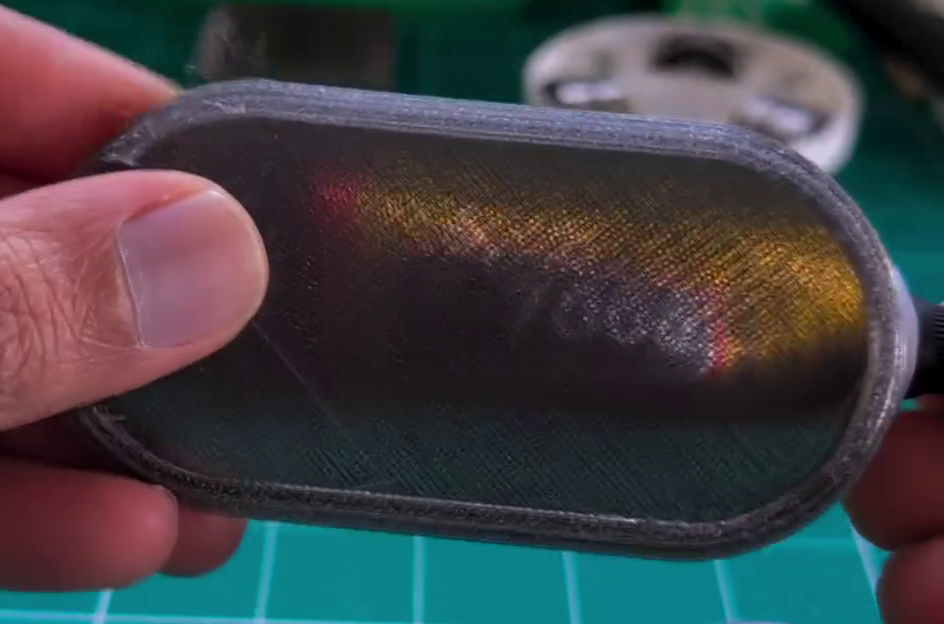
It all comes down to pathing of the 3D printer’s hot end. If it’s zigzagging back and forth, laying down hot plastic in all different orientations from layer to layer, you’re going to get a hazy, ugly, result that probably doesn’t look very see-through at all.
However, you can work around this by choosing slicer settings that make the tool pathing more suitable for producing a clearer part. [Tej] recommends going slow — as little as 20 mm/s during printing. He also states that removing top and bottom shells and setting wall loops to 1 can help to produce a part that’s entirely infill. Then, you’ll want to set infill to 100% and the direction to 0 or 90 degrees. This will ensure your hot end is just making long, straight strokes for layer after layer that will best allow light to pass through. You’ll also want to maximize nozzle flow to avoid any unsightly gaps or bubbles in your print.
[Tej] demonstrates the technique by creating a cover for a display. By using the settings in question, he creates a far more transparent plate, compared to the original part that has an ugly zig-zagging haze effect. You’re not going to get something optically clear this way; the final results are more lightly frosted, but still good.
Transparency will never be something 3D printers are great at. However, we have seen some interesting post-processing techniques that will blow your mind in this regard.