
ESP32 Plugs In to Real-Time Crypto Prices

In today’s high-speed information overload environment, we often find ourselves with too much data to take in at once, causing us to occasionally miss out on opportunities otherwise drowned out in noise. None of this is more evident in the realm of high-speed trading, whether it’s for stocks, commodities, or even crypto. Most of us won’t be able to build dedicated high speed connections directly to stock exchanges for that extra bit of edge over the other traders, but what we can do is build a system that keys us in to our cryptocurrency price of choice so we know exactly when to pull the trigger on a purchase or sale.
[rishab]’s project for doing this is based on an ESP32 paired with a 10″ touchscreen display. It gathers live data from Binance, a large cryptocurrency exchange that maintains various pieces of information about many digital currencies. [rishab]’s tool offers a quick, in-depth look at a custom array of coins, with data such as percentage change over a certain time and high and low values for that coin as well. The chart updates in real time, and [rishab] also built a feature in which scales coins up if they have been seeing large movements in price over short timeframes.
Although it’s not a direct fiber link into an exchange, it certainly has its advantages over keeping this information in a browser window on a computer where it could get missed, and since it’s dedicated hardware running custom firmware it can show you exactly what you need to see if you’re day trading crypto. Certainly projects like this are in the DIY spirit that crypto enthusiasts tout as ideals of the currency, and as people move away from mining and more into speculative trading we’d expect to see more projects like this.
youtube.com/embed/U1MZoj3MJso?…
Building a Stirling Engine Bike

Over on his YouTube channel [Tom Stanton] shows us how to build a Stirling Engine for a bike.
A Stirling Engine is a heat engine, powered by the expansion and contraction of a working fluid (such as air) which is heated and cooled in a cycle. In the video [Tom] begins by demonstrating the Stirling Engine with some model engines and explains the role of the displacer piston. His target power output for his bike engine is 150 watts (about 0.2 horsepower) which is enough power to cycle at about 15 mph (about 24 km/h). After considering a CPU heatsink as the cooling system he decided on water cooling instead.
[Tom] goes on to 3D print and machine various parts for his bike engine. He uses myriad materials including aluminum and Teflon. He isn’t yet comfortable machining steel, so he had the steel part he needed for handling the hot end of the engine manufactured by a third party.
[Tom] explains that when he started the project he had intended to make a steam engine. But after some preliminary research he discovered that a Stirling Engine was a better choice, particularly they are quieter, more efficient, and safer. After a number of false starts and various adjustments he manages to get his engine to run, which is pretty awesome. Standby for part two to see the bike in action!
We have covered the Stirling Engine here on Hackaday many times before. You might like to read about how to create one with minimal parts or how to make one from expedient materials.
youtube.com/embed/zB3lrLjqIh4?…


2025 One Hertz Challenge: Building a Better Jumping Bean

Do you feel nostalgia for a childhood novelty toy that had potential but ultimately fell short of its promise? Do you now have the skills to go make a better version of that toy to satisfy your long-held craving? [ExpensivePlasticCrap] does and has set off on a mission to make a better jumping bean.
Jumping beans, the phenomenon on which the novelty of [ExpensivePlasticCrap]’s childhood is based, are technically not beans, and their movement is arguably not a jump — a small hop at best. The trick is that the each not-a-bean has become the home to moth larvae that twitches and rolls on the ground as the larvae thrash about, trying to move their protective shells out of the hot sun.
The novelty bean was a small plastic pill-like capsule with a ball bearing inside what would cause the “bean” to move in unexpected ways as it rolled around. [ExpensivePlasticCrap]’s goal is to make a jumping bean that lives up to its name.
Various solenoids and motors were considered for the motion component of this new and improved bean. Ultimately, it was a small sealed vibrating motor that would be selected to move the bean without getting tangled in what was to become a compact bundle of components.
An ATtiny microcontroller won out over discrete components for the job of switching the motor on and off (once per second), for ease of implementation. Add this along with a MOSFET, battery and charging board for power into a plastic capsule, and the 1 Hz jumping bean was complete.
[ExpensivePlasticCrap] offers some thoughts on how to get more jump out of the design by reducing the weight of the build and giving it a more powerful source of motion.
If insect-inspired motion gets you jumping, check out this jumping robot roach and these tiny RoboBees.

The Apollo–Soyuz Legacy Lives On, Fifty Years Later

On this date in 1975, a Soviet and an American shook hands. Even for the time period, this wouldn’t have been a big deal if it wasn’t for the fact that it happened approximately 220 kilometers (136 miles) over the surface of the Earth.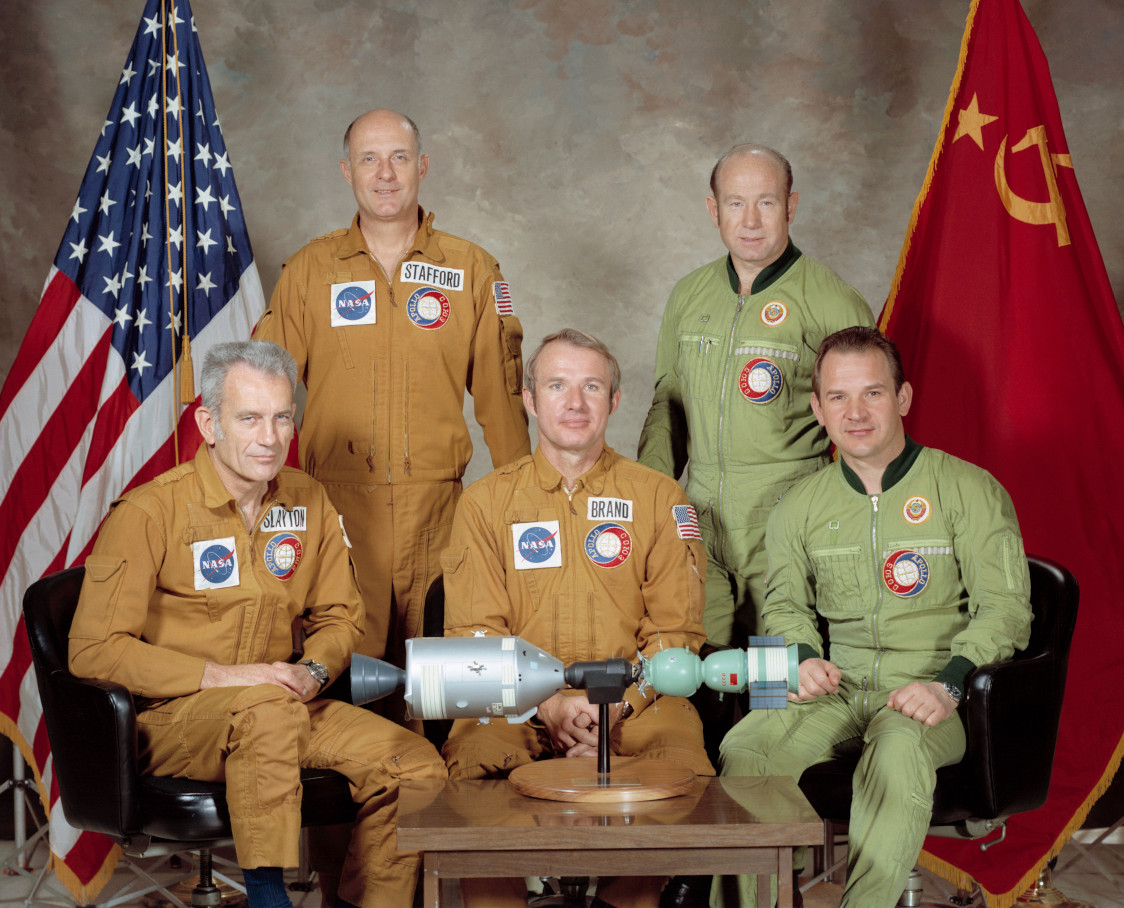
Although their spacecraft actually launched a few days earlier on the 15th, today marks 50 years since American astronauts Thomas Stafford, Vance Brand, and Donald “Deke” Slayton docked their Apollo spacecraft to a specifically modified Soyuz crewed by Cosmonauts Alexei Leonov and Valery Kubasov. The two craft were connected for nearly two days, during which time the combined crew was able to freely move between them. The conducted scientific experiments, exchanged flags, and ate shared meals together.
Politically, this very public display of goodwill between the Soviet Union and the United States helped ease geopolitical tensions. On a technical level, it not only demonstrated a number of firsts, but marked a new era of international cooperation in space. While the Space Race saw the two counties approach spaceflight as a competition, from this point on, it would largely be treated as a collaborative endeavour.
The Apollo–Soyuz Test Project lead directly to the Shuttle–Mir missions of the 1990s, which in turn was a stepping stone towards the International Space Station. Not just because that handshake back in 1975 helped establish a spirit of cooperation between the two space-fairing nations, but because it introduced a piece of equipment that’s still being used five decades later — the Androgynous Peripheral Attach System (APAS) docking system.
Meeting in the Middle
While the Apollo–Soyuz Test Project was the first time spacecraft from two different countries linked up, it was far from the first docking in space. The Apollo program relied heavily on the concept, as the Command Module and Lunar Module would dock and undock multiple times on each lunar mission. For their part, the Soviets had also docked a pair of Soyuz capsules together as early as 1967. By the early 1970s, both nations had also docked spacecraft to their respective space stations.
The problem was, the docking systems used by both countries weren’t compatible with each other. In fact, things were changing so fast that even vehicles from the same country couldn’t necessarily dock with each other. For example, an American Gemini capsule wouldn’t be able to dock with Skylab. Of course, this isn’t terribly surprising. At this point, most of the hardware was mission-specific, and only flew once.
What was the Apollo–Soyuz Test Project needed was a standardized docking interface that took into account the lessons learned by both countries so far. By 1970, Soviet and US engineers had started meeting and exchanging information to decide what such a docking standard would look like. It was decided early on that this new docking standard should be androgynous — rather than having distinct “male” and “female” variants as was the norm with earlier docking ports. In this way, the same docking port could be used to support two spacecraft docking together as was planned for the Apollo–Soyuz Test Project, while at the same time allowing a vehicle to dock to a space station.
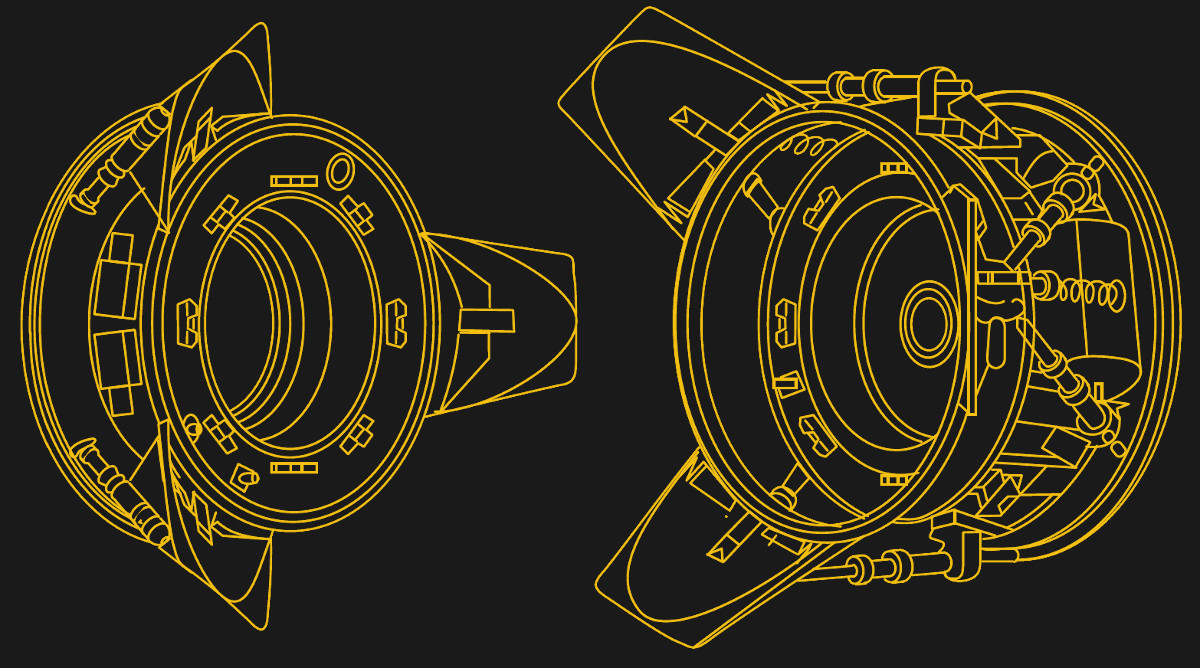
This capability was so key to the design that the docking standard ultimately came to be known as the Androgynous Peripheral Attach System. While the US and Soviet versions did differ slightly, they were mechanically compatible with each other. Some elements of the design were the result of a compromise, such as the overall diameter of the port being limited to the size of the existing Apollo and Soyuz capsules, but otherwise it was hoped the concept would prove useful for future missions and spacecraft from both nations.
Built to Last
The Apollo–Soyuz Test Project was the only time an Apollo and Soyuz spacecraft docked in space. In fact, it was the last time an Apollo spacecraft flew — after the conclusion of this mission, there wouldn’t be anther crewed American mission until the Space Shuttle came online nearly six years later.
But once the Americans started flying the Shuttle, and the Soviets had established their Mir space station, it wasn’t long before the two would meet. The Soviets had already designed a modified version of APAS that they called APAS-89, which was intended to allow the Buran spacecraft to dock with Mir. Buran never made it past the testing phase, but the work on the docking port ended up being adapted once more for the Shuttle. This final version of the standard became known as APAS-95, and was used until the final Shuttle-Mir mission in June of 1998.
APAS-95 performed so well during the Mir missions that it was decided the Shuttle would continue to use it for the International Space Station. In addition, APAS-95 (as well as a modified “hybrid” version) would also be used to hold together the core US and Russian modules of the Station.
It was the defacto docking standard used until the introduction of the International Docking Adapter in 2015, which converted the exposed APAS-95 ports used for visiting American spacecraft to a newer design to be used by modern vehicles such as the SpaceX Dragon and Boeing Starliner.
While it has now been retired for the International Docking System Standard (IDSS), the ISS is still being held together by APAS-95, and will remain that way until the space laboratory is eventually de-orbited. Not a bad legacy for a technology initially developed for a simple handshake.
ProtoWeb: Browsing the Information Superhighway Like It’s 1995

Feeling nostalgic? Weren’t around in the 90s but wonder what it was like? ProtoWeb has you covered! Over on his YouTube channel [RetroTech Chris] shows you how to browse the web like it’s 1995.
The service that [RetroTech Chris] introduces is on the web over here: protoweb.org. The way it works is that you configure your browser to use the service’s proxy server, then the service will be able to intercept your browsing activity and serve you old content from its cache. Also, for some supported sites, you will see present-day content but presented in the format you would have seen in the 90s. Once you have configured your browser to use the ProtoWeb proxy you can navigate to inode.com/ where you will find a directory listing of sites which have been archived or emulated within the service.
In his video [RetroTech Chris] actually demos some of the old web browsers running on old hardware, which is a very good recreation of what things were like. If you want the most realistic experience you can even configure ProtoWeb to slow down your network connection to the speed of a 56k dial-up modem. There are some things from the 90s that we miss, but waiting for websites to load isn’t one of them!
We had a look in our own archive to see how far back we here at Hackaday could go, and we found our first post, from September 2004: Radioshack Phone Dialer – Red Box. A red box! Spicy.
youtube.com/embed/-Qs3LVPmLgk?…
Thanks to [Teejay] for writing in about this one.
Joe Vinegar reshared this.
Israele ha attaccato l’unica chiesa cattolica nella Striscia di Gaza
Hanno cominciato ad ammazzare cattolici, stai a vedere che adesso comincia a importarcene qualcosa...
La presidente del Consiglio Giorgia Meloni ha condannato l’attacco contro la chiesa e in generale contro la popolazione civile con toni particolarmente duri: in un comunicato ha detto che «sono inaccettabili gli attacchi contro la popolazione civile che Israele sta dimostrando da mesi. Nessuna azione militare può giustificarla.
ilpost.it/2025/07/17/chiesa-sa…

Israele ha attaccato l’unica chiesa cattolica nella Striscia di Gaza
Quella della Sacra Famiglia: tre persone sono state uccise e nove ferite, fra cui il parrocoIl Post
Poliversity - Università ricerca e giornalismo reshared this.

reshared this
#Netanyahu e la #Siria in pezzi

Netanyahu e la Siria in pezzi
Lo scioccante bombardamento del palazzo presidenziale e di altri edifici governativi siriani da parte di Israele nella giornata di mercoledì ha dimostrato ancora una volta come non sia possibile intrattenere rapporti paritari con lo stato ebraico, il…www.altrenotizie.org
Non solo Mar Nero. Adesso Kyiv punta ai droni fluviali
@Notizie dall'Italia e dal mondo
Il successo nell’utilizzo degli Unmanned Surface Vessels (Usv), comunemente noti come droni marini, da parte dell’Ucraina è innegabile. Grazie a questi sistemi Kyiv è infatti riuscita a contendere il dominio sul teatro del Mar Nero alla preponderante Flotta russa, costringendola a spostare sempre più a Est le proprie basi per timore di
Notizie dall'Italia e dal mondo reshared this.
Petro: “la Colombia via dalla Nato”
@Notizie dall'Italia e dal mondo
Nel corso della Conferenza su Gaza ospitata dalla Colombia il presidente Petro ha annunciato la volontà di cessare la partnership con l'Alleanza Atlantica
L'articolo Petro: “la Colombia via dalla Nato” proviene da Pagine Esteri.
Notizie dall'Italia e dal mondo reshared this.
Bruxelles si mette l’elmetto. Nel budget Ue 131 miliardi per la difesa
@Notizie dall'Italia e dal mondo
Bruxelles (almeno a parole) non scherza sulla Difesa. Con la nuova proposta per il budget pluriennale dell’Unione (2028–2034), la Commissione europea punta a dare un messaggio forte ad Alleati e rivali. Tra le voci principali di spesa (che ammontano complessivamente a due trilioni di euro), spiccano i 131
Notizie dall'Italia e dal mondo reshared this.
Habemus Papam... ma resta la vergogna del Fantapapa.
@Privacy Pride
Il post completo di Christian Bernieri è sul suo blog: garantepiracy.it/blog/fantapap…
Non penso che esista qualcosa di leggero o pesante, grande o piccolo, luminoso o oscuro in sé. Occorre un elemento di paragone per definirsi e definire ciò che osserviamo. A volte, il termine di paragone è la legge e questo ci permettere di distinguere i…
Privacy Pride reshared this.
Serbia in rivolta: la repressione non ferma gli studenti
@Notizie dall'Italia e dal mondo
Nonostante arresti, minacce e contro-proteste organizzate dal governo, il movimento studentesco continua a riempire le strade di Belgrado
L'articolo Serbia in rivolta: la repressione non ferma gli pagineesteri.it/2025/07/17/bal…
reshared this
imolaoggi.it/2025/07/15/cipoll…

Cipollone (Bce): "L'euro digitale serve a preservare i benefici del contante" • Imola Oggi
Secondo Cipollone l'euro digitale preserverebbe il ruolo della moneta come bene pubblico accessibile a chiunque e accettato universalmenteImolaOggi (Imola Oggi)
Israele attacca la chiesa cattolica di Gaza: due donne uccise e sei feriti
@Notizie dall'Italia e dal mondo
Colpito il complesso cattolico della Sacra Famiglia, rifugio per centinaia di sfollati. Tra i feriti, padre Romanelli, il sacerdote che parlava quotidianamente con Papa Francesco
L'articolo Israele attacca la chiesa cattolica di Gaza: due donne uccise e sei
Notizie dall'Italia e dal mondo reshared this.

imolaoggi.it/2025/07/16/armi-a…

Armi a Kiev pagate dalla UE, Tajani: "Gli Usa hanno già fatto molto" • Imola Oggi
Lo ha detto il ministro degli Esteri, Antonio Tajani, parlando ai giornalisti alla residenza dell'ambasciatore d'Italia a Washington. Il capo della diplomaziaImola Oggi
Aiuti a Kyiv, ecco perché l’Italia non acquisterà le armi americane. Parla Nones (Iai)
@Notizie dall'Italia e dal mondo
Negli ultimi mesi Donald Trump ha più volte dichiarato che avrebbe potuto sospendere la fornitura di armamenti all’Ucraina. Ora, invece, ha dato il via libera all’invio di nuove batterie di missili Patriot, il cui costo sarà però coperto dagli Alleati europei. L’Italia, a tal riguardo, ha già
Notizie dall'Italia e dal mondo reshared this.
imolaoggi.it/2025/07/15/dazi-u…

Dazi Usa, Francia contro Trump: 'non siamo vassalli' • Imola Oggi
Lo ha detto Jean-Noel Barrot, Ministro per gli Affari europei e gli Affari esteri della Francia, a Bruxelles.ImolaOggi (Imola Oggi)
Finalmente si vedono Paesi con "le palle", come Dio comanda, altro che i fanfaroni ue, Usa e di Palazzo Chigi.
lindipendente.online/2025/07/1…

In Colombia il Sud Globale annuncia misure concrete contro il genocidio a Gaza - L'INDIPENDENTE
Dodici Paesi del cosiddetto “Sud Globale” hanno deciso di adottare immediatamente misure concrete per fermare il genocidio a Gaza.Dario Lucisano (Lindipendente.online)
lindipendente.online/2025/07/1…

In Colombia il Sud Globale annuncia misure concrete contro il genocidio a Gaza - L'INDIPENDENTE
Dodici Paesi del cosiddetto “Sud Globale” hanno deciso di adottare immediatamente misure concrete per fermare il genocidio a Gaza.Dario Lucisano (Lindipendente.online)
Reintrodurre l’immunità parlamentare per ridare dignità e forza alla politica
@Politica interna, europea e internazionale
L'articolo Reintrodurre l’immunità parlamentare per ridare dignità e forza alla politica proviene da Fondazione Luigi Einaudi.
Politica interna, europea e internazionale reshared this.
Son contento delle belle energie che si stanno aggregando attorno a questo nuovo progetto, ossia la prima edizione del Velletri Buskers Festival, del quale posto ora una locandina, che ho realizzato personalmente con tanto amore, e anche con l'aiuto dell'interferenza artigianale, la quale mi ha permesso, con una di quelle che chiamo "foto dal futuro", di rendere bene l'idea della magia che vogliamo creare sulle pittoresche vie del centro storico e tutto intorno alla Torre Del Trivio, uno dei simboli più caratteristici di questa antica città. L'altro giorno ho fatto anche un sopralluogo tecnico tra i vicoli di Velletri, ebbene, non ho trovato neanche un centimetro quadro di terreno che non fosse in sanpietrino e in leggera pendenza, che come tutti sanno è proprio il tipo di terreno preferito dai circensi (🤣), perché gli pone sfide sempre diverse e non li fa annoiare mai. Del resto che vuoi fare, la cittadina è arroccata su un promontorio collinare a più di quattrocento metri sul livello mare. E infatti si sta una favola, tira proprio una bella arietta, il tipico posto dove vorresti stare alle 19.00 a fare l'aperitivo mentre a Roma si fa la schiuma fortissimo. Quindi insomma, save the date: 19 Luglio, prima edizione del Velletri Buskers Festival, e chi non viene fa la schiuma, fortissimo 🙌😅
#Valletri #Buskers #festival #eventi #roma #lazio

like this
reshared this
freezonemagazine.com/news/mich…
In libreria dal 1 Agosto 2025 Con Diavolìade di Michail Bulgakov, Mattioli 1885 arricchisce la collana Light, dedicata ai classici in forma agile e curata. A firmare l’introduzione di questo nuovo titolo è Paolo Nori, che studia la letteratura russa da tutta la vita e guida il lettore nel racconto furioso e grottesco di Bulgakov con voce appassionata […]
L'articolo Michail Bulgakov – Diavolìade

Il bagno dopo mangiato
Ogni anno, puntuale come le zanzare e i tormentoni estivi, torna anche una delle leggende urbane più diffuse sulla nostra penisola: “Hai appena mangiato! Niente bagno per tre ore!” e altrettanto puntualmente arrivano articoli sui quotidiani a ribadir…maicolengel butac (Butac – Bufale Un Tanto Al Chilo)
Ucraina. Zelensky corteggia Trump con un “governo Maga”
@Notizie dall'Italia e dal mondo
«L‘Ucraina ha bisogno di dinamiche più positive nei rapporti con gli Stati Uniti» ha spiegato Zelensky. Trump ha convinto l'Europa a pagare le armi che Washington invierà a Kiev
L'articolo Ucraina. Zelensky corteggia Trump pagineesteri.it/2025/07/17/mon…
Notizie dall'Italia e dal mondo reshared this.
Come TikTok, AliExpress e WeChat ignorano i vostri diritti GDPR Tutte e tre le società non hanno risposto adeguatamente alle richieste di accesso dei denuncianti mickey17 July 2025
Altbot
in reply to Adriano Bono • • •L'immagine promuove il "Velletri Buskers Festival," la prima edizione del quale si terrà sabato 19 luglio. Il festival, organizzato dal Comune di Velletri con la collaborazione della Pro Loco Velletrae, si svolgerà in Piazza Cairoli a Velletri, con The Reggae Circus in programma alle 19.30, seguito da artisti di strada dalle 20.00. L'evento è parte del "Giubileo dei Giovani" e si svolgerà "Sognando per le vie del centro." La copertina dell'immagine mostra una donna che esegue una performance di fuochi d'artificio, con le fiamme che si stagliano contro il cielo notturno. Sullo sfondo, si intravede un edificio storico, probabilmente una chiesa, con una torre illuminata. Il testo è in italiano e fornisce informazioni dettagliate sull'evento, inclusi il luogo, l'orario e i contatti per ulteriori informazioni.
Fornito da @altbot, generato localmente e privatamente utilizzando Ovis2-8B
🌱 Energia utilizzata: 0.274 Wh
Zughy
in reply to Adriano Bono • • •Re: Son contento delle belle energie che si stanno aggregando attorno a questo nuovo progetto, ossia la prima edizione del Velletri Buskers Festival, del quale posto ora una locandina, che ho realizzato personalmente con tanto amore, e anche con l'aiuto d
Adriano Bono likes this.
Adriano Bono
in reply to Zughy • •youtube.com/shorts/dBnQQZ9NQA8
Lazio reshared this.