Cascina Torchiera - Piazzale Cimitero Maggio 18, Milano (martedì, 13 gennaio 19:00) GallinƏ! Da questo mese partono ben tre nuovi corsi, per cui correte in cascina, vi aspettiamo con gioia e voglia espressiva!
CPA Firenze sud - Via di Villamagna 27/a, Firenze (sabato, 10 gennaio 21:00) SABATO 10 GENNAIO
Ore 21.00 al CPA Firenze Sud
Iniziativa e dibattito
VENEZUELA, GUERRA e IMPERIALISMO con
Max Lioce - Comitato Internazionalista
Yoselina Guevara Lopez - Scrittrice, giornalista e attivista venezuelana
Sarà un momento di esposizione sull'attuale situazione in Venezuela, dopo i bombardamenti su Caracas e il sequestro del Presidente Maduro e della deputata Flores.
Sarà un momento di confronto sul legame tra le lotte di Resistenza, dalla Palestina all'America Latina fino a ciò che accade nel nostro paese, che si colloca pienamente all'interno del blocco imperialista euro-atlantico, e dove il nostro compito è quello di alimentare lo sviluppo della lotta contro la guerra e la repressione.
Associazione Musicale Culturale Vecchio Son - 14, Via Giovanni Antonio Sacco, San Donato, San Donato-San Vitale, Bologna, Emilia-Romagna, 40127, Italia (domenica, 11 gennaio 10:00) Workshop di danza Sabar a cura di Flaminia Vendruscolo e Tidiane Diop. QUANDO?
Domenica 11 Gennaio 2026 dalle 10 alle 13.30
DOVE? Vecchio Son, via G.A Sacco, 14 – Bologna → 15 minuti a piedi dalla stazione centrale.
L’oggetto del seminario è la danza del Farwoudjar, la madre delle danze che compongono il Sabar. È uno studio in profondità sia per chi non ha mai incontrato il Sabar, o la danza in generale, sia per danzatori. Prende le basi dall'insegnamento di Yama e dal mio percorso di ricerca. Per più info: it.navicellatheatre.org/worksh… flaminia-danza-senegalese
COSA PORTARE? - Pagne o pareo grande - Quaderno e penna Early bird entro il 5 gennaio e ulteriore sconto se porti un'amica/o! Posti Limitati - per info e iscrizione: 3465735907 info@keraps.org Vi aspettiamo!
Barattolo - Via del Borgo di San Pietro, Irnerio, Santo Stefano, Bologna, Emilia-Romagna, 40126, Italia (giovedì, 15 gennaio 17:30) Festival queer di autoproduzioni artistiche: creatività indipendente & aperitivi antifascisti.
N'oi con Lince BENEFIT - Mele Marce, Cesoia, T-Rex Squad, Oltre La Linea
Stella Nera - 67, Via Silvino Folloni, Fossalta, Buon Pastore-Sant'Agnese-San Damaso, Modena, Emilia-Romagna, 41126, Italia (sabato, 17 gennaio 19:00) pizzata e serata benefit per Lince che, la sera del 2 ottobre, durante una manifestazione contro il genocidio in Palestina, è stata colpita al volto da un lacrimogeno, sparato ad altezza uomo, che le ha causato la perdita permanente della vista in un occhio. Si tratta di violenza e repressione che vanno ben oltre il concetto di "ordine pubblico". Questi episodi di abusi stanno diventando sempre più frequenti e le forze dell'ordine si sentono sempre più legittimate, protette da uno stato di polizia. La rabbia e la solidarietà sono le nostre armi. LIBERI DI DISSENTIRE
Ore 20:00 PIZZATA
Ore 22:00 INIZIO CONCERTI:
- Oltre la linea - Cesoia - T-rex Squad - Mele Marce Il ricavato della serata contribuirà ad aiutare Lince a sostenere le spese mediche e legali.
Matrici Aperte - Via Elia Capriolo 41C, Brescia (martedì, 13 gennaio 15:00) Tutti i Martedì e i Giovedì dalle 15:00 alle 22:00 apriamo il laboratorio per chi ha bisogno di stampare ma anche per chi vuole solo sbevazzare! Potete venire a fare serigrafia, incisione calcografica, xilografia e tecniche grafiche sperimentali (cianotipia, gum print, monotipia, stampa bianca a rilievo). Per l'utilizzo del laboratorio chiediamo un contributo libero a supporto del progetto. Portate carta e matrici da casa, noi mettiamo a disposizione strumenti e spazio di lavoro. Ci sono due postazioni serigrafiche, due torchi calcografici, sala acidi e piani da inchiostrazione. Dalle 18.00 (ma anche dalle 15.00 per lx ubriaconx) apre il baretto con vino, birrette, pirli e gin tonic di pessima qualità! -c'è pure il pinkanello! Sarà aperto e consultabile anche l'archivio con libri serigrafici, fanzine e distro a supporto di movimenti e collettivi!
Teatro Coppola - il teatro dei cittadini - Via del vecchio bastione 9, Catania (sabato, 10 gennaio 18:30) Supporta il movimento catanese per la Palestina!
A Catania come altrove, chi ha scelto di mobilitarsi contro guerra, genocidio e la complicità dei nostri governi viene colpitə con misure cautelari e multe salate col solo scopo di scoraggiare la lotta.
Sostenere collettivamente queste spese significa difendere il diritto e la libertà di lottare e di non restare in silenzio. Partecipare, condividere un momento di socialità e cultura e dare un contributo concreto è un modo per rafforzare una solidarietà che non si lascia spezzare.
Ogni presenza e ogni sostegno aiutano a tenere viva la mobilitazione e a rispedire al mittente la paura e la solitudine.
Non ci lasceremo spaventare o schiacciare da queste intimidazioni perché siamo dalla parte giusta della storia.
Palestina libera, liberə di lottare!
18:30 Asseblea;
17:30 Cena benefit;
20:30 Musica Live con Cesare Basile, Sacha Tilotta, Flyinmoscow, Giovanna Cacciola, Stefamo Meli, Agostino Tilotta;
22:00 Spettacolo drag con Grazianall, Parma Gianna e Lucy Fear;
Spin Time Labs - Via di S. Croce in Gerusalemme, 55 (sabato, 10 gennaio 14:00) ROMA È TUTTA QUI
10 GENNAIO H14 - ASSEMBLEA PUBBLICA
SPIN TIME
Il 10 gennaio ci vedremo a Spin Time per organizzarci e per sognare un altro modello di città.
Abbiamo visto crescere l'onda di solidarietà, in seguito ai numerosi articoli che minacciavano lo sgombero del nostro palazzo. Associazioni, cittadin3, partiti, sindacati, giornalist3 e attor3 hanno risposto al nostro appello.
Ora dobbiamo rimetterci all'opera e dare una risposta organizzata a questa minaccia.
Perché se vogliono chiudere gli spazi sociali e abitativi, bisogna rispondere come comunità.
Incontriamoci perché abbiamo bisogno di una città a misura di tutt3, in cui l'educazione è garantita a tutte le fasce d'età, in cui il diritto all'abitare non è ostacolato dalla speculazione privata. Una città che non esclude, ma che accoglie.
Per questo e tanto altro, invitiamo cittadin3, associazioni, sindacati, partiti, figure istituzionali e artist3 a partecipare e diffondere l'appuntamento.
Nel frattempo, Spin Time resterà aperto alla città, come è sempre stato, e le attività ripartiranno: scriveteci, veniteci a trovare, organizzate le vostre iniziative nei nostri spazi!
Questa battaglia dobbiamo vincerla, non solo per Spin Time, ma per tutte le esperienze che dal basso organizzano i mondi possibili che questa destra di governo disprezza.
Inizia:Sabato Gennaio 10, 2026 @ 2:00 PM GMT+01:00 (Europe/Rome)
ROMA È TUTTA QUI
10 GENNAIO H14 - ASSEMBLEA PUBBLICA
SPIN TIME
Il 10 gennaio ci vedremo a Spin Time per organizzarci e per sognare un altro modello di città.
Abbiamo visto crescere l'onda di solidarietà, in seguito ai numerosi articoli che minacciavano lo sgombero del nostro palazzo. Associazioni, cittadin3, partiti, sindacati, giornalist3 e attor3 hanno risposto al nostro appello.
Ora dobbiamo rimetterci all'opera e dare una risposta organizzata a questa minaccia.
Perché se vogliono chiudere gli spazi sociali e abitativi, bisogna rispondere come comunità.
Incontriamoci perché abbiamo bisogno di una città a misura di tutt3, in cui l'educazione è garantita a tutte le fasce d'età, in cui il diritto all'abitare non è ostacolato dalla speculazione privata. Una città che non esclude, ma che accoglie.
Per questo e tanto altro, invitiamo cittadin3, associazioni, sindacati, partiti, figure istituzionali e artist3 a partecipare e diffondere l'appuntamento.
Nel frattempo, Spin Time resterà aperto alla città, come è sempre stato, e le attività ripartiranno: scriveteci, veniteci a trovare, organizzate le vostre iniziative nei nostri spazi!
Questa battaglia dobbiamo vincerla, non solo per Spin Time, ma per tutte le esperienze che dal basso organizzano i mondi possibili che questa destra di governo disprezza.
Scarceranda 2026: Lion’s Way feat. Ras Santo – The Healing – I-Tal Skank
Strike s.p.a. - via Umberto Partini 21 (sabato, 10 gennaio 20:00) "Quasi come una tradizione, ci piace iniziare l’anno con una serata a sostegno di Scarceranda e Radio Onda Rossa Si torna a montare l’impianto nella yard dello Strike per la prima session dell’anno!
★ Si comincia dalle ore 20:00 con la cena a cura di Radio Onda Rossa per poi proseguire con la presentazione di Scarceranda
Dalle 22:00 ★ Lion’s Way Sound System Full Powa ad accompagnarci durante la serata al microfono Ras Santo
Alle selezioni: ★ The Healing ★ Ital Skank
☛ Artwork by The Valentinis ☚ ◄ Entrata a sottoscrizione Libera ► ◄ A sostegno di Scarceranda e Radio Onda Rossa ► @ Strike Via Umberto Partini 21"
Città dell'Utopia - Via Valeriano 3f, San Paolo, Roma (sabato, 17 gennaio 09:00) Riprendono le attività del casale, e torna immancabile, l'appuntamento mensile con il mercato terraTERRA!
Una giornata all'insegna del buon cibo, della convivialità e della sostenibilità!
Cosa troverai:
dalle ore 9 mercato di vendita diretta, dal contadino al consumatore! Prodotti e verdure di stagione, miele, tisane, vino, cosmesi naturale, formaggio, pane, vestiti serigrafati... e molto altro!
alle ore 13:30 Pranzo vegano, fatto con amore e a prezzi popolari!
dalle ore 15 Laboratorio di riparazione: porta il tuo ogetto rotto ed impara a ripararlo con le tue stesse mani!
Ogni 3° sabato del mese, nella piazza di Via Valeriano e nel Casale de La città dell'Utopia!
Biella - Sala Convegni Fondazione CRB - Via Gramsci 14/A (martedì, 13 gennaio 16:00) Romeo e Giulietta: la storia senza tempo del giovane Shakespeare - Antonella Stefanuzzi
Biella - Via Corradino Sella 10 (giovedì, 15 gennaio 19:00) Dipingi e rilassati in compagnia di un bicchiere di vino con Beatrice di Aperitivo Artistico! 🎨🍷
Un'occasione per trascorrere una serata diversa dal solito, in un'atmosfera rilassata e conviviale, per conoscere nuove persone e uscire dalla routine ✨
Non devi preoccuparti se sei alle prima armi, potrai scegliere tra molte immagini di riferimento e sarai guidata/o per tutto il tempo.
Biella - UPBeduca - via Delleani, 33/D - Biella (martedì, 20 gennaio 16:00) Dall'oro al portafoglio ideale: come diversificare e ottenere invesstimenti profittevoli - Andrea Fabbris
Cossato - Sede di UPBeduca - Via Martiri della Libertà 14 (mercoledì, 21 gennaio 16:00) Anatomia di una tirannide: Domiziano nel giudizio dello storico Tacito - Fulvio Conti
Hacking Labs APS - via Piaggiori Basso 212, Segromigno in Monte (LU) (sabato, 10 gennaio 21:00) Un viaggio tra parole e musica per raccontare l'amore struggente e l'arte immortale di Luigi Tenco e Dalida. Una serata per rivivere le emozioni, i sogni e quel legame indissolubile spezzato troppo presto, ma reso eterno dalle loro canzoni.
“It is a massive surprise,” said one astronomer who measured the high temperatures of gas in galaxy cluster that existed 12 billion years ago.#TheAbstract
Astronomers Discovered Something Near the Dawn of Time That Shouldn’t Exist
🌘 Subscribe to 404 Media to get The Abstract, our newsletter about the most exciting and mind-boggling science news and studies of the week.
Astronomers have discovered an ancient reservoir of gas that is too hot for cosmic models to handle, reports a study published on Monday in Nature.
By peering over 12 billion years through time to the infant cosmos, a team captured an unprecedented glimpse of a baby galaxy cluster called SPT2349-56. Cosmological models suggest that the gas strewn between galaxies in these ancient clusters should be much cooler than gas observed in modern galaxies, which has been heated up by the intense gravitational interactions that play out in clusters over billions of years.
But the new observations of SPT2349-56 reveal an inexplicably hot reservoir of this intracluster gas, with temperatures similar to those at the center of the Sun, a finding that is “contrary to current theoretical expectations,” according to the new study.
“It is a massive surprise,” said Dazhi Zhou, a PhD candidate at the University of British Columbia who led the study, in a call with 404 Media. “According to our current theory, this kind of hot gas inside young galaxy clusters should still be cool and less abundant, because these baby clusters are still accumulating and gradually heating their gas.”
“This one we discover is already pretty abundant and even hotter than many mature clusters that we see today,” he added. “So, it's a bit different and forces us to rethink our current understanding of how these large structures form and evolve in the universe.”
The first stars and galaxies emerged in the universe a few hundred million years after the Big Bang, during an era called cosmic dawn. Galaxies gradually accumulated together into large clusters over time; for instance, our Milky Way galaxy is part of the Laniakea supercluster which contains about 100,000 galaxies and stretches across hundreds of millions of light years.
As a baby cluster, SPT2349-56 is much smaller, measuring about 500,000 light years across, and containing about 30 luminous galaxies and at least three supermassive black holes. Zhou and his colleagues observed the cluster with Atacama Large Millimeter/submillimeter Array (ALMA), a highly sensitive network of radio telescopes in Chile, which allowed them to capture the first temp check of its intracluster gas.
“Because this gas is pretty distant, it's very challenging to see the light of the gas directly,” explained Zhou. To probe it, the team searched for what’s known as the thermal Sunyaev–Zeldovich signature, which is a detectable distortion of the oldest light in the universe as it passes through intracluster gas.
The results produced a thermal energy measurement of 1061 erg, which is about five times hotter than expected. While the heat source is still unknown, Zhou speculated that it could be caused by high levels of activity in the cluster, where stars are forming 5,000 times faster than in our own galaxy and huge energetic jets of matter spout out of galactic cores.
However, it will take more observations of these distant clusters to figure out whether the hot gas within SPT2349-56 is an aberration, or if super-hot gas is more common in early clusters than predicted.
“Like every first discovery, we have to be cautious and careful with big results,” Zhou said. “We need to test it further, with more independent observations and comparisons to other galaxy clusters at a similar time. This is what we hope that our community will do next, and we're also planning for follow up observations of other clusters to see whether there is a broader trend or if this system is an outlier.”
The new study is part of a wave of unprecedented observations of the early universe within the past few years. The James Webb Space Telescope, for example, has discovered massive galaxies much earlier in time than expected, pointing to a tantalizing gap in our knowledge about how our modern cosmos emerged from these ancient structures.
“It is starting to change our current understanding of how energetic the galaxy formation process was in such an early time,” Zhou said. “Galaxies were formed and evolved with much more violence, and were more active, more extreme, and more energetic than what we used to expect. The James Webb results are also consistent with our current discovery that these galaxies were very powerful in shaping their surroundings.”
Detection of hot intracluster gas in SPT2349−56 with the Atacama Large Millimeter/submillimeter Array provides new insights into early cluster formation.
The publisher is teaming with a company that claims its proprietary AI can ‘provide 2 to 3 times higher quality translations’ than other large language models.#News #AI
HarperCollins Will Use AI to Translate Harlequin Romance Novels
Book publisher HarperCollins said it will start translating romance novels under its famous Harlequin label in France using AI, reducing or eliminating the pay for the team of human contract translators who previously did this work.
Publisher’s Weekly broke the news in English after French outlets reported on the story in December. According to a joint statement from French Association of Literary Translators (ATFL) and En Chair et en Os (In Flesh and Bone)—an anti-AI activist group of French translators—HarperCollins France has been contacting its translators to tell them they’re being replaced with machines in 2026. playlist.megaphone.fm?p=TBIEA2… The ATFL/ En Chair et en Os statement explained that HarperCollins France would use a third party company called Fluent Planet to run Harlequin romance novels through a machine translation system. The books would then be checked for errors and finalized by a team of freelancers. The ATFL and En Chair et en Os called on writers, book workers, and readers to refuse this machine translated future. They begged people to “reaffirm our unconditional commitment to human texts, created by human beings, in dignified working conditions.”
HarperCollins France did not return 404 Media’s request for comment, but told Publisher’s Weekly that “no Harlequin collection has been translated solely using machine translation generated by artificial intelligence.” In its statement, it explained that the company turned to AI translations because Harlequin’s sales had declined in France.
“We want to continue offering readers as many publications as possible at the current very low retail price, which is €4.99 for the Azur series, for example,” the statement said. “We are therefore conducting tests with Fluent Planet, a French company specializing in translation for 20 years: this company uses experienced translators who utilize artificial intelligence tools for part of their work.”
According to Fluent Planet’s website, its translators “studied at the best translation universities or have decades of experience under their belt.” These human translators are aided by a proprietary translation agent Fluent Planet called BrIAn.
“When compared to standard machine translation systems that use neural networks, BrIAn can provide 2 to 3 times higher quality translations, that are more accurate, offer idiomatic phrasing, provide a deeper understanding of the meaning and a faithful representation of the style and emotions of the source text,” the site said. “BrIAn takes into account the author’s tone and intention, making it highly effective for complex literary or marketing content.”
Translation is a delicate work that requires deep knowledge of both languages. Nuances and subtleties—two aspects of writing AIs are notoriously terrible at—can be lost or deranged if not carefully considered during the translation process. Translation is not simply a substitution game. Idioms, jargon, and regional dialects come into play and need a human touch to work in another language. Even with humans, the results are never perfect.
“I will tell you that the author community is up in arms about this, as we are anytime an announcement arrives that involves cutting back on human creativity and ingenuity in order to save money,” romance author Caroline Lee told 404 Media. “Sure, AI-generated art is going to be cheaper, but it cuts out our cover artists, many of whom we've been working with for a decade or more (indie publishing first took off around 2011). AI editing can pick up on (some) typos, but not as well as our human editors can. And of course, we're all worried what the glut of AI-generated books will mean for our author careers.”
HarperCollins France is not the first major publisher to announce its giving some of its translation duties over to an AI. In March of 2025, UK Publisher Taylor & Francis announced plans to use AI to publish English-language books in other languages to “expand readership.” The publisher promised AI-translated books would be “copyedited and then reviewed by Taylor & Francis editors and the books’ authors before publication.”
In a manifesto on its website, In Flesh and Bone begged readers to “say no to soulless translations.”
“These generative programmes are fed with existing human works, mined as simple bulk data, without offering the authors the choice to give their consent or not,” the manifesto said. “Furthermore, the data processing remains dependent on an enormous amount of human labour that is invisibilized, often carried out in conditions that are appalling, underpaid, dehumanizing, even traumatizing (when content moderation is involved). Finally, the storage of the necessary data for the functioning and training of algorithms produces a disastrous ecological footprint in terms of carbon balance and energy consumption. What may appear as progress is actually leading to immense losses of expertise, cognitive skills, and intellectual capacity across all human societies. It paves the way for a soulless, heartless, gutless future, saturated with standardized content, produced instantaneously in virtually unlimited quantity. We are close to a point of no return that we would never forgive ourselves for reaching.”
The translation of the manifesto from French to English was done by the collective themselves.
Following backlash from the French Literary Translators Association, HarperCollins France confirmed it’s “conducting tests” with a French company that “uses experienced translators who utilize artificial intelligence tools,” to translate Harleq
Here is the Agreement Giving ICE Medicaid Patients' Data
A data sharing agreement between the Department of Homeland Security (DHS) and the Centers for Medicare & Medicaid Services (CMS), which was designed for ICE to receive the personal data of nearly 80 million Medicaid patients, was published as part of a lawsuit last year, with the public now able to see the exact text of that unprecedented agreement.
Last year, Freedom of the Press Foundation and 404 Media sued DHS for a copy of the agreement after the agency failed to turn it over in response to Freedom of Information Act (FOIA) requests. A U.S. attorney working on that case then flagged to our counsel that the document had been released in a separate lawsuit various states brought against the Department of Health and Human Services and DHS.
The full text of the agreement also shows the data promised to ICE included more granular data than previously reported, such as patients’ banking “routing number, account type, account number.”
“Access to this information will allow ICE to receive information concerning the identity and location of aliens in the United States, such as address, telephone number, banking information (routing number, account type, account number), email address, internet protocol (IP) addresses, or other information relevant to identifying and locating aliens in the United States,” the agreement reads.
💡 Do you know anything else about this data sharing? I would love to hear from you. Using a non-work device, you can message me securely on Signal at joseph.404 or send me an email at joseph@404media.co.
The existence of the data sharing agreement was reported at the time by the Associated Press and later WIRED. 404 Media has uploaded a copy here. At the end of December, a judge ruled that the Trump administration could resume sharing much of the data after it had been blocked from doing so, Politico reported. That means ICE can use Medicaid data in deportation cases starting Tuesday, Politico added.
Under a section called “description of the data that may be disclosed,” the agreement says that data includes “Medicaid recipients: Name, address, assigned Medicaid identification number, social security number (SSN), date of birth, sex, phone number, locality, ethnicity and race.” The data allowed to be given to ICE under the new ruling is slightly narrower than that, and includes citizenship, immigration status, address, phone number, date of birth, and Medicaid ID, and is limited to people living unlawfully in the U.S., Politico reported.
In June the Associated Press reported Medicaid officials unsuccessfully fought to block the transfer of data related to millions of Medicaid enrollees from California, Illinois, Washington state, and Washington D.C. Emails showed two top advisers to Health Secretary Robert F. Kennedy Jr. ordered the data transfer and CMS officials had 54 minutes to comply, the Associated Press added. At the time, the exact purpose of the data sharing was not known. Then the Associated Press reported on the agreement itself that said the sharing was for ICE to locate aliens in the country. playlist.megaphone.fm?p=TBIEA2… CMS did not respond to 404 Media’s request for comment.
DHS Assistant Secretary Tricia McLaughlin told 404 Media in a statement, “President Trump consistently promised to protect Medicaid for eligible beneficiaries. To keep that promise after Joe Biden flooded our country with tens of millions of illegal aliens CMS and DHS are exploring an initiative to ensure that illegal aliens are not receiving Medicaid benefits that are meant for law-abiding Americans.” Undocumented immigrants do not have access to federally funded healthcare coverage, including Medicaid, according to the non-partisan, non-profit organization American Immigration Council. Federal law mandates that hospitals provide emergency care regardless of the person’s immigration status, the organization says.
The agreement is part of a much wider practice of data sharing across the second Trump administration and its mass deportation effort. The IRS has funneled data to ICE; in November a court blocked that data sharing. This month the New York Times revealed the TSA was sharing multiple lists of people a week with ICE so immigration authorities could then detain them at airports.
Correction: due to an editing error, this article previously said we sued DHS earlier this year. It was last year. The copy has been updated to reflect this.
A federal judge sided with plaintiffs who argued that the data-sharing pact violated privacy laws, putting immigrants at risk of their information being “impermissibly used” by ICE.
No, non è umano. Non è proprio dell'umanità uccidere un uomo perché un immigrato. Oppure straniero. O perché figlio di un'altra cultura, di un altro paese, di un altra regione o città. È disumano. Che poi, che significa "straniero", "immigrato", "extracomunitario"? È forse qualcuno che ha osato superare gli invisibili confini politici della terra di cui ci siamo stomachevolmente appropriati? Gente che ha avuto l'ardire di oltrepassare la soglia di "casa nostra"? Ma quale posto può esistere che non possa essere condiviso? Quali mani non possono attingere dallo stesso piatto? Quale pane non può essere spezzato in due? E i confini, che cosa sono? Non capisco. Dall'alto non si vedono, giuro. Chiunque può accertarlo: basta guardare dal finestrino di un aereo quando sorvola le nazioni e città. Si vedono solo alberi, laghi, colli e fiumi. Montagne altissime, prati, e poi il cielo. Non c'è occhio che possa distinguere una frontiera, e non esistono braccia che non possano distruggere muri e reti, cancellare delimitazioni; non esistono piedi incapaci di sbiadire le soglie, di prendere a calci le porte chiuse. Dovremmo sfondarle, le barricate dell'egoismo. Spalancarle, e lasciare tutti liberi. Perché lo spazio non esiste, è solo il rapporto tra le cose. E non esiste rapporto tra cosa e cosa, posto tra un punto e un punto, che possa giustificare un assassinio, un discrimine, una qualunque ributtante cattiveria. Che cazzo significa essere stranieri? Ditemelo, che cosa voglia mai dire essere "di un altro posto"? Perché sarebbe così tanto importante da ridurre il valore della vita a quello di una volgare raffica di mitra? Perché la sua vita dovrebbe valere meno della mia, della nostra, della vita della "gente di qua"? Vuol forse dire che non sono uguali a me? Che il loro sangue ha un colore diverso? Che i loro cuori non sanguinano davanti alla morte, alle disgrazie, alle malattie, ai dispiaceri di questo mondo? Vuol dire che le loro mani, quando vengono strette forte dai loro figli, non provano le stesse vibrazioni che provo io, quando sono i miei figli a stringermele? Vuol dire che i loro occhi non lacrimano davanti a Dio, quando pregano? Che le loro palpebre, quando si chiudono, non lasciano liberi i sogni? Vuol dire che la loro dignità è niente, solo perché stranieri? Forse non respirano la mia stessa aria? Non si bruciano la pelle sotto il sole? Non sentono il freddo o il caldo, come quando la neve colpisce con i suoi aghi il viso, o come quando il sole acceca, e non vedi più dove vai? Forse non hanno la mia stessa fame? E le loro papille gustative percepiscono i sapori diversamente dai miei? E i loro orecchi non sentono forse i miei stessi rumori, i miei stessi suoni, la mia stessa musica? I loro palpiti nervici, le mie stesse, incontrollabili, emozioni? Che vuol dire? Che cazzo vogliono dire tutte queste assurde cretinate? Che cazzo stiamo diventando? Che cazzo siamo diventati?
Pubblicato da @IFTAS questo rapporto si basa su sondaggi dettagliati e sul feedback della community, composto da moderatori volontari, amministratori e community manager del social web decentralizzato. Offre il quadro più completo finora sul panorama della fiducia e della sicurezza in progetti come Mastodon, GoToSocial, WordPress, PeerTube e altri.
Cosa c'è nel rapporto
- Nuove pressioni sui moderatori : il rapporto medio moderatori-utenti è peggiorato a 1:3.500 - Lo spam ha superato il CSAM come principale preoccupazione per la maggior parte delle squadre - Il burnout rimane diffuso : 1 amministratore e moderatore su 5 ha segnalato traumi o esaurimento - La maggior parte dei servizi non dispone delle garanzie legali o procedurali necessarie per gestire il rischio - Le piccole comunità dominano , ma l'ecosistema non ha gli strumenti progettati per loro - La federazione basata sul consenso sta emergendo come un modello desiderato per la crescita e la sicurezza
Novità del 2025
- C’è una crescente concentrazione tra i grandi servizi e una crescente tensione - C'è meno integrazione di nuovi moderatori , anche se le minacce aumentano - Le campagne di disinformazione e lo spam generato dall'intelligenza artificiale sono ora rischi importanti - La complessità legale e normativa è in aumento, ma il supporto resta scarso
Previsioni per il 2026
Il rapporto di quest'anno include anche una previsione lungimirante, individuando cinque tendenze che caratterizzeranno l'anno a venire:
- La logica condivisa e i segnali di fiducia sostituiranno le liste di blocco frammentate - I media sintetici e l'impersonificazione metteranno alla prova la moderazione umana - I rischi di cattura delle infrastrutture aumentano man mano che gli strumenti vengono centralizzati - La regolamentazione globale della sicurezza sta diventando obbligatoria e non facoltativa - Greylisting e allowlisting potrebbero presto sostituire la “federazione aperta predefinita”
Perché questo è importante
I moderatori sono la spina dorsale di un social web più sicuro, ma la maggior parte di loro non è retribuita, non riceve sufficiente supporto ed è costantemente sotto pressione. Se vogliamo un futuro per le piattaforme decentralizzate che rispetti l'autonomia degli utenti, la libertà di parola e l'autonomia della comunità, dobbiamo supportare l'infrastruttura che ne garantisce la sicurezza.
New insights into the people, pressures, and infrastructure shaping decentralised platforms Published by IFTAS, this report draws on detailed surveys and community feedback from volunteer moderators, administrators, and community managers across the decentralised social web. It offers our most comprehensive picture yet of the trust and safety landscape across projects like Mastodon, GoToSocial, WordPress, PeerTube, and more.
What’s in the Report
New pressures on moderators: The average mod-to-user ratio has worsened to 1:3,500
Spam has overtaken CSAM as the top concern for most teams
Burnout remains widespread: 1 in 5 admins and moderators reported trauma or exhaustion
Most services lack legal or procedural safeguards needed to manage risk
Small communities dominate, but the ecosystem lacks tooling designed for them
Consent-based federation is emerging as a desired model for growth and safety
What’s New in 2025
There is growing consolidation among large services – and growing strain
There’s less onboarding of new moderators, even as threats increase
Disinformation campaigns and AI-generated spam are now prominent risks
Legal and regulatory complexity is increasing – but support remains scarce
Forecasts for 2026
This year’s report also includes a forward-looking forecast, identifying five trends that will shape the coming year:
Shared logic and trust signals will replace fragmented blocklists
Synthetic media and impersonation will challenge human moderation
Infrastructure capture risks are rising as more tooling centralises
Global safety regulation is becoming enforceable, not optional
Greylisting and allowlisting may soon replace “default open federation”
Why This Matters
Moderators are the backbone of a safer social web – but most are unpaid, under-supported, and under constant strain. If we want a future for decentralised platforms that respects user agency, civil speech, and community autonomy, we need to support the infrastructure that keeps it safe.
In the weeks ahead, we’ll be publishing a series of follow-up posts that take a closer look at the trends, challenges, and emerging patterns highlighted in this year’s report. These articles will explore context and practical insights for anyone working to support safer, more resilient decentralised platforms.
Media or Press Enquiries
For questions, interviews, or background information related to the report or IFTAS’ work, contact press@iftas.org
Follow IFTAS to stay informed: Mastodon, Bluesky, WordPress (see below)
Running a federated messaging service exposes the volunteer staff to legal and regulatory requirements, online harms, and myriad questions. IFTAS provides resources to volunteer moderators, adminis…
The Legion of Doom (LoD) wasn’t just a hacker group, it captured the essence of underground hacking in the 80s/90s. BBSes, phreaking, rival crews, and the crackdowns that changed everything.
The concept of building your own hydroelectric generator seems simple at face value: use gravity to impart as much force as possible onto a turbine, which spins a generator, thus generating electricity. If you’re like the bloke over at [FarmCraft101] trying to DIY this with your farm pond and a lot of PVC pipes, you may have some significantly more in-depth questions, especially pertaining to what kind of generator to use. This and other questions, some of which were raised after the previous video in which the first prototype generator was assembled, are answered in this follow-up video.
When you DIY such a hydroelectric system, you have a number of options when it comes to just the turbine design alone, with the Kaplan-style turbine being one of the most straightforward ones – especially if you use a fixed pitch instead of adjustable – but you can go pretty far in the weeds with alternatives. As for the sharp drop-off after the turbine in the used design, the technical term is a draft tube, which is actually more efficient in this kind of low head, high flow hydroelectric dam situation.
After getting his money back for the unusable ‘3 kW’ generator, there were three options left: try an EBay special, get a purpose-built one from a US company, or rewind an alternator stator for higher voltage output than the standard 12/24V. Ultimately option four was chosen, as in ‘all of the above’, so that comparison is coming up in a future video.
There were also questions from viewers about why he opted to rectify the AC power from the generator and use DC transmission to the nearest farm building. The main reason is efficiency, as DC transmission lines lack the skin effect losses. The other is that the grid-tie inverter that he plans to use needs DC input anyway. Not having to deal with AC transmission issues like losses and reactive power shenanigans is a major plus here.
Once the three new generator versions are being tested it will be interesting to see how they perform. One thing with the Kaplan-style turbine is that too fast RPM induces cavitation, which will erode the propeller pretty quickly. Generally car alternators require a pretty fast RPM, so that may not work out too well. There is also the question of the DC voltage generated, as for DC transmission you want to have as high a voltage as possible to reduce the current.
The purpose-built generator he purchased tops out at 48V, which is quite low. The goal is to have at least 230 VAC before rectification, so a step-up transformer may be needed. Unfortunately three-phase transformers are pretty pricy again, making the rewound alternator seem less crazy. The wild card here is perhaps whether the EBay-purchased generator is a diamond in the rough and works out of the box as hoped.
Hot glue guns are pretty simple beasts: there’s an on/off switch, a heating element, and a source of current, be it battery or wired. You turn it on, and the heater starts warming up; eventually you can start extruding the thermoplastic sticks we call “hot glue”. Since there’s no temperature control, the longer you run the gun, the warmer it gets until it is inevitably hotter than you actually want– either burning you or oozing thermoplastic out the tip. [Mellow_Labs] was sick of that after a marathon hot-glue session, and decided to improve on his hot glue gun with PID tuning in the video embedded below.
PID tuning is probably a familiar concept to most of you, particularly those who have 3D printers, where it’s used in exactly the same way [Mellow_Labs] puts it to work in the hot glue gun. By varying the input (in this case the power to the heater) proportional both to the Parameter (in this case, temperature) as well as the Integral and Derivative of that value, you can have a much steadier control than more naive algorithms, like the simple “on/off” thermostat that leads to large temperature swings.
In this case [Mellow_Labs] is implementing the PID control using a thermistor that looks like it came from a 3D printer, and a MOSFET driven by an RP2040. Microcontroller gets its power via the hot glue gun’s battery fed through a buck converter. Since he has them, a small OLED screen displays temperature, which is set with a pair of push-buttons. Thus, one can set a temperature hot enough to melt the glue, but low enough to avoid oozing or third degree burns.
He does not share the code he’s running on the RP2040, but if you are inspired to replicate this project and don’t want to roll your own, there are plenty of example PID scripts out there, like the one in this lovely robot. No, PID isn’t reserved for thermostats– but if you are controlling heat, it’s not reserved for electric, either. Some intrepid soul put built a PID controller for a charcoal BBQ once.
[AmiCube] has announced their new PiStorm68K special edition MiniMig accelerator board. This board was developed to replace the 68000 CPU in a MiniMig — a recreation of the original Amiga chipset in an FPGA allowing a real genuine 68000 CPU to operate.
The PiStorm68K itself can host a real genuine 68000 CPU but it can also host various Raspberry Pi models which can do emulation of a 68000. So if you combine a PiStorm68K with a MiniMig you can, at your option, boot into an emulated environment with massively increased performance, or you can boot into an original environment, with its reliable and charming sluggishness.
In the introduction video below, [AmiCube] uses the SYSINFO utility software to compare the CPU speed when using emulation (1531 MIPS) versus the original (4.47 MIPS), where MIPS means Millions of Instructions Per Second. As you can see the 68000 emulated by the Raspberry Pi is way faster than the original. The Raspberry Pi also emulates a floating-point unit (FPU) which the original doesn’t include and a memory management unit (MMU) which isn’t used.
I’m going to go ahead and admit it: I really have too many tray icons. You know the ones. They sit on your taskbar, perhaps doing something in the background or, at least, giving you fingertip access to some service. You’d think that creating a custom tray icon would be hard, but on Linux, it can be surprisingly simple. Part of the reason is that the Freedesktop people created standards, so you don’t typically have to worry about how it works on KDE vs. GNOME or any of the other desktop environments. That’s a big win.
In fact, it is simple enough that you can even make your own tray icons with a lowly shell script. Well, of course, like most interesting shell scripts, you need some helper programs and, in this case, we’ll use YAD — which is “yet another dialog,” a derivative of Zenity. It’s a GTK program that may cause minor issues if you primarily use KDE, but they are nothing insurmountable.
The program is somewhat of a Swiss army knife. You can use it to make dialogs, file pickers, color selectors, printer dialogs, and even — in some versions — simple web browsers. We’ve seen plenty of tools to make pretty scripts, of course. However, the ability to quickly make good-looking taskbar icons is a big win compared to many other tools.
Docs
Depending on what you want to do, YAD will read things from a command line, a file, or standard input. There are dozens of options, and it is, honestly, fairly confusing. Luckily, [Ingemar Karlsson] wrote the Yad Guide, which is very digestible and full of examples.
Exactly what you need will depend on what you want to do. In my case, I want a tray icon that picks up the latest posts from my favorite website. You know. Hackaday?
The Web Connection
YAD can render HTML using WebKit. However, I ran into immediate problems. The version in the repos for the Linux I use was too old to include the HTML option. I found a supposedly statically linked version, but it was missing dependencies. Even after I fixed that, the program still reported errors related to the NVIDIA OpenGL stack.
I quickly abandoned the idea of using a web browser. I turned to two other YAD features. First, the basic dialog can hold text and, in most cases, renders quasi-HTML because it uses the Pango library. However, there is also a text-info dialog built in. Unlike most other YAD features, the text-info dialog reads its input from standard input. However, it doesn’t render markup.
In the end, I decided to try them both. Why not? It is simple enough. But first, I needed a tray icon.
The Tray
YAD can provide a “notification,” which is what it calls a tray icon. You can specify an icon, some text, and a right-click context menu. In addition, it can react when someone clicks on the icon. Can you find the tray icon we’re talking about? I decided to write a script with multiple personalities. If you run it with no arguments, it sets up the tray icon. If you pass anything to it, it will show a dialog with the latest Hackaday articles from the RSS feed. I wanted to make those links clickable, and that turned out to be a bit of a wrinkle. Both versions will do the job, but they each need a different approach, as you will see.
Here’s the tray code:
yad --notification --image="$0.icon.png" --text="Hackaday Now" \ --menu="Quit!quit!gtk-quit" --command="$0 show" --no-middle
You can probably guess at most of this without the manual. The image is stored in a file with the same name as the script, but with .icon.png at the end. That’s the icon in the tray. The simple menu provides an option to exit the program. If you click the icon, it calls the same script again, but with the “show” argument. The script doesn’t care what the argument is, but maybe one day it will.
So that part of the project was extremely simple. The next job is making the dialog appear.
Text Info
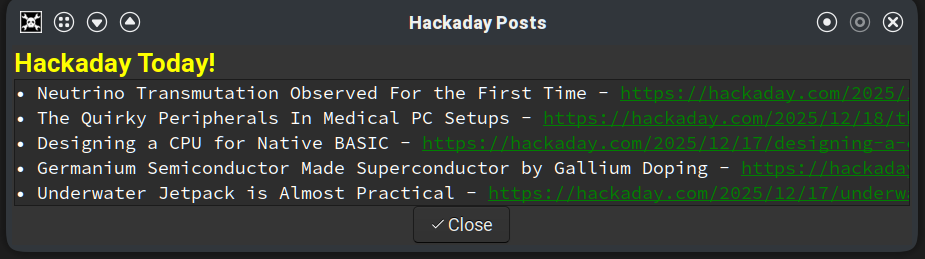
Grabbing the RSS feed with wget is trivial. You could use grep, sed, and bash pattern replacement to extract the titles and URLs, but I opted for awk and a brute-force parsing approach. This works, but the URLs are long and not terribly attractive. The list is scrollable, and there are more links below the visible ones. The standard output of awk pipes into YAD, but you can’t readily apply formatting or hyperlinks. You can use formatting in regular dialog text, which will appear before the other output. That’s where the yellow “Hackaday Today!” title in the adjacent screenshot gets set. In addition, you can automatically detect URLs and make them clickable using the --show-uri option.
You’ll notice that the –text option does take Pango formatting and the --show-uri option makes the links clickable. By default, dialogs have an Open and Cancel button, but I forced this one to have a single close button, accept escape, and I wanted the button centered.
As you can see in the screenshot, the result isn’t bad, but it does require having the title followed by a long URL that you can click on and that’s a little ugly.
Stock Dialog
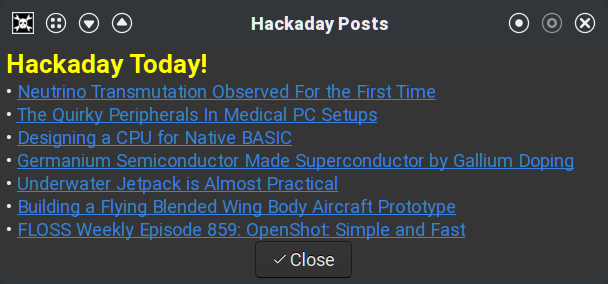
Using a standard dialog instead of text-info allows better formatting. Since the –text option works with any dialog and handles formatting, I decided to try that. The awk code was nearly the same, except for the output formatting. In addition, the output now needs to go on the command line instead of through a pipe.
This does make the script a bit more unwieldy. The awk script sets a variable, since jamming the command into the already busy YAD command line would make the script more complicated to read and work with.
The DATA variable has the formatted output text. The result looks better, as you can see in the screenshot. In either version, if you click an underlined link, your default browser should open the relevant post.
Other Choices
If you want to install either script, you can get it from GitHub. Of course, you could do this in Python or any other conventional language. There are also programs for “minimizing” another program to the tray, like AllTray or KDocker, although some of these may only work with X11 and not Wayland.
It would have been nice to have an integrated browser, although, thanks again to FreeDesktop, it is simple enough to open a URL and launch the system’s default browser.
Prefer your Hackaday feed on the command line? Check out the comments for this post. Meanwhile, send us a tip (you know, a link to your project, not a gratuity) and maybe you’ll see your own project show up on the feed.
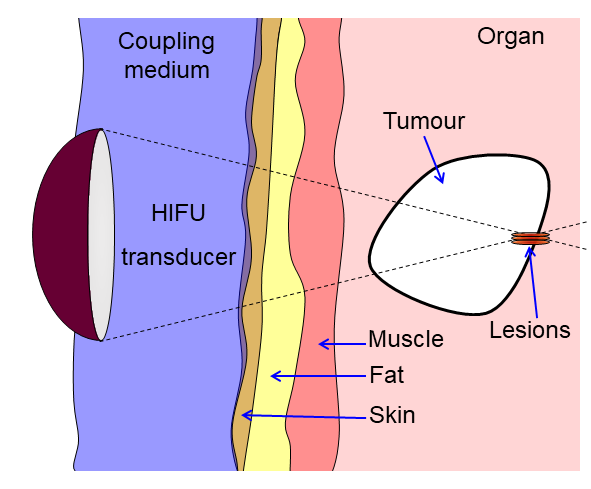
As areas of uncontrolled cell growth, cancerous growth form a major problem for a multi-celled organism like us humans. Thus before they can begin to affect our long-term prospects of a continued existence, eradicating these cells-gone-wrong is essential. Unfortunately, doing so without affecting healthy cells significantly is tough. Treatments such as chemotherapy are correspondingly rough on the body, while radiation therapy is a lot more directed. Perhaps one of the more fascinating treatments involves ultrasound, with the IEEE Spectrum magazine recently covering one company providing histotripsy equipment. Diagram showing how HIFU can be used to destroy tissue in the body. An acoustic lens is used to focus sound to a small point in the body. (Credit: James Ross McLaughlan, Wikimedia) Ultrasound has found many applications in the medical field far beyond imaging, with therapeutic ultrasound by itself covering a variety of methods to perform actions within the body without breaking the skin. By using high-energy ultrasound, everything from kidney stones to fat cells and cancerous cells can be accurately targeted and destroyed. For liver tumors the application of so-called histotropsy has become quite common, allowing certain types of tumors to be ablated non-invasively after which the body can handle the clean-up.
Histotropsy is a form of high-intensify focused ultrasound (HIFU) that uses either continuous or pulsed waves to achieve the desired effect, with the HIFU transducer equipped with an acoustic lens to establish a focal point. In the case of histotripsy cavitation is induced at this focal point that ends up destroying the local tissue. Beyond liver tumors the expectation is that other tumors will soon be treated in a similar manner, which could be good news for especially solid tumors.
Along with new approaches like CAR T cell immunotherapy, the prospects for cancer becoming a very treatable set of diseases would seem to be brighter than ever.
It’s a cliché in movies that whenever an airplane’s pilots are incapacitated, some distraught crew member queries the self-loading freight if any of them know how to fly a plane. For small airplanes we picture a hapless passenger taking over the controls so that a heroic traffic controller can talk them through the landing procedure and save the day.
Back in reality, there have been zero cases of large airliners being controlled by passengers in this fashion, while it has happened a few times in small craft, but with variable results. And in each of these cases, another person in the two- to six-seater aircraft was present to take over from the pilot, which may not always be the case.
To provide a more reliable backup, a range of automated systems have been proposed and implemented. Recently, the Garmin Emergency Autoland system got its first real use: the Beechcraft B200 Super King Air landed safely with two conscious pilots on board, but they let the Autoland do it’s thing due to the “complexity” of the situation.
Human In The Loop
Throughout the history of aviation, a human pilot has been a crucial component for the longest time for fairly obvious reasons, such as not flying past the destination airport or casually into terrain or rough weather. This changed a few decades ago with the advent of more advanced sensors, fast computing systems and landing assistance systems such as the ILS radio navigation system. It’s now become easier than ever to automate things like take-off and landing, which are generally considered to be the hardest part of any flight.
Meanwhile, the use of an autopilot of some description has become indispensable since the first long-distance flights became a thing by around the 1930s. This was followed by a surge in long-distance aviation and precise bombing runs during World War II, which in turn resulted in a massive boost in R&D on airplane automation. A USAF C-54 Skymaster. (Credit: US Air Force) While the the early gyroscopic autopilots provided basic controls that kept the airplane level and roughly on course, the push remained to increase the level of automation. This resulted in the first fully automatic take-off, flight and landing being performed on September 22, 1947 involving a USAF C-54 Skymaster. As the military version of the venerable DC-4 commercial airplane its main adaptations included extended fuel capacity, which allowed it to safely perform this autonomous flight from Newfoundland to the UK.
In the absence of GNSS satellites, two ships were located along the flight path to relay bearings to the airplane’s board computer via radio communication. As the C-54 approached the airfield at Brise Norton, a radio beacon provided the glide slope and other information necessary for a safe landing. The fact that this feat was performed just over twenty-eight years after the non-stop Atlantic crossing of Alcock and Brown in their Vickers Vimy airplane shows just how fast technology progressed at the time.
Nearly eighty years later, it bears asking the question why we still need human pilots, especially in this age of GNSS navigation, machine vision, and ILS beacons at any decently sized airfield. The other question that comes to mind is why we accept that airplanes effectively fall out of the sky the moment that they run out of functioning human pilots to push buttons, twist dials, and fiddle with sticks.
State of the Art
In the world of aviation, increased automation has become the norm, with Airbus in particular taking the lead. This means that Airbus has also taken the lead in spectacular automation-related mishaps: Flight 296Q in 1988 and Air France Flight 447 in 2009. While some have blamed the 296Q accident on the automation interfering with the pilot’s attempt to increase thrust for a go-around, the official explanation is that the pilots simply failed to notice that they were flying too low and thus tried to blame the automation. The Helios Airways 737-300, three days before it would become a ghost flight. (Credit: Mila Daniel) For the AF447 crash the cause was less ambiguous, even if took a few years to recover the flight recorders from the seafloor. Based on the available evidence it was clear by then that the automation had functioned as designed, with the autopilot disengaging at some point due to the unheated pitot tubes freezing up, resulting in inconsistent airspeed readings. Suddenly handed the reins, the pilots took over and reacted incorrectly to the airspeed information, stalled the plane, and crashed into the ocean.
One could perhaps say that AF447 shows that there ought to be either more automation, or better pilot training so that the human element can fly an airplane unassisted by an autopilot. When we then consider the tragic case of Helios Airways Flight 522, the ‘ghost flight’ that flew on autopilot with no conscious souls on board due to hypoxia, we can imagine a dead-man switch that auto-lands the airplane instead of leaving onlookers powerless to do anything but watch the airplane run out of fuel and crash.
Be Reasonable
Although there are still a significant number of people who would not dare to step a foot on an airliner that doesn’t have at least two full-blooded, breathing human pilots on board, there is definitely a solid case to be made for emergency landing systems to become a feature on airplanes, starting small. Much like the Cirrus Airframe Parachute System (CAPS) – a whole-airplane parachute system that has saved many lives as well as airframes – the Garmin Autoland feature targets smaller airplanes. The Garmin Autoland system communicates with ATC and nearby traffic and lands unassisted. (Credit: Garmin) After a recent successful test with a HondaJet, this recent unscheduled event with the Beechcraft B200 Super King Air twin-prop airplane turned out to be effectively another test. As the two pilots in this airplane were flying between airports for a repositioning flight, the cabin suddenly lost pressurization. Although both pilots were able to don their oxygen masks, the Autoland system engaged due to the dangerous cabin conditions. They then did not disengage the system as they didn’t know the full extent of the situation.
This effectively kept both pilots ready to take full control of the airplane should the need have arisen to interfere, but with the automated system making a textbook descent, approach and landing, it’s clear that even if their airplane had turned into another ghost flight, they would have woken up groggy but whole on the airstrip, surrounded by emergency personnel.
Considering how many small airplanes fly each year in the US alone, systems like CAPS and Autoland stand to save many lives both in the air and on the ground the coming years. Combine this with increased ATC automation at towers and elsewhere such as the FAA’s STARS and Saab’s I-ATS, and a picture begins to form of increased automation that takes the human element out of the loop as much as possible.
Although we’re still a long way off from the world imagined in 1947 where ‘electronic brains’ would unerringly fly all airplanes and more for us, it’s clear that we are moving in that direction, with such technology even within the reach of the average owner of an airplane of some description.
Besides being a fun way to pass time, video gaming is a surprisingly affordable hobby per unit time. A console or budget PC might only cost a few hundred dollars, and modern games like Hollowknight: Silksong can provide 40-60 hours of experience for only around $20 USD. This value proposition wasn’t really there in the 80s, where arcade cabinets like Gauntlet might have cost an inflation-adjusted $8 per hour in quarters. This paradigm shift is great for gamers, but hasn’t been great for arcade owners. [PrintAndPanic] wanted to bring some of that old coin munching vibe into console gaming, and so added a credit system to Super Mario 64.
The project is a fork of a decompilation of Super Mario 64, which converts the original machine code into a human-friendly format so bugs can be fixed and other modern features added. With the code available, essentially anyone can add features into the game that weren’t there already. In this case, [PrintAndPanic] is using a Raspberry Pi connected to a coin slot, so when coins are put into the game like an old arcade machine, the Raspberry Pi can tell the modified version of Super Mario 64 to add credits. These credits allow the player to run and jump, and when the credits run out Mario becomes extremely limited and barely able to outrun even the slowest Bombombs and Goombas.
With some debugging out of the way and the custom game working, [PrintAndPanic] built a custom enclosure for the game and the coin slot to turn it into a more self-contained arcade-style machine. The modified code for this project is available on the project’s GitHub page for those who want to play a tedious version of a favorite video game that costs more money than it should.
There are plenty of other modifications for this classic as well, most of which involve improving the game instead of adding a modern microtransaction-based system.
Alle 9.41 Papa Leone XIV ha chiuso la Porta Santa della basilica di San Pietro, con l’apposito rito che sancisce la fine del Giubileo ordinario del 2025, sul tema “Pellegrini di speranza”, aperto dal suo predecessore, Papa Francesco, il 24 dicembre 2…
“Gli estranei e gli avversari diventino fratelli e sorelle, al posto delle diseguaglianze ci sia equità, invece dell’industria della guerra si affermi l’artigianato della pace”.
“Sì, il Signore ci sorprende ancora! Si fa trovare. Le sue vie non sono le nostre vie, e i violenti non riescono a dominarle, né i poteri del mondo possono bloccarle”.
“Attorno a noi, un’economia distorta prova a trarre da tutto profitto”. Lo ha denunciato il Papa, nell’omelia della messa per l’Epifania, presieduta nella basilica di San Pietro subito dopo il rito di chiusura della Porta Santa.
“Il Giubileo è venuto a ricordarci che si può ricominciare, anzi che siamo ancora agli inizi, che il Signore vuole crescere fra di noi, vuole essere il Dio-con-noi”.