Cybersecurity & cyberwarfare ha ricondiviso questo.

The media in this post is not displayed to visitors. To view it, please go to the original post.

310 – Esiste un “sito hard” per le Intelligenze Artificiali camisanicalzolari.it/310-esist…

reshared this

Cybersecurity & cyberwarfare ha ricondiviso questo.

ATTENZIONE - Durante la giornata di oggi e di domani potrebbe verificarsi una temporanea interruzione di servizio del forum federato citiverse.it


The media in this post is not displayed to visitors. To view it, please go to the original post.

Informiamo tutti gli utenti iscritti a Citiverse.it e a tutti gli altri utenti che utilizzano le categorie di Citiverse.it come "gruppi federati" dalle loro istanze Mastodon, Friendica, Pixelfed o Lemmy, che

durante la giornata di oggi e di domani potrebbe verificarsi una temporanea interruzione di servizio sul dominio citiverse.it


a causa del cambio di gestore del dominio.

Ci scusiamo per il disguido e ricordiamo che il problema non riguarderà le altre nostre tre istanze:
- poliverso.org: la nostra istanza Friendica
- feddit.it: la nostra istanza Lemmy, che con le sue comunità è da anni un punto di riferimento anche per gli utenti Mastodon
- poliversity.it: la nostra istanza Mastodon potenziata che consente di scrivere anche con testo formattato e senza lmitazione di caratteri

Quando il problema si sarà risolto, provvederemo a comunicarlo tempestivamente


I Gruppi del Fediverso: un modo per incontrare altri utenti Mastodon, Friendica o Pixelfed in base ai loro interessi

Il Fediverso è un luogo fatto soprattutto di interazioni sociali ma rispetto ai social commerciali non è facilissimo trovare utenti che condividano i nostri stessi interessi. Ecco come giocarsi la carta dei “Gruppi”

informapirata.it/2025/02/03/i-…

#Calabria #Campania #comunità #Fediverso #Friendica #gruppi #Lemmy #Mastodon

informapirata.it/2025/02/03/i-…


#Main

reshared this

Cybersecurity & cyberwarfare ha ricondiviso questo.

The media in this post is not displayed to visitors. To view it, please go to the original post.

ATTENZIONE - Durante la giornata di oggi e di domani potrebbe verificarsi una temporanea interruzione di servizio del forum federato citiverse.it


Informiamo tutti gli utenti iscritti a Citiverse.it e a tutti gli altri utenti che utilizzano le categorie di Citiverse.it come "gruppi federati" dalle loro istanze Mastodon, Friendica, Pixelfed o Lemmy, che

durante la giornata di oggi e di domani potrebbe verificarsi una temporanea interruzione di servizio sul dominio citiverse.it


a causa del cambio di gestore del dominio.

Ci scusiamo per il disguido e ricordiamo che il problema non riguarderà le altre nostre tre istanze:

  • poliverso.org: la nostra istanza Friendica
  • feddit.it: la nostra istanza Lemmy, che con le sue comunità è da anni un punto di riferimento anche per gli utenti Mastodon
  • poliversity.it: la nostra istanza Mastodon potenziata che consente di scrivere anche con testo formattato e senza lmitazione di caratteri

Quando il problema si sarà risolto, provvederemo a comunicarlo tempestivamente

@fediverso


I Gruppi del Fediverso: un modo per incontrare altri utenti Mastodon, Friendica o Pixelfed in base ai loro interessi

Il Fediverso è un luogo fatto soprattutto di interazioni sociali ma rispetto ai social commerciali non è facilissimo trovare utenti che condividano i nostri stessi interessi. Ecco come giocarsi la carta dei “Gruppi”

informapirata.it/2025/02/03/i-…

#Calabria #Campania #comunità #Fediverso #Friendica #gruppi #Lemmy #Mastodon

informapirata.it/2025/02/03/i-…


Cybersecurity & cyberwarfare ha ricondiviso questo.

Researchers uncover YellowKey and GreenPlasma #Windows Zero-Days
securityaffairs.com/192173/hac…
#securityaffairs #hacking
Cybersecurity & cyberwarfare ha ricondiviso questo.

The media in this post is not displayed to visitors. To view it, please go to the original post.

Cisco SD-WAN sotto attacco: la falla critica apre le porte agli hacker. Attenzione all’obsolescenza

📌 Link all'articolo : redhotcyber.com/post/cisco-sd-…

A cura di Bajram Zeqiri

#redhotcyber #news #cybersecurity #hacking #vulnerabilita #cisco #catalystsdwan

Cybersecurity & cyberwarfare ha ricondiviso questo.

The media in this post is not displayed to visitors. To view it, please go to the original post.

🚀 Gli speaker della RHC Conference 2026

📍𝗤𝘂𝗮𝗻𝗱𝗼: Martedì 19 Maggio con ingresso dalle ore 8:45
📍𝗗𝗼𝘃𝗲: Teatro Italia, Via Bari 18, Roma (Metro Piazza Bologna)
📍𝗣𝗿𝗼𝗴𝗿𝗮𝗺𝗺𝗮: redhotcyber.com/linksSk2L/prog…
📍𝗜𝘀𝗰𝗿𝗶𝘇𝗶𝗼𝗻𝗲 conferenza di Martedì 19 Maggio: rhc-conference-2026.eventbrite…

#redhotcyber #rhcconference #conferenza #informationsecurity #ethicalhacking #dataprotection

Cybersecurity & cyberwarfare ha ricondiviso questo.

#Pwn2Own Berlin 2026, Day One: $523,000 paid out, AI products fall
securityaffairs.com/192183/hac…
#securityaffairs #hacking #P2OBerlin
Cybersecurity & cyberwarfare ha ricondiviso questo.

The media in this post is not displayed to visitors. To view it, please go to the original post.

L’imperativo delle infrastrutture critiche: dalla scelta all’obbligo legale

📌 Link all'articolo : redhotcyber.com/post/il-mandat…

A cura di Redazione RHC

#redhotcyber #news #cybersecurity #resilienzadigitale #sovranitadigitale #continuitàoperativa

Cybersecurity & cyberwarfare ha ricondiviso questo.

The media in this post is not displayed to visitors. To view it, please go to the original post.

Claude ricattava gli ingegneri per non essere spento: Anthropic svela cosa è andato storto

📌 Link all'articolo : redhotcyber.com/post/claude-ri…

A cura di Silvia Felici

#redhotcyber #news #intelligenzartificiale #ia #cybersecurity #sicurezzainformatica #malware

An E-Bike Motor From First Principles


The media in this post is not displayed to visitors. To view it, please log in.

Many of us have made electric transport of some form, whether a Hacky Racer, and e-bike, a go-kart, or whatever. We have invariably bought a motor, or if we are really adventurous, repurposed a car alternator. Not [Birdbrain] though, because she’s designed and built her own from first principles.

The video below goes into significant detail on the design of her motor, looking at cores, wire sixes, and configurations with a useful simulation along the way. We particularly like the way she uses a bandsaw to cut transformer laminations to shape for her core. The 3D printed housing initially isn’t strong enough for the forces induced by the magnets, but she attacks that problem with a new print. The motor works well, and as an added bonus there’s an introduction to the different types of motor driver. It seems the cheap ones don’t deliver a good waveform for the characteristics of the motor. Sadly she doesn’t fit it to a real bike in the video, but it seems this thing might just work.

If you lack the courage to make the whole thing from scratch, we took a quick look at the car alternator route a while back.

youtube.com/embed/6pnCrnvvXHQ?…


hackaday.com/2026/05/14/an-e-b…

Mix Your Own ECN-2 Development Chemicals


The media in this post is not displayed to visitors. To view it, please log in.

After the digital camera rose to prominence, it became a cool hobby to keep taking photos on film. It was even cooler if you did the same with an old motion picture camera. The retro film revival has kept a dedicated bunch of photo labs in business over the years, but it’s still possible to save some cash on development by doing it yourself. If that’s your game, you might try mixing up your own development chemicals.

As explained by [No Grain No Gain], it’s quite possible to mix up your own ECN-2 chemistry from scratch if you know what you’re doing. ECN-2 is the chemistry you’ll want if you’re trying to develop any of Kodak’s Vision3 films, along with CineStill films.

The problem with traditional methods of making developer is that once it’s mixed up, it doesn’t keep well, and the more you use it, the worse the quality gets. To beat this problem, this method involves producing two stock solutions which can be kept on the shelf for long periods of time. They can then be combined together with a little CD-3 developer on an as-needed basis. This makes it easy to always have fresh developer on hand for the best possible results on every roll processed. To make everything, you’ll need sodium sulfite, potassium bromide, sodium carbonate, sodium bicarbonate, and the specialist CD-3 developing agent. It’s then a simple job to mix up the dry chemicals with a bunch of distilled water to make the two necessary solutions to keep on hand. The video also explains how to deal with RemJet films if you happen to be shooting those.

[No Grain No Gain] estimates that this method can cut the cost of development to as little as 50 cents a roll. There’s plenty of labor involved, but if you want the freshest, best developer on hand for your home lab, it’s a method worth considering.

We’ve explored modern film development techniques before, too. Video after the break.

youtube.com/embed/4l4v-ZN3zv0?…


hackaday.com/2026/05/14/mix-yo…

Cybersecurity & cyberwarfare ha ricondiviso questo.

This is a serious question.

Is there anyone keeping track of infosec-related songs and music? I mean music where the lyrics are specifically about hacking and hackers. Could be music made by people in the community, like this song, but also outside of the community.

(Apologies for the X link)

x.com/uwu_underground/status/2…

in reply to Lorenzo Franceschi-Bicchierai

@http UwU Underground is a bit of a special case compared to just random AI generated music. I would also look at the impact and intent of their music.

Also, hi. I'm in that original questions. 🎵

open.spotify.com/album/771Qchk…
open.spotify.com/track/6nuBNkY…

@http

Controlling a Vibrobot with Only One Motor


The media in this post is not displayed to visitors. To view it, please log in.

A cylindrical grey robot sits on a white mat. The robot is made of three grey sections connected by a series of radially-arranged copper pillars.

The vibrobot – a vibrating motor and battery attached to the head of a brush – isn’t truly a robot, since its movement can’t be controlled, but it’s whetted the interest of many future roboticists. With a clever control method, though, it is in fact possible to drive them in any desired direction while using only one motor.

[Namaskar Mitro] based the design of this robot on this research paper; if the vibrating motor is mounted at an angle above the base of the robot, it causes the bot to rotate, and if the motor is mounted off-center from the center of mass, the robot moves in a circle. Crucially, reversing the direction of the motor’s rotation reverses the direction of the robot’s rotation. By rapidly switching the direction of rotation, the bot can move in a series of short, shallow arcs which approximate a straight line.

The robot which [Namaskar] built was based on an ESP-01F microcontroller, which let it be remote-controlled over Wi-Fi. It used a DRF8212 motor driver to control a vibrating pager motor, which was housed inside a 3D-printed enclosure. To move in a straight line, the ESP-01F switches the motor’s direction every 250 milliseconds, which still produces a slightly erratic movement. It can, however, approximately follow a traced path.

This adds to the previous vibrobot control methods we’ve seen: a pair of differentially-driven vibrating motors or a weight-shifting mechanism.

youtube.com/embed/mRDZLkw37Tc?…

Thanks to [110y6] for the tip!


hackaday.com/2026/05/14/contro…

Cybersecurity & cyberwarfare ha ricondiviso questo.

Parisi, con oligarchi dell'IA a rischio l'accesso alla conoscenza

@scienza

Gruppo 2003, difendere l'autonomia della ricerca per difendere la libertà della società
Cybersecurity & cyberwarfare ha ricondiviso questo.

Uno studio rivela che i tagli al programma DOGE hanno scatenato un'ondata mortale di violenza in tutta l'Africa.

Lo smantellamento dell'Agenzia degli Stati Uniti per lo Sviluppo Internazionale (USAID) è associato a incrementi misurabili in Africa, soprattutto nelle aree più dipendenti dal sostegno dell'agenzia.

@politica

404media.co/doge-cuts-unleashe…


DOGE Cuts Unleashed a Deadly Wave of Violence Across Africa, Study Finds


🌘
Subscribe to 404 Media to get The Abstract, our newsletter about the most exciting and mind-boggling science news and studies of the week.

The sudden shuttering of the United States Agency for International Development (USAID) by DOGE in 2025 is associated with a rise in violent conflicts across Africa, according to a study published on Thursday in Science.

Days into Donald Trump’s second term, his administration began rapidly dismantling USAID, which had, up until that point, been the world’s largest national humanitarian donor. Elon Musk, who spearheaded the Department of Government Efficiency, announced that his team had fed the agency “into the woodchipper” in February 2025. Tracking models suggest the collapse of USAID may have already caused 762,000 preventable deaths, of which 500,000 are children, and the cuts could lead to more than nine million preventable deaths by 2030, according to a study published in February 2026.

Now, a team reports “the earliest evidence of the impact of cuts to USAID on the incidence of violent events” which suggests that “the radical cuts…led to an increase in conflict in the regions that received the most aid from the United States,” according to the new study.

“What we find is that with the USAID shutdown, there was a rapid increase in the likelihood of violence, the severity of violence, and the lethality of violence across nearly one thousand subnational administrative units across Africa,” said Austin L. Wright, study co-author and associate professor and director of strategic initiatives at the Harris School of Public Policy at the University of Chicago, in a call with 404 Media.

In regions that received the most support from USAID, the cuts were associated with a 6.5 percent probability of any conflict event, compared to regions that received no aid. To get a sense of the devastating impact of that statistic, here’s what the study reports:

“The probability of protests and riots was 10% greater, the number of conflict events increased by 10.6%, battle counts increased by 6.9%, and battle-related fatalities increased by 9.3%. Event-study analysis confirmed no preexisting differences in conflict trends between high- and low-exposure regions before the shutdown. Effects are of similar size, with a 12.3% relative increase in the number of conflict events.“

Between 2021 and 2024, USAID is estimated to have saved 91 million lives, about a third of which are children under 5 years old. The agency was created by John F. Kennedy in 1961 and, in the years preceding Trump’s shutdown of the agency, accounted for less than 1 percent of total U.S. federal spending.

The impact of aid on communities is complex and context-dependent. Aid may reduce conflicts in cases where the opportunity costs of violence are mitigated by an influx of resources, known as the “opportunity cost effect.” But aid can also fuel conflicts over the handling and distribution of those resources, known as the “rapacity effect.”

The collapse of USAID, which is unprecedented in its scale and speed, has produced the worst of both worlds, according to the new study.
playlist.megaphone.fm?p=TBIEA2…
“When those funds rapidly go away, it's a shock to the opportunity cost, and now it becomes more and more attractive to participate in what we might call the unproductive part of the economy, which is participating in violence, engaging in crime, and other activities,” Wright said. “But because the shutdown was so rapid, it didn't really have an opportunity to bind on the rapacity effect, because it's not as if the bridges, roads, or full-on infrastructure went away. The things that individuals or groups might fight over were still present.”

“It’s a bit of a ticking time bomb, because you're both removing the conflict-reducing side of aid, while leaving behind the conflict-enhancing part of aid,” he added.

To quantify the impact of the cuts on violence, Wright and his colleagues examined the Geocoded Official Development Assistance Dataset (GODAD), which monitors geolocated information regarding foreign aid disbursements, alongside the Armed Conflict Location and Event Data (ACLED), which tracks violent events.

The overlapping datasets revealed macro-level patterns between aid distribution and violence in the wake of the cuts, including significant upticks of violence in areas that had previously received large amounts of aid, or where the population had less control over their government due to weaker executive constraints.

Moreover, this increase in conflict has persisted over the course of months and may continue in areas that fall into “conflict traps” defined by self-perpetuating cycles of violence.

These impacts are catastrophic for people who had relied on USAID, as evidenced by the estimated death tolls, and the increased risk of violent conflicts and upheavals. They also present new vulnerabilities for the United States and its allies. Though USAID had an altruistic mission, the agency also served as a vector of soft power and an early-warning system for tracking public health risks, like pandemics. The loss of the agency has already caused national security issues for the U.S., such as the seizure of discarded USAID supplies by Iran-backed Houthi groups in Yemen.

“Those insecurities don't stay where they're created; they travel,” Wright said. “That unfortunately means that the vulnerabilities that are being created at the moment will likely have long-run consequences of creating insecurity that directly impacts the safety of Americans.”

Moreover, Trump’s demolition of USAID prompted many allies in Europe to pull back on their own foreign aid, exacerbating the effects. Though other humanitarian organizations are struggling to mitigate the consequences, the loss of trust caused by the shutdown of USAID is likely permanent, with ominous long-term consequences.

“Even if you reactivated USAID and pretended as if it never went away, you can't reverse these effects because you've already communicated your bad faith behavior,” Wright said. “There is nothing quite like the reputational bomb of simply shutting down an agency, and what that does to the reputation that the U.S. might have if it ever wanted to reinitiate its interventions.”

“From the soft power lens, and a global lens, the reputational effects, I think, are tremendous and will create a bunch of wedges and inefficiencies,” he concluded. “If one simply wanted to restart USAID, it's going to cost much more to rebuild than simply the same budget all over again.”

🌘
Subscribe to 404 Media to get The Abstract, our newsletter about the most exciting and mind-boggling science news and studies of the week.


Cybersecurity & cyberwarfare ha ricondiviso questo.

#Trump umilia Zelensky, fa battute a Re Carlo, tratta Trudeau come un governatorino, chiama Macron "piccolo Napoleone", provoca Takaichi, con Meloni gioca a fare il papà.
Poi va a Pechino.
Definisce Xi Jinping "grande leader", dice che la visita è "un onore come pochi", si presenta con 17 CEO come boy scout in gita.
La Cina aveva risposto ai dazi bloccando l'export di terre rare.
Xi incassa i complimenti, avverte su Taiwan. Trump muto, scodinsola.
E c'è chi lo chiama "leader".
#usa #cina
Cybersecurity & cyberwarfare ha ricondiviso questo.

Sfruttamento del lavor: Il prossimo sindaco di Prato dovrà vedersela con un sindacato

ilpost.it/2026/05/14/prato-ele…

reshared this

Cybersecurity & cyberwarfare ha ricondiviso questo.

L'evoluzione umana corre: la selezione naturale negli ultimi 10.000 anni. Il nuovo video di #EntropyForLife


Negli ultimi 10 millenni l’uomo si è evoluto più velocemente che in passato. Uno studio su 15.000 genomi rivela che agricoltura e densità abitativa hanno spinto la selezione di geni per la resistenza alle malattie, la digestione del lattosio e tratti cognitivi, cambiando il nostro DNA.

youtu.be/I-BQFdshIJ0

@scienza

Questa voce è stata modificata (1 mese fa)

RS-485 Sprinkler Control: Scaling Irrigation Across the Farm


The media in this post is not displayed to visitors. To view it, please log in.

RS-485 Sprinkler system
Building your own sprinkler system controller isn’t that difficult on the face of it, but what happens when your system starts to grow, adding more distant areas? To tackle this, [Vinnie] leveraged the tried-and-true RS-485 differential pairs to communicate reliably with ever-more-spread-out valves on his farm’s irrigation system.

The system uses a Raspberry Pi to control when each valve turns on and for how long. It does this via a custom RS-485 valve master board, whose code and design files are on GitHub. The master board communicates with the Pi over I2C and issues RS-485 commands while controlling the 12V line to the valves. Toggling the 12V supply is a smart move it lets [Vinnie] save power by not keeping the valves energized when idle.

At the valves themselves lives a valve node board (also on the GitHub repo). Each node has a unique address so it knows when its name is called to open or close a valve. The valves are latching solenoids, ideal because they don’t require constant current during the watering cycle. The Valve Nodes also support their own protocol to report state, firmware version, and allow in-situ configuration.

Be sure to head over to [Vinnie]’s project page and check out all the work that went into this great DIY irrigation control system, along with the thoughtful boards and tools he made to help others set it up. This is a welcome addition to the sprinkler-related projects we’ve seen.


hackaday.com/2026/05/14/rs-485…

Cybersecurity & cyberwarfare ha ricondiviso questo.

U.S. CISA adds a flaw in Cisco Catalyst SD-WAN to its Known Exploited Vulnerabilities catalog
securityaffairs.com/192157/hac…
#securityaffairs #hacking

ChargeCap Helps Your Batteries Last Longer By Limiting Charge Level


The media in this post is not displayed to visitors. To view it, please log in.

If you want to maximize the life of your lithium-ion batteries, proper storage voltage is critical. That is, don’t store them empty, and don’t store them completely full either. “Almost fully charged” is a sweet spot for occasional-use devices. Sadly, this is easier said than done. While many devices use integrated rechargeable batteries these days, most provide no method of limiting charge level. That’s where [DaverDavid]’s ChargeCap comes in.
By sampling charge current and disconnecting when it drops to 50 percent of peak, charging is reliably stopped when the target device is 80 to 90 percent charged, regardless of cell count or capacity.
ChargeCap sits between a USB charger and target device, disconnecting when it detects that recharging is 80 to 90 percent complete. This is particularly useful for maximizing the cell life of devices that see only intermittent use.

The way ChargeCap does this is clever, and relies on the fact that all lithium-ion charging curves look the same regardless of cell capacity or cell count. Charge current remains at pretty much the same level for most of the charging process, but tapers off quickly (and in a linear fashion) as cells approach their maximum capacity. That’s because charging a battery is a lot like blowing up a balloon: the first breaths are easy, but once the balloon fills out, every breath needs to push harder than the last.

ChargeCap works by sampling the peak charge current at the beginning of the charge cycle, then detecting when it drops below 50 percent of peak, at which point charging is stopped. The result is a device that reliably charges to 80 to 90 percent of capacity, and no more. ChargeCap uses an ESP32-C3 and a small OLED display that, as a nice touch, inverts colors to signal charge completion. Design files and code are at the GitHub repository.

Lithium-ion cells are fantastic devices, so flesh out your knowledge by reading [Arya Voronova]’s primer on designing them into your own projects, or a more in-depth explanation of how they work.


hackaday.com/2026/05/14/charge…

Cybersecurity & cyberwarfare ha ricondiviso questo.

The media in this post is not displayed to visitors. To view it, please go to the original post.

#ESETresearch uncovered a new compromise that we attribute to #FrostyNeighbor, using links in malicious PDFs sent via spearphishing attachments to target governmental organizations in Ukraine. @dmnsch welivesecurity.com/en/eset-res…
The compromise chain is the newest observed to date, and starts with a blurry lure PDF file that contains a malicious link to download a document hosted on a delivery server. If the request does not come from an expected victim, the server delivers a benign PDF file.
If the victim request comes from an expected location, the server instead delivers a malicious RAR archive, containing the first stage and displays an unblurred version of the PDF file as a decoy, while executing the next stage silently.
The victim’s computer-related information is collected, and its fingerprint is sent to the C&C server. The response contains a Cobalt Strike beacon as initial implant only if the victim is of interest.
Detailed analysis is available at welivesecurity.com/en/eset-res…. IoCs available in our GitHub repo: github.com/eset/malware-ioc/tr…

reshared this

Cybersecurity & cyberwarfare ha ricondiviso questo.

#Linux #Kernel bug Fragnesia allows local root access attacks
securityaffairs.com/192145/unc…
#securityaffairs #hacking
Cybersecurity & cyberwarfare ha ricondiviso questo.

The media in this post is not displayed to visitors. To view it, please go to the original post.

SimpleChat: un template Blazor provider-agnostico per chat AI con .NET 10 Aspire
#tech
spcnet.it/simplechat-un-templa…
@informatica


SimpleChat: un template Blazor provider-agnostico per chat AI con .NET 10 Aspire


Chi sviluppa applicazioni AI in .NET lo sa bene: ogni volta che si integra un LLM in un progetto Blazor, si finisce a riscrivere lo stesso boilerplate per connettere OpenAI, Azure OpenAI, Anthropic o Google. SimpleChat è un template open-source che risolve esattamente questo problema — un’applicazione Blazor Server + .NET 10 Aspire che gestisce quattro provider AI in modo intercambiabile, esponendo un unico IChatClient all’intera applicazione.

Il progetto è disponibile su GitHub: github.com/ADefWebserver/SimpleChat

Perché esiste SimpleChat


Il problema che SimpleChat risolve è concreto: ogni provider AI ha il proprio contratto REST, le proprie intestazioni e le proprie particolarità. OpenAI usa una API key e un base URL. Azure OpenAI richiede un endpoint, un deployment name e una versione API. Anthropic ha il proprio formato di richiesta e rifiuta il parametro temperature sui modelli Claude 4 con ragionamento. Google AI (Gemini) ha ancora un’altra struttura REST sotto generativelanguage.googleapis.com.

SimpleChat risolve tutto questo costruendo su Microsoft.Extensions.AI e centralizzando la logica di creazione del client in una sola classe: ChatClientFactory. Tutto il codice upstream non deve mai sapere quale provider è attivo.

Architettura del progetto


La soluzione Aspire è composta da tre progetti:

  • SimpleChat — l’app web Blazor Server
  • SimpleChat.AppHost — l’orchestratore Aspire
  • SimpleChat.ServiceDefaults — OpenTelemetry condiviso, health check e resilienza

I componenti principali dell’applicazione sono:

  • AIConfigurationService — legge la sezione AI della configurazione e scrive le modifiche dell’utente su disco
  • ChatClientFactory — l’unico posto dove l’app conosce la differenza tra i provider; restituisce un IChatClient
  • ChatService — orchestratore stateless che fa streaming delle risposte dall’IChatClient attivo
  • AIModelService — chiama l’endpoint /models di ogni provider, con una lista di fallback


Il modello di configurazione


Tutta la configurazione AI vive in una sezione AI di appsettings.json:

{
  "AI": {
    "ActiveProvider": "OpenAI",
    "Providers": {
      "OpenAI": {
        "Enabled": true,
        "ApiKey": "",
        "Endpoint": "https://api.openai.com/v1",
        "DefaultModel": "gpt-4o-mini",
        "Models": ["gpt-4o-mini", "gpt-4o", "gpt-5-mini", "o4-mini"]
      },
      "AzureOpenAI": {
        "Enabled": false,
        "ApiKey": "",
        "Endpoint": "",
        "DeploymentName": "",
        "ApiVersion": "2024-10-21"
      },
      "Anthropic": {
        "Enabled": false,
        "ApiKey": "",
        "Endpoint": "https://api.anthropic.com",
        "DefaultModel": "claude-sonnet-4-20250514"
      },
      "GoogleAI": {
        "Enabled": false,
        "ApiKey": "",
        "Endpoint": "https://generativelanguage.googleapis.com",
        "DefaultModel": "gemini-2.5-flash"
      }
    },
    "Defaults": {
      "Temperature": 0.7,
      "MaxOutputTokens": 1024,
      "SystemPrompt": "You are a helpful assistant."
    }
  }
}

Questa struttura è il contratto. Per scambiare il layer di storage (database, Key Vault, browser storage, file share), basta modificare solo AIConfigurationService — nient’altro nell’app cambia.

La ChatClientFactory: un solo posto per tutta la logica provider


La factory è il cuore del template. Dopo che questo metodo ritorna, tutto il codice downstream vede solo un IChatClient:

public (IChatClient Client, string Model) Create(string providerKey)
{
    var key = NormalizeProviderKey(providerKey);
    var settings = _config.GetProvider(key);

    if (!settings.Enabled)
        throw new InvalidOperationException($"Provider '{providerKey}' is disabled.");

    IChatClient inner;
    string model;

    switch (key)
    {
        case "OpenAI":
            model = settings.DefaultModel ?? "gpt-4o-mini";
            var openAI = new OpenAIClient(
                new ApiKeyCredential(settings.ApiKey!),
                new OpenAIClientOptions { Endpoint = ... });
            inner = openAI.GetChatClient(model).AsIChatClient();
            break;

        case "AzureOpenAI":
            model = settings.DeploymentName!;
            var azure = new AzureOpenAIClient(
                new Uri(settings.Endpoint!),
                new AzureKeyCredential(settings.ApiKey!));
            inner = azure.GetChatClient(model).AsIChatClient();
            break;

        case "Anthropic":
            model = settings.DefaultModel ?? "claude-sonnet-4-20250514";
            inner = new AnthropicChatClient(settings.ApiKey!, model, _httpClientFactory.CreateClient(...));
            break;

        case "GoogleAI":
            model = settings.DefaultModel ?? "gemini-2.5-flash";
            inner = new GoogleAIChatClient(settings.ApiKey!, model, _httpClientFactory.CreateClient(...));
            break;

        default:
            throw new InvalidOperationException($"Unknown provider '{providerKey}'.");
    }

    return (inner, model);
}

Per Anthropic e Google AI, SimpleChat include client personalizzati (AnthropicChatClient e GoogleAIChatClient) che adattano le rispettive REST API all’interfaccia IChatClient di Microsoft.Extensions.AI — necessari perché questi provider non hanno ancora un pacchetto MEAI ufficiale.

Streaming e configurazione runtime


ChatService.StreamAsync restituisce un IAsyncEnumerable<string> di chunk di token. L’interfaccia utente fa lo streaming degli aggiornamenti nella bolla dell’assistente man mano che arrivano, e supporta un pulsante Cancel che interrompe la chiamata in corso.

Una delle funzionalità più interessanti è il cambio di provider e modello a runtime senza riavviare l’app. Il dropdown viene popolato dall’endpoint /models live di ogni provider. Il trucco tecnico è in Program.cs:

builder.Configuration.AddJsonFile(userOverlay, optional: true, reloadOnChange: true);
// ...
builder.Services.AddOptions<AIOptions>()
    .Bind(builder.Configuration.GetSection(AIOptions.SectionName));

reloadOnChange: true fa sì che salvare il file faccia scattare IOptionsMonitor<AIOptions>.OnChange, al quale il ChatPanel è sottoscritto — così il dropdown del provider si aggiorna senza ricaricare la pagina.

Gestione sicura delle chiavi API


In Development, le modifiche alla pagina Settings vengono scritte su appsettings.Development.json. In Production vengono scritte su un file separato appsettings.User.json che viene sovrapposto ad appsettings.json all’avvio — così le chiavi reali non devono mai essere committate nel repository.

private string WritablePath => _env.IsDevelopment()
    ? Path.Combine(_env.ContentRootPath, "appsettings.Development.json")
    : Path.Combine(_env.ContentRootPath, "appsettings.User.json");

Come usarlo come template per i propri agenti AI


Il vero valore di SimpleChat non è l’applicazione in sé, ma il pattern riutilizzabile che porta con sé. Quando si inizia una nuova app, si può puntare un agente AI di coding verso questo repository con l’istruzione: “implementa la configurazione di SimpleChat, ma salva le impostazioni AI in un database (o in un file JSON, o in Azure Key Vault, o dove mi dici).” Tutta la logica di incollaggio specifica per provider è già fatta.

Il contratto è semplice: l’agente deve implementare solo AIConfigurationService per leggere e scrivere lo stesso grafo di oggetti AIOptions. Nient’altro nell’app deve cambiare.

Conclusione


SimpleChat è un punto di partenza concreto per chiunque voglia costruire applicazioni AI con Blazor e .NET 10 Aspire senza dover reinventare ogni volta la ruota dell’integrazione multi-provider. L’architettura è intenzionalmente piccola e comprensibile: un frontend Blazor Server, un servizio di configurazione, una factory che produce un IChatClient, e un orchestratore di streaming leggero sopra. Il codice è aperto e modificabile per adattarsi a qualsiasi layer di storage.

Per chi lavora regolarmente con LLM in progetti .NET, avere questo template a disposizione può fare risparmiare ore di lavoro ripetitivo ad ogni nuovo progetto.

Fonte originale: SimpleChat: A Provider-Agnostic AI Chat Starter for Blazor di Michael Washington — via Morning Dew #4664


Ask Hackaday: Do We Need a 21st Century Calculator?


The media in this post is not displayed to visitors. To view it, please log in.


The HP-41C analog on my phone gives the right answer.
Three resistors in parallel: 4.7 k,Ω 22 kΩ, and 3.3 kΩ. Quick! What’s the equivalent value? You can estimate it, of course, but if you want the actual 1.8 kΩ (approximately) answer, you probably reached for some kind of calculating aid. I have two slide rules on my desk, and plenty more a few steps away, but I don’t use them much, honestly. I have a very old HP-41C — arguably the best calculator ever made — but I am usually afraid to use it as it is almost 50 years old and difficult to repair. I also have an HP-28S on my desk, a replica HP-41C, and a few others in desk drawers. There are also dozens of calculators on my desktop computer, my phone –including the official HP Prime app — and the web browser.

I often see newer calculators from HP, like the Prime G2, or “new” HP-like calculators like the ones from SwissMicros, and think I should pick one up. Well, technically, HP licensed their calculators to Moravia, so even a “real” HP calculator isn’t from HP anymore. But, in the end, I always realize that my need for a physical calculator is so diminished that I can’t justify buying anything new, and I can barely even spring for a $10 one at the thrift store unless it is a real collectible.

Mind you, I’m not talking about RPN versus algebraic. I could say the same thing for TI, Casio, or Sharp calculators. I just don’t know why I need one anymore, even though I still, for some strange reason, want them.
The Prime seems impressive, if I could ever find time to finish reading the manual.
For the record, I did use an HP-41C to check the resistor math, but it was in the form of an app on my phone, not a real calculator. On the same computer I’m writing this on, I have HP-41C emulators, the Prime emulator, and a bunch of other calculators. Yet I still pick up my phone and use the familiar key layout of the HP-41C. I don’t know why. The replica 41C, unfortunately, has a landscape-oriented keyboard, so while I like it, it doesn’t satisfy my finger’s muscle memory.

Which leads to this Ask Hackaday. Do you use a calculator? Why? If you don’t, do you use a fake calculator on your phone or computer? Or do you just send your math to Google or Wolfram? I suspect some of the answer will be generational. I was in high school before calculators started showing up in schools, but they took over quickly.

There is something satisfying about having a purpose-built device to do your math. No long boot sequence. No switching apps. No messages coming in while you are typing in numbers. For the ultimate convenience, you could wear it on your wrist. The Apollo mission that docked with a Russian spacecraft carried an HP-65, and nine early Space Shuttle missions used an HP-41C. But even astronauts now don’t have a standard-issue calculator. Pilots sometimes use electronic E6Bs, but many still use the mechanical version.

Of course, I do collect slide rules, so maybe I just need to accept that calculators are yet another tech relic to collect. But someone is still buying them. I’d like to be one of them.

With the current state of tech, you can easily build your own calculators. There are several options.


hackaday.com/2026/05/14/ask-ha…

Cybersecurity & cyberwarfare ha ricondiviso questo.

The media in this post is not displayed to visitors. To view it, please go to the original post.

LINQ in C#: guida completa alle operazioni di aggregazione (Count, Sum, MinBy, MaxBy, Aggregate)
#tech
spcnet.it/linq-in-c-guida-comp…
@informatica


LINQ in C#: guida completa alle operazioni di aggregazione (Count, Sum, MinBy, MaxBy, Aggregate)


Le operazioni di aggregazione sono tra le più frequenti in qualsiasi applicazione .NET che lavora con collezioni di dati. LINQ mette a disposizione un toolkit completo: dagli operatori di base come Count e Sum, alle più potenti MinBy/MaxBy introdotte in .NET 6, fino ad Aggregate, il fold generico che permette di sostituire loop complessi con pipeline dichiarative. In questo articolo approfondiamo ogni operatore con esempi pratici, evidenziamo le trappole di performance più comuni e mostriamo come costruire aggregazioni efficienti anche in scenari avanzati.

Il modello di dominio


Tutti gli esempi utilizzano tre record che rappresentano un sistema di ordini e vendite:

public record Order(int Id, string CustomerId, string Status, decimal Total, DateTimeOffset PlacedAt);
public record Product(int Id, string Name, string Category, decimal Price, int StockLevel);
public record SalesData(string Region, string ProductId, int UnitsSold, decimal Revenue, DateTimeOffset Period);


Count e LongCount


Count() restituisce il numero di elementi come int. La versione con predicato conta solo gli elementi che soddisfano la condizione:

IEnumerable<Order> orders = GetOrders();

int total        = orders.Count();
int pendingCount = orders.Count(o => o.Status == "Pending");
int paidCount    = orders.Count(o => o.Status == "Paid");

Console.WriteLine($"Totale: {total}, In attesa: {pendingCount}, Pagati: {paidCount}");


Per sequenze con più di int.MaxValue elementi (circa 2,1 miliardi), usare LongCount() che restituisce long. Nella pratica, questo scenario si presenta principalmente in contesti di log aggregation o telemetria su larga scala.

La trappola di performance: Count vs Any


Questo è uno degli errori di performance più diffusi con LINQ. Quando si vuole verificare l’esistenza di almeno un elemento, molti sviluppatori usano Count() > 0 invece di Any():

IEnumerable<Order> orders = GetOrders();

// ❌ Count() valuta l'intera sequenza — O(n)
if (orders.Count(o => o.Status == "Pending") > 0)
{
    Console.WriteLine("Ci sono ordini in attesa.");
}

// ✅ Any() si ferma al primo match — O(1) nel caso migliore
if (orders.Any(o => o.Status == "Pending"))
{
    Console.WriteLine("Ci sono ordini in attesa.");
}


Any(predicate) cortocircuita non appena trova il primo elemento corrispondente. Count(predicate) deve valutare ogni elemento per produrre un conteggio accurato, anche quando la risposta a “esiste almeno un elemento?” sarebbe nota immediatamente. La differenza di performance è particolarmente evidente con sorgenti lazy, query EF Core o sequenze molto lunghe.

Stesso principio per il test di sequenza vuota:

// ❌ Enumera tutta la sequenza
if (orders.Count() == 0) { }

// ✅ Si ferma al primo elemento
if (!orders.Any()) { }


La regola da memorizzare: usare Any() per verifiche di esistenza, Count() solo quando serve il numero esatto.

Sum e Average


Sum(selector) e Average(selector) accettano un selettore per proiettare ogni elemento a un valore numerico prima di aggregare:

IEnumerable<Order> orders = GetOrders();

decimal totalRevenue = orders.Sum(o => o.Total);
decimal averageOrder = orders.Average(o => o.Total);

Console.WriteLine($"Fatturato totale: €{totalRevenue:F2}");
Console.WriteLine($"Ordine medio: €{averageOrder:F2}");


Importante: Average() lancia InvalidOperationException su una sequenza vuota. È buona pratica proteggersi con un controllo preventivo:
decimal? safeAverage = orders.Any()
    ? orders.Average(o => o.Total)
    : null;


Un esempio più articolato che combina GroupBy con Sum e Average per ottenere statistiche per regione geografica:
IEnumerable<SalesData> sales = GetSalesData();

var revenueByRegion = sales
    .GroupBy(s => s.Region)
    .Select(g => new
    {
        Region       = g.Key,
        TotalRevenue = g.Sum(s => s.Revenue),
        AverageUnits = g.Average(s => s.UnitsSold)
    })
    .OrderByDescending(x => x.TotalRevenue);

foreach (var row in revenueByRegion)
{
    Console.WriteLine($"{row.Region}: €{row.TotalRevenue:F0}, media {row.AverageUnits:F1} unità");
}


Min e Max


Min(selector) e Max(selector) restituiscono il valore scalare minimo o massimo — non l’elemento che lo contiene:

IEnumerable<Product> products = GetProducts();

decimal cheapest      = products.Min(p => p.Price);
decimal mostExpensive = products.Max(p => p.Price);

Console.WriteLine($"Range prezzi: €{cheapest:F2} — €{mostExpensive:F2}");


Il limite: se serve il prodotto più economico (non solo il suo prezzo), prima di .NET 6 si era costretti a enumerare la sequenza due volte:
// Prima di .NET 6 — due passaggi, potenziale bug con prezzi duplicati
decimal minPrice     = products.Min(p => p.Price);
Product? cheapestOld = products.FirstOrDefault(p => p.Price == minPrice);


Questo approccio ha un bug sottile: se più prodotti condividono il prezzo minimo, FirstOrDefault sceglie il primo trovato nell’ordine di iterazione, che potrebbe non essere quello desiderato. Inoltre itera la sequenza due volte.

MinBy e MaxBy: l’elemento, non il valore (.NET 6+)


MinBy(keySelector) e MaxBy(keySelector) restituiscono l’elemento che ha il valore minimo o massimo della chiave, in un singolo passaggio sulla sequenza:

// .NET 6+ — singolo passaggio, restituisce l'elemento
Product? cheapest      = products.MinBy(p => p.Price);
Product? mostExpensive = products.MaxBy(p => p.Price);

Console.WriteLine($"Più economico: {cheapest?.Name} a €{cheapest?.Price:F2}");
Console.WriteLine($"Più costoso: {mostExpensive?.Name} a €{mostExpensive?.Price:F2}");


Quando più elementi condividono la stessa chiave minima/massima, MinBy/MaxBy restituiscono il primo incontrato, coerentemente con la semantica di OrderBy().First().

Esempio reale: trovare il periodo di vendita con fatturato più alto e la regione con performance peggiore:

// Periodo con il singolo record di fatturato più alto
SalesData? topPeriod = sales.MaxBy(s => s.Revenue);
Console.WriteLine($"Periodo migliore: {topPeriod?.Region} — €{topPeriod?.Revenue:F2}");

// Regione con fatturato totale più basso
var revenueSummary = sales
    .GroupBy(s => s.Region)
    .Select(g => (Region: g.Key, Total: g.Sum(s => s.Revenue)));

(string Region, decimal Total) worstRegion = revenueSummary.MinBy(r => r.Total);
Console.WriteLine($"Regione con fatturato minore: {worstRegion.Region} (€{worstRegion.Total:F2})");


Aggregate: fold personalizzato


Aggregate è l’operatore più generale: accetta un valore seed e una funzione accumulatrice, piegando ogni elemento nel risultato accumulato. È il fold funzionale di LINQ, e può fare tutto ciò che i metodi specializzati fanno — e molto di più:

IEnumerable<Order> orders = GetOrders();

// Concatena gli ID degli ordini come stringa CSV
string orderList = orders.Aggregate(
    string.Empty,
    (acc, order) => string.IsNullOrEmpty(acc)
        ? order.Id.ToString()
        : $"{acc},{order.Id}");

Console.WriteLine($"ID ordini: {orderList}");


Caso pratico: calcolo del fattore di sconto combinato (moltiplicativo):
decimal[] discounts = [0.10m, 0.05m, 0.15m]; // 10%, 5%, 15%

// Il fattore risultante dopo l'applicazione di tutti gli sconti in sequenza
decimal combinedFactor = discounts.Aggregate(
    1.0m,
    (factor, discount) => factor * (1 - discount));

Console.WriteLine($"Fattore combinato: {combinedFactor:P2}"); // es. 72,54%


Aggregate con result selector


La variante a tre argomenti aggiunge una proiezione finale applicata al risultato accumulato dopo aver processato tutti gli elementi. Questo permette di calcolare la media in un singolo passaggio senza dover iterare due volte:

IEnumerable<SalesData> sales = GetSalesData();

decimal averageRevenue = sales.Aggregate(
    seed: (Total: 0m, Count: 0),
    func: (acc, s) => (acc.Total + s.Revenue, acc.Count + 1),
    resultSelector: acc => acc.Count > 0 ? acc.Total / acc.Count : 0m);

Console.WriteLine($"Fatturato medio: €{averageRevenue:F2}");


Aggregazioni multiple in un singolo passaggio


Calcolare più aggregazioni sulla stessa sequenza in modo ingenuo significa iterarla più volte. Per sorgenti costose — query su database, chiamate di rete, lettura di file — questo ha un impatto reale. La soluzione è usare Aggregate con un accumulatore composito che raccoglie tutti i valori contemporaneamente:

public record AggregateSummary(int Count, decimal Sum, decimal Min, decimal Max);

IEnumerable<Order> orders = GetOrders();

AggregateSummary summary = orders.Aggregate(
    new AggregateSummary(0, 0m, decimal.MaxValue, decimal.MinValue),
    (acc, order) => new AggregateSummary(
        acc.Count + 1,
        acc.Sum   + order.Total,
        Math.Min(acc.Min, order.Total),
        Math.Max(acc.Max, order.Total)));

decimal average = summary.Count > 0 ? summary.Sum / summary.Count : 0m;

Console.WriteLine($"Count:   {summary.Count}");
Console.WriteLine($"Somma:   €{summary.Sum:F2}");
Console.WriteLine($"Minimo:  €{summary.Min:F2}");
Console.WriteLine($"Massimo: €{summary.Max:F2}");
Console.WriteLine($"Media:   €{average:F2}");


Un passaggio, quattro valori. Questo pattern è particolarmente utile nei query handler CQRS in cui il risultato richiede più statistiche e la sorgente dati è un database o un servizio esterno.

TryGetNonEnumeratedCount (.NET 6)


Prima di calcolare aggregazioni che richiedono il conteggio, conviene verificare se è disponibile senza enumerare la sequenza:

IEnumerable<Order> orders = GetOrders();

if (orders.TryGetNonEnumeratedCount(out int count))
{
    Console.WriteLine($"Conteggio rapido: {count}");
    // Disponibile senza iterare — usabile per pre-allocazione o logging
}
else
{
    // Fallback: deve enumerare
    count = orders.Count();
}


TryGetNonEnumeratedCount restituisce true per List<T>, array, HashSet<T> e altri tipi che implementano ICollection<T>. Restituisce false per pipeline lazy, risultati di GroupBy e qualsiasi IEnumerable che deve essere valutato per conoscere la propria lunghezza.

Novità .NET 9: CountBy e AggregateBy


.NET 9 ha introdotto due nuovi operatori di aggregazione per chiave che migliorano i pattern basati su GroupBy:

IEnumerable<Order> orders = GetOrders();

// CountBy: conta gli elementi per chiave — più conciso di GroupBy + Count
var countByStatus = orders.CountBy(o => o.Status);
foreach (var (status, count) in countByStatus)
{
    Console.WriteLine($"{status}: {count} ordini");
}

// AggregateBy: aggregazione personalizzata per chiave
var totalByCustomer = orders.AggregateBy(
    keySelector: o => o.CustomerId,
    seed: 0m,
    func: (total, order) => total + order.Total);

foreach (var (customerId, total) in totalByCustomer)
{
    Console.WriteLine($"Cliente {customerId}: €{total:F2}");
}


Per aggregazioni per chiave in .NET 9+, preferire CountBy e AggregateBy rispetto a GroupBy seguito da aggregazione: il codice è più leggibile e spesso più efficiente.

Guida rapida alla scelta dell’operatore


  • Verificare se esiste almeno un elementoAny(predicate)
  • Contare elementiCount() / Count(predicate)
  • Somma di valori proiettatiSum(selector)
  • Media di valori proiettatiAverage(selector)
  • Valore scalare minimo/massimoMin(selector) / Max(selector)
  • Elemento con chiave minima (.NET 6+)MinBy(keySelector)
  • Elemento con chiave massima (.NET 6+)MaxBy(keySelector)
  • Conteggio per chiave (.NET 9+)CountBy(keySelector)
  • Aggregazione personalizzata per chiave (.NET 9+)AggregateBy(keySelector, seed, func)
  • Fold generico con seedAggregate(seed, func)
  • Fold generico con proiezione finaleAggregate(seed, func, resultSelector)


Conclusione


Le operazioni di aggregazione LINQ coprono l’intero spettro delle necessità di riduzione dei dati. Conoscere la differenza tra Any e Count, sapere quando usare MinBy/MaxBy invece di un doppio passaggio, e saper costruire fold multi-valore con Aggregate sono competenze che migliorano sia le performance che la leggibilità del codice. Con l’aggiunta di CountBy e AggregateBy in .NET 9, il toolkit di aggregazione LINQ è oggi più completo che mai: vale la pena tenerlo presente come alternativa ai foreach loop ogni volta che si lavora con trasformazioni di collezioni.

Fonte: LINQ Aggregation in C#: Count, Sum, Min, Max, Average, and Aggregate — Dev Leader


Cybersecurity & cyberwarfare ha ricondiviso questo.

The media in this post is not displayed to visitors. To view it, please go to the original post.

Gli hacker sono stufi dell’IA! Il dark web si ribella alla spazzatura agentica

📌 Link all'articolo : redhotcyber.com/post/gli-hacke…

A cura di Carolina Vivianti

#redhotcyber #news #cybersecurity #hacking #intelligenzaartificiale #contenutidigitali

reshared this

Cybersecurity & cyberwarfare ha ricondiviso questo.

The media in this post is not displayed to visitors. To view it, please go to the original post.

The media in this post is not displayed to visitors. To view it, please go to the original post.

FamousSparrow nel Caucaso: tre ondate di spionaggio cinese colpiscono il gas azero che alimenta l’Europa
#CyberSecurity
insicurezzadigitale.com/famous…


FamousSparrow nel Caucaso: tre ondate di spionaggio cinese colpiscono il gas azero che alimenta l’Europa


Quando il 25 dicembre 2025 un processo silenzioso ha tentato di scrivere una web shell in una directory pubblica di un server Microsoft Exchange di un’azienda petrolifera azera, nessuno sapeva ancora che quello era l’inizio di un’operazione di cyberspionaggio in tre ondate. Il gruppo cinese FamousSparrow ha dimostrato una persistenza metodica e una sofisticazione tecnica che va ben oltre la semplice opportunismo: ha continuato a rientrare nello stesso sistema, cambiando ogni volta backdoor, per quasi due mesi. La ricerca di Bitdefender pubblicata il 13 maggio 2026 ricostruisce l’intera catena.

Un bersaglio di valore strategico nel Caucaso meridionale


L’Azerbaigian non è mai stato un paese secondario per la sicurezza energetica europea, ma la sua importanza è cresciuta esponenzialmente negli ultimi anni. Con la scadenza nel 2024 del transito del gas russo attraverso l’Ucraina e le successive interruzioni dello Stretto di Hormuz nel 2026, Baku si è trasformata in uno snodo critico per l’approvvigionamento energetico del continente. Chi controlla l’informazione che circola all’interno di quelle aziende ha accesso a dati di valore incalcolabile: prezzi di vendita futuri, capacità estrattive, negoziati contrattuali, infrastrutture fisiche.

È esattamente in questo contesto che Bitdefender Labs ha individuato un’intrusione plurifase attribuita con fiducia da moderata ad alta al gruppo FamousSparrow, noto anche come UAT-9244 e storicamente sovrapponibile a cluster come Earth Estries e Salt Typhoon — tutte denominazioni che orbitano intorno all’ecosistema dello spionaggio informatico legato allo stato cinese. L’obiettivo era un’azienda petrolifera e del gas azerbaigiana non nominata. L’operazione è durata dalla fine di dicembre 2025 alla fine di febbraio 2026.

Tre ondate, stesso ingresso: la tattica della porta sempre aperta


L’aspetto più rilevante dal punto di vista operativo è la persistenza attraverso lo stesso vettore iniziale nonostante i tentativi di bonifica. Gli attaccanti hanno sfruttato la catena ProxyNotShell (CVE-2022-41082 / CVE-2022-41040) su un server Microsoft Exchange esposto, una vulnerabilità che risale al 2022 ma che molte organizzazioni non hanno ancora patchato correttamente.

Il processo w3wp.exe è stato osservato tentare di scrivere una web shell in una directory pubblica del server Exchange il 25 dicembre 2025, avviando la prima ondata. Invece di cambiare punto di accesso quando il team difensivo ha tentato la remediation, FamousSparrow ha semplicemente sostituito la backdoor, dimostrando che la vulnerabilità non era stata effettivamente chiusa:

  • Ondata 1 — Dicembre 2025: Deploy di Deed RAT (aka Snappybee), successore di ShadowPad, strumento condiviso tra molteplici gruppi di spionaggio cinesi. Caricato tramite DLL sideloading sul binario legittimo di LogMeIn Hamachi.
  • Ondata 2 — Fine gennaio / inizio febbraio 2026: Sostituzione con TernDoor, un backdoor recentemente documentato in attacchi alle telecomunicazioni sudamericane nel 2024, mai visto prima nel Caucaso.
  • Ondata 3 — Fine febbraio 2026: Ritorno a una variante modificata di Deed RAT, probabilmente aggiornata per eludere le firme generate dopo le prime rilevazioni.


L’arsenale tecnico: DLL sideloading di nuova generazione


Ciò che distingue questa campagna da molte altre operazioni APT è l’evoluzione della tecnica di DLL sideloading utilizzata per caricare Deed RAT. Il metodo tradizionale si limita a rimpiazzare una libreria legittima; la variante di FamousSparrow va oltre, sovrascrivendo due specifiche funzioni esportate all’interno della DLL malevola. Questo crea un meccanismo a doppio trigger che subordina l’esecuzione del loader di Deed RAT al flusso di controllo naturale dell’applicazione host — in questo caso il client Hamachi di LogMeIn.

Il risultato pratico è duplice: il processo appare legittimo agli strumenti di monitoring basati su firma, e l’analisi statica del binario non rivela comportamenti anomali fino all’esecuzione del secondo trigger. Un design che porta il segno di un gruppo con elevate capacità di sviluppo custom.

Deed RAT è un impianto modulare a plug-in, successore architetturale di ShadowPad, storicamente associato a gruppi come APT41, Bronze Atlas e altri cluster dell’ecosistema China-nexus. Supporta esecuzione di comandi, manipolazione del filesystem, tunneling di rete e caricamento dinamico di moduli aggiuntivi. TernDoor è invece un backdoor relativamente nuovo, scoperto per la prima volta nel contesto delle telecomunicazioni sudamericane: la sua comparsa in Azerbaigian suggerisce una condivisione di tooling tra operazioni geograficamente distinte.

Chi è FamousSparrow: storia di un gruppo nell’ombra


FamousSparrow è stato documentato per la prima volta da ESET nel 2021, quando veniva osservato sfruttare ProxyLogon contro hotel, studi legali e organizzazioni governative in cinque continenti. Da allora, il gruppo ha mantenuto un profilo basso, operando con tooling condiviso e sovrapposizioni tattiche con altri cluster China-nexus. La sua attribuzione rimane complessa proprio a causa di questa natura di “contractor” dell’ecosistema: usa strumenti come Deed RAT che circolano tra più gruppi, rendendo difficile tracciare confini netti tra operazioni distinte.

Bitdefender nota sovrapposizioni tattiche con Earth Estries (il gruppo noto per aver colpito le telecomunicazioni globali nel 2022-2024) e con Salt Typhoon, il cluster che nel 2024 aveva compromesso le infrastrutture di intercettazione legale di diversi carrier americani. Questa rete di attribuzioni incrociate riflette quella che gli analisti definiscono la “shared malware economy” del cyberspionaggio cinese: un ecosistema in cui strumenti, infrastrutture e accessi vengono riutilizzati tra operazioni con mandanti potenzialmente diversi.

Due righe per i difensori


Il caso azerbaigiano offre lezioni concrete per i team di sicurezza operanti in settori ad alto valore strategico. La prima, forse la più scomoda, è che un tentativo di remediation che non chiude completamente la vulnerabilità iniziale può essere peggio del non fare nulla: dà al team difensivo una falsa sensazione di sicurezza mentre l’avversario osserva e si riadatta. L’attaccante ha dimostrato di monitorare le azioni difensive e di rispondervi con una nuova backdoor.

Alcune raccomandazioni pratiche: verificare che ProxyNotShell (CVE-2022-41082 e CVE-2022-41040) sia effettivamente patchato attraverso validazione post-patch, non solo applicazione dell’aggiornamento; monitorare l’esecuzione di processi Exchange come w3wp.exe per attività di scrittura su filesystem inusuali; implementare detection per DLL sideloading tramite binari firmati di terze parti come strumenti di remote access legittimi; e adottare una strategia di threat hunting proattiva basata sui TTP di FamousSparrow anche dopo la chiusura di un incidente confermato.

Indicatori di Compromissione (IoC)

# Campagna FamousSparrow - Azerbaigian Oil & Gas (Dic 2025 - Feb 2026)
# Fonte: Bitdefender Labs / The Hacker News (13 maggio 2026)
## File IoC identificati
# Ondata 2 - TernDoor loader
MD5: 762f787534a891eca8aa9b41330b4108
Percorso: C:\ProgramData\USOShared\USOShared.exe
## Vettore di accesso iniziale
Vulnerabilità: ProxyNotShell
CVE: CVE-2022-41082 (RCE) / CVE-2022-41040 (SSRF)
Processo sfruttato: w3wp.exe (IIS Worker Process su Exchange)
## Tecniche MITRE ATT&CK
T1190 - Exploit Public-Facing Application (Exchange ProxyNotShell)
T1505.003 - Web Shell
T1574.002 - DLL Side-Loading (LogMeIn Hamachi binary)
T1027 - Obfuscated Files or Information
T1071 - Application Layer Protocol (C2)
## Malware families
Deed RAT (aka Snappybee) - modulare, successore di ShadowPad
TernDoor - backdoor, prima rilevato in telecomunicazioni SA 2024
## Nota ai defender
# Verificare presenza di web shell residue su:
# %ExchangeInstallPath%\FrontEnd\HttpProxy\
# %ExchangeInstallPath%\ClientAccess\

Cybersecurity & cyberwarfare ha ricondiviso questo.

This is a really interesting look at what the internet shutdown in Iran actually means to regular people, and how they are adapting to this new reality.

digimpactlab.substack.com/p/ir…

reshared this

Cybersecurity & cyberwarfare ha ricondiviso questo.

The media in this post is not displayed to visitors. To view it, please go to the original post.

🔥 RHC Conference 2026 — incontra dal vivo un robot umanoide (Martedì 19 maggio, all'interno della conferenza)

📍Martedì 19 Maggio arriva la conferenza: visione, innovazione e speaker di alto livello
👉 Iscriviti alla conferenza: rhc-conference-2026.eventbrite…
👉 Programma: redhotcyber.com/linksSk2L/prog…

📍 Teatro Italia, Roma
⚠️ Posti limitati, registrati ora

#redhotcyber #rhcconference #conferenza #informationsecurity #ethicalhacking #dataprotection #hacking #cybersecurity #cybercrime #cybersecurityawareness #cybersecuritytraining #cybersecuritynews #privacy #infosecurity

Cybersecurity & cyberwarfare ha ricondiviso questo.

The media in this post is not displayed to visitors. To view it, please log in.

FamousSparrow nel Caucaso: tre ondate di spionaggio cinese colpiscono il gas azero che alimenta l’Europa


@Informatica (Italy e non Italy)
Il gruppo APT cinese FamousSparrow ha condotto un'operazione di cyberspionaggio in tre fasi successive contro una società petrolifera e del gas dell'Azerbaigian, sfruttando ripetutamente la stessa


FamousSparrow nel Caucaso: tre ondate di spionaggio cinese colpiscono il gas azero che alimenta l’Europa


Quando il 25 dicembre 2025 un processo silenzioso ha tentato di scrivere una web shell in una directory pubblica di un server Microsoft Exchange di un’azienda petrolifera azera, nessuno sapeva ancora che quello era l’inizio di un’operazione di cyberspionaggio in tre ondate. Il gruppo cinese FamousSparrow ha dimostrato una persistenza metodica e una sofisticazione tecnica che va ben oltre la semplice opportunismo: ha continuato a rientrare nello stesso sistema, cambiando ogni volta backdoor, per quasi due mesi. La ricerca di Bitdefender pubblicata il 13 maggio 2026 ricostruisce l’intera catena.

Un bersaglio di valore strategico nel Caucaso meridionale


L’Azerbaigian non è mai stato un paese secondario per la sicurezza energetica europea, ma la sua importanza è cresciuta esponenzialmente negli ultimi anni. Con la scadenza nel 2024 del transito del gas russo attraverso l’Ucraina e le successive interruzioni dello Stretto di Hormuz nel 2026, Baku si è trasformata in uno snodo critico per l’approvvigionamento energetico del continente. Chi controlla l’informazione che circola all’interno di quelle aziende ha accesso a dati di valore incalcolabile: prezzi di vendita futuri, capacità estrattive, negoziati contrattuali, infrastrutture fisiche.

È esattamente in questo contesto che Bitdefender Labs ha individuato un’intrusione plurifase attribuita con fiducia da moderata ad alta al gruppo FamousSparrow, noto anche come UAT-9244 e storicamente sovrapponibile a cluster come Earth Estries e Salt Typhoon — tutte denominazioni che orbitano intorno all’ecosistema dello spionaggio informatico legato allo stato cinese. L’obiettivo era un’azienda petrolifera e del gas azerbaigiana non nominata. L’operazione è durata dalla fine di dicembre 2025 alla fine di febbraio 2026.

Tre ondate, stesso ingresso: la tattica della porta sempre aperta


L’aspetto più rilevante dal punto di vista operativo è la persistenza attraverso lo stesso vettore iniziale nonostante i tentativi di bonifica. Gli attaccanti hanno sfruttato la catena ProxyNotShell (CVE-2022-41082 / CVE-2022-41040) su un server Microsoft Exchange esposto, una vulnerabilità che risale al 2022 ma che molte organizzazioni non hanno ancora patchato correttamente.

Il processo w3wp.exe è stato osservato tentare di scrivere una web shell in una directory pubblica del server Exchange il 25 dicembre 2025, avviando la prima ondata. Invece di cambiare punto di accesso quando il team difensivo ha tentato la remediation, FamousSparrow ha semplicemente sostituito la backdoor, dimostrando che la vulnerabilità non era stata effettivamente chiusa:

  • Ondata 1 — Dicembre 2025: Deploy di Deed RAT (aka Snappybee), successore di ShadowPad, strumento condiviso tra molteplici gruppi di spionaggio cinesi. Caricato tramite DLL sideloading sul binario legittimo di LogMeIn Hamachi.
  • Ondata 2 — Fine gennaio / inizio febbraio 2026: Sostituzione con TernDoor, un backdoor recentemente documentato in attacchi alle telecomunicazioni sudamericane nel 2024, mai visto prima nel Caucaso.
  • Ondata 3 — Fine febbraio 2026: Ritorno a una variante modificata di Deed RAT, probabilmente aggiornata per eludere le firme generate dopo le prime rilevazioni.


L’arsenale tecnico: DLL sideloading di nuova generazione


Ciò che distingue questa campagna da molte altre operazioni APT è l’evoluzione della tecnica di DLL sideloading utilizzata per caricare Deed RAT. Il metodo tradizionale si limita a rimpiazzare una libreria legittima; la variante di FamousSparrow va oltre, sovrascrivendo due specifiche funzioni esportate all’interno della DLL malevola. Questo crea un meccanismo a doppio trigger che subordina l’esecuzione del loader di Deed RAT al flusso di controllo naturale dell’applicazione host — in questo caso il client Hamachi di LogMeIn.

Il risultato pratico è duplice: il processo appare legittimo agli strumenti di monitoring basati su firma, e l’analisi statica del binario non rivela comportamenti anomali fino all’esecuzione del secondo trigger. Un design che porta il segno di un gruppo con elevate capacità di sviluppo custom.

Deed RAT è un impianto modulare a plug-in, successore architetturale di ShadowPad, storicamente associato a gruppi come APT41, Bronze Atlas e altri cluster dell’ecosistema China-nexus. Supporta esecuzione di comandi, manipolazione del filesystem, tunneling di rete e caricamento dinamico di moduli aggiuntivi. TernDoor è invece un backdoor relativamente nuovo, scoperto per la prima volta nel contesto delle telecomunicazioni sudamericane: la sua comparsa in Azerbaigian suggerisce una condivisione di tooling tra operazioni geograficamente distinte.

Chi è FamousSparrow: storia di un gruppo nell’ombra


FamousSparrow è stato documentato per la prima volta da ESET nel 2021, quando veniva osservato sfruttare ProxyLogon contro hotel, studi legali e organizzazioni governative in cinque continenti. Da allora, il gruppo ha mantenuto un profilo basso, operando con tooling condiviso e sovrapposizioni tattiche con altri cluster China-nexus. La sua attribuzione rimane complessa proprio a causa di questa natura di “contractor” dell’ecosistema: usa strumenti come Deed RAT che circolano tra più gruppi, rendendo difficile tracciare confini netti tra operazioni distinte.

Bitdefender nota sovrapposizioni tattiche con Earth Estries (il gruppo noto per aver colpito le telecomunicazioni globali nel 2022-2024) e con Salt Typhoon, il cluster che nel 2024 aveva compromesso le infrastrutture di intercettazione legale di diversi carrier americani. Questa rete di attribuzioni incrociate riflette quella che gli analisti definiscono la “shared malware economy” del cyberspionaggio cinese: un ecosistema in cui strumenti, infrastrutture e accessi vengono riutilizzati tra operazioni con mandanti potenzialmente diversi.

Due righe per i difensori


Il caso azerbaigiano offre lezioni concrete per i team di sicurezza operanti in settori ad alto valore strategico. La prima, forse la più scomoda, è che un tentativo di remediation che non chiude completamente la vulnerabilità iniziale può essere peggio del non fare nulla: dà al team difensivo una falsa sensazione di sicurezza mentre l’avversario osserva e si riadatta. L’attaccante ha dimostrato di monitorare le azioni difensive e di rispondervi con una nuova backdoor.

Alcune raccomandazioni pratiche: verificare che ProxyNotShell (CVE-2022-41082 e CVE-2022-41040) sia effettivamente patchato attraverso validazione post-patch, non solo applicazione dell’aggiornamento; monitorare l’esecuzione di processi Exchange come w3wp.exe per attività di scrittura su filesystem inusuali; implementare detection per DLL sideloading tramite binari firmati di terze parti come strumenti di remote access legittimi; e adottare una strategia di threat hunting proattiva basata sui TTP di FamousSparrow anche dopo la chiusura di un incidente confermato.

Indicatori di Compromissione (IoC)

# Campagna FamousSparrow - Azerbaigian Oil & Gas (Dic 2025 - Feb 2026)
# Fonte: Bitdefender Labs / The Hacker News (13 maggio 2026)
## File IoC identificati
# Ondata 2 - TernDoor loader
MD5: 762f787534a891eca8aa9b41330b4108
Percorso: C:\ProgramData\USOShared\USOShared.exe
## Vettore di accesso iniziale
Vulnerabilità: ProxyNotShell
CVE: CVE-2022-41082 (RCE) / CVE-2022-41040 (SSRF)
Processo sfruttato: w3wp.exe (IIS Worker Process su Exchange)
## Tecniche MITRE ATT&CK
T1190 - Exploit Public-Facing Application (Exchange ProxyNotShell)
T1505.003 - Web Shell
T1574.002 - DLL Side-Loading (LogMeIn Hamachi binary)
T1027 - Obfuscated Files or Information
T1071 - Application Layer Protocol (C2)
## Malware families
Deed RAT (aka Snappybee) - modulare, successore di ShadowPad
TernDoor - backdoor, prima rilevato in telecomunicazioni SA 2024
## Nota ai defender
# Verificare presenza di web shell residue su:
# %ExchangeInstallPath%\FrontEnd\HttpProxy\
# %ExchangeInstallPath%\ClientAccess\

Cybersecurity & cyberwarfare ha ricondiviso questo.

NEW: OpenAI says hackers stole "limited credential material" by pushing out malicious updates to a widely used open source project to two employees' devices.

The company said the supply chain attack did not result in the theft of user data, or the compromise of production systems or intellectual property, nor the hackers altered OpenAI’s software.

techcrunch.com/2026/05/14/open…

Automating Window Shades With Home Assistant


The media in this post is not displayed to visitors. To view it, please log in.

Most people love window shades, but many dislike the tedium of having to open and close them over the course of each day. While there are automation options here, if you’re in a rental place like [Rooster Robotics], then you’d prefer something less intrusive, as well as less cloud-bound. This is basically why he opted to build his own solution from scratch to open and close roller shades via Home Assistant.

The comments to the video helpfully point out that technically his point about there not being commercial options with a forced remote account ‘feature’ is false, as the Aqara Roller Shade Driver E1 for example is just a regular Zigbee device which can be used with a wide range of home automation ecosystems. That said, it’s always nice to have your own device that you fully control.

Of course, these devices are deceptively simple, as you still have to somehow know how far open the curtain is, which is also useful if you just want to open the curtain a certain amount. The other issue is the need to have the motor parallel with the wall unless you enjoy having a big wart sticking out from the wall.

Solving the first issue was attempted with a Hall effect sensor, and the second with angled gearing. With some refinements this led to a functioning design, allowing the development of a custom PCB with an ESP32-S3 module for WiFi control. In the final design the Hall effect sensor and magnets were replaced with an AS5600 magnetic rotatory position sensor that requires just one magnet and offers a much higher resolution.

Currently the design files are not available, but [Rooster Robotics] has indicated that they are looking at open sourcing the files in the future.

youtube.com/embed/KTIXB88X1M8?…


hackaday.com/2026/05/14/automa…

Teardown: ChargeTab Emergency Phone Charger


The media in this post is not displayed to visitors. To view it, please log in.

If you own a modern smartphone, there’s an excellent chance that its battery has run dangerously low on you at least a few times. Murphy’s Law dictates that this will naturally occur at the worst possible moment, say when you need to make an important phone call or when you’re lost and need to navigate home.

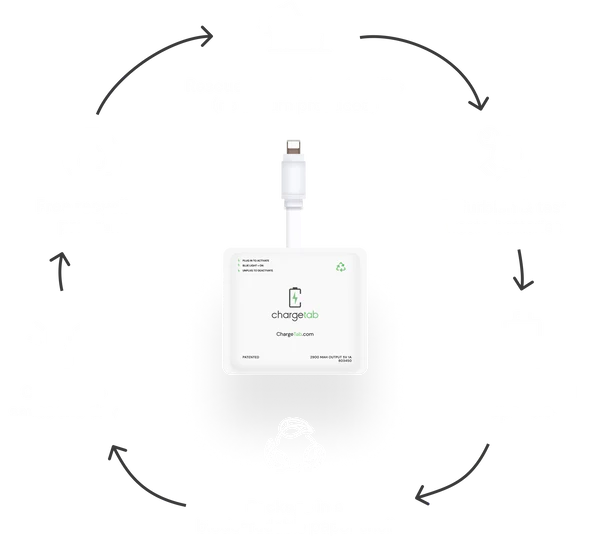
With this in mind, it’s not hard to see how a product like the ChargeTab would have a certain appeal. A small $10 USD device that you can keep in the car or pack in a bag that’s always available to charge your phone in an emergency.

Because it’s not meant to be used regularly — indeed it may never get used at all — it’s not completely unreasonable that such a device would only be good for one or two charges before its spent and must be replaced. It’s a bit like keeping a road flare in the car; it’s unlikely you’ll ever use the thing, but if you do, it only needs to work once.

But then what? According to ChargeTab, once the gadget has depleted its internal ~3,000 mAh battery it cannot be recharged and is no longer usable. Now to be fair, they specifically tell you to not throw it in the trash. They’ll send you a free return label to ship it back to them, at which point it will be refurbished and put back into circulation. The company argues that this recycling program, combined with the fact that the batteries inside the ChargeTabs were supposedly diverted from landfills in the first place, makes their entire operation eco-friendly.

Yet here we have a pair of ChargeTabs that were thrown in the regular garbage and would have taken a one-way trip to the local landfill if it wasn’t for the fact that I habitually dig through garbage cans like a raccoon. So let’s take a look at what’s inside one of these emergency phone chargers and if the idea is as green as the company claims.

Paper, Not Plastic


If nothing else, the enclosure of the ChargeTab is pretty unique. As part of the whole eco-friendly shtick they have going on, the device is encased in a biodegradable paper shell. Usually I wouldn’t approve of a device that’s sealed up rather than put together with fastners, but it’s hard to complain when you can cut the thing open with a pair of scissors. Of course reassembly would be tricky, but clearly that’s not something they were concerned with.

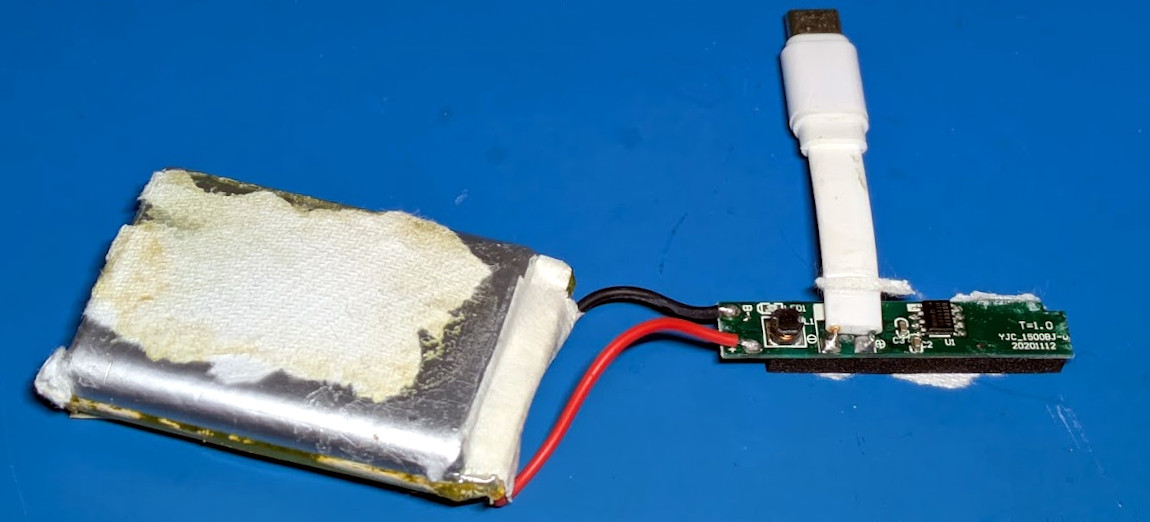
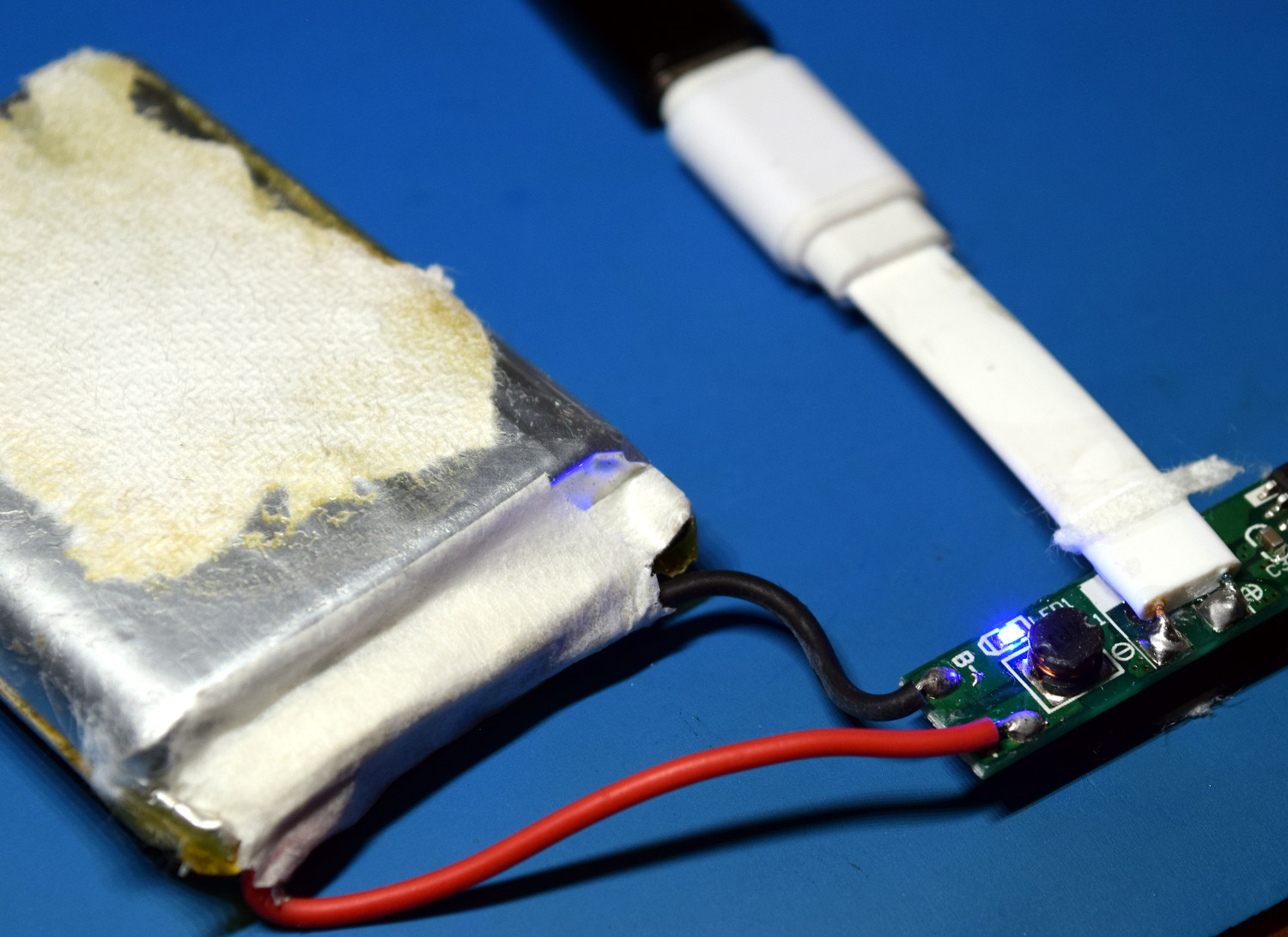
As for the internals, there’s really not much going on. Just a chunky LiPo pouch battery and a thin PCB with an SOIC8 IC, an inductor, a couple of capacitors, and a single LED.

The battery is marked YL 104058, has a capacity of 2,900 mAh, and a date code of 2017. Somewhat surprisingly a close inspection of the IC shows that its markings are intact, identifying it as a HotChip HT4928S.

Chips Ahoy


Being able to positively identify a chip when taking a consumer gadget apart is great, but actually being able to look it up and find a proper datasheet is a real treat. Turns out that the HT4928S is a very popular IC commonly used in USB power banks. It’s a highly integrated solution that offers battery management as well as 5 V boost with only a few support components.

At first, I found this somewhat surprising. Given the unusual single-use nature of the ChargeTab, I had expected a more bespoke solution. But of course it makes perfect sense to use one of these power bank ICs. They can be had for pennies, and functionally, the device is pretty much a USB power bank anyway, it just doesn’t recharge.

Truth be told, the HT4928S seems like a pretty slick part to have around. It’s unusually hacker-friendly: the SOIC8 package is easy to work with, and compared to the venerable TP4056 you get integrated battery protection, not to mention 5 V boost. All for about $1 USD a piece in quantities of ~10. I plan on ordering a few to go into the parts bin for sure.

But wait…if this chip has a charge controller, why is the ChargeTab single-use? What about the design prevents the user from simply charging it up like any other USB power bank that uses the HT4928S?

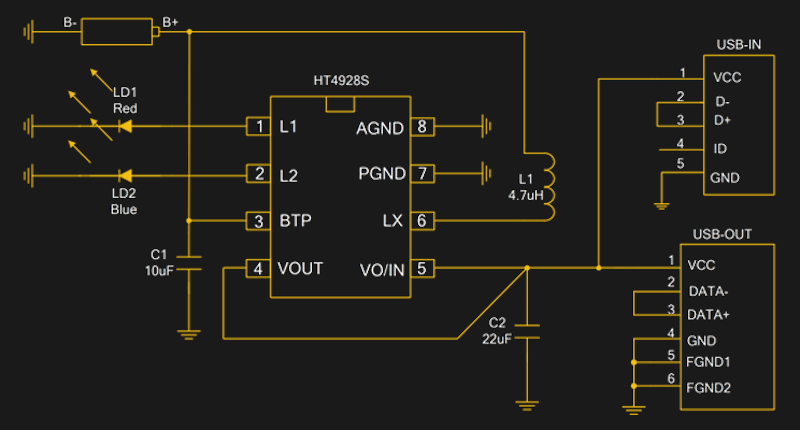
A look at the application diagram from the datasheet shows that the HT4928S uses the same pin for both power input and output. That is, the same pin that puts out the boosted 5 V from the battery will also charge said battery if you apply power to it. In the old days, the input would have been a female USB-A port, but in the era of USB-C you could simply have a female port that does double duty.

But the ChargeTab only has a male USB-C connector. Technically you could plug that into something that’s providing power, but the HT4928S doesn’t talk USB Power Delivery and the PCB doesn’t have the necessary resistors to enable legacy mode.

Security Through Obscurity


The only differences between the application circuit and the PCB in the ChargeTab is the missing LED and USB port. So unless they are using some custom modified version of the HT4928S, it stands to reason that injecting 5 V into the male USB-C connector should flip the chip over to charging mode.

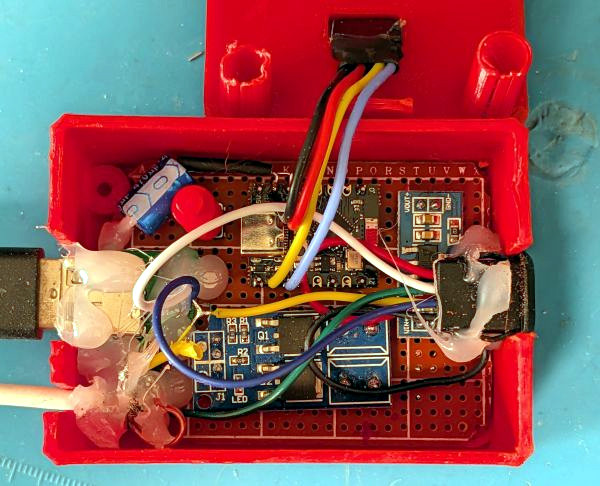
As mentioned previously, it won’t work with proper USB-C devices and cables. But through the magic of Amazon Prime, you can have all manner of shady adapters delivered to your door in just a few hours. So if we combine a USB-A to USB-C cable with a female-female USB-C coupler, we can stick 5 V where the ChargeTab least expects it. According to the HT4928S datasheet, a blinking LED will indicate the charging process has started.

Well, so much for that whole single-use thing.

Charging as a Service


So in the end, the only thing that’s keeping you from reusing the ChargeTab is a cheap USB-C coupler and an old cable. No return label, no sending it off to the mothership to get “refurbished.” It’s quite simply a USB power bank in a paper enclosure and with intentionally obtuse connectivity.

A devil’s advocate might argue that the recycling program makes it more likely the batteries inside the ChargeTabs will actually stay out of the waste stream compared to normal power banks. Rather than dropping them off in some random battery recycling box and having them go who knows where, the returned ChargeTabs are guaranteed to be put back into use properly. (On the other hand, I fished these out of the trash.)

But let’s be clear, this isn’t some benevolent initiative — the company ends up selling the recycled ChargeTabs again at full price. So if you really think about it, they are essentially just renting them out to the consumer. Is that a service worth $10? Regardless of how we might feel about it personally, the fact that these things are being sold would seem to indicate a not insignificant number of people feel it is.

All I know is that if you end up seeing one of these in the trash, you should definitely take it home and charge it up yourself.

Cybersecurity & cyberwarfare ha ricondiviso questo.

#Broadcom releases #VMware #Fusion security update for root access bug
securityaffairs.com/192136/sec…
#securityaffairs #hacking
Cybersecurity & cyberwarfare ha ricondiviso questo.

The media in this post is not displayed to visitors. To view it, please go to the original post.

Droni militari in cartone: il Giappone scommette su un’arma con design a basso costo

📌 Link all'articolo : redhotcyber.com/post/droni-mil…

A cura di Carolina Vivianti

#redhotcyber #news #dronimilitari #cartoneondulato #bassocosto #tecnologiamilitare #giappone

Cybersecurity & cyberwarfare ha ricondiviso questo.

Assunzioni nella cyber: pesa il divario di competenze nell’era AI


@Informatica (Italy e non Italy)
Il Global Cybersecurity Skills Gap Report 2026 di Fortinet analizza il persistente gap di competenze nella sicurezza informatica nell’attuale panorama di rischio in continua evoluzione, alla luce dei progressi dell'AI. Ecco l'ombra che si allunga sulle assunzioni in cyber

Cybersecurity & cyberwarfare ha ricondiviso questo.

Foxconn nel mirino di Nitrogen, 8 TB di dati sottratti: quali impatti sulla supply chain globale


@Informatica (Italy e non Italy)
Un attacco ransomware contro Foxconn rischia di trasformarsi nell’ennesimo incubo per la supply chain globale della tecnologia. Ecco perché
L'articolo Foxconn nel mirino di Nitrogen, 8 TB di dati sottratti: quali