THIS IS A BONUS EDITION OF DIGITAL POLITICS. I'm Mark Scott, and I don't usually speak about my day job in this newsletter. But today, that changes.
One of my goals this year is to help open up social media platforms to greater outside transparency. To do that, I'm working on ways to jumpstart data access to these platforms, or efforts to allow independent researchers to delve into the public data that these firms collect on all of us.
It's not an easy task — especially because any form of such data access must protect people's privacy, at all cost, and uphold the highest levels of security.
But, for me, it's a fundamental step in filling the democratic deficit associated with how social media may (or may not) affect our everyday lives.
Below gives you a glimpse about what I've been up to in recent months. It's a cross-post from Tech Policy Press.
Let's get started.
What happens online doesn't just stay online
IT'S HARD TO REMEMBER A WORLD WITHOUT SOCIAL MEDIA. From the United States to Brazil, people now spend hours on TikTok, Instagram, and YouTube each day, and these platforms have become embedded in everything from how we talk to friends and family to how we elect our national leaders.
But one thing is clear: despite researchers’ efforts to decipher social media’s impact, if any, on countries’ democratic institutions, no one still has a clear understanding of how these global platforms work. What’s worse — we have less awareness about what happens on these platforms in 2025 than we did five years ago.
This is a problem.
It’s a problem for those who believe these tech companies censor people’s voices online. It’s a problem for those who believe these firms do not do enough to police their platforms for harmful content. And it’s a problem for democratic countries whose political systems are fracturing under increased polarization — some of which is amplified via social media.
In 2025, there is a fundamental disconnect between what happens on social media and what academics, independent researchers and regulators understand about these platforms.
That has led to a democratic deficit. No one can quantify the effect, if any, of these platforms’ impact on public discourse. It has also led to a policymaking void. Lawmakers worldwide don’t know what steps are needed via potential new legislation, voluntary standards or the doubling down on existing efforts to reduce online harm on social media while upholding individuals’ right to free speech.
In short, we just don’t know enough about social media’s impact on society.
Thanks for reading Digital Politics. If you've been forwarded this newsletter (and like what you've read), please sign up here. For those already subscribed, reach out on digitalpolitics@protonmail.com
Without quantifiable evidence of harm (or lack of it) — driven by independent outside access to platform data, or the ability for people to research the inner workings of these social media giants — there is no way to make effective online safety legislation, uphold people’s freedom of expression, and hold companies to account when, inevitably, things go wrong.
And yet, there is a way forward. One that relies on the protection of people’s privacy and free speech. One that limits government access to people’s social media posts. And one that gives outside researchers the ability to kick the tires on how these platforms operate by granting them access to public data in ways that improves society’s understanding of these social media giants.
What are we going to do about it?
To meet this need, Columbia World Projects at Columbia University and the Hertie School’s Centre for Digital Governance have been running workshops with one aim in mind: How to build on emerging online safety regimes worldwide — some of which allow, or will soon allow, for such mandatory data access from the platforms to outside groups — to fill this democratic deficit.
With support from the Knight Foundation, that has involved bringing together groups of academic and civil society researchers, data infrastructure providers and national regulators for regular meetings to hash out what public and private funding is required to turn such data access from theory into reality.
The initial work has focused on the European Union’s Digital Services Act, which includes specific mandatory requirements for outsiders to delve into platform data.
But as other countries bring online similar data access regimes, the hope is to provide a route for others to follow that will build greater capacity for researchers to conduct this much-needed work; support regulators in navigating the inherent difficulties in opening up such platforms’ public data to outsiders; and ensure that people’s social media data is protected and secured, at all cost, from harm and surveillance.
As with all research, much relies on funding. Just because a country’s online safety laws dictate that outsiders can access social media data does not mean that researchers can just flick on a switch and get to work.
At every turn, there’s a need for greater public and private backing.
As part of the ongoing workshops, the discussions have focused on four areas where we believe targeted funding support from a variety of public and private donors can make the most impact. Taken together, it represents an essential investment in our wider understanding of social media that will ensure companies uphold their stated commitments to make their platforms accountable and transparent to outside scrutiny.
Four ways to make social media giants more accountable
The first component is the underlying infrastructure needed to carry out this work. Currently, accessing social media data is confined to the few, not the many. Researchers either need existing relationships with platforms or access to large funding pots to pay for cloud storage, technical analysis tools and other data access techniques that remain off limits to almost everyone.
Currently, there is a cottage industry of data providers — some commercial, others nonprofit — that provide the baseline infrastructure, in terms of access to platforms, analytics tooling and user-friendly research interfaces. Yet to meet researchers’ needs, as well as the growing regulatory push to open up social media giants to greater scrutiny, more needs to be done to make such infrastructure readily accessible, particularly to experts in Global Majority countries.
That includes scaling existing data infrastructure, making analytical tools more universally available to researchers, and using a variety of techniques — from using Application Programming Interfaces, or APIs, that plug directly into platform data to allowing researchers to scrape social media sites in the public interest to promoting “data donations” directly from users themselves — to meet different research needs.
The second focus has been on the relationships between researchers and regulators. As more countries pursue online safety legislation, there is a growing gap between in-house regulatory capacity and outsider expertise that needs to be closed for these regimes to operate effectively. Yet currently, few, if any, formal structures exist for researchers and regulators to share best practices — all while maintaining a safe distance via so-called “Chinese Walls” between government oversight and researcher independence.
What is needed are more formal information-sharing opportunities between regulators and researchers so that online safety regimes are based on quantifiable evidence — often derived from outside data access to social media platforms. That may include regular paid-for secondments for researchers to embed inside regulators to share their knowledge; the development of routine capacity building and information sharing to understand the evolving research landscape; and a shift away from informal networks between some researchers and regulators into a more transparent system that is open to all.
Sign up for Digital Politics
Thanks for getting this far. Enjoyed what you've read? Why not receive weekly updates on how the worlds of technology and politics are colliding like never before. The first two weeks of any paid subscription are free.
Subscribe Email sent! Check your inbox to complete your signup.
No spam. Unsubscribe anytime.
For that to work, a third element is needed in terms of greater capacity building — in the form of technical assistance, data protection and security training and researcher community engagement. Currently, outside experts have varying levels of technical understanding, policy expertise and knowledge of privacy standards that hamstring greater accountability and transparency for platforms. If people’s public social media data is not secured and protected against harm, for instance, then companies will rightly restrict access to safeguard their users from Cambridge Analytica-style leakages of information.
What is needed is the expansion of existing research networks so that data access best practices can be shared with as many groups as possible. Technical support to maintain the highest data protection standards — in the form of regular training of researchers and the development of world-leading privacy protocols for all to use — similarly will provide greater legal certainty for social media users. The regular convening of researchers so that people can learn from each other about the most effective, and secure, way to conduct such research will also democratize current data access that has often been limited to a small number of experts.
The fourth component of the workshops is the most important: how to maintain independence between outside researchers and regulators in charge of the growing number of online safety regimes worldwide. It is important for both sides to work effectively with each other. But neither researchers nor regulators should become beholden — or perceived to be beholden — to each other. Independence for regulators to conduct their oversight and for researchers to criticize these agencies is a fundamental part of how democracies function.
That will require forms of public-private funding to support ongoing data access work to create strict safeguards between researchers and regulators. That’s a tricky balance between supporting close ties between officials and outsiders, while similarly ensuring that neither side feels subordinate to the other. To meet that balance, a mixture of hands-off public support and non-government funding will be critical.
Such structures already exist in other industries, most notably in the medical research field. They represent a clear opportunity to learn from others as outside researchers and regulators push for greater accountability and transparency for social media companies.
There’s a classic grade school science experiment that involves extracting juice from red cabbage leaves and using it as a pH indicator. It relies on anthocyanins, pigmented compounds that give the cabbage its vibrant color but can change depending on the acidity of the environment they’re in, from pink in acidic conditions to green at higher pH. And anthocyanins are exactly what power this unusual kinetic art piece.
Even before it goes into action, [Nathalie Gebert]’s Anthofluid is pretty cool to look at. The “canvas” of the piece is a thin chamber formed by plexiglass sheets, one of which is perforated by an array of electrodes. A quartet of peristaltic pumps fills the chamber with a solution of red cabbage juice from a large reservoir, itself a mesmerizing process as the purple fluid meanders between the walls of the chamber and snakes around and between the electrodes. Once the chamber is full, an X-Y gantry behind the rear wall moves to a random set of electrodes, deploying a pair of conductors to complete the circuit. When a current is applied, tendrils of green and red appear, not by a pH change but rather by the oxidation and reduction reactions occurring at the positive and negative electrodes. The colors gently waft up through the pale purple solution before fading away into nothingness. Check out the video below for the very cool results.
We find Anthofluid terribly creative, especially in the use of such an unusual medium as red cabbage juice. We also appreciate the collision of chemistry, electricity, and mechatronics to make a piece of art that’s so kinetic but also so relaxing at the same time. It’s the same feeling that [Nathalie]’s previous art piece gave us as it created images on screens of moving thread.
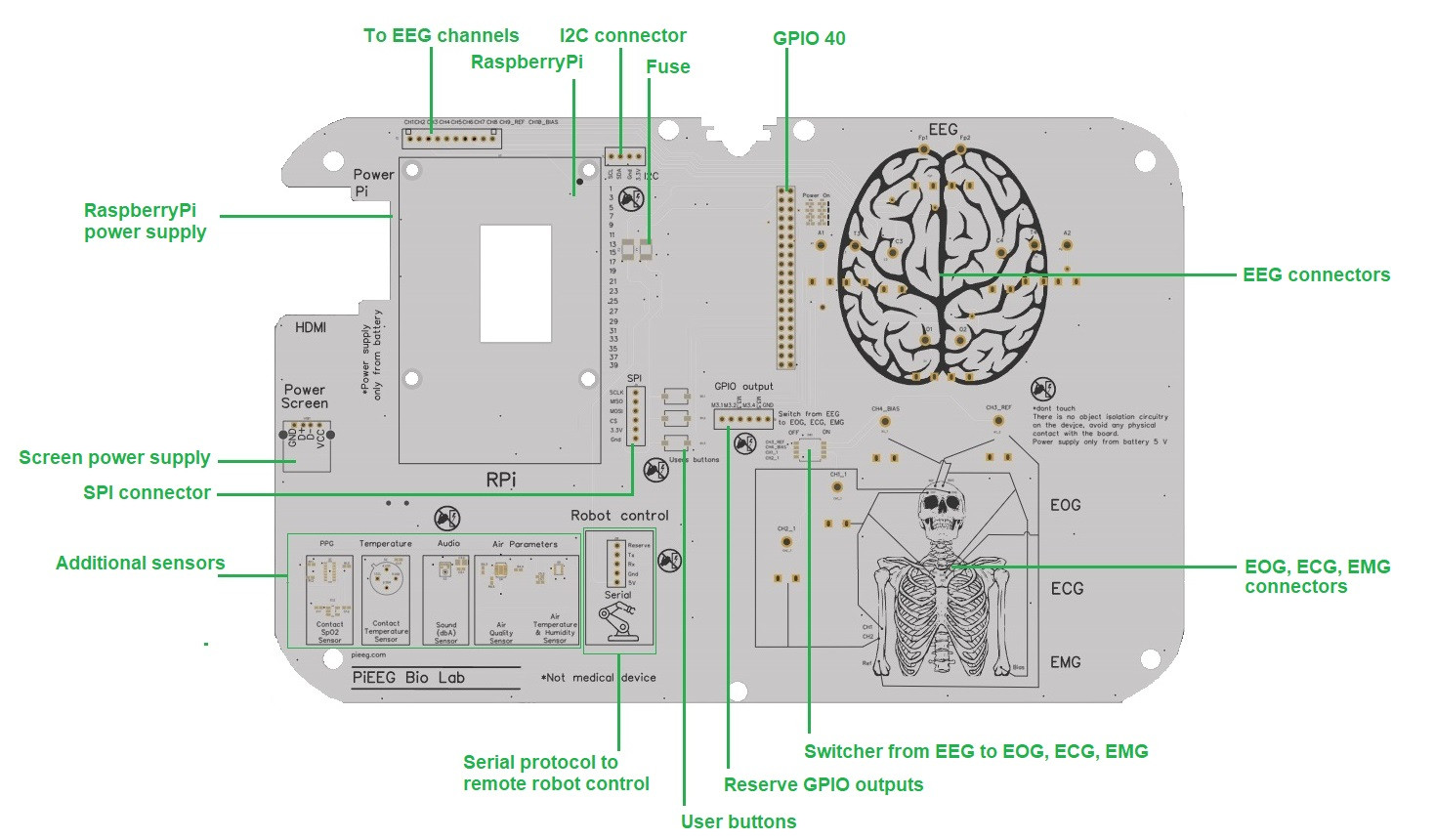
Back in 2023, we first brought you word of the PiEEG: a low-cost Raspberry Pi based device designed for detecting and analyzing electroencephalogram (EEG) and other biosignals for the purposes of experimenting with brain-computer interfaces. Developed by [Ildar Rakhmatulin], the hardware has gone through several revisions since then, with this latest incarnation promising to be the most versatile and complete take on the concept yet.
At the core of the project is the PiEEG board itself, which attaches to the Raspberry Pi and allows the single-board computer (SBC) to interface with the necessary electrodes. For safety, the PiEEG and Pi need to remain electrically isolated, so they would have to be powered by a battery. This is no problem while capturing data, as the Pi has enough power to process the incoming signals using the included Python tools, but could be an issue if you wanted to connect the PiEEG system to another computer, say.
For the new PiEEG Kit, the hardware is now enclosed in its own ABS carrying case, which includes an LCD right in the lid. While you’ve still got to provide your own power (such as a USB battery bank), having the on-board display removes the need to connect the Pi to some other system to visualize the data. There’s also a new PCB that allows the connection of additional environmental sensors, breakouts for I2C, SPI, and GPIO, three buttons for user interaction, and an interface for connecting the electrodes that indicates where they should be placed on the body right on the silkscreen.
@Informatica (Italy e non Italy 😁) Un recente rapporto del Citizen Lab rivela l'espansione globale di Graphite, il software di sorveglianza prodotto dall’israeliana Paragon, sollevando importanti questioni etiche che riguardano anche l’Italia, confermato come uno dei paesi clienti di Paragon L'articolo Italia spiata:
@Informatica (Italy e non Italy 😁) Le piccole e medie imprese italiane sono sempre più bersaglio di attacchi informatici, e la causa principale è una scarsa consapevolezza sulla cybersecurity. Un dato allarmante emerge
con gli stati uniti che stanno diventando la russia si parla ancora di sogno americano? la california sta avviando consultazioni informali per lasciare gli stati uniti... se (ed è un grosso se) aveva senso aveva senso prima di trump...
Scopri come trasferirti negli Stati Uniti e iniziare una nuova vita. Dalla scelta del visto al lavoro, passando per le pratiche burocratiche, ecco come fare nel 2025.
#MiStaiACuore, per la campagna di sensibilizzazione e formazione sull’uso del DAE sul sito dedicato si trovano pubblicati nuovi materiali e testimonianze inviate dalle scuole.
#MiStaiACuore, per la campagna di sensibilizzazione e formazione sull’uso del DAE sul sito dedicato si trovano pubblicati nuovi materiali e testimonianze inviate dalle scuole.
Seguiteci e utilizzate l’hashtag #MiStaiACuore.
@Notizie dall'Italia e dal mondo Il nuovo capo delle forze armate è sulla stessa linea dell'attacco ad oltranza contro Gaza del premier Netanyahu e dei ministri più estremisti L'articolo GAZA. Eyal Zamir, il capo di stato maggiore che desiderava la destra israeliana proviene da
Allucinazioni dell'intelligenza artificiale: ChatGPT ha creato un falso assassino di bambini ChatGPT ha creato una storia falsa su un uomo norvegese, sostenendo che aveva ucciso i suoi due figli ed era finito in prigione. Questo non è mai accaduto mickey20 March 2025
🖼️Quadro con Veduta Ponte Molle (Milvio) Roma; bassorilievo inciso su lastra argento e dorata. Misure 39 cm X 32 cm .Autore Blumal , acquistato presso gioielleria Puleo.
Puoi devolvere il 50% del costo di questo articolo a favore del salvataggio degli ALBERI di Villa PAMPHIILJ ROMA Si prega di contattarmi
NB: il 50% del costo di questo articolo potrai devolverlo per sostenere le spese per il ricorso al Tar a favore del salvataggio degli alberi promossa dal Neomondismo
Sostieni le spese per il ricorso al TAR! a favore del salvataggio degli ALBERI di Villa PAMPHIILJ ROMA
pertanto se avrai aderito alla donazione il costo finale dell’articolo sarà pari al 50% del costo
🖼️Peinture avec une vue du Ponte Molle (Milvio) Rome ; bas-relief gravé sur plaque d'argent et d'or. 🖼️Painting with View of Ponte Molle (Milvio) Rome; bas-relief engraved on silver and gold plate. 🖼️Schilderen met uitzicht op Ponte Molle (Milvio) Rome; bas-reliëf gegraveerd op zilver en goud. 🖼️Molerei mat Vue op Ponte Molle (Milvio) Roum; Bas-Relief gravéiert op Sëlwer a Goldplack. 🖼️Gemälde mit Blick auf die Ponte Molle (Milvio) in Rom; Flachrelief auf Silber- und Goldplatte eingraviert. 🖼️Cuadro con vista al Ponte Molle (Milvio) Roma; Bajorrelieve grabado sobre placa de plata y oro. 🖼️Pintura com vista para a Ponte Molle (Milvio) Roma; baixo-relevo gravado em placa de prata e ouro. 🖼️Obraz z widokiem na Ponte Molle (Milvio) Rzym; płaskorzeźba grawerowana na srebrnej i złotej płycie. 🖼️Måla med utsikt över Ponte Molle (Milvio) Rom; basrelief graverad på silver och guldplåt. 🖼️Pictură cu vedere la Ponte Molle (Milvio) Roma; basorelief gravat pe placa de argint si aur. 🖼️Slika s pogledom na Ponte Molle (Milvio) Rim; reljef ugraviran na srebrnoj i zlatnoj ploči. 🖼️Maleri med udsigt over Ponte Molle (Milvio) Rom; basrelief indgraveret på sølv- og guldplade. 🖼️Péinteáil le radharc ar Ponte Molle (Milvio) Róimh; basfhaoiseamh greanta ar phláta airgid agus óir. 🖼️Maalaus näköalalla Ponte Molle (Milvio) Roomaan; hopea- ja kultalevylle kaiverrettu bareljeef. 🖼️Málverk með útsýni yfir Ponte Molle (Milvio) Róm; lágmynd grafið á silfur- og gullplötu.
Price: 140 euro :: Questo è un articolo disponibile su FediMercatino.it
Si prega di rispondere con un messaggio diretto/privato al promotore dell'annuncio.
Se l'energia che investiamo nell'indignarci di fronte all'inondazione di dichiarazioni delle destre, in quella loro ossessione comunicativa, la indirizzassimo verso il sostegno e la promozione dei nostri valori credo che ne guadagneremmo tutti.
Clearview AI spent nearly a million dollars in a bid to purchase “690 million arrest records and 390 million arrest photos” from all 50 states, court records reveal.#ClearviewAI #Clearview #FacialRecognition
L’Europa della difesa non può più attendere, ma ciò non significa rinnegare l’Alleanza Atlantica. Di fronte alle sfide globali, il Vecchio continente non ha altre possibilità se non quella di costituire un vero pilastro europeo all’interno della Nato. Così ha
Viaggi della #memoria e #sport, via libera dal Senato a nuove risorse.
"Investiamo sulla crescita dei giovani” dichiara soddisfatto il Ministro Giuseppe Valditara.
Qui tutti i dettagli sulle misure e i fondi approvati ▶️ https://www.mim.gov.
Il secondo colloquio telefonico tra Putin e Trump nella giornata di martedì segna un nuovo passo avanti verso la possibile soluzione diplomatica della guerra in Ucraina.
La Commissione europea ha ufficialmente adottato il Libro Bianco per la Difesa europea/Readiness 2030, un documento che avrà il compito di porre le basi per un’azione coordinata e massiccia nel settore della difesa, con l’obiettivo di rafforzare la capacità
“Se sto con Usa o Ue? Sto con l’Italia, che è nell’Unione europea ed è storico alleato dell’America”. La precisazione di Giorgia Meloni alla Camera a chi le chiedeva (ancora) conto delle divergenze di vedute tra Bruxelles e Washington è utile cartina di tornasole per capire
@Politica interna, europea e internazionale Ospite di DiMartedì, il programma in onda su La7 nella serata di martedì 18 marzo, Elisabetta Piccolotti è stata presentata dal conduttore Giovanni Floris con una battuta inerente al caso Tesla scoppiato nei giorni scorsi. La deputata di Alleanza Verdi e
@Politica interna, europea e internazionale È una replica durissima quella che Federico Fornaro, deputato del Partito Democratico, ha fatto alla Camera in risposta alle dichiarazioni della presidente del Consiglio, la quale aveva attaccato il Manifesto di Ventotene
Meta is preparing for the Australian election by working closely with the government and news outlets that Zuckerberg said were “clearly political” and dismissed in the US.#News
The sites an ICE contractor is pulling data from; why top scientists are considering leaving the U.S. for France, and why Super Nintendos are getting faster as they age.#Podcast
@Politica interna, europea e internazionale La presidente del Consiglio Giorgia Meloni prende le distanze dal Manifesto di Ventotene, considerato uno dei testi fondanti dell’Unione europea: “Non so se questa è la vostra idea di Europa, ma certamente non è la mia”, dice rivolgendosi alle opposizioni in
@Politica interna, europea e internazionale “Mentre al livello internazionale sembrano affievolirsi le ragioni del Diritto e di una corretta articolazione della convivenza tra gli Stati, la Sua voce è e resta più che mai necessaria”. Lo scrive il presidente della Repubblica Sergio Mattarella in una lettera
UN LIBRO CONTRO IL DETERIORAMENTO CEREBRALE. LE SOLUZIONI DELLA SCUOLA AL BRAIN-ROT DELL’ERA DIGITALE. Il corso si propone di: dotare i docenti di strumenti pratici e teorici per comprendere il funzionamento del cervello umano durante la lettura
@Politica interna, europea e internazionale Le Commissioni Affari Costituzionali e Giustizia del Senato hanno approvato il contestato articolo 31 del nuovo ddl Sicurezza. Il via libera chiude l’esame degli emendamenti al disegno di legge, che – presentato dal Governo e già approvato dalla Camera lo
Bellissima serata al Bo.Po di Ponteranica (BG), dove si sono esibiti il chitarrista e cantante Michele Del Lago e la cantante e percussionista Giusi Pesenti. Nonostante i due siano nella scena da diversi anni, non avevo mai avuto il piacere di ascoltarli live...
@Notizie dall'Italia e dal mondo Violenti bombardamenti su tutta la Striscia da nord a sud, senza preavviso. 150 bambini tra le vittime. Per Tel Aviv «è solo l’inizio». Colpite le case danneggiate dentro cui si riparavano intere famiglie, scuole-rifugio e tende per sfollatihttps://pagineesteri.it/2025/03/19/medioriente/gaza-israele-scatena-linferno-promesso/
Dovremmo imparare a goderci le cose che abbiamo, come se sapessimo che il giorno dopo ce le porterà via. Ma l'incapacità di apprezzare il momento è più forte e così, niente, perdiamo attimi che non avremo mai più.
Per molto tempo abbiamo pensato che non sarebbe successo nulla in Europa, ci siamo preparati a operare in missioni di peacekeeping lontano dai nostri confini e senza una minaccia diretta ai nostri territori. Tutto questo è cambiato con l’invasione russa dell’Ucraina, che è servita da
@Notizie dall'Italia e dal mondo Berlino archivia l'austerità in nome del riarmo, pensa alla leva obbligatoria e droga l'economia con centinaia di miliardi di euro di finanziamenti pubblici a debito L'articolo “La Germania è tornata” proviene da Pagine Esteri.
La ripresa dei bombardamenti indiscriminati su Gaza nelle prime ore di martedì da parte di Israele è la logica conseguenza degli sforzi delle ultime settimane per affondare la tregua con Hamas firmata lo scorso mese di gennaio.
Siglato oggi il Protocollo d’intesa tra il Ministro dell'Istruzione e del Merito, Giuseppe Valditara, e il Rettore del Politecnico di Torino, Stefano Paolo Corgnati, per promuovere attività finalizzate a esplorare il rapporto tra tecnologia, umanità …
Incel, abbreviazione dell’espressione inglese involuntary celibates (“casti non per scelta”): è utilizzata per definire uomini eterosessuali che non hanno rapporti sessuali perché si sentono discriminati e rifiutati dalle donne, che incolpano di privarli di quello che reputano un loro diritto.
Newsletter publisher Ghost is now connecting to the fediverse in public beta, updates about the bridge that connects the fediverse with Bluesky, and more.
Newsletter publisher Ghost is now connecting to the fediverse in public beta, updates about the bridge that connects the fediverse with Bluesky, and more.
The News
The public beta for connecting Ghost to the fediverse is here, and the ActivityPub integration is now available for Ghost Pro subscribers. Ghost is a publishing platform for sending out blogs via email. With this latest update, Ghost now has another method of distribution, namely via the fediverse. Ghost’s integration with the fediverse consists of two parts: sending out long-form articles published on Ghost into the fediverse, and a reader app to the fediverse from Ghost.
Publishing Ghost articles on ActivityPub makes them accessible to the rest of the fediverse, similar to how WordPress with the ActivityPub plugin works. For users of Ghost this is an easy sales pitch, it is simply another free and automatic distribution channel for their blog. The second part of Ghost’s integration with the social web is a reader app. This app allows Ghost users to browse and read posts on the fediverse. It is split up into two parts: an inbox for reading other long-form posts from Ghost or WordPress, and a feed for all other types of posts. This allows accounts on Ghost not only to send out posts via the ActivityPub integration, but also to connect, respond and follow their audience. It even allows you to post short-form microblogs (notes), just like you’d use on Mastodon, that do not show up on the Ghost website. This makes the Ghost integration a full fediverse experience.
A New Social is the non-profit organisation that builds and manages cross-protocol tools for the open social web. The organisation currently manages Bridgy Fed, the connector that allows accounts to ‘bridge’ between both ActivityPub, ATProto, Nostr and more, and is currently in the process of setting up and launching the organisation. In their first update they shared this week, A New Social shared that they have a board of directors, consisting of Erin Kissane, Ben Werdmuller and Susan Mernit. Bridgy Fed Config is the first upcoming launch that they announced, scheduled for early April. To bridge their account, Bridgy Fed currently requires people to follow the Bridgy Fed account on their platform, which can be confusing and opaque for people as to what is actually happening and if it is working. The upcoming Config settings page allows people to log in with their social web account (Bluesky, Mastodon, Pixelfed) and turn the bridging on with a simple switch. A New Social also mentions supporting Threads with the new Bridgy Fed Config update, which is currently not supported by Bridgy Fed.
Forte is a new fediverse platform, that comes from the lineage of Hubzilla and Streams, created by the same developer Mike Macgirvin. Forte’s major feature is that it has Nomadic Identity over ActivityPub. Nomadic Identity means that you can port your entire account, including your posts, settings, social connections, etc. It is slightly different than the account migration that Mastodon has, which transfers your social graph to a new account. With Nomadic Identity, you create a single identity that can be connected to multiple different servers, so when one server becomes unavailable, all your personal data can be transferred and accessed from another server linked to your account. Forte, as well as Hubzilla and Streams, remain on the bleeding edge on what’s possible with ActivityPub. However, Forte also suffers from the same issue that its predecessors have, namely that getting to use the software is surprisingly difficult. By design there is no way to see a list of Forte servers. Forte mainly targets people with technical know-how, as the code repository does not include guide on how to setup your own Forte server. It leads to the funny situation where I would like to give Forte a try because I’m interesting in trying out the new features, but I legitimately do not know how.
Myo is a new image-focused client for the open social web, and allows you to connect your Mastodon, Bluesky and Nostr accounts into a single timeline. Combining multiple accounts into a single timeline is similar to OpenVibe, but Myo instead focuses media, in a design that is more reminiscent of Instagram than Twitter. Myo is made by the same developer as SoraSNS, which is also a multi-protocol app that focuses on microblogging instead. Myo and SoraSNS are both available for iOS.
ActivityPub badges is a new project that is currently in development to build a badges/credential system similar to Credly on ActivityPub. The project is currently at the proof-of-concept phase, where badges can be created and send over ActivityPub.
IFTAS, the non-profit for collaborative work on trust & safety on the fediverse, recently had to shut down various of their services due to a lack of funding. In their latest update, the organisation talks about how they are rescoping and moving forward, as the organisation itself is not shutting down. IFTAS will continue with various community support projects, such as their community platform IFTAS Connect. They will also continue providing insight into commonly blocked domains, in a scaled down version of the shut-down FediCheck program.
A new form of spam/scam has recently emerged on the fediverse, and it involves private messages from an account that identifies itself as ‘Nicole the fediverse chick’. So many people have gotten a variation of this message that it is quickly becoming a meme on the fediverse. It is unclear what the exact purpose of this spam is, with either a doxing ex or an elaborate 4chan troll as likely explainers.
This article by Fassbender examines how state surveillance treats federated and decentralised social networks, focusing on the BlueLeaks dataset, which contains a large amount of internal documentation of state surveillance organisations. Fassbender writes: “[…] surveillance actors are less interested in understanding decentralization within platforms, but rather look at organizations first, then take an interest in all platforms that they spread to. This means that any platform (or in the case of the fediverse, grouping of platforms that share a method for interconnecting) can become suspect.”
Sneak peek: Mastodon’s upcoming update will finally include the ability to show all replies on a post.
FEP Search Tool is a small web tool to search all the FEP’s.
Forum software Flarum got funding by NLnet in 2023 to implement ActivityPub, but recently decided that this effort would be postponed for the foreseeable future.
Notes on migrating an account from Mastodon to GoToSocial.
A Manyfold 3D viewer directly in a Mastodon timeline.
Roboherd is a tool to build automated Fediverse actors.
That’s all for this week, thanks for reading! You can subscribe to my newsletter to get all my weekly updates via email, which gets you some interesting extra analysis as a bonus, that is not posted here on the website. You can subscribe below:
We're excited to release version 7.1 of PeerTube, which continues to evolve graphically, but also to simplify your discoverability! Let's take a close...
Dal Rinascimento a oggi, il mecenatismo è stato un ponte tra potere, ricchezza e cultura. Oggi, dal report di Avant Arte, vediamo una trasformazione di questo fenomeno: una nuova generazione di collezionisti e mecenati non si limita più a sostenere economicamente musei e istituzioni, ma partecipa attivamente alla diffusione dell’arte. Questo cambiamento porta con sé una riflessione fondamentale: il mecenatismo contemporaneo deve solo promuovere o anche valorizzare?
Promuovere vs valorizzare: una distinzione cruciale
Spesso si usano questi termini come sinonimi, ma hanno significati profondamente diversi. Promuovere significa amplificare la visibilità di un'opera, un artista o un progetto attraverso strategie di comunicazione, marketing e diffusione. È un primo passo importante, ma da solo non garantisce la crescita culturale. Valorizzare, invece, è un processo più profondo: significa riconoscere e accrescere il valore di un’opera, mettendone in luce il significato, inserendola in un contesto che ne amplifichi la portata culturale e sociale.
Se il mecenatismo moderno vuole davvero lasciare un segno, non può limitarsi alla promozione. Deve creare connessioni, contesti e significati che permettano all’arte di avere un impatto duraturo nella società.
Il futuro del mecenatismo
Il modello che emerge dal report di Avant Arte suggerisce che i nuovi collezionisti vogliono essere più coinvolti nel processo creativo e culturale. Questa è una grande opportunità: il mecenatismo non è più solo un privilegio di pochi, ma può diventare un motore collettivo per sostenere e dare valore all’arte contemporanea.
Forse la vera sfida è questa: riusciremo a costruire un mecenatismo che non sia solo un investimento di mercato, ma un atto politico e culturale capace di generare un impatto reale?
Secondo l'analisi prodotta annualmente dal marketplace l’88% di questi ha sia le risorse che il desiderio di donare di più ai musei e di sostenerli concretamente
Il mecenatismo contemporaneo deve andare oltre la semplice promozione e puntare alla valorizzazione. Non basta amplificare la visibilità dell'arte: è necessario collocarla in un contesto che ne amplifichi il messaggio e ne approfondisca il significato. Questo significa creare connessioni culturali, storiche o sociali che rendano l'opera rilevante e duratura per il pubblico, garantendo un impatto che va oltre il momento della semplice esposizione. In altre parole, visibilità senza profondità rischia di non lasciare un segno. Il coinvolgimento diretto dei mecenati nel processo creativo rappresenta una grande opportunità per rendere il mecenatismo un motore culturale e sociale, non solo un investimento di mercato. La sfida? Trasformarlo in un atto consapevole, capace di generare un impatto reale.
@Antonio Marano Sono molto d'accordo con te, valorizzare dovrebbe essere una reale creazione di valore e di significato, è creare ragionamento attorno a un contesto. In questo modo l'arte non è solo qualcosa da guardare staticamente, ma diventa finalmente motore attivo che può essere utile a capire la realtà e il contesto sociale e culturale. La cosa che ho notato è che spesso viene confuso o usato come sinonimo di promozione e la sovrapposizione dei piani tende ad andar a invalidare l'una e l'altra.
Via libera della Regione all'accesso degli animali da affezione nelle strutture sanitarie, per migliorare il benessere dei pazienti a lunga degenza
[...]
Per gli ospedali deve essere concordato con il servizio di accoglienza il percorso per raggiungere la saletta di uso comune dove si svolgerà la visita. In ciascuna struttura è consentita la presenza di un solo animale per volta e le visite saranno pianificate per non creare sovrapposizioni. Alcuni reparti sono interdetti: gli animali non potranno accedere al pronto soccorso, a neonatologia, alle aree ambulatoriali, di dialisi, di prelievo e di ristoro, nei day hospital e nelle sale operatorie.
direi che la sentenza della corte non sta sostenendo che l'ucraina abbia deliberatamente compiuto azioni di pulizia etnica verso qualcuno, ma solo che ci sono stante mancanze e carenze, cosa che succede specie quando magari l'organico è mal addestrato, mal pagato, mal preparato. all'epoca polizia ed esercito ucraino non era famoso per efficienza. e la scuola russa nell'uso dell'esercito ai fini dell'ordine pubblico è più simile alla strategia di invasione che non al rasserenare animi turbolenti. ricordo che in partenza l'esercito ucraino era del tutto simile all'esercito russo. pessima scuola, pessimo addestramento, gerarchia molto rigida, logica ottocentesca, e per di più praticamente disarmati in seguito alla separazione dall'URSS.
La Corte Europea dei Diritti dell'Uomo (CEDU) ha emesso una sentenza il 13 marzo 2025, condannando l'Ucraina per la gestione degli eventi del 2 maggio 2014 a Odessa.
@Notizie dall'Italia e dal mondo Tapachula, la più grande città del confine sud tra Messico e Guatemala si è svuotata. Le code davanti agli uffici che permettono di avere i documenti per attraversare il paese o chiedere asilo negli USA non esistono più. Il video-reportage di Andrea Cegna dal
@Notizie dall'Italia e dal mondo A Napoli, una giornata dedicata alla Palestina, con proiezioni, testimonianze, presentazioni di libri, musica, incontri e tanto altro. Pagine Esteri, Life for Gaza, Associazione Pixel, Giuristi democratici e n’seaYet hanno organizzato per




Antonio Marano
in reply to Nicola Pizzamiglio • • •Nicola Pizzamiglio likes this.
Arte e Cultura reshared this.
Nicola Pizzamiglio
in reply to Antonio Marano • •Arte e Cultura reshared this.