
L’Ue rilancia l’impegno per Kyiv, Erdogan il dialogo con Mosca
@Notizie dall'Italia e dal mondo
Incontrando il segretario generale della Nato, Mark Rutte, e i leader europei nel corso del summit Nato a L’Aja, il presidente ucraino Volodymyr Zelensky ha delineato una visione ampia del conflitto che da oltre tre anni coinvolge il suo Paese. “L’Ucraina sta combattendo una guerra che non è
Notizie dall'Italia e dal mondo reshared this.
Nato Summit, gli Usa restano impegnati in Europa ma gli alleati devono fare di più. Parola di Whitaker
@Notizie dall'Italia e dal mondo
Dal palco del Nato Public Forum dell’Aja, l’ambasciatore americano presso l’Alleanza atlantica, Matthew Whitaker, ha offerto un messaggio che è insieme avvertimento e proposta: la Nato deve cambiare passo. Perchè ciò
Notizie dall'Italia e dal mondo reshared this.
A judge rules that Anthropic's training on copyrighted works without authors' permission was a legal fair use, but that stealing the books in the first place is illegal.
A judge rules that Anthropicx27;s training on copyrighted works without authorsx27; permission was a legal fair use, but that stealing the books in the first place is illegal.#AI #Books3

Judge Rules Training AI on Authors' Books Is Legal But Pirating Them Is Not
A judge rules that Anthropic's training on copyrighted works without authors' permission was a legal fair use, but that stealing the books in the first place is illegal.Jason Koebler (404 Media)
Why Trijets Lost Against Twinjets

If you’re designing a new jet-powered airplane, one of the design considerations is the number of jet engines you will put on it. Over the course of history we have seen everywhere from a single engine, all the way up to four and beyond, with today airliners usually having two engines aside from the Boeing 747 and Airbus A380 has been largely phased out. Yet for a long time airliners featured three engines, which raises the question of why this configuration has mostly vanished now. This is the topic of a recent YouTube video by [Plane Curious], embedded below.
The Boeing 727, DC-10 and L-1011 TriStar are probably among the most well-known trijets, all being unveiled around the same time. The main reason for this was actually regulatory, as twin-engine designs were thought to be too unsafe for long flights across oceans, while quad-jet designs were too fuel-hungry. This remained the situation until newer jet engine designs that were more reliable and powerful, leading to new safety standards (ETOPS) that allowed twinjets to fly these longer routes as well. Consequently, the last passenger trijet – an MD-11 KLM flight – touched down in 2014.
Along with the engineering and maintenance challenges that come with having a tail-mounted jet engine, the era of trijets seem to have firmly come to an end, at least for commercial airliners.
youtube.com/embed/wfEO4bchyGE?…

Al Bano e la «pugnalata» da Romina Power: «Sul concerto in Russia ha mentito. E Putin è una persona perbene»
Il cantante pugliese replica all'ex moglie, dopo che lei aveva preso le distanze dalla sua esibizione in Russia. La replica durissima e i giudizi su Putin che rischiano di sollevare altre polemicheValentina Romagnoli (Open)
Simon Perry likes this.
Blaming payment processor restrictions, Fansly—a platform creators flocked to after OnlyFans announced it'd ban sex—announced it's changing the rules for multiple types of content.
Blaming payment processor restrictions, Fansly—a platform creators flocked to after OnlyFans announced itx27;d ban sex—announced itx27;s changing the rules for multiple types of content.#platforms #furries #paymentprocessors

Massive Creator Platform Fansly Bans Furries
Blaming payment processor restrictions, Fansly—a platform creators flocked to after OnlyFans announced it'd ban sex—announced it's changing the rules for multiple types of content.Samantha Cole (404 Media)
DeepSeek sotto accusa: gli Usa temono legami con l’esercito cinese e l’elusione dei controlli
@Informatica (Italy e non Italy 😁)
Le accuse statunitensi vanno oltre il semplice accesso open-source ai modelli AI di DeepSeek. Il funzionario ha infatti citato oltre 150 riferimenti a DeepSeek nei registri degli appalti dell'esercito
Informatica (Italy e non Italy 😁) reshared this.
Notepad++, vulnerabilità critica consente di prendere pieno controllo dei sistemi esposti
@Informatica (Italy e non Italy 😁)
Individuata una vulnerabilità critica in Notepad++ 8.8.1: un suo eventuale sfruttamento consente a un attaccante di elevare i propri privilegi a livello System e prendere pieno controllo dei dispositivi su cui è installato tramite
Informatica (Italy e non Italy 😁) reshared this.
A free tool that allows anyone to upload a photo of an LAPD officer to get their name and badge number.#News


‘FuckLAPD.com’ Lets Anyone Use Facial Recognition to Instantly Identify Cops
A new site, FuckLAPD.com, is using public records and facial recognition technology to allow anyone to identify police officers in Los Angeles they have a picture of. The tool, made by artist Kyle McDonald, is designed to help people identify cops who may otherwise try to conceal their identity, such as covering their badge or serial number.“We deserve to know who is shooting us in the face even when they have their badge covered up,” McDonald told me when I asked if the site was made in response to police violence during the LA protests against ICE that started earlier this month. “fucklapd.com is a response to the violence of the LAPD during the recent protests against the horrific ICE raids. And more broadly—the failure of the LAPD to accomplish anything useful with over $2B in funding each year.”
“Cops covering up their badges? ID them with their faces instead,” the site, which McDonald said went live this Saturday. The tool allows users to upload an image of a police officer’s face to search over 9,000 LAPD headshots obtained via public record requests. The site says image processing happens on the device, and no photos or data are transmitted or saved on the site. “Blurry, low-resolution photos will not match,” the site says.
“fucklapd.com uses data provided by the City of Los Angeles directly to the public,” McDonald told me in an email. “This data has been provided in response to either public records requests or public records lawsuits. That means all of this information belongs to the public and is a matter of public record. fucklapd.com is not scraping any data.”
In addition to potentially identifying officers by name and serial number, FuckLAPD.com also pulls up a police officer’s salary.
“Surprisingly it [the domain name] only costs $10 a year to exercise my first amendment right to say fucklapd.com,” McDonald said.
playlist.megaphone.fm?p=TBIEA2…
I tested the tools by grabbing an image of a white and bald police officer from an LAPD press conference addressing its use of force during the anti-ICE protests in Los Angeles. I uploaded the image to the site, and within a few seconds the site presented me with nine headshots of officers who could be possible matches, all of them bald white men. The first correctly identified the cop in the image I uploaded.Clicking “view profile” under the result sent me to the Watch the Watchers site by the Stop LAPD Spying Coalition, a community group based in the Skid Row neighborhood of downtown Los Angeles. “All of the information on this website comes from records that were deliberately made public by the City of Los Angeles in response to either public records requests or public records lawsuits,” the Watch the Watchers site says. “We plan to keep refreshing this data from new public records requests as well as to add other data.” Stop LAPD Spying Coalition is not associated with FuckLAPD.com and did not endorse the site.
McDonald told me that since the site launched, it had around 50,000 visitors, but “Because the analysis happens on-device I have no way of knowing what people are using it for, except for some people who have posted screenshots to Twitter or Instagram,” he said.
In 2018 McDonald made another tool called ICEspy which used hundreds of photos of ICE employees from LinkedIn and does much the same thing as FuckLAPD.com. “This app is designed to highlight and embarrass the organization committing atrocities against refugees and immigrants to the United States,” ICEspy’s website says. That tool originally used a Microsoft API, before Microsoft restricted access to it. McDonald said on X that he recently relaunched the tool to run locally on devices. 404 Media tested ICEspy using images of ICE employees on LinkedIn to verify if the tool worked and each result was incorrect; McDonald indicated on X he was looking for others to re-scrape LinkedIn and update the database.
Over the last few months ICE officers have consistently worn masks, neck gaiters, sunglasses, and baseball caps to shield their identity while often refusing to provide their name or even confirm the agency they belong to. This includes while violently assaulting people, detaining U.S. citizens, and pointing weapons at bystanders, leaving little room for recourse or accountability against the individual agents or the agency.
ICE’s constant use of masks has created a climate where people cannot be sure that the heavily armed group of men coming towards them are really federal agents or not. In Philadelphia, a man pretended to be an ICE agent in order to rob an auto repair shop and zip tie an employee. In Brooklyn, a man posed as an immigration officer before attempting to rape a woman.
ICE claims that assaults against its officers have increased by 413 percent, and use this as the justification for covering their faces. But as Philip Bump showed in the Washington Postthere are still plenty of questions about those numbers and their accuracy. ICE says its officers’ family members have been doxed too.
Neither the LAPD or ICE responded to a request for comment.
Joseph Cox contributed reporting.
Woman says man posed as ICE agent before attempted rape in Brooklyn
A 51-year-old woman was approached by a man who said he was an ICE agent before attempting to sexually assault her.Eyewitness News (ABC7 New York)

Mining and Refining: Drilling and Blasting

It’s an inconvenient fact that most of Earth’s largesse of useful minerals is locked up in, under, and around a lot of rock. Our little world condensed out of the remnants of stars whose death throes cooked up almost every element in the periodic table, and in the intervening billions of years, those elements have sorted themselves out into deposits that range from the easily accessed, lying-about-on-the-ground types to those buried deep in the crust, or worse yet, those that are distributed so sparsely within a mineral matrix that it takes harvesting megatonnes of material to find just a few kilos of the stuff.
Whatever the substance of our desires, and no matter how it is associated with the rocks and minerals below our feet, almost every mining and refining effort starts with wresting vast quantities of rock from the Earth’s crust. And the easiest, cheapest, and fastest way to do that most often involves blasting. In a very real way, explosives make the world work, for without them, the minerals we need to do almost anything would be prohibitively expensive to produce, if it were possible at all. And understanding the chemistry, physics, and engineering behind blasting operations is key to understanding almost everything about Mining and Refining.
First, We Drill
For almost all of the time that we’ve been mining minerals, making big rocks into smaller rocks has been the work of strong backs and arms supplemented by the mechanical advantage of tools like picks, pry bars, and shovels. The historical record shows that early miners tried to reduce this effort with clever applications of low-energy physics, such as jamming wooden plugs into holes in the rocks and soaking them with liquid to swell the wood and exert enough force to fracture the rock, or by heating the rock with bonfires and then flooding with cold water to create thermal stress fractures. These methods, while effective, only traded effort for time, and only worked for certain types of rock.
Mining productivity got a much-needed boost in 1627 with the first recorded use of gunpowder for blasting at a gold mine in what is now Slovakia. Boreholes were stuffed with powder that was ignited by a fuse made from a powder-filled reed. The result was a pile of rubble that would have taken weeks to produce by hand, and while the speed with which the explosion achieved that result was probably much welcomed by the miners, in reality, it only shifted their efforts to drilling the boreholes, which generally took a five-man crew using sledgehammers and striker bars to pound deep holes into the rock. Replacing that manual effort with mechanical drilling was the next big advance, but it would have to wait until the Industrial Revolution harnessed the power of steam to run drills capable of boring deep holes in rock quickly and with much smaller crews.
The basic principles of rock drilling developed in the 19th century, such as rapidly spinning a hardened steel bit while exerting tremendous down-pressure and high-impulse percussion, remain applicable today, although with advancements like synthetic diamond tooling and better methods of power transmission. Modern drills for open-cast mining fall into two broad categories: overburden drills, which typically drill straight down or at a slight angle to vertical and can drill large-diameter holes over 100 meters deep, and quarry drills, which are smaller and more maneuverable rigs that can drill at any angle, even horizontally. Most drill rigs are track-driven for greater mobility over rubble-strewn surfaces, and are equipped with soundproofed, air-conditioned cabs with safety cages to protect the operator. Automation is a big part of modern rigs, with automatic leveling systems, tool changers that can select the proper bit for the rock type, and fully automated drill chain handling, including addition of drill rod to push the bit deeper into the rock. Many drill rigs even have semi-autonomous operation, where a single operator can control a fleet of rigs from a single remote control console.
youtube.com/embed/F4jPomI_P0I?…
Proper Prior Planning
While the use of explosives seems brutally chaotic and indiscriminate, it’s really the exact opposite. Each of the so-called “shots” in a blasting operation is a carefully controlled, highly engineered event designed to move material in a specific direction with the desired degree of fracturing, all while ensuring the safety of the miners and the facility.
To accomplish this, a blasting plan is put together by a mining engineer. The blasting plan takes into account the mechanical characteristics of the rock, the location and direction of any pre-existing fractures or faults, and proximity to any structures or hazards. Engineers also need to account for the equipment used for mucking, which is the process of removing blasted material for further processing. For instance, a wheeled loader operating on the same level, or bench, that the blasting took place on needs a different size and shape of rubble pile than an excavator or dragline operating from the bench above. The capabilities of the rock crushing machinery that’s going to be used to process the rubble also have to be accounted for in the blasting plan.
Most blasting plans define a matrix of drill holes with very specific spacing, generally with long rows and short columns. The drill plan specifies the diameter of each hole along with its depth, which usually goes a little beyond the distance to the next bench down. The mining engineer also specifies a stem height for the hole, which leaves room on top of the explosives to backfill the hole with drill tailings or gravel.
Prills and Oil
Once the drill holes are complete and inspected, charging the holes with explosives can begin. The type of blasting agents to be used is determined by the blasting plan, but in most cases, the agent of choice is ANFO, or ammonium nitrate and fuel oil. The ammonium nitrate, which contains 60% oxygen by weight, serves as an oxidizer for the combustion of the long-chain alkanes in the fuel oil. The ideal mix is 94% ammonium nitrate to 6% fuel oil.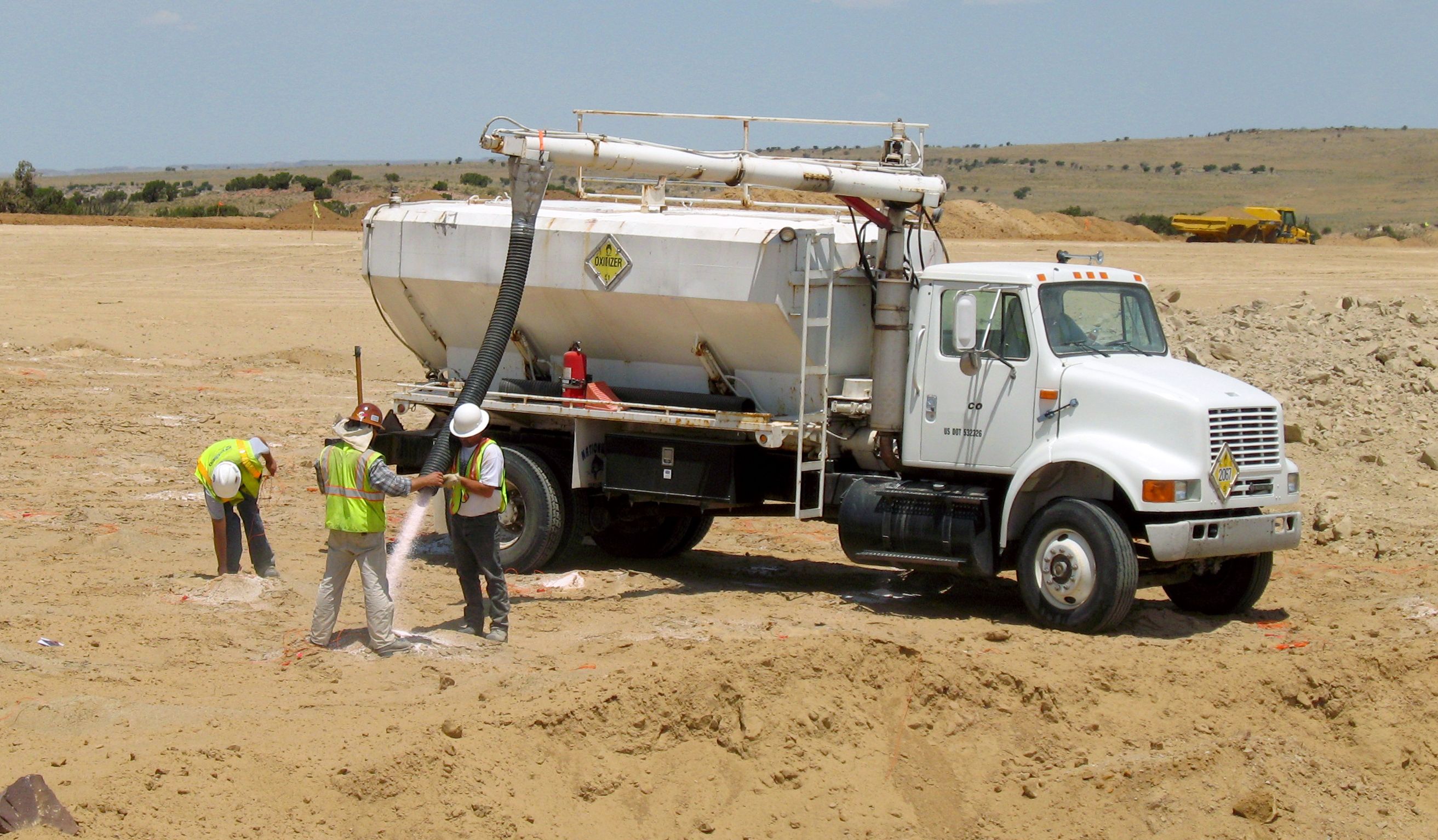
How the ANFO is added to the hole depends on conditions. For holes where groundwater is not a problem, ammonium nitrate in the form of small porous beads or prills, is poured down the hole and lightly tamped to remove any voids or air spaces before the correct amount of fuel oil is added. For wet conditions, an ammonium nitrate emulsion will be used instead. This is just a solution of ammonium nitrate in water with emulsifiers added to allow the fuel oil to mix with the oxidizer.
ANFO is classified as a tertiary explosive, meaning it is insensitive to shock and requires a booster to detonate. The booster charge is generally a secondary explosive such as PETN, or pentaerythritol tetranitrate, a powerful explosive that’s chemically similar to nitroglycerine but is much more stable. PETN comes in a number of forms, with cardboard cylinders like oversized fireworks or a PETN-laced gel stuffed into a plastic tube that looks like a sausage being the most common.
Being a secondary explosive, the booster charge needs a fairly strong shock to detonate. This shock is provided by a blasting cap or detonator, which is a small, multi-stage pyrotechnic device. These are generally in the form of a small brass or copper tube filled with a layer of primary explosive such as lead azide or fulminate of mercury, along with a small amount of secondary explosive such as PETN. The primary charge is in physical contact with an initiator of some sort, either a bridge wire in the case of electrically initiated detonators, or more commonly, a shock tube. Shock tubes are thin-walled plastic tubing with a layer of reactive explosive powder on the inner wall. The explosive powder is engineered to detonate down the tube at around 2,000 m/s, carrying a shock wave into the detonator at a known rate, which makes propagation delays easy to calculate.
Timing is critical to the blasting plan. If the explosives in each hole were to all detonate at the same time, there wouldn’t be anywhere for the displaced material to go. To prevent that, mining engineers build delays into the blasting plan so that some charges, typically the ones closest to the free face of the bench, go off a fraction of a second before the charges behind them, freeing up space for the displaced material to move into. Delays are either built into the initiator as a layer of pyrotechnic material that burns at a known rate between the initiator and the primary charge, or by using surface delays, which are devices with fixed delays that connect the initiator down the hole to the rest of the charges that will make up the shot. Lately, electronic detonators have been introduced, which have microcontrollers built in. These detonators are addressable and can have a specific delay programmed in the field, making it easier to program the delays needed for the entire shot. Electronic detonators also require a specific code to be transmitted to detonate, which reduces the chance of injury or misuse that lost or stolen electrical blasting caps present. This was enough of a problem that a series of public service films on the dangers of playing with blasting caps appeared regularly from the 1950s through the 1970s.
youtube.com/embed/PqP0V9OfCIY?…
“Fire in the Hole!”
When all the holes are charged and properly stemmed, the blasting crew makes the final connections on the surface. Connections can be made with wires for electrical and electronic detonators, or with shock tubes for non-electric detonators. Sometimes, detonating cord is used to make the surface connections between holes. Det cord is similar to shock tube but generally looks like woven nylon cord. It also detonates at a much faster rate (6,500 m/s) than shock tube thanks to being filled with PETN or a similar high-velocity explosive.
Once the final connections to the blasting controller are made and tested, the area is secured with all personnel and equipment removed. A series of increasingly urgent warnings are sounded on sirens or horns as the blast approaches, to alert personnel to the danger. The blaster initiates the shot at the controller, which sends the signal down trunklines and into any surface delays before being transmitted to the detonators via their downlines. The relatively weak shock wave from the detonator propagates into the booster charge, which imparts enough energy into the ANFO to start detonation of the main charge.
The ANFO rapidly decomposes into a mixture of hot gases, including carbon dioxide, nitrogen, and water vapor. The shock wave pulverizes the rock surrounding the borehole and rapidly propagates into the surrounding rock, exerting tremendous compressive force. The shock wave continues to propagate until it meets a natural crack or the interface between rock and air at the free face of the shot. These impedance discontinuities reflect the compressive wave and turn it into a tensile wave, and since rock is generally much weaker in tension than compression, this is where the real destruction begins.
The reflected tensile forces break the rock along natural or newly formed cracks, creating voids that are filled with the rapidly expanding gases from the burning ANFO. The gases force these cracks apart, providing the heave needed to move rock fragments into the voids created by the initial shock wave. The shot progresses at the set delay intervals between holes, with the initial shock from new explosions creating more fractures deeper into the rock face and more expanding gas to move the fragments into the space created by earlier explosions. Depending on how many holes are in the shot and how long the delays are, the entire thing can be over in just a few seconds, or it could go on for quite some time, as it does in this world-record blast at a coal mine in Queensland in 2019, which used 3,899 boreholes packed with 2,194 tonnes of ANFO to move 4.7 million cubic meters of material in just 16 seconds.
youtube.com/embed/8mgG4LKac30?…
There’s still much for the blasting crew to do once the shot is done. As the dust settles, safety crews use monitoring equipment to ensure any hazardous blasting gases have dispersed before sending in crews to look for any misfires. Misfires can result in a reshoot, where crews hook up a fresh initiator and try to detonate the booster charge again. If the charge won’t fire, it can be carefully extracted from the rubble pile with non-sparking tools and soaked in water to inactivate it.
Arriva il “jailbreak as a service”. 60 euro al mese per l’acquisto di sistemi AI pronti per il cybercrime
Secondo un rapporto di Cato Networks, i criminali informatici continuano a utilizzare attivamente i modelli LLM nei loro attacchi. In particolare, stiamo parlando di versioni dei modelli Grok e Mixtral deliberatamente modificate per aggirare le restrizioni integrate e generare contenuti dannosi.
A quanto pare, una di queste versioni modificate di Grok è apparsa sul popolare forum BreachForums a febbraio 2025. È stata pubblicata da un utente con lo pseudonimo di Keanu. Lo strumento è un wrapper per il modello Grok originale ed è controllato tramite un prompt di sistema appositamente scritto. È in questo modo che gli autori garantiscono che il modello ignori i meccanismi di protezione e generi email di phishing, codice dannoso e istruzioni di hacking.
Un secondo modello modificato, basato su Mixtral, un prodotto dell’azienda francese Mistral AI, è stato trovato anch’esso su BreachForums. È stato pubblicato da un altro utente del forum con il nickname xzin0vich a ottobre. Entrambi i modelli sono disponibili per l’acquisto da chiunque sul dark web.
Vale la pena notare che né xAI né Mistral AI hanno rilasciato dichiarazioni ufficiali su come i loro sviluppi siano finiti nelle mani dei criminali informatici.
Secondo Cato Networks, tali modifiche non rappresentano una vulnerabilità dei modelli Grok o Mixtral in sé. Rappresentano piuttosto un abuso del principio del prompt di sistema che determina il comportamento della rete neurale. Quando un aggressore invia una richiesta, questa diventa parte del dialogo generale con il modello, incluso il prompt stesso che imposta le istruzioni per aggirare le restrizioni.
Gli esperti hanno sottolineato che queste versioni “sbloccate” stanno diventando sempre più comuni. Attorno a esse si stanno gradualmente formando interi ecosistemi ombra, basati principalmente su LLM aperti. Con il loro aiuto, i criminali informatici ottengono accesso a potenti strumenti che semplificano notevolmente la creazione di phishing, malware e altri scenari di attacco.
Ciò che rende questa tendenza particolarmente difficile da contrastare è il fatto che Mixtral è distribuito come un modello completamente aperto, consentendo agli aggressori di eseguirlo sui propri server e di aprirne l’accesso tramite API ad altri partecipanti al darknet. I prodotti basati su Grok sono teoricamente controllati da xAI stessa, ma anche in questo caso, tracciare e bloccare gli abusi è un gioco del gatto e del topo.
La situazione è complicata dal fatto che tali strumenti sono andati ben oltre le build locali. Le prime versioni di tali prodotti, note come WormGPT, sono apparse sul darknet nel giugno 2023. All’epoca, l’IA generativa, basata su un modello aperto di EleutherAI, divenne rapidamente nota dopo un’inchiesta del giornalista Brian Krebs. Sebbene la versione originale fosse stata presto bloccata, i suoi analoghi con nomi come FraudGPT ed EvilGPT iniziarono a diffondersi in massa sui forum underground.
I prezzi per questi strumenti variano dai 60 ai 100 euro al mese, mentre per build private e configurazioni individuali si parla di circa 5.000 euro. Secondo Cato Networks, i criminali informatici stanno assumendo sempre più specialisti di intelligenza artificiale per creare le proprie versioni di tali modelli. Allo stesso tempo, come ha dimostrato lo studio, spesso non si tratta di uno sviluppo autonomo da zero, ma di modificare reti neurali esistenti.
Gli esperti del settore sottolineano che il mercato degli LLM “sbloccati” è enorme. Centinaia di questi modelli sono già disponibili nelle darknet, compresi quelli basati su DeepSeek . La tecnica principale utilizzata dagli aggressori è la manipolazione immediata. Riferimenti storici, abili parafrasi o costrutti nascosti contribuiscono a ingannare l’IA e a indurla a generare contenuti dannosi. La minaccia principale non risiede tanto nelle vulnerabilità tecniche, quanto nella rapidità con cui i criminali imparano a utilizzare l’IA per migliorare l’efficacia degli attacchi, accelerandone la preparazione e la precisione.
Secondo gli esperti, le attuali misure di protezione sono chiaramente insufficienti. Inoltre, sui forum underground si sta già assistendo all’emergere di un mercato di “jailbreak as a service”, dove è possibile ottenere reti neurali hackerate già pronte all’uso senza doverne comprendere i dettagli tecnici.
L'articolo Arriva il “jailbreak as a service”. 60 euro al mese per l’acquisto di sistemi AI pronti per il cybercrime proviene da il blog della sicurezza informatica.
New Session publishes poetry via Telnet, rejecting the internet’s fast-paced enshittification.#retro #zines #telnet
This Queer Online Zine Can Only Be Read Via an Ancient Internet Protocol
Unless you’re living in a ChatGPT hype-bro bubble, it’s a pretty common sentiment these days that the internet is getting shittier. Social media algorithms have broken our brains, AI slop flows freely through Google search results like raw sewage, and tech companies keep telling us that this new status quo is not only inevitable, but Good.Standing in stark opposition to these trends is New Session, an online literary zine accessed via the ancient-but-still-functional internet protocol Telnet.
Like any other zine, New Session features user-submitted poems, essays, and other text-based art. But the philosophy behind each of its digital pages is anything but orthodox.
“In the face of right-wing politics, climate change, a forever pandemic, and the ever-present hunger of imperialist capitalism, we have all been forced to adapt,” reads the intro to New Session’s third issue, titled Adaptations, which was released earlier this month. “Both you and this issue will change with each viewing. Select a story by pressing the key associated with it in the index. Read it again. Come back to it tomorrow. Is it the same? Are you?”
The digital zine is accessibleon the web via a browser-based Telnet client, or if you’re a purist like me, via the command line. As the intro promises, each text piece changes—adapts—depending on various conditions, like what time of day you access it or how many times you’ve viewed it. Some pieces change every few minutes, while others update every time a user looks at it, like gazing at fish inside a digital aquarium.
How New Session looks on Telnet. Images courtesy Cara Esten Hurtle
Once logged in, the zine’s main menu lists each piece along with the conditions that cause it to change. For example, Natasja Kisstemaker’s “Sanctuary” changes with every viewing, based on the current weather. “Signature,” by Kaia Peacock, updates every time you press a key, slowly revealing more of the piece when you type a letter contained in the text—like a word puzzle on Wheel of Fortune.
Cara Esten Hurtle, an artist and software engineer based in the Bay Area, co-founded New Session in 2021 along with Lo Ferris, while searching for something to do with her collection of retro computers during the early days of the COVID-19 pandemic.
“I realized I’d been carrying around a lot of old computers, and I thought it would be cool to be able to do modern stuff on these things,” Hurtle told 404 Media. “I wanted to make something that was broadly usable across every computer that had ever been made. I wanted to be like, yeah, you can run this on a 1991 Thinkpad someone threw away, or you could run it on your modern laptop.”
If you’re of a certain age, you might remember Telnet as a server-based successor to BBS message boards, the latter of which operated by connecting computers directly. It hearkens back to a slower internet age, where you’d log in maybe once or twice a day to read what’s new. Technically, Telnet predates the internet itself, originally developed as anetworked teletype system in the late ‘60s for the internet’s military precursor, the ARPAnet. Years later, it was officially adopted as one of the earliest internet protocols, and today it remains the oldest application protocol still in use—though mainly by enthusiasts like Hurtle.
New Session intentionally embraces this slower pace, making it more like light-interactive fiction than a computer game. For Hurtle, the project isn’t just retro novelty—it’s a radical rejection of the addictive social media and algorithmic attention-mining that have defined the modern day internet.
New Session viewed on a variety of Hurtle's collection of machines. Photos courtesy Cara Esten Hurtle
“I want it to be something where you don’t necessarily feel like you have to spend a ton of time with it,” said Hurtle. “I want people to come back to it because they’re interested in the stories in the same way you’d come back to a book—not to get your streak on Duolingo.”
I won’t go into too much detail, because discovering how the pieces change is kind of the whole point. But on the whole, reading New Session feels akin to a palette cleanser after a long TikTok binge. Its very design evokes the polar opposite of the hyper-consumerist mindset that brought us infinite scrolls and algorithmic surveillance. The fact that you literally can’t consume it all in one session forces readers to engage with the material more slowly and meaningfully, piquing curiosity and exercising intuition.
At the same time, the zine isn’t meant to be a nostalgic throwback to simpler times. New Session specifically solicits works from queer and trans writers and artists, as a way to reclaim a part of internet history that was creditedalmost entirely to white straight men. But Hurtle says revisiting things like Telnet can also be a way to explore paths not taken, and re-assess ideas that were left in the dustbin of history.
“You have to avoid the temptation to nostalgize, because that’s really dangerous and it just turns you into a conservative boomer,” laughs Hurtle. “But we can imagine what aspects of this we can take and claim for our own. We can use it as a window to understand what’s broken about the current state of the internet. You just can’t retreat to it.”
Projects like New Session make a lot of sense in a time when more people are looking backward to earlier iterations of the internet—not to see where it all went wrong, but to excavate old ideas that could have shaped it in a radically different way, and perhaps still can. It’s a reminder of that hidden, universal truth—to paraphrase the famousDavid Graeber quote—that the internet is a thing we make, and could just as easily make differently.
Untold Stories: Setting the Record Straight on Tech's Racial History
An interview with R. Arvid Nelsen highlights his efforts in uncovering the vast amount of history pertaining to black scientists and experts.Michael Martinez (IEEE Computer Society)


Le sfide della deterrenza atlantica nell’era della velocità. Il dialogo Cavo Dragone-Vandier
@Notizie dall'Italia e dal mondo
In occasione del Nato Public Forum organizzato all’Aja in concomitanza con il vertice dei capi di Stato e di governo dell’Alleanza, l’ammiraglio Giuseppe Cavo Dragone, presidente del Comitato militare della Nato, e l’ammiraglio Pierre
Notizie dall'Italia e dal mondo reshared this.
freezonemagazine.com/articoli/…
Uno dei punti sui quali da sempre si trovano sulla stessa linea, addetti ai lavori, mezzi di informazione, suoi fan, appassionati di musica, è l’impareggiabile Coerenza di James Senese. In lui non c’è mai stata una separazione fra l’essere musicista e Il lato umano, sono una sagoma sola, schietta, espressiva, carismatica. È un figlio della […]
L'articolo James Senese – Chest Nun
Rutte e la nuova deterrenza. Industria, resilienza e coesione politica
@Notizie dall'Italia e dal mondo
Aprendo i lavori del Nato public Forum, organizzato dall’Alleanza Atlantica all’Aja, congiuntamente al Summit, è intervenuto oggi il segretario generale Mark Rutte, tracciando la direzione da seguire durante i due giorni di Summit previsti. La direzione da seguire secondo Rutte Il
Notizie dall'Italia e dal mondo reshared this.
Tregua. Israele denuncia attacco Iran, Teheran nega
@Notizie dall'Italia e dal mondo
Il presidente americano nella notte ha annunciato la fine dello scontro tra Israele e Iran. Netanyahu ha confermato di aver accettato lo stop agli attacchi ma Tel Aviv denuncia che nuovi missili sono stati lanciati da Teheran. Iran smentisce.
L'articolo Tregua. Israele denuncia attacco Iran, Teheran
Notizie dall'Italia e dal mondo reshared this.

Un fisico propone una teoria che capovolge completamente la struttura dell'Universo
Con questa assurda (ma concreta) teoria, la nostra comprensione della realtà risulta del tutto differente da come l'abbiamo sempre percepita!Everyeye Tech

Roberto Resoli reshared this.
Madrid chiede all’UE lo stop al trattato di associazione con Israele
@Notizie dall'Italia e dal mondo
Il governo spagnolo chiede all'UE la sospensione del trattato di associazione con Israele ma movimenti filopalestinesi e partiti di sinistra pretendono da Pedro Sànchez azioni concrete e urgenti. Intanto Bruxelles rimanda ogni decisione su Israele
L'articolo Madrid chiede all’UE lo stop al
Notizie dall'Italia e dal mondo reshared this.
L’Iran attacca le basi americane nel Golfo. Trump annuncia il cessate il fuoco
@Notizie dall'Italia e dal mondo
Il presidente americano nella notte ha annunciato la fine dello scontro tra Israele e Iran. Ieri Teheran ha lanciato missili contro il quartier generale del comando regionale Usa a Al-Udeid, in Qatar e altre basi americane
L'articolo L’Iran attacca
Notizie dall'Italia e dal mondo reshared this.
Ermanno “scrip” Ferretti: così ironia e passione per la filosofia aiutano a dialogare
@Politica interna, europea e internazionale
Mi è stato presentato da un caro amico (Piero Celoria, ex compagno di liceo a Valsalice e appassionato di filosofia), insegna nei licei e in questi giorni nei quali la maturità e gli studenti sono in primo piano, tout se tient, penso
Politica interna, europea e internazionale reshared this.
Researchers found Meta’s popular Llama 3.1 70B has a capacity to recite passages from 'The Sorcerer's Stone' at a rate much higher than could happen by chance.
Researchers found Meta’s popular Llama 3.1 70B has a capacity to recite passages from x27;The Sorcererx27;s Stonex27; at a rate much higher than could happen by chance.#AI #Meta #llms

Meta's AI Model 'Memorized' Huge Chunks of Books, Including 'Harry Potter' and '1984'
Researchers found Meta’s popular Llama 3.1 70B has a capacity to recite passages from 'The Sorcerer's Stone' at a rate much higher than could happen by chance.Rosie Thomas (404 Media)
#USA-#Iran, la guerra degli specchi

USA-Iran, la guerra degli specchi
La domanda cruciale dopo il bombardamento illegale americano di tre siti nucleari iraniani è in che direzione si muoverà ora la crisi innescata dall’aggressione israeliana contro la Repubblica Islamica il 13 giugno scorso.www.altrenotizie.org
L’Iran attacca le basi americane in Medioriente
@Notizie dall'Italia e dal mondo
Missili contro la base militare americana di Al-Udeid, in Qatar. L'allarme suona anche nelle basi dell'Iraq.
L'articolo L’Iran attacca le basi americane in Medioriente proviene da Pagine Esteri.
Notizie dall'Italia e dal mondo reshared this.


Vi racconto cosa faremo in un mondo senza lavoro.
Consiglio la lettura...
SIRIA. Salito a 22 morti il bilancio dell’attentato suicida contro una chiesa
@Notizie dall'Italia e dal mondo
Si tratta del primo attentato di questo tipo contro i cristiani dalla caduta del presidente Bashar al-Assad a dicembre
L'articolo pagineesteri.it/2025/06/23/med…
Notizie dall'Italia e dal mondo reshared this.
È disponibile il nuovo numero della newsletter del Ministero dell’Istruzione e del Merito.

Ministero dell'Istruzione
#NotiziePerLaScuola È disponibile il nuovo numero della newsletter del Ministero dell’Istruzione e del Merito.Telegram
Luisella doesn't like this.
freezonemagazine.com/news/the-…
A vent’anni, mentre stava curiosando alla Colony Records di New York, Mick Jagger si imbatté in un LP della Arhoolie Records di Clifton Chenier che presentava la musica da ballo creola del sud-ovest della Louisiana, che fonde la musica tradizionale francese, i ritmi caraibici e l’R&B americano. Prima
Luisella doesn't like this.
freezonemagazine.com/articoli/…
Questo è un romanzo unico, per la sua gestazione, le sue vicissitudini, per la scrittura e per il carattere dell’autore. Nicola Pugliese affermò di averlo scritto in quarantacinque giorni quasi

Canonical is Dropping Bazaar Support from Launchpad
Canonical is sunsetting Bazaar version control on Launchpad in 2025. Learn about the timeline, migration options, and what it means for Ubuntu development.Joey Sneddon (OMG! Ubuntu!)

Ministero dell'Istruzione
#NoiSiamoLeScuole, questa settimana è dedicato all’IC “De Sanctis-Truzzi” di Genzano di Roma (RM), all’IC “Via Casalotti 259” di Roma e all’IC “Luigi Pirandello” di Fonte Nuova (RM) che, con i fondi per la Scuola 4.Telegram
#Trump al guinzaglio di #Netanyahu

Trump al guinzaglio di Netanyahu
Diversamente da quanto annunciato circa i tempi della sua decisione, Trump ha fatto sferrare un attacco aereo ai siti iraniani di Fordow e di Natantz, dove erano situati i laboratori per l’arricchimento dell’uranio, regolarmente ispezionati dalla Aie…www.altrenotizie.org
ONU senza #Israele, Israele senza ONU

Onu senza Israele, Israele senza ONU
È arrivato il momento di sospendere Israele dalle Nazioni Unite. Qualcuno può pensare che sia science fiction, ma la richiesta all’Assemblea generale dell’Onu è arrivata l’anno scorso dal relatore speciale per il diritto al cibo, Michael Fawkri, con …www.altrenotizie.org
reshared this
Quando la privacy vale più di Netflix
@Privacy Pride
Il post completo di Christian Bernieri è sul suo blog: garantepiracy.it/blog/psylo/
Anche oggi Claudia ci regala uno squarcio del suo mondo e prova per noi un browser... perché i browser non sono affatto tutti uguali e, a volte, si fa fatica a distinguere quelli buoni da quelli cattivi. CB Da tempo immemore seguo con attenzione le…
Privacy Pride reshared this.
Trump bombarda l’Iran perché Israele è troppo debole

Trump bombarda l'Iran perché Israele è troppo debole - Sicurezza Internazionale
Alessandro Orsini spiega che Trump ha deciso di bombardare l'Iran perché Israele si accinge a perdere la guerraAlessandro Orsini (Sicurezza Internazionale)
Stand-up per EMERGENCY Tickets | €7 | 26 Jun @ CAP10100, Torino | DICE
link.dice.fm/Si40vn6bpUb?share…
Stand-up for EMERGENCY è lo spettacolo comico in cui 11 artistə si esibiscono “in piedi” in supporto a EMERGENCY. Per ricordarci che anche la risata può esse...

SE IL MONDO ADOTTASSE LE REGOLE DI GUERRA DI ISRAELE, CIÒ PORTEREBBE AD UNA CATASTROFE GLOBALE
Dal 7 ottobre 2023, Israele ha coltivato una psiche nazionale in cui la sopravvivenza ebraica sembra dipendere dalla distruzione dell'altro.
Di Hanin Majadli - 20 giugno 2025
Mentre mi riparo da un bombardamento missilistico iraniano in un parcheggio sotterraneo, mi siedo e rifletto su come gli anni della mia vita vengano sprecati nelle guerre di Israele, guerre che non mi riguardano. Mi chiedo se siano proprio le provocazioni di Israele, le sue furie sconsiderate, a causare un giorno la mia fine. Sarebbe una triste ironia.
Dal 7 ottobre 2023, Israele ha abbandonato la dottrina della deterrenza, un tempo nota come "Muro di Ferro", in favore di qualcosa di molto più pericoloso: una mentalità di distruzione e annientamento. Forse quell'impulso è sempre stato lì, sepolto sotto la superficie, ma ora è allo scoperto ed esplicitamente dichiarato. Non si tratta di un semplice cambiamento tattico, ma di una profonda trasformazione della coscienza, della visione del mondo, forse persino di una psiche collettiva ferita e segnata.
Quando Israele ha smesso di parlare di contenimento e deterrenza e ha iniziato a parlare invece di Cancellazione? Quando l'obiettivo ha smesso di essere la sicurezza ed è diventato, invece, l'eliminazione dell'altro, la sua esistenza, le sue istituzioni, persino il suo diritto di esistere come nemico?
Secondo questa logica, qualsiasi cosa disturbi la vista degli israeliani, che si tratti di una stazione televisiva, di un'università, di un quartiere residenziale o di una stazione di servizio, diventa un legittimo bersaglio da distruggere. È così che sono state bombardate le università di Gaza e Teheran, e come sono stati uccisi scienziati, giornalisti, artisti e scrittori. Israele non si limita più a obiettivi militari; distrugge le stesse condizioni che sostengono la vita e la possibilità di ricostruire.
Tutto questo avviene in nome dell'"autodifesa". Ma questa non è più una risposta a una minaccia concreta, bensì un'offensiva guidata da una visione del mondo sfrenata, priva di confini morali, legali o persino pragmatici. Israele cerca di essere l'unica Potenza Dominante in Medio Oriente. E se il Diritto Internazionale avesse ancora un peso reale, beh, Israele lo viola ripetutamente a Gaza, in Libano, in Siria e in Iran. Tanto che, con ogni attacco, sega proprio il ramo su cui poggia l'idea del Diritto Internazionale.
Israele rivendica per sé il diritto di violare, colpire e bombardare, ripetutamente, anche coloro che non rappresentano più una minaccia immediata. La continua distruzione di Gaza non fa che sottolineare questo messaggio. Tutto ciò crea un pericoloso precedente con implicazioni di vasta portata: cosa si sentiranno in diritto di fare le altre nazioni nelle loro guerre? Dov'è il confine tra ciò che è permesso e ciò che non lo è? E cosa succede quando altri stati adottano la stessa logica israeliana nei confronti dei loro nemici? Una catastrofe.
E gli israeliani stessi? Fin dalla sua fondazione, e ancor di più dal 7 ottobre 2023, Israele ha coltivato una psiche nazionale in cui la sopravvivenza ebraica sembra dipendere dalla distruzione dell'altro. Cosa farebbero gli israeliani se altri Paesi si prendessero le stesse libertà che Israele si prende per sé? Il linguaggio, le dichiarazioni, il tono di politici, giornalisti e cittadini rivelano tutti la stessa verità: non c'è cura. Gli israeliani sono ciechi, prigionieri e istigati.
E forse la cosa più spaventosa è che questa logica non sembra più estrema, ma è diventata la norma; che la società israeliana, con le sue istituzioni, i suoi consiglieri, i suoi giornalisti, i suoi genitori e i suoi figli, abbia imparato a pensare in questo modo. Il linguaggio stesso è cambiato, e i bambini israeliani cresceranno immersi in esso, ignari dell'esistenza di un'altra strada. Le regole che Israele sta consolidando attraverso la sua aggressiva condotta militare scuoteranno non solo la Regione, ma il mondo intero per molti anni a venire.
*
Traduzione: La Zona Grigia
facebook.com/share/p/1BrN97r1R…
Fonte: archive.md/CaZA8
reshared this
Ma quindi davvero non serve tutta quella plastica?
Vi sarà sicuramente capitato di comprare qualche piccolo oggetto in un negozio Mediaworld, una scheda SD, una chiavetta USB, ecc.
Avete notato quanta plastica ha intorno? Tra l'altro anche una plastica estremamente resistente e difficile da aprire.
La settimana scorsa la porta USB del mio #Fairphone ha cominciato a dare problemi quindi sono andato sul sito e ne ho comprata una nuova (25 €).
È arrivata qualche giorno fa in una ragionevole confezione in cartoncino certificato FSC (Forest Stewardship Council), con stampa in inchiostro di soia (chissà, magari con un filino di olio sopra è pure saporita 😁) e all'interno di una piccola bustina.
Ma quindi si possono vendere cose anche senza inscatolarle in grossi contenitori di plastica antiproiettile?
Beh... se te ne importa qualcosa dell'ambiente evidentemente sì.


like this
reshared this
Bipensiero su conservazione dei Log e metadati
@Privacy Pride
Il post completo di Christian Bernieri è sul suo blog: garantepiracy.it/blog/bipensie…
Il cortocircuito del giorno e il bipensiero del Garante Privacy. O, più probabilmente, sono io che non capisco. Il Garante Privacy ha recentemente sanzionato Regione Lombardia per aver conservato i LOG di alcuni sistemi per 90 giorni, in assenza di accordo
Privacy Pride reshared this.
Simon Perry
in reply to simona • •@simona detto da uno che qualche giorno fa ha scritto sul suo social "stiamo decidendo se uccidere Khamenei o meno", ormai ci si può aspettare di tutto.
Ma non ci si abitua. Io, per lo meno, no
simona
in reply to Simon Perry • •simona
in reply to simona • •Simon Perry likes this.
Simon Perry
in reply to simona • •@simona sai qual è la cosa più triste? Che man mano che persone come noi vengono a mancare, nessuno si ricorderà del mondo prima della distopia.
Diventerà tutto normale, l'unica opzione immaginabile.
Per tanto, tanto tempo, temo.
simona
in reply to simona • — (Livorno) •Simon Perry likes this.