
Bambu Lab’s PLA Tough+ Filament: Mostly a Tough Sell

Beyond the simple world of basic PLA filaments there is a whole wild world of additives that can change this humble material for better or worse. The most common additives here are primarily to add color, but other additives seek to specifically improve certain properties of PLA. For example Bambu Lab’s new PLA Tough+ filament series that [Dr. Igor Gaspar] over at the My Tech Fun YouTube channel had over for reviewing purposes.
According to Bambu Lab’s claims for the filament, it’s supposed to have ‘up to’ double the layer adhesion strength as their basic PLA, while being much more robust when it comes to flexing and ‘taking a beating’. Yet as [Igor] goes through his battery of tests – comparing PLA Tough+ against the basic PLA – the supposedly tough filament is significantly worse in every count. That sad streak lasts until the impact tests, which is where we see a curious set of results – as shown above – as well as [Igor]’s new set of impact testing toys being put through their paces.
Of note is that although the Tough+ variants tested are consistently less brittle than their basic PLA counterparts, the Silver basic PLA variant makes an unexpectedly impressive showing. This is a good example of how color additives can have very positive impacts on a basic polymer like PLA, as well as a good indication that at least Bambu Lab’s Basic PLA in its Silver variant is basically better than Tough+ filaments. Not only does it not require higher printing temperatures, it also doesn’t produce more smelly VOCs, while being overall more robust.
youtube.com/embed/U-aTEslkqco?…
Tymoshchuk: latitante ucraino ricercato per responsabilità in LockerGoga, MegaCortex, e Nefilim ransomware
@Informatica (Italy e non Italy 😁)
In una mossa coordinata, il Dipartimento di Giustizia USA ha svelato un atto d’accusa federale che punta il dito contro Volodymyr Viktorovich Tymoshchuk, cittadino ucraino noto nei sotterranei del

Italia analfabeta: il 37% degli adulti fatica a leggere e comprendere testi - Primaonline - Ultime notizie
Dal rapporto Education at a Glance 2025 emergono divari educativi, investimenti sotto la media e calo nella mobilità internazionale degli studentiRedazione PrimaOnline (Primaonline - Ultime notizie)
The agency tells workers "we should all be vigilant against barriers that could slow our progress toward making America healthy again."#HHS #RFKJr


HHS Asks All Employees to Start Using ChatGPT
Employees at Robert F Kennedy Jr.’s Department of Health and Human Services received an email Tuesday morning with the subject line “AI Deployment,” which told them that ChatGPT would be rolled out for all employees at the agency. The deployment is being overseen by Clark Minor, a former Palantir employee who’s now Chief Information Officer at HHS.“Artificial intelligence is beginning to improve health care, business, and government,” the email, sent by deputy secretary Jim O’Neill and seen by 404 Media, begins. “Our department is committed to supporting and encouraging this transformation. In many offices around the world, the growing administrative burden of extensive emails and meetings can distract even highly motivated people from getting things done. We should all be vigilant against barriers that could slow our progress toward making America healthy again.”
“I’m excited to move us forward by making ChatGPT available to everyone in the Department effective immediately,” it adds. “Some operating divisions, such as FDA and ACF [Administration for Children and Families], have already benefitted from specific deployments of large language models to enhance their work, and now the rest of us can join them. This tool can help us promote rigorous science, radical transparency, and robust good health. As Secretary Kennedy said, ‘The AI revolution has arrived.’”
“To begin, simply go to go.hhs.gov/chatgpt and log in with your government email address. Pose a question and the tool will propose preliminary answers. You can follow up with further questions and ask for details and other views as you refine your thinking on a subject,” it says. “Of course, you should be skeptical of everything you read, watch for potential bias, and treat answers as suggestions. Before making a significant decision, make sure you have considered original sources and counterarguments. Like other LLMs, ChatGPT is particularly good at summarizing long documents.”
The email says that the rollout was being led by Minor, who worked at the surveillance company Palantir from 2013 through 2024. It states Minor has “taken precautions to ensure that your work with AI is carried out in a high-security environment,” and that “you can input most internal data, including procurement sensitive data and routine non-sensitive personally identifiable information, with confidence.”
It then goes on to say that “ChatGPT is currently not approved for disclosure of sensitive personally identifiable information (such as SSNs and bank account numbers), classified information, export-controlled data, or confidential commercial information subject to the Trade Secrets Act.” The email does not distinguish what “non-sensitive personally identifiable information” is. HHS did not immediately respond to a request for comment from 404 Media.
The email continues the rollout of AI to every corner of the federal government, which is something that began in the Biden administration but which the Trump administration has become increasingly obsessed with. It’s particularly notable that AI is being pushed on HHS employees under a secretary that has actively rejected science and which has taken steps to roll back vaccine schedules, made it more difficult to obtain routine vaccinations, and has amplified conspiracy theories about the causes of autism.
The agency has also said it plans to roll out AI through HHS’s Centers for Medicare and Medicaid Services that will determine whether patients are eligible to receive certain treatments. These types of systems have been shown to be biased when they’ve been tried, and result in fewer patients getting the care they need.
Dr. Oz's new Medicare pilot program will use AI and prior authorization
The Centers for Medicare and Medicaid Services (CMS) will begin a pilot program that will import the prior authorization process to traditional Medicare plans in six states.Miranda Yaver (MSNBC)


O Brother, What Art Thou?

Dedicated word processors are not something we see much of anymore. They were in a weird space: computerized, but not really what you could call a computer, even in those days. More like a fancy typewriter, with a screen and floppy disks. Brother made some very nice ones, and [Chad Boughton] got his hands on one for a modernization project.
The word processor in question, a Brother WP-2200, was chosen primarily because of its beautiful widescreen, yellow-phosphor CRT display. Yes, you read that correctly — yellow phosphor, not amber. Widescreen CRTs are rare enough, but that’s just different. As built, the WP-2200 had a luggable form-factor, with a floppy drive, mechanical keyboard, and dot-matrix printer in the back.
Thanks to [Chad]’s upgrade, most of that doesn’t work anymore. Not yet, anyway. The original logic controller of this word processor was… rather limited. As generations have hackers have discovered, you just can’t do very much with these. [Chad] thus decided to tear it all out, and replace it with an ESP-32, since the ESP32-VGA library is a thing. Of course this CRT is not a VGA display, but it was just a matter of tracing the pinout and guesstimating sane values for h-sync, v-sync and the like. (Details are not given in the video.)
Right now, the excellent mechanical keyboard (mostly) works, thanks to a Teensy reading the keyboard matrix off the original cable. The teensy sends characters via UART to the ESP32 and it can indeed display them upon the screen. That’s half of what this thing could do, back in the 1980s, and a very good start. Considering [Chad] now has magnitudes more compute power available than the engineers at Brother ever did (probably more compute power than the workstation used to program the WP2200, now that we think of it) we’re excited to see where this goes. By the spitballing at the end of the video, this device will end its life as much more than a word processor.To see what he’s got working so far, jump to 5:30 in the video. Once the project is a bit more mature, [Chad] assures us he’ll be releasing both code and documentation in written form.
We’ve seen [Chad]’s work before, most recently his slim-fit CD player, but he has been hacking for a long time.We covered his Super Mario PLC hack back in 2014.
youtube.com/embed/mr3uRO7FDz8?…
This Ouija Business Card Helps You Speak to Tiny Llamas

Business cards, on the whole, haven’t changed significantly over the past 600-ish years, and arguably are not as important as they used to be, but they are still worth considering as a reminder for someone to contact you. If the format of that card and method of contact stand out as unique and related to your personal or professional interests, you have a winning combination that will cement yourself in the recipient’s memory.
In a case study of “show, don’t tell”, [Binh]’s business card draws on technological and paranormal curiosity, blending affordable, short-run PCB manufacturing and an, LLM or, in this case, a Small Language Model, with a tiny Ouija board. While [Binh] is very much with us in the here and now, and a séance isn’t really an effective way to get a hold of him, the interactive Ouija card gives recipient’s a playful demonstration of his skills.

The interface is an array of LEDs in the classical Ouija layout, which slowly spell out the message your supernatural contact wants to communicate. The messages are triggered by the user through touch pads. Messages are generated locally by an ESP32-S3 based on Dave Bennett’s TinyLlama LLM implementation.
For a bit of a role reversal in Ouija communication, check out this Ouija robot. For more PCB business card inspiration, have a look at this pong-playing card and this Arduboy-inspired game console card.
youtube.com/embed/WC3O2cKT8Eo?…
Thanks to [Binh] for sharing this project with us.
The Android Linux Commander

Last time, I described how to write a simple Android app and get it talking to your code on Linux. So, of course, we need an example. Since I’ve been on something of a macropad kick lately, I decided to write a toolkit for building your own macropad using App Inventor and any sort of Linux tools you like.
I mentioned there is a server. I wrote some very basic code to exchange data with the Android device on the Linux side. The protocol is simple:
- All messages to the ordinary Linux start with >
- All messages to the Android device start with <
- All messages end with a carriage return
Security
You can build the server so that it can execute arbitrary commands. Since some people will doubtlessly be upset about that, the server can also have a restrictive set of numbered commands. You can also allow those commands to take arguments or disallow them, but you have to rebuild the server with your options set.
There is a handshake at the start of communications where Android sends “>.” and the server responds “<.” to allow synchronization and any resetting to occur. Sending “>#x” runs a numbered command (where x is an integer) which could have arguments like “>#20~/todo.txt” for example, or, with no arguments, “>#20” if you just want to run the command.
If the server allows it, you can also just send an entire command line using “>>” as in: “>>vi ~/todo.txt” to start a vi session.
Backtalk
There are times when you want the server to send you some data, like audio mute status or the current CPU temperature. You can do that using only numbered commands, but you use “>?” instead of “>#” to send the data. The server will reply with “<!” followed by the first line of text that the command outputs.
To define the numbered commands, you create a commands.txt file that has a simple format. You can also set a maximum number, and anything over that just makes a call to the server that you can intercept and handle with your own custom C code. So, using the lower-numbered commands, you can do everything you want with bash, Python, or a separate C program, even. Using the higher numbers, you can add more efficient commands directly into the server, which, if you don’t mind writing in C, is more efficient than calling external programs.
If you don’t want to write programs, things like xdotool, wmctrl, and dbus-send (or qdbus) can do much of what you want a macropad to do. You can either plug them into the commands file or launch shell scripts. You’ll see more about that in the example code.
Now all that’s left is to create the App Inventor interface.
A Not So Simple Sample
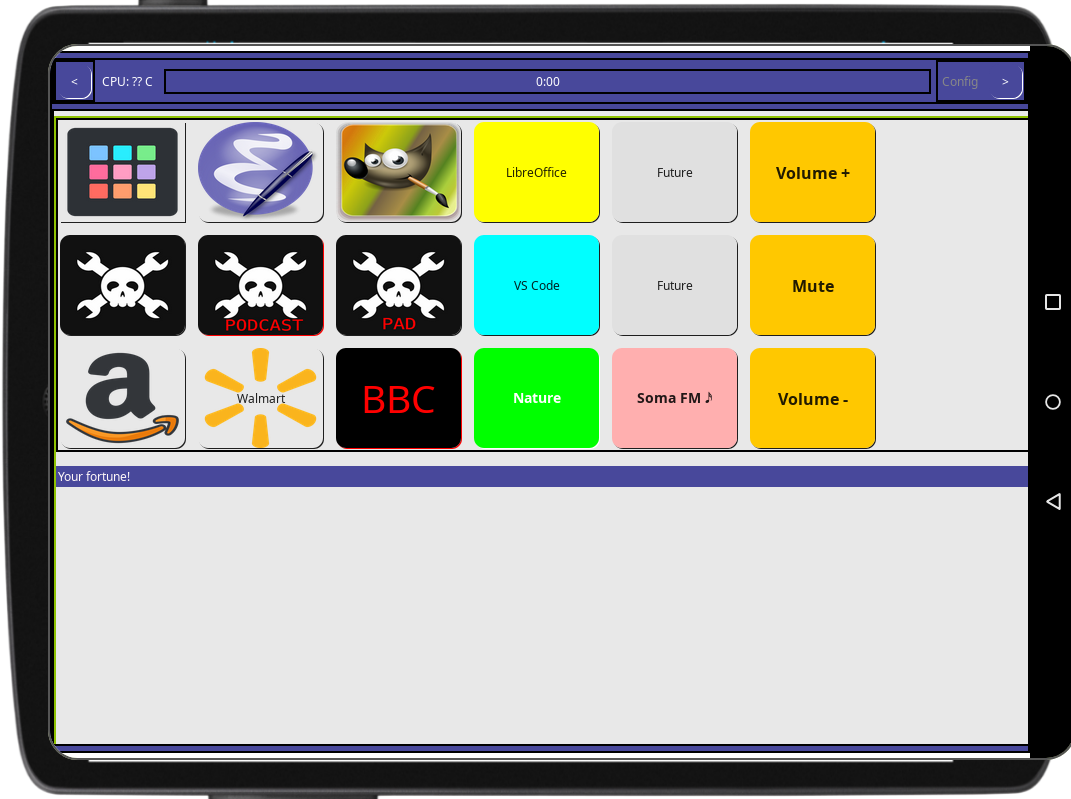
App Inventor is made to create simple apps. This one turned out not to be so simple for a few reasons. The idea was that the macro pad should have a configuration dialog and any number of screens where you could put buttons, sliders, or anything else to interact with the server.
The first issue was definitely a quirk of using App Inventor. It allows you to have multiple screens, and your program can move from screen to screen. The problem is, when you change screens, everything changes. So if we used multiple screens, you’d have to have copies of the Bluetooth client, timers, and anything else that was “global,” like toolbar buttons and their code.
That didn’t seem like a good idea. Instead, I built a simple system with a single screen featuring a toolbar and an area for table layouts. Initially, all but one of the layouts are hidden. As you navigate through the screens, the layout that is active hides, and the new one appears.
Sounds good, but in practice there is a horrible problem. When the layouts become visible, they don’t always recalculate their sizes properly, and there’s no clean way to force a repeat of the layout. This led to quirks when moving between pages. For example, some buttons would have text that is off-center even though it looked fine in the editor.
Another problem is editing a specific page. There is a button in the designer to show hidden things. But when you have lots of hidden things, that’s not very useful. In practice, I just hide the default layout, unhide the one I want to work on, and then try to remember to put things back before I finish. If you forget, the code defensively hides everything but the active page on startup.
Just Browsing
I also included some web browser pages (so you can check Hackaday or listen to Soma FM while you work). When the browser became visible, it would decide to be 1 pixel wide and 1 pixel high, which was not very useful. It took a lot of playing with making things visible and invisible and then visible again to get that working. In some cases, a timer will change something like the font size just barely, then change it back to trigger a recalculation after everything is visible.
Speaking of the browser, I didn’t want to have to use multiple pages with web browser components on it, so the system allows you to specify the same “page” more than once in the list. The page can have more than one title, based on its position, and you can initialize it differently, also based on its position. That was fairly easy, compared to getting them to draw correctly.
Other Gotchas
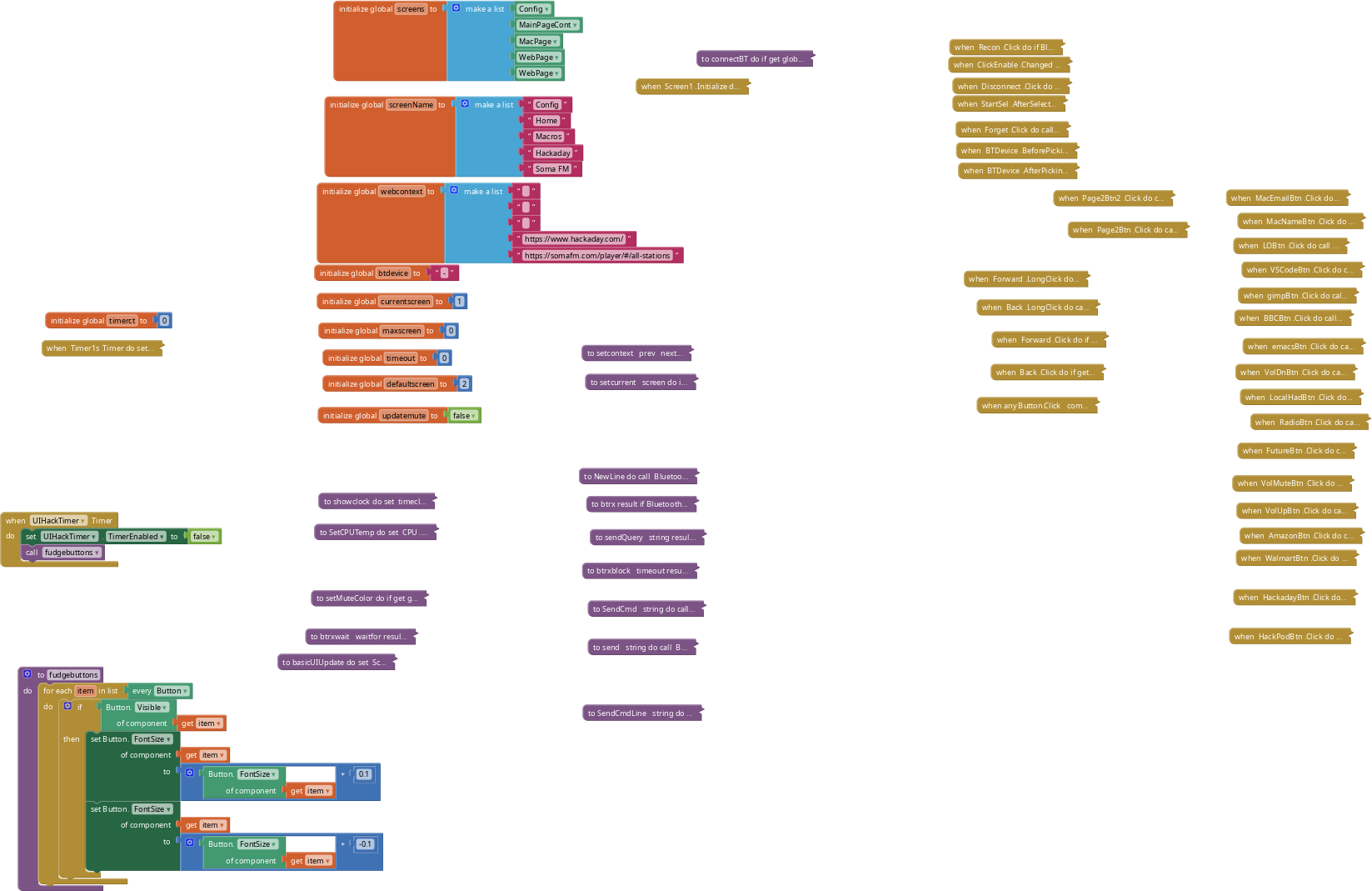
A few other problems cropped up, some of which aren’t the Inventor’s fault. For example, all phones are different, so your program gets resized differently, which makes it hard to work. I just told the interface I was building for a monitor and let the phone resize it. There’s no way to set a custom screen size that I could find.
The layout control is pretty crude, which makes sense. This is supposed to be a simple tool. There are no spacers or padding, for example, but small, fixed-size labels will do the job. There’s also no sane way to make an element span multiple cells in a layout, which leads to lots of deeply nested layouts.
The Bluetooth timeout in App Inventor seemed to act strangely, too. Sometimes it would time out even with ridiculously long timeout periods. I left it variable in the code, but if you change it to anything other than zero, good luck.
How’d It Work?
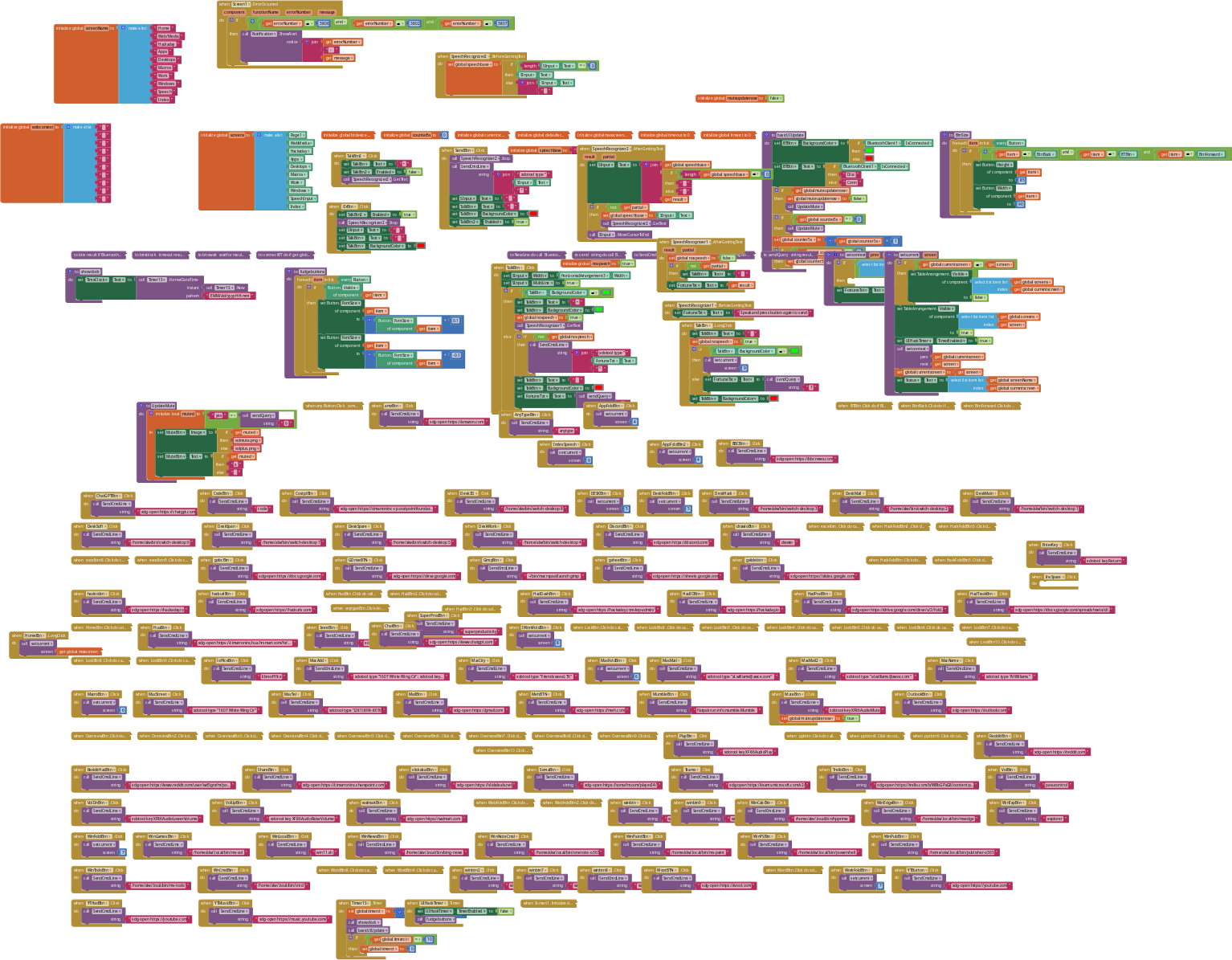
This is probably the most complex thing you’d want to do with App Inventor. The block structure is huge, although, to be fair, a lot of it is just sending a command off when you press a button. The example pad has nearly 500 blocks. The personalized version I use on my own phone (see the video below) has just over 900 blocks!
Of course, the tool isn’t made for such a scale, so be prepared for some development hiccups. The debugging won’t work after a certain point. You just have to build an APK, load it, and hope for luck.
You can find the demo on GitHub. My version is customized to link to my computer, on my exact screen size, and uses lots of local scripts, so I didn’t include it, but you can see it working in the video below.
If you want to go back and look more at the server mechanics, that was in the last post. Of, if you’d rather repurpose an old phone for a server, we’ve seen that done, too.
youtube.com/embed/15znMKz42yM?…

Ministero dell'Istruzione
#Scuola, ulteriori 500 milioni di euro per #AgendaSud e #AgendaNord. Il Ministro, Giuseppe Valditara, ha firmato oggi due decreti per rafforzare i Piani, con l’obiettivo di ridurre i divari territoriali e sostenere le #scuole con fragilità negli appr…Telegram
Offener Brief: Hunderte Wissenschaftler:innen stellen sich gegen Chatkontrolle
netzpolitik.org/2025/offener-b…


Nuovo Maidan angloamericano sionista in Nepal
In Nepal, i manifestanti hanno incendiato il palazzo del Parlamento e la residenza del Primo Ministro. Diversi ministri del governo avrebbero lasciato la capitale e lo stesso Primo Ministro si sarebbe dimesso.
Le proteste in Nepal sono scoppiate dopo il divieto assoluto dei social media (Facebook, Instagram, WhatsApp, YouTube e altri). Le autorità hanno giustificato la misura sostenendo che le piattaforme di social media violavano le regole di registrazione, poiché il governo aveva chiesto l'apertura di uffici di rappresentanza in Nepal, richiesta che hanno ignorato. Allo stesso tempo, non è stata offerta alcuna alternativa nazionale ai social media e alle piattaforme di messaggistica vietate.
A seguito delle proteste sui "social media", almeno 19 persone sono morte. Più di 500 sono rimaste ferite in varia gravità. I dati non sono ancora definitivi.
La moglie dell'ex primo ministro nepalese Jhala Nath Khanal è morta a causa delle ustioni riportate quando i manifestanti l'hanno intrappolata nella sua residenza in fiamme, proprio come era successo alla casa dei sindacati di Odessa: è stata letteralmente bruciata viva.
Cellule dormienti dell'intelligence occidentale angloamericana-sionista si stanno muovendo in vari paesi: nei Balcani, con il tentato colpo di Stato in Serbia, ecc.
L'impero predatorio sionista anglo-americano, morente e in bancarotta, sta diventando molto pericoloso.
L'impunità di Israele, un regime di occupazione criminale, ne è un esempio: la stessa tattica-strategia fatta con l'Iran, nel momento di accordi; è successo con la false flag dell'attentato di ieri; e il bombardamento del Quatar di oggi.
Chi si fida ancora di Trump, sionista e guerrafondaio?
CONTANO I FATTI così come afferma sempre il grande giornalista Manlio Dinucci. Ovviamente lasciando perdere il fantasioso Gianfranco Landi, difensore accanito e spesso presente su Visione TV.

in quale data per la prima volta la cisgiordania ha "ospitato" militari israeliani e civili definiti "coloni"?
La presenza militare e civile israeliana in Cisgiordania ha avuto inizio in seguito alla Guerra dei Sei Giorni del giugno 1967.
In quell'anno, Israele conquistò la Cisgiordania, che era precedentemente sotto il controllo della Giordania. Subito dopo la fine del conflitto, le forze armate israeliane stabilirono un'occupazione militare del territorio.
Parallelamente, ebbero inizio i primi insediamenti civili israeliani. Già nel settembre 1967, il blocco di Etzion, vicino a Hebron, fu uno dei primi insediamenti a essere costruito nella Cisgiordania occupata, segnando l'inizio di una politica di colonizzazione che si sarebbe espansa nei decenni successivi.
Anche a Napoli letti i nomi dei giornalisti uccisi a Gaza
@Giornalismo e disordine informativo
articolo21.org/2025/09/anche-a…
Mariam Abu Dagga, Hussam al-Masri, Mohammed Salama, Moaz Abu Taha e Ahmed Abu Aziz. Sono i nomi dei giornalisti uccisi nell’attacco all’ospedale Nasser dello scorso 25 agosto. Cinque nomi che si
“Operaicidio”, altri quattro morti sul lavoro in un solo giorno! E i soldi per la prevenzione vanno altrove
@Giornalismo e disordine informativo
articolo21.org/2025/09/operaic…
Altri 4 operai sono morti sul lavoro. Oramai è un bollettino di
rag. Gustavino Bevilacqua reshared this.
In Qatar c'è la più grande base militare USA nel Vicino Oriente. Gli USA hanno dato il via libera ad Israele per attaccare il Qatar, dove si stava tenendo un vertice dell'ala politica in esilio di Hamas. Il Qatar, a sua volta, non reagirà in alcun modo (salvo alcune dichiarazioni di circostanza) perché in larga parte è complice di USA e Israele. Tuttavia, questo dimostra che nessun è realmente al sicuro. Negli ultimi due anni Israele ha bombardato Siria, Libano, Yemen, Iran e Qatar (senza considerare, ovviamente, la distruzione genocida di Gaza e la silenziosa occupazione di Cipro, dove le basi britanniche vengono utilizzate a suo piacimento dall'IDF, e dove forse si prepara un attacco alla zona occupata dalla Turchia e priva di riconoscimento internazionale, cosa che renderebbe vano il ricorso all'articolo V della statuto NATO). Ribadisco, Israele rappresenta una minaccia per tutti i popoli rivieraschi del Mediterraneo. Rappresenta, insieme al suo padrino d'oltreoceano, il più evidente ostacolo alla sovranità europea su questo specchio d'acqua ed alla costruttiva cooperazione tra i popoli europei e nordafricani. Deve essere fermato prima che sia troppo tardi.
Daniele Perra

India potenza navale entro il 2040? Ecco la strategia di Nuova Delhi per inserirsi tra Cina e Usa
@Notizie dall'Italia e dal mondo
Il ministero della Difesa indiano ha recentemente pubblicato la Technology perspective capability roadmap (Tpcr) 2025, un documento che sviscera le priorità delle Forze armate di Nuova Delhi in materia di tecnologie emergenti
Difesa e innovazione. Il Dsei 2025 mette in mostra la forza dell’industria italiana
@Notizie dall'Italia e dal mondo
Ha preso il via oggi a Londra il Defence and security equipment international (Dsei), considerato il più importante salone europeo e uno dei principali appuntamenti mondiali dedicati a difesa e sicurezza. L’edizione 2025, che proseguirà fino al 12
Anduril, Palantir e la nuova Rivet in corsa per rivoluzionare il kit militare americano
@Notizie dall'Italia e dal mondo
Nei primi giorni di settembre l’esercito statunitense ha avviato il programma Soldier borne mission command (Sbmc), concepito per superare i limiti del precedente Integrated visual augmentation system (Ivas) sviluppato da Microsoft. Sbmc è un
NEPAL. Il premier si dimette in seguito alle proteste dei giovani
@Notizie dall'Italia e dal mondo
Dopo le dimissioni del premier Oli e del ministro dell’Interno, la protesta guidata dalla Generazione Z non si ferma: i giovani chiedono lo scioglimento del Parlamento, dimissioni di massa e nuove elezioni per voltare pagina nella politica del Nepal
L'articolo NEPAL. Il premier si
Venite tutti!

Israele attacca il Qatar. Bombe contro la leadership di Hamas durante i negoziati
@Notizie dall'Italia e dal mondo
Attacco senza precedenti durante i colloqui di cessate il fuoco: il Qatar denuncia una grave violazione della sua sovranità
L'articolo Israele attacca il Qatar. Bombe contro la leadership di Hamas durante i negoziati proviene da Pagine Esteri.
Così il Regno Unito trasforma la difesa in motore di potenza economica
@Notizie dall'Italia e dal mondo
La difesa come motore di crescita economica e leva geopolitica. È l’assunto da cui parte la nuova Defence Industrial Strategy 2025 del governo britannico, il documento che ridisegna la relazione tra Forze Armate, industria e politica estera in un’epoca di minacce crescenti.
Centinaia di giornalisti in piazza a Roma per i colleghi uccisi a Gaza
@Giornalismo e disordine informativo
articolo21.org/2025/09/centina…
Almeno 300 colleghi sono accorsi al flash mob promosso dall’Ordine dei giornalisti del Lazio e da Articolo 21 a Roma, in piazza Santi Apostoli, per ricordare i
Qualche settimana fa avevo letto un messaggio relativo ad una tastiera Open Source per Android.
Purtroppo non l'ho salvato e quindi non lo ritrovo più.
Mi dareste un paio di alternative a Gboard che avete provato voi stessi?
La caratteristica che mi interessa di più su una tastiera è il completamento delle parole, in tre lingue almeno (IT, EN, FR).
Mi piacerebbe che si potesse dettare il testo.
Grazie.
reshared this
Öcalan: il Rojava è la mia linea rossa
Pervin Buldan, esponente della delegazione di Imralı, ha affermato che Öcalan ha ripetutamente sottolineato che “il Rojava è la mia linea rossa”, aggiungendo: “Escludere i curdi ed eliminare i loro successi non porterà alcun beneficio alla Turchia”. Pervin Buldan della delegazione di Imralı del partito DEM, ha parlato a JINTV del processo di pace e della società democratica e dell’ultimo incontro con Öcalan.
Öcalan: il Rojava è la nostra linea rossa
Pervin Buldan ha affermato che Abdullah Öcalan ha espresso valutazioni sulla Siria settentrionale e orientale e sugli sviluppi in Siria. Ha spiegato che Öcalan ha discusso di questi temi con la delegazione statale, aggiungendo: “Con noi, con la delegazione del DEM, ha parlato solo di politica turca, ma so che lo ha ripetuto più volte: ‘Siria e Rojava sono la mia linea rossa. Per me, quel posto è diverso'”.
Ha sollevato questo punto sulla Siria più volte. Oltre a ciò, tuttavia, vorrei sottolineare che non ha espresso con noi valutazioni sulla Siria e sul Rojava. Ne ha discusso principalmente con la delegazione statale, ha dibattuto la questione lì e ha persino affermato che, se si fossero presentate l’opportunità e le circostanze avrebbe ritenuto importante stabilire una comunicazione anche con loro.
Sì, ha sottolineato più volte l’importanza della comunicazione con il Rojava. Ha espresso il desiderio di parlare con loro, dibattere con loro e valutare insieme quale percorso intraprendere e quale decisione prendere. “Questo non è ancora avvenuto, ma se in futuro si faranno progressi e si creerà un’opportunità del genere, magari attraverso incontri e contatti con i funzionari del Rojava, crediamo che la questione sarà risolta più facilmente”.
Pervin Buldan ha anche richiamato l’attenzione sulle dichiarazioni del governo sulla Siria settentrionale e orientale, commentando: “La Turchia, in questo senso, sulla questione del Rojava e della Siria, deve schierarsi dalla parte del popolo curdo”.
Escludere i curdi, lanciare un’operazione contro di loro o vanificare i successi del popolo curdo non porta alcun vantaggio alla Turchia, e nemmeno i curdi in Turchia lo accetteranno. Questo deve essere compreso chiaramente e credo che sia necessario pensare in modo più razionale e prendere decisioni corrette per risolvere la questione attraverso il giusto percorso e metodo.
Pertanto, anche la Turchia monitora attentamente gli sviluppi in Siria, gli accordi, i negoziati con il governo di Damasco, ecc. Ma i curdi sono estremamente sensibili a questo tema. Il Rojava è la zona più sensibile del popolo curdo. Quindi, non importa quanti passi facciamo verso la democratizzazione in Turchia, anche la più piccola perdita in Rojava, o un’operazione militare in quella zona, causerebbe una grande devastazione tra il popolo curdo. Un simile approccio non sarebbe accettato. Nessuno lo accetterebbe. Soprattutto, il signor Öcalan non lo accetterebbe. Quindi non importa quanti passi facciamo verso la democratizzazione in Turchia, anche la più piccola perdita in Rojava, o un’operazione militare in quella zona, causerebbe una grande devastazione tra il popolo curdo. Un simile approccio non sarebbe accettato. Nessuno lo accetterebbe. Soprattutto, il signor Öcalan non lo accetterebbe.
Credo che se la Turchia affronta questa questione con un’intesa che la vede al fianco del popolo curdo, ne rispetta i successi e ne riconosce il diritto a vivere in ogni regione con le proprie conquiste, la propria lingua, identità e cultura, e cerca di risolvere la questione su basi democratiche, legali e costituzionali, allora sarà la Turchia stessa a guadagnarci. In questo modo, non partendo da una situazione di perdita o di perdita, ma partendo da una situazione di vittoria e di aiuto agli altri, una comprensione e un consenso comuni possono effettivamente risolvere questa questione.
Tre concetti chiave
Pervin Buldan ha affermato che Öcalan ha sottolineato tre concetti chiave: “Possiamo pensare alle questioni della società democratica, della pace e dell’integrazione come a un unico pacchetto. Considerarle separatamente o scollegate l’una dall’altra sarebbe un errore, sarebbe sbagliato. Öcalan ha sottolineato l’importanza di adottare misure rapide e sincronizzate che possano intrecciare tutti questi aspetti e di garantire che l’integrazione diventi finalmente realtà”.
Mettiamola così: è stata istituita una commissione. Questa commissione ha iniziato i suoi lavori e il suo vero scopo è quello di approvare le leggi il più rapidamente possibile. Perché senza leggi sull’integrazione, nulla può essere attuato. Certo, possiamo parlare di pace, possiamo parlare di democratizzazione, possiamo certamente discutere delle ingiustizie e dell’illegalità in Turchia e di come si possano approvare nuove leggi per affrontarle. Ma l’integrazione è qualcosa di molto diverso.
Oggi ci sono migliaia di persone sulle montagne con le armi in mano. Sì, simbolicamente si è svolta una cerimonia di scioglimento. Il PKK ha dichiarato il suo scioglimento. Ma ci sono ancora persone armate. Ora, queste persone armate devono deporre le armi e tornare in Turchia, e le barriere che impediscono loro di partecipare alla politica democratica devono essere rimosse. Questo può diventare realtà solo attraverso le leggi che emergeranno dalla commissione.
like this
reshared this
Cosa può fare (da sola) l’Italia in Libano. Parla il gen. Camporini
@Notizie dall'Italia e dal mondo
Le tensioni non accennano a ridursi in Medio Oriente. In Libano, nuovi incidenti hanno coinvolto la missione Onu Unifil, cui partecipano molti soldati italiani, e hanno riacceso il dibattito sul futuro della presenza internazionale nel Paese. Il Consiglio di sicurezza ha deliberato il ritiro
Global Sumud Flotilla. Un incendio danneggia un’imbarcazione, gli attivisti accusano Israele
@Notizie dall'Italia e dal mondo
Un incendio ha danneggiato la Family Boat nel porto tunisino di Sidi Bou Said. Gli attivisti denunciano: "è stato un drone a sganciare un ordigno". Le autorità tunisine smentiscono
L'articolo Global Sumud Flotilla. Un
Deregulating digital rights: Why the EU’s war on ‘red tape’ should worry us all
The European Commission has made deregulation a top priority for the EU over the next four years. Under the banner of ‘simplifying’ EU rules, we risk seeing the entire digital rulebook – for which we have advocated for years – being stripped away. If the EU wants a healthy, competitive tech market that puts people at its center, then this deregulation push is not only bad for the protection of fundamental rights, but is also an act of self-sabotage which must be reversed.
The post Deregulating digital rights: Why the EU’s war on ‘red tape’ should worry us all appeared first on European Digital Rights (EDRi).
Gazzetta del Cadavere reshared this.
informapirata ⁂
in reply to Max - Poliverso 🇪🇺🇮🇹 • • •Ska
in reply to informapirata ⁂ • • •@informapirata qui sono segnalate quelle a codice aperto che ho trovato: lealternative.net/2019/12/23/a…
skariko
2019-12-23 11:30:11
Fabrizio
in reply to Max - Poliverso 🇪🇺🇮🇹 • • •heli board è una tastiera open, abbastanza buona. Scaricando le librerie di google funziona anche lo swipe.
f-droid.org/packages/helium314…
HeliBoard | F-Droid - Free and Open Source Android App Repository
f-droid.orgLorenzo Strambi
in reply to Fabrizio • • •FUTO Keyboard
keyboard.futo.orgMikkaels
in reply to Max - Poliverso 🇪🇺🇮🇹 • • •Poi ad un certo punto se l'è comprata Microsoft, ma rimane una tastiera molto valida che ti consiglio di sperimentare, pur non essendo open source.
Max - Poliverso 🇪🇺🇮🇹
in reply to Mikkaels • •@Mikkaels
Ho usato sempre SwiftKey negli ultimi anni poi sul nuovo smartphone, un paio di mesi fa, non l'ho voluta reinstallare e sto usando Gboard.
alephoto85
in reply to Max - Poliverso 🇪🇺🇮🇹 • • •eccone alcune:
github.com/Helium314/HeliBoard
github.com/AnySoftKeyboard/Any…
florisboard.org/
Le trovi tutti su f-droid.
Ci sarebbe anche github.com/Julow/Unexpected-Ke… che può sembrare difficile inizialmente ma, una volta presa la mano, è davvero versatile!
P.S. la dettatura la vedo male senza passare da GBoard (ma non so, è una funzione che non uso, mi spiace)
GitHub - Helium314/HeliBoard: Customizable and privacy-conscious open-source keyboard
GitHubMax - Poliverso 🇪🇺🇮🇹
in reply to Max - Poliverso 🇪🇺🇮🇹 • •Andrea R.
in reply to Max - Poliverso 🇪🇺🇮🇹 • •Grazie