Negli ultimi giorni, alcuni utenti selezionati hanno segnalato di aver avuto accesso al nuovo modello Gemini 3.0 Pro. Le prime impressioni parlano di un’evoluzione significativa rispetto alla generazione precedente, al punto che molti la descrivono come un vero salto di qualità per l’intelligenza artificiale di Google.
Gemini 3.0 Pro sembra in grado di affrontare compiti estremamente complessi: dalla programmazione di videogiochi o siti web completi fino alla generazione di piattaforme e-commerce funzionanti, tutto partendo da un unico prompt. In alcuni test, il modello è riuscito persino a creare grafica vettoriale in formato SVG con risultati molto convincenti.
Si parla inoltre della possibilità che il sistema riesca a costruire ambienti operativi e interfacce complesse, passando con naturalezza dal testo al codice, dai dati alle immagini. Un’evoluzione che conferma come Google stia spingendo verso un’IA sempre più capace di “capire” e non solo di generare. Un utente su twitter ha generato una completa interfaccia grafica con Gemini 3.0 riportando risultati eccezionali
Un rilascio graduale e un obiettivo ambizioso
Google mantiene ancora il massimo riserbo sull’arrivo ufficiale di Gemini 3.0, ma secondo le informazioni raccolte il debutto potrebbe avvenire entro dicembre (come anticipato nel precedente articolo), in linea con la strategia di rilascio adottata per i modelli precedenti. L’azienda avrebbe optato per un rollout controllato, riservando la fase di test a un numero ristretto di utenti per raccogliere feedback e migliorare le prestazioni.
Uno degli aspetti più interessanti è l’integrazione con l’ecosistema di Google Workspace. Gemini 3.0 Pro sarebbe pensato per operare all’interno di strumenti come Docs, Gmail, Sheets e Slides, permettendo all’intelligenza artificiale di supportare in modo dinamico la produttività e la creazione di contenuti.
L’obiettivo dichiarato è chiaro: competere direttamente con GPT-5 e Claude 4.5, due dei modelli più avanzati attualmente in sviluppo, e superarne le capacità multimodali e di ragionamento complesso. Un altro utente su twitter si lamenta che non è troppo performante nella programmazione, ma ama scusarsi.
Un salto generazionale verso il multimodale
Gemini 3.0 Pro non rappresenta solo un aggiornamento, ma un vero e proprio cambio di paradigma. È progettato per essere un modello “nativamente multimodale”, capace di passare senza soluzione di continuità dal testo alle immagini, dai dati numerici al codice, e di comprendere i collegamenti logici tra contenuti diversi.
Questa capacità apre la strada a un’IA in grado di partecipare attivamente ai processi creativi e di automazione, trasformando radicalmente il modo in cui si lavora, si scrive o si sviluppano applicazioni. È la visione di Google per un’intelligenza che non assiste soltanto, ma collabora.
Tuttavia, come accade per ogni salto tecnologico, ci sono ancora diversi punti interrogativi. I test pubblici sono limitati, i benchmark ufficiali non sono stati pubblicati e non esiste ancora una valutazione indipendente delle reali prestazioni rispetto alla concorrenza. Un utente su Twitter riporta invece che si tratti di un modello super performante per la realizzazione delle interfacce grafiche.
Le implicazioni per la cybersecurity e la governance dell’IA
Un modello così potente apre inevitabilmente anche riflessioni nel campo della cybersecurity. Un’intelligenza in grado di generare codice, automatizzare workflow e creare elementi grafici in tempo reale rappresenta una straordinaria opportunità per le imprese, ma anche un rischio se utilizzata in modo improprio.
Potrebbe facilitare la creazione di phishing sofisticati o di codice malevolo, ma al tempo stesso diventare un potente strumento di difesa, capace di identificare vulnerabilità e simulare attacchi per rafforzare la sicurezza.
Dal punto di vista della governance, Gemini 3.0 Pro spinge Google a definire regole chiare sulla trasparenza, la tracciabilità dei contenuti generati e il controllo sugli output. La sfida non è più soltanto tecnica, ma anche etica e regolamentare.
In definitiva, Gemini 3.0 Pro segna l’inizio di una nuova era per l’intelligenza artificiale di Google. Se le promesse verranno mantenute, ci troveremo di fronte non solo a un modello più potente, ma a una piattaforma capace di ridefinire gli standard della produttività e della sicurezza digitale. Un altro utente di Twitter ha ricreato una completa interfaccia grafica funzionante stile Windows L'articolo Gemini 3.0 Pro: scopriamo i primi test di chi lo sta provando proviene da Red Hot Cyber.
The European Commission closed its Call for Evidence for the upcoming Digital Fairness Act (DFA) on 24 October 2025. EDRi urged the Commission to tackle deeply harmful forms of manipulation: addictive design, deceptive design, and unfair personalisation, which undermine people’s fundamental rights to privacy, data protection, autonomy and equality. EDRi calls for strong, binding rules that embed fairness-by-design, ban exploitative features, and reinforce Europe’s digital rulebook against growing deregulatory pressure.
Piraten Podcast 4 (27 okt 2025): Zorg en zorgen die we hebbenDeze Piraten Podcast werd opgenomen in het Blauwe Pand, Zaandam Met Sabrina, Angeline en Leontien!en dank aan: Bart
Although most modern cars have moved to using proprietary components nearly everywhere, especially when it comes to infotainment systems, for a brief moment which peaked in the 90s and 00s most cars shipped with radios that fit in a standard size opening called a DIN slot. If you wanted a new Pioneer or Kenwood stereo it was usually a simple matter to slide the factory radio out and put your choice of aftermarket head unit in its place. [Stefan] has an E39 BMW from this era and wanted to upgrade the factory radio but use the original hardware instead of replacing it.
This isn’t just a simple stereo upgrade either. [Stefan] has gone all-out for this build which he started in 2020. Beginning with a Kotlin/Jetpack Compose Linux application to handle control input from the vehicle’s various knobs and buttons he moved on to a map application and an on-screen keyboard. From there he implemented VGA to send video to the OEM screen, and now has a fully functional system based on a Raspberry Pi. It does everything the original unit can do including playing music and showing the feed from the backup camera, plus adds plenty of new, modern features like Bluetooth.
For a certain classic car enthusiast, this build hits a sweet spot of modernizing a true classic like the E39 without removing or permanently modifying any OEM components. The amount of work that went into it is pretty staggering as well, with [Stephan] putting in over 100 hours of work just to get the video signal timing correct. We also like it because it reminds us of the flash-in-the-pan “carputer” trend from the late 00s where people in the pre-smartphone age were shoving all kinds of computing horsepower in their trunks.
The flip-flop, in whichever of its several forms you encounter it, is a staple of logic design. Any time that you need to hold onto something, count, or shift bits, out it comes. We expect a flip-flop to be an integrated circuit if we use one, but most of us could knock one together with a couple of transistors.
The circuit is simplicity itself, a pair of incandescent bulbs in series, each in turn in parallel with a momentary action switch and a PTC fuse. On start-up both fuses are conducting, so one or other of them will do its job as a fuse and go high impedance. At that point its bulb will light and the other fuse will remain low impedance so its bulb will stay dark. Press the switch across the lit bulb for a few seconds however, and the circuit resets itself. The other fuse goes high impedance while the first fuse returns to low impedance, and the other bulb lights.
We’re not sure we can see much in the way of practical application for this circuit, but sometimes merely because you can is reason enough. It’s part of our 2025 Component Abuse Challenge, for which you just about still have time to make an entry yourself if you have one.
In previous episodes of this long-running series looking at the world of high-quality audio, at every point we’ve stayed in the real world of physical audio hardware. From the human ear to the loudspeaker, from the DAC to measuring distortion, this is all stuff that can happen on your bench or in your Hi-Fi rack.
We’re now going for the first time to diverge from the practical world of hardware into the theoretical world of mathematics, as we consider a very contentious topic in the world of audio. We live in a world in which it is now normal for audio to have some form of digital compression applied to it, some of which has an effect on what is played back through our speakers and headphones. When a compression algorithm changes what we hear, it’s distortion in audio terms, but how much is it distorted and how do we even measure that? It’s time to dive in and play with some audio files.
How Good A Copy Does A Copy Have To Be?
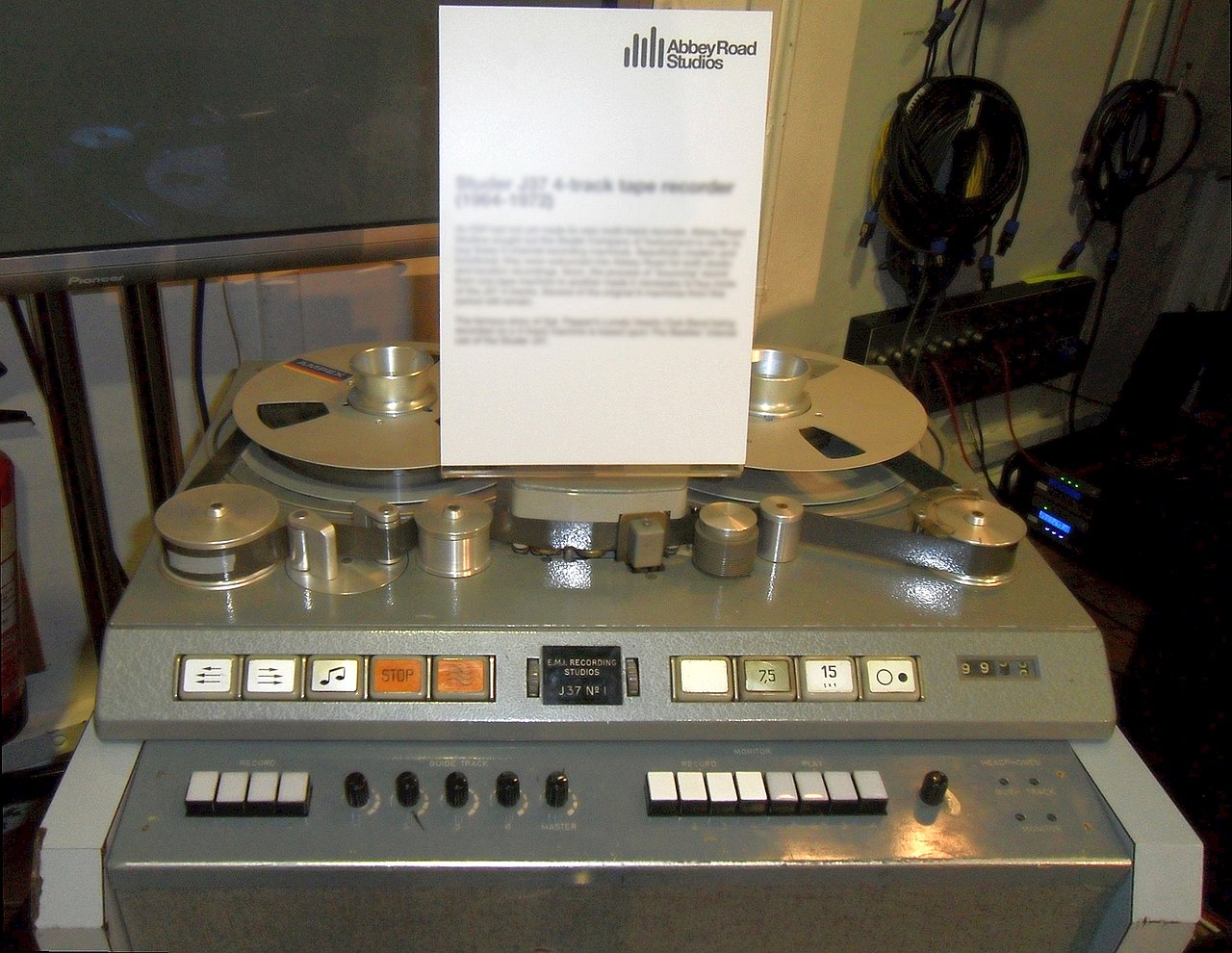
Abbey Road’s tape recorders would have been about as good as it gets. Josephenus P. Riley, CC BY 2.0. Were we to record some music with a good quality microphone and analogue tape recorder, we know that what came out of the speakers at playback would be a copy of what was heard by the microphone, subject to distortion from whatever non-linearities it has encountered in the audio path. But despite that distortion, the tape recorder is doing its best to faithfully record an exact copy of what it hears. It’s the same with a compression-free digital recording; record those musicians with a DAT machine or listen to them on a CD, and you’ll get back as good a copy as those media are capable of returning.
The trouble is that uncompressed audio takes up a lot of bandwidth, particularly when streaming over the Internet. Thus just as with any other data format, it makes sense to compress it such that it takes up less space. There are plenty of compression algorithms to choose from, but with analogue sources there are more choices than there are with text, or software. A Linux ISO has to uncompress as a perfect copy of its original otherwise it won’t run, while an image or an audio file simply has to uncompress to something that looks or sounds like the original to our meaty brains.
Those extra compression options for analogue data take advantage of this; they use so-called lossy compression in that what you get out sounds just like what you put in, but isn’t the same. This difference can be viewed as distortion, and if you have ever saved an image containing text as a JPEG file, you’ll probably have seen it as artifacts around sharply defined edges.
So if lossy compression algorithms such as MP3 introduce distortion, how can we measure this? The analogue distortion analyser featured in our last installment is of little use, because the pure sine wave it uses is very easy for the compression algorithm to encode faithfully. Compression based on Fourier analysis is always going to do a good job on a single frequency. Another solution is required, and here the Internet is of little help. It’s time to set out on my own and figure out a way to measure the distortion inherent to an MP3 file.
Math Will Give Us The Right Answer!
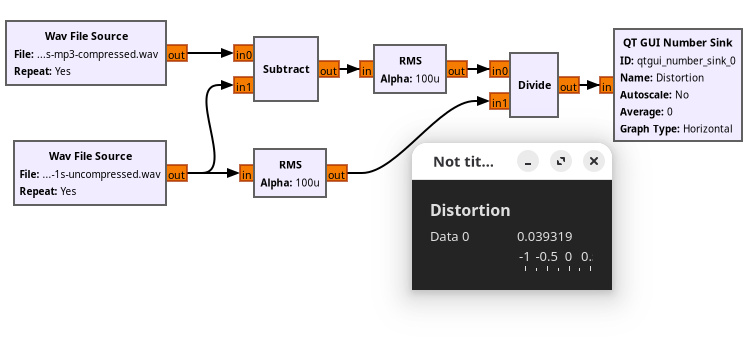
GNU Radio is an extremely convenient way to perform these types of measurement. At moments like these it’s great to be surrounded by other engineers, because you can mull it over and reach a solution. This distortion can’t be measured through my analogue instrumentation with a sine wave for the reasons discussed above, so it must instead be measured on a real world sample. We came up with a plan: measure the difference between two samples, compute the RMS value for that difference, then calculate the ratio between that and the RMS of the uncompressed sample.
As is so often the case with this type of task, it’s a relatively straightforward task using GNU Radio as a DSP workshop. I created a GNU Radio project to do the job, and fed it an uncompressed and compressed version of the same sample. I used a freely available recording of some bongo drums, and to make my compressed file I encoded it as a 128kbit MP3, then decoded it back to a WAV file. You can find it in my GitHub account, should you wish to play with it yourself.
Math Will Give Us The Wrong Answer!
The result it gives for my two bongo samples varies a little around 0.03, or 3%, depending upon where you are in the sample. What that in effect means is that the MP3 encoded version is around 3% different from the uncompressed one. If that were a figure measured on an analogue circuit using my trusty HP analyser I would say it wasn’t a very good quality circuit at all, and I would definitely be able to hear the distortion when listening to the audio. The fact that I can’t hear it raises a fundamental question as to what distortion really is, and the effect it has upon listeners.
What I would understand as distortion due to non-linearities in the audio path, is in reality harmonic distortion. Harmonics of the input signal are being created; if my audio path is a guitar pedal they are harmonics I want, while if it’s merely a very low quality piece of audio gear they’re unwelcome degradation of the listening experience. This MP3 file has a measurable 3% distortion, yet I am not hearing it as such when I listen. The answer to why that is the case is that this is not harmonic distortion, instead it’s a very similar version of the same sound, which differs by only 3% from the original. People with an acute ear can hear it, but most listeners will not notice the difference.
So In Summary: This Distortion Isn’t Distortion Like The Others
So in very simple terms, I’ve measured distortion, but not distortion in the same sense of the word. I’ve proven that an MP3 encoded audio source has a significant loss of information over its uncompressed ancestor, but noted that it is nowhere near as noticable in the finished product as for example a 3% harmonic distortion would be. It’s thus safe to say that this exercise, while interesting, is a little bit pointless because it produces a misleading figure. I think I have achieved something though, by shining some light on the matter of audio compression and subsequent quality loss. In short: for most of you it won’t matter, while the rest of you are probably using a lossless algorithm such as FLAC anyway.
It’s a truism that a computer must boot before it begins to operate. Nowadays that bootstrapping process is automatic, but in the case of the very first home computers, it was very much a hands-on affair. That’s what all those switches and blinkenlights are for on the front panel of the Altair 8800 — laboriously flicking each bit into memory as required to get your program going.
[Linus Åkesson] missed those very early days, and wanted to see what it was like, and clicking virtual switches on an emulator wasn’t going to cut it. He realized that he could set up an ATmega88 for front-panel booting, and proceeded to do just that.
The article linked above goes into good detail; for those of you who prefer video, we’ve embedded his presentation below. They say the book is always better, but to get the full story, you’ll really want both in this case. The video contains a lot more context and build details, but neglects to mention some issues he had with programming that are detailed in the text. In short, the Write Page bit needs to be written to the Command register to use the page buffer. Which does make sense, but tripped [Linus] up at first.
Then again, this use case isn’t exactly detailed in the datasheet. ATmega88 is an old chip, but not Intel 8008 old, so that’s no surprise. Which is exactly what makes this a good hack! The only thing lacking is blinkenlights to allow one to see the contents of the registers. [Linus] discusses the idea of putting them in, but is apparently happy with this more minimalist approach.
Questa mattina verso le 8 e 20 mi hanno operato di ernia inguinale e tardo pomeriggio mi hanno fatto uscire.
Inizialmente mi sentivo bene, certo il dolore ci stava e difatti facevo passetti, ma alla fine ho girato senza problemi.
Però mentre stavo cucinando una frittata ho iniziato a non sentirmi bene, con giramenti di testa e leggera nausea. Mi sono messo seduto alla tavola sperando passare, ma andava sempre peggio e vedevo tutto luminoso come se fissassi il sole, Alla fine nel tentativo di andare sul letto sono caduto due volte, la seconda sono rimasto per terra a 4 di spade, sudavo tantissimo, ma piano piano mi sono sentito sempre meglio, poi dopo qualche minuto sulle fresche piastrelle mi sono rialzato in piedi e potuto cenare senza problemi, per per poi andare sul letto.
Ho dormito fino ad ora praticamente. Ora vi scrivo questo post sorseggiando un orzo alla scrivania del computer 🙂
Orban: 'io e Meloni d'accordo sulle grandi questioni
ne ero certa... purtroppo. già sappiamo che la meloni dice di si a tutti. è molto comprensiva. e non mettetemi in bocca parole di altri: è una banderuola. essa stessa si definirebbe "flessibile". nell'interesse dell'italia naturalmente. ma ahimé senza spina dorsale.
Nel pomeriggio di sabato 8 novembre presenteremo per la prima volta le quaranta osservazioni che abbiamo presentato nella valutazione di impatto ambientale contro l'inceneritore illegale.
Metteremo in piazza le forzature che Gualtieri commissario dai pieni poteri porta avanti in spregio al diritto.
Chi come noi si batte in difesa della terra dove viviamo non ha bisogno della messa in scena organizzata in Municipio dove ne tornano a parlare dopo 3 anni.
Un casco azzurro con gli unicorni. Ginocchiere fucsia. La richiesta di iscriversi a danza. Scelte semplici. Comuni, se a farle fosse una bambina. Ma quando a chiedere è un bambino...
L’uso della giustizia per consolidare il potere e attaccare l’opposizione ha subito una nuova accelerazione in questi giorni in Turchia con una serie di iniziative pilotate con ogni probabilità dal presidente Erdogan e dal suo partito AKP (Giustizia …
Fermate le rotative! L'evento di moda del 2025 è qui! Decorate la vostra testa con questo elegante e disinvolto cappellino da baseball blu navy, con scritta di Phaedra Charles. La comunità accademica, scientifica e pro-fact globale.
Immagino che tu sia venuto a chiedermi scusa? Spero di sì, visti gli anni in cui ti sei preso gioco di me e ti sei lamentato di come stessi rovinando la conoscenza. Nel frattempo, hai trasformato il tuo ambiente informativo in un film snuff digitale ipercapitalista e post-verità.
Se ti interessano le discussioni sull'etica nelle nuove tecnologie o vuoi pubblicare i tuoi contributi, segui il gruppo Activitypub @Etica Digitale (Feddit)
Officina Stellare e Global Aerospace Technologies Group (Gatg) hanno annunciato un’operazione di integrazione che darà vita al primo polo della Difesa quotato in Italia nato dalla fusione di Pmi tecnologiche. L’operazione veste i panni di un reverse take-over, con Gatg che verrà incorporata in Officina
L’ammiraglio Giuseppe Cavo Dragone, presidente del Comitato militare della Nato, ha parlato alle commissioni Esteri e Difesa riunite per esporre la Strategia industriale europea per il settore della Difesa. Tono misurato e obiettivo operativo che mira a spiegare come cambiano minacce e
Dal 3 novembre LinkedIn addestrerà i suoi sistemi utilizzando i dati personali degli utenti che non si saranno opposti. Sul sito del #GarantePrivacy la scheda informativa per esercitare il diritto di opposizione
Gli utenti LinkedIn - e i non utenti i cui dati possono essere comunque presenti sul social network perché pubblicati da altri utenti - hanno il diritto di opporsi al trattamento dei propri dati personali per l’addestramento dei sistemi IA
Nel contesto di una competizione sempre più serrata tra droni da combattimento, Shield AI, società statunitense specializzata in sistemi di autonomia per la difesa, presenta X-bat, un velivolo a decollo verticale pensato per operare senza piste e con prestazioni da caccia. Svelato a
Avio chiude i primi nove mesi del 2025 con risultati in forte progresso e un portafoglio ordini ai massimi storici, confermando la guidance per l’intero esercizio. I ricavi netti raggiungono 351 milioni di euro, in aumento del 26,3% rispetto allo stesso periodo del 2024,
Il colosso del software non ha inoltre risposto a una richiesta di accesso relativa a Microsoft 365 Education, ampiamente utilizzato nelle scuole europee. Microsoft ha invece cercato di trasferire tutta la responsabilità alle scuole locali. Sebbene le scuole interessate debbano fornire dati di accesso più dettagliati e ulteriori informazioni sulla privacy, secondo la decisione, spetta ora a Microsoft chiarire definitivamente in che modo utilizza i dati degli utenti per i propri scopi aziendali.
Favorable decision by the Austrian DSB: Microsoft Education 365 may not track school kids and Microsoft is ordered to provide full access to kids' data.
@Privacy Pride Il post completo di Christian Bernieri è sul suo blog: garantepiracy.it/blog/mooneygo… È arrivata!!! Una nuova email da MooneyGo! Finalmente! Ero in pensiero all'idea che fosse tutto già finito. Prima ancora di leggerne il contenuto, faccio un rapida verifica perché, se ben ricordo, nella mail precedente c'era qualche problemino. Nel mio
Jeremy Pelt – Woven freezonemagazine.com/articoli/… C’è una logica silenziosa ma profonda nel titolo Woven: intrecciare, tessere, far convivere. Jeremy Pelt lo fa con la sicurezza di chi ha ormai oltrepassato il confine tra virtuosismo e linguaggio, tra la tradizione del jazz e il suo continuo rinnovarsi. In questo nuovo album, il trombettista californiano guida una formazione coesa e raffinata verso […] L'articolo Jeremy Pelt – Woven proviene da F C’è una logica
@Politica interna, europea e internazionale Se si venisse a sapere che Giorgia Meloni ha pubblicato un libro in Russia, con il supporto di Vladimir Putin e la prefazione di suo figlio, il Paese esploderebbe di indignazione. Editoriali, interrogazioni, appelli alle dimissioni: tutti griderebbero allo scandalo per l’influenza indebita di una
Kris Kristofferson – Una vita tra musica e militanza freezonemagazine.com/rubriche/… Il 28 settembre 2024, l’Highway man Kris Kristofferson ha lasciato per sempre la compagnia dopo Waylon Jennings e Johnny Cash; rimane attivo solo il fuorilegge Willie Nelson che nonostante abbia passato i novant’anni vive quasi perennemente in tour con la sua band. Vivere On the road è la sua filosofia esistenziale come risulta evidente dalle […]
@Notizie dall'Italia e dal mondo L'edizione italiana di Fortune ha pubblicato un articolo in cui elenca le principali società che punterebbero a mettere le mani sull'affaire, stimato tra i 50 e i 70 miliardi di dollari L'articolo Shock Economy. Le aziende italiane sognano grandi affari a Gaza proviene da Pagine
Non trovo la lista ma l'articolo citato di Fortune riporta questo:
Le aziende europee avranno una corsia privilegiata nelle gare per la ricostruzione, e in questo quadro aziende italiane come Webuild, AnsaldoEnergia, Saipem e Maire, potrebbero partecipare alle attività di ricostruzione. Prysmian potrebbe essere coinvolta nella fornitura dei cavi dell’alta tensione per ripristinare la rete elettrica e di quelli per l’elettrificazione degli edifici. Ci sono poi aziende come Buzzi Unicem e Cementir che potrebbero essere coinvolte in ogni caso, essendo tra i maggiori produttori al mondo di cemento e calcestruzzo (e quindi in grado di collaborare con chiunque sarà il committente dei lavori).
@Notizie dall'Italia e dal mondo Con loro salgono a quattordici i libanesi uccisi da giovedì scorso in attacchi condotti da Israele in diverse aree del sud L'articolohttps://pagineesteri.it/2025/10/28/medioriente/libano-la-tregua-come-la-guerra-due-fratelli-uccisi-da-un-drone-israeliano/
Denuncia penale contro la società di riconoscimento facciale Clearview AI Clearview AI è nota per aver raccolto miliardi di foto di persone in tutto il mondo su Internet e per aver venduto il suo sistema di riconoscimento facciale alle forze dell'ordine e agli attori statali mickey28 October 2025
Ora andiamo oltre le invasioni russe, praticamente ora ci dobbiamo proteggere dalle future invasioni degli UFO. Grande la Bomber Pfizer, sempre sul pezzo, sempre sfornando minchiate...




Ivan Bk
in reply to Max - Poliverso 🇪🇺🇮🇹 • • •