
Europe’s Next Digital Frontier: Balancing Web 3.0 Innovation with Fundamental Rights
Evolution Of the Internet
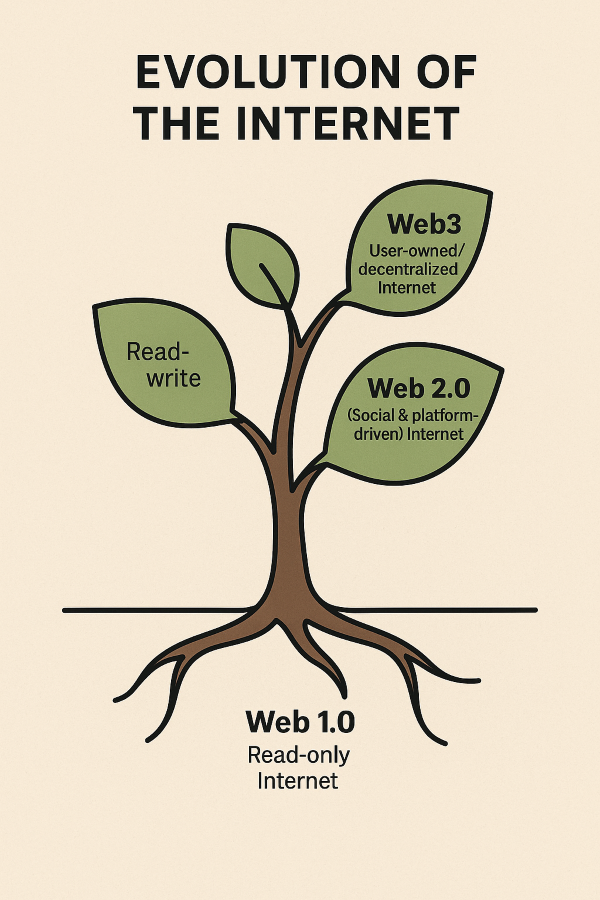
Comparing the internet’s growth to Darwin’s theory of evolution helps explain how it has changed over time, with each stage adapting to the needs, behaviours, and technologies of its time.
The initial phase, known as Web 1 (spanning the 1990s to the early 2000s), was characterised by the internet’s primary function as an information dissemination tool. During this period, only site owners managed content, resulting in a read-only experience for users and a unidirectional flow of information similar to a digital brochure.
Tim O’Reilly introduced the term “Web 2.0” in 2004, marking a new era as mobile services expanded, broadband connectivity improved, and technologies such as AJAX and HTML5 emerged. The internet became interactive, enabling users to create, share, and engage with content without needing special skills. This change opened new ways for people to communicate and connect worldwide.
But as Web 2.0 grew, a few big companies gained significant power and control over data. They decided how information was shared, which voices were heard, and how personal data was handled. Algorithms control every piece of information and opinion. At the same time, many of these platforms rely on business models that depend on extensive data collection, with user behaviour fueling targeted advertising. While these services often appear free, the trade-off is a gradual loss of privacy, autonomy, and control over one’s digital presence.
Concerns about this central control, privacy, and reliance on these platforms led to the idea of a new kind of internet, now called Web 3.0.
What is Web 3.0?
The internet is now moving toward a more user-focused phase, where data ownership is decentralised. Web 3.0 uses technologies such as blockchain and the Semantic Web to return control of data and digital assets to users rather than large technology companies. This change aims to enhance the transparency, security, and personalisation of online experiences.
Key Characteristics of Web 3.0
1. Decentralisation
Control is shared across networks rather than held by a single company or authority. This means that people need not rely on centralised platforms as much.
2. User control over data and identity
Users have more control over their digital identities and personal data, rather than giving that control to platforms by default.
3. Reduced intermediaries
Web 3.0 aims to cut out intermediaries by enabling people to interact, share, and make transactions directly, without needing a central platform to manage these actions.
4. Transparency by design
Many Web 3.0 systems are designed to make rules, transactions, and changes open and verifiable, rather than hidden within private systems.
5. Permissionless participation
Anyone can participate without approval from a central authority, provided they comply with the network’s rules.
6. Resilience and censorship resistance
The distribution of data and services increases the difficulty for any single entity to shut down platforms or completely silence users.
People often use the term Web 3.0 to refer to technologies such as cryptocurrencies, tokens, or blockchain-based finance. However, the main features listed above also make Web 3.0 useful in many areas, including supply chain management, gaming and the metaverse, healthcare, content creation and social media, intellectual property, and digital identity.
How Does Web 3.0 Work – A Brief Sneak Peek
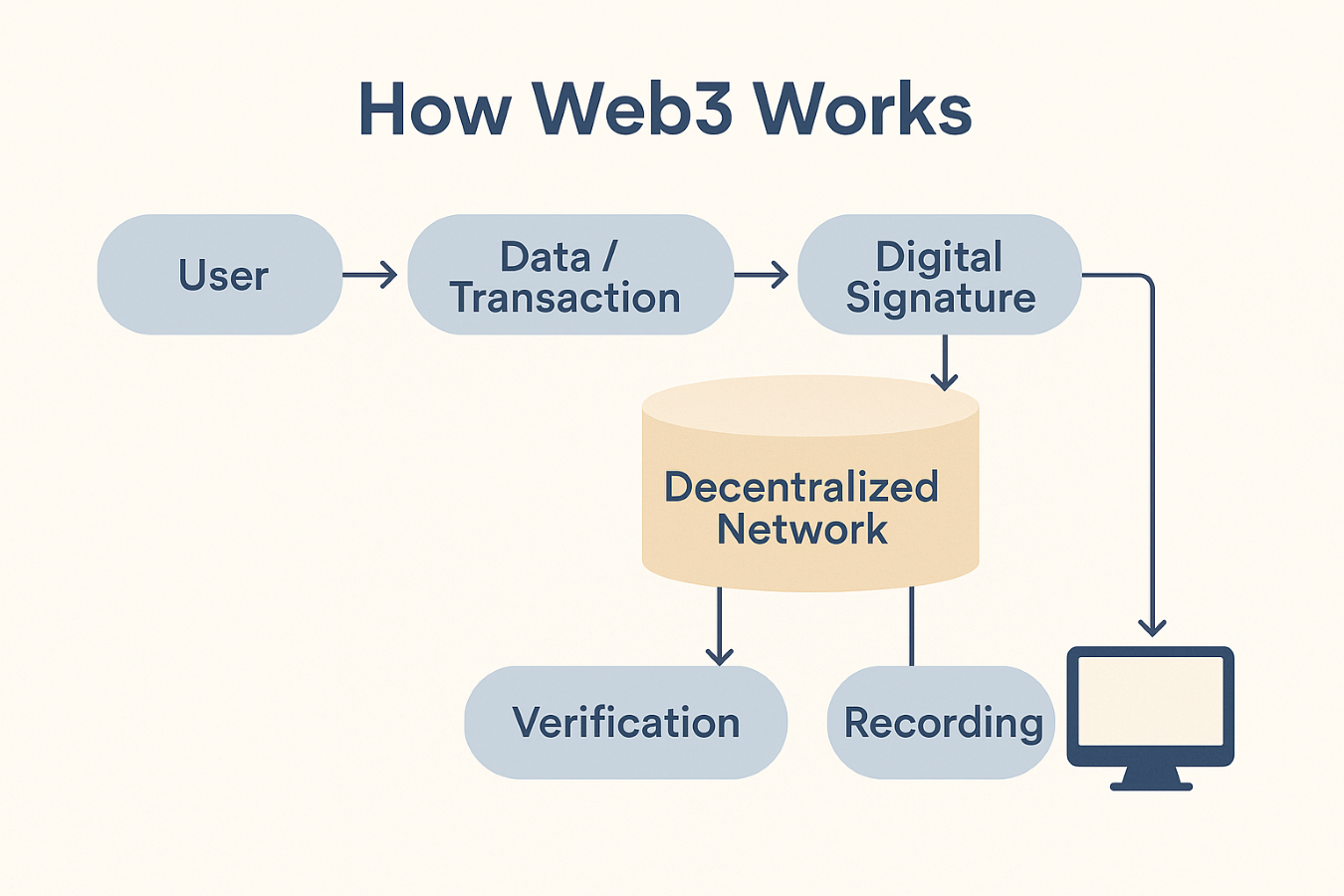
At its core, Web 3.0 changes how information is stored and managed. Instead of storing data on servers owned by a single company, information is distributed across networks. The action is cryptographically signed by the user, verified by multiple participants, and recorded in a shared ledger that is difficult to alter. This structure reduces reliance on central intermediaries and makes manipulation or data abuse more difficult, while shifting greater control and responsibility to users. Although the technology driving Web 3.0 is complex, the primary goal is simple: to give users greater control and responsibility.
Web 3.0: An Emerging, Yet Unsettled, Part of the EU’s Digital Vision
Freedom, Democracy, and Respect for human rights have been the core pillars of the European Union since its inception. These principles have been a centre of discussion whenever policies are framed, and the digital space is no exception. The European Union has signalled a clear willingness to invest in the development of Web 3.0-relevant technologies through official strategies, infrastructure development, and research funding. The European Union is actively shaping the digital world by protecting users, ensuring fair competition, and defending fundamental rights.
A Few Examples:
- The Commission’s blockchain and Web3 strategy outlines policy support, funding programmes, and legal frameworks to foster innovation in decentralised systems.
- Web 3.0-aligned technologies are being evaluated for identity and credential management and secure data exchange.
- EU funding programmes support projects on decentralised data, privacy-preserving technologies, and interoperability. (In recent times, 2016-2019, the EU invested 180 million Euros in a project called Horizon Europe, with grants expected to flow in the future as well)
Web 3.0 Is Still A probability, Not A Concrete Solution Yet.
However, the EU also values legal certainty, accountability, and consumer protection, which can be challenging to achieve in decentralised systems. As a result, the relationship between Web 3.0 and EU policy is still developing, reflecting both a willingness to innovate and a careful approach to potential risks. In this light, it is imperative to understand the complications and challenges associated with Web 3.0.
Challenges of Web 3.0:
- Still in its nascent stage, the technology underlying Web 3.0 is complex and not widely known. Concepts such as private keys, smart contracts, wallets, and decentralised storage are still largely unfamiliar and challenging for non-tech-savvy users.
- Centralised platforms outperform Web 3.0 due to easier user navigation. Influencing users to shift from a seamless platform to a complex option would require substantial investment in digital education and community building, as well as time.
- Beneath the layers of immutable privacy structures, due to a decentralised mechanism for data sharing and storage, technologies such as Web 3.0 lack accountability systems. In the absence of a centralised moderation mechanism, addressing harmful or illegal content, misinformation, and responding to abuse becomes challenging. Once the content is stored, its removal becomes nearly impossible.
- Protocols may be decentralised in theory, but small groups of developers or influential participants still influence many major decisions. This can recreate power imbalances similar to centralised platforms, undermining ideals of shared governance.
- Although Web 3.0 may be emerging as a technical solution to censorship, it is critical to understand that technology alone cannot address deeper social and political issues. Issues such as governance, community norms, power dynamics, and regulatory compliance require broader approaches beyond code.
- For less experienced users, the sole onus for online security, privacy, and data management, owing to greater control, could be overwhelming.
Looking ahead: between regulation and re-imagining
As Europe debates the future of its digital space, organisations such as European Digital Rights reiterate that technology alone does not secure freedom or fairness online. ERDi firmly believes that human rights, data protection, and democratic accountability should be the core of any discussion of new digital systems. From this perspective, Web 3.0 is neither a solution nor a threat in itself, but offers a new avenue of technological experimentation that must operate within existing legal frameworks and fundamental rights.
In the current political landscape, EU initiatives such as the Digital Services Act, the Digital Markets Act, and ongoing discussions around chat control and the Digital Omnibus reflect growing concern about platform dominance, surveillance, and the limits of the Web 2.0 model. These laws aim to correct structural harms through regulation, but also raise deeper questions about how digital infrastructures are designed and who ultimately holds power over them.
In this context, Web 3.0 can be seen as part of a broader conversation about decentralisation and user agency rather than a finished alternative. While its principles resonate with long-standing European Pirate values around privacy, autonomy, and resistance to excessive central control, decentralised technologies also risk creating new concentrations of power if left unchecked. EDRI’s cautious approach emphasises the need for civic interest control, civil society involvement, and robust safeguards.
The interaction between regulation and experimentation will likely shape Europe’s digital future. If approached critically and inclusively, discussions around Web 3.0 can help imagine an internet where innovation supports user rights, rather than undermining them.
europeanpirates.eu/europes-nex…

This week, we discuss history repeating itself, a phone wipe scandal, Meta's relationship with links and more.
This week, we discuss history repeating itself, a phone wipe scandal, Metax27;s relationship with links and more.#BehindTheBlog


Behind the Blog: Resisting Demoralization
This is Behind the Blog, where we share our behind-the-scenes thoughts about how a few of our top stories of the week came together. This week, we discuss history repeating itself and Meta's relationship with links.JOSEPH: I wanted to add a little bit from behind the scenes of this piece: Man Charged for Wiping Phone Before CBP Could Search It. As I said on the podcast this week, there are and continue to be many questions around the case. Especially why CBP stopped Samuel Tunick in the first place.
In the piece I did not focus on Tunick’s activism because frankly we don’t know yet how big a role it played in CBP stopping him. I mentioned it but didn’t focus on it. I think regardless, someone being charged for allegedly wiping a phone is interesting essentially no matter who they are.
Yes, it absolutely may turn out that he was stopped specifically because of his activism. Maybe lots of people think it’s very likely that’s the reason. But I can’t frame a story because it feels like that’s maybe the case. I have to go on what actual evidence I have at the moment.
This post is for subscribers only
Become a member to get access to all content
Subscribe nowBehind the Blog: Resisting Demoralization
This week, we discuss history repeating itself, a phone wipe scandal, Meta's relationship with links and more.Samantha Cole (404 Media)


Ministero dell'Istruzione
#Scuola, da oggi è disponibile il “Fascicolo digitale del personale scolastico”, la nuova piattaforma del #MIM che consente di consultare in modo semplice e sicuro le informazioni relative al proprio percorso professionale, attraverso i dati presenti…Telegram
Hackaday Podcast Episode 350: Damnation for Spreadsheets, Praise for Haiku, and Admiration for the Hacks In Between

This week’s Hackaday Podcast sees Elliot Williams joined by Jenny List for an all-European take on the week, and have we got some hacks for you!
In the news this week is NASA’s Maven Mars Orbiter, which may sadly have been lost. A sad day for study of the red planet, but at the same time a chance to look back at what has been a long and successful mission.
In the hacks of the week, we have a lo-fi camera, a very refined Commodore 64 laptop, and a MIDI slapophone to entertain you, as well as taking a detailed look at neutrino detectors. Then CYMK printing with laser cut stencils draws our attention, as well as the arrival of stable GPIB support for Linux. Finally both staffers let loose; Elliot with an epic rant about spreadsheets, and Jenny enthusiastically describing the Haiku operating system.
Check out the links below if you want to follow along, and as always, tell us what you think about this episode in the comments!
html5-player.libsyn.com/embed/…
It’s dangerous to go alone. Here, take this MP3.
Where to Follow Hackaday Podcast
Places to follow Hackaday podcasts:
Episode 349 Show Notes:
News:
What’s that Sound?
- Congratulations to [kenbob] for guessing the spinning down washing machine. Everyone else tune in next year for your shot at the first sound of 2026.
Interesting Hacks of the Week:
- Liberating AirPods With Bluetooth Spoofing
- GitHub – tyalie/AAP-Protocol-Defintion: Decoding the Apple Accessory Protocol
- Bypassing Airpods Hearing Aid Georestriction With A Faraday Cage
- Nostalgic Camera Is A Mashup Of Analog Video Gear
- Neutrino Transmutation Observed For The First Time
- Detecting Anti-Neutrinos From Distant Fission Reactors Using Pure Water At SNO+
- Engineering Lessons From The Super-Kamiokande Neutrino Observatory Failure
- Detecting Neutrinos, The Slippery Ghost Particles That Don’t Want To Interact
- Building A Commodore 64 Laptop
- Taking Electronics To A Different Level
- Taking It To Another Level: Making 3.3V Speak With 5V
- Philips application note 97055, Bi-directional level shifter for I²C-bus and other systems.
- Finally, A Pipe Slapophone With MIDI
Quick Hacks:
- Elliot’s Picks:
- WiFi Menorah For Eight Nights Of Bandwidth
- Laser Cutter Plus CYMK Spraypaint Equals Full-Color Prints
- Why Push A Button When A Machine Can Do It For You
- Jenny’s Picks:
- After Decades, Linux Finally Gains Stable GPIB Support
- 3D Printing And Metal Casting Are A Great Match
- The Lethal Danger Of Combining Welding And Brake Cleaner
Can’t Miss Articles:
hackaday.com/2025/12/19/hackad…
Attach a Full Size Lens to a Tiny Camera

The Kodak Charmera is a tiny keychain camera produced by licencing out the name of the famous film manufacturer, and it’s the current must-have cool trinket among photo nerds. Inside is a tiny sensor and a fixed-focus M7 lens, and unlike many toy cameras it has better quality than its tiny package might lead you to expect. There will always be those who wish to push the envelope though, and [微攝 Macrodeon] is here to fit a lens mount for full-size lenses (Chinese language, subtitle translation available).
The hack involves cracking the camera open and separating the lens mount from the sensor. This is something we’re familiar with from other cameras, and it’s a fiddly process which requires a lot of care. A C-mount is then glued to the front, from which all manner of other lenses can be attached using a range of adapters. The focus requires a bit of effort to set up and we’re guessing that every lens becomes extreme telephoto due to the tiny sensor, but we’re sure hours of fun could be had.
The Charmera is almost constantly sold out, but you should be able to place a preorder for about $30 USD if you want one. If waiting months for delivery isn’t your bag, there are other cameras you can upgrade to C-mount.
youtube.com/embed/FMZ74QCaLdw?…
Surplus Industrial Robot Becomes two-ton 3D Printer

As the saying goes — when life gives you lemons, you make lemonade. When life gives you a two-ton surplus industrial robot arm, if you’re [Brian Brocken], you apparently make a massive 3D printer.
The arm in question is an ABB IRB6400, a serious machine that can sling 100 to 200 kilograms depending on configuration. Compared to that, the beefiest 3D printhead is effectively weightless, and the Creality Sprite unit he’s using isn’t all that beefy. Getting the new hardware attached uses (ironically) a 3D printed mount, which is an easy enough hack. The hard work, as you might imagine, is in software.
As it turns out, there’s no profile in Klipper for this bad boy. It’s 26-year-old controller doesn’t even speak G-code, requiring [Brian] to feed the arm controller the “ABB RAPID” dialect it expects line-by-line, while simultaneously feeding G-code to the RAMPS board controlling the extruder. If you happen to have the same arm, he’s selling the software that does this. Getting that synchronized reliably was the biggest challenge [Brian] faced. Unfortunately that means things are slowed down compared to what the arm would otherwise be able to do, with a lot of stop-and-start on complex models, which compromises print quality. Check the build page above for more pictures, or the video embedded below.
[Brian] hopes to fix that by making better use of the ABB arm’s controller, since it does have enough memory for a small buffer, if not a full print. Still, even if it’s rough right now, it does print, which is not something the engineers at ABB probably ever planned for back before Y2K. [Brian]’s last use of the arm, carving a DeLorean out of styrofoam, might be closer to the original design brief.
Usually we see people using 3D printers to build robot arms, so this is a nice inversion, though not the first.
youtube.com/embed/peY_KK_nGc8?…
This Week in Security: PostHog, Project Zero Refresh, and Thanks For All the Fish

There’s something immensely satisfying about taking a series of low impact CVEs, and stringing them together into a full exploit. That’s the story we have from [Mehmet Ince] of Prodraft, who found a handful of issues in the default PostHog install instructions, and managed to turn it into a full RCE, though only accessible as a user with some configuration permissions.
As one might expect, it all starts with a Server Side Request Forgery (SSRF). That’s a flaw where sending traffic to a server can manipulate something on the server side to send a request somewhere else. The trick here is that a webhook worker can be primed to point at localhost by sending a request directly to a system API.
One of the systems that powers a PostHog install is the Clickhouse database server. This project had a problem in how it sanitized SQL requests, namely attempting to escape a single quote via a backslash symbol. In many SQL servers, a backslash would properly escape a single quote, but Clickhouse and other Postgresql servers don’t support that, and treat a backslash as a regular character. And with this, a read-only SQL API is vulnerable to SQL injection.
These vulnerabilities together just allow for injecting an SQL string to create and run a shell command from within the database, giving an RCE and remote shell. The vulnerabilities were reported through ZDI, and things were fixed earlier this year.
FreePBX
Speaking of SQL injections, FreePBX recently fixed a handful of SQL injections and an authentication bypass, and researchers at horizon3.ai have the scoop. None of these particular issues are vulnerable without either questionable configuration changes, or access to a valid PHP session ID token. The weakness here seems to be a very similar single quote injection.
Another fun SQL injection in FreePBX requires the authorization type swapped to webserver. But with that setting in place, an injected authentication header with only a valid user name is enough to pull off an SQL injection. The attack chosen for demonstration was to add a new user to the users table. This same authentication header spoof can be used to upload arbitrary files to the system, leading to an easy webshell.
Google Project Zero’s Refresh
We’ve often covered Google’s Project Zero on this column, as their work is usually quite impressive. As their blog now points out, the homepage design left something to be desired. That’s changed now, with a sleek and modern new look! And no, that’s not actually newsworthy here; stop typing those angry comments. The real news is the trio of new posts that came with the refresh.
The most recent is coverage of a VirtualBox VM excape via the NAT network driver. It’s covering a 2017 vulnerability, so not precisely still relevant, but still worth a look. The key here is a bit of code that changes the length of the data structure based on the length of the IP header. Memory manipulation from an untrusted value. The key to exploitation is to manipulate memory to control some of the memory where packets are stored. Then use IP fragmentation packets to interleave that malicious data together and trigger the memory management flaw.
The second post is on Windows exploitation through race conditions and path lookups. This one isn’t an exploit, but an examination of techniques that you could use to slow the Windows kernel down, when doing a path lookup, to exploit a race condition. The winner seems to be a combination of nested directories, with shadow directories and symbolic links. This combination can cost the kernel a whopping three minutes just to parse a path. Probably enough time.
The third entry is on an image-based malware campaign against Samsung Android phones. Malicious DNG files get processed by the Quram image processing library on Samsung devices. DNG images are a non-proprietary replacement for .raw image files, and the DNG format even includes features like embedding lens correction code right in the file format. This correction code is in the form of opcodes, that are handled very much like a script or small program on the host device. The Quram library didn’t handle those programs safely, allowing them to write outside of the allocated memory for the image.
Bits and Bytes
The E-note domain and servers have been seized by law enforcement. It’s believed that $70 million worth of ransomware and cryptocurrency theft has passed through this exchange service, as part of a money laundering operation. A Russian national has been named as the man behind the service, and an indictment has been made, but it seems that no actual arrests have been made.
Dropbear 2025.89 has been released, fixing a vulnerability where a user with SSH access could connect to any unix socket as root. This mishandling of socket permissions can lead to escalation of privilege in a multitude of ways.
React2shell was exploited in the wild almost as soon as it was announced. We covered the vulnerability as it was happening a couple weeks ago, and now it’s clear that ransomware campaigns were launched right away to take advantage of the exploit. It’s also reported that it was used in Advanced Persistent Threat (APT) campaigns right away as well. Real Proof of Concept code is also now available.
Thanks for All the Fish!
And lastly, on a personal note: Thank you to all the readers of this column over the last six years, and to the Hackaday editors for making it happen. I’ve found myself in the position of having four active careers at once, and with the birth of my son in November, I have four children as well. Something has to give, and it’s not going to be any of the kids, so it’s time for me to move on from a couple of those careers. This Week in Security has been a blast, ever since the first installment back in May of 2019. With any luck, another writer will pick up the mantle early next year. (Editor’s note: We’re working on it, but we’ll miss you!)
And if you’re a fan of FLOSS Weekly, the other thing I do around here, don’t worry, as it’s not going anywhere. Hope to see you all there!
Vulnerabilità critica in FreeBSD: eseguibile codice arbitrario via IPv6
Una nuova vulnerabilità nei componenti FreeBSD responsabili della configurazione IPv6 consente l’esecuzione remota di codice arbitrario su un dispositivo situato sulla stessa rete locale dell’aggressore. Il problema riguarda tutte le versioni supportate del sistema operativo e richiede un’azione immediata per proteggere i dispositivi.
È stata scoperta una vulnerabilità nelle utility “rtsold” e “rtsol“, utilizzate per elaborare i messaggi pubblicitari del router come parte del meccanismo di configurazione automatica degli indirizzi IPv6. È stato scoperto che questi programmi non convalidano il parametro del suffisso di dominio passato in tali messaggi, inviandolo direttamente all’utility “resolvconf“, responsabile dell’aggiornamento della configurazione DNS.
Tuttavia, “resolvconf” è scritto come uno script shell e non filtra i dati in arrivo. L’assenza di escape implica che qualsiasi codice dannoso passato tramite il parametro domain list può essere eseguito sul sistema. Pertanto, un aggressore sulla stessa subnet può eseguire comandi sul dispositivo di destinazione senza richiedere privilegi di amministratore o interazioni precedenti.
Secondo gli sviluppatori di FreeBSD , il problema è limitato alle reti locali, poiché gli annunci del router non vengono instradati e non possono attraversare i confini dei segmenti di rete. Tuttavia, riguarda tutti i sistemi che utilizzano l’autoconfigurazione IPv6, in particolare le interfacce con il flag “ACCEPT_RTADV” abilitato, verificabile tramite “ifconfig“.
Per gli utenti che non utilizzano IPv6, non vi è alcun rischio. In caso contrario, si consiglia di aggiornare urgentemente il sistema all’ultima versione.
Gli aggiornamenti sono ora disponibili per tutte le branch di FreeBSD supportate, incluse le versioni 15.0, 14.3 e 13.5. L’aggiornamento è possibile sia tramite il meccanismo di patching binario integrato sia applicando modifiche al codice sorgente.
L’identificatore della vulnerabilità registrata è CVE-2025-14558. Le correzioni sono state pubblicate il 16 dicembre 2025 e sono incluse nei rami stabile e di rilascio di FreeBSD.
L'articolo Vulnerabilità critica in FreeBSD: eseguibile codice arbitrario via IPv6 proviene da Red Hot Cyber.
Associazione Peacelink reshared this.


Internet Governance: Ein Weihnachtswunder der internationalen Digitalpolitik
netzpolitik.org/2025/internet-…

La direttiva Ue sulle confische e la tentazione di neutralizzare quarant’anni di antimafia
@Giornalismo e disordine informativo
articolo21.org/2025/12/la-dire…
Mentre la UE discute animatamente della confisca definitiva dei patrimoni russi e del loro ri-utilizzo
reshared this
LA REPUBBLICA ROMA: NUOVO ARTICOLO PIENO ZEPPO DI PROPAGANDA
Contro la falsa informazione pro-inceneritore.
Nell’articolo dell’edizione romana di ieri a firma di Salvatore Giuffrida leggiamo “Il cantiere a Santa Palomba partirà entro il primo trimestre del 2026 e durerà 32 mesi, fino a oltre la metà del 2028”. Il sottotitolo contiene la prima menzogna o bufala, come preferite. Le attività di costruzione dureranno 39 mesi e non 32 come scrive il giornalista e il cantiere terminerà nel maggio 2029. Attenzione, non siamo noi a dichiaralo ma è scritto nero su bianco sul più recente cronoprogramma del proponente.
“Il 2026 sarà l’anno del termovalorizzatore di Roma”. Nell’attacco del pezzo si condensa tutto lo strumentario della retorica tipica dei fan dell’incenerimento che si guarda bene dal ricordare, neppure incidentalmente che i poteri straordinari sono stati attributi per impiantistica destinata a far fronte all’afflusso straordinario dei pellegrini del Giubileo 2025. Un impianto che a Giubileo terminato non è ancora autorizzato e il cui iter è potuto andar avanti esclusivamente a forza di ordinanze, con la Procura di Roma che sta indagando al riguardo. Profili questi, guarda caso, del tutto omessi.
“Bisogna ancora aspettare due anni per inaugurare l’impianto, ma il percorso è già avviato: di fatto è ormai concluso il procedimento autorizzatorio unico regionale, Paur, che riunisce in un unico atto tutte le valutazioni, i pareri e le autorizzazioni di competenza regionale necessarie a realizzare il progetto e avviare il cantiere.”
Il procedimento non è affatto concluso. Ci sono i pareri contrari dei comuni di Albano, Ardea e Pomezia. C’è soprattutto la Soprintendenza Speciale di Roma ha tutta la competenza e decisive motivazioni per bocciare gli elaborati progettuali nella conferenza di servizi in corso e per contestare la procedura avviata in virtù delle proprie prerogative istituzionali discendenti dall’articolo 9 della Costituzione, attuato dal codice dei beni culturali.
Seguono poi i consueti ritornelli della propaganda inceneritorista: “Saranno inoltre realizzati quattro impianti ausiliari per recuperare le ceneri pesanti, un impianto fotovoltaico, una rete di teleriscaldamento e un sistema sperimentale per catturare l’anidride carbonica. Il termovalorizzatore sarà capace di bruciare 600mila tonnellate l’anno di rifiuti e di produrre energia elettrica per circa 200mila abitazioni”.
Al riguardo solo due repliche lampo a proposito di teleriscaldamento e sistema sperimentale cattura CO2. Il teleriscaldamento, conti alla mano, riguarderà un centinaio di famiglie. Dovranno provare di avere il contratto di fornitura indispensabile per la verifica del coefficiente R1 indice di efficienza energetica per ricondurre l’impianto tra quelli di recupero energetico.
Sull’impianto di cattura della CO2, oltre a non essere sperimentale come evidenziato dallo stesso proponente basti ricordare che la massima cattura equivale ad appena l’1per mille della Co 2 emessa. Su questo ci sono ben due esposti alla Corte dei conti ma anche su questo silenzio tombale.
Le 200 mila abitazioni che vorranno l’energia elettrica prodotta, non l’avranno certo a gratis ma dovranno pagarla a prezzi di mercato.
“Infine, a ottobre il Comune ha ratificato un protocollo d’intesa con Ferrovie dello Stato per gestire la logistica ambientale in merito al trasporto dei rifiuti senza costi aggiuntivi per le parti.” Un protocollo d’intesa privo di qualsivoglia autentica portata, chissà perché riportarlo?
Davanti a tanta spudorata propaganda rispondiamo con il nostro prossimo appuntamento: la mattina di lunedì 29 dicembre sit-in presso la Soprintendenza speciale di Roma per smuoverla a tutelare i beni archeologici presenti nell’area del progetto e che verrebbero irrimediabilmente distrutti.
Concludiamo il nostro comunicato richiamando il recentissimo parere contrario della Regione Lazio nella conferenza di servizi sulla discarica di Tor Tignosa che lascia l’inceneritore privo della sua discarica di servizio.
Non serve il giornalismo di inchiesta, sarebbe sufficiente il semplice giornalismo.
Buona serata!
19 dicembre 2025


L'animale più longevo mai scoperto aveva 507 anni. E lo abbiamo ucciso per sbaglio
Ming, nato nel 1499, ha attraversato cinque secoli di storia prima di morire il giorno della sua scoperta... purtroppo.Everyeye Tech
Europe’s Next Digital Frontier: Balancing Web 3.0 Innovation with Fundamental Rights
@politics
europeanpirates.eu/europes-nex…
Evolution Of the Internet Comparing the internet’s growth to Darwin’s theory of evolution helps explain how it has changed over time,
Effetto Gaza: piazze piene, urne vuote. L’ultimo sondaggio di Youtrend spiega perché
@Politica interna, europea e internazionale
Le elezioni regionali nelle Marche dello scorso settembre avevano già evidenziato questo tema: il candidato del centrosinistra Matteo Ricci ha dedicato gli ultimi giorni della campagna elettorale a iniziative apertamente a favore della causa palestinese. Le urne,
Politica interna, europea e internazionale reshared this.
I bambini della famiglia nel bosco restano in comunità, gli attacchi di Salvini e Roccella ai giudici: “Vergogna”
@Politica interna, europea e internazionale
Matteo Salvini ed Eugenia Roccella attaccano i giudici dopo la decisione della Corte d’Appello dell’Aquila di rigettare il ricorso di Nathan Trevallion e Catherine Birmingham contro la sospensione della responsabilità genitoriale. Il
Politica interna, europea e internazionale reshared this.
I giornalisti palestinesi Mohanna e Selmi sono riusciti ad arrivare in Italia
@Politica interna, europea e internazionale
Lo scorso 18 ottobre, a Roma, in Campidoglio, l’Istituto Ricerche Archivio Disarmo (Iriad) li aveva insigniti del Premio giornalistico Colombe d’Oro per la Pace. Ma loro, i premiati, non avevano potuto partecipare alla cerimonia di consegna, bloccati com’erano nella
Politica interna, europea e internazionale reshared this.
Perché il 2026 sarà un anno spartiacque per il Governo Meloni
@Politica interna, europea e internazionale
Giorgia Meloni si affaccia sul nuovo anno forte di sondaggi che stimano il suo partito, Fratelli d’Italia, saldamente intorno al 30% dei consensi. La fiducia di cui gode la presidente del Consiglio costituisce un’assicurazione sulla vita – anzi, un’assicurazione sul governo – anche per gli altri
Politica interna, europea e internazionale reshared this.
“Le Big Tech sono una minaccia per la democrazia”: intervista al prof. Juan De Martin
@Politica interna, europea e internazionale
Dal 23 al 25 gennaio il Palazzo Ducale di Genova ospiterà “Democrazia alla prova”, una tre giorni di dibattiti organizzata dal Forum Disuguaglianze e Diversità e dal Palazzo Ducale e curata in particolare dall’ex ministro Fabrizio Barca (co-coordinatore
reshared this
Il potente messaggio di pace di papa Prevost e la nomina del nuovo arcivescovo di New York
@Giornalismo e disordine informativo
articolo21.org/2025/12/il-pote…
Arriva la nomina del nuovo arcivescovo di New York e papa Prevost, per alcuni commentatori che così lo
Giornalismo e disordine informativo reshared this.
Missioni di pace, Crosetto e Portolano tracciano l’impegno dell’Italia nel mondo
@Notizie dall'Italia e dal mondo
Nell’ambito della tradizionale cerimonia di auguri natalizi ai militari italiani impegnati all’estero, alla presenza del presidente della Repubblica e dei vertici delle Forze armate, il ministro della Difesa Guido Crosetto e il capo di Stato maggiore della Difesa, il
Notizie dall'Italia e dal mondo reshared this.
Schleswig-Holstein: la sovranità digitale è possibile ed economica
softwareliberoliguria.org/schl…
Segnalato dall'Associazione Software Libero Liguria di #Genova e pubblicato sulla comunità Lemmy @GNU/Linux Italia
#Firenze
LibreOffice
GNU/Linux Italia reshared this.
Nessuno spiraglio alla pace
@Giornalismo e disordine informativo
articolo21.org/2025/12/nessuno…
A Gaza i neonati muoiono assiderati. In Ucraina muoiono sotto i bombardamenti. Che in altre aree del mondo sono definiti come “Raid”. Così pesano di meno. I telegiornali occupano la prima metà dei loro notiziari con guerre e omicidi, ed anche con le conseguenze giudiziarie di questi ultimi.
Giornalismo e disordine informativo reshared this.

kulturjam.it/news/mattarella-e…

il sommarsi di tre vettori di variazione culturale/scientifica straordinari – cioè (1) gli avanzamenti sperimentali e teorici in fisica quantistica + (2) le neuroscienze + (3) l'intelligenza artificiale – sembra attestarsi (in termini di eccezionalità) come contraltare all'avanzamento delle destre medioevali coloniali in tutto il mondo.
o, detto altrimenti: → noblogo.org/differx/il-sommars…

il sommarsi di tre vettori di variazione culturale/scientifica straordinari -...
o, detto altrimenti: i neofascismi violentano le lancette dell'orologio per portarle indietro nel momento stesso in cui queste sembrano invece accelerare positivamente.differxdiario
reshared this
Luna entro il 2028, reattori nucleari e armamenti. Ecco la nuova space strategy Usa
@Notizie dall'Italia e dal mondo
Donald Trump ha emesso un nuovo ordine esecutivo, formalizzando la nuova strategia nazionale per lo spazio degli Stati Uniti. Punti cardine del documento, il ritorno degli astronauti americani sulla Luna entro il 2028, un deciso rafforzamento delle capacità militari
Notizie dall'Italia e dal mondo reshared this.
Omaggio a Jane Austen, una penna per lo schermo
@Giornalismo e disordine informativo
articolo21.org/2025/12/omaggio…
In un panorama culturale saturo di celebrazioni per il 250° anniversario della nascita di Jane Austen, il saggio di Giancarlo Zappoli e Claudia Bersani si propone come un intervento necessario e ambizioso. “Jane Austen, una penna per
Giornalismo e disordine informativo reshared this.
PODCAST. La Cina espande la sua influenza nel Golfo
@Notizie dall'Italia e dal mondo
Pechino promuove il suo modello di cooperazione alternativo agli Usa e ai paesi arabi ora servono i suoi investimenti in tecnologie green
L'articolo PODCAST. La Cina espande la sua influenza nel Golfo pagineesteri.it/2025/12/19/med…
Notizie dall'Italia e dal mondo reshared this.
Ustica, non archiviate la ricerca di tutta la verità
@Giornalismo e disordine informativo
articolo21.org/2025/12/ustica-…
I parenti delle vittime della strage di Ustica oggi sono davanti al Gip per opporsi alla domanda di archiviazione dell’indagine aperta nel 2008 per la denuncia/testimonianza di Cossiga che indicava i francesi,
Giornalismo e disordine informativo reshared this.

freezonemagazine.com/articoli/…
Ho scelto di leggere questo romanzo perché ho sempre subito il fascino dell’America Latina e delle storie che in essa nascono, ma ero piuttosto scettica all’inizio perché spesso nei libri ambientati in questa parte di mondo ci si trova di fronte a un eccessivo utilizzo del “realismo magico”, dell’irreale, del soprannaturale, che non si sposano […]
L'articolo Miguel Bonnefoy –
“Vittoria!”. Nei Paesi Baschi la mobilitazione batte la speculazione
@Notizie dall'Italia e dal mondo
Dopo tre anni di massicce proteste i comitati e gli abitanti sono riusciti a bloccare la realizzazione di un progetto speculativo del museo Guggenheim all'interno dell'unica riserva naturale dei Paesi Baschi
L'articolo “Vittoria!”. Nei Paesi Baschi la mobilitazione batte la speculazione
Notizie dall'Italia e dal mondo reshared this.
Decine di Ong internazionali perderanno l’accesso a Gaza e in Cisgiordania
@Notizie dall'Italia e dal mondo
A causa delle nuove regole di registrazione decise da Israele decine di gruppi umanitari internazionali rischiano la cancellazione entro il 31 dicembre, e dovranno chiudere le operazioni entro 60 giorni
L'articolo Decine di Ong internazionali perderanno
Notizie dall'Italia e dal mondo reshared this.
Oversight Democrats released a new trove of Epstein pictures on Dropbox and left the comments on.#News #JeffreyEpstein
The Government Added a Comments Section to the Epstein Photo Dump
Update: After publication of this piece, House Oversight Democrats disabled comments on the photos. The original article follows below.Thursday afternoon House Democrats publicly released a new trove of photographs they’ve obtained from the estate of Jeffrey Epstein via Dropbox. They left the comments on so anyone who is signed into Dropbox and browsing the material can leave behind their thoughts.
Given that the investigation into Epstein is one of the most closely followed cases in the world and a subject of endless conspiracy theories, and that the committee released the trove of photographs with no context, it’s not surprising that people immediately began commenting on the photographs.
playlist.megaphone.fm?p=TBIEA2…
“Really punchable face,” BedeScarlet—whose avatar is Cloud from Final Fantasy VII—said above a picture of New York Times columnist David Brooks. Brooks, who wrote a column about his boredom with the Epstein case in November, attended a dinner with Epstein in 2011 and appears in two photographs in this new document dump.“Noam Chomsky,” Alya Colours (a frequent Epstein dropbox commenter) said below a photograph of the linguist talking to Epstein on a plane. Below this there is a little prompt from Dropbox asking me to “join the conversation” next to a smiley face.
In another picture, director Woody Allen is bundled up to his eyes in a heavy coat while Epstein side hugs him. “Yep, I’d know that face anywhere,” Susan Brown commented.
Among the pictures is a closeup of a prescription bottle labeled Phenazopyridine. “This is a medication used to treat pain from urinary tract infections,” Rebecca Stinton added, helpfully, in the comments.
“The fuck were they doing all that math for?” BedeScarlet said next to a picture of Epstein in front of a whiteboard covered in equations.
“Shit probably tastes like ass,” he added to a picture of Epstein cooking something in a kitchen.
There are darker and weird photographs in this collection of images that, as of this writing, do not yet have comments. There’s a pair of box springs in an unfinished room lit by the sun. There is a map of Little St James indicating where Epstein wants various buildings constructed. Bill Gates is shown in two photos standing next to women with their faces blocked out.
And then there are the Lolita pictures. A woman’s foot sits in the foreground, a worn annotated copy of Vladimir Nabokov novel Lolita in the background. “She was Lo, plain Lo, in the morning, standing four feet teen in one sock,” is written on the foot, a quote from the novel.
These photos are followed by a series of pictures of passports with the information redacted. Some are from Ukraine. There’s one from South Africa and another from the Czech Republic.
The House Democrats allowing the public to comment on these photos is funny and it’s unclear if intentional or a mistake. It’s also a continuation of the just-get-out-there approach when they have published other material, with it sometimes being in unsorted caches that readers then have to dig through. The only grand revelation in the new material is that Brooks was present at a dinner with Epstein in 2011.
“As a journalist, David Brooks regularly attends events to speak with noted and important business leaders to inform his columns, which is exactly what happened at this 2011 event. Mr. Brooks had no contact with him before or after this single attendance at a widely-attended dinner,” a Times spokesperson told Semafor’s Max Tani.
House Oversight Democrats did not immediately return 404 Media’s request for comment.

AI Solutions 87 says on its website its AI agents “deliver rapid acceleration in finding persons of interest and mapping their entire network.”#ICE #AI
ICE Contracts Company Making Bounty Hunter AI Agents
Immigration and Customs Enforcement (ICE) has paid hundreds of thousands of dollars to a company that makes “AI agents” to rapidly track down targets. The company claims the “skip tracing” AI agents help agencies find people of interest and map out their family and other associates more quickly. According to the procurement records, the company’s services were specifically for Enforcement and Removal Operations (ERO), the part of ICE that identifies, arrests, and deports people.The contract comes as ICE is spending millions of dollars, and plans to spend tens of millions more, on skip tracing services more broadly. The practice involves ICE paying bounty hunters to use digital tools and physically stalk immigrants to verify their addresses, then report that information to ICE so the agency can act.
This post is for subscribers only
Become a member to get access to all content
Subscribe now

Groppone da Ficulle
in reply to Antonella Ferrari • • •Giornalismo e disordine informativo reshared this.