Sottolineando che il “diritto alla speranza” costituisce il fondamento principale del Processo di pace e società democratica, Rezan Sarıca, uno degli avvocati dello studio legale Asrın, ha affermato che questo diritto deve essere attuato senza indugio per Abdullah Öcalan.
Mentre prosegue il Processo di pace e società democratica, sono iniziati gli attacchi contro il Rojava da parte di hayat Tahrir al-Sham (HTS) e di gruppi paramilitari sostenuti dalla Turchia. A causa delle numerose violazioni dei diritti umani verificatesi durante gli attacchi, le Forze democratiche Siriane (SDF) hanno dichiarato la mobilitazione generale. In risposta a questa mobilitazione, curdi e i loro alleati hanno intrapreso azioni di protesta in Kurdistan e in molti paesi del mondo.
Mentre gli attacchi continuavano, la delegazione di Imrali del Partito per l’uguaglianza e la democrazia dei popoli (DEM) ha incontrato anche il leader del popolo curdo Abdullah Öcalan. Durante l’incontro, Abdullah Öcalan ha sottolineato che gli attacchi stavano sabotando il processo. Successivamente, Pervin Buldan, membro della delegazione di Imrali, ha affermato che gli sforzi di Abdullah Öcalan hanno dato un contributo importante all’accordo firmato tra Damasco e SDF.
Le condizioni a Imrali permangono ancora sulla base dell’isolamento
Rezan Sarıca, uno degli avvocati dello studio legale Asrın, ha dichiarato che, nonostante alcuni incontri con Abdullah Öcalan, l’isolamento si è aggravato da settembre 2025. Sarıca ha dichiarato: “Come suoi avvocati e familiari, desideriamo incontrare il signor Öcalan. Tuttavia, non abbiamo ricevuto né una risposta positiva né negativa. Ciò dimostra che le condizioni a Imrali persistono, basate sull’isolamento. Questo non è un approccio compatibile con il processo”.
Il diritto alla speranza deve essere implementato
Affermando che il “diritto alla speranza” non è stato attuato ed è stato rinviato nonostante la sentenza di violazione emessa dalla CEDU nel 2014, Rezan Sarıca ha ricordato che, sebbene il Comitato dei Ministri del Consiglio d’Europa non abbia imposto sanzioni alla Turchia, ha dichiarato che il Parlamento e la Commissione Nazionale di Solidarietà e Fratellanza istituita in Parlamento per la soluzione della questione curda potrebbero svolgere attività in merito al “diritto alla speranza”. Sarıca ha aggiunto: “Vediamo che vengono addotte giustificazioni per non adottare misure in merito al diritto alla speranza. Non lo accettiamo assolutamente. Il “diritto alla speranza” deve essere attuato senza indugio per il signor Öcalan”.
Riferendosi all’ultimo messaggio di Abdullah Öcalan sugli attacchi al Rojava, in cui affermava che gli attacchi stavano sabotando il processo, Rezan Sarıca ha affermato: “È trascorso molto tempo dall’inizio del Processo di pace e società democratica. Durante questo periodo, nel primo riflesso collettivo dei curdi, ovvero la cospirazione internazionale contro il Rojava, lo Stato non si è allontanato molto dai suoi vecchi codici in risposta al riflesso politico e democratico mostrato dai curdi. Abbiamo visto che questi non portano a una soluzione, e speriamo che anche lo Stato se ne accorga. Pertanto, possiamo affermare che gli ultimi sviluppi dovrebbero aprire la strada a un processo in cui i curdi e i popoli di Turchia e Siria vinceranno insieme”.
Proposta di soluzione di Abdullah Ocalan
Parlando di come Abdullah Öcalan, che ha descritto gli attacchi al Rojava come una “nuova cospirazione internazionale”, proponga una via d’uscita da questo processo, Rezan Sarıca ha affermato: “In tale processo il signor Öcalan afferma che deve essere sviluppato il metodo del dialogo e della riconciliazione. In altre parole sottolinea che dovrebbe essere adottato un metodo in cui la violenza non sia mai accettata, dove non ci siano guerre, massacri, morti, lacrime e spargimenti di sangue”.
Rezan Sarıca ha affermato che Abdullah Öcalan si sta impegnando per fermare la “nuova cospirazione internazionale”. Sottolineando che le parole di Abdullah Öcalan sulle questioni attuali sono molto importanti in tali processi,ha affermato che lo stato di isolamento influisce su questo processo e ha aggiunto: “L’unica cosa che può eliminare ogni tipo di attacco e manipolazione è che il signor Öcalan si rivolga direttamente alll’opinione pubblica. Ecco perché affermiamo che il processo del “diritto alla speranza” è il terreno più importante per il futuro”.
The discovery of a Medieval tunnel built within a prehistoric burial ground adds to the mystery of hundreds of underground passages without a known purpose.#TheAbstract
Scientists Keep Discovering Mysterious Ancient Tunnels Across Europe
🌘 Subscribe to 404 Media to get The Abstract, our newsletter about the most exciting and mind-boggling science news and studies of the week.
Archeologists in Germany have unearthed a mysterious underground tunnel built centuries ago within a prehistoric burial ground, marking a “very special” discovery according to a recent release from the State Office for Monument Preservation and Archaeology (LDA) of Saxony-Anhalt.
The buried tunnel measures about two-feet wide and four-feet high, and was likely constructed anywhere between 800 to 1,100 years ago near the town of Reinstedt. Archeologists found pottery that dates to about the 13th or 14th century in the chamber, and also discovered a separate cavity that contained a horseshoe, a fox skeleton, and some small mammal bones. A layer of charcoal in the tunnel suggests that fires were once lit in this space.
The tunnel is just one of hundreds of similar structures, known as erdstalls, that have been discovered across Europe. Fascinatingly, nobody knows what function they served, with the debated possibilities including use as hideaways or sites for cultic activity. Erdstalls are “man-made underground tunnel systems, sometimes with chamber-like extensions,” said Jochen Fahr, an archaeologist at LDA who organized the excavation in an email to 404 Media. “Around a dozen such findings are known from the federal state of Saxony-Anhalt, which means that the density of these structures is lower in our region than it is in others. Their function has not yet been clarified and may also vary from case to case.”
“In the course of the site‘s further investigation and documentation, the erdstall was discovered,” Fahr explained. “It had been dug into the southern part of the trapezoidal ditch thousands of years after the ditch‘s construction. Initially, the erdstall appeared as a well-defined elongated oval pit, about two meters long and up to 75 centimeters wide, which cut the older ditch almost at right angles.”
Hundreds of erdstalls have been found across Europe, and they are often associated with local folklore passed down across generations. Because the tunnels are normally extremely narrow, some legends cast erdstalls as home to dwarfs, goblins, and other diminutive mythical creatures, which is why they are known as Schratzlloch (goblin holes) or Zwergloch (dwarf holes) in some regions.
Some of the most famous examples include the Beate Greithanner erdstall, a passage that was discovered in 2011 after a dairy cow fell into it. The Ratgöbluckn erdstall in Austria is one of the rare passages that is big enough to safely accommodate tourists. The Ratgöbluckn erdstall. Image: Pfeifferfranz The new erdstall found at Reinstedt deepens the mystery of these structures, which have intrigued archeologists for decades and still remain largely unexplained.
“The excavation has been completed, the team is currently in the process of evaluating the findings and finds,” Fahr said. “In this context, my colleagues are also in the process of delving deeper into the topic of the erdstall, based on the latest literature on the subject, for example. A scholarly publication is planned.”
“It is also hoped that further findings in the future will help us to better understand the phenomenon of erdstalls and, in particular, to further clarify their function,” he concluded.
Kei trucks are very versatile vehicles, but their stock powerplant can leave a bit to be desired. If you need more power, why not try an electric conversion?
[Ron “Mr. G” Grosinger] is a high school auto shop and welding teacher who worked with his students to replace the 40 hp gas motor in this Daihatsu Hijet with the 127 hp of a Hyper 9 electric motor. The motor sits in the original engine bay under the cab and is mated to the stock transmission with a custom adapter plate made from plate steel for less than $150. We really appreciate how they left all the electronics exposed to see what makes the conversion tick.
The faux battery was made by a foam sculptor friend out of urethane foam shaped with a carving knife and then painted. It slides on a set of unistrut trolleys and reveals the 5 salvaged Tesla battery modules that power the vehicle. The fold down sides of the truck bed allow easy access to anything not already exposed if any tweaking is necessary.
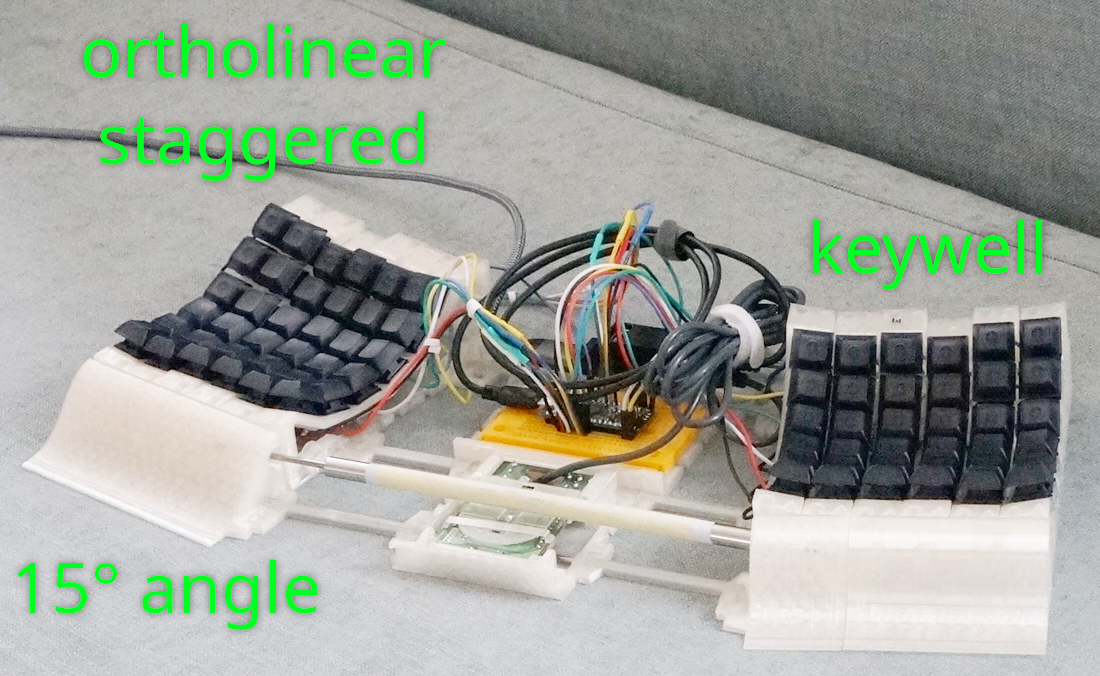
I just love it when y’all send in your projects, so thanks, [Kai]! But were do I even begin with this one? Okay, so, first of all, you need to know that [Kai Ruhl] built an amazing split keyboard with plenty of keys for even someone like me. Be sure to check it out, because the build log is great reading.
Image by [Kai Ruhl] via Land of KainBut that wasn’t enough — a mousing solution was in order that didn’t require taking [Kai]’s hands off of the keyboard. And so, over the course of several months, the RollerMouse Keyboard came into being. That’s the creation you see here.
Essentially, this is an ortholinear split with a built-in roller bar mouse, which basically acts like a cylindrical trackball. There’s an outer pipe that slides left/right and rolls up and down, and this sits on a stationary inner rod. The actual mouse bit is from a Logitech M-BJ69 optical number.
[Kai] found it unpleasant to work the roller bar using thumbs, so mousing is done via the palm rests. You may find it somewhat unpolished with all that exposed wiring in the middle. But I don’t. I just worry about dust is all. And like, wires getting ripped out accidentally.
All Work and No Play Makes Jack a Dull Boy
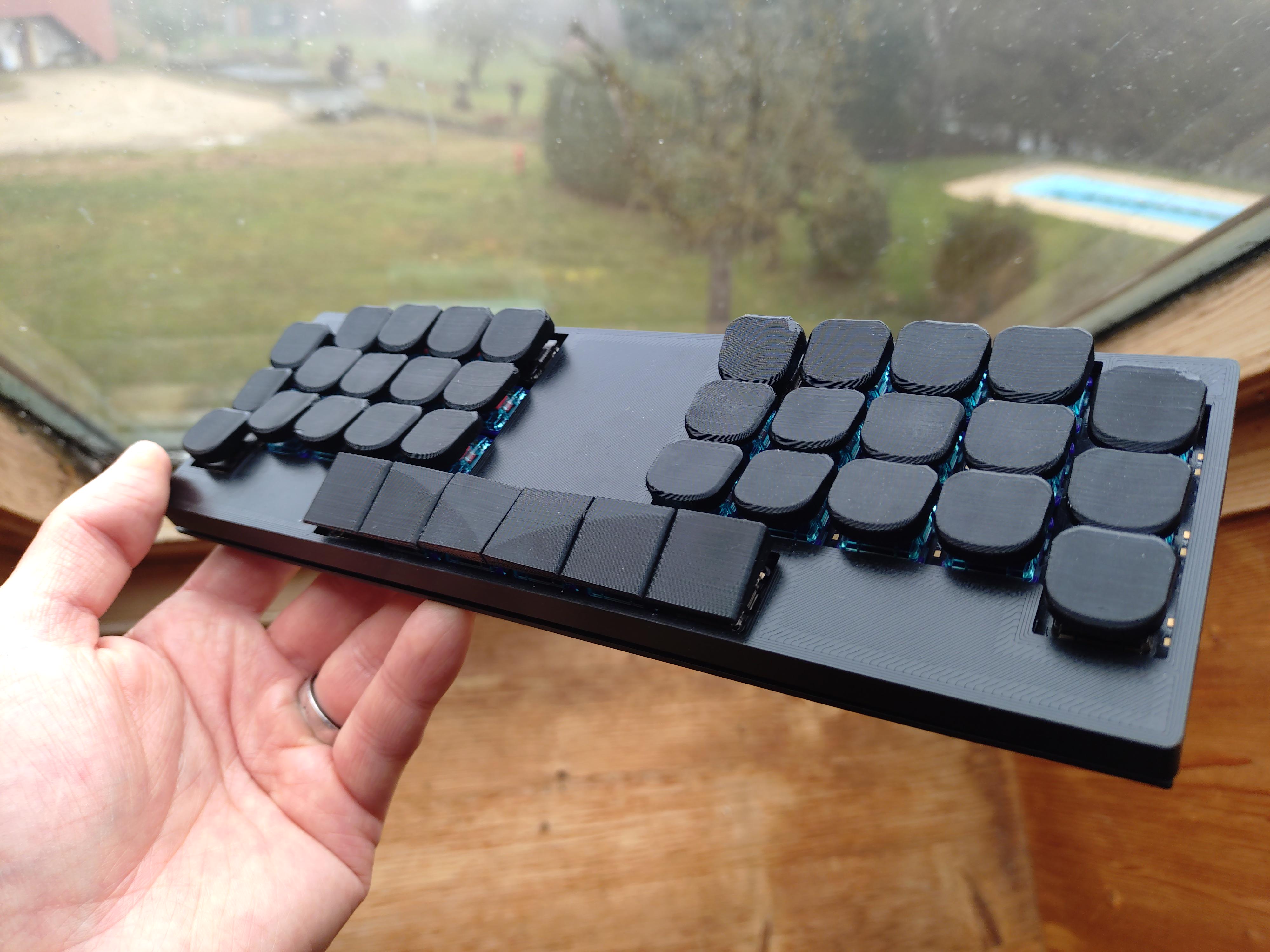
As I write this, a terrible snowpocalypse is snuggling up to the southern and mid-western states. What a time to watch The Shining and check out the dullboy prototype by [Blind_Heim].
Image by [Blind_Heim] via redditThis is [Blind_Heim]’s first project, and I think it looks mighty fine, especially with those slanty thumb keys. They are [Blind_Heim]’s own creation and were inspired by the design of the 1959 Adler Universal featured in TheShining. (Hence the name of the keyboard.) In case it isn’t obvious, they are meant for Kailh choc v1 switches.
Rev 1 shown here has a nice!nano and supports v1 chocs only. Rev 2 will support v1 and v2, and will have a 40 mm Cirque trackpad in that middle space there. Rev 2 will also be open-source and entirely free of copyright, so watch out for that.
Regarding those thumb keys, [Blind_Heim] says that they wanted something ergonomic and monoblock at first, and so the angles were just for looks. But after using it, he realized they were actually quite useful when it comes to determining which key is which without having to look.
The Centerfold: Downtown Busy Town Is the Place to Be
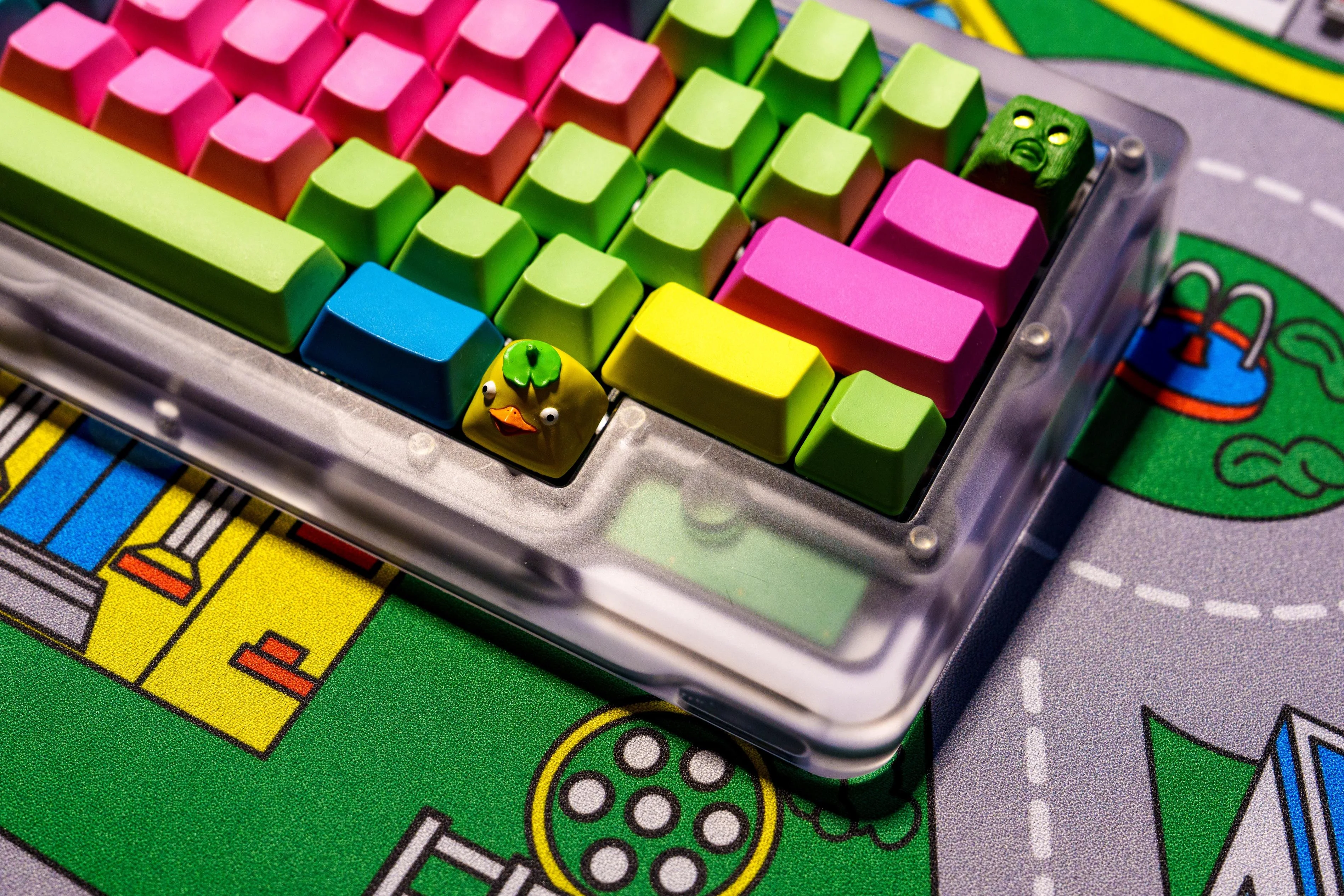
Image by [OrinNY] via redditThis desk mat ought to bring back some memories. Hopefully good ones, of daycare and snacks and nap time. Here it is for sale if you feel the need to drive little cars around on it.
As for the keyboard, that’s a Norbauer Heavy Grail Ghost of Christmas Future edition, which was of course a limited release that’s long sold out. I’m sure there are other transparent bodies out there, but good luck finding a bug-eyed, duck-faced keycap.
Do you rock a sweet set of peripherals on a screamin’ desk pad? Send me a picture along with your handle and all the gory details, and you could be featured here!
Historical Clackers: the Saturn
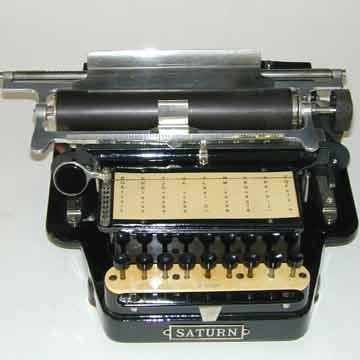
The Virtual Typewriter Museum calls the 1899 Saturn “one of the most impractical machines ever, built with proverbial precision in Switzerland”. Image via The Virtual Typewriter Museum The operation of this blind writer is pretty interesting, and that’s putting it politely. There are nine U-shaped type bars: four on each side beneath the carriage, and one in the middle that swings up from behind.
Each of these type bars holds eight characters, and these are selected by moving a wire up and down the index card using that giant round selector button the left side. The you would strike one of the nine keys corresponding to the column your character appears in.
Evidently the lower case characters were laid out differently than the upper case, which made it even more difficult to use. But hey, Swiss precision.
There is not a lot of information out there about the Saturn, but the Virtual Typewriter Museum does have more shots of various angles.
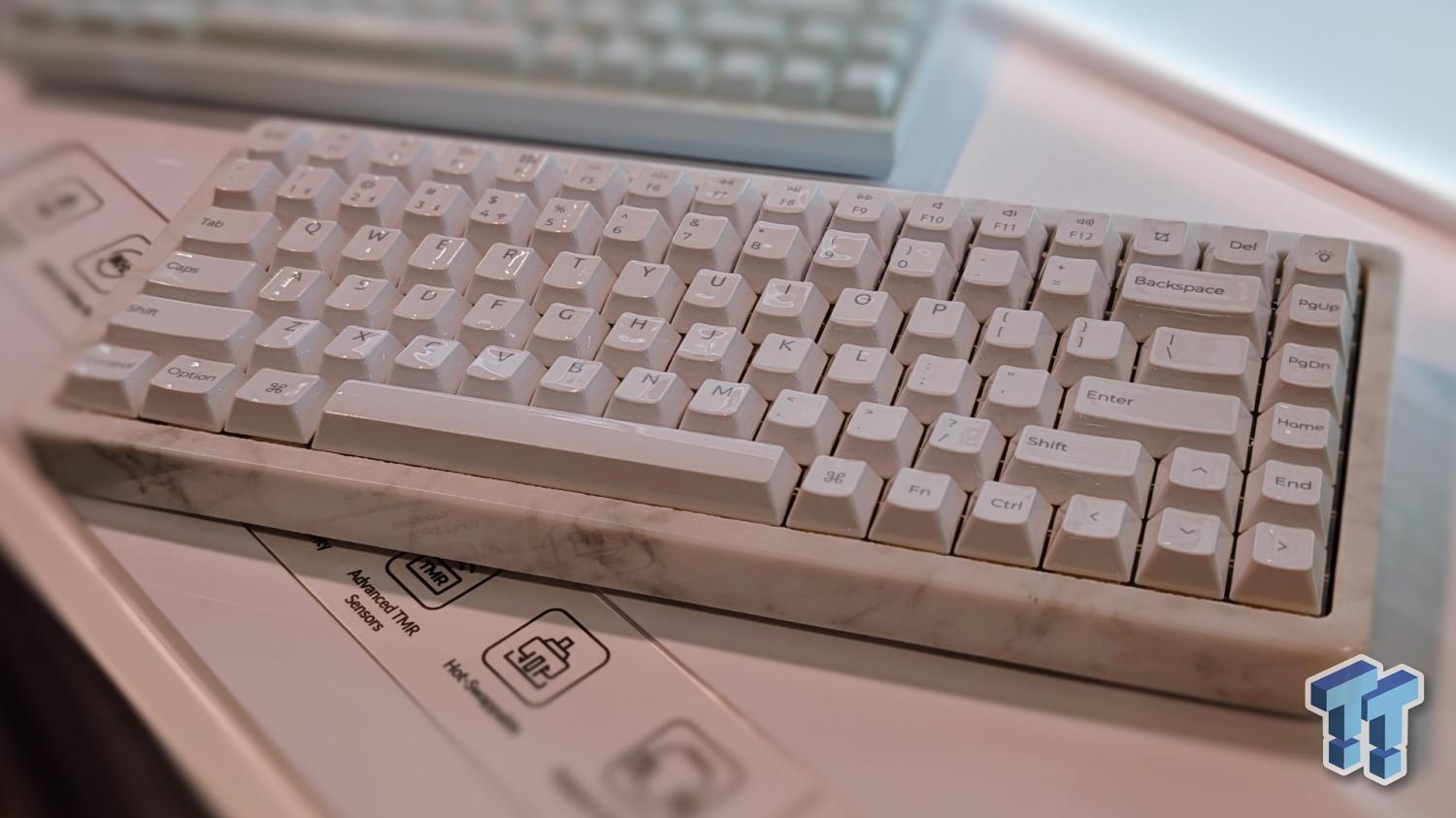
Finally, a Keyboard Made of Marble and Ceramic
Apparently there was a Kickstarter near the end of 2025 for this thing. Well, this is the first I’ve heard of it. This here is the Keychron Q16 HE 8K ceramic and marble keyboard, which debuted at CES. Image via Tweak Town This is a luxury keyboard for sure, right down to the pre-lubed Keychron ultra-fast Lime magnetic switches which features Tunnel Magnetoresistance (TMR) and per-key adjustable actuation.
They say it’s built for gaming, but I don’t know. I think it’s built for whatever you want to use it for. It will be available in April. I sincerely hope that it’s like typing on little coffee cups, and it probably sounds amazingly thocky.
Now Tweak Town doesn’t have a whole lot to say about this keyboard, so I found a review to go with it. [YouallareToxic] has quite a bit to say about the keyboard. I think the biggest takeaway from this review is that this keyboard sounds like no other. [YouallareToxic] likens it to a frog guiro. A what? Check out the video below.
This week Jonathan chats with Olaf Andreas Schulte and Lars Kiesow about Opencast, the video management system for education. What does Opencast let a school or university accomplish, how has that changed over the last decade, and what exciting new things are coming? Watch to find out!
Did you know you can watch the live recording of the show right on our YouTube Channel? Have someone you’d like us to interview? Let us know, or have the guest contact us! Take a look at the schedule here.
There are many solutions for remote control keyboards, be they Bluetooth, infrared, or whatever else. Often they leave much to be desired, and come with distinctly underwhelming physical buttons. [konkop] has a solution to these woes we’ve not seen before, turning an ESP32-S3 into a USB HID keyboard with a web interface for typing and some physical keyboard macro buttons. Instead of typing on the thing, you connect to it via WiFi using your phone, tablet, or computer, and type into a web browser. Your typing is then relayed to the USB HID interface.
The full hardware and software for the design is in the GitHub repository. The macro buttons use Cherry MX keys, and are mapped by default to the common control sequences that most of us would find useful. The software uses Visual Studio Code, and PlatformIO.
We like this project, because it solves something we’ve all encountered at one time or another, and it does so in a novel way. Yes, typing on a smartphone screen can be just as annoying as doing so with a fiddly rubber keyboard, but at least many of us already have our smartphones to hand. Previous plug-in keyboard dongles haven’t reached this ease of use.
In 1958, the American free-market economist Leonard E Read published his famous essay I, Pencil, in which he made his point about the interconnected nature of free market economics by following everything, and we mean Everything, that went into the manufacture of the humble writing instrument.
I thought about the essay last week when I wrote a piece about a new Chinese microcontroller with an integrated driver for small motors, because a commenter asked me why I was featuring a non-American part. As a Brit I remarked that it would look a bit silly were I were to only feature parts made in dear old Blighty — yes, we do still make some semiconductors! — and it made more sense to feature cool parts wherever I found them. But it left me musing about the nature of semiconductors, and whether it’s possible for any of them to truly only come from one country. So here follows a much more functional I, Chip than Read’s original, trying to work out just where your integrated circuit really comes from. It almost certainly takes great liberties with the details of the processes involved, but the countries of manufacture and extraction are accurate.
First, There’s The Silicon
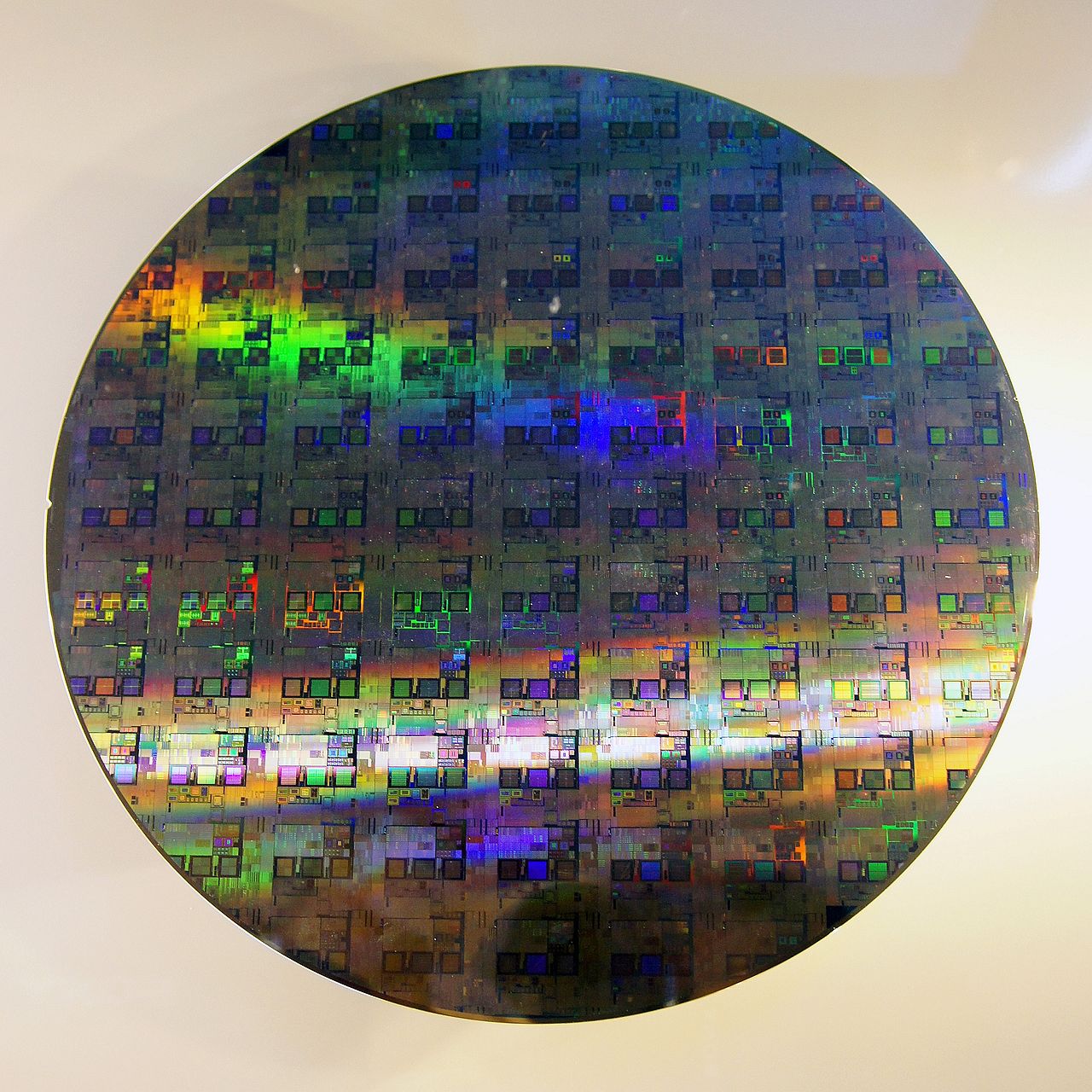
A silicon wafer, here bearing a grid of integrated circuits. Peellden, CC BY-SA 3.0. An integrated circuit, or silicon chip, is as its name suggests, made of silicon. Silicon is all around us in rocks and minerals, as silicon dioxide, which we know in impure form as sand. The world’s largest producer of silicon metal is China, followed by Russia, then Brazil. So if China and Russia are off the table then somewhere in Brazil, a Korean-made continuous bucket excavator scoops up some sand from a quarry.
That sand is taken to a smelting plant and fed with some carbon, probably petroleum coke as a by-product from a Brazilian oil refinery, into a Taiwanese-made submerged-arc furnace. The smelting plant produces ingots of impure silicon, which are shipped to a wafer plant in Taiwan. There they pass through a German-made zone refining process to produce the ultra-pure silicon which is split into wafers. Taiwan is a global centre for semiconductor foundries so the wafers could be shipped locally, but our chip is going to be made in the USA. They’re packed in a carton made from Canadian wood pulp, and placed in a container on a Korean-made ship bound for an American port. There it’s unloaded by a German-made container handling crane, and placed on a truck for transport to the foundry. The truck is American, made in the great state of Washington.
Then, There’s The Package And Leads
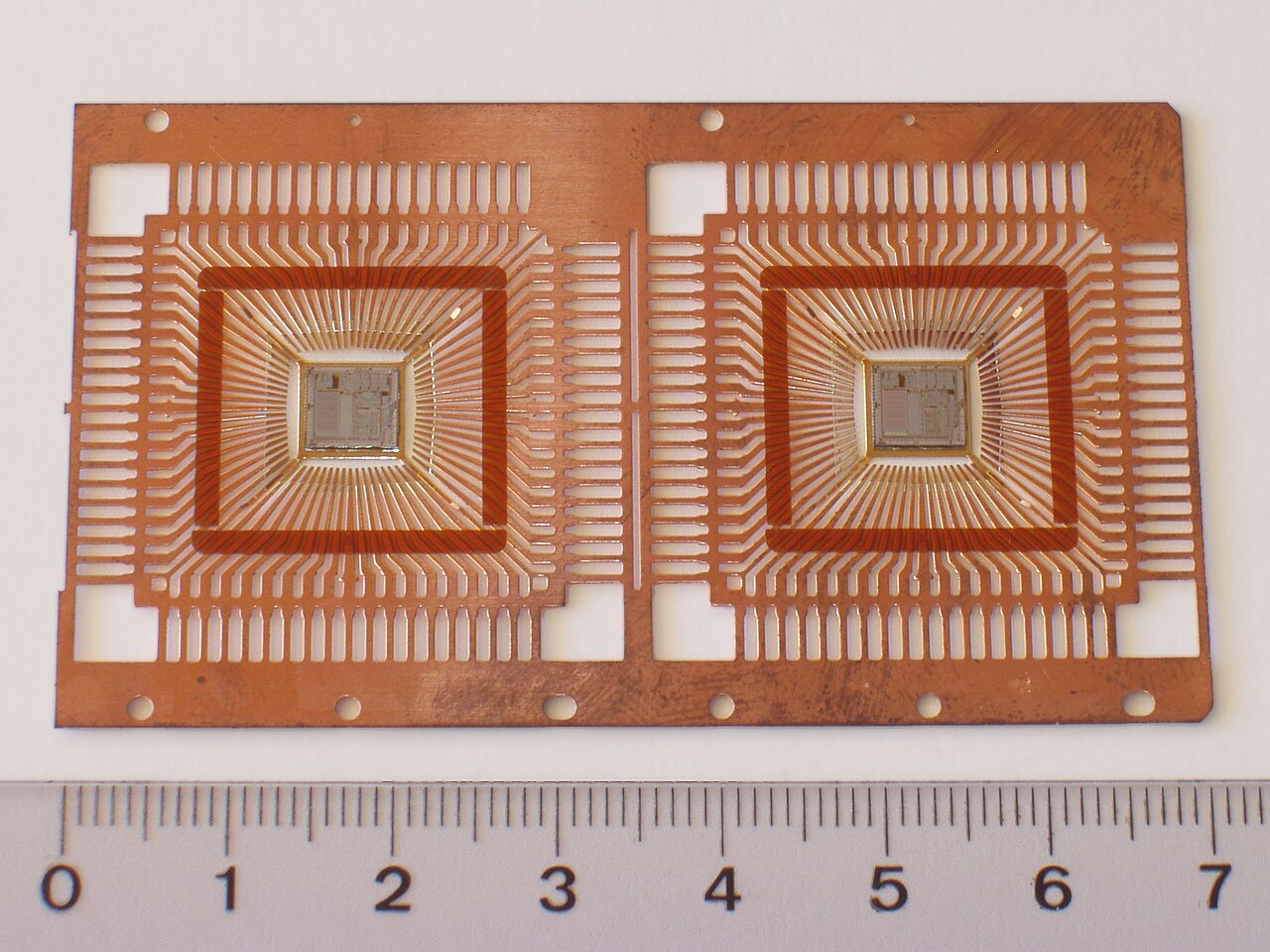
Lead frames for TQFP integrated circuits. I, NobbiP, CC BY-SA 3.0. Our integrated circuit is the chip itself, but in most cases it’s not just the bare chip. It’s supplied potted in an epoxy case, and with its contacts brought out to some kind of pins. The epoxy is a petrochemical product, while the lead frame is either stamped or chemically etched from metal sheet and plated.
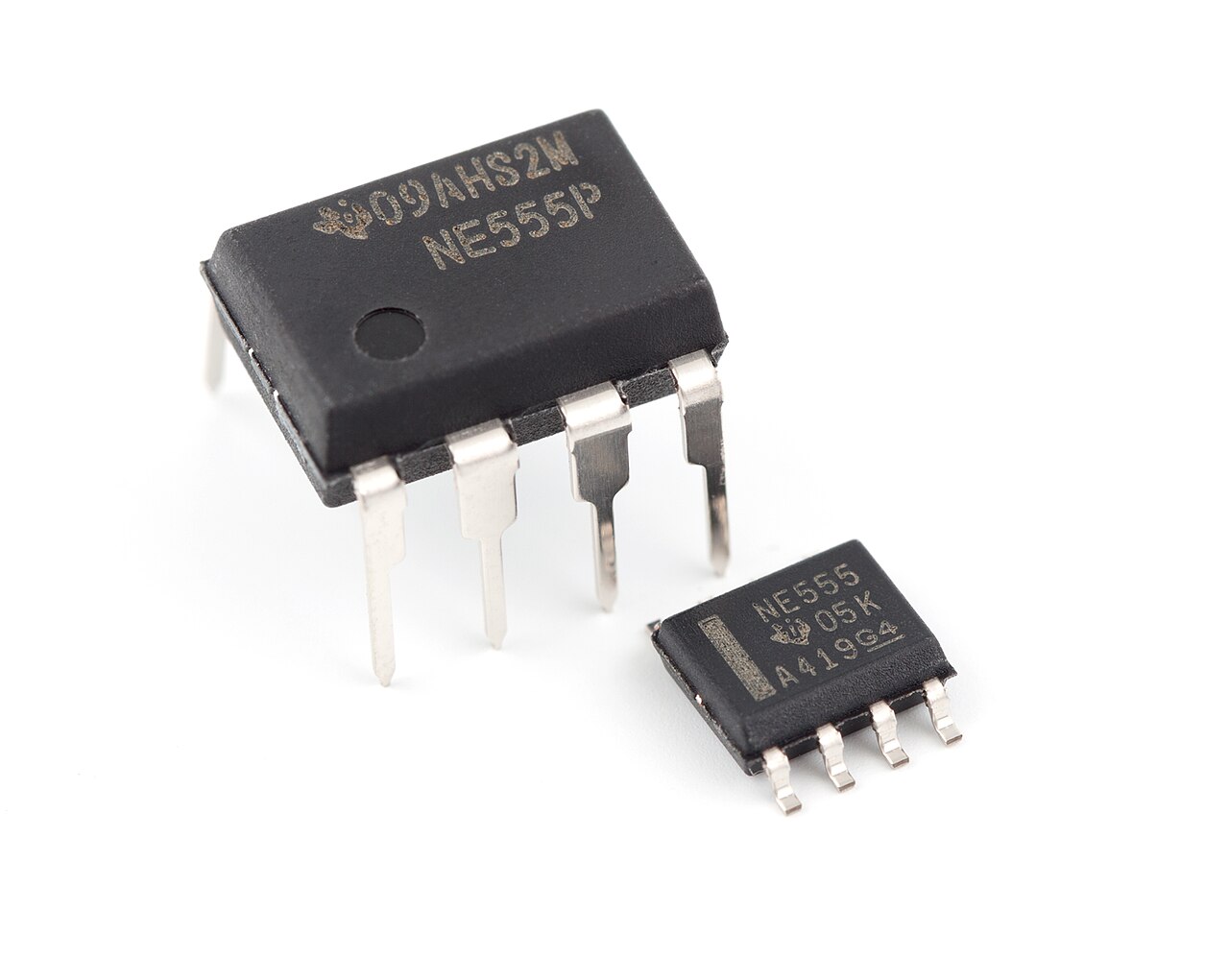
So, somewhere in the Chilean Atacama desert, an American-made dragline excavator is digging out copper ore from the bottom of a huge pit. The ore is loaded into Japanese-made dump trucks, from where it’s driven to a rail head and loaded into ore carrier cars. The American-made locomotives take it to a refining plant where machinery installed by a Finnish company smelts and refines it into copper ingots. These are shipped to Sweden aboard a German-made ship, unloaded by a German-made crane, and delivered to a specialised metal refiner on a Swedish-made truck. You all know the 555. The black stuff is epoxy moulding compound. Swift.Hg, commons.wikimedia.org/wiki/Fil…. Meanwhile underground in Ontario, Canada, Swedish-made machinery scoops up nickel ore and loads it onto a Swedish-made mine truck. At the nickel refining plant, which is Canadian-made, the sulphur and iron impurities are removed, and the resulting nickel ingots travel by rail behind a Canadian-made (but American designed) locomotive to a port, where an American made crane loads them into an Italian-made ship bound for Sweden. Another German crane and Swedish truck deliver it to the metal refiner, where a Swedish-made plant is used to create a copper-nickel alloy.
A German-made rolling plant then turns the alloy into a thin sheet, shipped in a roll inside a container on a Japanese-made container ship bound for the USA. Eventually after another round of cranes, trains, and trucks, all American this time, it arrives at the company who makes lead frames. They use a Japanese-made machine to stamp the sheet alloy and create the frames themselves. An American-made truck delivers them to the chip foundry.
At a petrochemical plant in China, bulk epoxy resin, plasticisers, pigments, and other products are manufactured. They are supplied in drums, which are shipped on a Chinese-made container ship to an American port where American cranes and trucks do the job of delivering them to an epoxy formulation company. There they are mixed in carefully-selected proportions to produce American-made epoxy semiconductor moulding compound, which is delivered to the chip foundry on an American-made truck.
Bringing all Those Countries’ Parts Together
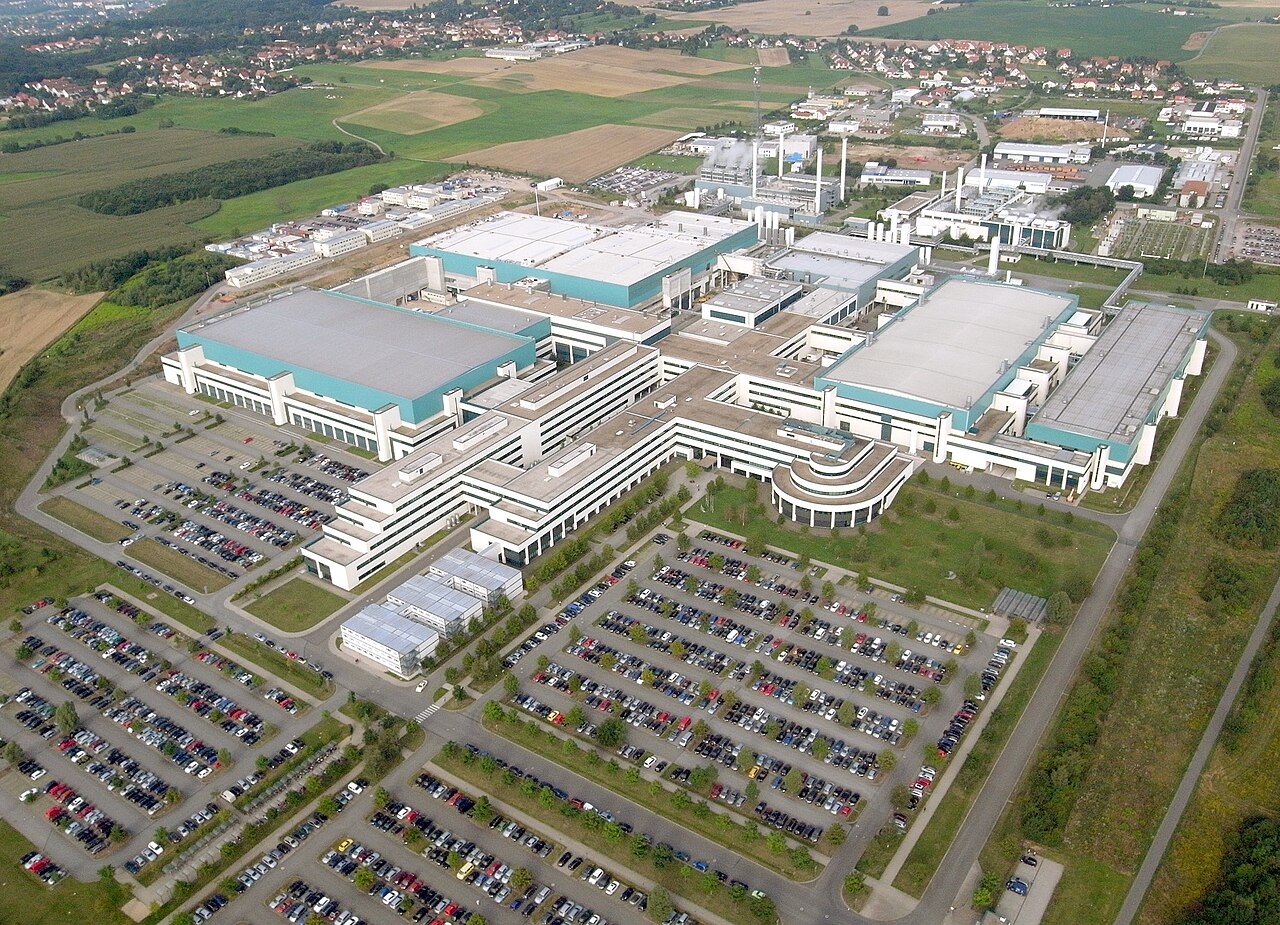
The foundry now has the silicon wafers, lead frames, and epoxy it needs to make an integrated circuit. There are many other chemicals used in its process, but for simplicity we’ll take those three as being the parts which make an IC. What they don’t yet have is an integrated circuit to make. For that there’s a team of high-end engineers in a smart air-conditioned office of an American semiconductor company in California. They are integrated circuit designers, but they don’t design everything. Instead they buy in much of the circuit as intellectual property, which can come from a variety of different countries. Banging the drum as a Brit I’m sure you’ll all know that ARM cores come from Cambridge here in the UK, just to name the most obvious example. So British, German, Dutch, American, and Canadian IP is combined using American software and the knowledge of American engineers, and the resulting design is sent to the foundry. This is the Globalfoundries semiconductor plant in Dresden, Germany. Fensterblick., CC BY-SA 3.0. The process machinery of an integrated circuit foundry lies probably at the most bleeding edge of human technology. The machines this foundry uses are mostly from Eindhoven in the Netherlands, but they are joined by American, German, Japanese, and even British ones. Even then, those machines themselves contain high-precision parts from all those countries and more, so that Dutch machine is also in part American and German too.
Whatever magic the semiconductor foundry does is performed, and at the loading bay appear cartons made from Canadian wood pulp containing reels made from Chinese bulk polymer, that have hundreds of packaged American-made integrated circuits in them. Some of them are shipped on an American truck to an airport, from where they cross the Atlantic in the hold of a pan-European-manufactured jet aircraft to be shipped from the British airport in a German-made truck to an electronics distributor in Northamptonshire. I place an order, and the next day a Polish bloke driving an American-badged van that was made in Turkey delivers a few of them to my door.
The above path from a dusty quarry in Brazil to my front door in Oxfordshire is excessively simplified, and were you to really try to find every possible global contribution it’s likely there would be few countries left out and this document would be hundreds of pages long. I hope mining engineers, metallurgists, chemists, and semiconductor process engineers will forgive me for any omissions or errors. What I hope it does illustrate though is how connected the world of manufacturing is, and how many sources come together to produce a single product. Read’s 1958 pencil is alive and well.
“È nello stare insieme che si costruisce il noi”. Con queste parole padre Giacomo Costa, segretario generale del Sinodo dei vescovi, ha aperto il suo intervento questa mattina al convegno nazionale degli assistenti di Azione Cattolica che si sta svol…
Si è svolta oggi la sesta udienza del processo di appello sugli investimenti finanziari della Segreteria di Stato a Londra, in cui hanno preso la parola le parti civili di Ior, Segreteria di Stato e Apsa (l’Asif si è associata) e i rappresentanti del…
Si apre oggi (fino al 6 febbraio), presso la Curia generalizia dei Gesuiti a Roma, la terza Assemblea plenaria del Dicastero per i Laici, la famiglia e la vita.
L’annuncio a inizio settimana da parte di Trump sul raggiungimento di un accordo commerciale tra Stati Uniti e India ha lasciato commentatori e addetti ai
Cinema Mariani - Via Ponte Marino, 19, 48121 Ravenna RA (mercoledì, 11 febbraio 21:00) Nel marzo 2024, Francesca Albanese, Relatrice Speciale delle Nazioni Unite per i Territori Palestinesi Occupati, ha denunciato un genocidio a Gaza. Seguendo i suoi passi tra missioni, incontri istituzionali e pressioni politiche, questo documentario ci porta nel cuore della crisi delle Nazioni Unite, messa di fronte alla propria incapacità di impedire il massacro dei civili...
ore 22.30 diretta streaming con: Francesca Albanese (Relatrice Speciale delle Nazioni Unite per i Territori Palestinesi Occupati) e Cecilia Strada (Europarlamentare e Membro della delegazione per i rapporti con la Palestina"
Gruppo di lettura Bucefalo | La spirale (Cosmicomiche, Calvino)
Associazione Allons Enfants - piazzale Martini 11, 20137 (mercoledì, 11 febbraio 18:30)
ciao! anche a febbraio proseguiamo con la narrativa, e leggiamo La spirale (dalle Cosmicomiche di Calvino). ci vediamo, per chi può e per chi vuole, nella sede di Allons Anfants, piazzale Martini 11, alle ore 18.30. come sempre: ci si può collegare da remoto, si possono condividere merende e bevute, cercheremo di stampare le dispense (che trovi scrivendoci qui, sul gruppo telegram e sul nostro drive). se hai domande scrivici. baci
Parole, corpi e libertà di pensiero: donne tra filosofia e letteratura
centro milano donna 5 - Via Giorgio Savoia 1 (mercoledì, 11 febbraio 19:00) Una serata per interrogarci insieme su domande cruciali: Che cosa ha ostacolato le donne nella libertà di espressione, di pensiero e di scrittura? Perché per così lungo tempo filosofe, scrittrici e artiste sono state taciute o dimenticate?
Due libri ci accompagneranno in questa riflessione collettiva.
Ne parleremo insieme a enciclopediadelledonne.it, un prezioso spazio di memoria e sapere al femminile.
Vi aspettiamo per un incontro di pensiero, confronto e cultura condivisa.
Iniziativa a cura di Zero5 - Laboratorio di utopie metropolitane.
De Lollis Underground - Via Cesare De Lollis, 20 (venerdì, 6 febbraio 15:00) Venerdì 6 febbraio ci vedremo tutt* nel laboratorio di serigrafia per un pomeriggio di lavoretti e condivisione! Vieni a conoscerci e ad aiutarci a rimettere in funzione tutte e 4 le braccia della nostra magnifica giostra, come sempre accompagnati da birrette e chiacchierine!
Inizia:Venerdì Febbraio 06, 2026 @ 3:00 PM GMT+01:00 (Europe/Rome)
Finisce:Venerdì Febbraio 06, 2026 @ 8:00 PM GMT+01:00 (Europe/Rome)
Venerdì 6 febbraio ci vedremo tutt* nel laboratorio di serigrafia per un pomeriggio di lavoretti e condivisione! Vieni a conoscerci e ad aiutarci a rimettere in funzione tutte e 4 le braccia della nostra magnifica giostra, come sempre accompagnati da birrette e chiacchierine!
Casa di Quartiere Quarticciolo - Via Trani, 1, 00171 Roma RM (venerdì, 6 febbraio 18:30) Il carcere è abitato dalla città di serie B. In particolare dagli abitanti delle periferie, a Roma dette borgate. C’è un legame quasi viscerale fra questi luoghi, troppo spesso dimenticati dal resto della società. Lo stigma di essere una persona detenuta, come lo stigma di essere nato in borgata. In carcere si vive male, si muore e ci si suicida molto di più rispetto al “fuori”, ci si ammala di più. La funzione del carcere non è rieducare e reinserire, in Italia c’è un tasso di recidiva vicino al 70%, usciti dal carcere si è bollati, è ancora più difficile trovare un lavoro. Allora cos’è il carcere oggi? Che rapporto ha con quartieri come il Quarticciolo, Rebibbia, Tar Sapienza, San Basilio e Laurentino38? Ne parliamo con chi il carcere l’ha vissuto e ha cercato di alzare la voce al suo interno, come i Detenuti Liberi di Regina Coeli, con chi dentro al penitenziario femminile di Rebibbia costruisce un progetto sportivo di calcio a 5, l’Atletico Diritti, e con Radio Ondarossa che dal 1977 da voce alle persone detenute e approfondisce il ruolo del carcere nella società.
Centro Sociale Anomalia - Via Archimede 1 - Palermo (sabato, 7 febbraio 22:00) Sabato 07 Febbraio, dopo il cineforum delle 18, all'Anomalia (via Archimede 1) passeremo insieme una serata all'insegna della socialità, dell'antifascismo e della buona musica! Sostieni chi lotta, sostieni l'arte!
Lockdown Mode is a sometimes overlooked feature of Apple devices that broadly make them harder to hack. A court record indicates the feature might be effective at stopping third parties unlocking someone's device. At least for now.
Lockdown Mode is a sometimes overlooked feature of Apple devices that broadly make them harder to hack. A court record indicates the feature might be effective at stopping third parties unlocking someonex27;s device. At least for now.#Privacy #News
FBI Couldn’t Get into WaPo Reporter’s iPhone Because It Had Lockdown Mode Enabled
The FBI has been unable to access a Washington Post reporter’s seized iPhone because it was in Lockdown Mode, a sometimes overlooked feature that makes iPhones broadly more secure, according to recently filed court records.
The court record shows what devices and data the FBI was able to ultimately access, and which devices it could not, after raiding the home of the reporter, Hannah Natanson, in January as part of an investigation into leaks of classified information. It also provides rare insight into the apparent effectiveness of Lockdown Mode, or at least how effective it might be before the FBI may try other techniques to access the device.
💡 Do you know anything else about phone unlocking technology? I would love to hear from you. Using a non-work device, you can message me securely on Signal at joseph.404 or send me an email at joseph@404media.co.
This post is for subscribers only
Become a member to get access to all content Subscribe now
Lockdown Mode is a sometimes overlooked feature of Apple devices that broadly make them harder to hack. A court record indicates the feature might be effective at stopping third parties unlocking someone's device. At least for now.
This Epstein dump is probably the worst yet. Then we talk all about security issues in Moltbot and Moltbook. Then, even more security issues with some popular apps.#Podcast
We start this week with Sam and Emanuel’s article about the latest Epstein dump, and how it’s really a disaster in a lot of ways. After the break, Matthew runs us through Moltbot and its terrible security. After the break, Emanuel breaks down his two recent stories about a fundamental issue exposing a bunch of very sensitive data. playlist.megaphone.fm?e=TBIEA8… Listen to the weekly podcast on Apple Podcasts,Spotify, or YouTube. Become a paid subscriber for access to this episode's bonus content and to power our journalism. If you become a paid subscriber, check your inbox for an email from our podcast host Transistor for a link to the subscribers-only version! You can also add that subscribers feed to your podcast app of choice and never miss an episode that way. The email should also contain the subscribers-only unlisted YouTube link for the extended video version too. It will also be in the show notes in your podcast player. youtube.com/embed/gDcOOP_Y9cU?… Timestamps:
0:00 - Intro
2:19 - DOJ Released Unredacted Nude Images in Epstein Files
25:08 - Silicon Valley’s Favorite New AI Agent Has Serious Security Flaws
34:55 - Exposed Moltbook Database Let Anyone Take Control of Any AI Agent on the Site
Tech News Podcast · Updated Weekly · Welcome to the podcast from 404 Media where Joseph, Sam, Emanuel, and Jason catch you up on the stories we published this week. 404 Media is a journalist-owned digital media company exploring the way …
@Notizie dall'Italia e dal mondo È morto il 2 febbraio 2026, a 67 anni, Khaled al-Saifi, sei giorni dopo essere uscito dalle prigioni di Israele. Giornalista, insegnante e politico palestinese. Era il direttore del Centro Culturale Ibdaa, nel campo profughi palestinese di Dheisheh, a Betlemme L'articolo VIDEO PALESTINA. Khaled
@Informatica (Italy e non Italy 😁) Offrendo un ulteriore livello di sicurezza, dedicato a giornalisti e personaggi pubblici, WhatsApp introduce le impostazioni restrittive dell'account, per tutelare i dati personali e le informazioni sensibili. Ecco quali vantaggi fornisce la funzionalità
E stato fatto in Francia il 22 luglio 2025 da 114 avvocati/e. E stato fatto in Italia il 14 ottobre 2025 da 52 avvocati/e sostenuti da 50'000 persone.
Il 3 febbraio, 25 avvocati/e di tutta la Svizzera hanno denunciato il Consigliere federale Ignazio Cassis presso l'ufficio del procuratore della CPI - Corte penale internazionale per complicità in crimini di guerra, crimini contro l'umanità e genocidio.
Con la mia firma, sostengo questa azione.
Sono 50.000 a sostenere gli avvocati italiani. Grazie a te, possiamo essere ancora più numerosi in Svizzera.
A sostegno della denuncia del ministro degli esteri svizzero Ignazio Cassis alla Corte penale internazionale per co.plicità nel genocidio che Israele sta perpetrando a Gaza è stata lanciata una petizione. Io ovvuamente l'ho firmata. Se altri la vogliono firmare, si trova qui: act.campax.org/petitions/mettr…
La Cellula Coscioni di Firenze organizza uno sportello sulle D.A.T.
Venerdì 6 febbraio 2026 Dalle ore 17:00 alle 19:00 SMS Rifredi – Via Vittorio Emanuele II 303, Firenze
La Cellula Coscioni di Firenze organizza uno sportello informativo dedicato alle Disposizioni Anticipate di Trattamento (D.A.T.), per approfondire i propri diritti sul fine vita e sul testamento biologico. Durante l’incontro sarà possibile ricevere informazioni chiare e aggiornate su come redigere e depositare il proprio testamento biologico, quali sono i diritti sanciti dalla legge 219/2017 e quali strumenti sono disponibili per l’autodeterminazione nelle scelte di curaUn’occasione aperta a tutte e tutti per conoscere, capire e fare scelte consapevoli.
Per maggiori info cellulafirenze@associazionelucacoscioni.it
Sportello D.A.T. – Con la Cellula Coscioni Firenze
Lunedì 2 febbraio 2026 Dalle ore 18:30 alle 20:00 Circolo San Lorenzo – Via San Zanobi 18r, Firenze
La Cellula Coscioni di Firenze organizza uno sportello informativo dedicato alle Disposizioni Anticipate di Trattamento (D.A.T.), per approfondire i propri diritti sul fine vita. Durante l’incontro sarà possibile ricevere informazioni chiare e aggiornate su come redigere e depositare il proprio testamento biologico, quali sono i diritti sanciti dalla legge 219/2017e quali strumenti sono disponibili per l’autodeterminazione nelle scelte di curaUn’occasione aperta a tutte e tutti per conoscere, capire e fare scelte consapevoli.
La Difesa italiana si appresta a varare la riforma più importante degli ultimi decenni per far fronte ai profondi mutamenti geopolitici e operativi odierni. Mentre del testo della riforma – che il ministro Crosetto intende far presentare alle Camere
SemiTO-V, il primo team studentesco RISC-V d'Europa fondato al Politecnico di Torino, è orgoglioso di organizzare il capitolo italiano dei World RISC-V Days.
Unisciti agli appassionati di RISC-V, agli studenti e ai leader del settore per una mezza giornata di talk tecnici, networking e innovazione open-hardware. Ascolta ingegneri e architetti che stanno plasmando il futuro di RISC-V in ambito accademico e industriale.
Data: martedì 26 febbraio 2026 Ora: 12:00 – 18:00 Luogo: Sala Emma Strada, Politecnico di Torino
La registrazione è totalmente gratuita ed è limitata a 200 partecipanti a causa delle limitazioni della Sala Emma Strada. Assicurati il tuo posto prima che la registrazione si chiuda per non perdere il principale raduno RISC-V d'Europa!
@Notizie dall'Italia e dal mondo Le minacce di Trump a Cuba si uniscono all'embargo economico a cui l'isola è sottoposta da decenni. Lo strangolamento energetico rischia di causare una catastrofe umanitaria in un Paese già in "multicrisi". Il video-racconto di Andrea


The horse shoe and pottery found in the erdstall. Image: © State Office for Monument Preservation and Archaeology of Saxony-Anhalt, Ulf Petzschmann.
A section of the underground passage with a pointed gable and a small niche in the wall. The passage is approximately one meter high and 50 to 70 centimeters wide. Image © State Office for Monument Preservation and Archaeology of Saxony-Anhalt, Ulf Petzschmann.
The Ratgöbluckn erdstall. Image: Pfeifferfranz






Venerdì 6 febbraio 2026
Dalle ore 17:00 alle 19:00
SMS Rifredi – Via Vittorio Emanuele II 303, Firenze
Lunedì 2 febbraio 2026
Dalle ore 18:30 alle 20:00
Circolo San Lorenzo – Via San Zanobi 18r, Firenze
Nicola Pizzamiglio
in reply to Max - Poliverso 🇪🇺🇮🇹 • •