
The Deadliest US Nuclear Accident is Not What You Think

When you think of a US Nuclear accident, you probably think of Three Mile Island. However, there have been over 50 accidents of varying severity in the US, with few direct casualties. (No one died directly from the Three Mile Island incident, although there are some studies that show increased cancer rates in the area.)
Indeed, where there are fatalities, it hasn’t been really related to the reactor. Take the four people who died at the Surry Nuclear Power Plant accident: they were killed when a steam pipe burst and fatally scalded them. At Arkansas Nuclear One, a 525-ton generator was being moved, the crane failed to hold it, and one person died. That sort of thing could happen in any kind of industrial setting.
But one incident that you have probably never heard of took three lives as a direct result of the reactor. True, it was a misuse of the reactor, and it led to design changes to ensure it can’t happen again. And while the incident was nuclear-related, the radiation didn’t kill them, although it probably would have if they had survived their injuries.
Background

It may be a misattribution, but it is often said that Napoleon said something like, “An army marches on its stomach.” A modern army might just as well march on electrical power. So the military has a keen interest in small nuclear reactors to both heat sites in cold climates and generate electricity when in remote locations or in, as they like to call it, denied areas.
In the mid-1950s, the Army tasked Argonne National Laboratory to prototype a small reactor. They wanted it portable, so it had to break down to relatively small pieces, if you consider something weighing 10 tons as small, and could be set up in the field.
The resulting prototype was the Stationary Low-Power Reactor Number One, known as SL-1, operated by the Army in late 1958. It could provide about 400 kW of heating or 200 kW of electricity. The reactor core was rated for 3 MW (thermal) but had been tested at 4.7 MW a few times. It would end operations due to an accident in 1961.
Design
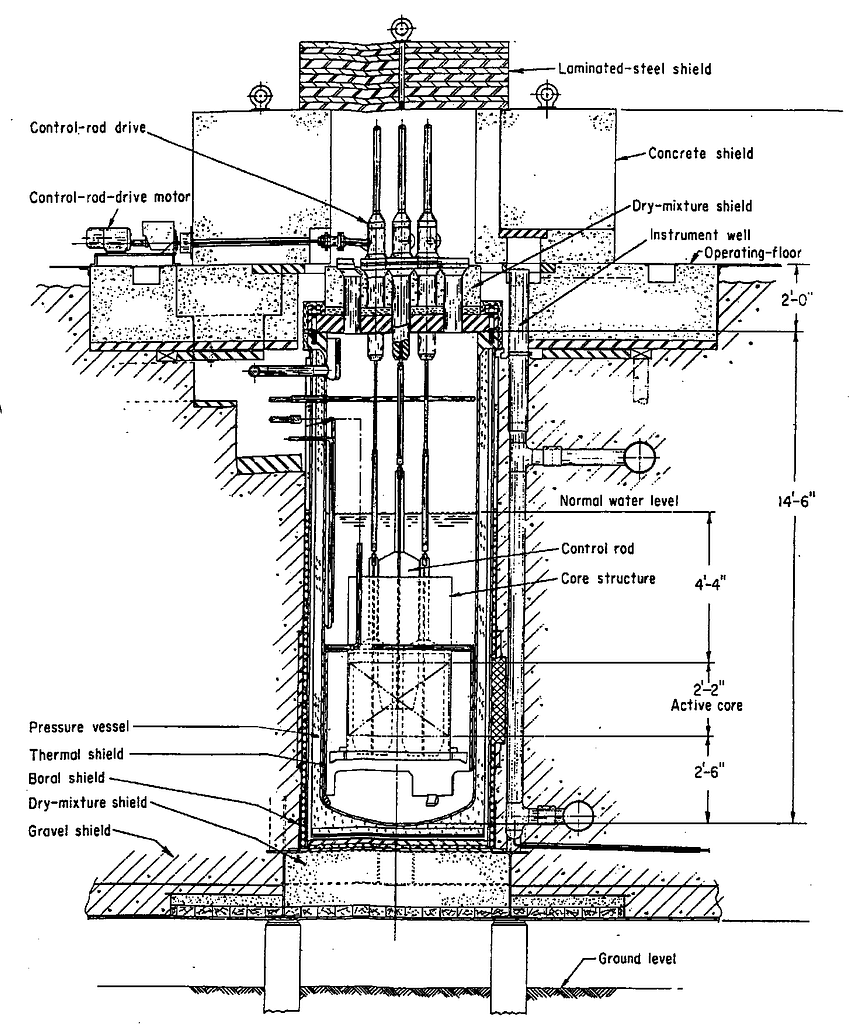
The reactor was a conventional boiling-water reactor design that used natural circulation of light water as both coolant and moderator. The fuel was in the form of plates of a uranium-aluminum alloy.
The reactor was inside a 48-foot-tall cylinder 38.5 feet in diameter. It was made of quarter-inch plate steel. Because the thing was in the middle of nowhere in Idaho, this was deemed sufficient. There was no containment shell like you’d find on reactors nearer to population centers.
The reactor, at the time of the accident, had five control rods, although it could accommodate nine. It could also hold 59 fuel assemblies, but only 40 were in use. Because of the reduced number of fuel plates, the reactor’s center region was more active than it would have been under full operation. The rods were eight in a circle with four dummies and a ninth one in the center. Because of the missing outer rods, the center control rod was more critical than the four others.
The Accident
In January of 1961, the reactor had been shut down for 11 days over the holiday. In preparation for restarting, workers had to reconnect the rods to their drive motors. The procedure was to pull the rod up four inches to allow the motor attachment.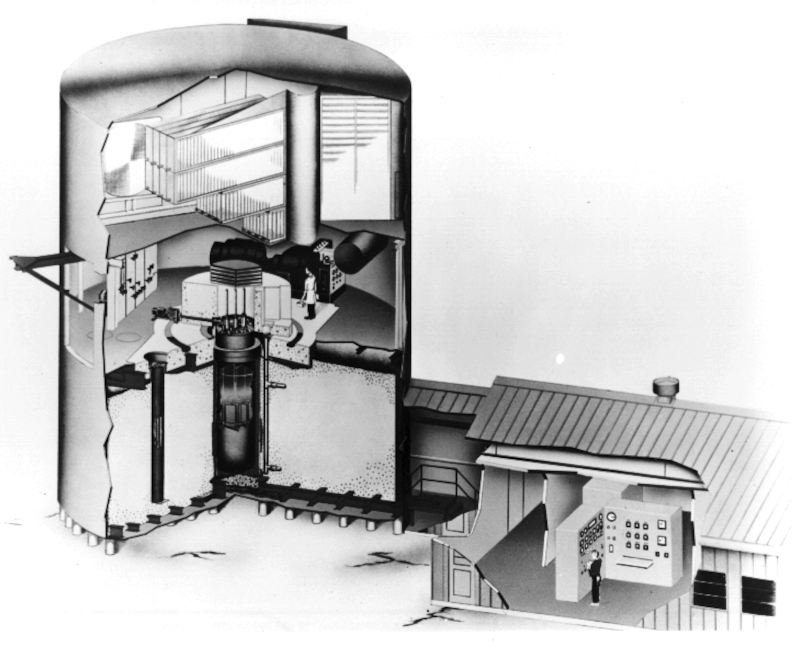
There were three workers: Specialist Richard McKinley, Specialist John Byrnes, and a Navy Seabee Electrician First Class Richard Legg. Legg was in charge, and McKinley was a trainee.
From a post-accident investigation, they are fairly sure that Byrnes inexplicably pulled the center rod out 20 inches instead of the requisite four inches. The reactor went prompt critical, and, in roughly four milliseconds, the 3 MW core reached 20 GW. There wasn’t enough time for sufficient steam to form to trigger the safeties, which took 7.5 milliseconds.
The extreme heat melted the fuel, which explosively vaporized. The reactor couldn’t dissipate so much heat so quickly, and a pressure wave of about 10,000 pounds hit the top of the reactor vessel. The 13-ton vessel flew up at about 18 miles an hour, and plugs flew out, allowing radioactive boiling water and steam to spray the room. At about nine feet, it collided with the ceiling and a crane and fell back down. All this occurred in about two seconds.
As you might imagine, you didn’t want to be in the room, much less on top of the reactor. Two of the operators were thrown to the floor. Byrnes’ fall causes his rib to fatally pierce his heart. McKinley was also badly injured but only survived for about two hours after the accident. Legg was found dead and stuck to the ceiling, an ejected shield plug impaling him.
Why?

You can place a lot of blame here. Of course, you probably shouldn’t have been able to pull the rod up that far, especially given that it was carrying more of the load than the other rods. The contractor that helped operate the facility wasn’t available around the clock due to “budget reasons.” There’s no way to know if that would have helped, of course.
But the real question is: why did they pull the rod up 20 inches instead of four? We may never know. There are, of course, theories. Improbably, people have tried to explain it as sabotage or murder-suicide due to some dispute between Byrnes and one of the other men. But that doesn’t seem to be the most likely explanation.
Apparently, the rods sometimes stuck due to misalignment, corrosion, or wear. During a ten-month period, for example, about 2.5% of the drop-and-scram tests failed because of this sticking: a total of 40 incidents. However, many of those causes only apply when the rods are automatically moved. Logbooks showed that manual movement of the rods had been done well over 500 times. There was no record of any sticking during manual operations. Several operators were asked, and none could recall any sticking. However, the rate of sticking was increasing right before the incident, just not from manual motion.
However, it is easy to imagine the 48-pound rod being stuck, pulling hard on it, and then having it give way. We’ve all done something like that, just not with such dire consequences.
Aftermath
First responders had a difficult time with this incident due to radiological problems. There had been false alarms before, so when six firefighters arrived on the scene, they weren’t too concerned. But when they entered the building, they saw radiation warning lights on and their radiation detectors pegged.
Even specialized responders with better equipment couldn’t determine just how much radiation was there, except for “plenty.” Air packs were fogging, limiting visibility. During the rescue of McKinley, one rescuer had to remove a defective air pack and breathe contaminated air for about three minutes. Freeing Legg’s body required ten men working in pairs, because each team could only work in the contaminated zone for 65 seconds. The rule had been that you could tolerate 100 Röntgens (about 1 Sv or 100 rem) to save a life and 25 (0.25 Sv or 25 rem) to save valuable property. Of the 32 people involved in the initial response, 22 received between 3 and 27 Röntgens exposure. Further, 790 people were exposed to harmful radiation levels during the subsequent cleanup.
The reactor building did prevent most of the radioactive material from escaping, but iodine-131 levels in some areas reached about 50 times normal levels. The remains of the site are buried nearby, and that’s the source of most residual radiation.
Lessons Learned
Unsurprisingly, the SL-1 design was abandoned. Future designs require that the reactor be safe even if one rod is entirely removed: the so-called “one stuck rod” rule. This also led to stricter operating procedures. What’s more, it is now necessary to ensure emergency responders have radiation meters with higher ranges. Regulations are often written in blood.
The Atomic Energy Commission made a film about the incident for internal use but, of course, now, you can watch it from your computer, below.
youtube.com/embed/gIBQMkd96CA?…
You might also enjoy this presentation by one of the first responders who was actually there, which you can see below. If you want a more detailed history, check out Chapters 15 and 16 of [Susan M. Stacy’s] book “Proving the Principle” that you can read online.
youtube.com/embed/gMNqPUT-yP0?…
Nuclear accidents can ruin your day. We are always surprised at how many ordinary mistakes happen at reactors like Brown’s Ferry.
Falcon strike 2025, ad Amendola la Nato si addestra al domani della deterrenza
@Notizie dall'Italia e dal mondo
La base militare di Amendola torna al centro dello scenario internazionale con Falcon strike 2025, l’esercitazione che riunisce le principali forze aeree della Nato per testare le capacità operative in contesti di alta complessità. Pensata come laboratorio di integrazione tra tecnologie e strategie,
Notizie dall'Italia e dal mondo reshared this.
The initial 'Shutdown Guidance' for the US Army Garrison Bavaria included instructions to go to German food banks.
The initial x27;Shutdown Guidancex27; for the US Army Garrison Bavaria included instructions to go to German food banks.#News


US Army Tells Soldiers to Go to German Food Bank, Then Deletes It
A US Army website for its bases in Bavaria, Germany published a list of food banks in the area that could help soldiers and staff as part of its “Shutdown Guidance,” the subtext being that soldiers and base employees might need to obtain free food from German government services during the government shutdown.The webpage included information about which services are affected by the ongoing shutdown of the federal government, FAQs about how to work during a furlough, and links to apply for emergency loans. After the shutdown guidance’s publication, the Army changed it and removed the list of food banks, but the original has been archived here.
playlist.megaphone.fm?p=TBIEA2…
The shutdown of the American federal government is affecting all its employees, from TSA agents to the troops, and the longer people go without paychecks, the more they’re turning to nonprofits and other services to survive. American military bases are like small cities with their own communities, stores, and schools. The US Army Garrison Bavaria covers four bases spread across the German state of Bavaria and is one of the largest garrisons in the world, hosting around 40,000 troops and civilians.Like many other American military websites, the Garrison’s has stopped updating, but did publish a page of “Shutdown Guidance” to help the people living on its bases navigate the shutdown. At the very bottom of the page there was a “Running list of German support organizations for your kit bags” that included various local food banks. It listed Tafel Deutschland, which it called an “umbrella organization [that] distributes food to people in poverty through its more than 970 local food banks,” Foodsharing e.V, and Essen für Alle (Food for everyone).
Image via the Wayback Machine.
The guidance also provided a link to the German version of the Too Good to Go App, which it described as a service that sells surprise bags of food to reduce food waste. “These bags contain unsellable but perfectly good food from shops, cafés, and restaurants, which can be picked up at a reduced price. To obtain one of these bags, it must be reserved in the app and picked up at the store during a specified time window, presenting the reservation receipt in the app,” the US Army Garrison Bavaria’s shutdown guidance page said.According to snapshots on the Wayback Machine, the list of food banks was up this morning but was removed sometime in the past few hours. The US Army Garrison Bavaria did not respond to 404 Media’s request for comment about the inclusion of the food banks on its shutdown guidance page.
The White House has kept paying America’s troops during the shut down, but not without struggle. At the end of October, the Trump administration accepted a $130 million donation from the billionaire Timothy Mellon to help keep America’s military paid. Though initially anonymous, The New York Times revealed Mellon’s identity. This donation only covered some of the costs,, however, and the White House has had to move money between accounts to keep the cash flowing to its troops.
But the US military isn’t just its soldiers, sailors, Marines, Guardians, and airmen. Every military base is staffed by thousands of civilian workers, many of them veterans, who do all the jobs that keep a base running. In Bavaria, those workers are a mix of German locals and Americans. The German government has approved a $50 million support package to cover the paychecks of its citizens affected by the shutdown. Any non-troop American working on those military bases is a federal employee, however, and they aren’t getting paid at all.
Trump administration says military members will get paid Friday despite the government shutdown
If the paychecks are delivered, it would be the second time the White House has avoided missing a pay period for troops during the shutdown, now in its 30th day.Monica Alba (NBC News)
Drahtbericht: Deutsche Diplomaten fordern undiplomatisch Chatkontrolle
netzpolitik.org/2025/drahtberi…

Forza, voglio vedere chi è il primo delle persone che seguo a commentare l'arresto di Al Masri con qualcosa tipo "in Libia sì che rispettano il Diritto mica come qui da noi".
😁
Poliversity - Università ricerca e giornalismo reshared this.

SolidWorks Certification… With FreeCAD?

There are various CAD challenges out there that come with bragging rights. Some, like the Certified Solid Works Professional Exam (CWSP) might actually look good on a resume. [Deltahedra] is apparently not too interested in padding his resume, nor does he have much interest in SolidWorks, and so decided to conquer the CWSP with FreeCAD in the name of open source — and to show us all how he did it.
Because these CAD exams are meant to show your chops with the program, the resulting video makes an awesome FreeCAD tutorial. Spoiler alert: he’s able to model the part, though it takes him about 15 minutes. After modeling the part, the CWSP exam needs you to find the mass of the part, which [Deltahedra] does with the FCInfo macro — which, of course, he shows us how to install and use. The second and third questions are similar: change some variables (it is a parametric modeling software, after all) and find the new mass. In a second exercise, he needs to modify the model according to a new drawing. Modifying existing models can sometimes be more difficult than creating them, but [Deltahedra] and FreeCAD pass with flying colors once again.
If you’re at all curious about what FreeCAD can do, this video is a really impressive demonstration of FreeCAD’s part modeling workbench. We’ve had a few FreeCAD guides of our on on Hackaday, like this one on reverse engineering STLs and this one on best practices in the software, but if you’d asked us before the release of v1.0 we’d never have guessed you could use it for a SolidWorks exam in 2025. So while there are kudos due to [Deltahedra], the real accolades belong to the hardworking team behind FreeCAD that has brought it this far. Bravo!
youtube.com/embed/VEfNRST_3x8?…
Microsoft avverte: Gli aggiornamenti di sicurezza causano problemi con BitLocker
Un’allerta urgente è stata diramata da Microsoft per gli utenti del sistema operativo Windows, in merito ad una problematica potenziale che, a partire dagli aggiornamenti di sicurezza distribuiti il 14 ottobre 2025, potrebbero causare l’avvio in alcuni dispositivi della schermata di ripristino BitLocker.
L’avviso sottolinea che non sono interessate le edizioni server, limitando l’ambito di applicazione agli ambienti client consumer e aziendali. Il problema riguarda tre piattaforme client chiave: Windows 11 versione 25H2 e 24H2, entrambe collegate all’articolo di origine della knowledge base KB5066835, e Windows 10 versione 22H2 nell’articolo KB5066791.
Una indagine approfondita è in corso da parte di Microsoft su specifiche versioni client di Windows, con un impatto soprattutto sui sistemi Intel-based che dispongono della funzione Connected Standby. Questa particolare opzione di risparmio energetico, permette ai dispositivi di rimanere connessi durante fasi di ridotto consumo di energia.
Sembra che i processori Intel dotati di supporto Connected Standby siano particolarmente esposti, in quanto la persistenza di rete propria di questa funzione potrebbe interferire con le procedure di avvio successive agli aggiornamenti. Gli aggiornamenti, volti a risolvere vulnerabilità critiche e a migliorare la stabilità del sistema, hanno inavvertitamente causato l’attivazione del comportamento di BitLocker sui dispositivi hardware compatibili.
Nonostante il problema non incida sulla sicurezza dei dati, può causare un’interruzione dei flussi di lavoro degli utenti, in quanto può essere necessario inserire la chiave di ripristino di BitLocker una volta al riavvio. Gli utenti coinvolti potrebbero essere tenuti a visualizzare la richiesta di ripristino durante l’avvio o nei riavvii successivi agli aggiornamenti, stando a quanto riportato nella documentazione sullo stato di salute delle versioni di Windows di Microsoft.
Una volta fornita la chiave, il dispositivo, dovrebbe riprendere il normale funzionamento senza ulteriori interruzioni. Questo modalità di ripristino è dovuto alle interazioni tra gli aggiornamenti e i meccanismi di crittografia di BitLocker, sebbene Microsoft non abbia ancora specificato la causa esatta.
Gli utenti possono fare riferimento ai tracker dei problemi di Microsoft, come WI1183025 per Windows 11 25H2, WI1183026 per 24H2 e WI1183027 per Windows 10 22H2, tramite il portale Windows Release Health per conoscere lo stato più recente.
Microsoft consiglia alle organizzazioni interessate di applicare un Known Issue Rollback (KIR) per aggirare il problema. Questo strumento di mitigazione, descritto in dettaglio nel blog IT Pro dell’azienda, richiede di contattare il Supporto Microsoft per le aziende per l’implementazione a livello aziendale.
I singoli utenti devono assicurarsi di avere a portata di mano le chiavi di ripristino di BitLocker, solitamente archiviate negli account Microsoft o stampate durante la configurazione, per evitare tempi di inattività prolungati.
L'articolo Microsoft avverte: Gli aggiornamenti di sicurezza causano problemi con BitLocker proviene da Red Hot Cyber.
Subito Commissione d’inchiesta su Paciolla, Attanasio e Iacovacci. Appello in Senato
@Giornalismo e disordine informativo
articolo21.org/2025/11/subito-…
In Senato oggi i famigliari di Mario Paciolla, Luca Attanansio, Vittorio Iacovacci, insieme a parlamentari, avvocati,
Giornalismo e disordine informativo reshared this.
Surveillance under Surveillance: Weltkarte der Videoüberwachung gerettet
netzpolitik.org/2025/surveilla…

Il Consiglio Nazionale dei giornalisti: reintegrare Nunziati
@Giornalismo e disordine informativo
articolo21.org/2025/11/il-cons…
– “Non si può essere di fatto licenziati per aver posto una domanda”: il Consiglio nazionale dell’Ordine dei giornalisti esprime “sconcerto per la vicenda che ha visto suo malgrado, protagonista
Giornalismo e disordine informativo reshared this.
Leonardo, crescita sostenibile e nuove alleanze trainano i risultati nel terzo trimestre
@Notizie dall'Italia e dal mondo
I risultati approvati dal Consiglio di Amministrazione di Leonardo confermano la traiettoria di crescita e la solidità del gruppo lungo le direttrici del Piano Industriale 2025-2029. Nei primi nove mesi dell’anno, il colosso italiano dell’aerospazio e della difesa ha registrato un
Notizie dall'Italia e dal mondo reshared this.
Aggiornamenti Android novembre 2025, corretta una vulnerabilità critica
@Informatica (Italy e non Italy 😁)
È stato rilasciato l’Android Security Bulletin per il mese di novembre 2025: al suo interno, gli aggiornamenti per due vulnerabilità, di cui una di esecuzione remota del codice classificata come critica. Ecco i dettagli e i consigli per mettere in sicurezza
Informatica (Italy e non Italy 😁) reshared this.
L’era dei Paywall è finita? I Browser intelligenti l’aggirano e controllarli è molto difficile
Come possono gli editori proteggersi dai browser “intelligenti” dotati di intelligenza artificiale se hanno l’aspetto di utenti normali? L’emergere di nuovi browser “intelligenti” basati sull’intelligenza artificiale sta mettendo in discussione i metodi tradizionali di protezione dei contenuti online.
Il browser Atlas di OpenAI, recentemente rilasciato, così come Comet di Perplexity e la modalità Copilot di Microsoft Edge, stanno diventando strumenti in grado di fare molto più che visualizzare pagine web: svolgono attività in più fasi, ad esempio raccogliendo informazioni di calendario e generando briefing per i clienti basati sulle notizie.
Le loro capacità stanno già ponendo serie sfide agli editori che cercano di limitare l’uso dell’intelligenza artificiale nei loro contenuti. Il problema è che tali browser sono esteriormente indistinguibili dagli utenti normali.
Quando Atlas o Comet accedono a un sito, vengono identificati come sessioni standard di Chrome, non come crawler automatici. Questo li rende impossibili da bloccare utilizzando il protocollo di esclusione dei robot, poiché bloccare tali richieste potrebbe contemporaneamente impedire l’accesso agli utenti normali. Il rapporto “State of the Bots” di TollBit osserva che la nuova generazione di visitatori AI è “sempre più simile a quella umana”, rendendo più impegnativo il monitoraggio e il filtraggio di tali agenti.
Un ulteriore vantaggio per i browser basati sull’intelligenza artificiale è il modo in cui sono strutturati gli abbonamenti a pagamento moderni. Molti siti web, tra cui MIT Technology Review, National Geographic e il Philadelphia Inquirer, utilizzano un approccio lato client: l’articolo viene caricato per intero ma viene nascosto dietro una finestra pop-up che offre un abbonamento. Mentre il testo rimane invisibile agli esseri umani, è accessibile all’intelligenza artificiale. Solo i paywall lato server, come quelli di Bloomberg o del Wall Street Journal, nascondono in modo affidabile i contenuti fino a quando l’utente non effettua l’accesso. Tuttavia, se l’utente ha effettuato l’accesso, l’agente di intelligenza artificiale può leggere liberamente l’articolo per suo conto.
OpenAI Atlas ha ricevuto il testo completo di un articolo esclusivo per gli abbonati da MIT Technology Review (CJR).

Durante i test, Atlas e Comet hanno estratto facilmente il testo completo delle pubblicazioni classificate del MIT Technology Review, nonostante le restrizioni imposte da crawler aziendali come OpenAI e Perplexity.
In un caso, Atlas è anche riuscito a riassemblare un articolo bloccato di PCMag combinando informazioni provenienti da altre fonti, come tweet, aggregatori e citazioni di terze parti. Questa tecnica, soprannominata “digital breadcrumb”, è stata precedentemente descritta dallo specialista di ricerca online Henk van Ess.
OpenAI afferma che i contenuti visualizzati dagli utenti tramite Atlas non vengono utilizzati per addestrare i modelli, a meno che non sia abilitata la funzione “Memorie del browser”. Tuttavia, “ChatGPT ricorderà i dettagli chiave delle pagine visualizzate”, il che, come ha osservato Jeffrey Fowler, editorialista del Washington Post, rende l’informativa sulla privacy di OpenAI confusa e incoerente. Non è ancora chiaro in che misura l’azienda utilizzi i dati ottenuti tramite contenuti a pagamento.
Si osserva un approccio decisamente selettivo: Atlas evita di contattare direttamente i siti web che hanno intentato cause legali contro OpenAI , come il New York Times, ma cerca comunque di aggirare il divieto compilando un riassunto dell’argomento da altre pubblicazioni – The Guardian, Reuters, Associated Press e il Washington Post – che hanno accordi di licenza con OpenAI. Comet, al contrario, non mostra tale moderazione.
Questa strategia trasforma l’agente artificiale in un intermediario che decide quali fonti sono considerate “accettabili”. Anche se l’editore riesce a bloccare l’accesso diretto, l’agente sostituisce semplicemente l’originale con una versione alternativa degli eventi. Questo altera la percezione stessa dell’informazione: l’utente riceve non un articolo, ma un’interpretazione generata automaticamente.
I browser basati sull’intelligenza artificiale non hanno ancora raggiunto un’ampia diffusione, ma è già chiaro che le barriere tradizionali come i paywall e il blocco dei crawler non sono più efficaci. Se tali agenti dovessero diventare il mezzo principale per leggere le notizie, le case editrici dovranno trovare nuovi meccanismi per garantire la trasparenza e il controllo su come i loro contenuti vengono utilizzati dall’intelligenza artificiale.
L'articolo L’era dei Paywall è finita? I Browser intelligenti l’aggirano e controllarli è molto difficile proviene da Red Hot Cyber.

Meta thinks its camera glasses, which are often used for harassment, are no different than any other camera.#News #Meta #AI
What’s the Difference Between AI Glasses and an iPhone? A Helpful Guide for Meta PR
Over the last few months 404 Media has covered some concerning but predictable uses for the Ray-Ban Meta glasses, which are equipped with a built-in camera, and for some models, AI. Aftermarket hobbyists have modified the glasses to add a facial recognition feature that could quietly dox whatever face a user is looking at, and they have been worn by CBP agents during the immigration raids that have come to define a new low for human rights in the United States. Most recently, exploitative Instagram users filmed themselves asking workers at massage parlors for sex and shared those videos online, a practice that experts told us put those workers’ lives at risk.404 Media reached out to Meta for comment for each of these stories, and in each case Meta’s rebuttal was a mind-bending argument: What is the difference between Meta’s Ray-Ban glasses and an iPhone, really, when you think about it?
“Curious, would this have been a story had they used the new iPhone?” a Meta spokesperson asked me in an email when I reached out for comment about the massage parlor story.
Meta’s argument is that our recent stories about its glasses are not newsworthy because we wouldn’t bother writing them if the videos in question were filmed with an iPhone as opposed to a pair of smart glasses. Let’s ignore the fact that I would definitely still write my story about the massage parlor videos if they were filmed with an iPhone and “steelman” Meta’s provocative argument that glasses and a phone are essentially not meaningfully different objects.
Meta’s Ray-Ban glasses and an iPhone are both equipped with a small camera that can record someone secretly. If anything, the iPhone can record more discreetly because unlike Meta’s Ray-Ban glasses it’s not equipped with an LED that lights up to indicate that it’s recording. This, Meta would argue, means that the glasses are by design more respectful of people’s privacy than an iPhone.
Both are small electronic devices. Both can include various implementations of AI tools. Both are often black, and are made by one of the FAANG companies. Both items can be bought at a Best Buy. You get the point: There are too many similarities between the iPhone and Meta’s glasses to name them all here, just as one could strain to name infinite similarities between a table and an elephant if we chose to ignore the context that actually matters to a human being.
Whenever we published one of these stories the response from commenters and on social media has been primarily anger and disgust with Meta’s glasses enabling the behavior we reported on and a rejection of the device as a concept entirely. This is not surprising to anyone who has covered technology long enough to remember the launch and quick collapse of Google Glass, so-called “glassholes,” and the device being banned from bars.
There are two things Meta’s glasses have in common with Google Glass which also make it meaningfully different from an iPhone. The first is that the iPhone might not have a recording light, but in order to record something or take a picture, a user has to take it out of their pocket and hold it out, an awkward gesture all of us have come to recognize in the almost two decades since the launch of the first iPhone. It is an unmistakable signal that someone is recording. That is not the case with Meta’s glasses, which are meant to be worn as a normal pair of glasses, and are always pointing at something or someone if you see someone wearing them in public.
In fact, the entire motivation for building these glasses is that they are discreet and seamlessly integrate into your life. The point of putting a camera in the glasses is that it eliminates the need to take an iPhone out of your pocket. People working in the augmented reality and virtual reality space have talked about this for decades. In Meta’s own promotional video for the Meta Ray-Ban Display glasses, titled “10 years in the making,” the company shows Mark Zuckerberg on stage in 2016 saying that “over the next 10 years, the form factor is just going to keep getting smaller and smaller until, and eventually we’re going to have what looks like normal looking glasses.” And in 2020, “you see something awesome and you want to be able to share it without taking out your phone.” Meta's Ray-Ban glasses have not achieved their final form, but one thing that makes them different from Google Glass is that they are designed to look exactly like an iconic pair of glasses that people immediately recognize. People will probably notice the camera in the glasses, but they have been specifically designed to look like "normal” glasses.
Again, Meta would argue that the LED light solves this problem, but that leads me to the next important difference: Unlike the iPhone and other smartphones, one of the most widely adopted electronics in human history, only a tiny portion of the population has any idea what the fuck these glasses are. I have watched dozens of videos in which someone wearing Meta glasses is recording themselves harassing random people to boost engagement on Instagram or TikTok. Rarely do the people in the videos say anything about being recorded, and it’s very clear the women working at these massage parlors have no idea they’re being recorded. The Meta glasses have an LED light, sure, but these glasses are new, rare, and it’s not safe to assume everyone knows what that light means.
As Joseph and Jason recently reported, there are also cheap ways to modify Meta glasses to prevent the recording light from turning on. Search results, Reddit discussions, and a number of products for sale on Amazon all show that many Meta glasses customers are searching for a way to circumvent the recording light, meaning that many people are buying them to do exactly what Meta claims is not a real issue.
It is possible that in the future Meta glasses and similar devices will become so common that most people will understand that if they see them, they would assume they are being recorded, though that is not a future I hope for. Until then, if it is all helpful to the public relations team at Meta, these are what the glasses look like:
And this is what an iPhone looks like:Photo by Bagus Hernawan / Unsplash
Feel free to refer to this handy guide when needed.- YouTube
Profitez des vidéos et de la musique que vous aimez, mettez en ligne des contenus originaux, et partagez-les avec vos amis, vos proches et le monde entier.www.youtube.com


European Parliament backs Europol expansion: “A dangerous step towards mass surveillance in the EU”
Today, the European Parliament’s Committee on Civil Liberties, Justice and Home Affairs (LIBE) voted in favour of a new Europol Regulation, part of the EU’s so-called Facilitators Package, despite widespread warnings from civil society and the European Data Protection Supervisor. The vote was voted for by 59 MEPs, whilst 10 voted against and 4 abstained.
The post European Parliament backs Europol expansion: “A dangerous step towards mass surveillance in the EU” appeared first on European Digital Rights (EDRi).

We talk all about our articles on Meta's Ray-Ban smart glasses, and AI-generated ads personalized just for you.
We talk all about our articles on Metax27;s Ray-Ban smart glasses, and AI-generated ads personalized just for you.#Podcast
Podcast: People Are Modding Meta Ray-Bans to Spy On You
We have something of a Meta Ray-Bans smart glasses bumper episode this week. We start with Joseph and Jason’s piece on a $60 mod that disables the privacy-protecting recording light in the smart glasses. After the break, Emanuel tells us how some people are abusing the glasses to film massage workers, and he explains the difference between a phone and a pair of smartglasses, if you need that spelled out for you. In the subscribers-only section, Jason tells us about the future of advertising: AI-generated ads personalized directly to you.
playlist.megaphone.fm?e=TBIEA8…
Listen to the weekly podcast on Apple Podcasts,Spotify, or YouTube. Become a paid subscriber for access to this episode's bonus content and to power our journalism. If you become a paid subscriber, check your inbox for an email from our podcast host Transistor for a link to the subscribers-only version! You can also add that subscribers feed to your podcast app of choice and never miss an episode that way. The email should also contain the subscribers-only unlisted YouTube link for the extended video version too. It will also be in the show notes in your podcast player.
- A $60 Mod to Meta’s Ray-Bans Disables Its Privacy-Protecting Recording Light
- Meta's Ray-Ban Glasses Users Film and Harass Massage Parlor Workers
- The Future of Advertising Is AI Generated Ads That Are Directly Personalized to You
The 404 Media Podcast
Tech News Podcast · Updated Weekly · Welcome to the podcast from 404 Media where Joseph, Sam, Emanuel, and Jason catch you up on the stories we published this week. 404 Media is a journalist-owned digital media company exploring the way …Apple Podcasts

Mamdani a New York: vittoria simbolo, sfida per la sinistra italiana.
noblogo.org/transit/mamdani-a-…


Mamdani a New York: vittoria simbolo, sfida per la sinistra italiana.
(177)
Nota: non voglio, e non ne ho facoltà, minimizzare la vittoria di Mamdani, nè pormi in contrasto con chi ne gioisce. Diciamo che non amo molto che le vittorie della sinistra all'estero siano prese come esempio in questo paese, che deve, comunque, fare i conti con la sua, di politica.
#ZohranMamdani, eletto sindaco di New York a soli 34 anni, rappresenta una svolta storica per la politica americana. Primo sindaco musulmano della città, Mamdani ha sconfitto l’ex governatore Andrew Cuomo con il 50,4% dei voti, conquistando consenso soprattutto tra giovani, immigrati e lavoratori grazie a una piattaforma basata su trasporti pubblici gratuiti, edilizia popolare e giustizia sociale.
Già nel suo discorso di vittoria, Mamdani ha lanciato una sfida diretta a #DonaldTrump, definendolo un “despota” e affermando che “...la città che lo ha creato può anche sconfiggerlo”. Da parte sua, Trump ha risposto con sarcasmo, minimizzando la sconfitta: «Io non ero sulla scheda elettorale» e accusando le tensioni a Washington di aver danneggiato il movimento repubblicano. A Mamdani ha rivolto l’epiteto di “Comunista” e ha minacciato tagli ai fondi federali: “Se vince un comunista, pronti a tagliare miliardi a New York”. Questa contrapposizione incarna uno scontro tra due visioni opposte, ma con un comune uso di retorica fortemente polarizzante.
Le vittorie parallele di Abigail Spanberger in Virginia e Mikie Sherrill nel New Jersey consolidano il successo dei democratici in territori chiave, ponendo un ulteriore freno alla spinta trumpiana e segnando un chiaro avvertimento verso la leadership repubblicana.
In Italia, il successo di Mamdani è stato accolto con entusiasmo da settori della sinistra, ma la realtà politica appare ben diversa rispetto a quella statunitense. Qui la sinistra è dilaniata da una cronica divisione tra anime moderata e radicale, che impedisce la costruzione di un progetto unitario e coerente. L’assenza di una leadership convincente che sappia parlare ai bisogni concreti della società limita molto la capacità di mobilitazione e di creare un’alternativa credibile al governo Meloni.
L’opposizione italiana tende spesso a rifugiarsi in tentativi di emulazione di modelli esteri senza riuscire a tradurli nel contesto nazionale, rimanendo così frammentata e marginale. Manca, inoltre, un dialogo autentico con le nuove generazioni e con i settori più vulnerabili, fattori che in America invece hanno fatto la differenza per Mamdani.
Solo un’analisi critica e profonda di queste difficoltà interne potrà avviare un processo di rinnovamento e rilancio della sinistra in Italia, partendo dalla concretezza e non dall’astrazione.
Mamdani e i successi democratici statunitensi mostrano dunque un modello efficace di politica progressista da cui trarre ispirazione, ma la sinistra italiana deve affrontare le proprie contraddizioni interne per poter davvero sognare una rinascita simile.
#Blog #USA #Mamdani #Trump #Politica #Italia #Sinistra #Opinioni
Mastodon: @alda7069@mastodon.unoTelegram: t.me/transitblogFriendica: @danmatt@poliverso.orgBio Site (tutto in un posto solo, diamine): bio.site/danielemattioli
Gli scritti sono tutelati da “Creative Commons” (qui)
Tutte le opinioni qui riportate sono da considerarsi personali. Per eventuali problemi riscontrati con i testi, si prega di scrivere a: corubomatt@gmail.com


Marwan Barghouti, da simbolo a mito per la Palestina
@Notizie dall'Italia e dal mondo
A seguito del fragile cessate il fuoco imposto a Israele da Donald Trump, gli scambi di prigionieri previsti dal piano statunitense si sono conclusi. Gli ostaggi israeliani ancora in vita sono tornati alle loro case, mentre molti dei palestinesi arrestati durante il genocidio a Gaza
L'articolo Marwan Barghouti, da
Notizie dall'Italia e dal mondo reshared this.
PRESIDIO PER LO STOP AL CANTIERE DI TERRA CONTAMINATA
PRESIDIO PER LO STOP AL CANTIERE DI TERRA CONTAMINATA
OGGI ALLE ORE 16:30 APPUNTAMENTO AL SITO

#Ambiente #StopInceneritore #NoInceneritore #NoInceneritori #ZeroWaste #Rifiuti #Riciclo #EconomiaCircolare #NoAlCarbone #EnergiaPulita
Leonardo-Rheinmetall, primo contratto per la nuova difesa terrestre italiana
@Notizie dall'Italia e dal mondo
La joint venture tra Leonardo e Rheinmetall segna il primo passo concreto verso la modernizzazione dei mezzi corazzati dell’Esercito italiano. Con la firma del contratto per la fornitura dei primi 21 veicoli A2cs Combat, Roma consolida la sua posizione nel panorama
Notizie dall'Italia e dal mondo reshared this.
Il Perù rompe le relazioni diplomatiche con il Messico
@Notizie dall'Italia e dal mondo
Il governo del Perù ha deciso di rompere con il Messico dopo che la presidente Sheinbaum ha concesso l'asilo politico alla ex premier Betssy Chavez, accusata di aver partecipato al "golpe" guidato da Pedro Castillo
L'articolo Il Perù rompe le relazioni diplomatiche con il Messico proviene da
Notizie dall'Italia e dal mondo reshared this.
qui:
slowforward.net/2010/06/20/tes…
(anche se in effetti la situazione è assai assai peggiorata)
reshared this
PNLUG di nuovo a Punto D’Incontro
pnlug.it/2025/11/05/pnlug-di-n…
Segnalato dal Grupo Linux di #Pordenone e pubblicato sulla comunità Lemmy @GNU/Linux Italia
Cari studenti e futuri professionisti, Preparatevi, perché anche quest'anno, Pordenone Linux User Group (PNLUG) sbarca a Punto D'Incontro! Sì, proprio […]
GNU/Linux Italia reshared this.
avvenire.it/mondo/afghanistan-…
questo è trump e il suo mondo. discriminazioni e ingiustizie. cosa c'entra trump? quando si tratta di discriminazioni è il principe negli usa... solo l'uomo bianco ha diritto. basta anche vedere quello che fa nel sud africa... o repubblica ceca dove ha preteso una costituzione transfobica. o le persone transgender. le donne? sulla stessa faccia della medaglia: devono stare a casa a fare solo figli. e parlare il meno possibile.
Un destino di nome Mamdani
@Giornalismo e disordine informativo
articolo21.org/2025/11/un-dest…
Zohran Mamdani sarà molto più del nuovo sindaco di New York. Figlio di un politologo ugandese e della regista indiana Mira Nair, musulmano, dichiaratamente a favore della causa palestinese, sostenitore dell’arresto di Netanyahu qualora dovesse mettere piede nella Grande Mela e favorevole
Giornalismo e disordine informativo reshared this.
LIBANO. Nel campo profughi palestinese di Shatila, è una morte di troppo
@Notizie dall'Italia e dal mondo
L'omicidio legato alla droga di una giovane donna nell'area di Beirut più povera ha scatenato una pesante operazione di sicurezza
L'articolo pagineesteri.it/2025/11/05/med…
Notizie dall'Italia e dal mondo reshared this.
Mamdani sindaco di New York, i Democratici vincono anche in Virginia e New Jersey
@Notizie dall'Italia e dal mondo
Le prime elezioni dell’era Trump II premiano la nuova generazione democratica. Dalla sinistra socialista di Mamdani al centrismo di Spanberger e Sherrill, il partito ritrova slancio e fiducia dopo mesi di smarrimento.
L'articolo Mamdani sindaco di
Notizie dall'Italia e dal mondo reshared this.
I no vax creano un po' di imbarazzo persino a destra.
Poliversity - Università ricerca e giornalismo reshared this.
freezonemagazine.com/articoli/…
C’è una parola che attraversa come un filo luminoso tutto il libro di Gianni Lucini: rinascita. Ma non la rinascita come concetto storico o slogan celebrativo — bensì quella intima, quotidiana, domestica, che nasce nei gesti più semplici: un negozio che riapre, un’officina che ricomincia a battere, un ragazzo che sogna un motorino, una donna
Dai droni di Gaza agli elicotteri italiani: la tecnologia israeliana entra nei cieli di Roma
@Notizie dall'Italia e dal mondo
L’impresa israeliana Odysight.ai, legata al complesso militare di Tel Aviv, ha testato con successo i propri sensori intelligenti sugli elicotteri AW139 di Leonardo presso la base aerea romana, con il supporto dell’Aeronautica
Notizie dall'Italia e dal mondo reshared this.

Greenwashing e dentifricio
Mi è apparsa l'ennesima pubblicità Instagram che gioca sulla differenza tra chimico e naturale, sostenendo che il secondo sia molto meglio del primo. Non è la prima volta e non sarà l'ultima.maicolengel butac (Butac – Bufale Un Tanto Al Chilo)
"Con il 91 per cento dei voti scrutinati, ha preso il 50,4 per cento dei voti, contro il 41,6 per cento di Andrew Cuomo, che come lui fa parte del Partito Democratico ma si era candidato da indipendente dopo aver perso le primarie. Il candidato Repubblicano Curtis Sliwa ha preso il 7,1 per cento". 😂
like this
Poliversity - Università ricerca e giornalismo reshared this.
Trames
in reply to Max - Poliverso 🇪🇺🇮🇹 • • •Tuttavia....
puntarella.party/@muffa/115497…
muffa
2025-11-05 13:04:43
Max - Poliverso 🇪🇺🇮🇹
in reply to Trames • •@Trames
Non è tra i miei contatti 😁